N L P
F r o m T e x t t o M e a n i n g
Rudra Pras anna Mis hra
What is NLP
Natural Language Processing (NLP) is an
interdisciplinary subfield of linguistics, computer science,
and artificial intelligence concerned with the interactions
between computers and human language
Natural Language Processing (NLP) is one of the hottest areas of artificial
intelligence (AI) thanks to applications like text generators that compose
coherent essays, chatbots that fool people into thinking they’re sentient,
and text-to-image programs that produce photorealistic images of anything
you can describe
NLP : From text to meaning 2
Why NLP ?
 Efficient communication.
 Large-scale analysis of text data.
 Language translation.
 Sentiment Analysis.
 Speech recognition.
 Toxicity classification.
 Text generation.
NLP : From text to meaning 3
From the Beginning
 NLP has its roots in the 1950s and 1960s. Traditionally NLP module was
made using Supervised Learning algorithm like Logistic regression and
Naive Bayes.
 In the 1990s, statistical approaches to NLP began to emerge, which used
machine learning algorithms as Decision Trees to analyze large amounts of
text data and identify patterns in language . It was time Speech recognition
and machine translation came to light.
 In the 2000s and 2010s, the field of NLP continued to advance with the
development of deep learning techniques, which use neural networks to
analyze language data. These techniques have been used to develop
powerful language models.
NLP : From text to meaning
4
How NLP Works ?
 NLP models work by finding relationships between the
constituent parts of language — for example, the letters,
words, and sentences found in a text dataset. NLP
architectures use various methods for data preprocessing,
feature extraction, and modeling.
 Data preprocessing :
• Sentence Segmentation.
• Tokenization
NLP : From text to meaning
5
How NLP Works ?
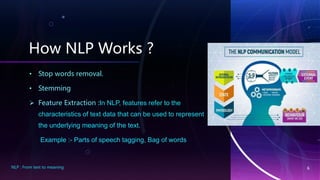
• Stop words removal.
• Stemming
 Feature Extraction :In NLP, features refer to the
characteristics of text data that can be used to represent
the underlying meaning of the text.
Example :- Parts of speech tagging, Bag of words
NLP : From text to meaning 6
How NLP Works ?
 Modelling : After data is preprocessed, it is fed into an
NLP architecture that models the data to accomplish a
variety of tasks.
It uses various algorithm like CNN , RNN , Decision tree
and so on.
NLP : From text to meaning 7
Top NLP Models
 Eliza was developed in the mid-1960s to try to solve the Turing Test; that
is, to fool people into thinking they’re conversing with another human being
rather than a machine. Eliza used pattern matching and a series of rules
without encoding the context of the language.
 Tay was a chatbot that Microsoft launched in 2016. It was supposed to
tweet like a teen and learn from conversations with real users on Twitter.
 Generative Pre-Trained Transformer 3 (GPT-3) is a 175 billion parameter
model that can write original prose with human-equivalent fluency in
response to an input prompt. The model is based on the transformer
architecture.
NLP : From text to meaning
8
Challenges
1.Ambiguity: Natural language is often ambiguous, and different people may
interpret the same sentence in different ways.
2.Contextual understanding: Language is heavily influenced by context, and
machines must be able to understand the context in which text is used in
order to accurately interpret its meaning.
3.Rare and complex language: Some languages and dialects are rare or
complex, making it difficult to develop NLP models that can accurately
analyze or generate text in those languages.
4.Idiomatic expressions :
NLP : From text to meaning
9
Challenges
1.Ambiguity: Natural language is often ambiguous, and different people may
interpret the same sentence in different ways.
2.Contextual understanding: Language is heavily influenced by context, and
machines must be able to understand the context in which text is used in
order to accurately interpret its meaning.
3.Rare and complex language: Some languages and dialects are rare or
complex, making it difficult to develop NLP models that can accurately
analyze or generate text in those languages.
4.Idiomatic expressions :
NLP : From text to meaning
10
THANK YOU
REFERENCES :
• https://www.deeplearning.ai/resourc
es/natural-language-processing/
• https://skills.yourlearning.ibm.com/a
bout/welcome/
• https://swayam.gov.in/nc_details/NP
TEL
NLP : From text to meaning
11

NLP.pptx

  • 1.
    N L P Fr o m T e x t t o M e a n i n g Rudra Pras anna Mis hra
  • 2.
    What is NLP NaturalLanguage Processing (NLP) is an interdisciplinary subfield of linguistics, computer science, and artificial intelligence concerned with the interactions between computers and human language Natural Language Processing (NLP) is one of the hottest areas of artificial intelligence (AI) thanks to applications like text generators that compose coherent essays, chatbots that fool people into thinking they’re sentient, and text-to-image programs that produce photorealistic images of anything you can describe NLP : From text to meaning 2
  • 3.
    Why NLP ? Efficient communication.  Large-scale analysis of text data.  Language translation.  Sentiment Analysis.  Speech recognition.  Toxicity classification.  Text generation. NLP : From text to meaning 3
  • 4.
    From the Beginning NLP has its roots in the 1950s and 1960s. Traditionally NLP module was made using Supervised Learning algorithm like Logistic regression and Naive Bayes.  In the 1990s, statistical approaches to NLP began to emerge, which used machine learning algorithms as Decision Trees to analyze large amounts of text data and identify patterns in language . It was time Speech recognition and machine translation came to light.  In the 2000s and 2010s, the field of NLP continued to advance with the development of deep learning techniques, which use neural networks to analyze language data. These techniques have been used to develop powerful language models. NLP : From text to meaning 4
  • 5.
    How NLP Works?  NLP models work by finding relationships between the constituent parts of language — for example, the letters, words, and sentences found in a text dataset. NLP architectures use various methods for data preprocessing, feature extraction, and modeling.  Data preprocessing : • Sentence Segmentation. • Tokenization NLP : From text to meaning 5
  • 6.
    How NLP Works? • Stop words removal. • Stemming  Feature Extraction :In NLP, features refer to the characteristics of text data that can be used to represent the underlying meaning of the text. Example :- Parts of speech tagging, Bag of words NLP : From text to meaning 6
  • 7.
    How NLP Works?  Modelling : After data is preprocessed, it is fed into an NLP architecture that models the data to accomplish a variety of tasks. It uses various algorithm like CNN , RNN , Decision tree and so on. NLP : From text to meaning 7
  • 8.
    Top NLP Models Eliza was developed in the mid-1960s to try to solve the Turing Test; that is, to fool people into thinking they’re conversing with another human being rather than a machine. Eliza used pattern matching and a series of rules without encoding the context of the language.  Tay was a chatbot that Microsoft launched in 2016. It was supposed to tweet like a teen and learn from conversations with real users on Twitter.  Generative Pre-Trained Transformer 3 (GPT-3) is a 175 billion parameter model that can write original prose with human-equivalent fluency in response to an input prompt. The model is based on the transformer architecture. NLP : From text to meaning 8
  • 9.
    Challenges 1.Ambiguity: Natural languageis often ambiguous, and different people may interpret the same sentence in different ways. 2.Contextual understanding: Language is heavily influenced by context, and machines must be able to understand the context in which text is used in order to accurately interpret its meaning. 3.Rare and complex language: Some languages and dialects are rare or complex, making it difficult to develop NLP models that can accurately analyze or generate text in those languages. 4.Idiomatic expressions : NLP : From text to meaning 9
  • 10.
    Challenges 1.Ambiguity: Natural languageis often ambiguous, and different people may interpret the same sentence in different ways. 2.Contextual understanding: Language is heavily influenced by context, and machines must be able to understand the context in which text is used in order to accurately interpret its meaning. 3.Rare and complex language: Some languages and dialects are rare or complex, making it difficult to develop NLP models that can accurately analyze or generate text in those languages. 4.Idiomatic expressions : NLP : From text to meaning 10
  • 11.
    THANK YOU REFERENCES : •https://www.deeplearning.ai/resourc es/natural-language-processing/ • https://skills.yourlearning.ibm.com/a bout/welcome/ • https://swayam.gov.in/nc_details/NP TEL NLP : From text to meaning 11