SURYAPET-508213
TECHNICAL SEMINAR ON
NATURAL LANGUAGE
PROCESSING
BY:
G.SAI VINAY
20631A0544
CO-ORDINATOR:
Dr. P.RATHAIAH MTech , PHD
ASST PROFESSOR , CSE
Content
Introduction to NLP
History of NLP
NLP Components
Application of NLP
Challenges in NLP
Technologies and Techniques
NLP Tools and Libraries
Future of NLP
Conclusion
Introduction to NLP
• Natural Language Processing (NLP) is a branch of artificial Intelligence that
studies the interaction between computers and humans using the natural
language.
• It enables computers to read, interpret, and generate text, making it possible for
machines to communicate with us in a way that feels natural.
• It's all about bridging the gap between human language and computer systems,
making interactions between humans and machines more seamless and efficient.
History of NLP
 NLP originated in the 1950s.
 It evolved from rule-based systems in the
1980s to deep learning models (BERT, GPT)
in the 2010s.
 The 2020s brought advanced Transformer
models and heightened ethical concerns
about AI, influencing its rapid development
and applications across various fields.
NLP Components
Text Preprocessing:
•This component involves tasks like tokenization, lowercasing, and removing
punctuation, stop words, and HTML tags. Text preprocessing helps standardize and
clean the input text for analysis.
Tokenization:
•Tokenization is the process of splitting text into individual words, phrases, or subworld
units (subworld tokenization is common in languages like English and Chinese). Tokens
serve as the basic units for NLP tasks.
Part-of-Speech Tagging (POS):
•POS tagging assigns grammatical categories (e.g., noun, verb, adjective) to each token
in a sentence. It is crucial for understanding the syntactic structure of text.
Named Entity Recognition (NER):
•NER identifies and categorizes entities in text, such as names of people, places,
organizations, dates, and more. It's essential for information extraction and entity linking.
NLP Components
Sentiment Analysis:
•Sentiment analysis determines the emotional tone of text, categorizing it as positive,
negative, or neutral. It's useful for analyzing customer feedback and social media
sentiment.
Machine Translation:
•Machine translation involves translating text from one language to another. It relies
on NLP models and alignment techniques to produce accurate translations.
Speech Recognition (ASR - Automatic Speech Recognition):
•ASR is closely related to NLP. It converts spoken language into text and is essential
for voice assistants and transcription services.
Text Generation:
•Text generation systems use NLP models to generate human-like text. This is
applicable to chatbots, content generation, and creative writing.
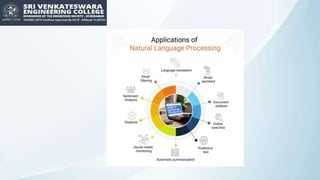
Applications of NLP
• Language Translation: NLP models like Google Translate enable real-time language
translation. This is invaluable for global communication and breaking down language barriers.
• Smart assistants: We have advanced enough technology to have smart assistants, such as Siri, Alexa,
and Cortana. We can talk to them like we talk to normal human beings, and they even respond to us in
the same way.
• Document analysis :Another one of NLP’s applications is document analysis. Companies, colleges,
schools, and other such places are always filled to the brim with data, which needs to be sorted out
properly, maintained, and searched for.
• Online searches: It is again Natural Language Processing. It helps search engines understand what is
asked of them by comprehending the literal meaning of words and the intent behind writing that word,
word, hence giving us the results, we want.
• Predictive text: It is something we use whenever we type anything on our smartphones. Whenever we
type a few letters on the screen, the keyboard gives us suggestions about what that word might be and
and when we have written a few words, it starts suggesting what the next word could be.
• Automatic summarization: NLP has a solution for that, too, it can not only summarize the meaning of
information, but it can also understand the emotional meaning hidden in the information. Thus, making
the summarization process quick and impeccable.
• Social media monitoring: NLP comes into play here. It enables the computer system to understand
unstructured social media data, analyze it and produce the required results in a valuable form for
companies.
• Chatbots which can understand consumers question, recommend them products, book meetings and
schedule appointments.
• Sentiment Analysis used by companies like Amazon, Netflix to gain insights on their customer to
enhance their products.
• Email filtering:Natural Language Processing comes to work, It identifies and filters incoming emails
into “important” or “spam” and places them into their respective designations.
Applications of NLP
Challenges in NLP
• Ambiguity:
Resolving word and phrase ambiguity accurately.
• Context Understanding:
Interpreting language within context.
• Named Entity Recognition:
Identifying entities in text.
• Coreference Resolution:
Handling pronoun references.
• Language Variation:
Managing dialect and language differences.
• Sarcasm and Irony:
Detecting figurative language.
• Data Bias:
Mitigating bias in training data.
• Privacy and Ethics:
Addressing ethical concerns.
• Scalability:
Handling large-scale models.
• Interpretability:
Explaining model decisions.
Challenges in NLP
Technologies and Techniques
 Text Classification: Categorizing text data into predefined categories (e.g.,
sentiment analysis, topic classification).
 Named Entity Recognition (NER): Identifying and categorizing named entities
(e.g., names, locations) in text.
 Machine Translation: Translating text between different languages to aid
communication.
 Chatbots and Virtual Assistants: Developing conversational AI systems to
provide information and support.
 Information Retrieval: Extracting relevant information from large textual
datasets.
 Sentiment Analysis: Analysing the emotional tone or sentiment expressed in
text.
NLP Tools and Libraries
• NLTK (Natural Language Toolkit): It offers a complete set of programs and modules to
analyze data in the form of statistical and symbolic analysis using Python. It is one of the
most important tools in NLP.
• spaCy: spaCy is a fast and efficient NLP library for Python. It is known for its speed and
accuracy and offers features like tokenization, part-of-speech tagging, named entity
recognition, dependency parsing, and word vectors.
• Transformers (Hugging Face): Transformers is a popular library for working with state-of-
the-art models in NLP, including BERT, GPT-2, and many others. It simplifies the process of
using pre-trained models for tasks like text classification, text generation, and named entity
recognition.
• GPT-3: A very trendy tool created by open AI that helps auto-completing and auto-
generating the sentence on its own which is vividly used in the aspect of text prediction.
Future of NLP
• Multimodal NLP: Future NLP models will increasingly handle not only text but also other
modalities like images, audio, and video. This will enable more comprehensive and
context-aware understanding of content.
• AI-Generated Content: NLP models will be used to generate high-quality content for
various purposes, including news articles, marketing materials, and creative writing.
• Ethical AI in NLP Ethical considerations in Natural Language Processing (NLP) and AI
are of utmost importance, given the growing impact of AI systems on society and
individuals.
• Integration with other AI fields: Integration with other AI fields is a natural progression
in the development of Artificial Intelligence (AI) technologies, including Natural Language
Processing (NLP). Collaboration and integration across AI domains can lead to more
powerful and versatile AI systems.
Conclusion
• Natural Language Processing (NLP) is a dynamic field of artificial intelligence that
empowers machines to understand, process, and generate human language.
• Its applications span across industries, from chatbots and language translation to
sentiment analysis and content generation.
• NLP's potential is boundless, promising more intuitive interactions between humans
and technology.
• However, ethical considerations, including bias mitigation and privacy, are
paramount to ensure responsible NLP development and deployment.
• NLP's future holds the key to advancing communication, decision-making, and
accessibility for all.

NATURAL LANGUAGE PROCESSING.pptx

  • 1.
    SURYAPET-508213 TECHNICAL SEMINAR ON NATURALLANGUAGE PROCESSING BY: G.SAI VINAY 20631A0544 CO-ORDINATOR: Dr. P.RATHAIAH MTech , PHD ASST PROFESSOR , CSE
  • 2.
    Content Introduction to NLP Historyof NLP NLP Components Application of NLP Challenges in NLP Technologies and Techniques NLP Tools and Libraries Future of NLP Conclusion
  • 3.
    Introduction to NLP •Natural Language Processing (NLP) is a branch of artificial Intelligence that studies the interaction between computers and humans using the natural language. • It enables computers to read, interpret, and generate text, making it possible for machines to communicate with us in a way that feels natural. • It's all about bridging the gap between human language and computer systems, making interactions between humans and machines more seamless and efficient.
  • 4.
    History of NLP NLP originated in the 1950s.  It evolved from rule-based systems in the 1980s to deep learning models (BERT, GPT) in the 2010s.  The 2020s brought advanced Transformer models and heightened ethical concerns about AI, influencing its rapid development and applications across various fields.
  • 5.
    NLP Components Text Preprocessing: •Thiscomponent involves tasks like tokenization, lowercasing, and removing punctuation, stop words, and HTML tags. Text preprocessing helps standardize and clean the input text for analysis. Tokenization: •Tokenization is the process of splitting text into individual words, phrases, or subworld units (subworld tokenization is common in languages like English and Chinese). Tokens serve as the basic units for NLP tasks. Part-of-Speech Tagging (POS): •POS tagging assigns grammatical categories (e.g., noun, verb, adjective) to each token in a sentence. It is crucial for understanding the syntactic structure of text. Named Entity Recognition (NER): •NER identifies and categorizes entities in text, such as names of people, places, organizations, dates, and more. It's essential for information extraction and entity linking.
  • 6.
    NLP Components Sentiment Analysis: •Sentimentanalysis determines the emotional tone of text, categorizing it as positive, negative, or neutral. It's useful for analyzing customer feedback and social media sentiment. Machine Translation: •Machine translation involves translating text from one language to another. It relies on NLP models and alignment techniques to produce accurate translations. Speech Recognition (ASR - Automatic Speech Recognition): •ASR is closely related to NLP. It converts spoken language into text and is essential for voice assistants and transcription services. Text Generation: •Text generation systems use NLP models to generate human-like text. This is applicable to chatbots, content generation, and creative writing.
  • 8.
    Applications of NLP •Language Translation: NLP models like Google Translate enable real-time language translation. This is invaluable for global communication and breaking down language barriers. • Smart assistants: We have advanced enough technology to have smart assistants, such as Siri, Alexa, and Cortana. We can talk to them like we talk to normal human beings, and they even respond to us in the same way. • Document analysis :Another one of NLP’s applications is document analysis. Companies, colleges, schools, and other such places are always filled to the brim with data, which needs to be sorted out properly, maintained, and searched for. • Online searches: It is again Natural Language Processing. It helps search engines understand what is asked of them by comprehending the literal meaning of words and the intent behind writing that word, word, hence giving us the results, we want. • Predictive text: It is something we use whenever we type anything on our smartphones. Whenever we type a few letters on the screen, the keyboard gives us suggestions about what that word might be and and when we have written a few words, it starts suggesting what the next word could be.
  • 9.
    • Automatic summarization:NLP has a solution for that, too, it can not only summarize the meaning of information, but it can also understand the emotional meaning hidden in the information. Thus, making the summarization process quick and impeccable. • Social media monitoring: NLP comes into play here. It enables the computer system to understand unstructured social media data, analyze it and produce the required results in a valuable form for companies. • Chatbots which can understand consumers question, recommend them products, book meetings and schedule appointments. • Sentiment Analysis used by companies like Amazon, Netflix to gain insights on their customer to enhance their products. • Email filtering:Natural Language Processing comes to work, It identifies and filters incoming emails into “important” or “spam” and places them into their respective designations. Applications of NLP
  • 10.
    Challenges in NLP •Ambiguity: Resolving word and phrase ambiguity accurately. • Context Understanding: Interpreting language within context. • Named Entity Recognition: Identifying entities in text. • Coreference Resolution: Handling pronoun references. • Language Variation: Managing dialect and language differences.
  • 11.
    • Sarcasm andIrony: Detecting figurative language. • Data Bias: Mitigating bias in training data. • Privacy and Ethics: Addressing ethical concerns. • Scalability: Handling large-scale models. • Interpretability: Explaining model decisions. Challenges in NLP
  • 12.
    Technologies and Techniques Text Classification: Categorizing text data into predefined categories (e.g., sentiment analysis, topic classification).  Named Entity Recognition (NER): Identifying and categorizing named entities (e.g., names, locations) in text.  Machine Translation: Translating text between different languages to aid communication.  Chatbots and Virtual Assistants: Developing conversational AI systems to provide information and support.  Information Retrieval: Extracting relevant information from large textual datasets.  Sentiment Analysis: Analysing the emotional tone or sentiment expressed in text.
  • 13.
    NLP Tools andLibraries • NLTK (Natural Language Toolkit): It offers a complete set of programs and modules to analyze data in the form of statistical and symbolic analysis using Python. It is one of the most important tools in NLP. • spaCy: spaCy is a fast and efficient NLP library for Python. It is known for its speed and accuracy and offers features like tokenization, part-of-speech tagging, named entity recognition, dependency parsing, and word vectors. • Transformers (Hugging Face): Transformers is a popular library for working with state-of- the-art models in NLP, including BERT, GPT-2, and many others. It simplifies the process of using pre-trained models for tasks like text classification, text generation, and named entity recognition. • GPT-3: A very trendy tool created by open AI that helps auto-completing and auto- generating the sentence on its own which is vividly used in the aspect of text prediction.
  • 14.
    Future of NLP •Multimodal NLP: Future NLP models will increasingly handle not only text but also other modalities like images, audio, and video. This will enable more comprehensive and context-aware understanding of content. • AI-Generated Content: NLP models will be used to generate high-quality content for various purposes, including news articles, marketing materials, and creative writing. • Ethical AI in NLP Ethical considerations in Natural Language Processing (NLP) and AI are of utmost importance, given the growing impact of AI systems on society and individuals. • Integration with other AI fields: Integration with other AI fields is a natural progression in the development of Artificial Intelligence (AI) technologies, including Natural Language Processing (NLP). Collaboration and integration across AI domains can lead to more powerful and versatile AI systems.
  • 15.
    Conclusion • Natural LanguageProcessing (NLP) is a dynamic field of artificial intelligence that empowers machines to understand, process, and generate human language. • Its applications span across industries, from chatbots and language translation to sentiment analysis and content generation. • NLP's potential is boundless, promising more intuitive interactions between humans and technology. • However, ethical considerations, including bias mitigation and privacy, are paramount to ensure responsible NLP development and deployment. • NLP's future holds the key to advancing communication, decision-making, and accessibility for all.