
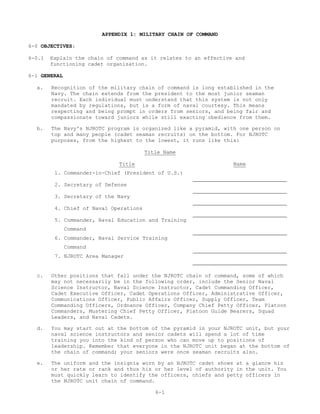



A FIELD MANUAL

       FOR THE

 NAVY JUNIOR RESERVE
OFFICERS TRAINING CORPS
      (NJROTC)


CADET FIELD MANUAL
  (8th Edition)
    NAVEDTRA 37116-H


     JUNE 2010
 0509-LP-110-2131
RECORD OF CHANGES


Change No.   Date of Change   Date of Entry        Signature


                                       ii
NAVAL JUNIOR RESERVE OFFICERS TRAINING CORPS

                                   CADET FIELD MANUAL


                                   TABLE OF CONTENTS

Preface......................................................................... iiv
Acknowledgments................................................................... v
Core Values of NJROTC............................................................ vi
CHAPTER 1: NJROTC UNIFORM REGULATIONS........................................... 1-1
      1-1   The Uniform........................................................... 1-1
      1-2   General............................................................... 1-1
      1-3   The Wearing Of The Uniform............................................ 1-2
      1-4   Personal Appearance and Grooming...................................... 1-2
             a. Men .............................................................. 1-2
             b. Women ............................................................ 1-4
      1-5   Uniform Composition................................................... 1-6
             a. Male Uniforms .................................................... 1-6
             b. Female Uniforms .................................................. 1-8
             a. Uniform Appearance, Cleanliness and Maintenance .................. 1-8
             b. Uniform Composition ............................................. 1-11
                1. Males ....................................................... 1-11
                    a. Navy Service............................................. 1-11
                    a. Service Dress Blue....................................... 1-13
                    a. Working Khaki............................................ 1-15
                2. Females ..................................................... 1-17
                    a. Navy Service............................................. 1-17
                    a. Service Dress Blue....................................... 1-19
                    a. Working Khaki............................................ 1-21
      1-6   Male Necktie, Black.................................................. 1-23 
      1-7   NJROTC Uniform Insignia and Devices.................................. 1-24 
      1-8   Awards and Decorations............................................... 1-27 
CHAPTER 2: NJROTC RATES/RANKS AND U.S. NAVY RATES/RANKS......................... 2-1
      2-1 NJROTC Rates, Ranks, and Assignments.................................. 2-1
      2-2 Navy Rates and Ranks.................................................. 2-4
CHAPTER 3: MILITARY CUSTOMS, COURTESIES, ETIQUETTE AND CEREMONIES............... 3-1
      3-1   General............................................................... 3-1
      3-2   The American Flag and Flag Etiquette.................................. 3-1
      3-3   Flag Courtesies....................................................... 3-3
      3-5   Ceremonies............................................................ 3-5
      3-6   Reviews............................................................... 3-6
      3-7   Street Parades....................................................... 3-11
CHAPTER 4: PERSONNEL INSPECTION................................................. 4-1
      4-1   General............................................................... 4-1
      4-2   Forming for Inspection................................................ 4-1
      4-3   Inspecting Officer’s Tour............................................. 4-2
      4-4   Inspection Guidelines................................................. 4-3
CHAPTER 5: REQUIREMENTS FOR THE NJROTC PHYSICAL FITNESS RIBBON.................. 5-1
      5-1 Introduction ......................................................... 5-1
APPENDIX 1: MILITARY CHAIN OF COMMAND........................................... 6-1
APPENDIX 2: ORDERS TO THE SENTRY................................................ 7-1
APPENDIX 3: MARINE CORPS RATES AND RANKS........................................ 8-1

                                          iii
PREFACE

The purpose of the "NJROTC CADET FIELD AND DRILL MANUAL" is to combine all the
information on military drill ceremonies and uniform regulations into one
distinguishable text. You may come to think of this Field Manual as the "guide" for
the military aspects of your association with the NJROTC Program. This manual is
based on current Naval Service Training Command (NSTC) Instructions. In the event
there is a difference, the most current NSTC 1533.9 publication will apply.

The reasons why military drill specifically is important for you to learn during
your time in the NJROTC are very basic. If you keep them in mind during your drill
and parade activities, these reasons will become a part of you whether you are the
leader or the follower. Here are the purposes of military drill:

   1. To enable a leader to move his/her unit from one place to another in a
      standard and orderly manner.

   2. To teach discipline by instilling habits of precision and automatic response
      to orders.

   3. To increase the confidence of cadets through the exercise of command, and by
      giving proper commands, and by the control of drilling cadets.

   4. To give cadets an opportunity to handle drill rifles.

The uniform regulations chapter of this manual is important. From this chapter you
will learn the importance of attention to detail.

While enrolled in the NJROTC program, you will be instructed and drilled in all
applicable safety precautions and procedures. Your naval science instructor will
maintain situational awareness, and ensure that safe practices are complied with at
all times during your training in NJROTC activities. An immediate "Training Time
Out" (TTO), shall be called whenever you or your naval science instructor
experiences apprehension concerning training safety. The TTO is explained in the
military drill chapter on page DM-1.

Note: When used in this publication, the terms "HE," "HIM," "HIS," and "MEN"
      represent both the masculine and feminine gender unless otherwise
      stated.


                                         iv
ACKNOWLEDGMENTS

We wish to express appreciation to several individuals who contributed to the
successful completion of this manual. Thanks are due to the members of the NJROTC
Curriculum Advisory Committee, a select group of naval science instructors who
represent the 11 NJROTC geographical areas in the United States. Considerable time,
attention to detail, and enthusiastic support came from these individuals.
Likewise, a number of other naval science instructors in the program provided
additional assistance, contributions, and many suggestions with respect to this
effort.


                                         v
THE CORE VALUES OF THE NAVY JUNIOR RESERVE OFFICERS TRAINING CORPS

As a member of the NJROTC, we are dedicated to the Core Values   of HONOR, COURAGE
and COMMITMENT to build the foundation of trust and leadership   upon which our
NJROTC unit is based. These are the principles which will give   us strength and
guide us in our daily activities; we will be faithful to these   Core Values as our
abiding duty and privilege.

     *      *     *     *     *     *     *     *     *     *      *     *

     I AM ACCOUNTABLE FOR MY PERSONAL BEHAVIOR. I WILL BE MINDFUL OF THE
     PRIVILEGE I HAVE TO SERVE MY FELLOW NJROTC CADETS AND CLASSMATES.

HONOR; "I will bear true faith and allegiance...." Accordingly we will: Conduct
ourselves in the highest ethical manner in all relationships with peers,
superiors and subordinates; Be honest and truthful in our dealings with each
other, and with those outside of NJROTC; Be willing to make honest
recommendations and to accept those of junior personnel; Encourage new ideas and
deliver the bad news, even when it is unpopular; Abide by an uncompromising code
of integrity, taking responsibility for our actions and keeping our word; Fulfill
or exceed our legal and ethical responsibilities in our public and personal lives
twenty-four hours a day. Illegal or improper behavior or even the appearance of
such behavior will not be tolerated. We are accountable for our school,
classroom, and personal behavior.


     COURAGE IS THE VALUE THAT GIVES ME THE MORAL AND MENTAL STRENGTH TO DO
     WHAT IS RIGHT, WITH CONFIDENCE AND RESOLUTION, EVEN IN THE FACE OF
     TEMPTATION OR PERSONAL ADVERSITY.

COURAGE; "I will support and defend...." Accordingly, we will: Have the courage
to meet the demands of our NJROTC unit when it is demanding, or otherwise
difficult; Make decisions in the best interests of the NJROTC unit and the
school, without regard to personal consequences; Meet these challenges while
adhering to a high standard of personal conduct and decency; Be loyal to our
NJROTC unit and our fellow cadets and classmates ensuring the resources
entrusted to us are used in an honest, careful, and efficient way.


      THE DAY-TO-DAY DUTY OF EVERY MAN AND WOMAN IN THE NJROTC PROGRAM IS TO
      JOIN TOGETHER AS A TEAM TO IMPROVE THE QUALITY OF OUR UNIT, OUR FELLOW
      CADETS AND CLASSMATES, AND OURSELVES.

 COMMITMENT; "I will obey the orders...." Accordingly, we will: Demand respect up
 and down the chain of command, care for the safety, professional, personal and
 spiritual well-being of our fellow cadets and classmates; Show respect toward all
 individuals without regard to race, religion, or gender; Treat each person with
 human dignity; Be committed to positive change and constant improvement; Exhibit
 the highest degree of moral character, technical excellence, quality and
 competence in what we have been entrusted to do.


 These are the CORE VALUES of the Navy and the Naval Junior Reserve Officers
 Training Corps.


                                         vi
CHAPTER 1: NJROTC UNIFORM REGULATIONS

1-1 THE UNIFORM
   a. The Navy Junior Reserve Officers Training Corps is one of the uniformed JROTC
      programs. The uniform is an important element in the morale, pride,
      discipline and effectiveness of the NJROTC program in your school. It is
      important for NJROTC cadets to maintain a high standard of dress and personal
      appearance. The key elements are neatness, cleanliness, safety and military
      image. The purpose of this section in the Cadet Field Manual is to acquaint
      you with the wearing of the Navy Junior Reserve Officer Training Corps
      uniform.

   b. The military uniform is a symbol of the nation's defense forces. It projects
      an image of devotion to duty in the service of one's country. The word
      "uniform" comes from a combination of two Latin words, unus and forma, which
      means "one form." Thus the word "uniform" suggests a distinctive mode of
      dress. In ancient times military dress acquired a certain degree of sameness,
      but in a much different design from the modern military uniforms. They were,
      nevertheless, military uniforms in the sense that all the soldiers looked
      alike. To this extent we assign the origin of the military uniform to an
      early date in western civilization.

   c. The uniform worn by the Navy Junior ROTC cadets is the same, with certain
      exceptions, as that worn by active duty Navy personnel. Cadets do not wear
      commissioned officer rank insignia or sleeve braid. Uniform articles must not
      be worn with other civilian clothing nor should they be loaned to other
      classmates who are not members of the Navy Junior ROTC program. You are
      obligated to wear the uniform properly and proudly, and in doing so, you
      uphold the dignity of the Navy, your NJROTC unit, fellow cadets, and
      yourself.

1-2 GENERAL
  a. Smartness. Wearing the Navy uniform should be a matter of personal pride to
     all NJROTC Cadets. Your dress and conduct shall be such as to reflect credit
     upon your NJROTC unit, your school, your community, the Navy and your
     country. Caps shall be worn squarely on the head, with the bottom edge
     horizontal. Shoes shall be kept well-shined and in good repair. No articles,
     such as pencils, pens, watch chains, jewelry, combs, or similar items shall
     be worn exposed when in uniform.

   b. Care of the Uniform. The maximum service life of the various uniform articles
      can only be attained by proper care and maintenance. No matter how well-
      fitting your uniform is when new, it will not continue to look its best or
      keep its shape unless it is carefully pressed and worn properly. By carrying
      large or heavy objects in the pockets, you can rapidly destroy the shape of
      the best uniform made. You should always hang the uniforms on a hanger when
      not in use. Many items must be dry cleaned instead of washed. Be careful not
      to damage clothing through improper care. Uniforms shall be kept clean, neat
      and in good repair. Insignia and devices shall be bright and free from
      tarnish and corrosion.

   c. Uniform of the Day. The uniform of the day is the uniform your naval science
      instructor (NSI) will direct you to wear on any given day. The uniform color,
      Navy blue, is actually black in appearance. The Service Dress Blue uniform
      (officers and chiefs) and the Working Khaki uniform (enlisted) is the uniform
      you may be directed to wear year-round in the cooler climates. In the warmer
      climates, you may be directed to wear the Service uniform year-round.


                                        1-1
The only uniforms authorized for cadet wear are those described in this
        manual and available through the current issue of the NJROTC Supply Manual
        (NSM) NAVEDTRA 37123B. The most updated uniform listing is in JUMS.


1-3 THE WEARING OF THE UNIFORM
   a. The NJROTC uniform will be worn by all cadets at least one full school day
      each week and on other occasions as prescribed by your naval science
      instructor (drills, ceremonies, and parades). Certain modifications to NJROTC
      uniforms may be authorized for drill teams and performing units. Such items
      include leggings, ascots, berets, and guard helmets. However, modifications
      to cadet uniforms must be approved by the area manager in advance. When
      appropriate, the wearing of reflective gear such as armbands, vests and
      sashes are authorized. The wearing of uniform articles of sister services
      with the NJROTC uniform are not authorized.

   b. The combination cap (optional for officers and chiefs)
      or the garrison cap (enlisted) is a required part of
      your NJROTC uniform. When outdoors, you shall be covered at all times except
      when ordered to uncover, or during religious services which are not
      associated with a military ceremony. While the cap is not normally worn
      indoors, it is required while on official duty when wearing a guard belt
      and/or leggings.

   c. Cadets are to be in a complete uniform and in compliance with the uniform
      standards described in this manual anytime they are in uniform. The wearing
      of partial or incomplete uniforms so that the uniform can be "preserved" for
      inspection is not permitted. Cadets will meet uniform standards whether they
      are standing an NJROTC inspection or attending other school classes in
      uniform.

   d. Uniforms for special occasions such as a field day shall be prescribed by the
      naval science instructor. All cadets participating at field meets will either
      be in the complete NJROTC uniform prescribed for the meet, or a complete
      athletic uniform.

   e. Uniformed cadets may not participate during or in connection with political
      activities, private employment, or commercial interests, that imply official
      sponsorship of the activity or interest, or at any other occasion when the
      wearing of the uniform would discredit the NJROTC program or the Navy.

   f. You may be required to wear a name tag at the discretion of your NSI. When
      worn, it shall be positioned on the right side of the uniform aligned and
      positioned opposite to the ribbons on the left side. The bottom of the name
      tag will be aligned with the bottom row of ribbons. Refer to the
      illustrations in this chapter beginning on page 1-11.

1-4 PERSONAL APPEARANCE AND GROOMING
MEN

Hair:            Neat, clean, trimmed and present a well-groomed appearance. Above
                 the ears and around the neck: must be tapered upwards 3/4-inch and
                 outwards not greater than 3/4-inch. Must not touch the collar. No
                 longer than 4 inches and the bulk shall not exceed 2 inches. (In no
                 case shall the bulk or length of your hair interfere with the
                 proper wearing of your cap. Bulk is defined as the distance that
                 the mass of the hair protrudes from the scalp as indicated by the -
                 - - - - - line in the drawing on the next page). One narrow part in
                 the hair is authorized. This may be cut, clipped, or shaved.
                                          1-2
Plaited or braided hair is unauthorized. Hair may not show under
               the front brim of any uniform cap. Below are examples of male
               haircuts which conform to NJROTC regulations.


Note: Ethnic hairstyles are permitted provided they are groomed to fit within the
guidelines stated above. Bizarre hairstyles and faddish or outrageous multicolor
hair are unauthorized.

                             GROOMING STANDARDS FOR MEN


Sideburns:            Neatly trimmed and tailored as described above. Shall not
                      extend below a point level with the middle of the ear, as
                      indicated by line "A", and shall be of even width (not
                      flared). Shall end with a clean shaven horizontal line.

Mustaches:            Neat and closely trimmed. No portion shall extend below the
                      upper lip line as indicated by line "D". Shall not be below
                      the horizontal line extending across the corners of the mouth
                      as indicated by line "B". Shall not be more than 1/4-inch
                      beyond a vertical line drawn upward from the corners of the
                      mouth as indicated by line "C". No other facial hair is
                      permitted.


                                        1-3
Fingernails:            Will not extend past the fingertips.

Earrings/Studs:         Not authorized in the ear, nose, eyebrows, tongue, lips, or
                        other areas of the face or body visible to the naval science
                        instructor.

Necklaces:              Authorized, but shall not be visible

Rings:                  One per hand is authorized.

Wristwatch/Bracelet:    One of each is authorized, but no ankle bracelets.

Sunglasses:             A conservative pair is permitted when authorized by the naval
                        science instructor. Sunglasses are never authorized in
                        military formations. Retainer straps are not authorized.


 WOMEN

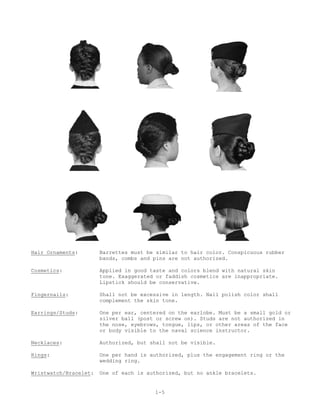
   Hair:     Clean, neatly shaped, and presents a well-groomed appearance. Lopsided
             and extremely asymmetrical haircuts and hair styles are not authorized.
             Braids, if worn, must be neatly and inconspicuously secured at all
             points to the head, and may not dangle free at any point. May touch, but
             cannot fall below the horizontal line level with the lower edge of the
             back of the collar as indicated by line "A" in the drawing below. Must
             not show under the front brim of any cap. The bulk of the hair shall not
             exceed approximately 2 inches, nor interfere with the proper wearing of
             your cap.


                             GROOMING STANDARDS FOR WOMEN


Note: Ethnic hairstyles are permitted provided they are groomed to fit within the
guidelines stated above. Bizarre hairstyles and faddish or outrageous multicolor
hair are unauthorized. Below are examples of female hair styles which conform to
NJROTC regulations.

                                          1-4
Hair Ornaments:        Barrettes must be similar to hair color. Conspicuous rubber
                       bands, combs and pins are not authorized.

Cosmetics:             Applied in good taste and colors blend with natural skin
                       tone. Exaggerated or faddish cosmetics are inappropriate.
                       Lipstick should be conservative.

Fingernails:           Shall not be excessive in length. Nail polish color shall
                       complement the skin tone.

Earrings/Studs:        One per ear, centered on the earlobe. Must be a small gold or
                       silver ball (post or screw on). Studs are not authorized in
                       the nose, eyebrows, tongue, lips, or other areas of the face
                       or body visible to the naval science instructor.

Necklaces:             Authorized, but shall not be visible.

Rings:                 One per hand is authorized, plus the engagement ring or the
                       wedding ring.

Wristwatch/Bracelet:   One of each is authorized, but no ankle bracelets.


                                        1-5
Sunglasses:             A conservative pair is permitted when authorized by the naval
                        science instructor. Sunglasses are never authorized in
                        military formations. Retainer straps are not authorized.

NOTE: Personal appearance such as the wearing of lip rings, tongue and nose studs,
belly rings and other types of bizarre body jewelry, for both males and females
when out of uniform, will be determined by the local school or NJROTC student dress
codes.

1-5 UNIFORM COMPOSITION
a. Male Uniforms. Listed here are the uniforms and items you will wear with the
   uniform. These uniforms shall be worn when prescribed by your NSI.

   1.   a.    Officers and chiefs are authorized to wear the Service Dress
              Blue uniforms.

        b.    All other personnel are authorized to wear the Navy Service uniform.

        c.    All personnel of the color guard are authorized to wear the Service
              Dress Blue uniform only when performing.

   2.   The Working Khaki uniform is normally prescribed by the NSI to be worn when
        your uniform might get unduly soiled on field trips, sea cruises, or summer
        Leadership Academies and mini-boot camps. When traveling on a field trip to
        a warm weather base, the khaki uniform is approved for wear throughout the
        entire trip, but must be worn properly at all times. Ribbons, medals, and
        cords are not authorized for wear with the khaki uniform.

   Note: The Working Khaki uniform is not authorized as a "Uniform Day" uniform.

   3.   The combination cap with white cover is authorized for wear by officers and
        chiefs only, and can be worn with Service Dress Blue uniforms. The white
        combination cap may be worn by the color guard when performing. The chin
        strap (gold for officers, black for chiefs) is adjusted to fit snugly
        against the cap. Chin strap buttons will be gold. Wear the black chin strap
        with the grommet to your left. The cap should be
        worn squarely on the head with the bottom edge
        parallel to and 1 and 1/2-inches above the
        eyebrows.

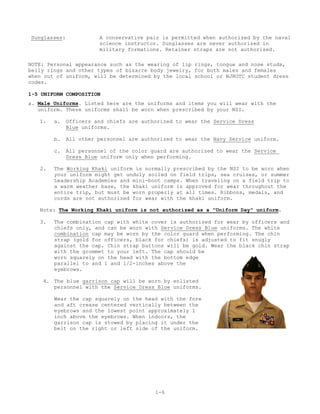
    4. The blue garrison cap will be worn by enlisted
       personnel with the Service Dress Blue uniforms.

        Wear the cap squarely on the head with the fore
        and aft crease centered vertically between the
        eyebrows and the lowest point approximately 1
        inch above the eyebrows. When indoors, the
        garrison cap is stowed by placing it under the
        belt on the right or left side of the uniform.


                                          1-6
5.   The khaki garrison cap or ball cap will be worn with the Working Khaki
     uniform by all personnel.

6.   A one-piece, black, hand-tied necktie will be worn when required. The tie
     will be knotted with either a four-in-hand, half windsor or windsor knot.
     Wear the top of the knot parallel to and slightly above the top of the
     shirt collar closure, hiding the shirt button. The bottom of the tie hangs
     within 1 inch of the top of the belt buckle. The tie does not cover the
     belt buckle.

7.   An optional tie tack/clasp can be worn with the uniform tie. This
     tack/clasp must be plain gold (the NJROTC bar may be used for this
     purpose), and aligned between the 3rd and 4th button from the neck.

8.   Shoes shall be Navy-style plain black leather, low quarter, lace style shoe
     with no stitching, decoration or seam across the toe. Shoes shall be laced
     inside out through all eyelets, and shall be well-shined. Poromeric (e.g.
     corfam) shoes are optional but might not be authorized to be worn when
     standing some inspections.

9.   Uniform socks shall be black plain knit or rib knit socks.

10. Plain white crew neck or V-neck tee shirts shall be worn with all uniforms.

11. Black gloves are authorized for outdoor wear as an optional item; however,
    they must be purchased by the wearer. Reimbursement is not authorized.

12. Peacoats or all-weather coats may be prescribed for wear in certain areas
    of the country. Gold buttons are worn on all peacoats. The NJROTC patch is
    not worn on the peacoat.

13. Watchcaps are authorized for wear with working
    uniforms as an optional item.

14. The black relaxed fit jacket may be worn with all
    uniforms except the Service Dress Blue uniform. The
    NJROTC patch is worn on the left shoulder with the
    top edge one inch below the shoulder seam. “When
    worn, all jackets and coats must be zipped at least
    3/4 of the way up.”

15. Ball caps are authorized with the Working Khaki
    uniforms as an optional item, as shown here. They
    can be of unit design, but in good taste. School
    colors are authorized.


                                     1-7
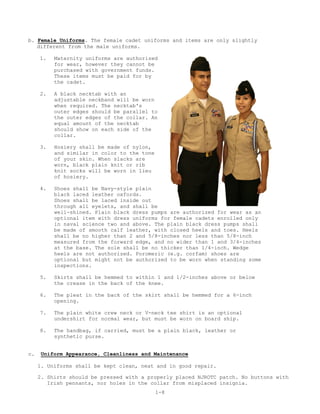
b. Female Uniforms. The female cadet uniforms and items are only slightly
   different from the male uniforms.

     1.   Maternity uniforms are authorized
          for wear, however they cannot be
          purchased with government funds.
          These items must be paid for by
          the cadet.

     2.   A black necktab with an
          adjustable neckband will be worn
          when required. The necktab's
          outer edges should be parallel to
          the outer edges of the collar. An
          equal amount of the necktab
          should show on each side of the
          collar.

     3.   Hosiery shall be made of nylon,
          and similar in color to the tone
          of your skin. When slacks are
          worn, black plain knit or rib
          knit socks will be worn in lieu
          of hosiery.

     4.   Shoes shall be Navy-style plain
          black laced leather oxfords.
          Shoes shall be laced inside out
          through all eyelets, and shall be
          well-shined. Plain black dress pumps are authorized for wear as an
          optional item with dress uniforms for female cadets enrolled only
          in naval science two and above. The plain black dress pumps shall
          be made of smooth calf leather, with closed heels and toes. Heels
          shall be no higher than 2 and 5/8-inches nor less than 5/8-inch
          measured from the forward edge, and no wider than 1 and 3/4-inches
          at the base. The sole shall be no thicker than 1/4-inch. Wedge
          heels are not authorized. Poromeric (e.g. corfam) shoes are
          optional but might not be authorized to be worn when standing some
          inspections.

     5.   Skirts shall be hemmed to within 1 and 1/2-inches above or below
          the crease in the back of the knee.

     6.   The pleat in the back of the skirt shall be hemmed for a 6-inch
          opening.

     7.   The plain white crew neck or V-neck tee shirt is an optional
          undershirt for normal wear, but must be worn on board ship.

     8.   The handbag, if carried, must be a plain black, leather or
          synthetic purse.


c.   Uniform Appearance, Cleanliness and Maintenance

     1. Uniforms shall be kept clean, neat and in good repair.

     2. Shirts should be pressed with a properly placed NJROTC patch. No buttons with
        Irish pennants, nor holes in the collar from misplaced insignia.
                                             1-8
3. Trousers and skirts should be pressed, well-fitting, proper length and no
   lint or stains visible.

4. Shoes should be highly polished in their entirety, not just the toe area.

5. Hats should be clean and well-fitting. Combination covers and chin straps
   should be tight. Eagles on the hat buttons should be in the upright position.

6. Insignia and devices shall be clean and bright and free from tarnish and
   corrosion. Metal polish such as Brasso will remove the plating and should not
   be used for cleaning purposes.

7. Brass buckles and belt tips should be shined with quartermaster removed.
   Polish residue in the slide area should be removed.

8. Gold buttons, which become tarnished, can be cleaned with vinegar, followed
   by a thorough washing in clean water.

9. The manufacturer's cleaning instructions should be followed for the cleaning
   and laundering of all uniforms:

  a. Service Dress Blue - Coat, trousers, skirt, and slacks are dry cleaned
     only. White shirt is laundered.

  b. Khaki - Shirt, trousers, and slacks are laundered and ironed.

  c. Combination cap cover is laundered.

  d. Black relaxed fit jacket is dry cleaned only.

  e. Care must be exercised when using bleach in the laundering of white
     articles. Chlorine bleach on white polyester fabric turns it yellow.

  f. Military creases on shirts for Navy Service, Service Dress, or Working
     Khaki uniforms are an individual option.


                                     1-9
This page to be used for personal grooming and uniform note-taking purposes.


______________________________________________________________________________

______________________________________________________________________________

______________________________________________________________________________

______________________________________________________________________________

______________________________________________________________________________

______________________________________________________________________________

______________________________________________________________________________

______________________________________________________________________________

______________________________________________________________________________

______________________________________________________________________________

______________________________________________________________________________

______________________________________________________________________________

______________________________________________________________________________

______________________________________________________________________________

______________________________________________________________________________

______________________________________________________________________________

______________________________________________________________________________

______________________________________________________________________________

______________________________________________________________________________

______________________________________________________________________________

______________________________________________________________________________

______________________________________________________________________________

______________________________________________________________________________

______________________________________________________________________________

______________________________________________________________________________

______________________________________________________________________________

______________________________________________________________________________

______________________________________________________________________________

                                     1-10
d. Uniform Composition.

1. Males:

   (a) NAVY SERVICE

        Basic Uniform Items:
        Awards............Ribbons/Medals/Cords
        Belt, brass tip...Black
        Buckle ...........Brass
        Cap, garrison.....Blue
        Coat..............None
        Necktie...........None
        Shirt, s/sleeve...Khaki
        Shoes.............Black
        Socks.............Black
        Trousers..........Blue
        Undershirt........White
            (V or crew-neck)


        Outerwear:
        All-weather coat
         V- Neck Sweater
        Black relaxed fit jacket


                                       1-11
MALE'S SHORT SLEEVE SERVICE SHIRT (Khaki)


                                           PO/CPO

The vertical axis of the rank/rate insignia and the vertical axis of the JROTC bar
insignia is positioned along an imaginary line bisecting the angle of the collar
point. The center of each insignia is 1 and 7/8ths of an inch from the collar
point. The diagram on the previous page shows the center of the insignia is
positioned at the point where 1-inch lines perpendicular to the front and lower
edges of the collar touch the imaginary line.

Service designation stars are worn 1/4-inch above the top row of ribbons. One
star is centered, and multiple stars are 1/4-inch apart.

Ribbons and name tag are worn parallel to the top of the shirt pocket, 1/4-inch
above and centered on the pocket button hole.

                              MALE'S BLUE GARRISON CAP


      SA/Seaman/P                    CPO                           Officer

The blue garrison cap is worn with the Service uniform.

The small fouled anchor is worn on   the garrison cap. The anchor is worn on the
wearer's left side of the cap. The   center of the anchor is bisected by a vertical
line 2 inches from the fore crease   of the garrison cap, and a horizontal line 1 and
1/2-inches from the bottom edge of   the cap.

Only officers and chiefs wear the rank/rate insignia on the garrison cap. It is
worn on the wearer's right side. The center of the rank/rate insignia is bisected
by a vertical line 2 inches from the fore crease of the garrison cap, and a
horizontal line 1 and 1/2-inches from the bottom edge of the cap.


                                            1-12
(b) SERVICE DRESS BLUE

  Basic Uniform Items:
  Awards............Ribbons/Medals/Cords
  Belt, brass tip...Black
  Buckle............Brass
  Cap, combination..White
  Coat..............Blue
  Necktie...........Black
  Shirt, l/sleeve...White
  Shoes.............Black
  Socks.............Black
  Trousers..........Blue
  Undershirt........White
  (V or crew-neck)

  Outerwear:
  Peacoat
  All-weather coat

  Optional Items:
  Cap, garrison.....Blue


                                 1-13
MALE'S SERVICE DRESS BLUE COAT (Officers/CPOs)


            Chief Petty Officer                         Officer

The JROTC bar and rank/rate insignias for the male's Service Dress Blue coat are
positioned on the collar 1/2-inch above the notch in the lapel. The vertical axis
of each insignia is parallel to, and centered between, the outer edges of the coat
collar. The JROTC bar insignia is worn on the wearer's left side; the rank/rate
insignia is worn on the wearer's right side.

Name tag and ribbons are parallel to the deck, 1/4-inch above and centered on the
coat pocket.

Service designation stars are worn 1/4-inch above the top row of ribbons. One star
is centered, and multiple stars are 1/4-inch apart.

                               MALE'S COMBINATION CAP
                                   (Officers/CPOs)


The large fouled anchor is worn on the combination cap. Cadet chief petty officers
wear a black chin strap on the cap; cadet officers wear a gold chin strap.

                                  MALE'S GARRISON CAP
                                    (Officers/CPOs)
                                       (Optional)


The small fouled anchor and rank/rate insignias are worn on the garrison cap for
officers and chiefs. The anchor is worn on the wearer's left side of the cap; the
rank/rate insignia is worn on the wearer's right side. The center of the anchor
insignia and the center of the rank/rate insignia is bisected by a vertical line 2
inches from the fore crease of the garrison cap, and a horizontal line 1 and 1/2-
inches from the bottom edge of the cap.


                                        1-14
(c) WORKING KHAKI

       Basic Uniform Items:

       Awards............None
       Belt, brass tip...Khaki
       Buckle............Brass
       Cap, garrison.....Khaki
       Coat..............None
       Necktie...........None
       Shirt.............Khaki
       Shoes.............Black
       Socks.............Black
       Trousers..........Khaki
       Undershirt........White
         (V or crew-neck)

       Outerwear:
       All-weather coat Utility jacket
       V- Neck Sweater
       Black relaxed fit jacket


       Optional Items:
       Cap, ball.........Black
        (or school colors)


Note: Ribbons, medals and aiguillettes
are not authorized on the Working Khaki
uniform.


                                          1-15
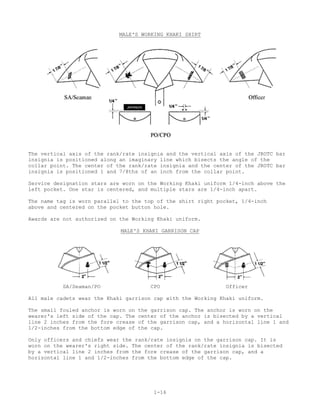
MALE'S WORKING KHAKI SHIRT


The vertical axis of the rank/rate insignia and the vertical axis of the JROTC bar
insignia is positioned along an imaginary line which bisects the angle of the
collar point. The center of the rank/rate insignia and the center of the JROTC bar
insignia is positioned 1 and 7/8ths of an inch from the collar point.

Service designation stars are worn on the Working Khaki uniform 1/4-inch above the
left pocket. One star is centered, and multiple stars are 1/4-inch apart.

The name tag is worn parallel to the top of the shirt right pocket, 1/4-inch
above and centered on the pocket button hole.

Awards are not authorized on the Working Khaki uniform.

                             MALE'S KHAKI GARRISON CAP


          SA/Seaman/PO                   CPO                     Officer

All male cadets wear the Khaki garrison cap with the Working Khaki uniform.

The small fouled anchor is worn on   the garrison cap. The anchor is worn on the
wearer's left side of the cap. The   center of the anchor is bisected by a vertical
line 2 inches from the fore crease   of the garrison cap, and a horizontal line 1 and
1/2-inches from the bottom edge of   the cap.

Only officers and chiefs wear the rank/rate insignia on the garrison cap. It is
worn on the wearer's right side. The center of the rank/rate insignia is bisected
by a vertical line 2 inches from the fore crease of the garrison cap, and a
horizontal line 1 and 1/2-inches from the bottom edge of the cap.


                                          1-16
2. Females:

   (a) NAVY SERVICE

       Basic Uniform Items:
       Awards............Ribbons/Medals/Cords
       Belt, brass tip...Black
       Buckle............Brass
       Cap, garrison.....Blue
       Coat..............None
       Hosiery, tone.....Flesh
       Necktab...........None
       Shirt, s/sleeve...Khaki
       Shoes, oxford.....Black
       Slacks, belted....Blue
       Socks.............Black


       Outerwear:
       All-weather coat
       V – Neck Sweater
       Black relaxed fit jacket


       Optional Items:
       Handbag...........Black
       Shoes, pumps......Black
       Skirt, belted.....Blue
       Undershirt........White
          (V or crew-neck)


                                       1-17
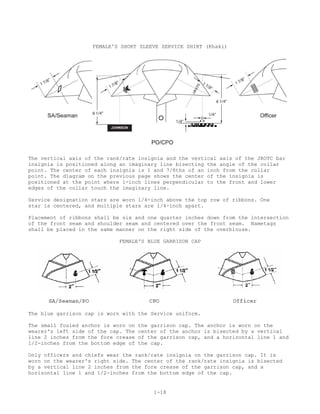
FEMALE'S SHORT SLEEVE SERVICE SHIRT (Khaki)


The vertical axis of the rank/rate insignia and the vertical axis of the JROTC bar
insignia is positioned along an imaginary line bisecting the angle of the collar
point. The center of each insignia is 1 and 7/8ths of an inch from the collar
point. The diagram on the previous page shows the center of the insignia is
positioned at the point where 1-inch lines perpendicular to the front and lower
edges of the collar touch the imaginary line.

Service designation stars are worn 1/4-inch above the top row of ribbons. One
star is centered, and multiple stars are 1/4-inch apart.

Placement of ribbons shall be six and one quarter inches down from the intersection
of the front seam and shoulder seam and centered over the front seam. Nametags
shall be placed in the same manner on the right side of the overblouse.

                             FEMALE'S BLUE GARRISON CAP


The blue garrison cap is worn with the Service uniform.

The small fouled anchor is worn on   the garrison cap. The anchor is worn on the
wearer's left side of the cap. The   center of the anchor is bisected by a vertical
line 2 inches from the fore crease   of the garrison cap, and a horizontal line 1 and
1/2-inches from the bottom edge of   the cap.

Only officers and chiefs wear the rank/rate insignia on the garrison cap. It is
worn on the wearer's right side. The center of the rank/rate insignia is bisected
by a vertical line 2 inches from the fore crease of the garrison cap, and a
horizontal line 1 and 1/2-inches from the bottom edge of the cap.


                                          1-18
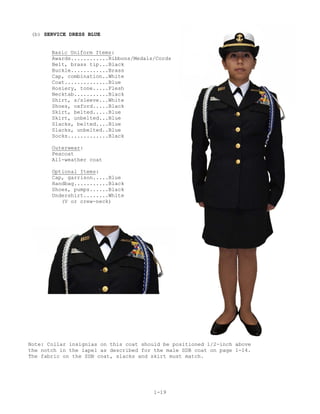
(b) SERVICE DRESS BLUE


       Basic Uniform Items:
       Awards............Ribbons/Medals/Cords
       Belt, brass tip...Black
       Buckle............Brass
       Cap, combination..White
       Coat..............Blue
       Hosiery, tone.....Flesh
       Necktab...........Black
       Shirt, s/sleeve...White
       Shoes, oxford.....Black
       Skirt, belted.....Blue
       Skirt, unbelted...Blue
       Slacks, belted....Blue
       Slacks, unbelted..Blue
       Socks.............Black

       Outerwear:
       Peacoat
       All-weather coat

       Optional Items:
       Cap, garrison.....Blue
       Handbag...........Black
       Shoes, pumps......Black
       Undershirt........White
          (V or crew-neck)


Note: Collar insignias on this coat should be positioned 1/2-inch above
the notch in the lapel as described for the male SDB coat on page 1-14.
The fabric on the SDB coat, slacks and skirt must match.


                                        1-19
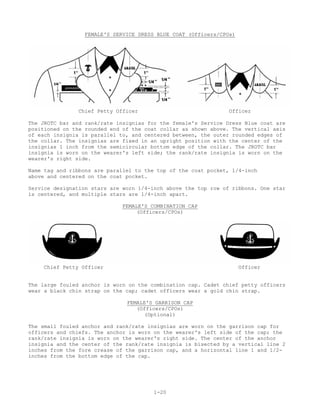
FEMALE'S SERVICE DRESS BLUE COAT (Officers/CPOs)


                Chief Petty Officer                            Officer

The JROTC bar and rank/rate insignias for the female's Service Dress Blue coat are
positioned on the rounded end of the coat collar as shown above. The vertical axis
of each insignia is parallel to, and centered between, the outer rounded edges of
the collar. The insignias are fixed in an upright position with the center of the
insignias 1 inch from the semicircular bottom edge of the collar. The JROTC bar
insignia is worn on the wearer's left side; the rank/rate insignia is worn on the
wearer's right side.

Name tag and ribbons are parallel to the top of the coat pocket, 1/4-inch
above and centered on the coat pocket.

Service designation stars are worn 1/4-inch above the top row of ribbons. One star
is centered, and multiple stars are 1/4-inch apart.

                              FEMALE'S COMBINATION CAP
                                   (Officers/CPOs)


     Chief Petty Officer                                             Officer


The large fouled anchor is worn on the combination cap. Cadet chief petty officers
wear a black chin strap on the cap; cadet officers wear a gold chin strap.

                               FEMALE'S GARRISON CAP
                                  (Officers/CPOs)
                                     (Optional)

The small fouled anchor and rank/rate insignias are worn on the garrison cap for
officers and chiefs. The anchor is worn on the wearer's left side of the cap; the
rank/rate insignia is worn on the wearer's right side. The center of the anchor
insignia and the center of the rank/rate insignia is bisected by a vertical line 2
inches from the fore crease of the garrison cap, and a horizontal line 1 and 1/2-
inches from the bottom edge of the cap.


                                        1-20
(c) WORKING KHAKI

       Basic Uniform Items:
       Awards............None
       Belt, brass tip...Khaki
       Buckle............Brass
       Cap, garrison.....Khaki
       Coat..............None
       Hosiery, tone.....Flesh
       Necktab...........None
       Shirt.............Khaki
       Shoes, oxford.....Black
       Slacks............Khaki
       Socks.............Black


       Outerwear:
       All-weather coat
       Utility jacket
       V- Neck Sweater
       Black relaxed fit jacket


       Optional Items:

       Handbag...........Black
       Undershirt........White
         (V or crew-neck)
       Cap, ball.........Black
         (or school colors)


Note: Ribbons, medals and aiguillettes are not
authorized on the Working Khaki uniform.


                                        1-21
FEMALE'S WORKING KHAKI SHIRT


                                         PO/CPO

The vertical axis of the rank/rate insignia and the vertical axis of the JROTC bar
insignia is positioned along an imaginary line which bisects the angle of the
collar point. The center of the rank/rate insignia and the center of the JROTC bar
insignia is positioned 1 and 7/8ths of an inch from the collar point.

Service designation stars are worn on the Working Khaki uniform 1/4-inch above the
left pocket. One star is centered, and multiple stars are 1/4-inch apart.

The name tag is worn parallel to the top of the shirt right pocket, 1/4-inch
above and centered on the pocket button hole.

Awards are not authorized on the Working Khaki uniform.

                            FEMALE'S KHAKI GARRISON CAP


   SA/Seaman/PO                          CPO                          Officer

All female cadets wear the Khaki garrison cap with the Working Khaki uniform.

The small fouled anchor is worn on   the garrison cap. The anchor is worn on the
wearer's left side of the cap. The   center of the anchor is bisected by a vertical
line 2 inches from the fore crease   of the garrison cap, and a horizontal line 1 and
1/2-inches from the bottom edge of   the cap.

Only officers and chiefs wear the rank/rate insignia on the garrison cap. It is
worn on the wearer's right side. The center of the rank/rate insignia is bisected
by a vertical line 2 inches from the fore crease of the garrison cap, and a
horizontal line 1 and 1/2-inches from the bottom edge of the cap.


                                          1-22
1-6 MALE NECKTIE, BLACK.
  a. Description: Made of authorized fabric measuring no more than 3 1/4-wide.
     Must be hand-tied.
   b. Correct Wear: Wear tie knotted with a half windsor, a windsor, or a four-in-
      hand knot. Wear the top of the knot parallel to and slightly above the top of
      the shirt collar closure, hiding the top button. The bottom of the tie hangs
      within one inch of the top of the belt buckle. The tie does not cover the
      belt buckle.
   c. Directions: The following diagrams on how to tie your tie with a half windsor
      knot are shown while looking in a mirror.


      (1) Place the wide end of your tie
          on the right side of your
          chest so it extends about 12
          inches below the narrow end of
          the tie.


      (2) Cross the wide end of the tie
          over the narrow end and then
          back under.


      (3) Bring the wide end of the tie
          up and over the neck loop,
          then turn the wide end down
          under and through the neck
          loop.


                                          1-23
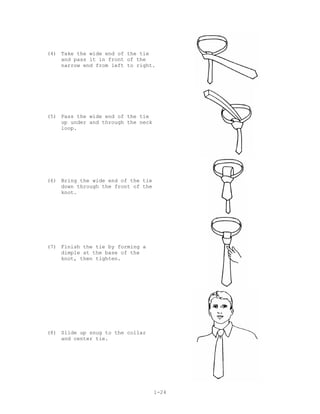
(4) Take the wide end of the tie
    and pass it in front of the
    narrow end from left to right.


(5) Pass the wide end of the tie
    up under and through the neck
    loop.


(6) Bring the wide end of the tie
    down through the front of the
    knot.


(7) Finish the tie by forming a
    dimple at the base of the
    knot, then tighten.


(8) Slide up snug to the collar
    and center tie.


                                    1-24
1-7 NJROTC UNIFORM INSIGNIA AND DEVICES
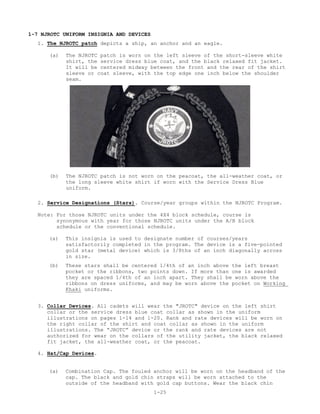
  1. The NJROTC patch depicts a ship, an anchor and an eagle.

      (a)   The NJROTC patch is worn on the left sleeve of the short-sleeve white
            shirt, the service dress blue coat, and the black relaxed fit jacket.
            It will be centered midway between the front and the rear of the shirt
            sleeve or coat sleeve, with the top edge one inch below the shoulder
            seam.


      (b)   The NJROTC patch is not worn on the peacoat, the all-weather coat, or
            the long sleeve white shirt if worn with the Service Dress Blue
            uniform.

  2. Service Designations (Stars). Course/year groups within the NJROTC Program.

   Note: For those NJROTC units under the 4X4 block schedule, course is
         synonymous with year for those NJROTC units under the A/B block
         schedule or the conventional schedule.

      (a)   This insignia is used to designate number of courses/years
            satisfactorily completed in the program. The device is a five-pointed
            gold star (metal device) which is 3/8ths of an inch diagonally across
            in size.
      (b)   These stars shall be centered 1/4th of an inch above the left breast
            pocket or the ribbons, two points down. If more than one is awarded
            they are spaced 1/4th of an inch apart. They shall be worn above the
            ribbons on dress uniforms, and may be worn above the pocket on Working
            Khaki uniforms.


   3. Collar Devices. All cadets will wear the "JROTC" device on the left shirt
      collar or the service dress blue coat collar as shown in the uniform
      illustrations on pages 1-14 and 1-20. Rank and rate devices will be worn on
      the right collar of the shirt and coat collar as shown in the uniform
      illustrations. The “JROTC” device or the rank and rate devices are not
      authorized for wear on the collars of the utility jacket, the black relaxed
      fit jacket, the all-weather coat, or the peacoat.

   4. Hat/Cap Devices.


      (a)   Combination Cap. The fouled anchor will be worn on the headband of the
            cap. The black and gold chin straps will be worn attached to the
            outside of the headband with gold cap buttons. Wear the black chin
                                          1-25
strap with the grommet to your left. The grommet looks like a small
         button that attaches to the top strap allowing the strap to slide and
         change size. The gold chin strap does not have a grommet.


   (b)   Garrison Cap (Blue and Khaki). A fouled anchor will be worn by all
         cadets on the left side of the garrison cap. Cadet officers and chiefs
         will wear their rank/rate insignia on the right side of the garrison
         cap. Refer to the uniform illustrations beginning on page 1-11 for
         correct positioning.

5. Aiguillettes. Aiguillettes may be awarded as earned
   for various academic and military achievements, and
   may be worn only on the Service Dress Blue and
   Service uniforms. Aiguillettes awarded by the naval
   science instructor for such things as color guard,
   drill team, academic team and the like, will be
   worn only on the left shoulder. Only the Leadership
   Academy aiguillette will be worn on the right
   shoulder. NO MORE THAN ONE AIGUILLETTE MAY BE WORN
   ON EACH SHOULDER. Aiguillettes will be attached to
   the appropriate shoulder by either a gold coat
   button on the Service Dress Blue uniform, or a
   miniature anchor (garrison cap) on the Service
   uniforms. The button or anchor shall be placed so
   that the entire aiguillette hangs on the shoulder
   parallel to the seam of the coat or shirt.
   Aiguillettes are not authorized for wear on the
   peacoat, all-weather coat, coat, utility jacket,
   relaxed fit jacket, and Working Khaki uniforms.


                                     1-26
1-8 AWARDS AND DECORATIONS
  a. Wearing of Ribbon Awards. The NJROTC ribbons are worn only on the Service
     Dress Blue and the Navy Service uniforms. When more than three ribbons are
     earned, wear them in horizontal rows of three each. If ribbons are not in
     multiple of threes, the top row contains the lesser number, and the center of
     this row sits over the center of the row below. Wear ribbons without spaces
     between ribbons or rows of ribbons. The
     NJROTC ribbons will be worn with the
     lower edge of the bottom row centered
     1/4 of an inch above the left breast
     pocket of the shirt or coat. An
     adjustment may be necessary to make the
     ribbons parallel to the deck on the
     Service Dress Blue coat. To prevent the
     lapels on the SDB coat from covering
     ribbons, they may be aligned so the
     ribbon border to the wearer's' left is
     aligned with the left side of the pocket. Rows of ribbons where more than 50
     percent of the ribbon is covered by the SDB coat lapel, may contain two
     ribbons each and be aligned with the left border. Note: Ribbons are not
     authorized on the Working Khaki uniforms.

   b. Precedence or Order of Seniority. NJROTC ribbons will be worn in the order of
      precedence as outlined on the next several pages. The most senior ribbon will
      be worn in the top row, and inboard when more than one ribbon is worn on a
      row. All earned NJROTC ribbons must be worn at the same time, however only
      one of each ribbon design may be worn with devices/subsequent awards attached
      to that one ribbon. Other awards and ribbons presented to you by
      organizations other than the NJROTC Program such as: other military Junior
      ROTC programs, Retired Officers Association, American Veterans, Order of

                                        1-27
Daedalians, American Legion, marksmanship, and the like, will be worn after
  (junior to) the NJROTC ribbons in the order determined by your SNSI.

c. NJROTC Medals. Medals earned are worn only on uniforms where other awards and
   decorations are authorized. They will be positioned 1/4 of an inch below the
   ribbons on the wear's left breast pocket. Medals will be centered immediately
   below the bottom row of ribbons, arranging in seniority order inboard to
   outboard, in the following order of precedence: (1) NJROTC academic
   competition, (2) NJROTC marksmanship competition, and (3) all others as
   prescribed by the SNSI. No more than 3 medals may be worn in each row side-
   by-side, or 5 medals when overlapping, in addition to its corresponding
   ribbon, if any. When wearing large medals, they will be placed immediately
   below the last row of medals so only the medallion of each medal is visible.

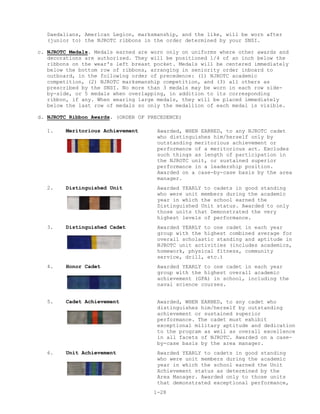
d. NJROTC Ribbon Awards. (ORDER OF PRECEDENCE)

  1.     Meritorious Achievement      Awarded, WHEN EARNED, to any NJROTC cadet
                                      who distinguishes him/herself only by
                                      outstanding meritorious achievement or
                                      performance of a meritorious act. Excludes
                                      such things as length of participation in
                                      the NJROTC unit, or sustained superior
                                      performance in a leadership position.
                                      Awarded on a case-by-case basis by the area
                                      manager.
  2.     Distinguished Unit           Awarded YEARLY to cadets in good standing
                                      who were unit members during the academic
                                      year in which the school earned the
                                      Distinguished Unit status. Awarded to only
                                      those units that Demonstrated the very
                                      highest levels of performance.
  3.     Distinguished Cadet          Awarded YEARLY to one cadet in each year
                                      group with the highest combined average for
                                      overall scholastic standing and aptitude in
                                      NJROTC unit activities (includes academics,
                                      homework, physical fitness, community
                                      service, drill, etc.)
  4.     Honor Cadet                  Awarded YEARLY to one cadet in each year
                                      group with the highest overall academic
                                      achievement (GPA) in school, including the
                                      naval science courses.


  5.     Cadet Achievement            Awarded, WHEN EARNED, to any cadet who
                                      distinguishes him/herself by outstanding
                                      achievement or sustained superior
                                      performance. The cadet must exhibit
                                      exceptional military aptitude and dedication
                                      to the program as well as overall excellence
                                      in all facets of NJROTC. Awarded on a case-
                                      by-case basis by the area manager.
  6.     Unit Achievement             Awarded YEARLY to cadets in good standing
                                      who were unit members during the academic
                                      year in which the school earned the Unit
                                      Achievement status as determined by the
                                      Area Manager. Awarded only to those units
                                      that demonstrated exceptional performance,
                                     1-28
but did not qualify for Distinguished Unit
                                status.


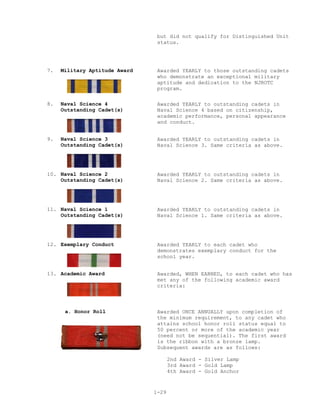
7.   Military Aptitude Award    Awarded YEARLY to those outstanding cadets
                                who demonstrate an exceptional military
                                aptitude and dedication to the NJROTC
                                program.

8.   Naval Science 4            Awarded YEARLY to outstanding cadets in
     Outstanding Cadet(s)       Naval Science 4 based on citizenship,
                                academic performance, personal appearance
                                and conduct.


9.   Naval Science 3            Awarded YEARLY to outstanding cadets in
     Outstanding Cadet(s)       Naval Science 3. Same criteria as above.


10. Naval Science 2             Awarded YEARLY to outstanding cadets in
    Outstanding Cadet(s)        Naval Science 2. Same criteria as above.


11. Naval Science 1             Awarded YEARLY to outstanding cadets in
    Outstanding Cadet(s)        Naval Science 1. Same criteria as above.


12. Exemplary Conduct           Awarded YEARLY to each cadet who
                                demonstrates exemplary conduct for the
                                school year.


13. Academic Award              Awarded, WHEN EARNED, to each cadet who has
                                met any of the following academic award
                                criteria:


      a. Honor Roll             Awarded ONCE ANNUALLY upon completion of
                                the minimum requirement, to any cadet who
                                attains school honor roll status equal to
                                50 percent or more of the academic year
                                (need not be sequential). The first award
                                is the ribbon with a bronze lamp.
                                Subsequent awards are as follows:

                                      2nd Award - Silver Lamp
                                      3rd Award - Gold Lamp
                                      4th Award - Gold Anchor


                               1-29
b. Academic Team            Awarded ONCE ANNUALLY upon completion of
                                 the minimum requirement, to any cadet who
                                 is a member in good standing of the
                                 Academic Team and has participated in
                                 three or more academic competitions. The
                                 first award is the ribbon with a gold
                                 torch. Subsequent awards are as follows:

                                       2nd Award - Bronze Star
                                       3rd Award - Silver Star
                                       4th Award - Gold Star

                                 When both the academic team and honor roll
                                 awards have been earned, the torch and
                                 lamp are positioned side-by-side on the
                                 ribbon, with the lamp on the wearer's
                                 right. Subsequent award stars for the
                                 academic team are worn outboard of the
                                 gold torch.

     c. Academic Team Captain    The cadet chosen for this honor wears the
                                 Academic Award ribbon on the right side of
                                 the uniform with a gold anchor centered on
                                 the ribbon. Note: No other devices will
                                 accompany the gold anchor when the
                                 Academic Award is worn on the right side.

                                 The only exception to wearing one gold
                                 anchor centered will be when a cadet has
                                 also earned a gold anchor for the 4th
                                 honor roll award. In this case both
                                 anchors can remain on the ribbon when
                                 moved to the wearer's right side.

                                 Note: When becoming captain of more than
                                 one team, the ribbon with the highest
                                 order of precedence is worn inboard, to
                                 the wearer's left, as shown in the
                                 example.

                                 Note: When wearing the ribbon of a team
                                 captain on the right side of the uniform,
                                 a similar ribbon without the team captain
                                 gold anchor cannot be worn in its normal
                                 position on the left side of the uniform.

14. Exemplary Personal          Awarded, WHEN EARNED, to each cadet who
    Appearance                  displays exemplary personal appearance and
                                has worn his/her uniform on all occasions
                                required.


                                1-30
15. Physical Fitness            Awarded, TWICE A YEAR, to any cadet who
                                meets or exceeds the basic physical fitness
                                exercise requirements as outlined in the
                                Cadet Challenge.


16. Participation               Awarded, WHEN EARNED, to any cadet who has
                                participated in three events other than
                                routine unit activities.


17. Unit Service                Awarded, WHEN EARNED, to any cadet who has
                                demonstrated exemplary service and
                                dedication to the unit as determined by the
                                SNSI.
18. Community Service           Awarded, WHEN EARNED, to any cadet in good
                                standing who distinguishes him/herself by
                                dedicated and outstanding service to the
                                community.

19. Drill Team                  Awarded, WHEN EARNED, to each member of a
                                drill team in good standing who has entered
                                competition, or performed at three or more
                                official functions.

20. Color Guard                 Awarded, WHEN EARNED, to each member of a
                                each member of a color guard in good
                                standing who has entered competition, or
                                performed at three or more official
                                functions.
21. Pistol/Rifle Team           Awarded, WHEN EARNED, to any cadet in good
                                standing who has entered any competition.


22. Orienteering                Awarded, WHEN EARNED, to any cadet in good
                                standing who has entered any organized
                                orienteering competition, or who meets the
                                orienteering qualification standards.

23. Recruiting                  Awarded, WHEN EARNED, to a cadet who is
                                instrumental in the enrollment of two
                                students in the NJROTC program. Subsequent
                                awards are given for each additional two
                                students enrolled.
24. Basic Leadership Training   Awarded to any cadet upon satisfactory
                                completion of Basic Leadership Training,
                                Leadership Academy or similar training as
                                approved by the area manager.


                                1-31
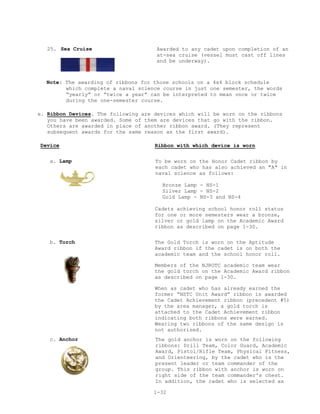
25. Sea Cruise                    Awarded to any cadet upon completion of an
                                     at-sea cruise (vessel must cast off lines
                                     and be underway).


  Note: The awarding of ribbons for those schools on a 4x4 block schedule
        which complete a naval science course in just one semester, the words
        “yearly” or “twice a year” can be interpreted to mean once or twice
        during the one-semester course.

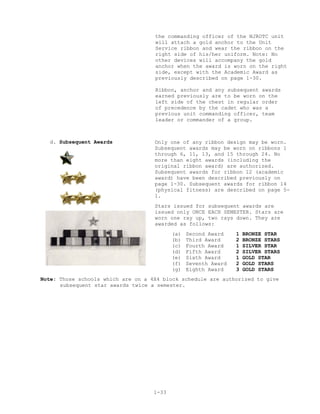
e. Ribbon Devices. The following are devices which will be worn on the ribbons
   you have been awarded. Some of them are devices that go with the ribbon.
   Others are awarded in place of another ribbon award. (They represent
   subsequent awards for the same reason as the first award).

Device                               Ribbon with which device is worn

   a. Lamp                           To be worn on the Honor Cadet ribbon by
                                     each cadet who has also achieved an "A" in
                                     naval science as follows:

                                       Bronze Lamp - NS-1
                                       Silver Lamp - NS-2
                                       Gold Lamp - NS-3 and NS-4

                                     Cadets achieving school honor roll status
                                     for one or more semesters wear a bronze,
                                     silver or gold lamp on the Academic Award
                                     ribbon as described on page 1-30.

   b. Torch                          The Gold Torch is worn on the Aptitude
                                     Award ribbon if the cadet is on both the
                                     academic team and the school honor roll.

                                     Members of the NJROTC academic team wear
                                     the gold torch on the Academic Award ribbon
                                     as described on page 1-30.

                                     When as cadet who has already earned the
                                     former “NSTC Unit Award” ribbon is awarded
                                     the Cadet Achievement ribbon (precedent #5)
                                     by the area manager, a gold torch is
                                     attached to the Cadet Achievement ribbon
                                     indicating both ribbons were earned.
                                     Wearing two ribbons of the same design is
                                     not authorized.
   c. Anchor                         The gold anchor is worn on the following
                                     ribbons: Drill Team, Color Guard, Academic
                                     Award, Pistol/Rifle Team, Physical Fitness,
                                     and Orienteering, by the cadet who is the
                                     present leader or team commander of the
                                     group. This ribbon with anchor is worn on
                                     right side of the team commander's chest.
                                     In addition, the cadet who is selected as

                                     1-32
the commanding officer of the NJROTC unit
                                    will attach a gold anchor to the Unit
                                    Service ribbon and wear the ribbon on the
                                    right side of his/her uniform. Note: No
                                    other devices will accompany the gold
                                    anchor when the award is worn on the right
                                    side, except with the Academic Award as
                                    previously described on page 1-30.

                                    Ribbon, anchor and any subsequent awards
                                    earned previously are to be worn on the
                                    left side of the chest in regular order
                                    of precedence by the cadet who was a
                                    previous unit commanding officer, team
                                    leader or commander of a group.


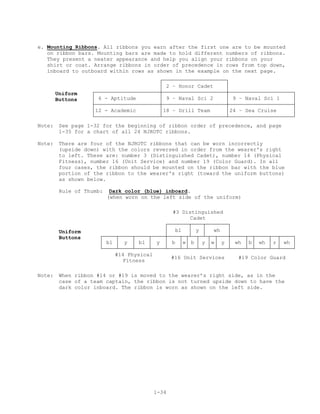
  d. Subsequent Awards              Only one of any ribbon design may be worn.
                                    Subsequent awards may be worn on ribbons 1
                                    through 6, 11, 13, and 15 through 24. No
                                    more than eight awards (including the
                                    original ribbon award) are authorized.
                                    Subsequent awards for ribbon 12 (academic
                                    award) have been described previously on
                                    page 1-30. Subsequent awards for ribbon 14
                                    (physical fitness) are described on page 5-
                                    1.
                                    Stars issued for subsequent awards are
                                    issued only ONCE EACH SEMESTER. Stars are
                                    worn one ray up, two rays down. They are
                                    awarded as follows:
                                           (a)   Second Award    1   BRONZE STAR
                                           (b)   Third Award     2   BRONZE STARS
                                           (c)   Fourth Award    1   SILVER STAR
                                           (d)   Fifth Award     2   SILVER STARS
                                           (e)   Sixth Award     1   GOLD STAR
                                           (f)   Seventh Award   2   GOLD STARS
                                           (g)   Eighth Award    3   GOLD STARS
Note: Those schools which are on a 4X4 block schedule are authorized to give
      subsequent star awards twice a semester.


                                    1-33
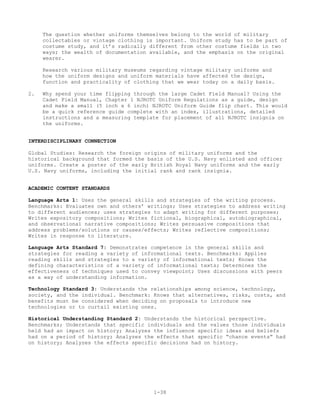
e. Mounting Ribbons. All ribbons you earn after the first one are to be mounted
   on ribbon bars. Mounting bars are made to hold different numbers of ribbons.
   They present a neater appearance and help you align your ribbons on your
   shirt or coat. Arrange ribbons in order of precedence in rows from top down,
   inboard to outboard within rows as shown in the example on the next page.

                                                  2 – Honor Cadet
        Uniform
        Buttons      6 - Aptitude                 9 – Naval Sci 2                   9 – Naval Sci 1

                    12 - Academic                 18 – Drill Team                   24 – Sea Cruise

Note:    See page 1-32 for the beginning of ribbon order of precedence, and page
         1-35 for a chart of all 24 NJROTC ribbons.

Note:    There are four of the NJROTC ribbons that can be worn incorrectly
         (upside down) with the colors reversed in order from the wearer's right
         to left. These are: number 3 (Distinguished Cadet), number 14 (Physical
         Fitness), number 16 (Unit Service) and number 19 (Color Guard). In all
         four cases, the ribbon should be mounted on the ribbon bar with the blue
         portion of the ribbon to the wearer's right (toward the uniform buttons)
         as shown below.

         Rule of Thumb:    Dark color (blue) inboard.
                          (when worn on the left side of the uniform)

                                                     #3 Distinguished
                                                           Cadet

         Uniform                                      bl           y       wh
         Buttons
                          bl     y    bl      y      b     w   b       y   w    y    wh   b   wh   r   wh

                               #14 Physical
                                                     #16 Unit Services                #19 Color Guard
                                 Fitness

Note:    When ribbon #14 or #19 is moved to the wearer’s right side, as in the
         case of a team captain, the ribbon is not turned upside down to have the
         dark color inboard. The ribbon is worn as shown on the left side.


                                              1-34
1-35
STUDY GUIDE QUESTIONS

                       CHAPTER 1: NJROTC UNIFORM REGULATIONS

1.   What four elements are important when wearing the uniform?

2.   Where does the word "uniform" come from? What does it mean?

3.   NJROTC cadets and active duty Navy personnel wear the uniform the same with
     certain exceptions, what are they?

4.   How should caps be worn?

5.   How should the uniform be kept?

6.   What is the uniform of the day?

7.   What is the requirement for wearing the NJROTC uniform be worn?

8.   When may one uncover outdoors?

9.   When must cadets comply with uniform requirements?

10. Who prescribes what uniform shall be worn for special occasions? For example:

11. Can cadets, in uniform, participate in political activities?

     A. Men

12. The bulk of the men's hair may not exceed how many inches?

13. Sideburns may not extend below ___________?

14. How should mustaches be kept?

15. What are the grooming standards for men regarding earrings and studs?

16. Are sunglasses authorized in military formations?


     B. Women

17. May the female hair extend to the collar?

18. How should cosmetics be worn on females?

19. What kind of nail polish is authorized?

20. What kinds of earrings/studs are authorized?

21. When can enlisted cadets wear the Service Dress Blue Uniform

22. Under what circumstances will a cadet be authorized to wear the Khaki uniform?

23. How are the uniform shoes required to be laced?

24. With what uniforms may a ball cap be worn?

25. What are the rules regarding hosiery for female cadets?

26. For the Service and Khaki uniforms shirts, where are the collar devices worn?
                                        1-36
27. Who is authorized to wear rank/rate insignias on the garrison cap?

28. On which side is the fouled anchor worn on the garrison cap?

29. On all uniforms where is the nametag worn?

30. What is the maximum number of service stars that can be worn on the NJROTC
    uniform?

31. Where are the service stars worn on Navy service and service dress blue
    uniform?

32. What color is the chinstrap on the combination cover for Cadet Chief Petty
    Officers?

33. What types of knots are authorized for the male tie?

34. Which aiguillette is only authorized to be worn on the right shoulder?

35. On which uniforms are aiguillettes not authorized?

36. Where are medals worn on the NJROTC uniform?

37. What is the highest award that can be earned by a NJROTC cadet? Who is
    authorized to award it?

38. What is the maximum number of awards of any ribbon that can be earned by a
    NJROTC cadet? How is this distinguished on the ribbon?

39. Which ribbon(s) are authorized to be worn on the wearer’s right side?

40. What are the four ribbons which can be worn “incorrectly” (i.e. upside down)?
    What is the general rule of thumb for the wearing of ribbons?


CRITICAL THINKING QUESTION

1.   Official clothing for naval men was pretty much a hit-or-miss affair until
     1747, when King George II of England ordered “uniforms” to be worn by all navy
     personnel. He did this as a means of boosting sailor’s morale and improving
     their appearance. The first uniforms for the U.S. Navy, authorized on September
     5, 1776, specified outfits for officers. These included a blue coat, blue
     breeches and a red waistcoat with narrow lace. Enlisted uniforms were first
     authorized in September 1817. The winter uniform included a black hat, blue
     jacket, blue trousers and a red vest, all with yellow buttons. Rating badges
     for enlisted men were first worn in 1885. It appears that as the United States
     Navy was being established, a standard designed naval uniform was not an issue.
     Do you think the standardization of a naval uniform, placement of rank and
     various insignia is important? What criteria would you use to assess a standard
     design for the naval uniform? Is there any sort of inconvenience that might
     arise from not being able to distinguish the commissioned officers from the
     enlisted personnel?

EXTENSION ACTIVITY

1.   The vintage clothing field, with its emphasis on the clothes of women and
     children, tends to reflect youthful and feminine lives. But when finding
     men’s clothes, we think about adult male lives, and then we shouldn’t forget
     an overwhelming force in those lives – the military. A lot of the world’s
     clothing is military, and uniforms directly affect the history of clothing.

                                        1-37
The question whether uniforms themselves belong to the world of military
     collectables or vintage clothing is important. Uniform study has to be part of
     costume study, and it’s radically different from other costume fields in two
     ways; the wealth of documentation available, and the emphasis on the original
     wearer.

     Research various military museums regarding vintage military uniforms and
     how the uniform designs and uniform materials have affected the design,
     function and practicality of clothing that we wear today on a daily basis.

2.   Why spend your time flipping through the large Cadet Field Manual? Using the
     Cadet Field Manual, Chapter 1 NJROTC Uniform Regulations as a guide, design
     and make a small (5 inch x 6 inch) NJROTC Uniform Guide flip chart. This would
     be a quick reference guide complete with an index, illustrations, detailed
     instructions and a measuring template for placement of all NJROTC insignia on
     the uniforms.


INTERDISCIPLINARY CONNECTION

Global Studies: Research the foreign origins of military uniforms and the
historical background that formed the basis of the U.S. Navy enlisted and officer
uniforms. Create a poster of the early British Royal Navy uniforms and the early
U.S. Navy uniforms, including the initial rank and rank insignia.


ACADEMIC CONTENT STANDARDS

Language Arts 1: Uses the general skills and strategies of the writing process.
Benchmarks: Evaluates own and others’ writings; Uses strategies to address writing
to different audiences; uses strategies to adapt writing for different purposes;
Writes expository compositions; Writes fictional, biographical, autobiographical,
and observational narrative compositions; Writes persuasive compositions that
address problems/solutions or causes/effects; Writes reflective compositions;
Writes in response to literature.

Language Arts Standard 7: Demonstrates competence in the general skills and
strategies for reading a variety of informational texts. Benchmarks: Applies
reading skills and strategies to a variety of informational texts; Knows the
defining characteristics of a variety of informational texts; Determines the
effectiveness of techniques used to convey viewpoint; Uses discussions with peers
as a way of understanding information.

Technology Standard 3: Understands the relationships among science, technology,
society, and the individual. Benchmark: Knows that alternatives, risks, costs, and
benefits must be considered when deciding on proposals to introduce new
technologies or to curtail existing ones.

Historical Understanding Standard 2: Understands the historical perspective.
Benchmarks; Understands that specific individuals and the values those individuals
held had an impact on history; Analyzes the influence specific ideas and beliefs
had on a period of history; Analyzes the effects that specific “chance events” had
on history; Analyzes the effects specific decisions had on history.


                                        1-38
VOCABULARY WORDS

Uniform
      From a combination of two Latin words, unus and forma, which means “one
      form.”

Uniform of the Day
      The uniform of the day is the uniform your Senior Naval Science Instructor
      (SNSI) will direct you to wear on any given day.

Legging
      A canvas cloth covering for the leg.

Ascot
        A broad neck scarf that is looped under the chin.

Beret
        A visor-less usually woolen cap, with a tight headband and a soft full flat
        top.

Garrison Cap
      A visor-less folding cap worn as part of a military uniform.

SDBs’
        Service Dress Blues

Service Designation Stars
      This insignia is used to designate the number of courses/years satisfactorily
      completed in the NJROTC program.

Precedence
      Priority of importance


                                          1-39
CHAPTER 2: NJROTC RATES/RANKS AND U.S. NAVY RATES/RANKS

2-0 OBJECTIVES:

2-0.1 Explain and recognize the various NJROTC rates and ranks and be able to
understand the different assignments associated with each billet.

2-0.2 Describe and recognize the rates and ranks of active duty Navy personnel.


2-1 NJROTC RATES, RANKS, AND ASSIGNMENTS
2-1.A. GENERAL

1.    Cadet rates, ranks, promotions and position assignments are earned based on
individual performance and demonstrated potential. Many factors are evaluated by
the naval science instructors before awarding rates, ranks, promotions and
advancement, and before cadet billet assignments are made. Cadets must continually
demonstrate:

      a.   High moral standards and good conduct
      b.   Proper appearance in school and in unit uniform
      c.   Acceptable academic achievement
      d.   Acceptable performance in carrying out assigned NJROTC responsibilities
      e.   Acceptable level of participation in NJROTC activities and programs

2. Students entering NJROTC for the first time are usually assigned the grade of
   Cadet Seaman Recruit, or in some schools the grade of Seaman Apprentice.
   Advancements beyond the initial grade in the enlisted rates are often based on
   performance, time in the unit, position assignment and by completing certain
   military knowledge advancement tests. Achievement of officer status requires an
   individual who has demonstrated superior quality leadership, integrity, personal
   appearance, conduct and patriotism. NJROTC cadet rates and ranks, from the
   lowest to the highest, are as follows:

3. All rate and rank promotions are determined by the naval science instructor.
   Unacceptable performance could result in a demotion.


2.1.B CADET ENLISTED RATES

NJROTC units will differ in rate assignments, advancement systems and may
require practical tests to qualify for advancement in rate.

NJROTC RATE/RANK                                                      COLLAR INSIGNIA

CADET SEAMAN RECRUIT (C/SR)
    There is no collar device for this rate.
    Assigned to new cadets in the process None of learning the
      NJROTC program.

CADET SEAMAN APPRENTICE (C/SA)
    The collar device is two silver diagonal stripes.
    When qualified, recruits can advance to SA in the first
      year.


                                           2-1
CADET SEAMAN (C/SN)

       The collar device is three silver diagonal stripes.
       When qualified, cadets can advance to SN in the first
        year.

Note: There are no specific assignments for seaman recruits,
      seaman apprentice or seaman; these cadets are in training
      for future leadership roles.

CADET   PETTY OFFICER THIRD CLASS (C/PO3)
       The collar device is a perched eagle over one chevron.
       Outstanding cadets may achieve this rate the first year.
       Assignments include squad leaders, assistant squad leaders
        in platoons, drill teams and drum and bugle corps.


CADET   PETTY OFFICER SECOND CLASS (C/PO2)
       The collar device is a perched eagle over two chevrons.
       Advancement to this rate is usually in the second year.
       Assignments include squad leaders, in platoons, drill
        teams, and drum and bugle corps and color escorts in color
        guards.


CADET PETTY OFFICER FIRST CLASS (C/PO1)
    The collar device is a perched eagle over three chevrons.
    Cadets can achieve this rate usually in their second or
      third year.
    Assignments include platoon guides, color bearers, drill
      team guides, and supply assistants.


 CADET CHIEF PETTY OFFICER (C/CPO)
    The collar device is an eagle perched on a fouled anchor.
    Cadets can generally achieve CPO in their second or third
      year.
    Assignments include company chief, platoon chief, color
      bearer, drill team chief, or rifle team chief.

CADET SENIOR CHIEF PETTY OFFICER (C/SCPO)
    The collar device is an eagle and one star perched on a
      fouled anchor.
    Generally a third year cadet.
    The SNSI may assign a Senior Chief Petty Officer billet to
      the company chief petty officer.

CADET MASTER CHIEF PETTY OFFICER (C/MCPO)
    The collar device is an eagle and two stars perched on a
      fouled anchor.
    Generally a third or fourth year cadet.
    The SNSI may assign a Master Chief Petty Officer billet to
      the battalion chief petty officer.


                                          2-2
2.1.C CADET OFFICER RANKS

Cadet officers are generally third or fourth year cadets that have shown aptitude
for high leadership positions. Officers are selected from the enlisted rates to
fill specific positions as noted below.

NJROTC RATE/RANK                                                   COLLAR INSIGNIA

CADET   ENSIGN
       The collar device is a single gold bar.
       Generally a third or fourth year cadet.
       The first junior officer assignment which may include
        junior officer on company staffs, public affairs,
        assistant supply, platoon commander, or assistant drill
        team commander.

CADET LIEUTENANT (Junior Grade)
    The collar device is two attached gold bars.
    Assigned to officers ready for additional
      responsibilities.
    Assignments can include operations, rifle team commanders,
      battalion supply, and administrative officer.

CADET LIEUTENANT
    The collar device is three attached gold bars.
    Assigned to some of the most senior officers such as
      executive officer of companies or operations officer in
      battalions and regiments.

CADET LIEUTENANT COMMANDER
    The collar device is four attached gold bars.
    Assigned to cadet officers in the top leadership roles of
      the NJROTC.
    The highest rank of company strength.
    Assignments include company commander in smaller units and
      executive officer in battalions and regiments.

CADET COMMANDER
    The collar device is five attached gold bars.
    The highest rank that can be attained by a cadet in
      NJROTC.
    Assignments include battalion commander and regimental
      commander.


                                          2-3
2-2 NAVY RATES AND RANKS
 2-2.A. GENERAL

     1. The Navy's rate and rank structure for men and women on active duty is in
some ways similar to the rate and rank structure used by the cadets in the NJROTC
program. Enlisted personnel have rates and commissioned officers have ranks. An
officer's rank refers to his or her official title, e.g. ensign, lieutenant
commander, captain, etc., but it also indicates the amount of pay received monthly.
Enlisted personnel have similar titles and pay grades. The lowest three enlisted
pay grades are in the general apprenticeship area before advancement to petty
officer pay grades. When officers move up the next rank and pay grade, they have
earned a promotion. When enlisted personnel move up to the next higher rate in
their specialty, they have advanced in rate. The uniform sleeve and collar insignia
for naval rates and ranks are shown below from the lowest to the highest:

2-2.B. SLEEVE AND COLLAR INSIGNIA FOR NAVAL RANKS AND RATES

             ENLISTED RATES                   SLEEVE INSIGNIA       COLLAR INSIGNIA
Pay Grade:                E-1
Title:               Seaman Recruit                   None               None
Abbreviation:              SR
Pay Grade:                E-2
Title:             Seaman Apprentice                                     None
Abbreviation:              SA
Pay Grade:                  E-3
Title:                     Seaman                                        None
Abbreviation:                SN
Pay Grade:                 E-4
Title:          Petty Officer Third Class                                None
Abbreviation:              PO3
                           E-5
Pay Grade:
                  Petty Officer Second
Title:                                                                   None
                          Class
Abbreviation:
                           PO2

Pay Grade:                 E-6
Title:          Petty Officer First Class                                None
Abbreviation:              PO1


       CHIEF PETTY OFFICER RATES                  SLEEVE INSIGNIA    COLLAR INSIGNIA


Pay Grade:                 E-7
Title:             Chief Petty Officer
Abbreviation:              CPO


                            E-8
Pay Grade:
                    Senior Chief Petty
Title:
                         Officer
Abbreviation:
                           SCPO


                                            2-4
E-9
Pay Grade:
                     Master Chief Petty
Title:
                          Officer
Abbreviation:
                            MCPO


                             E-9
Pay Grade:
                     Master Chief Petty
Title:
                     Officer of the Navy
Abbreviation:
                            MCPON


                                                                    COLLAR INSIGNIA
         WARRANT OFFICER RATES                       INSIGNIA
                                                                         COLORS


                                                                     Blue and Gold
Pay Grade:                   W-2
Title:              Chief Warrant Officer
Abbreviation:                CW02


Pay Grade:                   W-3                                     Blue and Gold
Title:              Chief Warrant Officer
Abbreviation:                CW03


Pay Grade:                   W-4                                    Blue and Silver
Title:              Chief Warrant Officer
Abbreviation:                CW04


                                                                    Blue and Silver
Pay Grade:                   W-5
Title:              Chief Warrant Officer
Abbreviation:                CW05


                                                                    COLLAR INSIGNIA
                OFFICER RATES                     SLEEVE INSIGNIA
                                                                         COLORS


                                            2-5
COLLAR INSIGNIA
                OFFICER RATES                    SLEEVE INSIGNIA
                                                                        COLORS


                                                                        Gold
Pay Grade:                  O-1
Title:                     Ensign
Abbreviation:               ENS


                              O-2                                      Silver
Pay Grade:
                      Lieutenant Junior
Title:
                            Grade
Abbreviation:
                             LTJG


Pay Grade:                   O-3                                       Silver
Title:                   Lieutenant
Abbreviation:                LT


Pay Grade:                   O-4                                        Gold
Title:              Lieutenant Commander
Abbreviation:               LCDR


                                           2-6
COLLAR INSIGNIA
                OFFICER RATES                   SLEEVE INSIGNIA
                                                                       COLORS


Pay Grade:                   O-5                                      Silver
Title:                    Commander
Abbreviation:                CDR


                                                                      Silver
Pay Grade:                   O-6
Title:                     Captain
Abbreviation:               CAPT


                             O-7                                      Silver
Pay Grade:
                     Rear Admiral Lower
Title:
                            Half
Abbreviation:
                          RADM (L)


                             O-8                                      Silver
Pay Grade:
                     Rear Admiral Upper
Title:
                            Half
Abbreviation:
                          RADM (U)


                                          2-7
COLLAR INSIGNIA
                OFFICER RATES                SLEEVE INSIGNIA
                                                                    COLORS


                                                                   Silver
Pay Grade:                   O-9
Title:                  Vice Admiral
Abbreviation:               VADM


Pay Grade:                  O-10                                   Silver
Title:                     Admiral
Abbreviation:                ADM


                                       2-8
STUDY GUIDE QUESTIONS

              CHAPTER 2: NJROTC RATES/RANKS AND U.S. NAVY RATES/RANKS

1.   Define rate.

2.   Define rank.

3.   What rate has a collar device consisting of two silver diagonal stripes?

4.   What is the difference between advancement and promotion?

5.   An eagle and two stars perched on a fouled anchor is the collar device for
     whom?

6.   What is the highest authorized rank within a unit of company strength?

7.   What is the highest rank that can be attained by a cadet in NJROTC?

8.   The collar device that has four attached bars is for whom?

9.   A collar device consisting of a single gold bar represents what rank?

10. How many stars does an Admiral have on his collar insignia?

11. What is the pay grade of a Captain?

12. What is the pay grade for a Chief Petty Officer?

13. What is the pay grade for a Warrant Officer?

14. What is required for achievement to officer status within the NJROTC?

15. What collar insignia does a Cadet Seaman Recruit wear?

16. What specific assignments are given to a Cadet Seaman Recruit, Cadet Seaman
    Apprentice and Cadet Seaman?

17. What assignments would a Cadet Petty Officer Third Class include?

18. The Cadet Petty Officer First Class collar device insignia looks like what and
    when can cadets usually achieve this rate?

19. What position can the SNSI assign a Cadet Master Chief Petty Officer?

20. What is the rank of the most junior cadet officer?

21. When are cadet officers chosen?

22. What does a Cadet Lieutenant Commander collar device look like and what
    specific position does at Cadet Lieutenant Commander fill?

23. List the Naval officers’ pay grades, from most junior to most senior.

24. List the pay grades and rates of enlisted personnel from junior to senior.

25. Where do Warrant Officers and Chief Warrant Officers fit in the chain of
    command?

                                          2-9


                                          2-9
Critical Thinking

1. In the earliest times, rank was not an issue. Do you think the badge of rank is
   important? Is there any sort of inconvenience that might arise from not being
   able to distinguish the commissioned officers from the junior enlisted?

2. As a precious metal, gold is worth more than silver, but in the military, silver
   outranks gold. The current day Navy rank badges are two different colors. One
   example being that of the rank of Ensign is a single gold bar, but the rank of a
   Lieutenant (Junior Grade) is a single silver bar. Another example is that the
   Petty Officer rank badges are silver, but the Chief Petty Officer rank badges
   are gold. Explain how you feel that the color scheme of the rank badges is
   incorrect and how would you change the color of the rank system?

Extension Activity

With the new Navy rank and pay grade of Chief Warrant Officer – 5 having been
established, write a point paper explaining why the enlisted rank system should
be now have a new enlisted rank and pay grade of E-10 for the Master Chief Petty
Officers.

Interdisciplinary Connection

Global Studies:   Research the foreign origins of military ranks and the historical
background that   formed the basis of the U.S. Navy enlisted and officer ranks.
Create a poster   of the early U.S. Navy rank structure including the initial pay
grades and rank   insignia.

Academic Content Standards for the extension activity and interdisciplinary
connections.

1.   Analyze the values held by specific people who influenced history and the role
     of their values played in influencing history.

2.   Analyzes how specific historical events would be interpreted differently based
     on newly uncovered records and/or information.

3.   Knows how to evaluate the credibility and authenticity of historical sources.

4.   Evaluates the validity and credibility of different historical interpretations.

Academic Content Standards

Language Arts 1: Uses the general skills and strategies of the writing process.
Benchmarks: Evaluates own and others’ writings; Uses strategies to address writing
to different audiences; uses strategies to adapt writing for different purposes;
Writes expository compositions; Writes fictional, biographical, autobiographical,
and observational narrative compositions; Writes persuasive compositions that
address problems/solutions or causes/effects; Writes reflective compositions;
Writes in response to literature.

Language Arts Standard 7: Demonstrates competence in the general skills and
strategies for reading a variety of informational texts. Benchmarks: Applies
reading skills and strategies to a variety of informational texts; Knows the
defining characteristics of a variety of informational texts; Determines the
effectiveness of techniques used to convey viewpoint; Uses discussions with peers
as a way of understanding information.


                                          2-10
Technology Standard 3: Understands the relationships among science, technology,
society, and the individual. Benchmark: Knows that alternatives, risks, costs, and
benefits must be considered when deciding on proposals to introduce new
technologies or to curtail existing ones.

Historical Understanding Standard 2: Understands the historical perspective.
Benchmarks; Understands that specific individuals and the values those individuals
held had an impact on history; Analyzes the influence specific ideas and beliefs
had on a period of history; Analyzes the effects that specific “chance events” had
on history; Analyzes the effects specific decisions had on history.

Vocabulary Words

Rate
       Level of proficiency within an enlisted rating, similar to a pay grade.

Ratings
      General grouping of enlisted personnel by job specialty.

Rank
       Relative position of authority among officers and petty officers.

Officer’s Rank
      An officer’s rank refers to his or her official title, e.g. Ensign,
      Lieutenant Commander, Captain, etc.

Promotion (in rank)
      When an officer moves up to the next rank and pay grade, they have earned
      a promotion.

Advancement (in rate)
      When enlisted personnel move up to the next higher rate in their
      rating specialty, they have advanced in rate.

Pay Grade
      Level of military pay, from E-1 (Seaman Recruit) to E-9 (Mater Chief
      Petty Officer), from W-1 (Warrant Officer) to W-5 (Chief Warrant
      Officer) and from O-1 (Ensign) to O-10 (Admiral).

CPO, SCPO, MCPO
      Chief Petty Officer, Senior Chief Petty Officer and Master Chief Petty
      Officer. With the exception of the Master Chief Petty Officer of the Navy,
      this is the highest rank attainable by enlisted personnel while still in the
      enlisted category.

Warrant Officers
      Warrant officers are senior specialists who supervise the operation of
      equipment and weapons. They bridge the gap between commissioned officers
      and enlisted personnel. They are like the journeymen or master tradesmen
      in civilian life.


                                        2-11
CHAPTER 3: MILITARY CUSTOMS, COURTESIES, ETIQUETTE AND CEREMONIES

3-0 OBJECTIVES:

3-0.1 Explain the types of military customs and courtesies to include their
      purposes and whencourtesies are rendered.

3-0.2 Describe the flag of the United States as a standard of honor.

3-0.3 Explain the procedures in pledging allegiance to the flag.

3-0.4 Describe the sequence of events in military ceremonies, reviews and parades.

3-1 GENERAL
a.   Military customs and courtesies are the traditional way by which nations and
     individuals pay respect to distinguished persons and foreign governments.
     Customs and courtesies are also used to show reverence for people and places of
     historical distinction, significance and sanctity. The type of courtesy
     rendered depends upon who or what is being recognized. Courtesies are salutes
     to ships, to high ranking individuals and to nations. Courtesies are not
     rendered to nations or officials not recognized by the United States, or
     officials who request that they not be rendered.

b.   Ceremonies are formal, traditional acts of respect and/or reverence performed
     on public occasions. Like customs and courtesies, military ceremonies are an
     integral part of military life. Ceremonial occasions range from morning and
     evening colors to the courtesies and ceremonies observed by ships when passing
     Washington's tomb, Mount Vernon, Virginia, or the USS ARIZONA Memorial, Pearl
     Harbor, Hawaii. There are numerous kinds and types of ceremonies, far too many
     to cover in this chapter.


3-2 THE AMERICAN FLAG AND FLAG ETIQUETTE
a.   The flag of the United States of America is a
     living thing that calls to our spirit,
     reminding us of the greatness of our America.
     We cherish and uphold it because it is the
     standard of honor under which we live.

b.   We view the flag with devotion, for it
     represents our national heritage of noble
     deeds, splendid accomplishments, and untold
     sacrifices which combined to establish the
     moral character of our national foundation.
     Our flag is a symbol that makes our past one
     with the present and makes the present a
     prophecy for tomorrow.

c.   Our flag signifies a people dedicated to
     liberty, justice and freedom for all.

d.   Our flag is our companion around the world.
     It summons confidence on sight. There is a
     magic in its folds that continually renews
     the hope that this nation, under God, will
     long be an example everywhere for all who love freedom with honor.

e.   We give homage to the flag because it stands for the courageous, earnest, and
     unselfish experiences of our people who have given us strength as a nation and
                                           3-1
pride as citizens.

f.   We respect our flag because we have respect for our countrymen, and because our
     love for country finds its center in our flag.

g.   The customs and traditions which surround the display and use of our flag are
     guides to the means by which we as proud and grateful citizens may demonstrate
     the ultimate respect for the flag of our nation.

h.   It is the universal custom to display
     the flag only from sunrise to sunset on
     buildings and on stationary flagstaffs
     in the open. However, when a patriotic
     effect is desired, the flag may be
     displayed twenty-four hours a day if
     properly illuminated during the hours
     of darkness.

i.   The flag should not be displayed on
     days when the weather is inclement,
     except when an all weather flag is
     displayed.

j.   The flag should be displayed daily on or near the main administration building
     of every public institution, and during school days in every schoolhouse.

k.   The flag should be displayed on all days, especially on all national and state
     holidays such as New Year’s Day, Inauguration Day, President’s Day,
     Washington’s Birthday, Easter Sunday, Armed Forces Day, Memorial Day (half-
     staff until noon), Flag Day, Independence Day, Labor Day, Columbus Day, Navy
     Day, Veteran’s Day, Thanksgiving Day, Christmas Day, Birthdays of States (date
     of admission), and such other important days as may be proclaimed by the
     President of the United States.

l.   The flag should be displayed daily in or near every
     polling place on election days.

m.   When the flag is in such condition that it is no longer
     a fitting emblem for display, it should be destroyed in
     a dignified way, preferably by burning.

n.   The flag and the national anthem are symbols of all the people, their land, and
     their institutions. When we salute these symbols, we are saluting the nation.
     Military personnel follow specific procedures in showing their respect to the
     flag and the national anthem. Flags and national anthems of friendly foreign
     nations are shown the same respect as our own. In honoring and saluting our
     flag we demonstrate respect for our nation, our fellow citizens and the proud
     heritage we share.


                                           3-2
3-3 FLAG COURTESIES
a. The following courtesies are rendered during the
   ceremony of hoisting or lowering the flag, during
   outdoor or indoor ceremonies, or when the flag is
   passing in a parade or in review:

   1. When Outdoors in Uniform. When in uniform outdoors
      and the national anthem or "To the Colors" is
      played, stand at attention, face the flag (if the
      flag is not visible, face the music) and render the
      military salute. The salute begins on the first note
      of the music and is held until the last note.

   2. When Outdoors in Civilian Clothes. When in civilian
      clothes and the national anthem or "To the Colors"
      is played, stand at attention, and face the flag (if
      the flag is not visible, face the music). A male
      removes his hat and holds it in his right hand and
      places his right hand over his heart. A female does
      the same, except the hat, if worn, is not removed.

   3. To An Escorted Flag Outdoors. When attending any outdoor event in uniform and
      the U.S. flag is escorted past you, stand at attention, face the front and
      render the appropriate salute. Render the salute six paces before the flag is
      even with you and hold it until the flag has passed six paces beyond you.
      Miniature flags, such as those displayed at downtown parades are not saluted.

   4. On a Stationary Flagstaff. When in uniform, do not salute flags on stationary
      flagstaffs except during reveille and retreat.

   5. During Indoor Ceremonies. When ceremonies occur indoors and the national
      anthem or "To the Colors" is played, face the flag and take the position of
      attention and place your hand over your heart. If the flag is not visible,
      take the position of attention and face the music or the front. When in
      uniform indoors, do not salute unless you are covered or under arms. No
      action is required while ceremonies are occurring outdoors and you are
      indoors. Also, there is no requirement for a person to stand or salute for
      ceremonies broadcast over radio or television.

   6. Private Vehicle Passengers. On a military base
      at the first note of the national anthem, all
      vehicles must come to a complete stop. Occupants
      sit quietly until the last note of the music is
      played before resuming travel.

  7. At Half Staff. The flag is flown at half staff
     to honor and pay respect to deceased persons of
     national importance. The term at “half-staff”
     means the position of the flag when it is one-
     half the distance between the top and the bottom
     of the staff.


                                        3-3
3-4 PLEDGE OF ALLEGIANCE

     a. In military formations and ceremonies, the Pledge of Allegiance shall not
        be recited. At protocol functions, social, and sporting events which
        include civilian participants, personnel in uniform should:
        (a) when outdoors, stand at attention, face the flag, remain silent and
        render the hand salute; (b) when indoors, stand at attention, and face the
        flag, but do not salute. Reciting the Pledge of Allegiance is optional for
        military personnel when indoors. All persons present in civilian clothes
        when outdoors should remove their hats, face the flag, stand at attention
        with their right hand over their heart, and recite the following:

                          "I pledge allegiance to the flag
                           of the United States of America,
                           and to the republic for which it stands,
                           one nation under God, indivisible,
                           with liberty and justice for all."

              * * * * * * * * * * * * * * * * * * * * * * * * * * * * * * * *

I:                       You and me, an individual, a person

PLEDGE ALLEGIANCE TO     Take a vow, an oath, a promise
THE FLAG:                Duty owed to your country, observance of obligation.
                         A symbol of liberty, freedom, that which we as free men and
                         women do so jealously cherish.
OF THE UNITED STATES: Joined together, combined, produced by two or more persons, a
                      union our forefathers put together in 1776, to make us a
                      united people free of a tyrant or an oppressor.
OF AMERICA:              A land blessed with brotherhood from sea to shining sea. A
                         land full of natural resources, a land where anyone can do
                         what he/she wants as long as it does not violate the rights
                         of another.
AND TO THE REPUBLIC:     A state in which the supreme power rests in the body of
                         citizens entitled to vote, and is exercised by elected
                         representatives.
FOR WHICH IT STANDS:     A flag known throughout the world as a symbol of freedom.
                         A nation in which people can worship as they please, speak
                         and not be afraid of being censored for what they say, or to
                         express an opinion in writing and not be afraid of being
                         arrested for writing what they feel.
ONE NATION:              A body of people associated with a particular territory, who
                         are conscious of their unity. One body of people speaking the
                         same language, and yet opening doors to those foreign to us
                         and saying welcome.
UNDER GOD:               Meaning we have been so blessed.

INDIVISIBLE:             Incapable of being divided. Even with our own internal
                         problems our people, when sensing someone trying to take away
                         our freedom, will answer the call to put down an adversary.
                         We will unite.
WITH LIBERTY:            Freedom from outside control. Freedom from captivity, freedom
                         from dictatorship, with the right to choose our own

                                           3-4
government.
AND JUSTICE:               The quality of being just, equitable, fair treatment for all,
                           regardless of social background or economic standing. The
                           right to be heard, to see our accusers, to question why.
FOR ALL:                   Not just a chosen few, but for everyone in the land.


             * * * * * * * * * * * * * * * * * * * * * * * * * * * * * * * *


3-5 CEREMONIES
     a. Elements of Ceremonies. Ceremonies are formal events and for the most
        part require an understanding of such aspects as the organization,
        purpose, composition and administration of the various parts of
        ceremonies.

     b. Flag Ceremonies. Flag ceremonies occur during parades, reveille, retreat,
        and prior to special events. Reveille is the signal for the START of the
        official duty day. Retreat signals the END of the official duty day and
        also serves as a ceremony for paying respect to the flag. Most flag
        ceremonies will be conducted with the national anthem. A bugle call, "To
        the Colors," can be used and is given the same respect as the national
        anthem. "To the Colors" can be used when a band is not available or
        during bad weather. During these ceremonies, all military and civilian
        personnel render the proper courtesies.

     c. Types of Ceremonies

        1. Reviews

        2. Decorations

        3. Parades

           a) Ceremonial
           b) Street

        4. Funerals and Special ceremonies

    d. Commander of Troops

      1. The commander of the troops in a ceremony is the senior officer taking
         part in it. He is responsible for the organization, uniform and
         equipment of the units participating in the ceremony along with any
         other necessary administrative information.

    e. Unit Commanders

      1. During ceremonies, unit commanders give commands, units execute drill
         movements, and units employ formations described in this manual for the
         squad, platoon, and company. Formations for ceremonies may be modified
         by commanding officers when the nature of the grounds or exceptional
         circumstances require such changes.

     f. The Place of Formation for participating in a ceremony is as directed by
        the commander of the unit.
                                            3-5
3-6 REVIEWS

   a. Composition of a Review.

      1. A review consists of four parts:

              (a) Formation of the unit.

              (b) Presentations and honors.

              (c) Inspection (trooping the line).

              (d) March in review.

  b. Preparations of the Review Area.

     1. The line on which the cadets are to form and along which they are to march
        is marked out by the host organization for the review. The post for the
        reviewing officer, opposite the center of the line of troops, is marked on
        each flank with a flag. The illustration (Field Marking In Preparation For
        A Review) shows the minimum markings for a review area. Additional flat
        markers may be used to designate the subordinate unit commander's posts,
        unit guide posts and turning points for approaching the line of troops.


                       FIELD MARKING IN PREPARATION FOR A REVIEW


c. Cadet Formation.

     1. Cadets form in line for a review. Depending on the size and number of
        units involved in a ceremony and the conditions of the area of the review,
        the units of cadets can form either as a company in a column of platoons
        or with the company in mass (all platoons gathered together). The cadets
        may be armed with rifles or not as the commander of the unit directs.


                                           3-6
TROOP FORMATIONS

   1. If Marine and Navy units are participating jointly in an NROTC unit's
      review, the Marine units are placed ahead of the Navy units. If all three
      services are participating, the order of march is Army, Marine Corps and
      Navy from the head of the column to the end. If the five services are
      participating, the order is Army, Marine Corps, Navy, Air Force and Coast
      Guard.

   2. The order of march in a review consisting of active, reserve and NROTC units
      can be determined by referring to SECNAVINST 5060.22.

   3. Cadets take their prescribed positions on the line of troops prior to the
      Adjutant's (second in command) call for the review. Then, under the
      supervision of the Adjutant, at the command dress RIGHT DRESS, the cadets
      are dressed to the right and the guides posted.

    4. After all the cadet units are dressed, the Adjutant then presents the units
       to the commander of the troops. To present the cadets to the commander of
       the troops, the Adjutant gives the command PRESENT, ARMS. When all the units
       are at present arms, the Adjutant faces the commander of the troops and
       reports "Sir, the parade is formed." The commander of the troops returns the
       salute and directs the adjutant to TAKE YOUR POST, SIR. The Adjutant then
       marches around the commander of the troops to his/her post in the staff,
       halts and comes to carry sword. When the Adjutant is in position, the
       commander of the troops then commands ORDER, ARMS.

d. Presentation and Honors.

   1. As the reviewing officer approaches his/her post, the commander of the
      troops calls the cadet units to attention.

   2. When the reviewing officer is in position, the commander of the troops
      directs his/her command to present arms. When all units have presented arms,
      he/she faces the reviewing officer and salutes. His/her staff salutes with
      him/her. Look at the illustration below for the positions of the units, the
      spacing and positions of the officers.


                                        3-7
COMPANY IN LINE


    3. If the reviewing officer's rank entitles him/her honors, they are rendered
       to the reviewing officer by the band. When the honors are completed, the
       commander of the troops terminates his/her salute and brings the cadets to
       order arms.

    4. When the rank of the reviewing officer entitles him/her to the honor, each
       organizational color salutes with its command.

    5. The reviewing officer, his/her staff and all military spectators in uniform
       and covered, salute at the first note of the music. They hold their salutes
       until the music and/or gun salute is completed.

e. Inspection

    1. After the honors, the reviewing officer makes whatever general inspection of
       the units he/she may desire. A detailed inspection is not generally a part
       of the ceremony or review. Should a detailed inspection be the case, it is
       conducted in the same manner as described in chapter 12 of this manual.

    2. The band plays while the reviewing officer makes his/her inspection of the
       cadet units.

    3. After resuming his/her post after the inspection, the commander of the
       troops faces the units and orders the units to attention. After the units
       are at attention, presentations of decorations (which will be covered later)
       may be conducted, and then the units are marched in review. If there is no
       presentation of decorations, the units march in review.

f. March in Review

    1. After the reviewing officer has taken his/her position in the reviewing area
       and the cadets are at attention, the commander of the troops commands PASS
       IN REVIEW. The commander and his/her staff proceed to the head of the
       column, and order the company along the route of the review.

    2. The commander of the troops and his/her staff salute and execute eyes right
       when six paces from the nearest member of the reviewing party. They hold

                                        3-8
their salutes and eyes position until six paces beyond the reviewing party.
       The platoon commanders of following companies (units) command EYES, RIGHT to
       their units in the same manner and place.

    3. After saluting the reviewing officer while marching in review, the commander
       of the troops and staff turn out of column and take a position on line with
       and to the right of the reviewing officer. The commander and staff return
       sword and render hand salutes as the national colors pass.

    4. When the last unit has passed in review, the commander of the troops faces
       the reviewing officer and renders a hand salute. When the salute is
       returned, he/she and the staff draw swords and follow the units off the
       parade grounds.

g. Presentation of Decorations.
    1. Reviews for the purpose of the presentation of decorations are
       held, when practicable, when there are:

         (a)   presentation of NJROTC awards and decorations

         (b)   presentations of United States decorations

         (c)   decorations of organizational colors

         (d)   presentations of foreign decorations

    2. Formations and procedures for these reviews are the same as discussed
       previously until the reviewing officer completes his/her inspection. At this
       time, the following procedures are to be executed.

    3. Procedure for the positioning of persons to be decorated is as follows:

         (a)   After the reviewing officer has inspected the cadets and resumed
               his/her post, the commander of the troops, from his/her post, does
               an about face and commands PERSONS TO BE DECORATED AND ALL COLORS,
               CENTER, MARCH. On MARCH, persons to be decorated and all colors move
               by the most direct route to form single ranks in the center of the
               command, starting 15 paces in front of the line of company (unit)
               commanders. They form according to the rank of the decoration to be
               conferred, the highest decoration on their right. Those to receive
               the same decorations take positions according to seniority within
               each group.

         (b)   Colors to be decorated form a single rank five paces in front of the
               center of the line of persons to be decorated. The color to receive
               the highest decoration is on the right.


                                        3-9
PRESENTATION OF DECORATIONS

     (c)   All other colors with color guards form a single rank five paces
           behind the center of the line of persons to be decorated. Each color
           is in the same relative position as its parent unit within the
           formation for review. Note the illustration.

4. The presentation of the persons and/or colors to be decorated is made by the
   commander of the troops.

5. The presentation of the awards/decorations commences with the reading of the
   orders and citations of the awards to be presented by a designated staff
   officer. In ceremonies involving many awards that are the same, the
   commanding officer may direct that only one be read. For awards to
   individuals, the reviewing officer attaches the decoration on the uniform
   over the left breast pocket, presents the citation and shakes the hand of
   each decorated person. Immediately after shaking hands, the person decorated
   salutes the reviewing officer. The salute is returned, and the reviewing
   officer proceeds to the next person being decorated. After shaking hands
   with the last person, the reviewing officer resumes his/her post.

6. The persons decorated/awarded, at the command of the senior, form line at
   normal interval on the left of the local commander. The colors return to
   their posts by the most direct route. When the colors have taken their
   posts, the reviewing officer directs the commander of the troops to march
   the command in review.


                                    3-10
3-7 STREET PARADES
   a.   General. In addition to the pass-in-review type events in which cadets will
        occasionally be involved, they will often be called upon to participate in
        street parades, etc. Street parades are considerably less formal with
        respect to the reports and procedures for conducting the parade than the
        military ceremonies since most street parades are run by civilian
        organizations.

   b.   Grand Marshal. Street parades are organized and directed by a person
        designated as Grand Marshal. He appoints his aides and issues orders as to
        how the parade is to be conducted, where the individual units will form, and
        their positions in the line of march.

   c.   Formations for Parades. All participating units will form in the same manner
        as for a review. Normally, the units will form on side streets and march
        into position as directed by the Grand Marshal.

   d.   Review of the Parade. The Grand Marshal may lead the parade the entire
        distance or may review the parade from a location along the parade route.

   e.   Importance of Participation. Cadets should look upon participation in a
        parade, especially in the civilian community, as an important part of their
        training. Cadets should make every effort to prepare themselves and their
        uniforms in such a way as to bring credit on their school and unit. This is
        the opportunity to "strut your stuff" and make your parents and school proud
        of your efforts.


                                        3-11
STUDY GUIDE QUESTIONS

          CHAPTER 3: MILITARY CUSTOMS, COURTESIES, ETIQUETTE AND CEREMONIES

   1. What message does the U.S. Flag give the American people and the world?

   2. How does heraldry influence the way the American flag is placed and handled?

   3. What procedure must be followed in raising and lowering the flag on a day
      when it is to be flown at half-staff?

   4. What is meant by the following terms used in relation to the flag of the
      United States?

          a. National flag
          b. National ensign
          c. Union Jack

   5. What do personnel in full uniform do during the Pledge of Allegiance and the
      National Anthem?

   6. What do the colors of the American flag represent?

   7. Why are ceremonies, customs and courtesies important to military
      organizations?

   8. What are the four types of ceremonies?

   9. What is the composition of a review?

   10.    What is a custom?

   11.    What is a tradition?

   12.    What is courtesy?

   13.    How is a street parade different from a military review?

   14.    Who organizes and directs street parades?

   15.    How does one properly retire the national flag when it is no longer
            suitable for display?

   16.    From memory, write “The Pledge of Allegiance”.

   17.    In a joint/combined review of the 5 uniformed services, what is the order
            of march?

   18.    Describe the process for reviewing awards to individuals. Include actions
            taken by both the presenter and the receiver.

    19.   Define the term ”half staff”.

CRITICAL THINKING QUESTIONS

  1. Do you recite the Pledge of Allegiance in your school? Do you feel you are
     forced to participate? How do you feel about saying it?

  2. Do you think that most students think about what they are saying when they
     recite the Pledge of Allegiance? If not, do you think they would feel
     differently about it if they thought more about the meaning?

                                          3-12
ACADEMIC CONTENT STANDARDS

Civics Standard 9 – Understands the importance of Americans sharing and
supporting certain values, beliefs, and principles of American constitutional
democracy. Benchmark: Understands how certain values are fundamental to public
life.

Civics Standard 11 – Understands the role of diversity in American life and the
importance of shared values, political beliefs, and civic beliefs in an
increasingly diverse American society. Benchmarks: Knows a variety of forms of
diversity in American society; Knows major conflicts in American society that have
arisen from diversity; Knows ways in which conflicts about diversity can be
resolved in a peaceful manner that respects individual rights and promotes the
common good; Knows why it is important to the individual and society that Americans
understand and act on their shared political values and principles.

VOCABULARY WORDS

BADGE
         An emblem or other device displayed on a flag, generally on the fly.

BANNER
         A rectangular flag used by a king, prince, duke, or other noble. The coat of
         arms of the owner covers the banner’s entire surface. The term is also
         loosely applied to a national flag (e.g. the “Star-Spangled Banner”) and is
         today synonymous with flag.

CANTON
         The four corners of a flag are named cantons, especially the upper quarter
         of the hoist, that is, the upper left hand corner of the flag; the canton
         is sometimes also called the union.

COLORS
         The national and regimental or armorial flags carried by dismounted
         organizations (such as a color guard). Hence, the national color for Army and
         Marine Corps regiments is the U.S. flag. The term also applies to the
         national ensign flown aboard a naval vessel.

ENSIGN
         A special flag based on a country’s national flag and used exclusively on
         naval ships or merchant ships. The civil ensign is the merchant marine’s
         flag. The U.S. flag serves as a national flag, naval ensign, and civil
         ensign. Great Briton, on the other hand, has a white ensign for naval ships,
         a red ensign for merchant ships, and a blue ensign for merchant ships
         commanded by an officer in the Naval Reserve.

FIELD
         The ground of each division of a flag

FLY
         The edge of a flag farthest from the staff.


                                          3-13
GARRISON FLAG
      A large U.S. flag flown at forts. During the War of 1812, garrison flags
      were 20 feet by 40 feet. The Star-Spangled Banner measures 30 feet by 42
      feet.


HALYARD
      The rope by which a flag is raised on a flagpole.

HOIST
         (N.) the edge of a flag nearest the staff. (Vb.) to raise a flag.

HOIST ROPE
      The rope on which a flag is flown on a flagpole.

JACK
         A flag flown at the bow of warships when anchored. Great Britain’s jack – the
         British Union Jack – combines the Crosses of St. George, St. Andrew, and St.
         Patrick on a blue field. The U.S. Union Jack carries 50 white stars on a blue
         field (the canton of the Naval Ensign). According to U.S. Navy regulations,
         the U.S. Union Jack should be the same size as the canton of the Naval Ensign
         flown at the ships stern.

MULLET
         A five pointed star, representative of a knight’s spur.

STAFF
         A small pole from which a flag is flown.

STANDARD
      A flag which is colored according to the owner’s livery and displays the
      owner’s badge or badges instead of his arms. The terms “national standard”
      is used to describe the national and regimental flags carried by mounted or
      motorized organizations.

STORM FLAG
      The U.S. flag which is flown at military installations during inclement
      weather. It is smaller than the U.S. flag that is usually flown at the
      installation.

UNION
         A flag or device of a flag symbolizing the union of countries or states.
         Also, the canton of (1) the U.S. flag, (2) British ensigns, and (3) British
         Commonwealth flags that are based on the British ensigns.


                                          3-14
CHAPTER 4: PERSONNEL INSPECTION

4-0      OBJECTIVES

4-0.1 Describe the techniques for conducting a personnel inspection.

4-0.2 Explain the Inspecting Officer’s duties (tour) when he/she inspects a
      platoon.

4-0.3 Explain the general Inspection Guidelines (items) that inspecting officers
      look for when inspecting a cadet in a platoon.


4-1      GENERAL

      a. Personnel inspections often require a lot of preparation, and they reveal a
         lot of things about the individual cadets to the NSI and to school officials.

      b. One of the positive things personnel inspections can promote as far as the
         individual cadets are concerned, is that it gives those hard-working cadets
         the opportunity to demonstrate the self-discipline, attention to detail, and
         pride they have in their unit and the things they have learned. The best part
         is that the naval science instructors get a chance to see what the cadets
         have learned.

  c. The naval science instructors and school officials can learn the condition of
     many aspects of the training, morale and leadership that exists in their unit
     by the appearance of the cadets. Parents can also see the value of the NJROTC
     program and take great pride in their sons and daughters for all their
     efforts.


4-2     FORMING FOR INSPECTION

  a. The company/platoon is the basic unit for inspection. The company falls in
     for inspection by platoons. A unit composed of a battalion may be inspected
     "en masse" for special occasions. Before the inspection, the cadets will have
     been informed of the time to fall in and will be in ranks and mustered by
     that time. The following procedures are those normally followed:

        1. PREPARE FOR INSPECTION. This is the command given by the company commander
           at the appointed time for the inspection. At this time, the following
           actions take place.

            (a)    The platoon commander of the first (base) platoon faces his platoon
                   and gives the command OPEN RANKS, MARCH. The cadets in the first
                   rank take two steps forward, the second rank takes one step forward
                   and the third rank remains stationary. The cadets automatically come
                   to dress right, while at the same time raising their left arm to get
                   the proper interval.

            (b)    The first platoon commander aligns each rank by sighting down the
                   rank and directing individuals to move if not in line. After
                   verifying the alignment, the platoon commander marches to a position
                   three paces beyond the front rank, faces left and commands READY
                   FRONT; COVER. The platoon leader then takes one pace forward and
                   faces front. It is in this position that the platoon commander
                   receives the inspecting officer.

                                            4-1
(c)   Each of the other platoon commanders aligns his platoon in sequence
                 on the first platoon. When all platoon commanders have taken their
                 posts, the company commander reports the company ready for
                 inspection. When acknowledged, he gives the command, AT EASE or
                 other command ordered.

4-3   INSPECTING OFFICER’S TOUR

  a. The inspecting officer proceeds to the first platoon and takes a
     position one pace in front of and facing the platoon and the platoon
     commander.

      1.     As the inspecting officer approaches the platoon, the platoon commander
             turns his head and gives the command ATTENTION.

      2.     Upon the arrival of the inspecting officer, the platoon commander
             salutes and reports "First platoon (Drill Team, etc.) is standing by for
             your inspection, Sir." If the platoon commander is armed he will go to
             return sword after saluting and being inspected.

      3.     The inspecting officer then proceeds to the first person in the first
             rank (the guide). The inspecting officer, at his discretion, may direct
             the platoon commander to put the ranks not being inspected at ease. If
             this is the case, the platoon commander will bring those ranks to
             attention when it is their turn to be inspected.

      4.     The platoon commander will move to a position ahead of the inspecting
             officer as he inspects. If armed with a sword, the platoon commander
             will execute RETURN SWORD prior to joining the inspecting officer. The
             inspecting officer proceeds from cadet to cadet by stepping off to the
             right as in marching, halting, and executing a left face. (The platoon
             commander must follow this same procedure in order not to be in the way
             of the inspecting officer).

      5.     After inspecting the front of the first rank, the inspecting officer
             inspects the rear of that rank and so forth for each rank.

      6.     At the conclusion of the inspection, the platoon commander proceeds to
             a position three paces in front of and one pace to the side of the
             first rank, faces left (draws sword if so armed), commands ATTENTION,
             takes one step forward, then faces right.

      7.     The inspecting officer proceeds to a position one pace in front of the
             platoon commander and makes any remarks he deems necessary. The
             inspecting officer and the platoon commander exchange salutes, and the
             inspecting officer proceeds to the next platoon.

      8.     Upon completion of the inspection of each platoon,   its commander faces
             left and orders CLOSE RANKS, MARCH. At the command   MARCH, the platoon
             commander moves by the most direct route and takes   his post six paces
             in front of the center of his platoon. The command   AT EASE or PARADE
             REST will be given from this position.


                                          4-2
4-4   INSPECTION GUIDELINES

  a. No two inspecting officers inspect in the same way. Some look at the overall
     appearance of the individuals, while others may act as though they want to
     see their face in the reflection from your "spit shined" shoes.

  b. An important aspect that an inspecting officer must try to keep in mind is
     not only what looks good but also what is correct according to the uniform
     regulations.

  c. In general, the inspecting officer should start with the overall "look" of
     the cadets and then check specific items. The first impression is very
     important. Some of these items include:


      1.    Does everything look like it is in the right place and worn correctly?

      2.    Does the cadet display good posture?

      3.    Is the cap clean, neat, positioned correctly and in good repair?

      4.    Are all insignia and devices positioned correctly?

      5.    Is the cadet's face and hair clean and groomed properly?

      6.    Are the trousers/skirts, shirts, etc. clean, pressed, fit properly and
            in good repair?

      7.    Are the shoes shined and in good repair?

      8.    Are the ribbons and/or awards correct (having been earned), worn in the
            proper order of precedence and properly positioned on the uniform?

      9.    Are the Service Designations (stars) positioned properly?

      10.   Is the aiguillette worn on the correct shoulder?

      11.   Is the cadet wearing unauthorized jewelry?

      12.   Has the cadet tied the necktie correctly?


                                         4-3
SAMPLE INSPECTION SCORE SHEET


                                                                        Score:
Cadet’s Name: _______________________________________                   __________

                                                                           Points
                                                                          Deducted
                                   Item
                                                                         __________
Cap: (Cleanliness/neatness/brim/chinstrap/buttons/cover/insignia)
                                                                         __________
Hair: (Length/neatness/taper/cleanliness/style)
                                                                         __________
Shave: (Neck/face/mustache)
                                                                         __________
Jewelry: (Amount/type/appropriateness)
                                                                         __________
Shirt/Jacket: (Fitness/cleanliness/press)
                                                                         __________
NJROTC Patch: (Position/condition/sewing)
                                                                         __________
Collar Devices: (Condition/position)
                                                                         __________
Tie: (Position/condition)
                                                                         __________
Name Tag: (Position/condition)
                                                                         __________
Ribbons: (Order/position/condition)
                                                                         __________
Fingernails: (Cleanliness/trim/color)
                                                                         __________
Gigline: (Trousers in line/belt buckle/shirt in line)
                                                                         __________
Belt/Buckle: (Fit/condition)
                                                                         __________
Trousers/Skirt/Slacks: (Length/cleanliness/fit/press)
                                                                         __________
Shoes: (Condition/shine/heels/welts)
                                                                         __________
Socks/Hose: (Color/condition)
                                                                         __________
Posture/Bearing:
                                                                         __________
Other Deductions: (________________________________________)
                                                                         __________
Total points deducted from 100 possible:

Note:

Although the above score sheet can be used for all cadets, some units may prefer to
make separate male and female score sheets with additional items of inspection.


                                           4-4
STUDY GUIDE QUESTIONS

                           CHAPTER 4: PERSONNEL INSPECTION

1.    What is one of the positive results personnel inspections can promote?

2.    What can the naval science instructors and school officials learn from
      inspecting a unit?

3.    What is considered to be the basic unit for inspection?

4.    What is the command given by the company commander to the platoon commanders at
      the appointed time for inspection?

5.    What does the first squad do when the platoon commander of a three squad
      platoon gives the command “Open Ranks, MARCH”?

6.    What does the third squad do when the platoon commander of a three squad
      platoon gives the command “Open Ranks, MARCH”.

7.    After verifying alignment, the platoon commander marches to a position _____
      pace(s) beyond the front rank, faces left and commands “Ready FRONT, COVER”.

8.    The inspecting officer proceeds to the first platoon and takes a position
      _______ pace(s) in front of and facing the platoon and the platoon commander.

9.    Upon arrival of the inspecting officer, the platoon commander salutes and
      reports ______

10. While the inspecting officer inspects each squad, the platoon commander will
    move to a position _______ of the inspecting officer as he inspects.

11. At the conclusion of the inspection, the platoon commander proceeds to a
    position _____ pace(s) in front of and ____ pace(s) to the side of the first
    rank.

12. Upon completion of the inspection of each platoon by the inspecting officer,
    its platoon commander faces left and orders ____________.

13. What can the platoon commander order the platoon to do after it has closed
    ranks?

14. What position does the platoon commander take after the inspecting officer
    departs the platoon and the platoon has closed its ranks?

15. The inspecting officer should start the inspection of each cadet with an
    overall “look” and then check specific items. What are the most correct items
    to be inspected by the inspecting officer?

16. What in general are the items that the inspecting officer inspects during
    inspection?

17. When inspecting a cap, what items are normally checked by the inspecting
    officer?

18.   When inspecting cadet hair, what are the items normally checked by the
      inspecting officer?


                                         4-5
CRITICAL THINKING QUESTIONS

1. Why are ceremonies, customs, and courtesies important to military organizations?
2. How did the tradition of personnel inspections start?

EXTENSION ACTIVITY

Research various military JROTC organizations regarding personnel inspection,
honors and ceremonies and how those organizations personnel inspections differ
from the NJROTC personnel inspection requirements.

INTERDISCIPLINARY CONNECTION

Research the British Royal Navy’s origins of their military personnel inspections
and the historical background that formed the basis for the United States Navy’s
personnel inspections and traditions.

ACADEMIC CONTENT STANDARDS

Language Arts Standard 7: Demonstrates competence in the general skills and
strategies for reading a variety of informational texts. Benchmarks: Applies
reading skills and strategies to a variety of informational texts; Knows the
defining characteristics of a variety of informational texts; Determines the
effectiveness of techniques used to convey viewpoint; Uses discussions with peers
as a way of understanding information.

Historical Understanding Standard 2: Understands the historical perspective.
Benchmarks: Understands that specific individuals and the values those individuals
held had an impact on history; Analyzes the influence specific ideas and beliefs
had on a period of history; Analyzes the effects that specific “chance events” had
on history; Analyzes the effects specific decisions had on history.

VOCABULARY WORDS

Inspection
      A checking or testing of an individual against established standards.

Self-discipline
      Correction or regulation of oneself for the sake of improvement.

“En masse”
      As a whole.


                                        4-6
CHAPTER 5: REQUIREMENTS FOR THE NJROTC PHYSICAL FITNESS RIBBON

5-0   OBJECTIVES

5-0.1 Explain the requirements for the NJROTC Physical Fitness Ribbon.

5-1   INTRODUCTION

a. The PFT ribbon will be awarded on different levels, with only the most recent
   PFT cycle counting toward lamps worn on the ribbon. In order to earn a ribbon, a
   cadet must achieve an overall point score at a level of "satisfactory" or better
   using the NJROTC Physical Readiness Point Table, and achieve the minimum
   requirement of "satisfactory" in every event. The award levels are as follows:

      (1) Ribbon. Achieve an overall point score of “satisfactory” and achieve the
          minimum requirements to be satisfactory in each event.

      (2) Ribbon with bronze lamp. Achieve an overall point score of “good” and
           achieve the minimum requirements to be satisfactory in each event.

      (3) Ribbon with silver lamp. Achieve an overall point score of “excellent”
           and achieve the minimum requirements to be satisfactory in each event.

      (4) Ribbon with gold lamp. Achieve an overall point score of “outstanding”
           and achieve the minimum requirements to be satisfactory in each event.


b. Additional successful PFT achievement will make a cadet eligible for stars on
   his/her ribbon according to the criteria listed on page 1-33.

c. Cadets who earn the PFT ribbon are encouraged to maintain or improve the level
   of physical fitness with each consecutive physical fitness test. If a lamp is
   worn on the ribbon, it will reflect the level of achievement from the most
   recent semi-annual PFT offered by the unit. For example, if a cadet has
   previously earned the silver lamp with a score of "excellent," but scores only
   at the "good" level at the next PFT, the silver lamp on the ribbon will be
   replaced with a bronze lamp. Likewise, if a cadet fails to achieve a physical
   fitness score recognized by a bronze lamp, or does not participate in the unit's
   scheduled semi-annual PFT or an approved make-up PFT (for valid medical
   reasons), the wearing of a bronze lamp device is no longer authorized. In this
   case, the cadet can wear only the PFT ribbon and any stars earned to date, if
   applicable.

d. The commander of a physical fitness team will wear the gold anchor on the
   Physical Fitness Ribbon as described on page 1-32.


                                        5-1
APPENDIX 1: MILITARY CHAIN OF COMMAND

6-0 OBJECTIVES:

6-0.1   Explain the chain of command as it relates to an effective and
        functioning cadet organization.

6-1 GENERAL

  a.    Recognition of the military chain of command is long established in the
        Navy. The chain extends from the president to the most junior seaman
        recruit. Each individual must understand that this system is not only
        mandated by regulations, but is a form of naval courtesy. This means
        respecting and being prompt in orders from seniors, and being fair and
        compassionate toward juniors while still exacting obedience from them.

  b.    The Navy's NJROTC program is organized like a pyramid, with one person on
        top and many people (cadet seaman recruits) on the bottom. For NJROTC
        purposes, from the highest to the lowest, it runs like this:

                                        Title Name

                              Title                               Name
         1. Commander-in-Chief (President of U.S.)

         2. Secretary of Defense

         3. Secretary of the Navy

         4. Chief of Naval Operations

         5. Commander, Naval Education and Training
              Command
         6. Commander, Naval Service Training
              Command
         7. NJROTC Area Manager


  c.    Other positions that fall under the NJROTC chain of command, some of which
        may not necessarily be in the following order, include the Senior Naval
        Science Instructor, Naval Science Instructor, Cadet Commanding Officer,
        Cadet Executive Officer, Cadet Operations Officer, Administrative Officer,
        Communications Officer, Public Affairs Officer, Supply Officer, Team
        Commanding Officers, Ordnance Officer, Company Chief Petty Officer, Platoon
        Commanders, Mustering Chief Petty Officer, Platoon Guide Bearers, Squad
        Leaders, and Naval Cadets.

  d.    You may start out at the bottom of the pyramid in your NJROTC unit, but your
        naval science instructors and senior cadets will spend a lot of time
        training you into the kind of person who can move up to positions of
        leadership. Remember that everyone in the NJROTC unit began at the bottom of
        the chain of command; your seniors were once seaman recruits also.

  e.    The uniform and the insignia worn by an NJROTC cadet shows at a glance his
        or her rate or rank and thus his or her level of authority in the unit. You
        must quickly learn to identify the officers, chiefs and petty officers in
        the NJROTC unit chain of command.

                                           6-1
(THIS PAGE INTENTIONALLY LEFT BLANK)


                6-2
APPENDIX 2: ORDERS TO THE SENTRY


                            (OPNAVINST 3120.32C - 4/94)


1.   TAKE CHARGE OF THIS POST AND ALL GOVERNMENT PROPERTY IN VIEW.


2.   WALK MY POST IN A MILITARY MANNER, KEEPING ALWAYS ON THE ALERT, AND OBSERVING
     EVERYTHING THAT TAKES PLACE WITHIN SIGHT OR HEARING.


3.   REPORT ALL VIOLATIONS OF ORDERS I AM INSTRUCTED TO ENFORCE.


4.   REPEAT ALL CALLS FROM POSTS MORE DISTANT FROM THE GUARDHOUSE OR THE QUARTER-
     DECK THAN MY OWN.


5.   QUIT MY POST ONLY WHEN PROPERLY RELIEVED.


7.   RECEIVE, OBEY, AND PASS ON TO THE SENTRY WHO RELIEVES ME, ALL ORDERS FROM THE
     COMMANDING OFFICER, COMMAND DUTY OFFICER, OFFICER OF THE DAY, OFFICER OF THE
     DECK, AND OFFICERS AND PETTY OFFICERS OF THE WATCH ONLY.


8.   TALK TO NO ONE EXCEPT IN THE LINE OF DUTY.


9.   GIVE THE ALARM IN CASE OF FIRE OR DISORDER.


10. CALL THE CORPORAL OF THE GUARD OR OFFICER OF THE DECK IN ANY CASE NOT COVERED
    BY INSTRUCTIONS.


11. SALUTE ALL OFFICERS AND ALL COLORS AND STANDARDS NOT CASED.


12. BE ESPECIALLY WATCHFUL AT NIGHT, AND DURING THE TIME FOR CHALLENGING, CHALLENGE
    ALL PERSONS ON OR NEAR MY POST, AND ALLOW NO ONE TO PASS WITHOUT PROPER
    AUTHORITY.


Note: All NJROTC cadets will sound off in a loud, clear voice when asked for a
particular order as shown in the following example:

Commanding officer: "Cadet, what is the 5th Order To The Sentry?"

Cadet: "Sir/Ma'am, the 5th Order To The Sentry is: Quit my post only when properly
relieved.


                                        7-1
(THIS PAGE INTENTIONALLY LEFT BLANK)


                7-2
APPENDIX 3: MARINE CORPS RATES AND RANKS


                SLEEVE INSIGNIA FOR MARINE CORPS RANKS AND RATES

                      ENLISTED RATES                           SLEEVE INSIGNIA
Pay Grade:                               E-1
Title:                                 Private                       None
Abbreviation:
Pay Grade:                               E-2
Title:                           Private First Class
Abbreviation:                            PFC
Pay Grade:                              E-3
Title:                             Lance Corporal
Abbreviation:                           LCPL

Pay Grade:                                E-4
Title:                                 Corporal
Abbreviation:                             CPL


Pay Grade:                                E-5
Title:                                 Sergeant
Abbreviation:                             SGT


Pay Grade:                              E-6
Title:                             Staff Sergeant
Abbreviation:                           SSGT


Pay Grade:                               E-7
Title:                            Gunnery Sergeant
Abbreviation:                           GYSGT


                                       E-8
Pay Grade:
                             Master Sergeant (MSGT)/
Title:
                                  First Sergeant
Abbreviation:


                                        E-9
Pay Grade:
                             Sergeant Major (SGTMAJ)/
Title:
                         Master Gunnery Sergeant (MGYSGT)
Abbreviation:


                                         E-9
Pay Grade:
                                   Sergeant Major
Title:
                                 of the Marine Corps
Abbreviation:
                                      SGTMAJMC


         WARRANT OFFICER RATES                      INSIGNIA       INSIGNIA COLORS
WARRANT OFFICER RATES                  INSIGNIA   INSIGNIA COLORS


                                                               Red and Gold
Pay Grade:                      W-1
Title:                   Warrant Officer 1
Abbreviation:                    W0


Pay Grade:                      W-2                            Red and Gold
Title:                Chief Warrant Officer 2
Abbreviation:                   CW02


Pay Grade:                      W-3
Title:                Chief Warrant Officer 3                 Red and Silver
Abbreviation:                   CW03


Pay Grade:                      W-4
Title:                Chief Warrant Officer 4                 Red and Silver
Abbreviation:                   CW04


                                                              Red and Silver
Pay Grade:                      W-5
Title:                Chief Warrant Officer 5
Abbreviation:                   CW05


                OFFICER RATES                   INSIGNIA      INSIGNIA COLORS
OFFICER RATES                INSIGNIA   INSIGNIA COLORS


                                                             Gold
Pay Grade:                      O-1
Title:                   Second Lieutenant
Abbreviation:                 2nd LT


Pay Grade:                      O-2                         Silver
Title:                   First Lieutenant
Abbreviation:                 1st LT


Pay Grade:                        O-3                       Silver
Title:                          Captain
Abbreviation:                    CAPT


Pay Grade:                        O-4                        Gold
Title:                           Major
Abbreviation:                     MAJ


Pay Grade:                      O-5                         Silver
Title:                  Lieutenant Colonel
Abbreviation:                 LT COL


                                                            Silver
Pay Grade:                        O-6
Title:                          Colonel
Abbreviation:                     COL


Pay Grade:                       O-7                        Silver
Title:                   Brigadier General
Abbreviation:                 BRIG GEN
OFFICER RATES                INSIGNIA   INSIGNIA COLORS


Pay Grade:                      O-8                         Silver
Title:                     Major General
Abbreviation:                 MAJ GEN


                                                            Silver
Pay Grade:                      O-9
Title:                  Lieutenant General
Abbreviation:                 LT GEN


Pay Grade:                       O-10                       Silver
Title:                          General
Abbreviation:                     GEN
NOTES
NOTES
NOTES
NOTES

Njrotc Cadet Feild Manual

  • 1.
    A FIELD MANUAL FOR THE NAVY JUNIOR RESERVE OFFICERS TRAINING CORPS (NJROTC) CADET FIELD MANUAL (8th Edition) NAVEDTRA 37116-H JUNE 2010 0509-LP-110-2131
  • 2.
    RECORD OF CHANGES ChangeNo. Date of Change Date of Entry Signature ii
  • 3.
    NAVAL JUNIOR RESERVEOFFICERS TRAINING CORPS CADET FIELD MANUAL TABLE OF CONTENTS Preface......................................................................... iiv Acknowledgments................................................................... v Core Values of NJROTC............................................................ vi CHAPTER 1: NJROTC UNIFORM REGULATIONS........................................... 1-1 1-1 The Uniform........................................................... 1-1 1-2 General............................................................... 1-1 1-3 The Wearing Of The Uniform............................................ 1-2 1-4 Personal Appearance and Grooming...................................... 1-2 a. Men .............................................................. 1-2 b. Women ............................................................ 1-4 1-5 Uniform Composition................................................... 1-6 a. Male Uniforms .................................................... 1-6 b. Female Uniforms .................................................. 1-8 a. Uniform Appearance, Cleanliness and Maintenance .................. 1-8 b. Uniform Composition ............................................. 1-11 1. Males ....................................................... 1-11 a. Navy Service............................................. 1-11 a. Service Dress Blue....................................... 1-13 a. Working Khaki............................................ 1-15 2. Females ..................................................... 1-17 a. Navy Service............................................. 1-17 a. Service Dress Blue....................................... 1-19 a. Working Khaki............................................ 1-21 1-6 Male Necktie, Black.................................................. 1-23  1-7 NJROTC Uniform Insignia and Devices.................................. 1-24  1-8 Awards and Decorations............................................... 1-27  CHAPTER 2: NJROTC RATES/RANKS AND U.S. NAVY RATES/RANKS......................... 2-1 2-1 NJROTC Rates, Ranks, and Assignments.................................. 2-1 2-2 Navy Rates and Ranks.................................................. 2-4 CHAPTER 3: MILITARY CUSTOMS, COURTESIES, ETIQUETTE AND CEREMONIES............... 3-1 3-1 General............................................................... 3-1 3-2 The American Flag and Flag Etiquette.................................. 3-1 3-3 Flag Courtesies....................................................... 3-3 3-5 Ceremonies............................................................ 3-5 3-6 Reviews............................................................... 3-6 3-7 Street Parades....................................................... 3-11 CHAPTER 4: PERSONNEL INSPECTION................................................. 4-1 4-1 General............................................................... 4-1 4-2 Forming for Inspection................................................ 4-1 4-3 Inspecting Officer’s Tour............................................. 4-2 4-4 Inspection Guidelines................................................. 4-3 CHAPTER 5: REQUIREMENTS FOR THE NJROTC PHYSICAL FITNESS RIBBON.................. 5-1 5-1 Introduction ......................................................... 5-1 APPENDIX 1: MILITARY CHAIN OF COMMAND........................................... 6-1 APPENDIX 2: ORDERS TO THE SENTRY................................................ 7-1 APPENDIX 3: MARINE CORPS RATES AND RANKS........................................ 8-1 iii
  • 4.
    PREFACE The purpose ofthe "NJROTC CADET FIELD AND DRILL MANUAL" is to combine all the information on military drill ceremonies and uniform regulations into one distinguishable text. You may come to think of this Field Manual as the "guide" for the military aspects of your association with the NJROTC Program. This manual is based on current Naval Service Training Command (NSTC) Instructions. In the event there is a difference, the most current NSTC 1533.9 publication will apply. The reasons why military drill specifically is important for you to learn during your time in the NJROTC are very basic. If you keep them in mind during your drill and parade activities, these reasons will become a part of you whether you are the leader or the follower. Here are the purposes of military drill: 1. To enable a leader to move his/her unit from one place to another in a standard and orderly manner. 2. To teach discipline by instilling habits of precision and automatic response to orders. 3. To increase the confidence of cadets through the exercise of command, and by giving proper commands, and by the control of drilling cadets. 4. To give cadets an opportunity to handle drill rifles. The uniform regulations chapter of this manual is important. From this chapter you will learn the importance of attention to detail. While enrolled in the NJROTC program, you will be instructed and drilled in all applicable safety precautions and procedures. Your naval science instructor will maintain situational awareness, and ensure that safe practices are complied with at all times during your training in NJROTC activities. An immediate "Training Time Out" (TTO), shall be called whenever you or your naval science instructor experiences apprehension concerning training safety. The TTO is explained in the military drill chapter on page DM-1. Note: When used in this publication, the terms "HE," "HIM," "HIS," and "MEN" represent both the masculine and feminine gender unless otherwise stated. iv
  • 5.
    ACKNOWLEDGMENTS We wish toexpress appreciation to several individuals who contributed to the successful completion of this manual. Thanks are due to the members of the NJROTC Curriculum Advisory Committee, a select group of naval science instructors who represent the 11 NJROTC geographical areas in the United States. Considerable time, attention to detail, and enthusiastic support came from these individuals. Likewise, a number of other naval science instructors in the program provided additional assistance, contributions, and many suggestions with respect to this effort. v
  • 6.
    THE CORE VALUESOF THE NAVY JUNIOR RESERVE OFFICERS TRAINING CORPS As a member of the NJROTC, we are dedicated to the Core Values of HONOR, COURAGE and COMMITMENT to build the foundation of trust and leadership upon which our NJROTC unit is based. These are the principles which will give us strength and guide us in our daily activities; we will be faithful to these Core Values as our abiding duty and privilege. * * * * * * * * * * * * I AM ACCOUNTABLE FOR MY PERSONAL BEHAVIOR. I WILL BE MINDFUL OF THE PRIVILEGE I HAVE TO SERVE MY FELLOW NJROTC CADETS AND CLASSMATES. HONOR; "I will bear true faith and allegiance...." Accordingly we will: Conduct ourselves in the highest ethical manner in all relationships with peers, superiors and subordinates; Be honest and truthful in our dealings with each other, and with those outside of NJROTC; Be willing to make honest recommendations and to accept those of junior personnel; Encourage new ideas and deliver the bad news, even when it is unpopular; Abide by an uncompromising code of integrity, taking responsibility for our actions and keeping our word; Fulfill or exceed our legal and ethical responsibilities in our public and personal lives twenty-four hours a day. Illegal or improper behavior or even the appearance of such behavior will not be tolerated. We are accountable for our school, classroom, and personal behavior. COURAGE IS THE VALUE THAT GIVES ME THE MORAL AND MENTAL STRENGTH TO DO WHAT IS RIGHT, WITH CONFIDENCE AND RESOLUTION, EVEN IN THE FACE OF TEMPTATION OR PERSONAL ADVERSITY. COURAGE; "I will support and defend...." Accordingly, we will: Have the courage to meet the demands of our NJROTC unit when it is demanding, or otherwise difficult; Make decisions in the best interests of the NJROTC unit and the school, without regard to personal consequences; Meet these challenges while adhering to a high standard of personal conduct and decency; Be loyal to our NJROTC unit and our fellow cadets and classmates ensuring the resources entrusted to us are used in an honest, careful, and efficient way. THE DAY-TO-DAY DUTY OF EVERY MAN AND WOMAN IN THE NJROTC PROGRAM IS TO JOIN TOGETHER AS A TEAM TO IMPROVE THE QUALITY OF OUR UNIT, OUR FELLOW CADETS AND CLASSMATES, AND OURSELVES. COMMITMENT; "I will obey the orders...." Accordingly, we will: Demand respect up and down the chain of command, care for the safety, professional, personal and spiritual well-being of our fellow cadets and classmates; Show respect toward all individuals without regard to race, religion, or gender; Treat each person with human dignity; Be committed to positive change and constant improvement; Exhibit the highest degree of moral character, technical excellence, quality and competence in what we have been entrusted to do. These are the CORE VALUES of the Navy and the Naval Junior Reserve Officers Training Corps. vi
  • 7.
    CHAPTER 1: NJROTCUNIFORM REGULATIONS 1-1 THE UNIFORM a. The Navy Junior Reserve Officers Training Corps is one of the uniformed JROTC programs. The uniform is an important element in the morale, pride, discipline and effectiveness of the NJROTC program in your school. It is important for NJROTC cadets to maintain a high standard of dress and personal appearance. The key elements are neatness, cleanliness, safety and military image. The purpose of this section in the Cadet Field Manual is to acquaint you with the wearing of the Navy Junior Reserve Officer Training Corps uniform. b. The military uniform is a symbol of the nation's defense forces. It projects an image of devotion to duty in the service of one's country. The word "uniform" comes from a combination of two Latin words, unus and forma, which means "one form." Thus the word "uniform" suggests a distinctive mode of dress. In ancient times military dress acquired a certain degree of sameness, but in a much different design from the modern military uniforms. They were, nevertheless, military uniforms in the sense that all the soldiers looked alike. To this extent we assign the origin of the military uniform to an early date in western civilization. c. The uniform worn by the Navy Junior ROTC cadets is the same, with certain exceptions, as that worn by active duty Navy personnel. Cadets do not wear commissioned officer rank insignia or sleeve braid. Uniform articles must not be worn with other civilian clothing nor should they be loaned to other classmates who are not members of the Navy Junior ROTC program. You are obligated to wear the uniform properly and proudly, and in doing so, you uphold the dignity of the Navy, your NJROTC unit, fellow cadets, and yourself. 1-2 GENERAL a. Smartness. Wearing the Navy uniform should be a matter of personal pride to all NJROTC Cadets. Your dress and conduct shall be such as to reflect credit upon your NJROTC unit, your school, your community, the Navy and your country. Caps shall be worn squarely on the head, with the bottom edge horizontal. Shoes shall be kept well-shined and in good repair. No articles, such as pencils, pens, watch chains, jewelry, combs, or similar items shall be worn exposed when in uniform. b. Care of the Uniform. The maximum service life of the various uniform articles can only be attained by proper care and maintenance. No matter how well- fitting your uniform is when new, it will not continue to look its best or keep its shape unless it is carefully pressed and worn properly. By carrying large or heavy objects in the pockets, you can rapidly destroy the shape of the best uniform made. You should always hang the uniforms on a hanger when not in use. Many items must be dry cleaned instead of washed. Be careful not to damage clothing through improper care. Uniforms shall be kept clean, neat and in good repair. Insignia and devices shall be bright and free from tarnish and corrosion. c. Uniform of the Day. The uniform of the day is the uniform your naval science instructor (NSI) will direct you to wear on any given day. The uniform color, Navy blue, is actually black in appearance. The Service Dress Blue uniform (officers and chiefs) and the Working Khaki uniform (enlisted) is the uniform you may be directed to wear year-round in the cooler climates. In the warmer climates, you may be directed to wear the Service uniform year-round. 1-1
  • 8.
    The only uniformsauthorized for cadet wear are those described in this manual and available through the current issue of the NJROTC Supply Manual (NSM) NAVEDTRA 37123B. The most updated uniform listing is in JUMS. 1-3 THE WEARING OF THE UNIFORM a. The NJROTC uniform will be worn by all cadets at least one full school day each week and on other occasions as prescribed by your naval science instructor (drills, ceremonies, and parades). Certain modifications to NJROTC uniforms may be authorized for drill teams and performing units. Such items include leggings, ascots, berets, and guard helmets. However, modifications to cadet uniforms must be approved by the area manager in advance. When appropriate, the wearing of reflective gear such as armbands, vests and sashes are authorized. The wearing of uniform articles of sister services with the NJROTC uniform are not authorized. b. The combination cap (optional for officers and chiefs) or the garrison cap (enlisted) is a required part of your NJROTC uniform. When outdoors, you shall be covered at all times except when ordered to uncover, or during religious services which are not associated with a military ceremony. While the cap is not normally worn indoors, it is required while on official duty when wearing a guard belt and/or leggings. c. Cadets are to be in a complete uniform and in compliance with the uniform standards described in this manual anytime they are in uniform. The wearing of partial or incomplete uniforms so that the uniform can be "preserved" for inspection is not permitted. Cadets will meet uniform standards whether they are standing an NJROTC inspection or attending other school classes in uniform. d. Uniforms for special occasions such as a field day shall be prescribed by the naval science instructor. All cadets participating at field meets will either be in the complete NJROTC uniform prescribed for the meet, or a complete athletic uniform. e. Uniformed cadets may not participate during or in connection with political activities, private employment, or commercial interests, that imply official sponsorship of the activity or interest, or at any other occasion when the wearing of the uniform would discredit the NJROTC program or the Navy. f. You may be required to wear a name tag at the discretion of your NSI. When worn, it shall be positioned on the right side of the uniform aligned and positioned opposite to the ribbons on the left side. The bottom of the name tag will be aligned with the bottom row of ribbons. Refer to the illustrations in this chapter beginning on page 1-11. 1-4 PERSONAL APPEARANCE AND GROOMING MEN Hair: Neat, clean, trimmed and present a well-groomed appearance. Above the ears and around the neck: must be tapered upwards 3/4-inch and outwards not greater than 3/4-inch. Must not touch the collar. No longer than 4 inches and the bulk shall not exceed 2 inches. (In no case shall the bulk or length of your hair interfere with the proper wearing of your cap. Bulk is defined as the distance that the mass of the hair protrudes from the scalp as indicated by the - - - - - - line in the drawing on the next page). One narrow part in the hair is authorized. This may be cut, clipped, or shaved. 1-2
  • 9.
    Plaited or braidedhair is unauthorized. Hair may not show under the front brim of any uniform cap. Below are examples of male haircuts which conform to NJROTC regulations. Note: Ethnic hairstyles are permitted provided they are groomed to fit within the guidelines stated above. Bizarre hairstyles and faddish or outrageous multicolor hair are unauthorized. GROOMING STANDARDS FOR MEN Sideburns: Neatly trimmed and tailored as described above. Shall not extend below a point level with the middle of the ear, as indicated by line "A", and shall be of even width (not flared). Shall end with a clean shaven horizontal line. Mustaches: Neat and closely trimmed. No portion shall extend below the upper lip line as indicated by line "D". Shall not be below the horizontal line extending across the corners of the mouth as indicated by line "B". Shall not be more than 1/4-inch beyond a vertical line drawn upward from the corners of the mouth as indicated by line "C". No other facial hair is permitted. 1-3
  • 10.
    Fingernails: Will not extend past the fingertips. Earrings/Studs: Not authorized in the ear, nose, eyebrows, tongue, lips, or other areas of the face or body visible to the naval science instructor. Necklaces: Authorized, but shall not be visible Rings: One per hand is authorized. Wristwatch/Bracelet: One of each is authorized, but no ankle bracelets. Sunglasses: A conservative pair is permitted when authorized by the naval science instructor. Sunglasses are never authorized in military formations. Retainer straps are not authorized. WOMEN Hair: Clean, neatly shaped, and presents a well-groomed appearance. Lopsided and extremely asymmetrical haircuts and hair styles are not authorized. Braids, if worn, must be neatly and inconspicuously secured at all points to the head, and may not dangle free at any point. May touch, but cannot fall below the horizontal line level with the lower edge of the back of the collar as indicated by line "A" in the drawing below. Must not show under the front brim of any cap. The bulk of the hair shall not exceed approximately 2 inches, nor interfere with the proper wearing of your cap. GROOMING STANDARDS FOR WOMEN Note: Ethnic hairstyles are permitted provided they are groomed to fit within the guidelines stated above. Bizarre hairstyles and faddish or outrageous multicolor hair are unauthorized. Below are examples of female hair styles which conform to NJROTC regulations. 1-4
  • 11.
    Hair Ornaments: Barrettes must be similar to hair color. Conspicuous rubber bands, combs and pins are not authorized. Cosmetics: Applied in good taste and colors blend with natural skin tone. Exaggerated or faddish cosmetics are inappropriate. Lipstick should be conservative. Fingernails: Shall not be excessive in length. Nail polish color shall complement the skin tone. Earrings/Studs: One per ear, centered on the earlobe. Must be a small gold or silver ball (post or screw on). Studs are not authorized in the nose, eyebrows, tongue, lips, or other areas of the face or body visible to the naval science instructor. Necklaces: Authorized, but shall not be visible. Rings: One per hand is authorized, plus the engagement ring or the wedding ring. Wristwatch/Bracelet: One of each is authorized, but no ankle bracelets. 1-5
  • 12.
    Sunglasses: A conservative pair is permitted when authorized by the naval science instructor. Sunglasses are never authorized in military formations. Retainer straps are not authorized. NOTE: Personal appearance such as the wearing of lip rings, tongue and nose studs, belly rings and other types of bizarre body jewelry, for both males and females when out of uniform, will be determined by the local school or NJROTC student dress codes. 1-5 UNIFORM COMPOSITION a. Male Uniforms. Listed here are the uniforms and items you will wear with the uniform. These uniforms shall be worn when prescribed by your NSI. 1. a. Officers and chiefs are authorized to wear the Service Dress Blue uniforms. b. All other personnel are authorized to wear the Navy Service uniform. c. All personnel of the color guard are authorized to wear the Service Dress Blue uniform only when performing. 2. The Working Khaki uniform is normally prescribed by the NSI to be worn when your uniform might get unduly soiled on field trips, sea cruises, or summer Leadership Academies and mini-boot camps. When traveling on a field trip to a warm weather base, the khaki uniform is approved for wear throughout the entire trip, but must be worn properly at all times. Ribbons, medals, and cords are not authorized for wear with the khaki uniform. Note: The Working Khaki uniform is not authorized as a "Uniform Day" uniform. 3. The combination cap with white cover is authorized for wear by officers and chiefs only, and can be worn with Service Dress Blue uniforms. The white combination cap may be worn by the color guard when performing. The chin strap (gold for officers, black for chiefs) is adjusted to fit snugly against the cap. Chin strap buttons will be gold. Wear the black chin strap with the grommet to your left. The cap should be worn squarely on the head with the bottom edge parallel to and 1 and 1/2-inches above the eyebrows. 4. The blue garrison cap will be worn by enlisted personnel with the Service Dress Blue uniforms. Wear the cap squarely on the head with the fore and aft crease centered vertically between the eyebrows and the lowest point approximately 1 inch above the eyebrows. When indoors, the garrison cap is stowed by placing it under the belt on the right or left side of the uniform. 1-6
  • 13.
    5. The khaki garrison cap or ball cap will be worn with the Working Khaki uniform by all personnel. 6. A one-piece, black, hand-tied necktie will be worn when required. The tie will be knotted with either a four-in-hand, half windsor or windsor knot. Wear the top of the knot parallel to and slightly above the top of the shirt collar closure, hiding the shirt button. The bottom of the tie hangs within 1 inch of the top of the belt buckle. The tie does not cover the belt buckle. 7. An optional tie tack/clasp can be worn with the uniform tie. This tack/clasp must be plain gold (the NJROTC bar may be used for this purpose), and aligned between the 3rd and 4th button from the neck. 8. Shoes shall be Navy-style plain black leather, low quarter, lace style shoe with no stitching, decoration or seam across the toe. Shoes shall be laced inside out through all eyelets, and shall be well-shined. Poromeric (e.g. corfam) shoes are optional but might not be authorized to be worn when standing some inspections. 9. Uniform socks shall be black plain knit or rib knit socks. 10. Plain white crew neck or V-neck tee shirts shall be worn with all uniforms. 11. Black gloves are authorized for outdoor wear as an optional item; however, they must be purchased by the wearer. Reimbursement is not authorized. 12. Peacoats or all-weather coats may be prescribed for wear in certain areas of the country. Gold buttons are worn on all peacoats. The NJROTC patch is not worn on the peacoat. 13. Watchcaps are authorized for wear with working uniforms as an optional item. 14. The black relaxed fit jacket may be worn with all uniforms except the Service Dress Blue uniform. The NJROTC patch is worn on the left shoulder with the top edge one inch below the shoulder seam. “When worn, all jackets and coats must be zipped at least 3/4 of the way up.” 15. Ball caps are authorized with the Working Khaki uniforms as an optional item, as shown here. They can be of unit design, but in good taste. School colors are authorized. 1-7
  • 14.
    b. Female Uniforms.The female cadet uniforms and items are only slightly different from the male uniforms. 1. Maternity uniforms are authorized for wear, however they cannot be purchased with government funds. These items must be paid for by the cadet. 2. A black necktab with an adjustable neckband will be worn when required. The necktab's outer edges should be parallel to the outer edges of the collar. An equal amount of the necktab should show on each side of the collar. 3. Hosiery shall be made of nylon, and similar in color to the tone of your skin. When slacks are worn, black plain knit or rib knit socks will be worn in lieu of hosiery. 4. Shoes shall be Navy-style plain black laced leather oxfords. Shoes shall be laced inside out through all eyelets, and shall be well-shined. Plain black dress pumps are authorized for wear as an optional item with dress uniforms for female cadets enrolled only in naval science two and above. The plain black dress pumps shall be made of smooth calf leather, with closed heels and toes. Heels shall be no higher than 2 and 5/8-inches nor less than 5/8-inch measured from the forward edge, and no wider than 1 and 3/4-inches at the base. The sole shall be no thicker than 1/4-inch. Wedge heels are not authorized. Poromeric (e.g. corfam) shoes are optional but might not be authorized to be worn when standing some inspections. 5. Skirts shall be hemmed to within 1 and 1/2-inches above or below the crease in the back of the knee. 6. The pleat in the back of the skirt shall be hemmed for a 6-inch opening. 7. The plain white crew neck or V-neck tee shirt is an optional undershirt for normal wear, but must be worn on board ship. 8. The handbag, if carried, must be a plain black, leather or synthetic purse. c. Uniform Appearance, Cleanliness and Maintenance 1. Uniforms shall be kept clean, neat and in good repair. 2. Shirts should be pressed with a properly placed NJROTC patch. No buttons with Irish pennants, nor holes in the collar from misplaced insignia. 1-8
  • 15.
    3. Trousers andskirts should be pressed, well-fitting, proper length and no lint or stains visible. 4. Shoes should be highly polished in their entirety, not just the toe area. 5. Hats should be clean and well-fitting. Combination covers and chin straps should be tight. Eagles on the hat buttons should be in the upright position. 6. Insignia and devices shall be clean and bright and free from tarnish and corrosion. Metal polish such as Brasso will remove the plating and should not be used for cleaning purposes. 7. Brass buckles and belt tips should be shined with quartermaster removed. Polish residue in the slide area should be removed. 8. Gold buttons, which become tarnished, can be cleaned with vinegar, followed by a thorough washing in clean water. 9. The manufacturer's cleaning instructions should be followed for the cleaning and laundering of all uniforms: a. Service Dress Blue - Coat, trousers, skirt, and slacks are dry cleaned only. White shirt is laundered. b. Khaki - Shirt, trousers, and slacks are laundered and ironed. c. Combination cap cover is laundered. d. Black relaxed fit jacket is dry cleaned only. e. Care must be exercised when using bleach in the laundering of white articles. Chlorine bleach on white polyester fabric turns it yellow. f. Military creases on shirts for Navy Service, Service Dress, or Working Khaki uniforms are an individual option. 1-9
  • 16.
    This page tobe used for personal grooming and uniform note-taking purposes. ______________________________________________________________________________ ______________________________________________________________________________ ______________________________________________________________________________ ______________________________________________________________________________ ______________________________________________________________________________ ______________________________________________________________________________ ______________________________________________________________________________ ______________________________________________________________________________ ______________________________________________________________________________ ______________________________________________________________________________ ______________________________________________________________________________ ______________________________________________________________________________ ______________________________________________________________________________ ______________________________________________________________________________ ______________________________________________________________________________ ______________________________________________________________________________ ______________________________________________________________________________ ______________________________________________________________________________ ______________________________________________________________________________ ______________________________________________________________________________ ______________________________________________________________________________ ______________________________________________________________________________ ______________________________________________________________________________ ______________________________________________________________________________ ______________________________________________________________________________ ______________________________________________________________________________ ______________________________________________________________________________ ______________________________________________________________________________ 1-10
  • 17.
    d. Uniform Composition. 1.Males: (a) NAVY SERVICE Basic Uniform Items: Awards............Ribbons/Medals/Cords Belt, brass tip...Black Buckle ...........Brass Cap, garrison.....Blue Coat..............None Necktie...........None Shirt, s/sleeve...Khaki Shoes.............Black Socks.............Black Trousers..........Blue Undershirt........White (V or crew-neck) Outerwear: All-weather coat V- Neck Sweater Black relaxed fit jacket 1-11
  • 18.
    MALE'S SHORT SLEEVESERVICE SHIRT (Khaki) PO/CPO The vertical axis of the rank/rate insignia and the vertical axis of the JROTC bar insignia is positioned along an imaginary line bisecting the angle of the collar point. The center of each insignia is 1 and 7/8ths of an inch from the collar point. The diagram on the previous page shows the center of the insignia is positioned at the point where 1-inch lines perpendicular to the front and lower edges of the collar touch the imaginary line. Service designation stars are worn 1/4-inch above the top row of ribbons. One star is centered, and multiple stars are 1/4-inch apart. Ribbons and name tag are worn parallel to the top of the shirt pocket, 1/4-inch above and centered on the pocket button hole. MALE'S BLUE GARRISON CAP SA/Seaman/P CPO Officer The blue garrison cap is worn with the Service uniform. The small fouled anchor is worn on the garrison cap. The anchor is worn on the wearer's left side of the cap. The center of the anchor is bisected by a vertical line 2 inches from the fore crease of the garrison cap, and a horizontal line 1 and 1/2-inches from the bottom edge of the cap. Only officers and chiefs wear the rank/rate insignia on the garrison cap. It is worn on the wearer's right side. The center of the rank/rate insignia is bisected by a vertical line 2 inches from the fore crease of the garrison cap, and a horizontal line 1 and 1/2-inches from the bottom edge of the cap. 1-12
  • 19.
    (b) SERVICE DRESSBLUE Basic Uniform Items: Awards............Ribbons/Medals/Cords Belt, brass tip...Black Buckle............Brass Cap, combination..White Coat..............Blue Necktie...........Black Shirt, l/sleeve...White Shoes.............Black Socks.............Black Trousers..........Blue Undershirt........White (V or crew-neck) Outerwear: Peacoat All-weather coat Optional Items: Cap, garrison.....Blue 1-13
  • 20.
    MALE'S SERVICE DRESSBLUE COAT (Officers/CPOs) Chief Petty Officer Officer The JROTC bar and rank/rate insignias for the male's Service Dress Blue coat are positioned on the collar 1/2-inch above the notch in the lapel. The vertical axis of each insignia is parallel to, and centered between, the outer edges of the coat collar. The JROTC bar insignia is worn on the wearer's left side; the rank/rate insignia is worn on the wearer's right side. Name tag and ribbons are parallel to the deck, 1/4-inch above and centered on the coat pocket. Service designation stars are worn 1/4-inch above the top row of ribbons. One star is centered, and multiple stars are 1/4-inch apart. MALE'S COMBINATION CAP (Officers/CPOs) The large fouled anchor is worn on the combination cap. Cadet chief petty officers wear a black chin strap on the cap; cadet officers wear a gold chin strap. MALE'S GARRISON CAP (Officers/CPOs) (Optional) The small fouled anchor and rank/rate insignias are worn on the garrison cap for officers and chiefs. The anchor is worn on the wearer's left side of the cap; the rank/rate insignia is worn on the wearer's right side. The center of the anchor insignia and the center of the rank/rate insignia is bisected by a vertical line 2 inches from the fore crease of the garrison cap, and a horizontal line 1 and 1/2- inches from the bottom edge of the cap. 1-14
  • 21.
    (c) WORKING KHAKI Basic Uniform Items: Awards............None Belt, brass tip...Khaki Buckle............Brass Cap, garrison.....Khaki Coat..............None Necktie...........None Shirt.............Khaki Shoes.............Black Socks.............Black Trousers..........Khaki Undershirt........White (V or crew-neck) Outerwear: All-weather coat Utility jacket V- Neck Sweater Black relaxed fit jacket Optional Items: Cap, ball.........Black (or school colors) Note: Ribbons, medals and aiguillettes are not authorized on the Working Khaki uniform. 1-15
  • 22.
    MALE'S WORKING KHAKISHIRT The vertical axis of the rank/rate insignia and the vertical axis of the JROTC bar insignia is positioned along an imaginary line which bisects the angle of the collar point. The center of the rank/rate insignia and the center of the JROTC bar insignia is positioned 1 and 7/8ths of an inch from the collar point. Service designation stars are worn on the Working Khaki uniform 1/4-inch above the left pocket. One star is centered, and multiple stars are 1/4-inch apart. The name tag is worn parallel to the top of the shirt right pocket, 1/4-inch above and centered on the pocket button hole. Awards are not authorized on the Working Khaki uniform. MALE'S KHAKI GARRISON CAP SA/Seaman/PO CPO Officer All male cadets wear the Khaki garrison cap with the Working Khaki uniform. The small fouled anchor is worn on the garrison cap. The anchor is worn on the wearer's left side of the cap. The center of the anchor is bisected by a vertical line 2 inches from the fore crease of the garrison cap, and a horizontal line 1 and 1/2-inches from the bottom edge of the cap. Only officers and chiefs wear the rank/rate insignia on the garrison cap. It is worn on the wearer's right side. The center of the rank/rate insignia is bisected by a vertical line 2 inches from the fore crease of the garrison cap, and a horizontal line 1 and 1/2-inches from the bottom edge of the cap. 1-16
  • 23.
    2. Females: (a) NAVY SERVICE Basic Uniform Items: Awards............Ribbons/Medals/Cords Belt, brass tip...Black Buckle............Brass Cap, garrison.....Blue Coat..............None Hosiery, tone.....Flesh Necktab...........None Shirt, s/sleeve...Khaki Shoes, oxford.....Black Slacks, belted....Blue Socks.............Black Outerwear: All-weather coat V – Neck Sweater Black relaxed fit jacket Optional Items: Handbag...........Black Shoes, pumps......Black Skirt, belted.....Blue Undershirt........White (V or crew-neck) 1-17
  • 24.
    FEMALE'S SHORT SLEEVESERVICE SHIRT (Khaki) The vertical axis of the rank/rate insignia and the vertical axis of the JROTC bar insignia is positioned along an imaginary line bisecting the angle of the collar point. The center of each insignia is 1 and 7/8ths of an inch from the collar point. The diagram on the previous page shows the center of the insignia is positioned at the point where 1-inch lines perpendicular to the front and lower edges of the collar touch the imaginary line. Service designation stars are worn 1/4-inch above the top row of ribbons. One star is centered, and multiple stars are 1/4-inch apart. Placement of ribbons shall be six and one quarter inches down from the intersection of the front seam and shoulder seam and centered over the front seam. Nametags shall be placed in the same manner on the right side of the overblouse. FEMALE'S BLUE GARRISON CAP The blue garrison cap is worn with the Service uniform. The small fouled anchor is worn on the garrison cap. The anchor is worn on the wearer's left side of the cap. The center of the anchor is bisected by a vertical line 2 inches from the fore crease of the garrison cap, and a horizontal line 1 and 1/2-inches from the bottom edge of the cap. Only officers and chiefs wear the rank/rate insignia on the garrison cap. It is worn on the wearer's right side. The center of the rank/rate insignia is bisected by a vertical line 2 inches from the fore crease of the garrison cap, and a horizontal line 1 and 1/2-inches from the bottom edge of the cap. 1-18
  • 25.
    (b) SERVICE DRESSBLUE Basic Uniform Items: Awards............Ribbons/Medals/Cords Belt, brass tip...Black Buckle............Brass Cap, combination..White Coat..............Blue Hosiery, tone.....Flesh Necktab...........Black Shirt, s/sleeve...White Shoes, oxford.....Black Skirt, belted.....Blue Skirt, unbelted...Blue Slacks, belted....Blue Slacks, unbelted..Blue Socks.............Black Outerwear: Peacoat All-weather coat Optional Items: Cap, garrison.....Blue Handbag...........Black Shoes, pumps......Black Undershirt........White (V or crew-neck) Note: Collar insignias on this coat should be positioned 1/2-inch above the notch in the lapel as described for the male SDB coat on page 1-14. The fabric on the SDB coat, slacks and skirt must match. 1-19
  • 26.
    FEMALE'S SERVICE DRESSBLUE COAT (Officers/CPOs) Chief Petty Officer Officer The JROTC bar and rank/rate insignias for the female's Service Dress Blue coat are positioned on the rounded end of the coat collar as shown above. The vertical axis of each insignia is parallel to, and centered between, the outer rounded edges of the collar. The insignias are fixed in an upright position with the center of the insignias 1 inch from the semicircular bottom edge of the collar. The JROTC bar insignia is worn on the wearer's left side; the rank/rate insignia is worn on the wearer's right side. Name tag and ribbons are parallel to the top of the coat pocket, 1/4-inch above and centered on the coat pocket. Service designation stars are worn 1/4-inch above the top row of ribbons. One star is centered, and multiple stars are 1/4-inch apart. FEMALE'S COMBINATION CAP (Officers/CPOs) Chief Petty Officer Officer The large fouled anchor is worn on the combination cap. Cadet chief petty officers wear a black chin strap on the cap; cadet officers wear a gold chin strap. FEMALE'S GARRISON CAP (Officers/CPOs) (Optional) The small fouled anchor and rank/rate insignias are worn on the garrison cap for officers and chiefs. The anchor is worn on the wearer's left side of the cap; the rank/rate insignia is worn on the wearer's right side. The center of the anchor insignia and the center of the rank/rate insignia is bisected by a vertical line 2 inches from the fore crease of the garrison cap, and a horizontal line 1 and 1/2- inches from the bottom edge of the cap. 1-20
  • 27.
    (c) WORKING KHAKI Basic Uniform Items: Awards............None Belt, brass tip...Khaki Buckle............Brass Cap, garrison.....Khaki Coat..............None Hosiery, tone.....Flesh Necktab...........None Shirt.............Khaki Shoes, oxford.....Black Slacks............Khaki Socks.............Black Outerwear: All-weather coat Utility jacket V- Neck Sweater Black relaxed fit jacket Optional Items: Handbag...........Black Undershirt........White (V or crew-neck) Cap, ball.........Black (or school colors) Note: Ribbons, medals and aiguillettes are not authorized on the Working Khaki uniform. 1-21
  • 28.
    FEMALE'S WORKING KHAKISHIRT PO/CPO The vertical axis of the rank/rate insignia and the vertical axis of the JROTC bar insignia is positioned along an imaginary line which bisects the angle of the collar point. The center of the rank/rate insignia and the center of the JROTC bar insignia is positioned 1 and 7/8ths of an inch from the collar point. Service designation stars are worn on the Working Khaki uniform 1/4-inch above the left pocket. One star is centered, and multiple stars are 1/4-inch apart. The name tag is worn parallel to the top of the shirt right pocket, 1/4-inch above and centered on the pocket button hole. Awards are not authorized on the Working Khaki uniform. FEMALE'S KHAKI GARRISON CAP SA/Seaman/PO CPO Officer All female cadets wear the Khaki garrison cap with the Working Khaki uniform. The small fouled anchor is worn on the garrison cap. The anchor is worn on the wearer's left side of the cap. The center of the anchor is bisected by a vertical line 2 inches from the fore crease of the garrison cap, and a horizontal line 1 and 1/2-inches from the bottom edge of the cap. Only officers and chiefs wear the rank/rate insignia on the garrison cap. It is worn on the wearer's right side. The center of the rank/rate insignia is bisected by a vertical line 2 inches from the fore crease of the garrison cap, and a horizontal line 1 and 1/2-inches from the bottom edge of the cap. 1-22
  • 29.
    1-6 MALE NECKTIE,BLACK. a. Description: Made of authorized fabric measuring no more than 3 1/4-wide. Must be hand-tied. b. Correct Wear: Wear tie knotted with a half windsor, a windsor, or a four-in- hand knot. Wear the top of the knot parallel to and slightly above the top of the shirt collar closure, hiding the top button. The bottom of the tie hangs within one inch of the top of the belt buckle. The tie does not cover the belt buckle. c. Directions: The following diagrams on how to tie your tie with a half windsor knot are shown while looking in a mirror. (1) Place the wide end of your tie on the right side of your chest so it extends about 12 inches below the narrow end of the tie. (2) Cross the wide end of the tie over the narrow end and then back under. (3) Bring the wide end of the tie up and over the neck loop, then turn the wide end down under and through the neck loop. 1-23
  • 30.
    (4) Take thewide end of the tie and pass it in front of the narrow end from left to right. (5) Pass the wide end of the tie up under and through the neck loop. (6) Bring the wide end of the tie down through the front of the knot. (7) Finish the tie by forming a dimple at the base of the knot, then tighten. (8) Slide up snug to the collar and center tie. 1-24
  • 31.
    1-7 NJROTC UNIFORMINSIGNIA AND DEVICES 1. The NJROTC patch depicts a ship, an anchor and an eagle. (a) The NJROTC patch is worn on the left sleeve of the short-sleeve white shirt, the service dress blue coat, and the black relaxed fit jacket. It will be centered midway between the front and the rear of the shirt sleeve or coat sleeve, with the top edge one inch below the shoulder seam. (b) The NJROTC patch is not worn on the peacoat, the all-weather coat, or the long sleeve white shirt if worn with the Service Dress Blue uniform. 2. Service Designations (Stars). Course/year groups within the NJROTC Program. Note: For those NJROTC units under the 4X4 block schedule, course is synonymous with year for those NJROTC units under the A/B block schedule or the conventional schedule. (a) This insignia is used to designate number of courses/years satisfactorily completed in the program. The device is a five-pointed gold star (metal device) which is 3/8ths of an inch diagonally across in size. (b) These stars shall be centered 1/4th of an inch above the left breast pocket or the ribbons, two points down. If more than one is awarded they are spaced 1/4th of an inch apart. They shall be worn above the ribbons on dress uniforms, and may be worn above the pocket on Working Khaki uniforms. 3. Collar Devices. All cadets will wear the "JROTC" device on the left shirt collar or the service dress blue coat collar as shown in the uniform illustrations on pages 1-14 and 1-20. Rank and rate devices will be worn on the right collar of the shirt and coat collar as shown in the uniform illustrations. The “JROTC” device or the rank and rate devices are not authorized for wear on the collars of the utility jacket, the black relaxed fit jacket, the all-weather coat, or the peacoat. 4. Hat/Cap Devices. (a) Combination Cap. The fouled anchor will be worn on the headband of the cap. The black and gold chin straps will be worn attached to the outside of the headband with gold cap buttons. Wear the black chin 1-25
  • 32.
    strap with thegrommet to your left. The grommet looks like a small button that attaches to the top strap allowing the strap to slide and change size. The gold chin strap does not have a grommet. (b) Garrison Cap (Blue and Khaki). A fouled anchor will be worn by all cadets on the left side of the garrison cap. Cadet officers and chiefs will wear their rank/rate insignia on the right side of the garrison cap. Refer to the uniform illustrations beginning on page 1-11 for correct positioning. 5. Aiguillettes. Aiguillettes may be awarded as earned for various academic and military achievements, and may be worn only on the Service Dress Blue and Service uniforms. Aiguillettes awarded by the naval science instructor for such things as color guard, drill team, academic team and the like, will be worn only on the left shoulder. Only the Leadership Academy aiguillette will be worn on the right shoulder. NO MORE THAN ONE AIGUILLETTE MAY BE WORN ON EACH SHOULDER. Aiguillettes will be attached to the appropriate shoulder by either a gold coat button on the Service Dress Blue uniform, or a miniature anchor (garrison cap) on the Service uniforms. The button or anchor shall be placed so that the entire aiguillette hangs on the shoulder parallel to the seam of the coat or shirt. Aiguillettes are not authorized for wear on the peacoat, all-weather coat, coat, utility jacket, relaxed fit jacket, and Working Khaki uniforms. 1-26
  • 33.
    1-8 AWARDS ANDDECORATIONS a. Wearing of Ribbon Awards. The NJROTC ribbons are worn only on the Service Dress Blue and the Navy Service uniforms. When more than three ribbons are earned, wear them in horizontal rows of three each. If ribbons are not in multiple of threes, the top row contains the lesser number, and the center of this row sits over the center of the row below. Wear ribbons without spaces between ribbons or rows of ribbons. The NJROTC ribbons will be worn with the lower edge of the bottom row centered 1/4 of an inch above the left breast pocket of the shirt or coat. An adjustment may be necessary to make the ribbons parallel to the deck on the Service Dress Blue coat. To prevent the lapels on the SDB coat from covering ribbons, they may be aligned so the ribbon border to the wearer's' left is aligned with the left side of the pocket. Rows of ribbons where more than 50 percent of the ribbon is covered by the SDB coat lapel, may contain two ribbons each and be aligned with the left border. Note: Ribbons are not authorized on the Working Khaki uniforms. b. Precedence or Order of Seniority. NJROTC ribbons will be worn in the order of precedence as outlined on the next several pages. The most senior ribbon will be worn in the top row, and inboard when more than one ribbon is worn on a row. All earned NJROTC ribbons must be worn at the same time, however only one of each ribbon design may be worn with devices/subsequent awards attached to that one ribbon. Other awards and ribbons presented to you by organizations other than the NJROTC Program such as: other military Junior ROTC programs, Retired Officers Association, American Veterans, Order of 1-27
  • 34.
    Daedalians, American Legion,marksmanship, and the like, will be worn after (junior to) the NJROTC ribbons in the order determined by your SNSI. c. NJROTC Medals. Medals earned are worn only on uniforms where other awards and decorations are authorized. They will be positioned 1/4 of an inch below the ribbons on the wear's left breast pocket. Medals will be centered immediately below the bottom row of ribbons, arranging in seniority order inboard to outboard, in the following order of precedence: (1) NJROTC academic competition, (2) NJROTC marksmanship competition, and (3) all others as prescribed by the SNSI. No more than 3 medals may be worn in each row side- by-side, or 5 medals when overlapping, in addition to its corresponding ribbon, if any. When wearing large medals, they will be placed immediately below the last row of medals so only the medallion of each medal is visible. d. NJROTC Ribbon Awards. (ORDER OF PRECEDENCE) 1. Meritorious Achievement Awarded, WHEN EARNED, to any NJROTC cadet who distinguishes him/herself only by outstanding meritorious achievement or performance of a meritorious act. Excludes such things as length of participation in the NJROTC unit, or sustained superior performance in a leadership position. Awarded on a case-by-case basis by the area manager. 2. Distinguished Unit Awarded YEARLY to cadets in good standing who were unit members during the academic year in which the school earned the Distinguished Unit status. Awarded to only those units that Demonstrated the very highest levels of performance. 3. Distinguished Cadet Awarded YEARLY to one cadet in each year group with the highest combined average for overall scholastic standing and aptitude in NJROTC unit activities (includes academics, homework, physical fitness, community service, drill, etc.) 4. Honor Cadet Awarded YEARLY to one cadet in each year group with the highest overall academic achievement (GPA) in school, including the naval science courses. 5. Cadet Achievement Awarded, WHEN EARNED, to any cadet who distinguishes him/herself by outstanding achievement or sustained superior performance. The cadet must exhibit exceptional military aptitude and dedication to the program as well as overall excellence in all facets of NJROTC. Awarded on a case- by-case basis by the area manager. 6. Unit Achievement Awarded YEARLY to cadets in good standing who were unit members during the academic year in which the school earned the Unit Achievement status as determined by the Area Manager. Awarded only to those units that demonstrated exceptional performance, 1-28
  • 35.
    but did notqualify for Distinguished Unit status. 7. Military Aptitude Award Awarded YEARLY to those outstanding cadets who demonstrate an exceptional military aptitude and dedication to the NJROTC program. 8. Naval Science 4 Awarded YEARLY to outstanding cadets in Outstanding Cadet(s) Naval Science 4 based on citizenship, academic performance, personal appearance and conduct. 9. Naval Science 3 Awarded YEARLY to outstanding cadets in Outstanding Cadet(s) Naval Science 3. Same criteria as above. 10. Naval Science 2 Awarded YEARLY to outstanding cadets in Outstanding Cadet(s) Naval Science 2. Same criteria as above. 11. Naval Science 1 Awarded YEARLY to outstanding cadets in Outstanding Cadet(s) Naval Science 1. Same criteria as above. 12. Exemplary Conduct Awarded YEARLY to each cadet who demonstrates exemplary conduct for the school year. 13. Academic Award Awarded, WHEN EARNED, to each cadet who has met any of the following academic award criteria: a. Honor Roll Awarded ONCE ANNUALLY upon completion of the minimum requirement, to any cadet who attains school honor roll status equal to 50 percent or more of the academic year (need not be sequential). The first award is the ribbon with a bronze lamp. Subsequent awards are as follows: 2nd Award - Silver Lamp 3rd Award - Gold Lamp 4th Award - Gold Anchor 1-29
  • 36.
    b. Academic Team Awarded ONCE ANNUALLY upon completion of the minimum requirement, to any cadet who is a member in good standing of the Academic Team and has participated in three or more academic competitions. The first award is the ribbon with a gold torch. Subsequent awards are as follows: 2nd Award - Bronze Star 3rd Award - Silver Star 4th Award - Gold Star When both the academic team and honor roll awards have been earned, the torch and lamp are positioned side-by-side on the ribbon, with the lamp on the wearer's right. Subsequent award stars for the academic team are worn outboard of the gold torch. c. Academic Team Captain The cadet chosen for this honor wears the Academic Award ribbon on the right side of the uniform with a gold anchor centered on the ribbon. Note: No other devices will accompany the gold anchor when the Academic Award is worn on the right side. The only exception to wearing one gold anchor centered will be when a cadet has also earned a gold anchor for the 4th honor roll award. In this case both anchors can remain on the ribbon when moved to the wearer's right side. Note: When becoming captain of more than one team, the ribbon with the highest order of precedence is worn inboard, to the wearer's left, as shown in the example. Note: When wearing the ribbon of a team captain on the right side of the uniform, a similar ribbon without the team captain gold anchor cannot be worn in its normal position on the left side of the uniform. 14. Exemplary Personal Awarded, WHEN EARNED, to each cadet who Appearance displays exemplary personal appearance and has worn his/her uniform on all occasions required. 1-30
  • 37.
    15. Physical Fitness Awarded, TWICE A YEAR, to any cadet who meets or exceeds the basic physical fitness exercise requirements as outlined in the Cadet Challenge. 16. Participation Awarded, WHEN EARNED, to any cadet who has participated in three events other than routine unit activities. 17. Unit Service Awarded, WHEN EARNED, to any cadet who has demonstrated exemplary service and dedication to the unit as determined by the SNSI. 18. Community Service Awarded, WHEN EARNED, to any cadet in good standing who distinguishes him/herself by dedicated and outstanding service to the community. 19. Drill Team Awarded, WHEN EARNED, to each member of a drill team in good standing who has entered competition, or performed at three or more official functions. 20. Color Guard Awarded, WHEN EARNED, to each member of a each member of a color guard in good standing who has entered competition, or performed at three or more official functions. 21. Pistol/Rifle Team Awarded, WHEN EARNED, to any cadet in good standing who has entered any competition. 22. Orienteering Awarded, WHEN EARNED, to any cadet in good standing who has entered any organized orienteering competition, or who meets the orienteering qualification standards. 23. Recruiting Awarded, WHEN EARNED, to a cadet who is instrumental in the enrollment of two students in the NJROTC program. Subsequent awards are given for each additional two students enrolled. 24. Basic Leadership Training Awarded to any cadet upon satisfactory completion of Basic Leadership Training, Leadership Academy or similar training as approved by the area manager. 1-31
  • 38.
    25. Sea Cruise Awarded to any cadet upon completion of an at-sea cruise (vessel must cast off lines and be underway). Note: The awarding of ribbons for those schools on a 4x4 block schedule which complete a naval science course in just one semester, the words “yearly” or “twice a year” can be interpreted to mean once or twice during the one-semester course. e. Ribbon Devices. The following are devices which will be worn on the ribbons you have been awarded. Some of them are devices that go with the ribbon. Others are awarded in place of another ribbon award. (They represent subsequent awards for the same reason as the first award). Device Ribbon with which device is worn a. Lamp To be worn on the Honor Cadet ribbon by each cadet who has also achieved an "A" in naval science as follows: Bronze Lamp - NS-1 Silver Lamp - NS-2 Gold Lamp - NS-3 and NS-4 Cadets achieving school honor roll status for one or more semesters wear a bronze, silver or gold lamp on the Academic Award ribbon as described on page 1-30. b. Torch The Gold Torch is worn on the Aptitude Award ribbon if the cadet is on both the academic team and the school honor roll. Members of the NJROTC academic team wear the gold torch on the Academic Award ribbon as described on page 1-30. When as cadet who has already earned the former “NSTC Unit Award” ribbon is awarded the Cadet Achievement ribbon (precedent #5) by the area manager, a gold torch is attached to the Cadet Achievement ribbon indicating both ribbons were earned. Wearing two ribbons of the same design is not authorized. c. Anchor The gold anchor is worn on the following ribbons: Drill Team, Color Guard, Academic Award, Pistol/Rifle Team, Physical Fitness, and Orienteering, by the cadet who is the present leader or team commander of the group. This ribbon with anchor is worn on right side of the team commander's chest. In addition, the cadet who is selected as 1-32
  • 39.
    the commanding officerof the NJROTC unit will attach a gold anchor to the Unit Service ribbon and wear the ribbon on the right side of his/her uniform. Note: No other devices will accompany the gold anchor when the award is worn on the right side, except with the Academic Award as previously described on page 1-30. Ribbon, anchor and any subsequent awards earned previously are to be worn on the left side of the chest in regular order of precedence by the cadet who was a previous unit commanding officer, team leader or commander of a group. d. Subsequent Awards Only one of any ribbon design may be worn. Subsequent awards may be worn on ribbons 1 through 6, 11, 13, and 15 through 24. No more than eight awards (including the original ribbon award) are authorized. Subsequent awards for ribbon 12 (academic award) have been described previously on page 1-30. Subsequent awards for ribbon 14 (physical fitness) are described on page 5- 1. Stars issued for subsequent awards are issued only ONCE EACH SEMESTER. Stars are worn one ray up, two rays down. They are awarded as follows: (a) Second Award 1 BRONZE STAR (b) Third Award 2 BRONZE STARS (c) Fourth Award 1 SILVER STAR (d) Fifth Award 2 SILVER STARS (e) Sixth Award 1 GOLD STAR (f) Seventh Award 2 GOLD STARS (g) Eighth Award 3 GOLD STARS Note: Those schools which are on a 4X4 block schedule are authorized to give subsequent star awards twice a semester. 1-33
  • 40.
    e. Mounting Ribbons.All ribbons you earn after the first one are to be mounted on ribbon bars. Mounting bars are made to hold different numbers of ribbons. They present a neater appearance and help you align your ribbons on your shirt or coat. Arrange ribbons in order of precedence in rows from top down, inboard to outboard within rows as shown in the example on the next page. 2 – Honor Cadet Uniform Buttons 6 - Aptitude 9 – Naval Sci 2 9 – Naval Sci 1 12 - Academic 18 – Drill Team 24 – Sea Cruise Note: See page 1-32 for the beginning of ribbon order of precedence, and page 1-35 for a chart of all 24 NJROTC ribbons. Note: There are four of the NJROTC ribbons that can be worn incorrectly (upside down) with the colors reversed in order from the wearer's right to left. These are: number 3 (Distinguished Cadet), number 14 (Physical Fitness), number 16 (Unit Service) and number 19 (Color Guard). In all four cases, the ribbon should be mounted on the ribbon bar with the blue portion of the ribbon to the wearer's right (toward the uniform buttons) as shown below. Rule of Thumb: Dark color (blue) inboard. (when worn on the left side of the uniform) #3 Distinguished Cadet Uniform bl y wh Buttons bl y bl y b w b y w y wh b wh r wh #14 Physical #16 Unit Services #19 Color Guard Fitness Note: When ribbon #14 or #19 is moved to the wearer’s right side, as in the case of a team captain, the ribbon is not turned upside down to have the dark color inboard. The ribbon is worn as shown on the left side. 1-34
  • 41.
  • 42.
    STUDY GUIDE QUESTIONS CHAPTER 1: NJROTC UNIFORM REGULATIONS 1. What four elements are important when wearing the uniform? 2. Where does the word "uniform" come from? What does it mean? 3. NJROTC cadets and active duty Navy personnel wear the uniform the same with certain exceptions, what are they? 4. How should caps be worn? 5. How should the uniform be kept? 6. What is the uniform of the day? 7. What is the requirement for wearing the NJROTC uniform be worn? 8. When may one uncover outdoors? 9. When must cadets comply with uniform requirements? 10. Who prescribes what uniform shall be worn for special occasions? For example: 11. Can cadets, in uniform, participate in political activities? A. Men 12. The bulk of the men's hair may not exceed how many inches? 13. Sideburns may not extend below ___________? 14. How should mustaches be kept? 15. What are the grooming standards for men regarding earrings and studs? 16. Are sunglasses authorized in military formations? B. Women 17. May the female hair extend to the collar? 18. How should cosmetics be worn on females? 19. What kind of nail polish is authorized? 20. What kinds of earrings/studs are authorized? 21. When can enlisted cadets wear the Service Dress Blue Uniform 22. Under what circumstances will a cadet be authorized to wear the Khaki uniform? 23. How are the uniform shoes required to be laced? 24. With what uniforms may a ball cap be worn? 25. What are the rules regarding hosiery for female cadets? 26. For the Service and Khaki uniforms shirts, where are the collar devices worn? 1-36
  • 43.
    27. Who isauthorized to wear rank/rate insignias on the garrison cap? 28. On which side is the fouled anchor worn on the garrison cap? 29. On all uniforms where is the nametag worn? 30. What is the maximum number of service stars that can be worn on the NJROTC uniform? 31. Where are the service stars worn on Navy service and service dress blue uniform? 32. What color is the chinstrap on the combination cover for Cadet Chief Petty Officers? 33. What types of knots are authorized for the male tie? 34. Which aiguillette is only authorized to be worn on the right shoulder? 35. On which uniforms are aiguillettes not authorized? 36. Where are medals worn on the NJROTC uniform? 37. What is the highest award that can be earned by a NJROTC cadet? Who is authorized to award it? 38. What is the maximum number of awards of any ribbon that can be earned by a NJROTC cadet? How is this distinguished on the ribbon? 39. Which ribbon(s) are authorized to be worn on the wearer’s right side? 40. What are the four ribbons which can be worn “incorrectly” (i.e. upside down)? What is the general rule of thumb for the wearing of ribbons? CRITICAL THINKING QUESTION 1. Official clothing for naval men was pretty much a hit-or-miss affair until 1747, when King George II of England ordered “uniforms” to be worn by all navy personnel. He did this as a means of boosting sailor’s morale and improving their appearance. The first uniforms for the U.S. Navy, authorized on September 5, 1776, specified outfits for officers. These included a blue coat, blue breeches and a red waistcoat with narrow lace. Enlisted uniforms were first authorized in September 1817. The winter uniform included a black hat, blue jacket, blue trousers and a red vest, all with yellow buttons. Rating badges for enlisted men were first worn in 1885. It appears that as the United States Navy was being established, a standard designed naval uniform was not an issue. Do you think the standardization of a naval uniform, placement of rank and various insignia is important? What criteria would you use to assess a standard design for the naval uniform? Is there any sort of inconvenience that might arise from not being able to distinguish the commissioned officers from the enlisted personnel? EXTENSION ACTIVITY 1. The vintage clothing field, with its emphasis on the clothes of women and children, tends to reflect youthful and feminine lives. But when finding men’s clothes, we think about adult male lives, and then we shouldn’t forget an overwhelming force in those lives – the military. A lot of the world’s clothing is military, and uniforms directly affect the history of clothing. 1-37
  • 44.
    The question whetheruniforms themselves belong to the world of military collectables or vintage clothing is important. Uniform study has to be part of costume study, and it’s radically different from other costume fields in two ways; the wealth of documentation available, and the emphasis on the original wearer. Research various military museums regarding vintage military uniforms and how the uniform designs and uniform materials have affected the design, function and practicality of clothing that we wear today on a daily basis. 2. Why spend your time flipping through the large Cadet Field Manual? Using the Cadet Field Manual, Chapter 1 NJROTC Uniform Regulations as a guide, design and make a small (5 inch x 6 inch) NJROTC Uniform Guide flip chart. This would be a quick reference guide complete with an index, illustrations, detailed instructions and a measuring template for placement of all NJROTC insignia on the uniforms. INTERDISCIPLINARY CONNECTION Global Studies: Research the foreign origins of military uniforms and the historical background that formed the basis of the U.S. Navy enlisted and officer uniforms. Create a poster of the early British Royal Navy uniforms and the early U.S. Navy uniforms, including the initial rank and rank insignia. ACADEMIC CONTENT STANDARDS Language Arts 1: Uses the general skills and strategies of the writing process. Benchmarks: Evaluates own and others’ writings; Uses strategies to address writing to different audiences; uses strategies to adapt writing for different purposes; Writes expository compositions; Writes fictional, biographical, autobiographical, and observational narrative compositions; Writes persuasive compositions that address problems/solutions or causes/effects; Writes reflective compositions; Writes in response to literature. Language Arts Standard 7: Demonstrates competence in the general skills and strategies for reading a variety of informational texts. Benchmarks: Applies reading skills and strategies to a variety of informational texts; Knows the defining characteristics of a variety of informational texts; Determines the effectiveness of techniques used to convey viewpoint; Uses discussions with peers as a way of understanding information. Technology Standard 3: Understands the relationships among science, technology, society, and the individual. Benchmark: Knows that alternatives, risks, costs, and benefits must be considered when deciding on proposals to introduce new technologies or to curtail existing ones. Historical Understanding Standard 2: Understands the historical perspective. Benchmarks; Understands that specific individuals and the values those individuals held had an impact on history; Analyzes the influence specific ideas and beliefs had on a period of history; Analyzes the effects that specific “chance events” had on history; Analyzes the effects specific decisions had on history. 1-38
  • 45.
    VOCABULARY WORDS Uniform From a combination of two Latin words, unus and forma, which means “one form.” Uniform of the Day The uniform of the day is the uniform your Senior Naval Science Instructor (SNSI) will direct you to wear on any given day. Legging A canvas cloth covering for the leg. Ascot A broad neck scarf that is looped under the chin. Beret A visor-less usually woolen cap, with a tight headband and a soft full flat top. Garrison Cap A visor-less folding cap worn as part of a military uniform. SDBs’ Service Dress Blues Service Designation Stars This insignia is used to designate the number of courses/years satisfactorily completed in the NJROTC program. Precedence Priority of importance 1-39
  • 46.
    CHAPTER 2: NJROTCRATES/RANKS AND U.S. NAVY RATES/RANKS 2-0 OBJECTIVES: 2-0.1 Explain and recognize the various NJROTC rates and ranks and be able to understand the different assignments associated with each billet. 2-0.2 Describe and recognize the rates and ranks of active duty Navy personnel. 2-1 NJROTC RATES, RANKS, AND ASSIGNMENTS 2-1.A. GENERAL 1. Cadet rates, ranks, promotions and position assignments are earned based on individual performance and demonstrated potential. Many factors are evaluated by the naval science instructors before awarding rates, ranks, promotions and advancement, and before cadet billet assignments are made. Cadets must continually demonstrate: a. High moral standards and good conduct b. Proper appearance in school and in unit uniform c. Acceptable academic achievement d. Acceptable performance in carrying out assigned NJROTC responsibilities e. Acceptable level of participation in NJROTC activities and programs 2. Students entering NJROTC for the first time are usually assigned the grade of Cadet Seaman Recruit, or in some schools the grade of Seaman Apprentice. Advancements beyond the initial grade in the enlisted rates are often based on performance, time in the unit, position assignment and by completing certain military knowledge advancement tests. Achievement of officer status requires an individual who has demonstrated superior quality leadership, integrity, personal appearance, conduct and patriotism. NJROTC cadet rates and ranks, from the lowest to the highest, are as follows: 3. All rate and rank promotions are determined by the naval science instructor. Unacceptable performance could result in a demotion. 2.1.B CADET ENLISTED RATES NJROTC units will differ in rate assignments, advancement systems and may require practical tests to qualify for advancement in rate. NJROTC RATE/RANK COLLAR INSIGNIA CADET SEAMAN RECRUIT (C/SR)  There is no collar device for this rate.  Assigned to new cadets in the process None of learning the NJROTC program. CADET SEAMAN APPRENTICE (C/SA)  The collar device is two silver diagonal stripes.  When qualified, recruits can advance to SA in the first year. 2-1
  • 47.
    CADET SEAMAN (C/SN)  The collar device is three silver diagonal stripes.  When qualified, cadets can advance to SN in the first year. Note: There are no specific assignments for seaman recruits, seaman apprentice or seaman; these cadets are in training for future leadership roles. CADET PETTY OFFICER THIRD CLASS (C/PO3)  The collar device is a perched eagle over one chevron.  Outstanding cadets may achieve this rate the first year.  Assignments include squad leaders, assistant squad leaders in platoons, drill teams and drum and bugle corps. CADET PETTY OFFICER SECOND CLASS (C/PO2)  The collar device is a perched eagle over two chevrons.  Advancement to this rate is usually in the second year.  Assignments include squad leaders, in platoons, drill teams, and drum and bugle corps and color escorts in color guards. CADET PETTY OFFICER FIRST CLASS (C/PO1)  The collar device is a perched eagle over three chevrons.  Cadets can achieve this rate usually in their second or third year.  Assignments include platoon guides, color bearers, drill team guides, and supply assistants. CADET CHIEF PETTY OFFICER (C/CPO)  The collar device is an eagle perched on a fouled anchor.  Cadets can generally achieve CPO in their second or third year.  Assignments include company chief, platoon chief, color bearer, drill team chief, or rifle team chief. CADET SENIOR CHIEF PETTY OFFICER (C/SCPO)  The collar device is an eagle and one star perched on a fouled anchor.  Generally a third year cadet.  The SNSI may assign a Senior Chief Petty Officer billet to the company chief petty officer. CADET MASTER CHIEF PETTY OFFICER (C/MCPO)  The collar device is an eagle and two stars perched on a fouled anchor.  Generally a third or fourth year cadet.  The SNSI may assign a Master Chief Petty Officer billet to the battalion chief petty officer. 2-2
  • 48.
    2.1.C CADET OFFICERRANKS Cadet officers are generally third or fourth year cadets that have shown aptitude for high leadership positions. Officers are selected from the enlisted rates to fill specific positions as noted below. NJROTC RATE/RANK COLLAR INSIGNIA CADET ENSIGN  The collar device is a single gold bar.  Generally a third or fourth year cadet.  The first junior officer assignment which may include junior officer on company staffs, public affairs, assistant supply, platoon commander, or assistant drill team commander. CADET LIEUTENANT (Junior Grade)  The collar device is two attached gold bars.  Assigned to officers ready for additional responsibilities.  Assignments can include operations, rifle team commanders, battalion supply, and administrative officer. CADET LIEUTENANT  The collar device is three attached gold bars.  Assigned to some of the most senior officers such as executive officer of companies or operations officer in battalions and regiments. CADET LIEUTENANT COMMANDER  The collar device is four attached gold bars.  Assigned to cadet officers in the top leadership roles of the NJROTC.  The highest rank of company strength.  Assignments include company commander in smaller units and executive officer in battalions and regiments. CADET COMMANDER  The collar device is five attached gold bars.  The highest rank that can be attained by a cadet in NJROTC.  Assignments include battalion commander and regimental commander. 2-3
  • 49.
    2-2 NAVY RATESAND RANKS 2-2.A. GENERAL 1. The Navy's rate and rank structure for men and women on active duty is in some ways similar to the rate and rank structure used by the cadets in the NJROTC program. Enlisted personnel have rates and commissioned officers have ranks. An officer's rank refers to his or her official title, e.g. ensign, lieutenant commander, captain, etc., but it also indicates the amount of pay received monthly. Enlisted personnel have similar titles and pay grades. The lowest three enlisted pay grades are in the general apprenticeship area before advancement to petty officer pay grades. When officers move up the next rank and pay grade, they have earned a promotion. When enlisted personnel move up to the next higher rate in their specialty, they have advanced in rate. The uniform sleeve and collar insignia for naval rates and ranks are shown below from the lowest to the highest: 2-2.B. SLEEVE AND COLLAR INSIGNIA FOR NAVAL RANKS AND RATES ENLISTED RATES SLEEVE INSIGNIA COLLAR INSIGNIA Pay Grade: E-1 Title: Seaman Recruit None None Abbreviation: SR Pay Grade: E-2 Title: Seaman Apprentice None Abbreviation: SA Pay Grade: E-3 Title: Seaman None Abbreviation: SN Pay Grade: E-4 Title: Petty Officer Third Class None Abbreviation: PO3 E-5 Pay Grade: Petty Officer Second Title: None Class Abbreviation: PO2 Pay Grade: E-6 Title: Petty Officer First Class None Abbreviation: PO1 CHIEF PETTY OFFICER RATES SLEEVE INSIGNIA COLLAR INSIGNIA Pay Grade: E-7 Title: Chief Petty Officer Abbreviation: CPO E-8 Pay Grade: Senior Chief Petty Title: Officer Abbreviation: SCPO 2-4
  • 50.
    E-9 Pay Grade: Master Chief Petty Title: Officer Abbreviation: MCPO E-9 Pay Grade: Master Chief Petty Title: Officer of the Navy Abbreviation: MCPON COLLAR INSIGNIA WARRANT OFFICER RATES INSIGNIA COLORS Blue and Gold Pay Grade: W-2 Title: Chief Warrant Officer Abbreviation: CW02 Pay Grade: W-3 Blue and Gold Title: Chief Warrant Officer Abbreviation: CW03 Pay Grade: W-4 Blue and Silver Title: Chief Warrant Officer Abbreviation: CW04 Blue and Silver Pay Grade: W-5 Title: Chief Warrant Officer Abbreviation: CW05 COLLAR INSIGNIA OFFICER RATES SLEEVE INSIGNIA COLORS 2-5
  • 51.
    COLLAR INSIGNIA OFFICER RATES SLEEVE INSIGNIA COLORS Gold Pay Grade: O-1 Title: Ensign Abbreviation: ENS O-2 Silver Pay Grade: Lieutenant Junior Title: Grade Abbreviation: LTJG Pay Grade: O-3 Silver Title: Lieutenant Abbreviation: LT Pay Grade: O-4 Gold Title: Lieutenant Commander Abbreviation: LCDR 2-6
  • 52.
    COLLAR INSIGNIA OFFICER RATES SLEEVE INSIGNIA COLORS Pay Grade: O-5 Silver Title: Commander Abbreviation: CDR Silver Pay Grade: O-6 Title: Captain Abbreviation: CAPT O-7 Silver Pay Grade: Rear Admiral Lower Title: Half Abbreviation: RADM (L) O-8 Silver Pay Grade: Rear Admiral Upper Title: Half Abbreviation: RADM (U) 2-7
  • 53.
    COLLAR INSIGNIA OFFICER RATES SLEEVE INSIGNIA COLORS Silver Pay Grade: O-9 Title: Vice Admiral Abbreviation: VADM Pay Grade: O-10 Silver Title: Admiral Abbreviation: ADM 2-8
  • 54.
    STUDY GUIDE QUESTIONS CHAPTER 2: NJROTC RATES/RANKS AND U.S. NAVY RATES/RANKS 1. Define rate. 2. Define rank. 3. What rate has a collar device consisting of two silver diagonal stripes? 4. What is the difference between advancement and promotion? 5. An eagle and two stars perched on a fouled anchor is the collar device for whom? 6. What is the highest authorized rank within a unit of company strength? 7. What is the highest rank that can be attained by a cadet in NJROTC? 8. The collar device that has four attached bars is for whom? 9. A collar device consisting of a single gold bar represents what rank? 10. How many stars does an Admiral have on his collar insignia? 11. What is the pay grade of a Captain? 12. What is the pay grade for a Chief Petty Officer? 13. What is the pay grade for a Warrant Officer? 14. What is required for achievement to officer status within the NJROTC? 15. What collar insignia does a Cadet Seaman Recruit wear? 16. What specific assignments are given to a Cadet Seaman Recruit, Cadet Seaman Apprentice and Cadet Seaman? 17. What assignments would a Cadet Petty Officer Third Class include? 18. The Cadet Petty Officer First Class collar device insignia looks like what and when can cadets usually achieve this rate? 19. What position can the SNSI assign a Cadet Master Chief Petty Officer? 20. What is the rank of the most junior cadet officer? 21. When are cadet officers chosen? 22. What does a Cadet Lieutenant Commander collar device look like and what specific position does at Cadet Lieutenant Commander fill? 23. List the Naval officers’ pay grades, from most junior to most senior. 24. List the pay grades and rates of enlisted personnel from junior to senior. 25. Where do Warrant Officers and Chief Warrant Officers fit in the chain of command? 2-9 2-9
  • 55.
    Critical Thinking 1. Inthe earliest times, rank was not an issue. Do you think the badge of rank is important? Is there any sort of inconvenience that might arise from not being able to distinguish the commissioned officers from the junior enlisted? 2. As a precious metal, gold is worth more than silver, but in the military, silver outranks gold. The current day Navy rank badges are two different colors. One example being that of the rank of Ensign is a single gold bar, but the rank of a Lieutenant (Junior Grade) is a single silver bar. Another example is that the Petty Officer rank badges are silver, but the Chief Petty Officer rank badges are gold. Explain how you feel that the color scheme of the rank badges is incorrect and how would you change the color of the rank system? Extension Activity With the new Navy rank and pay grade of Chief Warrant Officer – 5 having been established, write a point paper explaining why the enlisted rank system should be now have a new enlisted rank and pay grade of E-10 for the Master Chief Petty Officers. Interdisciplinary Connection Global Studies: Research the foreign origins of military ranks and the historical background that formed the basis of the U.S. Navy enlisted and officer ranks. Create a poster of the early U.S. Navy rank structure including the initial pay grades and rank insignia. Academic Content Standards for the extension activity and interdisciplinary connections. 1. Analyze the values held by specific people who influenced history and the role of their values played in influencing history. 2. Analyzes how specific historical events would be interpreted differently based on newly uncovered records and/or information. 3. Knows how to evaluate the credibility and authenticity of historical sources. 4. Evaluates the validity and credibility of different historical interpretations. Academic Content Standards Language Arts 1: Uses the general skills and strategies of the writing process. Benchmarks: Evaluates own and others’ writings; Uses strategies to address writing to different audiences; uses strategies to adapt writing for different purposes; Writes expository compositions; Writes fictional, biographical, autobiographical, and observational narrative compositions; Writes persuasive compositions that address problems/solutions or causes/effects; Writes reflective compositions; Writes in response to literature. Language Arts Standard 7: Demonstrates competence in the general skills and strategies for reading a variety of informational texts. Benchmarks: Applies reading skills and strategies to a variety of informational texts; Knows the defining characteristics of a variety of informational texts; Determines the effectiveness of techniques used to convey viewpoint; Uses discussions with peers as a way of understanding information. 2-10
  • 56.
    Technology Standard 3:Understands the relationships among science, technology, society, and the individual. Benchmark: Knows that alternatives, risks, costs, and benefits must be considered when deciding on proposals to introduce new technologies or to curtail existing ones. Historical Understanding Standard 2: Understands the historical perspective. Benchmarks; Understands that specific individuals and the values those individuals held had an impact on history; Analyzes the influence specific ideas and beliefs had on a period of history; Analyzes the effects that specific “chance events” had on history; Analyzes the effects specific decisions had on history. Vocabulary Words Rate Level of proficiency within an enlisted rating, similar to a pay grade. Ratings General grouping of enlisted personnel by job specialty. Rank Relative position of authority among officers and petty officers. Officer’s Rank An officer’s rank refers to his or her official title, e.g. Ensign, Lieutenant Commander, Captain, etc. Promotion (in rank) When an officer moves up to the next rank and pay grade, they have earned a promotion. Advancement (in rate) When enlisted personnel move up to the next higher rate in their rating specialty, they have advanced in rate. Pay Grade Level of military pay, from E-1 (Seaman Recruit) to E-9 (Mater Chief Petty Officer), from W-1 (Warrant Officer) to W-5 (Chief Warrant Officer) and from O-1 (Ensign) to O-10 (Admiral). CPO, SCPO, MCPO Chief Petty Officer, Senior Chief Petty Officer and Master Chief Petty Officer. With the exception of the Master Chief Petty Officer of the Navy, this is the highest rank attainable by enlisted personnel while still in the enlisted category. Warrant Officers Warrant officers are senior specialists who supervise the operation of equipment and weapons. They bridge the gap between commissioned officers and enlisted personnel. They are like the journeymen or master tradesmen in civilian life. 2-11
  • 57.
    CHAPTER 3: MILITARYCUSTOMS, COURTESIES, ETIQUETTE AND CEREMONIES 3-0 OBJECTIVES: 3-0.1 Explain the types of military customs and courtesies to include their purposes and whencourtesies are rendered. 3-0.2 Describe the flag of the United States as a standard of honor. 3-0.3 Explain the procedures in pledging allegiance to the flag. 3-0.4 Describe the sequence of events in military ceremonies, reviews and parades. 3-1 GENERAL a. Military customs and courtesies are the traditional way by which nations and individuals pay respect to distinguished persons and foreign governments. Customs and courtesies are also used to show reverence for people and places of historical distinction, significance and sanctity. The type of courtesy rendered depends upon who or what is being recognized. Courtesies are salutes to ships, to high ranking individuals and to nations. Courtesies are not rendered to nations or officials not recognized by the United States, or officials who request that they not be rendered. b. Ceremonies are formal, traditional acts of respect and/or reverence performed on public occasions. Like customs and courtesies, military ceremonies are an integral part of military life. Ceremonial occasions range from morning and evening colors to the courtesies and ceremonies observed by ships when passing Washington's tomb, Mount Vernon, Virginia, or the USS ARIZONA Memorial, Pearl Harbor, Hawaii. There are numerous kinds and types of ceremonies, far too many to cover in this chapter. 3-2 THE AMERICAN FLAG AND FLAG ETIQUETTE a. The flag of the United States of America is a living thing that calls to our spirit, reminding us of the greatness of our America. We cherish and uphold it because it is the standard of honor under which we live. b. We view the flag with devotion, for it represents our national heritage of noble deeds, splendid accomplishments, and untold sacrifices which combined to establish the moral character of our national foundation. Our flag is a symbol that makes our past one with the present and makes the present a prophecy for tomorrow. c. Our flag signifies a people dedicated to liberty, justice and freedom for all. d. Our flag is our companion around the world. It summons confidence on sight. There is a magic in its folds that continually renews the hope that this nation, under God, will long be an example everywhere for all who love freedom with honor. e. We give homage to the flag because it stands for the courageous, earnest, and unselfish experiences of our people who have given us strength as a nation and 3-1
  • 58.
    pride as citizens. f. We respect our flag because we have respect for our countrymen, and because our love for country finds its center in our flag. g. The customs and traditions which surround the display and use of our flag are guides to the means by which we as proud and grateful citizens may demonstrate the ultimate respect for the flag of our nation. h. It is the universal custom to display the flag only from sunrise to sunset on buildings and on stationary flagstaffs in the open. However, when a patriotic effect is desired, the flag may be displayed twenty-four hours a day if properly illuminated during the hours of darkness. i. The flag should not be displayed on days when the weather is inclement, except when an all weather flag is displayed. j. The flag should be displayed daily on or near the main administration building of every public institution, and during school days in every schoolhouse. k. The flag should be displayed on all days, especially on all national and state holidays such as New Year’s Day, Inauguration Day, President’s Day, Washington’s Birthday, Easter Sunday, Armed Forces Day, Memorial Day (half- staff until noon), Flag Day, Independence Day, Labor Day, Columbus Day, Navy Day, Veteran’s Day, Thanksgiving Day, Christmas Day, Birthdays of States (date of admission), and such other important days as may be proclaimed by the President of the United States. l. The flag should be displayed daily in or near every polling place on election days. m. When the flag is in such condition that it is no longer a fitting emblem for display, it should be destroyed in a dignified way, preferably by burning. n. The flag and the national anthem are symbols of all the people, their land, and their institutions. When we salute these symbols, we are saluting the nation. Military personnel follow specific procedures in showing their respect to the flag and the national anthem. Flags and national anthems of friendly foreign nations are shown the same respect as our own. In honoring and saluting our flag we demonstrate respect for our nation, our fellow citizens and the proud heritage we share. 3-2
  • 59.
    3-3 FLAG COURTESIES a.The following courtesies are rendered during the ceremony of hoisting or lowering the flag, during outdoor or indoor ceremonies, or when the flag is passing in a parade or in review: 1. When Outdoors in Uniform. When in uniform outdoors and the national anthem or "To the Colors" is played, stand at attention, face the flag (if the flag is not visible, face the music) and render the military salute. The salute begins on the first note of the music and is held until the last note. 2. When Outdoors in Civilian Clothes. When in civilian clothes and the national anthem or "To the Colors" is played, stand at attention, and face the flag (if the flag is not visible, face the music). A male removes his hat and holds it in his right hand and places his right hand over his heart. A female does the same, except the hat, if worn, is not removed. 3. To An Escorted Flag Outdoors. When attending any outdoor event in uniform and the U.S. flag is escorted past you, stand at attention, face the front and render the appropriate salute. Render the salute six paces before the flag is even with you and hold it until the flag has passed six paces beyond you. Miniature flags, such as those displayed at downtown parades are not saluted. 4. On a Stationary Flagstaff. When in uniform, do not salute flags on stationary flagstaffs except during reveille and retreat. 5. During Indoor Ceremonies. When ceremonies occur indoors and the national anthem or "To the Colors" is played, face the flag and take the position of attention and place your hand over your heart. If the flag is not visible, take the position of attention and face the music or the front. When in uniform indoors, do not salute unless you are covered or under arms. No action is required while ceremonies are occurring outdoors and you are indoors. Also, there is no requirement for a person to stand or salute for ceremonies broadcast over radio or television. 6. Private Vehicle Passengers. On a military base at the first note of the national anthem, all vehicles must come to a complete stop. Occupants sit quietly until the last note of the music is played before resuming travel. 7. At Half Staff. The flag is flown at half staff to honor and pay respect to deceased persons of national importance. The term at “half-staff” means the position of the flag when it is one- half the distance between the top and the bottom of the staff. 3-3
  • 60.
    3-4 PLEDGE OFALLEGIANCE a. In military formations and ceremonies, the Pledge of Allegiance shall not be recited. At protocol functions, social, and sporting events which include civilian participants, personnel in uniform should: (a) when outdoors, stand at attention, face the flag, remain silent and render the hand salute; (b) when indoors, stand at attention, and face the flag, but do not salute. Reciting the Pledge of Allegiance is optional for military personnel when indoors. All persons present in civilian clothes when outdoors should remove their hats, face the flag, stand at attention with their right hand over their heart, and recite the following: "I pledge allegiance to the flag of the United States of America, and to the republic for which it stands, one nation under God, indivisible, with liberty and justice for all." * * * * * * * * * * * * * * * * * * * * * * * * * * * * * * * * I: You and me, an individual, a person PLEDGE ALLEGIANCE TO Take a vow, an oath, a promise THE FLAG: Duty owed to your country, observance of obligation. A symbol of liberty, freedom, that which we as free men and women do so jealously cherish. OF THE UNITED STATES: Joined together, combined, produced by two or more persons, a union our forefathers put together in 1776, to make us a united people free of a tyrant or an oppressor. OF AMERICA: A land blessed with brotherhood from sea to shining sea. A land full of natural resources, a land where anyone can do what he/she wants as long as it does not violate the rights of another. AND TO THE REPUBLIC: A state in which the supreme power rests in the body of citizens entitled to vote, and is exercised by elected representatives. FOR WHICH IT STANDS: A flag known throughout the world as a symbol of freedom. A nation in which people can worship as they please, speak and not be afraid of being censored for what they say, or to express an opinion in writing and not be afraid of being arrested for writing what they feel. ONE NATION: A body of people associated with a particular territory, who are conscious of their unity. One body of people speaking the same language, and yet opening doors to those foreign to us and saying welcome. UNDER GOD: Meaning we have been so blessed. INDIVISIBLE: Incapable of being divided. Even with our own internal problems our people, when sensing someone trying to take away our freedom, will answer the call to put down an adversary. We will unite. WITH LIBERTY: Freedom from outside control. Freedom from captivity, freedom from dictatorship, with the right to choose our own 3-4
  • 61.
    government. AND JUSTICE: The quality of being just, equitable, fair treatment for all, regardless of social background or economic standing. The right to be heard, to see our accusers, to question why. FOR ALL: Not just a chosen few, but for everyone in the land. * * * * * * * * * * * * * * * * * * * * * * * * * * * * * * * * 3-5 CEREMONIES a. Elements of Ceremonies. Ceremonies are formal events and for the most part require an understanding of such aspects as the organization, purpose, composition and administration of the various parts of ceremonies. b. Flag Ceremonies. Flag ceremonies occur during parades, reveille, retreat, and prior to special events. Reveille is the signal for the START of the official duty day. Retreat signals the END of the official duty day and also serves as a ceremony for paying respect to the flag. Most flag ceremonies will be conducted with the national anthem. A bugle call, "To the Colors," can be used and is given the same respect as the national anthem. "To the Colors" can be used when a band is not available or during bad weather. During these ceremonies, all military and civilian personnel render the proper courtesies. c. Types of Ceremonies 1. Reviews 2. Decorations 3. Parades a) Ceremonial b) Street 4. Funerals and Special ceremonies d. Commander of Troops 1. The commander of the troops in a ceremony is the senior officer taking part in it. He is responsible for the organization, uniform and equipment of the units participating in the ceremony along with any other necessary administrative information. e. Unit Commanders 1. During ceremonies, unit commanders give commands, units execute drill movements, and units employ formations described in this manual for the squad, platoon, and company. Formations for ceremonies may be modified by commanding officers when the nature of the grounds or exceptional circumstances require such changes. f. The Place of Formation for participating in a ceremony is as directed by the commander of the unit. 3-5
  • 62.
    3-6 REVIEWS a. Composition of a Review. 1. A review consists of four parts: (a) Formation of the unit. (b) Presentations and honors. (c) Inspection (trooping the line). (d) March in review. b. Preparations of the Review Area. 1. The line on which the cadets are to form and along which they are to march is marked out by the host organization for the review. The post for the reviewing officer, opposite the center of the line of troops, is marked on each flank with a flag. The illustration (Field Marking In Preparation For A Review) shows the minimum markings for a review area. Additional flat markers may be used to designate the subordinate unit commander's posts, unit guide posts and turning points for approaching the line of troops. FIELD MARKING IN PREPARATION FOR A REVIEW c. Cadet Formation. 1. Cadets form in line for a review. Depending on the size and number of units involved in a ceremony and the conditions of the area of the review, the units of cadets can form either as a company in a column of platoons or with the company in mass (all platoons gathered together). The cadets may be armed with rifles or not as the commander of the unit directs. 3-6
  • 63.
    TROOP FORMATIONS 1. If Marine and Navy units are participating jointly in an NROTC unit's review, the Marine units are placed ahead of the Navy units. If all three services are participating, the order of march is Army, Marine Corps and Navy from the head of the column to the end. If the five services are participating, the order is Army, Marine Corps, Navy, Air Force and Coast Guard. 2. The order of march in a review consisting of active, reserve and NROTC units can be determined by referring to SECNAVINST 5060.22. 3. Cadets take their prescribed positions on the line of troops prior to the Adjutant's (second in command) call for the review. Then, under the supervision of the Adjutant, at the command dress RIGHT DRESS, the cadets are dressed to the right and the guides posted. 4. After all the cadet units are dressed, the Adjutant then presents the units to the commander of the troops. To present the cadets to the commander of the troops, the Adjutant gives the command PRESENT, ARMS. When all the units are at present arms, the Adjutant faces the commander of the troops and reports "Sir, the parade is formed." The commander of the troops returns the salute and directs the adjutant to TAKE YOUR POST, SIR. The Adjutant then marches around the commander of the troops to his/her post in the staff, halts and comes to carry sword. When the Adjutant is in position, the commander of the troops then commands ORDER, ARMS. d. Presentation and Honors. 1. As the reviewing officer approaches his/her post, the commander of the troops calls the cadet units to attention. 2. When the reviewing officer is in position, the commander of the troops directs his/her command to present arms. When all units have presented arms, he/she faces the reviewing officer and salutes. His/her staff salutes with him/her. Look at the illustration below for the positions of the units, the spacing and positions of the officers. 3-7
  • 64.
    COMPANY IN LINE 3. If the reviewing officer's rank entitles him/her honors, they are rendered to the reviewing officer by the band. When the honors are completed, the commander of the troops terminates his/her salute and brings the cadets to order arms. 4. When the rank of the reviewing officer entitles him/her to the honor, each organizational color salutes with its command. 5. The reviewing officer, his/her staff and all military spectators in uniform and covered, salute at the first note of the music. They hold their salutes until the music and/or gun salute is completed. e. Inspection 1. After the honors, the reviewing officer makes whatever general inspection of the units he/she may desire. A detailed inspection is not generally a part of the ceremony or review. Should a detailed inspection be the case, it is conducted in the same manner as described in chapter 12 of this manual. 2. The band plays while the reviewing officer makes his/her inspection of the cadet units. 3. After resuming his/her post after the inspection, the commander of the troops faces the units and orders the units to attention. After the units are at attention, presentations of decorations (which will be covered later) may be conducted, and then the units are marched in review. If there is no presentation of decorations, the units march in review. f. March in Review 1. After the reviewing officer has taken his/her position in the reviewing area and the cadets are at attention, the commander of the troops commands PASS IN REVIEW. The commander and his/her staff proceed to the head of the column, and order the company along the route of the review. 2. The commander of the troops and his/her staff salute and execute eyes right when six paces from the nearest member of the reviewing party. They hold 3-8
  • 65.
    their salutes andeyes position until six paces beyond the reviewing party. The platoon commanders of following companies (units) command EYES, RIGHT to their units in the same manner and place. 3. After saluting the reviewing officer while marching in review, the commander of the troops and staff turn out of column and take a position on line with and to the right of the reviewing officer. The commander and staff return sword and render hand salutes as the national colors pass. 4. When the last unit has passed in review, the commander of the troops faces the reviewing officer and renders a hand salute. When the salute is returned, he/she and the staff draw swords and follow the units off the parade grounds. g. Presentation of Decorations. 1. Reviews for the purpose of the presentation of decorations are held, when practicable, when there are: (a) presentation of NJROTC awards and decorations (b) presentations of United States decorations (c) decorations of organizational colors (d) presentations of foreign decorations 2. Formations and procedures for these reviews are the same as discussed previously until the reviewing officer completes his/her inspection. At this time, the following procedures are to be executed. 3. Procedure for the positioning of persons to be decorated is as follows: (a) After the reviewing officer has inspected the cadets and resumed his/her post, the commander of the troops, from his/her post, does an about face and commands PERSONS TO BE DECORATED AND ALL COLORS, CENTER, MARCH. On MARCH, persons to be decorated and all colors move by the most direct route to form single ranks in the center of the command, starting 15 paces in front of the line of company (unit) commanders. They form according to the rank of the decoration to be conferred, the highest decoration on their right. Those to receive the same decorations take positions according to seniority within each group. (b) Colors to be decorated form a single rank five paces in front of the center of the line of persons to be decorated. The color to receive the highest decoration is on the right. 3-9
  • 66.
    PRESENTATION OF DECORATIONS (c) All other colors with color guards form a single rank five paces behind the center of the line of persons to be decorated. Each color is in the same relative position as its parent unit within the formation for review. Note the illustration. 4. The presentation of the persons and/or colors to be decorated is made by the commander of the troops. 5. The presentation of the awards/decorations commences with the reading of the orders and citations of the awards to be presented by a designated staff officer. In ceremonies involving many awards that are the same, the commanding officer may direct that only one be read. For awards to individuals, the reviewing officer attaches the decoration on the uniform over the left breast pocket, presents the citation and shakes the hand of each decorated person. Immediately after shaking hands, the person decorated salutes the reviewing officer. The salute is returned, and the reviewing officer proceeds to the next person being decorated. After shaking hands with the last person, the reviewing officer resumes his/her post. 6. The persons decorated/awarded, at the command of the senior, form line at normal interval on the left of the local commander. The colors return to their posts by the most direct route. When the colors have taken their posts, the reviewing officer directs the commander of the troops to march the command in review. 3-10
  • 67.
    3-7 STREET PARADES a. General. In addition to the pass-in-review type events in which cadets will occasionally be involved, they will often be called upon to participate in street parades, etc. Street parades are considerably less formal with respect to the reports and procedures for conducting the parade than the military ceremonies since most street parades are run by civilian organizations. b. Grand Marshal. Street parades are organized and directed by a person designated as Grand Marshal. He appoints his aides and issues orders as to how the parade is to be conducted, where the individual units will form, and their positions in the line of march. c. Formations for Parades. All participating units will form in the same manner as for a review. Normally, the units will form on side streets and march into position as directed by the Grand Marshal. d. Review of the Parade. The Grand Marshal may lead the parade the entire distance or may review the parade from a location along the parade route. e. Importance of Participation. Cadets should look upon participation in a parade, especially in the civilian community, as an important part of their training. Cadets should make every effort to prepare themselves and their uniforms in such a way as to bring credit on their school and unit. This is the opportunity to "strut your stuff" and make your parents and school proud of your efforts. 3-11
  • 68.
    STUDY GUIDE QUESTIONS CHAPTER 3: MILITARY CUSTOMS, COURTESIES, ETIQUETTE AND CEREMONIES 1. What message does the U.S. Flag give the American people and the world? 2. How does heraldry influence the way the American flag is placed and handled? 3. What procedure must be followed in raising and lowering the flag on a day when it is to be flown at half-staff? 4. What is meant by the following terms used in relation to the flag of the United States? a. National flag b. National ensign c. Union Jack 5. What do personnel in full uniform do during the Pledge of Allegiance and the National Anthem? 6. What do the colors of the American flag represent? 7. Why are ceremonies, customs and courtesies important to military organizations? 8. What are the four types of ceremonies? 9. What is the composition of a review? 10. What is a custom? 11. What is a tradition? 12. What is courtesy? 13. How is a street parade different from a military review? 14. Who organizes and directs street parades? 15. How does one properly retire the national flag when it is no longer suitable for display? 16. From memory, write “The Pledge of Allegiance”. 17. In a joint/combined review of the 5 uniformed services, what is the order of march? 18. Describe the process for reviewing awards to individuals. Include actions taken by both the presenter and the receiver. 19. Define the term ”half staff”. CRITICAL THINKING QUESTIONS 1. Do you recite the Pledge of Allegiance in your school? Do you feel you are forced to participate? How do you feel about saying it? 2. Do you think that most students think about what they are saying when they recite the Pledge of Allegiance? If not, do you think they would feel differently about it if they thought more about the meaning? 3-12
  • 69.
    ACADEMIC CONTENT STANDARDS CivicsStandard 9 – Understands the importance of Americans sharing and supporting certain values, beliefs, and principles of American constitutional democracy. Benchmark: Understands how certain values are fundamental to public life. Civics Standard 11 – Understands the role of diversity in American life and the importance of shared values, political beliefs, and civic beliefs in an increasingly diverse American society. Benchmarks: Knows a variety of forms of diversity in American society; Knows major conflicts in American society that have arisen from diversity; Knows ways in which conflicts about diversity can be resolved in a peaceful manner that respects individual rights and promotes the common good; Knows why it is important to the individual and society that Americans understand and act on their shared political values and principles. VOCABULARY WORDS BADGE An emblem or other device displayed on a flag, generally on the fly. BANNER A rectangular flag used by a king, prince, duke, or other noble. The coat of arms of the owner covers the banner’s entire surface. The term is also loosely applied to a national flag (e.g. the “Star-Spangled Banner”) and is today synonymous with flag. CANTON The four corners of a flag are named cantons, especially the upper quarter of the hoist, that is, the upper left hand corner of the flag; the canton is sometimes also called the union. COLORS The national and regimental or armorial flags carried by dismounted organizations (such as a color guard). Hence, the national color for Army and Marine Corps regiments is the U.S. flag. The term also applies to the national ensign flown aboard a naval vessel. ENSIGN A special flag based on a country’s national flag and used exclusively on naval ships or merchant ships. The civil ensign is the merchant marine’s flag. The U.S. flag serves as a national flag, naval ensign, and civil ensign. Great Briton, on the other hand, has a white ensign for naval ships, a red ensign for merchant ships, and a blue ensign for merchant ships commanded by an officer in the Naval Reserve. FIELD The ground of each division of a flag FLY The edge of a flag farthest from the staff. 3-13
  • 70.
    GARRISON FLAG A large U.S. flag flown at forts. During the War of 1812, garrison flags were 20 feet by 40 feet. The Star-Spangled Banner measures 30 feet by 42 feet. HALYARD The rope by which a flag is raised on a flagpole. HOIST (N.) the edge of a flag nearest the staff. (Vb.) to raise a flag. HOIST ROPE The rope on which a flag is flown on a flagpole. JACK A flag flown at the bow of warships when anchored. Great Britain’s jack – the British Union Jack – combines the Crosses of St. George, St. Andrew, and St. Patrick on a blue field. The U.S. Union Jack carries 50 white stars on a blue field (the canton of the Naval Ensign). According to U.S. Navy regulations, the U.S. Union Jack should be the same size as the canton of the Naval Ensign flown at the ships stern. MULLET A five pointed star, representative of a knight’s spur. STAFF A small pole from which a flag is flown. STANDARD A flag which is colored according to the owner’s livery and displays the owner’s badge or badges instead of his arms. The terms “national standard” is used to describe the national and regimental flags carried by mounted or motorized organizations. STORM FLAG The U.S. flag which is flown at military installations during inclement weather. It is smaller than the U.S. flag that is usually flown at the installation. UNION A flag or device of a flag symbolizing the union of countries or states. Also, the canton of (1) the U.S. flag, (2) British ensigns, and (3) British Commonwealth flags that are based on the British ensigns. 3-14
  • 71.
    CHAPTER 4: PERSONNELINSPECTION 4-0 OBJECTIVES 4-0.1 Describe the techniques for conducting a personnel inspection. 4-0.2 Explain the Inspecting Officer’s duties (tour) when he/she inspects a platoon. 4-0.3 Explain the general Inspection Guidelines (items) that inspecting officers look for when inspecting a cadet in a platoon. 4-1 GENERAL a. Personnel inspections often require a lot of preparation, and they reveal a lot of things about the individual cadets to the NSI and to school officials. b. One of the positive things personnel inspections can promote as far as the individual cadets are concerned, is that it gives those hard-working cadets the opportunity to demonstrate the self-discipline, attention to detail, and pride they have in their unit and the things they have learned. The best part is that the naval science instructors get a chance to see what the cadets have learned. c. The naval science instructors and school officials can learn the condition of many aspects of the training, morale and leadership that exists in their unit by the appearance of the cadets. Parents can also see the value of the NJROTC program and take great pride in their sons and daughters for all their efforts. 4-2 FORMING FOR INSPECTION a. The company/platoon is the basic unit for inspection. The company falls in for inspection by platoons. A unit composed of a battalion may be inspected "en masse" for special occasions. Before the inspection, the cadets will have been informed of the time to fall in and will be in ranks and mustered by that time. The following procedures are those normally followed: 1. PREPARE FOR INSPECTION. This is the command given by the company commander at the appointed time for the inspection. At this time, the following actions take place. (a) The platoon commander of the first (base) platoon faces his platoon and gives the command OPEN RANKS, MARCH. The cadets in the first rank take two steps forward, the second rank takes one step forward and the third rank remains stationary. The cadets automatically come to dress right, while at the same time raising their left arm to get the proper interval. (b) The first platoon commander aligns each rank by sighting down the rank and directing individuals to move if not in line. After verifying the alignment, the platoon commander marches to a position three paces beyond the front rank, faces left and commands READY FRONT; COVER. The platoon leader then takes one pace forward and faces front. It is in this position that the platoon commander receives the inspecting officer. 4-1
  • 72.
    (c) Each of the other platoon commanders aligns his platoon in sequence on the first platoon. When all platoon commanders have taken their posts, the company commander reports the company ready for inspection. When acknowledged, he gives the command, AT EASE or other command ordered. 4-3 INSPECTING OFFICER’S TOUR a. The inspecting officer proceeds to the first platoon and takes a position one pace in front of and facing the platoon and the platoon commander. 1. As the inspecting officer approaches the platoon, the platoon commander turns his head and gives the command ATTENTION. 2. Upon the arrival of the inspecting officer, the platoon commander salutes and reports "First platoon (Drill Team, etc.) is standing by for your inspection, Sir." If the platoon commander is armed he will go to return sword after saluting and being inspected. 3. The inspecting officer then proceeds to the first person in the first rank (the guide). The inspecting officer, at his discretion, may direct the platoon commander to put the ranks not being inspected at ease. If this is the case, the platoon commander will bring those ranks to attention when it is their turn to be inspected. 4. The platoon commander will move to a position ahead of the inspecting officer as he inspects. If armed with a sword, the platoon commander will execute RETURN SWORD prior to joining the inspecting officer. The inspecting officer proceeds from cadet to cadet by stepping off to the right as in marching, halting, and executing a left face. (The platoon commander must follow this same procedure in order not to be in the way of the inspecting officer). 5. After inspecting the front of the first rank, the inspecting officer inspects the rear of that rank and so forth for each rank. 6. At the conclusion of the inspection, the platoon commander proceeds to a position three paces in front of and one pace to the side of the first rank, faces left (draws sword if so armed), commands ATTENTION, takes one step forward, then faces right. 7. The inspecting officer proceeds to a position one pace in front of the platoon commander and makes any remarks he deems necessary. The inspecting officer and the platoon commander exchange salutes, and the inspecting officer proceeds to the next platoon. 8. Upon completion of the inspection of each platoon, its commander faces left and orders CLOSE RANKS, MARCH. At the command MARCH, the platoon commander moves by the most direct route and takes his post six paces in front of the center of his platoon. The command AT EASE or PARADE REST will be given from this position. 4-2
  • 73.
    4-4 INSPECTION GUIDELINES a. No two inspecting officers inspect in the same way. Some look at the overall appearance of the individuals, while others may act as though they want to see their face in the reflection from your "spit shined" shoes. b. An important aspect that an inspecting officer must try to keep in mind is not only what looks good but also what is correct according to the uniform regulations. c. In general, the inspecting officer should start with the overall "look" of the cadets and then check specific items. The first impression is very important. Some of these items include: 1. Does everything look like it is in the right place and worn correctly? 2. Does the cadet display good posture? 3. Is the cap clean, neat, positioned correctly and in good repair? 4. Are all insignia and devices positioned correctly? 5. Is the cadet's face and hair clean and groomed properly? 6. Are the trousers/skirts, shirts, etc. clean, pressed, fit properly and in good repair? 7. Are the shoes shined and in good repair? 8. Are the ribbons and/or awards correct (having been earned), worn in the proper order of precedence and properly positioned on the uniform? 9. Are the Service Designations (stars) positioned properly? 10. Is the aiguillette worn on the correct shoulder? 11. Is the cadet wearing unauthorized jewelry? 12. Has the cadet tied the necktie correctly? 4-3
  • 74.
    SAMPLE INSPECTION SCORESHEET Score: Cadet’s Name: _______________________________________ __________ Points Deducted Item __________ Cap: (Cleanliness/neatness/brim/chinstrap/buttons/cover/insignia) __________ Hair: (Length/neatness/taper/cleanliness/style) __________ Shave: (Neck/face/mustache) __________ Jewelry: (Amount/type/appropriateness) __________ Shirt/Jacket: (Fitness/cleanliness/press) __________ NJROTC Patch: (Position/condition/sewing) __________ Collar Devices: (Condition/position) __________ Tie: (Position/condition) __________ Name Tag: (Position/condition) __________ Ribbons: (Order/position/condition) __________ Fingernails: (Cleanliness/trim/color) __________ Gigline: (Trousers in line/belt buckle/shirt in line) __________ Belt/Buckle: (Fit/condition) __________ Trousers/Skirt/Slacks: (Length/cleanliness/fit/press) __________ Shoes: (Condition/shine/heels/welts) __________ Socks/Hose: (Color/condition) __________ Posture/Bearing: __________ Other Deductions: (________________________________________) __________ Total points deducted from 100 possible: Note: Although the above score sheet can be used for all cadets, some units may prefer to make separate male and female score sheets with additional items of inspection. 4-4
  • 75.
    STUDY GUIDE QUESTIONS CHAPTER 4: PERSONNEL INSPECTION 1. What is one of the positive results personnel inspections can promote? 2. What can the naval science instructors and school officials learn from inspecting a unit? 3. What is considered to be the basic unit for inspection? 4. What is the command given by the company commander to the platoon commanders at the appointed time for inspection? 5. What does the first squad do when the platoon commander of a three squad platoon gives the command “Open Ranks, MARCH”? 6. What does the third squad do when the platoon commander of a three squad platoon gives the command “Open Ranks, MARCH”. 7. After verifying alignment, the platoon commander marches to a position _____ pace(s) beyond the front rank, faces left and commands “Ready FRONT, COVER”. 8. The inspecting officer proceeds to the first platoon and takes a position _______ pace(s) in front of and facing the platoon and the platoon commander. 9. Upon arrival of the inspecting officer, the platoon commander salutes and reports ______ 10. While the inspecting officer inspects each squad, the platoon commander will move to a position _______ of the inspecting officer as he inspects. 11. At the conclusion of the inspection, the platoon commander proceeds to a position _____ pace(s) in front of and ____ pace(s) to the side of the first rank. 12. Upon completion of the inspection of each platoon by the inspecting officer, its platoon commander faces left and orders ____________. 13. What can the platoon commander order the platoon to do after it has closed ranks? 14. What position does the platoon commander take after the inspecting officer departs the platoon and the platoon has closed its ranks? 15. The inspecting officer should start the inspection of each cadet with an overall “look” and then check specific items. What are the most correct items to be inspected by the inspecting officer? 16. What in general are the items that the inspecting officer inspects during inspection? 17. When inspecting a cap, what items are normally checked by the inspecting officer? 18. When inspecting cadet hair, what are the items normally checked by the inspecting officer? 4-5
  • 76.
    CRITICAL THINKING QUESTIONS 1.Why are ceremonies, customs, and courtesies important to military organizations? 2. How did the tradition of personnel inspections start? EXTENSION ACTIVITY Research various military JROTC organizations regarding personnel inspection, honors and ceremonies and how those organizations personnel inspections differ from the NJROTC personnel inspection requirements. INTERDISCIPLINARY CONNECTION Research the British Royal Navy’s origins of their military personnel inspections and the historical background that formed the basis for the United States Navy’s personnel inspections and traditions. ACADEMIC CONTENT STANDARDS Language Arts Standard 7: Demonstrates competence in the general skills and strategies for reading a variety of informational texts. Benchmarks: Applies reading skills and strategies to a variety of informational texts; Knows the defining characteristics of a variety of informational texts; Determines the effectiveness of techniques used to convey viewpoint; Uses discussions with peers as a way of understanding information. Historical Understanding Standard 2: Understands the historical perspective. Benchmarks: Understands that specific individuals and the values those individuals held had an impact on history; Analyzes the influence specific ideas and beliefs had on a period of history; Analyzes the effects that specific “chance events” had on history; Analyzes the effects specific decisions had on history. VOCABULARY WORDS Inspection A checking or testing of an individual against established standards. Self-discipline Correction or regulation of oneself for the sake of improvement. “En masse” As a whole. 4-6
  • 77.
    CHAPTER 5: REQUIREMENTSFOR THE NJROTC PHYSICAL FITNESS RIBBON 5-0 OBJECTIVES 5-0.1 Explain the requirements for the NJROTC Physical Fitness Ribbon. 5-1 INTRODUCTION a. The PFT ribbon will be awarded on different levels, with only the most recent PFT cycle counting toward lamps worn on the ribbon. In order to earn a ribbon, a cadet must achieve an overall point score at a level of "satisfactory" or better using the NJROTC Physical Readiness Point Table, and achieve the minimum requirement of "satisfactory" in every event. The award levels are as follows: (1) Ribbon. Achieve an overall point score of “satisfactory” and achieve the minimum requirements to be satisfactory in each event. (2) Ribbon with bronze lamp. Achieve an overall point score of “good” and achieve the minimum requirements to be satisfactory in each event. (3) Ribbon with silver lamp. Achieve an overall point score of “excellent” and achieve the minimum requirements to be satisfactory in each event. (4) Ribbon with gold lamp. Achieve an overall point score of “outstanding” and achieve the minimum requirements to be satisfactory in each event. b. Additional successful PFT achievement will make a cadet eligible for stars on his/her ribbon according to the criteria listed on page 1-33. c. Cadets who earn the PFT ribbon are encouraged to maintain or improve the level of physical fitness with each consecutive physical fitness test. If a lamp is worn on the ribbon, it will reflect the level of achievement from the most recent semi-annual PFT offered by the unit. For example, if a cadet has previously earned the silver lamp with a score of "excellent," but scores only at the "good" level at the next PFT, the silver lamp on the ribbon will be replaced with a bronze lamp. Likewise, if a cadet fails to achieve a physical fitness score recognized by a bronze lamp, or does not participate in the unit's scheduled semi-annual PFT or an approved make-up PFT (for valid medical reasons), the wearing of a bronze lamp device is no longer authorized. In this case, the cadet can wear only the PFT ribbon and any stars earned to date, if applicable. d. The commander of a physical fitness team will wear the gold anchor on the Physical Fitness Ribbon as described on page 1-32. 5-1
  • 78.
    APPENDIX 1: MILITARYCHAIN OF COMMAND 6-0 OBJECTIVES: 6-0.1 Explain the chain of command as it relates to an effective and functioning cadet organization. 6-1 GENERAL a. Recognition of the military chain of command is long established in the Navy. The chain extends from the president to the most junior seaman recruit. Each individual must understand that this system is not only mandated by regulations, but is a form of naval courtesy. This means respecting and being prompt in orders from seniors, and being fair and compassionate toward juniors while still exacting obedience from them. b. The Navy's NJROTC program is organized like a pyramid, with one person on top and many people (cadet seaman recruits) on the bottom. For NJROTC purposes, from the highest to the lowest, it runs like this: Title Name Title Name 1. Commander-in-Chief (President of U.S.) 2. Secretary of Defense 3. Secretary of the Navy 4. Chief of Naval Operations 5. Commander, Naval Education and Training Command 6. Commander, Naval Service Training Command 7. NJROTC Area Manager c. Other positions that fall under the NJROTC chain of command, some of which may not necessarily be in the following order, include the Senior Naval Science Instructor, Naval Science Instructor, Cadet Commanding Officer, Cadet Executive Officer, Cadet Operations Officer, Administrative Officer, Communications Officer, Public Affairs Officer, Supply Officer, Team Commanding Officers, Ordnance Officer, Company Chief Petty Officer, Platoon Commanders, Mustering Chief Petty Officer, Platoon Guide Bearers, Squad Leaders, and Naval Cadets. d. You may start out at the bottom of the pyramid in your NJROTC unit, but your naval science instructors and senior cadets will spend a lot of time training you into the kind of person who can move up to positions of leadership. Remember that everyone in the NJROTC unit began at the bottom of the chain of command; your seniors were once seaman recruits also. e. The uniform and the insignia worn by an NJROTC cadet shows at a glance his or her rate or rank and thus his or her level of authority in the unit. You must quickly learn to identify the officers, chiefs and petty officers in the NJROTC unit chain of command. 6-1
  • 79.
    (THIS PAGE INTENTIONALLYLEFT BLANK) 6-2
  • 80.
    APPENDIX 2: ORDERSTO THE SENTRY (OPNAVINST 3120.32C - 4/94) 1. TAKE CHARGE OF THIS POST AND ALL GOVERNMENT PROPERTY IN VIEW. 2. WALK MY POST IN A MILITARY MANNER, KEEPING ALWAYS ON THE ALERT, AND OBSERVING EVERYTHING THAT TAKES PLACE WITHIN SIGHT OR HEARING. 3. REPORT ALL VIOLATIONS OF ORDERS I AM INSTRUCTED TO ENFORCE. 4. REPEAT ALL CALLS FROM POSTS MORE DISTANT FROM THE GUARDHOUSE OR THE QUARTER- DECK THAN MY OWN. 5. QUIT MY POST ONLY WHEN PROPERLY RELIEVED. 7. RECEIVE, OBEY, AND PASS ON TO THE SENTRY WHO RELIEVES ME, ALL ORDERS FROM THE COMMANDING OFFICER, COMMAND DUTY OFFICER, OFFICER OF THE DAY, OFFICER OF THE DECK, AND OFFICERS AND PETTY OFFICERS OF THE WATCH ONLY. 8. TALK TO NO ONE EXCEPT IN THE LINE OF DUTY. 9. GIVE THE ALARM IN CASE OF FIRE OR DISORDER. 10. CALL THE CORPORAL OF THE GUARD OR OFFICER OF THE DECK IN ANY CASE NOT COVERED BY INSTRUCTIONS. 11. SALUTE ALL OFFICERS AND ALL COLORS AND STANDARDS NOT CASED. 12. BE ESPECIALLY WATCHFUL AT NIGHT, AND DURING THE TIME FOR CHALLENGING, CHALLENGE ALL PERSONS ON OR NEAR MY POST, AND ALLOW NO ONE TO PASS WITHOUT PROPER AUTHORITY. Note: All NJROTC cadets will sound off in a loud, clear voice when asked for a particular order as shown in the following example: Commanding officer: "Cadet, what is the 5th Order To The Sentry?" Cadet: "Sir/Ma'am, the 5th Order To The Sentry is: Quit my post only when properly relieved. 7-1
  • 81.
    (THIS PAGE INTENTIONALLYLEFT BLANK) 7-2
  • 82.
    APPENDIX 3: MARINECORPS RATES AND RANKS SLEEVE INSIGNIA FOR MARINE CORPS RANKS AND RATES ENLISTED RATES SLEEVE INSIGNIA Pay Grade: E-1 Title: Private None Abbreviation: Pay Grade: E-2 Title: Private First Class Abbreviation: PFC Pay Grade: E-3 Title: Lance Corporal Abbreviation: LCPL Pay Grade: E-4 Title: Corporal Abbreviation: CPL Pay Grade: E-5 Title: Sergeant Abbreviation: SGT Pay Grade: E-6 Title: Staff Sergeant Abbreviation: SSGT Pay Grade: E-7 Title: Gunnery Sergeant Abbreviation: GYSGT E-8 Pay Grade: Master Sergeant (MSGT)/ Title: First Sergeant Abbreviation: E-9 Pay Grade: Sergeant Major (SGTMAJ)/ Title: Master Gunnery Sergeant (MGYSGT) Abbreviation: E-9 Pay Grade: Sergeant Major Title: of the Marine Corps Abbreviation: SGTMAJMC WARRANT OFFICER RATES INSIGNIA INSIGNIA COLORS
  • 83.
    WARRANT OFFICER RATES INSIGNIA INSIGNIA COLORS Red and Gold Pay Grade: W-1 Title: Warrant Officer 1 Abbreviation: W0 Pay Grade: W-2 Red and Gold Title: Chief Warrant Officer 2 Abbreviation: CW02 Pay Grade: W-3 Title: Chief Warrant Officer 3 Red and Silver Abbreviation: CW03 Pay Grade: W-4 Title: Chief Warrant Officer 4 Red and Silver Abbreviation: CW04 Red and Silver Pay Grade: W-5 Title: Chief Warrant Officer 5 Abbreviation: CW05 OFFICER RATES INSIGNIA INSIGNIA COLORS
  • 84.
    OFFICER RATES INSIGNIA INSIGNIA COLORS Gold Pay Grade: O-1 Title: Second Lieutenant Abbreviation: 2nd LT Pay Grade: O-2 Silver Title: First Lieutenant Abbreviation: 1st LT Pay Grade: O-3 Silver Title: Captain Abbreviation: CAPT Pay Grade: O-4 Gold Title: Major Abbreviation: MAJ Pay Grade: O-5 Silver Title: Lieutenant Colonel Abbreviation: LT COL Silver Pay Grade: O-6 Title: Colonel Abbreviation: COL Pay Grade: O-7 Silver Title: Brigadier General Abbreviation: BRIG GEN
  • 85.
    OFFICER RATES INSIGNIA INSIGNIA COLORS Pay Grade: O-8 Silver Title: Major General Abbreviation: MAJ GEN Silver Pay Grade: O-9 Title: Lieutenant General Abbreviation: LT GEN Pay Grade: O-10 Silver Title: General Abbreviation: GEN
  • 86.
  • 87.
  • 88.
  • 89.