SIMULATION OF THE TRANSIT TIME
THROUGHT THE PORT OF DOVER
A thesis submitted in partial fulfilment of the requirements for the degree of
MSc in Management Science (Business Analytics)
at
University of Kent
by
Dimitrios Byritis
September 2014
S i m u l a t i o n o f t h e T r a n s i t T i m e t h r o u g h t h e P o r t o f D o v e r 2 0 1 4
D i m i t r i o s B y r i t i s I I | P a g e
Simulation of the Transit Time through the Port of Dover
A thesis submitted in partial fulfilment of the requirements for the degree of
MSc in Management Science (Business Analytics)
at
Kent Business School
University of Kent
by
Dimitrios Byritis
Supervisor:
Dr Jesse O’Hanley
Word Count:
10.509
September 2014
S i m u l a t i o n o f t h e T r a n s i t T i m e t h r o u g h t h e P o r t o f D o v e r 2 0 1 4
D i m i t r i o s B y r i t i s I I I | P a g e
Acknowledgements
I take this opportunity to express my profound gratitude and my very great appreciation to my
supervisor Dr O‟Hanley Jesse for his guidance, monitoring and especially for his constant patience
and encouragement throughout the completion of this thesis.
I am particularly grateful to staff members of Dover Harbour Board for the valuable assistance
provided by them. Special thanks should be given to Dr Trilsbach Anthony, Senior Strategic
Planning Analyst at Dover Harbour Board, for his cooperation during the period of my assignment.
Also, I would like to express my appreciation to Devrim Kara (UK Sales Manager at PTV Group)
for his support and the valuable information provided by him.
Lastly, I would like to thank almighty my parents, my brother and my very close friends for their
support and encouragement throughout my study.
S i m u l a t i o n o f t h e T r a n s i t T i m e t h r o u g h t h e P o r t o f D o v e r 2 0 1 4
D i m i t r i o s B y r i t i s I V | P a g e
Table of Contents
Acknowledgements............................................................................................................................III
Table of Contents.............................................................................................................................. IV
List of Tables ..................................................................................................................................... V
List of Figures................................................................................................................................... VI
List of Abbreviations ....................................................................................................................... VII
Abstract........................................................................................................................................... VIII
1 Introduction.................................................................................................................................1
2 Literature Review........................................................................................................................4
3 Data Analysis..............................................................................................................................6
3.1 Service Time .......................................................................................................................6
3.2 Travel Time.........................................................................................................................7
3.3 Inter-arrival Time ................................................................................................................8
3.4 Vehicles and Operators.......................................................................................................8
3.5 Servers and Shifts ...............................................................................................................9
3.6 Data Evaluation...................................................................................................................9
4 Simulation Model......................................................................................................................10
4.1 System Understanding ......................................................................................................10
4.2 Travel Time Modeling ......................................................................................................11
4.3 Capacity on the Queues.....................................................................................................14
4.4 Simul8 Implementation.....................................................................................................14
4.4.1 Structure of the Model ..............................................................................................14
4.4.2 Labels and Distributions ...........................................................................................17
4.4.3 Settings of the Simulation.........................................................................................17
5 Results and Analysis.................................................................................................................18
5.1 Model without Travel Time ..............................................................................................18
5.2 Dynamic Model ................................................................................................................19
Weekly Analysis ........................................................................................................................19
Shift Analysis.............................................................................................................................21
5.3 Evaluation of the Model....................................................................................................23
6 Conclusions...............................................................................................................................27
7 Appendices................................................................................................................................29
7.1 Tables................................................................................................................................29
7.2 Figures...............................................................................................................................31
8 References.................................................................................................................................32
S i m u l a t i o n o f t h e T r a n s i t T i m e t h r o u g h t h e P o r t o f D o v e r 2 0 1 4
D i m i t r i o s B y r i t i s V | P a g e
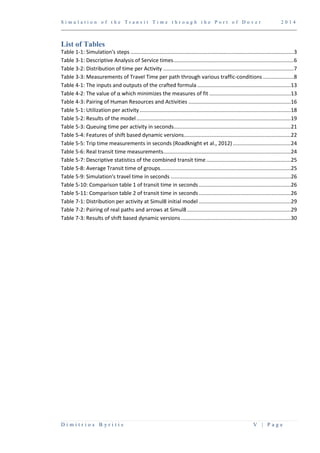
List of Tables
Table 1-1: Simulation's steps ..............................................................................................................3
Table 3-1: Descriptive Analysis of Service times.................................................................................6
Table 3-2: Distribution of time per Activity ........................................................................................7
Table 3-3: Measurements of Travel Time per path through various traffic-conditions.....................8
Table 4-1: The inputs and outputs of the crafted formula ...............................................................13
Table 4-2: The value of α which minimizes the measures of fit .......................................................13
Table 4-3: Pairing of Human Resources and Activities .....................................................................16
Table 5-1: Utilization per activity......................................................................................................18
Table 5-2: Results of the model........................................................................................................19
Table 5-3: Queuing time per activity in seconds...............................................................................21
Table 5-4: Features of shift based dynamic versions........................................................................22
Table 5-5: Trip time measurements in seconds (Roadknight et al., 2012) .......................................24
Table 5-6: Real transit time measurements......................................................................................24
Table 5-7: Descriptive statistics of the combined transit time.........................................................25
Table 5-8: Average Transit time of groups........................................................................................25
Table 5-9: Simulation's travel time in seconds .................................................................................26
Table 5-10: Comparison table 1 of transit time in seconds..............................................................26
Table 5-11: Comparison table 2 of transit time in seconds..............................................................26
Table 7-1: Distribution per activity at Simul8 initial model ..............................................................29
Table 7-2: Pairing of real paths and arrows at Simul8......................................................................29
Table 7-3: Results of shift based dynamic versions ..........................................................................30
S i m u l a t i o n o f t h e T r a n s i t T i m e t h r o u g h t h e P o r t o f D o v e r 2 0 1 4
D i m i t r i o s B y r i t i s V I | P a g e
List of Figures
Figure 1-1: Port of Dover, (Google Maps, 2014).................................................................................2
Figure 3-1: Percentages of Service time for HGVs..............................................................................7
Figure 3-2: Percentages of Service time for Cars................................................................................7
Figure 3-3: Proportions of vehicles per Operator...............................................................................9
Figure 4-1: The port of Dover with marked the points of security controls (Google Maps, 2014) ..10
Figure 4-2: Diagram of the flow through Dover's Port .....................................................................11
Figure 4-3: Distribution of various α through various levels of Fullness ..........................................13
Figure 4-4: Simul8 model..................................................................................................................15
Figure 4-5: Moving average of work items in queue at Simul8 model.............................................17
Figure 5-1: Vehicles entered to the system through the various traffic-conditions ........................20
Figure 5-2: Average Transit-time in seconds through various versions............................................20
Figure 5-3: Utilization of Human resources on ticketing-booths......................................................21
Figure 5-4: Transit-time in seconds through various versions..........................................................22
Figure 5-5: Utilization of Human Resources on Freight ticketing-booths.........................................23
Figure 7-1: Car Path at Simul8 ..........................................................................................................31
Figure 7-2: HGVs Path at Simul8.......................................................................................................31
S i m u l a t i o n o f t h e T r a n s i t T i m e t h r o u g h t h e P o r t o f D o v e r 2 0 1 4
D i m i t r i o s B y r i t i s V I I | P a g e
List of Abbreviations
AVI Automatic Vehicle Identification
DFDS Det Forenede Dampskibs-Selskab (Ferry Operator)
HGV Heavy Goods Vehicle
KPI Key Performance Indicator
MFL My Ferry Link
P&O Peninsular and Oriental Steam Navigation Company
PAF Police Aux Frontières
PTV-VISSIM Planung Transport Verkehr AG - Verkehr In Städten - Simulationsmodell
STEN Space –Time Expanded Network
TMI Traffic Management Improvement
S i m u l a t i o n o f t h e T r a n s i t T i m e t h r o u g h t h e P o r t o f D o v e r 2 0 1 4
D i m i t r i o s B y r i t i s V I I I | P a g e
Abstract
The present thesis provides an analysis and evaluation of the check-in procedure at Dover‟s
harbour. The method of analysis was based on discrete-event simulation, through the use of
simulation software package, the Simul8. Furthermore, statistical analysis was used to the collected
data. The initial results indicated that the model could work fittingly with a satisfactory level of
accuracy. Further, the combined transit time is close to 360 seconds under normal traffic conditions
and rises to 580 under heavy traffic. Also, the system has a bottleneck on trucks‟ ticketing booth,
which affects the overall transit and queuing time. In addition, the overall proportions of
personnel‟s utilization range on low levels. The first recommendation of the paper is the
installation of an automated system, through the whole check-in process. Secondly, an updated
assignment of the ticketing booths, based on the operators' demand, could contribute to the removal
of the bottleneck. Finally, more efficient and effective use of human resources is essential. Still, the
present research is limited to on spot measurements of data and to not use micro-traffic simulation
software; the latter fact ultimately contributed to the great significance of this study.
S i m u l a t i o n o f t h e T r a n s i t T i m e t h r o u g h t h e P o r t o f D o v e r 2 0 1 4
D i m i t r i o s B y r i t i s 1 | P a g e
1 Introduction
One of the most challenging issues within the transport industry is the traffic management of travel
stations. The rising number of passengers and cargo causes difficulties in their entrances and exits.
This is a major problem, as port and airport authorities seek to increase profits by attracting more
partners. Specifically, ports contain several areas with capacity for improvement, such as ferry and
cruise passengers, cargo and marina. There are several features, which contribute to the final
efficiency and performance evaluation of the port. For example, based on the aspect that “time is
money”, the time needed for crossing the harbour to boarding is an important decision factor for
potential clients. Effective traffic management could decrease transit time and in turn, induce more
tourists and businesses (such as logistics and transport companies), which wish to avoid
congestion. A smooth traffic flow guarantees less travel time and reduces fuel costs. In addition,
the rationalization of traffic management could not only diminish delays on ships‟ schedule but
also facilitate port authorities in using fewer and more efficient shifts on several posts, as well as to
avoid delays on ships‟ schedule. Finally, the traffic control makes a port more durable and agile
during adverse events, and smooth traffic produces fewer emissions, a fact that could be used to
boost the public image of port authorities.
A consistent method to estimate traffic and evaluate traffic management is simulation. This paper
focuses on the simulation of the needed time to cross the port of Dover. Mainly, it examines the
transit time through Dover‟s port from the first stop, for passport control, to last one for boarding.
For the purposes of the study, a model will be built on simulation software to ensure the reliable
visualization of the port‟s infrastructure, traffic and operation process. The analysis will be based
on two dimensions: time and performance. First, the total transit time as well as the queuing and
service time, on each control-point, will be examined. Secondly, the performance level of each
check-point as well as the efficiency of the servers and the shifts will be assessed. Also, based on
the simulation model the bottlenecks on the flow will be discussed whilst suggestions and changes
for the improvement of the overall procedure, will be discussed. Finally, a comparison of results
from two different simulation packages will take place.
The analysis will be effected on the port of Dover (Figure 1-1). This port is located in the South-
east of England and it is the nearest port to France. Hence, it is an ideal port to connect the UK with
continental Europe. Dover is one of the busiest ports in Europe, with more than 12m passengers for
2013 (Dover Port, 2014). This, in conjunction with the increased numbers in each operational
business field is a demanding challenge for the performance of the port. In addition, the lack of
space, for additional road lanes and parking lots in the particular area, renders the traffic
management a profoundly significant task. Furthermore, a unique feature of the port is that it
connects the UK with the EMU countries; thus, the implementation of necessary additional controls
(such as passport-control) may overload the overall procedure.
Simulation is a broadly used management science technique, which examines systems with high
levels of complexity (Winston & Goldberg, 1994). Banks and his colleagues (2001) describe
simulation as the imitation of real-world systems over time; what if questions are used to describe
and analyse the behaviour of the system in question and in turn, facilitate the design of a real
system. For the purpose of this study, two different simulators will be used. Specifically, the
Simul8 process simulation software will be used to visualize the system's capabilities into realistic
simulations. The Simul8 was selected due to its user-friendly interface and its object-oriented
characteristics. Simul8 is a discrete-event package that can visualize the system‟s capabilities into
accurate simulations (Concannon et al., 2003). The port‟s control system will be examined as an
integrated process, from the first check-point to the last.
Traffic simulation problems are classified based on time, state and space which could be discrete or
continuous (Traffic Simulation, 2014). Systems of this sort, (i.e.-with discrete events and
continuous state) are usually observed by micro-traffic simulation packages. This is the greatest
challenge of the present research as it attempts to approach the resolution of such problems a
distinct type of simulators, such as Simul8. Precisely, the significance of this study lays in the
investigation of traffic systems based on simpler and more user-friendly packages and without the
S i m u l a t i o n o f t h e T r a n s i t T i m e t h r o u g h t h e P o r t o f D o v e r 2 0 1 4
D i m i t r i o s B y r i t i s 2 | P a g e
specialized knowledge of traffic engineering and theory. However, commonly the analysis of such
traffic systems is mediated by the use of micro-traffic simulators, like PTV-VISSIM. Traffic
simulation is the imitation of transportation systems based on mathematical modelling. The term
“micro”, which is an abbreviation of microscopic, reflects that the entities on the model
(passengers, cars, signal lights etc.) react like individual objects (Nagel and Rickert, 2001). PTV-
VISSIM is a simulation tool, time step and behaviour based for the examination of highways and
public transport (Bloomberg and Dale, 2000). By the usage of PTV-VISSIM, each control-
procedure could be simulated and examined as well as the traffic flow between the stops.
Figure 1-1: Port of Dover, (Google Maps, 2014)
There are many business-modeling techniques, -such as systems dynamics, knowledge-based
techniques and discrete event simulation (Bosilj-Vuksic & Hlupic, 2004). The present research is
based on the building of a discrete-event simulation model and the examination of different
scenarios, which is considered to be the most practical and user-friendly practice. There are several
steps that constitute the simulation process, as they are presented on Table 1-1. This is a critical
path in order to build an accurate and representative model of the system. The first and most
important stage is the business and operational understanding of the system. After this, the building
of an initial simplified model takes place; its practicality is to illustrate on a visual way the flow
and interaction between the different activities. Then, the parameterization of the system is needed;
this includes several data like the distribution of time on activities or crucial proportions, which
determine the traffic flow. The collection of data, through a range of methodologies, is necessary
for this step. For the purposes of this study, data was gathered with measurements on the spot,
searching on existing data and by utilization of data from related works.
The next step is the analytical and detailed building of a computer model. For the purposes of the
current paper, the model was built on simulation software. Simul8 is a program for discrete time
simulation and a useful tool for planning, optimizing, identifying and redesigning a system‟s
structure. The software‟s object-oriented and discrete event simulating capacities render it most
suitable for the simulation of production lines, supply chains, business processes or call centers.
However, in this case it will be used for the examination of traffic management issues. The
foundations of the computer model are based on queuing theory, which consists of three elements
namely: arrival, queuing and service process. The improved model on Simul8 includes two
additional activities; a generator or start point, where the work items are produced and entered into
S i m u l a t i o n o f t h e T r a n s i t T i m e t h r o u g h t h e P o r t o f D o v e r 2 0 1 4
D i m i t r i o s B y r i t i s 3 | P a g e
the system, and the arrival or end point, where the already processed entities end up. Finally, the
examined issue will be addressed as a dynamic, discrete-time, stochastic problem; hence, the
discrete-event simulation is appropriate.
Therefore, the verification and validation of the computer model is set. The initial estimation is
based on consistency and logical interpretation of the results. Furthermore, a comparison with the
existing data will take place for the identification of any mismatches and weak parts on the
simulation model. Then several scenarios will run in order to check the impact of the changes and
the critical elements of the system. The final step of the simulation is the collection of the results
and findings from a sufficient number of runs and trials.
Steps Actions
Step 1 Begin to understand the system
Step 2 Develop a conceptual model
Step 3 Collect data & parameterize distributions
Step 4 Build a computer model
Step 5 Verify and validate model
Step 6 Evaluate and perform sensitivity analysis
Step 7 Report results and findings
Table 1-1: Simulation's steps
S i m u l a t i o n o f t h e T r a n s i t T i m e t h r o u g h t h e P o r t o f D o v e r 2 0 1 4
D i m i t r i o s B y r i t i s 4 | P a g e
2 Literature Review
The simulation method is widely used from researchers in a vast range of fields; it is particularly
used in subjects related to traffic management and queuing time. The subject of waiting-time has
been analyzed on diverse applications. Firstly, the concept of conceptual modelling of a simulation
and the required steps as well as the challenges is illustrated in Robinson‟s work (2004). Further, a
good example on simulation is the work of Van Berkel and Blake (2007) where the procedure and
waiting-time in general surgery are discussed. A model was built for the simulation of the capacity
in surgery and the stabilization of the waiting-time. Another application of simulation is illustrated
in Joustra and Van Dijk work (2001), who analyze the check-in process in airports. Firstly, a
comparison between queuing theory and simulation is presented, and a simulation and evaluation
of operational system of check-in is following. Further, in Yang and Meng work (1998), the issue
of traffic congestion in queuing networks is examined. More precisely, they illustrate a STEN
approach for managing these networks with the elastic demand.
A very attractive area for simulation analysis is the ports‟ performance. Kozan (1997) presents an
important work, where he investigated queuing techniques for the improvement of the performance
at a seaport container‟s terminal. The analysis is followed by a comparison of the proposed
approach to other models and simulations. An exquisite example of the use computer simulation
for the evaluation of performance and capacity of a container terminal is presented by Kia and his
colleagues (2002). Based on a comparison between the suggested and current model of the port,
they suggest an alternative operational strategy. In addition, they outline the issues that caused for a
traffic jam and reduced the terminal‟s capacity. A work in a similar field is this of Mathew and his
colleagues (2005), as they performed a study on military cargo. More specifically, the designed a
new architecture of a network of freight terminals, based on simulation method. The suggestion is
an object-oriented, hierarchical and nodal model, which simulates the cargo terminals under
various conditions and scenarios. The key elements of the model are the resources and the
infrastructure in each terminal as well as the transportation between the terminals. Finally, a case
study is presented for the validation of the design.
It is important to mention that although airport performance has been widely studied, researchers
have yet to apply a simulation perspective to the matter For instance Aubert (1999) investigates an
algorithm for the measurement of queues‟ length in airports based on image‟s analysis and then this
algorithm is tested on real situations. In addition, in his work, Tosic (1992) explains the efforts
made in expressing the planning and design of passengers‟ terminals, using mathematical models.
In the same study, the check-in process is discussed as well as the waiting and service time. In turn,
a detailed discussion and determination of the significant factors for the evaluation of airports‟
performance is presented on Lemer‟s study (1992). More precisely, he illustrates a framework,
composed by classified factors, for the efficient support of airports‟ operational strategy.
Furthermore, another work in the same field and close related with the present thesis is this Diaz
Esteban and his colleagues (2008); the check-in process is discussed at the airport of Lisbon. The
authors use the Simul8 for their research and simulation of the procedure. The process and the
needed time to pass through the security controls are examined, as it is one of the biggest issues for
airports. Finally, they suggest some changes on the operation of the particular services.
Another field where the Simul8 applied is on scheduling and planning production chains or
manufacturing and construction procedures. Concannon and his colleagues (2003) made a detailed
analysis and presentation of Simul8 and its capabilities on production scheduling and planning, as
well as new applications of the specific package are examined. A significant work in the same field
is this of Aslani and Christodoulou (2006). More specifically, they researched a new perspective on
scheduling of constructions based on the availability of resources; the resource-constrained
scheduling method as it is referred. On the other hand, Heilala and his colleagues (2010) made a
research on the same topic but with another perspective. Specifically, they investigated the building
of Discrete Event Simulation based on Decision Support Systems as tools for manufacturing
scheduling. They illustrate the challenges on the procedure of developing the model, and they
present a case study for the verification of their work.
S i m u l a t i o n o f t h e T r a n s i t T i m e t h r o u g h t h e P o r t o f D o v e r 2 0 1 4
D i m i t r i o s B y r i t i s 5 | P a g e
Another field that uses simulation is the analysis of a toll plaza. Simulation is a very adept
quantitative tool for the examination of situations with heavy traffic and high service demand. For
instance, Sadoun (2005) examines the optimization of performance on a toll plaza. In turn, an
analysis of traffic is followed by the investigation of queuing-time, based on a simulation model.
Eventually, an analysis on the number of tollbooths and the effects on delays are performed.
Similarly, Ceballos and Curtis (2004) compare traffic simulation and multi-sever queuing models.
Particularly, the researchers estimate the waiting-time and queue lengths at toll and parking lots,
based on the aforementioned methods. Finally, a detailed description of data collection is presented
and the conclusion that simulation provides more robust and comprehensive results. A research
related with the dealing of congestion at toll-plazas was given by Zarillo et al (1997), who
investigated ways for the improvement of performance. They suggest that the implementation of
new technologies AVI could be a solution for the traffic jam at those areas.
Still, international literature in the examination of ground-traffic in seaports is limited and
developed only recently. The present work is strongly related to Dachyar‟s study (2012), which
presents a simulation and optimization at an Indonesian port. In Dachyar‟s work, the waiting time
and the vehicles queuing are considered with the use of software suitable for dynamic simulation of
business activities. His analysis includes different scenarios and the suggestions are related with the
capacity and the amount of the ships. On the other hand, the work of Roadknight, Aikelin and
Sherman (2012) discusses the problems and difficulties that arise through the modeling of a
simulation. Notably, a case study on Port of Dover is taking place for the verification of their
analysis. The ground-traffic at port of Dover is examined and methods for the validation of the
simulation and the avoidance of over-calibration are presented. Furthermore, Roadknight and
Aikelin (2013) recently introduced the discussion related with the emerging issues while an
existing simulation model is extending. The basic model represents the port of Dover and several
strategies were implemented on this for simulation.
The remainder of this paper is organized as follows. A section containing the presentation, analysis
and evaluation of the used data follows. Further, the modelling process is shown; the presentation
of the business procedure is followed by a brief discussion of parameterization of the system‟s
elements. Next, the results and significant findings from the analysis are discussed. Finally, the
overall conclusions and suggestions of the presented analysis are presented.
S i m u l a t i o n o f t h e T r a n s i t T i m e t h r o u g h t h e P o r t o f D o v e r 2 0 1 4
D i m i t r i o s B y r i t i s 6 | P a g e
3 Data Analysis
3.1 Service Time
The building of a simulation model requires a large amount of data in order high levels of accuracy
and reliability to be achieved. As the dataset covers many aspects of the real function of the
system, the representativeness of the model is increased. Beyond the settings of the model, which
are related to the operational function of the port there is ample information relative to the
simulation of the process. The first batch of data is related to the service time of each facility,
which follows specific distributions. There are six different service times corresponding to the six
check-stops. The distribution of each service time was based on empirical data. These data were
collected using on the spot measurements under normal operating conditions that represent an
average level of traffic. The measurement of each observation was made using a stopwatch that
merely calculated the necessary time for the service of each vehicle. The dataset was based on
more than a hundred vehicles that passed through the port. The descriptive statistics of the
measurements for each service are presented in the Table 3-1. Accordingly, the measurements
indicate that the service time for trucks is larger than this for tourists‟ vehicles. The most time-
consuming check is the searching of suspicious freights with a mean of 175 seconds, while the
corresponding period for cars is 118 seconds. In the case, that trucks or cars do not pass the
searching facility, and then the consumption of service time is apportioned as shown in Figure 3-1
and Figure 3-2. Furthermore, there is great dissimilarity between the ticketing time for trucks and
cars. The service for freights lasts quite longer, not only due to a need for the confirmation of a
range of details relative to the load but also due to heightened bureaucratic procedures. The
identification of the distribution for each service time was based on goodness of fit model using
StatFit on Simul8. The assessment of whether a set of observations suits on the given distributions
of the software was based on the Kolmogorov-Smirnov test, where the distribution with the highest
p-value was chosen. The allocation of the distributions per service is given in Table 3-2. At this
point, it should be underlined that some services follow the lognormal distribution, which is a
heavy-tail distribution. Hence, extreme long times could be observed because of the tail; however
the average time remains representative.
Descriptive
Statistics
Weighbridge
Freight
Search
Freight
Ticketing
Time
PAF
Control
Car
Search
Car
Ticketing
Time
Mean 17,26 175,40 123,06 20,34 118,10 34,15
St. Error 0,94 19,88 13,76 3,55 16,72 6,53
Median 17,22 167,11 124,55 14,47 104,94 23,79
St. Deviation 4,20 62,86 55,02 19,46 52,88 29,22
Variance 17,63 3.950,88 3.027,36 378,83 2.795,90 853,90
Kurtosis 2,28 0,56 0,42 4,56 -0,63 6,33
Skewness 0,81 -0,18 0,84 2,06 0,62 2,48
Range 18,58 223,40 184,36 82,31 159,21 115,99
Minimum 10,47 56,75 57,94 2,41 50,14 15,99
Maximum 29,05 280,15 242,30 84,72 209,35 131,98
Sum 345,13 1.754,01 1.969,03 610,14 1.181,02 683,00
N 20,00 10,00 16,00 30,00 10,00 20,00
Table 3-1: Descriptive Analysis of Service times
S i m u l a t i o n o f t h e T r a n s i t T i m e t h r o u g h t h e P o r t o f D o v e r 2 0 1 4
D i m i t r i o s B y r i t i s 7 | P a g e
Figure 3-1: Percentages of Service time for HGVs
Figure 3-2: Percentages of Service time for Cars
Service Distribution
Weighbridge Lognormal
Freight Search Lognormal
Freight Ticketing Time Beta
PAF Control Lognormal
Car Search Pearson V
Vehicle Ticketing Time Lognormal
Table 3-2: Distribution of time per Activity
3.2 Travel Time
The building of a function for the estimation of the travel time for one activity to another requires a
wide range of data. Too, such data were gathered by measurements on the port for each one of the
needed paths. The careful selection of the routes was a challenging, due to the risk of overlapping
some paths. Hence, the suggested paths as well as the times in seconds are presented in Table
3-3. The times represent three statuses of traffic through Dover; not very busy, normal operating
conditions and very busy. The paths for tourists are two; one with cars-searching included (2+6)
and one not (7), hence three paths must be measured. The same was applied for trucks routes, with
the exception that there is one compulsory stop on weighbridge. Therefore, there are four paths for
two routes; one involving freight-search (1+4+5) and one omitting it (3+5). At this point, it must be
5%
56%
39%
Service Mean Time
Weighbridge
Freight Search
Freight
Ticketing Time
12%
68%
20%
Service Mean Time
PAF Control
Car Search
Vehicle
TicketingTime
S i m u l a t i o n o f t h e T r a n s i t T i m e t h r o u g h t h e P o r t o f D o v e r 2 0 1 4
D i m i t r i o s B y r i t i s 8 | P a g e
mentioned that the PAF-Control booths are considered the start point of the system whilst the
ticketing booths are considered the end point.
Paths Non-Busy Normal Very Busy
1 PAF -Freight Search Facility 4 8 10
2 PAF - Cars Search Facility 20 25 30
3 PAF – Weighbridge 15 25 35
4 Freight Search –Weighbridge 18 20 60
5 Weighbridge - Ticket Booths 225 270 690
6 Car Search - Ticket Booths 228 288 695
7 PAF Control - Ticket Booths 240 360 720
Table 3-3: Measurements of Travel Time per path through various traffic-conditions
3.3 Inter-arrival Time
One of the most important factors in a simulation system is the arrival process of the work items.
The arrival rate is a significant element of the function of the simulation model, as it affects the
holistic performance of the system, particularly in problems like those of the present work, where
matters of queuing are discussed. Hence, various inter-arrival times between successive work items
lead to different queues and service level and finally to different traffic management. Previous
studies have already mentioned the issue of fluctuations in the arrival rate during the year or even
during the day at the port of Dover. This variation depends on the season of the year (for example
during the touristic periods the port is busier), on special events, such as the tour events and on
unlikely events, such as cancelations or long delays on Eurotunnel‟s schedules. Based on the work
of Roadknight et al. (2012), the busiest time for the port is after 3 pm, while the lowest arrival rate
occurs after 2 am. Furthermore, the maximum flow is four times higher than the minimum one, a
fact that confirms the considerable variance on the arrival rate. Also, subsequent work by
Roadknight et al. (2013) mentions that the peak-flow is six vehicles per minute. Hence, the latter
findings in combination with queuing theory suggest that given the arrival-rate is distributed by
Poisson then the inter-arrival time is given by exponential distribution with an average of 10
seconds. However, multiple scenarios with a variety of inter-arrival times will be examined, in
order to broadly represent the three levels of traffic volume: low, normal and high. The inter-arrival
time for them will be 40, 25 and 10 seconds respectively.
3.4 Vehicles and Operators
The percentages of trucks and cars crossing the port have a significant contribution to the overall
operation of the system. Due to the variations in the size, routes and service time between the two
groups of vehicles, the running conditions and status of the port could change at any time. This is a
dynamic factor, which depends on daytime and weekday; in the present model the rate will be
stable. More specifically, the cars will be 54% of the total vehicles and the trucks will cover the rest
46%. These ratios were extracted from the analysis on ferries data, based on arrivals on port during
May 2014. Furthermore, an analysis per ferry operator was necessary for the routing of the
vehicles. There are three ferries operators; two English brands, P&O and MFL and a Danish one,
DFDS. Based on the same period, an examination of the ratios per operator took place. The P&O
takes the lion‟s share on total traffic, as it serves more than 50% of the total passengers and
freights. Slightly over than one-third is the ratio of DFDS and finally the rest is served by MFL
(Figure 3-3). These proportions cause deviations on queuing times at ticketing-booths, while the
booths have been shared based on the dynamic and the demand of each operator.
S i m u l a t i o n o f t h e T r a n s i t T i m e t h r o u g h t h e P o r t o f D o v e r 2 0 1 4
D i m i t r i o s B y r i t i s 9 | P a g e
Figure 3-3: Proportions of vehicles per Operator
3.5 Servers and Shifts
The facilities on the port of Dover are run by independent authorities (as per the aforementioned
descriptions); hence, each service decides on the number of servers. However, there are limitations
caused by the infrastructure and the facilities of the port. For example, the French Border Police is
responsible for the passports checks and the number of operating booths, which are however
limited to six cabins. The same applies to the rest of the services. Hence, freight search facilities
could serve up to three checks and up to six for cars. The weighbridges are five and on the check-in
plaza there are thirty booths. Specifically, MFL runs six booths, DFDS runs ten and the rest
fourteen are managed by P&O. Each company takes the decision for the number of servers;
however for the purposes of this study four shifts were applied, which corresponds to four levels of
traffic volume: a quiet shift, two normal shifts with different levels of available human resources
and a pick-hour shift.
3.6 Data Evaluation
Three kinds of data were used for the present work. The first is empirical data, which was collected
through on site measurements at the port. Undoubtedly, this dataset is a representative sample of
the real conditions and times; however, the method of collection was amateur. The gathering was
made by the observation of each vehicle and the measurement of time with a stopwatch. More
precise and accurate data could be collected with the assistance of the port‟s security system, as
there are cameras that record the vehicles at various points in time. Another way could be with the
usage of scientific equipment and for a longer time.
The second type of data was the existing data of the port. Port authorities collected these data for
the control and the evaluation of their system and so it is assumed that they are more accurate and
detailed. The third kind is based on datasets and information that was used in other researches.
Despite the fact that these are published works, the dataset could not be examined for its quality
and assurance.
50,2%
37,3%
12,6%
Ratios per Operator
POS
NKL
MFL
S i m u l a t i o n o f t h e T r a n s i t T i m e t h r o u g h t h e P o r t o f D o v e r 2 0 1 4
D i m i t r i o s B y r i t i s 1 0 | P a g e
4 Simulation Model
4.1 System Understanding
Dover‟s port follows a particular procedure, as it is the port that connects UK with continental
European countries. Hence, additional controls by independent authorities are required for
travelling at various points (Figure 4-1). The port‟s authority cannot intervene to these checks;
therefore, should manage the traffic based on port‟s infrastructure, roads and paths. In some cases,
Dover‟s experts could advice these authorities for the improvement of the overall service level.
Also, the port‟s authorities are responsible for preventing and managing any unfortunate events or
unusually high levels of traffic. In such situations, port authorities could inform the servers in order
to be prepared.
Figure 4-1: The port of Dover with marked the points of security controls (Google Maps, 2014)
A simplified version of the port's procedure is presented in Figure 4-2. The route diagram for
passengers and freights and the needed checks are highlighted. The routes for passengers and
freights are different, though they share some common parts as there are various stops for cars and
trucks. The passengers‟ vehicles should stop on „PAF control‟ for passport-checks where the vast
majority of freights pass without control. Then, for tourists there is a potential stop on „vehicle
search facility‟, where almost 20% of vehicles are checked. On the other hand, some trucks should
stop on „freight search facility‟, which operates almost 50% of the time. In both situations, checks
are made randomly or after incoming information about suspicious cargo or vehicles. The next
necessary step for all trucks is the weighbridge. Finally, the last stop is standard for tourists‟ cars
and trucks on check-in plaza, where the confirmation of tickets is made. However, there are
different lanes for freights and tourists cars.
S i m u l a t i o n o f t h e T r a n s i t T i m e t h r o u g h t h e P o r t o f D o v e r 2 0 1 4
D i m i t r i o s B y r i t i s 1 1 | P a g e
Figure 4-2: Diagram of the flow through Dover's Port
As it mentioned above, the majority of these facilities are not supervised by the port but by other
independent authorities. More specifically, the PAF-Control is operated by the French Border
Police, the search facilities by police and cooperating private security companies and the „check-in
plaza‟ by ferries‟ operators. Each authority decides about the number of servers, based on traffic
volume, forecasts and other general information. More specifically on ticket-booths, there are three
operators with a specific number of booths per operator. The same applies in this case as well, as
each operator decides about the number of booths which are operated, based on tickets booking and
ferries schedule. To sum up, the tourists‟ vehicles and trucks follow different routes, with some
common parts and stops, and they should pass through two or three checks until the embarkation.
4.2 Travel Time Modeling
Travel time is an important element in the examination of traffic problems. Travel time in
conjunction with queuing time constitute the two dynamic factors that determine the overall level
of performance of the system. Especially with traffic-simulators, the travel time is not one of the
inputs of the model; on the contrary it is one of the outputs. These software packages estimate time
based on inputs of the system and other settings with extraordinary accuracy. However as
previously reported, Simul8 is not designed for traffic simulations; hence travel time could not be
incorporated into the results. However, the software includes an option to identify the travel time
between two objects, a queue and an activity. Hence, a function that would represent the dynamic
change of travel time could be built.
In general, there are many ways to estimate the travel time, not only in terms of variety in methods
but also through a range of inputs. One prediction technique entails the usage of support vector
regression, which is the most suitable for time-series analysis as it generates smaller mean and root-
mean-squared errors (Wu et al., 2004). Another approach is the usage of machine learning and data
mining techniques, where the learned predictors are proved more accurate than the control ones
(Handley et al., 1998). However, in the present model, the travel time formula is based on
Davidson‟s function. In reality, the required time to cover a distance depends on the traffic volume,
which is calculated using the vehicle-flow and road-capacity. Davidson expressed the latter on his
method and so crafted a formula with the most robust theoretical foundation (Rose & Raymond,
1992). In this formula the travel time (T) is predicted as a function of traffic volume (V). More
specifically the function is presented on the following form:
S i m u l a t i o n o f t h e T r a n s i t T i m e t h r o u g h t h e P o r t o f D o v e r 2 0 1 4
D i m i t r i o s B y r i t i s 1 2 | P a g e
( )
The formula consists of three parameters; represents the travel time with zero traffic volume; the
represents the curvature factor and represents the capacity of the road. For the purposes of the
model, this formula was converted as it is not possible to estimate the traffic volume. Hence, the
calculation will be based on the relationship between the capacity of the queue and the number of
work items in the queue. This means that the function will be affected by the level of congestion of
each queue, as in the following form:
( )
The sole differentiation from the previous formula is the , which represents the percentage level
of fullness of the queue. More specifically, the expresses the number of work items divided by
the capacity as follows:
Where is the number of items in the queue and is the capacity of the queue, the estimation of
which will be discussed later on this paper. The is the dynamic factor of the function, as it can
change anytime, depending on the volume of work items. There are many ways to estimate the
parameters on Davidson‟s formula, based on the given values of the other parameters (Taylor,
1977). One way is by using the minimum sum of squares of differences between the observed and
expected values. In the examined system, the minimum travel time ( ) will be equal to the times
that the port was not busy ( Table 3-3). It is assumed that this is the free travel time, as the
non-busy status is the closest to the free-flow. In addition, the other two statuses of the port will be
matched with specific percentages of teeming (fullness). In detail, the normal status will represent a
level of 50% full a queue and the very busy conditions a ratio of 90%. Hence, these will be the
observed values for the estimation of α.
The estimation of this parameter will be based on widespread forecasting methods through the use
of overall measures of fit. More precisely, the main criteria will be the Mean Absolute Deviation
(MAD) and the Root Mean Square Error (RMSE). The use of spreadsheets and their add-on
applications, (such as solver), will facilitate the minimization of these measures in order to identify
the best solution for α. The formulas for MAD and RMSE are as follows:
MAD
∑| |
RMSE √
∑( )
Where the ΧΟ is the observed times for each path, ΧF is the forecasted times and N is the total
number of observations. There are two groups of observed times as it mentioned above, with 50%
and 90% of fullness. The value of α which minimizes MAD and RMSE is 0,2775 (Table 4-1 and
Table 4-2).
S i m u l a t i o n o f t h e T r a n s i t T i m e t h r o u g h t h e P o r t o f D o v e r 2 0 1 4
D i m i t r i o s B y r i t i s 1 3 | P a g e
F% Path t0 XO XF Error Error Sq.
50%
PAF -Freight Search Facility 4,00 8,00 4,91 3,09 9,55
PAF - Cars Search Facility 20,00 25,00 24,55 0,45 0,20
PAF – Weighbridge 15,00 25,00 18,41 6,59 43,40
Freight Search –Weighbridge 18,00 20,00 22,09 2,09 4,39
Weighbridge - Ticket Booths 225,00 270,00 276,18 6,18 38,24
Car Search - Ticket Booths 228,00 288,00 279,87 8,13 66,15
PAF Control - Ticket Booths 240,00 360,00 294,60 65,40 4.277,62
90%
PAF -Freight Search Facility 4,00 10,00 12,19 2,19 4,79
PAF - Cars Search Facility 20,00 30,00 60,95 30,95 957,74
PAF – Weighbridge 15,00 35,00 45,71 10,71 114,72
Freight Search –Weighbridge 18,00 60,00 54,85 5,15 26,50
Weighbridge - Ticket Booths 225,00 690,00 685,66 4,34 18,85
Car Search - Ticket Booths 228,00 694,80 694,80 0,00 0,00
PAF Control - Ticket Booths 240,00 720,00 731,37 11,37 129,24
Table 4-1: The inputs and outputs of the crafted formula
α MAD RMSE
0,227 11,189 20,163
Table 4-2: The value of α which minimizes the measures of fit
Hence, this is the value of α which will be used as a parameter in the model. At this point, it must
be mentioned that the value of α has a leading role in the prediction of the times based on the
formula above. The forecasted values are very sensitive to the changes of this parameter. The curve
of the time, through the different level of fullness changes dramatically when α becomes smaller.
Higher values, like 1.5, give very long times on high levels of traffic. This influence of α on
predicted value could be better understood by looking at Figure 4-3. It is clear that the distance
between lines becomes greater after 70% of fullness, with culminating in 90% where the
differences are very big. The dotted line represents the best α which has already been found, as it
described above.
Figure 4-3: Distribution of various α through various levels of Fullness
0
50
100
150
200
0 0,1 0,2 0,3 0,4 0,5 0,6 0,7 0,8 0,9
Seconds
Χ= % Fulness
Effection of α on Travel time
a=1,5
a=1
a=0,5
a=0,1
a=0,2275
S i m u l a t i o n o f t h e T r a n s i t T i m e t h r o u g h t h e P o r t o f D o v e r 2 0 1 4
D i m i t r i o s B y r i t i s 1 4 | P a g e
4.3 Capacity on the Queues
A traffic-simulation model on a specialized software package requires setting the capacity of
vehicles per lane. In some cases, this quantity can be predicted based on other settings. Hence,
there is an upper-limit on the vehicles that can be served per road-lane; so the travel-time and the
queuing time are related to this bound and traffic demand. On the contrary, Simul8 does not have
the capability to put a limitation on the lanes or arrows. However, there is an option to set a
maximum size on queues. Each queue will have a maximum size of work-items which could be
entered simultaneously. This setting will improve the level of accuracy and the reliability of the
model. The estimation of queues‟ capacity was based on Google maps and the measurement of
distance for each path. In addition, in order to achieve greater veracity, an equivalent will be built
between cars and trucks. More specifically, due to the fact that HGVs need more space, they will
be equal to three cars; hence, he average length for each car was defined on 4 meters and for HGVs
on 12.Suitably, the representation of cars and trucks on the queue before operators will be more
reliable. This is a very broad method for the calculation of the capacity; hence it approximates the
true values.
4.4 Simul8 Implementation
4.4.1 Structure of the Model
The examination of the system starts with the entry at PAF-booths and finishes with the exit from
ticket-booths. Hence, the building of all activities and routes within these two points was necessary
(Figure 4-4). In addition, the structure of the model is defined by two separate paths; one for the
cars and one for the trucks. There is no common activity for the two types of vehicles, despite of
the fact that in the real system there are two: the PAF control and the ticket-booths. In order to
facilitate the building of the model and the improvement of accuracy, there are two different paths
for each type of vehicle. Each type of vehicle passes through different activities with different
service-time. Hence, two paths help the monitoring and observation of these categories.
Car Route
The journey for all the entered vehicles begins at the start point. After this the „Dummy takes place,
where the split-up on cars and trucks occurs. From this point onwards the two separate paths start,
one for cars and one for freights. The tourist-cars path has two basic steps, the „PAF Control‟ and
the ticketing on the check-in plaza. In addition, at the passport-check vehicles get divided to cars
that will be checked and to cars that will follow the ordinary path to the ticket-booths. Right after,
the cars will be separated on the basis of operators. There are three operators which run various
numbers of ticket-booths. The last part of this path is the end point (Figure 7-1).
There are a few significant points on this route, which define its duration. The first is the selection
of cars to be checked and those to not be. The searching leads to longer transit-time. The second
notable point is the selection of the operator. Ferry-companies with high demand operate more
servers that, in most cases leads to shorter queuing time. The proportions for the separation and the
number of servers are mentioned above in detail.
S i m u l a t i o n o f t h e T r a n s i t T i m e t h r o u g h t h e P o r t o f D o v e r 2 0 1 4
D i m i t r i o s B y r i t i s 1 5 | P a g e
Figure 4-4: Simul8 model
S i m u l a t i o n o f t h e T r a n s i t T i m e t h r o u g h t h e P o r t o f D o v e r 2 0 1 4
D i m i t r i o s B y r i t i s 1 6 | P a g e
Truck Route
Almost the same logic is applied for trucks‟ path. After the „Start Point‟ and „Dummy PAF‟ which
are common points, this route continues with „Dummy Freight‟, where the decision about which
truck will be checked takes place. Next, the split-up of trucks for the weighbridges occurs as it was
mentioned in the third chapter. The critical point in this path is the queues before weighbridges. All
the HGVs pass through these queues; hence, a traffic jam could happen at this point. The freight
operators are structured exactly as on the previous path (Figure 7-2).
In that case there are some notable points, as above. Searching or not a truck is an important factor
for the total transit-time, as well as the selection of operator. Here it is important not to forget that
before the „Freight Search‟ activity, there is no queue. That happens because in real situations the
trucks do not wait to be checked. Once selected an HGV, that means that the facility is available.
Dummy Activities
The dummy activities have a crucial role and contribution to the modeling of this system. Due to
the difficulties in simulating a traffic problem without the usage of micro-traffic software package,
these activities could solve some problems related to the flow. It is not possible to set the route for
each vehicle from the start-point, something that could be done with other software like PTV-
VISSIM. Therefore, it is the usage of dummies that makes the regulation of the traffic-flow, before
the main activities. For example, predetermined percentages of cars are served by each operator;
hence, a dummy which determine these percentages is required before the operators. This is the
only usage of dummy activities and for this reason they do not consume any time; the vehicles just
pass through them.
Resources
The port‟s operation is based on officials who work in various departments. There are some units
which interact with customers, as mentioned in the „System understanding‟ section. Hence, the
personnel works based on job positions and shifts. In order to illustrate all units in the simulation,
the resource objects were used. More specifically, resources attached to the activities that require
staff, as they are presented on Table 4-3, based on abovementioned shifts; the number of available
resources is through various shifts. In this way, the number of servers which operate at any time
can be controlled.
Resource Activity
PAF Controllers PAF Control
Cars Inspectors Cars Search
Freight Inspectors Freight Search
P&O Cars Ticketing Staff P&O Cars
DFDS Cars Ticketing Staff DFDS Cars
MFL Cars Ticketing Staff MFL Cars
P&O Freight Ticketing Staff P&O Freight
DFDS Freight Ticketing Staff DFDS Freight
MFL Freight Ticketing Staff MFL Freight
Table 4-3: Pairing of Human Resources and Activities
Travel Time
A very important dimension of the specific model is travel time. When Simul8 is used for the
modeling of business procedures, in most cases the transit time is zero; but in this case due to the
examination of a traffic-problem this setting must be changed. Hence, there are some paths or
“arrows” in which a specific required time to pass them should be applied. The selection of these
arrows is a challenge, as each arrow must not affect the next one. On simulation they are
represented by specific arrows and the mapping is shown in Table 7-2. Also, in Figure 4-4 these
paths are represented with colorful arrows. For the estimation of the travel time the formula that
was mentioned in the previous chapter could be used (see p. 12).
S i m u l a t i o n o f t h e T r a n s i t T i m e t h r o u g h t h e P o r t o f D o v e r 2 0 1 4
D i m i t r i o s B y r i t i s 1 7 | P a g e
4.4.2 Labels and Distributions
For the running of simulation a batch of distributions and a label were necessary. Particularly, a
single label has been used, „Vehicle Type‟, which characterizes the entered items or vehicles as
trucks and cars, according to the two main categories of vehicles on the port. This label was based
on a probability distribution, which divided the vehicles on 54% tourist-cars and 46% HGVs.
Furthermore, for the determination of five of the six service-times combination distributions were
necessary. Hence, the list and the features of the distributions that were used in the model are
presented in Table 7-1. At this point, it must be mentioned that there are several „Dummy‟
activities on the model and their timing follows a Fixed (0) distribution, as their existence just
contributes on the flow of the model. An additional principal dimension is the inter-arrival time of
the model. As this issue has already been mentioned in the present paper, at this point the different
used distributions for the inter-arrival time will be highlighted. Hence, at the several versions that
will be run the inter-arrival times are based on exponential distribution with different average value
for the various traffic-conditions.
4.4.3 Settings of the Simulation
The building of a simulation model, with high levels of accuracy and precision, requires the setting
of several dimensions. The first important factor for the reliability of a model is the number of runs.
For the purposes of the present paper, several similar versions will be tested, all of them for 10 runs
per trial. The second important setting is the testing of the model under different situations. Apart
from the differentiations in the internal factors on several versions, the runs should be based on
different set of numbers in order to achieve real-life variability. Furthermore, important settings are
the total run-time and the warm-up period as well. The run-time is important for the building of a
reliable and truthful model, which collect data exactly for the needed time by avoiding distortions.
The port operates 24/7; hence the running time is twenty-four hours per day for seven days per
week. Also, the run-period is defined on a week period, a fact that allows for consistent results. In
addition, in some versions the run-period was six hours, as the reaction of the model under specific
situations will be examined. Due to the fact that the model operates continuously, it makes it non-
terminating as there is not a physical-end on the process. A very common problem on these
situations is the initialization bias, which can be eliminated by the usage of a warn-up period. For
the estimation of the warm-up period the Welch‟s procedure will be used. Based on Figure 4-5 the
warm-up period will be 141.120 seconds, which induces the model‟s collection of data following
this period of time.
Figure 4-5: Moving average of work items in queue at Simul8 model
0
15.120
30.240
45.360
60.480
75.600
90.720
105.840
120.960
136.080
151.200
166.320
181.440
196.560
211.680
226.800
241.920
257.040
272.160
287.280
302.400
317.520
332.640
347.760
362.880
378.000
393.120
408.240
423.360
438.480
453.600
468.720
483.840
498.960
514.080
529.200
544.320
559.440
574.560
589.680
Seconds
Moving Average
S i m u l a t i o n o f t h e T r a n s i t T i m e t h r o u g h t h e P o r t o f D o v e r 2 0 1 4
D i m i t r i o s B y r i t i s 1 8 | P a g e
5 Results and Analysis
The findings of the thesis were based on the analysis of the results gathered from two models: a
model with zero travel time and a dynamic model, where the travel time changes based on the
traffic in each queue. The analysis of dynamic model was run for week and for a shift, six hours.
5.1 Model without Travel Time
In order to examine the pure flow and the operation of the system under heavy traffic-conditions,
the first model was tested without travel-time between activities in weekly base. The model
contains 60.611 incoming vehicles on average. Furthermore, the combined average time in systems
is around 253 seconds; which means that the vehicles need this time just to move through the
activities, only for the service and the queuing time. The average queuing time is about 28 seconds;
thus, the average required time for the service through the various activities is almost 225 seconds.
An important observation at this point is that the time in the system for the two types of vehicles
differs. The cars needed almost 94 seconds to pass through the port but on the other hand HGVs
needed 456 seconds. There is a significant difference between the times of these groups. This
occurs due to the different service time on the activities for trucks and cars, as mentioned above.
Moreover, it is particularly interesting to emphasize on the utilization of each resource, as some of
them have really high levels while others have really low. As presented in the Table 5-1, the busiest
resource is the DFDS Freight Ticketing stuff with utilization on 70%. This can be verified by the
observation of the level of working time on DFDS Freight activities and the average queuing time
(Table 5-2). The utilization on DFDS Freight is close to 42%, as is the P&O Freight. However,
high levels of queuing time (close to nine minutes) indicate a significant problem. On the contrary,
the resource with the lowest utilization is MLS Cars Ticketing Stuff. Still, the waiting time for the
latter is the highest as compared to the other car operators.
Resources Utilization
P&O Cars Ticketing Staff 20,58%
DFDS Cars Ticketing Staff 23,95%
MFL Cars Ticketing Staff 13,99%
P&O Freight Ticketing Staff 61,77%
DFDS Freight Ticketing Staff 70,47%
MFL Freight Ticketing Staff 44,76%
PAF Controllers 28,58%
Cars Inspectors 37,23%
Freight Inspectors 29,55%
Table 5-1: Utilization per activity
S i m u l a t i o n o f t h e T r a n s i t T i m e t h r o u g h t h e P o r t o f D o v e r 2 0 1 4
D i m i t r i o s B y r i t i s 1 9 | P a g e
Activities
Average
Utilization
Average Queuing
Time in seconds
Vehicles
entered
P&O Cars 13,97% 5,58 16.518
DFDS Cars 14,37% 8,04 12.192
MFL Cars 8,16% 10,36 4.097
P&O Freight 41,91% 150,77 14.001
DFDS Freight 42,28% 533,3 10.071
MFL Freight 26,11% 246,27 3.733
Table 5-2: Results of the model
The great issue in this model is the function of DFDS Freight activities. Arguably, this is a
bottleneck for the system, as they have the highest average queuing time in the system and they are
the busiest activities. DFDS Freight did not have the most passengers but encompassed the longest
queuing time; this is a paradox event. However, this can be explained based on the number of
servers per operator. The P&O has more passengers than DFDS, but at the same time operates
more ticket-booths. Also, at any time there are more resources available (staff) to P&O in
comparison with DFDS. Thus, the combination of demand or traffic-volume, the ticketing-booths
and the available resources is responsible for this bottleneck. Indeed, the fact that the highest
blocked activity on Siml8 was the „Dummy DFDS Freight Routing out‟ validates this assumption.
A comparison between the results for cars and HGVs could lead to the conclusion that the function
of tourists-part is smoother and less demanding than this of HGVs. The statistics from cars-related
performance are significantly less burdened relative to these for freights, despite the highest
volume in tourist cars. Hence, a more efficient and effective utilization of the ticketing-booths
would be necessary. With the redistribution of the ticketing-booths on companies and the
consideration of the vehicle-type a better performance could be achieved.
5.2 Dynamic Model
Weekly Analysis
This model is based on the travel-time which changes dynamically, based on the congestion of each
queue. This is the most significant model of the research, as it forms the basis of efforts towards an
accurately simulation of the flow within the system of the port. The model will be analyzed under
two different periods of time; for a week and a shift. The first analysis tests the system for a week,
under specific traffic-conditions. More specifically, three versions were built with different inter-
arrival time according to the three traffic-conditions: non-busy, normal, very busy. Also, there are
four shifts, with different number of available human resources, which rotate within the day. The
versions with the weekly duration are useful for the holistic evaluation of the port‟s system and for
the broad estimation of the transit time. Its flexibility and durability are examined through this
analysis.
Due to of the diverse settings on arrival-rate, changes to the number of entered vehicles were also
put in place (Figure 5-1). It is clear that the smaller the inter-arrival time, the more vehicles entered
in the system. The first important finding from the analysis was that the total transit-time was
directly related to the vehicles in the system. The comparison of the transit time through these
versions highlights that the traffic conditions are a crucial factor for the overall performance. The
big change on the total time in the system is illustrated on Table 7-3 and Figure 5-2. The
differentiation of the time between the non-busy and normal model is slight but aloft
(upwards/increasing). This could be explained by the fact that the system fails to utilize its
resources and infrastructure to their maximum potential. Hence, the escalation on traffic conditions
did not affect the port‟s performance. On the other hand, it is obvious that the next increase in
traffic caused considerable alterations in transit-time. Hence, there is a point where the idle
“powers” of the system end and the congestion begins. This could be verified by the observation of
the average queuing time on each activity, where the pattern is the same; small but significant
differences on the first two traffic-conditions and a major change on the last one (Table 5-3). More
S i m u l a t i o n o f t h e T r a n s i t T i m e t h r o u g h t h e P o r t o f D o v e r 2 0 1 4
D i m i t r i o s B y r i t i s 2 0 | P a g e
specifically, the queuing time on the truck path is extremely long. Hence, this is a bottleneck of the
system, especially on DFDS booths.
Figure 5-1: Vehicles entered to the system through the various traffic-conditions
Figure 5-2: Average Transit-time in seconds through various versions
14.957
24.035
60.567
-
10.000
20.000
30.000
40.000
50.000
60.000
70.000
Non-busy Normal Very Busy
NoofVehicles
Versions (Traffic Conditions)
Vehicles entered the system
359,45 360,62
572,03
322,99 324,28 332,28
402,47 403,59
850,72
250,00
350,00
450,00
550,00
650,00
750,00
850,00
Non-busy Normal Very Busy
Seconds
Versions (Traffic Conditions)
Average Time in System
All
Cars
HGVs
S i m u l a t i o n o f t h e T r a n s i t T i m e t h r o u g h t h e P o r t o f D o v e r 2 0 1 4
D i m i t r i o s B y r i t i s 2 1 | P a g e
Queues Non-busy Normal Very Busy
Queue for Cars Search 1.28 2.23 26.28
Queue for P&O Cars 0.01 0.03 0.53
Queue for DFDS Cars 0.17 0.52 4.38
Queue for MFL Cars 0.96 2.85 13.87
Queue for P&O Freight 0.21 1.99 135.44
Queue for DFDS Freight 2.78 11.08 708.65
Queue for MFL Freight 8.47 12.84 92.81
Table 5-3: Queuing time per activity in seconds
To sum up, the weekly function of the port could secure high levels of performance under
continuously average traffic volume; however, when the vehicle flow accords with heavy traffic-
conditions, then there are bottlenecks on the system. Furthermore, the level of utilization per
activity is illustrated in Figure 5-3, where could be identified two groups, as the freight booths have
significantly greater utilization than the car booths. Importantly, the DFDS freight is the greatest, a
fact that verifies the results from the previous model and further highlights that this is a bottleneck
for the system.
Figure 5-3: Utilization of Human resources on ticketing-booths
Shift Analysis
The analysis of the versions was very useful for identifying the important factors which affect the
system and for examining its flexibility and durability. In fact, this was the key analysis for the
estimation of the transit time. However, there were a few mismatches, as the arrival-rate of the
versions above was the same for a week, but the shifts with different availability for the resources
were changed within a day. Consequently, a more detailed and refined analysis ought to take place.
The expediency of this step is the detailed study of system‟s behavior under various volumes of
traffic with the corresponding settings on the port in order to have a more precise vision of the
5,24
8,39
20,83
5,98
10,00
23,52
3,15 5,42
13,63
14,99
24,05
60,93
17,73
28,89
72,85
10,24
16,61
42,52
0,00
10,00
20,00
30,00
40,00
50,00
60,00
70,00
Non-busy Normal Very Busy
%ofUtilizationperActivity
Versions
Utilization of Human Resources
PnO Cars
DFDS
Cars
MFL Cars
PnO
Freight
DFDS
Freight
MFL
Freight
S i m u l a t i o n o f t h e T r a n s i t T i m e t h r o u g h t h e P o r t o f D o v e r 2 0 1 4
D i m i t r i o s B y r i t i s 2 2 | P a g e
capabilities of different port statuses. The status of the port is determined by the level of
availability of human resources. Thus, an examination based on shift patterns with different
settings in each situation took place. Four versions were examined, corresponding to traffic
conditions and based on shifts; a non-busy version, a very busy version and two versions for
normal conditions but with different level of human resources, as the one has more than the other
(Table 5-4). For the analysis of these versions different inter-arrival times and number of resources
were applied and the run-time was only six hours (equal to the duration of a shift). All of the results
are illustrated on Table 7-3. These four versions indicated minimal difference on transit-time
through the various traffic volumes. This could be very clear by the observation of the Figure 5-4.
The transit-time remains almost the same for all of the versions. Particularly important is the fact
that the busy version does not have the biggest transit time. This demonstrates that the fully
operational status of the port has a very good performance. This element leads to the conclusion
that the transit-time is in absolute relation to the number of available human resources.
Versions Traffic Human resources
V 2.1 Low Low
V2.2 Normal Average
V 2.2 Normal More than Average
V2.3 High Full
Table 5-4: Features of shift based dynamic versions
Figure 5-4: Transit-time in seconds through various versions
The utilization of these resources has the same pattern as the previous versions (Figure 5-5).
However, more interesting are the percentages on freight activities, as there is a significant
difference in utilization through the versions. On the first version, the proportions of three operators
are very close, while on the second only the two operators are close. The third one, DFDS, make
greater use of available resources than the others. On the third version, MFL has a low level of use
related to the other two. Finally, on the very-busy version the utilization of the P&O and DFDS is
around 40%, while MFL‟s is 25%. The notable point here is the P&O, as it is the first time that it
presents such level of use through the four versions. The high volume of traffic in conjunction with
the fact that this is the operator with the highest demand contributes to reaching this level of use of
human resources. At this point, the dissimilarity on the lines of utilization between the Figure 5-3
0,00 100,00 200,00 300,00 400,00
All
Cars
HGVs
365,41
322,71
415,84
362,13
323,57
407,14
368,55
326,12
418,05
368,01
323,41
420,09
Seconds
TypeofVehicle
Average Time in System
V 2.1
V 2.2
V 2.3
V 2.4
S i m u l a t i o n o f t h e T r a n s i t T i m e t h r o u g h t h e P o r t o f D o v e r 2 0 1 4
D i m i t r i o s B y r i t i s 2 3 | P a g e
and Figure 5-5 must be highlighted. This variation occurs due to the different level of available
resources on the last analysis. More specifically, the available personnel at weekly analysis are the
same during the time period, and the only differentiation in the versions was the arrival-rate.
Hence, the use of these resources is proportional to the arrival-rate, as the available staff remains
the same through the versions. In contrast, at the shift based analysis the available resources were
changed as well, as there is a different number of employees per activity per shift. Thus, based on
the second (V 2.2) and third versions (V 2.3), where the arrival-rate is the same but the available
resources vary (the third has more available resources), it is clear that the utilization of human
resources is inversely proportional to their number. This remark leads to the conclusion, that on the
second (V 2.2) and fourth versions (V 2.4) the effect of the highest arrival-rate was stronger than
this of the increasing the available resources.
Figure 5-5: Utilization of Human Resources on Freight ticketing-booths
To sum up, both of the analyses of the model revealed that the port can address various traffic
conditions with the suitable support from human resources. Each status on the adjustable of the
port, corresponding to the traffic volume, is sufficient to handle the demand without vital problems.
The service time remains at a satisfactory level. The utilization of human resources is directly
linked to their level of availability and the traffic volume (arrival-rate). Furthermore, a significant
problem for the port is the performance of the activities. More specifically, the use of each activity
ranges at very low levels. From the resources, the busiest are these on freight tickets booths and all
the other resources are at very low levels of utilizations. The values of this KPI show the poor use
of the available resources, as there are many idle ones. Particularly in this case, there is a surplus of
resources that is not essential for the smooth function of the port.
5.3 Evaluation of the Model
The fundamental model of the present paper is trying to simulate the Port of Dover's system
dynamically, under different conditions in a weekly base. To the holistic and multifaceted analysis
of the system, various versions with different settings were built, for the representation of a range
of traffic volume and resources‟ availability. Further, the model examined separately the passenger
and HGVs transit-time, by the building of different paths. The results of the model should be close
to the results from other relative works and especially to the real world time-measurements.
Roadknight and his colleagues (2012) illustrated a comparison table of their trip time and real time,
24,01%
29,06%
23,25%
41,39%
26,64%
42,97%
28,66%
43,52%
19,08%
29,43%
14,73%
24,59%
10,00%
15,00%
20,00%
25,00%
30,00%
35,00%
40,00%
45,00%
V 2.1 V 2.2 V 2.3 V 2.4
%ofUtilization
Models
Utilization of Human Resources
PnO
Freight
DFDS
Freight
MFL
Freight
S i m u l a t i o n o f t h e T r a n s i t T i m e t h r o u g h t h e P o r t o f D o v e r 2 0 1 4
D i m i t r i o s B y r i t i s 2 4 | P a g e
which were gathered from the Port of Dover through various methods (Table 5-5). More
specifically, in the table below are presented the simulation‟s results and the real time
measurements with two ways, by use of camera and Bluetooth technology. Further, the mean
should represent the trip time under normal traffic conditions.
Statistics Simulation Bluetooth Camera
Mean 319 358 343
Median 291 301 306
St. Deviation 110 181 137
Max 729 1250 860
Table 5-5: Trip time measurements in seconds (Roadknight et al., 2012)
Furthermore, the Port of Dover made measurements for the facilitation of the purposes of the
present project. These measurements took place on April 2014, during the Easter holidays; hence,
the observed days covered as high traffic conditions as normal ones. More specifically, in Table
5-6 the average daily transit time for each of the two groups of vehicles is presented, as well as a
combined one. Specifically, the Maundy Thursday was one of the busiest days of the year, due to
the stoppage of Eurotunnel for nearly a half day. At this point, it should be highlighted that an
extended transit time for trucks does not necessarily apply to cars as well, and vice versa. This
could be identified on the last Monday of the sample, where the freights need significantly more
time than the cars. In contrast, on the last Sunday both of the vehicles needed almost the same time
to pass through the port. A statistical analysis on the combined transit time shows that the mean is
about 7.5 minutes (Table 5-7); however, based on the assumption that due to the Easter holidays,
the traffic was increased (compared to the normal one), the combined transit time could be broadly
classified into two groups based on median: less than 416 seconds and more. These groups could
represent two traffic volumes, normal and very busy respectively. Thus, the average transit time
for the two groups is 372 and 534 seconds (Table 5-8).
Day Freight Tourist Combined Freight Tourist Combined
In minutes In seconds
Maundy Thursday 00:12:12 00:10:07 00:11:39 732 607 699
Good Friday 00:12:11 00:08:59 00:10:46 731 539 646
Easter Saturday 00:06:13 00:04:28 00:05:31 373 268 331
Easter Sunday 00:06:32 00:04:30 00:05:43 392 270 343
Easter Monday 00:06:42 00:05:00 00:06:12 402 300 372
Tuesday 00:07:03 00:04:28 00:06:19 423 268 379
Wednesday 00:07:24 00:05:01 00:06:55 444 301 415
Thursday 00:07:18 00:05:00 00:06:56 438 300 416
Friday 00:07:55 00:07:05 00:07:50 475 425 470
Saturday 00:09:54 00:06:27 00:08:42 594 387 522
Sunday 00:06:49 00:06:02 00:06:34 409 362 394
Monday 00:08:07 00:04:59 00:07:32 487 299 452
Table 5-6: Real transit time measurements
S i m u l a t i o n o f t h e T r a n s i t T i m e t h r o u g h t h e P o r t o f D o v e r 2 0 1 4
D i m i t r i o s B y r i t i s 2 5 | P a g e
Measurement Value
Mean 453
St. Error 33
Median 416
Mode #N/A
St. Deviation 116
Sample Variance 13466
Kurtosis 1
Skewness 1
Range 368
Minimum 331
Maximum 699
Sum 5439
Count 12
Conf. Level (95.0%) 74
Table 5-7: Descriptive statistics of the combined transit time
Groups Freight Tourist Combined
Group 1
(>416)
Very Busy
traffic
conditions
732 607 699
731 539 646
438 300 416
475 425 470
594 387 522
450 451 452
Average 570 452 534
Group 2
(<416)
Normal
traffic
conditions
373 268 331
392 270 343
402 300 372
423 268 379
444 301 415
409 362 394
Average 407 295 372
Table 5-8: Average Transit time of groups
The results of the present paper, which will be used for the final comparison with the real world
results, are these of the weekly analysis (Table 5-9). Specifically, there are three versions according
to the traffic-conditions. However, only the results from the normal and very busy version will be
used. Hence, the final comparison with all the available results related to the transit time at the Port
of Dover is presented in Table 5-10. Available results per vehicle are available only from the port‟s
last measurements. Hence, the primary criterion will be the combined transit time. The
measurements of April 2014 are considerably greater compared to the results of the simulation. At
this point, it should be recalled that the April‟s measurements are not the most representative, due
to the holiday season. However, the results of the present paper are extremely close to the actual
measurements in Roadknight‟s paper. This is an exceptionally important fact, as the difference on
the three transit time‟s (simulation, Bluetooth and camera) is insignificant. In addition, based on the
classification to groups of the April‟s measurements, the comparison in Table 5-11 is particularly
interesting. The differences of the transit times are not as large as before. However, under heavy
traffic the combined trip time is close but the other two are not. An explanation could be a change
on vehicles percentages due to the period.
S i m u l a t i o n o f t h e T r a n s i t T i m e t h r o u g h t h e P o r t o f D o v e r 2 0 1 4
D i m i t r i o s B y r i t i s 2 6 | P a g e
Traffic
Conditions
Type of
Vehicle
Transit Time
-0.95 Average 0.95
Non-busy
All 357.6 360.2 362.7
Cars 319.6 323.3 327.0
HGVs 402.8 403.6 404.4
Normal
All 358.7 360.5 362.3
Cars 320.5 324.0 327.4
HGVs 402.8 403.5 404.2
Very Busy
All 516.9 580.3 643.6
Cars 330.0 332.0 334.0
HGVs 734.9 873.4 1011.8
Table 5-9: Simulation's travel time in seconds
Type of
Vehicle
Present
Simulation
Port's Measurements
(April 2014)
Roadinght's
Simulation
Bluetooth Camera
Combined 360 453 319 358 343
Cars 324 361
HGVs 404 492
Table 5-10: Comparison table 1 of transit time in seconds
Traffic
Conditions
Type of
Vehicle
Simulation Groups
Normal
Combined 360 372
Cars 324 295
HGVs 404 407
Very Busy
Combined 580 534
Cars 332 452
HGVs 873 570
Table 5-11: Comparison table 2 of transit time in seconds
To sum up, the main results show that the combined average transit time is 360 and 580 seconds,
under normal and high traffic conditions respectively. These results are close to real measurements,
a fact that proves the proper functioning of the model, as well as the very promising capabilities of
an upgraded version. Hence, the model of the present paper can simulate the transit time at the Port
of Dover with high accuracy and reliability.
S i m u l a t i o n o f t h e T r a n s i t T i m e t h r o u g h t h e P o r t o f D o v e r 2 0 1 4
D i m i t r i o s B y r i t i s 2 7 | P a g e
6 Conclusions
The present paper investigated an analysis of Dover port‟s system based on simulation method.
Mostly, the required security controls and the needed time from the moment of arrival at the port
till the embarkation were studied; the waiting time at the parking lot, after the ticketing does not
included. The significance of this study lies in the approximation of the problem. More specifically,
this is a traffic problem which usually is examined by micro-traffic simulation packages. In
contrast, the current research did the analysis based on business process simulation software,
Simul8.
There built two models for a better understanding and examination of the port‟s procedure. The
first one was very detailed, for the analysis of flow and service time; the second had simpler
structure but dynamic travel time between the activities. The main results of the dynamic model
show that the combined transit time approaches the 360 seconds under normal traffic conditions;
while for the tourists is about 324 and for the HGVs 404 seconds At the same time, when the traffic
volume is really high the corresponding results are 580, 332 and 873seconds. The comparison of
the model with real measurements and other models, applied on the same system, shows that the
model not only work properly but it achieves high levels of accuracy at the most of the cases.
Furthermore, a notable finding of the research is the identification of a bottleneck in the system.
More precisely, congestion could happen on freight ticketing-booths; especially at the booths
operated by DFDS. This also could cause some problems on the flow through the weighbridges on
the model, as the queues before the booths are full. However, in real life, this fact may cause a
traffic jam on the lanes before the booths up to the weighbridges and cars search facilities. Finally,
another finding worth mentioning is the level of employment of human resources; despite the fact
that the Dover Harbour Board is not responsible for the most of these personnel. The utilization of
the human resources is at very low levels in general. Especially, at the ticketing services, which are
critical factors for the system‟s performance, the use under normal traffic ranges from 5% to 28%,
depends from the operator and the vehicle type. On the other hand, when the port is very busy the
corresponding ratios vary from 13% to 72%. These results are improved compared with the
previous but are still small.
As it mentioned above, Simul8 is not as suitable for this type of analysis as other software; hence,
there are some limitations on the analysis. Initially, the particulate software does not provide niche
results for the monitoring of the traffic. Also, it is not possible to define the route per vehicle type;
hence different path for them were built. Furthermore, a notable point is the fact that only the
average statistics from the model were used. This occurred due to the extensive use of a lognormal
distribution. As it is mentioned above, this particular distribution has the feature to give extremely
high values. In order to avoid this kind of misinformation, the maximum results were ignored.
Another potential issue is that one of the datasets was based on the spot measurements, which
broadly may be slightly inaccurate. Special attention should be given to the used assumptions for
the building of this model on the shift pattern, availability of human resources and queues‟
capacity.
In order to avoid these kinds of problems, the future researchers may apply few improvements on
their analysis. Firstly, if very detailed and specific analysis of the traffic on the system is desired,
then a selection of most suitable software should be taken. Secondly, more scientific extensive and
sophisticated way of measurement could ensure more precise and reliable data for the various
elements of the port (like the flow of vehicles type, service time and the capacity on the queues).
Thus, an advanced model could be built, for the accurate simulation of the port operation during
diverse periods of time.
Through the analysis of port‟s system, some topics were detected which their development would
be beneficial for the port‟s holistic performance. An updated traffic management strategy, which
will organize and link the pre-check-in procedure with the check-in process and line and flow
management is essential for the modernization of Dover‟s port. A proposed improvement could be
the implementation of a system similar to that of Tallinn port (Port of Tallinn, 2014). More
S i m u l a t i o n o f t h e T r a n s i t T i m e t h r o u g h t h e P o r t o f D o v e r 2 0 1 4
D i m i t r i o s B y r i t i s 2 8 | P a g e
specifically, they applied an electronic system which includes an online pre-registration for tourists
and HGVs which is followed by an automated check-in process, under the directions of an
automatic traffic control scheme. Hence, the integral check-in process is fully automated, easier
and faster. The last suggestion could be added on future TMI of Dover port (Dover Port, 2014).
Also, despite the fact that the model did not examine the driver‟s behavior, updated and clearer
signaling of the port is suggested.
In addition with the above improvements, another suggestion for the elimination of the bottlenecks
in the system is an updated and more efficient assignment of the booths. More cabins available for
trucks could reduce the queuing size and time at this point. Finally, more efficient and effective use
of the personnel is essential. Fewer employees but more trained and experienced could achieve the
same or better level of performance with a higher level of utilization and probably less cost for the
corporation. Further, an extended application of automated service-processes, as above, could
improve the use and the performance of the staff.
S i m u l a t i o n o f t h e T r a n s i t T i m e t h r o u g h t h e P o r t o f D o v e r 2 0 1 4
D i m i t r i o s B y r i t i s 2 9 | P a g e
7 Appendices
7.1 Tables
No Name Type
1 PAF 1 Fixed (0,968)
2 PAF 2 Log Normal (20.1 , 25.3)
3 PAF Service Time Dist Combination of 1 & 2
4 Car Search 1 Fixed (-27.2)
5 Car Search 2 Pearson(8.58 , 1110)
6 Car Search Service Time Combination of 4 & 5
7 Freight Search 1 Fixed (-1910)
8 Freight Search 2 Log Normal (2090 , 59.8)
9 Freight Search Service Time Combination of 7 & 8
10 Weighbridge Dist 1 Fixed (-4.53)
11 Weighbridge Dist 2 Log Normal (21.8 , 4.06)
12 Weighbridge Service Time Dist Combination of 10 & 11
13 Ticket Car Dist 1 Fixed (15.8)
14 Ticket Car Dist 2 Log Normal (20.4 , 58.3)
15 Ticketing Car Serv Time Dist Combination of 13 & 14
16 Vehicle Type Dist Probability Dist (54 , 46)
17 Ticketing Freight Serv Time Dist Beta (0.909 , 2.13 , 57.9 , 289)
Table 7-1: Distribution per activity at Simul8 initial model
Actual Path Simul8 Path
PAF -Freight Search Facility Freight Search - Queue to Dummy Weighbridge
PAF - Cars Search Facility PAF Control -> Queue to Cars Search
PAF – Weighbridge Dummy Weighbridge - Queue to Dummy Weighbridge
Freight Search –Weighbridge Freight Search - Queue to Dummy Weighbridge
Weighbridge - Ticket Booths Weighbridge 1- 5 - Queue to various Truck operators
Car Search - Ticket Booths Cars Search - Queue to various Car Operator
PAF Control - Ticket Booths PAF Control - Queue to various Car Operator
Table 7-2: Pairing of real paths and arrows at Simul8
S i m u l a t i o n o f t h e T r a n s i t T i m e t h r o u g h t h e P o r t o f D o v e r 2 0 1 4
D i m i t r i o s B y r i t i s 3 0 | P a g e
Version Vehicle -0.95 Average 0.95
V 2.1
All 365.84 368.01 370.18
Cars 316.47 323.41 330.34
HGVs 418.64 420.09 421.53
V 2.2
All 366.96 368.55 370.15
Cars 319.73 326.12 332.51
HGVs 412.36 418.05 423.75
V 2.3
All 360.93 362.13 363.34
Cars 317.19 323.57 329.94
HGVs 406.17 407.14 408.10
V 2.4
All 362.71 365.41 368.12
Cars 318.97 322.71 326.45
HGVs 414.77 415.84 416.90
Table 7-3: Results of shift based dynamic versions
S i m u l a t i o n o f t h e T r a n s i t T i m e t h r o u g h t h e P o r t o f D o v e r 2 0 1 4
D i m i t r i o s B y r i t i s 3 1 | P a g e
7.2 Figures
Figure 7-1: Car Path at Simul8
Figure 7-2: HGVs Path at Simul8
S i m u l a t i o n o f t h e T r a n s i t T i m e t h r o u g h t h e P o r t o f D o v e r 2 0 1 4
D i m i t r i o s B y r i t i s 3 2 | P a g e
8 References
Aslani, P. and Christodoulou, S. (2006). Dynamic Resource Modeling and Graph.
Aubert, D. (1999). Passengers Queue Length Measurement Image Analysis and Processing, 1999.
Proceedings. International Conference on. IEEE, pp. 1132-1135.
Banks, J., Carson, J. S. and Nelson, B. L. (1996). Discrete-event system simulation / Prentice-Hall
International Series in Industrial and Systems Engineering. Second edition. Upper Saddle
River, N.J.: Prentice Hall, pp. xii, 548 pages.
Bloomberg, L. and Dale, J. (2000). Comparison of VISSIM and CORSIM traffic simulation models
on a congested network. Transportation Research Record: Journal of the Transportation
Research Board, 1727(1), 52-60.
Bosilj-Vuksic, V. and Hlupic, V. (2004). Business Process Modelling using SIMUL8.
Ceballos, G. and Curtis, O. (2004). Queue Analysis at Toll and Parking Exit Plazas: A Comparison
between Multi-Server Queuing Models and Traffic Simulation ITE Annual Meeting and
Exhibit.
Company, EU Projects, Smart Port. Port of Tallin. Available from:
http://www.portoftallinn.com/smart-port [Accessed 11/08/2014].
Concannon, K. H., Hunter, K. I. and Tremble, J. M. (2003). Dynamic Scheduling II: SIMUL8-
Planner Simulation-Based Planning and Scheduling Proceedings of the 35th Conference on
Winter Simulation: Driving Innovation. Winter Simulation Conference, pp. 1488-1493.
Dachyar, M. (2012). Simulation and Optimization of Services at Port in Indonesia. International
Journal of Advanced Science and Technology, 44, 25-32.
Diaz Esteban, P. J., Macario, R. and Marinov, M. (September 2008). Check-in Process at Lisbon
Airport
Event-Based Simulations and Collaborative Design. Lisbon: Universidad Politécnica de
Madrid (UPM). ERASMUS Program – Master in Aeronautical Engineer.
Handley, S., Langley, P. and Rauscher, F. A. (1998). Learning to Predict the Duration of an
Automobile Trip. Kdd, pp. 219-223.
Heilala, J., et al. (2010). Developing Simulation-Based Decision Support Systems for Customer-
Driven Manufacturing Operation Planning Simulation Conference (WSC), Proceedings of the
2010 Winter. IEEE, pp. 3363-3375.
Joustra, P. E. and Van Dijk, N. M. (2001). Simulation of Check-in at Airports Simulation
Conference, 2001. Proceedings of the Winter. IEEE, pp. 1023-1028.
Kia, M., Shayan, E. and Ghotb, F. (2002). Investigation of port capacity under a new approach by
computer simulation. Computers & Industrial Engineering, 42(2), 533-540.
Kozan, E. (1997). Comparison of analytical and simulation planning models of seaport container
terminals. Transportation Planning and Technology, 20(3), 235-248.
Lemer, A. C. (1992). Measuring performance of airport passenger terminals. Transportation
Research Part A: Policy and Practice, 26(1), 37-45.
S i m u l a t i o n o f t h e T r a n s i t T i m e t h r o u g h t h e P o r t o f D o v e r 2 0 1 4
D i m i t r i o s B y r i t i s 3 3 | P a g e
Mathew, R., et al. (2005). An object-oriented architecture for the simulation of networks of cargo
terminal operations. The Journal of Defense Modeling and Simulation: Applications,
Methodology, Technology, 2(2), 101-116.
Nagel, K. and Rickert, M. (2001). Parallel implementation of the TRANSIMS micro-simulation.
Parallel Computin, 27(12), 1611-1639.
Performance, Annual Traffic Statistics (2014). Dover Por. Available from:
http://www.doverport.co.uk/about/performance/ [Accessed 08/08/2014].
Port Development, Traffic Management Improvement (TMI) Project (2014). Dover Por. Last
updated: 07/2014. Available from: http://www.doverport.co.uk/about/port-development/
[Accessed 10/08/2014].
Port of Dover Map (2014). Google Map. Available from:
https://www.google.com/maps/@51.1265084,1.3364871,472m/data=!3m1!1e3 [Accessed
09/08/2014].
Roadknight, C. M. and Aickelin, U. (2013). Extending a Microsimulation of the Port of Dover.
ArXiv Preprint arXiv:1307.159.
Roadknight, C., Aickelin, U. and Sherman, G. (2012). Validation of a Microsimulation of the Port
of Dover. Journal of Computational Science, 3(1), 56-66.
Robinson, S. (2006). Conceptual Modeling for Simulation: Issues and Research Requirements
Proceedings of the 38th Conference on Winter Simulation. Winter Simulation Conference, pp.
792-800.
Rose, G. and Raymond, M. (1992). Simulated Estimation of Davidson's travel time function.
Transportation Planning and Technology, 16(4), 251-259.
Sadoun, B. (2005). Optimizing the operation of a toll plaza system using simulation: a
methodology. Simulation, 81(9), 657-664.
Taylor, M. (1977). Parameter estimation and sensitivity of parameter values in a flow-rate/travel-
time relation. Transportation Science, 11(3), 275-292.
Tosic, V. (1992). A review of airport passenger terminal operations analysis and modelling.
Transportation Research Part A: Policy and Practice, 26(1), 3-26.
Traffic Simulation (2014). Wikipedia. Last updated: 4 August 2014. Available from:
http://en.wikipedia.org/wiki/Traffic_simulation#cite_note-4 [Accessed 09/08/2014].
VanBerkel, P. T. and Blake, J. T. (2007). A comprehensive simulation for wait time reduction and
capacity planning applied in general surgery. Health Care Management Science, 10(4), 373-
385.
Winston, W. L. and Goldberg, J. B. (c2004). Operations research : applications and algorithms..
Fourth edition (international student edition). Belmont, Ca.: Thomson Brooks/Cole ;, pp. xvi,
1418 pages.
Wu, C., Ho, J. and Lee, D. (2004). Travel-time prediction with support vector regression.
Intelligent Transportation Systems, IEEE Transactions on, 5(4), 276-281.
S i m u l a t i o n o f t h e T r a n s i t T i m e t h r o u g h t h e P o r t o f D o v e r 2 0 1 4
D i m i t r i o s B y r i t i s 3 4 | P a g e
Yang, H. and Meng, Q. (1998). Departure time, route choice and congestion toll in a queuing
network with elastic demand. Transportation Research Part B: Methodological, 32(4), 247-
260.
Zarrillo, M. L., Radwan, A. E. and Al-Deek, H. M. (1997). Modeling traffic operations at
electronic toll collection and traffic management systems. Computers & Industrial
Engineering, 33(3), 857-860.

DimitrisByritis_Thesis_2014

  • 1.
    SIMULATION OF THETRANSIT TIME THROUGHT THE PORT OF DOVER A thesis submitted in partial fulfilment of the requirements for the degree of MSc in Management Science (Business Analytics) at University of Kent by Dimitrios Byritis September 2014
  • 2.
    S i mu l a t i o n o f t h e T r a n s i t T i m e t h r o u g h t h e P o r t o f D o v e r 2 0 1 4 D i m i t r i o s B y r i t i s I I | P a g e Simulation of the Transit Time through the Port of Dover A thesis submitted in partial fulfilment of the requirements for the degree of MSc in Management Science (Business Analytics) at Kent Business School University of Kent by Dimitrios Byritis Supervisor: Dr Jesse O’Hanley Word Count: 10.509 September 2014
  • 3.
    S i mu l a t i o n o f t h e T r a n s i t T i m e t h r o u g h t h e P o r t o f D o v e r 2 0 1 4 D i m i t r i o s B y r i t i s I I I | P a g e Acknowledgements I take this opportunity to express my profound gratitude and my very great appreciation to my supervisor Dr O‟Hanley Jesse for his guidance, monitoring and especially for his constant patience and encouragement throughout the completion of this thesis. I am particularly grateful to staff members of Dover Harbour Board for the valuable assistance provided by them. Special thanks should be given to Dr Trilsbach Anthony, Senior Strategic Planning Analyst at Dover Harbour Board, for his cooperation during the period of my assignment. Also, I would like to express my appreciation to Devrim Kara (UK Sales Manager at PTV Group) for his support and the valuable information provided by him. Lastly, I would like to thank almighty my parents, my brother and my very close friends for their support and encouragement throughout my study.
  • 4.
    S i mu l a t i o n o f t h e T r a n s i t T i m e t h r o u g h t h e P o r t o f D o v e r 2 0 1 4 D i m i t r i o s B y r i t i s I V | P a g e Table of Contents Acknowledgements............................................................................................................................III Table of Contents.............................................................................................................................. IV List of Tables ..................................................................................................................................... V List of Figures................................................................................................................................... VI List of Abbreviations ....................................................................................................................... VII Abstract........................................................................................................................................... VIII 1 Introduction.................................................................................................................................1 2 Literature Review........................................................................................................................4 3 Data Analysis..............................................................................................................................6 3.1 Service Time .......................................................................................................................6 3.2 Travel Time.........................................................................................................................7 3.3 Inter-arrival Time ................................................................................................................8 3.4 Vehicles and Operators.......................................................................................................8 3.5 Servers and Shifts ...............................................................................................................9 3.6 Data Evaluation...................................................................................................................9 4 Simulation Model......................................................................................................................10 4.1 System Understanding ......................................................................................................10 4.2 Travel Time Modeling ......................................................................................................11 4.3 Capacity on the Queues.....................................................................................................14 4.4 Simul8 Implementation.....................................................................................................14 4.4.1 Structure of the Model ..............................................................................................14 4.4.2 Labels and Distributions ...........................................................................................17 4.4.3 Settings of the Simulation.........................................................................................17 5 Results and Analysis.................................................................................................................18 5.1 Model without Travel Time ..............................................................................................18 5.2 Dynamic Model ................................................................................................................19 Weekly Analysis ........................................................................................................................19 Shift Analysis.............................................................................................................................21 5.3 Evaluation of the Model....................................................................................................23 6 Conclusions...............................................................................................................................27 7 Appendices................................................................................................................................29 7.1 Tables................................................................................................................................29 7.2 Figures...............................................................................................................................31 8 References.................................................................................................................................32
  • 5.
    S i mu l a t i o n o f t h e T r a n s i t T i m e t h r o u g h t h e P o r t o f D o v e r 2 0 1 4 D i m i t r i o s B y r i t i s V | P a g e List of Tables Table 1-1: Simulation's steps ..............................................................................................................3 Table 3-1: Descriptive Analysis of Service times.................................................................................6 Table 3-2: Distribution of time per Activity ........................................................................................7 Table 3-3: Measurements of Travel Time per path through various traffic-conditions.....................8 Table 4-1: The inputs and outputs of the crafted formula ...............................................................13 Table 4-2: The value of α which minimizes the measures of fit .......................................................13 Table 4-3: Pairing of Human Resources and Activities .....................................................................16 Table 5-1: Utilization per activity......................................................................................................18 Table 5-2: Results of the model........................................................................................................19 Table 5-3: Queuing time per activity in seconds...............................................................................21 Table 5-4: Features of shift based dynamic versions........................................................................22 Table 5-5: Trip time measurements in seconds (Roadknight et al., 2012) .......................................24 Table 5-6: Real transit time measurements......................................................................................24 Table 5-7: Descriptive statistics of the combined transit time.........................................................25 Table 5-8: Average Transit time of groups........................................................................................25 Table 5-9: Simulation's travel time in seconds .................................................................................26 Table 5-10: Comparison table 1 of transit time in seconds..............................................................26 Table 5-11: Comparison table 2 of transit time in seconds..............................................................26 Table 7-1: Distribution per activity at Simul8 initial model ..............................................................29 Table 7-2: Pairing of real paths and arrows at Simul8......................................................................29 Table 7-3: Results of shift based dynamic versions ..........................................................................30
  • 6.
    S i mu l a t i o n o f t h e T r a n s i t T i m e t h r o u g h t h e P o r t o f D o v e r 2 0 1 4 D i m i t r i o s B y r i t i s V I | P a g e List of Figures Figure 1-1: Port of Dover, (Google Maps, 2014).................................................................................2 Figure 3-1: Percentages of Service time for HGVs..............................................................................7 Figure 3-2: Percentages of Service time for Cars................................................................................7 Figure 3-3: Proportions of vehicles per Operator...............................................................................9 Figure 4-1: The port of Dover with marked the points of security controls (Google Maps, 2014) ..10 Figure 4-2: Diagram of the flow through Dover's Port .....................................................................11 Figure 4-3: Distribution of various α through various levels of Fullness ..........................................13 Figure 4-4: Simul8 model..................................................................................................................15 Figure 4-5: Moving average of work items in queue at Simul8 model.............................................17 Figure 5-1: Vehicles entered to the system through the various traffic-conditions ........................20 Figure 5-2: Average Transit-time in seconds through various versions............................................20 Figure 5-3: Utilization of Human resources on ticketing-booths......................................................21 Figure 5-4: Transit-time in seconds through various versions..........................................................22 Figure 5-5: Utilization of Human Resources on Freight ticketing-booths.........................................23 Figure 7-1: Car Path at Simul8 ..........................................................................................................31 Figure 7-2: HGVs Path at Simul8.......................................................................................................31
  • 7.
    S i mu l a t i o n o f t h e T r a n s i t T i m e t h r o u g h t h e P o r t o f D o v e r 2 0 1 4 D i m i t r i o s B y r i t i s V I I | P a g e List of Abbreviations AVI Automatic Vehicle Identification DFDS Det Forenede Dampskibs-Selskab (Ferry Operator) HGV Heavy Goods Vehicle KPI Key Performance Indicator MFL My Ferry Link P&O Peninsular and Oriental Steam Navigation Company PAF Police Aux Frontières PTV-VISSIM Planung Transport Verkehr AG - Verkehr In Städten - Simulationsmodell STEN Space –Time Expanded Network TMI Traffic Management Improvement
  • 8.
    S i mu l a t i o n o f t h e T r a n s i t T i m e t h r o u g h t h e P o r t o f D o v e r 2 0 1 4 D i m i t r i o s B y r i t i s V I I I | P a g e Abstract The present thesis provides an analysis and evaluation of the check-in procedure at Dover‟s harbour. The method of analysis was based on discrete-event simulation, through the use of simulation software package, the Simul8. Furthermore, statistical analysis was used to the collected data. The initial results indicated that the model could work fittingly with a satisfactory level of accuracy. Further, the combined transit time is close to 360 seconds under normal traffic conditions and rises to 580 under heavy traffic. Also, the system has a bottleneck on trucks‟ ticketing booth, which affects the overall transit and queuing time. In addition, the overall proportions of personnel‟s utilization range on low levels. The first recommendation of the paper is the installation of an automated system, through the whole check-in process. Secondly, an updated assignment of the ticketing booths, based on the operators' demand, could contribute to the removal of the bottleneck. Finally, more efficient and effective use of human resources is essential. Still, the present research is limited to on spot measurements of data and to not use micro-traffic simulation software; the latter fact ultimately contributed to the great significance of this study.
  • 9.
    S i mu l a t i o n o f t h e T r a n s i t T i m e t h r o u g h t h e P o r t o f D o v e r 2 0 1 4 D i m i t r i o s B y r i t i s 1 | P a g e 1 Introduction One of the most challenging issues within the transport industry is the traffic management of travel stations. The rising number of passengers and cargo causes difficulties in their entrances and exits. This is a major problem, as port and airport authorities seek to increase profits by attracting more partners. Specifically, ports contain several areas with capacity for improvement, such as ferry and cruise passengers, cargo and marina. There are several features, which contribute to the final efficiency and performance evaluation of the port. For example, based on the aspect that “time is money”, the time needed for crossing the harbour to boarding is an important decision factor for potential clients. Effective traffic management could decrease transit time and in turn, induce more tourists and businesses (such as logistics and transport companies), which wish to avoid congestion. A smooth traffic flow guarantees less travel time and reduces fuel costs. In addition, the rationalization of traffic management could not only diminish delays on ships‟ schedule but also facilitate port authorities in using fewer and more efficient shifts on several posts, as well as to avoid delays on ships‟ schedule. Finally, the traffic control makes a port more durable and agile during adverse events, and smooth traffic produces fewer emissions, a fact that could be used to boost the public image of port authorities. A consistent method to estimate traffic and evaluate traffic management is simulation. This paper focuses on the simulation of the needed time to cross the port of Dover. Mainly, it examines the transit time through Dover‟s port from the first stop, for passport control, to last one for boarding. For the purposes of the study, a model will be built on simulation software to ensure the reliable visualization of the port‟s infrastructure, traffic and operation process. The analysis will be based on two dimensions: time and performance. First, the total transit time as well as the queuing and service time, on each control-point, will be examined. Secondly, the performance level of each check-point as well as the efficiency of the servers and the shifts will be assessed. Also, based on the simulation model the bottlenecks on the flow will be discussed whilst suggestions and changes for the improvement of the overall procedure, will be discussed. Finally, a comparison of results from two different simulation packages will take place. The analysis will be effected on the port of Dover (Figure 1-1). This port is located in the South- east of England and it is the nearest port to France. Hence, it is an ideal port to connect the UK with continental Europe. Dover is one of the busiest ports in Europe, with more than 12m passengers for 2013 (Dover Port, 2014). This, in conjunction with the increased numbers in each operational business field is a demanding challenge for the performance of the port. In addition, the lack of space, for additional road lanes and parking lots in the particular area, renders the traffic management a profoundly significant task. Furthermore, a unique feature of the port is that it connects the UK with the EMU countries; thus, the implementation of necessary additional controls (such as passport-control) may overload the overall procedure. Simulation is a broadly used management science technique, which examines systems with high levels of complexity (Winston & Goldberg, 1994). Banks and his colleagues (2001) describe simulation as the imitation of real-world systems over time; what if questions are used to describe and analyse the behaviour of the system in question and in turn, facilitate the design of a real system. For the purpose of this study, two different simulators will be used. Specifically, the Simul8 process simulation software will be used to visualize the system's capabilities into realistic simulations. The Simul8 was selected due to its user-friendly interface and its object-oriented characteristics. Simul8 is a discrete-event package that can visualize the system‟s capabilities into accurate simulations (Concannon et al., 2003). The port‟s control system will be examined as an integrated process, from the first check-point to the last. Traffic simulation problems are classified based on time, state and space which could be discrete or continuous (Traffic Simulation, 2014). Systems of this sort, (i.e.-with discrete events and continuous state) are usually observed by micro-traffic simulation packages. This is the greatest challenge of the present research as it attempts to approach the resolution of such problems a distinct type of simulators, such as Simul8. Precisely, the significance of this study lays in the investigation of traffic systems based on simpler and more user-friendly packages and without the
  • 10.
    S i mu l a t i o n o f t h e T r a n s i t T i m e t h r o u g h t h e P o r t o f D o v e r 2 0 1 4 D i m i t r i o s B y r i t i s 2 | P a g e specialized knowledge of traffic engineering and theory. However, commonly the analysis of such traffic systems is mediated by the use of micro-traffic simulators, like PTV-VISSIM. Traffic simulation is the imitation of transportation systems based on mathematical modelling. The term “micro”, which is an abbreviation of microscopic, reflects that the entities on the model (passengers, cars, signal lights etc.) react like individual objects (Nagel and Rickert, 2001). PTV- VISSIM is a simulation tool, time step and behaviour based for the examination of highways and public transport (Bloomberg and Dale, 2000). By the usage of PTV-VISSIM, each control- procedure could be simulated and examined as well as the traffic flow between the stops. Figure 1-1: Port of Dover, (Google Maps, 2014) There are many business-modeling techniques, -such as systems dynamics, knowledge-based techniques and discrete event simulation (Bosilj-Vuksic & Hlupic, 2004). The present research is based on the building of a discrete-event simulation model and the examination of different scenarios, which is considered to be the most practical and user-friendly practice. There are several steps that constitute the simulation process, as they are presented on Table 1-1. This is a critical path in order to build an accurate and representative model of the system. The first and most important stage is the business and operational understanding of the system. After this, the building of an initial simplified model takes place; its practicality is to illustrate on a visual way the flow and interaction between the different activities. Then, the parameterization of the system is needed; this includes several data like the distribution of time on activities or crucial proportions, which determine the traffic flow. The collection of data, through a range of methodologies, is necessary for this step. For the purposes of this study, data was gathered with measurements on the spot, searching on existing data and by utilization of data from related works. The next step is the analytical and detailed building of a computer model. For the purposes of the current paper, the model was built on simulation software. Simul8 is a program for discrete time simulation and a useful tool for planning, optimizing, identifying and redesigning a system‟s structure. The software‟s object-oriented and discrete event simulating capacities render it most suitable for the simulation of production lines, supply chains, business processes or call centers. However, in this case it will be used for the examination of traffic management issues. The foundations of the computer model are based on queuing theory, which consists of three elements namely: arrival, queuing and service process. The improved model on Simul8 includes two additional activities; a generator or start point, where the work items are produced and entered into
  • 11.
    S i mu l a t i o n o f t h e T r a n s i t T i m e t h r o u g h t h e P o r t o f D o v e r 2 0 1 4 D i m i t r i o s B y r i t i s 3 | P a g e the system, and the arrival or end point, where the already processed entities end up. Finally, the examined issue will be addressed as a dynamic, discrete-time, stochastic problem; hence, the discrete-event simulation is appropriate. Therefore, the verification and validation of the computer model is set. The initial estimation is based on consistency and logical interpretation of the results. Furthermore, a comparison with the existing data will take place for the identification of any mismatches and weak parts on the simulation model. Then several scenarios will run in order to check the impact of the changes and the critical elements of the system. The final step of the simulation is the collection of the results and findings from a sufficient number of runs and trials. Steps Actions Step 1 Begin to understand the system Step 2 Develop a conceptual model Step 3 Collect data & parameterize distributions Step 4 Build a computer model Step 5 Verify and validate model Step 6 Evaluate and perform sensitivity analysis Step 7 Report results and findings Table 1-1: Simulation's steps
  • 12.
    S i mu l a t i o n o f t h e T r a n s i t T i m e t h r o u g h t h e P o r t o f D o v e r 2 0 1 4 D i m i t r i o s B y r i t i s 4 | P a g e 2 Literature Review The simulation method is widely used from researchers in a vast range of fields; it is particularly used in subjects related to traffic management and queuing time. The subject of waiting-time has been analyzed on diverse applications. Firstly, the concept of conceptual modelling of a simulation and the required steps as well as the challenges is illustrated in Robinson‟s work (2004). Further, a good example on simulation is the work of Van Berkel and Blake (2007) where the procedure and waiting-time in general surgery are discussed. A model was built for the simulation of the capacity in surgery and the stabilization of the waiting-time. Another application of simulation is illustrated in Joustra and Van Dijk work (2001), who analyze the check-in process in airports. Firstly, a comparison between queuing theory and simulation is presented, and a simulation and evaluation of operational system of check-in is following. Further, in Yang and Meng work (1998), the issue of traffic congestion in queuing networks is examined. More precisely, they illustrate a STEN approach for managing these networks with the elastic demand. A very attractive area for simulation analysis is the ports‟ performance. Kozan (1997) presents an important work, where he investigated queuing techniques for the improvement of the performance at a seaport container‟s terminal. The analysis is followed by a comparison of the proposed approach to other models and simulations. An exquisite example of the use computer simulation for the evaluation of performance and capacity of a container terminal is presented by Kia and his colleagues (2002). Based on a comparison between the suggested and current model of the port, they suggest an alternative operational strategy. In addition, they outline the issues that caused for a traffic jam and reduced the terminal‟s capacity. A work in a similar field is this of Mathew and his colleagues (2005), as they performed a study on military cargo. More specifically, the designed a new architecture of a network of freight terminals, based on simulation method. The suggestion is an object-oriented, hierarchical and nodal model, which simulates the cargo terminals under various conditions and scenarios. The key elements of the model are the resources and the infrastructure in each terminal as well as the transportation between the terminals. Finally, a case study is presented for the validation of the design. It is important to mention that although airport performance has been widely studied, researchers have yet to apply a simulation perspective to the matter For instance Aubert (1999) investigates an algorithm for the measurement of queues‟ length in airports based on image‟s analysis and then this algorithm is tested on real situations. In addition, in his work, Tosic (1992) explains the efforts made in expressing the planning and design of passengers‟ terminals, using mathematical models. In the same study, the check-in process is discussed as well as the waiting and service time. In turn, a detailed discussion and determination of the significant factors for the evaluation of airports‟ performance is presented on Lemer‟s study (1992). More precisely, he illustrates a framework, composed by classified factors, for the efficient support of airports‟ operational strategy. Furthermore, another work in the same field and close related with the present thesis is this Diaz Esteban and his colleagues (2008); the check-in process is discussed at the airport of Lisbon. The authors use the Simul8 for their research and simulation of the procedure. The process and the needed time to pass through the security controls are examined, as it is one of the biggest issues for airports. Finally, they suggest some changes on the operation of the particular services. Another field where the Simul8 applied is on scheduling and planning production chains or manufacturing and construction procedures. Concannon and his colleagues (2003) made a detailed analysis and presentation of Simul8 and its capabilities on production scheduling and planning, as well as new applications of the specific package are examined. A significant work in the same field is this of Aslani and Christodoulou (2006). More specifically, they researched a new perspective on scheduling of constructions based on the availability of resources; the resource-constrained scheduling method as it is referred. On the other hand, Heilala and his colleagues (2010) made a research on the same topic but with another perspective. Specifically, they investigated the building of Discrete Event Simulation based on Decision Support Systems as tools for manufacturing scheduling. They illustrate the challenges on the procedure of developing the model, and they present a case study for the verification of their work.
  • 13.
    S i mu l a t i o n o f t h e T r a n s i t T i m e t h r o u g h t h e P o r t o f D o v e r 2 0 1 4 D i m i t r i o s B y r i t i s 5 | P a g e Another field that uses simulation is the analysis of a toll plaza. Simulation is a very adept quantitative tool for the examination of situations with heavy traffic and high service demand. For instance, Sadoun (2005) examines the optimization of performance on a toll plaza. In turn, an analysis of traffic is followed by the investigation of queuing-time, based on a simulation model. Eventually, an analysis on the number of tollbooths and the effects on delays are performed. Similarly, Ceballos and Curtis (2004) compare traffic simulation and multi-sever queuing models. Particularly, the researchers estimate the waiting-time and queue lengths at toll and parking lots, based on the aforementioned methods. Finally, a detailed description of data collection is presented and the conclusion that simulation provides more robust and comprehensive results. A research related with the dealing of congestion at toll-plazas was given by Zarillo et al (1997), who investigated ways for the improvement of performance. They suggest that the implementation of new technologies AVI could be a solution for the traffic jam at those areas. Still, international literature in the examination of ground-traffic in seaports is limited and developed only recently. The present work is strongly related to Dachyar‟s study (2012), which presents a simulation and optimization at an Indonesian port. In Dachyar‟s work, the waiting time and the vehicles queuing are considered with the use of software suitable for dynamic simulation of business activities. His analysis includes different scenarios and the suggestions are related with the capacity and the amount of the ships. On the other hand, the work of Roadknight, Aikelin and Sherman (2012) discusses the problems and difficulties that arise through the modeling of a simulation. Notably, a case study on Port of Dover is taking place for the verification of their analysis. The ground-traffic at port of Dover is examined and methods for the validation of the simulation and the avoidance of over-calibration are presented. Furthermore, Roadknight and Aikelin (2013) recently introduced the discussion related with the emerging issues while an existing simulation model is extending. The basic model represents the port of Dover and several strategies were implemented on this for simulation. The remainder of this paper is organized as follows. A section containing the presentation, analysis and evaluation of the used data follows. Further, the modelling process is shown; the presentation of the business procedure is followed by a brief discussion of parameterization of the system‟s elements. Next, the results and significant findings from the analysis are discussed. Finally, the overall conclusions and suggestions of the presented analysis are presented.
  • 14.
    S i mu l a t i o n o f t h e T r a n s i t T i m e t h r o u g h t h e P o r t o f D o v e r 2 0 1 4 D i m i t r i o s B y r i t i s 6 | P a g e 3 Data Analysis 3.1 Service Time The building of a simulation model requires a large amount of data in order high levels of accuracy and reliability to be achieved. As the dataset covers many aspects of the real function of the system, the representativeness of the model is increased. Beyond the settings of the model, which are related to the operational function of the port there is ample information relative to the simulation of the process. The first batch of data is related to the service time of each facility, which follows specific distributions. There are six different service times corresponding to the six check-stops. The distribution of each service time was based on empirical data. These data were collected using on the spot measurements under normal operating conditions that represent an average level of traffic. The measurement of each observation was made using a stopwatch that merely calculated the necessary time for the service of each vehicle. The dataset was based on more than a hundred vehicles that passed through the port. The descriptive statistics of the measurements for each service are presented in the Table 3-1. Accordingly, the measurements indicate that the service time for trucks is larger than this for tourists‟ vehicles. The most time- consuming check is the searching of suspicious freights with a mean of 175 seconds, while the corresponding period for cars is 118 seconds. In the case, that trucks or cars do not pass the searching facility, and then the consumption of service time is apportioned as shown in Figure 3-1 and Figure 3-2. Furthermore, there is great dissimilarity between the ticketing time for trucks and cars. The service for freights lasts quite longer, not only due to a need for the confirmation of a range of details relative to the load but also due to heightened bureaucratic procedures. The identification of the distribution for each service time was based on goodness of fit model using StatFit on Simul8. The assessment of whether a set of observations suits on the given distributions of the software was based on the Kolmogorov-Smirnov test, where the distribution with the highest p-value was chosen. The allocation of the distributions per service is given in Table 3-2. At this point, it should be underlined that some services follow the lognormal distribution, which is a heavy-tail distribution. Hence, extreme long times could be observed because of the tail; however the average time remains representative. Descriptive Statistics Weighbridge Freight Search Freight Ticketing Time PAF Control Car Search Car Ticketing Time Mean 17,26 175,40 123,06 20,34 118,10 34,15 St. Error 0,94 19,88 13,76 3,55 16,72 6,53 Median 17,22 167,11 124,55 14,47 104,94 23,79 St. Deviation 4,20 62,86 55,02 19,46 52,88 29,22 Variance 17,63 3.950,88 3.027,36 378,83 2.795,90 853,90 Kurtosis 2,28 0,56 0,42 4,56 -0,63 6,33 Skewness 0,81 -0,18 0,84 2,06 0,62 2,48 Range 18,58 223,40 184,36 82,31 159,21 115,99 Minimum 10,47 56,75 57,94 2,41 50,14 15,99 Maximum 29,05 280,15 242,30 84,72 209,35 131,98 Sum 345,13 1.754,01 1.969,03 610,14 1.181,02 683,00 N 20,00 10,00 16,00 30,00 10,00 20,00 Table 3-1: Descriptive Analysis of Service times
  • 15.
    S i mu l a t i o n o f t h e T r a n s i t T i m e t h r o u g h t h e P o r t o f D o v e r 2 0 1 4 D i m i t r i o s B y r i t i s 7 | P a g e Figure 3-1: Percentages of Service time for HGVs Figure 3-2: Percentages of Service time for Cars Service Distribution Weighbridge Lognormal Freight Search Lognormal Freight Ticketing Time Beta PAF Control Lognormal Car Search Pearson V Vehicle Ticketing Time Lognormal Table 3-2: Distribution of time per Activity 3.2 Travel Time The building of a function for the estimation of the travel time for one activity to another requires a wide range of data. Too, such data were gathered by measurements on the port for each one of the needed paths. The careful selection of the routes was a challenging, due to the risk of overlapping some paths. Hence, the suggested paths as well as the times in seconds are presented in Table 3-3. The times represent three statuses of traffic through Dover; not very busy, normal operating conditions and very busy. The paths for tourists are two; one with cars-searching included (2+6) and one not (7), hence three paths must be measured. The same was applied for trucks routes, with the exception that there is one compulsory stop on weighbridge. Therefore, there are four paths for two routes; one involving freight-search (1+4+5) and one omitting it (3+5). At this point, it must be 5% 56% 39% Service Mean Time Weighbridge Freight Search Freight Ticketing Time 12% 68% 20% Service Mean Time PAF Control Car Search Vehicle TicketingTime
  • 16.
    S i mu l a t i o n o f t h e T r a n s i t T i m e t h r o u g h t h e P o r t o f D o v e r 2 0 1 4 D i m i t r i o s B y r i t i s 8 | P a g e mentioned that the PAF-Control booths are considered the start point of the system whilst the ticketing booths are considered the end point. Paths Non-Busy Normal Very Busy 1 PAF -Freight Search Facility 4 8 10 2 PAF - Cars Search Facility 20 25 30 3 PAF – Weighbridge 15 25 35 4 Freight Search –Weighbridge 18 20 60 5 Weighbridge - Ticket Booths 225 270 690 6 Car Search - Ticket Booths 228 288 695 7 PAF Control - Ticket Booths 240 360 720 Table 3-3: Measurements of Travel Time per path through various traffic-conditions 3.3 Inter-arrival Time One of the most important factors in a simulation system is the arrival process of the work items. The arrival rate is a significant element of the function of the simulation model, as it affects the holistic performance of the system, particularly in problems like those of the present work, where matters of queuing are discussed. Hence, various inter-arrival times between successive work items lead to different queues and service level and finally to different traffic management. Previous studies have already mentioned the issue of fluctuations in the arrival rate during the year or even during the day at the port of Dover. This variation depends on the season of the year (for example during the touristic periods the port is busier), on special events, such as the tour events and on unlikely events, such as cancelations or long delays on Eurotunnel‟s schedules. Based on the work of Roadknight et al. (2012), the busiest time for the port is after 3 pm, while the lowest arrival rate occurs after 2 am. Furthermore, the maximum flow is four times higher than the minimum one, a fact that confirms the considerable variance on the arrival rate. Also, subsequent work by Roadknight et al. (2013) mentions that the peak-flow is six vehicles per minute. Hence, the latter findings in combination with queuing theory suggest that given the arrival-rate is distributed by Poisson then the inter-arrival time is given by exponential distribution with an average of 10 seconds. However, multiple scenarios with a variety of inter-arrival times will be examined, in order to broadly represent the three levels of traffic volume: low, normal and high. The inter-arrival time for them will be 40, 25 and 10 seconds respectively. 3.4 Vehicles and Operators The percentages of trucks and cars crossing the port have a significant contribution to the overall operation of the system. Due to the variations in the size, routes and service time between the two groups of vehicles, the running conditions and status of the port could change at any time. This is a dynamic factor, which depends on daytime and weekday; in the present model the rate will be stable. More specifically, the cars will be 54% of the total vehicles and the trucks will cover the rest 46%. These ratios were extracted from the analysis on ferries data, based on arrivals on port during May 2014. Furthermore, an analysis per ferry operator was necessary for the routing of the vehicles. There are three ferries operators; two English brands, P&O and MFL and a Danish one, DFDS. Based on the same period, an examination of the ratios per operator took place. The P&O takes the lion‟s share on total traffic, as it serves more than 50% of the total passengers and freights. Slightly over than one-third is the ratio of DFDS and finally the rest is served by MFL (Figure 3-3). These proportions cause deviations on queuing times at ticketing-booths, while the booths have been shared based on the dynamic and the demand of each operator.
  • 17.
    S i mu l a t i o n o f t h e T r a n s i t T i m e t h r o u g h t h e P o r t o f D o v e r 2 0 1 4 D i m i t r i o s B y r i t i s 9 | P a g e Figure 3-3: Proportions of vehicles per Operator 3.5 Servers and Shifts The facilities on the port of Dover are run by independent authorities (as per the aforementioned descriptions); hence, each service decides on the number of servers. However, there are limitations caused by the infrastructure and the facilities of the port. For example, the French Border Police is responsible for the passports checks and the number of operating booths, which are however limited to six cabins. The same applies to the rest of the services. Hence, freight search facilities could serve up to three checks and up to six for cars. The weighbridges are five and on the check-in plaza there are thirty booths. Specifically, MFL runs six booths, DFDS runs ten and the rest fourteen are managed by P&O. Each company takes the decision for the number of servers; however for the purposes of this study four shifts were applied, which corresponds to four levels of traffic volume: a quiet shift, two normal shifts with different levels of available human resources and a pick-hour shift. 3.6 Data Evaluation Three kinds of data were used for the present work. The first is empirical data, which was collected through on site measurements at the port. Undoubtedly, this dataset is a representative sample of the real conditions and times; however, the method of collection was amateur. The gathering was made by the observation of each vehicle and the measurement of time with a stopwatch. More precise and accurate data could be collected with the assistance of the port‟s security system, as there are cameras that record the vehicles at various points in time. Another way could be with the usage of scientific equipment and for a longer time. The second type of data was the existing data of the port. Port authorities collected these data for the control and the evaluation of their system and so it is assumed that they are more accurate and detailed. The third kind is based on datasets and information that was used in other researches. Despite the fact that these are published works, the dataset could not be examined for its quality and assurance. 50,2% 37,3% 12,6% Ratios per Operator POS NKL MFL
  • 18.
    S i mu l a t i o n o f t h e T r a n s i t T i m e t h r o u g h t h e P o r t o f D o v e r 2 0 1 4 D i m i t r i o s B y r i t i s 1 0 | P a g e 4 Simulation Model 4.1 System Understanding Dover‟s port follows a particular procedure, as it is the port that connects UK with continental European countries. Hence, additional controls by independent authorities are required for travelling at various points (Figure 4-1). The port‟s authority cannot intervene to these checks; therefore, should manage the traffic based on port‟s infrastructure, roads and paths. In some cases, Dover‟s experts could advice these authorities for the improvement of the overall service level. Also, the port‟s authorities are responsible for preventing and managing any unfortunate events or unusually high levels of traffic. In such situations, port authorities could inform the servers in order to be prepared. Figure 4-1: The port of Dover with marked the points of security controls (Google Maps, 2014) A simplified version of the port's procedure is presented in Figure 4-2. The route diagram for passengers and freights and the needed checks are highlighted. The routes for passengers and freights are different, though they share some common parts as there are various stops for cars and trucks. The passengers‟ vehicles should stop on „PAF control‟ for passport-checks where the vast majority of freights pass without control. Then, for tourists there is a potential stop on „vehicle search facility‟, where almost 20% of vehicles are checked. On the other hand, some trucks should stop on „freight search facility‟, which operates almost 50% of the time. In both situations, checks are made randomly or after incoming information about suspicious cargo or vehicles. The next necessary step for all trucks is the weighbridge. Finally, the last stop is standard for tourists‟ cars and trucks on check-in plaza, where the confirmation of tickets is made. However, there are different lanes for freights and tourists cars.
  • 19.
    S i mu l a t i o n o f t h e T r a n s i t T i m e t h r o u g h t h e P o r t o f D o v e r 2 0 1 4 D i m i t r i o s B y r i t i s 1 1 | P a g e Figure 4-2: Diagram of the flow through Dover's Port As it mentioned above, the majority of these facilities are not supervised by the port but by other independent authorities. More specifically, the PAF-Control is operated by the French Border Police, the search facilities by police and cooperating private security companies and the „check-in plaza‟ by ferries‟ operators. Each authority decides about the number of servers, based on traffic volume, forecasts and other general information. More specifically on ticket-booths, there are three operators with a specific number of booths per operator. The same applies in this case as well, as each operator decides about the number of booths which are operated, based on tickets booking and ferries schedule. To sum up, the tourists‟ vehicles and trucks follow different routes, with some common parts and stops, and they should pass through two or three checks until the embarkation. 4.2 Travel Time Modeling Travel time is an important element in the examination of traffic problems. Travel time in conjunction with queuing time constitute the two dynamic factors that determine the overall level of performance of the system. Especially with traffic-simulators, the travel time is not one of the inputs of the model; on the contrary it is one of the outputs. These software packages estimate time based on inputs of the system and other settings with extraordinary accuracy. However as previously reported, Simul8 is not designed for traffic simulations; hence travel time could not be incorporated into the results. However, the software includes an option to identify the travel time between two objects, a queue and an activity. Hence, a function that would represent the dynamic change of travel time could be built. In general, there are many ways to estimate the travel time, not only in terms of variety in methods but also through a range of inputs. One prediction technique entails the usage of support vector regression, which is the most suitable for time-series analysis as it generates smaller mean and root- mean-squared errors (Wu et al., 2004). Another approach is the usage of machine learning and data mining techniques, where the learned predictors are proved more accurate than the control ones (Handley et al., 1998). However, in the present model, the travel time formula is based on Davidson‟s function. In reality, the required time to cover a distance depends on the traffic volume, which is calculated using the vehicle-flow and road-capacity. Davidson expressed the latter on his method and so crafted a formula with the most robust theoretical foundation (Rose & Raymond, 1992). In this formula the travel time (T) is predicted as a function of traffic volume (V). More specifically the function is presented on the following form:
  • 20.
    S i mu l a t i o n o f t h e T r a n s i t T i m e t h r o u g h t h e P o r t o f D o v e r 2 0 1 4 D i m i t r i o s B y r i t i s 1 2 | P a g e ( ) The formula consists of three parameters; represents the travel time with zero traffic volume; the represents the curvature factor and represents the capacity of the road. For the purposes of the model, this formula was converted as it is not possible to estimate the traffic volume. Hence, the calculation will be based on the relationship between the capacity of the queue and the number of work items in the queue. This means that the function will be affected by the level of congestion of each queue, as in the following form: ( ) The sole differentiation from the previous formula is the , which represents the percentage level of fullness of the queue. More specifically, the expresses the number of work items divided by the capacity as follows: Where is the number of items in the queue and is the capacity of the queue, the estimation of which will be discussed later on this paper. The is the dynamic factor of the function, as it can change anytime, depending on the volume of work items. There are many ways to estimate the parameters on Davidson‟s formula, based on the given values of the other parameters (Taylor, 1977). One way is by using the minimum sum of squares of differences between the observed and expected values. In the examined system, the minimum travel time ( ) will be equal to the times that the port was not busy ( Table 3-3). It is assumed that this is the free travel time, as the non-busy status is the closest to the free-flow. In addition, the other two statuses of the port will be matched with specific percentages of teeming (fullness). In detail, the normal status will represent a level of 50% full a queue and the very busy conditions a ratio of 90%. Hence, these will be the observed values for the estimation of α. The estimation of this parameter will be based on widespread forecasting methods through the use of overall measures of fit. More precisely, the main criteria will be the Mean Absolute Deviation (MAD) and the Root Mean Square Error (RMSE). The use of spreadsheets and their add-on applications, (such as solver), will facilitate the minimization of these measures in order to identify the best solution for α. The formulas for MAD and RMSE are as follows: MAD ∑| | RMSE √ ∑( ) Where the ΧΟ is the observed times for each path, ΧF is the forecasted times and N is the total number of observations. There are two groups of observed times as it mentioned above, with 50% and 90% of fullness. The value of α which minimizes MAD and RMSE is 0,2775 (Table 4-1 and Table 4-2).
  • 21.
    S i mu l a t i o n o f t h e T r a n s i t T i m e t h r o u g h t h e P o r t o f D o v e r 2 0 1 4 D i m i t r i o s B y r i t i s 1 3 | P a g e F% Path t0 XO XF Error Error Sq. 50% PAF -Freight Search Facility 4,00 8,00 4,91 3,09 9,55 PAF - Cars Search Facility 20,00 25,00 24,55 0,45 0,20 PAF – Weighbridge 15,00 25,00 18,41 6,59 43,40 Freight Search –Weighbridge 18,00 20,00 22,09 2,09 4,39 Weighbridge - Ticket Booths 225,00 270,00 276,18 6,18 38,24 Car Search - Ticket Booths 228,00 288,00 279,87 8,13 66,15 PAF Control - Ticket Booths 240,00 360,00 294,60 65,40 4.277,62 90% PAF -Freight Search Facility 4,00 10,00 12,19 2,19 4,79 PAF - Cars Search Facility 20,00 30,00 60,95 30,95 957,74 PAF – Weighbridge 15,00 35,00 45,71 10,71 114,72 Freight Search –Weighbridge 18,00 60,00 54,85 5,15 26,50 Weighbridge - Ticket Booths 225,00 690,00 685,66 4,34 18,85 Car Search - Ticket Booths 228,00 694,80 694,80 0,00 0,00 PAF Control - Ticket Booths 240,00 720,00 731,37 11,37 129,24 Table 4-1: The inputs and outputs of the crafted formula α MAD RMSE 0,227 11,189 20,163 Table 4-2: The value of α which minimizes the measures of fit Hence, this is the value of α which will be used as a parameter in the model. At this point, it must be mentioned that the value of α has a leading role in the prediction of the times based on the formula above. The forecasted values are very sensitive to the changes of this parameter. The curve of the time, through the different level of fullness changes dramatically when α becomes smaller. Higher values, like 1.5, give very long times on high levels of traffic. This influence of α on predicted value could be better understood by looking at Figure 4-3. It is clear that the distance between lines becomes greater after 70% of fullness, with culminating in 90% where the differences are very big. The dotted line represents the best α which has already been found, as it described above. Figure 4-3: Distribution of various α through various levels of Fullness 0 50 100 150 200 0 0,1 0,2 0,3 0,4 0,5 0,6 0,7 0,8 0,9 Seconds Χ= % Fulness Effection of α on Travel time a=1,5 a=1 a=0,5 a=0,1 a=0,2275
  • 22.
    S i mu l a t i o n o f t h e T r a n s i t T i m e t h r o u g h t h e P o r t o f D o v e r 2 0 1 4 D i m i t r i o s B y r i t i s 1 4 | P a g e 4.3 Capacity on the Queues A traffic-simulation model on a specialized software package requires setting the capacity of vehicles per lane. In some cases, this quantity can be predicted based on other settings. Hence, there is an upper-limit on the vehicles that can be served per road-lane; so the travel-time and the queuing time are related to this bound and traffic demand. On the contrary, Simul8 does not have the capability to put a limitation on the lanes or arrows. However, there is an option to set a maximum size on queues. Each queue will have a maximum size of work-items which could be entered simultaneously. This setting will improve the level of accuracy and the reliability of the model. The estimation of queues‟ capacity was based on Google maps and the measurement of distance for each path. In addition, in order to achieve greater veracity, an equivalent will be built between cars and trucks. More specifically, due to the fact that HGVs need more space, they will be equal to three cars; hence, he average length for each car was defined on 4 meters and for HGVs on 12.Suitably, the representation of cars and trucks on the queue before operators will be more reliable. This is a very broad method for the calculation of the capacity; hence it approximates the true values. 4.4 Simul8 Implementation 4.4.1 Structure of the Model The examination of the system starts with the entry at PAF-booths and finishes with the exit from ticket-booths. Hence, the building of all activities and routes within these two points was necessary (Figure 4-4). In addition, the structure of the model is defined by two separate paths; one for the cars and one for the trucks. There is no common activity for the two types of vehicles, despite of the fact that in the real system there are two: the PAF control and the ticket-booths. In order to facilitate the building of the model and the improvement of accuracy, there are two different paths for each type of vehicle. Each type of vehicle passes through different activities with different service-time. Hence, two paths help the monitoring and observation of these categories. Car Route The journey for all the entered vehicles begins at the start point. After this the „Dummy takes place, where the split-up on cars and trucks occurs. From this point onwards the two separate paths start, one for cars and one for freights. The tourist-cars path has two basic steps, the „PAF Control‟ and the ticketing on the check-in plaza. In addition, at the passport-check vehicles get divided to cars that will be checked and to cars that will follow the ordinary path to the ticket-booths. Right after, the cars will be separated on the basis of operators. There are three operators which run various numbers of ticket-booths. The last part of this path is the end point (Figure 7-1). There are a few significant points on this route, which define its duration. The first is the selection of cars to be checked and those to not be. The searching leads to longer transit-time. The second notable point is the selection of the operator. Ferry-companies with high demand operate more servers that, in most cases leads to shorter queuing time. The proportions for the separation and the number of servers are mentioned above in detail.
  • 23.
    S i mu l a t i o n o f t h e T r a n s i t T i m e t h r o u g h t h e P o r t o f D o v e r 2 0 1 4 D i m i t r i o s B y r i t i s 1 5 | P a g e Figure 4-4: Simul8 model
  • 24.
    S i mu l a t i o n o f t h e T r a n s i t T i m e t h r o u g h t h e P o r t o f D o v e r 2 0 1 4 D i m i t r i o s B y r i t i s 1 6 | P a g e Truck Route Almost the same logic is applied for trucks‟ path. After the „Start Point‟ and „Dummy PAF‟ which are common points, this route continues with „Dummy Freight‟, where the decision about which truck will be checked takes place. Next, the split-up of trucks for the weighbridges occurs as it was mentioned in the third chapter. The critical point in this path is the queues before weighbridges. All the HGVs pass through these queues; hence, a traffic jam could happen at this point. The freight operators are structured exactly as on the previous path (Figure 7-2). In that case there are some notable points, as above. Searching or not a truck is an important factor for the total transit-time, as well as the selection of operator. Here it is important not to forget that before the „Freight Search‟ activity, there is no queue. That happens because in real situations the trucks do not wait to be checked. Once selected an HGV, that means that the facility is available. Dummy Activities The dummy activities have a crucial role and contribution to the modeling of this system. Due to the difficulties in simulating a traffic problem without the usage of micro-traffic software package, these activities could solve some problems related to the flow. It is not possible to set the route for each vehicle from the start-point, something that could be done with other software like PTV- VISSIM. Therefore, it is the usage of dummies that makes the regulation of the traffic-flow, before the main activities. For example, predetermined percentages of cars are served by each operator; hence, a dummy which determine these percentages is required before the operators. This is the only usage of dummy activities and for this reason they do not consume any time; the vehicles just pass through them. Resources The port‟s operation is based on officials who work in various departments. There are some units which interact with customers, as mentioned in the „System understanding‟ section. Hence, the personnel works based on job positions and shifts. In order to illustrate all units in the simulation, the resource objects were used. More specifically, resources attached to the activities that require staff, as they are presented on Table 4-3, based on abovementioned shifts; the number of available resources is through various shifts. In this way, the number of servers which operate at any time can be controlled. Resource Activity PAF Controllers PAF Control Cars Inspectors Cars Search Freight Inspectors Freight Search P&O Cars Ticketing Staff P&O Cars DFDS Cars Ticketing Staff DFDS Cars MFL Cars Ticketing Staff MFL Cars P&O Freight Ticketing Staff P&O Freight DFDS Freight Ticketing Staff DFDS Freight MFL Freight Ticketing Staff MFL Freight Table 4-3: Pairing of Human Resources and Activities Travel Time A very important dimension of the specific model is travel time. When Simul8 is used for the modeling of business procedures, in most cases the transit time is zero; but in this case due to the examination of a traffic-problem this setting must be changed. Hence, there are some paths or “arrows” in which a specific required time to pass them should be applied. The selection of these arrows is a challenge, as each arrow must not affect the next one. On simulation they are represented by specific arrows and the mapping is shown in Table 7-2. Also, in Figure 4-4 these paths are represented with colorful arrows. For the estimation of the travel time the formula that was mentioned in the previous chapter could be used (see p. 12).
  • 25.
    S i mu l a t i o n o f t h e T r a n s i t T i m e t h r o u g h t h e P o r t o f D o v e r 2 0 1 4 D i m i t r i o s B y r i t i s 1 7 | P a g e 4.4.2 Labels and Distributions For the running of simulation a batch of distributions and a label were necessary. Particularly, a single label has been used, „Vehicle Type‟, which characterizes the entered items or vehicles as trucks and cars, according to the two main categories of vehicles on the port. This label was based on a probability distribution, which divided the vehicles on 54% tourist-cars and 46% HGVs. Furthermore, for the determination of five of the six service-times combination distributions were necessary. Hence, the list and the features of the distributions that were used in the model are presented in Table 7-1. At this point, it must be mentioned that there are several „Dummy‟ activities on the model and their timing follows a Fixed (0) distribution, as their existence just contributes on the flow of the model. An additional principal dimension is the inter-arrival time of the model. As this issue has already been mentioned in the present paper, at this point the different used distributions for the inter-arrival time will be highlighted. Hence, at the several versions that will be run the inter-arrival times are based on exponential distribution with different average value for the various traffic-conditions. 4.4.3 Settings of the Simulation The building of a simulation model, with high levels of accuracy and precision, requires the setting of several dimensions. The first important factor for the reliability of a model is the number of runs. For the purposes of the present paper, several similar versions will be tested, all of them for 10 runs per trial. The second important setting is the testing of the model under different situations. Apart from the differentiations in the internal factors on several versions, the runs should be based on different set of numbers in order to achieve real-life variability. Furthermore, important settings are the total run-time and the warm-up period as well. The run-time is important for the building of a reliable and truthful model, which collect data exactly for the needed time by avoiding distortions. The port operates 24/7; hence the running time is twenty-four hours per day for seven days per week. Also, the run-period is defined on a week period, a fact that allows for consistent results. In addition, in some versions the run-period was six hours, as the reaction of the model under specific situations will be examined. Due to the fact that the model operates continuously, it makes it non- terminating as there is not a physical-end on the process. A very common problem on these situations is the initialization bias, which can be eliminated by the usage of a warn-up period. For the estimation of the warm-up period the Welch‟s procedure will be used. Based on Figure 4-5 the warm-up period will be 141.120 seconds, which induces the model‟s collection of data following this period of time. Figure 4-5: Moving average of work items in queue at Simul8 model 0 15.120 30.240 45.360 60.480 75.600 90.720 105.840 120.960 136.080 151.200 166.320 181.440 196.560 211.680 226.800 241.920 257.040 272.160 287.280 302.400 317.520 332.640 347.760 362.880 378.000 393.120 408.240 423.360 438.480 453.600 468.720 483.840 498.960 514.080 529.200 544.320 559.440 574.560 589.680 Seconds Moving Average
  • 26.
    S i mu l a t i o n o f t h e T r a n s i t T i m e t h r o u g h t h e P o r t o f D o v e r 2 0 1 4 D i m i t r i o s B y r i t i s 1 8 | P a g e 5 Results and Analysis The findings of the thesis were based on the analysis of the results gathered from two models: a model with zero travel time and a dynamic model, where the travel time changes based on the traffic in each queue. The analysis of dynamic model was run for week and for a shift, six hours. 5.1 Model without Travel Time In order to examine the pure flow and the operation of the system under heavy traffic-conditions, the first model was tested without travel-time between activities in weekly base. The model contains 60.611 incoming vehicles on average. Furthermore, the combined average time in systems is around 253 seconds; which means that the vehicles need this time just to move through the activities, only for the service and the queuing time. The average queuing time is about 28 seconds; thus, the average required time for the service through the various activities is almost 225 seconds. An important observation at this point is that the time in the system for the two types of vehicles differs. The cars needed almost 94 seconds to pass through the port but on the other hand HGVs needed 456 seconds. There is a significant difference between the times of these groups. This occurs due to the different service time on the activities for trucks and cars, as mentioned above. Moreover, it is particularly interesting to emphasize on the utilization of each resource, as some of them have really high levels while others have really low. As presented in the Table 5-1, the busiest resource is the DFDS Freight Ticketing stuff with utilization on 70%. This can be verified by the observation of the level of working time on DFDS Freight activities and the average queuing time (Table 5-2). The utilization on DFDS Freight is close to 42%, as is the P&O Freight. However, high levels of queuing time (close to nine minutes) indicate a significant problem. On the contrary, the resource with the lowest utilization is MLS Cars Ticketing Stuff. Still, the waiting time for the latter is the highest as compared to the other car operators. Resources Utilization P&O Cars Ticketing Staff 20,58% DFDS Cars Ticketing Staff 23,95% MFL Cars Ticketing Staff 13,99% P&O Freight Ticketing Staff 61,77% DFDS Freight Ticketing Staff 70,47% MFL Freight Ticketing Staff 44,76% PAF Controllers 28,58% Cars Inspectors 37,23% Freight Inspectors 29,55% Table 5-1: Utilization per activity
  • 27.
    S i mu l a t i o n o f t h e T r a n s i t T i m e t h r o u g h t h e P o r t o f D o v e r 2 0 1 4 D i m i t r i o s B y r i t i s 1 9 | P a g e Activities Average Utilization Average Queuing Time in seconds Vehicles entered P&O Cars 13,97% 5,58 16.518 DFDS Cars 14,37% 8,04 12.192 MFL Cars 8,16% 10,36 4.097 P&O Freight 41,91% 150,77 14.001 DFDS Freight 42,28% 533,3 10.071 MFL Freight 26,11% 246,27 3.733 Table 5-2: Results of the model The great issue in this model is the function of DFDS Freight activities. Arguably, this is a bottleneck for the system, as they have the highest average queuing time in the system and they are the busiest activities. DFDS Freight did not have the most passengers but encompassed the longest queuing time; this is a paradox event. However, this can be explained based on the number of servers per operator. The P&O has more passengers than DFDS, but at the same time operates more ticket-booths. Also, at any time there are more resources available (staff) to P&O in comparison with DFDS. Thus, the combination of demand or traffic-volume, the ticketing-booths and the available resources is responsible for this bottleneck. Indeed, the fact that the highest blocked activity on Siml8 was the „Dummy DFDS Freight Routing out‟ validates this assumption. A comparison between the results for cars and HGVs could lead to the conclusion that the function of tourists-part is smoother and less demanding than this of HGVs. The statistics from cars-related performance are significantly less burdened relative to these for freights, despite the highest volume in tourist cars. Hence, a more efficient and effective utilization of the ticketing-booths would be necessary. With the redistribution of the ticketing-booths on companies and the consideration of the vehicle-type a better performance could be achieved. 5.2 Dynamic Model Weekly Analysis This model is based on the travel-time which changes dynamically, based on the congestion of each queue. This is the most significant model of the research, as it forms the basis of efforts towards an accurately simulation of the flow within the system of the port. The model will be analyzed under two different periods of time; for a week and a shift. The first analysis tests the system for a week, under specific traffic-conditions. More specifically, three versions were built with different inter- arrival time according to the three traffic-conditions: non-busy, normal, very busy. Also, there are four shifts, with different number of available human resources, which rotate within the day. The versions with the weekly duration are useful for the holistic evaluation of the port‟s system and for the broad estimation of the transit time. Its flexibility and durability are examined through this analysis. Due to of the diverse settings on arrival-rate, changes to the number of entered vehicles were also put in place (Figure 5-1). It is clear that the smaller the inter-arrival time, the more vehicles entered in the system. The first important finding from the analysis was that the total transit-time was directly related to the vehicles in the system. The comparison of the transit time through these versions highlights that the traffic conditions are a crucial factor for the overall performance. The big change on the total time in the system is illustrated on Table 7-3 and Figure 5-2. The differentiation of the time between the non-busy and normal model is slight but aloft (upwards/increasing). This could be explained by the fact that the system fails to utilize its resources and infrastructure to their maximum potential. Hence, the escalation on traffic conditions did not affect the port‟s performance. On the other hand, it is obvious that the next increase in traffic caused considerable alterations in transit-time. Hence, there is a point where the idle “powers” of the system end and the congestion begins. This could be verified by the observation of the average queuing time on each activity, where the pattern is the same; small but significant differences on the first two traffic-conditions and a major change on the last one (Table 5-3). More
  • 28.
    S i mu l a t i o n o f t h e T r a n s i t T i m e t h r o u g h t h e P o r t o f D o v e r 2 0 1 4 D i m i t r i o s B y r i t i s 2 0 | P a g e specifically, the queuing time on the truck path is extremely long. Hence, this is a bottleneck of the system, especially on DFDS booths. Figure 5-1: Vehicles entered to the system through the various traffic-conditions Figure 5-2: Average Transit-time in seconds through various versions 14.957 24.035 60.567 - 10.000 20.000 30.000 40.000 50.000 60.000 70.000 Non-busy Normal Very Busy NoofVehicles Versions (Traffic Conditions) Vehicles entered the system 359,45 360,62 572,03 322,99 324,28 332,28 402,47 403,59 850,72 250,00 350,00 450,00 550,00 650,00 750,00 850,00 Non-busy Normal Very Busy Seconds Versions (Traffic Conditions) Average Time in System All Cars HGVs
  • 29.
    S i mu l a t i o n o f t h e T r a n s i t T i m e t h r o u g h t h e P o r t o f D o v e r 2 0 1 4 D i m i t r i o s B y r i t i s 2 1 | P a g e Queues Non-busy Normal Very Busy Queue for Cars Search 1.28 2.23 26.28 Queue for P&O Cars 0.01 0.03 0.53 Queue for DFDS Cars 0.17 0.52 4.38 Queue for MFL Cars 0.96 2.85 13.87 Queue for P&O Freight 0.21 1.99 135.44 Queue for DFDS Freight 2.78 11.08 708.65 Queue for MFL Freight 8.47 12.84 92.81 Table 5-3: Queuing time per activity in seconds To sum up, the weekly function of the port could secure high levels of performance under continuously average traffic volume; however, when the vehicle flow accords with heavy traffic- conditions, then there are bottlenecks on the system. Furthermore, the level of utilization per activity is illustrated in Figure 5-3, where could be identified two groups, as the freight booths have significantly greater utilization than the car booths. Importantly, the DFDS freight is the greatest, a fact that verifies the results from the previous model and further highlights that this is a bottleneck for the system. Figure 5-3: Utilization of Human resources on ticketing-booths Shift Analysis The analysis of the versions was very useful for identifying the important factors which affect the system and for examining its flexibility and durability. In fact, this was the key analysis for the estimation of the transit time. However, there were a few mismatches, as the arrival-rate of the versions above was the same for a week, but the shifts with different availability for the resources were changed within a day. Consequently, a more detailed and refined analysis ought to take place. The expediency of this step is the detailed study of system‟s behavior under various volumes of traffic with the corresponding settings on the port in order to have a more precise vision of the 5,24 8,39 20,83 5,98 10,00 23,52 3,15 5,42 13,63 14,99 24,05 60,93 17,73 28,89 72,85 10,24 16,61 42,52 0,00 10,00 20,00 30,00 40,00 50,00 60,00 70,00 Non-busy Normal Very Busy %ofUtilizationperActivity Versions Utilization of Human Resources PnO Cars DFDS Cars MFL Cars PnO Freight DFDS Freight MFL Freight
  • 30.
    S i mu l a t i o n o f t h e T r a n s i t T i m e t h r o u g h t h e P o r t o f D o v e r 2 0 1 4 D i m i t r i o s B y r i t i s 2 2 | P a g e capabilities of different port statuses. The status of the port is determined by the level of availability of human resources. Thus, an examination based on shift patterns with different settings in each situation took place. Four versions were examined, corresponding to traffic conditions and based on shifts; a non-busy version, a very busy version and two versions for normal conditions but with different level of human resources, as the one has more than the other (Table 5-4). For the analysis of these versions different inter-arrival times and number of resources were applied and the run-time was only six hours (equal to the duration of a shift). All of the results are illustrated on Table 7-3. These four versions indicated minimal difference on transit-time through the various traffic volumes. This could be very clear by the observation of the Figure 5-4. The transit-time remains almost the same for all of the versions. Particularly important is the fact that the busy version does not have the biggest transit time. This demonstrates that the fully operational status of the port has a very good performance. This element leads to the conclusion that the transit-time is in absolute relation to the number of available human resources. Versions Traffic Human resources V 2.1 Low Low V2.2 Normal Average V 2.2 Normal More than Average V2.3 High Full Table 5-4: Features of shift based dynamic versions Figure 5-4: Transit-time in seconds through various versions The utilization of these resources has the same pattern as the previous versions (Figure 5-5). However, more interesting are the percentages on freight activities, as there is a significant difference in utilization through the versions. On the first version, the proportions of three operators are very close, while on the second only the two operators are close. The third one, DFDS, make greater use of available resources than the others. On the third version, MFL has a low level of use related to the other two. Finally, on the very-busy version the utilization of the P&O and DFDS is around 40%, while MFL‟s is 25%. The notable point here is the P&O, as it is the first time that it presents such level of use through the four versions. The high volume of traffic in conjunction with the fact that this is the operator with the highest demand contributes to reaching this level of use of human resources. At this point, the dissimilarity on the lines of utilization between the Figure 5-3 0,00 100,00 200,00 300,00 400,00 All Cars HGVs 365,41 322,71 415,84 362,13 323,57 407,14 368,55 326,12 418,05 368,01 323,41 420,09 Seconds TypeofVehicle Average Time in System V 2.1 V 2.2 V 2.3 V 2.4
  • 31.
    S i mu l a t i o n o f t h e T r a n s i t T i m e t h r o u g h t h e P o r t o f D o v e r 2 0 1 4 D i m i t r i o s B y r i t i s 2 3 | P a g e and Figure 5-5 must be highlighted. This variation occurs due to the different level of available resources on the last analysis. More specifically, the available personnel at weekly analysis are the same during the time period, and the only differentiation in the versions was the arrival-rate. Hence, the use of these resources is proportional to the arrival-rate, as the available staff remains the same through the versions. In contrast, at the shift based analysis the available resources were changed as well, as there is a different number of employees per activity per shift. Thus, based on the second (V 2.2) and third versions (V 2.3), where the arrival-rate is the same but the available resources vary (the third has more available resources), it is clear that the utilization of human resources is inversely proportional to their number. This remark leads to the conclusion, that on the second (V 2.2) and fourth versions (V 2.4) the effect of the highest arrival-rate was stronger than this of the increasing the available resources. Figure 5-5: Utilization of Human Resources on Freight ticketing-booths To sum up, both of the analyses of the model revealed that the port can address various traffic conditions with the suitable support from human resources. Each status on the adjustable of the port, corresponding to the traffic volume, is sufficient to handle the demand without vital problems. The service time remains at a satisfactory level. The utilization of human resources is directly linked to their level of availability and the traffic volume (arrival-rate). Furthermore, a significant problem for the port is the performance of the activities. More specifically, the use of each activity ranges at very low levels. From the resources, the busiest are these on freight tickets booths and all the other resources are at very low levels of utilizations. The values of this KPI show the poor use of the available resources, as there are many idle ones. Particularly in this case, there is a surplus of resources that is not essential for the smooth function of the port. 5.3 Evaluation of the Model The fundamental model of the present paper is trying to simulate the Port of Dover's system dynamically, under different conditions in a weekly base. To the holistic and multifaceted analysis of the system, various versions with different settings were built, for the representation of a range of traffic volume and resources‟ availability. Further, the model examined separately the passenger and HGVs transit-time, by the building of different paths. The results of the model should be close to the results from other relative works and especially to the real world time-measurements. Roadknight and his colleagues (2012) illustrated a comparison table of their trip time and real time, 24,01% 29,06% 23,25% 41,39% 26,64% 42,97% 28,66% 43,52% 19,08% 29,43% 14,73% 24,59% 10,00% 15,00% 20,00% 25,00% 30,00% 35,00% 40,00% 45,00% V 2.1 V 2.2 V 2.3 V 2.4 %ofUtilization Models Utilization of Human Resources PnO Freight DFDS Freight MFL Freight
  • 32.
    S i mu l a t i o n o f t h e T r a n s i t T i m e t h r o u g h t h e P o r t o f D o v e r 2 0 1 4 D i m i t r i o s B y r i t i s 2 4 | P a g e which were gathered from the Port of Dover through various methods (Table 5-5). More specifically, in the table below are presented the simulation‟s results and the real time measurements with two ways, by use of camera and Bluetooth technology. Further, the mean should represent the trip time under normal traffic conditions. Statistics Simulation Bluetooth Camera Mean 319 358 343 Median 291 301 306 St. Deviation 110 181 137 Max 729 1250 860 Table 5-5: Trip time measurements in seconds (Roadknight et al., 2012) Furthermore, the Port of Dover made measurements for the facilitation of the purposes of the present project. These measurements took place on April 2014, during the Easter holidays; hence, the observed days covered as high traffic conditions as normal ones. More specifically, in Table 5-6 the average daily transit time for each of the two groups of vehicles is presented, as well as a combined one. Specifically, the Maundy Thursday was one of the busiest days of the year, due to the stoppage of Eurotunnel for nearly a half day. At this point, it should be highlighted that an extended transit time for trucks does not necessarily apply to cars as well, and vice versa. This could be identified on the last Monday of the sample, where the freights need significantly more time than the cars. In contrast, on the last Sunday both of the vehicles needed almost the same time to pass through the port. A statistical analysis on the combined transit time shows that the mean is about 7.5 minutes (Table 5-7); however, based on the assumption that due to the Easter holidays, the traffic was increased (compared to the normal one), the combined transit time could be broadly classified into two groups based on median: less than 416 seconds and more. These groups could represent two traffic volumes, normal and very busy respectively. Thus, the average transit time for the two groups is 372 and 534 seconds (Table 5-8). Day Freight Tourist Combined Freight Tourist Combined In minutes In seconds Maundy Thursday 00:12:12 00:10:07 00:11:39 732 607 699 Good Friday 00:12:11 00:08:59 00:10:46 731 539 646 Easter Saturday 00:06:13 00:04:28 00:05:31 373 268 331 Easter Sunday 00:06:32 00:04:30 00:05:43 392 270 343 Easter Monday 00:06:42 00:05:00 00:06:12 402 300 372 Tuesday 00:07:03 00:04:28 00:06:19 423 268 379 Wednesday 00:07:24 00:05:01 00:06:55 444 301 415 Thursday 00:07:18 00:05:00 00:06:56 438 300 416 Friday 00:07:55 00:07:05 00:07:50 475 425 470 Saturday 00:09:54 00:06:27 00:08:42 594 387 522 Sunday 00:06:49 00:06:02 00:06:34 409 362 394 Monday 00:08:07 00:04:59 00:07:32 487 299 452 Table 5-6: Real transit time measurements
  • 33.
    S i mu l a t i o n o f t h e T r a n s i t T i m e t h r o u g h t h e P o r t o f D o v e r 2 0 1 4 D i m i t r i o s B y r i t i s 2 5 | P a g e Measurement Value Mean 453 St. Error 33 Median 416 Mode #N/A St. Deviation 116 Sample Variance 13466 Kurtosis 1 Skewness 1 Range 368 Minimum 331 Maximum 699 Sum 5439 Count 12 Conf. Level (95.0%) 74 Table 5-7: Descriptive statistics of the combined transit time Groups Freight Tourist Combined Group 1 (>416) Very Busy traffic conditions 732 607 699 731 539 646 438 300 416 475 425 470 594 387 522 450 451 452 Average 570 452 534 Group 2 (<416) Normal traffic conditions 373 268 331 392 270 343 402 300 372 423 268 379 444 301 415 409 362 394 Average 407 295 372 Table 5-8: Average Transit time of groups The results of the present paper, which will be used for the final comparison with the real world results, are these of the weekly analysis (Table 5-9). Specifically, there are three versions according to the traffic-conditions. However, only the results from the normal and very busy version will be used. Hence, the final comparison with all the available results related to the transit time at the Port of Dover is presented in Table 5-10. Available results per vehicle are available only from the port‟s last measurements. Hence, the primary criterion will be the combined transit time. The measurements of April 2014 are considerably greater compared to the results of the simulation. At this point, it should be recalled that the April‟s measurements are not the most representative, due to the holiday season. However, the results of the present paper are extremely close to the actual measurements in Roadknight‟s paper. This is an exceptionally important fact, as the difference on the three transit time‟s (simulation, Bluetooth and camera) is insignificant. In addition, based on the classification to groups of the April‟s measurements, the comparison in Table 5-11 is particularly interesting. The differences of the transit times are not as large as before. However, under heavy traffic the combined trip time is close but the other two are not. An explanation could be a change on vehicles percentages due to the period.
  • 34.
    S i mu l a t i o n o f t h e T r a n s i t T i m e t h r o u g h t h e P o r t o f D o v e r 2 0 1 4 D i m i t r i o s B y r i t i s 2 6 | P a g e Traffic Conditions Type of Vehicle Transit Time -0.95 Average 0.95 Non-busy All 357.6 360.2 362.7 Cars 319.6 323.3 327.0 HGVs 402.8 403.6 404.4 Normal All 358.7 360.5 362.3 Cars 320.5 324.0 327.4 HGVs 402.8 403.5 404.2 Very Busy All 516.9 580.3 643.6 Cars 330.0 332.0 334.0 HGVs 734.9 873.4 1011.8 Table 5-9: Simulation's travel time in seconds Type of Vehicle Present Simulation Port's Measurements (April 2014) Roadinght's Simulation Bluetooth Camera Combined 360 453 319 358 343 Cars 324 361 HGVs 404 492 Table 5-10: Comparison table 1 of transit time in seconds Traffic Conditions Type of Vehicle Simulation Groups Normal Combined 360 372 Cars 324 295 HGVs 404 407 Very Busy Combined 580 534 Cars 332 452 HGVs 873 570 Table 5-11: Comparison table 2 of transit time in seconds To sum up, the main results show that the combined average transit time is 360 and 580 seconds, under normal and high traffic conditions respectively. These results are close to real measurements, a fact that proves the proper functioning of the model, as well as the very promising capabilities of an upgraded version. Hence, the model of the present paper can simulate the transit time at the Port of Dover with high accuracy and reliability.
  • 35.
    S i mu l a t i o n o f t h e T r a n s i t T i m e t h r o u g h t h e P o r t o f D o v e r 2 0 1 4 D i m i t r i o s B y r i t i s 2 7 | P a g e 6 Conclusions The present paper investigated an analysis of Dover port‟s system based on simulation method. Mostly, the required security controls and the needed time from the moment of arrival at the port till the embarkation were studied; the waiting time at the parking lot, after the ticketing does not included. The significance of this study lies in the approximation of the problem. More specifically, this is a traffic problem which usually is examined by micro-traffic simulation packages. In contrast, the current research did the analysis based on business process simulation software, Simul8. There built two models for a better understanding and examination of the port‟s procedure. The first one was very detailed, for the analysis of flow and service time; the second had simpler structure but dynamic travel time between the activities. The main results of the dynamic model show that the combined transit time approaches the 360 seconds under normal traffic conditions; while for the tourists is about 324 and for the HGVs 404 seconds At the same time, when the traffic volume is really high the corresponding results are 580, 332 and 873seconds. The comparison of the model with real measurements and other models, applied on the same system, shows that the model not only work properly but it achieves high levels of accuracy at the most of the cases. Furthermore, a notable finding of the research is the identification of a bottleneck in the system. More precisely, congestion could happen on freight ticketing-booths; especially at the booths operated by DFDS. This also could cause some problems on the flow through the weighbridges on the model, as the queues before the booths are full. However, in real life, this fact may cause a traffic jam on the lanes before the booths up to the weighbridges and cars search facilities. Finally, another finding worth mentioning is the level of employment of human resources; despite the fact that the Dover Harbour Board is not responsible for the most of these personnel. The utilization of the human resources is at very low levels in general. Especially, at the ticketing services, which are critical factors for the system‟s performance, the use under normal traffic ranges from 5% to 28%, depends from the operator and the vehicle type. On the other hand, when the port is very busy the corresponding ratios vary from 13% to 72%. These results are improved compared with the previous but are still small. As it mentioned above, Simul8 is not as suitable for this type of analysis as other software; hence, there are some limitations on the analysis. Initially, the particulate software does not provide niche results for the monitoring of the traffic. Also, it is not possible to define the route per vehicle type; hence different path for them were built. Furthermore, a notable point is the fact that only the average statistics from the model were used. This occurred due to the extensive use of a lognormal distribution. As it is mentioned above, this particular distribution has the feature to give extremely high values. In order to avoid this kind of misinformation, the maximum results were ignored. Another potential issue is that one of the datasets was based on the spot measurements, which broadly may be slightly inaccurate. Special attention should be given to the used assumptions for the building of this model on the shift pattern, availability of human resources and queues‟ capacity. In order to avoid these kinds of problems, the future researchers may apply few improvements on their analysis. Firstly, if very detailed and specific analysis of the traffic on the system is desired, then a selection of most suitable software should be taken. Secondly, more scientific extensive and sophisticated way of measurement could ensure more precise and reliable data for the various elements of the port (like the flow of vehicles type, service time and the capacity on the queues). Thus, an advanced model could be built, for the accurate simulation of the port operation during diverse periods of time. Through the analysis of port‟s system, some topics were detected which their development would be beneficial for the port‟s holistic performance. An updated traffic management strategy, which will organize and link the pre-check-in procedure with the check-in process and line and flow management is essential for the modernization of Dover‟s port. A proposed improvement could be the implementation of a system similar to that of Tallinn port (Port of Tallinn, 2014). More
  • 36.
    S i mu l a t i o n o f t h e T r a n s i t T i m e t h r o u g h t h e P o r t o f D o v e r 2 0 1 4 D i m i t r i o s B y r i t i s 2 8 | P a g e specifically, they applied an electronic system which includes an online pre-registration for tourists and HGVs which is followed by an automated check-in process, under the directions of an automatic traffic control scheme. Hence, the integral check-in process is fully automated, easier and faster. The last suggestion could be added on future TMI of Dover port (Dover Port, 2014). Also, despite the fact that the model did not examine the driver‟s behavior, updated and clearer signaling of the port is suggested. In addition with the above improvements, another suggestion for the elimination of the bottlenecks in the system is an updated and more efficient assignment of the booths. More cabins available for trucks could reduce the queuing size and time at this point. Finally, more efficient and effective use of the personnel is essential. Fewer employees but more trained and experienced could achieve the same or better level of performance with a higher level of utilization and probably less cost for the corporation. Further, an extended application of automated service-processes, as above, could improve the use and the performance of the staff.
  • 37.
    S i mu l a t i o n o f t h e T r a n s i t T i m e t h r o u g h t h e P o r t o f D o v e r 2 0 1 4 D i m i t r i o s B y r i t i s 2 9 | P a g e 7 Appendices 7.1 Tables No Name Type 1 PAF 1 Fixed (0,968) 2 PAF 2 Log Normal (20.1 , 25.3) 3 PAF Service Time Dist Combination of 1 & 2 4 Car Search 1 Fixed (-27.2) 5 Car Search 2 Pearson(8.58 , 1110) 6 Car Search Service Time Combination of 4 & 5 7 Freight Search 1 Fixed (-1910) 8 Freight Search 2 Log Normal (2090 , 59.8) 9 Freight Search Service Time Combination of 7 & 8 10 Weighbridge Dist 1 Fixed (-4.53) 11 Weighbridge Dist 2 Log Normal (21.8 , 4.06) 12 Weighbridge Service Time Dist Combination of 10 & 11 13 Ticket Car Dist 1 Fixed (15.8) 14 Ticket Car Dist 2 Log Normal (20.4 , 58.3) 15 Ticketing Car Serv Time Dist Combination of 13 & 14 16 Vehicle Type Dist Probability Dist (54 , 46) 17 Ticketing Freight Serv Time Dist Beta (0.909 , 2.13 , 57.9 , 289) Table 7-1: Distribution per activity at Simul8 initial model Actual Path Simul8 Path PAF -Freight Search Facility Freight Search - Queue to Dummy Weighbridge PAF - Cars Search Facility PAF Control -> Queue to Cars Search PAF – Weighbridge Dummy Weighbridge - Queue to Dummy Weighbridge Freight Search –Weighbridge Freight Search - Queue to Dummy Weighbridge Weighbridge - Ticket Booths Weighbridge 1- 5 - Queue to various Truck operators Car Search - Ticket Booths Cars Search - Queue to various Car Operator PAF Control - Ticket Booths PAF Control - Queue to various Car Operator Table 7-2: Pairing of real paths and arrows at Simul8
  • 38.
    S i mu l a t i o n o f t h e T r a n s i t T i m e t h r o u g h t h e P o r t o f D o v e r 2 0 1 4 D i m i t r i o s B y r i t i s 3 0 | P a g e Version Vehicle -0.95 Average 0.95 V 2.1 All 365.84 368.01 370.18 Cars 316.47 323.41 330.34 HGVs 418.64 420.09 421.53 V 2.2 All 366.96 368.55 370.15 Cars 319.73 326.12 332.51 HGVs 412.36 418.05 423.75 V 2.3 All 360.93 362.13 363.34 Cars 317.19 323.57 329.94 HGVs 406.17 407.14 408.10 V 2.4 All 362.71 365.41 368.12 Cars 318.97 322.71 326.45 HGVs 414.77 415.84 416.90 Table 7-3: Results of shift based dynamic versions
  • 39.
    S i mu l a t i o n o f t h e T r a n s i t T i m e t h r o u g h t h e P o r t o f D o v e r 2 0 1 4 D i m i t r i o s B y r i t i s 3 1 | P a g e 7.2 Figures Figure 7-1: Car Path at Simul8 Figure 7-2: HGVs Path at Simul8
  • 40.
    S i mu l a t i o n o f t h e T r a n s i t T i m e t h r o u g h t h e P o r t o f D o v e r 2 0 1 4 D i m i t r i o s B y r i t i s 3 2 | P a g e 8 References Aslani, P. and Christodoulou, S. (2006). Dynamic Resource Modeling and Graph. Aubert, D. (1999). Passengers Queue Length Measurement Image Analysis and Processing, 1999. Proceedings. International Conference on. IEEE, pp. 1132-1135. Banks, J., Carson, J. S. and Nelson, B. L. (1996). Discrete-event system simulation / Prentice-Hall International Series in Industrial and Systems Engineering. Second edition. Upper Saddle River, N.J.: Prentice Hall, pp. xii, 548 pages. Bloomberg, L. and Dale, J. (2000). Comparison of VISSIM and CORSIM traffic simulation models on a congested network. Transportation Research Record: Journal of the Transportation Research Board, 1727(1), 52-60. Bosilj-Vuksic, V. and Hlupic, V. (2004). Business Process Modelling using SIMUL8. Ceballos, G. and Curtis, O. (2004). Queue Analysis at Toll and Parking Exit Plazas: A Comparison between Multi-Server Queuing Models and Traffic Simulation ITE Annual Meeting and Exhibit. Company, EU Projects, Smart Port. Port of Tallin. Available from: http://www.portoftallinn.com/smart-port [Accessed 11/08/2014]. Concannon, K. H., Hunter, K. I. and Tremble, J. M. (2003). Dynamic Scheduling II: SIMUL8- Planner Simulation-Based Planning and Scheduling Proceedings of the 35th Conference on Winter Simulation: Driving Innovation. Winter Simulation Conference, pp. 1488-1493. Dachyar, M. (2012). Simulation and Optimization of Services at Port in Indonesia. International Journal of Advanced Science and Technology, 44, 25-32. Diaz Esteban, P. J., Macario, R. and Marinov, M. (September 2008). Check-in Process at Lisbon Airport Event-Based Simulations and Collaborative Design. Lisbon: Universidad Politécnica de Madrid (UPM). ERASMUS Program – Master in Aeronautical Engineer. Handley, S., Langley, P. and Rauscher, F. A. (1998). Learning to Predict the Duration of an Automobile Trip. Kdd, pp. 219-223. Heilala, J., et al. (2010). Developing Simulation-Based Decision Support Systems for Customer- Driven Manufacturing Operation Planning Simulation Conference (WSC), Proceedings of the 2010 Winter. IEEE, pp. 3363-3375. Joustra, P. E. and Van Dijk, N. M. (2001). Simulation of Check-in at Airports Simulation Conference, 2001. Proceedings of the Winter. IEEE, pp. 1023-1028. Kia, M., Shayan, E. and Ghotb, F. (2002). Investigation of port capacity under a new approach by computer simulation. Computers & Industrial Engineering, 42(2), 533-540. Kozan, E. (1997). Comparison of analytical and simulation planning models of seaport container terminals. Transportation Planning and Technology, 20(3), 235-248. Lemer, A. C. (1992). Measuring performance of airport passenger terminals. Transportation Research Part A: Policy and Practice, 26(1), 37-45.
  • 41.
    S i mu l a t i o n o f t h e T r a n s i t T i m e t h r o u g h t h e P o r t o f D o v e r 2 0 1 4 D i m i t r i o s B y r i t i s 3 3 | P a g e Mathew, R., et al. (2005). An object-oriented architecture for the simulation of networks of cargo terminal operations. The Journal of Defense Modeling and Simulation: Applications, Methodology, Technology, 2(2), 101-116. Nagel, K. and Rickert, M. (2001). Parallel implementation of the TRANSIMS micro-simulation. Parallel Computin, 27(12), 1611-1639. Performance, Annual Traffic Statistics (2014). Dover Por. Available from: http://www.doverport.co.uk/about/performance/ [Accessed 08/08/2014]. Port Development, Traffic Management Improvement (TMI) Project (2014). Dover Por. Last updated: 07/2014. Available from: http://www.doverport.co.uk/about/port-development/ [Accessed 10/08/2014]. Port of Dover Map (2014). Google Map. Available from: https://www.google.com/maps/@51.1265084,1.3364871,472m/data=!3m1!1e3 [Accessed 09/08/2014]. Roadknight, C. M. and Aickelin, U. (2013). Extending a Microsimulation of the Port of Dover. ArXiv Preprint arXiv:1307.159. Roadknight, C., Aickelin, U. and Sherman, G. (2012). Validation of a Microsimulation of the Port of Dover. Journal of Computational Science, 3(1), 56-66. Robinson, S. (2006). Conceptual Modeling for Simulation: Issues and Research Requirements Proceedings of the 38th Conference on Winter Simulation. Winter Simulation Conference, pp. 792-800. Rose, G. and Raymond, M. (1992). Simulated Estimation of Davidson's travel time function. Transportation Planning and Technology, 16(4), 251-259. Sadoun, B. (2005). Optimizing the operation of a toll plaza system using simulation: a methodology. Simulation, 81(9), 657-664. Taylor, M. (1977). Parameter estimation and sensitivity of parameter values in a flow-rate/travel- time relation. Transportation Science, 11(3), 275-292. Tosic, V. (1992). A review of airport passenger terminal operations analysis and modelling. Transportation Research Part A: Policy and Practice, 26(1), 3-26. Traffic Simulation (2014). Wikipedia. Last updated: 4 August 2014. Available from: http://en.wikipedia.org/wiki/Traffic_simulation#cite_note-4 [Accessed 09/08/2014]. VanBerkel, P. T. and Blake, J. T. (2007). A comprehensive simulation for wait time reduction and capacity planning applied in general surgery. Health Care Management Science, 10(4), 373- 385. Winston, W. L. and Goldberg, J. B. (c2004). Operations research : applications and algorithms.. Fourth edition (international student edition). Belmont, Ca.: Thomson Brooks/Cole ;, pp. xvi, 1418 pages. Wu, C., Ho, J. and Lee, D. (2004). Travel-time prediction with support vector regression. Intelligent Transportation Systems, IEEE Transactions on, 5(4), 276-281.
  • 42.
    S i mu l a t i o n o f t h e T r a n s i t T i m e t h r o u g h t h e P o r t o f D o v e r 2 0 1 4 D i m i t r i o s B y r i t i s 3 4 | P a g e Yang, H. and Meng, Q. (1998). Departure time, route choice and congestion toll in a queuing network with elastic demand. Transportation Research Part B: Methodological, 32(4), 247- 260. Zarrillo, M. L., Radwan, A. E. and Al-Deek, H. M. (1997). Modeling traffic operations at electronic toll collection and traffic management systems. Computers & Industrial Engineering, 33(3), 857-860.