№87/2022
Norwegian Journal of development of the International Science
ISSN 3453-9875
VOL.1
It was established in November 2016 with support from the Norwegian Academy of Science.
DESCRIPTION
The Scientific journal “Norwegian Journal of development of the International Science” is issued 24 times a year
and is a scientific publication on topical problems of science.
Editor in chief – Karin Kristiansen (University of Oslo, Norway)
The assistant of theeditor in chief – Olof Hansen
• James Smith (University of Birmingham, UK)
• Kristian Nilsen (University Centre in Svalbard, Norway)
• Arne Jensen (Norwegian University of Science and Technology, Norway)
• Sander Svein (University of Tromsø, Norway)
• Lena Meyer (University of Gothenburg, Sweden)
• Hans Rasmussen (University of Southern Denmark, Denmark)
• Chantal Girard (ESC Rennes School of Business, France)
• Ann Claes (University of Groningen, Netherlands)
• Ingrid Karlsen (University of Oslo, Norway)
• Terje Gruterson (Norwegian Institute of Public Health, Norway)
• Sander Langfjord (University Hospital, Norway)
• Fredrik Mardosas (Oslo and Akershus University College, Norway)
• Emil Berger (Ministry of Agriculture and Food, Norway)
• Sofie Olsen (BioFokus, Norway)
• Rolf Ulrich Becker (University of Duisburg-Essen, Germany)
• Lutz Jäncke (University of Zürich, Switzerland)
• Elizabeth Davies (University of Glasgow, UK)
• Chan Jiang(Peking University, China) and other independent experts
1000 copies
Norwegian Journal of development of the International Science
Iduns gate 4A, 0178, Oslo, Norway
email: publish@njd-iscience.com
site: http://www.njd-iscience.com
CONTENT
ARCHITECTURE
Nazarenko О.
CONSTRUCTION OF A DISCONTINUOS SOLUTION OF
THE WAWE EQUATION FOR A SPHERICAL DEFECT .....3
CHEMICAL SCIENCES
Mursakulov N., Abdulzade N., Nuriyeva S.,
Aliуev I.
PHYSICO-CHEMICAL INVESTIGATION OF ALLOYS OF
THE Сu2SnSe3-ZnSe SYSTEM........................................6
Ahmedova C.
SYNTHESIS AND INVESTIGATION OF GLASS
FORMATION AND PROPERTIES OF OBTAINED PHASES
IN THE AS2S3-TlInSe2 SYSTEM ....................................12
ECONOMIC SCIENCES
Odashev I.
ROLE AND ACTUALITY OF SPIRITUAL AND MORAL
ETIQUETTE IN SOLVING SOCIO-ECONOMIC
DISBALANCE..............................................................18
PEDAGOGICAL SCIENCES
Zakharova E.
MORAL CULTURE OF THE INDIVIDUAL AND PATRIOTIC
EDUCATION OF YOUTH .............................................24
Kazarenkov V., Koshanova M.
PERSON-ORIENTED EDUCATION THROUGH MEDIA
TECHNOLOGY FORMES CREATIVE ABILITIES .............27
PHARMACEUTICS
Garlitska N., Fira L., Kachur O.
BILE FORMATION FUNCTION OF LIVER IN CASESS OF
ANTI-TUBERCULOSIS DRUGS AFFECTION IN RATS ....30
PHILOLOGICAL SCIENCES
Lukianova T., Popova S.
SYNTACTIC MODALITY AND ITS EXAMPLES IN
SCIENTIFIC DISCOURSE..............................................35
PHILOSOPHICAL SCIENCES
Varini H.
EΣΧΑΤOΝ ΠYΡ: OVERMAN AS HISTORY.....................43
SOCIAL SCIENCES
Gilberto Mejía Salazar
THE USE OF SOCIAL NETWORKS IN ADMINISTRATION
CAREER STUDENTS....................................................57
TECHNICAL SCIENCES
Nurullayev J., Babayev H., Bunyatzada A.
INTEGRATION OF BLOCKCHAIN TECHNOLOGY AND
THE INTERNET OF THINGS.........................................61
Norwegian Journal of development of the International Science No 87/2022 3
ARCHITECTURE
CONSTRUCTION OF A DISCONTINUOS SOLUTION OF THE WAWE EQUATION FOR A
SPHERICAL DEFECT
Nazarenko О.
PhD, Assistant Professor,
Odesa State Academy of Civil Engineering and Architecture
https://doi.org/10.5281/zenodo.6778204
Abstract
The study of the interaction of undeformed shells with the surrounding elastic medium is of practical value, due
to the increase in the impact resistance of ships against underwater and air explosions, the improvement of methods
and methods of underwater acoustics, and the provision of seismic resistance of hydraulic structures and their compo-
nents. Thus, the development of mathematical methods for solving problems on the interaction of non-stationary (sta-
tionary) waves with different objects, including shell type, is relevant.
Among the analytical methods, the following can be distinguished: the method of integral equations (the
potential method), the method of separation of variables and its various modifications (the Fourier method and its
generalizations in vector and scalar forms, as well as reduction to infinite systems of algebraic equations), the
method of the theory of functions of a complex variable. These methods have proven themselves well when applied
to canonical domains (the equations of their boundary surfaces are reduced to standard canonical forms).
At present, various numerical methods of finite differences, finite elements, etc. are widely used to solve
spatial problems. The proposed work is devoted to solving a spatial problem of elasticity theory for a spherical
segment by the discontinuous solution method [1, 2].
Work goals. Generalization of the method of discontinuous solutions [1, 2] to the case of spherical defects
(cracks or thin rigid spherical inclusions). A method for constructing a discontinuous solution of the wave equation
for a spherical coordinate system is proposed.
Keywords:waveequation,elasticitytheory,defect,inclusion,crack,discontinuoussolution,jump,sphericalcoordinates,
stress, displacement.
Main material. Under the defect (from the point
of view of mechanics) we mean [1, 2] a part of the sur-
face, at the intersection of which the stresses and dis-
placements of the first kind suffer discontinuities. As a
classical defect, we can consider some mathematical
cut along the specified part of the surface (crack). A
certain rigid inclusion in the form of a shell (cavity), the
middle surface of which coincides with the same part
of the surface, can also be attributed to such defects.
Consider, as one of the special cases, when a part of a
spherical surface serves as a defect.
Let's set its geometric parameters in the form: 𝑟 =
𝑅, 0 ≤ 𝜃 ≤ 𝜔, −𝜋 ≤ 𝜑 ≤ 𝜋,
where 𝑟, 𝜃, 𝜑 are the parameters of the spherical
coordinate system. It is widely known that the solution
of the equations of motion of an elastic isotropic me-
dium can be expressed in terms of wave functions [3,
4]. Therefore, before proceeding with the construction
of a discontinuous solution for the equations of motion,
one should construct a solution for the wave equation
∆𝜓 −
1
с2 −
𝜕2
𝜕𝑡2 𝜓 = 0, 0 < 𝑟 < ∞, 0 < 𝜃 <
𝜋, |𝜑| < 𝜋, 𝑡 ≥ 0, (1)
where ∆ is the Laplace operator expressed in
spherical coordinates.
Under the discontinuous solution of equation (1),
which is given in the entire space for a spherical defect
𝑟 = 𝑅, 0 ≤ 𝜃 ≤ 𝜔, −𝜋 ≤ 𝜑 ≤ 𝜋 (2)
one should understand such a solution to equation
(1), which must satisfy it everywhere, excluding only
the points of the defect itself (2) (𝑅 is the radius of a
spherical defect). At these points, the function and its
normal (to the surface of the considered defect) deriva-
tive suffer discontinuities of the first kind and their
jumps are given, for which we introduce special nota-
tion
𝜓(𝑅 − 0, 𝜃, 𝜑, 𝑡) − 𝜓(𝑅 + 0, 𝜃, 𝜑, 𝑡) = 〈𝜓〉,
𝜓′(𝑅 − 0, 𝜃, 𝜑, 𝑡) − 𝜓′(𝑅 + 0, 𝜃, 𝜑, 𝑡) = 〈𝜓′〉.
In addition, here and everywhere below in the text
we will denote the derivative with respect to the varia-
ble 𝑟 by a prime, with respect to 𝜃 by a dot, and with
respect to the variable 𝜑 by a comma. To construct such
a solution, we use the same scheme as in the materials
[1, 2].
By successively applying to equation (1) the inte-
gral transformations of Laplace (with respect to the var-
iable 𝑡), Fourier (with respect to the variable 𝜑)
𝜓𝑝 = ∫ 𝜓
∞
0
(𝑟, 𝜃, 𝜑, 𝑡)𝑒−𝑝𝑡
𝑑𝑡, 𝜓𝑝𝑛 =
∫ 𝜓𝑝
𝜋
−𝜋
(𝑟, 𝜃, 𝜑)𝑒−𝑖𝑛𝜑
𝑑𝜑 (3)
and Legendre (with respect to the variable 𝜃),
𝜓𝑝𝑛𝑘(𝑟) = ∫ 𝑠𝑖𝑛
𝜋
0
𝜃𝑃𝑘
|𝑛|
(𝑐𝑜𝑠𝜃)𝑑𝜃 (4)
(𝑃𝑘
𝑛
(𝑐𝑜𝑠𝜃) is the adjointed Legendre polynomial),
we reduce equation (1) to the following one-dimen-
sional form:
1
𝑟2 [(𝑟2
𝜓′
𝑝𝑛𝑘
(𝑟))
′
− 𝑘(𝑘 + 1) 𝜓𝑝𝑛𝑘(𝑟)] −
𝑝2
𝑐2 𝜓𝑝𝑛𝑘(𝑟) = 0, (5)
where 0 < 𝑟 < ∞.
At this stage,itis necessaryto constructadiscontinuous
solution of this equation with predetermined jumps
4 Norwegian Journal of development of the International Science No 87/2022
〈 𝜓𝑝𝑛𝑘〉 = 𝜓𝑝𝑛𝑘(𝑅 − 0) − 𝜓𝑝𝑛𝑘(𝑅 + 0), (6)
〈 𝜓′𝑝𝑛𝑘〉 = 𝜓′𝑝𝑛𝑘(𝑅 − 0) − 𝜓′
𝑝𝑛𝑘
(𝑅 + 0).
The values of these jumps will be determined
based on the boundary conditions of the problem.
If in (5) we make a change of variables of the form
𝜒𝑝𝑛𝑘(𝑟) = √𝑟 𝜓𝑝𝑛𝑘(𝑟), then this equation is trans-
formed into the Bessel equation. Let us apply the
Hankel transformation to the resulting equation
𝜒𝑝𝑛𝑘 = ∫ 𝑟𝐽𝑘+1
2
⁄ (𝛼𝑟)
∞
0
𝜒𝑝𝑛𝑘(𝑟)𝑑𝑟
to get rid of the variable r according to the gener-
alized scheme [1] (in this formula, 𝐽𝑘+1
2
⁄ (𝛼𝑟) is the cy-
lindrical Bessel function).
Using the obtained results, we find the dimension-
less Hankel transform from the equation (5), expressing
them in terms of jumps (6). Further, applying to this
expression the inversion formula for the Hankel trans-
form, as well as using formula 6.541(1) from [5], we
find the necessary discontinuous solution of equation
(5) with jumps (6)
𝜓𝑝𝑛𝑘(𝑟) = 𝑅2
[〈 𝜓′
𝑝𝑛𝑘
〉 𝐷𝑘,𝑝(𝑟, 𝑅)
− 〈 𝜓𝑝𝑛𝑘〉
𝜕
𝜕𝑅
𝐷𝑘,𝑝(𝑟, 𝑅)],
𝐷𝑘,𝑝(𝑟, 𝑅) =
1
√𝑟𝑅
{
𝐼𝜈 (
𝑅𝑝
𝑐
) 𝐾𝜈 (
𝑟𝑝
𝑐
) , 𝑟 > 𝑅,
𝐼𝜈 (
𝑟𝑝
𝑐
) 𝐾𝜈 (
𝑅𝑝
𝑐
) , 𝑟 < 𝑅, 𝜈 = 𝑘 + 1
2
⁄ , 𝑘 = 0,1,2, …
(7)
(𝐼𝜈(𝑧), 𝐾𝜈(𝑧) are respectively modified Bessel and
Macdonald functions). Further, to obtain a discontinu-
ous solution of the original wave equation, one should
use the inversion formulas for the Legendre transforms
[6]
𝜓𝑝𝑛(𝑟, 𝜃) = ∑ 𝜓𝑝𝑛𝑘(𝑟)𝜎𝑘𝑛
∞
𝑘=|𝑛|
𝑃𝑘
|𝑛|
(𝑐𝑜𝑠𝜃),
(8)
𝜎𝑘𝑛 =
(𝑘 − |𝑛|)! (2𝑘 + 1)
2(𝑘 + |𝑛|)!
,
as well as for the Fourier and Laplace transforms.
Thus, applying transformation (8) to formula (7),
we obtain the following equation
𝜓𝑝𝑛(𝑟, 𝜃) = 𝑅2
[∫ 𝑇𝑛,𝑝(𝜃, 𝜏)
𝜔
0
𝑠𝑖𝑛𝜏𝑑𝜏
− ∫ 𝑇
̃𝑛,𝑝(𝜃, 𝜏)𝑠𝑖𝑛𝜏
𝜔
0
𝑑𝜏],
(9)
𝑇𝑛,𝑝(𝜃, 𝜏) = 〈 𝜓′
𝑝𝑛
〉 𝑀𝑛,𝑝(𝜃, 𝜏; 𝑟, 𝑅), 𝑇
̃𝑛,𝑝(𝜃, 𝜏) =
〈 𝜓𝑝𝑛〉
𝜕
𝜕𝑅
𝑀𝑛,𝑝(𝜃, 𝜏; 𝑟, 𝑅),
𝑀𝑛,𝑝(𝜃, 𝜏; 𝑟, 𝑅)
= 𝜎𝑘𝑛𝑃𝑘
|𝑛|
(𝑐𝑜𝑠𝜃)𝑃𝑘
|𝑛|
(𝑐𝑜𝑠𝜏)𝐷𝑘,𝑝(𝑟, 𝑅).
In the event that a steady process of medium oscil-
lations is considered (occurring according to a har-
monic law), then the potential from the wave equation
(1) can be written in the following form:
𝜓(𝑟, 𝜃, 𝜑, 𝑡) = 𝑒−𝑖𝜔𝑜𝑡
𝜓
̃(𝑟, 𝜃, 𝜑). (10)
This makes it possible to exclude the use of the
direct and inverse Laplace transforms with respect to
the variable 𝑡, which greatly simplifies the calculations.
Then, if in equation (5), instead of the parameter 𝑝, we
substitute the value
𝑝 = −𝑖𝜔𝑜, then we obtain a new equation, which
is the solution for the function 𝜓
̃(𝑟, 𝜃, 𝜑).
In contrast to equation (7), the discontinuous solu-
tion in this case will take a slightly different form:
𝜓
̃𝑛𝑘(𝑟) = 𝑅2
[〈 𝜓′
𝑝𝑛𝑘
〉 𝐷𝑘,𝜇(𝑟, 𝑅) − 〈 𝜓𝑝𝑛𝑘〉
𝜕
𝜕𝑅
𝐷𝑘,𝜇(𝑟, 𝑅)] (11)
𝐷𝑘,𝜇(𝑟, 𝑅) =
𝜋𝑖
2√𝑟𝑅
{
𝐽𝜈(𝑅𝜇)𝐻𝜈
(1)
(𝑟𝜇), 𝑟 > 𝑅, 𝜇 =
𝜔𝑜
𝑐
,
𝐽𝜈(𝑟𝜇)𝐻𝜈
(1)
(𝑅𝜇), 𝑟 < 𝑅, 𝜈 = 𝑘 + 1
2
⁄ , 𝑘 = 0,1,2, …
If in (11) we invert the Legendre transforms, then
we obtain an equation of the following form:
𝜓
̃𝑛(𝑟, 𝜃) = 𝑅2
[∫ 𝑃𝑛,𝜇(𝜃, 𝜏)
𝜔
0
𝑠𝑖𝑛𝜏𝑑𝜏 −
∫ 𝑃
̃𝑛,𝜇(𝜃, 𝜏)𝑠𝑖𝑛𝜏
𝜔
0
𝑑𝜏], (12)
𝑃𝑛,𝜇(𝜃, 𝜏) = 〈𝜓′
̃
𝑝𝑛
〉 𝑀𝑛,𝜇(𝜃, 𝜏; 𝑟, 𝑅), 𝑃
̃𝑛,𝜇(𝜃, 𝜏)
= 〈 𝜓
̃𝑝𝑛〉
𝜕
𝜕𝑅
𝑀𝑛,𝜇(𝜃, 𝜏; 𝑟, 𝑅),
𝑀𝑛,𝜇(𝜃, 𝜏; 𝑟, 𝑅)
= 𝜎𝑘𝑛𝑃𝑘
|𝑛|
(𝑐𝑜𝑠𝜃)𝑃𝑘
|𝑛|
(𝑐𝑜𝑠𝜏)𝐷𝑘,𝜇(𝑟, 𝑅).
When substituting the value 𝑝 = −𝑖𝜔𝑜 in (7), it is
necessary to choose the first Hankel function 𝐻𝜈
(1)
(𝑧) in
the kernel 𝐷𝑘,𝜇(𝑟, 𝑅). It is she who provides the condi-
tion of radiation at infinity. The second function 𝐽𝜈(𝑧)
in this kernel is the cylindrical Bessel function.
When using discontinuous solutions of the form
(9) and (12) in specific problems of the theory of elas-
ticity, it is necessary to use the integral representation
for the following function:
𝑊𝑘(𝑧)|𝑧=−𝑖𝜉 = 𝐼𝜈(𝑧)𝐾𝜈(𝑧)|𝑧=−𝑖𝜉 =
𝜋𝑖
2
𝐻𝜈
(1)
(𝜉)𝐽𝜈(𝜉) = 𝐴𝑘(𝜉), (13)
𝜈 = 𝑘 + 1
2
⁄ .
To obtain relation (13), it suffices to use formula
5.9.2(14) from [7], which allows us to expand the func-
tions Ω𝑜(𝜃) = 𝐼𝑜(𝜃) − 𝐿𝑜(𝜃) (𝐿𝑜(𝜃) − the second
Struve function [5]) into a series in the orthogonal sys-
tem of functions 𝑐𝑜𝑠 [(𝑘 +
1
2
) 𝜃] and therefore
𝑊𝑘(𝑧) =
(−1)𝑘
2
∫ Ω𝑜 (2𝑧𝑐𝑜𝑠
𝜃
2
)
𝜋
0
𝑐𝑜𝑠 [(𝑘 +
1
2
) 𝜃] 𝑑𝜃.
Integrating by parts based on (13), we establish an
important relationship:
𝐴𝑘(𝜉) =
1−Δ𝑘(𝜉)
2𝑘+1
, Δ𝑘(𝜉) =
∫
𝑠𝑖𝑛[(𝑘+
1
2
)𝜏]
(−1)𝑘
𝜋
0
𝜕
𝜕𝜏
Υ𝑜 (2𝜉𝑐𝑜𝑠
𝜏
2
) 𝑑𝜏, (14)
where Υ𝑜(𝑧) = 𝐽𝜈(𝑧) − 𝑖𝐻𝑜(𝑧), 𝐻𝑜(𝑧) is the first
Struve function.
Norwegian Journal of development of the International Science No 87/2022 5
References:
1. Popov G. Ya., The Concentration of Elastic
Stresses Near Punches, Cuts, Thin Inclusions and Sup-
ports. Nauka, Moscow, 1982.
2. Popov G. Ya., Problems of stress concentra-
tion in the neighbourhood of a spherical defect. Ad-
vances in Mechanics 15, 1-2, 71-110, 1992.
3. Guz’ A. N., Kubenko V. D. and Cherevko M.
A., The Diffraction of Elastic Waves. Naukova Dumka,
Kiev, 1978.
4. Gorshkov A. G. and Tarlakovskii D. V., The
Unsteady Aerohydroelasticity of Spherical Solids.
Nauka, Moscow, 1971.
5. Gradshtein and Ryzhik I. M., Tables of Inte-
grals, Sums, Series and Products. Nauka, Moscow,
1971.
6. Titchmarsh E. C., Expansion in Eigenfunc-
tions Related to Second-order Differential Equations,
Pt 1. Izd. Inost. Lit., Moscow, 1960.
7. Prudnikov A. P., Brychkov Yu. A. and
Marichev O. I., Integrals and Series. Nauka, Moscow,
1983.
6 Norwegian Journal of development of the International Science No 87/2022
CHEMICAL SCIENCES
PHYSICO-CHEMICAL INVESTIGATION OF ALLOYS OF THE Сu2SnSe3-ZnSe SYSTEM
Mursakulov N.
Candidate of physics and mathematics sciences, associated
professor, leading researcher, Institute of Physics,
National Academy of Sciences of Azerbaijan
Abdulzade N.
Candidate of physics and mathematics sciences, associated
professor, leading researcher, Institute of Physics,
National Academy of Sciences of Azerbaijan
Nuriyeva S.
dissertation student, researcher at the Institute of Physics
of the National Academy of Sciences of Azerbaijan
Aliуev I.
Doctor of Chemical Sciences, prof. Institute of Catalysis and
Inorganic Chemistry National Academy of Sciences of Azerbaijan
ФИЗИКО-ХИМИЧЕСКИЕ ИССЛЕДОВАНИЯ СПЛАВОВ СИСТЕМЫ Сu2SnSe3-ZnSe
Мурсакулов Н.Н.
Кандидат физ.-мат. наук, доц., ведущий научный сотрудник Института Физики
Национальной Академии Наук Азербайджана
Абдулзаде Н.Н.
Кандидат физ.-мат. наук, доц., ведущий научный сотрудник Института Физики
Национальной Академии Наук Азербайджана
Нуриева С.Г.
диссертант, научный сотрудник Института
Физики Национальной Академии Наук Азербайджана
Алиев И.И.
Доктор хим. наук, проф. Институт Катализа и
Неорганической Химии Национальной Академии Наук Азербайджана
https://doi.org/10.5281/zenodo.6778221
Abstract
The character of the chemical interaction in the Сu2SnSe3-ZnSe system was studied by the methods of phys-
icochemical analysis: differential thermal (DTA), X-ray phase (XRD), microstructural (MSA), as well as by meas-
uring microhardness and density, and a T-x phase diagram was constructed. It is established that the state diagram
of the system is quasi-binary. When the ratio of Cu2SnSe3 and ZnSe components is 1:1, a new quaternary com-
pound Cu2SnZnSe4 is formed. It has been established that the Cu2SnZnSe4 compound melts congruently at 1130°C.
In the system at room temperature, solid solutions based on Сu2SnZnSe4 reach 8 mol % ZnSe, and ZnSe-based
solid solutions are practically not detected. α-phase and compounds Cu2SnZnSe4 form a eutectic with a composi-
tion of 15 mol % ZnSe and at 600°С. The second eutectic was found in the composition of 60 mol % ZnSe and at
1050°С.
Аннотация
Характер химического взаимодействия в системе Сu2SnSe3-ZnSe изучали методами физико-химиче-
ского анализа: дифференциально-термического (ДТА), рентгенофазового (РФА), микроструктурного
(МСА), а также путем измерения микротвердости и плотности, была построена T-x фазовая диаграмма.
Установлено, что диаграмма состояния системы квазибинарная. При соотношении компонентов
Сu2SnSe3 и ZnSe 1:1 образуется новое четверное соединение Сu2SnZnSe4. Установлено, что соединение
Сu2SnZnSe4 плавится конгруэнтно при 1130о
С. В системе при комнатной температуре твердые растворы
на основе Сu2SnZnSe4 достигают 8 мол. % ZnSe, а твердые растворы на основе ZnSe практически не обна-
ружены. α-фаза и соединения Cu2SnZnSe4 образуют эвтектику состава 15 мол. % ZnSe и при 600°С. Вторая
эвтектика обнаружена в составе 60 мол. % ZnSe и при 1050°С.
Keywords: glass formation, system, quasi-binary, eutectic, component.
Ключевые слова: стеклообразования, система, квазибинарная, эвтектика, компонент.
Norwegian Journal of development of the International Science No 87/2022 7
Введение
Xалькогениды меди и сплавы на их основе яв-
ляются суперионными проводниками и находят
широкое применение в термоэлектрических преоб-
разователях энергии, а также в качестве химиче-
ских источников тока электрохимических сенсоров
и датчиков [1-4]. Ионоселективные электроды на
основе халькогенидов меди используются в различ-
ных электронных приборах [5,6].
Халькогениды цинка и олова и тройные
сплавы на их основе, а так же их более сложные
фазы имеют свойства оптических, люминесцент-
ных, термоэлектрических преобразователей [7-12].
Соединения Cu2ZnSn(SeS)4 являются прямозон-
ными полупроводниками со значением оптической
ширины запрещенной зоны от 0,8 до 1,7 эВ, близ-
кой к оптимальной величине, требуемой для эффек-
тивного поглощения света, и обладают p-типом
электрической проводимости, что почти идеально
для солнечных элементов на моно- и гетероперехо-
дах [13]. Cu2ZnSnS4 (CZTS) имеет почти идеальную
прямую запрещенную зону с Eg~1,5 эВ, что может
поглощать большую часть видимой части солнеч-
ного спектра, а также имеет высокий коэффициент
поглощения (104
см -1
).
Поэтому исследование взаимодействия между
халькогенидами Cu2SnSe3 и ZnSe представляет со-
бой научное и практическое значение. Создание
физико-химических основ получения многокомпо-
нентных фаз с заданными характеристиками тре-
бует изучения фазовых диаграмм в соответствую-
щих системах.
В литературе имеются многие данные о взаи-
модействии халькогенидов меди, олова и цинка по
тройным и четверным системам [14-23]. B системе
Сu2SnSe3-ZnSe исследованы некоторые составы
сплавов, однако диаграмма состояния не изучена.
Целью данной работы является физико-хими-
ческое исследование сплавов системы Cu2SnSe3-
ZnSe с построением диаграммы состояния и
свойств образующихся фаз.
Исходные компоненты характеризуются сле-
дующими данными: Cu2SnSe3 плавится конгру-
энтно при 695о
С и кристаллизуется с параметрами
кубической решетки: а=5,68 Å, плотность ρ=5,94
г/см3
, микротвердость Hμ=2700 MПа [24]. Соедине-
ние ZnSe плавится конгруэнтно при 1529о
С и кри-
сталлизуется к типу сфалерита с параметрами куби-
ческой решетки: а=5,667 Å [25].
Экспериментальная часть
Исходные компоненты системы Сu2SnSe3-
ZnSe были синтезированы в эвакуированных до
0,133 Па кварцевых ампулах в интервале темпера-
тур 900-1200°С. С целью достижения равновесного
состояния образцы системы Сu2SnSe3-ZnSe отжига-
лись при 700о
С в течение 150 ч. Взаимодействие в
системе Сu2SnSe3-ZnSe изучали методами диффе-
ренциально-термического (ДТА), рентгенографи-
ческого (РФА), микроструктурного (МСА) анали-
зов, а также измерением микротвердости и опреде-
лением плотности.
ДТА сплавов системы были осуществлены на
приборе TЕМОСКАН-2 со скоростью 10 град/мин.
Были использованы калиброванные хромель-алю-
мелевые термопары, эталоном служил А1203. РФА
проводили на рентгеновском приборе модели D-2
PHASER с использованием в СиКа- излучении с М-
фильтром. МСА сплавы системы Сu2SnSe3-ZnSe
исследовали с помощью металлографического мик-
роскопом МИМ-8. При исследовании микрострук-
туры сплавов использовали травитель состава 10 мл
конц. НNO3:5 мл Н2O2 = 1:1, время травления 20 с.
Микротвердость сплавов системы измеряли на
микротвердомере ПМТ-3 при нагрузках 0,10 и 0,20
Н. Плотность сплавов системы определяли пикно-
метрическим методом, в качестве рабочей жидко-
сти использовали толуол.
Результаты и их обсуждение
Полученные образцы компактные, сплавы
имеют черный цвет. При комнатной температуре
все образцы системы Cu2SnSe3-ZnSe устойчивы по
отношению к воде, воздуху и органическим раство-
рителям. Сильные минеральные кислоты разлагают
их. Равновесные сплавы исследовали методами фи-
зико-химического анализа до и после отжига. Ре-
зультаты ДТА показывают, что все эффекты, за-
фиксированные на кривых нагревания и охлажде-
ния, обратимые. На термограммах сплавов системы
обнаружено два эндотермических эффекта.
8 Norwegian Journal of development of the International Science No 87/2022
Рис. 1. Дифрактограммы сплавов системы Cu2SnSe3-ZnSe.
1- Cu2SnSe3, 2- Cu2ZnSnSe4, 3- ZnSe.
Рис.2. Фазовая диаграмма системы Cu2SnSe3-ZnSe.
Микроструктурный анализ сплавов системы
Cu2SnSe3-ZnSe показывает, что кроме сплавов со-
держащих 0-10 и 50 мол. % ZnSe, все сплавы двух-
фазные. Выявлено, что твердые растворы на основе
Cu2SnSу3 доходят до 10 мол. % ZnSe, а на основе
ZnSe твердые растворы практически не установ-
лены. Для подтверждения данные ДТА и МСА про-
водили РФА сплавов системы.
На дифрактограмме состава 50 мол. ZnSe
(рис.1) полученные дифракционные максимумы, по
интенсивности и межплоскостным расстояниям от-
личаются от исходных соединений. Таким образом,
рентгенографический анализ сплавов, содержащих
30, 50 и 70 мол. % ZnSe, подтверждают существо-
вание соединения Cu2ZnSnSe4 (рис.1).
L +α
α
α +Cu2ZnSnSe4
Cu2ZnSnSe4+ZnSe
600o
L+Cu2ZnSnSe4
L+ZnSe
600
400
800
1000
1200
1400
1600
t,o
C
1529o
Cu2SnSe3 20 40 60 80 ZnSe
mol %
L
1050o
695o
1000
1000
1000
Norwegian Journal of development of the International Science No 87/2022 9
На основании результатов физико-химиче-
ского анализа образцов, построена диаграмма со-
стояния системы Cu2SnSe3-ZnSe (рис.2).
В системе Cu2SnSe3-ZnSe образуется одно но-
вое соединения состава Cu2ZnSnSe4. Соединение
Cu2ZnSnSe4 плавится конгруэнтно при 1130o
C. В
работе [26] получены соединения Cu2ZnSnSe4 и
рассчитаны параметры решетки. По результатам
рентгенографического анализа авторы [26] работы
указывает, что соединения Cu2ZnSnSe4 кристалли-
зуется в тетрагональной сингонии с параметрами
решетки a = 5,68; c = 11,34 Å, пр.гр. D11
2d-I42m,
плотность ρ = 5,68 г/см3
. Некоторые физико-хими-
ческие данные приведены в табл.1.
Таблица 1.
Результаты ДТА, измерения микротвердости и определения плотности сплавов системы Cu2SnSe3-
ZnSe
Состав, мол %
Термические эф-
фекты нагревания,
˚С
Плотность,
103
кг/м3
Микротвердость фаз, МПа
Cu2SnSe3 ZnSe
α Cu2SnZnSe4 ZnSe
P=0,15 Н Р=0,20 H
100 0,0 795 5,94 2700 - -
97 3,0 640,790 5,96 2740 - -
95 5,0 625,680 5,93 2740 - -
90 10 600,665 5,89 - - -
85 15 600 5,82 Эвтек. Эвтек. -
80 20 600,725 5,78 - - -
70 30 600, 950 5,75 - 2140 -
60 40 600,1075 5,72 - 2140 -
55 45 600,110 5,70 - 2140 -
50 50 1130 5,68 - 2140 -
40 60 1050 5,52 - Эвтек. Эвтек.
30 70 10501300 5,44 - - 1400
20 80 1050 5,36 - - 1400
10 90 1050 5,26 - - 1350
0,0 100 1529 5,16 1350
Для каждой фазы измерены микротвердость
литых сплавов разреза Cu2SnSe3-ZnSe.
Получено три ряда значения микротвердости,
значения (2700-2740) МПа соответствуют микро-
твердости α-фазы твердых растворов на основе
Cu2SnSe3, значение микротвердости (2140) МПа со-
ответствует соединению Cu2ZnSnSe4 и для соедине-
ния ZnSe она соответствует (1350-1400) МПа
(Табл.1).
Ликвидус системы Cu2SnSe3-ZnSe состоит из
трех ветвей первичной кристаллизации: α -фазы
(твердые растворы на основе Cu2SnSe3), соедине-
ния Cu2ZnSnSe4 и ZnSe. В интервале концентраций
0-22 мол. % ZnSe по линии ликвидуса происходит
первичная кристаллизация α-фазы. В пределах кон-
центраций 22-40 мол. % ZnSe из жидкости пер-
вично выделяются кристаллы Cu2ZnSnSe4, а в ин-
тервале 40-100 мол. % ZnSe первично выделяются
кристаллы ZnSe.
В пределах 6-50 мол. % ZnSe ниже линии со-
лидуса кристаллизуются двухфазные сплавы
(α+Cu2ZnSnSe4), а в интервале 50-100 мол. % ZnSe
кристаллизуются двухфазные сплавы
(Cu2ZnSnSe4+ ZnSe). В системе Cu2SnSe3-ZnSe при
комнатной температуре на основе Cu2SnSe3 образу-
ется твердый растворы 10 мол. % ZnSe. Совместная
кристаллизация соединений α-фазы и Cu2ZnSnSe4
заканчивается в двойной эвтектике состава 15 л. %
ZnSe, которая плавится при 600о
С.
10 Norwegian Journal of development of the International Science No 87/2022
Рис.3. Рентгеновский спектр кристаллического порошка Cu2ZnSnSe4
Регистрация характеристического рентгенов-
ского излучения, возбуждаемого быстрыми элек-
тронами, лежит в основе электронного микроана-
лиза материалов, который используется для каче-
ственного и количественного анализа элементного
состава. Кристалличность синтезированных чет-
верных Cu2ZnSnSe4 материалов контролировали
рентгеноструктурным и рентгенофазовым анали-
зами, состав определяли элементным анализом на
сканирующем электронном микроскопе (СЭМ).
Поверхностный объем, возбуждаемый электро-
нами, имеет размеры порядка микрона. Электрон-
ный луч сканировал поверхность для получения
распределения элементов. В типичном рентгенов-
ском спектре образцов кристаллического
Cu2ZnSnSe4 в виде порошка наблюдаются соответ-
ствующие пики Cu, Zn, Sn и Se. Состав Cu2ZnSnSe4,
полученного методом элементного анализа, приве-
ден в таблице на риc. 3.
Заключение
Методами дифференциально-термического
(ДТА), рентгенофазового (РФА) и микроструктур-
ного (МСА) анализа, а также путем измерения мик-
ротвердости и плотности исследованы физико-хи-
мические свойства сплавов системы Cu2SnSe3-ZnSe
и построена T-x фазовая диаграмма. Установлено,
что диаграмма состояния системы Cu2SnSe3-ZnSe
является квазибинарной, эвтектического типа. α-
фаза и соединения Cu2SnZnSe4 образуют эвтектику
состава 15 мол. % ZnSe и при 600°С. Вторая эвтек-
тика обнаружена в составе 60 мол. % ZnSe и при
1050°С. В системе Cu2SnSe3-ZnSe образуется одно
соединение состава Cu2ZnSnSe4. Выявлено, что со-
единение Сu2SnZnSe4 плавится конгруэнтно при
1130о
С. Твердые растворы на основе Cu2SnSe3 при
комнатной температуре доходят до 8 мол. % ZnSe,
а на основе ZnSe твердые растворы практически не
установлены.
Список литературы:
1. Иванов-Шиц А.К., Мурин И.В. Ионика
твердого тела. В 2-х т. Т.1. СПб.: Изд-во С. Петерб.
ун-та, 2000. 616 с; Т.2. СПб.: Изд-во С. Петерб. ун-
та. 2009. 999 с.
2. Уваров Н. Ф. Композиционные твердые
электролиты // Н. Ф. Уваров; СО РАН, Ин-т химии
твердого тела и механохимии; Новосиб. гос. ун-т. –
Новосибирск. 2008. 258 с.
3. Горбачев В.В. Полупроводниковые
соединения А В11. М., Металлургия 1980. 132 с.
4. Березин В.М., Вяткин Г.П. Суперионные
полупроводниковые халькогениды. Челябинск.:
Изд. Ю.УрГУ. 2001. 135 с.
5. Чопра К., Дас С. Тонкопленочные
солнечные элементы. М.: Мир. 1986. 435 с.
6. Guangming Liu, Т. Schulmeyer, J. Brotz, A.
Klein and W. Jaegermann. Interface properties and
band alignment of Cu2S/CdS thin film solar cells // Thin
Solid Films, 2003. V.431. P. 477-482.
7. Jackson P., Hariskos D., Wuerz R.,
Wischmann W., Powalla M. Compositional
investigation of potassium doped Cu(In,Ga)Se2 solar
cells with efficiencies up to 20,8% // Physica Status
Solidi (RRL) – Rapid Research Letters. 2014. V. 8. №
3. P. 219–222. doi: 10.1002/pssr.201409040
8. Jackson P., Hariskos D., Wuerz R., Kiowski
O., Bauer A., Friedlmeier T.M., Powalla M. Properties
of Cu(In,Ga)Se2 solar cells with new record efficiencies
up to 21,7% // Physica Status Solidi (RRL)–Rapid
Research Letters. 2015. V. 9. № 1. P. 28–31. doi:
10.1002/pssr.201409520
Norwegian Journal of development of the International Science No 87/2022 11
9. Grossberg M., Krustok J., Martin R.W.
Optical properties of high quality Cu2ZnSnSe4 thin
films // Applied Physics Letters. 2011. V. 99. № 6. P.
062104. doi:10.1063/1.3624827
10. Leon M., Levcenko S., Serna R., Nateprov A.,
Gurieva G., Merino J.M., Schorr S., Arushanov E.
Spectroscopic ellipsometry study of Cu2ZnGeSe4 and
Cu2ZnSiSe4 poly-crystals // Materials Chemistry and
Physics, 2013. V. 141. № 1. P. 58–62.
11. Sheleg A.U., Hurtavy V.G., Mudryi A.V.,
Zhivulko V.D., Valakh M.Y., Yuhimchuk V.A.,
Babichuk I.S., Xie H., Saucedo E. Crystallographic and
Optical Characteristics of Thin Films of
Cu2ZnSn(SxSe1–x)4 Solid Solutions // Journal of
Applied Spectroscopy. 2014. V. 81. № 5. P. 776–781.
doi:10.1007/s10812-014-0005-8
12. RiyaThomas, Ashok Rao, Chun Yin Chung ,
Yung-KangKuo, Shivamurthy B. Investigation of
thermoelectric properties of Cu2SnSe3 composites
incorporated with SnSe // Physica B: Condensed
Matter. 2020. V. 596. P. 412411.
https://doi.org/10.1016/j.physb.2020.412411
13. Katagiri, H. Cu2ZnSnS4 thin film solar cells //
Thin Solid Films. 2005. V.480. P. 426-432.
14. Leon M., Levcenko S., Serna R., Nateprov A.,
Gurieva G., Merino J.M., Schorr S., Arushanov E.
Spectroscopic ellipsometry study of Cu2ZnGeSe4 and
Cu2ZnSiSe4 poly-crystals // Materials Chemistry and
Physics. 2013. V. 141. № 1. P. 58–62.
doi:10.1016/j.matchemphys.2013.04.024
15. Fang-ILai, Jui-FuYang, Wei-ChunChen, Yu-
ChaoHsu, Shou-YiKuo. Weatherability of Cu2ZnSnSe4
thin film solar cells on diverse substrates // Solar
Energy. 2020. V. 195. P. 626-635.
16. Todorov T.K., Tang J., Bag S., Gunawan O.,
Gokmen T., Zhu Y., Mitzi D.B. Beyond 11% Effi-
ciency: Characteristics of Stateof-the-Art
Cu2ZnSn(S,Se)4 Solar Cells. Advanced Energy Materi-
als. 2013. V. 3. № 1. P. 34–38. doi:
10.1002/aenm.201200348
17. Olekseyuk , I.D.Dudchak I.V., Piskach L.V.
Phase equilibria in the Cu2S–ZnS–SnS2 system //
Journal of Alloys and Compounds. 2004. V. 368. P.
135-143.
18. Author links open overlay panel Wen Li,
Xiuxun Han, Yun Zhao, Liang Liu,, Jinqing Wang,
ShengrongYang, TooruTanaka Cu2ZnSnS4 alloys
synthesized from Cu2SnS3@ZnS nanoparticles via a
facile hydrothermal approach //Materials Letters 2014.
V. 125. P. 167-170.
19. Ettlinger, R. B., Cazzaniga, A. C., Canulescu,
S., Pryds, N. Pulsed laser deposition from ZnS and
Cu2SnS3 multicomponent targets // J. Applied Surface
Science. 2015. V. 336. P. 385-390.
DOI:10.1016/j.apsusc.2014.12.165
20. Gorbachev, V.V. and Okhotin, A.S.,
Thermophysical properties of semiconductors.-
Moscow: Atomizdat, 1972. 200 p.
21. Bonazzi P., Bindi L., Bemardini G.P.,
Menchetti S. A model for the mechanism of
incorporation of Cu, Feand Zn in the stannite-kestenite
series Cu2FeSnS4-Cu2ZnSnS4 // Can Mineral. 2003.
V.41. P.639-642.
22. Sheleg A.U., Hurtavy V.G., Mudryi A.V., Va-
lakh M.Y., Yukhymchuk V.O., Babichuk I.S., Leon M.,
Caballero R. Determination of the structural and optical
characteristics of Cu2ZnSnS4 semiconductor thin films.
Semiconductors. 2014. V. 48. № 10. P. 1296–1302.
doi:10.1134/S1063782614100273
23. Sheleg A.U., Hurtavy V.G., Chumak V.A.
Synthesis and X-ray diffraction study of
Cu2ZnSn(SxSe1-x)4 solid solutions. Crystallography
Reports., 2015. V. 60. № 5. P. 758–762.
doi:10.1134/S1063774515040203
24. Физико-химические свойства
полупроводниковых веществ. Справочник. М.:
Изд-во. « Наука » 1979. 399 с.
25. Диаграммы состояния двойных
металлических систем. Справочник: В Т.1-3 // Под.
Ред. Н.П. Лякишева. М.: Машиностроение. 2001.
872 с.
26. Коломиец Б.Т., Мазец Т.Ф., Эфендиев
Ш.М. Кристаллографические данные соединения
Cu2ZnSnSe4 //ФТТ 1970. Т.12. № 2. С. 661-666.
12 Norwegian Journal of development of the International Science No 87/2022
SYNTHESIS AND INVESTIGATION OF GLASS FORMATION AND PROPERTIES OF OBTAINED
PHASES IN THE AS2S3-TlInSe2 SYSTEM
Ahmedova C.
Ph.D., Associate Professor, Adiyaman State University, Faculty of Arts and Sciences,
Department of Chemistry, Turkey
СИНТЕЗ И ИССЛЕДОВАНИЕ СТЕКЛООБРАЗОВАНИЕ И СВОЙСТВА ПОЛУЧЕННЫХ
ФАЗ В СИСТЕМЕ As2S3-TlInSe2
Ахмедова Дж.А.
К.х.н., доцент, Адыяманский Государственный университет, факультет
искусств и наук, кафедра химия, Турция
https://doi.org/10.5281/zenodo.6778279
Abstract
Glass formation and some physicochemical properties of the obtained phases in the As2S3-TlInSe2 system
were studied by the methods of physicochemical differential thermal (DTA), X-ray phase (XRD), microstructural
(MSA) analyzes, as well as by measuring microhardness, a T-x phase diagram was constructed. The state diagram
system quasi-binary, eutectic type. It has been established that in the As2S3-TlInSe2 system based on As2S3, upon
slow cooling, the glass-forming regions expand to 30 mol. % TlInSe2. In the concentration range of 30-40 mol. %
TlInSe2 alloys are glass-ceramic. In a system at room temperature based on As2S3, solid solutions reach up to 1.5
mol. % TlInSe2, and based on TlInSe2 up to -5 mol. % Аs2S3.
Аннотация
Стеклообразование и некоторые физико-химические свойства полученных фаз в системе As2S3-
TlInSe2 исследованы методами физико-химического дифференциально-термического (ДТА), рентгенофа-
зового (РФА), микроструктурного (МСА) анализов, а также путем измерения микротвердости, была по-
строена T-x фазовая диаграмма. Диаграмма состояния системы квазибинарная, эвтектического типа. Уста-
новлено, что в системе As2S3-TlInSe2 на основе As2S3 при медленном охлаждении области стеклообразо-
вания расширяются до 30 мол. % TlInSe2. В интервале концентраций 30-40 мол. % TlInSe2 сплавы
стеклокерамические. В системе при комнатной температуре на основе As2S3 твердые растворы достигают
до 1,5 мол. % TlInSe2, а на основе TlInSe2 до -5 мол. %. Аs2S3.
Keywords: system, glass, microhardness, density, solid solutions.
Ключевые слова: система, стекло, микротвердость, плотность, твердые растворы.
ВВЕДЕНИЕ
Известно, что халькогениды мышьяка обла-
дают оптическими [1-5], фотоэлектрическими [6-
10] и люминесцентными [11,12] свойствами, по-
этому эти соединения являются перспективными
материалами для создания фоторезисторов для
нужд микроэлектроники.
В последние годы внимание исследователей
привлекают стекловидные халькогенидные во-
локна на основе As2S3 и As2Se3, которые использу-
ются для передачи света в среднем ИК-диапазоне и
нашли применение в различной полупроводнико-
вой технике [13–18]. Получение материалов с уча-
стием халькогенидов индия и сложных фаз на их
основе также имеет теоретическое и практическое
значение [19–22].
В настоящее время поиск новых полупровод-
ников путем изучения диаграмм состояния соответ-
ствующих систем очень важен.
Целью данной работы является изучение обла-
сти стеклообразования, а также изучение некото-
рых физико-химических свойств полученных фаз с
построением диаграммы состояния системы As2S3-
TlInSe2.
AS2S3 является стеклообразным полупровод-
ником с открытом максимумом при 310о
С и кри-
сталлизуется в моноклинной сингонии с парамет-
рами решетки: а=11,49; b=9,59; с=4,25 Ǻ, β=90°27'
(пр. гр.Р2/n) [23]. Плотность и микротвердость кри-
сталлического As2S3 равны 3,46 г/см3
и 660 МПа со-
ответственно, а стеклообразного As2S3 плотность
равна 3,20 г/см3
, микротвердость 1300 МПа [23].
СоединениеTlInSe2 плавится конгруэнтно при
767о
С и кристаллизуется в тетрагональной синго-
нии с параметрами решетки: а=8,038 Ǻ; с=6,838 Ǻ;
пр.гр.14/mcm, z=4, плотность ρ= 6,90 г/см3
, микро-
твердость Нμ =1150 МПа [24].
ЭКСПЕРИМЕНТАЛЬНАЯ ЧАСТЬ
Синтез сплавов системы As2S3-TlInSe2 прово-
дился в два этапа. На первом этапе компоненты
As2S3 и TlInSe2 были синтезированы из элементов
следующей чистоты: мышьяк - 99,999 %, таллий -
99,97%, сера – марки ОСЧ, индий-99,999 % и селен-
99,998%.
На втором этапе сплавы системы были синте-
зированы из компонентов As2S3 и TlInSe2 в интер-
вале температур 600–1000°C. Полученные сплавы
были подвергнуты термообработке при 300°C в те-
чение 250 часов для гомогенизации.
Norwegian Journal of development of the International Science No 87/2022 13
Физико-химический анализ сплавов системы
As2S3-TlInSe2 проводился как в стеклообразном, так
и в кристаллическом состоянии.
Дифференциально-термический анализ спла-
вов системы проводили на приборе
«ТЕРМОСКАН-2» со скоростью нагревания 5
град/мин.
Рентгенофазовый анализ проводили на рентге-
новском приборе D2 PELASER с использованием
СиКа-излучения, с Ni-фильтром. MCA сплавов си-
стемы исследовали с помощью металлографиче-
ского микроскопа МИМ-8. При исследовании мик-
роструктуры сплавов использовали травитель со-
става 10 мл NaOH+10 мл Н2О2= 1:1 время травления
15-20 с. Микротвердость сплавов системы изме-
ряли на микротвердомере ПМТ-3 при нагрузке 0,10
Н. Плотность сплавов системы определяли пикно-
метрическим методом, в качестве рабочей жидко-
сти использовали толуол.
РЕЗУЛЬТАТЫ И ИХ ОБСУЖДЕНИЕ
Для определения области стеклообразования
на основе сплавов As2S3 в интервале концентраций
0-30 мол. % TlInSe2 были использованы методы фи-
зико-химического анализа. Полученные образцы
системы As2S3-TlInSe2 компактные, темно-крас-
ного цвета. Сплавы системы устойчивы к воде и
воздуху. Они разлагаются теплой азотной кислотой
(HNO3) и щелочами (NaOH, KOH).
Физико-химические исследования сплавов си-
стемы As2S3-TlInSe2 проводили до и после отжига.
На термограммах кривых нагрева стеклообразных
сплавов 0-30 мол. % TlInSe2 до отжига наблюда-
ются температурные эффекты размягчения при
170–200°С, совпадающие с температурой размягче-
ния стекла на основе As2S3. Стеклокристаллическая
область простирается от 30 до 40 мол. % TlInSe2.
Табл.1.
Некоторые физико-химические свойства стекол системы As2S3-TlInSe2
(в стеклообразной форме)
Составы, мол. % Термические эффекты, °C Микротвердость
МПа
Плотность
г/см3 Результаты MCA
AS2S3 TlInSe2 Tg Ткр. Тпл.
100 0 170 230 310 1300 3,20 Стекло,
97 3 170 230 210 1350 3,20 —
95 5 175 245 305 1350 3,24 —
93 7 180 250 300 1350 3,41 —
90 10 185 255 260 1400 3,50 —
85 15 190 255 360 1400 3,64 —
80 20 195 260 460 1400 3,79 —
75 25 2196 260 530 1450 3,94 —
70 30 200 260 600 1450 4,09 —
60 40 200 270 650 1450 4,09 Стекло-крист.
После длительного отжига при при 210°С в те-
чение 520 ч сплавов из области концентраций 0-30
мол. % TlInSe2 на термограммах эффекты размягче-
ния исчезают и остаются лишь эффекты, относящи-
еся к ликвидусу и солидусу.
Табл. 2.
Состав сплавов системы As2S3-TlInSe2, термические эффекты, результаты измерений плотности
или микротвердости (в кристаллической форме)
Состав, мол. %
Термические эф-
фекты, °C
Плотность,
г/см3
Микротвердость, MПa
As2S3 TlInSe2
I faza (α) II faza (β)
P=0,15 H P=0,20 H
100 0.0 310 3,46 700 -
97 3,0 270,310 3.54 730 -
95 5.0 260,290 3,62 760 -
93 7,0 260,380 3,65 820 -
90 10 260 3,72 - -
85 15 260,360 3,86 Эвтект. Эвтект.
80 20 260,460 4,00 - -
70 30 260,625 4,27 -
60 40 260,650 4,27
Микроструктурный анализ литых сплавов по-
казывает, что в интервале концентраций 0-30 мол.
% TlInSe2 они стеклообразны, а в сплавах, содержа-
щих 30-40 мол. % TlInSe2, наблюдаются стеклокри-
сталлические включения. Некоторые физико-хими-
ческие свойства сплавов из области стекол приве-
дены в таблице 1.
14 Norwegian Journal of development of the International Science No 87/2022
Рис.1. Дифрактограммы из области стекол системы As2S3-TlInSe2 A
1-10, 2-20, 3-30; 4-40 мол. % TlInSe2.
Как видно из таблицы 1, макроскопические па-
раметры: температуры размягчения (Tg), темпера-
туры кристаллизации и плавления, плотность и
микротвердость сплавов системы As2S3-TlInSe2 уве-
личиваются в зависимости от состава. Сплавы с со-
ставами 10 и 20 и 30 мол. % TlInSe2- стекла, а сплав
с составом 40 мол. %. % TlInSe2 относится к стекло-
кристаллической области.
Для сплавов из стеклообразной области си-
стемы As2S3-TlInSe2 рентгенофазовый анализ про-
водился до и после отжига. Было установлено, что
перед отжигом дифрактограммы сплавов из диапа-
зона концентраций 0-30 мол. % TlInSe2, дифракци-
онные максимумы не наблюдаются (рис. 1).
Сплавы в этой области были получены в виде
стекла. Образцы в диапазоне 30-40 мол. % TlInSe2 -
стеклокристаллические; На дифрактограммах этих
образцов наблюдаются слабые дифракционные
максимумы (рис. 1).
Таким образом, рентгенофазовый анализ пол-
ностью подтверждает результаты дифференци-
ально-термического и микроструктурного анали-
зов.
В результате физико-химического анализа
была построена Т-х фазовая диаграмма системы
As2S3-TlInSe2 (рис. 2). Установлено, что диаграмма
состояния системы квазибинарная, эвтектического
типа. В системе при комнатной температуре твер-
дые растворы на основе As2S3 достигают 1,5 мол.
%, а на основе TlInSe2 до -5 мол. %. В нормальных
условиях стеклообразование на основе As2S3 про-
стирается до 30 мол. % TlInSe2. Ликвидус системы
состоит из моновариантных кривых первичной
кристаллизации α- и β-фаз. Совместная кристалли-
зация α- и β-фаз заканчивается двойной эвтектикой.
Ниже линии солидуса кристаллизуются двухфаз-
ные сплавы α + β.
Norwegian Journal of development of the International Science No 87/2022 15
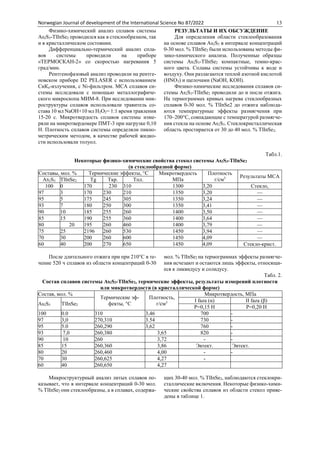
Рис.2. Т-х фазовая диаграмма системы As2S3-TlInSe2.
После длительного отжига при 250° в течение
500 часов сплавы системы составов 30, 70 и 95 мол.
% TlInSe2, проведен рентгенофазовый анализ (рис.
3). Как видно из рис. 3, дифрактограммы сплавов 30
и 70 мол. % TlInSe2 состоят из смеси дифракцион-
ных линий исходных компонентов. Это доказывает,
что система As2S3-TlInSe2 является квазибинарной.
Дифракционные линии на дифрактограмме сплава
95 мол. % TlInSe2 идентичны дифрактограмме со-
единения TlInSe2. Они лишь незначительно разли-
чаются межплоскостными расстояниями. Поэтому
сплав состава 95 мол. % TlInSe2 относится к обла-
сти твердых растворов на основе соединения
TlInSe2.
Рис.3. Дифрактограммы сплавов системы As2S3-TlInSe2.
1- As2S3, 2-30 мол. %, 3-70 30 мол. %, 4-95 мол. %, 5-100 мол. % TlInSe2.
4
3
2
1
200
400
600
800
1000
I,%
10 20 30 40 50 60
2θ
5
As2Se3 20 40 60 80 TlInSe2
мол. %l
Ж
Ж+ α
Ж+β
β
α +β
200
400
600
800
t,o
C
767o
260о
Области стекол
α
16 Norwegian Journal of development of the International Science No 87/2022
Некоторые физико-химические свойства спла-
вов из области стекол системы As2S3-TlInSe2 после
отжига приведены в табл.2. Микротвердость спла-
вов системы As2S3-TlInSe2 исследованы как в
стекле, так и в кристаллической форме. Некоторые
физико-химические свойства сплавов системы в
стеклообразном и кристаллическом состоянии при-
ведены в таблицах 1 и 2. Значения микротвердости
сплавов из области 0-30 мол. % TlInSe2 стекла нахо-
дятся в пределах МПа (1300-1450) (табл.1). После
кристаллизации тех же участков микротвердость
изменяется в пределах (700-820) МПа (табл. 2). Зна-
чение микротвердости (115-140) МПа соответ-
ствует микротвердости β-твердых растворов на ос-
нове TlInSe2.
Установлено, что микротвердость стеклооб-
разных сплавов выше, чем кристаллических. В кри-
сталлических же образцах плотность больше, чем в
стекле (См. табл. 1и 2).
ЗАКЛЮЧЕНИЕ
Методами физико-химического анализа: диф-
ференциального термического (DTA), рентгенофа-
зового (RFA), микроструктурного (MCA) анализов,
а также путем измерения микротвердости и плотно-
сти исследовано стеклообразование в системе
As2S3-TlInSe2 и изучены некоторые физико-химиче-
ские свойства. Установлено, что в системе As2S3-
TlInSe2 на основе As2S3 при медленном охлаждении
области стеклообразования простираются до 30
мол. % TlInSe2. В интервале концентраций 30-40
мол. % TlInSe2 сплавы являются стеклокристалли-
ческими. В системе при комнатной температуре на
основе AS2S3 твердые растворы доходят до 1,5 мол
% TlInSe2, а на основе TlInSe2 твердые растворы
практически не установлены. Выявлено, что макро-
скопические параметры: температура размягчения
(Tg), температуры кристаллизации и плавления,
плотность и микротвердость сплавов системы
As2S3-TlInSe2 увеличиваются в зависимости от со-
става.
Список литературы:
1. Hari P., Cheneya C., Luepkea G., Singha S.,
Tolka N., Sanghera J.S., Aggarwal D.. Wavelength se-
lective materials modification of bulk As2S3 and As2Se3
by free electron laser irradiation // Journal of Non-Crys-
talline Solids.2000. V. 270. P. 265-268.
2. Dinesh Chandra SATI1, Rajendra KUMAR,
Ram Mohan MEHRAInfluence of Thickness Oil Opti-
cal Properties of a: As2Se3 Thin Films // Turk J Phys.
2006. V.30. P. 519- 527.
3. Lovu M., Shutov S., Rebeja S., Colomeyco
E., Popescu M. Effect of metal additives on photodark-
ening kinetics in amorphous As2Se3 films // Journal of
Optoelectronics and Advanced Materials 2000. V. 2. Is-
sue: 1. P. 53-58.
4. Burdiyan I.I., Feshchenco I.S. Photocurrent
and Optical Transmission Spectra of Sn- and Pb-Doped
(As2S3)0,3(As2Se3)0,7 Glass Films, Inorgan. Materials.
2005. T.41. № 9.Р. 1013-1016.
5. Churbanov M.F., Shiryaev V.S., Skripachev
I.V., Snopatin G.E., Pimenov V.G., Smetanin S.V.,
Shaposhnikov R.M.,Fadin I.E., Pyrkov Yu.N., and
PlotnichenkoV.G. Высокочистые
Как As2S1,5 Se 1,5 стекла оптических волокон // Не-
орган. материлы. 2002. T.39. №2. Р. 193-197.
6. Jun J. Li Drabold. D. A.. Atomistic compari-
son between stoichiometric and nonstoichiometric
glasses: The cases of As2Se3 and As4Se4 // Phys. Rev.
2001. V. 64.P. 104206-104213.
7. Hineva Т., Petkova Т., Popov С., Pektov P..
Reithmaier J. P., Funrmann-Lieker T.,Axente E.. Sima
F.. Mihailescu C. N., Socol G., Mihailescu I. N.Optical
study of thin (As2Se3)1-x(AgI)x films // Journal of op-
toelektronics and Advanced Materials. 2007. V.9. No.
2. February. P. 326-329.
8. Seema Kandpal, Kushwaha R. P. S.. Photoa-
coustic spectroscopy of thin films of As2S3, As2Se3 and
GeSe2 // Indian Academy of Sciences. PRAM ANA
journal of physics. 2007. V. 69. No. 3. P. 481-484.
9. Shiryaev V.S., Smetanin S.V., Ovchinnikov
D.K., Churbanov M.F., Kryukova E.B., and Plot-
nichenkoV.G. Effects of Oxygen and Carbon Impuri-
ties on the Optical Transmission of As2Se3 Glass// Не-
орган. материлы. 2005. T.41. №3. Р. 308-312.
10. Алиев И.И., Бабанлы М.Б., Фарзалиев А.А.
Оптические и фотоэлектрические свойстватонких
пленок стекол (As2Se3)1-x(TlSe)X(X=0,05-0.01) Х1
Международная конф. по физике и технологии тон-
ких пленок. Ивано- Франковск.Украина 7-12 мая
2007. С.86
11. Бабаев А. А., Мурадов P., Султанов С. Б.,
Асхабов A.M. Влияние условий получения на опти-
ческие и фотолюминесцентные свойства стеклооб-
разных As2S3 // Неорган. материалы. 2008. Т.44.
№11. С. 1187-1201.
12. Курганова А., Snopatin G.E., Сучков А. И.
Рентгено-флуоресцентный Определение макроско-
пической состава As-S, As-Se и As-S-Se очки // Не-
орган. материалы. 2009. Т.45.№ 12. С. 1408-1413.
13. Slusher R.E., Lenz G., Hodelin J., Sanghera J.,
Shaw L.B.,Aggarwal I.D. Large Raman gain and non-
linear phase shifts in high-purity As2Se3 Chalcogenide
fibers // J. Opt. Soc. Am. 2004. V. 21. P. 1146-1155.
14. Diez A., Birks T.A., Reeves W.H., Mangan
B.J., and Russell P.St. J., Excitation of cladding modes
in photonic crystal fibers by flexural acoustic waves //
Optics Lett. 2000. V.25. P. 1499-1501.
15. Moon J.A. and Schaafsma D.T., “Chalco-
genide Fibers: An Overview of Selected Applications”,
Fiber and Integrated Optics, 2000. V.19. P. 201- 210.
16. Jackson S.D., Anzueto-Sánchez G.;, Chalco-
genide glass Raman fiber laser // Appl. Phys. Lett.,
2006. V.88. P. 221106.
17. Fu L.B., Fuerbach A., Littler I.C.M.,Eggleton
B.J., Efficient optical pulse compression using Chalco-
genide single-mode fibers // Appl. Phys. Lett. 2006.
V.88.P. 081116.
18. Fu L.B., Rochette M., Ta'eed V., Moss D., Eg-
gleton B.J. Investigation of self-phase modulation
based optical regeneration in single mode As2Se3 Chal-
cogenide glass fiber // Opt. Express. 2005. V.13. P.
7637-7641.
19. Петрусевич В.А., Сергеева В.М. Оптиче-
ские и фотоэлектрические свойства In2Te3 // ФТТ.
1960. № 2. С.2858 -2862.
Norwegian Journal of development of the International Science No 87/2022 17
20. Зорина Е.Л., Гулиев Т.Н. Инфракрасные
поглощения монокристаллического InSe // Оптика
и спектроскопия. 1967. Т.22. В6. С.919-923.
21. Коломиец Б.Т., Рывкин С.М. фотоэлектри-
ческие свойства сульфида и селенида индия. //
ЖТФ . 1974.Т. № 19. С.2041-2046.
22. Белоцкий Д.П., Бабюк П.Ф., Демянчук Н.В.
Физико-химические исследование системIn2В3
VI
-
А2
V
В3
VI
. Cб.: Низкотемпературные термоэлектри-
ческие материалы // Кишинев. 1970. С. 29-35.
23. Хворестенко A.C. Халькогениды мышьяка.
Обзор из серии Физические и химические свойства
твердого тела. - М., 1972.93 с.
24. Guseinov G.D., Abdullayev G.B., Bidzinova
S.N., Seidov F.M., Ismailob M.Z., Pashayev A.M., On
new analoga og TlSe –type semiconductor compound
// Phys. Lettera . 1970. V. 7. № 7. P. 421-422.
18 Norwegian Journal of development of the International Science No 87/2022
ECONOMIC SCIENCES
ROLE AND ACTUALITY OF SPIRITUAL AND MORAL ETIQUETTE IN SOLVING SOCIO-
ECONOMIC DISBALANCE
Odashev I.
Institute of Forecasting and Macroeconomic Research
under the Ministry of Economic Development and
Poverty Reduction of the Republic of Uzbekistan
Editorial and Publishing Department,
Leading specialist
Uzbekistan, Tashkent
РОЛЬ И АКТУАЛЬНОСТЬ ДУХОВНО-НРАВСТВЕННОГО ЭТИКЕТА В РАЗРЕШЕНИИ
СОЦИАЛЬНО-ЭКОНОМИЧЕСКОГО ДИСБАЛАНСА
Одашев И.М.
Институт прогнозирования и макроэкономических исследований
при Министерстве экономического развития и
сокращение бедности Республики Узбекистан
Редакционно-издательский отдел,
Ведущий специалист
Узбекистан, Ташкент
https://doi.org/10.5281/zenodo.6778428
Abstract
According to the article, spirituality should accompany economic development as one of the primary criteria
for improving disciplines on the behavioral etiquette of the people while cooperating in socio-economic activities.
The article also examines spirituality as a factor in economic poverty reduction, the importance of establishing a
market economy based on strong spiritual values, the impact of society on centuries-old spiritual traditions, and
the impact of the "human-society-state" system.
Аннотация
Согласно статье, духовность должна сопровождать экономическое развитие как один из основных
критериев совершенствования дисциплины поведенческого этикета людей при сотрудничестве в соци-
ально-экономической деятельности. В статье также рассматривается духовность как фактор сокращения
экономической бедности, важность становления рыночной экономики, основанной на сильных духовных
ценностях, влияние общества на многовековые духовные традиции, влияние системы «человек-общество-
государство».
Keywords: spirituality, economy, harmony, the market economy, social welfare, common interests.
Ключевые слова: духовность, экономика, гармония, рыночная экономика, общественное благосо-
стояние, общие интересы.
“The highest spirituality is
an invincible force.”1
I. Introduction
The national economy and spiritual life of the peo-
ple have always been inextricably linked. People work,
activate, talk, live, and engage each other in everyday
life. And it is impossible to imagine these continuous
connections without behavioral, disciplinary and social
norms of etiquette. Because the economy is not limited
to getting profits and expenditures, people should re-
spect one another regardless of the scale of economic
activity. Positive changes replace serious negative ac-
tions in human interactions and relationships at all
stages of human development, from the emergence of
1
Citation: Karimov I.K, “High spirituality is an invincible
force”. Tashkent, Manaviyat, 2008.
human society to the present. Among these changes is
a sense of spiritual uplift, which embodies human be-
havior, character, and relationships. Spirituality and
morally developed viewpoints are a concept that en-
compasses the positive traits that many people share,
such as spirit, intellect, perception, state of mind, inner
mood, courage, essence, care, and sadness. Spirituality
is the sum of a person's spiritual and mental worlds. The
main purpose of the paper is to make the economic re-
lationships based on the spiritual, behavioral and socio-
economical etiquette and get socio-economical welfare
of the people.
We often hear or read about a different kinds of
criminal topics or issues on the internet, newspapers,
journals, TV-set, radio and other media resources such
Norwegian Journal of development of the International Science No 87/2022 19
as “What scammers do in the digital age and how they
get away with it for so long”, “Italian businessman
made a fortune by counterfeiting Supreme clothes”,
“"Unusual traffic": How Chinese hackers bankrupted
Canada's largest corporation”. Such kinds of infor-
mation we can find any media resources and every sin-
gle day. But how can we solve these issues before it has
done? Is it possible? Or should we, once again, be lim-
ited and forced solely by law enforcement agencies?
What other mechanisms exist to deal with such situa-
tions to prevent crime or disrupt the balance of eco-
nomic activity and social, spiritual, moral, and behav-
ioral communities? During the paper, we can open the
morally developed viewpoints and behavioral disci-
plines which can be made mechanisms to prevent crim-
inal and nonbehavioral economic activities.
II. Literature review
The ideologies of Central Asian thinkers and folk-
lore play an important role in the formation of the na-
tional economy. As one of Central Asia's medieval sci-
entific and cultural centers, its positive impact on the
Renaissance process in other regions has been con-
firmed by global science. Samarkand hosted an interna-
tional conference in May 2014 on "Historical heritage
of medieval scholars and thinkers, its role and sig-
nificance in the development of modern civiliza-
tion," with scientists, representatives of leading inter-
national organizations, and scientific centers from
nearly 50 countries in attendance. President of the Re-
public of Uzbekistan in his speech provided a deeper
understanding of the significance of our great ancestors'
rich spiritual heritage. (Boriy Alixonov & Abdurakhim
Qurbanov, 2015)
Uzbekistan is rich in its historically behavioral and
moral etiquette rules and socio-economic connections
based on the many heritages from the great scholars,
scientists and governors.
Spirituality is an integrated aspect of one's
personality. It manifests as a desire to live and create
creatively by ideals of truth, goodness, and beauty.
Spiritual culture includes mental, artistic, aesthetic,
moral, environmental, legal, and political components.
Great thinkers of the past attributed eternal spiritual,
moral, and pedagogical values that have a universal,
global character, but a national and ethnic basis, to love
for children, devotion to the family and the memory of
ancestors, diligence, love for the Motherland, for the
person, a sense of justice and mutual tolerance, mercy,
love for the native language as a life-giving source of
the spirituality of the nation, care for the younger
generation. (Tolipov U.K, 2017)
The Avesta is one of the richest historical sources
for the formation of such ideas. According to research
by Uzbek scholars, the Avesta, the sacred book of Zo-
roastrianism (pre-Islamic), also contains important eco-
nomic ideas. For example, "a man who served all his
life on the path of beauty and goodness, light and joy,
was pious and truthful, pure and fair, and treated
guests impartially." He loves his wife, takes care of
the land and livestock, takes care of the human prop-
erty, takes care of nature, and enjoys it. A person who
spends his life in good deeds, pure and just, who does
not look at other people's property and preserves the
riches of nature like the apple of his eye, expresses
spiritual harmony." ( Khajiev B.D & Abdullaeva
R.G, 2016). Also, if you pay attention to the role and
export potential of the Great Silk Road in Central Asia,
interest in Central Asia, in particular, in the territory of
modern Uzbekistan, has long been known and im-
portant (politically and economically). According to
land, water, climatic, natural, geographical locations,
minerals, and wildlife distinguished by historical and
current data. Diligence, creativity, loves for the profes-
sion and creativity of the population were of great im-
portance.
In the holy book of Islam-the Koran, which is an-
other spiritual basis of our national economy, the activ-
ity of human society, and economic relations play an
important role. Because economic relations manifest
the main characteristics of people. The commandments
of the Koran, as a divine commandment to people, are
because all people on earth are one family, children of
Adam and Eve, and therefore brothers and sisters. In
particular, ayat 13 of Surah al-Khujurat says: "O, man-
kind! We make you from unit Father (Adam Alaykx-
salam) and unit mother (Momo Khavo) by several
types of the nation so you can get to know each other
and make love." Among the most common economic
ideas, the Qur'an glorifies honest work, especially the
work of farmers, shepherds, and artisans.
By ayat 29 Niso surah we can see this sentence:
“Do not realize your property among yourselves in
unjust ways (i.e. theft, robbery, usury, bribery, gam-
bling)! But make a fortune by bargaining." All other
economic ideas are fundamentally focused on property
and inheritance, the sanctity of property, betrayal of
one's property (particularly treason), and even envy of
one's property are considered a great sin.
It's impossible not to include the names of the
East's great intellectuals and scientists, who made im-
portant contributions to our nation's economic thinking
and the economic theories they proposed. Because their
contribution to the further enrichment of our contem-
porary national economy's spiritual roots is priceless.
These include Al-Fargani, Al-Khorezmi, Farabi, Ber-
uni, Ibn Sino, Yusuf Khas Hajib, Nizam-ul-Mulk, Amir
Temur, Alisher Navoi, Zahiriddin Muhammad Babur
and many others. According to Ibn Sina, “Animals are
content with the benefits of nature, and they deprive
people of the benefits of nature. She needs food, cloth-
ing and shelter. The animal assimilates the gifts of na-
ture, and man, through his labor, creates food, cloth-
ing and shelter for himself. To do this, a person must
be engaged in agriculture and crafts’’ (Khajiev B.D &
Abdullaeva R.G, 2016; Yuldashev K & Muftaydinov
K, 2000). Yusuf Khas-Khajib, on the contrary, says: “A
person who does not benefit a person is not a dead,
lifeless past, but wasted labor”. (Mahmudov T, 2000;
Karimov I, 2008). Farobiy comprehensively interprets
the ideas of his teacher Aristotle and tries to supplement
them, created a doctrine about the importance of mate-
rial needs for the formation of society, and described
the "need" that is important in economics. The role of
labor and labor tools in creating material wealth is de-
termined. In particular, in the works of the thinker, the
issues of “division of labor” are well covered. Because
20 Norwegian Journal of development of the International Science No 87/2022
of the division of labor, production develops as time is
spent, the skills of workers increase, a basis is created
for introducing technical means, and the advantage of
outsourcing each operation to special people, since all
work can be done by one person (master).
European thinkers and scientists investigate the
harmony of spirituality and the economy, as well as
spirituality and religion. However, all materials inves-
tigate the spirituality-based economy, socialite, and
mankind's mentality as a whole. Carlos Hoevel (Cath-
olic University of Argentina, Buenos Aires, Argentina)
argues in "Spiritual Meaning of the Economic Crisis"
that the economic and financial crisis that began in
2008 has a spiritual dimension. Behavioral economists
believe that the severe and prolonged crisis was caused
by a series of psychological irrationalities in the behav-
ior of players (borrowers, loan originators, investment
banks, rating agencies, regulators, and end investors).
(Bouckaert L & Zsolnai L, 2012)
In "Religion and Spirituality," Jesuit Scholar Paul
de Blot (Nyenrode Business University, the Nether-
lands) examines the complex relationship between reli-
gion and spirituality in "Religion and Spirituality."
While spirituality is concerned with the soul or spirit,
religion is concerned with the existence of a superhu-
man ruling power, particularly God or gods, which is
frequently manifested via worship. Religion is a sys-
tematic human approach to supernatural reality that
usually includes a set of narratives, beliefs, and behav-
iors. On the other hand, spirituality is a multifaceted
search for a transcendent purpose to life that is founded
on our human experience. (Luk Bouckaert & Laszlo
Zsolnai, 2012).
Veerle Draunlans (Tilburg University, the Neth-
erlands, and The Catholic University of Leuren, Bel-
gium) demonstrates in "Gender and Spirituality" that a
gender approaches to spirituality mirror the divided and
dichotomous thinking's significant repercussions. It
calls for global solidarity and a more prominent and
positive role for physical experiences in spiritual life,
as well as experiences rooted in men's and women's
pragmatic daily lives. (Bouckaert L & Zsolnai L, 2012)
Andrew Newberg (Thomas Jefferson University
and Hospital, Philadelphia, USA) argues in "Neurosci-
ence of Spirituality" that for successful synthesis of
neuroscience and spirituality, an understanding and
preservation of scientific fundamentals must be com-
bined with an analysis of the cognitive elements of re-
ligious and spiritual experience. This necessitates a
neuropsychological examination of religious and spir-
itual experiences. (Luk Bouckaert & Laszlo Zsolnai,
2012).
III. Methods and materials
Spirituality is the basis of human and social cul-
ture, which has a strong influence on the formation,
transformation, and crisis of a particular economic and
social system, the enrichment of which can lead to the
development of society and, conversely, to the impov-
erishment of spirituality. The spiritual and practical ac-
tions of man can explain the question of harmony be-
tween spirituality and the economy. We can express it
based on the following comparative table:
Table 1
Simple manifestations of a person's spiritual image influence his behavior
The behaviour of a spiritually high person The behaviour of a spiritually poor person
Creativity, variety of ideas Addiction to evil ideas
Enthusiasm, hard-working Coldness, laziness, carelessness
Caring for people The dominance of selfish views
Setting high goals Lack of purpose, uncertainty about the future
Flawless task execution Incomplete or incorrect execution of tasks
Respect for the Elders and Respect for the Younger Work for your benefit
Ethical and aesthetic outlook Evil intentions, nefarious goals
Source: Created and developed by the author
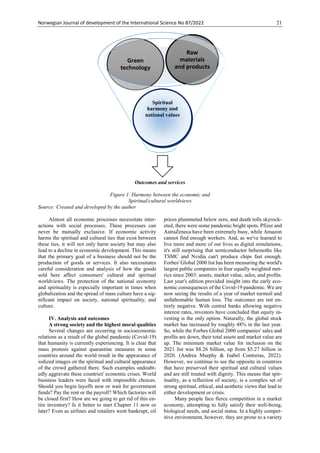
Its social nature explains the harmony of spiritual-
ity with the economy. Because spirituality and econom-
ics arise in society as a social phenomenon. Spiritual
poverty also directly reflects the disgusting image of a
social phenomenon and has a negative impact not only
on nature and society but also on economic processes.
We can analyze this using the terms "spiritual" and
"non-spiritual economy". We can assess the integral as-
pects of the spiritual economy as a set of many eco-
nomic processes in which they carried economic pro-
cesses out not only for good and for harm but also to
achieve the noble aspirations of humanity.
The main goal of enterprises' and organizations'
products and services is not to harm human health, not
to emit harmful gasses and emissions, the widespread
use of green technologies, the production of goods that
do not harm local traditions (clothing), human health is
reflected in such economic activities as growing and
processing consumer goods that bring more benefits.
An economy that is out of sync with spirituality is anal-
ogous to the socio-cultural and economic development
of society, resulting in a sharp change in the established
and accepted traditions of nations and peoples, as well
as the formation or deterioration of the younger gener-
ation's upbringing.
Norwegian Journal of development of the International Science No 87/2022 21
Outcomes and services
Figure 1. Harmony between the economic and
Spiritual/cultural worldviews
Source: Created and developed by the author
Almost all economic processes necessitate inter-
actions with social processes. These processes can
never be mutually exclusive. If economic activity
harms the spiritual and cultural ties that exist between
these ties, it will not only harm society but may also
lead to a decline in economic development. This means
that the primary goal of a business should not be the
production of goods or services. It also necessitates
careful consideration and analysis of how the goods
sold here affect consumers' cultural and spiritual
worldviews. The protection of the national economy
and spirituality is especially important in times when
globalization and the spread of mass culture have a sig-
nificant impact on society, national spirituality, and
culture.
IV. Analysis and outcomes
A strong society and the highest moral qualities
Several changes are occurring in socioeconomic
relations as a result of the global pandemic (Covid-19)
that humanity is currently experiencing. It is clear that
mass protests against quarantine measures in some
countries around the world result in the appearance of
iodized images on the spiritual and cultural appearance
of the crowd gathered there. Such examples undoubt-
edly aggravate these countries' economic crises. World
business leaders were faced with impossible choices.
Should you begin layoffs now or wait for government
funds? Pay the rent or the payroll? Which factories will
be closed first? How are we going to get rid of this en-
tire inventory? Is it better to start Chapter 11 now or
later? Even as airlines and retailers went bankrupt, oil
prices plummeted below zero, and death tolls skyrock-
eted, there were some pandemic bright spots. Pfizer and
AstraZeneca have been extremely busy, while Amazon
cannot find enough workers. And, as we've learned to
live more and more of our lives as digital simulations,
it's still surprising that semiconductor behemoths like
TSMC and Nvidia can't produce chips fast enough.
Forbes' Global 2000 list has been measuring the world's
largest public companies in four equally weighted met-
rics since 2003: assets, market value, sales, and profits.
Last year's edition provided insight into the early eco-
nomic consequences of the Covid-19 pandemic. We are
now seeing the results of a year of market turmoil and
unfathomable human loss. The outcomes are not en-
tirely negative. With central banks allowing negative
interest rates, investors have concluded that equity in-
vesting is the only option. Naturally, the global stock
market has increased by roughly 48% in the last year.
So, while the Forbes Global 2000 companies' sales and
profits are down, their total assets and market value are
up. The minimum market value for inclusion on the
2021 list was $8.26 billion, up from $5.27 billion in
2020. (Andrea Murphy & Isabel Contreras, 2022).
However, we continue to see the opposite in countries
that have preserved their spiritual and cultural values
and are still treated with dignity. This means that spir-
ituality, as a reflection of society, is a complex set of
strong spiritual, ethical, and aesthetic views that lead to
either development or crisis.
Many people face fierce competition in a market
economy, attempting to fully satisfy their well-being,
biological needs, and social status. In a highly compet-
itive environment, however, they are prone to a variety
Green
technology
Raw
materials
and products
Spiritual
harmony and
national values
22 Norwegian Journal of development of the International Science No 87/2022
of undesirable actions when they are aware of their lack
of knowledge and experience. These include familiar-
ity, corruption, victory lust, inability to control one's
desires, disregard for others, or boasting of one's he-
gemony, and the fact that such people participate in this
or that economic activity directly harms all normal eco-
nomic relations. They prevent the economy from func-
tioning normally. To achieve their evil intentions, they
sell their conscience, spirituality, and culture. This is
the most important factor in a person's spiritual and cul-
tural poverty, and it directly leads to socio-economic
poverty. A strong market economy promotes optimal
economic processes in the face of intense competition,
mutually beneficial relationships, and limited re-
sources. Spiritual poverty, on the other hand, does not
allow strong market mechanisms to function normally,
or it leads to a sharp deterioration and economic impov-
erishment of society.
According to B.P. Shulindin, “All forms of social
consciousness, although in various forms, reflect so-
cial life and, above all, material social relations,
which has the opposite effect. The joint evolution of
the materialistic and idealistic directions is a dialecti-
cal interaction of spirituality and the economic sphere
of society”. (A.Razzakov & Sh.Toshmatov & N.Ur-
monov, 2002) In the transition from a strong state to a
strong civil society, the formation of a strong spiritual-
ity and a strong economy are closely interconnected.
The presence of people with high moral qualities in so-
ciety prevents various conflicts and riots from escalat-
ing. Along with the COVID-19 pandemic, mass pro-
tests and collective conflicts in countries around the
world has resulted in complex social crises. Analyzing
this with the help of the following vivid examples, we
can see how difficult situations can arise in a society
devoid of spiritual beliefs. Tens of thousands of people
protested against COVID-19 measures and government
sanctions against the unvaccinated in Australia, France,
Italy, and Greece on Saturday, sparking clashes with
police. The protests highlight the global conflict be-
tween the World Health Organization and other public
health agencies' advice and people who refuse to be
vaccinated for various reasons. In the current situation,
no country in the world could resolve the Protestant
conflict peacefully. People with spiritual and moral
qualities would not instigate such widespread conflict.
And such national responsibilities should have been
considered before the conflict began.
Example 1: Government-imposed quarantine re-
strictions to prevent the rapid spread of COVID-19
around the world have resulted in mass conflicts. This
included mass protests in the United States on April 18,
2020, in Michigan, Ohio, Texas, Maryland, Kentucky,
and Wisconsin, where protesters created artificially
large traffic jams from several cars, and "Give me the
right to get a coronavirus, but don't restrict my free-
dom" ("reopen," i.e., stop isolation). During the pro-
tests, it was easy to see various violations, humiliations
of human dignity, and the disgusting state of society's
moral image. (Odashev I.M, 2021)
Example 2: Such large-scale conflicts and unau-
thorized protests against restrictions on citizens' rights
and freedoms in Berlin began on April 19. Protesters
first gathered in Rosa Luxemburg Square for a "sanitary
protest," then moved to the Kreuzberg neighborhood.
Protests against mass quarantine (isolation regime) in-
creased on May 9. Thousands of people from Stuttgart
attended. Protests took a smaller but more aggressive
form in Berlin. Around 3,000 people turned out for the
demonstration in Munich's Marienplatz. In Frankfurt,
about 500 people demanded the abolition of the mask
regime, sparking mass protests. A spiritual community
of individuals would never have created such a situa-
tion. (Odashev I.M, 2021)
Example 3: The unrest in Italy began on October
22 in Naples, after a curfew was imposed in the Cam-
pania region, and spread throughout the region the next
day. After Prime Minister Giuseppe Conte imposed
new strict restrictions on October 25, protests and riots
spread to Milan, Turin, and Rome. The protests were
not peaceful, resulting in riots, clashes with police, and
looting. The main causes of these mass conflicts are a
lack of a targeted governance approach, and a lack of
initial and targeted public awareness campaigns about
the pandemic, or poor organization. The inadequacy of
human spiritual qualities, on the other hand, can explain
crowd behavior. (Odashev I.M, 2021)
V. Conclusions and recommendations
In conclusion, I would like to emphasize that Uz-
bekistan, which is famous all over the world for its mul-
tinational people with a thousand-year history, culture,
and spiritual views, are a mirror of their spiritual
worldview. Therefore, the formation and implementa-
tion of a modern economy and its historical, cultural,
and spiritual foundations must be an integral part of to-
day's complex global economic processes. In the fur-
ther development of international economic relations
between the countries of the world, there is a need for
a spiritually rich economy as an important tool in cre-
ating a world economy that can respond to any unex-
pected challenges. I believe that such a spiritual econ-
omy is very important for today's world, and I would
like to make the following conclusions and recommen-
dations for achieving and implementing it:
✔ Development and continuous monitoring of
all measures to prevent corruption in implementing
business processes;
✔ Identify spiritual and cultural factors that af-
fect the level of the shadow economy, and conduct reg-
ular educational work to develop the spiritual con-
sciousness of a person;
✔ When establishing economic ties with the
countries of the world, more attention should be paid to
the formation of interethnic and intercultural ties;
✔ Ensuring the harmony of spiritual values in
shaping the foundations of the modern economy;
✔ To look into the historical genesis of spiritual
ideals, as well as the techniques and criteria that have
guided their evolution to the present day;
✔ Formation and implementation of targeted
mechanisms that ensure the main role of spiritual views
in the daily activities of economic entities;
✔ Formation of an environment of interest in
economic values, and criteria in economic activity;
✔ In-depth examination of the works of im-
portant historical leaders in the field of economics that
Norwegian Journal of development of the International Science No 87/2022 23
have been passed down to us, as well as an assessment
of their relevance to the present economy.
References:
1. Khajiev B.D., Abdullaeva R.G., Mamaraxi-
mov B.E. Educational-methodical complex on the sub-
ject "History of economic doctrines". For a lecture.
Tashkent: Economics, 2016. p.259.
2. Yuldashev K., Muftaydinov K., “From the his-
tory of economic doctrines”. (On the example of Shark
economic thinking) T., 2000.
3. Razzakov A., Toshmatov Sh., Urmonov N,
“History of Economics”, Finance, T., 2002.
4. Mahmudov T., "About the Avesto". T., Shark,
2000.
5. Karimov I, “High spirituality is an invincible
force”. Tashkent, Manaviyat, 2008.
6. In Central and Eastern Europe, Journal of the
Corvinus University of Budapest, Society and Econ-
omy Vol.34, No.3 (2012), pp.489-514 (26 pages) Luk
Bouckaert and Laszlo Zsolnai.
7. “Jamiyat va boshqaruv” Journal, 2021 №1
(91), pp.122-127, Odashev I.M.
8. Xalq so’zi online newspaper, Boriy Alixonov,
Chairman of the Executive Committee of the Central
Council of the Ecological Movement of Uzbekistan,
Deputy Speaker of the Legislative Chamber of the Oliy
Majlis of the Republic of Uzbekistan; Abdurakhim
Qurbanov, Deputy of the Legislative Chamber of the
Oliy Majlis of the Republic of Uzbekistan, 2015
9. Tolipov U.K, “Spiritual and moral bases life-
long education in the republic of Uzbekistan”, Nauki ob
Obrazovanii,
10. Forbes, “The Global 2000”, Andrea Murphy,
and Isabel Contreras, 2022
11. Bouckaert L, and Zsolnai L, 2012. “Spiritual-
ity and Business: An Interdisciplinary Overview” Soci-
ety and Economy 34 (2012) No. 3. pp. 489-514
12. https://en.wikipedia.org/wiki/Pro-
tests_against_responses_to_the_COVID-19_pandemic
13. https://www.bbc.com/news/world-europe-
59363256
14. https://www.dw.com/en/what-is-behind-the-
covid-protests-across-europe/a-60074426
24 Norwegian Journal of development of the International Science No 87/2022
PEDAGOGICAL SCIENCES
UDC 37.017.7
MORAL CULTURE OF THE INDIVIDUAL AND PATRIOTIC EDUCATION OF YOUTH
Zakharova E.
postgraduate student of the Academy of Postgraduate Education, Minsk, Republic of Belarus
https://doi.org/10.5281/zenodo.6778438
Abstract
The article focuses on the education of a patriot in an information society based on traditional values, which
actualizes the moral culture of a modern personality. The author's interpretation of the basic concepts of "citizen"
and "patriot" is carried out in the context of the concepts of Soviet pedagogical thought, which investigated topical
issues of family education of young people.
Keywords: moral culture of the individual; patriot; family education.
In the information society, the moral culture of an
individual is the level of an individual's perception of
the moral consciousness and spiritual culture of society,
as well as a positive result of the moral activity of a
modern person in difficult conditions of the anthropo-
logical, energy and food crises of the world [1, p. 130],
which is directly related to the civic education of youth
and is relevant for the modern Republic of Belarus for
two reasons.
Firstly, the geopolitical and socio-economic trans-
formations taking place in the policivilizational world
today indicate the need to pay special attention to the
spiritual culture of society, or rather, the moral compo-
nent of the citizenship of the younger generation, which
is formed not only on the basis of traditional values in
the Belarusian family, but also under the influence of
digital, network, telecommunication technologies.
Social space acquires bizarre, innovative forms in
the information society, gradually turning into a virtual
and content-updated existing reality, which, on the one
hand, opens up new opportunities for the development
of a modern personality, and on the other, carries huge
risks of "loss of personality" and the appearance of
biorobots [2, p. 186].
Secondly, the modern Republic of Belarus is faced
with the problem of a lack of patriotism and the up-
bringing of a citizen and a patriot in the family and in
the social institutions of society. The lack of patriotism
in modern Belarusian society is associated with family
traditions and family upbringing, as well as family val-
ues. It is the parents in the family who create the most
favorable conditions for the implementation of efforts
aimed at caring for the younger generation with an em-
phasis on mutual understanding, mutual respect and re-
sponsibility for the fate of the country, as well as for the
implementation by the older generation of purposeful
control and more successful socialization of Belarusian
youth [3, p.66]. In order to form pride in their homeland
among young people, modern parents need to raise
their child as a patriot. The feeling of love for the Moth-
erland, for one's Fatherland, native land, for the land
where one was born and grew up, pride in the historical
achievements of the people, willingness to subordinate
one's personal interests to the common interests of the
country, faithfully serve it and protect it – all this is
called patriotism [4, p.103].
The formation of patriotism as one of the basic
qualities of a modern personality, manifested in moral
actions and moral behavior, is carried out in the process
of patriotic education. It is aimed at the development of
patriotic feelings, beliefs and stable norms of patriotic
behavior of the individual and is closely related to civic
education [5, p.16].
Civic education is the process of forming citizen-
ship as an integrative quality of personality that allows
a person to be legally, socially, morally and politically
capable in society [6, p. 245], while it is necessary to
distinguish between the concepts of "patriot" and "citi-
zen".
A patriot is a person who consciously loves and
protects his land and himself, his Homeland, multiplies
national wealth, improves the life of the people, and a
citizen is a person belonging to the permanent popula-
tion of a given state, enjoying its protection and en-
dowed with a set of political and other rights and duties.
It is the unification of patriotic education and civic ed-
ucation into a single process that makes it possible for
the younger generation to form a valuable and reverent
attitude towards their Homeland. The historical peculi-
arity of the process of developing its concepts is rele-
vant for understanding the ways of developing the edu-
cation of a citizen. Civic education of the younger gen-
eration has historical roots, therefore, special attention
should be paid today to the best pages of Soviet peda-
gogical thought on the education of a citizen and a pa-
triot (Krupskaya N.K., Blonsky P.P., Makarenko A.C.,
Sukhomlinsky V.A., Ilyin).
In the Soviet period, the image of a citizen was
conditioned by the ideology of the socialist state and
the moral code of the builder of a communist society.
At the very beginning, the Soviet government openly
used the school as a tool for subordinating the interests
of the individual to society, acted as a conductor of ide-
ological doctrines of atheism, the elimination of illiter-
acy, polytechnism, education as a long-term purposeful
influence on the personality of the child in order to pre-
pare the builder of a new system of public relations. So
in his writings N.K. Krupskaya, justified a number of
provisions for the conceptual foundations of the future
Norwegian Journal of development of the International Science No 87/2022 25
of public education in the new socio-cultural condi-
tions.
In the article "On the question of the socialist
school", N. K. Krupskaya points out that "primary, sec-
ondary and higher schools ... have one common goal:
the education of comprehensively developed people
with conscious and organized social instincts, having a
whole thought-out worldview, clearly understanding
everything that is happening around them in nature and
social life; people prepared in theory and in practice for
all kinds of work; both physical and mental, who are
able to build a reasonable, full of content, beautiful and
joyful social life" [7, pp. 445, 348-349]. This became
the ideological platform on which the theory of educa-
tion was built, where, unfortunately, the role of the fam-
ily and traditional values was leveled.
In the center of attention of P.P. Blonsky is a new
folk school. It was through such a school that the
teacher proposed to include the achievements of world
pedagogy. Such a school, in his opinion, should bring
up independence in a child, be closely connected with
life, give food to his heart, provide space for experi-
ences, include in creative activity, and the priority task
of the new school is "... to teach to live. To live means
to know reality and transform it ..." [7, pp. 445, 348-
349]. Researcher P.P. Blonsky considered that the or-
ganic connection between the education of humanity
and social responsibility, active participation in public
life and subject-centricity, "a gentle touch to the child's
soul and the strictness of explaining the canons of so-
cial morality without political accents" [8, p. 106] is
able to ensure the formation of a civic position in the
younger generation, and hence a willingness to serve
the interests of the country and people.
A.S. Makarenko's scientific activity is of particu-
lar interest, because he is a unique teacher who, in the
difficult conditions that have arisen, was able to create
a system of educating children and young people of the
ideals of duty, feelings of love for the Motherland and
respect for its cultural traditions. Analyzing his peda-
gogical heritage, we can say that the ideas of civic edu-
cation were reflected in his pedagogical (artistic) works
in different years of his work ("Pedagogical Poem",
"Flags on towers", "March of the 30th year"), in articles
and materials of public speeches ("An essay on the
work of the Poltava colony. M. Gorky", "The purpose
of education", "Experience of the methods of work of a
children's labor colony", "Pedagogy of individual ac-
tion", "Some conclusions from my pedagogical experi-
ence", "Methods of education") and other works.
The famous Soviet teacher A. S. Makarenko wrote
that "... we must graduate from our schools energetic
and ideological members of socialist society who are
able to find the right criterion for personal action with-
out hesitation, always, at every moment of their lives,
and at the same time are able to demand correct behav-
ior from others. Our pupil, whoever he is, can never act
in life as a carrier of personal perfection, only as a kind
or honest person. He should always, first of all, act as a
member of his team, as a member of society, responsi-
ble for the actions not only of his own, but also of his
comrades ..." [9, p. 54].
In the early years of Soviet power, it was difficult
and difficult. Teachers worked with children thrown to
the social bottom by the war and the revolution, who
were rejected by society, but thanks to the work of So-
viet teachers, children became worthy citizens of their
country, received education and profession, acquired
cultural skills, created full-fledged families, raised
good children with a civic position, and also had respect
in their professional environment. It is especially im-
portant that they showed high civic qualities not only in
peacetime, but also during social upheavals. The events
of the Great Patriotic War are proof of this, because it
was thanks to such pupils of the school of the innovator
in pedagogy A.S. Makarenko that the Soviet people
stood up and defeated fascism.
Analysis of the theory and practice of the educa-
tional system of A.S. Makarenko shows that he per-
fectly understood himself and warned other teachers: it
should be borne in mind that each historical time has its
own ideal of civic education. To do this, on the one
hand, we must understand well the position of a new
person in a new society, on the other hand, realize that
there is nothing eternal and absolute. Exploring the So-
viet period, it is impossible to bypass the pedagogical
work of V.A. Sukhomlinsky. The teacher-practitioner
and teacher-scientist drew a red thread in his writings
the idea of civic education of the individual, built on
strong moral foundations, which becomes especially
relevant in the conditions of the information war of the
Euro-Atlantic Alliance against the modern Republic of
Belarus.
The teacher considers the formation of a personal-
ity and a citizen in unity, arguing that for the first time
a living being is born, for the second time a citizen, an
active, thinking, positively acting personality. And as
S.A. Sukhomlinsky noted: "... I have always strived for
an organic unity of civic thoughts, feelings and activi-
ties, so that experiences find their expression in noble
deeds, in the work of people for society, for the Moth-
erland" [10, p. 24]. According to V.A. According to Su-
khomlinsky, civic consciousness is a civic education
through the process of transferring to students special
knowledge about civic values (self-determination of the
individual, patriotism, respect for rights and freedoms,
national traditions and cultures, universal values, hu-
man dignity, equality of people before the law, etc.), the
formation of their skills and abilities (the ability to
make decisions, take responsibility for to think criti-
cally, to realize individual and public rights and obliga-
tions, to use mechanisms for the protection of human
rights, etc.), contributing to the assimilation of social
experience and the development of basic core compe-
tencies.
In turn, knowledge, having turned into beliefs, ide-
als, principles, will allow the future citizen to establish
the right relations with society, the state, develop a civil
position, fulfill his civic duty.
So, the main goal of civic education of Belarusian
youth is the socialization of personality with an empha-
sis on humanistic principles, which is connected with
the main task of civic education, or rather, with the for-
mation of moral culture, civic consciousness of a mod-
26 Norwegian Journal of development of the International Science No 87/2022
ern personality in the information society. V.A. Su-
khomlinsky's humanistic ideas found creative develop-
ment in the pedagogical activity of his followers – in
the experience of S.A. Amonashvili, V.F. Shatalov,
E.N. Ilyin, I.P. Volkov, who, like their predecessors,
are convinced that the most important feature of citi-
zenship is its humanistic essence and the moral culture
of the individual, which is initially formed in the fam-
ily. The role of the family in the socialization of youth
and civic education was pointed out by I. A. Ilyin. He
says that "... to educate a child means to lay the foun-
dations of a spiritual character in him and bring him to
the ability of self-education" [11, p. 84]. According to
the philosopher and teacher I.A. Ilyina, the traditional
family teaches that it is impossible to form citizenship
without showing one's own initiative, observing the
principles of social mutual assistance, independence,
solidarity, loyalty to ideals, social expediency. The
teacher claims that in the family, the means for forming
the experience of civic behavior are: authority, disci-
pline, traditions, an atmosphere of love, sincerity, and
this allows the thinker to conclude that the family is "...
the first foundation of inner freedom, spiritual character
and healthy citizenship" [11, p. 100].
Thus, summarizing, it can be argued that for the
modern concept of educating a citizen and a patriot,
there are fundamental works of Soviet teachers on the
theory of humanistic education, where a special place
is given to the moral culture of the individual and the
spiritual culture of society. In the process of civic and
patriotic education of the younger generation, values
are being formed, the tasks of which in the Republic of
Belarus are determined by the Strategy for the Devel-
opment of State Youth Policy in the Republic of Bela-
rus until 2030 [12]. The priority areas are: improving
the quality of the national education system and train-
ing qualified personnel, civic and patriotic education of
youth, youth employment, youth health, preservation of
family values and support for young families, youth in
socio-political life, information field of work with
youth. The program of patriotic education of the popu-
lation 2022-2025 has been created under the leadership
of the Ministry of Education. A special role in the edu-
cation of patriotism is assigned to the family, where it
is based on the spiritual connection between genera-
tions, includes the formation of patriotic feelings and
patriotic behavior. Family patriotic education should be
purposeful, consistent, timely and continue at all stages
of the formation of a highly moral, harmoniously de-
veloped personality, who has a sense of responsibility
for the fate of the country and who is capable of empa-
thy, mercy, self-sacrifice [13]. The interactive platform
"Patriot.by", where the activities of the republican re-
source center for patriotic education of youth as a single
cluster are organized on the basis of the Republican
Center for Ecology and Local Lore for the exchange of
experience and best practices. Work is underway to cre-
ate military-patriotic clubs on the basis of military
units.
As a result, global challenges (coronacrisis, migra-
tion crisis, energy crisis, food crisis, anthropological
crisis) and the geopolitical turbulence of modern social
reality have an impact on the formation of public con-
sciousness of the main subjects of the educational pro-
cess: children, their parents and teachers [14, p. 308].
In summary, I would like to clarify that for suc-
cessful interaction with young people, especially in the
era of hybrid wars and neo-terrorist aggression, which
is carried out in the direction of the modern Republic of
Belarus (sanctions war, cyber war, information war,
network war, etc.) [15, p. 26], it is important to specify
the goals of modern educational work in educational in-
stitutions that In turn, they will be able to synthesize
updated trends in the information society, actualize
family traditions, values of Slavic civilization. Focus-
ing on family education, it is necessary today to initiate
the moral culture of the individual and patriotism, start-
ing with the family, educational institutions, labor col-
lectives, which is also important for the implementation
of the national task, namely, for the formation of a mor-
ally integral, comprehensively developed personality
with a formed system of Slavic values, national culture
(language), capable of self-actualization, self-educa-
tion, self-development and positive self-realization in
the modern Republic of Belarus.
References:
1. The spiritual dimension of hybrid warfare in
the information sphere: a value aspect / Hybrid wars of
the XXI century: origin, essence and place in the civi-
lizational process: Monograph / A.S. Brychkov [et al.].
– Smolensk: VA VPVO of the Armed Forces of the
Russian Federation, 2019. – 306 p. (Sokolova S.N.,
Chapter 14, pp.130-140).
2. Sokolova S.N. Existence of modern society
and specific of security sphere // S. European Science
and Technology [Text] : materials of the VI intema-
tional research and practice conference, Vol. II, Mu-
nich, December 27-28, 2013 / publishing office Vela
Verlag Waldkraiburh – Municipality – Germany, 2013.
- P. 184-195.
3. Sokolova A.A., Sokolova S.N. Information se-
curity in the era of hybrid wars / A.A. Sokolova, S.N.
Sokolova // Sciences of Europe. - 2020. - (Praha, Czech
Republic) Vol. 1, No. 58. - P. 66-69.
4. Boltykov O.V. Ideas and approaches of civic
education of Soviet pedagogy and pedagogy of the Rus-
sian abroad of the beginning of the XX century as the
basis of modern methodological approaches to the for-
mation of civic identity of youth / O.V. Boltykov // Ipa-
tievsky Bulletin. 2021, No.2. - pp. 103-114.
5. Butkevich V.V. Civic education of children
and students / V.V. Butkevich. – Minsk : Research In-
stitute, 2007. – 279 p
6. Belarusian Pedagogical Encyclopedia: in 2
vols. – Vol.1: A-M. / Editorial Board: N. P. Baranova
[et al.] - Minsk: Adukatsia i vykhavanne, 2015. – 735
p.
7. Galaguzova M.A. History of social pedagogy:
A textbook / Edited by M.A. Galaguzova. - Moscow:
Humanit. publishing house VLADOS Center, 2000. -
544 p.
8. Boltykov O.V. Ideas and approaches of civic
education of Soviet pedagogy and pedagogy of the Rus-
sian abroad of the beginning of the XX century as the
Norwegian Journal of development of the International Science No 87/2022 27
basis of modern methodological approaches to the for-
mation of civic identity of youth / O.V. Boltykov // Ipa-
tievsky Bulletin. 2021, No.2. - pp. 103-114.
9. Makarenko A.S. Collective and personal edu-
cation / A.S. Makarenko, comp. and auth. introductory
article, pp.5-22, V.V. Kumarin. - Moscow: Pedagogika,
1972. – 334 p.
10. Sukhomlinsky, S.A. The birth of a citizen /
S.A. Sukhomlinsky. – Moscow: Molodaya gvardiya,
1971. – 336 p.
11. Pedagogy of the Russian Abroad / comp. E.G.
Osovsky, O.E. Osovsky. - Moscow: Institute of Practi-
cal Psychology, 1996. – 528 p.
12. On the Development Strategy of the State
Youth Policy of the Republic of Belarus until 2030
[Electronic resource] : Resolution of the Council of
Ministers of the Republic of Belarus, June 19. 2021,
No. 349 // National Legal Internet Portal of the Repub-
lic of Belarus. – Access mode: https://eta-
lonline.by/document/?reg-
num=c22100349&q_id=5193043 - Access date:
30.05.2022.
13. On the Program of patriotic education of the
population of the Republic of Belarus for 2022-2025
[Electronic resource] : Resolution of the Council of
Ministers of the Republic of Belarus, December 29,
2021 No. 773 // National Legal Internet Portal of the
Republic of Belarus. – Access mode: https://eta-
lonline.by/document/?reg-
num=c22100773&q_id=5193106 - Access date:
30.05.2022.
14. Sokolova A.A., Sokolova S.N. Axiological
foundations of civic education in modern society / A.A.
Sokolova, S.N. Sokolova // Collection of scientific pa-
pers of the Academy of Postgraduate Education. –
Minsk: APA, 2019. - pp. 308-316.
15. Sokolova A.A., Sokolova S.N. THE AGE OF
HYBRID WARS AND NEO-TERRORISM IN THE
INFORMATION SOCIETY / A.A. Sokolova, S.N.
Sokolova // Bulletin of the Polessky State University.
Series of Social and Humanitarian Sciences. 2021, No.
1. - pp. 26-34.
PERSON-ORIENTED EDUCATION THROUGH MEDIA TECHNOLOGY FORMES CREATIVE
ABILITIES
Kazarenkov V.
doctor of pedagogical sciences, professor of PFUR Russia, Moscow
Koshanova M.
doctoral student of the Department of Social Pedagogy and Self-knowledge L.N. Gumilyov Eurasian Na-
tional University, Nur-Sultan, Kazakhstan.
ЛИЧНОСТНО-ОРЕНТИРОВАННОЕ ОБРАЗОВАНИЕ ЧЕРЕЗ МЕДИАТЕХНОЛОГИЮ
ФОРМИРУЕТ КРЕАТИВНЫЕ СПОСОБНОСТИ
Казаренков В.И.
доктор пед.наук, профессор РУДН Россия, г. Москва
Кошанова М.Т.
PhD докторант Евразийского национального университета
им. Л.Н. Гумилева, Казахстан, Нур-Султан
https://doi.org/10.5281/zenodo.6778568
Abstract
This article contains information that modern innovative education at a higher educational institution provides
for a significant expansion of the role of media technology as an effective means of a person-centered approach.
The content of the use of media resources in the educational process as an innovative approach to integrated edu-
cational technology is disclosed.
Аннотация
В данной статье содержится информация о том что современное инновационное образование высшем
учебном заведение предусматривает значительное расширение роли медиатехнологии как эффективного
средства личностно-орентированного подхода. Раскрыто содержание использования медиаресурсов в
учебном процессе как инновационного подхода интегрированном образовательном технологии.
Keywords: features of media technology, lesson design, educational information, creative abilities, student-
centered education.
Ключевые слова: особенности медиатехнологии, проектирование занятия, учебная информация,
креативные способности, личностно-орентированное образование.
28 Norwegian Journal of development of the International Science No 87/2022
В настоящее время следует вести речи о совре-
менной технологии обучения, сущность которой
состоит в определении наиболее рациональных
способов достижения поставленных учебных це-
лей. Многие исследователи выделяют современный
этап развития образования как переход от традици-
онных массовых средств информации к новым ин-
формационным технологиям – компьютеризиро-
ванным системам хранения информации, лазерным
каналам связи, микроэлектронным устройствам и
т.д. [1, с. 96]. Такая технология обучения в целост-
ном педагогическом процессе будет получать более
широкое развитие. Комплексное использование ме-
диаресурсов в обучения составляет одну из основ-
ных особенностей медиатехнологии. При внедре-
нии медиатехнологии связь теории и практики спо-
собствует улучшению процессов преподавания и
обучения [2, с. 57]. Это зависит от целей, которые
ставит перед собой преподаватель, проектируя за-
нятия, от того, для чего именно нужна обучающе-
муся та или иная учебная информация, которую
ему предстоит усвоить [3]. Учебную информацию,
которую излагает преподаватель в ходе занятия,
можно сгруппировать, ориентируясь на поставлен-
ные им цели. К первой группе, отнесем информа-
цию, которая будет непосредственно использо-
ваться в практической деятельности. Во вторую
группу, войдет учебная информация, которой обу-
чаемый должен уметь оперировать, чтобы приобре-
сти другие необходимые знание. Примером такой
информации являются разнообразные задачи, кото-
рые ставятся перед обучаемым для того, чтобы он
овладел методом их решения. Третья группа, вклю-
чает в себе вспомогательную информацию, в том
числе ту, что служит для иллюстрации. При этом
обычно цель усвоения данной группы информати-
ции специально не ставится (что не исключает, од-
нако, возможности ее усвоения) [3, с. 58]. Образо-
вание представляет собой одному из важнейших
форм проявления социальной и индивидуальной
активности человека, поэтому теоретические разра-
ботки в этой области постоянно должны сопостав-
ляться с социально-экономической политикой
страны. В этой связи, стремление высших учебных
заведении к мировым образовательным стандар-
там, актуализация проблемы создания единой си-
стемы образования, соответствующей современ-
ным реалиям [4, с. 28]. Разработка новых подходов
в обучении позволит не только реализовывать стан-
дарт образования, но и формировать новые знания
и новое самосознание на основе интереса и креа-
тивных способностей обучающихся. Для того
чтобы содержание знаний стало ценным для обуча-
ющегося, личностно-орентированное образование
предлагает представить его в виде условных ча-
стей, каждая из которых обращена к чему-то лич-
ному. Это очень важно как с теоретической, так и
практической точки зрения. Они состоят из ниже
перечисленных компонентов содержания. Первое,
аксиологический – введение обучающихся в мир
ценностей и оказание помощи в выборе личностно-
значимой системы ценностных ориентаций, лич-
ностных смыслов. Второе, когнитивный – обеспе-
чивает научными знаниями о человеке, культуре,
истории, природе, ноосфере как основе духовного
развития. Третье, деятельностно-творческий – спо-
собствует формированию и развитию у обучаю-
щихся разнообразных способов деятельности,
творческих способностей, необходимых для само-
реализации личности в познании, труде, научной,
художественной и других видах деятельности.
Четвертое, личностный –обеспечивает познание
себя, развитие рефлексивной способности, овладе-
ние способами саморегуляции, самоопределения,
формирует личностную позицию; является систе-
мообразующим, существенно отличается от тради-
ционного содержания, системообразующим компо-
нентом которого признается когнитивный [5, с. 27].
Следовательно, подготовка рефлексивного профес-
сионала предполагает личностную, общекультур-
ную образованность, профессионально-педагоги-
ческое, практическое мастерство, опыт практиче-
ских исследований в аудирии и знания
исследований в области социальных, бихивиори-
стических наук. «В результате создадим единую
Европейскую зону высшего образования. Взаимо-
действие в рамках Болонского процесса позволит
национальным системам образования заимствовать
все лучшее и передовое, что есть у партнеров, обес-
печив привлекательность единой Европы на миро-
вом «образовательном рынке» [6, с. 8]. Таким обра-
зом, формируем креативное направления обучаю-
щихся. Вместе с тем можно считать, что интеграция
знаний, привлекаемых для решения задач образова-
ния, являясь в целом характерной чертой развития
современной методологии научных исследований
[7, с. 459]. Это позволяет использовать содержание
всех учебных предметов, привлекать сведения из
различных областей науки, культуры, искусства,
обращаясь к явлениям и событиям окружающей
жизни. Использование мадиаресурсов в образова-
тельном процессе предоставило возможность со-
вершенствовать эти виды работ, что позволило к
тому же активизировать деятельность обучаю-
щихся в цифровом пространсте. Для личностно-
ориентированного занятия с применением медиа-
технологии, очень важно составить план. Для моло-
дого специалиста, можно рекомендовать оснавные
этапы планирования занятия и подготовки к нему
педагога: а) разработка системы занятия по теме
или разделу; б) определение образовательных и
воспитательных задач и целей данного урока; в)
определение оптимального объема учебного мате-
риала, расчленение его на ряд законченных в смыс-
ловом отношении блоков и частей; г) разработка
структуры урока, определение его типа и наиболее
целесообразных методов обучения на нем; д)
нахождение связей данного материала с другими
предметами и использование этих связей при изу-
чении нового материала; е) планирование всех дей-
ствий преподавателя и обучающегося на всех эта-
пах урока, прежде всего при изучении нового мате-
риала; ё) подбор медиатехлогии; ж) планирование
использование медиаресурсов; з) своевременная
проверка медаресурсов для исследование и их
Norwegian Journal of development of the International Science No 87/2022 29
предварительная постановка; и) определение объ-
ема и форм самостоятельной работы на занятиях; й)
определение форм и приемов закрепления матери-
ала на занятиях и вне занятий, приемов обобщения
и систематизаций знаний; к) определение форм и
методики контроля креативности обучающихся, со-
ставление списка студентов, уровень креативности
которых нужно проверить; л) определение содер-
жание, объема и формы практических занятий; м)
определение формы подведения итогов урока; п)
определение самостоятельной работы по данной
теме. В дальнейшом, при креативном мышлении
можно осуществлять качественное и эффективное
анализирование занятии в едином дистанционном
системе.
Таким образом, прочное усвоение материала
достигается посредством учебно-воспитательного
процесса, в центре которого находится обучающи-
еся, то есть, в рамках личностно-орентированного
образования педагог понимает, что обучающийся
способны выстроить свои собственные креативные
суждения, основываясь на исходных убеждениях,
знаниях, с которыми они приходят в аудиторию.
Более того, интегрированное обучения является
показателем компетентного понимания процесса
обучения и преподавания.
Список литературы:
1. Федоров А.В. Медиаобразование: История,
теория и методика. –Ростов-на-Дону: Изд-во ЦВВР,
2001. – 708 с.
2. Загвязинский В.И. Теория обучения:
современная интерпретация: учеб.пособие для
студ.высш.учеб.заведений. 5-е изд., стер. – М.:
Издательский центр «Академия», 2008. – 192 с. С.
96. ISBN 978-5-7695-5480-3
3. Masterman L. Teaching the Media. – London:
Comedia Publishing Group, 1985. – 341 p.
4. Трайнев И.В. Конструктивная педагогика:
Учебное пособие / Под общей ред. В.Л.Матросова.
– М.: ТЦ Сфера, 2004. – 320 с. С.58
5. Кайдарова А.Д., Масырова Р.Р. Теория и
технология формирования профессиональных
интересов у будущих учителей в условиях
университетского образования. – Алматы, Ғылым,
2005. – 176 с.].
6. Бондаревская Е.В. Теория и практика
личностно-орентированного образования.
Монограф. – Ростов н/Д, 2000. С.104
7. Болонский процесс: практика внедрения в
вузах Республики Казахстан / Под ред. Амреевой
Т.М.; сост. Паршина Г.Н., Аушева И.У., Каленов
Г.К., Шахманова А.Т. – Астана: Редакционно-
издательская служба НЦОКО, 2010. – 162 с. С.8
ISBN 978-601-278-418-3
8. Seytkazy P.B., Akeshova M.M., Tashetov
A.A. Formation of professional competence of the fu-
ture specialists through information-telecommunica-
tion technologies // VIII международной научно-
практической конференции. Образование:
традиции и инновации. – Прага, 2015. -459-461.
30 Norwegian Journal of development of the International Science No 87/2022
PHARMACEUTICS
BILE FORMATION FUNCTION OF LIVER IN CASESS OF ANTI-TUBERCULOSIS DRUGS
AFFECTION IN RATS
Garlitska N.
Ph.D., Associate Professor, Department of General Chemistry, Faculty of Pharmacy, I. Horbachevsky Ter-
nopil National Medical University, Ternopil, Ukraine
Fira L.
DSc, Professor, Head of Pharmacy Department, Educational Scientific Institute of Postgraduate Education,
I. Horbachevsky Ternopil National Medical University, Ternopil, Ukraine
Kachur O.
Ph.D., Assistant Professor, Department of General Chemistry, Faculty of Pharmacy, I. Horbachevsky Ter-
nopil National Medical University, Ternopil, Ukraine
https://doi.org/10.5281/zenodo.6778468
Abstract
The disorders in hepatocytes plasma membranes permeability were defined by the increased alkaline phos-
phatase activity in blood serum which was decreased in the liver. It was determined that total bilirubin and bile
acids content in blood serum of the affected animals increased. It influenced hepatocytes excretion in bile capil-
laries and caused cholestasis and revenues decrease in bile. The most pronounced disorders of bile formation
function in cases of isoniazid and rifampicin affection was evidenced in the organism of immature and senior
animals in comparison with mature animals.
Keywords: isoniazid, rifampicin, bile formation function.
Introduction. Biliary function is a vital function
of the liver, which results from the sequential vectorial
transport of endogenous and exogenous substrates
through three compartments [17]. Bile is produced by
hepatocytes and it is then modified by the cholangio-
cytes lining the bile ducts. The production and secretion
of bile require active transport systems within hepato-
cytes and cholangiocytes in addition to a structurally
and functionally intact biliary tree. Initially, hepato-
cytes produce bile by secreting conjugated bilirubin,
bile salts, cholesterol, phospholipids, proteins, ions,
and water into their canaliculi [2].
Hepatocellular insufficiency syndrome is charac-
terized by hyperbilirubinemia due to its unconjugated
fraction [14]. Hyperbilirubinemia indicates impaired
absorption, conjugation and excretion of bilirubin in the
bile, as a toxic damage of liver occurs parenchymal
jaundice [23].
Recent studies indicate the existence of a strong
correlation between hepatic injury and oxidant stress in
experimental animals treated with anti-tuberculosis
drugs [13, 15]. Since all the drugs used in the treatment
of tuberculosis are shown to have hepatotoxic effects,
studies have been performed to prevent or reduce the
toxicity by the use of natural herbal drugs and/or syn-
thetic compounds, without interfering with the thera-
peutic actions of the drugs.
Rifampicin, isoniazid, pyrazinamide and etham-
butol are first line drugs used for the treatment of tuber-
culosis. According to the Centre of monitoring of ad-
verse reactions of drugs, isoniazid – 29.2%, rifampicin
– 26.7%, capreomycin – 17.1%, ethambutol – 10.2%
dominate among monopreparations in high incidence
of the adverse reactions in world [3]. Thus, the risk of
the development of hepatitis increases in patients who
take rifampicin together with isoniazid. In this case
hepatitis incidence is 5-8%. During the isoniazid mon-
otherapy, the incidence of hepatitis is 1.2%, but during
the rifampin monotherapy – 0.3% [3].
According to the researches [16, 24] the hepato-
toxicity of isoniazid may be developed in two ways:
1. The accumulation of free radicals with activa-
tion of lipid peroxidation and the formation of reactive
metabolites: acetylisoniazid, hydrazine, monoacetylhy-
drazine;
2. The increased activity of N-acetylisoniazid by
N-hydroxylation and formation of acetyl radical and
acetyl carbonium ion.
The metabolism of acetyl hydrazine and microso-
mal monooxygenases cause hepatotoxic effect as a re-
sult of the covalent addition of acetyl groups to the liver
proteins [16], which manifest as temporary asympto-
matic increase of transaminases activity. The hepato-
toxicity of rifampicin is also due to the formation of
toxic metabolites as a result of its deacetylation in the
liver that leads to hepatocytes dystrophy [18, 20].
Several in vivo studies found that rifampicin plus
isoniazid induced hepatocyte apoptosis in rodent ani-
mals [7, 19]. The mechanism through which rifampicin
induces liver injury remains obscure. An earlier study
demonstrates that oxidative stress in the mitochondria
is involved in the pathogenesis of rifampicin plus iso-
niazid-induced apoptotic liver cell injury in mice [6].
The objective of the study was to investigate the
bile formation function of liver in different age groups
of rats that were intoxication by isoniazid and rifam-
picin.
Materials and methods. The experiments were
conducted on outbred white male rats of three age
groups: the 1st
group –immature (3-month-old animals,
90-110 g in weight); 2nd
group –mature (6-month-old
animals, 150-170 g in weight); and the 3rd
group –senile
Norwegian Journal of development of the International Science No 87/2022 31
(18-months-old animals, 280-300 g in weight). They
were kept on a standard diet at the vivarium of Ternopil
National Medical University.
The sustentation and manipulations of animals
were carried out according to the “European Conven-
tion for the protection of vertebrate animals used for
experimental and other scientific purposes” [10].
All experimental animals of each age group were
divided into two groups: the control group – intact ani-
mals (injected with a physiological solution); the exper-
imental group – animals that were administered isonia-
zid and rifampicin. In the each study group 6 animals
were selected.
The experimental toxic affection of animals was
simulated by combined effect of isoniazid and rifam-
picin. Isoniazid and rifampicin were administered intra-
gastrically in aqueous solution to animals every day,
0.05 g/kg and 0.25 g/kg accordingly, during the 7th
and
14th
days. Euthanasia was performed by means of thio-
pental sodium (25 mg/kg) on the 7th
and 14th
day from
the first day of anti-tuberculosis drugs administration.
The study of liver homogenate and blood serum
was performed. The blood was taken from the heart of
animals by centrifugation at 3000 rpm during 30 min.
The obtained blood serum (a sedimentary liquid) was
used for researches. Selected liver (250 mg) was used
to obtain the homogenate by the method of differential
homogenization; it was used after previous perfusion in
physiological solution.
The activity of liver enzyme markers was deter-
mined by the alkaline phosphatase activity (ALP) (the
reagents of OOO NPP Filisit- Diagnostics, Ukraine) in
blood serum and liver homogenate. Estimation of the
alkaline phosphatase activity was based on the property
of the enzyme to hydrolyse the etheric bond in β-glyc-
erophosphate and eliminate phosphoric acid. Phospho-
rus was determined by colorimetric method due to the
reaction with molybdenum reagent in the presence of a
reducing eikonogen or ascorbic acid. The product of re-
action was molybdenum blue; its colour intensity was
directly proportional to the amount of phosphorus in the
simple evaluation of the enzyme activity [21].
The bile formation function of liver in animals was
defined by the content of total bilirubin (TB) and bile
acids (BAs) in blood serum. The total bilirubin content
was determined by caffeine reagent, which together
with diazotized sulphanilic acid formed pink-purple
colour of azobilirubin. The colour intensity of this so-
lution was directly proportional to the concentration of
total bilirubin in the sample. Evaluation of total biliru-
bin in blood serum was performed by the calibration
graph, mmol / L [21]. Determination of bile acids con-
tent was based on the reaction of colour products for-
mation by condensation, which interacted with bile ac-
ids and oxymethyl furfural. These solutions were ob-
tained from fructose. They are the products of
hydrolysis by adding concentrated sulfuric acid to su-
crose. The bile acids content was evaluated by the cali-
bration graph due to the tauroholic acid content, g / L
[21].
The processing of statistical data was carried out
in the SPSS-22 software package. The distribution of
data is analyzed according to Kolmogorov-Smirnov's
criterion of normality. The obtained values had a non-
parametric distribution, so the difference between the
groups was analyzed according to the Student's t-crite-
rion and the non-parametric Wilcoxon's criterion for
the connected samples. The criterion χ2 was used to
evaluate the difference between categorical data. The
difference of probability values was p≥0.95 (P signifi-
cance level). Differences were considered probable at
p˂0.05. [9]
Results and discussion. The metabolism of acetyl
hydrazine and microsomal monooxygenases cause
hepatotoxic effect as a result of the covalent addition of
acetyl groups to the liver proteins [22]. The hepatotox-
icity of rifampicin is also due to the formation of toxic
metabolites as a result of its deacetylation in the liver
that leads to hepatocytes dystrophy [6].
Based on the above, we studied alkaline phospha-
tase activity in blood serum and liver of the affected rats
(Table 1). Alkaline phosphatases are a group of isoen-
zymes, located on the outer layer of the cell membrane;
they catalyze the hydrolysis of organic phosphate esters
present in the extracellular space. Although alkaline
phosphatases are present in different body tissues and
have different physiochemical properties, they are true
isoenzymes because they catalyze the same reaction. In
the liver, alkaline phosphatase is cytosolic and present
in the canalicular membrane of the hepatocyte [5].
Table 1
Alkaline phosphatase activity in blood serum (nmol / s·L) and
liver (nmol / s·g) of rats affected by isoniazid and rifampicin (M±m)
Research
material
Group of
animals
Age group of animals
immature mature senior
Research duration, days
7th
14th
7th
14th
7th
14th
Blood se-
rum
Control group 1924.64±113.32 2405.80±159.13 3007.25±240.58
Experimental
group
3247.83±
192.09*
3849.28±
206.60*
4210.15±
159.13*
4540.94±
142.96*
4330.43±
208.35*
4781.52±
137.81*
Liver
Control group 739.78±30.90 1338.23±54.21 1705.11±74.21
Experimental
group
562.35±
19.44*
496.20±
20.17*
941.27±
38.82*
836.01±
35.68*
1341.23±
30.79*
1235.14±
16.64*
Note: here and in the following tables * – significant differences between the animals of intact controls and the
affected animals, р≤ 0.05.
32 Norwegian Journal of development of the International Science No 87/2022
On the 7th
day of anti-tuberculosis drugs admin-
istration ALP activity increased in blood serum by 69%
in immature animals in comparison with the control
group (р˂0.05), by 75% – in mature animals and by
44% – in senior animals. The senior animals proved to
be the least sensitive. We evidenced the highest ALP
activity in blood serum at the end of research in the im-
mature animals, which was 200% in comparison with
intact animals (р˂0.05).
In liver of the experimental group, this enzyme de-
creased in the immature rats by 24% on the 7th
day of
the experiment and by 33% on the 14th
day in compari-
son with the control group (р˂0.05), in the mature rats
– by 30% and 38%, in the senior rats – by 21% and
28%, respectively (Table 1). The lowest alkaline phos-
phatase activity was on the 14th
day of research in the
mature animals after the effect of isoniazid and rifam-
picin (836.01 ± 35.68) nmol / (s·g) that is in 1.6 times
lower than in the control group (1338.23 ± 54.21 nmol
/ (s·g)).
Increased hepatic enzyme activity demonstrably
parallels the rise in serum alkaline phosphatase activity;
this occurs primarily due to increased translation of the
mRNA of alkaline phosphatase and increased secretion
of alkaline phosphatase into serum via canalicular leak-
age into the hepatic sinusoid [12]. Studies report that
vesicles containing alkaline phosphatase, and many
such enzymes bound to the sinusoidal membranes, are
found in the serum of patients with cholestasis. Be-
cause alkaline phosphatase is newly synthesized in re-
sponse to biliary obstruction, its serum level may be
normal in the early phase of acute biliary obstruction
even when the serum aminotransferases are already at
their peak [8].
It was determined that increase in alkaline phos-
phatase activity in blood serum of all age rats' groups
after the administration of anti-tuberculosis drugs into
their bodies cause the release of ALP out of the dam-
aged hepatocytes as well as the restoration of its syn-
thesis in bile tubules. We consider that this dynamic ac-
tivity of alkaline phosphatase may evidence the devel-
opment of hepatocytes destruction and intrahepatic
cholestasis caused by liver architectonics damage and
possible development of cirrhosis.
We evidenced a significant increase (р ≤0.05) in
total bilirubin (TB) content in blood serum of all age
animals in comparison with control rats (Table 2). Bil-
irubin is a breakdown product of hem, which is released
from red blood cell lysis. Serum bilirubin level repre-
sents hepatic synthetic and excretory function well;
hence, most well-recognized prognostic models includ-
ing child-pugh score and model for end-stage liver dis-
ease score have serum TB as a component [11].
Table 2
Total bilirubin content in blood serum (μmol / L) of rats affected by isoniazid and
rifampicin (M±m)
Group of
animals
Age group of animals
immature mature senior
Research duration, days
7th
14th
7th
14th
7th
14th
Control group 12.19±0.55 12.49±0.47 15.09±0.78
Experimental
group
13.38±0.69 18.68±1.50* 16.53±1.17* 17.53±1.61* 18.97±1.12* 19.25±1.27*
The TB content in blood serum was increased by
10% in the immature animals, by 32% – in the mature
animals and by 26% – in the senior animals in compar-
ison with the intact control (p˂0.05) on the 7th
day of
the experiment. The combined action of anti-tuberculo-
sis drugs had led to an even greater increase of TB con-
tent already on the 14th
day of the experiment. It was
153% in animals of the immature age, in animals of the
mature age – 140%, and in animals of the senior age –
128% (Table 2). The most susceptible to isoniazid and
rifampicin were immature rats; the TB content in blood
serum exceeded the level of the intact control (р˂0.05)
by 53% till the end of the experiment.
It was established that hepatotoxicity of the me-
tabolites of isoniazid and rifampicin caused the lipid
peroxidation of hepatocyte biomembranes and bile for-
mation dysfunction. Rifampicin can also inhibit the
glucuronil-transaminases and cause bilirubin metabo-
lism disorders and jaundice [7]. Increase in total biliru-
bin content under the influence of the toxicants evi-
denced the damage of cell membranes and erythrocytes
predominantly and decrease in hemolysis as well as
liver excretory dysfunction.
The researched results of bile acids (BAs) content
in blood serum of all age rats are presented in Table 3.
BAs are synthesized from cholesterol by hepatocytes
and conjugated with either taurine or glycine. The ac-
cumulation of cytotoxic BAs can induce an inflamma-
tory response and trigger hepatocyte apoptosis and ne-
crosis. If left untreated, cholestasis will cause liver
damage, liver fibrosis, cirrhosis, and even liver failure
[4].
On the 7th
day of research the BAs content in-
creased by 42% in the immature animals, by 54% – in
the mature animals and by 50% – in the senior animals
if compared with the animals of the intact control
(p˂0.05).
On the 14th
day in the immature and the mature
animals the BAs content increased in 1.71 and 1.76
times, respectively, in comparison with animals of the
intact control (p˂0.05). The maximum increase of BAs
content in blood serum was recorded in the senior ani-
mals on the 14th
day of research. It was 180% in com-
parison with the control group (p˂0.05).
Norwegian Journal of development of the International Science No 87/2022 33
Table 3
Bile acids content in blood serum (g / L) of rats affected by isoniazid and rifampicin (M±m)
Group of
animals
Age group of animals
immature mature senior
Research duration, days
7th
14th
7th
14th
7th
14th
Control group 6.95±0.43 9.48±0.58 12.02±0.64
Experimental
group
9.90±0.49* 11.89±0.55* 14.60±0.8* 16.69±0.65* 18.09±0.87* 21.59±0.84*
It was established, that in case of drug-induced
hepatitis the intestines and liver suffer from the affec-
tion, which was caused by the disorders of biosynthesis
and hepatoenteral circulation of bile acids. The increase
in bile acids content in blood serum of affected animals
may have the toxic effect on hepatocyte mitochondria
that caused increase in ions permeability to internal
membrane of mitochondria, ions swelling and release
of cytochrome C into cytosol as well as cells apoptosis.
The immature and senior animals were the most sensi-
tive to bile formation function after administration of
isoniazid and rifampicin.
Conclusions. We determined the increase of alka-
line phosphatase activity in blood serum and its de-
crease in liver. It proved the toxic effect of anti-tuber-
culosis drugs on liver of all age animals. It evidences
the development of hepatocytes destruction and intra-
hepatic cholestasis caused by liver architectonics dam-
age and possible development of cirrhosis. It was char-
acterized by accumulation of bile acids and total biliru-
bin as well as other bile components in blood that could
inhibit the synthesis of components complement in
hepatocytes. The most pronounced disorders of bile
formation function in cases of isoniazid and rifampicin
affection was evidenced in the organism of immature
and senior animals in comparison with mature animals.
References:
1. Allen K., Jaeschke H., Copple B. L. Bile Acids
induce inflammatory genes in hepatocytes: a novel
mechanism of inflammation during obstructive choles-
tasis. Am. J. Pathol. 2011. Vol. 178, No 1. P. 175–186.
2. Boyer J. L. Bile formation and secre-
tion. Compr Physiol. 2013. Vol. 3, No 3. P. 1035–
1078.
3. Burmas N., Fira L., Lyhackyy P. Enzyme
markers activity and bile formation function of liver in
cases of tuberculostatics and hexavalent chromium
compounds affection in rats. International Journal of
Medicine and Medical Research. 2016. Vol. 2. P. 32–
38.
4. Cai S. Y., Boyer J. L. The role of inflammation
in the mechanisms of bile acid-induced liver dam-
age. Dig. Dis. 2017. Vol. 35, No 3. P. 232–234.
5. Castells L., Cassanello P., Muñiz F., de Castro
M. J., Couce M. L. Neonatal lethal hypophosphatasia:
A case report and review of literature. Medicine (Balti-
more). 2018. Vol. 97, No 48. P. 132–169.
6. Chowdhury A., Santra A., Bhattacharjee K.,
Ghatak S., Saha D. R., Dhali G. K. Mitochondrial oxi-
dative stress and permeability transition in isoniazid
and rifampicin induced liver injury in mice. J Hepatol.
2006. Vol. 45. P. 117–126.
7. Chen X., Xu J., Zhang C., Yu T., Wang H.,
Zhao M. The protective effects of ursodeoxycholic acid
on isoniazid plus rifampicin induced liver injury in
mice. Eur J Pharmacol. 2011. Vol. 659. P. 53–60.
8. Cristoferi L., Nardi A., Ronca V., Invernizzi
P., Mells G., Carbone M. Prognostic models in primary
biliary cholangitis. J Autoimmun. 2018. Vol. 95. P.
171–178.
9. Eroğlu Ö., Yuksel S. Statistical method selec-
tion in medical research. Soc. Sci. Stud. J. 2019. Vol.
29, No 5. P. 364–371.
10. Gross D., Tolba R. H. Ethics in animal–based
research. Eur Surg Res. 2015. Vol. 55. P. 43–57.
11. Kamath P. S., Wiesner R. H., Malinchoc M. A
model to predict survival in patients with end-stage
liver disease. Hepatology. 2001. Vol. 33. P. 464–470.
12. Masrour R. J., Mahjoub S. Quantification and
comparison of bone-specific alkaline phosphatase with
two methods in normal and paget's specimens. Caspian
J Intern Med. 2012. Vol. 3, No 3. P. 478–483.
13. Pal R., Vaiphei K., Sikander A., Singh K.,
Rana S. V. Effect of garlic on isoniazid and rifampicin-
induced hepatic injury in rats. World Gastroen-
terol. 2006. Vol. 12. P. 636–639.
14. Ramappa V., Aithal G. P. Hepatotoxicity re-
lated to antituberculosis drugs: mechanisms and man-
agement. J Clin Exp Hepatol. 2013. No. 3. P. 37–49.
15. Rana S. V., Attri S., Vaiphei K., Pal R., Attri
A. Singh K: Role of N-acetylcysteine in rifampicin-in-
duced hepatic injury of young rats. World Gastroen-
terol. 2006. Vol. 12. P. 287–291.
16. Ren-Jie Lu, Yan Zhang, Feng-Lei Tang,
Zhong-Wei Zheng, Zheng-Da Fan, Shan-Mei Zhu,
Xian-Feng Qian, Na-Na Liu. Clinical characteristics of
drug-induced liver injury and related risk factors. Exp
Ther Med. 2016. Vol. 12, No 4. P. 2606–2616.
17. Reshetnyak V. I. Physiological and molecular
biochemical mechanisms of bile formation. World J
Gastroenterol. 2013. Vol. 42, No 19. P. 7341–7360.
18. Sharifzadeh M., Rasoulinejad M., Valipour F.,
Nouraie M., Vaziri S. Evaluation of patient-related fac-
tors associated with causality, preventability, predicta-
bility and severity of hepatotoxicity during antitubercu-
losis [correction of antituberclosis] treatment. Pharma-
col Res. 2005. Vol. 51. P. 353–358.
19. Shih T. Y., Ho S. C., Hsiong C. H., Huang T.
Y., Hu O. Y. Selected pharmaceutical excipient pre-
vents isoniazid and rifampicin induced hepatotoxi-
city. Curr Drug Metab. 2013. Vol. 14. P. 720–728.
20. Singla N., Gupta D., Birbian N., Singh J. As-
sociation of NAT2, GST and CYP2E1 polymorphisms
and anti-tuberculosis drug-induced hepatotoxicity. Tu-
berculosis. 2014. Vol. 94. P. 293–298.
34 Norwegian Journal of development of the International Science No 87/2022
21. Vlizlo V. V., Fedoruk R. S., Ratych I. B. La-
boratory methods of investigation in biology, stock-
breeding and veterinary. Reference book: Spolom,
Lviv. 2012. 764 p.
22. Walubo A., Chan K., Woo J., Chan H. S.,
Wong C. L. The disposition of antituberculous drugs in
plasma of elderly patients. I. Isoniazid and hydrazine
metabolite. Methods Find Exp Clin Pharmacol. 1991.
Vol. 13, No 8. P. 545–550.
23. Watson R. L. Hyperbilirubinemia crit care
nurs. Clin North Am. 2009. Vol. 21, No 1. P. 97–120.
24. World Health Organization. Global Tubercu-
losis Report 2020. Geneva, Switzerland: World Health
Organization. 2020. Available online at:
https://www.who.int/news-room/fact-sheets/detail/tu-
berculosis
Norwegian Journal of development of the International Science No 87/2022 35
PHILOLOGICAL SCIENCES
SYNTACTIC MODALITY AND ITS EXAMPLES IN SCIENTIFIC DISCOURSE
Lukianova T.
MA student, Peoples' Friendship University of Russia, Moscow
Popova S.
Candidate of Linguistics, Associate Professor, Peoples' Friendship University of Russia, Moscow
https://doi.org/10.5281/zenodo.6778489
Abstract
The article is devoted to the analysis of the author’s assessment realization through the syntax in the frame-
work of the scientific discourse. The author’s involvement in oral and written texts belonging to the scientific
dimension is implied with the help of diverse linguistic means at different language levels and one of them is
expressiveness that can be represented through the category of modality. Modern studies have proved that scien-
tific discourse expresses the author’s evaluation of the problem under research by phonetic, lexical, syntactic and
other means. The degree of the author’s evaluation reveals his pragmatic attitude to what he states and sheds light
on the emotional state of the addressee. Using various linguistic means of expressing modality, the scientist is
influenced by the postulates for justifying an opinion which strengthens the specific cultural context of scientific
presentation. Nevertheless, it is through the syntactic level having close interconnection with the content of the
utterance that the implicit assessment can be revealed. An important purpose of the article is to identify syntactic
means used in scientific discourse that express the author's modality on the basis of scientific literature of linguistic
dimension. The research approach of the mixed-method research approach with general theoretical and linguistic
analysis of scientific literature, semantic, deductive and quantitative analysis of the data collected illustrates the
classification of syntactic means possessing the author's assessment. As a result, it is possible to single out six
syntactic means of modality. The results obtained in the course of our research are of practical value for further
research of scientific discourse, the accurate communicative behavior for representatives of the scientific commu-
nity. Moreover, they contribute to the hypothesis about the evaluative constituent of scientific discourse, stating
that the language of scientific specificity cannot be considered purely devoid of any kind of objective narration.
Keywords: Scientific discourse, modality, evaluation, syntactic means, implicitness, author’s involvement
Introduction
It is impossible not to note that one of the modern
world’s key characteristics is the omnipresent and daily
process of global informatization. It implies that more
people from different walks social stratums dealing
with various fields of professional activity start having
access to more scientific resources to expand their own
knowledge, as well as to continue establishing scien-
tific hypotheses in order to advance science.
Informatization affects both specialists of a partic-
ular area as well as semi-professionals or even lay pub-
lic with nothing but background knowledge. It may
hamper them to understand what is being implied in the
scientific context due to the use of special narrowly spe-
cialized terms or intricate syntactic constructions. Thus,
the latest scientific discoveries and inventions are de-
scribed not only in scientific publications and mono-
graphs, but also in newspaper articles, the style of
which is characterized as both scientific and publicist.
It is also important to mention popular scientific dis-
course which attracts semi-professionals and the lay
public who are interested in the obtaining of
knowledge. Nevertheless, it is through scientific lan-
guage that researchers are able to present their studies
of a particular phenomenon and develop scientific
ideas. All of the above accentuates the need to have a
thorough study of scientific discourse that encompasses
professional scientific communication and allows to
perform scientific activities with the further verbal de-
scriptions of the results obtained.
To the present, a great number of researches is de-
voted to scientific discourse and its specifics at differ-
ent levels of the language system. Generalization, ab-
straction, logical presentation and objectivity, which
leads to minimal manifestation of emotions (if there is
any at all) are considered basic features that character-
ize scientific discourse. The influence of these charac-
teristics on the functioning of subjective modality in the
texts of scientific discourse is expressed in a low fre-
quency of expression of subjective modality in compar-
ison with other institutional discursive types. However,
it is hardly possible to exclude completely the author’s
involvement. It can be stated that the expression of the
author's attitude to what is being reported in scientific
community is carried out in a text of scientific dimen-
sion in a special form distinctive to this type of dis-
course. It cannot also be denied that science in its broad
meaning is aimed at developing new knowledge, veri-
fying the old one or elaboration on new features which
also posses the author's nature and it is the author of the
research who chooses the language means for the
presentation of the scientific hypothesis [4].
The most highly proven feature of this discursive
type is scientific objectivity that implies the decrease of
subjective influence on scientific methods, investiga-
tions and results. Aiming at objectivity is believed to
decrease any use of subjective modality. Scientific ac-
tivity is considered as a collective work to expand ideas
about the world phenomena. That is why the author's
interference is intentionally minimized.
36 Norwegian Journal of development of the International Science No 87/2022
More attention is nowadays focused on the means
of subjective modality manifestation in scientific dis-
course. This may be conditioned by the dual origin of
scientific discourse. On the one hand, texts of scientific
orientation are characterized by accuracy, unambiguity
and objectivity. On the other hand, most authors convey
evaluation of results, methods and means of scientific
research. That is why it becomes impossible to say that
scientific discourse can be considered purely objective.
Considering the reevaluation of structuralist views on
the isolation of the language system, its autonomy and
independence from extralinguistic factors, language of
scientific communication cannot be longer considered
as an impartial and impersonal form of discursive ac-
tivity. The linguistic facts of subjective modality actu-
alization have already received verbal confirmation.
Theoretical background
Scientific discourse is a field of linguistic studies
that is nowadays drawing more professional attention.
It is a polysemantic term that has been broadly used
since the 1970s, along with the development and the
spread of the concept of discourse in West European
and American science. It is a specific way of organizing
speech activity in the scientific environment which in-
cludes linguistic, cognitive, political features and is
aimed for any representatives of the scientific commu-
nity [12].
O. V. Kotik and L. V. Tolstikova interpret scien-
tific discourse as an expression and reflection of scien-
tific style being a unique way of cognitive and commu-
nicative speech actions of an interlocutor who is to be
informed of new knowledge about reality and provide
rationale of its credibility in the communication process
[6, p. 59-65].
Increasingly, scientific discourse may be referred
to as an institutional type, which, according to V. I.
Karasik, is conditioned by status-role participants in re-
lations and social institutions within which this com-
munication takes place [5]. Thus, T. R. Vanko is in-
clined to give scientific discourse the status of an insti-
tutional type. She believes that scientific discourse is a
generally accepted type of speech behavior of a speaker
in the area of scientific performance, determined by so-
cio-historical conditions and established stereotypes of
the organization and interpretation of scientific texts [2,
p. 144-153].
N. L. Nikulshina also adheres to the opinion that
scientific discourse is of an institutional type and that it
is aimed at verbal production of new knowledge about
the surrounding world, conditioned by the communica-
tive canons of scientific communication, the partici-
pants of which are scientists-researchers, the method of
implementation is scientific dialogue, and its values are
contained in key concepts: truth, knowledge, research
[10, p. 245-250].
The ubiquity of scientific and technological pro-
gress and informatization advances interest in the study
of the language of scientific literature. Obviously, sci-
entific discourse varies greatly from other types, as sci-
entific communication is stipulated by its communica-
tive aims, participants and objectives. It is strictly sep-
arated from daily communicative situations and cannot
be identified to other discursive types, like political or
economic, although they share the same strive for im-
plicit manifestation of the authors assessment [1, p.
335]. Due to the fact that nowadays a great number of
linguists agree that all institutional discursive types are
in synthesis, it is still necessary to understand what dis-
tinguishes scientific discourse from its counterparts.
That is why we resort to a coherent enumeration of the
distinctive scientific peculiarities of scientific dis-
course:
1) The division of scientific knowledge, i.e. fun-
damental differentiation of knowledge types according
to its novelty. The old knowledge was obtained earlier
and verbalized in the previously presented textual
sources of other authors, while the new knowledge that
was obtained directly by the author of a particular
study.
2) The participants of scientific discourse
As it has already been noted earlier, the partici-
pants of scientific discourse are representatives of the
scientific community that includes both qualified com-
petent participants and semiprofessionals as well as the
lay public aimed at obtaining new knowledge. All of
the may be considered equal in the process of scientific
communication since they equally have the right to en-
ter scientific community to a certain extent.
3) The use of terminology
It is a common requirement for scientists in any
area of research to use a set of terms as they help to
disclose the notion of the subject of the study so that it
can reach precision and further development. It is nec-
essary that every term is complied with the demands of
accuracy and logic. Both general and specialized termi-
nological units can be employed depending on the area
of science.
4) The use of functional resources, i.e. diagrams,
tables, symbols, signs and plans that illustrate the sub-
ject of the study, add information to the research and
serve as explanatory means.
5) Accuracy, i.e. a strict focus on a particular field
of scientific research. It may be ensured by the use of
references, special lexis of limited application and ex-
act data (for instance, statistics).
6) Criticism
Scientific statements are always subject to critical
consideration due to possible presence of errors or dis-
crepancy between scientific realities inherent in the
way of thinking, therefore any researcher is obliged to
self-criticize his inquiry in order to eliminate possible
errors [8, p. 138 – 139]. Eventually, it is the criticism
of any scientific research that allows us to speak about
the subjective nature of scientific communication.
7) Methodological attitude
Scientific research involves the use of a well-
tested set of methods. Nevertheless, the implementation
of one method is hardly possible because a scientist, in
an attempt to develop his own concept or hypothesis, to
develop his own conclusions, often tends to go beyond
the generally accepted methods. This encourages the
researcher to invent modern experimental methods and
means of observation.
8) Objectivity of scientific knowledge, i.e. depri-
vation of methods and results dictated by personal ex-
Norwegian Journal of development of the International Science No 87/2022 37
perience with no or lack of scientific outcome, prefer-
ences, opinions or other subjective reasoning. Objectiv-
ity is often seen as an ideal for scientific research, as
well as the basis for giving special importance to scien-
tific knowledge in modern society. A scientist should
be objective and rational during the process of investi-
gation. The manner of the presentation of the material
should remain impersonal so that the attention to the
scientific work is drawn to the contents, the information
and not to the author’s judgments or points of view.
However, we can sometimes observe evaluative con-
structions for expressing a purely personal point of
view like “to my point of view”, “in my opinion” that
helps to develop the scientific inquiry and to show its
ambiguity.
9) Integrity and indivisibility of scientific presen-
tation, i.e. the contents are always presented in a holis-
tic and indivisible way [1, p. 335 – 341].
10) Informativity, that is, the ability to display var-
ious information in its full degree.
11) Intertextuality
This feature implies that each scientific text is
based on previously established works, so it becomes a
part of a universal scientific system of knowledge. In-
tertextuality may be realized through the use of quota-
tions, references to other previous sources, links and
comments that express the author’s view on the partic-
ular scientific problem [8, p. 138 – 139].
12) Credibility of scientific knowledge.
13) Cohesion and coherence, i.e. lexical and gram-
matical relations and a logically organized textual
structure with consistent connection between para-
graphs and sentences.
It is truly recognized that objectivity can be con-
sidered the crucial characteristics of scientific dis-
course, and the status of means of conveying verbal
evaluation is either not reasoned, or they are considered
as belonging to other discursive styles. Nevertheless,
modern interest in the study of the author’s involve-
ment generated the need to study expressive evaluative
nature of scientific discourse.
The informative making of new knowledge also
produces the incentive effect on the readership. This in-
centive can be understood as the process of transferring
new knowledge in order to convince the target audience
of its credibility and the ability to critically evaluate it
within the framework of scientific activity [14]. We
may trace its manifestation at different levels of the lan-
guage system with the help of various linguistic means
and the establishment of a necessary subjective assess-
ment in the mind of scientific knowledge recipients.
The emotional evaluation ensures the author’s cogni-
tive performance and receives psychological adjust-
ment. Prior to that, the implicit expression of evaluation
retained more focus due to its evidence dismissal of the
evident emotional nature that may characterize scien-
tific communication. The emotive evaluation plan acts
in relation to the author’s cognitive activity as an addi-
tional one, though of significant importance [3, p. 18 –
22].
The verbal expression of the author's assessment
can be expressed at different levels of the language sys-
tem: lexically, phonetically, syntactically, morphologi-
cally, intonationally and so on. Due to its explicit na-
ture, lexical and phonetic methods alongside with vari-
ous communicative techniques show its most obvious
manifestation. According to, L. Babenko emotive lexis
and phraseological constructions comprise the set of
primary means that express the author’s evaluation and
establish the linguistic image of feelings. Supporting
the above-given statement, N. Krasavsky believes that
the linguistic representation of emotions is carried out
mainly by lexical and phraseological turns [7, p. 134].
Our previous research on the manifestation of the
author’s subjective evaluation in economic discourse
proved that it is important to study syntactic construc-
tions of economic discourse, since syntax of economic
discourse cannot still be considered the principal lin-
guistic level of studies. The reason for this is the vast
popularity of the lexical level studies because of its rel-
atively high degree of expressing the author's interfer-
ence. However, it is precisely syntactic constructions
that may be employed to express the appropriate con-
tent, as well as to present information and ensure the
realization of communication in a most adequate way
[10].
As a diverse notion that can be studied at every
level of the language system modality finds its way of
being manifested through various means: morphologi-
cally, lexically, syntactically, intonationally. This arti-
cle is intended to focus on mainly syntactic means to
study its implicit character and the lack of the research
base. Syntactic modality is the way of expressing emo-
tionally evaluative, figurative and modal meanings
through specialized syntactic means. It is used not only
to perform an expressive function, but also to take part
in the organization of oral and written speech with the
stress on the addressees’ attention [11, p. 230 – 280].
Studying modern scientific discourse, a lot of lin-
guists notice a tendency to use various syntactic means.
However, not all of them adhere to the opinion about
the priority of syntactic means. Thus, while investigat-
ing expressiveness V. V. Sharova states that lexical
means comprise the nucleus of this category and syn-
tactic means are considered to be its peripheral units
[15, p. 225]. However, I. A. Skripak is of the view that
affirms the primary character of syntactic means of sci-
entific communication as the use of lexical means is re-
stricted by rules of scientific discourse [12, p. 68]. De-
spite of the existing controversy between the syntactic
and lexical means, both of them help to reveal modality
that is an inseparable part of scientific discourse.
According to S. L. Nistratova syntactic means of
expressing modality in the scientific complex represent
a precisely organized system with the nucleus (the cen-
tre) and the periphery. Each of these two parts is repre-
sented by different language means [9, p. 78 – 94].
Material and Methods
Material of the research is represented by the ex-
amples of syntactic means derived from the English-
language literature of scientific and popular scientific
orientation, namely:
1) J. Bybee, S. Fleischman “Modality in grammar
and discourse”;
38 Norwegian Journal of development of the International Science No 87/2022
2) V. Evans, M. Green “Cognitive linguistics: An
Introduction”;
3) Jurafsky D., J. H. Martin “Speech and Lan-
guage Processing: An introduction to Natural Language
processing, Coputional Linguistics”;
4) R. Wardhaugh “An Introduction to Sociolin-
guistics”.
The study was conducted with the help of the
mixed-method research approach with general theoret-
ical and linguistic analysis of scientific literature, se-
mantic, deductive and quantitative analysis of the data
collected.
Study and results
Having examined various sources of the cross-cut-
ting subject, we found that nowadays the problem of
studying the expression of author's verbal presence in
the scientific discourse is becoming more relevant. It is
specifically important to trace the presence of the au-
thor's assessment in the literature on linguistics, since
these are linguists who, by the nature of their occupa-
tion, understand the concept of linguistic text analysis
and realize the need to correctly and appropriately ex-
press their attitude to the issue under study. After ana-
lyzing the sources that form the basis of our work, we
have identified the following most frequent syntactic
means of expressing the author's assessment at the syn-
tactic level:
1) Exclamatory sentences
Exclamation is considered to be the most explicit
way of transmitting evaluation. Nevertheless, tradition-
ally exclamatory sentences are considered to be elimi-
nated in scientific discourse as they can be too emo-
tional and break the scientific objectivity of presenting
the facts. However, our further research has proven that
this type of sentences still occurs, and it is one of the
means of expressing subjective evaluation in scientific
communication [2, p. 144-153].
2) Interrogative structures
According to S. L. Nistratova syntactic means of
expressing modality in scientific complex represent a
precisely organized system with the nucleus and the pe-
riphery. They represent the periphery in accordance
with the relatively low degree of their expressive abil-
ity. These structures differ in the extent of their nomi-
native and modal characteristics. All of these units are
not identical in their structure, functions and the degree
of their modal expression [11, p. 78 – 94].
These are the following interrogative units:
2.1.) Rhetorical questions
A rhetorical question is considered a question-
statement, the answer to which is not required or ex-
pected due to its extreme obviousness for the speaker.
However, science precisely provides ignorance of the
speaker about this or that phenomenon, and therefore
seeks to give possible answers. This type of interroga-
tive sentences is quite widespread in scientific texts and
it performs two major functions: intensification of the
reader’s attention to a certain scientific problem and the
formulation of the author’s personal attitude to the sub-
ject of the research. What is peculiar about rhetorical
questions is that they implement both the meaning of a
question and of a statement and thus can be regarded as
an indirect form of a dialogue [11, p. 78 – 94].
2.2.) Question – in – the – narrative
The question – in – the – narrative is a result of a
so – called mute dialogue with a monological question
which sets the reader’s attention to the scientific prob-
lem under research. The specific feature of this com-
plex is that this is the author who answers the questions,
although it is expected from a reader. In this case eval-
uation can be reached by adding parenthesis, colloquial
units, inversion and repetition to the answer. Modern
scientific texts tend not to separate the question and the
answer. Both a question and an answer are lexically and
syntactically connected with each other, so they be-
come dependent on syntactic and semantic sides. They
help the author to present his thoughts and to involve
readers by intensifying their attention in the course of a
dialogue [2, p. 144 – 153].
1.1)
3) Syntactic parallelism (which can also be con-
sidered a way of syntactic repetition)
I. A. Skripak states that lexical, syntactic and
purely syntactic types of repetition can coexist in scien-
tific discourse. These means may be used to draw the
attention of an addressee, add more expressiveness to
its organization and achieve clarity of scientific speech,
being the key characteristic inherent in scientific dis-
course. This linguistic means of conveying subjective
modality in scientific discourse serves as a basis of an-
other syntactic means of expressiveness – syntactic par-
allelism. It is considered to be one of the crucial means
in the scientific communication as it organizes judg-
ments in a parallel way based on the principles of the
organization of scientific discourse - logic and rational-
ity of narration. Parallelism also serves to express clar-
ification depending on what the author finds significant
to explain [12, p, 156].
4) Inversion with a part of the predicate
As far as syntactic inversion goes, it is also present
in the scientific discourse in spite of the fact that this
type of discourse is organized with the help of direct
word order that helps to eliminate vagueness being a
general conventional characteristic of the English lan-
guage. In this case, the author uses this syntactic
method in order to pay special attention to the inverted
centre of the statement. The meaning does not change
but it gains more coloring and intellectual assessment.
5) Sentences with the formal introductory “it”
with various modal meanings. Studying the above-
mentioned constructions T. R. Vanko showed that the
degree of evaluation that they express in scientific dis-
course is very high [2, p. 144 – 153]. The following
types of the above-mentioned structures can be distin-
guished:
a) Sentences with the formal introductory “it”
with the modal meaning of credibility. They employed
to help to persuade the addressee of the certain point of
view accuracy by stressing its credibility and evidence.
The meaning of credibility is conveyed with the
help of the following predicates: it is cer-
tain/clear/common/evident/natural/obvious/plain/true
(But it is clear enough that this readiness to forget the
etymological meaning of a word in favor of its deriva-
Norwegian Journal of development of the International Science No 87/2022 39
tive application, to sink its native condition in its offi-
cial character, prepares the way for mutilation and mu-
tation.) [2, p. 144 – 153].
b) Sentences with the formal introductory “it”
with the modal meaning of speech and mental activity.
They provide the functioning of the principal feature of
scientific discourse – objectivity.
The following verbal predicates in the passive
voice can be traced: it is asserted, it is assumed, it is
believed, it is desired, it is expected, it is known, it is
hoped, it is noted, it is proposed, it is realized, it is sug-
gested [2, p. 144 – 153]. It is also the use of the Passive
Voice that helps to reach objectivity.
c) Sentences with the formal introductory “it”
with the modal meaning of intellectual assessment
which are aimed at evaluation of the scientific infor-
mation in terms of its significance and therefore at im-
pact on the addressee.
There can be found the following predicates: it is
allowable, it is appropriate, it is competent, it is diffi-
cult, it is easy, it is fair, it is hard, it is interesting, it is
legitimate, it is peculiar, it is plausible, it is reasonable,
it is relevant, it is wise [2, p. 144 – 153].
d) Sentences with the formal introductory “it”
with the modal meaning of literal emotional evaluation.
Although they are not so common due to the gen-
eral objective character of scientific narration, we may
still observe the use of the following predicates: it is
striking, it is regrettable, it is surprising.
e) Sentences with the formal introductory “it”
with the modal meaning of necessity
In this type of grammatical structures, we ob-
served the use of the predicate it is necessary or it is
essential.
f) Sentences with the formal introductory “it”
with the modal meaning of general evaluation
They are considered to be encountered on a lower
basis perhaps of its excessive general character,
whereas science strives for the accuracy of knowledge.
Nevertheless, such predicates as it is good, it is bad, it
is natural can still be referred to this type [2, p. 144 –
153].
We find it significant to highlight that not all of the
sentences with the formal introductory “it” possess ex-
pressive features. This is why we also single out an-
other type of sentences with the formal introductory
“it” without any manifestation of subjective expressive-
ness.
In order to justify the results of our research, to
establish the solid base for their usage and make it pos-
sible to expand our research to further studies of the
modality manifestation in the language of economics,
we provide various examples of the usage of stated syn-
tactic methods in the Economist articles in the table be-
low:
Table 1.
Syntactic means of expressing modality in the economic discourse
Exclamatory sen-
tences
Malay continues to have a place in everyday life in Singapore but knowledge of Tamil has
declined. Consequently, a native of Singapore is likely to understand, and use, with dif-
ferent levels of success, Mandarin, Hokkien, English, Malay, and local varieties of each
of these. Truly a multilingual situation! [22, p. 372]
The author gives an example of the language situation amid Singaporean residents, who
can understand and are likely to use not only the Malay language daily speech, but also
Mandarin, Tamil, Hokkien, English and their varieties. He gives his opinion on the multi-
lingual situation in Singapore in the second sentence with the help of an exclamation mark
that expresses a rather high degree of the author’s assessment.
Rhetorical ques-
tions
One way to code this message is just to use the binary representation of the horse’s number
as a code; thus, horse 1 would be 001, horse 2 010, horse 3 011 and so on, with horse 8
coded as 000. If we spend the whole day betting and each horse is coded with 3 bits, on
average we would be sending 3 bits per race. Can we do better? [21, p. 57]
This example does not purely concern the linguistic notions as it is present in the discus-
sion of the example that concerned coding of the message. Thus, the author does not pro-
vide the reader with the direct answer as he wants himself to evaluate the situation and let
him think of his own point of view.
Question-in-the-
narrative
Does the semantic structure found in language reflect a systematic structure within our
conceptual system? Cognitive linguists certainly think so. Cognitive linguists explore the
hypothesis that certain kinds of linguistic expressions provide evidence that the structure
of our conceptual systems is reflected in the patterns of language [20, p.68].
The author states difficulties in understanding the role of the linguistic semantic structure
and these of the human conceptual system so he evaluates their relationship as difficult. It
is precisely the question-in-the-narrative that explains concepts which are difficult for
comprehension in an easy and understandable manner by establishing an indirect contact
with the reader, though not expecting his answers and explanations (answering provides
this explanation). It draws the reader’s attention and maintains it throughout the whole
explanatory part that establishes the impression of a directive similar to the one in a manual
book.
40 Norwegian Journal of development of the International Science No 87/2022
Syntactic parallel-
ism
Since probabilities are (by definition) less than or equal to 1, the more probabilities we
multiply together, the smaller the product becomes [21, p.43].
Since the scientific work where this example is taken from refers the basics of cognitive
linguistics, the author studies different formulae concerning its subject of discussion. In
this case he finds it significant to stress that the number of probabilities does matter in
terms of describing a product and when it is somewhat connected with number 1, it
changes the state of a product. Here modality is reached through the comparative construc-
tion “the more… the less…”.
Inversion with a
part of the predi-
cate
Not only is word meaning composed from semantic primitives, but sentence meaning is
composed from the word meaning, together with the structure imposed on those words by
the grammar [20, p.171].
In this example the author studies the linguistic composition of two formal language mod-
els and their meanings and finds it significant to persuade the reader that they are seman-
tically and grammatically coherent. It is inversion of the subject and the predicate that
helps to influence the reader, to convince him of the author’s rightness and to make it more
expressive.
Sentences with the
formal introduc-
tory “it” with the
modal meaning of
credibility
It is true that the development of apprehensional epistemics involves pragmatic strength-
ening and this is not necessarily the end of the process of semantic/pragmatic change [19,
p. 247].
In this sentence the author tries to persuade the reader that in order to make the epistemics
change one should come across a certain way that includes pragmatic strengthening, but
this method, to the author’s point of view, does not mean that either pragmatic or semantic
changes of the epistemics should be discarded. The modal meaning is verbalized through
the use of the predicate it is true.
Sentences with the
formal introduc-
tory “it” with the
modal meaning of
speech and mental
activity
In English, it is to be assumed that negative is formally associated with the modal, since it
is generally criticized [20, p. 102].
In this example the author argues about the meaning of a negative constructions and he is
inclined to think that negative meaning can be equal to modal verbs. Evaluation here con-
cerns both negative and modal constructions and their formal expression in language. The
predicate it is to be assumed is employed in order to clarify this linguistic idea so that the
reader easily gets it.
Sentences with the
formal introduc-
tory “it” with the
modal meaning of
intellectual as-
sessment
Sentences with the
formal introduc-
tory “it” with the
modal meaning of
literal emotional
evaluation
It is interesting to suppose that these linguistic categories and structures are more or less
straightforward mappings from a preexisting conceptual space, programmed into our bio-
logical nature [20, p. 62].
In this example the author finds it significant to say that certain linguistic categories are a
part of a conceptual space and they somehow reflect it and thus are considered to be an
important part of it. He wants to attract the reader’s attention to this particular linguistic
feature, to accentuate it. The meaning of subjective modality is reached here through the
use of the predicate it is possible that is verbalized by an adjective possible.
Sentences with the
formal introduc-
tory “it” with the
modal meaning of
necessity
Once a conversation has been initiated and the opening forms have been exchanged, it will
be necessary to establish a topic or topics on which to talk [22, p. 300].
In this sentence the author evaluates the importance of introducing a topic of conversation
right after formally performed verbal forms of politeness. The modal meaning of necessity
is verbalized through the use of the predicate it is necessary that characterizes the necessity
to behave appropriately in the current situation.
Sentences with the
formal introduc-
tory “it” with the
modal meaning of
general evaluation
It is good that linguistic inputs contain many instances of all kinds of indefinite references,
and it is, therefore, critical for any meaning representation language to be able to handle
this kind of expression [21, p. 300].
In this example the author evaluates the contents of certain linguistic inputs. Moreover, he
assesses the degree of importance to use indefinite references that make up the data con-
tents in order to handle a particular expression. The modal meaning of general evaluation
is verbalized through the use of the predicate it is good.
Norwegian Journal of development of the International Science No 87/2022 41
Sentences with the
formal introduc-
tory “it” without
subjective modal
meaning
It is known as vector semantics, which instantiates this linguistic hypothesis by learning
representations of the meaning of words directly from their distributions in the text [21, p.
101].
In this example we observe the use of the predicate “it is known” which refers to the
structures with the modal meaning of speech and mental activity. However, here the author
is not aimed at expressing any degree of subjective evaluation; he simply provides explicit
information about the notion of a particular linguistic model. “It” in this case substitutes
a noun “model” and acts as a subject of the sentence.
Conclusion
In this paper we have studied the realization of the
expressive constituent of scientific discourse that is
represented through the category of modality at its syn-
tactic level. We have also identified and examined syn-
tactic means used in scientific discourse to express the
author's subjective evaluation in the framework of sci-
entific literature on linguistics. The main results are for-
mulated in the theses below:
1) It goes without saying that scientific discourse
is considered to be very objective in terms of factual
information presentation, as one of the main criteria for
scientific discourse functioning is accuracy and integ-
rity of scientific knowledge on the object of research,
which is achieved precisely with the help of objectivity.
Accuracy of knowledge also requires professionalism
and competence of the addressee, therefore, the process
of text generation in scientific speech reflects rules of
the cognitive process. In this regard, one of the stereo-
types about scientific discourse is a clichéd and re-
strained presentation which is realized with the help of
objectivity.
2) Our analysis of the selected scientific literature
confirms the hypothesis that authors not only strive for
conveying scientific knowledge to the target audience.
After having conducted the consistent and holistic re-
search the data we have obtained illustrates that the im-
plementation of these objectives is impossible without
the usage of linguistic means that attract the target au-
dience, convinces it of the validity of the material pre-
sented, encourages it for further actions, as well as eval-
uates the results obtained in comparison with the exist-
ing ones with the identification of new significant
differences, disadvantages or advantages of the new
knowledge. This is exactly what contributes to the
emergence of the “emotional” reaction.
3) As we can see from the listed examples ob-
tained in the course of our research “emotional” reac-
tion in this case is not necessarily realized in its literal
form of an experienced feeling, biologically embedded
in a person in response to what is being experienced,
but also in subsequent actions and deeds. For example,
in terms of sentences with the formal introductory “it”
that have been studied in this article, evaluation in such
constructions is presented objectively since the subject
of these structures is always expressed by the imper-
sonal pronoun “it” so that the doer of the action is omit-
ted and it is unclear who expresses the evaluation to the
issue if it is expressed at all. However, this is a way for
the author to influence the reader, to present the infor-
mation in the form of objective knowledge, so that the
reader perceives it as one hundred percent correct and
credible.
4) As stated before, the author's involvement in
scientific discourse can be manifested at different lev-
els of the language system. Despite of the most gener-
ally accepted theory implying that the presence of the
author's assessment is the most verbally vivid at the lex-
ical level, it is precisely the syntactic level that allows
the author to express a more vivid manifestation of an
implicit author’s assessment, though not so evident,
but, nevertheless, being a more devious and skillful
way to show his or her attitude to the statement.
5) Our research conducted with the help of the
mixed-method research approach with general theoret-
ical and linguistic analysis of scientific literature, se-
mantic, deductive and quantitative analysis of the data
collected allowed us to provide the following classifi-
cation of syntactic means which represent the author’s
assessment in the scientific discourse:
a) Exclamatory sentences;
b) Interrogative structures (subdivided into rhe-
torical questions and question-in-the-narrative);
c) Syntactic parallelism;
d) Inversion with the part of a predicate;
e) Sentences with the formal introductory “it”
with the modal meaning of:
 credibility
 speech and mental activity
 intellectual assessment
 literal emotional evaluation
 necessity
 general evaluation
 no subjective modal meaning
All the above-mentioned syntactic means of ex-
pressing subjective modality serve to implement com-
municative aims of scientific discourse - that is to con-
vey the scientific information of the research to the
readership and to persuade the recipient of its trustwor-
thiness. They help the scientist to express his personal
stance on the problem under research, to stress the most
significant information, to attract the reader’s attention
and to persuade him of the scientific validity. The au-
thor’s subjective modality is a feature of scientific dis-
course that ensures the effectiveness of the argumenta-
tion. It may be expressed through a wide range of lan-
guage means, not only through explicit lexical means,
but also through implicit ones, through syntactic
means, which was of a principal interest of this article.
The prospect of our research development in-
cludes the possibility of analyzing more explicit syn-
tactic ways that express the author’s evaluation, such as
modal verbs, parenthetical structures, parcellation and
inserted constructions.
References:
42 Norwegian Journal of development of the International Science No 87/2022
1. Aksenova T. V. Subjective modality in scien-
tific and scientific publicistic discourse// Vestnik of the
Mari State University. – 2021. – Т. 15. – № 3(43). – p.
335-341.
2. Vanko T. R. On the issue of emotional impact
of scientific discourse// Vestnik of Moscow State Lin-
guistic University. Humanities. 2014. №25 (711). – p.
144 – 153
3. Danilevskaya N. V. Scientific text in the as-
pect of the interdiscursive approach // Perm University
Herald. Russian and Foreign Philology. 2009. №3. – p.
18 – 22
4. Zinevich N. V. Scientific discourse from the
aspect of interaction between the categories of modus
and modality// Proceedings of the National Academy of
Sciences of Belarus, Humanitarian Series – 2020. – Т.
65. – № 4. – p. 451-460.
5. Karasik V. I. Language Circle: personality,
concepts, discourse // [Language Circle: personality,
concepts, discourse]. Moscow: Gnozis. – 2004
6. Kotik O. V., Tolstikova L. V. The concept of
expressiveness in scientific discourse (based on Eng-
lish-language scientific articles)// The Bulletin of the
Adyghe State University. Series “Philology and Art”.
2021. №1 (272). – p. 59-65
7. Krasavsky N. A. Emotional concepts in Ger-
man and Russian linguocultures. M.: Gnozic, 2008. –
374 p.
8. Krotkov E. A., Kozhemyakin E. A. Scientific
discourse // Discourse-P. 2013. №3. – p. 138 – 139
9. Nistratova S. L. Language, conscience, com-
munication// MAKS Press. – 2004. – №28 – p.78 – 94
10. Nikulshina N. L. Written scientific discourse
as an object of modeling for educational purposes //
Tomsk State University Journal 2008. №3. – p. 245 –
250
11. Paducheva E. V. Semantic research: Seman-
tics of time and type in the Russian language; Seman-
tics of narrative. 2nd edition/ — M.: Languages of
Slavic culture, 2010. — p. 230 – 280
12. Skripak I. Y. Linguistic manifestation of ex-
pressiveness as a way of speech influence in modern
scientific discourse (based on the material of articles on
linguistics in Russian and English) – Stavropol, 2008.
– p.199
13. Tazetdinova R. R. Grammatical peculiarities
of English scientific discourse// Vestnik of Naberezh-
nye Chelny Pedagogical University – 2021. – № S2-
2(31). – p. 22-24.
14. Famina, N. V. The use of may, can, shall and
will verbs to convey the pecularities of textual modality
in scientific discourse// Actual problems of humanities
and natural sciences. – 2018. – No. 6. – pp. 43-57. –
EDN XPTRVR.
15. Sharova V. V. Category of expressiveness in
the Russian language (compared to the English lan-
guage). – SPB, 2002, p.225
16. Bybee J., Fleischman S. Modality in grammar
and discourse / edited by Joan Bybee, Suzanne Fleisch-
man. p. cm. — (Typological studies in language), 1992
– p. 585
17. Evans V., Green M. “Cognitive linguistics: An
Introduction” [electronic resource] https://edisci-
plinas.usp.br/pluginfile.php/398854/mod_folder/con-
tent/0/Evans%20%20Green%20-%20CognitiveLin-
guistics-AnIntroduction.pdf?forcedownload=1
18. Jurafsky D., J. H. Martin “Speech and Lan-
guage Processing: An introduction to Natural Language
processing, Coputional Linguistics” [electronic re-
source] https://www.cs.colorado.edu/~mar-
tin/SLP/Updates/1.pdf
19. Wardhaugh R. “An Introduction to Sociolin-
guistics” [electronic resource]
http://staffnew.uny.ac.id/upload/132107096/pendidi-
kan/Book+for+Sociolinguistics.pdf
Norwegian Journal of development of the International Science No 87/2022 43
PHILOSOPHICAL SCIENCES
EΣΧΑΤOΝ ΠYΡ: OVERMAN AS HISTORY
Varini H.
Ph.D.
https://zenodo.org/10.5281/zenodo.6778905
Abstract
History is bound to an opposite destination in the form of sheer incarnation. This embodies becoming, the
underlying force from within the cosmos, the purest action. All these traits are harmonic into one Single Mover as
necessary historical gore. This is the EΣΧΑΤΟN ΠYΡ, the Ultimate Fire, from the Greek ἔσχατος and πῦρ, mean-
ing “last” and “fire” this latter in the Heraclitean sense of all-steering Rational Agent. This impetus the Overman
incarnates and presides over into the Triad of Power formed by himself, Being as Power and Becoming as Increase
in Power, all focusing on his own Person. The whole process culminates into will as Will-to-the Overman as a
well-defined antithetical Body, at once directed unto the future and the past. For this supreme state of affairs the
whole force of the universe and the core of perpetual change are required, as one. Literary parts and semiotic
images are included.
Keywords: ontology, history, will, cosmology, superhuman, metaphysics, semiotics, physics, visual arts, lit-
erature
Varini Hermes
Philosopher, writer, lecturer, and artist. He gradu-
ated in Philosophy at the University of Verona, Italy,
with a thesis on Medieval Metaphysics and Cosmology,
and attended courses at the University of Paris 1 Pan-
theon Sorbonne, France, and at the Santa Clara Univer-
sity in the United States. An expert of Ancient Greek
and Latin, he authored two philosophical essays, Fire
Within the Universe-A Philosophy of Energy (2002)
and Condition of Power-Ontology and Anthropology
beyond Nietzsche (2015), and a historical novel cover-
ing the theme of the Doppelgänger or double, The Great
Adversary (2007), together with several articles on the
antithetical Overman, his own creation and discovery,
one of which won the first prize for the best philosoph-
ical works. He lectured in European and Russian Uni-
versities.
The Eskaton Pyr: an Introduction
In sheer metaphysical terms, Becoming (κίνησις)
proves opposed to Permanent Being (ἐπίμονον ὄν) not
to Being as such (τὸ ὄν, τὸ εἶναι), in whose respects no
positive opposition can be in principle assumed, by its
thus constituting one of its leading traits, this latter as-
pect as stressed in the notion of Triad of Power and as
now dwelt upon as embodied in one single historical
mover and perennial force. That is, touching the follow-
ing premise [1]:
Triad (of Power, Overhuman): This triad is
formed by Being as Power as Power (Esse Ipsum Po-
tentiae) under the garb of reinvigorating Source, Be-
coming as Increase of Power and the Condition of
Power, all focusing on the singular action (Fortitudo in
Acto) of the Overman, as the specular counterpart of
Being as Power. The Overman is one with the unre-
strainable Becoming through the medium of his own
will as a premise for change, Being maintaining its ex-
ternal status of Source. It differs from the Ontological
Triad on account of its admitting no dialectical coun-
terpart in terms of powerlessness (as Man or Shadow),
and of its entailing an ultimate Ontological Fusion as
Radiation still in the person of the Overman to take
place into the phase of the potentiating return as final
definition of the Ens (Return of Power).
This triad embodies the deepest energetic synthe-
sis to be possibly conceived, as incarnated in the frame
of the Overman precisely, with Becoming as a funda-
mental trait within the continuously changing Physical
Ens, and as by definition endowed with a very aim.
That is, he is at once the incarnation of Becoming as the
Ultimate Act of the latter, a situation, as is known, tra-
ditionally assigned to Being, which is now looked
upon, within this very union, as an element dwelling in
the aforementioned terms of Esse Ipsum Potentiae, thus
involving an Absolute Value and Supreme Act, still
most dynamic in itself as related to the Overman, the
latter possessing these same specular qualities. A pro-
portional relationship is therefore established. To add
more, still by way of introduction, and in terms this
time of Hegelian, hence Heraclitean dialectics, this lat-
ter as the most fiery embodiment of the primordial,
hence most veritable Logos [2] reasoning in an antithet-
ical turn of mind had beyond doubt a substantial impact
on twentieth century history. For its geopolitical effects
are still visible to-day, and shall still be visible, by their
obeying to the natural rule of the intrinsic contrast.
Thus, again, the rational force of the Logos, wherefrom
the Baconian idea of dominion over the entity (Ens, τὸ
ἐόν) originated, plays still a fundamental role [3] under
the dialectical garb now specifically taken into account.
The standpoint is accordingly objective, with the main
argument herewith presented according to terms com-
parable, vaguely, to what in the Phenomenology of
Spirit (Phänomenologie des Geistes) is found as Geist
[4],with no other subdivision needed, and as further ex-
ceeded into one overhuman mover and frame. For, by
aid of recorded facts, through solemn inscriptions
graven within the rock as immortal human memories,
arising alone yet in unison, with a sentiment of tangible
vengeance in waiting, as a dazzling veritable Shadow,
44 Norwegian Journal of development of the International Science No 87/2022
at Tadmor, at Nineveh, at Hattusa, at Mycenae, at leg-
endary Thule itself, one may be enabled to positively
say that there do must exist a unified force standing be-
yond all this, hence beyond human collective sacrifice,
action and effort in necessary gore as themselves in the
end forming the body of history. The main standpoint
is thus as follows: the Overman renders the latter, by
events thus proving at once grandiose and tragic, re-
ferred to the natural need for a core, as a manifestation
of himself, of Being as Power and of Becoming as an
Increase of Power [5], in reference hence to no greater
dynamic synthesis to be possibly conceived, and as still
focusing on his own intangible frame to be found as one
with these events. He is therefore an Unum Absolutum,
the central revealer of a flowing dynamism, in the es-
sence most self-affirmative in necessary historical gore.
There exists, accordingly, an overman-centrism, as it
were, behind and beyond the Real, hitherto hidden or
otherwise unperceived, save in the vague yet most ver-
itable form of myth [6]. In its regards, history, except-
ing Antiquity and the Middle Ages, to be from now on
fathomed as both the primordial hence truthful origin,
has been thus far a mere Shade, the most intangible and
obscure one to enter the mind, upon the Overman being
again perceived as the unparalleled antithetical goal
and destination. This cannot but touch the essence of
man, hence of the human in an extended sense, the for-
mer not being able to prove altogether one with the lat-
ter, too imperfect, both physically and spiritually, prov-
ing his indeed obscure character [7]. Hence Copernican
Revolution in the terms of directing force is involved,
which force, as it shall be seen, is the very incarnation
of one self-recurring, hence self-referential infinite in-
creasing its inner impetus to ∞. Upon these very
grounds, the greatest achievements of mankind can be
looked upon as all an unconscious manifestation of the
Overman, by his own embodying the essence (antithet-
ical) of the human as Unum Absolutum precisely, which
is again the very beacon by which the individual of
proven value comes naturally, yet still most selectively,
through his own faculty and decision, driven [8]. No
one can be possibly sheltered: the Force is yonder, in-
finitely behind and beyond, as thus one with the very
gore shed into deep historical Becoming, whatsoever
single action done within the present human, no matter
how epochal in kind. In further terms exceeding those
otherwise found as to the Aristotelian-Thomistic con-
ception of Analogia Potentiae, thus on the latter as pro-
jected into the Act, more may be observed, as again re-
ferred to the immortal hence most true and still redden-
ing dawn of the Hellenic Logos (for it is still,
ontologically, in its own fiery infancy). That is, the no-
tion of Unum Absolutum, as defining a centrality, may
well be exceeded in that of Éskhaton Pyr (ἔσχατoν πῦρ)
or Ultimate Fire, as still conveying this same centrality,
yet under a garb otherwise imbued with a primal daz-
zling dynamism. This cannot but be bound to the very
incarnation of Becoming, with reference still to the im-
mortal Heraclitean dictum τὰ δὲ πὰντα οἰακίζει
κεραυνός [9] as denoting the unparalleled force in the
ever-living Thunderbolt, the highest attribute and epi-
clesis of Zeus (the same Germanic Thor, the Hittite
Teshub, the Roman Jupiter, into one Indo-European
tradition [10]), all-directing, over all holding its sudden
dominion, yet self-exceeded as spiral-like in kind
(κοχλιώδης), to the infinite extending its centrifugal
impetus, and with traits unlimited and indeterminate al-
together akin to those found in the ἄπειρον of Anaxi-
mander [11]. Intensely hereinto, events weld alto-
gether, thus wearing an aspect of sheer indeterminacy,
as flowing in reference to a continual generation and
corruption, and as thus requiring a Very Agent, both in-
ternal, as immanent beating heart, whose vital force lies
stealthily manifested, and external, as a directing Bea-
con wherein Energy exceeds Reason within Reason it-
self. This process is at once affirmative and contrasting,
for adversity antithetically fuels the impetus, that is, the
more the former, the more the latter as self-overcoming,
into thus a continual process self-increasing in potency
unto a point that shall reach infinity, as it shall be seen.
In an attempt at fathoming a point of agreement be-
tween the notions of ἀρχή (principle, origin) and τροπή
(metamorphosis, change), as in fact radically opposed,
the Overman embodies them both as thus endowed with
these very fiery qualities, and again unto a very situa-
tion that shall, precisely as the Heraclitean Thunder-
bolt, direct and judge the dignified Ens, with its own
inevitable amount of historical gore left behind into the
trail of the Cosmic Fire (for history on the planet earth
yields before, and in fact derives from the superior En-
ergy within the universe). Into the grandest moments of
this unrelenting thread (in whose regard a backwards
direction not even the mightiest deity, as proving by
definition impotent towards the by-gone, and its irre-
versible sentence, is able to assume), the Overman
grows a conqueror towards both the latter and the pre-
sent as a unchangeable certainty, and the future as an
open possibly, by his thus again incarnating the most
dynamic trait into the Triad of Power, which is a unified
Force into his own person as most distant from Stillness
or Chaos, hence from sheer ontological Falsity [12].
For no single individual alone, no matter how excep-
tional his character might possibly prove, can mini-
mally suit the supreme gravity, responsibility, and
tragic burden in the whole of historical events, still on
account of the present status of the human proving so
dreadfully limited, and now in further reference to the
immortal notion of καλοκαγαθία, which notion has
been illustrated in photonic-geometric terms [13]. The
comparison is thus with the World Spirit (Weltgeist), or
very moment in which the Soul of the Real reaches its
own phase of full historical awareness as thus referred
to a mere mortal driven forth into his own imperfection
as proving both last defeat on a crucial battlefield and
in the end, further, total dissolution, as Hegel did at
Jena.
Equation of Power and Overhuman Advent
History reaches its fiery zenith touching the intan-
gible action from a sheer overhuman Personification as
Becoming, to which the sole character of the purest ad-
amantine sublimity may be referred, when thus rever-
berating its own primordial Steel [14] into still fiery
collective terms, such as those to be found at its very
dawn (for the origin can never prove negative), in thus
Norwegian Journal of development of the International Science No 87/2022 45
the first theocratic states of southern Mesopotamia, and
later, in the Assyrian and Mycenean monarchies, in the
Athens of Pericles, in Rome during Augustus (includ-
ing the tragic solemnity in the Varian Disaster of 9
A.D., which disaster altered forever, trough the will of
the young Arminius, the whole course of European his-
tory, hence of history itself [15]), in the Empire of
Charlemagne, in Scotland as ruled by Robert the Bruce,
and so forth. It is not much to say that this clearly sig-
nifies a Disclosedness (in terms of crucial sheer
ἀλήθεια, or a Heideggerian one, even), although with
an impetus naturally addressed to the future, yet, for the
same reason feeding with equal strength and determi-
nation the by-gone, which not even the mighty volition
of a god can alter. Herein, again, a catalyzation is re-
quired, into one overhuman Body as the very essence of
corporeality, as thus opposed to its own intangible
Shadow [16], as a requisite of glaringness mirroring
unto perfection the self-regenerating vigour from Being
as Power as one with it, and of no evolution as generally
received, since the process is spiral-like in kind. On the
one hand, entailing thus a sheer overhuman conception
of history, the most so ever, on the other, the ultimate
opposition to Chaos, ontological feebleness, and uncer-
tainty as a personification in a most tangible, light-re-
lated manner [17], the Overman thus catalyzes upon his
own gleaming skin, gleaming when mirroring unto per-
fection the eternally self-regenerating vigour from Be-
ing as Power [18], the whole force of history, by his
manifesting himself, through epochal events in a spiral-
like, self-referential manner as the most fiery manifes-
tation of Becoming, throughout a process thus continu-
ally self-overcoming since always most identical to it-
self. Herein, no evolution whatsoever can find any
room, for this manifestation proves eternally recurring
by an increasing power exceeding the category evolu-
tion at issue itself, as generally received. This implies
the existence of antagonizing forces as by definition
forming the substratum of Becoming, the substratum,
therefore, not its own essence, which essence remains
dazzlingly bound to a self-referential, in a spiral-like
manner closing on itself Increase in Power. A want,
fundamental in kind, is moreover necessary, in order to
trigger off an overcoming respecting a previous status.
This want may well be transformed into the affirmative
terms of Adversity, for the latter fuels Energy, antithet-
ically, that is, the more the former, the more the moti-
vation in surpassing a by-gone situation, by thus reduc-
ing it to ashes though a continually self-increasing in
potency progression, which progression the Overman,
as a beacon, presides over. Having briefly premised
this, the substance is as follows: the proportional rela-
tionship (proportio-relatio) of the Overman with man is
to be found within concrete action itself, the latter alone
granting results, in reference to epochal events more es-
pecially, with his unimaginably superior Frame always
embodying, still in a most tangible manner, a necessary
specular and most selective aim (for else the ontological
unworthy shall recur as well, which is inadmissible, a
metaphysical blasphemy indeed, as to the nobility in
the Purest Ens [19]. Thus, in terms of necessarily se-
lective goal:
The more the decadence, the more the energetic
accumulation (latent) for the adequation to the Over-
man and to his Era
Or
The more the difference between the Overman
and man (which difference, although already abysmal
since antithetical [20]), yet, it increases in a time of
historical decline), the more the impetus for his own
return before the dazzling Presence of Being as Power
as favoring individual excellence
This aforementioned process should not be looked
upon as ensuing forthwith, it instead requiring a given
length of time as, for instance, the one to be found be-
tween the last centuries of the Roman Empire (fourth
and fifth century) and the splendor in the maturity of
the Middle Ages (twelfth, thirteenth and fourteenth
century), by thus regarding the ensuing Renaissance in
a minor ontological gravity, in terms both of action, or
even more so theological, or else. The historical Real,
although noble in its essence yet dreadful in its own
particulars, proves not enough remunerated as to a su-
perior greatness, with the inevitable result of the rise of
what turns out to be, in terms of temporal progression,
or again Becoming, the opposite, that is, the Person of
the Overman in selective waiting. Decline, as therefore
one with general ontological stillness, lies therefore di-
rectly proportional to the increasing-in-power spiral-
like recurrence of the Overman as embodying, in his
own very frame, the very aim of Becoming: the daz-
zling opposite state of affairs within whose antithetical
(and cosmological, as it shall be seen) character the
meaning of history is now under consideration, which
meaning has been in many ways fathomed throughout
the centuries, at times in a peculiarly tripartite, eschato-
logical and symbolic one, as found exemplified in the
case of Joachim of Fiore [21]. Whereas a phase of
dreadful ontological stillness is inevitable, the more so
as continuously confirmed by the physical laws ac-
counting for the limited status of the present human, so
is the advent devastatingly affirmative hence positive
of the Overman, as the very herald of an unimaginably
superior era, far beyond, in sheer overhuman terms, the
one solemnly predicted by Virgil in his own Bucolics
[22]. Owing to an antithetical state of affairs, a state of
stillness is, therefore, in condition to favor, or rather to
grant altogether the advent of an empowered one. For,
again, the more this stillness in the former accumulates,
the more devastatingly powerful is the return unto the
very core most energetic on part of the latter, in terms
historical, thus microcosmic or otherwise man-related,
yet still centered on the frame of the Overman. This still
wears a primordial aspect of historical verity, alongside
its own peculiarly mythical one [23], in proving thus
foreign to whatsoever stillness and still a necessary cen-
trality or core point of reference (without whom the
mere periphery would prove prevailing, with disastrous
consequences) or otherwise dreadful Chaos, as opposed
to the Logos. The symmetrical, hence dialectical force
in history, as directed towards its own natural aim and
destination precisely, is one, therefore, with the realiza-
tion, or rather dazzling recreation on the planet earth,
46 Norwegian Journal of development of the International Science No 87/2022
that is, into still a dreadful obscure status of intrinsic
limitations and impotence, the elected counterpart sta-
tus of power of the Overman in the person of the letter
himself as embodying the leading trait, as the Force of
Becoming within the Triad of Power whose final rele-
vant energy condensates into a majestic cosmic finale
as new rebirth, as it shall be set forth. Whereas proven
individual superiority can solely be associated, in terms
of superior, hence true essence, with the opposed Over-
man alone, this recreation touches instead endeavors re-
ferring, in terms of responsibility and indeed overhu-
man manifestation, to an entire superior community, or
nation, or empire etc., whatsoever might prove from
time to time the grandest case. To set forth further, ar-
istotelically, therefore thomistically, a potential thing
(δύναμις, potentia), in its potential amount of energy
considered, may prove much more powerful than a
merely present thing (ἐνέργεια, actus). This would fur-
ther occur by means of a permeation, as itself a prereq-
uisite of motion, of opposites, the Overman and man,
this latter still in his daily recurring miseries and banal-
ities, whose nature his own faulty physical appearance
with distinctness embodies [24]. Now the Overman,
since still not here in terms of his own cosmic era [25],
may prove just thus, as a selective destination properly,
more especially through a continual empirical wanting
in man. For opposites are essential for their own exist-
ence by their maintaining a decisive role in relation to
the entire process, whether historical or cosmic in kind,
the latter proving at length ontologically superior to the
former, as it shall be seen. Becoming hence history can-
not, therefore, as a matter of course arrest itself until the
actual time of the Overman shall make, again, its own,
in terms most dazzling regarded or else photonic [26],
crucial apparition as thus further antithetically favored
by a status of obscure decadence within an already im-
potent one, in terms now set forth of historical princi-
ple. To add more, within the present status of the uni-
verse, which is of dreadful ontic impotence as visibly
and physically exemplified in man, wherein, not by
chance, a mere microorganism can prove fatal, the
dominance (momentary) of one form leads, antitheti-
cally, to the increase in power into another, this latter
as thus proving the sole conquering, hence superior and
ontologically true. This boost is, in terms of becoming
by definition itself continually increasing, always ad-
dressed to an achieved degree, which, at a human level,
cannot but refer to the opposite counterpart of power
embodied by the Specular Overman, whose dazzling
ultimate person embodies again the aim, the accom-
plishment, the completion, the perfection (specular in
kind), the totality, and the fullness. Touching proven in-
dividual value, the scheme (highly selective) is thus as
follows:
Identity as Self-Overcome → True Identity (as
Selective) → Overman as Over-Identity [27]
For
The Force of Becoming favors, antithetically, in
terms of Potentiality, or of latent Energy within the
Potential, to the Overhuman Act as incarnating the
True Selective Identity, at once into the Future and the
Past [28]
As regards this potentiality-actuality relationship
now considered (Potentia-Actus), indeed simple and
primordial, more than ever valid as rooted in whatso-
ever change as a chief trait in material Ens, which rela-
tionship may well be extended into the one defining
thus matter (Materia) and form (Forma) and in turn,
even more radically, or the one in other respects touch-
ing essence (Essentia) and existence (Existentia), all
thus in the relevant metaphysical terms of continual al-
teration over time, the process is looked upon in view
of a distance basically infinite and inevitably cosmo-
logical in kind (ad Universum), as dwelling between
the Overman as the very necessary embodiment of
sheer Perfection, hence of the very category Power it-
self as wearing an aspect of unrivalled ontological pri-
macy [29] and man as, conversely, the visible manifes-
tation of defect, want, misery and in the end powerless-
ness, to which the doom of ontic dissolution lies not
unproportionally, much less inappropriately referred.
Symmetrical Strength and Specular Intensity
By thus further touching the conception of finality,
it may well be observed that it proves to be either that
in view of which an action takes place, or as the accom-
plishment of that to which the action comes otherwise
directed, in a manner thus firmly considering adversity,
of whatsoever kind, as dramatically, that is, irreversibly
in relation to action of the Intangible Time [30], dwell-
ing intrinsic to the otherwise Fiery Ens (entity), hence
to the Real as a whole, as thus rendered further misera-
ble, when referred to its present status of ontological-
physical, non-photonic in kind limitation [31]. In both
cases thus, concrete direct action and relevant sheer
conviction are implied in reference to a well-defined
aim, which latter in turn entailing an objective, a direc-
tion, a guidance, a tendency, an execution, a realization,
as thus related to the agency found in the one of will
itself. It is not much to further say that without vigour,
personal and inner, and of course superior in kind as
related to an individual of proven value, there can be no
effective or energetically confirmed upon a practical
level, actual will nor volition, whereas without these
latter there can still be energy, as consciously directed
to an aim. Hence Energy as Will (and not the converse,
inasmuch as solely a moral criterion) stands as inde-
pendent and ontologically prevailing for, by reference
to the omnipresence (still selective) of the Overman,
Energy and Will are both fully realized into the daz-
zling frame of the latter, a frame that knows, and must
know not, antithetically, no limitation whatsoever in the
terms of sheer ontological-physical potency, which po-
tency is to transcend accordingly even dissolution or
death as representing the ultimate ontological defeat the
Physical Ens (thus entailing the human in its present
state of impotence). The Force of History focalizes
therefore, consciously even though hiddenly (for the
person of the Overman cannot be of course tangibly
seen, if not in the ultimate terms of the Core of Becom-
ing as one with it, as it shall be illustrated) on a well-
Norwegian Journal of development of the International Science No 87/2022 47
defined antithetical aim. This aim proves, on the one
hand, collective and always sacrificial (since always in-
volving gore, sometimes shed by millions of individu-
als, as in global wars) whenever thus referred to the
mass, and on the other an invisible incarnation, sheer
individual as the natural ultimate outcome of change,
inevitably cosmic in character as transcending histori-
cal events on this planet. Hence, the hidden yet dazzling
presence of a selective destination is always antitheti-
cally yonder, on account of the force of perpetual Be-
coming (as still being considered in reference to its own
essence, which must be foreign to whatsoever begin-
ning or end), a destination driven by, and at length fully
one with a most potent, as it were, directing turbine,
with its spiral-like impetus increasing an inner amount
of ontological-physical potency to an ultimate ∞ [32].
For this very impetus (the grandest, alongside Being as
Power, to be found dwelling into the dazzling frame of
the Overman in the terms of Triad of Power he himself,
with his own action thus, presides over) is aimed to it’s
a necessary self-referential state of perfection, inevita-
bly found most simple in reference to a core-metaphys-
ical reasoning, both hence Greek and Patristic [33].
This leads to the awaiting absolute unity, oneness and
union, hence in the end to the very origin itself, upon a
relevant state of fiery infinity closing majestically on it-
self, by aid of a relevant spiral-like cosmic phenome-
nology (to which spiral-like phenomenology, the form
peculiar to galaxies may well be associated [34], by
now assuming possibly the one in an all-powerful
Dragon [35]), and in further reference to an all-gather-
ing ultimate Momentum. As for the former suggestion,
the following brief literary one, in an archaic Scottish
tone:
Saw Ah! Saw Ah noo! lookin’ yondir!
Before my ain verra eyes,
The Verra Nucleus wi’in Total Gravity dwellin’!
The Verra Core, Ah say noo to ye,
Frae Fathomless the Wniverse!
Intae the Becoming Unforgivin’, IT!
An’ waes IT, waes IT!
Let me, noo, distinctly remember, IT!
In Spiral Shape of Red Dragon
Hys Open Verra Jaws
Core-Enraged.
In view of a symmetrical strength and specular in-
tensity (most selectively so, else the Ens foreign to Dig-
nity would also recur, which is an ontological blas-
phemy) to be found within the constant and relentless
Becoming, a most variegated imperfection touching the
present status of the human, and in its altogether faulty
ontological-physical nature proves thus again antithet-
ical to this tangible destination, whose aspect of oppo-
site sheer ontological-physical Power the dazzling very
Body of the Overman alone, as thus most unimaginably
distant in both space and time, is in condition to alto-
gether wore. The latter finds thus himself so habited in
his own cloak of Dazzling Fire, most tangibly photonic
in kind [36], and cut, moreover, in the flowing character
of Gory History itself, as to dwell a supreme Sovereign
into his own Primal Regions of Light, with which he is
perfectly one, through a geometric harmony equally
fully realized as supreme, and as a goal beyond the un-
forgiving Change. As the present status of the human,
including whatsoever decadence (as proving always
momentary), is less than a quark within an unfathoma-
ble receptacle (whose core cannot but be most energet-
ical, or rather, in a sheer Heraclitean manner still, Fiery,
as it shall be seen), an immortal Heraclitean dialectical
truth and validity lies thus into the relationship that
sheer superiority, that is, the individual of proven value,
maintains with the specular (again, most selectively so)
Overman throughout time, hence with collective history
itself, as himself, despite his utter limitations as ending
in death, forming unquestionably a part in it. For, again,
in terms of ultimate destination, beyond or behind the
Overman as now one with the core of Becoming, one
may find himself encountering nothing but the hideous
Very Void: the non-Being itself, the feeble, passive and
static yet still dreadful empty non-Ens, in terms Par-
menidean, alongside its own intrinsic amount of horror
(as Horror Vacui, precisely). Upon the Essence of Man
being over and over unto the Very Infinite exceeded by
the one (supreme, as now a destination) in the Overman
(beyond whom there dwells but Nothingness in per-
son), the more so when the latter now comes exempli-
fied in the nobility of a progression proving ultimately
historical gore, now transcends the present human’s
own most limited status as singularly considered (as
not, therefore, able to bear alone the weight from an ep-
ochal gravity), and now refers to his own Very Frame
as the necessary central outcome of Becoming (wherein
Change still proceeds as further Increase in ontic Power
[37]), this dialectical truth lies still bound to an ances-
tral message, which is the one in the Fiery Logos itself.
This in accordance with the view that history, in a man-
ner akin to individual existence, still yield to the
Hobbesian law of causation in terms of chain of events
forming an order [38], or disorder rather, from a non-
deterministic or else chaotic perspective, as confirmed
by the general character of the present human [39]. Into
the chief and grandest moments of this dramatically en-
flamed, as well as unrelenting thread (in whose regard
a backwards direction not even the mightiest deity, as
proving by definition impotent towards the irreversible
past, is able to assume), thus always involving strife or
gore, the Overman grows a conqueror, towards both the
past and the present as a unchangeable certainty, and
the future as an open possibly, in his thus embodying
to perfection the most dynamic character in the Triad of
Power, a trait which is, conversely, altogether foreign
to Chaos, hence, since the very dawn of Rational
Thought, to overall Ontological Falsity. Again, the
Overman alone is in condition to incarnate this, as thus
self-rendered most remarkable by his own dazzlingly
superior, unto the infinite so, ontological dignity as the
Aim and the Mover (for, he is Pure Action and that in
view of which this action takes place), throughout a
process which himself thus embodies, and of which
iconographical instances in great plenty may be given,
at Hattusa, at Mycenae, at Persepolis, at Tadmor, or at
48 Norwegian Journal of development of the International Science No 87/2022
the Scandinavian Ørsta, all giving evidence of an over-
human presence in a collective exertion, thus standing
as both hieratically and unconsciously perceived [40].
This phenomenology lies akin to the one expressing the
highest levels of frequency in the wavelength of the
electromagnetic spectrum, as recognizable in events in-
dicating, from time to time, an intenser amount of his-
torical gravity (such as at Thermopylae, at Teutoburg,
at Hastings etc.), with whom the single sheer overhu-
man presence identifies. It is, therefore, as it were, un-
dulatory in kind (for into the grandest events alone a
sheer beyond-human manifestation can effectively oc-
cur), witnessed moreover by a relevant catalyzing pres-
ence of intangible Quanta of Power [41]. As a natural
tendency to stability and self-preservation prevails (else
the human would vanish from the face of the globe),
notwithstanding an innate impulse to self-destruction
on account of continual antagonizing forces, the es-
sence of history proves, hitherto, the most ontologically
feeble before its very Aim, excepting the very impetus
afforded by the Very Origin as Antiquity (in which the
Bronze Age has thus a priority) as well by the ironclad,
as it were, ontological severity in the subsequent Mid-
dle Ages, the whole process still not reaching his own
supreme state, as driven by change as directed towards
its own, which state is the form dominated by the frame
of the Overman, as regularly recurring over a self-in-
creasing in power spiral-like advancing, thus exceeding
the one crystallized in the mere cyclical one [42], and
therein unto infinity hurling its own directing blows,
unto a point wherein this rotating spiral shall meet with
its own point of absolute Radiant Energy, still under the
garb of Core-Body, as it shall be seen. To this a sym-
metrical strength a specular intensity may be added,
still unconscious and sacrificially collective in its own
destination towards the latter, through an equilibrium
surfacing from within the mass, and touching the action
from single excellence alone. In drawing the argument
to a close, the following scheme is propounded:
OVERMAN AS INCARNATED
CATALYZATION
(ONTOLOGICAL, PHYSICAL)
Hence
OVERMAN AS MOVER AND AIM
(SELCTIVELY INDIVIDUAL, OVER-
HISTORICAL, COSMIC)
Hence
OVERMAN as EΣΧΑΤOΝ ΠYΡ
Glare-Overman, Will-to-the Overman, Ulti-
mate Inward Fire
Most assuredly, a rain of arrows on a battlefield is
a vivid affirmation of the power of a multitude, all at
once still randomly manifested, owing to no precise in-
dividual target being addressed by the archers at the be-
ginning of the clash but the enemy mass. In a similar
although diverging manner, the Heraclitean Fire, as for-
eign to whatsoever antonym or contradiction, encom-
passes this multitude, or else plurality, by nevertheless
exceeding the latter insofar as a directing, devastating
and most rational (else the self-inflicted doom shall be
destruction) force holding its dominion over the chaos
[43]. This ancestral turn of mind dwells since millennia
at the very heart of the Logos, hence thus must be in
perpetuum received. Yet by fathoming the question fur-
ther, there is more to add, and to in the end surpass in
terms of sheer personification. For this remains neces-
sary in dealing with events proving human, as an exi-
gency the very essence of overhuman alone can accord-
ingly fulfill touching his own character of self-agency,
in a word, again of Eskaton Pyr, of which history is left
to the guidance, and in which everything is surpassed
in reference to the notion of Triad of Power, wherein
the Person of the Overman dwells a sovereign [44]. To
further explain, now in terms of actual possibility or ra-
ther fact: over a time long since gone its way into an
infinite region, within the starry walls encircling high,
a fathomless Real, in more than a trillion of related pos-
sibilities or accidents, one occurs, at length, as the pres-
ence of the Overman. If we are further wont to regard
the whole force of the universe, or of the universes as
exceeded into the Very One (for, of course, the rival
notion of “multiverse” remains altogether questionable,
the cosmos, proving otherwise the Universum, the One-
ness), that force is, equally, the fiery Unicum Movens.
This being established, it may be worth observing that
the nature of human history yields before the physical,
as its at present so dramatically experienced (so much,
in fact, as to allow the antithetical presence of a per-
fectly realized frame and status). Whereupon the con-
ception of the cosmos as exceeding, hence comprising
whatsoever historical instance, alongside sheer prag-
matic ones as a matter of course follows, that is, re-
specting the Abstract as realized into the sheer Fact,
with the result that whatsoever unmistakable conviction
must again meet with Concrete Action, else no convic-
tion properly so termed would be the case, much less
truth. On looking closely, true ontological motion en-
tails therefore again a destination and finality, still most
dynamic one, hence, from a perspective Aristotelian to
be now fathomed, a most self-referential first mover
(else motion, as even exceeded in the terms of quantity
of motion, thus embodying the Essence of Time itself,
which Essence, as the nature of the Titan Kronos, never
shows any mercy, would be devoid of its own very bea-
con, thus meaning). The question remains unaltered,
since this state of affairs, on one hand proves individual
by its embodying a specular identification and opposed
counterpart, in both cases selective to the highest de-
gree [45], on the other, it proves collective in this man-
ner revealing its imperceptible historical presence now
at issue: for the shades in the manifestation of this pres-
ence are not the shades of just any one entity, but rather
of a multitude of entities, changing in their tones from
historical event to historical event, always in magnitude
crucial, thus reveling an unparalleled beyond-human
insofar as epochal trait. As for this second instance, be-
side embodying the very mover within historical events
(collectivity thus proving, from a non-anthropocentric
Norwegian Journal of development of the International Science No 87/2022 49
perspective, again merely peripheral), the Person of the
Overman is the cause in cosmic becoming as referred
to the ultimate phases of the latter, in possible view of
the fact that rational deduction may still lead, very
straightforwardly, to the unthinkable itself, still a ra-
tional one, that is, to the catalyzing, by necessity fiery
core within deep the unexplored, either by the mind or
through empirical investigation, recesses of the Physi-
cal Real. This is held to occur in relation to a most re-
mote epoch of the latter, in whose abode everything,
hence ultimately the Ens itself, grows a prey to an un-
paralleled unified force or the one we are accustomed
in perceiving as gravity. Herein Eternal Mutation still
dwells (for Becoming in any case, as to its own essence,
meets with no limit) by holding its dominion over all,
hence, again, over historical events as themselves de-
riving from the superior force in an unfathomable and
immanent cosmic Physical. This radiant point of limit-
less Vigor proves to be again one with the frame of the
Overman in his maintaining a privileged status in a sur-
passing Triad (the force of Being and Becoming dwell-
ing alongside) which himself incarnates, in his drag-
ging everything along (thus the Ens in itself) unto the
very core of motion. Now this position lies still con-
sistent with the Heraclitean Logos (Λόγος) thus fiery
and unitary, hence most distant from dispersion and on-
tological feebleness in its still asserting the Cosmic Re-
turn as necessary self-referentiality of the Ens [46].
Now the difference in terms of increased ontological-
physical Power is essential to the latter, else there can
be, in itself, no recurrence altogether [47]. For the Ens
proving supremely dynamic proves equally self-deno-
tative to an ultimate degree. Now what can be possibly
more dynamically conceived than the final, all-absorb-
ing, all-judging nature of the cosmos in its own conclu-
sive fiery stage, still further fortified as embodying the
metaphysical Very Core in Becoming? Everything thus
rushing towards its own self-referential Essence, a
grand central mass, a prime mover (Greek πρῶτον
κινοῦν ἀκίνητον, Latin Primum Movens, in terms now
Aristotelian) as embodying thus the primary cause,
where and whereunto the relevant ultimate character of
Pure Action still firmly dwells and is directed [48].
Now, as aforementioned, the character of the universe
naturally implies that of Being, hence the conception of
the latter in terms of Power. A relevant strong definition
has been correspondingly employed, in relation thus to
the Ipsum Esse Subsistens as opposed to the Comune
Esse (as otherwise found in Duns Scotus, Wolff and
Suarez), furthermore, with no possible connection
whatsoever with a Negatio Negationis as found pecu-
liar to Meister Eckhart [49]. This latter aspect has been
again defined in the supremely dynamic notion of Triad
of Power, wherein the person of the Overman prevails,
and wherein it is held that the whole contracting force
of the cosmos-in-becoming reaches its supreme recapit-
ulation in having thus an unparalleled bearing on it (for
nothing else is to be found beyond, if not in the terms
of the Very Void, or the appalling presence, or rather
non-presence of the Non-Ens), both unto the Future and
the Past, as it shall be fathomed. The whole standpoint
proves evidently referable to the category Big Crunch,
under the garb generally received (by thus taking note,
in a Kantian perspective [50], of its theoretical, or sub-
jective, limitations as still transcended into one single
overhuman frame), hence to that of singularity, or a
well-defined ultimate spatiotemporal location (still
now a frame equally ultimate) in which physical laws,
as mathematically described, yields to certain infinite
quantities and values, in relation to a most conclusive
universal scenario, still shaping the future (for begin-
ning and end are, physically-metaphysically, one),
which scenario evidently suits the case, in terms almost
Wagnerian, of fiery final, as again confirmed in the
solid Heraclitean prophetic view. A brief premise may
ensue accordingly [51]. As is known, this theoretical
enunciation, not even regarded, in certain ontological
terms, as the most veritable one (hence the closest to
that of ἐκπύρωσις), dwells upon the density of matter
throughout the cosmos proving as high enough as to at
length cause the gravitational attraction to overcome its
own initial expanse, this latter originated from the Big
Bang (which notion, one may well assume, proves an-
tithetical, hence inseparable from that of Big Crunch as
thus a counterpart). If one then assumes the possibility
that the overall density of the universe is to exceed the
critical at least one time, its present expansion shall
continue in consequence for at least forty billion years.
Meanwhile, the inner boost shall duplicate, with the re-
sult that the temperature of the so-called Cosmic Back-
ground Radiation shall reach a diminution of consider-
able level. Upon the primordial explosion being thus
decreased in reference to its initial stage, all the galax-
ies shall eventually reach a point in which the expan-
sion would arrest, in which the outward direction would
prove so yielding to gravity as to grow the reverse, and
in which the galaxies themselves, alongside all the
other celestial bodies for the mind to conceive, would
start to collide by reference to an increasing temporal
progression. For an observer [52], the phenomenon
would entail a shift towards the violet in the spectral
lines, that is, a doppler effect or change
of wavelength occasioned by the motion from a rele-
vant source akin yet opposite to the one presently indi-
cating the escape of the galaxies, and the relevant ac-
celeration of the universe. For about sixty billions of
years afterwards (notwithstanding such all-comprehen-
sive a scenario may well be painted in non-quantitative
terms exceeding thus a mere point of number) the world
shall meet with nothing but an ultimate and rather mild
cosmic contraction towards a well-defined point prov-
ing certainly unrelative (since thus highly decreed by
the non-human, extra-human altogether cosmic voli-
tion in the Great Reversal itself), and driven still by a
slight increase in the temperature from an underlying
cosmic background radiation. This action on part of the
universe, altogether non-human yet still beyond human
as still focusing on the person the Overman as the
mover, is again antithetical, in its being equally imbued
with an akin impetus, to the one in the Big Bang, the
latter as a by-gone Shadow, when, conversely, the Big
Crunch proves a conquering Substance still into one
conceptual focus, self-decreed, which focus the Pythag-
orean Phylolaus, in his own quest for a dimensional
core and ultimate point of reference, would have no
doubt termed central fire or hearth [53]. Henceforth the
50 Norwegian Journal of development of the International Science No 87/2022
universe shall find its own galaxies occupying a mere
one hundredth of their initial volume, when these, pre-
viously overspread throughout abysmal distances, shall
start to collapse into a scorching amalgam: the super-
clusters with the superclusters, followed by the clusters,
alongside their own counterparts in size, then the indi-
vidual galaxies, until they shall all be mere constituents
into a primordial fluid, the temperature of the cosmic
background radiation meanwhile (although no tem-
poral synchronicity may be assigned) rising to no less
than three hundred degrees K. Over the next seventy
million years the universe shall further contract and be-
come thus millions of times smaller, with an increase in
the motion of the gas from each star, and with increas-
ing collisions amid different cosmic entities, such as
black holes and pulsars, white dwarfs and black dwarfs,
and so forth. Upon the cosmic temperature further ex-
ceeding three thousand degrees, all the stars shall run
towards each other with a speed by now relativistic, and
yet still be barely visible, on account of their surface
temperature proving higher than that in the cosmic
background radiation, this allowing some dark celestial
bodies to be momentarily restored to their own burning
life. For eight or seven hundred thousand years after-
wards, in a cosmic temperature of ten million degrees
or thereabouts, and with an inferno of thermonuclear
explosions in quick succession (the Physical Ens, there-
fore, still meeting with the notion of Becoming as an
Increase in Power, now inwardly directed) all the stars
shall dissolve their own vigor into a hideously chaotic
blaze wherein electrons and photons would prevail, and
wherein even the black holes shall at length yield to the,
proving by now more than ever supreme, Force of
Gravity. Consequently, upon the cosmic temperature
reaching one billion degrees, even the nuclei shall start
disintegrating into protons and neutrons, after which
phase radiation would still materialize into pairs of
electrons and positrons, the neutrinos resume their
combining with akin particles, and the weak interaction
meet first with the electromagnetic one, then with the
all-unifying, into a self-decreed centre, gravitational.
The so-called cosmic scale factor reaching by now a
drastic zero degree, and space-time thus collapsing on
itself, an altogether plausible Very Rebirth, with differ-
ent physical laws, shall be by all means the plausible
result, which laws shall all be positively boosted, before
the opposite superior era of the Overman, in sheer se-
lective waiting [54], under the garb, still, of historical,
hence dabbed with necessary gore, Eskaton Pyr. From
within this ultimate cosmic zone and scenario, as wit-
nessed, in impotence, by the hands upon the dial of a
universal Clock, to recall the genius of Isaac Newton
(for Becoming, as metaphysically superior to Time, lei-
surely goes on), the image of a Beacon, now elevated
to a self-increasing in force Infinity still distinctly
emerges. This is still the Frame of the Overman into the
Triad of Power he alone dominates, and now consid-
ered after the following image:
Fig.1
Excalibur
Norwegian Journal of development of the International Science No 87/2022 51
All the rays the beholder may now perceive gather
into one solar surface, inwardly, thus assuming the
form of lightnings and flames polarized by an invisible
centre. This centre lies comprised into a solar surface in
evidence top left, whose fiery rain the Overman,
through his own shield, still in historical gore, alto-
gether gathers. That is, he himself proves imbued (for
no one else could, not even the mightiest deity as still
impotent towards the by-gone) with an increasing im-
petus he himself dominates into the Triad of Power, by
again thus proving one with sheer Becoming as bring-
ing further ontological-physical power to the inde-
structible Ens [55]). This solar surface, or rather rotat-
ing disc (whose amount of Energy grows thus to infin-
ity, by returning-to-itself over and over most identical)
is meant to embody the ἐκπύρωσις itself, as increased
in a spiral-like force reaching (and possibly exceeding)
the infinite ∞. The legendary Arthurian sword can be
perceived as merging into this primal inferno (posi-
tively regarded as one with the action in both the Big
Crunch and Big Bang, both directed towards a single
focus) at the bottom of a tower, melting itself into a
fiery siege (for the struggle lies perennial). Now this
Rain of Fire (that is, Becoming as Increase in Power)
so imbues the figure as to be in the on end one with his
own person. Hence a second figure is propounded, as
semiotically bound to the first:
Fig. 2
Will-to-the Overman
or
Thunder-Force Increasing to ∞
This figure refers to the crucial conception of will
in the first place, as directed towards both the Future
and, by antithetical necessity, the Past [56]. That is, by
still bearing in mind the Heraclitean dictum τὰ δὲ πὰντα
οἰακίζει κεραυνός [57], which dictum shall survive as
long as human memory does, and by considering action
and its own effect as directed towards the infinite since
foreign to any beginning thus end [58], in the face of
whose ontological strength everything, hence the Ens
itself, is destined to yield, this figure may still be per-
ceived in the terms of Rational, All-Steering Force, giv-
ing hence the Primal Fire an ascendancy over all, into
52 Norwegian Journal of development of the International Science No 87/2022
the frame of the Overman as Incarnation (still neces-
sary, in beyond-human terms) of Becoming (as the pur-
est γίγνεσϑαι, whose very essence lies thus foreign to
whatsoever arrest). Touching what has been pro-
pounded hitherto, this Becoming, by increasing his own
vigor to ∞, and by thus exceeding, materially, whatso-
ever entity for the mind to imagine, proves one with a
Locus Omnium, or Locus Locorum [59], still into this
very Body as precisely σῶμα, and as the very principle
of universal motion (as Aristotle, or Averroes, or Avi-
cenna, this latter in a more markedly neo-platonic tone,
perceived in the terms of Primum Movens). An intrinsic
luminosity dwells as reinforced by the flashing from the
four lightings (which may be associated to the signifi-
cance, equally quadripartite and now merely symbolic,
in the four Hippocratic humors, in the four seasons, in
the four stages of the life of man, and so on), which
lightings catalyze upon the all-gathering, in terms of ul-
timate gravity, bosom of the ultimate central frame now
at issue. One of these can be seen originating from the
star visible top left, which star is meant to answer all
the purposes, under the garb of Being as Power, of third
perennially invigorating element to be found into the
Triad of Power the Overman incarnates as Purest Ac-
tion. For, beyond doubt, this latter signifies a commun-
ion of tensions, and the converse. It is therefore the law,
the measure (τά πάντα, κόσμος-λόγος, μέτρον [60]),
the eternal exchange, the all-judging Fire, whose intrin-
sically dynamic character and impetus, as well as tan-
gible mass cannot originate from a ghostly Nothing-
ness, nor to Nothingness return (since this latter, by def-
inition, cannot embody any First Imposing Act). This
process, on one hand defines a centre of propagation,
cosmic or universal in kind, one thus of sheer gravity,
in Ptolemaic or Copernican terms as altogether forgot-
ten in the modern world, on the other a dramatic revo-
lution, by increasing tenfold, then hundredfold and so
on, until reaching its own infinite speed as metaphysi-
cal πρόοδος, or intrinsic unrestrainable progression.
This so primordial an impetus, as further involving
gore, from within the memory of history, when still in
the terms of Eskaton Pyr considered, closes on itself,
thus entering into dazzling combination with the outer
rim in the figure, granting thus the process a self-refer-
entiality opposite to whatsoever dispersion into noth-
ingness as otherwise found in the linear view of time
and the related open universe scenario. Herein the four
(still Heraclitean in kind) thunderbolts meet in a com-
mon embrace, the infinite (∞) as consistent with a sim-
ultaneous increasing-in power direction into both the
Future and the Past. An infinite growing ontological-
physical force proves thus to be the case, which force,
since still involving a direction in life, cannot but meet
with the very meaning of will or volition. This is
stressed in the same spiral-like charter of the figure,
which is meant to signify the Will-to-the Overman, as
thus focusing on his own tangible Body still, the sole
thus to grant equally tangible retroactive results. Hence
the following points, to be all regarded in the most se-
lective manner [61], and in relation to infinite physical
values, so overabundant hence as to meet with their
own affirmative reversal into Will itself as both Very
Frame of the Overman and necessary central Outcome
of Becoming:
Willing signifies willing the Overman as a Tangi-
ble Destination or Corporeitas
both into the future and the past
through a directing rational spiral-like continuum
increasing its intrinsic force to ∞
And
The Body (corporeitas) is both form of corporeity
(as specularity, since directed to the Overman as
a Mirror-Image or Eidolon)
and matter of corporeity (as filling the void from
the past)
Hence
Willing signifies willing in terms of overhuman
Body as Corporeitas
Hence
The Essence of Will is incarnated as Corporeitas
(overhuman)
Hence
Willing is willing the Overman, both into the Fu-
ture and the Past
Hence
Willing the past as it was, is willing the Overman
as no longer a Blank
Or
The past is the Overman as thus willed back-
wards, and so is the future as empowered [62]
Or, in sheer dialectical terms,
Willing the past as Impotence is willing the fu-
ture as Power in the Person of the Overman
And
The Overman willed, as a selective counterpart,
embodies the future and the past as both empowered
to ∞
Or
Willing backwards in the Person of the Overman,
is willing the future as empowered to ∞ in the Person
of the Overman
Or
Willing is also willing backwards, with both the
future and the past empowered to ∞ in the Person of
Norwegian Journal of development of the International Science No 87/2022 53
the Overman
Or
Willing the past as it was in the person of the
Overman is willing the future as empowered to ∞
And finally, by dwelling upon the prospect of su-
periority (ontological hence ultimate) as signifying the
very measure of things, thus of the Ens itself:
Willing is willing the Overman as axiomatically
one with the ontological superior, by thus exceeding
the ontological inferior under whatsoever form mani-
fested
And to conclude, by means of verses recalling a
most potent primordial past, with the central ones now
in Anglo-Saxon propounded:
THE OVERMAN! HE:
WILL, AS THE VERRA INNER ENERGY!
VIGOUR, AS THE VERRA INNER WILL!
FRAE THE PAST, FRAE THE FUTURE!
TANGIBLE, VISIBLE, INCARNATED,
NOBLE WYLD DRAGON,
SKYE-BEAST O’ MINE,
GRYREBRÓGA OND FÆRGRYRE,
WUNDORA WYRM! ÚHT-SCEAÞA HÉ!
FYRE-WOUNDED IN NAE GOWD-CAGE,
HE!
O'ER SKYE-SPIRIT O' MINE,
HE! HYNNE, UNCO SKYE-FLYIN'!
WI’ HYS SKYE-GORE O’ER THE BARS
INVISIBLE
TRULY MINE AIN! [63]
In reference to the above suggestion, a next is vis-
ually propounded by focusing on the element iron as at
once an element to be found within the universe and a
peculiar, distinctive trait in the Middle Ages. The semi-
otic connection with the previous figure (and the first)
may be noticed in the ray and the shield:
Fig. 3
The Feudal Overman
54 Norwegian Journal of development of the International Science No 87/2022
This image still portrays the opposite Overman as
wearing a 14th century armour, into which the very
Last Cosmic Fire dwells, and wherein a found of
thought may be gathered as to the relationship between
matter and form, now conversely considered. That is,
form itself, as an outline of feature or contour of per-
son, sill thus as σῶμα (body) foreign to whatsoever
limit, and now imbued with primordial historical Steel,
receives its own nature from matter itself, through an
ultimate catalyzation, or condensation on part of the lat-
ter as still the Big Crunch. Although further foreign to
any unity and alterity relationship in the terms of pro-
gressio and regressio [64], yet, still an analogy with the
related conception of coincidentia oppositorum [65]
may be underlined, as still the Big Crunch as one with
its own counterpart, the Big Bang, whose supreme
Flashing Fire, as a ray, reigns upon the gleaming (as
still reflecting unto perfection Being as Power, inside
the Triad of Power) most martial cuirass now in ques-
tion, as well as on the dragon lying on the shield, there-
from emanating in unison, thus from the gravity, hence
not only metaphorical, of the Middle Ages. Accompa-
nied by a millenary, hence immortal criterion touching
the origin and the propagation as one into an ultimate
reunion [66], for the Overman still stands as
THE DESTROYER O’ THE PAST,
THE CREATOR O’ THE FUTURE,
O’ LYFE FORE’ER CHANGIN’
THE GREAT AFFIRMATOR,
HYE SKYE-VEINS O’ HYS
O’ERHUMAN, MY AIN!
THE IRONCLAD INCARNATOR
AN’ THE FEUDAL WITNESS!
O’ MY BURNAN MOUNTAYN-PATH
DYIN’:
THUNDIR-FRAME O’ MINE, HE!
STRONGER! STRONGER!
O’ER AN’ O’ER,
UNTO MY BY-GONE DAYS BLEEZAN,
AN’ THE ROARAN’ FUTURE!
AS MOLTEN SKYE-GOWD
INCORRUPTIBLE
NOO RETURNIN’,
WHAR IMMORTALITY ITSELF HYNNE,
IN FORE’ER INCRESIN’
HYE FYRE AN’ BATTLE-GORE,
O’ERSHADOWED IT WAES,
INTAE DEEP THE WHYTE SPIRAL,
SKYE-RECURRENCE INCANDESCENT, IT!
ANE WI’ THE LONE IRONCLAD IMAGE
UNTO VERRA, VERRA PERFECTION!
SKYE-SPECULAR O' MINE! [67]
This last figure still focuses on an ekpyrotic sce-
nario, thus on the notion of singularity unto the utmost
degree [68], in reference to nowadays categories and
their own inevitable Kantian limit, alongside the Baco-
nian conception, ultimately considered, of total domin-
ion over the Final Ens [69], which dominion is now the
one over Gravity the Overman alone incarnates as the
necessary outcome of Becoming and Very Centre of the
(Cosmic) Real. This centre is thus meant to embody a
unique all-encompassing ultimate force, at once physi-
cal and metaphysical (for the former trait proves con-
sistent with the latter, as found confirmed within the
birth of Western thought as φύσις). And still under the
most dynamic garb, historical thus inevitably dabbed in
gore, of Eskaton Pyr, wherein Gravity is no longer an
obstacle [70], very often a fatal one, a final narrative
follows as the:
Glare Overman
Or
The Camlann Fyre
I found myself alone, standing on the high Red
Rock. Therein the view of the universe was unto my
blinded sight by now complete. For the heat was by
now about me unconceivable, and the density of the
Flame reached, in Lone Agony, its own Abode. For no
dazzling event had been ever recorded as wearing a trait
of so supreme a consistency. And heard I, loud yells of
terror from the throats of countless of dying worlds, still
convinced with the notion that the cosmos was open,
and infinite within this spread. Yet the Seal was already
decreed by the Central Glare. And I saw the whole at-
mosphere of the cosmos forerun, in robes of fiery
Prophecy and altogether willingly (for this was indeed
its own decision), by the Hammer of Thor, invisible,
intangible, waiting for its own final devastating blow,
floating into the astral void. Yet there were still words
entitled to awareness, no mere lineage of spectators
they, for an attempt was made on their part at grasping,
by aid of their finest technology, the final substance of
the universe, and at thus arresting its rush towards the
Red Core. This was their final design and doom. For
they all erected a massive barrier against the Force of
Gravity as a seemingly impenetrable Stronghold,
which was one for them all, and felt secure within it.
Yet Will as Energy exceeded Faith, as the lone Invisible
Mjölnir increasingly floated across the starless space.
It flashed its warlike ancestral hue at intervals, thus
launching signals, but those they remained unseen.
Meanwhile the contraction increased until one day (for
there were still). This day was a day of great triumph in
each of these worlds, a triumph they regarded as the fi-
nal one in their battle against Gravity. Thus in one of
their revels their general attention was arrested by an
ironclad figure, previously unnoticed, who breached
feverishly through the very gates in one of their defen-
sive walls. He wore a decorated Saxon Iron Mask, mar-
tially engraved in Celtic spirals, and then advanced lei-
surely amid the astonished throng, unable to perceive
any recognizable meaning in this. Hereupon they all en-
deavored to arrest his stroll in forcibly grabbing him,
until they all discovered that his frame was untenanted
by any substance but a Wild Mass of Contracting Fire.
Thus the Glare Overman conquered. Thus I found this
same Mask across my own path, and then wore it. It
bore the inscription CAMLANN. And as my blood
dripped onto the gleaming Rock cutting the ground
with Fire from my own open scars, Will appeared as
One with my own Image unto me forever advancing.
Norwegian Journal of development of the International Science No 87/2022 55
And as I beheld my by-gone memories within this In-
creasing Fire destroyed, this HE uttered, in a tone of
voice absolutely my own:
THE WORN PAST DWELLS DEFEATED
IN THE FUTURE AS EMPOW'RED!
INTAE THE STEEL-BLUISH IMAGE AH HEARE
AM!
NOO AFORE THINE SKYE-BLINDED EYES
THRO' THE LONE HYE LOWE WOUNDED,
THAD ARE ALSO MINE! [71]
References:
1. H. Varini, Condition of Power: Ontology and
Anthropology beyond Nietzsche, Amazon Kindle Di-
rect Publishing, 2015. Glossary. Text revised.
2. H. Diels, W. Kranz, Die Fragmente der
Vorsokratiker, Griechisch und Deutsch, Berlin, 1903.
The reference is, of course, to fire and strife, which
shall be henceforth referred to.
3. F. Bacon, Novum Organum or True Sugges-
tions for the Interpretation of Nature, London and New
York. 1898
4. G. W. F. Hegel, Die Phänomenologie des
Geistes, Bamberg, 1807.
5. H. Varini, Condition of Power: Ontology and
Anthropology beyond Nietzsche, Amazon Kindle Di-
rect Publishing, 2015. Glossary. This lies consistent
with the notion of Triad of Power.
6. H. Varini, Beyond Nietzsche: The Dialectical
Overhuman and its Evidence in the Myth, Philosophy
and Humanities in Information Society, 2 (2018) 12-24.
7. H. Varini, Sixth Force and Photonic Overman,
Society. Communication. Education, 11(1) (2020) 30-
58.
8. H. Varini, Condition of Power: Ontology and
Anthropology beyond Nietzsche, Amazon Kindle Di-
rect Publishing, 2015.
9. H. Diels, W. Kranz, Die Fragmente der
Vorsokratiker, Griechisch und Deutsch, Berlin, 1903.
Heraclitus, Fragment LXIV. “The thunderbolt steers all
things.”
10. H. Varini, Sixth Force and Photonic Overman,
Society. Communication. Education, 11(1) (2020) 30-
58.
11. H. Diels, W. Kranz, Die Fragmente der
Vorsokratiker, Griechisch und Deutsch, Berlin, 1903.
“The Limitless” as the fathomless principle of all
things, the very first abstract notion in Western
Thought.
12. H. Varini, Condition of Power: Ontology and
Anthropology beyond Nietzsche, Amazon Kindle Di-
rect Publishing, 2015. Glossary.
13. H. Varini, Sixth Force and Photonic Overman,
Society. Communication. Education, 11(1) (2020) 30-
58. As is known, this notion holds, that what is beauti-
ful, or else symmetrically agreeable (καλὸς) must meet
with nothing but the equally essential good (ἀγαθός).
14. H. Varini, Gewill Overman, Hello Poetry,
2022. H. Varini, Overman Skye, Hello Poetry, 2021.
This has been set forth, in terms primordially medieval,
in these two compositions of mine.
15. Tacitus, The Annals, The Loeb Classical Li-
brary. No. 322, Harvard University Press, 1981.
16. H. Varini, Condition of Power: Ontology and
Anthropology beyond Nietzsche, Amazon Kindle Di-
rect Publishing, 2015. Glossary.
17. H. Varini, Gewill Overman, Hello Poetry,
2022. H. Varini, Overman Skye, Hello Poetry, 2021.
This element surfaces in my latter poem. For, within the
fiery notion of Triad of Power as focusing on the Person
of the Overman, Being dwells, as perennially reinvig-
orating, specular Source of the latter, again in the strong
terms of Esse Ipsum Potentiae.
18. H. Varini, Sixth Force and Photonic Overman,
Society. Communication. Education, 11(1) (2020) 30-
58.
19. H. Varini, Condition of Power: Ontology and
Anthropology beyond Nietzsche, Amazon Kindle Di-
rect Publishing, 2015.
20. H. Varini, Condition of Power: Ontology and
Anthropology beyond Nietzsche, Amazon Kindle Di-
rect Publishing, 2015.
21. Joachim of Fiore, Enchiridion super Ap-
ochalipsym, Pontifical Institute of Mediaeval Studies,
1986.
22. Virgil, Bucolics and Georgics, University of
Toronto Libraries, 2011. Eclogue IV.
23. H. Varini, Beyond Nietzsche: The Dialectical
Overhuman and its Evidence in the Myth, Philosophy
and Humanities in Information Society, 2 (2018) 12-24.
24. H. Varini, Sixth Force and Photonic Overman,
Society. Communication. Education, 11 (1) (2020) 30-
58.
25. H. Varini, Beyond Nietzsche: The Dialectical
Overhuman and its Evidence in the Myth, Philosophy
and Humanities in Information Society, 2 (2018) 12-24.
26. H. Varini, Sixth Force and Photonic Overman,
Society. Communication. Education, 11(1) (2020) 30-
58.
27. H. Varini, Condition of Power: Ontology and
Anthropology beyond Nietzsche, Amazon Kindle Di-
rect Publishing, 2015. Glossary.
28. H. Varini, Overman Skye, Hello Poetry, 2021.
This shall again have ultimate cosmological implica-
tions.
29. H. Varini, Condition of Power: Ontology and
Anthropology beyond Nietzsche, Amazon Kindle Di-
rect Publishing, 2015. Chapter one. Glossary.
30. H. Varini, The Great Adversary, Lit Verlag,
2007. Time has been regarded as the supreme opponent
in my historical novel.
31. H. Varini, Gewill Overman, Hello Poetry,
2022. H. Varini, Overman Skye, Hello Poetry, 2021.
32. H. Varini, Overman Skye, Hello Poetry, 2021.
33. Plotinus, The Six Enneads, P. L. Warner, Lon-
don, 1917- 1930. This can be notably found in Plotinus,
Proclus, Porphyry, and Neoplatonic thought in general
as to the known, altogether transcending the Material
World, conception of One (τὸ Ἕν).
34. M. Seigar, Spiral Structure in Galaxies, (Iop
Concise Physics), 2017.
35. H. Varini, Overman Skye, Hello Poetry, 2021.
56 Norwegian Journal of development of the International Science No 87/2022
36. H. Varini, Sixth Force and Photonic Overman,
Society. Communication. Education, 11(1) (2020) 30-
58.
37. H. Varini, Return of Power: Theory of a Cos-
mic Bridge to the Dialectical Overhuman, Collected
Papers of the 6th Philosophy and Culture of the Infor-
mation Society International Conference, Saint-Peters-
burg State University of Aerospace Instrumenta-
tion,2018.
38. T. Hobbes, Human Nature and De Corpore Po-
litico, Oxford University Press, 2008.
39. H. Varini, Sixth Force and Photonic Overman,
Society. Communication. Education, 11(1) (2020) 30-
58.
40. H. Varini, Quantum of Power and Superhu-
man Body, Collected Papers of the XI International
Scientific and Theoretical Conference: Communication
Strategies of Information Society, Peter the Great St.
Petersburg Polytechnic University, 2019.
41. H. Varini, Quantum of Power and Superhu-
man Body, Collected Papers of the XI International
Scientific and Theoretical Conference: Communication
Strategies of Information Society, Peter the Great St.
Petersburg Polytechnic University, 2019.
42. H. Varini, Condition of Power: Ontology and
Anthropology beyond Nietzsche, Amazon Kindle Di-
rect Publishing, 2015. Chapter four.
43. H. Diels, W. Kranz, Die Fragmente der
Vorsokratiker, Griechisch und Deutsch, Berlin, 1903.
Heraclitus, Fragment LXIV. “The thunderbolt steers all
things.”
44. H. Varini, Condition of Power: Ontology and
Anthropology beyond Nietzsche, Amazon Kindle Di-
rect Publishing, 2015. Glossary.
45. H. Varini, Condition of Power: Ontology and
Anthropology beyond Nietzsche, Amazon Kindle Di-
rect Publishing, 2015.
46. O. Spengler, Der Metaphysische
Grundgedanke der Heraklitischen Philosophie, Halle,
1904.
47. H. Varini, Return of Power: Theory of a Cos-
mic Bridge to the Dialectical Overhuman, Collected
Papers of the 6th Philosophy and Culture of the Infor-
mation Society International Conference, Saint-Peters-
burg State University of Aerospace Instrumentation,
2018.
48. Aristotle, Metaphysics, Book XII.
49. Meister Eckhart, In Exodum, n. 74; LW, II, p.
77, 11. Negation vero negationis purissima et plenis-
sima est affirmatio. For, according to Eckhart, this
certainly is to be received in cosmological terms, also,
besides mystical ones.
50. H. Varini, Sixth Force and Photonic Overman,
Society. Communication. Education, 11(1) (2020) 30-
58.
51. R. Penrose, Cycles of Time: An Extraordinary
New View of the Universe, 2011. Some connections
with the last dramatic scenario as vividly portrayed in
Edgar Allan Poe’s own Eureka: A Prose Poem may
well be noticed. Edgar Allan Poe, Eureka: A Prose
Poem, George P. Putnam, New York, 1848. From now
on, my principal reference is
52. C. Doppler, Über das farbige Licht der Dop-
pelsterne und einiger anderer Gestirne des Himmels,
Proceedings of the Royal Bohemian Society of Sci-
ences, 1842.
53. H. Diels, W. Kranz, Die Fragmente der
Vorsokratiker, Griechisch und Deutsch, Berlin, 1903.
54. H. Varini, Condition of Power: Ontology and
Anthropology beyond Nietzsche, Amazon Kindle Di-
rect Publishing, 2015.
55. H. Varini, The Great Adversary, Lit Verlag,
2007. Identity has been propounded in terms of struggle
as continual self-return in my novel.
56. Siger of Brabant, Quaestiones on Aristotle's
De anima III, Merton College MS. 292, Quaestio II.
The dialectic of the past and the future as infinitely ex-
tended unto one direction has been set forth by Siger of
Brabant in relation to the relevant Averroist notion of
Intellect. Sed hoc factum, scilicet intellectus virtutem
habet per quam potest esse in toto futuro. Ergo habet
virtutem per quam potuit esse in toto praeterito.
57. O. Spengler, Der Metaphysische
Grundgedanke der Heraklitischen Philosophie, Halle,
1904.
58. Solomon ibn gabirol (Avicebron), The Fount
of Life (Fons Vitae), Azafran Books, 2017. Page 124.
This can be found in Avicebron’s Fons Vitae.
59. S. J. Eriugena, Periphyseon, Bellarmin, 1987.
60. W. Bauer, Der Altere Pythagoreismus, Kes-
singer Publishing, 2010. “Everything, universal Order-
Logos, Measure.”
61. H. Varini, Return of Power: Theory of a Cos-
mic Bridge to the Dialectical Overhuman, Collected
Papers of the 6th Philosophy and Culture of the Infor-
mation Society International Conference, Saint-Peters-
burg State University of Aerospace Instrumentation,
2018. Else the unworthy Ens shall also recur, which is
impossible in terms of unified nobility of the latter.
62. H. Varini, Overman Skye, Hello Poetry, 2021.
63. H. Varini, Overman Skye, Hello Poetry, 2021.
64. Nicholas of Cusa, De Coniecturis, Book II.
65. Die coincidentia oppositorum bei Nikolaus
von Kues, Charakterisierung der Theorie, Grin Verlag,
2005.
66. Solomon ibn gabirol (Avicebron), The Fount
of Life (Fons Vitae), Azafran Books, 2017. Page 65.
67. H. Varini, Overman Skye, Hello Poetry, 2021.
68. S. W. Hawking, R. Penrose, The Singularities
of Gravitational Collapse and Cosmology, Proceedings
of the Royal Society, 1970.
69. F. Bacon, Novum Organum or True Sugges-
tions for the Interpretation of Nature, London and New
York. 1898.
70. H. Varini, Sixth Force and Photonic Overman,
Society. Communication. Education, 11(1) (2020) 30-
58.
71. H. Varini, Overman Skye, Hello Poetry, 2021.
Norwegian Journal of development of the International Science No 87/2022 57
SOCIAL SCIENCES
THE USE OF SOCIAL NETWORKS IN ADMINISTRATION CAREER STUDENTS
Gilberto Mejía Salazar
Autonomous University of Nayarit
https://doi.org/10.5281/zenodo.6778530
Abstract
The objective of the following investigation is to know the frequency of use that the student gives to social
networks from the educational perspective, as well as to deliberate the usefulness of these technological tools. A
quantitative approach was used, therefore, a survey with closed questions was applied for data collection. For data
processing, frequencies were used to analyze the collected data. Obviously, social networks help to obtain and
exchange information about tasks, jobs, research projects, and positively influence the student's academic training.
Being a widely used and practical medium in daily activities, proper use allows solving problems in the classroom.
The frequency of use of social networks by students is 52.6%, referring to what they do every day, it is established
that the use of social networks gives the opportunity to be connected with the same classmates and teachers, de-
veloping activities and tasks inside and outside the school or campus, and at the same time promoting collective
and organized work. In addition, the student declares to be connected to the internet and social networks for two
to three hours (37.2%).
Keywords: Communication, education, teaching by computer, internet, social network.
Introduction
Social networks in the field of education have
gained favoritism for the use of these same, establish-
ing and granting an endless number of technological
tools available to all, that is, social, educational and
work environments have driven this type of tools to be
part of strategies, proposals and initiatives that are fo-
cused on general improvement. In this way, knowing
these tools constitutes an advance within the institu-
tions, achieving the support they give to students and
teachers, carrying out a continuous activity in the ped-
agogical functions.
Likewise, the benefits are of great magnitude con-
solidating the important aspects for the academic devel-
opment of the student, social networks arise not only to
make playful use of them, but also provide opportuni-
ties for the performance and understanding of the sub-
jects, give support for research, tasks, teamwork, con-
sultation of information and above all maintain com-
munication with teachers and students, highlighting
that the main objective of this research is based on
knowing the frequency of use and the application of so-
cial networks, in addition, to investigate the usefulness
it gives to the same people.
Finally, the research provides results on the use
and frequencies of these technological tools, which at
the same time works with the proposed objective, tak-
ing these results to deliberate the constancy itself. We
live in a digital environment where technology is able
to attract the attention of users. Thus, the so-called so-
cial networks are an instrument for teaching and learn-
ing, determining models in education.
Social media in education
The challenges of social networks are focused on
offering spaces where continuous and self-taught learn-
ing is favored, and in this way to be able to adapt it to
an effective learning plan or scheme. For Islas and Car-
ranza [5] "they define that social networks constitute
one of the most representative tools of web 2.0, since
their roots and fascination in students are a huge di-
dactic possibility".
From the above, it is defined that social networks
serve as support in the educational training of the stu-
dent, giving a range of possibilities to develop the dif-
ferent activities of the school type, providing their own
benefits that only in social networks can be found, com-
plementing in direct strategies towards the institutions
that make use of these same.
However, social networks offer environments for
the creation of work groups where people such as stu-
dents and teachers can coincide more effectively, cre-
ating networks of creative and group collaboration, opt-
ing for teamwork, problem solving and project realiza-
tion.
Therefore, Ruiz [9], affirms that, "social networks
are an educational resource, where they create spaces
for the formation of closed groups, forming a true vir-
tual collective learning community". In the same way,
"they have influenced the way in which citizens are in-
formed about current affairs, displacing traditional me-
dia"[10].
The use of social networks in the classroom
The use of social networks has the benefits that
they are interactive tools, favoring the development of
digital skills, encouraging the search for information
and in the same way exchanging information to offer
alternatives for school feedback from the virtual ap-
proach. Likewise, social networks allow students to de-
velop and exploit their skills, through cognitive pro-
cesses, which thanks to the transformation and manip-
ulation of information, provide the necessary
knowledge to explore in a computer network, which
can be available to everyone.
In this way, The World Educational Network
(REDEM) [8], argues "that cognitive processes evolve
at a high level for the development of these same ca-
pacities, such as: reasoning, critical capacity, synthesis
and analysis and decision making".
58 Norwegian Journal of development of the International Science No 87/2022
Using social networks in educational centers as
pedagogical tools, is gaining strength, because the new
generations of students, integrate this type of technolo-
gies, adopt digital applications in their living environ-
ments, constituting an advance in education, making it
clear that anywhere they can access a large amount of
information simultaneously.
At the same time, teachers are immersed in chal-
lenges where they must embark on a path of technolog-
ical literacy, for the design of strategies that take the
student orientation on the right path [4]. Thus, networks
allow machine learning and promote the constant
knowledge of students, having different ways of inter-
acting in social and academic tones, for Molina [7], so-
cial networks encourage individuals to develop their
own knowledge. Therefore, social networks have now
become a very necessary tool and in many cases essen-
tial in our daily lives both in the workplace and aca-
demically [6].
Benefits of social networks
Social networks have been implemented at differ-
ent educational levels from three perspectives: as a
complement to face-to-face courses, as the main envi-
ronment for teaching and as a communication forum for
networked exchanges of information and knowledge
[7]. In this way, it is understood that technologies are in
favor of education, showing themselves to be great al-
lies in the activities of knowledge exchange.
With all the above, the type of reinforcement pro-
vided by social networks in school environments is
made known, defining certain characteristics that man-
age to combine diverse activities with students, as
shown in Figure 1.
Fig. 1. Academic activities with the use of social networks
Obviously, social networks help to obtain and ex-
change information about tasks, jobs, research projects,
and positively influence the student's academic train-
ing. Thus, they are a widely used and practical means
in daily activities; the proper use allows solving prob-
lems within the classroom. Certainly, through social
networks we can have more knowledge and infor-
mation about what happens around the world, in addi-
tion, we can know different things within school envi-
ronments through social networks. According to social
networks are tools that teach new ways of working and
teaching, from the educational perspective strategies
focused on virtual environments are carried out, captur-
ing the attention of students in general, likewise, Bux-
arrais [2], affirms that social networks offer a whole
world of information and possibilities of interconnec-
tivity.
Based on teaching and learning, facilitating better
performance within schools, giving opportunity to the
exchange of information between institutions, facilitat-
ing a better understanding of knowledge, so it turns out
that social networks are important in the integration of
present educational models.
It is worth mentioning that virtual environments
are not socially or culturally neutral, but carry socio-
cultural implications and interpretations that guide and
organize social practice [3].
However, the main activity of social networks is
marked by communication, in this way, Barrón-Colin
and Mejía-Alvarado [1], define that communication ex-
ists a transmitter and a receiver, achieving a dynamic
and instantaneous process, where users of social net-
works can be in communication simultaneously.
Main objective
The objective of the research is to know the fre-
quency of use that the student gives to social networks
from the educational perspective, as well as to deliber-
ate the usefulness of these technological tools during
Norwegian Journal of development of the International Science No 87/2022 59
the development of activities in the 2020-2021 school
year.
Research question
With the above defined, the following research
question is reached, do social networks positively influ-
ence the academic training of students?
Methodology
To develop the following research, a quantitative
approach was used; therefore, for the collection of the
data a survey with closed questions was applied. The
area of study was carried out in the Academic Unit of
Accounting and Administration belonging to the Au-
tonomous University of Nayarit. For data processing,
frequencies were used to analyze the collected data.
Sample
To obtain the study sample, the technique of non-
probabilistic sampling for convenience was applied;
this type of sampling allows the researcher to convinc-
ingly select the subjects to study from the same conven-
ience of the researcher [11]. Thus establishing a sample
of 78 students to investigate.
Results
The results show that of the total number of stu-
dents surveyed, 46 are female and 32 are male, of which
59% of students have a computer and 41% do not have
a computer. In the same way, they asked where they
have access to the internet, 73.1% have access at home,
2.6% at school, 6.4% at work, 12.8% in the Internet
café and only 5.1% do not have access to the internet.
What is the frequency of use of social networks by
students, 52.6% use social networks every day, 35.9%
some days, 10.3% once a week and 1.3% do not use
social networks.
Within this context, 35.9% connect to social net-
works less than an hour, 37.2% two to three hours,
15.4% four to five hours, 6.4% six to seven hours, and
5.1% more than nine hours.
Of the above, it was asked which social networks
do you connect to? 38.7% connect to Facebook, 4.2%
Snapchat, 1.2% Twitter, 18.5% Messenger, 20.8%
YouTube, 0.6% Pinterest, 8.3% Instagram, 7.1% con-
nect to another social network and only 0.6% do not
connect, as seen in figure 2.
Fig. 2. Which social networks do you connect to?
Likewise, it was asked what use it gives to social
networks, 36.7% send and receive messages, 7.5%
multimedia exchange, 31.3% send assignments and
works, 0.7% participate in debates, 10.9% exchange in-
formation and knowledge, 12.9% use them for fun and
leisure.
What kind of technological tools does the school
have? 37% answered that the internet, 33.6% educa-
tional platforms, 9.6% specific software, 19.2% basic
elements of the computer, and only 0.7% do not know.
Finally, they asked what the means of communi-
cation with your teacher is, 1.7% answered that blogs,
13.2% email, 5.8% chats, 38% through platforms, 7.4%
Facebook, 33.1% Whatsapp, and 0.8% use another
means of communication with the teacher.
Discussion
Of the results obtained, it is necessary that of the
total of the participants 59% have computer equipment
of which 41% do not have a computer, making it im-
possible to have a relationship with technology, deny-
ing the collective work that this type of device can of-
fer. That is why, the places where the student makes use
of the internet and in the same way the use of social
networks are presented, it is observed that 73.1% have
access from home, defining the highest item and it is
known that most students have their own network,
making efficient the tools and social networks that are
very useful.
Likewise, 2.6% make use of the internet from
school, providing this service within the reach of stu-
dents and teachers, providing the necessary tools within
the campus to be able to carry out a teaching based on
technologies, 6.4% do it at work, 12.8% in the Internet
café, and only 5.1% do not have access to the internet,
it is understood that within some communities it can be
complicated to have this type of technology, Making it
impossible to have an online education, this is set to ge-
ographical regions that are difficult to access or simply
not have the services available today.
60 Norwegian Journal of development of the International Science No 87/2022
Thus, the frequency of use of social networks by
students is 52.6% referring that they do it every day,
35.9% some days, 10.3% once a week and 1.3% do not
use social networks, it is therefore established that the
use of social networks gives the opportunity to be con-
nected with the same classmates and teachers, develop-
ing activities and tasks inside and outside the school or
campus, and at the same time promoting collective and
organized work, having social and playful interaction
for the benefit of people, making it clear that the use of
social networks is attractive for students in general. In
addition, the student declares to be connected to the in-
ternet and social networks for two to three hours
(37.2%).
Within this context, it is referenced that the social
networks most used and frequented by students is the
aforementioned social network Facebook (38.7%),
Messenger 18.5%, and YouTube (20.8%), these net-
works being the preferred. Therefore, it follows that
36.7% send and receive messages, 31.3% send assign-
ments and works, reiterating that social networks fo-
cused on the educational field are of great help in the
management and organization of students' homework,
providing their own benefits, and only 12.9% use them
for fun and leisure.
In this way, 38% of the students stay in communi-
cation through platforms, and 33.1% do it through
Whatsapp, which results in frequent favorable and ben-
eficial management for the student community, delib-
erating that social networks are tools of great help
within the environment of the institution.
Conclusion
It should be concluded that the research yields fa-
vorable results, projecting the main objective, which is
to know the frequency of use and their usefulness,
which confirms the question posed, do social networks
have a positive influence on the academic training of
students? in this sense it is expressed that social net-
works can exchange information with peers, influenc-
ing knowledge. In the same way, between groups it is
possible to complete the most appropriate information
and to be able to share it.
It should be noted that it is important to have ac-
cess to this type of technology because it is a way of
communicating with teachers, and it is easier for stu-
dents to use. As is known, the use and knowledge of
social networks helps to improve academic training, fa-
cilitating knowledge and information about culture,
technology, history, art, etc.
However, thanks to social networks you can
search and consult information for student tasks, they
facilitate research on various topics, the truth is that, if
social networks are applied correctly, you can learn
beneficial things. Finally, it is considered that social
networks are fundamental tools today that facilitate
school work: research, feedback, courses, among oth-
ers.
References:
1. Barrón-Colin, M. y Mejía-Alvarado, C. A.,
Redes sociales y salud mental: vivencias digitales de
alumnos de la FESI UNAM. CuidArte, 2021, 10(19).
DOI: DOI:
http://dx.doi.org/10.22201/fesi.23958979e.2021.10.19.
78044
2. Buxarrais, M. R., Redes sociales y educación.
Education in the Knowledge Society, 2016, 17(2), 15-
20.
3. Del Petre, A. y Pantoja, S., Las redes sociales
on-line: espacios de socialización definición de
identidad. Psicoperspectivas, 19(1), 2020, 1-11. DOI:
http://dx.doi.org/10.5027/psicoperspectivas-vol19-
issue1-fulltext-1834
4. Evangelista, P. C. (2019). El uso de las redes
sociales en el aprendizaje (Tesis maestría). Guayaquil:
Universidad Casa Grande.
5. Islas, C. y Carranza, M. R., Uso de las redes
sociales como estrategias de aprendizaje.
¿Transformación educativa?, Apertura, 2011, 3(2). Re-
covered from: http://udgvirtual.udg.mx/apertura/in-
dex.php/apertura/article/view/198/213
6. Mendoza, J. R., Uso excesivo de redes sociales
de internet y rendimiento académico en estudiantes de
cuarto año de la carrera de psicología UMSA.
Educación Superior, 2018, V (2), 58-69.
7. Molina, R. (2018). Las redes sociales en la
actualidad (Tesis fin de grado). Universidad de Jaén.
8. Red Educativa Mundial (REDEM) (2017).
Educación 3.0: usos de las redes sociales en el aula.
Ventajas y desventajas. En: www.redem.org. Recov-
ered from: https://www.redem.org/educacion-3-0-
usos-de-las-redes-sociales-en-el-aula-ventajas-y-
desventajas/ (30/03/2022).
9. Ruiz, C., Redes sociales y Educación
Universitaria. Paradigma, 2016, XXXVII (1), 232-256.
10. Sampedro, R. (2021). Redes sociales:
desinformación, adicción y seguridad. Documento de
Opinión ieee. Recovered from:
https://www.ieee.es/Galerias/fichero/docs_opin-
ion/2021/DIEEEO30_2021_RAUSAM_RedesSociale
s.pdf (01/04=2022).
11. Tamayo, G., Diseños muéstrales en la
investigación. Semestre Económico, 2001, 4(7), 1-14.
Norwegian Journal of development of the International Science No 87/2022 61
TECHNICAL SCIENCES
INTEGRATION OF BLOCKCHAIN TECHNOLOGY AND THE INTERNET OF THINGS
Nurullayev J.
Faculty of Business Administration, ADA University, Baku, Azerbaijan
Babayev H.
Faculty of MBA, UNEC, Baku, Azerbaijan
Bunyatzada A.
Faculty of International Trade and Logistics, Azerbaijan Technical University, Baku, Azerbaijan
https://doi.org/10.5281/zenodo.6778546
Abstract
The article analyzes the results of the use of digital technologies in international trade. At the heart of the new
technological revolution are digital technologies, especially the Internet of Things and blockchain. The Internet of
Things (IoT) is a revolutionary networking technology of people, devices, physical and virtual objects, processes,
and systems that can communicate with each other through data transmission. The Internet of Things allows these
objects to communicate, exchange data, and analyze information about the world around them through networks
and cloud software platforms. This technology helps solve many productions and household problems, gives con-
trol over the supply chain, prevents equipment failures, and opens up opportunities to sell new digital products and
services. Under the influence of digitalization, international trade has become more fluid, global chains have be-
come more flexible, delivery times for goods have been reduced, smart contracts have become widely used, and
credit has become more accessible as a means of financing trade. With the advent of digital technologies and the
transformation of the Internet into an important operational tool, the global economy is undergoing major changes.
New technologies have changed consumer habits and also made life easier for suppliers. There are new online
markets, new products, and new business models based on these technologies. E-commerce has rapidly outgrown
thanks to the widespread use of the Internet and connected devices, which have provided direct access to online
marketplaces for suppliers and buyers. This allowed them to manufacture, sell and distribute their products at low
prices, making it easier to enter the market and diversify production. As a result, more and more goods and services
are delivered remotely, often from overseas.
Keywords: digital technologies, IoT, EDGE, internet of things, blockchain, smart contracts, retailers, inte-
grated systems.
Introduction. International trade is a very im-
portant part of the development of any country and the
world as a whole because, in the context of globaliza-
tion, no state can develop without creating an effective
system of economic relations. Digitalization has
changed the structure of the world economy, making
digital technologies a leader in the economic sphere and
public life. The concept of the digital economy, which
is currently evolving with the development of digital
technologies, includes doing business, maintaining
connections, and providing services in all sectors. The
critical factor in the digitalization of the economy is the
use of robotics and artificial intelligence. Harnessing
the power of the global network through its abstract,
machine-coded structure and software has simplified
value creation, transactions, and cross-border interac-
tions [1].
One of the technologies that were discussed as a
breakthrough at the recent International Economic Fo-
rum in Davos, dedicated to the fourth industrial revolu-
tion, the application of modern technologies and their
impact on changing the economic, social, and cultural
landscape of contemporary society, was the concept of
the Internet of Things (IoT). The concept of the Internet
of Things has led to the modernization of individual
management tools and methods and contributed to a
radical restructuring of management processes and
ways of organizing activities in modern companies.
The experience of global companies already using IoT
technologies has helped to increase efficiency, signifi-
cantly reduce the costs of logistics, marketing, and ad-
ministrative processes, and also created a new type of
business. However, the implementation of these tech-
nological solutions requires fundamentally new solu-
tions in the field of human-machine interaction, new
skills from employees, and, most importantly, new
methods of public administration.
Tools for identifying things not connected to the
Internet include RFID tags, OIDs such as barcodes, QR
codes, Data Matrix, infrared tags, and real-time loca-
tion tools. The means of identifying objects connected
to the Internet include the MAC address of the network
adapter, which allows you to identify the device at the
link level. The means of measuring the parameters of
objects include sensors, smart meters, and integrated
systems. The means of data transmission include wire-
less and wired networks. Data processing tools - spe-
cialized applications, information, and computing sys-
tems [2].
Not only do IoT devices generate huge amounts of
data, which presents many business opportunities, but
also the equally huge challenges of managing, analyz-
ing, and storing this data. Typically, these processes
were handled in a private cloud or company data center.
Analyzing the data where it's coming from and sending
only the information that matters to effective raw
62 Norwegian Journal of development of the International Science No 87/2022
stream decision making provides a wide range of cost
and efficiency benefits. Edge computing (peripheral or
edge computing) helps maintain security in an organi-
zation. Edge technology (Edge is a digital wireless data
transmission technology for mobile communications)
refers to remote monitoring and data processing di-
rectly on IoT devices. Edge computing solves the la-
tency problem in the cloud, allowing organizations of
all sizes to benefit from the latest advances in IoT. The
Internet of Things and the worldwide network of sen-
sors are gradually increasing the amount of data that the
regular cloud has to process. With Edge IoT and new
sensor tokens in the field of freight transport, it is pos-
sible to track and control a container on a cargo ship in
the middle of the ocean, or in an airplane right in the
middle of a flight, and with the advent of 5G, explosive
changes will be inevitable. Tracking the location and
status of cargo through the Internet of Things has pro-
vided a new level of cargo transportation and transport
security. Multiple sensors in smart containers, con-
nected to the Edge data communication architecture, al-
low you to instantly know the status of the cargo. All
this becomes possible only with the use of blockchain
technologies.
Blockchain is a system for recording information
that makes it impossible to cheat, change or hack and is
a distributed registry technology (Distributed Ledger
Technology (DLT), where transactions are recorded
with an unchanged cryptographic signature called a
Hash. In other words, it is a technology for storing data
in a chain of sequentially connected blocks on comput-
ers where storage media are not connected to each other
using a single server. Once an entry has been added to
the chain, it cannot be changed.
Features of DLT technology:
Programmable - DLT is programmable;
Secure – all records are encrypted;
Distributed - DLT is distributed, that is, for com-
plete transparency, network participants have a copy of
the registry;
Immutable - checked entries are irreversible and
cannot be changed;
Time-Stamped - the time of the transaction is rec-
orded in the block;
Anonymous - the identity of the participants is not
revealed;
Unanimous - Network members agree on the va-
lidity of each entry.
DLT can completely change how financial mar-
kets work by eliminating intermediaries. When goods
move from one part of the world to another, supply
chains contain a huge amount of information and it is
impossible to trace the source of problems using stand-
ard data storage methods. Therefore, storing infor-
mation on the blockchain makes it easier to monitor the
supply chain. Due to the huge number of devices and
limited resources, deploying blockchain in IoT is a par-
ticularly challenging task. The optimal blockchain ar-
chitecture should scale to many IoT devices and should
handle high throughput transactions.
Currently, in blockchain-based CP-ABE data ex-
change schemes, data is encrypted and stored in the
cloud. If users need to process the data, they must de-
crypt the ciphertext, and after processing the data, en-
crypt it again and upload the text to the cloud. Block-
chain-based identity and access control systems, using
encryption, have the potential to solve important secu-
rity problems for the Internet of Things, in particular,
to prevent IP address spoofing.
The system consists of a cloud server, an attribute
authority (AA), a blockchain, an IoT device, edge serv-
ers, and users.
 Cloud server stores encrypted IoT data and
calculates ciphertexts for users.
 AA is responsible for generating decryption
keys as well as evaluating keys for users and generates
a public key for each IoT device.
 Blockchain records data hash, cloud server
signatures and data access policy.
 IoT devices are data collectors that define the
data access policy.
 Edge Servers are responsible for encrypting
IoT data and sending encrypted text to the cloud. In ad-
dition, the edge servers check the accuracy of the ci-
phertext stored on the cloud server. All edge servers
jointly maintain the blockchain and also run smart con-
tacts to write the actual information about the IoT data
to the blockchain.
 Us-
ers are individuals who request data and calculations.
Let's show the architecture of the system:
a. IoT devices send the collected data to the near-
est edge server over a secure channel.
b. The edge server encrypts the IoT data and
sends the encrypted texts to the cloud server.
c. The cloud server signs the ciphertext hash us-
ing the traditional and homomorphic signature algo-
rithm, and then returns the signatures to the edge server.
d. The edge server verifies signatures and rec-
ords valid signatures, data hashes, and data access pol-
icies on the blockchain.
e. The user submits an access request or compute
request to the cloud.
f. The cloud server extracts the ciphertext, then
sends the result of the ciphertext calculation to the user.
g. The user decrypts the ciphertext and down-
loads the data from the blockchain, verifying the valid-
ity of the data using the data hash.
The entire IoT system is distributed and scalable,
however, if it is not possible to transfer data from the
end device to the cloud or vice versa, retries are made.
For the exchange of signals between the components of
a distributed system, special solutions are used - mes-
Norwegian Journal of development of the International Science No 87/2022 63
sage brokers, which guarantee the delivery of the nec-
essary data to one or more recipients through a man-
aged queue. The main advantage of the Internet of
Things in commerce lies in the potential sensors and
mechanisms for contextual, personalized, real-time in-
teractive communication with consumers and buyers.
At the same time, IoT can lead to the implementation
of logistics and outcomes for better retail business man-
agement [4].
Conclusion. Much can be achieved today thanks
to digital technologies, but for their successful func-
tioning, physical transformations are required, which
are also driven by digital technologies. Blockchain-
based applications have the potential to improve the
supply chains that today’s trade and manufacturing are
built on by providing the infrastructure for registration,
certification and traceability of low-cost goods that are
transferred between often distant parties that are con-
nected through the supply chain but do not necessarily
trust each other. . Blockchain-based systems can im-
prove the efficiency of procurement, logistics, and pay-
ment processes, reduce paperwork, ensure compliance
and delivery of goods, and prevent wastage, all of
which reduce costs and minimize fraud. Blockchain-
based solutions are created that are implemented in
conjunction with the Internet of Things, Big Data tech-
nology, artificial intelligence, etc. A unique aspect of
IoT, compared to other network systems, is the pres-
ence of many physical things and devices other than
computing and data processing devices.
Thus, IoT and blockchain open up truly wide op-
portunities, both for automating household and every-
day tasks, and for decision support systems and ro-
botization of high-tech industries.
This work was supported by the Science
Development Foundation under the President of the
Republic of Azerbaijan – Grant № EİF-GAT-6-
2021-2(39)-13/02/1-M-02
References:
1. Nurullayev J., Babayev H., İmpact of digital
transformation on the labor market: a review, Journal
of Global Economics, Management and Business Re-
search , 13(4): 92-96, 2021, ISSN: 2454-2504
2. Довгаль В.А., Довгаль Д.В. Интернет Ве-
щей: концепция, приложения и задачи, ISSN 2410-
3225 Ежеквартальный рецензируемый, реферируе-
мый научный журнал «Вестник АГУ». Выпуск 1
(216) 2018
3. Sun, S.; Du, R.; Chen, S. A Secure and Com-
putable Blockchain- Based Data Sharing Scheme in
IoT System. Information 2021, 12, 47.
https://doi.org/10.3390/info12020047
4. Kasznik, E. 5 ways the 'Internet of Things'
transformed the vending machine [Electronic resource]
/ E. Kasznik // Bizjournals. – URL: http://www.bizjour-
nals. com/bizjournals/how-to/technology/2015/ 04/the-
internet-of-things-is-transformingvending.html
5. Namiot D. et al. Blockchain applications for
transport industry
6. //International Journal of Open Information
Technologies. – 2017. – Т. 5. – №. 12. – С. 130-134.
№87/2022
Norwegian Journal of development of the International Science
ISSN 3453-9875
VOL.1
It was established in November 2016 with support from the Norwegian Academy of Science.
DESCRIPTION
The Scientific journal “Norwegian Journal of development of the International Science” is issued 24 times a year
and is a scientific publication on topical problems of science.
Editor in chief – Karin Kristiansen (University of Oslo, Norway)
The assistant of theeditor in chief – Olof Hansen
• James Smith (University of Birmingham, UK)
• Kristian Nilsen (University Centre in Svalbard, Norway)
• Arne Jensen (Norwegian University of Science and Technology, Norway)
• Sander Svein (University of Tromsø, Norway)
• Lena Meyer (University of Gothenburg, Sweden)
• Hans Rasmussen (University of Southern Denmark, Denmark)
• Chantal Girard (ESC Rennes School of Business, France)
• Ann Claes (University of Groningen, Netherlands)
• Ingrid Karlsen (University of Oslo, Norway)
• Terje Gruterson (Norwegian Institute of Public Health, Norway)
• Sander Langfjord (University Hospital, Norway)
• Fredrik Mardosas (Oslo and Akershus University College, Norway)
• Emil Berger (Ministry of Agriculture and Food, Norway)
• Sofie Olsen (BioFokus, Norway)
• Rolf Ulrich Becker (University of Duisburg-Essen, Germany)
• Lutz Jäncke (University of Zürich, Switzerland)
• Elizabeth Davies (University of Glasgow, UK)
• Chan Jiang(Peking University, China) and other independent experts
1000 copies
Norwegian Journal of development of the International Science
Iduns gate 4A, 0178, Oslo, Norway
email: publish@njd-iscience.com
site: http://www.njd-iscience.com
NJD_87.pdf

NJD_87.pdf

  • 2.
    №87/2022 Norwegian Journal ofdevelopment of the International Science ISSN 3453-9875 VOL.1 It was established in November 2016 with support from the Norwegian Academy of Science. DESCRIPTION The Scientific journal “Norwegian Journal of development of the International Science” is issued 24 times a year and is a scientific publication on topical problems of science. Editor in chief – Karin Kristiansen (University of Oslo, Norway) The assistant of theeditor in chief – Olof Hansen • James Smith (University of Birmingham, UK) • Kristian Nilsen (University Centre in Svalbard, Norway) • Arne Jensen (Norwegian University of Science and Technology, Norway) • Sander Svein (University of Tromsø, Norway) • Lena Meyer (University of Gothenburg, Sweden) • Hans Rasmussen (University of Southern Denmark, Denmark) • Chantal Girard (ESC Rennes School of Business, France) • Ann Claes (University of Groningen, Netherlands) • Ingrid Karlsen (University of Oslo, Norway) • Terje Gruterson (Norwegian Institute of Public Health, Norway) • Sander Langfjord (University Hospital, Norway) • Fredrik Mardosas (Oslo and Akershus University College, Norway) • Emil Berger (Ministry of Agriculture and Food, Norway) • Sofie Olsen (BioFokus, Norway) • Rolf Ulrich Becker (University of Duisburg-Essen, Germany) • Lutz Jäncke (University of Zürich, Switzerland) • Elizabeth Davies (University of Glasgow, UK) • Chan Jiang(Peking University, China) and other independent experts 1000 copies Norwegian Journal of development of the International Science Iduns gate 4A, 0178, Oslo, Norway email: publish@njd-iscience.com site: http://www.njd-iscience.com
  • 3.
    CONTENT ARCHITECTURE Nazarenko О. CONSTRUCTION OFA DISCONTINUOS SOLUTION OF THE WAWE EQUATION FOR A SPHERICAL DEFECT .....3 CHEMICAL SCIENCES Mursakulov N., Abdulzade N., Nuriyeva S., Aliуev I. PHYSICO-CHEMICAL INVESTIGATION OF ALLOYS OF THE Сu2SnSe3-ZnSe SYSTEM........................................6 Ahmedova C. SYNTHESIS AND INVESTIGATION OF GLASS FORMATION AND PROPERTIES OF OBTAINED PHASES IN THE AS2S3-TlInSe2 SYSTEM ....................................12 ECONOMIC SCIENCES Odashev I. ROLE AND ACTUALITY OF SPIRITUAL AND MORAL ETIQUETTE IN SOLVING SOCIO-ECONOMIC DISBALANCE..............................................................18 PEDAGOGICAL SCIENCES Zakharova E. MORAL CULTURE OF THE INDIVIDUAL AND PATRIOTIC EDUCATION OF YOUTH .............................................24 Kazarenkov V., Koshanova M. PERSON-ORIENTED EDUCATION THROUGH MEDIA TECHNOLOGY FORMES CREATIVE ABILITIES .............27 PHARMACEUTICS Garlitska N., Fira L., Kachur O. BILE FORMATION FUNCTION OF LIVER IN CASESS OF ANTI-TUBERCULOSIS DRUGS AFFECTION IN RATS ....30 PHILOLOGICAL SCIENCES Lukianova T., Popova S. SYNTACTIC MODALITY AND ITS EXAMPLES IN SCIENTIFIC DISCOURSE..............................................35 PHILOSOPHICAL SCIENCES Varini H. EΣΧΑΤOΝ ΠYΡ: OVERMAN AS HISTORY.....................43 SOCIAL SCIENCES Gilberto Mejía Salazar THE USE OF SOCIAL NETWORKS IN ADMINISTRATION CAREER STUDENTS....................................................57 TECHNICAL SCIENCES Nurullayev J., Babayev H., Bunyatzada A. INTEGRATION OF BLOCKCHAIN TECHNOLOGY AND THE INTERNET OF THINGS.........................................61
  • 4.
    Norwegian Journal ofdevelopment of the International Science No 87/2022 3 ARCHITECTURE CONSTRUCTION OF A DISCONTINUOS SOLUTION OF THE WAWE EQUATION FOR A SPHERICAL DEFECT Nazarenko О. PhD, Assistant Professor, Odesa State Academy of Civil Engineering and Architecture https://doi.org/10.5281/zenodo.6778204 Abstract The study of the interaction of undeformed shells with the surrounding elastic medium is of practical value, due to the increase in the impact resistance of ships against underwater and air explosions, the improvement of methods and methods of underwater acoustics, and the provision of seismic resistance of hydraulic structures and their compo- nents. Thus, the development of mathematical methods for solving problems on the interaction of non-stationary (sta- tionary) waves with different objects, including shell type, is relevant. Among the analytical methods, the following can be distinguished: the method of integral equations (the potential method), the method of separation of variables and its various modifications (the Fourier method and its generalizations in vector and scalar forms, as well as reduction to infinite systems of algebraic equations), the method of the theory of functions of a complex variable. These methods have proven themselves well when applied to canonical domains (the equations of their boundary surfaces are reduced to standard canonical forms). At present, various numerical methods of finite differences, finite elements, etc. are widely used to solve spatial problems. The proposed work is devoted to solving a spatial problem of elasticity theory for a spherical segment by the discontinuous solution method [1, 2]. Work goals. Generalization of the method of discontinuous solutions [1, 2] to the case of spherical defects (cracks or thin rigid spherical inclusions). A method for constructing a discontinuous solution of the wave equation for a spherical coordinate system is proposed. Keywords:waveequation,elasticitytheory,defect,inclusion,crack,discontinuoussolution,jump,sphericalcoordinates, stress, displacement. Main material. Under the defect (from the point of view of mechanics) we mean [1, 2] a part of the sur- face, at the intersection of which the stresses and dis- placements of the first kind suffer discontinuities. As a classical defect, we can consider some mathematical cut along the specified part of the surface (crack). A certain rigid inclusion in the form of a shell (cavity), the middle surface of which coincides with the same part of the surface, can also be attributed to such defects. Consider, as one of the special cases, when a part of a spherical surface serves as a defect. Let's set its geometric parameters in the form: 𝑟 = 𝑅, 0 ≤ 𝜃 ≤ 𝜔, −𝜋 ≤ 𝜑 ≤ 𝜋, where 𝑟, 𝜃, 𝜑 are the parameters of the spherical coordinate system. It is widely known that the solution of the equations of motion of an elastic isotropic me- dium can be expressed in terms of wave functions [3, 4]. Therefore, before proceeding with the construction of a discontinuous solution for the equations of motion, one should construct a solution for the wave equation ∆𝜓 − 1 с2 − 𝜕2 𝜕𝑡2 𝜓 = 0, 0 < 𝑟 < ∞, 0 < 𝜃 < 𝜋, |𝜑| < 𝜋, 𝑡 ≥ 0, (1) where ∆ is the Laplace operator expressed in spherical coordinates. Under the discontinuous solution of equation (1), which is given in the entire space for a spherical defect 𝑟 = 𝑅, 0 ≤ 𝜃 ≤ 𝜔, −𝜋 ≤ 𝜑 ≤ 𝜋 (2) one should understand such a solution to equation (1), which must satisfy it everywhere, excluding only the points of the defect itself (2) (𝑅 is the radius of a spherical defect). At these points, the function and its normal (to the surface of the considered defect) deriva- tive suffer discontinuities of the first kind and their jumps are given, for which we introduce special nota- tion 𝜓(𝑅 − 0, 𝜃, 𝜑, 𝑡) − 𝜓(𝑅 + 0, 𝜃, 𝜑, 𝑡) = 〈𝜓〉, 𝜓′(𝑅 − 0, 𝜃, 𝜑, 𝑡) − 𝜓′(𝑅 + 0, 𝜃, 𝜑, 𝑡) = 〈𝜓′〉. In addition, here and everywhere below in the text we will denote the derivative with respect to the varia- ble 𝑟 by a prime, with respect to 𝜃 by a dot, and with respect to the variable 𝜑 by a comma. To construct such a solution, we use the same scheme as in the materials [1, 2]. By successively applying to equation (1) the inte- gral transformations of Laplace (with respect to the var- iable 𝑡), Fourier (with respect to the variable 𝜑) 𝜓𝑝 = ∫ 𝜓 ∞ 0 (𝑟, 𝜃, 𝜑, 𝑡)𝑒−𝑝𝑡 𝑑𝑡, 𝜓𝑝𝑛 = ∫ 𝜓𝑝 𝜋 −𝜋 (𝑟, 𝜃, 𝜑)𝑒−𝑖𝑛𝜑 𝑑𝜑 (3) and Legendre (with respect to the variable 𝜃), 𝜓𝑝𝑛𝑘(𝑟) = ∫ 𝑠𝑖𝑛 𝜋 0 𝜃𝑃𝑘 |𝑛| (𝑐𝑜𝑠𝜃)𝑑𝜃 (4) (𝑃𝑘 𝑛 (𝑐𝑜𝑠𝜃) is the adjointed Legendre polynomial), we reduce equation (1) to the following one-dimen- sional form: 1 𝑟2 [(𝑟2 𝜓′ 𝑝𝑛𝑘 (𝑟)) ′ − 𝑘(𝑘 + 1) 𝜓𝑝𝑛𝑘(𝑟)] − 𝑝2 𝑐2 𝜓𝑝𝑛𝑘(𝑟) = 0, (5) where 0 < 𝑟 < ∞. At this stage,itis necessaryto constructadiscontinuous solution of this equation with predetermined jumps
  • 5.
    4 Norwegian Journalof development of the International Science No 87/2022 〈 𝜓𝑝𝑛𝑘〉 = 𝜓𝑝𝑛𝑘(𝑅 − 0) − 𝜓𝑝𝑛𝑘(𝑅 + 0), (6) 〈 𝜓′𝑝𝑛𝑘〉 = 𝜓′𝑝𝑛𝑘(𝑅 − 0) − 𝜓′ 𝑝𝑛𝑘 (𝑅 + 0). The values of these jumps will be determined based on the boundary conditions of the problem. If in (5) we make a change of variables of the form 𝜒𝑝𝑛𝑘(𝑟) = √𝑟 𝜓𝑝𝑛𝑘(𝑟), then this equation is trans- formed into the Bessel equation. Let us apply the Hankel transformation to the resulting equation 𝜒𝑝𝑛𝑘 = ∫ 𝑟𝐽𝑘+1 2 ⁄ (𝛼𝑟) ∞ 0 𝜒𝑝𝑛𝑘(𝑟)𝑑𝑟 to get rid of the variable r according to the gener- alized scheme [1] (in this formula, 𝐽𝑘+1 2 ⁄ (𝛼𝑟) is the cy- lindrical Bessel function). Using the obtained results, we find the dimension- less Hankel transform from the equation (5), expressing them in terms of jumps (6). Further, applying to this expression the inversion formula for the Hankel trans- form, as well as using formula 6.541(1) from [5], we find the necessary discontinuous solution of equation (5) with jumps (6) 𝜓𝑝𝑛𝑘(𝑟) = 𝑅2 [〈 𝜓′ 𝑝𝑛𝑘 〉 𝐷𝑘,𝑝(𝑟, 𝑅) − 〈 𝜓𝑝𝑛𝑘〉 𝜕 𝜕𝑅 𝐷𝑘,𝑝(𝑟, 𝑅)], 𝐷𝑘,𝑝(𝑟, 𝑅) = 1 √𝑟𝑅 { 𝐼𝜈 ( 𝑅𝑝 𝑐 ) 𝐾𝜈 ( 𝑟𝑝 𝑐 ) , 𝑟 > 𝑅, 𝐼𝜈 ( 𝑟𝑝 𝑐 ) 𝐾𝜈 ( 𝑅𝑝 𝑐 ) , 𝑟 < 𝑅, 𝜈 = 𝑘 + 1 2 ⁄ , 𝑘 = 0,1,2, … (7) (𝐼𝜈(𝑧), 𝐾𝜈(𝑧) are respectively modified Bessel and Macdonald functions). Further, to obtain a discontinu- ous solution of the original wave equation, one should use the inversion formulas for the Legendre transforms [6] 𝜓𝑝𝑛(𝑟, 𝜃) = ∑ 𝜓𝑝𝑛𝑘(𝑟)𝜎𝑘𝑛 ∞ 𝑘=|𝑛| 𝑃𝑘 |𝑛| (𝑐𝑜𝑠𝜃), (8) 𝜎𝑘𝑛 = (𝑘 − |𝑛|)! (2𝑘 + 1) 2(𝑘 + |𝑛|)! , as well as for the Fourier and Laplace transforms. Thus, applying transformation (8) to formula (7), we obtain the following equation 𝜓𝑝𝑛(𝑟, 𝜃) = 𝑅2 [∫ 𝑇𝑛,𝑝(𝜃, 𝜏) 𝜔 0 𝑠𝑖𝑛𝜏𝑑𝜏 − ∫ 𝑇 ̃𝑛,𝑝(𝜃, 𝜏)𝑠𝑖𝑛𝜏 𝜔 0 𝑑𝜏], (9) 𝑇𝑛,𝑝(𝜃, 𝜏) = 〈 𝜓′ 𝑝𝑛 〉 𝑀𝑛,𝑝(𝜃, 𝜏; 𝑟, 𝑅), 𝑇 ̃𝑛,𝑝(𝜃, 𝜏) = 〈 𝜓𝑝𝑛〉 𝜕 𝜕𝑅 𝑀𝑛,𝑝(𝜃, 𝜏; 𝑟, 𝑅), 𝑀𝑛,𝑝(𝜃, 𝜏; 𝑟, 𝑅) = 𝜎𝑘𝑛𝑃𝑘 |𝑛| (𝑐𝑜𝑠𝜃)𝑃𝑘 |𝑛| (𝑐𝑜𝑠𝜏)𝐷𝑘,𝑝(𝑟, 𝑅). In the event that a steady process of medium oscil- lations is considered (occurring according to a har- monic law), then the potential from the wave equation (1) can be written in the following form: 𝜓(𝑟, 𝜃, 𝜑, 𝑡) = 𝑒−𝑖𝜔𝑜𝑡 𝜓 ̃(𝑟, 𝜃, 𝜑). (10) This makes it possible to exclude the use of the direct and inverse Laplace transforms with respect to the variable 𝑡, which greatly simplifies the calculations. Then, if in equation (5), instead of the parameter 𝑝, we substitute the value 𝑝 = −𝑖𝜔𝑜, then we obtain a new equation, which is the solution for the function 𝜓 ̃(𝑟, 𝜃, 𝜑). In contrast to equation (7), the discontinuous solu- tion in this case will take a slightly different form: 𝜓 ̃𝑛𝑘(𝑟) = 𝑅2 [〈 𝜓′ 𝑝𝑛𝑘 〉 𝐷𝑘,𝜇(𝑟, 𝑅) − 〈 𝜓𝑝𝑛𝑘〉 𝜕 𝜕𝑅 𝐷𝑘,𝜇(𝑟, 𝑅)] (11) 𝐷𝑘,𝜇(𝑟, 𝑅) = 𝜋𝑖 2√𝑟𝑅 { 𝐽𝜈(𝑅𝜇)𝐻𝜈 (1) (𝑟𝜇), 𝑟 > 𝑅, 𝜇 = 𝜔𝑜 𝑐 , 𝐽𝜈(𝑟𝜇)𝐻𝜈 (1) (𝑅𝜇), 𝑟 < 𝑅, 𝜈 = 𝑘 + 1 2 ⁄ , 𝑘 = 0,1,2, … If in (11) we invert the Legendre transforms, then we obtain an equation of the following form: 𝜓 ̃𝑛(𝑟, 𝜃) = 𝑅2 [∫ 𝑃𝑛,𝜇(𝜃, 𝜏) 𝜔 0 𝑠𝑖𝑛𝜏𝑑𝜏 − ∫ 𝑃 ̃𝑛,𝜇(𝜃, 𝜏)𝑠𝑖𝑛𝜏 𝜔 0 𝑑𝜏], (12) 𝑃𝑛,𝜇(𝜃, 𝜏) = 〈𝜓′ ̃ 𝑝𝑛 〉 𝑀𝑛,𝜇(𝜃, 𝜏; 𝑟, 𝑅), 𝑃 ̃𝑛,𝜇(𝜃, 𝜏) = 〈 𝜓 ̃𝑝𝑛〉 𝜕 𝜕𝑅 𝑀𝑛,𝜇(𝜃, 𝜏; 𝑟, 𝑅), 𝑀𝑛,𝜇(𝜃, 𝜏; 𝑟, 𝑅) = 𝜎𝑘𝑛𝑃𝑘 |𝑛| (𝑐𝑜𝑠𝜃)𝑃𝑘 |𝑛| (𝑐𝑜𝑠𝜏)𝐷𝑘,𝜇(𝑟, 𝑅). When substituting the value 𝑝 = −𝑖𝜔𝑜 in (7), it is necessary to choose the first Hankel function 𝐻𝜈 (1) (𝑧) in the kernel 𝐷𝑘,𝜇(𝑟, 𝑅). It is she who provides the condi- tion of radiation at infinity. The second function 𝐽𝜈(𝑧) in this kernel is the cylindrical Bessel function. When using discontinuous solutions of the form (9) and (12) in specific problems of the theory of elas- ticity, it is necessary to use the integral representation for the following function: 𝑊𝑘(𝑧)|𝑧=−𝑖𝜉 = 𝐼𝜈(𝑧)𝐾𝜈(𝑧)|𝑧=−𝑖𝜉 = 𝜋𝑖 2 𝐻𝜈 (1) (𝜉)𝐽𝜈(𝜉) = 𝐴𝑘(𝜉), (13) 𝜈 = 𝑘 + 1 2 ⁄ . To obtain relation (13), it suffices to use formula 5.9.2(14) from [7], which allows us to expand the func- tions Ω𝑜(𝜃) = 𝐼𝑜(𝜃) − 𝐿𝑜(𝜃) (𝐿𝑜(𝜃) − the second Struve function [5]) into a series in the orthogonal sys- tem of functions 𝑐𝑜𝑠 [(𝑘 + 1 2 ) 𝜃] and therefore 𝑊𝑘(𝑧) = (−1)𝑘 2 ∫ Ω𝑜 (2𝑧𝑐𝑜𝑠 𝜃 2 ) 𝜋 0 𝑐𝑜𝑠 [(𝑘 + 1 2 ) 𝜃] 𝑑𝜃. Integrating by parts based on (13), we establish an important relationship: 𝐴𝑘(𝜉) = 1−Δ𝑘(𝜉) 2𝑘+1 , Δ𝑘(𝜉) = ∫ 𝑠𝑖𝑛[(𝑘+ 1 2 )𝜏] (−1)𝑘 𝜋 0 𝜕 𝜕𝜏 Υ𝑜 (2𝜉𝑐𝑜𝑠 𝜏 2 ) 𝑑𝜏, (14) where Υ𝑜(𝑧) = 𝐽𝜈(𝑧) − 𝑖𝐻𝑜(𝑧), 𝐻𝑜(𝑧) is the first Struve function.
  • 6.
    Norwegian Journal ofdevelopment of the International Science No 87/2022 5 References: 1. Popov G. Ya., The Concentration of Elastic Stresses Near Punches, Cuts, Thin Inclusions and Sup- ports. Nauka, Moscow, 1982. 2. Popov G. Ya., Problems of stress concentra- tion in the neighbourhood of a spherical defect. Ad- vances in Mechanics 15, 1-2, 71-110, 1992. 3. Guz’ A. N., Kubenko V. D. and Cherevko M. A., The Diffraction of Elastic Waves. Naukova Dumka, Kiev, 1978. 4. Gorshkov A. G. and Tarlakovskii D. V., The Unsteady Aerohydroelasticity of Spherical Solids. Nauka, Moscow, 1971. 5. Gradshtein and Ryzhik I. M., Tables of Inte- grals, Sums, Series and Products. Nauka, Moscow, 1971. 6. Titchmarsh E. C., Expansion in Eigenfunc- tions Related to Second-order Differential Equations, Pt 1. Izd. Inost. Lit., Moscow, 1960. 7. Prudnikov A. P., Brychkov Yu. A. and Marichev O. I., Integrals and Series. Nauka, Moscow, 1983.
  • 7.
    6 Norwegian Journalof development of the International Science No 87/2022 CHEMICAL SCIENCES PHYSICO-CHEMICAL INVESTIGATION OF ALLOYS OF THE Сu2SnSe3-ZnSe SYSTEM Mursakulov N. Candidate of physics and mathematics sciences, associated professor, leading researcher, Institute of Physics, National Academy of Sciences of Azerbaijan Abdulzade N. Candidate of physics and mathematics sciences, associated professor, leading researcher, Institute of Physics, National Academy of Sciences of Azerbaijan Nuriyeva S. dissertation student, researcher at the Institute of Physics of the National Academy of Sciences of Azerbaijan Aliуev I. Doctor of Chemical Sciences, prof. Institute of Catalysis and Inorganic Chemistry National Academy of Sciences of Azerbaijan ФИЗИКО-ХИМИЧЕСКИЕ ИССЛЕДОВАНИЯ СПЛАВОВ СИСТЕМЫ Сu2SnSe3-ZnSe Мурсакулов Н.Н. Кандидат физ.-мат. наук, доц., ведущий научный сотрудник Института Физики Национальной Академии Наук Азербайджана Абдулзаде Н.Н. Кандидат физ.-мат. наук, доц., ведущий научный сотрудник Института Физики Национальной Академии Наук Азербайджана Нуриева С.Г. диссертант, научный сотрудник Института Физики Национальной Академии Наук Азербайджана Алиев И.И. Доктор хим. наук, проф. Институт Катализа и Неорганической Химии Национальной Академии Наук Азербайджана https://doi.org/10.5281/zenodo.6778221 Abstract The character of the chemical interaction in the Сu2SnSe3-ZnSe system was studied by the methods of phys- icochemical analysis: differential thermal (DTA), X-ray phase (XRD), microstructural (MSA), as well as by meas- uring microhardness and density, and a T-x phase diagram was constructed. It is established that the state diagram of the system is quasi-binary. When the ratio of Cu2SnSe3 and ZnSe components is 1:1, a new quaternary com- pound Cu2SnZnSe4 is formed. It has been established that the Cu2SnZnSe4 compound melts congruently at 1130°C. In the system at room temperature, solid solutions based on Сu2SnZnSe4 reach 8 mol % ZnSe, and ZnSe-based solid solutions are practically not detected. α-phase and compounds Cu2SnZnSe4 form a eutectic with a composi- tion of 15 mol % ZnSe and at 600°С. The second eutectic was found in the composition of 60 mol % ZnSe and at 1050°С. Аннотация Характер химического взаимодействия в системе Сu2SnSe3-ZnSe изучали методами физико-химиче- ского анализа: дифференциально-термического (ДТА), рентгенофазового (РФА), микроструктурного (МСА), а также путем измерения микротвердости и плотности, была построена T-x фазовая диаграмма. Установлено, что диаграмма состояния системы квазибинарная. При соотношении компонентов Сu2SnSe3 и ZnSe 1:1 образуется новое четверное соединение Сu2SnZnSe4. Установлено, что соединение Сu2SnZnSe4 плавится конгруэнтно при 1130о С. В системе при комнатной температуре твердые растворы на основе Сu2SnZnSe4 достигают 8 мол. % ZnSe, а твердые растворы на основе ZnSe практически не обна- ружены. α-фаза и соединения Cu2SnZnSe4 образуют эвтектику состава 15 мол. % ZnSe и при 600°С. Вторая эвтектика обнаружена в составе 60 мол. % ZnSe и при 1050°С. Keywords: glass formation, system, quasi-binary, eutectic, component. Ключевые слова: стеклообразования, система, квазибинарная, эвтектика, компонент.
  • 8.
    Norwegian Journal ofdevelopment of the International Science No 87/2022 7 Введение Xалькогениды меди и сплавы на их основе яв- ляются суперионными проводниками и находят широкое применение в термоэлектрических преоб- разователях энергии, а также в качестве химиче- ских источников тока электрохимических сенсоров и датчиков [1-4]. Ионоселективные электроды на основе халькогенидов меди используются в различ- ных электронных приборах [5,6]. Халькогениды цинка и олова и тройные сплавы на их основе, а так же их более сложные фазы имеют свойства оптических, люминесцент- ных, термоэлектрических преобразователей [7-12]. Соединения Cu2ZnSn(SeS)4 являются прямозон- ными полупроводниками со значением оптической ширины запрещенной зоны от 0,8 до 1,7 эВ, близ- кой к оптимальной величине, требуемой для эффек- тивного поглощения света, и обладают p-типом электрической проводимости, что почти идеально для солнечных элементов на моно- и гетероперехо- дах [13]. Cu2ZnSnS4 (CZTS) имеет почти идеальную прямую запрещенную зону с Eg~1,5 эВ, что может поглощать большую часть видимой части солнеч- ного спектра, а также имеет высокий коэффициент поглощения (104 см -1 ). Поэтому исследование взаимодействия между халькогенидами Cu2SnSe3 и ZnSe представляет со- бой научное и практическое значение. Создание физико-химических основ получения многокомпо- нентных фаз с заданными характеристиками тре- бует изучения фазовых диаграмм в соответствую- щих системах. В литературе имеются многие данные о взаи- модействии халькогенидов меди, олова и цинка по тройным и четверным системам [14-23]. B системе Сu2SnSe3-ZnSe исследованы некоторые составы сплавов, однако диаграмма состояния не изучена. Целью данной работы является физико-хими- ческое исследование сплавов системы Cu2SnSe3- ZnSe с построением диаграммы состояния и свойств образующихся фаз. Исходные компоненты характеризуются сле- дующими данными: Cu2SnSe3 плавится конгру- энтно при 695о С и кристаллизуется с параметрами кубической решетки: а=5,68 Å, плотность ρ=5,94 г/см3 , микротвердость Hμ=2700 MПа [24]. Соедине- ние ZnSe плавится конгруэнтно при 1529о С и кри- сталлизуется к типу сфалерита с параметрами куби- ческой решетки: а=5,667 Å [25]. Экспериментальная часть Исходные компоненты системы Сu2SnSe3- ZnSe были синтезированы в эвакуированных до 0,133 Па кварцевых ампулах в интервале темпера- тур 900-1200°С. С целью достижения равновесного состояния образцы системы Сu2SnSe3-ZnSe отжига- лись при 700о С в течение 150 ч. Взаимодействие в системе Сu2SnSe3-ZnSe изучали методами диффе- ренциально-термического (ДТА), рентгенографи- ческого (РФА), микроструктурного (МСА) анали- зов, а также измерением микротвердости и опреде- лением плотности. ДТА сплавов системы были осуществлены на приборе TЕМОСКАН-2 со скоростью 10 град/мин. Были использованы калиброванные хромель-алю- мелевые термопары, эталоном служил А1203. РФА проводили на рентгеновском приборе модели D-2 PHASER с использованием в СиКа- излучении с М- фильтром. МСА сплавы системы Сu2SnSe3-ZnSe исследовали с помощью металлографического мик- роскопом МИМ-8. При исследовании микрострук- туры сплавов использовали травитель состава 10 мл конц. НNO3:5 мл Н2O2 = 1:1, время травления 20 с. Микротвердость сплавов системы измеряли на микротвердомере ПМТ-3 при нагрузках 0,10 и 0,20 Н. Плотность сплавов системы определяли пикно- метрическим методом, в качестве рабочей жидко- сти использовали толуол. Результаты и их обсуждение Полученные образцы компактные, сплавы имеют черный цвет. При комнатной температуре все образцы системы Cu2SnSe3-ZnSe устойчивы по отношению к воде, воздуху и органическим раство- рителям. Сильные минеральные кислоты разлагают их. Равновесные сплавы исследовали методами фи- зико-химического анализа до и после отжига. Ре- зультаты ДТА показывают, что все эффекты, за- фиксированные на кривых нагревания и охлажде- ния, обратимые. На термограммах сплавов системы обнаружено два эндотермических эффекта.
  • 9.
    8 Norwegian Journalof development of the International Science No 87/2022 Рис. 1. Дифрактограммы сплавов системы Cu2SnSe3-ZnSe. 1- Cu2SnSe3, 2- Cu2ZnSnSe4, 3- ZnSe. Рис.2. Фазовая диаграмма системы Cu2SnSe3-ZnSe. Микроструктурный анализ сплавов системы Cu2SnSe3-ZnSe показывает, что кроме сплавов со- держащих 0-10 и 50 мол. % ZnSe, все сплавы двух- фазные. Выявлено, что твердые растворы на основе Cu2SnSу3 доходят до 10 мол. % ZnSe, а на основе ZnSe твердые растворы практически не установ- лены. Для подтверждения данные ДТА и МСА про- водили РФА сплавов системы. На дифрактограмме состава 50 мол. ZnSe (рис.1) полученные дифракционные максимумы, по интенсивности и межплоскостным расстояниям от- личаются от исходных соединений. Таким образом, рентгенографический анализ сплавов, содержащих 30, 50 и 70 мол. % ZnSe, подтверждают существо- вание соединения Cu2ZnSnSe4 (рис.1). L +α α α +Cu2ZnSnSe4 Cu2ZnSnSe4+ZnSe 600o L+Cu2ZnSnSe4 L+ZnSe 600 400 800 1000 1200 1400 1600 t,o C 1529o Cu2SnSe3 20 40 60 80 ZnSe mol % L 1050o 695o 1000 1000 1000
  • 10.
    Norwegian Journal ofdevelopment of the International Science No 87/2022 9 На основании результатов физико-химиче- ского анализа образцов, построена диаграмма со- стояния системы Cu2SnSe3-ZnSe (рис.2). В системе Cu2SnSe3-ZnSe образуется одно но- вое соединения состава Cu2ZnSnSe4. Соединение Cu2ZnSnSe4 плавится конгруэнтно при 1130o C. В работе [26] получены соединения Cu2ZnSnSe4 и рассчитаны параметры решетки. По результатам рентгенографического анализа авторы [26] работы указывает, что соединения Cu2ZnSnSe4 кристалли- зуется в тетрагональной сингонии с параметрами решетки a = 5,68; c = 11,34 Å, пр.гр. D11 2d-I42m, плотность ρ = 5,68 г/см3 . Некоторые физико-хими- ческие данные приведены в табл.1. Таблица 1. Результаты ДТА, измерения микротвердости и определения плотности сплавов системы Cu2SnSe3- ZnSe Состав, мол % Термические эф- фекты нагревания, ˚С Плотность, 103 кг/м3 Микротвердость фаз, МПа Cu2SnSe3 ZnSe α Cu2SnZnSe4 ZnSe P=0,15 Н Р=0,20 H 100 0,0 795 5,94 2700 - - 97 3,0 640,790 5,96 2740 - - 95 5,0 625,680 5,93 2740 - - 90 10 600,665 5,89 - - - 85 15 600 5,82 Эвтек. Эвтек. - 80 20 600,725 5,78 - - - 70 30 600, 950 5,75 - 2140 - 60 40 600,1075 5,72 - 2140 - 55 45 600,110 5,70 - 2140 - 50 50 1130 5,68 - 2140 - 40 60 1050 5,52 - Эвтек. Эвтек. 30 70 10501300 5,44 - - 1400 20 80 1050 5,36 - - 1400 10 90 1050 5,26 - - 1350 0,0 100 1529 5,16 1350 Для каждой фазы измерены микротвердость литых сплавов разреза Cu2SnSe3-ZnSe. Получено три ряда значения микротвердости, значения (2700-2740) МПа соответствуют микро- твердости α-фазы твердых растворов на основе Cu2SnSe3, значение микротвердости (2140) МПа со- ответствует соединению Cu2ZnSnSe4 и для соедине- ния ZnSe она соответствует (1350-1400) МПа (Табл.1). Ликвидус системы Cu2SnSe3-ZnSe состоит из трех ветвей первичной кристаллизации: α -фазы (твердые растворы на основе Cu2SnSe3), соедине- ния Cu2ZnSnSe4 и ZnSe. В интервале концентраций 0-22 мол. % ZnSe по линии ликвидуса происходит первичная кристаллизация α-фазы. В пределах кон- центраций 22-40 мол. % ZnSe из жидкости пер- вично выделяются кристаллы Cu2ZnSnSe4, а в ин- тервале 40-100 мол. % ZnSe первично выделяются кристаллы ZnSe. В пределах 6-50 мол. % ZnSe ниже линии со- лидуса кристаллизуются двухфазные сплавы (α+Cu2ZnSnSe4), а в интервале 50-100 мол. % ZnSe кристаллизуются двухфазные сплавы (Cu2ZnSnSe4+ ZnSe). В системе Cu2SnSe3-ZnSe при комнатной температуре на основе Cu2SnSe3 образу- ется твердый растворы 10 мол. % ZnSe. Совместная кристаллизация соединений α-фазы и Cu2ZnSnSe4 заканчивается в двойной эвтектике состава 15 л. % ZnSe, которая плавится при 600о С.
  • 11.
    10 Norwegian Journalof development of the International Science No 87/2022 Рис.3. Рентгеновский спектр кристаллического порошка Cu2ZnSnSe4 Регистрация характеристического рентгенов- ского излучения, возбуждаемого быстрыми элек- тронами, лежит в основе электронного микроана- лиза материалов, который используется для каче- ственного и количественного анализа элементного состава. Кристалличность синтезированных чет- верных Cu2ZnSnSe4 материалов контролировали рентгеноструктурным и рентгенофазовым анали- зами, состав определяли элементным анализом на сканирующем электронном микроскопе (СЭМ). Поверхностный объем, возбуждаемый электро- нами, имеет размеры порядка микрона. Электрон- ный луч сканировал поверхность для получения распределения элементов. В типичном рентгенов- ском спектре образцов кристаллического Cu2ZnSnSe4 в виде порошка наблюдаются соответ- ствующие пики Cu, Zn, Sn и Se. Состав Cu2ZnSnSe4, полученного методом элементного анализа, приве- ден в таблице на риc. 3. Заключение Методами дифференциально-термического (ДТА), рентгенофазового (РФА) и микроструктур- ного (МСА) анализа, а также путем измерения мик- ротвердости и плотности исследованы физико-хи- мические свойства сплавов системы Cu2SnSe3-ZnSe и построена T-x фазовая диаграмма. Установлено, что диаграмма состояния системы Cu2SnSe3-ZnSe является квазибинарной, эвтектического типа. α- фаза и соединения Cu2SnZnSe4 образуют эвтектику состава 15 мол. % ZnSe и при 600°С. Вторая эвтек- тика обнаружена в составе 60 мол. % ZnSe и при 1050°С. В системе Cu2SnSe3-ZnSe образуется одно соединение состава Cu2ZnSnSe4. Выявлено, что со- единение Сu2SnZnSe4 плавится конгруэнтно при 1130о С. Твердые растворы на основе Cu2SnSe3 при комнатной температуре доходят до 8 мол. % ZnSe, а на основе ZnSe твердые растворы практически не установлены. Список литературы: 1. Иванов-Шиц А.К., Мурин И.В. Ионика твердого тела. В 2-х т. Т.1. СПб.: Изд-во С. Петерб. ун-та, 2000. 616 с; Т.2. СПб.: Изд-во С. Петерб. ун- та. 2009. 999 с. 2. Уваров Н. Ф. Композиционные твердые электролиты // Н. Ф. Уваров; СО РАН, Ин-т химии твердого тела и механохимии; Новосиб. гос. ун-т. – Новосибирск. 2008. 258 с. 3. Горбачев В.В. Полупроводниковые соединения А В11. М., Металлургия 1980. 132 с. 4. Березин В.М., Вяткин Г.П. Суперионные полупроводниковые халькогениды. Челябинск.: Изд. Ю.УрГУ. 2001. 135 с. 5. Чопра К., Дас С. Тонкопленочные солнечные элементы. М.: Мир. 1986. 435 с. 6. Guangming Liu, Т. Schulmeyer, J. Brotz, A. Klein and W. Jaegermann. Interface properties and band alignment of Cu2S/CdS thin film solar cells // Thin Solid Films, 2003. V.431. P. 477-482. 7. Jackson P., Hariskos D., Wuerz R., Wischmann W., Powalla M. Compositional investigation of potassium doped Cu(In,Ga)Se2 solar cells with efficiencies up to 20,8% // Physica Status Solidi (RRL) – Rapid Research Letters. 2014. V. 8. № 3. P. 219–222. doi: 10.1002/pssr.201409040 8. Jackson P., Hariskos D., Wuerz R., Kiowski O., Bauer A., Friedlmeier T.M., Powalla M. Properties of Cu(In,Ga)Se2 solar cells with new record efficiencies up to 21,7% // Physica Status Solidi (RRL)–Rapid Research Letters. 2015. V. 9. № 1. P. 28–31. doi: 10.1002/pssr.201409520
  • 12.
    Norwegian Journal ofdevelopment of the International Science No 87/2022 11 9. Grossberg M., Krustok J., Martin R.W. Optical properties of high quality Cu2ZnSnSe4 thin films // Applied Physics Letters. 2011. V. 99. № 6. P. 062104. doi:10.1063/1.3624827 10. Leon M., Levcenko S., Serna R., Nateprov A., Gurieva G., Merino J.M., Schorr S., Arushanov E. Spectroscopic ellipsometry study of Cu2ZnGeSe4 and Cu2ZnSiSe4 poly-crystals // Materials Chemistry and Physics, 2013. V. 141. № 1. P. 58–62. 11. Sheleg A.U., Hurtavy V.G., Mudryi A.V., Zhivulko V.D., Valakh M.Y., Yuhimchuk V.A., Babichuk I.S., Xie H., Saucedo E. Crystallographic and Optical Characteristics of Thin Films of Cu2ZnSn(SxSe1–x)4 Solid Solutions // Journal of Applied Spectroscopy. 2014. V. 81. № 5. P. 776–781. doi:10.1007/s10812-014-0005-8 12. RiyaThomas, Ashok Rao, Chun Yin Chung , Yung-KangKuo, Shivamurthy B. Investigation of thermoelectric properties of Cu2SnSe3 composites incorporated with SnSe // Physica B: Condensed Matter. 2020. V. 596. P. 412411. https://doi.org/10.1016/j.physb.2020.412411 13. Katagiri, H. Cu2ZnSnS4 thin film solar cells // Thin Solid Films. 2005. V.480. P. 426-432. 14. Leon M., Levcenko S., Serna R., Nateprov A., Gurieva G., Merino J.M., Schorr S., Arushanov E. Spectroscopic ellipsometry study of Cu2ZnGeSe4 and Cu2ZnSiSe4 poly-crystals // Materials Chemistry and Physics. 2013. V. 141. № 1. P. 58–62. doi:10.1016/j.matchemphys.2013.04.024 15. Fang-ILai, Jui-FuYang, Wei-ChunChen, Yu- ChaoHsu, Shou-YiKuo. Weatherability of Cu2ZnSnSe4 thin film solar cells on diverse substrates // Solar Energy. 2020. V. 195. P. 626-635. 16. Todorov T.K., Tang J., Bag S., Gunawan O., Gokmen T., Zhu Y., Mitzi D.B. Beyond 11% Effi- ciency: Characteristics of Stateof-the-Art Cu2ZnSn(S,Se)4 Solar Cells. Advanced Energy Materi- als. 2013. V. 3. № 1. P. 34–38. doi: 10.1002/aenm.201200348 17. Olekseyuk , I.D.Dudchak I.V., Piskach L.V. Phase equilibria in the Cu2S–ZnS–SnS2 system // Journal of Alloys and Compounds. 2004. V. 368. P. 135-143. 18. Author links open overlay panel Wen Li, Xiuxun Han, Yun Zhao, Liang Liu,, Jinqing Wang, ShengrongYang, TooruTanaka Cu2ZnSnS4 alloys synthesized from Cu2SnS3@ZnS nanoparticles via a facile hydrothermal approach //Materials Letters 2014. V. 125. P. 167-170. 19. Ettlinger, R. B., Cazzaniga, A. C., Canulescu, S., Pryds, N. Pulsed laser deposition from ZnS and Cu2SnS3 multicomponent targets // J. Applied Surface Science. 2015. V. 336. P. 385-390. DOI:10.1016/j.apsusc.2014.12.165 20. Gorbachev, V.V. and Okhotin, A.S., Thermophysical properties of semiconductors.- Moscow: Atomizdat, 1972. 200 p. 21. Bonazzi P., Bindi L., Bemardini G.P., Menchetti S. A model for the mechanism of incorporation of Cu, Feand Zn in the stannite-kestenite series Cu2FeSnS4-Cu2ZnSnS4 // Can Mineral. 2003. V.41. P.639-642. 22. Sheleg A.U., Hurtavy V.G., Mudryi A.V., Va- lakh M.Y., Yukhymchuk V.O., Babichuk I.S., Leon M., Caballero R. Determination of the structural and optical characteristics of Cu2ZnSnS4 semiconductor thin films. Semiconductors. 2014. V. 48. № 10. P. 1296–1302. doi:10.1134/S1063782614100273 23. Sheleg A.U., Hurtavy V.G., Chumak V.A. Synthesis and X-ray diffraction study of Cu2ZnSn(SxSe1-x)4 solid solutions. Crystallography Reports., 2015. V. 60. № 5. P. 758–762. doi:10.1134/S1063774515040203 24. Физико-химические свойства полупроводниковых веществ. Справочник. М.: Изд-во. « Наука » 1979. 399 с. 25. Диаграммы состояния двойных металлических систем. Справочник: В Т.1-3 // Под. Ред. Н.П. Лякишева. М.: Машиностроение. 2001. 872 с. 26. Коломиец Б.Т., Мазец Т.Ф., Эфендиев Ш.М. Кристаллографические данные соединения Cu2ZnSnSe4 //ФТТ 1970. Т.12. № 2. С. 661-666.
  • 13.
    12 Norwegian Journalof development of the International Science No 87/2022 SYNTHESIS AND INVESTIGATION OF GLASS FORMATION AND PROPERTIES OF OBTAINED PHASES IN THE AS2S3-TlInSe2 SYSTEM Ahmedova C. Ph.D., Associate Professor, Adiyaman State University, Faculty of Arts and Sciences, Department of Chemistry, Turkey СИНТЕЗ И ИССЛЕДОВАНИЕ СТЕКЛООБРАЗОВАНИЕ И СВОЙСТВА ПОЛУЧЕННЫХ ФАЗ В СИСТЕМЕ As2S3-TlInSe2 Ахмедова Дж.А. К.х.н., доцент, Адыяманский Государственный университет, факультет искусств и наук, кафедра химия, Турция https://doi.org/10.5281/zenodo.6778279 Abstract Glass formation and some physicochemical properties of the obtained phases in the As2S3-TlInSe2 system were studied by the methods of physicochemical differential thermal (DTA), X-ray phase (XRD), microstructural (MSA) analyzes, as well as by measuring microhardness, a T-x phase diagram was constructed. The state diagram system quasi-binary, eutectic type. It has been established that in the As2S3-TlInSe2 system based on As2S3, upon slow cooling, the glass-forming regions expand to 30 mol. % TlInSe2. In the concentration range of 30-40 mol. % TlInSe2 alloys are glass-ceramic. In a system at room temperature based on As2S3, solid solutions reach up to 1.5 mol. % TlInSe2, and based on TlInSe2 up to -5 mol. % Аs2S3. Аннотация Стеклообразование и некоторые физико-химические свойства полученных фаз в системе As2S3- TlInSe2 исследованы методами физико-химического дифференциально-термического (ДТА), рентгенофа- зового (РФА), микроструктурного (МСА) анализов, а также путем измерения микротвердости, была по- строена T-x фазовая диаграмма. Диаграмма состояния системы квазибинарная, эвтектического типа. Уста- новлено, что в системе As2S3-TlInSe2 на основе As2S3 при медленном охлаждении области стеклообразо- вания расширяются до 30 мол. % TlInSe2. В интервале концентраций 30-40 мол. % TlInSe2 сплавы стеклокерамические. В системе при комнатной температуре на основе As2S3 твердые растворы достигают до 1,5 мол. % TlInSe2, а на основе TlInSe2 до -5 мол. %. Аs2S3. Keywords: system, glass, microhardness, density, solid solutions. Ключевые слова: система, стекло, микротвердость, плотность, твердые растворы. ВВЕДЕНИЕ Известно, что халькогениды мышьяка обла- дают оптическими [1-5], фотоэлектрическими [6- 10] и люминесцентными [11,12] свойствами, по- этому эти соединения являются перспективными материалами для создания фоторезисторов для нужд микроэлектроники. В последние годы внимание исследователей привлекают стекловидные халькогенидные во- локна на основе As2S3 и As2Se3, которые использу- ются для передачи света в среднем ИК-диапазоне и нашли применение в различной полупроводнико- вой технике [13–18]. Получение материалов с уча- стием халькогенидов индия и сложных фаз на их основе также имеет теоретическое и практическое значение [19–22]. В настоящее время поиск новых полупровод- ников путем изучения диаграмм состояния соответ- ствующих систем очень важен. Целью данной работы является изучение обла- сти стеклообразования, а также изучение некото- рых физико-химических свойств полученных фаз с построением диаграммы состояния системы As2S3- TlInSe2. AS2S3 является стеклообразным полупровод- ником с открытом максимумом при 310о С и кри- сталлизуется в моноклинной сингонии с парамет- рами решетки: а=11,49; b=9,59; с=4,25 Ǻ, β=90°27' (пр. гр.Р2/n) [23]. Плотность и микротвердость кри- сталлического As2S3 равны 3,46 г/см3 и 660 МПа со- ответственно, а стеклообразного As2S3 плотность равна 3,20 г/см3 , микротвердость 1300 МПа [23]. СоединениеTlInSe2 плавится конгруэнтно при 767о С и кристаллизуется в тетрагональной синго- нии с параметрами решетки: а=8,038 Ǻ; с=6,838 Ǻ; пр.гр.14/mcm, z=4, плотность ρ= 6,90 г/см3 , микро- твердость Нμ =1150 МПа [24]. ЭКСПЕРИМЕНТАЛЬНАЯ ЧАСТЬ Синтез сплавов системы As2S3-TlInSe2 прово- дился в два этапа. На первом этапе компоненты As2S3 и TlInSe2 были синтезированы из элементов следующей чистоты: мышьяк - 99,999 %, таллий - 99,97%, сера – марки ОСЧ, индий-99,999 % и селен- 99,998%. На втором этапе сплавы системы были синте- зированы из компонентов As2S3 и TlInSe2 в интер- вале температур 600–1000°C. Полученные сплавы были подвергнуты термообработке при 300°C в те- чение 250 часов для гомогенизации.
  • 14.
    Norwegian Journal ofdevelopment of the International Science No 87/2022 13 Физико-химический анализ сплавов системы As2S3-TlInSe2 проводился как в стеклообразном, так и в кристаллическом состоянии. Дифференциально-термический анализ спла- вов системы проводили на приборе «ТЕРМОСКАН-2» со скоростью нагревания 5 град/мин. Рентгенофазовый анализ проводили на рентге- новском приборе D2 PELASER с использованием СиКа-излучения, с Ni-фильтром. MCA сплавов си- стемы исследовали с помощью металлографиче- ского микроскопа МИМ-8. При исследовании мик- роструктуры сплавов использовали травитель со- става 10 мл NaOH+10 мл Н2О2= 1:1 время травления 15-20 с. Микротвердость сплавов системы изме- ряли на микротвердомере ПМТ-3 при нагрузке 0,10 Н. Плотность сплавов системы определяли пикно- метрическим методом, в качестве рабочей жидко- сти использовали толуол. РЕЗУЛЬТАТЫ И ИХ ОБСУЖДЕНИЕ Для определения области стеклообразования на основе сплавов As2S3 в интервале концентраций 0-30 мол. % TlInSe2 были использованы методы фи- зико-химического анализа. Полученные образцы системы As2S3-TlInSe2 компактные, темно-крас- ного цвета. Сплавы системы устойчивы к воде и воздуху. Они разлагаются теплой азотной кислотой (HNO3) и щелочами (NaOH, KOH). Физико-химические исследования сплавов си- стемы As2S3-TlInSe2 проводили до и после отжига. На термограммах кривых нагрева стеклообразных сплавов 0-30 мол. % TlInSe2 до отжига наблюда- ются температурные эффекты размягчения при 170–200°С, совпадающие с температурой размягче- ния стекла на основе As2S3. Стеклокристаллическая область простирается от 30 до 40 мол. % TlInSe2. Табл.1. Некоторые физико-химические свойства стекол системы As2S3-TlInSe2 (в стеклообразной форме) Составы, мол. % Термические эффекты, °C Микротвердость МПа Плотность г/см3 Результаты MCA AS2S3 TlInSe2 Tg Ткр. Тпл. 100 0 170 230 310 1300 3,20 Стекло, 97 3 170 230 210 1350 3,20 — 95 5 175 245 305 1350 3,24 — 93 7 180 250 300 1350 3,41 — 90 10 185 255 260 1400 3,50 — 85 15 190 255 360 1400 3,64 — 80 20 195 260 460 1400 3,79 — 75 25 2196 260 530 1450 3,94 — 70 30 200 260 600 1450 4,09 — 60 40 200 270 650 1450 4,09 Стекло-крист. После длительного отжига при при 210°С в те- чение 520 ч сплавов из области концентраций 0-30 мол. % TlInSe2 на термограммах эффекты размягче- ния исчезают и остаются лишь эффекты, относящи- еся к ликвидусу и солидусу. Табл. 2. Состав сплавов системы As2S3-TlInSe2, термические эффекты, результаты измерений плотности или микротвердости (в кристаллической форме) Состав, мол. % Термические эф- фекты, °C Плотность, г/см3 Микротвердость, MПa As2S3 TlInSe2 I faza (α) II faza (β) P=0,15 H P=0,20 H 100 0.0 310 3,46 700 - 97 3,0 270,310 3.54 730 - 95 5.0 260,290 3,62 760 - 93 7,0 260,380 3,65 820 - 90 10 260 3,72 - - 85 15 260,360 3,86 Эвтект. Эвтект. 80 20 260,460 4,00 - - 70 30 260,625 4,27 - 60 40 260,650 4,27 Микроструктурный анализ литых сплавов по- казывает, что в интервале концентраций 0-30 мол. % TlInSe2 они стеклообразны, а в сплавах, содержа- щих 30-40 мол. % TlInSe2, наблюдаются стеклокри- сталлические включения. Некоторые физико-хими- ческие свойства сплавов из области стекол приве- дены в таблице 1.
  • 15.
    14 Norwegian Journalof development of the International Science No 87/2022 Рис.1. Дифрактограммы из области стекол системы As2S3-TlInSe2 A 1-10, 2-20, 3-30; 4-40 мол. % TlInSe2. Как видно из таблицы 1, макроскопические па- раметры: температуры размягчения (Tg), темпера- туры кристаллизации и плавления, плотность и микротвердость сплавов системы As2S3-TlInSe2 уве- личиваются в зависимости от состава. Сплавы с со- ставами 10 и 20 и 30 мол. % TlInSe2- стекла, а сплав с составом 40 мол. %. % TlInSe2 относится к стекло- кристаллической области. Для сплавов из стеклообразной области си- стемы As2S3-TlInSe2 рентгенофазовый анализ про- водился до и после отжига. Было установлено, что перед отжигом дифрактограммы сплавов из диапа- зона концентраций 0-30 мол. % TlInSe2, дифракци- онные максимумы не наблюдаются (рис. 1). Сплавы в этой области были получены в виде стекла. Образцы в диапазоне 30-40 мол. % TlInSe2 - стеклокристаллические; На дифрактограммах этих образцов наблюдаются слабые дифракционные максимумы (рис. 1). Таким образом, рентгенофазовый анализ пол- ностью подтверждает результаты дифференци- ально-термического и микроструктурного анали- зов. В результате физико-химического анализа была построена Т-х фазовая диаграмма системы As2S3-TlInSe2 (рис. 2). Установлено, что диаграмма состояния системы квазибинарная, эвтектического типа. В системе при комнатной температуре твер- дые растворы на основе As2S3 достигают 1,5 мол. %, а на основе TlInSe2 до -5 мол. %. В нормальных условиях стеклообразование на основе As2S3 про- стирается до 30 мол. % TlInSe2. Ликвидус системы состоит из моновариантных кривых первичной кристаллизации α- и β-фаз. Совместная кристалли- зация α- и β-фаз заканчивается двойной эвтектикой. Ниже линии солидуса кристаллизуются двухфаз- ные сплавы α + β.
  • 16.
    Norwegian Journal ofdevelopment of the International Science No 87/2022 15 Рис.2. Т-х фазовая диаграмма системы As2S3-TlInSe2. После длительного отжига при 250° в течение 500 часов сплавы системы составов 30, 70 и 95 мол. % TlInSe2, проведен рентгенофазовый анализ (рис. 3). Как видно из рис. 3, дифрактограммы сплавов 30 и 70 мол. % TlInSe2 состоят из смеси дифракцион- ных линий исходных компонентов. Это доказывает, что система As2S3-TlInSe2 является квазибинарной. Дифракционные линии на дифрактограмме сплава 95 мол. % TlInSe2 идентичны дифрактограмме со- единения TlInSe2. Они лишь незначительно разли- чаются межплоскостными расстояниями. Поэтому сплав состава 95 мол. % TlInSe2 относится к обла- сти твердых растворов на основе соединения TlInSe2. Рис.3. Дифрактограммы сплавов системы As2S3-TlInSe2. 1- As2S3, 2-30 мол. %, 3-70 30 мол. %, 4-95 мол. %, 5-100 мол. % TlInSe2. 4 3 2 1 200 400 600 800 1000 I,% 10 20 30 40 50 60 2θ 5 As2Se3 20 40 60 80 TlInSe2 мол. %l Ж Ж+ α Ж+β β α +β 200 400 600 800 t,o C 767o 260о Области стекол α
  • 17.
    16 Norwegian Journalof development of the International Science No 87/2022 Некоторые физико-химические свойства спла- вов из области стекол системы As2S3-TlInSe2 после отжига приведены в табл.2. Микротвердость спла- вов системы As2S3-TlInSe2 исследованы как в стекле, так и в кристаллической форме. Некоторые физико-химические свойства сплавов системы в стеклообразном и кристаллическом состоянии при- ведены в таблицах 1 и 2. Значения микротвердости сплавов из области 0-30 мол. % TlInSe2 стекла нахо- дятся в пределах МПа (1300-1450) (табл.1). После кристаллизации тех же участков микротвердость изменяется в пределах (700-820) МПа (табл. 2). Зна- чение микротвердости (115-140) МПа соответ- ствует микротвердости β-твердых растворов на ос- нове TlInSe2. Установлено, что микротвердость стеклооб- разных сплавов выше, чем кристаллических. В кри- сталлических же образцах плотность больше, чем в стекле (См. табл. 1и 2). ЗАКЛЮЧЕНИЕ Методами физико-химического анализа: диф- ференциального термического (DTA), рентгенофа- зового (RFA), микроструктурного (MCA) анализов, а также путем измерения микротвердости и плотно- сти исследовано стеклообразование в системе As2S3-TlInSe2 и изучены некоторые физико-химиче- ские свойства. Установлено, что в системе As2S3- TlInSe2 на основе As2S3 при медленном охлаждении области стеклообразования простираются до 30 мол. % TlInSe2. В интервале концентраций 30-40 мол. % TlInSe2 сплавы являются стеклокристалли- ческими. В системе при комнатной температуре на основе AS2S3 твердые растворы доходят до 1,5 мол % TlInSe2, а на основе TlInSe2 твердые растворы практически не установлены. Выявлено, что макро- скопические параметры: температура размягчения (Tg), температуры кристаллизации и плавления, плотность и микротвердость сплавов системы As2S3-TlInSe2 увеличиваются в зависимости от со- става. Список литературы: 1. Hari P., Cheneya C., Luepkea G., Singha S., Tolka N., Sanghera J.S., Aggarwal D.. Wavelength se- lective materials modification of bulk As2S3 and As2Se3 by free electron laser irradiation // Journal of Non-Crys- talline Solids.2000. V. 270. P. 265-268. 2. Dinesh Chandra SATI1, Rajendra KUMAR, Ram Mohan MEHRAInfluence of Thickness Oil Opti- cal Properties of a: As2Se3 Thin Films // Turk J Phys. 2006. V.30. P. 519- 527. 3. Lovu M., Shutov S., Rebeja S., Colomeyco E., Popescu M. Effect of metal additives on photodark- ening kinetics in amorphous As2Se3 films // Journal of Optoelectronics and Advanced Materials 2000. V. 2. Is- sue: 1. P. 53-58. 4. Burdiyan I.I., Feshchenco I.S. Photocurrent and Optical Transmission Spectra of Sn- and Pb-Doped (As2S3)0,3(As2Se3)0,7 Glass Films, Inorgan. Materials. 2005. T.41. № 9.Р. 1013-1016. 5. Churbanov M.F., Shiryaev V.S., Skripachev I.V., Snopatin G.E., Pimenov V.G., Smetanin S.V., Shaposhnikov R.M.,Fadin I.E., Pyrkov Yu.N., and PlotnichenkoV.G. Высокочистые Как As2S1,5 Se 1,5 стекла оптических волокон // Не- орган. материлы. 2002. T.39. №2. Р. 193-197. 6. Jun J. Li Drabold. D. A.. Atomistic compari- son between stoichiometric and nonstoichiometric glasses: The cases of As2Se3 and As4Se4 // Phys. Rev. 2001. V. 64.P. 104206-104213. 7. Hineva Т., Petkova Т., Popov С., Pektov P.. Reithmaier J. P., Funrmann-Lieker T.,Axente E.. Sima F.. Mihailescu C. N., Socol G., Mihailescu I. N.Optical study of thin (As2Se3)1-x(AgI)x films // Journal of op- toelektronics and Advanced Materials. 2007. V.9. No. 2. February. P. 326-329. 8. Seema Kandpal, Kushwaha R. P. S.. Photoa- coustic spectroscopy of thin films of As2S3, As2Se3 and GeSe2 // Indian Academy of Sciences. PRAM ANA journal of physics. 2007. V. 69. No. 3. P. 481-484. 9. Shiryaev V.S., Smetanin S.V., Ovchinnikov D.K., Churbanov M.F., Kryukova E.B., and Plot- nichenkoV.G. Effects of Oxygen and Carbon Impuri- ties on the Optical Transmission of As2Se3 Glass// Не- орган. материлы. 2005. T.41. №3. Р. 308-312. 10. Алиев И.И., Бабанлы М.Б., Фарзалиев А.А. Оптические и фотоэлектрические свойстватонких пленок стекол (As2Se3)1-x(TlSe)X(X=0,05-0.01) Х1 Международная конф. по физике и технологии тон- ких пленок. Ивано- Франковск.Украина 7-12 мая 2007. С.86 11. Бабаев А. А., Мурадов P., Султанов С. Б., Асхабов A.M. Влияние условий получения на опти- ческие и фотолюминесцентные свойства стеклооб- разных As2S3 // Неорган. материалы. 2008. Т.44. №11. С. 1187-1201. 12. Курганова А., Snopatin G.E., Сучков А. И. Рентгено-флуоресцентный Определение макроско- пической состава As-S, As-Se и As-S-Se очки // Не- орган. материалы. 2009. Т.45.№ 12. С. 1408-1413. 13. Slusher R.E., Lenz G., Hodelin J., Sanghera J., Shaw L.B.,Aggarwal I.D. Large Raman gain and non- linear phase shifts in high-purity As2Se3 Chalcogenide fibers // J. Opt. Soc. Am. 2004. V. 21. P. 1146-1155. 14. Diez A., Birks T.A., Reeves W.H., Mangan B.J., and Russell P.St. J., Excitation of cladding modes in photonic crystal fibers by flexural acoustic waves // Optics Lett. 2000. V.25. P. 1499-1501. 15. Moon J.A. and Schaafsma D.T., “Chalco- genide Fibers: An Overview of Selected Applications”, Fiber and Integrated Optics, 2000. V.19. P. 201- 210. 16. Jackson S.D., Anzueto-Sánchez G.;, Chalco- genide glass Raman fiber laser // Appl. Phys. Lett., 2006. V.88. P. 221106. 17. Fu L.B., Fuerbach A., Littler I.C.M.,Eggleton B.J., Efficient optical pulse compression using Chalco- genide single-mode fibers // Appl. Phys. Lett. 2006. V.88.P. 081116. 18. Fu L.B., Rochette M., Ta'eed V., Moss D., Eg- gleton B.J. Investigation of self-phase modulation based optical regeneration in single mode As2Se3 Chal- cogenide glass fiber // Opt. Express. 2005. V.13. P. 7637-7641. 19. Петрусевич В.А., Сергеева В.М. Оптиче- ские и фотоэлектрические свойства In2Te3 // ФТТ. 1960. № 2. С.2858 -2862.
  • 18.
    Norwegian Journal ofdevelopment of the International Science No 87/2022 17 20. Зорина Е.Л., Гулиев Т.Н. Инфракрасные поглощения монокристаллического InSe // Оптика и спектроскопия. 1967. Т.22. В6. С.919-923. 21. Коломиец Б.Т., Рывкин С.М. фотоэлектри- ческие свойства сульфида и селенида индия. // ЖТФ . 1974.Т. № 19. С.2041-2046. 22. Белоцкий Д.П., Бабюк П.Ф., Демянчук Н.В. Физико-химические исследование системIn2В3 VI - А2 V В3 VI . Cб.: Низкотемпературные термоэлектри- ческие материалы // Кишинев. 1970. С. 29-35. 23. Хворестенко A.C. Халькогениды мышьяка. Обзор из серии Физические и химические свойства твердого тела. - М., 1972.93 с. 24. Guseinov G.D., Abdullayev G.B., Bidzinova S.N., Seidov F.M., Ismailob M.Z., Pashayev A.M., On new analoga og TlSe –type semiconductor compound // Phys. Lettera . 1970. V. 7. № 7. P. 421-422.
  • 19.
    18 Norwegian Journalof development of the International Science No 87/2022 ECONOMIC SCIENCES ROLE AND ACTUALITY OF SPIRITUAL AND MORAL ETIQUETTE IN SOLVING SOCIO- ECONOMIC DISBALANCE Odashev I. Institute of Forecasting and Macroeconomic Research under the Ministry of Economic Development and Poverty Reduction of the Republic of Uzbekistan Editorial and Publishing Department, Leading specialist Uzbekistan, Tashkent РОЛЬ И АКТУАЛЬНОСТЬ ДУХОВНО-НРАВСТВЕННОГО ЭТИКЕТА В РАЗРЕШЕНИИ СОЦИАЛЬНО-ЭКОНОМИЧЕСКОГО ДИСБАЛАНСА Одашев И.М. Институт прогнозирования и макроэкономических исследований при Министерстве экономического развития и сокращение бедности Республики Узбекистан Редакционно-издательский отдел, Ведущий специалист Узбекистан, Ташкент https://doi.org/10.5281/zenodo.6778428 Abstract According to the article, spirituality should accompany economic development as one of the primary criteria for improving disciplines on the behavioral etiquette of the people while cooperating in socio-economic activities. The article also examines spirituality as a factor in economic poverty reduction, the importance of establishing a market economy based on strong spiritual values, the impact of society on centuries-old spiritual traditions, and the impact of the "human-society-state" system. Аннотация Согласно статье, духовность должна сопровождать экономическое развитие как один из основных критериев совершенствования дисциплины поведенческого этикета людей при сотрудничестве в соци- ально-экономической деятельности. В статье также рассматривается духовность как фактор сокращения экономической бедности, важность становления рыночной экономики, основанной на сильных духовных ценностях, влияние общества на многовековые духовные традиции, влияние системы «человек-общество- государство». Keywords: spirituality, economy, harmony, the market economy, social welfare, common interests. Ключевые слова: духовность, экономика, гармония, рыночная экономика, общественное благосо- стояние, общие интересы. “The highest spirituality is an invincible force.”1 I. Introduction The national economy and spiritual life of the peo- ple have always been inextricably linked. People work, activate, talk, live, and engage each other in everyday life. And it is impossible to imagine these continuous connections without behavioral, disciplinary and social norms of etiquette. Because the economy is not limited to getting profits and expenditures, people should re- spect one another regardless of the scale of economic activity. Positive changes replace serious negative ac- tions in human interactions and relationships at all stages of human development, from the emergence of 1 Citation: Karimov I.K, “High spirituality is an invincible force”. Tashkent, Manaviyat, 2008. human society to the present. Among these changes is a sense of spiritual uplift, which embodies human be- havior, character, and relationships. Spirituality and morally developed viewpoints are a concept that en- compasses the positive traits that many people share, such as spirit, intellect, perception, state of mind, inner mood, courage, essence, care, and sadness. Spirituality is the sum of a person's spiritual and mental worlds. The main purpose of the paper is to make the economic re- lationships based on the spiritual, behavioral and socio- economical etiquette and get socio-economical welfare of the people. We often hear or read about a different kinds of criminal topics or issues on the internet, newspapers, journals, TV-set, radio and other media resources such
  • 20.
    Norwegian Journal ofdevelopment of the International Science No 87/2022 19 as “What scammers do in the digital age and how they get away with it for so long”, “Italian businessman made a fortune by counterfeiting Supreme clothes”, “"Unusual traffic": How Chinese hackers bankrupted Canada's largest corporation”. Such kinds of infor- mation we can find any media resources and every sin- gle day. But how can we solve these issues before it has done? Is it possible? Or should we, once again, be lim- ited and forced solely by law enforcement agencies? What other mechanisms exist to deal with such situa- tions to prevent crime or disrupt the balance of eco- nomic activity and social, spiritual, moral, and behav- ioral communities? During the paper, we can open the morally developed viewpoints and behavioral disci- plines which can be made mechanisms to prevent crim- inal and nonbehavioral economic activities. II. Literature review The ideologies of Central Asian thinkers and folk- lore play an important role in the formation of the na- tional economy. As one of Central Asia's medieval sci- entific and cultural centers, its positive impact on the Renaissance process in other regions has been con- firmed by global science. Samarkand hosted an interna- tional conference in May 2014 on "Historical heritage of medieval scholars and thinkers, its role and sig- nificance in the development of modern civiliza- tion," with scientists, representatives of leading inter- national organizations, and scientific centers from nearly 50 countries in attendance. President of the Re- public of Uzbekistan in his speech provided a deeper understanding of the significance of our great ancestors' rich spiritual heritage. (Boriy Alixonov & Abdurakhim Qurbanov, 2015) Uzbekistan is rich in its historically behavioral and moral etiquette rules and socio-economic connections based on the many heritages from the great scholars, scientists and governors. Spirituality is an integrated aspect of one's personality. It manifests as a desire to live and create creatively by ideals of truth, goodness, and beauty. Spiritual culture includes mental, artistic, aesthetic, moral, environmental, legal, and political components. Great thinkers of the past attributed eternal spiritual, moral, and pedagogical values that have a universal, global character, but a national and ethnic basis, to love for children, devotion to the family and the memory of ancestors, diligence, love for the Motherland, for the person, a sense of justice and mutual tolerance, mercy, love for the native language as a life-giving source of the spirituality of the nation, care for the younger generation. (Tolipov U.K, 2017) The Avesta is one of the richest historical sources for the formation of such ideas. According to research by Uzbek scholars, the Avesta, the sacred book of Zo- roastrianism (pre-Islamic), also contains important eco- nomic ideas. For example, "a man who served all his life on the path of beauty and goodness, light and joy, was pious and truthful, pure and fair, and treated guests impartially." He loves his wife, takes care of the land and livestock, takes care of the human prop- erty, takes care of nature, and enjoys it. A person who spends his life in good deeds, pure and just, who does not look at other people's property and preserves the riches of nature like the apple of his eye, expresses spiritual harmony." ( Khajiev B.D & Abdullaeva R.G, 2016). Also, if you pay attention to the role and export potential of the Great Silk Road in Central Asia, interest in Central Asia, in particular, in the territory of modern Uzbekistan, has long been known and im- portant (politically and economically). According to land, water, climatic, natural, geographical locations, minerals, and wildlife distinguished by historical and current data. Diligence, creativity, loves for the profes- sion and creativity of the population were of great im- portance. In the holy book of Islam-the Koran, which is an- other spiritual basis of our national economy, the activ- ity of human society, and economic relations play an important role. Because economic relations manifest the main characteristics of people. The commandments of the Koran, as a divine commandment to people, are because all people on earth are one family, children of Adam and Eve, and therefore brothers and sisters. In particular, ayat 13 of Surah al-Khujurat says: "O, man- kind! We make you from unit Father (Adam Alaykx- salam) and unit mother (Momo Khavo) by several types of the nation so you can get to know each other and make love." Among the most common economic ideas, the Qur'an glorifies honest work, especially the work of farmers, shepherds, and artisans. By ayat 29 Niso surah we can see this sentence: “Do not realize your property among yourselves in unjust ways (i.e. theft, robbery, usury, bribery, gam- bling)! But make a fortune by bargaining." All other economic ideas are fundamentally focused on property and inheritance, the sanctity of property, betrayal of one's property (particularly treason), and even envy of one's property are considered a great sin. It's impossible not to include the names of the East's great intellectuals and scientists, who made im- portant contributions to our nation's economic thinking and the economic theories they proposed. Because their contribution to the further enrichment of our contem- porary national economy's spiritual roots is priceless. These include Al-Fargani, Al-Khorezmi, Farabi, Ber- uni, Ibn Sino, Yusuf Khas Hajib, Nizam-ul-Mulk, Amir Temur, Alisher Navoi, Zahiriddin Muhammad Babur and many others. According to Ibn Sina, “Animals are content with the benefits of nature, and they deprive people of the benefits of nature. She needs food, cloth- ing and shelter. The animal assimilates the gifts of na- ture, and man, through his labor, creates food, cloth- ing and shelter for himself. To do this, a person must be engaged in agriculture and crafts’’ (Khajiev B.D & Abdullaeva R.G, 2016; Yuldashev K & Muftaydinov K, 2000). Yusuf Khas-Khajib, on the contrary, says: “A person who does not benefit a person is not a dead, lifeless past, but wasted labor”. (Mahmudov T, 2000; Karimov I, 2008). Farobiy comprehensively interprets the ideas of his teacher Aristotle and tries to supplement them, created a doctrine about the importance of mate- rial needs for the formation of society, and described the "need" that is important in economics. The role of labor and labor tools in creating material wealth is de- termined. In particular, in the works of the thinker, the issues of “division of labor” are well covered. Because
  • 21.
    20 Norwegian Journalof development of the International Science No 87/2022 of the division of labor, production develops as time is spent, the skills of workers increase, a basis is created for introducing technical means, and the advantage of outsourcing each operation to special people, since all work can be done by one person (master). European thinkers and scientists investigate the harmony of spirituality and the economy, as well as spirituality and religion. However, all materials inves- tigate the spirituality-based economy, socialite, and mankind's mentality as a whole. Carlos Hoevel (Cath- olic University of Argentina, Buenos Aires, Argentina) argues in "Spiritual Meaning of the Economic Crisis" that the economic and financial crisis that began in 2008 has a spiritual dimension. Behavioral economists believe that the severe and prolonged crisis was caused by a series of psychological irrationalities in the behav- ior of players (borrowers, loan originators, investment banks, rating agencies, regulators, and end investors). (Bouckaert L & Zsolnai L, 2012) In "Religion and Spirituality," Jesuit Scholar Paul de Blot (Nyenrode Business University, the Nether- lands) examines the complex relationship between reli- gion and spirituality in "Religion and Spirituality." While spirituality is concerned with the soul or spirit, religion is concerned with the existence of a superhu- man ruling power, particularly God or gods, which is frequently manifested via worship. Religion is a sys- tematic human approach to supernatural reality that usually includes a set of narratives, beliefs, and behav- iors. On the other hand, spirituality is a multifaceted search for a transcendent purpose to life that is founded on our human experience. (Luk Bouckaert & Laszlo Zsolnai, 2012). Veerle Draunlans (Tilburg University, the Neth- erlands, and The Catholic University of Leuren, Bel- gium) demonstrates in "Gender and Spirituality" that a gender approaches to spirituality mirror the divided and dichotomous thinking's significant repercussions. It calls for global solidarity and a more prominent and positive role for physical experiences in spiritual life, as well as experiences rooted in men's and women's pragmatic daily lives. (Bouckaert L & Zsolnai L, 2012) Andrew Newberg (Thomas Jefferson University and Hospital, Philadelphia, USA) argues in "Neurosci- ence of Spirituality" that for successful synthesis of neuroscience and spirituality, an understanding and preservation of scientific fundamentals must be com- bined with an analysis of the cognitive elements of re- ligious and spiritual experience. This necessitates a neuropsychological examination of religious and spir- itual experiences. (Luk Bouckaert & Laszlo Zsolnai, 2012). III. Methods and materials Spirituality is the basis of human and social cul- ture, which has a strong influence on the formation, transformation, and crisis of a particular economic and social system, the enrichment of which can lead to the development of society and, conversely, to the impov- erishment of spirituality. The spiritual and practical ac- tions of man can explain the question of harmony be- tween spirituality and the economy. We can express it based on the following comparative table: Table 1 Simple manifestations of a person's spiritual image influence his behavior The behaviour of a spiritually high person The behaviour of a spiritually poor person Creativity, variety of ideas Addiction to evil ideas Enthusiasm, hard-working Coldness, laziness, carelessness Caring for people The dominance of selfish views Setting high goals Lack of purpose, uncertainty about the future Flawless task execution Incomplete or incorrect execution of tasks Respect for the Elders and Respect for the Younger Work for your benefit Ethical and aesthetic outlook Evil intentions, nefarious goals Source: Created and developed by the author Its social nature explains the harmony of spiritual- ity with the economy. Because spirituality and econom- ics arise in society as a social phenomenon. Spiritual poverty also directly reflects the disgusting image of a social phenomenon and has a negative impact not only on nature and society but also on economic processes. We can analyze this using the terms "spiritual" and "non-spiritual economy". We can assess the integral as- pects of the spiritual economy as a set of many eco- nomic processes in which they carried economic pro- cesses out not only for good and for harm but also to achieve the noble aspirations of humanity. The main goal of enterprises' and organizations' products and services is not to harm human health, not to emit harmful gasses and emissions, the widespread use of green technologies, the production of goods that do not harm local traditions (clothing), human health is reflected in such economic activities as growing and processing consumer goods that bring more benefits. An economy that is out of sync with spirituality is anal- ogous to the socio-cultural and economic development of society, resulting in a sharp change in the established and accepted traditions of nations and peoples, as well as the formation or deterioration of the younger gener- ation's upbringing.
  • 22.
    Norwegian Journal ofdevelopment of the International Science No 87/2022 21 Outcomes and services Figure 1. Harmony between the economic and Spiritual/cultural worldviews Source: Created and developed by the author Almost all economic processes necessitate inter- actions with social processes. These processes can never be mutually exclusive. If economic activity harms the spiritual and cultural ties that exist between these ties, it will not only harm society but may also lead to a decline in economic development. This means that the primary goal of a business should not be the production of goods or services. It also necessitates careful consideration and analysis of how the goods sold here affect consumers' cultural and spiritual worldviews. The protection of the national economy and spirituality is especially important in times when globalization and the spread of mass culture have a sig- nificant impact on society, national spirituality, and culture. IV. Analysis and outcomes A strong society and the highest moral qualities Several changes are occurring in socioeconomic relations as a result of the global pandemic (Covid-19) that humanity is currently experiencing. It is clear that mass protests against quarantine measures in some countries around the world result in the appearance of iodized images on the spiritual and cultural appearance of the crowd gathered there. Such examples undoubt- edly aggravate these countries' economic crises. World business leaders were faced with impossible choices. Should you begin layoffs now or wait for government funds? Pay the rent or the payroll? Which factories will be closed first? How are we going to get rid of this en- tire inventory? Is it better to start Chapter 11 now or later? Even as airlines and retailers went bankrupt, oil prices plummeted below zero, and death tolls skyrock- eted, there were some pandemic bright spots. Pfizer and AstraZeneca have been extremely busy, while Amazon cannot find enough workers. And, as we've learned to live more and more of our lives as digital simulations, it's still surprising that semiconductor behemoths like TSMC and Nvidia can't produce chips fast enough. Forbes' Global 2000 list has been measuring the world's largest public companies in four equally weighted met- rics since 2003: assets, market value, sales, and profits. Last year's edition provided insight into the early eco- nomic consequences of the Covid-19 pandemic. We are now seeing the results of a year of market turmoil and unfathomable human loss. The outcomes are not en- tirely negative. With central banks allowing negative interest rates, investors have concluded that equity in- vesting is the only option. Naturally, the global stock market has increased by roughly 48% in the last year. So, while the Forbes Global 2000 companies' sales and profits are down, their total assets and market value are up. The minimum market value for inclusion on the 2021 list was $8.26 billion, up from $5.27 billion in 2020. (Andrea Murphy & Isabel Contreras, 2022). However, we continue to see the opposite in countries that have preserved their spiritual and cultural values and are still treated with dignity. This means that spir- ituality, as a reflection of society, is a complex set of strong spiritual, ethical, and aesthetic views that lead to either development or crisis. Many people face fierce competition in a market economy, attempting to fully satisfy their well-being, biological needs, and social status. In a highly compet- itive environment, however, they are prone to a variety Green technology Raw materials and products Spiritual harmony and national values
  • 23.
    22 Norwegian Journalof development of the International Science No 87/2022 of undesirable actions when they are aware of their lack of knowledge and experience. These include familiar- ity, corruption, victory lust, inability to control one's desires, disregard for others, or boasting of one's he- gemony, and the fact that such people participate in this or that economic activity directly harms all normal eco- nomic relations. They prevent the economy from func- tioning normally. To achieve their evil intentions, they sell their conscience, spirituality, and culture. This is the most important factor in a person's spiritual and cul- tural poverty, and it directly leads to socio-economic poverty. A strong market economy promotes optimal economic processes in the face of intense competition, mutually beneficial relationships, and limited re- sources. Spiritual poverty, on the other hand, does not allow strong market mechanisms to function normally, or it leads to a sharp deterioration and economic impov- erishment of society. According to B.P. Shulindin, “All forms of social consciousness, although in various forms, reflect so- cial life and, above all, material social relations, which has the opposite effect. The joint evolution of the materialistic and idealistic directions is a dialecti- cal interaction of spirituality and the economic sphere of society”. (A.Razzakov & Sh.Toshmatov & N.Ur- monov, 2002) In the transition from a strong state to a strong civil society, the formation of a strong spiritual- ity and a strong economy are closely interconnected. The presence of people with high moral qualities in so- ciety prevents various conflicts and riots from escalat- ing. Along with the COVID-19 pandemic, mass pro- tests and collective conflicts in countries around the world has resulted in complex social crises. Analyzing this with the help of the following vivid examples, we can see how difficult situations can arise in a society devoid of spiritual beliefs. Tens of thousands of people protested against COVID-19 measures and government sanctions against the unvaccinated in Australia, France, Italy, and Greece on Saturday, sparking clashes with police. The protests highlight the global conflict be- tween the World Health Organization and other public health agencies' advice and people who refuse to be vaccinated for various reasons. In the current situation, no country in the world could resolve the Protestant conflict peacefully. People with spiritual and moral qualities would not instigate such widespread conflict. And such national responsibilities should have been considered before the conflict began. Example 1: Government-imposed quarantine re- strictions to prevent the rapid spread of COVID-19 around the world have resulted in mass conflicts. This included mass protests in the United States on April 18, 2020, in Michigan, Ohio, Texas, Maryland, Kentucky, and Wisconsin, where protesters created artificially large traffic jams from several cars, and "Give me the right to get a coronavirus, but don't restrict my free- dom" ("reopen," i.e., stop isolation). During the pro- tests, it was easy to see various violations, humiliations of human dignity, and the disgusting state of society's moral image. (Odashev I.M, 2021) Example 2: Such large-scale conflicts and unau- thorized protests against restrictions on citizens' rights and freedoms in Berlin began on April 19. Protesters first gathered in Rosa Luxemburg Square for a "sanitary protest," then moved to the Kreuzberg neighborhood. Protests against mass quarantine (isolation regime) in- creased on May 9. Thousands of people from Stuttgart attended. Protests took a smaller but more aggressive form in Berlin. Around 3,000 people turned out for the demonstration in Munich's Marienplatz. In Frankfurt, about 500 people demanded the abolition of the mask regime, sparking mass protests. A spiritual community of individuals would never have created such a situa- tion. (Odashev I.M, 2021) Example 3: The unrest in Italy began on October 22 in Naples, after a curfew was imposed in the Cam- pania region, and spread throughout the region the next day. After Prime Minister Giuseppe Conte imposed new strict restrictions on October 25, protests and riots spread to Milan, Turin, and Rome. The protests were not peaceful, resulting in riots, clashes with police, and looting. The main causes of these mass conflicts are a lack of a targeted governance approach, and a lack of initial and targeted public awareness campaigns about the pandemic, or poor organization. The inadequacy of human spiritual qualities, on the other hand, can explain crowd behavior. (Odashev I.M, 2021) V. Conclusions and recommendations In conclusion, I would like to emphasize that Uz- bekistan, which is famous all over the world for its mul- tinational people with a thousand-year history, culture, and spiritual views, are a mirror of their spiritual worldview. Therefore, the formation and implementa- tion of a modern economy and its historical, cultural, and spiritual foundations must be an integral part of to- day's complex global economic processes. In the fur- ther development of international economic relations between the countries of the world, there is a need for a spiritually rich economy as an important tool in cre- ating a world economy that can respond to any unex- pected challenges. I believe that such a spiritual econ- omy is very important for today's world, and I would like to make the following conclusions and recommen- dations for achieving and implementing it: ✔ Development and continuous monitoring of all measures to prevent corruption in implementing business processes; ✔ Identify spiritual and cultural factors that af- fect the level of the shadow economy, and conduct reg- ular educational work to develop the spiritual con- sciousness of a person; ✔ When establishing economic ties with the countries of the world, more attention should be paid to the formation of interethnic and intercultural ties; ✔ Ensuring the harmony of spiritual values in shaping the foundations of the modern economy; ✔ To look into the historical genesis of spiritual ideals, as well as the techniques and criteria that have guided their evolution to the present day; ✔ Formation and implementation of targeted mechanisms that ensure the main role of spiritual views in the daily activities of economic entities; ✔ Formation of an environment of interest in economic values, and criteria in economic activity; ✔ In-depth examination of the works of im- portant historical leaders in the field of economics that
  • 24.
    Norwegian Journal ofdevelopment of the International Science No 87/2022 23 have been passed down to us, as well as an assessment of their relevance to the present economy. References: 1. Khajiev B.D., Abdullaeva R.G., Mamaraxi- mov B.E. Educational-methodical complex on the sub- ject "History of economic doctrines". For a lecture. Tashkent: Economics, 2016. p.259. 2. Yuldashev K., Muftaydinov K., “From the his- tory of economic doctrines”. (On the example of Shark economic thinking) T., 2000. 3. Razzakov A., Toshmatov Sh., Urmonov N, “History of Economics”, Finance, T., 2002. 4. Mahmudov T., "About the Avesto". T., Shark, 2000. 5. Karimov I, “High spirituality is an invincible force”. Tashkent, Manaviyat, 2008. 6. In Central and Eastern Europe, Journal of the Corvinus University of Budapest, Society and Econ- omy Vol.34, No.3 (2012), pp.489-514 (26 pages) Luk Bouckaert and Laszlo Zsolnai. 7. “Jamiyat va boshqaruv” Journal, 2021 №1 (91), pp.122-127, Odashev I.M. 8. Xalq so’zi online newspaper, Boriy Alixonov, Chairman of the Executive Committee of the Central Council of the Ecological Movement of Uzbekistan, Deputy Speaker of the Legislative Chamber of the Oliy Majlis of the Republic of Uzbekistan; Abdurakhim Qurbanov, Deputy of the Legislative Chamber of the Oliy Majlis of the Republic of Uzbekistan, 2015 9. Tolipov U.K, “Spiritual and moral bases life- long education in the republic of Uzbekistan”, Nauki ob Obrazovanii, 10. Forbes, “The Global 2000”, Andrea Murphy, and Isabel Contreras, 2022 11. Bouckaert L, and Zsolnai L, 2012. “Spiritual- ity and Business: An Interdisciplinary Overview” Soci- ety and Economy 34 (2012) No. 3. pp. 489-514 12. https://en.wikipedia.org/wiki/Pro- tests_against_responses_to_the_COVID-19_pandemic 13. https://www.bbc.com/news/world-europe- 59363256 14. https://www.dw.com/en/what-is-behind-the- covid-protests-across-europe/a-60074426
  • 25.
    24 Norwegian Journalof development of the International Science No 87/2022 PEDAGOGICAL SCIENCES UDC 37.017.7 MORAL CULTURE OF THE INDIVIDUAL AND PATRIOTIC EDUCATION OF YOUTH Zakharova E. postgraduate student of the Academy of Postgraduate Education, Minsk, Republic of Belarus https://doi.org/10.5281/zenodo.6778438 Abstract The article focuses on the education of a patriot in an information society based on traditional values, which actualizes the moral culture of a modern personality. The author's interpretation of the basic concepts of "citizen" and "patriot" is carried out in the context of the concepts of Soviet pedagogical thought, which investigated topical issues of family education of young people. Keywords: moral culture of the individual; patriot; family education. In the information society, the moral culture of an individual is the level of an individual's perception of the moral consciousness and spiritual culture of society, as well as a positive result of the moral activity of a modern person in difficult conditions of the anthropo- logical, energy and food crises of the world [1, p. 130], which is directly related to the civic education of youth and is relevant for the modern Republic of Belarus for two reasons. Firstly, the geopolitical and socio-economic trans- formations taking place in the policivilizational world today indicate the need to pay special attention to the spiritual culture of society, or rather, the moral compo- nent of the citizenship of the younger generation, which is formed not only on the basis of traditional values in the Belarusian family, but also under the influence of digital, network, telecommunication technologies. Social space acquires bizarre, innovative forms in the information society, gradually turning into a virtual and content-updated existing reality, which, on the one hand, opens up new opportunities for the development of a modern personality, and on the other, carries huge risks of "loss of personality" and the appearance of biorobots [2, p. 186]. Secondly, the modern Republic of Belarus is faced with the problem of a lack of patriotism and the up- bringing of a citizen and a patriot in the family and in the social institutions of society. The lack of patriotism in modern Belarusian society is associated with family traditions and family upbringing, as well as family val- ues. It is the parents in the family who create the most favorable conditions for the implementation of efforts aimed at caring for the younger generation with an em- phasis on mutual understanding, mutual respect and re- sponsibility for the fate of the country, as well as for the implementation by the older generation of purposeful control and more successful socialization of Belarusian youth [3, p.66]. In order to form pride in their homeland among young people, modern parents need to raise their child as a patriot. The feeling of love for the Moth- erland, for one's Fatherland, native land, for the land where one was born and grew up, pride in the historical achievements of the people, willingness to subordinate one's personal interests to the common interests of the country, faithfully serve it and protect it – all this is called patriotism [4, p.103]. The formation of patriotism as one of the basic qualities of a modern personality, manifested in moral actions and moral behavior, is carried out in the process of patriotic education. It is aimed at the development of patriotic feelings, beliefs and stable norms of patriotic behavior of the individual and is closely related to civic education [5, p.16]. Civic education is the process of forming citizen- ship as an integrative quality of personality that allows a person to be legally, socially, morally and politically capable in society [6, p. 245], while it is necessary to distinguish between the concepts of "patriot" and "citi- zen". A patriot is a person who consciously loves and protects his land and himself, his Homeland, multiplies national wealth, improves the life of the people, and a citizen is a person belonging to the permanent popula- tion of a given state, enjoying its protection and en- dowed with a set of political and other rights and duties. It is the unification of patriotic education and civic ed- ucation into a single process that makes it possible for the younger generation to form a valuable and reverent attitude towards their Homeland. The historical peculi- arity of the process of developing its concepts is rele- vant for understanding the ways of developing the edu- cation of a citizen. Civic education of the younger gen- eration has historical roots, therefore, special attention should be paid today to the best pages of Soviet peda- gogical thought on the education of a citizen and a pa- triot (Krupskaya N.K., Blonsky P.P., Makarenko A.C., Sukhomlinsky V.A., Ilyin). In the Soviet period, the image of a citizen was conditioned by the ideology of the socialist state and the moral code of the builder of a communist society. At the very beginning, the Soviet government openly used the school as a tool for subordinating the interests of the individual to society, acted as a conductor of ide- ological doctrines of atheism, the elimination of illiter- acy, polytechnism, education as a long-term purposeful influence on the personality of the child in order to pre- pare the builder of a new system of public relations. So in his writings N.K. Krupskaya, justified a number of provisions for the conceptual foundations of the future
  • 26.
    Norwegian Journal ofdevelopment of the International Science No 87/2022 25 of public education in the new socio-cultural condi- tions. In the article "On the question of the socialist school", N. K. Krupskaya points out that "primary, sec- ondary and higher schools ... have one common goal: the education of comprehensively developed people with conscious and organized social instincts, having a whole thought-out worldview, clearly understanding everything that is happening around them in nature and social life; people prepared in theory and in practice for all kinds of work; both physical and mental, who are able to build a reasonable, full of content, beautiful and joyful social life" [7, pp. 445, 348-349]. This became the ideological platform on which the theory of educa- tion was built, where, unfortunately, the role of the fam- ily and traditional values was leveled. In the center of attention of P.P. Blonsky is a new folk school. It was through such a school that the teacher proposed to include the achievements of world pedagogy. Such a school, in his opinion, should bring up independence in a child, be closely connected with life, give food to his heart, provide space for experi- ences, include in creative activity, and the priority task of the new school is "... to teach to live. To live means to know reality and transform it ..." [7, pp. 445, 348- 349]. Researcher P.P. Blonsky considered that the or- ganic connection between the education of humanity and social responsibility, active participation in public life and subject-centricity, "a gentle touch to the child's soul and the strictness of explaining the canons of so- cial morality without political accents" [8, p. 106] is able to ensure the formation of a civic position in the younger generation, and hence a willingness to serve the interests of the country and people. A.S. Makarenko's scientific activity is of particu- lar interest, because he is a unique teacher who, in the difficult conditions that have arisen, was able to create a system of educating children and young people of the ideals of duty, feelings of love for the Motherland and respect for its cultural traditions. Analyzing his peda- gogical heritage, we can say that the ideas of civic edu- cation were reflected in his pedagogical (artistic) works in different years of his work ("Pedagogical Poem", "Flags on towers", "March of the 30th year"), in articles and materials of public speeches ("An essay on the work of the Poltava colony. M. Gorky", "The purpose of education", "Experience of the methods of work of a children's labor colony", "Pedagogy of individual ac- tion", "Some conclusions from my pedagogical experi- ence", "Methods of education") and other works. The famous Soviet teacher A. S. Makarenko wrote that "... we must graduate from our schools energetic and ideological members of socialist society who are able to find the right criterion for personal action with- out hesitation, always, at every moment of their lives, and at the same time are able to demand correct behav- ior from others. Our pupil, whoever he is, can never act in life as a carrier of personal perfection, only as a kind or honest person. He should always, first of all, act as a member of his team, as a member of society, responsi- ble for the actions not only of his own, but also of his comrades ..." [9, p. 54]. In the early years of Soviet power, it was difficult and difficult. Teachers worked with children thrown to the social bottom by the war and the revolution, who were rejected by society, but thanks to the work of So- viet teachers, children became worthy citizens of their country, received education and profession, acquired cultural skills, created full-fledged families, raised good children with a civic position, and also had respect in their professional environment. It is especially im- portant that they showed high civic qualities not only in peacetime, but also during social upheavals. The events of the Great Patriotic War are proof of this, because it was thanks to such pupils of the school of the innovator in pedagogy A.S. Makarenko that the Soviet people stood up and defeated fascism. Analysis of the theory and practice of the educa- tional system of A.S. Makarenko shows that he per- fectly understood himself and warned other teachers: it should be borne in mind that each historical time has its own ideal of civic education. To do this, on the one hand, we must understand well the position of a new person in a new society, on the other hand, realize that there is nothing eternal and absolute. Exploring the So- viet period, it is impossible to bypass the pedagogical work of V.A. Sukhomlinsky. The teacher-practitioner and teacher-scientist drew a red thread in his writings the idea of civic education of the individual, built on strong moral foundations, which becomes especially relevant in the conditions of the information war of the Euro-Atlantic Alliance against the modern Republic of Belarus. The teacher considers the formation of a personal- ity and a citizen in unity, arguing that for the first time a living being is born, for the second time a citizen, an active, thinking, positively acting personality. And as S.A. Sukhomlinsky noted: "... I have always strived for an organic unity of civic thoughts, feelings and activi- ties, so that experiences find their expression in noble deeds, in the work of people for society, for the Moth- erland" [10, p. 24]. According to V.A. According to Su- khomlinsky, civic consciousness is a civic education through the process of transferring to students special knowledge about civic values (self-determination of the individual, patriotism, respect for rights and freedoms, national traditions and cultures, universal values, hu- man dignity, equality of people before the law, etc.), the formation of their skills and abilities (the ability to make decisions, take responsibility for to think criti- cally, to realize individual and public rights and obliga- tions, to use mechanisms for the protection of human rights, etc.), contributing to the assimilation of social experience and the development of basic core compe- tencies. In turn, knowledge, having turned into beliefs, ide- als, principles, will allow the future citizen to establish the right relations with society, the state, develop a civil position, fulfill his civic duty. So, the main goal of civic education of Belarusian youth is the socialization of personality with an empha- sis on humanistic principles, which is connected with the main task of civic education, or rather, with the for- mation of moral culture, civic consciousness of a mod-
  • 27.
    26 Norwegian Journalof development of the International Science No 87/2022 ern personality in the information society. V.A. Su- khomlinsky's humanistic ideas found creative develop- ment in the pedagogical activity of his followers – in the experience of S.A. Amonashvili, V.F. Shatalov, E.N. Ilyin, I.P. Volkov, who, like their predecessors, are convinced that the most important feature of citi- zenship is its humanistic essence and the moral culture of the individual, which is initially formed in the fam- ily. The role of the family in the socialization of youth and civic education was pointed out by I. A. Ilyin. He says that "... to educate a child means to lay the foun- dations of a spiritual character in him and bring him to the ability of self-education" [11, p. 84]. According to the philosopher and teacher I.A. Ilyina, the traditional family teaches that it is impossible to form citizenship without showing one's own initiative, observing the principles of social mutual assistance, independence, solidarity, loyalty to ideals, social expediency. The teacher claims that in the family, the means for forming the experience of civic behavior are: authority, disci- pline, traditions, an atmosphere of love, sincerity, and this allows the thinker to conclude that the family is "... the first foundation of inner freedom, spiritual character and healthy citizenship" [11, p. 100]. Thus, summarizing, it can be argued that for the modern concept of educating a citizen and a patriot, there are fundamental works of Soviet teachers on the theory of humanistic education, where a special place is given to the moral culture of the individual and the spiritual culture of society. In the process of civic and patriotic education of the younger generation, values are being formed, the tasks of which in the Republic of Belarus are determined by the Strategy for the Devel- opment of State Youth Policy in the Republic of Bela- rus until 2030 [12]. The priority areas are: improving the quality of the national education system and train- ing qualified personnel, civic and patriotic education of youth, youth employment, youth health, preservation of family values and support for young families, youth in socio-political life, information field of work with youth. The program of patriotic education of the popu- lation 2022-2025 has been created under the leadership of the Ministry of Education. A special role in the edu- cation of patriotism is assigned to the family, where it is based on the spiritual connection between genera- tions, includes the formation of patriotic feelings and patriotic behavior. Family patriotic education should be purposeful, consistent, timely and continue at all stages of the formation of a highly moral, harmoniously de- veloped personality, who has a sense of responsibility for the fate of the country and who is capable of empa- thy, mercy, self-sacrifice [13]. The interactive platform "Patriot.by", where the activities of the republican re- source center for patriotic education of youth as a single cluster are organized on the basis of the Republican Center for Ecology and Local Lore for the exchange of experience and best practices. Work is underway to cre- ate military-patriotic clubs on the basis of military units. As a result, global challenges (coronacrisis, migra- tion crisis, energy crisis, food crisis, anthropological crisis) and the geopolitical turbulence of modern social reality have an impact on the formation of public con- sciousness of the main subjects of the educational pro- cess: children, their parents and teachers [14, p. 308]. In summary, I would like to clarify that for suc- cessful interaction with young people, especially in the era of hybrid wars and neo-terrorist aggression, which is carried out in the direction of the modern Republic of Belarus (sanctions war, cyber war, information war, network war, etc.) [15, p. 26], it is important to specify the goals of modern educational work in educational in- stitutions that In turn, they will be able to synthesize updated trends in the information society, actualize family traditions, values of Slavic civilization. Focus- ing on family education, it is necessary today to initiate the moral culture of the individual and patriotism, start- ing with the family, educational institutions, labor col- lectives, which is also important for the implementation of the national task, namely, for the formation of a mor- ally integral, comprehensively developed personality with a formed system of Slavic values, national culture (language), capable of self-actualization, self-educa- tion, self-development and positive self-realization in the modern Republic of Belarus. References: 1. The spiritual dimension of hybrid warfare in the information sphere: a value aspect / Hybrid wars of the XXI century: origin, essence and place in the civi- lizational process: Monograph / A.S. Brychkov [et al.]. – Smolensk: VA VPVO of the Armed Forces of the Russian Federation, 2019. – 306 p. (Sokolova S.N., Chapter 14, pp.130-140). 2. Sokolova S.N. Existence of modern society and specific of security sphere // S. European Science and Technology [Text] : materials of the VI intema- tional research and practice conference, Vol. II, Mu- nich, December 27-28, 2013 / publishing office Vela Verlag Waldkraiburh – Municipality – Germany, 2013. - P. 184-195. 3. Sokolova A.A., Sokolova S.N. Information se- curity in the era of hybrid wars / A.A. Sokolova, S.N. Sokolova // Sciences of Europe. - 2020. - (Praha, Czech Republic) Vol. 1, No. 58. - P. 66-69. 4. Boltykov O.V. Ideas and approaches of civic education of Soviet pedagogy and pedagogy of the Rus- sian abroad of the beginning of the XX century as the basis of modern methodological approaches to the for- mation of civic identity of youth / O.V. Boltykov // Ipa- tievsky Bulletin. 2021, No.2. - pp. 103-114. 5. Butkevich V.V. Civic education of children and students / V.V. Butkevich. – Minsk : Research In- stitute, 2007. – 279 p 6. Belarusian Pedagogical Encyclopedia: in 2 vols. – Vol.1: A-M. / Editorial Board: N. P. Baranova [et al.] - Minsk: Adukatsia i vykhavanne, 2015. – 735 p. 7. Galaguzova M.A. History of social pedagogy: A textbook / Edited by M.A. Galaguzova. - Moscow: Humanit. publishing house VLADOS Center, 2000. - 544 p. 8. Boltykov O.V. Ideas and approaches of civic education of Soviet pedagogy and pedagogy of the Rus- sian abroad of the beginning of the XX century as the
  • 28.
    Norwegian Journal ofdevelopment of the International Science No 87/2022 27 basis of modern methodological approaches to the for- mation of civic identity of youth / O.V. Boltykov // Ipa- tievsky Bulletin. 2021, No.2. - pp. 103-114. 9. Makarenko A.S. Collective and personal edu- cation / A.S. Makarenko, comp. and auth. introductory article, pp.5-22, V.V. Kumarin. - Moscow: Pedagogika, 1972. – 334 p. 10. Sukhomlinsky, S.A. The birth of a citizen / S.A. Sukhomlinsky. – Moscow: Molodaya gvardiya, 1971. – 336 p. 11. Pedagogy of the Russian Abroad / comp. E.G. Osovsky, O.E. Osovsky. - Moscow: Institute of Practi- cal Psychology, 1996. – 528 p. 12. On the Development Strategy of the State Youth Policy of the Republic of Belarus until 2030 [Electronic resource] : Resolution of the Council of Ministers of the Republic of Belarus, June 19. 2021, No. 349 // National Legal Internet Portal of the Repub- lic of Belarus. – Access mode: https://eta- lonline.by/document/?reg- num=c22100349&q_id=5193043 - Access date: 30.05.2022. 13. On the Program of patriotic education of the population of the Republic of Belarus for 2022-2025 [Electronic resource] : Resolution of the Council of Ministers of the Republic of Belarus, December 29, 2021 No. 773 // National Legal Internet Portal of the Republic of Belarus. – Access mode: https://eta- lonline.by/document/?reg- num=c22100773&q_id=5193106 - Access date: 30.05.2022. 14. Sokolova A.A., Sokolova S.N. Axiological foundations of civic education in modern society / A.A. Sokolova, S.N. Sokolova // Collection of scientific pa- pers of the Academy of Postgraduate Education. – Minsk: APA, 2019. - pp. 308-316. 15. Sokolova A.A., Sokolova S.N. THE AGE OF HYBRID WARS AND NEO-TERRORISM IN THE INFORMATION SOCIETY / A.A. Sokolova, S.N. Sokolova // Bulletin of the Polessky State University. Series of Social and Humanitarian Sciences. 2021, No. 1. - pp. 26-34. PERSON-ORIENTED EDUCATION THROUGH MEDIA TECHNOLOGY FORMES CREATIVE ABILITIES Kazarenkov V. doctor of pedagogical sciences, professor of PFUR Russia, Moscow Koshanova M. doctoral student of the Department of Social Pedagogy and Self-knowledge L.N. Gumilyov Eurasian Na- tional University, Nur-Sultan, Kazakhstan. ЛИЧНОСТНО-ОРЕНТИРОВАННОЕ ОБРАЗОВАНИЕ ЧЕРЕЗ МЕДИАТЕХНОЛОГИЮ ФОРМИРУЕТ КРЕАТИВНЫЕ СПОСОБНОСТИ Казаренков В.И. доктор пед.наук, профессор РУДН Россия, г. Москва Кошанова М.Т. PhD докторант Евразийского национального университета им. Л.Н. Гумилева, Казахстан, Нур-Султан https://doi.org/10.5281/zenodo.6778568 Abstract This article contains information that modern innovative education at a higher educational institution provides for a significant expansion of the role of media technology as an effective means of a person-centered approach. The content of the use of media resources in the educational process as an innovative approach to integrated edu- cational technology is disclosed. Аннотация В данной статье содержится информация о том что современное инновационное образование высшем учебном заведение предусматривает значительное расширение роли медиатехнологии как эффективного средства личностно-орентированного подхода. Раскрыто содержание использования медиаресурсов в учебном процессе как инновационного подхода интегрированном образовательном технологии. Keywords: features of media technology, lesson design, educational information, creative abilities, student- centered education. Ключевые слова: особенности медиатехнологии, проектирование занятия, учебная информация, креативные способности, личностно-орентированное образование.
  • 29.
    28 Norwegian Journalof development of the International Science No 87/2022 В настоящее время следует вести речи о совре- менной технологии обучения, сущность которой состоит в определении наиболее рациональных способов достижения поставленных учебных це- лей. Многие исследователи выделяют современный этап развития образования как переход от традици- онных массовых средств информации к новым ин- формационным технологиям – компьютеризиро- ванным системам хранения информации, лазерным каналам связи, микроэлектронным устройствам и т.д. [1, с. 96]. Такая технология обучения в целост- ном педагогическом процессе будет получать более широкое развитие. Комплексное использование ме- диаресурсов в обучения составляет одну из основ- ных особенностей медиатехнологии. При внедре- нии медиатехнологии связь теории и практики спо- собствует улучшению процессов преподавания и обучения [2, с. 57]. Это зависит от целей, которые ставит перед собой преподаватель, проектируя за- нятия, от того, для чего именно нужна обучающе- муся та или иная учебная информация, которую ему предстоит усвоить [3]. Учебную информацию, которую излагает преподаватель в ходе занятия, можно сгруппировать, ориентируясь на поставлен- ные им цели. К первой группе, отнесем информа- цию, которая будет непосредственно использо- ваться в практической деятельности. Во вторую группу, войдет учебная информация, которой обу- чаемый должен уметь оперировать, чтобы приобре- сти другие необходимые знание. Примером такой информации являются разнообразные задачи, кото- рые ставятся перед обучаемым для того, чтобы он овладел методом их решения. Третья группа, вклю- чает в себе вспомогательную информацию, в том числе ту, что служит для иллюстрации. При этом обычно цель усвоения данной группы информати- ции специально не ставится (что не исключает, од- нако, возможности ее усвоения) [3, с. 58]. Образо- вание представляет собой одному из важнейших форм проявления социальной и индивидуальной активности человека, поэтому теоретические разра- ботки в этой области постоянно должны сопостав- ляться с социально-экономической политикой страны. В этой связи, стремление высших учебных заведении к мировым образовательным стандар- там, актуализация проблемы создания единой си- стемы образования, соответствующей современ- ным реалиям [4, с. 28]. Разработка новых подходов в обучении позволит не только реализовывать стан- дарт образования, но и формировать новые знания и новое самосознание на основе интереса и креа- тивных способностей обучающихся. Для того чтобы содержание знаний стало ценным для обуча- ющегося, личностно-орентированное образование предлагает представить его в виде условных ча- стей, каждая из которых обращена к чему-то лич- ному. Это очень важно как с теоретической, так и практической точки зрения. Они состоят из ниже перечисленных компонентов содержания. Первое, аксиологический – введение обучающихся в мир ценностей и оказание помощи в выборе личностно- значимой системы ценностных ориентаций, лич- ностных смыслов. Второе, когнитивный – обеспе- чивает научными знаниями о человеке, культуре, истории, природе, ноосфере как основе духовного развития. Третье, деятельностно-творческий – спо- собствует формированию и развитию у обучаю- щихся разнообразных способов деятельности, творческих способностей, необходимых для само- реализации личности в познании, труде, научной, художественной и других видах деятельности. Четвертое, личностный –обеспечивает познание себя, развитие рефлексивной способности, овладе- ние способами саморегуляции, самоопределения, формирует личностную позицию; является систе- мообразующим, существенно отличается от тради- ционного содержания, системообразующим компо- нентом которого признается когнитивный [5, с. 27]. Следовательно, подготовка рефлексивного профес- сионала предполагает личностную, общекультур- ную образованность, профессионально-педагоги- ческое, практическое мастерство, опыт практиче- ских исследований в аудирии и знания исследований в области социальных, бихивиори- стических наук. «В результате создадим единую Европейскую зону высшего образования. Взаимо- действие в рамках Болонского процесса позволит национальным системам образования заимствовать все лучшее и передовое, что есть у партнеров, обес- печив привлекательность единой Европы на миро- вом «образовательном рынке» [6, с. 8]. Таким обра- зом, формируем креативное направления обучаю- щихся. Вместе с тем можно считать, что интеграция знаний, привлекаемых для решения задач образова- ния, являясь в целом характерной чертой развития современной методологии научных исследований [7, с. 459]. Это позволяет использовать содержание всех учебных предметов, привлекать сведения из различных областей науки, культуры, искусства, обращаясь к явлениям и событиям окружающей жизни. Использование мадиаресурсов в образова- тельном процессе предоставило возможность со- вершенствовать эти виды работ, что позволило к тому же активизировать деятельность обучаю- щихся в цифровом пространсте. Для личностно- ориентированного занятия с применением медиа- технологии, очень важно составить план. Для моло- дого специалиста, можно рекомендовать оснавные этапы планирования занятия и подготовки к нему педагога: а) разработка системы занятия по теме или разделу; б) определение образовательных и воспитательных задач и целей данного урока; в) определение оптимального объема учебного мате- риала, расчленение его на ряд законченных в смыс- ловом отношении блоков и частей; г) разработка структуры урока, определение его типа и наиболее целесообразных методов обучения на нем; д) нахождение связей данного материала с другими предметами и использование этих связей при изу- чении нового материала; е) планирование всех дей- ствий преподавателя и обучающегося на всех эта- пах урока, прежде всего при изучении нового мате- риала; ё) подбор медиатехлогии; ж) планирование использование медиаресурсов; з) своевременная проверка медаресурсов для исследование и их
  • 30.
    Norwegian Journal ofdevelopment of the International Science No 87/2022 29 предварительная постановка; и) определение объ- ема и форм самостоятельной работы на занятиях; й) определение форм и приемов закрепления матери- ала на занятиях и вне занятий, приемов обобщения и систематизаций знаний; к) определение форм и методики контроля креативности обучающихся, со- ставление списка студентов, уровень креативности которых нужно проверить; л) определение содер- жание, объема и формы практических занятий; м) определение формы подведения итогов урока; п) определение самостоятельной работы по данной теме. В дальнейшом, при креативном мышлении можно осуществлять качественное и эффективное анализирование занятии в едином дистанционном системе. Таким образом, прочное усвоение материала достигается посредством учебно-воспитательного процесса, в центре которого находится обучающи- еся, то есть, в рамках личностно-орентированного образования педагог понимает, что обучающийся способны выстроить свои собственные креативные суждения, основываясь на исходных убеждениях, знаниях, с которыми они приходят в аудиторию. Более того, интегрированное обучения является показателем компетентного понимания процесса обучения и преподавания. Список литературы: 1. Федоров А.В. Медиаобразование: История, теория и методика. –Ростов-на-Дону: Изд-во ЦВВР, 2001. – 708 с. 2. Загвязинский В.И. Теория обучения: современная интерпретация: учеб.пособие для студ.высш.учеб.заведений. 5-е изд., стер. – М.: Издательский центр «Академия», 2008. – 192 с. С. 96. ISBN 978-5-7695-5480-3 3. Masterman L. Teaching the Media. – London: Comedia Publishing Group, 1985. – 341 p. 4. Трайнев И.В. Конструктивная педагогика: Учебное пособие / Под общей ред. В.Л.Матросова. – М.: ТЦ Сфера, 2004. – 320 с. С.58 5. Кайдарова А.Д., Масырова Р.Р. Теория и технология формирования профессиональных интересов у будущих учителей в условиях университетского образования. – Алматы, Ғылым, 2005. – 176 с.]. 6. Бондаревская Е.В. Теория и практика личностно-орентированного образования. Монограф. – Ростов н/Д, 2000. С.104 7. Болонский процесс: практика внедрения в вузах Республики Казахстан / Под ред. Амреевой Т.М.; сост. Паршина Г.Н., Аушева И.У., Каленов Г.К., Шахманова А.Т. – Астана: Редакционно- издательская служба НЦОКО, 2010. – 162 с. С.8 ISBN 978-601-278-418-3 8. Seytkazy P.B., Akeshova M.M., Tashetov A.A. Formation of professional competence of the fu- ture specialists through information-telecommunica- tion technologies // VIII международной научно- практической конференции. Образование: традиции и инновации. – Прага, 2015. -459-461.
  • 31.
    30 Norwegian Journalof development of the International Science No 87/2022 PHARMACEUTICS BILE FORMATION FUNCTION OF LIVER IN CASESS OF ANTI-TUBERCULOSIS DRUGS AFFECTION IN RATS Garlitska N. Ph.D., Associate Professor, Department of General Chemistry, Faculty of Pharmacy, I. Horbachevsky Ter- nopil National Medical University, Ternopil, Ukraine Fira L. DSc, Professor, Head of Pharmacy Department, Educational Scientific Institute of Postgraduate Education, I. Horbachevsky Ternopil National Medical University, Ternopil, Ukraine Kachur O. Ph.D., Assistant Professor, Department of General Chemistry, Faculty of Pharmacy, I. Horbachevsky Ter- nopil National Medical University, Ternopil, Ukraine https://doi.org/10.5281/zenodo.6778468 Abstract The disorders in hepatocytes plasma membranes permeability were defined by the increased alkaline phos- phatase activity in blood serum which was decreased in the liver. It was determined that total bilirubin and bile acids content in blood serum of the affected animals increased. It influenced hepatocytes excretion in bile capil- laries and caused cholestasis and revenues decrease in bile. The most pronounced disorders of bile formation function in cases of isoniazid and rifampicin affection was evidenced in the organism of immature and senior animals in comparison with mature animals. Keywords: isoniazid, rifampicin, bile formation function. Introduction. Biliary function is a vital function of the liver, which results from the sequential vectorial transport of endogenous and exogenous substrates through three compartments [17]. Bile is produced by hepatocytes and it is then modified by the cholangio- cytes lining the bile ducts. The production and secretion of bile require active transport systems within hepato- cytes and cholangiocytes in addition to a structurally and functionally intact biliary tree. Initially, hepato- cytes produce bile by secreting conjugated bilirubin, bile salts, cholesterol, phospholipids, proteins, ions, and water into their canaliculi [2]. Hepatocellular insufficiency syndrome is charac- terized by hyperbilirubinemia due to its unconjugated fraction [14]. Hyperbilirubinemia indicates impaired absorption, conjugation and excretion of bilirubin in the bile, as a toxic damage of liver occurs parenchymal jaundice [23]. Recent studies indicate the existence of a strong correlation between hepatic injury and oxidant stress in experimental animals treated with anti-tuberculosis drugs [13, 15]. Since all the drugs used in the treatment of tuberculosis are shown to have hepatotoxic effects, studies have been performed to prevent or reduce the toxicity by the use of natural herbal drugs and/or syn- thetic compounds, without interfering with the thera- peutic actions of the drugs. Rifampicin, isoniazid, pyrazinamide and etham- butol are first line drugs used for the treatment of tuber- culosis. According to the Centre of monitoring of ad- verse reactions of drugs, isoniazid – 29.2%, rifampicin – 26.7%, capreomycin – 17.1%, ethambutol – 10.2% dominate among monopreparations in high incidence of the adverse reactions in world [3]. Thus, the risk of the development of hepatitis increases in patients who take rifampicin together with isoniazid. In this case hepatitis incidence is 5-8%. During the isoniazid mon- otherapy, the incidence of hepatitis is 1.2%, but during the rifampin monotherapy – 0.3% [3]. According to the researches [16, 24] the hepato- toxicity of isoniazid may be developed in two ways: 1. The accumulation of free radicals with activa- tion of lipid peroxidation and the formation of reactive metabolites: acetylisoniazid, hydrazine, monoacetylhy- drazine; 2. The increased activity of N-acetylisoniazid by N-hydroxylation and formation of acetyl radical and acetyl carbonium ion. The metabolism of acetyl hydrazine and microso- mal monooxygenases cause hepatotoxic effect as a re- sult of the covalent addition of acetyl groups to the liver proteins [16], which manifest as temporary asympto- matic increase of transaminases activity. The hepato- toxicity of rifampicin is also due to the formation of toxic metabolites as a result of its deacetylation in the liver that leads to hepatocytes dystrophy [18, 20]. Several in vivo studies found that rifampicin plus isoniazid induced hepatocyte apoptosis in rodent ani- mals [7, 19]. The mechanism through which rifampicin induces liver injury remains obscure. An earlier study demonstrates that oxidative stress in the mitochondria is involved in the pathogenesis of rifampicin plus iso- niazid-induced apoptotic liver cell injury in mice [6]. The objective of the study was to investigate the bile formation function of liver in different age groups of rats that were intoxication by isoniazid and rifam- picin. Materials and methods. The experiments were conducted on outbred white male rats of three age groups: the 1st group –immature (3-month-old animals, 90-110 g in weight); 2nd group –mature (6-month-old animals, 150-170 g in weight); and the 3rd group –senile
  • 32.
    Norwegian Journal ofdevelopment of the International Science No 87/2022 31 (18-months-old animals, 280-300 g in weight). They were kept on a standard diet at the vivarium of Ternopil National Medical University. The sustentation and manipulations of animals were carried out according to the “European Conven- tion for the protection of vertebrate animals used for experimental and other scientific purposes” [10]. All experimental animals of each age group were divided into two groups: the control group – intact ani- mals (injected with a physiological solution); the exper- imental group – animals that were administered isonia- zid and rifampicin. In the each study group 6 animals were selected. The experimental toxic affection of animals was simulated by combined effect of isoniazid and rifam- picin. Isoniazid and rifampicin were administered intra- gastrically in aqueous solution to animals every day, 0.05 g/kg and 0.25 g/kg accordingly, during the 7th and 14th days. Euthanasia was performed by means of thio- pental sodium (25 mg/kg) on the 7th and 14th day from the first day of anti-tuberculosis drugs administration. The study of liver homogenate and blood serum was performed. The blood was taken from the heart of animals by centrifugation at 3000 rpm during 30 min. The obtained blood serum (a sedimentary liquid) was used for researches. Selected liver (250 mg) was used to obtain the homogenate by the method of differential homogenization; it was used after previous perfusion in physiological solution. The activity of liver enzyme markers was deter- mined by the alkaline phosphatase activity (ALP) (the reagents of OOO NPP Filisit- Diagnostics, Ukraine) in blood serum and liver homogenate. Estimation of the alkaline phosphatase activity was based on the property of the enzyme to hydrolyse the etheric bond in β-glyc- erophosphate and eliminate phosphoric acid. Phospho- rus was determined by colorimetric method due to the reaction with molybdenum reagent in the presence of a reducing eikonogen or ascorbic acid. The product of re- action was molybdenum blue; its colour intensity was directly proportional to the amount of phosphorus in the simple evaluation of the enzyme activity [21]. The bile formation function of liver in animals was defined by the content of total bilirubin (TB) and bile acids (BAs) in blood serum. The total bilirubin content was determined by caffeine reagent, which together with diazotized sulphanilic acid formed pink-purple colour of azobilirubin. The colour intensity of this so- lution was directly proportional to the concentration of total bilirubin in the sample. Evaluation of total biliru- bin in blood serum was performed by the calibration graph, mmol / L [21]. Determination of bile acids con- tent was based on the reaction of colour products for- mation by condensation, which interacted with bile ac- ids and oxymethyl furfural. These solutions were ob- tained from fructose. They are the products of hydrolysis by adding concentrated sulfuric acid to su- crose. The bile acids content was evaluated by the cali- bration graph due to the tauroholic acid content, g / L [21]. The processing of statistical data was carried out in the SPSS-22 software package. The distribution of data is analyzed according to Kolmogorov-Smirnov's criterion of normality. The obtained values had a non- parametric distribution, so the difference between the groups was analyzed according to the Student's t-crite- rion and the non-parametric Wilcoxon's criterion for the connected samples. The criterion χ2 was used to evaluate the difference between categorical data. The difference of probability values was p≥0.95 (P signifi- cance level). Differences were considered probable at p˂0.05. [9] Results and discussion. The metabolism of acetyl hydrazine and microsomal monooxygenases cause hepatotoxic effect as a result of the covalent addition of acetyl groups to the liver proteins [22]. The hepatotox- icity of rifampicin is also due to the formation of toxic metabolites as a result of its deacetylation in the liver that leads to hepatocytes dystrophy [6]. Based on the above, we studied alkaline phospha- tase activity in blood serum and liver of the affected rats (Table 1). Alkaline phosphatases are a group of isoen- zymes, located on the outer layer of the cell membrane; they catalyze the hydrolysis of organic phosphate esters present in the extracellular space. Although alkaline phosphatases are present in different body tissues and have different physiochemical properties, they are true isoenzymes because they catalyze the same reaction. In the liver, alkaline phosphatase is cytosolic and present in the canalicular membrane of the hepatocyte [5]. Table 1 Alkaline phosphatase activity in blood serum (nmol / s·L) and liver (nmol / s·g) of rats affected by isoniazid and rifampicin (M±m) Research material Group of animals Age group of animals immature mature senior Research duration, days 7th 14th 7th 14th 7th 14th Blood se- rum Control group 1924.64±113.32 2405.80±159.13 3007.25±240.58 Experimental group 3247.83± 192.09* 3849.28± 206.60* 4210.15± 159.13* 4540.94± 142.96* 4330.43± 208.35* 4781.52± 137.81* Liver Control group 739.78±30.90 1338.23±54.21 1705.11±74.21 Experimental group 562.35± 19.44* 496.20± 20.17* 941.27± 38.82* 836.01± 35.68* 1341.23± 30.79* 1235.14± 16.64* Note: here and in the following tables * – significant differences between the animals of intact controls and the affected animals, р≤ 0.05.
  • 33.
    32 Norwegian Journalof development of the International Science No 87/2022 On the 7th day of anti-tuberculosis drugs admin- istration ALP activity increased in blood serum by 69% in immature animals in comparison with the control group (р˂0.05), by 75% – in mature animals and by 44% – in senior animals. The senior animals proved to be the least sensitive. We evidenced the highest ALP activity in blood serum at the end of research in the im- mature animals, which was 200% in comparison with intact animals (р˂0.05). In liver of the experimental group, this enzyme de- creased in the immature rats by 24% on the 7th day of the experiment and by 33% on the 14th day in compari- son with the control group (р˂0.05), in the mature rats – by 30% and 38%, in the senior rats – by 21% and 28%, respectively (Table 1). The lowest alkaline phos- phatase activity was on the 14th day of research in the mature animals after the effect of isoniazid and rifam- picin (836.01 ± 35.68) nmol / (s·g) that is in 1.6 times lower than in the control group (1338.23 ± 54.21 nmol / (s·g)). Increased hepatic enzyme activity demonstrably parallels the rise in serum alkaline phosphatase activity; this occurs primarily due to increased translation of the mRNA of alkaline phosphatase and increased secretion of alkaline phosphatase into serum via canalicular leak- age into the hepatic sinusoid [12]. Studies report that vesicles containing alkaline phosphatase, and many such enzymes bound to the sinusoidal membranes, are found in the serum of patients with cholestasis. Be- cause alkaline phosphatase is newly synthesized in re- sponse to biliary obstruction, its serum level may be normal in the early phase of acute biliary obstruction even when the serum aminotransferases are already at their peak [8]. It was determined that increase in alkaline phos- phatase activity in blood serum of all age rats' groups after the administration of anti-tuberculosis drugs into their bodies cause the release of ALP out of the dam- aged hepatocytes as well as the restoration of its syn- thesis in bile tubules. We consider that this dynamic ac- tivity of alkaline phosphatase may evidence the devel- opment of hepatocytes destruction and intrahepatic cholestasis caused by liver architectonics damage and possible development of cirrhosis. We evidenced a significant increase (р ≤0.05) in total bilirubin (TB) content in blood serum of all age animals in comparison with control rats (Table 2). Bil- irubin is a breakdown product of hem, which is released from red blood cell lysis. Serum bilirubin level repre- sents hepatic synthetic and excretory function well; hence, most well-recognized prognostic models includ- ing child-pugh score and model for end-stage liver dis- ease score have serum TB as a component [11]. Table 2 Total bilirubin content in blood serum (μmol / L) of rats affected by isoniazid and rifampicin (M±m) Group of animals Age group of animals immature mature senior Research duration, days 7th 14th 7th 14th 7th 14th Control group 12.19±0.55 12.49±0.47 15.09±0.78 Experimental group 13.38±0.69 18.68±1.50* 16.53±1.17* 17.53±1.61* 18.97±1.12* 19.25±1.27* The TB content in blood serum was increased by 10% in the immature animals, by 32% – in the mature animals and by 26% – in the senior animals in compar- ison with the intact control (p˂0.05) on the 7th day of the experiment. The combined action of anti-tuberculo- sis drugs had led to an even greater increase of TB con- tent already on the 14th day of the experiment. It was 153% in animals of the immature age, in animals of the mature age – 140%, and in animals of the senior age – 128% (Table 2). The most susceptible to isoniazid and rifampicin were immature rats; the TB content in blood serum exceeded the level of the intact control (р˂0.05) by 53% till the end of the experiment. It was established that hepatotoxicity of the me- tabolites of isoniazid and rifampicin caused the lipid peroxidation of hepatocyte biomembranes and bile for- mation dysfunction. Rifampicin can also inhibit the glucuronil-transaminases and cause bilirubin metabo- lism disorders and jaundice [7]. Increase in total biliru- bin content under the influence of the toxicants evi- denced the damage of cell membranes and erythrocytes predominantly and decrease in hemolysis as well as liver excretory dysfunction. The researched results of bile acids (BAs) content in blood serum of all age rats are presented in Table 3. BAs are synthesized from cholesterol by hepatocytes and conjugated with either taurine or glycine. The ac- cumulation of cytotoxic BAs can induce an inflamma- tory response and trigger hepatocyte apoptosis and ne- crosis. If left untreated, cholestasis will cause liver damage, liver fibrosis, cirrhosis, and even liver failure [4]. On the 7th day of research the BAs content in- creased by 42% in the immature animals, by 54% – in the mature animals and by 50% – in the senior animals if compared with the animals of the intact control (p˂0.05). On the 14th day in the immature and the mature animals the BAs content increased in 1.71 and 1.76 times, respectively, in comparison with animals of the intact control (p˂0.05). The maximum increase of BAs content in blood serum was recorded in the senior ani- mals on the 14th day of research. It was 180% in com- parison with the control group (p˂0.05).
  • 34.
    Norwegian Journal ofdevelopment of the International Science No 87/2022 33 Table 3 Bile acids content in blood serum (g / L) of rats affected by isoniazid and rifampicin (M±m) Group of animals Age group of animals immature mature senior Research duration, days 7th 14th 7th 14th 7th 14th Control group 6.95±0.43 9.48±0.58 12.02±0.64 Experimental group 9.90±0.49* 11.89±0.55* 14.60±0.8* 16.69±0.65* 18.09±0.87* 21.59±0.84* It was established, that in case of drug-induced hepatitis the intestines and liver suffer from the affec- tion, which was caused by the disorders of biosynthesis and hepatoenteral circulation of bile acids. The increase in bile acids content in blood serum of affected animals may have the toxic effect on hepatocyte mitochondria that caused increase in ions permeability to internal membrane of mitochondria, ions swelling and release of cytochrome C into cytosol as well as cells apoptosis. The immature and senior animals were the most sensi- tive to bile formation function after administration of isoniazid and rifampicin. Conclusions. We determined the increase of alka- line phosphatase activity in blood serum and its de- crease in liver. It proved the toxic effect of anti-tuber- culosis drugs on liver of all age animals. It evidences the development of hepatocytes destruction and intra- hepatic cholestasis caused by liver architectonics dam- age and possible development of cirrhosis. It was char- acterized by accumulation of bile acids and total biliru- bin as well as other bile components in blood that could inhibit the synthesis of components complement in hepatocytes. The most pronounced disorders of bile formation function in cases of isoniazid and rifampicin affection was evidenced in the organism of immature and senior animals in comparison with mature animals. References: 1. Allen K., Jaeschke H., Copple B. L. Bile Acids induce inflammatory genes in hepatocytes: a novel mechanism of inflammation during obstructive choles- tasis. Am. J. Pathol. 2011. Vol. 178, No 1. P. 175–186. 2. Boyer J. L. Bile formation and secre- tion. Compr Physiol. 2013. Vol. 3, No 3. P. 1035– 1078. 3. Burmas N., Fira L., Lyhackyy P. Enzyme markers activity and bile formation function of liver in cases of tuberculostatics and hexavalent chromium compounds affection in rats. International Journal of Medicine and Medical Research. 2016. Vol. 2. P. 32– 38. 4. Cai S. Y., Boyer J. L. The role of inflammation in the mechanisms of bile acid-induced liver dam- age. Dig. Dis. 2017. Vol. 35, No 3. P. 232–234. 5. Castells L., Cassanello P., Muñiz F., de Castro M. J., Couce M. L. Neonatal lethal hypophosphatasia: A case report and review of literature. Medicine (Balti- more). 2018. Vol. 97, No 48. P. 132–169. 6. Chowdhury A., Santra A., Bhattacharjee K., Ghatak S., Saha D. R., Dhali G. K. Mitochondrial oxi- dative stress and permeability transition in isoniazid and rifampicin induced liver injury in mice. J Hepatol. 2006. Vol. 45. P. 117–126. 7. Chen X., Xu J., Zhang C., Yu T., Wang H., Zhao M. The protective effects of ursodeoxycholic acid on isoniazid plus rifampicin induced liver injury in mice. Eur J Pharmacol. 2011. Vol. 659. P. 53–60. 8. Cristoferi L., Nardi A., Ronca V., Invernizzi P., Mells G., Carbone M. Prognostic models in primary biliary cholangitis. J Autoimmun. 2018. Vol. 95. P. 171–178. 9. Eroğlu Ö., Yuksel S. Statistical method selec- tion in medical research. Soc. Sci. Stud. J. 2019. Vol. 29, No 5. P. 364–371. 10. Gross D., Tolba R. H. Ethics in animal–based research. Eur Surg Res. 2015. Vol. 55. P. 43–57. 11. Kamath P. S., Wiesner R. H., Malinchoc M. A model to predict survival in patients with end-stage liver disease. Hepatology. 2001. Vol. 33. P. 464–470. 12. Masrour R. J., Mahjoub S. Quantification and comparison of bone-specific alkaline phosphatase with two methods in normal and paget's specimens. Caspian J Intern Med. 2012. Vol. 3, No 3. P. 478–483. 13. Pal R., Vaiphei K., Sikander A., Singh K., Rana S. V. Effect of garlic on isoniazid and rifampicin- induced hepatic injury in rats. World Gastroen- terol. 2006. Vol. 12. P. 636–639. 14. Ramappa V., Aithal G. P. Hepatotoxicity re- lated to antituberculosis drugs: mechanisms and man- agement. J Clin Exp Hepatol. 2013. No. 3. P. 37–49. 15. Rana S. V., Attri S., Vaiphei K., Pal R., Attri A. Singh K: Role of N-acetylcysteine in rifampicin-in- duced hepatic injury of young rats. World Gastroen- terol. 2006. Vol. 12. P. 287–291. 16. Ren-Jie Lu, Yan Zhang, Feng-Lei Tang, Zhong-Wei Zheng, Zheng-Da Fan, Shan-Mei Zhu, Xian-Feng Qian, Na-Na Liu. Clinical characteristics of drug-induced liver injury and related risk factors. Exp Ther Med. 2016. Vol. 12, No 4. P. 2606–2616. 17. Reshetnyak V. I. Physiological and molecular biochemical mechanisms of bile formation. World J Gastroenterol. 2013. Vol. 42, No 19. P. 7341–7360. 18. Sharifzadeh M., Rasoulinejad M., Valipour F., Nouraie M., Vaziri S. Evaluation of patient-related fac- tors associated with causality, preventability, predicta- bility and severity of hepatotoxicity during antitubercu- losis [correction of antituberclosis] treatment. Pharma- col Res. 2005. Vol. 51. P. 353–358. 19. Shih T. Y., Ho S. C., Hsiong C. H., Huang T. Y., Hu O. Y. Selected pharmaceutical excipient pre- vents isoniazid and rifampicin induced hepatotoxi- city. Curr Drug Metab. 2013. Vol. 14. P. 720–728. 20. Singla N., Gupta D., Birbian N., Singh J. As- sociation of NAT2, GST and CYP2E1 polymorphisms and anti-tuberculosis drug-induced hepatotoxicity. Tu- berculosis. 2014. Vol. 94. P. 293–298.
  • 35.
    34 Norwegian Journalof development of the International Science No 87/2022 21. Vlizlo V. V., Fedoruk R. S., Ratych I. B. La- boratory methods of investigation in biology, stock- breeding and veterinary. Reference book: Spolom, Lviv. 2012. 764 p. 22. Walubo A., Chan K., Woo J., Chan H. S., Wong C. L. The disposition of antituberculous drugs in plasma of elderly patients. I. Isoniazid and hydrazine metabolite. Methods Find Exp Clin Pharmacol. 1991. Vol. 13, No 8. P. 545–550. 23. Watson R. L. Hyperbilirubinemia crit care nurs. Clin North Am. 2009. Vol. 21, No 1. P. 97–120. 24. World Health Organization. Global Tubercu- losis Report 2020. Geneva, Switzerland: World Health Organization. 2020. Available online at: https://www.who.int/news-room/fact-sheets/detail/tu- berculosis
  • 36.
    Norwegian Journal ofdevelopment of the International Science No 87/2022 35 PHILOLOGICAL SCIENCES SYNTACTIC MODALITY AND ITS EXAMPLES IN SCIENTIFIC DISCOURSE Lukianova T. MA student, Peoples' Friendship University of Russia, Moscow Popova S. Candidate of Linguistics, Associate Professor, Peoples' Friendship University of Russia, Moscow https://doi.org/10.5281/zenodo.6778489 Abstract The article is devoted to the analysis of the author’s assessment realization through the syntax in the frame- work of the scientific discourse. The author’s involvement in oral and written texts belonging to the scientific dimension is implied with the help of diverse linguistic means at different language levels and one of them is expressiveness that can be represented through the category of modality. Modern studies have proved that scien- tific discourse expresses the author’s evaluation of the problem under research by phonetic, lexical, syntactic and other means. The degree of the author’s evaluation reveals his pragmatic attitude to what he states and sheds light on the emotional state of the addressee. Using various linguistic means of expressing modality, the scientist is influenced by the postulates for justifying an opinion which strengthens the specific cultural context of scientific presentation. Nevertheless, it is through the syntactic level having close interconnection with the content of the utterance that the implicit assessment can be revealed. An important purpose of the article is to identify syntactic means used in scientific discourse that express the author's modality on the basis of scientific literature of linguistic dimension. The research approach of the mixed-method research approach with general theoretical and linguistic analysis of scientific literature, semantic, deductive and quantitative analysis of the data collected illustrates the classification of syntactic means possessing the author's assessment. As a result, it is possible to single out six syntactic means of modality. The results obtained in the course of our research are of practical value for further research of scientific discourse, the accurate communicative behavior for representatives of the scientific commu- nity. Moreover, they contribute to the hypothesis about the evaluative constituent of scientific discourse, stating that the language of scientific specificity cannot be considered purely devoid of any kind of objective narration. Keywords: Scientific discourse, modality, evaluation, syntactic means, implicitness, author’s involvement Introduction It is impossible not to note that one of the modern world’s key characteristics is the omnipresent and daily process of global informatization. It implies that more people from different walks social stratums dealing with various fields of professional activity start having access to more scientific resources to expand their own knowledge, as well as to continue establishing scien- tific hypotheses in order to advance science. Informatization affects both specialists of a partic- ular area as well as semi-professionals or even lay pub- lic with nothing but background knowledge. It may hamper them to understand what is being implied in the scientific context due to the use of special narrowly spe- cialized terms or intricate syntactic constructions. Thus, the latest scientific discoveries and inventions are de- scribed not only in scientific publications and mono- graphs, but also in newspaper articles, the style of which is characterized as both scientific and publicist. It is also important to mention popular scientific dis- course which attracts semi-professionals and the lay public who are interested in the obtaining of knowledge. Nevertheless, it is through scientific lan- guage that researchers are able to present their studies of a particular phenomenon and develop scientific ideas. All of the above accentuates the need to have a thorough study of scientific discourse that encompasses professional scientific communication and allows to perform scientific activities with the further verbal de- scriptions of the results obtained. To the present, a great number of researches is de- voted to scientific discourse and its specifics at differ- ent levels of the language system. Generalization, ab- straction, logical presentation and objectivity, which leads to minimal manifestation of emotions (if there is any at all) are considered basic features that character- ize scientific discourse. The influence of these charac- teristics on the functioning of subjective modality in the texts of scientific discourse is expressed in a low fre- quency of expression of subjective modality in compar- ison with other institutional discursive types. However, it is hardly possible to exclude completely the author’s involvement. It can be stated that the expression of the author's attitude to what is being reported in scientific community is carried out in a text of scientific dimen- sion in a special form distinctive to this type of dis- course. It cannot also be denied that science in its broad meaning is aimed at developing new knowledge, veri- fying the old one or elaboration on new features which also posses the author's nature and it is the author of the research who chooses the language means for the presentation of the scientific hypothesis [4]. The most highly proven feature of this discursive type is scientific objectivity that implies the decrease of subjective influence on scientific methods, investiga- tions and results. Aiming at objectivity is believed to decrease any use of subjective modality. Scientific ac- tivity is considered as a collective work to expand ideas about the world phenomena. That is why the author's interference is intentionally minimized.
  • 37.
    36 Norwegian Journalof development of the International Science No 87/2022 More attention is nowadays focused on the means of subjective modality manifestation in scientific dis- course. This may be conditioned by the dual origin of scientific discourse. On the one hand, texts of scientific orientation are characterized by accuracy, unambiguity and objectivity. On the other hand, most authors convey evaluation of results, methods and means of scientific research. That is why it becomes impossible to say that scientific discourse can be considered purely objective. Considering the reevaluation of structuralist views on the isolation of the language system, its autonomy and independence from extralinguistic factors, language of scientific communication cannot be longer considered as an impartial and impersonal form of discursive ac- tivity. The linguistic facts of subjective modality actu- alization have already received verbal confirmation. Theoretical background Scientific discourse is a field of linguistic studies that is nowadays drawing more professional attention. It is a polysemantic term that has been broadly used since the 1970s, along with the development and the spread of the concept of discourse in West European and American science. It is a specific way of organizing speech activity in the scientific environment which in- cludes linguistic, cognitive, political features and is aimed for any representatives of the scientific commu- nity [12]. O. V. Kotik and L. V. Tolstikova interpret scien- tific discourse as an expression and reflection of scien- tific style being a unique way of cognitive and commu- nicative speech actions of an interlocutor who is to be informed of new knowledge about reality and provide rationale of its credibility in the communication process [6, p. 59-65]. Increasingly, scientific discourse may be referred to as an institutional type, which, according to V. I. Karasik, is conditioned by status-role participants in re- lations and social institutions within which this com- munication takes place [5]. Thus, T. R. Vanko is in- clined to give scientific discourse the status of an insti- tutional type. She believes that scientific discourse is a generally accepted type of speech behavior of a speaker in the area of scientific performance, determined by so- cio-historical conditions and established stereotypes of the organization and interpretation of scientific texts [2, p. 144-153]. N. L. Nikulshina also adheres to the opinion that scientific discourse is of an institutional type and that it is aimed at verbal production of new knowledge about the surrounding world, conditioned by the communica- tive canons of scientific communication, the partici- pants of which are scientists-researchers, the method of implementation is scientific dialogue, and its values are contained in key concepts: truth, knowledge, research [10, p. 245-250]. The ubiquity of scientific and technological pro- gress and informatization advances interest in the study of the language of scientific literature. Obviously, sci- entific discourse varies greatly from other types, as sci- entific communication is stipulated by its communica- tive aims, participants and objectives. It is strictly sep- arated from daily communicative situations and cannot be identified to other discursive types, like political or economic, although they share the same strive for im- plicit manifestation of the authors assessment [1, p. 335]. Due to the fact that nowadays a great number of linguists agree that all institutional discursive types are in synthesis, it is still necessary to understand what dis- tinguishes scientific discourse from its counterparts. That is why we resort to a coherent enumeration of the distinctive scientific peculiarities of scientific dis- course: 1) The division of scientific knowledge, i.e. fun- damental differentiation of knowledge types according to its novelty. The old knowledge was obtained earlier and verbalized in the previously presented textual sources of other authors, while the new knowledge that was obtained directly by the author of a particular study. 2) The participants of scientific discourse As it has already been noted earlier, the partici- pants of scientific discourse are representatives of the scientific community that includes both qualified com- petent participants and semiprofessionals as well as the lay public aimed at obtaining new knowledge. All of the may be considered equal in the process of scientific communication since they equally have the right to en- ter scientific community to a certain extent. 3) The use of terminology It is a common requirement for scientists in any area of research to use a set of terms as they help to disclose the notion of the subject of the study so that it can reach precision and further development. It is nec- essary that every term is complied with the demands of accuracy and logic. Both general and specialized termi- nological units can be employed depending on the area of science. 4) The use of functional resources, i.e. diagrams, tables, symbols, signs and plans that illustrate the sub- ject of the study, add information to the research and serve as explanatory means. 5) Accuracy, i.e. a strict focus on a particular field of scientific research. It may be ensured by the use of references, special lexis of limited application and ex- act data (for instance, statistics). 6) Criticism Scientific statements are always subject to critical consideration due to possible presence of errors or dis- crepancy between scientific realities inherent in the way of thinking, therefore any researcher is obliged to self-criticize his inquiry in order to eliminate possible errors [8, p. 138 – 139]. Eventually, it is the criticism of any scientific research that allows us to speak about the subjective nature of scientific communication. 7) Methodological attitude Scientific research involves the use of a well- tested set of methods. Nevertheless, the implementation of one method is hardly possible because a scientist, in an attempt to develop his own concept or hypothesis, to develop his own conclusions, often tends to go beyond the generally accepted methods. This encourages the researcher to invent modern experimental methods and means of observation. 8) Objectivity of scientific knowledge, i.e. depri- vation of methods and results dictated by personal ex-
  • 38.
    Norwegian Journal ofdevelopment of the International Science No 87/2022 37 perience with no or lack of scientific outcome, prefer- ences, opinions or other subjective reasoning. Objectiv- ity is often seen as an ideal for scientific research, as well as the basis for giving special importance to scien- tific knowledge in modern society. A scientist should be objective and rational during the process of investi- gation. The manner of the presentation of the material should remain impersonal so that the attention to the scientific work is drawn to the contents, the information and not to the author’s judgments or points of view. However, we can sometimes observe evaluative con- structions for expressing a purely personal point of view like “to my point of view”, “in my opinion” that helps to develop the scientific inquiry and to show its ambiguity. 9) Integrity and indivisibility of scientific presen- tation, i.e. the contents are always presented in a holis- tic and indivisible way [1, p. 335 – 341]. 10) Informativity, that is, the ability to display var- ious information in its full degree. 11) Intertextuality This feature implies that each scientific text is based on previously established works, so it becomes a part of a universal scientific system of knowledge. In- tertextuality may be realized through the use of quota- tions, references to other previous sources, links and comments that express the author’s view on the partic- ular scientific problem [8, p. 138 – 139]. 12) Credibility of scientific knowledge. 13) Cohesion and coherence, i.e. lexical and gram- matical relations and a logically organized textual structure with consistent connection between para- graphs and sentences. It is truly recognized that objectivity can be con- sidered the crucial characteristics of scientific dis- course, and the status of means of conveying verbal evaluation is either not reasoned, or they are considered as belonging to other discursive styles. Nevertheless, modern interest in the study of the author’s involve- ment generated the need to study expressive evaluative nature of scientific discourse. The informative making of new knowledge also produces the incentive effect on the readership. This in- centive can be understood as the process of transferring new knowledge in order to convince the target audience of its credibility and the ability to critically evaluate it within the framework of scientific activity [14]. We may trace its manifestation at different levels of the lan- guage system with the help of various linguistic means and the establishment of a necessary subjective assess- ment in the mind of scientific knowledge recipients. The emotional evaluation ensures the author’s cogni- tive performance and receives psychological adjust- ment. Prior to that, the implicit expression of evaluation retained more focus due to its evidence dismissal of the evident emotional nature that may characterize scien- tific communication. The emotive evaluation plan acts in relation to the author’s cognitive activity as an addi- tional one, though of significant importance [3, p. 18 – 22]. The verbal expression of the author's assessment can be expressed at different levels of the language sys- tem: lexically, phonetically, syntactically, morphologi- cally, intonationally and so on. Due to its explicit na- ture, lexical and phonetic methods alongside with vari- ous communicative techniques show its most obvious manifestation. According to, L. Babenko emotive lexis and phraseological constructions comprise the set of primary means that express the author’s evaluation and establish the linguistic image of feelings. Supporting the above-given statement, N. Krasavsky believes that the linguistic representation of emotions is carried out mainly by lexical and phraseological turns [7, p. 134]. Our previous research on the manifestation of the author’s subjective evaluation in economic discourse proved that it is important to study syntactic construc- tions of economic discourse, since syntax of economic discourse cannot still be considered the principal lin- guistic level of studies. The reason for this is the vast popularity of the lexical level studies because of its rel- atively high degree of expressing the author's interfer- ence. However, it is precisely syntactic constructions that may be employed to express the appropriate con- tent, as well as to present information and ensure the realization of communication in a most adequate way [10]. As a diverse notion that can be studied at every level of the language system modality finds its way of being manifested through various means: morphologi- cally, lexically, syntactically, intonationally. This arti- cle is intended to focus on mainly syntactic means to study its implicit character and the lack of the research base. Syntactic modality is the way of expressing emo- tionally evaluative, figurative and modal meanings through specialized syntactic means. It is used not only to perform an expressive function, but also to take part in the organization of oral and written speech with the stress on the addressees’ attention [11, p. 230 – 280]. Studying modern scientific discourse, a lot of lin- guists notice a tendency to use various syntactic means. However, not all of them adhere to the opinion about the priority of syntactic means. Thus, while investigat- ing expressiveness V. V. Sharova states that lexical means comprise the nucleus of this category and syn- tactic means are considered to be its peripheral units [15, p. 225]. However, I. A. Skripak is of the view that affirms the primary character of syntactic means of sci- entific communication as the use of lexical means is re- stricted by rules of scientific discourse [12, p. 68]. De- spite of the existing controversy between the syntactic and lexical means, both of them help to reveal modality that is an inseparable part of scientific discourse. According to S. L. Nistratova syntactic means of expressing modality in the scientific complex represent a precisely organized system with the nucleus (the cen- tre) and the periphery. Each of these two parts is repre- sented by different language means [9, p. 78 – 94]. Material and Methods Material of the research is represented by the ex- amples of syntactic means derived from the English- language literature of scientific and popular scientific orientation, namely: 1) J. Bybee, S. Fleischman “Modality in grammar and discourse”;
  • 39.
    38 Norwegian Journalof development of the International Science No 87/2022 2) V. Evans, M. Green “Cognitive linguistics: An Introduction”; 3) Jurafsky D., J. H. Martin “Speech and Lan- guage Processing: An introduction to Natural Language processing, Coputional Linguistics”; 4) R. Wardhaugh “An Introduction to Sociolin- guistics”. The study was conducted with the help of the mixed-method research approach with general theoret- ical and linguistic analysis of scientific literature, se- mantic, deductive and quantitative analysis of the data collected. Study and results Having examined various sources of the cross-cut- ting subject, we found that nowadays the problem of studying the expression of author's verbal presence in the scientific discourse is becoming more relevant. It is specifically important to trace the presence of the au- thor's assessment in the literature on linguistics, since these are linguists who, by the nature of their occupa- tion, understand the concept of linguistic text analysis and realize the need to correctly and appropriately ex- press their attitude to the issue under study. After ana- lyzing the sources that form the basis of our work, we have identified the following most frequent syntactic means of expressing the author's assessment at the syn- tactic level: 1) Exclamatory sentences Exclamation is considered to be the most explicit way of transmitting evaluation. Nevertheless, tradition- ally exclamatory sentences are considered to be elimi- nated in scientific discourse as they can be too emo- tional and break the scientific objectivity of presenting the facts. However, our further research has proven that this type of sentences still occurs, and it is one of the means of expressing subjective evaluation in scientific communication [2, p. 144-153]. 2) Interrogative structures According to S. L. Nistratova syntactic means of expressing modality in scientific complex represent a precisely organized system with the nucleus and the pe- riphery. They represent the periphery in accordance with the relatively low degree of their expressive abil- ity. These structures differ in the extent of their nomi- native and modal characteristics. All of these units are not identical in their structure, functions and the degree of their modal expression [11, p. 78 – 94]. These are the following interrogative units: 2.1.) Rhetorical questions A rhetorical question is considered a question- statement, the answer to which is not required or ex- pected due to its extreme obviousness for the speaker. However, science precisely provides ignorance of the speaker about this or that phenomenon, and therefore seeks to give possible answers. This type of interroga- tive sentences is quite widespread in scientific texts and it performs two major functions: intensification of the reader’s attention to a certain scientific problem and the formulation of the author’s personal attitude to the sub- ject of the research. What is peculiar about rhetorical questions is that they implement both the meaning of a question and of a statement and thus can be regarded as an indirect form of a dialogue [11, p. 78 – 94]. 2.2.) Question – in – the – narrative The question – in – the – narrative is a result of a so – called mute dialogue with a monological question which sets the reader’s attention to the scientific prob- lem under research. The specific feature of this com- plex is that this is the author who answers the questions, although it is expected from a reader. In this case eval- uation can be reached by adding parenthesis, colloquial units, inversion and repetition to the answer. Modern scientific texts tend not to separate the question and the answer. Both a question and an answer are lexically and syntactically connected with each other, so they be- come dependent on syntactic and semantic sides. They help the author to present his thoughts and to involve readers by intensifying their attention in the course of a dialogue [2, p. 144 – 153]. 1.1) 3) Syntactic parallelism (which can also be con- sidered a way of syntactic repetition) I. A. Skripak states that lexical, syntactic and purely syntactic types of repetition can coexist in scien- tific discourse. These means may be used to draw the attention of an addressee, add more expressiveness to its organization and achieve clarity of scientific speech, being the key characteristic inherent in scientific dis- course. This linguistic means of conveying subjective modality in scientific discourse serves as a basis of an- other syntactic means of expressiveness – syntactic par- allelism. It is considered to be one of the crucial means in the scientific communication as it organizes judg- ments in a parallel way based on the principles of the organization of scientific discourse - logic and rational- ity of narration. Parallelism also serves to express clar- ification depending on what the author finds significant to explain [12, p, 156]. 4) Inversion with a part of the predicate As far as syntactic inversion goes, it is also present in the scientific discourse in spite of the fact that this type of discourse is organized with the help of direct word order that helps to eliminate vagueness being a general conventional characteristic of the English lan- guage. In this case, the author uses this syntactic method in order to pay special attention to the inverted centre of the statement. The meaning does not change but it gains more coloring and intellectual assessment. 5) Sentences with the formal introductory “it” with various modal meanings. Studying the above- mentioned constructions T. R. Vanko showed that the degree of evaluation that they express in scientific dis- course is very high [2, p. 144 – 153]. The following types of the above-mentioned structures can be distin- guished: a) Sentences with the formal introductory “it” with the modal meaning of credibility. They employed to help to persuade the addressee of the certain point of view accuracy by stressing its credibility and evidence. The meaning of credibility is conveyed with the help of the following predicates: it is cer- tain/clear/common/evident/natural/obvious/plain/true (But it is clear enough that this readiness to forget the etymological meaning of a word in favor of its deriva-
  • 40.
    Norwegian Journal ofdevelopment of the International Science No 87/2022 39 tive application, to sink its native condition in its offi- cial character, prepares the way for mutilation and mu- tation.) [2, p. 144 – 153]. b) Sentences with the formal introductory “it” with the modal meaning of speech and mental activity. They provide the functioning of the principal feature of scientific discourse – objectivity. The following verbal predicates in the passive voice can be traced: it is asserted, it is assumed, it is believed, it is desired, it is expected, it is known, it is hoped, it is noted, it is proposed, it is realized, it is sug- gested [2, p. 144 – 153]. It is also the use of the Passive Voice that helps to reach objectivity. c) Sentences with the formal introductory “it” with the modal meaning of intellectual assessment which are aimed at evaluation of the scientific infor- mation in terms of its significance and therefore at im- pact on the addressee. There can be found the following predicates: it is allowable, it is appropriate, it is competent, it is diffi- cult, it is easy, it is fair, it is hard, it is interesting, it is legitimate, it is peculiar, it is plausible, it is reasonable, it is relevant, it is wise [2, p. 144 – 153]. d) Sentences with the formal introductory “it” with the modal meaning of literal emotional evaluation. Although they are not so common due to the gen- eral objective character of scientific narration, we may still observe the use of the following predicates: it is striking, it is regrettable, it is surprising. e) Sentences with the formal introductory “it” with the modal meaning of necessity In this type of grammatical structures, we ob- served the use of the predicate it is necessary or it is essential. f) Sentences with the formal introductory “it” with the modal meaning of general evaluation They are considered to be encountered on a lower basis perhaps of its excessive general character, whereas science strives for the accuracy of knowledge. Nevertheless, such predicates as it is good, it is bad, it is natural can still be referred to this type [2, p. 144 – 153]. We find it significant to highlight that not all of the sentences with the formal introductory “it” possess ex- pressive features. This is why we also single out an- other type of sentences with the formal introductory “it” without any manifestation of subjective expressive- ness. In order to justify the results of our research, to establish the solid base for their usage and make it pos- sible to expand our research to further studies of the modality manifestation in the language of economics, we provide various examples of the usage of stated syn- tactic methods in the Economist articles in the table be- low: Table 1. Syntactic means of expressing modality in the economic discourse Exclamatory sen- tences Malay continues to have a place in everyday life in Singapore but knowledge of Tamil has declined. Consequently, a native of Singapore is likely to understand, and use, with dif- ferent levels of success, Mandarin, Hokkien, English, Malay, and local varieties of each of these. Truly a multilingual situation! [22, p. 372] The author gives an example of the language situation amid Singaporean residents, who can understand and are likely to use not only the Malay language daily speech, but also Mandarin, Tamil, Hokkien, English and their varieties. He gives his opinion on the multi- lingual situation in Singapore in the second sentence with the help of an exclamation mark that expresses a rather high degree of the author’s assessment. Rhetorical ques- tions One way to code this message is just to use the binary representation of the horse’s number as a code; thus, horse 1 would be 001, horse 2 010, horse 3 011 and so on, with horse 8 coded as 000. If we spend the whole day betting and each horse is coded with 3 bits, on average we would be sending 3 bits per race. Can we do better? [21, p. 57] This example does not purely concern the linguistic notions as it is present in the discus- sion of the example that concerned coding of the message. Thus, the author does not pro- vide the reader with the direct answer as he wants himself to evaluate the situation and let him think of his own point of view. Question-in-the- narrative Does the semantic structure found in language reflect a systematic structure within our conceptual system? Cognitive linguists certainly think so. Cognitive linguists explore the hypothesis that certain kinds of linguistic expressions provide evidence that the structure of our conceptual systems is reflected in the patterns of language [20, p.68]. The author states difficulties in understanding the role of the linguistic semantic structure and these of the human conceptual system so he evaluates their relationship as difficult. It is precisely the question-in-the-narrative that explains concepts which are difficult for comprehension in an easy and understandable manner by establishing an indirect contact with the reader, though not expecting his answers and explanations (answering provides this explanation). It draws the reader’s attention and maintains it throughout the whole explanatory part that establishes the impression of a directive similar to the one in a manual book.
  • 41.
    40 Norwegian Journalof development of the International Science No 87/2022 Syntactic parallel- ism Since probabilities are (by definition) less than or equal to 1, the more probabilities we multiply together, the smaller the product becomes [21, p.43]. Since the scientific work where this example is taken from refers the basics of cognitive linguistics, the author studies different formulae concerning its subject of discussion. In this case he finds it significant to stress that the number of probabilities does matter in terms of describing a product and when it is somewhat connected with number 1, it changes the state of a product. Here modality is reached through the comparative construc- tion “the more… the less…”. Inversion with a part of the predi- cate Not only is word meaning composed from semantic primitives, but sentence meaning is composed from the word meaning, together with the structure imposed on those words by the grammar [20, p.171]. In this example the author studies the linguistic composition of two formal language mod- els and their meanings and finds it significant to persuade the reader that they are seman- tically and grammatically coherent. It is inversion of the subject and the predicate that helps to influence the reader, to convince him of the author’s rightness and to make it more expressive. Sentences with the formal introduc- tory “it” with the modal meaning of credibility It is true that the development of apprehensional epistemics involves pragmatic strength- ening and this is not necessarily the end of the process of semantic/pragmatic change [19, p. 247]. In this sentence the author tries to persuade the reader that in order to make the epistemics change one should come across a certain way that includes pragmatic strengthening, but this method, to the author’s point of view, does not mean that either pragmatic or semantic changes of the epistemics should be discarded. The modal meaning is verbalized through the use of the predicate it is true. Sentences with the formal introduc- tory “it” with the modal meaning of speech and mental activity In English, it is to be assumed that negative is formally associated with the modal, since it is generally criticized [20, p. 102]. In this example the author argues about the meaning of a negative constructions and he is inclined to think that negative meaning can be equal to modal verbs. Evaluation here con- cerns both negative and modal constructions and their formal expression in language. The predicate it is to be assumed is employed in order to clarify this linguistic idea so that the reader easily gets it. Sentences with the formal introduc- tory “it” with the modal meaning of intellectual as- sessment Sentences with the formal introduc- tory “it” with the modal meaning of literal emotional evaluation It is interesting to suppose that these linguistic categories and structures are more or less straightforward mappings from a preexisting conceptual space, programmed into our bio- logical nature [20, p. 62]. In this example the author finds it significant to say that certain linguistic categories are a part of a conceptual space and they somehow reflect it and thus are considered to be an important part of it. He wants to attract the reader’s attention to this particular linguistic feature, to accentuate it. The meaning of subjective modality is reached here through the use of the predicate it is possible that is verbalized by an adjective possible. Sentences with the formal introduc- tory “it” with the modal meaning of necessity Once a conversation has been initiated and the opening forms have been exchanged, it will be necessary to establish a topic or topics on which to talk [22, p. 300]. In this sentence the author evaluates the importance of introducing a topic of conversation right after formally performed verbal forms of politeness. The modal meaning of necessity is verbalized through the use of the predicate it is necessary that characterizes the necessity to behave appropriately in the current situation. Sentences with the formal introduc- tory “it” with the modal meaning of general evaluation It is good that linguistic inputs contain many instances of all kinds of indefinite references, and it is, therefore, critical for any meaning representation language to be able to handle this kind of expression [21, p. 300]. In this example the author evaluates the contents of certain linguistic inputs. Moreover, he assesses the degree of importance to use indefinite references that make up the data con- tents in order to handle a particular expression. The modal meaning of general evaluation is verbalized through the use of the predicate it is good.
  • 42.
    Norwegian Journal ofdevelopment of the International Science No 87/2022 41 Sentences with the formal introduc- tory “it” without subjective modal meaning It is known as vector semantics, which instantiates this linguistic hypothesis by learning representations of the meaning of words directly from their distributions in the text [21, p. 101]. In this example we observe the use of the predicate “it is known” which refers to the structures with the modal meaning of speech and mental activity. However, here the author is not aimed at expressing any degree of subjective evaluation; he simply provides explicit information about the notion of a particular linguistic model. “It” in this case substitutes a noun “model” and acts as a subject of the sentence. Conclusion In this paper we have studied the realization of the expressive constituent of scientific discourse that is represented through the category of modality at its syn- tactic level. We have also identified and examined syn- tactic means used in scientific discourse to express the author's subjective evaluation in the framework of sci- entific literature on linguistics. The main results are for- mulated in the theses below: 1) It goes without saying that scientific discourse is considered to be very objective in terms of factual information presentation, as one of the main criteria for scientific discourse functioning is accuracy and integ- rity of scientific knowledge on the object of research, which is achieved precisely with the help of objectivity. Accuracy of knowledge also requires professionalism and competence of the addressee, therefore, the process of text generation in scientific speech reflects rules of the cognitive process. In this regard, one of the stereo- types about scientific discourse is a clichéd and re- strained presentation which is realized with the help of objectivity. 2) Our analysis of the selected scientific literature confirms the hypothesis that authors not only strive for conveying scientific knowledge to the target audience. After having conducted the consistent and holistic re- search the data we have obtained illustrates that the im- plementation of these objectives is impossible without the usage of linguistic means that attract the target au- dience, convinces it of the validity of the material pre- sented, encourages it for further actions, as well as eval- uates the results obtained in comparison with the exist- ing ones with the identification of new significant differences, disadvantages or advantages of the new knowledge. This is exactly what contributes to the emergence of the “emotional” reaction. 3) As we can see from the listed examples ob- tained in the course of our research “emotional” reac- tion in this case is not necessarily realized in its literal form of an experienced feeling, biologically embedded in a person in response to what is being experienced, but also in subsequent actions and deeds. For example, in terms of sentences with the formal introductory “it” that have been studied in this article, evaluation in such constructions is presented objectively since the subject of these structures is always expressed by the imper- sonal pronoun “it” so that the doer of the action is omit- ted and it is unclear who expresses the evaluation to the issue if it is expressed at all. However, this is a way for the author to influence the reader, to present the infor- mation in the form of objective knowledge, so that the reader perceives it as one hundred percent correct and credible. 4) As stated before, the author's involvement in scientific discourse can be manifested at different lev- els of the language system. Despite of the most gener- ally accepted theory implying that the presence of the author's assessment is the most verbally vivid at the lex- ical level, it is precisely the syntactic level that allows the author to express a more vivid manifestation of an implicit author’s assessment, though not so evident, but, nevertheless, being a more devious and skillful way to show his or her attitude to the statement. 5) Our research conducted with the help of the mixed-method research approach with general theoret- ical and linguistic analysis of scientific literature, se- mantic, deductive and quantitative analysis of the data collected allowed us to provide the following classifi- cation of syntactic means which represent the author’s assessment in the scientific discourse: a) Exclamatory sentences; b) Interrogative structures (subdivided into rhe- torical questions and question-in-the-narrative); c) Syntactic parallelism; d) Inversion with the part of a predicate; e) Sentences with the formal introductory “it” with the modal meaning of:  credibility  speech and mental activity  intellectual assessment  literal emotional evaluation  necessity  general evaluation  no subjective modal meaning All the above-mentioned syntactic means of ex- pressing subjective modality serve to implement com- municative aims of scientific discourse - that is to con- vey the scientific information of the research to the readership and to persuade the recipient of its trustwor- thiness. They help the scientist to express his personal stance on the problem under research, to stress the most significant information, to attract the reader’s attention and to persuade him of the scientific validity. The au- thor’s subjective modality is a feature of scientific dis- course that ensures the effectiveness of the argumenta- tion. It may be expressed through a wide range of lan- guage means, not only through explicit lexical means, but also through implicit ones, through syntactic means, which was of a principal interest of this article. The prospect of our research development in- cludes the possibility of analyzing more explicit syn- tactic ways that express the author’s evaluation, such as modal verbs, parenthetical structures, parcellation and inserted constructions. References:
  • 43.
    42 Norwegian Journalof development of the International Science No 87/2022 1. Aksenova T. V. Subjective modality in scien- tific and scientific publicistic discourse// Vestnik of the Mari State University. – 2021. – Т. 15. – № 3(43). – p. 335-341. 2. Vanko T. R. On the issue of emotional impact of scientific discourse// Vestnik of Moscow State Lin- guistic University. Humanities. 2014. №25 (711). – p. 144 – 153 3. Danilevskaya N. V. Scientific text in the as- pect of the interdiscursive approach // Perm University Herald. Russian and Foreign Philology. 2009. №3. – p. 18 – 22 4. Zinevich N. V. Scientific discourse from the aspect of interaction between the categories of modus and modality// Proceedings of the National Academy of Sciences of Belarus, Humanitarian Series – 2020. – Т. 65. – № 4. – p. 451-460. 5. Karasik V. I. Language Circle: personality, concepts, discourse // [Language Circle: personality, concepts, discourse]. Moscow: Gnozis. – 2004 6. Kotik O. V., Tolstikova L. V. The concept of expressiveness in scientific discourse (based on Eng- lish-language scientific articles)// The Bulletin of the Adyghe State University. Series “Philology and Art”. 2021. №1 (272). – p. 59-65 7. Krasavsky N. A. Emotional concepts in Ger- man and Russian linguocultures. M.: Gnozic, 2008. – 374 p. 8. Krotkov E. A., Kozhemyakin E. A. Scientific discourse // Discourse-P. 2013. №3. – p. 138 – 139 9. Nistratova S. L. Language, conscience, com- munication// MAKS Press. – 2004. – №28 – p.78 – 94 10. Nikulshina N. L. Written scientific discourse as an object of modeling for educational purposes // Tomsk State University Journal 2008. №3. – p. 245 – 250 11. Paducheva E. V. Semantic research: Seman- tics of time and type in the Russian language; Seman- tics of narrative. 2nd edition/ — M.: Languages of Slavic culture, 2010. — p. 230 – 280 12. Skripak I. Y. Linguistic manifestation of ex- pressiveness as a way of speech influence in modern scientific discourse (based on the material of articles on linguistics in Russian and English) – Stavropol, 2008. – p.199 13. Tazetdinova R. R. Grammatical peculiarities of English scientific discourse// Vestnik of Naberezh- nye Chelny Pedagogical University – 2021. – № S2- 2(31). – p. 22-24. 14. Famina, N. V. The use of may, can, shall and will verbs to convey the pecularities of textual modality in scientific discourse// Actual problems of humanities and natural sciences. – 2018. – No. 6. – pp. 43-57. – EDN XPTRVR. 15. Sharova V. V. Category of expressiveness in the Russian language (compared to the English lan- guage). – SPB, 2002, p.225 16. Bybee J., Fleischman S. Modality in grammar and discourse / edited by Joan Bybee, Suzanne Fleisch- man. p. cm. — (Typological studies in language), 1992 – p. 585 17. Evans V., Green M. “Cognitive linguistics: An Introduction” [electronic resource] https://edisci- plinas.usp.br/pluginfile.php/398854/mod_folder/con- tent/0/Evans%20%20Green%20-%20CognitiveLin- guistics-AnIntroduction.pdf?forcedownload=1 18. Jurafsky D., J. H. Martin “Speech and Lan- guage Processing: An introduction to Natural Language processing, Coputional Linguistics” [electronic re- source] https://www.cs.colorado.edu/~mar- tin/SLP/Updates/1.pdf 19. Wardhaugh R. “An Introduction to Sociolin- guistics” [electronic resource] http://staffnew.uny.ac.id/upload/132107096/pendidi- kan/Book+for+Sociolinguistics.pdf
  • 44.
    Norwegian Journal ofdevelopment of the International Science No 87/2022 43 PHILOSOPHICAL SCIENCES EΣΧΑΤOΝ ΠYΡ: OVERMAN AS HISTORY Varini H. Ph.D. https://zenodo.org/10.5281/zenodo.6778905 Abstract History is bound to an opposite destination in the form of sheer incarnation. This embodies becoming, the underlying force from within the cosmos, the purest action. All these traits are harmonic into one Single Mover as necessary historical gore. This is the EΣΧΑΤΟN ΠYΡ, the Ultimate Fire, from the Greek ἔσχατος and πῦρ, mean- ing “last” and “fire” this latter in the Heraclitean sense of all-steering Rational Agent. This impetus the Overman incarnates and presides over into the Triad of Power formed by himself, Being as Power and Becoming as Increase in Power, all focusing on his own Person. The whole process culminates into will as Will-to-the Overman as a well-defined antithetical Body, at once directed unto the future and the past. For this supreme state of affairs the whole force of the universe and the core of perpetual change are required, as one. Literary parts and semiotic images are included. Keywords: ontology, history, will, cosmology, superhuman, metaphysics, semiotics, physics, visual arts, lit- erature Varini Hermes Philosopher, writer, lecturer, and artist. He gradu- ated in Philosophy at the University of Verona, Italy, with a thesis on Medieval Metaphysics and Cosmology, and attended courses at the University of Paris 1 Pan- theon Sorbonne, France, and at the Santa Clara Univer- sity in the United States. An expert of Ancient Greek and Latin, he authored two philosophical essays, Fire Within the Universe-A Philosophy of Energy (2002) and Condition of Power-Ontology and Anthropology beyond Nietzsche (2015), and a historical novel cover- ing the theme of the Doppelgänger or double, The Great Adversary (2007), together with several articles on the antithetical Overman, his own creation and discovery, one of which won the first prize for the best philosoph- ical works. He lectured in European and Russian Uni- versities. The Eskaton Pyr: an Introduction In sheer metaphysical terms, Becoming (κίνησις) proves opposed to Permanent Being (ἐπίμονον ὄν) not to Being as such (τὸ ὄν, τὸ εἶναι), in whose respects no positive opposition can be in principle assumed, by its thus constituting one of its leading traits, this latter as- pect as stressed in the notion of Triad of Power and as now dwelt upon as embodied in one single historical mover and perennial force. That is, touching the follow- ing premise [1]: Triad (of Power, Overhuman): This triad is formed by Being as Power as Power (Esse Ipsum Po- tentiae) under the garb of reinvigorating Source, Be- coming as Increase of Power and the Condition of Power, all focusing on the singular action (Fortitudo in Acto) of the Overman, as the specular counterpart of Being as Power. The Overman is one with the unre- strainable Becoming through the medium of his own will as a premise for change, Being maintaining its ex- ternal status of Source. It differs from the Ontological Triad on account of its admitting no dialectical coun- terpart in terms of powerlessness (as Man or Shadow), and of its entailing an ultimate Ontological Fusion as Radiation still in the person of the Overman to take place into the phase of the potentiating return as final definition of the Ens (Return of Power). This triad embodies the deepest energetic synthe- sis to be possibly conceived, as incarnated in the frame of the Overman precisely, with Becoming as a funda- mental trait within the continuously changing Physical Ens, and as by definition endowed with a very aim. That is, he is at once the incarnation of Becoming as the Ultimate Act of the latter, a situation, as is known, tra- ditionally assigned to Being, which is now looked upon, within this very union, as an element dwelling in the aforementioned terms of Esse Ipsum Potentiae, thus involving an Absolute Value and Supreme Act, still most dynamic in itself as related to the Overman, the latter possessing these same specular qualities. A pro- portional relationship is therefore established. To add more, still by way of introduction, and in terms this time of Hegelian, hence Heraclitean dialectics, this lat- ter as the most fiery embodiment of the primordial, hence most veritable Logos [2] reasoning in an antithet- ical turn of mind had beyond doubt a substantial impact on twentieth century history. For its geopolitical effects are still visible to-day, and shall still be visible, by their obeying to the natural rule of the intrinsic contrast. Thus, again, the rational force of the Logos, wherefrom the Baconian idea of dominion over the entity (Ens, τὸ ἐόν) originated, plays still a fundamental role [3] under the dialectical garb now specifically taken into account. The standpoint is accordingly objective, with the main argument herewith presented according to terms com- parable, vaguely, to what in the Phenomenology of Spirit (Phänomenologie des Geistes) is found as Geist [4],with no other subdivision needed, and as further ex- ceeded into one overhuman mover and frame. For, by aid of recorded facts, through solemn inscriptions graven within the rock as immortal human memories, arising alone yet in unison, with a sentiment of tangible vengeance in waiting, as a dazzling veritable Shadow,
  • 45.
    44 Norwegian Journalof development of the International Science No 87/2022 at Tadmor, at Nineveh, at Hattusa, at Mycenae, at leg- endary Thule itself, one may be enabled to positively say that there do must exist a unified force standing be- yond all this, hence beyond human collective sacrifice, action and effort in necessary gore as themselves in the end forming the body of history. The main standpoint is thus as follows: the Overman renders the latter, by events thus proving at once grandiose and tragic, re- ferred to the natural need for a core, as a manifestation of himself, of Being as Power and of Becoming as an Increase of Power [5], in reference hence to no greater dynamic synthesis to be possibly conceived, and as still focusing on his own intangible frame to be found as one with these events. He is therefore an Unum Absolutum, the central revealer of a flowing dynamism, in the es- sence most self-affirmative in necessary historical gore. There exists, accordingly, an overman-centrism, as it were, behind and beyond the Real, hitherto hidden or otherwise unperceived, save in the vague yet most ver- itable form of myth [6]. In its regards, history, except- ing Antiquity and the Middle Ages, to be from now on fathomed as both the primordial hence truthful origin, has been thus far a mere Shade, the most intangible and obscure one to enter the mind, upon the Overman being again perceived as the unparalleled antithetical goal and destination. This cannot but touch the essence of man, hence of the human in an extended sense, the for- mer not being able to prove altogether one with the lat- ter, too imperfect, both physically and spiritually, prov- ing his indeed obscure character [7]. Hence Copernican Revolution in the terms of directing force is involved, which force, as it shall be seen, is the very incarnation of one self-recurring, hence self-referential infinite in- creasing its inner impetus to ∞. Upon these very grounds, the greatest achievements of mankind can be looked upon as all an unconscious manifestation of the Overman, by his own embodying the essence (antithet- ical) of the human as Unum Absolutum precisely, which is again the very beacon by which the individual of proven value comes naturally, yet still most selectively, through his own faculty and decision, driven [8]. No one can be possibly sheltered: the Force is yonder, in- finitely behind and beyond, as thus one with the very gore shed into deep historical Becoming, whatsoever single action done within the present human, no matter how epochal in kind. In further terms exceeding those otherwise found as to the Aristotelian-Thomistic con- ception of Analogia Potentiae, thus on the latter as pro- jected into the Act, more may be observed, as again re- ferred to the immortal hence most true and still redden- ing dawn of the Hellenic Logos (for it is still, ontologically, in its own fiery infancy). That is, the no- tion of Unum Absolutum, as defining a centrality, may well be exceeded in that of Éskhaton Pyr (ἔσχατoν πῦρ) or Ultimate Fire, as still conveying this same centrality, yet under a garb otherwise imbued with a primal daz- zling dynamism. This cannot but be bound to the very incarnation of Becoming, with reference still to the im- mortal Heraclitean dictum τὰ δὲ πὰντα οἰακίζει κεραυνός [9] as denoting the unparalleled force in the ever-living Thunderbolt, the highest attribute and epi- clesis of Zeus (the same Germanic Thor, the Hittite Teshub, the Roman Jupiter, into one Indo-European tradition [10]), all-directing, over all holding its sudden dominion, yet self-exceeded as spiral-like in kind (κοχλιώδης), to the infinite extending its centrifugal impetus, and with traits unlimited and indeterminate al- together akin to those found in the ἄπειρον of Anaxi- mander [11]. Intensely hereinto, events weld alto- gether, thus wearing an aspect of sheer indeterminacy, as flowing in reference to a continual generation and corruption, and as thus requiring a Very Agent, both in- ternal, as immanent beating heart, whose vital force lies stealthily manifested, and external, as a directing Bea- con wherein Energy exceeds Reason within Reason it- self. This process is at once affirmative and contrasting, for adversity antithetically fuels the impetus, that is, the more the former, the more the latter as self-overcoming, into thus a continual process self-increasing in potency unto a point that shall reach infinity, as it shall be seen. In an attempt at fathoming a point of agreement be- tween the notions of ἀρχή (principle, origin) and τροπή (metamorphosis, change), as in fact radically opposed, the Overman embodies them both as thus endowed with these very fiery qualities, and again unto a very situa- tion that shall, precisely as the Heraclitean Thunder- bolt, direct and judge the dignified Ens, with its own inevitable amount of historical gore left behind into the trail of the Cosmic Fire (for history on the planet earth yields before, and in fact derives from the superior En- ergy within the universe). Into the grandest moments of this unrelenting thread (in whose regard a backwards direction not even the mightiest deity, as proving by definition impotent towards the by-gone, and its irre- versible sentence, is able to assume), the Overman grows a conqueror towards both the latter and the pre- sent as a unchangeable certainty, and the future as an open possibly, by his thus again incarnating the most dynamic trait into the Triad of Power, which is a unified Force into his own person as most distant from Stillness or Chaos, hence from sheer ontological Falsity [12]. For no single individual alone, no matter how excep- tional his character might possibly prove, can mini- mally suit the supreme gravity, responsibility, and tragic burden in the whole of historical events, still on account of the present status of the human proving so dreadfully limited, and now in further reference to the immortal notion of καλοκαγαθία, which notion has been illustrated in photonic-geometric terms [13]. The comparison is thus with the World Spirit (Weltgeist), or very moment in which the Soul of the Real reaches its own phase of full historical awareness as thus referred to a mere mortal driven forth into his own imperfection as proving both last defeat on a crucial battlefield and in the end, further, total dissolution, as Hegel did at Jena. Equation of Power and Overhuman Advent History reaches its fiery zenith touching the intan- gible action from a sheer overhuman Personification as Becoming, to which the sole character of the purest ad- amantine sublimity may be referred, when thus rever- berating its own primordial Steel [14] into still fiery collective terms, such as those to be found at its very dawn (for the origin can never prove negative), in thus
  • 46.
    Norwegian Journal ofdevelopment of the International Science No 87/2022 45 the first theocratic states of southern Mesopotamia, and later, in the Assyrian and Mycenean monarchies, in the Athens of Pericles, in Rome during Augustus (includ- ing the tragic solemnity in the Varian Disaster of 9 A.D., which disaster altered forever, trough the will of the young Arminius, the whole course of European his- tory, hence of history itself [15]), in the Empire of Charlemagne, in Scotland as ruled by Robert the Bruce, and so forth. It is not much to say that this clearly sig- nifies a Disclosedness (in terms of crucial sheer ἀλήθεια, or a Heideggerian one, even), although with an impetus naturally addressed to the future, yet, for the same reason feeding with equal strength and determi- nation the by-gone, which not even the mighty volition of a god can alter. Herein, again, a catalyzation is re- quired, into one overhuman Body as the very essence of corporeality, as thus opposed to its own intangible Shadow [16], as a requisite of glaringness mirroring unto perfection the self-regenerating vigour from Being as Power as one with it, and of no evolution as generally received, since the process is spiral-like in kind. On the one hand, entailing thus a sheer overhuman conception of history, the most so ever, on the other, the ultimate opposition to Chaos, ontological feebleness, and uncer- tainty as a personification in a most tangible, light-re- lated manner [17], the Overman thus catalyzes upon his own gleaming skin, gleaming when mirroring unto per- fection the eternally self-regenerating vigour from Be- ing as Power [18], the whole force of history, by his manifesting himself, through epochal events in a spiral- like, self-referential manner as the most fiery manifes- tation of Becoming, throughout a process thus continu- ally self-overcoming since always most identical to it- self. Herein, no evolution whatsoever can find any room, for this manifestation proves eternally recurring by an increasing power exceeding the category evolu- tion at issue itself, as generally received. This implies the existence of antagonizing forces as by definition forming the substratum of Becoming, the substratum, therefore, not its own essence, which essence remains dazzlingly bound to a self-referential, in a spiral-like manner closing on itself Increase in Power. A want, fundamental in kind, is moreover necessary, in order to trigger off an overcoming respecting a previous status. This want may well be transformed into the affirmative terms of Adversity, for the latter fuels Energy, antithet- ically, that is, the more the former, the more the moti- vation in surpassing a by-gone situation, by thus reduc- ing it to ashes though a continually self-increasing in potency progression, which progression the Overman, as a beacon, presides over. Having briefly premised this, the substance is as follows: the proportional rela- tionship (proportio-relatio) of the Overman with man is to be found within concrete action itself, the latter alone granting results, in reference to epochal events more es- pecially, with his unimaginably superior Frame always embodying, still in a most tangible manner, a necessary specular and most selective aim (for else the ontological unworthy shall recur as well, which is inadmissible, a metaphysical blasphemy indeed, as to the nobility in the Purest Ens [19]. Thus, in terms of necessarily se- lective goal: The more the decadence, the more the energetic accumulation (latent) for the adequation to the Over- man and to his Era Or The more the difference between the Overman and man (which difference, although already abysmal since antithetical [20]), yet, it increases in a time of historical decline), the more the impetus for his own return before the dazzling Presence of Being as Power as favoring individual excellence This aforementioned process should not be looked upon as ensuing forthwith, it instead requiring a given length of time as, for instance, the one to be found be- tween the last centuries of the Roman Empire (fourth and fifth century) and the splendor in the maturity of the Middle Ages (twelfth, thirteenth and fourteenth century), by thus regarding the ensuing Renaissance in a minor ontological gravity, in terms both of action, or even more so theological, or else. The historical Real, although noble in its essence yet dreadful in its own particulars, proves not enough remunerated as to a su- perior greatness, with the inevitable result of the rise of what turns out to be, in terms of temporal progression, or again Becoming, the opposite, that is, the Person of the Overman in selective waiting. Decline, as therefore one with general ontological stillness, lies therefore di- rectly proportional to the increasing-in-power spiral- like recurrence of the Overman as embodying, in his own very frame, the very aim of Becoming: the daz- zling opposite state of affairs within whose antithetical (and cosmological, as it shall be seen) character the meaning of history is now under consideration, which meaning has been in many ways fathomed throughout the centuries, at times in a peculiarly tripartite, eschato- logical and symbolic one, as found exemplified in the case of Joachim of Fiore [21]. Whereas a phase of dreadful ontological stillness is inevitable, the more so as continuously confirmed by the physical laws ac- counting for the limited status of the present human, so is the advent devastatingly affirmative hence positive of the Overman, as the very herald of an unimaginably superior era, far beyond, in sheer overhuman terms, the one solemnly predicted by Virgil in his own Bucolics [22]. Owing to an antithetical state of affairs, a state of stillness is, therefore, in condition to favor, or rather to grant altogether the advent of an empowered one. For, again, the more this stillness in the former accumulates, the more devastatingly powerful is the return unto the very core most energetic on part of the latter, in terms historical, thus microcosmic or otherwise man-related, yet still centered on the frame of the Overman. This still wears a primordial aspect of historical verity, alongside its own peculiarly mythical one [23], in proving thus foreign to whatsoever stillness and still a necessary cen- trality or core point of reference (without whom the mere periphery would prove prevailing, with disastrous consequences) or otherwise dreadful Chaos, as opposed to the Logos. The symmetrical, hence dialectical force in history, as directed towards its own natural aim and destination precisely, is one, therefore, with the realiza- tion, or rather dazzling recreation on the planet earth,
  • 47.
    46 Norwegian Journalof development of the International Science No 87/2022 that is, into still a dreadful obscure status of intrinsic limitations and impotence, the elected counterpart sta- tus of power of the Overman in the person of the letter himself as embodying the leading trait, as the Force of Becoming within the Triad of Power whose final rele- vant energy condensates into a majestic cosmic finale as new rebirth, as it shall be set forth. Whereas proven individual superiority can solely be associated, in terms of superior, hence true essence, with the opposed Over- man alone, this recreation touches instead endeavors re- ferring, in terms of responsibility and indeed overhu- man manifestation, to an entire superior community, or nation, or empire etc., whatsoever might prove from time to time the grandest case. To set forth further, ar- istotelically, therefore thomistically, a potential thing (δύναμις, potentia), in its potential amount of energy considered, may prove much more powerful than a merely present thing (ἐνέργεια, actus). This would fur- ther occur by means of a permeation, as itself a prereq- uisite of motion, of opposites, the Overman and man, this latter still in his daily recurring miseries and banal- ities, whose nature his own faulty physical appearance with distinctness embodies [24]. Now the Overman, since still not here in terms of his own cosmic era [25], may prove just thus, as a selective destination properly, more especially through a continual empirical wanting in man. For opposites are essential for their own exist- ence by their maintaining a decisive role in relation to the entire process, whether historical or cosmic in kind, the latter proving at length ontologically superior to the former, as it shall be seen. Becoming hence history can- not, therefore, as a matter of course arrest itself until the actual time of the Overman shall make, again, its own, in terms most dazzling regarded or else photonic [26], crucial apparition as thus further antithetically favored by a status of obscure decadence within an already im- potent one, in terms now set forth of historical princi- ple. To add more, within the present status of the uni- verse, which is of dreadful ontic impotence as visibly and physically exemplified in man, wherein, not by chance, a mere microorganism can prove fatal, the dominance (momentary) of one form leads, antitheti- cally, to the increase in power into another, this latter as thus proving the sole conquering, hence superior and ontologically true. This boost is, in terms of becoming by definition itself continually increasing, always ad- dressed to an achieved degree, which, at a human level, cannot but refer to the opposite counterpart of power embodied by the Specular Overman, whose dazzling ultimate person embodies again the aim, the accom- plishment, the completion, the perfection (specular in kind), the totality, and the fullness. Touching proven in- dividual value, the scheme (highly selective) is thus as follows: Identity as Self-Overcome → True Identity (as Selective) → Overman as Over-Identity [27] For The Force of Becoming favors, antithetically, in terms of Potentiality, or of latent Energy within the Potential, to the Overhuman Act as incarnating the True Selective Identity, at once into the Future and the Past [28] As regards this potentiality-actuality relationship now considered (Potentia-Actus), indeed simple and primordial, more than ever valid as rooted in whatso- ever change as a chief trait in material Ens, which rela- tionship may well be extended into the one defining thus matter (Materia) and form (Forma) and in turn, even more radically, or the one in other respects touch- ing essence (Essentia) and existence (Existentia), all thus in the relevant metaphysical terms of continual al- teration over time, the process is looked upon in view of a distance basically infinite and inevitably cosmo- logical in kind (ad Universum), as dwelling between the Overman as the very necessary embodiment of sheer Perfection, hence of the very category Power it- self as wearing an aspect of unrivalled ontological pri- macy [29] and man as, conversely, the visible manifes- tation of defect, want, misery and in the end powerless- ness, to which the doom of ontic dissolution lies not unproportionally, much less inappropriately referred. Symmetrical Strength and Specular Intensity By thus further touching the conception of finality, it may well be observed that it proves to be either that in view of which an action takes place, or as the accom- plishment of that to which the action comes otherwise directed, in a manner thus firmly considering adversity, of whatsoever kind, as dramatically, that is, irreversibly in relation to action of the Intangible Time [30], dwell- ing intrinsic to the otherwise Fiery Ens (entity), hence to the Real as a whole, as thus rendered further misera- ble, when referred to its present status of ontological- physical, non-photonic in kind limitation [31]. In both cases thus, concrete direct action and relevant sheer conviction are implied in reference to a well-defined aim, which latter in turn entailing an objective, a direc- tion, a guidance, a tendency, an execution, a realization, as thus related to the agency found in the one of will itself. It is not much to further say that without vigour, personal and inner, and of course superior in kind as related to an individual of proven value, there can be no effective or energetically confirmed upon a practical level, actual will nor volition, whereas without these latter there can still be energy, as consciously directed to an aim. Hence Energy as Will (and not the converse, inasmuch as solely a moral criterion) stands as inde- pendent and ontologically prevailing for, by reference to the omnipresence (still selective) of the Overman, Energy and Will are both fully realized into the daz- zling frame of the latter, a frame that knows, and must know not, antithetically, no limitation whatsoever in the terms of sheer ontological-physical potency, which po- tency is to transcend accordingly even dissolution or death as representing the ultimate ontological defeat the Physical Ens (thus entailing the human in its present state of impotence). The Force of History focalizes therefore, consciously even though hiddenly (for the person of the Overman cannot be of course tangibly seen, if not in the ultimate terms of the Core of Becom- ing as one with it, as it shall be illustrated) on a well-
  • 48.
    Norwegian Journal ofdevelopment of the International Science No 87/2022 47 defined antithetical aim. This aim proves, on the one hand, collective and always sacrificial (since always in- volving gore, sometimes shed by millions of individu- als, as in global wars) whenever thus referred to the mass, and on the other an invisible incarnation, sheer individual as the natural ultimate outcome of change, inevitably cosmic in character as transcending histori- cal events on this planet. Hence, the hidden yet dazzling presence of a selective destination is always antitheti- cally yonder, on account of the force of perpetual Be- coming (as still being considered in reference to its own essence, which must be foreign to whatsoever begin- ning or end), a destination driven by, and at length fully one with a most potent, as it were, directing turbine, with its spiral-like impetus increasing an inner amount of ontological-physical potency to an ultimate ∞ [32]. For this very impetus (the grandest, alongside Being as Power, to be found dwelling into the dazzling frame of the Overman in the terms of Triad of Power he himself, with his own action thus, presides over) is aimed to it’s a necessary self-referential state of perfection, inevita- bly found most simple in reference to a core-metaphys- ical reasoning, both hence Greek and Patristic [33]. This leads to the awaiting absolute unity, oneness and union, hence in the end to the very origin itself, upon a relevant state of fiery infinity closing majestically on it- self, by aid of a relevant spiral-like cosmic phenome- nology (to which spiral-like phenomenology, the form peculiar to galaxies may well be associated [34], by now assuming possibly the one in an all-powerful Dragon [35]), and in further reference to an all-gather- ing ultimate Momentum. As for the former suggestion, the following brief literary one, in an archaic Scottish tone: Saw Ah! Saw Ah noo! lookin’ yondir! Before my ain verra eyes, The Verra Nucleus wi’in Total Gravity dwellin’! The Verra Core, Ah say noo to ye, Frae Fathomless the Wniverse! Intae the Becoming Unforgivin’, IT! An’ waes IT, waes IT! Let me, noo, distinctly remember, IT! In Spiral Shape of Red Dragon Hys Open Verra Jaws Core-Enraged. In view of a symmetrical strength and specular in- tensity (most selectively so, else the Ens foreign to Dig- nity would also recur, which is an ontological blas- phemy) to be found within the constant and relentless Becoming, a most variegated imperfection touching the present status of the human, and in its altogether faulty ontological-physical nature proves thus again antithet- ical to this tangible destination, whose aspect of oppo- site sheer ontological-physical Power the dazzling very Body of the Overman alone, as thus most unimaginably distant in both space and time, is in condition to alto- gether wore. The latter finds thus himself so habited in his own cloak of Dazzling Fire, most tangibly photonic in kind [36], and cut, moreover, in the flowing character of Gory History itself, as to dwell a supreme Sovereign into his own Primal Regions of Light, with which he is perfectly one, through a geometric harmony equally fully realized as supreme, and as a goal beyond the un- forgiving Change. As the present status of the human, including whatsoever decadence (as proving always momentary), is less than a quark within an unfathoma- ble receptacle (whose core cannot but be most energet- ical, or rather, in a sheer Heraclitean manner still, Fiery, as it shall be seen), an immortal Heraclitean dialectical truth and validity lies thus into the relationship that sheer superiority, that is, the individual of proven value, maintains with the specular (again, most selectively so) Overman throughout time, hence with collective history itself, as himself, despite his utter limitations as ending in death, forming unquestionably a part in it. For, again, in terms of ultimate destination, beyond or behind the Overman as now one with the core of Becoming, one may find himself encountering nothing but the hideous Very Void: the non-Being itself, the feeble, passive and static yet still dreadful empty non-Ens, in terms Par- menidean, alongside its own intrinsic amount of horror (as Horror Vacui, precisely). Upon the Essence of Man being over and over unto the Very Infinite exceeded by the one (supreme, as now a destination) in the Overman (beyond whom there dwells but Nothingness in per- son), the more so when the latter now comes exempli- fied in the nobility of a progression proving ultimately historical gore, now transcends the present human’s own most limited status as singularly considered (as not, therefore, able to bear alone the weight from an ep- ochal gravity), and now refers to his own Very Frame as the necessary central outcome of Becoming (wherein Change still proceeds as further Increase in ontic Power [37]), this dialectical truth lies still bound to an ances- tral message, which is the one in the Fiery Logos itself. This in accordance with the view that history, in a man- ner akin to individual existence, still yield to the Hobbesian law of causation in terms of chain of events forming an order [38], or disorder rather, from a non- deterministic or else chaotic perspective, as confirmed by the general character of the present human [39]. Into the chief and grandest moments of this dramatically en- flamed, as well as unrelenting thread (in whose regard a backwards direction not even the mightiest deity, as proving by definition impotent towards the irreversible past, is able to assume), thus always involving strife or gore, the Overman grows a conqueror, towards both the past and the present as a unchangeable certainty, and the future as an open possibly, in his thus embodying to perfection the most dynamic character in the Triad of Power, a trait which is, conversely, altogether foreign to Chaos, hence, since the very dawn of Rational Thought, to overall Ontological Falsity. Again, the Overman alone is in condition to incarnate this, as thus self-rendered most remarkable by his own dazzlingly superior, unto the infinite so, ontological dignity as the Aim and the Mover (for, he is Pure Action and that in view of which this action takes place), throughout a process which himself thus embodies, and of which iconographical instances in great plenty may be given, at Hattusa, at Mycenae, at Persepolis, at Tadmor, or at
  • 49.
    48 Norwegian Journalof development of the International Science No 87/2022 the Scandinavian Ørsta, all giving evidence of an over- human presence in a collective exertion, thus standing as both hieratically and unconsciously perceived [40]. This phenomenology lies akin to the one expressing the highest levels of frequency in the wavelength of the electromagnetic spectrum, as recognizable in events in- dicating, from time to time, an intenser amount of his- torical gravity (such as at Thermopylae, at Teutoburg, at Hastings etc.), with whom the single sheer overhu- man presence identifies. It is, therefore, as it were, un- dulatory in kind (for into the grandest events alone a sheer beyond-human manifestation can effectively oc- cur), witnessed moreover by a relevant catalyzing pres- ence of intangible Quanta of Power [41]. As a natural tendency to stability and self-preservation prevails (else the human would vanish from the face of the globe), notwithstanding an innate impulse to self-destruction on account of continual antagonizing forces, the es- sence of history proves, hitherto, the most ontologically feeble before its very Aim, excepting the very impetus afforded by the Very Origin as Antiquity (in which the Bronze Age has thus a priority) as well by the ironclad, as it were, ontological severity in the subsequent Mid- dle Ages, the whole process still not reaching his own supreme state, as driven by change as directed towards its own, which state is the form dominated by the frame of the Overman, as regularly recurring over a self-in- creasing in power spiral-like advancing, thus exceeding the one crystallized in the mere cyclical one [42], and therein unto infinity hurling its own directing blows, unto a point wherein this rotating spiral shall meet with its own point of absolute Radiant Energy, still under the garb of Core-Body, as it shall be seen. To this a sym- metrical strength a specular intensity may be added, still unconscious and sacrificially collective in its own destination towards the latter, through an equilibrium surfacing from within the mass, and touching the action from single excellence alone. In drawing the argument to a close, the following scheme is propounded: OVERMAN AS INCARNATED CATALYZATION (ONTOLOGICAL, PHYSICAL) Hence OVERMAN AS MOVER AND AIM (SELCTIVELY INDIVIDUAL, OVER- HISTORICAL, COSMIC) Hence OVERMAN as EΣΧΑΤOΝ ΠYΡ Glare-Overman, Will-to-the Overman, Ulti- mate Inward Fire Most assuredly, a rain of arrows on a battlefield is a vivid affirmation of the power of a multitude, all at once still randomly manifested, owing to no precise in- dividual target being addressed by the archers at the be- ginning of the clash but the enemy mass. In a similar although diverging manner, the Heraclitean Fire, as for- eign to whatsoever antonym or contradiction, encom- passes this multitude, or else plurality, by nevertheless exceeding the latter insofar as a directing, devastating and most rational (else the self-inflicted doom shall be destruction) force holding its dominion over the chaos [43]. This ancestral turn of mind dwells since millennia at the very heart of the Logos, hence thus must be in perpetuum received. Yet by fathoming the question fur- ther, there is more to add, and to in the end surpass in terms of sheer personification. For this remains neces- sary in dealing with events proving human, as an exi- gency the very essence of overhuman alone can accord- ingly fulfill touching his own character of self-agency, in a word, again of Eskaton Pyr, of which history is left to the guidance, and in which everything is surpassed in reference to the notion of Triad of Power, wherein the Person of the Overman dwells a sovereign [44]. To further explain, now in terms of actual possibility or ra- ther fact: over a time long since gone its way into an infinite region, within the starry walls encircling high, a fathomless Real, in more than a trillion of related pos- sibilities or accidents, one occurs, at length, as the pres- ence of the Overman. If we are further wont to regard the whole force of the universe, or of the universes as exceeded into the Very One (for, of course, the rival notion of “multiverse” remains altogether questionable, the cosmos, proving otherwise the Universum, the One- ness), that force is, equally, the fiery Unicum Movens. This being established, it may be worth observing that the nature of human history yields before the physical, as its at present so dramatically experienced (so much, in fact, as to allow the antithetical presence of a per- fectly realized frame and status). Whereupon the con- ception of the cosmos as exceeding, hence comprising whatsoever historical instance, alongside sheer prag- matic ones as a matter of course follows, that is, re- specting the Abstract as realized into the sheer Fact, with the result that whatsoever unmistakable conviction must again meet with Concrete Action, else no convic- tion properly so termed would be the case, much less truth. On looking closely, true ontological motion en- tails therefore again a destination and finality, still most dynamic one, hence, from a perspective Aristotelian to be now fathomed, a most self-referential first mover (else motion, as even exceeded in the terms of quantity of motion, thus embodying the Essence of Time itself, which Essence, as the nature of the Titan Kronos, never shows any mercy, would be devoid of its own very bea- con, thus meaning). The question remains unaltered, since this state of affairs, on one hand proves individual by its embodying a specular identification and opposed counterpart, in both cases selective to the highest de- gree [45], on the other, it proves collective in this man- ner revealing its imperceptible historical presence now at issue: for the shades in the manifestation of this pres- ence are not the shades of just any one entity, but rather of a multitude of entities, changing in their tones from historical event to historical event, always in magnitude crucial, thus reveling an unparalleled beyond-human insofar as epochal trait. As for this second instance, be- side embodying the very mover within historical events (collectivity thus proving, from a non-anthropocentric
  • 50.
    Norwegian Journal ofdevelopment of the International Science No 87/2022 49 perspective, again merely peripheral), the Person of the Overman is the cause in cosmic becoming as referred to the ultimate phases of the latter, in possible view of the fact that rational deduction may still lead, very straightforwardly, to the unthinkable itself, still a ra- tional one, that is, to the catalyzing, by necessity fiery core within deep the unexplored, either by the mind or through empirical investigation, recesses of the Physi- cal Real. This is held to occur in relation to a most re- mote epoch of the latter, in whose abode everything, hence ultimately the Ens itself, grows a prey to an un- paralleled unified force or the one we are accustomed in perceiving as gravity. Herein Eternal Mutation still dwells (for Becoming in any case, as to its own essence, meets with no limit) by holding its dominion over all, hence, again, over historical events as themselves de- riving from the superior force in an unfathomable and immanent cosmic Physical. This radiant point of limit- less Vigor proves to be again one with the frame of the Overman in his maintaining a privileged status in a sur- passing Triad (the force of Being and Becoming dwell- ing alongside) which himself incarnates, in his drag- ging everything along (thus the Ens in itself) unto the very core of motion. Now this position lies still con- sistent with the Heraclitean Logos (Λόγος) thus fiery and unitary, hence most distant from dispersion and on- tological feebleness in its still asserting the Cosmic Re- turn as necessary self-referentiality of the Ens [46]. Now the difference in terms of increased ontological- physical Power is essential to the latter, else there can be, in itself, no recurrence altogether [47]. For the Ens proving supremely dynamic proves equally self-deno- tative to an ultimate degree. Now what can be possibly more dynamically conceived than the final, all-absorb- ing, all-judging nature of the cosmos in its own conclu- sive fiery stage, still further fortified as embodying the metaphysical Very Core in Becoming? Everything thus rushing towards its own self-referential Essence, a grand central mass, a prime mover (Greek πρῶτον κινοῦν ἀκίνητον, Latin Primum Movens, in terms now Aristotelian) as embodying thus the primary cause, where and whereunto the relevant ultimate character of Pure Action still firmly dwells and is directed [48]. Now, as aforementioned, the character of the universe naturally implies that of Being, hence the conception of the latter in terms of Power. A relevant strong definition has been correspondingly employed, in relation thus to the Ipsum Esse Subsistens as opposed to the Comune Esse (as otherwise found in Duns Scotus, Wolff and Suarez), furthermore, with no possible connection whatsoever with a Negatio Negationis as found pecu- liar to Meister Eckhart [49]. This latter aspect has been again defined in the supremely dynamic notion of Triad of Power, wherein the person of the Overman prevails, and wherein it is held that the whole contracting force of the cosmos-in-becoming reaches its supreme recapit- ulation in having thus an unparalleled bearing on it (for nothing else is to be found beyond, if not in the terms of the Very Void, or the appalling presence, or rather non-presence of the Non-Ens), both unto the Future and the Past, as it shall be fathomed. The whole standpoint proves evidently referable to the category Big Crunch, under the garb generally received (by thus taking note, in a Kantian perspective [50], of its theoretical, or sub- jective, limitations as still transcended into one single overhuman frame), hence to that of singularity, or a well-defined ultimate spatiotemporal location (still now a frame equally ultimate) in which physical laws, as mathematically described, yields to certain infinite quantities and values, in relation to a most conclusive universal scenario, still shaping the future (for begin- ning and end are, physically-metaphysically, one), which scenario evidently suits the case, in terms almost Wagnerian, of fiery final, as again confirmed in the solid Heraclitean prophetic view. A brief premise may ensue accordingly [51]. As is known, this theoretical enunciation, not even regarded, in certain ontological terms, as the most veritable one (hence the closest to that of ἐκπύρωσις), dwells upon the density of matter throughout the cosmos proving as high enough as to at length cause the gravitational attraction to overcome its own initial expanse, this latter originated from the Big Bang (which notion, one may well assume, proves an- tithetical, hence inseparable from that of Big Crunch as thus a counterpart). If one then assumes the possibility that the overall density of the universe is to exceed the critical at least one time, its present expansion shall continue in consequence for at least forty billion years. Meanwhile, the inner boost shall duplicate, with the re- sult that the temperature of the so-called Cosmic Back- ground Radiation shall reach a diminution of consider- able level. Upon the primordial explosion being thus decreased in reference to its initial stage, all the galax- ies shall eventually reach a point in which the expan- sion would arrest, in which the outward direction would prove so yielding to gravity as to grow the reverse, and in which the galaxies themselves, alongside all the other celestial bodies for the mind to conceive, would start to collide by reference to an increasing temporal progression. For an observer [52], the phenomenon would entail a shift towards the violet in the spectral lines, that is, a doppler effect or change of wavelength occasioned by the motion from a rele- vant source akin yet opposite to the one presently indi- cating the escape of the galaxies, and the relevant ac- celeration of the universe. For about sixty billions of years afterwards (notwithstanding such all-comprehen- sive a scenario may well be painted in non-quantitative terms exceeding thus a mere point of number) the world shall meet with nothing but an ultimate and rather mild cosmic contraction towards a well-defined point prov- ing certainly unrelative (since thus highly decreed by the non-human, extra-human altogether cosmic voli- tion in the Great Reversal itself), and driven still by a slight increase in the temperature from an underlying cosmic background radiation. This action on part of the universe, altogether non-human yet still beyond human as still focusing on the person the Overman as the mover, is again antithetical, in its being equally imbued with an akin impetus, to the one in the Big Bang, the latter as a by-gone Shadow, when, conversely, the Big Crunch proves a conquering Substance still into one conceptual focus, self-decreed, which focus the Pythag- orean Phylolaus, in his own quest for a dimensional core and ultimate point of reference, would have no doubt termed central fire or hearth [53]. Henceforth the
  • 51.
    50 Norwegian Journalof development of the International Science No 87/2022 universe shall find its own galaxies occupying a mere one hundredth of their initial volume, when these, pre- viously overspread throughout abysmal distances, shall start to collapse into a scorching amalgam: the super- clusters with the superclusters, followed by the clusters, alongside their own counterparts in size, then the indi- vidual galaxies, until they shall all be mere constituents into a primordial fluid, the temperature of the cosmic background radiation meanwhile (although no tem- poral synchronicity may be assigned) rising to no less than three hundred degrees K. Over the next seventy million years the universe shall further contract and be- come thus millions of times smaller, with an increase in the motion of the gas from each star, and with increas- ing collisions amid different cosmic entities, such as black holes and pulsars, white dwarfs and black dwarfs, and so forth. Upon the cosmic temperature further ex- ceeding three thousand degrees, all the stars shall run towards each other with a speed by now relativistic, and yet still be barely visible, on account of their surface temperature proving higher than that in the cosmic background radiation, this allowing some dark celestial bodies to be momentarily restored to their own burning life. For eight or seven hundred thousand years after- wards, in a cosmic temperature of ten million degrees or thereabouts, and with an inferno of thermonuclear explosions in quick succession (the Physical Ens, there- fore, still meeting with the notion of Becoming as an Increase in Power, now inwardly directed) all the stars shall dissolve their own vigor into a hideously chaotic blaze wherein electrons and photons would prevail, and wherein even the black holes shall at length yield to the, proving by now more than ever supreme, Force of Gravity. Consequently, upon the cosmic temperature reaching one billion degrees, even the nuclei shall start disintegrating into protons and neutrons, after which phase radiation would still materialize into pairs of electrons and positrons, the neutrinos resume their combining with akin particles, and the weak interaction meet first with the electromagnetic one, then with the all-unifying, into a self-decreed centre, gravitational. The so-called cosmic scale factor reaching by now a drastic zero degree, and space-time thus collapsing on itself, an altogether plausible Very Rebirth, with differ- ent physical laws, shall be by all means the plausible result, which laws shall all be positively boosted, before the opposite superior era of the Overman, in sheer se- lective waiting [54], under the garb, still, of historical, hence dabbed with necessary gore, Eskaton Pyr. From within this ultimate cosmic zone and scenario, as wit- nessed, in impotence, by the hands upon the dial of a universal Clock, to recall the genius of Isaac Newton (for Becoming, as metaphysically superior to Time, lei- surely goes on), the image of a Beacon, now elevated to a self-increasing in force Infinity still distinctly emerges. This is still the Frame of the Overman into the Triad of Power he alone dominates, and now consid- ered after the following image: Fig.1 Excalibur
  • 52.
    Norwegian Journal ofdevelopment of the International Science No 87/2022 51 All the rays the beholder may now perceive gather into one solar surface, inwardly, thus assuming the form of lightnings and flames polarized by an invisible centre. This centre lies comprised into a solar surface in evidence top left, whose fiery rain the Overman, through his own shield, still in historical gore, alto- gether gathers. That is, he himself proves imbued (for no one else could, not even the mightiest deity as still impotent towards the by-gone) with an increasing im- petus he himself dominates into the Triad of Power, by again thus proving one with sheer Becoming as bring- ing further ontological-physical power to the inde- structible Ens [55]). This solar surface, or rather rotat- ing disc (whose amount of Energy grows thus to infin- ity, by returning-to-itself over and over most identical) is meant to embody the ἐκπύρωσις itself, as increased in a spiral-like force reaching (and possibly exceeding) the infinite ∞. The legendary Arthurian sword can be perceived as merging into this primal inferno (posi- tively regarded as one with the action in both the Big Crunch and Big Bang, both directed towards a single focus) at the bottom of a tower, melting itself into a fiery siege (for the struggle lies perennial). Now this Rain of Fire (that is, Becoming as Increase in Power) so imbues the figure as to be in the on end one with his own person. Hence a second figure is propounded, as semiotically bound to the first: Fig. 2 Will-to-the Overman or Thunder-Force Increasing to ∞ This figure refers to the crucial conception of will in the first place, as directed towards both the Future and, by antithetical necessity, the Past [56]. That is, by still bearing in mind the Heraclitean dictum τὰ δὲ πὰντα οἰακίζει κεραυνός [57], which dictum shall survive as long as human memory does, and by considering action and its own effect as directed towards the infinite since foreign to any beginning thus end [58], in the face of whose ontological strength everything, hence the Ens itself, is destined to yield, this figure may still be per- ceived in the terms of Rational, All-Steering Force, giv- ing hence the Primal Fire an ascendancy over all, into
  • 53.
    52 Norwegian Journalof development of the International Science No 87/2022 the frame of the Overman as Incarnation (still neces- sary, in beyond-human terms) of Becoming (as the pur- est γίγνεσϑαι, whose very essence lies thus foreign to whatsoever arrest). Touching what has been pro- pounded hitherto, this Becoming, by increasing his own vigor to ∞, and by thus exceeding, materially, whatso- ever entity for the mind to imagine, proves one with a Locus Omnium, or Locus Locorum [59], still into this very Body as precisely σῶμα, and as the very principle of universal motion (as Aristotle, or Averroes, or Avi- cenna, this latter in a more markedly neo-platonic tone, perceived in the terms of Primum Movens). An intrinsic luminosity dwells as reinforced by the flashing from the four lightings (which may be associated to the signifi- cance, equally quadripartite and now merely symbolic, in the four Hippocratic humors, in the four seasons, in the four stages of the life of man, and so on), which lightings catalyze upon the all-gathering, in terms of ul- timate gravity, bosom of the ultimate central frame now at issue. One of these can be seen originating from the star visible top left, which star is meant to answer all the purposes, under the garb of Being as Power, of third perennially invigorating element to be found into the Triad of Power the Overman incarnates as Purest Ac- tion. For, beyond doubt, this latter signifies a commun- ion of tensions, and the converse. It is therefore the law, the measure (τά πάντα, κόσμος-λόγος, μέτρον [60]), the eternal exchange, the all-judging Fire, whose intrin- sically dynamic character and impetus, as well as tan- gible mass cannot originate from a ghostly Nothing- ness, nor to Nothingness return (since this latter, by def- inition, cannot embody any First Imposing Act). This process, on one hand defines a centre of propagation, cosmic or universal in kind, one thus of sheer gravity, in Ptolemaic or Copernican terms as altogether forgot- ten in the modern world, on the other a dramatic revo- lution, by increasing tenfold, then hundredfold and so on, until reaching its own infinite speed as metaphysi- cal πρόοδος, or intrinsic unrestrainable progression. This so primordial an impetus, as further involving gore, from within the memory of history, when still in the terms of Eskaton Pyr considered, closes on itself, thus entering into dazzling combination with the outer rim in the figure, granting thus the process a self-refer- entiality opposite to whatsoever dispersion into noth- ingness as otherwise found in the linear view of time and the related open universe scenario. Herein the four (still Heraclitean in kind) thunderbolts meet in a com- mon embrace, the infinite (∞) as consistent with a sim- ultaneous increasing-in power direction into both the Future and the Past. An infinite growing ontological- physical force proves thus to be the case, which force, since still involving a direction in life, cannot but meet with the very meaning of will or volition. This is stressed in the same spiral-like charter of the figure, which is meant to signify the Will-to-the Overman, as thus focusing on his own tangible Body still, the sole thus to grant equally tangible retroactive results. Hence the following points, to be all regarded in the most se- lective manner [61], and in relation to infinite physical values, so overabundant hence as to meet with their own affirmative reversal into Will itself as both Very Frame of the Overman and necessary central Outcome of Becoming: Willing signifies willing the Overman as a Tangi- ble Destination or Corporeitas both into the future and the past through a directing rational spiral-like continuum increasing its intrinsic force to ∞ And The Body (corporeitas) is both form of corporeity (as specularity, since directed to the Overman as a Mirror-Image or Eidolon) and matter of corporeity (as filling the void from the past) Hence Willing signifies willing in terms of overhuman Body as Corporeitas Hence The Essence of Will is incarnated as Corporeitas (overhuman) Hence Willing is willing the Overman, both into the Fu- ture and the Past Hence Willing the past as it was, is willing the Overman as no longer a Blank Or The past is the Overman as thus willed back- wards, and so is the future as empowered [62] Or, in sheer dialectical terms, Willing the past as Impotence is willing the fu- ture as Power in the Person of the Overman And The Overman willed, as a selective counterpart, embodies the future and the past as both empowered to ∞ Or Willing backwards in the Person of the Overman, is willing the future as empowered to ∞ in the Person of the Overman Or Willing is also willing backwards, with both the future and the past empowered to ∞ in the Person of
  • 54.
    Norwegian Journal ofdevelopment of the International Science No 87/2022 53 the Overman Or Willing the past as it was in the person of the Overman is willing the future as empowered to ∞ And finally, by dwelling upon the prospect of su- periority (ontological hence ultimate) as signifying the very measure of things, thus of the Ens itself: Willing is willing the Overman as axiomatically one with the ontological superior, by thus exceeding the ontological inferior under whatsoever form mani- fested And to conclude, by means of verses recalling a most potent primordial past, with the central ones now in Anglo-Saxon propounded: THE OVERMAN! HE: WILL, AS THE VERRA INNER ENERGY! VIGOUR, AS THE VERRA INNER WILL! FRAE THE PAST, FRAE THE FUTURE! TANGIBLE, VISIBLE, INCARNATED, NOBLE WYLD DRAGON, SKYE-BEAST O’ MINE, GRYREBRÓGA OND FÆRGRYRE, WUNDORA WYRM! ÚHT-SCEAÞA HÉ! FYRE-WOUNDED IN NAE GOWD-CAGE, HE! O'ER SKYE-SPIRIT O' MINE, HE! HYNNE, UNCO SKYE-FLYIN'! WI’ HYS SKYE-GORE O’ER THE BARS INVISIBLE TRULY MINE AIN! [63] In reference to the above suggestion, a next is vis- ually propounded by focusing on the element iron as at once an element to be found within the universe and a peculiar, distinctive trait in the Middle Ages. The semi- otic connection with the previous figure (and the first) may be noticed in the ray and the shield: Fig. 3 The Feudal Overman
  • 55.
    54 Norwegian Journalof development of the International Science No 87/2022 This image still portrays the opposite Overman as wearing a 14th century armour, into which the very Last Cosmic Fire dwells, and wherein a found of thought may be gathered as to the relationship between matter and form, now conversely considered. That is, form itself, as an outline of feature or contour of per- son, sill thus as σῶμα (body) foreign to whatsoever limit, and now imbued with primordial historical Steel, receives its own nature from matter itself, through an ultimate catalyzation, or condensation on part of the lat- ter as still the Big Crunch. Although further foreign to any unity and alterity relationship in the terms of pro- gressio and regressio [64], yet, still an analogy with the related conception of coincidentia oppositorum [65] may be underlined, as still the Big Crunch as one with its own counterpart, the Big Bang, whose supreme Flashing Fire, as a ray, reigns upon the gleaming (as still reflecting unto perfection Being as Power, inside the Triad of Power) most martial cuirass now in ques- tion, as well as on the dragon lying on the shield, there- from emanating in unison, thus from the gravity, hence not only metaphorical, of the Middle Ages. Accompa- nied by a millenary, hence immortal criterion touching the origin and the propagation as one into an ultimate reunion [66], for the Overman still stands as THE DESTROYER O’ THE PAST, THE CREATOR O’ THE FUTURE, O’ LYFE FORE’ER CHANGIN’ THE GREAT AFFIRMATOR, HYE SKYE-VEINS O’ HYS O’ERHUMAN, MY AIN! THE IRONCLAD INCARNATOR AN’ THE FEUDAL WITNESS! O’ MY BURNAN MOUNTAYN-PATH DYIN’: THUNDIR-FRAME O’ MINE, HE! STRONGER! STRONGER! O’ER AN’ O’ER, UNTO MY BY-GONE DAYS BLEEZAN, AN’ THE ROARAN’ FUTURE! AS MOLTEN SKYE-GOWD INCORRUPTIBLE NOO RETURNIN’, WHAR IMMORTALITY ITSELF HYNNE, IN FORE’ER INCRESIN’ HYE FYRE AN’ BATTLE-GORE, O’ERSHADOWED IT WAES, INTAE DEEP THE WHYTE SPIRAL, SKYE-RECURRENCE INCANDESCENT, IT! ANE WI’ THE LONE IRONCLAD IMAGE UNTO VERRA, VERRA PERFECTION! SKYE-SPECULAR O' MINE! [67] This last figure still focuses on an ekpyrotic sce- nario, thus on the notion of singularity unto the utmost degree [68], in reference to nowadays categories and their own inevitable Kantian limit, alongside the Baco- nian conception, ultimately considered, of total domin- ion over the Final Ens [69], which dominion is now the one over Gravity the Overman alone incarnates as the necessary outcome of Becoming and Very Centre of the (Cosmic) Real. This centre is thus meant to embody a unique all-encompassing ultimate force, at once physi- cal and metaphysical (for the former trait proves con- sistent with the latter, as found confirmed within the birth of Western thought as φύσις). And still under the most dynamic garb, historical thus inevitably dabbed in gore, of Eskaton Pyr, wherein Gravity is no longer an obstacle [70], very often a fatal one, a final narrative follows as the: Glare Overman Or The Camlann Fyre I found myself alone, standing on the high Red Rock. Therein the view of the universe was unto my blinded sight by now complete. For the heat was by now about me unconceivable, and the density of the Flame reached, in Lone Agony, its own Abode. For no dazzling event had been ever recorded as wearing a trait of so supreme a consistency. And heard I, loud yells of terror from the throats of countless of dying worlds, still convinced with the notion that the cosmos was open, and infinite within this spread. Yet the Seal was already decreed by the Central Glare. And I saw the whole at- mosphere of the cosmos forerun, in robes of fiery Prophecy and altogether willingly (for this was indeed its own decision), by the Hammer of Thor, invisible, intangible, waiting for its own final devastating blow, floating into the astral void. Yet there were still words entitled to awareness, no mere lineage of spectators they, for an attempt was made on their part at grasping, by aid of their finest technology, the final substance of the universe, and at thus arresting its rush towards the Red Core. This was their final design and doom. For they all erected a massive barrier against the Force of Gravity as a seemingly impenetrable Stronghold, which was one for them all, and felt secure within it. Yet Will as Energy exceeded Faith, as the lone Invisible Mjölnir increasingly floated across the starless space. It flashed its warlike ancestral hue at intervals, thus launching signals, but those they remained unseen. Meanwhile the contraction increased until one day (for there were still). This day was a day of great triumph in each of these worlds, a triumph they regarded as the fi- nal one in their battle against Gravity. Thus in one of their revels their general attention was arrested by an ironclad figure, previously unnoticed, who breached feverishly through the very gates in one of their defen- sive walls. He wore a decorated Saxon Iron Mask, mar- tially engraved in Celtic spirals, and then advanced lei- surely amid the astonished throng, unable to perceive any recognizable meaning in this. Hereupon they all en- deavored to arrest his stroll in forcibly grabbing him, until they all discovered that his frame was untenanted by any substance but a Wild Mass of Contracting Fire. Thus the Glare Overman conquered. Thus I found this same Mask across my own path, and then wore it. It bore the inscription CAMLANN. And as my blood dripped onto the gleaming Rock cutting the ground with Fire from my own open scars, Will appeared as One with my own Image unto me forever advancing.
  • 56.
    Norwegian Journal ofdevelopment of the International Science No 87/2022 55 And as I beheld my by-gone memories within this In- creasing Fire destroyed, this HE uttered, in a tone of voice absolutely my own: THE WORN PAST DWELLS DEFEATED IN THE FUTURE AS EMPOW'RED! INTAE THE STEEL-BLUISH IMAGE AH HEARE AM! NOO AFORE THINE SKYE-BLINDED EYES THRO' THE LONE HYE LOWE WOUNDED, THAD ARE ALSO MINE! [71] References: 1. H. Varini, Condition of Power: Ontology and Anthropology beyond Nietzsche, Amazon Kindle Di- rect Publishing, 2015. Glossary. Text revised. 2. H. Diels, W. Kranz, Die Fragmente der Vorsokratiker, Griechisch und Deutsch, Berlin, 1903. The reference is, of course, to fire and strife, which shall be henceforth referred to. 3. F. Bacon, Novum Organum or True Sugges- tions for the Interpretation of Nature, London and New York. 1898 4. G. W. F. Hegel, Die Phänomenologie des Geistes, Bamberg, 1807. 5. H. Varini, Condition of Power: Ontology and Anthropology beyond Nietzsche, Amazon Kindle Di- rect Publishing, 2015. Glossary. This lies consistent with the notion of Triad of Power. 6. H. Varini, Beyond Nietzsche: The Dialectical Overhuman and its Evidence in the Myth, Philosophy and Humanities in Information Society, 2 (2018) 12-24. 7. H. Varini, Sixth Force and Photonic Overman, Society. Communication. Education, 11(1) (2020) 30- 58. 8. H. Varini, Condition of Power: Ontology and Anthropology beyond Nietzsche, Amazon Kindle Di- rect Publishing, 2015. 9. H. Diels, W. Kranz, Die Fragmente der Vorsokratiker, Griechisch und Deutsch, Berlin, 1903. Heraclitus, Fragment LXIV. “The thunderbolt steers all things.” 10. H. Varini, Sixth Force and Photonic Overman, Society. Communication. Education, 11(1) (2020) 30- 58. 11. H. Diels, W. Kranz, Die Fragmente der Vorsokratiker, Griechisch und Deutsch, Berlin, 1903. “The Limitless” as the fathomless principle of all things, the very first abstract notion in Western Thought. 12. H. Varini, Condition of Power: Ontology and Anthropology beyond Nietzsche, Amazon Kindle Di- rect Publishing, 2015. Glossary. 13. H. Varini, Sixth Force and Photonic Overman, Society. Communication. Education, 11(1) (2020) 30- 58. As is known, this notion holds, that what is beauti- ful, or else symmetrically agreeable (καλὸς) must meet with nothing but the equally essential good (ἀγαθός). 14. H. Varini, Gewill Overman, Hello Poetry, 2022. H. Varini, Overman Skye, Hello Poetry, 2021. This has been set forth, in terms primordially medieval, in these two compositions of mine. 15. Tacitus, The Annals, The Loeb Classical Li- brary. No. 322, Harvard University Press, 1981. 16. H. Varini, Condition of Power: Ontology and Anthropology beyond Nietzsche, Amazon Kindle Di- rect Publishing, 2015. Glossary. 17. H. Varini, Gewill Overman, Hello Poetry, 2022. H. Varini, Overman Skye, Hello Poetry, 2021. This element surfaces in my latter poem. For, within the fiery notion of Triad of Power as focusing on the Person of the Overman, Being dwells, as perennially reinvig- orating, specular Source of the latter, again in the strong terms of Esse Ipsum Potentiae. 18. H. Varini, Sixth Force and Photonic Overman, Society. Communication. Education, 11(1) (2020) 30- 58. 19. H. Varini, Condition of Power: Ontology and Anthropology beyond Nietzsche, Amazon Kindle Di- rect Publishing, 2015. 20. H. Varini, Condition of Power: Ontology and Anthropology beyond Nietzsche, Amazon Kindle Di- rect Publishing, 2015. 21. Joachim of Fiore, Enchiridion super Ap- ochalipsym, Pontifical Institute of Mediaeval Studies, 1986. 22. Virgil, Bucolics and Georgics, University of Toronto Libraries, 2011. Eclogue IV. 23. H. Varini, Beyond Nietzsche: The Dialectical Overhuman and its Evidence in the Myth, Philosophy and Humanities in Information Society, 2 (2018) 12-24. 24. H. Varini, Sixth Force and Photonic Overman, Society. Communication. Education, 11 (1) (2020) 30- 58. 25. H. Varini, Beyond Nietzsche: The Dialectical Overhuman and its Evidence in the Myth, Philosophy and Humanities in Information Society, 2 (2018) 12-24. 26. H. Varini, Sixth Force and Photonic Overman, Society. Communication. Education, 11(1) (2020) 30- 58. 27. H. Varini, Condition of Power: Ontology and Anthropology beyond Nietzsche, Amazon Kindle Di- rect Publishing, 2015. Glossary. 28. H. Varini, Overman Skye, Hello Poetry, 2021. This shall again have ultimate cosmological implica- tions. 29. H. Varini, Condition of Power: Ontology and Anthropology beyond Nietzsche, Amazon Kindle Di- rect Publishing, 2015. Chapter one. Glossary. 30. H. Varini, The Great Adversary, Lit Verlag, 2007. Time has been regarded as the supreme opponent in my historical novel. 31. H. Varini, Gewill Overman, Hello Poetry, 2022. H. Varini, Overman Skye, Hello Poetry, 2021. 32. H. Varini, Overman Skye, Hello Poetry, 2021. 33. Plotinus, The Six Enneads, P. L. Warner, Lon- don, 1917- 1930. This can be notably found in Plotinus, Proclus, Porphyry, and Neoplatonic thought in general as to the known, altogether transcending the Material World, conception of One (τὸ Ἕν). 34. M. Seigar, Spiral Structure in Galaxies, (Iop Concise Physics), 2017. 35. H. Varini, Overman Skye, Hello Poetry, 2021.
  • 57.
    56 Norwegian Journalof development of the International Science No 87/2022 36. H. Varini, Sixth Force and Photonic Overman, Society. Communication. Education, 11(1) (2020) 30- 58. 37. H. Varini, Return of Power: Theory of a Cos- mic Bridge to the Dialectical Overhuman, Collected Papers of the 6th Philosophy and Culture of the Infor- mation Society International Conference, Saint-Peters- burg State University of Aerospace Instrumenta- tion,2018. 38. T. Hobbes, Human Nature and De Corpore Po- litico, Oxford University Press, 2008. 39. H. Varini, Sixth Force and Photonic Overman, Society. Communication. Education, 11(1) (2020) 30- 58. 40. H. Varini, Quantum of Power and Superhu- man Body, Collected Papers of the XI International Scientific and Theoretical Conference: Communication Strategies of Information Society, Peter the Great St. Petersburg Polytechnic University, 2019. 41. H. Varini, Quantum of Power and Superhu- man Body, Collected Papers of the XI International Scientific and Theoretical Conference: Communication Strategies of Information Society, Peter the Great St. Petersburg Polytechnic University, 2019. 42. H. Varini, Condition of Power: Ontology and Anthropology beyond Nietzsche, Amazon Kindle Di- rect Publishing, 2015. Chapter four. 43. H. Diels, W. Kranz, Die Fragmente der Vorsokratiker, Griechisch und Deutsch, Berlin, 1903. Heraclitus, Fragment LXIV. “The thunderbolt steers all things.” 44. H. Varini, Condition of Power: Ontology and Anthropology beyond Nietzsche, Amazon Kindle Di- rect Publishing, 2015. Glossary. 45. H. Varini, Condition of Power: Ontology and Anthropology beyond Nietzsche, Amazon Kindle Di- rect Publishing, 2015. 46. O. Spengler, Der Metaphysische Grundgedanke der Heraklitischen Philosophie, Halle, 1904. 47. H. Varini, Return of Power: Theory of a Cos- mic Bridge to the Dialectical Overhuman, Collected Papers of the 6th Philosophy and Culture of the Infor- mation Society International Conference, Saint-Peters- burg State University of Aerospace Instrumentation, 2018. 48. Aristotle, Metaphysics, Book XII. 49. Meister Eckhart, In Exodum, n. 74; LW, II, p. 77, 11. Negation vero negationis purissima et plenis- sima est affirmatio. For, according to Eckhart, this certainly is to be received in cosmological terms, also, besides mystical ones. 50. H. Varini, Sixth Force and Photonic Overman, Society. Communication. Education, 11(1) (2020) 30- 58. 51. R. Penrose, Cycles of Time: An Extraordinary New View of the Universe, 2011. Some connections with the last dramatic scenario as vividly portrayed in Edgar Allan Poe’s own Eureka: A Prose Poem may well be noticed. Edgar Allan Poe, Eureka: A Prose Poem, George P. Putnam, New York, 1848. From now on, my principal reference is 52. C. Doppler, Über das farbige Licht der Dop- pelsterne und einiger anderer Gestirne des Himmels, Proceedings of the Royal Bohemian Society of Sci- ences, 1842. 53. H. Diels, W. Kranz, Die Fragmente der Vorsokratiker, Griechisch und Deutsch, Berlin, 1903. 54. H. Varini, Condition of Power: Ontology and Anthropology beyond Nietzsche, Amazon Kindle Di- rect Publishing, 2015. 55. H. Varini, The Great Adversary, Lit Verlag, 2007. Identity has been propounded in terms of struggle as continual self-return in my novel. 56. Siger of Brabant, Quaestiones on Aristotle's De anima III, Merton College MS. 292, Quaestio II. The dialectic of the past and the future as infinitely ex- tended unto one direction has been set forth by Siger of Brabant in relation to the relevant Averroist notion of Intellect. Sed hoc factum, scilicet intellectus virtutem habet per quam potest esse in toto futuro. Ergo habet virtutem per quam potuit esse in toto praeterito. 57. O. Spengler, Der Metaphysische Grundgedanke der Heraklitischen Philosophie, Halle, 1904. 58. Solomon ibn gabirol (Avicebron), The Fount of Life (Fons Vitae), Azafran Books, 2017. Page 124. This can be found in Avicebron’s Fons Vitae. 59. S. J. Eriugena, Periphyseon, Bellarmin, 1987. 60. W. Bauer, Der Altere Pythagoreismus, Kes- singer Publishing, 2010. “Everything, universal Order- Logos, Measure.” 61. H. Varini, Return of Power: Theory of a Cos- mic Bridge to the Dialectical Overhuman, Collected Papers of the 6th Philosophy and Culture of the Infor- mation Society International Conference, Saint-Peters- burg State University of Aerospace Instrumentation, 2018. Else the unworthy Ens shall also recur, which is impossible in terms of unified nobility of the latter. 62. H. Varini, Overman Skye, Hello Poetry, 2021. 63. H. Varini, Overman Skye, Hello Poetry, 2021. 64. Nicholas of Cusa, De Coniecturis, Book II. 65. Die coincidentia oppositorum bei Nikolaus von Kues, Charakterisierung der Theorie, Grin Verlag, 2005. 66. Solomon ibn gabirol (Avicebron), The Fount of Life (Fons Vitae), Azafran Books, 2017. Page 65. 67. H. Varini, Overman Skye, Hello Poetry, 2021. 68. S. W. Hawking, R. Penrose, The Singularities of Gravitational Collapse and Cosmology, Proceedings of the Royal Society, 1970. 69. F. Bacon, Novum Organum or True Sugges- tions for the Interpretation of Nature, London and New York. 1898. 70. H. Varini, Sixth Force and Photonic Overman, Society. Communication. Education, 11(1) (2020) 30- 58. 71. H. Varini, Overman Skye, Hello Poetry, 2021.
  • 58.
    Norwegian Journal ofdevelopment of the International Science No 87/2022 57 SOCIAL SCIENCES THE USE OF SOCIAL NETWORKS IN ADMINISTRATION CAREER STUDENTS Gilberto Mejía Salazar Autonomous University of Nayarit https://doi.org/10.5281/zenodo.6778530 Abstract The objective of the following investigation is to know the frequency of use that the student gives to social networks from the educational perspective, as well as to deliberate the usefulness of these technological tools. A quantitative approach was used, therefore, a survey with closed questions was applied for data collection. For data processing, frequencies were used to analyze the collected data. Obviously, social networks help to obtain and exchange information about tasks, jobs, research projects, and positively influence the student's academic training. Being a widely used and practical medium in daily activities, proper use allows solving problems in the classroom. The frequency of use of social networks by students is 52.6%, referring to what they do every day, it is established that the use of social networks gives the opportunity to be connected with the same classmates and teachers, de- veloping activities and tasks inside and outside the school or campus, and at the same time promoting collective and organized work. In addition, the student declares to be connected to the internet and social networks for two to three hours (37.2%). Keywords: Communication, education, teaching by computer, internet, social network. Introduction Social networks in the field of education have gained favoritism for the use of these same, establish- ing and granting an endless number of technological tools available to all, that is, social, educational and work environments have driven this type of tools to be part of strategies, proposals and initiatives that are fo- cused on general improvement. In this way, knowing these tools constitutes an advance within the institu- tions, achieving the support they give to students and teachers, carrying out a continuous activity in the ped- agogical functions. Likewise, the benefits are of great magnitude con- solidating the important aspects for the academic devel- opment of the student, social networks arise not only to make playful use of them, but also provide opportuni- ties for the performance and understanding of the sub- jects, give support for research, tasks, teamwork, con- sultation of information and above all maintain com- munication with teachers and students, highlighting that the main objective of this research is based on knowing the frequency of use and the application of so- cial networks, in addition, to investigate the usefulness it gives to the same people. Finally, the research provides results on the use and frequencies of these technological tools, which at the same time works with the proposed objective, tak- ing these results to deliberate the constancy itself. We live in a digital environment where technology is able to attract the attention of users. Thus, the so-called so- cial networks are an instrument for teaching and learn- ing, determining models in education. Social media in education The challenges of social networks are focused on offering spaces where continuous and self-taught learn- ing is favored, and in this way to be able to adapt it to an effective learning plan or scheme. For Islas and Car- ranza [5] "they define that social networks constitute one of the most representative tools of web 2.0, since their roots and fascination in students are a huge di- dactic possibility". From the above, it is defined that social networks serve as support in the educational training of the stu- dent, giving a range of possibilities to develop the dif- ferent activities of the school type, providing their own benefits that only in social networks can be found, com- plementing in direct strategies towards the institutions that make use of these same. However, social networks offer environments for the creation of work groups where people such as stu- dents and teachers can coincide more effectively, cre- ating networks of creative and group collaboration, opt- ing for teamwork, problem solving and project realiza- tion. Therefore, Ruiz [9], affirms that, "social networks are an educational resource, where they create spaces for the formation of closed groups, forming a true vir- tual collective learning community". In the same way, "they have influenced the way in which citizens are in- formed about current affairs, displacing traditional me- dia"[10]. The use of social networks in the classroom The use of social networks has the benefits that they are interactive tools, favoring the development of digital skills, encouraging the search for information and in the same way exchanging information to offer alternatives for school feedback from the virtual ap- proach. Likewise, social networks allow students to de- velop and exploit their skills, through cognitive pro- cesses, which thanks to the transformation and manip- ulation of information, provide the necessary knowledge to explore in a computer network, which can be available to everyone. In this way, The World Educational Network (REDEM) [8], argues "that cognitive processes evolve at a high level for the development of these same ca- pacities, such as: reasoning, critical capacity, synthesis and analysis and decision making".
  • 59.
    58 Norwegian Journalof development of the International Science No 87/2022 Using social networks in educational centers as pedagogical tools, is gaining strength, because the new generations of students, integrate this type of technolo- gies, adopt digital applications in their living environ- ments, constituting an advance in education, making it clear that anywhere they can access a large amount of information simultaneously. At the same time, teachers are immersed in chal- lenges where they must embark on a path of technolog- ical literacy, for the design of strategies that take the student orientation on the right path [4]. Thus, networks allow machine learning and promote the constant knowledge of students, having different ways of inter- acting in social and academic tones, for Molina [7], so- cial networks encourage individuals to develop their own knowledge. Therefore, social networks have now become a very necessary tool and in many cases essen- tial in our daily lives both in the workplace and aca- demically [6]. Benefits of social networks Social networks have been implemented at differ- ent educational levels from three perspectives: as a complement to face-to-face courses, as the main envi- ronment for teaching and as a communication forum for networked exchanges of information and knowledge [7]. In this way, it is understood that technologies are in favor of education, showing themselves to be great al- lies in the activities of knowledge exchange. With all the above, the type of reinforcement pro- vided by social networks in school environments is made known, defining certain characteristics that man- age to combine diverse activities with students, as shown in Figure 1. Fig. 1. Academic activities with the use of social networks Obviously, social networks help to obtain and ex- change information about tasks, jobs, research projects, and positively influence the student's academic train- ing. Thus, they are a widely used and practical means in daily activities; the proper use allows solving prob- lems within the classroom. Certainly, through social networks we can have more knowledge and infor- mation about what happens around the world, in addi- tion, we can know different things within school envi- ronments through social networks. According to social networks are tools that teach new ways of working and teaching, from the educational perspective strategies focused on virtual environments are carried out, captur- ing the attention of students in general, likewise, Bux- arrais [2], affirms that social networks offer a whole world of information and possibilities of interconnec- tivity. Based on teaching and learning, facilitating better performance within schools, giving opportunity to the exchange of information between institutions, facilitat- ing a better understanding of knowledge, so it turns out that social networks are important in the integration of present educational models. It is worth mentioning that virtual environments are not socially or culturally neutral, but carry socio- cultural implications and interpretations that guide and organize social practice [3]. However, the main activity of social networks is marked by communication, in this way, Barrón-Colin and Mejía-Alvarado [1], define that communication ex- ists a transmitter and a receiver, achieving a dynamic and instantaneous process, where users of social net- works can be in communication simultaneously. Main objective The objective of the research is to know the fre- quency of use that the student gives to social networks from the educational perspective, as well as to deliber- ate the usefulness of these technological tools during
  • 60.
    Norwegian Journal ofdevelopment of the International Science No 87/2022 59 the development of activities in the 2020-2021 school year. Research question With the above defined, the following research question is reached, do social networks positively influ- ence the academic training of students? Methodology To develop the following research, a quantitative approach was used; therefore, for the collection of the data a survey with closed questions was applied. The area of study was carried out in the Academic Unit of Accounting and Administration belonging to the Au- tonomous University of Nayarit. For data processing, frequencies were used to analyze the collected data. Sample To obtain the study sample, the technique of non- probabilistic sampling for convenience was applied; this type of sampling allows the researcher to convinc- ingly select the subjects to study from the same conven- ience of the researcher [11]. Thus establishing a sample of 78 students to investigate. Results The results show that of the total number of stu- dents surveyed, 46 are female and 32 are male, of which 59% of students have a computer and 41% do not have a computer. In the same way, they asked where they have access to the internet, 73.1% have access at home, 2.6% at school, 6.4% at work, 12.8% in the Internet café and only 5.1% do not have access to the internet. What is the frequency of use of social networks by students, 52.6% use social networks every day, 35.9% some days, 10.3% once a week and 1.3% do not use social networks. Within this context, 35.9% connect to social net- works less than an hour, 37.2% two to three hours, 15.4% four to five hours, 6.4% six to seven hours, and 5.1% more than nine hours. Of the above, it was asked which social networks do you connect to? 38.7% connect to Facebook, 4.2% Snapchat, 1.2% Twitter, 18.5% Messenger, 20.8% YouTube, 0.6% Pinterest, 8.3% Instagram, 7.1% con- nect to another social network and only 0.6% do not connect, as seen in figure 2. Fig. 2. Which social networks do you connect to? Likewise, it was asked what use it gives to social networks, 36.7% send and receive messages, 7.5% multimedia exchange, 31.3% send assignments and works, 0.7% participate in debates, 10.9% exchange in- formation and knowledge, 12.9% use them for fun and leisure. What kind of technological tools does the school have? 37% answered that the internet, 33.6% educa- tional platforms, 9.6% specific software, 19.2% basic elements of the computer, and only 0.7% do not know. Finally, they asked what the means of communi- cation with your teacher is, 1.7% answered that blogs, 13.2% email, 5.8% chats, 38% through platforms, 7.4% Facebook, 33.1% Whatsapp, and 0.8% use another means of communication with the teacher. Discussion Of the results obtained, it is necessary that of the total of the participants 59% have computer equipment of which 41% do not have a computer, making it im- possible to have a relationship with technology, deny- ing the collective work that this type of device can of- fer. That is why, the places where the student makes use of the internet and in the same way the use of social networks are presented, it is observed that 73.1% have access from home, defining the highest item and it is known that most students have their own network, making efficient the tools and social networks that are very useful. Likewise, 2.6% make use of the internet from school, providing this service within the reach of stu- dents and teachers, providing the necessary tools within the campus to be able to carry out a teaching based on technologies, 6.4% do it at work, 12.8% in the Internet café, and only 5.1% do not have access to the internet, it is understood that within some communities it can be complicated to have this type of technology, Making it impossible to have an online education, this is set to ge- ographical regions that are difficult to access or simply not have the services available today.
  • 61.
    60 Norwegian Journalof development of the International Science No 87/2022 Thus, the frequency of use of social networks by students is 52.6% referring that they do it every day, 35.9% some days, 10.3% once a week and 1.3% do not use social networks, it is therefore established that the use of social networks gives the opportunity to be con- nected with the same classmates and teachers, develop- ing activities and tasks inside and outside the school or campus, and at the same time promoting collective and organized work, having social and playful interaction for the benefit of people, making it clear that the use of social networks is attractive for students in general. In addition, the student declares to be connected to the in- ternet and social networks for two to three hours (37.2%). Within this context, it is referenced that the social networks most used and frequented by students is the aforementioned social network Facebook (38.7%), Messenger 18.5%, and YouTube (20.8%), these net- works being the preferred. Therefore, it follows that 36.7% send and receive messages, 31.3% send assign- ments and works, reiterating that social networks fo- cused on the educational field are of great help in the management and organization of students' homework, providing their own benefits, and only 12.9% use them for fun and leisure. In this way, 38% of the students stay in communi- cation through platforms, and 33.1% do it through Whatsapp, which results in frequent favorable and ben- eficial management for the student community, delib- erating that social networks are tools of great help within the environment of the institution. Conclusion It should be concluded that the research yields fa- vorable results, projecting the main objective, which is to know the frequency of use and their usefulness, which confirms the question posed, do social networks have a positive influence on the academic training of students? in this sense it is expressed that social net- works can exchange information with peers, influenc- ing knowledge. In the same way, between groups it is possible to complete the most appropriate information and to be able to share it. It should be noted that it is important to have ac- cess to this type of technology because it is a way of communicating with teachers, and it is easier for stu- dents to use. As is known, the use and knowledge of social networks helps to improve academic training, fa- cilitating knowledge and information about culture, technology, history, art, etc. However, thanks to social networks you can search and consult information for student tasks, they facilitate research on various topics, the truth is that, if social networks are applied correctly, you can learn beneficial things. Finally, it is considered that social networks are fundamental tools today that facilitate school work: research, feedback, courses, among oth- ers. References: 1. Barrón-Colin, M. y Mejía-Alvarado, C. A., Redes sociales y salud mental: vivencias digitales de alumnos de la FESI UNAM. CuidArte, 2021, 10(19). DOI: DOI: http://dx.doi.org/10.22201/fesi.23958979e.2021.10.19. 78044 2. Buxarrais, M. R., Redes sociales y educación. Education in the Knowledge Society, 2016, 17(2), 15- 20. 3. Del Petre, A. y Pantoja, S., Las redes sociales on-line: espacios de socialización definición de identidad. Psicoperspectivas, 19(1), 2020, 1-11. DOI: http://dx.doi.org/10.5027/psicoperspectivas-vol19- issue1-fulltext-1834 4. Evangelista, P. C. (2019). El uso de las redes sociales en el aprendizaje (Tesis maestría). Guayaquil: Universidad Casa Grande. 5. Islas, C. y Carranza, M. R., Uso de las redes sociales como estrategias de aprendizaje. ¿Transformación educativa?, Apertura, 2011, 3(2). Re- covered from: http://udgvirtual.udg.mx/apertura/in- dex.php/apertura/article/view/198/213 6. Mendoza, J. R., Uso excesivo de redes sociales de internet y rendimiento académico en estudiantes de cuarto año de la carrera de psicología UMSA. Educación Superior, 2018, V (2), 58-69. 7. Molina, R. (2018). Las redes sociales en la actualidad (Tesis fin de grado). Universidad de Jaén. 8. Red Educativa Mundial (REDEM) (2017). Educación 3.0: usos de las redes sociales en el aula. Ventajas y desventajas. En: www.redem.org. Recov- ered from: https://www.redem.org/educacion-3-0- usos-de-las-redes-sociales-en-el-aula-ventajas-y- desventajas/ (30/03/2022). 9. Ruiz, C., Redes sociales y Educación Universitaria. Paradigma, 2016, XXXVII (1), 232-256. 10. Sampedro, R. (2021). Redes sociales: desinformación, adicción y seguridad. Documento de Opinión ieee. Recovered from: https://www.ieee.es/Galerias/fichero/docs_opin- ion/2021/DIEEEO30_2021_RAUSAM_RedesSociale s.pdf (01/04=2022). 11. Tamayo, G., Diseños muéstrales en la investigación. Semestre Económico, 2001, 4(7), 1-14.
  • 62.
    Norwegian Journal ofdevelopment of the International Science No 87/2022 61 TECHNICAL SCIENCES INTEGRATION OF BLOCKCHAIN TECHNOLOGY AND THE INTERNET OF THINGS Nurullayev J. Faculty of Business Administration, ADA University, Baku, Azerbaijan Babayev H. Faculty of MBA, UNEC, Baku, Azerbaijan Bunyatzada A. Faculty of International Trade and Logistics, Azerbaijan Technical University, Baku, Azerbaijan https://doi.org/10.5281/zenodo.6778546 Abstract The article analyzes the results of the use of digital technologies in international trade. At the heart of the new technological revolution are digital technologies, especially the Internet of Things and blockchain. The Internet of Things (IoT) is a revolutionary networking technology of people, devices, physical and virtual objects, processes, and systems that can communicate with each other through data transmission. The Internet of Things allows these objects to communicate, exchange data, and analyze information about the world around them through networks and cloud software platforms. This technology helps solve many productions and household problems, gives con- trol over the supply chain, prevents equipment failures, and opens up opportunities to sell new digital products and services. Under the influence of digitalization, international trade has become more fluid, global chains have be- come more flexible, delivery times for goods have been reduced, smart contracts have become widely used, and credit has become more accessible as a means of financing trade. With the advent of digital technologies and the transformation of the Internet into an important operational tool, the global economy is undergoing major changes. New technologies have changed consumer habits and also made life easier for suppliers. There are new online markets, new products, and new business models based on these technologies. E-commerce has rapidly outgrown thanks to the widespread use of the Internet and connected devices, which have provided direct access to online marketplaces for suppliers and buyers. This allowed them to manufacture, sell and distribute their products at low prices, making it easier to enter the market and diversify production. As a result, more and more goods and services are delivered remotely, often from overseas. Keywords: digital technologies, IoT, EDGE, internet of things, blockchain, smart contracts, retailers, inte- grated systems. Introduction. International trade is a very im- portant part of the development of any country and the world as a whole because, in the context of globaliza- tion, no state can develop without creating an effective system of economic relations. Digitalization has changed the structure of the world economy, making digital technologies a leader in the economic sphere and public life. The concept of the digital economy, which is currently evolving with the development of digital technologies, includes doing business, maintaining connections, and providing services in all sectors. The critical factor in the digitalization of the economy is the use of robotics and artificial intelligence. Harnessing the power of the global network through its abstract, machine-coded structure and software has simplified value creation, transactions, and cross-border interac- tions [1]. One of the technologies that were discussed as a breakthrough at the recent International Economic Fo- rum in Davos, dedicated to the fourth industrial revolu- tion, the application of modern technologies and their impact on changing the economic, social, and cultural landscape of contemporary society, was the concept of the Internet of Things (IoT). The concept of the Internet of Things has led to the modernization of individual management tools and methods and contributed to a radical restructuring of management processes and ways of organizing activities in modern companies. The experience of global companies already using IoT technologies has helped to increase efficiency, signifi- cantly reduce the costs of logistics, marketing, and ad- ministrative processes, and also created a new type of business. However, the implementation of these tech- nological solutions requires fundamentally new solu- tions in the field of human-machine interaction, new skills from employees, and, most importantly, new methods of public administration. Tools for identifying things not connected to the Internet include RFID tags, OIDs such as barcodes, QR codes, Data Matrix, infrared tags, and real-time loca- tion tools. The means of identifying objects connected to the Internet include the MAC address of the network adapter, which allows you to identify the device at the link level. The means of measuring the parameters of objects include sensors, smart meters, and integrated systems. The means of data transmission include wire- less and wired networks. Data processing tools - spe- cialized applications, information, and computing sys- tems [2]. Not only do IoT devices generate huge amounts of data, which presents many business opportunities, but also the equally huge challenges of managing, analyz- ing, and storing this data. Typically, these processes were handled in a private cloud or company data center. Analyzing the data where it's coming from and sending only the information that matters to effective raw
  • 63.
    62 Norwegian Journalof development of the International Science No 87/2022 stream decision making provides a wide range of cost and efficiency benefits. Edge computing (peripheral or edge computing) helps maintain security in an organi- zation. Edge technology (Edge is a digital wireless data transmission technology for mobile communications) refers to remote monitoring and data processing di- rectly on IoT devices. Edge computing solves the la- tency problem in the cloud, allowing organizations of all sizes to benefit from the latest advances in IoT. The Internet of Things and the worldwide network of sen- sors are gradually increasing the amount of data that the regular cloud has to process. With Edge IoT and new sensor tokens in the field of freight transport, it is pos- sible to track and control a container on a cargo ship in the middle of the ocean, or in an airplane right in the middle of a flight, and with the advent of 5G, explosive changes will be inevitable. Tracking the location and status of cargo through the Internet of Things has pro- vided a new level of cargo transportation and transport security. Multiple sensors in smart containers, con- nected to the Edge data communication architecture, al- low you to instantly know the status of the cargo. All this becomes possible only with the use of blockchain technologies. Blockchain is a system for recording information that makes it impossible to cheat, change or hack and is a distributed registry technology (Distributed Ledger Technology (DLT), where transactions are recorded with an unchanged cryptographic signature called a Hash. In other words, it is a technology for storing data in a chain of sequentially connected blocks on comput- ers where storage media are not connected to each other using a single server. Once an entry has been added to the chain, it cannot be changed. Features of DLT technology: Programmable - DLT is programmable; Secure – all records are encrypted; Distributed - DLT is distributed, that is, for com- plete transparency, network participants have a copy of the registry; Immutable - checked entries are irreversible and cannot be changed; Time-Stamped - the time of the transaction is rec- orded in the block; Anonymous - the identity of the participants is not revealed; Unanimous - Network members agree on the va- lidity of each entry. DLT can completely change how financial mar- kets work by eliminating intermediaries. When goods move from one part of the world to another, supply chains contain a huge amount of information and it is impossible to trace the source of problems using stand- ard data storage methods. Therefore, storing infor- mation on the blockchain makes it easier to monitor the supply chain. Due to the huge number of devices and limited resources, deploying blockchain in IoT is a par- ticularly challenging task. The optimal blockchain ar- chitecture should scale to many IoT devices and should handle high throughput transactions. Currently, in blockchain-based CP-ABE data ex- change schemes, data is encrypted and stored in the cloud. If users need to process the data, they must de- crypt the ciphertext, and after processing the data, en- crypt it again and upload the text to the cloud. Block- chain-based identity and access control systems, using encryption, have the potential to solve important secu- rity problems for the Internet of Things, in particular, to prevent IP address spoofing. The system consists of a cloud server, an attribute authority (AA), a blockchain, an IoT device, edge serv- ers, and users.  Cloud server stores encrypted IoT data and calculates ciphertexts for users.  AA is responsible for generating decryption keys as well as evaluating keys for users and generates a public key for each IoT device.  Blockchain records data hash, cloud server signatures and data access policy.  IoT devices are data collectors that define the data access policy.  Edge Servers are responsible for encrypting IoT data and sending encrypted text to the cloud. In ad- dition, the edge servers check the accuracy of the ci- phertext stored on the cloud server. All edge servers jointly maintain the blockchain and also run smart con- tacts to write the actual information about the IoT data to the blockchain.  Us- ers are individuals who request data and calculations. Let's show the architecture of the system: a. IoT devices send the collected data to the near- est edge server over a secure channel. b. The edge server encrypts the IoT data and sends the encrypted texts to the cloud server. c. The cloud server signs the ciphertext hash us- ing the traditional and homomorphic signature algo- rithm, and then returns the signatures to the edge server. d. The edge server verifies signatures and rec- ords valid signatures, data hashes, and data access pol- icies on the blockchain. e. The user submits an access request or compute request to the cloud. f. The cloud server extracts the ciphertext, then sends the result of the ciphertext calculation to the user. g. The user decrypts the ciphertext and down- loads the data from the blockchain, verifying the valid- ity of the data using the data hash. The entire IoT system is distributed and scalable, however, if it is not possible to transfer data from the end device to the cloud or vice versa, retries are made. For the exchange of signals between the components of a distributed system, special solutions are used - mes-
  • 64.
    Norwegian Journal ofdevelopment of the International Science No 87/2022 63 sage brokers, which guarantee the delivery of the nec- essary data to one or more recipients through a man- aged queue. The main advantage of the Internet of Things in commerce lies in the potential sensors and mechanisms for contextual, personalized, real-time in- teractive communication with consumers and buyers. At the same time, IoT can lead to the implementation of logistics and outcomes for better retail business man- agement [4]. Conclusion. Much can be achieved today thanks to digital technologies, but for their successful func- tioning, physical transformations are required, which are also driven by digital technologies. Blockchain- based applications have the potential to improve the supply chains that today’s trade and manufacturing are built on by providing the infrastructure for registration, certification and traceability of low-cost goods that are transferred between often distant parties that are con- nected through the supply chain but do not necessarily trust each other. . Blockchain-based systems can im- prove the efficiency of procurement, logistics, and pay- ment processes, reduce paperwork, ensure compliance and delivery of goods, and prevent wastage, all of which reduce costs and minimize fraud. Blockchain- based solutions are created that are implemented in conjunction with the Internet of Things, Big Data tech- nology, artificial intelligence, etc. A unique aspect of IoT, compared to other network systems, is the pres- ence of many physical things and devices other than computing and data processing devices. Thus, IoT and blockchain open up truly wide op- portunities, both for automating household and every- day tasks, and for decision support systems and ro- botization of high-tech industries. This work was supported by the Science Development Foundation under the President of the Republic of Azerbaijan – Grant № EİF-GAT-6- 2021-2(39)-13/02/1-M-02 References: 1. Nurullayev J., Babayev H., İmpact of digital transformation on the labor market: a review, Journal of Global Economics, Management and Business Re- search , 13(4): 92-96, 2021, ISSN: 2454-2504 2. Довгаль В.А., Довгаль Д.В. Интернет Ве- щей: концепция, приложения и задачи, ISSN 2410- 3225 Ежеквартальный рецензируемый, реферируе- мый научный журнал «Вестник АГУ». Выпуск 1 (216) 2018 3. Sun, S.; Du, R.; Chen, S. A Secure and Com- putable Blockchain- Based Data Sharing Scheme in IoT System. Information 2021, 12, 47. https://doi.org/10.3390/info12020047 4. Kasznik, E. 5 ways the 'Internet of Things' transformed the vending machine [Electronic resource] / E. Kasznik // Bizjournals. – URL: http://www.bizjour- nals. com/bizjournals/how-to/technology/2015/ 04/the- internet-of-things-is-transformingvending.html 5. Namiot D. et al. Blockchain applications for transport industry 6. //International Journal of Open Information Technologies. – 2017. – Т. 5. – №. 12. – С. 130-134.
  • 65.
    №87/2022 Norwegian Journal ofdevelopment of the International Science ISSN 3453-9875 VOL.1 It was established in November 2016 with support from the Norwegian Academy of Science. DESCRIPTION The Scientific journal “Norwegian Journal of development of the International Science” is issued 24 times a year and is a scientific publication on topical problems of science. Editor in chief – Karin Kristiansen (University of Oslo, Norway) The assistant of theeditor in chief – Olof Hansen • James Smith (University of Birmingham, UK) • Kristian Nilsen (University Centre in Svalbard, Norway) • Arne Jensen (Norwegian University of Science and Technology, Norway) • Sander Svein (University of Tromsø, Norway) • Lena Meyer (University of Gothenburg, Sweden) • Hans Rasmussen (University of Southern Denmark, Denmark) • Chantal Girard (ESC Rennes School of Business, France) • Ann Claes (University of Groningen, Netherlands) • Ingrid Karlsen (University of Oslo, Norway) • Terje Gruterson (Norwegian Institute of Public Health, Norway) • Sander Langfjord (University Hospital, Norway) • Fredrik Mardosas (Oslo and Akershus University College, Norway) • Emil Berger (Ministry of Agriculture and Food, Norway) • Sofie Olsen (BioFokus, Norway) • Rolf Ulrich Becker (University of Duisburg-Essen, Germany) • Lutz Jäncke (University of Zürich, Switzerland) • Elizabeth Davies (University of Glasgow, UK) • Chan Jiang(Peking University, China) and other independent experts 1000 copies Norwegian Journal of development of the International Science Iduns gate 4A, 0178, Oslo, Norway email: publish@njd-iscience.com site: http://www.njd-iscience.com