Objective:
To revisemain contents inEnglish
Created by Paolo Molina
Contents
Present simple of “BE”
There is –There are
Some -Any
Countable and uncountable nouns
Prepositions of place
Demonstrative pronouns
What’s the time? – What time is it?
What’s the weather like today?
everydayactivities
Created by Paolo Molina
Objective:
To review the forms and usage of the verb BE.
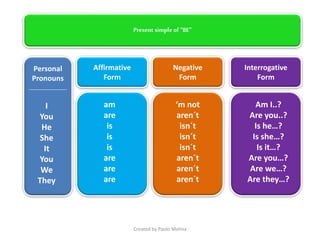
Present simple of “BE”
Personal
Pronouns
I
You
He
She
It
You
We
They
Affirmative
Form
am
are
is
is
is
are
are
are
Negative
Form
‘m not
aren´t
isn´t
isn´t
isn´t
aren´t
aren´t
aren´t
Interrogative
Form
Am I..?
Are you..?
Is he…?
Is she…?
Is it…?
Are you…?
Are we…?
Are they…?
Created by Paolo Molina
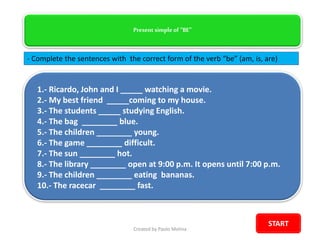
Present simple of “BE”
- Complete the sentences with the correct form of the verb “be” (am, is, are)
1.- Ricardo, John and I _____ watching a movie.
2.- My best friend _____coming to my house.
3.- The students _____ studying English.
4.- The bag ________ blue.
5.- The children ________ young.
6.- The game ________ difficult.
7.- The sun ________ hot.
8.- The library ________ open at 9:00 p.m. It opens until 7:00 p.m.
9.- The children ________ eating bananas.
10.- The racecar ________ fast.
Created by Paolo Molina
START
Created by Paolo Molina
Objective:
To express existence and non existence of things.
There is –There are
We use There is /
There are to say that
something exists (or
does not exist). The
real subject usually
comes after There is /
There are.
AFFIRMATIVE
FORM
NEGATIVE FORM
THERE IS…
THERE ARE…
THERE ISN’T…
THERE AREN’T…
INTERROGATIVE
FORM
SHORT ANSWERS
IS THERE…?
ARE THERE…?
YES, THERE IS / NO, THERE ISN’T
YES, THERE ARE / NO, THERE AREN’T
Examples:
There is a book on the table
There aren’t any chairs in the classroom.
Is there any sugar in the sugar pot?
Created by Paolo Molina
1.- __________ something wrong with my ear.
2.- __________ a frog near the lake.
3.- __________ some flowers in the vase.
4.- __________ some rice in the bowl.
5.- __________ no money in my pocket.
6.- _________ some fresh fruit in the basket.
7.- _________ a blue dress in my wardrobe.
8.- _________ a new student in our classroom.
There is –There are
- Complete the sentences with “there is..” or “there are”.
Created by Paolo Molina
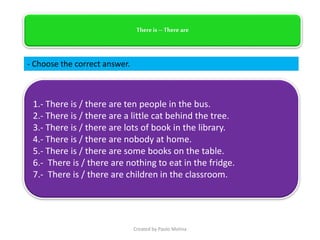
There is –There are
- Choose the correct answer.
1.- There is / there are ten people in the bus.
2.- There is / there are a little cat behind the tree.
3.- There is / there are lots of book in the library.
4.- There is / there are nobody at home.
5.- There is / there are some books on the table.
6.- There is / there are nothing to eat in the fridge.
7.- There is / there are children in the classroom.
Created by Paolo Molina
There is –There are
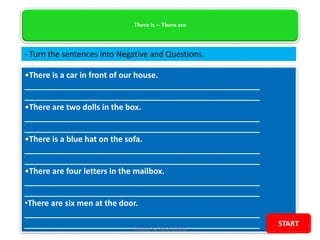
•There is a car in front of our house.
_____________________________________________________
_____________________________________________________
•There are two dolls in the box.
_____________________________________________________
_____________________________________________________
•There is a blue hat on the sofa.
_____________________________________________________
_____________________________________________________
•There are four letters in the mailbox.
_____________________________________________________
_____________________________________________________
•There are six men at the door.
_____________________________________________________
_____________________________________________________
- Turn the sentences into Negative and Questions.
Created by Paolo Molina
START
Created by Paolo Molina
Objective:
To express quantity with some, any and the indefinite
article
Some -Any
Dialogue
Barbara: Is there any milk left?
Katherine: Yes, there is some in the bottle
on the table.
Barbara: Would you like some milk?
Katherine: No, thank you. I don't think I'll
drink any tonight. Could I have some water,
please?
Barbara: Sure. There is some in the fridge.
Read the following dialogue!
Created by Paolo Molina
Some – Any – A- an
Some: affirmative statements,
offers, requests and in
questions when you expect
the answer "yes“
Example:
Would you like some sugar in
your tea?
Any: negative statements,
questions.
Example:
Is there any pencil?
Indefinite article:
The indefinite article A-An is
used only with singular nouns
as it refers to just one thing.
Use “A” when the following
word starts with a consonant;
and “AN” with the next word
begins with a vowel.
Example:
There is a cat under the table
She studies at an old school
Created by Paolo Molina
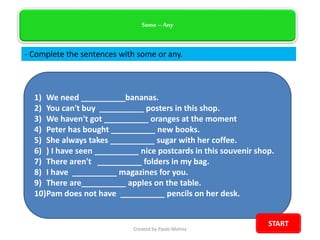
1) We need __________bananas.
2) You can't buy __________ posters in this shop.
3) We haven't got __________ oranges at the moment
4) Peter has bought __________ new books.
5) She always takes __________ sugar with her coffee.
6) ) I have seen __________ nice postcards in this souvenir shop.
7) There aren't __________ folders in my bag.
8) I have __________ magazines for you.
9) There are__________ apples on the table.
10)Pam does not have __________ pencils on her desk.
Some – Any
- Complete the sentences with some or any.
Created by Paolo Molina
START
Created by Paolo Molina
Objective:
To identify and classify countable and uncountable
nouns.
To count or not to count?
Created by Paolo Molina
Countable Nouns
Countable nouns are easy to recognize. They are things
that we can count. For example: "pen". We can count
pens. We can have one, two, three or more pens. Here
are some more countable nouns:
dog, cat, animal, man, person
bottle, box, litre
coin, note
cup, plate, fork
table, chair, suitcase, bag
Created by Paolo Molina
Countable and uncountable nouns
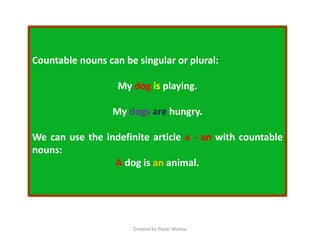
Countable nouns can be singular or plural:
My dog is playing.
My dogs are hungry.
We can use the indefinite article a - an with countable
nouns:
A dog is an animal.
Created by Paolo Molina
When a countable noun is plural, we can use it alone:
I like oranges.
Bottles can break.
We can use some and any with countable nouns:
I've got some dollars.
Have you got any pens?
Created by Paolo Molina
Uncountable Nouns
Uncountable nouns are substances, concepts ; anything
that we cannot divide into separate elements. We
cannot "count" them. For example, we cannot count
"milk". We can count "bottles of milk" or "litres of
milk", but we cannot count "milk" itself. Here are some
more uncountable nouns:
music, art, love, happiness
advice, information, news
furniture, luggage
rice, sugar, butter, water
electricity, gas, power
money
Created by Paolo Molina
We usually treat uncountable nouns as singular. We use
a singular verb. For example:
This news is very important.
Your luggage looks heavy.
We do not usually use the indefinite article a-an with
uncountable nouns. We cannot say "an information" or
"a music". But we can say a something of:
a piece of news
a bottle of water
a grain of rice
We can use some and any with uncountable nouns:
I've got some money.
Have you got any rice?
Created by Paolo Molina
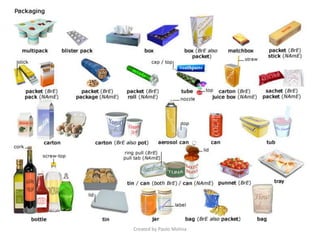
Containers
Created by Paolo Molina
Created by Andrea Torres-Knapp
With containers,
you can count the
uncountable!
Time to practice!
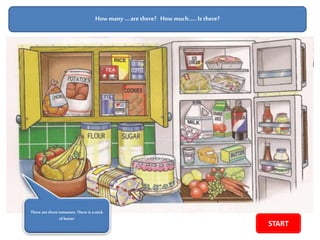
How many … are there? How much….. Is there?
There are three tomatoes. There is a stick
of butter
START
Objective:
To describe where things are located
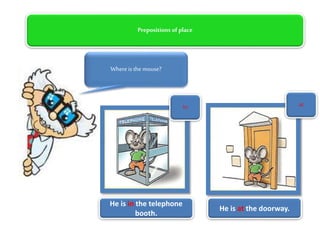
He is in the telephone
booth.
Prepositions of place
Whereis the mouse?
in
He is at the doorway.
at
Prepositions of place
He is between the books
between
He is behind the sofa
behind
Prepositions of place
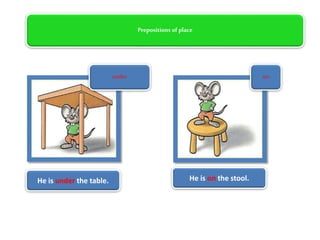
under
He is under the table. He is on the stool.
on
Prepositions of place
He is near the television.
near
He is in front of the
television.
Infront of
He is next to the
television.
Next to
Prepositions of place
- Complete the sentences with in, on, behind, between, next to, under
1-THE BOOKS AND THE
CRAYONS ARE ___________
THE SCHOOL BAG.
2-THE BIN IS _________
THE DESK.
3-THE BOARD IS _________
THE CHAIR
4-THE RULER IS __________
THE BOOK.
5-THE COPYBOOK IS __________
THE BOOKS AND
THE PENCILS.
6-THE ERASER AND
THE SHARPENER ARE
________THE PENCIL-CASE.
START
Objective:
To show and indicate things
Demonstrative pronouns
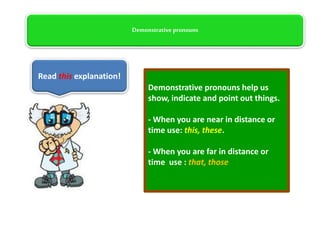
Demonstrative pronouns help us
show, indicate and point out things.
- When you are near in distance or
time use: this, these.
- When you are far in distance or
time use : that, those
Read this explanation!
Demonstrative pronouns
Singular Plural
Near This These
Far That Those
Demonstrative pronouns
This is a pencil
These are pencils
That is a tree
Those are trees
Created by Andrea Torres-Knapp
Demonstrative pronouns
- Complete the sentences with this, that , these or those.
1.- __________ shoes are too expensive. (this-these)
2.- I live in ________ house. (those-that)
3.- ___________ children are in my class. (those-that)
4.- My niece likes _________ game. (this –these)
5.- I did __________ card for you. (this – these)
6.- I read _________ books last year. ( those – that)
7.- I like ___________ colours. (this – these)
8.- I am in _________ photo! (this – these)
Demonstrative pronouns
Created by Andrea Torres-Knapp
Demonstrative pronouns
START
Objective:
To ask and say the time
Created by Andrea Torres-Knapp
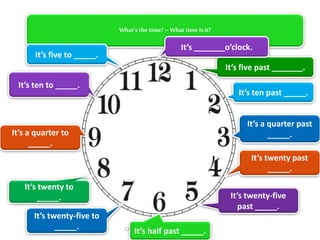
What’s the time? – What time is it?
It’s five past _______.
It’s _______o’clock.
It’s ten past _____.
It’s a quarter past
_____.
It’s twenty past
_____.
It’s twenty-five
past _____.
It’s half past _____.
It’s twenty-five to
_____.
It’s twenty to
_____.
It’s a quarter to
_____.
It’s ten to _____.
It’s five to _____.
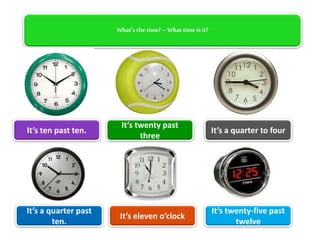
What’s the time? – What time is it?
It’s ten past ten.
It’s twenty past
three
It’s a quarter to four
It’s a quarter past
ten.
It’s eleven o’clock
It’s twenty-five past
twelve
Created by Andrea Torres-Knapp
What’s the time? – What time is it?
- Look at the clocks and write down the time in english.
1 2 3 4
5 6 7 8
What’s the time? – What time is it?
- Read the time and then draw the hands of the clock.
1
It’s twenty five
past five.
2 3
It’s twenty five
to seven
It’s five to eleven
It’s a quarter
past four
4
5
It’s half past
twelve
876
It’s five to one
It’s twenty past
two
It’s a quarter to
three.
START
Objective:
To ask and say what the weather is like.
What’s the weather like today?
- Make a weather chart and then share it with your classmates.
MONDAY TUESDAY WEDNESDAY THURSDAY FRIDAY SATURDAY SUNDAY
START
Objective:
To talk about my everyday activities
everydayactivities
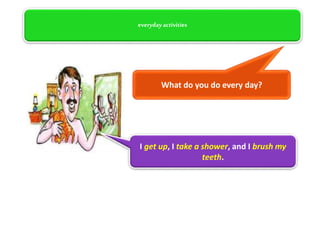
What do you do every day?
I get up, I take a shower, and I brush my
teeth.
everydayactivities
get up take a shower take a shower get dressed
wash *my face put on makeup comb *my hair make the bed
everydayactivities
eat/have
breakfast
go to school play have/eat lunch
wash the dishes study watch TV
listen to
music/the radio
Created by Andrea Torres-Knapp
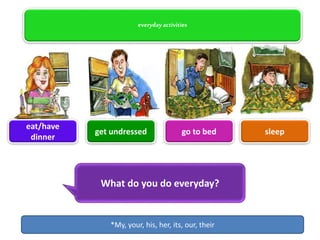
everydayactivities
eat/have
dinner
get undressed go to bed sleep
What do you do everyday?
*My, your, his, her, its, our, their
everydayactivities
Example:
I get up at seven o’clock, I have a shower and then I
have breakfast. I go to school at a quarter to eight.
After that I start my lessons at eight o’clock.
When I get home at half past six, I do my homework,
watch TV and have my dinner.
Finally, I go to bed at a quarter to ten and that’s my
day!
Created by Andrea Torres-Knapp
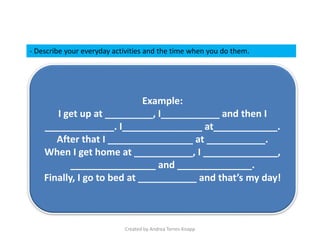
Example:
I get up at _________, I___________ and then I
_____________. I_______________ at____________.
After that I ________________ at ___________.
When I get home at ___________, I ______________,
________________ and ______________.
Finally, I go to bed at ___________ and that’s my day!
- Describe your everyday activities and the time when you do them.
Created by Paolo Molina
Well done!
you finished the
review…
now you are
ready….
to take the test!Good luck and ..See you soon!

Nivelación 7th grade

  • 1.
    Objective: To revisemain contentsinEnglish Created by Paolo Molina
  • 2.
    Contents Present simple of“BE” There is –There are Some -Any Countable and uncountable nouns Prepositions of place Demonstrative pronouns What’s the time? – What time is it? What’s the weather like today? everydayactivities
  • 3.
    Created by PaoloMolina Objective: To review the forms and usage of the verb BE.
  • 4.
    Present simple of“BE” Personal Pronouns I You He She It You We They Affirmative Form am are is is is are are are Negative Form ‘m not aren´t isn´t isn´t isn´t aren´t aren´t aren´t Interrogative Form Am I..? Are you..? Is he…? Is she…? Is it…? Are you…? Are we…? Are they…? Created by Paolo Molina
  • 5.
    Present simple of“BE” - Complete the sentences with the correct form of the verb “be” (am, is, are) 1.- Ricardo, John and I _____ watching a movie. 2.- My best friend _____coming to my house. 3.- The students _____ studying English. 4.- The bag ________ blue. 5.- The children ________ young. 6.- The game ________ difficult. 7.- The sun ________ hot. 8.- The library ________ open at 9:00 p.m. It opens until 7:00 p.m. 9.- The children ________ eating bananas. 10.- The racecar ________ fast. Created by Paolo Molina START
  • 6.
    Created by PaoloMolina Objective: To express existence and non existence of things.
  • 7.
    There is –Thereare We use There is / There are to say that something exists (or does not exist). The real subject usually comes after There is / There are. AFFIRMATIVE FORM NEGATIVE FORM THERE IS… THERE ARE… THERE ISN’T… THERE AREN’T… INTERROGATIVE FORM SHORT ANSWERS IS THERE…? ARE THERE…? YES, THERE IS / NO, THERE ISN’T YES, THERE ARE / NO, THERE AREN’T Examples: There is a book on the table There aren’t any chairs in the classroom. Is there any sugar in the sugar pot? Created by Paolo Molina
  • 8.
    1.- __________ somethingwrong with my ear. 2.- __________ a frog near the lake. 3.- __________ some flowers in the vase. 4.- __________ some rice in the bowl. 5.- __________ no money in my pocket. 6.- _________ some fresh fruit in the basket. 7.- _________ a blue dress in my wardrobe. 8.- _________ a new student in our classroom. There is –There are - Complete the sentences with “there is..” or “there are”. Created by Paolo Molina
  • 9.
    There is –Thereare - Choose the correct answer. 1.- There is / there are ten people in the bus. 2.- There is / there are a little cat behind the tree. 3.- There is / there are lots of book in the library. 4.- There is / there are nobody at home. 5.- There is / there are some books on the table. 6.- There is / there are nothing to eat in the fridge. 7.- There is / there are children in the classroom. Created by Paolo Molina
  • 10.
    There is –Thereare •There is a car in front of our house. _____________________________________________________ _____________________________________________________ •There are two dolls in the box. _____________________________________________________ _____________________________________________________ •There is a blue hat on the sofa. _____________________________________________________ _____________________________________________________ •There are four letters in the mailbox. _____________________________________________________ _____________________________________________________ •There are six men at the door. _____________________________________________________ _____________________________________________________ - Turn the sentences into Negative and Questions. Created by Paolo Molina START
  • 11.
    Created by PaoloMolina Objective: To express quantity with some, any and the indefinite article
  • 12.
    Some -Any Dialogue Barbara: Isthere any milk left? Katherine: Yes, there is some in the bottle on the table. Barbara: Would you like some milk? Katherine: No, thank you. I don't think I'll drink any tonight. Could I have some water, please? Barbara: Sure. There is some in the fridge. Read the following dialogue! Created by Paolo Molina
  • 13.
    Some – Any– A- an Some: affirmative statements, offers, requests and in questions when you expect the answer "yes“ Example: Would you like some sugar in your tea? Any: negative statements, questions. Example: Is there any pencil? Indefinite article: The indefinite article A-An is used only with singular nouns as it refers to just one thing. Use “A” when the following word starts with a consonant; and “AN” with the next word begins with a vowel. Example: There is a cat under the table She studies at an old school Created by Paolo Molina
  • 14.
    1) We need__________bananas. 2) You can't buy __________ posters in this shop. 3) We haven't got __________ oranges at the moment 4) Peter has bought __________ new books. 5) She always takes __________ sugar with her coffee. 6) ) I have seen __________ nice postcards in this souvenir shop. 7) There aren't __________ folders in my bag. 8) I have __________ magazines for you. 9) There are__________ apples on the table. 10)Pam does not have __________ pencils on her desk. Some – Any - Complete the sentences with some or any. Created by Paolo Molina START
  • 15.
    Created by PaoloMolina Objective: To identify and classify countable and uncountable nouns.
  • 16.
    To count ornot to count? Created by Paolo Molina
  • 17.
    Countable Nouns Countable nounsare easy to recognize. They are things that we can count. For example: "pen". We can count pens. We can have one, two, three or more pens. Here are some more countable nouns: dog, cat, animal, man, person bottle, box, litre coin, note cup, plate, fork table, chair, suitcase, bag Created by Paolo Molina Countable and uncountable nouns
  • 18.
    Countable nouns canbe singular or plural: My dog is playing. My dogs are hungry. We can use the indefinite article a - an with countable nouns: A dog is an animal. Created by Paolo Molina
  • 19.
    When a countablenoun is plural, we can use it alone: I like oranges. Bottles can break. We can use some and any with countable nouns: I've got some dollars. Have you got any pens? Created by Paolo Molina
  • 20.
    Uncountable Nouns Uncountable nounsare substances, concepts ; anything that we cannot divide into separate elements. We cannot "count" them. For example, we cannot count "milk". We can count "bottles of milk" or "litres of milk", but we cannot count "milk" itself. Here are some more uncountable nouns: music, art, love, happiness advice, information, news furniture, luggage rice, sugar, butter, water electricity, gas, power money Created by Paolo Molina
  • 21.
    We usually treatuncountable nouns as singular. We use a singular verb. For example: This news is very important. Your luggage looks heavy. We do not usually use the indefinite article a-an with uncountable nouns. We cannot say "an information" or "a music". But we can say a something of: a piece of news a bottle of water a grain of rice We can use some and any with uncountable nouns: I've got some money. Have you got any rice? Created by Paolo Molina
  • 22.
    Created by PaoloMolina Containers
  • 23.
  • 24.
    Created by AndreaTorres-Knapp With containers, you can count the uncountable!
  • 25.
  • 30.
    How many …are there? How much….. Is there? There are three tomatoes. There is a stick of butter START
  • 31.
    Objective: To describe wherethings are located
  • 32.
    He is inthe telephone booth. Prepositions of place Whereis the mouse? in He is at the doorway. at
  • 33.
    Prepositions of place Heis between the books between He is behind the sofa behind
  • 34.
    Prepositions of place under Heis under the table. He is on the stool. on
  • 35.
    Prepositions of place Heis near the television. near He is in front of the television. Infront of He is next to the television. Next to
  • 36.
    Prepositions of place -Complete the sentences with in, on, behind, between, next to, under 1-THE BOOKS AND THE CRAYONS ARE ___________ THE SCHOOL BAG. 2-THE BIN IS _________ THE DESK. 3-THE BOARD IS _________ THE CHAIR 4-THE RULER IS __________ THE BOOK. 5-THE COPYBOOK IS __________ THE BOOKS AND THE PENCILS. 6-THE ERASER AND THE SHARPENER ARE ________THE PENCIL-CASE. START
  • 37.
    Objective: To show andindicate things
  • 38.
    Demonstrative pronouns Demonstrative pronounshelp us show, indicate and point out things. - When you are near in distance or time use: this, these. - When you are far in distance or time use : that, those Read this explanation!
  • 39.
  • 40.
    Demonstrative pronouns This isa pencil These are pencils That is a tree Those are trees
  • 41.
    Created by AndreaTorres-Knapp Demonstrative pronouns - Complete the sentences with this, that , these or those. 1.- __________ shoes are too expensive. (this-these) 2.- I live in ________ house. (those-that) 3.- ___________ children are in my class. (those-that) 4.- My niece likes _________ game. (this –these) 5.- I did __________ card for you. (this – these) 6.- I read _________ books last year. ( those – that) 7.- I like ___________ colours. (this – these) 8.- I am in _________ photo! (this – these)
  • 42.
  • 43.
    Created by AndreaTorres-Knapp Demonstrative pronouns START
  • 44.
  • 45.
    Created by AndreaTorres-Knapp What’s the time? – What time is it? It’s five past _______. It’s _______o’clock. It’s ten past _____. It’s a quarter past _____. It’s twenty past _____. It’s twenty-five past _____. It’s half past _____. It’s twenty-five to _____. It’s twenty to _____. It’s a quarter to _____. It’s ten to _____. It’s five to _____.
  • 46.
    What’s the time?– What time is it? It’s ten past ten. It’s twenty past three It’s a quarter to four It’s a quarter past ten. It’s eleven o’clock It’s twenty-five past twelve
  • 47.
    Created by AndreaTorres-Knapp What’s the time? – What time is it? - Look at the clocks and write down the time in english. 1 2 3 4 5 6 7 8
  • 48.
    What’s the time?– What time is it? - Read the time and then draw the hands of the clock. 1 It’s twenty five past five. 2 3 It’s twenty five to seven It’s five to eleven It’s a quarter past four 4 5 It’s half past twelve 876 It’s five to one It’s twenty past two It’s a quarter to three. START
  • 49.
    Objective: To ask andsay what the weather is like.
  • 50.
  • 51.
  • 52.
  • 53.
    What’s the weatherlike today? - Make a weather chart and then share it with your classmates. MONDAY TUESDAY WEDNESDAY THURSDAY FRIDAY SATURDAY SUNDAY START
  • 54.
    Objective: To talk aboutmy everyday activities
  • 55.
    everydayactivities What do youdo every day? I get up, I take a shower, and I brush my teeth.
  • 56.
    everydayactivities get up takea shower take a shower get dressed wash *my face put on makeup comb *my hair make the bed
  • 57.
    everydayactivities eat/have breakfast go to schoolplay have/eat lunch wash the dishes study watch TV listen to music/the radio
  • 58.
    Created by AndreaTorres-Knapp everydayactivities eat/have dinner get undressed go to bed sleep What do you do everyday? *My, your, his, her, its, our, their
  • 59.
    everydayactivities Example: I get upat seven o’clock, I have a shower and then I have breakfast. I go to school at a quarter to eight. After that I start my lessons at eight o’clock. When I get home at half past six, I do my homework, watch TV and have my dinner. Finally, I go to bed at a quarter to ten and that’s my day!
  • 60.
    Created by AndreaTorres-Knapp Example: I get up at _________, I___________ and then I _____________. I_______________ at____________. After that I ________________ at ___________. When I get home at ___________, I ______________, ________________ and ______________. Finally, I go to bed at ___________ and that’s my day! - Describe your everyday activities and the time when you do them.
  • 61.
    Created by PaoloMolina Well done! you finished the review… now you are ready…. to take the test!Good luck and ..See you soon!