FOUNDATION FOR PARTNERSHIP INITIATIVES IN THE NIGER DELTA
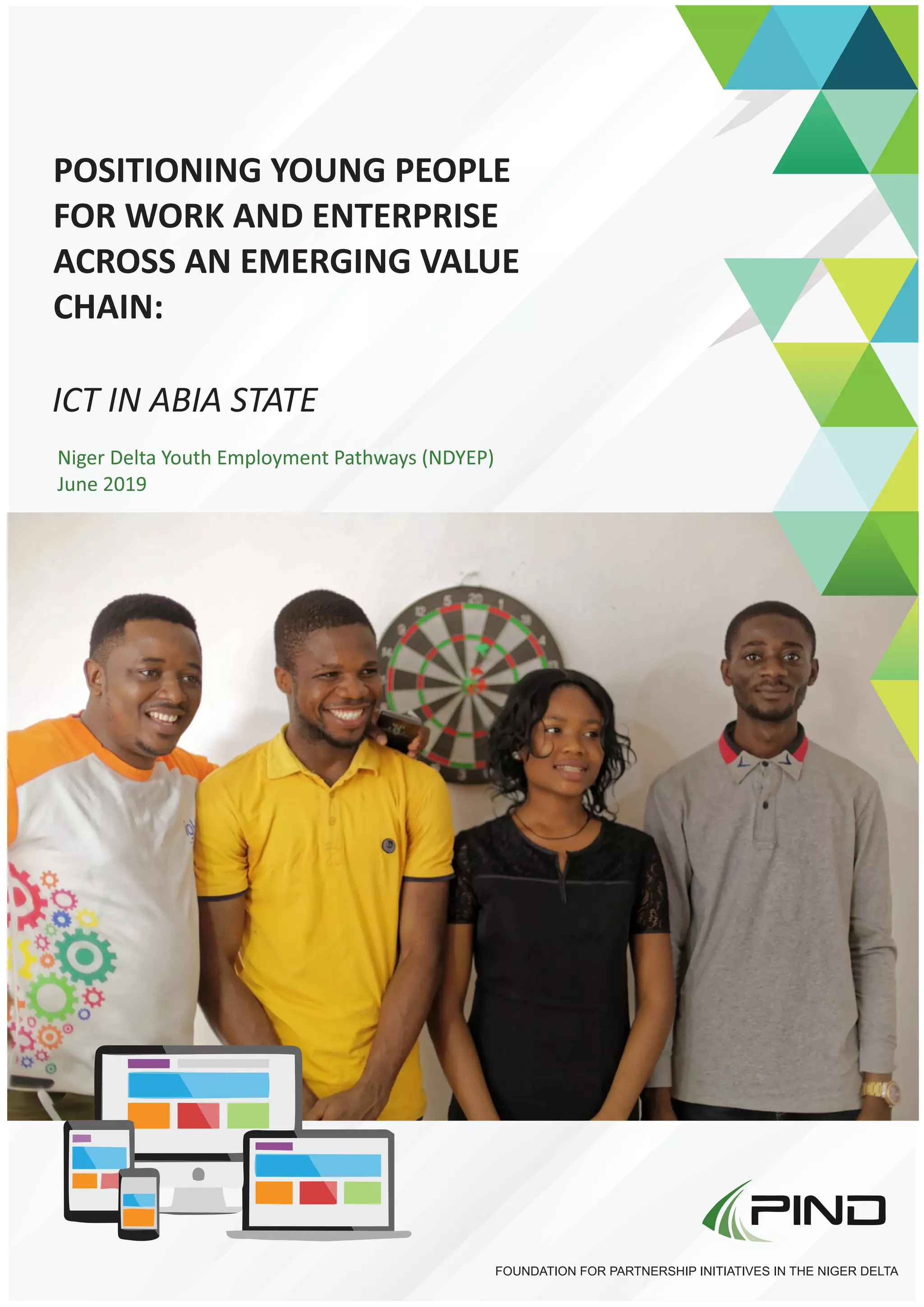
POSITIONING YOUNG PEOPLE
FOR WORK AND ENTERPRISE
ACROSS AN EMERGING VALUE
CHAIN:
ICT IN ABIA STATE
Niger Delta Youth Employment Pathways (NDYEP)
June 2019
Acknowledgements
This prac ce paper reflects the work of many people who: conceptualized
and brought the Niger Delta Youth Employment Pathways Project (NDYEP) to
life, adap ng its approach to con nually improve results; who provided key
insights and facilita on of the evalua on; and who guided the several
itera ons of this paper. We wish to extend special thanks to: Emeka
Nwankwo, PIND's Planning and Evalua on Manager for his wisdom, guidance
and dedica on to the evalua on of the project and development of related
prac ce papers; to Emeka Ile, the Project Team Leader and Patrick Ekpe,
Project Advisor for their orienta on, technical insights and guidance and for
organizing and accompanying the field work; John Femi Osuntokun, the
Monitoring and Evalua on Coordinator for reassuring logis cal support; and
Chinonso Onwunali and Yvonne Jonah, Private Sector Advisor for excellent
research assistance with note taking, transcrip ons and contextual
informa on.
This prac ce paper was commissioned by the Founda on for Partnership
Ini a ves in the Niger Delta (PIND) to document emerging models, lessons
and prac ces from the on-going implementa on of its pilot youth skills
training and employment pathways program. We are enormously grateful
for the contribu on and acknowledged exper se of Olayide Adesanya,
independentconsultant,whoisthemainauthorofthisprac cepaper.
Above all, we are grateful to the project partners, their staff, trainees, the
employers and other respondents who gave their thoughts, and me –
some mes quite considerable – out of their busy schedules, to answer our
many ques ons, and without whom there would be no project to evaluate.
ThelastwordofthanksisreservedforPINDFounda onleadership,especially
Dara Akala, the Execu ve Director and Tunji Idowu, his astute deputy, who
had the courage and foresight to support and nurture this ground-breaking
project. Wearehappytosharethisprac cepaperwithyou.
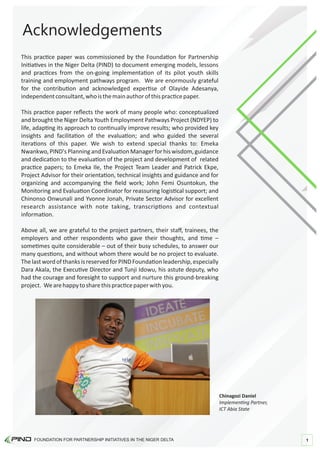
Chinagozi Daniel
Implemen ng Partner,
ICT Abia State
FOUNDATION FOR PARTNERSHIP INITIATIVES IN THE NIGER DELTA 1
Summary
· Partnering with community embedded organisa ons: CIC built strategic partnerships for the project and created wider
networks and more opportuni es for the trainees through collabora on with YES Building Ini a ve and E.T. Edwin
Industrial Company among others. These include a poten al partnership with Leather Products Manufacturers
Associa on of Abia State (LEPMAS) to have a Skill Up Abia design office in its secretariat providing CAD/CAM services to
leather products manufacturers in Abia State. There is yet another opportunity to partner with Shoe Sole Dealers of Abia
StatetoprovideCAD/CAMservices. CICalsopartneredwithseveralotherorganisa onsaspoten alemployersofthe
Niger Delta Youth Employment Pathways (NDYEP) began in 2018 to develop models of youth training in which marginalised young
people are trained in market-relevant skills and subsequently supported into sustainable jobs or enterprise. It currently works
through 13 implemen ng partners in the aquaculture, construc on and ICT sectors, in Rivers, Abia and Akwa Ibom states. This
paper explores the methods applied and the mid-term results achieved in the ICT sector in Abia state, using the example of the
projectimplementedbyClintonelInnova onCentre(CIC).
· Combining business and development sector approaches: NDYEP partnered with entrepreneurial business-oriented
organisa ons that were selected through a compe ve tender process. Through these organisa ons, it has deployed
profit-oriented strategies with the objec ve of contribu ng to s mula ng economic growth and demonstra ng 'business
thinking' to trainees. For the ICT sector in Aba, Abia State, NYDEP partnered with Innova on Growth Hub and Clintonel
Innova on Centre (CIC), a solar-powered STEM Centre, that provides training, mentoring and equipment for young
peopletocreatedifferentproductsandbusinesses.
· Working to strengths: PIND project management permi ed flexibility concerning training content, approach, and the
rela onships built by grantees to support training. It aimed to offer tailored support to organisa ons as their approaches
evolved.Thissupportallowedtheorganisa onstoworktotheirstrengthsandevolvetraining-to-enterprise/employment
models tailored to the par cular local economy in which their organisa on is embedded. For CIC, this allowed the
development of a dis nct approach involving an enriched, hands-on training curriculum which includes opportunity to
iden fy gaps and problems and develop resourcefulness to solve these and forge rela onships with entrepreneurs for
futureopportuni esforthetraineesa ercomple on.
Keyfeaturesoftheimplementa onmodelsuppor ngtheseresultsare:
NDYEP's interven on in ICT aimed to equip youth with skills such as coding and digital marke ng that would help them obtain jobs
in the ICT sector. CIC has trained 140 youth; 28% of whom are women. All the trainees were all young people, aged 17-28, mostly
from low income families, with diverse educa onal backgrounds- some were secondary school drop outs, some had completed
secondary school; some were under-graduates and some graduates. A few were ar sans trying to run small businesses. Almost
half of the trainees (49%) par cipated in a training on "Business Development and Access to Funding for Start-ups". 69 of the
trainees are either self-employed freelancers or in paid employment, 34 of them are in internships while 29 trainees started 10
businesses. In summary, about 90% of the trainees are engaged; 77% of them are either self-employed freelancers or in salaried
employment;24%ofthetotaltrainedhavebeenplacedininternships.
Aba, Abia State's commercial hub, has a plethora of Small and Medium Enterprises, SMEs manufacturing products that are sold in
different parts of Nigeria. Most of these products are produced manually thus making the products uncompe ve with
compe tors who have high-tech and automated produc on lines. This challenge provides an opportunity for young people who
areinterestedinICTinAbaandwillleadtoimprovementinqualityof'AbaMade'products.
· Enriching training with an integrated approach: The training provided by CIC in ICT/Solar combines five syllabi: 1)
Computer Aided Design (CAD); 2) Computer Aided Manufacturing (CAM); 3) Renewable Energy (Solar); 4) Access to
funding for start-ups; and 5) So skills or business and personal development. CIC adapted the Autodesk Inc. curriculum
for the training on Computer Aided Design (CAD) and Computer Aided Manufacturing (CAM), using Autodesk Inventor
and Autodesk Fusion360 respec vely. The curriculum of Intelligent Energy-Europe (IEE), a programme of the European
Commission, was used for solar energy. The ICT training was prac ce-oriented; it provided trainees with hands-on
experienceaspartofthetraining.Thetraineeswereexposedtofunc oningbusinessprocesses,asanaddeddimensionof
theirtraining.CICbuiltamarketresearchcomponent(MarketImmersion)intothetraining.
FOUNDATION FOR PARTNERSHIP INITIATIVES IN THE NIGER DELTA 2
trainees and to secure internship placements for them. The organisa ons include Solid Blast Technical Services, MaacZulus
Innova veSkills,CeleIfeHillCompany,CandisCompanyLimited,CommonFacilityCentre(CFC),andPGNCompany.
· Crea ng accountability to the onward pathway: one of the unique features of the NDYEP is the establishment of
accountability for the outcomes of training – in terms of employability of trainees – at the level of the training
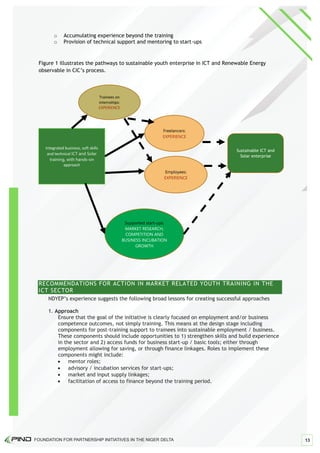
organisa on, with support from the broader project. CIC therefore worked on crea ng three types of post-training
onward pathways from the outset: crea ng start-up companies; routes to employment and self-employed freelancing;
and internship opportuni es. Since the training, 34 trainees have been placed on internships; 69 trainees became self-
employed freelancers or secured waged jobs; and 29 started 10 companies. CIC provided post training support to
trainees on internships by monitoring their performance and suppor ng them to transit from internship to full
employment,rou nelymetwithtraineesandfreelancerstodiscussworkandlifechallengesandproffersolu ons.
· Comple on rate: Comple on rate in the first batch of training was 46% but it increased to 92% in the second batch. To
achieve this increase, CIC consulted widely with other training service providers. One of the ins tu ons consulted
revealed that they involve the parents of trainees in their programs. As a result, CIC invited parents/guarantors of
shortlisted applicants to sign an agreement indica ng that they will refund the cost of training if their child/ward drops
out.
Emergingrecommenda onsfororganisa onsmovingintosimilaryouthworkreadinessapproachesinclude:
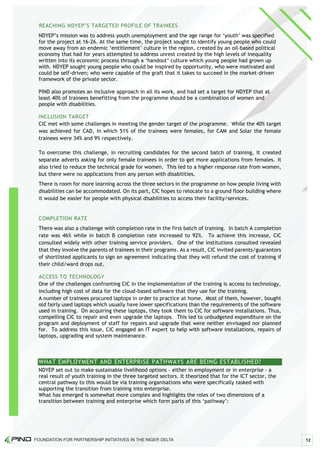
NDYEP promotes an inclusive approach for the programme, and had set a target that at least 40% of trainees benefi ng from the
programme should be a combina on of women and people with disabili es. It also targeted marginalised young people in the age
group 16-26 from the outset. These criteria for trainee selec on presented a number of challenges to CIC and other partner
organisa ons. CIC achieved the 40% target for CAD, in which 51% of the trainees were females, for CAM and Solar the female
trainees were 34% and 9% respec vely. To overcome this challenge, while recrui ng for the second batch of training, CIC created
separateadvertsaskingforonlyfemaletraineesinorderto getmoreapplica ons from females.Italsotriedto reducethetechnical
gradeforwomen. Thisledtoahigherresponseratefromwomen,buttherewerenoapplica onsfromanypersonwithdisabili es.
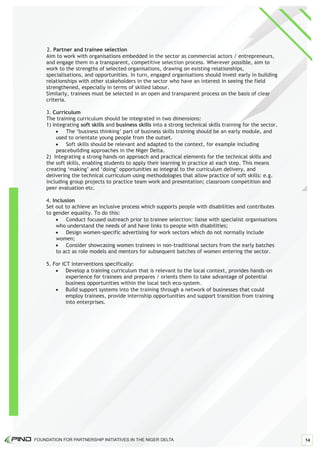
· Ini ate strong, transparent partner and trainee selec on processes which iden fy partners embedded as businesses in
thesector;andselecttraineesaccordingtoclearlyunderstoodcriteria.
· Design a curriculum which integrates business and so skills with technical skills, and use a methodology which give
opportunitytoapplyandprac ceallthesetypesofskillsoverthecourseofthetraining.
· Use strategies for inclusion of people with disabili es for contribu ng to gender equality, especially in sectors in which
womendonotnormallywork.
· Ensuring accountability of the project to employment / sustainable business outcomes, not simply training, and planning
for the post-training ac vi es and support that will be necessary to facilitate the onward process of strengthening skills,
buildingexperienceandaccessingfinance.
FOUNDATION FOR PARTNERSHIP INITIATIVES IN THE NIGER DELTA 3
FOUNDATION FOR PARTNERSHIP INITIATIVES IN THE NIGER DELTA 4
FOUNDATION FOR PARTNERSHIP INITIATIVES IN THE NIGER DELTA 5
FOUNDATION FOR PARTNERSHIP INITIATIVES IN THE NIGER DELTA 6
FOUNDATION FOR PARTNERSHIP INITIATIVES IN THE NIGER DELTA 7
FOUNDATION FOR PARTNERSHIP INITIATIVES IN THE NIGER DELTA 8
FOUNDATION FOR PARTNERSHIP INITIATIVES IN THE NIGER DELTA 9
FOUNDATION FOR PARTNERSHIP INITIATIVES IN THE NIGER DELTA 10
FOUNDATION FOR PARTNERSHIP INITIATIVES IN THE NIGER DELTA 11
FOUNDATION FOR PARTNERSHIP INITIATIVES IN THE NIGER DELTA 12
FOUNDATION FOR PARTNERSHIP INITIATIVES IN THE NIGER DELTA 13
FOUNDATION FOR PARTNERSHIP INITIATIVES IN THE NIGER DELTA 14
Connect & Engage
Visit or Call
Learn More
www.pindfounda on.org
@pindfounda on
@pindfounda on
@pindfounda on
@pindfounda on
www.facebook.com/pindfounda on
25, Jimmy Carter Street, Asokoro
+234(09)2910454
1 PIND - EDC Drive, Egbokodo Itsekiri
+234(0)8172401598 +234(0)9030808794
6, Tombia Street, GRA phase 2
+234(0)8110521802
ABUJA
WARRI
PH
FOUNDATION FOR PARTNERSHIP INITIATIVES IN THE NIGER DELTA

Niger Delta Youth Employment Pathways Case Study - ICT

  • 1.
    FOUNDATION FOR PARTNERSHIPINITIATIVES IN THE NIGER DELTA POSITIONING YOUNG PEOPLE FOR WORK AND ENTERPRISE ACROSS AN EMERGING VALUE CHAIN: ICT IN ABIA STATE Niger Delta Youth Employment Pathways (NDYEP) June 2019
  • 2.
    Acknowledgements This prac cepaper reflects the work of many people who: conceptualized and brought the Niger Delta Youth Employment Pathways Project (NDYEP) to life, adap ng its approach to con nually improve results; who provided key insights and facilita on of the evalua on; and who guided the several itera ons of this paper. We wish to extend special thanks to: Emeka Nwankwo, PIND's Planning and Evalua on Manager for his wisdom, guidance and dedica on to the evalua on of the project and development of related prac ce papers; to Emeka Ile, the Project Team Leader and Patrick Ekpe, Project Advisor for their orienta on, technical insights and guidance and for organizing and accompanying the field work; John Femi Osuntokun, the Monitoring and Evalua on Coordinator for reassuring logis cal support; and Chinonso Onwunali and Yvonne Jonah, Private Sector Advisor for excellent research assistance with note taking, transcrip ons and contextual informa on. This prac ce paper was commissioned by the Founda on for Partnership Ini a ves in the Niger Delta (PIND) to document emerging models, lessons and prac ces from the on-going implementa on of its pilot youth skills training and employment pathways program. We are enormously grateful for the contribu on and acknowledged exper se of Olayide Adesanya, independentconsultant,whoisthemainauthorofthisprac cepaper. Above all, we are grateful to the project partners, their staff, trainees, the employers and other respondents who gave their thoughts, and me – some mes quite considerable – out of their busy schedules, to answer our many ques ons, and without whom there would be no project to evaluate. ThelastwordofthanksisreservedforPINDFounda onleadership,especially Dara Akala, the Execu ve Director and Tunji Idowu, his astute deputy, who had the courage and foresight to support and nurture this ground-breaking project. Wearehappytosharethisprac cepaperwithyou. Chinagozi Daniel Implemen ng Partner, ICT Abia State FOUNDATION FOR PARTNERSHIP INITIATIVES IN THE NIGER DELTA 1
  • 3.
    Summary · Partnering withcommunity embedded organisa ons: CIC built strategic partnerships for the project and created wider networks and more opportuni es for the trainees through collabora on with YES Building Ini a ve and E.T. Edwin Industrial Company among others. These include a poten al partnership with Leather Products Manufacturers Associa on of Abia State (LEPMAS) to have a Skill Up Abia design office in its secretariat providing CAD/CAM services to leather products manufacturers in Abia State. There is yet another opportunity to partner with Shoe Sole Dealers of Abia StatetoprovideCAD/CAMservices. CICalsopartneredwithseveralotherorganisa onsaspoten alemployersofthe Niger Delta Youth Employment Pathways (NDYEP) began in 2018 to develop models of youth training in which marginalised young people are trained in market-relevant skills and subsequently supported into sustainable jobs or enterprise. It currently works through 13 implemen ng partners in the aquaculture, construc on and ICT sectors, in Rivers, Abia and Akwa Ibom states. This paper explores the methods applied and the mid-term results achieved in the ICT sector in Abia state, using the example of the projectimplementedbyClintonelInnova onCentre(CIC). · Combining business and development sector approaches: NDYEP partnered with entrepreneurial business-oriented organisa ons that were selected through a compe ve tender process. Through these organisa ons, it has deployed profit-oriented strategies with the objec ve of contribu ng to s mula ng economic growth and demonstra ng 'business thinking' to trainees. For the ICT sector in Aba, Abia State, NYDEP partnered with Innova on Growth Hub and Clintonel Innova on Centre (CIC), a solar-powered STEM Centre, that provides training, mentoring and equipment for young peopletocreatedifferentproductsandbusinesses. · Working to strengths: PIND project management permi ed flexibility concerning training content, approach, and the rela onships built by grantees to support training. It aimed to offer tailored support to organisa ons as their approaches evolved.Thissupportallowedtheorganisa onstoworktotheirstrengthsandevolvetraining-to-enterprise/employment models tailored to the par cular local economy in which their organisa on is embedded. For CIC, this allowed the development of a dis nct approach involving an enriched, hands-on training curriculum which includes opportunity to iden fy gaps and problems and develop resourcefulness to solve these and forge rela onships with entrepreneurs for futureopportuni esforthetraineesa ercomple on. Keyfeaturesoftheimplementa onmodelsuppor ngtheseresultsare: NDYEP's interven on in ICT aimed to equip youth with skills such as coding and digital marke ng that would help them obtain jobs in the ICT sector. CIC has trained 140 youth; 28% of whom are women. All the trainees were all young people, aged 17-28, mostly from low income families, with diverse educa onal backgrounds- some were secondary school drop outs, some had completed secondary school; some were under-graduates and some graduates. A few were ar sans trying to run small businesses. Almost half of the trainees (49%) par cipated in a training on "Business Development and Access to Funding for Start-ups". 69 of the trainees are either self-employed freelancers or in paid employment, 34 of them are in internships while 29 trainees started 10 businesses. In summary, about 90% of the trainees are engaged; 77% of them are either self-employed freelancers or in salaried employment;24%ofthetotaltrainedhavebeenplacedininternships. Aba, Abia State's commercial hub, has a plethora of Small and Medium Enterprises, SMEs manufacturing products that are sold in different parts of Nigeria. Most of these products are produced manually thus making the products uncompe ve with compe tors who have high-tech and automated produc on lines. This challenge provides an opportunity for young people who areinterestedinICTinAbaandwillleadtoimprovementinqualityof'AbaMade'products. · Enriching training with an integrated approach: The training provided by CIC in ICT/Solar combines five syllabi: 1) Computer Aided Design (CAD); 2) Computer Aided Manufacturing (CAM); 3) Renewable Energy (Solar); 4) Access to funding for start-ups; and 5) So skills or business and personal development. CIC adapted the Autodesk Inc. curriculum for the training on Computer Aided Design (CAD) and Computer Aided Manufacturing (CAM), using Autodesk Inventor and Autodesk Fusion360 respec vely. The curriculum of Intelligent Energy-Europe (IEE), a programme of the European Commission, was used for solar energy. The ICT training was prac ce-oriented; it provided trainees with hands-on experienceaspartofthetraining.Thetraineeswereexposedtofunc oningbusinessprocesses,asanaddeddimensionof theirtraining.CICbuiltamarketresearchcomponent(MarketImmersion)intothetraining. FOUNDATION FOR PARTNERSHIP INITIATIVES IN THE NIGER DELTA 2
  • 4.
    trainees and tosecure internship placements for them. The organisa ons include Solid Blast Technical Services, MaacZulus Innova veSkills,CeleIfeHillCompany,CandisCompanyLimited,CommonFacilityCentre(CFC),andPGNCompany. · Crea ng accountability to the onward pathway: one of the unique features of the NDYEP is the establishment of accountability for the outcomes of training – in terms of employability of trainees – at the level of the training organisa on, with support from the broader project. CIC therefore worked on crea ng three types of post-training onward pathways from the outset: crea ng start-up companies; routes to employment and self-employed freelancing; and internship opportuni es. Since the training, 34 trainees have been placed on internships; 69 trainees became self- employed freelancers or secured waged jobs; and 29 started 10 companies. CIC provided post training support to trainees on internships by monitoring their performance and suppor ng them to transit from internship to full employment,rou nelymetwithtraineesandfreelancerstodiscussworkandlifechallengesandproffersolu ons. · Comple on rate: Comple on rate in the first batch of training was 46% but it increased to 92% in the second batch. To achieve this increase, CIC consulted widely with other training service providers. One of the ins tu ons consulted revealed that they involve the parents of trainees in their programs. As a result, CIC invited parents/guarantors of shortlisted applicants to sign an agreement indica ng that they will refund the cost of training if their child/ward drops out. Emergingrecommenda onsfororganisa onsmovingintosimilaryouthworkreadinessapproachesinclude: NDYEP promotes an inclusive approach for the programme, and had set a target that at least 40% of trainees benefi ng from the programme should be a combina on of women and people with disabili es. It also targeted marginalised young people in the age group 16-26 from the outset. These criteria for trainee selec on presented a number of challenges to CIC and other partner organisa ons. CIC achieved the 40% target for CAD, in which 51% of the trainees were females, for CAM and Solar the female trainees were 34% and 9% respec vely. To overcome this challenge, while recrui ng for the second batch of training, CIC created separateadvertsaskingforonlyfemaletraineesinorderto getmoreapplica ons from females.Italsotriedto reducethetechnical gradeforwomen. Thisledtoahigherresponseratefromwomen,buttherewerenoapplica onsfromanypersonwithdisabili es. · Ini ate strong, transparent partner and trainee selec on processes which iden fy partners embedded as businesses in thesector;andselecttraineesaccordingtoclearlyunderstoodcriteria. · Design a curriculum which integrates business and so skills with technical skills, and use a methodology which give opportunitytoapplyandprac ceallthesetypesofskillsoverthecourseofthetraining. · Use strategies for inclusion of people with disabili es for contribu ng to gender equality, especially in sectors in which womendonotnormallywork. · Ensuring accountability of the project to employment / sustainable business outcomes, not simply training, and planning for the post-training ac vi es and support that will be necessary to facilitate the onward process of strengthening skills, buildingexperienceandaccessingfinance. FOUNDATION FOR PARTNERSHIP INITIATIVES IN THE NIGER DELTA 3
  • 5.
    FOUNDATION FOR PARTNERSHIPINITIATIVES IN THE NIGER DELTA 4
  • 6.
    FOUNDATION FOR PARTNERSHIPINITIATIVES IN THE NIGER DELTA 5
  • 7.
    FOUNDATION FOR PARTNERSHIPINITIATIVES IN THE NIGER DELTA 6
  • 8.
    FOUNDATION FOR PARTNERSHIPINITIATIVES IN THE NIGER DELTA 7
  • 9.
    FOUNDATION FOR PARTNERSHIPINITIATIVES IN THE NIGER DELTA 8
  • 10.
    FOUNDATION FOR PARTNERSHIPINITIATIVES IN THE NIGER DELTA 9
  • 11.
    FOUNDATION FOR PARTNERSHIPINITIATIVES IN THE NIGER DELTA 10
  • 12.
    FOUNDATION FOR PARTNERSHIPINITIATIVES IN THE NIGER DELTA 11
  • 13.
    FOUNDATION FOR PARTNERSHIPINITIATIVES IN THE NIGER DELTA 12
  • 14.
    FOUNDATION FOR PARTNERSHIPINITIATIVES IN THE NIGER DELTA 13
  • 15.
    FOUNDATION FOR PARTNERSHIPINITIATIVES IN THE NIGER DELTA 14
  • 16.
    Connect & Engage Visitor Call Learn More www.pindfounda on.org @pindfounda on @pindfounda on @pindfounda on @pindfounda on www.facebook.com/pindfounda on 25, Jimmy Carter Street, Asokoro +234(09)2910454 1 PIND - EDC Drive, Egbokodo Itsekiri +234(0)8172401598 +234(0)9030808794 6, Tombia Street, GRA phase 2 +234(0)8110521802 ABUJA WARRI PH FOUNDATION FOR PARTNERSHIP INITIATIVES IN THE NIGER DELTA