Modeling the Effects of Bruch’s Membrane
Opening Shape on the Biomechanics of the Rat
Model of Glaucoma
Nicole Gullatt
Dr. C. R. Ethier’s Lab
Mentor: Stephen Schwaner
May 16, 2016
Glaucoma Overview: What is it?
• Glaucoma is a group of eye diseases involving optic nerve damage and usually involving an increase of intra-ocular
pressure (IOP)
• Elevated IOP causes increased stressed and strain in the optic nerve head (ONH) tissues resulting in retinal ganglion
cell death and preventing the transmission of visual information to the brain
• Treatment for glaucoma is centered around preventing further loss because eye damage and vision loss that has already
occurred is irreversible
• Medications and surgical treatments for glaucoma focus on lowering a patient’s IOP, but are not always effective
Why the rat model is studied for glaucoma research:
 It is unethical to conduct scientific experiments on humans.
 Rodent models are necessary for high throughput studies due to their low cost and ease of caring for
 Rats present similar optic nerve head damage patterns to humans after experiencing elevated IOP
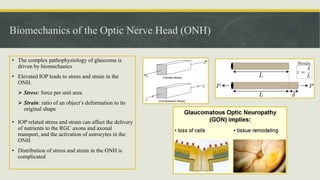
Biomechanics of the Optic Nerve Head (ONH)
• The complex pathophysiology of glaucoma is
driven by biomechanics
• Elevated IOP leads to stress and strain in the
ONH.
 Stress: force per unit area
 Strain: ratio of an object’s deformation to its
original shape
• IOP related stress and strain can affect the delivery
of nutrients to the RGC axons and axonal
transport, and the activation of astrocytes in the
ONH
• Distribution of stress and strain in the ONH is
complicated
My Research Focus: Computer Modeling
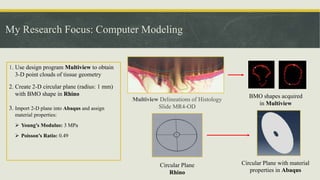
1. Use design program Multiview to obtain
3-D point clouds of tissue geometry
2. Create 2-D circular plane (radius: 1 mm)
with BMO shape in Rhino
3. Import 2-D plane into Abaqus and assign
material properties:
 Young’s Modulus: 3 MPa
 Poisson’s Ratio: 0.49
Multiview Delineations of Histology
Slide MR4-OD
BMO shapes acquired
in Multiview
Circular Plane
Rhino
Circular Plane with material
properties in Abaqus
My Research Focus: Computer Modeling
4. Create polar coordinate system for 2-D Plane
Section in Abaqus
 Biaxial Displacement: 10 µm in radial direction
 Boundary Condition: constrained in z direction
5. Mesh 2-D Plane in Abaqus
 Meshing breaks geometrical figures into elements
6. Simulate stress and strain levels at locations in the
eye using Abaqus
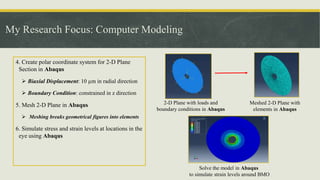
2-D Plane with loads and
boundary conditions in Abaqus
Meshed 2-D Plane with
elements in Abaqus
Solve the model in Abaqus
to simulate strain levels around BMO
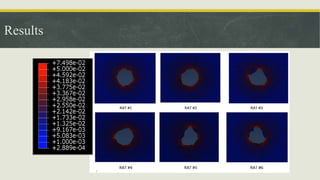
Results
Conclusion
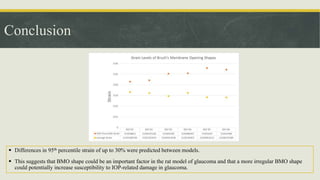
 Differences in 95th percentile strain of up to 30% were predicted between models.
 This suggests that BMO shape could be an important factor in the rat model of glaucoma and that a more irregular BMO shape
could potentially increase susceptibility to IOP-related damage in glaucoma.
Summer Research: Saponin Treatments for Pig TM Cells
• The trabecular meshwork is an area of tissue in the eye located around the cornea, responsible for
removing the aqueous humor from the eye.
• Project Goal: Find the appropriate concentration of saponin to kill approximately 80% of pig trabecula
meshwork cells to develop a glaucoma model.
Acknowledgments
• I wish to acknowledge Dr. C. R. Ethier, Stephen Schwaner, Eric Snider, and members of
the Either Lab for their assistance with this research.
• Thank You!

Nicole Gullatt_Project Engages Presentation (Spring Semester Presentation)

  • 1.
    Modeling the Effectsof Bruch’s Membrane Opening Shape on the Biomechanics of the Rat Model of Glaucoma Nicole Gullatt Dr. C. R. Ethier’s Lab Mentor: Stephen Schwaner May 16, 2016
  • 2.
    Glaucoma Overview: Whatis it? • Glaucoma is a group of eye diseases involving optic nerve damage and usually involving an increase of intra-ocular pressure (IOP) • Elevated IOP causes increased stressed and strain in the optic nerve head (ONH) tissues resulting in retinal ganglion cell death and preventing the transmission of visual information to the brain • Treatment for glaucoma is centered around preventing further loss because eye damage and vision loss that has already occurred is irreversible • Medications and surgical treatments for glaucoma focus on lowering a patient’s IOP, but are not always effective Why the rat model is studied for glaucoma research:  It is unethical to conduct scientific experiments on humans.  Rodent models are necessary for high throughput studies due to their low cost and ease of caring for  Rats present similar optic nerve head damage patterns to humans after experiencing elevated IOP
  • 3.
    Biomechanics of theOptic Nerve Head (ONH) • The complex pathophysiology of glaucoma is driven by biomechanics • Elevated IOP leads to stress and strain in the ONH.  Stress: force per unit area  Strain: ratio of an object’s deformation to its original shape • IOP related stress and strain can affect the delivery of nutrients to the RGC axons and axonal transport, and the activation of astrocytes in the ONH • Distribution of stress and strain in the ONH is complicated
  • 4.
    My Research Focus:Computer Modeling 1. Use design program Multiview to obtain 3-D point clouds of tissue geometry 2. Create 2-D circular plane (radius: 1 mm) with BMO shape in Rhino 3. Import 2-D plane into Abaqus and assign material properties:  Young’s Modulus: 3 MPa  Poisson’s Ratio: 0.49 Multiview Delineations of Histology Slide MR4-OD BMO shapes acquired in Multiview Circular Plane Rhino Circular Plane with material properties in Abaqus
  • 5.
    My Research Focus:Computer Modeling 4. Create polar coordinate system for 2-D Plane Section in Abaqus  Biaxial Displacement: 10 µm in radial direction  Boundary Condition: constrained in z direction 5. Mesh 2-D Plane in Abaqus  Meshing breaks geometrical figures into elements 6. Simulate stress and strain levels at locations in the eye using Abaqus 2-D Plane with loads and boundary conditions in Abaqus Meshed 2-D Plane with elements in Abaqus Solve the model in Abaqus to simulate strain levels around BMO
  • 6.
  • 7.
    Conclusion  Differences in95th percentile strain of up to 30% were predicted between models.  This suggests that BMO shape could be an important factor in the rat model of glaucoma and that a more irregular BMO shape could potentially increase susceptibility to IOP-related damage in glaucoma.
  • 8.
    Summer Research: SaponinTreatments for Pig TM Cells • The trabecular meshwork is an area of tissue in the eye located around the cornea, responsible for removing the aqueous humor from the eye. • Project Goal: Find the appropriate concentration of saponin to kill approximately 80% of pig trabecula meshwork cells to develop a glaucoma model.
  • 9.
    Acknowledgments • I wishto acknowledge Dr. C. R. Ethier, Stephen Schwaner, Eric Snider, and members of the Either Lab for their assistance with this research. • Thank You!

Editor's Notes

  • #3  Glaucoma is complex and often times misunderstood optic neuropathy of unknown etiology. Etiology: set of causes, or manner of causation of a disease or condition. Women are three times more likely than men to develop acute angle closure glaucoma due to their shallower anterior chambers.
  • #4 Stress: the amount of force applied to an object per surface area Strain: ratio of deformity to the original shape of an object
  • #11 Pathophysiology: disordered physiological processes associated with disease or injury Connective Tissues: scleral tissues and lamina cribrosa Neural Tissues: retinal ganglion cells Other Cells: astrocytes, glial cells, and endothelial cells Ischemia: an inadequate blood supply to an organ or part of the body Astrocyte Biology = Astrocyte Structure & Function