

HIT Policy Committee
NHIN Workgroup Recommendations


David Lansky, Chair
Pacific Business Group on Health

Danny Weitzner, Co-Chair
Department of Commerce, NTIA


January 13, 2010
INTRODUCTORY REMARKS
Workgroup Members
Chair
ƒ  David Lansky, Pacific Business Group on Health

Co-Chair
ƒ  Danny Weitzner, Department of Commerce, NTIA

Members
•   Christine Bechtel, National Partnership for Women & Families
•   A. John Blair, III, Taconic IPA
•   Neil Calman, Institute for Family Health
•   James Borland, Social Security Administration
•   Carol Diamond, Markle Foundation
•   Colin Evans, Dossia
•   Tim Cromwell, Department of Veterans Affairs
•   Jonah Frohlich, Deputy Secretary, Health IT, California
•   Leslie Harris, Center for Democracy and Technology
•   Arien Malec, Relay Health
•   Marc Overhage, Regenstrief Institute
•   Marc Probst, Intermountain Healthcare
•   Wes Rishel, Gartner
•   Micky Tripathi, Massachusetts eHealth Collaborative

ONC/HHS
ƒ  Farzad Mostashari
ƒ  Todd Park
ƒ  Doug Fridsma
Nationwide Health Information Network

• Workgroup’s Definition of the NHIN
     A set of policies, standards and services that enable the Internet
     to be used for secure and meaningful exchange of health
     information to improve health and health care.


• NHIN Work Group Charge
     To create a set of recommendations for a policy and technical
     framework for the NHIN in a way that is both open to all and
     fosters innovation.
Workgroup Context
• Meaningful use criteria in the proposed CMS rule
  require exchange of health information among
  providers and with patients to improve quality, safety,
  and efficiency of care, patient engagement,
  coordination of care, and population health.
• Stage 1 criteria involve direct communication of patient
  data among providers and with patients (e.g., doctor to
  consultant, or lab to doctor, or doctor to pharmacy),
  where:
   – the exchange is for treatment or payment purposes;
   – the sender and receiver are known; but
   – the sender may or may not have a prior relationship with the
     recipient.
• The NHIN should support achievement of Meaningful
  Use in 2011 and beyond.
Meet the needs of today and tomorrow
Goal:
This is part of an evolutionary path
There will be incremental growth
All journeys start with a few steps


                                                                     Stage 3
                                                                     - Access comprehensive patient
                                                                     data
                                             Stage 2                  - Automated real-time
                                                                     surveillance
                                              - Patient PHR access
                                             - ePrescribing refills
                                             - Electronic summary record
              Stage I                        - Receive health alerts
               - ePrescribing                - Immunization information
               - Lab results into EHRs
               - Send clinical summary
                  to providers and patient
              - Public health reporting
              - Quality reporting (2012)
EXCHANGING PATIENT DATA


   Authentication /
                          Delivery Protocols     Trust Relationships
   certificates
Vocabulary/ Document/
                        Directories            Security
Message Standards
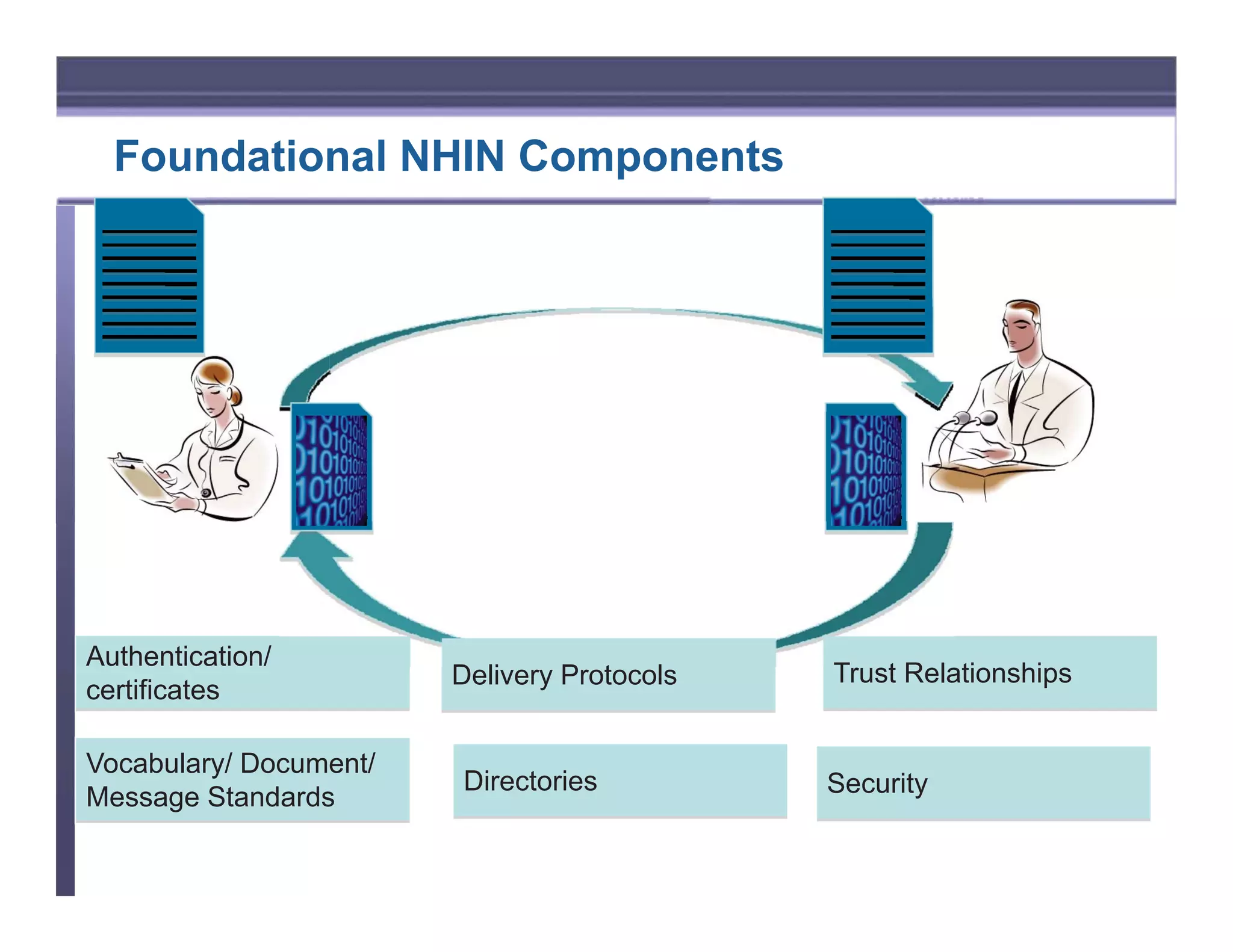
Foundational NHIN Components


Authentication/
                        Delivery Protocols   Trust Relationships
certificates

Vocabulary/ Document/
                        Directories          Security
Message Standards
Working Assumptions

• A goal is to support widest possible participation by
  providers at the individual and organizational level.
• Incremental approach is reasonable; change will be
  evolutionary.
• The approach for 2011 is intended to be foundational
  and help progress toward longer-term aims in 2013,
  2015 and beyond.
• Leverage the Internet and appropriate security
  protocols as the transport mechanism.
Government Role

• What can the government do today to enable the
  broadest participation across a wide spectrum of
  providers, large and small, by 2011.
• Desired attributes of government role:
   – Recognizes (and learns from) existing patterns of exchange
   – Minimized to accomplish the agreed upon purposes.
   – Creates incentives to stimulate information exchange without
     impeding existing exchange models.
   – Fosters innovation to achieve new means for information
     exchange.
   – Facilitates long-term expansion of information exchange under
     a variety of scenarios.
Key Findings

• Key elements that need to be in place to facilitate and
  encourage the broadest range of providers (individuals
  and organizations) to be able to achieve meaningful
  use in 2011:
   – Secure Internet transport.
   – Directories to allow parties to locate those to whom information
     is transferred.
   – Means to authenticate/validate identity of parties involved in
     information exchange.
   – Trust fabric that provides parties with sufficient confidence that
     the exchange can be accomplished successfully.
Findings: Directories

• Extensive provider directories exist, but were created
  for different business purposes which, in their present
  form, may not be sufficient:
   –   Varying types of data maintained.
   –   Different data definitions.
   –   Certain data may not be currently collected (e.g. place of care).
   –   The quality and accuracy of the data.
• The quality of the data depends upon the value to the
  subject of the data, as well as the use and incentives
  for accuracy.
• The private sector and those government programs
  that rely on directories will still need to maintain and
  operationally support directories.
Findings: Identity Proofing and Authentication

• Risk analysis must determine level of assurance
  required, this may vary depending upon context.
• Assurance requires both identity proofing (carbon-
  based life form) and authentication (same entity); both
  are best done as close to the provider as possible.
• Implementation may be supported through various
  technical means and by a multitude of entities.
• The Federal Government has defined standards and
  services for identity proofing and authentication, as well
  as mechanisms to procure reliable intermediaries to
  manage identities.
Findings: Trust Fabric
• Information exchange depends on common trust
  elements, including:
   – Rules for interaction.
   – Pre-existing personal and business relationships.
   – Understanding and clear expectation of how data will be used.
   – Assurance that the exchange takes place as expected
     (including the identity of those exchanging data).
   – Oversight and accountability for compliance.
• Implementation of the trust elements will differ based
  on the nature of the parties to the exchange and the
  information being exchanged.
• The absence of a mature policy and technical trust
  framework is an impediment to information exchange.
NHIN Workgroup

RECOMMENDATIONS
Recommendations Topics

1.   Meaningful Use
2.   Transport vs. Content
3.   Directories
4.   Authentication


     What is the Workgroup’s definition of the NHIN?

        A set of policies, standards and services that
        enable the Internet to be used for secure and
        meaningful exchange of health information to
        improve health and health care.
Recommendation #1 – Meaningful Use

• The policies, standards, and services of the NHIN
  should enable the broadest range of providers to
  exchange information to achieve meaningful use and
  enable consumers to be able to access their health
  information (as well as states and other organizations
  that support those providers).
• The Federal government should focus on the minimum
  standards, policies and services needed for
  foundational exchange components to further
  meaningful use in the near-term.
Recommendation #2 – Transport vs. Content

• The initial focus should be on private and secure
  transport over the Internet, with increased focus on
  data content over time.
• The NHIN policies, standards and services should be
  structured so that simple intermediaries can provide
  required services for private and secure routing of
  health information.
Recommendation #3 – Directories

• The federal government already maintains provider
  directories to meet existing federal obligations and
  should work with stakeholders to improve upon and
  leverage these directories for the NHIN.
• The federal government has a unique role in assuring
  that authoritative provider directories are available to
  accelerate the exchange of information to successfully
  support and increase efficiency of meaningful use.
• The federal government should define a core set of
  policies for the inter-operation of trusted directories.
Recommendation #4 - Authentication

• Build upon existing federal standards, policies and
  practices for authentication and identity proofing.
• Determine the level of confidence appropriate for
  different exchange scenarios.
• Permit innovation and local autonomy in the method of
  authentication.
• If intermediaries are involved in the exchange, make
  sure that certification (independent verification) of those
  intermediaries is done for authentication and identity
  proofing.
• Include oversight mechanisms and redress.
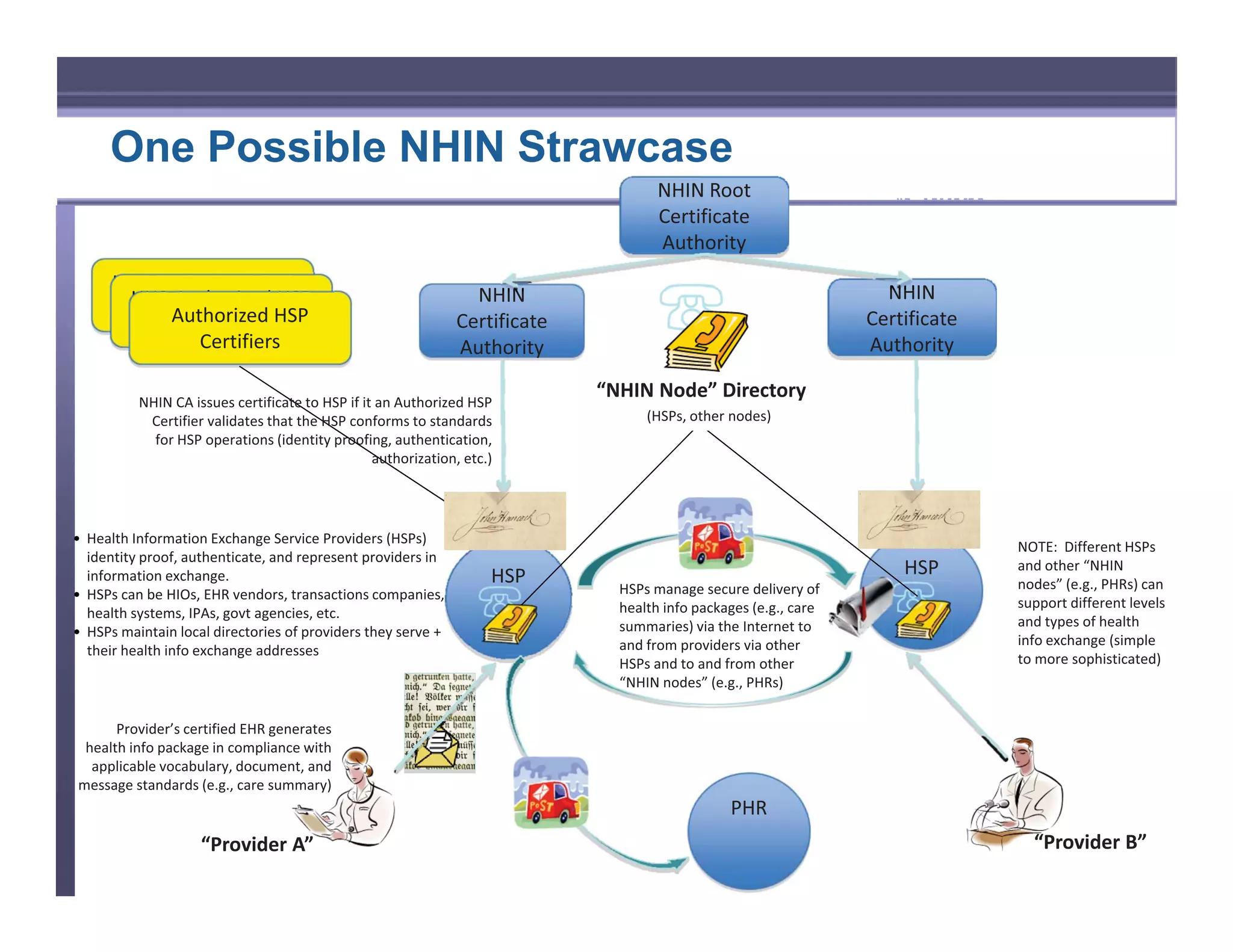
One Possible NHIN Strawcase
                                                                                     NHIN Root
                                                                                     Certificate
                                                                                     Authority y
      HHS Authorized HSP
      HHS Authorized HSP
       HS t i d                                                                                                     NH
                                                                                                                    NHIN
       HHS Artifie i d HSP
       HHS ertifierszed HSP
            Authorized
              uthori
               t                                                 NHIN
                                                                   HIN
                                                                     I
           Certifiers HSP
           CAuthorized                                                                                            Certificate
             Certifiers                                        Certificate
               Certifiers                                      Authority                                          Authority

          NHIN CA issues certificate to HSP if it an Authorized HSP
                                                                             “NHIN Node” Directory
           Certifier validates that the HSP conforms to standards                  (HSPs, other nodes)
            for HSP operations (identity proofing, authentication,
                                                 authorization, etc.)


• Health Information Exchange Service Providers (HSPs)
                                                                                                                                NOTE: Different HSPs
  identity proof, authenticate, and represent providers in
  information exchange.                                             HSP                                               HSP       and other “NHIN
                                                                               HSPs manage secure delivery of                   nodes” (e.g., PHRs) can
• HSPs can be HIOs, EHR vendors, transactions companies,
                                                                               health info packages (e.g., care                 support different levels
  health systems, IPAs, govt agencies, etc.
                                                                               summaries) via the Internet to                   and types of health
• HSPs maintain local directories of providers they serve +
                                                                               and from providers via other                     info exchange (simple
  their health info exchange addresses
                                                                               HSPs and to and from other                       to more sophisticated)
                                                                               “NHIN nodes” (e.g., PHRs)

      Provider’s certified EHR generates
 health info package in compliance with
  applicable vocabulary, document, and
message standards (e.g., care summary)
                                                                                                PHR
                    “Provider A”                                                                                                  “Provider B”
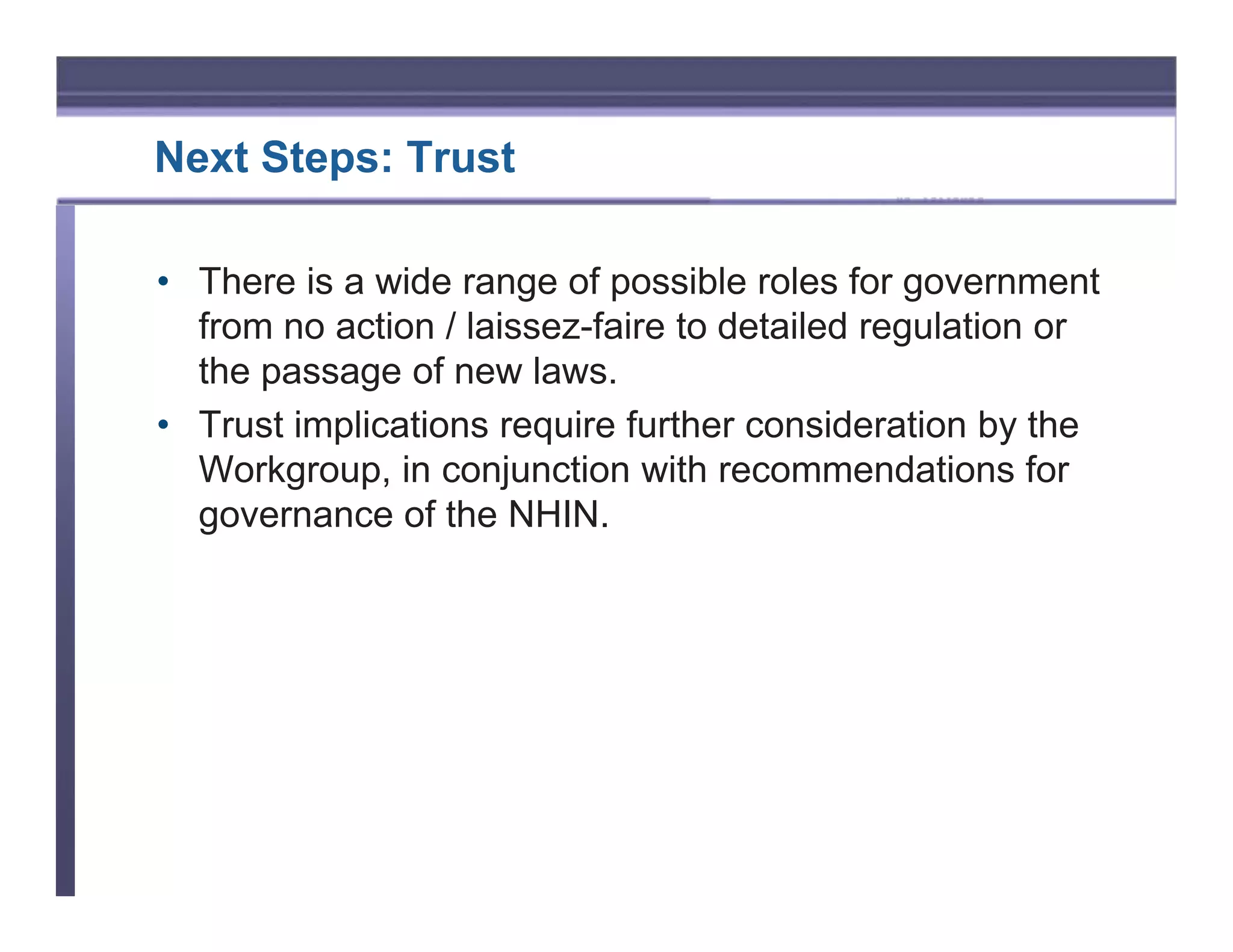
Next Steps: Trust

• There is a wide range of possible roles for government
  from no action / laissez-faire to detailed regulation or
  the passage of new laws.
• Trust implications require further consideration by the
  Workgroup, in conjunction with recommendations for
  governance of the NHIN.
WEB LINKS


                            Web Links
                         NRPM Document:
http://mycourses.med.harvard.edu/ec_res/nt/3E57FAE4-
        A6AB-4CA8-AF6B-FAB1537595A4/nprm.pdf


             Dr. John Halamka’s Blog – Life as a
             Healthcare CIO: Bookmarked Version
                     of the NPRM and IFR:
            http://geekdoctor.blogspot.com/2010/01/bookmarked-
                               version-of-nprm.html

NHIN Workgroup Recommendation

  • 1.
    HIT Policy Committee NHINWorkgroup Recommendations David Lansky, Chair Pacific Business Group on Health Danny Weitzner, Co-Chair Department of Commerce, NTIA January 13, 2010
  • 2.
  • 3.
    Workgroup Members Chair ƒ David Lansky, Pacific Business Group on Health Co-Chair ƒ Danny Weitzner, Department of Commerce, NTIA Members • Christine Bechtel, National Partnership for Women & Families • A. John Blair, III, Taconic IPA • Neil Calman, Institute for Family Health • James Borland, Social Security Administration • Carol Diamond, Markle Foundation • Colin Evans, Dossia • Tim Cromwell, Department of Veterans Affairs • Jonah Frohlich, Deputy Secretary, Health IT, California • Leslie Harris, Center for Democracy and Technology • Arien Malec, Relay Health • Marc Overhage, Regenstrief Institute • Marc Probst, Intermountain Healthcare • Wes Rishel, Gartner • Micky Tripathi, Massachusetts eHealth Collaborative ONC/HHS ƒ Farzad Mostashari ƒ Todd Park ƒ Doug Fridsma
  • 4.
    Nationwide Health InformationNetwork • Workgroup’s Definition of the NHIN A set of policies, standards and services that enable the Internet to be used for secure and meaningful exchange of health information to improve health and health care. • NHIN Work Group Charge To create a set of recommendations for a policy and technical framework for the NHIN in a way that is both open to all and fosters innovation.
  • 5.
    Workgroup Context • Meaningfuluse criteria in the proposed CMS rule require exchange of health information among providers and with patients to improve quality, safety, and efficiency of care, patient engagement, coordination of care, and population health. • Stage 1 criteria involve direct communication of patient data among providers and with patients (e.g., doctor to consultant, or lab to doctor, or doctor to pharmacy), where: – the exchange is for treatment or payment purposes; – the sender and receiver are known; but – the sender may or may not have a prior relationship with the recipient. • The NHIN should support achievement of Meaningful Use in 2011 and beyond.
  • 6.
    Meet the needsof today and tomorrow Goal: This is part of an evolutionary path There will be incremental growth All journeys start with a few steps Stage 3 - Access comprehensive patient data Stage 2 - Automated real-time surveillance - Patient PHR access - ePrescribing refills - Electronic summary record Stage I - Receive health alerts - ePrescribing - Immunization information - Lab results into EHRs - Send clinical summary to providers and patient - Public health reporting - Quality reporting (2012)
  • 7.
    EXCHANGING PATIENT DATA Authentication / Delivery Protocols Trust Relationships certificates Vocabulary/ Document/ Directories Security Message Standards
  • 8.
    Foundational NHIN Components Authentication/ Delivery Protocols Trust Relationships certificates Vocabulary/ Document/ Directories Security Message Standards
  • 9.
    Working Assumptions • Agoal is to support widest possible participation by providers at the individual and organizational level. • Incremental approach is reasonable; change will be evolutionary. • The approach for 2011 is intended to be foundational and help progress toward longer-term aims in 2013, 2015 and beyond. • Leverage the Internet and appropriate security protocols as the transport mechanism.
  • 10.
    Government Role • Whatcan the government do today to enable the broadest participation across a wide spectrum of providers, large and small, by 2011. • Desired attributes of government role: – Recognizes (and learns from) existing patterns of exchange – Minimized to accomplish the agreed upon purposes. – Creates incentives to stimulate information exchange without impeding existing exchange models. – Fosters innovation to achieve new means for information exchange. – Facilitates long-term expansion of information exchange under a variety of scenarios.
  • 11.
    Key Findings • Keyelements that need to be in place to facilitate and encourage the broadest range of providers (individuals and organizations) to be able to achieve meaningful use in 2011: – Secure Internet transport. – Directories to allow parties to locate those to whom information is transferred. – Means to authenticate/validate identity of parties involved in information exchange. – Trust fabric that provides parties with sufficient confidence that the exchange can be accomplished successfully.
  • 12.
    Findings: Directories • Extensiveprovider directories exist, but were created for different business purposes which, in their present form, may not be sufficient: – Varying types of data maintained. – Different data definitions. – Certain data may not be currently collected (e.g. place of care). – The quality and accuracy of the data. • The quality of the data depends upon the value to the subject of the data, as well as the use and incentives for accuracy. • The private sector and those government programs that rely on directories will still need to maintain and operationally support directories.
  • 13.
    Findings: Identity Proofingand Authentication • Risk analysis must determine level of assurance required, this may vary depending upon context. • Assurance requires both identity proofing (carbon- based life form) and authentication (same entity); both are best done as close to the provider as possible. • Implementation may be supported through various technical means and by a multitude of entities. • The Federal Government has defined standards and services for identity proofing and authentication, as well as mechanisms to procure reliable intermediaries to manage identities.
  • 14.
    Findings: Trust Fabric •Information exchange depends on common trust elements, including: – Rules for interaction. – Pre-existing personal and business relationships. – Understanding and clear expectation of how data will be used. – Assurance that the exchange takes place as expected (including the identity of those exchanging data). – Oversight and accountability for compliance. • Implementation of the trust elements will differ based on the nature of the parties to the exchange and the information being exchanged. • The absence of a mature policy and technical trust framework is an impediment to information exchange.
  • 15.
  • 16.
    Recommendations Topics 1. Meaningful Use 2. Transport vs. Content 3. Directories 4. Authentication What is the Workgroup’s definition of the NHIN? A set of policies, standards and services that enable the Internet to be used for secure and meaningful exchange of health information to improve health and health care.
  • 17.
    Recommendation #1 –Meaningful Use • The policies, standards, and services of the NHIN should enable the broadest range of providers to exchange information to achieve meaningful use and enable consumers to be able to access their health information (as well as states and other organizations that support those providers). • The Federal government should focus on the minimum standards, policies and services needed for foundational exchange components to further meaningful use in the near-term.
  • 18.
    Recommendation #2 –Transport vs. Content • The initial focus should be on private and secure transport over the Internet, with increased focus on data content over time. • The NHIN policies, standards and services should be structured so that simple intermediaries can provide required services for private and secure routing of health information.
  • 19.
    Recommendation #3 –Directories • The federal government already maintains provider directories to meet existing federal obligations and should work with stakeholders to improve upon and leverage these directories for the NHIN. • The federal government has a unique role in assuring that authoritative provider directories are available to accelerate the exchange of information to successfully support and increase efficiency of meaningful use. • The federal government should define a core set of policies for the inter-operation of trusted directories.
  • 20.
    Recommendation #4 -Authentication • Build upon existing federal standards, policies and practices for authentication and identity proofing. • Determine the level of confidence appropriate for different exchange scenarios. • Permit innovation and local autonomy in the method of authentication. • If intermediaries are involved in the exchange, make sure that certification (independent verification) of those intermediaries is done for authentication and identity proofing. • Include oversight mechanisms and redress.
  • 21.
    One Possible NHINStrawcase NHIN Root Certificate Authority y HHS Authorized HSP HHS Authorized HSP HS t i d NH NHIN HHS Artifie i d HSP HHS ertifierszed HSP Authorized uthori t NHIN HIN I Certifiers HSP CAuthorized Certificate Certifiers Certificate Certifiers Authority Authority NHIN CA issues certificate to HSP if it an Authorized HSP “NHIN Node” Directory Certifier validates that the HSP conforms to standards (HSPs, other nodes) for HSP operations (identity proofing, authentication, authorization, etc.) • Health Information Exchange Service Providers (HSPs) NOTE: Different HSPs identity proof, authenticate, and represent providers in information exchange. HSP HSP and other “NHIN HSPs manage secure delivery of nodes” (e.g., PHRs) can • HSPs can be HIOs, EHR vendors, transactions companies, health info packages (e.g., care support different levels health systems, IPAs, govt agencies, etc. summaries) via the Internet to and types of health • HSPs maintain local directories of providers they serve + and from providers via other info exchange (simple their health info exchange addresses HSPs and to and from other to more sophisticated) “NHIN nodes” (e.g., PHRs) Provider’s certified EHR generates health info package in compliance with applicable vocabulary, document, and message standards (e.g., care summary) PHR “Provider A” “Provider B”
  • 22.
    Next Steps: Trust •There is a wide range of possible roles for government from no action / laissez-faire to detailed regulation or the passage of new laws. • Trust implications require further consideration by the Workgroup, in conjunction with recommendations for governance of the NHIN.
  • 23.
    WEB LINKS Web Links NRPM Document: http://mycourses.med.harvard.edu/ec_res/nt/3E57FAE4- A6AB-4CA8-AF6B-FAB1537595A4/nprm.pdf Dr. John Halamka’s Blog – Life as a Healthcare CIO: Bookmarked Version of the NPRM and IFR: http://geekdoctor.blogspot.com/2010/01/bookmarked- version-of-nprm.html