Accepted by ApJ
                                               Preprint typeset using L TEX style emulateapj v. 5/2/11
                                                                      A


                                                    THE GALACTIC SUPERNOVA REMNANT W49B LIKELY ORIGINATES FROM A JET-DRIVEN,
                                                                            CORE-COLLAPSE EXPLOSION
                                                                  Laura A. Lopez1,2,3 , Enrico Ramirez-Ruiz4 , Daniel Castro1 , Sarah Pearson5
                                                                                                         Accepted by ApJ

                                                                                                  ABSTRACT
                                                        We present results from a 220-ks observation of the galactic supernova remnant (SNR) W49B
                                                      using the Advanced CCD Imaging Spectrometer (ACIS) on board the Chanrda X-ray Observatory.
                                                      We exploit these data to perform detailed spatially-resolved spectroscopic analyses across the SNR
                                                      with the aim to investigate the thermodynamic properties and explosive origin of W49B. We find
arXiv:1301.0618v1 [astro-ph.HE] 3 Jan 2013


                                                      substantial variation in the electron temperature and absorbing column toward W49B, and we show
                                                      that the mean metal abundances are consistent with the predicted yields in models of bipolar/jet-
                                                      driven core-collapse SNe. Furthermore, we set strict upper limits on the X-ray luminosity of any
                                                      undetected point sources, and we exclude the presence of a neutron star associated with W49B. We
                                                      conclude that the morphological, spectral, and environmental characteristics of W49B are indicative
                                                      of a bipolar Type Ib/Ic SN origin, making it the first of its kind to be discovered in the Milky Way.
                                                      Subject headings: ISM: Supernova Remnants — X-rays: ISM — Supernovae: Individual (W49 B) —
                                                                         X-rays: ISM

                                                                   1. INTRODUCTION                                   The physical origin of W49B’s unusual traits remains
                                                W49B (G43.3−0.2) is one of the most luminous Galac-                uncertain. Two potential scenarios may account for the
                                                                                                                   barrel shape of W49B (Keohane et al. 2007; Miceli et al.
                                             tic supernova remnant (SNR) in X-rays (with LX ∼ 1038
                                                                                                                   2008; Zhou et al. 2011): it could be due to a bipolar/jet-
                                             erg s−1 ; Immler & Kuntz 2005) and γ-rays, as observed                driven explosion of a massive star, or it may be the
                                             by Fermi Large Area Telescope (Abdo et al. 2010). While               result of an inhomogeneous ISM around a spherically-
                                             radio maps show the SNR has a prominent shell ∼ 4 in                  symmetric SN. The latter explanation is appealing be-
                                             diameter, the X-ray emission is elongated in a centrally              cause it applies to other sources (e.g., G292.0+1.8: Park
                                             bright, iron rich bar which has two plumes at its east-               et al. 2004). However, that scenario would require un-
                                             ern and western edges (see Figure 1; Hwang et al. 2000;               realistic ejecta masses in W49B (Keohane et al. 2007).
                                             Miceli et al. 2006; Lopez et al. 2009b). The X-ray spec-              A bipolar/jet-driven Type Ib/Ic SN origin is consis-
                                             trum of W49B has strong emission lines from He-like and               tent with the median abundance ratios from a spatially-
                                             H-like ions of several metals with super solar abundances,            resolved spectroscopic analysis using XMM-Newton ob-
                                             indicative of their ejecta-dominated origin.                          servations (Lopez et al. 2009b), and it may account for
                                                Previous studies of W49B have demonstrated the                     the anisotropic distribution of iron since heavy elements
                                             source has several unique morphological and spectral fea-             are preferentially ejected along the polar axis of the pro-
                                             tures which are not found in other Galactic SNRs. Fore-               genitor in these explosions (Khokhlov et al. 1999; Maz-
                                             most, W49B is the only Galactic SNR with large-scale                  zali et al. 2001; Ramirez-Ruiz & MacFadyen 2010; Couch
                                             segregation of its nucleosynthetic products (Lopez et al.             et al. 2011). Based on radio observations, the rate of
                                             2009b, 2011): the iron synthesized in the explosion is
                                             missing from the Eastern half of the SNR, while the                   such events is estimated to be 0.7+1.6 % of local Type
                                                                                                                                                        −0.6
                                             intermediate-mass elements (like silicon and sulfur) are              Ib/Ic SNe (Soderberg et al. 2010), equating to ∼1 per
                                             more spatially homogeneous. Secondly, the X-ray spec-                 103 − 104 years per galaxy (Lopez et al. 2011), with a
                                             trum is suggestive of rapid cooling uncommon in young                 subset of these explosions being hypernovae or gamma-
                                             SNRs, such as a strong radiative recombination contin-                ray bursts (Izzard et al. 2004; Podsiadlowski et al. 2004).
                                             uum from iron (Ozawa et al. 2009). Finally, W49B is one                 In this paper, we investigate the explosive origin and
                                             of only two SNRs to date with detected X-ray emission                 thermodynamic properties of W49B based on a re-
                                             lines from the heavy elements chromium and manganese                  cent 220-ks Chandra X-ray Observatory Advanced CCD
                                             (Hwang et al. 2000; Miceli et al. 2006), nucleosynthetic              Imaging Spectrometer (ACIS) observation. In Section 2,
                                             products of explosive silicon burning.                                we detail the observations and spatially-resolved spec-
                                                                                                                   troscopic analyses of the data. In Section 3, we discuss
                                               lopez@space.mit.edu                                                 the multiwavelength evidence of the explosive origin of
                                                 1 MIT-Kavli Institute for Astrophysics and Space Research,        W49B and its implications.
                                               77 Massachusetts Avenue, 37-664H, Cambridge MA 02139, USA
                                                 2 NASA Einstein Fellow
                                                 3 Pappalardo Fellow in Physics                                      2. OBSERVATIONS AND SPECTROSCOPIC ANALYSES
                                                 4 Department of Astronomy and Astrophysics, University of
                                                                                                                     W49B was observed for 220 ks with Chandra ACIS
                                               California Santa Cruz, 1156 High Street, Santa Cruz, CA 95060,
                                               USA
                                                                                                                   on 18–22 August 2011 with the backside-illuminated S3
                                                 5 DARK Cosmology Centre, Niels Bohr Institute, University         chip in the Timed-Exposure Faint Mode (ObsIDs 13440
                                               of Copenhagen, Juliane Maries vej 30, DK-2100 Copenhagen,           and 13441). Reprocessed data were downloaded from
                                               Denmark                                                             the Chandra archive, and analyses were performed us-
2                                                                                                          LOPEZ ET AL.

                                                                                                                   energy ranges corresponding to those features: Si xiii
                                                                                                                   and Si xiv (1.74–2.05 keV), S xv and S xvi (2.25–2.70
                                                                                                                   keV), Ar xvii and Ar xviii (3.0–3.40 keV), Ca xix and
                                                                                                                   Caxx (3.72–4.13 keV), and Fe xxv (6.4–6.9 keV). We
                                                                                                                   continuum-subtracted these images by creating a contin-
                                                                                                                   uum image (4.2–5.5 keV), scaling the image to reflect
                                                                                                                   the continuum under the respective lines, smoothing all
                                                                                                                   the images, and then subtracting the scaled continuum
                                                                                                                   images from the line images. The resulting continuum-
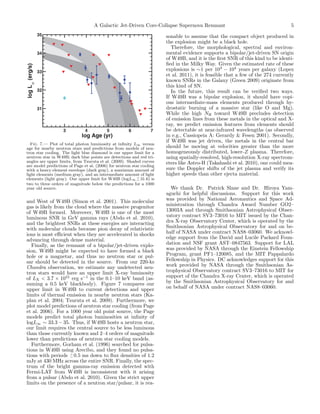
                                                                                                                   subtracted images are shown in Figure 3. Fe xxv is
                                                                                                                   largely absent in the West of W49B, while the other ions
                                                                                                                   are more homogeneously distributed.
                                                                                                                      Chandra had previously observed W49B with ACIS-S3
                                                                                                                   for 55 ks in 2000. In the 11-year interval between Chan-
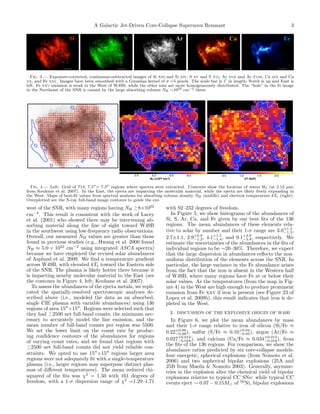
                                                                                                                   dra observations, the spectra have changed dramatically.
                                                                                                                   In particular, the (unabsorbed) Si xiii flux decreased
                                                                                                                   by ∼18%, and the other emission lines have < 5% lower
                                                                                                                                                                  ∼

                                                                                                                   fluxes in 2011 compared to their 2000 values (see Fig-
                                                                                                                   ure 2). Based on spatially-resolved spectral analysis, this
                                                                                                                   line flux decrement is the greatest in the West of W49B,
                                                                                                                   whereas the East has the smallest variation. Possible
                                                                                                                   astrophysical explanations for this spectral evolution in-
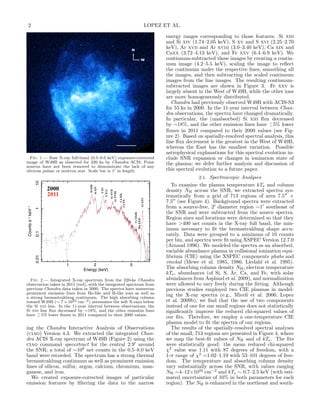
  Fig. 1.— Raw X-ray full-band (0.5–8.0 keV) exposure-corrected                                                    clude SNR expansion or changes in ionization state of
image of W49B as observed for 220 ks by Chandra ACIS. Point                                                        the plasma; we defer further analysis and discussion of
sources have not been removed to demonstrate the lack of any
obvious pulsar or neutron star. Scale bar is 1 in length.                                                          this spectral evolution to a future paper.
                                                                                                                                  2.1. Spectroscopic Analyses
                 10


                                                                                                                      To examine the plasma temperature kTe and column
                                       Si XIII


                        2000
                                      Si XIV

                                                    S XV


                                                                                                                   density NH across the SNR, we extracted spectra sys-
                                                             Ar XVII
                                                 S XVI


                        2011
                                                           Ar XVIII

                                                                           Ca XIX


                                                                                                                   tematically from a grid of 713 regions of area 7.5 ×
                                                                                                   Fe XXV


                                                                                                                   7.5 (see Figure 4). Background spectra were extracted
                                                                       Ca XX


                                                                                                                   from a source-free, 2 diameter region ∼1 southeast of
1


                 1
Counts s 1 keV


                                                                                                                   the SNR and were subtracted from the source spectra.
                                                                                            Cr XXIII


                                                                                                                   Region sizes and locations were determined so that they
                                                                                        Mn XXIV


                                                                                                                   have >400 net counts in the X-ray full band, the min-
                                                                                                                   imum necessary to fit the bremsstrahlung shape accu-
                 0.1


                                                                                                                   rately. Data were grouped to a minimum of 10 counts
                                                                                                                   per bin, and spectra were fit using XSPEC Version 12.7.0
                                                                                                                   (Arnaud 1996). We modeled the spectra as an absorbed,
                                                                                                                   variable abundance plasma in collisional ionization equi-
                                                                                                                   librium (CIE) using the XSPEC components phabs and
                 0.01


                                                                                                                   vmekal (Mewe et al. 1985, 1986; Liedahl et al. 1995).
                               1        2                                           5
                                   Energy (keV)                                                                    The absorbing column density NH , electron temperature
                                                                                                                   kTe , abundances (of Si, S, Ar, Ca, and Fe, with solar
  Fig. 2.— Integrated X-ray spectrum from the 220-ks Chandra                                                       abundances from Asplund et al. 2009), and normalization
observation taken in 2011 (red), with the integrated spectrum from                                                 were allowed to vary freely during the fitting. Although
previous Chandra data taken in 2000. The spectra have numerous                                                     previous studies employed two CIE plasmas in model-
prominent emission lines from He-like and H-like ions as well as                                                   ing the X-ray spectra (e.g., Miceli et al. 2006; Lopez
a strong bremsstrahlung continuum. The high absorbing column
toward W49B (∼ 7 × 1022 cm−2 ) attenuates the soft X-rays below                                                    et al. 2009b), we find that the use of two components
the Si xiii line. In the 11-year interval between observations, the                                                instead of one for our small regions does not statistically
Si xiii line flux decreased by ∼18%, and the other emission lines                                                   significantly improve the reduced chi-squared values of
have < 5% lower fluxes in 2011 compared to their 2000 values.
      ∼
                                                                                                                   our fits. Therefore, we employ a one-temperature CIE
                                                                                                                   plasma model to fit the spectra of our regions.
ing the Chandra Interactive Analysis of Observations                                                                  The results of the spatially-resolved spectral analyses
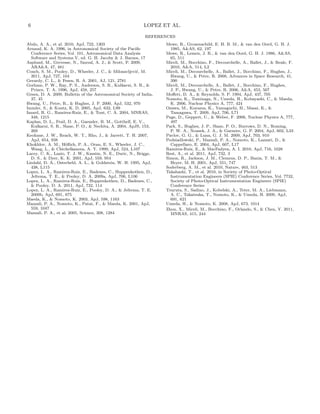
(ciao) Version 4.3. We extracted the integrated Chan-                                                              of the small, 713 regions are presented in Figure 4, where
dra ACIS X-ray spectrum of W49B (Figure 2) using the                                                               we map the best-fit values of NH and of kTe . The fits
ciao command specextract for the central 2.9 around                                                                were statistically good: the mean reduced chi-squared
the SNR; a total of ∼106 net counts in the 0.5–8.0 keV                                                             χ2 value was 1.11 with 87 degrees of freedom, with a
band were recorded. The spectrum has a strong thermal                                                              1-σ range of χ2 =1.02–1.19 with 53–101 degrees of free-
bremsstrahlung continuum as well as prominent emission                                                             dom. The temperature and absorbing column density
lines of silicon, sulfur, argon, calcium, chromium, man-                                                           vary substantially across the SNR, with values ranging
ganese, and iron.                                                                                                  NH ∼4–12×1022 cm−2 and kTe ∼ 0.7–2.5 keV (with esti-
   We created exposure-corrected images of particular                                                              mated uncertainties of 10% in both parameters for each
emission features by filtering the data to the narrow                                                               region). The NH is enhanced in the northeast and south-
A Galactic Jet-Driven Core-Collapse Supernova Remnant                                                          3

                     Si                          S                                 Ar                     Ca                                Fe


  Fig. 3.— Exposure-corrected, continuum-subtracted images of Si xiii and Si xiv, S xv and S xvi, Ar xvii and Ar xviii, Ca xix and Ca
xx, and Fe xxv. Images have been smoothed with a Gaussian kernel of σ =5 pixels. The scale bar is 1 in length; North is up and East is
left. Fe xxv emission is weak in the West of W49B, while the other ions are more homogeneously distributed. The “hole” in the Si image
in the Northeast of the SNR is caused by the large absorbing column NH ∼1023 cm−2 there.


                                                      2.0      4.0           6.0        8.0         0.5        1.0              1.5   2.0
                                                              NH (x1022 cm-2)                                        kT (keV)

  Fig. 4.— Left: Grid of 713, 7.5 × 7.5 regions where spectra were extracted. Contours show the location of warm H2 (at 2.12 µm;
from Keohane et al. 2007). In the East, the ejecta are impacting the molecular material, while the ejecta are likely freely expanding in
the West. Maps of best-fit values from spectral analyses for absorbing column density NH (middle) and electron temperature kTe (right).
Overplotted are the X-ray full-band image contours to guide the eye.
west of the SNR, with many regions having NH > 8×10²²
                                                 ∼                        with 92–232 degrees of freedom.
cm−2 . This result is consistent with the work of Lacey                     In Figure 5, we show histograms of the abundances of
et al. (2001) who showed there may be intervening ab-                     Si, S, Ar, Ca, and Fe given by our best fits of the 136
sorbing material along the line of sight toward W49B                      regions. The mean abundances of these elements rela-
in the southwest using low-frequency radio observations.                  tive to solar by number and their 1-σ range are 3.0+1.3 ,
                                                                                                                                  −1.5
Overall, our measured NH values are greater than those                    2.7±1.1, 2.9+0.9 , 4.1+1.5 , and 9.1+4.8 , respectively. We
                                                                                       −1.2     −1.4          −5.8
found in previous studies (e.g., Hwang et al. 2000 found                  estimate the uncertainties of the abundances in the fits of
NH ≈ 5.0 × 1022 cm−2 using integrated ASCA spectra)                       individual regions to be ∼20–30%. Therefore, we expect
because we have employed the revised solar abundances                     that the large dispersion in abundances reflects the non-
of Asplund et al. 2009. We find a temperature gradient                     uniform distribution of the elements across the SNR. In
across W49B, with elevated kTe toward the Eastern side                    particular, the large variance in the Fe abundance arises
of the SNR. The plasma is likely hotter there because it                  from the fact that the iron is absent in the Western half
is impacting nearby molecular material to the East (see                   of W49B, where many regions have Fe at or below their
the contours in Figure 4, left; Keohane et al. 2007).                     solar values. As the temperatures (from the map in Fig-
   To assess the abundances of the ejecta metals, we repli-               ure 4) in the West are high enough to produce prominent
cated the spatially-resolved spectroscopic analyses de-                   emission from Fe xxv if iron is present (see Figure 23 of
scribed above (i.e., modeled the data as an absorbed,                     Lopez et al. 2009b), this result indicates that iron is de-
single CIE plasma with variable abundances) using 136                     pleted in the West.
regions of area 15 ×15 . Regions were selected such that
they had > 2500 net full-band counts, the minimum nec-
           ∼
                                                                             3. DISCUSSION OF THE EXPLOSIVE ORIGIN OF W49B
essary to accurately model the line emission, and the                       In Figure 6, we plot the mean abundances by mass
mean number of full-band counts per region was 5500.                      and their 1-σ range relative to iron of silicon (Si/Fe ≈
We set the lower limit on the count rate by produc-                       0.22+0.06 ), sulfur (S/Fe ≈ 0.10+0.04 ), argon (Ar/Fe ≈
                                                                               −0.08                        −0.05
ing confidence contours of the abundances for regions
                                                                          0.027+0.012 ), and calcium (Ca/Fe ≈ 0.034+0.013 ), from
                                                                                −0.016                                −0.019
of varying count rates, and we found that regions with
                                                                          the fits of the 136 regions. For comparison, we show the
∼ 2500 net full-band counts did not yield reliable con-
<
                                                                          abundance ratios predicted by six core-collapse models:
straints. We opted to use 15 ×15 regions larger area                      four energetic, spherical explosions (from Nomoto et al.
regions were not adequately fit with a single-temperature                  2006) and two aspherical bipolar explosions (25A and
plasma (i.e., larger regions may superpose distinct plas-                 25B from Maeda & Nomoto 2003). Generally, asymme-
mas of different temperatures). The mean reduced chi-                      tries in the explosion alter the chemical yield of bipolar
squared of the fits was χ2 = 1.50 with 161 degrees of                      explosions relative to typical CC SNe: while typical CC
freedom, with a 1-σ dispersion range of χ2 =1.29–1.71                     events eject ∼ 0.07 − 0.15M of 56 Ni, bipolar explosions
4                                                        LOPEZ ET AL.


 Fig. 5.— Histograms of the abundance ratios by mass obtained from the spatially-resolved spectroscopic analyses across W49B.
have much greater nickel yields which increase with as-
phericity, progenitor mass, and explosion energy (Umeda
& Nomoto 2008). The primary difference between the
two aspherical models in Figure 6 is their jet opening an-
gles, θ: 25A has θ = 15◦ and 25B has θ = 45◦ . For a fixed
kinetic energy, larger θ means less mechanical energy is
released per unit solid angle, affecting the luminosity of
the explosion and the nucleosynthetic products.
   The ratios we obtain for W49B agree better with the
predictions of the aspherical models than those of the
spherical models. The Si/Fe of the aspherical model with
larger opening angle, θ = 45◦ , is within ∼5σ range of
our fit values, while the spherical explosions have Si/Fe
∼ 17σ away from the measured ratios. The S/Fe fit values
>

are also within 2σ of the prediction for the aspherical
model with θ = 45◦ and within 4.5σ range of that for the
θ = 15◦ aspherical model, whereas the measured S/Fe is
∼ 10σ from the ratios of the spherical explosions.      For
>


Ar/Fe, the θ = 45◦ model gives a value roughly equal                 Fig. 6.— Plot of mean abundances (by mass) and their 1σ range
                                                                    of values relative to iron of silicon, sulfur, argon, and calcium. For
to our mean estimated Ar/Fe, and the θ = 15◦ model                  comparison, we show the abundance ratios predicted by models
is ∼1.5σ from the obtained value. By comparison, the                of four spherical explosions (from Nomoto et al. 2006) and two
spherical models are > 5σ from the measured Ar/Fe in
                        ∼                                           aspherical explosions (from Maeda & Nomoto 2003).
W49B. Finally, both aspherical models give Ca/Fe ratios             and explosion energy on nucleosynthetic yields.
within the 1σ range of those estimated in W49B, and the                In addition to its anomalous abundances, W49B has
spherical models give values > 1σ above the measured
                                 ∼
                                                                    other observational signatures consistent with a bipolar
means. Based on the results for each of these four ratios,          origin. The X-ray line emission of W49B is the most
we find that a bipolar origin of W49B is most consistent             elliptical and elongated when compared to other young,
with the abundances found across the SNR.                           X-ray bright SNRs (Lopez et al. 2009a), and the bar-
   To exemplify an SNR that has abundances consistent               rel shape of W49B is what would be expected from a
with spherical model predictions, we measured Si/Fe                 bipolar SNR if the jet was oriented near the plane of
and S/Fe in several regions of G292.0+1.8, an SNR                   the sky. Additionally, the Fe xxv is morphologically dis-
thought to be from a spherically-symmetric CC explosion             tinct from the lower-Z ions: the iron is more asymmetric
within a complex CSM (Park et al. 2004). We extracted               and is segregated from the lighter elements (Lopez et al.
spectra from 26 regions identified as ejecta substruc-               2009b). Furthermore, as the temperatures in the loca-
tures in Lopez et al. (2011) and modeled these data as              tions without prominent Fe xxv emission are sufficient
an absorbed, variable abundance plane-parallel shocked              to produce that feature, the anomalous distribution of Fe
plasma with constant temperature (with XSPEC model                  xxv likely arises from anisotropic ejection of iron (Lopez
components phabs and vpshock). We found mean abun-                  et al. 2009b). The morphological differences of iron from
dance ratios of Si/Fe ≈ 1.54 and S/Fe ≈ 0.62. These val-            lower-Z elements is consistent with a bipolar origin: the
ues are consistent with the M = 25 M and M = 30 M                   enhanced kinetic energy at the polar axis causes nickel to
spherical models of Nomoto et al. (2006).                           be more efficiently synthesized there, while perpendicular
   The recent 220-ks Chandra ACIS observation has fa-               to the rotation axis, mechanical energy decreases, caus-
cilitated a detailed study of the ejecta and thermody-              ing lower-Z elements to also be ejected more isotropically
namic properties across W49B, and the measured abun-                (e.g., Mazzali et al. 2005).
dance ratios are close to those predicted for a bipolar/jet-           The environment of W49B is also suggestive of a mas-
driven explosion of a 25 M progenitor. By contrast,                 sive progenitor star that would be necessary for a Type Ic
these ratios are inconsistent with the values for symmet-           bipolar explosion. Keohane et al. (2007) imaged W49B
ric CC SNe of different explosion energies and progenitor            at near-infrared wavelengths and found a barrel-shaped
masses. Although the bipolar SN models do not match                 structure in the 1.64 µm [Fe ii] which they interpret
the measured abundance ratios precisely, the available              as coaxial rings from wind-blown material of a massive
models of aspherical CC SNe are limited, and the work               star. These authors also found warm, shocked H2 at
presented above demonstrates the need for more simula-              2.12µm enclosing the SNR to the East and Southwest,
tions exploring the effects of asphericity, progenitor mass,         while cooler 13 CO gas has been detected at the North
35
                              35

                                                                                    A Galactic Jet-Driven Core-Collapse Supernova Remnant                                   5
                   34
                    34
                                          35
                                                                       35
                                                                                                                  sonable to assume that the compact object produced in
                                                             35                                                   the explosion might be a black hole.
                (erg/s)


                                                                                                                     Therefore, the morphological, spectral and environ-
log L (erg/s)


                              33                                       34
                                          34                                                                      mental evidence supports a bipolar/jet-driven SN origin
                   33                                                                                             of W49B, and it is the first SNR of this kind to be identi-

                                                             (erg/s)
                                                                                                                  fied in the Milky Way. Given the estimated rate of these
                log L
                          log L (erg/s)


                              32                             34        33                                         explosions is ∼1 per 103 − 104 years per galaxy (Lopez
                                          33
                                                                                                                  et al. 2011), it is feasible that a few of the 274 currently
                                                                                                                  known SNRs in the Galaxy (Green 2009) originate from
                                                   (erg/s)
                                                             log L


                   32
                    31                                                                                            this kind of SN.
                                          32                           32
                                                             33                                                      In the future, this result can be verified two ways.
                                                                                                                  If W49B was a bipolar explosion, it should have copi-
                                                                                                                  ous intermediate-mass elements produced through hy-
                                          31   3      4                31 5         6         7                   drostatic burning of a massive star (like O and Mg).
                                                   log L


                   31                              log Age (yr)                                                   While the high NH toward W49B precludes detection
                                                             32                                                   of emission lines from these metals in the optical and X-
                                                                                                                  ray, we predict emission features from elements should
                                                     3                         4    3      54      56   6   7 7   be detectable at near-infrared wavelengths (as observed
                                                                              log Age (yr) Age (yr)
                                                                                        log                       in e.g., Cassiopeia A: Gerardy & Fesen 2001). Secondly,
                                                31                                                                if W49B was jet driven, the metals in the central bar
                            Fig. 7.— Plot of total photon luminosity at infinity L∞ versus
                                                                                                                  should be moving at velocities greater than the more
                                                   3                                4
                          age for nearby neutron stars and predictions from models of neu-         5          6              7
                                                                                                                  homogeneously distributed, lower-Z plasma. Therefore,
                          tron star cooling. The light blue diamond is our upper limit for a
                                                                                   log Age (yr)
                          neutron star in W49B; dark blue points are detections and red tri-
                          angles are upper limits, from Tsuruta et al. (2009). Shaded curves
                                                                                                                  using spatially-resolved, high-resolution X-ray spectrom-
                                                                                                                  eters like Astro-H (Takahashi et al. 2010), one could mea-
                          are model predictions of Page et al. (2006) for neutron star cooling
                          with a heavy element envelope (dark 4gray), 5 maximum amount of
                                                                       a                                          sure the Doppler shifts of the jet plasma and verify its
                                                        3                    6      7
                          light elements (medium gray), and an intermediate amount of light                       higher speeds than other ejecta material.
                                                                                    log Age (yr)
                          elements (light gray). Our upper limit for W49B (logL∞ < 31.6) is
                                                                                     ∼
                          two to three orders of magnitude below the predictions for a 1000
                          year old source.                                                                          We thank Dr. Patrick Slane and Dr. Hiroya Yam-
                                                                                                                  aguchi for helpful discussions. Support for this work
                          and West of W49B (Simon et al. 2001). This molecular                                    was provided by National Aeronautics and Space Ad-
                          gas is likely from the cloud where the massive progenitor                               ministration through Chandra Award Number GO2–
                          of W49B formed. Moreover, W49B is one of the most                                       13003A and through Smithsonian Astrophysical Obser-
                          luminous SNR in GeV gamma rays (Abdo et al. 2010),                                      vatory contract SV3–73016 to MIT issued by the Chan-
                          and the brightest SNRs at these energies are interacting                                dra X-ray Observatory Center, which is operated by the
                          with molecular clouds because pion decay of relativistic                                Smithsonian Astrophysical Observatory for and on be-
                          ions is most efficient when they are accelerated in shocks                                half of NASA under contract NAS8–03060. We acknowl-
                          advancing through dense material.                                                       edge support from the David and Lucile Packard Foun-
                            Finally, as the remnant of a bipolar/jet-driven explo-                                dation and NSF grant AST–0847563. Support for LAL
                          sion, W49B might be expected to have formed a black                                     was provided by NASA through the Einstein Fellowship
                          hole or a magnetar, and thus no neutron star or pul-                                    Program, grant PF1–120085, and the MIT Pappalardo
                          sar should be detected in the source. From our 220-ks                                   Fellowship in Physics. DC acknowledges support for this
                          Chandra observation, we estimate any undetected neu-                                    work provided by NASA through the Smithsonian As-
                          tron stars would have an upper limit X-ray luminosity                                   trophysical Observatory contract SV3–73016 to MIT for
                          of LX < 3.7 × 1031 erg s−1 in the 0.1–10 keV band (as-                                  support of the Chandra X-ray Center, which is operated
                          suming a 0.5 keV blackbody). Figure 7 compares our                                      by the Smithsonian Astrophysical Observatory for and
                          upper limit in W49B to current detections and upper                                     on behalf of NASA under contract NAS8–03060.
                          limits of thermal emission in nearby neutron stars (Ka-
                          plan et al. 2004; Tsuruta et al. 2009). Furthermore, we
                          plot model predictions of neutron star cooling (from Page
                          et al. 2006). For a 1000 year old point source, the Page
                          models predict total photon luminosities at infinity of
                          logL∞ ∼ 33.3 − 35. Thus, if W49B hosts a neutron star,
                          our limit requires the central source to be less luminous
                          than those currently known and 2–4 orders of magnitude
                          lower than predictions of neutron star cooling models.
                            Furthermore, Gorham et al. (1996) searched for pulsa-
                          tions in W49B using Arecibo, and they found no pulsa-
                          tions with periods > 0.5 ms down to flux densities of 1.2
                                               ∼
                          mJy at 430 MHz across the entire SNR. Finally, the spec-
                          trum of the bright gamma-ray emission detected with
                          Fermi-LAT from W49B is inconsistent with it arising
                          from a pulsar (Abdo et al. 2010). Given the strict upper
                          limits on the presence of a neutron star/pulsar, it is rea-
6                                                           LOPEZ ET AL.

                                                            REFERENCES
Abdo, A. A., et al. 2010, ApJ, 722, 1303                            Mewe, R., Gronenschild, E. H. B. M., & van den Oord, G. H. J.
Arnaud, K. A. 1996, in Astronomical Society of the Pacific             1985, A&AS, 62, 197
  Conference Series, Vol. 101, Astronomical Data Analysis           Mewe, R., Lemen, J. R., & van den Oord, G. H. J. 1986, A&AS,
  Software and Systems V, ed. G. H. Jacoby & J. Barnes, 17            65, 511
Asplund, M., Grevesse, N., Sauval, A. J., & Scott, P. 2009,         Miceli, M., Bocchino, F., Decourchelle, A., Ballet, J., & Reale, F.
  ARA&A, 47, 481                                                      2010, A&A, 514, L2
Couch, S. M., Pooley, D., Wheeler, J. C., & Milosavljevi´, M.
                                                         c          Miceli, M., Decourchelle, A., Ballet, J., Bocchino, F., Hughes, J.,
  2011, ApJ, 727, 104                                                 Hwang, U., & Petre, R. 2008, Advances in Space Research, 41,
Gerardy, C. L., & Fesen, R. A. 2001, AJ, 121, 2781                    390
Gorham, P. W., Ray, P. S., Anderson, S. B., Kulkarni, S. R., &      Miceli, M., Decourchelle, A., Ballet, J., Bocchino, F., Hughes,
  Prince, T. A. 1996, ApJ, 458, 257                                   J. P., Hwang, U., & Petre, R. 2006, A&A, 453, 567
Green, D. A. 2009, Bulletin of the Astronomical Society of India,   Moffett, D. A., & Reynolds, S. P. 1994, ApJ, 437, 705
  37, 45                                                            Nomoto, K., Tominaga, N., Umeda, H., Kobayashi, C., & Maeda,
Hwang, U., Petre, R., & Hughes, J. P. 2000, ApJ, 532, 970             K. 2006, Nuclear Physics A, 777, 424
Immler, S., & Kuntz, K. D. 2005, ApJ, 632, L99                      Ozawa, M., Koyama, K., Yamaguchi, H., Masai, K., &
Izzard, R. G., Ramirez-Ruiz, E., & Tout, C. A. 2004, MNRAS,           Tamagawa, T. 2009, ApJ, 706, L71
  348, 1215                                                         Page, D., Geppert, U., & Weber, F. 2006, Nuclear Physics A, 777,
Kaplan, D. L., Frail, D. A., Gaensler, B. M., Gotthelf, E. V.,        497
  Kulkarni, S. R., Slane, P. O., & Nechita, A. 2004, ApJS, 153,     Park, S., Hughes, J. P., Slane, P. O., Burrows, D. N., Roming,
  269                                                                 P. W. A., Nousek, J. A., & Garmire, G. P. 2004, ApJ, 602, L33
Keohane, J. W., Reach, W. T., Rho, J., & Jarrett, T. H. 2007,       Pavlov, G. G., & Luna, G. J. M. 2009, ApJ, 703, 910
  ApJ, 654, 938                                                     Podsiadlowski, P., Mazzali, P. A., Nomoto, K., Lazzati, D., &
Khokhlov, A. M., H¨flich, P. A., Oran, E. S., Wheeler, J. C.,
                     o                                                Cappellaro, E. 2004, ApJ, 607, L17
  Wang, L., & Chtchelkanova, A. Y. 1999, ApJ, 524, L107             Ramirez-Ruiz, E., & MacFadyen, A. I. 2010, ApJ, 716, 1028
Lacey, C. K., Lazio, T. J. W., Kassim, N. E., Duric, N., Briggs,    Rest, A., et al. 2011, ApJ, 732, 3
  D. S., & Dyer, K. K. 2001, ApJ, 559, 954                          Simon, R., Jackson, J. M., Clemens, D. P., Bania, T. M., &
Liedahl, D. A., Osterheld, A. L., & Goldstein, W. H. 1995, ApJ,       Heyer, M. H. 2001, ApJ, 551, 747
  438, L115                                                         Soderberg, A. M., et al. 2010, Nature, 463, 513
Lopez, L. A., Ramirez-Ruiz, E., Badenes, C., Huppenkothen, D.,      Takahashi, T., et al. 2010, in Society of Photo-Optical
  Jeltema, T. E., & Pooley, D. A. 2009a, ApJ, 706, L106               Instrumentation Engineers (SPIE) Conference Series, Vol. 7732,
Lopez, L. A., Ramirez-Ruiz, E., Huppenkothen, D., Badenes, C.,        Society of Photo-Optical Instrumentation Engineers (SPIE)
  & Pooley, D. A. 2011, ApJ, 732, 114                                 Conference Series
Lopez, L. A., Ramirez-Ruiz, E., Pooley, D. A., & Jeltema, T. E.     Tsuruta, S., Sadino, J., Kobelski, A., Teter, M. A., Liebmann,
  2009b, ApJ, 691, 875                                                A. C., Takatsuka, T., Nomoto, K., & Umeda, H. 2009, ApJ,
Maeda, K., & Nomoto, K. 2003, ApJ, 598, 1163                          691, 621
Mazzali, P. A., Nomoto, K., Patat, F., & Maeda, K. 2001, ApJ,       Umeda, H., & Nomoto, K. 2008, ApJ, 673, 1014
  559, 1047                                                         Zhou, X., Miceli, M., Bocchino, F., Orlando, S., & Chen, Y. 2011,
Mazzali, P. A., et al. 2005, Science, 308, 1284                       MNRAS, 415, 244

The galactic supernova_remnant_w49_b_likely_originates_from_a_jet_driven

  • 1.
    Accepted by ApJ Preprint typeset using L TEX style emulateapj v. 5/2/11 A THE GALACTIC SUPERNOVA REMNANT W49B LIKELY ORIGINATES FROM A JET-DRIVEN, CORE-COLLAPSE EXPLOSION Laura A. Lopez1,2,3 , Enrico Ramirez-Ruiz4 , Daniel Castro1 , Sarah Pearson5 Accepted by ApJ ABSTRACT We present results from a 220-ks observation of the galactic supernova remnant (SNR) W49B using the Advanced CCD Imaging Spectrometer (ACIS) on board the Chanrda X-ray Observatory. We exploit these data to perform detailed spatially-resolved spectroscopic analyses across the SNR with the aim to investigate the thermodynamic properties and explosive origin of W49B. We find arXiv:1301.0618v1 [astro-ph.HE] 3 Jan 2013 substantial variation in the electron temperature and absorbing column toward W49B, and we show that the mean metal abundances are consistent with the predicted yields in models of bipolar/jet- driven core-collapse SNe. Furthermore, we set strict upper limits on the X-ray luminosity of any undetected point sources, and we exclude the presence of a neutron star associated with W49B. We conclude that the morphological, spectral, and environmental characteristics of W49B are indicative of a bipolar Type Ib/Ic SN origin, making it the first of its kind to be discovered in the Milky Way. Subject headings: ISM: Supernova Remnants — X-rays: ISM — Supernovae: Individual (W49 B) — X-rays: ISM 1. INTRODUCTION The physical origin of W49B’s unusual traits remains W49B (G43.3−0.2) is one of the most luminous Galac- uncertain. Two potential scenarios may account for the barrel shape of W49B (Keohane et al. 2007; Miceli et al. tic supernova remnant (SNR) in X-rays (with LX ∼ 1038 2008; Zhou et al. 2011): it could be due to a bipolar/jet- erg s−1 ; Immler & Kuntz 2005) and γ-rays, as observed driven explosion of a massive star, or it may be the by Fermi Large Area Telescope (Abdo et al. 2010). While result of an inhomogeneous ISM around a spherically- radio maps show the SNR has a prominent shell ∼ 4 in symmetric SN. The latter explanation is appealing be- diameter, the X-ray emission is elongated in a centrally cause it applies to other sources (e.g., G292.0+1.8: Park bright, iron rich bar which has two plumes at its east- et al. 2004). However, that scenario would require un- ern and western edges (see Figure 1; Hwang et al. 2000; realistic ejecta masses in W49B (Keohane et al. 2007). Miceli et al. 2006; Lopez et al. 2009b). The X-ray spec- A bipolar/jet-driven Type Ib/Ic SN origin is consis- trum of W49B has strong emission lines from He-like and tent with the median abundance ratios from a spatially- H-like ions of several metals with super solar abundances, resolved spectroscopic analysis using XMM-Newton ob- indicative of their ejecta-dominated origin. servations (Lopez et al. 2009b), and it may account for Previous studies of W49B have demonstrated the the anisotropic distribution of iron since heavy elements source has several unique morphological and spectral fea- are preferentially ejected along the polar axis of the pro- tures which are not found in other Galactic SNRs. Fore- genitor in these explosions (Khokhlov et al. 1999; Maz- most, W49B is the only Galactic SNR with large-scale zali et al. 2001; Ramirez-Ruiz & MacFadyen 2010; Couch segregation of its nucleosynthetic products (Lopez et al. et al. 2011). Based on radio observations, the rate of 2009b, 2011): the iron synthesized in the explosion is missing from the Eastern half of the SNR, while the such events is estimated to be 0.7+1.6 % of local Type −0.6 intermediate-mass elements (like silicon and sulfur) are Ib/Ic SNe (Soderberg et al. 2010), equating to ∼1 per more spatially homogeneous. Secondly, the X-ray spec- 103 − 104 years per galaxy (Lopez et al. 2011), with a trum is suggestive of rapid cooling uncommon in young subset of these explosions being hypernovae or gamma- SNRs, such as a strong radiative recombination contin- ray bursts (Izzard et al. 2004; Podsiadlowski et al. 2004). uum from iron (Ozawa et al. 2009). Finally, W49B is one In this paper, we investigate the explosive origin and of only two SNRs to date with detected X-ray emission thermodynamic properties of W49B based on a re- lines from the heavy elements chromium and manganese cent 220-ks Chandra X-ray Observatory Advanced CCD (Hwang et al. 2000; Miceli et al. 2006), nucleosynthetic Imaging Spectrometer (ACIS) observation. In Section 2, products of explosive silicon burning. we detail the observations and spatially-resolved spec- troscopic analyses of the data. In Section 3, we discuss lopez@space.mit.edu the multiwavelength evidence of the explosive origin of 1 MIT-Kavli Institute for Astrophysics and Space Research, W49B and its implications. 77 Massachusetts Avenue, 37-664H, Cambridge MA 02139, USA 2 NASA Einstein Fellow 3 Pappalardo Fellow in Physics 2. OBSERVATIONS AND SPECTROSCOPIC ANALYSES 4 Department of Astronomy and Astrophysics, University of W49B was observed for 220 ks with Chandra ACIS California Santa Cruz, 1156 High Street, Santa Cruz, CA 95060, USA on 18–22 August 2011 with the backside-illuminated S3 5 DARK Cosmology Centre, Niels Bohr Institute, University chip in the Timed-Exposure Faint Mode (ObsIDs 13440 of Copenhagen, Juliane Maries vej 30, DK-2100 Copenhagen, and 13441). Reprocessed data were downloaded from Denmark the Chandra archive, and analyses were performed us-
  • 2.
    2 LOPEZ ET AL. energy ranges corresponding to those features: Si xiii and Si xiv (1.74–2.05 keV), S xv and S xvi (2.25–2.70 keV), Ar xvii and Ar xviii (3.0–3.40 keV), Ca xix and Caxx (3.72–4.13 keV), and Fe xxv (6.4–6.9 keV). We continuum-subtracted these images by creating a contin- uum image (4.2–5.5 keV), scaling the image to reflect the continuum under the respective lines, smoothing all the images, and then subtracting the scaled continuum images from the line images. The resulting continuum- subtracted images are shown in Figure 3. Fe xxv is largely absent in the West of W49B, while the other ions are more homogeneously distributed. Chandra had previously observed W49B with ACIS-S3 for 55 ks in 2000. In the 11-year interval between Chan- dra observations, the spectra have changed dramatically. In particular, the (unabsorbed) Si xiii flux decreased by ∼18%, and the other emission lines have < 5% lower ∼ fluxes in 2011 compared to their 2000 values (see Fig- ure 2). Based on spatially-resolved spectral analysis, this line flux decrement is the greatest in the West of W49B, whereas the East has the smallest variation. Possible astrophysical explanations for this spectral evolution in- Fig. 1.— Raw X-ray full-band (0.5–8.0 keV) exposure-corrected clude SNR expansion or changes in ionization state of image of W49B as observed for 220 ks by Chandra ACIS. Point the plasma; we defer further analysis and discussion of sources have not been removed to demonstrate the lack of any obvious pulsar or neutron star. Scale bar is 1 in length. this spectral evolution to a future paper. 2.1. Spectroscopic Analyses 10 To examine the plasma temperature kTe and column Si XIII 2000 Si XIV S XV density NH across the SNR, we extracted spectra sys- Ar XVII S XVI 2011 Ar XVIII Ca XIX tematically from a grid of 713 regions of area 7.5 × Fe XXV 7.5 (see Figure 4). Background spectra were extracted Ca XX from a source-free, 2 diameter region ∼1 southeast of 1 1 Counts s 1 keV the SNR and were subtracted from the source spectra. Cr XXIII Region sizes and locations were determined so that they Mn XXIV have >400 net counts in the X-ray full band, the min- imum necessary to fit the bremsstrahlung shape accu- 0.1 rately. Data were grouped to a minimum of 10 counts per bin, and spectra were fit using XSPEC Version 12.7.0 (Arnaud 1996). We modeled the spectra as an absorbed, variable abundance plasma in collisional ionization equi- librium (CIE) using the XSPEC components phabs and 0.01 vmekal (Mewe et al. 1985, 1986; Liedahl et al. 1995). 1 2 5 Energy (keV) The absorbing column density NH , electron temperature kTe , abundances (of Si, S, Ar, Ca, and Fe, with solar Fig. 2.— Integrated X-ray spectrum from the 220-ks Chandra abundances from Asplund et al. 2009), and normalization observation taken in 2011 (red), with the integrated spectrum from were allowed to vary freely during the fitting. Although previous Chandra data taken in 2000. The spectra have numerous previous studies employed two CIE plasmas in model- prominent emission lines from He-like and H-like ions as well as ing the X-ray spectra (e.g., Miceli et al. 2006; Lopez a strong bremsstrahlung continuum. The high absorbing column toward W49B (∼ 7 × 1022 cm−2 ) attenuates the soft X-rays below et al. 2009b), we find that the use of two components the Si xiii line. In the 11-year interval between observations, the instead of one for our small regions does not statistically Si xiii line flux decreased by ∼18%, and the other emission lines significantly improve the reduced chi-squared values of have < 5% lower fluxes in 2011 compared to their 2000 values. ∼ our fits. Therefore, we employ a one-temperature CIE plasma model to fit the spectra of our regions. ing the Chandra Interactive Analysis of Observations The results of the spatially-resolved spectral analyses (ciao) Version 4.3. We extracted the integrated Chan- of the small, 713 regions are presented in Figure 4, where dra ACIS X-ray spectrum of W49B (Figure 2) using the we map the best-fit values of NH and of kTe . The fits ciao command specextract for the central 2.9 around were statistically good: the mean reduced chi-squared the SNR; a total of ∼106 net counts in the 0.5–8.0 keV χ2 value was 1.11 with 87 degrees of freedom, with a band were recorded. The spectrum has a strong thermal 1-σ range of χ2 =1.02–1.19 with 53–101 degrees of free- bremsstrahlung continuum as well as prominent emission dom. The temperature and absorbing column density lines of silicon, sulfur, argon, calcium, chromium, man- vary substantially across the SNR, with values ranging ganese, and iron. NH ∼4–12×1022 cm−2 and kTe ∼ 0.7–2.5 keV (with esti- We created exposure-corrected images of particular mated uncertainties of 10% in both parameters for each emission features by filtering the data to the narrow region). The NH is enhanced in the northeast and south-
  • 3.
    A Galactic Jet-DrivenCore-Collapse Supernova Remnant 3 Si S Ar Ca Fe Fig. 3.— Exposure-corrected, continuum-subtracted images of Si xiii and Si xiv, S xv and S xvi, Ar xvii and Ar xviii, Ca xix and Ca xx, and Fe xxv. Images have been smoothed with a Gaussian kernel of σ =5 pixels. The scale bar is 1 in length; North is up and East is left. Fe xxv emission is weak in the West of W49B, while the other ions are more homogeneously distributed. The “hole” in the Si image in the Northeast of the SNR is caused by the large absorbing column NH ∼1023 cm−2 there. 2.0 4.0 6.0 8.0 0.5 1.0 1.5 2.0 NH (x1022 cm-2) kT (keV) Fig. 4.— Left: Grid of 713, 7.5 × 7.5 regions where spectra were extracted. Contours show the location of warm H2 (at 2.12 µm; from Keohane et al. 2007). In the East, the ejecta are impacting the molecular material, while the ejecta are likely freely expanding in the West. Maps of best-fit values from spectral analyses for absorbing column density NH (middle) and electron temperature kTe (right). Overplotted are the X-ray full-band image contours to guide the eye. west of the SNR, with many regions having NH > 8×10²² ∼ with 92–232 degrees of freedom. cm−2 . This result is consistent with the work of Lacey In Figure 5, we show histograms of the abundances of et al. (2001) who showed there may be intervening ab- Si, S, Ar, Ca, and Fe given by our best fits of the 136 sorbing material along the line of sight toward W49B regions. The mean abundances of these elements rela- in the southwest using low-frequency radio observations. tive to solar by number and their 1-σ range are 3.0+1.3 , −1.5 Overall, our measured NH values are greater than those 2.7±1.1, 2.9+0.9 , 4.1+1.5 , and 9.1+4.8 , respectively. We −1.2 −1.4 −5.8 found in previous studies (e.g., Hwang et al. 2000 found estimate the uncertainties of the abundances in the fits of NH ≈ 5.0 × 1022 cm−2 using integrated ASCA spectra) individual regions to be ∼20–30%. Therefore, we expect because we have employed the revised solar abundances that the large dispersion in abundances reflects the non- of Asplund et al. 2009. We find a temperature gradient uniform distribution of the elements across the SNR. In across W49B, with elevated kTe toward the Eastern side particular, the large variance in the Fe abundance arises of the SNR. The plasma is likely hotter there because it from the fact that the iron is absent in the Western half is impacting nearby molecular material to the East (see of W49B, where many regions have Fe at or below their the contours in Figure 4, left; Keohane et al. 2007). solar values. As the temperatures (from the map in Fig- To assess the abundances of the ejecta metals, we repli- ure 4) in the West are high enough to produce prominent cated the spatially-resolved spectroscopic analyses de- emission from Fe xxv if iron is present (see Figure 23 of scribed above (i.e., modeled the data as an absorbed, Lopez et al. 2009b), this result indicates that iron is de- single CIE plasma with variable abundances) using 136 pleted in the West. regions of area 15 ×15 . Regions were selected such that they had > 2500 net full-band counts, the minimum nec- ∼ 3. DISCUSSION OF THE EXPLOSIVE ORIGIN OF W49B essary to accurately model the line emission, and the In Figure 6, we plot the mean abundances by mass mean number of full-band counts per region was 5500. and their 1-σ range relative to iron of silicon (Si/Fe ≈ We set the lower limit on the count rate by produc- 0.22+0.06 ), sulfur (S/Fe ≈ 0.10+0.04 ), argon (Ar/Fe ≈ −0.08 −0.05 ing confidence contours of the abundances for regions 0.027+0.012 ), and calcium (Ca/Fe ≈ 0.034+0.013 ), from −0.016 −0.019 of varying count rates, and we found that regions with the fits of the 136 regions. For comparison, we show the ∼ 2500 net full-band counts did not yield reliable con- < abundance ratios predicted by six core-collapse models: straints. We opted to use 15 ×15 regions larger area four energetic, spherical explosions (from Nomoto et al. regions were not adequately fit with a single-temperature 2006) and two aspherical bipolar explosions (25A and plasma (i.e., larger regions may superpose distinct plas- 25B from Maeda & Nomoto 2003). Generally, asymme- mas of different temperatures). The mean reduced chi- tries in the explosion alter the chemical yield of bipolar squared of the fits was χ2 = 1.50 with 161 degrees of explosions relative to typical CC SNe: while typical CC freedom, with a 1-σ dispersion range of χ2 =1.29–1.71 events eject ∼ 0.07 − 0.15M of 56 Ni, bipolar explosions
  • 4.
    4 LOPEZ ET AL. Fig. 5.— Histograms of the abundance ratios by mass obtained from the spatially-resolved spectroscopic analyses across W49B. have much greater nickel yields which increase with as- phericity, progenitor mass, and explosion energy (Umeda & Nomoto 2008). The primary difference between the two aspherical models in Figure 6 is their jet opening an- gles, θ: 25A has θ = 15◦ and 25B has θ = 45◦ . For a fixed kinetic energy, larger θ means less mechanical energy is released per unit solid angle, affecting the luminosity of the explosion and the nucleosynthetic products. The ratios we obtain for W49B agree better with the predictions of the aspherical models than those of the spherical models. The Si/Fe of the aspherical model with larger opening angle, θ = 45◦ , is within ∼5σ range of our fit values, while the spherical explosions have Si/Fe ∼ 17σ away from the measured ratios. The S/Fe fit values > are also within 2σ of the prediction for the aspherical model with θ = 45◦ and within 4.5σ range of that for the θ = 15◦ aspherical model, whereas the measured S/Fe is ∼ 10σ from the ratios of the spherical explosions. For > Ar/Fe, the θ = 45◦ model gives a value roughly equal Fig. 6.— Plot of mean abundances (by mass) and their 1σ range of values relative to iron of silicon, sulfur, argon, and calcium. For to our mean estimated Ar/Fe, and the θ = 15◦ model comparison, we show the abundance ratios predicted by models is ∼1.5σ from the obtained value. By comparison, the of four spherical explosions (from Nomoto et al. 2006) and two spherical models are > 5σ from the measured Ar/Fe in ∼ aspherical explosions (from Maeda & Nomoto 2003). W49B. Finally, both aspherical models give Ca/Fe ratios and explosion energy on nucleosynthetic yields. within the 1σ range of those estimated in W49B, and the In addition to its anomalous abundances, W49B has spherical models give values > 1σ above the measured ∼ other observational signatures consistent with a bipolar means. Based on the results for each of these four ratios, origin. The X-ray line emission of W49B is the most we find that a bipolar origin of W49B is most consistent elliptical and elongated when compared to other young, with the abundances found across the SNR. X-ray bright SNRs (Lopez et al. 2009a), and the bar- To exemplify an SNR that has abundances consistent rel shape of W49B is what would be expected from a with spherical model predictions, we measured Si/Fe bipolar SNR if the jet was oriented near the plane of and S/Fe in several regions of G292.0+1.8, an SNR the sky. Additionally, the Fe xxv is morphologically dis- thought to be from a spherically-symmetric CC explosion tinct from the lower-Z ions: the iron is more asymmetric within a complex CSM (Park et al. 2004). We extracted and is segregated from the lighter elements (Lopez et al. spectra from 26 regions identified as ejecta substruc- 2009b). Furthermore, as the temperatures in the loca- tures in Lopez et al. (2011) and modeled these data as tions without prominent Fe xxv emission are sufficient an absorbed, variable abundance plane-parallel shocked to produce that feature, the anomalous distribution of Fe plasma with constant temperature (with XSPEC model xxv likely arises from anisotropic ejection of iron (Lopez components phabs and vpshock). We found mean abun- et al. 2009b). The morphological differences of iron from dance ratios of Si/Fe ≈ 1.54 and S/Fe ≈ 0.62. These val- lower-Z elements is consistent with a bipolar origin: the ues are consistent with the M = 25 M and M = 30 M enhanced kinetic energy at the polar axis causes nickel to spherical models of Nomoto et al. (2006). be more efficiently synthesized there, while perpendicular The recent 220-ks Chandra ACIS observation has fa- to the rotation axis, mechanical energy decreases, caus- cilitated a detailed study of the ejecta and thermody- ing lower-Z elements to also be ejected more isotropically namic properties across W49B, and the measured abun- (e.g., Mazzali et al. 2005). dance ratios are close to those predicted for a bipolar/jet- The environment of W49B is also suggestive of a mas- driven explosion of a 25 M progenitor. By contrast, sive progenitor star that would be necessary for a Type Ic these ratios are inconsistent with the values for symmet- bipolar explosion. Keohane et al. (2007) imaged W49B ric CC SNe of different explosion energies and progenitor at near-infrared wavelengths and found a barrel-shaped masses. Although the bipolar SN models do not match structure in the 1.64 µm [Fe ii] which they interpret the measured abundance ratios precisely, the available as coaxial rings from wind-blown material of a massive models of aspherical CC SNe are limited, and the work star. These authors also found warm, shocked H2 at presented above demonstrates the need for more simula- 2.12µm enclosing the SNR to the East and Southwest, tions exploring the effects of asphericity, progenitor mass, while cooler 13 CO gas has been detected at the North
  • 5.
    35 35 A Galactic Jet-Driven Core-Collapse Supernova Remnant 5 34 34 35 35 sonable to assume that the compact object produced in 35 the explosion might be a black hole. (erg/s) Therefore, the morphological, spectral and environ- log L (erg/s) 33 34 34 mental evidence supports a bipolar/jet-driven SN origin 33 of W49B, and it is the first SNR of this kind to be identi- (erg/s) fied in the Milky Way. Given the estimated rate of these log L log L (erg/s) 32 34 33 explosions is ∼1 per 103 − 104 years per galaxy (Lopez 33 et al. 2011), it is feasible that a few of the 274 currently known SNRs in the Galaxy (Green 2009) originate from (erg/s) log L 32 31 this kind of SN. 32 32 33 In the future, this result can be verified two ways. If W49B was a bipolar explosion, it should have copi- ous intermediate-mass elements produced through hy- 31 3 4 31 5 6 7 drostatic burning of a massive star (like O and Mg). log L 31 log Age (yr) While the high NH toward W49B precludes detection 32 of emission lines from these metals in the optical and X- ray, we predict emission features from elements should 3 4 3 54 56 6 7 7 be detectable at near-infrared wavelengths (as observed log Age (yr) Age (yr) log in e.g., Cassiopeia A: Gerardy & Fesen 2001). Secondly, 31 if W49B was jet driven, the metals in the central bar Fig. 7.— Plot of total photon luminosity at infinity L∞ versus should be moving at velocities greater than the more 3 4 age for nearby neutron stars and predictions from models of neu- 5 6 7 homogeneously distributed, lower-Z plasma. Therefore, tron star cooling. The light blue diamond is our upper limit for a log Age (yr) neutron star in W49B; dark blue points are detections and red tri- angles are upper limits, from Tsuruta et al. (2009). Shaded curves using spatially-resolved, high-resolution X-ray spectrom- eters like Astro-H (Takahashi et al. 2010), one could mea- are model predictions of Page et al. (2006) for neutron star cooling with a heavy element envelope (dark 4gray), 5 maximum amount of a sure the Doppler shifts of the jet plasma and verify its 3 6 7 light elements (medium gray), and an intermediate amount of light higher speeds than other ejecta material. log Age (yr) elements (light gray). Our upper limit for W49B (logL∞ < 31.6) is ∼ two to three orders of magnitude below the predictions for a 1000 year old source. We thank Dr. Patrick Slane and Dr. Hiroya Yam- aguchi for helpful discussions. Support for this work and West of W49B (Simon et al. 2001). This molecular was provided by National Aeronautics and Space Ad- gas is likely from the cloud where the massive progenitor ministration through Chandra Award Number GO2– of W49B formed. Moreover, W49B is one of the most 13003A and through Smithsonian Astrophysical Obser- luminous SNR in GeV gamma rays (Abdo et al. 2010), vatory contract SV3–73016 to MIT issued by the Chan- and the brightest SNRs at these energies are interacting dra X-ray Observatory Center, which is operated by the with molecular clouds because pion decay of relativistic Smithsonian Astrophysical Observatory for and on be- ions is most efficient when they are accelerated in shocks half of NASA under contract NAS8–03060. We acknowl- advancing through dense material. edge support from the David and Lucile Packard Foun- Finally, as the remnant of a bipolar/jet-driven explo- dation and NSF grant AST–0847563. Support for LAL sion, W49B might be expected to have formed a black was provided by NASA through the Einstein Fellowship hole or a magnetar, and thus no neutron star or pul- Program, grant PF1–120085, and the MIT Pappalardo sar should be detected in the source. From our 220-ks Fellowship in Physics. DC acknowledges support for this Chandra observation, we estimate any undetected neu- work provided by NASA through the Smithsonian As- tron stars would have an upper limit X-ray luminosity trophysical Observatory contract SV3–73016 to MIT for of LX < 3.7 × 1031 erg s−1 in the 0.1–10 keV band (as- support of the Chandra X-ray Center, which is operated suming a 0.5 keV blackbody). Figure 7 compares our by the Smithsonian Astrophysical Observatory for and upper limit in W49B to current detections and upper on behalf of NASA under contract NAS8–03060. limits of thermal emission in nearby neutron stars (Ka- plan et al. 2004; Tsuruta et al. 2009). Furthermore, we plot model predictions of neutron star cooling (from Page et al. 2006). For a 1000 year old point source, the Page models predict total photon luminosities at infinity of logL∞ ∼ 33.3 − 35. Thus, if W49B hosts a neutron star, our limit requires the central source to be less luminous than those currently known and 2–4 orders of magnitude lower than predictions of neutron star cooling models. Furthermore, Gorham et al. (1996) searched for pulsa- tions in W49B using Arecibo, and they found no pulsa- tions with periods > 0.5 ms down to flux densities of 1.2 ∼ mJy at 430 MHz across the entire SNR. Finally, the spec- trum of the bright gamma-ray emission detected with Fermi-LAT from W49B is inconsistent with it arising from a pulsar (Abdo et al. 2010). Given the strict upper limits on the presence of a neutron star/pulsar, it is rea-
  • 6.
    6 LOPEZ ET AL. REFERENCES Abdo, A. A., et al. 2010, ApJ, 722, 1303 Mewe, R., Gronenschild, E. H. B. M., & van den Oord, G. H. J. Arnaud, K. A. 1996, in Astronomical Society of the Pacific 1985, A&AS, 62, 197 Conference Series, Vol. 101, Astronomical Data Analysis Mewe, R., Lemen, J. R., & van den Oord, G. H. J. 1986, A&AS, Software and Systems V, ed. G. H. Jacoby & J. Barnes, 17 65, 511 Asplund, M., Grevesse, N., Sauval, A. J., & Scott, P. 2009, Miceli, M., Bocchino, F., Decourchelle, A., Ballet, J., & Reale, F. ARA&A, 47, 481 2010, A&A, 514, L2 Couch, S. M., Pooley, D., Wheeler, J. C., & Milosavljevi´, M. c Miceli, M., Decourchelle, A., Ballet, J., Bocchino, F., Hughes, J., 2011, ApJ, 727, 104 Hwang, U., & Petre, R. 2008, Advances in Space Research, 41, Gerardy, C. L., & Fesen, R. A. 2001, AJ, 121, 2781 390 Gorham, P. W., Ray, P. S., Anderson, S. B., Kulkarni, S. R., & Miceli, M., Decourchelle, A., Ballet, J., Bocchino, F., Hughes, Prince, T. A. 1996, ApJ, 458, 257 J. P., Hwang, U., & Petre, R. 2006, A&A, 453, 567 Green, D. A. 2009, Bulletin of the Astronomical Society of India, Moffett, D. A., & Reynolds, S. P. 1994, ApJ, 437, 705 37, 45 Nomoto, K., Tominaga, N., Umeda, H., Kobayashi, C., & Maeda, Hwang, U., Petre, R., & Hughes, J. P. 2000, ApJ, 532, 970 K. 2006, Nuclear Physics A, 777, 424 Immler, S., & Kuntz, K. D. 2005, ApJ, 632, L99 Ozawa, M., Koyama, K., Yamaguchi, H., Masai, K., & Izzard, R. G., Ramirez-Ruiz, E., & Tout, C. A. 2004, MNRAS, Tamagawa, T. 2009, ApJ, 706, L71 348, 1215 Page, D., Geppert, U., & Weber, F. 2006, Nuclear Physics A, 777, Kaplan, D. L., Frail, D. A., Gaensler, B. M., Gotthelf, E. V., 497 Kulkarni, S. R., Slane, P. O., & Nechita, A. 2004, ApJS, 153, Park, S., Hughes, J. P., Slane, P. O., Burrows, D. N., Roming, 269 P. W. A., Nousek, J. A., & Garmire, G. P. 2004, ApJ, 602, L33 Keohane, J. W., Reach, W. T., Rho, J., & Jarrett, T. H. 2007, Pavlov, G. G., & Luna, G. J. M. 2009, ApJ, 703, 910 ApJ, 654, 938 Podsiadlowski, P., Mazzali, P. A., Nomoto, K., Lazzati, D., & Khokhlov, A. M., H¨flich, P. A., Oran, E. S., Wheeler, J. C., o Cappellaro, E. 2004, ApJ, 607, L17 Wang, L., & Chtchelkanova, A. Y. 1999, ApJ, 524, L107 Ramirez-Ruiz, E., & MacFadyen, A. I. 2010, ApJ, 716, 1028 Lacey, C. K., Lazio, T. J. W., Kassim, N. E., Duric, N., Briggs, Rest, A., et al. 2011, ApJ, 732, 3 D. S., & Dyer, K. K. 2001, ApJ, 559, 954 Simon, R., Jackson, J. M., Clemens, D. P., Bania, T. M., & Liedahl, D. A., Osterheld, A. L., & Goldstein, W. H. 1995, ApJ, Heyer, M. H. 2001, ApJ, 551, 747 438, L115 Soderberg, A. M., et al. 2010, Nature, 463, 513 Lopez, L. A., Ramirez-Ruiz, E., Badenes, C., Huppenkothen, D., Takahashi, T., et al. 2010, in Society of Photo-Optical Jeltema, T. E., & Pooley, D. A. 2009a, ApJ, 706, L106 Instrumentation Engineers (SPIE) Conference Series, Vol. 7732, Lopez, L. A., Ramirez-Ruiz, E., Huppenkothen, D., Badenes, C., Society of Photo-Optical Instrumentation Engineers (SPIE) & Pooley, D. A. 2011, ApJ, 732, 114 Conference Series Lopez, L. A., Ramirez-Ruiz, E., Pooley, D. A., & Jeltema, T. E. Tsuruta, S., Sadino, J., Kobelski, A., Teter, M. A., Liebmann, 2009b, ApJ, 691, 875 A. C., Takatsuka, T., Nomoto, K., & Umeda, H. 2009, ApJ, Maeda, K., & Nomoto, K. 2003, ApJ, 598, 1163 691, 621 Mazzali, P. A., Nomoto, K., Patat, F., & Maeda, K. 2001, ApJ, Umeda, H., & Nomoto, K. 2008, ApJ, 673, 1014 559, 1047 Zhou, X., Miceli, M., Bocchino, F., Orlando, S., & Chen, Y. 2011, Mazzali, P. A., et al. 2005, Science, 308, 1284 MNRAS, 415, 244