Jim Lucas – Tri-Tech Medical 
http://www.tri-techmedical.com/
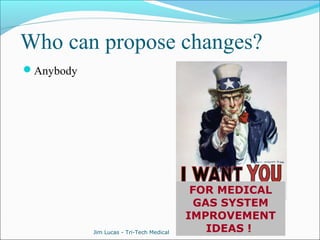
Who can propose changes? 
Anybody 
FOR MEDICAL 
GAS SYSTEM 
IMPROVEMENT 
IDEAS ! Jim Lucas - Tri-Tech Medical
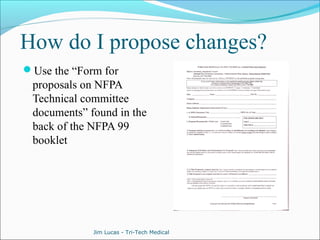
How do I propose changes? 
Use the “Form for 
proposals on NFPA 
Technical committee 
documents” found in the 
back of the NFPA 99 
booklet 
Jim Lucas - Tri-Tech Medical
Sequence of events leading to publication of an 
NFPA committee document 
Call goes out for proposals to amend existing document or for 
recommendations on new document 
Committee meets to act on proposals, to develop its own 
proposals, and to prepare it’s report 
Committee votes on proposals by letter ballot. If 2/3rds 
approve, report goes forward. Lacking 2/3rds approval, report 
returns to committee. 
Report on proposals (ROP) is published for public review & 
comment. 
Committee meets to act on each public comment received. 
Committee votes on comments by letter ballot. If 2/3rds 
approve, supplementary report goes forward. Lacking 2/3rds 
approval, supplementary report returns to committee. 
Jim Lucas - Tri-Tech Medical
Sequence of events leading to publication of an 
NFPA committee document 
Report on comments (ROC) is published for public 
review 
NFPA membership meets (annual or fall meeting) and 
acts on committee report (ROP or ROC) 
Committee votes on any amendments to report approved 
at NFPA annual or fall meeting 
Appeals to standards council on association action must 
be filed within 20 days of the NFPA annual or fall 
meeting. 
Standards council decides, based on all evidence, whether 
or not to issue standard or to take other action, including 
upholding any appeals. 
Jim Lucas - Tri-Tech Medical
What is the NFPA 99 Technical Piping 
Committee? 
A diverse group of appointed volunteer professionals . 
This committee shall have primary responsibility for 
documents or portions of documents covering the 
performance, maintenance, installation, and testing of 
medical and dental related gas piping systems and medical 
and dental related piping systems. 
Jim Lucas - Tri-Tech Medical
NFPA 99 Committee Membership Classifications 
M = Manufacturer 
U = User 
I/M = Installer/Maintainer 
L = Labor representative 
R/T = Applied research/testing laboratory 
E = Enforcing authority 
I = Insurance 
C = Consumer 
SE = Special expert 
Jim Lucas - Tri-Tech Medical
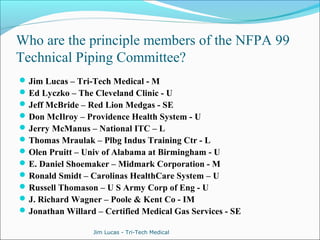
Who are the principle members of the NFPA 99 
Technical Piping Committee? 
Richard Bielen – NFPA Staff Liaison 
Dave Mohile – Chairman - Medical Eng Services - SE 
Mark Allen – Beacon Medaes - M 
Grant Anderson – Bard, Rao & Athanas Consulting Eng - SE 
Dave Brittain – Pro Vac - M 
Jan Ehrenwerth – Yale University - C 
P. L.Fan – American Dental Association – U 
Keith Ferrari – Praxair – M 
William Fettes – Airgas - M 
Michael Frankel – Utility Systems Consultants - SE 
Ed Golla – TRI/Air Testing - RT 
Jim Lucas - Tri-Tech Medical
Who are the principle members of the NFPA 99 
Technical Piping Committee? 
Jim Lucas – Tri-Tech Medical - M 
Ed Lyczko – The Cleveland Clinic - U 
Jeff McBride – Red Lion Medgas - SE 
Don McIlroy – Providence Health System - U 
Jerry McManus – National ITC – L 
Thomas Mraulak – Plbg Indus Training Ctr - L 
Olen Pruitt – Univ of Alabama at Birmingham - U 
E. Daniel Shoemaker – Midmark Corporation - M 
Ronald Smidt – Carolinas HealthCare System – U 
Russell Thomason – U S Army Corp of Eng - U 
J. Richard Wagner – Poole & Kent Co - IM 
Jonathan Willard – Certified Medical Gas Services - SE 
Jim Lucas - Tri-Tech Medical
Proposed NFPA 99 Chapters 4 & 5 changes 
2005 vs 2012 editions 
Hundreds of changes 
were proposed many are 
very minor corrections – 
we will cover less than 
100 in this presentation 
Jim Lucas - Tri-Tech Medical
This is the legal mumbo jumbo disclaimer page 
Any opinions expressed verbally by the speaker before you and all red 
text in this presentation should be considered the speakers opinion. 
These statements are NOT official views or opinions of the NFPA or of 
the Technical Piping Committee. Statements in blue text are paraphrased 
NFPA text. 
It is also worth pointing out that annex material in the NFPA Code, 
material in the NFPA Installation Guidebook and the 
comments/clarifications provided in the NFPA Handbook ARE NOT 
CODE and should be considered unofficial opinions as well. 
Jim Lucas - Tri-Tech Medical
Health Care Facilities Code 
NFPA 99 is now a “Code” – now longer just a “Standard”. As such it is 
on an equal level with – i.e. NFPA 70, National Electric Code (NEC), 
NFPA1 Fire Code and NFPA 101 Life Safety Code. 
As a code, it may be incorporated into law by itself (it will no longer need 
to be defacto law due to being referenced in NFPA 101) and it may 
accelerate being incorporated into law since NFPA 101 is typically 
referencing one edition behind 
Jim Lucas - Tri-Tech Medical
Changes to Chapter 4 Fundamentals 
4.1 Building System Categories. Building systems in health care 
facilities shall be designed to meet system Categories 1 through 4 
requirements as detailed in this code. 
4.1.1 Category 1 Facility systems in which failure of such equipment or 
system is likely to cause major injury or death of patients or caregivers… 
4.1.2 Category 2 Facility systems in which failure of such equipment is 
likely to cause minor injury to patients or caregivers… 
4.1.3 Category 3 Facility systems in which failure of such equipment is 
not likely to cause injury to patients or caregivers, but can cause patient 
discomfort… 
4.1.4 Category 4 Facility systems in which failure of such equipment 
would have no impact on patient care… 
Jim Lucas - Tri-Tech Medical
Changes to Chapter 4 Fundamentals 
4.2 Risk Assessment. Categories shall be 
determined by following and documenting a 
defined risk assessment procedure. 
4.3 Application. The Category definitions 
in Chapter 4 shall apply to Chapters 5 
through 11. 
Jim Lucas - Tri-Tech Medical
Changes to Chapter 4 Fundamentals 
Whoa – 
When & why did it change from Levels to 
Categories? 
How is “the facility” for the purposes of the medical 
gas pipeline equipment required defined? 
Who makes the decision as to which Category 
applies and how? 
How do the Architect/Engineer and the Certifiers 
know what to design and certify to? 
Jim Lucas - Tri-Tech Medical
NFPA 99 Chapter 5 Changes 
5.1, 5.2 and 5.3 (as a result of the Chapter 4 
Fundamentals changes) are now all changed 
through out from Levels to Categories 
Jim Lucas - Tri-Tech Medical
NFPA 99 Chapter 5 Changes 
5.1.1.5 Subsection 5.1.2 through 
5.1.12.3.14.5 and 5.1.14.4.2 shall apply to 
new health care facilities or facilities making 
changes that alter the piping. 
5.1.1.6 Paragraph 5.1.14.4.3 through 
5.1.14.4.9 and 5.1.13 through 5.1.15 shall 
apply to existing health care facilities. 
5.1.1.7 Paragraph 5.1.14.3 and 5.1.14.4.1 
shall apply to new and existing health care 
facilities. 
Jim Lucas - Tri-Tech Medical
NFPA 99 Chapter 5 Changes 
5.1.3.3.1.8 Central supply systems for nitrous oxide and carbon 
dioxide using cylinders or portable containers shall be 
prevented from reaching temperatures lower than the 
recommendations of the central supply system’s 
manufacturer, but shall never be lower than -29° C (-20°F) or 
greater than 51.6°C (125°F). (Was +20°F) 
This will greatly increase the number of cylinders required to 
achieve a given flow requirement as the withdrawal rate of gas 
from the cylinders decreases as the ambient temperature decreases. 
This will also decrease the cylinder pressure. The manifold must 
be able to function properly at the lower cylinder pressure. 
Jim Lucas - Tri-Tech Medical
NFPA 99 Chapter 5 Changes 
5.1.3.3.2 Design and Construction. Locations for 
central supply systems and the storage of positive-pressure 
gases shall meet the following 
requirements: 
5.1.3.3.2 (3) If outdoors, they shall be provided with an 
enclosure (wall or fencing) constructed of noncombustible 
material with a minimum of two entry/exits. (New) 
5.1.3.3.2 (5) They shall be compliant with NFPA 70, 
National Electric Code for ordinary locations 
5.1.3.3.2 (10) They shall protect electrical devices from 
physical damage (no longer 5 feet AFF) 
Jim Lucas - Tri-Tech Medical
NFPA 99 Chapter 5 Changes 
5.1.3.4 Control equipment. (New) Controls for 
central supply systems shall be permitted to be 
installed remotely as long as it is in a secure 
location, the enclosure provides enough space to 
perform maintenance and repair and for all sources 
except medical air does not communicate with 
combustible or flammable materials. 
Jim Lucas - Tri-Tech Medical
NFPA 99 Chapter 5 Changes 
5.1.3.5 Central Supply Systems. Central supply 
systems shall be permitted to consist of the 
following: 
5.1.3.5 (8) Proportioning systems for medical air 
USP (new) 
Jim Lucas - Tri-Tech Medical
NFPA 99 Chapter 5 Changes 
5.1.3.5.2 Permitted Locations for Medical 
Gases. This paragraph has been re-written to 
require that patient medical gases may only be 
piped into areas where their use would be under 
the supervision of licensed clinicians for patient 
treatment: 
Jim Lucas - Tri-Tech Medical
NFPA 99 Chapter 5 Changes 
5.1.3.5.4 (1) Materials. In those portions of 
systems intended to handle oxygen at gauge 
pressures greater than 2413 kPa (350 psi), 
interconnecting hose shall contain no polymeric 
materials. Was 300 psi 
Jim Lucas - Tri-Tech Medical
NFPA 99 Chapter 5 Changes 
5.1.3.5.10 (1) If located outdoors, be installed in 
an enclosure used only for this purpose and sited 
to comply with minimum distance requirements in 
NFPA 55. Was per NFPA 5.1.3.4.10.1 
5.1.3.5.11 (1) If located outdoors, be installed in 
an enclosure used only for this purpose and sited 
to comply with minimum distance requirements in 
NFPA 55. Was per NFPA 5.1.3.4.10.1 
Jim Lucas - Tri-Tech Medical
NFPA 99 Chapter 5 Changes 
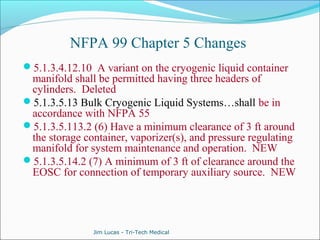
5.1.3.4.12.10 A variant on the cryogenic liquid container 
manifold shall be permitted having three headers of 
cylinders. Deleted 
5.1.3.5.13 Bulk Cryogenic Liquid Systems…shall be in 
accordance with NFPA 55 
5.1.3.5.113.2 (6) Have a minimum clearance of 3 ft around 
the storage container, vaporizer(s), and pressure regulating 
manifold for system maintenance and operation. NEW 
5.1.3.5.14.2 (7) A minimum of 3 ft of clearance around the 
EOSC for connection of temporary auxiliary source. NEW 
Jim Lucas - Tri-Tech Medical
NFPA 99 Chapter 5 Changes 
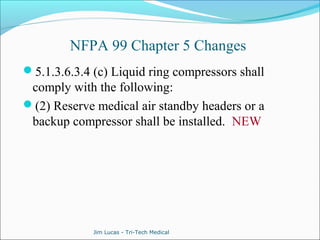
5.1.3.6.3.4 (c) Liquid ring compressors shall 
comply with the following: 
(2) Reserve medical air standby headers or a 
backup compressor shall be installed. NEW 
Jim Lucas - Tri-Tech Medical
NFPA 99 Chapter 5 Changes 
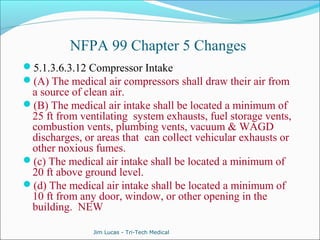
5.1.3.6.3.12 Compressor Intake 
(A) The medical air compressors shall draw their air from 
a source of clean air. 
(B) The medical air intake shall be located a minimum of 
25 ft from ventilating system exhausts, fuel storage vents, 
combustion vents, plumbing vents, vacuum & WAGD 
discharges, or areas that can collect vehicular exhausts or 
other noxious fumes. 
(c) The medical air intake shall be located a minimum of 
20 ft above ground level. 
(d) The medical air intake shall be located a minimum of 
10 ft from any door, window, or other opening in the 
building. NEW 
Jim Lucas - Tri-Tech Medical
NFPA 99 Chapter 5 Changes 
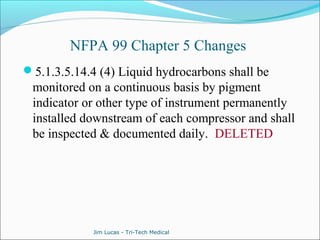
5.1.3.5.14.4 (4) Liquid hydrocarbons shall be 
monitored on a continuous basis by pigment 
indicator or other type of instrument permanently 
installed downstream of each compressor and shall 
be inspected & documented daily. DELETED 
Jim Lucas - Tri-Tech Medical
NFPA 99 Chapter 5 Changes 
5.1.3.6.3.14 Medical Air Quality Monitoring 
(1) Dew point shall be monitored and shall 
activate a local alarm and all master alarms when 
the dew point at system delivery pressure exceeds 
+ 2 degrees C (+35 degreed F). Was +4 C / +39 F 
Jim Lucas - Tri-Tech Medical
NFPA 99 Chapter 5 Changes 
5.1.3.6.3.15 Category 1 Medical Air 
Proportioning System New 
Jim Lucas - Tri-Tech Medical
NFPA 99 Chapter 5 Changes 
5.1.4.8 Zone Valve – Mostly re-written 
5.1.6 Manufactured Assemblies – Requirement to 
be DISS has been dropped 
5.1.9 Category 1 Warning Systems – All 
references to “wired” have been changed to 
“communicate” 
Jim Lucas - Tri-Tech Medical
NFPA 99 Chapter 5 Changes 
 5.1.13.2.3.2 (New) Booms & articulating 
assemblies, other than headwalls, utilizing flexible 
connectors shall be inspected for leaks at a 
minimum of once every 12 months. 
Jim Lucas - Tri-Tech Medical
NFPA 99 Chapter 5 Changes 
 5.1.9.1 (14) (New) Alarm switches/sensors shall be 
installed so as to be removable. 
 5.1.9.3 (New) Area alarm panels for medical gas systems 
shall provide visual & audible indication in the event a 
mismatch occurs between transducer(s) and its associated 
circuit board(s). 
 5.1.4.11 (New) New or replacement in-line check valves 
shall be as follows: (1) brass or bronze construction (2) 
have brazed extensions (3) permit inline serviceability (4) 
shall not have threaded connections 
Jim Lucas - Tri-Tech Medical
NFPA 99 Chapter 5 Changes 
 5.2.13.3.1 (New) Medical gas/vacuum systems 
maintenance & record keeping – was under NFPA 
chapter 9 – now has been brought under chapter 5 
 5.3 – Level 3 systems has been completely re-written 
- some of the noteworthy changes are: verification is 
required by a 6030, ventilation requirements same as 
for Level 1 & 2, requirements for: shut-off valves, 
labeling of the medical gas supply system, cylinder 
storage & handling, pipe support, underground 
piping, verification tests. 
Jim Lucas - Tri-Tech Medical
Thank You 
Jim Lucas - Tri-Tech Medical

Nfpa 99

  • 1.
    Jim Lucas –Tri-Tech Medical http://www.tri-techmedical.com/
  • 2.
    Who can proposechanges? Anybody FOR MEDICAL GAS SYSTEM IMPROVEMENT IDEAS ! Jim Lucas - Tri-Tech Medical
  • 3.
    How do Ipropose changes? Use the “Form for proposals on NFPA Technical committee documents” found in the back of the NFPA 99 booklet Jim Lucas - Tri-Tech Medical
  • 4.
    Sequence of eventsleading to publication of an NFPA committee document Call goes out for proposals to amend existing document or for recommendations on new document Committee meets to act on proposals, to develop its own proposals, and to prepare it’s report Committee votes on proposals by letter ballot. If 2/3rds approve, report goes forward. Lacking 2/3rds approval, report returns to committee. Report on proposals (ROP) is published for public review & comment. Committee meets to act on each public comment received. Committee votes on comments by letter ballot. If 2/3rds approve, supplementary report goes forward. Lacking 2/3rds approval, supplementary report returns to committee. Jim Lucas - Tri-Tech Medical
  • 5.
    Sequence of eventsleading to publication of an NFPA committee document Report on comments (ROC) is published for public review NFPA membership meets (annual or fall meeting) and acts on committee report (ROP or ROC) Committee votes on any amendments to report approved at NFPA annual or fall meeting Appeals to standards council on association action must be filed within 20 days of the NFPA annual or fall meeting. Standards council decides, based on all evidence, whether or not to issue standard or to take other action, including upholding any appeals. Jim Lucas - Tri-Tech Medical
  • 6.
    What is theNFPA 99 Technical Piping Committee? A diverse group of appointed volunteer professionals . This committee shall have primary responsibility for documents or portions of documents covering the performance, maintenance, installation, and testing of medical and dental related gas piping systems and medical and dental related piping systems. Jim Lucas - Tri-Tech Medical
  • 7.
    NFPA 99 CommitteeMembership Classifications M = Manufacturer U = User I/M = Installer/Maintainer L = Labor representative R/T = Applied research/testing laboratory E = Enforcing authority I = Insurance C = Consumer SE = Special expert Jim Lucas - Tri-Tech Medical
  • 8.
    Who are theprinciple members of the NFPA 99 Technical Piping Committee? Richard Bielen – NFPA Staff Liaison Dave Mohile – Chairman - Medical Eng Services - SE Mark Allen – Beacon Medaes - M Grant Anderson – Bard, Rao & Athanas Consulting Eng - SE Dave Brittain – Pro Vac - M Jan Ehrenwerth – Yale University - C P. L.Fan – American Dental Association – U Keith Ferrari – Praxair – M William Fettes – Airgas - M Michael Frankel – Utility Systems Consultants - SE Ed Golla – TRI/Air Testing - RT Jim Lucas - Tri-Tech Medical
  • 9.
    Who are theprinciple members of the NFPA 99 Technical Piping Committee? Jim Lucas – Tri-Tech Medical - M Ed Lyczko – The Cleveland Clinic - U Jeff McBride – Red Lion Medgas - SE Don McIlroy – Providence Health System - U Jerry McManus – National ITC – L Thomas Mraulak – Plbg Indus Training Ctr - L Olen Pruitt – Univ of Alabama at Birmingham - U E. Daniel Shoemaker – Midmark Corporation - M Ronald Smidt – Carolinas HealthCare System – U Russell Thomason – U S Army Corp of Eng - U J. Richard Wagner – Poole & Kent Co - IM Jonathan Willard – Certified Medical Gas Services - SE Jim Lucas - Tri-Tech Medical
  • 10.
    Proposed NFPA 99Chapters 4 & 5 changes 2005 vs 2012 editions Hundreds of changes were proposed many are very minor corrections – we will cover less than 100 in this presentation Jim Lucas - Tri-Tech Medical
  • 11.
    This is thelegal mumbo jumbo disclaimer page Any opinions expressed verbally by the speaker before you and all red text in this presentation should be considered the speakers opinion. These statements are NOT official views or opinions of the NFPA or of the Technical Piping Committee. Statements in blue text are paraphrased NFPA text. It is also worth pointing out that annex material in the NFPA Code, material in the NFPA Installation Guidebook and the comments/clarifications provided in the NFPA Handbook ARE NOT CODE and should be considered unofficial opinions as well. Jim Lucas - Tri-Tech Medical
  • 12.
    Health Care FacilitiesCode NFPA 99 is now a “Code” – now longer just a “Standard”. As such it is on an equal level with – i.e. NFPA 70, National Electric Code (NEC), NFPA1 Fire Code and NFPA 101 Life Safety Code. As a code, it may be incorporated into law by itself (it will no longer need to be defacto law due to being referenced in NFPA 101) and it may accelerate being incorporated into law since NFPA 101 is typically referencing one edition behind Jim Lucas - Tri-Tech Medical
  • 13.
    Changes to Chapter4 Fundamentals 4.1 Building System Categories. Building systems in health care facilities shall be designed to meet system Categories 1 through 4 requirements as detailed in this code. 4.1.1 Category 1 Facility systems in which failure of such equipment or system is likely to cause major injury or death of patients or caregivers… 4.1.2 Category 2 Facility systems in which failure of such equipment is likely to cause minor injury to patients or caregivers… 4.1.3 Category 3 Facility systems in which failure of such equipment is not likely to cause injury to patients or caregivers, but can cause patient discomfort… 4.1.4 Category 4 Facility systems in which failure of such equipment would have no impact on patient care… Jim Lucas - Tri-Tech Medical
  • 14.
    Changes to Chapter4 Fundamentals 4.2 Risk Assessment. Categories shall be determined by following and documenting a defined risk assessment procedure. 4.3 Application. The Category definitions in Chapter 4 shall apply to Chapters 5 through 11. Jim Lucas - Tri-Tech Medical
  • 15.
    Changes to Chapter4 Fundamentals Whoa – When & why did it change from Levels to Categories? How is “the facility” for the purposes of the medical gas pipeline equipment required defined? Who makes the decision as to which Category applies and how? How do the Architect/Engineer and the Certifiers know what to design and certify to? Jim Lucas - Tri-Tech Medical
  • 16.
    NFPA 99 Chapter5 Changes 5.1, 5.2 and 5.3 (as a result of the Chapter 4 Fundamentals changes) are now all changed through out from Levels to Categories Jim Lucas - Tri-Tech Medical
  • 17.
    NFPA 99 Chapter5 Changes 5.1.1.5 Subsection 5.1.2 through 5.1.12.3.14.5 and 5.1.14.4.2 shall apply to new health care facilities or facilities making changes that alter the piping. 5.1.1.6 Paragraph 5.1.14.4.3 through 5.1.14.4.9 and 5.1.13 through 5.1.15 shall apply to existing health care facilities. 5.1.1.7 Paragraph 5.1.14.3 and 5.1.14.4.1 shall apply to new and existing health care facilities. Jim Lucas - Tri-Tech Medical
  • 18.
    NFPA 99 Chapter5 Changes 5.1.3.3.1.8 Central supply systems for nitrous oxide and carbon dioxide using cylinders or portable containers shall be prevented from reaching temperatures lower than the recommendations of the central supply system’s manufacturer, but shall never be lower than -29° C (-20°F) or greater than 51.6°C (125°F). (Was +20°F) This will greatly increase the number of cylinders required to achieve a given flow requirement as the withdrawal rate of gas from the cylinders decreases as the ambient temperature decreases. This will also decrease the cylinder pressure. The manifold must be able to function properly at the lower cylinder pressure. Jim Lucas - Tri-Tech Medical
  • 19.
    NFPA 99 Chapter5 Changes 5.1.3.3.2 Design and Construction. Locations for central supply systems and the storage of positive-pressure gases shall meet the following requirements: 5.1.3.3.2 (3) If outdoors, they shall be provided with an enclosure (wall or fencing) constructed of noncombustible material with a minimum of two entry/exits. (New) 5.1.3.3.2 (5) They shall be compliant with NFPA 70, National Electric Code for ordinary locations 5.1.3.3.2 (10) They shall protect electrical devices from physical damage (no longer 5 feet AFF) Jim Lucas - Tri-Tech Medical
  • 20.
    NFPA 99 Chapter5 Changes 5.1.3.4 Control equipment. (New) Controls for central supply systems shall be permitted to be installed remotely as long as it is in a secure location, the enclosure provides enough space to perform maintenance and repair and for all sources except medical air does not communicate with combustible or flammable materials. Jim Lucas - Tri-Tech Medical
  • 21.
    NFPA 99 Chapter5 Changes 5.1.3.5 Central Supply Systems. Central supply systems shall be permitted to consist of the following: 5.1.3.5 (8) Proportioning systems for medical air USP (new) Jim Lucas - Tri-Tech Medical
  • 22.
    NFPA 99 Chapter5 Changes 5.1.3.5.2 Permitted Locations for Medical Gases. This paragraph has been re-written to require that patient medical gases may only be piped into areas where their use would be under the supervision of licensed clinicians for patient treatment: Jim Lucas - Tri-Tech Medical
  • 23.
    NFPA 99 Chapter5 Changes 5.1.3.5.4 (1) Materials. In those portions of systems intended to handle oxygen at gauge pressures greater than 2413 kPa (350 psi), interconnecting hose shall contain no polymeric materials. Was 300 psi Jim Lucas - Tri-Tech Medical
  • 24.
    NFPA 99 Chapter5 Changes 5.1.3.5.10 (1) If located outdoors, be installed in an enclosure used only for this purpose and sited to comply with minimum distance requirements in NFPA 55. Was per NFPA 5.1.3.4.10.1 5.1.3.5.11 (1) If located outdoors, be installed in an enclosure used only for this purpose and sited to comply with minimum distance requirements in NFPA 55. Was per NFPA 5.1.3.4.10.1 Jim Lucas - Tri-Tech Medical
  • 25.
    NFPA 99 Chapter5 Changes 5.1.3.4.12.10 A variant on the cryogenic liquid container manifold shall be permitted having three headers of cylinders. Deleted 5.1.3.5.13 Bulk Cryogenic Liquid Systems…shall be in accordance with NFPA 55 5.1.3.5.113.2 (6) Have a minimum clearance of 3 ft around the storage container, vaporizer(s), and pressure regulating manifold for system maintenance and operation. NEW 5.1.3.5.14.2 (7) A minimum of 3 ft of clearance around the EOSC for connection of temporary auxiliary source. NEW Jim Lucas - Tri-Tech Medical
  • 26.
    NFPA 99 Chapter5 Changes 5.1.3.6.3.4 (c) Liquid ring compressors shall comply with the following: (2) Reserve medical air standby headers or a backup compressor shall be installed. NEW Jim Lucas - Tri-Tech Medical
  • 27.
    NFPA 99 Chapter5 Changes 5.1.3.6.3.12 Compressor Intake (A) The medical air compressors shall draw their air from a source of clean air. (B) The medical air intake shall be located a minimum of 25 ft from ventilating system exhausts, fuel storage vents, combustion vents, plumbing vents, vacuum & WAGD discharges, or areas that can collect vehicular exhausts or other noxious fumes. (c) The medical air intake shall be located a minimum of 20 ft above ground level. (d) The medical air intake shall be located a minimum of 10 ft from any door, window, or other opening in the building. NEW Jim Lucas - Tri-Tech Medical
  • 28.
    NFPA 99 Chapter5 Changes 5.1.3.5.14.4 (4) Liquid hydrocarbons shall be monitored on a continuous basis by pigment indicator or other type of instrument permanently installed downstream of each compressor and shall be inspected & documented daily. DELETED Jim Lucas - Tri-Tech Medical
  • 29.
    NFPA 99 Chapter5 Changes 5.1.3.6.3.14 Medical Air Quality Monitoring (1) Dew point shall be monitored and shall activate a local alarm and all master alarms when the dew point at system delivery pressure exceeds + 2 degrees C (+35 degreed F). Was +4 C / +39 F Jim Lucas - Tri-Tech Medical
  • 30.
    NFPA 99 Chapter5 Changes 5.1.3.6.3.15 Category 1 Medical Air Proportioning System New Jim Lucas - Tri-Tech Medical
  • 31.
    NFPA 99 Chapter5 Changes 5.1.4.8 Zone Valve – Mostly re-written 5.1.6 Manufactured Assemblies – Requirement to be DISS has been dropped 5.1.9 Category 1 Warning Systems – All references to “wired” have been changed to “communicate” Jim Lucas - Tri-Tech Medical
  • 32.
    NFPA 99 Chapter5 Changes  5.1.13.2.3.2 (New) Booms & articulating assemblies, other than headwalls, utilizing flexible connectors shall be inspected for leaks at a minimum of once every 12 months. Jim Lucas - Tri-Tech Medical
  • 33.
    NFPA 99 Chapter5 Changes  5.1.9.1 (14) (New) Alarm switches/sensors shall be installed so as to be removable.  5.1.9.3 (New) Area alarm panels for medical gas systems shall provide visual & audible indication in the event a mismatch occurs between transducer(s) and its associated circuit board(s).  5.1.4.11 (New) New or replacement in-line check valves shall be as follows: (1) brass or bronze construction (2) have brazed extensions (3) permit inline serviceability (4) shall not have threaded connections Jim Lucas - Tri-Tech Medical
  • 34.
    NFPA 99 Chapter5 Changes  5.2.13.3.1 (New) Medical gas/vacuum systems maintenance & record keeping – was under NFPA chapter 9 – now has been brought under chapter 5  5.3 – Level 3 systems has been completely re-written - some of the noteworthy changes are: verification is required by a 6030, ventilation requirements same as for Level 1 & 2, requirements for: shut-off valves, labeling of the medical gas supply system, cylinder storage & handling, pipe support, underground piping, verification tests. Jim Lucas - Tri-Tech Medical
  • 35.
    Thank You JimLucas - Tri-Tech Medical