Social Media in the newsroom: Past. Present. Future.


Observations of how
social media has and
 will be used in the
     newsroom
About Me

â—Ź   Assistant Editor for New Media at The Edge
    Malaysia
â—Ź   Produce and host a podcast called The Digital
    Edge
â—Ź   Disclaimer: Opinions are personal, and not
    representative of The Edge.
Trends of Social Media Use

â—Ź   Three major trends
1. Automated and centralised:
- The period when Facebook and Twitter are used
as RSS directories.
- Social Networking Services (SNS) are primarily
seen as another channel of dissemination and
marketing tool.
Trends of Social Media Use
2. Manned and centralized
- Work is delegated to a team to handle the Twitter feeds,
monitor Facebook postings, regulate comments, encourage
online conversation through the SNS.
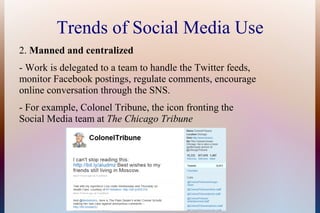
- For example, Colonel Tribune, the icon fronting the
Social Media team at The Chicago Tribune
Trends of Social Media Use
3. Manned and distributed use of social networks
- This is the stage where individual newsroom staffers are
empowered and trusted to use SNS tools to distribute news
and gather news, create conversations, and spread opinions.
- Coming of age in newsrooms abroad, but generally still
slow to adopt here.
Examples: CNN's various Twitter accounts of Rick Sanchez
and Kristie Lu Stout.
So what's the problem of adoption?


  Despite the ubiquity of Social Media and the
      obvious advantages to using them,
 Why are newsrooms then slow to adapt to this
                platform?
Challenges to Social Media Adoption

1 “Now, what do we do with them?”
â—Ź   Is the first question asked, and often unanswered. Newsrooms, which have
    been very entrenched in print practices, often don't know what to do
    with these new platforms where speed and conversation matter.
â—Ź   So Social Media tools end up being marketing tools for the primary
    print product, or to drive more hits to the website.
2 A poor understanding of fitting the content onto the platform
●   Content is king, but the nature of the platforms – be it Twitter, Facebook,
    Tumblr – determine what kind of content should go on it.
â—Ź   Postings in Facebook, needs to encourage discussion; Twitter should be
    short and frequent; Tumblr should be short and graphic-intensive.
Challenges to Social Media Adoption

3 Return of investment
â—Ź   - Is it worth the time and investment in creating a social media team to
    man these Social Media platforms? If upper management sees this as
    nothing more than a cut-and-paste job, then it is difficult to justify a
    presence.
â—Ź   - How do you measure the value behind all those Tweets and posts? What
    is the value of the brand equity created through social media engagement?
â—Ź   - News organizations are driven to deliver news, not judge the strength of
    their social media campaigns.
â—Ź   - As a result, Social Media strategies often get stunted at the first stage.
Challenges to Social Media Adoption

4 Splitting the personal from the professional
â—Ź   While many staffers state disclaimers that their posts don't reflect the
    opinion of the news organization, the public takes their opinions under the
    context of them being a journalist/editor.
â—Ź   Social Media disrupts the hierarchy of the traditional newsroom where
    only senior reporters who have gained sufficient understanding in their
    beat can comment.
â—Ź   Outside the workplace: If a staffer posts something inappropriate, is it
    considered unprofessional? The newsroom is built on integrity, and who
    else builds that integrity but the journalists and editors.
Challenges to Social Media Adoption

5 Trust
â—Ź   The newsroom prides itself on accuracy and truth. Editors ensure that the
    news printed would not be taken out of context or misinterpreted.
â—Ź   Two lines of editors:
           –   News editors, who go through the tone, facts, and angle of the story.
           –   Copy editors, who ensure grammar and house-style are observed.
â—Ź   The questions are: Do editors trust their reporters to say the right
    thing, to make sure their facts are straight, their sources reliable?
â—Ź   How do reporters or the news organization respond to comments from
    readers? How much control should a news organization have over what
    individual reporters say?
Challenges to Social Media Adoption

- These are the questions that weigh on the minds of
newsroom editors, and slow down the adoption of
Social Media in the newsroom.

- It’s a brand new world out there, and
understandably, many are still finding their feet.
How would the new newsroom would look like?

Despite the challenges, the third phase of Social Media in the
newsroom is coming:
●   CNN – news anchors like Rick Sanchez and Kristie Lu Stout having
    their individual Twitter accounts, and they often use Tweets as feedback
    on their news shows.
â—Ź   The BBC's new director mandates journalists use Social Media
â—Ź   The Star reporters and editors are leading the line in adopting social
    media, especially Twitter
â—Ź   Terence Fernandes from The Sun has started to engage in conversations
    through Twitter with politicians.
â—Ź   I've employed Twitter to crowd-source for The Digital Edge panelists.
How would the new newsroom would look like?

Director of BBC Global News Peter Horrocks: “If you don’t like
it, if you think that level of change or that different way of
working isn’t right for me, then go and do something else,
because it’s going to happen. You’re not going to be able to stop
it.”

“Aggregating and curating content with attribution should
become part of a BBC journalist’s assignment; and BBC’s
journalists have to integrate and listen to feedback for a better
understanding of how the audience is relating to the BBC
brand.”
How would the new newsroom look like?

- What we’re seeing now is a gradual willingness to let go of
top-down control, and trust reporters to conduct themselves
responsibly online.
- There is always a risk attached if there is a misreporting.
- The payoff that we're starting to see: faster distribution of
news, better engagement with the readers, an increased brand
reputation for being “ahead of the curve”, and effective news
gathering process through crowd-sourcing.
How do we encourage the use of Social Media in
              the newsroom?
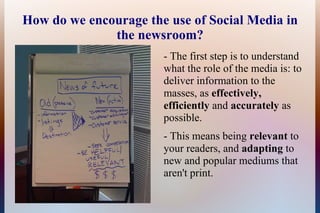
                       - The first step is to understand
                       what the role of the media is: to
                       deliver information to the
                       masses, as effectively,
                       efficiently and accurately as
                       possible.
                       - This means being relevant to
                       your readers, and adapting to
                       new and popular mediums that
                       aren't print.
Guidelines to consider
1 Recognise that staffers will have Social Media profiles, and they
should be free to express themselves online.
â—Ź   However, should they identify themselves as a member of the news
    organisation, they should be aware that they carry with them a
    journalist's responsibility – what they post online should not damage
    the reputation of the news organisation they work for.
â—Ź   Alternatively keep the personal and public apart. Go private and do not
    associate with the organization.
â—Ź   For example, in FreeForm, many of the staffers have two Twitter
    accounts. The CEO understands their need for personal space.
Guidelines to consider
2 Trust your staffers to be responsible. Drill into them the need
to double-check sources from Social Media before spreading the
word.
3 Develop relationships with credible sources. With a limited
pool of Twitterers, these sources are easy to find and connect
with – Fahmi Fadzil, Khairy Jamaluddin, Terence The Sun,
Anil Netto – are some of the people we follow and ReTweet as
news.
4 Avoid being Big Brother. Guidelines are meant to empower,
not restrict, staffers from using social media.

Newsroom

  • 1.
    Social Media inthe newsroom: Past. Present. Future. Observations of how social media has and will be used in the newsroom
  • 2.
    About Me â—Ź Assistant Editor for New Media at The Edge Malaysia â—Ź Produce and host a podcast called The Digital Edge â—Ź Disclaimer: Opinions are personal, and not representative of The Edge.
  • 3.
    Trends of SocialMedia Use â—Ź Three major trends 1. Automated and centralised: - The period when Facebook and Twitter are used as RSS directories. - Social Networking Services (SNS) are primarily seen as another channel of dissemination and marketing tool.
  • 4.
    Trends of SocialMedia Use 2. Manned and centralized - Work is delegated to a team to handle the Twitter feeds, monitor Facebook postings, regulate comments, encourage online conversation through the SNS. - For example, Colonel Tribune, the icon fronting the Social Media team at The Chicago Tribune
  • 5.
    Trends of SocialMedia Use 3. Manned and distributed use of social networks - This is the stage where individual newsroom staffers are empowered and trusted to use SNS tools to distribute news and gather news, create conversations, and spread opinions. - Coming of age in newsrooms abroad, but generally still slow to adopt here. Examples: CNN's various Twitter accounts of Rick Sanchez and Kristie Lu Stout.
  • 6.
    So what's theproblem of adoption? Despite the ubiquity of Social Media and the obvious advantages to using them, Why are newsrooms then slow to adapt to this platform?
  • 7.
    Challenges to SocialMedia Adoption 1 “Now, what do we do with them?” ● Is the first question asked, and often unanswered. Newsrooms, which have been very entrenched in print practices, often don't know what to do with these new platforms where speed and conversation matter. ● So Social Media tools end up being marketing tools for the primary print product, or to drive more hits to the website. 2 A poor understanding of fitting the content onto the platform ● Content is king, but the nature of the platforms – be it Twitter, Facebook, Tumblr – determine what kind of content should go on it. ● Postings in Facebook, needs to encourage discussion; Twitter should be short and frequent; Tumblr should be short and graphic-intensive.
  • 8.
    Challenges to SocialMedia Adoption 3 Return of investment â—Ź - Is it worth the time and investment in creating a social media team to man these Social Media platforms? If upper management sees this as nothing more than a cut-and-paste job, then it is difficult to justify a presence. â—Ź - How do you measure the value behind all those Tweets and posts? What is the value of the brand equity created through social media engagement? â—Ź - News organizations are driven to deliver news, not judge the strength of their social media campaigns. â—Ź - As a result, Social Media strategies often get stunted at the first stage.
  • 9.
    Challenges to SocialMedia Adoption 4 Splitting the personal from the professional â—Ź While many staffers state disclaimers that their posts don't reflect the opinion of the news organization, the public takes their opinions under the context of them being a journalist/editor. â—Ź Social Media disrupts the hierarchy of the traditional newsroom where only senior reporters who have gained sufficient understanding in their beat can comment. â—Ź Outside the workplace: If a staffer posts something inappropriate, is it considered unprofessional? The newsroom is built on integrity, and who else builds that integrity but the journalists and editors.
  • 10.
    Challenges to SocialMedia Adoption 5 Trust ● The newsroom prides itself on accuracy and truth. Editors ensure that the news printed would not be taken out of context or misinterpreted. ● Two lines of editors: – News editors, who go through the tone, facts, and angle of the story. – Copy editors, who ensure grammar and house-style are observed. ● The questions are: Do editors trust their reporters to say the right thing, to make sure their facts are straight, their sources reliable? ● How do reporters or the news organization respond to comments from readers? How much control should a news organization have over what individual reporters say?
  • 11.
    Challenges to SocialMedia Adoption - These are the questions that weigh on the minds of newsroom editors, and slow down the adoption of Social Media in the newsroom. - It’s a brand new world out there, and understandably, many are still finding their feet.
  • 12.
    How would thenew newsroom would look like? Despite the challenges, the third phase of Social Media in the newsroom is coming: ● CNN – news anchors like Rick Sanchez and Kristie Lu Stout having their individual Twitter accounts, and they often use Tweets as feedback on their news shows. ● The BBC's new director mandates journalists use Social Media ● The Star reporters and editors are leading the line in adopting social media, especially Twitter ● Terence Fernandes from The Sun has started to engage in conversations through Twitter with politicians. ● I've employed Twitter to crowd-source for The Digital Edge panelists.
  • 13.
    How would thenew newsroom would look like? Director of BBC Global News Peter Horrocks: “If you don’t like it, if you think that level of change or that different way of working isn’t right for me, then go and do something else, because it’s going to happen. You’re not going to be able to stop it.” “Aggregating and curating content with attribution should become part of a BBC journalist’s assignment; and BBC’s journalists have to integrate and listen to feedback for a better understanding of how the audience is relating to the BBC brand.”
  • 14.
    How would thenew newsroom look like? - What we’re seeing now is a gradual willingness to let go of top-down control, and trust reporters to conduct themselves responsibly online. - There is always a risk attached if there is a misreporting. - The payoff that we're starting to see: faster distribution of news, better engagement with the readers, an increased brand reputation for being “ahead of the curve”, and effective news gathering process through crowd-sourcing.
  • 15.
    How do weencourage the use of Social Media in the newsroom? - The first step is to understand what the role of the media is: to deliver information to the masses, as effectively, efficiently and accurately as possible. - This means being relevant to your readers, and adapting to new and popular mediums that aren't print.
  • 16.
    Guidelines to consider 1Recognise that staffers will have Social Media profiles, and they should be free to express themselves online. ● However, should they identify themselves as a member of the news organisation, they should be aware that they carry with them a journalist's responsibility – what they post online should not damage the reputation of the news organisation they work for. ● Alternatively keep the personal and public apart. Go private and do not associate with the organization. ● For example, in FreeForm, many of the staffers have two Twitter accounts. The CEO understands their need for personal space.
  • 17.
    Guidelines to consider 2Trust your staffers to be responsible. Drill into them the need to double-check sources from Social Media before spreading the word. 3 Develop relationships with credible sources. With a limited pool of Twitterers, these sources are easy to find and connect with – Fahmi Fadzil, Khairy Jamaluddin, Terence The Sun, Anil Netto – are some of the people we follow and ReTweet as news. 4 Avoid being Big Brother. Guidelines are meant to empower, not restrict, staffers from using social media.