“A printed publication (usually issued daily or weekly) consisting of folded
unstapled sheets and containing news, articles, advertisements, and
correspondence”
 A newspaper gives information and opinions about current events and news.
 They are available to buy at most stores or at a news stand.
 Newspapers can be delivered to your home, if you subscribe to this service.
 The first newspaper was published in Strassburg by Johann Carolus’ in the 17th century
(1605), and they were after that published once a week.
 Since this newspapers have become a lot more frequent.
 They are produced daily and there are many different newspaper types.
 There are different styles, such as; Tabloid (The Sun and The Daily Star) and Broadsheet
papers (The Guardian and The Times).
 Newspapers increasingly made their profit from selling advertising. In the 1850s and
1860s the ads appealed to the increasingly affluent middle-class that sought out a variety
of new products.
 The advertisements announced new health remedies as well as fresh foods and
beverages. The latest London fashions were featured in the regional press.
 Due to the various different kinds of newspapers they all have different psychographics
and demographics.
 The Psychographics of a tabloid paper would be Mainstreamers and Settlers, whereas for
a broadsheet paper they would be aspirers. This is because tabloids are stereotyped to be
for the ‘less educated’ because of their content. Broadsheet newspapers on the other
hand are stereotyped for the better educated and higher class people as the content is
more ‘sophisticated’.
 The demographics of a tabloid paper would be people who fell into C2 (teaching
assistants), D (manual labourer) and E (students) category, whereas for a broadsheet
paper they would be people who fell into the A (doctors), B (nurses) and C1 (skilled
labourers/teachers) category. This is again down to the stereotype each news paper has
regarding how educated you have to be to read a certain newspaper.
 In a recent data collection The New York
Times found that per year they spend around
£44582400 producing the paper,
consumption and distribution, etc.
 On average all papers would be in a similar
cost bracket.
 However as The NY Times is a broadsheet
paper, they cost more to produce then
tabloid papers, simply down to their content
type and amount of it.
 This is why tabloid papers are drastically
cheaper then broadsheet papers to buy in a
shop.
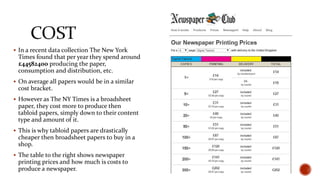
 The table to the right shows newspaper
printing prices and how much is costs to
produce a newspaper.

Newspaper research

  • 2.
    “A printed publication(usually issued daily or weekly) consisting of folded unstapled sheets and containing news, articles, advertisements, and correspondence”  A newspaper gives information and opinions about current events and news.  They are available to buy at most stores or at a news stand.  Newspapers can be delivered to your home, if you subscribe to this service.
  • 3.
     The firstnewspaper was published in Strassburg by Johann Carolus’ in the 17th century (1605), and they were after that published once a week.  Since this newspapers have become a lot more frequent.  They are produced daily and there are many different newspaper types.  There are different styles, such as; Tabloid (The Sun and The Daily Star) and Broadsheet papers (The Guardian and The Times).  Newspapers increasingly made their profit from selling advertising. In the 1850s and 1860s the ads appealed to the increasingly affluent middle-class that sought out a variety of new products.  The advertisements announced new health remedies as well as fresh foods and beverages. The latest London fashions were featured in the regional press.
  • 4.
     Due tothe various different kinds of newspapers they all have different psychographics and demographics.  The Psychographics of a tabloid paper would be Mainstreamers and Settlers, whereas for a broadsheet paper they would be aspirers. This is because tabloids are stereotyped to be for the ‘less educated’ because of their content. Broadsheet newspapers on the other hand are stereotyped for the better educated and higher class people as the content is more ‘sophisticated’.  The demographics of a tabloid paper would be people who fell into C2 (teaching assistants), D (manual labourer) and E (students) category, whereas for a broadsheet paper they would be people who fell into the A (doctors), B (nurses) and C1 (skilled labourers/teachers) category. This is again down to the stereotype each news paper has regarding how educated you have to be to read a certain newspaper.
  • 5.
     In arecent data collection The New York Times found that per year they spend around £44582400 producing the paper, consumption and distribution, etc.  On average all papers would be in a similar cost bracket.  However as The NY Times is a broadsheet paper, they cost more to produce then tabloid papers, simply down to their content type and amount of it.  This is why tabloid papers are drastically cheaper then broadsheet papers to buy in a shop.  The table to the right shows newspaper printing prices and how much is costs to produce a newspaper.