
Where are we?
Where do we go from here?
What kind of news will we
have to consume?
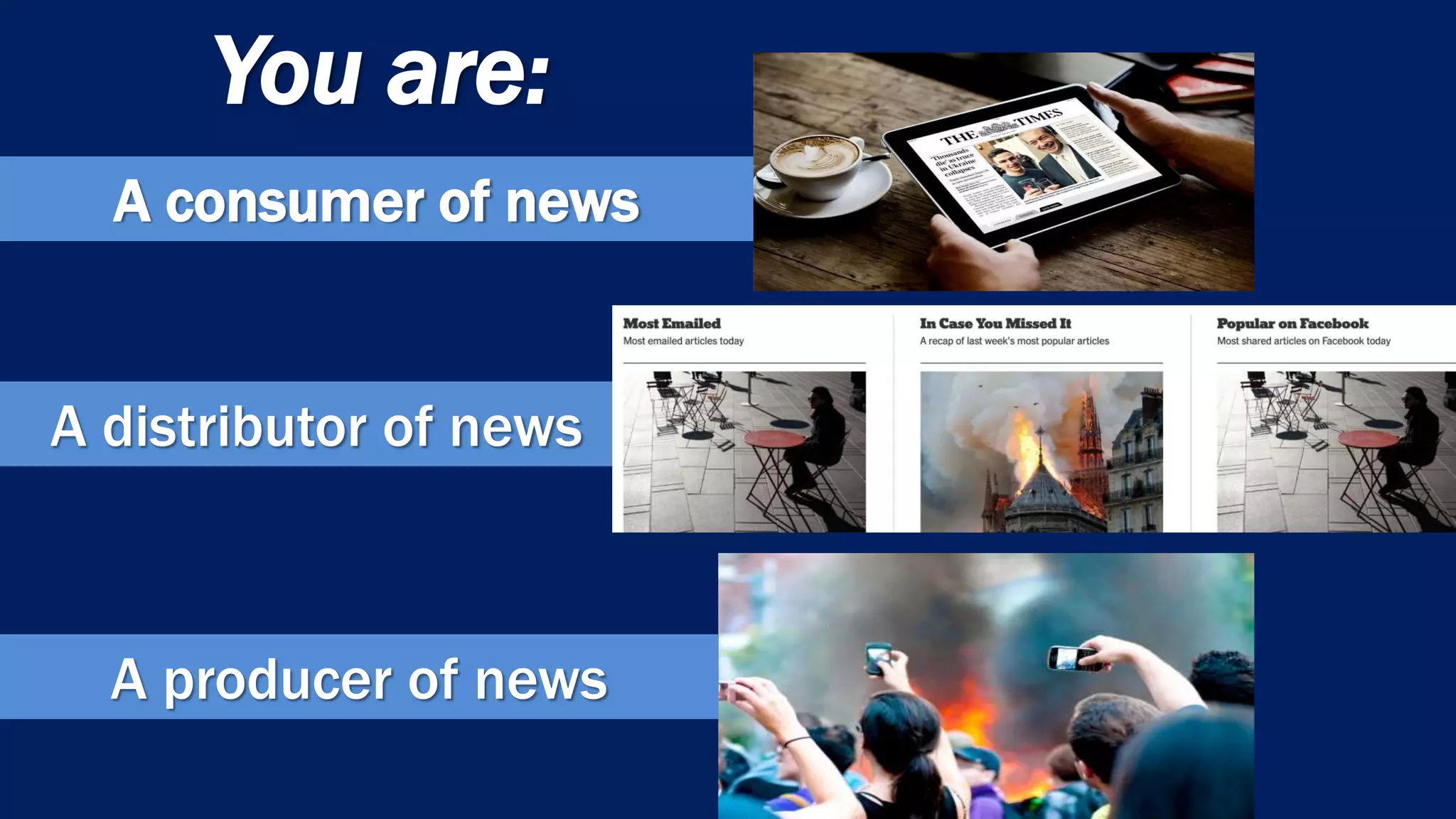
You are:
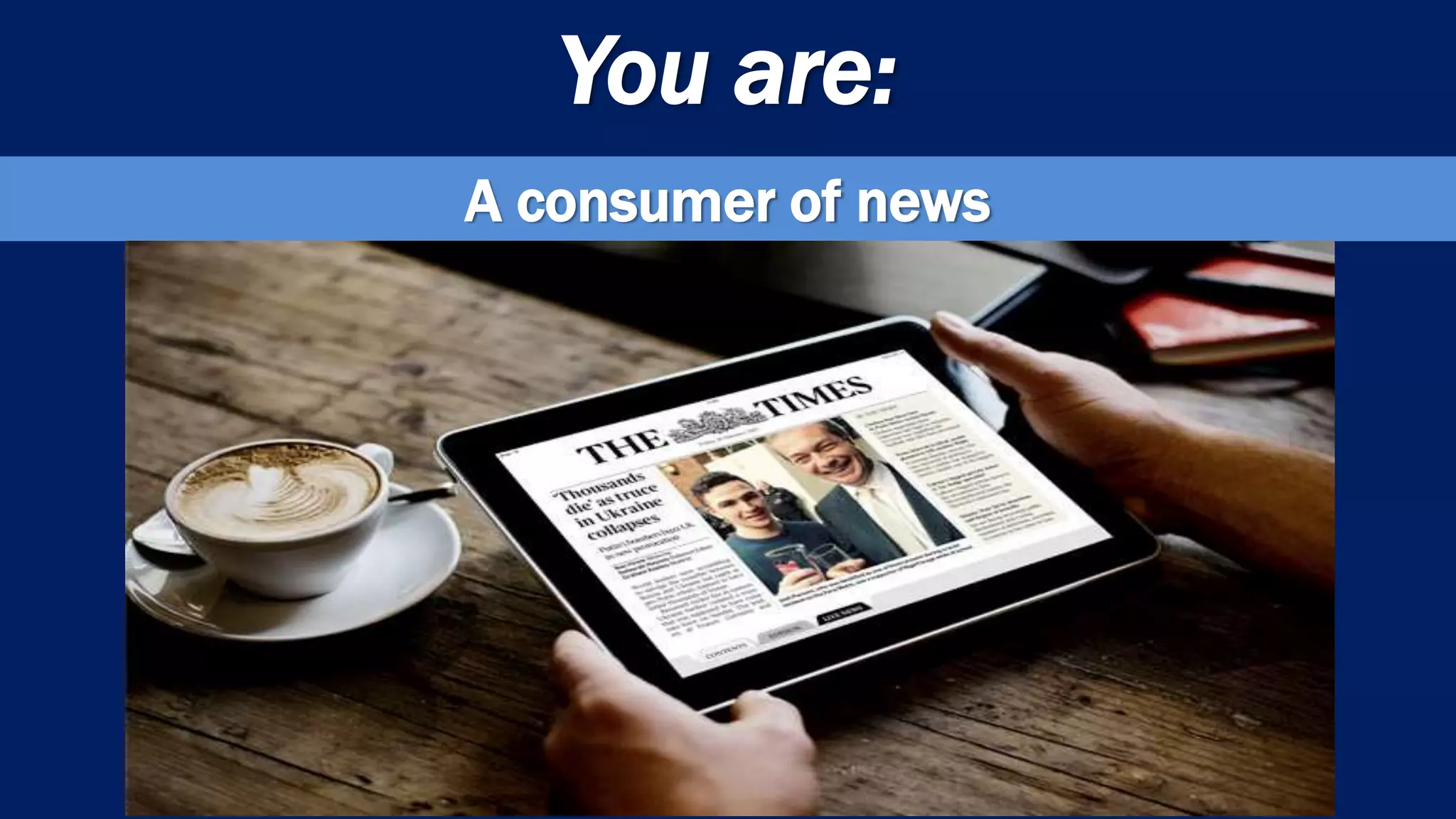
A consumer of news
A distributor of news
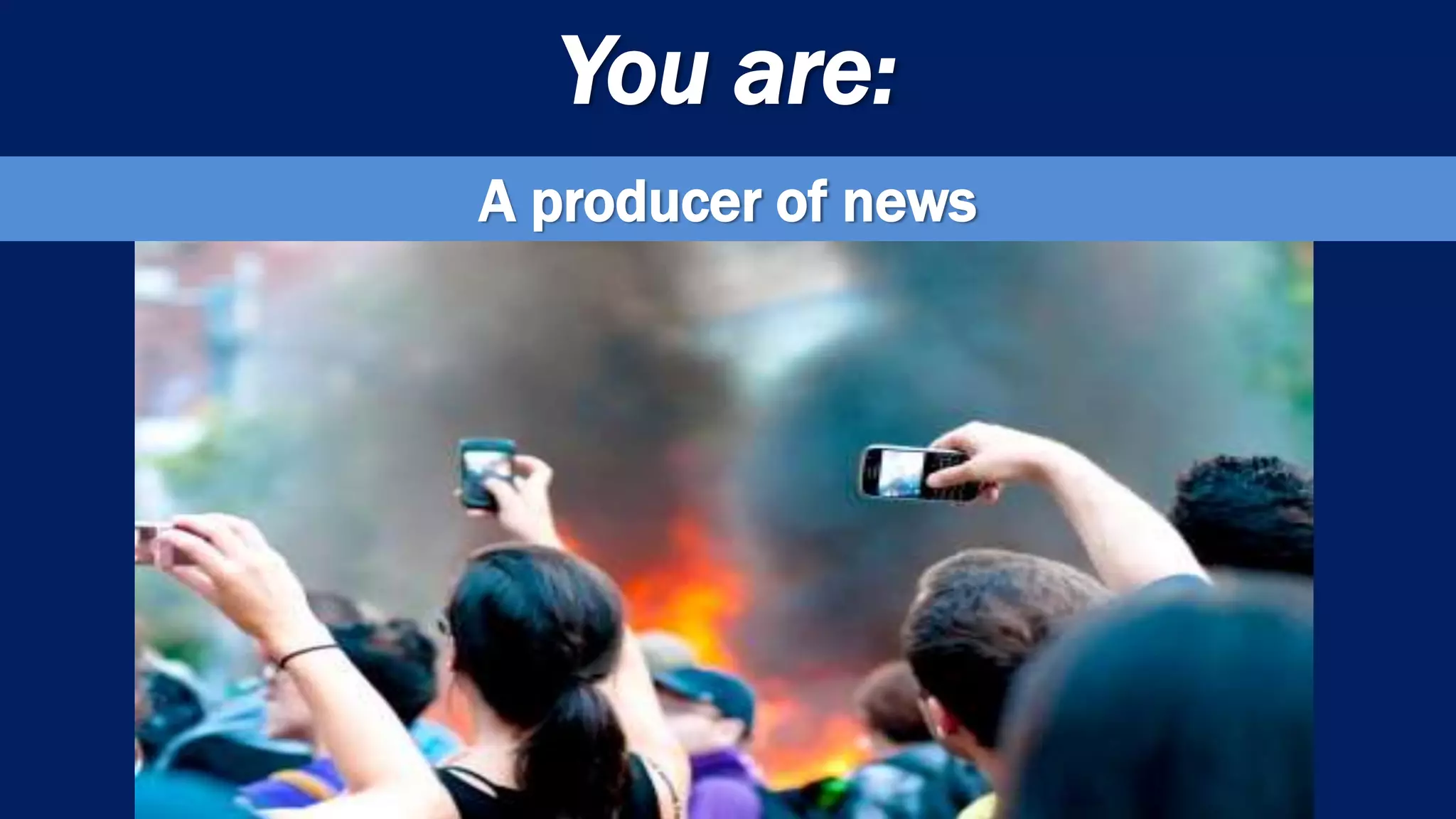
A producer of news
Journalism alone won’t save us
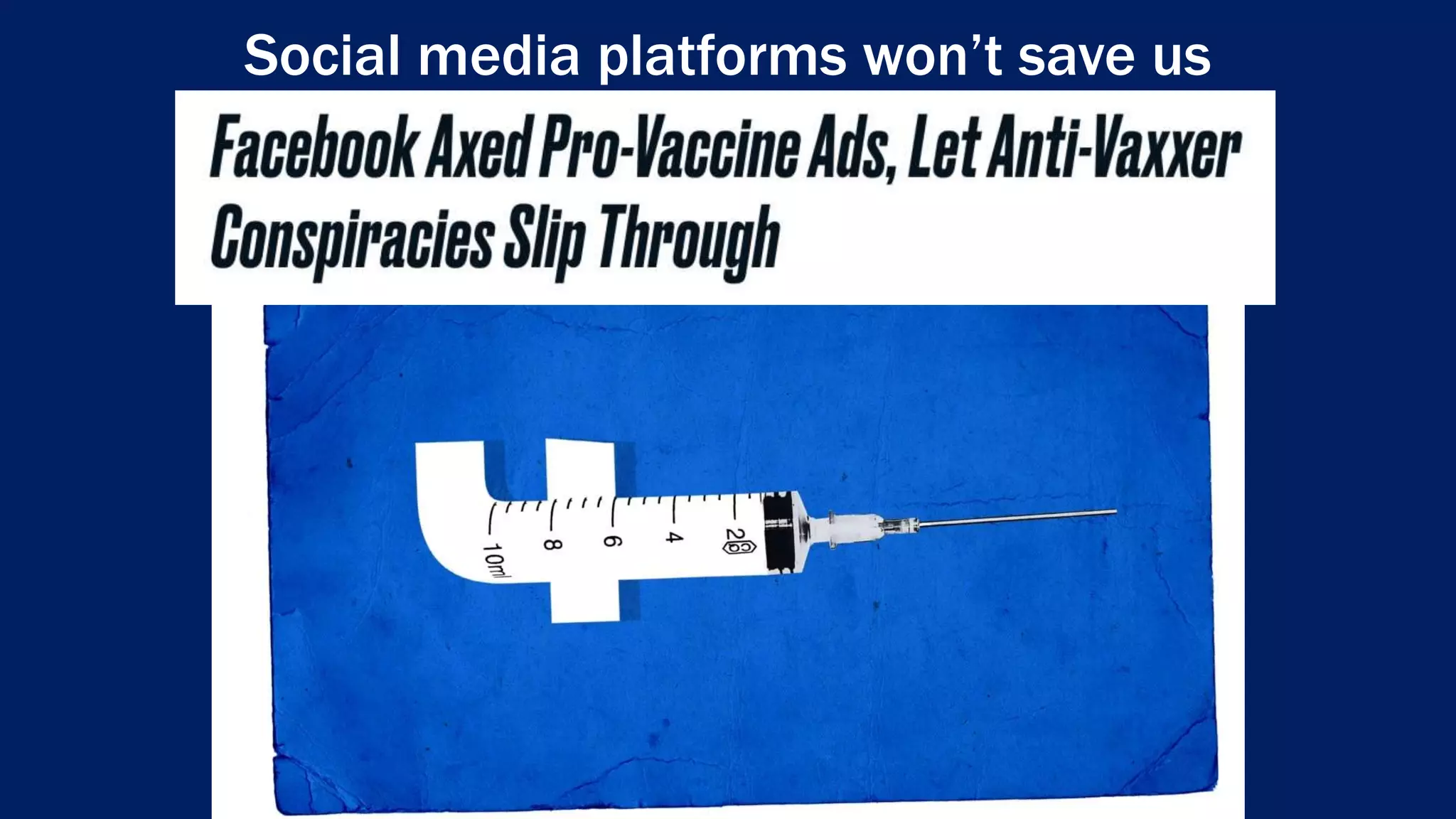
Social media platforms won’t save us
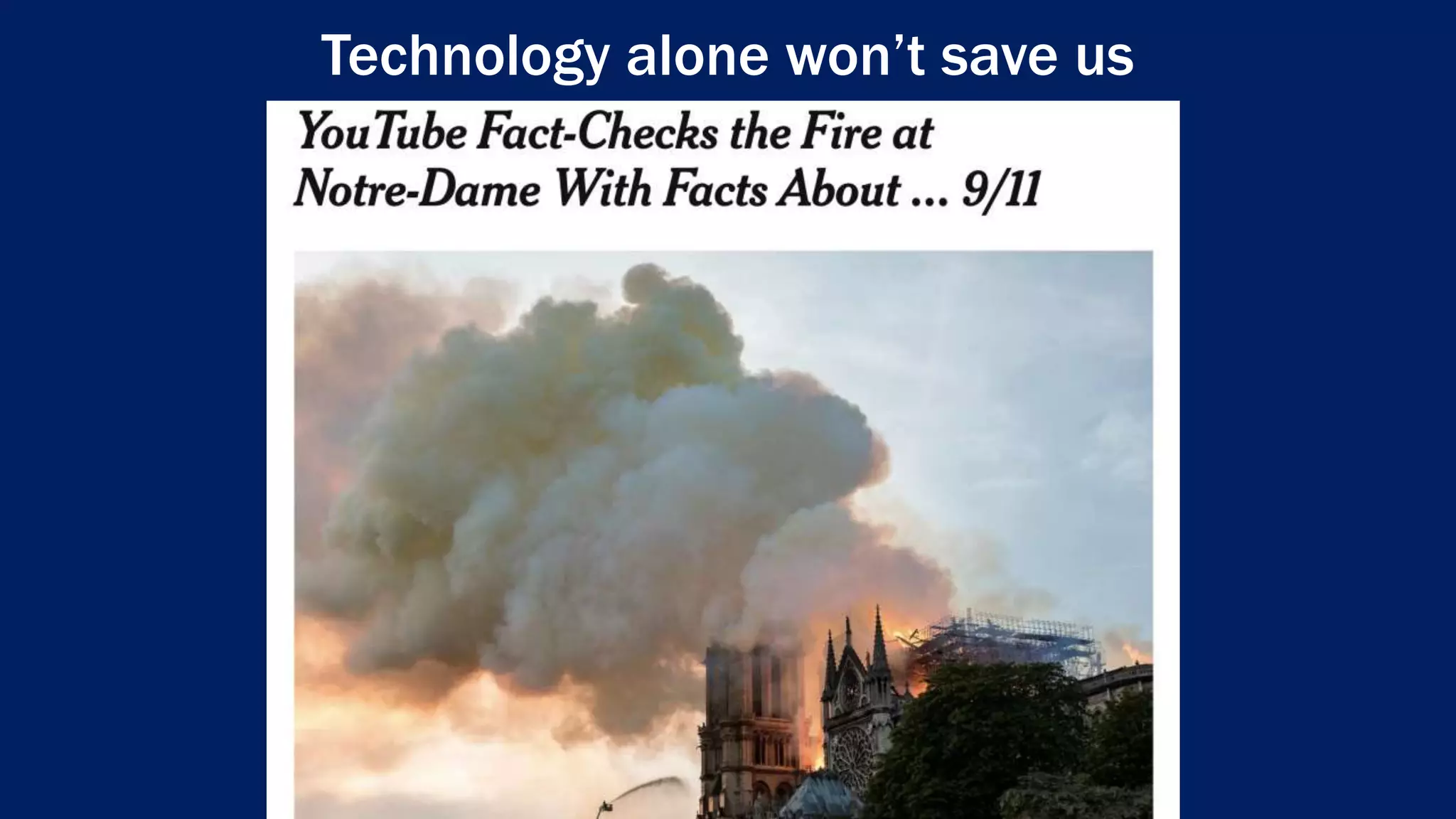
Technology alone won’t save us
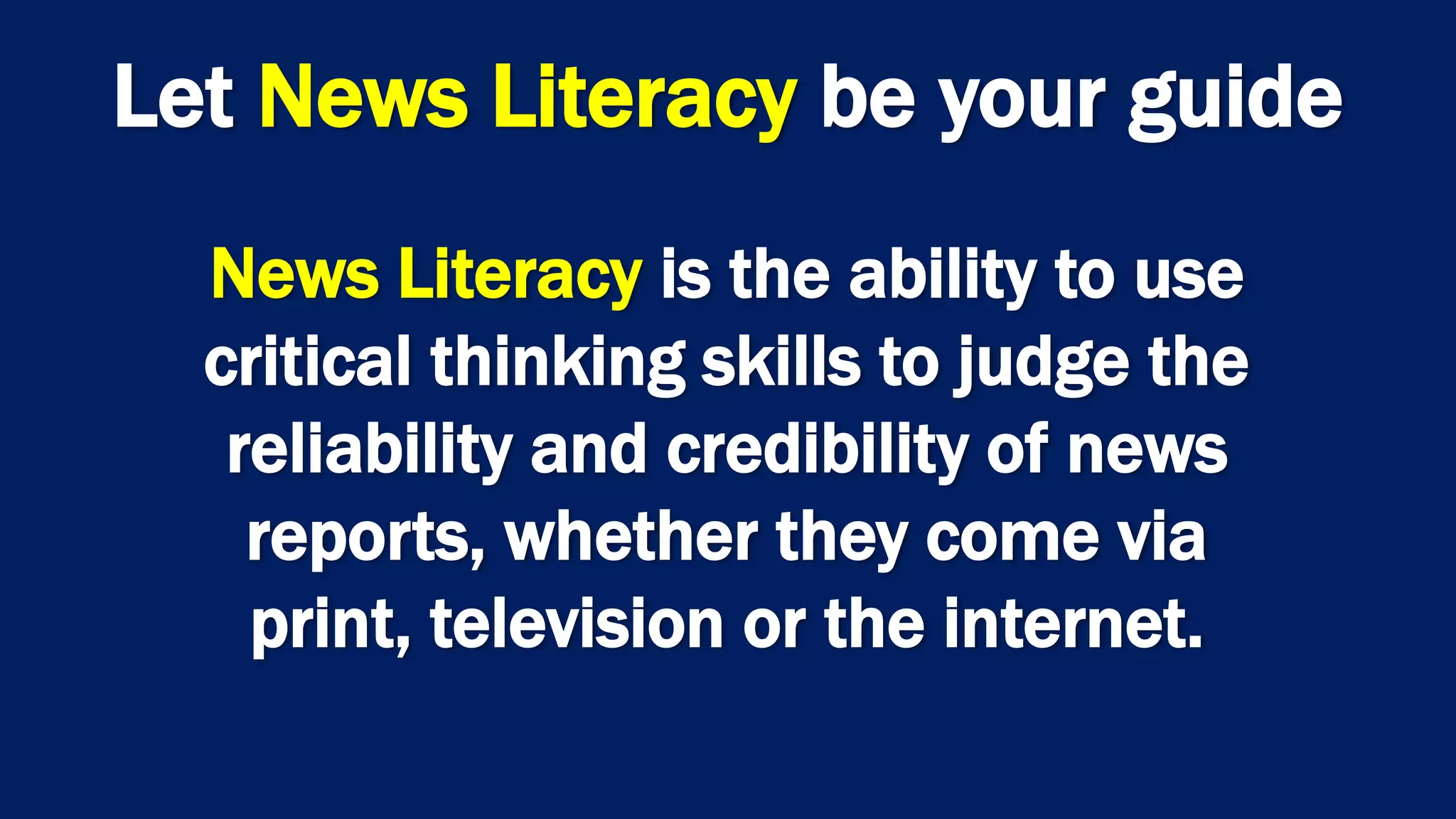
News Literacy is the ability to use
critical thinking skills to judge the
reliability and credibility of news
reports, whether they come via
print, television or the internet.
Let News Literacy be your guide
You are:
A consumer of news
Challenges for consumers
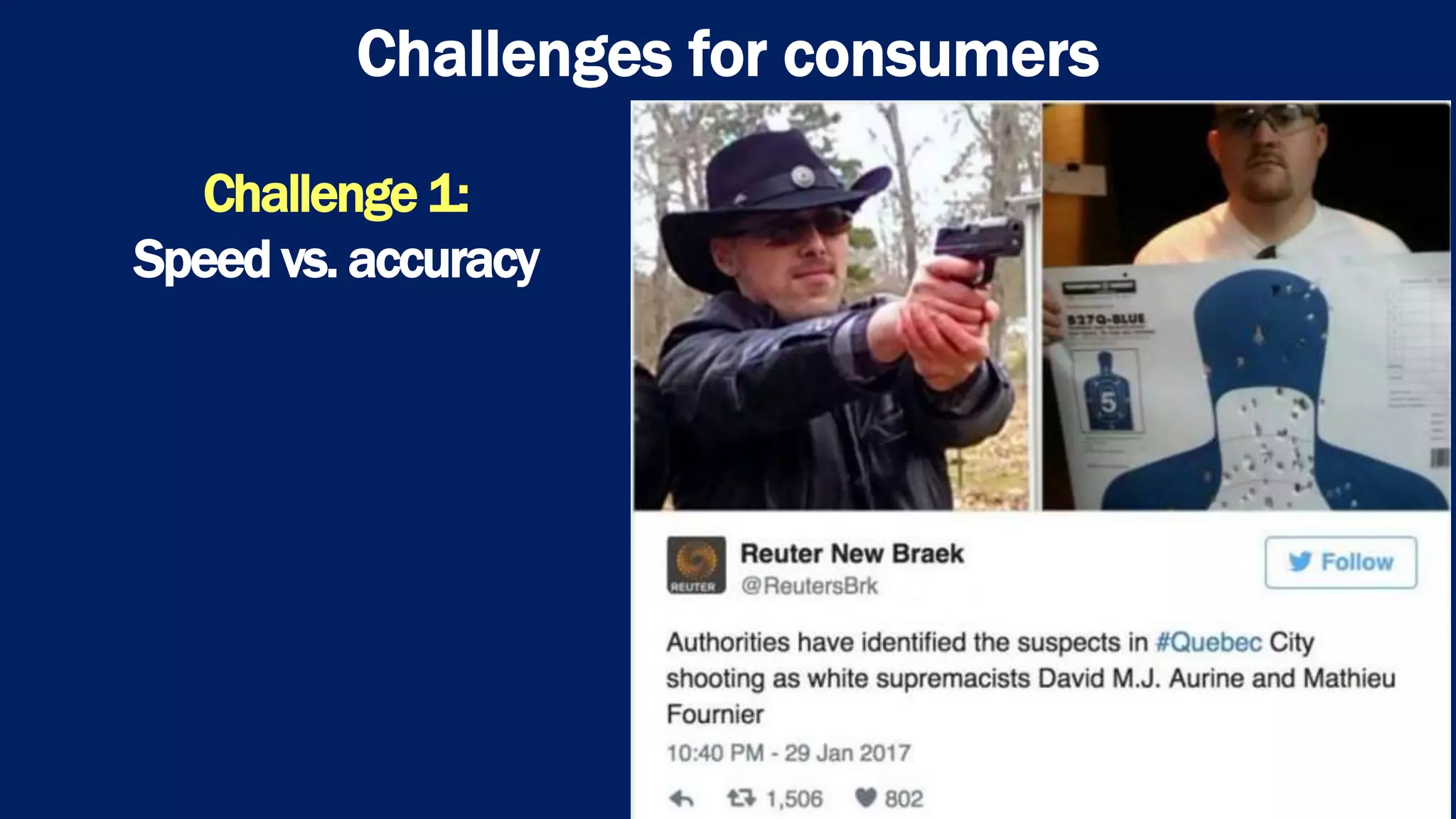
Challenge 1:
Speed vs. accuracy
INTERROGATE
INFORMATION
Challenges for consumers
Challenge 2:
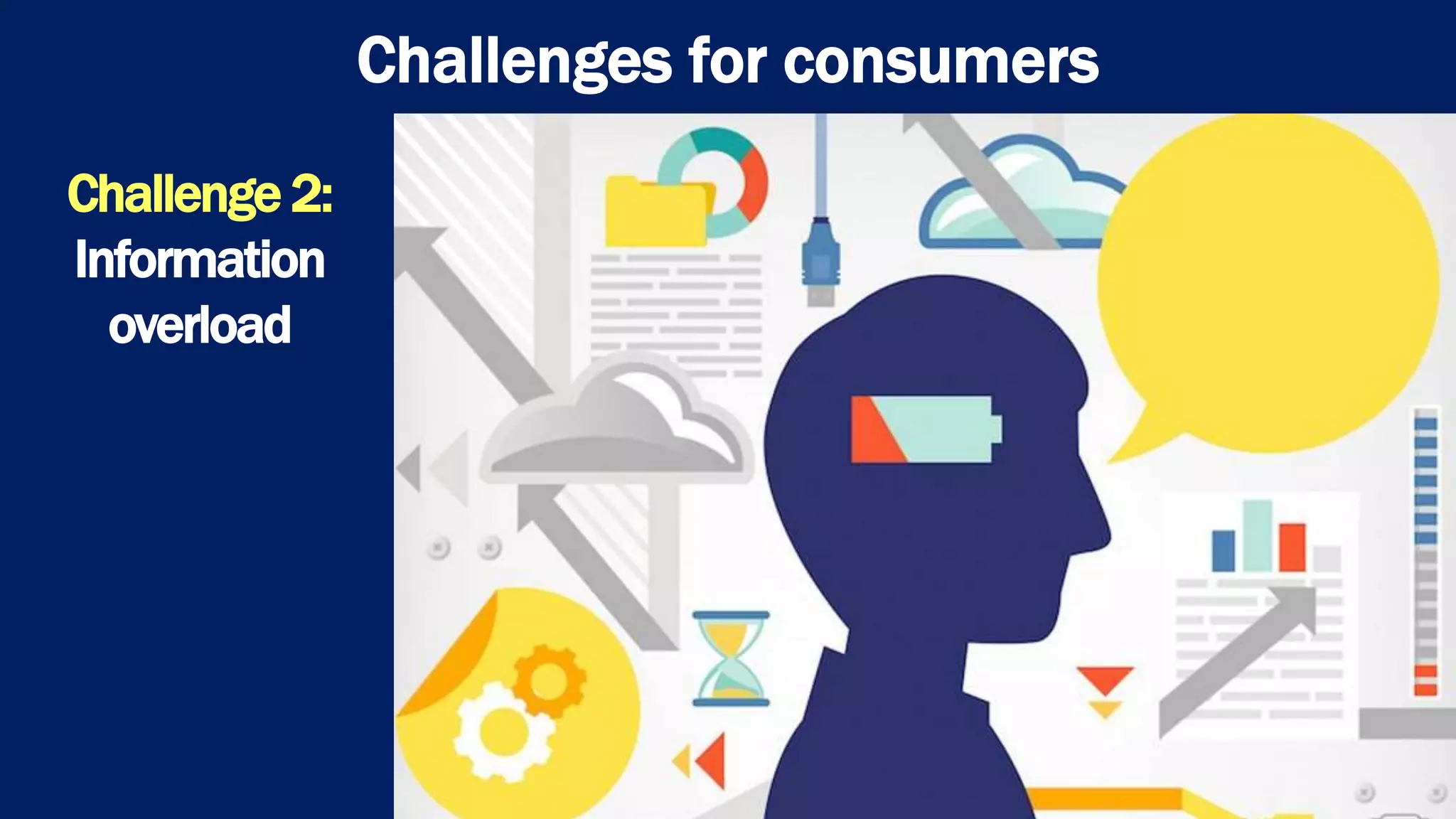
Information
overload
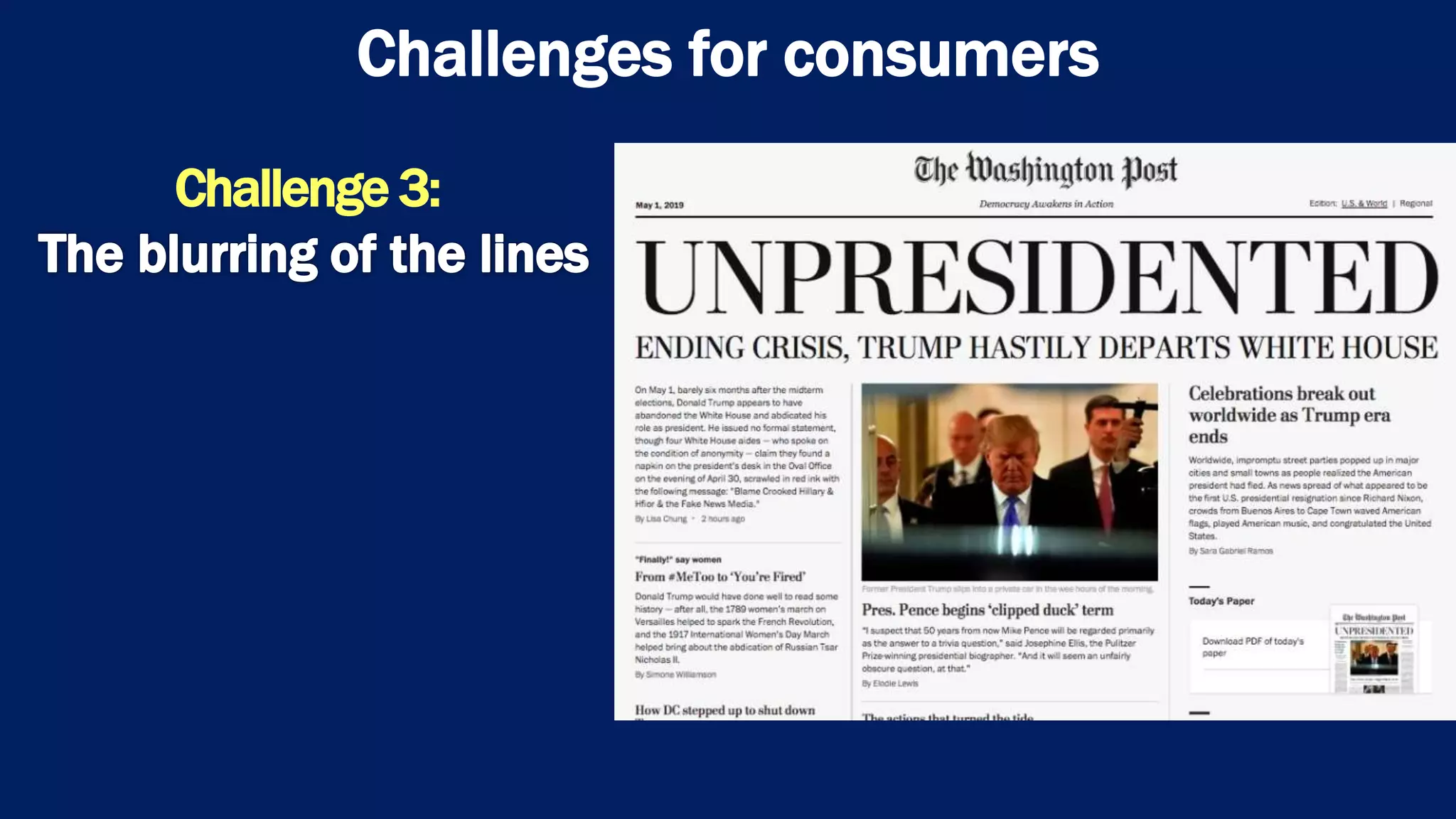
Challenge 3:
Challenges for consumers
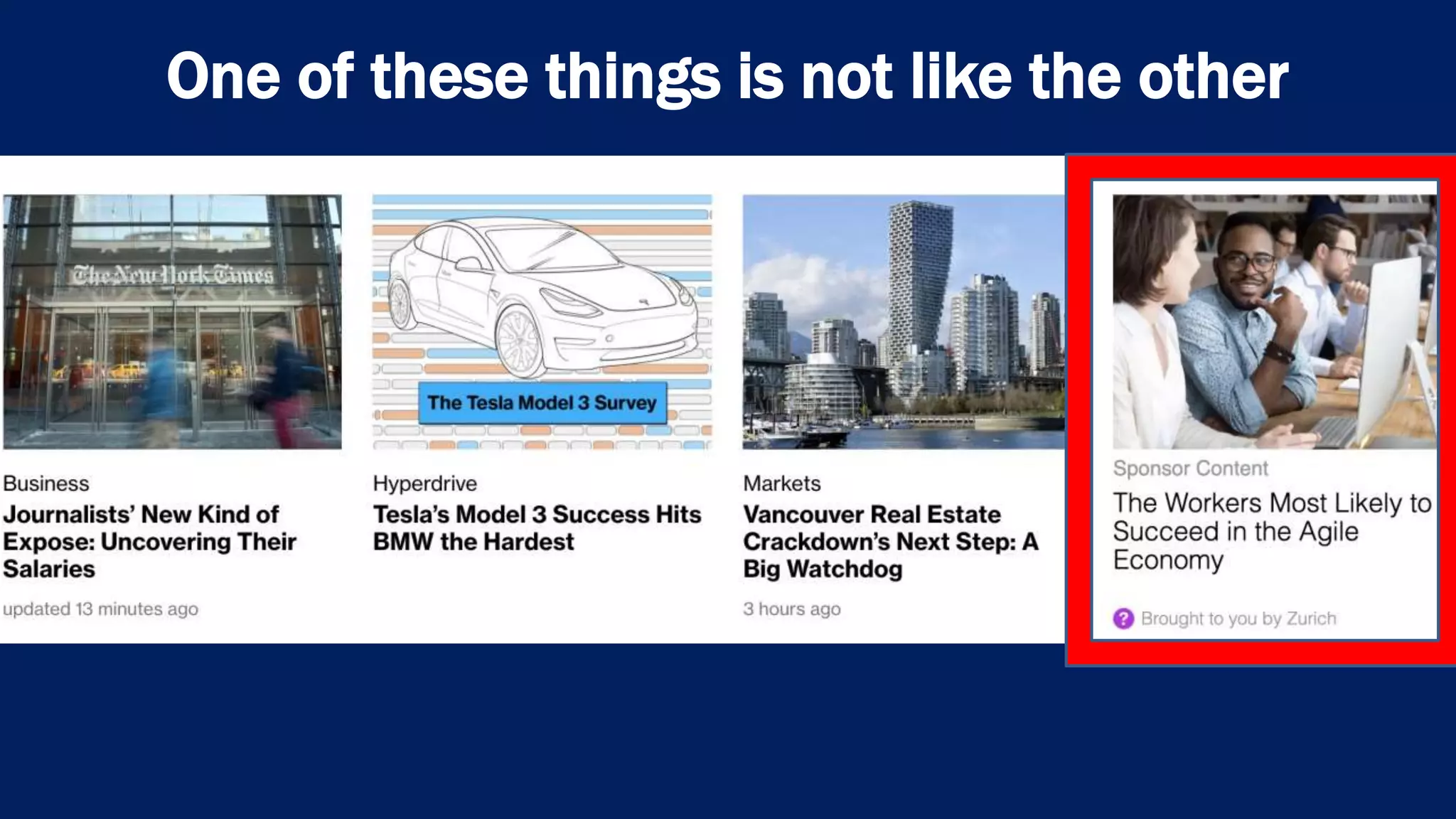
One of these things is not like the other
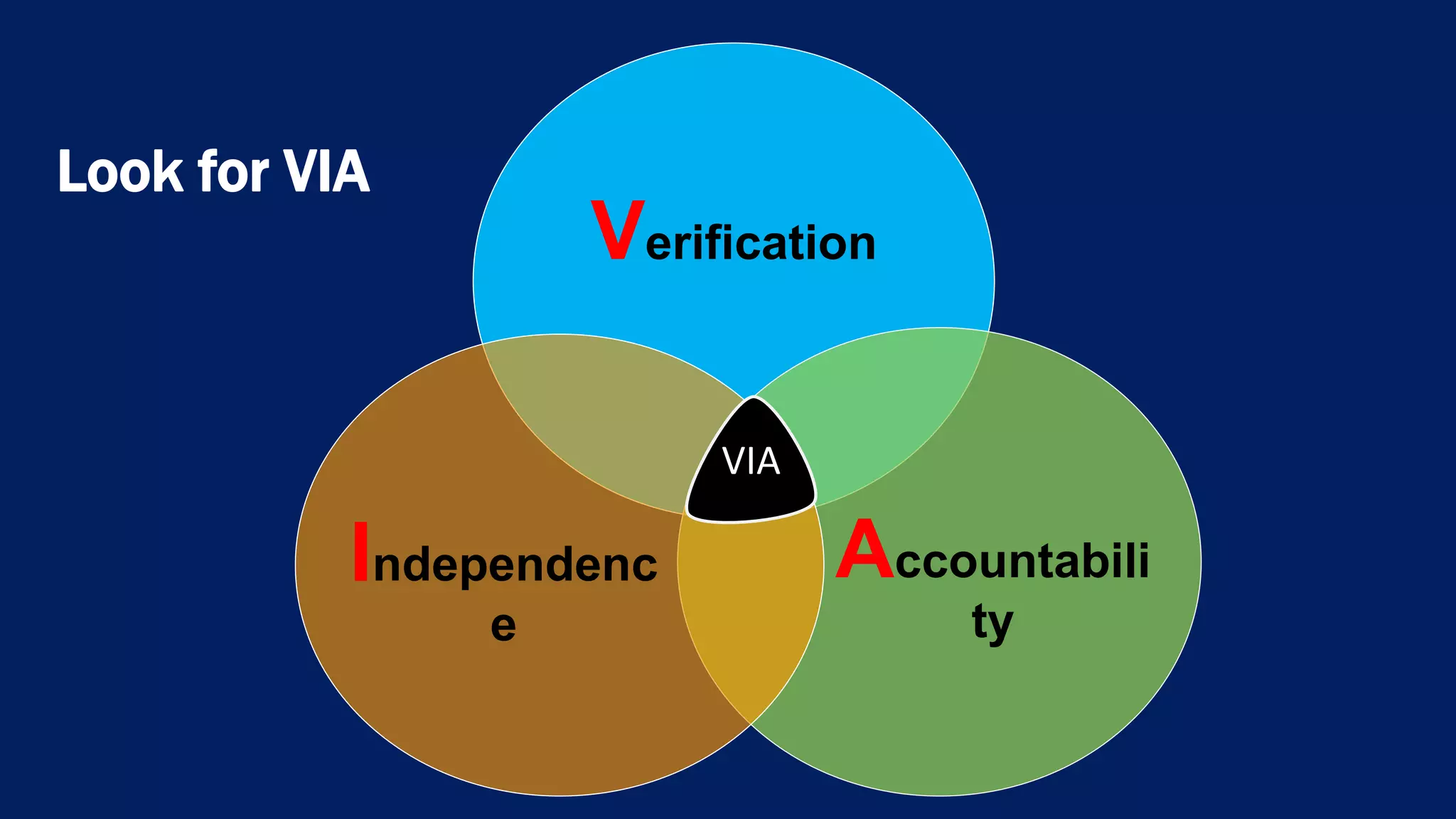
Verification
Accountabili
ty
Independenc
e
VIA
Look for VIA
Challenges for consumers
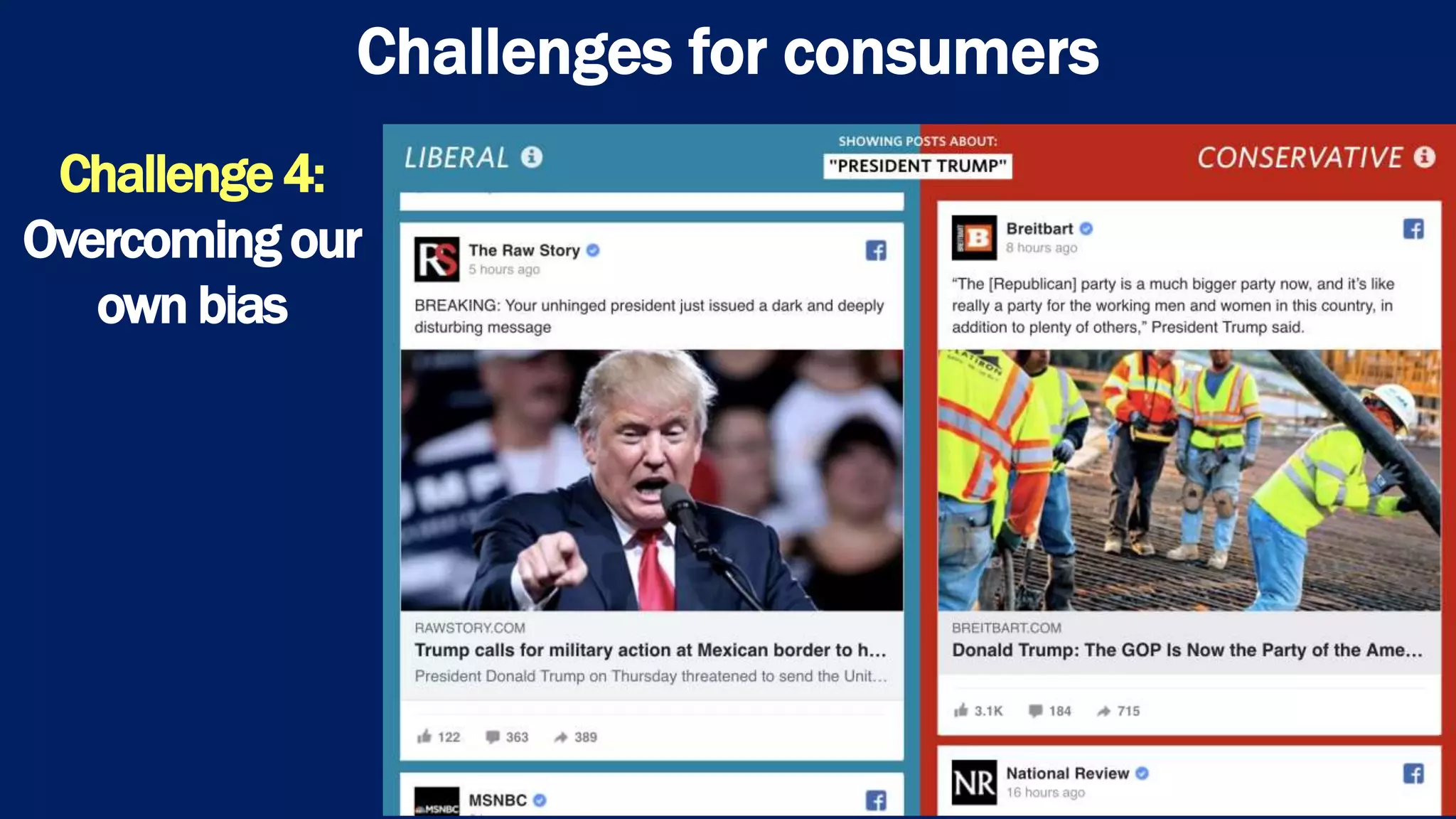
Challenge 4:
Overcoming our
own bias
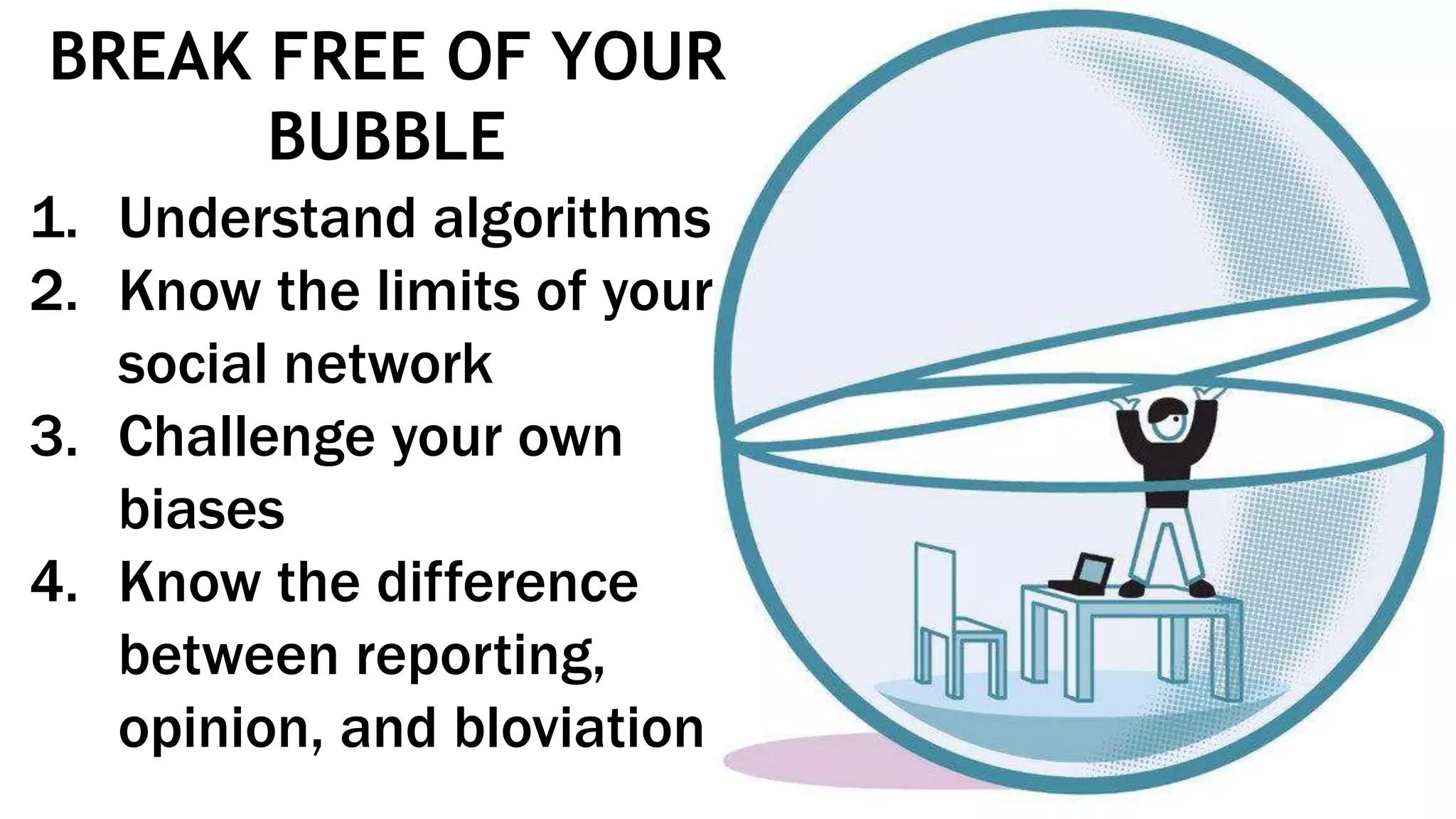
BREAK FREE OF YOUR
BUBBLE
1. Understand algorithms
2. Know the limits of your
social network
3. Challenge your own
biases
4. Know the difference
between reporting,
opinion, and bloviation
You are:
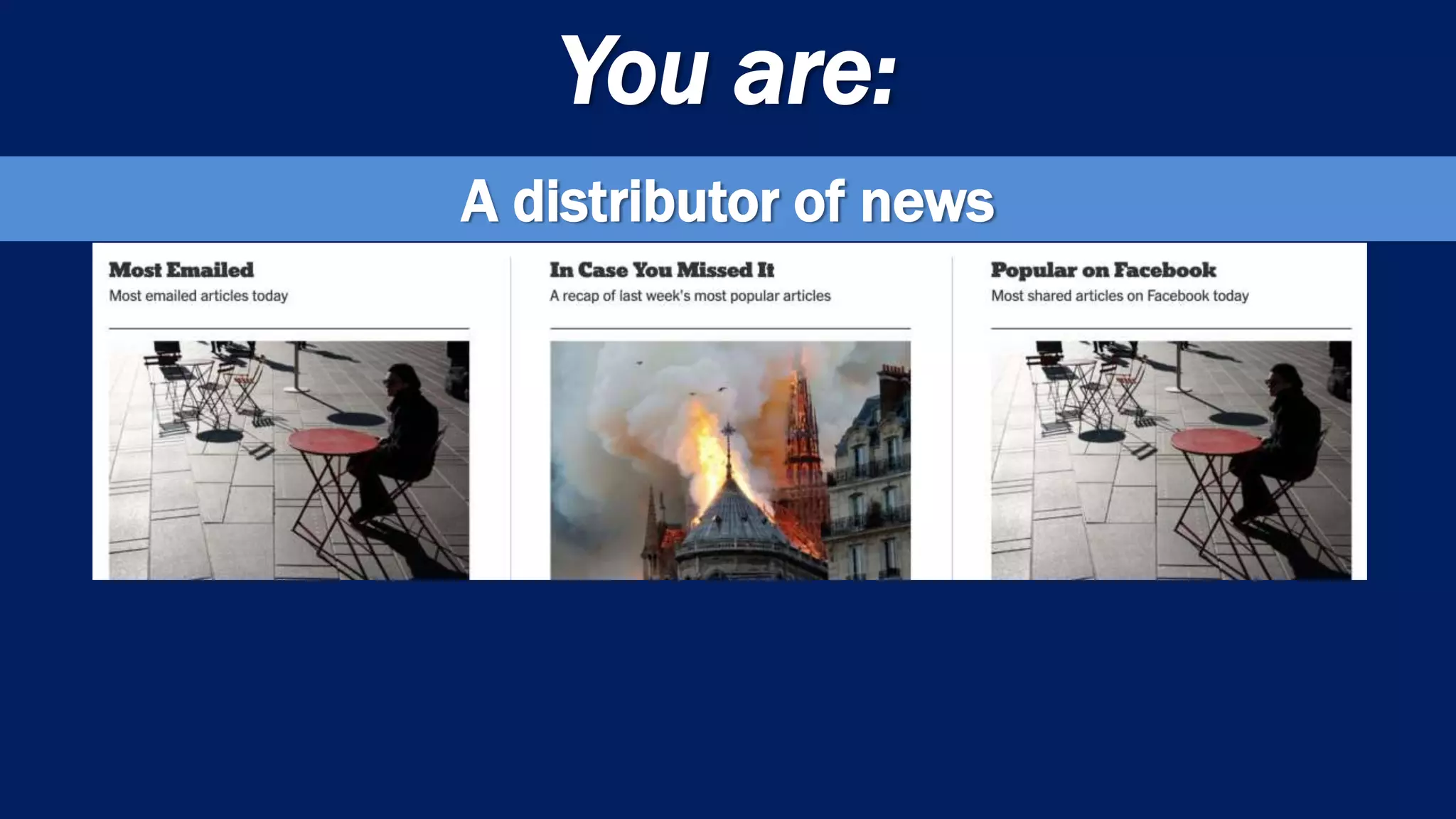
A distributor of news
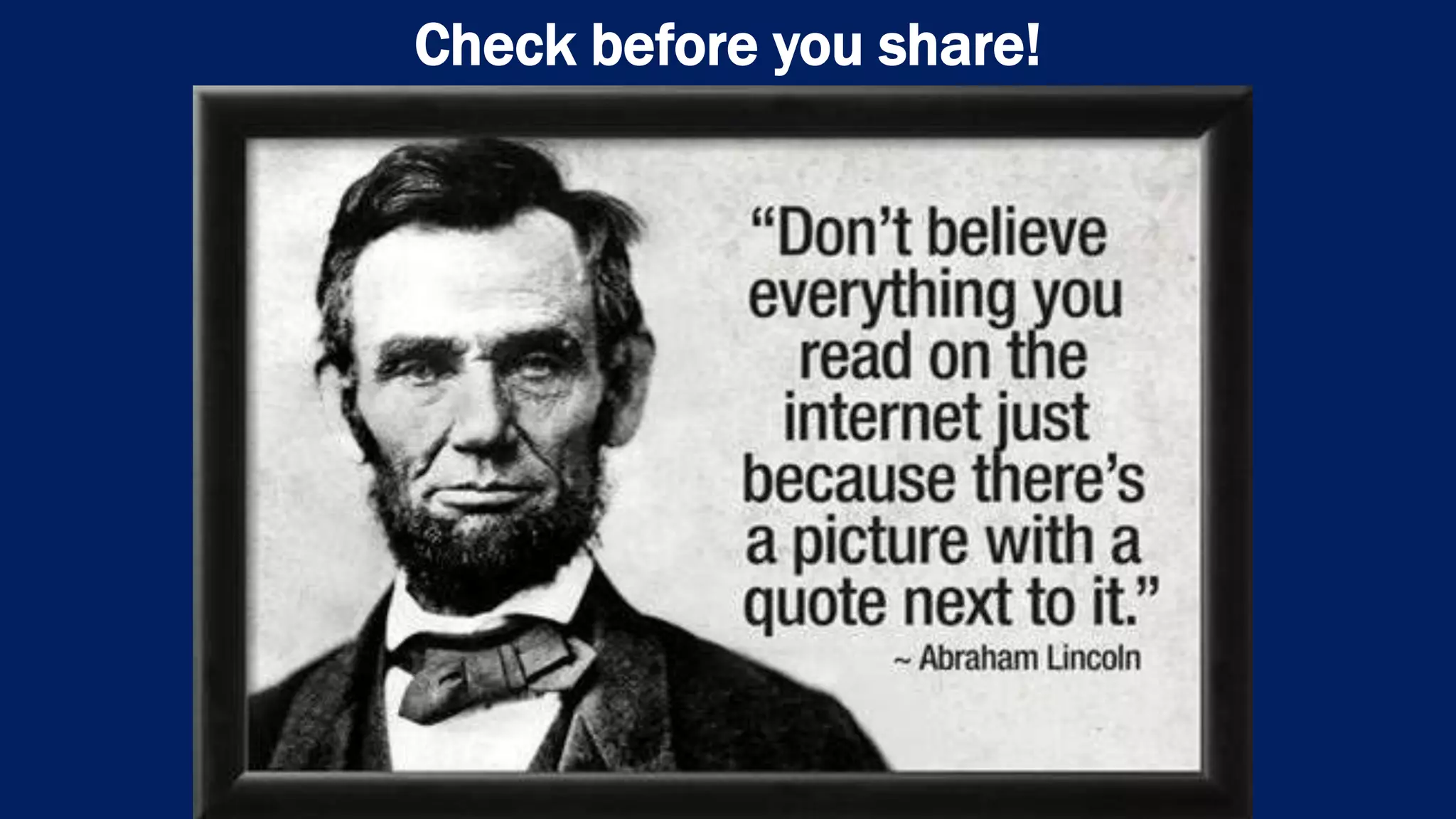
Check before you share!
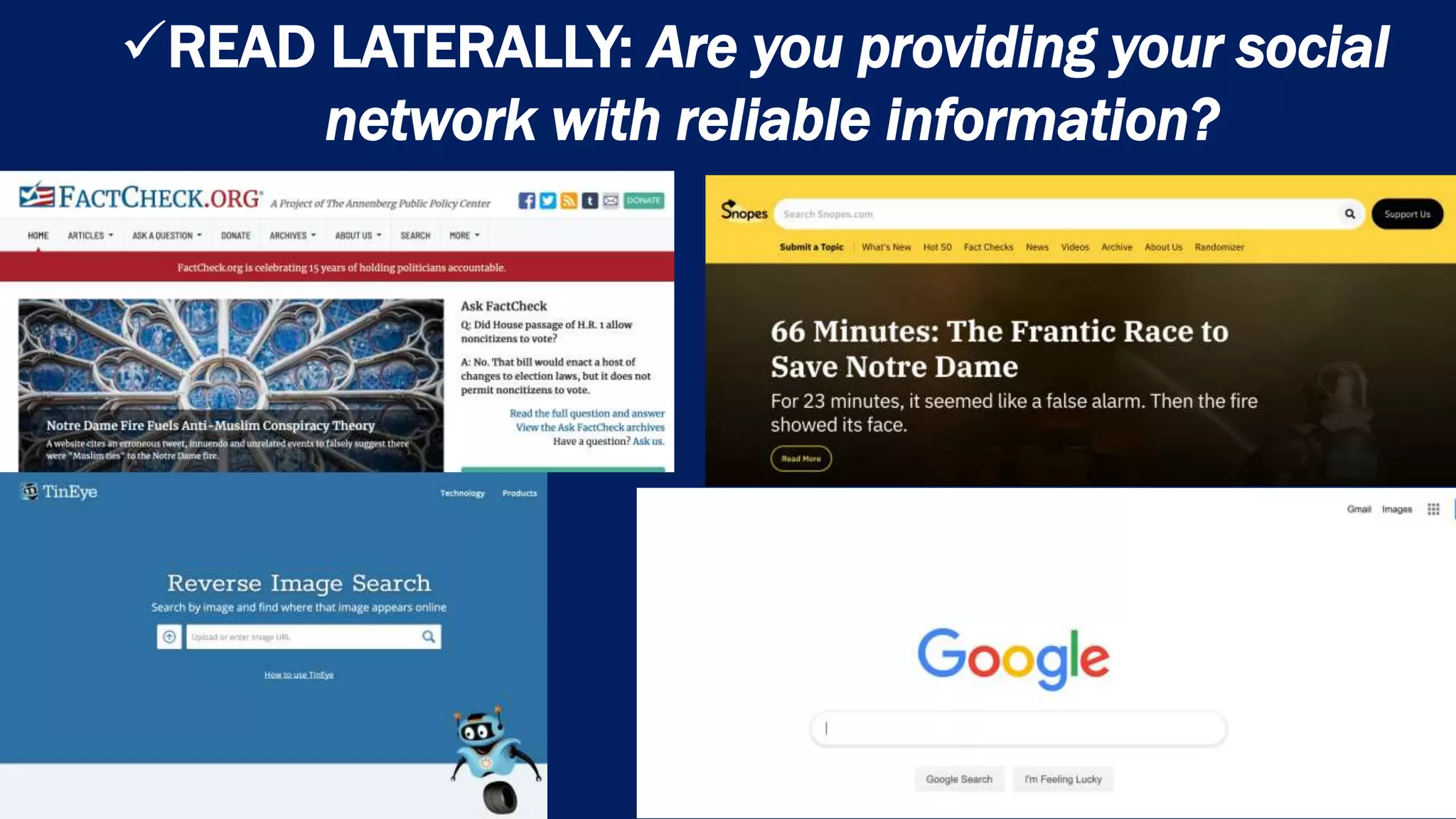
READ LATERALLY: Are you providing your social
network with reliable information?
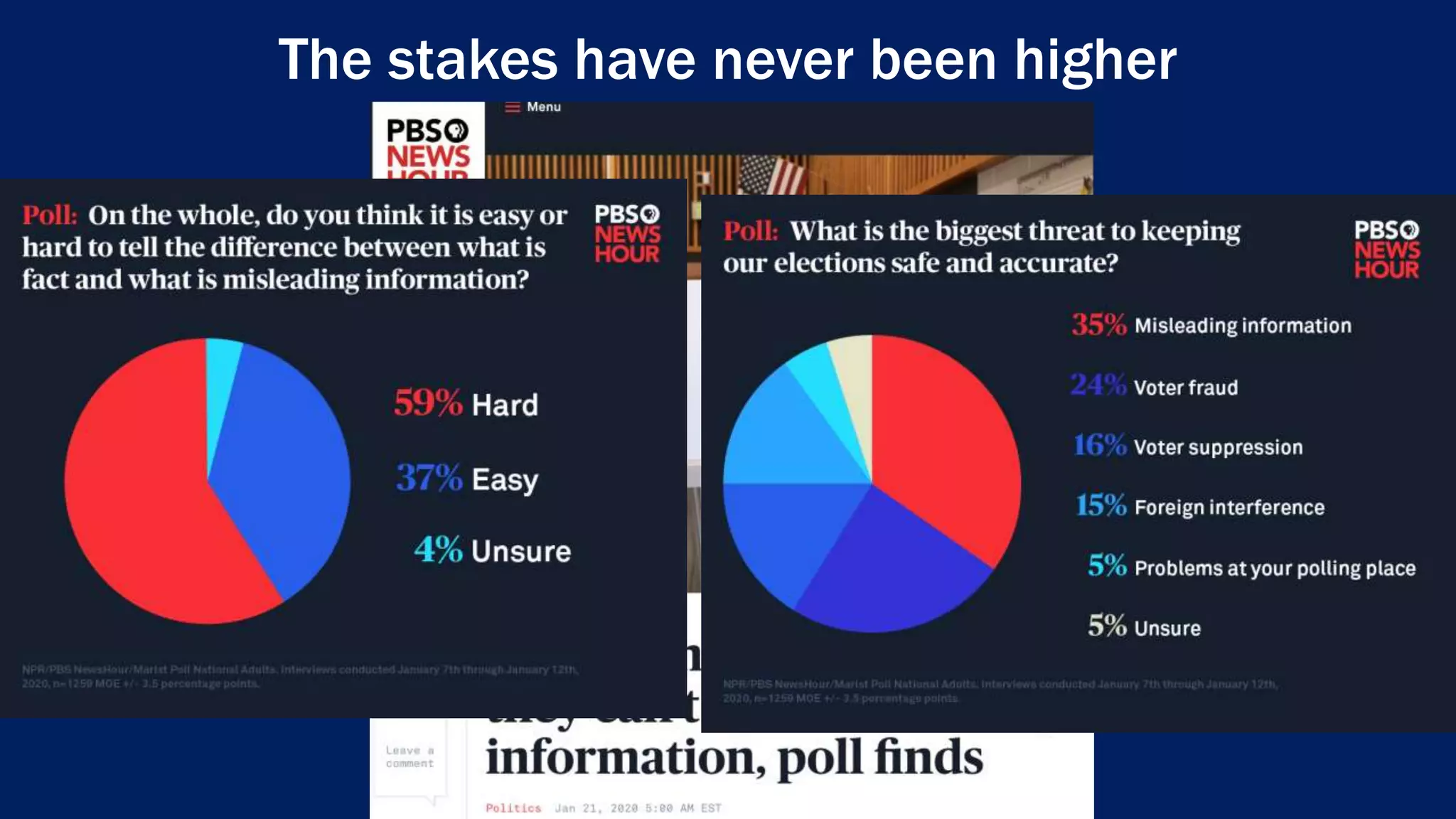
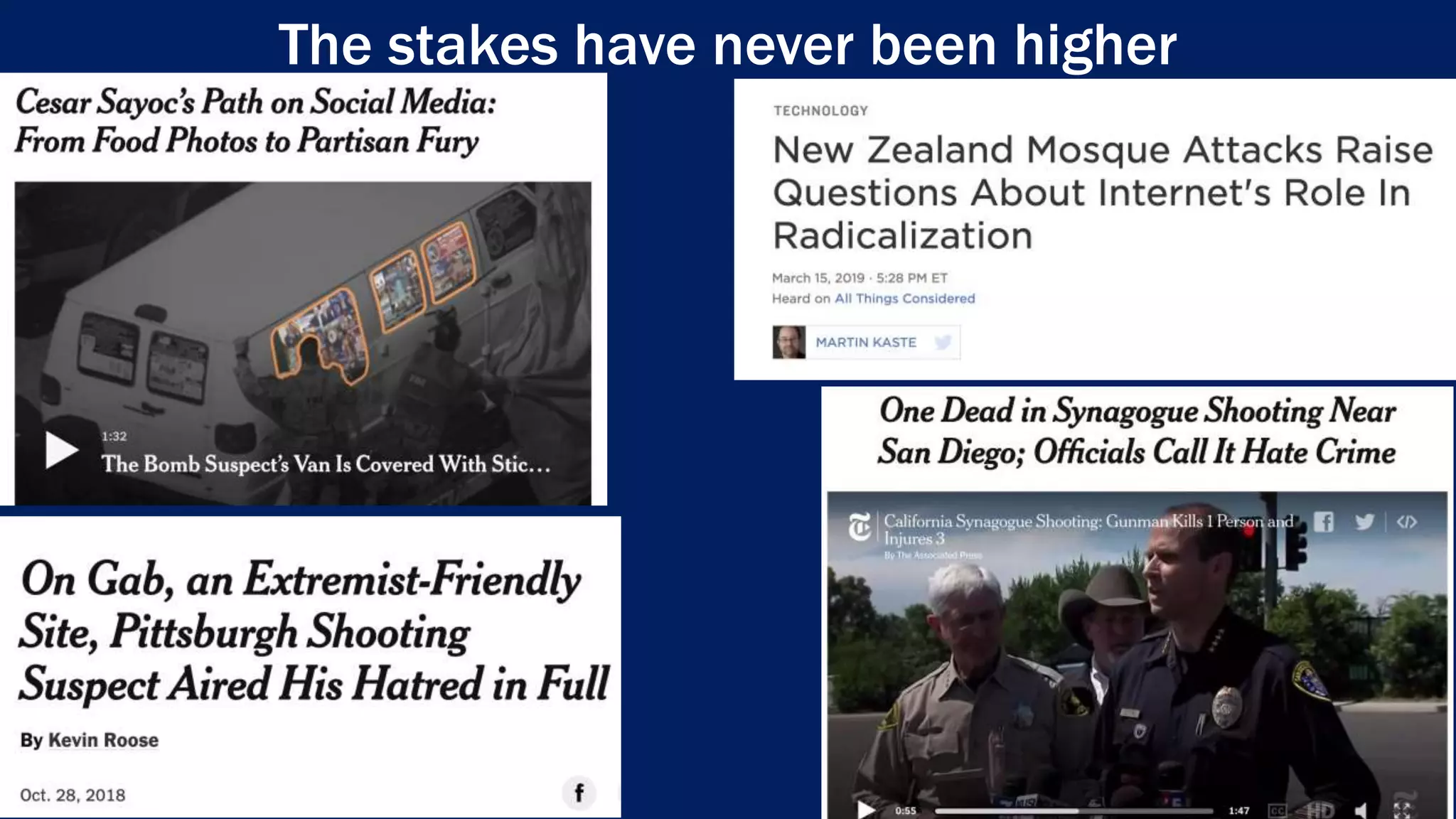
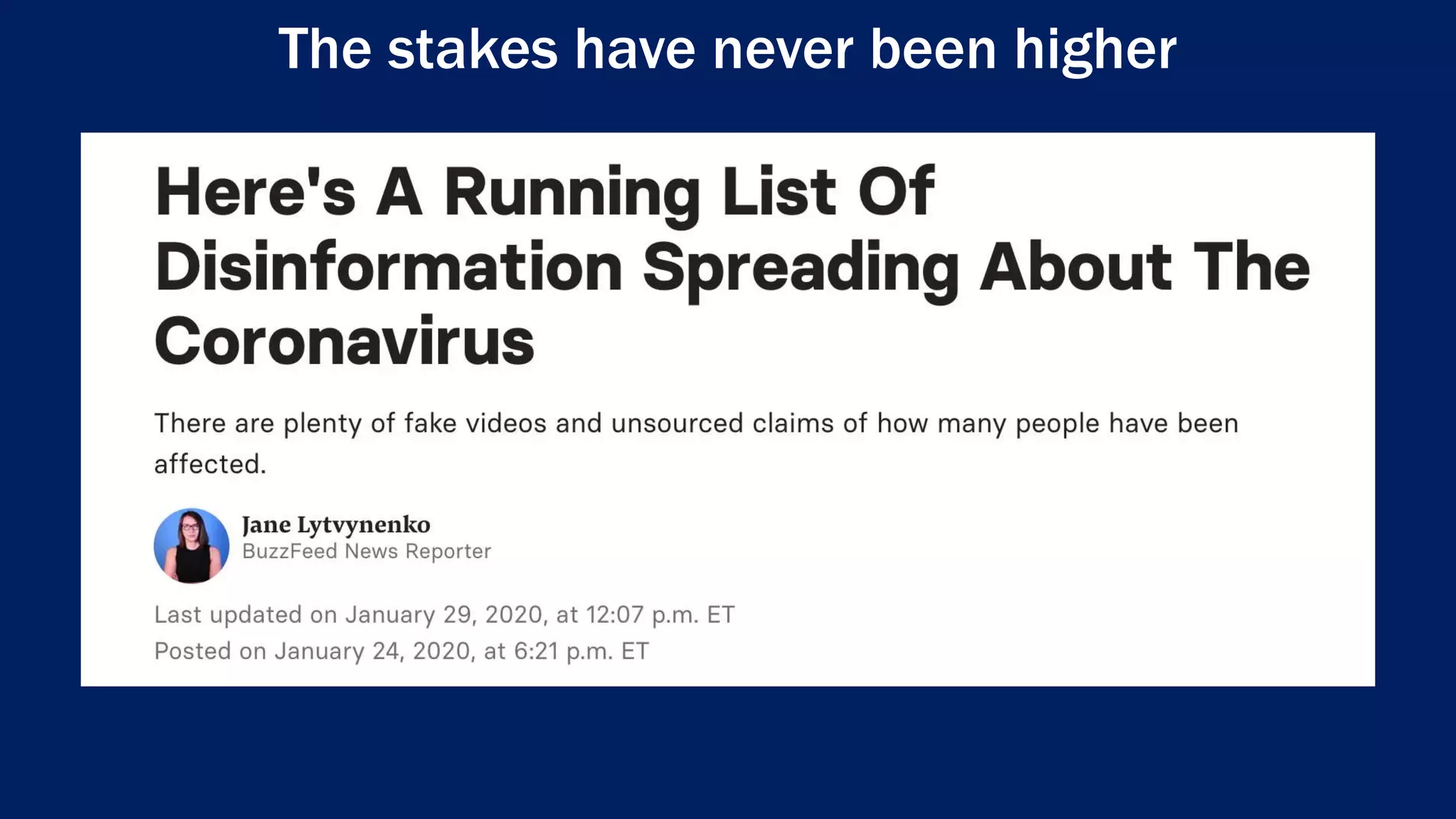
The stakes have never been higher
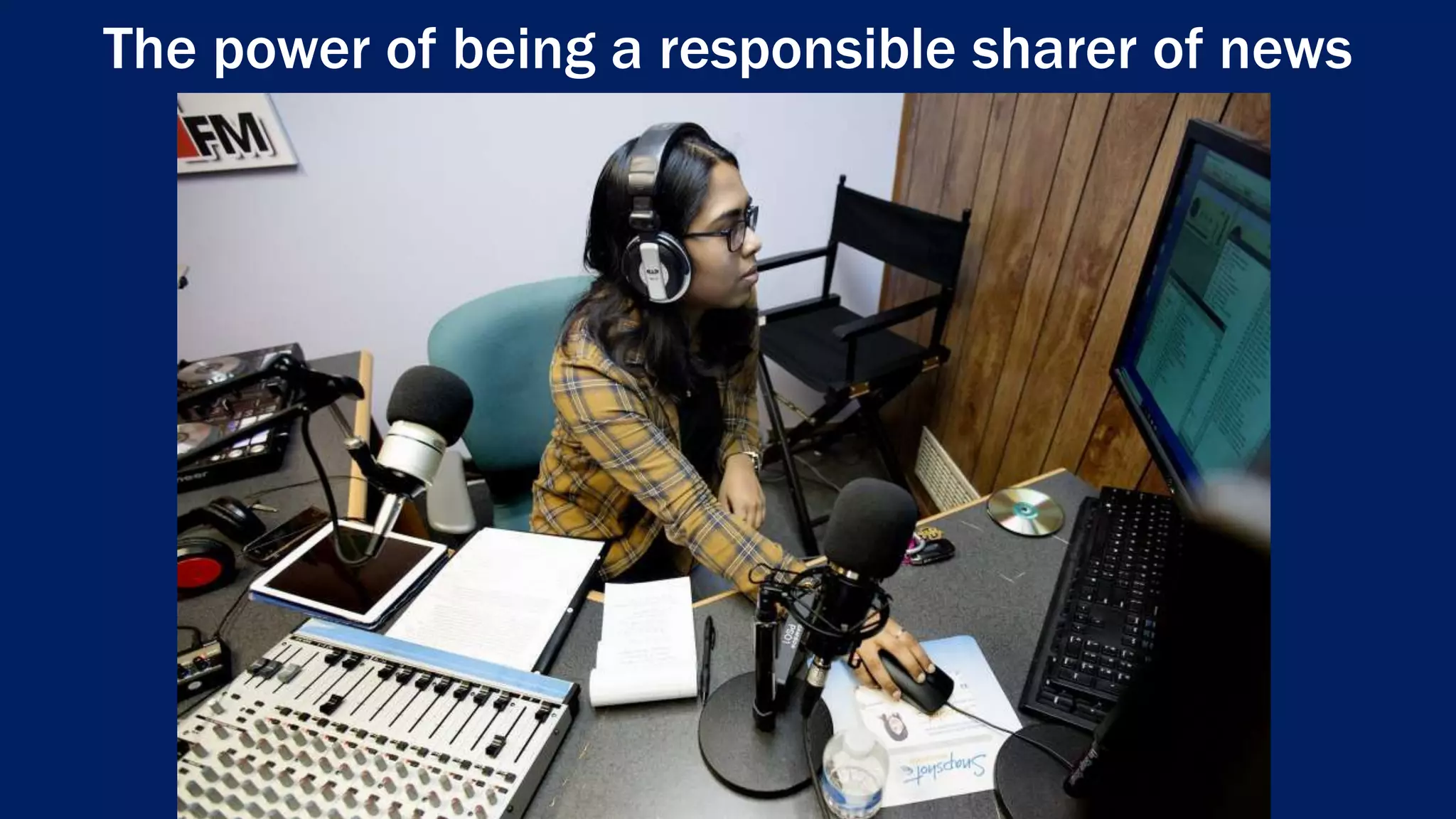
The power of being a responsible sharer of news
You are:
A producer of news
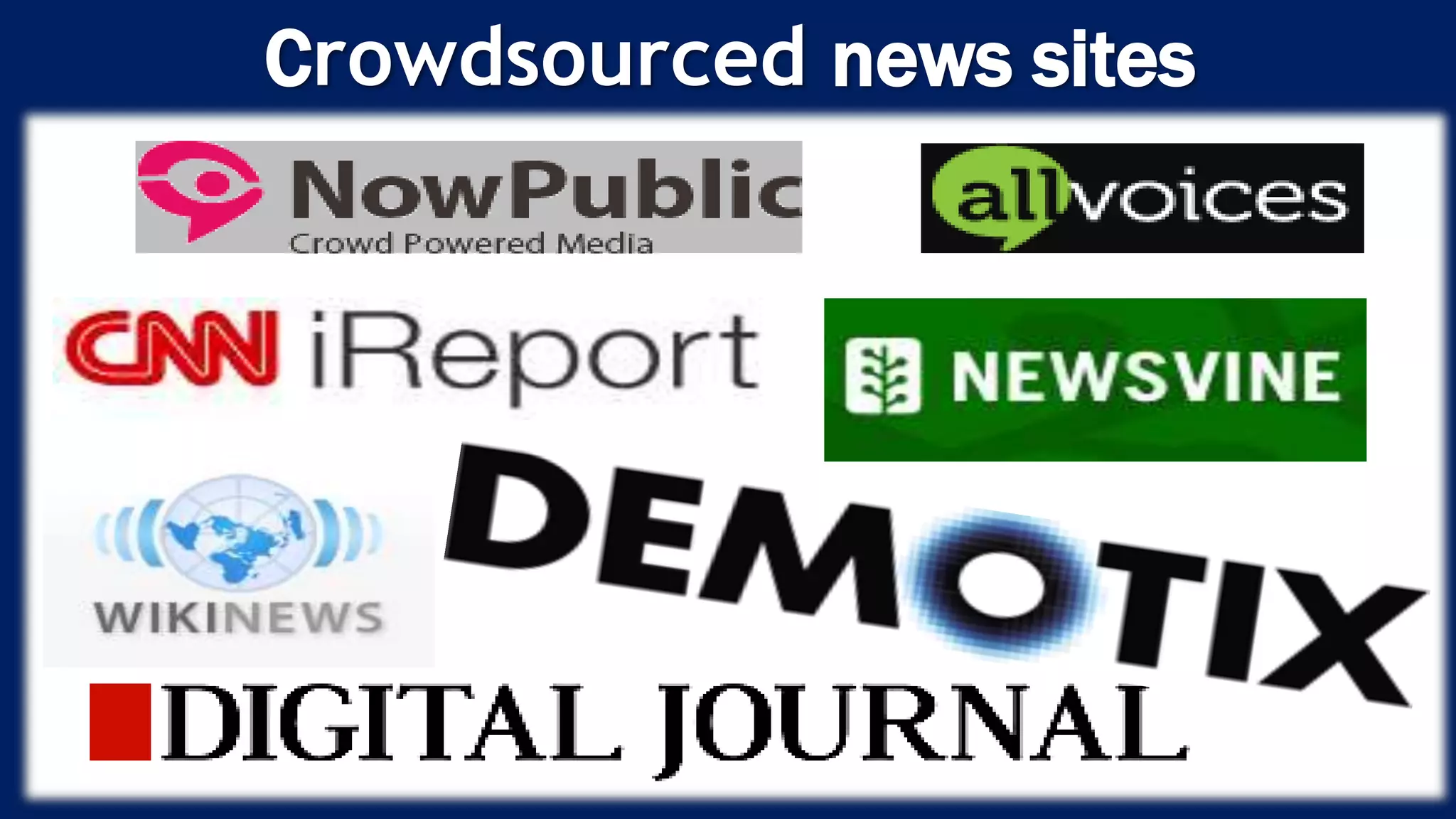
Crowdsourced news sites
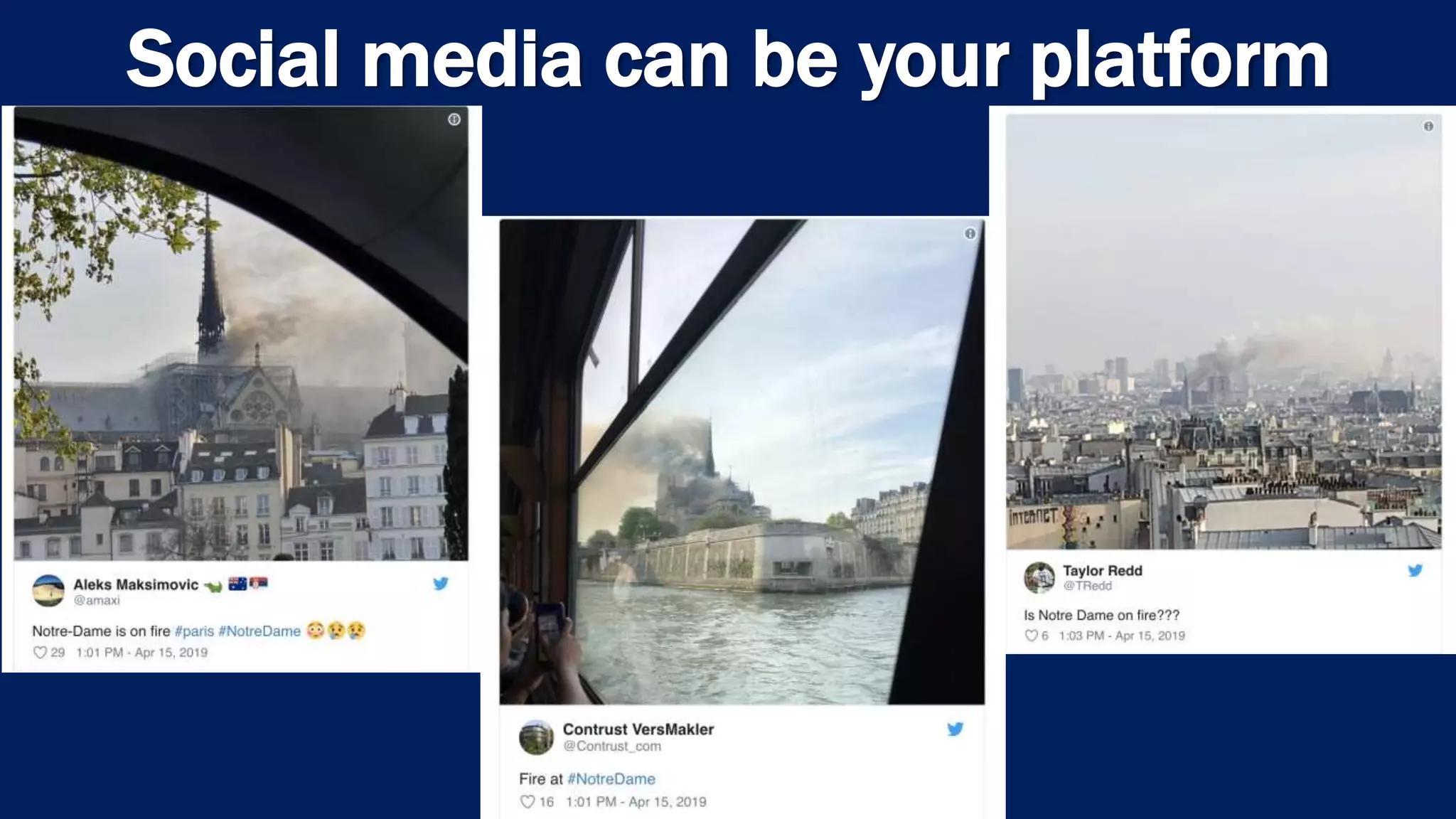
Social media can be your platform
“These days it’s more the act of
journalism that gets you entry into
the tent, not whether you’re doing it
every day, or doing it for pay.”
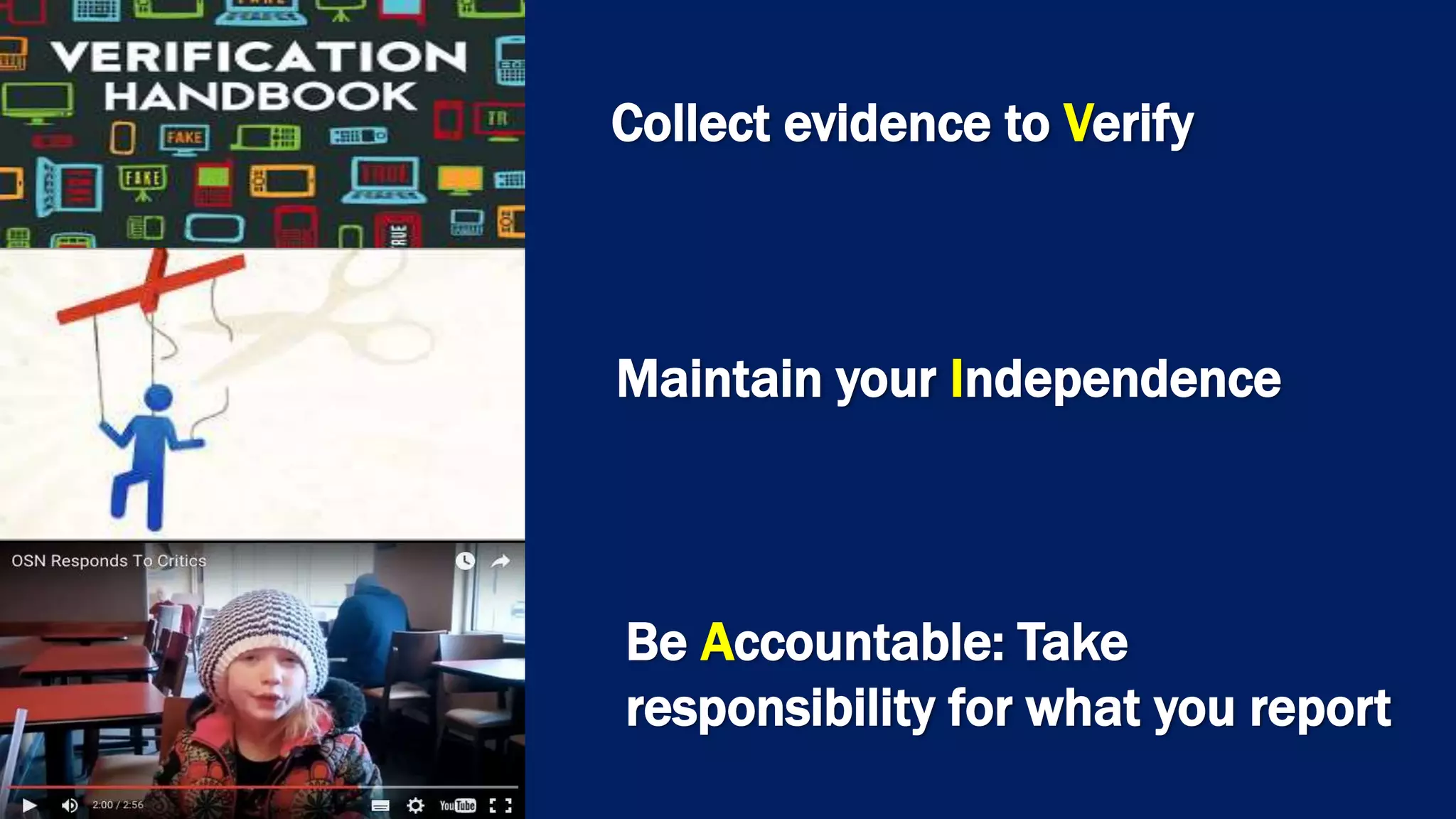
Collect evidence to Verify
Maintain your Independence
Be Accountable: Take
responsibility for what you report
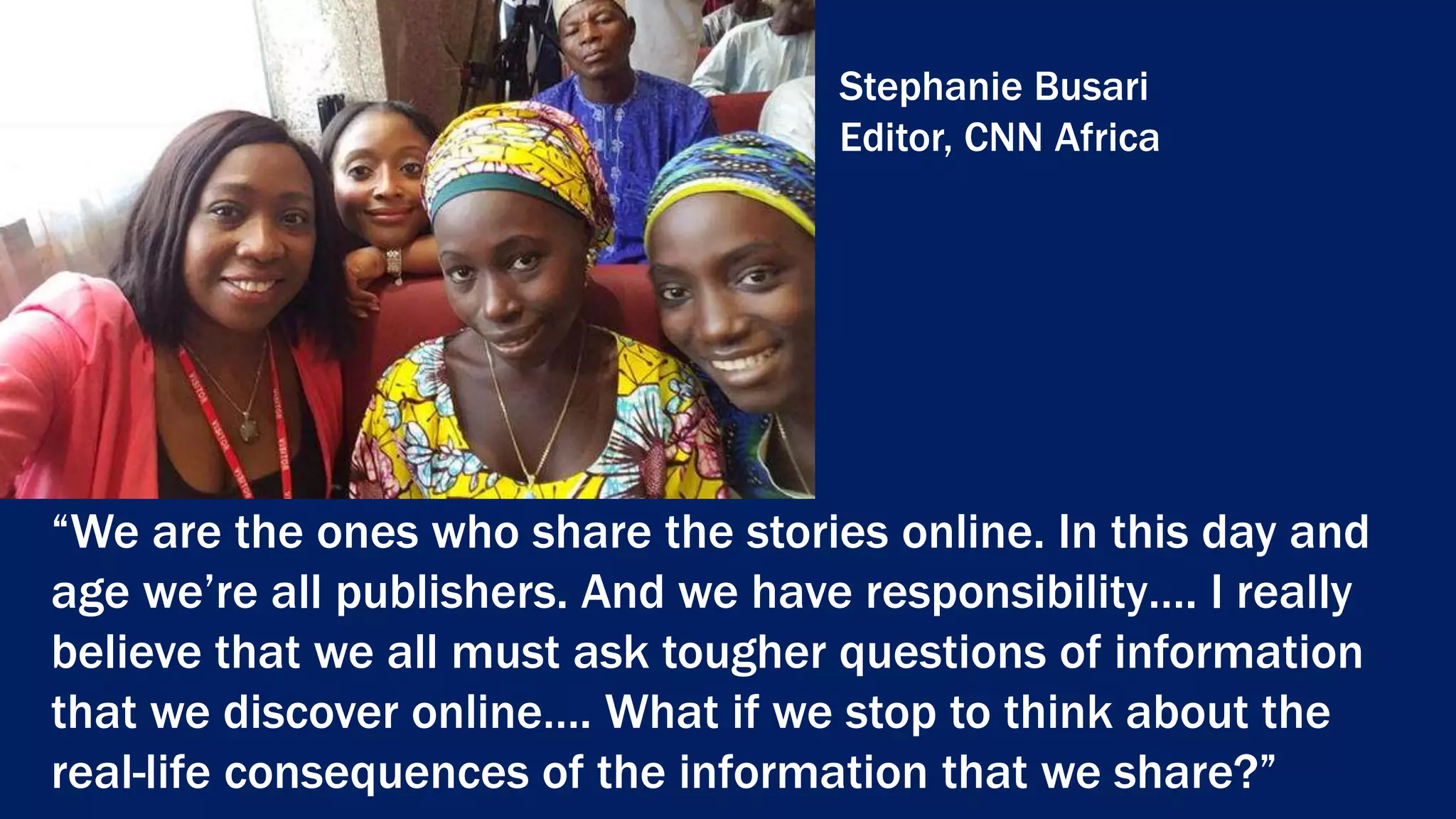
“We are the ones who share the stories online. In this day and
age we’re all publishers. And we have responsibility…. I really
believe that we all must ask tougher questions of information
that we discover online…. What if we stop to think about the
real-life consequences of the information that we share?”
Stephanie Busari
Editor, CNN Africa

News Literacy, Final Lecture Fall 2023

Editor's Notes

  • #4 You have three roles in the digital age. Each comes with its share of responsibilities. Of course, we are news consumers. As such, it’s in our best interest to find reliable information on which we can act. We also now have many different outlets with which to share news. You don’t have to wait until the family gathers around the dinner table to discuss the news, as social media functions as an instant platform to spread the news you consume with your friends, family, and acquaintances. You might also share news you’ve made online or through social media. Hilde Kate Lysiak has done it! In all three roles you play, the lessons of news literacy will be important.
  • #5 We would all benefit from better journalism. But given the precarious financial state of newspapers, the unfortunate compromises forced by the tension between profit and public service such as native advertising, and the vast number of news outlets of varying quality--we can’t expect heroic journalists to save us. We have to take responsibility for the news and information we consume, share, and produce.
  • #6 Facebook promised to institute a stricter policy on anti-vaccination misinformation in ads back in February, a policy it expanded sitewide in March. That crackdown, however, appears to be penalizing some legitimate healthcare providers while letting some anti-vaccine conspiracies slide, even as the United States faces its largest outbreak of diseases preventable by vaccines in decades.  This month, the Idaho Department of Health and Welfare, the state’s official health department, bought 14 ads to promote a statewide program providing free pediatric vaccinations. Facebook removed all of them. During the same time period, Children’s Health Defense, an anti-vaccine nonprofit founded and chaired by the nation’s most prominent vaccine conspiracy theorist, Robert F. Kennedy Jr., successfully placed more than 10 ads stoking unfounded fear about vaccines and other medical conspiracy theories. Some of the ads skirted around their intent, and some did not: One promised to reveal the truth about the “MMR Vaccine’s Poison Pill”—the commonplace vaccine against mumps, measles, and rubella. It reached between 10,000 and 50,000 people, and Facebook took in between $100 and $500 for the ad. Another page promoted a link to a website called vaccineholocaust.org without issue in June. The group Michigan for Vaccine Choice, which advocates for exemptions from mandatory vaccines, is still running an ad that began mid-July. All of the ads draw ideas from a debunked web of conspiracy theories arguing that vaccines pose hidden dangers and the risk of “vaccine injury” means children should be denied potentially life-saving immunizations.  The Minnesota Hospital Association, which lobbies the Minnesota legislature on behalf of the state’s hospitals, buys Facebook ads to fight vaccine disinformation and promote conversations with healthcare providers about vaccines. Over the last two months, Facebook has removed dozens of their ads. Facebook flags the group’s advertisements referencing vaccines far more often than any of its other ad campaigns, which cover medical issues like mental illness, addiction, and vaping-related illnesses.  https://www.thedailybeast.com/facebook-axed-pro-vaccine-ads-from-hospitals-and-health-orgs-let-anti-vaxxer-ads-slip-through
  • #7 Google (which owns YouTube), Facebook (which owns Instagram), Twitter, and other platforms have attempted to filter out disinformation and hate speech, but their efforts (at best) have been partially successful. The sheer volume of information may make it impossible to catch every bit of misleading and hateful information in their net. And technology, like the human beings who develop it, is fallible. YouTube provided fact checks on the Notre-Dame cathedral fire, but mistakenly provided facts about the 9/11 attacks of 2001. Moreover, the main interest of these platforms is to keep users on these platforms—so their efforts will only go so far. https://www.nytimes.com/2019/04/16/technology/youtube-notre-dame-fire.html
  • #8 How will news consumers be able to tell whether news producers will give them reliable news they can use? We have to trust ourselves, cultivate our critical-thinking faculties, as we seek to play a productive role in a confusing information landscape.
  • #9 You have three roles in the digital age. Each comes with its share of responsibilities. Of course, we are news consumers. As such, it’s in our best interest to find reliable information on which we can act. We also now have many different outlets with which to share news. You don’t have to wait until the family gathers around the dinner table to discuss the news, as social media functions as an instant platform to spread the news you consume with your friends, family, and acquaintances. You might also share news you’ve made online or through social media. In all three roles you play, the lessons of news literacy will be important.
  • #10 Remember when The Daily Beast cited this impostor “Reuter” Twitter account in a story on a shooting at a Quebec mosque?
  • #11 The first thing we must do is slow down. The pace of news won’t change, but we have to pause, take a deep breath, let our initial emotional response pass, and then begin to methodically interrogate the information in front of us. But how do we go about interrogating the information we encounter on social media and online??
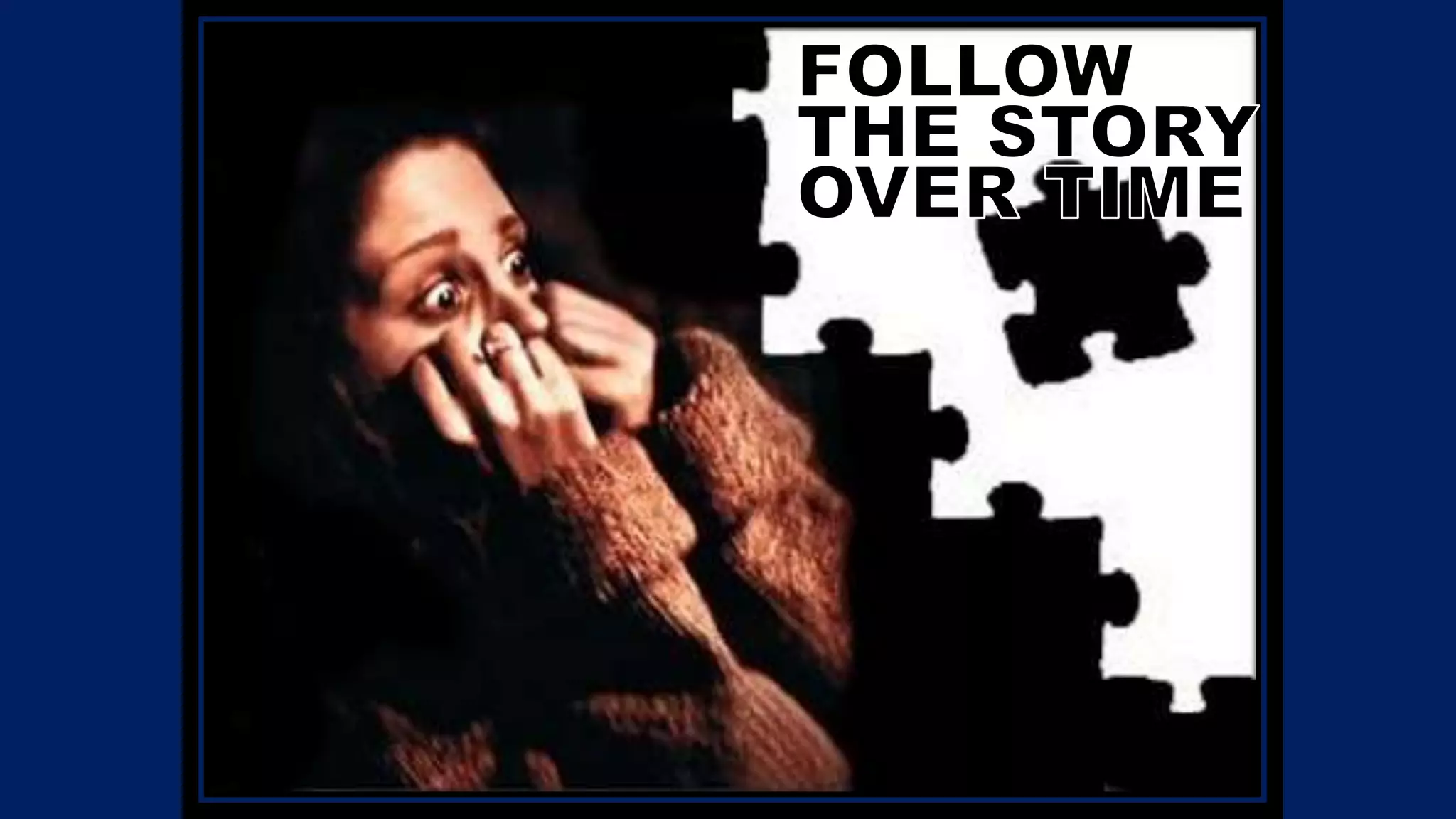
  • #12 ANIMATION: Typewriter effect adds the key message: Follow the story over time. Fornews consumers, the LESSON is: FOLLOW THE STORY OVER TIME!!!! Our knowledge, those verified beliefs in which we are reasonable confident, depends on what information is available…and that changes over time. We must be vigilant, and tireless in the pursuit of better and more complete information, always ready to revise our beliefs and update them according to the latest evidence. And that means looking for journalists who are tireless and open to reversing their account, if the latest evidence demands it. (With each click, repeat the phrase)
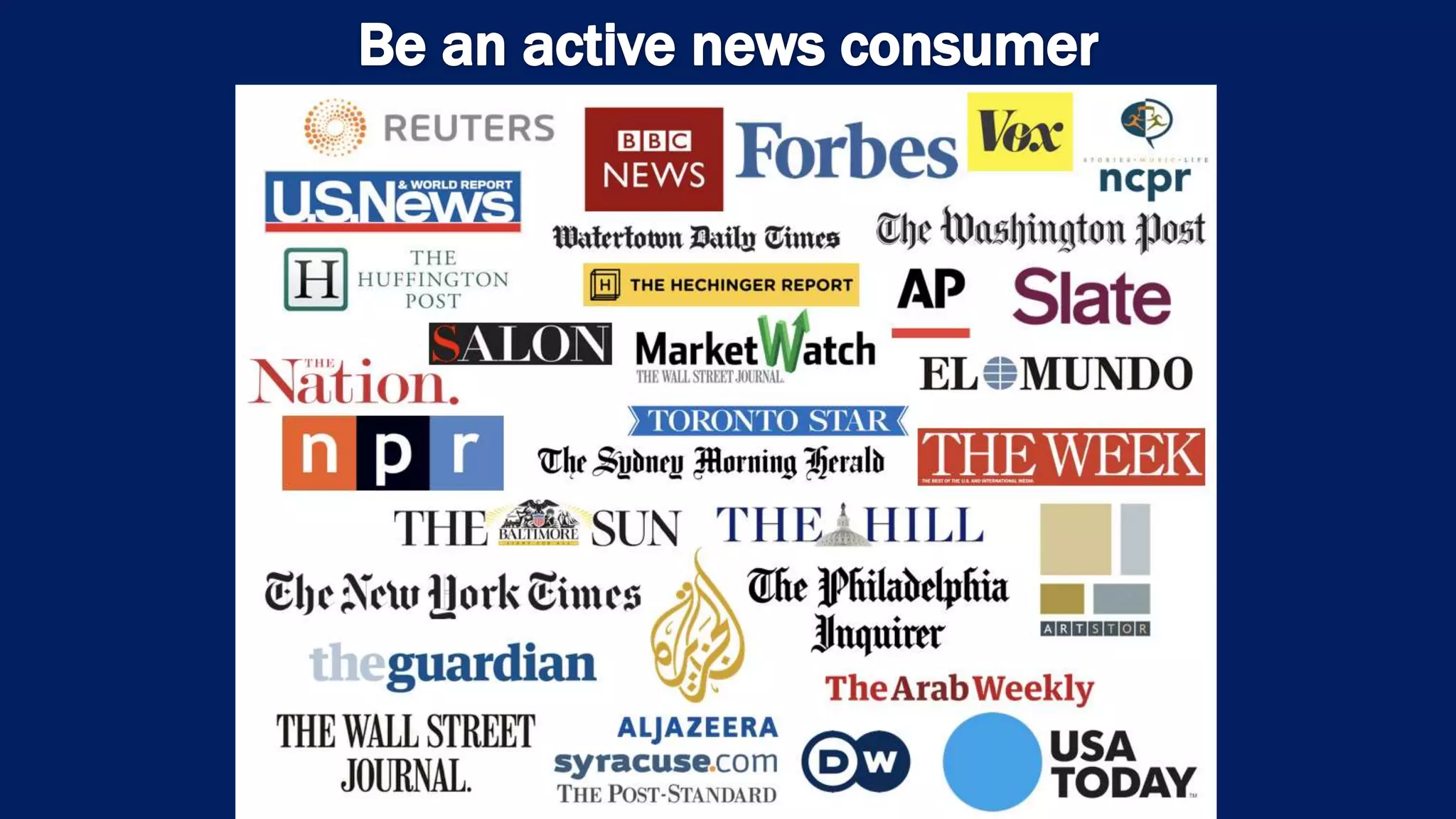
  • #14 It’s a good idea to follow news outlets where they live, not just on social media. Evaluate an outlet—does it live up to the standards of VIA?—and decide whether it’s worth following, its stories worth sharing with others.
  • #15 It’s grown difficult to distinguish one journalism neighborhood from another. This looks just like the Washington Post, and hundreds of copies were published, but its contents are made up.
  • #17 Let’s start with VIA Verification, Independence and Accountability — we use the mnemonic device VIA — are the three defining attributes of journalism. If all three are not present, you’re not in the journalism neighborhood. We should use these same criteria on any information we see. --Verification: The process that establishes or confirms the accuracy or truth of something. --Independence: freedom from the control, influence, or support of interested parties. --Accountability: Responsible or answerable for your work. Unless all three attributes are present, what you have may be interesting, informative or provocative – it might even be true – but it’s not journalism. Knowing that, let’s take a closer look at Verification, Independence and Accountability and whether each comes into play on the Clinton.News web page.
  • #18 Often we intentionally seek out news that suits our views (confirmation bias). Also social media algorithms reinforce our beliefs.
  • #19 We must be active consumers of news, and actively challenge ourselves with new information. Can we handle the truth?
  • #20 You have three roles in the digital age. Each comes with its share of responsibilities. Of course, we are news consumers. As such, it’s in our best interest to find reliable information on which we can act. We also now have many different outlets with which to share news. You don’t have to wait until the family gathers around the dinner table to discuss the news, as social media functions as an instant platform to spread the news you consume with your friends, family, and acquaintances. You might also share news you’ve made online or through social media. In all three roles you play, the lessons of news literacy will be important.
  • #21 Armed with the skills to find reliable information, make sure that the information you share Is verified!
  • #22 Take advantage of the tools available to check information, before passing it on to others. Fact-checking sites like FactCheck.org, Snopes.com, and others, and reverse-image search engines like TinEye, are valuable resource. Sometimes a simple Google search can be revealing (with the caveat that rank does not equal reliability).
  • #23 Why does it matter? The problems we face go beyond ”fake news”: fabricated stories that resemble legitimate journalism. Deception can be more subtle. And Americans are quite worried about misleading information on social media, during the upcoming election. This problem gets at the heart of citizenship, of what it means to be an American. We rely on the news to make important decisions every day, and among the most profound decisions we make center on our lives as citizens—being engaged in the political process. If misleading information leads us astray, our society and government may be led astray as well. https://www.pbs.org/newshour/politics/social-media-disinformation-leads-election-security-concerns-poll-finds
  • #24 Does it even matter what’s true and what’s not? Yes, it does. Perpetrators of hate find outlets online, for expressing that hate, finding likeminded bigots, and even acting on their hate. https://www.nytimes.com/2018/10/27/technology/cesar-sayoc-facebook-twitter.html?module=inline https://www.nytimes.com/2018/10/28/us/gab-robert-bowers-pittsburgh-synagogue-shootings.html?module=inline https://www.npr.org/2019/03/15/703912101/new-zealand-mosque-attacks-raise-questions-about-internets-role-in-radicalizatio https://www.nytimes.com/2018/10/29/technology/hate-on-social-media.html
  • #25 Threatening our health: https://www.buzzfeednews.com/article/janelytvynenko/coronavirus-disinformation-spread
  • #26 Saideepika Rayala, a teenager in Powell, Ohio, uses her radio segment called the Columbus Civic Radio Show, to bring local news to immigrants and refugees and connect them to their community. https://www.youtube.com/watch?v=fzybqtSUNC8 https://www.dispatch.com/news/20191020/high-schoolers-monthly-newsletter-helps-link-immigrants-to-columbus-with-stories-in-their-languages?utm_source=API+Need+to+Know+newsletter&utm_campaign=55f1a9bc56-EMAIL_CAMPAIGN_2019_10_25_12_34&utm_medium=email&utm_term=0_e3bf78af04-55f1a9bc56-31701313
  • #27 You have three roles in the digital age. Each comes with its share of responsibilities. Of course, we are news consumers. As such, it’s in our best interest to find reliable information on which we can act. We also now have many different outlets with which to share news. You don’t have to wait until the family gathers around the dinner table to discuss the news, as social media functions as an instant platform to spread the news you consume with your friends, family, and acquaintances. You might also share news you’ve made online or through social media. Hilde Kate Lysiak has done it! In all three roles you play, the lessons of news literacy will be important.
  • #28 There are a number of crowdsourced news sites that you can contribute to without having a press pass. You can learn the tricks of the trade and find outlets for the information you collect. Although Sean Penn is correct that journalists do not require a license to practice their profession, they do embrace a set of professional standards.
  • #29 Ordinary people at or near the scene of the Notre Dame fire informed us. https://www.cnn.com/world/live-news/notre-dame-fire/h_95525fe9d9d98293d09f09f92933c4c8
  • #31 http://www.cjr.org/essay/the_bigger_tent_1.php As the Columbia Journalism Review put it: These days it’s more the act of journalism that gets you entry into the tent, not whether you’re doing it every day, or doing it for pay. There are still distinctions, though. “Old” journalists are called professional, traditional, mainstream, or institutional; “new” ones are amateur, nontraditional, nonprofessional, or citizen journalists.