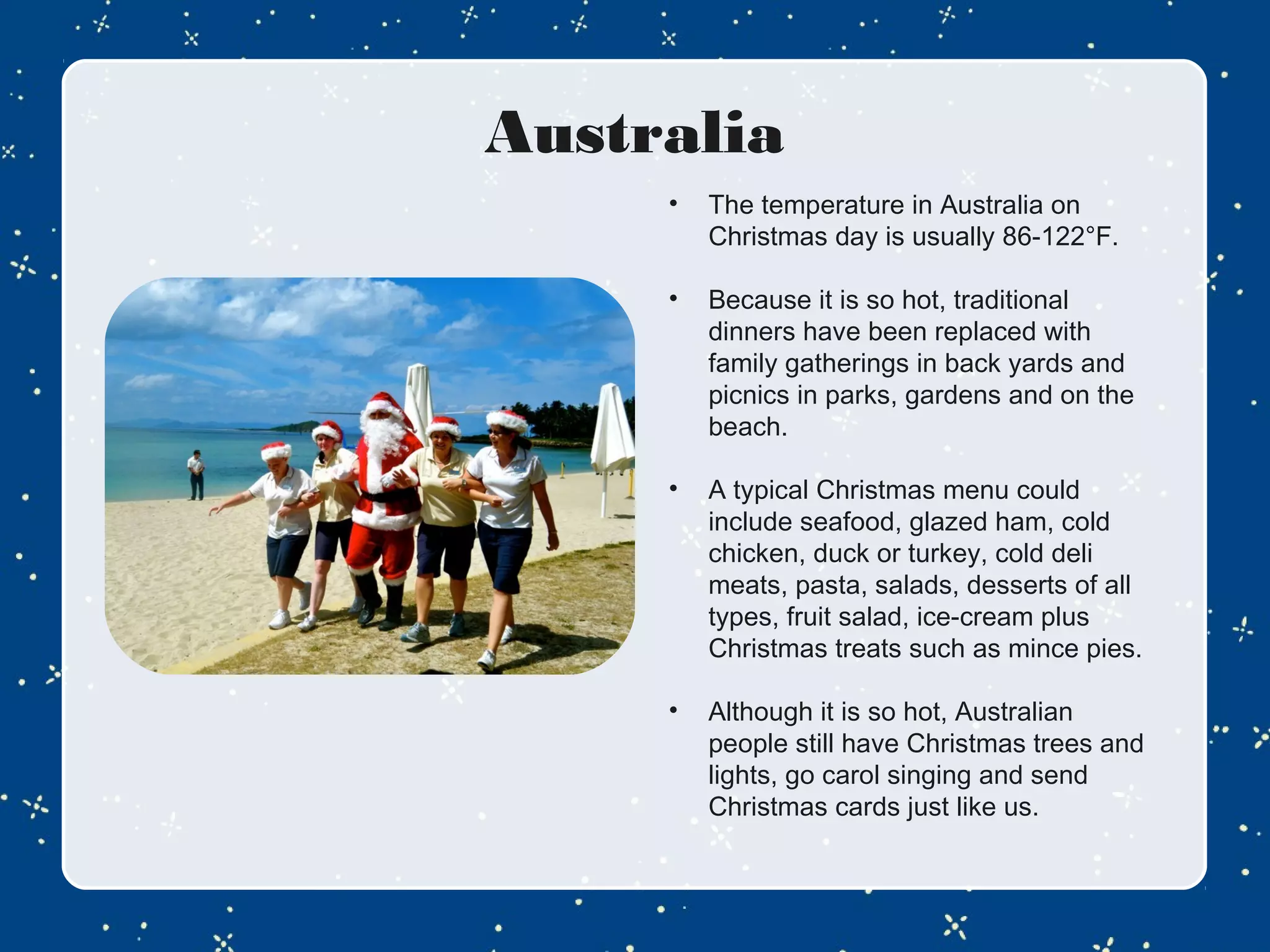
• The temperature in Australia on
Christmas day is usually 86-122°F.
• Because it is so hot, traditional
dinners have been replaced with
family gatherings in back yards and
picnics in parks, gardens and on the
beach.
• A typical Christmas menu could
include seafood, glazed ham, cold
chicken, duck or turkey, cold deli
meats, pasta, salads, desserts of all
types, fruit salad, ice-cream plus
Christmas treats such as mince pies.
• Although it is so hot, Australian
people still have Christmas trees and
lights, go carol singing and send
Christmas cards just like us.
Australia
China
• Christians in China celebrate by
lighting their houses with paper
lanterns.
• Christmas trees are called ‘trees of
light’ and are decorated with paper
chains, paper flowers and paper
lanterns.
• Lots of people in China do not
celebrate Christmas. The main
winter festival is called Chinese New
Year which takes place in January.
Chinese people worship their
ancestors during Chinese New Year.
• The Christmas feast in Denmark is
celebrated at midnight on
Christmas Eve.
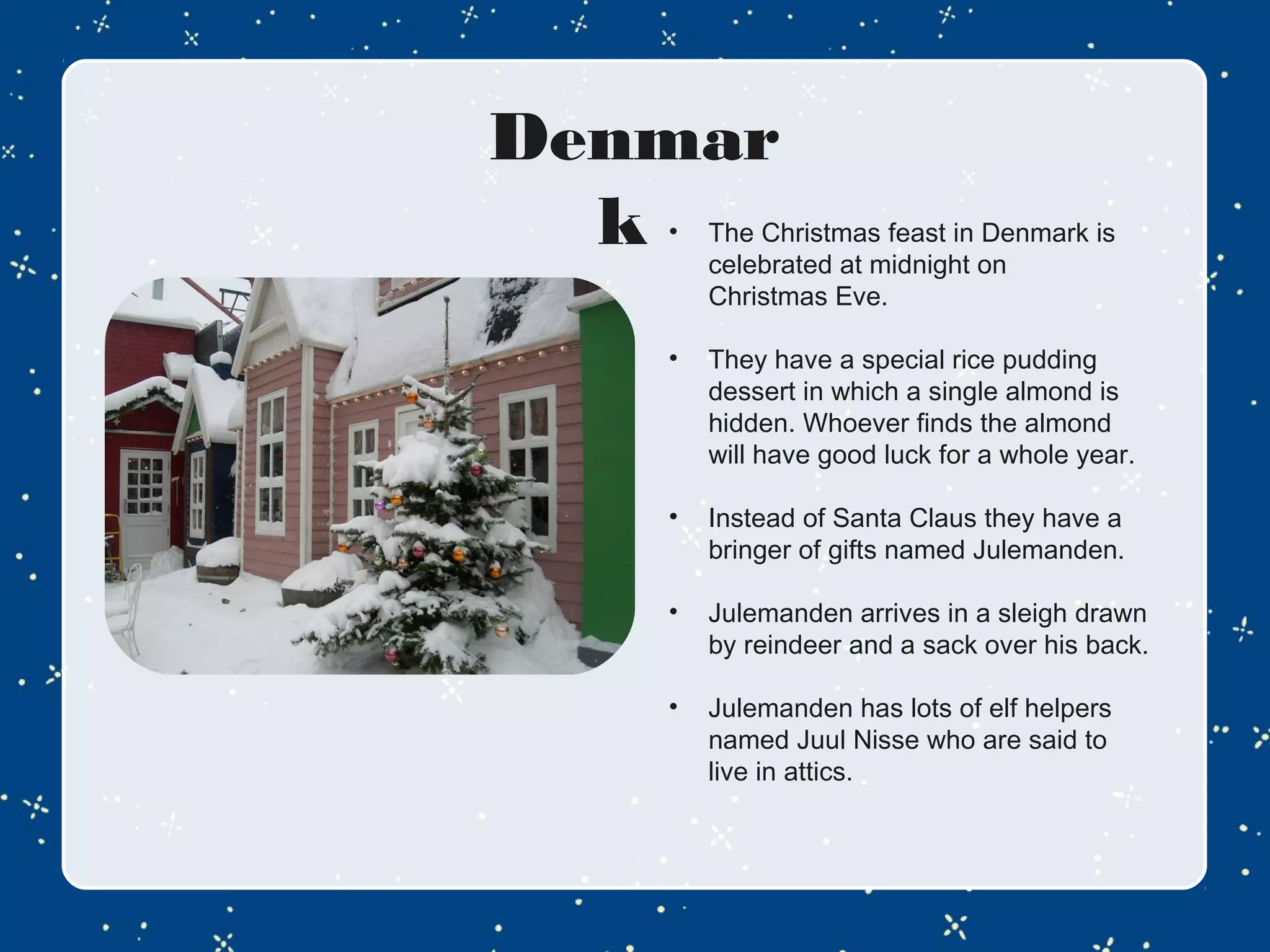
• They have a special rice pudding
dessert in which a single almond is
hidden. Whoever finds the almond
will have good luck for a whole year.
• Instead of Santa Claus they have a
bringer of gifts named Julemanden.
• Julemanden arrives in a sleigh drawn
by reindeer and a sack over his back.
• Julemanden has lots of elf helpers
named Juul Nisse who are said to
live in attics.
Denmar
k
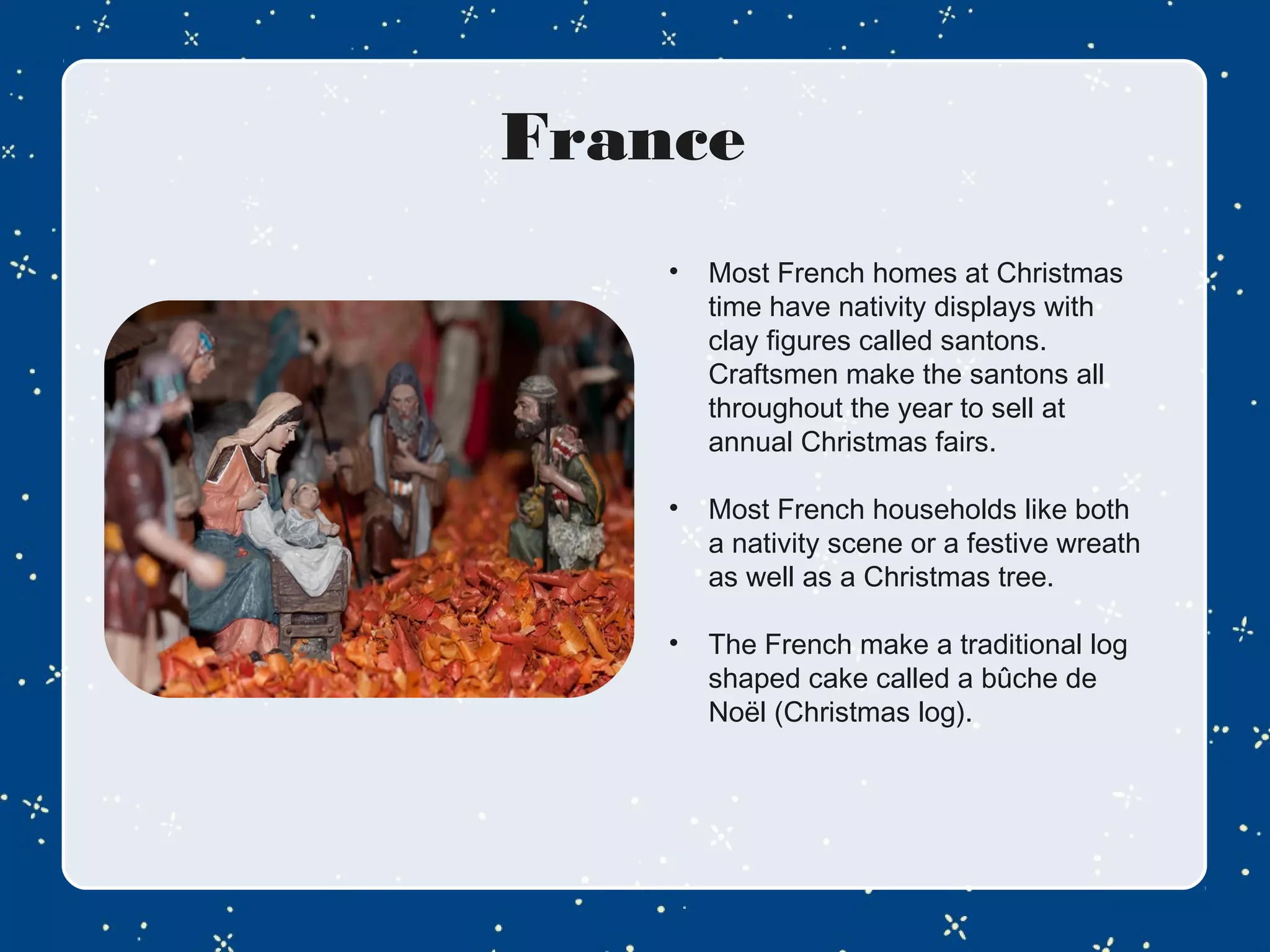
• Most French homes at Christmas
time have nativity displays with
clay figures called santons.
Craftsmen make the santons all
throughout the year to sell at
annual Christmas fairs.
• Most French households like both
a nativity scene or a festive wreath
as well as a Christmas tree.
• The French make a traditional log
shaped cake called a bûche de
Noël (Christmas log).
France
•Christmas dinner varies in different
parts of France. Some favorites are
goose, turkey and oysters.
•French children receive gifts from
Père Noël who travels with his stern
friend Père Fouettard who reminds
Père Noël how each child has
behaved in the past year.
France
• According to legend, on Christmas
Eve in Germany rivers turn to wine,
animals speak to each other, tree
blossoms bear fruit, mountains open
up to reveal precious gems and
church bells can be heard ringing in
the bottom of the sea. Only the pure
of heart can witness the Christmas
magic.
• While children are distracted the
Christmas tree is brought out and
decorated on Christmas Eve. The
presents are put underneath. Plates
are laid out for each member of the
family with fruit, nuts, chocolate and
cookies. Carols are then sung,
sparklers are lit, the Christmas story
is read and then the gifts are opened.
German
y
• On Christmas day there is a banquet
of roast goose, breads and marzipan.
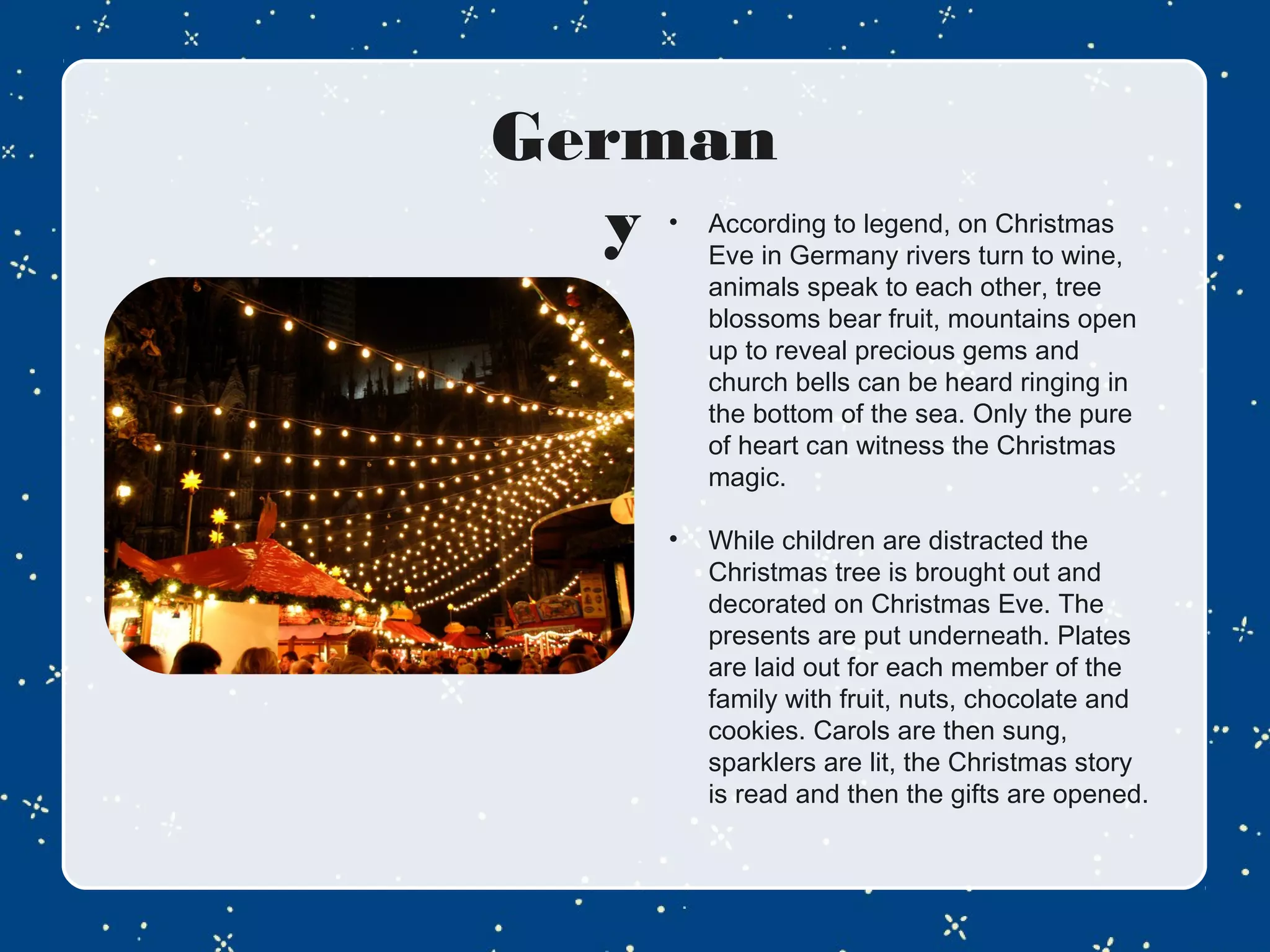
• There are lots of huge Christmas
fairs in Germany which are very
beautiful.
• After the presentation of the tree
there is a huge feast of dishes like
suckling pig, white sausage,
macaroni salad and many more.
German
y
• Christians in India decorate mango
and banana trees at Christmas
time.
• Decorations are colorful and bright.
• In some parts of India, small clay
oil-burning lamps are used as
Christmas decorations. They are
placed on the edges of roofs and
on the tops of walls.
• Churches are lit with poinsettias
(red Christmas flowers) and
candles for the Christmas Evening
service.
India
• Christmas was introduced to Japan
by the Christian missionaries and
for many years only those who
were of Christian faith celebrated it.
• Today, lots of people in Japan love
the Christmas season and it’s
almost universally celebrated even
though only 1% of people believe
in Christ.
• The idea of exchanging gifts
appeals to Japanese people.
• Shops in Japan have wonderful
displays and decorations to
advertise gifts to buy.
Japan
• Besides exchanging gifts,
Japanese people eat turkey on
Christmas day, have Christmas
trees and decorate their houses
with evergreens and mistletoe.
• A Buddhist monk named Hotei-
osho acts like Santa Claus. He
brings presents to each house for
children. Some think he has eyes
in the back of his head so that
children behave when he is nearby.
Japan
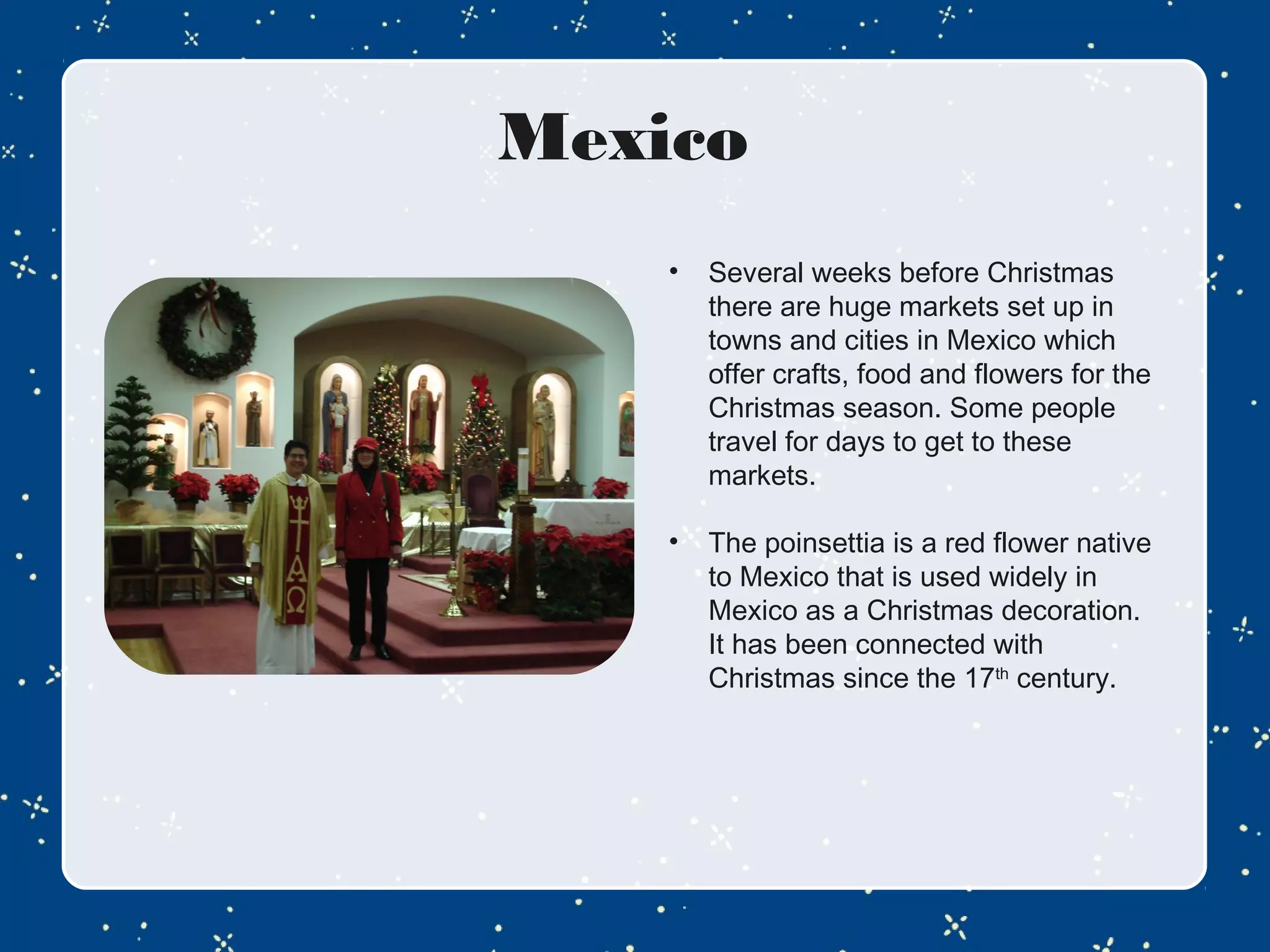
• Several weeks before Christmas
there are huge markets set up in
towns and cities in Mexico which
offer crafts, food and flowers for the
Christmas season. Some people
travel for days to get to these
markets.
• The poinsettia is a red flower native
to Mexico that is used widely in
Mexico as a Christmas decoration.
It has been connected with
Christmas since the 17th
century.
Mexico
• The main Christmas celebration in
Mexico is called Las Posadas.
People re-enact Joseph and Mary’s
search for somewhere to stay in
Bethlehem. They go house to
house getting refused until they
finally reach a house where an
altar and nativity scene have been
set up.
• Once they have reached the right
house a traditional prayer is
spoken and the party begins. Food
and drink are served and then
children take it in turns to break
open the piñata.
Mexico
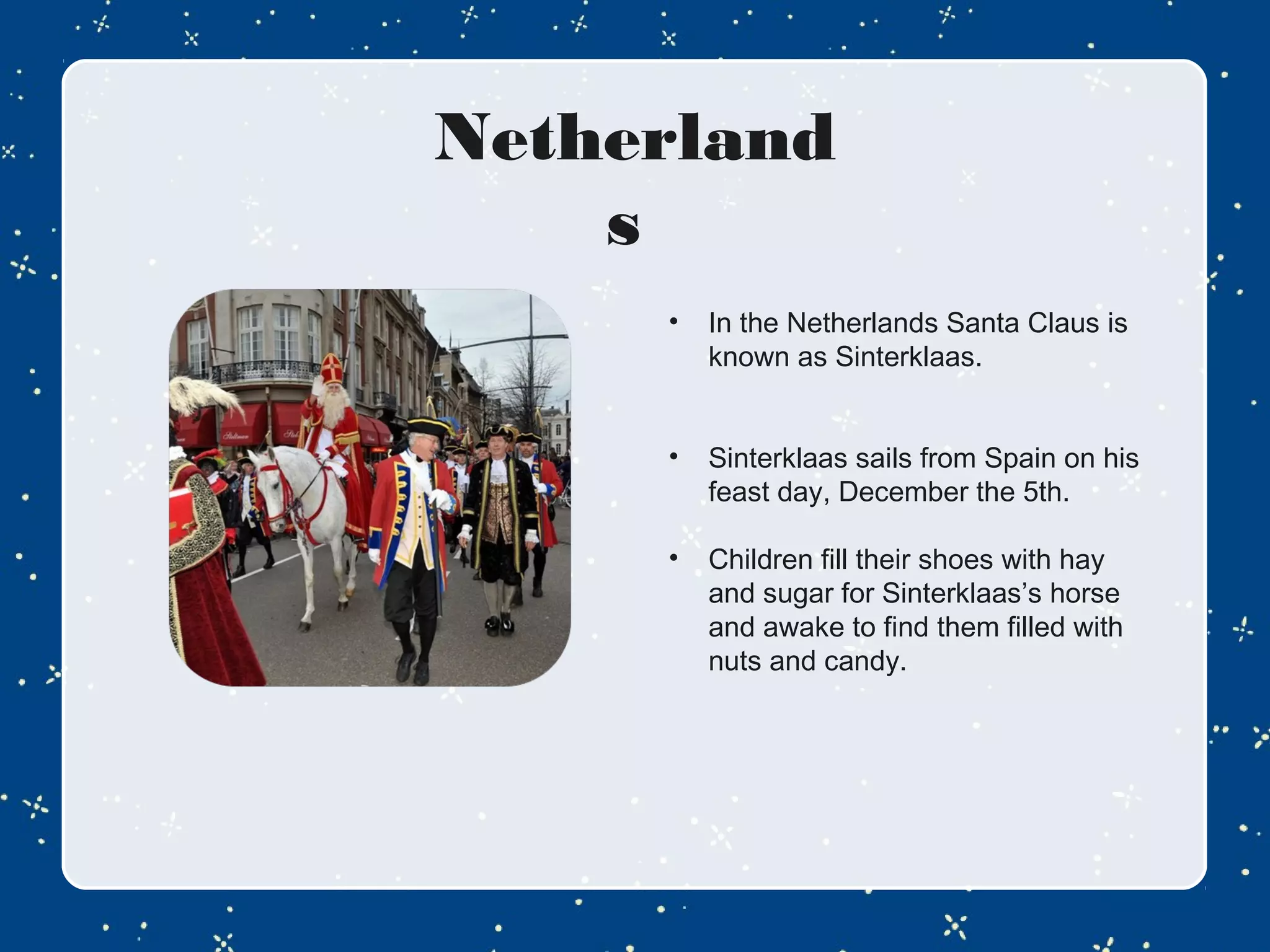
• In the Netherlands Santa Claus is
known as Sinterklaas.
• Sinterklaas sails from Spain on his
feast day, December the 5th.
• Children fill their shoes with hay
and sugar for Sinterklaas’s horse
and awake to find them filled with
nuts and candy.
Netherland
s
• Sinterklaas appears in person in
children's homes asking the
children about their behavior in the
past year.
• The people of Twente in east
Holland hold a special Christmas
ceremony where special horns are
blown to chase away evil spirits
and to announce the birth of Christ.
Netherland
s
Merry Christmas
Sheng Dan Kuai Le
Feliz Navidad
Fröhliche Weihnachten
Joyeux Noel
Vrolijk Kerstfeest
Pozdrevlyayu s prazdnikom Rozhdestva is Novim Godom
Shinnen omedeto
Christmas around the world

Christmas around the world

  • 2.
    • The temperaturein Australia on Christmas day is usually 86-122°F. • Because it is so hot, traditional dinners have been replaced with family gatherings in back yards and picnics in parks, gardens and on the beach. • A typical Christmas menu could include seafood, glazed ham, cold chicken, duck or turkey, cold deli meats, pasta, salads, desserts of all types, fruit salad, ice-cream plus Christmas treats such as mince pies. • Although it is so hot, Australian people still have Christmas trees and lights, go carol singing and send Christmas cards just like us. Australia
  • 3.
    China • Christians inChina celebrate by lighting their houses with paper lanterns. • Christmas trees are called ‘trees of light’ and are decorated with paper chains, paper flowers and paper lanterns. • Lots of people in China do not celebrate Christmas. The main winter festival is called Chinese New Year which takes place in January. Chinese people worship their ancestors during Chinese New Year.
  • 4.
    • The Christmasfeast in Denmark is celebrated at midnight on Christmas Eve. • They have a special rice pudding dessert in which a single almond is hidden. Whoever finds the almond will have good luck for a whole year. • Instead of Santa Claus they have a bringer of gifts named Julemanden. • Julemanden arrives in a sleigh drawn by reindeer and a sack over his back. • Julemanden has lots of elf helpers named Juul Nisse who are said to live in attics. Denmar k
  • 5.
    • Most Frenchhomes at Christmas time have nativity displays with clay figures called santons. Craftsmen make the santons all throughout the year to sell at annual Christmas fairs. • Most French households like both a nativity scene or a festive wreath as well as a Christmas tree. • The French make a traditional log shaped cake called a bûche de Noël (Christmas log). France
  • 6.
    •Christmas dinner variesin different parts of France. Some favorites are goose, turkey and oysters. •French children receive gifts from Père Noël who travels with his stern friend Père Fouettard who reminds Père Noël how each child has behaved in the past year. France
  • 7.
    • According tolegend, on Christmas Eve in Germany rivers turn to wine, animals speak to each other, tree blossoms bear fruit, mountains open up to reveal precious gems and church bells can be heard ringing in the bottom of the sea. Only the pure of heart can witness the Christmas magic. • While children are distracted the Christmas tree is brought out and decorated on Christmas Eve. The presents are put underneath. Plates are laid out for each member of the family with fruit, nuts, chocolate and cookies. Carols are then sung, sparklers are lit, the Christmas story is read and then the gifts are opened. German y
  • 8.
    • On Christmasday there is a banquet of roast goose, breads and marzipan. • There are lots of huge Christmas fairs in Germany which are very beautiful. • After the presentation of the tree there is a huge feast of dishes like suckling pig, white sausage, macaroni salad and many more. German y
  • 9.
    • Christians inIndia decorate mango and banana trees at Christmas time. • Decorations are colorful and bright. • In some parts of India, small clay oil-burning lamps are used as Christmas decorations. They are placed on the edges of roofs and on the tops of walls. • Churches are lit with poinsettias (red Christmas flowers) and candles for the Christmas Evening service. India
  • 10.
    • Christmas wasintroduced to Japan by the Christian missionaries and for many years only those who were of Christian faith celebrated it. • Today, lots of people in Japan love the Christmas season and it’s almost universally celebrated even though only 1% of people believe in Christ. • The idea of exchanging gifts appeals to Japanese people. • Shops in Japan have wonderful displays and decorations to advertise gifts to buy. Japan
  • 11.
    • Besides exchanginggifts, Japanese people eat turkey on Christmas day, have Christmas trees and decorate their houses with evergreens and mistletoe. • A Buddhist monk named Hotei- osho acts like Santa Claus. He brings presents to each house for children. Some think he has eyes in the back of his head so that children behave when he is nearby. Japan
  • 12.
    • Several weeksbefore Christmas there are huge markets set up in towns and cities in Mexico which offer crafts, food and flowers for the Christmas season. Some people travel for days to get to these markets. • The poinsettia is a red flower native to Mexico that is used widely in Mexico as a Christmas decoration. It has been connected with Christmas since the 17th century. Mexico
  • 13.
    • The mainChristmas celebration in Mexico is called Las Posadas. People re-enact Joseph and Mary’s search for somewhere to stay in Bethlehem. They go house to house getting refused until they finally reach a house where an altar and nativity scene have been set up. • Once they have reached the right house a traditional prayer is spoken and the party begins. Food and drink are served and then children take it in turns to break open the piñata. Mexico
  • 14.
    • In theNetherlands Santa Claus is known as Sinterklaas. • Sinterklaas sails from Spain on his feast day, December the 5th. • Children fill their shoes with hay and sugar for Sinterklaas’s horse and awake to find them filled with nuts and candy. Netherland s
  • 15.
    • Sinterklaas appearsin person in children's homes asking the children about their behavior in the past year. • The people of Twente in east Holland hold a special Christmas ceremony where special horns are blown to chase away evil spirits and to announce the birth of Christ. Netherland s
  • 16.
    Merry Christmas Sheng DanKuai Le Feliz Navidad Fröhliche Weihnachten Joyeux Noel Vrolijk Kerstfeest Pozdrevlyayu s prazdnikom Rozhdestva is Novim Godom Shinnen omedeto