New Venture
Creation
NQF LEVEL 2
COMPILED BY NS HLONGWANE
Topic 1
Demonstrating and understanding of a selected business environment
Introduction
This topic will explore different types organisations,
advantages as well as disadvantages of those types of
organisations.
The topic will also explore how to be competitive in a
business environment. SWOT analysis will be used to
analysis the business standing in the market.
Another factor will be a look on the legal and
professional regulations which a business will have to
adhere to
Module 1
Explaining the structure and roles of different types of
organisations within their own industry in South Africa
Unit 1.1 Types of organisations
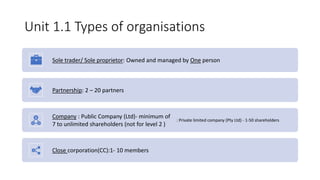
Sole trader/ Sole proprietor: Owned and managed by One person
Partnership: 2 – 20 partners
Company : Public Company (Ltd)- minimum of
7 to unlimited shareholders (not for level 2 )
: Private limited company (Pty Ltd) - 1-50 shareholders
Close corporation(CC):1- 10 members
Advantage and
disadvantages
Business Structure
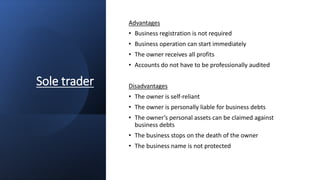
Sole trader
Advantages
• Business registration is not required
• Business operation can start immediately
• The owner receives all profits
• Accounts do not have to be professionally audited
Disadvantages
• The owner is self-reliant
• The owner is personally liable for business debts
• The owner’s personal assets can be claimed against
business debts
• The business stops on the death of the owner
• The business name is not protected
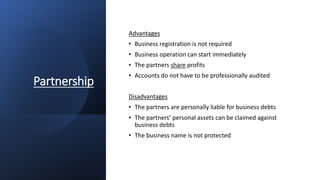
Partnership
Advantages
• Business registration is not required
• Business operation can start immediately
• The partners share profits
• Accounts do not have to be professionally audited
Disadvantages
• The partners are personally liable for business debts
• The partners’ personal assets can be claimed against
business debts
• The business name is not protected
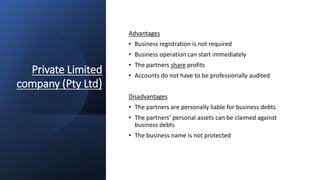
Private Limited
company (Pty Ltd)
Advantages
• Business registration is not required
• Business operation can start immediately
• The partners share profits
• Accounts do not have to be professionally audited
Disadvantages
• The partners are personally liable for business debts
• The partners’ personal assets can be claimed against
business debts
• The business name is not protected
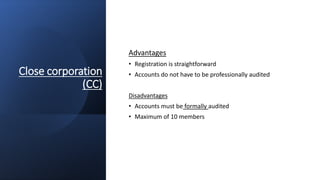
Close corporation
(CC)
Advantages
• Registration is straightforward
• Accounts do not have to be professionally audited
Disadvantages
• Accounts must be formally audited
• Maximum of 10 members

New venture creation presentation

  • 1.
    New Venture Creation NQF LEVEL2 COMPILED BY NS HLONGWANE
  • 2.
    Topic 1 Demonstrating andunderstanding of a selected business environment
  • 3.
    Introduction This topic willexplore different types organisations, advantages as well as disadvantages of those types of organisations. The topic will also explore how to be competitive in a business environment. SWOT analysis will be used to analysis the business standing in the market. Another factor will be a look on the legal and professional regulations which a business will have to adhere to
  • 4.
    Module 1 Explaining thestructure and roles of different types of organisations within their own industry in South Africa
  • 5.
    Unit 1.1 Typesof organisations Sole trader/ Sole proprietor: Owned and managed by One person Partnership: 2 – 20 partners Company : Public Company (Ltd)- minimum of 7 to unlimited shareholders (not for level 2 ) : Private limited company (Pty Ltd) - 1-50 shareholders Close corporation(CC):1- 10 members
  • 6.
  • 7.
    Sole trader Advantages • Businessregistration is not required • Business operation can start immediately • The owner receives all profits • Accounts do not have to be professionally audited Disadvantages • The owner is self-reliant • The owner is personally liable for business debts • The owner’s personal assets can be claimed against business debts • The business stops on the death of the owner • The business name is not protected
  • 8.
    Partnership Advantages • Business registrationis not required • Business operation can start immediately • The partners share profits • Accounts do not have to be professionally audited Disadvantages • The partners are personally liable for business debts • The partners’ personal assets can be claimed against business debts • The business name is not protected
  • 9.
    Private Limited company (PtyLtd) Advantages • Business registration is not required • Business operation can start immediately • The partners share profits • Accounts do not have to be professionally audited Disadvantages • The partners are personally liable for business debts • The partners’ personal assets can be claimed against business debts • The business name is not protected
  • 10.
    Close corporation (CC) Advantages • Registrationis straightforward • Accounts do not have to be professionally audited Disadvantages • Accounts must be formally audited • Maximum of 10 members