This case was prepared by Professor Paul Gilis of the Guanghua School of Management based on publicly available
information. Karen Wong, Jack Smith, John Carter, Global Capital Funds and Asia Stars are fictitious characters.
© 2012 Paul Gillis


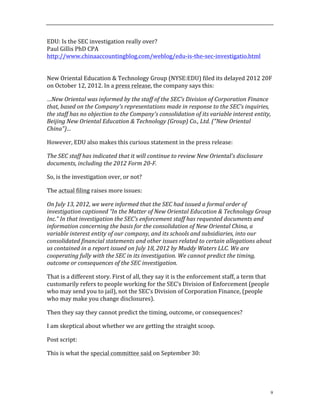
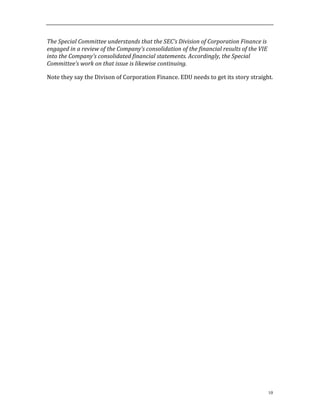
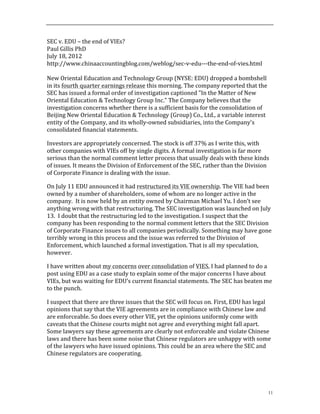
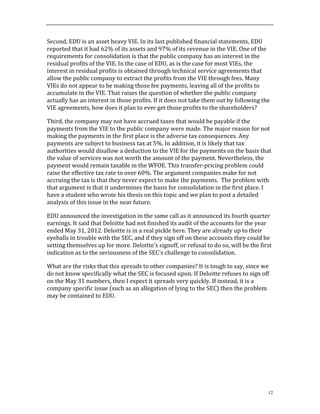
New	
  Oriental’s	
  Variable	
  Interest	
  Entity	
  
“So,	
  Karen,	
  what	
  do	
  you	
  propose	
  we	
  do?”	
  said	
  Jack	
  Smith.	
  	
  
Jack	
  was	
  the	
  Chief	
  Investment	
  Officer	
  for	
  Global	
  Capital	
  Funds	
  (GCF),	
  one	
  of	
  the	
  top	
  
five	
  mutual	
  fund	
  groups	
  in	
  the	
  United	
  States.	
  GCF	
  had	
  $1	
  trillion	
  under	
  management	
  
in	
  a	
  family	
  of	
  mutual	
  funds.	
  	
  
Karen	
  Wong,	
  31,	
  had	
  joined	
  GCF	
  right	
  after	
  she	
  earned	
  her	
  MBA	
  degree.	
  She	
  had	
  
started	
  as	
  an	
  analyst,	
  but	
  Jack	
  quickly	
  saw	
  her	
  talents	
  and	
  promoted	
  her	
  to	
  portfolio	
  
manager.	
  	
  She	
  was	
  managing	
  the	
  Asia	
  Stars	
  fund,	
  which	
  had	
  been	
  a	
  top	
  performer	
  in	
  
its	
  group.	
  She	
  had	
  developed	
  a	
  track	
  record	
  of	
  picking	
  solid	
  Asian	
  companies	
  that	
  
had	
  outperformed	
  their	
  peers.	
  Today,	
  however,	
  she	
  had	
  a	
  problem.	
  
Jack	
  had	
  come	
  to	
  Karen’s	
  office	
  shortly	
  after	
  the	
  market	
  opened	
  on	
  July	
  17,	
  2012.	
  
John	
  Carter,	
  GCF’s	
  chief	
  risk	
  officer	
  was	
  at	
  his	
  side.	
  Carter	
  had	
  a	
  scowl	
  on	
  his	
  face,	
  
but	
  that	
  was	
  normal.	
  	
  The	
  portfolio	
  managers	
  had	
  a	
  natural	
  dislike	
  for	
  the	
  risk	
  
officer.	
  After	
  all,	
  it	
  was	
  his	
  job	
  to	
  second-­‐guess	
  their	
  decisions,	
  but	
  Karen	
  had	
  to	
  
admit	
  he	
  was	
  usually	
  right.	
  
Today’s	
  visit	
  was	
  about	
  the	
  largest	
  position	
  in	
  the	
  Asia	
  Stars	
  fund,	
  a	
  Chinese	
  
company	
  listed	
  on	
  the	
  New	
  York	
  Stock	
  Exchange	
  called	
  New	
  Oriental	
  Education	
  &	
  
Technology	
  Group	
  (NYSE:	
  EDU).	
  The	
  company	
  had	
  announced	
  its	
  4th	
  quarter	
  
earnings	
  before	
  the	
  market	
  opened.	
  The	
  earnings	
  were	
  good;	
  revenues	
  for	
  the	
  
quarter	
  were	
  up	
  40.7%	
  and	
  net	
  income	
  for	
  the	
  year	
  was	
  up	
  30.4%.	
  The	
  stock,	
  
however,	
  was	
  falling	
  like	
  a	
  rock,	
  down	
  20%	
  in	
  the	
  first	
  hour	
  of	
  trading.	
  The	
  reason	
  
was	
  that	
  Louis	
  Hsieh,	
  President	
  and	
  CFO	
  of	
  New	
  Oriental,	
  had	
  announced	
  in	
  the	
  
earnings	
  call	
  that	
  the	
  SEC	
  had	
  launched	
  a	
  formal	
  investigation	
  of	
  the	
  company.	
  	
  
Louis	
  said	
  that	
  the	
  Company	
  believed	
  that	
  the	
  investigation	
  concerns	
  whether	
  there	
  
is	
  a	
  sufficient	
  basis	
  for	
  the	
  consolidation	
  of	
  Beijing	
  New	
  Oriental	
  Education	
  and	
  
Technology	
  (Group)	
  Co.	
  Ltd.,	
  a	
  variable	
  interest	
  entity	
  of	
  the	
  Company,	
  and	
  its	
  
wholly	
  owned	
  subsidiaries,	
  into	
  the	
  Company’s	
  consolidated	
  financial	
  statements.	
  
Asia	
  Stars	
  held	
  10	
  million	
  shares	
  of	
  New	
  Oriental	
  that	
  had	
  been	
  worth	
  $225	
  million	
  
the	
  day	
  before.	
  The	
  fund	
  had	
  lost	
  $45	
  million	
  already	
  today.	
  	
  While	
  Asia	
  Stars	
  had	
  
less	
  than	
  5%	
  of	
  its	
  capital	
  invested	
  in	
  New	
  Oriental,	
  the	
  loss	
  was	
  going	
  to	
  be	
  painful	
  
and	
  it	
  would	
  leave	
  a	
  black	
  mark	
  on	
  Karen’s	
  record	
  as	
  a	
  portfolio	
  manager.	
  	
  
About	
  New	
  Oriental	
  
As	
  the	
  largest	
  provider	
  of	
  private	
  educational	
  services	
  in	
  China,	
  New	
  Oriental	
  offers	
  
education	
  for	
  a	
  lifetime,	
  teaching	
  skills	
  that	
  give	
  students	
  a	
  crucial	
  competitive	
  
advantage	
  in	
  the	
  workplace	
  and	
  help	
  improve	
  their	
  quality	
  of	
  life.	
  New	
  Oriental	
  
2
offers	
  a	
  wide	
  range	
  of	
  educational	
  programs,	
  services	
  and	
  products	
  that	
  include	
  
English	
  and	
  other	
  foreign	
  language	
  training,	
  overseas	
  and	
  domestic	
  test	
  preparation	
  
courses,	
  all-­‐subjects	
  after	
  school	
  tutoring,	
  primary	
  and	
  secondary	
  school	
  education,	
  
educational	
  content	
  and	
  software	
  as	
  well	
  as	
  online	
  education.	


New	
  Oriental	
  has	
  become	
  the	
  most	
  recognized	
  brand	
  in	
  Chinese	
  private	
  
education.	
  Based	
  on	
  founder	
  Michael	
  Yu's	
  groundbreaking	
  vision,	
  New	
  Oriental’s	
  
innovative	
  and	
  inspirational	
  instruction	
  combines	
  humorous,	
  interactive	
  teaching	
  
techniques	
  with	
  traditional	
  Chinese	
  educational	
  values.	
  
	
  Since	
  its	
  founding	
  in	
  1993,	
  New	
  Oriental	
  has	
  had	
  over	
  13	
  million	
  student	
  
enrollments,	
  including	
  approximately	
  2.4	
  million	
  enrollments	
  in	
  fiscal	
  year	
  2012.	
  In	
  
2012	
  New	
  Oriental	
  has	
  a	
  network	
  of	
  55	
  schools,	
  664	
  learning	
  centers,	
  32	
  New	
  
Oriental	
  bookstores	
  and	
  over	
  5,000	
  third-­‐party	
  bookstores	
  and	
  over	
  17,600	
  
teachers	
  in	
  49	
  cities,	
  as	
  well	
  as	
  an	
  online	
  network	
  with	
  over	
  7.8	
  million	
  registered	
  
users.	
  
Variable	
  interest	
  entities	
  
New	
  Oriental	
  commenced	
  operations	
  in	
  China	
  in	
  1993..	
  In	
  2004,	
  the	
  Company	
  set	
  up	
  
a	
  holding	
  company	
  in	
  the	
  British	
  Virgin	
  Islands	
  (which	
  later	
  changed	
  its	
  domicile	
  to	
  
the	
  Cayman	
  Islands).	
  The	
  reason	
  for	
  setting	
  up	
  the	
  offshore	
  company	
  was	
  to	
  
circumvent	
  Chinese	
  regulations	
  that	
  prohibit	
  foreign	
  ownership	
  of	
  primary	
  and	
  
middle	
  schools	
  for	
  students	
  in	
  grades	
  one	
  to	
  nine.	
  	
  New	
  Oriental	
  wished	
  to	
  raise	
  
foreign	
  capital	
  for	
  expansion,	
  and	
  the	
  offshore	
  company	
  facilitated	
  it	
  raising	
  funds	
  
from	
  Tiger	
  Global	
  Private	
  Investment	
  Partners	
  II,	
  L.P.	


The	
  restrictions	
  on	
  foreign	
  investment	
  in	
  the	
  education	
  sector	
  were	
  problematic.	
  A	
  
work-­‐around	
  had	
  been	
  developed	
  to	
  allow	
  foreign	
  investment	
  in	
  restricted	
  sectors.	
  	
  
The	
  solution	
  would	
  have	
  the	
  restricted	
  operations	
  held	
  in	
  a	
  corporation	
  that	
  was	
  
owned	
  by	
  a	
  Chinese	
  individual.	
  That	
  would	
  make	
  the	
  operations	
  domestically	
  
owned	
  and	
  avoid	
  the	
  restrictions	
  on	
  foreign	
  ownership.	
  
The	
  problem	
  was	
  that	
  if	
  the	
  operations	
  were	
  actually	
  owned	
  by	
  a	
  Chinese	
  individual,	
  
how	
  could	
  foreigners	
  be	
  convinced	
  to	
  invest	
  in	
  a	
  company	
  that	
  actually	
  did	
  not	
  
conduct	
  the	
  business?	
  The	
  solution	
  that	
  was	
  found	
  was	
  to	
  put	
  in	
  place	
  a	
  series	
  of	
  
contracts	
  that	
  gave	
  the	
  foreign	
  company	
  control	
  over	
  the	
  Chinese	
  company	
  that	
  
actually	
  operated	
  the	
  business.	
  While	
  this	
  left	
  the	
  ownership	
  of	
  operations	
  in	
  
Chinese	
  hands,	
  it	
  gave	
  control	
  to	
  foreigners.	
  	
  
In	
  order	
  to	
  sell	
  investors	
  on	
  this	
  idea	
  it	
  was	
  critical	
  that	
  the	
  foreign	
  company	
  be	
  
allowed	
  to	
  consolidate	
  the	
  operations	
  of	
  the	
  individually	
  owned	
  Chinese	
  company	
  in	
  
its	
  consolidated	
  financial	
  statements.	
  The	
  accounting	
  rules	
  for	
  consolidation	
  had	
  
long	
  focused	
  on	
  stock	
  ownership,	
  requiring	
  consolidation	
  when	
  more	
  than	
  50%	
  of	
  
the	
  shares	
  were	
  owned,	
  requiring	
  equity	
  accounting	
  for	
  ownership	
  between	
  20%	
  
and	
  50%,	
  and	
  portfolio	
  accounting	
  for	
  ownership	
  below	
  20%.	
  Enron	
  famously	
  
abused	
  these	
  rules	
  and	
  set	
  up	
  special	
  purpose	
  entities	
  that	
  were	
  owned	
  by	
  Andy	
  
Fastow,	
  Enron’s	
  treasurer	
  (who	
  would	
  later	
  go	
  to	
  prison).	
  Enron	
  would	
  put	
  large	
  
amounts	
  of	
  debt	
  in	
  these	
  entities,	
  and	
  because	
  Enron	
  owned	
  no	
  shares	
  in	
  the	
  
companies,	
  it	
  was	
  not	
  required	
  to	
  consolidate	
  the	
  entities	
  and	
  put	
  the	
  debt	
  on	
  its	
  
3
balance	
  sheet,	
  even	
  though	
  it	
  was	
  essentially	
  on	
  the	
  hook	
  for	
  it.	
  When	
  Enron	
  
imploded	
  the	
  Financial	
  Accounting	
  Standards	
  Board	
  (FASB)	
  decided	
  that	
  accounting	
  
rules	
  had	
  to	
  change	
  to	
  prevent	
  reoccurrence	
  of	
  the	
  Enron	
  off-­‐balance	
  sheet	
  financing	
  
scandals.	
  The	
  FASB	
  issued	
  FASB	
  Interpretation	
  No.	
  46	
  (FIN	
  46)	
  which	
  was	
  later	
  
reissued	
  as	
  FIN46R	
  which	
  changed	
  the	
  consolidation	
  rules.	
  	
  FIN46	
  requires	
  an	
  entity	
  
to	
  consolidate	
  a	
  variable	
  interest	
  entity	
  (VIE)	
  if	
  it	
  is	
  the	
  primary	
  beneficiary	
  of	
  the	
  
VIE.	
  Under	
  FIN46R,	
  a	
  variable	
  interest	
  is	
  one	
  that	
  increases	
  or	
  decreases	
  in	
  value	
  
based	
  on	
  the	
  increases	
  or	
  decreases	
  in	
  the	
  expected	
  cash	
  flows	
  from	
  the	
  entity’s	
  
assets	
  or	
  liabilities.	
  The	
  primary	
  beneficiary	
  of	
  the	
  varlable	
  interest	
  entity	
  is	
  
required	
  to	
  consolidate	
  that	
  entity	
  in	
  its	
  financial	
  statements.	
  Said	
  another	
  way,	
  if	
  a	
  
company	
  has	
  the	
  upside	
  and	
  downside	
  in	
  another	
  entity	
  it	
  must	
  consolidate	
  it.	
  	
  The	
  
main	
  effect	
  of	
  FIN46	
  and	
  FIN	
  46R	
  was	
  to	
  require	
  many	
  companies	
  to	
  consolidate	
  
special	
  purpose	
  entities	
  that	
  were	
  set	
  up	
  to	
  keep	
  debt	
  off	
  the	
  balance	
  sheet.	
  	
  
FIN46	
  and	
  FIN46R	
  were	
  not	
  limited	
  to	
  off	
  balance	
  sheet	
  financing	
  situations.	
  	
  
Chinese	
  companies	
  had	
  found	
  a	
  way	
  to	
  use	
  the	
  VIE	
  to	
  allow	
  consolidation	
  of	
  
companies	
  that	
  were	
  off	
  limits	
  to	
  foreign	
  investment.	
  	
  The	
  operations	
  that	
  did	
  not	
  
permit	
  foreign	
  investment	
  would	
  be	
  held	
  in	
  a	
  Chinese	
  company	
  owned	
  by	
  a	
  Chinese	
  
individual.	
  The	
  public	
  company	
  would	
  control	
  this	
  company	
  through	
  legal	
  
agreements,	
  rather	
  than	
  through	
  ownership.	
  See	
  Appendix	
  1	
  for	
  a	
  description	
  of	
  the	
  
use	
  of	
  VIEs	
  in	
  China.	
  
The	
  Confrontation	
  
“So,	
  I	
  understand	
  that	
  New	
  Oriental	
  has	
  all	
  its	
  operations	
  in	
  a	
  variable	
  interest	
  entity.	
  
Does	
  that	
  mean	
  we	
  have	
  invested	
  a	
  quarter	
  of	
  a	
  billion	
  dollars	
  in	
  an	
  entity	
  that	
  does	
  
not	
  actually	
  own	
  the	
  business?”	
  asked	
  John	
  Carter.	


“Yes”,	
  answered	
  Karen	
  Wong.	
  “New	
  Oriental	
  uses	
  the	
  VIE	
  structure.	
  It	
  allows	
  the	
  
public	
  company	
  to	
  control	
  businesses	
  where	
  China	
  restricts	
  foreign	
  ownership.	
  The	
  
VIE	
  structure	
  is	
  very	
  common	
  –	
  half	
  of	
  U.S.	
  listed	
  Chinese	
  companies	
  use	
  it.”	
  
“But	
  haven’t	
  there	
  been	
  a	
  lot	
  of	
  problems	
  with	
  VIE’s?”	
  asked	
  Jack	
  Smith.	
  “Didn’t	
  we	
  
get	
  burned	
  last	
  year	
  when	
  Yahoo	
  lost	
  its	
  interest	
  in	
  Alipay	
  when	
  the	
  VIE	
  
mysteriously	
  disappeared	
  into	
  the	
  hands	
  of	
  the	
  Chinese	
  shareholder?	
  “	
  
“Yahoo	
  was	
  not	
  in	
  any	
  of	
  my	
  funds”,	
  answered	
  Karen	
  Wong,	
  “But	
  I	
  don’t	
  think	
  that	
  is	
  
going	
  to	
  happen	
  in	
  this	
  situation.	
  Michael	
  Yu,	
  the	
  owner	
  of	
  the	
  VIE,	
  has	
  an	
  interest	
  in	
  
keeping	
  it	
  in	
  New	
  Oriental,	
  and	
  the	
  lawyers	
  say	
  the	
  contracts	
  that	
  make	
  him	
  do	
  so	
  
are	
  enforceable.	
  “	
  	
  
“Lawyers!”	
  snorted	
  John	
  Carter,	
  “Aren’t	
  these	
  the	
  same	
  lawyers	
  who	
  say	
  that	
  the	
  VIE	
  
actually	
  works	
  to	
  get	
  around	
  Chinese	
  restrictions	
  on	
  foreign	
  investment?	
  Did	
  you	
  
hear	
  about	
  the	
  Buddha	
  Steel	
  case?	
  A	
  lot	
  of	
  other	
  lawyers	
  say	
  there	
  is	
  no	
  way	
  these	
  
deal	
  hold	
  up	
  if	
  the	
  end	
  up	
  in	
  court.”	
  
“I	
  am	
  worried	
  about	
  this	
  SEC	
  investigation”,	
  said	
  Jack	
  Smith.	
  Why	
  is	
  the	
  SEC	
  now	
  
challenging	
  whether	
  these	
  VIEs	
  can	
  be	
  consolidated?	
  What	
  if	
  the	
  SEC	
  is	
  right	
  and	
  
they	
  cannot	
  consolidate?	
  What	
  do	
  we	
  have	
  left?	
  	
  
4
“Karen,	
  you	
  have	
  to	
  take	
  us	
  through	
  your	
  thinking	
  on	
  why	
  we	
  should	
  be	
  holding	
  this	
  
investment,	
  and	
  the	
  way	
  the	
  market	
  is	
  moving,	
  you	
  better	
  make	
  it	
  quick”	
  said	
  John	
  
Carter	
  as	
  he	
  settled	
  into	
  his	
  chair.	
  	
  
The	
  other	
  shoe	
  drops	
  
By	
  the	
  time	
  John	
  Carter	
  left	
  Karen’s	
  office,	
  New	
  Oriental	
  shares	
  had	
  dropped	
  38%	
  
although	
  they	
  did	
  rally	
  slightly	
  to	
  close	
  at	
  14.62,	
  down	
  35%	
  for	
  the	
  day.	
  John	
  had	
  
told	
  Karen	
  to	
  spend	
  the	
  night	
  preparing	
  for	
  a	
  meeting	
  the	
  next	
  morning	
  with	
  Jack	
  
and	
  himself,	
  where	
  they	
  would	
  decide	
  what	
  to	
  do	
  with	
  the	
  New	
  Oriental	
  position.	
  	
  
Karen	
  reviewed	
  all	
  of	
  her	
  prior	
  analytic	
  work	
  on	
  New	
  Oriental,	
  and	
  she	
  was	
  
prepared	
  to	
  defend	
  her	
  decision	
  to	
  maintain	
  the	
  position	
  in	
  the	
  stock.	
  The	
  meeting	
  
was	
  scheduled	
  at	
  10	
  am,	
  and	
  she	
  watched	
  her	
  computer	
  cautiously	
  as	
  the	
  market	
  
opened	
  at	
  9:30.	
  She	
  was	
  relieved	
  to	
  see	
  that	
  New	
  Oriental	
  opened	
  at	
  $15	
  “Maybe	
  we	
  
have	
  seen	
  the	
  worst	
  of	
  it”	
  she	
  muttered	
  to	
  herself	
  as	
  she	
  grabbed	
  her	
  Starbucks	
  and	
  
headed	
  for	
  the	
  conference	
  room.	
  	
  
Jack	
  was	
  already	
  there	
  when	
  Karen	
  arrived.	
  He	
  smiled	
  warmly	
  “this	
  happens	
  to	
  the	
  
best	
  of	
  them,	
  you	
  know.	
  It	
  is	
  a	
  tough	
  business”.	
  Karen	
  wondered	
  why	
  John	
  Carter	
  
was	
  not	
  present	
  –	
  he	
  was	
  always	
  early	
  to	
  meetings.	
  Suddenly	
  John	
  Carter	
  burst	
  into	
  
the	
  room	
  –	
  “it	
  is	
  dropping	
  like	
  rock!”	
  he	
  shouted.	
  Jack	
  jumped	
  out	
  of	
  his	
  chair	
  and	
  
headed	
  for	
  the	
  Bloomberg	
  terminal	
  in	
  the	
  corner.	
  Karen	
  beat	
  him	
  there	
  and	
  punched	
  
in	
  the	
  code	
  for	
  New	
  Oriental	
  –	
  EDU.	
  The	
  stock	
  had	
  just	
  fallen	
  through	
  $11	
  and	
  was	
  
still	
  dropping.	
  	
  The	
  screen	
  flashed	
  the	
  news	
  on	
  the	
  stock	
  –	
  Muddy	
  Waters	
  Research	
  
initiating	
  coverage	
  on	
  EDU	
  –	
  strong	
  sell.	


Muddy	
  Waters	
  Research	
  was	
  notorious	
  in	
  China	
  investment	
  circles.	
  Muddy	
  Waters	
  
was	
  one	
  of	
  several	
  short	
  selling	
  research	
  firms	
  that	
  specialized	
  in	
  finding	
  fraudulent	
  
Chinese	
  companies.	
  It	
  had	
  brought	
  down	
  many.	
  It	
  was	
  a	
  highly	
  controversial	
  
business	
  model,	
  and	
  the	
  founder,	
  Carson	
  Block	
  was	
  despised	
  by	
  many	
  investors.	
  
Block	
  was	
  not	
  always	
  right,	
  but	
  he	
  always	
  hurt	
  companies	
  when	
  he	
  focused	
  on	
  them.	


The	
  investigation	
  
The	
  Board	
  of	
  Directors	
  of	
  EDU	
  formed	
  a	
  Special	
  Committee	
  of	
  independent	
  directors,	
  
including	
  Baidu	
  Chairman	
  Robin	
  Lee	
  and	
  BIMBA	
  Dean	
  John	
  Yang.	
  	
  The	
  Special	
  
Committee	
  hired	
  law	
  firm	
  Simpson,	
  Thacher	
  and	
  Bartlett	
  and	
  accounting	
  firm	
  Ernst	
  
&	
  Young	
  to	
  conduct	
  an	
  investigation.	
  	
  
EDU	
  issued	
  a	
  press	
  release	
  on	
  September	
  30	
  announcing	
  that	
  the	
  Special	
  Committee	
  
had	
  completed	
  its	
  review	
  of	
  Muddy	
  Water’s	
  allegations	
  and	
  had	
  found	
  no	
  significant	
  
evidence	
  to	
  support	
  them.	
  The	
  Company	
  indiated	
  that	
  the	
  investigation	
  into	
  the	
  VIE	
  
structure	
  continued,	
  and	
  that	
  the	
  company	
  would	
  miss	
  the	
  filing	
  date	
  for	
  its	
  annual	
  
report	
  on	
  Form	
  20F.	
  	
  EDU’s	
  stock	
  had	
  jumped	
  from	
  a	
  low	
  of	
  $14	
  to	
  $17	
  in	
  the	
  week	
  
prior	
  to	
  the	
  announcement,	
  suggesting	
  someone	
  had	
  leaked	
  the	
  news.	
  On	
  October	
  1,	
  
the	
  first	
  trading	
  day	
  after	
  the	
  announcement,	
  the	
  stock	
  fell	
  $0.06.	
  Muddy	
  Waters	
  
announced	
  it	
  was	
  “more	
  convinced	
  than	
  ever”	
  that	
  EDU	
  was	
  misleading	
  investors.	
  
5
On	
  October	
  12,	
  2012	
  EDU	
  announced	
  that	
  it	
  was	
  filing	
  its	
  annual	
  report	
  on	
  Form	
  20F.	
  	
  
I	
  staid	
  that	
  it	
  was	
  informed	
  by	
  the	
  staff	
  of	
  the	
  SEC’s	
  Division	
  of	
  Corporation	
  Finance	
  
that	
  the	
  staff	
  has	
  no	
  objection	
  to	
  the	
  consolidation	
  of	
  its	
  schools.	


EDU	
  stock	
  jumped	
  14%	
  in	
  premarket	
  trading	
  the	
  next	
  trading	
  day,	
  but	
  quickly	
  fell	
  
back	
  after	
  a	
  Chinese	
  accounting	
  blog	
  pointed	
  out	
  that	
  the	
  company	
  was	
  making	
  
inconsistent	
  disclosures	
  about	
  the	
  SEC	
  investigation.	


Questions	


Should	
  EDU’s	
  VIE	
  be	
  consolidated?	


What	
  would	
  happen	
  to	
  EDU’s	
  financial	
  statements	
  if	
  the	
  VIE	
  cannot	
  be	
  consolidated?	


6
Consolidating	
  EDU’s	
  VIE	
  
Paul	
  Gillis	
  PhD	
  CPA	
  
http://www.chinaaccountingblog.com/weblog/consolidating-­‐edus-­‐vie.html	


New	
  Oriental	
  Education	
  &	
  Technology	
  Group	
  (NYSE:	
  EDU)	
  has	
  filed	
  its	
  delayed	
  
annual	
  report	
  on	
  Form	
  20-­‐F.	
  EDU	
  claims	
  that	
  the	
  SEC	
  has	
  no	
  objection	
  to	
  the	
  
consolidation	
  of	
  its	
  VIE.	
  However,	
  the	
  SEC	
  has	
  indicated	
  it	
  will	
  continue	
  to	
  review	
  
EDU’s	
  disclosure	
  documents,	
  including	
  the	
  2012	
  Form	
  20-­‐F,	
  which	
  would	
  not	
  have	
  
been	
  provided	
  to	
  the	
  SEC	
  until	
  now.	
  In	
  the	
  Form	
  20-­‐F	
  the	
  company	
  says	
  the	
  SEC	
  
investigation	
  is	
  ongoing,	
  so	
  I	
  don’t	
  understand	
  what	
  is	
  going	
  on.	


If	
  the	
  SEC	
  has	
  blessed	
  the	
  consolidation	
  of	
  EDU’s	
  VIE,	
  this	
  is	
  big	
  news	
  for	
  VIEs,	
  and	
  I	
  
am	
  a	
  bit	
  surprised	
  by	
  the	
  result.	
  The	
  investigation	
  into	
  EDU	
  likely	
  was	
  a	
  
consequence	
  of	
  Muddy	
  Water’s	
  allegations	
  against	
  the	
  company;	
  allegations	
  that	
  
appear	
  to	
  have	
  been	
  discredited.	
  There	
  is	
  an	
  issue	
  present	
  in	
  EDU	
  that	
  Muddy	
  
Waters	
  did	
  not	
  raise,	
  but	
  I	
  thought	
  that	
  the	
  SEC	
  would.	
  EDU	
  has	
  an	
  asset-­‐heavy	
  VIE,	
  
that	
  is,	
  most	
  of	
  the	
  business	
  at	
  EDU	
  is	
  in	
  the	
  VIE.	
  Consolidation	
  requires	
  that	
  the	
  
parent	
  company	
  have	
  a	
  right	
  to	
  the	
  residual	
  profits	
  of	
  the	
  VIE.	
  EDU	
  claims	
  a	
  right	
  to	
  
these	
  residual	
  profits	
  because	
  of	
  a	
  series	
  of	
  service	
  agreements	
  between	
  EDU	
  and	
  
the	
  VIE.	
  It	
  is	
  apparent	
  that	
  EDU	
  is	
  not	
  distributing	
  all	
  of	
  the	
  profits	
  through	
  these	
  
agreements.	
  The	
  question	
  that	
  the	
  SEC	
  should	
  have	
  addressed	
  is	
  whether	
  all	
  that	
  is	
  
necessary	
  to	
  consolidate	
  a	
  VIE	
  is	
  a	
  agreement,	
  or	
  whether	
  those	
  agreements	
  have	
  to	
  
give	
  access	
  to	
  the	
  residual	
  profits	
  in	
  practice.	
  This	
  is	
  not	
  just	
  a	
  technical	
  accounting	
  
question;	
  it	
  also	
  gets	
  to	
  the	
  substance	
  of	
  the	
  arrangements	
  and	
  what	
  the	
  
shareholders	
  actually	
  own.	
  If	
  you	
  do	
  not	
  take	
  the	
  profits	
  out	
  as	
  you	
  are	
  entitled	
  to	
  
them,	
  will	
  you	
  ever	
  be	
  able	
  to	
  take	
  them	
  out	
  and	
  do	
  you	
  really	
  own	
  them?	
  
EDU	
  says	
  it	
  obtains	
  a	
  right	
  to	
  receive	
  substantially	
  all	
  of	
  the	
  economic	
  benefits	
  of	
  the	
  
VIE	
  in	
  consideration	
  for	
  the	
  services	
  provided	
  by	
  EDU’s	
  wholly	
  owned	
  subsidiaries	
  
(WFOEs).	
  The	
  service	
  fees	
  are	
  set	
  at	
  a	
  percentage	
  of	
  revenue.	
  I	
  do	
  not	
  understand	
  
how	
  a	
  fee	
  that	
  is	
  a	
  percentage	
  of	
  revenue	
  is	
  considered	
  to	
  be	
  an	
  interest	
  in	
  the	
  
residual	
  profits	
  of	
  the	
  company.	
  Residual	
  profits	
  are	
  what	
  remain	
  after	
  the	
  revenue-­‐
based	
  fees.	
  Most	
  VIE	
  agreements	
  get	
  around	
  this	
  by	
  allowing	
  the	
  public	
  company	
  to	
  
unilaterally	
  set	
  the	
  fees	
  so	
  that	
  they	
  can	
  be	
  made	
  equal	
  to	
  net	
  income.	
  While	
  those	
  
kinds	
  of	
  arrangements	
  are	
  more	
  easily	
  argued	
  to	
  result	
  in	
  an	
  interest	
  in	
  residual	
  
profits,	
  they	
  are	
  likely	
  to	
  be	
  challenged	
  by	
  tax	
  authorities	
  as	
  violating	
  transfer-­‐
pricing	
  rules.	


EDU	
  reports	
  that	
  the	
  VIE	
  earned	
  $159	
  million	
  in	
  2012.	
  Retained	
  earnings	
  of	
  the	
  VIE	
  
increased	
  by	
  $49	
  million,	
  suggesting	
  that	
  the	
  VIE	
  only	
  made	
  payments	
  to	
  the	
  parent	
  
of	
  $110	
  million.	
  EDU’s	
  VIE	
  has	
  retained	
  earnings	
  of	
  $308	
  million,	
  which	
  is	
  the	
  
accumulated	
  earnings	
  that	
  have	
  not	
  been	
  paid	
  out.	
  The	
  accounting	
  question	
  is	
  
whether	
  EDU	
  has	
  an	
  interest	
  in	
  those	
  retained	
  earnings.	
  	
  
From	
  what	
  EDU	
  is	
  saying,	
  the	
  SEC	
  appears	
  to	
  have	
  decided	
  that	
  EDU	
  has	
  a	
  right	
  to	
  
the	
  residual	
  earnings	
  of	
  the	
  VIE,	
  despite	
  the	
  disclosure	
  that	
  the	
  VIE	
  is	
  not	
  paying	
  
7
these	
  profits	
  to	
  the	
  public	
  company	
  through	
  the	
  service	
  agreements.	
  Perhaps	
  the	
  
fees	
  required	
  under	
  the	
  agreements	
  are	
  equal	
  to	
  or	
  greater	
  than	
  the	
  net	
  income,	
  yet	
  
the	
  company	
  has	
  decided	
  against	
  paying	
  them.	
  Payments	
  from	
  a	
  VIE	
  to	
  a	
  WFOE	
  are	
  
inherently	
  tax	
  ineffective,	
  and	
  once	
  the	
  profits	
  are	
  in	
  the	
  WFOE	
  it	
  is	
  very	
  difficult	
  to	
  
get	
  the	
  cash	
  back	
  to	
  the	
  VIE.	
  Perhaps	
  EDU	
  was	
  able	
  to	
  convince	
  the	
  SEC	
  that	
  it	
  met	
  
the	
  letter	
  of	
  the	
  law	
  by	
  having	
  the	
  contractual	
  right	
  to	
  these	
  profits,	
  even	
  if	
  in	
  
practice	
  it	
  did	
  not	
  actually	
  collect	
  the	
  payments	
  it	
  was	
  entitled	
  to.	


Getting	
  the	
  residual	
  profits	
  through	
  service	
  contracts	
  is	
  the	
  usual	
  method	
  for	
  VIEs,	
  
even	
  though	
  it	
  is	
  tax	
  inefficient.	
  There	
  is	
  another,	
  even	
  more	
  tax	
  inefficient	
  way,	
  to	
  
get	
  the	
  profits	
  out.	
  That	
  would	
  be	
  through	
  a	
  dividend	
  from	
  the	
  VIE	
  to	
  the	
  VIE’s	
  
individual	
  shareholder,	
  who	
  would	
  then	
  turn	
  it	
  over	
  to	
  WFOE.	
  Most	
  VIE	
  agreements	
  
provide	
  for	
  that	
  possibility,	
  although	
  I	
  see	
  no	
  disclosure	
  of	
  such	
  provisions	
  by	
  EDU.	
  
There	
  are	
  layers	
  of	
  additional	
  taxes	
  in	
  this	
  approach	
  that	
  can	
  drive	
  the	
  effective	
  tax	
  
rate	
  up	
  substantially.	
  EDU	
  addresses	
  this	
  issue	
  in	
  its	
  tax	
  footnotes:	
  
Aggregate	
  undistributed	
  earnings	
  of	
  the	
  Company’s	
  PRC	
  subsidiaries	
  and	
  VIE	
  that	
  are	
  
available	
  for	
  distribution	
  was	
  US$395,534	
  and	
  US$483,100	
  as	
  of	
  May	
  31,	
  2011	
  and	
  
May	
  31,	
  2012,	
  respectively.	
  Upon	
  distribution	
  of	
  such	
  earnings,	
  the	
  Company	
  will	
  be	
  
subject	
  to	
  PRC	
  EIT	
  taxes,	
  the	
  amount	
  of	
  which	
  is	
  impractical	
  to	
  estimate.	
  The	
  Company	
  
did	
  not	
  record	
  any	
  tax	
  on	
  any	
  of	
  the	
  aforementioned	
  undistributed	
  earnings	
  because	
  
the	
  relevant	
  subsidiaries	
  and	
  VIE	
  does	
  not	
  intend	
  to	
  declare	
  dividends	
  and	
  the	
  
Company	
  intends	
  to	
  permanently	
  reinvest	
  it	
  within	
  the	
  PRC.	
  
Of	
  the	
  $483	
  million	
  of	
  undistributed	
  earnings,	
  $308	
  million	
  are	
  in	
  the	
  VIE.	
  The	
  
remainder	
  is	
  in	
  the	
  WFOEs	
  and	
  would	
  not	
  be	
  subject	
  to	
  enterprise	
  income	
  tax	
  (EIT)	
  
on	
  distribution.	
  It	
  would	
  be	
  subject	
  to	
  withholding	
  tax,	
  at	
  10%,	
  an	
  amount	
  that	
  is	
  not	
  
impractical	
  to	
  estimate.	
  (EDU	
  does	
  not	
  appear	
  to	
  use	
  a	
  Hong	
  Kong	
  holding	
  company	
  
to	
  reduce	
  the	
  withholding	
  rate	
  to	
  5%,	
  a	
  technique	
  that	
  probably	
  does	
  not	
  work	
  
because	
  of	
  treaty	
  shopping	
  restrictions).	
  The	
  distribution	
  of	
  VIE	
  earnings	
  would	
  be	
  
subject	
  to	
  individual	
  income	
  tax	
  when	
  distributed	
  to	
  the	
  individual	
  VIE	
  shareholder,	
  
and	
  then	
  to	
  EIT	
  when	
  the	
  individual	
  gives	
  the	
  money	
  to	
  the	
  WFOE,	
  and	
  then	
  to	
  
withholding	
  tax	
  when	
  distributed	
  by	
  the	
  WFOE	
  to	
  the	
  Cayman	
  Islands	
  parent.	
  Here	
  
is	
  what	
  would	
  happen:	
  
Amount	
  of	
  retained	
  earnings	
  of	
  VIE	
  =	
  $308	
  million.	
  Individual	
  income	
  tax	
  on	
  
dividend	
  to	
  Michael	
  Yu	
  (20%	
  X	
  $308)	
  =	
  $61.6	
  million.	
  Amount	
  paid	
  to	
  WFOE	
  $308-­‐
$61.6	
  =	
  246.4	
  X	
  EIT	
  of	
  25%	
  =$61.6	
  million.	
  Total	
  tax	
  liability	
  on	
  VIE	
  retained	
  
earnings	
  is	
  $123.2	
  million.	
  Add	
  to	
  that	
  a	
  10%	
  withholding	
  tax	
  to	
  get	
  the	
  money	
  out	
  
of	
  China	
  to	
  the	
  Cayman	
  Islands.	
  	
  
Does	
  EDU	
  provide	
  for	
  that	
  deferred	
  tax	
  liability?	
  No,	
  the	
  company	
  waves	
  it	
  off	
  by	
  
saying	
  they	
  do	
  not	
  intend	
  to	
  distribute	
  dividends	
  and	
  plan	
  to	
  leave	
  the	
  money	
  in	
  the	
  
PRC.	
  Accordingly,	
  the	
  taxes	
  that	
  would	
  be	
  payable	
  on	
  distribution	
  are	
  not	
  recorded.	
  
The	
  company	
  indicates	
  it	
  never	
  plans	
  to	
  pay	
  the	
  public	
  company	
  any	
  of	
  the	
  retained	
  
8
earnings	
  of	
  the	
  VIE.	
  Not	
  providing	
  tax	
  on	
  income	
  that	
  the	
  company	
  never	
  expects	
  to	
  
distribute	
  is	
  allowed	
  under	
  GAAP.	


What	
  troubles	
  me	
  about	
  EDU’s	
  accounting	
  is	
  the	
  combination	
  of	
  claiming	
  an	
  interest	
  
in	
  the	
  profits	
  of	
  the	
  VIE	
  despite	
  the	
  lack	
  of	
  ownership	
  but	
  also	
  arguing	
  that	
  EDU	
  will	
  
never	
  get	
  those	
  profits.	
  When	
  you	
  start	
  layering	
  on	
  aggressive	
  accounting	
  policies,	
  
even	
  if	
  individually	
  each	
  is	
  GAAP,	
  the	
  final	
  picture	
  does	
  not	
  fairly	
  present	
  the	
  
situation.	
  	
  
If,	
  as	
  EDU	
  appears	
  to	
  say,	
  the	
  SEC	
  has	
  signed	
  off	
  on	
  this,	
  we	
  can	
  stop	
  worrying	
  about	
  
accounting	
  challenges	
  to	
  the	
  VIE	
  structure.	


9
EDU:	
  Is	
  the	
  SEC	
  investigation	
  really	
  over?	
  
Paul	
  Gillis	
  PhD	
  CPA	
  
http://www.chinaaccountingblog.com/weblog/edu-­‐is-­‐the-­‐sec-­‐investigatio.html	


New	
  Oriental	
  Education	
  &	
  Technology	
  Group	
  (NYSE:EDU)	
  filed	
  its	
  delayed	
  2012	
  20F	
  
on	
  October	
  12,	
  2012.	
  In	
  a	
  press	
  release,	
  the	
  company	
  says	
  this:	
  
…New	
  Oriental	
  was	
  informed	
  by	
  the	
  staff	
  of	
  the	
  SEC's	
  Division	
  of	
  Corporation	
  Finance	
  
that,	
  based	
  on	
  the	
  Company's	
  representations	
  made	
  in	
  response	
  to	
  the	
  SEC's	
  inquiries,	
  
the	
  staff	
  has	
  no	
  objection	
  to	
  the	
  Company's	
  consolidation	
  of	
  its	
  variable	
  interest	
  entity,	
  
Beijing	
  New	
  Oriental	
  Education	
  &	
  Technology	
  (Group)	
  Co.,	
  Ltd.	
  ("New	
  Oriental	
  
China")…	
  
However,	
  EDU	
  also	
  makes	
  this	
  curious	
  statement	
  in	
  the	
  press	
  release:	
  
The	
  SEC	
  staff	
  has	
  indicated	
  that	
  it	
  will	
  continue	
  to	
  review	
  New	
  Oriental's	
  disclosure	
  
documents,	
  including	
  the	
  2012	
  Form	
  20-­‐F.	
  
So,	
  is	
  the	
  investigation	
  over,	
  or	
  not?	


The	
  actual	
  filing	
  raises	
  more	
  issues:	
  
On	
  July	
  13,	
  2012,	
  we	
  were	
  informed	
  that	
  the	
  SEC	
  had	
  issued	
  a	
  formal	
  order	
  of	
  
investigation	
  captioned	
  “In	
  the	
  Matter	
  of	
  New	
  Oriental	
  Education	
  &	
  Technology	
  Group	
  
Inc.”	
  In	
  that	
  investigation	
  the	
  SEC’s	
  enforcement	
  staff	
  has	
  requested	
  documents	
  and	
  
information	
  concerning	
  the	
  basis	
  for	
  the	
  consolidation	
  of	
  New	
  Oriental	
  China,	
  a	
  
variable	
  interest	
  entity	
  of	
  our	
  company,	
  and	
  its	
  schools	
  and	
  subsidiaries,	
  into	
  our	
  
consolidated	
  financial	
  statements	
  and	
  other	
  issues	
  related	
  to	
  certain	
  allegations	
  about	
  
us	
  contained	
  in	
  a	
  report	
  issued	
  on	
  July	
  18,	
  2012	
  by	
  Muddy	
  Waters	
  LLC.	
  We	
  are	
  
cooperating	
  fully	
  with	
  the	
  SEC	
  in	
  its	
  investigation.	
  We	
  cannot	
  predict	
  the	
  timing,	
  
outcome	
  or	
  consequences	
  of	
  the	
  SEC	
  investigation.	
  
That	
  is	
  a	
  different	
  story.	
  First	
  of	
  all,	
  they	
  say	
  it	
  is	
  the	
  enforcement	
  staff,	
  a	
  term	
  that	
  
customarily	
  refers	
  to	
  people	
  working	
  for	
  the	
  SEC’s	
  Division	
  of	
  Enforcement	
  (people	
  
who	
  may	
  send	
  you	
  to	
  jail),	
  not	
  the	
  SEC’s	
  Division	
  of	
  Corporation	
  Finance,	
  (people	
  
who	
  may	
  make	
  you	
  change	
  disclosures).	


Then	
  they	
  say	
  they	
  cannot	
  predict	
  the	
  timing,	
  outcome,	
  or	
  consequences?	
  
I	
  am	
  skeptical	
  about	
  whether	
  we	
  are	
  getting	
  the	
  straight	
  scoop.	


Post	
  script:	
  
This	
  is	
  what	
  the	
  special	
  committee	
  said	
  on	
  September	
  30:	
  	
  
10
The	
  Special	
  Committee	
  understands	
  that	
  the	
  SEC’s	
  Division	
  of	
  Corporation	
  Finance	
  is	
  
engaged	
  in	
  a	
  review	
  of	
  the	
  Company’s	
  consolidation	
  of	
  the	
  financial	
  results	
  of	
  the	
  VIE	
  
into	
  the	
  Company’s	
  consolidated	
  financial	
  statements.	
  Accordingly,	
  the	
  Special	
  
Committee’s	
  work	
  on	
  that	
  issue	
  is	
  likewise	
  continuing.	
  
Note	
  they	
  say	
  the	
  Divison	
  of	
  Corporation	
  Finance.	
  EDU	
  needs	
  to	
  get	
  its	
  story	
  straight.	


11
SEC	
  v.	
  EDU	
  –	
  the	
  end	
  of	
  VIEs?	
  
Paul	
  Gillis	
  PhD	
  
July	
  18,	
  2012	
  
http://www.chinaaccountingblog.com/weblog/sec-­‐v-­‐edu-­‐-­‐-­‐the-­‐end-­‐of-­‐vies.html	


New	
  Oriental	
  Education	
  and	
  Technology	
  Group	
  (NYSE:	
  EDU)	
  dropped	
  a	
  bombshell	
  
in	
  its	
  fourth	
  quarter	
  earnings	
  release	
  this	
  morning.	
  The	
  company	
  reported	
  that	
  the	
  
SEC	
  has	
  issued	
  a	
  formal	
  order	
  of	
  investigation	
  captioned	
  "In	
  the	
  Matter	
  of	
  New	
  
Oriental	
  Education	
  &	
  Technology	
  Group	
  Inc."	
  The	
  Company	
  believes	
  that	
  the	
  
investigation	
  concerns	
  whether	
  there	
  is	
  a	
  sufficient	
  basis	
  for	
  the	
  consolidation	
  of	
  
Beijing	
  New	
  Oriental	
  Education	
  &	
  Technology	
  (Group)	
  Co.,	
  Ltd.,	
  a	
  variable	
  interest	
  
entity	
  of	
  the	
  Company,	
  and	
  its	
  wholly-­‐owned	
  subsidiaries,	
  into	
  the	
  Company's	
  
consolidated	
  financial	
  statements.	
  
Investors	
  are	
  appropriately	
  concerned.	
  The	
  stock	
  is	
  off	
  37%	
  as	
  I	
  write	
  this,	
  with	
  
other	
  companies	
  with	
  VIEs	
  off	
  by	
  single	
  digits.	
  A	
  formal	
  investigation	
  is	
  far	
  more	
  
serious	
  than	
  the	
  normal	
  comment	
  letter	
  process	
  that	
  usually	
  deals	
  with	
  these	
  kinds	
  
of	
  issues.	
  It	
  means	
  the	
  Division	
  of	
  Enforcement	
  of	
  the	
  SEC,	
  rather	
  than	
  the	
  Division	
  
of	
  Corporate	
  Finance	
  is	
  dealing	
  with	
  the	
  issue.	


On	
  July	
  11	
  EDU	
  announced	
  it	
  had	
  restructured	
  its	
  VIE	
  ownership.	
  The	
  VIE	
  had	
  been	
  
owned	
  by	
  a	
  number	
  of	
  shareholders,	
  some	
  of	
  whom	
  are	
  no	
  longer	
  active	
  in	
  the	
  
company.	
  	
  It	
  is	
  now	
  held	
  by	
  an	
  entity	
  owned	
  by	
  Chairman	
  Michael	
  Yu.	
  I	
  don’t	
  see	
  
anything	
  wrong	
  with	
  that	
  restructuring.	
  The	
  SEC	
  investigation	
  was	
  launched	
  on	
  July	
  
13.	
  	
  I	
  doubt	
  that	
  the	
  restructuring	
  led	
  to	
  the	
  investigation.	
  I	
  suspect	
  that	
  the	
  
company	
  has	
  been	
  responding	
  to	
  the	
  normal	
  comment	
  letters	
  that	
  the	
  SEC	
  Division	
  
of	
  Corporate	
  Finance	
  issues	
  to	
  all	
  companies	
  periodically.	
  Something	
  may	
  have	
  gone	
  
terribly	
  wrong	
  in	
  this	
  process	
  and	
  the	
  issue	
  was	
  referred	
  to	
  the	
  Division	
  of	
  
Enforcement,	
  which	
  launched	
  a	
  formal	
  investigation.	
  That	
  is	
  all	
  my	
  speculation,	
  
however.	
  	
  
I	
  have	
  written	
  about	
  my	
  concerns	
  over	
  consolidation	
  of	
  VIES.	
  I	
  had	
  planned	
  to	
  do	
  a	
  
post	
  using	
  EDU	
  as	
  a	
  case	
  study	
  to	
  explain	
  some	
  of	
  the	
  major	
  concerns	
  I	
  have	
  about	
  
VIEs,	
  but	
  was	
  waiting	
  for	
  EDU’s	
  current	
  financial	
  statements.	
  The	
  SEC	
  has	
  beaten	
  me	
  
to	
  the	
  punch.	


I	
  suspect	
  that	
  there	
  are	
  three	
  issues	
  that	
  the	
  SEC	
  will	
  focus	
  on.	
  First,	
  EDU	
  has	
  legal	
  
opinions	
  that	
  say	
  that	
  the	
  VIE	
  agreements	
  are	
  in	
  compliance	
  with	
  Chinese	
  law	
  and	
  
are	
  enforceable.	
  So	
  does	
  every	
  other	
  VIE,	
  yet	
  the	
  opinions	
  uniformly	
  come	
  with	
  
caveats	
  that	
  the	
  Chinese	
  courts	
  might	
  not	
  agree	
  and	
  everything	
  might	
  fall	
  apart.	
  
Some	
  lawyers	
  say	
  these	
  agreements	
  are	
  clearly	
  not	
  enforceable	
  and	
  violate	
  Chinese	
  
laws	
  and	
  there	
  has	
  been	
  some	
  noise	
  that	
  Chinese	
  regulators	
  are	
  unhappy	
  with	
  some	
  
of	
  the	
  lawyers	
  who	
  have	
  issued	
  opinions.	
  This	
  could	
  be	
  an	
  area	
  where	
  the	
  SEC	
  and	
  
Chinese	
  regulators	
  are	
  cooperating.	
  
12
Second,	
  EDU	
  is	
  an	
  asset	
  heavy	
  VIE.	
  In	
  its	
  last	
  published	
  financial	
  statements,	
  EDU	
  
reported	
  that	
  it	
  had	
  62%	
  of	
  its	
  assets	
  and	
  97%	
  of	
  its	
  revenue	
  in	
  the	
  VIE.	
  One	
  of	
  the	
  
requirements	
  for	
  consolidation	
  is	
  that	
  the	
  public	
  company	
  has	
  an	
  interest	
  in	
  the	
  
residual	
  profits	
  of	
  the	
  VIE.	
  In	
  the	
  case	
  of	
  EDU,	
  as	
  is	
  the	
  case	
  for	
  most	
  VIEs,	
  the	
  
interest	
  in	
  residual	
  profits	
  is	
  obtained	
  through	
  technical	
  service	
  agreements	
  that	
  
allow	
  the	
  public	
  company	
  to	
  extract	
  the	
  profits	
  from	
  the	
  VIE	
  through	
  fees.	
  Many	
  
VIEs	
  do	
  not	
  appear	
  to	
  be	
  making	
  those	
  fee	
  payments,	
  leaving	
  all	
  of	
  the	
  profits	
  to	
  
accumulate	
  in	
  the	
  VIE.	
  That	
  raises	
  the	
  question	
  of	
  whether	
  the	
  public	
  company	
  
actually	
  has	
  an	
  interest	
  in	
  those	
  profits.	
  If	
  it	
  does	
  not	
  take	
  them	
  out	
  by	
  following	
  the	
  
VIE	
  agreements,	
  how	
  does	
  it	
  plan	
  to	
  ever	
  get	
  those	
  profits	
  to	
  the	
  shareholders?	
  
Third,	
  the	
  company	
  may	
  not	
  have	
  accrued	
  taxes	
  that	
  would	
  be	
  payable	
  if	
  the	
  
payments	
  from	
  the	
  VIE	
  to	
  the	
  public	
  company	
  were	
  made.	
  The	
  major	
  reason	
  for	
  not	
  
making	
  the	
  payments	
  in	
  the	
  first	
  place	
  is	
  the	
  adverse	
  tax	
  consequences.	
  Any	
  
payments	
  are	
  subject	
  to	
  business	
  tax	
  at	
  5%.	
  In	
  addition,	
  it	
  is	
  likely	
  that	
  tax	
  
authorities	
  would	
  disallow	
  a	
  deduction	
  to	
  the	
  VIE	
  for	
  the	
  payments	
  on	
  the	
  basis	
  that	
  
the	
  value	
  of	
  services	
  was	
  not	
  worth	
  the	
  amount	
  of	
  the	
  payment.	
  Nevertheless,	
  the	
  
payment	
  would	
  remain	
  taxable	
  in	
  the	
  WFOE.	
  This	
  transfer-­‐pricing	
  problem	
  could	
  
raise	
  the	
  effective	
  tax	
  rate	
  to	
  over	
  60%.	
  The	
  argument	
  companies	
  make	
  for	
  not	
  
accruing	
  the	
  tax	
  is	
  that	
  they	
  never	
  expect	
  to	
  make	
  the	
  payments.	
  	
  The	
  problem	
  with	
  
that	
  argument	
  is	
  that	
  it	
  undermines	
  the	
  basis	
  for	
  consolidation	
  in	
  the	
  first	
  place.	
  I	
  
have	
  a	
  student	
  who	
  wrote	
  his	
  thesis	
  on	
  this	
  topic	
  and	
  we	
  plan	
  to	
  post	
  a	
  detailed	
  
analysis	
  of	
  this	
  issue	
  in	
  the	
  near	
  future.	
  	
  
EDU	
  announced	
  the	
  investigation	
  in	
  the	
  same	
  call	
  as	
  it	
  announced	
  its	
  fourth	
  quarter	
  
earnings.	
  It	
  said	
  that	
  Deloitte	
  had	
  not	
  finished	
  its	
  audit	
  of	
  the	
  accounts	
  for	
  the	
  year	
  
ended	
  May	
  31,	
  2012.	
  Deloitte	
  is	
  in	
  a	
  real	
  pickle	
  here.	
  They	
  are	
  already	
  up	
  to	
  their	
  
eyeballs	
  in	
  trouble	
  with	
  the	
  SEC,	
  and	
  if	
  they	
  sign	
  off	
  on	
  these	
  accounts	
  they	
  could	
  be	
  
setting	
  themselves	
  up	
  for	
  more.	
  Deloitte’s	
  signoff,	
  or	
  refusal	
  to	
  do	
  so,	
  will	
  be	
  the	
  first	
  
indication	
  as	
  to	
  the	
  seriousness	
  of	
  the	
  SEC's	
  challenge	
  to	
  consolidation.	
  	
  
What	
  are	
  the	
  risks	
  that	
  this	
  spreads	
  to	
  other	
  companies?	
  It	
  is	
  tough	
  to	
  say,	
  since	
  we	
  
do	
  not	
  know	
  specifically	
  what	
  the	
  SEC	
  is	
  focused	
  upon.	
  If	
  Deloitte	
  refuses	
  to	
  sign	
  off	
  
on	
  the	
  May	
  31	
  numbers,	
  then	
  I	
  expect	
  it	
  spreads	
  very	
  quickly.	
  If	
  instead,	
  it	
  is	
  a	
  
company	
  specific	
  issue	
  (such	
  as	
  an	
  allegation	
  of	
  lying	
  to	
  the	
  SEC)	
  then	
  the	
  problem	
  
may	
  be	
  contained	
  to	
  EDU.	


13


This	
  is	
  a	
  fast	
  moving	
  story	
  so	
  you	
  should	
  do	
  an	
  Internet	
  search	
  on	
  New	
  Oriental	
  and	
  
read	
  the	
  financial	
  websites	
  such	
  as	
  Yahoo	
  Finance.	


Useful	
  links:	


http:///www.chinaaccountingblog.com
http://zhongguojinrongblog.wordpress.com/2012/07/18/edus-­‐sec-­‐troubles/	


http://www.chinahearsay.com/gigamedia-­‐the-­‐answer-­‐to-­‐the-­‐what-­‐if-­‐vie-­‐question/	


http://www.chinalawblog.com/2011/10/vies_in_china_the_end_of_a_flawed_strate
gy.html	


http://www.chinalawblog.com/2011/10/china_vies_the_end_of_a_flawed_strategy_
an_updaterebuttal.html	


Accounting Matters
Variable Interest Entities in China
Guest Series
18 September 2012
This report is exclusively for Forensic Asia Limited's clients. Please help us protect the exclusivity of this service by not forwarding it to
others. For independent research to survive, the integrity of its products has to be maintained. All products/correspondences should only
be received by paying clients. If you have received this report in error, please delete it or contact us about how to become a client.
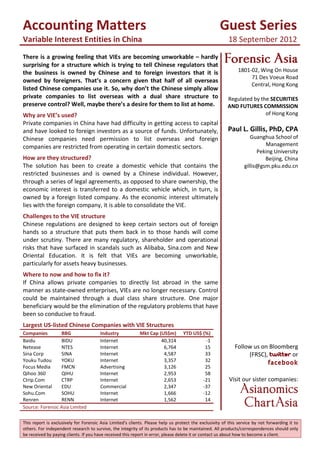
There is a growing feeling that VIEs are becoming unworkable – hardly
surprising for a structure which is trying to tell Chinese regulators that
the business is owned by Chinese and to foreign investors that it is
owned by foreigners. That’s a concern given that half of all overseas
listed Chinese companies use it. So, why don’t the Chinese simply allow
private companies to list overseas with a dual share structure to
preserve control? Well, maybe there’s a desire for them to list at home.
Why are VIE’s used?
Private companies in China have had difficulty in getting access to capital
and have looked to foreign investors as a source of funds. Unfortunately,
Chinese companies need permission to list overseas and foreign
companies are restricted from operating in certain domestic sectors.
How are they structured?
The solution has been to create a domestic vehicle that contains the
restricted businesses and is owned by a Chinese individual. However,
through a series of legal agreements, as opposed to share ownership, the
economic interest is transferred to a domestic vehicle which, in turn, is
owned by a foreign listed company. As the economic interest ultimately
lies with the foreign company, it is able to consolidate the VIE.
Challenges to the VIE structure
Chinese regulations are designed to keep certain sectors out of foreign
hands so a structure that puts them back in to those hands will come
under scrutiny. There are many regulatory, shareholder and operational
risks that have surfaced in scandals such as Alibaba, Sina.com and New
Oriental Education. It is felt that VIEs are becoming unworkable,
particularly for assets heavy businesses.
Where to now and how to fix it?
If China allows private companies to directly list abroad in the same
manner as state-owned enterprises, VIEs are no longer necessary. Control
could be maintained through a dual class share structure. One major
beneficiary would be the elimination of the regulatory problems that have
been so conducive to fraud.
Forensic Asia
1801-02, Wing On House
71 Des Voeux Road
Central, Hong Kong
Regulated by the SECURITIES
AND FUTURES COMMISSION
of Hong Kong
Paul L. Gillis, PhD, CPA
Guanghua School of
Management
Peking University
Beijing, China
gillis@gsm.pku.edu.cn
Largest US-listed Chinese Companies with VIE Structures
Follow us on Bloomberg
(FRSC), twitter or
facebook
Visit our sister companies:
Asianomics
ChartAsia
Companies BBG Industry Mkt Cap (US$m) YTD US$ (%)
Baidu BIDU Internet 40,314 -1
Netease NTES Internet 6,764 15
Sina Corp SINA Internet 4,587 33
Youku Tudou YOKU Internet 3,357 32
Focus Media FMCN Advertising 3,126 25
Qihoo 360 QIHU Internet 2,953 58
Ctrip.Com CTRP Internet 2,653 -21
New Oriental EDU Commercial 2,347 -37
Sohu.Com SOHU Internet 1,666 -12
Renren RENN Internet 1,562 14
Source: Forensic Asia Limited
Accounting Matters
Variable Interest Entities in China
Page 2 of 15 18 September 2012 Forensic Asia
Investors in Chinese companies soon encounter an obscure accounting term –
the variable interest entity, or VIE. A VIE is a company that is included in
consolidated financial statements because it is controlled through contracts,
rather than the more conventional control that is obtained through ownership.
The contracts attempt, often imperfectly, to mimic the control and economic
interest of direct ownership.
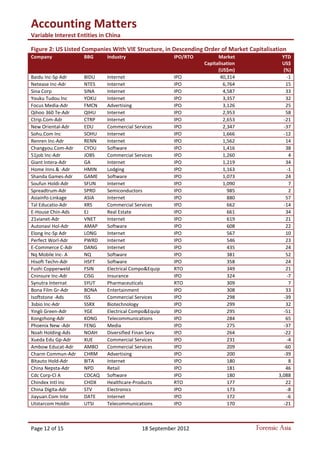
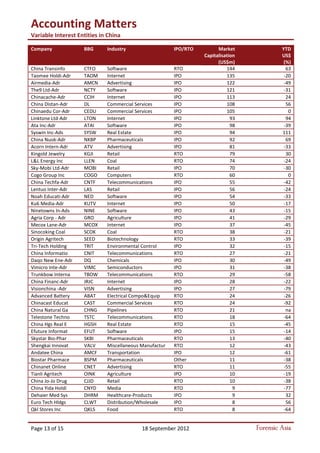
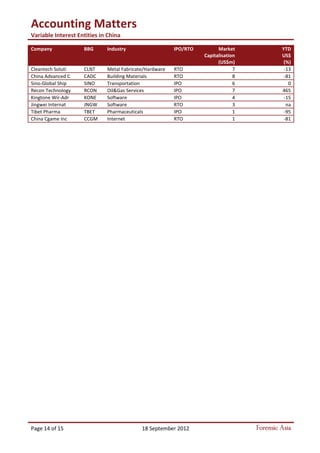
VIEs are widely used in China. Of the 225 Chinese companies listed on the
NYSE and NASDAQ, 108 (48%) use the VIE structure (see Figure 2). Chinese
companies traded on other exchanges, including the OTCBB in the U.S., the
Hong Kong Stock Exchange, the Toronto Stock Exchange, the London Stock
Exchange, and others, also use VIEs. Some multinational companies use VIEs to
hold their part or all of their China operations.
Why are VIEs used?
After the Communists took power in China in 1949, private business
disappeared and all economic activity was conducted by state-owned
enterprises. Following the disastrous Cultural Revolution and the death of Mao
Zedong, Deng Xiaoping, in December of 1978, set China on a path of reform
and opening up that led to the China becoming the second largest global
economy.
China’s stock markets reopened in 1990 after having been closed in the early
1950s. Initially the stock markets were used to reform state-owned enterprises
by providing capital and instituting corporate governance.
Private enterprise emerged as the opening up process began and
entrepreneurs prospered in the new environment. By 2002, the share of GDP
produced by the non-state sector exceeded two-thirds. Private companies,
however, had great difficulty accessing capital. As late as 2006, a study found
that 98% of Chinese companies could not access bank loans. In 2000, only 1%
of companies listed on China’s stock exchanges were privately owned. That
began to change in 2001 when Jiang Zemin invited businessmen to join the
Communist Party, signalling the beginning of reforms that would lead to the
establishment of Chinese venture capital and private equity firms, the SME
board on the Shenzhen Stock Exchange, and ChiNext, China’s answer to
NASDAQ. These new institutions would increasingly meet the capital needs of
China’s entrepreneurial sector.
These new capital institutions would lag the development of the private sector
in China. Starved for capital locally, privately owned firms looked to overseas
markets. Foreign investors were keen to participate in China’s economic
miracle. Yet, as companies prepared for public listings in overseas markets,
obstacles loomed in their way. China required its companies that wanted to
list overseas to obtain permission from the State Council, China’s highest
executive organ. The big state-owned enterprises like PetroChina that listed in
the U.S. had no difficulty obtaining this permission, but it was viewed unlikely
that a privately controlled business would be able to do the same. Instead the
private companies formed offshore companies, typically in the Cayman
Islands, to serve as the company that would actually list on the foreign
exchange.
A VIE is a company that is
included in consolidated
financial statements
because it is controlled
through contracts
China required its
companies that wanted to
list overseas to obtain
permission from the State
Council but only SOEs were
likely to get approval
Accounting Matters
Variable Interest Entities in China
Page 3 of 15 18 September 2012 Forensic Asia
Using offshore companies as the listing vehicle created a new problem for
these companies. China controls foreign investment through an investment
catalogue that classifies industries as encouraged, restricted, or prohibited for
foreign investment. Many of the sectors in which entrepreneurs were active
are restricted, including the Internet sector. The Internet entrepreneurs faced
a problem. By using offshore companies they had made their company foreign,
yet foreign companies could not operate their business because it was in a
restricted sector. The entrepreneurs could have gone to Chinese regulators
and asked permission to have foreign investors, but they thought it unlikely
they would be successful in doing so.
Necessity being the mother of invention, this is when the VIE concept was
created. The VIE structure is commonly called the Sina structure, named after
Sina.com which listed on NASDAQ in 2000. Actually the structure was
developed for two Chinese Internet companies, Sina and Sohu, which both
listed in 2000 and Price Waterhouse (PW) audited both. The solution to the
restricted sector problem was to separate the business into two parts – the
parts of the business that were open to foreign ownership were put into a
wholly foreign owned enterprise (WFOE) that was owned by the Cayman
Islands public company. The parts of the business that were restricted to
foreign ownership were put into a Chinese company that was owned by
Chinese individuals (the VIE). The challenge was to include the restricted part
in the consolidated financial statements, which was considered to be an
essential requirement for going public. The accounting rules at the time
focused on stock ownership; if a company was more than 50% owned it was to
be consolidated. Many companies were abusing these rules by creating special
purpose vehicles to hold debt. Since these companies did not own more than
50% of the shares of the special purpose vehicle they did not consolidate it,
keeping the debt off their balance sheet. Enron made extensive use of this
technique, and its collapse led to the establishment of VIE rules.
In the Sina and Sohu cases, PW accountants convinced the U.S. Securities and
Exchange Commission (SEC) that the Chinese company that held the Internet
content provider license and was owned by Chinese individuals should be
consolidated into the financial statements of the offshore parent company.
They argued that a series of agreements between the public company and the
VIE sufficiently mimicked ownership so that the VIE should be consolidated.
The accounting rules were formally changed in 2002 after Enron collapsed, and
Financial Accounting Standards Board (FASB) Interpretation No. 46:
Consolidation of Variable Interest Entities established rules that require
consolidation of entities when the parent company has the risks and rewards
normally associated with ownership, but the accountants at PW had convinced
the SEC to apply the concepts to the Sina and Sohu offerings at an earlier date.
Many of the sectors in
which entrepreneurs were
active are restricted and
could not be owned by
foreigners
Separate the business into
two parts: that which
operates in restricted
businesses (VIE) and that
which does not (WFOE)
Auditors persuaded the SEC
that VIE be consolidated
into the financial
statements of the offshore
parent company
The VIE was owned by
Chinese individuals but
controlled through legal
agreements by the listed
vehicle
Accounting Matters
Variable Interest Entities in China
Page 4 of 15 18 September 2012 Forensic Asia
How are VIEs structured?
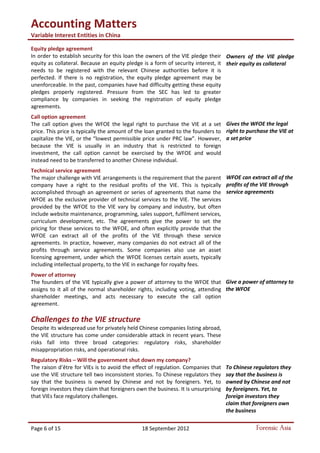
While there is some variation in VIE structures, an archetypal model has
developed. Here is a diagram of the archetypal structure:
Figure 1: Structure of a Variable Interest Entity
Source: Paul Gillis
Some structures have Hong Kong companies between the Cayman Islands
company and the WFOE. The objective of these intermediary companies is to
minimize withholding taxes on dividends paid from China, but China’s treaty
shopping rules generally make this practice ineffective.
Starting at the top of the structure there are shareholders in the public
company. The VIE structure is only used on overseas listed Chinese private
companies. It is not used for State controlled companies like PetroChina or
China Life, even when they are listed overseas. It is also not used with private
companies listed on Chinese stock exchanges. While the VIE structure is most
common on the NYSE and NASDAQ, it can also be found in companies listed on
other foreign exchanges, including Hong Kong and Toronto. Because the VIE is
an American accounting term, entities controlled through contracts are not
called VIEs in those markets, but operate in the same manner.
The listed company for non-state controlled companies listing abroad is always
an offshore company. The most popular location for incorporating these
companies is the Cayman Islands, although the British Virgin Islands, the
United States, and other jurisdictions are sometimes used. The listed company
typically has no operations and serves only as a holding company.
The WFOE is a Chinese subsidiary that is wholly owned by the offshore listed
company. A WFOE is the conventional entity used by multinational
corporations to conduct business in China. Most overseas listed Chinese
companies that do not use the VIE structure will conduct all of their China
business in a WFOE. WFOEs are heavily regulated by Chinese authorities and
must conduct their business within the scope of a business license that is
granted to them. Companies using the VIE structure tend to conduct any part
While the VIE structure is
most common on the NYSE
and NASDAQ, it can also be
found in companies listed
on other foreign
exchanges, including Hong
Kong and Toronto
The WFOE is a Chinese
subsidiary that is wholly
owned by the offshore
listed company
Accounting Matters
Variable Interest Entities in China
Page 5 of 15 18 September 2012 Forensic Asia
of the business that can be done by foreign invested enterprises in their
WFOE. Often the WFOE obtains a business license that allows it to conduct a
consulting business, and its only customer is the VIE.
The VIE is a Chinese company that is owned by an individual who holds
Chinese nationality. The Chinese individual is typically the founder and
chairman of the public company. In situations where the founder is not a
Chinese citizen, another trusted employee is usually selected to own the VIE.
This allows the VIE to claim it is domestically owned when it applies for
permits to operate a business in a sector that is restricted for foreign investors.
However, in order to consolidate the VIE in the financial statements of the
public company, the VIE must meet certain accounting requirements.
FASB Interpretation No. 46: Consolidation of Variable Interest Entities (FIN 46)
contains the accounting rules for VIEs. It has been amended and is now known
as FIN 46R, and is included in the FASB Codification of Accounting Standards in
Section 810. The rules as presently written require an entity to be consolidated
where the parent company has the power to direct the activities of the entity
which most significantly impact economic performance, has the obligation to
absorb the expected losses of the entity, and has the right to receive the
expected residual returns of the entity. When the VIE is initially formed, none
of those conditions are met. In order to consolidate the VIE, a series of
agreements are put in place to meet those requirements. These VIE
agreements vary somewhat between companies, but most follow what has
become a standard protocol.
What are the standard VIE agreements?
The concept that underpins a VIE structure is that control is obtained through
legal agreements rather than through share ownership. Taken together, the
agreements are intended to provide the WFOE with substantially all of the
economic benefits from the VIE and the obligation to absorb all of its losses.
The typical VIE will use five agreements to achieve this:
Loan agreement
The first two agreements deal with capitalizing the VIE, and attaining some
sort of collateral for the loan given to provide funds for the capitalization. To
achieve this, a loan agreement is set up and the equity in the VIE is pledged as
collateral in the event of any failure to comply with the agreement.
The loan is normally given to the owners of a VIE by the WFOE and is typically
in the form of an RMB denominated, interest free loan running for a number
of years with the potential for extension. A loan from the offshore public
company would face regulatory problems with the State Administration of
Foreign Exchange. Regulatory problems remain, however. The authorized
business scope of the WFOE is unlikely to include making loans to Chinese
individuals, although no companies appear to have been challenged on this
issue.
The loan agreement typically transfers most shareholder rights from the
Chinese shareholder of the VIE to the WFOE, giving the WFOE the power to
vote shares in the VIE, collect dividends, and make other important corporate
decisions.
The VIE is a Chinese
company that is owned by
an individual who holds
Chinese nationality
The rules as presently
written require an entity to
be consolidated where the
parent company has the
power to direct the
activities of the entity
Control is obtained through
legal agreements rather
than through share
ownership
The loan is normally given
to the owners of a VIE by
the WFOE
The loan agreement
transfers most shareholder
rights from the Chinese
shareholder of the VIE to
the WFOE
Accounting Matters
Variable Interest Entities in China
Page 6 of 15 18 September 2012 Forensic Asia
Equity pledge agreement
In order to establish security for this loan the owners of the VIE pledge their
equity as collateral. Because an equity pledge is a form of security interest, it
needs to be registered with the relevant Chinese authorities before it is
perfected. If there is no registration, the equity pledge agreement may be
unenforceable. In the past, companies have had difficulty getting these equity
pledges properly registered. Pressure from the SEC has led to greater
compliance by companies in seeking the registration of equity pledge
agreements.
Call option agreement
The call option gives the WFOE the legal right to purchase the VIE at a set
price. This price is typically the amount of the loan granted to the founders to
capitalize the VIE, or the “lowest permissible price under PRC law”. However,
because the VIE is usually in an industry that is restricted to foreign
investment, the call option cannot be exercised by the WFOE and would
instead need to be transferred to another Chinese individual.
Technical service agreement
The major challenge with VIE arrangements is the requirement that the parent
company have a right to the residual profits of the VIE. This is typically
accomplished through an agreement or series of agreements that name the
WFOE as the exclusive provider of technical services to the VIE. The services
provided by the WFOE to the VIE vary by company and industry, but often
include website maintenance, programming, sales support, fulfilment services,
curriculum development, etc. The agreements give the power to set the
pricing for these services to the WFOE, and often explicitly provide that the
WFOE can extract all of the profits of the VIE through these service
agreements. In practice, however, many companies do not extract all of the
profits through service agreements. Some companies also use an asset
licensing agreement, under which the WFOE licenses certain assets, typically
including intellectual property, to the VIE in exchange for royalty fees.
Power of attorney
The founders of the VIE typically give a power of attorney to the WFOE that
assigns to it all of the normal shareholder rights, including voting, attending
shareholder meetings, and acts necessary to execute the call option
agreement.
Challenges to the VIE structure
Despite its widespread use for privately held Chinese companies listing abroad,
the VIE structure has come under considerable attack in recent years. These
risks fall into three broad categories: regulatory risks, shareholder
misappropriation risks, and operational risks.
Regulatory Risks – Will the government shut down my company?
The raison d’être for VIEs is to avoid the effect of regulation. Companies that
use the VIE structure tell two inconsistent stories. To Chinese regulators they
say that the business is owned by Chinese and not by foreigners. Yet, to
foreign investors they claim that foreigners own the business. It is unsurprising
that VIEs face regulatory challenges.
Owners of the VIE pledge
their equity as collateral
Gives the WFOE the legal
right to purchase the VIE at
a set price
WFOE can extract all of the
profits of the VIE through
service agreements
Give a power of attorney to
the WFOE
To Chinese regulators they
say that the business is
owned by Chinese and not
by foreigners. Yet, to
foreign investors they
claim that foreigners own
the business
Accounting Matters
Variable Interest Entities in China
Page 7 of 15 18 September 2012 Forensic Asia
Chinese regulators initially ignored the growing use of VIE structures, even as
most of China’s Internet sector was developed under this model.
No PRC regulatory body has officially approved a VIE structure, yet many
investors and advisors believe that they have tacit approval to use the
structure. There have been several challenges to VIE structures by regulators
in recent years.
The first regulatory attack on VIEs came in 2009 when the General
Administration of Press and Publication (GAAP), and two other regulators
published Xin Chu Lian [2009] No. 13, (Notice 13). Notice 13 specifically
prohibited the use of contractual arrangements to control Chinese Internet
game operators. No action, however, has been taken against companies in this
sector that use the VIE structure and the rules have essentially been ignored.
A more serious attack on the VIE structure occurred in late 2010 when Jack Ma
of Alibaba Group attempted to obtain a license for Alipay from the People’s
Bank of China (PBOC). The PBOC had decided to regulate online payment
processors and as a first step required them to obtain a license. Alipay is the
market leader among online payment processors in China. It operated as a
WFOE that was wholly owned by the Alibaba Group, a Cayman Islands
company owned in turn by Yahoo!, Softbank and Jack Ma, a Chinese individual
and CEO of Alibaba Group. Jack Ma was apparently told by regulators that
Alipay could not obtain the required license if it was a WFOE, so the entity was
converted to a VIE with Jack Ma as shareholder. Jack Ma was then informed by
regulators that the license would not be granted to a VIE, so the VIE was
unwound and Jack Ma ended up owning Alipay entirely by himself. Yahoo!
and its shareholders were obviously outraged at the loss of Alipay, and
negotiations ultimately lead to a deal for Alibaba to buy out Yahoo!.
Buddha Steel, Inc. pulled its planned IPO in March of 2011 after local
regulators in Hebei province told the company that its VIE structure
contravened current Chinese management practices related to foreign
invested enterprises and, as a result, was against public policy. Steel is a
restricted industry for foreign investment.
In August 2011, the Ministry of Commerce issued regulations requiring a
national security review when foreigners acquire domestic companies. These
regulations specifically provide that the required review could not be avoided
through use of VIE or similar structures.
In September 2011, a report surfaced in the Chinese press that was purported
to come from the China Securities Regulatory Commission (CSRC). The report
advocated greater regulation of the VIE structure (particularly in sensitive
areas such as the internet), and suggested that Chinese companies should be
encouraged to list at home. The report was widely reported and lead to a
significant decline in the price of companies using the VIE structure. Over the
next year, however, no significant changes in the regulation of VIEs transpired.
Shareholder misappropriation risks – Will someone steal my VIE?
The nightmare scenario for investors in companies using the VIE structure is
that the Chinese shareholder of the VIE will one day take the VIE and refuse to
acknowledge the VIE agreements. The VIE structure is dependent on the
enforceability of the contracts between the WFOE and the VIE. If those
Chinese regulators initially
ignored the growing use of
VIE structures
The first regulatory attack
on VIEs came in 2009...
...and then a more serious
attack in 2010...
...and let’s not forget
Buddha Steel
National Security review
needed
Greater regulation of the
VIE structure
The Chinese shareholder of
the VIE will one day take
the VIE and refuse to
acknowledge the VIE
agreements
Accounting Matters
Variable Interest Entities in China
Page 8 of 15 18 September 2012 Forensic Asia
contracts can be breached, not only does the accounting treatment fail, but
also the public shareholders lose the business that is in the VIE.
Lawyers have given opinions that VIE structures are legal under Chinese law,
often using remarkable legal gymnastics to explain why specific rules such as
GAPP’s specific prohibition on the use of VIEs for online games does not apply
to their Internet game company. The opinions are consistently caveated with a
statement that Chinese law is unclear and that authorities might disagree. The
opinions point out that if authorities disagree, the consequences could be
disastrous, leading possibly to the business being shuttered. What they do not
usually point out is that the shareholder of the VIE might take the position that
the contracts are not enforceable and will simply decide to ignore them and
take the VIE. Like most countries, China has a rule that says that contracts that
frustrate public policy are not enforceable, and as we saw in the Buddha Steel
case, local regulators and judges might decide that VIE contracts frustrate
public policy.
The first case challenging VIE contracts came up with the company that started
the VIE trend – Sina. In 2001, not long after Sina’s IPO, its board removed a
founder who was also the controlling shareholder of its VIE. In the end the
founder agreed to sell his shares in the VIE to another insider, and a crisis was
averted.
Nasdaq listed Agria Corporation nearly lost its VIE in 2008 when its COO, who
also owned the VIE, resigned in a compensation dispute. The COO had no
share interest in the public company. The dispute was settled through a
significant payment of cash and shares to the COO and to management of the
VIE, and Agria was able to retain control of its VIE.
Gigamedia, a Nasdaq listed, Taiwan based, online game company lost its VIE
when it tried to replace the VIE owner as head of its China operations. The VIE
owner took the company chops, registrations and other key documents for
both the VIE and the WOFE. The company and the VIE owner are fighting it out
in court, but Gigamedia had to start over in China.
The most serious case related to loss of the VIE to the VIE shareholder was
that of Alipay and Jack Ma. As previously discussed, Jack Ma ended up with
sole ownership of Alipay after the PBOC said that Alipay could not get an
online payment processor license if it was controlled by foreigners either as a
WFOE or through VIE agreements.
Operational Risks – Will the VIE actually work?
VIE structures have been in use in China for a little more than a decade. While
the regulatory risks and risks of VIE shareholder misappropriation have gotten
most of the headlines, there is growing concern that the VIE structure is
unworkable for some companies. When most of the business in the company
is conducted in the VIE, China’s tax and business laws make it difficult and
expensive to operate a VIE.
The problems arise in asset-heavy VIEs; those where most of the assets and
most of the business is conducted in the VIE. Internet companies are examples
of asset-light VIEs. They usually have a small proportion of the assets and
business in the VIE, operating most of the business in their WFOE. An Internet
company will typically put only the Internet content provider license and the
servers necessary to host the site into the VIE, retaining all of the
Lawyers have given
opinions that VIE structures
are legal under Chinese
law...
...but the opinions are
consistently caveated with
a statement that Chinese
law is unclear and that
authorities might disagree
The first case challenging
VIE contracts came up with
the company that started
the VIE trend – Sina
The most serious case
related to loss of the VIE to
the VIE shareholder was
that of Alipay and Jack Ma
There is growing concern
that the VIE structure is
unworkable for some
companies
The problems arise in
asset-heavy VIEs
Accounting Matters
Variable Interest Entities in China
Page 9 of 15 18 September 2012 Forensic Asia
programming, advertising sales, and fulfilment activities in the WFOE.
Consequentially there is minimal profit in the VIE, and this profit can be easily
extracted through the service agreements.
Education companies are good examples of asset-heavy VIEs. In this industry it
is necessary to put the entire school into the VIE because of restrictions on
foreign ownership. Because the school has to collect the tuition, all of the
profit of education companies tends to end up in the VIE. That creates
problems.
Under the typical VIE structure, the profits of a VIE are extracted to the public
company through service contracts. Chinese tax laws impose a 5% business tax
on service payments. The business tax is similar to a sales tax or value added
tax (VAT); in fact, China is in the process of turning the business tax into VAT.
This tax is a cost of using a VIE since it would not be payable (because there
would be no service charge) if the operations were in the WFOE.
There is also concern that Chinese tax authorities might question why a
company would pay 100% of its earnings to another company for services.
That is especially likely when those services are of dubious value. The
authorities might make a transfer pricing adjustment, disallowing a deduction
to the VIE for part or all of the service fee. That would significantly increase the
tax liability of the VIE (which usually pays tax at 25%). If the tax authorities
adjusted the transfer price, they might also allow the WFOE to reduce the
income it reports, resulting in a tax refund to the WFOE. But they might not.
After all, the cash found its way to the WFOE, so the tax authorities might
instead characterize the payment as a dividend to the individual shareholder
of the VIE (which is taxed at 20%), followed by a payment from the individual
shareholder to the WFOE (which might be characterized as interest on the
loan, and taxed to the WFOE at 25%). The end result would be a disaster –
raising the effective tax rate above 60%.
Because of this risk, many asset-heavy VIEs have not been making the
payments on the service contracts. Another reason for not making the
payments is that the companies typically need the cash in the VIE, not the
WFOE. It is usually not in the authorized business scope of the WFOE to be
making loans or capital contributions to the VIE, so if the cash is transferred to
the WFOE it is difficult to get it back to the VIE where it is needed for
operations or capital improvements.
Companies have not typically been accruing the taxes that would result if they
made the service payments under the VIE agreements. They argue that they
do not intend to ever make these payments. The problem with that argument
is that it undermines the basis for treating the company as a VIE in the first
place. One of the key requirements for consolidating a company as a VIE is that
the parent company has a right to the residual profits of the VIE. If it has no
intent to ever distribute the profits of the VIE to the public company, should
the public company be considered to have a right to those residual profits?
The most recent scandal with respect to VIEs broke when New Oriental
Education (NYSE: EDU) “EDU”, announced that it was under SEC investigation
as to whether it should be consolidating its VIEs. Shortly after this
announcement Muddy Waters, a short-selling research firm, released a report
alleging that EDU was improperly consolidating certain operations that were
Tax is a problem
Why would a company pay
100% of its earnings to
another company for
services?
Many asset-heavy VIEs
have not been making the
payments on the service
contracts
Companies have not
typically been accruing the
taxes
A scandal with New
Oriental Education
Accounting Matters
Variable Interest Entities in China
Page 10 of 15 18 September 2012 Forensic Asia
actually franchise operations, not-for-profits, or state-owned. A special
committee of the board was formed to conduct an investigation.
Where to now?
The problems with VIEs have led many investors to conclude that the structure
is unsustainable. The problems are unsurprising because the structure is based
on inconsistent statements. To investors, the company says that it owns its
operations, yet to Chinese regulators it claims it does not control them.
Neither statement is true and a structure built on lies is not likely to work for
long.
The reasons why the VIE structure is needed are related to Chinese regulations
restricting foreign investment in certain sectors, or which make it difficult for
Chinese companies to directly list abroad. The solution to the problem can be
found by addressing those regulations.
A number of state-owned enterprises have listed abroad without using
offshore structures or VIEs. China’s major telecommunications companies,
China Mobile, China Unicom, and China Telecom are all listed on the New York
Stock Exchange yet do not use either an offshore holding company or a VIE.
Like the Internet industry, the telecommunications industry is restricted for
foreign investment. These state-owned enterprises had the political power to
obtain permission to directly list ADSs abroad and to have foreign investment.
Private companies have not had that level of political clout and as a
consequence were forced into offshore holding companies and VIE structures.
The problem with VIEs and offshore companies could be eliminated if
permission were given to private companies to directly list abroad. No change
in law or regulations appears to be necessary, rather the government simply
needs to give the same permission to privately owned companies to directly
list abroad that it has given to the large SOEs.
Allowing private Chinese companies to directly list abroad would eliminate the
only justification for using a VIE structure – to avoid Chinese regulations that
prohibit foreign investment in certain sectors. It has the additional benefit of
closing the regulatory hole that these companies have fallen into. Chinese
regulators have been unable to effectively regulate overseas listed Chinese
companies because the listing entity is usually a Cayman Islands company that
is outside of their jurisdiction. U.S. regulators like the SEC and the Public
Company Accounting Oversight Board (PCAOB) have likewise been unable to
effectively regulate these companies because, despite being Cayman Islands
companies, the officers and records are located in China and Chinese
regulators will not grant them access. These regulatory holes have been a
major factor in creating an environment conducive to fraud. While allowing
private companies to directly list abroad does not solve the access issues for
U.S. regulators, it would allow Chinese regulators to more effectively supervise
the companies.
How to fix the VIE structures
If China decides to allow private companies to directly list abroad in the same
manner as SOEs, the Cayman Islands and VIE structures are no longer
necessary. If Chinese regulators decide to go in this direction, I expect they will
The VIE structure is
unsustainable
SOEs can list overseas
Why not allow private
companies?
It would help closing the
regulatory hole
Ask US-listed Chinese
companies to restructure
Accounting Matters
Variable Interest Entities in China
Page 11 of 15 18 September 2012 Forensic Asia
approach several leading U.S. listed Chinese companies and ask them to
restructure. The companies will be allowed to directly list ADSs of a Chinese
company on U.S. exchanges, but first they will be asked to merge the offshore
parent company and the WFOE into the VIE. At that point the operating
company in China would become the listed company. That is a big win for
investors since they now have direct ownership in the entity that actually
operates the business. The restructuring solves the regulatory problems, the
shareholder moral hazard problems and the operational problems that have
plagued the VIE structure. Investors can also hope that Chinese regulators take
a more active role in supervising the company, perhaps heading off some of
the frauds that have so damaged the market for U.S. listed Chinese companies.
The original concern of Chinese regulators in restricting foreign investment in
certain sectors was to make certain that Chinese, and not foreigners, were
making the decisions that impact sensitive sectors. Those concerns remain,
even though the offshore structures and VIEs have substantially undermined
the policy. I expect that Chinese regulators will want to make certain that
Chinese remain in control of critical decisions that may impact social stability
or state secrecy. The easiest way to accomplish this would be through a
multiple share structure. A shares, with full voting rights, would be issued to
Chinese nationals. B shares, with limited voting rights would be traded as ADSs
on U.S. exchanges. This structure would also facilitate the listing of A shares on
Chinese exchanges, which I expect the companies will be encouraged to do.
Chinese regulators have indicated they would prefer that the overseas listed
companies come home to list, and this could be the first step in making that
happen.
Another advantage of allowing Chinese companies to directly list abroad is
that the CSRC could be made the first gatekeeper for access to foreign capital
markets. Companies that wish to list overseas would need to seek the
permission of the CSRC, which could stop listings of companies with state
security issues or disreputable management. By making the CSRC the primary
regulatory of overseas listed companies, it should be easier for overseas
regulators such as the SEC and PCAOB to negotiate workable arrangements for
obtaining the information needed to enforce foreign securities laws.
Investors would actually
own the operating
company
Use a multiple share
structure to retain control
Accounting Matters
Variable Interest Entities in China
Page 12 of 15 18 September 2012 Forensic Asia
Figure 2: US Listed Companies With VIE Structure, in Descending Order of Market Capitalisation
Company BBG Industry IPO/RTO Market
Capitalisation
(US$m)
YTD
US$
(%)
Baidu Inc-Sp Adr BIDU Internet IPO 40,314 -1
Netease Inc-Adr NTES Internet IPO 6,764 15
Sina Corp SINA Internet IPO 4,587 33
Youku Tudou Inc YOKU Internet IPO 3,357 32
Focus Media-Adr FMCN Advertising IPO 3,126 25
Qihoo 360 Te-Adr QIHU Internet IPO 2,953 58
Ctrip.Com-Adr CTRP Internet IPO 2,653 -21
New Oriental-Adr EDU Commercial Services IPO 2,347 -37
Sohu.Com Inc SOHU Internet IPO 1,666 -12
Renren Inc-Adr RENN Internet IPO 1,562 14
Changyou.Com-Adr CYOU Software IPO 1,416 38
51job Inc-Adr JOBS Commercial Services IPO 1,260 4
Giant Intera-Adr GA Internet IPO 1,219 34
Home Inns & -Adr HMIN Lodging IPO 1,163 -1
Shanda Games-Adr GAME Software IPO 1,073 24
Soufun Holdi-Adr SFUN Internet IPO 1,090 7
Spreadtrum-Adr SPRD Semiconductors IPO 985 2
Asiainfo-Linkage ASIA Internet IPO 880 57
Tal Educatio-Adr XRS Commercial Services IPO 662 -14
E-House Chin-Ads EJ Real Estate IPO 661 34
21vianet-Adr VNET Internet IPO 619 21
Autonavi Hol-Adr AMAP Software IPO 608 22
Elong Inc-Sp Adr LONG Internet IPO 567 10
Perfect Worl-Adr PWRD Internet IPO 546 23
E-Commerce C-Adr DANG Internet IPO 435 24
Nq Mobile Inc- A NQ Software IPO 381 52
Hisoft Techn-Adr HSFT Software IPO 358 24
Fushi Copperweld FSIN Electrical Compo&Equip RTO 349 21
Cninsure Inc-Adr CISG Insurance IPO 324 -7
Synutra Internat SYUT Pharmaceuticals RTO 309 7
Bona Film Gr-Adr BONA Entertainment IPO 308 33
Isoftstone -Ads ISS Commercial Services IPO 298 -39
3sbio Inc-Adr SSRX Biotechnology IPO 299 32
Yingli Green-Adr YGE Electrical Compo&Equip IPO 295 -51
Kongzhong-Adr KONG Telecommunications IPO 284 65
Phoenix New -Adr FENG Media IPO 275 -37
Noah Holding-Ads NOAH Diversified Finan Serv IPO 264 -22
Xueda Edu Gp-Adr XUE Commercial Services IPO 231 -4
Ambow Educat-Adr AMBO Commercial Services IPO 209 -60
Charm Commun-Adr CHRM Advertising IPO 200 -39
Bitauto Hold-Adr BITA Internet IPO 180 8
China Nepsta-Adr NPD Retail IPO 181 46
Cdc Corp-Cl A CDCAQ Software IPO 180 3,088
Chindex Intl Inc CHDX Healthcare-Products RTO 177 22
China Digita-Adr STV Electronics IPO 173 -8
Jiayuan.Com Inte DATE Internet IPO 172 -6
Utstarcom Holdin UTSI Telecommunications IPO 170 -21
Accounting Matters
Variable Interest Entities in China
Page 13 of 15 18 September 2012 Forensic Asia
Company BBG Industry IPO/RTO Market
Capitalisation
(US$m)
YTD
US$
(%)
China Transinfo CTFO Software RTO 144 63
Taomee Holdi-Adr TAOM Internet IPO 135 -20
Airmedia-Adr AMCN Advertising IPO 122 -49
The9 Ltd-Adr NCTY Software IPO 121 -31
Chinacache-Adr CCIH Internet IPO 113 24
China Distan-Adr DL Commercial Services IPO 108 56
Chinaedu Cor-Adr CEDU Commercial Services IPO 105 0
Linktone Ltd-Adr LTON Internet IPO 93 94
Ata Inc-Adr ATAI Software IPO 98 -39
Syswin Inc-Ads SYSW Real Estate IPO 94 111
China Nuok-Adr NKBP Pharmaceuticals IPO 92 69
Acorn Intern-Adr ATV Advertising IPO 81 -33
Kingold Jewelry KGJI Retail RTO 79 30
L&L Energy Inc LLEN Coal RTO 74 -24
Sky-Mobi Ltd-Adr MOBI Retail IPO 70 -30
Cogo Group Inc COGO Computers RTO 60 0
China Techfa-Adr CNTF Telecommunications IPO 55 -42
Lentuo Inter-Adr LAS Retail IPO 56 -24
Noah Educati-Adr NED Software IPO 54 -33
Ku6 Media-Adr KUTV Internet IPO 50 -17
Ninetowns In-Ads NINE Software IPO 43 -15
Agria Corp - Adr GRO Agriculture IPO 41 -29
Mecox Lane-Adr MCOX Internet IPO 37 -45
Sinocoking Coal SCOK Coal RTO 38 -21
Origin Agritech SEED Biotechnology RTO 33 -39
Tri-Tech Holding TRIT Environmental Control IPO 32 -15
China Informatio CNIT Telecommunications RTO 27 -21
Daqo New Ene-Adr DQ Chemicals IPO 30 -49
Vimicro Inte-Adr VIMC Semiconductors IPO 31 -38
Trunkbow Interna TBOW Telecommunications RTO 29 -58
China Financ-Adr JRJC Internet IPO 28 -22
Visionchina -Adr VISN Advertising IPO 27 -79
Advanced Battery ABAT Electrical Compo&Equip RTO 24 -26
Chinacast Educat CAST Commercial Services RTO 24 -92
China Natural Ga CHNG Pipelines RTO 21 na
Telestone Techno TSTC Telecommunications RTO 18 -64
China Hgs Real E HGSH Real Estate RTO 15 -45
Efuture Informat EFUT Software IPO 15 -14
Skystar Bio-Phar SKBI Pharmaceuticals RTO 13 -40
Shengkai Innovat VALV Miscellaneous Manufactur RTO 12 -43
Andatee China AMCF Transportation IPO 12 -61
Biostar Pharmace BSPM Pharmaceuticals Other 11 -38
Chinanet Online CNET Advertising RTO 11 -55
Tianli Agritech OINK Agriculture IPO 10 -19
China Jo-Jo Drug CJJD Retail RTO 10 -38
China Yida Holdi CNYD Media RTO 9 -77
Dehaier Med Sys DHRM Healthcare-Products IPO 9 32
Euro Tech Hldgs CLWT Distribution/Wholesale IPO 8 56
Qkl Stores Inc QKLS Food RTO 8 -64
Accounting Matters
Variable Interest Entities in China
Page 14 of 15 18 September 2012 Forensic Asia
Company BBG Industry IPO/RTO Market
Capitalisation
(US$m)
YTD
US$
(%)
Cleantech Soluti CLNT Metal Fabricate/Hardware RTO 7 -13
China Advanced C CADC Building Materials RTO 8 -81
Sino-Global Ship SINO Transportation IPO 6 0
Recon Technology RCON Oil&Gas Services IPO 7 465
Kingtone Wir-Adr KONE Software IPO 4 -15
Jingwei Internat JNGW Software RTO 3 na
Tibet Pharma TBET Pharmaceuticals IPO 1 -95
China Cgame Inc CCGM Internet RTO 1 -81
Accounting Matters
Variable Interest Entities in China
Page 15 of 15 18 September 2012 Forensic Asia
Figure 3: Past Forensic Asia Research
Date Author Title Hyperlink
13 Sep 12 Quincy Sell Chinese Banks Download...
11 Sep 12 Gillem Tulloch Asian Financial Stress: A north-south divide Download...
05 Sep 12 Keith Neruda China Telcos: Time to put the Mobile/Unicom pair trade back on Download...
03 Sep 12 Gillem Tulloch Summer’s Over: China Prop/Everbright/Jain/Country Visits Download...
13 Aug 12 Gillem Tulloch Worldwide Financial Stress: BRICing apart? Download...
09 Aug 12 Keith Neruda Bharti Airtel (Sell): Time for Plan B Download…
03 Aug 12 Gillem Tulloch Thailand Visit (O/W): A crowded trade Download…
25 July 12 Forensic Asia Angels & Demons: Introducing ChartAsia Download…
24 July 12 Keith Neruda China Unicom (Sell): Not yet a fundamental buy signal Download…
20 July 12 Gillem Tulloch China Property: Making sense of it all Download…
09 July 12 Chris Roberts Asian Equities: Unfinished bear Download…
07 July 12 Gillem Tulloch Day 6: Boom town Download…
06 July 12 Gillem Tulloch Day 5: Bullet train to Beijing Download…
05 July 12 Gillem Tulloch Day 4: Shanghai frustration Download…
04 July 12 Gillem Tulloch Day 3: Wenzhou deteriorating Download…
03 July 12 Gillem Tulloch Day 1&2: Zhenzhou powering ahead Download…
28 June 12 Gillem Tulloch China Corporate Solvency: Accrued interested expenses rising Download…
24 June 12 Gillem Tulloch Greentown China (Sell): Dead man walking? Download...
20 June 12 Gillem Tulloch Suspicious Behaviour: China’s deteriorating working capital Download...
12 June 12 Forensic Asia Angels & Demons: It’s all about China Download…
11 June 12 Gillem Tulloch Greentown China (Sell): Mad or desperate Download…
05 June 20 Gillem Tulloch China (U/W): Corporate balance sheets at breaking point Download…
29 May 12 Gillem Tulloch A balance sheet goes missing Download…
25 May 12 Keith Neruda China Unicom (Sell): Lower rates don’t address core concerns Download…
22 May 12 Gillem Tulloch China Property: Are presales real? Download…
15 May 12 Forensic Asia Angels & Demons – Potpourri Download…
09 May 12 Gillem & Keith Indian Company Visits: Be greedy… Download…
03 May 12 Keith Neruda Bharti: Trading at 50x balance sheet adjusted PE Download…
26 Apr 12 Forensic Asia Angels & Demons: Mad & bad Download…
26 Apr 12 Keith Neruda China Unicom: Financing costs make themselves felt Download…
23 Apr 12 Keith Neruda China Mobile 1Q12 results Download…
18 Apr 12 Gillem Tulloch China Property: Just a bad dream? Download…
16 Apr 12 Gillem Tulloch Bo Xilai and China Everbright (Sell) Download…
11 Apr 12 Gillem & Keith China Mobile: A short debate on the pros and cons Download…
04 Apr 12 Gillem Tulloch Greentown China results: Going, going... Download…
02 Apr 12 Gillem Tulloch Shimao results: Don't buy the hype Download…
30 Mar 12 Gillem Tulloch Indian corporate overview Download…
23 Mar 12 Keith Neruda China Unicom (Sell): Valuation levers worsening Download…
21 Mar 12 Gillem Tulloch Philippine corporate overview Download…
15 Mar 12 Keith Neruda Profiting from mispriced balance sheets Download…
07 Mar 12 Gillem Tulloch Asia 2011 reporting season/Shimao Property presales fall 31% Download…
24 Feb 12 Gillem Tulloch US road show/China 2011 earnings disappoint Download…
17 Feb 12 Gillem & Keith Indian company visits – First thoughts Download…
16 Feb 12 Gillem & Keith Indonesian company visits Download…
09 Feb 12 Keith Neruda Bharti (SELL): Overvalued, illiquid balance sheet Download…
03 Feb 12 Gillem Tulloch China earnings disappoint Download…
27 Jan 12 Gillem Tulloch Reliance Communication: Under-Reporting Liabilities Download…
13 Jan 12 Gillem Tulloch India’s foreign debt problem Download…
Source: Forensic Asia

New Oriental

  • 1.
    This case wasprepared by Professor Paul Gilis of the Guanghua School of Management based on publicly available information. Karen Wong, Jack Smith, John Carter, Global Capital Funds and Asia Stars are fictitious characters. © 2012 Paul Gillis     New  Oriental’s  Variable  Interest  Entity   “So,  Karen,  what  do  you  propose  we  do?”  said  Jack  Smith.     Jack  was  the  Chief  Investment  Officer  for  Global  Capital  Funds  (GCF),  one  of  the  top   five  mutual  fund  groups  in  the  United  States.  GCF  had  $1  trillion  under  management   in  a  family  of  mutual  funds.     Karen  Wong,  31,  had  joined  GCF  right  after  she  earned  her  MBA  degree.  She  had   started  as  an  analyst,  but  Jack  quickly  saw  her  talents  and  promoted  her  to  portfolio   manager.    She  was  managing  the  Asia  Stars  fund,  which  had  been  a  top  performer  in   its  group.  She  had  developed  a  track  record  of  picking  solid  Asian  companies  that   had  outperformed  their  peers.  Today,  however,  she  had  a  problem.   Jack  had  come  to  Karen’s  office  shortly  after  the  market  opened  on  July  17,  2012.   John  Carter,  GCF’s  chief  risk  officer  was  at  his  side.  Carter  had  a  scowl  on  his  face,   but  that  was  normal.    The  portfolio  managers  had  a  natural  dislike  for  the  risk   officer.  After  all,  it  was  his  job  to  second-­‐guess  their  decisions,  but  Karen  had  to   admit  he  was  usually  right.   Today’s  visit  was  about  the  largest  position  in  the  Asia  Stars  fund,  a  Chinese   company  listed  on  the  New  York  Stock  Exchange  called  New  Oriental  Education  &   Technology  Group  (NYSE:  EDU).  The  company  had  announced  its  4th  quarter   earnings  before  the  market  opened.  The  earnings  were  good;  revenues  for  the   quarter  were  up  40.7%  and  net  income  for  the  year  was  up  30.4%.  The  stock,   however,  was  falling  like  a  rock,  down  20%  in  the  first  hour  of  trading.  The  reason   was  that  Louis  Hsieh,  President  and  CFO  of  New  Oriental,  had  announced  in  the   earnings  call  that  the  SEC  had  launched  a  formal  investigation  of  the  company.     Louis  said  that  the  Company  believed  that  the  investigation  concerns  whether  there   is  a  sufficient  basis  for  the  consolidation  of  Beijing  New  Oriental  Education  and   Technology  (Group)  Co.  Ltd.,  a  variable  interest  entity  of  the  Company,  and  its   wholly  owned  subsidiaries,  into  the  Company’s  consolidated  financial  statements.   Asia  Stars  held  10  million  shares  of  New  Oriental  that  had  been  worth  $225  million   the  day  before.  The  fund  had  lost  $45  million  already  today.    While  Asia  Stars  had   less  than  5%  of  its  capital  invested  in  New  Oriental,  the  loss  was  going  to  be  painful   and  it  would  leave  a  black  mark  on  Karen’s  record  as  a  portfolio  manager.     About  New  Oriental   As  the  largest  provider  of  private  educational  services  in  China,  New  Oriental  offers   education  for  a  lifetime,  teaching  skills  that  give  students  a  crucial  competitive   advantage  in  the  workplace  and  help  improve  their  quality  of  life.  New  Oriental  
  • 2.
    2 offers  a  wide  range  of  educational  programs,  services  and  products  that  include   English  and  other  foreign  language  training,  overseas  and  domestic  test  preparation   courses,  all-­‐subjects  after  school  tutoring,  primary  and  secondary  school  education,   educational  content  and  software  as  well  as  online  education.         New  Oriental  has  become  the  most  recognized  brand  in  Chinese  private   education.  Based  on  founder  Michael  Yu's  groundbreaking  vision,  New  Oriental’s   innovative  and  inspirational  instruction  combines  humorous,  interactive  teaching   techniques  with  traditional  Chinese  educational  values.    Since  its  founding  in  1993,  New  Oriental  has  had  over  13  million  student   enrollments,  including  approximately  2.4  million  enrollments  in  fiscal  year  2012.  In   2012  New  Oriental  has  a  network  of  55  schools,  664  learning  centers,  32  New   Oriental  bookstores  and  over  5,000  third-­‐party  bookstores  and  over  17,600   teachers  in  49  cities,  as  well  as  an  online  network  with  over  7.8  million  registered   users.   Variable  interest  entities   New  Oriental  commenced  operations  in  China  in  1993..  In  2004,  the  Company  set  up   a  holding  company  in  the  British  Virgin  Islands  (which  later  changed  its  domicile  to   the  Cayman  Islands).  The  reason  for  setting  up  the  offshore  company  was  to   circumvent  Chinese  regulations  that  prohibit  foreign  ownership  of  primary  and   middle  schools  for  students  in  grades  one  to  nine.    New  Oriental  wished  to  raise   foreign  capital  for  expansion,  and  the  offshore  company  facilitated  it  raising  funds   from  Tiger  Global  Private  Investment  Partners  II,  L.P.       The  restrictions  on  foreign  investment  in  the  education  sector  were  problematic.  A   work-­‐around  had  been  developed  to  allow  foreign  investment  in  restricted  sectors.     The  solution  would  have  the  restricted  operations  held  in  a  corporation  that  was   owned  by  a  Chinese  individual.  That  would  make  the  operations  domestically   owned  and  avoid  the  restrictions  on  foreign  ownership.   The  problem  was  that  if  the  operations  were  actually  owned  by  a  Chinese  individual,   how  could  foreigners  be  convinced  to  invest  in  a  company  that  actually  did  not   conduct  the  business?  The  solution  that  was  found  was  to  put  in  place  a  series  of   contracts  that  gave  the  foreign  company  control  over  the  Chinese  company  that   actually  operated  the  business.  While  this  left  the  ownership  of  operations  in   Chinese  hands,  it  gave  control  to  foreigners.     In  order  to  sell  investors  on  this  idea  it  was  critical  that  the  foreign  company  be   allowed  to  consolidate  the  operations  of  the  individually  owned  Chinese  company  in   its  consolidated  financial  statements.  The  accounting  rules  for  consolidation  had   long  focused  on  stock  ownership,  requiring  consolidation  when  more  than  50%  of   the  shares  were  owned,  requiring  equity  accounting  for  ownership  between  20%   and  50%,  and  portfolio  accounting  for  ownership  below  20%.  Enron  famously   abused  these  rules  and  set  up  special  purpose  entities  that  were  owned  by  Andy   Fastow,  Enron’s  treasurer  (who  would  later  go  to  prison).  Enron  would  put  large   amounts  of  debt  in  these  entities,  and  because  Enron  owned  no  shares  in  the   companies,  it  was  not  required  to  consolidate  the  entities  and  put  the  debt  on  its  
  • 3.
    3 balance  sheet,  even  though  it  was  essentially  on  the  hook  for  it.  When  Enron   imploded  the  Financial  Accounting  Standards  Board  (FASB)  decided  that  accounting   rules  had  to  change  to  prevent  reoccurrence  of  the  Enron  off-­‐balance  sheet  financing   scandals.  The  FASB  issued  FASB  Interpretation  No.  46  (FIN  46)  which  was  later   reissued  as  FIN46R  which  changed  the  consolidation  rules.    FIN46  requires  an  entity   to  consolidate  a  variable  interest  entity  (VIE)  if  it  is  the  primary  beneficiary  of  the   VIE.  Under  FIN46R,  a  variable  interest  is  one  that  increases  or  decreases  in  value   based  on  the  increases  or  decreases  in  the  expected  cash  flows  from  the  entity’s   assets  or  liabilities.  The  primary  beneficiary  of  the  varlable  interest  entity  is   required  to  consolidate  that  entity  in  its  financial  statements.  Said  another  way,  if  a   company  has  the  upside  and  downside  in  another  entity  it  must  consolidate  it.    The   main  effect  of  FIN46  and  FIN  46R  was  to  require  many  companies  to  consolidate   special  purpose  entities  that  were  set  up  to  keep  debt  off  the  balance  sheet.     FIN46  and  FIN46R  were  not  limited  to  off  balance  sheet  financing  situations.     Chinese  companies  had  found  a  way  to  use  the  VIE  to  allow  consolidation  of   companies  that  were  off  limits  to  foreign  investment.    The  operations  that  did  not   permit  foreign  investment  would  be  held  in  a  Chinese  company  owned  by  a  Chinese   individual.  The  public  company  would  control  this  company  through  legal   agreements,  rather  than  through  ownership.  See  Appendix  1  for  a  description  of  the   use  of  VIEs  in  China.   The  Confrontation   “So,  I  understand  that  New  Oriental  has  all  its  operations  in  a  variable  interest  entity.   Does  that  mean  we  have  invested  a  quarter  of  a  billion  dollars  in  an  entity  that  does   not  actually  own  the  business?”  asked  John  Carter.       “Yes”,  answered  Karen  Wong.  “New  Oriental  uses  the  VIE  structure.  It  allows  the   public  company  to  control  businesses  where  China  restricts  foreign  ownership.  The   VIE  structure  is  very  common  –  half  of  U.S.  listed  Chinese  companies  use  it.”   “But  haven’t  there  been  a  lot  of  problems  with  VIE’s?”  asked  Jack  Smith.  “Didn’t  we   get  burned  last  year  when  Yahoo  lost  its  interest  in  Alipay  when  the  VIE   mysteriously  disappeared  into  the  hands  of  the  Chinese  shareholder?  “   “Yahoo  was  not  in  any  of  my  funds”,  answered  Karen  Wong,  “But  I  don’t  think  that  is   going  to  happen  in  this  situation.  Michael  Yu,  the  owner  of  the  VIE,  has  an  interest  in   keeping  it  in  New  Oriental,  and  the  lawyers  say  the  contracts  that  make  him  do  so   are  enforceable.  “     “Lawyers!”  snorted  John  Carter,  “Aren’t  these  the  same  lawyers  who  say  that  the  VIE   actually  works  to  get  around  Chinese  restrictions  on  foreign  investment?  Did  you   hear  about  the  Buddha  Steel  case?  A  lot  of  other  lawyers  say  there  is  no  way  these   deal  hold  up  if  the  end  up  in  court.”   “I  am  worried  about  this  SEC  investigation”,  said  Jack  Smith.  Why  is  the  SEC  now   challenging  whether  these  VIEs  can  be  consolidated?  What  if  the  SEC  is  right  and   they  cannot  consolidate?  What  do  we  have  left?    
  • 4.
    4 “Karen,  you  have  to  take  us  through  your  thinking  on  why  we  should  be  holding  this   investment,  and  the  way  the  market  is  moving,  you  better  make  it  quick”  said  John   Carter  as  he  settled  into  his  chair.     The  other  shoe  drops   By  the  time  John  Carter  left  Karen’s  office,  New  Oriental  shares  had  dropped  38%   although  they  did  rally  slightly  to  close  at  14.62,  down  35%  for  the  day.  John  had   told  Karen  to  spend  the  night  preparing  for  a  meeting  the  next  morning  with  Jack   and  himself,  where  they  would  decide  what  to  do  with  the  New  Oriental  position.     Karen  reviewed  all  of  her  prior  analytic  work  on  New  Oriental,  and  she  was   prepared  to  defend  her  decision  to  maintain  the  position  in  the  stock.  The  meeting   was  scheduled  at  10  am,  and  she  watched  her  computer  cautiously  as  the  market   opened  at  9:30.  She  was  relieved  to  see  that  New  Oriental  opened  at  $15  “Maybe  we   have  seen  the  worst  of  it”  she  muttered  to  herself  as  she  grabbed  her  Starbucks  and   headed  for  the  conference  room.     Jack  was  already  there  when  Karen  arrived.  He  smiled  warmly  “this  happens  to  the   best  of  them,  you  know.  It  is  a  tough  business”.  Karen  wondered  why  John  Carter   was  not  present  –  he  was  always  early  to  meetings.  Suddenly  John  Carter  burst  into   the  room  –  “it  is  dropping  like  rock!”  he  shouted.  Jack  jumped  out  of  his  chair  and   headed  for  the  Bloomberg  terminal  in  the  corner.  Karen  beat  him  there  and  punched   in  the  code  for  New  Oriental  –  EDU.  The  stock  had  just  fallen  through  $11  and  was   still  dropping.    The  screen  flashed  the  news  on  the  stock  –  Muddy  Waters  Research   initiating  coverage  on  EDU  –  strong  sell.         Muddy  Waters  Research  was  notorious  in  China  investment  circles.  Muddy  Waters   was  one  of  several  short  selling  research  firms  that  specialized  in  finding  fraudulent   Chinese  companies.  It  had  brought  down  many.  It  was  a  highly  controversial   business  model,  and  the  founder,  Carson  Block  was  despised  by  many  investors.   Block  was  not  always  right,  but  he  always  hurt  companies  when  he  focused  on  them.       The  investigation   The  Board  of  Directors  of  EDU  formed  a  Special  Committee  of  independent  directors,   including  Baidu  Chairman  Robin  Lee  and  BIMBA  Dean  John  Yang.    The  Special   Committee  hired  law  firm  Simpson,  Thacher  and  Bartlett  and  accounting  firm  Ernst   &  Young  to  conduct  an  investigation.     EDU  issued  a  press  release  on  September  30  announcing  that  the  Special  Committee   had  completed  its  review  of  Muddy  Water’s  allegations  and  had  found  no  significant   evidence  to  support  them.  The  Company  indiated  that  the  investigation  into  the  VIE   structure  continued,  and  that  the  company  would  miss  the  filing  date  for  its  annual   report  on  Form  20F.    EDU’s  stock  had  jumped  from  a  low  of  $14  to  $17  in  the  week   prior  to  the  announcement,  suggesting  someone  had  leaked  the  news.  On  October  1,   the  first  trading  day  after  the  announcement,  the  stock  fell  $0.06.  Muddy  Waters   announced  it  was  “more  convinced  than  ever”  that  EDU  was  misleading  investors.  
  • 5.
    5 On  October  12,  2012  EDU  announced  that  it  was  filing  its  annual  report  on  Form  20F.     I  staid  that  it  was  informed  by  the  staff  of  the  SEC’s  Division  of  Corporation  Finance   that  the  staff  has  no  objection  to  the  consolidation  of  its  schools.       EDU  stock  jumped  14%  in  premarket  trading  the  next  trading  day,  but  quickly  fell   back  after  a  Chinese  accounting  blog  pointed  out  that  the  company  was  making   inconsistent  disclosures  about  the  SEC  investigation.     Questions     Should  EDU’s  VIE  be  consolidated?     What  would  happen  to  EDU’s  financial  statements  if  the  VIE  cannot  be  consolidated?      
  • 6.
    6 Consolidating  EDU’s  VIE   Paul  Gillis  PhD  CPA   http://www.chinaaccountingblog.com/weblog/consolidating-­‐edus-­‐vie.html     New  Oriental  Education  &  Technology  Group  (NYSE:  EDU)  has  filed  its  delayed   annual  report  on  Form  20-­‐F.  EDU  claims  that  the  SEC  has  no  objection  to  the   consolidation  of  its  VIE.  However,  the  SEC  has  indicated  it  will  continue  to  review   EDU’s  disclosure  documents,  including  the  2012  Form  20-­‐F,  which  would  not  have   been  provided  to  the  SEC  until  now.  In  the  Form  20-­‐F  the  company  says  the  SEC   investigation  is  ongoing,  so  I  don’t  understand  what  is  going  on.         If  the  SEC  has  blessed  the  consolidation  of  EDU’s  VIE,  this  is  big  news  for  VIEs,  and  I   am  a  bit  surprised  by  the  result.  The  investigation  into  EDU  likely  was  a   consequence  of  Muddy  Water’s  allegations  against  the  company;  allegations  that   appear  to  have  been  discredited.  There  is  an  issue  present  in  EDU  that  Muddy   Waters  did  not  raise,  but  I  thought  that  the  SEC  would.  EDU  has  an  asset-­‐heavy  VIE,   that  is,  most  of  the  business  at  EDU  is  in  the  VIE.  Consolidation  requires  that  the   parent  company  have  a  right  to  the  residual  profits  of  the  VIE.  EDU  claims  a  right  to   these  residual  profits  because  of  a  series  of  service  agreements  between  EDU  and   the  VIE.  It  is  apparent  that  EDU  is  not  distributing  all  of  the  profits  through  these   agreements.  The  question  that  the  SEC  should  have  addressed  is  whether  all  that  is   necessary  to  consolidate  a  VIE  is  a  agreement,  or  whether  those  agreements  have  to   give  access  to  the  residual  profits  in  practice.  This  is  not  just  a  technical  accounting   question;  it  also  gets  to  the  substance  of  the  arrangements  and  what  the   shareholders  actually  own.  If  you  do  not  take  the  profits  out  as  you  are  entitled  to   them,  will  you  ever  be  able  to  take  them  out  and  do  you  really  own  them?   EDU  says  it  obtains  a  right  to  receive  substantially  all  of  the  economic  benefits  of  the   VIE  in  consideration  for  the  services  provided  by  EDU’s  wholly  owned  subsidiaries   (WFOEs).  The  service  fees  are  set  at  a  percentage  of  revenue.  I  do  not  understand   how  a  fee  that  is  a  percentage  of  revenue  is  considered  to  be  an  interest  in  the   residual  profits  of  the  company.  Residual  profits  are  what  remain  after  the  revenue-­‐ based  fees.  Most  VIE  agreements  get  around  this  by  allowing  the  public  company  to   unilaterally  set  the  fees  so  that  they  can  be  made  equal  to  net  income.  While  those   kinds  of  arrangements  are  more  easily  argued  to  result  in  an  interest  in  residual   profits,  they  are  likely  to  be  challenged  by  tax  authorities  as  violating  transfer-­‐ pricing  rules.       EDU  reports  that  the  VIE  earned  $159  million  in  2012.  Retained  earnings  of  the  VIE   increased  by  $49  million,  suggesting  that  the  VIE  only  made  payments  to  the  parent   of  $110  million.  EDU’s  VIE  has  retained  earnings  of  $308  million,  which  is  the   accumulated  earnings  that  have  not  been  paid  out.  The  accounting  question  is   whether  EDU  has  an  interest  in  those  retained  earnings.     From  what  EDU  is  saying,  the  SEC  appears  to  have  decided  that  EDU  has  a  right  to   the  residual  earnings  of  the  VIE,  despite  the  disclosure  that  the  VIE  is  not  paying  
  • 7.
    7 these  profits  to  the  public  company  through  the  service  agreements.  Perhaps  the   fees  required  under  the  agreements  are  equal  to  or  greater  than  the  net  income,  yet   the  company  has  decided  against  paying  them.  Payments  from  a  VIE  to  a  WFOE  are   inherently  tax  ineffective,  and  once  the  profits  are  in  the  WFOE  it  is  very  difficult  to   get  the  cash  back  to  the  VIE.  Perhaps  EDU  was  able  to  convince  the  SEC  that  it  met   the  letter  of  the  law  by  having  the  contractual  right  to  these  profits,  even  if  in   practice  it  did  not  actually  collect  the  payments  it  was  entitled  to.       Getting  the  residual  profits  through  service  contracts  is  the  usual  method  for  VIEs,   even  though  it  is  tax  inefficient.  There  is  another,  even  more  tax  inefficient  way,  to   get  the  profits  out.  That  would  be  through  a  dividend  from  the  VIE  to  the  VIE’s   individual  shareholder,  who  would  then  turn  it  over  to  WFOE.  Most  VIE  agreements   provide  for  that  possibility,  although  I  see  no  disclosure  of  such  provisions  by  EDU.   There  are  layers  of  additional  taxes  in  this  approach  that  can  drive  the  effective  tax   rate  up  substantially.  EDU  addresses  this  issue  in  its  tax  footnotes:   Aggregate  undistributed  earnings  of  the  Company’s  PRC  subsidiaries  and  VIE  that  are   available  for  distribution  was  US$395,534  and  US$483,100  as  of  May  31,  2011  and   May  31,  2012,  respectively.  Upon  distribution  of  such  earnings,  the  Company  will  be   subject  to  PRC  EIT  taxes,  the  amount  of  which  is  impractical  to  estimate.  The  Company   did  not  record  any  tax  on  any  of  the  aforementioned  undistributed  earnings  because   the  relevant  subsidiaries  and  VIE  does  not  intend  to  declare  dividends  and  the   Company  intends  to  permanently  reinvest  it  within  the  PRC.   Of  the  $483  million  of  undistributed  earnings,  $308  million  are  in  the  VIE.  The   remainder  is  in  the  WFOEs  and  would  not  be  subject  to  enterprise  income  tax  (EIT)   on  distribution.  It  would  be  subject  to  withholding  tax,  at  10%,  an  amount  that  is  not   impractical  to  estimate.  (EDU  does  not  appear  to  use  a  Hong  Kong  holding  company   to  reduce  the  withholding  rate  to  5%,  a  technique  that  probably  does  not  work   because  of  treaty  shopping  restrictions).  The  distribution  of  VIE  earnings  would  be   subject  to  individual  income  tax  when  distributed  to  the  individual  VIE  shareholder,   and  then  to  EIT  when  the  individual  gives  the  money  to  the  WFOE,  and  then  to   withholding  tax  when  distributed  by  the  WFOE  to  the  Cayman  Islands  parent.  Here   is  what  would  happen:   Amount  of  retained  earnings  of  VIE  =  $308  million.  Individual  income  tax  on   dividend  to  Michael  Yu  (20%  X  $308)  =  $61.6  million.  Amount  paid  to  WFOE  $308-­‐ $61.6  =  246.4  X  EIT  of  25%  =$61.6  million.  Total  tax  liability  on  VIE  retained   earnings  is  $123.2  million.  Add  to  that  a  10%  withholding  tax  to  get  the  money  out   of  China  to  the  Cayman  Islands.     Does  EDU  provide  for  that  deferred  tax  liability?  No,  the  company  waves  it  off  by   saying  they  do  not  intend  to  distribute  dividends  and  plan  to  leave  the  money  in  the   PRC.  Accordingly,  the  taxes  that  would  be  payable  on  distribution  are  not  recorded.   The  company  indicates  it  never  plans  to  pay  the  public  company  any  of  the  retained  
  • 8.
    8 earnings  of  the  VIE.  Not  providing  tax  on  income  that  the  company  never  expects  to   distribute  is  allowed  under  GAAP.       What  troubles  me  about  EDU’s  accounting  is  the  combination  of  claiming  an  interest   in  the  profits  of  the  VIE  despite  the  lack  of  ownership  but  also  arguing  that  EDU  will   never  get  those  profits.  When  you  start  layering  on  aggressive  accounting  policies,   even  if  individually  each  is  GAAP,  the  final  picture  does  not  fairly  present  the   situation.     If,  as  EDU  appears  to  say,  the  SEC  has  signed  off  on  this,  we  can  stop  worrying  about   accounting  challenges  to  the  VIE  structure.        
  • 9.
    9 EDU:  Is  the  SEC  investigation  really  over?   Paul  Gillis  PhD  CPA   http://www.chinaaccountingblog.com/weblog/edu-­‐is-­‐the-­‐sec-­‐investigatio.html       New  Oriental  Education  &  Technology  Group  (NYSE:EDU)  filed  its  delayed  2012  20F   on  October  12,  2012.  In  a  press  release,  the  company  says  this:   …New  Oriental  was  informed  by  the  staff  of  the  SEC's  Division  of  Corporation  Finance   that,  based  on  the  Company's  representations  made  in  response  to  the  SEC's  inquiries,   the  staff  has  no  objection  to  the  Company's  consolidation  of  its  variable  interest  entity,   Beijing  New  Oriental  Education  &  Technology  (Group)  Co.,  Ltd.  ("New  Oriental   China")…   However,  EDU  also  makes  this  curious  statement  in  the  press  release:   The  SEC  staff  has  indicated  that  it  will  continue  to  review  New  Oriental's  disclosure   documents,  including  the  2012  Form  20-­‐F.   So,  is  the  investigation  over,  or  not?       The  actual  filing  raises  more  issues:   On  July  13,  2012,  we  were  informed  that  the  SEC  had  issued  a  formal  order  of   investigation  captioned  “In  the  Matter  of  New  Oriental  Education  &  Technology  Group   Inc.”  In  that  investigation  the  SEC’s  enforcement  staff  has  requested  documents  and   information  concerning  the  basis  for  the  consolidation  of  New  Oriental  China,  a   variable  interest  entity  of  our  company,  and  its  schools  and  subsidiaries,  into  our   consolidated  financial  statements  and  other  issues  related  to  certain  allegations  about   us  contained  in  a  report  issued  on  July  18,  2012  by  Muddy  Waters  LLC.  We  are   cooperating  fully  with  the  SEC  in  its  investigation.  We  cannot  predict  the  timing,   outcome  or  consequences  of  the  SEC  investigation.   That  is  a  different  story.  First  of  all,  they  say  it  is  the  enforcement  staff,  a  term  that   customarily  refers  to  people  working  for  the  SEC’s  Division  of  Enforcement  (people   who  may  send  you  to  jail),  not  the  SEC’s  Division  of  Corporation  Finance,  (people   who  may  make  you  change  disclosures).       Then  they  say  they  cannot  predict  the  timing,  outcome,  or  consequences?   I  am  skeptical  about  whether  we  are  getting  the  straight  scoop.       Post  script:   This  is  what  the  special  committee  said  on  September  30:    
  • 10.
    10 The  Special  Committee  understands  that  the  SEC’s  Division  of  Corporation  Finance  is   engaged  in  a  review  of  the  Company’s  consolidation  of  the  financial  results  of  the  VIE   into  the  Company’s  consolidated  financial  statements.  Accordingly,  the  Special   Committee’s  work  on  that  issue  is  likewise  continuing.   Note  they  say  the  Divison  of  Corporation  Finance.  EDU  needs  to  get  its  story  straight.          
  • 11.
    11 SEC  v.  EDU  –  the  end  of  VIEs?   Paul  Gillis  PhD   July  18,  2012   http://www.chinaaccountingblog.com/weblog/sec-­‐v-­‐edu-­‐-­‐-­‐the-­‐end-­‐of-­‐vies.html     New  Oriental  Education  and  Technology  Group  (NYSE:  EDU)  dropped  a  bombshell   in  its  fourth  quarter  earnings  release  this  morning.  The  company  reported  that  the   SEC  has  issued  a  formal  order  of  investigation  captioned  "In  the  Matter  of  New   Oriental  Education  &  Technology  Group  Inc."  The  Company  believes  that  the   investigation  concerns  whether  there  is  a  sufficient  basis  for  the  consolidation  of   Beijing  New  Oriental  Education  &  Technology  (Group)  Co.,  Ltd.,  a  variable  interest   entity  of  the  Company,  and  its  wholly-­‐owned  subsidiaries,  into  the  Company's   consolidated  financial  statements.   Investors  are  appropriately  concerned.  The  stock  is  off  37%  as  I  write  this,  with   other  companies  with  VIEs  off  by  single  digits.  A  formal  investigation  is  far  more   serious  than  the  normal  comment  letter  process  that  usually  deals  with  these  kinds   of  issues.  It  means  the  Division  of  Enforcement  of  the  SEC,  rather  than  the  Division   of  Corporate  Finance  is  dealing  with  the  issue.       On  July  11  EDU  announced  it  had  restructured  its  VIE  ownership.  The  VIE  had  been   owned  by  a  number  of  shareholders,  some  of  whom  are  no  longer  active  in  the   company.    It  is  now  held  by  an  entity  owned  by  Chairman  Michael  Yu.  I  don’t  see   anything  wrong  with  that  restructuring.  The  SEC  investigation  was  launched  on  July   13.    I  doubt  that  the  restructuring  led  to  the  investigation.  I  suspect  that  the   company  has  been  responding  to  the  normal  comment  letters  that  the  SEC  Division   of  Corporate  Finance  issues  to  all  companies  periodically.  Something  may  have  gone   terribly  wrong  in  this  process  and  the  issue  was  referred  to  the  Division  of   Enforcement,  which  launched  a  formal  investigation.  That  is  all  my  speculation,   however.     I  have  written  about  my  concerns  over  consolidation  of  VIES.  I  had  planned  to  do  a   post  using  EDU  as  a  case  study  to  explain  some  of  the  major  concerns  I  have  about   VIEs,  but  was  waiting  for  EDU’s  current  financial  statements.  The  SEC  has  beaten  me   to  the  punch.           I  suspect  that  there  are  three  issues  that  the  SEC  will  focus  on.  First,  EDU  has  legal   opinions  that  say  that  the  VIE  agreements  are  in  compliance  with  Chinese  law  and   are  enforceable.  So  does  every  other  VIE,  yet  the  opinions  uniformly  come  with   caveats  that  the  Chinese  courts  might  not  agree  and  everything  might  fall  apart.   Some  lawyers  say  these  agreements  are  clearly  not  enforceable  and  violate  Chinese   laws  and  there  has  been  some  noise  that  Chinese  regulators  are  unhappy  with  some   of  the  lawyers  who  have  issued  opinions.  This  could  be  an  area  where  the  SEC  and   Chinese  regulators  are  cooperating.  
  • 12.
    12 Second,  EDU  is  an  asset  heavy  VIE.  In  its  last  published  financial  statements,  EDU   reported  that  it  had  62%  of  its  assets  and  97%  of  its  revenue  in  the  VIE.  One  of  the   requirements  for  consolidation  is  that  the  public  company  has  an  interest  in  the   residual  profits  of  the  VIE.  In  the  case  of  EDU,  as  is  the  case  for  most  VIEs,  the   interest  in  residual  profits  is  obtained  through  technical  service  agreements  that   allow  the  public  company  to  extract  the  profits  from  the  VIE  through  fees.  Many   VIEs  do  not  appear  to  be  making  those  fee  payments,  leaving  all  of  the  profits  to   accumulate  in  the  VIE.  That  raises  the  question  of  whether  the  public  company   actually  has  an  interest  in  those  profits.  If  it  does  not  take  them  out  by  following  the   VIE  agreements,  how  does  it  plan  to  ever  get  those  profits  to  the  shareholders?   Third,  the  company  may  not  have  accrued  taxes  that  would  be  payable  if  the   payments  from  the  VIE  to  the  public  company  were  made.  The  major  reason  for  not   making  the  payments  in  the  first  place  is  the  adverse  tax  consequences.  Any   payments  are  subject  to  business  tax  at  5%.  In  addition,  it  is  likely  that  tax   authorities  would  disallow  a  deduction  to  the  VIE  for  the  payments  on  the  basis  that   the  value  of  services  was  not  worth  the  amount  of  the  payment.  Nevertheless,  the   payment  would  remain  taxable  in  the  WFOE.  This  transfer-­‐pricing  problem  could   raise  the  effective  tax  rate  to  over  60%.  The  argument  companies  make  for  not   accruing  the  tax  is  that  they  never  expect  to  make  the  payments.    The  problem  with   that  argument  is  that  it  undermines  the  basis  for  consolidation  in  the  first  place.  I   have  a  student  who  wrote  his  thesis  on  this  topic  and  we  plan  to  post  a  detailed   analysis  of  this  issue  in  the  near  future.     EDU  announced  the  investigation  in  the  same  call  as  it  announced  its  fourth  quarter   earnings.  It  said  that  Deloitte  had  not  finished  its  audit  of  the  accounts  for  the  year   ended  May  31,  2012.  Deloitte  is  in  a  real  pickle  here.  They  are  already  up  to  their   eyeballs  in  trouble  with  the  SEC,  and  if  they  sign  off  on  these  accounts  they  could  be   setting  themselves  up  for  more.  Deloitte’s  signoff,  or  refusal  to  do  so,  will  be  the  first   indication  as  to  the  seriousness  of  the  SEC's  challenge  to  consolidation.     What  are  the  risks  that  this  spreads  to  other  companies?  It  is  tough  to  say,  since  we   do  not  know  specifically  what  the  SEC  is  focused  upon.  If  Deloitte  refuses  to  sign  off   on  the  May  31  numbers,  then  I  expect  it  spreads  very  quickly.  If  instead,  it  is  a   company  specific  issue  (such  as  an  allegation  of  lying  to  the  SEC)  then  the  problem   may  be  contained  to  EDU.                      
  • 13.
    13         This  is  a  fast  moving  story  so  you  should  do  an  Internet  search  on  New  Oriental  and   read  the  financial  websites  such  as  Yahoo  Finance.       Useful  links:     http:///www.chinaaccountingblog.com http://zhongguojinrongblog.wordpress.com/2012/07/18/edus-­‐sec-­‐troubles/     http://www.chinahearsay.com/gigamedia-­‐the-­‐answer-­‐to-­‐the-­‐what-­‐if-­‐vie-­‐question/     http://www.chinalawblog.com/2011/10/vies_in_china_the_end_of_a_flawed_strate gy.html     http://www.chinalawblog.com/2011/10/china_vies_the_end_of_a_flawed_strategy_ an_updaterebuttal.html        
  • 14.
    Accounting Matters Variable InterestEntities in China Guest Series 18 September 2012 This report is exclusively for Forensic Asia Limited's clients. Please help us protect the exclusivity of this service by not forwarding it to others. For independent research to survive, the integrity of its products has to be maintained. All products/correspondences should only be received by paying clients. If you have received this report in error, please delete it or contact us about how to become a client. There is a growing feeling that VIEs are becoming unworkable – hardly surprising for a structure which is trying to tell Chinese regulators that the business is owned by Chinese and to foreign investors that it is owned by foreigners. That’s a concern given that half of all overseas listed Chinese companies use it. So, why don’t the Chinese simply allow private companies to list overseas with a dual share structure to preserve control? Well, maybe there’s a desire for them to list at home. Why are VIE’s used? Private companies in China have had difficulty in getting access to capital and have looked to foreign investors as a source of funds. Unfortunately, Chinese companies need permission to list overseas and foreign companies are restricted from operating in certain domestic sectors. How are they structured? The solution has been to create a domestic vehicle that contains the restricted businesses and is owned by a Chinese individual. However, through a series of legal agreements, as opposed to share ownership, the economic interest is transferred to a domestic vehicle which, in turn, is owned by a foreign listed company. As the economic interest ultimately lies with the foreign company, it is able to consolidate the VIE. Challenges to the VIE structure Chinese regulations are designed to keep certain sectors out of foreign hands so a structure that puts them back in to those hands will come under scrutiny. There are many regulatory, shareholder and operational risks that have surfaced in scandals such as Alibaba, Sina.com and New Oriental Education. It is felt that VIEs are becoming unworkable, particularly for assets heavy businesses. Where to now and how to fix it? If China allows private companies to directly list abroad in the same manner as state-owned enterprises, VIEs are no longer necessary. Control could be maintained through a dual class share structure. One major beneficiary would be the elimination of the regulatory problems that have been so conducive to fraud. Forensic Asia 1801-02, Wing On House 71 Des Voeux Road Central, Hong Kong Regulated by the SECURITIES AND FUTURES COMMISSION of Hong Kong Paul L. Gillis, PhD, CPA Guanghua School of Management Peking University Beijing, China gillis@gsm.pku.edu.cn Largest US-listed Chinese Companies with VIE Structures Follow us on Bloomberg (FRSC), twitter or facebook Visit our sister companies: Asianomics ChartAsia Companies BBG Industry Mkt Cap (US$m) YTD US$ (%) Baidu BIDU Internet 40,314 -1 Netease NTES Internet 6,764 15 Sina Corp SINA Internet 4,587 33 Youku Tudou YOKU Internet 3,357 32 Focus Media FMCN Advertising 3,126 25 Qihoo 360 QIHU Internet 2,953 58 Ctrip.Com CTRP Internet 2,653 -21 New Oriental EDU Commercial 2,347 -37 Sohu.Com SOHU Internet 1,666 -12 Renren RENN Internet 1,562 14 Source: Forensic Asia Limited
  • 15.
    Accounting Matters Variable InterestEntities in China Page 2 of 15 18 September 2012 Forensic Asia Investors in Chinese companies soon encounter an obscure accounting term – the variable interest entity, or VIE. A VIE is a company that is included in consolidated financial statements because it is controlled through contracts, rather than the more conventional control that is obtained through ownership. The contracts attempt, often imperfectly, to mimic the control and economic interest of direct ownership. VIEs are widely used in China. Of the 225 Chinese companies listed on the NYSE and NASDAQ, 108 (48%) use the VIE structure (see Figure 2). Chinese companies traded on other exchanges, including the OTCBB in the U.S., the Hong Kong Stock Exchange, the Toronto Stock Exchange, the London Stock Exchange, and others, also use VIEs. Some multinational companies use VIEs to hold their part or all of their China operations. Why are VIEs used? After the Communists took power in China in 1949, private business disappeared and all economic activity was conducted by state-owned enterprises. Following the disastrous Cultural Revolution and the death of Mao Zedong, Deng Xiaoping, in December of 1978, set China on a path of reform and opening up that led to the China becoming the second largest global economy. China’s stock markets reopened in 1990 after having been closed in the early 1950s. Initially the stock markets were used to reform state-owned enterprises by providing capital and instituting corporate governance. Private enterprise emerged as the opening up process began and entrepreneurs prospered in the new environment. By 2002, the share of GDP produced by the non-state sector exceeded two-thirds. Private companies, however, had great difficulty accessing capital. As late as 2006, a study found that 98% of Chinese companies could not access bank loans. In 2000, only 1% of companies listed on China’s stock exchanges were privately owned. That began to change in 2001 when Jiang Zemin invited businessmen to join the Communist Party, signalling the beginning of reforms that would lead to the establishment of Chinese venture capital and private equity firms, the SME board on the Shenzhen Stock Exchange, and ChiNext, China’s answer to NASDAQ. These new institutions would increasingly meet the capital needs of China’s entrepreneurial sector. These new capital institutions would lag the development of the private sector in China. Starved for capital locally, privately owned firms looked to overseas markets. Foreign investors were keen to participate in China’s economic miracle. Yet, as companies prepared for public listings in overseas markets, obstacles loomed in their way. China required its companies that wanted to list overseas to obtain permission from the State Council, China’s highest executive organ. The big state-owned enterprises like PetroChina that listed in the U.S. had no difficulty obtaining this permission, but it was viewed unlikely that a privately controlled business would be able to do the same. Instead the private companies formed offshore companies, typically in the Cayman Islands, to serve as the company that would actually list on the foreign exchange. A VIE is a company that is included in consolidated financial statements because it is controlled through contracts China required its companies that wanted to list overseas to obtain permission from the State Council but only SOEs were likely to get approval
  • 16.
    Accounting Matters Variable InterestEntities in China Page 3 of 15 18 September 2012 Forensic Asia Using offshore companies as the listing vehicle created a new problem for these companies. China controls foreign investment through an investment catalogue that classifies industries as encouraged, restricted, or prohibited for foreign investment. Many of the sectors in which entrepreneurs were active are restricted, including the Internet sector. The Internet entrepreneurs faced a problem. By using offshore companies they had made their company foreign, yet foreign companies could not operate their business because it was in a restricted sector. The entrepreneurs could have gone to Chinese regulators and asked permission to have foreign investors, but they thought it unlikely they would be successful in doing so. Necessity being the mother of invention, this is when the VIE concept was created. The VIE structure is commonly called the Sina structure, named after Sina.com which listed on NASDAQ in 2000. Actually the structure was developed for two Chinese Internet companies, Sina and Sohu, which both listed in 2000 and Price Waterhouse (PW) audited both. The solution to the restricted sector problem was to separate the business into two parts – the parts of the business that were open to foreign ownership were put into a wholly foreign owned enterprise (WFOE) that was owned by the Cayman Islands public company. The parts of the business that were restricted to foreign ownership were put into a Chinese company that was owned by Chinese individuals (the VIE). The challenge was to include the restricted part in the consolidated financial statements, which was considered to be an essential requirement for going public. The accounting rules at the time focused on stock ownership; if a company was more than 50% owned it was to be consolidated. Many companies were abusing these rules by creating special purpose vehicles to hold debt. Since these companies did not own more than 50% of the shares of the special purpose vehicle they did not consolidate it, keeping the debt off their balance sheet. Enron made extensive use of this technique, and its collapse led to the establishment of VIE rules. In the Sina and Sohu cases, PW accountants convinced the U.S. Securities and Exchange Commission (SEC) that the Chinese company that held the Internet content provider license and was owned by Chinese individuals should be consolidated into the financial statements of the offshore parent company. They argued that a series of agreements between the public company and the VIE sufficiently mimicked ownership so that the VIE should be consolidated. The accounting rules were formally changed in 2002 after Enron collapsed, and Financial Accounting Standards Board (FASB) Interpretation No. 46: Consolidation of Variable Interest Entities established rules that require consolidation of entities when the parent company has the risks and rewards normally associated with ownership, but the accountants at PW had convinced the SEC to apply the concepts to the Sina and Sohu offerings at an earlier date. Many of the sectors in which entrepreneurs were active are restricted and could not be owned by foreigners Separate the business into two parts: that which operates in restricted businesses (VIE) and that which does not (WFOE) Auditors persuaded the SEC that VIE be consolidated into the financial statements of the offshore parent company The VIE was owned by Chinese individuals but controlled through legal agreements by the listed vehicle
  • 17.
    Accounting Matters Variable InterestEntities in China Page 4 of 15 18 September 2012 Forensic Asia How are VIEs structured? While there is some variation in VIE structures, an archetypal model has developed. Here is a diagram of the archetypal structure: Figure 1: Structure of a Variable Interest Entity Source: Paul Gillis Some structures have Hong Kong companies between the Cayman Islands company and the WFOE. The objective of these intermediary companies is to minimize withholding taxes on dividends paid from China, but China’s treaty shopping rules generally make this practice ineffective. Starting at the top of the structure there are shareholders in the public company. The VIE structure is only used on overseas listed Chinese private companies. It is not used for State controlled companies like PetroChina or China Life, even when they are listed overseas. It is also not used with private companies listed on Chinese stock exchanges. While the VIE structure is most common on the NYSE and NASDAQ, it can also be found in companies listed on other foreign exchanges, including Hong Kong and Toronto. Because the VIE is an American accounting term, entities controlled through contracts are not called VIEs in those markets, but operate in the same manner. The listed company for non-state controlled companies listing abroad is always an offshore company. The most popular location for incorporating these companies is the Cayman Islands, although the British Virgin Islands, the United States, and other jurisdictions are sometimes used. The listed company typically has no operations and serves only as a holding company. The WFOE is a Chinese subsidiary that is wholly owned by the offshore listed company. A WFOE is the conventional entity used by multinational corporations to conduct business in China. Most overseas listed Chinese companies that do not use the VIE structure will conduct all of their China business in a WFOE. WFOEs are heavily regulated by Chinese authorities and must conduct their business within the scope of a business license that is granted to them. Companies using the VIE structure tend to conduct any part While the VIE structure is most common on the NYSE and NASDAQ, it can also be found in companies listed on other foreign exchanges, including Hong Kong and Toronto The WFOE is a Chinese subsidiary that is wholly owned by the offshore listed company
  • 18.
    Accounting Matters Variable InterestEntities in China Page 5 of 15 18 September 2012 Forensic Asia of the business that can be done by foreign invested enterprises in their WFOE. Often the WFOE obtains a business license that allows it to conduct a consulting business, and its only customer is the VIE. The VIE is a Chinese company that is owned by an individual who holds Chinese nationality. The Chinese individual is typically the founder and chairman of the public company. In situations where the founder is not a Chinese citizen, another trusted employee is usually selected to own the VIE. This allows the VIE to claim it is domestically owned when it applies for permits to operate a business in a sector that is restricted for foreign investors. However, in order to consolidate the VIE in the financial statements of the public company, the VIE must meet certain accounting requirements. FASB Interpretation No. 46: Consolidation of Variable Interest Entities (FIN 46) contains the accounting rules for VIEs. It has been amended and is now known as FIN 46R, and is included in the FASB Codification of Accounting Standards in Section 810. The rules as presently written require an entity to be consolidated where the parent company has the power to direct the activities of the entity which most significantly impact economic performance, has the obligation to absorb the expected losses of the entity, and has the right to receive the expected residual returns of the entity. When the VIE is initially formed, none of those conditions are met. In order to consolidate the VIE, a series of agreements are put in place to meet those requirements. These VIE agreements vary somewhat between companies, but most follow what has become a standard protocol. What are the standard VIE agreements? The concept that underpins a VIE structure is that control is obtained through legal agreements rather than through share ownership. Taken together, the agreements are intended to provide the WFOE with substantially all of the economic benefits from the VIE and the obligation to absorb all of its losses. The typical VIE will use five agreements to achieve this: Loan agreement The first two agreements deal with capitalizing the VIE, and attaining some sort of collateral for the loan given to provide funds for the capitalization. To achieve this, a loan agreement is set up and the equity in the VIE is pledged as collateral in the event of any failure to comply with the agreement. The loan is normally given to the owners of a VIE by the WFOE and is typically in the form of an RMB denominated, interest free loan running for a number of years with the potential for extension. A loan from the offshore public company would face regulatory problems with the State Administration of Foreign Exchange. Regulatory problems remain, however. The authorized business scope of the WFOE is unlikely to include making loans to Chinese individuals, although no companies appear to have been challenged on this issue. The loan agreement typically transfers most shareholder rights from the Chinese shareholder of the VIE to the WFOE, giving the WFOE the power to vote shares in the VIE, collect dividends, and make other important corporate decisions. The VIE is a Chinese company that is owned by an individual who holds Chinese nationality The rules as presently written require an entity to be consolidated where the parent company has the power to direct the activities of the entity Control is obtained through legal agreements rather than through share ownership The loan is normally given to the owners of a VIE by the WFOE The loan agreement transfers most shareholder rights from the Chinese shareholder of the VIE to the WFOE
  • 19.
    Accounting Matters Variable InterestEntities in China Page 6 of 15 18 September 2012 Forensic Asia Equity pledge agreement In order to establish security for this loan the owners of the VIE pledge their equity as collateral. Because an equity pledge is a form of security interest, it needs to be registered with the relevant Chinese authorities before it is perfected. If there is no registration, the equity pledge agreement may be unenforceable. In the past, companies have had difficulty getting these equity pledges properly registered. Pressure from the SEC has led to greater compliance by companies in seeking the registration of equity pledge agreements. Call option agreement The call option gives the WFOE the legal right to purchase the VIE at a set price. This price is typically the amount of the loan granted to the founders to capitalize the VIE, or the “lowest permissible price under PRC law”. However, because the VIE is usually in an industry that is restricted to foreign investment, the call option cannot be exercised by the WFOE and would instead need to be transferred to another Chinese individual. Technical service agreement The major challenge with VIE arrangements is the requirement that the parent company have a right to the residual profits of the VIE. This is typically accomplished through an agreement or series of agreements that name the WFOE as the exclusive provider of technical services to the VIE. The services provided by the WFOE to the VIE vary by company and industry, but often include website maintenance, programming, sales support, fulfilment services, curriculum development, etc. The agreements give the power to set the pricing for these services to the WFOE, and often explicitly provide that the WFOE can extract all of the profits of the VIE through these service agreements. In practice, however, many companies do not extract all of the profits through service agreements. Some companies also use an asset licensing agreement, under which the WFOE licenses certain assets, typically including intellectual property, to the VIE in exchange for royalty fees. Power of attorney The founders of the VIE typically give a power of attorney to the WFOE that assigns to it all of the normal shareholder rights, including voting, attending shareholder meetings, and acts necessary to execute the call option agreement. Challenges to the VIE structure Despite its widespread use for privately held Chinese companies listing abroad, the VIE structure has come under considerable attack in recent years. These risks fall into three broad categories: regulatory risks, shareholder misappropriation risks, and operational risks. Regulatory Risks – Will the government shut down my company? The raison d’être for VIEs is to avoid the effect of regulation. Companies that use the VIE structure tell two inconsistent stories. To Chinese regulators they say that the business is owned by Chinese and not by foreigners. Yet, to foreign investors they claim that foreigners own the business. It is unsurprising that VIEs face regulatory challenges. Owners of the VIE pledge their equity as collateral Gives the WFOE the legal right to purchase the VIE at a set price WFOE can extract all of the profits of the VIE through service agreements Give a power of attorney to the WFOE To Chinese regulators they say that the business is owned by Chinese and not by foreigners. Yet, to foreign investors they claim that foreigners own the business
  • 20.
    Accounting Matters Variable InterestEntities in China Page 7 of 15 18 September 2012 Forensic Asia Chinese regulators initially ignored the growing use of VIE structures, even as most of China’s Internet sector was developed under this model. No PRC regulatory body has officially approved a VIE structure, yet many investors and advisors believe that they have tacit approval to use the structure. There have been several challenges to VIE structures by regulators in recent years. The first regulatory attack on VIEs came in 2009 when the General Administration of Press and Publication (GAAP), and two other regulators published Xin Chu Lian [2009] No. 13, (Notice 13). Notice 13 specifically prohibited the use of contractual arrangements to control Chinese Internet game operators. No action, however, has been taken against companies in this sector that use the VIE structure and the rules have essentially been ignored. A more serious attack on the VIE structure occurred in late 2010 when Jack Ma of Alibaba Group attempted to obtain a license for Alipay from the People’s Bank of China (PBOC). The PBOC had decided to regulate online payment processors and as a first step required them to obtain a license. Alipay is the market leader among online payment processors in China. It operated as a WFOE that was wholly owned by the Alibaba Group, a Cayman Islands company owned in turn by Yahoo!, Softbank and Jack Ma, a Chinese individual and CEO of Alibaba Group. Jack Ma was apparently told by regulators that Alipay could not obtain the required license if it was a WFOE, so the entity was converted to a VIE with Jack Ma as shareholder. Jack Ma was then informed by regulators that the license would not be granted to a VIE, so the VIE was unwound and Jack Ma ended up owning Alipay entirely by himself. Yahoo! and its shareholders were obviously outraged at the loss of Alipay, and negotiations ultimately lead to a deal for Alibaba to buy out Yahoo!. Buddha Steel, Inc. pulled its planned IPO in March of 2011 after local regulators in Hebei province told the company that its VIE structure contravened current Chinese management practices related to foreign invested enterprises and, as a result, was against public policy. Steel is a restricted industry for foreign investment. In August 2011, the Ministry of Commerce issued regulations requiring a national security review when foreigners acquire domestic companies. These regulations specifically provide that the required review could not be avoided through use of VIE or similar structures. In September 2011, a report surfaced in the Chinese press that was purported to come from the China Securities Regulatory Commission (CSRC). The report advocated greater regulation of the VIE structure (particularly in sensitive areas such as the internet), and suggested that Chinese companies should be encouraged to list at home. The report was widely reported and lead to a significant decline in the price of companies using the VIE structure. Over the next year, however, no significant changes in the regulation of VIEs transpired. Shareholder misappropriation risks – Will someone steal my VIE? The nightmare scenario for investors in companies using the VIE structure is that the Chinese shareholder of the VIE will one day take the VIE and refuse to acknowledge the VIE agreements. The VIE structure is dependent on the enforceability of the contracts between the WFOE and the VIE. If those Chinese regulators initially ignored the growing use of VIE structures The first regulatory attack on VIEs came in 2009... ...and then a more serious attack in 2010... ...and let’s not forget Buddha Steel National Security review needed Greater regulation of the VIE structure The Chinese shareholder of the VIE will one day take the VIE and refuse to acknowledge the VIE agreements
  • 21.
    Accounting Matters Variable InterestEntities in China Page 8 of 15 18 September 2012 Forensic Asia contracts can be breached, not only does the accounting treatment fail, but also the public shareholders lose the business that is in the VIE. Lawyers have given opinions that VIE structures are legal under Chinese law, often using remarkable legal gymnastics to explain why specific rules such as GAPP’s specific prohibition on the use of VIEs for online games does not apply to their Internet game company. The opinions are consistently caveated with a statement that Chinese law is unclear and that authorities might disagree. The opinions point out that if authorities disagree, the consequences could be disastrous, leading possibly to the business being shuttered. What they do not usually point out is that the shareholder of the VIE might take the position that the contracts are not enforceable and will simply decide to ignore them and take the VIE. Like most countries, China has a rule that says that contracts that frustrate public policy are not enforceable, and as we saw in the Buddha Steel case, local regulators and judges might decide that VIE contracts frustrate public policy. The first case challenging VIE contracts came up with the company that started the VIE trend – Sina. In 2001, not long after Sina’s IPO, its board removed a founder who was also the controlling shareholder of its VIE. In the end the founder agreed to sell his shares in the VIE to another insider, and a crisis was averted. Nasdaq listed Agria Corporation nearly lost its VIE in 2008 when its COO, who also owned the VIE, resigned in a compensation dispute. The COO had no share interest in the public company. The dispute was settled through a significant payment of cash and shares to the COO and to management of the VIE, and Agria was able to retain control of its VIE. Gigamedia, a Nasdaq listed, Taiwan based, online game company lost its VIE when it tried to replace the VIE owner as head of its China operations. The VIE owner took the company chops, registrations and other key documents for both the VIE and the WOFE. The company and the VIE owner are fighting it out in court, but Gigamedia had to start over in China. The most serious case related to loss of the VIE to the VIE shareholder was that of Alipay and Jack Ma. As previously discussed, Jack Ma ended up with sole ownership of Alipay after the PBOC said that Alipay could not get an online payment processor license if it was controlled by foreigners either as a WFOE or through VIE agreements. Operational Risks – Will the VIE actually work? VIE structures have been in use in China for a little more than a decade. While the regulatory risks and risks of VIE shareholder misappropriation have gotten most of the headlines, there is growing concern that the VIE structure is unworkable for some companies. When most of the business in the company is conducted in the VIE, China’s tax and business laws make it difficult and expensive to operate a VIE. The problems arise in asset-heavy VIEs; those where most of the assets and most of the business is conducted in the VIE. Internet companies are examples of asset-light VIEs. They usually have a small proportion of the assets and business in the VIE, operating most of the business in their WFOE. An Internet company will typically put only the Internet content provider license and the servers necessary to host the site into the VIE, retaining all of the Lawyers have given opinions that VIE structures are legal under Chinese law... ...but the opinions are consistently caveated with a statement that Chinese law is unclear and that authorities might disagree The first case challenging VIE contracts came up with the company that started the VIE trend – Sina The most serious case related to loss of the VIE to the VIE shareholder was that of Alipay and Jack Ma There is growing concern that the VIE structure is unworkable for some companies The problems arise in asset-heavy VIEs
  • 22.
    Accounting Matters Variable InterestEntities in China Page 9 of 15 18 September 2012 Forensic Asia programming, advertising sales, and fulfilment activities in the WFOE. Consequentially there is minimal profit in the VIE, and this profit can be easily extracted through the service agreements. Education companies are good examples of asset-heavy VIEs. In this industry it is necessary to put the entire school into the VIE because of restrictions on foreign ownership. Because the school has to collect the tuition, all of the profit of education companies tends to end up in the VIE. That creates problems. Under the typical VIE structure, the profits of a VIE are extracted to the public company through service contracts. Chinese tax laws impose a 5% business tax on service payments. The business tax is similar to a sales tax or value added tax (VAT); in fact, China is in the process of turning the business tax into VAT. This tax is a cost of using a VIE since it would not be payable (because there would be no service charge) if the operations were in the WFOE. There is also concern that Chinese tax authorities might question why a company would pay 100% of its earnings to another company for services. That is especially likely when those services are of dubious value. The authorities might make a transfer pricing adjustment, disallowing a deduction to the VIE for part or all of the service fee. That would significantly increase the tax liability of the VIE (which usually pays tax at 25%). If the tax authorities adjusted the transfer price, they might also allow the WFOE to reduce the income it reports, resulting in a tax refund to the WFOE. But they might not. After all, the cash found its way to the WFOE, so the tax authorities might instead characterize the payment as a dividend to the individual shareholder of the VIE (which is taxed at 20%), followed by a payment from the individual shareholder to the WFOE (which might be characterized as interest on the loan, and taxed to the WFOE at 25%). The end result would be a disaster – raising the effective tax rate above 60%. Because of this risk, many asset-heavy VIEs have not been making the payments on the service contracts. Another reason for not making the payments is that the companies typically need the cash in the VIE, not the WFOE. It is usually not in the authorized business scope of the WFOE to be making loans or capital contributions to the VIE, so if the cash is transferred to the WFOE it is difficult to get it back to the VIE where it is needed for operations or capital improvements. Companies have not typically been accruing the taxes that would result if they made the service payments under the VIE agreements. They argue that they do not intend to ever make these payments. The problem with that argument is that it undermines the basis for treating the company as a VIE in the first place. One of the key requirements for consolidating a company as a VIE is that the parent company has a right to the residual profits of the VIE. If it has no intent to ever distribute the profits of the VIE to the public company, should the public company be considered to have a right to those residual profits? The most recent scandal with respect to VIEs broke when New Oriental Education (NYSE: EDU) “EDU”, announced that it was under SEC investigation as to whether it should be consolidating its VIEs. Shortly after this announcement Muddy Waters, a short-selling research firm, released a report alleging that EDU was improperly consolidating certain operations that were Tax is a problem Why would a company pay 100% of its earnings to another company for services? Many asset-heavy VIEs have not been making the payments on the service contracts Companies have not typically been accruing the taxes A scandal with New Oriental Education
  • 23.
    Accounting Matters Variable InterestEntities in China Page 10 of 15 18 September 2012 Forensic Asia actually franchise operations, not-for-profits, or state-owned. A special committee of the board was formed to conduct an investigation. Where to now? The problems with VIEs have led many investors to conclude that the structure is unsustainable. The problems are unsurprising because the structure is based on inconsistent statements. To investors, the company says that it owns its operations, yet to Chinese regulators it claims it does not control them. Neither statement is true and a structure built on lies is not likely to work for long. The reasons why the VIE structure is needed are related to Chinese regulations restricting foreign investment in certain sectors, or which make it difficult for Chinese companies to directly list abroad. The solution to the problem can be found by addressing those regulations. A number of state-owned enterprises have listed abroad without using offshore structures or VIEs. China’s major telecommunications companies, China Mobile, China Unicom, and China Telecom are all listed on the New York Stock Exchange yet do not use either an offshore holding company or a VIE. Like the Internet industry, the telecommunications industry is restricted for foreign investment. These state-owned enterprises had the political power to obtain permission to directly list ADSs abroad and to have foreign investment. Private companies have not had that level of political clout and as a consequence were forced into offshore holding companies and VIE structures. The problem with VIEs and offshore companies could be eliminated if permission were given to private companies to directly list abroad. No change in law or regulations appears to be necessary, rather the government simply needs to give the same permission to privately owned companies to directly list abroad that it has given to the large SOEs. Allowing private Chinese companies to directly list abroad would eliminate the only justification for using a VIE structure – to avoid Chinese regulations that prohibit foreign investment in certain sectors. It has the additional benefit of closing the regulatory hole that these companies have fallen into. Chinese regulators have been unable to effectively regulate overseas listed Chinese companies because the listing entity is usually a Cayman Islands company that is outside of their jurisdiction. U.S. regulators like the SEC and the Public Company Accounting Oversight Board (PCAOB) have likewise been unable to effectively regulate these companies because, despite being Cayman Islands companies, the officers and records are located in China and Chinese regulators will not grant them access. These regulatory holes have been a major factor in creating an environment conducive to fraud. While allowing private companies to directly list abroad does not solve the access issues for U.S. regulators, it would allow Chinese regulators to more effectively supervise the companies. How to fix the VIE structures If China decides to allow private companies to directly list abroad in the same manner as SOEs, the Cayman Islands and VIE structures are no longer necessary. If Chinese regulators decide to go in this direction, I expect they will The VIE structure is unsustainable SOEs can list overseas Why not allow private companies? It would help closing the regulatory hole Ask US-listed Chinese companies to restructure
  • 24.
    Accounting Matters Variable InterestEntities in China Page 11 of 15 18 September 2012 Forensic Asia approach several leading U.S. listed Chinese companies and ask them to restructure. The companies will be allowed to directly list ADSs of a Chinese company on U.S. exchanges, but first they will be asked to merge the offshore parent company and the WFOE into the VIE. At that point the operating company in China would become the listed company. That is a big win for investors since they now have direct ownership in the entity that actually operates the business. The restructuring solves the regulatory problems, the shareholder moral hazard problems and the operational problems that have plagued the VIE structure. Investors can also hope that Chinese regulators take a more active role in supervising the company, perhaps heading off some of the frauds that have so damaged the market for U.S. listed Chinese companies. The original concern of Chinese regulators in restricting foreign investment in certain sectors was to make certain that Chinese, and not foreigners, were making the decisions that impact sensitive sectors. Those concerns remain, even though the offshore structures and VIEs have substantially undermined the policy. I expect that Chinese regulators will want to make certain that Chinese remain in control of critical decisions that may impact social stability or state secrecy. The easiest way to accomplish this would be through a multiple share structure. A shares, with full voting rights, would be issued to Chinese nationals. B shares, with limited voting rights would be traded as ADSs on U.S. exchanges. This structure would also facilitate the listing of A shares on Chinese exchanges, which I expect the companies will be encouraged to do. Chinese regulators have indicated they would prefer that the overseas listed companies come home to list, and this could be the first step in making that happen. Another advantage of allowing Chinese companies to directly list abroad is that the CSRC could be made the first gatekeeper for access to foreign capital markets. Companies that wish to list overseas would need to seek the permission of the CSRC, which could stop listings of companies with state security issues or disreputable management. By making the CSRC the primary regulatory of overseas listed companies, it should be easier for overseas regulators such as the SEC and PCAOB to negotiate workable arrangements for obtaining the information needed to enforce foreign securities laws. Investors would actually own the operating company Use a multiple share structure to retain control
  • 25.
    Accounting Matters Variable InterestEntities in China Page 12 of 15 18 September 2012 Forensic Asia Figure 2: US Listed Companies With VIE Structure, in Descending Order of Market Capitalisation Company BBG Industry IPO/RTO Market Capitalisation (US$m) YTD US$ (%) Baidu Inc-Sp Adr BIDU Internet IPO 40,314 -1 Netease Inc-Adr NTES Internet IPO 6,764 15 Sina Corp SINA Internet IPO 4,587 33 Youku Tudou Inc YOKU Internet IPO 3,357 32 Focus Media-Adr FMCN Advertising IPO 3,126 25 Qihoo 360 Te-Adr QIHU Internet IPO 2,953 58 Ctrip.Com-Adr CTRP Internet IPO 2,653 -21 New Oriental-Adr EDU Commercial Services IPO 2,347 -37 Sohu.Com Inc SOHU Internet IPO 1,666 -12 Renren Inc-Adr RENN Internet IPO 1,562 14 Changyou.Com-Adr CYOU Software IPO 1,416 38 51job Inc-Adr JOBS Commercial Services IPO 1,260 4 Giant Intera-Adr GA Internet IPO 1,219 34 Home Inns & -Adr HMIN Lodging IPO 1,163 -1 Shanda Games-Adr GAME Software IPO 1,073 24 Soufun Holdi-Adr SFUN Internet IPO 1,090 7 Spreadtrum-Adr SPRD Semiconductors IPO 985 2 Asiainfo-Linkage ASIA Internet IPO 880 57 Tal Educatio-Adr XRS Commercial Services IPO 662 -14 E-House Chin-Ads EJ Real Estate IPO 661 34 21vianet-Adr VNET Internet IPO 619 21 Autonavi Hol-Adr AMAP Software IPO 608 22 Elong Inc-Sp Adr LONG Internet IPO 567 10 Perfect Worl-Adr PWRD Internet IPO 546 23 E-Commerce C-Adr DANG Internet IPO 435 24 Nq Mobile Inc- A NQ Software IPO 381 52 Hisoft Techn-Adr HSFT Software IPO 358 24 Fushi Copperweld FSIN Electrical Compo&Equip RTO 349 21 Cninsure Inc-Adr CISG Insurance IPO 324 -7 Synutra Internat SYUT Pharmaceuticals RTO 309 7 Bona Film Gr-Adr BONA Entertainment IPO 308 33 Isoftstone -Ads ISS Commercial Services IPO 298 -39 3sbio Inc-Adr SSRX Biotechnology IPO 299 32 Yingli Green-Adr YGE Electrical Compo&Equip IPO 295 -51 Kongzhong-Adr KONG Telecommunications IPO 284 65 Phoenix New -Adr FENG Media IPO 275 -37 Noah Holding-Ads NOAH Diversified Finan Serv IPO 264 -22 Xueda Edu Gp-Adr XUE Commercial Services IPO 231 -4 Ambow Educat-Adr AMBO Commercial Services IPO 209 -60 Charm Commun-Adr CHRM Advertising IPO 200 -39 Bitauto Hold-Adr BITA Internet IPO 180 8 China Nepsta-Adr NPD Retail IPO 181 46 Cdc Corp-Cl A CDCAQ Software IPO 180 3,088 Chindex Intl Inc CHDX Healthcare-Products RTO 177 22 China Digita-Adr STV Electronics IPO 173 -8 Jiayuan.Com Inte DATE Internet IPO 172 -6 Utstarcom Holdin UTSI Telecommunications IPO 170 -21
  • 26.
    Accounting Matters Variable InterestEntities in China Page 13 of 15 18 September 2012 Forensic Asia Company BBG Industry IPO/RTO Market Capitalisation (US$m) YTD US$ (%) China Transinfo CTFO Software RTO 144 63 Taomee Holdi-Adr TAOM Internet IPO 135 -20 Airmedia-Adr AMCN Advertising IPO 122 -49 The9 Ltd-Adr NCTY Software IPO 121 -31 Chinacache-Adr CCIH Internet IPO 113 24 China Distan-Adr DL Commercial Services IPO 108 56 Chinaedu Cor-Adr CEDU Commercial Services IPO 105 0 Linktone Ltd-Adr LTON Internet IPO 93 94 Ata Inc-Adr ATAI Software IPO 98 -39 Syswin Inc-Ads SYSW Real Estate IPO 94 111 China Nuok-Adr NKBP Pharmaceuticals IPO 92 69 Acorn Intern-Adr ATV Advertising IPO 81 -33 Kingold Jewelry KGJI Retail RTO 79 30 L&L Energy Inc LLEN Coal RTO 74 -24 Sky-Mobi Ltd-Adr MOBI Retail IPO 70 -30 Cogo Group Inc COGO Computers RTO 60 0 China Techfa-Adr CNTF Telecommunications IPO 55 -42 Lentuo Inter-Adr LAS Retail IPO 56 -24 Noah Educati-Adr NED Software IPO 54 -33 Ku6 Media-Adr KUTV Internet IPO 50 -17 Ninetowns In-Ads NINE Software IPO 43 -15 Agria Corp - Adr GRO Agriculture IPO 41 -29 Mecox Lane-Adr MCOX Internet IPO 37 -45 Sinocoking Coal SCOK Coal RTO 38 -21 Origin Agritech SEED Biotechnology RTO 33 -39 Tri-Tech Holding TRIT Environmental Control IPO 32 -15 China Informatio CNIT Telecommunications RTO 27 -21 Daqo New Ene-Adr DQ Chemicals IPO 30 -49 Vimicro Inte-Adr VIMC Semiconductors IPO 31 -38 Trunkbow Interna TBOW Telecommunications RTO 29 -58 China Financ-Adr JRJC Internet IPO 28 -22 Visionchina -Adr VISN Advertising IPO 27 -79 Advanced Battery ABAT Electrical Compo&Equip RTO 24 -26 Chinacast Educat CAST Commercial Services RTO 24 -92 China Natural Ga CHNG Pipelines RTO 21 na Telestone Techno TSTC Telecommunications RTO 18 -64 China Hgs Real E HGSH Real Estate RTO 15 -45 Efuture Informat EFUT Software IPO 15 -14 Skystar Bio-Phar SKBI Pharmaceuticals RTO 13 -40 Shengkai Innovat VALV Miscellaneous Manufactur RTO 12 -43 Andatee China AMCF Transportation IPO 12 -61 Biostar Pharmace BSPM Pharmaceuticals Other 11 -38 Chinanet Online CNET Advertising RTO 11 -55 Tianli Agritech OINK Agriculture IPO 10 -19 China Jo-Jo Drug CJJD Retail RTO 10 -38 China Yida Holdi CNYD Media RTO 9 -77 Dehaier Med Sys DHRM Healthcare-Products IPO 9 32 Euro Tech Hldgs CLWT Distribution/Wholesale IPO 8 56 Qkl Stores Inc QKLS Food RTO 8 -64
  • 27.
    Accounting Matters Variable InterestEntities in China Page 14 of 15 18 September 2012 Forensic Asia Company BBG Industry IPO/RTO Market Capitalisation (US$m) YTD US$ (%) Cleantech Soluti CLNT Metal Fabricate/Hardware RTO 7 -13 China Advanced C CADC Building Materials RTO 8 -81 Sino-Global Ship SINO Transportation IPO 6 0 Recon Technology RCON Oil&Gas Services IPO 7 465 Kingtone Wir-Adr KONE Software IPO 4 -15 Jingwei Internat JNGW Software RTO 3 na Tibet Pharma TBET Pharmaceuticals IPO 1 -95 China Cgame Inc CCGM Internet RTO 1 -81
  • 28.
    Accounting Matters Variable InterestEntities in China Page 15 of 15 18 September 2012 Forensic Asia Figure 3: Past Forensic Asia Research Date Author Title Hyperlink 13 Sep 12 Quincy Sell Chinese Banks Download... 11 Sep 12 Gillem Tulloch Asian Financial Stress: A north-south divide Download... 05 Sep 12 Keith Neruda China Telcos: Time to put the Mobile/Unicom pair trade back on Download... 03 Sep 12 Gillem Tulloch Summer’s Over: China Prop/Everbright/Jain/Country Visits Download... 13 Aug 12 Gillem Tulloch Worldwide Financial Stress: BRICing apart? Download... 09 Aug 12 Keith Neruda Bharti Airtel (Sell): Time for Plan B Download… 03 Aug 12 Gillem Tulloch Thailand Visit (O/W): A crowded trade Download… 25 July 12 Forensic Asia Angels & Demons: Introducing ChartAsia Download… 24 July 12 Keith Neruda China Unicom (Sell): Not yet a fundamental buy signal Download… 20 July 12 Gillem Tulloch China Property: Making sense of it all Download… 09 July 12 Chris Roberts Asian Equities: Unfinished bear Download… 07 July 12 Gillem Tulloch Day 6: Boom town Download… 06 July 12 Gillem Tulloch Day 5: Bullet train to Beijing Download… 05 July 12 Gillem Tulloch Day 4: Shanghai frustration Download… 04 July 12 Gillem Tulloch Day 3: Wenzhou deteriorating Download… 03 July 12 Gillem Tulloch Day 1&2: Zhenzhou powering ahead Download… 28 June 12 Gillem Tulloch China Corporate Solvency: Accrued interested expenses rising Download… 24 June 12 Gillem Tulloch Greentown China (Sell): Dead man walking? Download... 20 June 12 Gillem Tulloch Suspicious Behaviour: China’s deteriorating working capital Download... 12 June 12 Forensic Asia Angels & Demons: It’s all about China Download… 11 June 12 Gillem Tulloch Greentown China (Sell): Mad or desperate Download… 05 June 20 Gillem Tulloch China (U/W): Corporate balance sheets at breaking point Download… 29 May 12 Gillem Tulloch A balance sheet goes missing Download… 25 May 12 Keith Neruda China Unicom (Sell): Lower rates don’t address core concerns Download… 22 May 12 Gillem Tulloch China Property: Are presales real? Download… 15 May 12 Forensic Asia Angels & Demons – Potpourri Download… 09 May 12 Gillem & Keith Indian Company Visits: Be greedy… Download… 03 May 12 Keith Neruda Bharti: Trading at 50x balance sheet adjusted PE Download… 26 Apr 12 Forensic Asia Angels & Demons: Mad & bad Download… 26 Apr 12 Keith Neruda China Unicom: Financing costs make themselves felt Download… 23 Apr 12 Keith Neruda China Mobile 1Q12 results Download… 18 Apr 12 Gillem Tulloch China Property: Just a bad dream? Download… 16 Apr 12 Gillem Tulloch Bo Xilai and China Everbright (Sell) Download… 11 Apr 12 Gillem & Keith China Mobile: A short debate on the pros and cons Download… 04 Apr 12 Gillem Tulloch Greentown China results: Going, going... Download… 02 Apr 12 Gillem Tulloch Shimao results: Don't buy the hype Download… 30 Mar 12 Gillem Tulloch Indian corporate overview Download… 23 Mar 12 Keith Neruda China Unicom (Sell): Valuation levers worsening Download… 21 Mar 12 Gillem Tulloch Philippine corporate overview Download… 15 Mar 12 Keith Neruda Profiting from mispriced balance sheets Download… 07 Mar 12 Gillem Tulloch Asia 2011 reporting season/Shimao Property presales fall 31% Download… 24 Feb 12 Gillem Tulloch US road show/China 2011 earnings disappoint Download… 17 Feb 12 Gillem & Keith Indian company visits – First thoughts Download… 16 Feb 12 Gillem & Keith Indonesian company visits Download… 09 Feb 12 Keith Neruda Bharti (SELL): Overvalued, illiquid balance sheet Download… 03 Feb 12 Gillem Tulloch China earnings disappoint Download… 27 Jan 12 Gillem Tulloch Reliance Communication: Under-Reporting Liabilities Download… 13 Jan 12 Gillem Tulloch India’s foreign debt problem Download… Source: Forensic Asia