Elementary I
Englisl.Course 4
3Liz
- - - -
and John
- - - - -
Soars
- - - -
nmanda Maris
- * ' A = ? &.
m
I' leadwayonline '
mnw.oup.com/elt~headway -
for interactive resourcesfor students
I
- urww.oup.comleMeacher~v
-
ohne resourcesfor teachers
d
and motiyabng,
LA--. & ! h
p
?
!
*
.
v
k
.
c
o
m/
e
n
g
l
i
s
h
l
i
b
r
a
r
y
Elementary
Teacher's Book
New
-... - i
rl$ bw
EnglishCourse
Liz and John Soars
Amanda Maris
OXFORD
UNIVERSITY PRESS
OXFORD
UNIVERSITY PRESS
Acknowledgements
Great Clarendon Street, Oxford OX2 6DP
Oxford University Press is a department of the University of Oxford.
It furthers the University's objective of excellence in research, scholarship,
and education by publishing worldwide in
Oxford New York
Auckland Bangkok Buenos Aires Cape Town Chennai
Dares Salaam Delhi Hong Kong Istanbul Karachi Kolkata
Kuala Lumpur Madrid Melbourne Mexico City Mumbai Sairobi
Sao Paulo Shanghai Taipei Tokyo Toronto
Oxford and Oxford English are registered trade marks of
Oxford University Press in the UK and in certain other countries
0 Oxford University Press 2000
The moral rights of the author have been asserted
Database right Oxford University Press (maker)
First published 2000
Sixth impression 2004
All rights reserved. No part of this publication may be reproduced,
stored in a retrieval system, or transmitted, in any form or by any means,
without the prior permission in writing of Oxford University Press
(with the sole exception of photocopying carried out under the conditions
stated in the paragraph headed 'Photocopying'), or as expressly permitted by
law, or under terms agreed with the appropriate reprographics rights
organization. Enquiries concerning reproduction outside the scope o f the ahove
should be sent to the ELT Rights Department. Oxford University Press, at the
address above
You must not circulate this book in any other binding or cover and you must
impose this same condition on any acquirer
Photocopying
The Publisher grants permission for the photocopying of those pages
marked 'photocopiable'according to the following conditions. Individual
purchasers may make copies for their own use or for use by classes that
they teach. School purchasers may make copies for use by staff and students.
but this permission does not extend to additional schools or branches
Under no circumstances may any part of this book be photocopied for resale
Any websites referred to in this publication are in the public domain and
their addresses are provided by Oxford University Press for information only
Oxford University Press disclaims any responsibility for the content.
The authors and publisher are grateful to thosewho have given
permission to reproduce the folio*-I+ extracts and adaptations of
copyright material:
p124 CO/OI~-;
'ordsand Alusic h  : - ..Jn Leitch. :Copyright 1965
Donovan I Ilu.;~i)
Ltd. R~produii: - . ;::mission.
p129 1Just tl,il!icito Sq.1 Love 1>:. '.'. r:. ~ n d
h'lus~i
by Stevie Wonder. P
1984 lobett. hlusic Co Ini , Black r- . '.l.:.ic Inc.. LS.4. EM1 Music
Publishing Ltd, london .C2H I F i :s;roduced bv permission of IXIP Ltd.
p13-l WotlrlcrfirlTonight 'ords Lr.: !-.:; by Eric Clapton 01977 & 1999
Eric Clapton. Vsed by permissiori ! .l~;ic
Sales Ltd. .-I1 rights reserved.
International Copyright Secured
p137 Su~frrrrt.rrirfreMusic
and I.vr;i. ?.. Gcorge Gerjhwin, Du Bose and
Dorothy Hr~.ard
and Ira C e r h :r :935 (Renewed 1962) George
Gershwin Xlujic, Ira Gershwin !I,.; 2nd Du Bose and Dorothy Heyward
Xlemorial Fund. All riehts adn:~-..::rid by WB Sfusic Corp. By permission
of IMP Lt?. .All rights reserved.
Illustrations by:
Roger Fsrcday pp15. 131
Oxl~3r2
lilustrators pp148, I!:
ISBN 0 19 436665 0
Printed in Spain by Unigraf s.1,
Contents
Introduction
am/is/are - my/your/his/her -Everydayobjects - Numbers - Hello and goodbye 6
am/is/are: questions and negatives - Possessive 's - Family- Opposites- In a cafe 11
Present Simple 1: he/she/it- Questions and negatives- Jobs-What time is it? 18
Present Simple 2: I/you/we/they - Leisure activities- Social expressions 26
L&.%&-F&-Tw''; jd r
-
- -5- t-wq -rr,.c~ri=m~
, i s p i . .=- .
There is/nre- Prepositions- sorne/any- thidthat- Furniture- Directions 1 34
-*y"" ,.- <-":*I..
hL--1 146
cnn/cnn7t/cou1d/cou1dn't- was/were- Words that sound the same- On the phone 42
Past Simple 1: regular verbs- Irregular verbs- Silent letters - Special occasions 51
Past Simple 2: negativedago - Which word is different?-What's the date? 60
Stopddmk2 * 140
Count and uncount nouns - I like/I'd like- much/many - Food - Polite requests 69
Comparatives and superlatives - havegot- Town and country - Directions 2 77
hrostrs-2 149
Present Continuous - Whose?- Clothes - Words that rhyme- In a clothes shop 87
going to future - Infinitive of purpose- The weather -Making suggestions 96
Stapmdchedt3 142
Question forms - Adverbs and adjectives- Describing feelings- Catching a train 105
Present Perfect + ever, never, yet, and just- At the airport 113
.'.* . . .' .-U-;..<.,d "a%ra'":' :' .. .
Photocopiable materialsand extra ideas Stop and checks 138
Units 1-4
Cnits 5-8
Units 9-12
Progresstests
Answer keys
Units 13-14 135
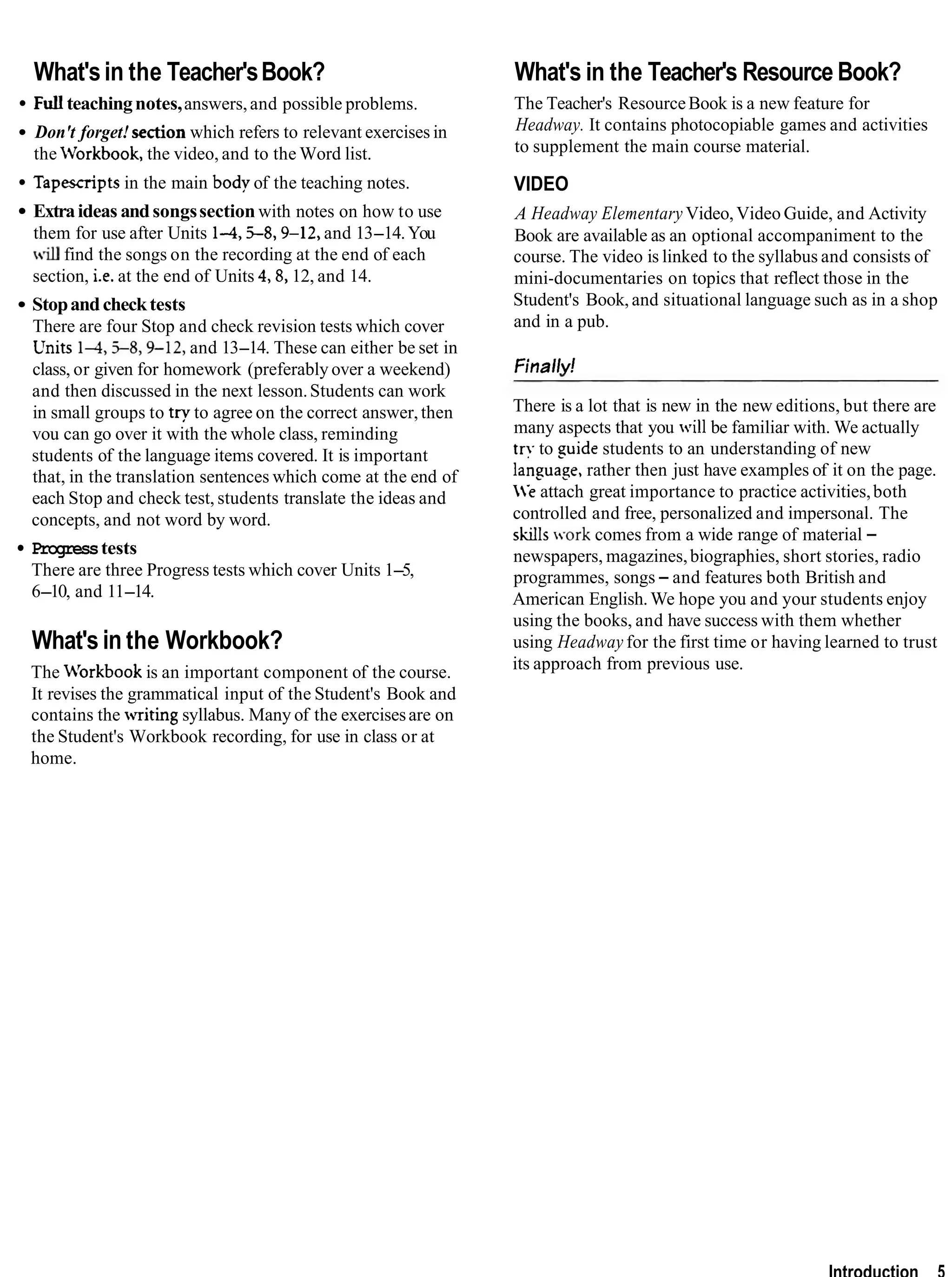
Introduction
Why a new version of
Headway Elementary?
A main reason for producing new
versions of Headway Elementary and
Headway Pre-Intermediate was to bring
them into line with New Headway
Intermediate and New Headway Upper-
Intermediate. Having rewritten the two
higher level books, it became
increasingly apparent that it was
necessary to ring some changes with
the two lower levels. We felt that the
time had come to give them a much
fresher and lighter feel, but at the same
time we didn't want to lose those
elements that have proved successful
with so many teachers. We believe that
at lower levels the content and
approach of language teaching is
inevitably more restricted, and so a lot
about the books remains the same.
What remainsthe same?
The basic Headway methodology is the same. Proven traditional approaches
are used alongside those which have been developed and researched more
recently.
The grammatical syllabus is largely unchanged because the requirements o i
lower level students are usually more predictable than at later levels.
There is a great variety of practice activities. Some of these have been
amended rather than replaced. Nevertheless there are still many new ones.
Vocabulary is not only integrated throughout but also developed in its own
section.
Skills work is integrated and balanced. It all comes from authentic sources
but has been simplified and adapted to suit the level.
There is an Everyday English section.
What are the differences?
The design is completely new, and this represents a break in what a Headlva?.
Student's Book traditionally looked like. It is cleaner and fresher, and
activities are easier to follow. There is more space on a page, and some of the
exercises and activities are shorter.
The vast majority of the texts are new. We took this opportunity to freshen up
the topics. Teachers very easily get fed up with using the same texts year after
year. Sometimes we have found a parallel text on the same topic, but more
often we have selected a new topic and a new text.
There are several new features, such as the Starter at the beginning of a unit,
and the Grammar Spot.
Many of the vocabulary exercises are different, new, or amended, as are the
topics of the Everyday English section.
STARTER
This is designed to be a warmer to the lesson. It is a short activity and ahcays
has direct relevance to the language to be introduced in the unit.
GRAMMAR SPOT
This is a mix of explanation, questions, and self-check tasks to reinforce thz
grammar being taught. There is a page reference given to the fuller Grammar
Reference at the back of the book.
lntroduction
What'sin the Teacher'sBook?
Full teachingnotes,answers,and possible problems.
Don't forget! sectionwhich refers to relevant exercises in
the Workbook, the video, and to the Word list.
Tapescriptsin the main body of the teaching notes.
Extraideas andsongssection with notes on how to use
them for use after Units 1-4,j-8,9-12, and 13-14.You
find the songs on the recording at the end of each
section, i.e. at the end of Units 4,8, 12, and 14.
Stopandchecktests
There are four Stop and check revision tests which cover
LTnits145-8,9-12, and 13-14. These can either be set in
class, or given for homework (preferably over a weekend)
and then discussed in the next lesson.Students can work
in small groups to try to agree on the correct answer,then
vou can go over it with the whole class, reminding
students of the language items covered. It is important
that, in the translation sentences which come at the end of
each Stop and check test, students translate the ideas and
concepts, and not word by word.
Progresstests
There are three Progress tests which cover Units 1-5,
6-10, and 11-14.
What's in the Workbook?
The M'orkbook is an important component of the course.
It revises the grammatical input of the Student's Book and
contains the writing syllabus. Many of the exercisesare on
the Student's Workbook recording, for use in class or at
home.
What's in the Teacher's Resource Book?
The Teacher's ResourceBook is a new feature for
Headway. It contains photocopiable games and activities
to supplement the main course material.
VIDEO
A Headway Elementary Video,Video Guide, and Activity
Book are available as an optional accompaniment to the
course. The video is linked to the syllabus and consists of
mini-documentaries on topics that reflect those in the
Student's Book, and situational language such as in a shop
and in a pub.
Finally!
There is a lot that is new in the new editions, but there are
many aspects that you will be familiar with. We actually
try to suide students to an understanding of new
lansuage, rather then just have examples of it on the page.
e attach great importance to practice activities,both
controlled and free, personalized and impersonal. The
skills work comes from a wide range of material -
newspapers, magazines,biographies, short stories, radio
programmes, songs- and features both British and
American English.We hope you and your students enjoy
using the books, and have success with them whether
using Headway for the first time or having learned to trust
its approach from previous use.
Introduction 5
Introduction
to the unit
As you begin New Headway
Elementary, you are probably starting a
new course with a new group of
students. The title of Unit 1 is'Hello
everybody!', and one important aim is
that students get to know each other
and you, and you get to know them.
Obviously students will have relatively
little English to use at this stage, but
nevertheless a convivial classroom
atmosphere can be established through
quite basic interchanges.
am/is/are my/your/his/her
Everyday objects Numbers
Hello and goodbye
Language aims
Grammar-am/is/are The verb to be is introduced in all persons, singular
and plural. The focus is on the positiveand questions with question words
(where,what, and how).The negativeand Yes/!Voquestions are dealt with
in Unit 2.
Possessiveadjectives My, your, his,and herare introduced in the unit. The
other possessive adjectives are given in Grammar Reference 1.2 on p124.
Vocabulary Names of countries are introduced as part of thP work on
introductions. In the Vocabulary and pronunciation section, the alphabet is
introduced and practised. Students look at the organization of a bilingual
dictionary entry, and everyday objectssuch as ticketand key. If possible,bring
enough bilingual dictionaries for students to share at least one between two.
Students are asked to work out the rules for using a/an and the formation of
regular plurals with -s.
EverydayEnglish Numbers 1-20 are revised and practised. The situational
focus includes practice on exchanging telephone numbers and work on saying
hello and goodbye.
Workbook Nationality adiectives(German, French);the numbers 1-20 are
practised. The writing svllabusbegins in Unit 3.
Notes on the unit
STARTER (ssp6)
1 Say your own name- I'm (John)-and point to yourself to make the
meaning clear. Then invite students to say their names - I'm Jean, I'rn Keiko,
etc. Encourage students to listen to each other's names and to memorize as
many as they can. If appropriate, play a memory game by pointing to
individual students and yourself and getting the group to sayiust the name,
e.g. John! Keiko! Encourage students in a multilingual group to pronounce
each other's names (and your name!) as accurately as possible.
Check students understand 'alphabetical order' by putting letters a-g on the
board in random order and asking students to re-order them alphabeticall!-.
(Don't worry too much if students pronounce the letters wrongly as the
alphabet is covered later in the unit.) Check by askingstudents to put the
names in Starter 1 in order.
Ask students to stand up in alphabetical order and say their name. If
appropriate, repeat this getting progressivelyfaster each time.
If there are not too many students in the class, put their names on the board
so everyone can begin to learn them.
6 Unit 1 Hello everybody!
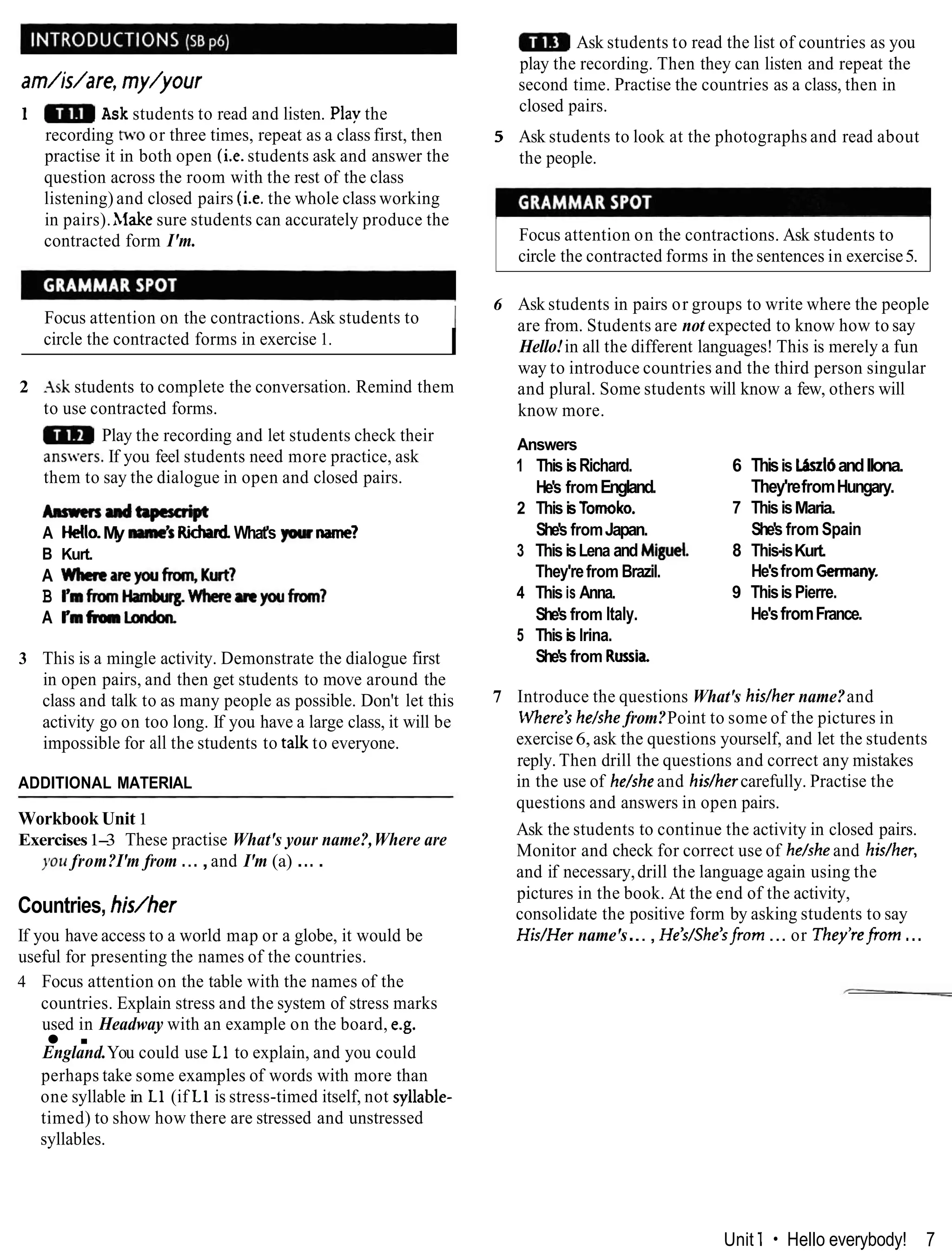
am/is/are, my/your
1 Ask students to read and listen. Play the
recording two or three times, repeat as a class first, then
practise it in both open (i.e.students ask and answer the
question across the room with the rest of the class
listening) and closed pairs (i.e. the whole class working
in pairs).hlake sure students can accurately produce the
contracted form I'm.
Focus attention on the contractions. Ask students to I
circle the contracted forms in exercise 1.
I
2 -Ask students to complete the conversation. Remind them
to use contracted forms.
Play the recording and let students check their
ans.ers. If you feel students need more practice, ask
them to say the dialogue in open and closed pairs.
~ a d a p c r a i p t
A Hello.My mane's Richad.What's ptum?
B Kurt.
A Whmareyoufmm,Kutl
B Ymfrom~Whererrryoufrom?
A Pmfronlmdon
3 This is a mingle activity. Demonstrate the dialogue first
in open pairs, and then get students to move around the
class and talk to as many people as possible. Don't let this
activity go on too long. If you have a large class, it will be
impossible for all the students to talk to everyone.
ADDITIONAL MATERIAL
Workbook Unit 1
Exercises1-
3 These practise What's your name?,Where are
you from?I'm from ...,and I'm (a) ....
Countries, his/her
If you have access to a world map or a globe, it would be
useful for presenting the names of the countries.
4 Focus attention on the table with the names of the
countries. Explain stress and the system of stress marks
used in Headway with an example on the board, e.g.
.
England.You could use L1 to explain, and you could
Ask students to read the list of countries as you
play the recording. Then they can listen and repeat the
second time. Practise the countries as a class, then in
closed pairs.
5 Ask students to look at the photographs and read about
the people.
Focus attention on the contractions. Ask students to
circle the contracted forms in the sentences in exercise5.
6 Ask students in pairs or groups to write where the people
are from. Students are not expected to know how to say
Hello!in all the different languages! This is merely a fun
way to introduce countries and the third person singular
and plural. Some students will know a few, others will
know more.
Answers
1 This isRichard.
He's fromEngland.
2 Thisis Tomoko.
She's fromJapan.
3 ThisisLena and Mi@.
They'refrom Brazil.
4 This is Anna.
She's from Italy.
5 Thisis lrina.
She's from R ~ i k
6 Thisis LbzldandIlona.
They'refromHungary.
7 ThisisMaria.
She's from Spain
8 This-isKurt.
He'sfrom Germany.
9 ThisisPierre.
He'sfromFrance.
7 Introduce the questions What's hidher name?and
Where'she/she from?Point to some of the pictures in
exercise6, ask the questions yourself, and let the students
reply. Then drill the questions and correct any mistakes
in the use of he/sheand hidhercarefully. Practise the
questions and answers in open pairs.
Ask the students to continue the activity in closed pairs.
Monitor and check for correct use of he/sheand hidher,
and if necessary,drill the language again using the
pictures in the book. At the end of the activity,
consolidate the positive form by asking students to say
His/Her name's..., He'dShe'sfrom ... or They'refrorn ...
perhaps take some examples of words with more than
one syllable in L1 (if L1 is stress-timed itself, not syllable-
timed) to show how there are stressed and unstressed
syllables.
Unit 1 Hello everybody! 7
Check it
.Ask students to complete the table with am, is, and are.
Check the answers.
Answers
Brieflycheck comprehension of the subject pronouns
which are not covered in exercise6 (we, it, and you
plural) by using the photographs and the students !
themselves. Itcan be checked using international food
and drinks, e.g. champagne-It'sfrom France. I
Read Grammar Reference1.1 on p124 together in class, 1
and/or ask students to read it at home. Encourage them
to ask you questions about it.
I
I
He
She
It
We
You
They
Talkingabout you
1 Demonstrate the activity by getting students to ask and
answer the same questions in open and/or closed pairs
about the other people in the class. Obviously this will
work better in a multilingual class. In a monolingual
class where everyone knows each other, you could make
role cards giving students a new country of origin, or the
identity of a famous person whose country of origin the
class would know. This practises the vocabulary of the
exercise, too.
am
is
are
2 Ask the students to introduce their partner to the rest of
the class. Check for the correct use of he/she and for the
correct stress on the names of countries.
fromEngland.
Listeningand pronunciation
3 Play the recording. Ask students to tick the
sentence they hear. This is an exercise that tests
discrimination, but you can make it productive
afierwards by asking students in pairs to practise the
pairs of sentences. Pay particular attention to the sounds
/d and /i:/.
Answers and tapescript
1 He'sfromSpain.
2 What'sher name?
3 They're fromBrazil.
4 Where'sshefrom?
5 He's a teacher in Italy.
4 Ask students to work in pairs to put urn, is, are, his, her,
or your into the gaps. Afterwards, you can ask them to
make the contractions in numbers 1,3,and 7.
Anmers
2 Where n youfrom?
3 lvnfmmlapan
4 'What's puname?''My name'sTomob.'
5 Max and Lisa arefrom Chicago.
6 Thisis my teacher. Hkname'sRichard.
7 whereisheh?
8 Thisis my sister.Her name'sE
m
n
a
Readingand writing
The aim of this section is to allow students to see how
I! much English they already know. In exercise7, students
j write about themselves. Encourage them to follow the
I
models in exercises 5 and 6, but also give better
students the opportunity to show off!
The verbs have, live, and want appear in their Present
Simple form, but you don't need to review this tense at
5 Ask students to read and listen to the text about
Rafael. Make sure students understand married and
children. You could ask one or two students to read the
text aloud, or in closed pairs, and the students can help
each other with pronunciation.
6 Ask students to complete the text about Sasmina. Make
sure students understand pat, internatiortal, and
language.
Play the recording to check. Again, vou could
practise the text around the class andlor in closed pairs.
Tapescriptdanswers
My name'sYasmina KarnalandI'm a student P
m19. fmnot
married.Ihaw one sister and two bmthen.Ili
m a flatin
Cairo,Egypt. I wantto learnEnglishbecauseit's an
internationallangwlp.
7 Ask students to write about themselves.After quite a lot
of oral class work, some silent, individual work provides
variety and balance. Ask them to read what they have
written to the class. Don't worry if there are a lot of
pronunciation mistakes. The aim is for students to show
what they can do, and to say a little about themselves and
their families. You can't do everything at once!
If you have a large class, not all the students will be able
to read out what they have written. Collect it in.
8 Unit 1 Hello everybody!
If you have a smaller class, it can be interesting to record
the students. Play the recording back and correct
mistakes that are common to the whole class.
ADDITIONAL MATERIAL
Workbook Unit 1
Exercises4 and 5 Third person isand are, and short and
long forms.
Exercises6 and 7 Possessiveadjectives.
Exercises8 and 9 Countries and nationalities with stress
practice.
SUGGESTION
Some students may be quite familiar with the letters of
the alphabet, while others may not remember many of
them. Whatever your students' knowledge at this stage
of the course, remember that they will all need regular
I practice in the alphabet and spelling. This can easily be
integrated into any lesson when teaching new
vocabulary (Howdo you think you spell ...from the
! round?),or when reviewing vocabulary (Howdo you
/ spell... I), and by the use of spelling games.
I
:
If your group cannot remember much of the alphabet,
/ you may want to write it on the board and drill the
I letters in groups of five before moving on to the song.
1 Tell the students that they are going to listen to
the alphabet in the form of a song. Ask them to join in
where thev can. Play the recording and note down the
letters students get wrong or don't know, paying
particular attention to a, j, e, g, i, y, u, w, r, which cause
problems for many students. Drill the letters which
students found difficult.
Practise the letters as a class and in closed pairs. Listen to
the song again and let the students sing it if they want to.
It certainly helps them to remember the pronunciation
of the alphabet!
r r r n T h - m b - w
A B C D E F G
H I J K L M N O P
L M N O P Q R S T
L M N O P Q R S T
U V W X Y Z
Thatis the Engliialphabet!
Pre-teach the question How do you spell... ?and the
use of double for spelling (e.g.apple= a, double p, I, e).
Get students to practise asking the question and spelling
in pairs, using their own names or the names of famous
people. Do not focus on the use of do to form questions
in the Present Simple as in How do yoir spell... ?This
will be covered in full in Units 3 and 4.
2 In the previous lesson, check who has a bilingual
dictionary. If there are not likely to be enough, bring
some yourself. Ask students to find apple in the
dictionary. You could have a conversation in L1 to
compare the dictionary entries, but don't let this go on
too long.
3 Students match the words and pictures. Encourage them
to work in pairs and match the words that they recognize
first. Then they can use a dictionary to complete the
activity. Monitor and check for pronunciation.
Answersand tapescript
a adictionary g anapple
b an orange h aletter
c anewspaper i amagazine
d a stamp j aticket
e abag k akey
f a camera I apostcard
Play the recording and get students to repeat the
words as a class and individually. If students have
problems with incorrect stress, refer them to the table to
help them self-correct. If necessary, drill the words,
stopping the recording after each example.
4 Demonstrate the activity by saying the letter of some of
the photographs and asking a student to tell you what
the object is and how you spell it. Students continue in
closed pairs.
5 Ask students to look at the words and to work out the
rule if they don't already know it.
Answers
The lettersa, e, i, 0,and uare vowels.
agoes beforea word witha consonant, angoesbeforea
vowel.
Point out the following sound rules:
when we pronounce u /ju:/, we use a, e.g. a university
when h is silent, we use an, e.g. an hour.
6 Ask students to look at the plurals and work out the
rules for the formation of plurals. Refer students to
Grammar Reference 1.4 and 1.5 on p124.
Answers
Mostnounsadd -s.Nounsendingin aconsonant+ y,take
away the -yand add -ies.
Get studentsto say thepluralsof theother words in
exercise2.
ADDITIONAL MATERIAL
Workbook Unit 1
Exercises 10 and 11 a/an
Exercise 12 Check it
Unit1 Hello everybody! 9
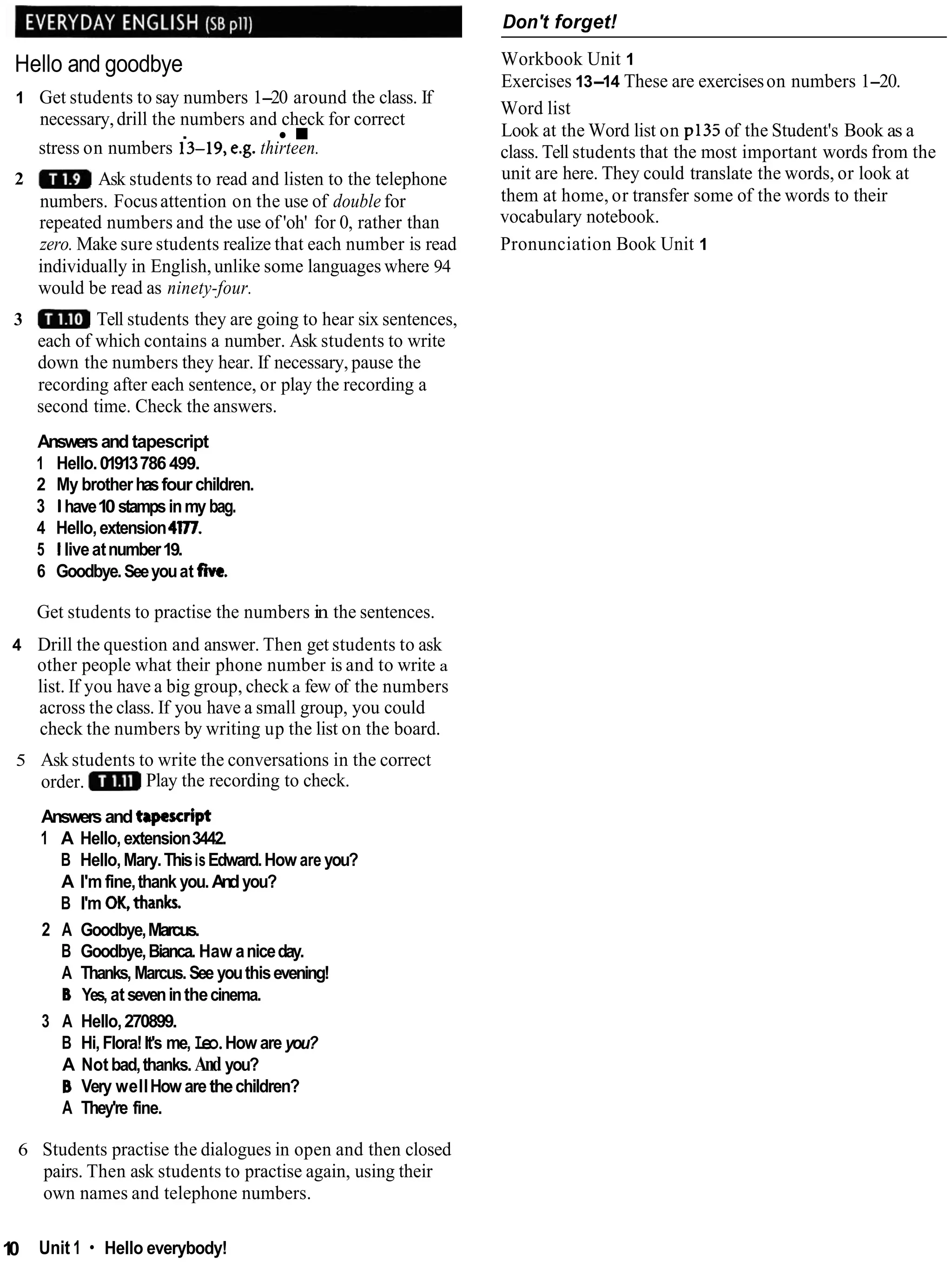
Hello and goodbye
1 Get students to say numbers 1-20 around the class. If
necessary,drill the numbers and check for correct
.
stress on numbers i3-19, e.g. thirteen.
2 Ask students to read and listen to the telephone
numbers. Focusattention on the use of double for
repeated numbers and the use of 'oh' for 0, rather than
zero. Make sure students realize that each number is read
individually in English, unlike some languages where 94
would be read as ninety-four.
3 Tell students they are going to hear six sentences,
each of which contains a number. Ask students to write
down the numbers they hear. If necessary, pause the
recording after each sentence, or play the recording a
second time. Check the answers.
Answersand tapescript
1 Hello.01913786499.
2 My brotherhasfour children.
3 1have10stampsinmy bag.
4 Hello,extension4177.
5 1liveatnumber19.
6 Goodbye.Seeyouat five.
Get students to practise the numbers in the sentences.
4 Drill the question and answer. Then get students to ask
other people what their phone number is and to write a
list. If you have a big group, check a few of the numbers
across the class. If you have a small group, you could
check the numbers by writing up the list on the board.
5 Ask students to write the conversations in the correct
order. Play the recording to check.
Answers and tapescript
1 A Hello,extension3442.
B Hello,Mary.ThisisEdward.How are you?
A I'm fine,thank you.Andyou?
B I'm OK,thanks.
2 A Goodbye,Marcus.
B Goodbye,Bianca. Haw aniceday.
A Thanks, Marcus.See youthisevening!
B Yes, atseveninthecinema.
3 A Hello,270899.
B Hi,Flora!It's me, Leo.How are you?
A Not bad,thanks. And you?
B Very wellHow arethechildren?
A They're fine.
Don't forget!
Workbook Unit 1
Exercises 13-14 These are exerciseson numbers 1-20.
Word list
Look at the Word list on p135 of the Student's Book as a
class. Tell students that the most important words from the
unit are here. They could translate the words, or look at
them at home, or transfer some of the words to their
vocabulary notebook.
Pronunciation Book Unit 1
6 Students practise the dialogues in open and then closed
pairs. Then ask students to practise again, using their
own names and telephone numbers.
1
0 Unit 1 Hello everybody!
2am/is/are -questions and negatives
Possessive 's Family
Opposites In acafe
.. ' D - I 1
Introduction
to the unit
The title of Unit 2 is'Meeting people',
and various characters are introduced
to practise the grammar.The first real
fluencyactivity of New Headway
Elementary is the reading and listening
exercise- Dorita's letter to Miguel. It is
important for elementary-level
students to be exposed to language in a
natural context.
Language aims
Grammar-questionsandnegatives The verb to be is given further practice,
with an emphasis on questions, negatives,and short answers.The question
words what, where, who, how old,and how much are revised or introduced.
Note that in the negative, we use the contracted forms of not, not the
contracted forms of the verb to be: i.e.she isn't, they aren't, you aren't, wearen't,
and not she's not, they're not, you're not, we're not. Try to keep to these forms as
you speak to the class. The contraction *Iamn't isn't possible,and this is
pointed out in the GrammarSpotin the Negativeand short answerssection.
Having been introduced to contracted forms, students are tempted to use them
in short answers, for example, Areyou married?*Yes,I'm, but this is not
possible. Where other languages will answer an inverted question with simply
yesor no, English prefers to add a short answer. Without the short answer, the
speaker can sound rather abrupt.
Possessive 's It can come as quite a surprise to students to learn that not only
does ssignify a plural noun, but 's is both the contracted form of the verb to be
and an indicator of possession. This needs to be pointed out very carefullyand
regular practice given in distinguishing the different forms.
Vocabulary Members of the family (father, aunt,etc.), other words for
personal relationships (boyfriend/girlfrien; plus common adjectivesand their
opposites.
EverydayEnglish This section practises the language required in a cafk.
Can I have... ? is taught idiomatically.Vocabularyto do with food and drink is
introduced, and prices are practised.You might feel your students would
benefit from doing exercises13 and 14 in the Workbook beforedoing the
EverydayEnglishsection.
Workbook The spelling of plural nouns is practised.
Notes on the unit
STARTER (sspi21
POSSIBLE PROBLEMS
The Startersection revisesand practises numbers. Numbers 1-20 and
phone numbers were introduced in Unit 1, but you might feel that your
students need more classroom work on these areas.
Learners of English often experience difficultyin recognizingand
producing the differencebetween the'teen' numbers (13-19)and the
corresponding'ten' numbers (30,40,50,etc.). Point out the different word
stress.
a a
thirty thirteen
Unit 2 Meeting people 11
I Get students to count from 1-20 around the class.
Repeat so that everyone has a chance to practise or if
students make mistakes.
2 Now ask students to count in tens from 10-100 around
the class. Check for correct stress,and repeat until
students can say the numbers quickly and accurately.
3 Tell students your own age and then briefly revise
numbers that reflect the age of your students. Drill the
question How old areyou?Askstudents to work in
groups of three or four and ask and answer about ages.
Ask for a few examples of ages to practise He's ...,
She's ...,They're ...,and We're.. ..(Unlessyour
students query the use of be as different from how they
expressage in their own language, do not spend time on
this.)
Questions and negatives
1 Ask students to read about Keesha Anderson. Check
comprehension of the key vocabulary: surname,first
name, address, and journalist.
2 If you think that your students will be familiar with most
of the question words in this exercise,you can ask them
to do this exercise in pairs. Otherwise, do it as a class.
Play the recording so students can check their
answers. Point out that isn't is the negative, and that n't is
the short form of not.
Tapescriptand answers
1 . What'sher surname?Anderson.
2 What's her first name?Keesh'k
3 Where's she from?London,England.
4 What'sher job?She's a journalist.
5 What'sher address?42, MuswellHillRoad,LondonNH)3JD.
6 What'sher phonenumber?020 88635741.
7 How old is she?Twenty-eight.
8 Is shemarried?No, she isn't.
Before you ask students to practise the questions and
answers in pairs, let them practise in open pairs, focusing
on accurate intonation. English has a very wide voice
range, and this is apparent in questions. Questions with a
question word start high and fall.
Y
'hat's hersurname?
Listen to the models on the recording and ask students
:o imitate them. Point out that the question in number 8
:r different as you can answer Yes/No and it has a
. ..
1:rrcrznt intonation pattern. Inverted questions usually
r:ae at the end. (Students will practise this more fully in
- _ ;
.:.. .Ligr~ti*es
andshort answerssection that follows.)
f
Isshe married?
Practise the questions as much as possible without boring
the class! Have a mixture of open and closed pairs.
3 Students write questions about Keesha's brother, basing
their questions on exercise 2.
krnrm
Where'shefrom? What's hiphonemmber?
What's his job? Hawddbhe?
What's his address? Ishemarrid?
Encourage students to ask you questions about Keesha's
brother. Insist on accurate intonation. You can give any
information you want, but here is a sample profile.
Keesha's brother
Surname Anderson
First m Rudi
corntry England
Job Policeman
Address 70,LondonRoad, O d dOX3 5AL
Phonenumber 018657534991
Age 21
Married? No
Negatives and short answers
4 Tell students they are going to continue asking questions,
first about Keesha and then about her brother.
Askingabout Keesha
Ask students to read and listen to the Yes/.So
questions and short answers. Play the recording. Play the
recording again and ask students to repeat, emphasizing
the rising intonation on the question and the
pronunciation of the contracted form isn't.
Allowstudents to practise the questions and answers
which appear in full in the Student's Book in open and
closed pairs. Insist on accurate intonation. Then ask
students to ask questions 1 and 2, following the same
pattern.
Answers
1 Issheadoctor? No, sheisn't
Is sheateacher? No, she isn't
Is shea jwmlii? Yes, sheis.
2 lssheeighteen? No, sheisn't
Isshetwellty-one? No, sheisn't
Isshetwenty-eight! Yes, she i
r
5 Askingabout Keesha's brother
Students continue asking about Keesha's brother,
followingthe same pattern and working in closed pairs.
.-
- -- :;- Meeting people
krra
1 Ishisfirstnameb?
tshisfirstname M i
khisfirstname Rudi?
2 tshea jowmlist?
kheastudent?
bheapdiaman?
3 bhesbrteen?
Ishethirty?
khctwenty6ne?
l
l
i
-No,itisn't.
No,it isn't
Yes.it is.
No, heisn't
No, heisn't.
Yes.he is.
No,he isn't
No,heisn't
Yes.hei.%
SUGGESTION
This is the first time that students have seen all the
short answers and negative forms of the verb to be,
so deal with the information in the Grammar Spotvery
I carefully. You might want to practise the short answers
in open pairs and drill the negative sentences.
i 1 Students complete the short answers, using the
contracted form where possible (No, it isn't). Check
! the answers.
Anrmrr
i .bKeehEq$bh? Yes,she&
bher sunameSmith? No,it isn't.
: Arepuajournalist? No,I'm not.
Make sure students understand that positive short
. answers can't be contracted to Yes, she's.
2 Focus attention on the negative forms and point out
especially that we cannot say "Iamn't.
'
Read Grammar Reference2.1 on p125 together in
class, and/or ask students to read it at home.
Encourage them to ask you questions about it.
Who is he?
1 Photocopy the identity cards on p122.
POSSIBLE PROBLEMS
This is the first information gap activity in New
HeadwayElementary, and it might even be the first
time your students have ever done such an activity.
Students may find it strange that Student A has
different information from Student B, so explain this
activity very carefully,in L1 if you can. Stress that they
mustn't show each other the information! Read the
instructions as a class. Allocate the pairs, and give the
photocopied card to Student B. You could do the first
two questions yourself as an example. Give students
: enough time to complete the information exchange.
Answers
SURNAME
FIRSTNAME
COUNTRY
JOB
ADDRESS
PHONENUMBER
AGE
MARRIED?
Binchey
Patrick
Ireland
Accountant
82, HillRoad,Dublin
12324837
47
Yes
2 Students ask and answer questions about Patrick.
POSSIBLE PROBLEMS
, Students first saw the short answers Yes, he/she is, No,
he/she isn't, and No, I'm not in Negatives and short
i nrrswers.This speaking exerciseand the exercisesin
i Tnlkingabout you extend and consolidate this focus. It
I is inadvisable to embark on an explanation of what
I
! short answers are and how they operate, as you run the
: risk of overloading students with too much
I information. It is better to let students see them in
I context and use them in controlled exercises.
j Demonstrate the activity by asking this first question
1 about Patrick's surname and getting students to answer.
I
Students continue to ask and answer in closed pairs.
1 Monitor and check for correct formation of questions
I and short answers.
1
Answers
1 Is his surnameSmith?
Is his surnameJones?
Is his surname Binchey?
2 Ishe from Italy?
Ishe from England?
Ishe fromIreland?
3 Is he a policeman?
Is he a teacher?
Ishe an accountant?
No, it isn't
No, it isn't.
Yes, it is.
No, he isn't.
No, he isn't.
Yes, he is.
No, he isn't.
No,he isn't.
Yes, he is.
Talkingabout you
3 Demonstrate the activity by asking students the example
questions in the Student's Book. If necessary, remind
students of the short answers Yes, Iam and No, I'm not.
Get students to ask you the questions for each category
on the identity card. Correct mistakes carefully.
4 Photocopy the forms on p122. This is a mingle activity.
Read the instructions as a class and get two or three pairs
of students to model the examples. Students stand up
and ask and answer questions. The students should
complete the information exchange with at least two
other students, but stop the activity before they get tired.
Unit 2 Meeting people 13
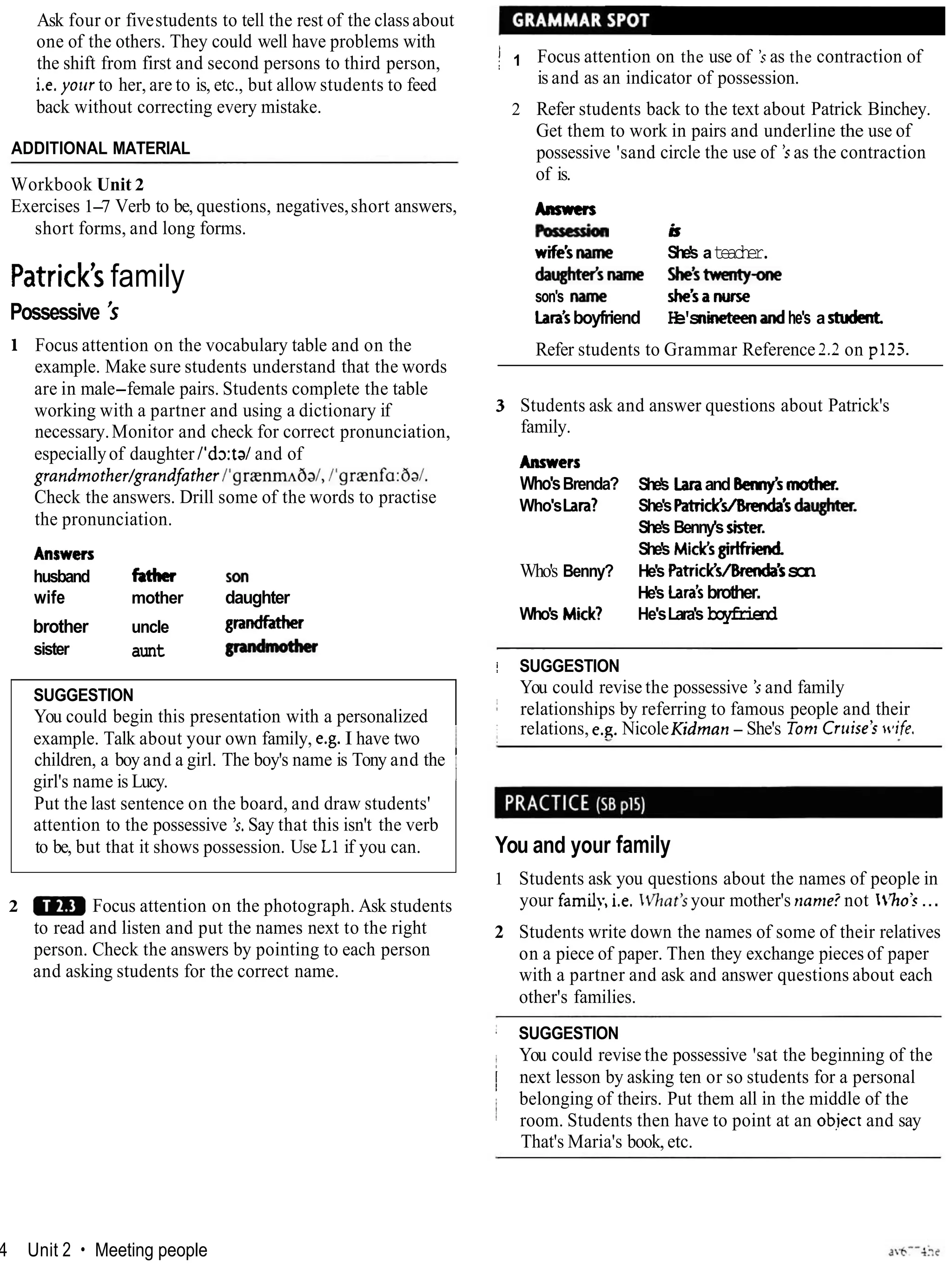
Ask four or fivestudents to tell the rest of the classabout
one of the others. They could well have problems with
the shift from first and second persons to third person,
i.e,your to her, are to is, etc., but allow students to feed
back without correcting every mistake.
ADDITIONAL MATERIAL
Workbook Unit 2
Exercises 1-7 Verb to be, questions, negatives,short answers,
short forms, and long forms.
Patrick family
Possessive 's
1 Focus attention on the vocabulary table and on the
example. Make sure students understand that the words
are in male-female pairs. Students complete the table
working with a partner and using a dictionary if
necessary.Monitor and check for correct pronunciation,
especiallyof daughter l'dxtal and of
grandmothedgrandfather /'gra:nm6al, /'graenfa:6a/.
Check the answers. Drill some of the words to practise
the pronunciation.
Answers
husband fatha son
wife mother daughter
brother uncle grandfather
sister aunt w
SUGGESTION
You could begin this presentation with a personalized
example. Talk about your own family, e.g. I have two
I
children, a boy and a girl. The boy's name is Tony and the 1
girl's name is Lucy. I
Put the last sentence on the board, and draw students'
attention to the possessive 's. Say that this isn't the verb
to be, but that it shows possession. Use L1 if you can.
2 tjlR Focus attention on the photograph. Ask students
to read and listen and put the names next to the right
person. Check the answers by pointing to each person
and asking students for the correct name.
' 1 Focus attention on the use of 's as the contraction of
is and as an indicator of possession.
2 Refer students back to the text about Patrick Binchey.
Get them to work in pairs and underline the use of
possessive 'sand circle the use of 'sas the contraction
of is.
kamrs
ir
wifesname She's ateacher.
daughter'smme She'stwentylme
son's name shefanurse
Lara'sboyfriend H
e
'
snineteenandhe's a student.
Refer students to Grammar Reference 2.2 on p123.
3 Students ask and answer questions about Patrick's
family.
Answers
Who'sBrenda? She's Laraand Bemy'smother.
Who'sLara? She'sP a t r i c k ' M s daughter.
She's Benny's sistw.
She's MicKsgirffriend
Who's Benny? He's PatricKs/&enda'sson
He's Lara'sbrother.
Who's Mid? He'sLara's boyfriend
- - - ~ - --
i SUGGESTION
'
You could revise the possessive 'sand family
; relationships by referring to famous people and their
: relations, e.g. NicoleKidman - She's Ton1 Cruise's wife.
You and your family
1 Students ask you questions about the names of people in
your famil!; i.e. 1t"rlat'syour mother's name?not 'he's ...
2 Students write down the names of some of their relatives
on a piece of paper. Then they exchange pieces of paper
with a partner and ask and answer questions about each
other's families.
: SUGGESTION
i You could revise the possessive 'sat the beginning of the
/ next lesson by asking ten or so students for a personal
:i
belonging of theirs. Put them all in the middle of the
i room. Students then have to point at an object and say
That's Maria's book, etc.
14 Unit 2 Meeting people
3 This exerciseconsolidates the verb to be in a range of
persons, and allows students to make some sentences
about themsel~es.
Check comprehension of at home,
nr ~vork,
and cofee bar.
Anrrms
Therecanbenosetanswersfor thbexercise,but checkthat
'
shrdents hawn'tmade mistakesintheformsof to be.
Check it
4 Students work in pairs or small groups to identify the
correct sentence.
krmcrs
1 Ymadoctor. ' 5 She'smarried.
2 1amtwenty-nineyearsold. 6 I'm an unde.
3 Ymnotmanied. 7 I havetwobrothers.
4 My sister's n
a
yis Lara. 8 Peter'smy sister'sson.
ADDITIONAL MATERIAL
Workbook Unit 2
Exercises8 and 9 Possessive 's
Opposites
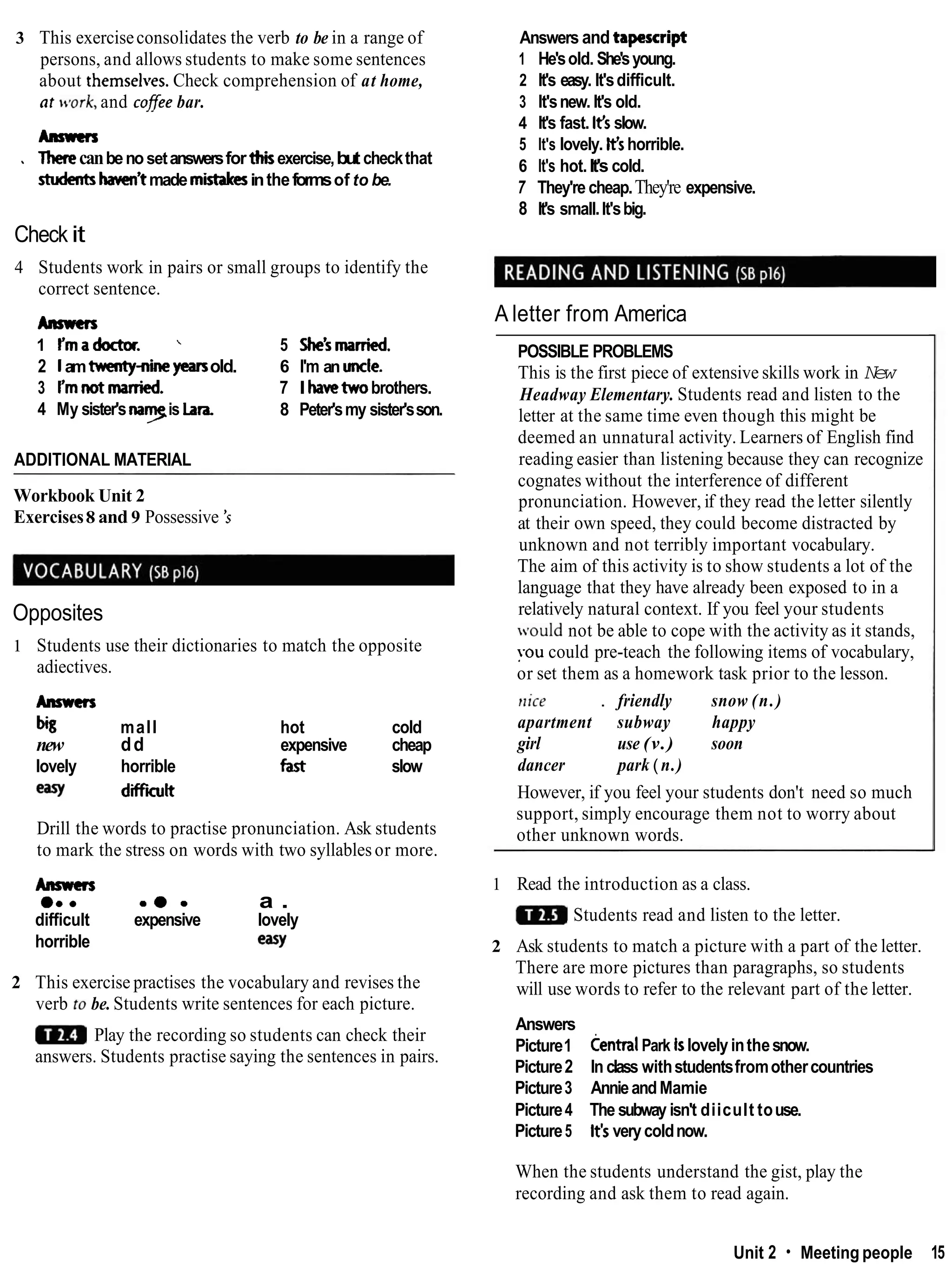
1 Students use their dictionaries to match the opposite
adiectives.
Anmcn
h
3 mall hot cold
new dd expensive cheap
lovely horrible fast slow
earY diffilt
Drill the words to practise pronunciation. Ask students
to mark the stress on words with two syllablesor more.
Anmcrs
e.. me. a .
difficult expensive lovely
horrible easy
2 This exercise practises the vocabulary and revises the
verb to be. Students write sentences for each picture.
Play the recording so students can check their
answers. Students practise saying the sentences in pairs.
Answers and tapescript
1 He'sold. She'syoung.
2 It's easy. It'sdifficult.
3 It'snew. It's old.
4 It's fast. lt'sslow.
5 It's lovely. H's horrible.
6 It's hot.It's cold.
7 They're cheap.They're expensive.
8 It's small.It'sbig.
A letter from America
POSSIBLE PROBLEMS
This is the first piece of extensive skills work in New
Headway Elementary. Students read and listen to the
letter at the same time even though this might be
deemed an unnatural activity. Learners of English find
reading easier than listening because they can recognize
cognates without the interference of different
pronunciation. However, if they read the letter silently
at their own speed, they could become distracted by
unknown and not terribly important vocabulary.
The aim of this activity is to show students a lot of the
language that they have already been exposed to in a
relatively natural context. If you feel your students
vould not be able to cope with the activity as it stands,
you could pre-teach the following items of vocabulary,
or set them as a homework task prior to the lesson.
nice . friendly snow (n.)
apartment subway happy
girl use (v.) soon
dancer park ( n.)
However, if you feel your students don't need so much
support, simply encourage them not to worry about
other unknown words.
1 Read the introduction as a class.
Students read and listen to the letter.
2 Ask students to match a picture with a part of the letter.
There are more pictures than paragraphs, so students
will use words to refer to the relevant part of the letter.
Answers
Picture1 centralPark Islovelyinthesnow.
Picture2 In class withstudentsfromothercountries
Picture3 AnnieandMamie
Picture4 The subway isn't diicult touse.
Picture5 lt'sverycoldnow.
When the students understand the gist, play the
recording and ask them to read again.
Unit 2 Meeting people 15
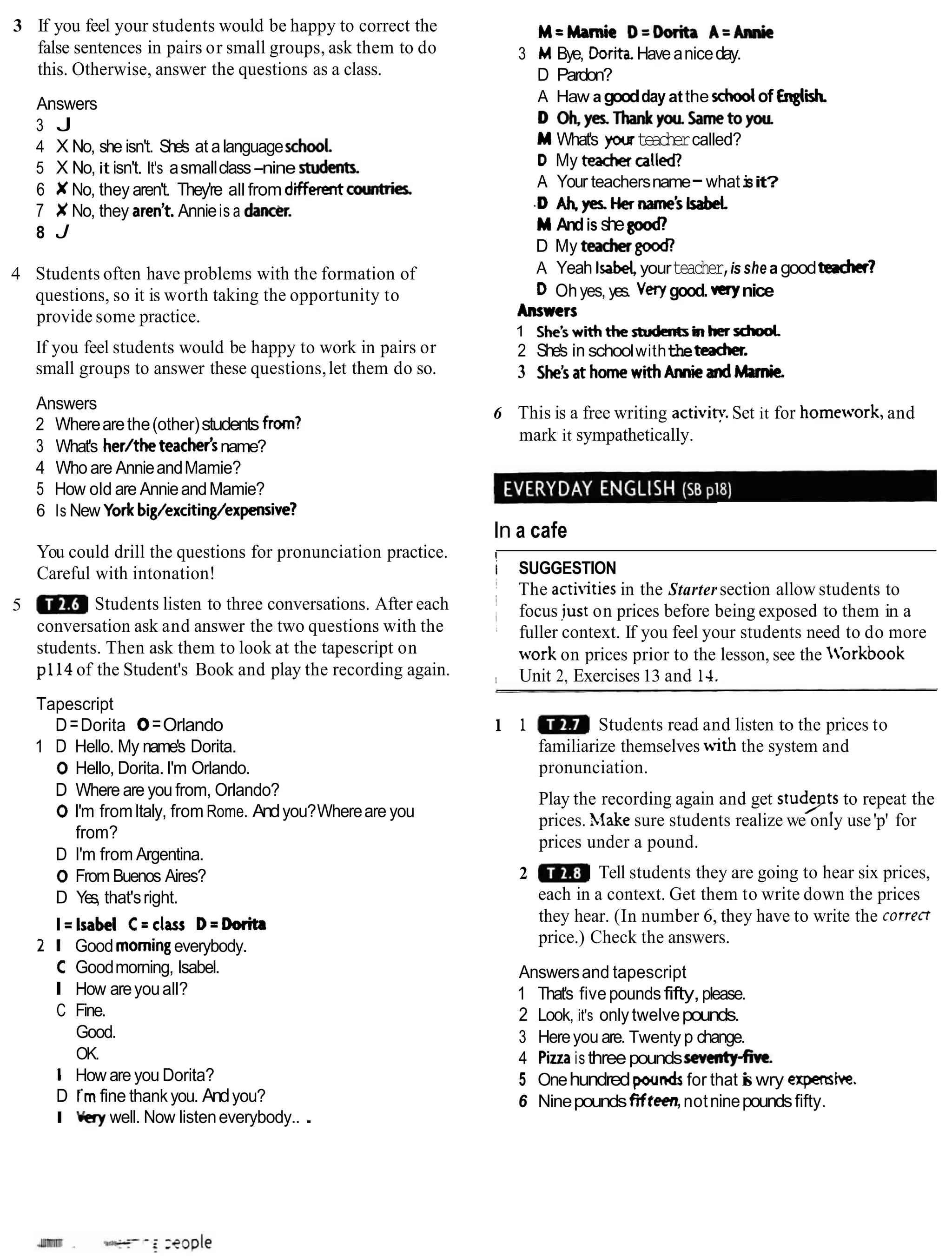
3 If you feel your students would be happy to correct the
false sentences in pairs or small groups, ask them to do
this. Otherwise, answer the questions as a class.
Answers
3 J
4 X No, she isn't. She's at alanguageschool
5 X No, it isn't. It's asmallclass-nine st&nts.
6 X No, they aren't. They're all from d iamhies
7 X No, they aren't Annieis a d m .
8 J
4 Students often have problems with the formation of
questions, so it is worth taking the opportunity to
provide some practice.
If you feel students would be happy to work in pairs or
small groups to answer these questions,let them do so.
Answers
2 Wherearethe(other)students frwn?
3 What's her/the teachetsname?
4 Who are AnnieandMamie?
5 How old are AnnieandMamie?
6 Is New York big/exciting/expensive?
You could drill the questions for pronunciation practice.
Careful with intonation!
5 Students listen to three conversations. After each
conversation ask and answer the two questions with the
students. Then ask them to look at the tapescript on
pl14 of the Student's Book and play the recording again.
Tapescript
D=Dorita 0=Orlando
1 D Hello. My name's Dorita.
0 Hello, Dorita. I'm Orlando.
D Where are you from, Orlando?
0 I'm fromItaly, from Rome. Andyou?Whereare you
from?
D I'm from Argentina.
0 From Buenos Aires?
D Yes, that'sright.
I=lsabel C = c k D=Dorita
2 I Good morningeverybody.
C Goodmorning, Isabel.
I How areyouall?
C Fine.
Good.
OK.
I How are you Dorita?
D i mfine thankyou. Andyou?
I Wry well. Now listeneverybody.. .
M=Marnie D=Dorik A=-
3 MBye, Dorita. Haveaniceday.
D Pardon?
A Haw agoodday atthe xhoolof Errgli
D W~ThankyouSametoyou
M What's youteachercalled?
D My teachercalled?
A Your teachersname-whati
sit?
.D Ah,yes.Hername'slsabeL
M Andis shegood,
D My tea* good!
A Yeah Isabel,yourteacher,is she a goodteacher?
D Ohyes, yes. Verygood. verynice
Answers
1 She'swiththestudarhinhersdrod
2 She's in schoolwiththetencher.
3 She'sathomewithAmieandMmie.
6 This is a free writing a c t i v i ~
Set it for home.ts.ork, and
mark it sympathetically.
In a cafe
I
i SUGGESTION
i The activities in the Startersection allow students to
I
i focus iust on prices before being exposed to them in a
1 fuller context. If you feel your students need to do more
work on prices prior to the lesson, see the 'orkbook
I Unit 2, Exercises13 and 14.
1 1 Students read and listen to the prices to
familiarize themselves with the system and
pronunciation.
Play the recording again and get studyts to repeat the
prices. Xiake sure students realize we only use'p' for
prices under a pound.
2 Tell students they are going to hear six prices,
each in a context. Get them to write down the prices
they hear. (In number 6, they have to write the correct
price.) Check the answers.
Answersand tapescript
1 That's fivepoundsfifty,please.
2 Look, it's only twelvepounds.
3 Hereyou are. Twenty p change.
4 Pizzais threepoundssewnty-five.
5 Onehundredpoundsfor that i
swry expensive.
6 Ninepoundsfifteen,notninepoundsfifty.
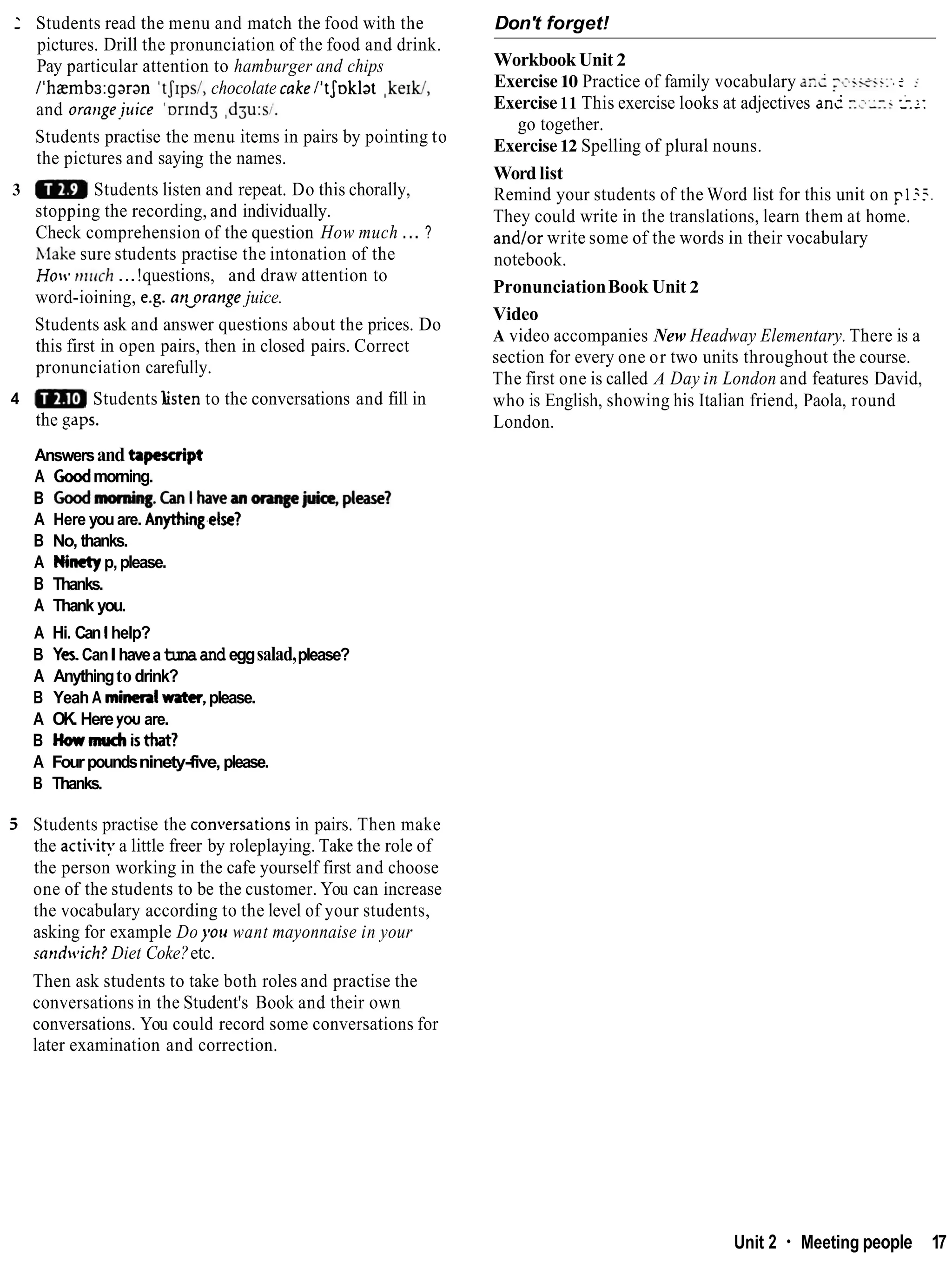
1 Students read the menu and match the food with the
pictures. Drill the pronunciation of the food and drink.
Pay particular attention to hamburger and chips
l1hzmbs:garan'tJ1ps1,chocolate cakelitJoklat ,ke~W,
and oratlgejuice '~r1nd3
,d3u:si.
Students practise the menu items in pairs by pointing to
the pictures and saying the names.
3 Students listen and repeat. Do this chorally,
stopping the recording, and individually.
Check comprehension of the question How much ... ?
Make sure students practise the intonation of the
Hocc. tr~lich
...!questions, and draw attention to
word-ioining, e.g. an-orange juice.
Students ask and answer questions about the prices. Do
this first in open pairs, then in closed pairs. Correct
pronunciation carefully.
4 Students listen to the conversations and fill in
the saps.
Answersand tapescript
A Coodmorning.
B Goodmonring.CanIhawan~ju&please?
A Here youare. Anything.else?
B No, thanks.
A Ninetyp,please.
B Thanks.
A Thank you.
A Hi. Can l help?
B Yes CanIhaveatunaand eggsalad,please?
A Anythingto drink?
B Yeah A mineralwater, please.
A OK. Here you are.
B Howmuchisthat?
A Fourpoundsninety-five,please.
B Thanks.
5. Students practise the con~ersations
in pairs. Then make
the activit?.a little freer by roleplaying. Take the role of
the person working in the cafe yourself first and choose
one of the students to be the customer. You can increase
the vocabulary according to the level of your students,
asking for example Do you want mayonnaise in your
mndcvich? Diet Coke?etc.
Don't forget!
Workbook Unit 2
Exercise10 Practice of family vocabulary an2 -z.isi:-. c :
Exercise 11 This exercise looks at adjectives ant r.s:xr i
-
.
:
:
go together.
Exercise12 Spelling of plural nouns.
Word list
Remind your students of the Word list for this unit on ~ 1 % .
They could write in the translations, learn them at home.
and/or write some of the words in their vocabulary
notebook.
PronunciationBook Unit 2
Video
A video accompanies New Headway Elementary. There is a
section for every one or two units throughout the course.
The first one is called A Day in London and features David,
who is English, showing his Italian friend, Paola, round
London.
Then ask students to take both roles and practise the
conversations in the Student's Book and their own
conversations. You could record some conversations for
later examination and correction.
Unit 2 Meeting people 17
Questionsandnegatives
Jobs What time is it?
Introduction Language aims
to the unit Grammar-PresentSimple1 The Present Simple is the most used tense in
the English language. It is therefore important to introduce it early in an
Work and jobs are the themes of this
elementary course. In New Headway Elementarythe introduction is staged
unit as they lend themselves to the
over two units. In this unit only the third person singular with its questions
practice of the grammatical aim, which
and negatives is presented and practised. All the other persons are introduced
isatheintroduction of the third person
in Unit 4.
singular of the Present Simple. The
skills work includes a reading text
about a man who lives on a remote
Scottish island and has thirteen jobs!
This was chosen to complement both
the themes and grammar of the unit.
The text also acts as a preview of other
forms of the Present Simple in context.
POSSIBLE PROBLEMS
The English language does not have many inflections. Unfortunately
this seems to mean that the few that exist cause a disproportionate
amount of difficulty for foreign learners. The son the thud person
singular of the Present Simple is a classic example of this. Therefore we
introduce it first in the hope that it will be more memorable and
students will be less likely to omit it.
The s can be pronounced in three ways:
comes l k d
works lw3:ksi
teaches /'ti:t J d
So you need to spend some time highlighting the.s., z, .
r
z
endings
and practising them.
The use of does/doesnJtin the question and negative often seems strange
to students, because of the absence of the auxiliary in the positive.
NOTE
For the first nine units of New HeadwayElementary, the verb haveis
introduced and practised as a full verb with its do/does forms. Havegot is
introduced in Unit 10. This is for several reasons:
By introducing the do/does forms, the verb haveoperates like any other
verb in the Present Simple (with the exception of Joasin the third
person singular).
When students have just learned the Present Simple and have been
introduced to the auxiliary verbs do/does, it is very difficult and
confusing for them when they come across the verb form harpegot,
which operates differently.
Although havegot is common, especially in the spoken language, the
full verb havewith its do/does forms covers all the uses in a way that
havegotdoesn't. Havegot expresses possession, but it cannot expressa
habitual action. So students can learn How many children haveyou got?,
but then it is very confusing when they are introduced to $%attime do
you have lunch?Wrecannot say 'What time have you got lunch?
Finally, havewith its doldoesforms is becoming more common in
spoken British English. It is the standard form in American Engbsh.
;!I! milr ' e *odd of work
Vocabulary and pronunciation i
i variety of jobs with
related activities are introduced. Dictionary work is
encouraged and there is a certain amount of work on the
phonetic spelling of some of the words.
Everyday English Students focus on how to tell the time in
English. This is practised in short dialogues.
Workbook The spelling of the third person singular is
practised ( ~rfatches,
goes).
Question words such as 'here?and How much?are
practised.
Verbs of daily routine (get up, get dressed) are introduced,
and some verbs and nouns that go together (havea shower,
wear a zolifortn).
The writing syllabus of S
e
wHeadway Elementary begins in
this unit.
Object pronouns (me,him, them) are introduced and
practised.
Notes on the unit
STARTER (ssp2o)
The Starteractivity recycles the family vocabulary from
Cnit 3 and allovsstudents to use some of the jobs
vocabulary they already know. Give some examples of jobs
of the people in your own family and then get students to
continue the activity in pairs. If students ask for the names
of individual iobs, give some examples that are common to
the whole class, but do not let.the Starter activity go on too
long or reduce the usefulness of the Vbcabularyand
pronunciation section.
Present Simple he/she/it
SUGGESTION
Iresuggest that before you start this unit you set the
following ~ocabulary
homework in preparation for the
presentation texts on Ali and Bob.This will save a lot of
classroom time where you would have to check
vocabular). either by mime, dictionary work, or
translation (in a monolingual class), and it will give you
more time to focus on the grammar.
Homework prior to lesson
Ask students to write the translation of the following
words and learn them for the lesson. They can use a
bilingual dictionary to look up words they don't know.
Verbs come .flj/ go help like love speak work
Nouns day hour summer town walk week winter
Adjectives free (time) ordinary
Pre-teach scietrtistand flyingdoctor.
1 Ask students to look at the photographs. Ask them
What's her job?(scientist), What's his job?(flying doctor).
Then ask them to look quickly at the texts and ask
Where'sshefrom? (Cambridge, England), Wherei he
from? (England).
Now play the recording and ask your students to
read and listen to the texts at the same time. If you think
your class will experience some difficulty, you could deal
with the texts one at a time, doing the Grammar Spot
exercises with them for the first text and then asking
them to repeat the process on their own for the second.
' 1 Ask students to work on their own to underline the
verbs and then check their answers with a partner
before you conduct a full class feedback. You could
ask them to call out the verbs for you to write on the
: board in columns according to their pronunciation. .
i
I Answersandpronunciationguide
! /zl comes flies lives loves is has
i IS/ workslikesspeaks
2 Ask the whole class what the last letter is and point
out that this is the ending for the third person
singular - he, she, it-of the Present Simple tense.
3 Before you ask your students to practise the verbs in
pairs, ask them to chorus them with you from the
board and draw their attention to the different
i pronunciations of the endings.
You may also want to point out that isand has are
irregular.
Now ask them to practise in pairs and read one of the
texts to each other. Go round and monitor. You could
round off the activity by asking one or two students
to read a text aloud to the whole class.
2 Ask your students to write in the answers on their own
and then check with a partner. Make it clear that each
gap represents a word and that number 8 requires a
positive verb in the second sentence because of the
negative expressed by never.
Students listen and check their answers.
Answersand tapscript
1 She's ascientist.He'sadoctor.
2 Alisoncomes fromEngland.Bobcomes fromEngland,too.
3 She lives in abigcity, but helivesin asmalltown.
4 She worksthreedaysa week. He works16 hoursa day
non-stop.
Unit 3 The world of work 19
5 Hespeaksto sickpeopleon hiradio. She speaksthree
languages.
6 She lovesher job andheloveshiijob,too.
7 Shehasadaughter.Heisn't married.
8 She likesskiingandgoingfor walksin herfreetime.*He
neverhasfree time.
* Notethat like+ -ingisdealt within hit4. . .
Talkingabout people
1 The aim of this activity is to givestudents the chance not
just to produce single sentences, but to speak at some
length to describe Philippe. It is both useful and
satisfyingfor low-level students to use language for
'display' purposes in this way and not always engage in
the more'natural' question and answer activities.
Ask the whole class to look at the picture of Philippe and
the information about him. Start to build a profileof
him orally with contributions from different students.
2 Then ask one or two individuals to speak at length about
Philippe.
Sample answer
Philippeis abarman.HecomesfromFranceand he l i iin
Paris.He worksinthecentreofParis. HespeaksFrenchanda
littleEnglish. He isn'tmarried,buthehasadog. Inhisfree
timehelikeswalkinghis dogandplayingfootball.
3 Now ask your students to write some notes about a
friend or relative.Students work in pairs and talk about
their friendlrelative to their partner. Go round the class
to check and help them. Bring the whole class together
again, and ask one or two students to tell the others
about their friendlrelative.
ADDITIONAL MATERIAL
Workbook Unit 3
Exercises1 and 2These provide further practice of the third
person positive of the Present Simple. Exercise 2 focuses
on thespelling.
Exercise 3 This is a vocabulary activity in preparation for
Exercise 4. It should be done with a dictionary. (It is not
an opportunity to practise other persons of the Present
Simple, only to see the verbs in their infinitive forms!) It
would be a good idea to set this exercisefor homework
and then follow it in class with Exercise 4 - the pictures
of Rupert's daily routine are particularly suitable for a
classroom activity,where the story is built orally before
students are asked to write it.
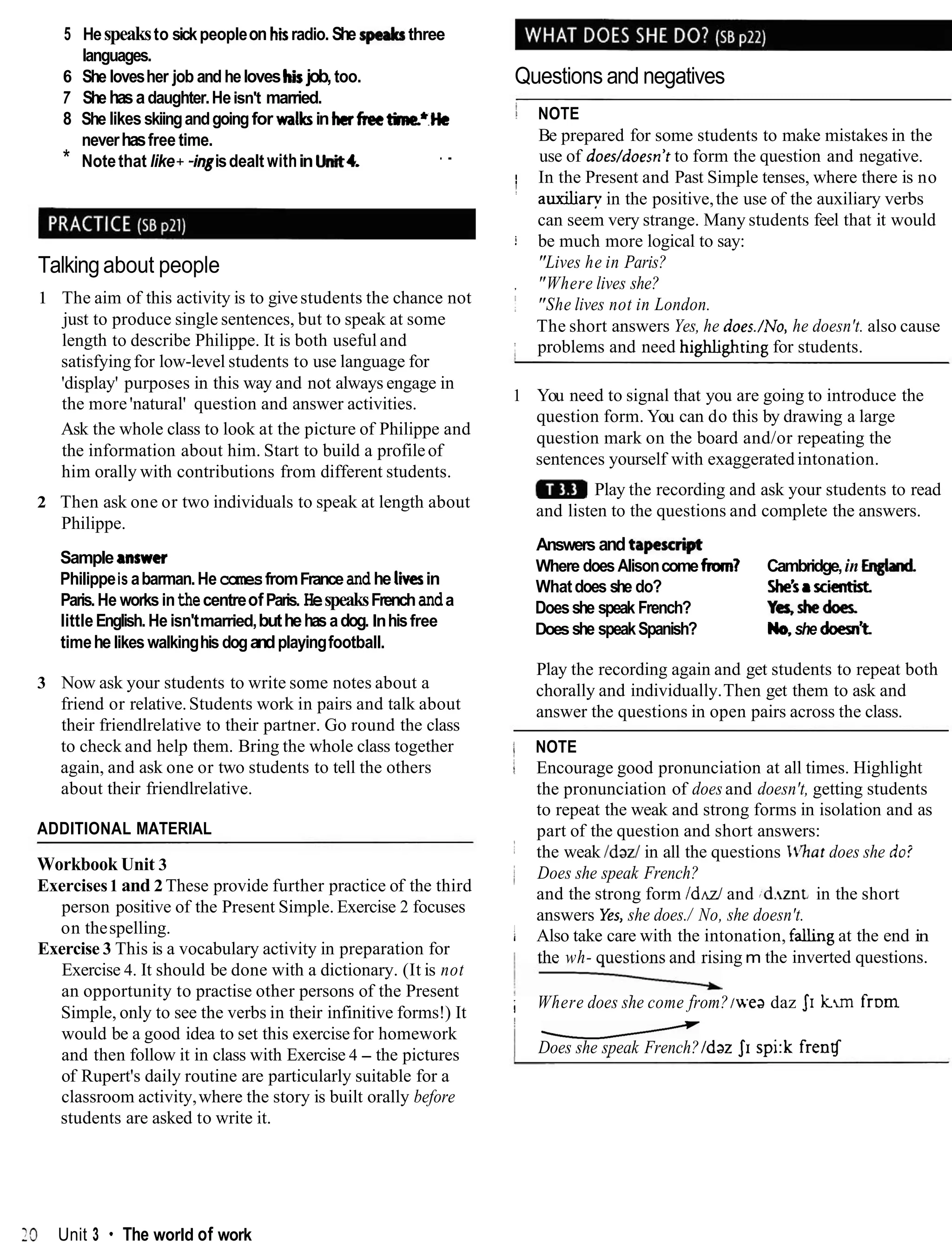
Questions and negatives
i NOTE
Be prepared for some students to make mistakes in the
use of does/doesn't to form the question and negative.
/ In the Present and Past Simple tenses, where there is no
I auxiliary in the positive,the use of the auxiliary verbs
can seem very strange. Many students feel that it would
i be much more logical to say:
"Lives he in Paris?
, "Where lives she?
j "She lives not in London.
The short answers Yes, he does./No, he doesn't. also cause
; problems and need highbghting for students.
1 You need to signal that you are going to introduce the
question form. You can do this by drawing a large
question mark on the board and/or repeating the
sentences yourself with exaggeratedintonation.
Play the recording and ask your students to read
and listen to the questions and complete the answers.
Answers andt a m
Where doesAlisoncomefrom? Cambridge,in Englad
Whatdoes she do? W s8 xientbt
Doesshe speak French? Yes,dredoer
Doesshe speakSpanish? b,
she dwm't
Play the recording again and get students to repeat both
chorally and individually.Then get them to ask and
answer the questions in open pairs across the class.
1 NOTE
1 Encourage good pronunciation at all times. Highlight
the pronunciation of does and doesn't, getting students
to repeat the weak and strong forms in isolation and as
part of the question and short answers:
: the weak /dad in all the questions $%atdoes she do?
j Does she speak French?
and the strong form / d d and {d.zntin the short
answers Yes,she does./ No, she doesn't.
! Also take care with the intonation, f a h g at the end in
'
the wh- questions and rising m the inverted questions.
; Where does she come from?~wea
daz JI kun f r ~ m
1 u
Does she speak French?/daz JI spi:k frenlf
29 Unit 3 The world of work
1 h i d e sure students understand that What does she/he
do?means the same as %'hat'sher/his job?but that
I
1t'hardoes she/he do?is the more normal question.
2 .Ask students to complete the sentences using the
verb come.
1 3 Read Grammar Reference3.1 on p126 together in I
( class, and/or ask students to read it at hoke. I
I Encourage them to ask you questions about it.'
I
2 Ask your students to complete the sentences on
their own and then check their answers with a partner.
Play the recording and get them to listen and check.
Finally,ask individuals to read aloud their answers to the
class and check the pronunciation.
-md-pt
1 WheredocsBob comcfrom? England.
2 What doeshedo?He'sa doctor.
3 Doeshefly to helppeople? Yes,he does.
4 Docshe speakFrenchandGerman?No,hedoesn't.
3 Students write similar questions about Philippe and then
ask and answer in pairs.
SIlnplequcstionsmdansrars
1 Where doesPhilippecomefrom?France.
2 Whatdoeshedo? He's abarman.
3 Doeshe workinthecentreofParis? Yes,he doer
4 Doeshe speakGerman?No,he doesn't.
3 Ask each student in a pair to choose either Keiko or
Mark. Students work on their own and write the
questions about their character.
Ansnen
1 Wheredoes KeikoAarkcomefroml
2 Wheredoes KeikoAarklive?
. a
3 Whatdoes KeikoMrkdo? .,..• .-
- .
4 Wheredoes KeikdMarkwork? . .--
5 Does Keiko/Mark speak French/Spanish? . - ,
6 What does Keiko/Mark do in herhisfreetime? & - .J
7 Does Keiko/Mark listentomusic? . -
< - -
8 How manychildrendoes Keiko/Mark M?
9 Does KeikoMrkhaveadog?
Check their questions quickly round the class, getting
students to read them aloud.
4 Ask your students to close their books. Write the names
Keiko and Mark on the board, then ask students to work
in pairs and take it in turns to ask and answer questions
about them. Don't make the activity too laborious by
insisting they ask every question about both characters,
as this would probably take too long. Let your students
choose their questions and character they use.
Round off the activity by asking for a few questions and
answers in open pairs across the class.
5 This is a personalized activity.Tell students they can
answer questions about any relative, e.g. aunt, uncle, or a
friend. Feed in any necessary vocabulary, e.g. cousin,
(sister)-in-lawif students request this. Go round and
check as they do the activity, focusing on the formation
of questions. Ask one or two students to tell the whole
class about their or their partner's relative.
SUGGESTION
Students can play a guessing game in which one
student describes another (withoutsaying histher
name!) and the rest of the class guess who it is. This can
also be used to practise Yes/Noquestions, where the
student who has thought of the person replies Yesor No
to the rest of the class and does not give any additional
information. This can be set up as a whole-class activity
and then continued in groupslpairs.
Askingabout people
1 Get students to read about Keiko or Mark. Check
comprehension and drill the pronunciation of interpreter
rn'txpr~ta
,journalist :'dg:nalrst/, United Nations
ju:'na~t~d
'ne1Jnz1,and Moscow l'moskaul.
Listeningand pronunciation
2 Get students to say a sentence about each person as an
example. Students choose Keiko or Mark and describe 6 Do this exerciseas briskly as possible with the whole
her/him to a partner. Go round the class to check and class. Demonstrate the activity by going through the
help them. Round off the activity by bringing the whole sample sentences with them and practising the responses
class together again, and asking one or two students to Yes, that's right, No, he/she doesn't, No, he isn't.
tell the others about Keiko and Mark. Play the recording or read the sentences yourself
and nominate individuals in the class to respond.
Unit 3 The world of work 21
Encourage other members of the class to correct if a
wrong answer is given. It should be quick and fun to do,
so don't insist on the full correct answer if it slows down
the activity. No, he/she doesn't is enough.
A,B!madt@pc
1 PhilippecomesfromParSs.
Yes,that's right.
2 Philippelives i n h d m ,
No,he doem9t.
(He l i i nPark)
3 HeworksinthecentreafRris.
Yes,that's right
4 HespeakrEnglii~mll.
N o , k d o e s n ' t . ( H e ~ a I ' ~ b @ h )
5 He'smarried.
No,kisn9t.
6' Keikolivesandwo&s inNmYorlc
;
Yes,thrt's*
.Y-ShespeaksFrenchandCennan.
" No,she doesn't(She speaksJapame,Engtish,and
/ T
: F d )
8 Sheplaysnembinherfmtbnc.
:No,shedoesntt(Shegoesskiing.)
-9:
Sheisn'tmarried.
- ..Yes,shcb.(She'smarriedtoan~)
~~~~arkwork~inanofficein~osam.
, Yes,tW's*
n'.Hehasthreesons,.
-~No,Reh't.(Hekt)rcc-)
12 'Helikesplayi-football inhisfreetime.
No,hed o d t .(Helikesl i i qto music)
7 This should follow on immediately from the
previous exercise. Play the recording. Ask students to tick
the sentence they hear. This exercise tests receptive
comprehension, but you can make it productive
afterwards by asking students to say the pairs of
sentences in pairs.
*~llL&dh p d p t
1 Shelikesher job.
2 Shelowswalking.'
3 He isn't manicd
4 Dogshehavethreechildrm?
5 Whatdowhedo?
Check it
8 Ask students to work in pairs or small groups and tick
the correct sentence. Ask them to work quite quickly,
then conduct a full class feedback.Try to get students to
correct each other and explain any mistakes they hear.
Antwcn
1 ShecomesfromJapan.
2 Whatdoeshedoinhisfreetime?
3 Wheredoesshelive?
4 He isn't married.
5 Doesshehavetwosons?
6 Hedoesn't play football.
7 Shedoesn'tlovePeter.
8 What's hiaddress?
ADDITIONAL MATERIAL
WorkbookUnit 3
Exercises4-8 Questions and negatives in Present Simple
third person singular.
Exercise 12 Using pronouns.
Exercise 13 Rewriting a short text about Keiko.
Seumas McSporran- the man with thirteen jobs!
NOTE
This is an important activity because it brings together
in a text much of the grammar your students have been
studying so far. It should give them great satisfaction to
feel that they can already master a piece of continuous
prose of this length.
It also acts as a preview of the work on daily routine in
Unit 4.
Seumas McSporran is a real person (anda real name),
and the text is based on a newspaper article. However, it
has been carefullysimplified and graded for students of
this level.
You could begin the lesson by asking students:
How many jobs do you/mostpeople have?
What time do you/rnostpeoplestart andjinish work?
1 Ask students to look quickly at the photographs on the
page and tell you a little about what and who they can
see. Do not insist on accuracy at this stage- use this as
an opportunity for students to get into the topic and
predict what they might read in the text.
Briefly revise the times that go with each photograph.
2 Ask students to work in pairs and match the sentences
with the photographs. Tell them not to worn about new
vocabulary but to use the words that they recognize and
the information in the photographs to help them with
the matching.
Check the answers.
L Unit 3 The world of work
Check the key ~ocabulary
by giving short definitions
accompanied by mime and getting students to tell you
the word, e.g. Ibu eat this in the morning- breakfast; the
people vho stay in a hotel -guests; you need this in your
car to drive it -petrol,etc.
3 Pre-teachlcheck some of the key vocabulary before the
students start to read, so that they do not stop at every
word thev do not recognize to ask for an explanation.
You can teachlcheck the following through mime or
short definitions: jobs - policeman,fireman, taxi-driver,
school-bus driver, boatman (a man you pay to take you
out in a boat or for the use of a boat), ambulance man,
petrol attendant, undertaker; verbs- get up, make
breakfast, rvatch n
'
,
make supper, go to bed.
Ask students to work in pairs or small groups to find the
answers. Tell them not to worry about words they do not
recognize and just to focus on the key information. They
can consult the text whenever necessary.
Check the answers. Decide according to the speed and
ability of your students whether you want quick, short
answers or fuller answers (see brackets).
A#mrs
1 OnthelslandofCigha(~/gi:a/).(HeI'
lveson
the Madof Gighainthenorthof Scotland.)
2 6
0
.
(He's60yeanold)
3 Thirteen.(He hasthirteenpbs.)
4 Margaret.(Hiswife's nameisMargaret)
5 She worksintheshop.
6 120. (120 peopleliveon Gigha.)
7 150. (150tourists visit Gighainsummer.)
8 Hemakesbreakfast,drivesthechildrento school, collects
thepostfromtheboat, anddeliversthepost tothe
houses.
9 Margaretmakessupper,andSeumasdoestheaccounts.
They haveaglassof wineandthengoto bed.
If appropriate, ask students for their reaction to the text.
Ask if thev know anyone who has a lot of jobs and what
they do.
4 iuk students to look back at the photographs on p24.
Demonstrate the activity by getting two students to ask
and answer using the example in the Student's Book.
Students continue to ask and answer questions about the
times in Seumas's day. Go round the class to check. Feed
back on any common errors.
5 Ask students to mask the conversations in
exercise6. Focus attention on the three questions and
demonstrate the activity by playing conversation I and
chechng the answers (see below).
Play the remaining three conversations, stopping after
each one to allow students to complete their answers.
Check the answers with the whole class.
Answers
Conversation1
1 Afternoon
2 Seumasandacustomer in Seumas's shop
3 Shopkeeper
Conversation2
1 Morning
2 Seumasandawoman who livesontheisland
3 Postman
Comcrsation3
1 Evening
2 SeumasandMargaret
3 No job-Seumasisn't working
Convemthl4
1 Morning
2 Seumasand xhoolchildren
3 School-busdriver
6 Students complete the conversations as far as they can,
using what they can remember from the first listening
and from the reading text, and the information from
exercise 4. Students can then exchange information with
a partner.
Play the conversations again to allow students to
complete their answers. Then check the answers with the
whole class.
Answersandtapescript
' 1 A Good afternoon.CanIhaw two ice-creams,please?
B Chocolateor vanilla?
A Onechocolate,one vanillaplease.
B That's £1.80. Anythingelse?
A No, thank you.
2 A Onlytwo letters for youthismorning,MrsCraig.
B Thank you very much, Mr McSporran.Andhow's M n
McSporranthismorning?
A Oh, she's very well, thankyou. She's busyintheshop.
3 A Aglassof winebeforebed, my dear?
B Oh, yesplease.
A Here youare.
B Thank you, my dear. I'm verytiredthis evening.
4 A Hello, Mr McSporran!
B Good morning,boys andgirls. Hurryup, we're late.
A CanIsit here, Mr McSporran?
C No, no, I want to sit there.
B Bequiet allof you, andSITDOWN!
Put students into pairs to practise the conversations. An
additional idea is to ask them to choose one of the
conversations and learn it by heart to act out to the rest
of the class.You could also encourage more confident
students to improvise some further dialogues. (Asking
students to act really seems to help their pronunciation,
particularly stress and intonation.)
Unit 3 The world of work 23
Jobs
1 Ask students to look at the pictures and tell you any of
the jobs they know already.Then get them to work in
pairs and match a picture with a job in column A,
checking any words that are still unknown in their
dictionaries. You could ask them to mark the stress.
Conduct a full class feedback on the correct answers and
drill the words both chorally and individually as you go,
taking care with the stress (see below). Keep revisingas
you go by asking Tell me again! What's 'a'?What's 'd'?etc.
Anrwcrs
I d ~ & n 61 A
&
- a
2c Anurse 7e Anaccountant
2 Ask students to work in pairs or small groups and match
a job in column A with a line in column B. They will
probably need to continue to use their dictionaries or if
you have a monolingual class and you think dictionary
work will take too much time, you could give quick
translations of any words they ask about. Afterwardsyou
could either conduct a f
u
l
lclass feedback (try not to
make this too laborious with too much correction), or
ask different students to come to the board and write the
answers for the others to comment on and read aloud.
Answers
a Apilotf l i ip k
b Aninterpretertranslatesthings.
c Anurse looksafterpeoplein hapitit.1. . :~.~,,
.:,:
, ~ . .
d Abarmanserves drinks. 1 , .
. . .
. I . ;
. .
e An accountant look aftermoney;:'- ,,
:-
,,"..'
,,..
.,',',
: .I..; . .
f A journalistwritesfor anewspaper. .
: ., . .'.
.. . _ .
g Apostmandeliversletters. , . :..
h Anarchitectdesignsbuildings. i
i Ashopkeeper sellsthings.
Ask the whole class to look at all the phonetic
transcriptions and sav if they can recognizeany of the
words. Ask them to turn to pl43, not to study it, but so
that they get the idea of what phonetic script is.
Now ask them to write the spellingsof the words and
then check them with a partner and practise saying them
together. Let them use the phonetic chart to help them.
krrrrrn
1 nuK 4shopheeper
5 a r d l i i
3 a x a m m t 6 barman
3
If you have time, you could put a few additional words in
phonetic script on the board for students to do after you
have asked for feedback on the words in the exercise. For
example:
NOTE
The idea of this activity is to give a very short
i'h~sprtav (hospital)
/'pi:pl/ (People)
/w3:ks/ (works)
fluksl (looks)
iseW (sells)
/ p l e d (planes)
i"hauzrz/ (houses)
I
introduction to and practice of the phonetic script. It
I is also an opportunity to start getting your students
! familiar with the phonetic s~mbols
chart on p143 of
I their book
1 You need to make clear what exactly phonetic script
is, i.e. that it is only the sounds of the words that are
I
I
transcribed and that it is important to know this in
Enghsh because the spellingsand the sounds often
I do not relate exactly.
4 Make this exercise fun, like a game, and do it as quickly
as possible. Ask students to learn the sentences by heart.
then to close their books. Call out the name of a job and
tell your students to call out to complete the sentence.
Teacher Student(s)
A journalist ... writes for a tlnvspaper!
A pilot ... flies planes! etc.
Finally, ask students to work in pairs for a feis-minutes
with their books still shut, and ask and answer questions
about the jobs. Demonstrate the first example yourself to
remind them of the question, e.g.
What does an interpreter do? He/She translates things.
24 Unit 3 The world of work
ADDITIONAL MATERIAL
Vorkbook Unit 3
Further vocabularyexercises:
Exercise9 This practises more verbs and nouns that go
together, e.g. have a shower.
Exercise10 This revisesa selection of vocabulary from all
the units so far. It requires students to sort words into
related groups.
What time is it?
lntroduce the subject of telling the time by asking What
time is it now?and Ifhat time does the lesson end?Accept
answers in the hour + minutes form, e.g. five thirty, but
explain that the system used in New Headway Elementary
uses past and to.
The first eight clocks on this page are positioned in
i NoTE
such a way that those with gaps underneath are next to
/ clocks with similar times which students can use to help
I them write in the correct answers.
The next eight practise the time in five-minute intervals
around the clock. You probably will not need to point
this out to students. It should be obvious what to do
from the pictures.
1 Ask students to work in pairs, look carefully at the
clocks, and write in the times.
Sow play the recording for students to check
their answers.
Anmnsdapncript
tt's fnreo'dock
It's halfpastfive.
tt'squarterpast five.
K
squartertosix.
K
sfivepastfive.
Kstwmtypastfive.
Kstwmy-fivetoshr.
It'stento sin
K
seight o'chxk
It'shalfpasteleven.
Ksquartupasttwo.
It's quutcrto nhn.
Kstmpastfiw.
It's twenty-fivepastfive.
tt'stwenty to six.
It'sfmtoshr.
Get students to practise saying the times either from the
recording or repeating them after you. If possible, bring
a toy clock with moveable hands to the lesson as an easy
rvay of getting further practice. First, you can change the
times on the clock and then your students can also have
turns, coming to the front of the class, moving the
hands, and asking %at time is it?
Read through the examples with the classand practise
with the toy clock (if you have one!) or by drawing
further examples on the board.
3 Play the recording and ask your students to
repeat the sentences giving veryspecial attention to the
stress and intonation. Tell them that they must try to
sound very polite. Reallyencourage good imitation from
the recording, or by giving the sentences yourself.
Practise the dialogue across the class with your own
examples first, then ask everyone to draw about three
clocks on a piece of paper and practise the conversation
again in pairs. Round off the lesson by asking one or two
pairs30 act out the conversations in front of the class.
Tell them to imagine that they are stopping someone in
the street to ask the time and that they must be very,very
polite.
The more you insist on good stress and intonation in
such activities, the more fun it will be!
ADDITIONAL MATERIAL
Workbook Unit 3
Exercise 11 This gives more practice of telling the time.
Don't forget!
Workbook Unit 3
Exercises 12 and 13 You might want to do the writing
activities now, if you haven't done them earlier.
Word list
Remind your students of the Word list for this unit on pl36.
They could write in the translations, learn them at home,
andlor write some of the words in their vocabulary
notebook.
Pronunciation Book Unit 3
2 This exerciseintroduces about as a useful expression for
times iust before or after an exact division of the clock.
Unit 3 The world of work 25
Present Simple2 - I/you/we/they
Leisure activities
Introduction
to the unit
The theme of this unit is free time and
leisureactivities. This lends itself to
much practice, personalizedand
otherwise, of the main grammatical
aim, which is the introduction of all
other persons (those without the s!) of
the Present Simple tense. The skills
work includes reading and listening
tasks where people from three different
countries talk about their favourite
season and what they do. This provides
the opportunity to bring together and
revise all persons of the PresentSimple.
Language aims
Grammar-PresentSimple 2 This unit follows on from the introduction of
the h r d person in Unit 3 and introduces all other persons of the Present
Simple,I, you, we, they, and the question and negative. The verb forms with
these are all the same, without the inflection s, and tend to cause less difficulv
as a result. The third person is constantly revisedalongside the other persons so
that students can perceive the differencesin form.
Vocabulary Avariety of leisure activities (sportsand hobbies)are introduced
and these are practised in a personalizedactivity with the verb to like.
Everyday English Some common and useful social expressionsare introduced
and practised in short dialogues.
Workbook Adverbsof frequency, e.g. always, sometimes, neverare practised.
In the vocabularysection,'opposite' verbs,e.g. lovehate, open/close, Ieave/arri.e
are revised.
The writing syllabuscontinues with an introduction to informal letter writing
via a letter to a penfriend.
Notes on the unit
SUGGESTION
Setting some vocabulary for homework before vou start this unit will give
you more time to focus on the grammar. It is also worthwhile to get your
students used to the idea of taking some responsibilityfor the learning of 1
vocabulary. Encourage them to enter the new words in their vocabulan
notebooks.
Homeworkpriorto thelesson
1 Ask students to learn the days of the week in Enghsh.You could give them a
handout with phonetic script such as this:
Monday I'mndil Thursday 1'83:zdil Sunday .
;'s.mdi
Tuesday 1'Tfu:zdil Friday I'frardii
WednesdayI'wenzdiJ Saturday I'sa3tadil
2 Give students these new verbs to look up in a bilingual dictionary. Ask them
to learn them and write down the translations.
interview go out
chat relax
cook stay-
get up - visit
26 Unit 4 Take it easy!
STARTER (ss pzs)
1 Use a calendar that shows the year, months, and days as a
visual aid. (Alternatively,write the day, month, and year
on the board in abbreviated form, e.g. Tu., Sept., 2000).
Focus attention on the year and elicit how we say this in
Enghsh. Do the same for the month. (Do not spend too
long on this, as students will focus on months more fully
before the Reading and listening section.)
POSSIBLE PROBLEMS
Students often try to say years in English in the same
wa? as in their own language, e.g.1999 is read as"one
thousand nine hundred and ninety-nine instead of
i~irleteenninety-nine. If necessary,highlight on the
board how we divide dates beginning 18-, 19-, into two
pairs of numbers and give practise of similar dates.
You may also need to remind students of the use of and
in dates ldie 2001= two thousand and one.
2 Use the calendar and get students to go through the days
of the week. Say the days yourself and ask them to repeat
each one both chorally and individually. This will take
less time if you have set the above for homework.
POSSIBLE PROBLEMS
Days
Take particular care with the pronunciation of Tuesday
1'tJu:zdLand Thursdayi'9a:zdilwhich students can
easily confuse because they sound quite similar. Also
the pronunciation of Vednesday/'wenzdi/ can be a
problem because of the spelling, and the consonant
cluster nzd; that results from it being pronounced as
two syllables not three.
Ask IVhat day is it today?Chorus through the days of
the week with the whole class and then make the
individual practice fun by getting one student after
another to give consecutive days very quickly round
the class until they are firmly fixed. (If time, you
could then ask one or two students to go through the
whole week and perhaps also ask them to spell some
of the days, to revise the alphabet.)
Ask IVhich days are the weekend?This will check that
students understand the word weekend which is
needed in the exercises.
Ask students to ask and answer the Starter questions
in pairs. Go round and check students' pronunciation
and feed back on any common errors.
Present Simple I/you/we/they
i
1 This text reminds students of the third person of the
Present Simple before they are introduced to the other
persons. Focus attention on the photograph and on the
headline. Elicit basic information about Bobbi (What's
her name?Where is she in the photo?).
EXTRA SUGGESTIONS
If you feel your students needs more practice on days,
months, and years, try the following activities:
rearranging the jumbled spelling of days and months
matching phonetic script to days and months
conducting a favourite day or birthday survey
a word association activity for different daystmonths
doing an 'important year' quiz with simple headline-
stylesentences (to avoid the use of the past simple),
e.g. thefirst man on the moon, and students supply the
correct year, e.g. 1969.
linking days and months to horoscope signs. This can
be done as an information gap activity where
Answers
Bobbi Brownlivesin New Jersey.Sheis thirty-four and works
for SKY TV in New York City.But she doesn't work on week- .
days, sheonly worksat weekends. She interviewsfamous
peoplefor an early momingnews programmecalled The
World This Weekend.On Saturdaysand Sundays she getsup
at 3.00 in the momingbecauseshe startswork at 6.301She
lovesher jobbecauseit is exciting.
! students have some of the names of the signs and
some of the dates missing.
Ask a few questions to revise the third person.
Examples
Teacher Student(s)
Where does Bobbi live? In New Jersey.
How old is she? Thirty-four.
What does she do? She works for SKY T V
What time does she get up? Three o'clock in the
morning.
What time does the Halfpast six.
programme start?
Does she like her job? Yes, she does.
Why does she like it? Because it's exciting.
2 Tell students that Bobbi Brown is now talking
about her weekdays.Ask students to first read and listen
to the text and not to write anything. Explain that they
will complete the text at the next stage. Check or pre-
teach the following vocabulary from the text: domestic,
gym, block, kids. Play the recording.
Unit 4 Take it easy! 27
3 Ask students to work in pairs and check the verbs in the
box. This can be done quite q&cklyif they have done the
preparatory homework. If they haven't, encourage
students to look up new words in their dictionary and
work together to complete the text with the verbs from
the box. You will need to make clear that some of the
verbs will need an s because they are third person
singular. The others can be copied exactly from the box
Play the recording again so that students can
check their answers.
Answersa d tapescript
My weekendsare fkstand exciting.My wdabys-fist nd
domestic!I havetwo sons, Dylan,7, wd Dakota,!
5
. Every
morningI get uponehowbeforethem,at6.W. dIp
t
n
the gym. Icome homeandImahebreakfast,thenItrbethan
to school. OnMondaysIalwayspshoppmltI hayallthe
f o o d f o r t h e w & I o f t m ~ d b n c r i n t h t ~ M
.
noteveryday becauseIdon't Iika -my-
husband,Don,loves cooking.OnTuesdaysandlhs@ I
visitmy father.He Uraronthenext blodcEvayrbbanoarrI
pidcupthekidsfromschoolB,tt#-WDanadI. -
usually relax,but sometimeswe vi$t fie& Wem
r
a
w
out onFridayeveningsbecauseIstut wak soearlyon
Saturdays.
Ask one or two students to read parts of the text aloud to
the rest of the class and, if time, to each other in pairs.
Questionsand negatives
4 Ask students to complete Bobbi's answers and
play the recording for them to check their answers.
Answers
InNew York
Yes,Ido.
Play the recording again or model the questions and
answers yourself. Practise the questions and answers in
open pairs across the classso that you can correct any
mistakes.Take particular care with the pronunciation:
Sounds
The weak vowel sound /du/ in the question, and the
strong vowel sound /du:/ in the short answer.
Do you like your work? Yes, 1do.
Idgu l a ~ k
ja w3:W Ijes a1 du:/
Stressand intonation
The intonation rises at the end of inverted questions and
falls at the end of short answers and wh- questions.
u
. ..
Do you like your work? Yes, I do.

.
Where do you work?
5 Tell students to read the texts on p28-9 again first, but
then to cover them and try to remember the information
about Bobbi's life.Ask students to work in pairs and take
it in turns to be Bobbi Brown. Demonstrate the aaivi?
by getting two students to ask and answer the first nvo
questions across the class.Ask students to continue the
activity in pairs. Go round and check for the correct use
of the auxiliary do/doesand for the correct use of strong
and weak forms in the pronunciation of do.
r -
I
1 Ask students to complete the table with the positive
and negative forms. Check the answers.
Ask students to focus on the positive forms in the
table.Ask them which have a different form
, (he/she/it)and how thev are different (theyend in -11.
/ Ask students to focus on the negative forms in the
table. Ask them how the I/you/we/rheyforms are
1 different from the positiveforms lthey use the
I
auxiliary don't).Ask students to focus on the he/she/ir i
j forms and ask them how they are different from the
I other negative forms (theyuse the a d a r y doesn't).
I
/ 2 Ask students to complete the questions and answers. I
Check the answers.
I
Ask students which auxiliary verb is used in
questions with I/you/we/they(do)arid which with
he/she/it (does).Remind students that questions can
begin with a question word, or have no question
word and the answer Yes/No.Ask students to give you
I
examples of each type of question from the table.
Read Grammar Reference 4.1 and 4.2 on pl27
together in class, and/or ask students to read it at
home. Encourage them to ask you questions about it.
3 Students find the adverbs of tiequency in the tea
1 about Bobbi Brown.
28 Unit4 Takeiteasy!
SUGGESTION
Do Exercises6 and 7 in the Workbook to introduce
adverbs of frequency before this activity.
Anmcrs
~ M o n d a y s ~ ~ g o s h o p p i ~ ~ . . .
Intheevenings, DonandIusuallyrelax...
I aFtcncookdinnerintheevenings.. .
...rornctbncswe visit friends.
Wenewgoouton Frldayewnings...
SUGGESTIONS
I
I
Student Adescribes their weekday routine as if they
do a certain job and the rest of the class has to guess
what the job is. They can ask Yes/Noquestions.
Student Adescribes their weekday routine as if they
were a famous person (politician,actor, singer,etc.)
and the rest of the class has to guess who they are
pretending to be. They can ask Yes/Noquestions to
, help them if necessary. (You might provide role cards
of people who are often in the news,so that students
don't choose characters who are too obscure.)
Talking about you
1 Ask students to work on their own to do this activity.
Students who finish early can then check their answers
with a partner.
Answers and tapescript
M Whattimedo yougo tobed?At ll o'clock.
2b Wheredoyougo onholiday?ToSpainor Portugal.
3e Whatdoyoudoon Sundays?Ialwaysrelax.
4c Whendoyoudo yourhomework?Afterdinner.
5a Who doyou livewith?My motherandsisters.
6f Why doyoulikeyour job?Becauseit's interesting.
7g How doyoutravelto school?Bybus.
8h Doyougo out on Friday evenings?Yes, I dosometimes.
Play the recording and let students check their
answers. As preparation for the next activity, ask students
to listen and repeat the questions and answers chorally
and individually.Take particular care with intonation.
2 This activity gives practice of the first and second
persons only. Ask students to work in pairs to ask and
answer the questions in Practice 1. Demonstrate the
activity by getting a pair of students to ask and answer
the first question across the class. Remind students to
have the whole question ready before they speak. Go
round and check as students do the activity,listening for
correct intonation. Students who finish early can be
encouraged to ask similar questions but with different
days or question words, e.g. Do you go out on Saturday
evenings?Where do you do your homework?
3 This activity practises the third person singular alongside
the other persons. It also pulls the class together after the
pairwork. Ask a few individuals to tell the rest of the class
about themselvesand their partner. If necessary, remind
students they need to use the third person -swhen
talking about their partner. (Unlessyou have a small
class, it would take too long to give everyone a turn.)
Listeningand pronunciation
4 Play the recording. Ask students to listen
carefullyand tick the sentence they hear. Play the
recording again. Stop after each one and ask students to
discuss the answer with a partner before you establish
the correct one. You can make this exercise productive by
asking students to read aloud the pairs of sentences.
, . . , ...
hCIS
4
t
p
w
i
i
l
l
j
t
[
....
1 Whatdoes shedoon Sundays?
2 Do youstayhomeonThursday'evenings?.
, ' , . . , . .
' ,
. . , . '
. ,
3 He liwshere. . . . . ( .
. . .. .
I , .
4 What doyoudoonSaturdayevening?:
. .
: ,,>!j
: . :::
:
.i,, ..,
. - .
. I
5 1readalot. . ~
. .
, . . . _ ' , . .
.. .
. . . .
6 Why don't youlikeyour job?
. , ~ .
. .
. . ! :
:
.
, . ,
A questionnaire
5 Focus attention on the verbs in the questionnaire. Check
comprehension of smoke, drink wine, and have a
computer.Students answer the questions and complete
the Me column about themselves.
6 Get students to practise the questions and answers from
the questionnaire, encouraging good pronunciation with
rising intonation for inverted questions. Ask individual
students to ask you the questions so that you have the
opportunity to help and correct them before they
continue working with partners.
Ask all the class to stand up and 'mingle' to do the next
part of the activity (if there is enough space to do so!).
Tell them to take it in turns with two other students to
ask and answer the questions.
7 This part of the activity is designed to revise the third
person singular again alongside the other persons. (It
could be set for homework or done orally.)
Ask students to use the information they have collected
and write and compare themselveswith either you or
another student. Then ask one or two students to read
their answers aloud for the others to comment on.
Unit 4 Take it easy! 29
5 L
Sample answer . - ..- ...
I smoke, butmyt e & h k ~ h e * a lotofwinewe
bothlikeChinesefood,andwe b
o
t
h
- havea b@
breakfast. My teacherplaystemk,butIdon't Webothget
upearlyhweek~Sheat.somkhcrNabt,butIdon't
Positives and negatives
8 This exercise revises the verb to be alongside other verbs
in the Present Simple. The exercise could be set for
homework,but it can be quite fun if done orally and at a
brisk pace with the whole class.Students could then
write their answers afterwards.
, - 6 ~ ~ ~ ' t f & e v v s a ~ r g ~ - m ~ b u ~ ~ b m
playingit.
- :
7 1don'tW o l k a t ~ r ~ t
h a -
. -- 8
8 AmelhishaWykauDestrhasarmrff.
.' 9 laon'tsmdre,IBar~Qrinlcalld~~~kd~
.
.: io ~tsmdces,~tdrinlq~hcdarn'tpt~bedcor(p
I
SUGGESTIONS
1
You can'test' how much students can remember i
about each other's lives by using the ideas in the'How I
I
do you live?'questionnaire and getting the others to ,
guess who is being referred to. I
I
Students imagine they have a very extravagant and i
luxurious lifestyle and interview each other,
practising Wh- and Yes/Noquestions.
ij
Where do you work? I don't work. 1
What time do you get up? About 11 o'clock. !
I
Where do you live? In a very big house in Paris. I
Do you have children? Yes, but they don't live with 1
me.
Do you like cooking? No, I never cook. I have a
chef at home. I
Do you have a busy life? Of course!I go shopping
every day and I go to i
parties every night! I
ADDITIONAL MATERIAL
Workbook Unit 4
Exercise 1 This practises all persons of the Present Simple.
Part 3 focuseson question formation.
Exercise 2 This practises do and does, and the verb to be.
Exercises 3-5 Questions and negativesin the Present Simple.
Exercises 6 and 7 More adverbs of frequency.
My favourite season
- - -
j SUGGESTION I
I
j It would save time in the lesson if you could ask your
I students to learn the names of seasons and months in I
' Enghsh for homework before the lesson.You could give
/ them this List to learn by heart and test them in class. I
i Seasons
spring ispngl autumn l'xtaml
I
summer l'smal winter l'wntal
Months
January l'dgznjaril July:&u:'la~
February llfebruari/ August Ys:gast
March /ma:$' September :sepltemba
April J'e~pnll October ~k'tauba
May /med 1'Vovember nau'vemba
June/&u:n/ December dtsernba
1 Ask students to work in pairs and answer the questions
in exercise 1. They will obviously find this easier if you
set it for homework. Monitor, noting any problems with
pronunciation and confusion with the months of the
year.
POSSIBLE PROBLEMS
Monthsandseasons
Students often confuse the months .!larch and
and Juneand July.They may also need particular help
I
; with the pronunciation of February .'februari and 1
1 autumn I1~:tam/. I
I
If your students had difficulties with the questions in 1
exercise 1, now is a good time to present the key ,
j
language again. Use a calendar as a visual aid, and go I
(
through the seasons and months. Say them tirst
yourself and ask students to repeat each one in order
/ both chorally and individually. Repeat the months and
seasons a few times, making it fast and fun if you can. If
necessary, check further by asking:
What's before/afrer September? etc.
I
When's your birthday? (Makesure that students give
I only the month in their answers not the actual date.)
1 Then ask students the questions in exercise 1again,
1 checking for accurate pronunciation.
I
If your students had few difficulties with the questions
i in exercise 1, briefly go through the answers as class
!
I feedback, highlighting any specific problems you noted
I
i earlier. If necessary,do further spot checks by asking
1 similar questions to those above.
30 Unit 4 Take it easy!
2 Ask students to look at the photographs and see if they
can identify the seasons. Ask students which colours they
can see.
3 Ask students to read the text and listen to the
recording at the same time. Ask them which seasons are
mentioned and the speaker's favourite season (tocheck
whether they were right about the photographs).
It may be wise to pause after each text to ask for
feedback. You can also ask for the nationality of the
speaker. (Careful with stress in the nationalities.)
Awmn
a
Al Wheeler isCanadian. Hisfavouriteseason is autumn.
~n.*tja~~nirmtug&e.~erfa~writesemis
summer.
a
ToshiSuzukii
sJapanese.Hisfavouriteseasonis spring.
4 Ask students to do this in groups of three if possible. Ask
each one in the group to read about a different person.
Then they can share the information to answer the
questions, which will generate more speaking. Ask
someone in each group to write down their answers.
Give them 5-
10 minutes and then bring the whole class
together to conduct the feedback. Encourage them to
give short answers where applicable but then to expand
on these if possible (seesuggestions in brackets in the
answer key).
Anmcn
1 No, theyldon't (Toshid
o
e
s
n
'
t Alplaysbaseballandice
hockey andgoesice-skatingandsailing.Manuelagoes
swimming)
2 Algoes iceskatingand playsicehockey. Manwlameets
friendsinrestaurantsandbarsandtheychat.
3 Yes, they do.(Manwla likesgoingto Brazilianban,Toshi
likesrelaxinginabarnear his ofice.)
4 Nearalake.
5 Inspring.
6 Theydrivetothebeach, sunbathe,andgoswimming.
7 No, wedon't Weonlyknow Toshi'sjob. (He worksfor
Pentaxcameras)
8 Becausehelikesthecolourso
f thetrees.
9 Toshi watcheshisfriendShigeru. Shigerulikessinging
Karaokeinthebars.
Toshidoesn't singbecauseheistooshy.
10 Red, gold, orange, yellow, brown, grey.
(Ask studentsto pointtothingsof thesecoloursinthe
roomto check their understanding.)
Ask students to remain in their groups to find the six
mistakes in the summary and get one or two students to
read aloud the corrected version to the rest of the class.
Answers
Alcomes fromCanada. In winterheplaysicehockey andgoes
(1) ice-skating. Hehasaholiday homenear (2)a lake.
Mpnuelacomes from(3) Portugal.Shelikessunbathingand
(4) swimminginsummer.
Toshi comesfromJapan.He(5) doesn't have alot of free
time. He likestakingphotographs,buthe(6) doesn't like
singingpopsongsin bars.
6 Ask students to listen and decide which one is Al,
Manuel, and Toshi. Play the recording and stop it after
each conversation. Ask Who is it?Where are they? How do
you know?and let students discuss their answers in pairs
before checking with the whole class.
Answersand tapescript
Conversation1
: Manuela.(Sheis withsome Portuguese
friendsandanEnglishfriendcalledJane.)They are in a
Brazilianbar. W
e know thisbecausethey talk aboutthemusic
andhavedrinks.
Conversation2
: Toshi. (He is with aBritishcolleague, Ann
JonesfromLondon.) They areinTokyo inan ofice(the
headquartersof Pentax).W
e know thisbecauseToshisays
Welcome to Tokyo.
Conversation3: Al. (He is with aScottishfriendcalledMick.)
They are at Al's holidayhome, near thelake. W
e know this
becausethey talk about goingsailingandfishing.
Who'swho?
1 M =Manuela J=Jane F=Manwla's friends
M Hello, everybody! This ismy friendJanefromEngland.
F Hi!
Hello!
Hello,Jane!
J Hello. Pleasedto meet you.
M Sit downhere, Jane.
J Thanks.
F Do youlikethemusic,Jane?
J Yes, Ido. Is it American?
F No, it's Brazilianjazz!
M Comeandhaveadrink, Jane.
2 T=Toshi J=AnnJones
T MrsJones!How do youdo?
J How do youdo?
T Pleasecomein. You're fromour oficeinLondon, aren't
you?
J Yes, that's right.
T WelcometoTokyo! Doyou like our headquartershere?
J Yes. It's very big. How many peoplework here?
T Aboutsix thousandpeople.Doyou want to see our
offices?
3 A=AI M=Mick
A What do you want to dotoday, Mick?
M Ooh,Idon't know. What do you.. .
A Ah! Do you likesailing?
Unit 4 Take it easy! 31
MYes, wrymuch.I sametimesgosailingin W a n dbut
not very often.
A OK-so todayit's sailingandfishingonthelake.
MFantasticIlovefishingtoo-wego fishingalotin
Scotland.
You could round off the activity by playing the recording
again and suggesting that students read the tapescripts
on p116 at the same time.
What do you think?
This is an attempt to generate some personalized discussion
and give further freer practice of the Present Simple. Don't
worry if at this level it turns out to be quite a short activity.
Just a little free speaking is still worthwhile.
It can be helpful to ask students to discuss the topic together
in small groups first before you conduct feedback with the
whole class.
It would also be a nice idea to encourage them to ask you
questions about your favourite season.
3
SUGGESTIONS II
You could do a favourite monthtseason survey where I
students interview each other in groups and then
i
transfer the information into chart form. (This would ,
work well in a class of students from different I
i
countries.) Students write notes to accompany the
1
chart and highlight the key information. You will !
need to feed in expressions like: Mostof the class i
i 4
prefer ... because ...,Nobodyprefers .... !
Students interview each other to find out when the I
best monthlseason is for a certain activity in their
country: When's the best monthfor (skiing, walking, I
sunbathing,shopping, visitingyour city,etc.)? I
i
Students write a description of how their home area i
changes from season to season. Get them to include 1
information on the weather, the colours thev can see, I
1 the activities people do, and the number of
visitorsltourists.
Answers
1 playingfootball
5 dancing
8 skiing
16 watdhgTV
B mtnthegym
9 tdag-
6-
l2F'wwaanprtrrgames
Highhght the form like+ -ing.Choose a student and gi.
examplesof what you think hetshe Likesdoing. Then as
students what theyt
h
i
n
k you Like doing. Ask them to
continue in groups, choosing five activitiesfrom the
Student's Book.
Encourage students to ask you questions to find out if
thev were correct about what you like, following the
examples in the Student's Book. (Students are often
interested to find out about their teacher, but keep this
fairly short to allow time for the personahzed stage.)
First build a dialogue with two students, using the
example in the book and highlighting the possible
follow-up questions. Then tell the students some true
things about yourself,encouraging them to respond to
your likes and dislikesas in the example.
Now ask students to continue in pairs and go round the
class to check and help them. hlake sure they use the -it
form.
Ask students to think about other activitieswhich are
not in the Student's Book. They can look them up in
their bilingual dictionary, or ask you or their partner foi
help. Encourage students to mime or describe the
activities rather than ask in L1.Finally,ask a few studen.
in the class to report back on themselvesand their
partners (thereby practising different persons of the
Present Simple).
I I
Social expressions
These dialogues introduce and practise little expressions
that 'lubricate' day-to-day conversational exchanges.
Leisureactivities 1 Ask students to work in pairs and complete the
dialogues with the expressionsgiven. Then play the
1 In pairs or small groups, students look at the pictures recording for them to listen and check their answers.
and match as many as they can with the names of the
activities.Ask them to check the others in their bilingual
dictionary. Encourage them to enter any new words in
their vocabulary notebooks. Then ask students to tick
the activities they like doing.
32 Unit4 Takeiteasy!
Answers and tapescript
A I'm sorry I'm late. hekfficisbadtoday.
B Don't worry. Comeandsit down.We're onpage25.
2 A Excusem
e
.
B Yes?
A Doyouhavead i ?
B I'm somy,Idon't. K
sat home.
A That's OK.
3 A It'sveryhotinhere.CMIopenthewhdow?
B Really?I'm quitecold.
A OK. Itdoesn't nuttu.
4 A Excuseme!
B Can I help you?
A CanI haw a filmfor mycamera?
B How many exposures?
A Pardocl?
B How many expawres?
A w h a t d o c r * ~ m e a n ?
B Howmany pictures?24?M?40?
A Ah!Now lunde&d! 40,
please.
1 Ask students where each conversation takes place and
who the speakers are. Play the recording again so that
they can copy the stress and intonation. Ask each pair to
learn one of the dialogues by heart and then act it out for
the rest of the class.Acting out can improve their
pronunciation considerably.
Jon't forget!
'orkbook Unit 4
Exercise8 Prepositions of time.
Exercise9 This vocabulary exercise practises verbs with
opposite meaning, e.g. love/hate.
Exercise 10 b'riting an informal letter to a friend.
Word List
Xemind your students of the Word list for this unit on p136.
They could write in the translations, learn them at home,
~ndfor
write some of the words in their vocabulary
2otebook.
Pronunciation Book Unit 4
Video
There are two video sections that can supplement Units 3
and 4 of the Student's Book.
Report (Section2) The Train Drive Ashort documentary
about a teacher who drives a steam train in his free time.
Situation(Section 3) The Party David takes Paola to a party
to meet some friends.
EXTRA IDEAS UNITS 1-4
On p123-4 of the Teacher's Book there are two
additional activities- a reading text and a song. If you
have time and feel that your students would benefit
from them, you can photocopy them and use them in
class. The reading exercise revises Units 1-4 and could
also be done for homework.
An activity to exploit the reading is provided and the
answers are on p155.
You will find the song after the tapescript for Unit 4 on
the Class CassettefCD.There are missing words for
students to listen and complete, then they can listen
again and check their answers.
Introduction
to the unit
The theme of this unit is places.
Students describe a living room, a
kitchen, their classroom, and where
they live themselves. There is a reading
text about a woman who has an
unusual home - a plane! This text
consolidates the language of the unit
and hopefully students will be
interested in the woman and her
opinions of her less-than-average living
space. There are also four very short
listenings about homes around the
world, as far apart as Toronto and
Samoa.
There is/are Prepositions
some/any this/that
Furniture Directions 1
Language aims
Grammar - nere idare
POSSIBLE P
R
O
B
L
E
M
S
Students often confuse It's a ... with There'sa ....The difference is that
, It's a ... defines something and gives it a name. ?%ere>a ... expresses what
exists. This is quite a subtle area, and we don't suggest that you ex~lore
it
I with students, unless absolutely necessary,and preferably in Ll, using
I translation as a support.
Learners confuse there and their. For such a short structural item, there are
a lot of pronunciation problems. Many nationalities have difficulty with
the sound 8 .In There's, the r is often silent. In 77lereare and the question
i when the follow-ingword begins with a vowel, the r is pronounced as a
: linking sound. Again, students need to be encouraged to start questions
'high' and fall,ending with a rise in inverted questions. It is ivorth working
I on these pronunciation areas, but not to the point of eshaustion!
Prepositions Simple prepositions of place, such as on, zrnrler. and next to, are
introduced and practised.
some/any In this unit, some and any are presented only -ithcountable nouns.
In Unit 9, they are presented with both countable and uncountable nouns.
( POSSIBLEP
R
O
B
L
E
M
S
1 Somealso presents problems of pronunciation with its ,real, form sam .
Some as a concept has a tangible meaning, i.e. a certain, unspecified
number of (something).The same cannot be said of any. It is a determiner
, used often (though by no means exclusively) in questions and negatives.
We suggest you do not go into the deeper areas of atr!*ex-pressing
:
fundamentally negative ideas, or any expressing Ir doesn't rnnner .hat,as in
Take any book yo11Ivotzr.This is unnecessary and difficult for elementary-
level students.
Vocabulary There is quite a high vocabulary load in this unit, including
furniture and electrical appliances, classroom and business items, and local
amenities. The vocabulary is taught and recycled alongside the main target
structures and, for this reason, there is no self-contained 1bcobrtlar).section.
It is worth checking from time to time how students are progressing with their
vocabulary notebooks. Are they still adding to them? Have they started a new
one? Do they try to revise regularly? Have they thought of nec ways of
organizing their notebooks? Probably not!
EverydayEnglish This is the first activity on directions. This topic is picked ul
again in Unit 10,where prepositions of movement are introduced.
34 Unit 5 Where do you live?
:rkbook There is further practice on there is/are,
(lily, prepositions, and this/that/these/those. There are
2sercises to help students distinguish There's a .../
: ... and rhis/that/these/those.
.ie vocabulary section, rooms and objectslappliances are
sed through a labelling activity. There is also an exercise
:?rb and noun collocations.
:hewriting section, there is the first exerciseon linking
rds, and, so, but,and because. Students are invited to write
scription of their house or flat.
Votes on the unit
SUGGESTION
We suggest that you set some vocabulary for homework
before you start this unit to maximize classroom time.
-lomeworkprior to the lesson
-kstudents to look up the following words in their
.ctionar!; and put them in their vocabulary notebook.
,ii shelf fire bedroom
wchair cupboard rug bathroom
:t leo clrrrairls .flowers living room
:<re0 lnmp mirror kitchen
STARTER (sa p36)
1 Focus attention on the vocabulary and ask students to
give nvo or three examples of correct words to go in The
living room column. Students continue categorizing the
vocabulan in pairs. Check the answers with the whole
class. (Note that these are the most usual answers and
that students mav highlight different places for some
items, e.g. a television in the kitchen.) .
Anmcrs
Thelivingroom Thekirdnn both
anarmchair a fridge a shelf
atelevision a cooker aplant
a coffeetable a washingmachine acupboard
a lamp say>
a telephone
astereo
a sofa
Drdl the pronunciation of the words chorally and
individuallv. Take care with the stress on the compound
words cqfee table and washing machine. Students may
need help with pronunciation of cupboard l'k~badl
and
with distinguishing cook and cooker,thinking quite
logically that cookershould be a person and not a thing.
sentence In my living room there's a/an ... but do not give
too much extra detail like size, colour, etc. as the main
focus here is the core lexisof furniture and appliances.
Students continue the activity in pairs. More able
students may be able to include There islare ...,but do
not insist on this and keep the activity brief.
There is/are, prepositions
1 You could briefly reviselcheck the names of the main
rooms in a house or flat, living room, kitchen, bedroom,
bathroom,and toilet. Avoid overloading students with
relativelylow-frequency words like study, balcony, etc.
Students look at the photograph of Helen's living room.
Call out the following words and get students to point to
the objects in the photograph: armchair, sofa, cofee table,
plants, bookshelves, cupboard, television, stereo,telephone,
lamps, rug, fire, mirror, magazines, pictures. (If students
have looked up the words for homework, this shouldn't
take too long.)
Model the words yourself, and drill them around the
class. Correct pronunciation carefully.
Read the example sentences as a class. In a monolingual
class, you might want to ask for a translation of There's
and There are.You could ask 'Why is and why are?' to
establish singular and plural.
Again, model the sentences yourself and do some
individual drilling. Insist on accurate linking between
There'~a/an
... and Therevare....Point out that with
plural nouns students need to state the exact number.
You do not want them to try to produce some at this
stage.
Students then work in pairs to produce more sentences.
Allow them enough time to give four or five examples
each, but do not let the activity go on too long. Monitor
and check for correct use of there idare.
Round off the activity by bringing the whole class
together again to check the answers. Correct mistakes
carefully.
Answers
There's a sofa.
There'sacoffeetable.
There's a cupboard.
There'satelevision.
There'sa stereo.
There's atable.
There'sashelf.
There's a rug.
There'sa telephone.
There'sa mirror.
There'sa fire.
There'sanarmchair.
There are threeplants.
Therearetwo lamps.
There aretwo pictures.
There arethree bookshetves.
2 Demonstrate the activity by saying what's in your own
living room. You can do this in a natural way starting the
Unit 5 Where do you live? 35
2 Students read and listen to the questions and
complete the answers.
Answers and tapescript
A Is thereateledsion? 0 Yes.therek
A Is there aradio? B N0,thereim't
A Are thereany books? B Yes,there;rrr.
A How many booksarethere? B There ura lot
A Are thereanyphotographs? B No.thereadt
Play the recording again and get students to repeat.
Students then practise the questions and answers in open
pairs and then closed pairs. Monitor and check for
accurate pronunciation (sounds,intonation, stress).
Focus attention on the tables. Check students are clear
about which words are singular and which words are
plural. Get students to complete the tables, using
contracted forms where they can.
Check the answers with the whole class.
Answers
Positive
There's atelevision.Therearesomebooks.
Negative
Thereisn't aradio. Therearen't any photos.
Question
Is there atelevision?Arethereany books?
Briefly highlight the use of some in the positive plural
sentence and any in the negative plural and question,
but do not go into a long grammatical explanation at
this stage. (Some/anyis covered in the next presentation
What's in the kitchen?)
Read Grammar Reference5.1 on p127 together in class,
and/or ask students to read it at home. Encourage them
to ask you questions about it.
3 Focus attention on the sets of words and make sure
students realize that the first set are singular, and the
second set are plural and that they are going to ask and
answer questions about Helen's living room.
Students work in pairs to ask and answer questions. Go
round the class monitoring, helping as necessary.If most
students are having problems, drill the question and
answers and get students to try again.
Check the answers with the whole class,getting students
to repeat their questions and answers in open pairs.
A
n
m
m
htherea dog?
Istherea fire?
Istherearug?
Isthereacat?
Istherea m i m ?
Istherea computer?
Isthereaclack?
Arethereany p h s ?
Arethereany lamps?
Arethereany flowers?
Arethereany pktum?
Arethereany nempapers?
Arethereany bookshelves?
Arethereanyphotos?
No,there isn't
Yesthereis
Yes.therek
Yes.thereis.
Yesthereis.
No.thereisn't
No,thereisn't
Yes.thereare
Yes,thereare.
No,therearen't
Yes,thereare.
No,therearen't
Yesthereare.
No,thereuen't.
4 This exercise practiseslrevises prepositions. If you think
they will be new to your class, you -illneed to present
them first. Do this ven simply, perhaps using classroom
objects, such as a book or chair ( The book is on the desk),
or the students themselves (J~tnn
is next to .faria).
Refer students back to the photo of Helen's living room.
Ask students to work in pairs to put a preposition into
each gap. Check the answers.
AnsweK
1 ThetelevisionisonthecupboaFd
2 ThecoffeetableisinfroRt o
fthesofa
3 Thereare somemagazineslnkr thetable.
4 Thetelevisionis nuttothe m.
5 Thereare some picturesonthe walk
6 Thecat isonthe ruginfr#rtof thefire.
Point out that in front of;like r~ext
to, is two-dimensional
You can do this by using gestures.
You could practise the prepositions further by using you.
actual classroom, if you haven't already used this
situation to present the items.
What's in your picture?
You will need to photocopy the pictures on p173 of the
Teacher's Book, enough copies for half of the class to se:
picture A and half picture B. Read the instructions as a
class. Make sure students understand that each Student
has a complete picture and that each Student A has to
draw in objects in the correct place to make a'mirror'
image. These objects are set above Student S s picture sn
that helshe knows what to ask about. (Thisis another
information gap activit?; so use L1 if you want to clarit'
what students have to do. Saturall!; the most importan
thing is that they don't look at their partner's picture!)
36 Unit 5 Where do you live?
Look at the example questions for Student A, pointing
out the use of +%ere exactly?to get precise information
about the position of the different objects.
Look at the example answers for Student B, pointing out
the use of the prepositions for giving exact positions.
Point out that we say on the sofa,but in the armchair. Ask
students to work in pairs, asking and answering so that
Student A can complete their picture. Mow students
enough time to complete the information exchange.
When students have finished, get them to compare their
pictures and see how well they transferred and
interpreted the key information.
Answcn
Thelwrpisonthesmalltablenexttothesofa.
Themagazinesareonthecoffeetable. Nexttotheradio.
The photographareonthebookshelves.
Theplantsareonthefloor. Infrontofthewinddw.
Thedockison thetelevision.
Therugison thefloor. Underthecoffeetable.
Ask students to look at the complete picture
together. (It's probably wise to ask students to use the
printed picture, rather than Student A's completed
version just in case there are some objects wrongly
located.) Read the instructions as a class.Students listen
and shout 'Stop!' when they hear a mistake. You could do
some work on contrastive stress as students correct the
mistakes.
a a
There aren't three people. There are four people.
~ d a p c r c r i p t
hrrthcnrbdac
1 Therearen't three people.Therearefotnpeople.
2 Thegirl isn't inthearmchair.She's infrontofthetelevision.
3 Themisn't acat
4 Therearesome~onthebodcshelves.
5 lberearen't any flowersonthetablenextto thesofa.
They're infrontofthemirror.
eLbl
Therearethreepeopleinthelivingroom. Amananda
womanonthesofaandalittle girlinthearmchair. There's a
radioonthecoffeetableandarugunderit.There'sacat on
theruginfrontof thefire. Therearealot of picturesonthe
wallsbuttherearen't any photographs.Therearetwoplants
onthefloor next tothetelevisionandsomeflowerson the
smalltablenext to thesofa.
ADDITIONALMATERIAL
Workbook Unit 5
Exercises1-4 There idare, some/any,and prepositions.
1 Pre-teachlcheck the following vocabulary: plate, glass,
fork, spoon, knife. Check the plural of these words,
highlighting the irregular form knives and the
pronunciation of glasses.Ask students to look at the
photograph of Helen's kitchen and say what they can see.
Take the opportunity for students to recycle There is/
are...,but do not expect or insist on the use of some.
Correct mistakes in pronunciation.
Answers
(There's)afridge, acooker, atable, a shelf
(Therearesome) cupboards,cups, apples, oranges, knives,
forks,flowers
2 CLjn Students listen to the conversation about the
kitchen and fill in the gaps. Let them check in pairs, then
play the tape again. Ask for feedback. Notice that
students are not expected to produce some until they
have seen and heard it in context.
Answersandtapescript
H= Helen B=Bob
H Andthis is the kitchen.
B Mmm, it's very nice.
H Well, it's not very bigbuttherearealot of cupboards.
Andthere's anew fridge, andacooker. That's new, too.
B But what's inallthesecupboards?
H Well, not alot. Therearesome cups, buttherearen't any
plates. AndIhavesomeknivesandforks, butIdon't have
any spoons!
B Do youhaveanyglasses?
H No. Sorry.
B Nevermind. Wecandrink thischampagnefromthose
cups! Cheers!
3 Students now need to practise using There is/areand
a/some/anyin context. Focus attention on the photo of
Helen's kitchen. Model some sentences yourself in both
affirmative and negative and with singular nouns with a
and noun phrases with some. Make sure some is weak
Isam/. Drill the sentences around the class, correcting
mistakes carefully.
Examples
There's a cooker. There are some cupboards.
There aren't any glasses. There's a new fridge.
There are somejlowers. There aren't any spoons.
Students continue talking about Helen's kitchen in pairs.
You could ask your students to close their books and try
to remember what is (and isn't!) in the kitchen. Move on
to the personalization fairly quickly,so do not allow this
pairwork stage to go on too long.
Unit 5 Where do you live? 37
Briefly describe what is in your own kitchen and how it
differs from Helen's. Get students to talk about their own
kitchen in pairs. Go round checking and helping where
necessary, but don't correct grammar mistakes unless
incomprehensible. The emphasis here is on fluency
Bring the class back together and ask for any interesting
examples you heard, e.g. the washing machine being kept
in the bathroom, or in a special room on its own, or on a
balcony.You could ask follow-up questions like 'here's
the fridge?How big is it?Where do you keep food?,etc.
4 Therearen't any Chinesestudents.
5 Wehavesome dictionariesinthecupboard.
6 There aren't anypens in my bag.
2 Get students to .ark in pairs and brieflydescribe their
classroom. If necessary, gi,e word cues to help get a
variety of forms, e.g. rele~,ision,
rrideo,.flo>cvers,
photos,etc.
3 Briefly revise the use of this/tlror/these/rhoseand relevant
adiectives,e.g. big,snlnll, new, OMetc. Get students to
continue talking about things in the classroom in pairs.
What's in Pierre's briefcase?
1 Look at Grammar Spot question 1 as a class. Mow 4 Focus attention on the photo of Pierre and get
students time to think before checking the answer. students to say .tr.ho they think he is, where he is, and
what his job is. Read the instruction as a class to check.
213 Get students to work in pairs to answer question 2
and complete the sentences in 3. Students listen to Pierre describing what is in his
briefcase,and tick the things they hear.
Check the answers with the whole class.
Answers
1 Two magazinesgivesustheexactnumber. Savne
magazinesdoesn't giveustheexactnumber.
2 We say somein positivesenter~es.
We say anyin
negativesentencesand questions.
3 1 llikethischampagne.
2 These flowersare lev*
3 That cooker is new.
Answersandtapescript
(/ anewspaper X aletter
(/ adictionary d photos
X asandwich (/ amobilephone
/pens x stamps
(/ anotebook X an addressbook
kevs
X abus ticket
I 4 GivemethoseCUDS.
SUGGESTION
a
m
What's inmy briefcase?Well, there's a nempaper- aFrench
If students have difficulty with the use of this/that/ newspaper-andthere'sadictionary-my French/English
thesehhose, use the classroom environment to briefly dictionary.Ihavesomepens, threeIthink AlsoIhaw a
revise this language focus. Choose objects near to you ,
notebook for vocabulary.Iwrite wordsinthat ewry day. And
to demonstrate thishhese, e.g. This is my desk. I like of courseIhavemy keys,mycarkeysandmy housekeys. Oh
these postersand objects that you have to point to , yes, very important, therearesomephotosof my family, my
demonstrate thathhose, e.g. That cupboard is new. We wife andmy daughter andthere'smy mobilephone.Iringmy
use those books. Give students objects to hold or point home inParis every night. That's allIthinkIdon't have any
to objects and get students to say sentences using I
stampsandmy addressbook is inmy hotel
this/that/these/those.
Refer students to Grammar Reference 5.3 and 5.4 , 5 Get students to practise the questions in the Student's
on p127-8. Book in open pairs. Students continue orkin king in close.
pairs. Ask one or two students to say -hatis in their or
their partner's bag. This can be very interesting!
However, try not to be over-curious, as some students
may consider it too personal.
Answers
1 Inourclassroomthereare somebooksonthefloor.
2 Therearen't any plants.
3 Arethere anySpanishstudentsinyour class?
Answers
1 Therearen't any sandwick
2 Do youhaveagooddictionary?
3 1have somephotosof my dog.
4 1have a lot of books. -
38 Unit 5 Where do you live?
5 Howmmyshdentsare~inthisdass? and just to focus on finding the answers. (You may want
6 Next to myhouseM sa puk to set a time limit for this to discourage students from
7 L
o
o
katthathouse:owrtberr! reading too intensively.)
8 Henry,thisismy -Mun,thisis Heny. Check the answers. Decide according to the speed and
ability of your students whether to settle for quick short
r DDlTlONALMATERIAL answers or whether you want fuller answers.
.brkbook Unit 5 Answers
Exercises5-8 this/that/these/those and it/they 1 54.(She is 54.)
2 On a jet plane.(Shelivesona jetplane.)
4t homeon a plane
:'oucould lead in to the topic of the reading text by asking
.:udents:
'.'hat type of homedo you/mostpeople have?
20you know anyone who lives in an unusual home?(e.g.on a
~ouseboat,
in a windmill, in a lighthouse)
1 Focus attention on the picture of the plane. Demonstrate
the activity by asking students for the correct label for
number 1 (toilet).Students work in pairs and continue
to label the picture. Check the answers with the whole
class.
Answus
1 toilet 5 -
2 aflightattdant 6door
3 thefirstc(assSecti0n 7windam
4 acodtpit 8 emergencyexit
Ask students to give a few examples of things you can
find on a plane, e.g. magazines, newspapers,cups.
Students work in groups and think of as many other
examples as they can, including people. Set a time limit
for this, e.g. two minutes, so that the activity does not go
on too long.
Check answers with the whole class. Accept any realistic
answers and correct errors in pronunciation as necessary.
m-
pilot cups presents
P=="P &.= televisii
k n i i drinks
forks food
taephones
seats '
vx"'= magazines
plates nempapers
3 27yearsold. (Her homeis 27 yearsold.)
4 Two. (Shehastwograndsons.)
5 Three.(Therearethreebedrooms.)
6 Four.(There arefour toilets.)
3 Pre-teachtcheck the followingvocabulary:grandma,
passport, luxury, air cot~rfitioning,
dishwasher, warm, run,
party, upstairs/dort,nstnir.c.
Get students to answer the true-false questions in pairs.
Check the answers with the whole class. Encourage them
to correct some of the false answers.
Ahswtrs
1 true ' . ' . - . , I
2 false . . ' I ; , , :. .' .
3 false.The bajhiosmi
snextto Joanne's'bedr6om... . ".
. .
4 true
5 trw
.. -
6 false
7 false
8 false. She wantsto buy a Boeing747.
4 Practise the questions and answers in the Student's Book
in open and closed pairs. Drill the pronunciation of the
list of things students have to ask about.
Students continue to ask and answer about the things in
the list. Monitor and check for accurate use of Is there
a/an ... ?and Are there any... ?and feed back on any
common errors.
Check the answers with the whole class.
Answers
Isthereatelephone? Yes, thereis.
Istherea dishwasher? Yes, there is.
Are thereany toilets? Yes, thereare.
Are thereanyflightattendants? No, therearen't.
Istherean upstairsbedroom? No, thereisn't.
2 Tell students they are going to read a text about a woman
with an unusual home. Check comprehension of the What do you think?
questions. Ask students to work in pairs to find the Ask students for a few examples of things they like and don't
information in the text to answer the questions. Tell like and then allow them to continue exchanging opinions
them not to worry about words they do not recognize in pairs.The aim is to generate some personalized
discussion,so do not insist on complete accuracy.
Unit 5 Where do you live? 39
Ask students for any interesting opinions they or their
partner gave.
Homes around the world
-
- - -
POSSIBLE PROBLEMS I
The listening texts contain quite a lot of words that may ;
be new,or that students might not remember. We
intend this listening exerciseto be for gist
understanding only, so students should be encouraged, I
if possible, not to worry about unknown words. i
You couldask them to look at the tapescripts while they I
listen,or you could do this after they have heard the i
texts once or twice and then study the vocabulary. !
However, try if possible not to do this - but only you
know your class! I
Even for gist comprehension, you will need to check the '
following words first:
near river light (n.) alone shops basement room :
swimming pool sports centre blinds
You could ask students to look at the tapescript for
homework.
I Focus attention on the photos of the four places and get
students to match the correct names.
Answers
d Lisbon
a Toronto
b Malibu
c Samoa
Ask students to give any facts or personal experience of
the places. Allow students to continue briefly in pairs.
(Again, this is a personalization activity, so do not insist
on accuracy.)
2 CLjnStudents listen to the five people talking about
where they live and fill in the chart, supplying any extra
information (see below the chart) that they have
understood.
Answersand tapescript
Manolafrom Ray and Bradfrom A l ifrom
LISBON Elsiefrom MAUBU SAMOA
TORONTO
House flat house house house
or flat?
Old or old old wedon't new house,
modern? know but inold
style
Where? intheold nearthe nextto vwynear
town, near city centre thesea thesea
thesea
How many one three five one
bedrooms?
W s ) hercat eachother alone herfunily
with? -children
notathome
now
Exmidomath
MMdafromLhbon
livesinoldtown calledtheAlfama
hasbeautifulflat -one wrybigroomwithoneverybig
window
bednext to window socansee seaandlightso
f city when
shegoestosleep
hasa cat and livesnear shops
lotsof friendsvisither
lovesflat
RqrandElricfrornToronto
houseabout Myearsdd
nearthecitycentre
havelivingroom, quiteabigkitch,but fammiteroom is
theirfamilyroom
familyroomhasTV,stereo,largecomfdesofa,sorne
bigoldarmchairs. Lavesittingtherein winterwiths m
outside
childrenaren't athomenow-bothhaveJ O ~ S
m theUSA.
MostofthetimejustRayandElsieinhouse
WfromMalibu
houseisfantastic
neighboursveryrich-famous filmstars. Doesn't seethem
muchbuthears parties
tenroomsinhouse. Everythingwhite-carpets, artains,
sofa
alsohasaswimmingpadcinema,andsportscentn?
not marriedatthemomentEx-wifeisFrench-livesin
Paris withthreesons
Aliifromsamoa
housedoesn't haveany wallsbecauseis wryhot m Samoa
haveblindsto stoptherainandsun
newhouse butin d dstyle
oneroomfor livingandsleepirrg.Hawrugs-sitandsleep
on thefloor
m
m
1 ManolafromLisbon
Ilive in theoldtownnearthesea. Itis calledtheAtfama. I
have a verybeautifulflat.There's just aneroominmy flat,
one verybigroom withone wry bigwindow. My bedsnext
to the window soIseetheseaand allthe lightsofthecity
whenIgo tosleep.Ilive alone, butIhaveacat and I'm near
the shopsandlots of friendscometo visitme.Ilovemy fla:
40 Unit 5 Where do you live?
2 Ray and EkkfmrnTbronto
Etie Our houseis quite old,.2iboutfrftyyears dd. It's quite
near tothecity centre. Wehavealivingroom,quitea
big k iandthreebedrooms,buttheroomwe all
loveis ourfamilyroom
Ray Yes, there'saTV andastereoandalargecomfortable
sofa inthere,andsomebig,oldarmchairs. Welove
sittingtherein winter withthesnow outside.
Elsie Our childrenaren't at home now,theybothhave jobsin
theUSA, somost ofthetimeit's just Ray andme.
3 Badfrocnklrlibu
My houseis fantastic It's rightnext tothesea. Myneighbours
are veryrichSomeofthem are famousfilmstars. Inmy
housetherearetenrooms,fiveare bedrooms,andeverything
is white,thefloors, thewalls, thesofas, everything.Ialso
haveaswimmingpool, acinema, andanexercise room.Ilive
herealone. I'm not marriedatthemoment. My ex-wifeis
French. She livesin Parisnow with w r threesons.
4 AlisefmrnSamoa
Ilive withmy family inahousenearthesea. W
e haveanopen
house,. ..er...thatis.. .er...w rhousedoesn't haveany
walls.HousesinSamoadon't have walls becauseit is very,
very hot, butwehaveblindstostop the rainandsun. Our
houseis inthed dstyle. We haveonly oneroomfor living
andsleeping,soit isbothabedroomandalivingroom. We
have rugsandwesit andsleepon thefloor.
.
: Get students to ask you questions about where you live.
Then get students to continue in pairs or groups of
three. Get students to share any interesting information
with the whole class.
4 Students write about where they live for homework.
Before vou set this, do the writing exercises 10 and 11 in
the Workbook, which will prepare them for the task.
1 Ask students to look at the street map. Make sure they
understand the words on the map. As a class, ask where
you can buy the items in the Student's Book.
Answtrs
someaspirinat achemifls)
aC
D(compactdisc)atamusic shop
aplaneticketat atravelagent('s)
a newspaperatanewsagentfs) or supermarket
abook at a bookshop
some stampsat apost office(sometimesat asupermarketor
newsagent)
2 CLjn Students listen to the conversations and
complete them. You might want to play them all through
first before students begin to write, or pause the tape
recorder after each conversation to allow students time
to write. Play the tape again to check answers.
Answersand tapescript
1 A Excuseme! Is thereachemistnear here?
B Yes. It's over there.
A Thanks.
2 A Excuseme! Is thereanewsagentnear here?
B Yes. It's inChurchStreet.Takethe first street onthe
right. It's nextto themusic shop.
A Ohyes. Thanks.
3 A Excuseme! Is therearestaurant near here?
B There's aChineseonein Park Lanenextto the bank, and
there'sanItalianonein ChurchStreetnext to the travel
agent.
A Is that onefar?
B No. Justtwominutes,that's all.
4 A Is thereapost officenear here?
B Go straightahead, andit's on the left, next tothepub.
A Thanksalot.
Check that the class understand Excuse me!, over there,
first/second,and near/far.If necessary, highlight the
difference between next to and near (nextto is two-
dimensional, whereas near is three-dimensional.)
Students work in pairs to practise the conversations.
3 Students then make more conversations about the places
listed. Drill the pronunciation of the places in the list
and practise one or two conversations in open pairs
across the class. Students continue to work in closed
pairs. You could ask some of the pairs to act out their
dialogues for the rest of the class.
4 Students talk about their own situation. You could do
this as a group activity or as a class.
Don't forget!
WorkbookUnit 5
Exercise9 Vocabulary of rooms and objects found in them,
and verbs and nouns that go together.
Exercises 10 and11The writing section focuses on basic
linking words.
Wordlist
Remind your students of the Word list for this unit on p137.
They could write in the translations,learn them at home,
andlor write some of the words in their vocabulary
notebook.
PronunciationBookUnit 5
Unit 5 Where do you live? 41
. .. ~ .
.:. .
.
i
.
*
-
' < . :'
:
.
;
.
,
,
; , ,> .
.:$;.:,;..: ~1;::;:;;
:'.
..3 ,,,..,
.; .i;:;.<';. ;:.: .:- .-..
.,. . . . , . . . - .
: , < . - . ,. ..
a :
.
,
;
, . - :
,
.-..,<~*,-*;;.~;.:~."....:
,.;,. - ... 7 + ".--,-,:-..
r.:P , .
a .:
: .
;
.
; ,~:,
< .i;;,,
, ,
:,.,; Ai,*<;c-
'.<>, j . .,..
., , . ,
, , . .'I d . & 8
~.
.. ,,,.
*!* m +L;;$b :,.r.. ..:-*.-,;.:F-*,
".';:..'.,,-.,.,., ,..., : -I. .',--1.P..
;
,.'.; r.i-.. ;
-
' ..:. - - "
. . . ., , ,..;y.:;;+:,!:.~;
. < *.
, , . . . :~
,.,, + :.t!r7 :
. . .
. . .
;
e
!
.
;
.
.
.
i
:
. .&,-,*,,i:;~..;:$<;~;.?.:.~
: '
.... .-:-:,::,.,';;:.; ," .r.,I,?;-'.. -
can/canPt/could/couldn't wadwere
;
p
.
; , . , . + .. ,.+. ,
; :.
.,. 1 :
, .,-:+* :;'.)"?~,...,, '.",+:.-. -
" , ? , . . , S , ! ? . ' ' ,
Words that sound the same
. - , .-.
. ,
. ,;-
,,; ,
: . 7 . " ' - ..> > .
.. , -
,I,i
..
. - ,,; , ,.*,*.:,.;*7.: :
:
.;*,:-<., :'',.''.T. , .
, . . . 44'
On the phone
.. '<
>..'.":."'-",
,
-
,
,
-
;
:
;
.
, <
&
*,. I -. .
, _
.,.,... . . #g3
.. , - .*, .
.. . ~
,
a
'
d -*?<*.*JI.,:
Introduction Language aims
to the unit Grammar -can/canP
t Students have already met the form can in the Elgerydo.
English section of Unit 2, but it is used only as a polite request Can I hatve... ?
Skills and ability are the themes of this
In Unit 2 it is introduced idiomatically because it is a useful expression, and t h ~
unit. These are particularly suitable
grammar is not explored.
topics to introduce and practise
can/can't (ability). However, the unit Here, in Unit 6, the use is extended to ability, and all aspects of the form
has two main aims in that we also (statements, questions, negatives) are fully explored and practised.
introduce some past tenses for the first
time: the past of can (ability) - could,
and the Past Simple of the verb to be-
wadwere.The skills work includes a
jigsaw reading about two ten-year-old
geniuses and provides a further context
for and practice of the grammar.
POSSIBLE PROBLEMS
1 Sometimes after all the practising of the Present Simple, students want
to use do/don't and does/doesn't to form the question and negative.
*Do you can swim?
*I don't can swim.
2 A major problem with can and can't is the pronunciation. Often
students find the different realizations of the ~o~el
sounds ( a or /z/
in can and /a:/in can't) confusing and, because the final tin can't tends
to get lost, they can't recognize whether the sentence is positive or
negative and they have difficulty producing the correct sounds
themselves.
Ican switn. /a1 kan s w r d
Can you swim? /kan ju sw~m/
Yes, I can. Ijes a1 kznl
I can't come. /at ka:q k ~ d
For these reasons we highlight the pronunciation in the unit and include
exercises both for recognition and production.
wadwereand could/couldn't These forms are the first introduction to a
past tense. We have chosen to present them in a simple and straightforward
manner by having students complete a table about the present and past.
POSSIBLE PROBLEMS
Again pronunciation is a problem. The vowel sounds in Itpas
and were ha :
both weak and strong realizations: was la/ and o ;and were a and 3:/.
He was at hortte. / h ~
waz at h a u d
Was he at home? /waz h~at hauml
Yes, he was./No, he wasn't. /jes hr wozl inau h~,oznt
Were they at home? /wa 6e1at h a u d
Yes, they were./No, they weren't. Ijes 6e1wa: nag 6e1 1va:nt
The pronunciation is highlighted and practised in the unit.
42 Unit 6 Can you speak English?
1 ocabulary and pronunciation We focus on words that
und the same but have a different spelling and meaning,
:. homophones, for example seeand sea. This provides the
:.portunity to give more practice of phonetic script.
here are many homophones in English (because of the
~n-phonetic
spelling), and students confuse the two
~eanings,
especially when hearing them (asopposed to
:ting them when reading).
fveryday English Language useful for making phone calls
ntroduced and practised.
Yorkbook There is further practice on can/can't, wadwere,
:3 could/couldn't. The question How much ... ?is practised
:th isand was.
:the vocabulary section, more words that commonly go
-getherare practised (aska question,get up early).
here is an exercise to revise and extend coverage of
repositions.
'hewriting syllabuscontinues with work on simple formal
.Iters.
Notes on the unit
STARTER (sep44)
; Brieflycheck the pronunciation of the languages.
Students work in pairs and say a sentence about where
each language is spoken.
Check the answers. If necessary,drill the pronunciation
of the countries and languages in pairs, especially where
there is a change in stress, e.g. Japan, Japanese
Ansmrs
They alsospeakFrenchin Switzerland,Belgium,and some
partsofAfrick
They speakSpanish inSpain,Mexico,partsof Southand .
CentralAmerica,Cuba,andtheUSk
TheyspeakGermaninGermany, Austria,and Switzerland.
They speak Italianin ItalyandSwitzerland.
Theyspeak in Portugal,Brazil,Angola,and
Mozambique.
They WJv
inlapan
They speak Englishin Great Britain,theUSA, Canada,
Australia,New Zealand,Singapore,The West Indies,and India
(andin many othercountries asthe langwseof tourism,
business,and tedmology).
2 Tell the class which languages you can speak. Students
continue to work in pairs or small groups. If you have a
small group, alloweach student to tell the rest of the
class about their language skills. If you have a big group,
select just a few students to feed back, but make sure you
choose different students at the next feedbackstage,so
that evenone gets a chance.
1 This is quite a simple presentation.The aim of the
pictures is to illustrate the meaning of can and can't. The
sentences are recorded to provide models of the different
realizationsof the vowel sounds and to raisestudents'
awarenessof these from the start.
First, ask students to look at the pictures and read the
sentences. (Most of the vocabulary should be familiar or
obvious from the picture, but check that there are no
isolated difficulties.)Students then match the sentences
to the pictures and write the appropriate sentence
number in the boxes provided in the pictures.
Students can discuss their answers with a partner
before listening to the recording and checking.Then
check the answers with the whole class. Ask students to
repeat the sentences after listening to each one.
Answers
Id 2a 3 c 4f 5e 6 b
1 Focus attention on the GrammarSpot questions.
Students work in pairs and say all the persons of
can/can't. Ask them what they notice about the verb
form for each person. Check students are clear about
the answer.
Answer
Can/can7t arethesameforall persons,sothereis no -s
added in the heJJhe/itforms.
Wedo not use theauxiliary don't/doesn7tto form the
negative.
2 This activity highlights the pronunciation of
can/can't in the positive, question, and short answers.
Play the recording and get your students to read and
listen very carefullyto the pronunciation of can and
can't. First,ask generally Can you hear diflerences?If
necessary,repeat the sentences yourself,exaggerating
the vowel sounds in can and can't and isolating them
/a/, /a/,
/a:/,so that your students can fully appreciate
the differences.Play the recording again and get
students to repeat chorally and individually.
3 Focus attention on the sentence stress in the positive
and negativesentences. Drill the sentences and then
get students to practise in pairs. Read Grammar
Reference6.1 on p128 together in class, and/or ask
students to read it at home. Encourage them to ask
you questions about it.
Unit 6 Can you speak English? 43
SUGGESTION
If your students need more practice with the
pronunciation of cankan't, play the sentences from
exercise 1 again and get students to repeat. (The
sentences are produced below in phonetic script.)
1 /hi: kan ski: veri well
2 IJi: kan ju:z a kampju:ta/
3 Ikan d ~ g z
s w ~ d/jes be1 kanl
4 /kan ju: spi:k dgaepani:z/ Inau a1 ka:ntl
5 la1 ka:nt spel j3: n e r d
6 Iwi: ka:nt ~ndastand
ba kwestJan1
2 This is a dictation to check that your students
can recognize what they hear. Pre-teachtcheck cook,and
drive. Ask students to listen and write in the answers.
Pause the recording after each sentence. Then ask them
to check their answers with a partner. Play the recording
again as you conduct a hll class feedback. (They could
read the tapescript on pl17 of their books as you do this.)
Answers and tapescript
1 I can speak French,but I can't speak Germam.
2 He can't dance,buthecansing.
3 'Can youcook?''Yes, I can.'
4 They canski,but they can't swim.
5 We candance and wecansing.
6 'Canshedrive? 'No. shecan't.'
Although this is a recognition esercise, you can make it
productive by ashns your students to read some of the
sentences aloud to each other.
Tina can't cook. Can you?
1 This again is a recognition exercise that moves into a
production stage. This time the recording is much more
natural-sounding, not being a series of sentences for
dictation, but a girl talking about her abilities.
Focus attention on the picture of Tina and get
students to say whatever they can about her. Ask your
students to listen to Tina and put a (/ next to things she
can do or a X next to the things she can't do in the first
column in the chart. Play the recording.
Put students into pairs to compare their answers. Then
conduct a full class feedback to establish the correct
answers. Let students listen again if necessary.
44 Unit 6 Can you speak English?
Answersandtapescript
can,? ri
drive acar X
speakFrench X
speak Italian d
cook X
play tennis d
ski d
swim d
play thepiano X
use a computer d
m
Well, therearealot of thingsIcan't do. Ic
a
n
'
t driveacar,but
I want to have lessonssoon.I can't speakFrenchbutIan
speak Italian.My mother's ttalian, and weoftengoto Italy.
My mother's a reallygoodc d ,shecan cook reallywell, not
justItalian food,all kindsof food,but I can't cookat all.I just
love eating!What about sports?Er...IthinkI'm goodat
quite a lot of sports. I can play tennis,andski, sometimeswe
go skiingin the ItalianAlps,andof courseI canswimBut
musical instruments-no-I can'tplay anyatall -no I'mnot
very musical, but I lovedancing! Of courseIcan usea
computer-all my friendscan.
2 The exercise now becomes personalized. Students
complete column 2 of the chart about themselves.
3 This is the productive phase of the activity. Practise the
questions in the Student's Book in open and closed pairs.
' SUGGESTION
1 Make sure students use appropriate rising
intonation with the inverted questions, and falling
intonation with the short answers.

Can you ski?Y
e
s
, Ican.
~ a k i
sure that they pronounce the ton the end of
the negatives.The two consonants nt together are
difficult for many nationalities.
Students work in pairs and ask and answer
questions about each of the activities in the chart.
Go round and monitor and help as they do this.
Then round off the activity by asking a few
members of the class to tell the others about their
and their partner's abilities. Highlight the use of
.
contrastive stress, e.g. Louis can ski, bur I can't.
What can computersdo?
4 1 NOTE
This can be quite a contentiousactivih because
students tend to disagree about what exactls
computers can do, and/or the degree to which they
can do it. There is a growing belief that the initial
veryhigh experrarjonsofcomputer abiljhin rerms
i
of real human-like behaviour have not been met.
I
-.xkcomprehension of the key vocabulary: poetry,
:,$It, play chess, hear,feei,fall in love. Put your students
-::o pairs to do this activity. (Weare hoping that
::-cussion and disagreement wdl generate some freer
-taking in English, in which case the activity can last
. me while. Hovever,be grateful at any efforts at
:.%.pressing
their opinions and don't worry if the activity
.quite short.)
::
.the sample ansrvers we have included an extra section
Theycan ... but ... ), which is for your information
nly. You can choose howlif you deal with the extra
.nformation.
Sampleanswers
Theycan.. .
play chess checkspellings
They can...but...
translate(butwordfor word,notoverallmeaning)
speakEnglish(only inlimitedfashionwithunnatural
intonation)
hear (theycanrecognizesomespeech, but limited)
makemusic (butnot likeMozart!)
have convenations(butlimitedwithmanymisunderstandings
of context)
l k e y m ' t...
writepoetry laugh feel think(because they work
completelyin mnnbers) fallinlove
Conduct a feedback session with the whole class. This
could be quite lively.
:
Ask students what people can do that computers can't
do, or you could list some things that you think
computers can't do and encourage the class to react:
drink, eat, sleep, etc.
ADDITIONAL MATERIAL
',brkbookUnit6
3ercises I and 2 These practise can and can't.
~as/were, can/could
:his is a very direct presentation of the past of the verbs to
:
.and can. It revises the present of the verbs and then
-:oves straight to the past tense equivalents.
re-teachlcheck yesterday, by doing the first example with
.:c class. Let the students work in pairs to write in the
..-.swers.When they have finished, go through the exercise
-.:th them, modelling the questions and answers for them to
-:peat, and highlighting the weak vowel sounds of was and
-.:.ere(lwaz and .wa!) in statements and questions, and the
.trong vowel sounds (IWDZ,
iwoznt!, 1 ~ x 1 ,
Iw3:ntl) in
.hart answers and negatives.
1 Put your students into pairs to complete the table
with the past of to be. Quickly check through the
answers with the whole class.
,
Answers
Positive Negative
I was wasn't
You were weren't
He/She/lt was wasn't
We were weren't
They were weren't
POSSIBLE PROBLEM
The negatives
The groups of consonants in the negatives wasn't
I W D ~ I ,
weren'tlw3:ntl and couldn't lkudntl may be
difficult for some students and may need extra choral
and individual repetition.
Also, as you go through, keep backtracking by asking
individual students to answer the earlier questions
again.
Finally, get your students to ask and answer the
2 CI11.jn This is a repetition exercise with some more
questions and answers to help consolidate the
pronunciation. There are pauses on the recording for
students to repeat. Insist on accurate pronunciation
of the strong and weak forms.
; questions in open pairs across the class. Use the
: opportunity to check and correct them carefully.You
can move on to practise in closed pairs, unless you
/ think this may prove too laborious.
3 Students complete the positive and negative forms of
can.
Answers
Positive could(all persons)
Negative couldn't (allpersons)
Read Grammar Reference 6.1 and 6.2 on p128
together in class, and/or ask students to read it at
home. Encourage them to ask you questions about it.
Talkingabout you
1 Drill the first question and answer in open pairs.
Students continue asking and answering the questions in
closed pairs. Go round the class to help them. Encourage
them to ask about times other than those listed in the
Unit 6 Can you speak English? 45
book. Round the activity off by asking one or two
students to tell the others about their partner.
2 Set the scene of the conversation by asking your
students to look at the picture and telling them that two
friends are talking about parties they've been to. Check
that they realize that they can only use was, were, wasn't,
weren't, and couldn't to fill the gaps.
Ask students to work in pairs to do the exercise. Play the
recording for them to listen and check their answers.
Play it again and ask students to focus on the
pronunciation, not only of wasand were, but of the
stress and intonation of the questions and answers.
Ask one or two pairs of students to take the parts of Kim
and Max and read aloud the conversation across the
class. Encourage lively and natural pronunciation.
Answersand tapescript
K=Kim M=Max
K Wereyouat Charlotte'spartylast Saturday?
M Yes, I was.
K Wasitgood?
M Well, it wasOK.
K Were theremany people?
M Yes, therewere.
K WasHenry there?
M No, he wasn't. Andwhere wereyou?Why wmn't you
there?
K Oh.. .lcouldn't gobecauseI was atMark's party!It was
brilliant!
Now ask the class to practise the conversation again in
closed pairs. Go round and help and check them as they
do this. (Don't let this go on too long otherwise it will
become boring!)
You could move on to some other situations, e.g. thejazz
concert,John's barbecuelastSunday, the disco last Friday
evening, thefootball match last week. Put some skeletal
dialogue prompts on the blackboard and ask pairs of
students to come to the front ofithe class and act out
another situation, e.g.
... the jazz concert last Sunday?
...good?
... many people?
... (Tom) there?
... brilliant!
SUGGESTION
Try to personalize the language as much as possible by
getting students to use real parties or other events they
have been to recently as the basis for similar
conversations.
Four geniuses!
This section brings together could, cotrldn't,and war and it
also introduces to be born and trnril. It continues the theme
of skills and talents, but this time focuses on some famous
characters. Students are also given the opportunity to
personalize the language.
3 First ask students to look at the pictures and see if they
can recognize the people. Do the esercise as a class as a
contrast to the pairwork in the previous activit?; and so
it can be done quite quickly.
Answers
1 Picasso
2 Einstein
3 Nureyev
4 Mozart
(I) was born is taught here as an expression, nor as an
example of the passive. Don't be tempted to go into the
grammar. Some students translate from their own
language and want to say 'I am born.
4 Focus attention on the example. Check comprehension
of wns ban1and drill the pronunciation. Ask students to
give you a complete sentence about Mozart, matching
lines in columns A, B, and C, and adding a comparison
about themselves.
Check the rest of the answers with the whole class. (It
really is true that Einstein couldn't speak until he -as
eight!)
Answers (Sample personalizedsentencesin bmckets)
1 Mozart was born in Austria in1756.He couldplay the
piano whenhe wasthree.(I couldn'tplay thepianountilI
was ten.)
2 Picaaowasbornin Spainin1881. He couldpaint whenhe
was one.(I couldn't paintuntilI wassix.)
3 Nureyev was bornin Siberiain1938.He coulddance when
he was two.(I couldn't danceuntil I wasseven.)
4 Einsteinwasbornin Germanyin1879. Hecouldn'tspeak
until he was eight!(I could speak when I was one.)
5 Drill the questions in the Student's Book, highlighting
the falling intonation in the wh- questions. Students
continue working in pairs, aslung and answering about
the geniuses.
6 This is the personalization stage. Drill the questions in
the you form, getting students to repeat them in chorus
and individually. Make sure the students can hear the
difference between whereand were, and again insist on
accurate intonation.
Students work in small groups and ask and answer the
questions. At the end of the activity,ask a few students to
46 Unit 6 Can you speak English?
::.I1 you what information they can remember, e.g. Maria
::.(IS born in Barcelona in 1980.She could read when she
::.osjive.
SUGGESTION
Students could think of some famous talented people
:hat they know and make similar sentences about
:.herelwhen they were born and what skills they had at
different ages.
-.:iexercise practises the grammar of the unit.
- .Askstudents to work in pairs or small groups to choose
the correct sentence.Ask them to work quite quickly,
then conduct a full class feedback on which are the
correct answers. Try to get students to correct each other
~ n d
explain any mistakes they hear.
Answers
1 I can't use acomputer.
2 Weretheyattheparty?
3 I'm sorry. Ican't gototheparty.
4 She wasn't at home.
5 He couldplay chesswhenhewas fke.
6 1canspeakEnglishwry well.
ADDITIONAL MATERIAL
'.brkbook Unit 6
Exercises3-
5 These practise was and were. Exercise 4 is also
verysuitable for oral work and could well be used in
classeither to supplement or replace one of the activities
in the Student's Book. Exercise 5 brings together past
and present tense forms covered so far.
Exercise6 This practises couldand couldn't with was, were,
and can.
Super Kids
:his activity is a jigsaw reading. This means that it should
-:suit in not only reading practice, but also some freer
-7eaking.
The class divides into two groups and each group reads a
.iifferentbut similar text about a child genius and answers
.hequestions. After this, students from the different groups
:ct together to exchangeinformation about the child in
.heir text. This means that they should get some speaking
:~ractice
whilst their main attention is on the completion of
:3e reading task.
These texts are based on real newspaper articles but have
been simplified and rewritten to include examples of the
grammar taught in this and previous units.
You need to be very clear when giving instructions for any
jigsawactivity. If necessaryand possible,give them in L1.
1 Focus attention on the title of the section Super Kids. Ask
students what they think the section is about (very
talented children).Ask students to look at the
photographs of the two children and offer guesses about
their age and special talent.
2 Divide the class into two groups. Tell Group A to read
about 'Little Miss Picasso' and Group B to read about
'The New Mozart'.Ask each group to read through their
text as quicklyas possible to get a general understanding
of it and to check if their guessesabout the children were
correct.
3 Get students to read the text again more slowly and find
the information in their text to answer the questions
about Alexandra or Lukas. Most of the vocabulary in the
texts should be known, but allow students to use
dictionaries to check if they can't guess from the context.
When they have read the texts, they could either go
through the questions on their own and then check with
others from the same group, or work with a partner
from the same group to answer the questions. Each
group has the same questions to answer.
Check the answers with Group A students and Group B
students separately. The main idea of these questions is
to check understanding, therefore short answers are
perfectlyacceptable.However, when you have a full class
feedbackyou might want to encourage further language
production such as you can see in the brackets in the
answers below.
Answers
GroupA-AlexandraNechita
1 She'sthirteen.
2 Shepaintslarge, cubistpicturesand sellsthem for alot of
money.
3 (She was born)inRomania.
4 (Shelives)in LosAngeles.
5 (She lives) withher family.
6 Yes,she does.
7 Shecouldpaint very wellwhenshe wasfour.
8 No, she doesn't, becauseeverydayafter schoolshedoes
her homework,plays withher littlebrother, thenpaints
for two or threehoursuntilbedtime.
9 No,sheisn't.(Shecanbuy abighouseandtraveltheworld.)
10 She was inLondon, Paris,andRome.
Unit 6 Can you speak English? 47
GroupB -LukasVondracek
1 He'sten.
2 He canplay thepiano very well. / He'sabrilliantpianist.
3 (He was born)inOpava inthe CzechRepublic.
4 (He lives) in Vienna.
5 (He lives) withhis parents.
6 Yes,he does (two days a week).
7 Hecouldplay the piano whenhe was twoandhecould
readmusicbefore he couldread books.
8 No,he doesn't,because hepractisesthepiano six hours a
day and he giveslotsof concerts.
9 No,he isn't.(Mozartwaspoor butLukasisn't likehimatall.)
10 He was in Washington, Chicago,and London.
4 Tell each student to find a partner from the other group
and go through the questions and answers together,
tellingeach other about the child in their article. Try not
to offer help at this stage-let students exchange the
information themselvesas far as possible.
5 This stage allowsstudents to summarize the information
from both texts and also provides useful consolidation of
the he/sheand they forms with various structures. Focus
attention on the examples in the Student's Book and
then get students to continue discussing similarities and
differences in pairs.
Sampleanswers
They were bothborninEasternEurope.They bothtravela lot
and havemoney. Alexandra has abrotherbut Lukasisanonly
child. Alexandragoes to schoolevery day,butLukas goes to
school two days a week. Alexandralives inthe USA, butLukas
livesin Vienna.Lukas plays sportbut Alexandra doesn't.
Conduct a general feedback session with the whole class.
If appropriate, ask students if they know of any other
very talented children, or to comment on Alexandra's
and Lukas's lifestyle.
POSSIBLEPROBLEM
If students become involved in discussion activities,
they often start to talk in L1 in their frustration at not
being able to get their point across. Don't worry too
much if this happens, at least it shows that they are
interested! Gently encourage them to try and express
something in English as this is such good practice, and
don't correct them too much. If they get their point
across, that's enough. The aim of this activity is fluency
not accuracy.
Roleplay
SUGGESTION
You might find that time is short for the roleplay or
that it might be too difficult for your students as it
stands, so an alternative approach is included in the
Teacher's Book. Photocopy the interview on p126 of the
Teacher's Book and ask your students to complete the
gaps either in class or for homework. They can choose
which child is being interviewed.
6 Assign roles of the journalist and Alexandra or Lukas,or
allow students to choose the role they want. Get students
to prepare the interview using the questions in exercise 3
to help them. Allowsufficient time for students to make
notes, but discourage them from writing out the
interview word for word. Get students to practise the
interview in pairs and then act it out in class. (If time is
short, use the alternative approach in the Srtggestion
above.)
Words that sound the same
This activity introduces your students to words that have
different spellings and meanings but sound the same, i.e.
homophones. Of course, it is not important that your
students learn the linguistic term homophone,but it is
important that they are aware of such words, as there are so
many in English and they can be particularly confusing
when listening. The use of phonetic script in the activity
serves not only to continue the processof getting to know it,
but also to highlight the fact that there is often no relation
between sounds and spellings in English.
I This is to illustrate what is meant by words that sound the
same.Ask your students to read aloud the sentences to
themselves and then ask for suggestions about the words
highlighted in bold. They should easily notice that the
words sound the same but are spelt differently and have
different meanings.
/ad = eye and I
Inaul = no and know
Ask students to work in pairs to do this. hlost of the
words are taken from previous units and should be
familiar, but allow them to check new words either with
you or in their dictionaries. b'hilst they are doing the
exercise,write the words in box A on the board in a -
column.
Bring the class together to go through the exerciseand
invite students, in turn, up to the board to write the
words that sound the same next to each other.
48 Unit 6 Can you speak English?
Answers
A
hear
write
there
wear
see
eye
for
hour
by
too
know
son
B --'
here
right
their
where
sea
I
four
our
buy
two
no
wn
.
: This exercise puts some of the words which have the
same sound but different spelling in context and should
be good fun to do. Again, ask students to work in pairs to
do it. Then check through with the whole class, asking
individuals to read the sentences aloud and spell the
correct word.
Answers
1 I can hcuyou, butIcan't seeyou.
2 Themarethreebedroomsinour house.
3 1don't knowwhmJilllives.
4 My s
o
n livesnear thesea.
5 Don't weawthat hat,buyanew one!
6 No,Ican't cometo your party.
7 You wereright.Sally andPeter can't comefor dinner.
8 Their daughtercouldwrite whenshe was three.
9 1know my answersareright.
4 You could begin this by aslung the class to chant through
the phonetic transcriptions all together to check their
progress in reading them.
Ask students to work on their own to do the exercise and
then check their answers with a partner before you go
through it.
Answers
1 /naul know no
2 / s d son sun
3 /tu:/ too two
4 hart1 write right
5 /ha/ hear here
6 /weal wear where
ADDITIONAL MATERIAL
Workbook Unit 6
Exercise 7 This is a vocabulary exercise that practises words
that go together, e.g. paint a picture, get up early.
On the phone
1 Read the introduction as a class.
Focus attention on the first name and address
(NancyWilson).Students listen and answer the operator's
questions and get Nancy's telephone number. Do this as
a class activity, getting students to call out the answers.
Answersand tapescript
Operator InternationalDirectoryEnquiries.Which country,
please?
You Australia,please.
Operator And whichtown?
You Perth.
Operator Can I have the lastname,please?
You Wilson.
Operator Andthe initial?
You N.
Operator What's the address?
You 302 ErindaleRoad.
Recordedmessage Thenumber you requireis006198
4681133.
Check students have written Nancy's phone number
down correctly.
2 Students work in pairs to roleplay the operator and
someone wanting Franziska's and Mauricio's number.
Write the numbers on bits of paper to give to the
operators:
Franziska Novak's phonelfax number is 004930 369840.
Mauricio Ferreira's phone number is 005511 253 1162,
and his fax number is 005511 253 5879.
Briefly check students have exchanged the information
correctly.
SUGGESTION
This activity includes some of the typical
expressions used over the phone in English. Make
sure students understand that each language uses
different expressions over the phone and if they
translate from their own language, they may cause
confusion or surprise! Point out in particular that in
English you cannot say
'
I
'
m (lo)when saying who is
speaking.
Check comprehension of: get someone (as in fetch),
message,Great!, Never mind, ring back. Focus on line
1as an example with the whole class. If students are
unsure what would come before this line, tell them
they need to make a question with can (CanI speak
to lo, please?).Ask students to work in pairs and
Unit 6 Can you speak English? 49
continue the activity.Tell them not to worry about
getting exactly the right answers, as you will focus
on these at a later stage. Ask them to take the
, opportunity to exchange their ideas.
Focus attention on the use of will to make offers or
promises. (Do not focus on other uses of will,e.g. simple
future at this stage,as this may confuse students.)
Sampleanswers
1 Can lspeaktoJo,please?
Thisislo.
Hello,it's Xhere.
2 I'm afraidX isn't here.
Can I takeamessage?
Yes,please. Ask hidhartocallX.
3 SundayisOK forme.
GreatlSeeyouonSundayatten,then.Bye!
Yes, OK.Bye!
4 I'm afraidIcan't cometo yourparty.
Oh,nevermind. Perhapsnexttime. Byel
Yes, OK.Bye!
5 Isthat X?
No,it isn't.I'lljust gether.
Hello, Xspeaking.
6 Xisn't here at themoment.
I'llringback later.
OK.Bye!
7 Hi,X.
There'sapartyatmyhouseonSaturday.Canyoucome?
Yes. That's great, thanks.
8 Hello,(companyname).
Can I speak to themanager,please?
Yes, canIaskwho's calling, please?
4 Students work in pairs to complete the three telephone
conversations,using the lines from exercise3.
Students listen and check. If necessary,get
students to listen and repeat the conversations before
continuing to practise in pairs.
;Answersandtapescript . . . ' -'
. .
.. " . :
. . . .. . . . .
. . . ,
. . . .
;
:
'
. 1 A Hello. . ~. . .,,...
. . . : .
. , ~ ~ 1 1 ~ ;
1sw
mA ii;.-~~77 ', ' -, , . . .
>' '
.
.. . .~. . .
. ..
. .
: A 'Thisislo.
., , . . .
; . I
: :
. .
. B Oh!Hi,Jo.Thisis Fat.h.~u-nda~jtil~6~.h'kfls?
. . :'
-
I
.
. . "A Yes. That's fine. , . . . , . .!
..
. . . .
'.": '.- :B',Crartl
yau on r t . m ~ & ~ ~ b ~ , .
. , , ,
. .
.- -
:: ,
.
: ' Byel ~.
m .. . . . :
. ~ .
- . ,
. .'
, . -,
. .
..., . . .
2 A Hello.
' , . B Hello. I
sthat liz?
-:
. ..-:....
' -A NoitWt.O)~~t~brr.
(pausel
"
, :
'
:
;
;-;::
...:-i
...C Hello,Lizhere.
,. ,- . ,
.:::-.::,:I'
... , -B;:H~, KS
Tom l j s d l a
:. .
. . . . . .
,, . -
1
:
; :.I:;.:. . .: Saturdry.canyouoolm?
. ..
:
:
.....::.t j johsorry,TomIcan't K
smysister's weckhg.
, ..
. : , . ' . . , ; . ~ , ~ O h , n ~ & P c r + u p s ~ t i r # . ~
.>- .
- .,... .
. .
. . - ,
~.
.-..r; .... ,..<
:
;
:
:
_... .-8 G o o d : m o m i n g . C m I ~ t o t h e ~ ~
.. :
: :
..: A I'm afraidMr S m iisn't inhisoffice at the!moment
. .
. ,
. .. .
. Can Itakeamcuy?
i::~:'..:
. .. :B Don't worry..lllringbacklater.
- . i..,,;A Allright.Goodbye.
:.- . : . . .
I- B:Goodbye. . , , ,
.. .
:. .
Then ask students to invent more telephone
conversations,based on the ones in the Student's Book.
They can change the names, times, arrangements, etc.
but can keep the basic format of each conversation the
same.
Don't forget!
WorkbookUnit 6
Exercise8 Prepositions
Exercise9 The writing activityis a simple formal letter
applying for a job.
Word list
Remind your students of the Word list for this unit on p137.
They could write in the translations, learn them at home,
and/or write some of the words in their vocabulary
notebook.
Pronunciation Book Unit 6
Video
There are two video sections that can supplement Units 5
and 6 of the Student's Book.
Report (Section4) HeathrowThis is a mini-documentary
about Heathrow Airport, past and present. It is also
suitable for use either beforeor after the EverydayEnglish
Unit 14, At the airport.
Situation(Section5) At thebank This is a short situation
where Paola exchanges traveller's cheques at a bank.
50 Unit 6 Can you speak English?
r . 7PastSimple1-regular verbs
Irregular verbs
Silent letters Specialoccasions
. I *
i lntroduction
:I to the unit
I :he past (theearly part of the 20th
:mtury) and more recent past (the
,390s)are the themes of this unit.
.'ithin these contexts both 'regularand
:regular forms of the Past Simple are
>resented.The formation of the
ruestion and negative is introduced,
.ut the latter is only minimally
?ractised because it is one of the main
;rammatical aims of Unit 8. The skills
xork includes a jigsaw reading task
xith texts on two famous leaders-
'GeorgeWashington and Margaret
Thatcher- which provides further
?ractice of the Past Simple.
Languageaims
Grammar -Past Simple1 The learning of the Past Simple is facilitated by
students' knowledge of the Present Simple, in that both tenses use a form of do
as an auxiliary in the question and negative. It is not such a big leap to learn
that the same auxiliary is used in its past tense form, did, to make the Past
Simple tense, especiallyas this form remains constant in all persons.
Many of the exercisesin this unit provide opportunities to contrast the Present
and Past Simple tenses.
POSSIBLE PROBLEMS
1 Although students should be helped by their knowledge of the Present
Simple (see above), the use of did still causes problems and students
forget to use it, for example:
*Where you went last night?
*When she start school?
* She no liked her job.
2 There are a large number of irregular verbs to learn. From now on
students should be encouraged to consult the irregular verb list on
p142 and learn the irregular verbs as and when needed. You could start
setting some to learn for homework and givingshort tests on them at
the beginning of some lessons!
3 The different realizations of the pronunciation of -ed at the end of
regular verbs is a problem. Students always want to pronounce the -ed
in its entirety - led/- and not the It/, Id/, 11dlendings, for example:
cleaned "/kli:ned/ instead of /kli:nd/
worked " iv3:kedl instead of /wa:kt/
visited *:v~zrtedl
instead of Iv~zrt~dl
There is an exercise to help students perceive the different endings, but
we suggest you avoid spending too much time getting students to
producethe endings at this stageso as not to overload them.
Vocabularyandpronunciation Words with silent letters are focused upon, for
example walk, know, listen.Again, the point being emphasized is that English
spelling is not phonetic. The phonetic script is further practised to highlight
words that have silent letters.
EverydayEnglish Common expressionsfor specialoccasions,such as Happy
birthday and Happy New Yearare introduced and practised. This provides the
opportunity for some very interesting discussion on cross-cultural traditions,
especially if you have a multilingual class. What occasions different nationalities
celebrate,and how they celebrate them, is fascinating!
Workbook More irregular verbs are introduced.
There are exercises to revise the Present Simple alongside Past Simple.
Unit 7 Thenand now 51
In the vocabularysection, there is an exerciseon recognizing
parts of speech.
The writing syllabuscontinues with a piece of narrative
writing about My last holiday.
Notes on the unit
STARTER (ss~ S Z )
SUGGESTION
You could ask your students to bring to class any old
photographs they have of their grandparents when
young, andlor you could bring in some of your own
family to set the scene and introduce the idea of the
past.
It is alwaysinteresting looking at old photographs, so
take care that the scene-settingdoesn't go on too long
and take up too much lesson time!
Checkcomprehension of great-grandparents.
Demonstrate the activity by telling the class about your
own grandparents and great-grandparents,giving as
much information as you can about when and where
they were born, their names and their jobs. Use
photographs you have brought to class if appropriate.
Students work in pairs and talk about what they know
about their grandparents and great-grandparents. Get
them to talk about photographs they have brought to
class if appropriate.
Past Simple-regular verbs
1 Focus attention on the photo of MattieSmith now.Ask
students to giveyou information about her. Pre-teach/
check have a bath, clean the house,verandah, poems.
Ask students to read and listen about Mattie
Smith in text Aand complete the text. (This text is about
Mattie's life now and revises the PresentSimple before
moving to the introduction of the Past Simple.) Play the
recordingand then check the answers.
Answersand tapescript
MattieSmith is91yearsold. Slw Urera hinAtlaftta,
Georgia. Shestartsherday at 7.30. First shehrrabath,next
shecleansthehouse, andthenshesits outsideonher
verandahand thinksabouther pastlife-Thenshemita
poemsaboutit.
Ask a few questions about Mattie now.
How old is she? Ninefy-one.
Where does she live? In Atlanta, Georgia.
Does she live alone? Yes, she does.
What time does she start
her day? At7.30.
What does she do every day? She has a bath, cleans the
house, sits outside and
thinks about her past life.
What does she write poems
about? Her past lfe.
2 Establish the answer to this last question clearly
and tell your students that they are going to listen to and
read about Mattie's past. Play the recordingand
immediatelygo through the Grammar Spot exercises.
Go through the Grammar Spot exercisesone bv one,
establishingthe answersafter each exercise.
I
1 Refer students back to text B and get them to find
examplesof the past of is and can.Check the
answers.
I Answers
Mattiewasneveratschool.. .Shestartedwork whenshe
waseight....Shecouldn't reado
rwritebutsheoouM
think,... I
2 Students complete the sentencewith the correct form
of live. Check the answers.
'-
-wen
I
AnS
Nov
wit1
v she l i i
1her moth
3 Students work in pairs and find the Past Simple of
start, work,and create.Get them to work out the rule
for the formation of Past Simpleof regular verbs.
/ Answers
To formthePastSimpleof regularwrbs,add-edor -dto
the infinitive.
Read Grammar Reference 7.1 on p129 together in
class, and/or ask students to read it at home.
Encouragethem to ask you questions about it. I
3 Check comprehension of earn, die, and hate.
Students work in pairs to decide on the past form of the
verbs in the box and practise the pronunciation.
Play the recordingand let students check their answers.
Get students to spell the past forms. Pay particular
attention to the changeof consonant + y to -ied in
marry-married.
Answers aidtrpcscript
It/ looked worked
Id/ loved learned earned married died
/~d/hated wanted 5 )
52 Unit 7 Then and now
1 Play the recording again and get students to repeat.
4 Explain that the next text gives more
information about h3iattie's past and students have to
complete the text using the Past Simple forms of the
verbs in the box from exercise 3. You could ask them to
try and fill the gaps with the verbs before they listen,
then to listen and check their answers with a partner. Or,
if you think that it would be too difficult,let them listen
to the text and fillin the answersas they go along.
I
Play the recording without pausing the tape.
Anrvrcnadtlpcscript
Iworkedfrom6.00 inthemorninguntil10.00 at night.
SixteenhoursinthecottonfieldsandIonly earned$2 aday. 1
surehatedthat jobbutIlovedthepoemsinmy head. Ireally
wantedtolearntoreadandwrite. WhenIwassixteenI
marriedHubert, andsoonthere were six children, fivesons,
thenadaughter, Lily. Hubertdied just beforeshe was born.
That was sixty-fneyearsago. S
o 1 lookedafter my family
alone. There wasnotime for learning,butmy children, they
all lcrnndto readand write-that wasimportant tome.
And whendidIlearnto readand write?Ididn't learnuntilI
was86, andnowIhavethreeboob of poems.
Go through the answers as a class, getting students to
take turns at reading aloud part of the text. Correct their
pronunciation of the past tense verbs in preparation for
the exerciseon pronunciation in the Practicesection.
1 Refer students back to the text about Mattie and get
them to find a question and negative.
Answers
And whend
i
dIleamto readand write?Ididn't team
untilI was 86,...
213Go through the notes on the formation of questions
and negatives with the whole class.
Read Grammar Reference7.2 on p129 together in
class, and/or ask students to read it at home.
Encourage them to ask you questions about it.
i This exercise focuses on wh- questions in the Past
Simple.Students work in pairs to complete the questions
about Mattie.
Play the recording so that students can check
their answers.
Answersand tapescript
1 Whend
i
d shestart work?Whenshe waseight yearsold.
2 Wheredidshe work?Inthecottonfields.
3 Who d
i
dshel i e with?Hermother andsisters.
4 How many hoursdidshe work?Sixteenhoursaday.
5 How muchdidsheearn?$2aday.
6 Who didshemarry?Hubert.
7 WhendidHubert die?Sixty-fiveyearsago.
8 Whendid shelearnto read?Shedidn't learnuntil she
was 86.
Play the questions from the recording one by one (orsay
them yourself) and get students to repeat them both
chorally and individually.Ask other students to provide
the answers.These are all wh- questions so encourage
natural falling intonation on each one.

I'here did she ~tlork?
Students continue practising the questions and answers
in pairs.
Talkingabout you
1 This activity brings together the past of be, to be born,
and did in Past Simple questions, so that students
become aware of the difference between the past of the
verb to beand full verbs. Get students to complete the
sentences on their own first and then check in pairs.
Check the answers with the whole class,asking
individuals to read out their answers.
Answers
1 Wherewereyou born?Where was your mother born?
2 When didyoustartschool?
3 Whendidyoulearnto readand wriie?
4 Who wasyour first teacher?
5 What wasyour fwourite subject?
6 Wheredidyoulive when youwereachild?
7 Did youlivein ahouseor aflat?
Drill the questions, reminding students to use falling
intonation.
2 If you have room, ask students to get up and walk round
the class asking two or three other students the
questions, and answering about themselvesin return. Or,
if you don't mind a lot of movement, ask students to ask
each question to a differentstudent. Tell them that you
are going to see how much they can remember when
they sit down.
3 After a few minutes,students sit down and tell you what
information they can remember. Remind them to use
the third-person singular forms was and was born.
Unit 7 Then and now 53
Sampleanswer
Peter was bornin Frankfurtandhismother was bornin
Stuttgart. He started schoolin1980,He l e a dtoreada
d
write whenhe was five. Hisfirst teacher w
a
sFrauBraun. His
favourite subjectwashistory. He livedin
whenhe wasachild.
aflat in Frankfurt
You could ask students to write a short paragraph about
themselves for homework.
ADDITIONAL MATERIAL
Workbook Unit 7
Exercises 1and 2 These practise regular verbs, Yes/No
questions, and short answers in the Past Simple.
Pronunciation
4 Isolate the sounds It/, Id/, l ~ d i
for your students
and get them to listen and repeat them. Play the
recording and ask them to put the verbs in the correct
column. Get them to check their answers with a partner
and then conduct a full class feedback,asking students to
practise saying the verbs.
Answersandtapescript
It/ /dl 11dI
worked lived started
finished married hated
looked loved visited
liked died
cleaned
worked finished
lived looked
started died
married visited
loved cleaned
hated liked
Irregular verbs
Now the theme moves to the more recent past with a focus
on life at the end of the 20th century. This provides the
context for the introduction of irregular verbs.
1 Refer students to the irregular verb list on p142. Make
sure they understand that it is an important resource
that they should refer to regularly.
Ask students to work with a partner. Ask them to use
their dictionaries to look up new words and check the
list to find out which verb is regular and what the
irregular forms of the others are.
SUGGESTION
All these verbs appear at some point later in this unit,
so your students need to learn them. You might
therefore want to set this exercise for homework prior
to the lesson and then go through it in class.
Ask students to read out the correct answers.
Answers
have had
begin
come
h
F
came
80 went
do d
i
d
leave left
Bet *
' study mdiffd
(regular)
become became
win wan
lose lost
buy bought
meet met
2 Play the recording (or model the verbs yourself)
and ask students to listen and repeat.
3 Write 2000 in large numbers on the board and, if you
think your students need to practise dates, ask the whole
of your class to chant the years from 1990 to 2000.
Ask your students how old they were in 2000 and what
they can remember, not only about their own lives, but
also the world, especiallysport and politics.You could
put them into groups to do this if you have time and if
you feel that your students would respond well. Elicit
some examples from the class to set the scene for
tapescript 7.8 and Simon's reminiscencesabout the
1990s.
Let students read the texts first and check for any
unknown vocabulary-possiblygraphic design,
advertisingagency, World Cup, the Euro (theEuropean
- - .
single currency), car crash,and funeral. Tell students that
the texts are only a summary and that there is more
information on tape. studentsare required only to select
key points to practise certain verbs.
Play the recording. Tell your students to listen to Simon
and complete as much of the texts as they can. ;fter
listening for the first time, ask students to work in pairs
and compare their answers. Now play the recording
again so that students can complete or check their
answers.
54 Unit 7 Then and now
Answersandtapescript -
WHATDIDSIMONDO?
Heleft schoolin1994. Hewenttouniversity wherehe
studiedgraphic design. Then, in1997, hegotajob with
SaatchiandSaatchi, anadvertisingagencyin London.Hemet
h~s
girlfriend, Z e in1998, andthenext yeartheyboughta
flat together.
WHATHAPPENEDMTHEWORLD?
sport
France wontheWorldCupin1998. Brazilloat.
Politics
Tony BlairbecameBritain'sPrimeMinisterin1997. BillClinton
hadalot ofproblemsinh
i
slastyears intheWhiteHouse.
ElevencountriesinEurope(butnot Britain) beganto usethe
Euro in1999.
Famouspeople
PrincessDianadiedinacar crashinParisin1997. Millionsof
peoplecameto Londonfor her funeral.
a
m
What doIrememberofthenineties.. .er...well,Ileft
xhool in1994andIwenttouniversity.Istudiedgraphic
design-it was reallygood.Ihadagoodtime. Thenafter
university, in 1997,l was really lucky.Igota jobimmediately. A
job withSaatchi andSaatchi, they're anadvertisingagency in
London. Soonafter that,1998it was,Imet Z
M
,she'smy
girlfriend.Shehasagoodjob, too, and webought aflat
togetherin1999.
The only sportIlikeis football, soIremember whenFrance
wonthe WorldCupin1998. Brazillost in'98 but they won
in'94.
I remember whenTonyBlair becamePrimeMinister in1997,
that was justafterIstartedat SaatchiandSaatchi. Oh, andI
rememberBillClintonandalltheproblemshehadinhis last
years inthe WhiteHouse. AndtheEuro-elevencountriesin
Europebegantouse theEuro in1999, butBritaindidn't.
Oh yes-andof courseIrememberPrincessDiana-she died
in acar crashinParisin'97 andmillions of people cameto
Londonfor her funeral.Iwasthere.Icanrememberit really
well.
4 Ask students to give the first question and answer as an
example.Ask students to work in pairs to ask and answer
the rest of the questions. Insist on full answersso that
students get practice with the irregular past forms.
Check for accurate question formation and falling
intonation. If students have problems, drill the questions
and answers in open pairs and then in closed pairs.
Check the answers with the whole class.
Answers
1 WhendidSimonleavexhool?Heleft schoolin1994.
2 WhatdidSimonstudy at university?Hestudiedgraphic
design.
3 WhendidSimongetajob withSaatchiandSaatchi?Hegot
ajob withSaatchiandSaatchiin1997.
Nhendid !
Whatdid 2
roeether.
Simonmet
!&and Sil
tt Z
M
?
He
nondoin
I met Zoe i
19997The
n 1998,
yboughtak flat
5 Give an example of what you did in the last years of the
20th century and then ask students to write about what
they did. If students need a little prompting, you could
brainstorm ideas with the whole class, e.g. have a baby,
buy a house/flat, learn to drive, meet boyfiiend/girlfiiend,
marry, start university,get a job.Students tell the rest of
the class about what they did.
When did it happen?
1 Set up this activity by giving the class a few cues of major
events and getting students to form the question and
give the corresponding dates, e.g.
the Berlin Wall/fall-When did the BerlinWall fall?In
1989.
the Second World War/end-When did the SecondWorld
War end? In 1945.
theWright Brothersfirstfly -When did theWright
Brothers first fly? In 1903.
Students work in groups and list other major events of
the 20th century, both nationally and internationally.
They then form questions to'test' the other groups.
Pre-teach expressions like in the (1950s),in about (1995)
to enable students to give an answer if they can't give an
exact year. Get students to ask their questions to another
group. Conduct brief feedback with students saying
sentences about the most interestingtpopular events.
What did you do?
2 Focus attention on the phrases in the box, pointing out
we can't use last with parts of a day,except night. Check
pronunciation and then get students to give a few
examples of the phrases in context, e.g. I went to the
cinema last night.
3 Drill the questions in the Student's Book chorally and
individually and then get students to ask and answer in
pairs.You could suggest that they take notes about each
other. Go round the class monitoring and helping.
Bring the class together and brieflycheck the past form
of the verbs as students will need these to report back on
their partner. Students tell the class what they learned
about their partner.
Check it
4 Ask students to do this exerciseon their own and then
check with a partner before you go through the exercise
as a class.
Unit 7 Then and now 55
ghtsomer
did yougo
. .I yesterday
. m *
, - ., A .--, 7 , ..,.,.
..-
- v
Answers
1 He bcu;
2 Where 1
3 Did youseeJanelast weer!
4 Didsheget the jo
5 I wentout yesterc
6 HestudiedFrenchdt urrlver:
7 Whatdid youhavefor breal
8 1wasinNew Yorklast week
ADDITIONAL MATERIAL
Workbook Unit 7
Exercises3-
5 These practise irregular verbs in the Past
Simple.
Exercise6 This practises question formation.
Exercise7 This contrasts PresentSimpleand Past Simple.
Two famous firsts
This is another'jigsaw' reading activity,so make sure
students are clear about which text they should read and
how to exchange their information. The mechanicsof the
activityare made easier by students workingon the same
true-falsestatements, irrespectiveof whether they read
about GeorgeWashington or Margaret Thatcher.
EXTRA INFORMATION
The following is some background information on the
two leaders:
GeorgeWashington (1732-1799)
First President of the USA 1789-97. He was a strong
opponent of the British government's policy,and when
the War of American Independence started, he was
chosen as Commander-in-Chief.After the war, he
retired to his Virginia estate, Mount Vernon, but in
1787 he re-entered politicsas president of the
Constitutional Convention. Although he attempted to
draw ministers from a range of political opinion, his
aristocratic outlook alienated his secretary of state,
Thomas Jefferson,who resigned in 1793,and so created
the two-party system.
Margaret Thatcher
Brirish Conservative politician, Prime Minister
:3-3-90. She was education minister 1970-74 and
Cc.nser~ative
Party leader from 1975.She confronted
:rack union power during the miners' strike 1984-85,
$Id OHmany public utilitiesto the publicsector,and
rtJuied the influence of local government. In 1990,
>:.isions in the cabinet forced her to resign.
- . .
! ,-:ex students understand the terms nounsand verbsby
--.
..:..::::ln$
- into L1 or usinga simple examplesentence
and getting students to name the noun and verb, e.g. The
leader died yesterday Get students to check the meaning
of the words in their dictionary,or use simple
explanations andior L1.
2 Focus attention on the photos. Check students recognize
the nvo people and that they can pronounce their names.
Get students to complete the sentences about why each
person is an important first. If students are unsure, get
them to read the first line of each text.Check the
answers.
Answcn
GeorgeW a s h i i wasthiefirstRvridcntof* lM.
MargaretThatcher was thefirst womanprimeddstwk
E m .
If students query the terms presidentand prime minisrer,
explain that presidentis used for the official leader of a
country that does not have a king or queen. I
Students work in pairs or groups of three and exchange
any information or impressionsthey have of the two
leaders.
3 Divide the class into two groups. Tell Group A to read
about George Washington and Group B to read about
Margaret Thatcher.Ask each group to read through their
text as quickly as possible to get a general understanding
of it and to compare the information in the text with
what they talked about in exercise2.
4 Get students to read the text again more slowly and find
the information in their text to do the true-false task.
Remind them to correct the statements that are false.
When students have read the texts they could either go
through the statements on their own and then check
with others from the same group,or work with a partner
from the same group to do the exercise.Each group has
the same statements to work on.
Check the answers with Group Astudents and Group B
students separately.
Ansmn
GroupA-GeorgeWashington
1 True
2 False. By1797hewastiredofpoliics.
3 True
4 True
5 False. Hedidn'thave mucheducation
6 True
7 True
8 True
GroupB h r
1 False. I hardfor l i emoney.
2 True
3 True
4 False. hawmuchtirnefkeeherkrterestr.
-Margar
Her fathe1
--- .
k - . Then and now
5 True
5 False.Shehadtwins-a$rl andaboy.
7 False. She was inofficefor elevenyears.
8 False.Shedidn't wantto resignandleft10DowningStreet
in tears.
Telleach student to find a partner from the other group
~ n d
go through the statements together, telling each
'~ther
about the leader in their text. Encourage students
:o exchange their information in a meaningful way, b
!
-
~omparing
and contrasting the two leaders, rather than
imply saying truelfalseabout each statement, e.g.
.4 George llkshington came from a rich family.What
abolrr Margaret Thatcher?
B No, her father worked hard for little money.
Check the answers with the whole class.Again, get
students to give complete sentences,comparing and
contrasting the nvo leaders, using They both ...for
comparing, and linking contrasting information with
but.
Answers
1 GeorgeWashingtoncamefromarichfamily, butMargaret
Thatcherdidn't.
2 MargaretThatcherlovedbeingapolitician,butGeorge
Washingtondidn't.
3 They bothworkedhard.
4 George Washingtonhad alot of other interests,but
MargaretThatcher didn't.
5 MargaretThatcherhadagoodeducation, butGeorge
Washingtondidn't.
6 Margaret Thatcherhadtwins-agirl andaboy, butGeorge
Washingtondidn't haveanychildren.
7 George Washingtonwasin officefor eightyears, but
MargaretThatcher was inofficefor elevenyears.
8 George Washingtonwastiredofpolitics,butMargaret
Thatcherdidn't want to resign.
Get students to complete the questions about the other
leader, i.e. Group Acomplete the questions about
Margaret Thatcher and Group B about George
Washington. Students can work in pairs or small groups
to do this. If students have problems finding the correct
words, you could put them on the board in two groups
clearly headed George lashington and Margaret Thatcher
(the words are in bold below).
Check the answers with Group Astudents and Group B
students separately.
Ansmn
About G-v Wuhineton
1 Howmany jobsdidhehave?
2 Whendidhe becomePresident?
3 Whatdidhelike doingin hisfreetime?
4 DidGeorgeandMarthahaveany childrc
5 What did he build?
6 How longwashePresident?
AboutMargaretThatcher
7 What washer father'sjob?
8 Whendidshe marry Denis?
9 Howmanychildrendidthey b e ?
10 Howmuchsleepdid sheneed?
1
1 Whendid the terroristsbomb her hotel?
12 How longwas shePrimeMinister?
Students then work with the same partner as in exercise
3 and ask and answer the questions. Check the answers
with the whole class, getting students to give full
statements where possible in order to practise past
forms, e.g. GeorgeWashington had three jobs.
Answers
About George Washington
1 GeorgeWashingtonhadthree jobs.
2 He becamePresidentin1789.
3 He likeddancingandgoingto thetheatreinhisfreetime.
4 No, they didn't.
5 He built The WhiteHouse.
6 He wasPresident for eight years.
AboutMargaretThatcher
7 Her father was agrocer.
8 ShemarriedDenisin1951.
9 They hadtwo children/twins.
10 Sheneededfour hours' sleepanight.
1
1 Theterroristsbombedher hotelin1984.
12 She was PrimeMinister for elevenyears.
What do you think?
Get one or two students to give an example and then ask
students to continue to talking about famous leaders.This
will obviously work well in a multilingual group, but can
also create quite a lot of discussion in a monolingual group,
as students are likely to disagree about which leader was the
most important!
Spellingand silent letters
The aim of this exercise is to show students yet again that
English spelling is not phonetic through an exerciseon
silent letters. It is useful to have a convention when writing
words on the board to show students a silent letter. This
might be by writing the silent letter in a different coloured
pen, or by crossing out the silent letter, e.g.bomb4.
You could encourage your students to do the same in their
vocabulary notebooks.
Unit 7 Then and now 57
The silent r in mid-position (e.g. hard) and in the end
position (e.g. daughter) is practised.We do not adviseyou to
explain the rule about silent rin end position unless the
followingword begins with a vowelsound e.g. daughtervand
son.This would probably overload students at this level.
Also, pronunciation work here and on the recording is
based on RP. If you are a native-speaker teacher with a
different accent,you may like to point this out and explain a
little about the many and varying accentsof spoken English!
1 Read the instructions as a class. Practise the words from
the texts on p57 chorally and individually.
Students work in pairs to cross out the silent letters.
Students listen and check.
Answersand tapesdpt
1 wait 5 ei#t 9 &land
2 tisen 6 faXm 10 bllild
3 bow 7 woXk 11 res~@n
4 Wite 8 w
a
X 12 dau#t&
Students practise saying the words in pairs. Monitor and
check.
2 Students look at the phonetics and write in the words
from exercise 1.
wers
ork 4 build
rm 5 write
3 listen 6 daughter
3 Students work in pairs to write other words with silent
letters. They are all words students have met in earlier
units or should recognize.
Students listen and check.
Answersandtapescript
1 born 5 knives
2 bought 6 wrong
3 world 7 cupboard
4 answer 8 Christmas
Students practise sayingthe words in pairs. Monitor and
check.
Special occasions
This exercise can provide a lot of fascinatinginformation if
you havestudents from different countries, or if some of
your students know foreign countries.
1 Students look at the list and decide which are special
days.They match the special days to a picture and/or
object.
Answers
1 New Year'sEve 6 Mother'sDay
2 weddingday 7 birthday
3 Thanksgiving 8 Valentine'sDay
4 ChristmasDay 9 Hallowe'en
5 Easter Day
Ask your class if they have the same customs for the
same days. Here are some notes on what the days mean
to British people (though not all British people, of
course).
BritishandAmericancustoms
Birthday
There is often a birthday cake, with candles to be blown
out and everyonesings Happy birthday. People send
birthday cards,and there is perhaps a birthday part).
with friends.
Weddingday
People get married in a church for a religiousceremony
or a registryoffice for a civil ceremony. Rice or confetti is
thrown at the bride and groom to wish them luck,and
the bride often carries a horseshoe, again to symbolize
good luck. (We have no idea why the horseshoe is a
symbol of good luck!) There is a party afterwards called
a reception, and the bride and groom may go on a
holiday called a honeymoon.
Christmas Day
This is the 25 December,the main day for celebrating
Christmas in Britain,when presents are exchanged.
There is a large dinner, traditionally with turkeyand
Christmas pudding, which is made from dried fruit. Ve
decorate the house, and have a Christmas tree.Young
children believe that Santa Claus (or Father Christmas)
visits during the early hours of Christmas morning and
leaves presents by the children's beds or under the tree.
NewYear's Eve
In Scotland this is a more important celebration than in
the rest of Britain. People go to parties and wait for
midnight to come, when they wish each other 'Happy
New Year'. In London many thousands of people
celebrate NewYear in Trafalgar Square where they can
hear Big Ben (theclock on the Houses of Parliament)
strike midnight.
Easter Day
There is no h e d tradition of ways to celebrateEaster.
Children receive chocolate Easter eggs and usually eat
too many of them!
Mother's Day
This is on a Sunday towards the end of ,March. Children
givecards and a present such as some flowers or
chocolates.
58 Unit 7 Then and now
Thanksgiving
This is a national holiday in the US (fourth Thursday in
November) and Canada (secondMonday in October)
first celebrated by the Pilgrim settlers in Massachusetts
after their first harvest in 1621. Most familiesenjoy a
large meal together.
Valentine's Day
Peoplesend Valentinecards to the person they love.They
are usuallysent with no name on!
People also put messages in newspapers to their loved
one. These can often be quite funny!
Hallowe'en
This is the evening of 31 October, when it was believed
that the spirits of dead people appeared. Customs
associated with Hallowe'en in Britain and the US are
fancy dress parties where people dress up as ghosts,
witches,etc.Children often celebrate by wearing masks
or costumes and going'trick or treating' - going from
house to house collecting sweets,fruit, or money.
2 Students work in pairs to complete the conversations
with the days,and match them to the days and occasions
in exercise 1.
Students listen and check their answers,then
practise the conversations with a partner.
Answers and tapescript
1-
A Ugh!Workagain! I hateMondaymornings!
B Me, too. Didyouhaveanice weekend?
A Yes. I
t wasbrilliant.
2 birthday
Happy birthdayto you.
Happybirthdayto you.
Happybirthday,dear Tommy,
Happybirthdayto you.
3 Valentine'sDay
A Did you get any Valdne cards?
B Yes, I did. Listento this.
Rwesarered. Violetsare blue.
Y
waremy VaImth
Andl loveyou.
A Oooher!Do youknow whoit's from?
B Noidea!
4 weddingday
A Congratulations!
B Oh...thank youverymuch.
A When's thehappyday?
B Pardon?
A Your weddiiday. Whenis it?
B Oh!We'renot sure. PerhapssometimeinJune.
rEve
light!Hap1
. w - . ,
dew Year!
>yNew Y
e
5 New Year'!
A It'smidr
B Happy hew rear!
C HappyC
6 Friday
A Thank goodness! It's Frid*
B Yeah. Haveanice weekend!
A Same to you.
3 Students listen to the lines and give an answer.
They can choose what they say.
Sampleanswersandtapescript
1 A Did youhaveanice weekend?
B Yes, very nice, thank you. Whataboutyou?
2 A Did you get any Valentinecards?
B Only one, frommy husband. Whataboutyou?
3 A Congratulations!
B Thank youverymuch!
4 A Happy New Year!
B AndHappy New Year tayoutoo!
5 A Haveanice weekend!
B Thank you. Sameto you.
Don't foraet!
WorkbookUnit 7
Exercise8 Vocabularyof parts of speech, such as adjective,
noun
Exercise9 Prepositions: about, afier, for
Exercise 10 This is the writing activity: describing a holiday.
It provides more practice of the Past Simple.
Wordlist
Remind your students of the Word list for this unit on p138.
They could write in the translations, learn them at home,
and/or write some of the words in their vocabulary
notebook.
Pronunciation BookUnit 7
Video
There are two video sections that can supplement Units 7
(and 8) of the Student's Book.
Report (Section 6) ShakespeareThis is a short
documentaryabout the life of Shakespeare.
Situation (Section 7) The pub David takes Paola to an
English pub. (Thissection can also be used with Unit 9
as its topic is food and drink.)
1
Unit 7 Then and now 59
. . . :
' I
. . ., 8. :" .. : :
. . , . ,
. . ,
. .
. . . . . :. ..'. ' ., .
. . .... ,
. . . . .
I . ' . : . I :.
. . , -
Past Simple 2- negatives/ago
Which word is different?
What'sthe date?
Introduction
to the unit
This is the second unit on the Past
Simple tense, and it provides further
practice and reinforcement of the input
in Unit 7, focusing particularly on the
negative. The title of this unit is'How
long ago?'and the topics in the unit
lend themselves to practice of the Past
Simple. The unifying theme of the unit
is how things began, with reading texts
on inventions, and listening texts on
the start of two different relationships.
This main listening exercise is one of
the first extensivelistening exercises
where students do not have the support
of the written word.
Language aims
Grammar -Past Simple 2 See the introduction to the Past Simple and
problems associated with it on p51 of the Teacher's Book. There is considerable
practice of the positive in this unit, but there is also much emphasis on
question forms and negatives.These present few problems of concept, but there
can inevitably be mistakes of form.
Common mistakes
*When you went home?
*When did you went home?
*Where did go Peter?
*I no went out last night.
ago Ago is an adverb which is used when the point of reference is the present.
It means'before now', and is used only with past tenses, not present tenses or
present perfect tenses. Agoalways comes after an expression of time.
Different languages realize this concept in various ways.
two years ago - il y a deux ans (French)
- vor zwei Jahren (German)
- hace dos afios(Spanish)
- due anni fa (Italian)
Common mistakes
*I went there ago two weeks.
*I went there before two weeks.
*My cat died for two years.
Timeexpressions There is a focus on preposition and noun collocations, such
as on Saturday and in summer.These prepositions can cause a lot of confusion
and so w
i
l
l need a lot of practice and regular reviewing.
Vocabulary There is quite a lot of vocabulary input throughout the unit. The
first part of the vocabulary section is an 'odd one out' exercise which revises
vocabulary from this and previous units, as well as preparing students for the
listening exercise How did you two meet?There is also further work on word
stress and phonetic script.
EverydayEnglish This section introduces and practises ordinals and dates.
60 Unit 8 How long ago?
POSSIBLE PROBLEMS
The main problem that students face with ordinals is
pronunciation. The sound I81 always causes ditiiiult~
and there are a lot of consonant clusters, for esam~le.
shtll s1ks8, ttcje!frh2 tweif9;. In rapid speech. sounds
are often dropped, for example ItwelOlinstead oi
I !twelf8 and .fro instead of lf1f9l.
I Saying dates also causes problems of form. We can
begin with the month (April the third) or the date ( tilt-
third of,4priO,but in both cases we need to add the.
which is never written, and in the latter case we need to
add ofSwhich is also never written.
Note that in American English, 3/8/99 means the eighth
of hiarch 1999, whereas in British English it means the
I third of August 1999.
Workbook In the ~ocabulary
section, there is a focus on
words which are both nouns and verbs, e.g. dance, and
revision and extension of machines and inventions. There is
also a section on numbers 10&1,000.
In the writing section, there is further work on linking
words, and students are invited to write about an old friend.
Notes on the unit
STARTER (ssp60)
I POSSIBLE PROBLEMS
I Students often confuse eatli:tland its past form ate
et, ert ,so these will need careful highlighting. The past
of wear- wore ~ 3 : ;
can also present pronunciation
problems.
Students may try and look for patterns in the past
forms, expecting rake to work in the same way as make,
so take the opportunity to remind them that the past
I forms have to be learned! II
Students vork in pairs and say the Past Simple of the
verbs in the box. If they have problems with the form of
any of the irregular verbs, refer them to the irregular
verb list on pl-12.
Check the answers with the whole class,getting students
to spell the past forms and making sure they can
pronounce them correctly.
Answers
eat
drink
drive
fly
listento
make
ride
take
watch
wear
ate
drank
drove
flew
listenedto
made
rode
took
watched
wore
Past Simple - negativedago
1 Focus attention on the photographs and get students to
name each of the items shown. Check pronunciation
carefully,especiallyof the'international' words which are
the same or very similar in other languages, e.g.
lzamburger/'hamba:ga/,Coca-Cola l'kauka 'kaulal,
jeans /dgi:nz/,television /'telrvrgn/,and photograph
I1fautagra:f/.
Check students stress the noun form record
correctly I'rekxdl.
Students work in pairs and match the verbs from the
Starteractivity to the nouns.
Check the answers with the whole class.
Answers
1 drink Coca-Cola
2 take photographs
3 listento records
4 fly planes
5 wear jeans
6 eat hamburgers
7 drivecars
8 makephone calls
9 watchtelevision
10 ride bikes
SUGGESTION
You might want to pre-teach ago.You could ask
questions such as the following to feed this in:
When was your last English lesson?(On Tuesday.)
How many days ago was that?(Two days ago.)
When did you last have a holiday?(In June.)
How many months ago was that?(Five months ago.)
When did you last go to the cinema? (Last Friday.)
How many days ago was that? (Five days ago.)
You could then highlight and explain ago (see
Language aims on p60 of the Teacher's Book).
Translation might help.
Unit 8 How long ago? 61
Model the example question yourself, and get lots of
repetition practice. Then practise the question and the
three sample answers in open pairs. Do the same for five
of the photographs and then ask students to ask and
answer questions about the remaining five in closed
pairs.
3 Students give you their opinions about what people did
and didn't do 100 years ago.
SUGGESTION
This activity requires students to use the Past Simple
passive in the question: When wadwere ... invented?
Point out that students will need to use was to ask
about Coca-Cola and television.You can drill the
question forms, but do not do a full presentation of
the passive at this stage.
Get students to ask you about each of the items in the
photographs and give them the correct date. Get them to
write the dates down and work out how long ago the
item was invented. You may get some surprised reactions
and even disagreement from students, as there is a big
difference between,say, the invention of the car and
when cars became generally available.
Answers (Thenumberof yearsago willdependontheyear
you are usingthe course)
1 Coca-Cola was inventedin1886.
2 The camera was inventedin1826.
3 The recordplayer was inventedin1878.
4 The firstplane was inventedin1903.The firstflightacross
the Channelwas in1909.
5 Jeanswereinventedin 1873,made by Levi Strauss.
6 Hamburgerswereinventedin1895.
7 Cars were inventedin1893. A Benz wentat18 milesan
hour.
8 Thephone was inventedin1876.
9 The televisionwas inventedin1926.
10 Bikes were inventedin about1840.
Focus attention on the Grammar Spot table. Get
students to work through the answers orally first. Then
check the answers with the whole class, writing the
sentences on the board for students to copy.
Answers
PresentSimple PastSimple
He livesinLondon. He livedin London.
Do you live in London? Did youlivein Lodon?
Does shelive inLondon? Didshelivein London?
I don't live in London. Ididn't liveinLondon.
He doesn't live inLondon. He didn't liiinLondon.
Highlight that he/she/it has a different form in the
Present Simple from the other persons, but that all
forms in the Past Simple are the same.
Read Grammar Reference8.1 and 8.2 on p129 together
in class, andlor ask students to read it at home.
Encourage them to ask you questions about it.
Three inventors
1 Ask students to look at the three photos and say what
they can see.Students read the three texts, checking new
words in their dictionaries. The following words will
probably be new: cloth, ~cforkmen,fashionable,
transmitted rc,orkroon~,
produced, arthritis, best-selling,
painkiller, nsrrc??ltzlcr.pl~ilosopher,
century, age (=era!.
Tell students they are going to read the texts again,
focusing on the dates. Stress that all three dates in each
text are incorrect. and get students to discuss in pairs
what the correct dates might be. Remind them that they
already have some o i the correct dates from Fatr~o~ts
inventions. exercise4 and point out that they aren't
expected to know the correct dates, just have fun
guessins.
Students listen, correct the dates, and see if they
guessed any of them correctly.You could either play the
recording all the way through, or stop it after each text.
Ask students to make a negativeand a positive sentence
about each date. Drill the example sentence in the
Student's Book chorally and individually, highlighting
- -
the contrastive stress and the use of the pronoun:
-
They a'idrl'r nlake thefirst jeans in nineteen twenty-rhree.
9
They t?rcl~jt
r!rsm in rlghteen seventy-three.
Briefly revise the pronouns them and it and then get
students to continue working in pairs. Check the answers
with the whole class,either by getting students to read
out the pairs oi sentences with the correct stress or
asking different students to read the texts aloud with the
correct information. Correct any pronunciation
mistakes.
Answers a d tapedpt
They didn't makethefirst jeansin1923.They madethem in
1873.
Jeansdidn't b e a mfashionablefor women inlW5.Thq.
becamefashionablefor womenin1935.
CalvinKleindidn't earn$12.5 milliona weekfromjeansinthe
1990s.He earned$125million aweek from jeansinthelmOr
62 Unit 8 How long ago?
hlrddidn't transmitthefirst televisionpictureon2
5
wvember,1905.HetransmQ&l it on2
5October,1925.
51rddidn't sendpicturesfromLondonto Glasgow in1929.He
mtthem in1
9
2
7
.
hirddidn't sendpicturestoNew York in1940.He sentthem
r1928.
*ix Hofmandidn't invent Aspirinin1879.Heinventedit in
'899.
bpirinwasn't thebest-
sellingpainkillerby1940.It wasthe
xt-sellingpainkillerby1950.
The Apollo astronautsdidn't takeaspirinto themoonin1
9
5
9
.
They took it tothe moonin1969.
m B
JEANS
Two Americans,JacobDavisandLevi Strauss, madethefirst
jeans in 1
8
7
3
.Davisbought clothfromLevi'sshop. He told Levi
thathehadaspecial way to make strongtrousersfor
workmen.Thefirst jeans wereblue. In1935jeansbecame
fashionablefor womenaftertheysawthem in Vogue
magazine.Inthe 1970%CalvinKleinearned$
1
2
.
5milliona
week from jeans.
TELEVISION
A Scotsman.JohnLogieBaird, transmittedthefirst television
pictureon25 October,1925.The first thingontelevision was a
boy who workedin theofficenextto Baird's workroomin
London. In1927BairdsentpicturesfromLondonto Glasgow.
In1928he sentpicturesto New York, and alsoproducedthe
first colourTVpictures.
ASPIRIN
Felix Hofmana29-year-oldchemistwho workedfor the
GermancompanyBayer, inventedthedrugAspirininMarch
1899.Hegavethefirst aspirinto hisfatherfor his arthritis. By
1950it wasthebest-sellingpainkillerinthe world, and in1969
the Apolloastronautstook it to themoon. TheSpanish
philosopher, J& Ortegay Gasset,calledthe20thcentury
'The Ageof Aspirin'.
1 Look at the example in the Student's Book and highlight
the negative form and the correct answer. Students work
on their own and continue the activity.
Play the recording and let students check their
answers.
Answersand tapescript
1 Two Germansdidn'tmakethefirst jeans. Two Americans
madethem
2 Davisdidn't sellclothin Levi's shop. Heboughtclothfrom
Levi'sshop.
3 Womendidn't seepicturesof jeansin Shemagazine. They
sawt
h
e
m in Vogue.
4 birddidn't sendpicturesfrom Londonto Paris.Hesent
picturesfrom LondontoGlasgow.
5 Felix Hofmandidn't givethefirst aspirintohismother. He
gaveit to his father.
6 ASpanishphilosopher didn't callthe1
9
t
hcentury, 'the Age
of Aspirin'. Hecalledthe 20thcentury'the Ageof Aspirin',
Play the recording again and get students to practise the
stress and intonation.
Did you know that?
3 Pre-teachlcheck the following vocabulary:
spaghetti, really, incredible, true, afiaid, and believe.
Students read and listen to the conversations. Draw their
attention to the wide voice range of the second speaker
as helshe expresses incredulity. Practise the conversations
in open pairs, and really encourage students to sound
surprised!
4 You will need to photocopy the lists of incredible
information on p127 of the Teacher's Book.They are
repeated to help you save paper.
Pre-teachlcheck the following vocabulary: painting, alive,
actress, millionaire,spell(past tense spelled)snow (v),
marijuana, wall, voice, novelist.
Take care also with the pronunciation of the following
words:
van Gogh (in British English) 1,vsen ' g ~ f l
spelledIspeldl
Sahara Desert/satha:ra 'dezatl
Louis1'lu:iI
marijuana 1,maernv'a:nal
Also, point out how we say kings and queens in English.
(Students might not understand Roman numerals.)
King Louis thefourteenth
King Henry the eighth
King Francis thefirst
Divide the class into pairs. Give out the lists of incredible
information to Student A and B in each pair. Do an
example from Student A's information and one from
Student B's. Remember that students will have difficulty
in selecting the correct short answer (wasn't, didn't), so
you might want to go through them as a class first. On
the other hand, you might decide that as a teacher you
can't do everything at once! If students produce a good,
wide voice range, and enjoy doing the exercise, maybe
that's enough! (Thisis primarily a pronunciation
exercise.)
Unit 8 How long ago? 63
Sampleanswers
DidyouknowthatVincentvan Goghsoldonlytwoofhi
paintingswhilehewas alive?
Really (etc.)? Hedidn't! Idon't believeit [et~)!
Didyouknow thattheactressShirleyTemplewas a
millionairebeforeshe wasten?
Really?She wasn't!
DidyouknowthatShakespearespelledhinameineleven
differentways?
He didn't! Really?That's incredible!
Didyouknow thatin1979it snowedintheSahara-1
It didn't!
Didyouknow thatKingLouis XIVofFrancehadabathonly
threetimesinhislife?
He didn't! Idon't believei
t
!
Didyouknowthe AmericanPresidentGeorgeW a s h i i
grew marijuanainhis garden?
He didn't!
Didyouknowthatit took1,700 yearstobuildtheGreatWall
of China?
tt didn't!
Did youknowKingHenry Vlll of Englandhadsix wives?
Really?He didn't!
Didyouknow that Walt Disneyusedhis own.voiceforthe
characterofMickeyMouse?
He didn't!
DidyouknowthatShakespeareandtheSpani& novelii
Cervantesbothdiedon thesameday, 23 April16161
They didn't! Really?
DidyouknowthatKingFrancisIofFranceboughtthe
paintingTheMonaLisato put inhisbathroom?
He didn't! That's incredible!
Didyouknow whenShakespearewasalive, thekwereno
actresses, only maleactors?
Thereweren't! Idon't believeit!
ADDITIONAL MATERIAL
Workbook Unit 8
Exercises1-4 Past Simple, regular and irregular
Exercise5 Past time expressions
Exercise 6 ago
Time expressions
5 Ask students to identify the correct preposition for the
time expressions.Some they will know,some will be
new. If mistake follows mistake,you can expect some
frustration, and possiblyamusement, from students.
Give them these rules to help:
on + daylday of the week plus part of the day, e.g. on
Saturday morning
in + part of the day (except night)lmonthlseasonlyear/
century
at+ time
This leaves only at nightand at weekendsthat do not fit
any of the categories.Check the answers.
.. '-
:'mn
. ;
.#
;::,.:at
meno;)&
- .
:
.' . in.themoming-.~.,.J
:- , .
- .
. . .
on Saturday '.:,,::.,..:.
:'onSunday evening-..-. .. .
at night . .- ,
. .
inSeptember . .
. ,
at weekends
insummer
in1994
inthetwentiethcentury
6 Demonstrate the activity by getting students to practise
the examples in the Student's Book in open pairs.
Students continue in closed pairs asking questions with
when, and answering the questions in the two different
ways. Monitor and check that the questions are well
formed, and that the voicestarts high. Feed back on any
common errors in grammar or pronunciation.
7 Get students to tell the class about their day so far. If you
have a small group and sufficient time, you could ask
each student to give their example. If you have a lot of
students, you could get students to work simultaneously
in small groups, making sure the students who worked
together in exercise6 talk to different students.
Which word is different?
The aim of this activity is to revise and extend vocabulary
from this and previous units, and to pre-teach some words
that will come up in the listening exercise How did you hvo
meet?on p64 of the Student's Book.
1 Read the instructions and the example as a class.
Students work in pairs to find the words that are
different, using their dictionaries.
Answers
Studentsmightdecidethattheyhaw alternativeanm#s,
which is fineif they can justifythem!
2 Recipel'resapjlis diierent.Youcaneatalltheo t h
3 TelevisionisdiierentThe othersare machhsfor
housework.
4 Kissedis different.Allthe other wrbsarehegubr.
(Studentsmayneedpromptingwiththisone.)
5 CDplayer is different. Alltheothersarewayso
f
communicating.
6 DeliciousisdifferentAlltheathersare odour
7 Legis different.Alltheothersare ofthefaa
64 Unit 8 How long ago?
4 &is different. Allt
h
e
-
- are waysof
cmmunicatingwith words.
9 aodris different Alltheothersareperiodsof time.
Iiiny is different. Alltheothersamemotions.
7 60 toapartyis d i iTheothersare allpossible
aqesin a relationship
.:-nts look at the words in phonetic script. Tell them
:a panic as all the words have been taken from
I r :ise 1, so they should recognize most of them!
-tcnts work in pairs and practise saying the words.
nitor and check pronunciation, particularly of the
- . re difficult words- recipe, delicious, sandwich.
m r sand kpctcript
i recipe
2 chat
3
4 funny
5 face
6 worried
7 delicious
8 sandwich
9 machine
K) century
Students listen and check.
Students work in pairs to put one of the words from
sercise 1 (not necessarily the odd ones out) into each
Sap.
Students listen and check.
Answersdtapedpt
1 A Why & i t you atmyjoke?
B BecMseit wasn't very funlr.That's why!
2 A HalaHdlaIcan't hear youWho isit?
B K
s'
s
- ...JONATHON!I'm onmy mobile
pha#.
A Oh.Joruthon!Hi! Sarry, Ican't chatnow.I'm inahurry.
3 A Good ludcinyour exams!
6 Oh,thankyouIalwaysget s
o nervousbeforeexams.
4 A Mnmmun!Didyoumakethischocolatecake?
B IdidDoyouliiit?
A likeit?
I loveit.K
sddkbas. Can I havethe recipe?
5 A Comeon,Tommy. Say helloto Auntie Mavis. Don't be
*-
B Hello, Auntie Mavis.
Students practise the conversations in pairs.
How did you two meet?
POSSIBLE PROBLEMS
This is one of the first extensive listening exercises in
New Headway Elementary where students are not
encouraged to read and listen at the same time. They
have to listen to the recording only. Students often find
listening to recordings very difficult for the obvious
reason that they have no visual support. They cannot
see the speakers, or their lips. However, there are several
pre-listening tasks, and students are guided to
comprehension via the questions.
1 Students work in pairs to put the sentences in order. Ask
for some feedback. You will probably get lots of different
ideas!
Sample answers
1 Wilma and Carlmet at a party.
2 They chattedfor a longtime.(Makesure studentsrealize
that we also usethe verb chatwhenpeople communicate
informallyover the Internet.)
3 They kissed.
4 They fell in love.
5 He invited her tomeethis parents.
6 They got engaged.
7 Theygot married.
8 They had two children.
- -
SUGGESTION
With a weaker group, or to help get students started,
you might like to give your ideas about one of the
people as an example, e.g.
I think this woman is Rosa because she looks Spanish.
She has dark hair and dark skin. She is also on a
beach. I think she is married to Vincent because they
both like the sea. I think they met when he went to
Spain on his boat.
Feed in useful language like: dark hair/eyes/skin, fair
haidskin, blond, tall/short, he/she/it looks...,I think
... and... are husband and wife because ...,I think
they met ....
Students look at the photos of the four people and
answer the questions in pairs. Point out that they are not
expected to give correct answers at this stage and any
suggestions they make are valid provided they give a
reason.
3 Students read the introductions about how the couples
met and see if their ideas in exercise 2 were correct. Get
students to give a brief reaction to each introduction -
were they surprised or amused, and which story do they
think is the more romantic?
Unit 8 How long ago? 65
Tell students to decide individually what they think
happened next in each story. Again, give a brief example
if you think this will help, e.g. I think Per and Debbie
chatted on the Internet for a long time. Then they fell in
love. Then get students to compare in pairs or small
groups.
4 Tell students they are going to listen to each
couple talking and they should try to understand just
what happened next in each relationship and not to
panic if they don't understand every word. Pause the
recording after Debbie and Per and allow students to
check in pairs. Then play the recording of Rosa and
Vincent and again let students check brieflyin pairs.
Answersand tapescript
Per andDebbiechatted onthe lnternet for ayear.
Rosaaskedafriend to translatethe letter and then she wrote
to Vincent and sent aphoto.
Debbie
Per
Debbie
Per
Debbie
Per
Debbie
Per
Both
I'm really quiteshy.Ifindit difficult to talk to
people face toface.ButIfindit easy to chat onthe
Internet.Imet Per thereabout a year ago. It wason
a chatlinecalled'the Chat Room'. He was so funny.
But I'm only funny on the Internet! Anyway, we
chattedonthe lnternet for ayear, weexchanged
hundredsof e-mailsandsomephotographs.I
wantedtophoneDebbiebut.. .
Isaidno.I was worried.Ididn't wantit to end.
Shedidn't evengiveme her address. But finally she
saidOK, Icouldphone, soIdid, and wespoke for
anhour. It was very expensive!That was six months
ago. Thenshesent me her address and.. .
...that wasthreemonthsago and one week later,
there was a knockat the door and I knew beforeI
openedit.SomehowIwasn't worried any more.I
openedthe door and.. .
...andIstoodthere withsomeflowers.. .
...lots of flowers. Redroses. Beautiful...and...
...and well, we fell in love and.. .
...and we got marriedlastSaturday.
Rosa I love the sea. Ilike walkingon the beach. One day,
it was five years ago now, I was on the beachandI
stoodonsomething,it was abottle, agreenbottle.
I could seesomethinginside. Somepaper, soI
brokethe bottle, it was aletter but. ..
Vincent ...but youcouldn't readit...
Rosa No, I couldn't. Youseeit was in EnglishandI
couldn't speak Englishthen.
Vincent Youcanspeakit wellnow.. .
Rosa No, not really, but anyway.Iaskedafriend to
translatethe letter for me. We couldn't believeit.A
manin America-he wanteda wife, but the letter
was ten years old.
Vincent AndI still wasn't married!
Rosa ButIdidn't know that. Anywayfor a jokeIwrote
andsent aphoto.. .
Vincent Andnow, I couldnlt believeit.Igotthisletter anda
photo. She lookedbeautifulIwroteback
immediatelyand we wrote ewry wee&for six
months.. .and we spoke onthe phoneand.. .
Rosa ...andfinallyIflew to Americaandwemet faceto
face. I was very shy butit wasgood, very goodand
now.. .
Vincent ...now, we havethreechildren.Wehaveahouse
by thesea...
Rosa We're very happy. Yousee, webothlovethesea!
I SUGGESTION
Try to get students used to listening for gist from this
first extensivelistening exercise and so only repeat the
recording if students have really failed to follow what
happened next in the stories. They will probablv tell
you they didn't understand anything, but get them to
pool their ideas in pairs or small groups before feeding
back, as this will help build up their confidence.
5 Get students to read through the questions and check
comprehension of the expression face to face, and stood
(past of stand).Make sure they understand that in
question 6 they need to write the initial of the person
who says the sentences.
Ask students to listen again for the information
they need to answer the questions. Play both recorcbngs
straight through and get students to complete their
answers. Get them to check in pairs and exchange any
information they missed. Only play the recording a third
time if most of your students have missed a lot of key
information. Check the answers with the whole class.
Answers
1 Per andDebbiemet about ayear ago. Rosa andV i i
met five years ago.
2 Becauseshe is shy (andshefindsit diffiitt totalk to
peopleface to face).
3 It was in agreenbottle onthebeach. ItsaidVincent
wanteda wife.
4 Shecouldn't speakEnglish.
5 No. Rosa and Vincent have threechildrenbut Per and
Debbiedon't have any.
6 a DI'm really quiteshy.
RIwas veryshy.
b DIfindit difficult to talk topeoplefaceto face.
RIflew to America and wemet faceto fam.
c R Istoodon something.
PI stood there with someflowers
d PWechattedon the Internetfor ayear.
V We wrote every week for six months.
66 Unit 8 How long ago?
- Students work in pairs. Tell them they are going to
roleplay being one of the characters from the listening.
Let students alone or in pairs choose their character. If
you can, ask the boyslmen to imagine they are
PerIVincent, and similarly the girlslwomen to imagine
they are DebbieIRosa. Make sure that each student is
paired with the husbandlwife of the other couple, i.e. Per
~ n d
Rosa and Debbie and Vincent. Students tell their
?artner about how they met their husbandlwife from
their character's point of view. The partner can ask them
questions for more details and the student roleplaying
must answer in character.
- To encourage students to feel comfortable about talking
about their own life, give an example about how your
own relationship started andlor how your
parentslgrandparents met. Students continue working in
pairs.
Ask students to give the whole class examples of
romantic, unusual, or amusing starts to a relationship.
ADDITIONAL MATERIAL
'.'orkbook Unit 8
Exercise 7 This is a gap-fill and comprehension exercise on
the same theme of How did yoti two meet?
What's the date?
1 Students work in pairs to put the correct ordinal next to
the numbers.
Anwen
1st first 13th thirteenth
2nd second 16th sixteenth
3rd third l7th seventeenth
4th fowth 20th twentieth
5th f
M 21st twenty-first
6th sixth 30th thirtieth
loth tenth 3lst thirty-first
12th wdfth
Students listen and practise saying the ordinals.
Stop the recording after each one and drill them around
the class, correcting carefully.
2 Students ask and answer questions about the months of
the year. You don't need to let this go on for very long.
3 Focus attention on the Caution Box and highlight the
different wavs of writing and saying the dates. Students
practise saying the dates both ways. Students often have a
lot of difficulties saying dates, for the reasons explained
on p61 of the Teacher's Book, so do the activity as a class
and correct mistakes very carefully.
Students listen and check.
Anncn ondtapescript
1 Thefirst of April
Aprilthefirst
2 Thesecond of March
Marchthe second
3 Theseventeenthof September
Septemberthe seventeenth
4 Thenineteenthof November
November the nineteenth
5 Thetwenty-thirdofJune
Junethe twenty-third
6 Thetwenty-ninthof February, nineteenseventy-six
7 ThenineteenthofDecember, nineteeneighty-three
8 The third of October, nineteenninety-nine
9 The thirty-first of May, two thousand
10 Thefifteenthof July,two thousandandfour
4 Students listen and write down the dates they
hear. Tell them there are seven dates in total. Let them
check in pairs before you give the answers.
Answersand tapescript
1 4January
2 7May, 1997
3 1
5 August, 2001
4 13July
5 3ONovember
6 23 April,1564
2
3 April,1616
1 The fourthofJanuary.
2 May the seventh,1997
3 Thefifteenthof August, 2001
4 A It was aFriday.
B No, it wasn't. It wasa Thursday.
A No,Iremember.It was Fridaythe thirteenth.The
thirteenthof July.
5 A Oh nolIforgot your birthday.
B It doesn't matter, really.
A It was lastSunday, wasn't it?
Thethirtieth.November
the thirtieth.
6 A Hey!Did youknow thatShakespearewas bornanddied
on the sameday?
B That's notpossible!
A Yes, it is. He wasbornon Aprilthe twenty-thirdfifteen
sixty-fourandhediedon Aprilthe twenty-third, sixteen
sixteen.
5 Students work in pairs to answer the questions about
dates. Monitor and feed back on any common errors
before checking the answers with the whole class.
Unit 8 How long ago? 67
Answers
(Wecanonlygivesomeoftheanswers.)
3 25 December .
4 14February
5 It isalwayson a Sundaytowardstheendof M a d .
- 6 4July
Don't forget]
Workbook Unit 8
Exercise8 Avocabularyexercise on words that are both
nouns and verbs
Exercise9 A puzzle activityon machines and inventions.
Exercises10-12 Revision of numbers 100-1,000
Exercises13 and 14 The writing syllabuscontinues with a
further exercise on linking words, because, when,and
until.Students are invited to write about an old friend.
Word list
Remind your students of the Word list for this unit on p138.
They could write in the translations, learn them at home,
and/or write some of the words in their vocabulary
notebook.
Pronunciation Book Unit 8
Video
There are two video sections that can supplement Units 7
and 8 of the Student's Book.
Report (Section6) is about Shakespeare (if you haven't
already played it whilst doing Unit 7). It is a short
documentary about his life.
Situation (Section 7) The Pub David takes Paola to an
English pub. (Thissection can also be used with Unit 9
as its topic is food and drink.)
EXTRA IDEAS UNITS 5-8
On p128-9 of the Teacher's Book there are two
additional activities: a reading text and a song. If you
have time and feel that your students would benefit
from them, you can photocopy them and use them in
class. The reading exercise revises Units 5-8 and could
also be done for homework. Activitiesto exploit the
reading are provided, and the answers are on p155.
You will find the song after Unit 8 on the Class
CassetteICD.Students choose the correct words to
complete the song, then listen and check their answers.
68 Unit 8 How long ago?
!..
. .
)
I
.
: . -
;
,Y&,
. . .
. . . : . ;..-.:.:.
. . . : .:>- :
'
..>
. . . ' .:. ::.j&>*
.. : 1 - ; . . -
. . .. i, ~:.*'nj.a
. - -
. : , I . , . .:" Count and uncount nouns
, - . . ._....:....
- .
*,..
~. ,..::<.;;;,'-. -:.;:..,;.>j.:p,,
. .-......-:'. . . . ., .
.
.
.
.
.
I
.
. .
/ .: . - :
I like/l'd like much/many
Food Polite requests
r t . .
itroduction
rothe unit
-.e theme of this unit is food and
-:nk,which lends itself to the
-:sentation and practice of the target
rms- count and uncount nouns with
review of the determiners some and
::, (in Unit 5 they were introduced
:th countable nouns only) and a focus
:
much/many.The verb like is
ntrasted with would like, and the
cryday Englishfocus Polite requests
lrries through the food and drink
-:me. The skills material includes a
:;ding text about food around the
d d , and an invitation to discuss
.:ing habits in different countries.
:ere is also a Listening and Speaking
::tion on My favourite food.
Language aims
Grammar -count anduncount nouns Students often need help with the
concept of count and uncount nouns, and need regular practice with the
articles and determiners that can be used with them. Students also need to
understand that a lot of nouns can be both countable and uncountable,
depending on the context in which they are used, e.g.
Two coffees, please. (countableand meaning two cups of coffee)
Coffee is expensive. (uncountable and meaning coffee in general)
Students also have to get to grips with interference from their own language
where some nouns which are uncount in English are countable. This can lead
to misuse, e.g.
'They gave me advices.
*I'd like some informations.
likeand would like Would like is introduced for the first time, and this is the
first time that students have seen the modal verb would. It is easy for students to
confuse these two forms. Here are some common mistakes.
*Doyou like a cofee?
*I like a cup of tea, please.
Are you hungry? *Youlike a sandwich?
It is relativelyeasy for students to perceive the difference between a general
expression of liking and a specific request, but you can expect many mistakes
for a long time as students confuse the two forms, especially the two auxiliary
verbs do and would.
some/any Some and any were first introduced in Unit 5, but only with count
nouns. This unit introduces them with uncount nouns as well.
The often-repeated rule that some is used in positive sentences and any in
questions and negatives is not entirely true, but it's still useful at this level.
However, in this unit the use of some in requests and offers is also introduced. It
is quite a subtle concept for students to grasp that some can be used in
questions when there is no doubt about the existence of the thing requested or
offered. The use of L1 might help to clarify this.
As in Unit 5, we do not suggest that you explore the use of any to mean it
doesn't matter which, as in Take any book you want.
much/many The focus on indefinite quantities is extended with a focus on
much/many.The question forms How much ... ? and How many ... ?are also
practised.
Vocabulary There is quite a heavy vocabulary load in this unit, largely to do
with food and drink. Words to do with food and drink are introduced as part of
the presentation of count/uncount nouns, and there is more lexis to do with
food in the language practice and skills work. For this reason, there is no
separate Vocabulary section.
Unit 9 Food you like! 69
Everyday English Polite requests with Can/Could you ... ?
and Can/Could I... ?are introduced and practised.
Workbook There are exercises on count and uncount
nouns, I like/I'd like, and some/any, much/rnany.
The vocabulary of the unit is recycled and extended through
a menu and related activities.
In the writing section, there is the second focus on formal
letters, and students are invited to write a letter to a hotel.
Notes on the unit
STARTER (SBp66)
Give examples of your own favourite fruit, vegetable, and
drink. Then get students to write their own answers.
Students compare their answers in pairs.
Ask students to tell the rest of the class their answers,
checking and drilling pronunciation as necessary. Revise the
alphabet by getting students to tell you the spelling of each
word. Build up lists on the board for each category and get
students to copy into their vocabulary notebooks.
Count and uncount nouns
1 Students match the food and drink in columns A and 0
to the pictures.
Answers
A B
20 tea 3 spaghetti 8 apples 6 carrots
15 coffee 9 yoghurt 10 oranges 2 tomatoes
11 wine 7 pizza 19 bananas 17 hamburgers
12 beer 1 cheese 14 strawberries 18 chips
4 apple juice 16 chocolate 5 peas 1
3 biscuits
Focus attention on the Grnnznlar Spot and look at the
questions as a class. Don't hurry this part. Allow
students time to think. If one student knows and wants
to give the answer before the others have had time to
think, ask him or her to wait a little.
Answers
1 List B has pluralnouns.
U
3Wecannot count the things in the sentences in A, but
wecan countthe thingsin the sentencesin B. (You
might want to feed in the terms countand uncount
nouns.)
Read Grammar Reference 9.1 on p130 together in class,
and/or ask students to read it at home. Encourage them
to ask you questions about it.
The aim of exercise 2 is to revise like with count and
uncount nouns, but more especially to reinforce the idea
of like to express an 'all time' preference, in preparation
for the presentation of would like in the next section
which expresses a preferencelrequest at a specific time.
You can tell students that they are going to
listen to two children talking about what they like and
don't like to eat and drink. Students listen to Daisy and
Tom and tick the things they both like in lists A and B
on p66. Check the answers.
Answersand tapescript
Theyboth like apple juice, apples, oranges,bananasand
strawberries,hamburgers,chips, spaghetti, pizza
(though
Daisyeats hers without tomatoesor cheese!), ice-cream, and
chocolate.
D= Daisy T=Tom
D Idon't liketea.
T Oh, Ido. Well, sometimes, with sugar. But coffee'shonible!
D Yeah. Disgusting.Idon't like wine or beereither.
T Well-Idon't like wine but I likebeer. My dadhasbeer
every day after work and sometimesIhavea bit.
D Beer! Yuk! But apple juiceis nice.Ireally like applejui.
It's delicious.
T Mmmm! Yeah, it's delicious and it's goodfor you. Apples
are too! I love all fruit -apples, oranges, bananas,
strawberries.
D Yeah. OK.Ilikefruit, butIhateall vegetables, 'specially
carrots.
T Yeah, vegetablesaredisgusting. E
h-butnot allof them. -
Iquite likepeas. Hamburgers, chips, andpeas. Mmm!That's
one of my favouritemeals.
D Yeah-hamburgers, I like. Chips,Ilike. Butpeas-yuk!
T My very favouritemeal is spaghetti. Spagheth,then
ice-creamafter. Yummy!...Or yoghurt.I lowstrawberry
yoghurt.
D Ice-cream-OK, yes. Yoghurt, no! Spaghetti-yesIlikeall
pasta and pizza! ButIdon't likeit withtomatoesor cheese.
Idon't liketomatoes very muchandIhatecheese.
T Mmmm!Pizza. The best. But.. .youcan't havepizza
without tomatoesand cheese.
D Youcan.
T Youcan't!
D Can!
T Can't!
D Well,Ican. Idon't like cheeseat all!
70 Unit 9 Food you like!
T Whatdopulikethen?
D Well,I like...er...I l
i
k
e
- andchocolate
biscuits...
T Yeah! Ireallyliirec h c d a k Ewrybodylikeschocolate.
D Yeah!
Plav the recording again and get students to
decide who savs which sentence. Students write D for
Daisy or Tfor Tom. Check the answers.
Answers
T I don'tlike winebutIlikebeer.
D I reallylikeapplejuice. K
sdelicious.
T lquitelikepeas.
D I don't liket m a t w s m ymuch
D I don'tlibcheeseatall
.After students have listened, ask if they can remember
what the children said to express that they liked
something or didn't like it! The answers are the
exclamations Yttmrny!and Yuk!Ask what children say in
other languages. ~ s k
the class if they can remember any
of the other things the children said. Ask what they argue
about (Tomsavs you can't have pizza without tomatoes
and cheese).
Drill the pronunciation of the food and drink in the lists
on p66. Also practise the sentences in exercise 2, paying
particular attention to stress.
. . .
I don't like wine but I like beer.
. '
I really like applejuice. It's delicious.
. .
I quite likepeas.
. . .
I don't like tomatoes verv much.
.
I don't like cheese at all.
Students look at the lists of food and drink, and decide
what they like and don't like. Students work in pairs and
talk about their likes and dislikes Encourage them to use
the expressions from exercise 2, rather than simply I
like/l don't like ....Monitor and check.
Get students to feed back briefly,encouraging them to
talk about their partner and so practise the third person
-s, e.g. Ana likesfruit, but I don't. Correct mistakes in
grammar and pronunciation carefully.
like... and I'dlike...
Focus attention on the photo and get students to
describe briefly what they can see. Students read and
listen to the conversation.
Point out that students may hear Would you like a tea or
a cofee?instead of Would you like some tea or cofee?
The meaning here is Would you like a (cup of) tea or a
I (cup of) cofee?and that is why the article is used with
i the uncount nouns. This form is a feature of spoken
English and so encourage students to use some with
I plural and uncount nouns in offers and requests.
Look at the Grammar Spot questions as a class.
1 Question 1 is intended to guide students to the
difference between 1like and I'd like. Do not attempt
to go into a full presentation of the uses of would at
this stage, just highlight it as a polite way of making
requests and offers.
Answer
Thesentencesin BmeanDoyou want// want....
Point out that when we talk about things in general,
we do not use an articleldeterminer with plural
count nouns or with uncountable nouns. You could
write these examples on the board:
I like biscuits. (NOT *I like some biscuits.)
I don't like tea very much. (NOT*I don't like any tea
very much.)
Do you like Chinese food?(NOT * Do you like any
Chinese food?)
2 Question 2 highlights the use of some with both
count and uncount nouns when saying what you
want.
I
I 3 Question 3 highlights the special use of some in
I requests and offers, and any in other questions and
negatives.
Read Grammar Reference 9.2 on p130 together in
class, andlor ask students to read it at home.
1 Encourage them to ask you questions about it.
2 Students practise the conversation in exercise 1 and
make similar conversations. If students have problems
with pronunciation, play the recording again and get
students to repeat.
You could record students' conversations and play them
back for intensive correction. Pay attention to all aspects
of pronunciation - sounds, stress, and intonation.
Unit 9 Food you like! 71
aor some?
The aim of this section is to consolidate the concept of
count and uncount nouns and practise the use of a/an and
some. Use the section to check how well students have
grasped the concept and be prepared to explain further,
using L1 if possible.
1 Students work in pairs to write a, an,or somebefore the
nouns.
Answers
3 a mushroom 8 somerice
4 somebread 9 somemoney
5 somemilk 10 a dollar
6 somemeat 1
1 anotebook
7 an apple 12 somehomework
2 Students work in pairs to write a,an, or some. The aim of
this exercise is to show that some nouns (cofee, cake,and
ice-cream)can be both countable and uncountable.
Answers
1 an egg 5 somecake
2 someeggs 6 acake
3 acoffee 7 anice-cream
4 some coffee 8 someice-cream
Questions and answers
3 Focus on number 1 as an example with the whole class.
Students work in pairs or small groups to choose the
correct form.
Students listen and check.
Answers and tapescript
1 Would youlike acigarette?
No, thanks.Idon't smoke.
2 .Doyoulike your teacher?
Yes. She's very nice.
3 Would youlike adrink?
Yes, please. SomeCoke, please.
4 CanI help you?
Yes.I'd like abook of stamps,please.
5 What sportsdo youdo?
Well,Ilike swimmingvery much.
6 Excuseme, are youready toorder?
Yes. I'd like asteak, please.
Students practise the conversations in pairs.
Tapescript
1 Goodafternoon.Can1help you?
2 Who's your favouritewriter?
3 What wouldyoulikefor yourbirthday?
4 Do youlikeanimals?
5 Here's the winelist, sir.
6 Havesomeice-creamwithbyour shwbenks
Students listen and check their answers. Then get
them to practise the conversations in pairs.
Answersand tapescript
1 A Goodafternoon. CanIhelpyou?
B Yes. I'd likesomefruit, please.
2 A Who'syour favauriiewriter?
B Ilike booksbyJohnGrisham.
3 A What wouldyoulike for yourbirthday?
B I'd like a new bike.
4 A Do youlikeanimals?
B Ilikecats,but Idon't like dop.
5 A Here'sthe wine list, sir.
B We'd Pkea bottle of Frenchredrrim
6 A Havesome ice-cream with your shwvbenier
B No, thanks. ldon't like ice-aem.
ADDITIONALMATERIAL
WorkbookUnit 9
Exercises 1 and 2 Count and uncount nouns
Exercises3and 4 like
Exercises5 and 6 would like, and likeor would like
The aim of this section is to practise some/any, and
introduce (not) much/many with both countable and
uncountable nouns.
1 Read the instructions and focus attention on the picture
Make sure students understand sausagesand chewing
gum, and briefly revise the other items in the picture (se:
Answers below). Focus attention on the examples. Drill
the examples around the class. Students look at the
picture and make positive and negative sentences,
working as a class. Correct mistakes carefully, and pay
attention to the weak some Isam/.
4 Students listen to the questions and choose the
correct answers. Let students listen and discuss their
answers in pairs, then play the recording again.
R Unit 9 . Food you like!
Answas
Therearr#wnc-
Thereansomesasages
There'ssomey o g b t
There'ssaneapplejuice
Therearen't mytomatoes
Therearen't any Qnatr
Thereisn't ny bread.
Thereisn't any phzk
Thereuen'tmanyvndwidrer
Therem
'
t
many eggs
Therearen't many mushroonr
Theream't manymagazines
Thereisn't muchchewinggum
Thereisn't muchcoffee
Thereisn'tmuchq juice.
Thereisn't muchrice
Look at the GrammarSpotsection as a class. As well as
the notes in the Student's Book, highlight the use of
many with the plural verb are and much with the
singular verb is.
Read Grammar Reference 9.3 on p130 together in class.
and/or ask students to read it at home. Encourage them
to ask you questions about it.
2 Before students work in pairs to ask and answer
questions, highhght the use of any in the questions and
the contrastive use some/many with count nouns in the
answers, e.g. Yes, there are some. but there aren't many,
and some/much with uncount nouns, e.g. Yes, there is
some, but there isn't much. Drill the questions in open
and closed pairs. You might want to make this exercise a
little more challenging by asking students to close their
books, so they have to remember the picture. Either one
student at a time can close hislher book, or you can put
all the food as prompts on the board so that both
students keep their books closed.
? Focus attention on the shopping list. Students
listen to the conversation in the shop, and tick what
Barry buys. The conversation is supposed to be funny, so
if students laugh they are probably understanding it!
If necessary, play the recording a second time to allow
students to focus on the reasons why he doesn't buy
certain items. Check the answers.
Answersand tapescript
Orange juice d Cheese
Milk Pizza
Coffee d Bread
Apples
He doesn't buy...
...milk becauseMissPottssoldthe lastbottle afewminutes
ago.
...applesbecauseMiss Potts doesn't sellthem.
...pizzabecauseMissPottsdoesn't have pizzaonThursdays.
...breadbecausethereisn't any.
...cheesebecauseMissPotts doesn't sellit.
-
B=Barry M
P Miss Potts
M
P Goadmorning. CanIhelpyou?
B Yes. I'd like some orange juice,please.
M
P Er...sorry.There'sapple juicebutnoorange juice.
B What'sthat then?Isn't that orange juice?
M
P Oh, yes. S
oit is! My eyes! Hereyouare.
B Thank you, and somemilk, please.
M
P Sorry.Isold thelastbottle two minutesago.
B Oh, dear! What aboutsome coffee?
M
P Yes. Hereyouare.
B Thanks. That's orange juice,coffee.. .er...and.. .er.. .
akilo of apples, please.
M
P I don't sellapples.
B You don't sellapples! That's strange.Whatabout cheese.
CanIhavesomecheese?
M
P Idon't sellcheese, either.
B You don't sellcheese! That's amazing.Now, Iwantsome
pizza, butI'm sure youdon't sell pizza,do you?
M
P Oh, yes I do. What wouldyoulike?Pizzawith
mushrooms, pizzawithcheeseandham, pizzawith
sausage, or pizza withtomatoes?
B Wow! Can 1have.. .er...some pizzawithcheeseand
tomatoes,please?
M
P Oh, sorry.Iforgot. Usually,Ihavepizzabutnot on
Thursdays.Today'sThursday, isn't it?
B Yes, it is. Mmm...OK,. ..er...OK, forget thepizza.
.
Whatabout bread?Idon't suppose youhaveany bread?
M
P Yes, you're right.
B Pardon?
M
P You're right. Thereisn't any bread.
B Tellme. Do youdo alot of business?
M
P Oh, yessir. Thisshop is open24 hours.
B Really! What dopeoplebuy?
M
P All the thingsyousee.
B Mmmm. OK. That'sall for me. How much?
M
P That's£5.60, please.
B Thank you.Goodbye.
M
P Goodbyesir. See youagainsoon.
B Idon't think so.
Unit 9 Food you like! 73
The conversation is meant for gist understanding only,
but if you want to look more closely at the language you
could play the recording again, and ask students to look
at the tapescript. With a strong group, you could ask
students to talk about similar experiences in a shop!
muchor many?
1 Students work in pairs to complete the questions using
much or many. The word petrol might be new.
Answers
1 How manypeopleare therein theroom?
2 How muchmoneydo youhaveinyour pocket?
3 How manycigarettesdo yousmoke?
4 How muchpetrol is there in the car?
5 How many applesdo youwant?
6 How much wine is thereinthe fridge?
2 Students choose an answer for each question in
exercise 1.
Answers
le Twenty. Ninemenand eleven women.
2d Justfiftypence.
3c Tenaday.
4f It's full.
5a Akilo.
6b Therearetwo bottles.
Check it
3 Students work in pairs to find the mistakes.
Answers
2 Idon't like ice-cream./l wouldn't likean ice-cream.
3 CanIhavesomebread, please?
4 I'm hungry. I'd like asandwich.
5 Idon't havemuchmilk left.
6 I'd likesome fruit, please.
7 How muchmoney do youhave?
8 We havealot of homeworktoday.
Roleplay
4 Demonstrate the activity by writing a shopping list on
the board and getting two confident students to roleplay
the conversation. Drill the language in the Student's
Book and briefly revise realistic prices for a small
amount of shopping. Then students continue in pairs.
You could ask some of the pairs to act out the dialogue.
ADDITIONAL MATERIAL
Workbook Unit9
Exercise7 some or any?
Exercise8 How much ... ? or How many ... ?
Food around the world
SUGGESTION
You might want to set some vocabula~
for homework
prior to this lesson - the pictures on the page can then
be used to check vocabulary in the lesson.
move on environment sardines
pick up (food) farm (v.) depend on
course (of a meal) transport (v.) land (n.)
noodles chopsticks control it:)
herrings fingers
1 In a monolingual group, answer the questions as a
whole-class activity. In a multilingual group, students
can work in pairs or small groups and exchange
information about their country.
2 Focus attention on the photographs. Ask students to
name the places or nationalities represented by the food.
Answers(clockwise from the left)
India -curry
Japan-sushiand tempura
Thailand-bananasinmarket
France-cafeinLyon
Venezuela- strawberries
China-riceharvest
Saudi Arabia-deserttribe sharingmeal
Sudan-rice
China-noodles
3 Get students to read the text through quickly and match
the correct headings to paragraphs 2,3, and 4.
Encourage students to focus on just matching the
headings and tell them not to worry about new
vocabulary at this stage. (If they have done the above
homework task, they should not have too many
difficulties.) You might want to set a time limit to
encourage students to read extensively.
Answers
Paragraph2: WHATDO W
E EAT!
Paragraph3: HOW DO W
E EAI?
Paragraph 4: WHEREDOESOUR FOODCOMEFROM?
4 Students read the text again more slowvlyand answer the
questions. Get them to check in pairs before checking
answers with the whole class.
74 Unit 9 Food you like!
Answers
1 About lmillionyearsa g e
2 Yes,theydo.
3 Becausetheylikebythesea
4 Becausetheyliveawayframthesea.
5 GermanyandPoland.
6 Only one.
7 Theyusetheirfingersandbreedtopickupthefood
8 Becauseit b@Me totrursportthemfromOlika
Spain
Read through the questions as a class. Quickly revise the
meaning and pronunciation of breakfast, lunch, and
dinner and check comprehension of main meal.
Students work in small groups and discuss the questions.
This will obviously be a very productive activity in a
multilingual group, but students in a monolingual group
can also discuss food habits in their own country and
their own family, and compare with other countries they
have visited.
Conduct a brief feedback session with the whole class,
encouraging students to highlight different eating habits
in different countries.
Writing
6 Students write a short paragraph about meals in their
country. This can be given as a homework activity if you
do not have time to do it in class. When you correct this,
don't correct too harshly. The idea is to give students an
opportunity for some freer writing, and they will
inevitably make a lot of mistakes.
My favourite food
1 Focus attention on the photographs. Students work in
pairs and decide where each type of food is from and
which one(s)they like.
Anmm
1America
2 Italy
3 India
4 England
5 China
2 Tell students they are going to hear the five
people in the photographs talking about their favourite
food. Ask them to match each person with the
photographs of the different food. Play the recording
through once and then check the answers.
Answersand tapescript
Marian:Chinese food; Graham: Englishcookedbreakfast;
Lucy. Italianfood; Gavin:lndianfood; Sally: chocolate
Well,Ilove vegetables, all vegetables-Ieatmeat too -but
notmuch.Ithink this is whyI likeChinesefoodsomuch.
Therearelotsof vegetablesinChinesefood. Yes, Chinese is
my very favouritefood,Ilikethenoodlestoo. Canyoueat
withchopsticks?Ican!
Graham
Now in my job,Itravelthe world, andIlikeall kinds of food
...but my favourite, my favouriteis.. .er ...I alwayshaveit
assoonasIcomehome.. .is afullEnglishbreakfast. Bacon,
eggs, sausage, mushrooms, tomatoes, andof coursetoast.I
loveit,not every day but whenI'm at homewehaveit every
Sunday. Mmmm! I'd likeit rightnow -delicious.
Lucy
Oh, no question, noproblem.Iknow exactly whatmy
favourite foodis. Pasta. Allpasta. Especiallyspaghetti.Pasta
with tomatosauce-andIlikeit best whenI'm inItaly.I went
onholidayto the Italianlakes last year. Thefood was
wonderful.
Gavin
...er.. .I'm not sure. No,Iknow what it is. My.. .favourite
...foodis lndianfood.FridaynightIliketo go to thepub
with friendsfromwork and...haveafew beers,. ..er...no,
not toomany,. ..and after wealways go to an lndian
restaurantandIhaveachickencurry withrice. It'sthebest!I
likeit more than chips!
kll
y
Well, shhh! Butmy very, very favouritefoodis chocolate.
Chocolateanything,Iloveit.Chocolate ice-cream, chocolate
biscuits, chocolatecake, but especiallyjust abigbar of
chocolate.Mmmm! Terribleisn't it?
Go on! Have someof this!
My friendbroughtit back fromSwitzerlandfor me!
3 Focus attention on the questions about the people in
exercise 2. Students work in pairs and answer as many
questions as they can. If necessary, play the recording
again to let students complete their answers. Check the
answers with the whole class.
Answers
Grahamtravelsalot.
Sally likes sweetthings.
Lucy hadher favouritefoodonholiday.
Marianprefersvegetables.
Grahamlikesfood fromhis owncountry.
4 Students discuss the questions in pairs and then feed
back to the rest of the class.
Unit 9 Food you like! 75
ADDITIONAL MATERIAL
WorkbookUnit 9
Exercise9 Food vocabulary; ordering a meal in a restaurant.
Polite requests
POSSIBLE PROBLEMS
This section introduces Can I... ?/Could I ... ?and
Can you ... ?/Couldyou ... ?for the first time. If you
think your students will not be familiar with it, present
it yourself, using the classroom to illustrate meaning:
Jean, can you open the window, please?Maria, couldyou
clean the board, please?Emma, could I borrowyour pen,
please?etc.
You could tell students that Can I... ?and Could I... ?
mean the same, but could is usually more polite. Point
out that although couldlooks like the past tense, the
concept is in fact present. However, if you think your
class is strong enough, you could use the situations in
the Student's Book as a vehiclefor presentation.
1 Look at the photograph and get students to say what
they can see.
2 Pre-teachlcheck pass (thesalt),fizzy/still (water).Ask
students to match the questions and responses, using the
singular and plural forms, e.g. It'dThey're delicious to
help them.
Students listen and check their answers.
Answers and tapescript
1 Wouldyoulike some morecarrots?
Yes, please.They're delicious.
2 Could youpassthesalt, please?
Yes, of course. Hereyouare.
3 Could 1haveaglassof water, please?
Doyou want fizzyor still?
4 Does anybody wantmoredessert?
Yes,please. I'd lovesome. It's delicious.
5 How wouldyou like your coffee?
Black, no sugar, please.
6 This is delicious! Can yougivemetherecipe?
Yes, of course. I'm gladyoulike it.
7 Do you wanthelp withthe washing-up?
No, of coursenot. Wehaveadishwasher.
Students practise the questions and responses in pairs.
Monitor and check pronunciation mistakes.
Read the information in the caution box as a class.
3 Students look at the requests and complete them, using
Can/Could I . .. ?or Can/Could you ... ?
Answers
1 Can/Could lhaveacheesemdwid~,
please?
2 Can/Could youtellme thetime, please?
3 W C w l d youtakemetoxhoor!
4 Can/Could I see themenu,please?
5 CadCwldyoulendme some money,please?
6 Can/Could youhelpme withmyhomework,please?
7 Can/Could Iborrowyour dictionaty,please?
4 Students work in pairs to practise the requests in exercise
3 and give an answer.
Play the recording and get students to compare
their answers with those on the tape.
Tapescript
1 CanIhaveacheesesandwich, please?
Yes, of course. That'sE1.75.
2 Could youtellmethetime, please?
It's just afterten.
3 Canyoutakeme to school?
Jumpin.
4 CanIseethemenu, ptease?
Here youare. And would y w likeadrinktiostart?
5 Couldyoulendme somemoney, please?
Not again! How muchwouldyoulikethistime?
6 Can youhelp me withmy homwo& please?
What is it?French?Ican't speakamudofFrench.
7 CanIborrow your dictionary, please?
Yes, ifIcanfindit.Ithinkit's inmy bag.
Don't forget!
WorkbookUnit 9
Exercise10 Formal letters 2. Students are invited to write a
letter to a hotel.
Wordlist
Remind your students of the Word list for this unit on p139.
They could write in the translations, learn them at home,
andlor write some of the words in their vocabulary
notebook.
PronunciationBookUnit 9
Video
This unit can be supplemented by the following ~ l d e o
section, if you haven't already used it.
Situation(Section 7) The Pub David takes Paola to an
English pub.
76 Unit 9 Food you like!
/ -:
the unit
/ :nit is unusual in that it has three
I .txationsections, each one revising
rrammar of the one before.
:heme is describing places: towns
. :ities, the countryside, and hotels.
. ,z are useful contexts to practise
- ?aratives and superlatives. Now we
:;lute havegot (see Note in Unit 3,
f the Teacher's Book) in a direct
-.?arison with have (for possession),
:h students are already familiar
.-..The skills section includes a
- - ~ w
reading about three cities which
I iamous for their links to music,
;:. Orleans, Vienna, and Liverpool,
- 1 provides further practice of the
immatical aims.
Language aims
Grammar-comparativeand superlativeadjectives The following aspects of
comparatives and superlatives are introduced:
the use of -er/-est with short adjectives, such as cheap, cheaper, cheapest.
the use of -ier/-iest with adjectives that end in -y,such as noisy, noisier,
noisiest.
the use of more/most with longer adjectives, such as more expensive, most
expensive.
irregular adjectives such as good, better, best.
The presentation of these is staged. In the first presentation, pairs of opposite
adjectives are revisedlintroduced and this leads to the introduction of
comparative forms. These forms are then revised in the second presentation
when havegot is introduced. Finally, superlatives are introduced in the third
presentation and at the same time comparatives and havegotare revised.
Students usually experience little difficulty with the concept of comparatives
and superlatives but experience more difficulty in producing and pronouncing
the forms because of all the different parts involved. Utterances often sound
very laboured and unnatural because equal stress is given to each word and
syllable. For this reason we practise natural-sounding connected speech.
Common mistakes
"She's more tall than me.
"He's the most tall student in the class.
"She's taller that me.
"He's talleststudent in the class.
havegot The verb have for possession was introduced in Unit 3. We purposely
have delayed the introduction of havegotfor possession until now because of
the complications of production it causes if introduced alongside the Present
Simple of have, particularly in the question and negative. (See the Notein the
LanguageAimsof Unit 3, p18 of the Teacher's Book.)
In this unit there are many exercises that contrast haveand havegot.
Vocabularyand pronunciation Pairs of opposite adjectives are introduced as
part of the presentation of comparative adjectives.
In the vocabulary section, town and country words are introduced and
practised in contexts which provide an opportunity to review comparatives and
superlatives.
There is further practice in recognizing phonetic script.
EverydayEnglish There is further practice of getting and giving directions, and
prepositions of movement such as alongand down are introduced.
Workbook There is further practice on comparatives and superlatives, and
havegot.
Unit 10 Bigger and better! 77
/ueQejras,/
uay1
laJvs
/
u
e
~
e
d
:
@
~
/
uayi
~adoayl
:ymads
pai~auuo3
sa
lava201
waql
11!1p
uaqi
pue
uayl
pue
.~aJos
aleIos1
ueQ
11vip
J
O
U
O
!
~
~
!
~
U
~
U
O
.
I
~ aql
u!
pue
a~!le~eduro3
aql
jo
pua
aqi
Je
punos
/el
aqi
uo
X[~eln3!i.r~d
s
n
~
o
j
.lapour
e
se
Bu!pro3a~
ayl
ro
jlas~noA
8u!sn
laqi!a
snloq2
u!
I!
des
pue
yooa
s'iuapnls
ayl
u!
a3ualuas
aldurexa
aqi
1e
yo01
01
siuapnis
lnoX
ysv
.uo!le!3unuord
aqi
uo
ale~1ua31.103
01
luauour
aql
s!
MON
g
-ssep
q
o
q
~
a
v
uroy
y
e
q
p
a
a
~
a
u
o
s
)at)
.suo!u!do
r!aql
ssa~dxa
ley1
sa~uaiuas
ampold
01
X
J
~
may1
la1
1
s
n
(
'
a
~
n
l
m
~
1
s
aql
jo
%u!ueaur
aql
puejslapun
siuapnls
se
2uo1
se
uo!le!2unuo~d
1noqE
q3nur
ooi
XJJOM
I'UOP
'aBeis
sly1
lv
(
.uo
lalel
.ipj
slow
y
l
!
~
ileap
ale
Aaql
'aSels
s!y1
1e
pelap
q3nur
ool
u!
s
a
p
ay1
oiu!
02
i'uop
1nq
<sa~!l3a(pe
~aSuo1
ql!.n
a~oltr
J
O
asn
ayl
)no
lu!od
01
paau
ieur
no^)
..uluno,
pue
,i1!3
aql
u!
aj!l
Bu!~eduro3
sa~uaiuas
ayew
01
s~!ad
fl
yloni
01
pue
1.1aq3
aqi
113
yo01
01
sluapnis
ysv
-s!yi
op
01
uo!lelsuel1
asn
<alq!ssod
pue
.ilessa3au
31
~sBu!y~
sa~edwo3
ieqi
qs!12ug
u!
a
~
n
i
~
n
~
i
s ayl
s!
s!ql
ley1
pue
luaurour
luel~odur!
ue
s!
s!ql
leql
ssep
rnoX
01
.reap
1
!
ayeur
os
'uop3as
s!ylroj
aBen8uel
lafarel
u!eur
aql
uo
sasn3oj
as!~axa
s
!
q
~
.silnsar
it?q~
Suyeads
laaq
Xue
a
u
r
o
y
a
,
~
~
.a~ua!ladxa
pue
uo!u!do
leuos~ad
q
l
!
~
op
01
s
!
101
~
.
s
l
a
a
i
s
u
e
iqS!~
paq!.nsa.~d
ou
X~sno!.qo
are
araq1
se
uo!ssn2s!p
pue
aleqap
auros
l
o
j
pareda~d
ag
-saqaswaqi
suo!isa%ns
aq1
u!
ai!lM
01
pleoq
aql
01
dn
auro3
01
sluapnls
@np!,z!pu!
yse
plno3
noii
l
o
caraqM
Buolaq
sa.i!13a(pe
q
q
h
i
01
se
suo!lsa88ns
,siuapnis
lnoX
u!
al!r.w
puv
pleoq
aql
UOAXJ,NRO~
pup
.<l13
sSu!peay
aql
~
n
d
p1no3
noA
i
i
~
l
u
n
o
3
aql
U!
a]![
pue
L.1p
aql
y
aj!1
aq!Jxap
sp~oni
q
3
!
q
~
inoqe
y
u
~
y
~01
sluapnls
ysv
d
:
&at43
/
~
s
u
a
d
s
,
q
r
/
a~!suadxa
/GLI:c~,/
Bu!~oq
/Grires,qr/
Bu!~!~xa
mPuarJ,/
I
I
P
!
J
~
flIPUaJ3
,uv/
Xl~ua!J4un
/?'Inel
PI0
pepcur,/
u~apou!
P
e
~
~
,
l
@!nb
/?aCU,/
As!ou
/Pas/
ales
/se~e!+map,/
sno~a8uep
P:W
I
?
~
:
~
P
,
I
~
J
!
P
n:cms/
1let.u~
/
~
I
W
s!q
PIS/
~
0
1
s
/IS:DJ/
J
S
~
J
.aldoad
~
o
u
sBu!pl!nq
llu
al
pam
Su!aq
ale
sa~!ua!pe
atp
uo!leluasa~d
arp
40
u
-
3
a
q
~
u!
ame3aq
'8unok
aou
&au
aq
osle
plno3
q)
urapau
s!
plo
40
aqsoddo
aqj
SpJoM
40
s~!ed
asaqj
IJ~
sramsuy
./~[puaq/
'Lp3a~io3
I!
Ass
Xaqi
aJns
ayaur
pue
jqpuarql,
X~aieredas
klpuz+j
j
o
a!
a
w
asunouo~d
01
iueM
01
sluapnls
l
o
j
p
a
~
e
d
a
~
d
aa
;Xr1uno3,
pue
XI^,
OIU!
s
p
r
o
~
aq1
az!~o9aie3
sluapnjs
alojaq
lsly
uo!le!3unuo~d
aql
pue
sraMsue
aqj
y3ay3
.sal!soddo
l!ayl
y
l
!
~
san!13a(pe
aq1
qxeur
01
way1
iaB
pue
s~!ed
oiu!
siuapnis
~
n
o
L
ind
'
(
a
~
o
q
e
uoysa88ns
aas)
yloMauroq
se
as!3raxa
s!qi
auop
1,ua~eq
auapnis
j~
I
uo!1e!3unuord
aqi
8u!s!13erd
pue
slaMsue
ayl
qSno~y1
Bu!oB
X
q
uossal
aq1
u!%aq
'op
noL
j1
ssep
aAes
01
paau
noX
j
!
yloMawoq
~
o
j1
as!3.1axa
)as
plnor,
noh
N
O
l
l
S
3
3
9
n
S
.y3ay3
01
y3eq
01
y3eq
JO
raqio
q3ea
01
1xau
puels
01
~qB!aq
rel!ur!s
e
j
o
are
o
y
~
sluapnis
aBe~no3u3
.sage
pue
siy2!aq
a~eduro3
pue
sl!ed
u!
7.10~
sluapnls
.am
unyj
za8unoA
PUV
lallw~
s
!
(
a
~
)
'(sollv3)
uayi
laplo
pua
lallours
u.1'1-8.a
Laldwexa
~
[
ye
a~!g
uayi
pue
pleoq
aql
uo
sage
aqi
ai!-IM
.uo!lsanb
auras
aql
noX
yse
01
laq/w!y
la8
pue
ji70A
am
p10
MOH
luapnls
awes
aq)
yse
uaqL
.lqS!ay
u!
a
~
u
a
~
a
~
~
~
p
ayl
Bu!lqB!lqB!q
pue
.rauoqs
ro
.rallel
s!
o
q
~
sluapnls
rnoXjo
auo
01
jxau
Bu!puels
X
q
l(1!~!13e
ay1
alwlsuouraa
'MO~IOJ
ieqi
s~!I!A!I~~
ay1
u!
a3!1sa~d
jo
Xluald
la8
II!M
s1uapnlS
'palI!ls
apl!I
e
s!
uo!~a!r,unuo~d
aql
j
!
JO
llaj
a.iolu,
ayrl
sayels!ur
olu!
dys
sluapnls
j
!
q
~
n
u
r
001
AIJOM
J
~
U
O
P
os
'unj
pooS
aq
01
papuaiu!
osle
s!
11
-sjuaura1e1s
a~!1weduro3
aldur!s
q
l
!
~
ado3
ue3
sluapnls
1IaM
M
O
~
ssasse
noL
d
~
a
y
01
pue
s
a
~
!
i
e
~
e
d
u
r
o
~
30
idasuo3
a
q
l
j
o
sjuapnis
pu!waJ
oi
sw!e
A~!A!Jx
s
!
q
~
SW3180Yd
3181SSOd
-
4
3
lel!de3
l!ayl
inoqe
am!d
voys
e
a)!iM
01
pap!n2
8upq
alojaq
u
o
p
u
o
~
lnoqe
ixai
lapour
e
Xpn~s
sluapnls
uaqL
.sunouo~d
aA!lelaJ
uo
7.10~
sapnpu!
snqe1lXs
%U!Z!JM
aqL
.uo?iuis
ADMI!V.J
'
~
L
I
L
I
~
~ U
M
O
~
SE
ypns
pa3npo~lu!
ale
SUMO)
y
l
!
~
op
01
sunou
punodwo3
'uo!l3as
X~elnqe30~
aq1
u~
Try to get a natural 'flow' in the repetition of the
jentences as on the recording.
Tapescript
Thecountryi
scheaperandsaferthanthecity.
Thecity is noisierand dirtierthanthecountry.
Thecity is more expensivethanthecountry.
Thecity is more excitingthanthecountry,
- Get students to discuss their opinions in pairs. Monitor
dnd check for accurate use of comparatives and
acceptable pronunciation.
Students share their opinions with the rest of the class. If
most of your students had problems with the
comparative forms, write their sentences on the board
including the mistakes and get students to correct them
as a class. Major problems with pronunciation can be
dealt with by drilling the students'sentences with the
whole class.
1 This is to reinforce and make clear to your students
the rules governing the formation of comparative
adjectives. Get students to work individually to
complete the comparative sentences and try to
formulate any rules they can. They may have got a
clear idea from doing exercise 2 or they may need a
bit of prompting and guiding, but try not to just give
them the rules. You could write the rules up on the
board as you go along.
-erisusedwith short adjectiversuch as o(d dder.
-ierwith adjectiwsthat end in -ysuch as noisy,noisier.
more... is used with longeradjjeswchasexpensive,
moreexpensive.
2 Students work in pairs to write the comparative
forms of the adjectives in exercise 1, using
dictionaries to help them if appropriate. Some of the
comparative forms have already been given in
exercise 2.
Check the answers with the whole class, getting
students to spell the comparative forms. Highlight
biggeras an example of the doubling of the
consonant in short adjectives with a short vowel
sound. (Youdon't need to go into this rule in detail,
but do check that they have noticed the doubling of
the consonant.)
Answers
fast faster slow slower
big bigger small smaller
dirty dirtier clean cleaner
dangerous more dangcrow safe safer
noisy noisier quiet quieter
modem moremodern old older
unfriendly unfriendlier* friendly friendlier
exciting moreexciting boring more boring
expensive more expensive cheap cheaper
*This isthecomparativeusually givenby dictionaries,but
moreunfriendlyis also oftenused.
3 Ask students for the irregular forms of good and bad,
and check the pronunciation of worselw3:sl
carefully.
Answers
good better bad worse
Read Grammar Reference10.1 on p131 together in
class, and/or ask students to read it at home.
Encourage them to ask you questions about it.
Much more than...
1 This exercise is also good for stress and intonation
practice. Put the conversations in a context and tell your
students that two people are discussing different cities
that they know.
In this exercisewe bring in the use of much to
emphasize comparatives. The students are only asked to
recognize it at first, and not produce it until later.
1
Do the example with your students to illustrate the
activity.Then ask them to work in pairs to complete the
conversations. Point out that the students have to fill in
the opposite adjectives in B's comments to those A uses.
Play the recording and get students to check
their answers. Tell them to also focus on the
pronunciation, particularly the stress and intonation.
Answersand tapescript
1 A Life in thecountry is slower thancity life.
B Yes, the city'smuchfaster.
2 A New York issaferthanLondon.
B No, it isn't. New York is muchmoredangerous.
3 A Paris isbigger thanMadrid.
B No, it isn't! It'smuchsmaller.
Unit 10 Bigger and better! 79
4 A Madridismoreexpensivethan Rome.
B No, it isn't. Madridismuchcheaper.
5 A ThebuildingsinRome aremoremodemthanthe
buildingsinNew York.
B No, theyaren't.They'remucholder.
6 A The UndergroundinLondonisbetter thanthe Metroin
Paris.
B No!TheUndergroundismuchworse.
Get individual students to practise the conversations
across the class in open pairs. Encourage the Bs to sound
really indignant when they disagree with A. Give them
exaggerated models yourself or play the recording again
to make clear that you want them to produce good stress
and intonation and connected speech:
Examples
1
0 . - .
A New York,is,safer than London.
B No, it isn't. New York is much more dangerous.
" V "
A Paris is bigger than Madrid.
V
B NoLicsn't. It's much smaller.
2 This is the personalization stage. Decide on two
townlcities that you and all, or most, of the students
know and demonstrate the activity.Students continue in
pairs and decide which townlcity they prefer. Monitor
and check for accurate use of comparative forms and
pronunciation.
Get a few students to feed back to the rest of the class.
Highlight any common mistakes in grammar or
pronunciation from the pairwork stage.
ADDITIONAL MATERIAL
Workbook Unit 10
Exercises1 and 2 consolidate the work on comparatives.
havegot
In this presentation, comparatives are revised and havegot is
introduced in the context of a telephone conversation where
someone has moved from the city to the country.
Read the introduction about Me1and Tara aloud to the class
to set the scene. You could ask your students Why do you
think Me1 moved to Seacombe?
1 Tell students they are going to read and listen to
the telephone conversation between Me1and Tara. For
the moment, don't focus on the examples of have got in
the text- just tell students to complete the conversation
with the missing adjectives. Make it clear that some of
them are comparatives and some are not.
Play the recording through once and then ask students to
check their answers in pairs. Play the recording again for
students to add in any answers they missed. Check the
answers with the whole class.
Answersand tapescript
Tara Why didyouleave London?Youhadagoodpb.
Mel Yes,but I'vegot abetter jobhere.
Tara Andyou hadabigflatin London.
Mel Well, I've got a bigger flat here.
Tara Really?Howmany bedroomshasitgot?
Mel Three. Andit's got agarden.It'snicerthanmy ftatin
Londonand it's cheaper.
Tara But you haven'tgot any friends!
Mel I'vegot alotof friendshere.PeoplearemuchM r
than inLondon.
Tara But thecountry's soboring.
Mel No, it isn't. Ksmuchmorear&q thanLondan.
Seacombehasgot shops,acinema, a the&re,and apark.
Andthe air iscleanerand the streetsare&.
Tara OK.Everythingis wonderful!S
owhencanIvisityou?
This Granzmar Spot highlights the form and use of have
got compared with have.
1 Read through the notes with the whole class.You will
need to highlight the fact that the have in have got
contracts but that it doesn't in have for possession.
Students may have trouble saying the contracted and
negative forms, especially next to the following
consonant, so practise saying the examples in the
box. You could drill them chorally and individually.
I've got a dog. /arv got a dog:
He's got cr car. /hi:z g ~ t
a ka:'
Have you got a dog? /hxv (hav)ju:got a d ~ g /
Has she got a car? /haz (has) Ji: g ~ t
a ka:l
They haven'tgot aflat. /6e1havnt got a flat'
It hasn't got a garden. Irt haznt g ~ t
a ga:dnl
2 Highlight the past of have and have got. Elicit a few
examples from the class of things they had when they
were youneer, c.g. I had a dog. I had a bike.
3 Ask your students to study the conversation and
underline all the examples of havegot and had. Make
it clear that the! are looking for questions and
negatives and not iust the positive. Ask students to
check in FdlTS. and then check with the whole class.
80 Unit 10 Bigger and better!
Answers -
b ~ r n
I've got abetter jobhere.
I've gotabigger flat here.
How many bedroomshasit got?
And it's got a garden.
But youhaven'tgotany friends!
I've got alot of friendshere.
Seacombehasgot shops...
had
YouhadagoodjobinLondon.
And youhada bigflatin London.
Read the Grammar Reference 10.2 on p131 together
in class, and/or ask students to read it at home.
Encourage them to ask you questions about it.
: Ask students to work in pairs and take the parts in the
dialogue to practise have got. If necessary, play the
recording again and let students listen and repeat, before
practising in pairs.
You can then ask students to go through the dialogue
again and encourage them not to follow the dialogue
exactly,but to replace the adjectives with others that are
suitable. If they have the confidence, encourage them to
improvise completely without their books.
-ave/havegot
-.:s is a very straightforward transformation exercise
. :.igned to focus students' attention solely on the difference
- form between have and havegot for possession. It is
,rth bearing in mind that focusing on the form of have got
:his stage should help students when they meet the
-?sentPerfect Simple in Unit 14.
Ve suggest that you refer students back to Grammar
Reference 10.2 on p131 as they do the exercise. Ask them
:o do the exercise on their own, writing the contracted
forms where possible. Then get students to check with a
yrtner, before you conduct a full class feedback.
Answers
3 I'vegot alot ofhomeworktonight.
4 Have yougotany homework?
5 O
u
rschoolhasgot a library,but ithasn't got any
computers.
6 My parentshaveg
o
ta new stereo.
7 Has your sistergot a boyfrkd
8 1haven't gota problemwith thisexercise.
I've got more than you!
You will need to photocopy the information about the
multi-millionaires' possessions on p130 of the Teacher's
Book.
2 This roleplay should be a fun (and not very realistic!)
activity. Ask your students to look at the pictures of the
two millionaires. Ask What have millionaires usuallygot?
and elicit a few suggestions from the whole class.
Possible answers
money horses
(big) houses boats
(fast) cars servants
planes
Say the first line yourself and then in open pairs.
Encourage exaggerated stress and intonation as students
boast about their possessions!
-
-
-
-
-
G
-
-
I'vegot four houses. How many have you got?
Five. I'vegot two in France, one in Miami,
one in the Caribbean, and a castle in Scotland.
Ask your students to work in pairs. Give out the
rolecards on p130 of the Teacher's Book and get students
to exchange information about their possessions. Go
round the class checking grammar and pronunciation.
Only correct where absolutely necessary, in order to
encourage fluency. Then get feedback as to who is the
richer! (Millionaire Bis.)
ADDITIONAL MATERIAL
Workbook Unit 10
Exercises3-5 These give further practice of havegot.
Exercise6 This brings together comparatives and have got.
Superlativeadjectives
This presentation of superlative adjectives includes revision
of comparatives and have got.
1 Ask students to look at the pictures of the hotels and
read the information about each of them. Ask them to
tell you which they like and why. Here they could be
Unit 10 Bigger and better! 81
revising havegot, but don't insist on this, as the main aim
here is to generate interest in the theme and to take in
some of the information about the hotels.
2 This exercise has been specially designed so that all the
true sentences contain examples of superlative adjectives,
thereby providing a means of highlighting the new
structure. The false sentences contain examples of
comparatives and have got.
Focus attention on the examples, pointing out the
superlative example the cheapest but not going into detail
at this stage. Students work in pairs to decide which
sentences are true and which are false, and to correct the
information in the false ones.
POSSIBLE PROBLEMS
1 In sentence 4, make sure students are clear about
which opposite of old students need to use (new).
2 You will have to draw attention to the in
superlatives. It is common for students to omit this.
3 Point out that the superlative the furthest is irregular
- the adjective is farand the comparative is further.
4 Draw students' attention to the prepositions in
sentences 10 and 11: the nearest to, and the furthest
from.
Check the answers with the whole class.
Answers
3 Claridge'sisthe most expensivehotel. d
4 The MandarinOrientalis older thanthe Plaza. X
No, it isn't. Ksnewer.
5 Claridge'sis the oldesthotel. d
6 The Plazais the biggesthotel. d
7 The MandarinOrientalis smallerthanClaridge's. X
No, it isn't. K
sbigger.
8 The Plaza hasgot a swimmingpool. No, it hasn't. X
9 Claridge'sis nearer the airport thanthe Mandarin. X
No, it isn't.
10 The Mandarinis the nearestto theairport. d
11 The Plaza is the furthestfromthe airport. d
Get students to work in pairs and focus on the six
correct sentences. Ask your class what they notice about
all these sentences. Students should highlight the -est
endings in the short adjectives and the most form with
longer adjectives, but be prepared to prompt them if
necessary. (Do not go into a full explanation of the rules,
as this is the focus of the Grammar Spot activity on p77.)
3 Check comprehension of best as the superlative of good.
Get students to discuss which is the best hotel near
where they live and to describe what it has got.
1 Students complete the superlative sentences and try
to supply the rules. Prompt and guide them if they
need it. Write the rules up on the board as students
work them out, taking the opportunity to remind
them of the comparative forms.
Answers
The Green Palaceis the cheapesthotelmNew York
The Four Seasonsis the mostexpmsivc
- the...+st is used withshort adjectivessuchas h p ,
(cheaper),the cheapest.
- themostisused with longer adjectivessuch as
expensive,(moreexpensive), thethestexpmsive.
2 Students focus on the irregular forms and the
dictionary entry for good. Elicit what information the
dictionary gives (phonetic script, word category and
irregular comparative and superlative forms).
Students complete the irregular forms for bad and
far, using their dictionaries if appropriate.
Answers
bad worse,the worst far fudwr,thefuthcst
Read the Grammar Reference 10.3 on p131 together
in class, and/or ask students to read it at home.
Encourage them to ask you questions about it.
The biggest and best!
This is another activity which integrates pronunciation
work on stress and intonation.
1 Demonstrate the activity by reading the example aloud
to the class. Then ask students to work on their own to
complete the sentences.
Play the recording and ask vour students to
check their answers. Also tell them to listen carefully to
the rhythmlstress and intonation of the sentences.
Answers and tapescript
1 Thathouse is very big.
Yes, it'sthcbiggesthouseinthe village.
2 Claridge'sis a very expensivehotel
Yes,it's themost expensivehotelin Londan
3 Castle Combeis a very pretty village.
Yes,it's theprettiestvillagein England
4 New York is a very cosmopolitancity.
Yes,it's themost cosmopolicity mthewwld
5 Tom Hanks is a very popular filmstar.
Yes,he's themostpopular filmstar in Amcrick
82 Unit 10 Bigger and better!
6 MissSmiisavwyhyteacher.
Yes, she's t4efanicsttdadnrinour school
7 hisawryintellrgentsludent.
Yes, she's themosti m u istudentintheclass.
8 Thisisa m yeasy exercise.
Yesit'sthecpriatexmiscinthe book.
2 Now ask students to close their books. Play the
first lines again, pausing after each one so that your
students can produce the reply.You could do this in
chorus with the whole class, or ask individuals to
respond, or mix the two approaches.
Really work hard to encourage good (probably
exaggerated) stress and intonation in the replies, with the
main stress on the superlative adjective.
- 4 7
Student(s): Yes, it's the biggest house in the village.
Yes, it's the most expensive hotel in London.
The more you work on the stress and intonation, the
more fun the activity becomes!
Talking about your class
This is a freer speaking activity, which should be good fun,
provided you warn students to be careful not to offend
other people! Give them enough time to describe one or two
other people, but do not let the activity go on too long.
You could put some other cues on the board to prompt
comparative and superlative sentences: lives near to
schoolAi~~es~arfrom
school; has a big bag,etc.
3 Read the examples with students, then put them into
small groups and ask them to make sentences about the
other students.
Get the class to give you comments about each other.
4 Students write the name of their favourite film star and
then tell the rest of the class.Write the names of the stars
on the board and keep a score for each one. Students
work in pairs and compare the stars, e.g. (Brad Pitt) is
more popular than (Tom Cruise).Then get students to say
who is the most popular star in the class.
Check it
5 .Ask students to work in pairs or small groups to tick the
correct sentence. Ask them to work quite quickly, then
conduct a full class feedback on which are the correct
answers. Trv to get students to correct each other and
ex~lain
any mistakes they hear.
AnswUs
1 Yesterday washotter thantoday.
2 She's taller thanher brother.
3 I'mtheyoungestin the class.
4 Lastweek was busier than this week.
5 Hehasn't got any sisters.
6 Do youhave any bread?
7 Myhomeworkis the worstinthe class.
8 This exerciseis themostdifficultinthebook.
ADDITIONAL MATERIAL
+'orkbook Unit 10
Exercises7-9 These practise comparatives and superlatives
together.
Three musical cities
This activity is a jigsaw reading. This means that it should
result in not only reading practice but also some freer
speaking as in Unit 6.
The class divides into three groups and each group reads a
different but similar text about a city and answers the
questions. After this students from the different groups get
together to exchange information about the city in their
text. This means that they should get some speaking practice
whilst their main attention is on the completion of the
reading task.
The texts are about three cities which are famous for music
- New Orleans, Vienna, and Liverpool. These were chosen
because they all have a very strong link to music and are
important tourist centres, but are different enough to make
for interesting reading. The information comes from travel
brochures but the texts have been simplified and rewritten
to include examples of the grammar taught in this and
previous units.
1 This exerciseaims to generate some interest in the topic
of musical cities and hopefully provide some motivation
to read the texts.
Tell students they are going to hear three types of
music. Play the recording and get students to answer the
questions in pairs.
Answers
Jau-New Orleans
Classicalmusic-Vienna
The Beatles-Liverpool
Therecordingcontainsextractsfromthe following musk
WhenTheSaintsGo MarchingIn(traditional)arrangedby
Tony Meehan(New Orleans)
Unit10 Bigger and better! 83
ThunderandLightningPolkabylohannS
t
r
a
mJnrphycdby
theRoyal Philharmonic Orchestra(Vienna)
MeneyManiaby Henry Marsh(Liverpool)
2 Pre-teachfcheck bank (of a river), port, cousin,found (a
university), trade centre, spices, slaves,and immigrants.
Students work in pairs and exchange what they know
about the three cities. Get them to label the sentences
NO (New Orleans),V (Vienna),or L (Liverpool). If
students have problems with some of the sentences, tell
them not to worry at this stage. Explain that they will be
able to find the correct information from one of the texts
or from the other students in the class.
3 Divide the class into three groups. Tell Group 1 to read
about New Orleans, Group 2 to read about Vienna, and
Group 3 to read about Liverpool.Students should read
and check the answers to exercise2 that relate to the city
they are reading about. Allow dictionaries to be used to
check new words.
Re-group the students, so that there is a Group 1, Group
2, and Group 3 student working together. Each group of
three students should check the answers to exercise2.
Briefly check the answers with the whole class.
Answers
1 V 2 N O 3 V 4 L 5 N 0 6 V 7 1 8 1
4 Students work individually. Ask them to read their text
again and answer the questions about their city. Each
group has the same questions to answer. When they have
read the texts, they could either go through the questions
on their own and then check with others from the same
group, or work with a partner from the same group to
answer the questions.
Check the answers with the students from each group
separately. The main idea of these questions is to check
understanding, therefore short answers are perfectly
acceptable.
Answers
Groupl-NewOrleans
1 About550,000.
2 TheMississippiRiver.
3 It's cosmopolitan. Ithasa famow MardiGrasa
m
i
d
every year.
4 1682-TheFrenchnamedLouisianaafter theFrenchKing,
LouisXIV.
1718-They builtNew Orleans.
1762-Louis XV gaveittohiscousinCarlaof Spain.
1800-City becameFrenchagainuntilNapokmdditto
theUSA in1803.
5 LouisArmstrongandJdlyRollMorton.
6 Jan.
7 Jazz.
8 goby shipto Ireland Y
seeSigmundFreud'shouse X
seeafamouscarnival (/
walkroundtheFrenchQuarter r/
listen to afamousorchestra d
visitthehomesof afamous rockgroupX
Group2-Vienna
1 over1,500,000.
2 RiverDanube.
3 Becauseof its music, theatre,m
u
s
- and park
4 1365-universityopened.
1558-1806 -wasthecentre oftheHoly RomanEmpire
18thand 19thcenturies-becamean importantc u h l
centrefor artandlearning.
5 SigmundFreud.
6 Classicalmusicand opera.
7 Vienna Philharmonicand theState OperaHaust.
8 gobyshiptokeland%
seeSigmndW shouse.c/
seeafYnaLIomivalX
walk randt
kFrenchQuarter X
listentoafrrwrraorchestrar/
visitthehanada famous rockg r q X
G ~ 3 - ~
1 nearly soqboa
2 RiwrMenq
3 PeapkrisitLirrrpodtoseethehomesoftheBeak
4 1207-m
b
l
nfadedLiverpool
18th--beanem importanttrade~for
slrgv,spias~rhwr
5 T h e w
6 Rack/pap
7 ThekPrk
8 lpby*bletndd
s c c ~ F i W r r s h o w e X
r a r W a m i n l %
n & l l o r d t k W Q u a r t e r X
hbacrurarthestrax
ridttlcWrrdafamousrodtgrocpc/
5 Tell e x - s z 2 e : to find partners from the other two
groups L Y ~;c.rnFare the cities, using their answers from
exercis 4. k~cixase students to exchange information
. .
in a mezx+ h-ay. using comparative and superlative
forms k c p r where possible. e.g.
'ienn.i ,
I
-
:-r&- bi-ggest population.
L-O$. O-L-x; L-2iicmna havegot an orchestra, but
- . .
Li~s-x?. - 2 ~
:
.
.Ye~s.
Pi-:--;
5 -2ve- cosmopolitan than Vienna or
Lirq-,-L
84 Unit 10 Bigger and better!
However, do not stop students during the group work
and insist on these forms as this will limit students'
confidence.
Conduct a fullclass feedback and get information about
all three cities, encouraging your students to compare
and contrast. This way you might get some freer use of
comparatives, superlatives and have got, but don't force
this, just'be pleased if it happens! The aim of this
feedback is to encourage some fluency practice.
Your home town
6 Students write a short description of where they live,
giving similar information as in exercise 4. Then they tell
a partner or the rest of the class about it.
If you have time, you could get students to exchange
their written descriptions and check grammar,spelling,
etc., before moving on to the speaking phase. If time is
short, you could set the writing activity for homework,
check it (sympathetically!), and then do the speaking
phase during the next lesson.
Town and country words
1 Students work in pairs and put the words into the
correct columns. They can use their dictionaries and/or
they can ask you about words they don't know.
Amwus
Town c
-
w
catttedral wood
port farm
factory field
theatre lake
nightclub villw
mountain
cottage
river bank
tractor
Bath
park
museum
church
bridge
car park
hill
building
Go through the columns with the whole class. Ask
individuals to read out what they have in their columns
and see if the others agree. Be prepared for some debate
about such things as theatre and lake which could go in
the Both column. Correct pronunciation as you go.
This exercise aims to consolidate the vocabulary in
exercise 1 and review superlative and comparative forms.
Do this exercise quickly with the whole class. Ask
students for suggestions and when you have established
the correct answer and practised saying it, ask them to
complete the sentences. Make sure students realize that
numbers 2 and 5 require the same word, but that
students should decide which one needs a capital letter.
Answers
1 mountain 4 port
2 Bridge bridge 5 Building building
3 lake 6 cathedral
3 This exercise gives more practice on phonetic
transcription, again using words that students have
already seen. Always encourage your students to consult
the phonetic symbols chart on p143 when they do an
exercise like this. Ask them to do it on their own and
then check answers with a partner.
Play the recording and get students to check
their answers. Play the recording again and get students
to listen and repeat, looking at the phonetic
transcription as they do so.
Answers and tapescript
wood
theatre
farm
village
factory
cottage
field
church
4 This is a fun activity to give further practice with the
town and country vocabulary. Demonstrate the activity
by getting students to say the examples in the Student's
Book chorally and individually. Encourage them to
deliver the sentences rhythmically. Give a new sentence
with five or six examples to demonstrate 'list' intonation,
e.g.
2 2
... and I saw a farm, some cows, a church, a cottage,
2 7
a field, and a lake.
Get students to divide themselves into a'country' and a
'town' group, according to which they prefer. If you have
one group with a lot more students than the other, you
may have to ask some students to switch. Get each set of
students to play the game. The group that can continue
the longest without forgetting a word is the winner.
ADDITIONAL MATERIAL
Workbook Unit 10
Exercise 10 This is a vocabulary exercise which introduces
and revises compound nouns connected with town life,
such as town centre and railway station.
Exercises 11 and 12 There are two writing exercises.The
first introduces simple relative pronouns. The second
provides a model text about London and gives guidance
for students to write a similar piece about their own
capital city.
Unit 10 Bigger and better! 85
Don't foraet!
Directions2
The listening text and the pictures provide the context for
the introduction of prepositions of movement.
1 Briefly revise leftand right. Focus attention on
the map and get students to find Park Road. Play the
recording and tell students to mark the route to the lake
with a pencil (or a finger).
Now ask them to work with a partner to fill in the gaps.
Play the recording again for a final check.
Answers and tapescript
Drive alongParkRoad and turnright.Go underthe!bridge
andpast the pub. Turnleft upthehill, thendrivedownthe
hillto the river.Turnrightafter the farm and the lake ison
theright.It takestwenty minutes.
2 Focus attention on the pictures of Norman and ask
students to briefly describe the situation. Complete the
first three sentences as a class, using the prepositions
from the box (seeAnswers below).Students work in
pairs to complete the rest of the text, using the
information in the pictures.
mStudents listen to the recording and check.
Answers and tapescript
Normandrove out of thegarage, alongtheroad, and under
thebridge.
Thenhe drovepast thepub,up thehill,anddownthehill.
Nexthe droveover the river,throughthehedge,and intothe
lake!
m
Well,I droveout of thegarage,alongtheroad, andunderthe
bridge.ThenI drovepast thepub,up thehill,and downthe
hill. But thenIdroveover theriver,andthen-it wasterrible
-I went throughthehedge, andintothe lake!
3 Get students to cover the text, look at the pictures, and
tell Norman's story in pairs.
As an alternative or extension to students telling the
story in the third person, it can be fun to ask them to
pretend to be Norman. When you ask students to retell
the story as Norman, encourage them to include some of
these, rather than just read out the description in the
first person. This practises natural stress and intonation.
Ask one or two students to do this for the others.
Word list
Remind your students of the Word list for this unit on p139.
They could write in the translations, learn them at home,
and/or write some of the words in their vocabulary
notebook.
Pronunciation Book Unit 10
Video
There are two video sections that can supplement Units 9
and 10 of the Student's Book.
Report (Section8) Tea This is a mini-documentary about
the history of tea and its importance to the British
people, in the past and present.
The following video section also revisessome polite requests
practised in Unit 9 of the Student's Book, but thematically
you might prefer to use this section after Units 12 and 13.
Situation (Section9) The Phone Box This is a short
situation where Paola phones British Airways to book
her flight home.
4 Demonstrate the activity by giving some directions to a
few places near your school and getting students to call
out when they think they know the answer.
Students continue working in pairs. Go round and help
and check as they do it.
86 Unit10 Bigger and better!
i
I
Present Continuous Whose?
Clothes Words that rhyme
; In a clothes shop
Introduction Language aims
to the unit Grammar-Present Continuous In this unit, we aim to teach the Present
Continuous as though the present participle were just another adjective used
This is the first unit where students
after the verb to be, for example,
sncounter the Present Continuous. The
She's tall, pretty, hungry+ She's working,cooking, thinking.
Present Simple was introduced and -
?ractised much earlier in New Headway
Elementarybecause it is used far more
frequently,but by this stage of the
coursestudents should be ready to
compare and contrast the two present
tenses.
The theme of this unit is describing
people,and there is a lot of related
vocabulary input. The unit also
practises Whose... ?inconjunction
with possessivepronouns.There is a
song, What a wonderfulworld by Louis
Armstrong.
POSSIBLE PROBLEMS
The Present Continuous has no equivalent form in many other languages,
which use the present tense to convey the two concepts of 'action which
relates to all time' and 'activity happening now'. For example, in French, il
fume dix cigarettespar jour (he smokes ten cigarettesa day) and ilfume en
ce moment (heis smoking now), the present tensefume expressesboth
ideas.
Students not only confuse the two concepts of the Present Simple and the
Present Continuous, they also confuse the forms. When they have seen the
am/is/are in the Present Continuous, they tend to try to use it in the
Present Simple.
The use of Present Continuous for activities happening in the near future
can seem strange, so the unit also highlights and practises this use.
Commonmistakes
*She'scomefrom Spain.
*She'scomingfiom Spain.
*I'm come to school by bus.
*Whatdoes he doing?
*Doeshe wearinga suit?
Whoseis it?It's mine.
POSSIBLE PROBLEMS
The question Whose ... ?and possessive pronouns present few problems of
concept, but learners do confuse who'sand whose. Possessive pronouns
simply have to be learned. They are practised in this unit in conjunction
with Whose... ?and there is also a complete overviewof subject and
object pronouns, and possessiveadjectivesand pronouns in the Grammar
Spoton p85.
Vocabulary There is a lot of vocabulary to do with describing people-
colours, clothes, adjectives. There is also an exerciseon words that rhyme and
further practice of the phonetic script.
EverydayEnglish Language used in a clothes shop is introduced and practised,
as is the use of will to express a spontaneous decision.
Unit11 Lookinggood! 87
Workbook There is a section on the Present Continuous,
and the Present Simple and the Present Continuous are
further compared and contrasted. The spelling of the
present participle is practised.
Whose... ?and possessive pronouns are further practised.
In the vocabulary section, some names for parts of the body
are taught. In the writing section, there is more work on
linking words, and students are invited to write about
someone in their family.
Notes on the unit
STARTER (ss psz)
1 Ask students to look around the classroom and try to
find the items of clothing. You might need to bring in
pictures of the items that might not be present in the
classroom, e.g. a suit, a hat.
Focus attention on the examples trousers, jeans, shorts,
shoes, trainers,and boots. Ask students what they notice
about these words (they are all plural in English).
Drill the pronunciation of the words and briefly revise
colours. Ask students to make sentences such as It's a
white T-shirt, They're black shoes, but avoid the Present
Continuous at this stage.
Exercise 2 aims to give initial practice in the Present
Continuous with just one simple sentence. Do not
go into a full presentation of the tense at this stage.
Drill the examples in the Student's Book. Get students to
give two or three examples in open pairs to practise the I
and you forms. Students continue in closed pairs and
then get a few students to tell the whole class about
themselvesand you.
Present Continuous
1 Pre-teachlcheck pretty and fair/dark/grey (hair).Explain
the difference between good-looking(general), handsome
(for men), and pretty (for girlslwomen). Focus attention
on the photo of Becca and on the description of her.
Elicit one or two other descriptions from the whole class
and then drill the sentences around the class. Students
continue in pairs.
Sample uuwcn
1 Ruth,CathylandJme;rrepretty.Cathfsgot~fikhair.
2 Nadia'sgat la&c b k M.
Sheisn't very tall
3 Rudi'sgot dmk hdr.He's good-looking.
4 Flora is talllidsp
tshort hair.
5 Angelai
staH, dshe's got longhair.
6 Juanisn't verytallHe's got short,darkhair.
7 Edna and Videt hmgot grey hair.
8 Mileshas gotfkirhairandblueeyer He'shdmne.
9 Becca'sgot brwmeye!sand darkhair.
Pre-teachicheck the verbs in the list. Use mime to
demonstrate the verbs if necessary.Ask the questions for
the examples in the Student's Book and get students to
read the ans*.ers.f i n ; > smilingand Angela's running. Ask
the students each o ithe questions in the list and get
them to reply US@ the contracted form of the third
person of the Prwnt Continuous.
Drill the questions and answers.Students ask and answer
the questions in the list in pairs.
Sample answers
1 Ruth andCathyarelaughing.Jane'ssmilii
2 Naida's standingWcooking.
3 Rudi'ssittingM p l a y i n g .
4 Flora andToniarestanding up/talking. Toni'ssmilim
5 Angela'srunning.
6 Juan'splaying.
7 Ednaand Violetare laughing/sitting down.
8 Milesis writing/smiling/sitting down.
9 Becca'seating.
3 Say the names of nvoor three people in the photos and
get students to describe what they are wearing. Drill the
sentences and then get students to continue in pairs. I
Get students to continue practising the he/she form by
talking about the other students, e.g. Giulia's wearing I
I
jeans and a black T-shirt.
1 Read the notes with the whole class. Elicit other
examples, by pointing to people and objects in the
class, e.g. He's tall. It's new. We're happy,etc.
2 Read the notes with the whole class and then get
students to complete the table, using contracted
forms. Check the answers with the whole class.
Answers
II I'm (am)
're (are)
're (are)
're (are)
learningEnglish
sittingina clasvoom
listeningtothet e a k .
88 Unit 11 Lookinggood!
Name the tense and then get students to work out the
negative and question forms. Get students to do this
in pairs and then write up the answers on the board,
or refer students to Grammar Reference11.1 and
11.2 on p132.
learningEnglish.
sitting inaclassroom.
listeningto the teacher.
aren't
learningEnglish?
sitting inaclassroom?
listeningto the teacher?
I 3 Focus attention on the sentences. Get students to
work out the difference between the two tenses. Make
' sure they understand that Present Simple describer
I things that are always true, or true for a long time,
I and that Present Continuous describes activities
1 happening now and temporary activities. (Do not
overload students by focusing on the use of Present
1 Continuous for activities happening in the near
I future. This is covered later in the unit.)
I You could put sentences on the board to discuss with
I the whole class, e.g.
I PresentSimple PresentContinuous
I She usually wears jeans. She's wearing a dress today.
I
He vorks in (
I bank. He's working in thegarden
today.
/ They speak French. They're speaking English at
the moment.
1like music. Not possible: *I'm liking
music ....
I Read Grammar Reference 11.1 and 11.Zon p132
I together in class, andlor ask students to read it at
1 home. Encourage them to ask you questions about it.
Who is it?
1 Xlake sure that students are clear what Yes/Noquestions
are. Demonstrate the activity by drilling the question
forms chorally and individually and correcting any
mistakes.
.Ask a student to think of someone in the room, and ask
a few J'es/So questions yourself. Drill these questions as
much as necessary.When you feel students are read!: ask
them to work in pairs. Remind them not to ask questions
that are too personal!
2 This activity aims to practise the Present Continuous in
a personalized way. Demonstrate the activity by giving
two or three examples about yourself. Get students to
work individually and write their answers.
Get students to work in pairs and exchange their
answers. Monitor and check for correct use of the
Present Continuous and for appropriate linking, e.g.
I'm not wearing a jacket. If necessary,drill pronunciation
before eliciting; range of answers from students.
Sampleanswers
2 I'm not wearingjeans, I'm wearingtrousers. .
3 I'm not standingup, I'm sitting down.
4 I'm not lookingout of the window, I'm lookingat my book.
5 It's raining.
6 The teacher isn't writing.
7 We're workinghard.
8 I'm chewinggum.
Who's at the party?
3 This activity aims to practise the difference
between the two present tenses, first in a recognition
exercise, then in a productive one. Pre-teachlcheck the
following vocabulary items: musician, rich, stories, cigar,
pilot, upstairs.
Read the instructions with the whole class.Students
listen and write the names next to the correct people.
Answers and tapescript
Fromleft to right:
Roz Sam Harry Mandy Fiona George
m
m
0 = Oliver M=Monica
0 Oh dear! Monica,Idon't know any of these people. Who
arethey?
M Don't worry Oliver. They're all very nice. Can youseethat
manover there?He's sitting down. That's Harry. He'sa
musician.He works in LA.
0 Sorry, where?
M Youknow, LA. Los Angeles.
0 Oh yeah.
M Andhe's talkingto Mandy She's wearingared dress. She's
verynice and very rich! She lives in abeautifuloldhousein
the country.
0 Rich, eh?
M Yes. Richandmarried! Next to her is Fiona. She's drinkinga
glass of red wine. Fiona's my oldest friend, she andIwere
at schooltogether.
0 And what doesFionado?
M She's a writer. She writes children's stories-they're not
very good but...anyway, she'stalkingto George. He's
Unit 11 Lookinggood! 89
laughingandsmokingacigar. He'sapilot.Hetravelsthe
world, thousands of miles every week.
0 And whoare thosetwoover there?They're dancing.
Mmmm. Theyknoweachother very well.
M Oh, that'sRoz andSam. They're married.Theyliveinthe
flat upstairs.
0 S
o...er...that's Harry andMandyand...er...it's no
good, I can't remember allthosenames.
4 Focus attention on the table and on the names of the
guests in the first column. Play the recording again as far
as He works in LA and get students to read the example
in the table.
Ask students to work in pairs to complete the table. Play
the recording again to check before you provide the
answers.
Answers
PresentContinuaus
Mand~ She's wearinga
reddress.
F i o ~ She'sdrinkinga glass
of red wine. She's
talkingto George.
George He'slaughingand
smokingacigar.
Rozand Sam They're dancing.
Present S i d e
Shelivesinabeautiful
oldhouse.
Shemiteschildren's
stories.
Hetravelsthe world.
Theyliveintheflat
upstairs.
SUGGESTION
You might want to get some further practice of the two
present tenses from this exercise. You could ask
questions such as the following:
Where is Harry sitting?Wheredoes he work?
What is Mandy wearing?Wheredoesshe live?
What is Fiona drinking?What doesshe write?
What is Georgesmoking?Wheredoes he travel?
What are Roz and Sam doing?Where do they live?
You could begin by askinga few questions yourself,and
then encourage students to ask and answer the other
questions in open and/or closed pairs.
5 You will need to photocopy the pictures on p131 of the
Teacher's Book, enough for half of the class to have
pictureAand the other half to have picture B. Students
should be familiar with such information gap activities
by now, but still be careful with instructions. Use L1 if
necessary.You could set the activity up by doing one or
two examples with the class first.
You may need to give students some vocabulary before
the exercise,or, if the class is small enough, let them ask
you for words when the need arises. (That way you won't
give away clues as to what may be missing or different in
the pictures beforehand!)
90 Unit 11 Looking good!
Answers
Theten differencesin thepictures:
PictureA
Threepeopleare dancing.
Thegirlstandingup with fair hair is wearinga blackdress
Theboy withthecap is eatingasandwich.
There's aboy takingaphoto.
There'sagirl wearingsunglasses.
Thereare twopeoplekissingontheright.
There'sagirl writing.
Twogirlsare sittingdownandtalking.
Twopeoplenext to the sofaareeatingasandwich.
There's aboy with short fair hair wearingtrousers.
PichmB
Fourpeoplearedancing.
Thegirl standingup withfair hair is wearinga w h i i dress
Theboy withthe cap is drinking.
Thew's aboyusingacamcorder.
There's agirl wearingglasses.
Thereare twopeopletalkingonthe right
There's agirlreading.
Twogirlsarestandingupandtalking.
Twopeoplenext to the sofa are eatingapizza.
There's aboy withshort hair wearingshorts.
ADDITIONAL MATERIAL
Workbook Unit 11
Exercises 1-5 Present Continuous
Exercises6-7 Present Continuous and Present Simple
Whose is it?
SUGGESTION
You might choose to introduce Whose is it?and !
possessive pronouns using the classroom situation and
use the coursebook material for further practice and
consolidation.
Take some personal possessionsfrom the students and
put them on the floor where everyone can see them.
Hold something up and ask Whose is this?Is it Pedro's?
Is it Maria's?The aim is to convey the concept of
possession.
You could use the board and write up the question
Whose is this?,pointing out that whoseis not the same
I
as who's.Then hold up a possession of your own, and !
ask Whose is this?Teach It's mine. Write this on the
board. Then do the same for the other possessive
pronouns, yours, his, hers, ours, and theirs.
Focusattention on the picture. Students work in pairs
~ n d
locate the items in the scene. Drill the pronunciation
I of the words chorally and individually.
1 If you haven't presented CVhose?using the classroom
situation, do so now using the technique in the
Suggestion above. Do not present all the possessive
pronouns, as this can be done from the book. Just focus
on Whose is this?, making sure students understand the
concept by translating into L1 if possible.
Play the recording. Students listen to the
questions and then complete the answers with his, hers.
I or theirs.
Answers
1 Whoseisthebaseballcap? Kshis.
2 Whoseawthe rdlerblades? They're hen.
3 Whoseisthedog? Kstheirs.
Drill the questions and answers from the recording.
Demonstrate the singular and plural question forms,
using words from the box in exercise 1, e.g. Whose is the
bike? IVhose are the sunglasses?Students ask and answer
questions about the other things in exercise 1.
Answm
Whoseistheh i ?
Whoseisthefootball!
Whosearethetrainers?
Whosearethesunglasses?
Whoseistheradio?
Whoseistheskateboard?
Whoseistheumbrella?
Whosearetheflowers?
Kshers.
Kstheirs.
They're his.
They're hers.
Kshis.
Kshis.
It's his.
They're hers.
3 Get students to give you some objects that belong to
them. Practise questions with Whose?in open pairs,
making sure that the objects will generate each of the
possessive pronouns in the box. Do the questions and
answers as a class, with you giving models for repetition,
drilling, and correction. Then ask students to continue
the activity in pairs.
1 hlake sure students understand the different
categories in the table by putting simple sentences on
the board and asking students to highlight the key
word, e.g.
We speak English. (subject pronoun)
They are helping us. (object pronoun)
Our classroom is large. (possessive adjective)
Those book are ours. (possessive pronoun)
Answers
Subject Object Adjective Pronwn
I me my mine
You YOU your yours
He him his his
She her her hers
We use our ours
They them their theirs
2 Read the notes with the whole class. Point out that
there are two ways of asking the question, whose +
noun + is this, or whose+ is this + noun, and that
1 possessive pronouns replace possessiveadjectives +
, noun.
3 Highlight the difference between Who's= Who is and
Whose?for possession. Tell students that the
pronunciation is the same, but the meaning is
different.
Read Grammar Reference 11.3 on p132 together in
class, and/or ask students to read it at home.
Encourage them to ask you questions about it.
who's or whose?
1 Students work individually and choose the correct word.
Get students to compare with a partner before checking
the answers with the whole class.
Answers
1 your 6 mine,yours
2 Our,theirs 7 Whose,his
3 their,ours 8 Who's
4 My, hers 9 Whose,our
5 Who's,your
2 ejFZn Read the instructions. Studentsshout out 1 if
they think the word is Whose ... ?and 2 if they think it is
Who's ... ?This is not an easy exercise,so take it slowly,
and if a lot of students find difficult, repeat each
'
sentence as often as necessary.
Answersand tapescript
ciren
1 Who's on thephone?2
2 I'mgoingto thepub. Who'scoming?2
3 Wow!Lookat that sportscar. Whoseisit?
1
4 Whosedictionaryis this?It'snot mine.1
5 There arebooksallover thefloor. Whosearethey?1
6 Who'sthe most intelligentinour class?2
7 Who'sgot my book?2
8 Do you know whose jacket thisis? 1
Unit 11 Lookinggood! 91
What a mess!
NOTE
This exerciseintroduces the use of the Present
Continuous to refer to arrangements in the near future.
You might decide that this use merits a full
presentation from you, but you could also decide to
downplay it. Students are introduced to the going to
future in Unit 12. The area of future forms and the
concepts that they express in English is very complex,
and we do not suggest that you explore it at this level.
It is not such a leap for students to be told that the
Present Continuous can be used to describe activities
happening in the near future, even though in their own
language this concept may be expressed by the
equivalent of the Present Simple. You can also mention
that to express an arrangement in the near future, the
Present Continuous usually needs a future time
reference, e.g. I'm doing my homework (now) versus I'm
doing my homework tonight.
3 CjFen Students listen and complete the conversation.
Check the answers.
Answersand tapescript
A Wharsisthistennisracket?. , , <
B It's mine. , . a "
- -
A What'sitdoinghere?
B I'm playingtennisthis a f t e m . . . .
Read the information in the Caution Box as a class. Use
L1 to translate and explain if you can.
4 Play the recording of the conversation again. Get
students to listen and repeat. (It can be good fun to practise
the intonation of an exasperated person tidying up!)
Students work in pairs to make similar dialogues. Do the
first couple as an example with the whole class.
Answers . ,
1 Whosearethesehotballboots?
i
-
.
.
, ,,,
a I ^
They'reJohn's. , .
.. .: . j
.- . '
f
Whataretheydoing be~e? ,,
He'splayingfootballlater.
2 Whosearetheseballet shoes? .
They'reMary's.
Whatarethey doinghwe?
She's goingdancingtonight.
3 Whoseis thissuitcase?
K
smine.
What'sit doinghere?
I'm goingonholiday tomorrow.
4 Whose is thiscoat?
It's Jane's.
What'sitdoinghere?
She'sgoingfora walk soon.
92 Unit 11 Lookinggood!
5 Whoseis t
h
i
splanet
i
c
k
e
t
?
K
slo's.
What'sit doinghere?
She's flyingto Romethis afternoon.
6 Whose arealltheseg k e s ?
They're ours.
Whatarethey doinghere?
We'rehavingapartytonight.
Follow up the activity by getting students to tell the class
what they are doing at the following times: this
afternoon, tonight, tomorrow, later, soon.
Check it
5 Students work individually and correct the mistakes and
then check their answers in pairs. Then check the
answers with the whole class.
Amwus
1 A l iistall andshe'sgotlong, black kb.
2 Whoscbootsarethese?
3 Ymwearingjeans.
4 LookatRoger. He'sstandingnexttoJeremy.
5 He worksin abank. He'sthemanager.
6 What's Suziedrinking?
7 Who's thatmaninthegarden?
8 Whereareyougoingtonight?
9 Whatare youdoingafter xhodtoday?
ADDITIONAL MATERIAL
WorkbookUnit 11
Exercise8 Auxiliary verbs
Exercises9 and 10 Whose... ?and possessive pronouns
Exercise11 This is an error-correction exercise based on the
target language of the unit.
What a wonderful world!
SUGGESTION
You might want to start this activity by asking your
students what they know about Louis Armstrong. (He
was mentioned in Unit 10 in the text about New
Orleans.) He was a very famous American jazz
musician, with the nickname'Satchmo'. He was born in
1901 in New Orleans and gained recognition for his
trumpet playing with the Hot Five and Hot Seven in the
1920s. His pure tone,skill at improvisation, quirky
voice,and appearances in films all contributed to his
becoming a legend of the jazz world. He died in 1971.
Louis Armstrong's song'What a wonderful world!' has
been chosen because of the language of description it
contains and the examples of the Present Continuous.
1 Look out of the window and give a brief dex~?:: r :i
what you can see. If possible, include exam+ ci r-.?
Present Continuous to describe what people are i;.zi
Get students to look out of the window and CLXT'X
what they can see (from a different vantage s p :
possible!) Encourage them to be as detailed aj pxi5t
and include colours and other adjectives in their
description.
II NOTE
I If you have a large group, you will have to choose - 7 ~
three or four students to do this activity. With a s r i r
group, you could do this as a painvork activip. 

i
k
Student A describing the scene and Student B it!
hidher back to the window and listening.
I
If you have a classroom with no windows, you can still
do this activity by getting students to imagine the scene.
/ 1 Do the first two collocations with the whole class as an
1 example - shake hands and babies cry.Students continue
I the activity in pairs. If students have access to
dictionaries, encourage them to use them. If studens 20
not find the collocations as a separate dictionan enm..
encourage them to look at any example sentences ior tqe
words as these may help.
Check the answers with the whole class.
Ansmn
I babiescry
sunny day
starrynight
blues
k
i
m
red rmes
white dwds
green-
flowersbloom
colwnof therainbow
Students use the phrases to talk about the photos.
Encourage them to do this in a meaningful way, rather
than just pointing and saying the phrases, e.g. There are
two people smiling and shaking hands. The sun is shinir~g
and there are some white clouds in the sky.
3 Get students to work in pairs and try and complete the
lines from the song, using the words from exercise 2
where thev can.
4 Play the recording. Students check their answers
and complete the song with any words they couldn't
guess.
kaenandtapescript
a waddul world!
Isee treesof green
k d r o r a t o o
Iseethem bloomfor me and you
krd Ithinkto myself
rtnta wonderful world.
Incs&ks of blue
Id clodsof white
thcbq$t sunny day
rdthe dark starry night
rrd I think to myself
what a wonderful world
Thecdoutsof the rainbow
s
opretty in the sky
arealsoon the faces
of thepeoplegoing by.
I see friends shakinghands
saying'How do you do?
They're really saying
'I low you.'
Ihearbabiescry
I watch them grow.
They'll learnmuchmore
thanyou'll ever know
and I think to myself
whata wonderfulworld.
Yes, 1think to myself
whata wonderful world.
You could point out that the way of describing the things
in the song differs from how they would be described in
normal spoken English, e.g. I see trees ofgreen would be
I can) see green trees.Similarly, How do you do?has the
meaning of How are yoir? in the song. Explain that songs
and poetry often use a different form of expression, but
don't go into too much detail as this may spoil the
enioyment of having listened to and understood the
song.
What do you think?
Give some examples of the things that you think are
.onderful. Be as open as you can (withoutembarrassing
-ourself or the class!). This helps students to see their
teacher as a real person and also encourages them to talk
about themselves more openly.
Students write their lists and then compare in pairs. Elicit a
it-.
interesting or surprising examples in a short feedback
session ~t-ith
the whole class.
Unit 11 Looking good! 93
Words that rhyme
SUGGESTION
You could do this exerciseas it is in the book, or you
could put the words in their columns on the board and
ask students to do the exercise in pairs or small groups.
This makes a nice warmer to do at the beginning of a
lesson, as the whole class is focused on the board, and
students don't have their 'noses' in the book.
POSSIBLE PROBLEMS
Students find the different pronunciations of the
spelling ea difficult.
mean /i:/
near Ira/
wear leal
The following words often cause problems, too.
laugh (gh pronounced as If/)
bought (silent gh)
ha(f(si1ent I)
1 The aim of this exercise is to show students once again
that English spelling is not phonetic, and so the same
sound can be spelled in different ways. Most or all of the
vocabulary should be known, but check comprehension
before students start matching.
Students work in pairs or small groups to match the
words that rhyme. Do one or two as a class as an
example.Again the pronunciation in the book and on
the cassette recording are based on English RP. If, as a
native speaker teacher, your accent differs (and some of
the pairs don't rhyme for you) then you can point this
out to your students.
Students check their answers.
Answers
red said white night
hat that near beer
kissed list they Pay
green mean hair wear
laugh half rose knows
whose shoes ours flowers
short bought
Ask students to practise the words in rhyming pairs. Do
this first as a class so that you can monitor
pronunciation. Correct mistakes very carefully! Then
students can practise the words again in pairs.
2 Students categorize two of the words according to the
vowel sound. Check first that they know the symbols.
They can use the phonetic symbols chart on p143. Note
that the symbols are in three groups - single sounds,
long sounds, and diphthongs.
Students listen and check.
Answers
Vowels
1 /el red
2 /ae/ hat
3 /
I
.
/ kissed
4 / : I green
5 /a:/ laugh
6 /u:/ whose
7 3 : short
Diphthongs
1 /ad white
2 / ~ a / near
3 led they
4 lea/ hair
5 /au/ rose
6 /aul ours
said
that
list
mean
half
shoes
bought
night
beer
Pay
wear
knows
flowers
3 Students work in pairs and think of more words to add
to the lists. If students have access to dictionaries, they
could check their suggestions as they go along. Build u~
a set of answers on the board.
Sample answers
Vowels
1 /el bread, head, when,again,ten
2 /a:/ ham,cat,sat, stamp, map
3 Id fish, give, lived,his, it
4 I : meat, feet, leave, see, be
5 /a:/ heart,part,start, dark, card
6 /u:/ boot, suit, you,true,blue
7 / : I ball, door, caught,floor, or
Diphthongs
1 /ad buy, light,right, shy,die
2 / ~ a / here, dear,clear,real, hear
3 /e11 say, way,main, game,shake
4 leal where,fair, care, pear,rare
5 /aul clothes, soap, hope, no,show
6 / a d hour,shower,now,how, cow
Tongue twisters
4 Read the instructions with the whole class.
Check comprehension of the vocabulary in the tongL:
twisters and then play the recording. Students listen t -
repeat.
Students work in pairs and say the tongue twisters to
each other. Make sure students try and say them qui;
rather than read each word off the page.
94 Unit 11 Lookinggood!
3 Students learn two of the tongue twisters and say them
to the rest of the class. You could introduce a little light-
hearted competition and get students to vote for the
'tongue ncister champion'. Allow students to 'get their
own back' by asking you to say a tongue twister from
their language! If you have a multilingual group, just
choose one or two examples from the languages
represented by the class.
In a clothesshop
SUGGESTION
I
The final activity in this section works best if you have i
some props! Try to bring in some clothes so that !
students can actually try them on.
1 Students look at the lines of a conversation in a clothes
shop and decide who says them.
You could perhaps do this as a classso that you can sort
out anv unknown vocabulary. Point out that I'm afraid
can also mean I'm sorry, as it does in this exercise.This is
the first time that students may have come across the use
of will for spontaneous decisions.
Ansmrs
a SA Can lhelpyou?
b C Ohyes. Ilikethat onemuchbetter. Can Itry it on?
c SA 09.99.How doyouwant topay?
d C Yes, please.I'm lookingfor ashirt to go withmy new
suit
e C Blue.
f SA Yes, ofc
o
u
r
s
e
.Thechangngroomsare over there.
g C OK.Illtakethe white.Howmuchis it?
h C Can Ipay by creditcard?
i SA What colowareyou lookingfor?
j C No, it isn't therightblue.
k C No,it's abittoobig. Haveyougotasmaller size?
I SA That's thelast blueonewe've got, I'm afraid.But we've
gotitin white.
m SA Well, what aboutthisone? K
sabit darker blue.
n SA What aboutthisone?Do youlikethis?
o SA IsthesizeOK?
p U Crediicard's fine. Thank you very much.
2 Students try to match some of the lines in the
conversation. Get them to practise any sets of lines that
work but not to recreate the whole conversation at this
stage.
Students listen and check their order against the
recording. They might find other lines that match, so do
go through and check their alternatives with them after
they have listened to the recording.
Answers and tapescript
SA =shop assistant C=customer
SA CanIhelp you?
C Yes, please. I'm lookingfor ashirttogo withmynewsuit.
SA Whatcolour areyoulookingfor?
C Blue.
SA What aboutthis one?Doyou like this?
C No, it isn't therightblue.
SA Well, whatabout his one?It's abit darker blue.
C Oh yes. Ilikethat onemuchbetter. CanItry it on?
SA Yes, of course.Thechangingroomsare over there.
(pause)
Is thesizeOK?
C No, it's abit too big. Haveyougotasmallersize?
SA That's thelast blueone we've got, I'm afraid. But we've
gotit in white.
C OK.I'lltake the white. How muchisit?
SA f39.99.How do you want to pay?
C Can lpay by creditcard?
SA Credit card's fine. Thank you very much.
4 Students practise the conversation with a partner and
then make similar improvised conversations. Use the
props! Some interesting dialogues might ensue!
Don't forget!
Workbook Unit 11
Exercise 12 Vocabulary of parts of the body
Exercises13and 14 There is a writing exercise on linking
words and students are invited to write about a member
of their family.
Word list
Remind your students of the Word list for this unit on p140.
They could write in the translations, learn them at home,
and/or write some of the words in their vocabulary
notebook.
Pronunciation Book Unit 11
Video
This unit can be supplemented by the following video
section.
Situation (Section11) The inner Party Paola and David
go to dinner at their friends' house.
3 Students work in pairs and try to put all the lines of the
conversation in the correct order.
Unit 11 Lookinggood! 95
Introduction
to the unit
The theme of this unit is planning the
future. We focus on the going to future
for plans and intentions. We do not at
the same time introduce and contrast
the Future Simple with will (this rather
complex distinction is for a later stage
of learning), but in the Everyday English
section we do focus on shall for
suggestions and revise will for
immediate decisions.The second
presentation in the unit is the infinitive
of purpose, which is relativelysimple to
operate in English but is often realized
differentlyin other languages.The skills
work includes a jigsaw reading about
dangerous sports- sky-divingand
motor racing. This highlights the
theme of adventure and provides
opportunities to revise the grammar
not only of this unit but also of
previous units (Past Simple and
comparatives/superlatives). It is worth
noting that the theme of dangerous
sports is taken up in the Headway
Elementary Video, where there is a
short documentary about two climbers,
but they don't climb mountains, they
climb buildings!
goingtofuture
Infinitive of purpose
The weather Making suggestions
Languageaims
Grammar -goingto The learning of the going to future is facilitated by the
fact that students already know the present forms of the verb to be, both on its
own and as part of the Present Continuous, which they met in the previous
unit, Unit 11. These are, of course, intrinsic parts of this structure. Also, as this
is the first future they have encountered (apart from the Present Continuous
with future meaning touched on briefly in Unit 1 l),the problem of when to
use it in relation to other future forms (alwaysan area of difficulty for students)
is deferred for the time being, and they can simply concentrate on this one. The
two uses of going to are introduced in the unit: plans and intentions, such as I'm
going to be a photographer,and making predictions based on present evidence,
such as It'sgoing to rain.lHe's going to fall.
I POSSIBLE PROBLEMS
1 With the verbs go and come we often avoid using the full going to future
form, and just use the Present Continuous.
She'sgoing to go to Rome next week. + She'sgoing to Rome next week.
2 The Present Continuous can be used for future arrangements and is
often interchangeable with the going to future.
I'm going to see the doctor tomorrow./l'm seeing the doctor tomorrow. ,
The infinitiveof purpose The infinitive of purpose answers the question why
in place of because I wanted to, e.g. Why did you go to the shops?Because I
wanted to buy a newspaper./To buy a newspaper.
There is often a problem for learners when they attempt to translate this item
from their own language and insert for which is wrong in English.
Commonmistakes
*Iwent to the shops for to buy a newspaper.
*I went to the shops for buy a newspaper.
*I went to the shops for buying a newspaper.
Vocabulary Vocabulary to do with weather is introduced, such as It's
sunny/windy/rainy. The question for description What ... like?is presented and
practised in dialogues, but only in connection with weather: Vhat's the weather
like?
EverydayEnglish Two of the most common functional exponents for askmg
for and making suggestions are introduced:
What shall we do?
Let's go to the cinema.
Workbook There are exercises to consolidate the uses of going toand the
infinitive of purpose. All of the auxiliary verbs covered so far - am/is/are and
do/does/did-are brought together and practised.
96 Unit 12 Life's an adventure!
The vocabulary section focuseson word stress and phonetic
transcription of a range of words students are already
familiar with.
There is also an exercise on the prepositions fiom, like, than.
The writing syllabus continues with work on writing
postcards,and provides an opportunity to bring together
going to with other tenses.
Notes on the unit
STARTER (ssp90)
Focusattention on the I'm going to Florida and I went to
Florida. Establish the overall time reference by asking
past, present, orfiture?about each sentence. Students
should recognize went as the past of go but make sure
that they realize going to refers to the future. (Do not go
into a full presentation of the tense at this stage.)
Pre-teachicheck the meaning of retire.Students work in
pairs and make sentences using the time references in the
second box. Check the answers with the whole class.
Aunrcn
I'm goingto Floridasoon/next month/in ayear's time/
.whenlmire
IwenttoFloridawhenIwasa stdeWtwoyearsago.
2 Demonstrate the activity by giving similar sentences
about yourself,e.g. I'm going to (London) soon. I went to
(SouthAmerica) when I was a student,etc. Drill the
sentences in the Student's Book and then get students to
continue the activity in pairs.
Elicit any interesting or surprising examples in a short
feedback session with the whole class.
going to
1 The context for the presentation of going to is future
plans not only of a young girl but also of an older
woman who is about to retire.
Ask your students to look at the photographs of Rosie
and her teacher Miss Bishop. Elicit a few suggestions
about what their future plans might be.
Pre-teachtcheck the meaning of grow up, retire,open a
school (meaningestablish a new one),and TVstar.
I
POSSIBLE PROBLEM
The when clauses with grow up and retire require the
Present Simple.Sometimes students find it strange that
the Present Simple is used to talk about future events;
i the" might want to say When I wiN grow up ....
, However,try not to go into this at this stage.
Make it clear that students are going to read abou:
Rosie's and Miss Bishop's future plans, therefore I.%:
they are looking at is a future tense. Put students LIT
pairs to discuss the sentences and put R or MB accoriz.;
to who they think isspeaking. Tell them that sornc::z.-;
Rosie and Miss Bishop both have the same plan. so 2r.
must write R and MB next to the sentence. (The
sentences have been selected so that there are some
surprises.)
mPlay the recording of both Rosie and bliss
Bishop right through,asking students to listen c a r e - .
and check if they are right. At the end ask Were all ..L-L-
answers right?Were there any surprises?
Answers and tapescript
R 1 I'm goingtobeaballet dancer.
R,MB 2 I'm goingtotravelall overthe world.
R,MB 3 I'm goingto learnRussian.
M) 4 I'm goingto learnto drive.
R 5 I'm goingto openaschool.
R 6 I'm not goingto marryuntilI'm thirty-five.
MB 7 I'm not goingto wear skirtsandblouses.
MB 8 I'm goingto wear jeansandT-shirtsall thetime
MB 9 I'm goingto writeabook.
MB 10 I'm goingto becomeaTV star.
m
Rosie (aged11)
WhenIgrow upI'm goingto beaballetdancer.Ilove
Igo dancingthreetimes aweek. I'm goingto travelall anr
the worldandI'm goingtoleamFrenchandRussian becarstI
want to danceinParisandMoscow.I'm not goingto marry
until I'm thirty-fiveandthenI'm goingto have two children
First, I'd likeagirlandthenaboy -butmaybeIcan't pbn
that! I'm goingto workuntil I'm 75. I'm goingto teach a
and I'm going to open adanceschool. It's all very exciting
Miss Bishop (aged 59)
WhenIretire.. .?...er...well.. .er...twothings. Fimt fm
goingto learnRussian-Ican alreadyspeak Frenchand
German, andIwantto leamanother language. And second,
I'm goingto leamto drive.It's terriblethat I'm 59 andIcn't
drive-notimeto learn. ThenI'm goingto buy acar and
travelall over the world. AlsoI'm not goingto wear b o r q
clothesany more,Ihatethe skirtsandblousesIwearevery
day for school. I'm goingto wear jeansandT-shirtsall the
time. And whenIreturnfrommy travelsI'm goingto writea
book andgo onTV to talk aboutit.I'm goingto becomea TV
star!
This exercise moves from first person to third pcrsor..
still practising positiveand negativesentences only. E:r,:
ask individuals to give you some of Rosie's and .liss
Bishop's plans. Focuson the pronunciation of poip:<:.-
/'gau~qta/
or / ' g a u ~ g t d .
Practise it in isolation firs:.:
-
.
I
then as part of a full sentence, drilling the examples :
:
the book.
Unit 12 Life'san adventure! T-
Now put your students into pairs, one to tell the other
about Rosie's plans, and the other about Miss Bishop's
focusing on the plans they have in common, using
They're bothgoing to ....Monitor as they do this,
chechng for correct use and pronunciation of going to.
Answers
Rosie
Rosie'sgoingto beaballetdancer.
Rosie'sgoingto openaschool.
Rosie isn't goingto marryuntil she's thirty-five.
MissBishop
MissBishop'sgoingto leamto drive.
MissBishop's goingto writeabook.
MissBishop isn't goingto wear skirtsand blouses.
MissBishop'sgoingto wear jeansandT-shirtsall thetime.
MissBishop'sgoingto becomeaTV star.
Thetwo plans that arethe same
They'reboth goingto travelallover the world.
They'rebothgoingto learnRussian.
3 Now we focus on the formation and
pronunciation of the question, which should not cause
your students too much difficulty because they are
already familiar with the Present Continuous.
Play the recording and ask students to repeat the
questions and answers. Encourage them to use falling
intonation for wl?-questions.
Highlight that the for111ofgoing to builds on what
students already know by getting the class to chorus first
the positive and then the negative forms of the verb to
be. (Conjugating verbs may be deemed 'old-fashioned' in
these communicative days, but it is an effective way of
consolidating grammatical forms!)
1 Read the notes with the whole class and then get
students to complete the table using contracted
forms. Check the answers with the whole class.
Answers
goingto leavetomorrow.
We 're
They 're
Get students to work out the question and negative
forms in pairs, and then write the answers on the
board or refer students to the Grammar Reference
on p133.
I Answers
Questions
Are we
Are they
This may be a good opportunity to draw students'
attention again to the two realizations of the negative
of to be. Remind them that this is possible in all
persons except the first person singular.
2 Focus attention on the uses of the Present
Continuous for future and going to. Establish that
there is little difference between the two sentences.
Read Grammar Reference 12.1 on p133 together in
class, and/or ask students to read it at home.
Encourage them to ask you questions about it.
Questions about Rosie
1 Students work in pairs to form the questions about Rosie
and then match the answers.
Answers andtapescript
1e Why is she goingto leamFrenchandRussian?Because
she wantsto dance in ParisandMoscow.
2d Whenis she goingto marry?Notuntilshe'sthirtySive.
3 b How many childrenis shegoingtohaw?Two.
4 a How longis shegoingto work?Untilshe'sseventy-five.
5 c What is she goingto teach?Dancing.
2 Play the recording and get students to check
their answers. Then ask them to practise saying the
questions and answers in pairs. Go round and help and
check as they do this. If students have problems with the
falling intonation of the wh- questions, get them to listen
and repeat the questioris from the recording and then
continue asking and answering in pairs.
98 Unit 12 Life's an adventure!
Juestions about you
Now we move away from Rosie and Miss Bishop and get
students to talk about themselves. Drill the example in
the Student's Book individually and chorally. Get one or
two students to demonstrate question 2 in open pairs.
Then get students to work in closed pairs, asking and
answering the rest of the questions. Go round and
monitor as they do this, checking for correct use and
pronunciation of the Yes/Noquestions.
Ask students to tell the class about themselves and their
partner, thereby practising third person singular and first
person singular and plural.
'mgoing to sneeze!
-'ere we introduce the second use of going to, when we can
..e now that something is sure to happen in the future. Read
h e Caution Box with the whole class. If possible and
1 :ccessary, use L1 to explain.
1 5 Ask students to look at the pictures and write a sentence
for each picture using going to with it, you, I,etc. If
students have access to dictionaries, get them to look up
new words, or they can ask you. Students can work in
pairs so that they can help each other with vocabulary.
Check through the answers with the class as a whole. .sk
individuals to read a sentence aloud.
!
I Answers
1 tl'sgoingtonin.
2 You'mJpingtoklate.
3 I ' m ~ t o s n e a e .
4 Theytcgokgtohaveababy.
5 She's goingto win tbena.
6 He'sgoingtojump.
7 He's goingtofall.
8 They'regoingtok
6 Students work on their own or in pairs to fill the gaps,
using sentences from exercise 5.
Play the recording and get students to check
their answers. There are some useful little expressions
included in the sentences: Look at the time! Oh dear! Bless
you! Illustrate the meaning of these when you go
through the exerciseand get the class to repeat them. It
can also be interesting and fun to discuss what is said in
the students' own language(s)when someone sneezes,
and to express disgust, e.g. Yuk!in sentence 7.
They can then practise saying the sentences with a
partner and have fun practising the stress and intonation
in the expressions.
Answersand tapscript
1 Take anumbrella. Ws going to rain,
2 Look at the time! You're goingto baMeforthemeeting.
3 Anna'srunningvery fast.She's goingto wintherace.
4 LooklJack'sonthe wall.+lekp
i
n
gtofall.
5 Look at that man!H
e
'
s goingto jump.
6 They're goingtohavea baby. It'sdue nextmonth.
7 There'smy sister and herboyfriend! Yukl l h q hgoingto
kiss.
8 'Oh dear. I'm goingto smeze. Aaattishooa!'
'Blessyou!'
ADDITIONAL MATERIAL
Workbook Unit 12
Exercises1-
5 These consolidate and practise all aspects of
the going to future.
Infinitive of purpose
The aim of this activity is to set the scene and check
the vocabulary needed for the presentation dialogue in
exercise 2.
First ask your students to look at the photographs on
p93 and ask them which places they recognize. The
photographs will also help to check some of the
vocabulary needed for the matching exercise. Briefly
check the pronunciation of the names of the places,
focusing on Moscow /'m~skau/,
Egyptlli:dgptl,and
Kenya I'kenjal in particular.
Students work in pairs to match a country or city with
an activity, and a photograph if possible. Then check
quickly through the exercisewith the whole class.
Answers
Holland-see thetulips(pic4)
Spain-watchflamencodancing(pic 7)
Moscow -walk inRed Square(pic 9)
Egypt-visitthe pyramids (pic 2)
Kenya-take photographsof thelions (pic 5)
India-visittheTaj Mahal(pic 6)
China-walk alongthe Great Wall (pic1)
Japan-see MountFuji (pic3)
the USA -fly over the GrandCanyon(pic10)
Rio-sunbatheon Copacabanabeach(pic 8)
2 In this activity,students meet Miss Bishop again. She is
now planning all the placesshe will visit on her travels.
Unit 12 Life's an adventure! 99
SUGGESTION
Miss Bishop's dialogue with her friend, Harold,
incorporates revision of going to but some additional
information is introduced: the fact that with the verb go
we do not usually say going to go, but simply use the
Present Continuous. The notes in the Grammar Spot
spells this out in more detail. You could read this with
your students either after they first read the dialogue, or
after they have listened to check the answer.
Go through the dialogue with the whole class.Ask one
student to read Miss Bishop's lines and another Harold's.
See if they can complete Miss Bishop's final line.
Play the recording for your students, not only to
check the line, but also to familiarize them with the
stress and intonation in the dialogue.
Answersand tapescript
MB=MissBishop H=Harold
MB FirstI'mgoingto Holland.
H Why?
MB To see thetulips,of course!
H Oh yes!How wonderfullWhereare yougoingafter
that?
MB Well,then I'm goingto Spainto watchfhenco
dancing.
I
1 Read through the notes with the class (if you have
not done so earlier) and highlight the use of
1 going/coming rather than going to go/going to come.
2 Focus attention on the sentences and get students to
decide if they mean the same.
Answer
Yes,the sentencesdo meanthesame.
Explain, in L1 if possible, that the infinitive can be
used in answer to a Why... ?question and focus on
the example in the Student's Book.
Read Grammar Reference 12.2 on p133 together in
class, and/or ask students to read it at home.
Encourage them to ask you questions about it.
the class to illustrate the activity. Then put your students
into closed pairs to complete it.
2 This is an extension of the previous activity, so you could
move on to the next activity if you are short of time.
Put students into groups of four so that the activity can
be completed quite quicklv.Ask them to take turns to tell
part of Miss Bishop's planned journey. Remind them to
use the adverbs ,first.then, next, after that, finally.
Sample answer
Student1: Firstshe's@qtoHollandto seethetuIiThen
she'sgoingto Spahtor#tehflamencodancing.
Student2:Nextshe's to Moscow to walkinRedSpare,
thento Egyptto visit thepyramids,andafterthatto Kenpto
takephotographsdthelions.
Student3: After tlutshe'sgoingto IndiatoseetheTajMaha
and then to China to waUcalongtheGreatWallandtolapan
to see MountFuji
Student4:Thenhe's goingtotheUSA tofly mertheCmd
Canyon, and finallyto Rioto sunbatheon Copacabambe&
Whyand When?
3 This activity personalizes the infinitive of purpose. It also
moves away from practising the structure with going to,
and revises the Past Simple.
You could introduce the activity by just going through
the examples in the Student's Book,'but it is much more
interesting if yolr say some names of places you kited in
the past and then get students to ask you why you went
there and .hen, for example:
Teacher: I tc.enr to .ladrid.
Student(s): 171!. did you go to Madrid?
Teacher: To tiisit a friend and to practise my Spanish.
Student(s): -hen did you go?
Teacher: Eighteetl months ago.
Ask students to -ritedown the names of some places
they visited in the past - countries, cities, villages, or any
places of interest. Then put them into pairs to ask each
other questions about the places. Let this go on for as
long as students are interested if you have time.
Round the activipoff by asking one or two individuals
to give feedback to the class about their partner.
4 This activity ioUo-sthe same pattern as exercise 3, but
focuses on the tiiture. Remind students of the
expressions oifuture time that they can use, e.g. soon,
next week/ntonrh~!Par,er,
in a few weeks' rime, etc. Again,
Roleplay you can use the examples in the Student's Book or give
examples about places you are going to visit.
1 This is a controlled practice roleplay, where students Students work in pairs and ask each other questions
work in pairs and take the roles of Miss Bishop and about the places.Ask one or two individuals to give
Harold, and ask and answer questions about the places feedback to the classabout their partner.
on p92. Do the example in the book in open pairs across
100 Unit 12 Life's an adventure!
:.itrcise brings together the key structures from this
.
:
.
s
k your students to do it on their own as quickly
.sible, then check their answers with a partner
:
i vou conduct feedback with the whole class.
r a m s
tts goingto rain.
: ke yougoingto washyourhairthisevening?
: sheSgoingtohaveababy.
8 T
mgoingtothePostOfficeto buysome stamps.
: l mgoinghomeearlythinevening.
t Iopenedthe windowto getsomefreshair.
- :
ITIONAL MATERIAL
rkbook Unit 12
:
rcises6 and 7These consolidate and practise the
.-.5nitiveof purpose.
- .Ing dangerously
-
, his activity pre-teaches some of the collocations that
lppear in the texts. Get students to work in pairs and
rnatch the verbs with the nouns or phrases. Check the
Jnswers with the whole class.
Answers
haveanaccident feelsick get topmarks
winarace float inwater
i This activity is to set the scene for the reading task and
hopefully motivate students to read about the dangerous
sports.
First,ask your students to work on their own and
number the list according to which sports they think are
the most dangerous. Make it clear that 1 is the most
dangerous. Obviously, there are no right or wrong
answers to this.
Students compare their ideas with a partner. Encourage
them to give reasons for their choices.
Get students to compare their ideas with the whole class.
Again, encourage them to justie their answers (with luck
some free speaking might result if there is disagreement
across the group!). Finally, establish with everyone where
motor racingand sky-divingcame on their lists.
3 Focus attention on the photos of Clem and Sue.
Establish who does which sport (Clem = sky-diving and
Sue = motor racing). Ask students which sport they
would most like to try and why. Ask if anyone does either
of these sports and to briefly describe their reasons
andlor any experiences they had doing the sport.
Then divide the class into two groups. Tell Group A to
read about Clem and Group B to read about Sue.
Students should read and answer the questions about
their person. Each group has the same questions to work
on. If they have access to dictionaries, allow students to
check new words. Otherwise, they can ask you for help
or ask other students in their group.
Students check their answers with others from the same
group. Then check the answers with Group Astudents
and Group B students separately.
Answers
ClemQuinn
1 Hetriedtofly by jumpingoff thegardenshed.
2 He workeda
s ataxidriver.
3 Hedid a parachute jumpandlovedit.
4 Becausethe world lookssogood-you canseebluesky,
greenfields, and whiteclouds. Youfloat throughtheair
andit's likefloatingin water.The viewsare fantastic.You
canforgetall your worries.
5 No, he says i
t
'
s safer thanfootball.
6 Yes, he's afull-timeteacher of sky-diving.
7 He'sgoingtodo asky-dive with 1
0
0 fromsix
planes.
8 Never.
9 5 - Clem'sage whenhe jumpedoff thegardenshed
6- the numberof planes he5goingto use for his record
dive
20- thenumberof yearsago thathe didhis first jump
100 - thenumberof people whoare goingto do the
recorddive withClem
SueGlass
1 Shehadacar accidentso she didn't likedriving.
2 She workedin acar company.
3 Shemet julianSwayland.Hedroveher aroundBrands
Hatchracingcircuitand she lovedit.
4 Becauseshe lovestheexcitementof motorracing.
5 Yes, andshesays she's always very frightened.She felt sick
beforearacebecauseshe was sonervous.
6 No, but she's goingto teachother peopleto drive.
7 She's goingto openadrivingschoolnext year.
8 Shestoppedayear ago.
9 5 - thenumber of men onthemotor racingcourse with
Sue
6-thenumberof yearsagothat shemetJulian
Swayland
20-thenumber of men shebeat inher first
championship race
100-thespeedshe drovearoundcomersat theracing
circuit
4 Tell each student to find a partner from the other group
and to compare Clem and Sue, using their answers from
exercise 3. Encourage them to exchange information in a
meaningful way, rather than just read their answers, e.g.
Unit 12 Life's an adventure! 101
A Clem tried to fly by jumping ofjtthe garden shed. What
about Sue?
B She had a car accident so she didn't like driving. What
job did Clem do?
A He was a taxi driver. And Sue?
B She worked in a car company.
Interviews
1 Put students back into the A and B groups they were in
for the reading task. Tell students that the As are Clem
and the Bs are Sue. Ask the As to get together in small
groups to prepare the questions they are going to ask
about Sue, and the Bs to get together in small groups to
prepare the questions they are going to ask about Clem.
Make sure students understand they have to use a range
of tenses in the questions.
Check the answers with Group A and Bstudents
separately.
Answers
GroupA
1 Why didn't youlike driving?
2 Why did JulianSwaylandtake youtoBrandsHatch?
3 Why did youdo well on themotor racingcourse?
4 Why did youstopmotor racing?
5 What are yougoingto do next year?
GroupB
1 What did youdo when you werefive?
2 Whendid youdo your firstparachutejump?
3 Why did youmoveto the country?
4 Why do youlove sky-diving?
5 What are yougoingto do nextJuly?
2 Students work with a partner from the other group and
interview each other. Make sure they work with a
different partner from the reading stage and that they
answer as either Clem or Sue. Monitor and help where
necessary.
Finally, ask a couple of pairs to act out their interview to
the whole class. It would be a great idea to tape some of
the roleplays if possible and play them back to the whole
class for them to comment on and correct. Students
often find this very productive and satisfying.
ADDITIONAL MATERIAL
Video
Report (Section 10) This is a short documentary about two
climbers, but they don't climb mountains, they climb
buildings. The documentary shows them climbing
Coventry Cathedral.
The weather
I NOTE I
I Before the lesson, you need to photocopy the M'orld
Weather Reports on p132 of this book to give to
Student B for the information gap activity.
1 Ask your students to look at the weather symbols. Elicit
words for symbols students already know and then get
them to continue working in pairs to match the
remaining symbols and words. If students have access to
dictionaries,get them to look up words they don't know.
Go through the answers with the class.
Answers
cloudy,foggy, sunny, rainy, windy,snowy
The next part of this exercise is to practise which pairs of
adjectives commonlygo together to describe weather.
This will vary in different countries according to the
climate, for example it can be warm and windy in many
climates but is onlv rarely so in Britain.
Ask your class to give you their ideas about British
weather. (Everyone always has something to say about
British weather!)
I
1 CULTURAL NOTES
I
i
1 Despite London's reputation, the last big fogsmog
(smoke + fog) was in 1957 when the Clean Air Act
was passed!
1 2 There are lots of jokes about British weather. Can
your students understand this one?
If yoii don't like English weather, wait ten minutes!
You could have a mini-discussion comparing which pairs
they think will often go together in Britain and which for
the climate of their own country.
Sample answers(for Britain)
coolandcloudy coldand windy
cooland rainy warmandsunny
cooland windy hot and sunny
coldand cloudy coldand foggy
dry and cloudy coldand rainy
wet and windy coldand snowy
Also youoftenhear thepairs warmanddry, cddandwet
together.
2 Get students to look out of the window at the
weather conditions. Either play the recording or model
the questions yourself.
102 Unit 12 Life's an adventure!
POSSIBLE PROBLEM
.'hat.. . like?for descriptions always creates some
difficulty because of the different use of like.You need
i to make nvo things very clear to your students:
I
1 It has nothing to do with the verb like. The Caution
Box will help you do this.
2 The answer does not contain the word like.
l'hnt's the weather like? It's sunny.
SOT 'It4 like sunny.
Ask your students to listen and write in the weather for
today, yesterday, and tomorrow. Check their answers.
rrnmcndtapedpt
A What'sthe weatherliketoday?
B Ksmmyandit'svqcdd
A What wasit likeyesteday?
B Oh,it wascold and cloudy.
A What's it goingto beliketomorrow?
B Ithinkit'sgoingto b
e
-
.
Read through the Caution Box with the students (see
Possible problem above).
Practise the questions and answers in open pairs.
Encourage falling intonation in the wh- questions.
3 This is an information gap activity.Ask your students to
work in pairs. Tell Student A to look at the World
Ireather information on p96 of the Student's Book and
giveStudent B the information you have photocopied
from p132 of the Teacher's Book. (It is repeated to help
you save paper when photocopying.)
Brieflycheck the pronunciation of the cities, focusing in
particular on Edinburgh i'ed~nbral
and Los Angeles
1 ~ s ' ~ n d 3 a l ~ / .
Illustrate the activity by doing the first
questions and answers about Athens and Berlin across
the class. This is a good time to feed in the modifier
quite, if you feel your students can cope with it. (Make
sure they realize that this is yesterday's weather and
therefore they need to use was in the questions and
answers.)
Student A /hat was the weather like in Athens?
Student B It was sunny and (quite) warm. 18 degrees.
Get students to continue the activity in closed pairs. Go
round and check as they do it.
Check the answers with the whole class. Get students to
read out their answers as complete sentences, e.g. It was
sunny and (quite) warm in Athens yesterday. 18 degrees.
Answers
World weathn: noonyesterday
'C It was:
Athens S 18 sunny and warm
Berlin R 7 wet/rainy andcold
Bombay R 31 rainy andhot
Edinburgh C 5 cloudy andcold
Geneva C 12 cloudy and cod
Hong Kong S 29 sunny andhot
Lisbon C 19 cloudyand warm
London R 10 wet/rainy and cod
Los Angeles F
g 21 foggy and warm
Luxor S 40 sunny and veryhot
Milan Fg 19 foggy and warm
Moscow Sn -
1 snowy andvery cold
Oslo Sn 2 snowy andcold
S=sunny C=cloudy F
g=f0ggy
R =rainy Sn snowy
4 Get students to answer the questions about the ~eae.5:
report in pairs before checking with the whole class.
Answers
Luxor wasthehottest.(Ask your studentsif theyknow whsc
this is. It'sinEgypt.)
Moscow wasthecoldest.
The monthis in factMarch. (Encourageabit of dixussion
aboutthis-it could beother months,butclearly,in Luropc
anyway,the season iseither winter or earlyspring.)
ADDITIONALMATERIAL
Workbook
Exercise 13 Writing postcards fits nicely after this
vocabulary as it includes information about the weatkc:
It could be done in class or for homework.
Making suggestions
NOTES
In order not to overload students, we have restricted
the exponents in this section to: shall to ask for
suggestions and make suggestions, and Let's to make a
suggestion for everyone.
We also revise will for immediate decisions, which was
introduced in the previous unit.
1 Focus attention on the two examples and then elicit a
few more activities for good weather (go for a walk, pl,t:
tennis, gardening, etc.) and some for bad weather ( read i
book, do a jigsaw, play chess,etc.) Students continue the
two lists on their own and then compare their lists with r
partner's. Ask for some feedback from the whole class
and tell students that they will need their lists later.
Unit 12 Life's an adventure!
2 Tell students that they are going to hear the
beginnings of two conversations, one for good weather
and one for bad. Ask them to read and listen at the same
time and complete B's suggestions.
Answersand tapescript
1 A Ksa lovely day1Whatshallwedo?
- B Let's playtennis!
2 A It'srainingagain!What shallwedo?
B Let's stay at homeand watchavideo.
Then get students to listen and repeat in chorus. First
focus on the question, and then practise the answer.
Encourage good stress and intonation.
What shall we do? / w ~ t
Jal wi du:/
Let's play tennis. /lets pler ten~sl
Ask students to practise the conversations in pairs.
Read through the Caution Box with the whole class. In a
monolingual class,you could ask students to translate
the sentences.
3 Ask your students to work in pairs. Ask them first to find
the'good weather' lines and then the'bad weather' lines.
Then ask them to put each set in order to complete the
conversations from exercise2.
Play the recording and get students to check
their answers. Play the recording again and get students
to repeat, encouraging good stress and intonation. Get
students to practise the conversations in closed pairs.
Answersandtapescript
1 A It's alovely day! Whatshallwedo?
B Let's play tennis!
A Oh no!It's too hottoplay tennis.
B Well, let's goto thebeach.
A OK. I'llget my swimmingcostume.
2 A K
srainingagain! Whatshallwedo?
B let's stayathomeand watcha video.
A Ohno! We watcheda videolastnight
B Well, let's goto thecinema.
A OK. Whichfilmdo you wantto see?
4 Students continue to work in pairs.Ask them to look at
the lists they made in exercise 1. Demonstrate the
activity by asking for examplesof a good weather and a
bad weather activity and building the dialogues with the
whole class.Get students to continue in pairs, using the
activities in their lists. Monitor and check.
Don't forget!
WorkbookUnit 12
Exercises 8 and 9 These bring together all the auxiliary
verbs covered so far.
Exercises 10 and 11 These revise many items of vocabulary
covered so far. They focus on word stress and phonetic
transcription.
Exercise 12 Prepositions from, like, and than.
Wordlist
Remind your students of the Word list for this unit on p140
They could write in the translations, learn them at home,
and/or write some of the words in their vocabulary
notebook.
Pronunciation Book Unit12
Video
There are two video sections that can supplement Units 11
and 12 of the Student's Book.
Report (Section 10) Climbers (You may have done this
already after the reading.) It is a mini-documentary
about people who climb buildings.
Situation (Section 11) TheDinner PartyThis is a short
situation where Paola and David go to dinner at their
friends' house.
EXTRA IDEAS UNITS 9-12
On pp133-134 of the Teacher's Book there are two
additional activities-a reading text and a song.
If you have time and feel that your students would
benefit from it, you can photocopy it and use it in clas.
The reading exercise revisesall the units so far,
particularly Units 9-12. It could also be done for
homework. The answers are on pl55.
You will find the song after the tapescript for Unit 12
on the Class CassetteICD.Students choose the correc:
lines to complete the song, then listen and check their
answers.
To round off the activity,you could either ask a couple of
pairs to do their dialogues for the whole class,or record a
few dialogues and play them for the class to correct any
mistakes in the language and the pronunciation.
104 Unit 12 Life's an adventure!
A
:
: f.1
'.I
.>.:.
I ' .
:
. - -
. .
.
;.:. ,
, ,.:
<
;
Question forms Adverbs and adjectives
: .
,G2..A
,
,
:-.. j ., .
:
: Describing feelings Catching a train
1 -
lntroduction
to the unit
Juestion forms are the main target
.anguageof this unit. This is not a
?articularly new language area, as
question forms have been introduced
~ n d
practised throughout the book, but
Yocusingon question forms allows a lot
)f language areas, especiallytenses, to
3e pulled together and revised.
The theme of the unit is general
.inowledge,and reading stories. In the
reading and listening section, students
-cad a simplified story taken from the
lxford Bookwormsseries of readers. If
:ou haven't already encouraged your
.tudents to read outside the
:oursebook, now is the time to start!
3eading is one of the easiest, cheapest,
ind most pleasurable ways of learning a
-'areignlanguage and there is a big
-dngeof simplified stories available in
.criesof readers such as the Oxford
Sookworms.
Languageaims
Grammar-questionforms All the wh- questions (when, where, who, what,
why, which) except whose, and questions with how+ adjective (e.g.How old... ?)
and how+ adverb (e.g.Howfar. .. ?) are revised. What + noun (What
languages... ?/What sort of... ?)is also practised.
We'drop in' three subject questions, Who won ... ?, What happens... ?and
What happened ... ?in the quiz in the first presentation. The first of these is
'dropped in' in case students want to make such a question in exercise 3, where
they are asked to think up some general knowledge questions of their own. The
second two are'dropped in' because they are needed to talk about stories in the
Readingand listeningsection. We suggest that you do not embark on a detailed
presentation of the difference between subject and object question forms. If
students wonder (verysensibly) why do/does/did is not used in these questions,
try to satisfy them with a quick explanation. Put on the board the sentences Joe
likes Betty. Betty likes Tim. Ask these questions: Who likes Betty?(Joe does.) Who
doesBetty like?(She likes Tim.) to show them that the first question refers to the
subject of the sentence, while the second one asks about the object of the
sentence. Then tell them not to worry about it at this stage! In our experience, it
would not further students to go too deeply into it at this level, or at all, unless
they ask about it.
Adverbsand adjectives There are exercises to highlight the difference between
adjectivesand adverbs, and regular and irregular adverbs are presented and
practised.
Vocabulary The vocabulary section focuses on describing feelings and
highlights adjectives with both -ed and -ingendings.Students often find these
confusing and so choose the wrong form.
Commonmistakes
'I'm interestingin sport.
*I was very boring. (when the student meant to say I was very bored!)
*The problem is very worried.
EverydayEnglish The language used when catching a train is practised. This
picks up on the stories in the Readingand listeningsection.
Workbook Question words are further consolidated and the question Which
one... ? is introduced and practised.
There is further practice on adverbs and adjectives.
Noun and adjective suffixes are introduced,and -ed and -ingadjectives
(interested/interesting) are further practised.
In the writing section, adjectives and adverbs are further practised, and
students are invited to write a fairy story.
Unit 13 How terribly clever! 1
0
5
Notes on the unit
STARTER (se psa)
This activity provides a quick review of the question words
students have already met, without making them form
complete questions. It also acts as a preview to the focus on
stories later in the unit.
1 Demonstrate the activity with the whole class by asking
students to match When ... ?and Where ... ?with the
appropriate answer (When ... ?- 1991, Where ... ?-
Paris).Students work in pairs and continue the activity.
Check the answers with the whole class.
Answers
When...?-1991. - Which...?-Theredones.
Where...? -Paris. How...? -Byplane.
What...? -Someroses. How much...?-f25.
Who.. .?-John. How many.. .?-Six.
Why...?-BecauseIlovehim.
2 Students look at the answers again and say what type of
story it is (a love story).You could encourage students to
make up a short story. Introduce Mary.
Sample story: In 1991 Mary went to Paris by plane with
John. He bought her six red roses because he loved her. The
roses cost £25.
Question words
1 Students work in groups to answer the general
knowledge quiz. Encourage discussion iflwhen students
disagree about the answers. Elicit a range of answers to
the quiz questions but do not confirm or reject students'
ideas at this stage.
2 Students listen and check their answers.
Answersand tapescript
1 Whendidthe first man walk onthemoon?
In1969.
2 Whereare the Andesmountains?
InSouth America.
3 Who didMotherTeresa lookafter?
Poor peopleinCalcutta.
4 Who wonthe last WorldCup?
Francein1998 (sampleanswer).
5 How many Americanstates arethere?
50.
6 How muchdoes an Africanelephant weigh?
5-7 tonnes.
7 How far isit fromLondontoNew Yorlc?
6,000 kilometres.
8 How old wasPrincessDiana whenshedied?
36.
9 What languagesdoSwisspeoplespeak?
German, French, Italian, and Romansch.
10 What didMarconiinventin 19011
Theradio.
11 Whatsort of music didLouis Armrtrongplay?
Jau.
12 Whathappensat theend of Romeoand/ulM?
Romeo andJulietkillthemselves.
13 WhathappenedinEuropein 1939?
The SecondWorldWar started.
14 Why do birds migrate?
Becausethe winter is cold.
15 Which was the first country to haveTV?
Britain.
16 Whichlanguagehas the most words?
English.
Play some of the questions again and ask students to
focus on the intonation of the questions. Ask them
whether the voice rises or falls at the end (the voices falls
because these are all questions with a question word). If
necessary, highlight this on the board by writing up the
first two questions and adding the stress marks and
intonation arrows:
.. . .
When did thefirst man walk on the moon?
. . .
Where are the Andes mountains?
Drill the questions chorally and individually.
1 Ask students to underline the question words in the
quiz. Remind them that some question words consist
of two words. Check the answers.
Answers
1 When ...? 9 What... ?
2 Where.. .? 10 What... ?
3 Who...? 11 What...?
4 Who...? 12 What...?
5 How many.. .? 13 What...?
6 How much...? 14 Why...?
7 How far.. .? 15 Which...?
8 Howold...? 16 Which... ?
106 Unit 13 How terribly clever!
2 This exercise extends the focus on question
formation to include Yes/No questions. Read the
example with the whole class and then get students
to continue making the questions working on their
own.Tell them to use contracted forms where
possible and not to write the answers at this stage.
Students who finish early can check in pairs. Check
the answers with the whole class.
Amwus
1 Wsshewearing?
Isshe jeans?
2 Wheredoessheworlr?
DoesshedinthebuJr?
3 When's heleaving?
Isheleamgtomonaw?
4 Whodidyouvisi?
Did puvisityouraunt?
5 How d
i
dyoucome?
Didpucomebytaxi?
6 Whyaretheypingtohaveapaty?
Are theygoingtohaveaparty?
I
I 3 Elicit the short answers for the two types of question
I in number 1 (Jeans. and Yes, she is./No, she isn't.)
Students continue writing the answers, giving both a
positive and negative answer to the Yes/No questions.
Check the answers with the whole class.
Ansmn
1-
Ye!%
shem
,
sheisn't
2 Inthebank.
Yes,shedoer/No,shedoesn't
3 Tomonow.
Yes, he m
,
heisn't
4 My&
Y e s , l d i I d i d n ' t
5 Bytaxi.
Yes, ld i i ld i i t
6 Becauseit's her birthday. ( 'answerj
Yes, theyareJNotheyaren't.
Read Grammar Reference 13.1 on p133 together in
class, and/or ask students to read it at home.
Encourage them to ask you questions about it.
3 Students work in groups to write some more general
knowledge questions. Allow adequate time for this. It
might take students a while to get started. Go round the
groups to ensure that the questions are well formed.
When thev have a reasonable number of questions, ask
the groups to put the questions to the rest of the class.
You could make this activity into a team game and
allocate points if time allows.
Questionsand answers
Demonstrate the activity by getting students to give 5.; -
the correct question and answer, matching the quesw:
word and answer in A and C and choosing the correi:
question from B. (Wheredid yougo? To the shops.
Explain that students will have to use some of the
questions in B more than once. Students continue the
activity, working in pairs.
Ask students for their answers before giving them the
correct versions. This will allow you to see where
students are going wrong.
Answers
Wheredid yougo?To the shop
What did youbuy?A new jacket.
Whendid yougo?Thismorning.
Whodidyougo with?A friendfromwork.
Whydidyougo?To buysomenewclothes.
Whichone did youbuy?Theblack, leather one.
How didyougo?Wedrove.
How muchdidyoupay?f
1
2
0
.
9
9
.
How many didyoubuy?Only one.
If students have made a lot of mistakes, go back over k:
question words and how they relate to the answers. Tksr
drill the questions and answers in open pairs, gettine
students to repeat in closed pairs if necessary.
POSSIBLE PROBLEM
If students get confused by the use of one in Which
one ... ?, The black leather oneand Only one, explain
that we say Which one... ?and The black leather OIJE tt7
avoid repeating the word jacket,and that Only one
refers to the number one. This point is further
practised in exercise 4 in the Workbook.
Listeningand pronunciation
2 Students listen and tick the sentence they hea:.
Let students check in pairs before you give the anst.err.
Answers and tapescript
1 Whydo you want to go?
2 Whoisshe? .
3 Where'she staying?
4 Whydidn't theycome?
5 How old wasshe?
6 Doeshe play theguitar?
7 Wheredid yougo attheweekend?
Unit 13 How terribly clever! -.t
Askingabout you
3 Demonstrate the activity by getting students to put the
words in number 1in the correct order (Doyou like
learning English?).Students continue the activity in pairs.
Check the answers with the whole class.
Answers
2 Whatdid youdo last night?
3 How many languages doesyourmother speak?
4 Whendidyoulast go shopping?
5 Whichfootball teamdo yousupport?
6 Did youcometoschoolby car today?
7 How muchdo you weigh?
8 Who do youusually sit next toinclass?
9 Why do you wantto learnEnglish?
4 Drill the questions around the class. Make sure that
students use the correct intonation -falling on the wh-
questions and rising on the Yes/Noquestions.
In pairs, students ask and answer the questions about
themselves. Remind them that they can use short
answers where appropriate. Monitor and check for
correct intonation and for acceptable short answers.
Sample answers
1 Yes, l do.
2 Iwent to the cinema.
3 Two(SpanishandFrench).
4 A weekago.
5 Manchester United.
6 No, Icameby bus.
7 60kilos.
8 Roberto.
9 BecauseIneedit for my job.
ADDITIONAL MATERIAL
WorkbookUnit 13
Exercises 1-5 Question forms including What (sort)?,How
(old)?,Which (one)?
Adverbs and adjectives
1 Focus on the first pair of sentences as an example. Elicit
the answers (bad-adjective, badly-adverb). Students
then work in pairs. Check the answers with the whole
class.
3 easy-adjective
easi/y-adverb
4 well-adverb(pointoutthatwellistheinegubractverb
of good)
good-adjective
5 hard-adjective
hard-adverb(This questionis d i i k ,as hardis
irregular.)
1 Read the sentences and the explanation about
adjectives and adverbs as a class.
2 If necessary, put some adjectives that have regular
1 adverbs on the board. e.g. quick bad careful. Include
an example of an adjective ending in -y,e.g. easy.
Elicit the adverbs and get students to tell vou the
rule.
Answers
Wemake regular adverbsbyadding-&to the
Ifthe adjectiveends in-y, itchangesto -ily. I
1
3 Ask students to look back at exercise 1 and find the
I
irregular adverbs. Check the answers.
I
Answers
welland hardareirregular.
Read Grammar Reference 13.2 on p133 together in
class, and/or ask students to read it at home.
Encourage them to ask you questions about it.
2 This activity focuses on adverbs that collocate with
common verbs and phrases. Elicit adverbs that can go
with get up as an example (get up slort~ly/quietly/early/
quickly).
Students work in pairs and continue the activity. Remind
them to decide which adverbs in the box are irregular.
Check the answers with the whole class.
Answers
getup slowly/quietly/early/quickly
walk slowly/quietly/fast/quickly/carefully
work slowly/quietly/carefully/hard/faNquidcly
run slowly/fast/quickly 1
speak slowly/quietly/fast/quickly
speakEnglishslowly/fluently/Wqddy
passthe exameasily
do your homework slowly/carefully/easi~/W&
Answers
1 bad-adjective
badly-adverb
2 carefully-adverb
careful-adjective
hardandfastareirregular.
108 Unit 13 How terribly clever!
Order of adjectives/adverbs
I
1 Students put the word in brackets in the correct place in
the sentences, changing the adjective to an adverb if
necessary. Tell them that sometimes more than one
answer is possible.Students can work in pairs, or alone
and then check with a partner.
POSSIBLE PROBLEM
We do not overtly give the rules for the order of
adverbs (front position, mid position, end position),
because the rules are rather complicated. We do not
suggest that you try to go into them at this stage.You
could perhaps point out that adverbs usually follow the
verb and object if there is one, whereas adjectives go
before the noun (unlike many other languages).
Otherwise let students see how they get on without
rules, and simply correct any mistakes.
-
1 Wthada M iinSpain, but unforttmatelywehad
bariblcweather.
2 AkriadinKe!id
3 W h I sawtheacddent,lphonedthepoliceimmediately
(a1
arwdirtct)cphoned...).
4 Don't worry.Justinisa driver.
5 hm-Pheisatypical FnmchanHelovesfood, wine,
andw-
6 Ple!asespealr~.Ican'tunderstandyou.
7 Wehadaneasytesttoday.
8 Weallpassedcosily.
9 Youspeak good Errglish./YouspeakEnglishd
l
.
Telling a story
2 Focus on sentence 1as an example with the whole class.
Elicit a range of endings that will fit with the adverb
fortunately, e.g. I had a urnbrella./we were inside./the rain
didn't last long.
Students continue working in pairs. Monitor and check
if their answers fit with the adverbs given. Where
possible,elicit a range of answers for each sentence that
highhght the meaning of the adverb.
hsm!m
1 Fortm&y, Ihada unbrdW w ewere insideJtherain
didn't lastkmg.
2 UlforhMtdY,I couldn't go4 was ilVlwason holiday.
3 ...suddenlythephone rangJlk r daloud noiselthe
dogstartedto bark
4 I m n e d ~ , I c a l l e d t h e p d i i
If you want to double-check that students have
understood the adverbs, explain or translate them. You
could get them to look up the definitions in dictionaries.
3 Ask students to look at the picture and describe what
they can see.
C/FJCI Students listen to the story and number the
adverbs in the correct order. Check the answers.
Answersandtapescript
8 quickly 3 carefully
4 quietly 1 suddenly
2 slowly 7 fortunately
5 immediately 6 really
It was about twoo'clockin themorning, and.. .
suddenlyI wokeup. Iheardanoise.Igot outof bedand went
slowlydownstairs. Thenwas alightonin thelivingroom.I
listenedcarefully.Icouldheartwo menspeakingvery quietly.
'Burglars!' Ithought. 'Twoburglars!' ImmediatelyIranback
upstairsandphonedthepolice. I wasreally frightened.
Fortunatelythepolicearrivedquickly. Theyopenedthefront
door and wentinto thelivingroom. Thenthey came upstairs
to findme. 'Ks all right now, sir,' they explained.'We turned .
thetelevisionoff for you!'
4 In pairs, students retell the story either one sentence at a
time each, or one student first, then the other. Remind
them to use the order of adverbs to help them.
Check it
5 Students work in pairs to correct the mistakes.
Answers
1 Wheredoes Anna'ssister live?
2 Thechildrencameinto theclassroomnoisily.
3 Whatdoes whistlemean?
4 1always work hard.
5 Can youhelpme, please?
6 Whenis Peter goingonholiday?
ADDITIONALMATERIAL
WorkbookUnit 13
Exercises6 and 7 Adverbs
Describing feelings
I Demonstrate the activity by getting students to find the
correct picture for bored (5).Students match the rest of
the feelings to the pictures.
Unit 13 How terribly clever! 109
Check the answers with the whole class.
Answers
bored 5
tired 1
worried 6
excited 3
annoyed 2
interested 4
Drill the pronunciation of the feelings, making sure that
students pronounce bored and tired as one syllable-
Ibxdl, lta~adl.
2 Demonstrate the activity by getting students to find the
correct reason for bored (Iam bored because I have
nothing to do.).Students continue the activity in pairs.
Then check the answers with the whole class.
Why don't you run six kilometres every morning?
(Becauseit's tiring.)
How do you feel after the lesson? (A bit tired.)
How do you feel before an exam? (Very worried.)
How do you feel if your friend is late? ( Abit annoyed.)
Do you like football? (No,it's very boring.)
Do you like learning English? (Yes,it's interesting but a
bit tiring.)
ADDITIONAL MATERIAL
Workbook Unit 13
Exercises8 and 9 Adjective suffixes, and -ed/-ing adiectives
Answers
I am tiredbecauseI workedvery hardtoday.
I am worriedbecauseI can't find my keys.
I amexcitedbecauseI'm goingon holidaytomorrow.
I amannoyed becauseI wantto goto theparty but I can't.
I aminterestedbecause wehaveagood teacher.
Focus attention on the Caution Box. Read the notes with
the whole class. Using L1 if possible, explain that
adjectives ending in -ed often describe a person's feeling
or reactions, and that adjectives ending in -ingoften
describe the person or thing that provokes those feelings
or reactions.
3 Focus on the pair of sentences in number 1 as an
example (Lifein New York is very exciting. The football
fans were very excited.) Students complete the rest.
Check the answers with the whole class.
Answers
2 Themarathonrunners were very tired.
That game of tennis was very tiring.
3 The child'sbehaviour wasreally annoying.
Theteacher wasannoyedwhen nobody did the
homework.
4 Thenewsis very worrying.
Everybody was very worried when they heardthenews.
4 Drill the pronunciation of the pairs of adjectives in
exercise 3, making sure students can clearly distinguish
the -ingand -ed forms. Drill the example in the Student's
Book chorally and individually.
Continue the activity by asking the following questions
and getting students to respond with a suitable adjective
in the correct form (sample answers are given in
brackets). Elicit a range of answers by askingseveral
students the same question.
Did you enjoy the last film you saw? (Yes, it was
interesting.)
A story in a story
Notice that in many of the exercises in this section, a lot
of the questions are in the Present Simple, not the Past
Simple. This use of the Present Simple is called the
Historic Present, and it is common when talking about
stories, films, etc. We do not suggest that you point this
out to students, and don't worry too much if students
want to reply using the Past Simple.
1 Demonstrate the activity by telling the class who told
you stories when you were a child and what your
favourite story was. Then get the students to continue
talking about stories in pairs or small groups.
2 Focus attention on the first picture. Discuss the
questions as a class. Of course, students won't know the
answers for sure, but they can speculate.
Sampleanswer
The womanand the childrenarepartofthesamefamily.
Perhaps the womanisthe children'smother. The pung man
doesn't know the family.
SUGGESTION I
We suggest that students read and listen at the same !
time to discourage them from worrying too much .
about unknown vocabulary. However, if you think
that your students will be put off by coming across
words they don't recognize, you could pre-
teachtcheck the following items: whistle,countryside,
sheep, field, grass, behave, lake, save, ridiculous.
As an alternative approach, you could ask students to
read in silence, deal with any vocabulary queries they
have, and then play the recording aftenvards.
Students read and listen to part one of the story.
Get them to compare the ideas they had about the
characters in exercise 2.
110 Unit 13 How terribly clever!
1 Students answer the questions in pairs or small groups.
(Question 7 revises -ed/-ingadjectives.) Check the
answers with the whole class.
Ansmrs
1 Thepeopleonthetrainaretheeyoungchildrenandtheir
auntandayowgm~.
2 Cyrilasksquestionsaboutsheepandgrassinafield that
hecan see.
3 Shetellsthechildrena s t q becausethemanlooks
annoyedandshewantsthechildrento bequiet.
4 Thestg isaboutabeautiful, goodlittle girl who fellinto
a lake. Peopleinthevillagesavedher.
5 No, thechildrendon't likethe story.
6 Theycnatgman agreeswiththechildrenandhesays that
thea d sstory i
s ridiculwr
7 The tired,worried, boring
Tbedrildm:noisy, badly-behaved, tired,bored, annoying
Thep q -quiet, tiredannapd
5 Focus attention on the pictures of Bertha. Work as a class
and get students to predict what happens to Bertha from
the pictures. Pre-teachlcheck key vocabulary from part
two of the story: well behaved, medals, king, palace,
~cloods,
wolf Accept any interpretation that students give
at this stage, so that they can compare their ideas with
the actual stor):
6 Students read and listen to part two and
compare their version from exercise 5.
7 Check students understand the meaning of moral
(important message or lesson) and also the use of pay
(havea good result) in question 4. Students work in pairs
and answer the questions.
Anmm
1 Bothstoriesareaboutwrygood children, but in theaunt's
storythegood littlegirl survives,butintheyoungman's
storyshedoesn't
2 No,shedaesn't,becauseitshowsthattobewrygood
doesnotalwayshaveagoodresult.
3 Yes, they do, becausethey liketheideaofbeinggood
k i n gabadresult
4 Itdoesn't alwayspaytobegood.
8 Students retell the story of Bertha working from the
pictures on p103. Remind them to use the Past Simple
tense to do this, but don't worry if they switch to the
Present. Encourage them to add in any details they think
relevant. (Youcould do this activity at the beginning of
the nex7 lesson if you think students have had enough of
the story.)
Language work
This section revises adjectives and adverbs, and question
words. If you are short of time, it could be done quickly in
class or set for homework.
1 Elicit examples of adjectives and adverbs from paragraph
1of the story about Bertha (adjectives- long, little, well
behaved, late, dirty, untidy, rude; adverbs - hard).
Students continue in pairs to find adjectives and adverbs
from the story. (If time is short, you could get students
to work in groups and focus on just one paragraph of
the story, before exchanging answers with the rest of the
class.) Remind them that adjectives can be in
comparative or superlative forms.
Answcn
Parallraph2
Adjectives: bored, pretty, smaller, young,good, late, polite,
best
Adverbs: horribly
Paragraph3
Adjectives:young, good, best, clean, white, big, hungry,lovely
Adverbs: -
P
=
m
4
Adjectives:young,heavy
Adverbs: quickly, quietly, fast, easily
h - 5
Adjectives: terrible, best
Adverbs: -
2 Students write questions using the question words in the
box. Go round and check that students have formed the
questions correctly.
Sample questions
How manymedals didBertha win?
Whatdidthemedals say?
Why didBerthagoto the King'spalace?
WheredidBertha walk toget to thepalace?
How didt
h
ewolf movetowardsBertha?
What didthe wolf do?
Students ask and answer questions across the class.
Unit 13 How terribly clever! 111
Catchinga train
NOTE
You will need to photocopy the information on train
times on p135 of the Teacher's Book.
1 Read the introduction as a class. (Bristol is a port in the
south-west of England and Bristol Temple Meads is its
main station. Oxford is a city in south central England.)
If you have a map of Britain in your classroom it would
be a nice idea to show your students where Oxford is in
relation to Bristol.
Read the Caution Box with the whole class. If necessary,
put a few times on the board to help students practise
the 24-hour clock:
0645 = oh sixforty-five
1219 = twelve nineteen
0835 = oh eight thirty-five
1127= eleven twenty-seven
Students listen and complete the timetable.
Check the answers.
Answers and tapescript
DEPARTURETIME ARRIVALTIME
from Oxford at BristolTempleMeads
0816 0946
0945 1114
1040 1208
am
Trains fromOxfordtoBristolTempleMeads. Mondayto
Friday.
Hereare thedeparturetimes fromOxfordandarrivaltimesin
Bristol.
0816 arriving0946
0945 arriving1114
1040 arriving1208
1
1...
2 e/CJS1Students listen to the conversation and complete
it. Play it once through first, then in sections so students
have time to write. Check the answers.
Answersand tapescript
A = Ann B = clerk
A Goodmorning.(1) Canyoutell methetimesof trains
(2) from Bristol(3)back to Oxford, please?
B Afternoon, evening?When(4) do you want to comeback?
A About fiveo'clockthisafternoon.
B About(5) fiveo'clock. Right. Let's havealook. There's a
trainthat(6) leavesat 5.28, thenthereisn't (7) another
one until 6.50.
A And(8) what timedotheygetin?
B The 5.28 getsintoO
x
f
o
r
d at 6.54 andthe 630(9)getsinat
8.10.
A Thanksalot.
Students practise the conversation in pairs. If students
have problems, let them listen to the recording and
repeat the conversation, before practising again in pairs.
3 Explain that Ann is now at the ticket office. Students
work in pairs to put the conversation in the right order.
0 Students listen and check.
Answersand tapescript
A =Arm C=clerk(2)
A Hello. Areturnto Bristol, please.
C Day return or periodreturn?
A Aday return.
C Haw doyou want to pay?
A Cash, please.
C That's eighteenpounds.
A Here'satwenty-poundnote.
C Here'syourchangeandyourticket
A Thank you. Whichplatformis it?
C You wantplatform1overthere.
A OK, thanksverymuch.Goodbye.
Students practise the conversation in pairs. If students
have problems, let them listen to the recording and
repeat the conversation, before practising again in pairs.
4 Hand out the photocopied information on the train
journeys from Oxford. Students work in pairs: A is the
passenger and B is the clerk. A decides on a destination,
asks for information about times, and then buvs a ticket.
Get students to change roles after they have practised
one full conversation.
Don't foraet!
WorkbookUnit 13
Exercise10 Students read a fairy story. They are then invite;
to write a story of their own.
Word list
Remind your students of the Word list for this unit on p14:
They could write in the translations, learn them at home,
and/or write some of the words in their vocabulary
notebook.
PronunciationBook Unit 13
Video
This unit can be supplemented by the following video
section, if you haven't already used it.
Situation (Section9) The Phone Box This is a short
situation where Paola phones British Ainvays to book
her flight home.
112 Unit 13 How terribly clever!
- -
PresentPerfect + ever,never,yet,and just
: At the airport
' * "
. " . .
Introduction
to the unit
This unit introduces one of the most
difficult tenses for students of English
:o learn. The Present Perfect is one of
:he most commonly used tenses in
English, especiallyspoken English, but
its presentation has been deferred until
Unit 14. This is because until students
have understood the concept that the
Past Simple refers to the definite past,
they will not be able to grasp the idea
that the Present Perfect refers to the
indefinite past.
Language aims
Grammar -PresentPerfect In this unit, we introduce one of the main uses of
the Present Perfect, that is, to refer to an experiencesome time in one's life. We
also focus on another use (to refer to the present result of a past action) with
the adverbs yet and just.We do not introduce at all the third main use of the
Present Perfect, which is to refer to unfinished past (Ihave been a teacher for ten
years),nor do we teach the Present Perfect Continuous.
The aim of this unit is to provide an introduction to the Present Perfect, but do
not expect your students to master the area quickly! It takes a long time (and a
lot of mistakes, correction,and re-teaching) before students feel confident with
this tense.
The theme of this unit is 'in my life',
and various people's experiences in life
are explored. There is a jigsaw reading
activity where students read about
three people who are 100 years old.
This gives further exposure to and
practice in the Present Perfect
contrasted with the Past Simple, and
also provides a springboard for
discussing life and experiences. There is
also a Listening section with the song
Leaving on a jet plane. This links into
the Everyday Englishsection - At the
airport. Vocabulary There is no self-standing vocabulary section in this unit, but a lot
of general vocabulary is recycledand extended through the structural input.
POSSIBLE PROBLEMS
The Present Perfect tense presents students with problems mainly because
a similar form of auxiliary verb have + past participle exists in many
European languages, but it is used in a very different way. In English, the
Present Perfect expresses the concept of an action happening at an
indefinite time before now,and so it cannot be used when a definite time is
given.The following sentences are examples of incorrect usage.
Commonmistakes
*I have seen him last week.
*When have you been to the States?
*Did you ever try Chinese food?
*Inmy life I went to most countries in Europe, but I never went to Greece. 1
Note that American English can use the Past Simple with just and yet. 1
D
i
d you do your homework yet? I just did it.
EverydayEnglish Language useful in situations at an airport is introduced and
practised.
Workbook The Present Perfect is further practised in contrast with Past
Simple. The time expressions ever and never, ago and last week, yet and just,and
everor ago are consolidated with the appropriate tense. The difference between
been and gone is presented.
In the Vocabulary section, phrasal verbs are revised or introduced.
The writing syllabus concludes with a focus on writing a thank-you letter.
Unit 14 Have you ever? 1
;
:
Notes on the unit
STARTER (SB~106)
This section is a fun way of getting students into the topic of
places people have visited.
1 Focus attention on first two flags and elicit the names of
the corresponding countries. Students continue
matching the countries and flags.
Check the answers with the whole class. If students have
problems with the pronunciation of the countries, drill
them chorally and individually.
Answers
1 Germany
2 Italy
3 Spain
4 France
5 Brazil
6 Japan
7 Greece
8 Great Britain
9 the USA
10 Hungary
11 Australia
12 Canada
2 Tell students the countries you have been to. Students
then tick off the countries they have visited.
Present Perfect + ever and never
POSSIBLE PROBLEMS
1 Students find the difference between He's been to the
States and He's gone to theStates quite confusing.
This is dealt with in exercise 8 of the Workbook. We
do not suggest that you attempt to sort this out at
this stage of the presentation.
2 Students have already seen a Present Perfect form
with the structure havegot, but we do not suggest
that you mention this at all. It would be very
confusing for students, as havegot expresses an
essentially present-time concept.
1 Students read and listen to the sentences.
Remember that they will probably never have seen the
Present Perfect tense before, and been will be unfamiliar.
Using L1 if possible, explain that been is the past
participle of the verb to be, and sometimes togo, and that
have been is an example of the Present Perfect tense.
Don't try to do a full presentation at this stage, but just
explain that the sentences refer to the idea of 'some time
in your life'.
Ask students to repeat the sentences on the recording
(whether they are true for them or not). Do this chorally
and individually, and correct mistakes carefully.
Now ask students to make similar sentences, saying
which countries they havelhaven't been to. Demonstrate
this yourself first with true information about the
countries you have visited. Then elicit examples from the
whole class, so you can check students' accuracy in the
use and pronunciation of the structure. Students
continue the activity in groups. Monitor and check.
2 This activity introduces the question form.
Students read and listen to the conversation. They can
practise saying each sentence, either after the recording
or with you modelling each one. This exercise highlights
the'experience' use of the Present Perfect, and shows it
in contrast to the Past Simple. Draw students'attention
to the question form of the Present Perfect, then to
When did you go?and ask what tense this is (Past
Simple). Just name the tenses at this stage and do not try
to explain the different uses. (These are given in the
Grammar Spoton p107.)
Get students to ask you questions about countries you
have been to, following the model in exercise 2.
Encourage them to ask When did you go?and tell them.
Students continue in open pairs asking and answering
about countries they have been to, and when. This might
sound repetitive and laborious, but remember you are
introducing students to a very new concept with the
Present Perfect tense and they need practice with
forming questions, answers, and negatives.
3 Students write down the names of four cities, and in
pairs make similar conversations. Go round and check as
they do this. Monitor for accuracy in the use and
pronunciation of the two tenses.
4 This practises the third person singular for the first time,
so students will need to make the change from have to
has. Focus attention on the examples to highlight this
and on the contracted form 's = has. Drill the examples
chorally and individually. Ask three or four students to
talk about their partner.
1 Read the notes with the whole class. Highlight the
use of ever with the Present Perfect in the question
form to mean 'at any time on your life'. Stress that we
do not use ever in the answer.
2 Read the notes with the whole class. Highlight the
use of the Past Simple to say exactly when something .
happened. Elicit other past time references that can i
be used with the Past Simple, e.g. last month, a long
time ago, yesterday,etc. I
3 Read the notes with the whole class and get students
to complete the table. Check the answers. I
114 Unit 14 * Have you ever?
VYou/Wenhey beento Paris.
t-WSWlt has hasn't
4 Students complete the sentences with everor never.
Check the answers.
Anrmrs
HasheeverbeentoLondon?
He's n e w beento London
If your students have a similar tense form in their
language, and if you can use Ll, you might like to
make a brief comparison between the way L1 and
English use the auiliarv verb have+ past participle.
Be careful, however! Keep it short, and as simple as
i possible, because it would be verv easy to overload
students with too much information at this early
stage of their exposure to the Present Perfect.
Read Grammar Reference 14.1 on p134 together in
class, and/or ask students to read it at home.
Encourage them to ask you questions about it.
Past participles
1 Remind students of the term 'past participle' and give an
example: infinitive - be, past participle - been. Tell
students that they will often be able to guess which
infinitive a past participle comes from and focus on the
example in the Student's Book eaten - eat.
Students write in the infinitives for the rest of the verbs.
All the verbs are used in exercises that come later in this
unit and they are very common verbs when talking
about experiences. Get students to check in pairs before
checking with the whole class.
Armrrrs
eaten cot made make given give
sen see taken take won win
met meet driven drive had have
dnalkbidr c d e d & stayed W
flown fly bovsht w done do
2 Ask students to look at the selection of verbs and decide
which two are regular. Check the answers.
Anrmn
Thetworegular verbsare cdand stay.
1 3 Elicit the Past Simple forms of eat (ate)and see (saw) and
get students to continue the list in pairs.
4 Refer students to the list of irregular verbs on p142 and
get them to check their answers.
The life of Ryan
1 Focus attention on the photo of Ryan and elicit some
basic information about him. Pre-teachicheck the
vocabulary in the list, especially:foreign, company, jumbo
jet, play, tractor, competition.
Also check the following items from the recording: first
class/business class,politician,farm, lottery.
Focus attention on the questionnaire and the
column that relates to Ryan. Students listen and tick the
things Ryan has done.
Ask students to check in pairs before they give you the
answers.
Answersand tapescript
livedinaforeigncountry
workedfor abigcompany
stayedin anexpensivehotel
flownin ajumbo jet
cookedamealfor ten(or more)people
metafamousperson
seenaplay by Shakespeare
drivenatractor
beento hospital
wonacompetition
Yes, I've livedin aforeigncountry.InJapan,actually.
I lived inOsakafor ayear.Ienjoyedit verymuch. Iloved the
food. And, yes,Ihave workedfor abigcompany.1workedfor
Nissan,thecar company,that's whyIwas inJapan.That was
two yearsago, thenIgotanother job. HaveIstayedin an
expensivehotel?No, never -only cheaphotels for me, I'm
afraid, butIhave flownina jumbo jet -four or five times,
actually.Oh, I've never cookedamealfor alot of people.
IlovefoodbutIdon't like cooking, sometimes 1cookfor me
andmy girlfriendbut shelikesit better if we goout for a
meal! AndI've never metafamousperson-oh, just aminute,
wellnot met butI've seen.. .er...I saw afamouspolitician
attheairport once-oh, who wasit?
Ican't rememberhis
name. Er...I've only seenoneShakespeareplay, whenIwasat
school, wesaw RomeoandJulietIt was OK. I've drivena
tractor though,Ihadaholiday jobon afarm whenIwas17.
Ienjoyedthat. Goodnews-I'venever beento hospital.Iwas
bornin hospital, of course, but that's different. Badnews-
I've never wonacompetition.Ido the lottery every weekbut
I've never, ever wonathing!
2 First ask students to go through the questionnaire to
produce some sentences about Ryan. This is to further
practise the third person singular. Get some positive
sentences first, then some negative ones. Drill them
around the class, correcting carefully.
Unit14 Have you ever? 115
Read the instructions for this exercise. Ask for the
positive sentences in the Present Perfect again. This time,
where possible, you will ask follow-up questions in the
Past Simple, which students will answer in the Past
Simple. (You might want to play the recording again
before you do this to remind students of the information
about Ryan.) Although these questions and answers
practise the Past Simple, you are also indirectly helping
students with the Present Perfect, because you are
showing them when the Present Perfect isn't applicable.
Follow-upquestions( a d the students' u#warr)
(Notethatnot all thePresentPerfectsentences which
studentsmightproducefrom thequestionnairehavea
possiblefollow-upquestioninthePast Simple.)
Whichcity didhelivein?(Osaka.)
Didhe enjoy it?(Yes, hedid.)
Didhelikethefood?(Yes,hedid)
Whatsortof company didhe work for7(A car ampany.)
Whendidhe work there?(Twoyearsago.)
Who didhe see attheairport?(A famousp o l i i )
Whatplay didhesee?(RomeoandJuliet.)
Whendidhe see Romeoandjuliefl(Whenhewasat #hod)
Whendidhedriveatractor?(When he workedonafarm.)
Whendidhe workonafarm?(Whenhe wasseventeen.)
Where washe born?(Inhospital.)
3 This activity gives further practice in the question forms.
Drill the example questions in the Student's Book. Make
sure students use rising intonation on the Yes/No
questions in the Present Perfect and falling intonation on
the wh- questions in the Past Simple. Students ask you
the rest of the questions. Make sure they remember to
include ever in the Present Perfect questions. Answer
their questions.
4 Students ask a partner the same questions. Monitor and
check for correct pronunciation and formation of the
questions.
Students tell the class about their partner. Encourage
them to give follow-up information in the Past Simple
where appropriate, e.g. Elena hasflown in a jumbo jet.
Sheflew from London to New Yorkjiveyears ago.
ADDITIONAL MATERIAL
WorkbookUnit 14
Exercises 1 and 2 Present Perfect and Past Simple
Exercise3 and4 Time expressions ever and never,and ago
and last week
Present Perfect + yetand just
1 SUGGESTIONS
1 The concepts expressed by yet and just are ven
subtle and they are realized by different structures in ,
different languages. We do not ask any questions in
the Grammar Spot that test concept (onlyform),
because the language required would be more
complex than the target item itself. Students should
be able to get the meaning through context and use,
but you can check comprehension of the two
adverbs by translating into L1. Get them to look up
the adverbs in dictionaries. !
2 It might be a good idea to do exercise8 in the I
Workbook on been versus gone before you do the
presentation of Present Perfect + yet and just.This !
clarifies the difference of meaning between been and '
gone as the two past participles of to go.
1 Read the introduction and the list as a class. Check that
students understand honeymoon (a holiday after two
people get married 1. Ask students what they know about
places and activities in the list. Refer them to the photos
of places and acthities in London and use the
background information below if necessary.
London
Buckingham Palace- London home of the British
kinglqueen, built in 1703 for the Duke of Buckingham,
but bought by George I11 in 1762. It was reconstructed in
1821-36 and a new front was added in 1913.
the Houses of Pnrliamertt- the building where the UK
legislativeassembly meets which incorporates sections of
the medieval Palace of Westminster.
The London E?.s- a huge Ferris wheel next to the
Thames and near the Houses of Parliament.
Hyde Park - one o i the largest open spaces in London
which includs a bating lake called the Serpentine.
Harrods- the famous department store in Knightsbridge
(London's luxuy shopping area) where it is said that you
can buy an!rhin$
the Cro~c.tl
]or sk In the Tower of London - the crown,
jewels, etc. thar the British kingtqueen wears for
ceremonies are h o d in the Tower of London and both
are popular :ourst attractions.
double-dsi-kr +- a bus with two levels. In London,
these are red and have become a symbol of the city.
116 Unit 14 Have you ever?
Read the instructions as a class. Students listen to
the recording and put a tick next to the things Marilyn
~ n d
Rod have done.
Answersand hpesmipt
go to WinghamPalace d
see the Houseso
f Parliament d
have aboatrideontheRiver Thames d
go ontheLondonEye d
walk in HydePark
go shoppingin Harrods
seetheCrownJewelsintheTower ofLondon
travelon adoubledeckerbus
gotothetheatre
aim
M=Marilyn J=*
M We're havingagreattime!
J Tellme aboutit!Whathaw youdone sofar?
M Well, we've beento BuckinghamPalace. That was the first
thingwedidKsright in the centreof London! We went
insideand lookedaround.
J HawyouseentheHousesof Parliamentyet?
M Yeah, wehave. We've justhadaboat rideonthe River
Thamesand we wentright past theHousesof Parliament.
We saw BigBen! Then we wentontheLondonEye.That's
the biwheelnear BigBen. That was thismorning. This
a f t m we're goingto takeaatito HydePark and then
goshoppingin Harrods.Tomorrowmorningwe're goingto
seethe GownJewelsintheTower of London.
J Wow! You're busy!And what aboutthosebigredbuses?
Have youtravelledonadouble-deckerbus yet?
M Oh, yeah wetook one when we went to Buckingham
Palace. Wesat upstairs. You get a great view of thecity.
J T o m w ' s your lastnight. What are yougoingtodo on
your lastnight?
M Well, we're goingtothetheatre, but wehaven't decided
what to see yet.
J Oh, you're solucky! Givemy loveto Rod!
M YeahBye, Judy.See you soon!
POSSIBLE PROBLEMS
1 Remember that these questions focus on the
form of yet and just, not the concept, because any
questions that tested students' understanding of
these items would be more complex than the
items themselves. You need to make sure,
probably via translation if possible, that students
have understood them. Explain that (not) yet
means (not)before now1whereas just means a
short tirne before no+: using examples from the
text or putting examples on the board.
2 Be prepared to prompt and help with the
questions in the Grammar Spot,as students may
find them hard.
Look at the questions in the Grammar Spot as a class.
1 Get students to think about which words they need
to complete the gapped sentences. If necessary, refer
them back to exercise 1 for the correct information
and the past participles. Check the answers.
Answers
1 Have youseenthe CrownJewelsyet?
2 Wehaven't beento the theatre yet.
3 We've justhada boat ride on the Thames.
Focus on the use of yet and just in the sentences and
check comprehension (see Possibleproblems above).
2 Elicit the answers to the questions about the position
of yet and just.
Answers
yetcomesat the endof asentence.
justcomesbefore thepast participle.
3 Allow students time to work out the rules for the use
of yet. Then check the answer.
Answer
We canuseyetonly in questionsandnegativesentences,
not in positivesentences.
Read Grammar Reference 14.2 on p134 together in
class, and/or ask students to read it at home.
Encourage them to ask you questions about it.
3 Refer students back to the list in exercise 1 on p108. Elicit
the past participle of each of the verbs in the list, making
sure students give been as the participle of go. Remind
students that the ticks refer to things that Marilyn and
Rod have done. Drill the examples in the Student's Book
and elicit one or two more examples.
Students continue working in pairs, saying what Marilyn
and Rod have and haven't done. Monitor and check for
the correct form of the Present Perfect and the correct
position of yet.
Play the recording again so that students can
check their answers. Then check the answers with the
whole class.
Unit 14 Have you ever? 117
Answers
They've beentoBuckinghamPalace.
They've seenthe Hwsesof Parliament.
They've hadaboat rideon theRiver Thames.
They'vebeenontheLondonEye.
They haven't walkedinHydePark yet.
They haven't beenshoppingin Harrodsyet.
They haven't seentheCrownJewelsyet.
They'vetravelledon adouble-deckerbus.
They haven't beento thetheatre yet.
I've just done it
1 Students haven't practised Present Perfect questions with
yetor answers with just,so now's the time to do it! Drill
the question and answer in the Student's Book, making
sure students imitate the rising intonation on the
question and the falling intonation on the answer.
Students give one or two more examples in open pairs.
Remind students that they will need to use different
pronouns in their answers (it/hirn/her/one) and point
out that some questions can have more than one answer.
Students continue working in closed pairs. Then check
the answers with the whole class.
Answers
2 Haveyoudonetheshoppingyet?
Yes, I've just doneit.
3 Haveyou washedyourhair yet?
Yes, I've just donelwashedit.
4 Haveyoucleanedthecar yet?
Yes, I've just done/cleaned it.
5. Haveyoumadethedinner yet?
Yes, I've justmadeit.
6 Haveyoumet thenew studentyet?
Yes, I've just met himher.
7 Have youhad acoffeeyet?
Yes, I've just hadone.
8 Haveyougiven your homeworktotheteacher yet?
Yes, I've just givenit to her/him.
9 Haveyoufinishedtheexerciseyet?
Yes, I've justfinishedit.
Check it
2 This exercise revises the grammar just covered in the
unit. Students work in pairs to choose the correct
sentence. Then check the answers with the whole class.
Answers
1 IsawJohnyest~.
2 (No&::bothareparsiblek-'Didyw meet...'is
commoninAmericanEnglish.)
3 Donna wonf5,000 lastmonth.
4 I've neverdrunkchampagne.
5 Tomhasnever beento America.
6 Has your sister hadthebaby yet?
7 1haven't finishedmyhomeworkyet
8 Has she just boughtanewcar?
ADDITIONAL MATERIAL
Workbook Unit 14
Exercise 5 yet
Exercise6 yet and just
Exercise 7 Check it
Exercise8 been or gone?
How to live t o be100
1 Demonstrate the activity by telling the class about the
oldest person you know and a little about their lifestyle.
Students work in pairs to answer the questions.
Get a few students to tell the rest of the class about the
person they know in a brief feedback session.
2 This exercise pre-teaches some of the important
vocabulary in the texts. If students have access to
dictionaries, they can look up the new words.
Alternatively,get students to work in pairs or small
groups to help each other categorize the vocabulary.
Then check the answers with the whole class,giving a
brief description of the illnesses if necessary.You could
translate in a monolingual class.
Amwen
J h ~llmsscs
ambulancedriver pneumonia
engineer heart attack
secretary lungcancer
dressmaker rheumaticfever
3 Get students to read the introduction.They should
understand centenarian from the context, but if student.
ask, explain that it means a person who is 100 years old
or older. Elicit students' reactions to the facts in the
introduction and get them to compare with their own
country. (If you have a multilingual group, you could g:
students to do this stage in pairs and then feed back to
the whole class.) If students don't know the facts for
their own country, encourage them to talk about
previous generations of their own family and families
they know.
118 Unit 14 Have you ever?
4 Divide the class into groups of three. Get students to
choose one of the texts and read about their character. If
they have access to dictionaries, they can check any
unknown vocabulary or they can ask you.
Get students to read through the questions and check
they understand them. Pre-teachlcheck give up smoking
cigarettes in question 6. Students answer the questions.
They should be able to do this fairly easily, but if you feel
they need to check with you before comparing the
characters, put them in the same text groups and go
through the answers.
Anm#s
lorcc-
1 Skwasadmmaker.
2 SheliwsinPortsmouth.
3 ShehasbeentoAustralia, America, and Spain.
4 Shemarried,butshedidn't haveany children.
5 No, herhusbanddied10weeksafter they weremarried.
6 Skgaveup d i n gcigarettes whenshe was 65because
herhusbandd
i
dof lungcancer.
7 Her husbanddiedof lungcancer only10 weeksafterthey
married. Hernieceis 75. Her youngestbrother has just
died, aged90.
8 Onlyonce. Shehadpneumonia whenshe was20.
9 Shelikesfruit
10 Shedoesn't likeCengexercise.
Tor#llyHMkon
1 Hewasanengineer.
2 H e l i i n k i s t d
3 Hehasonlybeenabroadonce,toFranceduringthe War.
4 He manied,buthedidn't haveany children.
5 No, hiwifedied14 yearsago.
6 Hegaveupsmokingcigamttes4
0yearsagoandchanged
toapipe.
7 His wife, Mwde,died 14yearsago. Hisfather liveduntil
hewar 99.
8 Onlyonce. Hehadmeumaticfever justbeforetheFirst
WorkJWar..
9 He likes Englishbreakfast-bacon,eggs, toast, and
marmalade.
10 He likesdancingandswimming.
Alice ht&mmSmythe
1 She wasanambulancedriverandaschoolsecretary.
2 she liwsin Norfolk.
3 ShehasbeentoJapanandAmerica.
4 She marriedandshehadthreechildren.
5 No, her husbanddied25 yearsago.
6 Shegaveup smokingcigarettes whenshe was68because
shehadaheart attack.
7 Shehasthree children, six grandchildrenand1
1great-
grandchildren.Her grandsonis amillionaire. He tookher
onhisaeroplaneto visit Tokyo, Los Angeles,andMiami.
Her mother was95 when shedied.
8 She had aheartattack whenshewas68.
9 Shelikesfruit and vegetables.
10 She likesgolf andLatinAmericandancing.
5 Run through the pronunciation of the proper names in
the texts that students might have problems with (Maude
/ m ~ d / ,
JoyceIdgrsl, Portsmouth / ' p ~
tsrnael, Norfolk
Iin~:fak/.
Tell students they are going to work in their
groups and compare the three people. Show them how
they can do this in a meaningful way, rather than just
read off their answers in order, e.g.
A Tommy was an engineer.What about Joyceand Alice?
B Joycewas a dressmaker.
C And Alice worked as an ambulance driver and a school
secretary.
Remind students that they will need to use the Present
Perfect, Past Simple, and Present Simple tenses in their
answers. Students compare the three people in groups.
Monitor and check how students manage with the
different tenses, but don't expect them to get everything
right. You can note down and give feedback on common
errors, but bear in mind that the main focus is the
information exchange through reading and speaking,
not grammar accuracy.
What do you think?
Discuss the questions as a class.
Sampleanswers to first question
The threepeoplehavelivedso longbecause.. .
they haveexercised.
they haveeaten well.
theyhaven't beenillvery often
theyhavegiven6psmokingcigarettes.
theyhavestayedactive. . .
they are fromfamilieswho have livedalongtime.
Ask students if they would like to live to be 100.
Encourage them to give reasons why or why not.
Leavingon a jet plane
1 Ask students to mask the words of the song and to look
at the picture. Get them to predict what the song might
be about and accept any suggestions at this stage.
Ask students to close their books and listen to
the song. Play the recording through once and then
establish the general topic (thesinger is leaving the
person helshe loves and going to fly to another place).
Get students to check if their predictions were correct.
Unit 14 Have you ever? 119
2 Students open their books. Get them to read the words.
Check students understand that morn' in line 5 is short
for morning, lonesomein line8 is often used in American
English to mean lonely, babein line 15 is a way of
addressing the person you love, and that There'sis used
instead of Therearein line 16 to help the number of
syllables fit the line. Highlight that this is an example of a
song'bending' the rules of grammar.
Students work in pairs to decide which word is better in
each gap. Remind them to look at the context, rhyme
and also to think about grammar!
3 Play the recording again and get students to check their
answers.
Answersandtapescript
Allmy (1)bagsarepacked, I'm readytogo
I'm standinghere outsideyour(2) door,
I(3) hateto wakeyouuptosaygoodbye,
Butthedawnis breaking,
It's early mom',
Thetaxi's(4) waiting,
He'sblowinghis(5) horn,
AlreadyI'm solonesome
Icould(6)die.
Chorw
Sokissmeand(7)smilefor me,
(8) Tellmethat you'll waitfor me,
(9)Holdmelike you'll never letmego,
'Cos I'm leavingon a jet plane,
Idon't know when I'IIbebackagain,
Ohbabe,Ihateto go.
There'sso(10)many timesI've let youdown,
'
SomanytimesI've (11)playedaround,
Itell younow
They don't meanathing.
Every (12)placeIgo, I
'
I
Ithink 6fyou,
EverysongIsing, I'llsingfor you,
When 1(13)comeback,
I'IIwearyour wedding(14) rimg.
If students want to hear the song again, play the
recording and encourage them to sing along. If you have
time and students seem keen,you could get them to talk
about saying goodbye and any experiences they have had
(e.g. leaving home to get marriedlgo to university,
leavinga joblcompany, leavinga person you love, etc.)
At the airport
I Students read the sentences and then put them in the
correct order, working in pairs or small groups.
Check the answers with the whole class.
Answers
5 You wait inthedepamrelounge.
7 Youboardtheplane.
2 Youget atrolley for your luggage.
1 Youarriveat the airport.
3 Youcheck inyour luggageandget aboading pas^
4 Yougo throughpassport control
6 Youcheckthe departuresboardforyourgatenunber.
2 Focus attention on the chart and check students
understand the headings. Tell students to listen carefully
and complete the chart with the missing information.
Play the recording and get students to check in pairs. If
necessary, play the recording again to let students
complete their answers.
Check the answers with the whole class.
Ansmn
Flight Destination Gatt R a d l
Number number
BA516 Geneva 4 LMTCALL
SK 832 Frankfurt - MLAYEDoneb
AF472 Amsterdam 1
7 NOW BOARDINGG
A
T
E17
W 309 Miami 32 NOWBOARDINGGATE 32
VS876 New York - WAITINLOUNGE
am
BritishAirwaysflight BA 516toGeneva M k r gatgate4, last
callFlight BA 516toGeneva,last callSadinavianAirlines
flight SK 832to Frankfurtis delayedone hwr.fightSK 832to
Frankfurt,delayedonehour. AirFrancefight472to
Amsterdamis nowboardingatgate l
7
.flightAF472tb
Amrterdam,now boarding,gate1
7
.
' Lufttransaflight 309 toMiamiis nowboardii atgate32
Flight LH309toMiami, nowboarding, 3
2VirginAirlines
flight to New York, VS 876toNew YorkPleasewaitinthe
departueloungeuntil afurther annouKcmentThanlrpu.
Pasrengersareremindedtokeeptheirhand with
themat alltimes.
3 Students read the conversations in exercise 4 through
quickly and decide who the people are and where they
are. Get students to compare in pairs before checking th:
answers with the whole class.
120 Unit14 * Have you ever?
1nswers
T
w
o passengersinthedepartu&lounge
: Check-in assistantandpassengerat the check-indesk
. Rod andMarilynmeetingMarilyn'ssister, Judy,in the
arrivalhall
Boyfriend/GiW talkingto girlfriend/boyfriend at the
departuregate
..:dents complete the conversations with the correct
..:stion. Get students to check in pairs.
Play the recording and get students to check
answers.
hswers and tapescript
A Listen!...BAS16to Geneva.That's our flight.
B Didthe ammmmmt saygate4 or14?
A I couldn't hear.Ithink it said4.
B Look! There it is onthedepartureboard.It isgate4.
A OK. Comeon! Let's go.
! A CanIhaveyour ticket,please?
B Yes, of course.
A ThankyouHow many witcaseshave yougot?
B just one.
A Andhaveyougotmuchhandluggage?
B Justthis bag.
A That'sfine.
B Oh...canIhaveaseat nextto the window?
A Yes, that's OK. Here'syour boardingpass. Have a nice
flight!
3 A Rod! Marilyn! Over here!
B Hi! Judy!Greatto see you!
A It's great to see youtoo. Youlookterrific! Did youhave
agood bnqmoon?
B Fantastic. Everythingwas fantastic.
A Well, youhaven't missedanythinghere. Nothingmuch
has happenedatall!
4 A There's my flight. tt's time togo.
B Ohno! K
sbeenawonderfultwo weeks.Ican't believe
it's over.
A Iknow. When can msee eachother again?
B Soon,Ihope. I'IIwrite every day.
A I'IIphonetoo. Goodbye.
B Goodbye. Givemy loveto your family.
Students practise the conversations with a partner. If
necessary. play the recording again and get students to
repeat before practising in pairs.
Give students time to decide their roles for each
conversation. Encourage them to modify the
information in the conversations where possible, e.g.
conversation1 - different flight numbers, destinations,
and gate numbers
conversation2 - different number of suitcases and lots
of hand luggage
conversation 3 - different people, e.g. friends meeting
other friends after a holiday, husband meeting wife after
a business trip
conversation4 - different people saying goodbye, e.g.
two business colleagues, two teenagers
Be prepared to feed in the language students might need
for the characters and contexts they choose. Get students
to act out one conversation each for the whole class. If
possible, record the conversations and then play them
back for students to comment on and correct.
Don't forget!
Workbook Unit 14
Exercise9 Vocabulary - phrasal verbs
Exercise10 The writing syllabus concludes with a focus on
writing a thank-you letter. The context reintroduces a
character from Unit 2 of the Student's Book, Dorita, who
is writing a thank-you letter to her flatmates.Students
are then invited to write a thank-you letter to someone
who has looked after them.
Word list
Remind your students of the Word list for this unit on p141.
They could write in the translations, learn them at home,
and/or write some of the words in their vocabulary
notebook.
Video
There are two video sections that can supplement this unit.
Report (Section4) Heathrow Airport If you haven't already
used this section after Unit 6, this section links in
thematically with the end of Unit 14.
Situation (Section 12) Cappuccino Paola spends her last
day with David in Bath, before going back to Italy.
PronunciationBook Unit 14
EXTRA IDEAS UNITS 13-14
On pp136-7 of the Teacher's Rook there are two
additional activities: a reading text and a song. If you
have time and feel that your students would benefit
from them, you can photocopy them and use them in
class. The reading exercise revises Units 13-14 and
could also be done for homework. Activities to exploit
the reading are provided, and the answers are on p156.
You will find the song after Unit 14 on the Class
CassetteICD. Students decide what is missing from
several words which end in -in',then listen and
complete the songs with the words they hear.
Unit 14 Have you ever? 121
I/
Photocopiablematerial
Unit 2 Practice 1(SBpi))
ldentity card for Student A
Surname Binchey
Firstname
Country Ireland
Job
Address 82, Hill Road, Dublin
Phone number
Age 47
Married?
i Unit 2 Practice4 (SBP
I
,
)
I Identity card for Students A and B
Student A
Name
Countryltown
Age
Job
Phone number
Married?
Surname Binchey
First name
Country Ireland
Job
Address 82, Hill Road, Dublin
Phone number
Age 47
Married?
Student B
Name
Countryltown
Age
Job
Phone number
Married?
Surname Binchey
First name
Country Ireland
Job
Address 82, Hill Road, Dublin
Phone number
Age 47
Married?
Student A
Name
Countryltown
Age
Job I
Phone number II
Married? I
Surname Binchey
First name
Country Ireland
Job
Address 82, Hill Road, Dublin
Phone number
Age 47
Married?
Student B
Name
Countryltown
Age
Job
Phone number
Married?
122 Unit2 Photocopiablematerial
Extra ideas Units1-4 Revision
Reading
1 X magazine called It'eekend interviewed a politician,
Roberta Tornlinson.Read about her.
3 Complete the questions or answers in the interview
with Roberta Tomlinson.
1 A What's your name?
B Roberta Tomlinson.
2 A ?
B T-0-M-L-I-N-S-0-N.
3 A Where are you from?
4 A ?
B I'm forty-three.
3 A Are you married?
6 A ?
B Andrew.
7 A M'hat does your husband do?
B
8 A Do you have any children?
B
9 A ?
B Yes. I have two brothers.
10 A Do you enjoyyour work?
11 A ?
B Because I meet a lot of people.
12 A Where do you live?
B
13 A Do you have a garden?
14 A
in your free time?
B Having friends for dinner, going to the
theatre, and listening to music.
Meet ..
Roberta Tomlinson
Me and my family
I'm from Glasgow, in Scotland, and I'm forty-
three years old. I'm married, and my
husband's name is Andrew. He's a teacher in a
school for blind children. We have three
children - two boys and a girl. I have two
brothers. They still live in Scotland.
Me and my work
I'm a Member of Parliament, so I work in
London for part of the week and in Scotland
for the rest. I enjoy my work very much. I like
it because I meet a lot of people and it is my
job to help them. I work about fifty or sixty
hours a week.
Me and my home
We have a flat in London, but my home is
Glasgow, and we have a large house there.
There are about twelve rooms, and the house
is like a hotel. So many people come and go!
We have a garden where we grow fruit and
vegetables.
Me and my free time
Well, I have very little free time, but when
I can, I like having friends for dinner. We sit,
eat, drink, and talk for hours! I also enjoy the
theatre, and I love the Edinburgh Festival,
which takes place in August. I like all kinds of
music but especially folk music.
ExtraideasUnits1-4 Photocopiablematerial 123
Song
Completethe song with the words you hear.
(1 is the colour of my true love's hair
(2) when we rise
(3) when we rise
That's the time, that's the time (4)
(5) is the colour of the sparklin' corn
(6) when we rise
(7) when we rise
That's the time, that's the time I love the best
Mellow is the feelin' that I get
When I see her mm-hmm
When I see her uh-huh
That's the time, that's the time (8)
Freedom is a (9) I rarely use
Without thinkin' mm-hmm
Of the (10) when I've been loved
124 'LxtraideasUnits1-4 fhbmphble.Rwteria .
- - - - -
Complete the song with the words you hear.
(1 is the colour of my true love's hair i
(2) when we rise
(3) when we rise
That's the time, that's the time (4)
(5) is the colour of the sparklin' corn
(6) when we rise
(7) when we rise
That's the time, that's the time I love the best
Mellow is the feelin' that I get
When I see her mm-hmm
When I see her uh-huh
That's the time, that's the time (8)
Freedom is a (9) I rarely use
Without thinkin' mm-hmm
Of the (10) when I've been loved
Unit 5 Practice1and 2 (SB p37)
Student A
StudentB
e oaad university err Unit 5 Phot~opiable
material 125
Utlit 6 Reading and speaking6 (ss p a )
Alternativeto roleplay
A = Interviewer B = Alexandra or Lukas I
A Hello, ! Can I you a few
questions?
B Yes, of course.
A First of all, how old you?
B I'm
A And do you to school?
B Yes, I ...
A And do you live?
B Ilivein ... with ...
A you born in ?
B No, I . I ...
A That's interesting. And were you special when you
very young?
B Well, perhaps. You see I could ...
A I can't believe it! Tell me, do you much
free time?
B No, I ,because I ...
A Oh! And do you to different countries?
B Yes, last year I ...
A Thank you very much. That's all very interesting.
Good luck in the future!
,
1 Alternative to roleplay II II
i !
I A = Interviewer B = Alexandra or Lukas I j
A Hello, ! Can I you a few
questions?
I B Yes,of course.
A First of all, how old you?
B I'm
A And do you to school?
B Yes, I ...
A And do you live?
B I livein ... with ...
A you born in ?
B No, I . I ...
A That's interesting. And were you special when you
very young?
B Well, perhaps. You see I could ...
A I can't believe it! Tell me, do you much
free time?
B No, I ,because I ...
A Oh! And do you to different countries?
B Yes, last year I ...
A Thank you very much. That's all very interesting.
Good luck in the future!
I Alternative to roleplay
1 A = Interviewer B = Alexandra or Lukas
A Hello, ! Can I you a few
questions?
B Yes, of course.
A First of all, how old you?
B I'm
A hnd do you to school?
B Yes, I ...
A And do you live?
B I live in ... with ...
A you born in ?
B No, I . I ...
A That's interesting. And were you special when you
very young?
B Well, perhaps. You see I could ...
I A I can't believe it! Tell me, do you much
i free time?
B No, I ,because I ...
A Oh! And do you to different countries?
B Yes, last year I ...
A Thank you very much. That's all very interesting.
Good luck in the future!
I Alternativeto roleplay
A = Interviewer B = Alexandra or Lukas
A Hello, ! Can I YOU a few
questions?
B Yes, of course.
A First of all, hov old you?
B I'm
A And do you to school?
B Yes,I ...
A And do you live?
B Ilivein ... with ...
A you born in ?
B No, I . I ...
i A That's interesting. And were you special .hen you
very young?
I
B Well. perhaps. You see 1could ...
1 A I can't believe it! Tell me, do you much
free time?
,because I ...
A Oh! And do you to different countries!
B Yes, last year 1...
I A Thank you very much. That's all very inreresting.
i Good luck in the future!
126 Unit 6 Photocopiablematerial
Unit 8 Pnctite 4 !SB p62)
Student A
Student A I i
I Did you know that ..'.
Did you know that ...
... Vincent van Gogh sold only two
of his paintings while he was alive.
I
I
I
I
I
I
I
I
I
... Vincent van Gogh sold only two
of his paintings while he was alive.
... the actress Shirley Temple was
a millionaire before she was ten.
the actress Shirley Temple was
a millionaire before she was ten.
1 ... Shakespeare spelled his name in
i
eleven different ways.
... Shakespeare spelled his name in
eleven different ways.
...in 1979 it snowed in the Sahara
Desert.
... King Louis XIV of France had a bath
only three times in his life.
... in 1979 it snowed in the Sahara
Desert.
... King Louis XIV of France had a bath
only three times in his life.
... the American President George
Washington grew marijuana in his
garden.
/ ...the American President George
Washington grew marijuana in his
' garden.
i
Student B
I !
I Did you know that ...
Did you know that ...
... it took 1,700 years to build the Great I
Wall of China. I i
I
I
I
I
I
I
I
...it took 1,700 years to build the Great
Wall of China.
... King Henry Vlll of England had six
wives.
... King Henry Vlll of England had six
wives.
... Walt Disney used his own voice for the
character of Mickey Mouse.
... Walt Disney used his own voice for the
character of Mickey Mouse.
... Shakespeare and the Spanish novelist
Cervantes both died on the same day,
23 April 1616.
... Shakespeare and the Spanish novelist
Cervantes both died on the same day,
23 April 1616.
... King Francis I of France bought the
painting The Mona Lisa to put in his
bathroom.
... King Francis I of France bought the
painting The Mona Lisa to put in his
bathroom.
... when Shakespeare was alive, there
were no actresses, only male actors.
... when Shakespeare was alive, there
were no actresses, only male actors.
Unit 8 Photocopiablematerial 127
Extra ideas Units 5-8 Revision
Readingand speaking
1 Work in groups. How good is your memory?Answer
the questions.
1 When is your parents' wedding anniversary?
2 What did you have to eat last night?
3 Where were you ten days ago?What did you do
that day?
4 Where were the Olympic Games in 1996?
5 When was your mother born?
6 How many phone numbers can you remember?
2 Read the newspaper article about Dominic O'Leary,
the man with the best memory in the world.
3 Answer the questions.
1 What are some of the things Dominic can
remember?
2 How did he become world champion?
3 Was he good at school?Why not?
4 What did his teachers say about him?
5 When did he start to improve his memory?What
did he see?
6 Why isn't he popular with casino managers?
7 How many clubs did he visit with the interviewers?
8 How many clubs did he play in?Why?
9 What do you think of Dominic's suggestions for a
good memory?
Try his ideas to remember some words in English!
4 Here are the answers to some questions. Write in the
questions.
1 ?
Wednesday.
2 ?
Last October.
3 ?
Eight hundred pounds a day.
4 ?
She's a clothes designer.
5 ?
Seven hundred and fifty pounds.
6 ?
He likes number games, crosswords, writing
music, and playing the piano.
5 There are a lot of numbers in the article. What do
these numbers refer to?
Example
1876 April 21,1876 was a Wednesday.
1 35 3 £1,000 5 £1,250
2 34 4 7 6 5
WORLD CHAMPION MEMORY MAN
THISIS DOXTISIC
O'LEARY,
the man with the best
memory in the world. He can tell you the day of any
date in any year. What day was April 21. 1876:
'Wednesday,' says Dominic. He can remember the
teams and the scores d every football match in e,en.
World Cup. And he became world champion memop.
man when he remembered the order of thirty-five
packs of playing cards!
At school, Dominic was a pupil who couldn't
remember his lessons. 'My maths and English
teachers said I was stupid because I could ne.er
remember what they taught me.' But four years ago
he saw a programme on television which showed
people how to improve their memop.. and last
October he became world champion. 'I remembered
the order of thirty-five packs of cards.' said Dominic.
'It was quite easy.'
Dominic. 34, can earn £800 a day on European
TV programmes. He lives with his wife. Alison. a
clothes designer, in a small village near Bath. and he
is the manager of an office cleaning cornpan!..
I WINNING
Casino managers don't want Dominic to .isit their
casinos, because he can remember ever?. card. 'I
played as a professional gambler for a fen months.
and I won £1,000 a night, but then the managers
asked me to leave.'
We went with Dominic to seven clubs in London
and Brighton. He started with £500. and four hours
later, he had £1,250 in his pocket. He won f750.
He played in just three clubs for four hours. The
other four clubs knew his face and didn't .ant him to
play.
In his free time. Dominic loves number games and
crosswords, writing music, and playing the piano. He
says children can learn to improve their memop. from
the age of five. 'Then they can do anything.' says
Dominic.
HOW TO IMPROVE YOUR MEMORY
Dominic says anyone can have a good memory.
These are his suggestions.
1 When you go to bed, remember everything !.ou
did that day.
2 Remember things in pictures, not words. 'LVords
are difficult to remember, but pictures are eas!:'
For example, if you want to remember the name i
Kate, think of a cat. For the number 8811. think ,
of two snowmen, a tree and a bird. !
3 If you forget something, remember where you
were when you could remember it.
I
128 Extra ideasUnits5-8 Photocopiablematerial Q Oxford University f4ess br@
Song
Choose the correct words to complete the song. Listen
and check.
StevieWonder
IJustCalledTOSay I LoveYou i
S o S e w Year's (1) to DayEve
celebrate,
S o chocolate covered candy
(21 to give away smi/rs/hearts
S o first of spring, no song to
(3) play/sing
In fact here's just another
o r d i n ~
(4) dayltime
Choose the correct words to complete the song. Listen
and check.
StevieWonder
IJust CalledTo Say I LoveYou
No New Year's (1) to Day/Eve
celebrate,
No chocolate covered candy
(2) to give away, smiledhea~ts
No first of spring, no song to
(3) 7 p/ay/sing
In fact here's just another
ordinary (4) dayltime
S o Libra sun, no hallowe'en
S o giing (15) to all
the Christmas joy you bring thanWpresents
But what it is, though old, so new
To till your (16) like
no three words could ever do. beardtime
SO .-lpril rain, no (5) flowerdcolours
bloom,
S o (6) Saturday wedding/birthday
within the month ofJune.
But what it is is something
(7) blue/true
>lade up of these three
(8) thatImustsay lines/words
to you
Chorus
I just called to say I love you
I just called to say how much
1(9) cardknow
I just called to say I love you,
. h d I (10) it from the meadgive
bottom of my heart.
S o summers high, no w a r d o t
(11) July
S o harvest (12) to sudmoon
light one tender August night
S o autumn breeze, no falling
(13) leaf/leaves
S o t even time for birds to
(14) to southern skies fly/go
Chorus II
jI
I
I
I
m
I
I
I
I
I
I
I
I
I
I
I
j
I
I
I
I
I
I
r
I
I
I
I
I
I
I
jI
I
I
I
!
:
t
No Libra sun, no hallowe'en
to aU
the Christmas joy you bring than&presents
1 o ~ u , , i m ~ ~ ExtraideasUnits5-8 ~hotoco~iable
material 129
No April rain, no (5) j7owerdcolours
bloom,
No (6) Saturday wedding/birtbday
8
within the month ofJune.
But what it is is something
(7) 7 blue/true
Made up of these three
(8) that I must say linedwords
to you
Chorus
I just called to say I love you
I just called to say how much
1(9) cardknow
I just called to say I love you,
And I (10) it from the meadgive
bottom of my heart.
No summers high, no w a r d o t
(11) July
No harvest (12) to sudmoon
light one tender August night
No autumn breeze, no falling
(13) leafleaves
Not even time for birds to
(14) to southern skies fly/go
I
I
But what it is, though old, so new
To fill your (16) like
no three words could ever do. heart/time
Unit 10 Practice 2 (se p76)
Millionaire A . ...
.
. ,... .
_ . ' ,
4 houses , . 8 gold watches
. .
30 cars - 10Jaguars;' ' 50 gdd and
10 Porsches,and ,:1l:~:..,,diamond rings
10 Ferraris - ,
: I .
. . .
. . ,
'. ,
;
.
-. 10 servants
100 Arab hark,
. . ., .~
5 boats ':":; : '50 million dollars
I
i
1 Millionaire B . .
, .
! 1 5 houses - two in 2E.Arab horses
i I France, one in Miami, 12 boats
I one in the Caribbean, 18 gold watches
: and a castle in scotland
: 50 cars -
80 platinum and
diamond rings
, 10 Lamborghinis,
j I and 25 Rolls-Royces 150 million dollars
I
Millionaire A
4 houses 8gold watches
30 cars - 10 Jaguars, 50 gold and
10 Porsches,-and diamond rings
10 Ferraris
100 Arab horses 10 servants
5 boats 50 million dollars
1 Millionaire B
j 1 5 houses-two in 275 Arab horses
j / France, one in Miami. 12 boats
I I
, one in the Caribbean,
I I 18 gold watches
: j and a castle in Scotland
, I 80 platinum and
' I 50 cars -
diamond rings
, , 10 Lamborghinis,
1 15 Mercedes-Benz, 25 servants
! and 25 Rolls-Royces
I ,
150 million dollars
Millionaire A
4 houses 8 gold watches
30cars-lOJaguars, 5Ogoldand
10 Porsches, and I
diamond rings
10 Ferraris
100 Arab horses 10 servants
5 boats 50 million dollars I
I Millionaire B
: 1 5 houses-two in 275 Arab horses
I I France, one in Miami, ,- 12 boats
- - -
: one in the Caribbean, 18 gdd
watches
, and a castle in Scotland
. 80 platinum and
1 50 cars -
diamond rings
: 10 Lamborghinis,
1 15 Mercedes-Benz,
25 servants
Millionaire A
4 houses 8'gold watches
I I and 25 Rolls-Royces 150 million dollars
1
. . . . . . . . . . . . . . . . . . . . . . . . . . . . . . . . . . . . . . . . . . . . . . . . . . . . . . . . . . .
1 I
I I
: 1 Millionaire B
5 houses - two in 275 Arab horses
I France, one in Miami, 12 boats
30 cars - 10Jaguars. 50 gold
and
10 Porsches, and ' j one in the Caribbean.
18 gdd watches
diamond rings
10 Ferraris
I and a castle in Scotland
80 platinum and
10 sei-vants ' 50 cars -
100 Arab horses diamond rings
a
1
I 10 Lamborghinis,
5 boats 50 million dollars ! 15 Mercedes-Benz, 25 servants
; and 25 Rolls-Royces 150 million dollars
130 Unit 1
0 Photocopiablematerial o oxfwd university PRSS 1
-
d
Unit 11 Practice5 (sep84)
o~0ld-m- Unit11 Photocopiablematerial 131
Unit 12 The weather 3 (SB p96)
Athens ...........................
Berlin .............................. - -
Bombay ........................... R 31
Edinburgh ....................... - -
Geneva ..........................
+ c 1
2
Hong Kong ..................... - -
Lisbon ......................... C 19
London ........................... - -
Los Angeles .................... Fg 2
1
Luxor ............................... -
Milan ............................... Fg 19
..........................
Moscow - -
Oslo ........................... ..... Sn 2
S = sunny
Fg= foggy
Sn = snowy
C = cloudy
R = rainy
Athens ....................... ..... S
Berlin .............................. - . Fg= foggy
Bombay R I . Sn = snowy
........................... 31 1 .
C = cloudy
.......................
1 Edinburgh -
-
R = rainy
Geneva ........................ C 12 L ,
HongKong
I
I
..................... - .
Lisbon ........................... C
I
19 1
London ........................... - !
- I
....................
Los Angeles FS 2
1 1!
Luxor ............................... -
Milan ............................ Fg 19 !
..........................
MOSCOW I
Oslo ..... Sn
- i
........................... 2
Athens ........................ S
Berlin ........................... -
Bombay ....................... R
.......................
Edinburgh -
Geneva ........................... C
Hong Kong ..................... -
Lisbon .............................C
London ....................... -
Los Angeles ....................Fg
Luxor ...............................
Milan ............................... Fg
Moscow .......................... -
Oslo ................................ Sn
132 Unit12 Photocopiablematerial
Sn = snowy
C = cloudy
R = rainy
"C ,
i r ,
Athens .......................... 5 18 ! S = sunny
Berlin ............................. - Fg= foggy
-
31 i Sn =snowy
...........................
Bombav R
.....................
Hong Kong - -
Lisbon ......................... .... C 19
I
.........................
London - -
Los Angeles .................... Fg 21
...............................
Luxor -
Milan ............................... Fg 19
Moscow .......................... -
............................
Oslo Sn 2
Extra ideas Units 9-12 Revision
Vocabulary
The following words are either flowers or colours. Put
them into the correct column. If you have a dictionary,
use it to check new words.
tulip pink orange daffodil grey
rose red gold white snowdrop
yellow primrose brown
h i s t Verena Devov loves gardening. It is her passion.
Until three days ago she lived in a lovely little thatched
cottage in a illage near Cambridge. She spent ten years
and thousands of pounds to make her garden there
beautiful. She had flowers and plants for every season
of the year.
In autumn, big orange chrysanthemumsgrew next to
the gold of the trees and bushes. In winter, little white
snowdrops F e w in the grass and under the trees. In
spring there were bright yellow daffodils all over her
front lawn and tulips and primroses next to the path.
. b d summer! Summer was the prettiest season of all!
She bought hundreds of roses to fill every part of the
garden: she bought climbing roses to put round the
indows and doors, pink roses for the front garden, and
red and white roses for the back. A lot of people came
to the illage especially to see Verena's garden. It was
more beautifLl than the park.
Then last summer she decided that she would like to
i move to a bigger house. It was easy to sell her beautiful
i cottage. Alr and l l r s Grey from London came to see it.
: 'We fell in love with it immediately, especially the
i garden - we couldn't believe the colours of the roses.
"
We wanted to move from London because we didn't
have a garden there.'
Of course Mr and M
r
s Grey bought the cottage and
at the end of the summer they moved from London.
They arrived at the cottage.
'There was no garden! There was a brown field with
some stones and rocks. There weren't any flowers or
trees and there wasn't any grass! It looked terrible! We
couldn't believe our eyes!'
But it was true! ['erena Devoy loved her garden so
much that she took it with her when she left. Five laree
"
lorries carried all the flowers, trees, and plants to her
new house five miles away It cost E1,000!She says:
'I've got a much bigger garden now and I'm going to
make it even more beautiful than my first garden. I'm
going to plant all the flowers and trees again and this
rime I'm going to have a pond with some goldfish.'
And Mr and Mn Grey?What do they say? 'She can't
do this! if'e bought the garden with the house! We're
going to see our solicitor!'
Reading
Read the text and answer the questions. If you have a
dictionary, use it to help with new words.
1 What is Verena's job?What is her hobby?
2 Why did she spend thousands of pounds?
3 Which was the most colourfulseason in her garden?
4 Why did Verena want to move?
5 Did Mr and Mrs Grey like the cottage when they
first saw it?
6 Why were they shocked when they arrived at the
cottage?
7 How much did Verena pay to move her garden?
8 What are her plans for her new garden?
9 What are Mr and Mrs Grey going to do?
Language work
1 Here are some answers. Complete the questions.
1 How much did she spend to makeher garden
beautiful?
Thousands of pounds.
2 Which was ?
Summer. Because of all the roses.
3 Why ?
To see Verena's garden.
4 Was ?
Yes, it was. Very easy.
5 Why ?
Because they wanted to have a garden.
6 When ?
At the end of the summer.
7 What like?
It looked terrible. There weren't any flowers, just
stones and rocks.
8 HasVerena now?
Yes,she has. It's much bigger.
9 What ?
She's going to make it even more beautiful and
she's going to have a pond.
10 Who ?
Their solicitor.
Find examples of the following in the text. Underline
them.
1 The present and past of have got
2 a comparative sentence
3 a superlative sentence
4 three irregular past tenses
5 three sentences about the future
6 an infinitive of purpose
7 a sentence with some
8 a sentence with any
ExtraideasUnits9-
12 Photocopiablematerial 133
Song
Complete each verse with a line from the box. Listen and
check.
Wonderful Tonight
Eric Clapton
Verse 1 Verse 3
b Then brushes her long blond hair
'Do I look all right?' k And the wonder of it all
d She's wondering what clothes to wear
I feel wonderful
It3 late in the evening 9
1 The lovelight in your eyes
She puts on her make-up 10
2 Is that you just don't realize
And then she asks me, 1 1
3
And I say Yes, Verse 4
4
m I say 'My darling,
Verse 2 n It's time to go home now
e And then she asks me, o And then I tell her
f We go to a party
g And l say Yes, 12
h This beautiful lady
I
5
And
13 I've got an aching head
She helps me to bed
And everyone turns to see 14
6 As I turn out the light
That's walking around with me. 15
7 You were wonderful tonight.'
'Do you feel all right?'
8
I feel wonderful tonight.'
134 ExtraideasUnits 9-12 Photocopiablematerial 0 Oxford Universityh
n
r
Uf lit 13 Catching a train 4 (SB plos)
Day return f
1
7
.
5
0
Periodreturn £25.50
Day return £
1
5
.
5
0
Periodreturn (22.50
Day return £17.50
Periodreturn £25.50
i I Day return
I ,
£15.50
Periodreturn f22.50
I ,
Day return £8.50
Period return f
1
5
.
5
0
1 1 Day return £8.50
I j Period return f
1
5
.
5
0
' X '
Unit 13 Photocopiablematerial 135
Extra ideas Units 13-14 Revision
Answer the questions.
What films have you seen recently?
What's your favourite film?
Who are your favourite filmsstars?
Reading
1 Read the text about Liza Minnelli and choose the
correct words.
2 Answer the questions about Liza Minnelli.
1 When was she born?
2 Who was her mother?
3 What happened to Liza in 1951?
4 Which studio did her mother and father work for?
5 How old was she when she first appeared in a film?
6 How many awards has she won?
7 When did she make her first album?
8 Has she had an easy life?Why/Why not?
Languagework
1 Put the words in the right order to form a question.
1 children mother many did her how have
?
Three.
2 job what father's was her
?
He was a film director.
3 times did marry how mother her many
?
Five times.
4 1973 win what in she did
An Oscar.
5 films many she has how made?
?
More than fifteen.
6 did make Stepping Out she when
2 Find five verbs in the Past Simple,and five in the
Present Perfect.
L~za
Minnelli
j
L
iza Minnelli was born on March 12,
1946, in Hollywood, California. She is
the oldest of her mother's three children.
Her mother, of course, was Judy Garland and her
father was the film director, Vincente MinneUi. He
was the second of Miss Garland's five husbands. In
1951, Liza's parents (1)
have divorced/-
Liza spent most of her childhood in Hollywood, and
she often visited her mother's or father's film sets
at the MGM Studios. She was (2)interesting/intnestc.d
in everything to do with films, but she especially
loved dancers such as Fred Astaire. Gene Kelly. and
Cyd Charisse. 'I learned all their dances.' Liza
Minnelli said in an interview in 1972, 'and I went
home and practised them all in front of the mirror.'
When she was only two and a half years old she (3)
has appearedlappeared in her first movie. called In the
Good Old Summertime, and five years later she danced
on the stage of the PalaceTheatre in New York.
She knew that she wanted to be a professional
actress when she saw a musical on Broadway in
1960. 'The kids on stage looked fantastic,' she said
'so I (4)immediatelylimmediate decided to go to drama
school.'
Liza has worked (5)hardhardly all her life and has
won many awards. She won her first award when
she was nineteen for her performance in a musical
called Flora, the Red Menace, and since then she has
won five more. She won an Oscar in 1973 as Sally
Bowles in Cabaret. She has made more than fifteen
films and recorded eight albums. She made her first
album, Liza! Liza! in 1963.
Liza has had an (6)excitedlexciting life, but it has not
always been (7) easyleasily for her. She has been
married three times, but the marriages have
(8)neverlever lasted very long. She was an alcoholic
for many years and has also had problems with
drugs. In 1984 she went to the Betty Ford Center in
California and she has also had problems with her
health. Her fans were very (9)worried/~voming
about
her in the 1990s because she (10) has hasbad an
operation on her hip in 1994 and one on her throat
in 1997.
But Liza's career hasn't ended (11)yetlner. In 1991.
she made a film called Stepping Out, which was
(12)onlabout a group of people who find happiness
and a purpose in life through dancing. This is a
mirror of Liza Minnelli's life because she's now
planning to appear on Broadway again in her new
show Minnelli on Minnelli.
136 Extra ideasUnits13-14 Photocopiablematerial
Song Song
1 Look at the underlined words and decide what's j 1 Look at the underlined words and decide what's
missing. I missing.
2 Listen and complete the song with the words you / 2 Listen and complete the song with the words you
hear. I hear.
,
Summertime and the livin' is 1 1 Summertime and the Iivin' is
I I
Fish are jumpin' and the cotton is are iumpin' and the cotton is
(2)
Oh your Daddy's (3) and
your ma is aood-lookin'
S
o hush little baby, don't you
(4)
One of these (5)
you're aoin' to rise up singing
Then you'll spread your wings and
you'll take the (6)
But till that morning there's a nothin'
can harm you
With daddy and mammy standin' by.
One of these (5)
you're aoin' to rise up singing
I '
Oh your Daddy's (3) and
your ma is aood-lookin'
' I
Then you'll spread your wings and
you'll take the (6)
j
i
I
I
t
I
But till that morning there's a nothin'
can harm you
S
o hush little baby, don't you
(4)
With daddy and mammy standin' by.
ExtraideasUnits13-
14 Photacopiablematerial 137
Correct the mistakes
Stopandcheck1
Each sentence has a mistake. Find it and correct it.
Example
Antonia is T
e
,
'
:
-
-
,
. Antonia is Italian.
London is a city very big.
My mother works in a hotel is a receptionist.
My father watch TV in the evening.
He's like watching football.
On Sundays we go in a restaurant.
Hans is businessman.
You family is very nice.
I like listen to music.
Our school have a lot of students.
The childrens go to school near here.
We have the dinner at 7.00.
Buses in London are reds.
My brother no have a job.
Do you want a ice-cream?
Is near here, my flat.
Wordorder
Put the words in the correct order.
Example
Madrid Jorge from comes. Jorgecomesfrom Madrid.
1 policeman from is John a New York
2 married sister is your?
3 mountains sister skiing goes the in my
4 isn't coffee nice English very
5 your what name teacher's is?
6 surname how spell do your you?
7 often weekends go I at swimming
Choose the correct sentence
One sentence is correct. Which one?
Example
Where she from? 8
Where does she from? 8
Where is she from? J
1 a Sally is a nice girl, and I like.
b Sally is a nice girl, and I like her.
c Sally is a nice girl, and I like him.
2 a He has 27 old.
b He's 27 years.
c He's 27.
3 a Peter works with his father.
b Peter works with he's father.
c Peter works with him father.
4 a Sally and Tim live in Madrid. They're flat is lovely
b Sally and Tim live in Madrid. Their flat is lovely.
c Sally and Tim live in Madrid.There flat is lovely.
5 a She lives in a house or a flat?
b Does she lives in a house or a flat?
c Does she live in a house or a flat?
6 a I don't like going to discos.
b I don't like go to discos.
c I no like going to discos.
7 a How many languages you speak?
b How many languages do you speak?
c How many languages does you speak?
8 a My brother work in a bank.
b My brother he works in a bank.
c My brother works in a bank.
Questions
1 Match a line in A with a line in B to make questions.
'138, Units 1-4 Stopandcheck 1
A ! B
do you go to bed?
languagesdo you speak?
I is a cup of coffee and a sandwich?
do you usually sit next to?
do you do at weekends?
0 oxfordUniversity
How many do you go on holiday?
2 Here are the answers to some questions. Write the
questions. Use the words in brackets.
Esample
What do youdo? (you/do) I'm a hairdresser.
a ?
(Peter / start work) A t 8.00.
b ?
( Sylvieand Jacques/ come) From France.
C ?
( your wife's) Jaclue.
d ?
(you / have) Three. Two girls and a boy.
e ?
(you/ Ilke / gardening)
Yes, I do. I grosV
a lot of vegetables.
Prepositions
Complete the text with the prepositions in the box.
at in about after for with by to on after
Example
Jameslives in a small flat.
Jameslives (1) Cambridge.He lives (2)
two other boys who are students (3) Cambridge
University.They work hard during the week, but (4)
weekends they invite a lot of friends to their house. They cook a
meal (5) their friends,and then they go out
(6) the pub (7) a drink, or they stay
(8) home and listen (9) music.
Jameshas two jobs. (10) Mondays,Tuesdays,and
Wednesdayshe works(11) a hospital, where he helps to
look (12) children who are ill. He goes to the hospital
(13) bus.He starts (14) ten o'clock and
works until quarter (15) five. On Thursdaysand Fridays
he works (16) home.He has acomputer (17)
his bedroom and he writes stories.(18) the evening,
one of the boys cooks ameal. (19) dinner they look in
the newspaper to see what's on TV or they talk (20)
their day.They usually go to bed at about midnight.
Vocabulary
Put the words in the correct column. There are five
words for each column.
egg menu scientist favourite tuna accountant
collect hotel cake island want deliver letter
easy expensive chicken journalist dictionary
sell friendly interpreter magazine orange pub
beach nurse office newspaper busy listen
Things Professions Things Places Verbs Adjectives
Itoread/ / t o e a t 1 / I 1
am/is/ do/ does(not)
Complete the sentences with the verbs in the box.
Example
I 'M not English.
1 Vienna in Austria.
2 Where you from?
3 I on holiday. I'm at work.
4 My teacher very funny.
5 What time the bank open?
6 My sister eat meat because she like it.
7 1- hungry. How much a tuna sandwich?
8 Where you usually go on holiday?
9 Daddy,we want to go to bed.We tired.
10 Learning English boring! It's interesting!
m
TRANSLATE
Translate the sentences into your language. Translate the
ideas, not word by word.
1 I am a student.
2 My sister is a teacher.
3 She isn't at home. She's at work.
-
4 I live in a flat.
5 My mother works in a bank.
6 I don't smoke.
7 My father doesn't like rock music.
8 What do you do at weekends?
9 John's flat is in the centre of town.
10 Can I have a cup of coffee, please?
Units 1-4 Stop and check 1 '139
Correct the mistakes
Stop andcheck 2
Each sentence has a mistake. Find it and correct it.
Example
WweyeA+ Wheredo youlive?
1 There no is a supermarket.
2 Look at this pictures.
3 Is a bank near here?
4 I arrive at Heathrow airport at ten o'clock last night.
5 She could to speak three languages when she was ten.
6 Where did you went last night?
7 The plant is in front the window.
8 I don't can go out because I have a lot of homework.
9 In the kitchen is a table.
10 I was to the cinema last weekend.
11 Who are these people over there?
12 I buyed a new video.
13 Did you watch the football on TV last evening?
14 Italian people is very artistic.
15 I like cities because I can to go to the theatre.
Past Simple
Complete the text with the Past Simple form of the verbs
in brackets. There are regular and irregular verbs.
Example
Leonardo da Vinci lived (live) in Italy in the
fifteenth and sixteenth century.
He was astudent in Florence,where he (1) (study)
painting, sculptureand design.He (2) (begin)a lot of
paintings,but he (3) (not finish) many of them. His
picture of theMona Lisa is the most famous portrait in the world.
Leonardo(4) (be)interestedin many things. He
(5) (want)to know about everything he saw. He
examinedthe human body.He (6) (think)that the sun
(7) (notgo)roundthe earth. He (8) (write)
music.He designeda flyingmachine400 yearsbeforethe first one
flew.Many people(9) (not understand)his ideas. It is
difficult to think that one man (10) (can)do so much.
Irregular verbs
Write the Past Simple form of these irregular verbs.
1 give 6 make
2 leave 7 break
3 sell 8 meet
4 speak 9 win
5 lose 10 take
can/could/ was/ were (not)
Complete the sentences with the verbs in the box.
I can can't was wasn't were weren't could couldn't
Example
I can't drive. I'm only 14 years old.
1 Our teacher at school last week because
she ill.
2 Leonardo a student in Florence. He
draw, write music, and design buildings.
3 We see the Mona Lisa in the Louvre in
Paris.
4 'Where you last night?You at
home. I phoned you, but there no ans~cer.'
5 'I get into my flat because I lost my keys. I
at a friend's house.'
Questionsand negatives
Write the statements as questions and negatives.
Example
He can swim. Canhe swim?
Uccan't swim.
1 There's a good restaurant
in this town.
2 There are some eggs in
the fridge.
3 You can speak French.
140 Units 5-8 Stop and check2
4 He was born in 1985.
5 She could play the piano
when she was three.
6 They were in class last week.
7 Your parents studied
German at school.
8 The students went to the
theatre last night.
Complete the sentences with some, any, a, or an.
Example
Heathrow is an international airport.
1 Did Charles Dickens have children?
2 I bought newspaper and
magazines.
3 Janelives in old house in France.
4 There are trees in my garden, but there
aren't flowers.
3 Do you have books by Gabriel Garcia
Xlirquez?
6 There are letters for you on the table.
Vocabulary -connections
Alatch a line in A with a line in B.
birthday kitchen
Easter Day  . second
computer operator
2nd : plane
telephone egg
fridge wedding
son present
season Internet
Congratulations! I war
ticket : sun
chemist I month
soldier ; aspirin
Vocabulary -opposites
Match a word in A with its opposite in B.
TRANSLATE
A
hot
clean
win
old
near
before
happy
poor
on
begin
right
Translate the sentences into your language. Translate the
B
rich
far
under
left
-cold
lose
finish
after
sad
dirty
modern
- -
ideas, not word by word.
1 Is there a chemist near here?
2 There are two books on the table.
3 There are some flowers in the living room.
4 Are there any glasses?
5 I can ski, but I can't swim.
6 I couldn't go to the party last night.
7 I was ill.
8 Where were you born?
9 I was born in Mexico.
10 She started work when she was twelve.
11 He didn't like his first job.
12 Where did you go on holiday last year?
Units5-8 Stop andcheck 2 141
Correct the mistakes
Stop and check 3
There is a mistake in each sentence. Find it and correct it.
Example
Wheredo you live?
1 It's very hot today-do you like something to drink?
2 Peter's got a lot of books because he'd like reading.
3 How many children do you got?
4 How many money has he got?
5 Who's is that new car?
6 I'm go home now because it's late.
7 Last night I went to a cafe for to meet my friends.
8 We're going have a test next week.
9 I'm wear my old clothes because I'm going to clean
the car.
10 Pierre is French, he's coming from Paris.
11 What you doing tonight?
12 My sister is more old than me.
13 I think is going to rain.
14 Your house is bigger than my.
15 Who is the most rich person in the world?
Questionsand answers
Match a question in A with an answer in B.
Where does your sister work?
Whose is this coat?
How many catshave you got?
How much did your bike cost?
Couldyou helpme, please?
Do you like Henry?
Wouldyou like somemore to eat?
Where are you going on holiday?
Why are yougoingto the chemist's?
Whatdid you do last night?
Yes, of course. What can
I do for you?
Yes. I think he's very nice.
To buy some toothpaste.
To Turkey.
ln abank.
I stayedat home.
Three.
It's Jane's.
E195.
Comparativesand superlatives
Who's the new teacher? Her name's Mrs Taylor.
No, thanks. I'm full.
exciting I
I
noisy I
I I
Complete the chart.
Comparinghotels
I Adjective : Comparative
1 Look at the information about the two hotels. li'rite
five sentences about the hotels using the comparative
forms of the adjectives in the box.
Superlative
Example
The Ritzis a better hotelthan The Strand.
I good big expensive near far modern
Ibig
I
! i
i more beautiful I
I I worst
2 Look at the information about The Star Hotel. $'rite
five more sentences, comparing the three hotels. Use
the superlative form of the adjectives.
Example
The Star is the besthotel.
Number of stars
Number of rooms
Price
How many minutesto the sea?
How many minutesto the
town centre?
Old or new?
142 Units9-
12 Stopand check 3
The Strand The Ritz
*** ****
102 55
£80-£100 £120-£140
10 minutes 15 minutes
20 minutes 8 minutes
New-1990 Old-1870
Number of rooms
Prrce
How many minutes to the sea?
How many minutes to the town centre?
Old or new?
Number ofstars
45
E150-f 175
1minute I
15 minutes ,
Old-1920 I
I The Star
***** ,
Complete the sentences with some, any, or a.
Esample
I don't have any brothers or sisters.
Irouldvou like cup of tea?
You have lovely pictures on the walls!
Is there water in the fridge?
Can I have grapes, please?
I'd like hamburger and chips,
please.
Do you want sandwich?
The shop doesn't have potatoes, peas,or bread.
There are eggs in the cupboard, but there
isn't sugar.
Present Simple and Continuous
Complete the sentences with the correct form of the
verbs in brackets.
Example
I often watch (watch)TV in the evenings, but
tonight I'M aoina (go)to the cinema.
1 Pierre (smoke) twenty cigarettes a day, but
he (notsmoke) now because he's in class.
1 rUice and Peter (look) for a new house.
They (not like) living in London.
3 I al.ays (wear)nice clothes for work.
Today I (wear)a blue jacket and skirt.
4 'hy you (go) to bed? It's only
10.00.' 'I al-a~s (go) to bed early.
5 Jane (work)in a bank, but today she's at
home.She (write)letters.
goingto
Complete the sentences with going to. Use a verb and a
place or person from the boxes.
Example
I'm going to do my homework in the living room.
I buy write see borrow have
I my friend Florida library theatre baker's I
1 Peter some bread at
2 I some books from
3 We a play at
4 They a holiday in
5 I a letter to
Vocabulary
Put the words in the correct column.
wine fruit adress asuit mushrooms milk a shirt
cheese beer rice ajumper water juice shorts meat
a dress
TRANSLATE
Translate the sentences into your language. Translate the
ideas, not word by word.
1 I like Coke. I'd like a Coke.
2 There is some bread on the table. There isn't any coffee.
3 You're older than me. but Tim is the oldest in the class.
4 My sister has got three children.
5 I usually wear jeans, but today I'm wearing a suit.
6 'Whose is this book?"It's mine.'
7 We're going to have a party.
8 I went into London to buy some books.
Units 9-12 Stopand check; 143
'-
Correct the mistakes
Stop and check 4
There is a mistake in each sentence. Find it and correct it.
Example
We wtrj in Paris last year. We wereinParis lastycar.
1 Why you want to learn Portuguese?
2 She hasn't never been to Madrid.
3 I've wrote to her three timesand she hasn't answeredyet.
4 I didn't enjoy the film. It was very bored.
5 How many times you been to Greece?
6 I'm very exciting about my holiday.
7 The students worked very hardly.
8 Say me when you want to stop for lunch.
9 What sort books do you like reading?
10 Did you ever been to Ireland?
Questionsand tenses
Ask questions about the statements.
Example
John went to New York. When did he ao ?
1 Anna's tired.
Why ?
2 I don't go to work by car.
How YOU ?
3 This pen isn't mine.
Whose ?
4 I met a famous actress.
Who YOU ?
5 Sarah's bought a new car.
What sort ?
6 We saw Bill yesterday.
Where YOU ?
7 Sue's watching television.
What ?
8 They're going on holiday.
Where ?
9 Peter's left the party.
why ?
10 She drank a lot of wine.
How much ?
Past Simple and Present Perfect
1 Underline the correct tense.
Example
I ~ w l h a v e
seen Jillyesterday.
1 I met/have met Anna ten years ago.
2 My sister did never go/has never been to France.
3 I'm sorry. I didn'rfinish/haven'tfinishedmy work
yet.
4 I ate/have eaten a lot of ice-cream when I was a
child.
5 They climbed/have climbed Everest in 1953.
2 Put the verb in brackets in the correct form, the
Present Simple or the Present Perfect.
Example
I travelled (travel) by plane for the first time last year.
1 We (go) to Paris two years ago.
2 you ever (eat) Japanese
food?
3 I never (be) to hospital.
4 Where YOU (live)when you
were a student?
5 I can't give you your book back, because I
(not read) it yet.
Adverbor adjective?
Underline the correct form.
Example
I'm driving careful/car~ful17y
because it is raining.
1 Our village is always very quiet/quietly. Nothing
happens.
Please speak more slow/slowly. I can't understand you.
She'sa very good/well driver.
He doesn't drive very good/well.
My grandparents are very strong and healthyhealthily
for their age.
Uz
144 Units13-
14 Stop and check 4 @ Oxford Universityh s s
Word order Vocabulary-word groups
Put the words in the correct order.
Example
letter you yet have written?
Haveyou written tkr lettwyet?
1 many got you how cousins have?
2 Rome they iust have in arrived
3 well speak you very English
4 quickly road along man the walked the
5 by play a have Shakespeare seen ever you?
6 exam students the yesterday a had difficult
7 carefully work you did your check?
8 exercise this do please quickly
9 people going many invite party how are
to to your you?
10 up is because she tired she got early
Auxiliaries
Complete the sentences with an auxiliary verb from the
box.
am/is/are doldoes did have/has
Example
I am listening to music.
Look at those children - they smoking
cigarettes!
your daughter speak French well?
you learn German when you wereat school?
Ben ever been to India?
'e never played volleyball.
I going to have driving lessons soon.
Mark and Janelive near you?
John going to phone you tomorrow?
IVhen you start work?A long time ago?
you written to thank Sue and Bill yet?
Put the words in the correct column. Each column has a
different number of words.
quiet day return annoying jumbo jet departure lounge
worried niece station husband arrival hall platform
tiring aunt flight grandson badly-behaved boarding pass
1 gate widow lovely
! Travel by train I Travelby plane 1 Adjectives 1 Family 1
Prepositions
Complete the sentences with the prepositions in the box.
about in out of b
y on for to from 1
Example
Pamela lives on the second floor.
1 I'm reading a book the history of France.
2 Oliver Twist is a book Charles Dickens.
3 Is it far your house to the station?
4 Is Mexico City the biggest city the world?
5 Jane's worried her exam.
6 What's television tonight?
7 Are you interested politics?
8 She works a big company.
9 Can I speak you for a moment?
10 He drove the garage and down the street.
m
TRANSLATE
Translate the sentences into your language. Translate the
ideas, not word by word.
1 Tim drives carefully.Tim's a careful driver.
2 Have you ever been to China? I went to China last year.
3 He hasn't finished his homework yet.
4 I've just finished my homework.
5 I want to go home.
6 I'm interested in animals.
Units13-
14 Stop andcheck 4 145
Progresstest 1
Exercise1 Askingabout people
Read the information about JohnSmith. Write the
questions.
Surname
First name
Country
Age
Address
Job
Place of work
Married
Freetime
Example
What'shis firstname?
His first name's John.
Smith
John
Britain
30
94 EastSt,Oxford O
X
19HJ
Teacher
School in Oxford
No
Football
1
His surname is Smith.
2
He's from Britain.
3
He's 30.
4
94 East St, Oxford OX1 9HJ.
5
He's a teacher.
6
In a school in Oxford.
7
No, he isn't. He's single.
8
He plays football.
146 Units1-5 progresstest1
Exercise 2 Word order
Put the words in the correct order.
Example
you from are Where?
Where are you from?
1 do at What weekends you do?
2 work she does Where?
3 a television There photo is the on
4 near there chemist a Is here?
5 Coke please I a Can have?
6 children How they do have many?
7 skiing in Hans Switzerland teaches
8 any Is milk the there fridge in?
9 not work Rosy go by does to car
10 Sue going Dave and the opera like to
Exercise 3 Questions
LIJ
@ Oxford UniversityPmss m - i
Match a line in A with a line in B to make a question.
Then find an answer in C.
A B C
Who ,
+ do you do on Sundays?
How much do you meet on
A
t seven oclock.
I 1 Saturdayevenings? T
o the theatre.
I What I do you go on Friday .My friends.Dave
!
I evenings? i and Paul.
IWhere i do you get up? 4 I play tennis.
How
Whattime
is a ham sandwich? i By bus.
do you travel to work? I f1.80.
!
i
Exe~ise
4 some, any, a,and an
Complete the sentences with some, any, a, or an.
Example
There are some flowers in the garden.
1 There are pictures on the wall.
2 Can I have apple, please?
3 Are there books in the living room?
4 There aren't good restaurants in our
town.
5 There's newsagent's opposite the post
office.
6 John has trees in his garden.
7 Are there Japanesestudents in your
class?
8 There's orange on the table.
9 There aren't photographs on the wall.
10 There are plates next to the sink.
Exe~ise
5 Present Simple
Complete the text with the correct form of the verb in
brackets.
I (1) (have)two brothers,Simon and Chris.They
(2) (live)in London.Simon (3) (be)a pilot
and Chris (3) (work)in a garage.Simon (5)
(like)flying. but Chris (6) (notlike)
mendingcars. A
t weekends 1 (7) (go)to London and I
(8) (stay)with them.We (9) (go)to the
! theatre or to thecinema on Saturdayevening,and on Sunday we
(10) (walk)in Hyde Park.
Exercise6 beand do
Complete the sentences with a verb from the box.
Example
Peter is a teacher.
am / am not does / does not is / is not
do / do not are / are not
1 I hungry. Can I have an apple?
2 How you travel to work?
3 Rome in Spain. It in Italy.
4 Mary and Sarah like milk.
5 James have two jobs?
6 Ben like travelling by bus.
7 We aren't from Spain - we from
Portugal.
8 ' you like ice-cream?''No, I ,
Exercise7 Plural forms
Write these sentences in the plural.
Example
She's a doctor. They're doctors.
1 I go swimming on Saturdays.
2 He watches TV every day.
3 The dictionary is over there.
4 This watch is expensive.
5 Look at that lovely flower.
6 Do you have a stamp?
7 She's our child.
8 He's an interesting person.
9 That man is American.
10 The school doesn't have a computer.
Units 1-5 * ~ro~rerr
test 1. 147 *
Exercise8 Prepositions
Complete the sentences with the correct preposition.
Write one word on each line.
1 There are two chairs the living room.
2 The sofa is the table.
3 There's a lamp the sofa.
4 There's a picture the wall.
5 The chairs are the television.
6 There's a cat the
fire.
7 The telephone is the table.
Exercise9 Choosethe correct sentence
Tick (J)the correct sentence.
Example
Let's go to home.
Let's go home. J
1 a Kate and Ann are students in Cambridge
University.
b Kate and Ann are students at Cambridge
University.
2 a Let's go out to the pub!
b Let's go out at the pub!
3 a On Thursdays I get home at six o'clock.
b In Thursdays I get home at six o'clock.
4 a Richard lives at London.
b Richard lives in London.
5 a To weekends I go swimming.
b At weekends I go swimming.
Exercise10 Which one is different?
Underline the different word.
Example
Cambridge London Oxford Rome
1 magazine pen newspaper
2 milk apple ice-cream
3 house palace street
4 actor dentist policeman
5 boring interesting like
6 father sister mother
7 house bathroom kitchen
8 often near next to
9 France England American
10 my we his
book
ham
flat
teach
funny
man
living room
opposite
Hungarv
your
p-
Exercise11 Adjectives
Match the opposites.
horrible
expensive
lovely
wrong
old
new
easy
left
young
cold
old
right
Exercise12 Words that go together
Match a verb in A with a line in B.
A B I
drive football !
play a train
go tea
speak television
drink r acar
travel
catch
listen
watch
to music
jogging
by bus
French
Progress test 2
b e ~ i s e
1 The past tense of the verb tobe Exercise 3 Past Simple
Ii'hat are the past tense forms of the verb to be? Write the Past Simple of these verbs.
Exe~ise
2 canand can't
Read the information, then complete the sentences with
can or can't and a verb.
Negative
wasn't
i Positive
Example I
Iwas
1 Y
o
u
2 I He/She/lt
I
3
4
Example
Linda can swim and she can play tennis.
We
They i!
swim I play
I tennis
Sylvia J l X
Linda J ' J
Marianne . X
1 Sylvia can swim, but she
2 hlarianne and she
3 Linda ,but Sylvia and
Marianne can.
4 Everybody
5 Only Linda
6 , Syi~la
and Linda ,but
Marianne can't.
speak
German
J
X
J
speak
Italian
IJ
J
Exercise4 Past Simple andPresent Simple
Regular
1 work
2 live
3 earn
4 move
5 stay
Complete the text with the correct form of the verb in
brackets: the Past Simple or the Present Simple.
Irregular
6 have
7 come
8 give
9 go
10 buy
My friend Jackis 40.H
e (1) (leave)Britain when he was
20 and (2) (go)to Italy. H
e (3) (work)in
Naplesfor ten years,then he (4) (move)to Rome.
There he (5) (meet)Antonella.They (6)
(get)married in1982and now they (7) (live)in
Florence.Jack(8) (teach)English in a languageschool.
And what (9) (do)Antonella do?She (10)
(sell)computersoftware.
El
Units6-
10 Progresstest 2 149
-
Exercise5 Past Simple: negative
Make these positive sentences negative.
Example
He bought a new shirt. He didn't buy a newshirt.
1 We enjoyed the film.
2 I took a photograph of my sister.
3 Angela wrote a letter to her friend.
4 Charles Dickens became a journalist when he
was 18.
5 Germany won the World Cup in 1986.
6 Her father died when she was 14.
7 I lost £10 last night.
8 People flew by plane 100 years ago.
9 That book was very interesting.
10 We arrived at school at eight o'clock.
Exercise6 would like
Tick ( J )the correct sentence.
Example
A Would you like
a drink? J
Do you like X
B No thanks, I'm not thirsty.
1 A Would you like some fruit?
Do you like
B ~ e s . ' ~ n
apple, please.
A Would you like windsurfmg?
Do you like
B Yes, but I prefer swimming.
-
3 A What I~ ~ ~ ~ ~ , i k e
Ifor dinner this evening?
B Steak and chips.
4 A Would you like Mr Brown?
Do you like
B No. He's not very nice.
5 A Can I help you?
like
a bottle of mineral water, please.
yes' II'd like I
Exercise7 Countableand uncountable
Write C next to the count nouns and U next to the
uncount nouns.
Example
book C rice U
1 pencil - 5 apple -
2 music - 6 money -
3 rain - 7 bread -
4 flower -
Exercise8 some, any, or a
Write some, any,or a in the gaps.
Example
Do you have any rice?
1 I'vegot pens in the office.
2 Can I have can of Coke, please?
3 There isn't sugar in the dining room.
4 Have you got photographs of Jim?
5 I'd like fruit, please.
6 Peter put water and glasses
on the table.
7 There wasn't petrol or oil in the car.
Exercise9 How much and Howmany
Complete the questions with How much or How many.
1 milk is there in the fridge?
2 stamps do you need?
3 oranges and apples are there
on the table?
4 Coke is there in the kitchen?
5 money did you take to France?
TI
-
150. Units6-
10 Progresstest 2
Exercise10 Comparativesand superlatives1
Read about the castles.
Abergoran Castle
Price: 5200,000
Built: 1072
Rooms: 0
FootlebyCastle
Price: £10 million
Built: 1833
Rooms: 160
Haywood Castle
Price: 52 million
Built: 1450
Rooms: 20
These sentences are false. Correct them.
Example
Abergoran Castle is more modern than Haywood Castle.
No, it isn't. It's oldur.
1 Footlebv Castle is cheaper than Haywood Castle.
2 Abergoran Castle is bigger than Footleby Castle.
3 Abergoran Castle is the biggest.
1 Abergoran Castle is more expensive than Footleby
Castle.
5 Footlebv Castle is the cheapest.
6 Footleby Castle is older than Haywood Castle.
7 Abergoran Castle is the most modern.
Exercise11 Comparativesand superlatives2
Complete the chart.
I Adjective I Comparative ( Superlative
moredangerous
I
I I I best
I
1 bad
I I I
' interesting
Exercise12 Ordinalnumbers
Write the ordinal numbers in words.
Example
6th sixth
Exercise13 Opposites
Choose a word from the box and write it next to its
opposite.
Example
big small
interesting old buy before start
~uiet east day new same
1 boring
2 stop
3 night
4 sell
5 different
6 noisy
7 old
8 modern
9 west
10 after
Units6-
10 Progresstest 2 151
Progress test 3
Exercise1 Present Continuous: -@form
Write the correct -ingform.
Example
walk walking
smoke smoking
1 drive
2 stop
3 work
4 use
5 look
6 get
7 buy
8 think
9 swim
10 cry
Exercise2 Present Continuous
Complete the sentences with the Present Continuous
form of the verb in brackets.
Example
Julie is wearino earrings. (wear)
1 I on holiday tomorrow. (not go)
2 A Why YOU ? (smile)
B Because Mr Black didn't give us any homework.
3 A Where's Richard?
B He next to Jane. (stand)
4 Tom at his desk. (not sit)
5 A What Sue ? (eat)
B A tuna sandwich.
6 A What YOU ? (do)
B I my shoes. (clean)
7 I can't phone my wife.The telephone
(not work)
Exercise3 Present SimpleandContinuous
Complete the sentences with the Present Simple or the
Present Continuous form of the verbs in brackets.
Example
'Be quiet! I'm watchiho (watch) this film!'
1 We usually (take) the bus to town, but
today we (go) by car.
2 A Where you usually (go)
on Friday evenings?
B To a disco.
3 A It's 11.30. Why YOU
(work)so late?
B Because I (have) a lot of homework.
4 A Where your parents ?
(live)
B In a small village near Oxford.
A they (like)li~lng
in the
country?
B Yes, they do.
5 A What you usually (have)
for breakfast?
B Toast. But today I (have)some fruit
because there isn't any bread.
6 A The telephone (ring).Can you
answer it?
B OK.
152 Units11-
14 Progresstest 3 0 universityhar
Exercise4 Possessive pronouns Exercise6 Infinitiveof purpose
Rewrite these sentences using the infinitive of purpose.
Example
I went to Holland because I wanted to see the tulips.
Iwentto Uollandto sec the tulips.
illrite the sentences using a possessive pronoun.
Example
It's my pen. It's mine.
They're her socks. They're hers.
1 It's your newspaper. 1 I'm going to Moscow because I want to see the
Kremlin.
2 They're his books.
2 Paul is going to London because he wants to buy
some clothes.
3 It's her T-shirt.
3 Roger went to India because he wanted to visit
the Taj Mahal.
4 They're our videos.
5 This is their house.
4 Tracey often goes to the disco because she wants
to dance.
5 Tim is going to America because he wants to see
the Niagara Falls.
Exercise 5 going to
Make positive sentences, negativesentences, and
questions using going to.
Examples
she / pilot Shr's goingto be apilot.
he / not / bus driver Ueisn't goingto be abusdriver.
you / hairdresser? Are yougoing to bea hairdresser?
- - -
6 Frank is learning French because he wants to get
a better job.
7 Peter is saving money because he wants to buy a
car.
1 they / architects
8 Henry went to Japan because he wanted to visit
Kyoto.
2 he / not / ballet dancer
9 Chris went to the newsagent's because he wanted
to buy a newspaper.
3 you 1 pilot?
4 I / not / policeman 10 Brian and Janeare going to Paris because they
want to climb the Eiffel Tower.
3 we / athletes
6 she I not / chef
Exercise7 Adverbs
7 he I vet?
Write the adverbs next to the adjectives.
Example
quick quickly
8 I / actress
1 slow 5 hard
2 early 6 sudden
3 careful 7 fast
4 good 8 bad
El
9 he / not / travel agent
10 you / English teacher?
Units11-
14 Progresstest 3 153
Exercise 8 Question words
Complete the questions with a word from the box.
Example
A Mow tall is your sister?
B 111152.
Where Which Why How Who What When
1 A often do you go to the cinema?
B About once a month.
2 A time does the programme start?
B At nine o'clock.
3 A did you close the window?
B BecauseI'm cold.
4 A colour is Angela's new car?
B Red.
5 A did you go to town with?
B Jim and Lucy.
6 A newspaper do you want - the Italian
one or the English one?
B The English one.
7 A is Edinburgh?
B It's in Scotland.
8 A are you going to clean your room?
B When this film has finished.
9 A is your favourite season?
B I like summer best.
El
Exercise9 Past SimpleandPresentPerfect
Write the Past Simple and the Past Participle of these
verbs.
Example
stay staysd stayed
sing sang sung
1 eat
2 win
3 live
4 have
5 do
6 cook
7 go
8 drive
Exercise10 PresentPerfect andPast Simple
Tick (J)the correct sentence.
I went to London last week.
I have been to London last week.
Have you ever been to France?
Did you ever go to France?
Kate has finished her homework two hours ago.
Kate finished her homework two hours ago.
Did he go to the dentist last week or the week
before?
Has he been to the dentist last week or the week
before?
I haven't seen that film yet.
I didn't see that fitm yet.
I've just bought my plane ticket to Paris- here
it is!
I just bought my plane ticket to Paris- here it
is!
Jimand Cathy won £1,000 last month.
Jimand Cathy have won £1,000last month.
Exercise 11 Wordgroups
Put the words in the correct column.
blue T-shirt foggy green jumper
tie sunny brown cloudy snowing
pink suit skirt yellow windy
Colours Clothes Weather
Answer keys
Answersto the reading
2 A How do you spell it?
3 B Glasgow, in Scotland.
4 A How old are you?
5 B Yes,Iam.
i 6 A What's your husband's name?
7 B He's a teacher. (He teaches blind
children.)
8 B Yes, I do. I have two sons and a
daughter.
i 9 A Do you have any brothers or
1
sisters?
i
10 B Yes, I do.
11 A do you enjoy your job?
12 B In London and Glasgow.
13 B Yes, Ilwe do.
14 A $%at do vou like doing in your
free time?
Song-Colours
l'eU0.t~
In the morning
I love the best
Green
In the morning
I love the best
word
time
Answersto the reading
1 4 Seoul
3 1 the day of any date in any year;
the teams and the scores of every
football match in every World Cup.
2 He remembered the order of 35
packs of playing cards.
3 So, he wasn't. He couldn't
remember his lessons.
4 They said he was stupid.
5 Four years ago. He sawa programme
on which showed people how
to improve their memory.
6 Because he can remember everycard.
7 Seven.
8 Three. The other four clubs knew
him and didn't want him to play.
4 1 That day was April 21, 1876?
2 hen did he become world
champion?
3 How much can he earn a day on
European TV programmes?
4 What does his-wife do?
5 How much did he win?
6 What does he like doing in his free
time?
5 I He remembered the order of 35
packs of cards.
2 Dominic is 34 years old.
3 He won £1,000 a night.
4 He went to 7 clubs (with the
interviewers).
5 He had f1,250 in his pocket.
6 Children can learn to improve their
memory from the age of five.
Song-I JustCalledTo Say ILove You
1 Day 9 care
2 hearts 10 mean
3 sing 11 warm
4 day 12 moon
5 flowers 13 leaves
6 wedding 14 fly
7 true 15 thanks
8 words 16 heart
Answersto the reading
Vocabulary
(Note that pink is also a flower,a type of
carnation, but it is not necessary to
mention this.)
Flowers
tulip
rose
daffodil
snowdrop
primrose
Comprehension check
1 She's an artist. Her hobby is gardening.
2 To make her garden beautiful. / Because
she wanted to make her garden beautiful.
3 Summer, because there were hundreds
of red, white, and pink roses.
4 Because she wanted a bigger house.
5 Yes, they did. (They fell in love with it
immediately.)
6 Because there was no garden, just a
brown field with some stones and rocks.
Also there weren't any flowers or trees.
Colours
pink red
yellow gold
orange white
brown
grey
7 f 1,000.
8 She's going to plant all the flowers and
trees again and she's going to have a
pond with some goldfish.
9 They're going to see their solicitor.
Language work
1 2 Which was the prettiest season?
3 Why did a lot of people come to the
village?
4 Was the cottage easy to sell?
5 Why did Mr and Mrs Grey want to
move from London?
6 When did they move?
7 What was the garden like?
8 HasVerenagot a bigger house (now)?
9 What is she going to do (with it)?
10 Who are Mr and Mrs Grey going to
see?
2 1 Present
I'vegota much biggergarden
Past
She had flowers and plants for every
season
... we didn't have a garden there.
2 It was more beautiful than the park.
... she would like to move to a
bigger house.
...I'm going to make it even more
beautiful than my first garden.
3 Summer was the prettiest season of all.
4 spent, had, grew, bought, came,fell
left,(wadwere).
5 I'm going to make it even more
beautiful than my first garden
I'm going to plant all the flowers
and trees again.
I'm going to have a pond.
We're going to see a solicitor.
6 She spent ten years and thousands
of pounds to make her garden there
beautiful.
A lot of people came to the village
especially to seeverena's garden.
Mr and lMrs Grey came to see it.
7 There was a brown field with some
stonesand rocks.
I'm going to have a pond with some
goldfish.
8 There weren't anyflowers or trees
and there wasn't any grass!
Answer keys 155
Song-Wonderful tonight
Id 2b 3c 4a 5f 6h 7e 8g 9j
10k l l i 12n 131 140 15m
Answers to the reading
1 1 divorced 5 hard 9 worried
2 interested 6 exciting 10 had
3 appeared 7 easy 11 yet
4 immediately 8 never 12 about
2 1 March 12,1946.
2 JudyGarland.
3 Her parents divorced.
4 MGM.
5 Two and a half.
6 Six.
7 1963.
8 No,she hasn't. She has been married
three times and she has had
problems with alcohol and drugs.
Language work
1 1 How many children did her mother
have?
2 What was her father's job?
3 How many times did her mother
marry?
4 What did she win in 1973?
5 How many flms has she made?
6 When did she make SteppingOut?
2 PastSimple
was, divorced,spent, liked, enjoyed,
learned, said, went, practised,
appeared, danced, knew, wanted, saw,
looked, told, decided, won, were, made
Present Perfect
has won, has made, has had, has (not)
been, have lasted, hasn't ended
Song-Summertime
1 The letter gis missing.
2 1 easy 3 rich 5 mornings
2 high 4 cry 6 sky
Correct the mistakes
1 London is a very big city.
2 My mother works in a hotel. She's a
receptionist. or My mother is a
receptionist in a hotel.
3 My father watches TVin the evening.
4 He likes watching football.
5 On Sundays we go to a restaurant.
6 Hans is a businessman.
7 Your family is very nice.
8 I like listening to music.
9 Our school has a lot of students.
10 The children go to school near here.
11 We have dinner at 7.00.
12 Buses in London are red.
13 My brother doesn't have a job.
14 Do you want an ice-cream?
15 My flat is near here.
Word order
1 John is a policeman from New York.
2 Is your sister married?
3 My sister goes skiing in the mountains.
4 English coffee isn't very nice.
5 What is your teacher's name?
6 How do you spell your surname?
7 I often go swimming at weekends.11go
swimming often at weekends.
Choose the correct sentence
l b 2c 3a 4b 5c 6a 7b 8c
Questions
1 Where do you go on holiday?
What time do you go to bed?
Who do you usually sit next to?
How much is a cup of coffee and a
sandwich?
How many languages do you speak?
2 a What time does Peter start work?
b Where do Sylvie and Jacques come
from?
c What's your wife's name?
d How many children do you have?
e Do you like gardening?
Prepositions
1 in 8 at 15 to
2 with 9 to 16 at
3 at 10 On 17 in
4 at 11 in 18 In
5 for 12 after 19 After
6 to 13 by 20 about
7 for 14 at
Vocabulary
Thingsto read Pdeskm Thingsto eat
menu scientist egg
letter accountant tuna
dictionary journalist cake
magazine interpreter chicken
newspaper nurse orange
Places Verbs Adjectives ;
hotel collect favourite i
island want easy
pub deliver expensive
beach sell friendly
office listen busy
am/is/do/does (not)
1 is 6 doesn't doesn't
2 are 7 'm is
3 'mnot 8 do
4 islisn't 9 don't aren't
5 doeslis 10 isn't
Translate
The idea behind this is that students
begin to be aware of similarities and
differences between English and L1.
Emphasize that they must not translate
word by word. Obviously it will only be
possible to check their answers in a
monolingual class but even in a multi-
lingual class students can discus their
answers together in nationality groups.
Correct the mistakes
1 There isn't a supermarket.
2 Look at this picturelthese pictures.
3 Is there a bank near here?
4 I arrived at Heathrow airport at ten
o'clock last night.
5 She could speak three languages
when she was ten.
6 Where did you go last night?
7 The plant is in front of the window.
8 I can't go out because I have a lot of
homework.
9 There is a table in the kitchen.
10 I went to the cinema last weekend.
11 Who are those people over there?
12 I bought a new video.
13 Did you watch the football on ll'last
nightlyesterday evening?
14 Italian people are very artistic.
15 I like cities because I can go to the
theatre.
Past Simple
1 studied 6 thought
2 began 7 didn't go
3 didn't finish 8 wrote
4 was 9 didn't understand
5 wanted 10 could
Irregular verbs
1 gave 5 lost 9 won
2 left 6 made 10 took
3 sold 7 broke
4 spoke 8 met
can/could/ was/ were (not)
1 wasn't was
2 was could
3 can
4 were weren't was
5 couldn't was
156 Answer keys
Questionsandnegatives
1 Is there a good restaurant in this town?
There isn't a good restaurant in this
towll.
2 Are there any eggs in the fridge?
There aren't any eggs in the fridge.
3 Can you speak French?
You can't speak French.
-I 'as he born in 1985?
He wasn't born in 1983.
3 Could she play the piano when she
was three?
She couldn't play the piano when she
.as three.
6 'ere they in class last week?
They weren't in class last week.
7 Did your parents study German at
school?
Your parents didn't study German at
school.
8 Did the students go to the theatre last
night?
The students didn't go to the theatre
last night.
some/any/a/an
1 any
2 a some
3 an
-1 some any
5 any
6 some
Vocabulary - connections
(Suggested annvers but do award points
for any sensible alternatives!)
Easter Day - egg
computer - Internet
2nd -second
telephone - operator
fridge - kitchen
son -sun
season - month
Congratulations!-wedding
ticket - plane
chemist -aspirin
soldier - war
Vocabulary - opposites
clean - dirty happv -sad
win - lose poor - rich
old - modern on - under
near - far begin - finish
before -after right - left
Translate
See note about translation on pl36.
Correct the mistakes
It's very hot today -would you like
something to drink?
Peter's got a lot of books because he
likes reading.
How many children have you gotldo
you have?
How much money has he got?
Whose is that new car?
I'm going home now because it's late.
Last night I went to a cafk to meet my
friends.
We're going to have a test next week.
I'm wearing old clothes because I'm
going to clean the car.
Pierre is French, he comes from Paris.
What are you doing tonight?
My sister is older than me.
I think it is going to rain.
Your house is bigger than mine.
i4ho is the richest person in the
world?
Questions and answers
Whose is this coat?- It's Jane's.
How many cats have you got?-Three.
How much did your bike cost?-£195.
Could you help me, please?-
Yes, of course. What can I do for you?
Vould you like some more to eat?-
No, thanks. I'm full.
Do you like Henry?-
Yes. I think he's very nice.
Where are you going on holiday?-
To Turkey.
Why are you going to the chemist's? -
To buy some toothpaste.
What did you do last night?-
I stayed at home.
Who's the new teacher?-
Her name's Mrs Taylor.
Comparatives and superlatives
bigger
beautiful more beautiful
bad worse
exciting more exciting
noisy noisier
biggest
most beautiful
worst
most exciting
noisiest
Comparinghotels
1 a The Strand is bigger than the Ritz.
b The Ritz is more expensive than the
Strand.
c The Strand is nearer the sea than
the Ritz.
d The Strand is farther from the town
centre than the Ritz.
e The Strand is more modern than
the Ritz.
2 a The Strand is the biggest.
b The Star is the most expensive.
c The Star is the nearest to the sea.
d The Strand is the farthest from the
town centre.
e The Strand is the most modern.
some/any/a
1 a 5 a some
2 some 6 a
3 any 7 any
4 some 8 some any
Present Simple and Present Continuous
1 smokes isn't smoking
2 are looking don't like
3 wear 'm wearing
4 are you going go
5 works 's writing
going to
1 Peter is going to buy some bread at
the baker's.
2 I am going to borrow some books
from the library.
3 We are going to see a play at the
theatre.
4 They are going to have a holiday in
Florida.
5 I am going to write a letter to my
friend.
Vocabulary
Translate
See note about translation on p156.
Clothesshop
a dress
a suit
a shirt
a jumper
shorts
Correct the mistakes
1 Why do you want to learn Portuguese?
2 She hasn't ever been to Madrid.1She
has never been to Madrid.
3 I've written to her three times and
she hasn't answered yet.
4 I didn't enjoy the film. It was very
boring.
5 How many times have you been to
Greece?
Food
fruit
mushrooms
cheese
rice
meat
Answer keys 157
Drinks
wine
milk
beer
water
juice
6 I'm very excited about my holiday.
7 The students worked very hard.
8 Tell me when you want to stop for
lunch.
9 What sort of books do you like
reading?
10 Haveyou ever been to Ireland?
Questions and tenses
1 Why is she tired?
2 How do you go to work?
3 Whose is this pen?
4 Who did you meet?
5 What sort of car did she buy?
6 Where did you see him?
7 What isshe watching?
8 Where are theygoing?
9 Why did he leave?
10 How much winedid she drink?
Past Simple and Present Perfect
1 1 met 4 ate
2 has never been 5 climbed
3 haven't finished
2 1 went 4 did ... live
2 Have ... eaten 5 haven't read
3 have ... been
Adverb or adjective?
1 quiet 4 well
2 slowly 5 healthy
3 good
Word order
1 How many cousins have you got?
2 They have just arrived in Rome.
3 You speak English very well.
4 The man walked quickly along the
road.
5 Have you ever seen a play by
Shakespeare?
6 The students had a difficult exam
yesterday.
7 Did you check your work carefully?
8 Please do this exercise quickly.
9 How many people are you going to
invite to your party?
10 She is tired because she got up early.
Auxiliaries
1 are 6 am
2 Does 7 Do
3 Did 8 Is
4 Has 9 did
5 have 10 Have
Vocabulary - word groups How do you travel to work? By bus.
- .
What time do you get up? At seven
Travelby train ITravelby plane ! o'clock.
quiet
annoying
worried
tiring
badly-behaved
lovely
day return
station
platform
niece
husband
aunt
grandson I
widow
jumbo jet
departurelounge Exercise4
arrival hall 1 some
i 6 some
flight ; 2 an 7 any
boarding pass I
3 any 8 an
gate , 4 any 9 any
Prepositions
1 about 5 about 9 to
2 by 6 on 10 out of
3 from 7 in
4 in 8 for
I 5 a 10 some
Adjectives 1 Family
Translate
See note about translation on p156.
Exercise1
1 What's his surname?
2 Where's he from?
3 How old is he?
4 Where does he live?1What's his
address?
5 What does he do?/ What's his job?
6 Where does he work / teach?
7 Is he married?
8 What does he do in his free time?
Exercise2
1 What do you do at weekends?
2 Where does she work?
3 There is a photo on the television.
4 Is there a chemist near here?
5 Can I have a coke, please?
6 How many children do they have?
7 Hans teaches skiing in Switzerland.
8 Is there any milk in the fridge?
9 Rosy does not go to work by car.
10 Sue and Dave like going to the opera.
Exercise 3
How much is a ham sandwich? £1.80.
What do you do on Sundays?
I play tennis.
Where do you go on Friday evenings?
To the theatre.
Exercise 5
1 have 6 doesn't like
2 live 7 go
3 is 8 stay
4 works 9 go
5 likes I0 walk
Exercise 6
1 am 3 Does
2 do 6 does not
3 is not, is 7 are
4 do not 8 Do, don't
Exercise7
1 We go swimming on Saturdays.
2 They watch TV even. dav.
. .
3 The dictionaries are over there.
4 These watches are expensive.
5 Look at those lovely flowers.
6 Do you have any stamps?
7 They're our children.
8 They're interesting people.
9 Those men are American.
10 The schools don't have any
computers.
Exercise8
1 in 5 near
2 next to 6 in front of
3 behind 7 on
4 on
Exercise9
Ib 2a 3a 4b 5b
Exercise10
1 pen (You can read the others.)
2 milk (You can drink milk.)
3 street (The others are buildings.)
4 teach (The others are professions. )
5 like (The others are adjectives.
6 man (The others are names of family
members.)
7 house (The others are rooms.)
8 often (The others describe position. )
9 American (American is an adjective.)
10 we (The others are possessive
adjectives.)
Exercise 11
difficult - easy
expensive-cheap
hot -cold
lovely- horrible
srrong- right
old - young
new - old
right - left
Exercise12
play football
go j o ~ i n g
speak French
drink tea
travel by bus
catch a train
listen to music
watch television
Exercise1
1 were weren't
2 was wasn't
3 were weren't
4 were weren't
Exercise 2
1 can't play tennis
2 can speak German I can speak Italian
3 can't speak German
4 can speak Italian
3 can play tennis
6 can swim
Exercise 3
1 worked 5 stayed 9 went
2 lived 6 had 10 bought
3 earned 7 came
4 moved 8 gave
Exercise 4
1 left 3 met 9 does
2 went 6 got 10 sells
3 worked 7 live
3 moved 8 teaches
Exercise 5
1 Ve didn't enioy the film.
2 I didn't take a photograph of my sister.
3 Angela didn't write a letter to her
friend.
-1 Charles Dickens didn't become a
journalist <hen he was 18.
5 Germany didn't win the World Cup
in 1986.
6 Her father didn't die when she was 14.
7 I didn't lose f10 last night.
8 Peopledidn't fly by plane 100 yearsago.
9 That book wasn't very interesting.
10 We didn't arrive at school at eight
o'clock.
Exercise 6
1 Would you like ...
2 Do you like ...
3 What would you like ...
4 Doyoulike ...
5 Yes. I'd like a bottle ...
Exercise 7
1C 2U 3U 4C 5C 6U 7U
Exercise 8
1 some 5 some
2 a 6 some some
3 any 7 any
4 any
Exercise 9
1 How much
2 How many
3 How many
4 How much
5 How much
Exercise10
1 No, it isn't. It's more expensive.
2 No, it isn't. It's smaller.
3 No, it isn't. It's the smallest.
4 No, it isn't. It's cheaper.
5 No, it isn't. It's the most expensive.
6 No, it isn't. It's more modern.
7 So,it isn't. It's the oldest.
Exercise1
1
worst
Exercise 12
1 first 4 twelfth
2 second 5 twentieth
3 third
Exercise1
3
1 interesting 6 quiet
2 start 7 new
3 day 8 old
4 buy 9 east
5 same 10 before
Exercise1
1 driving 6 getting
2 stopping 7 buying
3 working 8 thinking
4 using 9 swimming
5 looking 10 crying
Exercise 2
1 am not going 5 is ... eating
2 are ... smiling 6 are ...doing
3 is standing am cleaning
4 isn't sitting 7 isn't working
Exercise 3
1 take are going
2 do ... go
3 are ... working have
4 do ... live Do ... like
5 do ... have am having
6 is ringing
Exercise 4
1 It's yours. 4 They're ours.
2 They're his. 5 It's theirs.
3 It's hers.
Exercise 5
1 They're going to be architects.
2 He isn't going to be a ballet dancer.
3 Are you going to be a pilot?
4 I'm not going to be a policeman.
5 We're going to be athletes.
6 She isn't going to be a chef.
7 Is he going to be a vet?
8 I'm going to be an actress.
9 He isn't going to be a travel agent.
10 h e you going to be an English teacher?
Exercise 6
1 I'm going to Moscow to see the
Kremlin.
2 Paul is going to London to buy some
clothes.
3 Roger went to India to visit the Taj
Mahal.
4 Tracey often goes to the disco to
dance.
5 Tim is going to America to see the
Niagara Falls.
6 Frank is learning French to get a
better job.
7 Peter is saving money to buy a car.
8 Henry went to Japan to visit Kyoto.
9 Chris went to the newsagent's to buy
a newspaper.
10 Brian and Janeare going to Paris to
climb the Eiffel Tower.
Answer keys 159
Exercise 7
1 slowly 5 hard
2 early' 6 suddenly
3 carefully 7 fast
4 well 8 badly
Exercise 8
1 How 6 Which
2 What 7 Where
3 Why 8 When
4 What 9 Which
5 Who
Exercise 9
1 ate eaten 5 did done
2 won won 6 cooked cooked
3 lived lived 7 went gone
4 had had 8 drove driven
Exercise10
la 2a 3b 4a 5a 6a 7a
Exercise11
Colours
blue
yellow
pink
green
brown
Clothes
jumper
skirt
T-shirt
tie
suit
Weather
cloudy
snowing
foggy
sunny
windy

New headway -_elementary_teachers_39_book_2

  • 1.
    Elementary I Englisl.Course 4 3Liz -- - - and John - - - - - Soars - - - - nmanda Maris - * ' A = ? &. m I' leadwayonline ' mnw.oup.com/elt~headway - for interactive resourcesfor students I - urww.oup.comleMeacher~v - ohne resourcesfor teachers d and motiyabng, LA--. & ! h p ? ! * . v k . c o m/ e n g l i s h l i b r a r y
  • 2.
    Elementary Teacher's Book New -... -i rl$ bw EnglishCourse Liz and John Soars Amanda Maris OXFORD UNIVERSITY PRESS
  • 3.
    OXFORD UNIVERSITY PRESS Acknowledgements Great ClarendonStreet, Oxford OX2 6DP Oxford University Press is a department of the University of Oxford. It furthers the University's objective of excellence in research, scholarship, and education by publishing worldwide in Oxford New York Auckland Bangkok Buenos Aires Cape Town Chennai Dares Salaam Delhi Hong Kong Istanbul Karachi Kolkata Kuala Lumpur Madrid Melbourne Mexico City Mumbai Sairobi Sao Paulo Shanghai Taipei Tokyo Toronto Oxford and Oxford English are registered trade marks of Oxford University Press in the UK and in certain other countries 0 Oxford University Press 2000 The moral rights of the author have been asserted Database right Oxford University Press (maker) First published 2000 Sixth impression 2004 All rights reserved. No part of this publication may be reproduced, stored in a retrieval system, or transmitted, in any form or by any means, without the prior permission in writing of Oxford University Press (with the sole exception of photocopying carried out under the conditions stated in the paragraph headed 'Photocopying'), or as expressly permitted by law, or under terms agreed with the appropriate reprographics rights organization. Enquiries concerning reproduction outside the scope o f the ahove should be sent to the ELT Rights Department. Oxford University Press, at the address above You must not circulate this book in any other binding or cover and you must impose this same condition on any acquirer Photocopying The Publisher grants permission for the photocopying of those pages marked 'photocopiable'according to the following conditions. Individual purchasers may make copies for their own use or for use by classes that they teach. School purchasers may make copies for use by staff and students. but this permission does not extend to additional schools or branches Under no circumstances may any part of this book be photocopied for resale Any websites referred to in this publication are in the public domain and their addresses are provided by Oxford University Press for information only Oxford University Press disclaims any responsibility for the content. The authors and publisher are grateful to thosewho have given permission to reproduce the folio*-I+ extracts and adaptations of copyright material: p124 CO/OI~-; 'ordsand Alusic h : - ..Jn Leitch. :Copyright 1965 Donovan I Ilu.;~i) Ltd. R~produii: - . ;::mission. p129 1Just tl,il!icito Sq.1 Love 1>:. '.'. r:. ~ n d h'lus~i by Stevie Wonder. P 1984 lobett. hlusic Co Ini , Black r- . '.l.:.ic Inc.. LS.4. EM1 Music Publishing Ltd, london .C2H I F i :s;roduced bv permission of IXIP Ltd. p13-l WotlrlcrfirlTonight 'ords Lr.: !-.:; by Eric Clapton 01977 & 1999 Eric Clapton. Vsed by permissiori ! .l~;ic Sales Ltd. .-I1 rights reserved. International Copyright Secured p137 Su~frrrrt.rrirfreMusic and I.vr;i. ?.. Gcorge Gerjhwin, Du Bose and Dorothy Hr~.ard and Ira C e r h :r :935 (Renewed 1962) George Gershwin Xlujic, Ira Gershwin !I,.; 2nd Du Bose and Dorothy Heyward Xlemorial Fund. All riehts adn:~-..::rid by WB Sfusic Corp. By permission of IMP Lt?. .All rights reserved. Illustrations by: Roger Fsrcday pp15. 131 Oxl~3r2 lilustrators pp148, I!: ISBN 0 19 436665 0 Printed in Spain by Unigraf s.1,
  • 4.
    Contents Introduction am/is/are - my/your/his/her-Everydayobjects - Numbers - Hello and goodbye 6 am/is/are: questions and negatives - Possessive 's - Family- Opposites- In a cafe 11 Present Simple 1: he/she/it- Questions and negatives- Jobs-What time is it? 18 Present Simple 2: I/you/we/they - Leisure activities- Social expressions 26 L&.%&-F&-Tw''; jd r - - -5- t-wq -rr,.c~ri=m~ , i s p i . .=- . There is/nre- Prepositions- sorne/any- thidthat- Furniture- Directions 1 34 -*y"" ,.- <-":*I.. hL--1 146 cnn/cnn7t/cou1d/cou1dn't- was/were- Words that sound the same- On the phone 42 Past Simple 1: regular verbs- Irregular verbs- Silent letters - Special occasions 51 Past Simple 2: negativedago - Which word is different?-What's the date? 60 Stopddmk2 * 140 Count and uncount nouns - I like/I'd like- much/many - Food - Polite requests 69 Comparatives and superlatives - havegot- Town and country - Directions 2 77 hrostrs-2 149 Present Continuous - Whose?- Clothes - Words that rhyme- In a clothes shop 87 going to future - Infinitive of purpose- The weather -Making suggestions 96 Stapmdchedt3 142 Question forms - Adverbs and adjectives- Describing feelings- Catching a train 105 Present Perfect + ever, never, yet, and just- At the airport 113 .'.* . . .' .-U-;..<.,d "a%ra'":' :' .. . Photocopiable materialsand extra ideas Stop and checks 138 Units 1-4 Cnits 5-8 Units 9-12 Progresstests Answer keys Units 13-14 135
  • 5.
    Introduction Why a newversion of Headway Elementary? A main reason for producing new versions of Headway Elementary and Headway Pre-Intermediate was to bring them into line with New Headway Intermediate and New Headway Upper- Intermediate. Having rewritten the two higher level books, it became increasingly apparent that it was necessary to ring some changes with the two lower levels. We felt that the time had come to give them a much fresher and lighter feel, but at the same time we didn't want to lose those elements that have proved successful with so many teachers. We believe that at lower levels the content and approach of language teaching is inevitably more restricted, and so a lot about the books remains the same. What remainsthe same? The basic Headway methodology is the same. Proven traditional approaches are used alongside those which have been developed and researched more recently. The grammatical syllabus is largely unchanged because the requirements o i lower level students are usually more predictable than at later levels. There is a great variety of practice activities. Some of these have been amended rather than replaced. Nevertheless there are still many new ones. Vocabulary is not only integrated throughout but also developed in its own section. Skills work is integrated and balanced. It all comes from authentic sources but has been simplified and adapted to suit the level. There is an Everyday English section. What are the differences? The design is completely new, and this represents a break in what a Headlva?. Student's Book traditionally looked like. It is cleaner and fresher, and activities are easier to follow. There is more space on a page, and some of the exercises and activities are shorter. The vast majority of the texts are new. We took this opportunity to freshen up the topics. Teachers very easily get fed up with using the same texts year after year. Sometimes we have found a parallel text on the same topic, but more often we have selected a new topic and a new text. There are several new features, such as the Starter at the beginning of a unit, and the Grammar Spot. Many of the vocabulary exercises are different, new, or amended, as are the topics of the Everyday English section. STARTER This is designed to be a warmer to the lesson. It is a short activity and ahcays has direct relevance to the language to be introduced in the unit. GRAMMAR SPOT This is a mix of explanation, questions, and self-check tasks to reinforce thz grammar being taught. There is a page reference given to the fuller Grammar Reference at the back of the book. lntroduction
  • 6.
    What'sin the Teacher'sBook? Fullteachingnotes,answers,and possible problems. Don't forget! sectionwhich refers to relevant exercises in the Workbook, the video, and to the Word list. Tapescriptsin the main body of the teaching notes. Extraideas andsongssection with notes on how to use them for use after Units 1-4,j-8,9-12, and 13-14.You find the songs on the recording at the end of each section, i.e. at the end of Units 4,8, 12, and 14. Stopandchecktests There are four Stop and check revision tests which cover LTnits145-8,9-12, and 13-14. These can either be set in class, or given for homework (preferably over a weekend) and then discussed in the next lesson.Students can work in small groups to try to agree on the correct answer,then vou can go over it with the whole class, reminding students of the language items covered. It is important that, in the translation sentences which come at the end of each Stop and check test, students translate the ideas and concepts, and not word by word. Progresstests There are three Progress tests which cover Units 1-5, 6-10, and 11-14. What's in the Workbook? The M'orkbook is an important component of the course. It revises the grammatical input of the Student's Book and contains the writing syllabus. Many of the exercisesare on the Student's Workbook recording, for use in class or at home. What's in the Teacher's Resource Book? The Teacher's ResourceBook is a new feature for Headway. It contains photocopiable games and activities to supplement the main course material. VIDEO A Headway Elementary Video,Video Guide, and Activity Book are available as an optional accompaniment to the course. The video is linked to the syllabus and consists of mini-documentaries on topics that reflect those in the Student's Book, and situational language such as in a shop and in a pub. Finally! There is a lot that is new in the new editions, but there are many aspects that you will be familiar with. We actually try to suide students to an understanding of new lansuage, rather then just have examples of it on the page. e attach great importance to practice activities,both controlled and free, personalized and impersonal. The skills work comes from a wide range of material - newspapers, magazines,biographies, short stories, radio programmes, songs- and features both British and American English.We hope you and your students enjoy using the books, and have success with them whether using Headway for the first time or having learned to trust its approach from previous use. Introduction 5
  • 7.
    Introduction to the unit Asyou begin New Headway Elementary, you are probably starting a new course with a new group of students. The title of Unit 1 is'Hello everybody!', and one important aim is that students get to know each other and you, and you get to know them. Obviously students will have relatively little English to use at this stage, but nevertheless a convivial classroom atmosphere can be established through quite basic interchanges. am/is/are my/your/his/her Everyday objects Numbers Hello and goodbye Language aims Grammar-am/is/are The verb to be is introduced in all persons, singular and plural. The focus is on the positiveand questions with question words (where,what, and how).The negativeand Yes/!Voquestions are dealt with in Unit 2. Possessiveadjectives My, your, his,and herare introduced in the unit. The other possessive adjectives are given in Grammar Reference 1.2 on p124. Vocabulary Names of countries are introduced as part of thP work on introductions. In the Vocabulary and pronunciation section, the alphabet is introduced and practised. Students look at the organization of a bilingual dictionary entry, and everyday objectssuch as ticketand key. If possible,bring enough bilingual dictionaries for students to share at least one between two. Students are asked to work out the rules for using a/an and the formation of regular plurals with -s. EverydayEnglish Numbers 1-20 are revised and practised. The situational focus includes practice on exchanging telephone numbers and work on saying hello and goodbye. Workbook Nationality adiectives(German, French);the numbers 1-20 are practised. The writing svllabusbegins in Unit 3. Notes on the unit STARTER (ssp6) 1 Say your own name- I'm (John)-and point to yourself to make the meaning clear. Then invite students to say their names - I'm Jean, I'rn Keiko, etc. Encourage students to listen to each other's names and to memorize as many as they can. If appropriate, play a memory game by pointing to individual students and yourself and getting the group to sayiust the name, e.g. John! Keiko! Encourage students in a multilingual group to pronounce each other's names (and your name!) as accurately as possible. Check students understand 'alphabetical order' by putting letters a-g on the board in random order and asking students to re-order them alphabeticall!-. (Don't worry too much if students pronounce the letters wrongly as the alphabet is covered later in the unit.) Check by askingstudents to put the names in Starter 1 in order. Ask students to stand up in alphabetical order and say their name. If appropriate, repeat this getting progressivelyfaster each time. If there are not too many students in the class, put their names on the board so everyone can begin to learn them. 6 Unit 1 Hello everybody!
  • 8.
    am/is/are, my/your 1 Askstudents to read and listen. Play the recording two or three times, repeat as a class first, then practise it in both open (i.e.students ask and answer the question across the room with the rest of the class listening) and closed pairs (i.e. the whole class working in pairs).hlake sure students can accurately produce the contracted form I'm. Focus attention on the contractions. Ask students to I circle the contracted forms in exercise 1. I 2 -Ask students to complete the conversation. Remind them to use contracted forms. Play the recording and let students check their ans.ers. If you feel students need more practice, ask them to say the dialogue in open and closed pairs. ~ a d a p c r a i p t A Hello.My mane's Richad.What's ptum? B Kurt. A Whmareyoufmm,Kutl B Ymfrom~Whererrryoufrom? A Pmfronlmdon 3 This is a mingle activity. Demonstrate the dialogue first in open pairs, and then get students to move around the class and talk to as many people as possible. Don't let this activity go on too long. If you have a large class, it will be impossible for all the students to talk to everyone. ADDITIONAL MATERIAL Workbook Unit 1 Exercises1- 3 These practise What's your name?,Where are you from?I'm from ...,and I'm (a) .... Countries, his/her If you have access to a world map or a globe, it would be useful for presenting the names of the countries. 4 Focus attention on the table with the names of the countries. Explain stress and the system of stress marks used in Headway with an example on the board, e.g. . England.You could use L1 to explain, and you could Ask students to read the list of countries as you play the recording. Then they can listen and repeat the second time. Practise the countries as a class, then in closed pairs. 5 Ask students to look at the photographs and read about the people. Focus attention on the contractions. Ask students to circle the contracted forms in the sentences in exercise5. 6 Ask students in pairs or groups to write where the people are from. Students are not expected to know how to say Hello!in all the different languages! This is merely a fun way to introduce countries and the third person singular and plural. Some students will know a few, others will know more. Answers 1 This isRichard. He's fromEngland. 2 Thisis Tomoko. She's fromJapan. 3 ThisisLena and Mi@. They'refrom Brazil. 4 This is Anna. She's from Italy. 5 Thisis lrina. She's from R ~ i k 6 Thisis LbzldandIlona. They'refromHungary. 7 ThisisMaria. She's from Spain 8 This-isKurt. He'sfrom Germany. 9 ThisisPierre. He'sfromFrance. 7 Introduce the questions What's hidher name?and Where'she/she from?Point to some of the pictures in exercise6, ask the questions yourself, and let the students reply. Then drill the questions and correct any mistakes in the use of he/sheand hidhercarefully. Practise the questions and answers in open pairs. Ask the students to continue the activity in closed pairs. Monitor and check for correct use of he/sheand hidher, and if necessary,drill the language again using the pictures in the book. At the end of the activity, consolidate the positive form by asking students to say His/Her name's..., He'dShe'sfrom ... or They'refrorn ... perhaps take some examples of words with more than one syllable in L1 (if L1 is stress-timed itself, not syllable- timed) to show how there are stressed and unstressed syllables. Unit 1 Hello everybody! 7
  • 9.
    Check it .Ask studentsto complete the table with am, is, and are. Check the answers. Answers Brieflycheck comprehension of the subject pronouns which are not covered in exercise6 (we, it, and you plural) by using the photographs and the students ! themselves. Itcan be checked using international food and drinks, e.g. champagne-It'sfrom France. I Read Grammar Reference1.1 on p124 together in class, 1 and/or ask students to read it at home. Encourage them to ask you questions about it. I I He She It We You They Talkingabout you 1 Demonstrate the activity by getting students to ask and answer the same questions in open and/or closed pairs about the other people in the class. Obviously this will work better in a multilingual class. In a monolingual class where everyone knows each other, you could make role cards giving students a new country of origin, or the identity of a famous person whose country of origin the class would know. This practises the vocabulary of the exercise, too. am is are 2 Ask the students to introduce their partner to the rest of the class. Check for the correct use of he/she and for the correct stress on the names of countries. fromEngland. Listeningand pronunciation 3 Play the recording. Ask students to tick the sentence they hear. This is an exercise that tests discrimination, but you can make it productive afierwards by asking students in pairs to practise the pairs of sentences. Pay particular attention to the sounds /d and /i:/. Answers and tapescript 1 He'sfromSpain. 2 What'sher name? 3 They're fromBrazil. 4 Where'sshefrom? 5 He's a teacher in Italy. 4 Ask students to work in pairs to put urn, is, are, his, her, or your into the gaps. Afterwards, you can ask them to make the contractions in numbers 1,3,and 7. Anmers 2 Where n youfrom? 3 lvnfmmlapan 4 'What's puname?''My name'sTomob.' 5 Max and Lisa arefrom Chicago. 6 Thisis my teacher. Hkname'sRichard. 7 whereisheh? 8 Thisis my sister.Her name'sE m n a Readingand writing The aim of this section is to allow students to see how I! much English they already know. In exercise7, students j write about themselves. Encourage them to follow the I models in exercises 5 and 6, but also give better students the opportunity to show off! The verbs have, live, and want appear in their Present Simple form, but you don't need to review this tense at 5 Ask students to read and listen to the text about Rafael. Make sure students understand married and children. You could ask one or two students to read the text aloud, or in closed pairs, and the students can help each other with pronunciation. 6 Ask students to complete the text about Sasmina. Make sure students understand pat, internatiortal, and language. Play the recording to check. Again, vou could practise the text around the class andlor in closed pairs. Tapescriptdanswers My name'sYasmina KarnalandI'm a student P m19. fmnot married.Ihaw one sister and two bmthen.Ili m a flatin Cairo,Egypt. I wantto learnEnglishbecauseit's an internationallangwlp. 7 Ask students to write about themselves.After quite a lot of oral class work, some silent, individual work provides variety and balance. Ask them to read what they have written to the class. Don't worry if there are a lot of pronunciation mistakes. The aim is for students to show what they can do, and to say a little about themselves and their families. You can't do everything at once! If you have a large class, not all the students will be able to read out what they have written. Collect it in. 8 Unit 1 Hello everybody!
  • 10.
    If you havea smaller class, it can be interesting to record the students. Play the recording back and correct mistakes that are common to the whole class. ADDITIONAL MATERIAL Workbook Unit 1 Exercises4 and 5 Third person isand are, and short and long forms. Exercises6 and 7 Possessiveadjectives. Exercises8 and 9 Countries and nationalities with stress practice. SUGGESTION Some students may be quite familiar with the letters of the alphabet, while others may not remember many of them. Whatever your students' knowledge at this stage of the course, remember that they will all need regular I practice in the alphabet and spelling. This can easily be integrated into any lesson when teaching new vocabulary (Howdo you think you spell ...from the ! round?),or when reviewing vocabulary (Howdo you / spell... I), and by the use of spelling games. I : If your group cannot remember much of the alphabet, / you may want to write it on the board and drill the I letters in groups of five before moving on to the song. 1 Tell the students that they are going to listen to the alphabet in the form of a song. Ask them to join in where thev can. Play the recording and note down the letters students get wrong or don't know, paying particular attention to a, j, e, g, i, y, u, w, r, which cause problems for many students. Drill the letters which students found difficult. Practise the letters as a class and in closed pairs. Listen to the song again and let the students sing it if they want to. It certainly helps them to remember the pronunciation of the alphabet! r r r n T h - m b - w A B C D E F G H I J K L M N O P L M N O P Q R S T L M N O P Q R S T U V W X Y Z Thatis the Engliialphabet! Pre-teach the question How do you spell... ?and the use of double for spelling (e.g.apple= a, double p, I, e). Get students to practise asking the question and spelling in pairs, using their own names or the names of famous people. Do not focus on the use of do to form questions in the Present Simple as in How do yoir spell... ?This will be covered in full in Units 3 and 4. 2 In the previous lesson, check who has a bilingual dictionary. If there are not likely to be enough, bring some yourself. Ask students to find apple in the dictionary. You could have a conversation in L1 to compare the dictionary entries, but don't let this go on too long. 3 Students match the words and pictures. Encourage them to work in pairs and match the words that they recognize first. Then they can use a dictionary to complete the activity. Monitor and check for pronunciation. Answersand tapescript a adictionary g anapple b an orange h aletter c anewspaper i amagazine d a stamp j aticket e abag k akey f a camera I apostcard Play the recording and get students to repeat the words as a class and individually. If students have problems with incorrect stress, refer them to the table to help them self-correct. If necessary, drill the words, stopping the recording after each example. 4 Demonstrate the activity by saying the letter of some of the photographs and asking a student to tell you what the object is and how you spell it. Students continue in closed pairs. 5 Ask students to look at the words and to work out the rule if they don't already know it. Answers The lettersa, e, i, 0,and uare vowels. agoes beforea word witha consonant, angoesbeforea vowel. Point out the following sound rules: when we pronounce u /ju:/, we use a, e.g. a university when h is silent, we use an, e.g. an hour. 6 Ask students to look at the plurals and work out the rules for the formation of plurals. Refer students to Grammar Reference 1.4 and 1.5 on p124. Answers Mostnounsadd -s.Nounsendingin aconsonant+ y,take away the -yand add -ies. Get studentsto say thepluralsof theother words in exercise2. ADDITIONAL MATERIAL Workbook Unit 1 Exercises 10 and 11 a/an Exercise 12 Check it Unit1 Hello everybody! 9
  • 11.
    Hello and goodbye 1Get students to say numbers 1-20 around the class. If necessary,drill the numbers and check for correct . stress on numbers i3-19, e.g. thirteen. 2 Ask students to read and listen to the telephone numbers. Focusattention on the use of double for repeated numbers and the use of 'oh' for 0, rather than zero. Make sure students realize that each number is read individually in English, unlike some languages where 94 would be read as ninety-four. 3 Tell students they are going to hear six sentences, each of which contains a number. Ask students to write down the numbers they hear. If necessary, pause the recording after each sentence, or play the recording a second time. Check the answers. Answersand tapescript 1 Hello.01913786499. 2 My brotherhasfour children. 3 1have10stampsinmy bag. 4 Hello,extension4177. 5 1liveatnumber19. 6 Goodbye.Seeyouat five. Get students to practise the numbers in the sentences. 4 Drill the question and answer. Then get students to ask other people what their phone number is and to write a list. If you have a big group, check a few of the numbers across the class. If you have a small group, you could check the numbers by writing up the list on the board. 5 Ask students to write the conversations in the correct order. Play the recording to check. Answers and tapescript 1 A Hello,extension3442. B Hello,Mary.ThisisEdward.How are you? A I'm fine,thank you.Andyou? B I'm OK,thanks. 2 A Goodbye,Marcus. B Goodbye,Bianca. Haw aniceday. A Thanks, Marcus.See youthisevening! B Yes, atseveninthecinema. 3 A Hello,270899. B Hi,Flora!It's me, Leo.How are you? A Not bad,thanks. And you? B Very wellHow arethechildren? A They're fine. Don't forget! Workbook Unit 1 Exercises 13-14 These are exerciseson numbers 1-20. Word list Look at the Word list on p135 of the Student's Book as a class. Tell students that the most important words from the unit are here. They could translate the words, or look at them at home, or transfer some of the words to their vocabulary notebook. Pronunciation Book Unit 1 6 Students practise the dialogues in open and then closed pairs. Then ask students to practise again, using their own names and telephone numbers. 1 0 Unit 1 Hello everybody!
  • 12.
    2am/is/are -questions andnegatives Possessive 's Family Opposites In acafe .. ' D - I 1 Introduction to the unit The title of Unit 2 is'Meeting people', and various characters are introduced to practise the grammar.The first real fluencyactivity of New Headway Elementary is the reading and listening exercise- Dorita's letter to Miguel. It is important for elementary-level students to be exposed to language in a natural context. Language aims Grammar-questionsandnegatives The verb to be is given further practice, with an emphasis on questions, negatives,and short answers.The question words what, where, who, how old,and how much are revised or introduced. Note that in the negative, we use the contracted forms of not, not the contracted forms of the verb to be: i.e.she isn't, they aren't, you aren't, wearen't, and not she's not, they're not, you're not, we're not. Try to keep to these forms as you speak to the class. The contraction *Iamn't isn't possible,and this is pointed out in the GrammarSpotin the Negativeand short answerssection. Having been introduced to contracted forms, students are tempted to use them in short answers, for example, Areyou married?*Yes,I'm, but this is not possible. Where other languages will answer an inverted question with simply yesor no, English prefers to add a short answer. Without the short answer, the speaker can sound rather abrupt. Possessive 's It can come as quite a surprise to students to learn that not only does ssignify a plural noun, but 's is both the contracted form of the verb to be and an indicator of possession. This needs to be pointed out very carefullyand regular practice given in distinguishing the different forms. Vocabulary Members of the family (father, aunt,etc.), other words for personal relationships (boyfriend/girlfrien; plus common adjectivesand their opposites. EverydayEnglish This section practises the language required in a cafk. Can I have... ? is taught idiomatically.Vocabularyto do with food and drink is introduced, and prices are practised.You might feel your students would benefit from doing exercises13 and 14 in the Workbook beforedoing the EverydayEnglishsection. Workbook The spelling of plural nouns is practised. Notes on the unit STARTER (sspi21 POSSIBLE PROBLEMS The Startersection revisesand practises numbers. Numbers 1-20 and phone numbers were introduced in Unit 1, but you might feel that your students need more classroom work on these areas. Learners of English often experience difficultyin recognizingand producing the differencebetween the'teen' numbers (13-19)and the corresponding'ten' numbers (30,40,50,etc.). Point out the different word stress. a a thirty thirteen Unit 2 Meeting people 11
  • 13.
    I Get studentsto count from 1-20 around the class. Repeat so that everyone has a chance to practise or if students make mistakes. 2 Now ask students to count in tens from 10-100 around the class. Check for correct stress,and repeat until students can say the numbers quickly and accurately. 3 Tell students your own age and then briefly revise numbers that reflect the age of your students. Drill the question How old areyou?Askstudents to work in groups of three or four and ask and answer about ages. Ask for a few examples of ages to practise He's ..., She's ...,They're ...,and We're.. ..(Unlessyour students query the use of be as different from how they expressage in their own language, do not spend time on this.) Questions and negatives 1 Ask students to read about Keesha Anderson. Check comprehension of the key vocabulary: surname,first name, address, and journalist. 2 If you think that your students will be familiar with most of the question words in this exercise,you can ask them to do this exercise in pairs. Otherwise, do it as a class. Play the recording so students can check their answers. Point out that isn't is the negative, and that n't is the short form of not. Tapescriptand answers 1 . What'sher surname?Anderson. 2 What's her first name?Keesh'k 3 Where's she from?London,England. 4 What'sher job?She's a journalist. 5 What'sher address?42, MuswellHillRoad,LondonNH)3JD. 6 What'sher phonenumber?020 88635741. 7 How old is she?Twenty-eight. 8 Is shemarried?No, she isn't. Before you ask students to practise the questions and answers in pairs, let them practise in open pairs, focusing on accurate intonation. English has a very wide voice range, and this is apparent in questions. Questions with a question word start high and fall. Y 'hat's hersurname? Listen to the models on the recording and ask students :o imitate them. Point out that the question in number 8 :r different as you can answer Yes/No and it has a . .. 1:rrcrznt intonation pattern. Inverted questions usually r:ae at the end. (Students will practise this more fully in - _ ; .:.. .Ligr~ti*es andshort answerssection that follows.) f Isshe married? Practise the questions as much as possible without boring the class! Have a mixture of open and closed pairs. 3 Students write questions about Keesha's brother, basing their questions on exercise 2. krnrm Where'shefrom? What's hiphonemmber? What's his job? Hawddbhe? What's his address? Ishemarrid? Encourage students to ask you questions about Keesha's brother. Insist on accurate intonation. You can give any information you want, but here is a sample profile. Keesha's brother Surname Anderson First m Rudi corntry England Job Policeman Address 70,LondonRoad, O d dOX3 5AL Phonenumber 018657534991 Age 21 Married? No Negatives and short answers 4 Tell students they are going to continue asking questions, first about Keesha and then about her brother. Askingabout Keesha Ask students to read and listen to the Yes/.So questions and short answers. Play the recording. Play the recording again and ask students to repeat, emphasizing the rising intonation on the question and the pronunciation of the contracted form isn't. Allowstudents to practise the questions and answers which appear in full in the Student's Book in open and closed pairs. Insist on accurate intonation. Then ask students to ask questions 1 and 2, following the same pattern. Answers 1 Issheadoctor? No, sheisn't Is sheateacher? No, she isn't Is shea jwmlii? Yes, sheis. 2 lssheeighteen? No, sheisn't Isshetwellty-one? No, sheisn't Isshetwenty-eight! Yes, she i r 5 Askingabout Keesha's brother Students continue asking about Keesha's brother, followingthe same pattern and working in closed pairs. .- - -- :;- Meeting people
  • 14.
    krra 1 Ishisfirstnameb? tshisfirstname Mi khisfirstname Rudi? 2 tshea jowmlist? kheastudent? bheapdiaman? 3 bhesbrteen? Ishethirty? khctwenty6ne? l l i -No,itisn't. No,it isn't Yes.it is. No, heisn't No, heisn't. Yes.he is. No,he isn't No,heisn't Yes.hei.% SUGGESTION This is the first time that students have seen all the short answers and negative forms of the verb to be, so deal with the information in the Grammar Spotvery I carefully. You might want to practise the short answers in open pairs and drill the negative sentences. i 1 Students complete the short answers, using the contracted form where possible (No, it isn't). Check ! the answers. Anrmrr i .bKeehEq$bh? Yes,she& bher sunameSmith? No,it isn't. : Arepuajournalist? No,I'm not. Make sure students understand that positive short . answers can't be contracted to Yes, she's. 2 Focus attention on the negative forms and point out especially that we cannot say "Iamn't. ' Read Grammar Reference2.1 on p125 together in class, and/or ask students to read it at home. Encourage them to ask you questions about it. Who is he? 1 Photocopy the identity cards on p122. POSSIBLE PROBLEMS This is the first information gap activity in New HeadwayElementary, and it might even be the first time your students have ever done such an activity. Students may find it strange that Student A has different information from Student B, so explain this activity very carefully,in L1 if you can. Stress that they mustn't show each other the information! Read the instructions as a class. Allocate the pairs, and give the photocopied card to Student B. You could do the first two questions yourself as an example. Give students : enough time to complete the information exchange. Answers SURNAME FIRSTNAME COUNTRY JOB ADDRESS PHONENUMBER AGE MARRIED? Binchey Patrick Ireland Accountant 82, HillRoad,Dublin 12324837 47 Yes 2 Students ask and answer questions about Patrick. POSSIBLE PROBLEMS , Students first saw the short answers Yes, he/she is, No, he/she isn't, and No, I'm not in Negatives and short i nrrswers.This speaking exerciseand the exercisesin i Tnlkingabout you extend and consolidate this focus. It I is inadvisable to embark on an explanation of what I ! short answers are and how they operate, as you run the : risk of overloading students with too much I information. It is better to let students see them in I context and use them in controlled exercises. j Demonstrate the activity by asking this first question 1 about Patrick's surname and getting students to answer. I Students continue to ask and answer in closed pairs. 1 Monitor and check for correct formation of questions I and short answers. 1 Answers 1 Is his surnameSmith? Is his surnameJones? Is his surname Binchey? 2 Ishe from Italy? Ishe from England? Ishe fromIreland? 3 Is he a policeman? Is he a teacher? Ishe an accountant? No, it isn't No, it isn't. Yes, it is. No, he isn't. No, he isn't. Yes, he is. No, he isn't. No,he isn't. Yes, he is. Talkingabout you 3 Demonstrate the activity by asking students the example questions in the Student's Book. If necessary, remind students of the short answers Yes, Iam and No, I'm not. Get students to ask you the questions for each category on the identity card. Correct mistakes carefully. 4 Photocopy the forms on p122. This is a mingle activity. Read the instructions as a class and get two or three pairs of students to model the examples. Students stand up and ask and answer questions. The students should complete the information exchange with at least two other students, but stop the activity before they get tired. Unit 2 Meeting people 13
  • 15.
    Ask four orfivestudents to tell the rest of the classabout one of the others. They could well have problems with the shift from first and second persons to third person, i.e,your to her, are to is, etc., but allow students to feed back without correcting every mistake. ADDITIONAL MATERIAL Workbook Unit 2 Exercises 1-7 Verb to be, questions, negatives,short answers, short forms, and long forms. Patrick family Possessive 's 1 Focus attention on the vocabulary table and on the example. Make sure students understand that the words are in male-female pairs. Students complete the table working with a partner and using a dictionary if necessary.Monitor and check for correct pronunciation, especiallyof daughter l'dxtal and of grandmothedgrandfather /'gra:nm6al, /'graenfa:6a/. Check the answers. Drill some of the words to practise the pronunciation. Answers husband fatha son wife mother daughter brother uncle grandfather sister aunt w SUGGESTION You could begin this presentation with a personalized example. Talk about your own family, e.g. I have two I children, a boy and a girl. The boy's name is Tony and the 1 girl's name is Lucy. I Put the last sentence on the board, and draw students' attention to the possessive 's. Say that this isn't the verb to be, but that it shows possession. Use L1 if you can. 2 tjlR Focus attention on the photograph. Ask students to read and listen and put the names next to the right person. Check the answers by pointing to each person and asking students for the correct name. ' 1 Focus attention on the use of 's as the contraction of is and as an indicator of possession. 2 Refer students back to the text about Patrick Binchey. Get them to work in pairs and underline the use of possessive 'sand circle the use of 'sas the contraction of is. kamrs ir wifesname She's ateacher. daughter'smme She'stwentylme son's name shefanurse Lara'sboyfriend H e ' snineteenandhe's a student. Refer students to Grammar Reference 2.2 on p123. 3 Students ask and answer questions about Patrick's family. Answers Who'sBrenda? She's Laraand Bemy'smother. Who'sLara? She'sP a t r i c k ' M s daughter. She's Benny's sistw. She's MicKsgirffriend Who's Benny? He's PatricKs/&enda'sson He's Lara'sbrother. Who's Mid? He'sLara's boyfriend - - - ~ - -- i SUGGESTION ' You could revise the possessive 'sand family ; relationships by referring to famous people and their : relations, e.g. NicoleKidman - She's Ton1 Cruise's wife. You and your family 1 Students ask you questions about the names of people in your famil!; i.e. 1t"rlat'syour mother's name?not 'he's ... 2 Students write down the names of some of their relatives on a piece of paper. Then they exchange pieces of paper with a partner and ask and answer questions about each other's families. : SUGGESTION i You could revise the possessive 'sat the beginning of the / next lesson by asking ten or so students for a personal :i belonging of theirs. Put them all in the middle of the i room. Students then have to point at an object and say That's Maria's book, etc. 14 Unit 2 Meeting people
  • 16.
    3 This exerciseconsolidatesthe verb to be in a range of persons, and allows students to make some sentences about themsel~es. Check comprehension of at home, nr ~vork, and cofee bar. Anrrms Therecanbenosetanswersfor thbexercise,but checkthat ' shrdents hawn'tmade mistakesintheformsof to be. Check it 4 Students work in pairs or small groups to identify the correct sentence. krmcrs 1 Ymadoctor. ' 5 She'smarried. 2 1amtwenty-nineyearsold. 6 I'm an unde. 3 Ymnotmanied. 7 I havetwobrothers. 4 My sister's n a yis Lara. 8 Peter'smy sister'sson. ADDITIONAL MATERIAL Workbook Unit 2 Exercises8 and 9 Possessive 's Opposites 1 Students use their dictionaries to match the opposite adiectives. Anmcn h 3 mall hot cold new dd expensive cheap lovely horrible fast slow earY diffilt Drill the words to practise pronunciation. Ask students to mark the stress on words with two syllablesor more. Anmcrs e.. me. a . difficult expensive lovely horrible easy 2 This exercise practises the vocabulary and revises the verb to be. Students write sentences for each picture. Play the recording so students can check their answers. Students practise saying the sentences in pairs. Answers and tapescript 1 He'sold. She'syoung. 2 It's easy. It'sdifficult. 3 It'snew. It's old. 4 It's fast. lt'sslow. 5 It's lovely. H's horrible. 6 It's hot.It's cold. 7 They're cheap.They're expensive. 8 It's small.It'sbig. A letter from America POSSIBLE PROBLEMS This is the first piece of extensive skills work in New Headway Elementary. Students read and listen to the letter at the same time even though this might be deemed an unnatural activity. Learners of English find reading easier than listening because they can recognize cognates without the interference of different pronunciation. However, if they read the letter silently at their own speed, they could become distracted by unknown and not terribly important vocabulary. The aim of this activity is to show students a lot of the language that they have already been exposed to in a relatively natural context. If you feel your students vould not be able to cope with the activity as it stands, you could pre-teach the following items of vocabulary, or set them as a homework task prior to the lesson. nice . friendly snow (n.) apartment subway happy girl use (v.) soon dancer park ( n.) However, if you feel your students don't need so much support, simply encourage them not to worry about other unknown words. 1 Read the introduction as a class. Students read and listen to the letter. 2 Ask students to match a picture with a part of the letter. There are more pictures than paragraphs, so students will use words to refer to the relevant part of the letter. Answers Picture1 centralPark Islovelyinthesnow. Picture2 In class withstudentsfromothercountries Picture3 AnnieandMamie Picture4 The subway isn't diicult touse. Picture5 lt'sverycoldnow. When the students understand the gist, play the recording and ask them to read again. Unit 2 Meeting people 15
  • 17.
    3 If youfeel your students would be happy to correct the false sentences in pairs or small groups, ask them to do this. Otherwise, answer the questions as a class. Answers 3 J 4 X No, she isn't. She's at alanguageschool 5 X No, it isn't. It's asmallclass-nine st&nts. 6 X No, they aren't. They're all from d iamhies 7 X No, they aren't Annieis a d m . 8 J 4 Students often have problems with the formation of questions, so it is worth taking the opportunity to provide some practice. If you feel students would be happy to work in pairs or small groups to answer these questions,let them do so. Answers 2 Wherearethe(other)students frwn? 3 What's her/the teachetsname? 4 Who are AnnieandMamie? 5 How old are AnnieandMamie? 6 Is New York big/exciting/expensive? You could drill the questions for pronunciation practice. Careful with intonation! 5 Students listen to three conversations. After each conversation ask and answer the two questions with the students. Then ask them to look at the tapescript on pl14 of the Student's Book and play the recording again. Tapescript D=Dorita 0=Orlando 1 D Hello. My name's Dorita. 0 Hello, Dorita. I'm Orlando. D Where are you from, Orlando? 0 I'm fromItaly, from Rome. Andyou?Whereare you from? D I'm from Argentina. 0 From Buenos Aires? D Yes, that'sright. I=lsabel C = c k D=Dorita 2 I Good morningeverybody. C Goodmorning, Isabel. I How areyouall? C Fine. Good. OK. I How are you Dorita? D i mfine thankyou. Andyou? I Wry well. Now listeneverybody.. . M=Marnie D=Dorik A=- 3 MBye, Dorita. Haveaniceday. D Pardon? A Haw agoodday atthe xhoolof Errgli D W~ThankyouSametoyou M What's youteachercalled? D My teachercalled? A Your teachersname-whati sit? .D Ah,yes.Hername'slsabeL M Andis shegood, D My tea* good! A Yeah Isabel,yourteacher,is she a goodteacher? D Ohyes, yes. Verygood. verynice Answers 1 She'swiththestudarhinhersdrod 2 She's in schoolwiththetencher. 3 She'sathomewithAmieandMmie. 6 This is a free writing a c t i v i ~ Set it for home.ts.ork, and mark it sympathetically. In a cafe I i SUGGESTION i The activities in the Startersection allow students to I i focus iust on prices before being exposed to them in a 1 fuller context. If you feel your students need to do more work on prices prior to the lesson, see the 'orkbook I Unit 2, Exercises13 and 14. 1 1 Students read and listen to the prices to familiarize themselves with the system and pronunciation. Play the recording again and get studyts to repeat the prices. Xiake sure students realize we only use'p' for prices under a pound. 2 Tell students they are going to hear six prices, each in a context. Get them to write down the prices they hear. (In number 6, they have to write the correct price.) Check the answers. Answersand tapescript 1 That's fivepoundsfifty,please. 2 Look, it's only twelvepounds. 3 Hereyou are. Twenty p change. 4 Pizzais threepoundssewnty-five. 5 Onehundredpoundsfor that i swry expensive. 6 Ninepoundsfifteen,notninepoundsfifty.
  • 18.
    1 Students readthe menu and match the food with the pictures. Drill the pronunciation of the food and drink. Pay particular attention to hamburger and chips l1hzmbs:garan'tJ1ps1,chocolate cakelitJoklat ,ke~W, and oratlgejuice '~r1nd3 ,d3u:si. Students practise the menu items in pairs by pointing to the pictures and saying the names. 3 Students listen and repeat. Do this chorally, stopping the recording, and individually. Check comprehension of the question How much ... ? Make sure students practise the intonation of the Hocc. tr~lich ...!questions, and draw attention to word-ioining, e.g. an-orange juice. Students ask and answer questions about the prices. Do this first in open pairs, then in closed pairs. Correct pronunciation carefully. 4 Students listen to the conversations and fill in the saps. Answersand tapescript A Coodmorning. B Goodmonring.CanIhawan~ju&please? A Here youare. Anything.else? B No, thanks. A Ninetyp,please. B Thanks. A Thank you. A Hi. Can l help? B Yes CanIhaveatunaand eggsalad,please? A Anythingto drink? B Yeah A mineralwater, please. A OK. Here you are. B Howmuchisthat? A Fourpoundsninety-five,please. B Thanks. 5. Students practise the con~ersations in pairs. Then make the activit?.a little freer by roleplaying. Take the role of the person working in the cafe yourself first and choose one of the students to be the customer. You can increase the vocabulary according to the level of your students, asking for example Do you want mayonnaise in your mndcvich? Diet Coke?etc. Don't forget! Workbook Unit 2 Exercise10 Practice of family vocabulary an2 -z.isi:-. c : Exercise 11 This exercise looks at adjectives ant r.s:xr i - . : : go together. Exercise12 Spelling of plural nouns. Word list Remind your students of the Word list for this unit on ~ 1 % . They could write in the translations, learn them at home. and/or write some of the words in their vocabulary notebook. PronunciationBook Unit 2 Video A video accompanies New Headway Elementary. There is a section for every one or two units throughout the course. The first one is called A Day in London and features David, who is English, showing his Italian friend, Paola, round London. Then ask students to take both roles and practise the conversations in the Student's Book and their own conversations. You could record some conversations for later examination and correction. Unit 2 Meeting people 17
  • 19.
    Questionsandnegatives Jobs What timeis it? Introduction Language aims to the unit Grammar-PresentSimple1 The Present Simple is the most used tense in the English language. It is therefore important to introduce it early in an Work and jobs are the themes of this elementary course. In New Headway Elementarythe introduction is staged unit as they lend themselves to the over two units. In this unit only the third person singular with its questions practice of the grammatical aim, which and negatives is presented and practised. All the other persons are introduced isatheintroduction of the third person in Unit 4. singular of the Present Simple. The skills work includes a reading text about a man who lives on a remote Scottish island and has thirteen jobs! This was chosen to complement both the themes and grammar of the unit. The text also acts as a preview of other forms of the Present Simple in context. POSSIBLE PROBLEMS The English language does not have many inflections. Unfortunately this seems to mean that the few that exist cause a disproportionate amount of difficulty for foreign learners. The son the thud person singular of the Present Simple is a classic example of this. Therefore we introduce it first in the hope that it will be more memorable and students will be less likely to omit it. The s can be pronounced in three ways: comes l k d works lw3:ksi teaches /'ti:t J d So you need to spend some time highlighting the.s., z, . r z endings and practising them. The use of does/doesnJtin the question and negative often seems strange to students, because of the absence of the auxiliary in the positive. NOTE For the first nine units of New HeadwayElementary, the verb haveis introduced and practised as a full verb with its do/does forms. Havegot is introduced in Unit 10. This is for several reasons: By introducing the do/does forms, the verb haveoperates like any other verb in the Present Simple (with the exception of Joasin the third person singular). When students have just learned the Present Simple and have been introduced to the auxiliary verbs do/does, it is very difficult and confusing for them when they come across the verb form harpegot, which operates differently. Although havegot is common, especially in the spoken language, the full verb havewith its do/does forms covers all the uses in a way that havegotdoesn't. Havegot expresses possession, but it cannot expressa habitual action. So students can learn How many children haveyou got?, but then it is very confusing when they are introduced to $%attime do you have lunch?Wrecannot say 'What time have you got lunch? Finally, havewith its doldoesforms is becoming more common in spoken British English. It is the standard form in American Engbsh. ;!I! milr ' e *odd of work
  • 20.
    Vocabulary and pronunciationi i variety of jobs with related activities are introduced. Dictionary work is encouraged and there is a certain amount of work on the phonetic spelling of some of the words. Everyday English Students focus on how to tell the time in English. This is practised in short dialogues. Workbook The spelling of the third person singular is practised ( ~rfatches, goes). Question words such as 'here?and How much?are practised. Verbs of daily routine (get up, get dressed) are introduced, and some verbs and nouns that go together (havea shower, wear a zolifortn). The writing syllabus of S e wHeadway Elementary begins in this unit. Object pronouns (me,him, them) are introduced and practised. Notes on the unit STARTER (ssp2o) The Starteractivity recycles the family vocabulary from Cnit 3 and allovsstudents to use some of the jobs vocabulary they already know. Give some examples of jobs of the people in your own family and then get students to continue the activity in pairs. If students ask for the names of individual iobs, give some examples that are common to the whole class, but do not let.the Starter activity go on too long or reduce the usefulness of the Vbcabularyand pronunciation section. Present Simple he/she/it SUGGESTION Iresuggest that before you start this unit you set the following ~ocabulary homework in preparation for the presentation texts on Ali and Bob.This will save a lot of classroom time where you would have to check vocabular). either by mime, dictionary work, or translation (in a monolingual class), and it will give you more time to focus on the grammar. Homework prior to lesson Ask students to write the translation of the following words and learn them for the lesson. They can use a bilingual dictionary to look up words they don't know. Verbs come .flj/ go help like love speak work Nouns day hour summer town walk week winter Adjectives free (time) ordinary Pre-teach scietrtistand flyingdoctor. 1 Ask students to look at the photographs. Ask them What's her job?(scientist), What's his job?(flying doctor). Then ask them to look quickly at the texts and ask Where'sshefrom? (Cambridge, England), Wherei he from? (England). Now play the recording and ask your students to read and listen to the texts at the same time. If you think your class will experience some difficulty, you could deal with the texts one at a time, doing the Grammar Spot exercises with them for the first text and then asking them to repeat the process on their own for the second. ' 1 Ask students to work on their own to underline the verbs and then check their answers with a partner before you conduct a full class feedback. You could ask them to call out the verbs for you to write on the : board in columns according to their pronunciation. . i I Answersandpronunciationguide ! /zl comes flies lives loves is has i IS/ workslikesspeaks 2 Ask the whole class what the last letter is and point out that this is the ending for the third person singular - he, she, it-of the Present Simple tense. 3 Before you ask your students to practise the verbs in pairs, ask them to chorus them with you from the board and draw their attention to the different i pronunciations of the endings. You may also want to point out that isand has are irregular. Now ask them to practise in pairs and read one of the texts to each other. Go round and monitor. You could round off the activity by asking one or two students to read a text aloud to the whole class. 2 Ask your students to write in the answers on their own and then check with a partner. Make it clear that each gap represents a word and that number 8 requires a positive verb in the second sentence because of the negative expressed by never. Students listen and check their answers. Answersand tapscript 1 She's ascientist.He'sadoctor. 2 Alisoncomes fromEngland.Bobcomes fromEngland,too. 3 She lives in abigcity, but helivesin asmalltown. 4 She worksthreedaysa week. He works16 hoursa day non-stop. Unit 3 The world of work 19
  • 21.
    5 Hespeaksto sickpeopleonhiradio. She speaksthree languages. 6 She lovesher job andheloveshiijob,too. 7 Shehasadaughter.Heisn't married. 8 She likesskiingandgoingfor walksin herfreetime.*He neverhasfree time. * Notethat like+ -ingisdealt within hit4. . . Talkingabout people 1 The aim of this activity is to givestudents the chance not just to produce single sentences, but to speak at some length to describe Philippe. It is both useful and satisfyingfor low-level students to use language for 'display' purposes in this way and not always engage in the more'natural' question and answer activities. Ask the whole class to look at the picture of Philippe and the information about him. Start to build a profileof him orally with contributions from different students. 2 Then ask one or two individuals to speak at length about Philippe. Sample answer Philippeis abarman.HecomesfromFranceand he l i iin Paris.He worksinthecentreofParis. HespeaksFrenchanda littleEnglish. He isn'tmarried,buthehasadog. Inhisfree timehelikeswalkinghis dogandplayingfootball. 3 Now ask your students to write some notes about a friend or relative.Students work in pairs and talk about their friendlrelative to their partner. Go round the class to check and help them. Bring the whole class together again, and ask one or two students to tell the others about their friendlrelative. ADDITIONAL MATERIAL Workbook Unit 3 Exercises1 and 2These provide further practice of the third person positive of the Present Simple. Exercise 2 focuses on thespelling. Exercise 3 This is a vocabulary activity in preparation for Exercise 4. It should be done with a dictionary. (It is not an opportunity to practise other persons of the Present Simple, only to see the verbs in their infinitive forms!) It would be a good idea to set this exercisefor homework and then follow it in class with Exercise 4 - the pictures of Rupert's daily routine are particularly suitable for a classroom activity,where the story is built orally before students are asked to write it. Questions and negatives i NOTE Be prepared for some students to make mistakes in the use of does/doesn't to form the question and negative. / In the Present and Past Simple tenses, where there is no I auxiliary in the positive,the use of the auxiliary verbs can seem very strange. Many students feel that it would i be much more logical to say: "Lives he in Paris? , "Where lives she? j "She lives not in London. The short answers Yes, he does./No, he doesn't. also cause ; problems and need highbghting for students. 1 You need to signal that you are going to introduce the question form. You can do this by drawing a large question mark on the board and/or repeating the sentences yourself with exaggeratedintonation. Play the recording and ask your students to read and listen to the questions and complete the answers. Answers andt a m Where doesAlisoncomefrom? Cambridge,in Englad Whatdoes she do? W s8 xientbt Doesshe speak French? Yes,dredoer Doesshe speakSpanish? b, she dwm't Play the recording again and get students to repeat both chorally and individually.Then get them to ask and answer the questions in open pairs across the class. 1 NOTE 1 Encourage good pronunciation at all times. Highlight the pronunciation of does and doesn't, getting students to repeat the weak and strong forms in isolation and as part of the question and short answers: : the weak /dad in all the questions $%atdoes she do? j Does she speak French? and the strong form / d d and {d.zntin the short answers Yes,she does./ No, she doesn't. ! Also take care with the intonation, f a h g at the end in ' the wh- questions and rising m the inverted questions. ; Where does she come from?~wea daz JI kun f r ~ m 1 u Does she speak French?/daz JI spi:k frenlf 29 Unit 3 The world of work
  • 22.
    1 h id e sure students understand that What does she/he do?means the same as %'hat'sher/his job?but that I 1t'hardoes she/he do?is the more normal question. 2 .Ask students to complete the sentences using the verb come. 1 3 Read Grammar Reference3.1 on p126 together in I ( class, and/or ask students to read it at hoke. I I Encourage them to ask you questions about it.' I 2 Ask your students to complete the sentences on their own and then check their answers with a partner. Play the recording and get them to listen and check. Finally,ask individuals to read aloud their answers to the class and check the pronunciation. -md-pt 1 WheredocsBob comcfrom? England. 2 What doeshedo?He'sa doctor. 3 Doeshefly to helppeople? Yes,he does. 4 Docshe speakFrenchandGerman?No,hedoesn't. 3 Students write similar questions about Philippe and then ask and answer in pairs. SIlnplequcstionsmdansrars 1 Where doesPhilippecomefrom?France. 2 Whatdoeshedo? He's abarman. 3 Doeshe workinthecentreofParis? Yes,he doer 4 Doeshe speakGerman?No,he doesn't. 3 Ask each student in a pair to choose either Keiko or Mark. Students work on their own and write the questions about their character. Ansnen 1 Wheredoes KeikoAarkcomefroml 2 Wheredoes KeikoAarklive? . a 3 Whatdoes KeikoMrkdo? .,..• .- - . 4 Wheredoes KeikdMarkwork? . .-- 5 Does Keiko/Mark speak French/Spanish? . - , 6 What does Keiko/Mark do in herhisfreetime? & - .J 7 Does Keiko/Mark listentomusic? . - < - - 8 How manychildrendoes Keiko/Mark M? 9 Does KeikoMrkhaveadog? Check their questions quickly round the class, getting students to read them aloud. 4 Ask your students to close their books. Write the names Keiko and Mark on the board, then ask students to work in pairs and take it in turns to ask and answer questions about them. Don't make the activity too laborious by insisting they ask every question about both characters, as this would probably take too long. Let your students choose their questions and character they use. Round off the activity by asking for a few questions and answers in open pairs across the class. 5 This is a personalized activity.Tell students they can answer questions about any relative, e.g. aunt, uncle, or a friend. Feed in any necessary vocabulary, e.g. cousin, (sister)-in-lawif students request this. Go round and check as they do the activity, focusing on the formation of questions. Ask one or two students to tell the whole class about their or their partner's relative. SUGGESTION Students can play a guessing game in which one student describes another (withoutsaying histher name!) and the rest of the class guess who it is. This can also be used to practise Yes/Noquestions, where the student who has thought of the person replies Yesor No to the rest of the class and does not give any additional information. This can be set up as a whole-class activity and then continued in groupslpairs. Askingabout people 1 Get students to read about Keiko or Mark. Check comprehension and drill the pronunciation of interpreter rn'txpr~ta ,journalist :'dg:nalrst/, United Nations ju:'na~t~d 'ne1Jnz1,and Moscow l'moskaul. Listeningand pronunciation 2 Get students to say a sentence about each person as an example. Students choose Keiko or Mark and describe 6 Do this exerciseas briskly as possible with the whole her/him to a partner. Go round the class to check and class. Demonstrate the activity by going through the help them. Round off the activity by bringing the whole sample sentences with them and practising the responses class together again, and asking one or two students to Yes, that's right, No, he/she doesn't, No, he isn't. tell the others about Keiko and Mark. Play the recording or read the sentences yourself and nominate individuals in the class to respond. Unit 3 The world of work 21
  • 23.
    Encourage other membersof the class to correct if a wrong answer is given. It should be quick and fun to do, so don't insist on the full correct answer if it slows down the activity. No, he/she doesn't is enough. A,B!madt@pc 1 PhilippecomesfromParSs. Yes,that's right. 2 Philippelives i n h d m , No,he doem9t. (He l i i nPark) 3 HeworksinthecentreafRris. Yes,that's right 4 HespeakrEnglii~mll. N o , k d o e s n ' t . ( H e ~ a I ' ~ b @ h ) 5 He'smarried. No,kisn9t. 6' Keikolivesandwo&s inNmYorlc ; Yes,thrt's* .Y-ShespeaksFrenchandCennan. " No,she doesn't(She speaksJapame,Engtish,and / T : F d ) 8 Sheplaysnembinherfmtbnc. :No,shedoesntt(Shegoesskiing.) -9: Sheisn'tmarried. - ..Yes,shcb.(She'smarriedtoan~) ~~~~arkwork~inanofficein~osam. , Yes,tW's* n'.Hehasthreesons,. -~No,Reh't.(Hekt)rcc-) 12 'Helikesplayi-football inhisfreetime. No,hed o d t .(Helikesl i i qto music) 7 This should follow on immediately from the previous exercise. Play the recording. Ask students to tick the sentence they hear. This exercise tests receptive comprehension, but you can make it productive afterwards by asking students to say the pairs of sentences in pairs. *~llL&dh p d p t 1 Shelikesher job. 2 Shelowswalking.' 3 He isn't manicd 4 Dogshehavethreechildrm? 5 Whatdowhedo? Check it 8 Ask students to work in pairs or small groups and tick the correct sentence. Ask them to work quite quickly, then conduct a full class feedback.Try to get students to correct each other and explain any mistakes they hear. Antwcn 1 ShecomesfromJapan. 2 Whatdoeshedoinhisfreetime? 3 Wheredoesshelive? 4 He isn't married. 5 Doesshehavetwosons? 6 Hedoesn't play football. 7 Shedoesn'tlovePeter. 8 What's hiaddress? ADDITIONAL MATERIAL WorkbookUnit 3 Exercises4-8 Questions and negatives in Present Simple third person singular. Exercise 12 Using pronouns. Exercise 13 Rewriting a short text about Keiko. Seumas McSporran- the man with thirteen jobs! NOTE This is an important activity because it brings together in a text much of the grammar your students have been studying so far. It should give them great satisfaction to feel that they can already master a piece of continuous prose of this length. It also acts as a preview of the work on daily routine in Unit 4. Seumas McSporran is a real person (anda real name), and the text is based on a newspaper article. However, it has been carefullysimplified and graded for students of this level. You could begin the lesson by asking students: How many jobs do you/mostpeople have? What time do you/rnostpeoplestart andjinish work? 1 Ask students to look quickly at the photographs on the page and tell you a little about what and who they can see. Do not insist on accuracy at this stage- use this as an opportunity for students to get into the topic and predict what they might read in the text. Briefly revise the times that go with each photograph. 2 Ask students to work in pairs and match the sentences with the photographs. Tell them not to worn about new vocabulary but to use the words that they recognize and the information in the photographs to help them with the matching. Check the answers. L Unit 3 The world of work
  • 24.
    Check the key~ocabulary by giving short definitions accompanied by mime and getting students to tell you the word, e.g. Ibu eat this in the morning- breakfast; the people vho stay in a hotel -guests; you need this in your car to drive it -petrol,etc. 3 Pre-teachlcheck some of the key vocabulary before the students start to read, so that they do not stop at every word thev do not recognize to ask for an explanation. You can teachlcheck the following through mime or short definitions: jobs - policeman,fireman, taxi-driver, school-bus driver, boatman (a man you pay to take you out in a boat or for the use of a boat), ambulance man, petrol attendant, undertaker; verbs- get up, make breakfast, rvatch n ' , make supper, go to bed. Ask students to work in pairs or small groups to find the answers. Tell them not to worry about words they do not recognize and just to focus on the key information. They can consult the text whenever necessary. Check the answers. Decide according to the speed and ability of your students whether you want quick, short answers or fuller answers (see brackets). A#mrs 1 OnthelslandofCigha(~/gi:a/).(HeI' lveson the Madof Gighainthenorthof Scotland.) 2 6 0 . (He's60yeanold) 3 Thirteen.(He hasthirteenpbs.) 4 Margaret.(Hiswife's nameisMargaret) 5 She worksintheshop. 6 120. (120 peopleliveon Gigha.) 7 150. (150tourists visit Gighainsummer.) 8 Hemakesbreakfast,drivesthechildrento school, collects thepostfromtheboat, anddeliversthepost tothe houses. 9 Margaretmakessupper,andSeumasdoestheaccounts. They haveaglassof wineandthengoto bed. If appropriate, ask students for their reaction to the text. Ask if thev know anyone who has a lot of jobs and what they do. 4 iuk students to look back at the photographs on p24. Demonstrate the activity by getting two students to ask and answer using the example in the Student's Book. Students continue to ask and answer questions about the times in Seumas's day. Go round the class to check. Feed back on any common errors. 5 Ask students to mask the conversations in exercise6. Focus attention on the three questions and demonstrate the activity by playing conversation I and chechng the answers (see below). Play the remaining three conversations, stopping after each one to allow students to complete their answers. Check the answers with the whole class. Answers Conversation1 1 Afternoon 2 Seumasandacustomer in Seumas's shop 3 Shopkeeper Conversation2 1 Morning 2 Seumasandawoman who livesontheisland 3 Postman Comcrsation3 1 Evening 2 SeumasandMargaret 3 No job-Seumasisn't working Convemthl4 1 Morning 2 Seumasand xhoolchildren 3 School-busdriver 6 Students complete the conversations as far as they can, using what they can remember from the first listening and from the reading text, and the information from exercise 4. Students can then exchange information with a partner. Play the conversations again to allow students to complete their answers. Then check the answers with the whole class. Answersandtapescript ' 1 A Good afternoon.CanIhaw two ice-creams,please? B Chocolateor vanilla? A Onechocolate,one vanillaplease. B That's £1.80. Anythingelse? A No, thank you. 2 A Onlytwo letters for youthismorning,MrsCraig. B Thank you very much, Mr McSporran.Andhow's M n McSporranthismorning? A Oh, she's very well, thankyou. She's busyintheshop. 3 A Aglassof winebeforebed, my dear? B Oh, yesplease. A Here youare. B Thank you, my dear. I'm verytiredthis evening. 4 A Hello, Mr McSporran! B Good morning,boys andgirls. Hurryup, we're late. A CanIsit here, Mr McSporran? C No, no, I want to sit there. B Bequiet allof you, andSITDOWN! Put students into pairs to practise the conversations. An additional idea is to ask them to choose one of the conversations and learn it by heart to act out to the rest of the class.You could also encourage more confident students to improvise some further dialogues. (Asking students to act really seems to help their pronunciation, particularly stress and intonation.) Unit 3 The world of work 23
  • 25.
    Jobs 1 Ask studentsto look at the pictures and tell you any of the jobs they know already.Then get them to work in pairs and match a picture with a job in column A, checking any words that are still unknown in their dictionaries. You could ask them to mark the stress. Conduct a full class feedback on the correct answers and drill the words both chorally and individually as you go, taking care with the stress (see below). Keep revisingas you go by asking Tell me again! What's 'a'?What's 'd'?etc. Anrwcrs I d ~ & n 61 A & - a 2c Anurse 7e Anaccountant 2 Ask students to work in pairs or small groups and match a job in column A with a line in column B. They will probably need to continue to use their dictionaries or if you have a monolingual class and you think dictionary work will take too much time, you could give quick translations of any words they ask about. Afterwardsyou could either conduct a f u l lclass feedback (try not to make this too laborious with too much correction), or ask different students to come to the board and write the answers for the others to comment on and read aloud. Answers a Apilotf l i ip k b Aninterpretertranslatesthings. c Anurse looksafterpeoplein hapitit.1. . :~.~,, .:,: , ~ . . d Abarmanserves drinks. 1 , . . . . . I . ; . . e An accountant look aftermoney;:'- ,, :- ,,"..' ,,.. .,',', : .I..; . . f A journalistwritesfor anewspaper. . : ., . .'. .. . _ . g Apostmandeliversletters. , . :.. h Anarchitectdesignsbuildings. i i Ashopkeeper sellsthings. Ask the whole class to look at all the phonetic transcriptions and sav if they can recognizeany of the words. Ask them to turn to pl43, not to study it, but so that they get the idea of what phonetic script is. Now ask them to write the spellingsof the words and then check them with a partner and practise saying them together. Let them use the phonetic chart to help them. krrrrrn 1 nuK 4shopheeper 5 a r d l i i 3 a x a m m t 6 barman 3 If you have time, you could put a few additional words in phonetic script on the board for students to do after you have asked for feedback on the words in the exercise. For example: NOTE The idea of this activity is to give a very short i'h~sprtav (hospital) /'pi:pl/ (People) /w3:ks/ (works) fluksl (looks) iseW (sells) / p l e d (planes) i"hauzrz/ (houses) I introduction to and practice of the phonetic script. It I is also an opportunity to start getting your students ! familiar with the phonetic s~mbols chart on p143 of I their book 1 You need to make clear what exactly phonetic script is, i.e. that it is only the sounds of the words that are I I transcribed and that it is important to know this in Enghsh because the spellingsand the sounds often I do not relate exactly. 4 Make this exercise fun, like a game, and do it as quickly as possible. Ask students to learn the sentences by heart. then to close their books. Call out the name of a job and tell your students to call out to complete the sentence. Teacher Student(s) A journalist ... writes for a tlnvspaper! A pilot ... flies planes! etc. Finally, ask students to work in pairs for a feis-minutes with their books still shut, and ask and answer questions about the jobs. Demonstrate the first example yourself to remind them of the question, e.g. What does an interpreter do? He/She translates things. 24 Unit 3 The world of work
  • 26.
    ADDITIONAL MATERIAL Vorkbook Unit3 Further vocabularyexercises: Exercise9 This practises more verbs and nouns that go together, e.g. have a shower. Exercise10 This revisesa selection of vocabulary from all the units so far. It requires students to sort words into related groups. What time is it? lntroduce the subject of telling the time by asking What time is it now?and Ifhat time does the lesson end?Accept answers in the hour + minutes form, e.g. five thirty, but explain that the system used in New Headway Elementary uses past and to. The first eight clocks on this page are positioned in i NoTE such a way that those with gaps underneath are next to / clocks with similar times which students can use to help I them write in the correct answers. The next eight practise the time in five-minute intervals around the clock. You probably will not need to point this out to students. It should be obvious what to do from the pictures. 1 Ask students to work in pairs, look carefully at the clocks, and write in the times. Sow play the recording for students to check their answers. Anmnsdapncript tt's fnreo'dock It's halfpastfive. tt'squarterpast five. K squartertosix. K sfivepastfive. Kstwmtypastfive. Kstwmy-fivetoshr. It'stento sin K seight o'chxk It'shalfpasteleven. Ksquartupasttwo. It's quutcrto nhn. Kstmpastfiw. It's twenty-fivepastfive. tt'stwenty to six. It'sfmtoshr. Get students to practise saying the times either from the recording or repeating them after you. If possible, bring a toy clock with moveable hands to the lesson as an easy rvay of getting further practice. First, you can change the times on the clock and then your students can also have turns, coming to the front of the class, moving the hands, and asking %at time is it? Read through the examples with the classand practise with the toy clock (if you have one!) or by drawing further examples on the board. 3 Play the recording and ask your students to repeat the sentences giving veryspecial attention to the stress and intonation. Tell them that they must try to sound very polite. Reallyencourage good imitation from the recording, or by giving the sentences yourself. Practise the dialogue across the class with your own examples first, then ask everyone to draw about three clocks on a piece of paper and practise the conversation again in pairs. Round off the lesson by asking one or two pairs30 act out the conversations in front of the class. Tell them to imagine that they are stopping someone in the street to ask the time and that they must be very,very polite. The more you insist on good stress and intonation in such activities, the more fun it will be! ADDITIONAL MATERIAL Workbook Unit 3 Exercise 11 This gives more practice of telling the time. Don't forget! Workbook Unit 3 Exercises 12 and 13 You might want to do the writing activities now, if you haven't done them earlier. Word list Remind your students of the Word list for this unit on pl36. They could write in the translations, learn them at home, andlor write some of the words in their vocabulary notebook. Pronunciation Book Unit 3 2 This exerciseintroduces about as a useful expression for times iust before or after an exact division of the clock. Unit 3 The world of work 25
  • 27.
    Present Simple2 -I/you/we/they Leisure activities Introduction to the unit The theme of this unit is free time and leisureactivities. This lends itself to much practice, personalizedand otherwise, of the main grammatical aim, which is the introduction of all other persons (those without the s!) of the Present Simple tense. The skills work includes reading and listening tasks where people from three different countries talk about their favourite season and what they do. This provides the opportunity to bring together and revise all persons of the PresentSimple. Language aims Grammar-PresentSimple 2 This unit follows on from the introduction of the h r d person in Unit 3 and introduces all other persons of the Present Simple,I, you, we, they, and the question and negative. The verb forms with these are all the same, without the inflection s, and tend to cause less difficulv as a result. The third person is constantly revisedalongside the other persons so that students can perceive the differencesin form. Vocabulary Avariety of leisure activities (sportsand hobbies)are introduced and these are practised in a personalizedactivity with the verb to like. Everyday English Some common and useful social expressionsare introduced and practised in short dialogues. Workbook Adverbsof frequency, e.g. always, sometimes, neverare practised. In the vocabularysection,'opposite' verbs,e.g. lovehate, open/close, Ieave/arri.e are revised. The writing syllabuscontinues with an introduction to informal letter writing via a letter to a penfriend. Notes on the unit SUGGESTION Setting some vocabulary for homework before vou start this unit will give you more time to focus on the grammar. It is also worthwhile to get your students used to the idea of taking some responsibilityfor the learning of 1 vocabulary. Encourage them to enter the new words in their vocabulan notebooks. Homeworkpriorto thelesson 1 Ask students to learn the days of the week in Enghsh.You could give them a handout with phonetic script such as this: Monday I'mndil Thursday 1'83:zdil Sunday . ;'s.mdi Tuesday 1'Tfu:zdil Friday I'frardii WednesdayI'wenzdiJ Saturday I'sa3tadil 2 Give students these new verbs to look up in a bilingual dictionary. Ask them to learn them and write down the translations. interview go out chat relax cook stay- get up - visit 26 Unit 4 Take it easy!
  • 28.
    STARTER (ss pzs) 1Use a calendar that shows the year, months, and days as a visual aid. (Alternatively,write the day, month, and year on the board in abbreviated form, e.g. Tu., Sept., 2000). Focus attention on the year and elicit how we say this in Enghsh. Do the same for the month. (Do not spend too long on this, as students will focus on months more fully before the Reading and listening section.) POSSIBLE PROBLEMS Students often try to say years in English in the same wa? as in their own language, e.g.1999 is read as"one thousand nine hundred and ninety-nine instead of i~irleteenninety-nine. If necessary,highlight on the board how we divide dates beginning 18-, 19-, into two pairs of numbers and give practise of similar dates. You may also need to remind students of the use of and in dates ldie 2001= two thousand and one. 2 Use the calendar and get students to go through the days of the week. Say the days yourself and ask them to repeat each one both chorally and individually. This will take less time if you have set the above for homework. POSSIBLE PROBLEMS Days Take particular care with the pronunciation of Tuesday 1'tJu:zdLand Thursdayi'9a:zdilwhich students can easily confuse because they sound quite similar. Also the pronunciation of Vednesday/'wenzdi/ can be a problem because of the spelling, and the consonant cluster nzd; that results from it being pronounced as two syllables not three. Ask IVhat day is it today?Chorus through the days of the week with the whole class and then make the individual practice fun by getting one student after another to give consecutive days very quickly round the class until they are firmly fixed. (If time, you could then ask one or two students to go through the whole week and perhaps also ask them to spell some of the days, to revise the alphabet.) Ask IVhich days are the weekend?This will check that students understand the word weekend which is needed in the exercises. Ask students to ask and answer the Starter questions in pairs. Go round and check students' pronunciation and feed back on any common errors. Present Simple I/you/we/they i 1 This text reminds students of the third person of the Present Simple before they are introduced to the other persons. Focus attention on the photograph and on the headline. Elicit basic information about Bobbi (What's her name?Where is she in the photo?). EXTRA SUGGESTIONS If you feel your students needs more practice on days, months, and years, try the following activities: rearranging the jumbled spelling of days and months matching phonetic script to days and months conducting a favourite day or birthday survey a word association activity for different daystmonths doing an 'important year' quiz with simple headline- stylesentences (to avoid the use of the past simple), e.g. thefirst man on the moon, and students supply the correct year, e.g. 1969. linking days and months to horoscope signs. This can be done as an information gap activity where Answers Bobbi Brownlivesin New Jersey.Sheis thirty-four and works for SKY TV in New York City.But she doesn't work on week- . days, sheonly worksat weekends. She interviewsfamous peoplefor an early momingnews programmecalled The World This Weekend.On Saturdaysand Sundays she getsup at 3.00 in the momingbecauseshe startswork at 6.301She lovesher jobbecauseit is exciting. ! students have some of the names of the signs and some of the dates missing. Ask a few questions to revise the third person. Examples Teacher Student(s) Where does Bobbi live? In New Jersey. How old is she? Thirty-four. What does she do? She works for SKY T V What time does she get up? Three o'clock in the morning. What time does the Halfpast six. programme start? Does she like her job? Yes, she does. Why does she like it? Because it's exciting. 2 Tell students that Bobbi Brown is now talking about her weekdays.Ask students to first read and listen to the text and not to write anything. Explain that they will complete the text at the next stage. Check or pre- teach the following vocabulary from the text: domestic, gym, block, kids. Play the recording. Unit 4 Take it easy! 27
  • 29.
    3 Ask studentsto work in pairs and check the verbs in the box. This can be done quite q&cklyif they have done the preparatory homework. If they haven't, encourage students to look up new words in their dictionary and work together to complete the text with the verbs from the box. You will need to make clear that some of the verbs will need an s because they are third person singular. The others can be copied exactly from the box Play the recording again so that students can check their answers. Answersa d tapescript My weekendsare fkstand exciting.My wdabys-fist nd domestic!I havetwo sons, Dylan,7, wd Dakota,! 5 . Every morningI get uponehowbeforethem,at6.W. dIp t n the gym. Icome homeandImahebreakfast,thenItrbethan to school. OnMondaysIalwayspshoppmltI hayallthe f o o d f o r t h e w & I o f t m ~ d b n c r i n t h t ~ M . noteveryday becauseIdon't Iika -my- husband,Don,loves cooking.OnTuesdaysandlhs@ I visitmy father.He Uraronthenext blodcEvayrbbanoarrI pidcupthekidsfromschoolB,tt#-WDanadI. - usually relax,but sometimeswe vi$t fie& Wem r a w out onFridayeveningsbecauseIstut wak soearlyon Saturdays. Ask one or two students to read parts of the text aloud to the rest of the class and, if time, to each other in pairs. Questionsand negatives 4 Ask students to complete Bobbi's answers and play the recording for them to check their answers. Answers InNew York Yes,Ido. Play the recording again or model the questions and answers yourself. Practise the questions and answers in open pairs across the classso that you can correct any mistakes.Take particular care with the pronunciation: Sounds The weak vowel sound /du/ in the question, and the strong vowel sound /du:/ in the short answer. Do you like your work? Yes, 1do. Idgu l a ~ k ja w3:W Ijes a1 du:/ Stressand intonation The intonation rises at the end of inverted questions and falls at the end of short answers and wh- questions. u . .. Do you like your work? Yes, I do. . Where do you work? 5 Tell students to read the texts on p28-9 again first, but then to cover them and try to remember the information about Bobbi's life.Ask students to work in pairs and take it in turns to be Bobbi Brown. Demonstrate the aaivi? by getting two students to ask and answer the first nvo questions across the class.Ask students to continue the activity in pairs. Go round and check for the correct use of the auxiliary do/doesand for the correct use of strong and weak forms in the pronunciation of do. r - I 1 Ask students to complete the table with the positive and negative forms. Check the answers. Ask students to focus on the positive forms in the table.Ask them which have a different form , (he/she/it)and how thev are different (theyend in -11. / Ask students to focus on the negative forms in the table. Ask them how the I/you/we/rheyforms are 1 different from the positiveforms lthey use the I auxiliary don't).Ask students to focus on the he/she/ir i j forms and ask them how they are different from the I other negative forms (theyuse the a d a r y doesn't). I / 2 Ask students to complete the questions and answers. I Check the answers. I Ask students which auxiliary verb is used in questions with I/you/we/they(do)arid which with he/she/it (does).Remind students that questions can begin with a question word, or have no question word and the answer Yes/No.Ask students to give you I examples of each type of question from the table. Read Grammar Reference 4.1 and 4.2 on pl27 together in class, and/or ask students to read it at home. Encourage them to ask you questions about it. 3 Students find the adverbs of tiequency in the tea 1 about Bobbi Brown. 28 Unit4 Takeiteasy!
  • 30.
    SUGGESTION Do Exercises6 and7 in the Workbook to introduce adverbs of frequency before this activity. Anmcrs ~ M o n d a y s ~ ~ g o s h o p p i ~ ~ . . . Intheevenings, DonandIusuallyrelax... I aFtcncookdinnerintheevenings.. . ...rornctbncswe visit friends. Wenewgoouton Frldayewnings... SUGGESTIONS I I Student Adescribes their weekday routine as if they do a certain job and the rest of the class has to guess what the job is. They can ask Yes/Noquestions. Student Adescribes their weekday routine as if they were a famous person (politician,actor, singer,etc.) and the rest of the class has to guess who they are pretending to be. They can ask Yes/Noquestions to , help them if necessary. (You might provide role cards of people who are often in the news,so that students don't choose characters who are too obscure.) Talking about you 1 Ask students to work on their own to do this activity. Students who finish early can then check their answers with a partner. Answers and tapescript M Whattimedo yougo tobed?At ll o'clock. 2b Wheredoyougo onholiday?ToSpainor Portugal. 3e Whatdoyoudoon Sundays?Ialwaysrelax. 4c Whendoyoudo yourhomework?Afterdinner. 5a Who doyou livewith?My motherandsisters. 6f Why doyoulikeyour job?Becauseit's interesting. 7g How doyoutravelto school?Bybus. 8h Doyougo out on Friday evenings?Yes, I dosometimes. Play the recording and let students check their answers. As preparation for the next activity, ask students to listen and repeat the questions and answers chorally and individually.Take particular care with intonation. 2 This activity gives practice of the first and second persons only. Ask students to work in pairs to ask and answer the questions in Practice 1. Demonstrate the activity by getting a pair of students to ask and answer the first question across the class. Remind students to have the whole question ready before they speak. Go round and check as students do the activity,listening for correct intonation. Students who finish early can be encouraged to ask similar questions but with different days or question words, e.g. Do you go out on Saturday evenings?Where do you do your homework? 3 This activity practises the third person singular alongside the other persons. It also pulls the class together after the pairwork. Ask a few individuals to tell the rest of the class about themselvesand their partner. If necessary, remind students they need to use the third person -swhen talking about their partner. (Unlessyou have a small class, it would take too long to give everyone a turn.) Listeningand pronunciation 4 Play the recording. Ask students to listen carefullyand tick the sentence they hear. Play the recording again. Stop after each one and ask students to discuss the answer with a partner before you establish the correct one. You can make this exercise productive by asking students to read aloud the pairs of sentences. , . . , ... hCIS 4 t p w i i l l j t [ .... 1 Whatdoes shedoon Sundays? 2 Do youstayhomeonThursday'evenings?. , ' , . . , . . ' , . . , . ' . , 3 He liwshere. . . . . ( . . . .. . I , . 4 What doyoudoonSaturdayevening?: . . : ,,>!j : . ::: : .i,, .., . - . . I 5 1readalot. . ~ . . , . . . _ ' , . . .. . . . . . 6 Why don't youlikeyour job? . , ~ . . . . . ! : : . , . , A questionnaire 5 Focus attention on the verbs in the questionnaire. Check comprehension of smoke, drink wine, and have a computer.Students answer the questions and complete the Me column about themselves. 6 Get students to practise the questions and answers from the questionnaire, encouraging good pronunciation with rising intonation for inverted questions. Ask individual students to ask you the questions so that you have the opportunity to help and correct them before they continue working with partners. Ask all the class to stand up and 'mingle' to do the next part of the activity (if there is enough space to do so!). Tell them to take it in turns with two other students to ask and answer the questions. 7 This part of the activity is designed to revise the third person singular again alongside the other persons. (It could be set for homework or done orally.) Ask students to use the information they have collected and write and compare themselveswith either you or another student. Then ask one or two students to read their answers aloud for the others to comment on. Unit 4 Take it easy! 29
  • 31.
    5 L Sample answer. - ..- ... I smoke, butmyt e & h k ~ h e * a lotofwinewe bothlikeChinesefood,andwe b o t h - havea b@ breakfast. My teacherplaystemk,butIdon't Webothget upearlyhweek~Sheat.somkhcrNabt,butIdon't Positives and negatives 8 This exercise revises the verb to be alongside other verbs in the Present Simple. The exercise could be set for homework,but it can be quite fun if done orally and at a brisk pace with the whole class.Students could then write their answers afterwards. , - 6 ~ ~ ~ ' t f & e v v s a ~ r g ~ - m ~ b u ~ ~ b m playingit. - : 7 1don'tW o l k a t ~ r ~ t h a - . -- 8 8 AmelhishaWykauDestrhasarmrff. .' 9 laon'tsmdre,IBar~Qrinlcalld~~~kd~ . .: io ~tsmdces,~tdrinlq~hcdarn'tpt~bedcor(p I SUGGESTIONS 1 You can'test' how much students can remember i about each other's lives by using the ideas in the'How I I do you live?'questionnaire and getting the others to , guess who is being referred to. I I Students imagine they have a very extravagant and i luxurious lifestyle and interview each other, practising Wh- and Yes/Noquestions. ij Where do you work? I don't work. 1 What time do you get up? About 11 o'clock. ! I Where do you live? In a very big house in Paris. I Do you have children? Yes, but they don't live with 1 me. Do you like cooking? No, I never cook. I have a chef at home. I Do you have a busy life? Of course!I go shopping every day and I go to i parties every night! I ADDITIONAL MATERIAL Workbook Unit 4 Exercise 1 This practises all persons of the Present Simple. Part 3 focuseson question formation. Exercise 2 This practises do and does, and the verb to be. Exercises 3-5 Questions and negativesin the Present Simple. Exercises 6 and 7 More adverbs of frequency. My favourite season - - - j SUGGESTION I I j It would save time in the lesson if you could ask your I students to learn the names of seasons and months in I ' Enghsh for homework before the lesson.You could give / them this List to learn by heart and test them in class. I i Seasons spring ispngl autumn l'xtaml I summer l'smal winter l'wntal Months January l'dgznjaril July:&u:'la~ February llfebruari/ August Ys:gast March /ma:$' September :sepltemba April J'e~pnll October ~k'tauba May /med 1'Vovember nau'vemba June/&u:n/ December dtsernba 1 Ask students to work in pairs and answer the questions in exercise 1. They will obviously find this easier if you set it for homework. Monitor, noting any problems with pronunciation and confusion with the months of the year. POSSIBLE PROBLEMS Monthsandseasons Students often confuse the months .!larch and and Juneand July.They may also need particular help I ; with the pronunciation of February .'februari and 1 1 autumn I1~:tam/. I I If your students had difficulties with the questions in 1 exercise 1, now is a good time to present the key , j language again. Use a calendar as a visual aid, and go I ( through the seasons and months. Say them tirst yourself and ask students to repeat each one in order / both chorally and individually. Repeat the months and seasons a few times, making it fast and fun if you can. If necessary, check further by asking: What's before/afrer September? etc. I When's your birthday? (Makesure that students give I only the month in their answers not the actual date.) 1 Then ask students the questions in exercise 1again, 1 checking for accurate pronunciation. I If your students had few difficulties with the questions i in exercise 1, briefly go through the answers as class ! I feedback, highlighting any specific problems you noted I i earlier. If necessary,do further spot checks by asking 1 similar questions to those above. 30 Unit 4 Take it easy!
  • 32.
    2 Ask studentsto look at the photographs and see if they can identify the seasons. Ask students which colours they can see. 3 Ask students to read the text and listen to the recording at the same time. Ask them which seasons are mentioned and the speaker's favourite season (tocheck whether they were right about the photographs). It may be wise to pause after each text to ask for feedback. You can also ask for the nationality of the speaker. (Careful with stress in the nationalities.) Awmn a Al Wheeler isCanadian. Hisfavouriteseason is autumn. ~n.*tja~~nirmtug&e.~erfa~writesemis summer. a ToshiSuzukii sJapanese.Hisfavouriteseasonis spring. 4 Ask students to do this in groups of three if possible. Ask each one in the group to read about a different person. Then they can share the information to answer the questions, which will generate more speaking. Ask someone in each group to write down their answers. Give them 5- 10 minutes and then bring the whole class together to conduct the feedback. Encourage them to give short answers where applicable but then to expand on these if possible (seesuggestions in brackets in the answer key). Anmcn 1 No, theyldon't (Toshid o e s n ' t Alplaysbaseballandice hockey andgoesice-skatingandsailing.Manuelagoes swimming) 2 Algoes iceskatingand playsicehockey. Manwlameets friendsinrestaurantsandbarsandtheychat. 3 Yes, they do.(Manwla likesgoingto Brazilianban,Toshi likesrelaxinginabarnear his ofice.) 4 Nearalake. 5 Inspring. 6 Theydrivetothebeach, sunbathe,andgoswimming. 7 No, wedon't Weonlyknow Toshi'sjob. (He worksfor Pentaxcameras) 8 Becausehelikesthecolourso f thetrees. 9 Toshi watcheshisfriendShigeru. Shigerulikessinging Karaokeinthebars. Toshidoesn't singbecauseheistooshy. 10 Red, gold, orange, yellow, brown, grey. (Ask studentsto pointtothingsof thesecoloursinthe roomto check their understanding.) Ask students to remain in their groups to find the six mistakes in the summary and get one or two students to read aloud the corrected version to the rest of the class. Answers Alcomes fromCanada. In winterheplaysicehockey andgoes (1) ice-skating. Hehasaholiday homenear (2)a lake. Mpnuelacomes from(3) Portugal.Shelikessunbathingand (4) swimminginsummer. Toshi comesfromJapan.He(5) doesn't have alot of free time. He likestakingphotographs,buthe(6) doesn't like singingpopsongsin bars. 6 Ask students to listen and decide which one is Al, Manuel, and Toshi. Play the recording and stop it after each conversation. Ask Who is it?Where are they? How do you know?and let students discuss their answers in pairs before checking with the whole class. Answersand tapescript Conversation1 : Manuela.(Sheis withsome Portuguese friendsandanEnglishfriendcalledJane.)They are in a Brazilianbar. W e know thisbecausethey talk aboutthemusic andhavedrinks. Conversation2 : Toshi. (He is with aBritishcolleague, Ann JonesfromLondon.) They areinTokyo inan ofice(the headquartersof Pentax).W e know thisbecauseToshisays Welcome to Tokyo. Conversation3: Al. (He is with aScottishfriendcalledMick.) They are at Al's holidayhome, near thelake. W e know this becausethey talk about goingsailingandfishing. Who'swho? 1 M =Manuela J=Jane F=Manwla's friends M Hello, everybody! This ismy friendJanefromEngland. F Hi! Hello! Hello,Jane! J Hello. Pleasedto meet you. M Sit downhere, Jane. J Thanks. F Do youlikethemusic,Jane? J Yes, Ido. Is it American? F No, it's Brazilianjazz! M Comeandhaveadrink, Jane. 2 T=Toshi J=AnnJones T MrsJones!How do youdo? J How do youdo? T Pleasecomein. You're fromour oficeinLondon, aren't you? J Yes, that's right. T WelcometoTokyo! Doyou like our headquartershere? J Yes. It's very big. How many peoplework here? T Aboutsix thousandpeople.Doyou want to see our offices? 3 A=AI M=Mick A What do you want to dotoday, Mick? M Ooh,Idon't know. What do you.. . A Ah! Do you likesailing? Unit 4 Take it easy! 31
  • 33.
    MYes, wrymuch.I sametimesgosailinginW a n dbut not very often. A OK-so todayit's sailingandfishingonthelake. MFantasticIlovefishingtoo-wego fishingalotin Scotland. You could round off the activity by playing the recording again and suggesting that students read the tapescripts on p116 at the same time. What do you think? This is an attempt to generate some personalized discussion and give further freer practice of the Present Simple. Don't worry if at this level it turns out to be quite a short activity. Just a little free speaking is still worthwhile. It can be helpful to ask students to discuss the topic together in small groups first before you conduct feedback with the whole class. It would also be a nice idea to encourage them to ask you questions about your favourite season. 3 SUGGESTIONS II You could do a favourite monthtseason survey where I students interview each other in groups and then i transfer the information into chart form. (This would , work well in a class of students from different I i countries.) Students write notes to accompany the 1 chart and highlight the key information. You will ! need to feed in expressions like: Mostof the class i i 4 prefer ... because ...,Nobodyprefers .... ! Students interview each other to find out when the I best monthlseason is for a certain activity in their country: When's the best monthfor (skiing, walking, I sunbathing,shopping, visitingyour city,etc.)? I i Students write a description of how their home area i changes from season to season. Get them to include 1 information on the weather, the colours thev can see, I 1 the activities people do, and the number of visitorsltourists. Answers 1 playingfootball 5 dancing 8 skiing 16 watdhgTV B mtnthegym 9 tdag- 6- l2F'wwaanprtrrgames Highhght the form like+ -ing.Choose a student and gi. examplesof what you think hetshe Likesdoing. Then as students what theyt h i n k you Like doing. Ask them to continue in groups, choosing five activitiesfrom the Student's Book. Encourage students to ask you questions to find out if thev were correct about what you like, following the examples in the Student's Book. (Students are often interested to find out about their teacher, but keep this fairly short to allow time for the personahzed stage.) First build a dialogue with two students, using the example in the book and highlighting the possible follow-up questions. Then tell the students some true things about yourself,encouraging them to respond to your likes and dislikesas in the example. Now ask students to continue in pairs and go round the class to check and help them. hlake sure they use the -it form. Ask students to think about other activitieswhich are not in the Student's Book. They can look them up in their bilingual dictionary, or ask you or their partner foi help. Encourage students to mime or describe the activities rather than ask in L1.Finally,ask a few studen. in the class to report back on themselvesand their partners (thereby practising different persons of the Present Simple). I I Social expressions These dialogues introduce and practise little expressions that 'lubricate' day-to-day conversational exchanges. Leisureactivities 1 Ask students to work in pairs and complete the dialogues with the expressionsgiven. Then play the 1 In pairs or small groups, students look at the pictures recording for them to listen and check their answers. and match as many as they can with the names of the activities.Ask them to check the others in their bilingual dictionary. Encourage them to enter any new words in their vocabulary notebooks. Then ask students to tick the activities they like doing. 32 Unit4 Takeiteasy!
  • 34.
    Answers and tapescript AI'm sorry I'm late. hekfficisbadtoday. B Don't worry. Comeandsit down.We're onpage25. 2 A Excusem e . B Yes? A Doyouhavead i ? B I'm somy,Idon't. K sat home. A That's OK. 3 A It'sveryhotinhere.CMIopenthewhdow? B Really?I'm quitecold. A OK. Itdoesn't nuttu. 4 A Excuseme! B Can I help you? A CanI haw a filmfor mycamera? B How many exposures? A Pardocl? B How many expawres? A w h a t d o c r * ~ m e a n ? B Howmany pictures?24?M?40? A Ah!Now lunde&d! 40, please. 1 Ask students where each conversation takes place and who the speakers are. Play the recording again so that they can copy the stress and intonation. Ask each pair to learn one of the dialogues by heart and then act it out for the rest of the class.Acting out can improve their pronunciation considerably. Jon't forget! 'orkbook Unit 4 Exercise8 Prepositions of time. Exercise9 This vocabulary exercise practises verbs with opposite meaning, e.g. love/hate. Exercise 10 b'riting an informal letter to a friend. Word List Xemind your students of the Word list for this unit on p136. They could write in the translations, learn them at home, ~ndfor write some of the words in their vocabulary 2otebook. Pronunciation Book Unit 4 Video There are two video sections that can supplement Units 3 and 4 of the Student's Book. Report (Section2) The Train Drive Ashort documentary about a teacher who drives a steam train in his free time. Situation(Section 3) The Party David takes Paola to a party to meet some friends. EXTRA IDEAS UNITS 1-4 On p123-4 of the Teacher's Book there are two additional activities- a reading text and a song. If you have time and feel that your students would benefit from them, you can photocopy them and use them in class. The reading exercise revises Units 1-4 and could also be done for homework. An activity to exploit the reading is provided and the answers are on p155. You will find the song after the tapescript for Unit 4 on the Class CassettefCD.There are missing words for students to listen and complete, then they can listen again and check their answers.
  • 35.
    Introduction to the unit Thetheme of this unit is places. Students describe a living room, a kitchen, their classroom, and where they live themselves. There is a reading text about a woman who has an unusual home - a plane! This text consolidates the language of the unit and hopefully students will be interested in the woman and her opinions of her less-than-average living space. There are also four very short listenings about homes around the world, as far apart as Toronto and Samoa. There is/are Prepositions some/any this/that Furniture Directions 1 Language aims Grammar - nere idare POSSIBLE P R O B L E M S Students often confuse It's a ... with There'sa ....The difference is that , It's a ... defines something and gives it a name. ?%ere>a ... expresses what exists. This is quite a subtle area, and we don't suggest that you ex~lore it I with students, unless absolutely necessary,and preferably in Ll, using I translation as a support. Learners confuse there and their. For such a short structural item, there are a lot of pronunciation problems. Many nationalities have difficulty with the sound 8 .In There's, the r is often silent. In 77lereare and the question i when the follow-ingword begins with a vowel, the r is pronounced as a : linking sound. Again, students need to be encouraged to start questions 'high' and fall,ending with a rise in inverted questions. It is ivorth working I on these pronunciation areas, but not to the point of eshaustion! Prepositions Simple prepositions of place, such as on, zrnrler. and next to, are introduced and practised. some/any In this unit, some and any are presented only -ithcountable nouns. In Unit 9, they are presented with both countable and uncountable nouns. ( POSSIBLEP R O B L E M S 1 Somealso presents problems of pronunciation with its ,real, form sam . Some as a concept has a tangible meaning, i.e. a certain, unspecified number of (something).The same cannot be said of any. It is a determiner , used often (though by no means exclusively) in questions and negatives. We suggest you do not go into the deeper areas of atr!*ex-pressing : fundamentally negative ideas, or any expressing Ir doesn't rnnner .hat,as in Take any book yo11Ivotzr.This is unnecessary and difficult for elementary- level students. Vocabulary There is quite a high vocabulary load in this unit, including furniture and electrical appliances, classroom and business items, and local amenities. The vocabulary is taught and recycled alongside the main target structures and, for this reason, there is no self-contained 1bcobrtlar).section. It is worth checking from time to time how students are progressing with their vocabulary notebooks. Are they still adding to them? Have they started a new one? Do they try to revise regularly? Have they thought of nec ways of organizing their notebooks? Probably not! EverydayEnglish This is the first activity on directions. This topic is picked ul again in Unit 10,where prepositions of movement are introduced. 34 Unit 5 Where do you live?
  • 36.
    :rkbook There isfurther practice on there is/are, (lily, prepositions, and this/that/these/those. There are 2sercises to help students distinguish There's a .../ : ... and rhis/that/these/those. .ie vocabulary section, rooms and objectslappliances are sed through a labelling activity. There is also an exercise :?rb and noun collocations. :hewriting section, there is the first exerciseon linking rds, and, so, but,and because. Students are invited to write scription of their house or flat. Votes on the unit SUGGESTION We suggest that you set some vocabulary for homework before you start this unit to maximize classroom time. -lomeworkprior to the lesson -kstudents to look up the following words in their .ctionar!; and put them in their vocabulary notebook. ,ii shelf fire bedroom wchair cupboard rug bathroom :t leo clrrrairls .flowers living room :<re0 lnmp mirror kitchen STARTER (sa p36) 1 Focus attention on the vocabulary and ask students to give nvo or three examples of correct words to go in The living room column. Students continue categorizing the vocabulan in pairs. Check the answers with the whole class. (Note that these are the most usual answers and that students mav highlight different places for some items, e.g. a television in the kitchen.) . Anmcrs Thelivingroom Thekirdnn both anarmchair a fridge a shelf atelevision a cooker aplant a coffeetable a washingmachine acupboard a lamp say> a telephone astereo a sofa Drdl the pronunciation of the words chorally and individuallv. Take care with the stress on the compound words cqfee table and washing machine. Students may need help with pronunciation of cupboard l'k~badl and with distinguishing cook and cooker,thinking quite logically that cookershould be a person and not a thing. sentence In my living room there's a/an ... but do not give too much extra detail like size, colour, etc. as the main focus here is the core lexisof furniture and appliances. Students continue the activity in pairs. More able students may be able to include There islare ...,but do not insist on this and keep the activity brief. There is/are, prepositions 1 You could briefly reviselcheck the names of the main rooms in a house or flat, living room, kitchen, bedroom, bathroom,and toilet. Avoid overloading students with relativelylow-frequency words like study, balcony, etc. Students look at the photograph of Helen's living room. Call out the following words and get students to point to the objects in the photograph: armchair, sofa, cofee table, plants, bookshelves, cupboard, television, stereo,telephone, lamps, rug, fire, mirror, magazines, pictures. (If students have looked up the words for homework, this shouldn't take too long.) Model the words yourself, and drill them around the class. Correct pronunciation carefully. Read the example sentences as a class. In a monolingual class, you might want to ask for a translation of There's and There are.You could ask 'Why is and why are?' to establish singular and plural. Again, model the sentences yourself and do some individual drilling. Insist on accurate linking between There'~a/an ... and Therevare....Point out that with plural nouns students need to state the exact number. You do not want them to try to produce some at this stage. Students then work in pairs to produce more sentences. Allow them enough time to give four or five examples each, but do not let the activity go on too long. Monitor and check for correct use of there idare. Round off the activity by bringing the whole class together again to check the answers. Correct mistakes carefully. Answers There's a sofa. There'sacoffeetable. There's a cupboard. There'satelevision. There'sa stereo. There's atable. There'sashelf. There's a rug. There'sa telephone. There'sa mirror. There'sa fire. There'sanarmchair. There are threeplants. Therearetwo lamps. There aretwo pictures. There arethree bookshetves. 2 Demonstrate the activity by saying what's in your own living room. You can do this in a natural way starting the Unit 5 Where do you live? 35
  • 37.
    2 Students readand listen to the questions and complete the answers. Answers and tapescript A Is thereateledsion? 0 Yes.therek A Is there aradio? B N0,thereim't A Are thereany books? B Yes,there;rrr. A How many booksarethere? B There ura lot A Are thereanyphotographs? B No.thereadt Play the recording again and get students to repeat. Students then practise the questions and answers in open pairs and then closed pairs. Monitor and check for accurate pronunciation (sounds,intonation, stress). Focus attention on the tables. Check students are clear about which words are singular and which words are plural. Get students to complete the tables, using contracted forms where they can. Check the answers with the whole class. Answers Positive There's atelevision.Therearesomebooks. Negative Thereisn't aradio. Therearen't any photos. Question Is there atelevision?Arethereany books? Briefly highlight the use of some in the positive plural sentence and any in the negative plural and question, but do not go into a long grammatical explanation at this stage. (Some/anyis covered in the next presentation What's in the kitchen?) Read Grammar Reference5.1 on p127 together in class, and/or ask students to read it at home. Encourage them to ask you questions about it. 3 Focus attention on the sets of words and make sure students realize that the first set are singular, and the second set are plural and that they are going to ask and answer questions about Helen's living room. Students work in pairs to ask and answer questions. Go round the class monitoring, helping as necessary.If most students are having problems, drill the question and answers and get students to try again. Check the answers with the whole class,getting students to repeat their questions and answers in open pairs. A n m m htherea dog? Istherea fire? Istherearug? Isthereacat? Istherea m i m ? Istherea computer? Isthereaclack? Arethereany p h s ? Arethereany lamps? Arethereany flowers? Arethereany pktum? Arethereany nempapers? Arethereany bookshelves? Arethereanyphotos? No,there isn't Yesthereis Yes.therek Yes.thereis. Yesthereis. No.thereisn't No,thereisn't Yes.thereare Yes,thereare. No,therearen't Yes,thereare. No,therearen't Yesthereare. No,thereuen't. 4 This exercise practiseslrevises prepositions. If you think they will be new to your class, you -illneed to present them first. Do this ven simply, perhaps using classroom objects, such as a book or chair ( The book is on the desk), or the students themselves (J~tnn is next to .faria). Refer students back to the photo of Helen's living room. Ask students to work in pairs to put a preposition into each gap. Check the answers. AnsweK 1 ThetelevisionisonthecupboaFd 2 ThecoffeetableisinfroRt o fthesofa 3 Thereare somemagazineslnkr thetable. 4 Thetelevisionis nuttothe m. 5 Thereare some picturesonthe walk 6 Thecat isonthe ruginfr#rtof thefire. Point out that in front of;like r~ext to, is two-dimensional You can do this by using gestures. You could practise the prepositions further by using you. actual classroom, if you haven't already used this situation to present the items. What's in your picture? You will need to photocopy the pictures on p173 of the Teacher's Book, enough copies for half of the class to se: picture A and half picture B. Read the instructions as a class. Make sure students understand that each Student has a complete picture and that each Student A has to draw in objects in the correct place to make a'mirror' image. These objects are set above Student S s picture sn that helshe knows what to ask about. (Thisis another information gap activit?; so use L1 if you want to clarit' what students have to do. Saturall!; the most importan thing is that they don't look at their partner's picture!) 36 Unit 5 Where do you live?
  • 38.
    Look at theexample questions for Student A, pointing out the use of +%ere exactly?to get precise information about the position of the different objects. Look at the example answers for Student B, pointing out the use of the prepositions for giving exact positions. Point out that we say on the sofa,but in the armchair. Ask students to work in pairs, asking and answering so that Student A can complete their picture. Mow students enough time to complete the information exchange. When students have finished, get them to compare their pictures and see how well they transferred and interpreted the key information. Answcn Thelwrpisonthesmalltablenexttothesofa. Themagazinesareonthecoffeetable. Nexttotheradio. The photographareonthebookshelves. Theplantsareonthefloor. Infrontofthewinddw. Thedockison thetelevision. Therugison thefloor. Underthecoffeetable. Ask students to look at the complete picture together. (It's probably wise to ask students to use the printed picture, rather than Student A's completed version just in case there are some objects wrongly located.) Read the instructions as a class.Students listen and shout 'Stop!' when they hear a mistake. You could do some work on contrastive stress as students correct the mistakes. a a There aren't three people. There are four people. ~ d a p c r c r i p t hrrthcnrbdac 1 Therearen't three people.Therearefotnpeople. 2 Thegirl isn't inthearmchair.She's infrontofthetelevision. 3 Themisn't acat 4 Therearesome~onthebodcshelves. 5 lberearen't any flowersonthetablenextto thesofa. They're infrontofthemirror. eLbl Therearethreepeopleinthelivingroom. Amananda womanonthesofaandalittle girlinthearmchair. There's a radioonthecoffeetableandarugunderit.There'sacat on theruginfrontof thefire. Therearealot of picturesonthe wallsbuttherearen't any photographs.Therearetwoplants onthefloor next tothetelevisionandsomeflowerson the smalltablenext to thesofa. ADDITIONALMATERIAL Workbook Unit 5 Exercises1-4 There idare, some/any,and prepositions. 1 Pre-teachlcheck the following vocabulary: plate, glass, fork, spoon, knife. Check the plural of these words, highlighting the irregular form knives and the pronunciation of glasses.Ask students to look at the photograph of Helen's kitchen and say what they can see. Take the opportunity for students to recycle There is/ are...,but do not expect or insist on the use of some. Correct mistakes in pronunciation. Answers (There's)afridge, acooker, atable, a shelf (Therearesome) cupboards,cups, apples, oranges, knives, forks,flowers 2 CLjn Students listen to the conversation about the kitchen and fill in the gaps. Let them check in pairs, then play the tape again. Ask for feedback. Notice that students are not expected to produce some until they have seen and heard it in context. Answersandtapescript H= Helen B=Bob H Andthis is the kitchen. B Mmm, it's very nice. H Well, it's not very bigbuttherearealot of cupboards. Andthere's anew fridge, andacooker. That's new, too. B But what's inallthesecupboards? H Well, not alot. Therearesome cups, buttherearen't any plates. AndIhavesomeknivesandforks, butIdon't have any spoons! B Do youhaveanyglasses? H No. Sorry. B Nevermind. Wecandrink thischampagnefromthose cups! Cheers! 3 Students now need to practise using There is/areand a/some/anyin context. Focus attention on the photo of Helen's kitchen. Model some sentences yourself in both affirmative and negative and with singular nouns with a and noun phrases with some. Make sure some is weak Isam/. Drill the sentences around the class, correcting mistakes carefully. Examples There's a cooker. There are some cupboards. There aren't any glasses. There's a new fridge. There are somejlowers. There aren't any spoons. Students continue talking about Helen's kitchen in pairs. You could ask your students to close their books and try to remember what is (and isn't!) in the kitchen. Move on to the personalization fairly quickly,so do not allow this pairwork stage to go on too long. Unit 5 Where do you live? 37
  • 39.
    Briefly describe whatis in your own kitchen and how it differs from Helen's. Get students to talk about their own kitchen in pairs. Go round checking and helping where necessary, but don't correct grammar mistakes unless incomprehensible. The emphasis here is on fluency Bring the class back together and ask for any interesting examples you heard, e.g. the washing machine being kept in the bathroom, or in a special room on its own, or on a balcony.You could ask follow-up questions like 'here's the fridge?How big is it?Where do you keep food?,etc. 4 Therearen't any Chinesestudents. 5 Wehavesome dictionariesinthecupboard. 6 There aren't anypens in my bag. 2 Get students to .ark in pairs and brieflydescribe their classroom. If necessary, gi,e word cues to help get a variety of forms, e.g. rele~,ision, rrideo,.flo>cvers, photos,etc. 3 Briefly revise the use of this/tlror/these/rhoseand relevant adiectives,e.g. big,snlnll, new, OMetc. Get students to continue talking about things in the classroom in pairs. What's in Pierre's briefcase? 1 Look at Grammar Spot question 1 as a class. Mow 4 Focus attention on the photo of Pierre and get students time to think before checking the answer. students to say .tr.ho they think he is, where he is, and what his job is. Read the instruction as a class to check. 213 Get students to work in pairs to answer question 2 and complete the sentences in 3. Students listen to Pierre describing what is in his briefcase,and tick the things they hear. Check the answers with the whole class. Answers 1 Two magazinesgivesustheexactnumber. Savne magazinesdoesn't giveustheexactnumber. 2 We say somein positivesenter~es. We say anyin negativesentencesand questions. 3 1 llikethischampagne. 2 These flowersare lev* 3 That cooker is new. Answersandtapescript (/ anewspaper X aletter (/ adictionary d photos X asandwich (/ amobilephone /pens x stamps (/ anotebook X an addressbook kevs X abus ticket I 4 GivemethoseCUDS. SUGGESTION a m What's inmy briefcase?Well, there's a nempaper- aFrench If students have difficulty with the use of this/that/ newspaper-andthere'sadictionary-my French/English thesehhose, use the classroom environment to briefly dictionary.Ihavesomepens, threeIthink AlsoIhaw a revise this language focus. Choose objects near to you , notebook for vocabulary.Iwrite wordsinthat ewry day. And to demonstrate thishhese, e.g. This is my desk. I like of courseIhavemy keys,mycarkeysandmy housekeys. Oh these postersand objects that you have to point to , yes, very important, therearesomephotosof my family, my demonstrate thathhose, e.g. That cupboard is new. We wife andmy daughter andthere'smy mobilephone.Iringmy use those books. Give students objects to hold or point home inParis every night. That's allIthinkIdon't have any to objects and get students to say sentences using I stampsandmy addressbook is inmy hotel this/that/these/those. Refer students to Grammar Reference 5.3 and 5.4 , 5 Get students to practise the questions in the Student's on p127-8. Book in open pairs. Students continue orkin king in close. pairs. Ask one or two students to say -hatis in their or their partner's bag. This can be very interesting! However, try not to be over-curious, as some students may consider it too personal. Answers 1 Inourclassroomthereare somebooksonthefloor. 2 Therearen't any plants. 3 Arethere anySpanishstudentsinyour class? Answers 1 Therearen't any sandwick 2 Do youhaveagooddictionary? 3 1have somephotosof my dog. 4 1have a lot of books. - 38 Unit 5 Where do you live?
  • 40.
    5 Howmmyshdentsare~inthisdass? andjust to focus on finding the answers. (You may want 6 Next to myhouseM sa puk to set a time limit for this to discourage students from 7 L o o katthathouse:owrtberr! reading too intensively.) 8 Henry,thisismy -Mun,thisis Heny. Check the answers. Decide according to the speed and ability of your students whether to settle for quick short r DDlTlONALMATERIAL answers or whether you want fuller answers. .brkbook Unit 5 Answers Exercises5-8 this/that/these/those and it/they 1 54.(She is 54.) 2 On a jet plane.(Shelivesona jetplane.) 4t homeon a plane :'oucould lead in to the topic of the reading text by asking .:udents: '.'hat type of homedo you/mostpeople have? 20you know anyone who lives in an unusual home?(e.g.on a ~ouseboat, in a windmill, in a lighthouse) 1 Focus attention on the picture of the plane. Demonstrate the activity by asking students for the correct label for number 1 (toilet).Students work in pairs and continue to label the picture. Check the answers with the whole class. Answus 1 toilet 5 - 2 aflightattdant 6door 3 thefirstc(assSecti0n 7windam 4 acodtpit 8 emergencyexit Ask students to give a few examples of things you can find on a plane, e.g. magazines, newspapers,cups. Students work in groups and think of as many other examples as they can, including people. Set a time limit for this, e.g. two minutes, so that the activity does not go on too long. Check answers with the whole class. Accept any realistic answers and correct errors in pronunciation as necessary. m- pilot cups presents P=="P &.= televisii k n i i drinks forks food taephones seats ' vx"'= magazines plates nempapers 3 27yearsold. (Her homeis 27 yearsold.) 4 Two. (Shehastwograndsons.) 5 Three.(Therearethreebedrooms.) 6 Four.(There arefour toilets.) 3 Pre-teachtcheck the followingvocabulary:grandma, passport, luxury, air cot~rfitioning, dishwasher, warm, run, party, upstairs/dort,nstnir.c. Get students to answer the true-false questions in pairs. Check the answers with the whole class. Encourage them to correct some of the false answers. Ahswtrs 1 true ' . ' . - . , I 2 false . . ' I ; , , :. .' . 3 false.The bajhiosmi snextto Joanne's'bedr6om... . ". . . 4 true 5 trw .. - 6 false 7 false 8 false. She wantsto buy a Boeing747. 4 Practise the questions and answers in the Student's Book in open and closed pairs. Drill the pronunciation of the list of things students have to ask about. Students continue to ask and answer about the things in the list. Monitor and check for accurate use of Is there a/an ... ?and Are there any... ?and feed back on any common errors. Check the answers with the whole class. Answers Isthereatelephone? Yes, thereis. Istherea dishwasher? Yes, there is. Are thereany toilets? Yes, thereare. Are thereanyflightattendants? No, therearen't. Istherean upstairsbedroom? No, thereisn't. 2 Tell students they are going to read a text about a woman with an unusual home. Check comprehension of the What do you think? questions. Ask students to work in pairs to find the Ask students for a few examples of things they like and don't information in the text to answer the questions. Tell like and then allow them to continue exchanging opinions them not to worry about words they do not recognize in pairs.The aim is to generate some personalized discussion,so do not insist on complete accuracy. Unit 5 Where do you live? 39
  • 41.
    Ask students forany interesting opinions they or their partner gave. Homes around the world - - - - POSSIBLE PROBLEMS I The listening texts contain quite a lot of words that may ; be new,or that students might not remember. We intend this listening exerciseto be for gist understanding only, so students should be encouraged, I if possible, not to worry about unknown words. i You couldask them to look at the tapescripts while they I listen,or you could do this after they have heard the i texts once or twice and then study the vocabulary. ! However, try if possible not to do this - but only you know your class! I Even for gist comprehension, you will need to check the ' following words first: near river light (n.) alone shops basement room : swimming pool sports centre blinds You could ask students to look at the tapescript for homework. I Focus attention on the photos of the four places and get students to match the correct names. Answers d Lisbon a Toronto b Malibu c Samoa Ask students to give any facts or personal experience of the places. Allow students to continue briefly in pairs. (Again, this is a personalization activity, so do not insist on accuracy.) 2 CLjnStudents listen to the five people talking about where they live and fill in the chart, supplying any extra information (see below the chart) that they have understood. Answersand tapescript Manolafrom Ray and Bradfrom A l ifrom LISBON Elsiefrom MAUBU SAMOA TORONTO House flat house house house or flat? Old or old old wedon't new house, modern? know but inold style Where? intheold nearthe nextto vwynear town, near city centre thesea thesea thesea How many one three five one bedrooms? W s ) hercat eachother alone herfunily with? -children notathome now Exmidomath MMdafromLhbon livesinoldtown calledtheAlfama hasbeautifulflat -one wrybigroomwithoneverybig window bednext to window socansee seaandlightso f city when shegoestosleep hasa cat and livesnear shops lotsof friendsvisither lovesflat RqrandElricfrornToronto houseabout Myearsdd nearthecitycentre havelivingroom, quiteabigkitch,but fammiteroom is theirfamilyroom familyroomhasTV,stereo,largecomfdesofa,sorne bigoldarmchairs. Lavesittingtherein winterwiths m outside childrenaren't athomenow-bothhaveJ O ~ S m theUSA. MostofthetimejustRayandElsieinhouse WfromMalibu houseisfantastic neighboursveryrich-famous filmstars. Doesn't seethem muchbuthears parties tenroomsinhouse. Everythingwhite-carpets, artains, sofa alsohasaswimmingpadcinema,andsportscentn? not marriedatthemomentEx-wifeisFrench-livesin Paris withthreesons Aliifromsamoa housedoesn't haveany wallsbecauseis wryhot m Samoa haveblindsto stoptherainandsun newhouse butin d dstyle oneroomfor livingandsleepirrg.Hawrugs-sitandsleep on thefloor m m 1 ManolafromLisbon Ilive in theoldtownnearthesea. Itis calledtheAtfama. I have a verybeautifulflat.There's just aneroominmy flat, one verybigroom withone wry bigwindow. My bedsnext to the window soIseetheseaand allthe lightsofthecity whenIgo tosleep.Ilive alone, butIhaveacat and I'm near the shopsandlots of friendscometo visitme.Ilovemy fla: 40 Unit 5 Where do you live?
  • 42.
    2 Ray andEkkfmrnTbronto Etie Our houseis quite old,.2iboutfrftyyears dd. It's quite near tothecity centre. Wehavealivingroom,quitea big k iandthreebedrooms,buttheroomwe all loveis ourfamilyroom Ray Yes, there'saTV andastereoandalargecomfortable sofa inthere,andsomebig,oldarmchairs. Welove sittingtherein winter withthesnow outside. Elsie Our childrenaren't at home now,theybothhave jobsin theUSA, somost ofthetimeit's just Ray andme. 3 Badfrocnklrlibu My houseis fantastic It's rightnext tothesea. Myneighbours are veryrichSomeofthem are famousfilmstars. Inmy housetherearetenrooms,fiveare bedrooms,andeverything is white,thefloors, thewalls, thesofas, everything.Ialso haveaswimmingpool, acinema, andanexercise room.Ilive herealone. I'm not marriedatthemoment. My ex-wifeis French. She livesin Parisnow with w r threesons. 4 AlisefmrnSamoa Ilive withmy family inahousenearthesea. W e haveanopen house,. ..er...thatis.. .er...w rhousedoesn't haveany walls.HousesinSamoadon't have walls becauseit is very, very hot, butwehaveblindstostop the rainandsun. Our houseis inthed dstyle. We haveonly oneroomfor living andsleeping,soit isbothabedroomandalivingroom. We have rugsandwesit andsleepon thefloor. . : Get students to ask you questions about where you live. Then get students to continue in pairs or groups of three. Get students to share any interesting information with the whole class. 4 Students write about where they live for homework. Before vou set this, do the writing exercises 10 and 11 in the Workbook, which will prepare them for the task. 1 Ask students to look at the street map. Make sure they understand the words on the map. As a class, ask where you can buy the items in the Student's Book. Answtrs someaspirinat achemifls) aC D(compactdisc)atamusic shop aplaneticketat atravelagent('s) a newspaperatanewsagentfs) or supermarket abook at a bookshop some stampsat apost office(sometimesat asupermarketor newsagent) 2 CLjn Students listen to the conversations and complete them. You might want to play them all through first before students begin to write, or pause the tape recorder after each conversation to allow students time to write. Play the tape again to check answers. Answersand tapescript 1 A Excuseme! Is thereachemistnear here? B Yes. It's over there. A Thanks. 2 A Excuseme! Is thereanewsagentnear here? B Yes. It's inChurchStreet.Takethe first street onthe right. It's nextto themusic shop. A Ohyes. Thanks. 3 A Excuseme! Is therearestaurant near here? B There's aChineseonein Park Lanenextto the bank, and there'sanItalianonein ChurchStreetnext to the travel agent. A Is that onefar? B No. Justtwominutes,that's all. 4 A Is thereapost officenear here? B Go straightahead, andit's on the left, next tothepub. A Thanksalot. Check that the class understand Excuse me!, over there, first/second,and near/far.If necessary, highlight the difference between next to and near (nextto is two- dimensional, whereas near is three-dimensional.) Students work in pairs to practise the conversations. 3 Students then make more conversations about the places listed. Drill the pronunciation of the places in the list and practise one or two conversations in open pairs across the class. Students continue to work in closed pairs. You could ask some of the pairs to act out their dialogues for the rest of the class. 4 Students talk about their own situation. You could do this as a group activity or as a class. Don't forget! WorkbookUnit 5 Exercise9 Vocabulary of rooms and objects found in them, and verbs and nouns that go together. Exercises 10 and11The writing section focuses on basic linking words. Wordlist Remind your students of the Word list for this unit on p137. They could write in the translations,learn them at home, andlor write some of the words in their vocabulary notebook. PronunciationBookUnit 5 Unit 5 Where do you live? 41
  • 43.
    . .. ~. .:. . . i . * - ' < . :' : . ; . , , ; , ,> . .:$;.:,;..: ~1;::;:;; :'. ..3 ,,,.., .; .i;:;.<';. ;:.: .:- .-.. .,. . . . , . . . - . : , < . - . ,. .. a : . , ; , . - : , .-..,<~*,-*;;.~;.:~."....: ,.;,. - ... 7 + ".--,-,:-.. r.:P , . a .: : . ; . ; ,~:, < .i;;,, , , :,.,; Ai,*<;c- '.<>, j . .,.. ., , . , , , . .'I d . & 8 ~. .. ,,,. *!* m +L;;$b :,.r.. ..:-*.-,;.:F-*, ".';:..'.,,-.,.,., ,..., : -I. .',--1.P.. ; ,.'.; r.i-.. ; - ' ..:. - - " . . . ., , ,..;y.:;;+:,!:.~; . < *. , , . . . :~ ,.,, + :.t!r7 : . . . . . . ; e ! . ; . . . i : . .&,-,*,,i:;~..;:$<;~;.?.:.~ : ' .... .-:-:,::,.,';;:.; ," .r.,I,?;-'.. - can/canPt/could/couldn't wadwere ; p . ; , . , . + .. ,.+. , ; :. .,. 1 : , .,-:+* :;'.)"?~,...,, '.",+:.-. - " , ? , . . , S , ! ? . ' ' , Words that sound the same . - , .-. . , . ,;- ,,; , : . 7 . " ' - ..> > . .. , - ,I,i .. . - ,,; , ,.*,*.:,.;*7.: : : .;*,:-<., :'',.''.T. , . , . . . 44' On the phone .. '< >..'.":."'-", , - , , - ; : ; . , < & *,. I -. . , _ .,.,... . . #g3 .. , - .*, . .. . ~ , a ' d -*?<*.*JI.,: Introduction Language aims to the unit Grammar -can/canP t Students have already met the form can in the Elgerydo. English section of Unit 2, but it is used only as a polite request Can I hatve... ? Skills and ability are the themes of this In Unit 2 it is introduced idiomatically because it is a useful expression, and t h ~ unit. These are particularly suitable grammar is not explored. topics to introduce and practise can/can't (ability). However, the unit Here, in Unit 6, the use is extended to ability, and all aspects of the form has two main aims in that we also (statements, questions, negatives) are fully explored and practised. introduce some past tenses for the first time: the past of can (ability) - could, and the Past Simple of the verb to be- wadwere.The skills work includes a jigsaw reading about two ten-year-old geniuses and provides a further context for and practice of the grammar. POSSIBLE PROBLEMS 1 Sometimes after all the practising of the Present Simple, students want to use do/don't and does/doesn't to form the question and negative. *Do you can swim? *I don't can swim. 2 A major problem with can and can't is the pronunciation. Often students find the different realizations of the ~o~el sounds ( a or /z/ in can and /a:/in can't) confusing and, because the final tin can't tends to get lost, they can't recognize whether the sentence is positive or negative and they have difficulty producing the correct sounds themselves. Ican switn. /a1 kan s w r d Can you swim? /kan ju sw~m/ Yes, I can. Ijes a1 kznl I can't come. /at ka:q k ~ d For these reasons we highlight the pronunciation in the unit and include exercises both for recognition and production. wadwereand could/couldn't These forms are the first introduction to a past tense. We have chosen to present them in a simple and straightforward manner by having students complete a table about the present and past. POSSIBLE PROBLEMS Again pronunciation is a problem. The vowel sounds in Itpas and were ha : both weak and strong realizations: was la/ and o ;and were a and 3:/. He was at hortte. / h ~ waz at h a u d Was he at home? /waz h~at hauml Yes, he was./No, he wasn't. /jes hr wozl inau h~,oznt Were they at home? /wa 6e1at h a u d Yes, they were./No, they weren't. Ijes 6e1wa: nag 6e1 1va:nt The pronunciation is highlighted and practised in the unit. 42 Unit 6 Can you speak English?
  • 44.
    1 ocabulary andpronunciation We focus on words that und the same but have a different spelling and meaning, :. homophones, for example seeand sea. This provides the :.portunity to give more practice of phonetic script. here are many homophones in English (because of the ~n-phonetic spelling), and students confuse the two ~eanings, especially when hearing them (asopposed to :ting them when reading). fveryday English Language useful for making phone calls ntroduced and practised. Yorkbook There is further practice on can/can't, wadwere, :3 could/couldn't. The question How much ... ?is practised :th isand was. :the vocabulary section, more words that commonly go -getherare practised (aska question,get up early). here is an exercise to revise and extend coverage of repositions. 'hewriting syllabuscontinues with work on simple formal .Iters. Notes on the unit STARTER (sep44) ; Brieflycheck the pronunciation of the languages. Students work in pairs and say a sentence about where each language is spoken. Check the answers. If necessary,drill the pronunciation of the countries and languages in pairs, especially where there is a change in stress, e.g. Japan, Japanese Ansmrs They alsospeakFrenchin Switzerland,Belgium,and some partsofAfrick They speakSpanish inSpain,Mexico,partsof Southand . CentralAmerica,Cuba,andtheUSk TheyspeakGermaninGermany, Austria,and Switzerland. They speak Italianin ItalyandSwitzerland. Theyspeak in Portugal,Brazil,Angola,and Mozambique. They WJv inlapan They speak Englishin Great Britain,theUSA, Canada, Australia,New Zealand,Singapore,The West Indies,and India (andin many othercountries asthe langwseof tourism, business,and tedmology). 2 Tell the class which languages you can speak. Students continue to work in pairs or small groups. If you have a small group, alloweach student to tell the rest of the class about their language skills. If you have a big group, select just a few students to feed back, but make sure you choose different students at the next feedbackstage,so that evenone gets a chance. 1 This is quite a simple presentation.The aim of the pictures is to illustrate the meaning of can and can't. The sentences are recorded to provide models of the different realizationsof the vowel sounds and to raisestudents' awarenessof these from the start. First, ask students to look at the pictures and read the sentences. (Most of the vocabulary should be familiar or obvious from the picture, but check that there are no isolated difficulties.)Students then match the sentences to the pictures and write the appropriate sentence number in the boxes provided in the pictures. Students can discuss their answers with a partner before listening to the recording and checking.Then check the answers with the whole class. Ask students to repeat the sentences after listening to each one. Answers Id 2a 3 c 4f 5e 6 b 1 Focus attention on the GrammarSpot questions. Students work in pairs and say all the persons of can/can't. Ask them what they notice about the verb form for each person. Check students are clear about the answer. Answer Can/can7t arethesameforall persons,sothereis no -s added in the heJJhe/itforms. Wedo not use theauxiliary don't/doesn7tto form the negative. 2 This activity highlights the pronunciation of can/can't in the positive, question, and short answers. Play the recording and get your students to read and listen very carefullyto the pronunciation of can and can't. First,ask generally Can you hear diflerences?If necessary,repeat the sentences yourself,exaggerating the vowel sounds in can and can't and isolating them /a/, /a/, /a:/,so that your students can fully appreciate the differences.Play the recording again and get students to repeat chorally and individually. 3 Focus attention on the sentence stress in the positive and negativesentences. Drill the sentences and then get students to practise in pairs. Read Grammar Reference6.1 on p128 together in class, and/or ask students to read it at home. Encourage them to ask you questions about it. Unit 6 Can you speak English? 43
  • 45.
    SUGGESTION If your studentsneed more practice with the pronunciation of cankan't, play the sentences from exercise 1 again and get students to repeat. (The sentences are produced below in phonetic script.) 1 /hi: kan ski: veri well 2 IJi: kan ju:z a kampju:ta/ 3 Ikan d ~ g z s w ~ d/jes be1 kanl 4 /kan ju: spi:k dgaepani:z/ Inau a1 ka:ntl 5 la1 ka:nt spel j3: n e r d 6 Iwi: ka:nt ~ndastand ba kwestJan1 2 This is a dictation to check that your students can recognize what they hear. Pre-teachtcheck cook,and drive. Ask students to listen and write in the answers. Pause the recording after each sentence. Then ask them to check their answers with a partner. Play the recording again as you conduct a hll class feedback. (They could read the tapescript on pl17 of their books as you do this.) Answers and tapescript 1 I can speak French,but I can't speak Germam. 2 He can't dance,buthecansing. 3 'Can youcook?''Yes, I can.' 4 They canski,but they can't swim. 5 We candance and wecansing. 6 'Canshedrive? 'No. shecan't.' Although this is a recognition esercise, you can make it productive by ashns your students to read some of the sentences aloud to each other. Tina can't cook. Can you? 1 This again is a recognition exercise that moves into a production stage. This time the recording is much more natural-sounding, not being a series of sentences for dictation, but a girl talking about her abilities. Focus attention on the picture of Tina and get students to say whatever they can about her. Ask your students to listen to Tina and put a (/ next to things she can do or a X next to the things she can't do in the first column in the chart. Play the recording. Put students into pairs to compare their answers. Then conduct a full class feedback to establish the correct answers. Let students listen again if necessary. 44 Unit 6 Can you speak English? Answersandtapescript can,? ri drive acar X speakFrench X speak Italian d cook X play tennis d ski d swim d play thepiano X use a computer d m Well, therearealot of thingsIcan't do. Ic a n ' t driveacar,but I want to have lessonssoon.I can't speakFrenchbutIan speak Italian.My mother's ttalian, and weoftengoto Italy. My mother's a reallygoodc d ,shecan cook reallywell, not justItalian food,all kindsof food,but I can't cookat all.I just love eating!What about sports?Er...IthinkI'm goodat quite a lot of sports. I can play tennis,andski, sometimeswe go skiingin the ItalianAlps,andof courseI canswimBut musical instruments-no-I can'tplay anyatall -no I'mnot very musical, but I lovedancing! Of courseIcan usea computer-all my friendscan. 2 The exercise now becomes personalized. Students complete column 2 of the chart about themselves. 3 This is the productive phase of the activity. Practise the questions in the Student's Book in open and closed pairs. ' SUGGESTION 1 Make sure students use appropriate rising intonation with the inverted questions, and falling intonation with the short answers. Can you ski?Y e s , Ican. ~ a k i sure that they pronounce the ton the end of the negatives.The two consonants nt together are difficult for many nationalities. Students work in pairs and ask and answer questions about each of the activities in the chart. Go round and monitor and help as they do this. Then round off the activity by asking a few members of the class to tell the others about their and their partner's abilities. Highlight the use of . contrastive stress, e.g. Louis can ski, bur I can't. What can computersdo? 4 1 NOTE This can be quite a contentiousactivih because students tend to disagree about what exactls computers can do, and/or the degree to which they can do it. There is a growing belief that the initial veryhigh experrarjonsofcomputer abiljhin rerms i of real human-like behaviour have not been met. I
  • 46.
    -.xkcomprehension of thekey vocabulary: poetry, :,$It, play chess, hear,feei,fall in love. Put your students -::o pairs to do this activity. (Weare hoping that ::-cussion and disagreement wdl generate some freer -taking in English, in which case the activity can last . me while. Hovever,be grateful at any efforts at :.%.pressing their opinions and don't worry if the activity .quite short.) :: .the sample ansrvers we have included an extra section Theycan ... but ... ), which is for your information nly. You can choose howlif you deal with the extra .nformation. Sampleanswers Theycan.. . play chess checkspellings They can...but... translate(butwordfor word,notoverallmeaning) speakEnglish(only inlimitedfashionwithunnatural intonation) hear (theycanrecognizesomespeech, but limited) makemusic (butnot likeMozart!) have convenations(butlimitedwithmanymisunderstandings of context) l k e y m ' t... writepoetry laugh feel think(because they work completelyin mnnbers) fallinlove Conduct a feedback session with the whole class. This could be quite lively. : Ask students what people can do that computers can't do, or you could list some things that you think computers can't do and encourage the class to react: drink, eat, sleep, etc. ADDITIONAL MATERIAL ',brkbookUnit6 3ercises I and 2 These practise can and can't. ~as/were, can/could :his is a very direct presentation of the past of the verbs to : .and can. It revises the present of the verbs and then -:oves straight to the past tense equivalents. re-teachlcheck yesterday, by doing the first example with .:c class. Let the students work in pairs to write in the ..-.swers.When they have finished, go through the exercise -.:th them, modelling the questions and answers for them to -:peat, and highlighting the weak vowel sounds of was and -.:.ere(lwaz and .wa!) in statements and questions, and the .trong vowel sounds (IWDZ, iwoznt!, 1 ~ x 1 , Iw3:ntl) in .hart answers and negatives. 1 Put your students into pairs to complete the table with the past of to be. Quickly check through the answers with the whole class. , Answers Positive Negative I was wasn't You were weren't He/She/lt was wasn't We were weren't They were weren't POSSIBLE PROBLEM The negatives The groups of consonants in the negatives wasn't I W D ~ I , weren'tlw3:ntl and couldn't lkudntl may be difficult for some students and may need extra choral and individual repetition. Also, as you go through, keep backtracking by asking individual students to answer the earlier questions again. Finally, get your students to ask and answer the 2 CI11.jn This is a repetition exercise with some more questions and answers to help consolidate the pronunciation. There are pauses on the recording for students to repeat. Insist on accurate pronunciation of the strong and weak forms. ; questions in open pairs across the class. Use the : opportunity to check and correct them carefully.You can move on to practise in closed pairs, unless you / think this may prove too laborious. 3 Students complete the positive and negative forms of can. Answers Positive could(all persons) Negative couldn't (allpersons) Read Grammar Reference 6.1 and 6.2 on p128 together in class, and/or ask students to read it at home. Encourage them to ask you questions about it. Talkingabout you 1 Drill the first question and answer in open pairs. Students continue asking and answering the questions in closed pairs. Go round the class to help them. Encourage them to ask about times other than those listed in the Unit 6 Can you speak English? 45
  • 47.
    book. Round theactivity off by asking one or two students to tell the others about their partner. 2 Set the scene of the conversation by asking your students to look at the picture and telling them that two friends are talking about parties they've been to. Check that they realize that they can only use was, were, wasn't, weren't, and couldn't to fill the gaps. Ask students to work in pairs to do the exercise. Play the recording for them to listen and check their answers. Play it again and ask students to focus on the pronunciation, not only of wasand were, but of the stress and intonation of the questions and answers. Ask one or two pairs of students to take the parts of Kim and Max and read aloud the conversation across the class. Encourage lively and natural pronunciation. Answersand tapescript K=Kim M=Max K Wereyouat Charlotte'spartylast Saturday? M Yes, I was. K Wasitgood? M Well, it wasOK. K Were theremany people? M Yes, therewere. K WasHenry there? M No, he wasn't. Andwhere wereyou?Why wmn't you there? K Oh.. .lcouldn't gobecauseI was atMark's party!It was brilliant! Now ask the class to practise the conversation again in closed pairs. Go round and help and check them as they do this. (Don't let this go on too long otherwise it will become boring!) You could move on to some other situations, e.g. thejazz concert,John's barbecuelastSunday, the disco last Friday evening, thefootball match last week. Put some skeletal dialogue prompts on the blackboard and ask pairs of students to come to the front ofithe class and act out another situation, e.g. ... the jazz concert last Sunday? ...good? ... many people? ... (Tom) there? ... brilliant! SUGGESTION Try to personalize the language as much as possible by getting students to use real parties or other events they have been to recently as the basis for similar conversations. Four geniuses! This section brings together could, cotrldn't,and war and it also introduces to be born and trnril. It continues the theme of skills and talents, but this time focuses on some famous characters. Students are also given the opportunity to personalize the language. 3 First ask students to look at the pictures and see if they can recognize the people. Do the esercise as a class as a contrast to the pairwork in the previous activit?; and so it can be done quite quickly. Answers 1 Picasso 2 Einstein 3 Nureyev 4 Mozart (I) was born is taught here as an expression, nor as an example of the passive. Don't be tempted to go into the grammar. Some students translate from their own language and want to say 'I am born. 4 Focus attention on the example. Check comprehension of wns ban1and drill the pronunciation. Ask students to give you a complete sentence about Mozart, matching lines in columns A, B, and C, and adding a comparison about themselves. Check the rest of the answers with the whole class. (It really is true that Einstein couldn't speak until he -as eight!) Answers (Sample personalizedsentencesin bmckets) 1 Mozart was born in Austria in1756.He couldplay the piano whenhe wasthree.(I couldn'tplay thepianountilI was ten.) 2 Picaaowasbornin Spainin1881. He couldpaint whenhe was one.(I couldn't paintuntilI wassix.) 3 Nureyev was bornin Siberiain1938.He coulddance when he was two.(I couldn't danceuntil I wasseven.) 4 Einsteinwasbornin Germanyin1879. Hecouldn'tspeak until he was eight!(I could speak when I was one.) 5 Drill the questions in the Student's Book, highlighting the falling intonation in the wh- questions. Students continue working in pairs, aslung and answering about the geniuses. 6 This is the personalization stage. Drill the questions in the you form, getting students to repeat them in chorus and individually. Make sure the students can hear the difference between whereand were, and again insist on accurate intonation. Students work in small groups and ask and answer the questions. At the end of the activity,ask a few students to 46 Unit 6 Can you speak English?
  • 48.
    ::.I1 you whatinformation they can remember, e.g. Maria ::.(IS born in Barcelona in 1980.She could read when she ::.osjive. SUGGESTION Students could think of some famous talented people :hat they know and make similar sentences about :.herelwhen they were born and what skills they had at different ages. -.:iexercise practises the grammar of the unit. - .Askstudents to work in pairs or small groups to choose the correct sentence.Ask them to work quite quickly, then conduct a full class feedback on which are the correct answers. Try to get students to correct each other ~ n d explain any mistakes they hear. Answers 1 I can't use acomputer. 2 Weretheyattheparty? 3 I'm sorry. Ican't gototheparty. 4 She wasn't at home. 5 He couldplay chesswhenhewas fke. 6 1canspeakEnglishwry well. ADDITIONAL MATERIAL '.brkbook Unit 6 Exercises3- 5 These practise was and were. Exercise 4 is also verysuitable for oral work and could well be used in classeither to supplement or replace one of the activities in the Student's Book. Exercise 5 brings together past and present tense forms covered so far. Exercise6 This practises couldand couldn't with was, were, and can. Super Kids :his activity is a jigsaw reading. This means that it should -:suit in not only reading practice, but also some freer -7eaking. The class divides into two groups and each group reads a .iifferentbut similar text about a child genius and answers .hequestions. After this, students from the different groups :ct together to exchangeinformation about the child in .heir text. This means that they should get some speaking :~ractice whilst their main attention is on the completion of :3e reading task. These texts are based on real newspaper articles but have been simplified and rewritten to include examples of the grammar taught in this and previous units. You need to be very clear when giving instructions for any jigsawactivity. If necessaryand possible,give them in L1. 1 Focus attention on the title of the section Super Kids. Ask students what they think the section is about (very talented children).Ask students to look at the photographs of the two children and offer guesses about their age and special talent. 2 Divide the class into two groups. Tell Group A to read about 'Little Miss Picasso' and Group B to read about 'The New Mozart'.Ask each group to read through their text as quicklyas possible to get a general understanding of it and to check if their guessesabout the children were correct. 3 Get students to read the text again more slowly and find the information in their text to answer the questions about Alexandra or Lukas. Most of the vocabulary in the texts should be known, but allow students to use dictionaries to check if they can't guess from the context. When they have read the texts, they could either go through the questions on their own and then check with others from the same group, or work with a partner from the same group to answer the questions. Each group has the same questions to answer. Check the answers with Group A students and Group B students separately. The main idea of these questions is to check understanding, therefore short answers are perfectlyacceptable.However, when you have a full class feedbackyou might want to encourage further language production such as you can see in the brackets in the answers below. Answers GroupA-AlexandraNechita 1 She'sthirteen. 2 Shepaintslarge, cubistpicturesand sellsthem for alot of money. 3 (She was born)inRomania. 4 (Shelives)in LosAngeles. 5 (She lives) withher family. 6 Yes,she does. 7 Shecouldpaint very wellwhenshe wasfour. 8 No, she doesn't, becauseeverydayafter schoolshedoes her homework,plays withher littlebrother, thenpaints for two or threehoursuntilbedtime. 9 No,sheisn't.(Shecanbuy abighouseandtraveltheworld.) 10 She was inLondon, Paris,andRome. Unit 6 Can you speak English? 47
  • 49.
    GroupB -LukasVondracek 1 He'sten. 2He canplay thepiano very well. / He'sabrilliantpianist. 3 (He was born)inOpava inthe CzechRepublic. 4 (He lives) in Vienna. 5 (He lives) withhis parents. 6 Yes,he does (two days a week). 7 Hecouldplay the piano whenhe was twoandhecould readmusicbefore he couldread books. 8 No,he doesn't,because hepractisesthepiano six hours a day and he giveslotsof concerts. 9 No,he isn't.(Mozartwaspoor butLukasisn't likehimatall.) 10 He was in Washington, Chicago,and London. 4 Tell each student to find a partner from the other group and go through the questions and answers together, tellingeach other about the child in their article. Try not to offer help at this stage-let students exchange the information themselvesas far as possible. 5 This stage allowsstudents to summarize the information from both texts and also provides useful consolidation of the he/sheand they forms with various structures. Focus attention on the examples in the Student's Book and then get students to continue discussing similarities and differences in pairs. Sampleanswers They were bothborninEasternEurope.They bothtravela lot and havemoney. Alexandra has abrotherbut Lukasisanonly child. Alexandragoes to schoolevery day,butLukas goes to school two days a week. Alexandralives inthe USA, butLukas livesin Vienna.Lukas plays sportbut Alexandra doesn't. Conduct a general feedback session with the whole class. If appropriate, ask students if they know of any other very talented children, or to comment on Alexandra's and Lukas's lifestyle. POSSIBLEPROBLEM If students become involved in discussion activities, they often start to talk in L1 in their frustration at not being able to get their point across. Don't worry too much if this happens, at least it shows that they are interested! Gently encourage them to try and express something in English as this is such good practice, and don't correct them too much. If they get their point across, that's enough. The aim of this activity is fluency not accuracy. Roleplay SUGGESTION You might find that time is short for the roleplay or that it might be too difficult for your students as it stands, so an alternative approach is included in the Teacher's Book. Photocopy the interview on p126 of the Teacher's Book and ask your students to complete the gaps either in class or for homework. They can choose which child is being interviewed. 6 Assign roles of the journalist and Alexandra or Lukas,or allow students to choose the role they want. Get students to prepare the interview using the questions in exercise 3 to help them. Allowsufficient time for students to make notes, but discourage them from writing out the interview word for word. Get students to practise the interview in pairs and then act it out in class. (If time is short, use the alternative approach in the Srtggestion above.) Words that sound the same This activity introduces your students to words that have different spellings and meanings but sound the same, i.e. homophones. Of course, it is not important that your students learn the linguistic term homophone,but it is important that they are aware of such words, as there are so many in English and they can be particularly confusing when listening. The use of phonetic script in the activity serves not only to continue the processof getting to know it, but also to highlight the fact that there is often no relation between sounds and spellings in English. I This is to illustrate what is meant by words that sound the same.Ask your students to read aloud the sentences to themselves and then ask for suggestions about the words highlighted in bold. They should easily notice that the words sound the same but are spelt differently and have different meanings. /ad = eye and I Inaul = no and know Ask students to work in pairs to do this. hlost of the words are taken from previous units and should be familiar, but allow them to check new words either with you or in their dictionaries. b'hilst they are doing the exercise,write the words in box A on the board in a - column. Bring the class together to go through the exerciseand invite students, in turn, up to the board to write the words that sound the same next to each other. 48 Unit 6 Can you speak English?
  • 50.
    Answers A hear write there wear see eye for hour by too know son B --' here right their where sea I four our buy two no wn . : Thisexercise puts some of the words which have the same sound but different spelling in context and should be good fun to do. Again, ask students to work in pairs to do it. Then check through with the whole class, asking individuals to read the sentences aloud and spell the correct word. Answers 1 I can hcuyou, butIcan't seeyou. 2 Themarethreebedroomsinour house. 3 1don't knowwhmJilllives. 4 My s o n livesnear thesea. 5 Don't weawthat hat,buyanew one! 6 No,Ican't cometo your party. 7 You wereright.Sally andPeter can't comefor dinner. 8 Their daughtercouldwrite whenshe was three. 9 1know my answersareright. 4 You could begin this by aslung the class to chant through the phonetic transcriptions all together to check their progress in reading them. Ask students to work on their own to do the exercise and then check their answers with a partner before you go through it. Answers 1 /naul know no 2 / s d son sun 3 /tu:/ too two 4 hart1 write right 5 /ha/ hear here 6 /weal wear where ADDITIONAL MATERIAL Workbook Unit 6 Exercise 7 This is a vocabulary exercise that practises words that go together, e.g. paint a picture, get up early. On the phone 1 Read the introduction as a class. Focus attention on the first name and address (NancyWilson).Students listen and answer the operator's questions and get Nancy's telephone number. Do this as a class activity, getting students to call out the answers. Answersand tapescript Operator InternationalDirectoryEnquiries.Which country, please? You Australia,please. Operator And whichtown? You Perth. Operator Can I have the lastname,please? You Wilson. Operator Andthe initial? You N. Operator What's the address? You 302 ErindaleRoad. Recordedmessage Thenumber you requireis006198 4681133. Check students have written Nancy's phone number down correctly. 2 Students work in pairs to roleplay the operator and someone wanting Franziska's and Mauricio's number. Write the numbers on bits of paper to give to the operators: Franziska Novak's phonelfax number is 004930 369840. Mauricio Ferreira's phone number is 005511 253 1162, and his fax number is 005511 253 5879. Briefly check students have exchanged the information correctly. SUGGESTION This activity includes some of the typical expressions used over the phone in English. Make sure students understand that each language uses different expressions over the phone and if they translate from their own language, they may cause confusion or surprise! Point out in particular that in English you cannot say ' I ' m (lo)when saying who is speaking. Check comprehension of: get someone (as in fetch), message,Great!, Never mind, ring back. Focus on line 1as an example with the whole class. If students are unsure what would come before this line, tell them they need to make a question with can (CanI speak to lo, please?).Ask students to work in pairs and Unit 6 Can you speak English? 49
  • 51.
    continue the activity.Tellthem not to worry about getting exactly the right answers, as you will focus on these at a later stage. Ask them to take the , opportunity to exchange their ideas. Focus attention on the use of will to make offers or promises. (Do not focus on other uses of will,e.g. simple future at this stage,as this may confuse students.) Sampleanswers 1 Can lspeaktoJo,please? Thisislo. Hello,it's Xhere. 2 I'm afraidX isn't here. Can I takeamessage? Yes,please. Ask hidhartocallX. 3 SundayisOK forme. GreatlSeeyouonSundayatten,then.Bye! Yes, OK.Bye! 4 I'm afraidIcan't cometo yourparty. Oh,nevermind. Perhapsnexttime. Byel Yes, OK.Bye! 5 Isthat X? No,it isn't.I'lljust gether. Hello, Xspeaking. 6 Xisn't here at themoment. I'llringback later. OK.Bye! 7 Hi,X. There'sapartyatmyhouseonSaturday.Canyoucome? Yes. That's great, thanks. 8 Hello,(companyname). Can I speak to themanager,please? Yes, canIaskwho's calling, please? 4 Students work in pairs to complete the three telephone conversations,using the lines from exercise3. Students listen and check. If necessary,get students to listen and repeat the conversations before continuing to practise in pairs. ;Answersandtapescript . . . ' -' . . .. " . : . . . .. . . . . . . . , . . . . ; : ' . 1 A Hello. . ~. . .,,... . . . : . . , ~ ~ 1 1 ~ ; 1sw mA ii;.-~~77 ', ' -, , . . . >' ' . .. . .~. . . . .. . . : A 'Thisislo. ., , . . . ; . I : : . . . B Oh!Hi,Jo.Thisis Fat.h.~u-nda~jtil~6~.h'kfls? . . :' - I . . . "A Yes. That's fine. , . . . , . .! .. . . . . '.": '.- :B',Crartl yau on r t . m ~ & ~ ~ b ~ , . . , , , . . .- - :: , . : ' Byel ~. m .. . . . : . ~ . - . , . .' , . -, . . ..., . . . 2 A Hello. ' , . B Hello. I sthat liz? -: . ..-:.... ' -A NoitWt.O)~~t~brr. (pausel " , : ' : ; ;-;:: ...:-i ...C Hello,Lizhere. ,. ,- . , .:::-.::,:I' ... , -B;:H~, KS Tom l j s d l a :. . . . . . . . ,, . - 1 : ; :.I:;.:. . .: Saturdry.canyouoolm? . .. : : .....::.t j johsorry,TomIcan't K smysister's weckhg. , .. . : , . ' . . , ; . ~ , ~ O h , n ~ & P c r + u p s ~ t i r # . ~ .>- . - .,... . . . . . - , ~. .-..r; .... ,..< : ; : : _... .-8 G o o d : m o m i n g . C m I ~ t o t h e ~ ~ .. : : : ..: A I'm afraidMr S m iisn't inhisoffice at the!moment . . . , . .. . . Can Itakeamcuy? i::~:'..: . .. :B Don't worry..lllringbacklater. - . i..,,;A Allright.Goodbye. :.- . : . . . I- B:Goodbye. . , , , .. . :. . Then ask students to invent more telephone conversations,based on the ones in the Student's Book. They can change the names, times, arrangements, etc. but can keep the basic format of each conversation the same. Don't forget! WorkbookUnit 6 Exercise8 Prepositions Exercise9 The writing activityis a simple formal letter applying for a job. Word list Remind your students of the Word list for this unit on p137. They could write in the translations, learn them at home, and/or write some of the words in their vocabulary notebook. Pronunciation Book Unit 6 Video There are two video sections that can supplement Units 5 and 6 of the Student's Book. Report (Section4) HeathrowThis is a mini-documentary about Heathrow Airport, past and present. It is also suitable for use either beforeor after the EverydayEnglish Unit 14, At the airport. Situation(Section5) At thebank This is a short situation where Paola exchanges traveller's cheques at a bank. 50 Unit 6 Can you speak English?
  • 52.
    r . 7PastSimple1-regularverbs Irregular verbs Silent letters Specialoccasions . I * i lntroduction :I to the unit I :he past (theearly part of the 20th :mtury) and more recent past (the ,390s)are the themes of this unit. .'ithin these contexts both 'regularand :regular forms of the Past Simple are >resented.The formation of the ruestion and negative is introduced, .ut the latter is only minimally ?ractised because it is one of the main ;rammatical aims of Unit 8. The skills xork includes a jigsaw reading task xith texts on two famous leaders- 'GeorgeWashington and Margaret Thatcher- which provides further ?ractice of the Past Simple. Languageaims Grammar -Past Simple1 The learning of the Past Simple is facilitated by students' knowledge of the Present Simple, in that both tenses use a form of do as an auxiliary in the question and negative. It is not such a big leap to learn that the same auxiliary is used in its past tense form, did, to make the Past Simple tense, especiallyas this form remains constant in all persons. Many of the exercisesin this unit provide opportunities to contrast the Present and Past Simple tenses. POSSIBLE PROBLEMS 1 Although students should be helped by their knowledge of the Present Simple (see above), the use of did still causes problems and students forget to use it, for example: *Where you went last night? *When she start school? * She no liked her job. 2 There are a large number of irregular verbs to learn. From now on students should be encouraged to consult the irregular verb list on p142 and learn the irregular verbs as and when needed. You could start setting some to learn for homework and givingshort tests on them at the beginning of some lessons! 3 The different realizations of the pronunciation of -ed at the end of regular verbs is a problem. Students always want to pronounce the -ed in its entirety - led/- and not the It/, Id/, 11dlendings, for example: cleaned "/kli:ned/ instead of /kli:nd/ worked " iv3:kedl instead of /wa:kt/ visited *:v~zrtedl instead of Iv~zrt~dl There is an exercise to help students perceive the different endings, but we suggest you avoid spending too much time getting students to producethe endings at this stageso as not to overload them. Vocabularyandpronunciation Words with silent letters are focused upon, for example walk, know, listen.Again, the point being emphasized is that English spelling is not phonetic. The phonetic script is further practised to highlight words that have silent letters. EverydayEnglish Common expressionsfor specialoccasions,such as Happy birthday and Happy New Yearare introduced and practised. This provides the opportunity for some very interesting discussion on cross-cultural traditions, especially if you have a multilingual class. What occasions different nationalities celebrate,and how they celebrate them, is fascinating! Workbook More irregular verbs are introduced. There are exercises to revise the Present Simple alongside Past Simple. Unit 7 Thenand now 51
  • 53.
    In the vocabularysection,there is an exerciseon recognizing parts of speech. The writing syllabuscontinues with a piece of narrative writing about My last holiday. Notes on the unit STARTER (ss~ S Z ) SUGGESTION You could ask your students to bring to class any old photographs they have of their grandparents when young, andlor you could bring in some of your own family to set the scene and introduce the idea of the past. It is alwaysinteresting looking at old photographs, so take care that the scene-settingdoesn't go on too long and take up too much lesson time! Checkcomprehension of great-grandparents. Demonstrate the activity by telling the class about your own grandparents and great-grandparents,giving as much information as you can about when and where they were born, their names and their jobs. Use photographs you have brought to class if appropriate. Students work in pairs and talk about what they know about their grandparents and great-grandparents. Get them to talk about photographs they have brought to class if appropriate. Past Simple-regular verbs 1 Focus attention on the photo of MattieSmith now.Ask students to giveyou information about her. Pre-teach/ check have a bath, clean the house,verandah, poems. Ask students to read and listen about Mattie Smith in text Aand complete the text. (This text is about Mattie's life now and revises the PresentSimple before moving to the introduction of the Past Simple.) Play the recordingand then check the answers. Answersand tapescript MattieSmith is91yearsold. Slw Urera hinAtlaftta, Georgia. Shestartsherday at 7.30. First shehrrabath,next shecleansthehouse, andthenshesits outsideonher verandahand thinksabouther pastlife-Thenshemita poemsaboutit. Ask a few questions about Mattie now. How old is she? Ninefy-one. Where does she live? In Atlanta, Georgia. Does she live alone? Yes, she does. What time does she start her day? At7.30. What does she do every day? She has a bath, cleans the house, sits outside and thinks about her past life. What does she write poems about? Her past lfe. 2 Establish the answer to this last question clearly and tell your students that they are going to listen to and read about Mattie's past. Play the recordingand immediatelygo through the Grammar Spot exercises. Go through the Grammar Spot exercisesone bv one, establishingthe answersafter each exercise. I 1 Refer students back to text B and get them to find examplesof the past of is and can.Check the answers. I Answers Mattiewasneveratschool.. .Shestartedwork whenshe waseight....Shecouldn't reado rwritebutsheoouM think,... I 2 Students complete the sentencewith the correct form of live. Check the answers. '- -wen I AnS Nov wit1 v she l i i 1her moth 3 Students work in pairs and find the Past Simple of start, work,and create.Get them to work out the rule for the formation of Past Simpleof regular verbs. / Answers To formthePastSimpleof regularwrbs,add-edor -dto the infinitive. Read Grammar Reference 7.1 on p129 together in class, and/or ask students to read it at home. Encouragethem to ask you questions about it. I 3 Check comprehension of earn, die, and hate. Students work in pairs to decide on the past form of the verbs in the box and practise the pronunciation. Play the recordingand let students check their answers. Get students to spell the past forms. Pay particular attention to the changeof consonant + y to -ied in marry-married. Answers aidtrpcscript It/ looked worked Id/ loved learned earned married died /~d/hated wanted 5 ) 52 Unit 7 Then and now
  • 54.
    1 Play therecording again and get students to repeat. 4 Explain that the next text gives more information about h3iattie's past and students have to complete the text using the Past Simple forms of the verbs in the box from exercise 3. You could ask them to try and fill the gaps with the verbs before they listen, then to listen and check their answers with a partner. Or, if you think that it would be too difficult,let them listen to the text and fillin the answersas they go along. I Play the recording without pausing the tape. Anrvrcnadtlpcscript Iworkedfrom6.00 inthemorninguntil10.00 at night. SixteenhoursinthecottonfieldsandIonly earned$2 aday. 1 surehatedthat jobbutIlovedthepoemsinmy head. Ireally wantedtolearntoreadandwrite. WhenIwassixteenI marriedHubert, andsoonthere were six children, fivesons, thenadaughter, Lily. Hubertdied just beforeshe was born. That was sixty-fneyearsago. S o 1 lookedafter my family alone. There wasnotime for learning,butmy children, they all lcrnndto readand write-that wasimportant tome. And whendidIlearnto readand write?Ididn't learnuntilI was86, andnowIhavethreeboob of poems. Go through the answers as a class, getting students to take turns at reading aloud part of the text. Correct their pronunciation of the past tense verbs in preparation for the exerciseon pronunciation in the Practicesection. 1 Refer students back to the text about Mattie and get them to find a question and negative. Answers And whend i dIleamto readand write?Ididn't team untilI was 86,... 213Go through the notes on the formation of questions and negatives with the whole class. Read Grammar Reference7.2 on p129 together in class, and/or ask students to read it at home. Encourage them to ask you questions about it. i This exercise focuses on wh- questions in the Past Simple.Students work in pairs to complete the questions about Mattie. Play the recording so that students can check their answers. Answersand tapescript 1 Whend i d shestart work?Whenshe waseight yearsold. 2 Wheredidshe work?Inthecottonfields. 3 Who d i dshel i e with?Hermother andsisters. 4 How many hoursdidshe work?Sixteenhoursaday. 5 How muchdidsheearn?$2aday. 6 Who didshemarry?Hubert. 7 WhendidHubert die?Sixty-fiveyearsago. 8 Whendid shelearnto read?Shedidn't learnuntil she was 86. Play the questions from the recording one by one (orsay them yourself) and get students to repeat them both chorally and individually.Ask other students to provide the answers.These are all wh- questions so encourage natural falling intonation on each one. I'here did she ~tlork? Students continue practising the questions and answers in pairs. Talkingabout you 1 This activity brings together the past of be, to be born, and did in Past Simple questions, so that students become aware of the difference between the past of the verb to beand full verbs. Get students to complete the sentences on their own first and then check in pairs. Check the answers with the whole class,asking individuals to read out their answers. Answers 1 Wherewereyou born?Where was your mother born? 2 When didyoustartschool? 3 Whendidyoulearnto readand wriie? 4 Who wasyour first teacher? 5 What wasyour fwourite subject? 6 Wheredidyoulive when youwereachild? 7 Did youlivein ahouseor aflat? Drill the questions, reminding students to use falling intonation. 2 If you have room, ask students to get up and walk round the class asking two or three other students the questions, and answering about themselvesin return. Or, if you don't mind a lot of movement, ask students to ask each question to a differentstudent. Tell them that you are going to see how much they can remember when they sit down. 3 After a few minutes,students sit down and tell you what information they can remember. Remind them to use the third-person singular forms was and was born. Unit 7 Then and now 53
  • 55.
    Sampleanswer Peter was borninFrankfurtandhismother was bornin Stuttgart. He started schoolin1980,He l e a dtoreada d write whenhe was five. Hisfirst teacher w a sFrauBraun. His favourite subjectwashistory. He livedin whenhe wasachild. aflat in Frankfurt You could ask students to write a short paragraph about themselves for homework. ADDITIONAL MATERIAL Workbook Unit 7 Exercises 1and 2 These practise regular verbs, Yes/No questions, and short answers in the Past Simple. Pronunciation 4 Isolate the sounds It/, Id/, l ~ d i for your students and get them to listen and repeat them. Play the recording and ask them to put the verbs in the correct column. Get them to check their answers with a partner and then conduct a full class feedback,asking students to practise saying the verbs. Answersandtapescript It/ /dl 11dI worked lived started finished married hated looked loved visited liked died cleaned worked finished lived looked started died married visited loved cleaned hated liked Irregular verbs Now the theme moves to the more recent past with a focus on life at the end of the 20th century. This provides the context for the introduction of irregular verbs. 1 Refer students to the irregular verb list on p142. Make sure they understand that it is an important resource that they should refer to regularly. Ask students to work with a partner. Ask them to use their dictionaries to look up new words and check the list to find out which verb is regular and what the irregular forms of the others are. SUGGESTION All these verbs appear at some point later in this unit, so your students need to learn them. You might therefore want to set this exercise for homework prior to the lesson and then go through it in class. Ask students to read out the correct answers. Answers have had begin come h F came 80 went do d i d leave left Bet * ' study mdiffd (regular) become became win wan lose lost buy bought meet met 2 Play the recording (or model the verbs yourself) and ask students to listen and repeat. 3 Write 2000 in large numbers on the board and, if you think your students need to practise dates, ask the whole of your class to chant the years from 1990 to 2000. Ask your students how old they were in 2000 and what they can remember, not only about their own lives, but also the world, especiallysport and politics.You could put them into groups to do this if you have time and if you feel that your students would respond well. Elicit some examples from the class to set the scene for tapescript 7.8 and Simon's reminiscencesabout the 1990s. Let students read the texts first and check for any unknown vocabulary-possiblygraphic design, advertisingagency, World Cup, the Euro (theEuropean - - . single currency), car crash,and funeral. Tell students that the texts are only a summary and that there is more information on tape. studentsare required only to select key points to practise certain verbs. Play the recording. Tell your students to listen to Simon and complete as much of the texts as they can. ;fter listening for the first time, ask students to work in pairs and compare their answers. Now play the recording again so that students can complete or check their answers. 54 Unit 7 Then and now
  • 56.
    Answersandtapescript - WHATDIDSIMONDO? Heleft schoolin1994.Hewenttouniversity wherehe studiedgraphic design. Then, in1997, hegotajob with SaatchiandSaatchi, anadvertisingagencyin London.Hemet h~s girlfriend, Z e in1998, andthenext yeartheyboughta flat together. WHATHAPPENEDMTHEWORLD? sport France wontheWorldCupin1998. Brazilloat. Politics Tony BlairbecameBritain'sPrimeMinisterin1997. BillClinton hadalot ofproblemsinh i slastyears intheWhiteHouse. ElevencountriesinEurope(butnot Britain) beganto usethe Euro in1999. Famouspeople PrincessDianadiedinacar crashinParisin1997. Millionsof peoplecameto Londonfor her funeral. a m What doIrememberofthenineties.. .er...well,Ileft xhool in1994andIwenttouniversity.Istudiedgraphic design-it was reallygood.Ihadagoodtime. Thenafter university, in 1997,l was really lucky.Igota jobimmediately. A job withSaatchi andSaatchi, they're anadvertisingagency in London. Soonafter that,1998it was,Imet Z M ,she'smy girlfriend.Shehasagoodjob, too, and webought aflat togetherin1999. The only sportIlikeis football, soIremember whenFrance wonthe WorldCupin1998. Brazillost in'98 but they won in'94. I remember whenTonyBlair becamePrimeMinister in1997, that was justafterIstartedat SaatchiandSaatchi. Oh, andI rememberBillClintonandalltheproblemshehadinhis last years inthe WhiteHouse. AndtheEuro-elevencountriesin Europebegantouse theEuro in1999, butBritaindidn't. Oh yes-andof courseIrememberPrincessDiana-she died in acar crashinParisin'97 andmillions of people cameto Londonfor her funeral.Iwasthere.Icanrememberit really well. 4 Ask students to give the first question and answer as an example.Ask students to work in pairs to ask and answer the rest of the questions. Insist on full answersso that students get practice with the irregular past forms. Check for accurate question formation and falling intonation. If students have problems, drill the questions and answers in open pairs and then in closed pairs. Check the answers with the whole class. Answers 1 WhendidSimonleavexhool?Heleft schoolin1994. 2 WhatdidSimonstudy at university?Hestudiedgraphic design. 3 WhendidSimongetajob withSaatchiandSaatchi?Hegot ajob withSaatchiandSaatchiin1997. Nhendid ! Whatdid 2 roeether. Simonmet !&and Sil tt Z M ? He nondoin I met Zoe i 19997The n 1998, yboughtak flat 5 Give an example of what you did in the last years of the 20th century and then ask students to write about what they did. If students need a little prompting, you could brainstorm ideas with the whole class, e.g. have a baby, buy a house/flat, learn to drive, meet boyfiiend/girlfiiend, marry, start university,get a job.Students tell the rest of the class about what they did. When did it happen? 1 Set up this activity by giving the class a few cues of major events and getting students to form the question and give the corresponding dates, e.g. the Berlin Wall/fall-When did the BerlinWall fall?In 1989. the Second World War/end-When did the SecondWorld War end? In 1945. theWright Brothersfirstfly -When did theWright Brothers first fly? In 1903. Students work in groups and list other major events of the 20th century, both nationally and internationally. They then form questions to'test' the other groups. Pre-teach expressions like in the (1950s),in about (1995) to enable students to give an answer if they can't give an exact year. Get students to ask their questions to another group. Conduct brief feedback with students saying sentences about the most interestingtpopular events. What did you do? 2 Focus attention on the phrases in the box, pointing out we can't use last with parts of a day,except night. Check pronunciation and then get students to give a few examples of the phrases in context, e.g. I went to the cinema last night. 3 Drill the questions in the Student's Book chorally and individually and then get students to ask and answer in pairs.You could suggest that they take notes about each other. Go round the class monitoring and helping. Bring the class together and brieflycheck the past form of the verbs as students will need these to report back on their partner. Students tell the class what they learned about their partner. Check it 4 Ask students to do this exerciseon their own and then check with a partner before you go through the exercise as a class. Unit 7 Then and now 55
  • 57.
    ghtsomer did yougo . .Iyesterday . m * , - ., A .--, 7 , ..,.,. ..- - v Answers 1 He bcu; 2 Where 1 3 Did youseeJanelast weer! 4 Didsheget the jo 5 I wentout yesterc 6 HestudiedFrenchdt urrlver: 7 Whatdid youhavefor breal 8 1wasinNew Yorklast week ADDITIONAL MATERIAL Workbook Unit 7 Exercises3- 5 These practise irregular verbs in the Past Simple. Exercise6 This practises question formation. Exercise7 This contrasts PresentSimpleand Past Simple. Two famous firsts This is another'jigsaw' reading activity,so make sure students are clear about which text they should read and how to exchange their information. The mechanicsof the activityare made easier by students workingon the same true-falsestatements, irrespectiveof whether they read about GeorgeWashington or Margaret Thatcher. EXTRA INFORMATION The following is some background information on the two leaders: GeorgeWashington (1732-1799) First President of the USA 1789-97. He was a strong opponent of the British government's policy,and when the War of American Independence started, he was chosen as Commander-in-Chief.After the war, he retired to his Virginia estate, Mount Vernon, but in 1787 he re-entered politicsas president of the Constitutional Convention. Although he attempted to draw ministers from a range of political opinion, his aristocratic outlook alienated his secretary of state, Thomas Jefferson,who resigned in 1793,and so created the two-party system. Margaret Thatcher Brirish Conservative politician, Prime Minister :3-3-90. She was education minister 1970-74 and Cc.nser~ative Party leader from 1975.She confronted :rack union power during the miners' strike 1984-85, $Id OHmany public utilitiesto the publicsector,and rtJuied the influence of local government. In 1990, >:.isions in the cabinet forced her to resign. - . . ! ,-:ex students understand the terms nounsand verbsby --. ..:..::::ln$ - into L1 or usinga simple examplesentence and getting students to name the noun and verb, e.g. The leader died yesterday Get students to check the meaning of the words in their dictionary,or use simple explanations andior L1. 2 Focus attention on the photos. Check students recognize the nvo people and that they can pronounce their names. Get students to complete the sentences about why each person is an important first. If students are unsure, get them to read the first line of each text.Check the answers. Answcn GeorgeW a s h i i wasthiefirstRvridcntof* lM. MargaretThatcher was thefirst womanprimeddstwk E m . If students query the terms presidentand prime minisrer, explain that presidentis used for the official leader of a country that does not have a king or queen. I Students work in pairs or groups of three and exchange any information or impressionsthey have of the two leaders. 3 Divide the class into two groups. Tell Group A to read about George Washington and Group B to read about Margaret Thatcher.Ask each group to read through their text as quickly as possible to get a general understanding of it and to compare the information in the text with what they talked about in exercise2. 4 Get students to read the text again more slowly and find the information in their text to do the true-false task. Remind them to correct the statements that are false. When students have read the texts they could either go through the statements on their own and then check with others from the same group,or work with a partner from the same group to do the exercise.Each group has the same statements to work on. Check the answers with Group Astudents and Group B students separately. Ansmn GroupA-GeorgeWashington 1 True 2 False. By1797hewastiredofpoliics. 3 True 4 True 5 False. Hedidn'thave mucheducation 6 True 7 True 8 True GroupB h r 1 False. I hardfor l i emoney. 2 True 3 True 4 False. hawmuchtirnefkeeherkrterestr. -Margar Her fathe1 --- . k - . Then and now
  • 58.
    5 True 5 False.Shehadtwins-a$rlandaboy. 7 False. She was inofficefor elevenyears. 8 False.Shedidn't wantto resignandleft10DowningStreet in tears. Telleach student to find a partner from the other group ~ n d go through the statements together, telling each '~ther about the leader in their text. Encourage students :o exchange their information in a meaningful way, b ! - ~omparing and contrasting the two leaders, rather than imply saying truelfalseabout each statement, e.g. .4 George llkshington came from a rich family.What abolrr Margaret Thatcher? B No, her father worked hard for little money. Check the answers with the whole class.Again, get students to give complete sentences,comparing and contrasting the nvo leaders, using They both ...for comparing, and linking contrasting information with but. Answers 1 GeorgeWashingtoncamefromarichfamily, butMargaret Thatcherdidn't. 2 MargaretThatcherlovedbeingapolitician,butGeorge Washingtondidn't. 3 They bothworkedhard. 4 George Washingtonhad alot of other interests,but MargaretThatcher didn't. 5 MargaretThatcherhadagoodeducation, butGeorge Washingtondidn't. 6 Margaret Thatcherhadtwins-agirl andaboy, butGeorge Washingtondidn't haveanychildren. 7 George Washingtonwasin officefor eightyears, but MargaretThatcher was inofficefor elevenyears. 8 George Washingtonwastiredofpolitics,butMargaret Thatcherdidn't want to resign. Get students to complete the questions about the other leader, i.e. Group Acomplete the questions about Margaret Thatcher and Group B about George Washington. Students can work in pairs or small groups to do this. If students have problems finding the correct words, you could put them on the board in two groups clearly headed George lashington and Margaret Thatcher (the words are in bold below). Check the answers with Group Astudents and Group B students separately. Ansmn About G-v Wuhineton 1 Howmany jobsdidhehave? 2 Whendidhe becomePresident? 3 Whatdidhelike doingin hisfreetime? 4 DidGeorgeandMarthahaveany childrc 5 What did he build? 6 How longwashePresident? AboutMargaretThatcher 7 What washer father'sjob? 8 Whendidshe marry Denis? 9 Howmanychildrendidthey b e ? 10 Howmuchsleepdid sheneed? 1 1 Whendid the terroristsbomb her hotel? 12 How longwas shePrimeMinister? Students then work with the same partner as in exercise 3 and ask and answer the questions. Check the answers with the whole class, getting students to give full statements where possible in order to practise past forms, e.g. GeorgeWashington had three jobs. Answers About George Washington 1 GeorgeWashingtonhadthree jobs. 2 He becamePresidentin1789. 3 He likeddancingandgoingto thetheatreinhisfreetime. 4 No, they didn't. 5 He built The WhiteHouse. 6 He wasPresident for eight years. AboutMargaretThatcher 7 Her father was agrocer. 8 ShemarriedDenisin1951. 9 They hadtwo children/twins. 10 Sheneededfour hours' sleepanight. 1 1 Theterroristsbombedher hotelin1984. 12 She was PrimeMinister for elevenyears. What do you think? Get one or two students to give an example and then ask students to continue to talking about famous leaders.This will obviously work well in a multilingual group, but can also create quite a lot of discussion in a monolingual group, as students are likely to disagree about which leader was the most important! Spellingand silent letters The aim of this exercise is to show students yet again that English spelling is not phonetic through an exerciseon silent letters. It is useful to have a convention when writing words on the board to show students a silent letter. This might be by writing the silent letter in a different coloured pen, or by crossing out the silent letter, e.g.bomb4. You could encourage your students to do the same in their vocabulary notebooks. Unit 7 Then and now 57
  • 59.
    The silent rin mid-position (e.g. hard) and in the end position (e.g. daughter) is practised.We do not adviseyou to explain the rule about silent rin end position unless the followingword begins with a vowelsound e.g. daughtervand son.This would probably overload students at this level. Also, pronunciation work here and on the recording is based on RP. If you are a native-speaker teacher with a different accent,you may like to point this out and explain a little about the many and varying accentsof spoken English! 1 Read the instructions as a class. Practise the words from the texts on p57 chorally and individually. Students work in pairs to cross out the silent letters. Students listen and check. Answersand tapesdpt 1 wait 5 ei#t 9 &land 2 tisen 6 faXm 10 bllild 3 bow 7 woXk 11 res~@n 4 Wite 8 w a X 12 dau#t& Students practise saying the words in pairs. Monitor and check. 2 Students look at the phonetics and write in the words from exercise 1. wers ork 4 build rm 5 write 3 listen 6 daughter 3 Students work in pairs to write other words with silent letters. They are all words students have met in earlier units or should recognize. Students listen and check. Answersandtapescript 1 born 5 knives 2 bought 6 wrong 3 world 7 cupboard 4 answer 8 Christmas Students practise sayingthe words in pairs. Monitor and check. Special occasions This exercise can provide a lot of fascinatinginformation if you havestudents from different countries, or if some of your students know foreign countries. 1 Students look at the list and decide which are special days.They match the special days to a picture and/or object. Answers 1 New Year'sEve 6 Mother'sDay 2 weddingday 7 birthday 3 Thanksgiving 8 Valentine'sDay 4 ChristmasDay 9 Hallowe'en 5 Easter Day Ask your class if they have the same customs for the same days. Here are some notes on what the days mean to British people (though not all British people, of course). BritishandAmericancustoms Birthday There is often a birthday cake, with candles to be blown out and everyonesings Happy birthday. People send birthday cards,and there is perhaps a birthday part). with friends. Weddingday People get married in a church for a religiousceremony or a registryoffice for a civil ceremony. Rice or confetti is thrown at the bride and groom to wish them luck,and the bride often carries a horseshoe, again to symbolize good luck. (We have no idea why the horseshoe is a symbol of good luck!) There is a party afterwards called a reception, and the bride and groom may go on a holiday called a honeymoon. Christmas Day This is the 25 December,the main day for celebrating Christmas in Britain,when presents are exchanged. There is a large dinner, traditionally with turkeyand Christmas pudding, which is made from dried fruit. Ve decorate the house, and have a Christmas tree.Young children believe that Santa Claus (or Father Christmas) visits during the early hours of Christmas morning and leaves presents by the children's beds or under the tree. NewYear's Eve In Scotland this is a more important celebration than in the rest of Britain. People go to parties and wait for midnight to come, when they wish each other 'Happy New Year'. In London many thousands of people celebrate NewYear in Trafalgar Square where they can hear Big Ben (theclock on the Houses of Parliament) strike midnight. Easter Day There is no h e d tradition of ways to celebrateEaster. Children receive chocolate Easter eggs and usually eat too many of them! Mother's Day This is on a Sunday towards the end of ,March. Children givecards and a present such as some flowers or chocolates. 58 Unit 7 Then and now
  • 60.
    Thanksgiving This is anational holiday in the US (fourth Thursday in November) and Canada (secondMonday in October) first celebrated by the Pilgrim settlers in Massachusetts after their first harvest in 1621. Most familiesenjoy a large meal together. Valentine's Day Peoplesend Valentinecards to the person they love.They are usuallysent with no name on! People also put messages in newspapers to their loved one. These can often be quite funny! Hallowe'en This is the evening of 31 October, when it was believed that the spirits of dead people appeared. Customs associated with Hallowe'en in Britain and the US are fancy dress parties where people dress up as ghosts, witches,etc.Children often celebrate by wearing masks or costumes and going'trick or treating' - going from house to house collecting sweets,fruit, or money. 2 Students work in pairs to complete the conversations with the days,and match them to the days and occasions in exercise 1. Students listen and check their answers,then practise the conversations with a partner. Answers and tapescript 1- A Ugh!Workagain! I hateMondaymornings! B Me, too. Didyouhaveanice weekend? A Yes. I t wasbrilliant. 2 birthday Happy birthdayto you. Happybirthdayto you. Happybirthday,dear Tommy, Happybirthdayto you. 3 Valentine'sDay A Did you get any Valdne cards? B Yes, I did. Listento this. Rwesarered. Violetsare blue. Y waremy VaImth Andl loveyou. A Oooher!Do youknow whoit's from? B Noidea! 4 weddingday A Congratulations! B Oh...thank youverymuch. A When's thehappyday? B Pardon? A Your weddiiday. Whenis it? B Oh!We'renot sure. PerhapssometimeinJune. rEve light!Hap1 . w - . , dew Year! >yNew Y e 5 New Year'! A It'smidr B Happy hew rear! C HappyC 6 Friday A Thank goodness! It's Frid* B Yeah. Haveanice weekend! A Same to you. 3 Students listen to the lines and give an answer. They can choose what they say. Sampleanswersandtapescript 1 A Did youhaveanice weekend? B Yes, very nice, thank you. Whataboutyou? 2 A Did you get any Valentinecards? B Only one, frommy husband. Whataboutyou? 3 A Congratulations! B Thank youverymuch! 4 A Happy New Year! B AndHappy New Year tayoutoo! 5 A Haveanice weekend! B Thank you. Sameto you. Don't foraet! WorkbookUnit 7 Exercise8 Vocabularyof parts of speech, such as adjective, noun Exercise9 Prepositions: about, afier, for Exercise 10 This is the writing activity: describing a holiday. It provides more practice of the Past Simple. Wordlist Remind your students of the Word list for this unit on p138. They could write in the translations, learn them at home, and/or write some of the words in their vocabulary notebook. Pronunciation BookUnit 7 Video There are two video sections that can supplement Units 7 (and 8) of the Student's Book. Report (Section 6) ShakespeareThis is a short documentaryabout the life of Shakespeare. Situation (Section 7) The pub David takes Paola to an English pub. (Thissection can also be used with Unit 9 as its topic is food and drink.) 1 Unit 7 Then and now 59
  • 61.
    . . .: ' I . . ., 8. :" .. : : . . , . , . . , . . . . . . . :. ..'. ' ., . . . .... , . . . . . I . ' . : . I :. . . , - Past Simple 2- negatives/ago Which word is different? What'sthe date? Introduction to the unit This is the second unit on the Past Simple tense, and it provides further practice and reinforcement of the input in Unit 7, focusing particularly on the negative. The title of this unit is'How long ago?'and the topics in the unit lend themselves to practice of the Past Simple. The unifying theme of the unit is how things began, with reading texts on inventions, and listening texts on the start of two different relationships. This main listening exercise is one of the first extensivelistening exercises where students do not have the support of the written word. Language aims Grammar -Past Simple 2 See the introduction to the Past Simple and problems associated with it on p51 of the Teacher's Book. There is considerable practice of the positive in this unit, but there is also much emphasis on question forms and negatives.These present few problems of concept, but there can inevitably be mistakes of form. Common mistakes *When you went home? *When did you went home? *Where did go Peter? *I no went out last night. ago Ago is an adverb which is used when the point of reference is the present. It means'before now', and is used only with past tenses, not present tenses or present perfect tenses. Agoalways comes after an expression of time. Different languages realize this concept in various ways. two years ago - il y a deux ans (French) - vor zwei Jahren (German) - hace dos afios(Spanish) - due anni fa (Italian) Common mistakes *I went there ago two weeks. *I went there before two weeks. *My cat died for two years. Timeexpressions There is a focus on preposition and noun collocations, such as on Saturday and in summer.These prepositions can cause a lot of confusion and so w i l l need a lot of practice and regular reviewing. Vocabulary There is quite a lot of vocabulary input throughout the unit. The first part of the vocabulary section is an 'odd one out' exercise which revises vocabulary from this and previous units, as well as preparing students for the listening exercise How did you two meet?There is also further work on word stress and phonetic script. EverydayEnglish This section introduces and practises ordinals and dates. 60 Unit 8 How long ago?
  • 62.
    POSSIBLE PROBLEMS The mainproblem that students face with ordinals is pronunciation. The sound I81 always causes ditiiiult~ and there are a lot of consonant clusters, for esam~le. shtll s1ks8, ttcje!frh2 tweif9;. In rapid speech. sounds are often dropped, for example ItwelOlinstead oi I !twelf8 and .fro instead of lf1f9l. I Saying dates also causes problems of form. We can begin with the month (April the third) or the date ( tilt- third of,4priO,but in both cases we need to add the. which is never written, and in the latter case we need to add ofSwhich is also never written. Note that in American English, 3/8/99 means the eighth of hiarch 1999, whereas in British English it means the I third of August 1999. Workbook In the ~ocabulary section, there is a focus on words which are both nouns and verbs, e.g. dance, and revision and extension of machines and inventions. There is also a section on numbers 10&1,000. In the writing section, there is further work on linking words, and students are invited to write about an old friend. Notes on the unit STARTER (ssp60) I POSSIBLE PROBLEMS I Students often confuse eatli:tland its past form ate et, ert ,so these will need careful highlighting. The past of wear- wore ~ 3 : ; can also present pronunciation problems. Students may try and look for patterns in the past forms, expecting rake to work in the same way as make, so take the opportunity to remind them that the past I forms have to be learned! II Students vork in pairs and say the Past Simple of the verbs in the box. If they have problems with the form of any of the irregular verbs, refer them to the irregular verb list on pl-12. Check the answers with the whole class,getting students to spell the past forms and making sure they can pronounce them correctly. Answers eat drink drive fly listento make ride take watch wear ate drank drove flew listenedto made rode took watched wore Past Simple - negativedago 1 Focus attention on the photographs and get students to name each of the items shown. Check pronunciation carefully,especiallyof the'international' words which are the same or very similar in other languages, e.g. lzamburger/'hamba:ga/,Coca-Cola l'kauka 'kaulal, jeans /dgi:nz/,television /'telrvrgn/,and photograph I1fautagra:f/. Check students stress the noun form record correctly I'rekxdl. Students work in pairs and match the verbs from the Starteractivity to the nouns. Check the answers with the whole class. Answers 1 drink Coca-Cola 2 take photographs 3 listento records 4 fly planes 5 wear jeans 6 eat hamburgers 7 drivecars 8 makephone calls 9 watchtelevision 10 ride bikes SUGGESTION You might want to pre-teach ago.You could ask questions such as the following to feed this in: When was your last English lesson?(On Tuesday.) How many days ago was that?(Two days ago.) When did you last have a holiday?(In June.) How many months ago was that?(Five months ago.) When did you last go to the cinema? (Last Friday.) How many days ago was that? (Five days ago.) You could then highlight and explain ago (see Language aims on p60 of the Teacher's Book). Translation might help. Unit 8 How long ago? 61
  • 63.
    Model the examplequestion yourself, and get lots of repetition practice. Then practise the question and the three sample answers in open pairs. Do the same for five of the photographs and then ask students to ask and answer questions about the remaining five in closed pairs. 3 Students give you their opinions about what people did and didn't do 100 years ago. SUGGESTION This activity requires students to use the Past Simple passive in the question: When wadwere ... invented? Point out that students will need to use was to ask about Coca-Cola and television.You can drill the question forms, but do not do a full presentation of the passive at this stage. Get students to ask you about each of the items in the photographs and give them the correct date. Get them to write the dates down and work out how long ago the item was invented. You may get some surprised reactions and even disagreement from students, as there is a big difference between,say, the invention of the car and when cars became generally available. Answers (Thenumberof yearsago willdependontheyear you are usingthe course) 1 Coca-Cola was inventedin1886. 2 The camera was inventedin1826. 3 The recordplayer was inventedin1878. 4 The firstplane was inventedin1903.The firstflightacross the Channelwas in1909. 5 Jeanswereinventedin 1873,made by Levi Strauss. 6 Hamburgerswereinventedin1895. 7 Cars were inventedin1893. A Benz wentat18 milesan hour. 8 Thephone was inventedin1876. 9 The televisionwas inventedin1926. 10 Bikes were inventedin about1840. Focus attention on the Grammar Spot table. Get students to work through the answers orally first. Then check the answers with the whole class, writing the sentences on the board for students to copy. Answers PresentSimple PastSimple He livesinLondon. He livedin London. Do you live in London? Did youlivein Lodon? Does shelive inLondon? Didshelivein London? I don't live in London. Ididn't liveinLondon. He doesn't live inLondon. He didn't liiinLondon. Highlight that he/she/it has a different form in the Present Simple from the other persons, but that all forms in the Past Simple are the same. Read Grammar Reference8.1 and 8.2 on p129 together in class, andlor ask students to read it at home. Encourage them to ask you questions about it. Three inventors 1 Ask students to look at the three photos and say what they can see.Students read the three texts, checking new words in their dictionaries. The following words will probably be new: cloth, ~cforkmen,fashionable, transmitted rc,orkroon~, produced, arthritis, best-selling, painkiller, nsrrc??ltzlcr.pl~ilosopher, century, age (=era!. Tell students they are going to read the texts again, focusing on the dates. Stress that all three dates in each text are incorrect. and get students to discuss in pairs what the correct dates might be. Remind them that they already have some o i the correct dates from Fatr~o~ts inventions. exercise4 and point out that they aren't expected to know the correct dates, just have fun guessins. Students listen, correct the dates, and see if they guessed any of them correctly.You could either play the recording all the way through, or stop it after each text. Ask students to make a negativeand a positive sentence about each date. Drill the example sentence in the Student's Book chorally and individually, highlighting - - the contrastive stress and the use of the pronoun: - They a'idrl'r nlake thefirst jeans in nineteen twenty-rhree. 9 They t?rcl~jt r!rsm in rlghteen seventy-three. Briefly revise the pronouns them and it and then get students to continue working in pairs. Check the answers with the whole class,either by getting students to read out the pairs oi sentences with the correct stress or asking different students to read the texts aloud with the correct information. Correct any pronunciation mistakes. Answers a d tapedpt They didn't makethefirst jeansin1923.They madethem in 1873. Jeansdidn't b e a mfashionablefor women inlW5.Thq. becamefashionablefor womenin1935. CalvinKleindidn't earn$12.5 milliona weekfromjeansinthe 1990s.He earned$125million aweek from jeansinthelmOr 62 Unit 8 How long ago?
  • 64.
    hlrddidn't transmitthefirst televisionpictureon2 5 wvember,1905.HetransmQ&lit on2 5October,1925. 51rddidn't sendpicturesfromLondonto Glasgow in1929.He mtthem in1 9 2 7 . hirddidn't sendpicturestoNew York in1940.He sentthem r1928. *ix Hofmandidn't invent Aspirinin1879.Heinventedit in '899. bpirinwasn't thebest- sellingpainkillerby1940.It wasthe xt-sellingpainkillerby1950. The Apollo astronautsdidn't takeaspirinto themoonin1 9 5 9 . They took it tothe moonin1969. m B JEANS Two Americans,JacobDavisandLevi Strauss, madethefirst jeans in 1 8 7 3 .Davisbought clothfromLevi'sshop. He told Levi thathehadaspecial way to make strongtrousersfor workmen.Thefirst jeans wereblue. In1935jeansbecame fashionablefor womenaftertheysawthem in Vogue magazine.Inthe 1970%CalvinKleinearned$ 1 2 . 5milliona week from jeans. TELEVISION A Scotsman.JohnLogieBaird, transmittedthefirst television pictureon25 October,1925.The first thingontelevision was a boy who workedin theofficenextto Baird's workroomin London. In1927BairdsentpicturesfromLondonto Glasgow. In1928he sentpicturesto New York, and alsoproducedthe first colourTVpictures. ASPIRIN Felix Hofmana29-year-oldchemistwho workedfor the GermancompanyBayer, inventedthedrugAspirininMarch 1899.Hegavethefirst aspirinto hisfatherfor his arthritis. By 1950it wasthebest-sellingpainkillerinthe world, and in1969 the Apolloastronautstook it to themoon. TheSpanish philosopher, J& Ortegay Gasset,calledthe20thcentury 'The Ageof Aspirin'. 1 Look at the example in the Student's Book and highlight the negative form and the correct answer. Students work on their own and continue the activity. Play the recording and let students check their answers. Answersand tapescript 1 Two Germansdidn'tmakethefirst jeans. Two Americans madethem 2 Davisdidn't sellclothin Levi's shop. Heboughtclothfrom Levi'sshop. 3 Womendidn't seepicturesof jeansin Shemagazine. They sawt h e m in Vogue. 4 birddidn't sendpicturesfrom Londonto Paris.Hesent picturesfrom LondontoGlasgow. 5 Felix Hofmandidn't givethefirst aspirintohismother. He gaveit to his father. 6 ASpanishphilosopher didn't callthe1 9 t hcentury, 'the Age of Aspirin'. Hecalledthe 20thcentury'the Ageof Aspirin', Play the recording again and get students to practise the stress and intonation. Did you know that? 3 Pre-teachlcheck the following vocabulary: spaghetti, really, incredible, true, afiaid, and believe. Students read and listen to the conversations. Draw their attention to the wide voice range of the second speaker as helshe expresses incredulity. Practise the conversations in open pairs, and really encourage students to sound surprised! 4 You will need to photocopy the lists of incredible information on p127 of the Teacher's Book.They are repeated to help you save paper. Pre-teachlcheck the following vocabulary: painting, alive, actress, millionaire,spell(past tense spelled)snow (v), marijuana, wall, voice, novelist. Take care also with the pronunciation of the following words: van Gogh (in British English) 1,vsen ' g ~ f l spelledIspeldl Sahara Desert/satha:ra 'dezatl Louis1'lu:iI marijuana 1,maernv'a:nal Also, point out how we say kings and queens in English. (Students might not understand Roman numerals.) King Louis thefourteenth King Henry the eighth King Francis thefirst Divide the class into pairs. Give out the lists of incredible information to Student A and B in each pair. Do an example from Student A's information and one from Student B's. Remember that students will have difficulty in selecting the correct short answer (wasn't, didn't), so you might want to go through them as a class first. On the other hand, you might decide that as a teacher you can't do everything at once! If students produce a good, wide voice range, and enjoy doing the exercise, maybe that's enough! (Thisis primarily a pronunciation exercise.) Unit 8 How long ago? 63
  • 65.
    Sampleanswers DidyouknowthatVincentvan Goghsoldonlytwoofhi paintingswhilehewas alive? Really(etc.)? Hedidn't! Idon't believeit [et~)! Didyouknow thattheactressShirleyTemplewas a millionairebeforeshe wasten? Really?She wasn't! DidyouknowthatShakespearespelledhinameineleven differentways? He didn't! Really?That's incredible! Didyouknow thatin1979it snowedintheSahara-1 It didn't! Didyouknow thatKingLouis XIVofFrancehadabathonly threetimesinhislife? He didn't! Idon't believei t ! Didyouknowthe AmericanPresidentGeorgeW a s h i i grew marijuanainhis garden? He didn't! Didyouknowthatit took1,700 yearstobuildtheGreatWall of China? tt didn't! Did youknowKingHenry Vlll of Englandhadsix wives? Really?He didn't! Didyouknow that Walt Disneyusedhis own.voiceforthe characterofMickeyMouse? He didn't! DidyouknowthatShakespeareandtheSpani& novelii Cervantesbothdiedon thesameday, 23 April16161 They didn't! Really? DidyouknowthatKingFrancisIofFranceboughtthe paintingTheMonaLisato put inhisbathroom? He didn't! That's incredible! Didyouknow whenShakespearewasalive, thekwereno actresses, only maleactors? Thereweren't! Idon't believeit! ADDITIONAL MATERIAL Workbook Unit 8 Exercises1-4 Past Simple, regular and irregular Exercise5 Past time expressions Exercise 6 ago Time expressions 5 Ask students to identify the correct preposition for the time expressions.Some they will know,some will be new. If mistake follows mistake,you can expect some frustration, and possiblyamusement, from students. Give them these rules to help: on + daylday of the week plus part of the day, e.g. on Saturday morning in + part of the day (except night)lmonthlseasonlyear/ century at+ time This leaves only at nightand at weekendsthat do not fit any of the categories.Check the answers. .. '- :'mn . ; .# ;::,.:at meno;)& - . : .' . in.themoming-.~.,.J :- , . - . . . . on Saturday '.:,,::.,..:. :'onSunday evening-..-. .. . at night . .- , . . inSeptember . . . , at weekends insummer in1994 inthetwentiethcentury 6 Demonstrate the activity by getting students to practise the examples in the Student's Book in open pairs. Students continue in closed pairs asking questions with when, and answering the questions in the two different ways. Monitor and check that the questions are well formed, and that the voicestarts high. Feed back on any common errors in grammar or pronunciation. 7 Get students to tell the class about their day so far. If you have a small group and sufficient time, you could ask each student to give their example. If you have a lot of students, you could get students to work simultaneously in small groups, making sure the students who worked together in exercise6 talk to different students. Which word is different? The aim of this activity is to revise and extend vocabulary from this and previous units, and to pre-teach some words that will come up in the listening exercise How did you hvo meet?on p64 of the Student's Book. 1 Read the instructions and the example as a class. Students work in pairs to find the words that are different, using their dictionaries. Answers Studentsmightdecidethattheyhaw alternativeanm#s, which is fineif they can justifythem! 2 Recipel'resapjlis diierent.Youcaneatalltheo t h 3 TelevisionisdiierentThe othersare machhsfor housework. 4 Kissedis different.Allthe other wrbsarehegubr. (Studentsmayneedpromptingwiththisone.) 5 CDplayer is different. Alltheothersarewayso f communicating. 6 DeliciousisdifferentAlltheathersare odour 7 Legis different.Alltheothersare ofthefaa 64 Unit 8 How long ago?
  • 66.
    4 &is different.Allt h e - - are waysof cmmunicatingwith words. 9 aodris different Alltheothersareperiodsof time. Iiiny is different. Alltheothersamemotions. 7 60 toapartyis d i iTheothersare allpossible aqesin a relationship .:-nts look at the words in phonetic script. Tell them :a panic as all the words have been taken from I r :ise 1, so they should recognize most of them! -tcnts work in pairs and practise saying the words. nitor and check pronunciation, particularly of the - . re difficult words- recipe, delicious, sandwich. m r sand kpctcript i recipe 2 chat 3 4 funny 5 face 6 worried 7 delicious 8 sandwich 9 machine K) century Students listen and check. Students work in pairs to put one of the words from sercise 1 (not necessarily the odd ones out) into each Sap. Students listen and check. Answersdtapedpt 1 A Why & i t you atmyjoke? B BecMseit wasn't very funlr.That's why! 2 A HalaHdlaIcan't hear youWho isit? B K s' s - ...JONATHON!I'm onmy mobile pha#. A Oh.Joruthon!Hi! Sarry, Ican't chatnow.I'm inahurry. 3 A Good ludcinyour exams! 6 Oh,thankyouIalwaysget s o nervousbeforeexams. 4 A Mnmmun!Didyoumakethischocolatecake? B IdidDoyouliiit? A likeit? I loveit.K sddkbas. Can I havethe recipe? 5 A Comeon,Tommy. Say helloto Auntie Mavis. Don't be *- B Hello, Auntie Mavis. Students practise the conversations in pairs. How did you two meet? POSSIBLE PROBLEMS This is one of the first extensive listening exercises in New Headway Elementary where students are not encouraged to read and listen at the same time. They have to listen to the recording only. Students often find listening to recordings very difficult for the obvious reason that they have no visual support. They cannot see the speakers, or their lips. However, there are several pre-listening tasks, and students are guided to comprehension via the questions. 1 Students work in pairs to put the sentences in order. Ask for some feedback. You will probably get lots of different ideas! Sample answers 1 Wilma and Carlmet at a party. 2 They chattedfor a longtime.(Makesure studentsrealize that we also usethe verb chatwhenpeople communicate informallyover the Internet.) 3 They kissed. 4 They fell in love. 5 He invited her tomeethis parents. 6 They got engaged. 7 Theygot married. 8 They had two children. - - SUGGESTION With a weaker group, or to help get students started, you might like to give your ideas about one of the people as an example, e.g. I think this woman is Rosa because she looks Spanish. She has dark hair and dark skin. She is also on a beach. I think she is married to Vincent because they both like the sea. I think they met when he went to Spain on his boat. Feed in useful language like: dark hair/eyes/skin, fair haidskin, blond, tall/short, he/she/it looks...,I think ... and... are husband and wife because ...,I think they met .... Students look at the photos of the four people and answer the questions in pairs. Point out that they are not expected to give correct answers at this stage and any suggestions they make are valid provided they give a reason. 3 Students read the introductions about how the couples met and see if their ideas in exercise 2 were correct. Get students to give a brief reaction to each introduction - were they surprised or amused, and which story do they think is the more romantic? Unit 8 How long ago? 65
  • 67.
    Tell students todecide individually what they think happened next in each story. Again, give a brief example if you think this will help, e.g. I think Per and Debbie chatted on the Internet for a long time. Then they fell in love. Then get students to compare in pairs or small groups. 4 Tell students they are going to listen to each couple talking and they should try to understand just what happened next in each relationship and not to panic if they don't understand every word. Pause the recording after Debbie and Per and allow students to check in pairs. Then play the recording of Rosa and Vincent and again let students check brieflyin pairs. Answersand tapescript Per andDebbiechatted onthe lnternet for ayear. Rosaaskedafriend to translatethe letter and then she wrote to Vincent and sent aphoto. Debbie Per Debbie Per Debbie Per Debbie Per Both I'm really quiteshy.Ifindit difficult to talk to people face toface.ButIfindit easy to chat onthe Internet.Imet Per thereabout a year ago. It wason a chatlinecalled'the Chat Room'. He was so funny. But I'm only funny on the Internet! Anyway, we chattedonthe lnternet for ayear, weexchanged hundredsof e-mailsandsomephotographs.I wantedtophoneDebbiebut.. . Isaidno.I was worried.Ididn't wantit to end. Shedidn't evengiveme her address. But finally she saidOK, Icouldphone, soIdid, and wespoke for anhour. It was very expensive!That was six months ago. Thenshesent me her address and.. . ...that wasthreemonthsago and one week later, there was a knockat the door and I knew beforeI openedit.SomehowIwasn't worried any more.I openedthe door and.. . ...andIstoodthere withsomeflowers.. . ...lots of flowers. Redroses. Beautiful...and... ...and well, we fell in love and.. . ...and we got marriedlastSaturday. Rosa I love the sea. Ilike walkingon the beach. One day, it was five years ago now, I was on the beachandI stoodonsomething,it was abottle, agreenbottle. I could seesomethinginside. Somepaper, soI brokethe bottle, it was aletter but. .. Vincent ...but youcouldn't readit... Rosa No, I couldn't. Youseeit was in EnglishandI couldn't speak Englishthen. Vincent Youcanspeakit wellnow.. . Rosa No, not really, but anyway.Iaskedafriend to translatethe letter for me. We couldn't believeit.A manin America-he wanteda wife, but the letter was ten years old. Vincent AndI still wasn't married! Rosa ButIdidn't know that. Anywayfor a jokeIwrote andsent aphoto.. . Vincent Andnow, I couldnlt believeit.Igotthisletter anda photo. She lookedbeautifulIwroteback immediatelyand we wrote ewry wee&for six months.. .and we spoke onthe phoneand.. . Rosa ...andfinallyIflew to Americaandwemet faceto face. I was very shy butit wasgood, very goodand now.. . Vincent ...now, we havethreechildren.Wehaveahouse by thesea... Rosa We're very happy. Yousee, webothlovethesea! I SUGGESTION Try to get students used to listening for gist from this first extensivelistening exercise and so only repeat the recording if students have really failed to follow what happened next in the stories. They will probablv tell you they didn't understand anything, but get them to pool their ideas in pairs or small groups before feeding back, as this will help build up their confidence. 5 Get students to read through the questions and check comprehension of the expression face to face, and stood (past of stand).Make sure they understand that in question 6 they need to write the initial of the person who says the sentences. Ask students to listen again for the information they need to answer the questions. Play both recorcbngs straight through and get students to complete their answers. Get them to check in pairs and exchange any information they missed. Only play the recording a third time if most of your students have missed a lot of key information. Check the answers with the whole class. Answers 1 Per andDebbiemet about ayear ago. Rosa andV i i met five years ago. 2 Becauseshe is shy (andshefindsit diffiitt totalk to peopleface to face). 3 It was in agreenbottle onthebeach. ItsaidVincent wanteda wife. 4 Shecouldn't speakEnglish. 5 No. Rosa and Vincent have threechildrenbut Per and Debbiedon't have any. 6 a DI'm really quiteshy. RIwas veryshy. b DIfindit difficult to talk topeoplefaceto face. RIflew to America and wemet faceto fam. c R Istoodon something. PI stood there with someflowers d PWechattedon the Internetfor ayear. V We wrote every week for six months. 66 Unit 8 How long ago?
  • 68.
    - Students workin pairs. Tell them they are going to roleplay being one of the characters from the listening. Let students alone or in pairs choose their character. If you can, ask the boyslmen to imagine they are PerIVincent, and similarly the girlslwomen to imagine they are DebbieIRosa. Make sure that each student is paired with the husbandlwife of the other couple, i.e. Per ~ n d Rosa and Debbie and Vincent. Students tell their ?artner about how they met their husbandlwife from their character's point of view. The partner can ask them questions for more details and the student roleplaying must answer in character. - To encourage students to feel comfortable about talking about their own life, give an example about how your own relationship started andlor how your parentslgrandparents met. Students continue working in pairs. Ask students to give the whole class examples of romantic, unusual, or amusing starts to a relationship. ADDITIONAL MATERIAL '.'orkbook Unit 8 Exercise 7 This is a gap-fill and comprehension exercise on the same theme of How did yoti two meet? What's the date? 1 Students work in pairs to put the correct ordinal next to the numbers. Anwen 1st first 13th thirteenth 2nd second 16th sixteenth 3rd third l7th seventeenth 4th fowth 20th twentieth 5th f M 21st twenty-first 6th sixth 30th thirtieth loth tenth 3lst thirty-first 12th wdfth Students listen and practise saying the ordinals. Stop the recording after each one and drill them around the class, correcting carefully. 2 Students ask and answer questions about the months of the year. You don't need to let this go on for very long. 3 Focus attention on the Caution Box and highlight the different wavs of writing and saying the dates. Students practise saying the dates both ways. Students often have a lot of difficulties saying dates, for the reasons explained on p61 of the Teacher's Book, so do the activity as a class and correct mistakes very carefully. Students listen and check. Anncn ondtapescript 1 Thefirst of April Aprilthefirst 2 Thesecond of March Marchthe second 3 Theseventeenthof September Septemberthe seventeenth 4 Thenineteenthof November November the nineteenth 5 Thetwenty-thirdofJune Junethe twenty-third 6 Thetwenty-ninthof February, nineteenseventy-six 7 ThenineteenthofDecember, nineteeneighty-three 8 The third of October, nineteenninety-nine 9 The thirty-first of May, two thousand 10 Thefifteenthof July,two thousandandfour 4 Students listen and write down the dates they hear. Tell them there are seven dates in total. Let them check in pairs before you give the answers. Answersand tapescript 1 4January 2 7May, 1997 3 1 5 August, 2001 4 13July 5 3ONovember 6 23 April,1564 2 3 April,1616 1 The fourthofJanuary. 2 May the seventh,1997 3 Thefifteenthof August, 2001 4 A It was aFriday. B No, it wasn't. It wasa Thursday. A No,Iremember.It was Fridaythe thirteenth.The thirteenthof July. 5 A Oh nolIforgot your birthday. B It doesn't matter, really. A It was lastSunday, wasn't it? Thethirtieth.November the thirtieth. 6 A Hey!Did youknow thatShakespearewas bornanddied on the sameday? B That's notpossible! A Yes, it is. He wasbornon Aprilthe twenty-thirdfifteen sixty-fourandhediedon Aprilthe twenty-third, sixteen sixteen. 5 Students work in pairs to answer the questions about dates. Monitor and feed back on any common errors before checking the answers with the whole class. Unit 8 How long ago? 67
  • 69.
    Answers (Wecanonlygivesomeoftheanswers.) 3 25 December. 4 14February 5 It isalwayson a Sundaytowardstheendof M a d . - 6 4July Don't forget] Workbook Unit 8 Exercise8 Avocabularyexercise on words that are both nouns and verbs Exercise9 A puzzle activityon machines and inventions. Exercises10-12 Revision of numbers 100-1,000 Exercises13 and 14 The writing syllabuscontinues with a further exercise on linking words, because, when,and until.Students are invited to write about an old friend. Word list Remind your students of the Word list for this unit on p138. They could write in the translations, learn them at home, and/or write some of the words in their vocabulary notebook. Pronunciation Book Unit 8 Video There are two video sections that can supplement Units 7 and 8 of the Student's Book. Report (Section6) is about Shakespeare (if you haven't already played it whilst doing Unit 7). It is a short documentary about his life. Situation (Section 7) The Pub David takes Paola to an English pub. (Thissection can also be used with Unit 9 as its topic is food and drink.) EXTRA IDEAS UNITS 5-8 On p128-9 of the Teacher's Book there are two additional activities: a reading text and a song. If you have time and feel that your students would benefit from them, you can photocopy them and use them in class. The reading exercise revises Units 5-8 and could also be done for homework. Activitiesto exploit the reading are provided, and the answers are on p155. You will find the song after Unit 8 on the Class CassetteICD.Students choose the correct words to complete the song, then listen and check their answers. 68 Unit 8 How long ago?
  • 70.
    !.. . . ) I . : .- ; ,Y&, . . . . . . : . ;..-.:.:. . . . : .:>- : ' ..> . . . ' .:. ::.j&>* .. : 1 - ; . . - . . .. i, ~:.*'nj.a . - - . : , I . , . .:" Count and uncount nouns , - . . ._....:.... - . *,.. ~. ,..::<.;;;,'-. -:.;:..,;.>j.:p,, . .-......-:'. . . . ., . . . . . . I . . . / .: . - : I like/l'd like much/many Food Polite requests r t . . itroduction rothe unit -.e theme of this unit is food and -:nk,which lends itself to the -:sentation and practice of the target rms- count and uncount nouns with review of the determiners some and ::, (in Unit 5 they were introduced :th countable nouns only) and a focus : much/many.The verb like is ntrasted with would like, and the cryday Englishfocus Polite requests lrries through the food and drink -:me. The skills material includes a :;ding text about food around the d d , and an invitation to discuss .:ing habits in different countries. :ere is also a Listening and Speaking ::tion on My favourite food. Language aims Grammar -count anduncount nouns Students often need help with the concept of count and uncount nouns, and need regular practice with the articles and determiners that can be used with them. Students also need to understand that a lot of nouns can be both countable and uncountable, depending on the context in which they are used, e.g. Two coffees, please. (countableand meaning two cups of coffee) Coffee is expensive. (uncountable and meaning coffee in general) Students also have to get to grips with interference from their own language where some nouns which are uncount in English are countable. This can lead to misuse, e.g. 'They gave me advices. *I'd like some informations. likeand would like Would like is introduced for the first time, and this is the first time that students have seen the modal verb would. It is easy for students to confuse these two forms. Here are some common mistakes. *Doyou like a cofee? *I like a cup of tea, please. Are you hungry? *Youlike a sandwich? It is relativelyeasy for students to perceive the difference between a general expression of liking and a specific request, but you can expect many mistakes for a long time as students confuse the two forms, especially the two auxiliary verbs do and would. some/any Some and any were first introduced in Unit 5, but only with count nouns. This unit introduces them with uncount nouns as well. The often-repeated rule that some is used in positive sentences and any in questions and negatives is not entirely true, but it's still useful at this level. However, in this unit the use of some in requests and offers is also introduced. It is quite a subtle concept for students to grasp that some can be used in questions when there is no doubt about the existence of the thing requested or offered. The use of L1 might help to clarify this. As in Unit 5, we do not suggest that you explore the use of any to mean it doesn't matter which, as in Take any book you want. much/many The focus on indefinite quantities is extended with a focus on much/many.The question forms How much ... ? and How many ... ?are also practised. Vocabulary There is quite a heavy vocabulary load in this unit, largely to do with food and drink. Words to do with food and drink are introduced as part of the presentation of count/uncount nouns, and there is more lexis to do with food in the language practice and skills work. For this reason, there is no separate Vocabulary section. Unit 9 Food you like! 69
  • 71.
    Everyday English Politerequests with Can/Could you ... ? and Can/Could I... ?are introduced and practised. Workbook There are exercises on count and uncount nouns, I like/I'd like, and some/any, much/rnany. The vocabulary of the unit is recycled and extended through a menu and related activities. In the writing section, there is the second focus on formal letters, and students are invited to write a letter to a hotel. Notes on the unit STARTER (SBp66) Give examples of your own favourite fruit, vegetable, and drink. Then get students to write their own answers. Students compare their answers in pairs. Ask students to tell the rest of the class their answers, checking and drilling pronunciation as necessary. Revise the alphabet by getting students to tell you the spelling of each word. Build up lists on the board for each category and get students to copy into their vocabulary notebooks. Count and uncount nouns 1 Students match the food and drink in columns A and 0 to the pictures. Answers A B 20 tea 3 spaghetti 8 apples 6 carrots 15 coffee 9 yoghurt 10 oranges 2 tomatoes 11 wine 7 pizza 19 bananas 17 hamburgers 12 beer 1 cheese 14 strawberries 18 chips 4 apple juice 16 chocolate 5 peas 1 3 biscuits Focus attention on the Grnnznlar Spot and look at the questions as a class. Don't hurry this part. Allow students time to think. If one student knows and wants to give the answer before the others have had time to think, ask him or her to wait a little. Answers 1 List B has pluralnouns. U 3Wecannot count the things in the sentences in A, but wecan countthe thingsin the sentencesin B. (You might want to feed in the terms countand uncount nouns.) Read Grammar Reference 9.1 on p130 together in class, and/or ask students to read it at home. Encourage them to ask you questions about it. The aim of exercise 2 is to revise like with count and uncount nouns, but more especially to reinforce the idea of like to express an 'all time' preference, in preparation for the presentation of would like in the next section which expresses a preferencelrequest at a specific time. You can tell students that they are going to listen to two children talking about what they like and don't like to eat and drink. Students listen to Daisy and Tom and tick the things they both like in lists A and B on p66. Check the answers. Answersand tapescript Theyboth like apple juice, apples, oranges,bananasand strawberries,hamburgers,chips, spaghetti, pizza (though Daisyeats hers without tomatoesor cheese!), ice-cream, and chocolate. D= Daisy T=Tom D Idon't liketea. T Oh, Ido. Well, sometimes, with sugar. But coffee'shonible! D Yeah. Disgusting.Idon't like wine or beereither. T Well-Idon't like wine but I likebeer. My dadhasbeer every day after work and sometimesIhavea bit. D Beer! Yuk! But apple juiceis nice.Ireally like applejui. It's delicious. T Mmmm! Yeah, it's delicious and it's goodfor you. Apples are too! I love all fruit -apples, oranges, bananas, strawberries. D Yeah. OK.Ilikefruit, butIhateall vegetables, 'specially carrots. T Yeah, vegetablesaredisgusting. E h-butnot allof them. - Iquite likepeas. Hamburgers, chips, andpeas. Mmm!That's one of my favouritemeals. D Yeah-hamburgers, I like. Chips,Ilike. Butpeas-yuk! T My very favouritemeal is spaghetti. Spagheth,then ice-creamafter. Yummy!...Or yoghurt.I lowstrawberry yoghurt. D Ice-cream-OK, yes. Yoghurt, no! Spaghetti-yesIlikeall pasta and pizza! ButIdon't likeit withtomatoesor cheese. Idon't liketomatoes very muchandIhatecheese. T Mmmm!Pizza. The best. But.. .youcan't havepizza without tomatoesand cheese. D Youcan. T Youcan't! D Can! T Can't! D Well,Ican. Idon't like cheeseat all! 70 Unit 9 Food you like!
  • 72.
    T Whatdopulikethen? D Well,Ilike...er...I l i k e - andchocolate biscuits... T Yeah! Ireallyliirec h c d a k Ewrybodylikeschocolate. D Yeah! Plav the recording again and get students to decide who savs which sentence. Students write D for Daisy or Tfor Tom. Check the answers. Answers T I don'tlike winebutIlikebeer. D I reallylikeapplejuice. K sdelicious. T lquitelikepeas. D I don't liket m a t w s m ymuch D I don'tlibcheeseatall .After students have listened, ask if they can remember what the children said to express that they liked something or didn't like it! The answers are the exclamations Yttmrny!and Yuk!Ask what children say in other languages. ~ s k the class if they can remember any of the other things the children said. Ask what they argue about (Tomsavs you can't have pizza without tomatoes and cheese). Drill the pronunciation of the food and drink in the lists on p66. Also practise the sentences in exercise 2, paying particular attention to stress. . . . I don't like wine but I like beer. . ' I really like applejuice. It's delicious. . . I quite likepeas. . . . I don't like tomatoes verv much. . I don't like cheese at all. Students look at the lists of food and drink, and decide what they like and don't like. Students work in pairs and talk about their likes and dislikes Encourage them to use the expressions from exercise 2, rather than simply I like/l don't like ....Monitor and check. Get students to feed back briefly,encouraging them to talk about their partner and so practise the third person -s, e.g. Ana likesfruit, but I don't. Correct mistakes in grammar and pronunciation carefully. like... and I'dlike... Focus attention on the photo and get students to describe briefly what they can see. Students read and listen to the conversation. Point out that students may hear Would you like a tea or a cofee?instead of Would you like some tea or cofee? The meaning here is Would you like a (cup of) tea or a I (cup of) cofee?and that is why the article is used with i the uncount nouns. This form is a feature of spoken English and so encourage students to use some with I plural and uncount nouns in offers and requests. Look at the Grammar Spot questions as a class. 1 Question 1 is intended to guide students to the difference between 1like and I'd like. Do not attempt to go into a full presentation of the uses of would at this stage, just highlight it as a polite way of making requests and offers. Answer Thesentencesin BmeanDoyou want// want.... Point out that when we talk about things in general, we do not use an articleldeterminer with plural count nouns or with uncountable nouns. You could write these examples on the board: I like biscuits. (NOT *I like some biscuits.) I don't like tea very much. (NOT*I don't like any tea very much.) Do you like Chinese food?(NOT * Do you like any Chinese food?) 2 Question 2 highlights the use of some with both count and uncount nouns when saying what you want. I I 3 Question 3 highlights the special use of some in I requests and offers, and any in other questions and negatives. Read Grammar Reference 9.2 on p130 together in class, andlor ask students to read it at home. 1 Encourage them to ask you questions about it. 2 Students practise the conversation in exercise 1 and make similar conversations. If students have problems with pronunciation, play the recording again and get students to repeat. You could record students' conversations and play them back for intensive correction. Pay attention to all aspects of pronunciation - sounds, stress, and intonation. Unit 9 Food you like! 71
  • 73.
    aor some? The aimof this section is to consolidate the concept of count and uncount nouns and practise the use of a/an and some. Use the section to check how well students have grasped the concept and be prepared to explain further, using L1 if possible. 1 Students work in pairs to write a, an,or somebefore the nouns. Answers 3 a mushroom 8 somerice 4 somebread 9 somemoney 5 somemilk 10 a dollar 6 somemeat 1 1 anotebook 7 an apple 12 somehomework 2 Students work in pairs to write a,an, or some. The aim of this exercise is to show that some nouns (cofee, cake,and ice-cream)can be both countable and uncountable. Answers 1 an egg 5 somecake 2 someeggs 6 acake 3 acoffee 7 anice-cream 4 some coffee 8 someice-cream Questions and answers 3 Focus on number 1 as an example with the whole class. Students work in pairs or small groups to choose the correct form. Students listen and check. Answers and tapescript 1 Would youlike acigarette? No, thanks.Idon't smoke. 2 .Doyoulike your teacher? Yes. She's very nice. 3 Would youlike adrink? Yes, please. SomeCoke, please. 4 CanI help you? Yes.I'd like abook of stamps,please. 5 What sportsdo youdo? Well,Ilike swimmingvery much. 6 Excuseme, are youready toorder? Yes. I'd like asteak, please. Students practise the conversations in pairs. Tapescript 1 Goodafternoon.Can1help you? 2 Who's your favouritewriter? 3 What wouldyoulikefor yourbirthday? 4 Do youlikeanimals? 5 Here's the winelist, sir. 6 Havesomeice-creamwithbyour shwbenks Students listen and check their answers. Then get them to practise the conversations in pairs. Answersand tapescript 1 A Goodafternoon. CanIhelpyou? B Yes. I'd likesomefruit, please. 2 A Who'syour favauriiewriter? B Ilike booksbyJohnGrisham. 3 A What wouldyoulike for yourbirthday? B I'd like a new bike. 4 A Do youlikeanimals? B Ilikecats,but Idon't like dop. 5 A Here'sthe wine list, sir. B We'd Pkea bottle of Frenchredrrim 6 A Havesome ice-cream with your shwvbenier B No, thanks. ldon't like ice-aem. ADDITIONALMATERIAL WorkbookUnit 9 Exercises 1 and 2 Count and uncount nouns Exercises3and 4 like Exercises5 and 6 would like, and likeor would like The aim of this section is to practise some/any, and introduce (not) much/many with both countable and uncountable nouns. 1 Read the instructions and focus attention on the picture Make sure students understand sausagesand chewing gum, and briefly revise the other items in the picture (se: Answers below). Focus attention on the examples. Drill the examples around the class. Students look at the picture and make positive and negative sentences, working as a class. Correct mistakes carefully, and pay attention to the weak some Isam/. 4 Students listen to the questions and choose the correct answers. Let students listen and discuss their answers in pairs, then play the recording again. R Unit 9 . Food you like!
  • 74.
    Answas Therearr#wnc- Thereansomesasages There'ssomey o gb t There'ssaneapplejuice Therearen't mytomatoes Therearen't any Qnatr Thereisn't ny bread. Thereisn't any phzk Thereuen'tmanyvndwidrer Therem ' t many eggs Therearen't many mushroonr Theream't manymagazines Thereisn't muchchewinggum Thereisn't muchcoffee Thereisn'tmuchq juice. Thereisn't muchrice Look at the GrammarSpotsection as a class. As well as the notes in the Student's Book, highlight the use of many with the plural verb are and much with the singular verb is. Read Grammar Reference 9.3 on p130 together in class. and/or ask students to read it at home. Encourage them to ask you questions about it. 2 Before students work in pairs to ask and answer questions, highhght the use of any in the questions and the contrastive use some/many with count nouns in the answers, e.g. Yes, there are some. but there aren't many, and some/much with uncount nouns, e.g. Yes, there is some, but there isn't much. Drill the questions in open and closed pairs. You might want to make this exercise a little more challenging by asking students to close their books, so they have to remember the picture. Either one student at a time can close hislher book, or you can put all the food as prompts on the board so that both students keep their books closed. ? Focus attention on the shopping list. Students listen to the conversation in the shop, and tick what Barry buys. The conversation is supposed to be funny, so if students laugh they are probably understanding it! If necessary, play the recording a second time to allow students to focus on the reasons why he doesn't buy certain items. Check the answers. Answersand tapescript Orange juice d Cheese Milk Pizza Coffee d Bread Apples He doesn't buy... ...milk becauseMissPottssoldthe lastbottle afewminutes ago. ...applesbecauseMiss Potts doesn't sellthem. ...pizzabecauseMissPottsdoesn't have pizzaonThursdays. ...breadbecausethereisn't any. ...cheesebecauseMissPotts doesn't sellit. - B=Barry M P Miss Potts M P Goadmorning. CanIhelpyou? B Yes. I'd like some orange juice,please. M P Er...sorry.There'sapple juicebutnoorange juice. B What'sthat then?Isn't that orange juice? M P Oh, yes. S oit is! My eyes! Hereyouare. B Thank you, and somemilk, please. M P Sorry.Isold thelastbottle two minutesago. B Oh, dear! What aboutsome coffee? M P Yes. Hereyouare. B Thanks. That's orange juice,coffee.. .er...and.. .er.. . akilo of apples, please. M P I don't sellapples. B You don't sellapples! That's strange.Whatabout cheese. CanIhavesomecheese? M P Idon't sellcheese, either. B You don't sellcheese! That's amazing.Now, Iwantsome pizza, butI'm sure youdon't sell pizza,do you? M P Oh, yes I do. What wouldyoulike?Pizzawith mushrooms, pizzawithcheeseandham, pizzawith sausage, or pizza withtomatoes? B Wow! Can 1have.. .er...some pizzawithcheeseand tomatoes,please? M P Oh, sorry.Iforgot. Usually,Ihavepizzabutnot on Thursdays.Today'sThursday, isn't it? B Yes, it is. Mmm...OK,. ..er...OK, forget thepizza. . Whatabout bread?Idon't suppose youhaveany bread? M P Yes, you're right. B Pardon? M P You're right. Thereisn't any bread. B Tellme. Do youdo alot of business? M P Oh, yessir. Thisshop is open24 hours. B Really! What dopeoplebuy? M P All the thingsyousee. B Mmmm. OK. That'sall for me. How much? M P That's£5.60, please. B Thank you.Goodbye. M P Goodbyesir. See youagainsoon. B Idon't think so. Unit 9 Food you like! 73
  • 75.
    The conversation ismeant for gist understanding only, but if you want to look more closely at the language you could play the recording again, and ask students to look at the tapescript. With a strong group, you could ask students to talk about similar experiences in a shop! muchor many? 1 Students work in pairs to complete the questions using much or many. The word petrol might be new. Answers 1 How manypeopleare therein theroom? 2 How muchmoneydo youhaveinyour pocket? 3 How manycigarettesdo yousmoke? 4 How muchpetrol is there in the car? 5 How many applesdo youwant? 6 How much wine is thereinthe fridge? 2 Students choose an answer for each question in exercise 1. Answers le Twenty. Ninemenand eleven women. 2d Justfiftypence. 3c Tenaday. 4f It's full. 5a Akilo. 6b Therearetwo bottles. Check it 3 Students work in pairs to find the mistakes. Answers 2 Idon't like ice-cream./l wouldn't likean ice-cream. 3 CanIhavesomebread, please? 4 I'm hungry. I'd like asandwich. 5 Idon't havemuchmilk left. 6 I'd likesome fruit, please. 7 How muchmoney do youhave? 8 We havealot of homeworktoday. Roleplay 4 Demonstrate the activity by writing a shopping list on the board and getting two confident students to roleplay the conversation. Drill the language in the Student's Book and briefly revise realistic prices for a small amount of shopping. Then students continue in pairs. You could ask some of the pairs to act out the dialogue. ADDITIONAL MATERIAL Workbook Unit9 Exercise7 some or any? Exercise8 How much ... ? or How many ... ? Food around the world SUGGESTION You might want to set some vocabula~ for homework prior to this lesson - the pictures on the page can then be used to check vocabulary in the lesson. move on environment sardines pick up (food) farm (v.) depend on course (of a meal) transport (v.) land (n.) noodles chopsticks control it:) herrings fingers 1 In a monolingual group, answer the questions as a whole-class activity. In a multilingual group, students can work in pairs or small groups and exchange information about their country. 2 Focus attention on the photographs. Ask students to name the places or nationalities represented by the food. Answers(clockwise from the left) India -curry Japan-sushiand tempura Thailand-bananasinmarket France-cafeinLyon Venezuela- strawberries China-riceharvest Saudi Arabia-deserttribe sharingmeal Sudan-rice China-noodles 3 Get students to read the text through quickly and match the correct headings to paragraphs 2,3, and 4. Encourage students to focus on just matching the headings and tell them not to worry about new vocabulary at this stage. (If they have done the above homework task, they should not have too many difficulties.) You might want to set a time limit to encourage students to read extensively. Answers Paragraph2: WHATDO W E EAT! Paragraph3: HOW DO W E EAI? Paragraph 4: WHEREDOESOUR FOODCOMEFROM? 4 Students read the text again more slowvlyand answer the questions. Get them to check in pairs before checking answers with the whole class. 74 Unit 9 Food you like!
  • 76.
    Answers 1 About lmillionyearsag e 2 Yes,theydo. 3 Becausetheylikebythesea 4 Becausetheyliveawayframthesea. 5 GermanyandPoland. 6 Only one. 7 Theyusetheirfingersandbreedtopickupthefood 8 Becauseit b@Me totrursportthemfromOlika Spain Read through the questions as a class. Quickly revise the meaning and pronunciation of breakfast, lunch, and dinner and check comprehension of main meal. Students work in small groups and discuss the questions. This will obviously be a very productive activity in a multilingual group, but students in a monolingual group can also discuss food habits in their own country and their own family, and compare with other countries they have visited. Conduct a brief feedback session with the whole class, encouraging students to highlight different eating habits in different countries. Writing 6 Students write a short paragraph about meals in their country. This can be given as a homework activity if you do not have time to do it in class. When you correct this, don't correct too harshly. The idea is to give students an opportunity for some freer writing, and they will inevitably make a lot of mistakes. My favourite food 1 Focus attention on the photographs. Students work in pairs and decide where each type of food is from and which one(s)they like. Anmm 1America 2 Italy 3 India 4 England 5 China 2 Tell students they are going to hear the five people in the photographs talking about their favourite food. Ask them to match each person with the photographs of the different food. Play the recording through once and then check the answers. Answersand tapescript Marian:Chinese food; Graham: Englishcookedbreakfast; Lucy. Italianfood; Gavin:lndianfood; Sally: chocolate Well,Ilove vegetables, all vegetables-Ieatmeat too -but notmuch.Ithink this is whyI likeChinesefoodsomuch. Therearelotsof vegetablesinChinesefood. Yes, Chinese is my very favouritefood,Ilikethenoodlestoo. Canyoueat withchopsticks?Ican! Graham Now in my job,Itravelthe world, andIlikeall kinds of food ...but my favourite, my favouriteis.. .er ...I alwayshaveit assoonasIcomehome.. .is afullEnglishbreakfast. Bacon, eggs, sausage, mushrooms, tomatoes, andof coursetoast.I loveit,not every day but whenI'm at homewehaveit every Sunday. Mmmm! I'd likeit rightnow -delicious. Lucy Oh, no question, noproblem.Iknow exactly whatmy favourite foodis. Pasta. Allpasta. Especiallyspaghetti.Pasta with tomatosauce-andIlikeit best whenI'm inItaly.I went onholidayto the Italianlakes last year. Thefood was wonderful. Gavin ...er.. .I'm not sure. No,Iknow what it is. My.. .favourite ...foodis lndianfood.FridaynightIliketo go to thepub with friendsfromwork and...haveafew beers,. ..er...no, not toomany,. ..and after wealways go to an lndian restaurantandIhaveachickencurry withrice. It'sthebest!I likeit more than chips! kll y Well, shhh! Butmy very, very favouritefoodis chocolate. Chocolateanything,Iloveit.Chocolate ice-cream, chocolate biscuits, chocolatecake, but especiallyjust abigbar of chocolate.Mmmm! Terribleisn't it? Go on! Have someof this! My friendbroughtit back fromSwitzerlandfor me! 3 Focus attention on the questions about the people in exercise 2. Students work in pairs and answer as many questions as they can. If necessary, play the recording again to let students complete their answers. Check the answers with the whole class. Answers Grahamtravelsalot. Sally likes sweetthings. Lucy hadher favouritefoodonholiday. Marianprefersvegetables. Grahamlikesfood fromhis owncountry. 4 Students discuss the questions in pairs and then feed back to the rest of the class. Unit 9 Food you like! 75
  • 77.
    ADDITIONAL MATERIAL WorkbookUnit 9 Exercise9Food vocabulary; ordering a meal in a restaurant. Polite requests POSSIBLE PROBLEMS This section introduces Can I... ?/Could I ... ?and Can you ... ?/Couldyou ... ?for the first time. If you think your students will not be familiar with it, present it yourself, using the classroom to illustrate meaning: Jean, can you open the window, please?Maria, couldyou clean the board, please?Emma, could I borrowyour pen, please?etc. You could tell students that Can I... ?and Could I... ? mean the same, but could is usually more polite. Point out that although couldlooks like the past tense, the concept is in fact present. However, if you think your class is strong enough, you could use the situations in the Student's Book as a vehiclefor presentation. 1 Look at the photograph and get students to say what they can see. 2 Pre-teachlcheck pass (thesalt),fizzy/still (water).Ask students to match the questions and responses, using the singular and plural forms, e.g. It'dThey're delicious to help them. Students listen and check their answers. Answers and tapescript 1 Wouldyoulike some morecarrots? Yes, please.They're delicious. 2 Could youpassthesalt, please? Yes, of course. Hereyouare. 3 Could 1haveaglassof water, please? Doyou want fizzyor still? 4 Does anybody wantmoredessert? Yes,please. I'd lovesome. It's delicious. 5 How wouldyou like your coffee? Black, no sugar, please. 6 This is delicious! Can yougivemetherecipe? Yes, of course. I'm gladyoulike it. 7 Do you wanthelp withthe washing-up? No, of coursenot. Wehaveadishwasher. Students practise the questions and responses in pairs. Monitor and check pronunciation mistakes. Read the information in the caution box as a class. 3 Students look at the requests and complete them, using Can/Could I . .. ?or Can/Could you ... ? Answers 1 Can/Could lhaveacheesemdwid~, please? 2 Can/Could youtellme thetime, please? 3 W C w l d youtakemetoxhoor! 4 Can/Could I see themenu,please? 5 CadCwldyoulendme some money,please? 6 Can/Could youhelpme withmyhomework,please? 7 Can/Could Iborrowyour dictionaty,please? 4 Students work in pairs to practise the requests in exercise 3 and give an answer. Play the recording and get students to compare their answers with those on the tape. Tapescript 1 CanIhaveacheesesandwich, please? Yes, of course. That'sE1.75. 2 Could youtellmethetime, please? It's just afterten. 3 Canyoutakeme to school? Jumpin. 4 CanIseethemenu, ptease? Here youare. And would y w likeadrinktiostart? 5 Couldyoulendme somemoney, please? Not again! How muchwouldyoulikethistime? 6 Can youhelp me withmy homwo& please? What is it?French?Ican't speakamudofFrench. 7 CanIborrow your dictionary, please? Yes, ifIcanfindit.Ithinkit's inmy bag. Don't forget! WorkbookUnit 9 Exercise10 Formal letters 2. Students are invited to write a letter to a hotel. Wordlist Remind your students of the Word list for this unit on p139. They could write in the translations, learn them at home, andlor write some of the words in their vocabulary notebook. PronunciationBookUnit 9 Video This unit can be supplemented by the following ~ l d e o section, if you haven't already used it. Situation(Section 7) The Pub David takes Paola to an English pub. 76 Unit 9 Food you like!
  • 78.
    / -: the unit /:nit is unusual in that it has three I .txationsections, each one revising rrammar of the one before. :heme is describing places: towns . :ities, the countryside, and hotels. . ,z are useful contexts to practise - ?aratives and superlatives. Now we :;lute havegot (see Note in Unit 3, f the Teacher's Book) in a direct -.?arison with have (for possession), :h students are already familiar .-..The skills section includes a - - ~ w reading about three cities which I iamous for their links to music, ;:. Orleans, Vienna, and Liverpool, - 1 provides further practice of the immatical aims. Language aims Grammar-comparativeand superlativeadjectives The following aspects of comparatives and superlatives are introduced: the use of -er/-est with short adjectives, such as cheap, cheaper, cheapest. the use of -ier/-iest with adjectives that end in -y,such as noisy, noisier, noisiest. the use of more/most with longer adjectives, such as more expensive, most expensive. irregular adjectives such as good, better, best. The presentation of these is staged. In the first presentation, pairs of opposite adjectives are revisedlintroduced and this leads to the introduction of comparative forms. These forms are then revised in the second presentation when havegot is introduced. Finally, superlatives are introduced in the third presentation and at the same time comparatives and havegotare revised. Students usually experience little difficulty with the concept of comparatives and superlatives but experience more difficulty in producing and pronouncing the forms because of all the different parts involved. Utterances often sound very laboured and unnatural because equal stress is given to each word and syllable. For this reason we practise natural-sounding connected speech. Common mistakes "She's more tall than me. "He's the most tall student in the class. "She's taller that me. "He's talleststudent in the class. havegot The verb have for possession was introduced in Unit 3. We purposely have delayed the introduction of havegotfor possession until now because of the complications of production it causes if introduced alongside the Present Simple of have, particularly in the question and negative. (See the Notein the LanguageAimsof Unit 3, p18 of the Teacher's Book.) In this unit there are many exercises that contrast haveand havegot. Vocabularyand pronunciation Pairs of opposite adjectives are introduced as part of the presentation of comparative adjectives. In the vocabulary section, town and country words are introduced and practised in contexts which provide an opportunity to review comparatives and superlatives. There is further practice in recognizing phonetic script. EverydayEnglish There is further practice of getting and giving directions, and prepositions of movement such as alongand down are introduced. Workbook There is further practice on comparatives and superlatives, and havegot. Unit 10 Bigger and better! 77
  • 79.
    /ueQejras,/ uay1 laJvs / u e ~ e d : @ ~ / uayi ~adoayl :ymads pai~auuo3 sa lava201 waql 11!1p uaqi pue uayl pue .~aJos aleIos1 ueQ 11vip J O U O ! ~ ~ ! ~ U ~ U O . I ~ aql u! pue a~!le~eduro3 aql jo pua aqi Je punos /el aqi uo X[~eln3!i.r~d s n ~ o j .lapour e se Bu!pro3a~ ayl ro jlas~noA 8u!sn laqi!a snloq2 u! I! des pue yooa s'iuapnls ayl u! a3ualuas aldurexa aqi 1e yo01 01 siuapnis lnoX ysv .uo!le!3unuord aqi uo ale~1ua31.103 01 luauour aql s! MON g -ssep q o q ~ a v uroy y e q p a a ~ a u o s )at) .suo!u!do r!aql ssa~dxa ley1 sa~uaiuas ampold 01 X J ~ may1 la1 1 s n ( ' a ~ n l m ~ 1 s aql jo %u!ueaur aql puejslapun siuapnls se 2uo1 se uo!le!2unuo~d 1noqE q3nur ooi XJJOM I'UOP 'aBeis sly1 lv ( .uo lalel .ipj slow y l ! ~ ileap ale Aaql 'aSels s!y1 1e pelap q3nur ool u! s a p ay1 oiu! 02 i'uop 1nq <sa~!l3a(pe ~aSuo1 ql!.n a~oltr J O asn ayl )no lu!od 01 paau ieur no^) ..uluno, pue ,i1!3 aql u! aj!l Bu!~eduro3 sa~uaiuas ayew 01 s~!ad fl yloni 01 pue 1.1aq3 aqi 113 yo01 01 sluapnis ysv -s!yi op 01 uo!lelsuel1 asn <alq!ssod pue .ilessa3au 31 ~sBu!y~ sa~edwo3 ieqi qs!12ug u! a ~ n i ~ n ~ i s ayl s! s!ql ley1 pue luaurour luel~odur! ue s! s!ql leql ssep rnoX 01 .reap 1 ! ayeur os 'uop3as s!ylroj aBen8uel lafarel u!eur aql uo sasn3oj as!~axa s ! q ~ .silnsar it?q~ Suyeads laaq Xue a u r o y a , ~ ~ .a~ua!ladxa pue uo!u!do leuos~ad q l ! ~ op 01 s ! 101 ~ . s l a a i s u e iqS!~ paq!.nsa.~d ou X~sno!.qo are araq1 se uo!ssn2s!p pue aleqap auros l o j pareda~d ag -saqaswaqi suo!isa%ns aq1 u! ai!lM 01 pleoq aql 01 dn auro3 01 sluapnls @np!,z!pu! yse plno3 noii l o caraqM Buolaq sa.i!13a(pe q q h i 01 se suo!lsa88ns ,siuapnis lnoX u! al!r.w puv pleoq aql UOAXJ,NRO~ pup .<l13 sSu!peay aql ~ n d p1no3 noA i i ~ l u n o 3 aql U! a]![ pue L.1p aql y aj!1 aq!Jxap sp~oni q 3 ! q ~ inoqe y u ~ y ~01 sluapnls ysv d : &at43 / ~ s u a d s , q r / a~!suadxa /GLI:c~,/ Bu!~oq /Grires,qr/ Bu!~!~xa mPuarJ,/ I I P ! J ~ flIPUaJ3 ,uv/ Xl~ua!J4un /?'Inel PI0 pepcur,/ u~apou! P e ~ ~ , l @!nb /?aCU,/ As!ou /Pas/ ales /se~e!+map,/ sno~a8uep P:W I ? ~ : ~ P , I ~ J ! P n:cms/ 1let.u~ / ~ I W s!q PIS/ ~ 0 1 s /IS:DJ/ J S ~ J .aldoad ~ o u sBu!pl!nq llu al pam Su!aq ale sa~!ua!pe atp uo!leluasa~d arp 40 u - 3 a q ~ u! ame3aq '8unok aou &au aq osle plno3 q) urapau s! plo 40 aqsoddo aqj SpJoM 40 s~!ed asaqj IJ~ sramsuy ./~[puaq/ 'Lp3a~io3 I! Ass Xaqi aJns ayaur pue jqpuarql, X~aieredas klpuz+j j o a! a w asunouo~d 01 iueM 01 sluapnls l o j p a ~ e d a ~ d aa ;Xr1uno3, pue XI^, OIU! s p r o ~ aq1 az!~o9aie3 sluapnjs alojaq lsly uo!le!3unuo~d aql pue sraMsue aqj y3ay3 .sal!soddo l!ayl y l ! ~ san!13a(pe aq1 qxeur 01 way1 iaB pue s~!ed oiu! siuapnis ~ n o L ind ' ( a ~ o q e uoysa88ns aas) yloMauroq se as!3raxa s!qi auop 1,ua~eq auapnis j~ I uo!1e!3unuord aqi 8u!s!13erd pue slaMsue ayl qSno~y1 Bu!oB X q uossal aq1 u!%aq 'op noL j1 ssep aAes 01 paau noX j ! yloMawoq ~ o j1 as!3.1axa )as plnor, noh N O l l S 3 3 9 n S .y3ay3 01 y3eq 01 y3eq JO raqio q3ea 01 1xau puels 01 ~qB!aq rel!ur!s e j o are o y ~ sluapnis aBe~no3u3 .sage pue siy2!aq a~eduro3 pue sl!ed u! 7.10~ sluapnls .am unyj za8unoA PUV lallw~ s ! ( a ~ ) '(sollv3) uayi laplo pua lallours u.1'1-8.a Laldwexa ~ [ ye a~!g uayi pue pleoq aql uo sage aqi ai!-IM .uo!lsanb auras aql noX yse 01 laq/w!y la8 pue ji70A am p10 MOH luapnls awes aq) yse uaqL .lqS!ay u! a ~ u a ~ a ~ ~ ~ p ayl Bu!lqB!lqB!q pue .rauoqs ro .rallel s! o q ~ sluapnls rnoXjo auo 01 jxau Bu!puels X q l(1!~!13e ay1 alwlsuouraa 'MO~IOJ ieqi s~!I!A!I~~ ay1 u! a3!1sa~d jo Xluald la8 II!M s1uapnlS 'palI!ls apl!I e s! uo!~a!r,unuo~d aql j ! JO llaj a.iolu, ayrl sayels!ur olu! dys sluapnls j ! q ~ n u r 001 AIJOM J ~ U O P os 'unj pooS aq 01 papuaiu! osle s! 11 -sjuaura1e1s a~!1weduro3 aldur!s q l ! ~ ado3 ue3 sluapnls 1IaM M O ~ ssasse noL d ~ a y 01 pue s a ~ ! i e ~ e d u r o ~ 30 idasuo3 a q l j o sjuapnis pu!waJ oi sw!e A~!A!Jx s ! q ~ SW3180Yd 3181SSOd - 4 3 lel!de3 l!ayl inoqe am!d voys e a)!iM 01 pap!n2 8upq alojaq u o p u o ~ lnoqe ixai lapour e Xpn~s sluapnls uaqL .sunouo~d aA!lelaJ uo 7.10~ sapnpu! snqe1lXs %U!Z!JM aqL .uo?iuis ADMI!V.J ' ~ L I L I ~ ~U M O ~ SE ypns pa3npo~lu! ale SUMO) y l ! ~ op 01 sunou punodwo3 'uo!l3as X~elnqe30~ aq1 u~
  • 80.
    Try to geta natural 'flow' in the repetition of the jentences as on the recording. Tapescript Thecountryi scheaperandsaferthanthecity. Thecity is noisierand dirtierthanthecountry. Thecity is more expensivethanthecountry. Thecity is more excitingthanthecountry, - Get students to discuss their opinions in pairs. Monitor dnd check for accurate use of comparatives and acceptable pronunciation. Students share their opinions with the rest of the class. If most of your students had problems with the comparative forms, write their sentences on the board including the mistakes and get students to correct them as a class. Major problems with pronunciation can be dealt with by drilling the students'sentences with the whole class. 1 This is to reinforce and make clear to your students the rules governing the formation of comparative adjectives. Get students to work individually to complete the comparative sentences and try to formulate any rules they can. They may have got a clear idea from doing exercise 2 or they may need a bit of prompting and guiding, but try not to just give them the rules. You could write the rules up on the board as you go along. -erisusedwith short adjectiversuch as o(d dder. -ierwith adjectiwsthat end in -ysuch as noisy,noisier. more... is used with longeradjjeswchasexpensive, moreexpensive. 2 Students work in pairs to write the comparative forms of the adjectives in exercise 1, using dictionaries to help them if appropriate. Some of the comparative forms have already been given in exercise 2. Check the answers with the whole class, getting students to spell the comparative forms. Highlight biggeras an example of the doubling of the consonant in short adjectives with a short vowel sound. (Youdon't need to go into this rule in detail, but do check that they have noticed the doubling of the consonant.) Answers fast faster slow slower big bigger small smaller dirty dirtier clean cleaner dangerous more dangcrow safe safer noisy noisier quiet quieter modem moremodern old older unfriendly unfriendlier* friendly friendlier exciting moreexciting boring more boring expensive more expensive cheap cheaper *This isthecomparativeusually givenby dictionaries,but moreunfriendlyis also oftenused. 3 Ask students for the irregular forms of good and bad, and check the pronunciation of worselw3:sl carefully. Answers good better bad worse Read Grammar Reference10.1 on p131 together in class, and/or ask students to read it at home. Encourage them to ask you questions about it. Much more than... 1 This exercise is also good for stress and intonation practice. Put the conversations in a context and tell your students that two people are discussing different cities that they know. In this exercisewe bring in the use of much to emphasize comparatives. The students are only asked to recognize it at first, and not produce it until later. 1 Do the example with your students to illustrate the activity.Then ask them to work in pairs to complete the conversations. Point out that the students have to fill in the opposite adjectives in B's comments to those A uses. Play the recording and get students to check their answers. Tell them to also focus on the pronunciation, particularly the stress and intonation. Answersand tapescript 1 A Life in thecountry is slower thancity life. B Yes, the city'smuchfaster. 2 A New York issaferthanLondon. B No, it isn't. New York is muchmoredangerous. 3 A Paris isbigger thanMadrid. B No, it isn't! It'smuchsmaller. Unit 10 Bigger and better! 79
  • 81.
    4 A MadridismoreexpensivethanRome. B No, it isn't. Madridismuchcheaper. 5 A ThebuildingsinRome aremoremodemthanthe buildingsinNew York. B No, theyaren't.They'remucholder. 6 A The UndergroundinLondonisbetter thanthe Metroin Paris. B No!TheUndergroundismuchworse. Get individual students to practise the conversations across the class in open pairs. Encourage the Bs to sound really indignant when they disagree with A. Give them exaggerated models yourself or play the recording again to make clear that you want them to produce good stress and intonation and connected speech: Examples 1 0 . - . A New York,is,safer than London. B No, it isn't. New York is much more dangerous. " V " A Paris is bigger than Madrid. V B NoLicsn't. It's much smaller. 2 This is the personalization stage. Decide on two townlcities that you and all, or most, of the students know and demonstrate the activity.Students continue in pairs and decide which townlcity they prefer. Monitor and check for accurate use of comparative forms and pronunciation. Get a few students to feed back to the rest of the class. Highlight any common mistakes in grammar or pronunciation from the pairwork stage. ADDITIONAL MATERIAL Workbook Unit 10 Exercises1 and 2 consolidate the work on comparatives. havegot In this presentation, comparatives are revised and havegot is introduced in the context of a telephone conversation where someone has moved from the city to the country. Read the introduction about Me1and Tara aloud to the class to set the scene. You could ask your students Why do you think Me1 moved to Seacombe? 1 Tell students they are going to read and listen to the telephone conversation between Me1and Tara. For the moment, don't focus on the examples of have got in the text- just tell students to complete the conversation with the missing adjectives. Make it clear that some of them are comparatives and some are not. Play the recording through once and then ask students to check their answers in pairs. Play the recording again for students to add in any answers they missed. Check the answers with the whole class. Answersand tapescript Tara Why didyouleave London?Youhadagoodpb. Mel Yes,but I'vegot abetter jobhere. Tara Andyou hadabigflatin London. Mel Well, I've got a bigger flat here. Tara Really?Howmany bedroomshasitgot? Mel Three. Andit's got agarden.It'snicerthanmy ftatin Londonand it's cheaper. Tara But you haven'tgot any friends! Mel I'vegot alotof friendshere.PeoplearemuchM r than inLondon. Tara But thecountry's soboring. Mel No, it isn't. Ksmuchmorear&q thanLondan. Seacombehasgot shops,acinema, a the&re,and apark. Andthe air iscleanerand the streetsare&. Tara OK.Everythingis wonderful!S owhencanIvisityou? This Granzmar Spot highlights the form and use of have got compared with have. 1 Read through the notes with the whole class.You will need to highlight the fact that the have in have got contracts but that it doesn't in have for possession. Students may have trouble saying the contracted and negative forms, especially next to the following consonant, so practise saying the examples in the box. You could drill them chorally and individually. I've got a dog. /arv got a dog: He's got cr car. /hi:z g ~ t a ka:' Have you got a dog? /hxv (hav)ju:got a d ~ g / Has she got a car? /haz (has) Ji: g ~ t a ka:l They haven'tgot aflat. /6e1havnt got a flat' It hasn't got a garden. Irt haznt g ~ t a ga:dnl 2 Highlight the past of have and have got. Elicit a few examples from the class of things they had when they were youneer, c.g. I had a dog. I had a bike. 3 Ask your students to study the conversation and underline all the examples of havegot and had. Make it clear that the! are looking for questions and negatives and not iust the positive. Ask students to check in FdlTS. and then check with the whole class. 80 Unit 10 Bigger and better!
  • 82.
    Answers - b ~r n I've got abetter jobhere. I've gotabigger flat here. How many bedroomshasit got? And it's got a garden. But youhaven'tgotany friends! I've got alot of friendshere. Seacombehasgot shops... had YouhadagoodjobinLondon. And youhada bigflatin London. Read the Grammar Reference 10.2 on p131 together in class, and/or ask students to read it at home. Encourage them to ask you questions about it. : Ask students to work in pairs and take the parts in the dialogue to practise have got. If necessary, play the recording again and let students listen and repeat, before practising in pairs. You can then ask students to go through the dialogue again and encourage them not to follow the dialogue exactly,but to replace the adjectives with others that are suitable. If they have the confidence, encourage them to improvise completely without their books. -ave/havegot -.:s is a very straightforward transformation exercise . :.igned to focus students' attention solely on the difference - form between have and havegot for possession. It is ,rth bearing in mind that focusing on the form of have got :his stage should help students when they meet the -?sentPerfect Simple in Unit 14. Ve suggest that you refer students back to Grammar Reference 10.2 on p131 as they do the exercise. Ask them :o do the exercise on their own, writing the contracted forms where possible. Then get students to check with a yrtner, before you conduct a full class feedback. Answers 3 I'vegot alot ofhomeworktonight. 4 Have yougotany homework? 5 O u rschoolhasgot a library,but ithasn't got any computers. 6 My parentshaveg o ta new stereo. 7 Has your sistergot a boyfrkd 8 1haven't gota problemwith thisexercise. I've got more than you! You will need to photocopy the information about the multi-millionaires' possessions on p130 of the Teacher's Book. 2 This roleplay should be a fun (and not very realistic!) activity. Ask your students to look at the pictures of the two millionaires. Ask What have millionaires usuallygot? and elicit a few suggestions from the whole class. Possible answers money horses (big) houses boats (fast) cars servants planes Say the first line yourself and then in open pairs. Encourage exaggerated stress and intonation as students boast about their possessions! - - - - - G - - I'vegot four houses. How many have you got? Five. I'vegot two in France, one in Miami, one in the Caribbean, and a castle in Scotland. Ask your students to work in pairs. Give out the rolecards on p130 of the Teacher's Book and get students to exchange information about their possessions. Go round the class checking grammar and pronunciation. Only correct where absolutely necessary, in order to encourage fluency. Then get feedback as to who is the richer! (Millionaire Bis.) ADDITIONAL MATERIAL Workbook Unit 10 Exercises3-5 These give further practice of havegot. Exercise6 This brings together comparatives and have got. Superlativeadjectives This presentation of superlative adjectives includes revision of comparatives and have got. 1 Ask students to look at the pictures of the hotels and read the information about each of them. Ask them to tell you which they like and why. Here they could be Unit 10 Bigger and better! 81
  • 83.
    revising havegot, butdon't insist on this, as the main aim here is to generate interest in the theme and to take in some of the information about the hotels. 2 This exercise has been specially designed so that all the true sentences contain examples of superlative adjectives, thereby providing a means of highlighting the new structure. The false sentences contain examples of comparatives and have got. Focus attention on the examples, pointing out the superlative example the cheapest but not going into detail at this stage. Students work in pairs to decide which sentences are true and which are false, and to correct the information in the false ones. POSSIBLE PROBLEMS 1 In sentence 4, make sure students are clear about which opposite of old students need to use (new). 2 You will have to draw attention to the in superlatives. It is common for students to omit this. 3 Point out that the superlative the furthest is irregular - the adjective is farand the comparative is further. 4 Draw students' attention to the prepositions in sentences 10 and 11: the nearest to, and the furthest from. Check the answers with the whole class. Answers 3 Claridge'sisthe most expensivehotel. d 4 The MandarinOrientalis older thanthe Plaza. X No, it isn't. Ksnewer. 5 Claridge'sis the oldesthotel. d 6 The Plazais the biggesthotel. d 7 The MandarinOrientalis smallerthanClaridge's. X No, it isn't. K sbigger. 8 The Plaza hasgot a swimmingpool. No, it hasn't. X 9 Claridge'sis nearer the airport thanthe Mandarin. X No, it isn't. 10 The Mandarinis the nearestto theairport. d 11 The Plaza is the furthestfromthe airport. d Get students to work in pairs and focus on the six correct sentences. Ask your class what they notice about all these sentences. Students should highlight the -est endings in the short adjectives and the most form with longer adjectives, but be prepared to prompt them if necessary. (Do not go into a full explanation of the rules, as this is the focus of the Grammar Spot activity on p77.) 3 Check comprehension of best as the superlative of good. Get students to discuss which is the best hotel near where they live and to describe what it has got. 1 Students complete the superlative sentences and try to supply the rules. Prompt and guide them if they need it. Write the rules up on the board as students work them out, taking the opportunity to remind them of the comparative forms. Answers The Green Palaceis the cheapesthotelmNew York The Four Seasonsis the mostexpmsivc - the...+st is used withshort adjectivessuchas h p , (cheaper),the cheapest. - themostisused with longer adjectivessuch as expensive,(moreexpensive), thethestexpmsive. 2 Students focus on the irregular forms and the dictionary entry for good. Elicit what information the dictionary gives (phonetic script, word category and irregular comparative and superlative forms). Students complete the irregular forms for bad and far, using their dictionaries if appropriate. Answers bad worse,the worst far fudwr,thefuthcst Read the Grammar Reference 10.3 on p131 together in class, and/or ask students to read it at home. Encourage them to ask you questions about it. The biggest and best! This is another activity which integrates pronunciation work on stress and intonation. 1 Demonstrate the activity by reading the example aloud to the class. Then ask students to work on their own to complete the sentences. Play the recording and ask vour students to check their answers. Also tell them to listen carefully to the rhythmlstress and intonation of the sentences. Answers and tapescript 1 Thathouse is very big. Yes, it'sthcbiggesthouseinthe village. 2 Claridge'sis a very expensivehotel Yes,it's themost expensivehotelin Londan 3 Castle Combeis a very pretty village. Yes,it's theprettiestvillagein England 4 New York is a very cosmopolitancity. Yes,it's themost cosmopolicity mthewwld 5 Tom Hanks is a very popular filmstar. Yes,he's themostpopular filmstar in Amcrick 82 Unit 10 Bigger and better!
  • 84.
    6 MissSmiisavwyhyteacher. Yes, she'st4efanicsttdadnrinour school 7 hisawryintellrgentsludent. Yes, she's themosti m u istudentintheclass. 8 Thisisa m yeasy exercise. Yesit'sthecpriatexmiscinthe book. 2 Now ask students to close their books. Play the first lines again, pausing after each one so that your students can produce the reply.You could do this in chorus with the whole class, or ask individuals to respond, or mix the two approaches. Really work hard to encourage good (probably exaggerated) stress and intonation in the replies, with the main stress on the superlative adjective. - 4 7 Student(s): Yes, it's the biggest house in the village. Yes, it's the most expensive hotel in London. The more you work on the stress and intonation, the more fun the activity becomes! Talking about your class This is a freer speaking activity, which should be good fun, provided you warn students to be careful not to offend other people! Give them enough time to describe one or two other people, but do not let the activity go on too long. You could put some other cues on the board to prompt comparative and superlative sentences: lives near to schoolAi~~es~arfrom school; has a big bag,etc. 3 Read the examples with students, then put them into small groups and ask them to make sentences about the other students. Get the class to give you comments about each other. 4 Students write the name of their favourite film star and then tell the rest of the class.Write the names of the stars on the board and keep a score for each one. Students work in pairs and compare the stars, e.g. (Brad Pitt) is more popular than (Tom Cruise).Then get students to say who is the most popular star in the class. Check it 5 .Ask students to work in pairs or small groups to tick the correct sentence. Ask them to work quite quickly, then conduct a full class feedback on which are the correct answers. Trv to get students to correct each other and ex~lain any mistakes they hear. AnswUs 1 Yesterday washotter thantoday. 2 She's taller thanher brother. 3 I'mtheyoungestin the class. 4 Lastweek was busier than this week. 5 Hehasn't got any sisters. 6 Do youhave any bread? 7 Myhomeworkis the worstinthe class. 8 This exerciseis themostdifficultinthebook. ADDITIONAL MATERIAL +'orkbook Unit 10 Exercises7-9 These practise comparatives and superlatives together. Three musical cities This activity is a jigsaw reading. This means that it should result in not only reading practice but also some freer speaking as in Unit 6. The class divides into three groups and each group reads a different but similar text about a city and answers the questions. After this students from the different groups get together to exchange information about the city in their text. This means that they should get some speaking practice whilst their main attention is on the completion of the reading task. The texts are about three cities which are famous for music - New Orleans, Vienna, and Liverpool. These were chosen because they all have a very strong link to music and are important tourist centres, but are different enough to make for interesting reading. The information comes from travel brochures but the texts have been simplified and rewritten to include examples of the grammar taught in this and previous units. 1 This exerciseaims to generate some interest in the topic of musical cities and hopefully provide some motivation to read the texts. Tell students they are going to hear three types of music. Play the recording and get students to answer the questions in pairs. Answers Jau-New Orleans Classicalmusic-Vienna The Beatles-Liverpool Therecordingcontainsextractsfromthe following musk WhenTheSaintsGo MarchingIn(traditional)arrangedby Tony Meehan(New Orleans) Unit10 Bigger and better! 83
  • 85.
    ThunderandLightningPolkabylohannS t r a mJnrphycdby theRoyal Philharmonic Orchestra(Vienna) MeneyManiabyHenry Marsh(Liverpool) 2 Pre-teachfcheck bank (of a river), port, cousin,found (a university), trade centre, spices, slaves,and immigrants. Students work in pairs and exchange what they know about the three cities. Get them to label the sentences NO (New Orleans),V (Vienna),or L (Liverpool). If students have problems with some of the sentences, tell them not to worry at this stage. Explain that they will be able to find the correct information from one of the texts or from the other students in the class. 3 Divide the class into three groups. Tell Group 1 to read about New Orleans, Group 2 to read about Vienna, and Group 3 to read about Liverpool.Students should read and check the answers to exercise2 that relate to the city they are reading about. Allow dictionaries to be used to check new words. Re-group the students, so that there is a Group 1, Group 2, and Group 3 student working together. Each group of three students should check the answers to exercise2. Briefly check the answers with the whole class. Answers 1 V 2 N O 3 V 4 L 5 N 0 6 V 7 1 8 1 4 Students work individually. Ask them to read their text again and answer the questions about their city. Each group has the same questions to answer. When they have read the texts, they could either go through the questions on their own and then check with others from the same group, or work with a partner from the same group to answer the questions. Check the answers with the students from each group separately. The main idea of these questions is to check understanding, therefore short answers are perfectly acceptable. Answers Groupl-NewOrleans 1 About550,000. 2 TheMississippiRiver. 3 It's cosmopolitan. Ithasa famow MardiGrasa m i d every year. 4 1682-TheFrenchnamedLouisianaafter theFrenchKing, LouisXIV. 1718-They builtNew Orleans. 1762-Louis XV gaveittohiscousinCarlaof Spain. 1800-City becameFrenchagainuntilNapokmdditto theUSA in1803. 5 LouisArmstrongandJdlyRollMorton. 6 Jan. 7 Jazz. 8 goby shipto Ireland Y seeSigmundFreud'shouse X seeafamouscarnival (/ walkroundtheFrenchQuarter r/ listen to afamousorchestra d visitthehomesof afamous rockgroupX Group2-Vienna 1 over1,500,000. 2 RiverDanube. 3 Becauseof its music, theatre,m u s - and park 4 1365-universityopened. 1558-1806 -wasthecentre oftheHoly RomanEmpire 18thand 19thcenturies-becamean importantc u h l centrefor artandlearning. 5 SigmundFreud. 6 Classicalmusicand opera. 7 Vienna Philharmonicand theState OperaHaust. 8 gobyshiptokeland% seeSigmndW shouse.c/ seeafYnaLIomivalX walk randt kFrenchQuarter X listentoafrrwrraorchestrar/ visitthehanada famous rockg r q X G ~ 3 - ~ 1 nearly soqboa 2 RiwrMenq 3 PeapkrisitLirrrpodtoseethehomesoftheBeak 4 1207-m b l nfadedLiverpool 18th--beanem importanttrade~for slrgv,spias~rhwr 5 T h e w 6 Rack/pap 7 ThekPrk 8 lpby*bletndd s c c ~ F i W r r s h o w e X r a r W a m i n l % n & l l o r d t k W Q u a r t e r X hbacrurarthestrax ridttlcWrrdafamousrodtgrocpc/ 5 Tell e x - s z 2 e : to find partners from the other two groups L Y ~;c.rnFare the cities, using their answers from exercis 4. k~cixase students to exchange information . . in a mezx+ h-ay. using comparative and superlative forms k c p r where possible. e.g. 'ienn.i , I - :-r&- bi-ggest population. L-O$. O-L-x; L-2iicmna havegot an orchestra, but - . . Li~s-x?. - 2 ~ : . .Ye~s. Pi-:--; 5 -2ve- cosmopolitan than Vienna or Lirq-,-L 84 Unit 10 Bigger and better!
  • 86.
    However, do notstop students during the group work and insist on these forms as this will limit students' confidence. Conduct a fullclass feedback and get information about all three cities, encouraging your students to compare and contrast. This way you might get some freer use of comparatives, superlatives and have got, but don't force this, just'be pleased if it happens! The aim of this feedback is to encourage some fluency practice. Your home town 6 Students write a short description of where they live, giving similar information as in exercise 4. Then they tell a partner or the rest of the class about it. If you have time, you could get students to exchange their written descriptions and check grammar,spelling, etc., before moving on to the speaking phase. If time is short, you could set the writing activity for homework, check it (sympathetically!), and then do the speaking phase during the next lesson. Town and country words 1 Students work in pairs and put the words into the correct columns. They can use their dictionaries and/or they can ask you about words they don't know. Amwus Town c - w catttedral wood port farm factory field theatre lake nightclub villw mountain cottage river bank tractor Bath park museum church bridge car park hill building Go through the columns with the whole class. Ask individuals to read out what they have in their columns and see if the others agree. Be prepared for some debate about such things as theatre and lake which could go in the Both column. Correct pronunciation as you go. This exercise aims to consolidate the vocabulary in exercise 1 and review superlative and comparative forms. Do this exercise quickly with the whole class. Ask students for suggestions and when you have established the correct answer and practised saying it, ask them to complete the sentences. Make sure students realize that numbers 2 and 5 require the same word, but that students should decide which one needs a capital letter. Answers 1 mountain 4 port 2 Bridge bridge 5 Building building 3 lake 6 cathedral 3 This exercise gives more practice on phonetic transcription, again using words that students have already seen. Always encourage your students to consult the phonetic symbols chart on p143 when they do an exercise like this. Ask them to do it on their own and then check answers with a partner. Play the recording and get students to check their answers. Play the recording again and get students to listen and repeat, looking at the phonetic transcription as they do so. Answers and tapescript wood theatre farm village factory cottage field church 4 This is a fun activity to give further practice with the town and country vocabulary. Demonstrate the activity by getting students to say the examples in the Student's Book chorally and individually. Encourage them to deliver the sentences rhythmically. Give a new sentence with five or six examples to demonstrate 'list' intonation, e.g. 2 2 ... and I saw a farm, some cows, a church, a cottage, 2 7 a field, and a lake. Get students to divide themselves into a'country' and a 'town' group, according to which they prefer. If you have one group with a lot more students than the other, you may have to ask some students to switch. Get each set of students to play the game. The group that can continue the longest without forgetting a word is the winner. ADDITIONAL MATERIAL Workbook Unit 10 Exercise 10 This is a vocabulary exercise which introduces and revises compound nouns connected with town life, such as town centre and railway station. Exercises 11 and 12 There are two writing exercises.The first introduces simple relative pronouns. The second provides a model text about London and gives guidance for students to write a similar piece about their own capital city. Unit 10 Bigger and better! 85
  • 87.
    Don't foraet! Directions2 The listeningtext and the pictures provide the context for the introduction of prepositions of movement. 1 Briefly revise leftand right. Focus attention on the map and get students to find Park Road. Play the recording and tell students to mark the route to the lake with a pencil (or a finger). Now ask them to work with a partner to fill in the gaps. Play the recording again for a final check. Answers and tapescript Drive alongParkRoad and turnright.Go underthe!bridge andpast the pub. Turnleft upthehill, thendrivedownthe hillto the river.Turnrightafter the farm and the lake ison theright.It takestwenty minutes. 2 Focus attention on the pictures of Norman and ask students to briefly describe the situation. Complete the first three sentences as a class, using the prepositions from the box (seeAnswers below).Students work in pairs to complete the rest of the text, using the information in the pictures. mStudents listen to the recording and check. Answers and tapescript Normandrove out of thegarage, alongtheroad, and under thebridge. Thenhe drovepast thepub,up thehill,anddownthehill. Nexthe droveover the river,throughthehedge,and intothe lake! m Well,I droveout of thegarage,alongtheroad, andunderthe bridge.ThenI drovepast thepub,up thehill,and downthe hill. But thenIdroveover theriver,andthen-it wasterrible -I went throughthehedge, andintothe lake! 3 Get students to cover the text, look at the pictures, and tell Norman's story in pairs. As an alternative or extension to students telling the story in the third person, it can be fun to ask them to pretend to be Norman. When you ask students to retell the story as Norman, encourage them to include some of these, rather than just read out the description in the first person. This practises natural stress and intonation. Ask one or two students to do this for the others. Word list Remind your students of the Word list for this unit on p139. They could write in the translations, learn them at home, and/or write some of the words in their vocabulary notebook. Pronunciation Book Unit 10 Video There are two video sections that can supplement Units 9 and 10 of the Student's Book. Report (Section8) Tea This is a mini-documentary about the history of tea and its importance to the British people, in the past and present. The following video section also revisessome polite requests practised in Unit 9 of the Student's Book, but thematically you might prefer to use this section after Units 12 and 13. Situation (Section9) The Phone Box This is a short situation where Paola phones British Airways to book her flight home. 4 Demonstrate the activity by giving some directions to a few places near your school and getting students to call out when they think they know the answer. Students continue working in pairs. Go round and help and check as they do it. 86 Unit10 Bigger and better!
  • 88.
    i I Present Continuous Whose? ClothesWords that rhyme ; In a clothes shop Introduction Language aims to the unit Grammar-Present Continuous In this unit, we aim to teach the Present Continuous as though the present participle were just another adjective used This is the first unit where students after the verb to be, for example, sncounter the Present Continuous. The She's tall, pretty, hungry+ She's working,cooking, thinking. Present Simple was introduced and - ?ractised much earlier in New Headway Elementarybecause it is used far more frequently,but by this stage of the coursestudents should be ready to compare and contrast the two present tenses. The theme of this unit is describing people,and there is a lot of related vocabulary input. The unit also practises Whose... ?inconjunction with possessivepronouns.There is a song, What a wonderfulworld by Louis Armstrong. POSSIBLE PROBLEMS The Present Continuous has no equivalent form in many other languages, which use the present tense to convey the two concepts of 'action which relates to all time' and 'activity happening now'. For example, in French, il fume dix cigarettespar jour (he smokes ten cigarettesa day) and ilfume en ce moment (heis smoking now), the present tensefume expressesboth ideas. Students not only confuse the two concepts of the Present Simple and the Present Continuous, they also confuse the forms. When they have seen the am/is/are in the Present Continuous, they tend to try to use it in the Present Simple. The use of Present Continuous for activities happening in the near future can seem strange, so the unit also highlights and practises this use. Commonmistakes *She'scomefrom Spain. *She'scomingfiom Spain. *I'm come to school by bus. *Whatdoes he doing? *Doeshe wearinga suit? Whoseis it?It's mine. POSSIBLE PROBLEMS The question Whose ... ?and possessive pronouns present few problems of concept, but learners do confuse who'sand whose. Possessive pronouns simply have to be learned. They are practised in this unit in conjunction with Whose... ?and there is also a complete overviewof subject and object pronouns, and possessiveadjectivesand pronouns in the Grammar Spoton p85. Vocabulary There is a lot of vocabulary to do with describing people- colours, clothes, adjectives. There is also an exerciseon words that rhyme and further practice of the phonetic script. EverydayEnglish Language used in a clothes shop is introduced and practised, as is the use of will to express a spontaneous decision. Unit11 Lookinggood! 87
  • 89.
    Workbook There isa section on the Present Continuous, and the Present Simple and the Present Continuous are further compared and contrasted. The spelling of the present participle is practised. Whose... ?and possessive pronouns are further practised. In the vocabulary section, some names for parts of the body are taught. In the writing section, there is more work on linking words, and students are invited to write about someone in their family. Notes on the unit STARTER (ss psz) 1 Ask students to look around the classroom and try to find the items of clothing. You might need to bring in pictures of the items that might not be present in the classroom, e.g. a suit, a hat. Focus attention on the examples trousers, jeans, shorts, shoes, trainers,and boots. Ask students what they notice about these words (they are all plural in English). Drill the pronunciation of the words and briefly revise colours. Ask students to make sentences such as It's a white T-shirt, They're black shoes, but avoid the Present Continuous at this stage. Exercise 2 aims to give initial practice in the Present Continuous with just one simple sentence. Do not go into a full presentation of the tense at this stage. Drill the examples in the Student's Book. Get students to give two or three examples in open pairs to practise the I and you forms. Students continue in closed pairs and then get a few students to tell the whole class about themselvesand you. Present Continuous 1 Pre-teachlcheck pretty and fair/dark/grey (hair).Explain the difference between good-looking(general), handsome (for men), and pretty (for girlslwomen). Focus attention on the photo of Becca and on the description of her. Elicit one or two other descriptions from the whole class and then drill the sentences around the class. Students continue in pairs. Sample uuwcn 1 Ruth,CathylandJme;rrepretty.Cathfsgot~fikhair. 2 Nadia'sgat la&c b k M. Sheisn't very tall 3 Rudi'sgot dmk hdr.He's good-looking. 4 Flora is talllidsp tshort hair. 5 Angelai staH, dshe's got longhair. 6 Juanisn't verytallHe's got short,darkhair. 7 Edna and Videt hmgot grey hair. 8 Mileshas gotfkirhairandblueeyer He'shdmne. 9 Becca'sgot brwmeye!sand darkhair. Pre-teachicheck the verbs in the list. Use mime to demonstrate the verbs if necessary.Ask the questions for the examples in the Student's Book and get students to read the ans*.ers.f i n ; > smilingand Angela's running. Ask the students each o ithe questions in the list and get them to reply US@ the contracted form of the third person of the Prwnt Continuous. Drill the questions and answers.Students ask and answer the questions in the list in pairs. Sample answers 1 Ruth andCathyarelaughing.Jane'ssmilii 2 Naida's standingWcooking. 3 Rudi'ssittingM p l a y i n g . 4 Flora andToniarestanding up/talking. Toni'ssmilim 5 Angela'srunning. 6 Juan'splaying. 7 Ednaand Violetare laughing/sitting down. 8 Milesis writing/smiling/sitting down. 9 Becca'seating. 3 Say the names of nvoor three people in the photos and get students to describe what they are wearing. Drill the sentences and then get students to continue in pairs. I Get students to continue practising the he/she form by talking about the other students, e.g. Giulia's wearing I I jeans and a black T-shirt. 1 Read the notes with the whole class. Elicit other examples, by pointing to people and objects in the class, e.g. He's tall. It's new. We're happy,etc. 2 Read the notes with the whole class and then get students to complete the table, using contracted forms. Check the answers with the whole class. Answers II I'm (am) 're (are) 're (are) 're (are) learningEnglish sittingina clasvoom listeningtothet e a k . 88 Unit 11 Lookinggood!
  • 90.
    Name the tenseand then get students to work out the negative and question forms. Get students to do this in pairs and then write up the answers on the board, or refer students to Grammar Reference11.1 and 11.2 on p132. learningEnglish. sitting inaclassroom. listeningto the teacher. aren't learningEnglish? sitting inaclassroom? listeningto the teacher? I 3 Focus attention on the sentences. Get students to work out the difference between the two tenses. Make ' sure they understand that Present Simple describer I things that are always true, or true for a long time, I and that Present Continuous describes activities 1 happening now and temporary activities. (Do not overload students by focusing on the use of Present 1 Continuous for activities happening in the near I future. This is covered later in the unit.) I You could put sentences on the board to discuss with I the whole class, e.g. I PresentSimple PresentContinuous I She usually wears jeans. She's wearing a dress today. I He vorks in ( I bank. He's working in thegarden today. / They speak French. They're speaking English at the moment. 1like music. Not possible: *I'm liking music .... I Read Grammar Reference 11.1 and 11.Zon p132 I together in class, andlor ask students to read it at 1 home. Encourage them to ask you questions about it. Who is it? 1 Xlake sure that students are clear what Yes/Noquestions are. Demonstrate the activity by drilling the question forms chorally and individually and correcting any mistakes. .Ask a student to think of someone in the room, and ask a few J'es/So questions yourself. Drill these questions as much as necessary.When you feel students are read!: ask them to work in pairs. Remind them not to ask questions that are too personal! 2 This activity aims to practise the Present Continuous in a personalized way. Demonstrate the activity by giving two or three examples about yourself. Get students to work individually and write their answers. Get students to work in pairs and exchange their answers. Monitor and check for correct use of the Present Continuous and for appropriate linking, e.g. I'm not wearing a jacket. If necessary,drill pronunciation before eliciting; range of answers from students. Sampleanswers 2 I'm not wearingjeans, I'm wearingtrousers. . 3 I'm not standingup, I'm sitting down. 4 I'm not lookingout of the window, I'm lookingat my book. 5 It's raining. 6 The teacher isn't writing. 7 We're workinghard. 8 I'm chewinggum. Who's at the party? 3 This activity aims to practise the difference between the two present tenses, first in a recognition exercise, then in a productive one. Pre-teachlcheck the following vocabulary items: musician, rich, stories, cigar, pilot, upstairs. Read the instructions with the whole class.Students listen and write the names next to the correct people. Answers and tapescript Fromleft to right: Roz Sam Harry Mandy Fiona George m m 0 = Oliver M=Monica 0 Oh dear! Monica,Idon't know any of these people. Who arethey? M Don't worry Oliver. They're all very nice. Can youseethat manover there?He's sitting down. That's Harry. He'sa musician.He works in LA. 0 Sorry, where? M Youknow, LA. Los Angeles. 0 Oh yeah. M Andhe's talkingto Mandy She's wearingared dress. She's verynice and very rich! She lives in abeautifuloldhousein the country. 0 Rich, eh? M Yes. Richandmarried! Next to her is Fiona. She's drinkinga glass of red wine. Fiona's my oldest friend, she andIwere at schooltogether. 0 And what doesFionado? M She's a writer. She writes children's stories-they're not very good but...anyway, she'stalkingto George. He's Unit 11 Lookinggood! 89
  • 91.
    laughingandsmokingacigar. He'sapilot.Hetravelsthe world, thousandsof miles every week. 0 And whoare thosetwoover there?They're dancing. Mmmm. Theyknoweachother very well. M Oh, that'sRoz andSam. They're married.Theyliveinthe flat upstairs. 0 S o...er...that's Harry andMandyand...er...it's no good, I can't remember allthosenames. 4 Focus attention on the table and on the names of the guests in the first column. Play the recording again as far as He works in LA and get students to read the example in the table. Ask students to work in pairs to complete the table. Play the recording again to check before you provide the answers. Answers PresentContinuaus Mand~ She's wearinga reddress. F i o ~ She'sdrinkinga glass of red wine. She's talkingto George. George He'slaughingand smokingacigar. Rozand Sam They're dancing. Present S i d e Shelivesinabeautiful oldhouse. Shemiteschildren's stories. Hetravelsthe world. Theyliveintheflat upstairs. SUGGESTION You might want to get some further practice of the two present tenses from this exercise. You could ask questions such as the following: Where is Harry sitting?Wheredoes he work? What is Mandy wearing?Wheredoesshe live? What is Fiona drinking?What doesshe write? What is Georgesmoking?Wheredoes he travel? What are Roz and Sam doing?Where do they live? You could begin by askinga few questions yourself,and then encourage students to ask and answer the other questions in open and/or closed pairs. 5 You will need to photocopy the pictures on p131 of the Teacher's Book, enough for half of the class to have pictureAand the other half to have picture B. Students should be familiar with such information gap activities by now, but still be careful with instructions. Use L1 if necessary.You could set the activity up by doing one or two examples with the class first. You may need to give students some vocabulary before the exercise,or, if the class is small enough, let them ask you for words when the need arises. (That way you won't give away clues as to what may be missing or different in the pictures beforehand!) 90 Unit 11 Looking good! Answers Theten differencesin thepictures: PictureA Threepeopleare dancing. Thegirlstandingup with fair hair is wearinga blackdress Theboy withthecap is eatingasandwich. There's aboy takingaphoto. There'sagirl wearingsunglasses. Thereare twopeoplekissingontheright. There'sagirl writing. Twogirlsare sittingdownandtalking. Twopeoplenext to the sofaareeatingasandwich. There's aboy with short fair hair wearingtrousers. PichmB Fourpeoplearedancing. Thegirl standingup withfair hair is wearinga w h i i dress Theboy withthe cap is drinking. Thew's aboyusingacamcorder. There's agirl wearingglasses. Thereare twopeopletalkingonthe right There's agirlreading. Twogirlsarestandingupandtalking. Twopeoplenext to the sofa are eatingapizza. There's aboy withshort hair wearingshorts. ADDITIONAL MATERIAL Workbook Unit 11 Exercises 1-5 Present Continuous Exercises6-7 Present Continuous and Present Simple Whose is it? SUGGESTION You might choose to introduce Whose is it?and ! possessive pronouns using the classroom situation and use the coursebook material for further practice and consolidation. Take some personal possessionsfrom the students and put them on the floor where everyone can see them. Hold something up and ask Whose is this?Is it Pedro's? Is it Maria's?The aim is to convey the concept of possession. You could use the board and write up the question Whose is this?,pointing out that whoseis not the same I as who's.Then hold up a possession of your own, and ! ask Whose is this?Teach It's mine. Write this on the board. Then do the same for the other possessive pronouns, yours, his, hers, ours, and theirs.
  • 92.
    Focusattention on thepicture. Students work in pairs ~ n d locate the items in the scene. Drill the pronunciation I of the words chorally and individually. 1 If you haven't presented CVhose?using the classroom situation, do so now using the technique in the Suggestion above. Do not present all the possessive pronouns, as this can be done from the book. Just focus on Whose is this?, making sure students understand the concept by translating into L1 if possible. Play the recording. Students listen to the questions and then complete the answers with his, hers. I or theirs. Answers 1 Whoseisthebaseballcap? Kshis. 2 Whoseawthe rdlerblades? They're hen. 3 Whoseisthedog? Kstheirs. Drill the questions and answers from the recording. Demonstrate the singular and plural question forms, using words from the box in exercise 1, e.g. Whose is the bike? IVhose are the sunglasses?Students ask and answer questions about the other things in exercise 1. Answm Whoseistheh i ? Whoseisthefootball! Whosearethetrainers? Whosearethesunglasses? Whoseistheradio? Whoseistheskateboard? Whoseistheumbrella? Whosearetheflowers? Kshers. Kstheirs. They're his. They're hers. Kshis. Kshis. It's his. They're hers. 3 Get students to give you some objects that belong to them. Practise questions with Whose?in open pairs, making sure that the objects will generate each of the possessive pronouns in the box. Do the questions and answers as a class, with you giving models for repetition, drilling, and correction. Then ask students to continue the activity in pairs. 1 hlake sure students understand the different categories in the table by putting simple sentences on the board and asking students to highlight the key word, e.g. We speak English. (subject pronoun) They are helping us. (object pronoun) Our classroom is large. (possessive adjective) Those book are ours. (possessive pronoun) Answers Subject Object Adjective Pronwn I me my mine You YOU your yours He him his his She her her hers We use our ours They them their theirs 2 Read the notes with the whole class. Point out that there are two ways of asking the question, whose + noun + is this, or whose+ is this + noun, and that 1 possessive pronouns replace possessiveadjectives + , noun. 3 Highlight the difference between Who's= Who is and Whose?for possession. Tell students that the pronunciation is the same, but the meaning is different. Read Grammar Reference 11.3 on p132 together in class, and/or ask students to read it at home. Encourage them to ask you questions about it. who's or whose? 1 Students work individually and choose the correct word. Get students to compare with a partner before checking the answers with the whole class. Answers 1 your 6 mine,yours 2 Our,theirs 7 Whose,his 3 their,ours 8 Who's 4 My, hers 9 Whose,our 5 Who's,your 2 ejFZn Read the instructions. Studentsshout out 1 if they think the word is Whose ... ?and 2 if they think it is Who's ... ?This is not an easy exercise,so take it slowly, and if a lot of students find difficult, repeat each ' sentence as often as necessary. Answersand tapescript ciren 1 Who's on thephone?2 2 I'mgoingto thepub. Who'scoming?2 3 Wow!Lookat that sportscar. Whoseisit? 1 4 Whosedictionaryis this?It'snot mine.1 5 There arebooksallover thefloor. Whosearethey?1 6 Who'sthe most intelligentinour class?2 7 Who'sgot my book?2 8 Do you know whose jacket thisis? 1 Unit 11 Lookinggood! 91
  • 93.
    What a mess! NOTE Thisexerciseintroduces the use of the Present Continuous to refer to arrangements in the near future. You might decide that this use merits a full presentation from you, but you could also decide to downplay it. Students are introduced to the going to future in Unit 12. The area of future forms and the concepts that they express in English is very complex, and we do not suggest that you explore it at this level. It is not such a leap for students to be told that the Present Continuous can be used to describe activities happening in the near future, even though in their own language this concept may be expressed by the equivalent of the Present Simple. You can also mention that to express an arrangement in the near future, the Present Continuous usually needs a future time reference, e.g. I'm doing my homework (now) versus I'm doing my homework tonight. 3 CjFen Students listen and complete the conversation. Check the answers. Answersand tapescript A Wharsisthistennisracket?. , , < B It's mine. , . a " - - A What'sitdoinghere? B I'm playingtennisthis a f t e m . . . . Read the information in the Caution Box as a class. Use L1 to translate and explain if you can. 4 Play the recording of the conversation again. Get students to listen and repeat. (It can be good fun to practise the intonation of an exasperated person tidying up!) Students work in pairs to make similar dialogues. Do the first couple as an example with the whole class. Answers . , 1 Whosearethesehotballboots? i - . . , ,,, a I ^ They'reJohn's. , . .. .: . j .- . ' f Whataretheydoing be~e? ,, He'splayingfootballlater. 2 Whosearetheseballet shoes? . They'reMary's. Whatarethey doinghwe? She's goingdancingtonight. 3 Whoseis thissuitcase? K smine. What'sit doinghere? I'm goingonholiday tomorrow. 4 Whose is thiscoat? It's Jane's. What'sitdoinghere? She'sgoingfora walk soon. 92 Unit 11 Lookinggood! 5 Whoseis t h i splanet i c k e t ? K slo's. What'sit doinghere? She's flyingto Romethis afternoon. 6 Whose arealltheseg k e s ? They're ours. Whatarethey doinghere? We'rehavingapartytonight. Follow up the activity by getting students to tell the class what they are doing at the following times: this afternoon, tonight, tomorrow, later, soon. Check it 5 Students work individually and correct the mistakes and then check their answers in pairs. Then check the answers with the whole class. Amwus 1 A l iistall andshe'sgotlong, black kb. 2 Whoscbootsarethese? 3 Ymwearingjeans. 4 LookatRoger. He'sstandingnexttoJeremy. 5 He worksin abank. He'sthemanager. 6 What's Suziedrinking? 7 Who's thatmaninthegarden? 8 Whereareyougoingtonight? 9 Whatare youdoingafter xhodtoday? ADDITIONAL MATERIAL WorkbookUnit 11 Exercise8 Auxiliary verbs Exercises9 and 10 Whose... ?and possessive pronouns Exercise11 This is an error-correction exercise based on the target language of the unit. What a wonderful world! SUGGESTION You might want to start this activity by asking your students what they know about Louis Armstrong. (He was mentioned in Unit 10 in the text about New Orleans.) He was a very famous American jazz musician, with the nickname'Satchmo'. He was born in 1901 in New Orleans and gained recognition for his trumpet playing with the Hot Five and Hot Seven in the 1920s. His pure tone,skill at improvisation, quirky voice,and appearances in films all contributed to his becoming a legend of the jazz world. He died in 1971. Louis Armstrong's song'What a wonderful world!' has been chosen because of the language of description it contains and the examples of the Present Continuous.
  • 94.
    1 Look outof the window and give a brief dex~?:: r :i what you can see. If possible, include exam+ ci r-.? Present Continuous to describe what people are i;.zi Get students to look out of the window and CLXT'X what they can see (from a different vantage s p : possible!) Encourage them to be as detailed aj pxi5t and include colours and other adjectives in their description. II NOTE I If you have a large group, you will have to choose - 7 ~ three or four students to do this activity. With a s r i r group, you could do this as a painvork activip. i k Student A describing the scene and Student B it! hidher back to the window and listening. I If you have a classroom with no windows, you can still do this activity by getting students to imagine the scene. / 1 Do the first two collocations with the whole class as an 1 example - shake hands and babies cry.Students continue I the activity in pairs. If students have access to dictionaries, encourage them to use them. If studens 20 not find the collocations as a separate dictionan enm.. encourage them to look at any example sentences ior tqe words as these may help. Check the answers with the whole class. Ansmn I babiescry sunny day starrynight blues k i m red rmes white dwds green- flowersbloom colwnof therainbow Students use the phrases to talk about the photos. Encourage them to do this in a meaningful way, rather than just pointing and saying the phrases, e.g. There are two people smiling and shaking hands. The sun is shinir~g and there are some white clouds in the sky. 3 Get students to work in pairs and try and complete the lines from the song, using the words from exercise 2 where thev can. 4 Play the recording. Students check their answers and complete the song with any words they couldn't guess. kaenandtapescript a waddul world! Isee treesof green k d r o r a t o o Iseethem bloomfor me and you krd Ithinkto myself rtnta wonderful world. Incs&ks of blue Id clodsof white thcbq$t sunny day rdthe dark starry night rrd I think to myself what a wonderful world Thecdoutsof the rainbow s opretty in the sky arealsoon the faces of thepeoplegoing by. I see friends shakinghands saying'How do you do? They're really saying 'I low you.' Ihearbabiescry I watch them grow. They'll learnmuchmore thanyou'll ever know and I think to myself whata wonderfulworld. Yes, 1think to myself whata wonderful world. You could point out that the way of describing the things in the song differs from how they would be described in normal spoken English, e.g. I see trees ofgreen would be I can) see green trees.Similarly, How do you do?has the meaning of How are yoir? in the song. Explain that songs and poetry often use a different form of expression, but don't go into too much detail as this may spoil the enioyment of having listened to and understood the song. What do you think? Give some examples of the things that you think are .onderful. Be as open as you can (withoutembarrassing -ourself or the class!). This helps students to see their teacher as a real person and also encourages them to talk about themselves more openly. Students write their lists and then compare in pairs. Elicit a it-. interesting or surprising examples in a short feedback session ~t-ith the whole class. Unit 11 Looking good! 93
  • 95.
    Words that rhyme SUGGESTION Youcould do this exerciseas it is in the book, or you could put the words in their columns on the board and ask students to do the exercise in pairs or small groups. This makes a nice warmer to do at the beginning of a lesson, as the whole class is focused on the board, and students don't have their 'noses' in the book. POSSIBLE PROBLEMS Students find the different pronunciations of the spelling ea difficult. mean /i:/ near Ira/ wear leal The following words often cause problems, too. laugh (gh pronounced as If/) bought (silent gh) ha(f(si1ent I) 1 The aim of this exercise is to show students once again that English spelling is not phonetic, and so the same sound can be spelled in different ways. Most or all of the vocabulary should be known, but check comprehension before students start matching. Students work in pairs or small groups to match the words that rhyme. Do one or two as a class as an example.Again the pronunciation in the book and on the cassette recording are based on English RP. If, as a native speaker teacher, your accent differs (and some of the pairs don't rhyme for you) then you can point this out to your students. Students check their answers. Answers red said white night hat that near beer kissed list they Pay green mean hair wear laugh half rose knows whose shoes ours flowers short bought Ask students to practise the words in rhyming pairs. Do this first as a class so that you can monitor pronunciation. Correct mistakes very carefully! Then students can practise the words again in pairs. 2 Students categorize two of the words according to the vowel sound. Check first that they know the symbols. They can use the phonetic symbols chart on p143. Note that the symbols are in three groups - single sounds, long sounds, and diphthongs. Students listen and check. Answers Vowels 1 /el red 2 /ae/ hat 3 / I . / kissed 4 / : I green 5 /a:/ laugh 6 /u:/ whose 7 3 : short Diphthongs 1 /ad white 2 / ~ a / near 3 led they 4 lea/ hair 5 /au/ rose 6 /aul ours said that list mean half shoes bought night beer Pay wear knows flowers 3 Students work in pairs and think of more words to add to the lists. If students have access to dictionaries, they could check their suggestions as they go along. Build u~ a set of answers on the board. Sample answers Vowels 1 /el bread, head, when,again,ten 2 /a:/ ham,cat,sat, stamp, map 3 Id fish, give, lived,his, it 4 I : meat, feet, leave, see, be 5 /a:/ heart,part,start, dark, card 6 /u:/ boot, suit, you,true,blue 7 / : I ball, door, caught,floor, or Diphthongs 1 /ad buy, light,right, shy,die 2 / ~ a / here, dear,clear,real, hear 3 /e11 say, way,main, game,shake 4 leal where,fair, care, pear,rare 5 /aul clothes, soap, hope, no,show 6 / a d hour,shower,now,how, cow Tongue twisters 4 Read the instructions with the whole class. Check comprehension of the vocabulary in the tongL: twisters and then play the recording. Students listen t - repeat. Students work in pairs and say the tongue twisters to each other. Make sure students try and say them qui; rather than read each word off the page. 94 Unit 11 Lookinggood!
  • 96.
    3 Students learntwo of the tongue twisters and say them to the rest of the class. You could introduce a little light- hearted competition and get students to vote for the 'tongue ncister champion'. Allow students to 'get their own back' by asking you to say a tongue twister from their language! If you have a multilingual group, just choose one or two examples from the languages represented by the class. In a clothesshop SUGGESTION I The final activity in this section works best if you have i some props! Try to bring in some clothes so that ! students can actually try them on. 1 Students look at the lines of a conversation in a clothes shop and decide who says them. You could perhaps do this as a classso that you can sort out anv unknown vocabulary. Point out that I'm afraid can also mean I'm sorry, as it does in this exercise.This is the first time that students may have come across the use of will for spontaneous decisions. Ansmrs a SA Can lhelpyou? b C Ohyes. Ilikethat onemuchbetter. Can Itry it on? c SA 09.99.How doyouwant topay? d C Yes, please.I'm lookingfor ashirt to go withmy new suit e C Blue. f SA Yes, ofc o u r s e .Thechangngroomsare over there. g C OK.Illtakethe white.Howmuchis it? h C Can Ipay by creditcard? i SA What colowareyou lookingfor? j C No, it isn't therightblue. k C No,it's abittoobig. Haveyougotasmaller size? I SA That's thelast blueonewe've got, I'm afraid.But we've gotitin white. m SA Well, what aboutthisone? K sabit darker blue. n SA What aboutthisone?Do youlikethis? o SA IsthesizeOK? p U Crediicard's fine. Thank you very much. 2 Students try to match some of the lines in the conversation. Get them to practise any sets of lines that work but not to recreate the whole conversation at this stage. Students listen and check their order against the recording. They might find other lines that match, so do go through and check their alternatives with them after they have listened to the recording. Answers and tapescript SA =shop assistant C=customer SA CanIhelp you? C Yes, please. I'm lookingfor ashirttogo withmynewsuit. SA Whatcolour areyoulookingfor? C Blue. SA What aboutthis one?Doyou like this? C No, it isn't therightblue. SA Well, whatabout his one?It's abit darker blue. C Oh yes. Ilikethat onemuchbetter. CanItry it on? SA Yes, of course.Thechangingroomsare over there. (pause) Is thesizeOK? C No, it's abit too big. Haveyougotasmallersize? SA That's thelast blueone we've got, I'm afraid. But we've gotit in white. C OK.I'lltake the white. How muchisit? SA f39.99.How do you want to pay? C Can lpay by creditcard? SA Credit card's fine. Thank you very much. 4 Students practise the conversation with a partner and then make similar improvised conversations. Use the props! Some interesting dialogues might ensue! Don't forget! Workbook Unit 11 Exercise 12 Vocabulary of parts of the body Exercises13and 14 There is a writing exercise on linking words and students are invited to write about a member of their family. Word list Remind your students of the Word list for this unit on p140. They could write in the translations, learn them at home, and/or write some of the words in their vocabulary notebook. Pronunciation Book Unit 11 Video This unit can be supplemented by the following video section. Situation (Section11) The inner Party Paola and David go to dinner at their friends' house. 3 Students work in pairs and try to put all the lines of the conversation in the correct order. Unit 11 Lookinggood! 95
  • 97.
    Introduction to the unit Thetheme of this unit is planning the future. We focus on the going to future for plans and intentions. We do not at the same time introduce and contrast the Future Simple with will (this rather complex distinction is for a later stage of learning), but in the Everyday English section we do focus on shall for suggestions and revise will for immediate decisions.The second presentation in the unit is the infinitive of purpose, which is relativelysimple to operate in English but is often realized differentlyin other languages.The skills work includes a jigsaw reading about dangerous sports- sky-divingand motor racing. This highlights the theme of adventure and provides opportunities to revise the grammar not only of this unit but also of previous units (Past Simple and comparatives/superlatives). It is worth noting that the theme of dangerous sports is taken up in the Headway Elementary Video, where there is a short documentary about two climbers, but they don't climb mountains, they climb buildings! goingtofuture Infinitive of purpose The weather Making suggestions Languageaims Grammar -goingto The learning of the going to future is facilitated by the fact that students already know the present forms of the verb to be, both on its own and as part of the Present Continuous, which they met in the previous unit, Unit 11. These are, of course, intrinsic parts of this structure. Also, as this is the first future they have encountered (apart from the Present Continuous with future meaning touched on briefly in Unit 1 l),the problem of when to use it in relation to other future forms (alwaysan area of difficulty for students) is deferred for the time being, and they can simply concentrate on this one. The two uses of going to are introduced in the unit: plans and intentions, such as I'm going to be a photographer,and making predictions based on present evidence, such as It'sgoing to rain.lHe's going to fall. I POSSIBLE PROBLEMS 1 With the verbs go and come we often avoid using the full going to future form, and just use the Present Continuous. She'sgoing to go to Rome next week. + She'sgoing to Rome next week. 2 The Present Continuous can be used for future arrangements and is often interchangeable with the going to future. I'm going to see the doctor tomorrow./l'm seeing the doctor tomorrow. , The infinitiveof purpose The infinitive of purpose answers the question why in place of because I wanted to, e.g. Why did you go to the shops?Because I wanted to buy a newspaper./To buy a newspaper. There is often a problem for learners when they attempt to translate this item from their own language and insert for which is wrong in English. Commonmistakes *Iwent to the shops for to buy a newspaper. *I went to the shops for buy a newspaper. *I went to the shops for buying a newspaper. Vocabulary Vocabulary to do with weather is introduced, such as It's sunny/windy/rainy. The question for description What ... like?is presented and practised in dialogues, but only in connection with weather: Vhat's the weather like? EverydayEnglish Two of the most common functional exponents for askmg for and making suggestions are introduced: What shall we do? Let's go to the cinema. Workbook There are exercises to consolidate the uses of going toand the infinitive of purpose. All of the auxiliary verbs covered so far - am/is/are and do/does/did-are brought together and practised. 96 Unit 12 Life's an adventure!
  • 98.
    The vocabulary sectionfocuseson word stress and phonetic transcription of a range of words students are already familiar with. There is also an exercise on the prepositions fiom, like, than. The writing syllabus continues with work on writing postcards,and provides an opportunity to bring together going to with other tenses. Notes on the unit STARTER (ssp90) Focusattention on the I'm going to Florida and I went to Florida. Establish the overall time reference by asking past, present, orfiture?about each sentence. Students should recognize went as the past of go but make sure that they realize going to refers to the future. (Do not go into a full presentation of the tense at this stage.) Pre-teachicheck the meaning of retire.Students work in pairs and make sentences using the time references in the second box. Check the answers with the whole class. Aunrcn I'm goingto Floridasoon/next month/in ayear's time/ .whenlmire IwenttoFloridawhenIwasa stdeWtwoyearsago. 2 Demonstrate the activity by giving similar sentences about yourself,e.g. I'm going to (London) soon. I went to (SouthAmerica) when I was a student,etc. Drill the sentences in the Student's Book and then get students to continue the activity in pairs. Elicit any interesting or surprising examples in a short feedback session with the whole class. going to 1 The context for the presentation of going to is future plans not only of a young girl but also of an older woman who is about to retire. Ask your students to look at the photographs of Rosie and her teacher Miss Bishop. Elicit a few suggestions about what their future plans might be. Pre-teachtcheck the meaning of grow up, retire,open a school (meaningestablish a new one),and TVstar. I POSSIBLE PROBLEM The when clauses with grow up and retire require the Present Simple.Sometimes students find it strange that the Present Simple is used to talk about future events; i the" might want to say When I wiN grow up .... , However,try not to go into this at this stage. Make it clear that students are going to read abou: Rosie's and Miss Bishop's future plans, therefore I.%: they are looking at is a future tense. Put students LIT pairs to discuss the sentences and put R or MB accoriz.; to who they think isspeaking. Tell them that sornc::z.-; Rosie and Miss Bishop both have the same plan. so 2r. must write R and MB next to the sentence. (The sentences have been selected so that there are some surprises.) mPlay the recording of both Rosie and bliss Bishop right through,asking students to listen c a r e - . and check if they are right. At the end ask Were all ..L-L- answers right?Were there any surprises? Answers and tapescript R 1 I'm goingtobeaballet dancer. R,MB 2 I'm goingtotravelall overthe world. R,MB 3 I'm goingto learnRussian. M) 4 I'm goingto learnto drive. R 5 I'm goingto openaschool. R 6 I'm not goingto marryuntilI'm thirty-five. MB 7 I'm not goingto wear skirtsandblouses. MB 8 I'm goingto wear jeansandT-shirtsall thetime MB 9 I'm goingto writeabook. MB 10 I'm goingto becomeaTV star. m Rosie (aged11) WhenIgrow upI'm goingto beaballetdancer.Ilove Igo dancingthreetimes aweek. I'm goingto travelall anr the worldandI'm goingtoleamFrenchandRussian becarstI want to danceinParisandMoscow.I'm not goingto marry until I'm thirty-fiveandthenI'm goingto have two children First, I'd likeagirlandthenaboy -butmaybeIcan't pbn that! I'm goingto workuntil I'm 75. I'm goingto teach a and I'm going to open adanceschool. It's all very exciting Miss Bishop (aged 59) WhenIretire.. .?...er...well.. .er...twothings. Fimt fm goingto learnRussian-Ican alreadyspeak Frenchand German, andIwantto leamanother language. And second, I'm goingto leamto drive.It's terriblethat I'm 59 andIcn't drive-notimeto learn. ThenI'm goingto buy acar and travelall over the world. AlsoI'm not goingto wear b o r q clothesany more,Ihatethe skirtsandblousesIwearevery day for school. I'm goingto wear jeansandT-shirtsall the time. And whenIreturnfrommy travelsI'm goingto writea book andgo onTV to talk aboutit.I'm goingto becomea TV star! This exercise moves from first person to third pcrsor.. still practising positiveand negativesentences only. E:r,: ask individuals to give you some of Rosie's and .liss Bishop's plans. Focuson the pronunciation of poip:<:.- /'gau~qta/ or / ' g a u ~ g t d . Practise it in isolation firs:.: - . I then as part of a full sentence, drilling the examples : : the book. Unit 12 Life'san adventure! T-
  • 99.
    Now put yourstudents into pairs, one to tell the other about Rosie's plans, and the other about Miss Bishop's focusing on the plans they have in common, using They're bothgoing to ....Monitor as they do this, chechng for correct use and pronunciation of going to. Answers Rosie Rosie'sgoingto beaballetdancer. Rosie'sgoingto openaschool. Rosie isn't goingto marryuntil she's thirty-five. MissBishop MissBishop'sgoingto leamto drive. MissBishop's goingto writeabook. MissBishop isn't goingto wear skirtsand blouses. MissBishop'sgoingto wear jeansandT-shirtsall thetime. MissBishop'sgoingto becomeaTV star. Thetwo plans that arethe same They'reboth goingto travelallover the world. They'rebothgoingto learnRussian. 3 Now we focus on the formation and pronunciation of the question, which should not cause your students too much difficulty because they are already familiar with the Present Continuous. Play the recording and ask students to repeat the questions and answers. Encourage them to use falling intonation for wl?-questions. Highlight that the for111ofgoing to builds on what students already know by getting the class to chorus first the positive and then the negative forms of the verb to be. (Conjugating verbs may be deemed 'old-fashioned' in these communicative days, but it is an effective way of consolidating grammatical forms!) 1 Read the notes with the whole class and then get students to complete the table using contracted forms. Check the answers with the whole class. Answers goingto leavetomorrow. We 're They 're Get students to work out the question and negative forms in pairs, and then write the answers on the board or refer students to the Grammar Reference on p133. I Answers Questions Are we Are they This may be a good opportunity to draw students' attention again to the two realizations of the negative of to be. Remind them that this is possible in all persons except the first person singular. 2 Focus attention on the uses of the Present Continuous for future and going to. Establish that there is little difference between the two sentences. Read Grammar Reference 12.1 on p133 together in class, and/or ask students to read it at home. Encourage them to ask you questions about it. Questions about Rosie 1 Students work in pairs to form the questions about Rosie and then match the answers. Answers andtapescript 1e Why is she goingto leamFrenchandRussian?Because she wantsto dance in ParisandMoscow. 2d Whenis she goingto marry?Notuntilshe'sthirtySive. 3 b How many childrenis shegoingtohaw?Two. 4 a How longis shegoingto work?Untilshe'sseventy-five. 5 c What is she goingto teach?Dancing. 2 Play the recording and get students to check their answers. Then ask them to practise saying the questions and answers in pairs. Go round and help and check as they do this. If students have problems with the falling intonation of the wh- questions, get them to listen and repeat the questioris from the recording and then continue asking and answering in pairs. 98 Unit 12 Life's an adventure!
  • 100.
    Juestions about you Nowwe move away from Rosie and Miss Bishop and get students to talk about themselves. Drill the example in the Student's Book individually and chorally. Get one or two students to demonstrate question 2 in open pairs. Then get students to work in closed pairs, asking and answering the rest of the questions. Go round and monitor as they do this, checking for correct use and pronunciation of the Yes/Noquestions. Ask students to tell the class about themselves and their partner, thereby practising third person singular and first person singular and plural. 'mgoing to sneeze! -'ere we introduce the second use of going to, when we can ..e now that something is sure to happen in the future. Read h e Caution Box with the whole class. If possible and 1 :ccessary, use L1 to explain. 1 5 Ask students to look at the pictures and write a sentence for each picture using going to with it, you, I,etc. If students have access to dictionaries, get them to look up new words, or they can ask you. Students can work in pairs so that they can help each other with vocabulary. Check through the answers with the class as a whole. .sk individuals to read a sentence aloud. ! I Answers 1 tl'sgoingtonin. 2 You'mJpingtoklate. 3 I ' m ~ t o s n e a e . 4 Theytcgokgtohaveababy. 5 She's goingto win tbena. 6 He'sgoingtojump. 7 He's goingtofall. 8 They'regoingtok 6 Students work on their own or in pairs to fill the gaps, using sentences from exercise 5. Play the recording and get students to check their answers. There are some useful little expressions included in the sentences: Look at the time! Oh dear! Bless you! Illustrate the meaning of these when you go through the exerciseand get the class to repeat them. It can also be interesting and fun to discuss what is said in the students' own language(s)when someone sneezes, and to express disgust, e.g. Yuk!in sentence 7. They can then practise saying the sentences with a partner and have fun practising the stress and intonation in the expressions. Answersand tapscript 1 Take anumbrella. Ws going to rain, 2 Look at the time! You're goingto baMeforthemeeting. 3 Anna'srunningvery fast.She's goingto wintherace. 4 LooklJack'sonthe wall.+lekp i n gtofall. 5 Look at that man!H e ' s goingto jump. 6 They're goingtohavea baby. It'sdue nextmonth. 7 There'smy sister and herboyfriend! Yukl l h q hgoingto kiss. 8 'Oh dear. I'm goingto smeze. Aaattishooa!' 'Blessyou!' ADDITIONAL MATERIAL Workbook Unit 12 Exercises1- 5 These consolidate and practise all aspects of the going to future. Infinitive of purpose The aim of this activity is to set the scene and check the vocabulary needed for the presentation dialogue in exercise 2. First ask your students to look at the photographs on p93 and ask them which places they recognize. The photographs will also help to check some of the vocabulary needed for the matching exercise. Briefly check the pronunciation of the names of the places, focusing on Moscow /'m~skau/, Egyptlli:dgptl,and Kenya I'kenjal in particular. Students work in pairs to match a country or city with an activity, and a photograph if possible. Then check quickly through the exercisewith the whole class. Answers Holland-see thetulips(pic4) Spain-watchflamencodancing(pic 7) Moscow -walk inRed Square(pic 9) Egypt-visitthe pyramids (pic 2) Kenya-take photographsof thelions (pic 5) India-visittheTaj Mahal(pic 6) China-walk alongthe Great Wall (pic1) Japan-see MountFuji (pic3) the USA -fly over the GrandCanyon(pic10) Rio-sunbatheon Copacabanabeach(pic 8) 2 In this activity,students meet Miss Bishop again. She is now planning all the placesshe will visit on her travels. Unit 12 Life's an adventure! 99
  • 101.
    SUGGESTION Miss Bishop's dialoguewith her friend, Harold, incorporates revision of going to but some additional information is introduced: the fact that with the verb go we do not usually say going to go, but simply use the Present Continuous. The notes in the Grammar Spot spells this out in more detail. You could read this with your students either after they first read the dialogue, or after they have listened to check the answer. Go through the dialogue with the whole class.Ask one student to read Miss Bishop's lines and another Harold's. See if they can complete Miss Bishop's final line. Play the recording for your students, not only to check the line, but also to familiarize them with the stress and intonation in the dialogue. Answersand tapescript MB=MissBishop H=Harold MB FirstI'mgoingto Holland. H Why? MB To see thetulips,of course! H Oh yes!How wonderfullWhereare yougoingafter that? MB Well,then I'm goingto Spainto watchfhenco dancing. I 1 Read through the notes with the class (if you have not done so earlier) and highlight the use of 1 going/coming rather than going to go/going to come. 2 Focus attention on the sentences and get students to decide if they mean the same. Answer Yes,the sentencesdo meanthesame. Explain, in L1 if possible, that the infinitive can be used in answer to a Why... ?question and focus on the example in the Student's Book. Read Grammar Reference 12.2 on p133 together in class, and/or ask students to read it at home. Encourage them to ask you questions about it. the class to illustrate the activity. Then put your students into closed pairs to complete it. 2 This is an extension of the previous activity, so you could move on to the next activity if you are short of time. Put students into groups of four so that the activity can be completed quite quicklv.Ask them to take turns to tell part of Miss Bishop's planned journey. Remind them to use the adverbs ,first.then, next, after that, finally. Sample answer Student1: Firstshe's@qtoHollandto seethetuIiThen she'sgoingto Spahtor#tehflamencodancing. Student2:Nextshe's to Moscow to walkinRedSpare, thento Egyptto visit thepyramids,andafterthatto Kenpto takephotographsdthelions. Student3: After tlutshe'sgoingto IndiatoseetheTajMaha and then to China to waUcalongtheGreatWallandtolapan to see MountFuji Student4:Thenhe's goingtotheUSA tofly mertheCmd Canyon, and finallyto Rioto sunbatheon Copacabambe& Whyand When? 3 This activity personalizes the infinitive of purpose. It also moves away from practising the structure with going to, and revises the Past Simple. You could introduce the activity by just going through the examples in the Student's Book,'but it is much more interesting if yolr say some names of places you kited in the past and then get students to ask you why you went there and .hen, for example: Teacher: I tc.enr to .ladrid. Student(s): 171!. did you go to Madrid? Teacher: To tiisit a friend and to practise my Spanish. Student(s): -hen did you go? Teacher: Eighteetl months ago. Ask students to -ritedown the names of some places they visited in the past - countries, cities, villages, or any places of interest. Then put them into pairs to ask each other questions about the places. Let this go on for as long as students are interested if you have time. Round the activipoff by asking one or two individuals to give feedback to the class about their partner. 4 This activity ioUo-sthe same pattern as exercise 3, but focuses on the tiiture. Remind students of the expressions oifuture time that they can use, e.g. soon, next week/ntonrh~!Par,er, in a few weeks' rime, etc. Again, Roleplay you can use the examples in the Student's Book or give examples about places you are going to visit. 1 This is a controlled practice roleplay, where students Students work in pairs and ask each other questions work in pairs and take the roles of Miss Bishop and about the places.Ask one or two individuals to give Harold, and ask and answer questions about the places feedback to the classabout their partner. on p92. Do the example in the book in open pairs across 100 Unit 12 Life's an adventure!
  • 102.
    :.itrcise brings togetherthe key structures from this . : . s k your students to do it on their own as quickly .sible, then check their answers with a partner : i vou conduct feedback with the whole class. r a m s tts goingto rain. : ke yougoingto washyourhairthisevening? : sheSgoingtohaveababy. 8 T mgoingtothePostOfficeto buysome stamps. : l mgoinghomeearlythinevening. t Iopenedthe windowto getsomefreshair. - : ITIONAL MATERIAL rkbook Unit 12 : rcises6 and 7These consolidate and practise the .-.5nitiveof purpose. - .Ing dangerously - , his activity pre-teaches some of the collocations that lppear in the texts. Get students to work in pairs and rnatch the verbs with the nouns or phrases. Check the Jnswers with the whole class. Answers haveanaccident feelsick get topmarks winarace float inwater i This activity is to set the scene for the reading task and hopefully motivate students to read about the dangerous sports. First,ask your students to work on their own and number the list according to which sports they think are the most dangerous. Make it clear that 1 is the most dangerous. Obviously, there are no right or wrong answers to this. Students compare their ideas with a partner. Encourage them to give reasons for their choices. Get students to compare their ideas with the whole class. Again, encourage them to justie their answers (with luck some free speaking might result if there is disagreement across the group!). Finally, establish with everyone where motor racingand sky-divingcame on their lists. 3 Focus attention on the photos of Clem and Sue. Establish who does which sport (Clem = sky-diving and Sue = motor racing). Ask students which sport they would most like to try and why. Ask if anyone does either of these sports and to briefly describe their reasons andlor any experiences they had doing the sport. Then divide the class into two groups. Tell Group A to read about Clem and Group B to read about Sue. Students should read and answer the questions about their person. Each group has the same questions to work on. If they have access to dictionaries, allow students to check new words. Otherwise, they can ask you for help or ask other students in their group. Students check their answers with others from the same group. Then check the answers with Group Astudents and Group B students separately. Answers ClemQuinn 1 Hetriedtofly by jumpingoff thegardenshed. 2 He workeda s ataxidriver. 3 Hedid a parachute jumpandlovedit. 4 Becausethe world lookssogood-you canseebluesky, greenfields, and whiteclouds. Youfloat throughtheair andit's likefloatingin water.The viewsare fantastic.You canforgetall your worries. 5 No, he says i t ' s safer thanfootball. 6 Yes, he's afull-timeteacher of sky-diving. 7 He'sgoingtodo asky-dive with 1 0 0 fromsix planes. 8 Never. 9 5 - Clem'sage whenhe jumpedoff thegardenshed 6- the numberof planes he5goingto use for his record dive 20- thenumberof yearsago thathe didhis first jump 100 - thenumberof people whoare goingto do the recorddive withClem SueGlass 1 Shehadacar accidentso she didn't likedriving. 2 She workedin acar company. 3 Shemet julianSwayland.Hedroveher aroundBrands Hatchracingcircuitand she lovedit. 4 Becauseshe lovestheexcitementof motorracing. 5 Yes, andshesays she's always very frightened.She felt sick beforearacebecauseshe was sonervous. 6 No, but she's goingto teachother peopleto drive. 7 She's goingto openadrivingschoolnext year. 8 Shestoppedayear ago. 9 5 - thenumber of men onthemotor racingcourse with Sue 6-thenumberof yearsagothat shemetJulian Swayland 20-thenumber of men shebeat inher first championship race 100-thespeedshe drovearoundcomersat theracing circuit 4 Tell each student to find a partner from the other group and to compare Clem and Sue, using their answers from exercise 3. Encourage them to exchange information in a meaningful way, rather than just read their answers, e.g. Unit 12 Life's an adventure! 101
  • 103.
    A Clem triedto fly by jumping ofjtthe garden shed. What about Sue? B She had a car accident so she didn't like driving. What job did Clem do? A He was a taxi driver. And Sue? B She worked in a car company. Interviews 1 Put students back into the A and B groups they were in for the reading task. Tell students that the As are Clem and the Bs are Sue. Ask the As to get together in small groups to prepare the questions they are going to ask about Sue, and the Bs to get together in small groups to prepare the questions they are going to ask about Clem. Make sure students understand they have to use a range of tenses in the questions. Check the answers with Group A and Bstudents separately. Answers GroupA 1 Why didn't youlike driving? 2 Why did JulianSwaylandtake youtoBrandsHatch? 3 Why did youdo well on themotor racingcourse? 4 Why did youstopmotor racing? 5 What are yougoingto do next year? GroupB 1 What did youdo when you werefive? 2 Whendid youdo your firstparachutejump? 3 Why did youmoveto the country? 4 Why do youlove sky-diving? 5 What are yougoingto do nextJuly? 2 Students work with a partner from the other group and interview each other. Make sure they work with a different partner from the reading stage and that they answer as either Clem or Sue. Monitor and help where necessary. Finally, ask a couple of pairs to act out their interview to the whole class. It would be a great idea to tape some of the roleplays if possible and play them back to the whole class for them to comment on and correct. Students often find this very productive and satisfying. ADDITIONAL MATERIAL Video Report (Section 10) This is a short documentary about two climbers, but they don't climb mountains, they climb buildings. The documentary shows them climbing Coventry Cathedral. The weather I NOTE I I Before the lesson, you need to photocopy the M'orld Weather Reports on p132 of this book to give to Student B for the information gap activity. 1 Ask your students to look at the weather symbols. Elicit words for symbols students already know and then get them to continue working in pairs to match the remaining symbols and words. If students have access to dictionaries,get them to look up words they don't know. Go through the answers with the class. Answers cloudy,foggy, sunny, rainy, windy,snowy The next part of this exercise is to practise which pairs of adjectives commonlygo together to describe weather. This will vary in different countries according to the climate, for example it can be warm and windy in many climates but is onlv rarely so in Britain. Ask your class to give you their ideas about British weather. (Everyone always has something to say about British weather!) I 1 CULTURAL NOTES I i 1 Despite London's reputation, the last big fogsmog (smoke + fog) was in 1957 when the Clean Air Act was passed! 1 2 There are lots of jokes about British weather. Can your students understand this one? If yoii don't like English weather, wait ten minutes! You could have a mini-discussion comparing which pairs they think will often go together in Britain and which for the climate of their own country. Sample answers(for Britain) coolandcloudy coldand windy cooland rainy warmandsunny cooland windy hot and sunny coldand cloudy coldand foggy dry and cloudy coldand rainy wet and windy coldand snowy Also youoftenhear thepairs warmanddry, cddandwet together. 2 Get students to look out of the window at the weather conditions. Either play the recording or model the questions yourself. 102 Unit 12 Life's an adventure!
  • 104.
    POSSIBLE PROBLEM .'hat.. .like?for descriptions always creates some difficulty because of the different use of like.You need i to make nvo things very clear to your students: I 1 It has nothing to do with the verb like. The Caution Box will help you do this. 2 The answer does not contain the word like. l'hnt's the weather like? It's sunny. SOT 'It4 like sunny. Ask your students to listen and write in the weather for today, yesterday, and tomorrow. Check their answers. rrnmcndtapedpt A What'sthe weatherliketoday? B Ksmmyandit'svqcdd A What wasit likeyesteday? B Oh,it wascold and cloudy. A What's it goingto beliketomorrow? B Ithinkit'sgoingto b e - . Read through the Caution Box with the students (see Possible problem above). Practise the questions and answers in open pairs. Encourage falling intonation in the wh- questions. 3 This is an information gap activity.Ask your students to work in pairs. Tell Student A to look at the World Ireather information on p96 of the Student's Book and giveStudent B the information you have photocopied from p132 of the Teacher's Book. (It is repeated to help you save paper when photocopying.) Brieflycheck the pronunciation of the cities, focusing in particular on Edinburgh i'ed~nbral and Los Angeles 1 ~ s ' ~ n d 3 a l ~ / . Illustrate the activity by doing the first questions and answers about Athens and Berlin across the class. This is a good time to feed in the modifier quite, if you feel your students can cope with it. (Make sure they realize that this is yesterday's weather and therefore they need to use was in the questions and answers.) Student A /hat was the weather like in Athens? Student B It was sunny and (quite) warm. 18 degrees. Get students to continue the activity in closed pairs. Go round and check as they do it. Check the answers with the whole class. Get students to read out their answers as complete sentences, e.g. It was sunny and (quite) warm in Athens yesterday. 18 degrees. Answers World weathn: noonyesterday 'C It was: Athens S 18 sunny and warm Berlin R 7 wet/rainy andcold Bombay R 31 rainy andhot Edinburgh C 5 cloudy andcold Geneva C 12 cloudy and cod Hong Kong S 29 sunny andhot Lisbon C 19 cloudyand warm London R 10 wet/rainy and cod Los Angeles F g 21 foggy and warm Luxor S 40 sunny and veryhot Milan Fg 19 foggy and warm Moscow Sn - 1 snowy andvery cold Oslo Sn 2 snowy andcold S=sunny C=cloudy F g=f0ggy R =rainy Sn snowy 4 Get students to answer the questions about the ~eae.5: report in pairs before checking with the whole class. Answers Luxor wasthehottest.(Ask your studentsif theyknow whsc this is. It'sinEgypt.) Moscow wasthecoldest. The monthis in factMarch. (Encourageabit of dixussion aboutthis-it could beother months,butclearly,in Luropc anyway,the season iseither winter or earlyspring.) ADDITIONALMATERIAL Workbook Exercise 13 Writing postcards fits nicely after this vocabulary as it includes information about the weatkc: It could be done in class or for homework. Making suggestions NOTES In order not to overload students, we have restricted the exponents in this section to: shall to ask for suggestions and make suggestions, and Let's to make a suggestion for everyone. We also revise will for immediate decisions, which was introduced in the previous unit. 1 Focus attention on the two examples and then elicit a few more activities for good weather (go for a walk, pl,t: tennis, gardening, etc.) and some for bad weather ( read i book, do a jigsaw, play chess,etc.) Students continue the two lists on their own and then compare their lists with r partner's. Ask for some feedback from the whole class and tell students that they will need their lists later. Unit 12 Life's an adventure!
  • 105.
    2 Tell studentsthat they are going to hear the beginnings of two conversations, one for good weather and one for bad. Ask them to read and listen at the same time and complete B's suggestions. Answersand tapescript 1 A Ksa lovely day1Whatshallwedo? - B Let's playtennis! 2 A It'srainingagain!What shallwedo? B Let's stay at homeand watchavideo. Then get students to listen and repeat in chorus. First focus on the question, and then practise the answer. Encourage good stress and intonation. What shall we do? / w ~ t Jal wi du:/ Let's play tennis. /lets pler ten~sl Ask students to practise the conversations in pairs. Read through the Caution Box with the whole class. In a monolingual class,you could ask students to translate the sentences. 3 Ask your students to work in pairs. Ask them first to find the'good weather' lines and then the'bad weather' lines. Then ask them to put each set in order to complete the conversations from exercise2. Play the recording and get students to check their answers. Play the recording again and get students to repeat, encouraging good stress and intonation. Get students to practise the conversations in closed pairs. Answersandtapescript 1 A It's alovely day! Whatshallwedo? B Let's play tennis! A Oh no!It's too hottoplay tennis. B Well, let's goto thebeach. A OK. I'llget my swimmingcostume. 2 A K srainingagain! Whatshallwedo? B let's stayathomeand watcha video. A Ohno! We watcheda videolastnight B Well, let's goto thecinema. A OK. Whichfilmdo you wantto see? 4 Students continue to work in pairs.Ask them to look at the lists they made in exercise 1. Demonstrate the activity by asking for examplesof a good weather and a bad weather activity and building the dialogues with the whole class.Get students to continue in pairs, using the activities in their lists. Monitor and check. Don't forget! WorkbookUnit 12 Exercises 8 and 9 These bring together all the auxiliary verbs covered so far. Exercises 10 and 11 These revise many items of vocabulary covered so far. They focus on word stress and phonetic transcription. Exercise 12 Prepositions from, like, and than. Wordlist Remind your students of the Word list for this unit on p140 They could write in the translations, learn them at home, and/or write some of the words in their vocabulary notebook. Pronunciation Book Unit12 Video There are two video sections that can supplement Units 11 and 12 of the Student's Book. Report (Section 10) Climbers (You may have done this already after the reading.) It is a mini-documentary about people who climb buildings. Situation (Section 11) TheDinner PartyThis is a short situation where Paola and David go to dinner at their friends' house. EXTRA IDEAS UNITS 9-12 On pp133-134 of the Teacher's Book there are two additional activities-a reading text and a song. If you have time and feel that your students would benefit from it, you can photocopy it and use it in clas. The reading exercise revisesall the units so far, particularly Units 9-12. It could also be done for homework. The answers are on pl55. You will find the song after the tapescript for Unit 12 on the Class CassetteICD.Students choose the correc: lines to complete the song, then listen and check their answers. To round off the activity,you could either ask a couple of pairs to do their dialogues for the whole class,or record a few dialogues and play them for the class to correct any mistakes in the language and the pronunciation. 104 Unit 12 Life's an adventure!
  • 106.
    A : : f.1 '.I .>.:. I '. : . - - . . . ;.:. , , ,.: < ; Question forms Adverbs and adjectives : . ,G2..A , , :-.. j ., . : : Describing feelings Catching a train 1 - lntroduction to the unit Juestion forms are the main target .anguageof this unit. This is not a ?articularly new language area, as question forms have been introduced ~ n d practised throughout the book, but Yocusingon question forms allows a lot )f language areas, especiallytenses, to 3e pulled together and revised. The theme of the unit is general .inowledge,and reading stories. In the reading and listening section, students -cad a simplified story taken from the lxford Bookwormsseries of readers. If :ou haven't already encouraged your .tudents to read outside the :oursebook, now is the time to start! 3eading is one of the easiest, cheapest, ind most pleasurable ways of learning a -'areignlanguage and there is a big -dngeof simplified stories available in .criesof readers such as the Oxford Sookworms. Languageaims Grammar-questionforms All the wh- questions (when, where, who, what, why, which) except whose, and questions with how+ adjective (e.g.How old... ?) and how+ adverb (e.g.Howfar. .. ?) are revised. What + noun (What languages... ?/What sort of... ?)is also practised. We'drop in' three subject questions, Who won ... ?, What happens... ?and What happened ... ?in the quiz in the first presentation. The first of these is 'dropped in' in case students want to make such a question in exercise 3, where they are asked to think up some general knowledge questions of their own. The second two are'dropped in' because they are needed to talk about stories in the Readingand listeningsection. We suggest that you do not embark on a detailed presentation of the difference between subject and object question forms. If students wonder (verysensibly) why do/does/did is not used in these questions, try to satisfy them with a quick explanation. Put on the board the sentences Joe likes Betty. Betty likes Tim. Ask these questions: Who likes Betty?(Joe does.) Who doesBetty like?(She likes Tim.) to show them that the first question refers to the subject of the sentence, while the second one asks about the object of the sentence. Then tell them not to worry about it at this stage! In our experience, it would not further students to go too deeply into it at this level, or at all, unless they ask about it. Adverbsand adjectives There are exercises to highlight the difference between adjectivesand adverbs, and regular and irregular adverbs are presented and practised. Vocabulary The vocabulary section focuses on describing feelings and highlights adjectives with both -ed and -ingendings.Students often find these confusing and so choose the wrong form. Commonmistakes 'I'm interestingin sport. *I was very boring. (when the student meant to say I was very bored!) *The problem is very worried. EverydayEnglish The language used when catching a train is practised. This picks up on the stories in the Readingand listeningsection. Workbook Question words are further consolidated and the question Which one... ? is introduced and practised. There is further practice on adverbs and adjectives. Noun and adjective suffixes are introduced,and -ed and -ingadjectives (interested/interesting) are further practised. In the writing section, adjectives and adverbs are further practised, and students are invited to write a fairy story. Unit 13 How terribly clever! 1 0 5
  • 107.
    Notes on theunit STARTER (se psa) This activity provides a quick review of the question words students have already met, without making them form complete questions. It also acts as a preview to the focus on stories later in the unit. 1 Demonstrate the activity with the whole class by asking students to match When ... ?and Where ... ?with the appropriate answer (When ... ?- 1991, Where ... ?- Paris).Students work in pairs and continue the activity. Check the answers with the whole class. Answers When...?-1991. - Which...?-Theredones. Where...? -Paris. How...? -Byplane. What...? -Someroses. How much...?-f25. Who.. .?-John. How many.. .?-Six. Why...?-BecauseIlovehim. 2 Students look at the answers again and say what type of story it is (a love story).You could encourage students to make up a short story. Introduce Mary. Sample story: In 1991 Mary went to Paris by plane with John. He bought her six red roses because he loved her. The roses cost £25. Question words 1 Students work in groups to answer the general knowledge quiz. Encourage discussion iflwhen students disagree about the answers. Elicit a range of answers to the quiz questions but do not confirm or reject students' ideas at this stage. 2 Students listen and check their answers. Answersand tapescript 1 Whendidthe first man walk onthemoon? In1969. 2 Whereare the Andesmountains? InSouth America. 3 Who didMotherTeresa lookafter? Poor peopleinCalcutta. 4 Who wonthe last WorldCup? Francein1998 (sampleanswer). 5 How many Americanstates arethere? 50. 6 How muchdoes an Africanelephant weigh? 5-7 tonnes. 7 How far isit fromLondontoNew Yorlc? 6,000 kilometres. 8 How old wasPrincessDiana whenshedied? 36. 9 What languagesdoSwisspeoplespeak? German, French, Italian, and Romansch. 10 What didMarconiinventin 19011 Theradio. 11 Whatsort of music didLouis Armrtrongplay? Jau. 12 Whathappensat theend of Romeoand/ulM? Romeo andJulietkillthemselves. 13 WhathappenedinEuropein 1939? The SecondWorldWar started. 14 Why do birds migrate? Becausethe winter is cold. 15 Which was the first country to haveTV? Britain. 16 Whichlanguagehas the most words? English. Play some of the questions again and ask students to focus on the intonation of the questions. Ask them whether the voice rises or falls at the end (the voices falls because these are all questions with a question word). If necessary, highlight this on the board by writing up the first two questions and adding the stress marks and intonation arrows: .. . . When did thefirst man walk on the moon? . . . Where are the Andes mountains? Drill the questions chorally and individually. 1 Ask students to underline the question words in the quiz. Remind them that some question words consist of two words. Check the answers. Answers 1 When ...? 9 What... ? 2 Where.. .? 10 What... ? 3 Who...? 11 What...? 4 Who...? 12 What...? 5 How many.. .? 13 What...? 6 How much...? 14 Why...? 7 How far.. .? 15 Which...? 8 Howold...? 16 Which... ? 106 Unit 13 How terribly clever!
  • 108.
    2 This exerciseextends the focus on question formation to include Yes/No questions. Read the example with the whole class and then get students to continue making the questions working on their own.Tell them to use contracted forms where possible and not to write the answers at this stage. Students who finish early can check in pairs. Check the answers with the whole class. Amwus 1 Wsshewearing? Isshe jeans? 2 Wheredoessheworlr? DoesshedinthebuJr? 3 When's heleaving? Isheleamgtomonaw? 4 Whodidyouvisi? Did puvisityouraunt? 5 How d i dyoucome? Didpucomebytaxi? 6 Whyaretheypingtohaveapaty? Are theygoingtohaveaparty? I I 3 Elicit the short answers for the two types of question I in number 1 (Jeans. and Yes, she is./No, she isn't.) Students continue writing the answers, giving both a positive and negative answer to the Yes/No questions. Check the answers with the whole class. Ansmn 1- Ye!% shem , sheisn't 2 Inthebank. Yes,shedoer/No,shedoesn't 3 Tomonow. Yes, he m , heisn't 4 My& Y e s , l d i I d i d n ' t 5 Bytaxi. Yes, ld i i ld i i t 6 Becauseit's her birthday. ( 'answerj Yes, theyareJNotheyaren't. Read Grammar Reference 13.1 on p133 together in class, and/or ask students to read it at home. Encourage them to ask you questions about it. 3 Students work in groups to write some more general knowledge questions. Allow adequate time for this. It might take students a while to get started. Go round the groups to ensure that the questions are well formed. When thev have a reasonable number of questions, ask the groups to put the questions to the rest of the class. You could make this activity into a team game and allocate points if time allows. Questionsand answers Demonstrate the activity by getting students to give 5.; - the correct question and answer, matching the quesw: word and answer in A and C and choosing the correi: question from B. (Wheredid yougo? To the shops. Explain that students will have to use some of the questions in B more than once. Students continue the activity, working in pairs. Ask students for their answers before giving them the correct versions. This will allow you to see where students are going wrong. Answers Wheredid yougo?To the shop What did youbuy?A new jacket. Whendid yougo?Thismorning. Whodidyougo with?A friendfromwork. Whydidyougo?To buysomenewclothes. Whichone did youbuy?Theblack, leather one. How didyougo?Wedrove. How muchdidyoupay?f 1 2 0 . 9 9 . How many didyoubuy?Only one. If students have made a lot of mistakes, go back over k: question words and how they relate to the answers. Tksr drill the questions and answers in open pairs, gettine students to repeat in closed pairs if necessary. POSSIBLE PROBLEM If students get confused by the use of one in Which one ... ?, The black leather oneand Only one, explain that we say Which one... ?and The black leather OIJE tt7 avoid repeating the word jacket,and that Only one refers to the number one. This point is further practised in exercise 4 in the Workbook. Listeningand pronunciation 2 Students listen and tick the sentence they hea:. Let students check in pairs before you give the anst.err. Answers and tapescript 1 Whydo you want to go? 2 Whoisshe? . 3 Where'she staying? 4 Whydidn't theycome? 5 How old wasshe? 6 Doeshe play theguitar? 7 Wheredid yougo attheweekend? Unit 13 How terribly clever! -.t
  • 109.
    Askingabout you 3 Demonstratethe activity by getting students to put the words in number 1in the correct order (Doyou like learning English?).Students continue the activity in pairs. Check the answers with the whole class. Answers 2 Whatdid youdo last night? 3 How many languages doesyourmother speak? 4 Whendidyoulast go shopping? 5 Whichfootball teamdo yousupport? 6 Did youcometoschoolby car today? 7 How muchdo you weigh? 8 Who do youusually sit next toinclass? 9 Why do you wantto learnEnglish? 4 Drill the questions around the class. Make sure that students use the correct intonation -falling on the wh- questions and rising on the Yes/Noquestions. In pairs, students ask and answer the questions about themselves. Remind them that they can use short answers where appropriate. Monitor and check for correct intonation and for acceptable short answers. Sample answers 1 Yes, l do. 2 Iwent to the cinema. 3 Two(SpanishandFrench). 4 A weekago. 5 Manchester United. 6 No, Icameby bus. 7 60kilos. 8 Roberto. 9 BecauseIneedit for my job. ADDITIONAL MATERIAL WorkbookUnit 13 Exercises 1-5 Question forms including What (sort)?,How (old)?,Which (one)? Adverbs and adjectives 1 Focus on the first pair of sentences as an example. Elicit the answers (bad-adjective, badly-adverb). Students then work in pairs. Check the answers with the whole class. 3 easy-adjective easi/y-adverb 4 well-adverb(pointoutthatwellistheinegubractverb of good) good-adjective 5 hard-adjective hard-adverb(This questionis d i i k ,as hardis irregular.) 1 Read the sentences and the explanation about adjectives and adverbs as a class. 2 If necessary, put some adjectives that have regular 1 adverbs on the board. e.g. quick bad careful. Include an example of an adjective ending in -y,e.g. easy. Elicit the adverbs and get students to tell vou the rule. Answers Wemake regular adverbsbyadding-&to the Ifthe adjectiveends in-y, itchangesto -ily. I 1 3 Ask students to look back at exercise 1 and find the I irregular adverbs. Check the answers. I Answers welland hardareirregular. Read Grammar Reference 13.2 on p133 together in class, and/or ask students to read it at home. Encourage them to ask you questions about it. 2 This activity focuses on adverbs that collocate with common verbs and phrases. Elicit adverbs that can go with get up as an example (get up slort~ly/quietly/early/ quickly). Students work in pairs and continue the activity. Remind them to decide which adverbs in the box are irregular. Check the answers with the whole class. Answers getup slowly/quietly/early/quickly walk slowly/quietly/fast/quickly/carefully work slowly/quietly/carefully/hard/faNquidcly run slowly/fast/quickly 1 speak slowly/quietly/fast/quickly speakEnglishslowly/fluently/Wqddy passthe exameasily do your homework slowly/carefully/easi~/W& Answers 1 bad-adjective badly-adverb 2 carefully-adverb careful-adjective hardandfastareirregular. 108 Unit 13 How terribly clever!
  • 110.
    Order of adjectives/adverbs I 1Students put the word in brackets in the correct place in the sentences, changing the adjective to an adverb if necessary. Tell them that sometimes more than one answer is possible.Students can work in pairs, or alone and then check with a partner. POSSIBLE PROBLEM We do not overtly give the rules for the order of adverbs (front position, mid position, end position), because the rules are rather complicated. We do not suggest that you try to go into them at this stage.You could perhaps point out that adverbs usually follow the verb and object if there is one, whereas adjectives go before the noun (unlike many other languages). Otherwise let students see how they get on without rules, and simply correct any mistakes. - 1 Wthada M iinSpain, but unforttmatelywehad bariblcweather. 2 AkriadinKe!id 3 W h I sawtheacddent,lphonedthepoliceimmediately (a1 arwdirtct)cphoned...). 4 Don't worry.Justinisa driver. 5 hm-Pheisatypical FnmchanHelovesfood, wine, andw- 6 Ple!asespealr~.Ican'tunderstandyou. 7 Wehadaneasytesttoday. 8 Weallpassedcosily. 9 Youspeak good Errglish./YouspeakEnglishd l . Telling a story 2 Focus on sentence 1as an example with the whole class. Elicit a range of endings that will fit with the adverb fortunately, e.g. I had a urnbrella./we were inside./the rain didn't last long. Students continue working in pairs. Monitor and check if their answers fit with the adverbs given. Where possible,elicit a range of answers for each sentence that highhght the meaning of the adverb. hsm!m 1 Fortm&y, Ihada unbrdW w ewere insideJtherain didn't lastkmg. 2 UlforhMtdY,I couldn't go4 was ilVlwason holiday. 3 ...suddenlythephone rangJlk r daloud noiselthe dogstartedto bark 4 I m n e d ~ , I c a l l e d t h e p d i i If you want to double-check that students have understood the adverbs, explain or translate them. You could get them to look up the definitions in dictionaries. 3 Ask students to look at the picture and describe what they can see. C/FJCI Students listen to the story and number the adverbs in the correct order. Check the answers. Answersandtapescript 8 quickly 3 carefully 4 quietly 1 suddenly 2 slowly 7 fortunately 5 immediately 6 really It was about twoo'clockin themorning, and.. . suddenlyI wokeup. Iheardanoise.Igot outof bedand went slowlydownstairs. Thenwas alightonin thelivingroom.I listenedcarefully.Icouldheartwo menspeakingvery quietly. 'Burglars!' Ithought. 'Twoburglars!' ImmediatelyIranback upstairsandphonedthepolice. I wasreally frightened. Fortunatelythepolicearrivedquickly. Theyopenedthefront door and wentinto thelivingroom. Thenthey came upstairs to findme. 'Ks all right now, sir,' they explained.'We turned . thetelevisionoff for you!' 4 In pairs, students retell the story either one sentence at a time each, or one student first, then the other. Remind them to use the order of adverbs to help them. Check it 5 Students work in pairs to correct the mistakes. Answers 1 Wheredoes Anna'ssister live? 2 Thechildrencameinto theclassroomnoisily. 3 Whatdoes whistlemean? 4 1always work hard. 5 Can youhelpme, please? 6 Whenis Peter goingonholiday? ADDITIONALMATERIAL WorkbookUnit 13 Exercises6 and 7 Adverbs Describing feelings I Demonstrate the activity by getting students to find the correct picture for bored (5).Students match the rest of the feelings to the pictures. Unit 13 How terribly clever! 109
  • 111.
    Check the answerswith the whole class. Answers bored 5 tired 1 worried 6 excited 3 annoyed 2 interested 4 Drill the pronunciation of the feelings, making sure that students pronounce bored and tired as one syllable- Ibxdl, lta~adl. 2 Demonstrate the activity by getting students to find the correct reason for bored (Iam bored because I have nothing to do.).Students continue the activity in pairs. Then check the answers with the whole class. Why don't you run six kilometres every morning? (Becauseit's tiring.) How do you feel after the lesson? (A bit tired.) How do you feel before an exam? (Very worried.) How do you feel if your friend is late? ( Abit annoyed.) Do you like football? (No,it's very boring.) Do you like learning English? (Yes,it's interesting but a bit tiring.) ADDITIONAL MATERIAL Workbook Unit 13 Exercises8 and 9 Adjective suffixes, and -ed/-ing adiectives Answers I am tiredbecauseI workedvery hardtoday. I am worriedbecauseI can't find my keys. I amexcitedbecauseI'm goingon holidaytomorrow. I amannoyed becauseI wantto goto theparty but I can't. I aminterestedbecause wehaveagood teacher. Focus attention on the Caution Box. Read the notes with the whole class. Using L1 if possible, explain that adjectives ending in -ed often describe a person's feeling or reactions, and that adjectives ending in -ingoften describe the person or thing that provokes those feelings or reactions. 3 Focus on the pair of sentences in number 1 as an example (Lifein New York is very exciting. The football fans were very excited.) Students complete the rest. Check the answers with the whole class. Answers 2 Themarathonrunners were very tired. That game of tennis was very tiring. 3 The child'sbehaviour wasreally annoying. Theteacher wasannoyedwhen nobody did the homework. 4 Thenewsis very worrying. Everybody was very worried when they heardthenews. 4 Drill the pronunciation of the pairs of adjectives in exercise 3, making sure students can clearly distinguish the -ingand -ed forms. Drill the example in the Student's Book chorally and individually. Continue the activity by asking the following questions and getting students to respond with a suitable adjective in the correct form (sample answers are given in brackets). Elicit a range of answers by askingseveral students the same question. Did you enjoy the last film you saw? (Yes, it was interesting.) A story in a story Notice that in many of the exercises in this section, a lot of the questions are in the Present Simple, not the Past Simple. This use of the Present Simple is called the Historic Present, and it is common when talking about stories, films, etc. We do not suggest that you point this out to students, and don't worry too much if students want to reply using the Past Simple. 1 Demonstrate the activity by telling the class who told you stories when you were a child and what your favourite story was. Then get the students to continue talking about stories in pairs or small groups. 2 Focus attention on the first picture. Discuss the questions as a class. Of course, students won't know the answers for sure, but they can speculate. Sampleanswer The womanand the childrenarepartofthesamefamily. Perhaps the womanisthe children'smother. The pung man doesn't know the family. SUGGESTION I We suggest that students read and listen at the same ! time to discourage them from worrying too much . about unknown vocabulary. However, if you think that your students will be put off by coming across words they don't recognize, you could pre- teachtcheck the following items: whistle,countryside, sheep, field, grass, behave, lake, save, ridiculous. As an alternative approach, you could ask students to read in silence, deal with any vocabulary queries they have, and then play the recording aftenvards. Students read and listen to part one of the story. Get them to compare the ideas they had about the characters in exercise 2. 110 Unit 13 How terribly clever!
  • 112.
    1 Students answerthe questions in pairs or small groups. (Question 7 revises -ed/-ingadjectives.) Check the answers with the whole class. Ansmrs 1 Thepeopleonthetrainaretheeyoungchildrenandtheir auntandayowgm~. 2 Cyrilasksquestionsaboutsheepandgrassinafield that hecan see. 3 Shetellsthechildrena s t q becausethemanlooks annoyedandshewantsthechildrento bequiet. 4 Thestg isaboutabeautiful, goodlittle girl who fellinto a lake. Peopleinthevillagesavedher. 5 No, thechildrendon't likethe story. 6 Theycnatgman agreeswiththechildrenandhesays that thea d sstory i s ridiculwr 7 The tired,worried, boring Tbedrildm:noisy, badly-behaved, tired,bored, annoying Thep q -quiet, tiredannapd 5 Focus attention on the pictures of Bertha. Work as a class and get students to predict what happens to Bertha from the pictures. Pre-teachlcheck key vocabulary from part two of the story: well behaved, medals, king, palace, ~cloods, wolf Accept any interpretation that students give at this stage, so that they can compare their ideas with the actual stor): 6 Students read and listen to part two and compare their version from exercise 5. 7 Check students understand the meaning of moral (important message or lesson) and also the use of pay (havea good result) in question 4. Students work in pairs and answer the questions. Anmm 1 Bothstoriesareaboutwrygood children, but in theaunt's storythegood littlegirl survives,butintheyoungman's storyshedoesn't 2 No,shedaesn't,becauseitshowsthattobewrygood doesnotalwayshaveagoodresult. 3 Yes, they do, becausethey liketheideaofbeinggood k i n gabadresult 4 Itdoesn't alwayspaytobegood. 8 Students retell the story of Bertha working from the pictures on p103. Remind them to use the Past Simple tense to do this, but don't worry if they switch to the Present. Encourage them to add in any details they think relevant. (Youcould do this activity at the beginning of the nex7 lesson if you think students have had enough of the story.) Language work This section revises adjectives and adverbs, and question words. If you are short of time, it could be done quickly in class or set for homework. 1 Elicit examples of adjectives and adverbs from paragraph 1of the story about Bertha (adjectives- long, little, well behaved, late, dirty, untidy, rude; adverbs - hard). Students continue in pairs to find adjectives and adverbs from the story. (If time is short, you could get students to work in groups and focus on just one paragraph of the story, before exchanging answers with the rest of the class.) Remind them that adjectives can be in comparative or superlative forms. Answcn Parallraph2 Adjectives: bored, pretty, smaller, young,good, late, polite, best Adverbs: horribly Paragraph3 Adjectives:young, good, best, clean, white, big, hungry,lovely Adverbs: - P = m 4 Adjectives:young,heavy Adverbs: quickly, quietly, fast, easily h - 5 Adjectives: terrible, best Adverbs: - 2 Students write questions using the question words in the box. Go round and check that students have formed the questions correctly. Sample questions How manymedals didBertha win? Whatdidthemedals say? Why didBerthagoto the King'spalace? WheredidBertha walk toget to thepalace? How didt h ewolf movetowardsBertha? What didthe wolf do? Students ask and answer questions across the class. Unit 13 How terribly clever! 111
  • 113.
    Catchinga train NOTE You willneed to photocopy the information on train times on p135 of the Teacher's Book. 1 Read the introduction as a class. (Bristol is a port in the south-west of England and Bristol Temple Meads is its main station. Oxford is a city in south central England.) If you have a map of Britain in your classroom it would be a nice idea to show your students where Oxford is in relation to Bristol. Read the Caution Box with the whole class. If necessary, put a few times on the board to help students practise the 24-hour clock: 0645 = oh sixforty-five 1219 = twelve nineteen 0835 = oh eight thirty-five 1127= eleven twenty-seven Students listen and complete the timetable. Check the answers. Answers and tapescript DEPARTURETIME ARRIVALTIME from Oxford at BristolTempleMeads 0816 0946 0945 1114 1040 1208 am Trains fromOxfordtoBristolTempleMeads. Mondayto Friday. Hereare thedeparturetimes fromOxfordandarrivaltimesin Bristol. 0816 arriving0946 0945 arriving1114 1040 arriving1208 1 1... 2 e/CJS1Students listen to the conversation and complete it. Play it once through first, then in sections so students have time to write. Check the answers. Answersand tapescript A = Ann B = clerk A Goodmorning.(1) Canyoutell methetimesof trains (2) from Bristol(3)back to Oxford, please? B Afternoon, evening?When(4) do you want to comeback? A About fiveo'clockthisafternoon. B About(5) fiveo'clock. Right. Let's havealook. There's a trainthat(6) leavesat 5.28, thenthereisn't (7) another one until 6.50. A And(8) what timedotheygetin? B The 5.28 getsintoO x f o r d at 6.54 andthe 630(9)getsinat 8.10. A Thanksalot. Students practise the conversation in pairs. If students have problems, let them listen to the recording and repeat the conversation, before practising again in pairs. 3 Explain that Ann is now at the ticket office. Students work in pairs to put the conversation in the right order. 0 Students listen and check. Answersand tapescript A =Arm C=clerk(2) A Hello. Areturnto Bristol, please. C Day return or periodreturn? A Aday return. C Haw doyou want to pay? A Cash, please. C That's eighteenpounds. A Here'satwenty-poundnote. C Here'syourchangeandyourticket A Thank you. Whichplatformis it? C You wantplatform1overthere. A OK, thanksverymuch.Goodbye. Students practise the conversation in pairs. If students have problems, let them listen to the recording and repeat the conversation, before practising again in pairs. 4 Hand out the photocopied information on the train journeys from Oxford. Students work in pairs: A is the passenger and B is the clerk. A decides on a destination, asks for information about times, and then buvs a ticket. Get students to change roles after they have practised one full conversation. Don't foraet! WorkbookUnit 13 Exercise10 Students read a fairy story. They are then invite; to write a story of their own. Word list Remind your students of the Word list for this unit on p14: They could write in the translations, learn them at home, and/or write some of the words in their vocabulary notebook. PronunciationBook Unit 13 Video This unit can be supplemented by the following video section, if you haven't already used it. Situation (Section9) The Phone Box This is a short situation where Paola phones British Ainvays to book her flight home. 112 Unit 13 How terribly clever! - -
  • 114.
    PresentPerfect + ever,never,yet,andjust : At the airport ' * " . " . . Introduction to the unit This unit introduces one of the most difficult tenses for students of English :o learn. The Present Perfect is one of :he most commonly used tenses in English, especiallyspoken English, but its presentation has been deferred until Unit 14. This is because until students have understood the concept that the Past Simple refers to the definite past, they will not be able to grasp the idea that the Present Perfect refers to the indefinite past. Language aims Grammar -PresentPerfect In this unit, we introduce one of the main uses of the Present Perfect, that is, to refer to an experiencesome time in one's life. We also focus on another use (to refer to the present result of a past action) with the adverbs yet and just.We do not introduce at all the third main use of the Present Perfect, which is to refer to unfinished past (Ihave been a teacher for ten years),nor do we teach the Present Perfect Continuous. The aim of this unit is to provide an introduction to the Present Perfect, but do not expect your students to master the area quickly! It takes a long time (and a lot of mistakes, correction,and re-teaching) before students feel confident with this tense. The theme of this unit is 'in my life', and various people's experiences in life are explored. There is a jigsaw reading activity where students read about three people who are 100 years old. This gives further exposure to and practice in the Present Perfect contrasted with the Past Simple, and also provides a springboard for discussing life and experiences. There is also a Listening section with the song Leaving on a jet plane. This links into the Everyday Englishsection - At the airport. Vocabulary There is no self-standing vocabulary section in this unit, but a lot of general vocabulary is recycledand extended through the structural input. POSSIBLE PROBLEMS The Present Perfect tense presents students with problems mainly because a similar form of auxiliary verb have + past participle exists in many European languages, but it is used in a very different way. In English, the Present Perfect expresses the concept of an action happening at an indefinite time before now,and so it cannot be used when a definite time is given.The following sentences are examples of incorrect usage. Commonmistakes *I have seen him last week. *When have you been to the States? *Did you ever try Chinese food? *Inmy life I went to most countries in Europe, but I never went to Greece. 1 Note that American English can use the Past Simple with just and yet. 1 D i d you do your homework yet? I just did it. EverydayEnglish Language useful in situations at an airport is introduced and practised. Workbook The Present Perfect is further practised in contrast with Past Simple. The time expressions ever and never, ago and last week, yet and just,and everor ago are consolidated with the appropriate tense. The difference between been and gone is presented. In the Vocabulary section, phrasal verbs are revised or introduced. The writing syllabus concludes with a focus on writing a thank-you letter. Unit 14 Have you ever? 1 ; :
  • 115.
    Notes on theunit STARTER (SB~106) This section is a fun way of getting students into the topic of places people have visited. 1 Focus attention on first two flags and elicit the names of the corresponding countries. Students continue matching the countries and flags. Check the answers with the whole class. If students have problems with the pronunciation of the countries, drill them chorally and individually. Answers 1 Germany 2 Italy 3 Spain 4 France 5 Brazil 6 Japan 7 Greece 8 Great Britain 9 the USA 10 Hungary 11 Australia 12 Canada 2 Tell students the countries you have been to. Students then tick off the countries they have visited. Present Perfect + ever and never POSSIBLE PROBLEMS 1 Students find the difference between He's been to the States and He's gone to theStates quite confusing. This is dealt with in exercise 8 of the Workbook. We do not suggest that you attempt to sort this out at this stage of the presentation. 2 Students have already seen a Present Perfect form with the structure havegot, but we do not suggest that you mention this at all. It would be very confusing for students, as havegot expresses an essentially present-time concept. 1 Students read and listen to the sentences. Remember that they will probably never have seen the Present Perfect tense before, and been will be unfamiliar. Using L1 if possible, explain that been is the past participle of the verb to be, and sometimes togo, and that have been is an example of the Present Perfect tense. Don't try to do a full presentation at this stage, but just explain that the sentences refer to the idea of 'some time in your life'. Ask students to repeat the sentences on the recording (whether they are true for them or not). Do this chorally and individually, and correct mistakes carefully. Now ask students to make similar sentences, saying which countries they havelhaven't been to. Demonstrate this yourself first with true information about the countries you have visited. Then elicit examples from the whole class, so you can check students' accuracy in the use and pronunciation of the structure. Students continue the activity in groups. Monitor and check. 2 This activity introduces the question form. Students read and listen to the conversation. They can practise saying each sentence, either after the recording or with you modelling each one. This exercise highlights the'experience' use of the Present Perfect, and shows it in contrast to the Past Simple. Draw students'attention to the question form of the Present Perfect, then to When did you go?and ask what tense this is (Past Simple). Just name the tenses at this stage and do not try to explain the different uses. (These are given in the Grammar Spoton p107.) Get students to ask you questions about countries you have been to, following the model in exercise 2. Encourage them to ask When did you go?and tell them. Students continue in open pairs asking and answering about countries they have been to, and when. This might sound repetitive and laborious, but remember you are introducing students to a very new concept with the Present Perfect tense and they need practice with forming questions, answers, and negatives. 3 Students write down the names of four cities, and in pairs make similar conversations. Go round and check as they do this. Monitor for accuracy in the use and pronunciation of the two tenses. 4 This practises the third person singular for the first time, so students will need to make the change from have to has. Focus attention on the examples to highlight this and on the contracted form 's = has. Drill the examples chorally and individually. Ask three or four students to talk about their partner. 1 Read the notes with the whole class. Highlight the use of ever with the Present Perfect in the question form to mean 'at any time on your life'. Stress that we do not use ever in the answer. 2 Read the notes with the whole class. Highlight the use of the Past Simple to say exactly when something . happened. Elicit other past time references that can i be used with the Past Simple, e.g. last month, a long time ago, yesterday,etc. I 3 Read the notes with the whole class and get students to complete the table. Check the answers. I 114 Unit 14 * Have you ever?
  • 116.
    VYou/Wenhey beento Paris. t-WSWlthas hasn't 4 Students complete the sentences with everor never. Check the answers. Anrmrs HasheeverbeentoLondon? He's n e w beento London If your students have a similar tense form in their language, and if you can use Ll, you might like to make a brief comparison between the way L1 and English use the auiliarv verb have+ past participle. Be careful, however! Keep it short, and as simple as i possible, because it would be verv easy to overload students with too much information at this early stage of their exposure to the Present Perfect. Read Grammar Reference 14.1 on p134 together in class, and/or ask students to read it at home. Encourage them to ask you questions about it. Past participles 1 Remind students of the term 'past participle' and give an example: infinitive - be, past participle - been. Tell students that they will often be able to guess which infinitive a past participle comes from and focus on the example in the Student's Book eaten - eat. Students write in the infinitives for the rest of the verbs. All the verbs are used in exercises that come later in this unit and they are very common verbs when talking about experiences. Get students to check in pairs before checking with the whole class. Armrrrs eaten cot made make given give sen see taken take won win met meet driven drive had have dnalkbidr c d e d & stayed W flown fly bovsht w done do 2 Ask students to look at the selection of verbs and decide which two are regular. Check the answers. Anrmn Thetworegular verbsare cdand stay. 1 3 Elicit the Past Simple forms of eat (ate)and see (saw) and get students to continue the list in pairs. 4 Refer students to the list of irregular verbs on p142 and get them to check their answers. The life of Ryan 1 Focus attention on the photo of Ryan and elicit some basic information about him. Pre-teachicheck the vocabulary in the list, especially:foreign, company, jumbo jet, play, tractor, competition. Also check the following items from the recording: first class/business class,politician,farm, lottery. Focus attention on the questionnaire and the column that relates to Ryan. Students listen and tick the things Ryan has done. Ask students to check in pairs before they give you the answers. Answersand tapescript livedinaforeigncountry workedfor abigcompany stayedin anexpensivehotel flownin ajumbo jet cookedamealfor ten(or more)people metafamousperson seenaplay by Shakespeare drivenatractor beento hospital wonacompetition Yes, I've livedin aforeigncountry.InJapan,actually. I lived inOsakafor ayear.Ienjoyedit verymuch. Iloved the food. And, yes,Ihave workedfor abigcompany.1workedfor Nissan,thecar company,that's whyIwas inJapan.That was two yearsago, thenIgotanother job. HaveIstayedin an expensivehotel?No, never -only cheaphotels for me, I'm afraid, butIhave flownina jumbo jet -four or five times, actually.Oh, I've never cookedamealfor alot of people. IlovefoodbutIdon't like cooking, sometimes 1cookfor me andmy girlfriendbut shelikesit better if we goout for a meal! AndI've never metafamousperson-oh, just aminute, wellnot met butI've seen.. .er...I saw afamouspolitician attheairport once-oh, who wasit? Ican't rememberhis name. Er...I've only seenoneShakespeareplay, whenIwasat school, wesaw RomeoandJulietIt was OK. I've drivena tractor though,Ihadaholiday jobon afarm whenIwas17. Ienjoyedthat. Goodnews-I'venever beento hospital.Iwas bornin hospital, of course, but that's different. Badnews- I've never wonacompetition.Ido the lottery every weekbut I've never, ever wonathing! 2 First ask students to go through the questionnaire to produce some sentences about Ryan. This is to further practise the third person singular. Get some positive sentences first, then some negative ones. Drill them around the class, correcting carefully. Unit14 Have you ever? 115
  • 117.
    Read the instructionsfor this exercise. Ask for the positive sentences in the Present Perfect again. This time, where possible, you will ask follow-up questions in the Past Simple, which students will answer in the Past Simple. (You might want to play the recording again before you do this to remind students of the information about Ryan.) Although these questions and answers practise the Past Simple, you are also indirectly helping students with the Present Perfect, because you are showing them when the Present Perfect isn't applicable. Follow-upquestions( a d the students' u#warr) (Notethatnot all thePresentPerfectsentences which studentsmightproducefrom thequestionnairehavea possiblefollow-upquestioninthePast Simple.) Whichcity didhelivein?(Osaka.) Didhe enjoy it?(Yes, hedid.) Didhelikethefood?(Yes,hedid) Whatsortof company didhe work for7(A car ampany.) Whendidhe work there?(Twoyearsago.) Who didhe see attheairport?(A famousp o l i i ) Whatplay didhesee?(RomeoandJuliet.) Whendidhe see Romeoandjuliefl(Whenhewasat #hod) Whendidhedriveatractor?(When he workedonafarm.) Whendidhe workonafarm?(Whenhe wasseventeen.) Where washe born?(Inhospital.) 3 This activity gives further practice in the question forms. Drill the example questions in the Student's Book. Make sure students use rising intonation on the Yes/No questions in the Present Perfect and falling intonation on the wh- questions in the Past Simple. Students ask you the rest of the questions. Make sure they remember to include ever in the Present Perfect questions. Answer their questions. 4 Students ask a partner the same questions. Monitor and check for correct pronunciation and formation of the questions. Students tell the class about their partner. Encourage them to give follow-up information in the Past Simple where appropriate, e.g. Elena hasflown in a jumbo jet. Sheflew from London to New Yorkjiveyears ago. ADDITIONAL MATERIAL WorkbookUnit 14 Exercises 1 and 2 Present Perfect and Past Simple Exercise3 and4 Time expressions ever and never,and ago and last week Present Perfect + yetand just 1 SUGGESTIONS 1 The concepts expressed by yet and just are ven subtle and they are realized by different structures in , different languages. We do not ask any questions in the Grammar Spot that test concept (onlyform), because the language required would be more complex than the target item itself. Students should be able to get the meaning through context and use, but you can check comprehension of the two adverbs by translating into L1. Get them to look up the adverbs in dictionaries. ! 2 It might be a good idea to do exercise8 in the I Workbook on been versus gone before you do the presentation of Present Perfect + yet and just.This ! clarifies the difference of meaning between been and ' gone as the two past participles of to go. 1 Read the introduction and the list as a class. Check that students understand honeymoon (a holiday after two people get married 1. Ask students what they know about places and activities in the list. Refer them to the photos of places and acthities in London and use the background information below if necessary. London Buckingham Palace- London home of the British kinglqueen, built in 1703 for the Duke of Buckingham, but bought by George I11 in 1762. It was reconstructed in 1821-36 and a new front was added in 1913. the Houses of Pnrliamertt- the building where the UK legislativeassembly meets which incorporates sections of the medieval Palace of Westminster. The London E?.s- a huge Ferris wheel next to the Thames and near the Houses of Parliament. Hyde Park - one o i the largest open spaces in London which includs a bating lake called the Serpentine. Harrods- the famous department store in Knightsbridge (London's luxuy shopping area) where it is said that you can buy an!rhin$ the Cro~c.tl ]or sk In the Tower of London - the crown, jewels, etc. thar the British kingtqueen wears for ceremonies are h o d in the Tower of London and both are popular :ourst attractions. double-dsi-kr +- a bus with two levels. In London, these are red and have become a symbol of the city. 116 Unit 14 Have you ever?
  • 118.
    Read the instructionsas a class. Students listen to the recording and put a tick next to the things Marilyn ~ n d Rod have done. Answersand hpesmipt go to WinghamPalace d see the Houseso f Parliament d have aboatrideontheRiver Thames d go ontheLondonEye d walk in HydePark go shoppingin Harrods seetheCrownJewelsintheTower ofLondon travelon adoubledeckerbus gotothetheatre aim M=Marilyn J=* M We're havingagreattime! J Tellme aboutit!Whathaw youdone sofar? M Well, we've beento BuckinghamPalace. That was the first thingwedidKsright in the centreof London! We went insideand lookedaround. J HawyouseentheHousesof Parliamentyet? M Yeah, wehave. We've justhadaboat rideonthe River Thamesand we wentright past theHousesof Parliament. We saw BigBen! Then we wentontheLondonEye.That's the biwheelnear BigBen. That was thismorning. This a f t m we're goingto takeaatito HydePark and then goshoppingin Harrods.Tomorrowmorningwe're goingto seethe GownJewelsintheTower of London. J Wow! You're busy!And what aboutthosebigredbuses? Have youtravelledonadouble-deckerbus yet? M Oh, yeah wetook one when we went to Buckingham Palace. Wesat upstairs. You get a great view of thecity. J T o m w ' s your lastnight. What are yougoingtodo on your lastnight? M Well, we're goingtothetheatre, but wehaven't decided what to see yet. J Oh, you're solucky! Givemy loveto Rod! M YeahBye, Judy.See you soon! POSSIBLE PROBLEMS 1 Remember that these questions focus on the form of yet and just, not the concept, because any questions that tested students' understanding of these items would be more complex than the items themselves. You need to make sure, probably via translation if possible, that students have understood them. Explain that (not) yet means (not)before now1whereas just means a short tirne before no+: using examples from the text or putting examples on the board. 2 Be prepared to prompt and help with the questions in the Grammar Spot,as students may find them hard. Look at the questions in the Grammar Spot as a class. 1 Get students to think about which words they need to complete the gapped sentences. If necessary, refer them back to exercise 1 for the correct information and the past participles. Check the answers. Answers 1 Have youseenthe CrownJewelsyet? 2 Wehaven't beento the theatre yet. 3 We've justhada boat ride on the Thames. Focus on the use of yet and just in the sentences and check comprehension (see Possibleproblems above). 2 Elicit the answers to the questions about the position of yet and just. Answers yetcomesat the endof asentence. justcomesbefore thepast participle. 3 Allow students time to work out the rules for the use of yet. Then check the answer. Answer We canuseyetonly in questionsandnegativesentences, not in positivesentences. Read Grammar Reference 14.2 on p134 together in class, and/or ask students to read it at home. Encourage them to ask you questions about it. 3 Refer students back to the list in exercise 1 on p108. Elicit the past participle of each of the verbs in the list, making sure students give been as the participle of go. Remind students that the ticks refer to things that Marilyn and Rod have done. Drill the examples in the Student's Book and elicit one or two more examples. Students continue working in pairs, saying what Marilyn and Rod have and haven't done. Monitor and check for the correct form of the Present Perfect and the correct position of yet. Play the recording again so that students can check their answers. Then check the answers with the whole class. Unit 14 Have you ever? 117
  • 119.
    Answers They've beentoBuckinghamPalace. They've seentheHwsesof Parliament. They've hadaboat rideon theRiver Thames. They'vebeenontheLondonEye. They haven't walkedinHydePark yet. They haven't beenshoppingin Harrodsyet. They haven't seentheCrownJewelsyet. They'vetravelledon adouble-deckerbus. They haven't beento thetheatre yet. I've just done it 1 Students haven't practised Present Perfect questions with yetor answers with just,so now's the time to do it! Drill the question and answer in the Student's Book, making sure students imitate the rising intonation on the question and the falling intonation on the answer. Students give one or two more examples in open pairs. Remind students that they will need to use different pronouns in their answers (it/hirn/her/one) and point out that some questions can have more than one answer. Students continue working in closed pairs. Then check the answers with the whole class. Answers 2 Haveyoudonetheshoppingyet? Yes, I've just doneit. 3 Haveyou washedyourhair yet? Yes, I've just donelwashedit. 4 Haveyoucleanedthecar yet? Yes, I've just done/cleaned it. 5. Haveyoumadethedinner yet? Yes, I've justmadeit. 6 Haveyoumet thenew studentyet? Yes, I've just met himher. 7 Have youhad acoffeeyet? Yes, I've just hadone. 8 Haveyougiven your homeworktotheteacher yet? Yes, I've just givenit to her/him. 9 Haveyoufinishedtheexerciseyet? Yes, I've justfinishedit. Check it 2 This exercise revises the grammar just covered in the unit. Students work in pairs to choose the correct sentence. Then check the answers with the whole class. Answers 1 IsawJohnyest~. 2 (No&::bothareparsiblek-'Didyw meet...'is commoninAmericanEnglish.) 3 Donna wonf5,000 lastmonth. 4 I've neverdrunkchampagne. 5 Tomhasnever beento America. 6 Has your sister hadthebaby yet? 7 1haven't finishedmyhomeworkyet 8 Has she just boughtanewcar? ADDITIONAL MATERIAL Workbook Unit 14 Exercise 5 yet Exercise6 yet and just Exercise 7 Check it Exercise8 been or gone? How to live t o be100 1 Demonstrate the activity by telling the class about the oldest person you know and a little about their lifestyle. Students work in pairs to answer the questions. Get a few students to tell the rest of the class about the person they know in a brief feedback session. 2 This exercise pre-teaches some of the important vocabulary in the texts. If students have access to dictionaries, they can look up the new words. Alternatively,get students to work in pairs or small groups to help each other categorize the vocabulary. Then check the answers with the whole class,giving a brief description of the illnesses if necessary.You could translate in a monolingual class. Amwen J h ~llmsscs ambulancedriver pneumonia engineer heart attack secretary lungcancer dressmaker rheumaticfever 3 Get students to read the introduction.They should understand centenarian from the context, but if student. ask, explain that it means a person who is 100 years old or older. Elicit students' reactions to the facts in the introduction and get them to compare with their own country. (If you have a multilingual group, you could g: students to do this stage in pairs and then feed back to the whole class.) If students don't know the facts for their own country, encourage them to talk about previous generations of their own family and families they know. 118 Unit 14 Have you ever?
  • 120.
    4 Divide theclass into groups of three. Get students to choose one of the texts and read about their character. If they have access to dictionaries, they can check any unknown vocabulary or they can ask you. Get students to read through the questions and check they understand them. Pre-teachlcheck give up smoking cigarettes in question 6. Students answer the questions. They should be able to do this fairly easily, but if you feel they need to check with you before comparing the characters, put them in the same text groups and go through the answers. Anm#s lorcc- 1 Skwasadmmaker. 2 SheliwsinPortsmouth. 3 ShehasbeentoAustralia, America, and Spain. 4 Shemarried,butshedidn't haveany children. 5 No, herhusbanddied10weeksafter they weremarried. 6 Skgaveup d i n gcigarettes whenshe was 65because herhusbandd i dof lungcancer. 7 Her husbanddiedof lungcancer only10 weeksafterthey married. Hernieceis 75. Her youngestbrother has just died, aged90. 8 Onlyonce. Shehadpneumonia whenshe was20. 9 Shelikesfruit 10 Shedoesn't likeCengexercise. Tor#llyHMkon 1 Hewasanengineer. 2 H e l i i n k i s t d 3 Hehasonlybeenabroadonce,toFranceduringthe War. 4 He manied,buthedidn't haveany children. 5 No, hiwifedied14 yearsago. 6 Hegaveupsmokingcigamttes4 0yearsagoandchanged toapipe. 7 His wife, Mwde,died 14yearsago. Hisfather liveduntil hewar 99. 8 Onlyonce. Hehadmeumaticfever justbeforetheFirst WorkJWar.. 9 He likes Englishbreakfast-bacon,eggs, toast, and marmalade. 10 He likesdancingandswimming. Alice ht&mmSmythe 1 She wasanambulancedriverandaschoolsecretary. 2 she liwsin Norfolk. 3 ShehasbeentoJapanandAmerica. 4 She marriedandshehadthreechildren. 5 No, her husbanddied25 yearsago. 6 Shegaveup smokingcigarettes whenshe was68because shehadaheart attack. 7 Shehasthree children, six grandchildrenand1 1great- grandchildren.Her grandsonis amillionaire. He tookher onhisaeroplaneto visit Tokyo, Los Angeles,andMiami. Her mother was95 when shedied. 8 She had aheartattack whenshewas68. 9 Shelikesfruit and vegetables. 10 She likesgolf andLatinAmericandancing. 5 Run through the pronunciation of the proper names in the texts that students might have problems with (Maude / m ~ d / , JoyceIdgrsl, Portsmouth / ' p ~ tsrnael, Norfolk Iin~:fak/. Tell students they are going to work in their groups and compare the three people. Show them how they can do this in a meaningful way, rather than just read off their answers in order, e.g. A Tommy was an engineer.What about Joyceand Alice? B Joycewas a dressmaker. C And Alice worked as an ambulance driver and a school secretary. Remind students that they will need to use the Present Perfect, Past Simple, and Present Simple tenses in their answers. Students compare the three people in groups. Monitor and check how students manage with the different tenses, but don't expect them to get everything right. You can note down and give feedback on common errors, but bear in mind that the main focus is the information exchange through reading and speaking, not grammar accuracy. What do you think? Discuss the questions as a class. Sampleanswers to first question The threepeoplehavelivedso longbecause.. . they haveexercised. they haveeaten well. theyhaven't beenillvery often theyhavegiven6psmokingcigarettes. theyhavestayedactive. . . they are fromfamilieswho have livedalongtime. Ask students if they would like to live to be 100. Encourage them to give reasons why or why not. Leavingon a jet plane 1 Ask students to mask the words of the song and to look at the picture. Get them to predict what the song might be about and accept any suggestions at this stage. Ask students to close their books and listen to the song. Play the recording through once and then establish the general topic (thesinger is leaving the person helshe loves and going to fly to another place). Get students to check if their predictions were correct. Unit 14 Have you ever? 119
  • 121.
    2 Students opentheir books. Get them to read the words. Check students understand that morn' in line 5 is short for morning, lonesomein line8 is often used in American English to mean lonely, babein line 15 is a way of addressing the person you love, and that There'sis used instead of Therearein line 16 to help the number of syllables fit the line. Highlight that this is an example of a song'bending' the rules of grammar. Students work in pairs to decide which word is better in each gap. Remind them to look at the context, rhyme and also to think about grammar! 3 Play the recording again and get students to check their answers. Answersandtapescript Allmy (1)bagsarepacked, I'm readytogo I'm standinghere outsideyour(2) door, I(3) hateto wakeyouuptosaygoodbye, Butthedawnis breaking, It's early mom', Thetaxi's(4) waiting, He'sblowinghis(5) horn, AlreadyI'm solonesome Icould(6)die. Chorw Sokissmeand(7)smilefor me, (8) Tellmethat you'll waitfor me, (9)Holdmelike you'll never letmego, 'Cos I'm leavingon a jet plane, Idon't know when I'IIbebackagain, Ohbabe,Ihateto go. There'sso(10)many timesI've let youdown, ' SomanytimesI've (11)playedaround, Itell younow They don't meanathing. Every (12)placeIgo, I ' I Ithink 6fyou, EverysongIsing, I'llsingfor you, When 1(13)comeback, I'IIwearyour wedding(14) rimg. If students want to hear the song again, play the recording and encourage them to sing along. If you have time and students seem keen,you could get them to talk about saying goodbye and any experiences they have had (e.g. leaving home to get marriedlgo to university, leavinga joblcompany, leavinga person you love, etc.) At the airport I Students read the sentences and then put them in the correct order, working in pairs or small groups. Check the answers with the whole class. Answers 5 You wait inthedepamrelounge. 7 Youboardtheplane. 2 Youget atrolley for your luggage. 1 Youarriveat the airport. 3 Youcheck inyour luggageandget aboading pas^ 4 Yougo throughpassport control 6 Youcheckthe departuresboardforyourgatenunber. 2 Focus attention on the chart and check students understand the headings. Tell students to listen carefully and complete the chart with the missing information. Play the recording and get students to check in pairs. If necessary, play the recording again to let students complete their answers. Check the answers with the whole class. Ansmn Flight Destination Gatt R a d l Number number BA516 Geneva 4 LMTCALL SK 832 Frankfurt - MLAYEDoneb AF472 Amsterdam 1 7 NOW BOARDINGG A T E17 W 309 Miami 32 NOWBOARDINGGATE 32 VS876 New York - WAITINLOUNGE am BritishAirwaysflight BA 516toGeneva M k r gatgate4, last callFlight BA 516toGeneva,last callSadinavianAirlines flight SK 832to Frankfurtis delayedone hwr.fightSK 832to Frankfurt,delayedonehour. AirFrancefight472to Amsterdamis nowboardingatgate l 7 .flightAF472tb Amrterdam,now boarding,gate1 7 . ' Lufttransaflight 309 toMiamiis nowboardii atgate32 Flight LH309toMiami, nowboarding, 3 2VirginAirlines flight to New York, VS 876toNew YorkPleasewaitinthe departueloungeuntil afurther annouKcmentThanlrpu. Pasrengersareremindedtokeeptheirhand with themat alltimes. 3 Students read the conversations in exercise 4 through quickly and decide who the people are and where they are. Get students to compare in pairs before checking th: answers with the whole class. 120 Unit14 * Have you ever?
  • 122.
    1nswers T w o passengersinthedepartu&lounge : Check-inassistantandpassengerat the check-indesk . Rod andMarilynmeetingMarilyn'ssister, Judy,in the arrivalhall Boyfriend/GiW talkingto girlfriend/boyfriend at the departuregate ..:dents complete the conversations with the correct ..:stion. Get students to check in pairs. Play the recording and get students to check answers. hswers and tapescript A Listen!...BAS16to Geneva.That's our flight. B Didthe ammmmmt saygate4 or14? A I couldn't hear.Ithink it said4. B Look! There it is onthedepartureboard.It isgate4. A OK. Comeon! Let's go. ! A CanIhaveyour ticket,please? B Yes, of course. A ThankyouHow many witcaseshave yougot? B just one. A Andhaveyougotmuchhandluggage? B Justthis bag. A That'sfine. B Oh...canIhaveaseat nextto the window? A Yes, that's OK. Here'syour boardingpass. Have a nice flight! 3 A Rod! Marilyn! Over here! B Hi! Judy!Greatto see you! A It's great to see youtoo. Youlookterrific! Did youhave agood bnqmoon? B Fantastic. Everythingwas fantastic. A Well, youhaven't missedanythinghere. Nothingmuch has happenedatall! 4 A There's my flight. tt's time togo. B Ohno! K sbeenawonderfultwo weeks.Ican't believe it's over. A Iknow. When can msee eachother again? B Soon,Ihope. I'IIwrite every day. A I'IIphonetoo. Goodbye. B Goodbye. Givemy loveto your family. Students practise the conversations with a partner. If necessary. play the recording again and get students to repeat before practising in pairs. Give students time to decide their roles for each conversation. Encourage them to modify the information in the conversations where possible, e.g. conversation1 - different flight numbers, destinations, and gate numbers conversation2 - different number of suitcases and lots of hand luggage conversation 3 - different people, e.g. friends meeting other friends after a holiday, husband meeting wife after a business trip conversation4 - different people saying goodbye, e.g. two business colleagues, two teenagers Be prepared to feed in the language students might need for the characters and contexts they choose. Get students to act out one conversation each for the whole class. If possible, record the conversations and then play them back for students to comment on and correct. Don't forget! Workbook Unit 14 Exercise9 Vocabulary - phrasal verbs Exercise10 The writing syllabus concludes with a focus on writing a thank-you letter. The context reintroduces a character from Unit 2 of the Student's Book, Dorita, who is writing a thank-you letter to her flatmates.Students are then invited to write a thank-you letter to someone who has looked after them. Word list Remind your students of the Word list for this unit on p141. They could write in the translations, learn them at home, and/or write some of the words in their vocabulary notebook. Video There are two video sections that can supplement this unit. Report (Section4) Heathrow Airport If you haven't already used this section after Unit 6, this section links in thematically with the end of Unit 14. Situation (Section 12) Cappuccino Paola spends her last day with David in Bath, before going back to Italy. PronunciationBook Unit 14 EXTRA IDEAS UNITS 13-14 On pp136-7 of the Teacher's Rook there are two additional activities: a reading text and a song. If you have time and feel that your students would benefit from them, you can photocopy them and use them in class. The reading exercise revises Units 13-14 and could also be done for homework. Activities to exploit the reading are provided, and the answers are on p156. You will find the song after Unit 14 on the Class CassetteICD. Students decide what is missing from several words which end in -in',then listen and complete the songs with the words they hear. Unit 14 Have you ever? 121 I/
  • 123.
    Photocopiablematerial Unit 2 Practice1(SBpi)) ldentity card for Student A Surname Binchey Firstname Country Ireland Job Address 82, Hill Road, Dublin Phone number Age 47 Married? i Unit 2 Practice4 (SBP I , ) I Identity card for Students A and B Student A Name Countryltown Age Job Phone number Married? Surname Binchey First name Country Ireland Job Address 82, Hill Road, Dublin Phone number Age 47 Married? Student B Name Countryltown Age Job Phone number Married? Surname Binchey First name Country Ireland Job Address 82, Hill Road, Dublin Phone number Age 47 Married? Student A Name Countryltown Age Job I Phone number II Married? I Surname Binchey First name Country Ireland Job Address 82, Hill Road, Dublin Phone number Age 47 Married? Student B Name Countryltown Age Job Phone number Married? 122 Unit2 Photocopiablematerial
  • 124.
    Extra ideas Units1-4Revision Reading 1 X magazine called It'eekend interviewed a politician, Roberta Tornlinson.Read about her. 3 Complete the questions or answers in the interview with Roberta Tomlinson. 1 A What's your name? B Roberta Tomlinson. 2 A ? B T-0-M-L-I-N-S-0-N. 3 A Where are you from? 4 A ? B I'm forty-three. 3 A Are you married? 6 A ? B Andrew. 7 A M'hat does your husband do? B 8 A Do you have any children? B 9 A ? B Yes. I have two brothers. 10 A Do you enjoyyour work? 11 A ? B Because I meet a lot of people. 12 A Where do you live? B 13 A Do you have a garden? 14 A in your free time? B Having friends for dinner, going to the theatre, and listening to music. Meet .. Roberta Tomlinson Me and my family I'm from Glasgow, in Scotland, and I'm forty- three years old. I'm married, and my husband's name is Andrew. He's a teacher in a school for blind children. We have three children - two boys and a girl. I have two brothers. They still live in Scotland. Me and my work I'm a Member of Parliament, so I work in London for part of the week and in Scotland for the rest. I enjoy my work very much. I like it because I meet a lot of people and it is my job to help them. I work about fifty or sixty hours a week. Me and my home We have a flat in London, but my home is Glasgow, and we have a large house there. There are about twelve rooms, and the house is like a hotel. So many people come and go! We have a garden where we grow fruit and vegetables. Me and my free time Well, I have very little free time, but when I can, I like having friends for dinner. We sit, eat, drink, and talk for hours! I also enjoy the theatre, and I love the Edinburgh Festival, which takes place in August. I like all kinds of music but especially folk music. ExtraideasUnits1-4 Photocopiablematerial 123
  • 125.
    Song Completethe song withthe words you hear. (1 is the colour of my true love's hair (2) when we rise (3) when we rise That's the time, that's the time (4) (5) is the colour of the sparklin' corn (6) when we rise (7) when we rise That's the time, that's the time I love the best Mellow is the feelin' that I get When I see her mm-hmm When I see her uh-huh That's the time, that's the time (8) Freedom is a (9) I rarely use Without thinkin' mm-hmm Without thinkin' mm-hmm Of the (10) when I've been loved 124 'LxtraideasUnits1-4 fhbmphble.Rwteria . - - - - - Complete the song with the words you hear. (1 is the colour of my true love's hair i (2) when we rise (3) when we rise That's the time, that's the time (4) (5) is the colour of the sparklin' corn (6) when we rise (7) when we rise That's the time, that's the time I love the best Mellow is the feelin' that I get When I see her mm-hmm When I see her uh-huh That's the time, that's the time (8) Freedom is a (9) I rarely use Without thinkin' mm-hmm Without thinkin' mm-hmm Of the (10) when I've been loved
  • 126.
    Unit 5 Practice1and2 (SB p37) Student A StudentB e oaad university err Unit 5 Phot~opiable material 125
  • 127.
    Utlit 6 Readingand speaking6 (ss p a ) Alternativeto roleplay A = Interviewer B = Alexandra or Lukas I A Hello, ! Can I you a few questions? B Yes, of course. A First of all, how old you? B I'm A And do you to school? B Yes, I ... A And do you live? B Ilivein ... with ... A you born in ? B No, I . I ... A That's interesting. And were you special when you very young? B Well, perhaps. You see I could ... A I can't believe it! Tell me, do you much free time? B No, I ,because I ... A Oh! And do you to different countries? B Yes, last year I ... A Thank you very much. That's all very interesting. Good luck in the future! , 1 Alternative to roleplay II II i ! I A = Interviewer B = Alexandra or Lukas I j A Hello, ! Can I you a few questions? I B Yes,of course. A First of all, how old you? B I'm A And do you to school? B Yes, I ... A And do you live? B I livein ... with ... A you born in ? B No, I . I ... A That's interesting. And were you special when you very young? B Well, perhaps. You see I could ... A I can't believe it! Tell me, do you much free time? B No, I ,because I ... A Oh! And do you to different countries? B Yes, last year I ... A Thank you very much. That's all very interesting. Good luck in the future! I Alternative to roleplay 1 A = Interviewer B = Alexandra or Lukas A Hello, ! Can I you a few questions? B Yes, of course. A First of all, how old you? B I'm A hnd do you to school? B Yes, I ... A And do you live? B I live in ... with ... A you born in ? B No, I . I ... A That's interesting. And were you special when you very young? B Well, perhaps. You see I could ... I A I can't believe it! Tell me, do you much i free time? B No, I ,because I ... A Oh! And do you to different countries? B Yes, last year I ... A Thank you very much. That's all very interesting. Good luck in the future! I Alternativeto roleplay A = Interviewer B = Alexandra or Lukas A Hello, ! Can I YOU a few questions? B Yes, of course. A First of all, hov old you? B I'm A And do you to school? B Yes,I ... A And do you live? B Ilivein ... with ... A you born in ? B No, I . I ... i A That's interesting. And were you special .hen you very young? I B Well. perhaps. You see 1could ... 1 A I can't believe it! Tell me, do you much free time? ,because I ... A Oh! And do you to different countries! B Yes, last year 1... I A Thank you very much. That's all very inreresting. i Good luck in the future! 126 Unit 6 Photocopiablematerial
  • 128.
    Unit 8 Pnctite4 !SB p62) Student A Student A I i I Did you know that ..'. Did you know that ... ... Vincent van Gogh sold only two of his paintings while he was alive. I I I I I I I I I ... Vincent van Gogh sold only two of his paintings while he was alive. ... the actress Shirley Temple was a millionaire before she was ten. the actress Shirley Temple was a millionaire before she was ten. 1 ... Shakespeare spelled his name in i eleven different ways. ... Shakespeare spelled his name in eleven different ways. ...in 1979 it snowed in the Sahara Desert. ... King Louis XIV of France had a bath only three times in his life. ... in 1979 it snowed in the Sahara Desert. ... King Louis XIV of France had a bath only three times in his life. ... the American President George Washington grew marijuana in his garden. / ...the American President George Washington grew marijuana in his ' garden. i Student B I ! I Did you know that ... Did you know that ... ... it took 1,700 years to build the Great I Wall of China. I i I I I I I I I ...it took 1,700 years to build the Great Wall of China. ... King Henry Vlll of England had six wives. ... King Henry Vlll of England had six wives. ... Walt Disney used his own voice for the character of Mickey Mouse. ... Walt Disney used his own voice for the character of Mickey Mouse. ... Shakespeare and the Spanish novelist Cervantes both died on the same day, 23 April 1616. ... Shakespeare and the Spanish novelist Cervantes both died on the same day, 23 April 1616. ... King Francis I of France bought the painting The Mona Lisa to put in his bathroom. ... King Francis I of France bought the painting The Mona Lisa to put in his bathroom. ... when Shakespeare was alive, there were no actresses, only male actors. ... when Shakespeare was alive, there were no actresses, only male actors. Unit 8 Photocopiablematerial 127
  • 129.
    Extra ideas Units5-8 Revision Readingand speaking 1 Work in groups. How good is your memory?Answer the questions. 1 When is your parents' wedding anniversary? 2 What did you have to eat last night? 3 Where were you ten days ago?What did you do that day? 4 Where were the Olympic Games in 1996? 5 When was your mother born? 6 How many phone numbers can you remember? 2 Read the newspaper article about Dominic O'Leary, the man with the best memory in the world. 3 Answer the questions. 1 What are some of the things Dominic can remember? 2 How did he become world champion? 3 Was he good at school?Why not? 4 What did his teachers say about him? 5 When did he start to improve his memory?What did he see? 6 Why isn't he popular with casino managers? 7 How many clubs did he visit with the interviewers? 8 How many clubs did he play in?Why? 9 What do you think of Dominic's suggestions for a good memory? Try his ideas to remember some words in English! 4 Here are the answers to some questions. Write in the questions. 1 ? Wednesday. 2 ? Last October. 3 ? Eight hundred pounds a day. 4 ? She's a clothes designer. 5 ? Seven hundred and fifty pounds. 6 ? He likes number games, crosswords, writing music, and playing the piano. 5 There are a lot of numbers in the article. What do these numbers refer to? Example 1876 April 21,1876 was a Wednesday. 1 35 3 £1,000 5 £1,250 2 34 4 7 6 5 WORLD CHAMPION MEMORY MAN THISIS DOXTISIC O'LEARY, the man with the best memory in the world. He can tell you the day of any date in any year. What day was April 21. 1876: 'Wednesday,' says Dominic. He can remember the teams and the scores d every football match in e,en. World Cup. And he became world champion memop. man when he remembered the order of thirty-five packs of playing cards! At school, Dominic was a pupil who couldn't remember his lessons. 'My maths and English teachers said I was stupid because I could ne.er remember what they taught me.' But four years ago he saw a programme on television which showed people how to improve their memop.. and last October he became world champion. 'I remembered the order of thirty-five packs of cards.' said Dominic. 'It was quite easy.' Dominic. 34, can earn £800 a day on European TV programmes. He lives with his wife. Alison. a clothes designer, in a small village near Bath. and he is the manager of an office cleaning cornpan!.. I WINNING Casino managers don't want Dominic to .isit their casinos, because he can remember ever?. card. 'I played as a professional gambler for a fen months. and I won £1,000 a night, but then the managers asked me to leave.' We went with Dominic to seven clubs in London and Brighton. He started with £500. and four hours later, he had £1,250 in his pocket. He won f750. He played in just three clubs for four hours. The other four clubs knew his face and didn't .ant him to play. In his free time. Dominic loves number games and crosswords, writing music, and playing the piano. He says children can learn to improve their memop. from the age of five. 'Then they can do anything.' says Dominic. HOW TO IMPROVE YOUR MEMORY Dominic says anyone can have a good memory. These are his suggestions. 1 When you go to bed, remember everything !.ou did that day. 2 Remember things in pictures, not words. 'LVords are difficult to remember, but pictures are eas!:' For example, if you want to remember the name i Kate, think of a cat. For the number 8811. think , of two snowmen, a tree and a bird. ! 3 If you forget something, remember where you were when you could remember it. I 128 Extra ideasUnits5-8 Photocopiablematerial Q Oxford University f4ess br@
  • 130.
    Song Choose the correctwords to complete the song. Listen and check. StevieWonder IJustCalledTOSay I LoveYou i S o S e w Year's (1) to DayEve celebrate, S o chocolate covered candy (21 to give away smi/rs/hearts S o first of spring, no song to (3) play/sing In fact here's just another o r d i n ~ (4) dayltime Choose the correct words to complete the song. Listen and check. StevieWonder IJust CalledTo Say I LoveYou No New Year's (1) to Day/Eve celebrate, No chocolate covered candy (2) to give away, smiledhea~ts No first of spring, no song to (3) 7 p/ay/sing In fact here's just another ordinary (4) dayltime S o Libra sun, no hallowe'en S o giing (15) to all the Christmas joy you bring thanWpresents But what it is, though old, so new To till your (16) like no three words could ever do. beardtime SO .-lpril rain, no (5) flowerdcolours bloom, S o (6) Saturday wedding/birthday within the month ofJune. But what it is is something (7) blue/true >lade up of these three (8) thatImustsay lines/words to you Chorus I just called to say I love you I just called to say how much 1(9) cardknow I just called to say I love you, . h d I (10) it from the meadgive bottom of my heart. S o summers high, no w a r d o t (11) July S o harvest (12) to sudmoon light one tender August night S o autumn breeze, no falling (13) leaf/leaves S o t even time for birds to (14) to southern skies fly/go Chorus II jI I I I m I I I I I I I I I I I j I I I I I I r I I I I I I I jI I I I ! : t No Libra sun, no hallowe'en to aU the Christmas joy you bring than&presents 1 o ~ u , , i m ~ ~ ExtraideasUnits5-8 ~hotoco~iable material 129 No April rain, no (5) j7owerdcolours bloom, No (6) Saturday wedding/birtbday 8 within the month ofJune. But what it is is something (7) 7 blue/true Made up of these three (8) that I must say linedwords to you Chorus I just called to say I love you I just called to say how much 1(9) cardknow I just called to say I love you, And I (10) it from the meadgive bottom of my heart. No summers high, no w a r d o t (11) July No harvest (12) to sudmoon light one tender August night No autumn breeze, no falling (13) leafleaves Not even time for birds to (14) to southern skies fly/go I I But what it is, though old, so new To fill your (16) like no three words could ever do. heart/time
  • 131.
    Unit 10 Practice2 (se p76) Millionaire A . ... . . ,... . _ . ' , 4 houses , . 8 gold watches . . 30 cars - 10Jaguars;' ' 50 gdd and 10 Porsches,and ,:1l:~:..,,diamond rings 10 Ferraris - , : I . . . . . . , '. , ; . -. 10 servants 100 Arab hark, . . ., .~ 5 boats ':":; : '50 million dollars I i 1 Millionaire B . . , . ! 1 5 houses - two in 2E.Arab horses i I France, one in Miami, 12 boats I one in the Caribbean, 18 gold watches : and a castle in scotland : 50 cars - 80 platinum and diamond rings , 10 Lamborghinis, j I and 25 Rolls-Royces 150 million dollars I Millionaire A 4 houses 8gold watches 30 cars - 10 Jaguars, 50 gold and 10 Porsches,-and diamond rings 10 Ferraris 100 Arab horses 10 servants 5 boats 50 million dollars 1 Millionaire B j 1 5 houses-two in 275 Arab horses j / France, one in Miami. 12 boats I I , one in the Caribbean, I I 18 gold watches : j and a castle in Scotland , I 80 platinum and ' I 50 cars - diamond rings , , 10 Lamborghinis, 1 15 Mercedes-Benz, 25 servants ! and 25 Rolls-Royces I , 150 million dollars Millionaire A 4 houses 8 gold watches 30cars-lOJaguars, 5Ogoldand 10 Porsches, and I diamond rings 10 Ferraris 100 Arab horses 10 servants 5 boats 50 million dollars I I Millionaire B : 1 5 houses-two in 275 Arab horses I I France, one in Miami, ,- 12 boats - - - : one in the Caribbean, 18 gdd watches , and a castle in Scotland . 80 platinum and 1 50 cars - diamond rings : 10 Lamborghinis, 1 15 Mercedes-Benz, 25 servants Millionaire A 4 houses 8'gold watches I I and 25 Rolls-Royces 150 million dollars 1 . . . . . . . . . . . . . . . . . . . . . . . . . . . . . . . . . . . . . . . . . . . . . . . . . . . . . . . . . . . 1 I I I : 1 Millionaire B 5 houses - two in 275 Arab horses I France, one in Miami, 12 boats 30 cars - 10Jaguars. 50 gold and 10 Porsches, and ' j one in the Caribbean. 18 gdd watches diamond rings 10 Ferraris I and a castle in Scotland 80 platinum and 10 sei-vants ' 50 cars - 100 Arab horses diamond rings a 1 I 10 Lamborghinis, 5 boats 50 million dollars ! 15 Mercedes-Benz, 25 servants ; and 25 Rolls-Royces 150 million dollars 130 Unit 1 0 Photocopiablematerial o oxfwd university PRSS 1 - d
  • 132.
    Unit 11 Practice5(sep84) o~0ld-m- Unit11 Photocopiablematerial 131
  • 133.
    Unit 12 Theweather 3 (SB p96) Athens ........................... Berlin .............................. - - Bombay ........................... R 31 Edinburgh ....................... - - Geneva .......................... + c 1 2 Hong Kong ..................... - - Lisbon ......................... C 19 London ........................... - - Los Angeles .................... Fg 2 1 Luxor ............................... - Milan ............................... Fg 19 .......................... Moscow - - Oslo ........................... ..... Sn 2 S = sunny Fg= foggy Sn = snowy C = cloudy R = rainy Athens ....................... ..... S Berlin .............................. - . Fg= foggy Bombay R I . Sn = snowy ........................... 31 1 . C = cloudy ....................... 1 Edinburgh - - R = rainy Geneva ........................ C 12 L , HongKong I I ..................... - . Lisbon ........................... C I 19 1 London ........................... - ! - I .................... Los Angeles FS 2 1 1! Luxor ............................... - Milan ............................ Fg 19 ! .......................... MOSCOW I Oslo ..... Sn - i ........................... 2 Athens ........................ S Berlin ........................... - Bombay ....................... R ....................... Edinburgh - Geneva ........................... C Hong Kong ..................... - Lisbon .............................C London ....................... - Los Angeles ....................Fg Luxor ............................... Milan ............................... Fg Moscow .......................... - Oslo ................................ Sn 132 Unit12 Photocopiablematerial Sn = snowy C = cloudy R = rainy "C , i r , Athens .......................... 5 18 ! S = sunny Berlin ............................. - Fg= foggy - 31 i Sn =snowy ........................... Bombav R ..................... Hong Kong - - Lisbon ......................... .... C 19 I ......................... London - - Los Angeles .................... Fg 21 ............................... Luxor - Milan ............................... Fg 19 Moscow .......................... - ............................ Oslo Sn 2
  • 134.
    Extra ideas Units9-12 Revision Vocabulary The following words are either flowers or colours. Put them into the correct column. If you have a dictionary, use it to check new words. tulip pink orange daffodil grey rose red gold white snowdrop yellow primrose brown h i s t Verena Devov loves gardening. It is her passion. Until three days ago she lived in a lovely little thatched cottage in a illage near Cambridge. She spent ten years and thousands of pounds to make her garden there beautiful. She had flowers and plants for every season of the year. In autumn, big orange chrysanthemumsgrew next to the gold of the trees and bushes. In winter, little white snowdrops F e w in the grass and under the trees. In spring there were bright yellow daffodils all over her front lawn and tulips and primroses next to the path. . b d summer! Summer was the prettiest season of all! She bought hundreds of roses to fill every part of the garden: she bought climbing roses to put round the indows and doors, pink roses for the front garden, and red and white roses for the back. A lot of people came to the illage especially to see Verena's garden. It was more beautifLl than the park. Then last summer she decided that she would like to i move to a bigger house. It was easy to sell her beautiful i cottage. Alr and l l r s Grey from London came to see it. : 'We fell in love with it immediately, especially the i garden - we couldn't believe the colours of the roses. " We wanted to move from London because we didn't have a garden there.' Of course Mr and M r s Grey bought the cottage and at the end of the summer they moved from London. They arrived at the cottage. 'There was no garden! There was a brown field with some stones and rocks. There weren't any flowers or trees and there wasn't any grass! It looked terrible! We couldn't believe our eyes!' But it was true! ['erena Devoy loved her garden so much that she took it with her when she left. Five laree " lorries carried all the flowers, trees, and plants to her new house five miles away It cost E1,000!She says: 'I've got a much bigger garden now and I'm going to make it even more beautiful than my first garden. I'm going to plant all the flowers and trees again and this rime I'm going to have a pond with some goldfish.' And Mr and Mn Grey?What do they say? 'She can't do this! if'e bought the garden with the house! We're going to see our solicitor!' Reading Read the text and answer the questions. If you have a dictionary, use it to help with new words. 1 What is Verena's job?What is her hobby? 2 Why did she spend thousands of pounds? 3 Which was the most colourfulseason in her garden? 4 Why did Verena want to move? 5 Did Mr and Mrs Grey like the cottage when they first saw it? 6 Why were they shocked when they arrived at the cottage? 7 How much did Verena pay to move her garden? 8 What are her plans for her new garden? 9 What are Mr and Mrs Grey going to do? Language work 1 Here are some answers. Complete the questions. 1 How much did she spend to makeher garden beautiful? Thousands of pounds. 2 Which was ? Summer. Because of all the roses. 3 Why ? To see Verena's garden. 4 Was ? Yes, it was. Very easy. 5 Why ? Because they wanted to have a garden. 6 When ? At the end of the summer. 7 What like? It looked terrible. There weren't any flowers, just stones and rocks. 8 HasVerena now? Yes,she has. It's much bigger. 9 What ? She's going to make it even more beautiful and she's going to have a pond. 10 Who ? Their solicitor. Find examples of the following in the text. Underline them. 1 The present and past of have got 2 a comparative sentence 3 a superlative sentence 4 three irregular past tenses 5 three sentences about the future 6 an infinitive of purpose 7 a sentence with some 8 a sentence with any ExtraideasUnits9- 12 Photocopiablematerial 133
  • 135.
    Song Complete each versewith a line from the box. Listen and check. Wonderful Tonight Eric Clapton Verse 1 Verse 3 b Then brushes her long blond hair 'Do I look all right?' k And the wonder of it all d She's wondering what clothes to wear I feel wonderful It3 late in the evening 9 1 The lovelight in your eyes She puts on her make-up 10 2 Is that you just don't realize And then she asks me, 1 1 3 And I say Yes, Verse 4 4 m I say 'My darling, Verse 2 n It's time to go home now e And then she asks me, o And then I tell her f We go to a party g And l say Yes, 12 h This beautiful lady I 5 And 13 I've got an aching head She helps me to bed And everyone turns to see 14 6 As I turn out the light That's walking around with me. 15 7 You were wonderful tonight.' 'Do you feel all right?' 8 I feel wonderful tonight.' 134 ExtraideasUnits 9-12 Photocopiablematerial 0 Oxford Universityh n r
  • 136.
    Uf lit 13Catching a train 4 (SB plos) Day return f 1 7 . 5 0 Periodreturn £25.50 Day return £ 1 5 . 5 0 Periodreturn (22.50 Day return £17.50 Periodreturn £25.50 i I Day return I , £15.50 Periodreturn f22.50 I , Day return £8.50 Period return f 1 5 . 5 0 1 1 Day return £8.50 I j Period return f 1 5 . 5 0 ' X ' Unit 13 Photocopiablematerial 135
  • 137.
    Extra ideas Units13-14 Revision Answer the questions. What films have you seen recently? What's your favourite film? Who are your favourite filmsstars? Reading 1 Read the text about Liza Minnelli and choose the correct words. 2 Answer the questions about Liza Minnelli. 1 When was she born? 2 Who was her mother? 3 What happened to Liza in 1951? 4 Which studio did her mother and father work for? 5 How old was she when she first appeared in a film? 6 How many awards has she won? 7 When did she make her first album? 8 Has she had an easy life?Why/Why not? Languagework 1 Put the words in the right order to form a question. 1 children mother many did her how have ? Three. 2 job what father's was her ? He was a film director. 3 times did marry how mother her many ? Five times. 4 1973 win what in she did An Oscar. 5 films many she has how made? ? More than fifteen. 6 did make Stepping Out she when 2 Find five verbs in the Past Simple,and five in the Present Perfect. L~za Minnelli j L iza Minnelli was born on March 12, 1946, in Hollywood, California. She is the oldest of her mother's three children. Her mother, of course, was Judy Garland and her father was the film director, Vincente MinneUi. He was the second of Miss Garland's five husbands. In 1951, Liza's parents (1) have divorced/- Liza spent most of her childhood in Hollywood, and she often visited her mother's or father's film sets at the MGM Studios. She was (2)interesting/intnestc.d in everything to do with films, but she especially loved dancers such as Fred Astaire. Gene Kelly. and Cyd Charisse. 'I learned all their dances.' Liza Minnelli said in an interview in 1972, 'and I went home and practised them all in front of the mirror.' When she was only two and a half years old she (3) has appearedlappeared in her first movie. called In the Good Old Summertime, and five years later she danced on the stage of the PalaceTheatre in New York. She knew that she wanted to be a professional actress when she saw a musical on Broadway in 1960. 'The kids on stage looked fantastic,' she said 'so I (4)immediatelylimmediate decided to go to drama school.' Liza has worked (5)hardhardly all her life and has won many awards. She won her first award when she was nineteen for her performance in a musical called Flora, the Red Menace, and since then she has won five more. She won an Oscar in 1973 as Sally Bowles in Cabaret. She has made more than fifteen films and recorded eight albums. She made her first album, Liza! Liza! in 1963. Liza has had an (6)excitedlexciting life, but it has not always been (7) easyleasily for her. She has been married three times, but the marriages have (8)neverlever lasted very long. She was an alcoholic for many years and has also had problems with drugs. In 1984 she went to the Betty Ford Center in California and she has also had problems with her health. Her fans were very (9)worried/~voming about her in the 1990s because she (10) has hasbad an operation on her hip in 1994 and one on her throat in 1997. But Liza's career hasn't ended (11)yetlner. In 1991. she made a film called Stepping Out, which was (12)onlabout a group of people who find happiness and a purpose in life through dancing. This is a mirror of Liza Minnelli's life because she's now planning to appear on Broadway again in her new show Minnelli on Minnelli. 136 Extra ideasUnits13-14 Photocopiablematerial
  • 138.
    Song Song 1 Lookat the underlined words and decide what's j 1 Look at the underlined words and decide what's missing. I missing. 2 Listen and complete the song with the words you / 2 Listen and complete the song with the words you hear. I hear. , Summertime and the livin' is 1 1 Summertime and the Iivin' is I I Fish are jumpin' and the cotton is are iumpin' and the cotton is (2) Oh your Daddy's (3) and your ma is aood-lookin' S o hush little baby, don't you (4) One of these (5) you're aoin' to rise up singing Then you'll spread your wings and you'll take the (6) But till that morning there's a nothin' can harm you With daddy and mammy standin' by. One of these (5) you're aoin' to rise up singing I ' Oh your Daddy's (3) and your ma is aood-lookin' ' I Then you'll spread your wings and you'll take the (6) j i I I t I But till that morning there's a nothin' can harm you S o hush little baby, don't you (4) With daddy and mammy standin' by. ExtraideasUnits13- 14 Photacopiablematerial 137
  • 139.
    Correct the mistakes Stopandcheck1 Eachsentence has a mistake. Find it and correct it. Example Antonia is T e , ' : - - , . Antonia is Italian. London is a city very big. My mother works in a hotel is a receptionist. My father watch TV in the evening. He's like watching football. On Sundays we go in a restaurant. Hans is businessman. You family is very nice. I like listen to music. Our school have a lot of students. The childrens go to school near here. We have the dinner at 7.00. Buses in London are reds. My brother no have a job. Do you want a ice-cream? Is near here, my flat. Wordorder Put the words in the correct order. Example Madrid Jorge from comes. Jorgecomesfrom Madrid. 1 policeman from is John a New York 2 married sister is your? 3 mountains sister skiing goes the in my 4 isn't coffee nice English very 5 your what name teacher's is? 6 surname how spell do your you? 7 often weekends go I at swimming Choose the correct sentence One sentence is correct. Which one? Example Where she from? 8 Where does she from? 8 Where is she from? J 1 a Sally is a nice girl, and I like. b Sally is a nice girl, and I like her. c Sally is a nice girl, and I like him. 2 a He has 27 old. b He's 27 years. c He's 27. 3 a Peter works with his father. b Peter works with he's father. c Peter works with him father. 4 a Sally and Tim live in Madrid. They're flat is lovely b Sally and Tim live in Madrid. Their flat is lovely. c Sally and Tim live in Madrid.There flat is lovely. 5 a She lives in a house or a flat? b Does she lives in a house or a flat? c Does she live in a house or a flat? 6 a I don't like going to discos. b I don't like go to discos. c I no like going to discos. 7 a How many languages you speak? b How many languages do you speak? c How many languages does you speak? 8 a My brother work in a bank. b My brother he works in a bank. c My brother works in a bank. Questions 1 Match a line in A with a line in B to make questions. '138, Units 1-4 Stopandcheck 1 A ! B do you go to bed? languagesdo you speak? I is a cup of coffee and a sandwich? do you usually sit next to? do you do at weekends? 0 oxfordUniversity How many do you go on holiday?
  • 140.
    2 Here arethe answers to some questions. Write the questions. Use the words in brackets. Esample What do youdo? (you/do) I'm a hairdresser. a ? (Peter / start work) A t 8.00. b ? ( Sylvieand Jacques/ come) From France. C ? ( your wife's) Jaclue. d ? (you / have) Three. Two girls and a boy. e ? (you/ Ilke / gardening) Yes, I do. I grosV a lot of vegetables. Prepositions Complete the text with the prepositions in the box. at in about after for with by to on after Example Jameslives in a small flat. Jameslives (1) Cambridge.He lives (2) two other boys who are students (3) Cambridge University.They work hard during the week, but (4) weekends they invite a lot of friends to their house. They cook a meal (5) their friends,and then they go out (6) the pub (7) a drink, or they stay (8) home and listen (9) music. Jameshas two jobs. (10) Mondays,Tuesdays,and Wednesdayshe works(11) a hospital, where he helps to look (12) children who are ill. He goes to the hospital (13) bus.He starts (14) ten o'clock and works until quarter (15) five. On Thursdaysand Fridays he works (16) home.He has acomputer (17) his bedroom and he writes stories.(18) the evening, one of the boys cooks ameal. (19) dinner they look in the newspaper to see what's on TV or they talk (20) their day.They usually go to bed at about midnight. Vocabulary Put the words in the correct column. There are five words for each column. egg menu scientist favourite tuna accountant collect hotel cake island want deliver letter easy expensive chicken journalist dictionary sell friendly interpreter magazine orange pub beach nurse office newspaper busy listen Things Professions Things Places Verbs Adjectives Itoread/ / t o e a t 1 / I 1 am/is/ do/ does(not) Complete the sentences with the verbs in the box. Example I 'M not English. 1 Vienna in Austria. 2 Where you from? 3 I on holiday. I'm at work. 4 My teacher very funny. 5 What time the bank open? 6 My sister eat meat because she like it. 7 1- hungry. How much a tuna sandwich? 8 Where you usually go on holiday? 9 Daddy,we want to go to bed.We tired. 10 Learning English boring! It's interesting! m TRANSLATE Translate the sentences into your language. Translate the ideas, not word by word. 1 I am a student. 2 My sister is a teacher. 3 She isn't at home. She's at work. - 4 I live in a flat. 5 My mother works in a bank. 6 I don't smoke. 7 My father doesn't like rock music. 8 What do you do at weekends? 9 John's flat is in the centre of town. 10 Can I have a cup of coffee, please? Units 1-4 Stop and check 1 '139
  • 141.
    Correct the mistakes Stopandcheck 2 Each sentence has a mistake. Find it and correct it. Example WweyeA+ Wheredo youlive? 1 There no is a supermarket. 2 Look at this pictures. 3 Is a bank near here? 4 I arrive at Heathrow airport at ten o'clock last night. 5 She could to speak three languages when she was ten. 6 Where did you went last night? 7 The plant is in front the window. 8 I don't can go out because I have a lot of homework. 9 In the kitchen is a table. 10 I was to the cinema last weekend. 11 Who are these people over there? 12 I buyed a new video. 13 Did you watch the football on TV last evening? 14 Italian people is very artistic. 15 I like cities because I can to go to the theatre. Past Simple Complete the text with the Past Simple form of the verbs in brackets. There are regular and irregular verbs. Example Leonardo da Vinci lived (live) in Italy in the fifteenth and sixteenth century. He was astudent in Florence,where he (1) (study) painting, sculptureand design.He (2) (begin)a lot of paintings,but he (3) (not finish) many of them. His picture of theMona Lisa is the most famous portrait in the world. Leonardo(4) (be)interestedin many things. He (5) (want)to know about everything he saw. He examinedthe human body.He (6) (think)that the sun (7) (notgo)roundthe earth. He (8) (write) music.He designeda flyingmachine400 yearsbeforethe first one flew.Many people(9) (not understand)his ideas. It is difficult to think that one man (10) (can)do so much. Irregular verbs Write the Past Simple form of these irregular verbs. 1 give 6 make 2 leave 7 break 3 sell 8 meet 4 speak 9 win 5 lose 10 take can/could/ was/ were (not) Complete the sentences with the verbs in the box. I can can't was wasn't were weren't could couldn't Example I can't drive. I'm only 14 years old. 1 Our teacher at school last week because she ill. 2 Leonardo a student in Florence. He draw, write music, and design buildings. 3 We see the Mona Lisa in the Louvre in Paris. 4 'Where you last night?You at home. I phoned you, but there no ans~cer.' 5 'I get into my flat because I lost my keys. I at a friend's house.' Questionsand negatives Write the statements as questions and negatives. Example He can swim. Canhe swim? Uccan't swim. 1 There's a good restaurant in this town. 2 There are some eggs in the fridge. 3 You can speak French. 140 Units 5-8 Stop and check2
  • 142.
    4 He wasborn in 1985. 5 She could play the piano when she was three. 6 They were in class last week. 7 Your parents studied German at school. 8 The students went to the theatre last night. Complete the sentences with some, any, a, or an. Example Heathrow is an international airport. 1 Did Charles Dickens have children? 2 I bought newspaper and magazines. 3 Janelives in old house in France. 4 There are trees in my garden, but there aren't flowers. 3 Do you have books by Gabriel Garcia Xlirquez? 6 There are letters for you on the table. Vocabulary -connections Alatch a line in A with a line in B. birthday kitchen Easter Day . second computer operator 2nd : plane telephone egg fridge wedding son present season Internet Congratulations! I war ticket : sun chemist I month soldier ; aspirin Vocabulary -opposites Match a word in A with its opposite in B. TRANSLATE A hot clean win old near before happy poor on begin right Translate the sentences into your language. Translate the B rich far under left -cold lose finish after sad dirty modern - - ideas, not word by word. 1 Is there a chemist near here? 2 There are two books on the table. 3 There are some flowers in the living room. 4 Are there any glasses? 5 I can ski, but I can't swim. 6 I couldn't go to the party last night. 7 I was ill. 8 Where were you born? 9 I was born in Mexico. 10 She started work when she was twelve. 11 He didn't like his first job. 12 Where did you go on holiday last year? Units5-8 Stop andcheck 2 141
  • 143.
    Correct the mistakes Stopand check 3 There is a mistake in each sentence. Find it and correct it. Example Wheredo you live? 1 It's very hot today-do you like something to drink? 2 Peter's got a lot of books because he'd like reading. 3 How many children do you got? 4 How many money has he got? 5 Who's is that new car? 6 I'm go home now because it's late. 7 Last night I went to a cafe for to meet my friends. 8 We're going have a test next week. 9 I'm wear my old clothes because I'm going to clean the car. 10 Pierre is French, he's coming from Paris. 11 What you doing tonight? 12 My sister is more old than me. 13 I think is going to rain. 14 Your house is bigger than my. 15 Who is the most rich person in the world? Questionsand answers Match a question in A with an answer in B. Where does your sister work? Whose is this coat? How many catshave you got? How much did your bike cost? Couldyou helpme, please? Do you like Henry? Wouldyou like somemore to eat? Where are you going on holiday? Why are yougoingto the chemist's? Whatdid you do last night? Yes, of course. What can I do for you? Yes. I think he's very nice. To buy some toothpaste. To Turkey. ln abank. I stayedat home. Three. It's Jane's. E195. Comparativesand superlatives Who's the new teacher? Her name's Mrs Taylor. No, thanks. I'm full. exciting I I noisy I I I Complete the chart. Comparinghotels I Adjective : Comparative 1 Look at the information about the two hotels. li'rite five sentences about the hotels using the comparative forms of the adjectives in the box. Superlative Example The Ritzis a better hotelthan The Strand. I good big expensive near far modern Ibig I ! i i more beautiful I I I worst 2 Look at the information about The Star Hotel. $'rite five more sentences, comparing the three hotels. Use the superlative form of the adjectives. Example The Star is the besthotel. Number of stars Number of rooms Price How many minutesto the sea? How many minutesto the town centre? Old or new? 142 Units9- 12 Stopand check 3 The Strand The Ritz *** **** 102 55 £80-£100 £120-£140 10 minutes 15 minutes 20 minutes 8 minutes New-1990 Old-1870
  • 144.
    Number of rooms Prrce Howmany minutes to the sea? How many minutes to the town centre? Old or new? Number ofstars 45 E150-f 175 1minute I 15 minutes , Old-1920 I I The Star ***** , Complete the sentences with some, any, or a. Esample I don't have any brothers or sisters. Irouldvou like cup of tea? You have lovely pictures on the walls! Is there water in the fridge? Can I have grapes, please? I'd like hamburger and chips, please. Do you want sandwich? The shop doesn't have potatoes, peas,or bread. There are eggs in the cupboard, but there isn't sugar. Present Simple and Continuous Complete the sentences with the correct form of the verbs in brackets. Example I often watch (watch)TV in the evenings, but tonight I'M aoina (go)to the cinema. 1 Pierre (smoke) twenty cigarettes a day, but he (notsmoke) now because he's in class. 1 rUice and Peter (look) for a new house. They (not like) living in London. 3 I al.ays (wear)nice clothes for work. Today I (wear)a blue jacket and skirt. 4 'hy you (go) to bed? It's only 10.00.' 'I al-a~s (go) to bed early. 5 Jane (work)in a bank, but today she's at home.She (write)letters. goingto Complete the sentences with going to. Use a verb and a place or person from the boxes. Example I'm going to do my homework in the living room. I buy write see borrow have I my friend Florida library theatre baker's I 1 Peter some bread at 2 I some books from 3 We a play at 4 They a holiday in 5 I a letter to Vocabulary Put the words in the correct column. wine fruit adress asuit mushrooms milk a shirt cheese beer rice ajumper water juice shorts meat a dress TRANSLATE Translate the sentences into your language. Translate the ideas, not word by word. 1 I like Coke. I'd like a Coke. 2 There is some bread on the table. There isn't any coffee. 3 You're older than me. but Tim is the oldest in the class. 4 My sister has got three children. 5 I usually wear jeans, but today I'm wearing a suit. 6 'Whose is this book?"It's mine.' 7 We're going to have a party. 8 I went into London to buy some books. Units 9-12 Stopand check; 143 '-
  • 145.
    Correct the mistakes Stopand check 4 There is a mistake in each sentence. Find it and correct it. Example We wtrj in Paris last year. We wereinParis lastycar. 1 Why you want to learn Portuguese? 2 She hasn't never been to Madrid. 3 I've wrote to her three timesand she hasn't answeredyet. 4 I didn't enjoy the film. It was very bored. 5 How many times you been to Greece? 6 I'm very exciting about my holiday. 7 The students worked very hardly. 8 Say me when you want to stop for lunch. 9 What sort books do you like reading? 10 Did you ever been to Ireland? Questionsand tenses Ask questions about the statements. Example John went to New York. When did he ao ? 1 Anna's tired. Why ? 2 I don't go to work by car. How YOU ? 3 This pen isn't mine. Whose ? 4 I met a famous actress. Who YOU ? 5 Sarah's bought a new car. What sort ? 6 We saw Bill yesterday. Where YOU ? 7 Sue's watching television. What ? 8 They're going on holiday. Where ? 9 Peter's left the party. why ? 10 She drank a lot of wine. How much ? Past Simple and Present Perfect 1 Underline the correct tense. Example I ~ w l h a v e seen Jillyesterday. 1 I met/have met Anna ten years ago. 2 My sister did never go/has never been to France. 3 I'm sorry. I didn'rfinish/haven'tfinishedmy work yet. 4 I ate/have eaten a lot of ice-cream when I was a child. 5 They climbed/have climbed Everest in 1953. 2 Put the verb in brackets in the correct form, the Present Simple or the Present Perfect. Example I travelled (travel) by plane for the first time last year. 1 We (go) to Paris two years ago. 2 you ever (eat) Japanese food? 3 I never (be) to hospital. 4 Where YOU (live)when you were a student? 5 I can't give you your book back, because I (not read) it yet. Adverbor adjective? Underline the correct form. Example I'm driving careful/car~ful17y because it is raining. 1 Our village is always very quiet/quietly. Nothing happens. Please speak more slow/slowly. I can't understand you. She'sa very good/well driver. He doesn't drive very good/well. My grandparents are very strong and healthyhealthily for their age. Uz 144 Units13- 14 Stop and check 4 @ Oxford Universityh s s
  • 146.
    Word order Vocabulary-wordgroups Put the words in the correct order. Example letter you yet have written? Haveyou written tkr lettwyet? 1 many got you how cousins have? 2 Rome they iust have in arrived 3 well speak you very English 4 quickly road along man the walked the 5 by play a have Shakespeare seen ever you? 6 exam students the yesterday a had difficult 7 carefully work you did your check? 8 exercise this do please quickly 9 people going many invite party how are to to your you? 10 up is because she tired she got early Auxiliaries Complete the sentences with an auxiliary verb from the box. am/is/are doldoes did have/has Example I am listening to music. Look at those children - they smoking cigarettes! your daughter speak French well? you learn German when you wereat school? Ben ever been to India? 'e never played volleyball. I going to have driving lessons soon. Mark and Janelive near you? John going to phone you tomorrow? IVhen you start work?A long time ago? you written to thank Sue and Bill yet? Put the words in the correct column. Each column has a different number of words. quiet day return annoying jumbo jet departure lounge worried niece station husband arrival hall platform tiring aunt flight grandson badly-behaved boarding pass 1 gate widow lovely ! Travel by train I Travelby plane 1 Adjectives 1 Family 1 Prepositions Complete the sentences with the prepositions in the box. about in out of b y on for to from 1 Example Pamela lives on the second floor. 1 I'm reading a book the history of France. 2 Oliver Twist is a book Charles Dickens. 3 Is it far your house to the station? 4 Is Mexico City the biggest city the world? 5 Jane's worried her exam. 6 What's television tonight? 7 Are you interested politics? 8 She works a big company. 9 Can I speak you for a moment? 10 He drove the garage and down the street. m TRANSLATE Translate the sentences into your language. Translate the ideas, not word by word. 1 Tim drives carefully.Tim's a careful driver. 2 Have you ever been to China? I went to China last year. 3 He hasn't finished his homework yet. 4 I've just finished my homework. 5 I want to go home. 6 I'm interested in animals. Units13- 14 Stop andcheck 4 145
  • 147.
    Progresstest 1 Exercise1 Askingaboutpeople Read the information about JohnSmith. Write the questions. Surname First name Country Age Address Job Place of work Married Freetime Example What'shis firstname? His first name's John. Smith John Britain 30 94 EastSt,Oxford O X 19HJ Teacher School in Oxford No Football 1 His surname is Smith. 2 He's from Britain. 3 He's 30. 4 94 East St, Oxford OX1 9HJ. 5 He's a teacher. 6 In a school in Oxford. 7 No, he isn't. He's single. 8 He plays football. 146 Units1-5 progresstest1 Exercise 2 Word order Put the words in the correct order. Example you from are Where? Where are you from? 1 do at What weekends you do? 2 work she does Where? 3 a television There photo is the on 4 near there chemist a Is here? 5 Coke please I a Can have? 6 children How they do have many? 7 skiing in Hans Switzerland teaches 8 any Is milk the there fridge in? 9 not work Rosy go by does to car 10 Sue going Dave and the opera like to Exercise 3 Questions LIJ @ Oxford UniversityPmss m - i Match a line in A with a line in B to make a question. Then find an answer in C. A B C Who , + do you do on Sundays? How much do you meet on A t seven oclock. I 1 Saturdayevenings? T o the theatre. I What I do you go on Friday .My friends.Dave ! I evenings? i and Paul. IWhere i do you get up? 4 I play tennis. How Whattime is a ham sandwich? i By bus. do you travel to work? I f1.80. ! i
  • 148.
    Exe~ise 4 some, any,a,and an Complete the sentences with some, any, a, or an. Example There are some flowers in the garden. 1 There are pictures on the wall. 2 Can I have apple, please? 3 Are there books in the living room? 4 There aren't good restaurants in our town. 5 There's newsagent's opposite the post office. 6 John has trees in his garden. 7 Are there Japanesestudents in your class? 8 There's orange on the table. 9 There aren't photographs on the wall. 10 There are plates next to the sink. Exe~ise 5 Present Simple Complete the text with the correct form of the verb in brackets. I (1) (have)two brothers,Simon and Chris.They (2) (live)in London.Simon (3) (be)a pilot and Chris (3) (work)in a garage.Simon (5) (like)flying. but Chris (6) (notlike) mendingcars. A t weekends 1 (7) (go)to London and I (8) (stay)with them.We (9) (go)to the ! theatre or to thecinema on Saturdayevening,and on Sunday we (10) (walk)in Hyde Park. Exercise6 beand do Complete the sentences with a verb from the box. Example Peter is a teacher. am / am not does / does not is / is not do / do not are / are not 1 I hungry. Can I have an apple? 2 How you travel to work? 3 Rome in Spain. It in Italy. 4 Mary and Sarah like milk. 5 James have two jobs? 6 Ben like travelling by bus. 7 We aren't from Spain - we from Portugal. 8 ' you like ice-cream?''No, I , Exercise7 Plural forms Write these sentences in the plural. Example She's a doctor. They're doctors. 1 I go swimming on Saturdays. 2 He watches TV every day. 3 The dictionary is over there. 4 This watch is expensive. 5 Look at that lovely flower. 6 Do you have a stamp? 7 She's our child. 8 He's an interesting person. 9 That man is American. 10 The school doesn't have a computer. Units 1-5 * ~ro~rerr test 1. 147 *
  • 149.
    Exercise8 Prepositions Complete thesentences with the correct preposition. Write one word on each line. 1 There are two chairs the living room. 2 The sofa is the table. 3 There's a lamp the sofa. 4 There's a picture the wall. 5 The chairs are the television. 6 There's a cat the fire. 7 The telephone is the table. Exercise9 Choosethe correct sentence Tick (J)the correct sentence. Example Let's go to home. Let's go home. J 1 a Kate and Ann are students in Cambridge University. b Kate and Ann are students at Cambridge University. 2 a Let's go out to the pub! b Let's go out at the pub! 3 a On Thursdays I get home at six o'clock. b In Thursdays I get home at six o'clock. 4 a Richard lives at London. b Richard lives in London. 5 a To weekends I go swimming. b At weekends I go swimming. Exercise10 Which one is different? Underline the different word. Example Cambridge London Oxford Rome 1 magazine pen newspaper 2 milk apple ice-cream 3 house palace street 4 actor dentist policeman 5 boring interesting like 6 father sister mother 7 house bathroom kitchen 8 often near next to 9 France England American 10 my we his book ham flat teach funny man living room opposite Hungarv your p- Exercise11 Adjectives Match the opposites. horrible expensive lovely wrong old new easy left young cold old right Exercise12 Words that go together Match a verb in A with a line in B. A B I drive football ! play a train go tea speak television drink r acar travel catch listen watch to music jogging by bus French
  • 150.
    Progress test 2 be ~ i s e 1 The past tense of the verb tobe Exercise 3 Past Simple Ii'hat are the past tense forms of the verb to be? Write the Past Simple of these verbs. Exe~ise 2 canand can't Read the information, then complete the sentences with can or can't and a verb. Negative wasn't i Positive Example I Iwas 1 Y o u 2 I He/She/lt I 3 4 Example Linda can swim and she can play tennis. We They i! swim I play I tennis Sylvia J l X Linda J ' J Marianne . X 1 Sylvia can swim, but she 2 hlarianne and she 3 Linda ,but Sylvia and Marianne can. 4 Everybody 5 Only Linda 6 , Syi~la and Linda ,but Marianne can't. speak German J X J speak Italian IJ J Exercise4 Past Simple andPresent Simple Regular 1 work 2 live 3 earn 4 move 5 stay Complete the text with the correct form of the verb in brackets: the Past Simple or the Present Simple. Irregular 6 have 7 come 8 give 9 go 10 buy My friend Jackis 40.H e (1) (leave)Britain when he was 20 and (2) (go)to Italy. H e (3) (work)in Naplesfor ten years,then he (4) (move)to Rome. There he (5) (meet)Antonella.They (6) (get)married in1982and now they (7) (live)in Florence.Jack(8) (teach)English in a languageschool. And what (9) (do)Antonella do?She (10) (sell)computersoftware. El Units6- 10 Progresstest 2 149 -
  • 151.
    Exercise5 Past Simple:negative Make these positive sentences negative. Example He bought a new shirt. He didn't buy a newshirt. 1 We enjoyed the film. 2 I took a photograph of my sister. 3 Angela wrote a letter to her friend. 4 Charles Dickens became a journalist when he was 18. 5 Germany won the World Cup in 1986. 6 Her father died when she was 14. 7 I lost £10 last night. 8 People flew by plane 100 years ago. 9 That book was very interesting. 10 We arrived at school at eight o'clock. Exercise6 would like Tick ( J )the correct sentence. Example A Would you like a drink? J Do you like X B No thanks, I'm not thirsty. 1 A Would you like some fruit? Do you like B ~ e s . ' ~ n apple, please. A Would you like windsurfmg? Do you like B Yes, but I prefer swimming. - 3 A What I~ ~ ~ ~ ~ , i k e Ifor dinner this evening? B Steak and chips. 4 A Would you like Mr Brown? Do you like B No. He's not very nice. 5 A Can I help you? like a bottle of mineral water, please. yes' II'd like I Exercise7 Countableand uncountable Write C next to the count nouns and U next to the uncount nouns. Example book C rice U 1 pencil - 5 apple - 2 music - 6 money - 3 rain - 7 bread - 4 flower - Exercise8 some, any, or a Write some, any,or a in the gaps. Example Do you have any rice? 1 I'vegot pens in the office. 2 Can I have can of Coke, please? 3 There isn't sugar in the dining room. 4 Have you got photographs of Jim? 5 I'd like fruit, please. 6 Peter put water and glasses on the table. 7 There wasn't petrol or oil in the car. Exercise9 How much and Howmany Complete the questions with How much or How many. 1 milk is there in the fridge? 2 stamps do you need? 3 oranges and apples are there on the table? 4 Coke is there in the kitchen? 5 money did you take to France? TI - 150. Units6- 10 Progresstest 2
  • 152.
    Exercise10 Comparativesand superlatives1 Readabout the castles. Abergoran Castle Price: 5200,000 Built: 1072 Rooms: 0 FootlebyCastle Price: £10 million Built: 1833 Rooms: 160 Haywood Castle Price: 52 million Built: 1450 Rooms: 20 These sentences are false. Correct them. Example Abergoran Castle is more modern than Haywood Castle. No, it isn't. It's oldur. 1 Footlebv Castle is cheaper than Haywood Castle. 2 Abergoran Castle is bigger than Footleby Castle. 3 Abergoran Castle is the biggest. 1 Abergoran Castle is more expensive than Footleby Castle. 5 Footlebv Castle is the cheapest. 6 Footleby Castle is older than Haywood Castle. 7 Abergoran Castle is the most modern. Exercise11 Comparativesand superlatives2 Complete the chart. I Adjective I Comparative ( Superlative moredangerous I I I I best I 1 bad I I I ' interesting Exercise12 Ordinalnumbers Write the ordinal numbers in words. Example 6th sixth Exercise13 Opposites Choose a word from the box and write it next to its opposite. Example big small interesting old buy before start ~uiet east day new same 1 boring 2 stop 3 night 4 sell 5 different 6 noisy 7 old 8 modern 9 west 10 after Units6- 10 Progresstest 2 151
  • 153.
    Progress test 3 Exercise1Present Continuous: -@form Write the correct -ingform. Example walk walking smoke smoking 1 drive 2 stop 3 work 4 use 5 look 6 get 7 buy 8 think 9 swim 10 cry Exercise2 Present Continuous Complete the sentences with the Present Continuous form of the verb in brackets. Example Julie is wearino earrings. (wear) 1 I on holiday tomorrow. (not go) 2 A Why YOU ? (smile) B Because Mr Black didn't give us any homework. 3 A Where's Richard? B He next to Jane. (stand) 4 Tom at his desk. (not sit) 5 A What Sue ? (eat) B A tuna sandwich. 6 A What YOU ? (do) B I my shoes. (clean) 7 I can't phone my wife.The telephone (not work) Exercise3 Present SimpleandContinuous Complete the sentences with the Present Simple or the Present Continuous form of the verbs in brackets. Example 'Be quiet! I'm watchiho (watch) this film!' 1 We usually (take) the bus to town, but today we (go) by car. 2 A Where you usually (go) on Friday evenings? B To a disco. 3 A It's 11.30. Why YOU (work)so late? B Because I (have) a lot of homework. 4 A Where your parents ? (live) B In a small village near Oxford. A they (like)li~lng in the country? B Yes, they do. 5 A What you usually (have) for breakfast? B Toast. But today I (have)some fruit because there isn't any bread. 6 A The telephone (ring).Can you answer it? B OK. 152 Units11- 14 Progresstest 3 0 universityhar
  • 154.
    Exercise4 Possessive pronounsExercise6 Infinitiveof purpose Rewrite these sentences using the infinitive of purpose. Example I went to Holland because I wanted to see the tulips. Iwentto Uollandto sec the tulips. illrite the sentences using a possessive pronoun. Example It's my pen. It's mine. They're her socks. They're hers. 1 It's your newspaper. 1 I'm going to Moscow because I want to see the Kremlin. 2 They're his books. 2 Paul is going to London because he wants to buy some clothes. 3 It's her T-shirt. 3 Roger went to India because he wanted to visit the Taj Mahal. 4 They're our videos. 5 This is their house. 4 Tracey often goes to the disco because she wants to dance. 5 Tim is going to America because he wants to see the Niagara Falls. Exercise 5 going to Make positive sentences, negativesentences, and questions using going to. Examples she / pilot Shr's goingto be apilot. he / not / bus driver Ueisn't goingto be abusdriver. you / hairdresser? Are yougoing to bea hairdresser? - - - 6 Frank is learning French because he wants to get a better job. 7 Peter is saving money because he wants to buy a car. 1 they / architects 8 Henry went to Japan because he wanted to visit Kyoto. 2 he / not / ballet dancer 9 Chris went to the newsagent's because he wanted to buy a newspaper. 3 you 1 pilot? 4 I / not / policeman 10 Brian and Janeare going to Paris because they want to climb the Eiffel Tower. 3 we / athletes 6 she I not / chef Exercise7 Adverbs 7 he I vet? Write the adverbs next to the adjectives. Example quick quickly 8 I / actress 1 slow 5 hard 2 early 6 sudden 3 careful 7 fast 4 good 8 bad El 9 he / not / travel agent 10 you / English teacher? Units11- 14 Progresstest 3 153
  • 155.
    Exercise 8 Questionwords Complete the questions with a word from the box. Example A Mow tall is your sister? B 111152. Where Which Why How Who What When 1 A often do you go to the cinema? B About once a month. 2 A time does the programme start? B At nine o'clock. 3 A did you close the window? B BecauseI'm cold. 4 A colour is Angela's new car? B Red. 5 A did you go to town with? B Jim and Lucy. 6 A newspaper do you want - the Italian one or the English one? B The English one. 7 A is Edinburgh? B It's in Scotland. 8 A are you going to clean your room? B When this film has finished. 9 A is your favourite season? B I like summer best. El Exercise9 Past SimpleandPresentPerfect Write the Past Simple and the Past Participle of these verbs. Example stay staysd stayed sing sang sung 1 eat 2 win 3 live 4 have 5 do 6 cook 7 go 8 drive Exercise10 PresentPerfect andPast Simple Tick (J)the correct sentence. I went to London last week. I have been to London last week. Have you ever been to France? Did you ever go to France? Kate has finished her homework two hours ago. Kate finished her homework two hours ago. Did he go to the dentist last week or the week before? Has he been to the dentist last week or the week before? I haven't seen that film yet. I didn't see that fitm yet. I've just bought my plane ticket to Paris- here it is! I just bought my plane ticket to Paris- here it is! Jimand Cathy won £1,000 last month. Jimand Cathy have won £1,000last month. Exercise 11 Wordgroups Put the words in the correct column. blue T-shirt foggy green jumper tie sunny brown cloudy snowing pink suit skirt yellow windy Colours Clothes Weather
  • 156.
    Answer keys Answersto thereading 2 A How do you spell it? 3 B Glasgow, in Scotland. 4 A How old are you? 5 B Yes,Iam. i 6 A What's your husband's name? 7 B He's a teacher. (He teaches blind children.) 8 B Yes, I do. I have two sons and a daughter. i 9 A Do you have any brothers or 1 sisters? i 10 B Yes, I do. 11 A do you enjoy your job? 12 B In London and Glasgow. 13 B Yes, Ilwe do. 14 A $%at do vou like doing in your free time? Song-Colours l'eU0.t~ In the morning I love the best Green In the morning I love the best word time Answersto the reading 1 4 Seoul 3 1 the day of any date in any year; the teams and the scores of every football match in every World Cup. 2 He remembered the order of 35 packs of playing cards. 3 So, he wasn't. He couldn't remember his lessons. 4 They said he was stupid. 5 Four years ago. He sawa programme on which showed people how to improve their memory. 6 Because he can remember everycard. 7 Seven. 8 Three. The other four clubs knew him and didn't want him to play. 4 1 That day was April 21, 1876? 2 hen did he become world champion? 3 How much can he earn a day on European TV programmes? 4 What does his-wife do? 5 How much did he win? 6 What does he like doing in his free time? 5 I He remembered the order of 35 packs of cards. 2 Dominic is 34 years old. 3 He won £1,000 a night. 4 He went to 7 clubs (with the interviewers). 5 He had f1,250 in his pocket. 6 Children can learn to improve their memory from the age of five. Song-I JustCalledTo Say ILove You 1 Day 9 care 2 hearts 10 mean 3 sing 11 warm 4 day 12 moon 5 flowers 13 leaves 6 wedding 14 fly 7 true 15 thanks 8 words 16 heart Answersto the reading Vocabulary (Note that pink is also a flower,a type of carnation, but it is not necessary to mention this.) Flowers tulip rose daffodil snowdrop primrose Comprehension check 1 She's an artist. Her hobby is gardening. 2 To make her garden beautiful. / Because she wanted to make her garden beautiful. 3 Summer, because there were hundreds of red, white, and pink roses. 4 Because she wanted a bigger house. 5 Yes, they did. (They fell in love with it immediately.) 6 Because there was no garden, just a brown field with some stones and rocks. Also there weren't any flowers or trees. Colours pink red yellow gold orange white brown grey 7 f 1,000. 8 She's going to plant all the flowers and trees again and she's going to have a pond with some goldfish. 9 They're going to see their solicitor. Language work 1 2 Which was the prettiest season? 3 Why did a lot of people come to the village? 4 Was the cottage easy to sell? 5 Why did Mr and Mrs Grey want to move from London? 6 When did they move? 7 What was the garden like? 8 HasVerenagot a bigger house (now)? 9 What is she going to do (with it)? 10 Who are Mr and Mrs Grey going to see? 2 1 Present I'vegota much biggergarden Past She had flowers and plants for every season ... we didn't have a garden there. 2 It was more beautiful than the park. ... she would like to move to a bigger house. ...I'm going to make it even more beautiful than my first garden. 3 Summer was the prettiest season of all. 4 spent, had, grew, bought, came,fell left,(wadwere). 5 I'm going to make it even more beautiful than my first garden I'm going to plant all the flowers and trees again. I'm going to have a pond. We're going to see a solicitor. 6 She spent ten years and thousands of pounds to make her garden there beautiful. A lot of people came to the village especially to seeverena's garden. Mr and lMrs Grey came to see it. 7 There was a brown field with some stonesand rocks. I'm going to have a pond with some goldfish. 8 There weren't anyflowers or trees and there wasn't any grass! Answer keys 155
  • 157.
    Song-Wonderful tonight Id 2b3c 4a 5f 6h 7e 8g 9j 10k l l i 12n 131 140 15m Answers to the reading 1 1 divorced 5 hard 9 worried 2 interested 6 exciting 10 had 3 appeared 7 easy 11 yet 4 immediately 8 never 12 about 2 1 March 12,1946. 2 JudyGarland. 3 Her parents divorced. 4 MGM. 5 Two and a half. 6 Six. 7 1963. 8 No,she hasn't. She has been married three times and she has had problems with alcohol and drugs. Language work 1 1 How many children did her mother have? 2 What was her father's job? 3 How many times did her mother marry? 4 What did she win in 1973? 5 How many flms has she made? 6 When did she make SteppingOut? 2 PastSimple was, divorced,spent, liked, enjoyed, learned, said, went, practised, appeared, danced, knew, wanted, saw, looked, told, decided, won, were, made Present Perfect has won, has made, has had, has (not) been, have lasted, hasn't ended Song-Summertime 1 The letter gis missing. 2 1 easy 3 rich 5 mornings 2 high 4 cry 6 sky Correct the mistakes 1 London is a very big city. 2 My mother works in a hotel. She's a receptionist. or My mother is a receptionist in a hotel. 3 My father watches TVin the evening. 4 He likes watching football. 5 On Sundays we go to a restaurant. 6 Hans is a businessman. 7 Your family is very nice. 8 I like listening to music. 9 Our school has a lot of students. 10 The children go to school near here. 11 We have dinner at 7.00. 12 Buses in London are red. 13 My brother doesn't have a job. 14 Do you want an ice-cream? 15 My flat is near here. Word order 1 John is a policeman from New York. 2 Is your sister married? 3 My sister goes skiing in the mountains. 4 English coffee isn't very nice. 5 What is your teacher's name? 6 How do you spell your surname? 7 I often go swimming at weekends.11go swimming often at weekends. Choose the correct sentence l b 2c 3a 4b 5c 6a 7b 8c Questions 1 Where do you go on holiday? What time do you go to bed? Who do you usually sit next to? How much is a cup of coffee and a sandwich? How many languages do you speak? 2 a What time does Peter start work? b Where do Sylvie and Jacques come from? c What's your wife's name? d How many children do you have? e Do you like gardening? Prepositions 1 in 8 at 15 to 2 with 9 to 16 at 3 at 10 On 17 in 4 at 11 in 18 In 5 for 12 after 19 After 6 to 13 by 20 about 7 for 14 at Vocabulary Thingsto read Pdeskm Thingsto eat menu scientist egg letter accountant tuna dictionary journalist cake magazine interpreter chicken newspaper nurse orange Places Verbs Adjectives ; hotel collect favourite i island want easy pub deliver expensive beach sell friendly office listen busy am/is/do/does (not) 1 is 6 doesn't doesn't 2 are 7 'm is 3 'mnot 8 do 4 islisn't 9 don't aren't 5 doeslis 10 isn't Translate The idea behind this is that students begin to be aware of similarities and differences between English and L1. Emphasize that they must not translate word by word. Obviously it will only be possible to check their answers in a monolingual class but even in a multi- lingual class students can discus their answers together in nationality groups. Correct the mistakes 1 There isn't a supermarket. 2 Look at this picturelthese pictures. 3 Is there a bank near here? 4 I arrived at Heathrow airport at ten o'clock last night. 5 She could speak three languages when she was ten. 6 Where did you go last night? 7 The plant is in front of the window. 8 I can't go out because I have a lot of homework. 9 There is a table in the kitchen. 10 I went to the cinema last weekend. 11 Who are those people over there? 12 I bought a new video. 13 Did you watch the football on ll'last nightlyesterday evening? 14 Italian people are very artistic. 15 I like cities because I can go to the theatre. Past Simple 1 studied 6 thought 2 began 7 didn't go 3 didn't finish 8 wrote 4 was 9 didn't understand 5 wanted 10 could Irregular verbs 1 gave 5 lost 9 won 2 left 6 made 10 took 3 sold 7 broke 4 spoke 8 met can/could/ was/ were (not) 1 wasn't was 2 was could 3 can 4 were weren't was 5 couldn't was 156 Answer keys
  • 158.
    Questionsandnegatives 1 Is therea good restaurant in this town? There isn't a good restaurant in this towll. 2 Are there any eggs in the fridge? There aren't any eggs in the fridge. 3 Can you speak French? You can't speak French. -I 'as he born in 1985? He wasn't born in 1983. 3 Could she play the piano when she was three? She couldn't play the piano when she .as three. 6 'ere they in class last week? They weren't in class last week. 7 Did your parents study German at school? Your parents didn't study German at school. 8 Did the students go to the theatre last night? The students didn't go to the theatre last night. some/any/a/an 1 any 2 a some 3 an -1 some any 5 any 6 some Vocabulary - connections (Suggested annvers but do award points for any sensible alternatives!) Easter Day - egg computer - Internet 2nd -second telephone - operator fridge - kitchen son -sun season - month Congratulations!-wedding ticket - plane chemist -aspirin soldier - war Vocabulary - opposites clean - dirty happv -sad win - lose poor - rich old - modern on - under near - far begin - finish before -after right - left Translate See note about translation on pl36. Correct the mistakes It's very hot today -would you like something to drink? Peter's got a lot of books because he likes reading. How many children have you gotldo you have? How much money has he got? Whose is that new car? I'm going home now because it's late. Last night I went to a cafk to meet my friends. We're going to have a test next week. I'm wearing old clothes because I'm going to clean the car. Pierre is French, he comes from Paris. What are you doing tonight? My sister is older than me. I think it is going to rain. Your house is bigger than mine. i4ho is the richest person in the world? Questions and answers Whose is this coat?- It's Jane's. How many cats have you got?-Three. How much did your bike cost?-£195. Could you help me, please?- Yes, of course. What can I do for you? Vould you like some more to eat?- No, thanks. I'm full. Do you like Henry?- Yes. I think he's very nice. Where are you going on holiday?- To Turkey. Why are you going to the chemist's? - To buy some toothpaste. What did you do last night?- I stayed at home. Who's the new teacher?- Her name's Mrs Taylor. Comparatives and superlatives bigger beautiful more beautiful bad worse exciting more exciting noisy noisier biggest most beautiful worst most exciting noisiest Comparinghotels 1 a The Strand is bigger than the Ritz. b The Ritz is more expensive than the Strand. c The Strand is nearer the sea than the Ritz. d The Strand is farther from the town centre than the Ritz. e The Strand is more modern than the Ritz. 2 a The Strand is the biggest. b The Star is the most expensive. c The Star is the nearest to the sea. d The Strand is the farthest from the town centre. e The Strand is the most modern. some/any/a 1 a 5 a some 2 some 6 a 3 any 7 any 4 some 8 some any Present Simple and Present Continuous 1 smokes isn't smoking 2 are looking don't like 3 wear 'm wearing 4 are you going go 5 works 's writing going to 1 Peter is going to buy some bread at the baker's. 2 I am going to borrow some books from the library. 3 We are going to see a play at the theatre. 4 They are going to have a holiday in Florida. 5 I am going to write a letter to my friend. Vocabulary Translate See note about translation on p156. Clothesshop a dress a suit a shirt a jumper shorts Correct the mistakes 1 Why do you want to learn Portuguese? 2 She hasn't ever been to Madrid.1She has never been to Madrid. 3 I've written to her three times and she hasn't answered yet. 4 I didn't enjoy the film. It was very boring. 5 How many times have you been to Greece? Food fruit mushrooms cheese rice meat Answer keys 157 Drinks wine milk beer water juice
  • 159.
    6 I'm veryexcited about my holiday. 7 The students worked very hard. 8 Tell me when you want to stop for lunch. 9 What sort of books do you like reading? 10 Haveyou ever been to Ireland? Questions and tenses 1 Why is she tired? 2 How do you go to work? 3 Whose is this pen? 4 Who did you meet? 5 What sort of car did she buy? 6 Where did you see him? 7 What isshe watching? 8 Where are theygoing? 9 Why did he leave? 10 How much winedid she drink? Past Simple and Present Perfect 1 1 met 4 ate 2 has never been 5 climbed 3 haven't finished 2 1 went 4 did ... live 2 Have ... eaten 5 haven't read 3 have ... been Adverb or adjective? 1 quiet 4 well 2 slowly 5 healthy 3 good Word order 1 How many cousins have you got? 2 They have just arrived in Rome. 3 You speak English very well. 4 The man walked quickly along the road. 5 Have you ever seen a play by Shakespeare? 6 The students had a difficult exam yesterday. 7 Did you check your work carefully? 8 Please do this exercise quickly. 9 How many people are you going to invite to your party? 10 She is tired because she got up early. Auxiliaries 1 are 6 am 2 Does 7 Do 3 Did 8 Is 4 Has 9 did 5 have 10 Have Vocabulary - word groups How do you travel to work? By bus. - . What time do you get up? At seven Travelby train ITravelby plane ! o'clock. quiet annoying worried tiring badly-behaved lovely day return station platform niece husband aunt grandson I widow jumbo jet departurelounge Exercise4 arrival hall 1 some i 6 some flight ; 2 an 7 any boarding pass I 3 any 8 an gate , 4 any 9 any Prepositions 1 about 5 about 9 to 2 by 6 on 10 out of 3 from 7 in 4 in 8 for I 5 a 10 some Adjectives 1 Family Translate See note about translation on p156. Exercise1 1 What's his surname? 2 Where's he from? 3 How old is he? 4 Where does he live?1What's his address? 5 What does he do?/ What's his job? 6 Where does he work / teach? 7 Is he married? 8 What does he do in his free time? Exercise2 1 What do you do at weekends? 2 Where does she work? 3 There is a photo on the television. 4 Is there a chemist near here? 5 Can I have a coke, please? 6 How many children do they have? 7 Hans teaches skiing in Switzerland. 8 Is there any milk in the fridge? 9 Rosy does not go to work by car. 10 Sue and Dave like going to the opera. Exercise 3 How much is a ham sandwich? £1.80. What do you do on Sundays? I play tennis. Where do you go on Friday evenings? To the theatre. Exercise 5 1 have 6 doesn't like 2 live 7 go 3 is 8 stay 4 works 9 go 5 likes I0 walk Exercise 6 1 am 3 Does 2 do 6 does not 3 is not, is 7 are 4 do not 8 Do, don't Exercise7 1 We go swimming on Saturdays. 2 They watch TV even. dav. . . 3 The dictionaries are over there. 4 These watches are expensive. 5 Look at those lovely flowers. 6 Do you have any stamps? 7 They're our children. 8 They're interesting people. 9 Those men are American. 10 The schools don't have any computers. Exercise8 1 in 5 near 2 next to 6 in front of 3 behind 7 on 4 on Exercise9 Ib 2a 3a 4b 5b Exercise10 1 pen (You can read the others.) 2 milk (You can drink milk.) 3 street (The others are buildings.) 4 teach (The others are professions. ) 5 like (The others are adjectives. 6 man (The others are names of family members.) 7 house (The others are rooms.) 8 often (The others describe position. ) 9 American (American is an adjective.) 10 we (The others are possessive adjectives.)
  • 160.
    Exercise 11 difficult -easy expensive-cheap hot -cold lovely- horrible srrong- right old - young new - old right - left Exercise12 play football go j o ~ i n g speak French drink tea travel by bus catch a train listen to music watch television Exercise1 1 were weren't 2 was wasn't 3 were weren't 4 were weren't Exercise 2 1 can't play tennis 2 can speak German I can speak Italian 3 can't speak German 4 can speak Italian 3 can play tennis 6 can swim Exercise 3 1 worked 5 stayed 9 went 2 lived 6 had 10 bought 3 earned 7 came 4 moved 8 gave Exercise 4 1 left 3 met 9 does 2 went 6 got 10 sells 3 worked 7 live 3 moved 8 teaches Exercise 5 1 Ve didn't enioy the film. 2 I didn't take a photograph of my sister. 3 Angela didn't write a letter to her friend. -1 Charles Dickens didn't become a journalist <hen he was 18. 5 Germany didn't win the World Cup in 1986. 6 Her father didn't die when she was 14. 7 I didn't lose f10 last night. 8 Peopledidn't fly by plane 100 yearsago. 9 That book wasn't very interesting. 10 We didn't arrive at school at eight o'clock. Exercise 6 1 Would you like ... 2 Do you like ... 3 What would you like ... 4 Doyoulike ... 5 Yes. I'd like a bottle ... Exercise 7 1C 2U 3U 4C 5C 6U 7U Exercise 8 1 some 5 some 2 a 6 some some 3 any 7 any 4 any Exercise 9 1 How much 2 How many 3 How many 4 How much 5 How much Exercise10 1 No, it isn't. It's more expensive. 2 No, it isn't. It's smaller. 3 No, it isn't. It's the smallest. 4 No, it isn't. It's cheaper. 5 No, it isn't. It's the most expensive. 6 No, it isn't. It's more modern. 7 So,it isn't. It's the oldest. Exercise1 1 worst Exercise 12 1 first 4 twelfth 2 second 5 twentieth 3 third Exercise1 3 1 interesting 6 quiet 2 start 7 new 3 day 8 old 4 buy 9 east 5 same 10 before Exercise1 1 driving 6 getting 2 stopping 7 buying 3 working 8 thinking 4 using 9 swimming 5 looking 10 crying Exercise 2 1 am not going 5 is ... eating 2 are ... smiling 6 are ...doing 3 is standing am cleaning 4 isn't sitting 7 isn't working Exercise 3 1 take are going 2 do ... go 3 are ... working have 4 do ... live Do ... like 5 do ... have am having 6 is ringing Exercise 4 1 It's yours. 4 They're ours. 2 They're his. 5 It's theirs. 3 It's hers. Exercise 5 1 They're going to be architects. 2 He isn't going to be a ballet dancer. 3 Are you going to be a pilot? 4 I'm not going to be a policeman. 5 We're going to be athletes. 6 She isn't going to be a chef. 7 Is he going to be a vet? 8 I'm going to be an actress. 9 He isn't going to be a travel agent. 10 h e you going to be an English teacher? Exercise 6 1 I'm going to Moscow to see the Kremlin. 2 Paul is going to London to buy some clothes. 3 Roger went to India to visit the Taj Mahal. 4 Tracey often goes to the disco to dance. 5 Tim is going to America to see the Niagara Falls. 6 Frank is learning French to get a better job. 7 Peter is saving money to buy a car. 8 Henry went to Japan to visit Kyoto. 9 Chris went to the newsagent's to buy a newspaper. 10 Brian and Janeare going to Paris to climb the Eiffel Tower. Answer keys 159
  • 161.
    Exercise 7 1 slowly5 hard 2 early' 6 suddenly 3 carefully 7 fast 4 well 8 badly Exercise 8 1 How 6 Which 2 What 7 Where 3 Why 8 When 4 What 9 Which 5 Who Exercise 9 1 ate eaten 5 did done 2 won won 6 cooked cooked 3 lived lived 7 went gone 4 had had 8 drove driven Exercise10 la 2a 3b 4a 5a 6a 7a Exercise11 Colours blue yellow pink green brown Clothes jumper skirt T-shirt tie suit Weather cloudy snowing foggy sunny windy