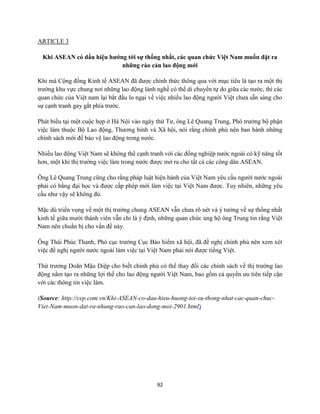
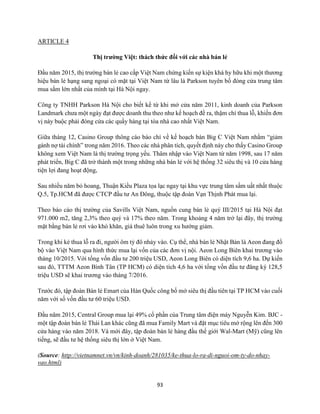
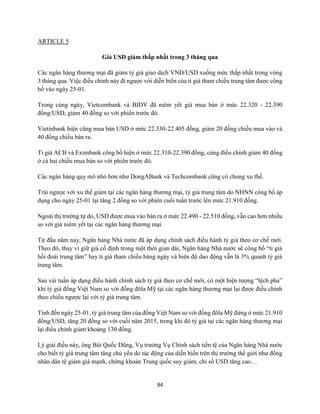
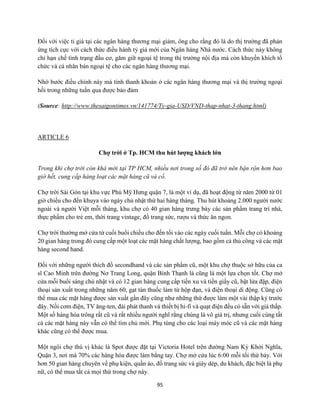
0
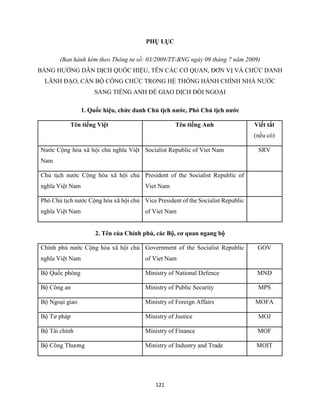
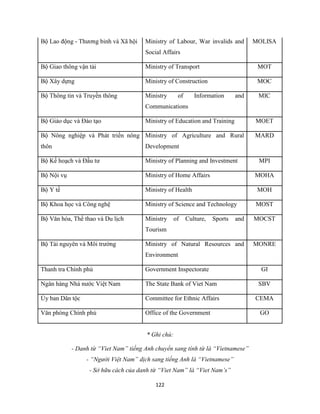
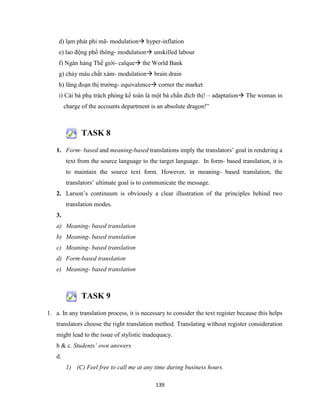
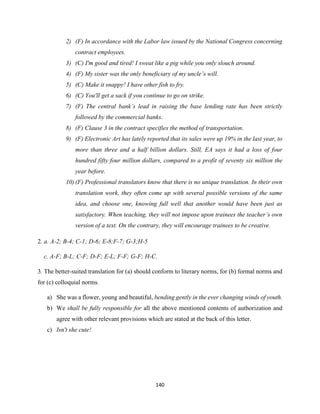
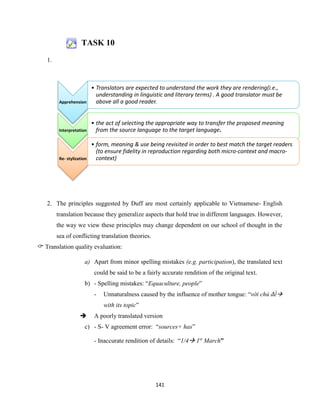
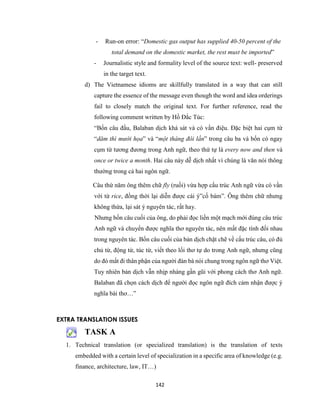
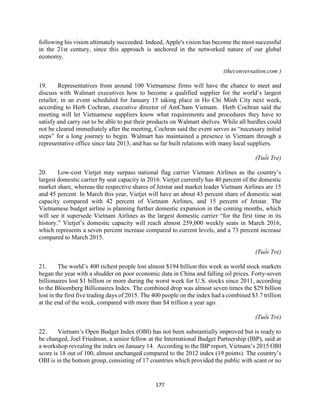
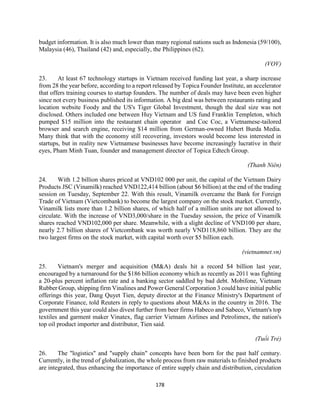
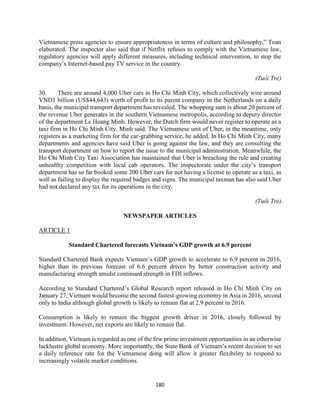
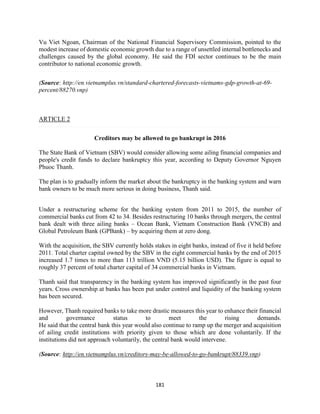
BANKING UNIVERSITY OF HO CHI MINH CITY
DEPARTMENT OF FOREIGN LANGUAGES
 
FOR INTERNAL USE
COMPILED BY: DAO NGUYEN ANH DUC (MA, MBA)
CU NHUT SUONG (MA)
LE THI MINH THUY (MA)
NGUYEN HONG OANH (MA)
VO THI BAO CHAU (MA)
1
2
PREFACE
At Banking University of HCMC, in the 6th
semester, Business English majors have to enroll in
Vietnamese – English Translation, the second in the total four translation courses in their study
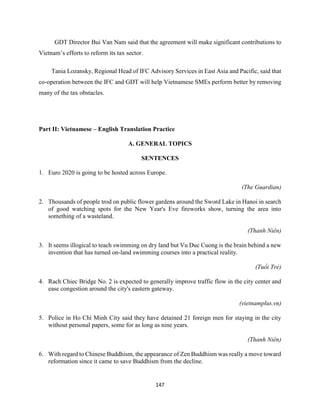
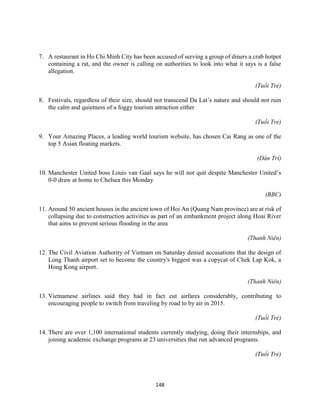
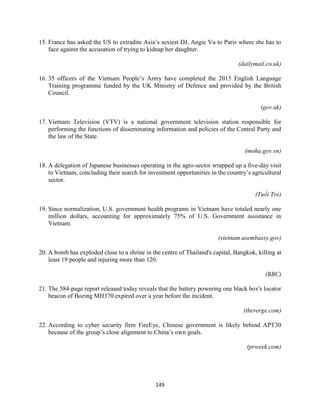
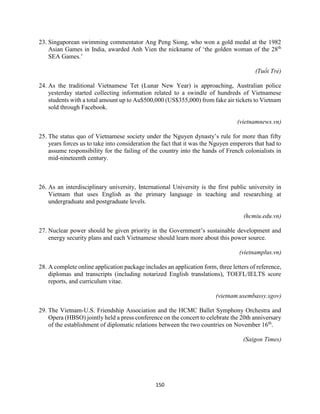
program. This subject is normally considered a challenge to both the instructor and the learner for
many reasons, one important of which is the lack of appropriate teaching and learning materials.
In reality, it requires time, labor and experience of the teacher in finding good teaching materials
that are not only relevant to the curriculum but also updated while there are few publications
available on the market.
Meanwhile, students need more than just 45 instructional hours to consolidate learnt knowledge
and train new skills; they need more practice!
As a result, it is highly necessary to compile a practice book with tasks and activities closely based
on the course syllabus. In light of this principle, the compilers aim to consolidate key knowledge
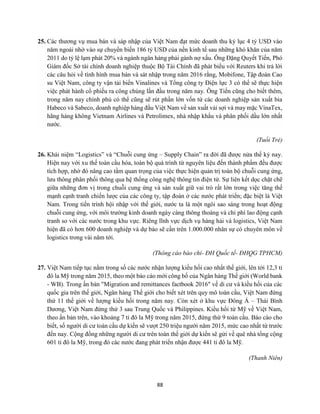
and review basic skills before providing learners with translation practice which requires them to
translate not only sentences but also paragraphs as well as newspaper articles. The tasks are
arranged into two sections: general topics and business topics.
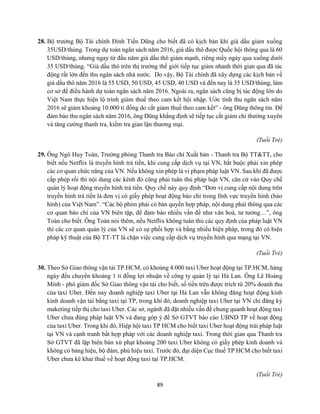
The compilation of this book is aimed at facilitating the teaching and learning of the Vietnamese
– English Translation course. The compilers hope to provide students with useful practice to
improve their skills.
3
CONTENT
Part I. Translation theory consolidation.....................................................................................4
A. The basics of translation studies: A brief overview .......................................................6
B. A closer look at Vietnamese-English Translation ........................................................10
Vietnamese-English Translation: The challenges ..............................................10
Vietnamese-English Translation: The guidelines...............................................16
*Extra translation issues: Technical Translation/Specialized Translation..........................31
*Extra translation issues: Translating newspaper headlines from Vietnamese into English37
*Extra translation issues: Dealing with figures in business, banking and finance texts......43
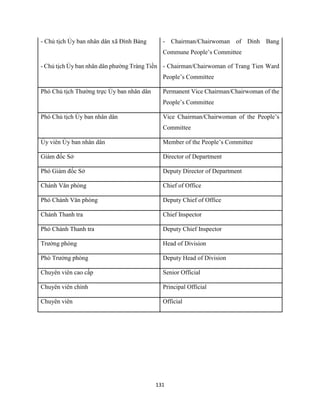
*Extra translation issues: Translating names of administrative, political, educational and
economic organizations or institutions.................................................................................48
Part II. Vietnamese- English Translation Practice..................................................................52
A. General topics.................................................................................................................53
Sentences.........................................................................................................................53
Paragraphs .....................................................................................................................58
Newspaper articles..........................................................................................................63
B. Business, banking, and finance topics..........................................................................74
Sentences.........................................................................................................................74
Paragraphs .....................................................................................................................82
Newspaper articles..........................................................................................................90
Forms and documents...................................................................................................106
REFERENCES........................................................................................................................117
APPENDICES .........................................................................................................................119
4
PART 1- TRANSLATION THEORY CONSOLIDATION
5
“...A translation pedagogy without a theoretical basis will be a blind pedagogy. It will fail to set
reasonable objectives, will be unable to create and apply methods appropriate to the learning
tasks, will be unable to measure and evaluate results, and will ultimately fail to create the
effective translators our society increasingly demands...”
(Gregory M. Shreve- Pathway to Translation: Pedagogy and Process)
6
A. TRANSLATION STUDIES: A BRIEF OVERVIEW
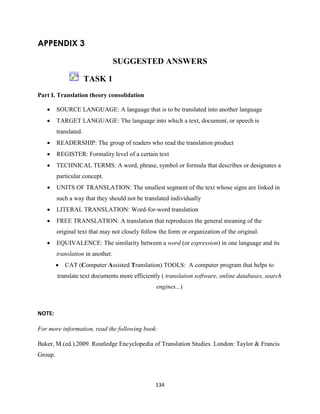
TASK 1
Below is an overview of several key terms in translation studies. Match each explanation on the
right column with a concept on the left column:
SOURCE LANGUAGE
The smallest segment of the text whose signs are linked in such
a way that they should not be translated individually
TARGET LANGUAGE
Formality level of a certain text
READERSHIP
Word-for-word translation
REGISTER
A language that is to be translated into another language
TECHNICAL TERMS
A translation that reproduces the general meaning of the original
text that may not closely follow the form or organization of the
original
UNITS OF
TRANSLATION
The similarity between a word (or expression) in one language
and its translation in another
LITERAL
TRANSLATION
A computer program that helps to translate text documents more
efficiently (translation software, online databases, search
engines...)
FREE TRANSLATION
The language into which a text, document, or speech is
translated
EQUIVALENCE
A word, phrase, symbol or formula that describes or designates
a particular concept
CAT (Computer Assisted
Translation) TOOLS
The group of readers who read the translation product
7
TASK 2
Translation has a long and rich history of conflicting theories. Read the article on the history of
translation below and take note of the milestones as well as the key figures throughout its
development:
Note: Tang Xuanzang: Đường Huyền Trang
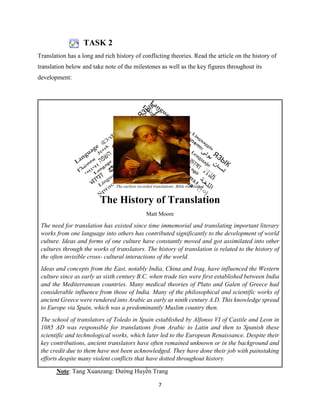
The earliest recorded translations: Bible translation
The History of Translation
Matt Moore
The need for translation has existed since time immemorial and translating important literary
works from one language into others has contributed significantly to the development of world
culture. Ideas and forms of one culture have constantly moved and got assimilated into other
cultures through the works of translators. The history of translation is related to the history of
the often invisible cross- cultural interactions of the world.
Ideas and concepts from the East, notably India, China and Iraq, have influenced the Western
culture since as early as sixth century B.C. when trade ties were first established between India
and the Mediterranean countries. Many medical theories of Plato and Galen of Greece had
considerable influence from those of India. Many of the philosophical and scientific works of
ancient Greece were rendered into Arabic as early as ninth century A.D. This knowledge spread
to Europe via Spain, which was a predominantly Muslim country then.
The school of translators of Toledo in Spain established by Alfonso VI of Castile and Leon in
1085 AD was responsible for translations from Arabic to Latin and then to Spanish these
scientific and technological works, which later led to the European Renaissance. Despite their
key contributions, ancient translators have often remained unknown or in the background and
the credit due to them have not been acknowledged. They have done their job with painstaking
efforts despite many violent conflicts that have dotted throughout history.
8
TASK 3
1. Consider the following perspectives on translation. Do you think they share the same
theoretical ground?
 “Translation is the recoding of a linguistic text, accompanied by the creation of its
new linguistic appearance and stylistic shape”
(A. Popovic)
 “Translation may be defined as follows: the replacement of textual material in one
language (Source Language) by equivalent textual material in another language
(Target Language)”
(J. Catford)
 “Translation is a craft consisting of the attempt to replace a written message and/or
statement in one language by the same message and/or statement in another
language”
(P. Newmark)
Translators have enabled Holy Scriptures like the Bible written in esoteric languages like Latin
to be understood by ordinary people by translating them into more common languages without
depending on a few elite priests or the members of clergy to explain what they contained. Some
translators even had to pay with their life for doing it like the famous Bible translators William
Tyndale, who was arrested and executed in Holland by the King in 1536 for translating the
Bible from its original languages into the common vernacular of English.
Chinese monk Xuanzang is supposed to have translated 74 volumes of Buddhist scriptures
originating from India into Chinese in 645 AD. One of the earliest recorded translations of
considerable effort in English is perhaps the translation of the Bible around 1100 AD. British
translator Constance Garnett made the translating community proud through her brilliant
translations of Russian classics including those of Turgenev, Gogol, Tolstoy, Chekhov and
Dostoyevski in late 19th
century. Another famous translator is Gregory Rabassa who has
translated many Latin American fictions into English. Dr. Arthur Waley is one of the world’s
foremost translators of the twentieth century of Chinese and Japanese literature into English.
More recently, Gladys Yang translated many Chinese classics into English over the last 50
years.
Thus, translators have made important contribution over the centuries in dissemination of
ideas and information to a larger audience, in shaping the cultures and uniting the world.
(Source: onehourtranslation.com)
9
 “Theo truyền thống, dịch là tuân thủ lời người trên như khi dịch kinh sách, dịch
“đúng” là dịch sát nguyên bản, giữ ý và chữ của thánh hiền. Quan niệm cũ chỉ đưa
ra một con đường. Cuộc sống càng chuyển hóa thì con người càng có nhiều lựa
chọn, vì vậy quan niệm “dịch đúng” được soi rọi từ nhiều góc cạnh khác nhau, từ
nhiều lối nhìn chứ không còn một con đường phải theo nữa. Dịch giả có nhiều lựa
chọn tùy học thức và quan niệm”
(Hồ Đắc Túc)
2. Write a definition of TRANSLATION using your own words:
Translation is
.......................................................
.......................................................
.......................................................
.......................................................
.......................................................
.......................................................
.......................................................
.......................................................
10
B. A CLOSER LOOK AT VIETNAMESE-ENGLISH
TRANSLATION
“Công tác phiên dịch một ngôn ngữ Phương
Đông sang một ngôn ngữ Phương tây luôn
mang lại những khó khăn trùng điệp…”
(Dương Ngọc Dũng)
TASK 4
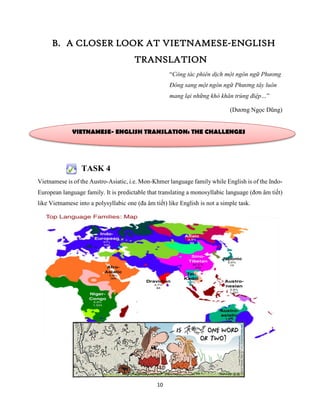
Vietnamese is of the Austro-Asiatic, i.e. Mon-Khmer language family while English is of the Indo-
European language family. It is predictable that translating a monosyllabic language (đơn âm tiết)
like Vietnamese into a polysyllabic one (đa âm tiết) like English is not a simple task.
VIETNAMESE- ENGLISH TRANSLATION: THE CHALLENGES
11
1. Figure out the challenges that you may face in dealing with Vietnamese-to-English
translation tasks. You may consider such issues as the FORM, MEANING, and USE
disparities between the two languages. Give examples to illustrate your points.
2. Translate the following texts into English:
a. Người dân Huế vẫn giữ được cái phong cách tao nhã, vẻ dịu dàng và tính thầm
lặng của đất thần kinh.
b. Chém cha cái kiếp lấy chồng chung
Kẻ đắp chăn bông kẻ lạnh lùng
(Hồ Xuân Hương)
c. Bộ Công Thương cho biết nền kinh tế tăng trưởng với tốc độ hàng năm là 1%
giữa tháng Tư và tháng Ba, giảm so với ước tính lúc đầu là 1,3%.
3. In the process of translating the texts above, did you encounter the problems you had
raised in (1)? Did you recognize any other issues that you need to work on? What are the
causes for those issues?
4. Compare your answer with the following adapted extract taken from Nord (1992). If
possible, provide examples of Vietnamese- English translation situations to disclose each
point.
Four main problems for translators
Pragmatic translation problems: arising from a particular transfer situation with its specific
contrast of source language versus target language recipients, medium, and function,etc.
Cultural translation problems: the result of the differences in cultural-specific (verbal)
habits, expectations, norms and conventions concerning verbal and other behaviours (e.g.
text-type conventions, norms of measuring, formal conventions of marking certain elements in
a text…)
Linguistic translation problems: the structural differences between two languages in lexis,
sentence structure and suprasegmental features (e.g. situations of one-to-many or one-to-zero
equivalence)
Text-specific translation problems: Any problems arising in a particular text specimen,
which cannot be classified as pragmatic, cultural or linguistic, have to be classified as “text-
specific translation problems”(e.g. figures of speech, metaphors, individual word creation or
puns …)
12
5. The Vietnamese texts below may cause problems for translators. Classify the root(s) of the
problems by writing (P) for Pragmatic translation problems, (C) for Cultural translation
problems, (L) for Linguistic translation problems,and (TS) for Text- specific translation
problems
Example:” Chúc chị mẹ tròn con vuông” : (P)
(Explanation: The discourse function of this sentence is to wish some expectant mother a
healthy delivery, but literal translation fails to render such function. Therefore, the
challenge in translating it could be said to come from pragmatic factors)
a) Mơ hão...hao mỡ
b) Cái cửa mắc dịch này không chịu mở!
c) Đừng nói chuyện tầm phào nữa, lo làm việc đàng hoàng đi!
d) Các món ăn chế biến từ thịt cá thác lác từ lâu là món dân dã ngon miệng.
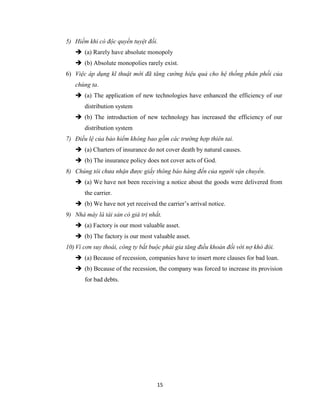
e) “Công nghệ lăng-xê” - bộ phim đầu tiên của một hãng phim tư nhân mới khởi chiếu đã
bất ngờ làm sôi động các rạp chiếu TP.HCM.
f) Lòng nàng là cả một hoang mạc khô cằn sỏi đá, nơi hạt giống tình yêu của tôi chẳng thể
nảy mầm.
g) Lạ gì bỉ sắc tư phong
Trời xanh quen thói má hồng đánh ghen
(Truyện Kiều- Nguyễn Du)
h) Phiên giao dịch buổi sáng diễn ra khá giằng co khi Vn-Index leo lên vùng 550 điểm. Áp
lực chốt lời gia tăng nhưng lực cầu vẫn được duy trì đã giúp Vn- Index giữ được sắc
xanh.
13
i) Căn cứ Nghị định số 116/2003/NĐ-CP ngày 10 tháng 10 năm 2003 của Chính phủ về
tuyển dụng, sử dụng và quản lý cán bộ, công chức trong các đơn vị sự nghiệp của Nhà
nước và Nghị định 121/2006/NĐ-CP ngày 23/10/2006 sửa đổi bổ sung một số điều của
Nghị định số 116/2003/NĐ-CP ngày 10/10/2003
TASK 5
1. The problems that translators face may also represent their lack of skills and knowledge.
In your opinion, what areas of competence does a novice translator need to acquire?
2. Study the much-cited translation competence model below to check your answer. Then
self- rate your translation competencies using the scale given.
TRANSLATIONAL COMPETENCE MODEL
1. Linguistic competence: The ability to understand the source language and
produce acceptable target language expressions.
2. Translation competence: The ability to comprehend the meaning of the source
text and express it in the target text without undue changes in form and to avoid
interference.
3. Methodological competence: The ability to research a particular subject and to
select appropriate terminology.
4. Disciplinary competence: The ability to translate texts in some basic disciplines
such as economics, information science, law, etc.
5. Technical competence: The ability to use aids to translation such as word
processors, data bases, etc.
Roberts (1984; cited in Delisle 1992: 42)
14
YOUR SELF-EVALUATION FORM
Very Poor Poor Fair Good Very good
1. Linguistic competence     
2. Translation competence     
3. Methodological competence     
4. Disciplinary competence     
5. Technical competence     
TASK 6
The difficulties inherent in the Vietnamese-to-English translation process or resulting from the
translator’s low competency will lead to different types of translation failures. Below are 10
Vietnamese sentences with 2 translated versions provided for each. In each case, version (b)
proves itself to be better than version (a) for a number of reasons. Analyze those sentences to
specify the error types for each. Then, sort the errors into different categories:
1) Năm ngoái việc bán hàng rất phát đạt.
 (a) The selling of last year was quite good
 (b) Sales boomed last year.
2) Thị trường chứng khoán Hongkong đột nhiên sôi động khi sự tin tưởng lên cao.
 (a) Hongkong market suddenly become active when the belief promote highly.
 (b) The Hongkong stock market bounced as confidence grew.
3) Dự án đó bạn mà hòa vốn là may rồi!
 (a) That tough project which you may break even is really lucky.
 (b) You will be lucky to break even on that project.
4) Những người cạnh tranh buôn bán sách cố gắng hết sức bán rẻ hơn giá của nhau.
 (a) The book selling competitors always try their best to sell much cheaper than
the others.
 (b) Competitors in the book trade did their best to undercut each other’s prices.
15
5) Hiếm khi có độc quyền tuyệt đối.
 (a) Rarely have absolute monopoly
 (b) Absolute monopolies rarely exist.
6) Việc áp dụng kĩ thuật mới đã tăng cường hiệu quả cho hệ thống phân phối của
chúng ta.
 (a) The application of new technologies have enhanced the efficiency of our
distribution system
 (b) The introduction of new technology has increased the efficiency of our
distribution system
7) Điều lệ của bảo hiểm không bao gồm các trường hợp thiên tai.
 (a) Charters of insurance do not cover death by natural causes.
 (b) The insurance policy does not cover acts of God.
8) Chúng tôi chưa nhận được giấy thông báo hàng đến của người vận chuyển.
 (a) We have not been receiving a notice about the goods were delivered from
the carrier.
 (b) We have not yet received the carrier’s arrival notice.
9) Nhà máy là tài sản có giá trị nhất.
 (a) Factory is our most valuable asset.
 (b) The factory is our most valuable asset.
10) Vì cơn suy thoái, công ty bắt buộc phải gia tăng điều khoản đối với nợ khó đòi.
 (a) Because of recession, companies have to insert more clauses for bad loan.
 (b) Because of the recession, the company was forced to increase its provision
for bad debts.
16
It is believed that solutions to translation problems are rarely a case of right versus wrong
because translation is a multifaceted phenomenon. There has been constant debate as to whether
translation is an art, a craft, or a science1
. As an art, translation includes a process of creative
thinking, or an artistic endeavour. As a cognitive science, translation must have universally
accepted principles and rules with sound theoretical grounds. Being a craft, translation is mainly a
teachable skill that can be improved with experience by practical methods. The guidance drawn
up hereinafter is out of the belief that we do have a set of learnable translation techniques.
Furthermore, those techniques are set to assist rather than hinder creativity in translation
professionals.
TASK 7:
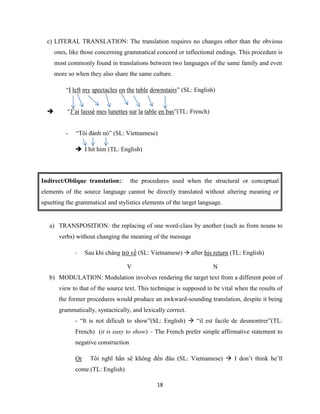
Study the following summary of common translation methods and techniques as proposed by
Vinay and Darbelnet(1958). Then use the ideas acquired to do the exercise below.
1
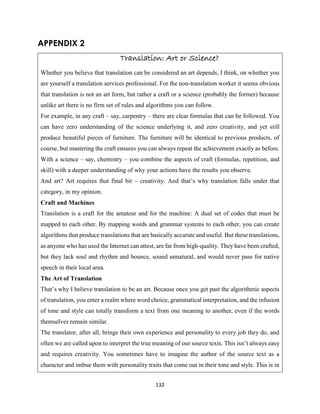
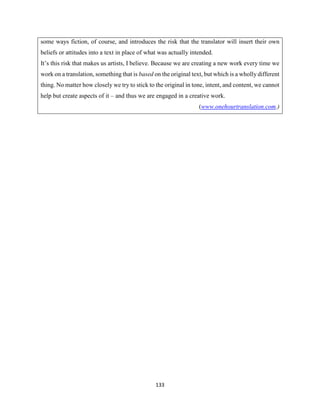
For more information, see appendix 2
TRANSLATION
METHODS
DIRECT/LITERAL
TRANSLATION
BORROWING CALQUE LITERAL
INDIRECT/OBLIQUE
TRANSLATION
TRANSPOSITION MODULATION EQUIVALENCE ADAPTATION
VIETNAMESE- ENGLISH TRANSLATION: THE GUIDELINES
17
a) BORROWING: using foreign phrasing in the target text
 Pure loanwords: borrowing with no change in form and meaning
- Phở (Source Language (SL): Vietnamese)  pho (Target Language (TL):
English)
- Áo dài (SL: Vietnamese)  Ao dai (TL: English)
- The Chinese word Kung Fu in modern English
 Mix loanwords: borrowing with changes in form but without changes in the meanings
- Dollar (SL: English)  đô-la (TL: Vietnamese)
- Cheque (SL: English)  séc (TL: Vietnamese)
 Loan blends: borrowing when part of the term is native and the other part is borrowed, but
the meaning is fully borrowed
- Wall Street (SL: English)  phố Wall (TL: Vietnamese)
- Đại học Hồng Bàng (SL: Vietnamese)  Hong Bang University (TL:
Vietnamese)
b) CALQUE: This is a special kind of borrowing in which the target language borrows an
expression from the source language by translating literally each of the original element.
The result creates either, a lexical calque, which preserves the syntactic structure of the
target language, but at the same time introduces a new mode of expression; or structural
calque, which introduces a new construction into the language. This technique is common
in translating collocations and names of organizations.
- Giáng sinh an lành (SL: Vietnamese)  Merry Christmas (TL: English)
- Phó Giám đốc Học viện Chính trị - Hành chính Quốc gia Hồ Chí Minh (SL:
Vietnamese)  Vice President of Ho Chi Minh National Academy of Politics
and Public Administration (TL: English)
- Qũy Tiền Tệ Quốc Tế (SL: Vietnamese)  International Monetary Fund (TL:
English)
- chợ đen (SL: Vietnamese)  black market (TL: English)
- công nghiệp nặng (SL: Vietnamese)  heavy industry (TL: English)
- trà đậm (SL: Vietnamese)  strong tea (TL: English)
Direct/ Literal translation : Translation that closely follows the phrasing, order and
sentence construction of the source text.
18
c) LITERAL TRANSLATION: The translation requires no changes other than the obvious
ones, like those concerning grammatical concord or inflectional endings. This procedure is
most commonly found in translations between two languages of the same family and even
more so when they also share the same culture.
“I left my spectacles on the table downstairs” (SL: English)
 “J’ai laissé mes lunettes sur la table en bas”(TL: French)
- “Tôi đánh nó” (SL: Vietnamese)
 I hit him (TL: English)
Indirect/Oblique translation:: the procedures used when the structural or conceptual
elements of the source language cannot be directly translated without altering meaning or
upsetting the grammatical and stylistics elements of the target language.
a) TRANSPOSITION: the replacing of one word-class by another (such as from nouns to
verbs) without changing the meaning of the message
- Sau khi chàng trở về (SL: Vietnamese)  after his return (TL: English)
V N
b) MODULATION: Modulation involves rendering the target text from a different point of
view to that of the source text. This technique is supposed to be vital when the results of
the former procedures would produce an awkward-sounding translation, despite it being
grammatically, syntactically, and lexically correct.
- “It is not dificult to show”(SL: English)  “il est facile de desmontrer”(TL:
French) (it is easy to show) – The French prefer simple affirmative statement to
negative construction
Or Tôi nghĩ hắn sẽ không đến đâu (SL: Vietnamese)  I don’t think he’ll
come.(TL: English)
19
c) EQUIVALENCE: Equivalence includes cases where languages described the same
situation by different stylistic or structural means. This translation procedure is also very
common in translating idiomatic expressions ,whereby literal translation would leave a
reader confused.
- “Ò Ó O” ( SL: Vietnamese)  Cock-A-Doodle-Doo (TL: English) (A rooster’s
sound)
- In expressing pain, the English would say “OUCH!” while in Vietnamese, the
equivalent of OUCH is “ỐI”.
- Chở củi về rừng (SL: Vietnamese)  Carry coals to Newcastle (TL: English)
d) ADAPTATION: a procedure which can be used whenever the context referred to in the
original text does not exist in the culture of the target text, thereby necessitating some form
of re-creation.
- Bốn con rồng châu Á (SL: Vietnamese) – 4 strong economies  Four Asian
Tigers (TL: English) (In Asia, The dragon is the symbol of strength and power
while in Western culture dragons represent evil and darkness. Thus, tigers
would make a better equivalent in this case.)
(Adapted from Vinay and Darbelnet (in Venuti (2000: 84))
1. Which translation techniques were used in the following examples:
a) Của rẻ là của ôi (SL: Vietnamese)  Cheapest is dearest (TL: English)
b) Ai giàu ba họ, ai khó ba đời (SL: Vietnamese) Every dog has its/his day (TL:
English)
c) Email (SL: English)  email (TL: Vietnamese)
d) Marketing (SL: English  marketing (TL: Vietnamese)
e) Bear (SL: English  người đầu cơ giá xuống (TL: Vietnamese)
f) tiền bảo lãnh (SL: Vietnamese)  bail (TL: English)
g) hợp đồng miệng (SL: Vietnamese)  unwritten contract (TL: English)
h) làm sổ ma (SL: Vietnamese)  cook the books (TL: English)
i) Dow Jones index (SL: English) chỉ số Dow Jones (TL: Vietnamese)
20
2. Decide on the best translation technique(s) for the following Vietnamese texts. Give
reasons for your choice:
a) bún bò Huế
b) Nhập gia tùy tục
c) Học viện Ngân hàng - Phân viện Bắc Ninh
d) lạm phát phi mã
e) lao động phổ thông
f) Ngân hàng Thế giới
g) chảy máu chất xám
h) lũng đoạn thị trường
i) Cái bà phụ trách phòng kế toán là một bà chằn đích thị!
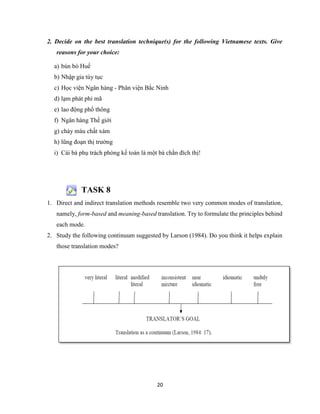
TASK 8
1. Direct and indirect translation methods resemble two very common modes of translation,
namely, form-based and meaning-based translation. Try to formulate the principles behind
each mode.
2. Study the following continuum suggested by Larson (1984). Do you think it helps explain
those translation modes?
21
3. Read the statements below and specify whether each statement favors form-based or
meaning based translation:
a) A translation seems like a currency exchange: You bring in your words, and the
translator hands you a different set of words of equal value.
b) There is no perfect translation.
c) Translating is just like painting a portrait: The result is not the same as the original,
but if it’s done well, it captures the original’s essence.
d) A good translator abandons a literal version only when it is plainly inexact or badly
written. A bad translator will always do his best to avoid translating word for word.
e) Translation is like a woman. If it is beautiful, it is not faithful. If it is faithful, it is most
certainly not beautiful.
TASK 9
The key to successful translation includes adopting the right translation method/mode. One
criterion by which a translation methodology could be well selected is the typology of the source
text (i.e., text register, text genre, and text type).
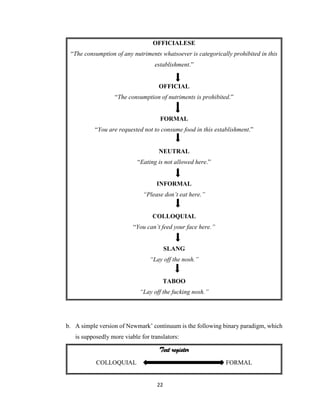
1. Register is a sociolinguistic term referring to the level of formality that varies in different
communicative settings.
a) Study the following 8-scale continuum of formalities to grasp a general
understanding of text register. Think of some reasons why register consideration is
important the translation process.
22
OFFICIALESE
“The consumption of any nutriments whatsoever is categorically prohibited in this
establishment.”
OFFICIAL
“The consumption of nutriments is prohibited.”
FORMAL
“You are requested not to consume food in this establishment.”
NEUTRAL
“Eating is not allowed here.”
INFORMAL
“Please don’t eat here.”
COLLOQUIAL
“You can’t feed your face here.”
SLANG
“Lay off the nosh.”
TABOO
“Lay off the fucking nosh.”
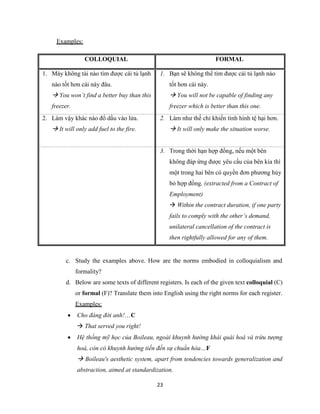
b. A simple version of Newmark’ continuum is the following binary paradigm, which
is supposedly more viable for translators:
Text register
COLLOQUIAL FORMAL
23
Examples:
COLLOQUIAL FORMAL
1. Mày không tài nào tìm được cái tủ lạnh
nào tốt hơn cái này đâu.
 You won’t find a better buy than this
freezer.
1. Bạn sẽ không thể tìm được cái tủ lạnh nào
tốt hơn cái này.
 You will not be capable of finding any
freezer which is better than this one.
2. Làm vậy khác nào đổ dầu vào lửa.
 It will only add fuel to the fire.
2. Làm như thế chỉ khiến tình hình tệ hại hơn.
 It will only make the situation worse.
3. Trong thời hạn hợp đồng, nếu một bên
không đáp ứng được yêu cầu của bên kia thì
một trong hai bên có quyền đơn phương hủy
bỏ hợp đồng. (extracted from a Contract of
Employment)
 Within the contract duration, if one party
fails to comply with the other’s demand,
unilateral cancellation of the contract is
then rightfully allowed for any of them.
c. Study the examples above. How are the norms embodied in colloquialism and
formality?
d. Below are some texts of different registers. Is each of the given text colloquial (C)
or formal (F)? Translate them into English using the right norms for each register.
Examples:
 Cho đáng đời anh!…C
 That served you right!
 Hệ thống mỹ học của Boileau, ngoài khuynh hướng khái quái hoá và trừu tượng
hoá, còn có khuynh hướng tiến đến sự chuẩn hóa…F
 Boileau's aesthetic system, apart from tendencies towards generalization and
abstraction, aimed at standardization.
24
1. Xin cứ tùy nghi gọi cho tôi bất cứ lúc nào trong giờ hành chính.____________
2. Căn cứ Luật Lao động do Quốc hội ban hành về chế độ hợp đồng lao
động.___________
3. Mệt quá trời đất! Tôi thì làm việc như trâu còn cô thì nằm ườn ra đó.__________
4. Chị tôi là người thụ hưởng duy nhất trong di chúc của bác tôi.___________
5. Nhanh lên! Tôi còn nhiều việc khác phải làm.___________
6. Anh sẽ bị tống cổ ra nếu tiếp tục đình công.___________
7. Sự chỉ đạo của Ngân hàng trung ương trong việc nâng lãi suất cơ bản đã được các
ngân hàng thương mại triệt để tuân theo.___________
8. Điều 3 trong hợp đồng định rõ phương thức vận chuyển.________________.
9. Electronic Arts vừa báo cáo rằng doanh số bán hang của họ đã tăng 19% năm vừa
qua, lên đến trên ba tỉ rưỡi đô la. Tuy nhiên EA tuyên bố họ đã thua lỗ 454 triệu đô la
so với khoản lợi nhuận 76 triệu đô la năm trước đó.____________
10. Dịch giả chuyên nghiệp nào cũng biết không hề có một cách dịch duy nhất. Cùng một
bản gốc họ có thể dịch ra các bản khác nhau, rồi cân nhắc để chọn một, đồng thời
cũng biết rất rõ các bản dịch khác cũng chấp nhận được. Khi dạy học, một dịch giả
chuyên nghiệp sẽ không ép người học phải theo cách dịch”chính thống” của thầy.
Ngược lại, họ khuyến khích người học sáng tạo.___________
2. “Text genre” and “text type” are two other candidates to consider before deciding on the
right translation mode. These two terms are sometimes used interchangeably. In translation
studies, genre is commonly understood as macro-characterizations of text-types, and text
type is specific sub-categorizations of genre.
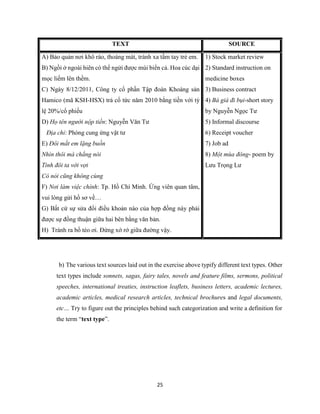
a) Below are some language extracts taken from a variety of Vietnamese texts. Match them
with a suitable given source (e.g., a TV weather report, a book review…).
Example: nhiều mây, ngày có mưa rào và dông rải rác, đêm có mưa rào và dông vài nơi.
Gió tây nam cấp 3…  TV weather forecast
25
TEXT SOURCE
A) Bảo quản nơi khô ráo, thoáng mát, tránh xa tầm tay trẻ em.
B) Ngồi ở ngoài hiên có thể ngửi được mùi biển cả. Hoa cúc dại
mọc liếm lên thềm.
C) Ngày 8/12/2011, Công ty cổ phần Tập đoàn Khoáng sản
Hamico (mã KSH-HSX) trả cổ tức năm 2010 bằng tiền với tỷ
lệ 20%/cổ phiếu
D) Họ tên người nộp tiền: Nguyễn Văn Tư
Địa chỉ: Phòng cung ứng vật tư
E) Đôi mắt em lặng buồn
Nhìn thôi mà chẳng nói
Tình đôi ta vời vợi
Có nói cũng không cùng
F) Nơi làm việc chính: Tp. Hồ Chí Minh. Ứng viên quan tâm,
vui lòng gửi hồ sơ về…
G) Bất cứ sự sửa đổi điều khoản nào của hợp đồng này phải
được sự đồng thuận giữa hai bên bằng văn bản.
H) Tránh ra bồ tèo ơi. Đứng xớ rớ giữa đường vậy.
1) Stock market review
2) Standard instruction on
medicine boxes
3) Business contract
4) Bà già đi bụi-short story
by Nguyễn Ngọc Tư
5) Informal discourse
6) Receipt voucher
7) Job ad
8) Một mùa đông- poem by
Lưu Trọng Lư
b) The various text sources laid out in the exercise above typify different text types. Other
text types include sonnets, sagas, fairy tales, novels and feature films, sermons, political
speeches, international treaties, instruction leaflets, business letters, academic lectures,
academic articles, medical research articles, technical brochures and legal documents,
etc… Try to figure out the principles behind such categorization and write a definition for
the term “text type”.
26
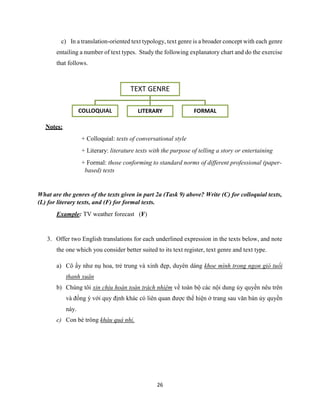
c) In a translation-oriented text typology, text genre is a broader concept with each genre
entailing a number of text types. Study the following explanatory chart and do the exercise
that follows.
Notes:
+ Colloquial: texts of conversational style
+ Literary: literature texts with the purpose of telling a story or entertaining
+ Formal: those conforming to standard norms of different professional (paper-
based) texts
What are the genres of the texts given in part 2a (Task 9) above? Write (C) for colloquial texts,
(L) for literary texts, and (F) for formal texts.
Example: TV weather forecast (F)
3. Offer two English translations for each underlined expression in the texts below, and note
the one which you consider better suited to its text register, text genre and text type.
a) Cô ấy như nụ hoa, trẻ trung và xinh đẹp, duyên dáng khoe mình trong ngọn gió tuổi
thanh xuân
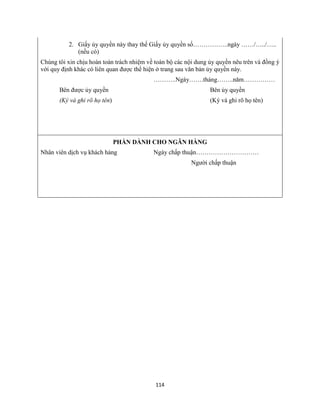
b) Chúng tôi xin chịu hoàn toàn trách nhiệm về toàn bộ các nội dung ủy quyền nêu trên
và đồng ý với quy định khác có liên quan được thể hiện ở trang sau văn bản ủy quyền
này.
c) Con bé trông kháu quá nhỉ.
TEXT GENRE
COLLOQUIAL LITERARY FORMAL
27
TASK 10
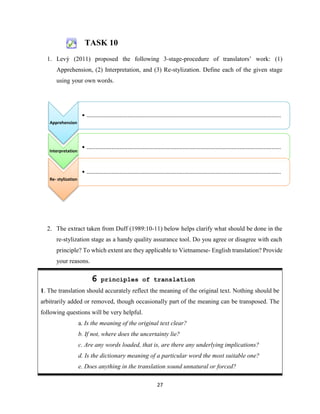
1. Levý (2011) proposed the following 3-stage-procedure of translators’ work: (1)
Apprehension, (2) Interpretation, and (3) Re-stylization. Define each of the given stage
using your own words.
2. The extract taken from Duff (1989:10-11) below helps clarify what should be done in the
re-stylization stage as a handy quality assurance tool. Do you agree or disagree with each
principle? To which extent are they applicable to Vietnamese- English translation? Provide
your reasons.
6 principles of translation
1. The translation should accurately reflect the meaning of the original text. Nothing should be
arbitrarily added or removed, though occasionally part of the meaning can be transposed. The
following questions will be very helpful.
a. Is the meaning of the original text clear?
b. If not, where does the uncertainty lie?
c. Are any words loaded, that is, are there any underlying implications?
d. Is the dictionary meaning of a particular word the most suitable one?
e. Does anything in the translation sound unnatural or forced?
Apprehension
• ...........................................................................................................................
Interpretation
• ...........................................................................................................................
Re- stylization
• ...........................................................................................................................
28
2. The ordering of words and ideas in the translation should match the original as closely as
possible. (This is probably essential in translating legal documents, guarantees, contracts, etc).
But differences in language structure often require changes in the form and order of words.
3. Languages often differ greatly in their level of formality in a specific context. To resolve these
differences, the translator must distinguish between formal or fixed expressions and personal
expressions in which the writer or speaker sets the tone.
4. Many translations do not sound natural. This is because the translator’s thoughts and choices
of words are too strongly influenced by the original text. A good way to avoid this is to set the
text aside and translate a few sentences from memory in order to get the natural patterns of
thought in the target language.
5. The translator should not change the style of the original as much as possible. Changes are
likely to happen if it is necessary such as, many repetitions or mistakes in writing.
6. Idiomatic expressions---- including similes, metaphors, proverbs, sayings, jargon, slang,
colloquialisms, and phrasal verbs ---- are commonly hard to translate. To solve this problem, try
any of the following.
a. Keep the original word between inverted commas.
b. Keep the original expression, with a literal explanation in brackets.
c. Use a close equivalent.
d. Use a non-idiomatic or plain prose translation.
But what is the most essential is that if the idiom does not work in the target language; do not
force it into the translation.
Try evaluating the following translation products using the principles quoted above:
a) Phòng Thương mại và Công nghiệp Việt Nam (VCCI) sẽ phối hợp với Trung
tâm triển lãm quốc tế Messe Essen-Cộng hoà Liên bang Đức tổ chức cho các
doanh nghiệp Việt Nam tham dự Hội chợ sản phẩm châu Á "Asia World", dự
kiến diễn ra vào tháng 6. Đây là hội chợ thương mại thường xuyên ở Đức, với
sự tham gia của khoảng 250 công ty đến từ châu Á và cũng là diễn đàn lý
tưởng để các doanh nghiệp giới thiệu sản phẩm và thương hiệu hàng hoá Việt
Nam thâm nhập vào thị trường Châu Âu.
29
 The Viet Nam Chamber of Commerce and Industry (VCCI) will collaborate
with Germany's Messe Essen International Exhibition Centre facilitating
Vietnamese enterprises' attendance of the "Asia World" fair scheduled to be
held in Germany in June. This is a regular commercial fair in Germany with the
paticipation of about 250 enterprises from Asia. It is also considered an ideal
forum for Vietnamese enterprises to introduce their for-export products, and
trademarks to European market.
b) Bộ Thuỷ sản, Hội nghề cá Việt Nam và Uỷ ban Nhân dân Thành phố Hồ Chí
Minh phối hợp tổ chức hội chợ thuỷ sản Việt Nam với chủ đề “Nghề Cá Việt
Nam – Phát triển và hội nhập” tại công viên văn hoá Tao Đàn từ ngày 2 đến
ngày 6/4/2004 với 178 gian hàng và ba khu trưng bày.
 The Ministry of Equaculture and Vietnam Fishery Association co-ordinated
with HCM people’s Committee to organize Vietnam Fishery Fair at Tao Dan
cultural park since 2/04 to 6/04/2004 with its topic: “Vietnam Fishery-
Development and Integration”. The fair includes 178 booths and 3 show zones.
c) Hiện sản lượng gas sản xuất trong nước chỉ đảm bảo đáp ứng được khoảng
40- 50% nhu cầu trên thị trường, số còn lại chủ yếu dựa vào nguồn nhập khẩu.
"Do vậy, khi giá gas trên thị trường thế giới tăng ngay lập tức sẽ ảnh hưởng
trực tiếp đến thị trường trong nước", ông Trình cho biết. Từ 1/4, Tổ chức các
nước xuất khẩu dầu (OPEC) cắt giảm sản lượng khiến nguồn cung nhiên liệu
đốt bị sụt giảm mạnh.
 Currently, domestic gas output has supplied 40-50 percent of the total demand
on the the domestic market, the rest must be imported. “Therefore, the hike of
gas prices on the world market will affect local prices directly.”, said Mr. Trình.
Since 1st March, fuel supplying sources has sharply decreased because of an
output cut of Organization of Petroleum-Exporting Countries (OPEC).
30
d) LẤY CHỒNG CHUNG
Chém cha cái kiếp lấy chồng chung.
Kẻ đắp chăn bông kẻ lạnh lùng,
Năm thì mười hoạ chăng hay chớ
Một tháng đôi lần có cũng không.
Cố đấm ăn xôi, xôi lại hẩm,
Cầm bằng làm mướn, mướn không công.
Thân này ví biết dường này nhỉ
Thà trước thôi đành ở vậy xong.
(Hồ Xuân Hương)
ON SHARING A HUSBAND
Screw the fate that makes you share a man
One cuddles under the cotton blankets; the other's cold
Every now and then, well, maybe or maybe not.
Once or twice a month, oh, its like nothing.
You try to stick to it like a fly on rice
but the rice is rotten. You slave like the maid,
but without pay. If I had known how it would go
I think I would have lived alone.
(Translated by John Balaban 2000)
31
Extra translation issues
TECHNICAL TRANSLATION/SPECIALIZED
TRANSLATION
32
TASK A:
1. What is technical translation (or specialized translation)? Write a definition for it.
2. What factors distinguish specialized from non- specialized text?
3. Newmark (1988: 151-61) maintains that terminology (or specialized lexicography) covers
roughly 10% the length of a specialized text while Arsentyeva (2003: 151-61) believes the
ratio may go up to 30%. What is your opinion?
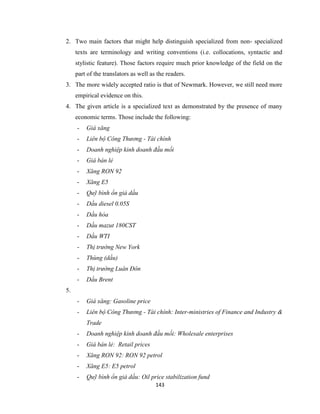
4. Is the article below a specialized text? Read and underline all terminologies you find?
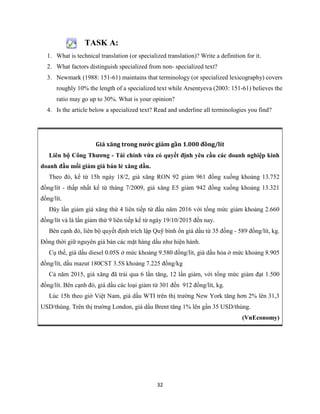
Giá xăng trong nước giảm gần 1.000 đồng/lít
Liên bộ Công Thương - Tài chính vừa có quyết định yêu cầu các doanh nghiệp kinh
doanh đầu mối giảm giá bán lẻ xăng dầu.
Theo đó, kể từ 15h ngày 18/2, giá xăng RON 92 giảm 961 đồng xuống khoảng 13.752
đồng/lít - thấp nhất kể từ tháng 7/2009, giá xăng E5 giảm 942 đồng xuống khoảng 13.321
đồng/lít.
Đây lần giảm giá xăng thứ 4 liên tiếp từ đầu năm 2016 với tổng mức giảm khoảng 2.660
đồng/lít và là lần giảm thứ 9 liên tiếp kể từ ngày 19/10/2015 đến nay.
Bên cạnh đó, liên bộ quyết định trích lập Quỹ bình ổn giá dầu từ 35 đồng - 589 đồng/lít, kg.
Đồng thời giữ nguyên giá bán các mặt hàng dầu như hiện hành.
Cụ thể, giá dầu diesel 0.05S ở mức khoảng 9.580 đồng/lít, giá dầu hỏa ở mức khoảng 8.905
đồng/lít, dầu mazut 180CST 3.5S khoảng 7.225 đồng/kg
Cả năm 2015, giá xăng đã trải qua 6 lần tăng, 12 lần giảm, với tổng mức giảm đạt 1.500
đồng/lít. Bên cạnh đó, giá dầu các loại giảm từ 301 đến 912 đồng/lít, kg.
Lúc 15h theo giờ Việt Nam, giá dầu WTI trên thị trường New York tăng hơn 2% lên 31,3
USD/thùng. Trên thị trường London, giá dầu Brent tăng 1% lên gần 35 USD/thùng.
(VnEconomy)
33
5. Translate the underlined terminologies in Task A.4 above into English. Which methods
and tools did you use to translate them? Read the following extract by Hồ Đắc Túc (2012:
230) to check your answer. Summarize the main points suggested by him.
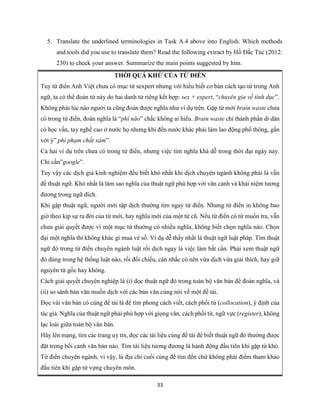
THỜI QUÁ KHỨ CỦA TỪ ĐIỂN
Tuy từ điển Anh Việt chưa có mục từ sexpert nhưng với hiểu biết cơ bản cách tạo từ trong Anh
ngữ, ta có thể đoán từ này do hai danh từ riêng kết hợp: sex + expert, “chuyên gia về tình dục”.
Không phải lúc nào người ta cũng đoán được nghĩa như ví dụ trên. Gặp từ mới brain waste chưa
có trong từ điển, đoán nghĩa là “phí não” chắc không ai hiểu. Brain waste chỉ thành phần di dân
có học vấn, tay nghề cao ở nước họ nhưng khi đến nước khác phải làm lao động phổ thông, gần
với ý” phí phạm chất xám”.
Cả hai ví dụ trên chưa có trong từ điển, nhưng việc tìm nghĩa khá dễ trong thời đại ngày nay.
Chỉ cần”google”.
Tuy vậy các dịch giả kinh nghiệm đều biết khó nhất khi dịch chuyên ngành không phải là vấn
đề thuật ngữ. Khó nhất là làm sao nghĩa của thuật ngữ phù hợp với văn cảnh và khái niệm tương
đương trong ngữ đích.
Khi gặp thuật ngữ, người mới tập dịch thường tìm ngay từ điển. Nhưng từ điển in không bao
giờ theo kịp sự ra đời của từ mới, hay nghĩa mới của một từ cũ. Nếu từ điển có từ muốn tra, vẫn
chưa giải quyết được vì một mục từ thường có nhiều nghĩa, không biết chọn nghĩa nào. Chọn
đại một nghĩa thì không khác gì mua vé số. Ví dụ dễ thấy nhất là thuật ngữ luật pháp. Tìm thuật
ngữ đó trong từ điển chuyên ngành luật rồi dịch ngay là việc làm bất cẩn. Phải xem thuật ngữ
đó dùng trong hệ thống luật nào, rồi đối chiếu, cân nhắc có nên vừa dịch vừa giải thích, hay giữ
nguyên từ gốc hay không.
Cách giải quyết chuyên nghiệp là (i) đọc thuật ngữ đó trong toàn bộ văn bản để đoán nghĩa, và
(ii) so sánh bản văn muốn dịch với các bản văn cùng nói về một đề tài.
Đọc vài văn bản có cùng đề tài là để tìm phong cách viết, cách phối từ (collocation), ý định của
tác giả. Nghĩa của thuật ngữ phải phù hợp với giọng văn, cách phối từ, ngữ vực (register), không
lạc loài giữa toàn bộ văn bản.
Hãy lên mạng, tìm các trang uy tín, đọc các tài liệu cùng đề tài để biết thuật ngữ đó thường được
đặt trong bối cảnh văn bản nào. Tìm tài liệu tương đương là hành động đầu tiên khi gặp từ khó.
Từ điển chuyên ngành, vì vậy, là địa chỉ cuối cùng để tìm đến chứ không phải điểm tham khảo
đầu tiên khi gặp từ vựng chuyên môn.
34
6. Regarding ways of dealing with terminologies, there are some important reminders:
In the short term
- Use dictionaries and search engines of different types to properly grasp the notion
proposed.
- Cross-check to find one equivalent which best suits the given text genre and text
register.
In the long run
- Keep a vocabulary notebook and constantly record new terms.
- Familiarise yourself with the recorded terms and their surrounding co-text.
- Boost your expertise/technicality.
35
The following extract discusses a useful tip in using Google Search as a powerful translation tool.
Read it and do the exercise below.
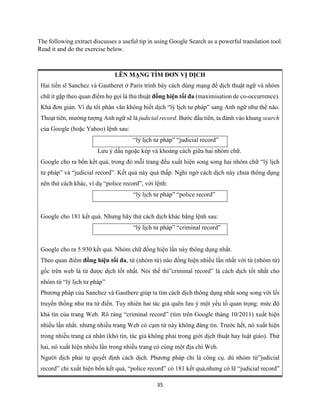
LÊN MẠNG TÌM ĐƠN VỊ DỊCH
Hai tiến sĩ Sanchez và Gautheret ở Paris trình bày cách dùng mạng để dịch thuật ngữ và nhóm
chữ ít gặp theo quan điểm họ gọi là thủ thuật đồng hiện tối đa (maximisation de co-occurrence).
Khá đơn giản. Ví dụ tôi phân vân không biết dịch “lý lịch tư pháp” sang Anh ngữ như thế nào.
Thoạt tiên, mường tượng Anh ngữ sẽ là judicial record. Bước đầu tiên, ta đánh vào khung search
của Google (hoặc Yahoo) lệnh sau:
“lý lịch tư pháp” “judicial record”
Lưu ý dấu ngoặc kép và khoảng cách giữa hai nhóm chữ.
Google cho ra bốn kết quả, trong đó mỗi trang đều xuất hiện song song hai nhóm chữ “lý lịch
tư pháp” và “judicial record”. Kết quả này quá thấp. Nghi ngờ cách dịch này chưa thông dụng
nên thử cách khác, ví dụ “police record”, với lệnh:
“lý lịch tư pháp” “police record”
Google cho 181 kết quả. Nhưng hãy thử cách dịch khác bằng lệnh sau:
“lý lịch tư pháp” “criminal record”
Google cho ra 5.930 kết quả. Nhóm chữ đồng hiện lần này thông dụng nhất.
Theo quan điểm đồng hiện tối đa, từ (nhóm từ) nào đồng hiện nhiều lần nhất với từ (nhóm từ)
gốc trên web là từ được dịch tốt nhất. Nói thế thì”criminal record” là cách dịch tốt nhất cho
nhóm từ “lý lịch tư pháp”
Phương pháp của Sanchez và Gauthere giúp ta tìm cách dịch thông dụng nhất song song với lối
truyền thống như tra từ điển. Tuy nhiên hai tác giả quên lưu ý một yếu tố quan trọng: mức độ
khả tín của trang Web. Rõ ràng “criminal record” (tìm trên Google tháng 10/2011) xuất hiện
nhiều lần nhất. nhưng nhiều trang Web có cụm từ này không đáng tin. Trước hết, nó xuất hiện
trong nhiều trang cá nhân (khó tin, tác giả không phải trong giới dịch thuật hay luật giáo). Thứ
hai, nó xuất hiện nhiều lần trong nhiều trang có cùng một địa chỉ Web.
Người dịch phải tự quyết định cách dịch. Phương pháp chỉ là công cụ. dù nhóm từ”judicial
record” chỉ xuất hiện bốn kết quả, “police record” có 181 kết quả,nhưng có lẽ “judicial record”
36
hoặc”police record” đối dịch tốt nhất với “lý lịch tư pháp”. Thứ nhất, “police record” có trên
các trang Web của cơ quan nhà nước Việt Nam (như trang Web của Sứ Quán Việt Nam tại Hoa
Kì và Phillipinnes). Lý lịch tư pháp, nếu đã được cơ quan nhà nước dịch là “police record’, thì
cứ dùng vì mục đích là đáp ứng yêu cầu về thủ tục, không phải tranh biện về cách dịch. Nếu bàn
về cách dịch, “judicial record “có nghĩa rộng hơn, bao trùm cả “criminal record”,”police
certificate” và “police record”.
Vì vậy cần suy xét chọn lọc khi đã tìm ra một số cách dịch trên Web, chứ không nên áp dụng
phương pháp của Sanchez và Gautheret một cách máy móc.
(Hồ Đắc Túc)
Translate the following Vietnamese terms into English using “maximization de co-occurrence”
technique via Google.
a) Cuống não
b) Bồi thẩm đoàn
c) Rủi ro tiềm tàng
d) Bong bóng bất động sản
e) Hàng tồn kho
f) Bán khống
g) Chính sách tiền tệ thắt lưng buộc bụng
h) Lãi ròng
37
Extra translation issues
TRANSLATING NEWSPAPER HEADLINES FROM
VIETNAMESE INTO ENGLISH
38
TASK B
Newspaper headlines have a variety of linguistic peculiarities. Some of those are shared between
Vietnamese and English while others remain typical of each. This, as such, might create
considerable difficulty for novice translators.
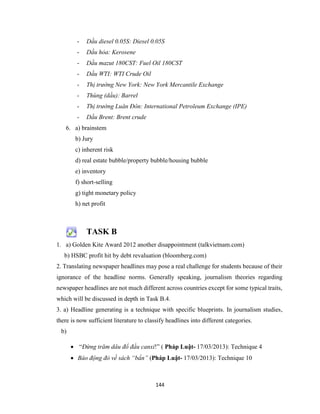
1. Try translating the headlines below from Vietnamese into English:
a) Cánh diều đang thiếu “gió” (Petrotimes.vn- 05/03/2013) (an article about the
disappointing 2012 Vietnam Film Awards Canh Dieu Vang)
b) HSBC giảm lãi do định giá lại nợ (BBC Vietnamese- 18/07/2012) (an article about the
drop in profit of the Hongkong and Shanghai Banking Corporation after its debt
revaluation)
2. Did the headlines in 1a and 1b present any difficulties for you in the process of translating
them? In your opinion, what makes good headlines? Read the following excerpt taken from
Nghebao.vn about several speacial traits of headlines in Vietnamese. In your opinion, do
those points still hold true in English?
39
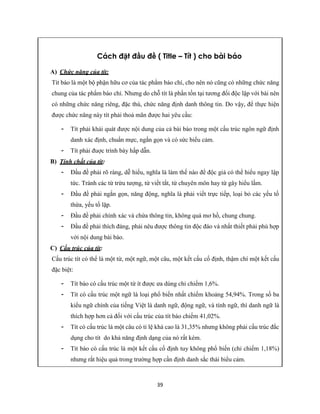
Cách đặt đầu đề ( Title – Tít ) cho bài báo
A) Chức năng của tít:
Tít báo là một bộ phận hữu cơ của tác phẩm báo chí, cho nên nó cũng có những chức năng
chung của tác phẩm báo chí. Nhưng do chỗ tít là phần tồn tại tương đối độc lập với bài nên
có những chức năng riêng, đặc thù, chức năng định danh thông tin. Do vậy, để thực hiện
được chức năng này tít phải thoả mãn được hai yêu cầu:
- Tít phải khái quát được nội dung của cả bài báo trong một cấu trúc ngôn ngữ định
danh xác định, chuẩn mực, ngắn gọn và có sức biểu cảm.
- Tít phải đuợc trình bày hấp dẫn.
B) Tính chất của tít:
- Đầu đề phải rõ ràng, dễ hiểu, nghĩa là làm thế nào để độc giả có thể hiểu ngay lập
tức. Tránh các từ trừu tượng, từ viết tắt, từ chuyên môn hay từ gây hiểu lầm.
- Đầu đề phải ngắn gọn, năng động, nghĩa là phải viết trực tiếp, loại bỏ các yếu tố
thừa, yếu tố lặp.
- Đầu đề phải chính xác và chứa thông tin, không quá mơ hồ, chung chung.
- Đầu đề phải thích đáng, phải nêu được thông tin độc đáo và nhất thiết phải phù hợp
với nội dung bài báo.
C) Cấu trúc của tít:
Cấu trúc tít có thể là một từ, một ngữ, một câu, một kết cấu cố định, thậm chí một kết cấu
đặc biệt:
- Tít báo có cấu trúc một từ ít được ưa dùng chỉ chiếm 1,6%.
- Tít có cấu trúc một ngữ là loại phổ biến nhất chiếm khoảng 54,94%. Trong số ba
kiểu ngữ chính của tiếng Việt là danh ngữ, động ngữ, và tính ngữ, thì danh ngữ là
thích hợp hơn cả đối với cấu trúc của tít báo chiếm 41,02%.
- Tít có cấu trúc là một câu có tỉ lệ khá cao là 31,35% nhưng không phải cấu trúc đắc
dụng cho tít do khả năng định dạng của nó rất kém.
- Tít báo có cấu trúc là một kết cấu cố định tuy không phổ biến (chỉ chiếm 1,18%)
nhưng rất hiệu quả trong trường hợp cần định danh sắc thái biểu cảm.
40
3. a) Do you think headlines could be classified into different categories, regarding the way
they are generated? Why or why not? Now read the second half of the extract taken from
Nghebao.vn to check your answer.
Ở Việt Nam có rất nhiều ấn phẩm báo chí với một số lượng khổng lồ các tít báo được sinh
thành hằng ngày. Nhưng có thể tổng hợp lại thành một số loại thường thấy sau:
1. Dùng con số để nhấn mạnh.
2. Dùng cấu trúc bỏ lửng mà dấu lửng hiện diện ở giữa tít.
3. Đặt ra những câu hỏi.
4. Dùng các đơn vị của ngôn ngữ dân gian như thành ngữ, tục ngữ, ca dao, dân ca…
5. Dựa theo tên các tác phẩm văn học, điện ảnh, tên ca khúc nổi tiếng.
6. Dập lại những mẫu cấu trúc tít có sẵn hoặc cấu trúc tít vốn là những chệch chuẩn đã
từng nổi tiếng trong làng báo
7. Tạo ra những cấu trúc mới lạ, bất thường cho tít.
8. Dùng biện pháp tu từ (so sánh, ẩn dụ…)
9. Dùng những từ ngữ đang hoặc vẫn là điều bí ẩn đối với đa số độc giả
10. Tạo ra một mệnh đề có vẻ ngược đời làm cho độc giả không thể không tìm hiểu.
11. Đưa tên riêng lên đầu tít, dành phần còn lại của tít khái quát về đặc điểm, tính chất….
của tên riêng đó.
b) Read the headlines taken from popular Vietnamese newspapers below. Guess what each
article is about. Categorize them by the 11 headline-generating techniques mentioned in
3a.
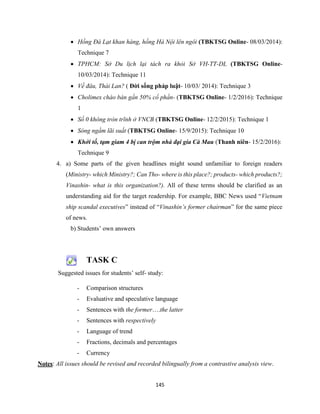
 “Đừng trăm dâu đổ đầu canxi!” ( Pháp Luật - 17/03/2013)
 Báo động đỏ về sách “bẩn” (Pháp Luật - 17/03/2013)
 Hồng Đà Lạt khan hàng, hồng Hà Nội lên ngôi (TBKTSG Online - 08/03/2014)
 TPHCM: Sở Du lịch lại tách ra khỏi Sở VH-TT-DL (TBKTSG Online - 10/03/ 2014)
 Về đâu, Thái Lan? ( Đời sống pháp luật - 10/03/ 2014)
 Cholimex chào bán gần 50% cổ phần (TBKTSG Online - 1/2/2016)
 Số 0 không tròn trĩnh ở VNCB (TBKTSG Online - 12/2/2015)
 Sóng ngầm lãi suất (TBKTSG Online - 15/9/2015)
 Khởi tố, tạm giam 4 bị can trộm nhà đại gia Cà Mau (Thanh niên - 15/2/2016)
41
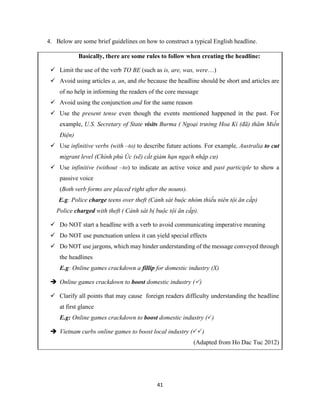
4. Below are some brief guidelines on how to construct a typical English headline.
Basically, there are some rules to follow when creating the headline:
 Limit the use of the verb TO BE (such as is, are, was, were…)
 Avoid using articles a, an, and the because the headline should be short and articles are
of no help in informing the readers of the core message
 Avoid using the conjunction and for the same reason
 Use the present tense even though the events mentioned happened in the past. For
example, U.S. Secretary of State visits Burma ( Ngoại trưởng Hoa Kì (đã) thăm Miến
Điện)
 Use infinitive verbs (with –to) to describe future actions. For example, Australia to cut
migrant level (Chính phủ Úc (sẽ) cắt giảm hạn ngạch nhập cư)
 Use infinitive (without –to) to indicate an active voice and past participle to show a
passive voice
(Both verb forms are placed right after the nouns).
E.g: Police charge teens over theft (Cảnh sát buộc nhóm thiếu niên tội ăn cắp)
Police charged with theft ( Cảnh sát bị buộc tội ăn cắp).
 Do NOT start a headline with a verb to avoid communicating imperative meaning
 Do NOT use punctuation unless it can yield special effects
 Do NOT use jargons, which may hinder understanding of the message conveyed through
the headlines
E.g: Online games crackdown a fillip for domestic industry (X)
 Online games crackdown to boost domestic industry ()
 Clarify all points that may cause foreign readers difficulty understanding the headline
at first glance
E.g: Online games crackdown to boost domestic industry ()
 Vietnam curbs online games to boost local industry ()
(Adapted from Ho Dac Tuc 2012)
42
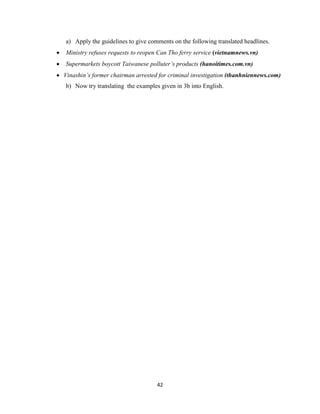
a) Apply the guidelines to give comments on the following translated headlines.
 Ministry refuses requests to reopen Can Tho ferry service (vietnamnews.vn)
 Supermarkets boycott Taiwanese polluter’s products (hanoitimes.com.vn)
 Vinashin’s former chairman arrested for criminal investigation (thanhniennews.com)
b) Now try translating the examples given in 3b into English.
43
Extra translation issues
DEALING WITH FIGURES IN BUSINESS, BANKING &
FINANCE TEXTS
44
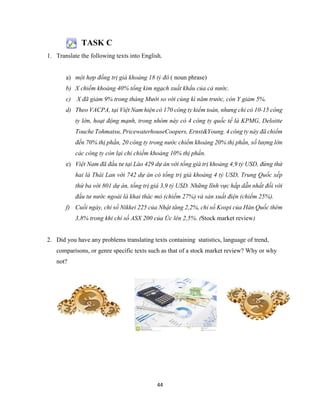
TASK C
1. Translate the following texts into English.
a) một hợp đồng trị giá khoảng 18 tỷ đô ( noun phrase)
b) X chiếm khoảng 40% tổng kim ngạch xuất khẩu của cả nước.
c) X đã giảm 9% trong tháng Mười so với cùng kì năm trước, còn Y giảm 5%.
d) Theo VACPA, tại Việt Nam hiện có 170 công ty kiểm toán, nhưng chỉ có 10-15 công
ty lớn, hoạt động mạnh, trong nhóm này có 4 công ty quốc tế là KPMG, Deloitte
Touche Tohmatsu, PricewaterhouseCoopers, Ernst&Young. 4 công ty này đã chiếm
đến 70% thị phần, 20 công ty trong nước chiếm khoảng 20% thị phần, số lượng lớn
các công ty còn lại chỉ chiếm khoảng 10% thị phần.
e) Việt Nam đã đầu tư tại Lào 429 dự án với tổng giá trị khoảng 4,9 tỷ USD, đứng thứ
hai là Thái Lan với 742 dự án có tổng trị giá khoảng 4 tỷ USD, Trung Quốc xếp
thứ ba với 801 dự án, tổng trị giá 3,9 tỷ USD. Những lĩnh vực hấp dẫn nhất đối với
đầu tư nước ngoài là khai thác mỏ (chiếm 27%) và sản xuất điện (chiếm 25%).
f) Cuối ngày, chỉ số Nikkei 225 của Nhật tăng 2,2%, chỉ số Kospi của Hàn Quốc thêm
3,8% trong khi chỉ số ASX 200 của Úc lên 2,5%. (Stock market review)
2. Did you have any problems translating texts containing statistics, language of trend,
comparisons, or genre specific texts such as that of a stock market review? Why or why
not?
45
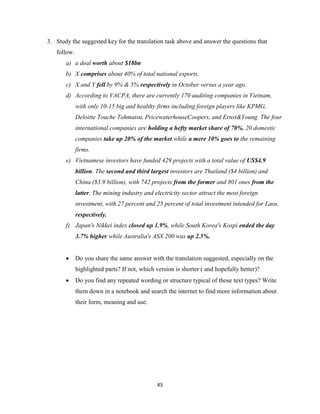
3. Study the suggested key for the translation task above and answer the questions that
follow.
a) a deal worth about $18bn
b) X comprises about 40% of total national exports.
c) X and Y fell by 9% & 5% respectively in October versus a year ago.
d) According to VACPA, there are currently 170 auditing companies in Vietnam,
with only 10-15 big and healthy firms including foreign players like KPMG,
Deloitte Touche Tohmatsu, PricewaterhouseCoopers, and Ernst&Young. The four
international companies are holding a hefty market share of 70%. 20 domestic
companies take up 20% of the market while a mere 10% goes to the remaining
firms.
e) Vietnamese investors have funded 429 projects with a total value of US$4.9
billion. The second and third largest investors are Thailand ($4 billion) and
China ($3.9 billion), with 742 projects from the former and 801 ones from the
latter. The mining industry and electricity sector attract the most foreign
investment, with 27 percent and 25 percent of total investment intended for Laos,
respectively.
f) Japan's Nikkei index closed up 1.9%, while South Korea's Kospi ended the day
3.7% higher while Australia's ASX 200 was up 2.5%.
 Do you share the same answer with the translation suggested, especially on the
highlighted parts? If not, which version is shorter ( and hopefully better)?
 Do you find any repeated wording or structure typical of those text types? Write
them down in a notebook and search the internet to find more information about
their form, meaning and use.
46
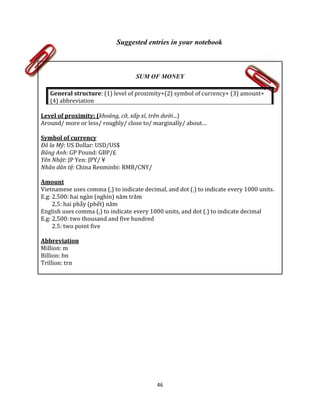
Suggested entries in your notebook
SUM OF MONEY
General structure: (1) level of proximity+(2) symbol of currency+ (3) amount+
(4) abbreviation
Level of proximity: (khoảng, cỡ, xấp xỉ, trên dưới...)
Around/ more or less/ roughly/ close to/ marginally/ about…
Symbol of currency
Đô la Mỹ: US Dollar: USD/US$
Bảng Anh: GP Pound: GBP/£
Yên Nhật: JP Yen: JPY/ ¥
Nhân dân tệ: China Renminbi: RMB/CNY/
Amount
Vietnamese uses comma (,) to indicate decimal, and dot (.) to indicate every 1000 units.
E.g: 2.500: hai ngàn (nghìn) năm trăm
2,5: hai phẩy (phết) năm
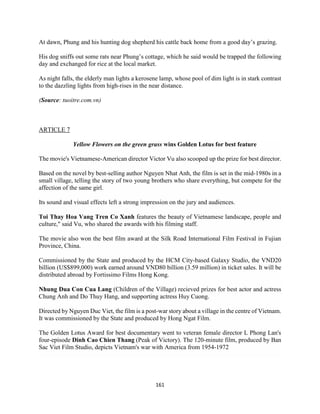
English uses comma (,) to indicate every 1000 units, and dot (.) to indicate decimal
E.g: 2,500: two thousand and five hundred
2.5: two point five
Abbreviation
Million: m
Billion: bn
Trillion: trn
47
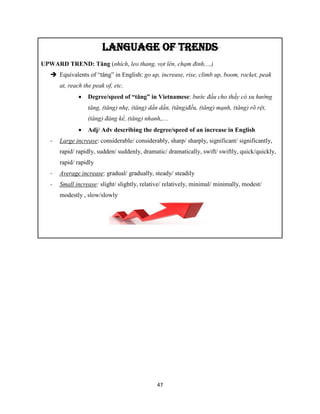
LANGUAGE OF TRENDS
UPWARD TREND: Tăng (nhích, leo thang, vọt lên, chạm đỉnh,…)
 Equivalents of “tăng” in English: go up, increase, rise, climb up, boom, rocket, peak
at, reach the peak of, etc.
 Degree/speed of “tăng” in Vietnamese: bước đầu cho thấy có xu hướng
tăng, (tăng) nhẹ, (tăng) dần dần, (tăng)đều, (tăng) mạnh, (tăng) rõ rệt,
(tăng) đáng kể, (tăng) nhanh,…
 Adj/ Adv describing the degree/speed of an increase in English
- Large increase: considerable/ considerably, sharp/ sharply, significant/ significantly,
rapid/ rapidly, sudden/ suddenly, dramatic/ dramatically, swift/ swiftly, quick/quickly,
rapid/ rapidly
- Average increase: gradual/ gradually, steady/ steadily
- Small increase: slight/ slightly, relative/ relatively, minimal/ minimally, modest/
modestly , slow/slowly
48
Extra translation issues
TRANSLATING NAMES OF ADMINISTRATIVE,
POLITICAL, EDUCATIONAL AND ECONOMIC
ORGANIZATIONS OR INSTITUTIONS
49
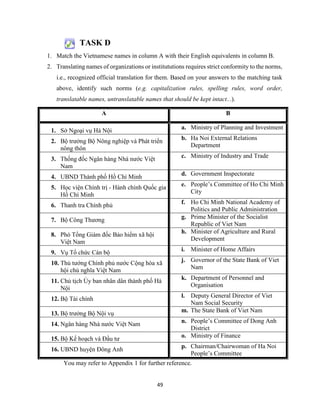
TASK D
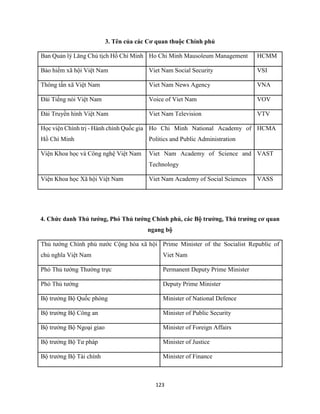
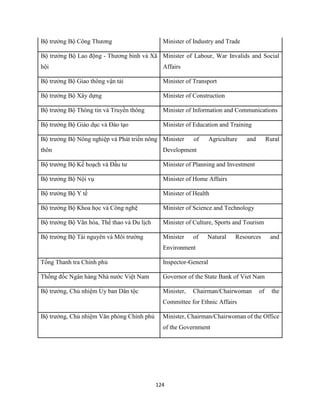
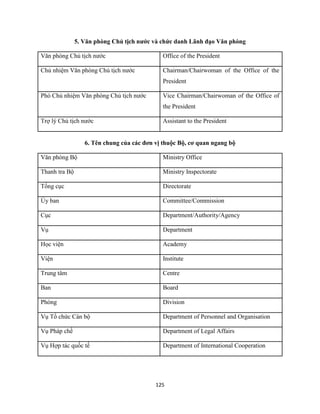
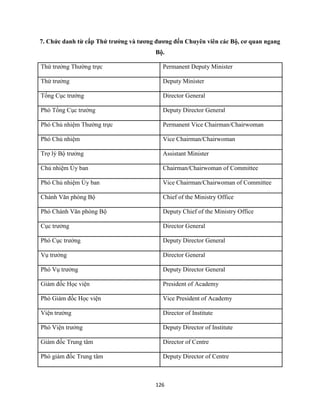
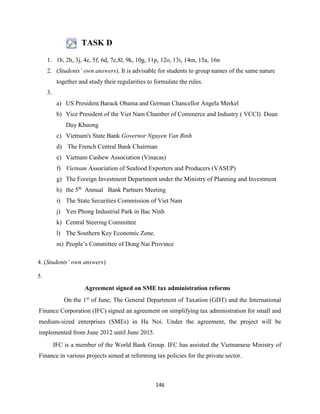
1. Match the Vietnamese names in column A with their English equivalents in column B.
2. Translating names of organizations or institututions requires strict conformity to the norms,
i.e., recognized official translation for them. Based on your answers to the matching task
above, identify such norms (e.g. capitalization rules, spelling rules, word order,
translatable names, untranslatable names that should be kept intact...).
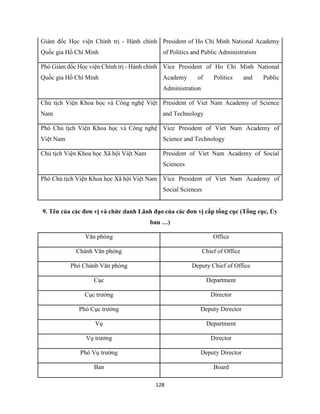
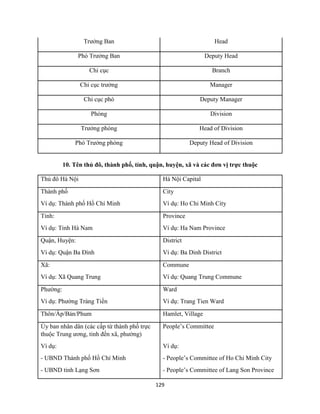
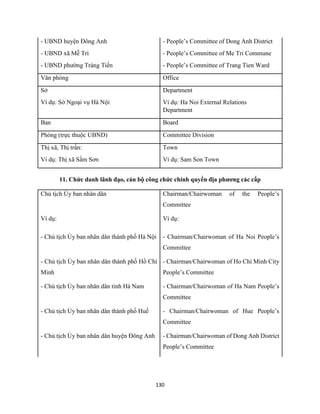
You may refer to Appendix 1 for further reference.
A B
1. Sở Ngoại vụ Hà Nội
a. Ministry of Planning and Investment
2. Bộ trưởng Bộ Nông nghiệp và Phát triển
nông thôn
b. Ha Noi External Relations
Department
3. Thống đốc Ngân hàng Nhà nước Việt
Nam
c. Ministry of Industry and Trade
4. UBND Thành phố Hồ Chí Minh
d. Government Inspectorate
5. Học viện Chính trị - Hành chính Quốc gia
Hồ Chí Minh
e. People’s Committee of Ho Chi Minh
City
6. Thanh tra Chính phủ
f. Ho Chi Minh National Academy of
Politics and Public Administration
7. Bộ Công Thương
g. Prime Minister of the Socialist
Republic of Viet Nam
8. Phó Tổng Giám đốc Bảo hiểm xã hội
Việt Nam
h. Minister of Agriculture and Rural
Development
9. Vụ Tổ chức Cán bộ
i. Minister of Home Affairs
10. Thủ tướng Chính phủ nước Cộng hòa xã
hội chủ nghĩa Việt Nam
j. Governor of the State Bank of Viet
Nam
11. Chủ tịch Ủy ban nhân dân thành phố Hà
Nội
k. Department of Personnel and
Organisation
12. Bộ Tài chính
l. Deputy General Director of Viet
Nam Social Security
13. Bộ trưởng Bộ Nội vụ
m. The State Bank of Viet Nam
14. Ngân hàng Nhà nước Việt Nam
n. People’s Committee of Dong Anh
District
15. Bộ Kế hoạch và Đầu tư
o. Ministry of Finance
16. UBND huyện Đông Anh
p. Chairman/Chairwoman of Ha Noi
People’s Committee
50
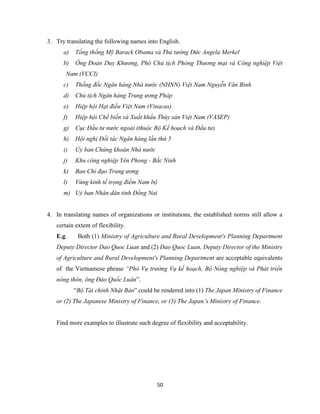
3. Try translating the following names into English.
a) Tổng thống Mỹ Barack Obama và Thủ tướng Đức Angela Merkel
b) Ông Đoàn Duy Khương, Phó Chủ tịch Phòng Thương mại và Công nghiệp Việt
Nam (VCCI)
c) Thống đốc Ngân hàng Nhà nước (NHNN) Việt Nam Nguyễn Văn Bình
d) Chủ tịch Ngân hàng Trung ương Pháp
e) Hiệp hội Hạt điều Việt Nam (Vinacas)
f) Hiệp hội Chế biến và Xuất khẩu Thủy sản Việt Nam (VASEP)
g) Cục Đầu tư nước ngoài (thuộc Bộ Kế hoạch và Đầu tư)
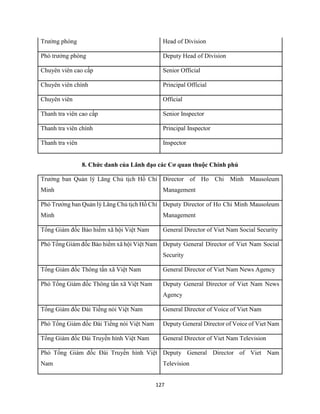
h) Hội nghị Đối tác Ngân hàng lần thứ 5
i) Ủy ban Chứng khoán Nhà nước
j) Khu công nghiệp Yên Phong - Bắc Ninh
k) Ban Chỉ đạo Trung ương
l) Vùng kinh tế trọng điểm Nam bộ
m) Uỷ ban Nhân dân tỉnh Đồng Nai
4. In translating names of organizations or institutions, the established norms still allow a
certain extent of flexibility.
E.g. Both (1) Ministry of Agriculture and Rural Development's Planning Department
Deputy Director Dao Quoc Luan and (2) Dao Quoc Luan, Deputy Director of the Ministry
of Agriculture and Rural Development's Planning Department are acceptable equivalents
of the Vietnamese phrase “Phó Vụ trưởng Vụ kế hoạch, Bộ Nông nghiệp và Phát triển
nông thôn, ông Đào Quốc Luân”.
“Bộ Tài chính Nhật Bản” could be rendered into (1) The Japan Ministry of Finance
or (2) The Japanese Ministry of Finance, or (3) The Japan’s Ministry of Finance.
Find more examples to illustrate such degree of flexibility and acceptability.
51
5. Translate the following text into English.
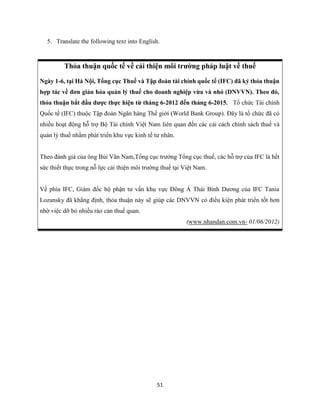
Thỏa thuận quốc tế về cải thiện môi trường pháp luật về thuế
Ngày 1-6, tại Hà Nội, Tổng cục Thuế và Tập đoàn tài chính quốc tế (IFC) đã ký thỏa thuận
hợp tác về đơn giản hóa quản lý thuế cho doanh nghiệp vừa và nhỏ (DNVVN). Theo đó,
thỏa thuận bắt đầu được thực hiện từ tháng 6-2012 đến tháng 6-2015. Tổ chức Tài chính
Quốc tế (IFC) thuộc Tập đoàn Ngân hàng Thế giới (World Bank Group). Đây là tổ chức đã có
nhiều hoạt động hỗ trợ Bộ Tài chính Việt Nam liên quan đến các cải cách chính sách thuế và
quản lý thuế nhằm phát triển khu vực kinh tế tư nhân.
Theo đánh giá của ông Bùi Văn Nam,Tổng cục trưởng Tổng cục thuế, các hỗ trợ của IFC là hết
sức thiết thực trong nỗ lực cải thiện môi trường thuế tại Việt Nam.
Về phía IFC, Giám đốc bộ phận tư vấn khu vực Đông Á Thái Bình Dương của IFC Tania
Lozansky đã khẳng định, thỏa thuận này sẽ giúp các DNVVN có điều kiện phát triển tốt hơn
nhờ việc dỡ bỏ nhiều rào cản thuế quan.
(www.nhandan.com.vn- 01/06/2012)
52
PART 2- VIETNAMESE – ENGLISH TRANSLATION
PRACTICE
53
A. GENERAL TOPICS
SENTENCES
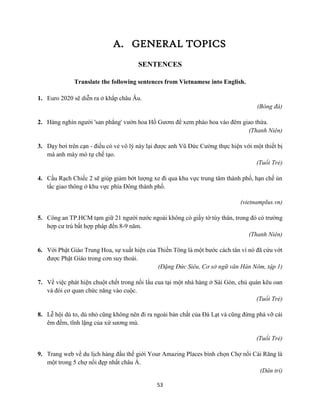
Translate the following sentences from Vietnamese into English.
1. Euro 2020 sẽ diễn ra ở khắp châu Âu.
(Bóng đá)
2. Hàng nghìn người 'san phẳng' vườn hoa Hồ Gươm để xem pháo hoa vào đêm giao thừa.
(Thanh Niên)
3. Dạy bơi trên cạn - điều có vẻ vô lý này lại được anh Vũ Đức Cường thực hiện với một thiết bị
mà anh mày mò tự chế tạo.
(Tuổi Trẻ)
4. Cầu Rạch Chiếc 2 sẽ giúp giảm bớt lượng xe đi qua khu vực trung tâm thành phố, hạn chế ùn
tắc giao thông ở khu vực phía Đông thành phố.
(vietnamplus.vn)
5. Công an TP.HCM tạm giữ 21 người nước ngoài không có giấy tờ tùy thân, trong đó có trường
hợp cư trú bất hợp pháp đến 8-9 năm.
(Thanh Niên)
6. Với Phật Giáo Trung Hoa, sự xuất hiện của Thiền Tông là một bước cách tân vì nó đã cứu vớt
được Phật Giáo trong cơn suy thoái.
(Đặng Đức Siêu, Cơ sở ngữ văn Hán Nôm, tập 1)
7. Về việc phát hiện chuột chết trong nồi lẩu cua tại một nhà hàng ở Sài Gòn, chủ quán kêu oan
và đòi cơ quan chức năng vào cuộc.
(Tuổi Trẻ)
8. Lễ hội dù to, dù nhỏ cũng không nên đi ra ngoài bản chất của Đà Lạt và cũng đừng phá vỡ cái
êm đềm, tĩnh lặng của xứ sương mù.
(Tuổi Trẻ)
9. Trang web về du lịch hàng đầu thế giới Your Amazing Places bình chọn Chợ nổi Cái Răng là
một trong 5 chợ nổi đẹp nhất châu Á.
(Dân trí)
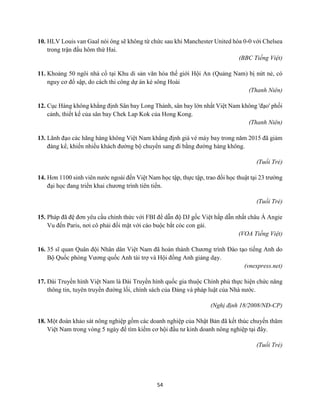
54
10. HLV Louis van Gaal nói ông sẽ không từ chức sau khi Manchester United hòa 0-0 với Chelsea
trong trận đấu hôm thứ Hai.
(BBC Tiếng Việt)
11. Khoảng 50 ngôi nhà cổ tại Khu di sản văn hóa thế giới Hội An (Quảng Nam) bị nứt nẻ, có
nguy cơ đổ sập, do cách thi công dự án kè sông Hoài
(Thanh Niên)
12. Cục Hàng không khẳng định Sân bay Long Thành, sân bay lớn nhất Việt Nam không 'đạo' phối
cảnh, thiết kế của sân bay Chek Lap Kok của Hong Kong.
(Thanh Niên)
13. Lãnh đạo các hãng hàng không Việt Nam khẳng định giá vé máy bay trong năm 2015 đã giảm
đáng kể, khiến nhiều khách đường bộ chuyển sang đi bằng đường hàng không.
(Tuổi Trẻ)
14. Hơn 1100 sinh viên nước ngoài đến Việt Nam học tập, thực tập, trao đổi học thuật tại 23 trường
đại học đang triển khai chương trình tiên tiến.
(Tuổi Trẻ)
15. Pháp đã đệ đơn yêu cầu chính thức với FBI để dẫn độ DJ gốc Việt hấp dẫn nhất châu Á Angie
Vu đến Paris, nơi cô phải đối mặt với cáo buộc bắt cóc con gái.
(VOA Tiếng Việt)
16. 35 sĩ quan Quân đội Nhân dân Việt Nam đã hoàn thành Chương trình Đào tạo tiếng Anh do
Bộ Quốc phòng Vương quốc Anh tài trợ và Hội đồng Anh giảng dạy.
(vnexpress.net)
17. Đài Truyền hình Việt Nam là Đài Truyền hình quốc gia thuộc Chính phủ thực hiện chức năng
thông tin, tuyên truyền đường lối, chính sách của Đảng và pháp luật của Nhà nước.
(Nghị định 18/2008/NĐ-CP)
18. Một đoàn khảo sát nông nghiệp gồm các doanh nghiệp của Nhật Bản đã kết thúc chuyến thăm
Việt Nam trong vòng 5 ngày để tìm kiếm cơ hội đầu tư kinh doanh nông nghiệp tại đây.
(Tuổi Trẻ)
55
19. Kể từ khi bình thường hóa quan hệ, hỗ trợ của Hoa Kỳ cho các chương trình y tế tại Việt Nam
đã lên tới gần 1 tỷ USD, chiếm gần 75% tổng hỗ trợ của chính phủ Hoa Kỳ tại Việt Nam.
(Tạp chí Dân Tộc)
20. Một vụ nổ bom vừa mới xảy ra gần một ngôi đền tại trung tâm Bangkok, thủ đô Thái Lan vào
hôm nay, ngày 17/08/2015, khiến ít nhất 19 người thiệt mạng và hơn 120 người bị thương.
(BBC Tiếng Việt)
21. Bản báo cáo dày 584 trang vừa được công bố hôm nay tiết lộ rằng pin của thiết bị định vị gắn
trên hộp đen của chiếc Boeing MH370 đã ngưng hoạt động hơn một năm trước khi tai nạn xảy
ra.
(vnexpress.net)
22. Công ty an ninh mạng FireEye cho biết, do hoạt động của nhóm tin tặc APT30 nhằm phục vụ
quyền lợi của chính quyền Trung Quốc nên chắc hẳn thế lực chống lưng cho chúng chính là
Bắc Kinh.
(Nhịp sống kinh tế Việt Nam và thế giới)
23. Bình luận viên thể thao người Singapore Ang Peng Siong, cũng chính là kình ngư từng giành
huy chương vàng Asiad 1982 tại Ấn Độ, đã đặt cho Ánh Viên biệt danh là “cô gái vàng” của
SEA Games 28.
(Tuổi Trẻ)
24. Cảnh sát Australia hôm qua đã vào cuộc điều tra vụ hàng trăm du học sinh Việt Nam tại Úc bị
một tài khoản Facebook lừa mua vé máy bay về Việt Nam đón Tết với tổng giá trị lên đến trên
500.000 đôla Úc.
(VOA Tiếng Việt)
25. Thực trạng xã hội Việt Nam trong hơn 50 năm thống trị của triều Nguyễn buộc chúng ta không
thể không xét đến trách nhiệm của triều Nguyễn trong việc làm cho đất nước rơi vào tay thực
dân Pháp ở giữa thế kỷ 19.
(lichsuvietnam.blogspot.com)
26. Trường Đại học Quốc tế là trường đại học công lập đa ngành đầu tiên và duy nhất hiện nay tại
Việt Nam sử dụng hoàn toàn tiếng Anh trong công tác đào tạo giảng dạy và nghiên cứu ở bậc
đại học và sau đại học.
(Thông cáo báo chí- ĐH Quốc tế- ĐHQG TPHCM)
56
27. Điện hạt nhân xứng đáng được ưu tiên trong các kế hoạch tăng trưởng bền vững, đảm bảo an
ninh năng lượng mà Chính phủ đang theo đuổi và mỗi người dân Việt Nam nên tìm hiểu nhiều
hơn về nguồn năng lượng này.
(vietnamplus.vn)
28. Một bộ hồ sơ trực tuyến đầy đủ bao gồm đơn dự tuyển, ba thư giới thiệu, các loại bằng cấp và
bảng điểm từ bậc đại học trở lên (kèm bản dịch Tiếng Anh có công chứng), chứng chỉ
TOEFL/IELTS và sơ yếu lý lịch.
(Thông cáo báo chí- Đại sứ quán Hoa Kì tại Việt Nam)
29. Ngày 16-11, Liên hiệp Các tổ chức hữu nghị và Hội hữu nghị Việt Nam-Hoa Kỳ TPHCM đã
tổ chức buổi họp báo về chương trình hòa nhạc nhân kỷ niệm 20 năm tái lập quan hệ ngoại
giao Việt Nam-Hoa Kỳ.
(Sài Gòn Giải Phóng)
30. Một nghiên cứu của trường Đại Học Sydney cho biết, mặc dù truyền thống rượu rắn đã có từ
nhiều thế kỷ ở châu Á, người ta cho rằng việc buôn bán nó chỉ được phát triển mạnh từ khi
Đông Nam Á mở cửa với Phương Tây.
(BBC Tiếng Việt)
31. Trong bối cảnh tình hình Biển Đông căng thẳng hẳn lên do việc Trung Quốc bị cho là đang âm
mưu bồi đắp và mở rộng đất tại Biển Đông, Thượng nghị sĩ Mỹ John McCain tuyên bố Mỹ
cần cung cấp thêm vũ khí cho Việt Nam.
(An Ninh Thủ Đô)
32. Về vấn đề Biển Đông, Hoa Kỳ ủng hộ lập trường của Việt Nam và cho rằng Việt Nam và các
nước ASEAN cần có tiếng nói chung nhằm tăng cường phối hợp giải quyết tranh chấp bằng
các biện pháp hoà bình, trên cơ sở luật pháp quốc tế và các thoả thuận khu vực.
(Thanh Niên)
33. Theo Bản tin cập nhật thị trường lao động Việt Nam quý II năm 2015, tỷ lệ thất nghiệp chung
đã giảm, tuy nhiên số lượng người có trình độ đại học, sau đại học thất nghiệp vẫn tiếp tục tăng
cao với hơn 199.400 người , chiếm 17,4% số người thất nghiệp.
(Giáo dục)
34. Đại sứ quán Hoa Kỳ tại Việt Nam vừa ra thông báo về Chương trình học bổng Fulbright lấy
bằng thạc sĩ tại Mỹ năm học 2017- 2018 với các học bổng bao gồm toàn bộ học phí, trợ cấp
hàng tháng, vé máy bay khứ hồi đến Mỹ và bảo hiểm y tế.
(Thông cáo báo chí- Đại sứ quán Hoa Kì tại Việt Nam)
57
35. Thức ăn Nhật ngày càng được người Việt Nam ưa chuộng khi nhiều món ăn quen thuộc của
Nhật Bản như sushi, sashimi, súp miso... không chỉ bán trong các nhà hàng Nhật mà còn xuất
hiện trong các thực đơn của nhiều nhà hàng, khách sạn thuần Việt.
(Tuổi Trẻ)
36. Theo Chỉ số thành phố hạnh phúc khu vực châu Á-Thái Bình Dương đầu tiên do MasterCard
công bố mới đây, Hà Nội xếp thứ 4 với 71 điểm, chỉ sau Bangalore (Ấn Độ) 73,2 điểm, Jakarta
( Indonesia) 72,1 điểm và New Delhi (Ấn Độ) 71,7 điểm.
(vietnamplus.vn)
37. Sáng 28-12, tại Hội nghị trực tuyến của Chính phủ với các địa phương, Chủ tịch UBND TP
Hà Nội Nguyễn Đức Chung cho biết “Hà Nội đề xuất với Chính phủ chỉ đạo các Bộ, ngành
Trung ương phối hợp với TP Hà Nội xây dựng lộ trình hạn chế phương tiện giao thông cá
nhân”.
(Người Lao Động)
38. Sau khi một số hình ảnh được cho là của chiếc đồng hồ thông minh, mang thương hiệu Bkav
đang rò rỉ trên mạng, xác nhận với Thanh Niên, Bkav cho biết ngoài đồng hồ thông minh (tên
gọi dự kiến là Bwatch) thì Bkav còn đang phát triển mẫu máy tính bảng mới với tên gọi dự
kiến là Bpad.
(Thanh Niên)
39. McDonald’s đã thừa nhận ba vụ việc nhiễm bẩn thực phẩm trong năm ngoái:
• Một miếng nhựa nhỏ trong suất kem gây tổn thương vùng miệng của một em bé ở thành
phố Koriyama hồi tháng 12.
• Miếng đĩa than bên trong suất gà rán ở thành phố Misawa hồi cuối tuần trước
• Răng người trong suất khoai tây chiên ở Osaka tháng Tám năm ngoái.
(BBC Tiếng Việt)
40. Phần trình diễn áo tắm của Phạm Hương trong đêm bán kết Hoa hậu hoàn vũ 2015 tạo một
cuộc tranh luận khen chê cả trong lẫn ngoài nước: một số ý kiến cho rằng Phạm Hương đã thực
hiện những bước đi “hổ mang” đầy ấn tượng; đồng thời có ý kiến cho rằng cô “diễn hơi lố”,
tạo những động tác mạnh quá mức.
(Tuổi Trẻ)
58
PARAGRAPHS
Translate the following paragraphs from Vietnamese into English.
1. Ngày 6/1/1946, đáp lời kêu gọi của Chủ tịch Hồ Chí Minh, nhân dân ta, không phân biệt nam
nữ, dân tộc, giai cấp, tôn giáo đã tham gia cuộc Tổng tuyển cử bầu ra Quốc hội đầu tiên của
nước Việt Nam mới bằng phương thức bầu cử dân chủ, bình đẳng, trực tiếp. Sự kiện trọng đại
này đã đi vào lịch sử nước ta như một mốc son chói lọi, đánh dấu bước phát triển nhảy vọt về
thể chế dân chủ, mở ra một thời kỳ phát triển mới của dân tộc.
(vietnamplus.vn)
2. Giáo sư Ian Flitcroft – người đang công tác tại Bệnh viện Trường Đại Học Nhi ở Dublin nhận
định: “Cận thị là một bệnh nghề nghiệp”. Gien của chúng ta có thể vẫn đóng một vai trò quyết
định ai sẽ bị cận thị, nhưng chính sự thay đổi về môi trường mới khiến bệnh bùng phát. Một
phần của sự thay đổi đó là việc học tập và đọc viết. Đây là một trong những cách lý giải thông
dụng nhất đối với căn bệnh này.
(BBC Tiếng Việt)
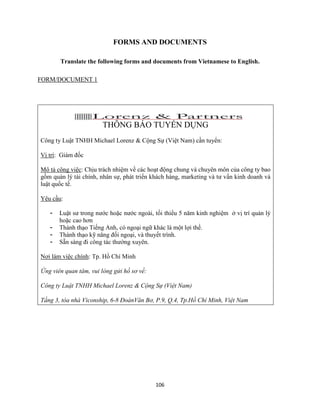
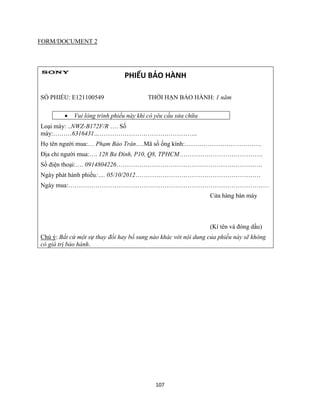
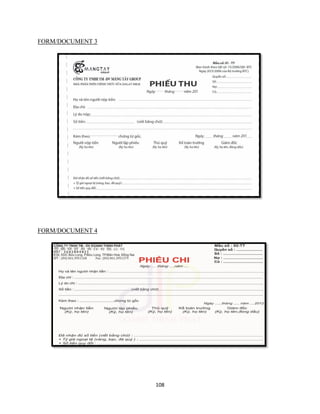
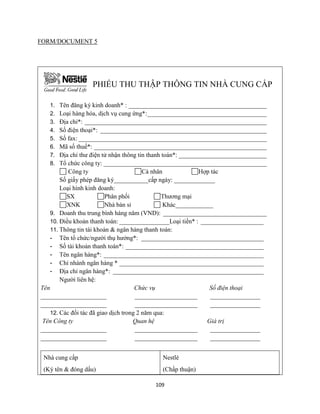
3. Số lượng cử nhân, thạc sĩ không có việc làm gia tăng đáng kể. Hiện cả nước có 225.500 người
có trình độ đại học trở lên đang thất nghiệp, chiếm tới 20% số lao động thất nghiệp. Con số
này được Bộ Lao động - thương binh và xã hội (LĐ-TB&XH) công bố ngày 24-12. Đi liền với
tỉ lệ thất nghiệp cao là tình trạng có sự chênh lệch rất lớn giữa cung và cầu ở một số nhóm
ngành nghề.
(Tuổi Trẻ)
4. Chợ đêm Dinh Cậu, nằm trên đường Võ Thị Sáu được thành lập và đi vào hoạt động từ tháng
9-2007, nhanh chóng trở thành một điểm đến không thể thiếu trong hành trình của du khách
trong và ngoài nước. Chợ đêm này hiện có đến 70 lô với 50 hộ kinh doanh chủ yếu là ăn uống,
hải sản, quà lưu niệm và hầu như mùa nào cũng tấp nập du khách do trên đảo không có nhiều
tụ điểm giải trí công cộng.
(Tuổi Trẻ)
5. Hang Sơn Đoòng tại xã Sơn Trạch, huyện Bố Trạch, tỉnh Quảng Bình được đánh giá là hang
động tự nhiên lớn nhất thế giới. Hang nằm trong quần thể hang động Phong Nha - Kẻ Bàng.
Với chiều cao hơn 200m, rộng 150m, dài ít nhất 6,5km cùng vô vàn những bức tường thạch
59
nhũ đẹp tuyệt vời, hang Sơn Đoòng tạo nên nguồn cảm hứng, thu hút cho nhiều nhà thám hiểm
tới và khám phá hang động khổng lồ này.
(kenhkhampha.com)
6. Căn cứ vào kích thước của những chiếc chum và xương người được tìm thấy gần đó, một số
nhà khảo cổ cho rằng chúng là nơi chôn cất thời tiền sử của một nền văn minh cổ đại nằm trải
dài suốt một tuyến giao thương đã bị quên lãng từ lâu nối giữa lưu vực sông Mekong với vịnh
Bắc Bộ của Việt Nam.Một số người khác thì tin rằng những chiếc chum được dùng như dụng
cụ đặt xác người chết vào chờ tự phân hủy hết trong giai đoạn đầu của nghi thức tang lễ, trước
khi được đưa đi hỏa táng hoặc được đưa đi làm phần nghi thức tang lễ tiếp theo.
(BBC Tiếng Việt)
7. Đặng Thái Sơn hiểu rất rõ điều đó. Anh hoà mình vào bản nhạc. Ngón tay điêu luyện của anh
lướt trên phím đàn làm mọi người nghe thấy tiếng lòng của Sô-panh từ nhiều năm trước. Tiếng
đàn làm người nghe buồn theo nỗi buồn sâu lắng của Sô-panh, nhớ thương cùng sự nhớ thương
man mác của Sô-panh. Rồi tiếng đàn đem lại cho mọi người một niềm vui trong sáng, lòng hân
hoan pha lẫn một sự khao khát sống, khao khát yêu mãnh liệt. Đó là tất cả những sắc thái đa
dạng của một tình yêu thuở ban đầu.
(Tạp chí âm nhạc)
8. Uỷ ban Nhân dân tỉnh Kiên Giang vừa ban hành chỉ thị về việc quản lý, kiểm tra những phương
tiện vận chuyển hành khách đường biển, đường thủy nội bộ trên địa bàn tỉnh Kiên Giang. Theo
đó tỉnh sẽ mở đợt kiểm tra trên diện rộng, kịp thời phát hiện những phương tiện vận chuyển
hành khách bằng đường biển, đường thủy sai phạm qui định. Khi phát hiện sẽ xử lý nghiêm
những đối tượng cố tình vi phạm. Tỉnh nghiêm cấm các phương tiện khai thác thuỷ sản, vận
chuyển hàng hoá chở khách dưới mọi hình thức.
(Tuổi Trẻ)
9. Nhiều người dân và cả du khách khi chứng kiến tòa nhà Bưu điện TP.HCM gần 130 tuổi đang
được sơn lại đã bị sốc vì màu sơn vàng quá đậm và chói chang. Theo ông Lê Kiêm Hòa, Trưởng
phòng Đầu tư Bưu điện TP.HCM, trước khi sơn Bưu điện TP.HCM đã mời Công ty sơn Kova
đưa máy móc vào để giám định màu gốc của tòa nhà. Từ màu gốc này, Bưu điện TP.HCM cho
sơn thử 7 màu vàng lên tường, rồi mới chọn ra màu sơn giống với màu gốc nhất. “Màu sơn
mới hơi sáng nhưng sau khi tiếp xúc ánh sáng, mưa gió màu sẽ dịu đi. Lúc đó nhìn sẽ không
vàng chóe như bây giờ đâu.”
(Thanh Niên)
60
10. Việc xác định uống rượu vừa phải có lợi cho sức khỏe là một việc phức tạp. Một trong những
nghiên cứu trước đây nói về sự liên quan giữa bia rượu và sức khỏe đã được Archie Cochrane
(đã mất) thực hiện. Ông là cây cổ thụ trong ngành y học thực chứng. Năm 1979 Cochrane và
hai đồng nghiệp đã cố tìm xem nguyên nhân của tỉ lệ tử vong khác nhau vì bệnh tim ở 18 nước
phát triển, gồm cả Mỹ, Anh và Úc là gì. Nghiên cứu của họ cho thấy rằng có sự liên hệ rõ ràng
và đáng kể giữa lượng rượu uống (chủ yếu là rượu vang) và việc giảm tỉ lệ bệnh thiếu máu cục
bộ ở tim (do mỡ bám vào thành mạch cung cấp máu cho tim).
(BBC Tiếng Việt)
11. Phó Thủ tướng Vũ Đức Đam vừa đồng ý đề nghị của Bộ Giáo dục và Đào tạo đăng cai tổ chức
Olympic Vật lý Châu Á (APhO) lần thứ 19 vào năm 2018 tại Việt Nam. Phó Thủ tướng giao
Bộ Giáo dục và Đào tạo chủ trì, phối hợp với các cơ quan liên quan chỉ đạo triển khai tốt công
tác này, bảo đảm chất lượng, hiệu quả. Được biết, năm 2015, đoàn Việt Nam có 8 học sinh
tham dự kỳ thi Olympic Vật lý châu Á tổ chức ở Trung Quốc. Cả 8/8 thí sinh đoạt giải, gồm:
2 Huy chương Vàng, 3 Huy chương Bạc, 1 Huy chương Đồng và 2 Bằng khen (giải Khuyến
khích).
(Dân trí)
12. YouthNet, một tổ chức thiện nguyện của Anh, vừa ra một công cụ trực tuyến có tên Define Me
nhằm giúp những người trẻ tuổi xác định được các kỹ năng họ có được từ sinh hoạt hàng ngày,
như chơi thể thao, du lịch hay làm tình nguyện viên, rồi giúp họ tìm được những từ ngữ phù
hợp để mô tả các kỹ năng đó trước chủ lao động. Một cuộc khảo sát do YouthNet thực hiện ở
Anh cho thấy gần một nửa các công ty cảm thấy các ứng viên trẻ tuổi không hiểu gì về những
kỹ năng mà công việc đòi hỏi, và chừng hai phần ba loại bỏ hồ sơ bởi các ứng viên không thể
mô tả chính xác, rõ ràng về những khả năng của bản thân.
(BBC Tiếng Việt)
13. Trao đổi với Tuổi Trẻ, Thứ trưởng Bộ GD-ĐT Bùi Văn Ga cho biết trước đây từng có sinh
viên quốc tế đến Việt Nam học tập nhưng số lượng chưa nhiều, chủ yếu là sinh viên các nước
Lào, Campuchia, Trung Quốc, Hàn Quốc, Nhật Bản… Song hiện nay, theo ông Ga, sinh viên
quốc tế đến Việt Nam đa dạng hơn rất nhiều, có nhiều sinh viên châu Âu, Bắc Mỹ… Một trong
những lý do quan trọng là do nhiều trường ĐH đã triển khai các chương trình đào tạo tiên tiến
giảng dạy hoàn toàn bằng tiếng Anh, giúp sinh viên quốc tế thuận lợi hơn trong quá trình theo
học tại Việt Nam.
(Tuổi Trẻ)
14. Theo số liệu của Tổng cục Thống kê, lượng khách quốc tế đến nước ta năm 2015 ước tính đạt
hơn 7,94 triệu lượt người, giảm 0,2% so với năm trước.Lượng khách đến bằng đường biển
61
trong năm tăng 27,5% và lượng khách đến bằng đường hàng không tăng 0,8% so với năm
trước, trong khi đó, khách đến bằng đường bộ giảm 6,5%.Một số thị trường châu Á có lượng
khách đến Việt Nam giảm như Trung Quốc giảm 8,5%, Campuchia giảm 43,8%, Indonesia
giảm 9,3%, Thái Lan giảm 13,1%, Lào giảm 16,6%, Philippines giảm 3,5%.
(Dân trí)
15. Tối 2-1, trao đổi với Tuổi Trẻ, ông Hà Lê - phó cục trưởng Cục Kiểm ngư VN - cho biết sau
khi nắm thông tin về tàu cá của ngư dân Quảng Ngãi bị đâm chìm, kiểm ngư VN thông qua
đường dây nóng đã có công văn gửi sang phía Trung Quốc đề nghị làm rõ. Hiện phía Trung
Quốc đang xác minh và đề nghị VN làm rõ hơn về số hiệu tàu sắt. Ông Lê cho biết đang chỉ
đạo lực lượng kiểm ngư làm việc với ngư dân, nhận dạng đặc điểm tàu đã tông chìm tàu cá của
ngư dân Việt.
(Tuổi Trẻ)
16. Các quan chức cho biết kế hoạch bắn pháo hoa và các lễ hội mừng năm mới đã bị hủy tại thủ
đô Brussels của Bỉ do có cảnh báo khủng bố. Thủ tướng Bỉ Charles Michel nói rằng quyết định
được đưa ra "dựa vào thông tin chúng tôi nhận được".Trước đó trong tuần, cảnh sát đã bắt giữ
hai người bị tình nghi lên kế hoạch tấn công trong kỳ nghỉ lễ này. Bỉ hiện đang trong tình trạng
báo động cao kể từ khi xảy ra các cuộc tấn công khủng bố vào ngày 13 tháng 11 tại Paris.Một
số thủ phạm được cho là đóng tại Bỉ.
(BBC Tiếng Việt)
17. Sáng 1-1, Công ty cổ phần địa ốc Trung Nam Đà Lạt tổ chức khánh thành hạ tầng dự án khu
công viên văn hóa và đô thị Đà Lạt (Golf Valley). Đây là dự án phát triển đô thị có quy mô lớn
nhất của tỉnh Lâm Đồng cho đến nay, với tổng mức đầu tư 180 triệu USD, gồm hàng chục căn
biệt thự cao cấp, kiến trúc hiện đại, trung tâm thương mại, nhà hàng, công viên mở và các
không gian hoa, cây xanh. Dự án có quy mô gần 20ha, tọa lạc ngay trung tâm của thành phố
Đà Lạt, tiếp giáp sân Golf Đà Lạt Palace, hồ Xuân Hương và gần chợ Đà Lạt.
(Sài Gòn Giải Phóng)
18. Chỉ vài ngày sau khi thắng “vụ kiện con ruồi”, Tập đoàn Tân Hiệp Phát bị cộng đồng mạng
kêu gọi tẩy chay và Hội bảo vệ quyền lợi người tiêu dùng tiến hành thanh tra. Hội bảo vệ quyền
lợi người tiêu dùng Việt Nam đã nhận được thông tin về việc người dân và các các cơ quan
chức năng tỉnh Cà Mau phát hiện vật lạ trong hàng trăm chai trà thảo mộc của Tân Hiệp Phát
vào tuần trước. Chi cục An toàn vệ sinh thực phẩm tỉnh Cà Mau cho biết ở nhiều vùng trong
tỉnh đoàn kiểm tra đã phát hiện hơn 100 chai trà thảo mộc Dr Thanh (còn nguyên, chưa khui)
có cặn lơ lửng. Mặc dù các sản phẩm trên đều còn hạn sử dụng, có thể dễ dàng thấy các lợn
62
cợn màu trắng đục lơ lửng ở đáy chai. Phát hiện này làm dấy lên nghi ngờ về chất lượng sản
phẩm.
(Tuổi Trẻ)
19. Trong tháng 8, có thêm tin vui trên mặt trận vắc xin: thử nghiệm thực địa một loại vắc xin
Ebola đã chứng minh "hiệu quả 100%". Các nhà nghiên cứu Canada đã tiêm vắc xin vi rút
Ebola cho hàng ngàn người Guinea từng có tiếp xúc gần với người bị nhiễm bệnh - một quá
trình gọi là "chủng ngừa vòng”. Một nửa số mẫu được chủng ngừa ngay lập tức, trong khi nửa
còn lại được chủng ngừa muộn hơn sau ba tuần. Các kết quả ban đầu, được công bố trên tạp
chí Lancet và bởi WHO cho thấy vắc xin có 100% hiệu quả khi chủng ngừa ngay lập tức.
Không đối tượng nào xuất hiện triệu chứng Ebola trong tới 10 ngày sau khi được chủng ngừa
ngay sau khi tiếp xúc. Vẫn còn quá sớm để khẳng định, nhưng một vắc xin có hiệu quả có thể
dẫn đến việc thanh toán căn bệnh chết người này.
(Dân trí)
20. Mặc dù chỉ cách TP Hồ Chí Minh một chuyến bay 45 phút, thiên đường Côn Sơn là một thế
giới ít được du khách lui tới ở Việt Nam. Đây là nơi nằm ngoài tầm ngắm du lịch, khuất nẻo
so với các thành phố du lịch phát triển quá ồ ạt như Nha Trang và các bãi biển Phú Quốc.
Chẳng thấy cảnh chèo kéo khách, chỉ thấy các bãi biển vắng êm ả, và mùa cao điểm chỉ có
khoảng hơn một chục du khách Tây. Tuy nhiên nó sẽ không mãi như vậy. Six Senses Côn Đảo-
khu nghỉ dưỡng cực kỳ sang trọng đầu tiên của đảo được khánh thành năm 2010 ở Vịnh Đất
Dốc bên bờ phía Đông, và một khu nghỉ dưỡng rất lớn đang được xây dựng ở phía Nam. Cũng
có thông tin về việc xây dựng một nơi lui sống ẩn dật do Ý tài trợ và việc kéo dài đường băng
để máy bay lớn hơn có thể hạ cánh.
(BBC Tiếng Việt)
63
NEWSPAPER ARTICLES
Translate the following articles from Vietnamese into English.
ARTICLE 1
Khởi hành các chuyến đi thăm, chúc tết tại huyện đảo Trường Sa
Chiều 5/1, tại Quân cảng Cam Ranh, Bộ Tư lệnh Vùng 4 Hải quân đã tổ chức Lễ tiễn các đoàn
công tác lên đường đi thăm, động viên và mang quà Tết đến với quân và dân huyện đảo Trường
Sa, tỉnh Khánh Hòa, nhân dịp Tết Nguyên đán Bính Thân 2016.
Các đoàn ra thăm, chúc Tết huyện đảo Trường Sa lần này gồm đại diện các ngành, tỉnh, thành phố
trong cả nước và hơn 100 phóng viên báo, đài Trung ương, địa phương.
Chuyến đi này cũng mang theo quà Tết của các cơ quan, doanh nghiệp, địa phương trong cả nước
gửi tặng quân và dân huyện đảo Trường Sa gồm: lương thực, thực phẩm, hoa tươi cùng nhiều vật
dụng khác.
Phát biểu tại buổi lễ, Phó Chủ tịch Ủy ban Nhân dân tỉnh Khánh Hòa Đào Công Thiên nhấn mạnh,
hàng năm các đoàn công tác đều ra thăm, động viên quân và dân huyện đảo Trường Sa, thể hiện
sự quan tâm sâu sắc của Đảng, Nhà nước, Bộ Quốc phòng, Quân chủng Hải quân và nhân dân cả
nước đối với sự nghiệp bảo vệ biển, đảo của Tổ quốc nói chung, quân và dân Trường Sa nói riêng.
Ngay sau buổi lễ, các chuyến tàu đã rời Quân cảng Cam Ranh đưa cán bộ, chiến sỹ ra thăm, chúc
Tết quân và dân huyện đảo Trường Sa./.
(Source: http://www.vietnamplus.vn/khoi-hanh-cac-chuyen-di-tham-chuc-tet-tai-huyen-dao-
truong-sa/364677.vnp)
ARTICLE 2
WHO: Cuba là nước đầu tiên loại trừ lây nhiễm HIV và giang mai từ mẹ sang con
Tổ chức Y tế thế giới (WHO) vừa công bố chính thức Cuba là nước đầu tiên trên thế giới thành
công trong việc loại trừ lây nhiễm virus HIV và bệnh giang mai từ mẹ sang con.
Loại bỏ lây nhiễm virus HIV là một trong những bước tiến lớn về sức khỏe cộng đồng, bà Margaret
Chan, Tổng Giám đốc Tổ chức WHO cho biết.
64
Cũng theo bà Margaret Chan, đây là thành công đáng kể trong cuộc chiến lâu dài chống lại HIV
và các bệnh lây qua đường tình dục, cũng như là một bước quan trọng hướng đến một thế hệ không
Sida.
Theo WHO, mỗi năm trên thế giới có khoảng 1,4 triệu phụ nữ bị nhiễm HIV khi mang thai.
Nếu không xử lý và điều trị đúng cách, nguy cơ lây truyền từ mẹ sang con từ 15 đến 45% trong
quá trình mang thai, sinh con hay cho con bú.
Tuy nhiên, nguy cơ này có thể giảm xuống thấp hơn 1% nếu người mẹ và trẻ vừa sinh ra đều dùng
thuốc chống phơi nhiễm HIV.
Năm 2009, số trẻ sơ sinh trên thế giới bị nhiễm HIV là 400.000 giảm xuống còn 240.000 vào năm
2013. Theo giới chuyên gia, cần có nhiều nỗ lực hơn nữa thì mới có thể đạt được mục tiêu hiện
nay là giảm số trẻ sơ sinh bị lây nhiễm xuống còn 40.000 trường hợp mỗi năm.
(Source: http://www.abc.net.au/news/2015-07-01/health-cuba-women-hiv-babies/6586160)
ARTICLE 3
Cô gái đưa tơ lụa Việt ra hội thảo quốc tế
Cô gái trẻ Đỗ Khải Ly (22 tuổi) vừa trở về sau chuyến đi dài ngày trong vai trò “đại sứ” của làng
lụa Hội An tham dự hai hội thảo tơ lụa quốc tế tại Thái Lan và Trung Quốc.
Nhiều câu chuyện về lụa tơ tằm của quê hương đã được Khải Ly - khách mời trẻ nhất - giới thiệu
đến với khoảng 500 chuyên gia, nghệ nhân tơ lụa trên thế giới.
Vừa tốt nghiệp ĐH Ngoại ngữ Đà Nẵng nhưng Khải Ly đã có gần ba năm làm việc tại làng lụa
Hội An với đam mê tìm hiểu sâu hơn về lịch sử hình thành, các nền văn hóa tơ lụa Việt Nam cũng
như quy trình sản xuất tơ lụa...
Khải Ly chia sẻ, ban đầu các nước tham dự hầu như không hề quan tâm, lạnh nhạt với tơ lụa Việt
Nam bởi lẽ sản phẩm của chúng ta không thể sánh bằng với các nước có nền tơ lụa nổi tiếng thế
giới như Trung Quốc, Nhật Bản, Pháp, Ý...
“Thế nhưng điểm khác biệt khiến mọi người chú tâm và hoan nghênh đó là cách làm, gìn giữ lụa
Việt Nam.” - Ly lý giải.
Đứng trước diễn đàn, cô tự tin kể về lịch sử Hội An, nơi từng là cảng thị, một nhánh của “con
đường tơ lụa trên biển” nên vẫn giữ nguyên được giá trị truyền thống về sản xuất lụa tơ tằm.
65
Điều làm cô bất ngờ nhất trong chuyến đi là gặp gỡ những nhà thiết kế đã tạo ra các sản phẩm tơ
lụa tuyệt vời khi tuổi đời còn quá trẻ, từ 22-25 tuổi.
“Ở Việt Nam, lụa không phải là sản phẩm phổ biến bởi giá thành cao và khó bảo quản. Hơn nữa,
việc mở cửa cho nhà thiết kế trẻ có môi trường làm việc vẫn còn hạn chế, vì thế ít thấy được những
gương mặt mới của Việt Nam tại các sự kiện thời trang quốc tế” - Khải Ly nhìn nhận.
Nếu các bạn trẻ trong nước được đào tạo và khuyến khích làm việc trong môi trường chuyên
nghiệp, hứa hẹn về tương lai thì với bất kỳ chất liệu nào các nhà thiết kế trẻ cũng sẽ cho ra đời
những bộ sưu tập đặc sắc nhất.
(Source: http://tuoitre.vn/tin/nhip-song-tre/20151227/co-gai-yeu-to-lua-viet/1027843.html)
ARTICLE 4
Trao công hàm phản đối Trung Quốc bay thử nghiệm ở Trường Sa
Việt Nam trao công hàm phản đối việc Trung Quốc thực hiện việc bay thử nghiệm ra sân bay mà
Trung Quốc xây dựng bất hợp pháp trên đá Chữ Thập thuộc quần đảo Trường Sa của Việt Nam.
Ngày 2-1, đại diện Bộ Ngoại giao Việt Nam đã gặp đại diện Đại sứ quán Trung Quốc tại Hà Nội
trao công hàm phản đối động thái này của Trung Quốc
Phản ứng về vụ việc này, người phát ngôn Bộ Ngoại giao Việt Nam Lê Hải Bình nhấn mạnh hành
động nêu trên của Trung Quốc đã xâm phạm nghiêm trọng chủ quyền của Việt Nam đối với quần
đảo Trường Sa.
Hành động này đi ngược lại nhận thức chung của lãnh đạo cấp cao hai nước, thỏa thuận về những
nguyên tắc cơ bản chỉ đạo giải quyết vấn đề trên biển Việt Nam - Trung Quốc, tinh thần của tuyên
bố về ứng xử của các bên ở biển Đông (DOC) năm 2002; ảnh hưởng hòa bình, ổn định ở Biển
Đông; giảm sự tin cậy chính trị giữa hai nước; tác động tiêu cực đến quan hệ láng giềng và tình
cảm tốt đẹp giữa nhân dân hai nước Việt Nam - Trung Quốc.
“Việt Nam kiên quyết phản đối hành động nêu trên của Trung Quốc, yêu cầu Trung Quốc chấm
dứt ngay, không tái diễn các hành động tương tự và có hành động thiết thực, cụ thể góp phần duy
trì hòa bình, ổn định, an ninh, an toàn, tự do hàng hải và hàng không ở Biển Đông" - ông Lê Hải
Bình tái khẳng định lập trường nhất quán của Việt Nam.
(Source: http://tuoitre.vn/tin/chinh-tri-xa-hoi/20160102/trao-cong-ham-phan-doi-trung-quoc-
bay-thu-nghiem-o-truong-sa/1031605.html)
66
ARTICLE 5
Việt Nam xây dựng Hệ thống quốc gia về kiểm kê khí nhà kính
Thủ tướng Chính phủ vừa phê duyệt Hệ thống quốc gia về kiểm kê khí nhà kính (NGHGIS), dự
tính sẽ triển khai hoạt động từ năm 2016.
Việc xây dựng hệ thống này nhằm tạo cơ sở pháp lý cho công tác kiểm kê khí nhà kính tại Việt
Nam, tuân thủ các quy định hiện hành của Việt Nam có liên quan đến ứng phó với biến đổi khí
hậu, đáp ứng các yêu cầu và nghĩa vụ của một nước thành viên tham gia Công ước khung của Liên
hợp quốc về biến đổi khí hậu (Công ước khí hậu).
Theo đó, cơ quan đầu mối của Hệ thống quốc gia về kiểm kê khí nhà kính là Bộ Tài nguyên và
Môi trường có trách nhiệm tổ chức thực hiện các hoạt động kiểm kê khí nhà kính trong khuôn khổ
xây dựng các báo cáo quốc gia về biến đổi khí hậu; tổ chức thực hiện, đảm bảo hoạt động của Ban
Chỉ đạo thực hiện Công ước khí hậu và Nghị định thư Kyoto trong việc đánh giá và thông qua các
báo cáo quốc gia về biến đổi khí hậu bao gồm kết quả kiểm kê khí nhà kính định kỳ.
Bộ Kế hoạch và Đầu tư phối hợp với Bộ Tài nguyên và Môi trường hướng dẫn các các Bộ, ngành,
Ủy ban nhân dân các tỉnh, thành phố trực thuộc Trung ương, doanh nghiệp có liên quan cung cấp
số liệu hoạt động, thông tin liên quan phục vụ kiểm kê khí nhà kính định kỳ hai năm một lần.
Bộ cũng chịu trách nhiệm tổng hợp, cung cấp số liệu hoạt động, thông tin liên quan cho Cơ quan
đầu mối của Hệ thống quốc gia về kiểm kê khí nhà kính định kỳ hai năm một lần.
Theo Kế hoạch thực hiện, trong giai đoạn 2016 – 2020 sẽ tiến hành rà soát, xây dựng, bổ sung và
hoàn thiện các chính sách, văn bản quy định liên quan kiểm kê khí nhà kính; hoàn thành kiểm kê
khí nhà kính và lập Báo cáo kỹ thuật kiểm kê khí nhà kính cho năm cơ sở 2014 và 2016; xây dựng
hệ cơ sở dữ liệu kiểm kê khí nhà kính; tổng kết, đánh giá hiệu quả của Hệ thống quốc gia về kiểm
kê khí nhà kính.
Giai đoạn sau 2020, hoàn thiện Hệ thống quốc gia về kiểm kê khí nhà kính; tăng cường công tác
quản lý, giám sát phát thải khí nhà kính, đo đạc - báo cáo - thẩm tra các hoạt động giảm phát thải
khí nhà kính, phục vụ thực hiện Đóng góp do quốc gia tự quyết định của Việt Nam cho Công ước
khí hậu.
(Source : http://vpcp.chinhphu.vn/Home/Xay-dung-He-thong-quoc-gia-ve-kiem-ke-khi-nha-
kinh/201512/17777.vgp)
67
ARTICLE 6
“Du mục” giữa…Sài Gòn
Thật khó hình dung ngay giữa Sài Gòn cũng đang có những gia đình sống kiểu “du mục”, rày đây
mai đó cùng đàn gia súc mong tìm được những bãi cỏ xanh cùng một ước mơ về một cuộc sống
tốt đẹp hơn.
Mười lăm năm trước, từ một miền quê nghèo ở Đồng bằng song Cửu Long, vợ chồng ông Lê Văn
Phùng (65 tuổi) và bà Lê Thị Tư (60 tuổi) dắt díu nhau tìm miền đất mới.
Nhìn xa xa một bên đường cao tốc thuộc phường An Phú, quận 2, căn chòi lá của ông bà nằm trơ
trọi như một ốc đảo giữa đồng cỏ xanh trải dài ngút ngàn và kênh rạch bao bọc chằng chịt xung
quanh.
Dù tuổi ngoài lục tuần nhưng ông vẫn tráng kiện, nước da rắn rỏi, cánh tay chi chít sẹo. Công việc
thường nhật của ông khởi đầu bằng việc cùng chú chó săn lùa đàn bò, đàn dê ra đồng cỏ trước nhà,
xong rồi xuống xuồng chèo đi cắt cỏ dọc khắp sông rạch Sài Gòn. Ông giải thích, “Buổi tối phải
cho tụi nó ăn dặm thì tụi nó mới mập được.”
Dáng vẻ phong trần, ông nói: “Ở đây tụi tui chỉ cần đặt bẫy, lưới cá, trồng rau là đủ ăn mệt nghỉ.”
Sau bữa cơm trưa đạm bạc, nhanh gọn, ông múc một ca nước mưa ngửa cổ uống ừng ực rồi dong
bộ ra hướng đường cao tốc. Dưới dạ cầu gần đó, hàng trăm con bò, dê (của nhiều gia đình “du
mục” khác) thong thả đứng trú nắng. Xa xa từng đàn trâu dầm mình dưới vũng sình lầy.
Chiều tắt nắng, ông cùng chú chó ra đồng lùa đàn gia súc về chuồng. Nghe tiếng sủa inh ỏi sau bụi
sậy, ông nói: “Chắc đánh hơi chuột cống nhum đó mà, mai đi bẫy đổi gạo cũng kha khá”.
Màn đêm buông dần. Ánh đèn từ những tòa nhà cao tầng lấp lánh hắt qua cửa sổ. Ông khẽ khàng
châm cây đèn dầu đặt giữa bàn. Ngọn đèn leo lét giữa trời đêm Sài Gòn, xa xa là vô số ánh đèn
rực rỡ của những tòa cao ốc.
(Source : http://tuoitre.vn/tin/tuoi-tre-cuoi-tuan/cuoc-song-muon-mau/ho-so/20151221/du-muc-
giua-sai-gon/1024606.html)
68
ARTICLE 7
Phim 'Tôi thấy hoa vàng trên cỏ xanh' thắng giải Sen Vàng cho bộ phim xuất sắc nhất
Đạo diễn người Mỹ gốc Việt của bộ phim là Victor Vulso đã nhận được giải thưởng cho đạo diễn
xuất sắc.
Dựa theo tiểu thuyết của tác giả có sách bán chạy nhất là Nguyễn Nhật Ánh, bộ phim được lấy bối
cảnh vào giữa những năm 1980 tại một ngôi làng nhỏ, kể về câu chuyện của hai cậu bé là hai anh
em, sẵn sàng chia sẻ tất cả mọi thứ, nhưng lại cạnh tranh vì tình cảm dành cho cùng một cô gái.
Âm thanh và hiệu ứng hình ảnh của bộ phim đã để lại ấn tượng mạnh mẽ với ban giám khảo và
khán giả.
"Tôi Thấy Hoa Vàng Trên Cỏ Xanh thể hiện vẻ đẹp của phong cảnh ở Việt Nam, con người và
văn hóa", đạo diễn Vũ đã nói rằng ông chia sẻ giải thưởng của mình với các nhân viên của ông.
Bộ phim cũng giành giải phim hay nhất tại Liên hoan phim Con Đường Tơ Lụa quốc tế ở tỉnh
Phúc Kiến, Trung Quốc.
Được ủy quyền của Nhà nước và được sản xuất bởi Galaxy Studio TP.HCM, với kinh phí 20 tỷ
đồng đã kiếm được doanh thu khoảng 80 tỷ đồng. Bộ phim này sẽ được Fortissimo Films Hồng
Kông phân phối ra nước ngoài.
Bộ phim Những Đứa Con Của Làng (Children of the Village) đã nhận được giải thưởng cho nam
diễn viên và nữ diễn viên xuất sắc nhất cho Chung Anh và Đỗ Thúy Hằng và cùng một giải khuyến
khích cho nữ diễn viên Huy Cường.
Được đạo diễn bởi Nguyễn Đức Việt, bộ phim là một câu chuyện hậu chiến về một ngôi làng ở
miền trung Việt Nam. Nó được ủy nhiệm bởi Nhà nước và sản xuất bởi Hồng Ngát phim.
Giải thưởng Bông sen vàng cho phim tài liệu xuất sắc đã thuộc về nữ đạo diễn kỳ cựu L Phong
Lan của bốn tập phim Đỉnh Cao Chiến Thắng (Peak của Victory). Bộ phim dài 120 phút, được sản
xuất bởi Bản Sắc Việt Film Studio, mô tả cuộc chiến tranh với Mỹ của Việt Nam trong giai đoạn
1954-1972.
Bộ phim Cậu Bé Cỏ Lau (The Boy và Reed Grass) của xưởng phim hoạt hình Việt Nam, dựa trên
người anh hùng dân tộc vào thế kỷ 10 là Đinh Bộ Lĩnh, đã giành giải thưởng Bông Sen Vàng cho
phim hoạt hình hay nhất, trong khi đạo diễn của bộ phim là Phùng Văn Hà được vinh danh là đạo
diễn phim hoạt hình hay nhất.
69
Lễ trao giải Bông Sen Vàng lần thứ 19 đã thu hút 26 phim điện ảnh, 33 phim tài liệu, 23 phim hoạt
hình và mười bộ phim khoa học, được sản xuất bởi hơn 40 hãng phim nhà nước, tư nhân và các
công ty trên toàn quốc.
Ban giám khảo gồm các đạo diễn có tay nghề cao và những biên kịch như NSƯT Tất Bình, Lê
Cung Bắc và Vũ Xuân Hùng và tác giả Nguyễn Đông Thức.
Lễ trao giải cũng vinh danh gương mặt mới là nữ diễn viên 25 tuổi Nguyễn Ngọc Thùy Trang ở
Thành phố Hồ Chí Minh, là người đã đoạt giải thưởng Nữ diễn viên xuất sắc nhất tại Liên hoan
phim Việt Nam lần thứ 18.
Hai mươi bộ phim đã được đề cử cho giải thưởng Bông Sen Vàng và được trình chiếu miễn phí tại
các rạp chiếu phim Galaxy, Star Cineplex, Mega GS và CGV trong suốt lễ hội. Các buổi công
chiếu đã thu hút hàng ngàn người.
(Source: http://cep.com.vn/Phim-Toi-thay-hoa-vang-tren-co-xanh-thang-giai-Sen-Vang-danh-
cho-bo-phim-xuat-sac-nhat-2806.html)
ARTICLE 8
Nét hấp dẫn khó cưỡng của công nghệ 'đồ cổ'
Từ những chiếc điện thoại thông minh đời mới nhất cho tới các màn hình TV chất lượng siêu nét
ultra HD, các thiết bị điện tử đang bị nhanh chóng thay thế chỉ sau vài năm, thậm chí chỉ vài tháng,
ra mắt. Điều đó khiến cho tuyên bố của Sony về việc dừng sản xuất các băng từ Betamax - vốn rất
phổ biến thời cuối thập niên 1970 - bị nhiều người cho là đưa ra chậm mất vài thập niên.
Những ai ngày nay vẫn còn dùng Betamax? Ta biết rằng loại băng này đã thảm bại trước loại băng
video VHS hồi thập niên 1980, bất chấp việc nó được cho là có chất lượng ghi hình tốt hơn. Thế
nhưng điều khiến cả thế giới ngạc nhiên là cho tới nay Betamax vẫn còn được bán ở Nhật Bản, tuy
điều này sẽ không còn kéo dài nữa.
Vậy còn những loại công nghệ khác vẫn đang tồn tại thấp thoáng đó đây, bất chấp sự lấn lướt của
những dòng sản phẩm mới thì sao?
Đĩa mềm
Có lẽ trong chúng ta nhiều người có những kỷ niệm ngọt ngào về đĩa mềm - thứ cho đến nay là
cách phổ biến nhất để ta sao chép dữ liệu giữa các máy tính trong thời còn chưa có đĩa CD, ổ đĩa
USB và tất nhiên là chưa có cả các trang web.
70
Đĩa mềm ngày nay thực ra vẫn còn được chính thức sử dụng tại Na Uy. Hồi tháng Chín, Finn
Gunderson, một nhà phát triển phần mềm làm việc tại nước này, đã đăng một bài blog giải thích
rằng các bác sỹ Na Uy mỗi tháng đều nhận được một chiếc đĩa mềm từ chính phủ. Trong đĩa có
chứa bản mới nhất danh sách bệnh nhân-bác sỹ của Na Uy - một hệ thống cho phép các bệnh nhân
đã đăng ký chọn bác sỹ gia đình. Bởi bệnh nhân có quyền đổi bác sỹ gia đình vào bất kỳ lúc nào,
danh sách cần phải được cập nhật và phân phối đều đặn.
"Đĩa mềm không đắt đỏ gì; chúng rẻ hơn nhiều so với một ổ đĩa USB và tốn ít thời gian hơn nhiều
so với việc phải viết cùng một lượng dữ liệu vào đĩa CD-ROM," Gundersen viết. "Với hạn chế
mang tính lịch sử của việc gửi, nhận thư tín và với lượng dữ liệu nhỏ hơn 1.44MB, đĩa mềm là lựa
chọn hợp lý."
Một số loại điện thoại di động đơn giản
Doanh số bán điện thoại thông minh trên toàn thế giới đã vượt qua số lượng điện thoại đơn giản
(tức các loại điện thoại có những chức năng hạn chế hơn so với điện thoại thông minh sử dụng
phần mềm iOS hay Android) từ vài năm qua.
Thế nhưng ở tiểu-Sahara, Phi châu, thì những điện thoại này vẫn ở thế thượng phong. Một nghiên
cứu do Pew Research thực hiện hồi đầu năm 2015 cho thấy điện thoại di động vẫn chưa phổ biến
ở bảy quốc gia trên châu lục đen. Lý do một phần là bởi điện thoại thông minh có mức giá cao
hơn, và cũng bởi các dịch vụ ngân hàng phổ biến như M-Pesa ở Kenya và Tanzania chỉ cần chức
năng gửi tin nhắn SMS là đủ, chẳng hạn như để chuyển tiền giữa các cá nhân với nhau. Gửi tin
nhắn SMS là hoạt động phổ biến nhất trên điện thoại tại bảy quốc gia mà Pew tiến hành khảo sát.
Nhu cầu vào các mạng xã hội hay dùng điện thoại cho các chức năng đòi hỏi dịch vụ online phức
tạp hơn, như nộp đơn xin việc, thấp hơn nhiều.
Window XP
Từ ngày 8/4/2014, hãng Microsoft chấm dứt hỗ trợ kỹ thuật đối với hệ điều hành cực kỳ phổ biến,
Window XP. Điều này đồng nghĩa với việc phần mềm này sẽ không còn được cập nhật, nâng cấp
cho người dùng nữa, bất kể có thể có phát sinh những vấn đề an ninh, bảo mật máy tính trong
tương lai.
Chi phí nâng cấp lên hệ điều hành khác vẫn là bài toán khó đối với nhiều người, cho nên họ tiếp
tục sử dụng Window XP. Hồi năm ngoái, một khảo sát do hãng an ninh mạng Kaspersky thực hiện
cho thấy gần 40% người dùng Việt Nam vẫn sử dụng XP, bên cạnh một số lượng đáng kể ở Trung
Quốc, Ấn Độ, Algeria và một số quốc gia khác.
Trong số các tổ chức vẫn dùng XP có cả Hải quân Hoa Kỳ, tuy nhiên lực lượng này đã trả cho
Microsoft hàng tỷ đô la để hưởng đặc quyền tiếp tục được cập nhật an ninh cho phần mềm này.
71
Cho nên ta chớ nên quá tin tưởng vào những thứ đồ chơi mới nhất. Cho dù một số công nghệ trông
như đã lỗi mốt, đã trở nên cổ lỗ, thì vẫn có ai đó ở đâu đó vẫn còn đang sử dụng chúng theo những
cách thức rất cũ.
(Source: http://www.bbc.com/vietnamese/culture_social/2015/12/151231_why-do-people-still-
use-these-retro-gadgets_vert_fut)
ARTICLE 9
Đạo đức nghề nghiệp trong việc dùng ảnh
Hỏi: Chương trình phát triển bền vững của công ty chúng tôi giúp đỡ người dân trong cộng đồng
nơi chúng tôi sản xuất. Để khách hàng biết được điều này, chúng tôi đã dùng văn học có hình ảnh
của những nông dân đang mỉm cười. Nhưng những hình ảnh này không phải được chụp tại địa
điểm chúng tôi sản xuất mà là hình ảnh tư liệu. Liệu chúng tôi có buộc phải đưa ra hình ảnh chụp
lại thực tế những gì đang xảy ra tại nơi chúng tôi có hoạt động sản xuất hay không? Và trên hết,
đâu là lằn ranh đạo đức giữa quảng cáo và thực tế?
Đáp: Có hai câu hỏi ở đây: việc dùng ảnh tư liệu thay vì hình ảnh thật là đúng hay sai và liệu nó
có cho thấy đầu óc nghèo nàn của người sử dụng hay không.
“Chẳng có gì sai nếu bạn dùng ảnh tư liệu để truyền tải thông điệp cũng như thúc đẩy một chương
trình khuyến mãi nào đó,” Steve Nguyen, nhà tư vấn chuyên phục vụ khách hàng là các tổ chức,
viết trong điện thư.
Nhưng người phụ trách chương trình phải cân nhắc rất kỹ về những rủi ro, Nguyen, người sống ở
Dallas, Texas, nói, cũng nhắc nghĩ kỹ về việc những hình ảnh đó chân thật như thế nào đối với
thông điệp họ muốn chuyển tải.
Ông dẫn lại một sự việc hồi năm 2014 khi mà nhật báo Anh The Daily Mirror sử dụng hình ảnh
tư liệu một bé gái đang khóc để minh họa cho chiến dịch chống đói nghèo. Đây là một hình ảnh
cổ điển làm lay động lòng người – loại hình ảnh thường được sử dụng trong những lời kêu gọi từ
thiện.
“Vấn đề ở chỗ bé gái trong bức ảnh thậm chí không phải là người Anh và điều quan trọng nhất,
em khóc không phải vì em đói nghèo,” Nguyen dẫn lại một bài báo trên tờ Guardian cho biết. Đó
là một bé gái người Mỹ. Em đang khóc vì thấy một con sâu róm và mẹ em đã chụp lại tấm ảnh
này.
72
Sau khi bức ảnh này được tiết lộ là ảnh gia đình chứ không phải ảnh mô tả một em bé trong cảnh
đói nghèo, độc giả cảm thấy họ bị lừa dối và tờ Daily Mirror đã bị chỉ trích nặng nề từ truyền thông
và công chúng.
Một vấn đề tương tự cũng đã xảy ra tại Lễ hội nhạc Jazz Montreux ở Thụy Sỹ hồi năm 2013 khi
mẩu quảng cáo cho nhà trẻ ở lễ hội dùng hình ảnh một bé trai.
Các nhà tổ chức lễ hội sau đó cho biết người dùng bức ảnh này không hề biết rằng đó là ảnh của
Gregory Villemin, một bé trai người Pháp bị bắt cóc và bị sát hại hồi năm 1984 trong một vụ án
nổi tiếng mà cảnh sát không tìm ra hung thủ.
(Source: http://www.bbc.com/capital/story/20150320-advertising-vs-reality)
ARTICLE 10
Có một ngôi nhà đa văn hóa giữa lòng Sài Gòn
Tiếng Việt ru bên nôi, tiếng mẹ thương vô bờ/Đưa con vào đời bằng vần thơ, những cánh cò bay
rợp mộng mơ/Tiếng Việt cha dạy con, những chiều bay cánh diều/Câu đồng dao bên bạn quen,
cho con nhìn quê mình tình yêu.
Những câu ca ngọt ngào cất lên cùng với những tà áo dài e ấp, mang theo hình ảnh một Việt Nam
bình yên đầy yêu thương đã mở màn cho Đêm hội sinh viên quốc tế với Văn hóa Việt diễn ra tại
trường Đại học Khoa học Xã hội và Nhân văn TPHCM tối ngày 12-12.
Đây là Lễ hội khoa Việt Nam học truyền thống lần thứ 5 do khoa Việt Nam học phối hợp với hội
sinh viên của trường tổ chức, nhằm mang đến một không gian đa văn hóa, giới thiệu một Việt Nam
giàu bản sắc đến bạn bè quốc tế, và đưa những nét văn hóa độc đáo khắp nơi trên thế giới đến với
các bạn trẻ Việt Nam. Với dụng tâm đó, các giảng viên khoa Việt Nam học đã tận tâm hướng dẫn
các học viên quốc tế tập hát tiếng Việt, hòa mình vào khung cảnh làng quê, những câu chuyện dân
gian, lời ca tiếng hát… Để rồi, trong đêm hội ấy, có một “Thằng Cuội” Hector người Pháp ngẩn
ngơ dưới cây đa to, trong ánh trăng vàng nghêu ngao rằng “Có con dế mèn/Suốt trong đêm
khuya/Hát xẩm không tiền nên nghèo xác xơ”. Và hài hước vẫy vẫy chiếc túi rỗng không. Các sinh
viên người Hàn Quốc tưng bừng hòa trong điệu vũ trống cơm. Đến từ xứ sở khác, các bạn trẻ lạ
lẫm thích thú với chiếc trống bé xinh, với tà áo dài khăn đóng, còn các cô nàng người Việt uyển
chuyển lí lắc trong tà áo tứ thân. Dường như tà áo dài là điểm nhấn của đêm hội khi các cô gái đến
từ Đức, Tây Ban Nha, Hàn Quốc hay Nhật Bản đều thích thú khoác lên người một bộ thật xinh, tự
tin sải những bước đi trên sân khấu như những người mẫu chuyên nghiệp. Này tà áo trắng tinh
khôi, này tà áo vàng vương giả, này tà áo đỏ ấm nồng, này tà áo xanh mây trời… Những tà áo dịu
dàng e ấp làm anh chàng dẫn chương trình (MC) người Hàn Quốc ngẩn ngơ. Có lẽ không chỉ anh
73
chàng ấy ngẩn ngơ, mà còn có chàng “ca sĩ” người Nhật, Yasuhiro Tamiya, lạc lối, ôm guitar ngồi
hát Tôi yêu Việt Nam.
Hai giờ của chương trình, lúc sôi động với Lý Ngựa Ô, lúc lắng đọng với điệu múa truyền thống
của các bạn trẻ người Thái, lúc hờn dỗi của những kẻ đang yêu trong Bốn chữ lắm. MC cũng có
khi lúng túng với vốn tiếng Việt còn trọ trẹ, và diễn viên có lúc phát âm chưa tròn vành rõ chữ.
Nhưng để có hai giờ ăm ắp văn hóa đó là cả nỗ lực của cả người dạy và người học tiếng Việt trong
nỗi niềm gìn giữ và giới thiệu tiếng nói cha ông, như lời bài hát vang vọng:
Tiếng Việt còn trong mọi người, người Việt còn thì còn nước non
Giữ tiếng Việt như ngày nào, hào hùng xưa mãi vọng ngàn sau
Tiếng Việt còn trong mọi người
Hồn Việt mình còn nguyên vẹn tròn
Giữ tiếng Việt cho nối đời, lời quê hương ấy lời sắc son.
Chọn bài hát Sài Gòn đẹp lắm và Hãy yêu nhau đi để khép lại chương trình, đêm hội đã nhắn gửi
đến bạn bè quốc tế về một Sài Gòn sôi động, phát triển nhưng luôn gìn giữ vốn văn hóa dân tộc và
Sài Gòn luôn rộng mở với muôn phương trong yêu thương, nối kết.
(Source: http://www.sgtiepthi.vn/co-mo%CC%A3t-ngoi-nha-da-van-hoa-giu%CC%83a-long-
sai-gon/)
74
BUSINESS, BANKING AND FINANCE TOPICS
SENTENCES
Translate the following sentences from Vietnamese into English.
1. Ngân hàng ồ ạt thay “tướng”
(vietnamnet.vn)
2. Trung Quốc tiếp tục nâng giá đồng nhân dân tệ, chứng khoán đi xuống.
(vietnamplus.vn)
3. Hiện tổng tài sản của hệ thống ngân hàng Việt lớn hơn nhiều so với vốn chủ sở hữu của các
ngân hàng.
(vietnamplus.vn)
4. Đến năm 2020, Việt Nam phải “mở cửa” ít nhất 70% dịch vụ tài chính ngân hàng trong thị
trường ASEAN.
(vietnamnet.vn)
5. Quy mô thị trường trái phiếu Việt Nam khá èo uột, chỉ chiếm 20% GDP và chủ yếu là trái
phiếu Chính phủ.
(vietnamnet.vn)
6. Thời gian qua, nỗ lực tái cơ cấu hệ thống ngân hàng mới chỉ dừng lại ở đảm bảo tính thanh
khoản trong ngắn hạn.
(Tuổi Trẻ)
7. Ngành điện và ngành than cần tiếp tục kiên trì cơ chế thị trường, tiến tới cạnh tranh, không độc
quyền, không bao cấp về giá.
(Tuổi Trẻ)
8. Ngân hàng Nhà nước Việt Nam (NHNN) đã quyết định điều chỉnh lãi suất gửi đô la Mỹ từ
0,25% xuống mức thấp kỷ lục là 0%.
(vietnamnet.vn)
75
9. Dù lãi suất trung bình ở nước ta đã giảm rất nhiều so với khoảng 3-4 năm trước nhưng vẫn ở
mức cao so với các nước trong khu vực.
(Người Lao Động)
10. Việc tự do hóa ngành bán lẻ khiến Việt Nam trở thành một thị trường cực kỳ hấp dẫn, đặc biệt
là trong lĩnh vực thương mại điện tử.
(taichinhplus.vn)
11. Prudential đã tham gia đầu tư 500 tỉ đồng trái phiếu chính phủ kỳ hạn 30 năm và cam kết tăng
vốn đầu tư lên 12 lần trong năm 2016.
(Tuổi Trẻ)
12. Giá cà phê liên tục giảm mạnh và đang dao động ở mức 36,500 đồng/kg (tương đương 1.7
USD/kg) - mức giá thấp nhất trong nhiều năm.
(vietnamplus.vn)
13. TP Đà Nẵng chấp thuận cho các hãng tàu được phép mở casino hay mở cửa hàng miễn thuế
khi tàu cập bến và lưu trú qua đêm tại cảng Tiên Sa (Đà Nẵng).
(Tuổi Trẻ)
14. Ngân hàng Nhà nước (NHNN) sẽ tiếp tục không in mới tiền lẻ mệnh giá từ 5.000 đồng trở
xuống trong dịp tết Nguyên đán năm nay để tiết kiệm chi phí.
(Thời báo Kinh tế Sài Gòn)
15. Lạm phát thấp trong năm 2015 đã thúc đẩy tiêu dùng và đầu tư. Tương tự, lãi suất vay mua
nhà duy trì ở mức thấp đã hỗ trợ tích cực cho thị trường bất động sản.
(Nhân Dân)
16. Khả năng sinh lời (ROE) của ngân hàng Việt rất thấp chỉ ở mức 5,5%, vì NIM (chênh lệch lãi
suất đầu vào - đầu ra) chỉ 3%, thấp nhất so với ngân hàng khu vực.
(vietnamnet.vn)
17. Ngân hàng Nhà nước cần tích cực áp dụng chính sách tiền tệ linh hoạt, giúp Nhà nước kiềm
chế lạm phát, ổn định kinh tế vĩ mô và tăng tốc độ phát triển kinh tế.
(Ngân hàng Nhà nước Việt Nam)
76
18. Báo cáo Môi trường kinh doanh 2016 của Ngân hàng Thế giới cho thấy, Việt Nam tăng 3 bậc
so với năm ngoái, xếp hạng thứ 90 trong số 189 nền kinh tế toàn cầu.
(Chính Phủ)
19. Tín dụng ngân hàng dành cho tư nhân của Việt Nam là 100% GDP, cũng không quá cao khi
bình quân tỷ lệ này của các ngân hàng trên thế giới khoảng 125% GDP.
(vietnamnet.vn)
20. Tổng tài sản của nhóm 400 tỷ phú trong xếp hạng Bloomberg Billionaires Index hiện ở mức
3,7 nghìn tỷ USD, tương đương tổng sản phẩm quốc nội (GDP) của Đức.
(Thanh Niên)
21. Thị trường xăng dầu trong nước đã có nhiều chuyển biến tích cực; kinh doanh xăng dầu cơ bản
được vận hành theo cơ chế thị trường có sự quản lý của Nhà nước.
(Bộ Công Thương Việt Nam)
22. Năm 2015, Chính phủ cho phép Tổng công ty Đầu tư và kinh doanh vốn nhà nước (SCIC)
thoái toàn bộ vốn nhà nước tại 10 doanh nghiệp lớn như Vinamilk và FPT.
(vietnamnet.vn)
23. Công ty Ford Việt Nam khuyến cáo khách hàng cần mang các xe bị ảnh hưởng đến đại lý của
công ty để kiểm tra và các lỗi ở những xe này sẽ được khắc phục miễn phí.
(Tuổi Trẻ)
24. Phải xây dựng hành lang pháp lý, chính sách để các tổ chức có lượng vốn lớn như các công ty
và các tổ chức quỹ bảo hiểm có thể tham gia thị trường trái phiếu chính phủ.
(Tuổi Trẻ)
25. Hệ thống phân phối nông sản tại Việt Nam khá phức tạp nên người nông dân không biết được
giá thành sản phẩm của mình khi đến tay người tiêu dùng là bao nhiêu.
(vietnamplus.vn)
26. Các nhà đầu tư vào thời điểm này nên bình tĩnh, cơ cấu lại danh mục và mua rẻ những cổ phiếu
cơ bản tốt vì trước đây có nằm mơ họ cũng không thể mua được ở vùng giá này.
(thitruongotc.com.vn)
77
27. Năm 2016, nếu VN tiếp tục ổn định được kinh tế vĩ mô thì tốc độ tăng trưởng GDP có thể đạt
6,8-7%, lần đầu tiên vượt qua tốc độ tăng trưởng kinh tế của Trung Quốc kể từ năm 1986.
(Tuổi Trẻ)
28. Việc cộng đồng quốc tế ngày càng quan tâm, đánh giá tốt về triển vọng phát triển của Việt
Nam là cơ hội cũng như thách thức với nhiều áp lực lên vấn đề phát triển đô thị ở nước ta.
(vietnamplus.vn)
29. Trong năm 2016, Ngân hàng Nhà nước Việt Nam sẽ ban hành một cơ chế mới về việc quản lí
trao đổi ngoại tệ nhằm ứng phó với những thay đổi của thị trường, đặc biệt là thị trường quốc
tế.
(vietnamplus.vn)
30. Những năm gần đây, Vĩnh Phúc đã và đang thực hiện tái cơ cấu nông nghiệp, phát triển các
sản phẩm thế mạnh theo hướng hàng hóa quy mô lớn, ứng dụng khoa học công nghệ, công
nghệ cao.
(Viện Khoa học Nông nghiệp Việt Nam)
31. Hệ thống 19 siêu thị Metro Cash & Carry VN cùng toàn bộ danh mục bất động sản của tập
đoàn này tại VN chính thức chuyển cho tập đoàn TCC (Thái Lan) với giá 655 triệu Euro (gần
879 triệu USD).
(Tuổi Trẻ)
32. Tổng công ty Đầu tư và phát triển công nghiệp (Becamex IDC) có trụ sở tại Bình Dương sẽ
được bán cổ phần lần đầu (IPO) ngay trong quý 1-2016 để giảm tỉ lệ cổ phần nhà nước nắm
giữ xuống 75%.
(Tuổi Trẻ)
33. Cú sốc phá giá 4,6% đồng Nhân dân tệ của Trung Quốc bắt đầu từ tháng 8 buộc Việt Nam phải
điều chỉnh tỷ giá mạnh, nới tỷ giá tăng 2 lần và nới rộng biên độ, đưa mức tăng tối đa VND
lên +5%.
(vietnamnet.vn)
78
34. Để được xuất khẩu vào thị trường Việt Nam, các doanh nghiệp dâu tươi Hàn Quốc phải đăng
ký địa chỉ, quy trình trồng trọt, phân loại đồng thời phải nhận được chứng nhận kiểm dịch của
phía Việt Nam.
(Doanh nhân Sài Gòn)
35. Theo một khảo sát của Ngân hàng Thế giới (WB), Việt Nam đang thiếu lao động có tay nghề,
có kiến thức, kỹ năng và thái độ cũng như tâm lý để sẵn sàng di chuyển sang làm việc tại các
nước ASEAN.
(Chính Phủ)
36. Cán bộ địa phương cho biết có một nhóm người Trung Quốc dùng visa du lịch đến huyện Châu
Thành, Long An núp bóng các doanh nghiệp, cơ sở thu mua thanh long để thao túng thị trường
trái cây này.
(Tuổi Trẻ)
37. Bà Patricia Marques, Tổng giám đốc Starbucks Việt Nam cho biết công ty bà đã làm việc 7
năm qua với các nông dân và các nhà phân phối ở vùng Cầu Đất, Đà Lạt để đến đầu năm nay
đưa ra thị trường Việt Nam.
(Thời báo Kinh tế Sài Gòn)
38. Tập đoàn bán lẻ Casino, Pháp thông báo muốn nhượng lại toàn bộ chuỗi siêu thị Big C theo kế
hoạch tăng cường tính linh hoạt về tài chính của mình bằng cách bán đi các tài sản ở Việt Nam,
Thái Lan và Colombia.
(Tuổi Trẻ)
39. Thị trường Việt Nam đã xuất hiện nhiều dự án bất động sản nghỉ dưỡng quy mô lớn, được đầu
tư đồng bộ, tuy nhiên giá bán tại các dự án này được cho là khá hợp lý nên có thể thu hút được
nhiều khách hàng nội địa.
(Nhân Dân)
40. Theo thống kê của Tổ chức Xúc tiến thương mại Nhật Bản (JETRO) TP.HCM, hiện có khoảng
770 nhà hàng Nhật Bản tại Việt Nam, hầu hết được mở ra để phục vụ đối tượng khách là người
Việt hơn là người Nhật.
(Tuổi Trẻ)
79
41. Việt Nam phải nhập khẩu 70% nhu cầu nhiên liệu, chủ yếu từ Singapore: giá nhập khẩu từ thị
trường này đã tăng 2.7% trong khoảng từ 30/4 đến 20/5, trong khi đó giá bán lẻ trong nước đã
tăng đột biến 18% trong cùng thời kỳ.
(Tuổi Trẻ)
42. Ngoài chiến lược đẩy mạnh xuất khẩu các sản phẩm sản xuất trong nước, chính phủ Ấn Độ
cũng mong muốn thu hút các công ty đa quốc gia lập trung tâm sản xuất toàn cầu tại nước
mình, trong đó có nhà đầu tư Việt Nam.
(Tuổi Trẻ)
43. Ngày 5/10/2015, Việt Nam cùng 11 đối tác đã kết thúc đàm phán Hiệp định Đối tác xuyên
Thái Bình Dương (TPP); đây được coi là hiệp định của thế kỷ 21, tạo ra những tiêu chuẩn mới
cho thương mại toàn cầu ở cấp cao nhất.
(vietnamnet.vn)
44. Thương mại điện tử trở thành một trong các trụ cột của tiến trình xây dựng xã hội thông tin
kinh tế ở Việt Nam, thể hiện qua việc một số doanh nghiệp hàng đầu về thương mại điện tử có
tốc độ tăng trưởng trên 200% trong năm 2015.
(vietnamplus.vn)
45. Báo cáo của Cục Thuế tỉnh Bắc Ninh cho thấy, năm 2015 Công ty TNHH Microsoft Mobile
Việt Nam bỗng dưng nộp 191 tỷ đồng của năm 2013 và 2014 (gồm tiền thuế Thu nhập doanh
nghiệp 186 tỷ đồng và tiền chậm nộp 5 tỷ đồng).
(vietnamnet.vn)
46. Năm 2015 đánh dấu sự thay đổi ấn tượng về diện mạo và vị thế của hãng Hàng không quốc
gia Việt Nam (Vietnam Airlines) tại thị trường Hàn Quốc với sự tăng trưởng cả về quy mô
hoạt động, doanh số bán hàng và chất lượng dịch vụ.
(vietnamplus.vn)
47. Chuyên gia kinh tế Nguyễn Xuân Thành - giám đốc Chương trình giảng dạy kinh tế Fulbright
VN nhận định rằng năm 2016, Việt Nam có cơ hội trở thành nền kinh tế có tốc độ tăng trưởng
cao nhất tại khu vực Đông Á và Đông Nam Á.
(Tuổi Trẻ)
80
48. Khi phát hành cổ phiếu quốc tế trị giá 1 tỷ đô la Mỹ, Bộ Tài Chính đã thuê một tổ chức tài
chính quốc tế đóng vai trò tư vấn và tổ chức nhiều chương trình tại các trung tâm tài chính trên
thế giới nhằm quảng bá về việc phát hành trái phiếu này.
(vietnamnet.vn)
49. Trong năm 2015, theo báo cáo của Tổng cục Thống kê, cả nước có hơn 94,000 doanh nghiệp
đăng ký thành lập mới với tổng vốn đăng ký là hơn 601.000 tỉ đồng, tăng 26,6% về số doanh
nghiệp và tăng hơn 39% về số vốn đăng ký so với năm 2014.
(Thanh Niên)
50. Việc phát triển các định chế tín dụng phi ngân hàng để thu hút nguồn vốn đầu tư dài hạn là rất
cần thiết khi nhu cầu phát hành thêm trái phiếu chính phủ đầu tư phục vụ phát triển kinh tế, xã
hội ngày càng lớn mà nguồn ngân sách không còn dồi dào.
(Tuổi Trẻ)
51. Một khi giá của sản phẩm hoa được công bố hàng ngày cùng với tất cả các thông tin cung -
cầu của bên mua và bên bán trên thị trường thì nông dân mới có thể lên kế hoạch sản xuất phù
hợp, cân đối được cung-cầu và ổn định được giá và nguồn thu.
(vietnamplus.vn)
52. Theo Ủy ban Chứng khoán Nhà nước (SSC), tuy thị trường chứng khoán các nước diễn biến
không thuận lợi do tình hình kinh tế thế giới, đặc biệt là vấn đề giá dầu giảm nhưng Việt Nam
được đánh giá là “chịu tác động ít nhất so với các nước khác”.
(Nhân Dân)
53. Trong 6 tháng cuối năm 2015, tăng trưởng tín dụng đạt 18%, làm gia tăng áp lực tăng lãi suất.
Do đó, việc giảm lãi suất xuống là rất khó và mặt bằng lãi suất hiện nay là phù hợp để thực
hiện mục tiêu Nhà nước đặt ra là duy trì lạm phát ở mức dưới 5%.
(Báo Công Thương)
54. Từ ngày 1.2 - 5.2, các ngân hàng thương mại sẽ thực hiện kéo dài thời gian hoạt động của hệ
thống thanh toán điện tử liên ngân hàng vào cuối mỗi ngày làm việc thêm 1 giờ để đáp ứng
nhu cầu thanh toán tăng cao của các tổ chức, cá nhân trong dịp giáp Tết.
(Thanh Niên)
81
55. Thông tư 297 của Ngân hàng Nhà nước yêu cầu các tổ chức tín dụng không được áp dụng các
“biện pháp kỹ thuật” để lách, vượt trần lãi suất huy động do Ngân hàng Nhà nước quy định,
nghiêm cấm cạnh tranh không lành mạnh trong huy động vốn.
(Nhịp sống kinh tế Việt Nam và thế giới)
56. Sở Giao dịch Chứng khoán Hà Nội (HNX) sẽ phối hợp với Kho bạc Nhà nước thúc đẩy việc
huy động vốn trái phiếu chính phủ, đồng thời hoàn thành Đề án phát triển thị trường trái phiếu
doanh nghiệp, để có thể đưa vào vận hành thị trường này từ năm 2017.
(Nhịp sống kinh tế Việt Nam và thế giới)
57. Mạng xã hội không chỉ là kênh chia sẻ thông tin mà nó đã trở thành một nền tảng giúp thương
mại điện tử phát triển; cụ thể có 24% các doanh nghiệp đã tiến hành kinh doanh trên mạng xã
hội; trong đó có 16% cho biết hoạt động này mang lại hiệu quả cao.
(vietnamplus.vn)
58. Các chuyên gia cho rằng để tìm được chỗ đứng vững chắc ở thị trường giao dịch tự do và hội
nhập kinh tế, các doanh nghiệp gỗ không chỉ chủ động tìm hướng đi riêng cho mình mà còn
phải biết hợp tác kinh doanh trong nội bộ ngành để có thể tăng cường khả năng cạnh tranh.
(Doanh nhân Sài Gòn)
59. Sự sụt giảm mạnh trong phiên giao dịch ngày 18/01/2016 trên thị trường chứng khoán Việt
Nam chủ yếu là do các yếu tố tâm lý và điều này không thể hiện đúng với triển vọng phát triển
kinh tế vĩ mô của Việt Nam cũng như hiệu quả hoạt động của các doanh nghiệp niêm yết.
(Nhịp sống kinh tế Việt Nam và thế giới)
60. Theo Ngân hàng Nhà nước (NHNN), cách thức điều hành tỉ giá trung tâm của Việt Nam đồng
với đô la Mỹ cho phép tỉ giá biến động linh hoạt theo diễn biến cung cầu ngoại tệ trong nước,
biến động trên thị trường thế giới hằng ngày, nhưng vẫn đảm bảo vai trò quản lý của NHNN
theo định hướng điều hành chính sách tiền tệ.
(Tuổi Trẻ)
82
PARAGRAPHS
Translate the following paragraphs from Vietnamese into English.
1. Cơ quan thống kê ước tính rằng tăng trưởng kinh tế của Việt Nam bị chậm lại trong ba tháng
đầu của năm. Cơ quan này cho biết dự kiến tổng sản phẩm quốc nội (GDP) tăng trưởng cho
quí đầu là vào khoảng 5,4% so với 7,3% trong ba tháng trước đó. Trong khi đó, các nhà phân
tích cho rằng đây là kết quả của các biện pháp khác nhau mà chính phủ đã đưa ra nhằm kiềm
chế giá cả tăng cao.
(vietnamplus.vn)
2. Trong định hướng hoạt động năm 2016, Ngân hàng Nông nghiệp và Phát triển nông thôn Việt
Nam (Agribank) đặt mục tiêu tăng tối đa 18% đối với dư nợ cho vay, trong đó , giữ vững tỷ
trọng dư nợ nông nghiệp, nông thôn trên 70%, tỷ lệ nợ xấu dưới 3%. Ngân hàng này cũng đặt
mục tiêu tăng trưởng năm 2016 từ 11 - 13% cho vốn huy động và phí dịch vụ tăng tối thiểu
17%; tài chính đạt lợi nhuận trước thuế 4.000 tỷ đồng trong năm.
(vietnamplus.vn)
3. Chủ nhật vừa qua, đại diện của công ty Điện lực Việt Nam, viết tắt là EVN, đã phát biểu rằng
công ty hiện không có kế hoạch cho một đợt tăng giá điện trong năm nay, mặc dù hiện tượng
El Nino có thể gây ra nhiều khó khăn về sản lượng. Ông Đinh Quang Trí, Phó Tổng giám đốc,
đã trả lời một số báo cáo truyền thông rằng công ty này có thể tăng giá điện bán lẻ trung bình
lên 1.651đồng mỗi kWh trong năm nay, mức tăng 1.3%.
(Thanh Niên)
4. Ngân hàng Nhà nước vừa đưa ra những quy định theo hướng thắt chặt hơn việc thành lập và
hoạt động công ty kiều hối trực thuộc ngân hàng để quản lí các dịch vụ chuyển tiền chặt chẽ
hơn. Theo quy định này, chỉ có những ngân hàng thương mại nào tuân thủ các quy định, đặc
biệt trong lĩnh vực tiền tệ, có tình hình tài chính lành mạnh, hoạt động kinh doanh trong 2 năm
gần nhất có lãi, tỉ lệ nợ quá hạn dưới 3%;... mới được thành lập công ty kiều hối.
(Doanh Nhân Sài Gòn)
5. Công ty TNHH Thái Bình Dương Imex Pan (IPP) đã bày tỏ nguyện vọng trở thành nhà đầu tư
chiến lược của ACV - đơn vị đang quản lý 25 cảng hàng không trên khắp cả nước, với tỷ lệ cổ
phần tham gia là 5% vốn điều lệ. IPP là nhà phân phối chính thức độc quyền của 60 thương
hiệu hàng đầu trên thế giới tại Việt Nam. Nhà đầu tư này cũng rất thành công trong các dịch
83
vụ phi hàng không tại các sân bay Manila (Philippines), Nội Bài, Tân Sơn Nhất, Cam Ranh,
Phú Quốc.
(nhatbao.org)
6. Với các tổ chức tín dụng nước ngoài, để tham gia làm thành viên sáng lập công ty phi ngân
hàng, các tổ chức tín dụng này phải có tổng tài sản trên 10 tỷ USD vào cuối năm trước tính từ
ngày 8 tháng hai. Các tổ chức này cũng phải kinh doanh có lãi trong 3 năm tài chính liền kề
trước năm nộp hồ sơ đề nghị cấp giấy phép. Trong khi đó, để tham gia làm thành viên sáng lập
tổ chức tài chính hoặc cho thuê tài chính, các ngân hàng thương mại phải có ít nhất 100.000 tỷ
đồng.
(vietnamplus.vn)
7. Đối với TPP, điều quan trọng đối với các ngân hàng Việt là thách thức về cạnh tranh dịch vụ
khi TPP cho phép ngân hàng của 12 nước trong TPP được cung cấp dịch vụ tài chính ngân
hàng xuyên biên giới. Nghĩa là ngân hàng ở Mỹ có thể cung cấp dịch vụ về thẻ, chuyển tiền…
cho người dân Việt Nam mà không cần có chi nhánh ngân hàng tại Việt Nam. Bên cạnh đó,
việc cạnh tranh chất xám sẽ rất khốc liệt trong thời gian tới khi TPP quy định không phân biệt
quốc tịch đối với nhân sự cấp cao.
(Nhịp Sống Kinh Doanh)
8. Mặc dù mặt bằng lãi suất của Việt Nam tăng nhẹ sau khi Fed quyết định tăng lãi suất vào cuối
tháng 12 nhưng môi trường lãi suất tại Việt Nam dự báo sẽ không thay đổi nhiều trong năm
2016 vì hầu hết tác động đã được phản ánh vào mặt bằng lãi suất hiện thời. Điều này được
đánh giá là tin vui cho các nhà đầu tư bất động sản vì lợi nhuận từ đầu tư lĩnh vực bất động sản
những năm gần đây đem lại đã cao hơn so với các kênh đầu tư khác như ngoại tệ, vàng hay
trái phiếu.
(vietnamplus.vn)
9. Sau vụ tai tiếng về thịt nhiễm độc tại các cửa hàng Big Mac ở Trung Quốc và Nhật Bản, lợi
nhuận của công ty này ở Châu Á-Thái Bình Dương, Trung Đông và Châu Phi sụt giảm 55%.
Khi được hỏi liệu vụ việc này có ảnh hưởng đến khách hàng Việt Nam hay không, giám đốc
tiếp thị của công ty nói: “Cũng có một chút!” Nhưng ông cũng nói thêm từ tháng 2 đến tháng
12 năm 2014, 3 cửa hàng ở thành phố Hồ Chí Minh đã bán hơn 1 triệu cái bánh burger và đây
là một thành tích mà ông rất bất ngờ.
(VOA Tiếng Việt)
84
10. Vào mùa hè năm 2006, Yahoo đã quyết định chi khoản tiền 1 tỉ USD để mua lại Facebook.
Điều này nhanh chóng nhận được sự đồng thuận của các nhà đầu tư Facebook cũng như điều
hành của hãng. Nhưng ở thời điểm đó Facebook sắp ra mắt News Feed, và nếu nó được bán
đi, Mark Zuckerberg ước tính công ty có thể có giá trị hơn 1 tỉ USD. Tuy nhiên, sau khi công
bố lợi nhuận quý 2 sụt giảm, Yahoo đã hạ mức giá chào mua xuống còn 850 triệu USD. Hội
đồng quản trị của Facebook đã mất 10 phút để bác bỏ lời để nghị giảm giá này.
(Thanh Niên)
11.Tại những chương trình kết nối ngân hàng và doanh nghiệp gần đây, vấn đề được quan tâm
hàng đầu là lãi suất - nhất là lãi suất trung và dài hạn. Các doanh nghiệp yêu cầu lãi suất trung
và dài hạn cần ổn định để doanh nghiệp yên tâm đầu tư đổi mới máy móc thiết bị, đầu tư nhà
xưởng và các công việc khác. Nhưng hiện nay ở nước ta lãi suất cho vay chỉ ổn định trong năm
đầu, hoặc tối đa là sang năm thứ 2, và thả nổi những năm tiếp theo, khiến hầu hết các doanh
nghiệp thấp thỏm khi vay tiền ngân hàng để đầu tư.
(Người Lao Động)
12. Tác động tài chính trực tiếp của giá cổ phiếu giảm ở Trung Quốc được đánh giá ở mức vừa
phải. Giới đầu tư nước ngoài tại thị trường chứng khoán Trung Quốc không nhiều nên đó
không phải là vấn đề lớn. Công ty tư vấn Capital Economics có trụ sở ở London cho hay người
nước ngoài chỉ sở hữu 2% chứng khoán tại Trung Quốc.Vấn đề đáng quan tâm hơn là liệu sự
bất ổn tài chính là dấu hiệu cho thấy những vấn đề liên quan đến cuộc suy thoái kinh tế Trung
Quốc: có phải kinh tế nước này đang đối mặt với nguy cơ ‘hạ cánh cứng’, tức chững lại đột
ngột hay không?
(BBC Tiếng Việt)
13. Bộ trưởng Bộ Kế hoạch và Đầu tư cho biết, nếu tính chung cả năm 2015 thì cả nước có đến
hơn 21.500 doanh nghiệp tạm ngừng kinh doanh nay đã quay trở lại hoạt động, tăng 39,5% so
với năm 2014. Giới phân tích cho rằng tình hình kinh tế vĩ mô trong nước đang dần ổn định,
đơn hàng xuất khẩu gia tăng trở lại cùng với lãi suất và tín dụng ngân hàng thuận lợi hơn đã
giúp cho lượng doanh nghiệp hoạt động khó khăn trước đây quay trở lại thị trường. Trong khi
đó, số doanh nghiệp hoàn tất thủ tục giải thể, chấm dứt hoạt động kinh doanh trong năm 2015
của cả nước là khoảng 9.500 doanh nghiệp, tương đương cùng kỳ năm trước.
(Thanh Niên)
14. Theo công bố mới đây trong tháng này của ông Yoshihisa Maruta, Chủ tịch Toyota Motor Việt
Nam, chi nhánh tại Việt Nam của nhà sản xuất ô tô lớn nhất thế giới đang cân nhắc việc ngừng
85
hoạt động sản xuất và chuyển hướng sang nhập khẩu nhằm tận dụng ưu thế về thuế mà một
hiệp định thương mại ASEAN sẽ đưa ra trong vòng 3 năm tới. Theo lộ trình của Khu vực
Thương mại Tự do ASEAN (AFTA), xe ô tô dưới mười chỗ ngồi nhập khẩu từ các nước
ASEAN sẽ được hưởng mức thuế suất 50 phần trăm trong năm nay. Tỷ lệ này sẽ được cắt giảm
đến 40 % trong năm tới, 30 % trong năm tiếp theo, và 0 % trong năm 2018.
(Tuổi Trẻ)
15.Ngân hàng Đầu tư và Phát triển Việt Nam (BIDV) chiều 15-12 đã công bố giảm lãi suất cho
vay còn 14,5 - 15,5% / năm tài trợ hàng xuất khẩu, nông nghiệp và phát triển nông thôn, doanh
nghiệp nhỏ và vừa, khắc phục bão lũ. Đối với cho vay tài trợ hàng xuất khẩu, mức lãi suất cho
vay tối đa là 15,0 % / năm. Đối với cho vay ngành nông nghiệp và phát triển nông thôn, doanh
nghiệp nhỏ và vừa, mức lãi suất cho vay tối đa là 15,5% / năm. Đối với cho vay khắc phục hậu
quả bão lũ, mức lãi suất cho vay tối đa là 14,5 % / năm. Ông Lê Đào Nguyên, Ủy viên thường
trực Hội đồng Quản trị BIDV cho biết, mục đích của chương trình nhằm chia sẻ khó khăn
chung với các doanh nghiệp.
(Thời báo Kinh Tế Sài Gòn)
16.Chỉ số niềm tin người tiêu dùng Việt Nam ANZ-Roy Morgan tăng 2,5 điểm, đạt 144,8 điểm
trong tháng 12. Mức điểm này đã đánh dấu một kỷ lục mới cho chỉ số niềm tin người tiêu dùng
Việt Nam khi kết thúc năm 2015 lần đầu tiên chỉ số niềm tin người tiêu dùng của Việt Nam
đạt mức cao nhất trong khu vực Châu Á. Chỉ số niềm tin người tiêu dùng Việt Nam tháng này
hiện cao hơn nhiều so với mức trung bình của chỉ số này trong suốt 2 năm qua là 136,6 điểm,
và cao hơn đáng kể (9,2 điểm) so với cùng kỳ năm ngoái. Sự tăng cao này là do có sự gia tăng
niềm tin vào triển vọng nền kinh tế Việt Nam trong vòng 12 tháng và 5 năm tới.
(Nhịp Cầu Đầu Tư)
17. Tính đến nay, đảo Phú Quốc có 164 dự án được cấp giấy chứng nhận đầu tư, với tổng số vốn
đăng ký đầu tư là 183.080 tỉ đồng. Trong đó có 21 dự án đầu tư 100% vốn nước ngoài. Có 24
dự án đã hoàn thành và đưa vào hoạt động, trong đó có những dự án lớn như: sân bay quốc tế
Phú Quốc, khu phức hợp giải trí nghỉ dưỡng 5 sao Vinpearl Land Phú Quốc, vườn thú Safari
Phú Quốc... Có 23 dự án đang triển khai xây dựng, các dự án còn lại đang triển khai thực hiện.
Ngoài ra, từ năm 2010 đến nay, UBND tỉnh Kiên Giang đã ra quyết định thu hồi chủ trương
khoảng 100 dự án trên đảo Phú Quốc, do nhà đầu tư chậm triển khai, thiếu năng lực thực hiện
dự án.
(Tuổi Trẻ)
86
18. Apple có khả năng kết nối các sản phẩm và các hoạt động khác nhau vào các gói dịch vụ toàn
diện cho khách hàng. Thay vì chỉ sản xuất máy tính cá nhân hoặc phần mềm điều hành, Apple
có tầm nhìn tiên phong trong việc cung cấp trọn gói cả phần cứng lẫn phần mềm cho các khách
hàng – cùng với sự chăm chút tuyệt vời cho cả công việc thiết kế. Mặc dù trong những năm
1980 và 1990 chiến lược này ít hiệu quả và Microsoft là công ty thành công hơn nhưng Steve
Jobs vẫn kiên trì đi theo tầm nhìn của ông và cuối cùng đã thành công. Quả thực, tầm nhìn của
Apple đã trở nên thành công nhất trong thế kỷ 21 bởi vì phương pháp này bám chặt vào bản
chất kết nối mạng của nền kinh tế toàn cầu.
(vietdaikynguyen.com)
19. Ông Herb Cochran, giám đốc điều hành Phòng Thương mại Hoa Kỳ (AmCham) tại TP.HCM,
cho biết dự kiến ngày 15-1 tại TP.HCM, đại diện (Hoa Kỳ) sẽ có buổi gặp gỡ gần 100 doanh
nghiệp tại VN để trao đổi về cách thức trở thành nhà cung cấp đạt chuẩn cho hệ thống siêu thị
Walmart. Theo ông Herb Cochran, buổi gặp gỡ, trao đổi này sẽ giúp các nhà cung ứng VN
hiểu rõ cách thức và thủ tục cần tuân thủ để đưa hàng vào siêu thị Walmart. “Cuộc gặp gỡ lần
này chắc chắn chưa thể giải quyết ngay nhu cầu tìm hiểu của hai bên nhưng một hành trình dài
cần bắt đầu bằng những bước đầu tiên” - ông Herb nói thêm. Từ cuối năm 2013, Walmart đã
mở một văn phòng tìm nguồn thu mua tại TP.HCM và đến nay tạo được quan hệ khá tốt với
nhiều nhà cung cấp Việt Nam.
(Tuổi Trẻ)
20. Hãng hàng không giá rẻ VietJet Air có khả năng có công suất hoạt động vượt Vietnam Airlines
trở thành hãng hàng không nội địa lớn nhất Việt Nam vào tháng 3/2016. Hiện tại, VietJet Air
chiếm 40% công suất thị trường bay nội địa, Vietnam Airlines chiếm 45% và Jetstar chiếm
15%. Dự kiến vào tháng 3/2016 tỷ lệ này sẽ thay đổi tương ứng thành 43%, 42% và 15% vào
tháng 3/2016 nếu tình hình diễn ra theo đúng dự đoán. Trong những tháng tới, VietJet Air sẽ
tập trung phát triển thị trường nội địa hơn nữa và được dự đoán sẽ vượt qua Vietnam Airlines
để lần đầu tiên trong lịch sử trở thành hãng hàng không nội địa lớn nhất Việt Nam. Theo ước
tính, công suất hoạt động trên thị trường nội địa của VietJet Air sẽ đạt 259.000 ghế mỗi tuần
vào tháng 3/2016, tăng 7% so với hiện tại và tăng 73% so với cùng kỳ năm trước.
(Tuổi Trẻ)
21. Nhóm 400 tỷ phú giàu nhất hành tinh đã chứng kiến giá trị tài sản ròng “bốc hơi” tổng cộng
khoảng 194 tỷ USD trong tuần giao dịch đầu tiên của năm 2016, do sự khởi đầu năm mới tồi
tệ của thị trường chứng khoán toàn cầu trong bối cảnh xuất hiện các chỉ số xấu của kinh tế
Trung Quốc và giá dầu tiếp tục chìm sâu xuống kỷ lục mới. Trong đó, 47 tỷ phú mất 1 tỷ USD
hoặc hơn trong tuần tồi tệ nhất của thị trường chứng khoán Mỹ kể từ năm 2011, theo chỉ số
Bloomberg Billionaires Index. Tổng mức thiệt hại này lớn gấp gần 7 lần so với con số 29 tỷ
USD bị mất trong 5 ngày giao dịch đầu của năm 2015. Số tài sản của 400 tỷ phú nằm trong
87
chỉ số của Bloomberge cuối tuần này chỉ còn 3,7 nghìn tỷ USD, so với hơn 4 nghìn tỷ USD
vào thời điểm 1 năm trước đó.
(Nhịp Sống Kinh Doanh)
22. Chỉ số Công khai Ngân sách (OBI) của Việt Nam chưa có nhiều tiến bộ nhưng đã sẵn sàng
thay đổi. Đây là khẳng định của ông Joel Friedman, Nghiên cứu viên cao cấp thuộc Tổ chức
Hợp tác Ngân sách Quốc tế (IBP) tại hội thảo công bố Chỉ số Công khai Ngân sách 2015 (OBI
2015) diễn ra vào ngày 14.01 vừa qua. Theo báo cáo của IBP, OBI 2015 của Việt Nam ở mức
18/100 điểm, gần như không thay đổi so với đánh giá năm 2012 (19/100 điểm). So với các
nước trong khu vực, xếp hạng chỉ số OBI Việt Nam hiện nay thuộc vào nhóm thứ 5 là nhóm
yếu nhất, gồm 17 nước được coi là ít hoặc không công khai thông tin ngân sách. Thứ hạng của
Việt Nam vẫn còn thấp hơn rất nhiều so với một số nước trong khu vực như Indonesia (59
điểm), Malaysia (46 điểm), Thái Lan (42 điểm) và đặc biệt là Philippines (62 điểm).
(baotintuc.vn)
23. Theo báo cáo của Topica Founder Institute, một học viện của Việt Nam chuyên đào tạo các
nhà sáng lập công ty, năm 2015 có ít nhất 67 start-up công nghệ tại Việt Nam nhận vốn đầu tư
mạo hiểm tăng mạnh so với năm 2014 chỉ với 28 doanh nghiệp. Theo báo cáo nêu trên, con số
doanh nghiệp khởi nghiệp tại Việt Nam được đầu tư có thể còn cao hơn, do các doanh nghiệp
không công khai thông tin. Đáng chú ý là Foody nhận vốn từ Tiger Global Invesment với số
vốn đầu tư ‘khủng” được giữ kín, Cốc Cốc nhận 14 triệu đô la Mỹ từ Hubert Burda; Huy
Vietnam nhận 15 triệu đô la Mỹ từ Templeton...Ông Phạm Minh Tuấn, người sáng lập và giám
đốc điều hành của Topica Edtech Group, nhận xét: “Nhiều người nghĩ kinh tế khủng hoảng thì
sức hút đầu tư mạo hiểm vào các doanh nghiệp khởi nghiệp công nghệ sẽ giảm nhưng thực tế
lại ngày càng tăng trong những năm gần đây”.
(Thanh Niên)
24. Với 1,2 tỷ cổ phiếu có giá 102.000 đồng một đơn vị, vốn hóa của Công ty cổ phần Sữa Việt
Nam - Vinamilk (VNM) vượt mức 122.414 tỷ đồng vào cuối phiên giao dịch ngày thứ Ba, 22
Tháng Chín. Với kết quả này, VNM đã chính thức vượt quá Ngân hàng Ngoại thương Việt
Nam - Vietcombank (VCB) để trở thành công ty có mức vốn hóa cao nhất thị trường chứng
khoán Việt Nam. Hiện tại, VNM niêm yết hơn 1,2 tỷ cổ phiếu, trong đó có nửa triệu đơn vị
không được phép lưu hành. Với mức tăng 3000 đồng/cổ phiếu trong phiên giao dịch ngày thứ
3, giá cổ phiếu của VNM đã đạt mức 102.000 đồng cho mỗi cổ phiếu. Trong khi đó, với mức
giảm nhẹ 100 đồng/cổ phiếu, gần 2.7 tỷ cổ phiếu của Vietcombank có giá trị ước tính khoảng
118.860 tỷ đồng. Đây là hai doanh nghiệp lớn nhất trên thị trường chứng khoán, với giá trị vốn
hóa hơn tỷ 5 USD mỗi doanh nghiệp.
(vietnamnet.vn)
88
25. Các thương vụ mua bán và sáp nhập của Việt Nam đạt mức doanh thu kỷ lục 4 tỷ USD vào
năm ngoái nhờ vào sự chuyển biến 186 tỷ USD của nền kinh tế sau những khó khăn của năm
2011 do tỷ lệ lạm phát 20% và ngành ngân hàng phải gánh nợ xấu. Ông Đặng Quyết Tiến, Phó
Giám đốc Sở tài chính doanh nghiệp thuộc Bộ Tài Chính đã phát biểu với Reuters khi trả lời
các câu hỏi về tình hình mua bán và sát nhập trong năm 2016 rằng, Mobifone, Tập đoàn Cao
su Việt Nam, công ty vận tải biển Vinalines và Tổng công ty Điện lực 3 có thể sẽ thực hiện
việc phát hành cổ phiếu ra công chúng lần đầu trong năm nay. Ông Tiến cũng cho biết thêm,
trong năm nay chính phủ có thể cũng sẽ rút phần lớn vốn từ các doanh nghiệp sản xuất bia
Habeco và Sabeco, doanh nghiệp hàng đầu Việt Nam về sản xuất vải sợi và may mặc VinaTex,
hãng hàng không Vietnam Airlines và Petrolimex, nhà nhập khẩu và phân phối dầu lớn nhất
nước.
(Tuổi Trẻ)
26. Khái niệm “Logistics” và “Chuỗi cung ứng – Supply Chain” ra đời đã được nửa thế kỷ nay.
Hiện nay với xu thế toàn cầu hóa, toàn bộ quá trình từ nguyên liệu đến thành phẩm đều được
tích hợp, nhờ đó nâng cao tầm quan trọng của việc thực hiện quản trị toàn bộ chuỗi cung ứng,
lưu thông phân phối thông qua hệ thống công nghệ thông tin điện tử. Sự liên kết dọc chặt chẽ
giữa những đơn vị trong chuỗi cung ứng và sản xuất giữ vai trò rất lớn trong việc tăng thế
mạnh cạnh tranh chiến lược của các công ty, tập đoàn ở các nước phát triển; đặc biệt là Việt
Nam. Trong tiến trình hội nhập với thế giới, nước ta là một ngôi sao sáng trong hoạt động
chuỗi cung ứng, với môi trường kinh doanh ngày càng thông thoáng và chi phí lao động cạnh
tranh so với các nước trong khu vực. Riêng lĩnh vực dịch vụ hàng hải và logistics, Việt Nam
hiện đã có hơn 600 doanh nghiệp và dự báo sẽ cần trên 1.000.000 nhân sự có chuyên môn về
logistics trong vài năm tới.
(Thông cáo báo chí- ĐH Quốc tế- ĐHQG TPHCM)
27. Việt Nam tiếp tục nằm trong số các nước nhận lượng kiều hối cao nhất thế giới, lên tới 12,3 tỉ
đô la Mỹ trong năm 2015, theo một báo cáo mới công bố của Ngân hàng Thế giới (World bank
- WB). Trong ấn bản "Migration and remittances factbook 2016" về di cư và kiều hối của các
quốc gia trên thế giới, Ngân hàng Thế giới cho biết xét trên quy mô toàn cầu, Việt Nam đứng
thứ 11 thế giới về lượng kiều hối trong năm nay. Còn xét ở khu vực Đông Á – Thái Bình
Dương, Việt Nam đứng thứ 3 sau Trung Quốc và Philippines. Kiều hối từ Mỹ về Việt Nam,
theo ấn bản trên, vào khoảng 7 tỉ đô la Mỹ trong năm 2015, đứng thứ 9 toàn cầu. Báo cáo cho
biết, số người di cư toàn cầu dự kiến sẽ vượt 250 triệu người năm 2015, mức cao nhất từ trước
đến nay. Cộng đồng những người di cư trên toàn thế giới dự kiến sẽ gửi về quê nhà tổng cộng
601 tỉ đô la Mỹ, trong đó các nước đang phát triển nhận được 441 tỉ đô la Mỹ.
(Thanh Niên)
89
28. Bộ trưởng Bộ Tài chính Đinh Tiến Dũng cho biết đã có kịch bản khi giá dầu giảm xuống
35USD/thùng. Trong dự toán ngân sách năm 2016, giá dầu thô được Quốc hội thông qua là 60
USD/thùng, nhưng ngay từ đầu năm giá dầu thô giảm mạnh, riêng mấy ngày qua xuống dưới
35 USD/thùng. “Giá dầu thô trên thị trường thế giới tiếp tục giảm nhanh thời gian qua đã tác
động rất lớn đến thu ngân sách nhà nước. Do vậy, Bộ Tài chính đã xây dựng các kịch bản về
giá dầu thô năm 2016 là 55 USD, 50 USD, 45 USD, 40 USD và đến nay là 35 USD/thùng, làm
cơ sở để điều hành dự toán ngân sách năm 2016. Ngoài ra, ngân sách cũng bị tác động lớn do
Việt Nam thực hiện lộ trình giảm thuế theo cam kết hội nhập. Ước tính thu ngân sách năm
2016 sẽ giảm khoảng 10.000 tỉ đồng do cắt giảm thuế theo cam kết” - ông Dũng thông tin. Để
đảm bảo thu ngân sách năm 2016, ông Dũng khẳng định sẽ tiếp tục cắt giảm chi thường xuyên
và tăng cường thanh tra, kiểm tra gian lận thương mại.
(Tuổi Trẻ)
29. Ông Ngô Huy Toàn, Trưởng phòng Thanh tra Báo chí Xuất bản - Thanh tra Bộ TT&TT, cho
biết nếu Netflix là truyền hình trả tiền, khi cung cấp dịch vụ tại VN, bắt buộc phải xin phép
các cơ quan chức năng của VN. Nếu không xin phép là vi phạm pháp luật VN. Sau khi đã được
cấp phép rồi thì nội dung các kênh đó cũng phải tuân thủ pháp luật VN, căn cứ vào Quy chế
quản lý hoạt động truyền hình trả tiền. Quy chế này quy định “Đơn vị cung cấp nội dung trên
truyền hình trả tiền là đơn vị có giấy phép hoạt động báo chí trong lĩnh vực truyền hình (báo
hình) của Việt Nam”. “Các bộ phim phải có bản quyền hợp pháp, nội dung phải thông qua các
cơ quan báo chí của VN biên tập, để đảm bảo nhiều vấn đề như văn hoá, tư tưởng…”, ông
Toàn cho biết. Ông Toàn nói thêm, nếu Netflix không tuân thủ các quy định của pháp luật VN
thì các cơ quan quản lý của VN sẽ có sự phối hợp và bằng nhiều biện pháp, trong đó có biện
pháp kỹ thuật của Bộ TT-TT là chặn việc cung cấp dịch vụ truyền hình qua mạng tại VN.
(Tuổi Trẻ)
30. Theo Sở Giao thông vận tải TP.HCM, có khoảng 4.000 taxi Uber hoạt động tại TP.HCM, hàng
ngày đều chuyển khoảng 1 tỉ đồng lợi nhuận về công ty quản lý tại Hà Lan. Ông Lê Hoàng
Minh - phó giám đốc Sở Giao thông vận tải cho biết, số tiền trên được trích từ 20% doanh thu
của taxi Uber. Đến nay doanh nghiệp taxi Uber tại Hà Lan vẫn không đăng hoạt động kinh
kinh doanh vận tải bằng taxi tại TP, trong khi đó, doanh nghiệp taxi Uber tại VN chỉ đăng ký
maketing tiếp thị cho taxi Uber. Các sở, ngành đã đặt nhiều vấn đề chung quanh hoạt động taxi
Uber chưa đúng pháp luật VN và đang góp ý để Sở GTVT báo cáo UBND TP về hoạt động
của taxi Uber. Trong khi đó, Hiệp hội taxi TP HCM cho biết taxi Uber hoạt động trái pháp luật
tại VN và cạnh tranh bất hợp pháp với các doanh nghiệp taxi. Trong thời gian qua Thanh tra
Sở GTVT đã lập biên bản xử phạt khoảng 200 taxi Uber không có giấy phép kinh doanh và
không có bảng hiệu, bộ đàm, phù hiệu taxi. Trước đó, đại diện Cục thuế TP HCM cho biết taxi
Uber chưa kê khai thuế về hoạt động taxi tại TP.HCM.
(Tuổi Trẻ)
90
NEWSPAPER ARTICLES
Translate the following articles from Vietnamese into English.
ARTICLE 1
Standard Chartered dự báo GDP Việt Nam có thể đạt 6,9%
Theo Báo cáo Nghiên cứu Toàn cầu của Ngân hàng Standard Chartered, dự đoán tăng trưởng GDP
Việt Nam năm 2016 là 6,9%, cao hơn so với dự báo trước đó là 6,6%. Dự đoán này dựa vào hai
ngành đang tăng trưởng tốt là sản xuất và xây dựng trong bối cảnh thu hút đầu tư trực tiếp nước
ngoài (FDI) tiếp tục khả quan.
Tại buổi công bố báo cáo này do Ngân hàng Standard Chartered Việt Nam tổ chức ngày 27/1 tại
Thành phố Hồ Chí Minh, các nhà kinh tế của Standard Chartered chia sẻ nhận định Việt Nam có
thể vươn lên trở thành nền kinh tế phát triển nhanh thứ hai ở châu Á trong năm 2016, chỉ sau Ấn
Độ dù tăng trưởng toàn cầu có thể ở mức thấp 2,9% trong năm 2016.
Các lĩnh vực sẽ tiếp tục đóng góp lớn nhất cho nền kinh tế Việt Nam năm 2016 là tiêu dùng, đầu
tư... Tuy nhiên, giá trị xuất khẩu ròng được dự báo không tăng nhiều trong năm nay.
Ngoài ra, Việt Nam được đánh giá là một trong số ít những nền kinh tế có nhiều cơ hội đầu tư tốt
trong bối cảnh nền kinh tế toàn cầu không mấy sáng sủa. Đặc biệt, Ngân hàng Nhà nước Việt Nam
đã có những quyết định điều chỉnh tỷ giá tham chiếu hàng ngày giúp tiền đồng Việt Nam linh hoạt
hơn và phù hợp với tình hình biến động thị trường.
Ông Vũ Quyết Ngoạn, Chủ tịch Ủy ban Giám sát Tài chính Quốc gia, nhận định rằng mức độ tăng
trưởng kinh tế khu vực trong nước được cải thiện không lớn do những bất cập nội tại của nền kinh
tế chưa được khắc phục triệt để cũng như kinh tế thế giới còn nhiều trở ngại. Bên cạnh đó, khu
vực FDI vẫn tiếp tục là nhân tố đóng góp chính cho tăng trưởng kinh tế Việt Nam.
(Source: http://www.vietnamplus.vn/standard-chartered-du-bao-gdp-viet-nam-co-the-dat-
69/368747.vnp)
91
ARTICLE 2
Tổ chức tín dụng yếu kém có thể được cho phá sản năm 2016
Phó thống đốc Ngân hàng Nhà nước Nguyễn Phước Thanh cho biết Ngân hàng Nhà nước sẽ xem
xét việc cho phép các công ty tài chính và quỹ tín dụng yếu kém được tuyên bố phá sản.
Ông cho rằng kế hoạch này là nhằm giúp thị trường quen dần với những thông tin liên quan đến
phá sản trong hệ thống ngân hàng, cũng như cảnh báo các ông chủ ngân hàng phải nghiêm túc
trong hoạt động.
Sau giai đoạn tái cơ cấu toàn ngành ngân hàng từ năm 2011 đến 2015, số lượng ngân hàng thương
mại giảm từ 42 xuống 34. Ngoài việc tiến hành tái cơ cấu sáp nhập đối với 10 ngân hàng thì Ngân
hàng Nhà nước đã đứng ra mua lại 3 ngân hàng kinh doanh yếu kém là Ngân hàng Đại Dương
(Ocean Bank), Ngân hàng Xây Dựng (VNCB) và Ngân hàng Dầu khí Toàn cầu (GPBank) với giá
0 đồng.
Sau khi mua lại các ngân hàng này, Ngân hàng Nhà nước hiện đang nắm giữ cổ phiếu của 8 ngân
hàng, so với trước đó trong năm 2011 chỉ có 5 ngân hàng. Tính đến cuối năm 2015, tổng số vốn
điều lệ do Ngân hàng Nhà nước sở hữu ở 8 ngân hàng này là hơn 113 nghìn tỉ, tăng 1,7 lần. Con
số này theo ước tính chiếm khoảng 37% tổng vốn điều lệ của tất cả 34 ngân hàng thương mại tại
Việt Nam.
Theo ông Thanh, sự công khai, minh bạch trong hệ thống ngân hàng trong 4 năm qua đã được
nâng cao đáng kể. Tình trạng sở hữu chéo tại các ngân hàng đã nằm trong tầm kiểm soát, đồng
thời tính thanh khoản trong toàn hệ thống cũng được bảo đảm.
Tuy nhiên, vị này cho rằng các ngân hàng cần có những giải pháp quyết liệt trong năm nay để nâng
cao năng lực tài chính, quản trị…, để đáp ứng được yêu cầu và đòi hỏi mới.
Theo ông Thanh, năm nay, Ngân hàng Nhà nước tiếp tục đẩy mạnh việc mua bán, sáp nhập các tổ
chức tín dụng yếu kém, ưu tiên việc tự nguyện trước. Nếu không thì Ngân hàng Nhà nước phải
can thiệp.
(Source: http://kinhdoanh.vnexpress.net/tin-tuc/ebank/ngan-hang/to-chuc-tin-dung-yeu-kem-co-
the-duoc-cho-pha-san-nam-2016-3343118.html)
92
ARTICLE 3
Khi ASEAN có dấu hiệu hướng tới sự thống nhất, các quan chức Việt Nam muốn đặt ra
những rào cản lao động mới
Khi mà Cộng đồng Kinh tế ASEAN đã được chính thức thông qua với mục tiêu là tạo ra một thị
trường khu vực chung nơi những lao động lành nghề có thể di chuyển tự do giữa các nước, thì các
quan chức của Việt nam lại bắt đầu lo ngại về việc nhiều lao động người Việt chưa sẵn sàng cho
sự cạnh tranh gay gắt phía trước.
Phát biểu tại một cuộc họp ở Hà Nội vào ngày thứ Tư, ông Lê Quang Trung, Phó trưởng bộ phận
việc làm thuộc Bộ Lao động, Thương binh và Xã hội, nói rằng chính phủ nên ban hành những
chính sách mới để bảo vệ lao động trong nước.
Nhiều lao động Việt Nam sẽ không thể cạnh tranh với các đồng nghiệp nước ngoài có kỹ năng tốt
hơn, một khi thị trường việc làm trong nước được mở ra cho tất cả các công dân ASEAN.
Ông Lê Quang Trung cũng cho rằng pháp luật hiện hành của Việt Nam yêu cầu người nước ngoài
phải có bằng đại học và được cấp phép mới làm việc tại Việt Nam được. Tuy nhiên, những yêu
cầu như vậy sẽ không đủ.
Mặc dù triển vọng về một thị trường chung ASEAN vẫn chưa rõ nét và ý tưởng về sự thống nhất
kinh tế giữa mười thành viên vẫn chỉ là ý định, những quan chức ủng hộ ông Trung tin rằng Việt
Nam nên chuẩn bị cho vấn đề này.
Ông Thái Phúc Thanh, Phó cục trưởng Cục Bảo hiểm xã hội, đã đề nghị chính phủ nên xem xét
việc đề nghị người nước ngoài làm việc tại Việt Nam phải nói được tiếng Việt.
Thứ trưởng Doãn Mậu Diệp cho biết chính phủ có thể thay đổi các chính sách về thị trường lao
động nằm tạo ra những lợi thế cho lao động người Việt Nam, bao gồm cả quyền ưu tiên tiếp cận
với các thông tin việc làm.
(Source: http://cep.com.vn/Khi-ASEAN-co-dau-hieu-huong-toi-su-thong-nhat-cac-quan-chuc-
Viet-Nam-muon-dat-ra-nhung-rao-can-lao-dong-moi-2901.html)
93
ARTICLE 4
Thị trường Việt: thách thức đối với các nhà bán lẻ
Đầu năm 2015, thị trường bán lẻ cao cấp Việt Nam chứng kiến sự kiện khá hy hữu khi một thương
hiệu bán lẻ hạng sang ngoại có mặt tại Việt Nam từ lâu là Parkson tuyên bố đóng cửa trung tâm
mua sắm lớn nhất của mình tại Hà Nội ngay.
Công ty TNHH Parkson Hà Nội cho biết kể từ khi mở cửa năm 2011, kinh doanh của Parkson
Landmark chưa một ngày đạt được doanh thu theo như kế hoạch đề ra, thậm chí thua lỗ, khiến đơn
vị này buộc phải đóng cửa các quầy hàng tại tòa nhà cao nhất Việt Nam.
Giữa tháng 12, Casino Group thông cáo báo chí về kế hoạch bán Big C Việt Nam nhằm “giảm
gánh nợ tài chính” trong năm 2016. Theo các nhà phân tích, quyết định này cho thấy Casino Group
không xem Việt Nam là thị trường trọng yếu. Thâm nhập vào Việt Nam từ năm 1998, sau 17 năm
phát triển, Big C đã trở thành một trong những nhà bán lẻ với hệ thống 32 siêu thị và 10 cửa hàng
tiện lợi đang hoạt động,
Sau nhiều năm bỏ hoang, Thuận Kiều Plaza tọa lạc ngay tại khu vực trung tâm sầm uất nhất thuộc
Q.5, Tp.HCM đã được CTCP đầu tư An Đông, thuộc tập đoàn Vạn Thịnh Phát mua lại.
Theo báo cáo thị trường của Savills Việt Nam, nguồn cung bán lẻ quý III/2015 tại Hà Nội đạt
971.000 m2, tăng 2,3% theo quý và 17% theo năm. Trong khoảng 4 năm trở lại đây, thị trường
mặt bằng bán lẻ rơi vào khó khăn, giá thuê luôn trong xu hướng giảm.
Trong khi kẻ thua lỗ ra đi, người ôm tỷ đô nhảy vào. Cụ thể, nhà bán lẻ Nhật Bản là Aeon đang đổ
bộ vào Việt Nam qua hình thức mua lại vốn của các đơn vị nội. Aeon Long Biên khai trương vào
tháng 10/2015. Với tổng vốn đầu tư 200 triệu USD, Aeon Long Biên có diện tích 9,6 ha. Dự kiến
sau đó, TTTM Aeon Bình Tân (TP HCM) có diện tích 4,6 ha với tổng vốn đầu tư đăng ký 128,5
triệu USD sẽ khai trương vào tháng 7/2016.
Trước đó, tập đoàn Bán lẻ Emart của Hàn Quốc công bố mở siêu thị đầu tiên tại TP HCM vào cuối
năm với số vốn đầu tư 60 triệu USD.
Đầu năm 2015, Central Group mua lại 49% cổ phần của Trung tâm điện máy Nguyễn Kim. BJC -
một tập đoàn bán lẻ Thái Lan khác cũng đã mua Family Mart và đặt mục tiêu mở rộng lên đến 300
cửa hàng vào năm 2018. Và mới đây, tập đoàn bán lẻ hàng đầu thế giới Wal-Mart (Mỹ) cũng lên
tiếng, sẽ đầu tư hệ thống siêu thị lớn ở Việt Nam.
(Source: http://vietnamnet.vn/vn/kinh-doanh/281035/ke-thua-lo-ra-di-nguoi-om-ty-do-nhay-
vao.html)
94
ARTICLE 5
Giá USD giảm thấp nhất trong 3 tháng qua
Các ngân hàng thương mại đã giảm tỷ giá giao dịch VNĐ/USD xuống mức thấp nhất trong vòng
3 tháng qua. Việc điều chỉnh này đi ngược với diễn biến của tỉ giá tham chiếu trung tâm được công
bố vào ngày 25-01.
Trong cùng ngày, Vietcombank và BIDV đã niêm yết giá mua bán ở mức 22.320 - 22.390
đồng/USD, giảm 40 đồng so với phiên trước đó.
Vietinbank hiện cũng mua bán USD ở mức 22.330-22.405 đồng, giảm 20 đồng chiều mua vào và
40 đồng chiều bán ra.
Tỉ giá ACB và Eximbank công bố hiện ở mức 22.310-22.390 đồng, cùng điều chỉnh giảm 40 đồng
ở cả hai chiều mua bán so với phiên trước đó.
Các ngân hàng quy mô nhỏ hơn như DongABank và Techcombank cũng có chung xu thế.
Trái ngược với xu thế giảm tại các ngân hàng thương mại, tỷ giá trung tâm do NHNN công bố áp
dụng cho ngày 25-01 lại tăng 2 đồng so với phiên cuối tuần trước lên mức 21.910 đồng.
Ngoài thị trường tự do, USD được mua vào bán ra ở mức 22.490 - 22.510 đồng, vẫn cao hơn nhiều
so với giá niêm yết tại các ngân hàng thương mại.
Từ đầu năm nay, Ngân hàng Nhà nước đã áp dụng chính sách điều hành tỷ giá theo cơ chế mới.
Theo đó, thay vì giữ giá cố định trong một thời gian dài, Ngân hàng Nhà nước sẽ công bố “tỉ giá
hối đoái trung tâm” hay tỉ giá tham chiếu hàng ngày và biên độ dao động vẫn là 3% quanh tỷ giá
trung tâm.
Sau vài tuần áp dụng điều hành chính sách tỷ giá theo cơ chế mới, có một hiện tượng “lệch pha”
khi tỷ giá đồng Việt Nam so với đồng đôla Mỹ tại các ngân hàng thương mại lại được điều chỉnh
theo chiều ngược lại với tỷ giá trung tâm.
Tính đến ngày 25-01, tỷ giá trung tâm của đồng Việt Nam so với đồng đôla Mỹ đứng ở mức 21.910
đồng/USD, tăng 20 đồng so với cuối năm 2015, trong khi đó tỷ giá tại các ngân hàng thương mại
lại điều chỉnh giảm khoảng 130 đồng.
Lý giải điều này, ông Bùi Quốc Dũng, Vụ trưởng Vụ Chính sách tiền tệ của Ngân hàng Nhà nước
cho biết tỷ giá trung tâm tăng chủ yếu do tác động của diễn biến trên thị trường thế giới như đồng
nhân dân tệ giảm giá mạnh, chứng khoán Trung quốc suy giảm, chỉ số USD tăng cao…
95
Đối với việc tỉ giá tại các ngân hàng thương mại giảm, ông cho rằng đó là do thị trường đã phản
ứng tích cực với cách thức điều hành tỷ giá mới của Ngân hàng Nhà nước. Cách thức này không
chỉ hạn chế tình trạng đầu cơ, găm giữ ngoại tệ trong thị trường nội địa mà còn khuyến khích tổ
chức và cá nhân bán ngoại tệ cho các ngân hàng thương mại.
Nhờ bước điều chỉnh này mà tính thanh khoản ở các ngân hàng thương mại và thị trường ngoại
hối trong những tuần qua được bảo đảm
(Source: http://www.thesaigontimes.vn/141774/Ty-gia-USD/VND-thap-nhat-3-thang.html)
ARTICLE 6
Chợ trời ở Tp. HCM thu hút lượng khách lớn
Trong khi chợ trời còn khá mới tại TP HCM, nhiều nơi trong số đó đã trở nên bận rộn hơn bao
giờ hết, cung cấp hàng loạt các mặt hàng cũ và cổ.
Chợ trời Sài Gòn tại khu vực Phú Mỹ Hưng quận 7, là một ví dụ, đã hoạt động từ năm 2000 từ 01
giờ chiều cho đến khuya vào ngày chủ nhật thứ hai hàng tháng. Thu hút khoảng 2.000 người nước
ngoài và người Việt mỗi tháng, khu chợ có 40 gian hàng trưng bày các sản phẩm trang trí nhà,
thực phẩm cho trẻ em, thời trang vintage, đồ trang sức, rượu và thức ăn ngon.
Chợ trời thường mở cửa từ cuối buổi chiều cho đến tối vào các ngày cuối tuần. Mỗi chợ có khoảng
20 gian hàng trong đó cung cấp một loạt các mặt hàng chất lượng, bao gồm cả thủ công và các mặt
hàng second hand.
Đối với những người thích đồ secondhand và các sản phẩm cũ, một khu chợ thuộc sở hữu của ca
sĩ Cao Minh trên đường Nơ Trang Long, quận Bình Thạnh là cũng là một lựa chọn tốt. Chợ mở
cửa mỗi buổi sáng chủ nhật và có 12 gian hàng cung cấp tiền xu và tiền giấy cũ, bật lửa đập, điện
thoại sản xuất trong những năm 60, gạt tàn thuốc làm từ hộp đạn, và điện thoại di động. Cũng có
thể mua các mặt hàng được sản xuất gần đây cũng như những thứ được làm một vài thập kỷ trước
đây. Nồi cơm điện, TV ăng-ten, đài phát thanh và thiết bị hi-fi và quạt điện đều có sẵn với giá thấp.
Một số hàng hóa trông rất cũ và rất nhiều người nghĩ rằng chúng là vô giá trị, nhưng cuối cùng tất
cả các mặt hàng này vẫn có thể tìm chủ mới. Phụ tùng cho các loại máy móc cũ và các mặt hàng
khác cũng có thể được mua.
Một ngôi chợ thú vị khác là Spot được đặt tại Victoria Hotel trên đường Nam Kỳ Khởi Nghĩa,
Quận 3, nơi mà 70% các hàng hóa được làm bằng tay. Chợ mở cửa lúc 6:00 mỗi tối thứ bảy. Với
hơn 50 gian hàng chuyên về phụ kiện, quần áo, đồ trang sức và giày dép, du khách, đặc biệt là phụ
nữ, có thể mua tất cả mọi thứ trong chợ này.
96
Một ngôi chợ bán sản phẩm secondhand là một trong những cửa hàng Outlets mới nhất trong thành
phố. Tọa lạc trên đường Nguyễn Văn Hưởng, quận 2, Khu đô thị Saigon Flea hoạt động từ 03 giờ
chiều đến 09 giờ tối vào ngày chủ nhật thứ hai hàng tháng. Có 40 gian hàng bao gồm quần áo
vintage và retro, các bộ sưu tập nghệ thuật và đồ cổ. Chợ thu hút nhiều người nước ngoài yêu thích
trang sức, nghệ thuật và hàng thủ công được thực hiện bởi các nghệ nhân và nhà thiết kế địa
phương.
Chợ trời Nhà văn hóa Thanh niên ở quận 3 bán quần áo, giày dép và các phụ kiện như túi xách,
thắt lưng và ví. Nó mở cửa mỗi tối chủ nhật và thu hút nhiều sinh viên và công nhân. Mức giá thấp
đã giúp các ngôi chợ này tồn tại. Nhiều người yêu thích việc ngắm nghía và mặc cả thích mua sắm
ở đây vì bầu không khí. Những người bán hàng không quấy rối khách hàng, việc này khiến cho
chuyến du ngoạn đến các ngôi chợ này thú vị và thư giãn.
(Source: http://cep.com.vn/Cho-troi-o-TPHCM-thu-hut-luong-khach-lon-2784.html)
ARTICLE 7
20 năm quan hệ Việt Mỹ: Triển vọng hợp tác kinh tế - giáo dục và tiếp theo với hiệp định
TPP
Tại buổi hội thảo diễn ra vào ngày thứ năm, các chuyên gia cho rằng, Hiệp định đối tác xuyên Thái
Bình Dương (TPP) đánh dấu một bước phát triển mới trong quan hệ Việt - Mỹ và sẽ thúc đẩy mạnh
mẽ tăng trưởng kinh tế của VN những năm tới. Tuy nhiên, các thách thức đối với VN không hề
nhỏ.
Ông Lương Hoàng Thái, vụ trưởng Vụ Kinh tế đa biên Bộ Công thương, tuyên bố thông qua tiến
trình tham gia một thỏa thuận thương mại có tiêu chuẩn rất cao như TPP, Chính phủ VN muốn gửi
một thông điệp rõ ràng đến cộng đồng quốc tế. Đó là mong muốn cải cách môi trường kinh doanh,
tạo thuận lợi cho các nhà đầu tư nước ngoài vào VN. Theo ông Thái, các nước TPP đều là những
quốc gia đi đầu về cải cách, xây dựng thể chế để phát triển nền kinh tế, cải thiện môi trường đầu
tư và đây sẽ là cơ hội để VN học hỏi.
Nguyên bộ trưởng Bộ Thương mại Trương Đình Tuyển cũng nhận định cơ chế giám sát ngặt nghèo
của TPP sẽ giúp VN tích cực cải thiện thể chế. Trong 12 nước tham gia TPP, VN là quốc gia có
trình độ kém phát triển nhất. “Do đó VN bắt buộc phải thay đổi nhiều nhất, kể cả pháp luật, để đáp
ứng các tiêu chuẩn trong TPP” - ông Tuyển khẳng định.
Bà Wendy Cutler - phó chủ tịch Viện Chính sách xã hội châu Á (ASPI), cựu phó đại diện thương
mại Mỹ - cho rằng VN cần phải đầu tư nhiều vào giáo dục, cơ sở hạ tầng, đường sá, cảng biển.
Theo bà Cutler, ước tính trong năm năm tới VN cần ít nhất 30 tỉ USD để cải thiện hạ tầng, đáp
97
ứng nhu cầu tăng trưởng mà TPP đem lại. Chuyên gia Wendy Cutler khẳng định VN sẽ là quốc
gia giành chiến thắng lớn nhất trong TPP. Bởi TPP có thể giúp VN có vị trí cao hơn trong chuỗi
giá trị toàn cầu, tạo ra những sản phẩm có giá trị gia tăng cao.
Chẳng hạn, bà Joyce Tran, giám đốc khu vực thu mua bộ phận Đông Nam Á của Walmart, cho
rằng TPP vừa tạo điều kiện để chuỗi siêu thị khổng lồ Mỹ xâm nhập vào Việt Nam, vừa là cơ hội
để Walmart chuyển giao công nghệ, kiến thức cho các nhà cung cấp VN. Qua đó, các nhà cung
cấp VN có thể xây dựng năng lực và tham gia hệ thống chuỗi giá trị toàn cầu. “Walmart hiện diện
ở VN chính vì TPP” - bà Tran nhấn mạnh. “Chúng tôi đang xem xét mua tất cả sản phẩm sản xuất
tại VN, không loại trừ nhóm hàng nào.” - bà Tran cho biết. Bà Tran nhận định với TPP, VN là
điểm hứa hẹn cung ứng nguồn sản phẩm đa dạng của Walmart. “Tuy nhiên, một thách thức của
VN là thiếu những nhà cung cấp trung gian có kỹ năng phân tích, tư duy chiến lược. Các bạn cần
cải thiện vấn đề này để có thể tận dụng được các cơ hội trong tương lai” - bà Tran đánh giá.
(Source: http://tuoitre.vn/tin/kinh-te/20160115/tpp-thuc-day-cai-cach-the-che-vn/1038532.html)
ARTICLE 8
Nhìn lại một năm hoạt động tại Việt Nam của McDonald's
Trong khi vẫn đang chật vật với các đối thủ cạnh tranh ở quê nhà Hoa Kỳ thì tại Việt Nam
McDonald’s lại đánh dấu sinh nhật lần đầu bằng việc mở thêm cửa hàng thứ tư. Thành tích của
công ty này ở châu Á trong năm qua rõ ràng vẫn còn nhiều bất ổn.
Năm vừa rồi, khi lần đầu tiên những biểu tượng hình mái vòm màu vàng mọc lên ở Việt Nam,
giới kinh doanh quốc tế đã đặt nhiều kì vọng về một thị trường mới đã được chờ đợi khá lâu, nhưng
những thành tích phấn khởi ban đầu đã lắng xuống vì những trở ngại về văn hoá và con người.
Liệu khách hàng có đủ tiền mua một bữa ăn với giá bằng 4 tô phở? Liệu khẩu vị của người Việt
có hợp thịt bò bằm miếng và khoai tây chiên?
Ông Sean Ngô, tổng giám đốc Công ty Tham vấn VF Franchise cho biết việc các công ty thường
tập trung vào những nước mới nổi lên như Việt Nam là nằm trong sách lược của họ nhằm ‘đối
trọng’ với doanh số bán hàng giảm ở các nước công nghiệp hoá.
Hiện đang làm việc tại thành phố Hồ Chí Minh và có văn phòng ở Thái Lan cũng như Singapore,
ông Ngô cho biết thêm: “Trong hai thập niên qua, vì muốn thúc đẩy sự phát triển các thương hiệu
của mình tại Mỹ, nhiều hệ thống cửa hàng thức ăn nhanh đã chọn cách phát triển tại thị trường
châu Á.
Thị trường mục tiêu
98
Trên thực tế, gia đình là một trong những yếu tố nhân khẩu quyết định của công ty vì 65% trong
số 90 triệu dân ở Việt Nam có độ tuổi dưới 35. Ông Thái Nguyên, giám đốc tiếp thị của công ty,
nói McDonald’s luôn cố gắng tạo ra những trải nghiệm “phi thường” và là điểm đến cuối tuần của
các gia đình Việt Nam theo đúng chính sách chung của công ty được áp dụng ở khắp mọi nơi. Tại
Hoa Kỳ, các sân chơi và phần ăn cho trẻ cũng đã nhanh chóng thu hút khách hàng và trở thành
một phần kỉ niệm đẹp của trẻ cho đến tuổi trưởng thành.
Do các đối thủ cạnh tranh trong lĩnh vực thức ăn nhanh đã có mặt khắp thị trường thành phố Hồ
Chí Minh cộng với giá mặt bằng đắt đỏ nên McDonald’s đã quyết định mở cửa hàng thứ tư cách
trung tâm Thành phố 30 phút. Ông Nguyên cho rằng tuy thu nhập của người dân ở vùng ngoại
thành có thấp hơn nhưng công ty sẽ có nhiều tiềm năng phát triển. Trên thực tế thì McDonald’s
cũng đã khởi nghiệp ở các vùng ngoại ô Hoa Kỳ.
Sau một đợt chào sân hoành tráng thì bất cứ hệ thống cửa hàng nào cũng sẽ dần mất đi vẻ hào
nhoáng ban đầu khi người dân địa phương đã bắt đầu quen với thương hiệu, nhưng ông Ngô nói
điều ấy không đồng nghĩa với việc tầm ảnh hưởng của McDonald’s sẽ sụt giảm. Ông Ngô cho biết
công ty đang tính nước cờ về lâu về dài ở Việt Nam là mở thêm 100 cửa hàng trong vòng 10 năm.
Ông nói tiếp, “Dù doanh thu của McDonald’s ở Việt Nam dự kiến sẽ sụt giảm so với lúc mới mở
cửa, nhưng nếu tính theo đơn vị sản phẩm thì chúng tôi vẫn bán nhiều hơn đáng kể so với các đối
thủ cạnh tranhvà chúng tôi vẫn sẽ tiếp tục góp phần hình thành nên thị trường thức ăn nhanh tại
Việt Nam.”
(Source: http://www.voatiengviet.com/a/tron-mot-nam-hoat-dong-tai-vn-thanh-tich-cua-
mcdonalds-o-chau-a-ra-sao/2647675.html)
ARTICLE 9
Vì sao du học sinh Việt Nam không về?
Ngày 2-11, trong phiên thảo luận của Quốc hội về tình hình kinh tế - xã hội 2015 và kế hoạch năm
2016 ngày 2-11, đại biểu Nguyễn Ngọc Hòa, TP.HCM đã đề cập đến chuyện trong 13 học sinh
nhận học bổng của cuộc thi đi du học ở Úc thì chỉ có một cháu trở về nước làm việc sau khi tốt
nghiệp cho thấy tình trạng bức xúc trong sử dụng nhân tài của nước ta.
Về: chỉ có lý do là gia đình
PGS.TS Trương Anh Hoàng (Trường ĐH Công nghệ - ĐH Quốc gia Hà Nội) chia sẻ thời điểm
gần 10 năm trước khi nhận bằng tiến sĩ ngành công nghệ thông tin tại Na Uy, ông cũng từng có ý
định ở lại, tiếp tục thực hiện dự án nghiên cứu theo lời mời của thầy hướng dẫn. Sau này, vì lý do
99
gia đình, ông về nước, nhưng trong thâm tâm khi ấy thực chất vẫn nung nấu sau khi giải quyết
xong việc cá nhân sẽ trở lại Na Uy.
Còn TS Đỗ Thành Trung (32 tuổi, hiện công tác tại Công ty Vinaconex) chia sẻ dù từng có ý định
ở lại sau thời gian làm nghiên cứu sinh tại Pháp, nhưng lựa chọn cuối cùng của anh lại là trở về
quê hương.TS Trung lý giải lý do quan trọng và có ý nghĩa lớn nhất cho quyết định trở về chính
là gia đình.
Dù đánh giá lạc quan môi trường làm việc ở VN có nhiều thách thức, cơ hội - là một trong những
lý do để trở về - nhưng TS Đỗ Thành Trung cũng thẳng thắn cho rằng trải nghiệm thực tế công
việc trong nước cho anh thấy rõ phương thức làm việc của tổ chức, cá nhân người lao động còn
chưa chuyên nghiệp, thiếu tính cạnh tranh lành mạnh, không có tinh thần phối hợp làm việc tập
thể.
“Chưa kể, môi trường xã hội còn nhiều rào cản như hiện tượng “con ông, cháu cha”, mức đãi ngộ
so với mức sống chưa đảm bảo... dẫn đến người lao động không chuyên tâm làm việc” - TS Trung
nhận định.
PGS Trương Anh Hoàng cho biết ông nhận thấy môi trường làm việc tại nước ngoài thuận lợi hơn
hẳn cho mục tiêu muốn chuyên tâm nghiên cứu.
“Ở Na Uy - nơi tôi làm nghiên cứu sinh, các giáo sư hoàn toàn có thể yên tâm rằng mình có thể
chuyên tâm vào công việc khi mức lương đảm bảo được cho cuộc sống của cả gia đình. Trong khi
đó về nước, những yếu tố này không được đảm bảo.” - ông Hoàng nói.
Cũng vậy, anh Dũng Lê (26 tuổi, cựu sinh viên Trường ĐH La Trobe - Úc) lý giải quyết định ở lại
vì ngoài môi trường làm việc lý tưởng, nhiều cơ hội phát triển thì điều kiện sống cùng các dịch vụ
công đảm bảo cho anh có được cuộc sống dễ chịu, thoải mái hơn rất nhiều so với việc về nước.
Trong số những người ở lại, có những người rất giỏi làm chuyên ngành nghiên cứu giảng dạy,
muốn ở lại vì có điều kiện làm việc, cống hiến trong môi trường khoa học chuyên nghiệp thực thụ,
không phải bận tâm suy nghĩ đến cuộc sống mưu sinh thường nhật.
“Về nguồn nhân lực, tôi thấy dân tộc ta có truyền thống hiếu học, hiện nay cộng đồng dân cư đang
đầu tư rất lớn cho thế hệ trẻ, đặc biệt là thế hệ trẻ được đi học bài bản ở nước ngoài. Nhiều bậc cha
mẹ và bản thân các cháu rất mong muốn về làm việc trong nước nhưng rất tiếc chúng ta đã lãng
phí nguồn lực quý báu này do thiếu cơ chế phù hợp để khai thác. Vì vậy, tôi kiến nghị thời gian
tới cần có sự đột phá mạnh mẽ trong việc thu hút, sử dụng nhân tài” - ông Hòa nhận xét.
(Source: http://tuoitre.vn/tin/nhip-song-tre/20151105/vi-sao-du-hoc-sinh-khong-ve/997276.html)
100
ARTICLE 10
‘Chống đỡ’ với thịt ngoại nhập
Việt Nam đã bỏ ra hơn 556 triệu USD để nhập gần 480.000 tấn thịt các loại chỉ trong 10 tháng đầu
năm nay, tăng hơn 150 triệu USD so với cả năm 2014.
Bình luận về con số trên, ông Đoàn Xuân Trúc - Phó chủ tịch Hiệp hội Chăn nuôi, nói: “Thịt heo,
trâu, bò, gà… nhập khẩu tăng mạnh là áp lực nhưng cũng đồng thời là thời cơ để ngành chăn nuôi
trong nước thay đổi để tăng tính cạnh tranh”.
Những ngày cuối năm lượng thịt ngoại vào thị trường Việt Nam nhiều hơn. Tại một số siêu thị,
chân gà Việt Nam giá khoảng 60.000 đồng một kg trong khi chân gà Brazil chỉ 47.000 đồng. Còn
tại chợ, chân gà nhập khẩu xuống mức 35.000-40.000 đồng một kg, trong khi chân gà công nghiệp
Việt Nam tới 65.000 đồng.
Đùi tỏi gà nhập khẩu từ Mỹ chỉ có giá chưa tới 42.000 đồng một kg, trong khi đùi tỏi gà Việt Nam
có giá thấp nhất cũng 55.000 đồng một kg, có khi giá lên tới 70.000-80.000 đồng một kg.
Thịt ngoài đã tràn vào các siêu thị, từ thịt bò Úc, bò Mỹ đến thịt cừu, thịt trâu Ấn Độ, thậm chí
sườn non nhập từ Pháp.
Cục Chăn nuôi cho hay ngoài việc nhập lậu trâu bò từ Lào, Campuchia, Thái Lan còn có hiện
tượng đưa bò từ Ấn Độ đi qua các nước về Việt Nam.
Việt Nam đang nhập khẩu thịt gà từ hơn 20 quốc gia, chủ yếu từ Mỹ, Brazil, Hàn Quốc, các nước
EU. Trong đó, lượng thịt gà nhập từ Mỹ chiếm hơn 50%. Nhiều nước như Canada, Ba Lan cũng
đang đẩy mạnh quảng bá sản phẩm thịt heo, bò tại Việt Nam.
“Khi Việt Nam gia nhập Hiệp định Đối tác xuyên Thái Bình Dương (TPP), thịt từ những nước có
ngành chăn nuôi hiện đại như Mỹ, Australia, Canada có thế mạnh với giá thành sản xuất thấp sẽ
đổ bộ vào nước ta nhiều hơn do thuế giảm” - ông Đoàn Xuân Trúc nhận định.
Theo ông Phạm Đức Bình, Công ty cổ phần Thanh Bình, hiện nay gà công nghiệp trong nước đang
“chờ chết” vì không cạnh tranh nổi với gà cùng loại nhập từ Mỹ với giá chỉ khoảng 15-16.000
đồng một kg, người nuôi lỗ nặng. Ông Bình khuyến cáo nên chuyển sang… nhập gà công nghiệp
chứ không nên nuôi giống gà này và chỉ tập trung nuôi gà ta, gà thả vườn.
Ông Bình nói thêm: “Nuôi heo đang có lãi vì có thị trường đầu ra là Trung Quốc. Song tới đây
lượng thịt heo nhập từ các nước TPP sẽ tăng mạnh, do đó nếu không thay đổi, người nuôi heo
trong nước cũng sẽ hết đất sống. Cụ thể là phải làm sao giảm giá thành sản xuất heo xuống dưới
101
35.000 đồng một kg heo hơi thì mới có lợi nhuận, cạnh tranh lại, còn ở trên mức đó thì chỉ có
chết”.
Phó chủ tịch Hiệp hội Thức ăn chăn nuôi Việt Nam Phạm Đức Bình nhìn nhận khi hội nhập thì
thịt ngoại nhập khẩu vào ngày càng nhiều là điều bình thường. Nhưng các cơ quan chức năng cần
phải công khai, minh bạch số liệu nhập khẩu, nguồn gốc xuất xứ nhập phải rõ ràng. Bên cạnh đó
phải có hàng rào kỹ thuật đối với thịt nhập khẩu.
Với góc nhìn tương tự, ông Tống Xuân Chinh, Phó cục trưởng Cục Chăn nuôi, cho rằng áp lực thịt
ngoại sẽ tạo động lực đối với các ngành chăn nuôi trong nước phải đầu tư xây dựng chuỗi giá trị
khép kín từ đầu tư giống, trang trại, nhà máy giết mổ đến hệ thống phân phối. Còn đối với người
nông dân, quy mô nhỏ, nuôi thủ công thì cần hình thành các hợp tác xã, hợp tác liên kết với các
công ty tiêu thụ sản phẩm.
“Người nông dân không nên chạy theo nuôi công nghiệp vì không bao giờ đủ sức để cạnh tranh.
Nên phát triển chăn nuôi theo hướng sinh thái, xanh, sạch. Những trang trại heo rừng, heo nuôi
hữu cơ không cho ăn cám công nghiệp hiện nay đầu ra rất tốt, bán theo đơn đặt hàng rất ổn định”
- ông Chinh nói.
Tính đến hết tháng 10 năm nay, nước ta nhập gần 348.000 con trâu, bò sống với kim ngạch 363
triệu USD, tăng 72% về số lượng, 101% về kim ngạch nhập khẩu so với cùng kỳ.
(Source: http://kinhdoanh.vnexpress.net/tin-tuc/hang-hoa/chong-do-voi-thit-ngoai-nhap-
3336505.html?commentid=14851699)
ARTICLE 11
11 xu hướng marketing ở Việt Nam năm 2016
Các kênh marketing truyền thống như truyền hình, tổ chức sự kiện... tiếp tục chứng tỏ tầm quan
trọng, song xu hướng chính của sự dịch chuyển vẫn là tiếp thị số (digital marketing).
1. Quảng cáo video lên ngôi
Các kênh như Youtube vốn đã có nhiều người dùng ở Việt Nam (hơn 15 triệu), nay tiếp tục tăng
trưởng mạnh mẽ cả về lượng sử dụng và mức độ tương tác. Từ 2014, Facebook (34 triệu tài khoản
ở Việt Nam) cũng đẩy mạnh việc quảng bá cho các video và đến 2016 thì hoạt động này càng
mạnh mẽ hơn. Doanh nghiệp cần tận dụng hết các nguồn lực video có thể có và chú ý việc lập
kênh truyền tải.
102
2. Mobile thống trị so với desktop
Từ tháng 4/2015 vừa qua, Google đã đưa ra thuật toán mới - Mobilegeddon, trong đó xếp loại web
ra làm hai: có giao diện mobile (di động) và không có. Họ cũng chỉ ưu tiên hiển thị và xếp hạng
các trang web có giao diện mobile. Thuật toán này đã ảnh hưởng đến hơn 60% các trang web toàn
cầu và là mức ảnh hưởng rộng lớn nhất từ trước đến nay. Tại Việt Nam, các trang web kinh doanh,
web công ty nếu không có giao diện mobile đều bị tụt hạng dữ dội. Xu hướng này được dự báo sẽ
còn mạnh hơn trong năm nay.
3. Marketing automation lên ngôi
Xếp về thứ tự ưu tiên của các xu hướng marketing trên thế giới của 2016, Marketing automation -
các phần mềm tự động tiếp thị, tối ưu hóa tiếp thị và chăm sóc khách hàng - sẽ xếp hàng đầu. Tiếp
đến là content marketing (marketing nội dung), big data (dữ liệu lớn) rồi mới đến mobile
marketing.
4. Nội dung tiếp tục được tôn vinh
Facebook và Google tiếp tục theo đuổi mục tiêu lớn nhất là tìm ra và tôn vinh cho các nội dung tốt
trên mạng. 2016 không nằm ngoài xu hướng lớn này và cải thiện của các ông lớn sẽ theo hướng
tôn vinh nội dung nhằm thu hút người dùng. Hơn thế nữa, khi video nở rộ trên cả các kênh thì nội
dung tốt sẽ còn quan trọng hơn nữa.
5. Event và activation vẫn mạnh
Có khả năng tiếp cận trực tiếp người tiêu dùng, hiển thị và tương tác mạnh, song vấn đề với các
hình thức sử dụng gián tiếp và thông qua các “công cụ ảo” là tỷ lệ chuyển đổi thành khách hàng
tốt có lớn hay không. Nếu xét trên tiêu chí này thì event và activation (sự kiện và các hoạt động)
vẫn nằm trong nhóm có tỷ lệ cao và chắc chắn nhất.
6. Thời hoàng kim của truyền hình ở Việt Nam
Trên thế giới, truyền hình bắt đầu xu hướng suy giảm do thời gian xem truyền hình đi xuống từ
mấy năm nay. Xếp hạng của các kênh bắt đầu giảm và quảng cáo đương nhiên rớt theo. Tuy nhiên,
ở Việt Nam, mọi chuyện theo một nhịp khác chậm hơn nên truyền hình vẫn đang trong thời kỳ
vàng son, ít nhất trong một số năm nữa.
7. KPI và đòi hỏi tương tác cao hơn
KPI (chỉ số hiệu quả trọng yếu) của mỗi chiến dịch được chú trọng hơn. Khách hàng đòi hỏi cần
có tương tác nhiều hơn trong hoạt động marketing bất kỳ.
103
8. Tăng trưởng chi tiêu quảng cáo
Với mức tăng trưởng tín dụng được Chính phủ xác định là 20% (năm 2015 là 18%, 2014 là 14%),
thị trường bất động sản và chứng khoán sẽ đi lên. Tuy nhiên, đà tăng này không cào bằng, có thứ
không tăng, thậm chí giảm giá như thường. Nhìn chung thị trường sẽ lên nếu tăng trưởng tín dụng
2016 đạt 20%, cộng với nguồn cung bất động sản quá dồi dào sẽ tạo ra cuộc đua tiêu tiền cho
marketing để bán được hàng.
9. SMS Marketing gặp khó
Nếu Việt Nam bắt đầu thực hiện siết chặt quản lý sim trả trước như sim trả sau theo những tuyên
bố gần đây thì SMS marketing sẽ "rớt như lá mùa thu".
10. Quảng cáo trên nền tảng digital sẽ trở nên đắt đỏ hơn nhiều
Digital vốn hấp dẫn người dùng bởi nhiều nhân tố, trong đó có việc nó rất rẻ để tiếp cận được đối
tượng mục tiêu. 2016 sẽ chứng kiến một cột mốc mới về bùng nổ quảng cáo trên nền tảng digital
với rất đông đảo người dùng.
11. Báo in, đặc biệt là tạp chí, sẽ vô cùng khó khăn
2016 sẽ là năm đánh dấu mốc về sự suy giảm mọi phương diện của báo in. P&G - một trong những
tập đoàn tiêu nhiều tiền cho quảng cáo nhất trên thế giới (khoảng 9 tỷ USD mỗi năm) và Việt Nam
- đã tuyên bố sẽ cắt 14% chi tiêu cho các phương tiện truyền thông truyền thống, nhất là báo in
trên quy mô toàn cầu từ 2014. Gần đây, họ lại cắt tiếp 40% các công ty quảng cáo đối tác và giảm
mạnh chi tiêu.
(Source: http://kinhdoanh.vnexpress.net/tin-tuc/thuong-mai-dien-tu/12-xu-huong-marketing-viet-
nam-nam-2016-3337178.html)
ARTICLE 12
Khách Nga sẽ giảm?
Ba công ty du lịch chuyên đưa khách Nga vào VN gồm Pegas Touristik, Anex Tour và Coral Travel
không được Cơ quan quản lý du lịch Nga (Rosturizm) cấp lại giấy phép hoạt động. Với việc này,
nhiều dự báo cho rằng lượng khách du lịch Nga sang VN sẽ giảm mạnh.
Theo Thông tấn xã TASS (Nga), đến ngày 31-12-2015, ba công ty nêu trên nằm trong danh sách
19 công ty du lịch Nga không được Rosturizm tái cấp phép kinh doanh do có mối quan hệ với các
doanh nghiệp Thổ Nhĩ Kỳ.
104
Trong khi đó, theo thống kê của Tổng cục Du lịch VN, khoảng 70% khách Nga vào VN đều thông
qua ba công ty này.
Phát biểu trên báo chí Nga, ông Dmitry Gorin, chủ tịch Hiệp hội Lữ hành của Nga (ATOR), cho
biết các công ty không có mặt trong các danh sách đăng ký của Rosturizm, nên không có quyền
triển khai các hoạt động du lịch trên lãnh thổ Nga.
Thông tin này khiến các công ty du lịch chuyên đón khách Nga tại VN không khỏi lo lắng vì đang
là mùa cao điểm đón du khách Nga sang nghỉ đông, tránh rét (kéo dài từ tháng 10-2015 đến tháng
3-2016).
Tổng giám đốc một resort 4 sao tại Mũi Né cho biết lượng khách Nga nghỉ tại resort này chiếm tỉ
lệ cao nên khi các đối tác du lịch chuyên gửi khách Nga đến resort này thông báo “tin xấu”, doanh
nghiệp này rất lo sẽ bị ảnh hưởng nặng.
Theo các doanh nghiệp, do kinh tế khó khăn, đồng rúp mất giá, lượng khách Nga đến VN du lịch
đã giảm mạnh trong gần cả năm 2015, chỉ mới nhích lên trở lại vào tháng 10-2015 thì lại đón nhận
tin không vui.
Du khách Nga chủ yếu đến VN bằng các chuyến bay charter (thuê nguyên chuyến) do các công ty
Pegas Touristik, Anex Tour, Coral Travel thuê đưa sang.
Hầu hết khách Nga từ các thành phố lớn của Nga đến Cam Ranh, Phú Quốc bằng những máy bay
Boeing loại lớn với trung bình 250 - 300 khách/chuyến. Có ngày sân bay quốc tế Cam Ranh (Khánh
Hòa) đón 4 - 5 chuyến bay charter với tổng số hơn 1.000 khách đến nghỉ mát, thời gian lưu trú
trung bình là 12 ngày.
Bà Hoàng Thị Phong Thu, chủ tịch Công ty du lịch Pegas Misr Travel VN (Khánh Hòa) chuyên
đón du khách Nga của Công ty Pegas Touristik, cho biết chỉ riêng trong năm 2015 công ty này đã
đưa sang VN gần 130.000 du khách Nga, trong tổng số gần 339.000 khách Nga đến VN.
Tính đến ngày 9-1, công ty này đã có 11.337 lượt khách Nga do Pegas Touristik gửi sang, chưa kể
kế hoạch đón khách Nga của tháng 1-2016 sẽ có đến 15.000 lượt khách.
Chủ một resort tại Khánh Hòa (chủ yếu phục vụ khách Nga) phân tích số lượng khách Nga đến
địa phương này không thể so sánh với khách Trung Quốc nhưng tính tổng thời gian lưu trú tại
khách sạn (trung bình 12 ngày), khách Nga mang đến nhiều lợi nhuận hơn so với khách Trung
Quốc, thường chỉ ở 3 - 4 ngày.
“Nếu khách Nga không sang nữa sẽ là bất lợi lớn cho chúng tôi” - vị này chia sẻ.
Sẽ có nhiều công ty khác thay thế?
105
Nhiều ý kiến cho rằng không nên quá lo lắng cho dù các công ty này không còn cơ hội được kinh
doanh du lịch ở Nga.
Phát biểu với báo chí Nga, ông Yuri Barzykin, phó chủ tịch Liên hiệp Du lịch Nga (RST), nói:
“Không có gì khủng khiếp sẽ xảy ra vì những công ty này sẽ bán tour du lịch thông qua các pháp
nhân khác còn đang được đăng ký hoạt động”.
Ông N., chủ đầu tư một số resort đồng thời là chủ tịch một công ty du lịch chuyên khai thác thị
trường Nga, cho rằng khách Nga đương nhiên sẽ giảm trong thời gian đầu, nhưng không nên quá
lo lắng vì nhu cầu du lịch ở các vùng nhiệt đới có nhiều bãi biển đẹp như VN là rất lớn.
Mấy năm trước, resort này chủ yếu đón du khách Nga do Công ty Lanta Tour Voyage (Nga) đưa
sang. Sau khi công ty này bị phá sản vào năm 2012, resort này chỉ vắng khách Nga một thời gian
rồi “đâu lại vào đấy”, vì sau đó Pegas Touristik và các công ty khác xuất hiện lại đưa khách Nga
sang VN du lịch.
Trong khi đó, bà Phong Thu nói các đối tác ở Nga cũng gửi email, gọi điện thoại sang động viên
và khẳng định sẽ nhanh chóng chuyển khách sang các công ty con kinh doanh hợp pháp và làm
thủ tục thành lập công ty mới theo đúng thủ tục quy định của Nga để tiếp tục đưa khách sang VN.
Trước mắt, những ngày qua khách của Pegas Touristik vẫn được đưa sang VN trên các chuyến
bay charter thông qua những đối tác có giấy phép kinh doanh hợp pháp ở Nga.
Ông Lê Văn Nghĩa, giám đốc Công ty TNHH du lịch quốc tế Nhật Minh, cho rằng với một thị
trường khách lớn như Nga, không có những công ty này chắc chắn sẽ có các công ty du lịch khác
bán tour sang VN
Đặc biệt, khi Chính phủ Nga cấm các công ty du lịch nước này đưa khách sang Ai Cập và Thổ Nhĩ
Kỳ, nhu cầu này còn tăng lên nhiều hơn nữa.
Ông Lê Văn Nghĩa cho rằng một trong những vấn đề quan trọng hiện nay là giá tour bán cho khách
Nga sẽ như thế nào và làm sao để có thể quảng bá điểm đến VN với cộng đồng du khách Nga vì
nhiều công ty vẫn không đưa VN vào danh sách giới thiệu cho khách Nga, trong khi họ vẫn giới
thiệu các quốc gia khác trong khu vực ASEAN. “Tôi không tin rằng không có khách Nga đến VN
nghỉ mát vì họ vẫn ồ ạt đến Thái Lan đấy thôi” - ông Nghĩa nói.
(Source:http://dulich.tuoitre.vn/tin/20160110/khach-nga-se-giam/1035670.html)
106
FORMS AND DOCUMENTS
Translate the following forms and documents from Vietnamese to English.
FORM/DOCUMENT 1
THÔNG BÁO TUYỂN DỤNG
Công ty Luật TNHH Michael Lorenz & Cộng Sự (Việt Nam) cần tuyển:
Vị trí: Giám đốc
Mô tả công việc: Chịu trách nhiệm về các hoạt động chung và chuyên môn của công ty bao
gồm quản lý tài chính, nhân sự, phát triển khách hàng, marketing và tư vấn kinh doanh và
luật quốc tế.
Yêu cầu:
- Luật sư trong nước hoặc nước ngoài, tối thiểu 5 năm kinh nghiệm ở vị trí quản lý
hoặc cao hơn
- Thành thạo Tiếng Anh, có ngoại ngữ khác là một lợi thế.
- Thành thạo kỹ năng đối ngoại, và thuyết trình.
- Sẵn sàng đi công tác thường xuyên.
Nơi làm việc chính: Tp. Hồ Chí Minh
Ứng viên quan tâm, vui lòng gửi hồ sơ về:
Công ty Luật TNHH Michael Lorenz & Cộng Sự (Việt Nam)
Tầng 3, tòa nhà Viconship, 6-8 ĐoànVăn Bơ, P.9, Q.4, Tp.Hồ Chí Minh, Việt Nam
107
FORM/DOCUMENT 2
PHIẾU BẢO HÀNH
SỐ PHIẾU: E121100549 THỜI HẠN BẢO HÀNH: 1 năm
 Vui lòng trình phiếu này khi có yêu cầu sửa chữa
Loại máy: ..NWZ-B172F/R …. Số
máy:………6316431…………………………………………..
Họ tên người mua:… Phạm Bảo Trân….Mã số ống kính:……………………………….
Địa chỉ người mua:…. 128 Ba Đình, P10, Q8, TPHCM………………………………….
Số điện thoại:…. 0914804226…………………………………………………………….
Ngày phát hành phiếu:…. 05/10/2012……………………………………………………
Ngày mua:……………………………………………………………………………………
Cửa hàng bán máy
(Kí tên và đóng dấu)
Chú ý: Bất cứ một sự thay đổi hay bổ sung nào khác với nội dung của phiếu này sẽ không
có giá trị bảo hành.
108
FORM/DOCUMENT 3
FORM/DOCUMENT 4
109
FORM/DOCUMENT 5
PHIẾU THU THẬP THÔNG TIN NHÀ CUNG CẤP
1. Tên đăng ký kinh doanh* : ____________________________________________
2. Loại hàng hóa, dịch vụ cung ứng*:______________________________________
3. Địa chỉ*: __________________________________________________________
4. Số điện thoại*: _____________________________________________________
5. Số fax: ____________________________________________________________
6. Mã số thuế*: _______________________________________________________
7. Địa chỉ thư điện tử nhận thông tin thanh toán*: ____________________________
8. Tổ chức công ty: ____________________________________________________
Công ty Cá nhân Hợp tác
Số giấy phép đăng ký___________cấp ngày: _____________
Loại hình kinh doanh:
SX Phân phối Thương mại
XNK Nhà bán sỉ Khác____________
9. Doanh thu trung bình hàng năm (VND): _________________________________
10. Điều khoản thanh toán: ________________Loại tiền* : ____________________
11. Thông tin tài khoản & ngân hàng thanh toán:
- Tên tổ chức/người thụ hưởng*: _______________________________________
- Số tài khoản thanh toán*: ____________________________________________
- Tên ngân hàng*: ___________________________________________________
- Chi nhánh ngân hàng * ______________________________________________
- Địa chỉ ngân hàng*: ________________________________________________
Người liên hệ:
Tên Chức vụ Số điện thoại
_____________________ ____________________ ________________
_____________________ ____________________ ________________
12. Các đối tác đã giao dịch trong 2 năm qua:
Tên Công ty Quan hệ Giá trị
_____________________ ____________________ ________________
_____________________ ____________________ ________________
Nhà cung cấp
(Ký tên & đóng dấu)
Nestlé
(Chấp thuận)
110
Chứng từ kèm theo:
 Giấy phép kinh doanh
 Giấy chứng nhận đăng ký thuế
 Chứng chỉ chất lượng, nếu có
 Catalogue sản phẩm, nếu có
111
FORM/DOCUMENT 6
CỘNG HÒA XÃ HỘI CHỦ NGHĨA VIỆT NAM
Độc lập – Tự do – Hạnh phúc

THỎA THUẬN DỊCH VỤ
Số:
BÊN A BÊN B
VĂN PHÒNG ĐẠI DIỆN MEGA LIFESCIENCES
PUBLIC COMPANY LIMITED TẠI THÀNH PHỐ
HỒ CHÍ MINH
Ông/Bà: Mr. NGUYỄN VĂN A
Địa chỉ: 364 Cộng Hoà, P. 13, Q. Tân Bình, Tp.
Hồ Chí Minh
Quốc tịch: Việt Nam
Đại diện: ĐẶNG TRẦN HOÀNG Ngày sinh: 15/05/1968 Nơi sinh: Tp. HCM
Số CMND: 0221727760 Nghề
nghiệp:
Giáo viên
Ngày cấp: 03/04/1997 Nơi cấp: Hồ Chí Minh Địa chỉ: 263/18 Lê Văn Sỹ, F9, Q3, Tp. HCM
Điện thoại: 08 38123166 Số CMND: 023282945
Fax: 08 38123168 Ngày cấp: 02/06/2015 Nơi cấp:
CATPHCM
Mã số thuế: 0306898079
Số TK: 0071001105924 (Vietcombank)
Sau khi thảo luận, hai Bên đồng ý ký kết thỏa thuận về việc dạy tiếng Anh và cam kết thực hiện theo
các quy định như sau:
1 Phạm vi công việc
Hai bên đồng ý rằng bên B sẽ dạy tiếng Anh cho nhân viên bên A theo tài liệu, thời gian, địa
điểm và yêu cầu do bên A chỉ định.
Thời lượng giảng dạy: 48 giờ
2 Thời hạn thỏa thuận và thời gian thông báo chấm dứt thỏa thuận
Thỏa Thuận này sẽ bắt đầu từ thời điểm ký và kết thúc khi công việc ở Điều 1 được hoàn
thành.
3 Cam đoan và Bảo đảm
Bên B cam đoan và bảo đảm rằng Thỏa Thuận này phù hợp với bất kỳ nghĩa vụ theo hợp đồng
hoặc pháp luật.
4 Nghĩa vụ, quyền và lợi ích của Bên B
4.1 Quyền và lợi ích
Các quyền và nghĩa vụ của Bên B được nêu tại phần này. Theo đó, Bên B không được hưởng
các lợi ích, khoản thanh toán, trợ cấp, tiền thù lao hoặc quyền hưởng lợi nếu không được quy
định một cách rõ ràng tại Thỏa Thuận này.
Tiền thù lao: Bên B sẽ thực nhận tổng số tiền trên thực tế số giờ dạy với giá 600.000 đồng/giờ
cho Dịch vụ được nêu tại Điều 1.
112
Công ty sẽ trả 10% thuế TNCN cho dịch vụ được nêu ở Điều 1 theo quy định của Pháp luật
Việt Nam.
Phương thức thanh toán: Bên A sẽ thanh toán bằng chuyển khoản hoặc tiền mặt hàng tháng
sau khi Bên B thực hiện Dịch vụ. Việc thanh toán sẽ được thực hiện trước ngày 10 của tháng
tiếp theo.
4.2 Nghĩa vụ
Thực hiện các nhiệm vụ đã cam kết theo hợp đồng.
Bên B sẽ tuân thủ các pháp luật, quy chế và quy định hiện hành khi thực hiện Thỏa thuận này,
và sẽ đảm bảo cho Bên A và bất kỳ các bên thứ ba có liên quan không chịu mọi tổn thất và
thiệt hại phát sinh từ hoặc có liên quan đến tất cả vi phạm của Thỏa thuận này.
5 Nghĩa vụ và quyền của Bên A
5.1 Nghĩa vụ
Thanh toán ngay và đầy đủ cho Bên B (sau khi trừ các khoản trả theo pháp luật) mọi khoản
tiền thù lao và lợi ích khác được cam kết tại Thỏa thuận này.
5.2 Quyền
Được Bên B thực hiện đầy đủ và đồng ý theo Thỏa thuận này.
6 Điều khoản thi hành
Tư cách của Bên B: Bên B sẽ được xem là có tư cách của một nhà thầu độc lập. Bên B sẽ
không được xem là nhân viên của Bên A hoặc khách hàng của Bên A trong mọi khía cạnh.
Cam kết khác - Bên B sẽ không công bố thông tin hoặc tài liệu mật mà Bên B được Bên A cho
biết cho bất kỳ bên nào khác không được Bên A cho phép trong thời gian thực hiện Thỏa thuận
này cũng như cho đến sau khi chấm dứt Thỏa thuận này.
Thỏa Thuận này có hiệu lực kể từ ngày ký.
BÊN A BÊN B
ĐẶNG TRẦN HOÀNG NGUYỄN VĂN A
Ngày ký Ngày ký
113
FORM/DOCUMENT 7
GIẤY ỦY QUYỀN ( Áp dụng cho cá nhân)
Số:…………………………………….
Bên ủy quyền:
CMND/ Hộ chiếu: ..................................
Ngày cấp: ...............................................
Nơi cấp: ..................................................
Địa chỉ:....................................................
Điện thoại: ..............................................
Di động:.......................................................
Là chủ tài khoản:
 Tiền gửi thanh toán
 Tiền gửi tiết kiệm
Số tài khoản:...............................tại ACB
Bên được ủy quyền:
CMND/ Hộ chiếu: ..................................
Ngày cấp: ................................................
Nơi cấp: ..................................................
Ngày sinh: ...............................................
Quốc tịch: ...............................................
Địa chỉ thường trú: ..................................
Địa chỉ liên lạc: .......................................
Điện thoại: ..............................................
Di động: ..................................................
Tình trạng hôn nhân:
 Độc thân
 Lập gia đình
I. Nội dung ủy quyền:
1. Phạm vi ủy quyền: Bên được ủy quyền nhân danh Bên ủy quyền sử dụng tài
khoản số …………………………… của bên ủy quyền dưới hình thức sau:
...........................................................................................................................
...........................................................................................................................
...........................................................................................................................
2. Trong phạm vi ủy quyền, Bên được ủy quyền được quyền kí các chứng từ, tài
liệu và nhân danh bên ủy quyền thực hiện các giao dịch liên quan đến nội dung
ủy quyền trên theo quy định của pháp luật và ACB.
II. Thời hạn ủy quyền:
1. Giấy ủy quyền có hiệu lực:
 Từ ngày………………………… đến ngày………………………………
 Từ ngày………………………… cho đến khi có văn bản khác thay thế và không bị giới
hạn hiệu lực bởi thời hạn một (01) năm theo quy định tại điều 582 Bộ luật dân sự.
114
2. Giấy ủy quyền này thay thế Giấy ủy quyền số……………..ngày ……/…../…..
(nếu có)
Chúng tôi xin chịu hoàn toàn trách nhiệm về toàn bộ các nội dung ủy quyền nêu trên và đồng ý
với quy định khác có liên quan được thể hiện ở trang sau văn bản ủy quyền này.
………..Ngày…….tháng……..năm……………
Bên được ủy quyền Bên ủy quyền
(Ký và ghi rõ họ tên) (Ký và ghi rõ họ tên)
PHẦN DÀNH CHO NGÂN HÀNG
Nhân viên dịch vụ khách hàng Ngày chấp thuận…………………………
Người chấp thuận
115
FORM/DOCUMENT 8
LỆNH CHUYỂN TIỀN BẰNG BANKDRAFT
(Dùng cho phi mậu dịch)

Ngày ..... tháng ...... năm .................
Kính gửi: NGÂN HÀNG TMCP Á CHÂU
Tôi/chúng tôi đề nghị ngân hàng phát hàng Séc chuyển tiền theo chi tiết sau:
Tên người chuyển: ..................................................................................................................
Địa chỉ: ....................................................................................................................................
Số tiền thanh toán (bằng số) : ..................................................................................................
(Bằng chữ) ...............................................................................................................................
Tên người thụ hưởng: ..............................................................................................................
Địa chỉ: ....................................................................................................................................
Mục đích thanh toán: ...............................................................................................................
Khi thanh toán, đề nghị:
 Nhận ngoại tệ mặt của tôi/chúng tôi: ...........................................................................
 Ghi nợ tài khoản của tôi/chúng tôi số: ........................................................................
 Ngân hàng bán ngoại tệ: ..............................................................................................
Chi phí trong nước do người chuyển tiền thanh toán:
 Thu tiền mặt
 Ghi nợ tài khoản của tôi/chúng tôi số: .........................................................................
Chứng từ đính kèm:
- ......................................................................................................................................
- ......................................................................................................................................
CAM KẾT CỦA NGƯỜI CHUYỂN TIỀN
1. Chuyển tiền đúng mục đích
2. Chịu trách nhiệm về mọi hậu quả xảy ra do để mất, thất lạc Bankdraft cho dù đã
có thông báo mất Séc gửi cho ngân hàng
Người chuyển tiền/ Chủ tài khoản (Dấu)
Phần dành cho ngân hàng
NHÂN VIÊN GIAO DỊCH KIỂM SOÁT VIÊN GIÁM ĐỐC
116
FORM/DOCUMENT 9
CHỨNG TỪ GIAO DỊCH
ỦY NHIỆM CHI
Ngày: …………………..
ĐỀ NGHỊ GHI NỢ TÀI KHOẢN SỐ TIỀN PHÍ NH
SỐ TK: BẰNG SỐ Phí trong 
TÊN TK: Phí ngoài 
ĐỊA CHỈ BẰNG CHỮ
TẠI NH
GHI CÓ TÀI KHOẢN
SỐ TK:
TÊN TK:
ĐỊA CHỈ
TẠI NH
NỘI DUNG:..........................................................................................................................
...............................................................................................................................................
KẾ TOÁN TRƯỞNG KÝ CHỦ TÀI KHOẢN KÝ VÀ ĐÓNG DẤU
DÀNH CHO NGÂN HÀNG
MÃ VAT
Thanh toán viên Kiểm soát Giám đốc
117
REFERENCES
Arsentyeva, E. (2003). Scientific and Technical Texts as an Object of Study and Analysis. The
Journal of Specialized Translation, Issue 7- January 2007.
Baker, M. (ed.). (2009). Routledge Encyclopedia of Translation Studies. London: Taylor &
Francis Group.
Catford, J. C. (1965). A Linguistic Theory of Translation. London: Oxford University Press.
Delisle, J. (1992). “Les manuels de traduction: essai de classification.” TTR: traduction,
terminologie, redaction 5 (1), 17-47.
Duff, A. (1989). Translation. London: Oxford University Press.
Dương, N. D. (2009).Phương pháp luyện dịch Việt Anh. NXB Đại học tổng hợp Thành phố
Hồ Chí Minh.
Ho, D. T. (2012). Dịch thuật và tự do. Nhà xuất bản Hồng Đức.
Larson, L. M. (2000). Meaning–based Translation. University Press of America.
Levy, J. (2011). The Art of Translation. John Benjamins Publishing.
More, M. (2013 February 18). The History of Translation [Web log post]. Retrieved from
https://www.onehourtranslation.com/translation/blog/history-translation.
Na, P. (2005). Error Analysis in Vietnamese- English Translation: Pedagogical Implications
(Doctoral dissertation). Retrieved from
http://sealang.net/sala/archives/pdf8/pham2005errors.pdf.
Newmark, P. (1988). A Textbook of Translation. London: Prentice Hall International.
Nguyen, P. V. C. (2012 February 14). Methods and procedures for translating business
English into Vietnamese [Web log post]. Retrieved from
118
https://nguyenphuocvinhco.com/2012/02/14/ methods-and-procedures-for-translating-business-
e/.
Nord, C. (2006). Text Analysis in Translation: Theory, Methodology, and Didactic Application
of a Model for Translation-Oriented Text Analysis. Beijing: New Press.
Popovic, A. (1980). Problems of Literary Translation. Moscow: Visshaya Shkola.
Vinay, J.P., & Darbelnet, J. (1958/2000). A Methodology for Translation. In Venuti, L. (Ed.),
The Translation Studies Reader (pp. 84–93). London: Routledge.
119
APPENDICES
APPENDIX 1
BỘ NGOẠI GIAO
--------
CỘNG HÒA XÃ HỘI CHỦ NGHĨA VIỆT NAM
Độc lập – Tự do – Hạnh phúc
-------------------
Số: 03/2009/TT-BNG Hà Nội, ngày 09 tháng 07 năm 2009
THÔNG TƯ
HƯỚNG DẪN DỊCH QUỐC HIỆU, TÊN CÁC CƠ QUAN, ĐƠN VỊ VÀ CHỨC DANH
LÃNH ĐẠO, CÁN BỘ CÔNG CHỨC TRONG HỆ THỐNG HÀNH CHÍNH NHÀ NƯỚC
SANG TIẾNG ANH ĐỂ GIAO DỊCH ĐỐI NGOẠI
Căn cứ Nghị định số 178/2007/NĐ-CP ngày 03 tháng 12 năm 2007 của Chính phủ quy định
chức năng, nhiệm vụ, quyền hạn và cơ cấu tổ chức của Bộ, cơ quan ngang Bộ;
Căn cứ Nghị định số 15/2008/NĐ-CP ngày 04 tháng 02 năm 2008 của Chính phủ quy định
chức năng, nhiệm vụ, quyền hạn và cơ cấu tổ chức của Bộ Ngoại giao;
Sau khi thống nhất ý kiến với Bộ Nội vụ, Bộ Ngoại giao hướng dẫn dịch Quốc hiệu, tên các cơ
quan, đơn vị và chức danh lãnh đạo, cán bộ công chức trong hệ thống hành chính nhà nước
sang tiếng Anh để giao dịch đối ngoại.
Điều 1. Phạm vi và nội dung dịch sang tiếng Anh
1. Trong Thông tư này Quốc hiệu, tên cơ quan và chức danh trong hệ thống hành chính nhà
nước cấp trung ương được dịch đầy đủ sang tiếng Anh; tên của các đơn vị thuộc cơ quan và Ủy
ban nhân dân các cấp được dịch phần danh từ chung.
2. Ban hành kèm theo Thông tư này “Phụ lục dịch Quốc hiệu, tên các cơ quan, đơn vị và chức
danh lãnh đạo, cán bộ công chức trong hệ thống hành chính nhà nước sang tiếng Anh để giao
dịch đối ngoại”.
120
3. Tên viết tắt theo chữ cái tiếng Anh của các Bộ (ví dụ: Bộ Ngoại giao là MOFA, Bộ Kế hoạch
và Đầu tư là MPI), cơ quan ngang Bộ, cơ quan thuộc Chính phủ được dịch trên cơ sở thực tế
các cơ quan đã sử dụng trong các văn bản đối ngoại.
4. Các Bộ, cơ quan ngang Bộ, cơ quan thuộc Chính phủ, Ủy ban nhân dân các tỉnh, thành phố
trực thuộc Trung ương dịch tên đầy đủ của các đơn vị, tổ chức trực thuộc, các chức danh chưa
được dịch trong phụ lục Thông tư này sang tiếng Anh và lập thành văn bản để sử dụng đối ngoại.
Điều 2. Tổ chức thực hiện
- Thông tư này có hiệu lực sau 45 ngày kể từ ngày đăng Công báo.
- Thông tư này được đăng trên Website của Bộ Ngoại giao để tra cứu.
- Trong quá trình thực hiện, nếu có vướng mắc các cơ quan, đơn vị liên quan liên hệ với Trung
tâm Biên phiên dịch Quốc gia Bộ Ngoại giao để tham khảo về cách dịch cụ thể./.
KT. BỘ TRƯỞNG
THỨ TRƯỞNG
Đoàn Xuân Hưng
121
PHỤ LỤC
(Ban hành kèm theo Thông tư số: 03/2009/TT-BNG ngày 09 tháng 7 năm 2009)
BẢNG HƯỚNG DẪN DỊCH QUỐC HIỆU, TÊN CÁC CƠ QUAN, ĐƠN VỊ VÀ CHỨC DANH
LÃNH ĐẠO, CÁN BỘ CÔNG CHỨC TRONG HỆ THỐNG HÀNH CHÍNH NHÀ NƯỚC
SANG TIẾNG ANH ĐỂ GIAO DỊCH ĐỐI NGOẠI
1. Quốc hiệu, chức danh Chủ tịch nước, Phó Chủ tịch nước
Tên tiếng Việt Tên tiếng Anh Viết tắt
(nếu có)
Nước Cộng hòa xã hội chủ nghĩa Việt
Nam
Socialist Republic of Viet Nam SRV
Chủ tịch nước Cộng hòa xã hội chủ
nghĩa Việt Nam
President of the Socialist Republic of
Viet Nam
Phó Chủ tịch nước Cộng hòa xã hội chủ
nghĩa Việt Nam
Vice President of the Socialist Republic
of Viet Nam
2. Tên của Chính phủ, các Bộ, cơ quan ngang bộ
Chính phủ nước Cộng hòa xã hội chủ
nghĩa Việt Nam
Government of the Socialist Republic
of Viet Nam
GOV
Bộ Quốc phòng Ministry of National Defence MND
Bộ Công an Ministry of Public Security MPS
Bộ Ngoại giao Ministry of Foreign Affairs MOFA
Bộ Tư pháp Ministry of Justice MOJ
Bộ Tài chính Ministry of Finance MOF
Bộ Công Thương Ministry of Industry and Trade MOIT
122
Bộ Lao động - Thương binh và Xã hội Ministry of Labour, War invalids and
Social Affairs
MOLISA
Bộ Giao thông vận tải Ministry of Transport MOT
Bộ Xây dựng Ministry of Construction MOC
Bộ Thông tin và Truyền thông Ministry of Information and
Communications
MIC
Bộ Giáo dục và Đào tạo Ministry of Education and Training MOET
Bộ Nông nghiệp và Phát triển nông
thôn
Ministry of Agriculture and Rural
Development
MARD
Bộ Kế hoạch và Đầu tư Ministry of Planning and Investment MPI
Bộ Nội vụ Ministry of Home Affairs MOHA
Bộ Y tế Ministry of Health MOH
Bộ Khoa học và Công nghệ Ministry of Science and Technology MOST
Bộ Văn hóa, Thể thao và Du lịch Ministry of Culture, Sports and
Tourism
MOCST
Bộ Tài nguyên và Môi trường Ministry of Natural Resources and
Environment
MONRE
Thanh tra Chính phủ Government Inspectorate GI
Ngân hàng Nhà nước Việt Nam The State Bank of Viet Nam SBV
Ủy ban Dân tộc Committee for Ethnic Affairs CEMA
Văn phòng Chính phủ Office of the Government GO
* Ghi chú:
- Danh từ “Viet Nam” tiếng Anh chuyển sang tính từ là “Vietnamese”
- “Người Việt Nam” dịch sang tiếng Anh là “Vietnamese”
- Sở hữu cách của danh từ “Viet Nam” là “Viet Nam’s”
123
3. Tên của các Cơ quan thuộc Chính phủ
Ban Quản lý Lăng Chủ tịch Hồ Chí Minh Ho Chi Minh Mausoleum Management HCMM
Bảo hiểm xã hội Việt Nam Viet Nam Social Security VSI
Thông tấn xã Việt Nam Viet Nam News Agency VNA
Đài Tiếng nói Việt Nam Voice of Viet Nam VOV
Đài Truyền hình Việt Nam Viet Nam Television VTV
Học viện Chính trị - Hành chính Quốc gia
Hồ Chí Minh
Ho Chi Minh National Academy of
Politics and Public Administration
HCMA
Viện Khoa học và Công nghệ Việt Nam Viet Nam Academy of Science and
Technology
VAST
Viện Khoa học Xã hội Việt Nam Viet Nam Academy of Social Sciences VASS
4. Chức danh Thủ tướng, Phó Thủ tướng Chính phủ, các Bộ trưởng, Thủ trưởng cơ quan
ngang bộ
Thủ tướng Chính phủ nước Cộng hòa xã hội
chủ nghĩa Việt Nam
Prime Minister of the Socialist Republic of
Viet Nam
Phó Thủ tướng Thường trực Permanent Deputy Prime Minister
Phó Thủ tướng Deputy Prime Minister
Bộ trưởng Bộ Quốc phòng Minister of National Defence
Bộ trưởng Bộ Công an Minister of Public Security
Bộ trưởng Bộ Ngoại giao Minister of Foreign Affairs
Bộ trưởng Bộ Tư pháp Minister of Justice
Bộ trưởng Bộ Tài chính Minister of Finance
124
Bộ trưởng Bộ Công Thương Minister of Industry and Trade
Bộ trưởng Bộ Lao động - Thương binh và Xã
hội
Minister of Labour, War Invalids and Social
Affairs
Bộ trưởng Bộ Giao thông vận tải Minister of Transport
Bộ trưởng Bộ Xây dựng Minister of Construction
Bộ trưởng Bộ Thông tin và Truyền thông Minister of Information and Communications
Bộ trưởng Bộ Giáo dục và Đào tạo Minister of Education and Training
Bộ trưởng Bộ Nông nghiệp và Phát triển nông
thôn
Minister of Agriculture and Rural
Development
Bộ trưởng Bộ Kế hoạch và Đầu tư Minister of Planning and Investment
Bộ trưởng Bộ Nội vụ Minister of Home Affairs
Bộ trưởng Bộ Y tế Minister of Health
Bộ trưởng Bộ Khoa học và Công nghệ Minister of Science and Technology
Bộ trưởng Bộ Văn hóa, Thể thao và Du lịch Minister of Culture, Sports and Tourism
Bộ trưởng Bộ Tài nguyên và Môi trường Minister of Natural Resources and
Environment
Tổng Thanh tra Chính phủ Inspector-General
Thống đốc Ngân hàng Nhà nước Việt Nam Governor of the State Bank of Viet Nam
Bộ trưởng, Chủ nhiệm Ủy ban Dân tộc Minister, Chairman/Chairwoman of the
Committee for Ethnic Affairs
Bộ trưởng, Chủ nhiệm Văn phòng Chính phủ Minister, Chairman/Chairwoman of the Office
of the Government
125
5. Văn phòng Chủ tịch nước và chức danh Lãnh đạo Văn phòng
Văn phòng Chủ tịch nước Office of the President
Chủ nhiệm Văn phòng Chủ tịch nước Chairman/Chairwoman of the Office of the
President
Phó Chủ nhiệm Văn phòng Chủ tịch nước Vice Chairman/Chairwoman of the Office of
the President
Trợ lý Chủ tịch nước Assistant to the President
6. Tên chung của các đơn vị thuộc Bộ, cơ quan ngang bộ
Văn phòng Bộ Ministry Office
Thanh tra Bộ Ministry Inspectorate
Tổng cục Directorate
Ủy ban Committee/Commission
Cục Department/Authority/Agency
Vụ Department
Học viện Academy
Viện Institute
Trung tâm Centre
Ban Board
Phòng Division
Vụ Tổ chức Cán bộ Department of Personnel and Organisation
Vụ Pháp chế Department of Legal Affairs
Vụ Hợp tác quốc tế Department of International Cooperation
126
7. Chức danh từ cấp Thứ trưởng và tương đương đến Chuyên viên các Bộ, cơ quan ngang
Bộ.
Thứ trưởng Thường trực Permanent Deputy Minister
Thứ trưởng Deputy Minister
Tổng Cục trưởng Director General
Phó Tổng Cục trưởng Deputy Director General
Phó Chủ nhiệm Thường trực Permanent Vice Chairman/Chairwoman
Phó Chủ nhiệm Vice Chairman/Chairwoman
Trợ lý Bộ trưởng Assistant Minister
Chủ nhiệm Ủy ban Chairman/Chairwoman of Committee
Phó Chủ nhiệm Ủy ban Vice Chairman/Chairwoman of Committee
Chánh Văn phòng Bộ Chief of the Ministry Office
Phó Chánh Văn phòng Bộ Deputy Chief of the Ministry Office
Cục trưởng Director General
Phó Cục trưởng Deputy Director General
Vụ trưởng Director General
Phó Vụ trưởng Deputy Director General
Giám đốc Học viện President of Academy
Phó Giám đốc Học viện Vice President of Academy
Viện trưởng Director of Institute
Phó Viện trưởng Deputy Director of Institute
Giám đốc Trung tâm Director of Centre
Phó giám đốc Trung tâm Deputy Director of Centre
127
Trưởng phòng Head of Division
Phó trưởng phòng Deputy Head of Division
Chuyên viên cao cấp Senior Official
Chuyên viên chính Principal Official
Chuyên viên Official
Thanh tra viên cao cấp Senior Inspector
Thanh tra viên chính Principal Inspector
Thanh tra viên Inspector
8. Chức danh của Lãnh đạo các Cơ quan thuộc Chính phủ
Trưởng ban Quản lý Lăng Chủ tịch Hồ Chí
Minh
Director of Ho Chi Minh Mausoleum
Management
Phó Trưởng ban Quản lý Lăng Chủ tịch Hồ Chí
Minh
Deputy Director of Ho Chi Minh Mausoleum
Management
Tổng Giám đốc Bảo hiểm xã hội Việt Nam General Director of Viet Nam Social Security
Phó Tổng Giám đốc Bảo hiểm xã hội Việt Nam Deputy General Director of Viet Nam Social
Security
Tổng Giám đốc Thông tấn xã Việt Nam General Director of Viet Nam News Agency
Phó Tổng Giám đốc Thông tấn xã Việt Nam Deputy General Director of Viet Nam News
Agency
Tổng Giám đốc Đài Tiếng nói Việt Nam General Director of Voice of Viet Nam
Phó Tổng Giám đốc Đài Tiếng nói Việt Nam Deputy General Director of Voice of Viet Nam
Tổng Giám đốc Đài Truyền hình Việt Nam General Director of Viet Nam Television
Phó Tổng Giám đốc Đài Truyền hình Việt
Nam
Deputy General Director of Viet Nam
Television
128
Giám đốc Học viện Chính trị - Hành chính
Quốc gia Hồ Chí Minh
President of Ho Chi Minh National Academy
of Politics and Public Administration
Phó Giám đốc Học viện Chính trị - Hành chính
Quốc gia Hồ Chí Minh
Vice President of Ho Chi Minh National
Academy of Politics and Public
Administration
Chủ tịch Viện Khoa học và Công nghệ Việt
Nam
President of Viet Nam Academy of Science
and Technology
Phó Chủ tịch Viện Khoa học và Công nghệ
Việt Nam
Vice President of Viet Nam Academy of
Science and Technology
Chủ tịch Viện Khoa học Xã hội Việt Nam President of Viet Nam Academy of Social
Sciences
Phó Chủ tịch Viện Khoa học Xã hội Việt Nam Vice President of Viet Nam Academy of
Social Sciences
9. Tên của các đơn vị và chức danh Lãnh đạo của các đơn vị cấp tổng cục (Tổng cục, Ủy
ban …)
Văn phòng Office
Chánh Văn phòng Chief of Office
Phó Chánh Văn phòng Deputy Chief of Office
Cục Department
Cục trưởng Director
Phó Cục trưởng Deputy Director
Vụ Department
Vụ trưởng Director
Phó Vụ trưởng Deputy Director
Ban Board
129
Trưởng Ban Head
Phó Trưởng Ban Deputy Head
Chi cục Branch
Chi cục trưởng Manager
Chi cục phó Deputy Manager
Phòng Division
Trưởng phòng Head of Division
Phó Trưởng phòng Deputy Head of Division
10. Tên thủ đô, thành phố, tỉnh, quận, huyện, xã và các đơn vị trực thuộc
Thủ đô Hà Nội Hà Nội Capital
Thành phố
Ví dụ: Thành phố Hồ Chí Minh
City
Ví dụ: Ho Chi Minh City
Tỉnh:
Ví dụ: Tỉnh Hà Nam
Province
Ví dụ: Ha Nam Province
Quận, Huyện:
Ví dụ: Quận Ba Đình
District
Ví dụ: Ba Dinh District
Xã:
Ví dụ: Xã Quang Trung
Commune
Ví dụ: Quang Trung Commune
Phường:
Ví dụ: Phường Tràng Tiền
Ward
Ví dụ: Trang Tien Ward
Thôn/Ấp/Bản/Phum Hamlet, Village
Ủy ban nhân dân (các cấp từ thành phố trực
thuộc Trung ương, tỉnh đến xã, phường)
People’s Committee
Ví dụ:
- UBND Thành phố Hồ Chí Minh
- UBND tỉnh Lạng Sơn
Ví dụ:
- People’s Committee of Ho Chi Minh City
- People’s Committee of Lang Son Province
130
- UBND huyện Đông Anh
- UBND xã Mễ Trì
- UBND phường Tràng Tiền
- People’s Committee of Dong Anh District
- People’s Committee of Me Tri Commune
- People’s Committee of Trang Tien Ward
Văn phòng Office
Sở
Ví dụ: Sở Ngoại vụ Hà Nội
Department
Ví dụ: Ha Noi External Relations
Department
Ban Board
Phòng (trực thuộc UBND) Committee Division
Thị xã, Thị trấn:
Ví dụ: Thị xã Sầm Sơn
Town
Ví dụ: Sam Son Town
11. Chức danh lãnh đạo, cán bộ công chức chính quyền địa phương các cấp
Chủ tịch Ủy ban nhân dân Chairman/Chairwoman of the People’s
Committee
Ví dụ:
- Chủ tịch Ủy ban nhân dân thành phố Hà Nội
Ví dụ:
- Chairman/Chairwoman of Ha Noi People’s
Committee
- Chủ tịch Ủy ban nhân dân thành phố Hồ Chí
Minh
- Chairman/Chairwoman of Ho Chi Minh City
People’s Committee
- Chủ tịch Ủy ban nhân dân tỉnh Hà Nam - Chairman/Chairwoman of Ha Nam People’s
Committee
- Chủ tịch Ủy ban nhân dân thành phố Huế - Chairman/Chairwoman of Hue People’s
Committee
- Chủ tịch Ủy ban nhân dân huyện Đông Anh - Chairman/Chairwoman of Dong Anh District
People’s Committee
131
- Chủ tịch Ủy ban nhân dân xã Đình Bảng - Chairman/Chairwoman of Dinh Bang
Commune People’s Committee
- Chủ tịch Ủy ban nhân dân phường Tràng Tiền - Chairman/Chairwoman of Trang Tien Ward
People’s Committee
Phó Chủ tịch Thường trực Ủy ban nhân dân Permanent Vice Chairman/Chairwoman of the
People’s Committee
Phó Chủ tịch Ủy ban nhân dân Vice Chairman/Chairwoman of the People’s
Committee
Ủy viên Ủy ban nhân dân Member of the People’s Committee
Giám đốc Sở Director of Department
Phó Giám đốc Sở Deputy Director of Department
Chánh Văn phòng Chief of Office
Phó Chánh Văn phòng Deputy Chief of Office
Chánh Thanh tra Chief Inspector
Phó Chánh Thanh tra Deputy Chief Inspector
Trưởng phòng Head of Division
Phó Trưởng phòng Deputy Head of Division
Chuyên viên cao cấp Senior Official
Chuyên viên chính Principal Official
Chuyên viên Official
132
APPENDIX 2
Translation: Art or Science?
Whether you believe that translation can be considered an art depends, I think, on whether you
are yourself a translation services professional. For the non-translation worker it seems obvious
that translation is not an art form, but rather a craft or a science (probably the former) because
unlike art there is no firm set of rules and algorithms you can follow.
For example, in any craft – say, carpentry – there are clear formulas that can be followed. You
can have zero understanding of the science underlying it, and zero creativity, and yet still
produce beautiful pieces of furniture. The furniture will be identical to previous products, of
course, but mastering the craft ensures you can always repeat the achievement exactly as before.
With a science – say, chemistry – you combine the aspects of craft (formulas, repetition, and
skill) with a deeper understanding of why your actions have the results you observe.
And art? Art requires that final bit – creativity. And that’s why translation falls under that
category, in my opinion.
Craft and Machines
Translation is a craft for the amateur and for the machine: A dual set of codes that must be
mapped to each other. By mapping words and grammar systems to each other, you can create
algorithms that produce translations that are basically accurate and useful. But these translations,
as anyone who has used the Internet can attest, are far from high-quality. They have been crafted,
but they lack soul and rhythm and bounce, sound unnatural, and would never pass for native
speech in their local area.
The Art of Translation
That’s why I believe translation to be an art. Because once you get past the algorithmic aspects
of translation, you enter a realm where word choice, grammatical interpretation, and the infusion
of tone and style can totally transform a text from one meaning to another, even if the words
themselves remain similar.
The translator, after all, brings their own experience and personality to every job they do, and
often we are called upon to interpret the true meaning of our source texts. This isn’t always easy
and requires creativity. You sometimes have to imagine the author of the source text as a
character and imbue them with personality traits that come out in their tone and style. This is in
133
some ways fiction, of course, and introduces the risk that the translator will insert their own
beliefs or attitudes into a text in place of what was actually intended.
It’s this risk that makes us artists, I believe. Because we are creating a new work every time we
work on a translation, something that is based on the original text, but which is a wholly different
thing. No matter how closely we try to stick to the original in tone, intent, and content, we cannot
help but create aspects of it – and thus we are engaged in a creative work.
(www.onehourtranslation.com.)
134
APPENDIX 3
SUGGESTED ANSWERS
TASK 1
Part I. Translation theory consolidation
 SOURCE LANGUAGE: A language that is to be translated into another language
 TARGET LANGUAGE: The language into which a text, document, or speech is
translated.
 READERSHIP: The group of readers who read the translation product
 REGISTER: Formality level of a certain text
 TECHNICAL TERMS: A word, phrase, symbol or formula that describes or designates a
particular concept.
 UNITS OF TRANSLATION: The smallest segment of the text whose signs are linked in
such a way that they should not be translated individually
 LITERAL TRANSLATION: Word-for-word translation
 FREE TRANSLATION: A translation that reproduces the general meaning of the
original text that may not closely follow the form or organization of the original.
 EQUIVALENCE: The similarity between a word (or expression) in one language and its
translation in another.
 CAT (Computer Assisted Translation) TOOLS: A computer program that helps to
translate text documents more efficiently ( translation software, online databases, search
engines...)
NOTE:
For more information, read the following book:
Baker, M.(ed.).2009. Routledge Encyclopedia of Translation Studies. London: Taylor & Francis
Group.
135
TASK 2
The given article mainly reviews the early history of translation. Apart from the key figures
mentioned, Cicero, Horace, St Jerome, Wycliffe, Martin Luther, Tyndale, Dolet, Chapman,
Denham, Dryden, Tytler, and Schleiermacher are among immensely influential translators.
Students who are interested in the quest for a unified translation theory may also read articles and
books written by Jean-Paul Vinay and Jean Darbelnet, Jiří Levý, James S. Holmes, Eugene Nida,
John C. Catford, and Peter Newmark. Regarding notable Vietnamese translators, Nguyen Hien Le,
Phan Ngoc, Pham Viem Phuong, and Ho Dac Tuc are highly recommended.
TASK 3
1. All the given definitions capture the essence of translation: the exchange of message
between languages. They also illustrate how equivalence (the core issue of translation) is
viewed by various scholars.
2. Students’ own answer
TASK 4
1. Students’ own answer
2. a. The natives of Hue still keep the refine manners, gentleness and quietness of the
ancient imperial capital homeland.
b. Goddam the fate of sharing a mate,
One wraps with cotton drapes, the other’s in the shade.
(Translated by Hồ Đắc Túc)
c. The Ministry of Industry and Commerce says the economy expanded at an annualised
rate of 1% between April and March, down from its first estimate of 1.3%
3. Students’ own answers
4.
Example of pragmatic translation problems:
“Tạo dựng vị thế hạt ngọc Việt trong hội nhập quốc tế” (the headline of a newspaper article on
Vietnamese rice)
”Cementing the global position of Vietnamese rice”
136
In this example, the phrase “hạt ngọc Việt” is rendered into “Vietnamese rice” rather than a
literal translation “Vietnamese pearl” because English language recipients might have difficulty
understanding such connotation.
Example of cultural translation problems:
The date included in a Vietnamese document: 31/12/2015
 In a US legal document: 12/31/2015
Example of linguistic translation problems:
Bún chả: one- to- zero equivalence
Con bé trông ngồ ngộ: one- to- many equivalence
Example of text- specific translation problems:
Lợi thì có lợi nhưng răng không còn (Vietnamese homophones: lợi –gum; lợi- beneficial)
5.
a) TS
b) P
c) P
d) C
e) L
f) TS
g) C
h) L
i) L
j) L
TASK 5
1. Answers may vary. Generally speaking, translation requires a complex set of knowledge
and skill. Some areas of translation competence include target language competence,
textual competence, subject competence, cultural competence, transfer competence…
137
2. Roberts’ translational competence model is a good point of reference for students’ answers.
Please note that different authors propose different categorization models and there is no
such thing as a perfect model.
TASK 6
1.
1) Inaccurate rendition of individual words:
 Rất phát đạt quite good
 Việc bán hàng selling
2) Collocational error:
 Sự tin tưởng lên cao: belief + promote
Grammatical error (S-V agreement):
 Belief promotex
3) Addition:
 Dự án đó that tough project
Inappropriate use of relative pronoun
 which you may break even
4) Ineffective use of lexical items:
“Sell much cheaper” (not as effective as the jargon “undercut”)
Grammatical error (S-V agreement):
 Competitors + tries
5) Word-by-word translation due to the influence of translators’ mother tongue:
 Hiếm khi có độc quyền tuyệt đối.
Rarely have absolute monopoly
 Sự tin tưởng lên cao: belief + promote
6) Grammatical error (S-V agreement):
 The introduction + have
7) Distorted meaning of the source text:
 Trường hợp thiên tai death by natural causes.
8) Relative pronoun error:
138
 We have not been receiving a notice about the goods were delivered from…
9) Article error:
 Nhà máy factory
10) Article error:
 Vì cơn suy thoái Because of recession
Word form- singular/plural
2. Overall, different translation theorists define translation errors differently. These variations
may include pragmatic, semantic, idiomatic, orthographic, linguistic, or stylistic errors.
Among them, the most widely accepted categorization is to classify translation errors into
two types, namely errors in form and errors in meaning. For example, grammar errors
would fall into the former category while an inaccurate rendition of an individual lexical
item belongs to the latter one. For convenience’s sake, this simple classification is strongly
recommended for beginners in translation studies.
TASK 7
1. a. equivalence
b. equivalence
c. borrowing (pure loanwords)
d. borrowing (pure loanwords)
e. modulation
f. transposition
g. modulation
h. equivalence
i. borrowing (loan blends)
2.
a) bún bò Huế- modulation  spicy Vietnamese beef noodle soup
b) Nhập gia tùy tục- equivalence When in the Rome, do as the Romans do
c) Học viện Ngân hàng - Phân viện Bắc Ninh- calque The Banking Academy- Bac
Ninh Branch
139
d) lạm phát phi mã- modulation hyper-inflation
e) lao động phổ thông- modulation unskilled labour
f) Ngân hàng Thế giới- calque the World Bank
g) chảy máu chất xám- modulation brain drain
h) lũng đoạn thị trường- equivalence corner the market
i) Cái bà phụ trách phòng kế toán là một bà chằn đích thị! – adaptation The woman in
charge of the accounts department is an absolute dragon!”
TASK 8
1. Form- based and meaning-based translations imply the translators’ goal in rendering a
text from the source language to the target language. In form- based translation, it is
to maintain the source text form. However, in meaning- based translation, the
translators’ ultimate goal is to communicate the message.
2. Larson’s continuum is obviously a clear illustration of the principles behind two
translation modes.
3.
a) Meaning- based translation
b) Meaning- based translation
c) Meaning- based translation
d) Form-based translation
e) Meaning- based translation
TASK 9
1. a. In any translation process, it is necessary to consider the text register because this helps
translators choose the right translation method. Translating without register consideration
might lead to the issue of stylistic inadequacy.
b & c. Students’ own answers
d.
1) (C) Feel free to call me at any time during business hours.
140
2) (F) In accordance with the Labor law issued by the National Congress concerning
contract employees.
3) (C) I'm good and tired! I sweat like a pig while you only slouch around.
4) (F) My sister was the only beneficiary of my uncle’s will.
5) (C) Make it snappy! I have other fish to fry.
6) (C) You'll get a sack if you continue to go on strike.
7) (F) The central bank’s lead in raising the base lending rate has been strictly
followed by the commercial banks.
8) (F) Clause 3 in the contract specifies the method of transportation.
9) (F) Electronic Art has lately reported that its sales were up 19% in the last year, to
more than three and a half billion dollars. Still, EA says it had a loss of four
hundred fifty four million dollars, compared to a profit of seventy six million the
year before.
10) (F) Professional translators know that there is no unique translation. In their own
translation work, they often come up with several possible versions of the same
idea, and choose one, knowing full well that another would have been just as
satisfactory. When teaching, they will not impose upon trainees the teacher’s own
version of a text. On the contrary, they will encourage trainees to be creative.
2. a. A-2; B-4; C-1; D-6; E-8;F-7; G-3;H-5
c. A-F; B-L; C-F; D-F; E-L; F-F; G-F; H-C.
3. The better-suited translation for (a) should conform to literary norms, for (b) formal norms and
for (c) colloquial norms.
a) She was a flower, young and beautiful, bending gently in the ever changing winds of youth.
b) We shall be fully responsible for all the above mentioned contents of authorization and
agree with other relevant provisions which are stated at the back of this letter.
c) Isn't she cute!
141
TASK 10
1.
2. The principles suggested by Duff are most certainly applicable to Vietnamese- English
translation because they generalize aspects that hold true in different languages. However,
the way we view these principles may change dependent on our school of thought in the
sea of conflicting translation theories.
 Translation quality evaluation:
a) Apart from minor spelling mistakes (e.g. participation), the translated text
could be said to be a fairly accurate rendition of the original text.
b) - Spelling mistakes: “Equaculture, people”
- Unnaturalness caused by the influence of mother tongue: “với chủ đề
with its topic”
 A poorly translated version
c) - S- V agreement error: “sources+ has”
- Inaccurate rendition of details: “1/4 1st
March”
Apprehension
• Translators are expected to understand the work they are rendering(i.e.,
understanding in linguistic and literary terms) . A good translator must be
above all a good reader.
Interpretation
• the act of selecting the appropriate way to transfer the proposed meaning
from the source language to the target language.
Re- stylization
• form, meaning & use being revisited in order to best match the target readers
(to ensure fidelity in reproduction regarding both micro-context and macro-
context)
142
- Run-on error: “Domestic gas output has supplied 40-50 percent of the
total demand on the domestic market, the rest must be imported”
- Journalistic style and formality level of the source text: well- preserved
in the target text.
d) The Vietnamese idioms are skillfully translated in a way that can still
capture the essence of the message even though the word and idea orderings
fail to closely match the original text. For further reference, read the
following comment written by Hồ Đắc Túc:
“Bốn câu đầu, Balaban dịch khá sát và có vần điệu. Đặc biệt hai cụm từ
“dăm thì mười họa” và “một tháng đôi lần” trong câu ba và bốn có ngay
cụm từ tương đương trong Anh ngữ, theo thứ tự là every now and then và
once or twice a month. Hai câu này dễ dịch nhất vì chúng là văn nói thông
thường trong cả hai ngôn ngữ.
Câu thứ năm ông thêm chữ fly (ruồi) vừa hợp cấu trúc Anh ngữ vừa có vần
với từ rice, đồng thời lại diễn được cái ý”cố bám”. Ông thêm chữ nhưng
không thừa, lại sát ý nguyên tác, rất hay.
Nhưng bốn câu cuối của ông, do phải đọc liền một mạch mới đúng câu trúc
Anh ngữ và chuyển được nghĩa thơ nguyên tác, nên mất đặc tính đối nhau
trong nguyên tác. Bốn câu cuối của bản dịch chặt chẽ về cấu trúc câu, có đủ
chủ từ, động từ, túc từ, viết theo lối thơ tự do trong Anh ngữ, nhưng cũng
do đó mất đi thân phận của người đàn bà nói chung trong ngôn ngữ thơ Việt.
Tuy nhiên bản dịch vẫn nhịp nhàng gần gũi với phong cách thơ Anh ngữ.
Balaban đã chọn cách dịch để người đọc ngôn ngữ đích cảm nhận được ý
nghĩa bài thơ…”
EXTRA TRANSLATION ISSUES
TASK A
1. Technical translation (or specialized translation) is the translation of texts
embedded with a certain level of specialization in a specific area of knowledge (e.g.
finance, architecture, law, IT…)
143
2. Two main factors that might help distinguish specialized from non- specialized
texts are terminology and writing conventions (i.e. collocations, syntactic and
stylistic feature). Those factors require much prior knowledge of the field on the
part of the translators as well as the readers.
3. The more widely accepted ratio is that of Newmark. However, we still need more
empirical evidence on this.
4. The given article is a specialized text as demonstrated by the presence of many
economic terms. Those include the following:
- Giá xăng
- Liên bộ Công Thương - Tài chính
- Doanh nghiệp kinh doanh đầu mối
- Giá bán lẻ
- Xăng RON 92
- Xăng E5
- Quỹ bình ổn giá dầu
- Dầu diesel 0.05S
- Dầu hỏa
- Dầu mazut 180CST
- Dầu WTI
- Thị trường New York
- Thùng (dầu)
- Thị trường Luân Đôn
- Dầu Brent
5.
- Giá xăng: Gasoline price
- Liên bộ Công Thương - Tài chính: Inter-ministries of Finance and Industry &
Trade
- Doanh nghiệp kinh doanh đầu mối: Wholesale enterprises
- Giá bán lẻ: Retail prices
- Xăng RON 92: RON 92 petrol
- Xăng E5: E5 petrol
- Quỹ bình ổn giá dầu: Oil price stabilization fund
144
- Dầu diesel 0.05S: Diesel 0.05S
- Dầu hỏa: Kerosene
- Dầu mazut 180CST: Fuel Oil 180CST
- Dầu WTI: WTI Crude Oil
- Thị trường New York: New York Mercantile Exchange
- Thùng (dầu): Barrel
- Thị trường Luân Đôn: International Petroleum Exchange (IPE)
- Dầu Brent: Brent crude
6. a) brainstem
b) Jury
c) inherent risk
d) real estate bubble/property bubble/housing bubble
e) inventory
f) short-selling
g) tight monetary policy
h) net profit
TASK B
1. a) Golden Kite Award 2012 another disappointment (talkvietnam.com)
b) HSBC profit hit by debt revaluation (bloomberg.com)
2. Translating newspaper headlines may pose a real challenge for students because of their
ignorance of the headline norms. Generally speaking, journalism theories regarding
newspaper headlines are not much different across countries except for some typical traits,
which will be discussed in depth in Task B.4.
3. a) Headline generating is a technique with specific blueprints. In journalism studies,
there is now sufficient literature to classify headlines into different categories.
b)
 “Đừng trăm dâu đổ đầu canxi!” ( Pháp Luật- 17/03/2013): Technique 4
 Báo động đỏ về sách “bẩn” (Pháp Luật- 17/03/2013): Technique 10
145
 Hồng Đà Lạt khan hàng, hồng Hà Nội lên ngôi (TBKTSG Online- 08/03/2014):
Technique 7
 TPHCM: Sở Du lịch lại tách ra khỏi Sở VH-TT-DL (TBKTSG Online-
10/03/2014): Technique 11
 Về đâu, Thái Lan? ( Đời sống pháp luật- 10/03/ 2014): Technique 3
 Cholimex chào bán gần 50% cổ phần- (TBKTSG Online- 1/2/2016): Technique
1
 Số 0 không tròn trĩnh ở VNCB (TBKTSG Online- 12/2/2015): Technique 1
 Sóng ngầm lãi suất (TBKTSG Online- 15/9/2015): Technique 10
 Khởi tố, tạm giam 4 bị can trộm nhà đại gia Cà Mau (Thanh niên- 15/2/2016):
Technique 9
4. a) Some parts of the given headlines might sound unfamiliar to foreign readers
(Ministry- which Ministry?; Can Tho- where is this place?; products- which products?;
Vinashin- what is this organization?). All of these terms should be clarified as an
understanding aid for the target readership. For example, BBC News used “Vietnam
ship scandal executives” instead of “Vinashin’s former chairman” for the same piece
of news.
b) Students’ own answers
TASK C
Suggested issues for students’ self- study:
- Comparison structures
- Evaluative and speculative language
- Sentences with the former….the latter
- Sentences with respectively
- Language of trend
- Fractions, decimals and percentages
- Currency
Notes: All issues should be revised and recorded bilingually from a contrastive analysis view.
146
TASK D
1. 1b, 2h, 3j, 4e, 5f, 6d, 7c,8l, 9k, 10g, 11p, 12o, 13i, 14m, 15a, 16n
2. (Students’ own answers). It is advisable for students to group names of the same nature
together and study their regularities to formulate the rules.
3.
a) US President Barack Obama and German Chancellor Angela Merkel
b) Vice President of the Viet Nam Chamber of Commerce and Industry ( VCCI) Doan
Duy Khuong
c) Vietnam's State Bank Governor Nguyen Van Binh
d) The French Central Bank Chairman
e) Vietnam Cashew Association (Vinacas)
f) Vietnam Association of Seafood Exporters and Producers (VASEP)
g) The Foreign Investment Department under the Ministry of Planning and Investment
h) the 5th
Annual Bank Partners Meeting
i) The State Securities Commission of Viet Nam
j) Yen Phong Industrial Park in Bac Ninh
k) Central Steering Committee
l) The Southern Key Economic Zone.
m) People’s Committee of Dong Nai Province
4. (Students’ own answers)
5.
Agreement signed on SME tax administration reforms
On the 1st
of June, The General Department of Taxation (GDT) and the International
Finance Corporation (IFC) signed an agreement on simplifying tax administration for small and
medium-sized enterprises (SMEs) in Ha Noi. Under the agreement, the project will be
implemented from June 2012 until June 2015.
IFC is a member of the World Bank Group. IFC has assisted the Vietnamese Ministry of
Finance in various projects aimed at reforming tax policies for the private sector.
147
GDT Director Bui Van Nam said that the agreement will make significant contributions to
Vietnam’s efforts to reform its tax sector.
Tania Lozansky, Regional Head of IFC Advisory Services in East Asia and Pacific, said that
co-operation between the IFC and GDT will help Vietnamese SMEs perform better by removing
many of the tax obstacles.
Part II: Vietnamese – English Translation Practice
A. GENERAL TOPICS
SENTENCES
1. Euro 2020 is going to be hosted across Europe.
(The Guardian)
2. Thousands of people trod on public flower gardens around the Sword Lake in Hanoi in search
of good watching spots for the New Year's Eve fireworks show, turning the area into
something of a wasteland.
(Thanh Niên)
3. It seems illogical to teach swimming on dry land but Vu Duc Cuong is the brain behind a new
invention that has turned on-land swimming courses into a practical reality.
(Tuổi Trẻ)
4. Rach Chiec Bridge No. 2 is expected to generally improve traffic flow in the city center and
ease congestion around the city's eastern gateway.
(vietnamplus.vn)
5. Police in Ho Chi Minh City said they have detained 21 foreign men for staying in the city
without personal papers, some for as long as nine years.
(Thanh Niên)
6. With regard to Chinese Buddhism, the appearance of Zen Buddhism was really a move toward
reformation since it came to save Buddhism from the decline.
148
7. A restaurant in Ho Chi Minh City has been accused of serving a group of diners a crab hotpot
containing a rat, and the owner is calling on authorities to look into what it says is a false
allegation.
(Tuổi Trẻ)
8. Festivals, regardless of their size, should not transcend Da Lat’s nature and should not ruin
the calm and quietness of a foggy tourism attraction either
(Tuổi Trẻ)
9. Your Amazing Places, a leading world tourism website, has chosen Cai Rang as one of the
top 5 Asian floating markets.
(Dân Trí)
10. Manchester United boss Louis van Gaal says he will not quit despite Manchester United’s
0-0 draw at home to Chelsea this Monday
(BBC)
11. Around 50 ancient houses in the ancient town of Hoi An (Quang Nam province) are at risk of
collapsing due to construction activities as part of an embankment project along Hoai River
that aims to prevent serious flooding in the area
(Thanh Niên)
12. The Civil Aviation Authority of Vietnam on Saturday denied accusations that the design of
Long Thanh airport set to become the country's biggest was a copycat of Chek Lap Kok, a
Hong Kong airport.
(Thanh Niên)
13. Vietnamese airlines said they had in fact cut airfares considerably, contributing to
encouraging people to switch from traveling by road to by air in 2015.
(Tuổi Trẻ)
14. There are over 1,100 international students currently studying, doing their internships, and
joining academic exchange programs at 23 universities that run advanced programs.
(Tuổi Trẻ)
149
15. France has asked the US to extradite Asia’s sexiest DJ, Angie Vu to Paris where she has to
face against the accusation of trying to kidnap her daughter.
(dailymail.co.uk)
16. 35 officers of the Vietnam People’s Army have completed the 2015 English Language
Training programme funded by the UK Ministry of Defence and provided by the British
Council.
(gov.uk)
17. Vietnam Television (VTV) is a national government television station responsible for
performing the functions of disseminating information and policies of the Central Party and
the law of the State.
(moha.gov.vn)
18. A delegation of Japanese businesses operating in the agro-sector wrapped up a five-day visit
to Vietnam, concluding their search for investment opportunities in the country’s agricultural
sector.
(Tuổi Trẻ)
19. Since normalization, U.S. government health programs in Vietnam have totaled nearly one
million dollars, accounting for approximately 75% of U.S. Government assistance in
Vietnam.
(vietnam.usembassy.gov)
20. A bomb has exploded close to a shrine in the centre of Thailand's capital, Bangkok, killing at
least 19 people and injuring more than 120.
(BBC)
21. The 584-page report released today reveals that the battery powering one black box's locator
beacon of Boeing MH370 expired over a year before the incident.
(theverge.com)
22. According to cyber security firm FireEye, Chinese government is likely behind APT30
because of the group’s close alignment to China’s own goals.
(prweek.com)
150
23. Singaporean swimming commentator Ang Peng Siong, who won a gold medal at the 1982
Asian Games in India, awarded Anh Vien the nickname of ‘the golden woman of the 28th
SEA Games.’
(Tuổi Trẻ)
24. As the traditional Vietnamese Tet (Lunar New Year) is approaching, Australian police
yesterday started collecting information related to a swindle of hundreds of Vietnamese
students with a total amount up to Au$500,000 (US$355,000) from fake air tickets to Vietnam
sold through Facebook.
(vietnamnews.vn)
25. The status quo of Vietnamese society under the Nguyen dynasty’s rule for more than fifty
years forces us to take into consideration the fact that it was the Nguyen emperors that had to
assume responsibility for the failing of the country into the hands of French colonialists in
mid-nineteenth century.
26. As an interdisciplinary university, International University is the first public university in
Vietnam that uses English as the primary language in teaching and researching at
undergraduate and postgraduate levels.
(hcmiu.edu.vn)
27. Nuclear power should be given priority in the Government’s sustainable development and
energy security plans and each Vietnamese should learn more about this power source.
(vietnamplus.vn)
28. A complete online application package includes an application form, three letters of reference,
diplomas and transcripts (including notarized English translations), TOEFL/IELTS score
reports, and curriculum vitae.
(vietnam.usembassy.sgov)
29. The Vietnam-U.S. Friendship Association and the HCMC Ballet Symphony Orchestra and
Opera (HBSO) jointly held a press conference on the concert to celebrate the 20th anniversary
of the establishment of diplomatic relations between the two countries on November 16th
.
(Saigon Times)
151
30. “Although snake wine tradition has existed for centuries in Asia, the trade is presumed to have
grown at a startling rate since Southeast Asia opened its doors to the West,” reports a 2010
University of Sydney study.
(BBC)
31. America needs to provide Vietnam with more defensive weapons, U.S. Sen. John McCain
said Saturday as tensions in the Asia Pacific region heightened over China's expanding land
reclamation projects in the East Sea.
(dailymail.co.uk)
32. On the East Sea issue, the US President said his country supports Vietnam’s stance, and called
on Vietnam and other ASEAN member countries to have a common voice and increase
coordination to settle disputes by peaceful means in line with international law and regional
agreements.
(Thanh Niên)
33. The Q2 labor market bulletin showed that while the unemployment rate has decreased, the
number of workers with bachelor’s and master’s degrees has increased to approximately
200,000, which accounts for 17.4 percent of unemployed workers.
(baomoi.com)
34. The U.S. Embassy in Vietnam has just announced the Fulbright Vietnamese Student
Scholarship Program. The scholarship will cover tuition and fees, monthly stipend, round-trip
airfare to the United States and health insurance.
(vietnam.usembassy.sgov)
35. Japanese food is increasingly popular with the Vietnamese community, as many familiar
dishes like sushi, sashimi, and miso soup are not only sold in Japanese restaurants but also
included in the menu of many Vietnamese restaurants and hotels.
(Tuổi Trẻ)
36. Hanoi ranked as the fourth happiest city in Asia Pacific with 71 points, behind India’s
Bangalore (73.2 points), Indonesia’s Jakarta (72.1 points) and India’s New Delhi (71.7
points), according to the first MasterCard Happiness Cities Index for the region.
(vietnamplus.vn)
152
37. During a meeting between the central and local governments on December 28th, Hanoi
People's Committee Chairman Nguyen Duc Chung urged the capital to craft a plan to reduce
the number of private vehicles on its streets.
(Người Lao Động)
38. A representative with the Hanoi-based company has confirmed with Thanh Nien that it is
developing a smartwatch and a tablet tentatively named Bwatch and Bpad, after several photos
of the watch's supposed design were posted online.
(Thanh Niên)
39. McDonald has now admitted three cases of food contamination in the past year:
• A tiny piece of plastic in an ice-cream sundae injured a child's mouth in the city of
Koriyama in December
• A piece of vinyl was inside a chicken nugget sold in the city of Misawa last weekend
• A human tooth found in a portion of fries in Osaka last August.
(BBC)
40. After the swimsuit performance in the 2015 Miss Universe Preliminary Show, Pham Huong’s
‘cobra catwalk’ moves received mixed opinions from those who said they were impressed by
her runway skills and others who believed the way she strutted was awkward.
(Tuổi Trẻ)
PARAGRAPHS
1. On January 6, 1946, in response to President Ho Chi Minh’s appeal, Vietnamese people,
regardless of their gender, ethic, social class or religion, took part in a general election to elect
Vietnam’s first National Assembly by a democratic, equitable and direct ballot. This extremely
important event was set in the country’s history as an important milestone, marking a great step-
forward in the country’s democratic institution and ushering in a new period of national
development.
(vietnamplus.vn)
2. “Short-sightedness is an industrial disease,” says Prof. Ian Flitcroft at Children’s
University Hospital, Dublin. Our genes may still play a role in deciding who becomes short-
sighted, but it was only through a change in environment that the problems began to emerge. Part
of that change would have been education and literacy – one of the most common explanations
for short-sightedness.
(BBC)
153
3. The number of university graduates and masters becoming jobless has significantly
increased, reaching 225,500 people or 20 percent of the unemployed, the Ministry of Labor, War
Invalids, and Social Affairs said on December 24. Going along with the increasing unemployment
rate is a big difference between supply of and demand for labor in several careers.
(Tuổi Trẻ)
4. The Dinh Cau night market was open for business in September 2007 on Vo Thi Sau
Street and quickly became a must-visit destination in many domestic and international tourists’
itinerary. The market houses over 70 stalls of 50 small businesses, featuring various culinary
delights, seafood and unique souvenirs, and is usually packed with visitors all year round, for it
is one of a few places for entertainment on the pristine island.
(Tuổi Trẻ)
5. Son Doong Cave in the Son Trach commune, Bo Trach district, Quang Binh province was
named the world’s largest natural cave. It belongs to Phong Nha – Ke Bang cave system. With its
size of more than 200 meters high, 150 meters wide, at least 6.5 kilometers long along with
primeval and mesmerizing limestone structures, Son Doong has inspired and attracted a lot of
adventurers to visit and discover this giant cave.
(vietnambreakingnews.com)
6. Due to the size of the jars and the nearby bones, some archaeologists think the urns were
prehistoric burial sites for an ancient civilisation that travelled along a forgotten overland trade route
between the Mekong River and the Gulf of Tonkin. Others believe the urns were used as distilling
vessels during the early stages of funeral rites. A body would be placed inside and left to decompose
before being moved to a crematorium or secondary storage location.
(BBC)
7. Dang Thai Son understood it thoroughly. He put all his self and soul into his work. His
skilled fingers on the keyboard brought everyone back to more than an age before and they could
hear again the song of Chopin’s heart. The sound from the piano made the audience relive
Chopin’s deep sorrows and, like him, they felt seized with an immense nostalgia. Then, they were
carried away by a noble enthusiasm, a joy and a desire, so violent, to live and love. Those are the
first love’s multi – coloured forms.
(Tạp chí âm nhạc)
8. Kien Giang People Committee has just issued a directive on management and inspection
of means of passenger transportation on inner seaway and waterway in Kien Giang province area.
The provincial officials would go on an inspection extensively to find derogation of means of
transportation on seaway and waterway in time. They would strictly punished people who
154
intentionally break the law. The provincial officials also strictly forbid means of water resource
exploitation and commodity transportation to carry passengers by any way.
(documents.tips)
9. Locals and tourists seem shocked by the boldness and flashiness of nearly 130-year-old
Saigon Central Post Office’s new paint. Le Kiem Hoa, chief of investment at HCMC Post Office,
said they hired the Vietnamese paint group Kova to examine the original color or the building.
Hoa said they tried seven shades of yellow before choosing the one closest to the original. “It’s a
bit too bright, but exposure to rain and shine will tone it down.”
(Thanh Niên)
10. It is a complex task to determine whether or not alcohol in moderation has health benefits.
One of the earlier studies drawing a link between alcohol consumption and health was performed
by the late, great Archie Cochrane; the godfather of evidence-based medicine. In 1979, Cochrane
and two colleagues tried to work out what exactly was responsible for the differing rates of death
from heart disease across 18 developed countries, including the US, UK and Australia. Their
analysis came up with a clear and significant link between increasing alcohol consumption –
specifically of wine – and decreasing rates of ischaemic heart disease (heart disease caused by the
build-up of fatty deposits inside the blood vessels supplying the heart).
(BBC)
11. The Deputy Prime Minister Vu Duc Dam has approved the Ministry of Education and
Training’s plan on the hosting of the 19th Asian Physics Olympiad (APhO) in 2018. The Deputy
PM requested the ministry to coordinate with relevant authorities to effectively carry out the plan.
In 2015, all eight Vietnamese students competing the 16th APhO in China won prizes, including
two gold, three silver, one bronze medals and two certificates of merit (consolation).
(Dân Trí)
12. YouthNet, a UK charity, has just launched an online tool called Define Me that’s designed
to help young people identify job-related skills they have acquired in everyday life experiences
such as playing sports, traveling and volunteering, and then find the right words to describe them
to potential employers. A YouthNet survey of UK employers found that nearly half feel young
applicants don’t understand required job skills, and about two-thirds reject candidates because
they can’t clearly articulate their abilities.
(BBC)
13. Talking to Tuoi Tre (Youth) newspaper, Deputy Minister of Education and Training Bui
Van Ga said previously there was a number of international students coming to Vietnam to study,
mainly from Laos, Cambodia, China, South Korea, and Japan, but the count was not high.
According to the official, international students in Vietnam are more diverse at the moment, with
many coming from the European Union and North America. One important reason for the surge
155
is that many universities have offered advanced training programs taught entirely in English,
which helps international students find it more convenient to study in Vietnam.
(Tuổi Trẻ)
14. International visitors to Vietnam witnessed a modest year-on-year decrease of 0.2 per cent
to 7.94 million in 2015, the latest report from the General Statistics Office (GSO) reveals. The
GSO said that this year visitors travelling by sea surged significantly by 27.5 per cent over the
same period last year, while visitors arriving by air increased 1 per cent and arrivals by road
plunged 6.5 per cent. The number of visitors from some other Asian nations dropped. These were
Cambodia, down 44 per cent, Laos, which dropped 17 per cent, Thailand dropped 13.1 per cent,
and Indonesia dropped 9.3 per cent, in addition to China which dropped 8.5 per cent.
(Dân Trí)
15. After hearing reports from fishermen from Quang Ngai on their local fishing boat rammed
and sunk in Vietnam’s waters, Ha Le, deputy head of the Vietnam Fisheries Resources
Surveillance, said that he had sent a notice to request China to clarify the incident. Chinese
authorities have responded that they are investigating the case and asked for an accurate code of
the vessel. Vietnamese officers have been assigned to work with the fishermen to identify the
vessel responsible for the attack, Le said.
(Tuổi Trẻ)
16. New Year’s fireworks and other public celebrations have been canceled in Belgium’s
capital city Brussels due to a suspected terrorist threat, authorities said. Belgian Prime Minister
Charles Michel said the national and local governments made the decision to belay festivities
“given information we have received.” The cancellation comes days after two men were detained
for allegedly planning attacks on “symbolic targets” across Brussels on New Year’s Eve and New
Year’s Day. Belgium has been on high alert since last month’s terrorist attacks in Paris and several
suspects having resided in the nation.
(time.com)
17. On the morning of January 1, Da Lat Trung Nam Real Estate Corp inaugurated the
infrastructure phase of the Da Lat Urban Culture Park (Golf Valley) project. This is the largest
urban development project in the province with total investment capital of US$ 180million
including high-end villas, modern architecture, commercial centers, restaurants, open parks and
space for trees and flowers… The project covering an area of 20 ha, is located in the center city,
contiguous to Golf Da Lat Palace and Xuan Huong Lake and not far from Da Lat market.
(Sài Gòn Giải Phóng )
18. Tan Hiep Phat Group, the maker of several popular drinks in Vietnam, is being boycotted
on the Internet and scrutinized by the country’s consumer association, only days after winning
the fly-in-bottle lawsuit. The Vietnamese Consumer Protection Association has received
156
complaints from local residents and authorities in the southern province of Ca Mau, as hundreds
of Tan Hiep Phat-made herbal tea products were found containing strange objects last week. The
Ca Mau food safety watchdog said last week they had found more than 100 unopened bottles of
Dr Thanh herbal tea to be containing floating ‘dregs’ from various places in the province. The
products are all within their expiry date, but white sediment can easily be seen floating at the
bottom of the bottles, raising doubt over their quality, according to food safety officers.
(Tuổi Trẻ)
19. More good news on the vaccine front were reported in August that a field trial of an Ebola
vaccine proved "100% effective". Researchers gave the Ebola virus vaccine to thousands of
people in Guinea who'd had close contact with an infected individual – a process called "ring
vaccination". Half the sample were given the vaccine immediately, while the other half were
given the vaccine after a delay of three weeks. The early results, published in The Lancet and
publicised by the World Health Organization (WHO), showed the vaccine had 100%
effectiveness when given immediately. Nobody developed Ebola symptoms up to 10 days after
being given the vaccine immediately after exposure. It is very early days, but an effective vaccine
could lead to the eradication of this deadly disease.
(BBC)
20. Despite being a short 45-minute turboprop flight from Ho Chi Minh City, the island
paradise of Con Son is a world away from Vietnam’s well-beaten tourist trail. It is a throwback
that has somehow flown under the radar, escaping the overdevelopment of mainland resort towns
like Nha Trang and the party beaches of Phu Quoc. There are no touts, only peaceful empty
beaches, and peak season means being just one of a dozen Westerners. It won't stay this way
forever, though. The island's first resort, the ultra-luxe Six Senses Con Dao, opened at Dat Doc
Bay on the island's east coast in 2010, and a megaresort is currently under construction in the
south. There is also talk of an Italian-backed spiritual retreat, as well as rumours about extending
the airport's runway so that bigger planes can land.
(BBC)
NEWSPAPER ARTICLES
ARTICLE 1
Pre-Tet visits to Truong Sa island district launched
Khanh Hoa (VNA) – On the afternoon of January 5 at Cam Ranh naval base, the Navy Zone 4
High Command has held the Farewell Ceremony to assignment panels who will visit, encourage
and bring gifts for the Lunar New Year to the naval army and citizens in Truong Sa (Spratly)
island district, Khanh Hoa province on the occasion of 2016 Lunar New Year.
157
They are participated by sector and industry, province and city representatives and over 100
reporters from central and local press companies across the country.
The visits will bring Tet gifts, fresh flowers and foodstuff and other necessities to officers, soldiers
and residents stationed across islands of the country’s Truong Sa island district.
At a see-off ceremony, Vice Chairman of the Khanh Hoa People’s Committee Dao Cong Thien
said the annual visits to Truong Sa show how much care the Party, the State, the army, and people
have given to those people who are safeguarding national sovereignty over sea and islands in
general and in Truong Sa district in particular.
Right after the ceremony, ships serving the visits left the Cam Ranh naval base the same day.
(Source: http://en.vietnamplus.vn/pretet-visits-to-truong-sa-island-district-launched/87209.vnp)
ARTICLE 2
Cuba: First nation to eliminate mother-to-child HIV and syphilis
Cuba has become the first country to eliminate the transmission of HIV and syphilis from mother
to child, according to the World Health Organisation (WHO).
World Health Organisation director-general Margaret Chan said it was one of the "greatest public
health achievements possible".
"This is a major victory in our long fight against HIV and sexually transmitted infections, and an
important step towards having an AIDS-free generation," Ms Chan said.
According to WHO, each year, 1.4 million women living with HIV around the world become
pregnant.
If left untreated, they have a 15 to 45 percent chance of passing the virus on to their children
during pregnancy, labour, delivery or breastfeeding.
But the risk of transmission is just over one per cent if antiretroviral medicines are given to both
mothers and children.
The number of children born annually with HIV was 400,000 in 2009. By 2013, the number had
decreased to 240,000.
But health authorities said intense effort was needed to meet the global target of less than 40,000
new child infections per year by 2015.
(Source: http://www.abc.net.au/news/2015-07-01/health-cuba-women-hiv-babies/6586160)
158
ARTICLE 3
Vietnamese girl introduces local silk at international conferences
Do Khai Ly, 22, has returned from a long trip as an ‘ambassador’ of the Hoi An silk village to
take part in several international silk conferences in Thailand and China.
As the youngest guest, Ly proudly told many stories about Vietnamese silk to around 500 foreign
experts and artisans.
Being a fresh graduate of a university in the central Vietnamese city of Da Nang, the girl spent
nearly three years working in the Hoi An silk village to learn more about the history, cultures,
and weaving of this fine soft thread.
Ly said international guests initially had almost no interest in the Vietnamese silk, as Vietnam’s
products are less popular than those of China, Japan, France, or Italy.
“What makes people pay attention to our silk is how we produce and preserve it,” Ly explained.
Hoi An used to be a harbor town and was part of a marine ‘Silk Road,’ which helps this land
maintain its traditional value in producing silk, Ly confidently said at the conferences.
What surprised her most during the trip was meeting many young designers aged from 22 to 25
who have created many amazing silk products.
“In Vietnam, silk is not a popular product due to its high cost and complexity in terms of
preserving, alongside a limited working environment where young designers lack the opportunity
to show off their talent at international events,” Ly said.
Vietnamese youngsters need more chances to learn and work in a professional, promising
environment, so they can create the most luring collections whatever the material is, she added.
(Source: http://tuoitrenews.vn/lifestyle/32515/vietnamese-girl-introduces-local-silk-at-
international-conferences)
ARTICLE 4
Vietnam opposes China’s test flight to Truong Sa (Spratlys)
Vietnam has objected to China after Beijing conducted a test flight to an airfield illegally built on
Da Chu Thap (Fiery Cross Reef), part of the Southeast Asian country’s Truong Sa (Spratly)
archipelago, on Saturday.
159
The Vietnamese Ministry of Foreign Affairs sent a protest note to the Chinese Embassy in Hanoi
yesterday.
Le Hai Binh, spokesperson of the Vietnamese ministry, considered China’s pilot flight a serious
violation of Vietnam’s sovereignty over Truong Sa, which goes against the two governments’
agreement on the basic principles for settling sea disputes as well as the 2012 Declaration on the
Conduct of Parties in the East Vietnam Sea.
It also affects peace and stability in the East Vietnam Sea, compromising the political trust
between Vietnam and China and negatively impacting the neighborly relations between the two
peoples, Binh said.
“Vietnam resolutely opposes China’s action and demands that Beijing stop it and not repeat any
similar move, as well as apply practical and specific measures to contribute to the maintenance
of peace, stability, security, safety, and freedom of navigation and aviation in the sea area,” the
spokesperson stated.
(Source: http://tuoitrenews.vn/politics/32561/vietnam-opposes-chinas-test-flight-to-truong-sa-
spratlys)
ARTICLE 5
Vietnam to create national greenhouse gas inventory system
The Prime Minister has approved the creation of the national greenhouse gas inventory system
(NGHGIS), which will begin operation from 2016.
The system aims to create a legal foundation for GHG inventory accounting in Vietnam and
enforce Vietnam’s current regulations relating to climate change response, meeting the
requirements and obligations of a member country of the United Nations Framework Convention
on Climate Change (UNFCCC).
The Ministry of Natural Resources and Environment (MoNRE) will be responsible for organising
GHG inventory tasks as part of the creation of national reports on climate change. The ministry
will also ensure the role of the steering committee for the implementation of the UNFCCC and
the Kyoto Protocol in the assessment and approval of national reports on climate change,
including periodical GHG inventory.
The Ministry of Planning and Investment (MoPI) will coordinate with the MoNRE to guide
ministries and sectors, People’s Committees of provinces and centrally-governed cities and
related enterprises in providing data and relevant information for compiling GHG inventory every
two years.
160
The MoPI will be responsible for summing up and providing relevant data and information for
the coordinating agency of the NGHGIS every two years.
The NGHGIS’s working plan for 2016-2020 includes reviewing and revising policies and
documents relating to the GHG inventory; completing the GHG inventory and creating technical
reports on GHG inventory for the base years of 2014 and 2016. The plan also includes the
development of a database on GHG inventory and assessment of the effectiveness of the
NGHGIS.
After 2020, the NGHGIS will be completed and the management and supervision of GHG
emission will be strengthened. The system will measure, verify and report the country’s GHG
emission reduction to serve the implementation of Vietnam’s Intended Nationally Determined
Contribution for the UNFCCC.
(Source: http://en.vietnamplus.vn/vietnam-to-create-national-greenhouse-gas-inventory-
system/86643.vnp)
ARTICLE 6
‘Nomads’ in Sai Gon
Believe it or not, a number of cattle keepers retain their practice of wandering from place to place
in Sai Gon in search of lush pastures and the chance to make a better living.
Among them are Le Van Phung, 65, and his 60-year-old wife, Le Thi Tu, who left their hometown
in the Mekong Delta province of Hau Giang for the southern economic hub 15 years ago.
Their plain-looking cottage looks like an oasis surrounded by vast pastures and criss-crossing
creeks on one side of an expressway located in An Phu Ward of District 2.
Despite his old age, Phung remains fit as a fiddle, agile and tanned albeit with scar-riddled arms.
His daily routine typically begins with shepherding his livestock to the grasslands in front of his
cottage along with his hunting dog and rowing a sampan through canals across the city to sickle
grass for his animals. The grass serves as nutrient-rich snacks for his cows and goats in the
evening, he explains.
The weather-beaten old man also sets traps for small prey, goes fishing and grows his own
vegetables to supply their virtually self-sufficient way of living.
After a quick, plain lunch gulping down rainwater kept in a large jar, he hastily walks to the
pastures near the expressway. Some 100 cows and goats including his own and those reared by
other ‘nomadic’ families seek shelter from the blazing sun beneath a bridge nearby, while herds
of buffaloes bask in mud puddles some distance away.
161
At dawn, Phung and his hunting dog shepherd his cattle back home from a good day’s grazing.
His dog sniffs out some rats near Phung’s cottage, which he said would be trapped the following
day and exchanged for rice at the local market.
As night falls, the elderly man lights a kerosene lamp, whose pool of dim light is in stark contrast
to the dazzling lights from high-rises in the near distance.
(Source: tuoitre.com.vn)
ARTICLE 7
Yellow Flowers on the green grass wins Golden Lotus for best feature
The movie's Vietnamese-American director Victor Vu also scooped up the prize for best director.
Based on the novel by best-selling author Nguyen Nhat Anh, the film is set in the mid-1980s in a
small village, telling the story of two young brothers who share everything, but compete for the
affection of the same girl.
Its sound and visual effects left a strong impression on the jury and audiences.
Toi Thay Hoa Vang Tren Co Xanh features the beauty of Vietnamese landscape, people and
culture," said Vu, who shared the awards with his filming staff.
The movie also won the best film award at the Silk Road International Film Festival in Fujian
Province, China.
Commissioned by the State and produced by the HCM City-based Galaxy Studio, the VND20
billion (US$899,000) work earned around VND80 billion (3.59 million) in ticket sales. It will be
distributed abroad by Fortissimo Films Hong Kong.
Nhung Dua Con Cua Lang (Children of the Village) recieved prizes for best actor and actress
Chung Anh and Do Thuy Hang, and supporting actress Huy Cuong.
Directed by Nguyen Duc Viet, the film is a post-war story about a village in the centre of Vietnam.
It was commissioned by the State and produced by Hong Ngat Film.
The Golden Lotus Award for best documentary went to veteran female director L Phong Lan's
four-episode Dinh Cao Chien Thang (Peak of Victory). The 120-minute film, produced by Ban
Sac Viet Film Studio, depicts Vietnam's war with America from 1954-1972
162
The Viet Nam Animation Studio's Cau Be Co Lau (The Boy and Reed Grass), based on 10th
century national hero Dinh Bo Linh, won Golden Lotus Award for best animation film, while its
director Phung Van Ha was named the best animation director.
The 19th Golden Lotus awards attracted 26 feature and video films, 33 documentaries, 23
animations and ten scientific films, produced by more than 40 State-owned and private studios
and companies across the country.
The jury consisted of skilled directors and scripwriters such as Meritorious Artist Tat Binh, Le
Cung Bac and Vu Xuan Hung, and author Nguyen Dong Thuc.
It also featured a new face, 25-year-old actress Nguyen Ngoc ThuyTrang of HCM City, who won
the award for Best Actress at the 18th Vietnam Film Festival.
Twenty feature films nominated for Golden Lotus awards had been screened for free at Galaxy,
Star Cineplex, Mega GS and CGV cinemas during the festival. The screenings attracted several
thousands of people.
(Source: http://cep.com.vn/Phim-Toi-thay-hoa-vang-tren-co-xanh-thang-giai-Sen-Vang-danh-
cho-bo-phim-xuat-sac-nhat-2806.html )
ARTICLE 8
Why do people still use these retro gadgets?
We live in forward-looking times. From the latest smartphones to ultra high-definition screens, it
often feels like gadgets are doomed to be replaced within a couple of years – or even months.
That’s why the announcement that Sony would stop making Betamax tapes – last popular in the
late 1970s – sounded to many as though it had come decades too late.
Who still used Betamax? As everyone knows, the format was widely trounced in competition by
the VHS format during the 1980s, despite arguably being a better format. But to much of the
world’s surprise, it turned out that Betamax is still on sale in Japan today, although not for much
longer.
What other technologies are still hanging on despite the rise of newer alternatives?
Floppy disks
Many will have fond memories of floppy disks – which were by far the most popular way of
transferring data between computers before the age of CDs, USB drives and, of course, the web.
Floppy disks are, in fact, still in regular, official use in Norway today. In September, Finn
Gundersen, a software developer working in the country, posted a blog in which he explained that
163
Norwegian doctors receive a floppy disk from the government every month. The disk carries the
latest version of Norway’s patient-doctor list – a system in which every registered patient chooses
a specific doctor as their “go to” physician. Because patients can change their choice of preferred
doctor at any time, the list needs to be updated and distributed constantly.
“The floppy disks are inexpensive; they cost far less than a USB drive and are far less time-
consuming to write to than a CD-ROM for this amount of data”, wrote Gundersen. “Given the
historical restriction of delivery by mail, and the data volume being less than 1.44MB, they are
the logical choice.”
Feature phones
Worldwide smartphone sales have surpassed those of feature phones (handsets with more limited
functionality compared to, say, iOS or Android devices) for a few years now. In sub-Saharan
Africa, though, the feature phone remains king.
A study published by Pew Research earlier this year found that smartphones are yet to become
popular in seven countries on the continent. This is partly due to the cost of smartphones and also
the popularity of banking services like M-Pesa in Kenya and Tanzania which only needs SMS
functionality for certain operations – such as transferring money between individuals.
Generally, sending text messages is the most popular activity on cell phones in the seven countries
surveyed by Pew. The importance of accessing social networks or performing more complex
online queries like applying for a job, for example, is much lower.
Windows XP
On April 8, 2014, Microsoft ended technical support for its hugely popular operating system
Windows XP. This meant the software would no longer be updated for regular users, regardless
of security problems that might be discovered with it in the future.
The cost of upgrading to alternatives remains prohibitive for many computer users, however, who
continue to run the operating system on their machines. Last year, a survey by security firm
Kaspersky suggested nearly 40% of Vietnamese users still ran XP with sizeable numbers also
present in China, India, Algeria and several other countries.
Among the institutions still relying on XP is the US Navy – although it is paying Microsoft
billions of dollars for the privilege of continuing to receive security updates for the software.
Don’t believe all the hype, then, about the latest gadgets. Even though some technologies seem
to be outmoded and obsolete, there is very likely someone, somewhere, who still does things the
old-fashioned way.
(Source: http://www.bbc.com/future/story/20151111-why-do-people-still-use-these-retro-
gadgets)
164
ARTICLE 9
The use of images and ethics
Q. Our company’s sustainability programme helps people in the communities where we
manufacture. To advertise this to clients, we have produced literature that includes photos of
smiling farmers, children and similar images. But these pictures weren't taken at our project sites;
they're stock photos. Are we obligated to show what's actually happening at our sites? More
generally, what's the ethical line between advertising and reality?
A. There are two questions here: whether using stock photos instead of real photos is wrong, and
whether it’s in poor taste.
“There is nothing wrong with using stock photos to enhance your message or promote a
programme,” said organisational consultant Steve Nguyen by email. But the people in charge of
the sustainability campaign should think hard about the risks, said Nguyen, who is based in Dallas,
Texas, in the US, and how true to that message the images are.
Nguyen cited a 2014 incident in which UK newspaper The Daily Mirror used a stock photo of a
small girl crying to illustrate a campaign to fight poverty. The image was a classic heartstrings-
tugging photo, the kind that typically accompanies an appeal for charity.
“The problem was that the girl in the photo was not even British, and perhaps most important of
all, she wasn’t crying because she was poor,” Nguyen said, citing a Guardian article. Rather, the
girl, an American, was crying because she saw an earthworm, and her mother, a photographer,
snapped the photo. After the photo was revealed to be a family snapshot and not a portrait of a
child in poverty, readers felt deceived and The Daily Mirror came under fire from media critics
and blogs..
A similar problem reportedly struck the Montreux Jazz Festival in Switzerland in 2013 when an
advertisement for a kindergarten at the festival used a photo of a young boy. Festival organizers
later said the employee responsible didn’t know the image was of Gregory Villemin, a French
child who was kidnapped and murdered in 1984 in a famous unsolved case.
(Source: http://www.bbc.com/capital/story/20150320-advertising-vs-reality)
ARTICLE 10
Multicultural home at heart of Saigon
Next to the cradle lulled the language is, how much boundless love mom gives/ To life stanzas
gently lead me/ and shades of cranes’ wings in my dream I see/ the native language dad taught
165
me/ Flying kites in the sunset are released/ And folk songs I sang with my buddies, through which
I love my country.
Sweet songs sung by girls in long and graceful tunics, which conveyed a portray of a peaceful
and soft-hearted Vietnam, led in the commencement of the Vietnamese Culture Festival for
Foreign Students that took place in USSH VNU HCMC at night on the last Dec 12nd.
Traditionally, this is the fifth festival which was officially held by the Faculty of Vietnamese
Studies in association with the USSH’s Association of Students. The carnival aimed at bringing
in a sense of multiculturalism, introducing the Vietnamese culture to international friends and
showing other cultures to Vietnamese youths. Given the honorable intention, the faculty was
committed to instructing its students to sing Vietnamese songs, setting up a fake natural landscape
of Vietnamese countrysides, understanding folklore and folk songs before letting them produce a
magnificent and stunning performance in the event. At that night, the “Cuoi” Hector (“Cuoi” is a
character in a fable about the Moon’s Legend) exclaimed blithely and ludicrously in the golden
moonlight: “There is a cricket/ through late nights/ ‘cos of a street performer/ he is a penniless
busker”. Then, he humorously fluttered his empty pocket . In another play, Korean friends vividly
performed “Trong Com drum percussion”. Curious to the Vietnam culture, foreign friends
seemed to get excited and indulged in traditional costumes. Ao-dai was the focus of the night
when Korean, Germany, Spanish and Japanese students chose it for their performances and took
catwalk-like steps with confidence. Students were well-dressed in different colors such as purely
white, royal golden, warm-heartedly red, sky blue etc. appeared on the stage. That was the reason
why a Korean MC was mesmerized and enchanted. The same happened to the Japanese guitarist,
Yasuhiro Tamiya, felt embarassed when singing the song “I love Vietnam”.
Two-hour programme was imbued with eagerness of “Ly Ngua O”, with inspiration of a Thai
dance, with the “Four words with lam” play of those in love, pretending in anger although the
MC was sometimes perplexed and bewildered in broken Vietnamese and performers sometimes
had problems with their pronunciation. However, the two-hour show was worth of students’ and
lecturers’ durable and determined efforts in preserving the Vietnamese language, like what is
sweetly sung in a catchy song:
As soon as Vietnamese is in people’ heart, the nation was protected,
Keep the language and make it inherited for succeeding generations.
As soon as Vietnamese is in people’s heart, the national spirit is preserved,
Keep the language to the posterity, the language is also a solemn promise.
By choosing the song Beautiful Saigon and Let’s love each other to end up the event, the
organizers would like to send to international friends a beautiful image of Saigon which is
proactive, modern yet traditional, and has open-minded, friendly citizens who love to make
friends with many people around the globe.
(Source: http://en.hcmussh.edu.vn/?ArticleId=ebba363b-6a24-481d-b900-73393faf55bb)
166
B. BUSINESS, BANKING AND FINANCE TOPICS
SENTENCES
1. Banks rush to change players on chessboard.
(vietnamnet.vn)
2. China guides yuan higher, stocks tumble.
(Tuổi Trẻ)
3. The total assets of the Vietnamese banking system are much bigger than the banks’
stockholder equities.
(vietnamnet.vn)
4. By 2020, Vietnam will have to open the market in at least 70 percent of the banking and
financial services to bankers in ASEAN.
(vietnamnet.vn)
5. The bond market is very weak, which just makes up 20 percent of GDP; the goods
available there are mostly government bonds.
(vietnamnet.vn)
6. While Vietnam has exerted efforts to restructure the banking sector, what it has done so
far is being able to ensure stable liquidity in a short term.
(Tuổi Trẻ)
7. The coal and electricity sectors were requested to pursue the open market mechanism, as
they should be gearing towards a higher competitive edge - without monopoly or subsidy of price.
(vietnamnews.vn)
8. The State Bank, in an unexpected move, has slashed the dollar deposit interest rate from
0.25 percent to zero percent.
(vietnamnet.vn)
9. The average interest rates have fallen considerably compared to three or four years ago,
but remain higher than other countries in Viet Nam's neighbourhood.
167
(vietnamplus.vn)
10. The liberalisation of the retail industry in Vietnam would turn it to an extremely attractive
market, especially in e-commerce.
(Chính Phủ)
11. U.S. insurer Prudential has bought 30-year bonds issued by the Vietnamese government at
a whopping VND500 billion (US$22.32 million) and pledged to increase the investment by 12
times within 2016.
(Tuổi Trẻ)
12. Coffee prices have continuously fallen and are now hovering around VND36,500
(US$1.7) per kilogram, the lowest price in years.
(vietnamnews.vn)
13. The central city of Da Nang is now the only place in Vietnam where international cruise
ships can dock overnight with onboard casinos legally open to punters, a local official has
confirmed.
(Tuổi Trẻ)
14. The State Bank of Viet Nam (SBV) will not issue new banknotes with denominations
lower than VND5,000 (22 US cents) for the Tet (Lunar New Year) holiday to save costs.
(vietnamnet.vn)
15. The low level of the inflation rate supported the growth of consumption and investment
level in 2015. Similarly, the low mortgage rate also supported activities in the real estate market.
(vietnamnews.vn)
16. The ROE (return on equity) is very low at 5.5 percent because of the low NIM (net interest
margin) at 3 percent, the lowest among regional banks.
(vietnamnet.vn)
17. The State Bank of Vietnam is to actively implement flexible monetary policies to help the
country control inflation, maintain macro-economic stability and accelerate economic growth.
(vietnamnews.vn)
168
18. Vietnam has jumped three spots in the WB’s Doing Business 2016 report, ranking 90th
among 189 economies in the world.
(vietnamnet.vn)
19. The bank credit reserved for private businesses in Vietnam is 100 percent of GDP, which
is not high if noting that the average rate in the world is 125 percent of GDP.
(vietnamnet.vn)
20. The combined net worth of the 400 people on the index is $3.7 trillion, about equal to the
gross domestic product of Germany, according to Bloomberg Billionaires Index.
(Thanh Niên)
21. The local petrol market has seen positive changes as trading has been basically operated
on the basis of the market mechanism under the State management.
(vietnambreakingnews.com)
22. In 2015, the government allowed the State Capital Investment Corporation (SCIC) to
withdraw the state’s capital from 10 big enterprises, including FPT and Vinamilk.
(vietnamnet.vn)
23. Ford Vietnam has already started contacting the customer to get their affected vehicles
inspected at a local Ford dealer and all the necessary work will be carried out for free.
(Dân Trí)
24. There must be legal frameworks and mechanisms for such capital-rich institutions as
insurers and insurance funds to join in the government bond market.
(Tuổi Trẻ)
25. Complex agricultural distribution in Vietnam has made it difficult for growers to be aware
of the prices of their products when they reach consumers.
(vnplus.vn)
26. Investors should remain calm, restructuring their portfolios and seeking out good stocks,
which were now being sold at prices they could never have dreamed of before.
(vietnamnet.vn)
169
27. In 2016 if Vietnam continues to be able to stabilize its macro-economy, the GDP can grow
by 6.8-7 percent, which will enable the country to beat China on GDP growth for the first time
since 1986.
(Tuổi Trẻ)
28. The international community is paying more attention to Vietnam’s development
prospects, which offers both opportunities and challenges for the country, and creates pressure on
urban development.
(vietnamplus.vn)
29. The State Bank of Vietnam (SBV) will issue a new mechanism on foreign exchange
management in 2016 to cope with changes in the market, especially the global market.
(vietnamplus.vn)
30. Vinh Phuc has been accelerating agriculture restructuring, focusing on developing its
strongest products for large-scale production using high-tech methods in recent years.
(VNA
31. Thailand's TCC Holding Co. has acquired all of Metro Cash & Carry Vietnam’s
operations, including 19 wholesale stores and related real estate portfolios for an enterprise value
of €655 million (nearly US$879 million).
(Tuổi Trẻ)
32. Becamex IDC, a giant industrial investment and development corporation headquartered in
the southern province of Binh Duong, is poised to launch an IPO (initial public offering) in the
first quarter of 2016, which will cut state holdings in the firm by a quarter.
(Tuổi Trẻ)
33. The Chinese reminbi 4.6 percent devaluation in August forced Vietnam to adjust the
dong/dollar exchange rate twice in 2015 and widen the trading band to +/- 5 percent.
(vietnamnet.vn)
34. If exporters from the Republic of Korean wish to export strawberries to the Vietnamese
market, they have to supply documents showing a registration of address, planting process and
classification, and get quarantine certificates from the Vietnamese side.
(vietnamnet.vn)
170
35. According to a study of the World Bank, Vietnam lacks skilled workers who are well
prepared, in terms of knowledge, skills and psychology, for their movement to other ASEAN
countries.
(Nhân Dân)
36. The dragon fruit market in Chau Thanh district in the southern Vietnamese province of
Long An is being manipulated by a group of Chinese traders, who have entered the country on
tourist visas, local authorities said.
(Tuổi Trẻ)
37. Patricia Marques, General Manager of Starbucks Vietnam, told reporters that the company
had worked with farmers and distributors from Cau Dat, Dalat for seven years before it was
launched at its shops in Vietnam at the start of the new year.
(vietnamnet.vn)
38. French mass retailer Casino Group may seek a new owner for its supermarket chain Big C
in Vietnam, as the company plans to strengthen its financial flexibility by selling assets in the
country, as well as Thailand and Colombia.
(Tuổi Trẻ)
39. The Vietnamese market has launched many resort projects with large scale, synchronous
infrastructure and reasonable selling prices, so the projects have attracted numerous local buyers.
(vietnamnews.vn)
40. There are about 770 Japanese restaurants in Vietnam, most of which have been established
to serve Vietnamese rather than the Japanese community, according to the Ho Chi Minh City
branch of the Japan Foreign Trade Promotion Organization (JETRO).
(Tuổi Trẻ)
41. Vietnam has to import 70 percent of its fuel demand, mostly from Singapore. The import
price from this market rose 2.7 percent between April 30 and May 20, whereas the domestic retail
price was hiked 18 percent during the same period.
(Tuổi Trẻ)
42. Apart from promoting the export of chemical products manufactured in India, the
government also wants to encourage multinational companies to establish global manufacturing
centers in India, including Vietnamese investors.
171
(Tuổi Trẻ)
43. On October 5, 2015, Vietnam and 11 partners completed the negotiations for TPP,
considered the trade deal of the 21st century which sets new high standards for global trade.
(vietnamnet.vn)
44. E-commerce has contributed to the building of an economic information society in
Vietnam, as some of the country’s leading e-commerce enterprises’ growth rate stood at over 200
percent in 2015.
(vietnamnet.vn)
45. According to a report by the Bac Ninh Department of Taxation, Microsoft Mobile
Vietnam recently stumped up VND191 billion ($9 million), including corporate income tax (CIT)
arrears of VND186 billion ($8.7 million) and a late payment fee of VND5 billion ($234,000)
incurred in 2013 and 2014.
(vietnamnet.vn)
46. The year 2015 marks an impressive performance of the national flag carrier Vietnam
Airlines in the Republic of Korea (RoK) market, with improvements in operational scale, sale
revenues and service quality.
(vietnamplus.vn)
47. Vietnam’s economy has the chance to become East Asia and Southeast Asia’s fastest-
growing economy, said Dr. Nguyen Xuan Thanh, director of the Fulbright Economics Teaching
Program in Vietnam.
(Tuổi Trẻ)
48. When issuing $1 billion worth of international bonds, the Ministry of Finance hired
international financial institutions as consultants and organized many roadshows in the world’s
financial centers to popularize the bond issuance.
(vietnamnet.vn)
49. A report from the General Statistics Office showed that more than 94,700 businesses were
incorporated, a 26.6 percent rise from 2014, with a 39 percent increase in registered capital at
more than VND601 trillion ($26.75 billion).
(Thanh Niên)
172
50. It is necessary to develop non-bank credit institutions to attract long-term investments at a
time when the government has the need to issue more bonds to execute its eco-social development
plans, while the state budget is tight.
(Tuổi Trẻ)
51. Flower prices should be updated daily along with information of output and demand on
the marketplace, based on which, farmers are able to raise appropriate plantation plans to balance
supply-demand and stabilise prices for more stable profits.
(vietnamplus.vn)
52. The State Securities Committee (SSC) said the recent global economic situation,
particularly the falling oil prices, had influenced the stock market; however, Vietnam, compared
with other countries, was considered the least affected.
(news.com.vn)
53. In the last six months of 2015, credit grew 18 percent, fuelling pressure for increasing
interest rates. Thus, it would be hard to reduce the rates, and the current level is sensible to ensure
the government’s target of maintaining inflation rates below 5 percent.
(vietnambreakingnews.com)
54. The payment operation through the inter-bank system would last for an extra hour from
February 1 to February 5, to make it easy for people to meet the increasing transaction demand
of organizations and individuals before Tet.
(vietnamnet.vn)
55. Under Circular 297/NHNN, the central bank said that credit institutions are not allowed
to use ‘technical measures' as a loophole to indirectly exceed the central bank's rate cap. The
central bank prohibits any unhealthy competition in the capital attraction of credit institutions.
(vietnamplus.vn)
56. Hanoi Stock Exchange (HNX) will coordinate with the State Treasury of Vietnam to boost
the issuance of G-bonds and also complete a scheme to develop the local corporate bond market
that is expected to be operated in 2017.
(vietnamnews.vn)
173
57. Not only for sharing information, social networks are also becoming a platform for the
development of e-commerce, with 24 percent of the firms saying they do business via social
networks and 16 percent revealing that their efficiency had improved as a result.
(vietnamplus.vn)
58. While it is advisable for business players in the wood sector to devise their own strategies
to join the free trade markets and economic integration, experts noted that embracing links in the
field is important to enhance competitiveness.
(VOV)
59. The sharp decline in the Vietnamese stock market on January 18, 2016 was only caused
by psychological factors and was not an indication of the macroeconomic prospects of Vietnam
or the operational efficiency of the listed companies.
(stockbiz.vn)
60. The new policy of central rate for the dong/dollar allows more flexibility in accordance
with the daily demand and supply of foreign currencies in Vietnam and changes in the global
market, while still helping maintain the central bank’s management role, said the State Bank of
Vietnam's (SBV).
(Tuổi Trẻ)
PARAGRAPHS
1. A statistics office estimated that the country's economic growth slowed down in the first
three months of the year. It said it expected the Gross Domestic Product (GDP) growth for the
period to be around 5.4% compared to 7.3% in the previous three months. Meanwhile, analysts
say this is the result of the various measures that the government has put in place to curb rising
prices.
(vietnamplus.vn)
2. The Vietnam Bank for Agriculture and Rural Development (Agribank) targets a loan
growth of 18 percent and a bad debt rate below 3 percent in 2016. The agri-business is expected
to continue to count for the majority, or approximately 70 percent, of its total outstanding loan
balance. It is also set to raise revenue from its deposits and service fees: by 11-13 percent, and
17 percent, respectively. Overall, pre-tax profit is expected to reach 4 trillion VND (178 million
USD) this year.
(vietnamplus.vn)
174
3. State-run Electricity of Vietnam, often known as EVN, currently has no plan for a power
price hike this year, although its output can face many difficulties due to El Nino impacts, a
company representative told the press on Sunday. Deputy CEO Dinh Quang Tri was responding
to some media reports suggesting that his company may increase the average retail price to
VND1651 per kWh this year, up 1.3 percent.
(Thanh Niên)
4. The State Bank of Vietnam (SBV) has issued strict regulations on the establishment and
operation of remittance companies under commercial banks in order to better manage money
transfer services. Under the newly issued regulations, only commercial banks obeying legal
regulations, especially in the monetary field with a healthy financial status, profits being
registered in the previous two years, overdue debts of less than 3 percent can set up remittance
companies.
(bizhub.vn)
5. Imex Pan Pacific Co Ltd (IPP) recently expressed its hope to be a strategic investor of the
Airports Corporation of Vietnam (ACV), a State-owned company of the Ministry of Transport
managing 25 airports across Vietnam, with a volume of 5 percent of the corporation's registered
capital. IPP, an official sole supplier of 60 famous brand names of the world in Vietnam, has met
success with non-airlines services at Manila airport in the Philippines, Noi Bai, Tan Son Nhat,
Cam Ranh and Phu Quoc airports.
(VNA)
6. Foreign credit institutions intending to contribute to establishing non-banking financial
companies will be required to own minimum 10 billion USD of assets at the end of the previous
year as from February 8. These institutions also have to operate profitably in three consecutive
financial years prior to the year they file for licensing. Meanwhile, commercial banks must have
at least 100 trillion VND (4.4 billion USD) in assets in order to become founding members of
financial and financial-leasing companies.
(vietnamplus.vn)
7. Within the framework of TPP, the biggest challenge for Vietnamese banks would be in
the competition for services as TPP allows the banks of 12 TPP member countries to provide
banking services across the border. This means that the banks in the US can provide remittance
and card services to Vietnamese citizens while there is no need to set up their bank branches in
Vietnam.The competition for staff is also believed to be very stiff in the time to come as TPP
stipulated that there will be no discrimination in hiring people of different nationalities for high-
ranking personnel.
(vietnamnet.vn)
8. Although the interest rate level in Vietnam has increased slightly after the United States
Federal Reserve hiked its interest rate in late December, it is forecast that there will be no drastic
175
change in interest rates in 2016, since most of the effect has already been factored in the interest
rate's current value. This is good news for real estate investors as this real estate investment has
been proved to yield better returns than other types of investments such as currency, gold, oil, or
government bonds, in recent years.
(vietnamnews.vn)
9. The Big Mac maker suffered a tainted meat scandal that hit China and Japan, which
plunged its Asia-Pacific, Middle East and Africa profits 55 percent. When asked if that affected
consumers in Vietnam, the company’s marketing manager , “A little bit.” But he also said he was
pleasantly surprised with the performance of the three restaurants in Ho Chi Minh City, which
dished out more than one million burgers from February to December 2014.
(VOA)
10. In the summer of 2006, Yahoo decided to offer Facebook $1 billion. Facebook's investors
and many of its executives quickly wanted to sell. But Facebook was about to launch the News
Feed, and if it went well, Mark Zuckerberg figured the company would be worth way more than
a $1 billion. However, Yahoo lowered its offer to $850 million after announcing horrible Q2
earnings. Facebook's Board took 10 minutes to reject the lowered offer.
(Thanh Niên)
11. At recent programmes by HCM City authorities to bring companies and banks together,
the biggest concern was interest rates, particularly on medium- and long-term loans. Many
companies asked for fixed rather than floating interest rates to enable them to invest in new
machinery and plants and others. But in Vietnam, interest rates are fixed for only the first year,
and the second at most, and often volatile, making most companies apprehensive about investing
using borrowed money.
(vietnamplus.vn)
12. The direct financial impact of lower share prices in China is moderate. There is not enough
foreign investment in the Chinese market for it to be a major problem. The London-based
consultancy Capital Economics has said foreigners own just 2% of shares.The issue is more about
whether the financial turbulence shines a light on wider issues about the economic slowdown in
China: is the economy heading for what's called a "hard landing", too sharp a slowdown?
(BBC)
13. The Ministry of Investment and Planning said the number of companies that revived
operation in the whole year of 2015 reached more than 21,500, up 39.5 percent from 2014.
According to economists, macroeconomic stability, increase in export orders and more affordable
bank loans have brought a large number of players back. The number of business closures
remained almost unchanged last year at around 9,500 each.
176
(Thanh Niên)
14. As announced early this month by Yoshihisa Maruta, president of Toyota Motor Vietnam,
the Vietnamese unit of the world's largest carmaker is mulling over putting an end to production
and switching to imports in order to enjoy the preferential tax treatment an ASEAN trade pact
will offer in the next three years. According to the road map of the ASEAN Free Trade Area
(AFTA), automobiles under ten seats imported from ASEAN countries are entitled to a 50 percent
rate this year. The rate will be cut to 40 percent next year, 30 percent the following year, and 0
percent in 2018.
(Tuổi Trẻ)
15. Bank for Investment and Development of Vietnam (BIDV) will continue lowering lending
rates to the 14.5-15.5% range next week for exporters, agricultural firms, and small and medium
enterprises, marking the fifth such move by the State-owned bank in four months. Export credits
will be made available at an interest rate of 15% per year. Meanwhile, the rate applicable to loans
for agricultural, and small and medium firms is 15.5% and a lower rate, at 14.5%, will be extended
to corporate customers to cope with disaster consequences. Le Dao Nguyen, a board member of
BIDV, said the rate cuts were aimed at easing the headwinds faced by such businesses.
(Saigon Times)
16. The ANZ-Roy Morgan Vietnam Consumer Confidence index in December is up again by
2.5 points to touch 144.8 points. December's mark is a record high for Vietnamese Consumer
Confidence, which finishes 2015 as the country with the highest consumer confidence in Asia for
the first time. Vietnamese Consumer Confidence is now well above its two-year average of 136.6,
and is now 9.2 points above its figure in December last year. The rise was driven by improving
confidence in the domestic economy over the next 12 months and five years.
(vietnamnews.vn)
17. To date, 164 projects, collectively worth VND183.08 trillion (US$8.17 billion), have been
licensed on Phu Quoc island. Twenty-one of these are 100 percent foreign invested. Among them
are 24 completed projects, including the Phu Quoc International Airport, the five-star Vinpearl
Land Phu Quoc resort complex, and the semi-wildlife park Safari Phu Quoc. Twenty-three other
projects are currently under construction, and construction of the remaining are about to begin.
Since 2010 the Kien Giang administration has pulled the plug on approximately 100 projects that
made sluggish progress, or whose developers failed to get them started.
(Tuổi Trẻ)
18. Apple is able to tie different products and activities into comprehensive packages of
services to their customers. Instead of just producing a personal computer or its operating
software, Apple pioneered a vision of delivering the whole package of hardware and software to
its customers – with great care given to design too. Although in the 1980s and 1990s this strategy
was less effective and Microsoft was the more successful company, Steve Jobs' persistence in
177
following his vision ultimately succeeded. Indeed, Apple's vision has become the most successful
in the 21st century, since this approach is anchored in the networked nature of our global
economy.
(theconversation.com )
19. Representatives from around 100 Vietnamese firms will have the chance to meet and
discuss with Walmart executives how to become a qualified supplier for the world’s largest
retailer, in an event scheduled for January 15 taking place in Ho Chi Minh City next week,
according to Herb Cochran, executive director of AmCham Vietnam. Herb Cochran said the
meeting will let Vietnamese suppliers know what requirements and procedures they have to
satisfy and carry out to be able to put their products on Walmart shelves. While all hurdles could
not be cleared immediately after the meeting, Cochran said the event serves as “necessary initial
steps” for a long journey to begin. Walmart has maintained a presence in Vietnam through a
representative office since late 2013, and has so far built relations with many local suppliers.
(Tuổi Trẻ)
20. Low-cost Vietjet may surpass national flag carrier Vietnam Airlines as the country’s
largest domestic carrier by seat capacity in 2016. Vietjet currently has 40 percent of the domestic
market share, whereas the respective shares of Jetstar and market leader Vietnam Airlines are 15
and 45 percent. In March this year, Vietjet will have an about 43 percent share of domestic seat
capacity compared with 42 percent of Vietnam Airlines, and 15 percent of Jetstar. The
Vietnamese budget airline is planning further domestic expansion in the coming months, which
will see it supersede Vietnam Airlines as the largest domestic carrier “for the first time in its
history.” Vietjet’s domestic capacity will reach almost 259,000 weekly seats in March 2016,
which represents a seven percent increase compared to current levels, and a 73 percent increase
compared to March 2015.
(Tuổi Trẻ)
21. The world’s 400 richest people lost almost $194 billion this week as world stock markets
began the year with a shudder on poor economic data in China and falling oil prices. Forty-seven
billionaires lost $1 billion or more during the worst week for U.S. stocks since 2011, according
to the Bloomberg Billionaires Index. The combined drop was almost seven times the $29 billion
lost in the first five trading days of 2015. The 400 people on the index had a combined $3.7 trillion
at the end of the week, compared with more than $4 trillion a year ago.
(Tuổi Trẻ)
22. Vietnam’s Open Budget Index (OBI) has not been substantially improved but is ready to
be changed, Joel Friedman, a senior fellow at the International Budget Partnership (IBP), said at
a workshop revealing the index on January 14. According to the IBP report, Vietnam’s 2015 OBI
score is 18 out of 100, almost unchanged compared to the 2012 index (19 points). The country’s
OBI is in the bottom group, consisting of 17 countries which provided the public with scant or no
178
budget information. It is also much lower than many regional nations such as Indonesia (59/100),
Malaysia (46), Thailand (42) and, especially, the Philippines (62).
(VOV)
23. At least 67 technology startups in Vietnam received funding last year, a sharp increase
from 28 the year before, according to a report released by Topica Founder Institute, an accelerator
that offers training courses to startup founders. The number of deals may have been even higher
since not every business published its information. A big deal was between restaurants rating and
location website Foody and the US's Tiger Global Investment, though the deal size was not
disclosed. Others included one between Huy Vietnam and US fund Franklin Templeton, which
pumped $15 million into the restaurant chain operator and Coc Coc, a Vietnamese-tailored
browser and search engine, receiving $14 million from German-owned Hubert Burda Media.
Many think that with the economy still recovering, investors would become less interested in
startups, but in reality new Vietnamese businesses have become increasingly lucrative in their
eyes, Pham Minh Tuan, founder and management director of Topica Edtech Group.
(Thanh Niên)
24. With 1.2 billion shares priced at VND102 000 per unit, the capital of the Vietnam Dairy
Products JSC (Vinamilk) reached VND122,414 billion (about $6 billion) at the end of the trading
session on Tuesday, September 22. With this result, Vinamilk overcame the Bank for Foreign
Trade of Vietnam (Vietcombank) to become the largest company on the stock market. Currently,
Vinamilk lists more than 1.2 billion shares, of which half of a million units are not allowed to
circulate. With the increase of VND3,000/share in the Tuesday session, the price of Vinamilk
shares reached VND102,000 per share. Meanwhile, with a slight decline of VND100 per share,
nearly 2.7 billion shares of Vietcombank was worth nearly VND118,860 billion. They are the
two largest firms on the stock market, with capital worth over $5 billion each.
(vietnamnet.vn)
25. Vietnam's merger and acquisition (M&A) deals hit a record $4 billion last year,
encouraged by a turnaround for the $186 billion economy which as recently as 2011 was fighting
a 20-plus percent inflation rate and a banking sector saddled by bad debt. Mobifone, Vietnam
Rubber Group, shipping firm Vinalines and Power General Corporation 3 could have initial public
offerings this year, Dang Quyet Tien, deputy director at the Finance Ministry's Department of
Corporate Finance, told Reuters in reply to questions about M&As in the country in 2016. The
government this year could also divest further from beer firms Habeco and Sabeco, Vietnam's top
textiles and garment maker Vinatex, flag carrier Vietnam Airlines and Petrolimex, the nation's
top oil product importer and distributor, Tien said.
(Tuổi Trẻ)
26. The "logistics" and "supply chain" concepts have been born for the past half century.
Currently, in the trend of globalization, the whole process from raw materials to finished products
are integrated, thus enhancing the importance of entire supply chain and distribution, circulation
179
management through the system of electronic information technology. The tight vertical
integration between the units in the manufacturing and supply chain plays a very important role
in increasing the competitive advantage of companies and corporations in developing countries;
especially Vietnam. In the process of integration into the world, our country is a shining star in
the supply chain activities with a more flexible business environment and competitive labor costs
compared to other countries in the region. In particular, Vietnam’s maritime and logistics sector
now has more than 600 businesses and is expected to need more than 1,000,000 personnel with
expertise in logistics in the next few years.
(hcmiu.edu.vn)
27. Vietnam continues to be one of the biggest beneficiary of remittances in the world and is
on track to receive US$12.3 billion this year, according to a new World Bank report. The
“Migration and remittances factbook 2016” ranks Vietnam 11th in terms of amount received this
year and third in the Asia-Pacific behind China and the Philippines. Around $7 billion has come
from the US – the largest remittance source in the world -- making the US-Vietnam the ninth
biggest remittance corridor this year. The report said the number of international migrants is
expected to reach an all-time high of more than 250 million this year. It is estimated that
international emigrants will send $601 billion to their families in their home countries this year,
with developing countries receiving $441 billion.
(Thanh Niên)
28. Vietnam has already prepared itself for different scenarios to deal with the new reality of
the drop of oil prices to $35 a barrel, Minister of Finance Dinh Tien Dung said. Last year the
lawmaking National Assembly approved the 2016 budget plan based on an estimated oil price of
US$60 a barrel. In the last few days, prices have fallen to below $35 a barrel. “Such a price
collapse has greatly affected state revenue collection,” Dung said. However, he added, the finance
ministry has already considered scenarios in which the price of oil is estimated to be as low as
$55, $50, $45, $40 and $35 a barrel, and factored that into a budget plan. The minister added that
besides the falling oil price, state revenue this year is also expected to be adversely affected by a
number of tax reductions Vietnam will release as per the various trade pacts it has signed. “The
tax reductions will cause an approximate VND10 trillion [$446.43 million] reduction in budget
collection,” he elaborated. Dung said the finance ministry will continue enacting measures
including reducing the government's regular spending and preventing trade frauds to ensure
revenue for the state coffers.
(Thanh Niên)
29. Netflix, as a pay TV provider, is required to obtain permission from Vietnamese agencies
to offer services in the country otherwise it is breaching the law, Ngo Huy Toan, head of Ministry
of Information and Communication Inspectorate. Once licensed, Netflix must also ensure that the
contents it provides comply with the Vietnamese law, Toan added, citing a government’s decision
that regulates the pay TV sector. According to the document, a pay TV provider is required to be
“an entity that is licensed to operate as a media agency in Vietnam’s TV sector.” “The movies
must be legally copyrighted, while their contents must also be edited and approved by relevant
180
Vietnamese press agencies to ensure appropriateness in terms of culture and philosophy,” Toan
elaborated. The inspector also said that if Netflix refuses to comply with the Vietnamese law,
regulatory agencies will apply different measures, including technical intervention, to stop the
company’s Internet-based pay TV service in the country.
(Tuổi Trẻ)
30. There are around 4,000 Uber cars in Ho Chi Minh City, which collectively wire around
VND1 billion (US$44,643) worth of profit to its parent company in the Netherlands on a daily
basis, the municipal transport department has revealed. The whopping sum is about 20 percent of
the revenue Uber generates in the southern Vietnamese metropolis, according to deputy director
of the department Le Hoang Minh. However, the Dutch firm would never register to operate as a
taxi firm in Ho Chi Minh City, Minh said. The Vietnamese unit of Uber, in the meantime, only
registers as a marketing firm for the car-grabbing service, he added. In Ho Chi Minh City, many
departments and agencies have said Uber is going against the law, and they are consulting the
transport department on how to report the issue to the municipal administration. Meanwhile, the
Ho Chi Minh City Taxi Association has maintained that Uber is breaching the rule and creating
unhealthy competition with local cab operators. The inspectorate under the city’s transport
department has so far booked some 200 Uber cars for not having a license to operate as a taxi, as
well as failing to display the required badges and signs. The municipal taxman has also said Uber
had not declared any tax for its operations in the city.
(Tuổi Trẻ)
NEWSPAPER ARTICLES
ARTICLE 1
Standard Chartered forecasts Vietnam’s GDP growth at 6.9 percent
Standard Chartered Bank expects Vietnam’s GDP growth to accelerate to 6.9 percent in 2016,
higher than its previous forecast of 6.6 percent driven by better construction activity and
manufacturing strength amidst continued strength in FDI inflows.
According to Standard Chartered’s Global Research report released in Ho Chi Minh City on
January 27, Vietnam would become the second fastest-growing economy in Asia in 2016, second
only to India although global growth is likely to remain flat at 2.9 percent in 2016.
Consumption is likely to remain the biggest growth driver in 2016, closely followed by
investment. However, net exports are likely to remain flat.
In addition, Vietnam is regarded as one of the few prime investment opportunities in an otherwise
lacklustre global economy. More importantly, the State Bank of Vietnam’s recent decision to set
a daily reference rate for the Vietnamese dong will allow it greater flexibility to respond to
increasingly volatile market conditions.
181
Vu Viet Ngoan, Chairman of the National Financial Supervisory Commission, pointed to the
modest increase of domestic economic growth due to a range of unsettled internal bottlenecks and
challenges caused by the global economy. He said the FDI sector continues to be the main
contributor to national economic growth.
(Source: http://en.vietnamplus.vn/standard-chartered-forecasts-vietnams-gdp-growth-at-69-
percent/88270.vnp)
ARTICLE 2
Creditors may be allowed to go bankrupt in 2016
The State Bank of Vietnam (SBV) would consider allowing some ailing financial companies and
people's credit funds to declare bankruptcy this year, according to Deputy Governor Nguyen
Phuoc Thanh.
The plan is to gradually inform the market about the bankruptcy in the banking system and warn
bank owners to be much more serious in doing business, Thanh said.
Under a restructuring scheme for the banking system from 2011 to 2015, the number of
commercial banks cut from 42 to 34. Besides restructuring 10 banks through mergers, the central
bank dealt with three ailing banks – Ocean Bank, Vietnam Construction Bank (VNCB) and
Global Petroleum Bank (GPBank) – by acquiring them at zero dong.
With the acquisition, the SBV currently holds stakes in eight banks, instead of five it held before
2011. Total charter capital owned by the SBV in the eight commercial banks by the end of 2015
increased 1.7 times to more than 113 trillion VND (5.15 billion USD). The figure is equal to
roughly 37 percent of total charter capital of 34 commercial banks in Vietnam.
Thanh said that transparency in the banking system has improved significantly in the past four
years. Cross ownership at banks has been put under control and liquidity of the banking system
has been secured.
However, Thanh required banks to take more drastic measures this year to enhance their financial
and governance status to meet the rising demands.
He said that the central bank this year would also continue to ramp up the merger and acquisition
of ailing credit institutions with priority given to those which are done voluntarily. If the
institutions did not approach voluntarily, the central bank would intervene.
(Source: http://en.vietnamplus.vn/creditors-may-be-allowed-to-go-bankrupt/88339.vnp)
182
ARTICLE 3
As ASEAN takes symbolic step toward unity, Vietnam officials want new labor barriers
Now that the ASEAN Economic Community (AEC) has officially been launched, with the goal
of creating a common regional market where skilled workers can move freely, officials in
Vietnam began to fear that many Vietnamese are not ready for the tough competition ahead.
Speaking at a meeting in Hanoi on Wednesday, Le Quang Trung, Deputy Dhief of Employment
Department under the Ministry of Labor, Invalids and Social Affairs, said the government should
issue new policies to protect local jobs.
Many Vietnamese workers will not be able to compete with foreign peers who have better skills,
once the local job market is opened for all ASEAN citizens.
Vietnam's existing laws require foreigners to have a university degree and be licensed to work
here, but such requirements will not be enough, Trung said.
Even though the prospect of a common ASEAN market is not yet clear and the idea of economic
unity among ten member states remains more or less an idea, officials like Trung believe the
country should come prepared.
Thai Phuc Thanh, Deputy Chief of the ministry's Department of Social Insurance, suggested that
the government should consider setting up barriers such as demanding foreign workers have
Vietnamese language competency.
Deputy Minister Doan Mau Diep said the government can change policies on labor market so
they can give Vietnamese laborers advantages, including a priority access to information about
job vacancies.
(Source: http://www.thanhniennews.com/business/as-asean-takes-symbolic-step-toward-unity-
vietnam-officials-want-new-labor-barriers-58145.html)
ARTICLE 4
Vietnam’s market turns out to be challenging for retailers
On the first days of 2015, the Vietnamese retail market witnessed an uncommon thing: Parkson,
a high-end retail brand which has been in Vietnam for many years, announced the closing of its
biggest shopping mall in Hanoi.
183
According to Parkson Ha Noi, since its opening day in 2011, Parkson Landmark never got the
expected turnover. The continued loss forced the retailer to shut down the stalls located at the
tallest building in Vietnam.
In mid-December, Casino Group said that it plans to sell Big C Vietnam in a plan to ease the
financial burden in 2016. In the eyes of analysts, the fact that Casino Group decided to sell Big C
Vietnam shows Vietnam is not a key market for it. Having been operational in Vietnam since
1998, Big C has developed into a big retail chain with 32 supermarkets and 10 convenience stores.
After some years of being left idle, Thuan Kieu Plaza, located in the most bustling commercial
hub in district 5 in HCM City, has been transferred to An Dong JSC, a subsidiary of Van Thinh
Phat Group.
A report of Savills Vietnam, a real estate service provider, showed that the retail premises supply
in the third quarter of 2015 in Hanoi was 971,000 square meters, up by 2.3 percent over the quarter
before and 17 percent over the year before. The retail premises market has been quiet for the last
four years with the rent on the decrease.
While some retailers decided to leave because they felt unsatisfied about the business in Vietnam,
others eagerly want to enter the market. Japanese Aeon, for example, has been conquering the
Vietnamese market by taking over existing domestic retail chains. In October 2015, Aeon opened
the 9.6 hectare Aeon Long Bien with the investment capital of $200 million. Aeon Binh Tan in
HCM City, covering an area of 4.6 hectares, is expected to kick off in July 2016 with the
investment capital of $128.5 million.
South Korean Emart earlier this year announced the plan to open its first supermarket with
investment capital of $60 million in HCMC.
In early 2015, Central Group bought 49 percent of stakes of Nguyen Kim, one of the largest home
appliance distribution chains. BJC, another Thai retail group, has taken over Family Mart,
planning to expand the network to 300 shops by 2018. Most recently, the US Wal-Mart announced
it will invest in Vietnam.
(Source: http://english.vietnamnet.vn/fms/business/149849/vietnam-s-market-turns-out-to-be-
challenging-for-retailers.html)
ARTICLE 5
US dollar rate cut to three-month low
Commercial banks cut the exchange rate of the United States (US) dollar against the dong,
bringing it to its lowest level in the past three months. This was despite a rise in the central bank's
daily reference rate on January 25.
184
Vietcombank and BIDV on January 25 listed the buying/selling rates between 22,320 VND and
22,390 VND per dollar, down 40 VND against the previous session.
Vietinbank also cut the buying rate by 20 VND to 22,330 VND and 40 VND for the selling rate
to 22,405 VND.
The rates at ACB and Eximbank were quoted between 22,301 VND and 22,390 VND, a 40 VND
reduction against the previous session.
The same trend was also seen in many other smaller-sized banks such as DongABank and
Techcombank.
In contrast to the reduction at commercial banks, the daily reference rate quoted by the State Bank
of Vietnam on January 25 rose by 2 VND to 21,910 VND.
The rates at the flea market were also much higher, staying between 22,490 VND and 22,510
VND per dollar.
From the beginning of this year, the central bank applied a new exchange rate policy in which it
set a "central exchange rate" or a reference rate every day, instead of maintaining a fixed rate for
a long period of time. The trading band of the new rate continues to be plus or minus three percent.
For the past few weeks after the new policy had been applied, the exchange rates quoted by
commercial banks and the central bank have moved in the opposite direction.
By January 25, the US dollar/dong central rate stood at 21,910 VND per dollar, up 20 VND
against the end of 2015. However, the rate quoted at commercial banks in the period decreased
roughly 130 VND per dollar against the end of 2015.
Director of the State Bank of Vietnam's Monetary Policy Department Bui Quoc Dung attributed
the central rate rise to the impact of the global market including the devaluation of the yuan, a
decline in the Chinese securities market and a rise in US dollar value.
As for the decline in the exchange rates of commercial banks, he said, it was thanks to a positive
response from the market to the new exchange policy, which has helped reduce the dollar
speculation in the domestic economy and encourage organisations and individuals to sell the
greenback to commercial banks.
The move has contributed to creating good liquidation in commercial banks and the domestic
forex market for the past weeks, he said.
(Source: http://en.vietnamplus.vn/us-dollar-rate-cut-to-threemonth-low/88185.vnp )
185
ARTICLE 6
HCM city flea markets attract big crowds
While flea markets are relatively new in HCM City, many of them have become busier than ever,
offering a wide array of old and vintage items.
The Saigon Flea Market in District 7's Phu My Hung area, for example, has operated since 2000
from 1pm until late at night on the second Sunday every month. Attracting about 2,000 foreigners
and Vietnamese each month, the flea market has 40 stalls which display home decor products,
goods for children, vintage fashion, jewellery, wine, and fine food.
Flea markets normally operate late in the afternoon until night on the weekends. In each location,
there are about twenty stands supplying a range of high-quality goods, including both hamade
and second hand items.
For people who love secondhand and old products, a flea market owned by singer Cao Minh on
No Trang Long Street in Binh Thanh District is a good choice. The market opens every Sunday
morning and has 12 stalls offering old coins and bank notes, battered lighters, gramophones
produced in the 60s, ashtrays made from bullet cartridges, and mobile phones. It is also possible
to buy items produced recently as well as those made several decades ago. Electric rice cookers,
TV's and antennas, radio and hi-fi equipment, and fans are all available at low prices. Some goods
look very old and many people think them worthless but eventually all these items find new
owners. Parts for old machines and other items can also be purchased.
One interesting market is the Spot market located in Victoria Hotel on Nam Ky Khoi Nghia Street,
District 3, where 70 percent of the goods are handmade. The market opens at 6pm every Saturday
night. With more than 50 stands specialising in accessories, clothes, jewellery and shoes, visitors,
particularly women, can buy all-in-one here.
A market selling secondhand products is among the newest outlets in the city. Located on Nguyen
Van Huong Street in District 2, the Saigon Urban Flea Market operates from 3pm to 9pm on the
second Sunday every month. It has 40 stalls featuring vintage and retro clothing, art collections
and antiques. The market attracts many foreigners who love jewellery and art and crafts made by
local artisans and designers.
The Youth Cultural House's flea market in District 3 sells clothing, shoes and accessories such as
bags, belts and purses. It is open every Sunday night and attracts students and workers. Low prices
have helped these markets survive. Many people who love to window-shop and bargain love
shopping here because of the atmosphere. The vendors do not harass customers, which makes the
excursions to the markets an enjoyable and relaxing way of spending the day.
(Source: http://english.vietnamnet.vn/fms/travel/146434/hcm-city-flea-markets-attract-big-
crowds.html)
186
ARTICLE 7
20 years of U.S.-Vietnam relations: Business & education opportunities in light of TPP
The Trans-Pacific Partnership (TPP) pact has marked a new milestone in Vietnam-U.S. ties and
its coming ratification is expected to rapidly accelerate the Southeast Asian country’s economic
growth in the years to come. Besides business and education opportunities, there will also be
challenges for Vietnam, experts said at a conference on Thursday.
Luong Hoang Thai, head of multilateral economic affairs at the Vietnamese Ministry of Industry
and Trade, said Vietnam’s participation in the accord carries a message its government wants to
send to the international community. “It indicates Vietnam’s aspiration to improve the country’s
business environment and create more conditions for foreign investors,” he said. Thai added most
of the TPP countries have experience in institutional reform, economic development and business
environment improvement, which Vietnam can learn from.
Former Minister of Trade Truong Dinh Tuyen also said the strict requirements set by the TPP are
the chance for Vietnam to carry out its institutional reform more drastically. “As the least
developed among the 12 TPP nations, it is crucial that Vietnam make many changes, even to the
law, to meet the trade pact’s standards,” Tuyen said.
Wendy Cutler, vice president of the Asia Society Policy Institute, recommended that Vietnam
invest more in education, infrastructure, roads and seaports. It is estimated that Vietnam needs at
least US$30 billion to improve its infrastructure for economic growth, according to Cutler, who
is also former Acting Deputy U.S. Trade Representative. Cutler also asserted that Vietnam will
pull off the biggest victory from the TPP compared to other party nations, as the trade pact will
help the Southeast Asian country climb to a higher place in the global value chain and make
higher value-added products.
Joyce Tran, director of procurement for Southeast Asia with Walmart, said the trade agreement
will allow the largest retailer in the U.S. to both enter Vietnam and transfer technology and
knowledge to local suppliers. The technology transfer will enable Vietnamese suppliers to join
the global value chain, she said, adding Walmart maintains a presence in the country because of
the TPP. The giant retailer is considering purchasing all kinds of goods in Vietnam, which it sees
as a potential source of diverse products, she said. Tran, however, noted that Vietnam lacks
intermediate suppliers with analytical skills and strategic thinking, problems the country should
try to solve in order to grasp the TPP opportunity.
(Source: http://tuoitrenews.vn/business/32781/after-20th-anniversary-of-ties-vietnam-us-
discuss-future-in-tpp-age)
187
ARTICLE 8
Turning in Vietnam, McDonald’s Sees Mixed Performance
McDonald’s marked its first birthday in Vietnam with a fourth restaurant earlier this month,
reflecting a mixed year in Asia even as the company struggles to compete at home in the United
States.
When the golden arches rose over Vietnam for the first time last year, there was international
buzz for the new, long-awaited market, but the excitement was tempered by cultural and
demographic challenges. Could consumers afford a value meal that costs as much as four bowls
of pho? Would Vietnamese tastes give way to beef patties and fries?
Sean Ngo, CEO of VF Franchise Consulting, said companies focus on emerging countries like
Vietnam as a strategy to “counter-balance” weak sales in industrialized countries.
“Many fast-food restaurant chains have been developing markets in Asia for the past two decades
as a means of future growth for the brands in the U.S.,” said Ngo, who is based in Ho Chi Minh
City and has offices in Thailand and Singapore.
Target market
In fact, family is a key demographic for the franchise, as 65 percent of Vietnam’s 90 million
people are below 35. The company’s marketing manager Thai Nguyen said McDonald’s aims to
create a “magical” experience and a weekend destination for Vietnamese families, which would
jibe with corporate strategy elsewhere. In the United States, playgrounds and children’s meals
hook customers early on and foster a nostalgia that carries into adulthood.
The fourth McDonald’s is 30 minutes from downtown Ho Chi Minh City, where fast food rivals
have flooded the market and real estate remains expensive. Incomes are lower on the city’s
outskirts, but Nguyen said that there’s potential for growth. McDonald’s, after all, started off in
U.S. suburbs.
Any chain will lose luster after the hubbub of a grand opening, as locals get familiar with a brand,
but Ngo said that doesn’t mean the McDonald’s influence will decline. He said the company is
playing the long game in Vietnam, planning to roll out 100 locations in a decade.
“While McDonald's revenues in Vietnam are expectedly down from initial sales when it first
opened,” Ngo said, “they are still selling significantly more than competitors on a per unit basis
and will continue to help shape the fast-food market in Vietnam.”
(Source: https://www.voanews.com%2Fcontent%2Fmcdonalds-turns-1-in-vietname-asia-
market-performance%2F2643491.html&usg=AFQjCNEzr59O-6hUZB2m_ZFkSiVEwVv9yg)
188
ARTICLE 9
Why do Vietnamese students refuse to return home after studying abroad?
At the session on November 2 discussing the country’s socioeconomic situation in 2015 and
making plans for 2016, deputy Nguyen Ngoc Hoa from Ho Chi Minh City gave the example of
Vietnam failing to use talents, repeating the story that only one of the 13 winners of the past
“Road to Mt. Olympia’s Peak" quiz shows have come back to Vietnam for work after graduating
from universities in Australia.
Family is the reason that counts for those who choose to come back home.
Dr. Truong Anh Hoang from the University of Engineering and Technology under the Vietnam
National University – Hanoi recalled the moment 10 years ago when he received the doctorate
degree on information technology in Norway.
He said he did think of staying in the European country to continue a research project at the
invitation of his instructor but he eventually decided to return to Vietnam for family reasons.
Dr. Hoang said at that time he still wanted to get back to Norway after handling his personal
situation.
Meanwhile, 32-year-old Dr. Do Thanh Trung, who is working at Vinaconex, shared his plan to
stay in France after finishing his PhD but his final decision was to return to his homeland. Family
is the most important and most meaningful reason for his decision, Dr. Trung said.
Although agreeing that the challenging and opportunity-rich working environment in Vietnam
was one of the reasons for his return, Dr. Trung said point-blank that from his own experience,
the way organizations and workforces here operate is unprofessional, and lacks fair competition
and the spirit of teamwork.
“Also, the social environment still has barriers like nepotism or wages not in line with living cost,
etc., resulting in people not putting their heart into their job,” Dr. Trung commented.
According to Associate Professor Truong Anh Hoang, the work environment overseas is more
favorable for research.
“In Norway, where I was a research fellow, the professors were able to wholeheartedly focus on
their work as the salary is high enough to warrant their family expenses, while in Vietnam these
factors are more limited,” he said.
Likewise, Dung Le, 26, an alumnus at La Trobe University in Australia, explained that the living
standard and public services overseas bring him a comfortable life, not to mention a wide range
of career opportunities.
189
Many overseas students, especially research fellows, choose not to return to Vietnam, in the hope
of working in a really professional environment where they do not have to think about their daily
living.
“Our people have a studious tradition, and people are now investing large sums of money in the
young generation, especially those who are studying abroad. Many parents and students wish to
return home for work but it is a pity that we have wasted this precious workforce due to the lack
of appropriate policy. Vietnam needs a breakthrough in attracting and using talents,” he added.
(Source: http://tuoitrenews.vn/education/31445/why-do-vietnamese-students-refuse-to-return-
home-after-studying-abroad)
ARTICLE 10
Local husbandry industry competes against imported meat
Vietnam spent more than US$556 million to import nearly 480,000 tons of meat of all kinds in
January-October of 2015, an increase of $150 million compared with the entire year in 2014.
Mr. Doan Xuan Truc, Deputy Chairman of the Vietnam Livestock Association, said that the
strong increase of meat imports poses pressures but also is an opportunity for the domestic
livestock sector to change to strengthen its competitiveness.
In the last days of 2015, the volume of imported meat flooded the local market. In some major
supermarkets, Vietnam’s chicken legs were priced VND60,000 (nearly $3) a kilo while it was
only VND47,000 ($2.2) for Brazil’s chicken legs.
At traditional markets, the price for imported chicken legs dropped to VND35,000-VND40,000
($1.3-1.8) per kilo, while the price for Vietnam's industrial chicken legs was up to VND65,000
($3.2) per kilo.
Similarly, the price of US chicken thighs was less than VND42,000 ($2) per kilo, compared to
VND55,000 to VND80,000 ($3.2-3.8) per kilo for Vietnam’s product.
Imported meat currently floods supermarkets in Vietnam and the sources of import vary, from
Australian, New Zealand and American beef to Indian buffalo and lamb meat and even small ribs
imported from France.
The authorities have voiced concern about illegal imports of buffalos and cows from Laos,
Cambodia, Thailand and even India to Vietnam.
Vietnam is importing chicken from more than 20 countries, mainly from the US, Brazil, South
Korea, and the EU. In particular, the amount of chicken imported from the US accounts for more
190
than 50%. Many countries such as Canada and Poland are promoting exports of pork and beef to
Vietnam.
Truc noted that once the Trans-Pacific Partnership (TPP) agreement takes effect, meat from the
countries with the modern livestock industry as the US, Australia, and Canada will be imported
further to Vietnam due to reduced taxes.
Domestic poultry breeders are crying because they cannot compare imported chicken, particularly
American chicken, which is priced only VND15,000-VND16,000 ($0.7 – $0.8) per kilo.
Some experts have suggested local poultry breeders raise traditional chicken species rather than
industrial chicken.
Vice Chair of the Vietnam Animal Feed Association Pham Duc Binh said that Vietnamese pig
breeders still earn profit because they can sell pigs to China but in the future, imports of pork
from TPP state members will strongly increase.
If local breeders do not change their policy, they will also face losses like poultry breeders at
present. Particularly, they have to reduce production costs to less than VND35,000/kg ($1.7), he
stressed.
Binh said imports of meat are normal but the authorities should make public the volume of
imported meat and product origin and to set technical barriers for imported meat.
Mr. Tong Xuan Chinh, Deputy Head of the Vietnam Livestock Administration, said that the
pressure created by imported meat will force the domestic livestock industry to invest in building
a closed value chain. As for farmers, they should form cooperatives and work with distributors.
Chinh emphasized that Vietnamese farmers should not apply the industrial-model because they
will never be strong enough to compete with foreign meat. They should develop “green and clean”
livestock industry, for example setting up wild-boar and organic pig farms because the market
demand for these products is very high and always stable.
By the end of October 2015, Vietnam imported nearly 348,000 buffaloes and cows worth $363
million, up 72% in quantity and 101% in import turnover over the same period of 2014.
(Source: http://english.vietnamnet.vn/fms/business/149705/local-husbandry-industry-competes-
against-imported-meat.html)
191
ARTICLE 11
11 marketing trends in Vietnam in 2016
The traditional marketing channels such as TV, events and others continue to demonstrate their
importance, but the main trends of the shift are related to digital marketing.
1. The rise of video ads
The channels like YouTube have many users in Vietnam (over 15 million people) and they will
strongly grow in 2016 in both usage and level of interactivity.
Since 2014, Facebook (34 million accounts in Vietnam) has increased advertising for video and
activity will be stronger this year. Enterprises should make the most of this resource in
advertisement and marketing.
2. The dominance of mobile divices
In Apirl 2015, Google launched a new algorithm - Mobilegeddon, which ranked websites into
two groups: with and without mobile interface. They also prioritised the display and ranking of
sites with mobile interface. This algorithm has affected more than 60 percent of websites globally.
In Vietnam, business and company websites without mobile interface will fall in importance. This
trend is expected to be even stronger this year.
3. Marketing automation
In the order of priority of marketing trends in the world in 2016, marketing automation - software
for automatic marketing - will be ranked first, followed by content marketing, big data and then
mobile marketing.
4. Content still a key factor in marketing in 2016
Facebook and Google continue to pursue the biggest goal of finding and honoring good content
on the Internet in 2016 to attract users. When video blooms on both channels, the good content
will be more important.
5. Event and activation remained strong
Having direct access to consumers, a strong display and interaction, the problem of indirect
marketing forms through cyber tools is that the conversion rate of customers may not be high.
Considering this criterion, event and activation will be still favored.
192
6. The heyday of TV in Vietnam
Worldwide, TV has seen a downward trend as the time to watch television went down in recent
years. Ratings of TV channels began to decline and ads also fell. However, in Vietnam, it
happened at a slower pace so TV is still in the golden age, at least for several more years.
7. KPI and requirement of greater interaction
KPI (key performance indicators) for each marketing campaign will be more focused. Customers
require more interaction for marketing activities.
8. Growth in ad spending
With credit growth defined by the Government of 20% in 2016 (18% in 2015, 14% in 2014), the
real estate market and the stock market will go up. However, the rise will not be flat. In general
the market will go if credit growth reaches 20% in 2016.
9. SMS Marketing to face difficulty
If Vietnam begins tightening management of pre-paid SIMs, SMS marketing will fall sharply.
10. Advertising on digital platforms will become more expensive
Digital appeals to users via various factors, including the fact that it is very cheap to reach the
target audience. 2016 will witness a new milestone - the boom of digital advertising platform with
large numbers of users.
11. The print media, especially magazines, will face extremely difficult time
2016 will be a year marking the decline in all aspects of the print media. P & G - one of the groups
spending much money on advertising in the world (about $9 billion per year) and in Vietnam –
stated that it would cut 14% of spending for advertising in traditional media, especially print
newspapers on a global scale since 2014. Recently, they cut 40% of advertising partners and cut
spending sharply.
(Source: http://english.vietnamnet.vn/fms/business/149774/12-marketing-trends-in-vietnam-in-
2016.html)
193
ARTICLE 12
Vietnam firms fret over decline in Russian tourists
Local travel firms have been on tenterhooks over a gloomy outlook and a possible slump in
Russian arrivals after three major Russian tour organizers have not had their Vietnamese permits
renewed.
Three dominant players in the packaged travel industry for Russian tourists, namely Pegas
Touristik, Anex Tour and Coral Travel, are among the 19 Russian tour operators that Rosturizm
– Russia’s Federal Agency for Tourism – has excluded from the federal register as of January 1,
2016, because of their association with Turkish businesses, according to Russia's TASS news
agency.
Statistics from the Vietnam National Administration of Tourism reveal that the three companies
have historically been responsible for approximately 70 percent of Russian tourists to Vietnam.
Dmitry Gorin, president of the Association of Tour Operators of Russia (ATOR), told the Russian
press that the companies excluded from Rosturizm’s register are now not entitled to organize
tourism activities in the European country.
The news has come during peak season for Russian holidaymakers, who frequently travel abroad
from October to March in a bid to escape arctic weather at home.
The general director of a four-star resort in Mui Ne, a famed tourist spot located in the south-
central Vietnamese province of Binh Thuan, voiced concerns over the news as Russian tourists
make up the majority of his clientele.
According to Vietnamese travel agencies, worsening economic conditions and the weakened
ruble caused the number of Russian visitors to Vietnam to plummet during most of 2015, with
the situation not improving until October last year.
Most Russian tourists travel to Vietnam on charter flights hired by Pegas Touristik, Anex Tour
and Coral Travel.
The majority fly from large Russian cities to tourist attractions in Vietnam including Cam Ranh
and Phu Quoc, mostly on large Boeing jets, with 250-300 passengers aboard each one.
There have been times when Cam Ranh International Airport received four to five charter flights
each day, amounting to over 1,000 passengers, with their individual stays averaging 12 days.
Hoang Thi Phong Thu, chairwoman of Pegas Misr Travel Vietnam Co. based in Khanh Hoa,
which also receives a large number of Russian tourists from Pegas Touristik, revealed that the
operator sent nearly 130,000 Russian tourists to Vietnam in 2015 alone. This amounts to a
significant portion of the 339,000 Russians who arrived in Vietnam last year.
194
As of January 9, Pegas Misr Travel Vietnam Co. had received 11,337 holidaymakers from the
European country sent by Pegas Touristik.
The Vietnamese firm plans to receive up to 15,000 Russian arrivals in January this year.
Meanwhile, the owner of a resort in Khanh Hoa which mostly serves Russians pointed out that
the number of Russian vacationers to the province is not comparable with that of Chinese tourists.
However, based on their longer hotel stays, which usually average 12 days, compared to their
Chinese counterparts who typically stay for three or four days, Russian clients represent a much
more valuable segment of the market for operators.
“Our business will be seriously hurt if fewer Russian tourists travel to Vietnam,” the resort owner
lamented.
No cause for concern?
Despite the decline, several insiders have tried to allay Vietnamese tourist operators’ worries.
Yuri Barzykin, vice president of the Russian Union of Tourism Industry, has confirmed to the
Russian press that these hurdles can be overcome as the three excluded Russian tour providers
will still be able sell their packages through other registered legal entities.
N., investor in several resorts and chair of a travel firm specializing in the Russian market, said
though providers will certainly experience a dip in Russian arrivals initially, they should not be
overly worried as demand for travel in tropical countries with gorgeous beaches like Vietnam
remains huge.
A few years ago, N.’s resort mostly received Russian customers from Russia’s Lanta Tour Voyage
Co. After the Russian company went bankrupt in 2012, the resort suffered a decline in Russian
arrivals for only a while before Pegas Touristik and other tour operators took the opportunity and
began sending their customers to the Southeast Asian country.
Thu, the chairwoman of Pegas Misr Travel Vietnam Co., also disclosed that her partners in Russia
had confirmed that they would quickly move their clients to legal subsidiaries and establish new
companies to continue sending tourists to Vietnam.
At the time of writing, Pegas Touristik’s clients are still being brought to Vietnam on charter
flights via legal partners in Russia, Thu noted.
Le Van Nghia, director of Nhat Minh Co., asserted that other players will definitely jump into a
large, promising market like Russia. She predicted demand for Vietnam to soar as the Russian
government has banned local tour operators from sending their clients to Egypt and Turkey.
Nghia stressed that reasonable tour prices and better promotion of Vietnamese scenic spots to
Russians will be integral to Vietnamese providers’ success, as many Russian firms still fail to
195
introduce the Southeast Asian country to their clientele, unlike other members of the Association
of Southeast Asian Nations. “I don’t believe that fewer Russians will vacation in Vietnam since
they have always flocked to Thailand,” he concluded.
(Source: http://tuoitrenews.vn/business/32683/vietnam-firms-fret-over-decline-in-russian-
tourists-as-companies-denied-licenses)
FORMS AND DOCUMENTS
FORM/DOCUMENT 1
Job Vacancy
Michael Lorenz & Associates (Vietnam) Law Co., Ltd need to recruit the following position:
Position: Director
Job descriptions: Be responsible for company’s general activities including financial
management, human resources, client development, marketing and international business
consulting.
Requirements:
- Be a Vietnamese or a foreigner lawyer, minimum 5- year experience in management
positions or higher
- Be fluent in oral and written English, other language is an advantage.
- Excellent communicative ability and presentation skill.
- Be willing to travel.
Principal working location: Ho Chi Minh City
Should candidates be interested in this position, please address CV to:
Michael Lorenz & Associates (Vietnam) Law Co., Ltd
3rd Floor, Viconship Building, 6-8 Doan Van Bo Street, Ward 9, District 4, Ho Chi Minh
City, Vietnam.
196
FORM/DOCUMENT 2
WARRANTY CARD
WARRANTY CARD NUMBER: E121100549 WARRANTY PERIOD: 1 year
 Please present this card when applying for service
Model: NWZ-B172F/R Serial number: 6316431
Name of customer: Pham Bao Tran Lens serial No:
Customer’s address: 128, Ba Dinh St., Ward 10, District 8, HCMC
Telephone No.: 0914804226
Date of issue: 05/10/2012
Date of purchase:
Dealer’s signature and stamp
NOTE: Any alteration or amendment to this card will render warranty void.
197
FORM/DOCUMENT 3
Form No: 01-TT
(Accompanied with Decision No. 15/2006/QĐ-
BTC dated 20/02/2006 of the MoF)
RECEIPT VOUCHER
Day…..month…..year 201……
Payer:........................................................................................................................................
Address:....................................................................................................................................
Details: .....................................................................................................................................
Amount:........................................... In words:.........................................................................
..................................................................................................................................................
Enclosed: ...........................................Original document(s):...................................................
Day…..month…..year 201……
Payer Preparer Cashier Chief accountant Director
(Sign, name) (Sign, name) (Sign, name) (Sign, name) (Sign, name,
stamp)
Total amount received (in words):........................................................................................................................
+ Exchange rate (gold, silver, precious stone):.....................................................................................................
+ Conversed amount:............................................................................................................................................
Book No.:........................................
No.: .................................................
Debit: ..............................................
Credit:.............................................
198
FORM/DOCUMENT 4
PAYMENT VOUCHER
Day…..month…..year 201……
Receiver:......................................................................................................................................
Address:.......................................................................................................................................
Details: ........................................................................................................................................
Amount:......................................................... In words:..............................................................
Enclosed: ....................................................... Original document(s): .........................................
Day…..month…..year 201……
Receiver Preparer Cashier Chief accountant Director
(Sign, name) (Sign, name) (Sign, name) (Sign, name) (Sign, name, stamp)
Total amount received (in words):...........................................................................................................................
+ Exchange rate (gold, silver, precious stone):........................................................................................................
+ Conversed amount:...............................................................................................................................................
Book No.: .....................................
No.:...............................................
Debit:............................................
Credit:...........................................
199
FORM/DOCUMENT 5
VENDOR INFORMATION SHEET
1. Company legal name*:________________________________________________
2. Services and/or materials involved*: _____________________________________
3. Address*: __________________________________________________________
4. Tel No.*:___________________________________________________________
5. Fax No. :___________________________________________________________
6. Tax registration No.*: ________________________________________________
7. Email receiving payment information *: __________________________________
8. Business organization: ________________________________________________
Corporation Individual Partnership
Business License ___________ Issued on: _____________
Business classification
Manufacturer Distributor Trader
Importer/Export Dealer Other: ____________
9. Annual Sales Turnover (VND): _________________________________________
10. Payment term: _______________________Currency*: _____________________
11. Vendor’s bank information:
Beneficiary name *: _________________________________________________
Bank account number*: ______________________________________________
Bank name*: ______________________________________________________
Bank branch*: ____________________________________________________
Bank address : _____________________________________________________
Key contact person: _________________________________________________
Name Title/Position Phone
_____________________ ____________________ _______________
_____________________ ____________________ _______________
200
12. Companies with whom you have dealing with for the past 2 years
Company Name Relations Business Value
_____________________ ____________________ _______________
_____________________ ____________________ _______________
Supplier’s signature* Nestle’s approval
Please provide the hard copy of following documents:
 Business License
 Certificate of tax registration
 Quality Certificate (if any)
 Product Catalogue (if any)
201
FORM/DOCUMENT 6
SOCIALIST REPUBLIC OF VIETNAM
Independence – Freedom – Happiness

Service Agreement
Number:
PARTY A PARTY B
MEGA LIFESCIENCES PUBLIC
COMPANY LIMITED (HCMC
REPRESENTATIVE OFFICE)
Mr./Ms.:
Mr.
Nguyen Van A
Address: 364 Cong Hoa St., Ward 13,
Tan Binh District, HCMC
Nationality: Vietnam
Representative: DANG TRAN HOANG Date of
Birth:
15/05/1968 Place of Birth:
HCMC
ID No.: 0221727760 Occupation: Teacher
Issued on: 03/04/1997 Issued in: HCMC Address: 263/18 Le Van Sy St., Ward
9, District 3, HCMC
Tel: 08 38123166 ID No.: 23282945
Fax: 08 38123168 Issued on: 02/06/2015 Issued at:
HCMC‘s
Public Security
TIN: 0306898079
Bank
Account:
0071001105924
(Vietcombank)
Both Parties have agreed to sign this agreement on teaching English with the following terms
and conditions:
1 Scope of work
Both parties agree that Party B will teach English for staff of Party A with materials,
requirements and location assigned by Party B.
Teaching duration: 48 hours
2 Agreement period and Period of notice to terminate the agreement
This agreement comes into effect from the signing date and ends when the work in
Article 1 is completed.
3 Commitment and Guarantee
202
Party B commits that this Agreement shall not conflict with other agreements or
contract of Party B (if any) and the Vietnamese laws.
4 Obligations, rights & benefits of Party B
4.1 Rights and benefits
Rights and benefits of Party B are listed in this article. According to that, Party B will
not receive any benefits, payment, allowance, remuneration or right which are not
mentioned clearly in this agreement
Party B shall receive total amount of money (net) on the actual teaching hours with
unit price for each hour is 600.000 VND.
The Company shall pay 10% of Personal Income Tax for the service mentioned in
Article 1 according to Vietnamese laws.
Payment method: Party A shall pay Party B by bank transfer or cash on monthly
basic after Party B fulfills the obligations. The payment shall be made before date
10th
of the next month
4.2 Obligations
Fulfill the obligations committed in this agreement.
Party B shall comply with laws, regulations and provisions of this agreement and
make sure that Party A or any related third party will not be responsible for any lost
or damage related to violating of this agreement
5 Obligations and Rights of Party A
5.1 Obligations
Fully and dully pay the Party B all the remuneration and benefits stipulated in this
agreement (after deducting the amounts paid under laws).
5.2 Rights
Be committed by Party B to provide service as mentioned in this agreement.
6 Executive Provisions
Status of Party B: Party B shall be considered as a dependent supplier and shall not
be considered as Party A’s staff or customers in every aspect.
Other commitment: Party B shall not disclose any information or documents
provided by Party A to any other third party without written approval from Party A
during the period of this agreement or afterthat.
This agreement is made into two (02) copies of the same value. Each party keeps one.
This agreement comes into effect from the signing date.
PARTY A PARTY B
DANG TRAN HOANG NGUYEN VAN A
Signing date Signing date
203
FORM/DOCUMENT 7
LETTER FOR AUTHORIZATION
(For Individual)
No:…………………………………….
Mandator:
ID No./ Passport No: ..............................
Date of issue: ..........................................
Place of issue: .........................................
Address:...................................................
Tel No.: ...................................................
Celphone No.: .............................................
Owner of:
 Demand account
 Savings account
Account No: ................................at ACB
Mandatory:
ID No./ Passport No: ...............................
Date of issue: ...........................................
Place of issue: .........................................
Date of birth: ...........................................
Nationality: ..............................................
Permanent address: .................................
Mailing address: ......................................
Tel No.: ...................................................
Celphone No.: .........................................
Marital status:
 Single
 Married
I. Content of authorization:
1. Scope of Authorization: The Mandatory is entitled to use the account
No………….on behalf of the Mandator under the following circumstances:
..........................................................................................................................
..........................................................................................................................
..........................................................................................................................
2. Within the said scope of authorization, the Mandatory is entitled to sign all
documents, materials and, on behalf of the Mandatory, to conduct all
transactions as specified in the aforementioned authorization contents in
accordance with law provisions and ACB’s regulations.
II. Period of authorization:
1. This letter of authorization shall be effective:
 From …………….. to ………………………
204
 From …………….. to the date when it is replaced by other document(s) and its validity
shall not be governed by the one-year validity limit stipulated in Article 582 of Civil Law.
2. This authorization letter replaces the authorization letter No ………………
dated …………. (if any)
We shall be fully responsible for all the above mentioned contents of authorization and agree
with other relevant provisions which are stated at the back of this letter.
…………,day…………month………year………
Mandatary Mandator
(Signature and full name) (Signature and full name)
FOR BANK USE ONLY
Customer service officer Approval date
Approver
205
FORM/DOCUMENT 8
PAYMENT ORDER BY BANKDRAFT
(Non-trade purposes)

Date:…………………………..
To: ASIA COMMERCIAL BANK
We request the Bank to issue a Bankdraft with the following details below:
Name of Remitter:....................................................................................................................
Address:....................................................................................................................................
Amount of payment (in figures): .............................................................................................
(In words):................................................................................................................................
Name of beneficiary:................................................................................................................
Address:....................................................................................................................................
Purpose:....................................................................................................................................
For payment, please
 Receive my/Our USD cash ..........................................................................................
 Debit my/Our account no .............................................................................................
 Sell USD amount..........................................................................................................
Charges inside Vietnam are for the account of Remitter
 In cash
 Depict my/our account No. ...........................................................................................
Documents enclosed:
- ..........................................................................................................................................
- ..........................................................................................................................................
- ..........................................................................................................................................
We undertake
 To remit funds in accordance with above purpose of payment
 To be liable for any damages resulting from lost of the bankdraft even if I/we have
notified the Bank about the lost.
Remitter/Account Holder (Stamp)
For bank use only
206
FORM/DOCUMENT 9
PAYMENT ORDER
Ngày: …………………..
PLEASE DEBIT ACCOUNT WITH AMOUNT BANK CHARGES
A/C NO.: IN FIGURES Including 
A/C NAME: Excluding 
ADDRESS: IN WORDS
WITH BANK:
AND CREDIT ACCOUNT
A/C NO.:
A/C NAME:
ADDRESS:
WITH BANK:
DETAILS OF PAYMENT:...................................................................................................
...............................................................................................................................................
CHIEF ACCOUNT ACC. HOLDER & STAMP
FOR BANK’S USE ONLY
VAT CODE
207

VIETNAMESE-ENGLISH TRANSLATION PRACTICE.pdf

  • 1.
    0 BANKING UNIVERSITY OFHO CHI MINH CITY DEPARTMENT OF FOREIGN LANGUAGES   FOR INTERNAL USE COMPILED BY: DAO NGUYEN ANH DUC (MA, MBA) CU NHUT SUONG (MA) LE THI MINH THUY (MA) NGUYEN HONG OANH (MA) VO THI BAO CHAU (MA)
  • 2.
  • 3.
    2 PREFACE At Banking Universityof HCMC, in the 6th semester, Business English majors have to enroll in Vietnamese – English Translation, the second in the total four translation courses in their study program. This subject is normally considered a challenge to both the instructor and the learner for many reasons, one important of which is the lack of appropriate teaching and learning materials. In reality, it requires time, labor and experience of the teacher in finding good teaching materials that are not only relevant to the curriculum but also updated while there are few publications available on the market. Meanwhile, students need more than just 45 instructional hours to consolidate learnt knowledge and train new skills; they need more practice! As a result, it is highly necessary to compile a practice book with tasks and activities closely based on the course syllabus. In light of this principle, the compilers aim to consolidate key knowledge and review basic skills before providing learners with translation practice which requires them to translate not only sentences but also paragraphs as well as newspaper articles. The tasks are arranged into two sections: general topics and business topics. The compilation of this book is aimed at facilitating the teaching and learning of the Vietnamese – English Translation course. The compilers hope to provide students with useful practice to improve their skills.
  • 4.
    3 CONTENT Part I. Translationtheory consolidation.....................................................................................4 A. The basics of translation studies: A brief overview .......................................................6 B. A closer look at Vietnamese-English Translation ........................................................10 Vietnamese-English Translation: The challenges ..............................................10 Vietnamese-English Translation: The guidelines...............................................16 *Extra translation issues: Technical Translation/Specialized Translation..........................31 *Extra translation issues: Translating newspaper headlines from Vietnamese into English37 *Extra translation issues: Dealing with figures in business, banking and finance texts......43 *Extra translation issues: Translating names of administrative, political, educational and economic organizations or institutions.................................................................................48 Part II. Vietnamese- English Translation Practice..................................................................52 A. General topics.................................................................................................................53 Sentences.........................................................................................................................53 Paragraphs .....................................................................................................................58 Newspaper articles..........................................................................................................63 B. Business, banking, and finance topics..........................................................................74 Sentences.........................................................................................................................74 Paragraphs .....................................................................................................................82 Newspaper articles..........................................................................................................90 Forms and documents...................................................................................................106 REFERENCES........................................................................................................................117 APPENDICES .........................................................................................................................119
  • 5.
    4 PART 1- TRANSLATIONTHEORY CONSOLIDATION
  • 6.
    5 “...A translation pedagogywithout a theoretical basis will be a blind pedagogy. It will fail to set reasonable objectives, will be unable to create and apply methods appropriate to the learning tasks, will be unable to measure and evaluate results, and will ultimately fail to create the effective translators our society increasingly demands...” (Gregory M. Shreve- Pathway to Translation: Pedagogy and Process)
  • 7.
    6 A. TRANSLATION STUDIES:A BRIEF OVERVIEW TASK 1 Below is an overview of several key terms in translation studies. Match each explanation on the right column with a concept on the left column: SOURCE LANGUAGE The smallest segment of the text whose signs are linked in such a way that they should not be translated individually TARGET LANGUAGE Formality level of a certain text READERSHIP Word-for-word translation REGISTER A language that is to be translated into another language TECHNICAL TERMS A translation that reproduces the general meaning of the original text that may not closely follow the form or organization of the original UNITS OF TRANSLATION The similarity between a word (or expression) in one language and its translation in another LITERAL TRANSLATION A computer program that helps to translate text documents more efficiently (translation software, online databases, search engines...) FREE TRANSLATION The language into which a text, document, or speech is translated EQUIVALENCE A word, phrase, symbol or formula that describes or designates a particular concept CAT (Computer Assisted Translation) TOOLS The group of readers who read the translation product
  • 8.
    7 TASK 2 Translation hasa long and rich history of conflicting theories. Read the article on the history of translation below and take note of the milestones as well as the key figures throughout its development: Note: Tang Xuanzang: Đường Huyền Trang The earliest recorded translations: Bible translation The History of Translation Matt Moore The need for translation has existed since time immemorial and translating important literary works from one language into others has contributed significantly to the development of world culture. Ideas and forms of one culture have constantly moved and got assimilated into other cultures through the works of translators. The history of translation is related to the history of the often invisible cross- cultural interactions of the world. Ideas and concepts from the East, notably India, China and Iraq, have influenced the Western culture since as early as sixth century B.C. when trade ties were first established between India and the Mediterranean countries. Many medical theories of Plato and Galen of Greece had considerable influence from those of India. Many of the philosophical and scientific works of ancient Greece were rendered into Arabic as early as ninth century A.D. This knowledge spread to Europe via Spain, which was a predominantly Muslim country then. The school of translators of Toledo in Spain established by Alfonso VI of Castile and Leon in 1085 AD was responsible for translations from Arabic to Latin and then to Spanish these scientific and technological works, which later led to the European Renaissance. Despite their key contributions, ancient translators have often remained unknown or in the background and the credit due to them have not been acknowledged. They have done their job with painstaking efforts despite many violent conflicts that have dotted throughout history.
  • 9.
    8 TASK 3 1. Considerthe following perspectives on translation. Do you think they share the same theoretical ground?  “Translation is the recoding of a linguistic text, accompanied by the creation of its new linguistic appearance and stylistic shape” (A. Popovic)  “Translation may be defined as follows: the replacement of textual material in one language (Source Language) by equivalent textual material in another language (Target Language)” (J. Catford)  “Translation is a craft consisting of the attempt to replace a written message and/or statement in one language by the same message and/or statement in another language” (P. Newmark) Translators have enabled Holy Scriptures like the Bible written in esoteric languages like Latin to be understood by ordinary people by translating them into more common languages without depending on a few elite priests or the members of clergy to explain what they contained. Some translators even had to pay with their life for doing it like the famous Bible translators William Tyndale, who was arrested and executed in Holland by the King in 1536 for translating the Bible from its original languages into the common vernacular of English. Chinese monk Xuanzang is supposed to have translated 74 volumes of Buddhist scriptures originating from India into Chinese in 645 AD. One of the earliest recorded translations of considerable effort in English is perhaps the translation of the Bible around 1100 AD. British translator Constance Garnett made the translating community proud through her brilliant translations of Russian classics including those of Turgenev, Gogol, Tolstoy, Chekhov and Dostoyevski in late 19th century. Another famous translator is Gregory Rabassa who has translated many Latin American fictions into English. Dr. Arthur Waley is one of the world’s foremost translators of the twentieth century of Chinese and Japanese literature into English. More recently, Gladys Yang translated many Chinese classics into English over the last 50 years. Thus, translators have made important contribution over the centuries in dissemination of ideas and information to a larger audience, in shaping the cultures and uniting the world. (Source: onehourtranslation.com)
  • 10.
    9  “Theo truyềnthống, dịch là tuân thủ lời người trên như khi dịch kinh sách, dịch “đúng” là dịch sát nguyên bản, giữ ý và chữ của thánh hiền. Quan niệm cũ chỉ đưa ra một con đường. Cuộc sống càng chuyển hóa thì con người càng có nhiều lựa chọn, vì vậy quan niệm “dịch đúng” được soi rọi từ nhiều góc cạnh khác nhau, từ nhiều lối nhìn chứ không còn một con đường phải theo nữa. Dịch giả có nhiều lựa chọn tùy học thức và quan niệm” (Hồ Đắc Túc) 2. Write a definition of TRANSLATION using your own words: Translation is ....................................................... ....................................................... ....................................................... ....................................................... ....................................................... ....................................................... ....................................................... .......................................................
  • 11.
    10 B. A CLOSERLOOK AT VIETNAMESE-ENGLISH TRANSLATION “Công tác phiên dịch một ngôn ngữ Phương Đông sang một ngôn ngữ Phương tây luôn mang lại những khó khăn trùng điệp…” (Dương Ngọc Dũng) TASK 4 Vietnamese is of the Austro-Asiatic, i.e. Mon-Khmer language family while English is of the Indo- European language family. It is predictable that translating a monosyllabic language (đơn âm tiết) like Vietnamese into a polysyllabic one (đa âm tiết) like English is not a simple task. VIETNAMESE- ENGLISH TRANSLATION: THE CHALLENGES
  • 12.
    11 1. Figure outthe challenges that you may face in dealing with Vietnamese-to-English translation tasks. You may consider such issues as the FORM, MEANING, and USE disparities between the two languages. Give examples to illustrate your points. 2. Translate the following texts into English: a. Người dân Huế vẫn giữ được cái phong cách tao nhã, vẻ dịu dàng và tính thầm lặng của đất thần kinh. b. Chém cha cái kiếp lấy chồng chung Kẻ đắp chăn bông kẻ lạnh lùng (Hồ Xuân Hương) c. Bộ Công Thương cho biết nền kinh tế tăng trưởng với tốc độ hàng năm là 1% giữa tháng Tư và tháng Ba, giảm so với ước tính lúc đầu là 1,3%. 3. In the process of translating the texts above, did you encounter the problems you had raised in (1)? Did you recognize any other issues that you need to work on? What are the causes for those issues? 4. Compare your answer with the following adapted extract taken from Nord (1992). If possible, provide examples of Vietnamese- English translation situations to disclose each point. Four main problems for translators Pragmatic translation problems: arising from a particular transfer situation with its specific contrast of source language versus target language recipients, medium, and function,etc. Cultural translation problems: the result of the differences in cultural-specific (verbal) habits, expectations, norms and conventions concerning verbal and other behaviours (e.g. text-type conventions, norms of measuring, formal conventions of marking certain elements in a text…) Linguistic translation problems: the structural differences between two languages in lexis, sentence structure and suprasegmental features (e.g. situations of one-to-many or one-to-zero equivalence) Text-specific translation problems: Any problems arising in a particular text specimen, which cannot be classified as pragmatic, cultural or linguistic, have to be classified as “text- specific translation problems”(e.g. figures of speech, metaphors, individual word creation or puns …)
  • 13.
    12 5. The Vietnamesetexts below may cause problems for translators. Classify the root(s) of the problems by writing (P) for Pragmatic translation problems, (C) for Cultural translation problems, (L) for Linguistic translation problems,and (TS) for Text- specific translation problems Example:” Chúc chị mẹ tròn con vuông” : (P) (Explanation: The discourse function of this sentence is to wish some expectant mother a healthy delivery, but literal translation fails to render such function. Therefore, the challenge in translating it could be said to come from pragmatic factors) a) Mơ hão...hao mỡ b) Cái cửa mắc dịch này không chịu mở! c) Đừng nói chuyện tầm phào nữa, lo làm việc đàng hoàng đi! d) Các món ăn chế biến từ thịt cá thác lác từ lâu là món dân dã ngon miệng. e) “Công nghệ lăng-xê” - bộ phim đầu tiên của một hãng phim tư nhân mới khởi chiếu đã bất ngờ làm sôi động các rạp chiếu TP.HCM. f) Lòng nàng là cả một hoang mạc khô cằn sỏi đá, nơi hạt giống tình yêu của tôi chẳng thể nảy mầm. g) Lạ gì bỉ sắc tư phong Trời xanh quen thói má hồng đánh ghen (Truyện Kiều- Nguyễn Du) h) Phiên giao dịch buổi sáng diễn ra khá giằng co khi Vn-Index leo lên vùng 550 điểm. Áp lực chốt lời gia tăng nhưng lực cầu vẫn được duy trì đã giúp Vn- Index giữ được sắc xanh.
  • 14.
    13 i) Căn cứNghị định số 116/2003/NĐ-CP ngày 10 tháng 10 năm 2003 của Chính phủ về tuyển dụng, sử dụng và quản lý cán bộ, công chức trong các đơn vị sự nghiệp của Nhà nước và Nghị định 121/2006/NĐ-CP ngày 23/10/2006 sửa đổi bổ sung một số điều của Nghị định số 116/2003/NĐ-CP ngày 10/10/2003 TASK 5 1. The problems that translators face may also represent their lack of skills and knowledge. In your opinion, what areas of competence does a novice translator need to acquire? 2. Study the much-cited translation competence model below to check your answer. Then self- rate your translation competencies using the scale given. TRANSLATIONAL COMPETENCE MODEL 1. Linguistic competence: The ability to understand the source language and produce acceptable target language expressions. 2. Translation competence: The ability to comprehend the meaning of the source text and express it in the target text without undue changes in form and to avoid interference. 3. Methodological competence: The ability to research a particular subject and to select appropriate terminology. 4. Disciplinary competence: The ability to translate texts in some basic disciplines such as economics, information science, law, etc. 5. Technical competence: The ability to use aids to translation such as word processors, data bases, etc. Roberts (1984; cited in Delisle 1992: 42)
  • 15.
    14 YOUR SELF-EVALUATION FORM VeryPoor Poor Fair Good Very good 1. Linguistic competence      2. Translation competence      3. Methodological competence      4. Disciplinary competence      5. Technical competence      TASK 6 The difficulties inherent in the Vietnamese-to-English translation process or resulting from the translator’s low competency will lead to different types of translation failures. Below are 10 Vietnamese sentences with 2 translated versions provided for each. In each case, version (b) proves itself to be better than version (a) for a number of reasons. Analyze those sentences to specify the error types for each. Then, sort the errors into different categories: 1) Năm ngoái việc bán hàng rất phát đạt.  (a) The selling of last year was quite good  (b) Sales boomed last year. 2) Thị trường chứng khoán Hongkong đột nhiên sôi động khi sự tin tưởng lên cao.  (a) Hongkong market suddenly become active when the belief promote highly.  (b) The Hongkong stock market bounced as confidence grew. 3) Dự án đó bạn mà hòa vốn là may rồi!  (a) That tough project which you may break even is really lucky.  (b) You will be lucky to break even on that project. 4) Những người cạnh tranh buôn bán sách cố gắng hết sức bán rẻ hơn giá của nhau.  (a) The book selling competitors always try their best to sell much cheaper than the others.  (b) Competitors in the book trade did their best to undercut each other’s prices.
  • 16.
    15 5) Hiếm khicó độc quyền tuyệt đối.  (a) Rarely have absolute monopoly  (b) Absolute monopolies rarely exist. 6) Việc áp dụng kĩ thuật mới đã tăng cường hiệu quả cho hệ thống phân phối của chúng ta.  (a) The application of new technologies have enhanced the efficiency of our distribution system  (b) The introduction of new technology has increased the efficiency of our distribution system 7) Điều lệ của bảo hiểm không bao gồm các trường hợp thiên tai.  (a) Charters of insurance do not cover death by natural causes.  (b) The insurance policy does not cover acts of God. 8) Chúng tôi chưa nhận được giấy thông báo hàng đến của người vận chuyển.  (a) We have not been receiving a notice about the goods were delivered from the carrier.  (b) We have not yet received the carrier’s arrival notice. 9) Nhà máy là tài sản có giá trị nhất.  (a) Factory is our most valuable asset.  (b) The factory is our most valuable asset. 10) Vì cơn suy thoái, công ty bắt buộc phải gia tăng điều khoản đối với nợ khó đòi.  (a) Because of recession, companies have to insert more clauses for bad loan.  (b) Because of the recession, the company was forced to increase its provision for bad debts.
  • 17.
    16 It is believedthat solutions to translation problems are rarely a case of right versus wrong because translation is a multifaceted phenomenon. There has been constant debate as to whether translation is an art, a craft, or a science1 . As an art, translation includes a process of creative thinking, or an artistic endeavour. As a cognitive science, translation must have universally accepted principles and rules with sound theoretical grounds. Being a craft, translation is mainly a teachable skill that can be improved with experience by practical methods. The guidance drawn up hereinafter is out of the belief that we do have a set of learnable translation techniques. Furthermore, those techniques are set to assist rather than hinder creativity in translation professionals. TASK 7: Study the following summary of common translation methods and techniques as proposed by Vinay and Darbelnet(1958). Then use the ideas acquired to do the exercise below. 1 For more information, see appendix 2 TRANSLATION METHODS DIRECT/LITERAL TRANSLATION BORROWING CALQUE LITERAL INDIRECT/OBLIQUE TRANSLATION TRANSPOSITION MODULATION EQUIVALENCE ADAPTATION VIETNAMESE- ENGLISH TRANSLATION: THE GUIDELINES
  • 18.
    17 a) BORROWING: usingforeign phrasing in the target text  Pure loanwords: borrowing with no change in form and meaning - Phở (Source Language (SL): Vietnamese)  pho (Target Language (TL): English) - Áo dài (SL: Vietnamese)  Ao dai (TL: English) - The Chinese word Kung Fu in modern English  Mix loanwords: borrowing with changes in form but without changes in the meanings - Dollar (SL: English)  đô-la (TL: Vietnamese) - Cheque (SL: English)  séc (TL: Vietnamese)  Loan blends: borrowing when part of the term is native and the other part is borrowed, but the meaning is fully borrowed - Wall Street (SL: English)  phố Wall (TL: Vietnamese) - Đại học Hồng Bàng (SL: Vietnamese)  Hong Bang University (TL: Vietnamese) b) CALQUE: This is a special kind of borrowing in which the target language borrows an expression from the source language by translating literally each of the original element. The result creates either, a lexical calque, which preserves the syntactic structure of the target language, but at the same time introduces a new mode of expression; or structural calque, which introduces a new construction into the language. This technique is common in translating collocations and names of organizations. - Giáng sinh an lành (SL: Vietnamese)  Merry Christmas (TL: English) - Phó Giám đốc Học viện Chính trị - Hành chính Quốc gia Hồ Chí Minh (SL: Vietnamese)  Vice President of Ho Chi Minh National Academy of Politics and Public Administration (TL: English) - Qũy Tiền Tệ Quốc Tế (SL: Vietnamese)  International Monetary Fund (TL: English) - chợ đen (SL: Vietnamese)  black market (TL: English) - công nghiệp nặng (SL: Vietnamese)  heavy industry (TL: English) - trà đậm (SL: Vietnamese)  strong tea (TL: English) Direct/ Literal translation : Translation that closely follows the phrasing, order and sentence construction of the source text.
  • 19.
    18 c) LITERAL TRANSLATION:The translation requires no changes other than the obvious ones, like those concerning grammatical concord or inflectional endings. This procedure is most commonly found in translations between two languages of the same family and even more so when they also share the same culture. “I left my spectacles on the table downstairs” (SL: English)  “J’ai laissé mes lunettes sur la table en bas”(TL: French) - “Tôi đánh nó” (SL: Vietnamese)  I hit him (TL: English) Indirect/Oblique translation:: the procedures used when the structural or conceptual elements of the source language cannot be directly translated without altering meaning or upsetting the grammatical and stylistics elements of the target language. a) TRANSPOSITION: the replacing of one word-class by another (such as from nouns to verbs) without changing the meaning of the message - Sau khi chàng trở về (SL: Vietnamese)  after his return (TL: English) V N b) MODULATION: Modulation involves rendering the target text from a different point of view to that of the source text. This technique is supposed to be vital when the results of the former procedures would produce an awkward-sounding translation, despite it being grammatically, syntactically, and lexically correct. - “It is not dificult to show”(SL: English)  “il est facile de desmontrer”(TL: French) (it is easy to show) – The French prefer simple affirmative statement to negative construction Or Tôi nghĩ hắn sẽ không đến đâu (SL: Vietnamese)  I don’t think he’ll come.(TL: English)
  • 20.
    19 c) EQUIVALENCE: Equivalenceincludes cases where languages described the same situation by different stylistic or structural means. This translation procedure is also very common in translating idiomatic expressions ,whereby literal translation would leave a reader confused. - “Ò Ó O” ( SL: Vietnamese)  Cock-A-Doodle-Doo (TL: English) (A rooster’s sound) - In expressing pain, the English would say “OUCH!” while in Vietnamese, the equivalent of OUCH is “ỐI”. - Chở củi về rừng (SL: Vietnamese)  Carry coals to Newcastle (TL: English) d) ADAPTATION: a procedure which can be used whenever the context referred to in the original text does not exist in the culture of the target text, thereby necessitating some form of re-creation. - Bốn con rồng châu Á (SL: Vietnamese) – 4 strong economies  Four Asian Tigers (TL: English) (In Asia, The dragon is the symbol of strength and power while in Western culture dragons represent evil and darkness. Thus, tigers would make a better equivalent in this case.) (Adapted from Vinay and Darbelnet (in Venuti (2000: 84)) 1. Which translation techniques were used in the following examples: a) Của rẻ là của ôi (SL: Vietnamese)  Cheapest is dearest (TL: English) b) Ai giàu ba họ, ai khó ba đời (SL: Vietnamese) Every dog has its/his day (TL: English) c) Email (SL: English)  email (TL: Vietnamese) d) Marketing (SL: English  marketing (TL: Vietnamese) e) Bear (SL: English  người đầu cơ giá xuống (TL: Vietnamese) f) tiền bảo lãnh (SL: Vietnamese)  bail (TL: English) g) hợp đồng miệng (SL: Vietnamese)  unwritten contract (TL: English) h) làm sổ ma (SL: Vietnamese)  cook the books (TL: English) i) Dow Jones index (SL: English) chỉ số Dow Jones (TL: Vietnamese)
  • 21.
    20 2. Decide onthe best translation technique(s) for the following Vietnamese texts. Give reasons for your choice: a) bún bò Huế b) Nhập gia tùy tục c) Học viện Ngân hàng - Phân viện Bắc Ninh d) lạm phát phi mã e) lao động phổ thông f) Ngân hàng Thế giới g) chảy máu chất xám h) lũng đoạn thị trường i) Cái bà phụ trách phòng kế toán là một bà chằn đích thị! TASK 8 1. Direct and indirect translation methods resemble two very common modes of translation, namely, form-based and meaning-based translation. Try to formulate the principles behind each mode. 2. Study the following continuum suggested by Larson (1984). Do you think it helps explain those translation modes?
  • 22.
    21 3. Read thestatements below and specify whether each statement favors form-based or meaning based translation: a) A translation seems like a currency exchange: You bring in your words, and the translator hands you a different set of words of equal value. b) There is no perfect translation. c) Translating is just like painting a portrait: The result is not the same as the original, but if it’s done well, it captures the original’s essence. d) A good translator abandons a literal version only when it is plainly inexact or badly written. A bad translator will always do his best to avoid translating word for word. e) Translation is like a woman. If it is beautiful, it is not faithful. If it is faithful, it is most certainly not beautiful. TASK 9 The key to successful translation includes adopting the right translation method/mode. One criterion by which a translation methodology could be well selected is the typology of the source text (i.e., text register, text genre, and text type). 1. Register is a sociolinguistic term referring to the level of formality that varies in different communicative settings. a) Study the following 8-scale continuum of formalities to grasp a general understanding of text register. Think of some reasons why register consideration is important the translation process.
  • 23.
    22 OFFICIALESE “The consumption ofany nutriments whatsoever is categorically prohibited in this establishment.” OFFICIAL “The consumption of nutriments is prohibited.” FORMAL “You are requested not to consume food in this establishment.” NEUTRAL “Eating is not allowed here.” INFORMAL “Please don’t eat here.” COLLOQUIAL “You can’t feed your face here.” SLANG “Lay off the nosh.” TABOO “Lay off the fucking nosh.” b. A simple version of Newmark’ continuum is the following binary paradigm, which is supposedly more viable for translators: Text register COLLOQUIAL FORMAL
  • 24.
    23 Examples: COLLOQUIAL FORMAL 1. Màykhông tài nào tìm được cái tủ lạnh nào tốt hơn cái này đâu.  You won’t find a better buy than this freezer. 1. Bạn sẽ không thể tìm được cái tủ lạnh nào tốt hơn cái này.  You will not be capable of finding any freezer which is better than this one. 2. Làm vậy khác nào đổ dầu vào lửa.  It will only add fuel to the fire. 2. Làm như thế chỉ khiến tình hình tệ hại hơn.  It will only make the situation worse. 3. Trong thời hạn hợp đồng, nếu một bên không đáp ứng được yêu cầu của bên kia thì một trong hai bên có quyền đơn phương hủy bỏ hợp đồng. (extracted from a Contract of Employment)  Within the contract duration, if one party fails to comply with the other’s demand, unilateral cancellation of the contract is then rightfully allowed for any of them. c. Study the examples above. How are the norms embodied in colloquialism and formality? d. Below are some texts of different registers. Is each of the given text colloquial (C) or formal (F)? Translate them into English using the right norms for each register. Examples:  Cho đáng đời anh!…C  That served you right!  Hệ thống mỹ học của Boileau, ngoài khuynh hướng khái quái hoá và trừu tượng hoá, còn có khuynh hướng tiến đến sự chuẩn hóa…F  Boileau's aesthetic system, apart from tendencies towards generalization and abstraction, aimed at standardization.
  • 25.
    24 1. Xin cứtùy nghi gọi cho tôi bất cứ lúc nào trong giờ hành chính.____________ 2. Căn cứ Luật Lao động do Quốc hội ban hành về chế độ hợp đồng lao động.___________ 3. Mệt quá trời đất! Tôi thì làm việc như trâu còn cô thì nằm ườn ra đó.__________ 4. Chị tôi là người thụ hưởng duy nhất trong di chúc của bác tôi.___________ 5. Nhanh lên! Tôi còn nhiều việc khác phải làm.___________ 6. Anh sẽ bị tống cổ ra nếu tiếp tục đình công.___________ 7. Sự chỉ đạo của Ngân hàng trung ương trong việc nâng lãi suất cơ bản đã được các ngân hàng thương mại triệt để tuân theo.___________ 8. Điều 3 trong hợp đồng định rõ phương thức vận chuyển.________________. 9. Electronic Arts vừa báo cáo rằng doanh số bán hang của họ đã tăng 19% năm vừa qua, lên đến trên ba tỉ rưỡi đô la. Tuy nhiên EA tuyên bố họ đã thua lỗ 454 triệu đô la so với khoản lợi nhuận 76 triệu đô la năm trước đó.____________ 10. Dịch giả chuyên nghiệp nào cũng biết không hề có một cách dịch duy nhất. Cùng một bản gốc họ có thể dịch ra các bản khác nhau, rồi cân nhắc để chọn một, đồng thời cũng biết rất rõ các bản dịch khác cũng chấp nhận được. Khi dạy học, một dịch giả chuyên nghiệp sẽ không ép người học phải theo cách dịch”chính thống” của thầy. Ngược lại, họ khuyến khích người học sáng tạo.___________ 2. “Text genre” and “text type” are two other candidates to consider before deciding on the right translation mode. These two terms are sometimes used interchangeably. In translation studies, genre is commonly understood as macro-characterizations of text-types, and text type is specific sub-categorizations of genre. a) Below are some language extracts taken from a variety of Vietnamese texts. Match them with a suitable given source (e.g., a TV weather report, a book review…). Example: nhiều mây, ngày có mưa rào và dông rải rác, đêm có mưa rào và dông vài nơi. Gió tây nam cấp 3…  TV weather forecast
  • 26.
    25 TEXT SOURCE A) Bảoquản nơi khô ráo, thoáng mát, tránh xa tầm tay trẻ em. B) Ngồi ở ngoài hiên có thể ngửi được mùi biển cả. Hoa cúc dại mọc liếm lên thềm. C) Ngày 8/12/2011, Công ty cổ phần Tập đoàn Khoáng sản Hamico (mã KSH-HSX) trả cổ tức năm 2010 bằng tiền với tỷ lệ 20%/cổ phiếu D) Họ tên người nộp tiền: Nguyễn Văn Tư Địa chỉ: Phòng cung ứng vật tư E) Đôi mắt em lặng buồn Nhìn thôi mà chẳng nói Tình đôi ta vời vợi Có nói cũng không cùng F) Nơi làm việc chính: Tp. Hồ Chí Minh. Ứng viên quan tâm, vui lòng gửi hồ sơ về… G) Bất cứ sự sửa đổi điều khoản nào của hợp đồng này phải được sự đồng thuận giữa hai bên bằng văn bản. H) Tránh ra bồ tèo ơi. Đứng xớ rớ giữa đường vậy. 1) Stock market review 2) Standard instruction on medicine boxes 3) Business contract 4) Bà già đi bụi-short story by Nguyễn Ngọc Tư 5) Informal discourse 6) Receipt voucher 7) Job ad 8) Một mùa đông- poem by Lưu Trọng Lư b) The various text sources laid out in the exercise above typify different text types. Other text types include sonnets, sagas, fairy tales, novels and feature films, sermons, political speeches, international treaties, instruction leaflets, business letters, academic lectures, academic articles, medical research articles, technical brochures and legal documents, etc… Try to figure out the principles behind such categorization and write a definition for the term “text type”.
  • 27.
    26 c) In atranslation-oriented text typology, text genre is a broader concept with each genre entailing a number of text types. Study the following explanatory chart and do the exercise that follows. Notes: + Colloquial: texts of conversational style + Literary: literature texts with the purpose of telling a story or entertaining + Formal: those conforming to standard norms of different professional (paper- based) texts What are the genres of the texts given in part 2a (Task 9) above? Write (C) for colloquial texts, (L) for literary texts, and (F) for formal texts. Example: TV weather forecast (F) 3. Offer two English translations for each underlined expression in the texts below, and note the one which you consider better suited to its text register, text genre and text type. a) Cô ấy như nụ hoa, trẻ trung và xinh đẹp, duyên dáng khoe mình trong ngọn gió tuổi thanh xuân b) Chúng tôi xin chịu hoàn toàn trách nhiệm về toàn bộ các nội dung ủy quyền nêu trên và đồng ý với quy định khác có liên quan được thể hiện ở trang sau văn bản ủy quyền này. c) Con bé trông kháu quá nhỉ. TEXT GENRE COLLOQUIAL LITERARY FORMAL
  • 28.
    27 TASK 10 1. Levý(2011) proposed the following 3-stage-procedure of translators’ work: (1) Apprehension, (2) Interpretation, and (3) Re-stylization. Define each of the given stage using your own words. 2. The extract taken from Duff (1989:10-11) below helps clarify what should be done in the re-stylization stage as a handy quality assurance tool. Do you agree or disagree with each principle? To which extent are they applicable to Vietnamese- English translation? Provide your reasons. 6 principles of translation 1. The translation should accurately reflect the meaning of the original text. Nothing should be arbitrarily added or removed, though occasionally part of the meaning can be transposed. The following questions will be very helpful. a. Is the meaning of the original text clear? b. If not, where does the uncertainty lie? c. Are any words loaded, that is, are there any underlying implications? d. Is the dictionary meaning of a particular word the most suitable one? e. Does anything in the translation sound unnatural or forced? Apprehension • ........................................................................................................................... Interpretation • ........................................................................................................................... Re- stylization • ...........................................................................................................................
  • 29.
    28 2. The orderingof words and ideas in the translation should match the original as closely as possible. (This is probably essential in translating legal documents, guarantees, contracts, etc). But differences in language structure often require changes in the form and order of words. 3. Languages often differ greatly in their level of formality in a specific context. To resolve these differences, the translator must distinguish between formal or fixed expressions and personal expressions in which the writer or speaker sets the tone. 4. Many translations do not sound natural. This is because the translator’s thoughts and choices of words are too strongly influenced by the original text. A good way to avoid this is to set the text aside and translate a few sentences from memory in order to get the natural patterns of thought in the target language. 5. The translator should not change the style of the original as much as possible. Changes are likely to happen if it is necessary such as, many repetitions or mistakes in writing. 6. Idiomatic expressions---- including similes, metaphors, proverbs, sayings, jargon, slang, colloquialisms, and phrasal verbs ---- are commonly hard to translate. To solve this problem, try any of the following. a. Keep the original word between inverted commas. b. Keep the original expression, with a literal explanation in brackets. c. Use a close equivalent. d. Use a non-idiomatic or plain prose translation. But what is the most essential is that if the idiom does not work in the target language; do not force it into the translation. Try evaluating the following translation products using the principles quoted above: a) Phòng Thương mại và Công nghiệp Việt Nam (VCCI) sẽ phối hợp với Trung tâm triển lãm quốc tế Messe Essen-Cộng hoà Liên bang Đức tổ chức cho các doanh nghiệp Việt Nam tham dự Hội chợ sản phẩm châu Á "Asia World", dự kiến diễn ra vào tháng 6. Đây là hội chợ thương mại thường xuyên ở Đức, với sự tham gia của khoảng 250 công ty đến từ châu Á và cũng là diễn đàn lý tưởng để các doanh nghiệp giới thiệu sản phẩm và thương hiệu hàng hoá Việt Nam thâm nhập vào thị trường Châu Âu.
  • 30.
    29  The VietNam Chamber of Commerce and Industry (VCCI) will collaborate with Germany's Messe Essen International Exhibition Centre facilitating Vietnamese enterprises' attendance of the "Asia World" fair scheduled to be held in Germany in June. This is a regular commercial fair in Germany with the paticipation of about 250 enterprises from Asia. It is also considered an ideal forum for Vietnamese enterprises to introduce their for-export products, and trademarks to European market. b) Bộ Thuỷ sản, Hội nghề cá Việt Nam và Uỷ ban Nhân dân Thành phố Hồ Chí Minh phối hợp tổ chức hội chợ thuỷ sản Việt Nam với chủ đề “Nghề Cá Việt Nam – Phát triển và hội nhập” tại công viên văn hoá Tao Đàn từ ngày 2 đến ngày 6/4/2004 với 178 gian hàng và ba khu trưng bày.  The Ministry of Equaculture and Vietnam Fishery Association co-ordinated with HCM people’s Committee to organize Vietnam Fishery Fair at Tao Dan cultural park since 2/04 to 6/04/2004 with its topic: “Vietnam Fishery- Development and Integration”. The fair includes 178 booths and 3 show zones. c) Hiện sản lượng gas sản xuất trong nước chỉ đảm bảo đáp ứng được khoảng 40- 50% nhu cầu trên thị trường, số còn lại chủ yếu dựa vào nguồn nhập khẩu. "Do vậy, khi giá gas trên thị trường thế giới tăng ngay lập tức sẽ ảnh hưởng trực tiếp đến thị trường trong nước", ông Trình cho biết. Từ 1/4, Tổ chức các nước xuất khẩu dầu (OPEC) cắt giảm sản lượng khiến nguồn cung nhiên liệu đốt bị sụt giảm mạnh.  Currently, domestic gas output has supplied 40-50 percent of the total demand on the the domestic market, the rest must be imported. “Therefore, the hike of gas prices on the world market will affect local prices directly.”, said Mr. Trình. Since 1st March, fuel supplying sources has sharply decreased because of an output cut of Organization of Petroleum-Exporting Countries (OPEC).
  • 31.
    30 d) LẤY CHỒNGCHUNG Chém cha cái kiếp lấy chồng chung. Kẻ đắp chăn bông kẻ lạnh lùng, Năm thì mười hoạ chăng hay chớ Một tháng đôi lần có cũng không. Cố đấm ăn xôi, xôi lại hẩm, Cầm bằng làm mướn, mướn không công. Thân này ví biết dường này nhỉ Thà trước thôi đành ở vậy xong. (Hồ Xuân Hương) ON SHARING A HUSBAND Screw the fate that makes you share a man One cuddles under the cotton blankets; the other's cold Every now and then, well, maybe or maybe not. Once or twice a month, oh, its like nothing. You try to stick to it like a fly on rice but the rice is rotten. You slave like the maid, but without pay. If I had known how it would go I think I would have lived alone. (Translated by John Balaban 2000)
  • 32.
    31 Extra translation issues TECHNICALTRANSLATION/SPECIALIZED TRANSLATION
  • 33.
    32 TASK A: 1. Whatis technical translation (or specialized translation)? Write a definition for it. 2. What factors distinguish specialized from non- specialized text? 3. Newmark (1988: 151-61) maintains that terminology (or specialized lexicography) covers roughly 10% the length of a specialized text while Arsentyeva (2003: 151-61) believes the ratio may go up to 30%. What is your opinion? 4. Is the article below a specialized text? Read and underline all terminologies you find? Giá xăng trong nước giảm gần 1.000 đồng/lít Liên bộ Công Thương - Tài chính vừa có quyết định yêu cầu các doanh nghiệp kinh doanh đầu mối giảm giá bán lẻ xăng dầu. Theo đó, kể từ 15h ngày 18/2, giá xăng RON 92 giảm 961 đồng xuống khoảng 13.752 đồng/lít - thấp nhất kể từ tháng 7/2009, giá xăng E5 giảm 942 đồng xuống khoảng 13.321 đồng/lít. Đây lần giảm giá xăng thứ 4 liên tiếp từ đầu năm 2016 với tổng mức giảm khoảng 2.660 đồng/lít và là lần giảm thứ 9 liên tiếp kể từ ngày 19/10/2015 đến nay. Bên cạnh đó, liên bộ quyết định trích lập Quỹ bình ổn giá dầu từ 35 đồng - 589 đồng/lít, kg. Đồng thời giữ nguyên giá bán các mặt hàng dầu như hiện hành. Cụ thể, giá dầu diesel 0.05S ở mức khoảng 9.580 đồng/lít, giá dầu hỏa ở mức khoảng 8.905 đồng/lít, dầu mazut 180CST 3.5S khoảng 7.225 đồng/kg Cả năm 2015, giá xăng đã trải qua 6 lần tăng, 12 lần giảm, với tổng mức giảm đạt 1.500 đồng/lít. Bên cạnh đó, giá dầu các loại giảm từ 301 đến 912 đồng/lít, kg. Lúc 15h theo giờ Việt Nam, giá dầu WTI trên thị trường New York tăng hơn 2% lên 31,3 USD/thùng. Trên thị trường London, giá dầu Brent tăng 1% lên gần 35 USD/thùng. (VnEconomy)
  • 34.
    33 5. Translate theunderlined terminologies in Task A.4 above into English. Which methods and tools did you use to translate them? Read the following extract by Hồ Đắc Túc (2012: 230) to check your answer. Summarize the main points suggested by him. THỜI QUÁ KHỨ CỦA TỪ ĐIỂN Tuy từ điển Anh Việt chưa có mục từ sexpert nhưng với hiểu biết cơ bản cách tạo từ trong Anh ngữ, ta có thể đoán từ này do hai danh từ riêng kết hợp: sex + expert, “chuyên gia về tình dục”. Không phải lúc nào người ta cũng đoán được nghĩa như ví dụ trên. Gặp từ mới brain waste chưa có trong từ điển, đoán nghĩa là “phí não” chắc không ai hiểu. Brain waste chỉ thành phần di dân có học vấn, tay nghề cao ở nước họ nhưng khi đến nước khác phải làm lao động phổ thông, gần với ý” phí phạm chất xám”. Cả hai ví dụ trên chưa có trong từ điển, nhưng việc tìm nghĩa khá dễ trong thời đại ngày nay. Chỉ cần”google”. Tuy vậy các dịch giả kinh nghiệm đều biết khó nhất khi dịch chuyên ngành không phải là vấn đề thuật ngữ. Khó nhất là làm sao nghĩa của thuật ngữ phù hợp với văn cảnh và khái niệm tương đương trong ngữ đích. Khi gặp thuật ngữ, người mới tập dịch thường tìm ngay từ điển. Nhưng từ điển in không bao giờ theo kịp sự ra đời của từ mới, hay nghĩa mới của một từ cũ. Nếu từ điển có từ muốn tra, vẫn chưa giải quyết được vì một mục từ thường có nhiều nghĩa, không biết chọn nghĩa nào. Chọn đại một nghĩa thì không khác gì mua vé số. Ví dụ dễ thấy nhất là thuật ngữ luật pháp. Tìm thuật ngữ đó trong từ điển chuyên ngành luật rồi dịch ngay là việc làm bất cẩn. Phải xem thuật ngữ đó dùng trong hệ thống luật nào, rồi đối chiếu, cân nhắc có nên vừa dịch vừa giải thích, hay giữ nguyên từ gốc hay không. Cách giải quyết chuyên nghiệp là (i) đọc thuật ngữ đó trong toàn bộ văn bản để đoán nghĩa, và (ii) so sánh bản văn muốn dịch với các bản văn cùng nói về một đề tài. Đọc vài văn bản có cùng đề tài là để tìm phong cách viết, cách phối từ (collocation), ý định của tác giả. Nghĩa của thuật ngữ phải phù hợp với giọng văn, cách phối từ, ngữ vực (register), không lạc loài giữa toàn bộ văn bản. Hãy lên mạng, tìm các trang uy tín, đọc các tài liệu cùng đề tài để biết thuật ngữ đó thường được đặt trong bối cảnh văn bản nào. Tìm tài liệu tương đương là hành động đầu tiên khi gặp từ khó. Từ điển chuyên ngành, vì vậy, là địa chỉ cuối cùng để tìm đến chứ không phải điểm tham khảo đầu tiên khi gặp từ vựng chuyên môn.
  • 35.
    34 6. Regarding waysof dealing with terminologies, there are some important reminders: In the short term - Use dictionaries and search engines of different types to properly grasp the notion proposed. - Cross-check to find one equivalent which best suits the given text genre and text register. In the long run - Keep a vocabulary notebook and constantly record new terms. - Familiarise yourself with the recorded terms and their surrounding co-text. - Boost your expertise/technicality.
  • 36.
    35 The following extractdiscusses a useful tip in using Google Search as a powerful translation tool. Read it and do the exercise below. LÊN MẠNG TÌM ĐƠN VỊ DỊCH Hai tiến sĩ Sanchez và Gautheret ở Paris trình bày cách dùng mạng để dịch thuật ngữ và nhóm chữ ít gặp theo quan điểm họ gọi là thủ thuật đồng hiện tối đa (maximisation de co-occurrence). Khá đơn giản. Ví dụ tôi phân vân không biết dịch “lý lịch tư pháp” sang Anh ngữ như thế nào. Thoạt tiên, mường tượng Anh ngữ sẽ là judicial record. Bước đầu tiên, ta đánh vào khung search của Google (hoặc Yahoo) lệnh sau: “lý lịch tư pháp” “judicial record” Lưu ý dấu ngoặc kép và khoảng cách giữa hai nhóm chữ. Google cho ra bốn kết quả, trong đó mỗi trang đều xuất hiện song song hai nhóm chữ “lý lịch tư pháp” và “judicial record”. Kết quả này quá thấp. Nghi ngờ cách dịch này chưa thông dụng nên thử cách khác, ví dụ “police record”, với lệnh: “lý lịch tư pháp” “police record” Google cho 181 kết quả. Nhưng hãy thử cách dịch khác bằng lệnh sau: “lý lịch tư pháp” “criminal record” Google cho ra 5.930 kết quả. Nhóm chữ đồng hiện lần này thông dụng nhất. Theo quan điểm đồng hiện tối đa, từ (nhóm từ) nào đồng hiện nhiều lần nhất với từ (nhóm từ) gốc trên web là từ được dịch tốt nhất. Nói thế thì”criminal record” là cách dịch tốt nhất cho nhóm từ “lý lịch tư pháp” Phương pháp của Sanchez và Gauthere giúp ta tìm cách dịch thông dụng nhất song song với lối truyền thống như tra từ điển. Tuy nhiên hai tác giả quên lưu ý một yếu tố quan trọng: mức độ khả tín của trang Web. Rõ ràng “criminal record” (tìm trên Google tháng 10/2011) xuất hiện nhiều lần nhất. nhưng nhiều trang Web có cụm từ này không đáng tin. Trước hết, nó xuất hiện trong nhiều trang cá nhân (khó tin, tác giả không phải trong giới dịch thuật hay luật giáo). Thứ hai, nó xuất hiện nhiều lần trong nhiều trang có cùng một địa chỉ Web. Người dịch phải tự quyết định cách dịch. Phương pháp chỉ là công cụ. dù nhóm từ”judicial record” chỉ xuất hiện bốn kết quả, “police record” có 181 kết quả,nhưng có lẽ “judicial record”
  • 37.
    36 hoặc”police record” đốidịch tốt nhất với “lý lịch tư pháp”. Thứ nhất, “police record” có trên các trang Web của cơ quan nhà nước Việt Nam (như trang Web của Sứ Quán Việt Nam tại Hoa Kì và Phillipinnes). Lý lịch tư pháp, nếu đã được cơ quan nhà nước dịch là “police record’, thì cứ dùng vì mục đích là đáp ứng yêu cầu về thủ tục, không phải tranh biện về cách dịch. Nếu bàn về cách dịch, “judicial record “có nghĩa rộng hơn, bao trùm cả “criminal record”,”police certificate” và “police record”. Vì vậy cần suy xét chọn lọc khi đã tìm ra một số cách dịch trên Web, chứ không nên áp dụng phương pháp của Sanchez và Gautheret một cách máy móc. (Hồ Đắc Túc) Translate the following Vietnamese terms into English using “maximization de co-occurrence” technique via Google. a) Cuống não b) Bồi thẩm đoàn c) Rủi ro tiềm tàng d) Bong bóng bất động sản e) Hàng tồn kho f) Bán khống g) Chính sách tiền tệ thắt lưng buộc bụng h) Lãi ròng
  • 38.
    37 Extra translation issues TRANSLATINGNEWSPAPER HEADLINES FROM VIETNAMESE INTO ENGLISH
  • 39.
    38 TASK B Newspaper headlineshave a variety of linguistic peculiarities. Some of those are shared between Vietnamese and English while others remain typical of each. This, as such, might create considerable difficulty for novice translators. 1. Try translating the headlines below from Vietnamese into English: a) Cánh diều đang thiếu “gió” (Petrotimes.vn- 05/03/2013) (an article about the disappointing 2012 Vietnam Film Awards Canh Dieu Vang) b) HSBC giảm lãi do định giá lại nợ (BBC Vietnamese- 18/07/2012) (an article about the drop in profit of the Hongkong and Shanghai Banking Corporation after its debt revaluation) 2. Did the headlines in 1a and 1b present any difficulties for you in the process of translating them? In your opinion, what makes good headlines? Read the following excerpt taken from Nghebao.vn about several speacial traits of headlines in Vietnamese. In your opinion, do those points still hold true in English?
  • 40.
    39 Cách đặt đầuđề ( Title – Tít ) cho bài báo A) Chức năng của tít: Tít báo là một bộ phận hữu cơ của tác phẩm báo chí, cho nên nó cũng có những chức năng chung của tác phẩm báo chí. Nhưng do chỗ tít là phần tồn tại tương đối độc lập với bài nên có những chức năng riêng, đặc thù, chức năng định danh thông tin. Do vậy, để thực hiện được chức năng này tít phải thoả mãn được hai yêu cầu: - Tít phải khái quát được nội dung của cả bài báo trong một cấu trúc ngôn ngữ định danh xác định, chuẩn mực, ngắn gọn và có sức biểu cảm. - Tít phải đuợc trình bày hấp dẫn. B) Tính chất của tít: - Đầu đề phải rõ ràng, dễ hiểu, nghĩa là làm thế nào để độc giả có thể hiểu ngay lập tức. Tránh các từ trừu tượng, từ viết tắt, từ chuyên môn hay từ gây hiểu lầm. - Đầu đề phải ngắn gọn, năng động, nghĩa là phải viết trực tiếp, loại bỏ các yếu tố thừa, yếu tố lặp. - Đầu đề phải chính xác và chứa thông tin, không quá mơ hồ, chung chung. - Đầu đề phải thích đáng, phải nêu được thông tin độc đáo và nhất thiết phải phù hợp với nội dung bài báo. C) Cấu trúc của tít: Cấu trúc tít có thể là một từ, một ngữ, một câu, một kết cấu cố định, thậm chí một kết cấu đặc biệt: - Tít báo có cấu trúc một từ ít được ưa dùng chỉ chiếm 1,6%. - Tít có cấu trúc một ngữ là loại phổ biến nhất chiếm khoảng 54,94%. Trong số ba kiểu ngữ chính của tiếng Việt là danh ngữ, động ngữ, và tính ngữ, thì danh ngữ là thích hợp hơn cả đối với cấu trúc của tít báo chiếm 41,02%. - Tít có cấu trúc là một câu có tỉ lệ khá cao là 31,35% nhưng không phải cấu trúc đắc dụng cho tít do khả năng định dạng của nó rất kém. - Tít báo có cấu trúc là một kết cấu cố định tuy không phổ biến (chỉ chiếm 1,18%) nhưng rất hiệu quả trong trường hợp cần định danh sắc thái biểu cảm.
  • 41.
    40 3. a) Doyou think headlines could be classified into different categories, regarding the way they are generated? Why or why not? Now read the second half of the extract taken from Nghebao.vn to check your answer. Ở Việt Nam có rất nhiều ấn phẩm báo chí với một số lượng khổng lồ các tít báo được sinh thành hằng ngày. Nhưng có thể tổng hợp lại thành một số loại thường thấy sau: 1. Dùng con số để nhấn mạnh. 2. Dùng cấu trúc bỏ lửng mà dấu lửng hiện diện ở giữa tít. 3. Đặt ra những câu hỏi. 4. Dùng các đơn vị của ngôn ngữ dân gian như thành ngữ, tục ngữ, ca dao, dân ca… 5. Dựa theo tên các tác phẩm văn học, điện ảnh, tên ca khúc nổi tiếng. 6. Dập lại những mẫu cấu trúc tít có sẵn hoặc cấu trúc tít vốn là những chệch chuẩn đã từng nổi tiếng trong làng báo 7. Tạo ra những cấu trúc mới lạ, bất thường cho tít. 8. Dùng biện pháp tu từ (so sánh, ẩn dụ…) 9. Dùng những từ ngữ đang hoặc vẫn là điều bí ẩn đối với đa số độc giả 10. Tạo ra một mệnh đề có vẻ ngược đời làm cho độc giả không thể không tìm hiểu. 11. Đưa tên riêng lên đầu tít, dành phần còn lại của tít khái quát về đặc điểm, tính chất…. của tên riêng đó. b) Read the headlines taken from popular Vietnamese newspapers below. Guess what each article is about. Categorize them by the 11 headline-generating techniques mentioned in 3a.  “Đừng trăm dâu đổ đầu canxi!” ( Pháp Luật - 17/03/2013)  Báo động đỏ về sách “bẩn” (Pháp Luật - 17/03/2013)  Hồng Đà Lạt khan hàng, hồng Hà Nội lên ngôi (TBKTSG Online - 08/03/2014)  TPHCM: Sở Du lịch lại tách ra khỏi Sở VH-TT-DL (TBKTSG Online - 10/03/ 2014)  Về đâu, Thái Lan? ( Đời sống pháp luật - 10/03/ 2014)  Cholimex chào bán gần 50% cổ phần (TBKTSG Online - 1/2/2016)  Số 0 không tròn trĩnh ở VNCB (TBKTSG Online - 12/2/2015)  Sóng ngầm lãi suất (TBKTSG Online - 15/9/2015)  Khởi tố, tạm giam 4 bị can trộm nhà đại gia Cà Mau (Thanh niên - 15/2/2016)
  • 42.
    41 4. Below aresome brief guidelines on how to construct a typical English headline. Basically, there are some rules to follow when creating the headline:  Limit the use of the verb TO BE (such as is, are, was, were…)  Avoid using articles a, an, and the because the headline should be short and articles are of no help in informing the readers of the core message  Avoid using the conjunction and for the same reason  Use the present tense even though the events mentioned happened in the past. For example, U.S. Secretary of State visits Burma ( Ngoại trưởng Hoa Kì (đã) thăm Miến Điện)  Use infinitive verbs (with –to) to describe future actions. For example, Australia to cut migrant level (Chính phủ Úc (sẽ) cắt giảm hạn ngạch nhập cư)  Use infinitive (without –to) to indicate an active voice and past participle to show a passive voice (Both verb forms are placed right after the nouns). E.g: Police charge teens over theft (Cảnh sát buộc nhóm thiếu niên tội ăn cắp) Police charged with theft ( Cảnh sát bị buộc tội ăn cắp).  Do NOT start a headline with a verb to avoid communicating imperative meaning  Do NOT use punctuation unless it can yield special effects  Do NOT use jargons, which may hinder understanding of the message conveyed through the headlines E.g: Online games crackdown a fillip for domestic industry (X)  Online games crackdown to boost domestic industry ()  Clarify all points that may cause foreign readers difficulty understanding the headline at first glance E.g: Online games crackdown to boost domestic industry ()  Vietnam curbs online games to boost local industry () (Adapted from Ho Dac Tuc 2012)
  • 43.
    42 a) Apply theguidelines to give comments on the following translated headlines.  Ministry refuses requests to reopen Can Tho ferry service (vietnamnews.vn)  Supermarkets boycott Taiwanese polluter’s products (hanoitimes.com.vn)  Vinashin’s former chairman arrested for criminal investigation (thanhniennews.com) b) Now try translating the examples given in 3b into English.
  • 44.
    43 Extra translation issues DEALINGWITH FIGURES IN BUSINESS, BANKING & FINANCE TEXTS
  • 45.
    44 TASK C 1. Translatethe following texts into English. a) một hợp đồng trị giá khoảng 18 tỷ đô ( noun phrase) b) X chiếm khoảng 40% tổng kim ngạch xuất khẩu của cả nước. c) X đã giảm 9% trong tháng Mười so với cùng kì năm trước, còn Y giảm 5%. d) Theo VACPA, tại Việt Nam hiện có 170 công ty kiểm toán, nhưng chỉ có 10-15 công ty lớn, hoạt động mạnh, trong nhóm này có 4 công ty quốc tế là KPMG, Deloitte Touche Tohmatsu, PricewaterhouseCoopers, Ernst&Young. 4 công ty này đã chiếm đến 70% thị phần, 20 công ty trong nước chiếm khoảng 20% thị phần, số lượng lớn các công ty còn lại chỉ chiếm khoảng 10% thị phần. e) Việt Nam đã đầu tư tại Lào 429 dự án với tổng giá trị khoảng 4,9 tỷ USD, đứng thứ hai là Thái Lan với 742 dự án có tổng trị giá khoảng 4 tỷ USD, Trung Quốc xếp thứ ba với 801 dự án, tổng trị giá 3,9 tỷ USD. Những lĩnh vực hấp dẫn nhất đối với đầu tư nước ngoài là khai thác mỏ (chiếm 27%) và sản xuất điện (chiếm 25%). f) Cuối ngày, chỉ số Nikkei 225 của Nhật tăng 2,2%, chỉ số Kospi của Hàn Quốc thêm 3,8% trong khi chỉ số ASX 200 của Úc lên 2,5%. (Stock market review) 2. Did you have any problems translating texts containing statistics, language of trend, comparisons, or genre specific texts such as that of a stock market review? Why or why not?
  • 46.
    45 3. Study thesuggested key for the translation task above and answer the questions that follow. a) a deal worth about $18bn b) X comprises about 40% of total national exports. c) X and Y fell by 9% & 5% respectively in October versus a year ago. d) According to VACPA, there are currently 170 auditing companies in Vietnam, with only 10-15 big and healthy firms including foreign players like KPMG, Deloitte Touche Tohmatsu, PricewaterhouseCoopers, and Ernst&Young. The four international companies are holding a hefty market share of 70%. 20 domestic companies take up 20% of the market while a mere 10% goes to the remaining firms. e) Vietnamese investors have funded 429 projects with a total value of US$4.9 billion. The second and third largest investors are Thailand ($4 billion) and China ($3.9 billion), with 742 projects from the former and 801 ones from the latter. The mining industry and electricity sector attract the most foreign investment, with 27 percent and 25 percent of total investment intended for Laos, respectively. f) Japan's Nikkei index closed up 1.9%, while South Korea's Kospi ended the day 3.7% higher while Australia's ASX 200 was up 2.5%.  Do you share the same answer with the translation suggested, especially on the highlighted parts? If not, which version is shorter ( and hopefully better)?  Do you find any repeated wording or structure typical of those text types? Write them down in a notebook and search the internet to find more information about their form, meaning and use.
  • 47.
    46 Suggested entries inyour notebook SUM OF MONEY General structure: (1) level of proximity+(2) symbol of currency+ (3) amount+ (4) abbreviation Level of proximity: (khoảng, cỡ, xấp xỉ, trên dưới...) Around/ more or less/ roughly/ close to/ marginally/ about… Symbol of currency Đô la Mỹ: US Dollar: USD/US$ Bảng Anh: GP Pound: GBP/£ Yên Nhật: JP Yen: JPY/ ¥ Nhân dân tệ: China Renminbi: RMB/CNY/ Amount Vietnamese uses comma (,) to indicate decimal, and dot (.) to indicate every 1000 units. E.g: 2.500: hai ngàn (nghìn) năm trăm 2,5: hai phẩy (phết) năm English uses comma (,) to indicate every 1000 units, and dot (.) to indicate decimal E.g: 2,500: two thousand and five hundred 2.5: two point five Abbreviation Million: m Billion: bn Trillion: trn
  • 48.
    47 LANGUAGE OF TRENDS UPWARDTREND: Tăng (nhích, leo thang, vọt lên, chạm đỉnh,…)  Equivalents of “tăng” in English: go up, increase, rise, climb up, boom, rocket, peak at, reach the peak of, etc.  Degree/speed of “tăng” in Vietnamese: bước đầu cho thấy có xu hướng tăng, (tăng) nhẹ, (tăng) dần dần, (tăng)đều, (tăng) mạnh, (tăng) rõ rệt, (tăng) đáng kể, (tăng) nhanh,…  Adj/ Adv describing the degree/speed of an increase in English - Large increase: considerable/ considerably, sharp/ sharply, significant/ significantly, rapid/ rapidly, sudden/ suddenly, dramatic/ dramatically, swift/ swiftly, quick/quickly, rapid/ rapidly - Average increase: gradual/ gradually, steady/ steadily - Small increase: slight/ slightly, relative/ relatively, minimal/ minimally, modest/ modestly , slow/slowly
  • 49.
    48 Extra translation issues TRANSLATINGNAMES OF ADMINISTRATIVE, POLITICAL, EDUCATIONAL AND ECONOMIC ORGANIZATIONS OR INSTITUTIONS
  • 50.
    49 TASK D 1. Matchthe Vietnamese names in column A with their English equivalents in column B. 2. Translating names of organizations or institututions requires strict conformity to the norms, i.e., recognized official translation for them. Based on your answers to the matching task above, identify such norms (e.g. capitalization rules, spelling rules, word order, translatable names, untranslatable names that should be kept intact...). You may refer to Appendix 1 for further reference. A B 1. Sở Ngoại vụ Hà Nội a. Ministry of Planning and Investment 2. Bộ trưởng Bộ Nông nghiệp và Phát triển nông thôn b. Ha Noi External Relations Department 3. Thống đốc Ngân hàng Nhà nước Việt Nam c. Ministry of Industry and Trade 4. UBND Thành phố Hồ Chí Minh d. Government Inspectorate 5. Học viện Chính trị - Hành chính Quốc gia Hồ Chí Minh e. People’s Committee of Ho Chi Minh City 6. Thanh tra Chính phủ f. Ho Chi Minh National Academy of Politics and Public Administration 7. Bộ Công Thương g. Prime Minister of the Socialist Republic of Viet Nam 8. Phó Tổng Giám đốc Bảo hiểm xã hội Việt Nam h. Minister of Agriculture and Rural Development 9. Vụ Tổ chức Cán bộ i. Minister of Home Affairs 10. Thủ tướng Chính phủ nước Cộng hòa xã hội chủ nghĩa Việt Nam j. Governor of the State Bank of Viet Nam 11. Chủ tịch Ủy ban nhân dân thành phố Hà Nội k. Department of Personnel and Organisation 12. Bộ Tài chính l. Deputy General Director of Viet Nam Social Security 13. Bộ trưởng Bộ Nội vụ m. The State Bank of Viet Nam 14. Ngân hàng Nhà nước Việt Nam n. People’s Committee of Dong Anh District 15. Bộ Kế hoạch và Đầu tư o. Ministry of Finance 16. UBND huyện Đông Anh p. Chairman/Chairwoman of Ha Noi People’s Committee
  • 51.
    50 3. Try translatingthe following names into English. a) Tổng thống Mỹ Barack Obama và Thủ tướng Đức Angela Merkel b) Ông Đoàn Duy Khương, Phó Chủ tịch Phòng Thương mại và Công nghiệp Việt Nam (VCCI) c) Thống đốc Ngân hàng Nhà nước (NHNN) Việt Nam Nguyễn Văn Bình d) Chủ tịch Ngân hàng Trung ương Pháp e) Hiệp hội Hạt điều Việt Nam (Vinacas) f) Hiệp hội Chế biến và Xuất khẩu Thủy sản Việt Nam (VASEP) g) Cục Đầu tư nước ngoài (thuộc Bộ Kế hoạch và Đầu tư) h) Hội nghị Đối tác Ngân hàng lần thứ 5 i) Ủy ban Chứng khoán Nhà nước j) Khu công nghiệp Yên Phong - Bắc Ninh k) Ban Chỉ đạo Trung ương l) Vùng kinh tế trọng điểm Nam bộ m) Uỷ ban Nhân dân tỉnh Đồng Nai 4. In translating names of organizations or institutions, the established norms still allow a certain extent of flexibility. E.g. Both (1) Ministry of Agriculture and Rural Development's Planning Department Deputy Director Dao Quoc Luan and (2) Dao Quoc Luan, Deputy Director of the Ministry of Agriculture and Rural Development's Planning Department are acceptable equivalents of the Vietnamese phrase “Phó Vụ trưởng Vụ kế hoạch, Bộ Nông nghiệp và Phát triển nông thôn, ông Đào Quốc Luân”. “Bộ Tài chính Nhật Bản” could be rendered into (1) The Japan Ministry of Finance or (2) The Japanese Ministry of Finance, or (3) The Japan’s Ministry of Finance. Find more examples to illustrate such degree of flexibility and acceptability.
  • 52.
    51 5. Translate thefollowing text into English. Thỏa thuận quốc tế về cải thiện môi trường pháp luật về thuế Ngày 1-6, tại Hà Nội, Tổng cục Thuế và Tập đoàn tài chính quốc tế (IFC) đã ký thỏa thuận hợp tác về đơn giản hóa quản lý thuế cho doanh nghiệp vừa và nhỏ (DNVVN). Theo đó, thỏa thuận bắt đầu được thực hiện từ tháng 6-2012 đến tháng 6-2015. Tổ chức Tài chính Quốc tế (IFC) thuộc Tập đoàn Ngân hàng Thế giới (World Bank Group). Đây là tổ chức đã có nhiều hoạt động hỗ trợ Bộ Tài chính Việt Nam liên quan đến các cải cách chính sách thuế và quản lý thuế nhằm phát triển khu vực kinh tế tư nhân. Theo đánh giá của ông Bùi Văn Nam,Tổng cục trưởng Tổng cục thuế, các hỗ trợ của IFC là hết sức thiết thực trong nỗ lực cải thiện môi trường thuế tại Việt Nam. Về phía IFC, Giám đốc bộ phận tư vấn khu vực Đông Á Thái Bình Dương của IFC Tania Lozansky đã khẳng định, thỏa thuận này sẽ giúp các DNVVN có điều kiện phát triển tốt hơn nhờ việc dỡ bỏ nhiều rào cản thuế quan. (www.nhandan.com.vn- 01/06/2012)
  • 53.
    52 PART 2- VIETNAMESE– ENGLISH TRANSLATION PRACTICE
  • 54.
    53 A. GENERAL TOPICS SENTENCES Translatethe following sentences from Vietnamese into English. 1. Euro 2020 sẽ diễn ra ở khắp châu Âu. (Bóng đá) 2. Hàng nghìn người 'san phẳng' vườn hoa Hồ Gươm để xem pháo hoa vào đêm giao thừa. (Thanh Niên) 3. Dạy bơi trên cạn - điều có vẻ vô lý này lại được anh Vũ Đức Cường thực hiện với một thiết bị mà anh mày mò tự chế tạo. (Tuổi Trẻ) 4. Cầu Rạch Chiếc 2 sẽ giúp giảm bớt lượng xe đi qua khu vực trung tâm thành phố, hạn chế ùn tắc giao thông ở khu vực phía Đông thành phố. (vietnamplus.vn) 5. Công an TP.HCM tạm giữ 21 người nước ngoài không có giấy tờ tùy thân, trong đó có trường hợp cư trú bất hợp pháp đến 8-9 năm. (Thanh Niên) 6. Với Phật Giáo Trung Hoa, sự xuất hiện của Thiền Tông là một bước cách tân vì nó đã cứu vớt được Phật Giáo trong cơn suy thoái. (Đặng Đức Siêu, Cơ sở ngữ văn Hán Nôm, tập 1) 7. Về việc phát hiện chuột chết trong nồi lẩu cua tại một nhà hàng ở Sài Gòn, chủ quán kêu oan và đòi cơ quan chức năng vào cuộc. (Tuổi Trẻ) 8. Lễ hội dù to, dù nhỏ cũng không nên đi ra ngoài bản chất của Đà Lạt và cũng đừng phá vỡ cái êm đềm, tĩnh lặng của xứ sương mù. (Tuổi Trẻ) 9. Trang web về du lịch hàng đầu thế giới Your Amazing Places bình chọn Chợ nổi Cái Răng là một trong 5 chợ nổi đẹp nhất châu Á. (Dân trí)
  • 55.
    54 10. HLV Louisvan Gaal nói ông sẽ không từ chức sau khi Manchester United hòa 0-0 với Chelsea trong trận đấu hôm thứ Hai. (BBC Tiếng Việt) 11. Khoảng 50 ngôi nhà cổ tại Khu di sản văn hóa thế giới Hội An (Quảng Nam) bị nứt nẻ, có nguy cơ đổ sập, do cách thi công dự án kè sông Hoài (Thanh Niên) 12. Cục Hàng không khẳng định Sân bay Long Thành, sân bay lớn nhất Việt Nam không 'đạo' phối cảnh, thiết kế của sân bay Chek Lap Kok của Hong Kong. (Thanh Niên) 13. Lãnh đạo các hãng hàng không Việt Nam khẳng định giá vé máy bay trong năm 2015 đã giảm đáng kể, khiến nhiều khách đường bộ chuyển sang đi bằng đường hàng không. (Tuổi Trẻ) 14. Hơn 1100 sinh viên nước ngoài đến Việt Nam học tập, thực tập, trao đổi học thuật tại 23 trường đại học đang triển khai chương trình tiên tiến. (Tuổi Trẻ) 15. Pháp đã đệ đơn yêu cầu chính thức với FBI để dẫn độ DJ gốc Việt hấp dẫn nhất châu Á Angie Vu đến Paris, nơi cô phải đối mặt với cáo buộc bắt cóc con gái. (VOA Tiếng Việt) 16. 35 sĩ quan Quân đội Nhân dân Việt Nam đã hoàn thành Chương trình Đào tạo tiếng Anh do Bộ Quốc phòng Vương quốc Anh tài trợ và Hội đồng Anh giảng dạy. (vnexpress.net) 17. Đài Truyền hình Việt Nam là Đài Truyền hình quốc gia thuộc Chính phủ thực hiện chức năng thông tin, tuyên truyền đường lối, chính sách của Đảng và pháp luật của Nhà nước. (Nghị định 18/2008/NĐ-CP) 18. Một đoàn khảo sát nông nghiệp gồm các doanh nghiệp của Nhật Bản đã kết thúc chuyến thăm Việt Nam trong vòng 5 ngày để tìm kiếm cơ hội đầu tư kinh doanh nông nghiệp tại đây. (Tuổi Trẻ)
  • 56.
    55 19. Kể từkhi bình thường hóa quan hệ, hỗ trợ của Hoa Kỳ cho các chương trình y tế tại Việt Nam đã lên tới gần 1 tỷ USD, chiếm gần 75% tổng hỗ trợ của chính phủ Hoa Kỳ tại Việt Nam. (Tạp chí Dân Tộc) 20. Một vụ nổ bom vừa mới xảy ra gần một ngôi đền tại trung tâm Bangkok, thủ đô Thái Lan vào hôm nay, ngày 17/08/2015, khiến ít nhất 19 người thiệt mạng và hơn 120 người bị thương. (BBC Tiếng Việt) 21. Bản báo cáo dày 584 trang vừa được công bố hôm nay tiết lộ rằng pin của thiết bị định vị gắn trên hộp đen của chiếc Boeing MH370 đã ngưng hoạt động hơn một năm trước khi tai nạn xảy ra. (vnexpress.net) 22. Công ty an ninh mạng FireEye cho biết, do hoạt động của nhóm tin tặc APT30 nhằm phục vụ quyền lợi của chính quyền Trung Quốc nên chắc hẳn thế lực chống lưng cho chúng chính là Bắc Kinh. (Nhịp sống kinh tế Việt Nam và thế giới) 23. Bình luận viên thể thao người Singapore Ang Peng Siong, cũng chính là kình ngư từng giành huy chương vàng Asiad 1982 tại Ấn Độ, đã đặt cho Ánh Viên biệt danh là “cô gái vàng” của SEA Games 28. (Tuổi Trẻ) 24. Cảnh sát Australia hôm qua đã vào cuộc điều tra vụ hàng trăm du học sinh Việt Nam tại Úc bị một tài khoản Facebook lừa mua vé máy bay về Việt Nam đón Tết với tổng giá trị lên đến trên 500.000 đôla Úc. (VOA Tiếng Việt) 25. Thực trạng xã hội Việt Nam trong hơn 50 năm thống trị của triều Nguyễn buộc chúng ta không thể không xét đến trách nhiệm của triều Nguyễn trong việc làm cho đất nước rơi vào tay thực dân Pháp ở giữa thế kỷ 19. (lichsuvietnam.blogspot.com) 26. Trường Đại học Quốc tế là trường đại học công lập đa ngành đầu tiên và duy nhất hiện nay tại Việt Nam sử dụng hoàn toàn tiếng Anh trong công tác đào tạo giảng dạy và nghiên cứu ở bậc đại học và sau đại học. (Thông cáo báo chí- ĐH Quốc tế- ĐHQG TPHCM)
  • 57.
    56 27. Điện hạtnhân xứng đáng được ưu tiên trong các kế hoạch tăng trưởng bền vững, đảm bảo an ninh năng lượng mà Chính phủ đang theo đuổi và mỗi người dân Việt Nam nên tìm hiểu nhiều hơn về nguồn năng lượng này. (vietnamplus.vn) 28. Một bộ hồ sơ trực tuyến đầy đủ bao gồm đơn dự tuyển, ba thư giới thiệu, các loại bằng cấp và bảng điểm từ bậc đại học trở lên (kèm bản dịch Tiếng Anh có công chứng), chứng chỉ TOEFL/IELTS và sơ yếu lý lịch. (Thông cáo báo chí- Đại sứ quán Hoa Kì tại Việt Nam) 29. Ngày 16-11, Liên hiệp Các tổ chức hữu nghị và Hội hữu nghị Việt Nam-Hoa Kỳ TPHCM đã tổ chức buổi họp báo về chương trình hòa nhạc nhân kỷ niệm 20 năm tái lập quan hệ ngoại giao Việt Nam-Hoa Kỳ. (Sài Gòn Giải Phóng) 30. Một nghiên cứu của trường Đại Học Sydney cho biết, mặc dù truyền thống rượu rắn đã có từ nhiều thế kỷ ở châu Á, người ta cho rằng việc buôn bán nó chỉ được phát triển mạnh từ khi Đông Nam Á mở cửa với Phương Tây. (BBC Tiếng Việt) 31. Trong bối cảnh tình hình Biển Đông căng thẳng hẳn lên do việc Trung Quốc bị cho là đang âm mưu bồi đắp và mở rộng đất tại Biển Đông, Thượng nghị sĩ Mỹ John McCain tuyên bố Mỹ cần cung cấp thêm vũ khí cho Việt Nam. (An Ninh Thủ Đô) 32. Về vấn đề Biển Đông, Hoa Kỳ ủng hộ lập trường của Việt Nam và cho rằng Việt Nam và các nước ASEAN cần có tiếng nói chung nhằm tăng cường phối hợp giải quyết tranh chấp bằng các biện pháp hoà bình, trên cơ sở luật pháp quốc tế và các thoả thuận khu vực. (Thanh Niên) 33. Theo Bản tin cập nhật thị trường lao động Việt Nam quý II năm 2015, tỷ lệ thất nghiệp chung đã giảm, tuy nhiên số lượng người có trình độ đại học, sau đại học thất nghiệp vẫn tiếp tục tăng cao với hơn 199.400 người , chiếm 17,4% số người thất nghiệp. (Giáo dục) 34. Đại sứ quán Hoa Kỳ tại Việt Nam vừa ra thông báo về Chương trình học bổng Fulbright lấy bằng thạc sĩ tại Mỹ năm học 2017- 2018 với các học bổng bao gồm toàn bộ học phí, trợ cấp hàng tháng, vé máy bay khứ hồi đến Mỹ và bảo hiểm y tế. (Thông cáo báo chí- Đại sứ quán Hoa Kì tại Việt Nam)
  • 58.
    57 35. Thức ănNhật ngày càng được người Việt Nam ưa chuộng khi nhiều món ăn quen thuộc của Nhật Bản như sushi, sashimi, súp miso... không chỉ bán trong các nhà hàng Nhật mà còn xuất hiện trong các thực đơn của nhiều nhà hàng, khách sạn thuần Việt. (Tuổi Trẻ) 36. Theo Chỉ số thành phố hạnh phúc khu vực châu Á-Thái Bình Dương đầu tiên do MasterCard công bố mới đây, Hà Nội xếp thứ 4 với 71 điểm, chỉ sau Bangalore (Ấn Độ) 73,2 điểm, Jakarta ( Indonesia) 72,1 điểm và New Delhi (Ấn Độ) 71,7 điểm. (vietnamplus.vn) 37. Sáng 28-12, tại Hội nghị trực tuyến của Chính phủ với các địa phương, Chủ tịch UBND TP Hà Nội Nguyễn Đức Chung cho biết “Hà Nội đề xuất với Chính phủ chỉ đạo các Bộ, ngành Trung ương phối hợp với TP Hà Nội xây dựng lộ trình hạn chế phương tiện giao thông cá nhân”. (Người Lao Động) 38. Sau khi một số hình ảnh được cho là của chiếc đồng hồ thông minh, mang thương hiệu Bkav đang rò rỉ trên mạng, xác nhận với Thanh Niên, Bkav cho biết ngoài đồng hồ thông minh (tên gọi dự kiến là Bwatch) thì Bkav còn đang phát triển mẫu máy tính bảng mới với tên gọi dự kiến là Bpad. (Thanh Niên) 39. McDonald’s đã thừa nhận ba vụ việc nhiễm bẩn thực phẩm trong năm ngoái: • Một miếng nhựa nhỏ trong suất kem gây tổn thương vùng miệng của một em bé ở thành phố Koriyama hồi tháng 12. • Miếng đĩa than bên trong suất gà rán ở thành phố Misawa hồi cuối tuần trước • Răng người trong suất khoai tây chiên ở Osaka tháng Tám năm ngoái. (BBC Tiếng Việt) 40. Phần trình diễn áo tắm của Phạm Hương trong đêm bán kết Hoa hậu hoàn vũ 2015 tạo một cuộc tranh luận khen chê cả trong lẫn ngoài nước: một số ý kiến cho rằng Phạm Hương đã thực hiện những bước đi “hổ mang” đầy ấn tượng; đồng thời có ý kiến cho rằng cô “diễn hơi lố”, tạo những động tác mạnh quá mức. (Tuổi Trẻ)
  • 59.
    58 PARAGRAPHS Translate the followingparagraphs from Vietnamese into English. 1. Ngày 6/1/1946, đáp lời kêu gọi của Chủ tịch Hồ Chí Minh, nhân dân ta, không phân biệt nam nữ, dân tộc, giai cấp, tôn giáo đã tham gia cuộc Tổng tuyển cử bầu ra Quốc hội đầu tiên của nước Việt Nam mới bằng phương thức bầu cử dân chủ, bình đẳng, trực tiếp. Sự kiện trọng đại này đã đi vào lịch sử nước ta như một mốc son chói lọi, đánh dấu bước phát triển nhảy vọt về thể chế dân chủ, mở ra một thời kỳ phát triển mới của dân tộc. (vietnamplus.vn) 2. Giáo sư Ian Flitcroft – người đang công tác tại Bệnh viện Trường Đại Học Nhi ở Dublin nhận định: “Cận thị là một bệnh nghề nghiệp”. Gien của chúng ta có thể vẫn đóng một vai trò quyết định ai sẽ bị cận thị, nhưng chính sự thay đổi về môi trường mới khiến bệnh bùng phát. Một phần của sự thay đổi đó là việc học tập và đọc viết. Đây là một trong những cách lý giải thông dụng nhất đối với căn bệnh này. (BBC Tiếng Việt) 3. Số lượng cử nhân, thạc sĩ không có việc làm gia tăng đáng kể. Hiện cả nước có 225.500 người có trình độ đại học trở lên đang thất nghiệp, chiếm tới 20% số lao động thất nghiệp. Con số này được Bộ Lao động - thương binh và xã hội (LĐ-TB&XH) công bố ngày 24-12. Đi liền với tỉ lệ thất nghiệp cao là tình trạng có sự chênh lệch rất lớn giữa cung và cầu ở một số nhóm ngành nghề. (Tuổi Trẻ) 4. Chợ đêm Dinh Cậu, nằm trên đường Võ Thị Sáu được thành lập và đi vào hoạt động từ tháng 9-2007, nhanh chóng trở thành một điểm đến không thể thiếu trong hành trình của du khách trong và ngoài nước. Chợ đêm này hiện có đến 70 lô với 50 hộ kinh doanh chủ yếu là ăn uống, hải sản, quà lưu niệm và hầu như mùa nào cũng tấp nập du khách do trên đảo không có nhiều tụ điểm giải trí công cộng. (Tuổi Trẻ) 5. Hang Sơn Đoòng tại xã Sơn Trạch, huyện Bố Trạch, tỉnh Quảng Bình được đánh giá là hang động tự nhiên lớn nhất thế giới. Hang nằm trong quần thể hang động Phong Nha - Kẻ Bàng. Với chiều cao hơn 200m, rộng 150m, dài ít nhất 6,5km cùng vô vàn những bức tường thạch
  • 60.
    59 nhũ đẹp tuyệtvời, hang Sơn Đoòng tạo nên nguồn cảm hứng, thu hút cho nhiều nhà thám hiểm tới và khám phá hang động khổng lồ này. (kenhkhampha.com) 6. Căn cứ vào kích thước của những chiếc chum và xương người được tìm thấy gần đó, một số nhà khảo cổ cho rằng chúng là nơi chôn cất thời tiền sử của một nền văn minh cổ đại nằm trải dài suốt một tuyến giao thương đã bị quên lãng từ lâu nối giữa lưu vực sông Mekong với vịnh Bắc Bộ của Việt Nam.Một số người khác thì tin rằng những chiếc chum được dùng như dụng cụ đặt xác người chết vào chờ tự phân hủy hết trong giai đoạn đầu của nghi thức tang lễ, trước khi được đưa đi hỏa táng hoặc được đưa đi làm phần nghi thức tang lễ tiếp theo. (BBC Tiếng Việt) 7. Đặng Thái Sơn hiểu rất rõ điều đó. Anh hoà mình vào bản nhạc. Ngón tay điêu luyện của anh lướt trên phím đàn làm mọi người nghe thấy tiếng lòng của Sô-panh từ nhiều năm trước. Tiếng đàn làm người nghe buồn theo nỗi buồn sâu lắng của Sô-panh, nhớ thương cùng sự nhớ thương man mác của Sô-panh. Rồi tiếng đàn đem lại cho mọi người một niềm vui trong sáng, lòng hân hoan pha lẫn một sự khao khát sống, khao khát yêu mãnh liệt. Đó là tất cả những sắc thái đa dạng của một tình yêu thuở ban đầu. (Tạp chí âm nhạc) 8. Uỷ ban Nhân dân tỉnh Kiên Giang vừa ban hành chỉ thị về việc quản lý, kiểm tra những phương tiện vận chuyển hành khách đường biển, đường thủy nội bộ trên địa bàn tỉnh Kiên Giang. Theo đó tỉnh sẽ mở đợt kiểm tra trên diện rộng, kịp thời phát hiện những phương tiện vận chuyển hành khách bằng đường biển, đường thủy sai phạm qui định. Khi phát hiện sẽ xử lý nghiêm những đối tượng cố tình vi phạm. Tỉnh nghiêm cấm các phương tiện khai thác thuỷ sản, vận chuyển hàng hoá chở khách dưới mọi hình thức. (Tuổi Trẻ) 9. Nhiều người dân và cả du khách khi chứng kiến tòa nhà Bưu điện TP.HCM gần 130 tuổi đang được sơn lại đã bị sốc vì màu sơn vàng quá đậm và chói chang. Theo ông Lê Kiêm Hòa, Trưởng phòng Đầu tư Bưu điện TP.HCM, trước khi sơn Bưu điện TP.HCM đã mời Công ty sơn Kova đưa máy móc vào để giám định màu gốc của tòa nhà. Từ màu gốc này, Bưu điện TP.HCM cho sơn thử 7 màu vàng lên tường, rồi mới chọn ra màu sơn giống với màu gốc nhất. “Màu sơn mới hơi sáng nhưng sau khi tiếp xúc ánh sáng, mưa gió màu sẽ dịu đi. Lúc đó nhìn sẽ không vàng chóe như bây giờ đâu.” (Thanh Niên)
  • 61.
    60 10. Việc xácđịnh uống rượu vừa phải có lợi cho sức khỏe là một việc phức tạp. Một trong những nghiên cứu trước đây nói về sự liên quan giữa bia rượu và sức khỏe đã được Archie Cochrane (đã mất) thực hiện. Ông là cây cổ thụ trong ngành y học thực chứng. Năm 1979 Cochrane và hai đồng nghiệp đã cố tìm xem nguyên nhân của tỉ lệ tử vong khác nhau vì bệnh tim ở 18 nước phát triển, gồm cả Mỹ, Anh và Úc là gì. Nghiên cứu của họ cho thấy rằng có sự liên hệ rõ ràng và đáng kể giữa lượng rượu uống (chủ yếu là rượu vang) và việc giảm tỉ lệ bệnh thiếu máu cục bộ ở tim (do mỡ bám vào thành mạch cung cấp máu cho tim). (BBC Tiếng Việt) 11. Phó Thủ tướng Vũ Đức Đam vừa đồng ý đề nghị của Bộ Giáo dục và Đào tạo đăng cai tổ chức Olympic Vật lý Châu Á (APhO) lần thứ 19 vào năm 2018 tại Việt Nam. Phó Thủ tướng giao Bộ Giáo dục và Đào tạo chủ trì, phối hợp với các cơ quan liên quan chỉ đạo triển khai tốt công tác này, bảo đảm chất lượng, hiệu quả. Được biết, năm 2015, đoàn Việt Nam có 8 học sinh tham dự kỳ thi Olympic Vật lý châu Á tổ chức ở Trung Quốc. Cả 8/8 thí sinh đoạt giải, gồm: 2 Huy chương Vàng, 3 Huy chương Bạc, 1 Huy chương Đồng và 2 Bằng khen (giải Khuyến khích). (Dân trí) 12. YouthNet, một tổ chức thiện nguyện của Anh, vừa ra một công cụ trực tuyến có tên Define Me nhằm giúp những người trẻ tuổi xác định được các kỹ năng họ có được từ sinh hoạt hàng ngày, như chơi thể thao, du lịch hay làm tình nguyện viên, rồi giúp họ tìm được những từ ngữ phù hợp để mô tả các kỹ năng đó trước chủ lao động. Một cuộc khảo sát do YouthNet thực hiện ở Anh cho thấy gần một nửa các công ty cảm thấy các ứng viên trẻ tuổi không hiểu gì về những kỹ năng mà công việc đòi hỏi, và chừng hai phần ba loại bỏ hồ sơ bởi các ứng viên không thể mô tả chính xác, rõ ràng về những khả năng của bản thân. (BBC Tiếng Việt) 13. Trao đổi với Tuổi Trẻ, Thứ trưởng Bộ GD-ĐT Bùi Văn Ga cho biết trước đây từng có sinh viên quốc tế đến Việt Nam học tập nhưng số lượng chưa nhiều, chủ yếu là sinh viên các nước Lào, Campuchia, Trung Quốc, Hàn Quốc, Nhật Bản… Song hiện nay, theo ông Ga, sinh viên quốc tế đến Việt Nam đa dạng hơn rất nhiều, có nhiều sinh viên châu Âu, Bắc Mỹ… Một trong những lý do quan trọng là do nhiều trường ĐH đã triển khai các chương trình đào tạo tiên tiến giảng dạy hoàn toàn bằng tiếng Anh, giúp sinh viên quốc tế thuận lợi hơn trong quá trình theo học tại Việt Nam. (Tuổi Trẻ) 14. Theo số liệu của Tổng cục Thống kê, lượng khách quốc tế đến nước ta năm 2015 ước tính đạt hơn 7,94 triệu lượt người, giảm 0,2% so với năm trước.Lượng khách đến bằng đường biển
  • 62.
    61 trong năm tăng27,5% và lượng khách đến bằng đường hàng không tăng 0,8% so với năm trước, trong khi đó, khách đến bằng đường bộ giảm 6,5%.Một số thị trường châu Á có lượng khách đến Việt Nam giảm như Trung Quốc giảm 8,5%, Campuchia giảm 43,8%, Indonesia giảm 9,3%, Thái Lan giảm 13,1%, Lào giảm 16,6%, Philippines giảm 3,5%. (Dân trí) 15. Tối 2-1, trao đổi với Tuổi Trẻ, ông Hà Lê - phó cục trưởng Cục Kiểm ngư VN - cho biết sau khi nắm thông tin về tàu cá của ngư dân Quảng Ngãi bị đâm chìm, kiểm ngư VN thông qua đường dây nóng đã có công văn gửi sang phía Trung Quốc đề nghị làm rõ. Hiện phía Trung Quốc đang xác minh và đề nghị VN làm rõ hơn về số hiệu tàu sắt. Ông Lê cho biết đang chỉ đạo lực lượng kiểm ngư làm việc với ngư dân, nhận dạng đặc điểm tàu đã tông chìm tàu cá của ngư dân Việt. (Tuổi Trẻ) 16. Các quan chức cho biết kế hoạch bắn pháo hoa và các lễ hội mừng năm mới đã bị hủy tại thủ đô Brussels của Bỉ do có cảnh báo khủng bố. Thủ tướng Bỉ Charles Michel nói rằng quyết định được đưa ra "dựa vào thông tin chúng tôi nhận được".Trước đó trong tuần, cảnh sát đã bắt giữ hai người bị tình nghi lên kế hoạch tấn công trong kỳ nghỉ lễ này. Bỉ hiện đang trong tình trạng báo động cao kể từ khi xảy ra các cuộc tấn công khủng bố vào ngày 13 tháng 11 tại Paris.Một số thủ phạm được cho là đóng tại Bỉ. (BBC Tiếng Việt) 17. Sáng 1-1, Công ty cổ phần địa ốc Trung Nam Đà Lạt tổ chức khánh thành hạ tầng dự án khu công viên văn hóa và đô thị Đà Lạt (Golf Valley). Đây là dự án phát triển đô thị có quy mô lớn nhất của tỉnh Lâm Đồng cho đến nay, với tổng mức đầu tư 180 triệu USD, gồm hàng chục căn biệt thự cao cấp, kiến trúc hiện đại, trung tâm thương mại, nhà hàng, công viên mở và các không gian hoa, cây xanh. Dự án có quy mô gần 20ha, tọa lạc ngay trung tâm của thành phố Đà Lạt, tiếp giáp sân Golf Đà Lạt Palace, hồ Xuân Hương và gần chợ Đà Lạt. (Sài Gòn Giải Phóng) 18. Chỉ vài ngày sau khi thắng “vụ kiện con ruồi”, Tập đoàn Tân Hiệp Phát bị cộng đồng mạng kêu gọi tẩy chay và Hội bảo vệ quyền lợi người tiêu dùng tiến hành thanh tra. Hội bảo vệ quyền lợi người tiêu dùng Việt Nam đã nhận được thông tin về việc người dân và các các cơ quan chức năng tỉnh Cà Mau phát hiện vật lạ trong hàng trăm chai trà thảo mộc của Tân Hiệp Phát vào tuần trước. Chi cục An toàn vệ sinh thực phẩm tỉnh Cà Mau cho biết ở nhiều vùng trong tỉnh đoàn kiểm tra đã phát hiện hơn 100 chai trà thảo mộc Dr Thanh (còn nguyên, chưa khui) có cặn lơ lửng. Mặc dù các sản phẩm trên đều còn hạn sử dụng, có thể dễ dàng thấy các lợn
  • 63.
    62 cợn màu trắngđục lơ lửng ở đáy chai. Phát hiện này làm dấy lên nghi ngờ về chất lượng sản phẩm. (Tuổi Trẻ) 19. Trong tháng 8, có thêm tin vui trên mặt trận vắc xin: thử nghiệm thực địa một loại vắc xin Ebola đã chứng minh "hiệu quả 100%". Các nhà nghiên cứu Canada đã tiêm vắc xin vi rút Ebola cho hàng ngàn người Guinea từng có tiếp xúc gần với người bị nhiễm bệnh - một quá trình gọi là "chủng ngừa vòng”. Một nửa số mẫu được chủng ngừa ngay lập tức, trong khi nửa còn lại được chủng ngừa muộn hơn sau ba tuần. Các kết quả ban đầu, được công bố trên tạp chí Lancet và bởi WHO cho thấy vắc xin có 100% hiệu quả khi chủng ngừa ngay lập tức. Không đối tượng nào xuất hiện triệu chứng Ebola trong tới 10 ngày sau khi được chủng ngừa ngay sau khi tiếp xúc. Vẫn còn quá sớm để khẳng định, nhưng một vắc xin có hiệu quả có thể dẫn đến việc thanh toán căn bệnh chết người này. (Dân trí) 20. Mặc dù chỉ cách TP Hồ Chí Minh một chuyến bay 45 phút, thiên đường Côn Sơn là một thế giới ít được du khách lui tới ở Việt Nam. Đây là nơi nằm ngoài tầm ngắm du lịch, khuất nẻo so với các thành phố du lịch phát triển quá ồ ạt như Nha Trang và các bãi biển Phú Quốc. Chẳng thấy cảnh chèo kéo khách, chỉ thấy các bãi biển vắng êm ả, và mùa cao điểm chỉ có khoảng hơn một chục du khách Tây. Tuy nhiên nó sẽ không mãi như vậy. Six Senses Côn Đảo- khu nghỉ dưỡng cực kỳ sang trọng đầu tiên của đảo được khánh thành năm 2010 ở Vịnh Đất Dốc bên bờ phía Đông, và một khu nghỉ dưỡng rất lớn đang được xây dựng ở phía Nam. Cũng có thông tin về việc xây dựng một nơi lui sống ẩn dật do Ý tài trợ và việc kéo dài đường băng để máy bay lớn hơn có thể hạ cánh. (BBC Tiếng Việt)
  • 64.
    63 NEWSPAPER ARTICLES Translate thefollowing articles from Vietnamese into English. ARTICLE 1 Khởi hành các chuyến đi thăm, chúc tết tại huyện đảo Trường Sa Chiều 5/1, tại Quân cảng Cam Ranh, Bộ Tư lệnh Vùng 4 Hải quân đã tổ chức Lễ tiễn các đoàn công tác lên đường đi thăm, động viên và mang quà Tết đến với quân và dân huyện đảo Trường Sa, tỉnh Khánh Hòa, nhân dịp Tết Nguyên đán Bính Thân 2016. Các đoàn ra thăm, chúc Tết huyện đảo Trường Sa lần này gồm đại diện các ngành, tỉnh, thành phố trong cả nước và hơn 100 phóng viên báo, đài Trung ương, địa phương. Chuyến đi này cũng mang theo quà Tết của các cơ quan, doanh nghiệp, địa phương trong cả nước gửi tặng quân và dân huyện đảo Trường Sa gồm: lương thực, thực phẩm, hoa tươi cùng nhiều vật dụng khác. Phát biểu tại buổi lễ, Phó Chủ tịch Ủy ban Nhân dân tỉnh Khánh Hòa Đào Công Thiên nhấn mạnh, hàng năm các đoàn công tác đều ra thăm, động viên quân và dân huyện đảo Trường Sa, thể hiện sự quan tâm sâu sắc của Đảng, Nhà nước, Bộ Quốc phòng, Quân chủng Hải quân và nhân dân cả nước đối với sự nghiệp bảo vệ biển, đảo của Tổ quốc nói chung, quân và dân Trường Sa nói riêng. Ngay sau buổi lễ, các chuyến tàu đã rời Quân cảng Cam Ranh đưa cán bộ, chiến sỹ ra thăm, chúc Tết quân và dân huyện đảo Trường Sa./. (Source: http://www.vietnamplus.vn/khoi-hanh-cac-chuyen-di-tham-chuc-tet-tai-huyen-dao- truong-sa/364677.vnp) ARTICLE 2 WHO: Cuba là nước đầu tiên loại trừ lây nhiễm HIV và giang mai từ mẹ sang con Tổ chức Y tế thế giới (WHO) vừa công bố chính thức Cuba là nước đầu tiên trên thế giới thành công trong việc loại trừ lây nhiễm virus HIV và bệnh giang mai từ mẹ sang con. Loại bỏ lây nhiễm virus HIV là một trong những bước tiến lớn về sức khỏe cộng đồng, bà Margaret Chan, Tổng Giám đốc Tổ chức WHO cho biết.
  • 65.
    64 Cũng theo bàMargaret Chan, đây là thành công đáng kể trong cuộc chiến lâu dài chống lại HIV và các bệnh lây qua đường tình dục, cũng như là một bước quan trọng hướng đến một thế hệ không Sida. Theo WHO, mỗi năm trên thế giới có khoảng 1,4 triệu phụ nữ bị nhiễm HIV khi mang thai. Nếu không xử lý và điều trị đúng cách, nguy cơ lây truyền từ mẹ sang con từ 15 đến 45% trong quá trình mang thai, sinh con hay cho con bú. Tuy nhiên, nguy cơ này có thể giảm xuống thấp hơn 1% nếu người mẹ và trẻ vừa sinh ra đều dùng thuốc chống phơi nhiễm HIV. Năm 2009, số trẻ sơ sinh trên thế giới bị nhiễm HIV là 400.000 giảm xuống còn 240.000 vào năm 2013. Theo giới chuyên gia, cần có nhiều nỗ lực hơn nữa thì mới có thể đạt được mục tiêu hiện nay là giảm số trẻ sơ sinh bị lây nhiễm xuống còn 40.000 trường hợp mỗi năm. (Source: http://www.abc.net.au/news/2015-07-01/health-cuba-women-hiv-babies/6586160) ARTICLE 3 Cô gái đưa tơ lụa Việt ra hội thảo quốc tế Cô gái trẻ Đỗ Khải Ly (22 tuổi) vừa trở về sau chuyến đi dài ngày trong vai trò “đại sứ” của làng lụa Hội An tham dự hai hội thảo tơ lụa quốc tế tại Thái Lan và Trung Quốc. Nhiều câu chuyện về lụa tơ tằm của quê hương đã được Khải Ly - khách mời trẻ nhất - giới thiệu đến với khoảng 500 chuyên gia, nghệ nhân tơ lụa trên thế giới. Vừa tốt nghiệp ĐH Ngoại ngữ Đà Nẵng nhưng Khải Ly đã có gần ba năm làm việc tại làng lụa Hội An với đam mê tìm hiểu sâu hơn về lịch sử hình thành, các nền văn hóa tơ lụa Việt Nam cũng như quy trình sản xuất tơ lụa... Khải Ly chia sẻ, ban đầu các nước tham dự hầu như không hề quan tâm, lạnh nhạt với tơ lụa Việt Nam bởi lẽ sản phẩm của chúng ta không thể sánh bằng với các nước có nền tơ lụa nổi tiếng thế giới như Trung Quốc, Nhật Bản, Pháp, Ý... “Thế nhưng điểm khác biệt khiến mọi người chú tâm và hoan nghênh đó là cách làm, gìn giữ lụa Việt Nam.” - Ly lý giải. Đứng trước diễn đàn, cô tự tin kể về lịch sử Hội An, nơi từng là cảng thị, một nhánh của “con đường tơ lụa trên biển” nên vẫn giữ nguyên được giá trị truyền thống về sản xuất lụa tơ tằm.
  • 66.
    65 Điều làm côbất ngờ nhất trong chuyến đi là gặp gỡ những nhà thiết kế đã tạo ra các sản phẩm tơ lụa tuyệt vời khi tuổi đời còn quá trẻ, từ 22-25 tuổi. “Ở Việt Nam, lụa không phải là sản phẩm phổ biến bởi giá thành cao và khó bảo quản. Hơn nữa, việc mở cửa cho nhà thiết kế trẻ có môi trường làm việc vẫn còn hạn chế, vì thế ít thấy được những gương mặt mới của Việt Nam tại các sự kiện thời trang quốc tế” - Khải Ly nhìn nhận. Nếu các bạn trẻ trong nước được đào tạo và khuyến khích làm việc trong môi trường chuyên nghiệp, hứa hẹn về tương lai thì với bất kỳ chất liệu nào các nhà thiết kế trẻ cũng sẽ cho ra đời những bộ sưu tập đặc sắc nhất. (Source: http://tuoitre.vn/tin/nhip-song-tre/20151227/co-gai-yeu-to-lua-viet/1027843.html) ARTICLE 4 Trao công hàm phản đối Trung Quốc bay thử nghiệm ở Trường Sa Việt Nam trao công hàm phản đối việc Trung Quốc thực hiện việc bay thử nghiệm ra sân bay mà Trung Quốc xây dựng bất hợp pháp trên đá Chữ Thập thuộc quần đảo Trường Sa của Việt Nam. Ngày 2-1, đại diện Bộ Ngoại giao Việt Nam đã gặp đại diện Đại sứ quán Trung Quốc tại Hà Nội trao công hàm phản đối động thái này của Trung Quốc Phản ứng về vụ việc này, người phát ngôn Bộ Ngoại giao Việt Nam Lê Hải Bình nhấn mạnh hành động nêu trên của Trung Quốc đã xâm phạm nghiêm trọng chủ quyền của Việt Nam đối với quần đảo Trường Sa. Hành động này đi ngược lại nhận thức chung của lãnh đạo cấp cao hai nước, thỏa thuận về những nguyên tắc cơ bản chỉ đạo giải quyết vấn đề trên biển Việt Nam - Trung Quốc, tinh thần của tuyên bố về ứng xử của các bên ở biển Đông (DOC) năm 2002; ảnh hưởng hòa bình, ổn định ở Biển Đông; giảm sự tin cậy chính trị giữa hai nước; tác động tiêu cực đến quan hệ láng giềng và tình cảm tốt đẹp giữa nhân dân hai nước Việt Nam - Trung Quốc. “Việt Nam kiên quyết phản đối hành động nêu trên của Trung Quốc, yêu cầu Trung Quốc chấm dứt ngay, không tái diễn các hành động tương tự và có hành động thiết thực, cụ thể góp phần duy trì hòa bình, ổn định, an ninh, an toàn, tự do hàng hải và hàng không ở Biển Đông" - ông Lê Hải Bình tái khẳng định lập trường nhất quán của Việt Nam. (Source: http://tuoitre.vn/tin/chinh-tri-xa-hoi/20160102/trao-cong-ham-phan-doi-trung-quoc- bay-thu-nghiem-o-truong-sa/1031605.html)
  • 67.
    66 ARTICLE 5 Việt Namxây dựng Hệ thống quốc gia về kiểm kê khí nhà kính Thủ tướng Chính phủ vừa phê duyệt Hệ thống quốc gia về kiểm kê khí nhà kính (NGHGIS), dự tính sẽ triển khai hoạt động từ năm 2016. Việc xây dựng hệ thống này nhằm tạo cơ sở pháp lý cho công tác kiểm kê khí nhà kính tại Việt Nam, tuân thủ các quy định hiện hành của Việt Nam có liên quan đến ứng phó với biến đổi khí hậu, đáp ứng các yêu cầu và nghĩa vụ của một nước thành viên tham gia Công ước khung của Liên hợp quốc về biến đổi khí hậu (Công ước khí hậu). Theo đó, cơ quan đầu mối của Hệ thống quốc gia về kiểm kê khí nhà kính là Bộ Tài nguyên và Môi trường có trách nhiệm tổ chức thực hiện các hoạt động kiểm kê khí nhà kính trong khuôn khổ xây dựng các báo cáo quốc gia về biến đổi khí hậu; tổ chức thực hiện, đảm bảo hoạt động của Ban Chỉ đạo thực hiện Công ước khí hậu và Nghị định thư Kyoto trong việc đánh giá và thông qua các báo cáo quốc gia về biến đổi khí hậu bao gồm kết quả kiểm kê khí nhà kính định kỳ. Bộ Kế hoạch và Đầu tư phối hợp với Bộ Tài nguyên và Môi trường hướng dẫn các các Bộ, ngành, Ủy ban nhân dân các tỉnh, thành phố trực thuộc Trung ương, doanh nghiệp có liên quan cung cấp số liệu hoạt động, thông tin liên quan phục vụ kiểm kê khí nhà kính định kỳ hai năm một lần. Bộ cũng chịu trách nhiệm tổng hợp, cung cấp số liệu hoạt động, thông tin liên quan cho Cơ quan đầu mối của Hệ thống quốc gia về kiểm kê khí nhà kính định kỳ hai năm một lần. Theo Kế hoạch thực hiện, trong giai đoạn 2016 – 2020 sẽ tiến hành rà soát, xây dựng, bổ sung và hoàn thiện các chính sách, văn bản quy định liên quan kiểm kê khí nhà kính; hoàn thành kiểm kê khí nhà kính và lập Báo cáo kỹ thuật kiểm kê khí nhà kính cho năm cơ sở 2014 và 2016; xây dựng hệ cơ sở dữ liệu kiểm kê khí nhà kính; tổng kết, đánh giá hiệu quả của Hệ thống quốc gia về kiểm kê khí nhà kính. Giai đoạn sau 2020, hoàn thiện Hệ thống quốc gia về kiểm kê khí nhà kính; tăng cường công tác quản lý, giám sát phát thải khí nhà kính, đo đạc - báo cáo - thẩm tra các hoạt động giảm phát thải khí nhà kính, phục vụ thực hiện Đóng góp do quốc gia tự quyết định của Việt Nam cho Công ước khí hậu. (Source : http://vpcp.chinhphu.vn/Home/Xay-dung-He-thong-quoc-gia-ve-kiem-ke-khi-nha- kinh/201512/17777.vgp)
  • 68.
    67 ARTICLE 6 “Du mục”giữa…Sài Gòn Thật khó hình dung ngay giữa Sài Gòn cũng đang có những gia đình sống kiểu “du mục”, rày đây mai đó cùng đàn gia súc mong tìm được những bãi cỏ xanh cùng một ước mơ về một cuộc sống tốt đẹp hơn. Mười lăm năm trước, từ một miền quê nghèo ở Đồng bằng song Cửu Long, vợ chồng ông Lê Văn Phùng (65 tuổi) và bà Lê Thị Tư (60 tuổi) dắt díu nhau tìm miền đất mới. Nhìn xa xa một bên đường cao tốc thuộc phường An Phú, quận 2, căn chòi lá của ông bà nằm trơ trọi như một ốc đảo giữa đồng cỏ xanh trải dài ngút ngàn và kênh rạch bao bọc chằng chịt xung quanh. Dù tuổi ngoài lục tuần nhưng ông vẫn tráng kiện, nước da rắn rỏi, cánh tay chi chít sẹo. Công việc thường nhật của ông khởi đầu bằng việc cùng chú chó săn lùa đàn bò, đàn dê ra đồng cỏ trước nhà, xong rồi xuống xuồng chèo đi cắt cỏ dọc khắp sông rạch Sài Gòn. Ông giải thích, “Buổi tối phải cho tụi nó ăn dặm thì tụi nó mới mập được.” Dáng vẻ phong trần, ông nói: “Ở đây tụi tui chỉ cần đặt bẫy, lưới cá, trồng rau là đủ ăn mệt nghỉ.” Sau bữa cơm trưa đạm bạc, nhanh gọn, ông múc một ca nước mưa ngửa cổ uống ừng ực rồi dong bộ ra hướng đường cao tốc. Dưới dạ cầu gần đó, hàng trăm con bò, dê (của nhiều gia đình “du mục” khác) thong thả đứng trú nắng. Xa xa từng đàn trâu dầm mình dưới vũng sình lầy. Chiều tắt nắng, ông cùng chú chó ra đồng lùa đàn gia súc về chuồng. Nghe tiếng sủa inh ỏi sau bụi sậy, ông nói: “Chắc đánh hơi chuột cống nhum đó mà, mai đi bẫy đổi gạo cũng kha khá”. Màn đêm buông dần. Ánh đèn từ những tòa nhà cao tầng lấp lánh hắt qua cửa sổ. Ông khẽ khàng châm cây đèn dầu đặt giữa bàn. Ngọn đèn leo lét giữa trời đêm Sài Gòn, xa xa là vô số ánh đèn rực rỡ của những tòa cao ốc. (Source : http://tuoitre.vn/tin/tuoi-tre-cuoi-tuan/cuoc-song-muon-mau/ho-so/20151221/du-muc- giua-sai-gon/1024606.html)
  • 69.
    68 ARTICLE 7 Phim 'Tôithấy hoa vàng trên cỏ xanh' thắng giải Sen Vàng cho bộ phim xuất sắc nhất Đạo diễn người Mỹ gốc Việt của bộ phim là Victor Vulso đã nhận được giải thưởng cho đạo diễn xuất sắc. Dựa theo tiểu thuyết của tác giả có sách bán chạy nhất là Nguyễn Nhật Ánh, bộ phim được lấy bối cảnh vào giữa những năm 1980 tại một ngôi làng nhỏ, kể về câu chuyện của hai cậu bé là hai anh em, sẵn sàng chia sẻ tất cả mọi thứ, nhưng lại cạnh tranh vì tình cảm dành cho cùng một cô gái. Âm thanh và hiệu ứng hình ảnh của bộ phim đã để lại ấn tượng mạnh mẽ với ban giám khảo và khán giả. "Tôi Thấy Hoa Vàng Trên Cỏ Xanh thể hiện vẻ đẹp của phong cảnh ở Việt Nam, con người và văn hóa", đạo diễn Vũ đã nói rằng ông chia sẻ giải thưởng của mình với các nhân viên của ông. Bộ phim cũng giành giải phim hay nhất tại Liên hoan phim Con Đường Tơ Lụa quốc tế ở tỉnh Phúc Kiến, Trung Quốc. Được ủy quyền của Nhà nước và được sản xuất bởi Galaxy Studio TP.HCM, với kinh phí 20 tỷ đồng đã kiếm được doanh thu khoảng 80 tỷ đồng. Bộ phim này sẽ được Fortissimo Films Hồng Kông phân phối ra nước ngoài. Bộ phim Những Đứa Con Của Làng (Children of the Village) đã nhận được giải thưởng cho nam diễn viên và nữ diễn viên xuất sắc nhất cho Chung Anh và Đỗ Thúy Hằng và cùng một giải khuyến khích cho nữ diễn viên Huy Cường. Được đạo diễn bởi Nguyễn Đức Việt, bộ phim là một câu chuyện hậu chiến về một ngôi làng ở miền trung Việt Nam. Nó được ủy nhiệm bởi Nhà nước và sản xuất bởi Hồng Ngát phim. Giải thưởng Bông sen vàng cho phim tài liệu xuất sắc đã thuộc về nữ đạo diễn kỳ cựu L Phong Lan của bốn tập phim Đỉnh Cao Chiến Thắng (Peak của Victory). Bộ phim dài 120 phút, được sản xuất bởi Bản Sắc Việt Film Studio, mô tả cuộc chiến tranh với Mỹ của Việt Nam trong giai đoạn 1954-1972. Bộ phim Cậu Bé Cỏ Lau (The Boy và Reed Grass) của xưởng phim hoạt hình Việt Nam, dựa trên người anh hùng dân tộc vào thế kỷ 10 là Đinh Bộ Lĩnh, đã giành giải thưởng Bông Sen Vàng cho phim hoạt hình hay nhất, trong khi đạo diễn của bộ phim là Phùng Văn Hà được vinh danh là đạo diễn phim hoạt hình hay nhất.
  • 70.
    69 Lễ trao giảiBông Sen Vàng lần thứ 19 đã thu hút 26 phim điện ảnh, 33 phim tài liệu, 23 phim hoạt hình và mười bộ phim khoa học, được sản xuất bởi hơn 40 hãng phim nhà nước, tư nhân và các công ty trên toàn quốc. Ban giám khảo gồm các đạo diễn có tay nghề cao và những biên kịch như NSƯT Tất Bình, Lê Cung Bắc và Vũ Xuân Hùng và tác giả Nguyễn Đông Thức. Lễ trao giải cũng vinh danh gương mặt mới là nữ diễn viên 25 tuổi Nguyễn Ngọc Thùy Trang ở Thành phố Hồ Chí Minh, là người đã đoạt giải thưởng Nữ diễn viên xuất sắc nhất tại Liên hoan phim Việt Nam lần thứ 18. Hai mươi bộ phim đã được đề cử cho giải thưởng Bông Sen Vàng và được trình chiếu miễn phí tại các rạp chiếu phim Galaxy, Star Cineplex, Mega GS và CGV trong suốt lễ hội. Các buổi công chiếu đã thu hút hàng ngàn người. (Source: http://cep.com.vn/Phim-Toi-thay-hoa-vang-tren-co-xanh-thang-giai-Sen-Vang-danh- cho-bo-phim-xuat-sac-nhat-2806.html) ARTICLE 8 Nét hấp dẫn khó cưỡng của công nghệ 'đồ cổ' Từ những chiếc điện thoại thông minh đời mới nhất cho tới các màn hình TV chất lượng siêu nét ultra HD, các thiết bị điện tử đang bị nhanh chóng thay thế chỉ sau vài năm, thậm chí chỉ vài tháng, ra mắt. Điều đó khiến cho tuyên bố của Sony về việc dừng sản xuất các băng từ Betamax - vốn rất phổ biến thời cuối thập niên 1970 - bị nhiều người cho là đưa ra chậm mất vài thập niên. Những ai ngày nay vẫn còn dùng Betamax? Ta biết rằng loại băng này đã thảm bại trước loại băng video VHS hồi thập niên 1980, bất chấp việc nó được cho là có chất lượng ghi hình tốt hơn. Thế nhưng điều khiến cả thế giới ngạc nhiên là cho tới nay Betamax vẫn còn được bán ở Nhật Bản, tuy điều này sẽ không còn kéo dài nữa. Vậy còn những loại công nghệ khác vẫn đang tồn tại thấp thoáng đó đây, bất chấp sự lấn lướt của những dòng sản phẩm mới thì sao? Đĩa mềm Có lẽ trong chúng ta nhiều người có những kỷ niệm ngọt ngào về đĩa mềm - thứ cho đến nay là cách phổ biến nhất để ta sao chép dữ liệu giữa các máy tính trong thời còn chưa có đĩa CD, ổ đĩa USB và tất nhiên là chưa có cả các trang web.
  • 71.
    70 Đĩa mềm ngàynay thực ra vẫn còn được chính thức sử dụng tại Na Uy. Hồi tháng Chín, Finn Gunderson, một nhà phát triển phần mềm làm việc tại nước này, đã đăng một bài blog giải thích rằng các bác sỹ Na Uy mỗi tháng đều nhận được một chiếc đĩa mềm từ chính phủ. Trong đĩa có chứa bản mới nhất danh sách bệnh nhân-bác sỹ của Na Uy - một hệ thống cho phép các bệnh nhân đã đăng ký chọn bác sỹ gia đình. Bởi bệnh nhân có quyền đổi bác sỹ gia đình vào bất kỳ lúc nào, danh sách cần phải được cập nhật và phân phối đều đặn. "Đĩa mềm không đắt đỏ gì; chúng rẻ hơn nhiều so với một ổ đĩa USB và tốn ít thời gian hơn nhiều so với việc phải viết cùng một lượng dữ liệu vào đĩa CD-ROM," Gundersen viết. "Với hạn chế mang tính lịch sử của việc gửi, nhận thư tín và với lượng dữ liệu nhỏ hơn 1.44MB, đĩa mềm là lựa chọn hợp lý." Một số loại điện thoại di động đơn giản Doanh số bán điện thoại thông minh trên toàn thế giới đã vượt qua số lượng điện thoại đơn giản (tức các loại điện thoại có những chức năng hạn chế hơn so với điện thoại thông minh sử dụng phần mềm iOS hay Android) từ vài năm qua. Thế nhưng ở tiểu-Sahara, Phi châu, thì những điện thoại này vẫn ở thế thượng phong. Một nghiên cứu do Pew Research thực hiện hồi đầu năm 2015 cho thấy điện thoại di động vẫn chưa phổ biến ở bảy quốc gia trên châu lục đen. Lý do một phần là bởi điện thoại thông minh có mức giá cao hơn, và cũng bởi các dịch vụ ngân hàng phổ biến như M-Pesa ở Kenya và Tanzania chỉ cần chức năng gửi tin nhắn SMS là đủ, chẳng hạn như để chuyển tiền giữa các cá nhân với nhau. Gửi tin nhắn SMS là hoạt động phổ biến nhất trên điện thoại tại bảy quốc gia mà Pew tiến hành khảo sát. Nhu cầu vào các mạng xã hội hay dùng điện thoại cho các chức năng đòi hỏi dịch vụ online phức tạp hơn, như nộp đơn xin việc, thấp hơn nhiều. Window XP Từ ngày 8/4/2014, hãng Microsoft chấm dứt hỗ trợ kỹ thuật đối với hệ điều hành cực kỳ phổ biến, Window XP. Điều này đồng nghĩa với việc phần mềm này sẽ không còn được cập nhật, nâng cấp cho người dùng nữa, bất kể có thể có phát sinh những vấn đề an ninh, bảo mật máy tính trong tương lai. Chi phí nâng cấp lên hệ điều hành khác vẫn là bài toán khó đối với nhiều người, cho nên họ tiếp tục sử dụng Window XP. Hồi năm ngoái, một khảo sát do hãng an ninh mạng Kaspersky thực hiện cho thấy gần 40% người dùng Việt Nam vẫn sử dụng XP, bên cạnh một số lượng đáng kể ở Trung Quốc, Ấn Độ, Algeria và một số quốc gia khác. Trong số các tổ chức vẫn dùng XP có cả Hải quân Hoa Kỳ, tuy nhiên lực lượng này đã trả cho Microsoft hàng tỷ đô la để hưởng đặc quyền tiếp tục được cập nhật an ninh cho phần mềm này.
  • 72.
    71 Cho nên tachớ nên quá tin tưởng vào những thứ đồ chơi mới nhất. Cho dù một số công nghệ trông như đã lỗi mốt, đã trở nên cổ lỗ, thì vẫn có ai đó ở đâu đó vẫn còn đang sử dụng chúng theo những cách thức rất cũ. (Source: http://www.bbc.com/vietnamese/culture_social/2015/12/151231_why-do-people-still- use-these-retro-gadgets_vert_fut) ARTICLE 9 Đạo đức nghề nghiệp trong việc dùng ảnh Hỏi: Chương trình phát triển bền vững của công ty chúng tôi giúp đỡ người dân trong cộng đồng nơi chúng tôi sản xuất. Để khách hàng biết được điều này, chúng tôi đã dùng văn học có hình ảnh của những nông dân đang mỉm cười. Nhưng những hình ảnh này không phải được chụp tại địa điểm chúng tôi sản xuất mà là hình ảnh tư liệu. Liệu chúng tôi có buộc phải đưa ra hình ảnh chụp lại thực tế những gì đang xảy ra tại nơi chúng tôi có hoạt động sản xuất hay không? Và trên hết, đâu là lằn ranh đạo đức giữa quảng cáo và thực tế? Đáp: Có hai câu hỏi ở đây: việc dùng ảnh tư liệu thay vì hình ảnh thật là đúng hay sai và liệu nó có cho thấy đầu óc nghèo nàn của người sử dụng hay không. “Chẳng có gì sai nếu bạn dùng ảnh tư liệu để truyền tải thông điệp cũng như thúc đẩy một chương trình khuyến mãi nào đó,” Steve Nguyen, nhà tư vấn chuyên phục vụ khách hàng là các tổ chức, viết trong điện thư. Nhưng người phụ trách chương trình phải cân nhắc rất kỹ về những rủi ro, Nguyen, người sống ở Dallas, Texas, nói, cũng nhắc nghĩ kỹ về việc những hình ảnh đó chân thật như thế nào đối với thông điệp họ muốn chuyển tải. Ông dẫn lại một sự việc hồi năm 2014 khi mà nhật báo Anh The Daily Mirror sử dụng hình ảnh tư liệu một bé gái đang khóc để minh họa cho chiến dịch chống đói nghèo. Đây là một hình ảnh cổ điển làm lay động lòng người – loại hình ảnh thường được sử dụng trong những lời kêu gọi từ thiện. “Vấn đề ở chỗ bé gái trong bức ảnh thậm chí không phải là người Anh và điều quan trọng nhất, em khóc không phải vì em đói nghèo,” Nguyen dẫn lại một bài báo trên tờ Guardian cho biết. Đó là một bé gái người Mỹ. Em đang khóc vì thấy một con sâu róm và mẹ em đã chụp lại tấm ảnh này.
  • 73.
    72 Sau khi bứcảnh này được tiết lộ là ảnh gia đình chứ không phải ảnh mô tả một em bé trong cảnh đói nghèo, độc giả cảm thấy họ bị lừa dối và tờ Daily Mirror đã bị chỉ trích nặng nề từ truyền thông và công chúng. Một vấn đề tương tự cũng đã xảy ra tại Lễ hội nhạc Jazz Montreux ở Thụy Sỹ hồi năm 2013 khi mẩu quảng cáo cho nhà trẻ ở lễ hội dùng hình ảnh một bé trai. Các nhà tổ chức lễ hội sau đó cho biết người dùng bức ảnh này không hề biết rằng đó là ảnh của Gregory Villemin, một bé trai người Pháp bị bắt cóc và bị sát hại hồi năm 1984 trong một vụ án nổi tiếng mà cảnh sát không tìm ra hung thủ. (Source: http://www.bbc.com/capital/story/20150320-advertising-vs-reality) ARTICLE 10 Có một ngôi nhà đa văn hóa giữa lòng Sài Gòn Tiếng Việt ru bên nôi, tiếng mẹ thương vô bờ/Đưa con vào đời bằng vần thơ, những cánh cò bay rợp mộng mơ/Tiếng Việt cha dạy con, những chiều bay cánh diều/Câu đồng dao bên bạn quen, cho con nhìn quê mình tình yêu. Những câu ca ngọt ngào cất lên cùng với những tà áo dài e ấp, mang theo hình ảnh một Việt Nam bình yên đầy yêu thương đã mở màn cho Đêm hội sinh viên quốc tế với Văn hóa Việt diễn ra tại trường Đại học Khoa học Xã hội và Nhân văn TPHCM tối ngày 12-12. Đây là Lễ hội khoa Việt Nam học truyền thống lần thứ 5 do khoa Việt Nam học phối hợp với hội sinh viên của trường tổ chức, nhằm mang đến một không gian đa văn hóa, giới thiệu một Việt Nam giàu bản sắc đến bạn bè quốc tế, và đưa những nét văn hóa độc đáo khắp nơi trên thế giới đến với các bạn trẻ Việt Nam. Với dụng tâm đó, các giảng viên khoa Việt Nam học đã tận tâm hướng dẫn các học viên quốc tế tập hát tiếng Việt, hòa mình vào khung cảnh làng quê, những câu chuyện dân gian, lời ca tiếng hát… Để rồi, trong đêm hội ấy, có một “Thằng Cuội” Hector người Pháp ngẩn ngơ dưới cây đa to, trong ánh trăng vàng nghêu ngao rằng “Có con dế mèn/Suốt trong đêm khuya/Hát xẩm không tiền nên nghèo xác xơ”. Và hài hước vẫy vẫy chiếc túi rỗng không. Các sinh viên người Hàn Quốc tưng bừng hòa trong điệu vũ trống cơm. Đến từ xứ sở khác, các bạn trẻ lạ lẫm thích thú với chiếc trống bé xinh, với tà áo dài khăn đóng, còn các cô nàng người Việt uyển chuyển lí lắc trong tà áo tứ thân. Dường như tà áo dài là điểm nhấn của đêm hội khi các cô gái đến từ Đức, Tây Ban Nha, Hàn Quốc hay Nhật Bản đều thích thú khoác lên người một bộ thật xinh, tự tin sải những bước đi trên sân khấu như những người mẫu chuyên nghiệp. Này tà áo trắng tinh khôi, này tà áo vàng vương giả, này tà áo đỏ ấm nồng, này tà áo xanh mây trời… Những tà áo dịu dàng e ấp làm anh chàng dẫn chương trình (MC) người Hàn Quốc ngẩn ngơ. Có lẽ không chỉ anh
  • 74.
    73 chàng ấy ngẩnngơ, mà còn có chàng “ca sĩ” người Nhật, Yasuhiro Tamiya, lạc lối, ôm guitar ngồi hát Tôi yêu Việt Nam. Hai giờ của chương trình, lúc sôi động với Lý Ngựa Ô, lúc lắng đọng với điệu múa truyền thống của các bạn trẻ người Thái, lúc hờn dỗi của những kẻ đang yêu trong Bốn chữ lắm. MC cũng có khi lúng túng với vốn tiếng Việt còn trọ trẹ, và diễn viên có lúc phát âm chưa tròn vành rõ chữ. Nhưng để có hai giờ ăm ắp văn hóa đó là cả nỗ lực của cả người dạy và người học tiếng Việt trong nỗi niềm gìn giữ và giới thiệu tiếng nói cha ông, như lời bài hát vang vọng: Tiếng Việt còn trong mọi người, người Việt còn thì còn nước non Giữ tiếng Việt như ngày nào, hào hùng xưa mãi vọng ngàn sau Tiếng Việt còn trong mọi người Hồn Việt mình còn nguyên vẹn tròn Giữ tiếng Việt cho nối đời, lời quê hương ấy lời sắc son. Chọn bài hát Sài Gòn đẹp lắm và Hãy yêu nhau đi để khép lại chương trình, đêm hội đã nhắn gửi đến bạn bè quốc tế về một Sài Gòn sôi động, phát triển nhưng luôn gìn giữ vốn văn hóa dân tộc và Sài Gòn luôn rộng mở với muôn phương trong yêu thương, nối kết. (Source: http://www.sgtiepthi.vn/co-mo%CC%A3t-ngoi-nha-da-van-hoa-giu%CC%83a-long- sai-gon/)
  • 75.
    74 BUSINESS, BANKING ANDFINANCE TOPICS SENTENCES Translate the following sentences from Vietnamese into English. 1. Ngân hàng ồ ạt thay “tướng” (vietnamnet.vn) 2. Trung Quốc tiếp tục nâng giá đồng nhân dân tệ, chứng khoán đi xuống. (vietnamplus.vn) 3. Hiện tổng tài sản của hệ thống ngân hàng Việt lớn hơn nhiều so với vốn chủ sở hữu của các ngân hàng. (vietnamplus.vn) 4. Đến năm 2020, Việt Nam phải “mở cửa” ít nhất 70% dịch vụ tài chính ngân hàng trong thị trường ASEAN. (vietnamnet.vn) 5. Quy mô thị trường trái phiếu Việt Nam khá èo uột, chỉ chiếm 20% GDP và chủ yếu là trái phiếu Chính phủ. (vietnamnet.vn) 6. Thời gian qua, nỗ lực tái cơ cấu hệ thống ngân hàng mới chỉ dừng lại ở đảm bảo tính thanh khoản trong ngắn hạn. (Tuổi Trẻ) 7. Ngành điện và ngành than cần tiếp tục kiên trì cơ chế thị trường, tiến tới cạnh tranh, không độc quyền, không bao cấp về giá. (Tuổi Trẻ) 8. Ngân hàng Nhà nước Việt Nam (NHNN) đã quyết định điều chỉnh lãi suất gửi đô la Mỹ từ 0,25% xuống mức thấp kỷ lục là 0%. (vietnamnet.vn)
  • 76.
    75 9. Dù lãisuất trung bình ở nước ta đã giảm rất nhiều so với khoảng 3-4 năm trước nhưng vẫn ở mức cao so với các nước trong khu vực. (Người Lao Động) 10. Việc tự do hóa ngành bán lẻ khiến Việt Nam trở thành một thị trường cực kỳ hấp dẫn, đặc biệt là trong lĩnh vực thương mại điện tử. (taichinhplus.vn) 11. Prudential đã tham gia đầu tư 500 tỉ đồng trái phiếu chính phủ kỳ hạn 30 năm và cam kết tăng vốn đầu tư lên 12 lần trong năm 2016. (Tuổi Trẻ) 12. Giá cà phê liên tục giảm mạnh và đang dao động ở mức 36,500 đồng/kg (tương đương 1.7 USD/kg) - mức giá thấp nhất trong nhiều năm. (vietnamplus.vn) 13. TP Đà Nẵng chấp thuận cho các hãng tàu được phép mở casino hay mở cửa hàng miễn thuế khi tàu cập bến và lưu trú qua đêm tại cảng Tiên Sa (Đà Nẵng). (Tuổi Trẻ) 14. Ngân hàng Nhà nước (NHNN) sẽ tiếp tục không in mới tiền lẻ mệnh giá từ 5.000 đồng trở xuống trong dịp tết Nguyên đán năm nay để tiết kiệm chi phí. (Thời báo Kinh tế Sài Gòn) 15. Lạm phát thấp trong năm 2015 đã thúc đẩy tiêu dùng và đầu tư. Tương tự, lãi suất vay mua nhà duy trì ở mức thấp đã hỗ trợ tích cực cho thị trường bất động sản. (Nhân Dân) 16. Khả năng sinh lời (ROE) của ngân hàng Việt rất thấp chỉ ở mức 5,5%, vì NIM (chênh lệch lãi suất đầu vào - đầu ra) chỉ 3%, thấp nhất so với ngân hàng khu vực. (vietnamnet.vn) 17. Ngân hàng Nhà nước cần tích cực áp dụng chính sách tiền tệ linh hoạt, giúp Nhà nước kiềm chế lạm phát, ổn định kinh tế vĩ mô và tăng tốc độ phát triển kinh tế. (Ngân hàng Nhà nước Việt Nam)
  • 77.
    76 18. Báo cáoMôi trường kinh doanh 2016 của Ngân hàng Thế giới cho thấy, Việt Nam tăng 3 bậc so với năm ngoái, xếp hạng thứ 90 trong số 189 nền kinh tế toàn cầu. (Chính Phủ) 19. Tín dụng ngân hàng dành cho tư nhân của Việt Nam là 100% GDP, cũng không quá cao khi bình quân tỷ lệ này của các ngân hàng trên thế giới khoảng 125% GDP. (vietnamnet.vn) 20. Tổng tài sản của nhóm 400 tỷ phú trong xếp hạng Bloomberg Billionaires Index hiện ở mức 3,7 nghìn tỷ USD, tương đương tổng sản phẩm quốc nội (GDP) của Đức. (Thanh Niên) 21. Thị trường xăng dầu trong nước đã có nhiều chuyển biến tích cực; kinh doanh xăng dầu cơ bản được vận hành theo cơ chế thị trường có sự quản lý của Nhà nước. (Bộ Công Thương Việt Nam) 22. Năm 2015, Chính phủ cho phép Tổng công ty Đầu tư và kinh doanh vốn nhà nước (SCIC) thoái toàn bộ vốn nhà nước tại 10 doanh nghiệp lớn như Vinamilk và FPT. (vietnamnet.vn) 23. Công ty Ford Việt Nam khuyến cáo khách hàng cần mang các xe bị ảnh hưởng đến đại lý của công ty để kiểm tra và các lỗi ở những xe này sẽ được khắc phục miễn phí. (Tuổi Trẻ) 24. Phải xây dựng hành lang pháp lý, chính sách để các tổ chức có lượng vốn lớn như các công ty và các tổ chức quỹ bảo hiểm có thể tham gia thị trường trái phiếu chính phủ. (Tuổi Trẻ) 25. Hệ thống phân phối nông sản tại Việt Nam khá phức tạp nên người nông dân không biết được giá thành sản phẩm của mình khi đến tay người tiêu dùng là bao nhiêu. (vietnamplus.vn) 26. Các nhà đầu tư vào thời điểm này nên bình tĩnh, cơ cấu lại danh mục và mua rẻ những cổ phiếu cơ bản tốt vì trước đây có nằm mơ họ cũng không thể mua được ở vùng giá này. (thitruongotc.com.vn)
  • 78.
    77 27. Năm 2016,nếu VN tiếp tục ổn định được kinh tế vĩ mô thì tốc độ tăng trưởng GDP có thể đạt 6,8-7%, lần đầu tiên vượt qua tốc độ tăng trưởng kinh tế của Trung Quốc kể từ năm 1986. (Tuổi Trẻ) 28. Việc cộng đồng quốc tế ngày càng quan tâm, đánh giá tốt về triển vọng phát triển của Việt Nam là cơ hội cũng như thách thức với nhiều áp lực lên vấn đề phát triển đô thị ở nước ta. (vietnamplus.vn) 29. Trong năm 2016, Ngân hàng Nhà nước Việt Nam sẽ ban hành một cơ chế mới về việc quản lí trao đổi ngoại tệ nhằm ứng phó với những thay đổi của thị trường, đặc biệt là thị trường quốc tế. (vietnamplus.vn) 30. Những năm gần đây, Vĩnh Phúc đã và đang thực hiện tái cơ cấu nông nghiệp, phát triển các sản phẩm thế mạnh theo hướng hàng hóa quy mô lớn, ứng dụng khoa học công nghệ, công nghệ cao. (Viện Khoa học Nông nghiệp Việt Nam) 31. Hệ thống 19 siêu thị Metro Cash & Carry VN cùng toàn bộ danh mục bất động sản của tập đoàn này tại VN chính thức chuyển cho tập đoàn TCC (Thái Lan) với giá 655 triệu Euro (gần 879 triệu USD). (Tuổi Trẻ) 32. Tổng công ty Đầu tư và phát triển công nghiệp (Becamex IDC) có trụ sở tại Bình Dương sẽ được bán cổ phần lần đầu (IPO) ngay trong quý 1-2016 để giảm tỉ lệ cổ phần nhà nước nắm giữ xuống 75%. (Tuổi Trẻ) 33. Cú sốc phá giá 4,6% đồng Nhân dân tệ của Trung Quốc bắt đầu từ tháng 8 buộc Việt Nam phải điều chỉnh tỷ giá mạnh, nới tỷ giá tăng 2 lần và nới rộng biên độ, đưa mức tăng tối đa VND lên +5%. (vietnamnet.vn)
  • 79.
    78 34. Để đượcxuất khẩu vào thị trường Việt Nam, các doanh nghiệp dâu tươi Hàn Quốc phải đăng ký địa chỉ, quy trình trồng trọt, phân loại đồng thời phải nhận được chứng nhận kiểm dịch của phía Việt Nam. (Doanh nhân Sài Gòn) 35. Theo một khảo sát của Ngân hàng Thế giới (WB), Việt Nam đang thiếu lao động có tay nghề, có kiến thức, kỹ năng và thái độ cũng như tâm lý để sẵn sàng di chuyển sang làm việc tại các nước ASEAN. (Chính Phủ) 36. Cán bộ địa phương cho biết có một nhóm người Trung Quốc dùng visa du lịch đến huyện Châu Thành, Long An núp bóng các doanh nghiệp, cơ sở thu mua thanh long để thao túng thị trường trái cây này. (Tuổi Trẻ) 37. Bà Patricia Marques, Tổng giám đốc Starbucks Việt Nam cho biết công ty bà đã làm việc 7 năm qua với các nông dân và các nhà phân phối ở vùng Cầu Đất, Đà Lạt để đến đầu năm nay đưa ra thị trường Việt Nam. (Thời báo Kinh tế Sài Gòn) 38. Tập đoàn bán lẻ Casino, Pháp thông báo muốn nhượng lại toàn bộ chuỗi siêu thị Big C theo kế hoạch tăng cường tính linh hoạt về tài chính của mình bằng cách bán đi các tài sản ở Việt Nam, Thái Lan và Colombia. (Tuổi Trẻ) 39. Thị trường Việt Nam đã xuất hiện nhiều dự án bất động sản nghỉ dưỡng quy mô lớn, được đầu tư đồng bộ, tuy nhiên giá bán tại các dự án này được cho là khá hợp lý nên có thể thu hút được nhiều khách hàng nội địa. (Nhân Dân) 40. Theo thống kê của Tổ chức Xúc tiến thương mại Nhật Bản (JETRO) TP.HCM, hiện có khoảng 770 nhà hàng Nhật Bản tại Việt Nam, hầu hết được mở ra để phục vụ đối tượng khách là người Việt hơn là người Nhật. (Tuổi Trẻ)
  • 80.
    79 41. Việt Namphải nhập khẩu 70% nhu cầu nhiên liệu, chủ yếu từ Singapore: giá nhập khẩu từ thị trường này đã tăng 2.7% trong khoảng từ 30/4 đến 20/5, trong khi đó giá bán lẻ trong nước đã tăng đột biến 18% trong cùng thời kỳ. (Tuổi Trẻ) 42. Ngoài chiến lược đẩy mạnh xuất khẩu các sản phẩm sản xuất trong nước, chính phủ Ấn Độ cũng mong muốn thu hút các công ty đa quốc gia lập trung tâm sản xuất toàn cầu tại nước mình, trong đó có nhà đầu tư Việt Nam. (Tuổi Trẻ) 43. Ngày 5/10/2015, Việt Nam cùng 11 đối tác đã kết thúc đàm phán Hiệp định Đối tác xuyên Thái Bình Dương (TPP); đây được coi là hiệp định của thế kỷ 21, tạo ra những tiêu chuẩn mới cho thương mại toàn cầu ở cấp cao nhất. (vietnamnet.vn) 44. Thương mại điện tử trở thành một trong các trụ cột của tiến trình xây dựng xã hội thông tin kinh tế ở Việt Nam, thể hiện qua việc một số doanh nghiệp hàng đầu về thương mại điện tử có tốc độ tăng trưởng trên 200% trong năm 2015. (vietnamplus.vn) 45. Báo cáo của Cục Thuế tỉnh Bắc Ninh cho thấy, năm 2015 Công ty TNHH Microsoft Mobile Việt Nam bỗng dưng nộp 191 tỷ đồng của năm 2013 và 2014 (gồm tiền thuế Thu nhập doanh nghiệp 186 tỷ đồng và tiền chậm nộp 5 tỷ đồng). (vietnamnet.vn) 46. Năm 2015 đánh dấu sự thay đổi ấn tượng về diện mạo và vị thế của hãng Hàng không quốc gia Việt Nam (Vietnam Airlines) tại thị trường Hàn Quốc với sự tăng trưởng cả về quy mô hoạt động, doanh số bán hàng và chất lượng dịch vụ. (vietnamplus.vn) 47. Chuyên gia kinh tế Nguyễn Xuân Thành - giám đốc Chương trình giảng dạy kinh tế Fulbright VN nhận định rằng năm 2016, Việt Nam có cơ hội trở thành nền kinh tế có tốc độ tăng trưởng cao nhất tại khu vực Đông Á và Đông Nam Á. (Tuổi Trẻ)
  • 81.
    80 48. Khi pháthành cổ phiếu quốc tế trị giá 1 tỷ đô la Mỹ, Bộ Tài Chính đã thuê một tổ chức tài chính quốc tế đóng vai trò tư vấn và tổ chức nhiều chương trình tại các trung tâm tài chính trên thế giới nhằm quảng bá về việc phát hành trái phiếu này. (vietnamnet.vn) 49. Trong năm 2015, theo báo cáo của Tổng cục Thống kê, cả nước có hơn 94,000 doanh nghiệp đăng ký thành lập mới với tổng vốn đăng ký là hơn 601.000 tỉ đồng, tăng 26,6% về số doanh nghiệp và tăng hơn 39% về số vốn đăng ký so với năm 2014. (Thanh Niên) 50. Việc phát triển các định chế tín dụng phi ngân hàng để thu hút nguồn vốn đầu tư dài hạn là rất cần thiết khi nhu cầu phát hành thêm trái phiếu chính phủ đầu tư phục vụ phát triển kinh tế, xã hội ngày càng lớn mà nguồn ngân sách không còn dồi dào. (Tuổi Trẻ) 51. Một khi giá của sản phẩm hoa được công bố hàng ngày cùng với tất cả các thông tin cung - cầu của bên mua và bên bán trên thị trường thì nông dân mới có thể lên kế hoạch sản xuất phù hợp, cân đối được cung-cầu và ổn định được giá và nguồn thu. (vietnamplus.vn) 52. Theo Ủy ban Chứng khoán Nhà nước (SSC), tuy thị trường chứng khoán các nước diễn biến không thuận lợi do tình hình kinh tế thế giới, đặc biệt là vấn đề giá dầu giảm nhưng Việt Nam được đánh giá là “chịu tác động ít nhất so với các nước khác”. (Nhân Dân) 53. Trong 6 tháng cuối năm 2015, tăng trưởng tín dụng đạt 18%, làm gia tăng áp lực tăng lãi suất. Do đó, việc giảm lãi suất xuống là rất khó và mặt bằng lãi suất hiện nay là phù hợp để thực hiện mục tiêu Nhà nước đặt ra là duy trì lạm phát ở mức dưới 5%. (Báo Công Thương) 54. Từ ngày 1.2 - 5.2, các ngân hàng thương mại sẽ thực hiện kéo dài thời gian hoạt động của hệ thống thanh toán điện tử liên ngân hàng vào cuối mỗi ngày làm việc thêm 1 giờ để đáp ứng nhu cầu thanh toán tăng cao của các tổ chức, cá nhân trong dịp giáp Tết. (Thanh Niên)
  • 82.
    81 55. Thông tư297 của Ngân hàng Nhà nước yêu cầu các tổ chức tín dụng không được áp dụng các “biện pháp kỹ thuật” để lách, vượt trần lãi suất huy động do Ngân hàng Nhà nước quy định, nghiêm cấm cạnh tranh không lành mạnh trong huy động vốn. (Nhịp sống kinh tế Việt Nam và thế giới) 56. Sở Giao dịch Chứng khoán Hà Nội (HNX) sẽ phối hợp với Kho bạc Nhà nước thúc đẩy việc huy động vốn trái phiếu chính phủ, đồng thời hoàn thành Đề án phát triển thị trường trái phiếu doanh nghiệp, để có thể đưa vào vận hành thị trường này từ năm 2017. (Nhịp sống kinh tế Việt Nam và thế giới) 57. Mạng xã hội không chỉ là kênh chia sẻ thông tin mà nó đã trở thành một nền tảng giúp thương mại điện tử phát triển; cụ thể có 24% các doanh nghiệp đã tiến hành kinh doanh trên mạng xã hội; trong đó có 16% cho biết hoạt động này mang lại hiệu quả cao. (vietnamplus.vn) 58. Các chuyên gia cho rằng để tìm được chỗ đứng vững chắc ở thị trường giao dịch tự do và hội nhập kinh tế, các doanh nghiệp gỗ không chỉ chủ động tìm hướng đi riêng cho mình mà còn phải biết hợp tác kinh doanh trong nội bộ ngành để có thể tăng cường khả năng cạnh tranh. (Doanh nhân Sài Gòn) 59. Sự sụt giảm mạnh trong phiên giao dịch ngày 18/01/2016 trên thị trường chứng khoán Việt Nam chủ yếu là do các yếu tố tâm lý và điều này không thể hiện đúng với triển vọng phát triển kinh tế vĩ mô của Việt Nam cũng như hiệu quả hoạt động của các doanh nghiệp niêm yết. (Nhịp sống kinh tế Việt Nam và thế giới) 60. Theo Ngân hàng Nhà nước (NHNN), cách thức điều hành tỉ giá trung tâm của Việt Nam đồng với đô la Mỹ cho phép tỉ giá biến động linh hoạt theo diễn biến cung cầu ngoại tệ trong nước, biến động trên thị trường thế giới hằng ngày, nhưng vẫn đảm bảo vai trò quản lý của NHNN theo định hướng điều hành chính sách tiền tệ. (Tuổi Trẻ)
  • 83.
    82 PARAGRAPHS Translate the followingparagraphs from Vietnamese into English. 1. Cơ quan thống kê ước tính rằng tăng trưởng kinh tế của Việt Nam bị chậm lại trong ba tháng đầu của năm. Cơ quan này cho biết dự kiến tổng sản phẩm quốc nội (GDP) tăng trưởng cho quí đầu là vào khoảng 5,4% so với 7,3% trong ba tháng trước đó. Trong khi đó, các nhà phân tích cho rằng đây là kết quả của các biện pháp khác nhau mà chính phủ đã đưa ra nhằm kiềm chế giá cả tăng cao. (vietnamplus.vn) 2. Trong định hướng hoạt động năm 2016, Ngân hàng Nông nghiệp và Phát triển nông thôn Việt Nam (Agribank) đặt mục tiêu tăng tối đa 18% đối với dư nợ cho vay, trong đó , giữ vững tỷ trọng dư nợ nông nghiệp, nông thôn trên 70%, tỷ lệ nợ xấu dưới 3%. Ngân hàng này cũng đặt mục tiêu tăng trưởng năm 2016 từ 11 - 13% cho vốn huy động và phí dịch vụ tăng tối thiểu 17%; tài chính đạt lợi nhuận trước thuế 4.000 tỷ đồng trong năm. (vietnamplus.vn) 3. Chủ nhật vừa qua, đại diện của công ty Điện lực Việt Nam, viết tắt là EVN, đã phát biểu rằng công ty hiện không có kế hoạch cho một đợt tăng giá điện trong năm nay, mặc dù hiện tượng El Nino có thể gây ra nhiều khó khăn về sản lượng. Ông Đinh Quang Trí, Phó Tổng giám đốc, đã trả lời một số báo cáo truyền thông rằng công ty này có thể tăng giá điện bán lẻ trung bình lên 1.651đồng mỗi kWh trong năm nay, mức tăng 1.3%. (Thanh Niên) 4. Ngân hàng Nhà nước vừa đưa ra những quy định theo hướng thắt chặt hơn việc thành lập và hoạt động công ty kiều hối trực thuộc ngân hàng để quản lí các dịch vụ chuyển tiền chặt chẽ hơn. Theo quy định này, chỉ có những ngân hàng thương mại nào tuân thủ các quy định, đặc biệt trong lĩnh vực tiền tệ, có tình hình tài chính lành mạnh, hoạt động kinh doanh trong 2 năm gần nhất có lãi, tỉ lệ nợ quá hạn dưới 3%;... mới được thành lập công ty kiều hối. (Doanh Nhân Sài Gòn) 5. Công ty TNHH Thái Bình Dương Imex Pan (IPP) đã bày tỏ nguyện vọng trở thành nhà đầu tư chiến lược của ACV - đơn vị đang quản lý 25 cảng hàng không trên khắp cả nước, với tỷ lệ cổ phần tham gia là 5% vốn điều lệ. IPP là nhà phân phối chính thức độc quyền của 60 thương hiệu hàng đầu trên thế giới tại Việt Nam. Nhà đầu tư này cũng rất thành công trong các dịch
  • 84.
    83 vụ phi hàngkhông tại các sân bay Manila (Philippines), Nội Bài, Tân Sơn Nhất, Cam Ranh, Phú Quốc. (nhatbao.org) 6. Với các tổ chức tín dụng nước ngoài, để tham gia làm thành viên sáng lập công ty phi ngân hàng, các tổ chức tín dụng này phải có tổng tài sản trên 10 tỷ USD vào cuối năm trước tính từ ngày 8 tháng hai. Các tổ chức này cũng phải kinh doanh có lãi trong 3 năm tài chính liền kề trước năm nộp hồ sơ đề nghị cấp giấy phép. Trong khi đó, để tham gia làm thành viên sáng lập tổ chức tài chính hoặc cho thuê tài chính, các ngân hàng thương mại phải có ít nhất 100.000 tỷ đồng. (vietnamplus.vn) 7. Đối với TPP, điều quan trọng đối với các ngân hàng Việt là thách thức về cạnh tranh dịch vụ khi TPP cho phép ngân hàng của 12 nước trong TPP được cung cấp dịch vụ tài chính ngân hàng xuyên biên giới. Nghĩa là ngân hàng ở Mỹ có thể cung cấp dịch vụ về thẻ, chuyển tiền… cho người dân Việt Nam mà không cần có chi nhánh ngân hàng tại Việt Nam. Bên cạnh đó, việc cạnh tranh chất xám sẽ rất khốc liệt trong thời gian tới khi TPP quy định không phân biệt quốc tịch đối với nhân sự cấp cao. (Nhịp Sống Kinh Doanh) 8. Mặc dù mặt bằng lãi suất của Việt Nam tăng nhẹ sau khi Fed quyết định tăng lãi suất vào cuối tháng 12 nhưng môi trường lãi suất tại Việt Nam dự báo sẽ không thay đổi nhiều trong năm 2016 vì hầu hết tác động đã được phản ánh vào mặt bằng lãi suất hiện thời. Điều này được đánh giá là tin vui cho các nhà đầu tư bất động sản vì lợi nhuận từ đầu tư lĩnh vực bất động sản những năm gần đây đem lại đã cao hơn so với các kênh đầu tư khác như ngoại tệ, vàng hay trái phiếu. (vietnamplus.vn) 9. Sau vụ tai tiếng về thịt nhiễm độc tại các cửa hàng Big Mac ở Trung Quốc và Nhật Bản, lợi nhuận của công ty này ở Châu Á-Thái Bình Dương, Trung Đông và Châu Phi sụt giảm 55%. Khi được hỏi liệu vụ việc này có ảnh hưởng đến khách hàng Việt Nam hay không, giám đốc tiếp thị của công ty nói: “Cũng có một chút!” Nhưng ông cũng nói thêm từ tháng 2 đến tháng 12 năm 2014, 3 cửa hàng ở thành phố Hồ Chí Minh đã bán hơn 1 triệu cái bánh burger và đây là một thành tích mà ông rất bất ngờ. (VOA Tiếng Việt)
  • 85.
    84 10. Vào mùahè năm 2006, Yahoo đã quyết định chi khoản tiền 1 tỉ USD để mua lại Facebook. Điều này nhanh chóng nhận được sự đồng thuận của các nhà đầu tư Facebook cũng như điều hành của hãng. Nhưng ở thời điểm đó Facebook sắp ra mắt News Feed, và nếu nó được bán đi, Mark Zuckerberg ước tính công ty có thể có giá trị hơn 1 tỉ USD. Tuy nhiên, sau khi công bố lợi nhuận quý 2 sụt giảm, Yahoo đã hạ mức giá chào mua xuống còn 850 triệu USD. Hội đồng quản trị của Facebook đã mất 10 phút để bác bỏ lời để nghị giảm giá này. (Thanh Niên) 11.Tại những chương trình kết nối ngân hàng và doanh nghiệp gần đây, vấn đề được quan tâm hàng đầu là lãi suất - nhất là lãi suất trung và dài hạn. Các doanh nghiệp yêu cầu lãi suất trung và dài hạn cần ổn định để doanh nghiệp yên tâm đầu tư đổi mới máy móc thiết bị, đầu tư nhà xưởng và các công việc khác. Nhưng hiện nay ở nước ta lãi suất cho vay chỉ ổn định trong năm đầu, hoặc tối đa là sang năm thứ 2, và thả nổi những năm tiếp theo, khiến hầu hết các doanh nghiệp thấp thỏm khi vay tiền ngân hàng để đầu tư. (Người Lao Động) 12. Tác động tài chính trực tiếp của giá cổ phiếu giảm ở Trung Quốc được đánh giá ở mức vừa phải. Giới đầu tư nước ngoài tại thị trường chứng khoán Trung Quốc không nhiều nên đó không phải là vấn đề lớn. Công ty tư vấn Capital Economics có trụ sở ở London cho hay người nước ngoài chỉ sở hữu 2% chứng khoán tại Trung Quốc.Vấn đề đáng quan tâm hơn là liệu sự bất ổn tài chính là dấu hiệu cho thấy những vấn đề liên quan đến cuộc suy thoái kinh tế Trung Quốc: có phải kinh tế nước này đang đối mặt với nguy cơ ‘hạ cánh cứng’, tức chững lại đột ngột hay không? (BBC Tiếng Việt) 13. Bộ trưởng Bộ Kế hoạch và Đầu tư cho biết, nếu tính chung cả năm 2015 thì cả nước có đến hơn 21.500 doanh nghiệp tạm ngừng kinh doanh nay đã quay trở lại hoạt động, tăng 39,5% so với năm 2014. Giới phân tích cho rằng tình hình kinh tế vĩ mô trong nước đang dần ổn định, đơn hàng xuất khẩu gia tăng trở lại cùng với lãi suất và tín dụng ngân hàng thuận lợi hơn đã giúp cho lượng doanh nghiệp hoạt động khó khăn trước đây quay trở lại thị trường. Trong khi đó, số doanh nghiệp hoàn tất thủ tục giải thể, chấm dứt hoạt động kinh doanh trong năm 2015 của cả nước là khoảng 9.500 doanh nghiệp, tương đương cùng kỳ năm trước. (Thanh Niên) 14. Theo công bố mới đây trong tháng này của ông Yoshihisa Maruta, Chủ tịch Toyota Motor Việt Nam, chi nhánh tại Việt Nam của nhà sản xuất ô tô lớn nhất thế giới đang cân nhắc việc ngừng
  • 86.
    85 hoạt động sảnxuất và chuyển hướng sang nhập khẩu nhằm tận dụng ưu thế về thuế mà một hiệp định thương mại ASEAN sẽ đưa ra trong vòng 3 năm tới. Theo lộ trình của Khu vực Thương mại Tự do ASEAN (AFTA), xe ô tô dưới mười chỗ ngồi nhập khẩu từ các nước ASEAN sẽ được hưởng mức thuế suất 50 phần trăm trong năm nay. Tỷ lệ này sẽ được cắt giảm đến 40 % trong năm tới, 30 % trong năm tiếp theo, và 0 % trong năm 2018. (Tuổi Trẻ) 15.Ngân hàng Đầu tư và Phát triển Việt Nam (BIDV) chiều 15-12 đã công bố giảm lãi suất cho vay còn 14,5 - 15,5% / năm tài trợ hàng xuất khẩu, nông nghiệp và phát triển nông thôn, doanh nghiệp nhỏ và vừa, khắc phục bão lũ. Đối với cho vay tài trợ hàng xuất khẩu, mức lãi suất cho vay tối đa là 15,0 % / năm. Đối với cho vay ngành nông nghiệp và phát triển nông thôn, doanh nghiệp nhỏ và vừa, mức lãi suất cho vay tối đa là 15,5% / năm. Đối với cho vay khắc phục hậu quả bão lũ, mức lãi suất cho vay tối đa là 14,5 % / năm. Ông Lê Đào Nguyên, Ủy viên thường trực Hội đồng Quản trị BIDV cho biết, mục đích của chương trình nhằm chia sẻ khó khăn chung với các doanh nghiệp. (Thời báo Kinh Tế Sài Gòn) 16.Chỉ số niềm tin người tiêu dùng Việt Nam ANZ-Roy Morgan tăng 2,5 điểm, đạt 144,8 điểm trong tháng 12. Mức điểm này đã đánh dấu một kỷ lục mới cho chỉ số niềm tin người tiêu dùng Việt Nam khi kết thúc năm 2015 lần đầu tiên chỉ số niềm tin người tiêu dùng của Việt Nam đạt mức cao nhất trong khu vực Châu Á. Chỉ số niềm tin người tiêu dùng Việt Nam tháng này hiện cao hơn nhiều so với mức trung bình của chỉ số này trong suốt 2 năm qua là 136,6 điểm, và cao hơn đáng kể (9,2 điểm) so với cùng kỳ năm ngoái. Sự tăng cao này là do có sự gia tăng niềm tin vào triển vọng nền kinh tế Việt Nam trong vòng 12 tháng và 5 năm tới. (Nhịp Cầu Đầu Tư) 17. Tính đến nay, đảo Phú Quốc có 164 dự án được cấp giấy chứng nhận đầu tư, với tổng số vốn đăng ký đầu tư là 183.080 tỉ đồng. Trong đó có 21 dự án đầu tư 100% vốn nước ngoài. Có 24 dự án đã hoàn thành và đưa vào hoạt động, trong đó có những dự án lớn như: sân bay quốc tế Phú Quốc, khu phức hợp giải trí nghỉ dưỡng 5 sao Vinpearl Land Phú Quốc, vườn thú Safari Phú Quốc... Có 23 dự án đang triển khai xây dựng, các dự án còn lại đang triển khai thực hiện. Ngoài ra, từ năm 2010 đến nay, UBND tỉnh Kiên Giang đã ra quyết định thu hồi chủ trương khoảng 100 dự án trên đảo Phú Quốc, do nhà đầu tư chậm triển khai, thiếu năng lực thực hiện dự án. (Tuổi Trẻ)
  • 87.
    86 18. Apple cókhả năng kết nối các sản phẩm và các hoạt động khác nhau vào các gói dịch vụ toàn diện cho khách hàng. Thay vì chỉ sản xuất máy tính cá nhân hoặc phần mềm điều hành, Apple có tầm nhìn tiên phong trong việc cung cấp trọn gói cả phần cứng lẫn phần mềm cho các khách hàng – cùng với sự chăm chút tuyệt vời cho cả công việc thiết kế. Mặc dù trong những năm 1980 và 1990 chiến lược này ít hiệu quả và Microsoft là công ty thành công hơn nhưng Steve Jobs vẫn kiên trì đi theo tầm nhìn của ông và cuối cùng đã thành công. Quả thực, tầm nhìn của Apple đã trở nên thành công nhất trong thế kỷ 21 bởi vì phương pháp này bám chặt vào bản chất kết nối mạng của nền kinh tế toàn cầu. (vietdaikynguyen.com) 19. Ông Herb Cochran, giám đốc điều hành Phòng Thương mại Hoa Kỳ (AmCham) tại TP.HCM, cho biết dự kiến ngày 15-1 tại TP.HCM, đại diện (Hoa Kỳ) sẽ có buổi gặp gỡ gần 100 doanh nghiệp tại VN để trao đổi về cách thức trở thành nhà cung cấp đạt chuẩn cho hệ thống siêu thị Walmart. Theo ông Herb Cochran, buổi gặp gỡ, trao đổi này sẽ giúp các nhà cung ứng VN hiểu rõ cách thức và thủ tục cần tuân thủ để đưa hàng vào siêu thị Walmart. “Cuộc gặp gỡ lần này chắc chắn chưa thể giải quyết ngay nhu cầu tìm hiểu của hai bên nhưng một hành trình dài cần bắt đầu bằng những bước đầu tiên” - ông Herb nói thêm. Từ cuối năm 2013, Walmart đã mở một văn phòng tìm nguồn thu mua tại TP.HCM và đến nay tạo được quan hệ khá tốt với nhiều nhà cung cấp Việt Nam. (Tuổi Trẻ) 20. Hãng hàng không giá rẻ VietJet Air có khả năng có công suất hoạt động vượt Vietnam Airlines trở thành hãng hàng không nội địa lớn nhất Việt Nam vào tháng 3/2016. Hiện tại, VietJet Air chiếm 40% công suất thị trường bay nội địa, Vietnam Airlines chiếm 45% và Jetstar chiếm 15%. Dự kiến vào tháng 3/2016 tỷ lệ này sẽ thay đổi tương ứng thành 43%, 42% và 15% vào tháng 3/2016 nếu tình hình diễn ra theo đúng dự đoán. Trong những tháng tới, VietJet Air sẽ tập trung phát triển thị trường nội địa hơn nữa và được dự đoán sẽ vượt qua Vietnam Airlines để lần đầu tiên trong lịch sử trở thành hãng hàng không nội địa lớn nhất Việt Nam. Theo ước tính, công suất hoạt động trên thị trường nội địa của VietJet Air sẽ đạt 259.000 ghế mỗi tuần vào tháng 3/2016, tăng 7% so với hiện tại và tăng 73% so với cùng kỳ năm trước. (Tuổi Trẻ) 21. Nhóm 400 tỷ phú giàu nhất hành tinh đã chứng kiến giá trị tài sản ròng “bốc hơi” tổng cộng khoảng 194 tỷ USD trong tuần giao dịch đầu tiên của năm 2016, do sự khởi đầu năm mới tồi tệ của thị trường chứng khoán toàn cầu trong bối cảnh xuất hiện các chỉ số xấu của kinh tế Trung Quốc và giá dầu tiếp tục chìm sâu xuống kỷ lục mới. Trong đó, 47 tỷ phú mất 1 tỷ USD hoặc hơn trong tuần tồi tệ nhất của thị trường chứng khoán Mỹ kể từ năm 2011, theo chỉ số Bloomberg Billionaires Index. Tổng mức thiệt hại này lớn gấp gần 7 lần so với con số 29 tỷ USD bị mất trong 5 ngày giao dịch đầu của năm 2015. Số tài sản của 400 tỷ phú nằm trong
  • 88.
    87 chỉ số củaBloomberge cuối tuần này chỉ còn 3,7 nghìn tỷ USD, so với hơn 4 nghìn tỷ USD vào thời điểm 1 năm trước đó. (Nhịp Sống Kinh Doanh) 22. Chỉ số Công khai Ngân sách (OBI) của Việt Nam chưa có nhiều tiến bộ nhưng đã sẵn sàng thay đổi. Đây là khẳng định của ông Joel Friedman, Nghiên cứu viên cao cấp thuộc Tổ chức Hợp tác Ngân sách Quốc tế (IBP) tại hội thảo công bố Chỉ số Công khai Ngân sách 2015 (OBI 2015) diễn ra vào ngày 14.01 vừa qua. Theo báo cáo của IBP, OBI 2015 của Việt Nam ở mức 18/100 điểm, gần như không thay đổi so với đánh giá năm 2012 (19/100 điểm). So với các nước trong khu vực, xếp hạng chỉ số OBI Việt Nam hiện nay thuộc vào nhóm thứ 5 là nhóm yếu nhất, gồm 17 nước được coi là ít hoặc không công khai thông tin ngân sách. Thứ hạng của Việt Nam vẫn còn thấp hơn rất nhiều so với một số nước trong khu vực như Indonesia (59 điểm), Malaysia (46 điểm), Thái Lan (42 điểm) và đặc biệt là Philippines (62 điểm). (baotintuc.vn) 23. Theo báo cáo của Topica Founder Institute, một học viện của Việt Nam chuyên đào tạo các nhà sáng lập công ty, năm 2015 có ít nhất 67 start-up công nghệ tại Việt Nam nhận vốn đầu tư mạo hiểm tăng mạnh so với năm 2014 chỉ với 28 doanh nghiệp. Theo báo cáo nêu trên, con số doanh nghiệp khởi nghiệp tại Việt Nam được đầu tư có thể còn cao hơn, do các doanh nghiệp không công khai thông tin. Đáng chú ý là Foody nhận vốn từ Tiger Global Invesment với số vốn đầu tư ‘khủng” được giữ kín, Cốc Cốc nhận 14 triệu đô la Mỹ từ Hubert Burda; Huy Vietnam nhận 15 triệu đô la Mỹ từ Templeton...Ông Phạm Minh Tuấn, người sáng lập và giám đốc điều hành của Topica Edtech Group, nhận xét: “Nhiều người nghĩ kinh tế khủng hoảng thì sức hút đầu tư mạo hiểm vào các doanh nghiệp khởi nghiệp công nghệ sẽ giảm nhưng thực tế lại ngày càng tăng trong những năm gần đây”. (Thanh Niên) 24. Với 1,2 tỷ cổ phiếu có giá 102.000 đồng một đơn vị, vốn hóa của Công ty cổ phần Sữa Việt Nam - Vinamilk (VNM) vượt mức 122.414 tỷ đồng vào cuối phiên giao dịch ngày thứ Ba, 22 Tháng Chín. Với kết quả này, VNM đã chính thức vượt quá Ngân hàng Ngoại thương Việt Nam - Vietcombank (VCB) để trở thành công ty có mức vốn hóa cao nhất thị trường chứng khoán Việt Nam. Hiện tại, VNM niêm yết hơn 1,2 tỷ cổ phiếu, trong đó có nửa triệu đơn vị không được phép lưu hành. Với mức tăng 3000 đồng/cổ phiếu trong phiên giao dịch ngày thứ 3, giá cổ phiếu của VNM đã đạt mức 102.000 đồng cho mỗi cổ phiếu. Trong khi đó, với mức giảm nhẹ 100 đồng/cổ phiếu, gần 2.7 tỷ cổ phiếu của Vietcombank có giá trị ước tính khoảng 118.860 tỷ đồng. Đây là hai doanh nghiệp lớn nhất trên thị trường chứng khoán, với giá trị vốn hóa hơn tỷ 5 USD mỗi doanh nghiệp. (vietnamnet.vn)
  • 89.
    88 25. Các thươngvụ mua bán và sáp nhập của Việt Nam đạt mức doanh thu kỷ lục 4 tỷ USD vào năm ngoái nhờ vào sự chuyển biến 186 tỷ USD của nền kinh tế sau những khó khăn của năm 2011 do tỷ lệ lạm phát 20% và ngành ngân hàng phải gánh nợ xấu. Ông Đặng Quyết Tiến, Phó Giám đốc Sở tài chính doanh nghiệp thuộc Bộ Tài Chính đã phát biểu với Reuters khi trả lời các câu hỏi về tình hình mua bán và sát nhập trong năm 2016 rằng, Mobifone, Tập đoàn Cao su Việt Nam, công ty vận tải biển Vinalines và Tổng công ty Điện lực 3 có thể sẽ thực hiện việc phát hành cổ phiếu ra công chúng lần đầu trong năm nay. Ông Tiến cũng cho biết thêm, trong năm nay chính phủ có thể cũng sẽ rút phần lớn vốn từ các doanh nghiệp sản xuất bia Habeco và Sabeco, doanh nghiệp hàng đầu Việt Nam về sản xuất vải sợi và may mặc VinaTex, hãng hàng không Vietnam Airlines và Petrolimex, nhà nhập khẩu và phân phối dầu lớn nhất nước. (Tuổi Trẻ) 26. Khái niệm “Logistics” và “Chuỗi cung ứng – Supply Chain” ra đời đã được nửa thế kỷ nay. Hiện nay với xu thế toàn cầu hóa, toàn bộ quá trình từ nguyên liệu đến thành phẩm đều được tích hợp, nhờ đó nâng cao tầm quan trọng của việc thực hiện quản trị toàn bộ chuỗi cung ứng, lưu thông phân phối thông qua hệ thống công nghệ thông tin điện tử. Sự liên kết dọc chặt chẽ giữa những đơn vị trong chuỗi cung ứng và sản xuất giữ vai trò rất lớn trong việc tăng thế mạnh cạnh tranh chiến lược của các công ty, tập đoàn ở các nước phát triển; đặc biệt là Việt Nam. Trong tiến trình hội nhập với thế giới, nước ta là một ngôi sao sáng trong hoạt động chuỗi cung ứng, với môi trường kinh doanh ngày càng thông thoáng và chi phí lao động cạnh tranh so với các nước trong khu vực. Riêng lĩnh vực dịch vụ hàng hải và logistics, Việt Nam hiện đã có hơn 600 doanh nghiệp và dự báo sẽ cần trên 1.000.000 nhân sự có chuyên môn về logistics trong vài năm tới. (Thông cáo báo chí- ĐH Quốc tế- ĐHQG TPHCM) 27. Việt Nam tiếp tục nằm trong số các nước nhận lượng kiều hối cao nhất thế giới, lên tới 12,3 tỉ đô la Mỹ trong năm 2015, theo một báo cáo mới công bố của Ngân hàng Thế giới (World bank - WB). Trong ấn bản "Migration and remittances factbook 2016" về di cư và kiều hối của các quốc gia trên thế giới, Ngân hàng Thế giới cho biết xét trên quy mô toàn cầu, Việt Nam đứng thứ 11 thế giới về lượng kiều hối trong năm nay. Còn xét ở khu vực Đông Á – Thái Bình Dương, Việt Nam đứng thứ 3 sau Trung Quốc và Philippines. Kiều hối từ Mỹ về Việt Nam, theo ấn bản trên, vào khoảng 7 tỉ đô la Mỹ trong năm 2015, đứng thứ 9 toàn cầu. Báo cáo cho biết, số người di cư toàn cầu dự kiến sẽ vượt 250 triệu người năm 2015, mức cao nhất từ trước đến nay. Cộng đồng những người di cư trên toàn thế giới dự kiến sẽ gửi về quê nhà tổng cộng 601 tỉ đô la Mỹ, trong đó các nước đang phát triển nhận được 441 tỉ đô la Mỹ. (Thanh Niên)
  • 90.
    89 28. Bộ trưởngBộ Tài chính Đinh Tiến Dũng cho biết đã có kịch bản khi giá dầu giảm xuống 35USD/thùng. Trong dự toán ngân sách năm 2016, giá dầu thô được Quốc hội thông qua là 60 USD/thùng, nhưng ngay từ đầu năm giá dầu thô giảm mạnh, riêng mấy ngày qua xuống dưới 35 USD/thùng. “Giá dầu thô trên thị trường thế giới tiếp tục giảm nhanh thời gian qua đã tác động rất lớn đến thu ngân sách nhà nước. Do vậy, Bộ Tài chính đã xây dựng các kịch bản về giá dầu thô năm 2016 là 55 USD, 50 USD, 45 USD, 40 USD và đến nay là 35 USD/thùng, làm cơ sở để điều hành dự toán ngân sách năm 2016. Ngoài ra, ngân sách cũng bị tác động lớn do Việt Nam thực hiện lộ trình giảm thuế theo cam kết hội nhập. Ước tính thu ngân sách năm 2016 sẽ giảm khoảng 10.000 tỉ đồng do cắt giảm thuế theo cam kết” - ông Dũng thông tin. Để đảm bảo thu ngân sách năm 2016, ông Dũng khẳng định sẽ tiếp tục cắt giảm chi thường xuyên và tăng cường thanh tra, kiểm tra gian lận thương mại. (Tuổi Trẻ) 29. Ông Ngô Huy Toàn, Trưởng phòng Thanh tra Báo chí Xuất bản - Thanh tra Bộ TT&TT, cho biết nếu Netflix là truyền hình trả tiền, khi cung cấp dịch vụ tại VN, bắt buộc phải xin phép các cơ quan chức năng của VN. Nếu không xin phép là vi phạm pháp luật VN. Sau khi đã được cấp phép rồi thì nội dung các kênh đó cũng phải tuân thủ pháp luật VN, căn cứ vào Quy chế quản lý hoạt động truyền hình trả tiền. Quy chế này quy định “Đơn vị cung cấp nội dung trên truyền hình trả tiền là đơn vị có giấy phép hoạt động báo chí trong lĩnh vực truyền hình (báo hình) của Việt Nam”. “Các bộ phim phải có bản quyền hợp pháp, nội dung phải thông qua các cơ quan báo chí của VN biên tập, để đảm bảo nhiều vấn đề như văn hoá, tư tưởng…”, ông Toàn cho biết. Ông Toàn nói thêm, nếu Netflix không tuân thủ các quy định của pháp luật VN thì các cơ quan quản lý của VN sẽ có sự phối hợp và bằng nhiều biện pháp, trong đó có biện pháp kỹ thuật của Bộ TT-TT là chặn việc cung cấp dịch vụ truyền hình qua mạng tại VN. (Tuổi Trẻ) 30. Theo Sở Giao thông vận tải TP.HCM, có khoảng 4.000 taxi Uber hoạt động tại TP.HCM, hàng ngày đều chuyển khoảng 1 tỉ đồng lợi nhuận về công ty quản lý tại Hà Lan. Ông Lê Hoàng Minh - phó giám đốc Sở Giao thông vận tải cho biết, số tiền trên được trích từ 20% doanh thu của taxi Uber. Đến nay doanh nghiệp taxi Uber tại Hà Lan vẫn không đăng hoạt động kinh kinh doanh vận tải bằng taxi tại TP, trong khi đó, doanh nghiệp taxi Uber tại VN chỉ đăng ký maketing tiếp thị cho taxi Uber. Các sở, ngành đã đặt nhiều vấn đề chung quanh hoạt động taxi Uber chưa đúng pháp luật VN và đang góp ý để Sở GTVT báo cáo UBND TP về hoạt động của taxi Uber. Trong khi đó, Hiệp hội taxi TP HCM cho biết taxi Uber hoạt động trái pháp luật tại VN và cạnh tranh bất hợp pháp với các doanh nghiệp taxi. Trong thời gian qua Thanh tra Sở GTVT đã lập biên bản xử phạt khoảng 200 taxi Uber không có giấy phép kinh doanh và không có bảng hiệu, bộ đàm, phù hiệu taxi. Trước đó, đại diện Cục thuế TP HCM cho biết taxi Uber chưa kê khai thuế về hoạt động taxi tại TP.HCM. (Tuổi Trẻ)
  • 91.
    90 NEWSPAPER ARTICLES Translate thefollowing articles from Vietnamese into English. ARTICLE 1 Standard Chartered dự báo GDP Việt Nam có thể đạt 6,9% Theo Báo cáo Nghiên cứu Toàn cầu của Ngân hàng Standard Chartered, dự đoán tăng trưởng GDP Việt Nam năm 2016 là 6,9%, cao hơn so với dự báo trước đó là 6,6%. Dự đoán này dựa vào hai ngành đang tăng trưởng tốt là sản xuất và xây dựng trong bối cảnh thu hút đầu tư trực tiếp nước ngoài (FDI) tiếp tục khả quan. Tại buổi công bố báo cáo này do Ngân hàng Standard Chartered Việt Nam tổ chức ngày 27/1 tại Thành phố Hồ Chí Minh, các nhà kinh tế của Standard Chartered chia sẻ nhận định Việt Nam có thể vươn lên trở thành nền kinh tế phát triển nhanh thứ hai ở châu Á trong năm 2016, chỉ sau Ấn Độ dù tăng trưởng toàn cầu có thể ở mức thấp 2,9% trong năm 2016. Các lĩnh vực sẽ tiếp tục đóng góp lớn nhất cho nền kinh tế Việt Nam năm 2016 là tiêu dùng, đầu tư... Tuy nhiên, giá trị xuất khẩu ròng được dự báo không tăng nhiều trong năm nay. Ngoài ra, Việt Nam được đánh giá là một trong số ít những nền kinh tế có nhiều cơ hội đầu tư tốt trong bối cảnh nền kinh tế toàn cầu không mấy sáng sủa. Đặc biệt, Ngân hàng Nhà nước Việt Nam đã có những quyết định điều chỉnh tỷ giá tham chiếu hàng ngày giúp tiền đồng Việt Nam linh hoạt hơn và phù hợp với tình hình biến động thị trường. Ông Vũ Quyết Ngoạn, Chủ tịch Ủy ban Giám sát Tài chính Quốc gia, nhận định rằng mức độ tăng trưởng kinh tế khu vực trong nước được cải thiện không lớn do những bất cập nội tại của nền kinh tế chưa được khắc phục triệt để cũng như kinh tế thế giới còn nhiều trở ngại. Bên cạnh đó, khu vực FDI vẫn tiếp tục là nhân tố đóng góp chính cho tăng trưởng kinh tế Việt Nam. (Source: http://www.vietnamplus.vn/standard-chartered-du-bao-gdp-viet-nam-co-the-dat- 69/368747.vnp)
  • 92.
    91 ARTICLE 2 Tổ chứctín dụng yếu kém có thể được cho phá sản năm 2016 Phó thống đốc Ngân hàng Nhà nước Nguyễn Phước Thanh cho biết Ngân hàng Nhà nước sẽ xem xét việc cho phép các công ty tài chính và quỹ tín dụng yếu kém được tuyên bố phá sản. Ông cho rằng kế hoạch này là nhằm giúp thị trường quen dần với những thông tin liên quan đến phá sản trong hệ thống ngân hàng, cũng như cảnh báo các ông chủ ngân hàng phải nghiêm túc trong hoạt động. Sau giai đoạn tái cơ cấu toàn ngành ngân hàng từ năm 2011 đến 2015, số lượng ngân hàng thương mại giảm từ 42 xuống 34. Ngoài việc tiến hành tái cơ cấu sáp nhập đối với 10 ngân hàng thì Ngân hàng Nhà nước đã đứng ra mua lại 3 ngân hàng kinh doanh yếu kém là Ngân hàng Đại Dương (Ocean Bank), Ngân hàng Xây Dựng (VNCB) và Ngân hàng Dầu khí Toàn cầu (GPBank) với giá 0 đồng. Sau khi mua lại các ngân hàng này, Ngân hàng Nhà nước hiện đang nắm giữ cổ phiếu của 8 ngân hàng, so với trước đó trong năm 2011 chỉ có 5 ngân hàng. Tính đến cuối năm 2015, tổng số vốn điều lệ do Ngân hàng Nhà nước sở hữu ở 8 ngân hàng này là hơn 113 nghìn tỉ, tăng 1,7 lần. Con số này theo ước tính chiếm khoảng 37% tổng vốn điều lệ của tất cả 34 ngân hàng thương mại tại Việt Nam. Theo ông Thanh, sự công khai, minh bạch trong hệ thống ngân hàng trong 4 năm qua đã được nâng cao đáng kể. Tình trạng sở hữu chéo tại các ngân hàng đã nằm trong tầm kiểm soát, đồng thời tính thanh khoản trong toàn hệ thống cũng được bảo đảm. Tuy nhiên, vị này cho rằng các ngân hàng cần có những giải pháp quyết liệt trong năm nay để nâng cao năng lực tài chính, quản trị…, để đáp ứng được yêu cầu và đòi hỏi mới. Theo ông Thanh, năm nay, Ngân hàng Nhà nước tiếp tục đẩy mạnh việc mua bán, sáp nhập các tổ chức tín dụng yếu kém, ưu tiên việc tự nguyện trước. Nếu không thì Ngân hàng Nhà nước phải can thiệp. (Source: http://kinhdoanh.vnexpress.net/tin-tuc/ebank/ngan-hang/to-chuc-tin-dung-yeu-kem-co- the-duoc-cho-pha-san-nam-2016-3343118.html)
  • 93.
    92 ARTICLE 3 Khi ASEANcó dấu hiệu hướng tới sự thống nhất, các quan chức Việt Nam muốn đặt ra những rào cản lao động mới Khi mà Cộng đồng Kinh tế ASEAN đã được chính thức thông qua với mục tiêu là tạo ra một thị trường khu vực chung nơi những lao động lành nghề có thể di chuyển tự do giữa các nước, thì các quan chức của Việt nam lại bắt đầu lo ngại về việc nhiều lao động người Việt chưa sẵn sàng cho sự cạnh tranh gay gắt phía trước. Phát biểu tại một cuộc họp ở Hà Nội vào ngày thứ Tư, ông Lê Quang Trung, Phó trưởng bộ phận việc làm thuộc Bộ Lao động, Thương binh và Xã hội, nói rằng chính phủ nên ban hành những chính sách mới để bảo vệ lao động trong nước. Nhiều lao động Việt Nam sẽ không thể cạnh tranh với các đồng nghiệp nước ngoài có kỹ năng tốt hơn, một khi thị trường việc làm trong nước được mở ra cho tất cả các công dân ASEAN. Ông Lê Quang Trung cũng cho rằng pháp luật hiện hành của Việt Nam yêu cầu người nước ngoài phải có bằng đại học và được cấp phép mới làm việc tại Việt Nam được. Tuy nhiên, những yêu cầu như vậy sẽ không đủ. Mặc dù triển vọng về một thị trường chung ASEAN vẫn chưa rõ nét và ý tưởng về sự thống nhất kinh tế giữa mười thành viên vẫn chỉ là ý định, những quan chức ủng hộ ông Trung tin rằng Việt Nam nên chuẩn bị cho vấn đề này. Ông Thái Phúc Thanh, Phó cục trưởng Cục Bảo hiểm xã hội, đã đề nghị chính phủ nên xem xét việc đề nghị người nước ngoài làm việc tại Việt Nam phải nói được tiếng Việt. Thứ trưởng Doãn Mậu Diệp cho biết chính phủ có thể thay đổi các chính sách về thị trường lao động nằm tạo ra những lợi thế cho lao động người Việt Nam, bao gồm cả quyền ưu tiên tiếp cận với các thông tin việc làm. (Source: http://cep.com.vn/Khi-ASEAN-co-dau-hieu-huong-toi-su-thong-nhat-cac-quan-chuc- Viet-Nam-muon-dat-ra-nhung-rao-can-lao-dong-moi-2901.html)
  • 94.
    93 ARTICLE 4 Thị trườngViệt: thách thức đối với các nhà bán lẻ Đầu năm 2015, thị trường bán lẻ cao cấp Việt Nam chứng kiến sự kiện khá hy hữu khi một thương hiệu bán lẻ hạng sang ngoại có mặt tại Việt Nam từ lâu là Parkson tuyên bố đóng cửa trung tâm mua sắm lớn nhất của mình tại Hà Nội ngay. Công ty TNHH Parkson Hà Nội cho biết kể từ khi mở cửa năm 2011, kinh doanh của Parkson Landmark chưa một ngày đạt được doanh thu theo như kế hoạch đề ra, thậm chí thua lỗ, khiến đơn vị này buộc phải đóng cửa các quầy hàng tại tòa nhà cao nhất Việt Nam. Giữa tháng 12, Casino Group thông cáo báo chí về kế hoạch bán Big C Việt Nam nhằm “giảm gánh nợ tài chính” trong năm 2016. Theo các nhà phân tích, quyết định này cho thấy Casino Group không xem Việt Nam là thị trường trọng yếu. Thâm nhập vào Việt Nam từ năm 1998, sau 17 năm phát triển, Big C đã trở thành một trong những nhà bán lẻ với hệ thống 32 siêu thị và 10 cửa hàng tiện lợi đang hoạt động, Sau nhiều năm bỏ hoang, Thuận Kiều Plaza tọa lạc ngay tại khu vực trung tâm sầm uất nhất thuộc Q.5, Tp.HCM đã được CTCP đầu tư An Đông, thuộc tập đoàn Vạn Thịnh Phát mua lại. Theo báo cáo thị trường của Savills Việt Nam, nguồn cung bán lẻ quý III/2015 tại Hà Nội đạt 971.000 m2, tăng 2,3% theo quý và 17% theo năm. Trong khoảng 4 năm trở lại đây, thị trường mặt bằng bán lẻ rơi vào khó khăn, giá thuê luôn trong xu hướng giảm. Trong khi kẻ thua lỗ ra đi, người ôm tỷ đô nhảy vào. Cụ thể, nhà bán lẻ Nhật Bản là Aeon đang đổ bộ vào Việt Nam qua hình thức mua lại vốn của các đơn vị nội. Aeon Long Biên khai trương vào tháng 10/2015. Với tổng vốn đầu tư 200 triệu USD, Aeon Long Biên có diện tích 9,6 ha. Dự kiến sau đó, TTTM Aeon Bình Tân (TP HCM) có diện tích 4,6 ha với tổng vốn đầu tư đăng ký 128,5 triệu USD sẽ khai trương vào tháng 7/2016. Trước đó, tập đoàn Bán lẻ Emart của Hàn Quốc công bố mở siêu thị đầu tiên tại TP HCM vào cuối năm với số vốn đầu tư 60 triệu USD. Đầu năm 2015, Central Group mua lại 49% cổ phần của Trung tâm điện máy Nguyễn Kim. BJC - một tập đoàn bán lẻ Thái Lan khác cũng đã mua Family Mart và đặt mục tiêu mở rộng lên đến 300 cửa hàng vào năm 2018. Và mới đây, tập đoàn bán lẻ hàng đầu thế giới Wal-Mart (Mỹ) cũng lên tiếng, sẽ đầu tư hệ thống siêu thị lớn ở Việt Nam. (Source: http://vietnamnet.vn/vn/kinh-doanh/281035/ke-thua-lo-ra-di-nguoi-om-ty-do-nhay- vao.html)
  • 95.
    94 ARTICLE 5 Giá USDgiảm thấp nhất trong 3 tháng qua Các ngân hàng thương mại đã giảm tỷ giá giao dịch VNĐ/USD xuống mức thấp nhất trong vòng 3 tháng qua. Việc điều chỉnh này đi ngược với diễn biến của tỉ giá tham chiếu trung tâm được công bố vào ngày 25-01. Trong cùng ngày, Vietcombank và BIDV đã niêm yết giá mua bán ở mức 22.320 - 22.390 đồng/USD, giảm 40 đồng so với phiên trước đó. Vietinbank hiện cũng mua bán USD ở mức 22.330-22.405 đồng, giảm 20 đồng chiều mua vào và 40 đồng chiều bán ra. Tỉ giá ACB và Eximbank công bố hiện ở mức 22.310-22.390 đồng, cùng điều chỉnh giảm 40 đồng ở cả hai chiều mua bán so với phiên trước đó. Các ngân hàng quy mô nhỏ hơn như DongABank và Techcombank cũng có chung xu thế. Trái ngược với xu thế giảm tại các ngân hàng thương mại, tỷ giá trung tâm do NHNN công bố áp dụng cho ngày 25-01 lại tăng 2 đồng so với phiên cuối tuần trước lên mức 21.910 đồng. Ngoài thị trường tự do, USD được mua vào bán ra ở mức 22.490 - 22.510 đồng, vẫn cao hơn nhiều so với giá niêm yết tại các ngân hàng thương mại. Từ đầu năm nay, Ngân hàng Nhà nước đã áp dụng chính sách điều hành tỷ giá theo cơ chế mới. Theo đó, thay vì giữ giá cố định trong một thời gian dài, Ngân hàng Nhà nước sẽ công bố “tỉ giá hối đoái trung tâm” hay tỉ giá tham chiếu hàng ngày và biên độ dao động vẫn là 3% quanh tỷ giá trung tâm. Sau vài tuần áp dụng điều hành chính sách tỷ giá theo cơ chế mới, có một hiện tượng “lệch pha” khi tỷ giá đồng Việt Nam so với đồng đôla Mỹ tại các ngân hàng thương mại lại được điều chỉnh theo chiều ngược lại với tỷ giá trung tâm. Tính đến ngày 25-01, tỷ giá trung tâm của đồng Việt Nam so với đồng đôla Mỹ đứng ở mức 21.910 đồng/USD, tăng 20 đồng so với cuối năm 2015, trong khi đó tỷ giá tại các ngân hàng thương mại lại điều chỉnh giảm khoảng 130 đồng. Lý giải điều này, ông Bùi Quốc Dũng, Vụ trưởng Vụ Chính sách tiền tệ của Ngân hàng Nhà nước cho biết tỷ giá trung tâm tăng chủ yếu do tác động của diễn biến trên thị trường thế giới như đồng nhân dân tệ giảm giá mạnh, chứng khoán Trung quốc suy giảm, chỉ số USD tăng cao…
  • 96.
    95 Đối với việctỉ giá tại các ngân hàng thương mại giảm, ông cho rằng đó là do thị trường đã phản ứng tích cực với cách thức điều hành tỷ giá mới của Ngân hàng Nhà nước. Cách thức này không chỉ hạn chế tình trạng đầu cơ, găm giữ ngoại tệ trong thị trường nội địa mà còn khuyến khích tổ chức và cá nhân bán ngoại tệ cho các ngân hàng thương mại. Nhờ bước điều chỉnh này mà tính thanh khoản ở các ngân hàng thương mại và thị trường ngoại hối trong những tuần qua được bảo đảm (Source: http://www.thesaigontimes.vn/141774/Ty-gia-USD/VND-thap-nhat-3-thang.html) ARTICLE 6 Chợ trời ở Tp. HCM thu hút lượng khách lớn Trong khi chợ trời còn khá mới tại TP HCM, nhiều nơi trong số đó đã trở nên bận rộn hơn bao giờ hết, cung cấp hàng loạt các mặt hàng cũ và cổ. Chợ trời Sài Gòn tại khu vực Phú Mỹ Hưng quận 7, là một ví dụ, đã hoạt động từ năm 2000 từ 01 giờ chiều cho đến khuya vào ngày chủ nhật thứ hai hàng tháng. Thu hút khoảng 2.000 người nước ngoài và người Việt mỗi tháng, khu chợ có 40 gian hàng trưng bày các sản phẩm trang trí nhà, thực phẩm cho trẻ em, thời trang vintage, đồ trang sức, rượu và thức ăn ngon. Chợ trời thường mở cửa từ cuối buổi chiều cho đến tối vào các ngày cuối tuần. Mỗi chợ có khoảng 20 gian hàng trong đó cung cấp một loạt các mặt hàng chất lượng, bao gồm cả thủ công và các mặt hàng second hand. Đối với những người thích đồ secondhand và các sản phẩm cũ, một khu chợ thuộc sở hữu của ca sĩ Cao Minh trên đường Nơ Trang Long, quận Bình Thạnh là cũng là một lựa chọn tốt. Chợ mở cửa mỗi buổi sáng chủ nhật và có 12 gian hàng cung cấp tiền xu và tiền giấy cũ, bật lửa đập, điện thoại sản xuất trong những năm 60, gạt tàn thuốc làm từ hộp đạn, và điện thoại di động. Cũng có thể mua các mặt hàng được sản xuất gần đây cũng như những thứ được làm một vài thập kỷ trước đây. Nồi cơm điện, TV ăng-ten, đài phát thanh và thiết bị hi-fi và quạt điện đều có sẵn với giá thấp. Một số hàng hóa trông rất cũ và rất nhiều người nghĩ rằng chúng là vô giá trị, nhưng cuối cùng tất cả các mặt hàng này vẫn có thể tìm chủ mới. Phụ tùng cho các loại máy móc cũ và các mặt hàng khác cũng có thể được mua. Một ngôi chợ thú vị khác là Spot được đặt tại Victoria Hotel trên đường Nam Kỳ Khởi Nghĩa, Quận 3, nơi mà 70% các hàng hóa được làm bằng tay. Chợ mở cửa lúc 6:00 mỗi tối thứ bảy. Với hơn 50 gian hàng chuyên về phụ kiện, quần áo, đồ trang sức và giày dép, du khách, đặc biệt là phụ nữ, có thể mua tất cả mọi thứ trong chợ này.
  • 97.
    96 Một ngôi chợbán sản phẩm secondhand là một trong những cửa hàng Outlets mới nhất trong thành phố. Tọa lạc trên đường Nguyễn Văn Hưởng, quận 2, Khu đô thị Saigon Flea hoạt động từ 03 giờ chiều đến 09 giờ tối vào ngày chủ nhật thứ hai hàng tháng. Có 40 gian hàng bao gồm quần áo vintage và retro, các bộ sưu tập nghệ thuật và đồ cổ. Chợ thu hút nhiều người nước ngoài yêu thích trang sức, nghệ thuật và hàng thủ công được thực hiện bởi các nghệ nhân và nhà thiết kế địa phương. Chợ trời Nhà văn hóa Thanh niên ở quận 3 bán quần áo, giày dép và các phụ kiện như túi xách, thắt lưng và ví. Nó mở cửa mỗi tối chủ nhật và thu hút nhiều sinh viên và công nhân. Mức giá thấp đã giúp các ngôi chợ này tồn tại. Nhiều người yêu thích việc ngắm nghía và mặc cả thích mua sắm ở đây vì bầu không khí. Những người bán hàng không quấy rối khách hàng, việc này khiến cho chuyến du ngoạn đến các ngôi chợ này thú vị và thư giãn. (Source: http://cep.com.vn/Cho-troi-o-TPHCM-thu-hut-luong-khach-lon-2784.html) ARTICLE 7 20 năm quan hệ Việt Mỹ: Triển vọng hợp tác kinh tế - giáo dục và tiếp theo với hiệp định TPP Tại buổi hội thảo diễn ra vào ngày thứ năm, các chuyên gia cho rằng, Hiệp định đối tác xuyên Thái Bình Dương (TPP) đánh dấu một bước phát triển mới trong quan hệ Việt - Mỹ và sẽ thúc đẩy mạnh mẽ tăng trưởng kinh tế của VN những năm tới. Tuy nhiên, các thách thức đối với VN không hề nhỏ. Ông Lương Hoàng Thái, vụ trưởng Vụ Kinh tế đa biên Bộ Công thương, tuyên bố thông qua tiến trình tham gia một thỏa thuận thương mại có tiêu chuẩn rất cao như TPP, Chính phủ VN muốn gửi một thông điệp rõ ràng đến cộng đồng quốc tế. Đó là mong muốn cải cách môi trường kinh doanh, tạo thuận lợi cho các nhà đầu tư nước ngoài vào VN. Theo ông Thái, các nước TPP đều là những quốc gia đi đầu về cải cách, xây dựng thể chế để phát triển nền kinh tế, cải thiện môi trường đầu tư và đây sẽ là cơ hội để VN học hỏi. Nguyên bộ trưởng Bộ Thương mại Trương Đình Tuyển cũng nhận định cơ chế giám sát ngặt nghèo của TPP sẽ giúp VN tích cực cải thiện thể chế. Trong 12 nước tham gia TPP, VN là quốc gia có trình độ kém phát triển nhất. “Do đó VN bắt buộc phải thay đổi nhiều nhất, kể cả pháp luật, để đáp ứng các tiêu chuẩn trong TPP” - ông Tuyển khẳng định. Bà Wendy Cutler - phó chủ tịch Viện Chính sách xã hội châu Á (ASPI), cựu phó đại diện thương mại Mỹ - cho rằng VN cần phải đầu tư nhiều vào giáo dục, cơ sở hạ tầng, đường sá, cảng biển. Theo bà Cutler, ước tính trong năm năm tới VN cần ít nhất 30 tỉ USD để cải thiện hạ tầng, đáp
  • 98.
    97 ứng nhu cầutăng trưởng mà TPP đem lại. Chuyên gia Wendy Cutler khẳng định VN sẽ là quốc gia giành chiến thắng lớn nhất trong TPP. Bởi TPP có thể giúp VN có vị trí cao hơn trong chuỗi giá trị toàn cầu, tạo ra những sản phẩm có giá trị gia tăng cao. Chẳng hạn, bà Joyce Tran, giám đốc khu vực thu mua bộ phận Đông Nam Á của Walmart, cho rằng TPP vừa tạo điều kiện để chuỗi siêu thị khổng lồ Mỹ xâm nhập vào Việt Nam, vừa là cơ hội để Walmart chuyển giao công nghệ, kiến thức cho các nhà cung cấp VN. Qua đó, các nhà cung cấp VN có thể xây dựng năng lực và tham gia hệ thống chuỗi giá trị toàn cầu. “Walmart hiện diện ở VN chính vì TPP” - bà Tran nhấn mạnh. “Chúng tôi đang xem xét mua tất cả sản phẩm sản xuất tại VN, không loại trừ nhóm hàng nào.” - bà Tran cho biết. Bà Tran nhận định với TPP, VN là điểm hứa hẹn cung ứng nguồn sản phẩm đa dạng của Walmart. “Tuy nhiên, một thách thức của VN là thiếu những nhà cung cấp trung gian có kỹ năng phân tích, tư duy chiến lược. Các bạn cần cải thiện vấn đề này để có thể tận dụng được các cơ hội trong tương lai” - bà Tran đánh giá. (Source: http://tuoitre.vn/tin/kinh-te/20160115/tpp-thuc-day-cai-cach-the-che-vn/1038532.html) ARTICLE 8 Nhìn lại một năm hoạt động tại Việt Nam của McDonald's Trong khi vẫn đang chật vật với các đối thủ cạnh tranh ở quê nhà Hoa Kỳ thì tại Việt Nam McDonald’s lại đánh dấu sinh nhật lần đầu bằng việc mở thêm cửa hàng thứ tư. Thành tích của công ty này ở châu Á trong năm qua rõ ràng vẫn còn nhiều bất ổn. Năm vừa rồi, khi lần đầu tiên những biểu tượng hình mái vòm màu vàng mọc lên ở Việt Nam, giới kinh doanh quốc tế đã đặt nhiều kì vọng về một thị trường mới đã được chờ đợi khá lâu, nhưng những thành tích phấn khởi ban đầu đã lắng xuống vì những trở ngại về văn hoá và con người. Liệu khách hàng có đủ tiền mua một bữa ăn với giá bằng 4 tô phở? Liệu khẩu vị của người Việt có hợp thịt bò bằm miếng và khoai tây chiên? Ông Sean Ngô, tổng giám đốc Công ty Tham vấn VF Franchise cho biết việc các công ty thường tập trung vào những nước mới nổi lên như Việt Nam là nằm trong sách lược của họ nhằm ‘đối trọng’ với doanh số bán hàng giảm ở các nước công nghiệp hoá. Hiện đang làm việc tại thành phố Hồ Chí Minh và có văn phòng ở Thái Lan cũng như Singapore, ông Ngô cho biết thêm: “Trong hai thập niên qua, vì muốn thúc đẩy sự phát triển các thương hiệu của mình tại Mỹ, nhiều hệ thống cửa hàng thức ăn nhanh đã chọn cách phát triển tại thị trường châu Á. Thị trường mục tiêu
  • 99.
    98 Trên thực tế,gia đình là một trong những yếu tố nhân khẩu quyết định của công ty vì 65% trong số 90 triệu dân ở Việt Nam có độ tuổi dưới 35. Ông Thái Nguyên, giám đốc tiếp thị của công ty, nói McDonald’s luôn cố gắng tạo ra những trải nghiệm “phi thường” và là điểm đến cuối tuần của các gia đình Việt Nam theo đúng chính sách chung của công ty được áp dụng ở khắp mọi nơi. Tại Hoa Kỳ, các sân chơi và phần ăn cho trẻ cũng đã nhanh chóng thu hút khách hàng và trở thành một phần kỉ niệm đẹp của trẻ cho đến tuổi trưởng thành. Do các đối thủ cạnh tranh trong lĩnh vực thức ăn nhanh đã có mặt khắp thị trường thành phố Hồ Chí Minh cộng với giá mặt bằng đắt đỏ nên McDonald’s đã quyết định mở cửa hàng thứ tư cách trung tâm Thành phố 30 phút. Ông Nguyên cho rằng tuy thu nhập của người dân ở vùng ngoại thành có thấp hơn nhưng công ty sẽ có nhiều tiềm năng phát triển. Trên thực tế thì McDonald’s cũng đã khởi nghiệp ở các vùng ngoại ô Hoa Kỳ. Sau một đợt chào sân hoành tráng thì bất cứ hệ thống cửa hàng nào cũng sẽ dần mất đi vẻ hào nhoáng ban đầu khi người dân địa phương đã bắt đầu quen với thương hiệu, nhưng ông Ngô nói điều ấy không đồng nghĩa với việc tầm ảnh hưởng của McDonald’s sẽ sụt giảm. Ông Ngô cho biết công ty đang tính nước cờ về lâu về dài ở Việt Nam là mở thêm 100 cửa hàng trong vòng 10 năm. Ông nói tiếp, “Dù doanh thu của McDonald’s ở Việt Nam dự kiến sẽ sụt giảm so với lúc mới mở cửa, nhưng nếu tính theo đơn vị sản phẩm thì chúng tôi vẫn bán nhiều hơn đáng kể so với các đối thủ cạnh tranhvà chúng tôi vẫn sẽ tiếp tục góp phần hình thành nên thị trường thức ăn nhanh tại Việt Nam.” (Source: http://www.voatiengviet.com/a/tron-mot-nam-hoat-dong-tai-vn-thanh-tich-cua- mcdonalds-o-chau-a-ra-sao/2647675.html) ARTICLE 9 Vì sao du học sinh Việt Nam không về? Ngày 2-11, trong phiên thảo luận của Quốc hội về tình hình kinh tế - xã hội 2015 và kế hoạch năm 2016 ngày 2-11, đại biểu Nguyễn Ngọc Hòa, TP.HCM đã đề cập đến chuyện trong 13 học sinh nhận học bổng của cuộc thi đi du học ở Úc thì chỉ có một cháu trở về nước làm việc sau khi tốt nghiệp cho thấy tình trạng bức xúc trong sử dụng nhân tài của nước ta. Về: chỉ có lý do là gia đình PGS.TS Trương Anh Hoàng (Trường ĐH Công nghệ - ĐH Quốc gia Hà Nội) chia sẻ thời điểm gần 10 năm trước khi nhận bằng tiến sĩ ngành công nghệ thông tin tại Na Uy, ông cũng từng có ý định ở lại, tiếp tục thực hiện dự án nghiên cứu theo lời mời của thầy hướng dẫn. Sau này, vì lý do
  • 100.
    99 gia đình, ôngvề nước, nhưng trong thâm tâm khi ấy thực chất vẫn nung nấu sau khi giải quyết xong việc cá nhân sẽ trở lại Na Uy. Còn TS Đỗ Thành Trung (32 tuổi, hiện công tác tại Công ty Vinaconex) chia sẻ dù từng có ý định ở lại sau thời gian làm nghiên cứu sinh tại Pháp, nhưng lựa chọn cuối cùng của anh lại là trở về quê hương.TS Trung lý giải lý do quan trọng và có ý nghĩa lớn nhất cho quyết định trở về chính là gia đình. Dù đánh giá lạc quan môi trường làm việc ở VN có nhiều thách thức, cơ hội - là một trong những lý do để trở về - nhưng TS Đỗ Thành Trung cũng thẳng thắn cho rằng trải nghiệm thực tế công việc trong nước cho anh thấy rõ phương thức làm việc của tổ chức, cá nhân người lao động còn chưa chuyên nghiệp, thiếu tính cạnh tranh lành mạnh, không có tinh thần phối hợp làm việc tập thể. “Chưa kể, môi trường xã hội còn nhiều rào cản như hiện tượng “con ông, cháu cha”, mức đãi ngộ so với mức sống chưa đảm bảo... dẫn đến người lao động không chuyên tâm làm việc” - TS Trung nhận định. PGS Trương Anh Hoàng cho biết ông nhận thấy môi trường làm việc tại nước ngoài thuận lợi hơn hẳn cho mục tiêu muốn chuyên tâm nghiên cứu. “Ở Na Uy - nơi tôi làm nghiên cứu sinh, các giáo sư hoàn toàn có thể yên tâm rằng mình có thể chuyên tâm vào công việc khi mức lương đảm bảo được cho cuộc sống của cả gia đình. Trong khi đó về nước, những yếu tố này không được đảm bảo.” - ông Hoàng nói. Cũng vậy, anh Dũng Lê (26 tuổi, cựu sinh viên Trường ĐH La Trobe - Úc) lý giải quyết định ở lại vì ngoài môi trường làm việc lý tưởng, nhiều cơ hội phát triển thì điều kiện sống cùng các dịch vụ công đảm bảo cho anh có được cuộc sống dễ chịu, thoải mái hơn rất nhiều so với việc về nước. Trong số những người ở lại, có những người rất giỏi làm chuyên ngành nghiên cứu giảng dạy, muốn ở lại vì có điều kiện làm việc, cống hiến trong môi trường khoa học chuyên nghiệp thực thụ, không phải bận tâm suy nghĩ đến cuộc sống mưu sinh thường nhật. “Về nguồn nhân lực, tôi thấy dân tộc ta có truyền thống hiếu học, hiện nay cộng đồng dân cư đang đầu tư rất lớn cho thế hệ trẻ, đặc biệt là thế hệ trẻ được đi học bài bản ở nước ngoài. Nhiều bậc cha mẹ và bản thân các cháu rất mong muốn về làm việc trong nước nhưng rất tiếc chúng ta đã lãng phí nguồn lực quý báu này do thiếu cơ chế phù hợp để khai thác. Vì vậy, tôi kiến nghị thời gian tới cần có sự đột phá mạnh mẽ trong việc thu hút, sử dụng nhân tài” - ông Hòa nhận xét. (Source: http://tuoitre.vn/tin/nhip-song-tre/20151105/vi-sao-du-hoc-sinh-khong-ve/997276.html)
  • 101.
    100 ARTICLE 10 ‘Chống đỡ’với thịt ngoại nhập Việt Nam đã bỏ ra hơn 556 triệu USD để nhập gần 480.000 tấn thịt các loại chỉ trong 10 tháng đầu năm nay, tăng hơn 150 triệu USD so với cả năm 2014. Bình luận về con số trên, ông Đoàn Xuân Trúc - Phó chủ tịch Hiệp hội Chăn nuôi, nói: “Thịt heo, trâu, bò, gà… nhập khẩu tăng mạnh là áp lực nhưng cũng đồng thời là thời cơ để ngành chăn nuôi trong nước thay đổi để tăng tính cạnh tranh”. Những ngày cuối năm lượng thịt ngoại vào thị trường Việt Nam nhiều hơn. Tại một số siêu thị, chân gà Việt Nam giá khoảng 60.000 đồng một kg trong khi chân gà Brazil chỉ 47.000 đồng. Còn tại chợ, chân gà nhập khẩu xuống mức 35.000-40.000 đồng một kg, trong khi chân gà công nghiệp Việt Nam tới 65.000 đồng. Đùi tỏi gà nhập khẩu từ Mỹ chỉ có giá chưa tới 42.000 đồng một kg, trong khi đùi tỏi gà Việt Nam có giá thấp nhất cũng 55.000 đồng một kg, có khi giá lên tới 70.000-80.000 đồng một kg. Thịt ngoài đã tràn vào các siêu thị, từ thịt bò Úc, bò Mỹ đến thịt cừu, thịt trâu Ấn Độ, thậm chí sườn non nhập từ Pháp. Cục Chăn nuôi cho hay ngoài việc nhập lậu trâu bò từ Lào, Campuchia, Thái Lan còn có hiện tượng đưa bò từ Ấn Độ đi qua các nước về Việt Nam. Việt Nam đang nhập khẩu thịt gà từ hơn 20 quốc gia, chủ yếu từ Mỹ, Brazil, Hàn Quốc, các nước EU. Trong đó, lượng thịt gà nhập từ Mỹ chiếm hơn 50%. Nhiều nước như Canada, Ba Lan cũng đang đẩy mạnh quảng bá sản phẩm thịt heo, bò tại Việt Nam. “Khi Việt Nam gia nhập Hiệp định Đối tác xuyên Thái Bình Dương (TPP), thịt từ những nước có ngành chăn nuôi hiện đại như Mỹ, Australia, Canada có thế mạnh với giá thành sản xuất thấp sẽ đổ bộ vào nước ta nhiều hơn do thuế giảm” - ông Đoàn Xuân Trúc nhận định. Theo ông Phạm Đức Bình, Công ty cổ phần Thanh Bình, hiện nay gà công nghiệp trong nước đang “chờ chết” vì không cạnh tranh nổi với gà cùng loại nhập từ Mỹ với giá chỉ khoảng 15-16.000 đồng một kg, người nuôi lỗ nặng. Ông Bình khuyến cáo nên chuyển sang… nhập gà công nghiệp chứ không nên nuôi giống gà này và chỉ tập trung nuôi gà ta, gà thả vườn. Ông Bình nói thêm: “Nuôi heo đang có lãi vì có thị trường đầu ra là Trung Quốc. Song tới đây lượng thịt heo nhập từ các nước TPP sẽ tăng mạnh, do đó nếu không thay đổi, người nuôi heo trong nước cũng sẽ hết đất sống. Cụ thể là phải làm sao giảm giá thành sản xuất heo xuống dưới
  • 102.
    101 35.000 đồng mộtkg heo hơi thì mới có lợi nhuận, cạnh tranh lại, còn ở trên mức đó thì chỉ có chết”. Phó chủ tịch Hiệp hội Thức ăn chăn nuôi Việt Nam Phạm Đức Bình nhìn nhận khi hội nhập thì thịt ngoại nhập khẩu vào ngày càng nhiều là điều bình thường. Nhưng các cơ quan chức năng cần phải công khai, minh bạch số liệu nhập khẩu, nguồn gốc xuất xứ nhập phải rõ ràng. Bên cạnh đó phải có hàng rào kỹ thuật đối với thịt nhập khẩu. Với góc nhìn tương tự, ông Tống Xuân Chinh, Phó cục trưởng Cục Chăn nuôi, cho rằng áp lực thịt ngoại sẽ tạo động lực đối với các ngành chăn nuôi trong nước phải đầu tư xây dựng chuỗi giá trị khép kín từ đầu tư giống, trang trại, nhà máy giết mổ đến hệ thống phân phối. Còn đối với người nông dân, quy mô nhỏ, nuôi thủ công thì cần hình thành các hợp tác xã, hợp tác liên kết với các công ty tiêu thụ sản phẩm. “Người nông dân không nên chạy theo nuôi công nghiệp vì không bao giờ đủ sức để cạnh tranh. Nên phát triển chăn nuôi theo hướng sinh thái, xanh, sạch. Những trang trại heo rừng, heo nuôi hữu cơ không cho ăn cám công nghiệp hiện nay đầu ra rất tốt, bán theo đơn đặt hàng rất ổn định” - ông Chinh nói. Tính đến hết tháng 10 năm nay, nước ta nhập gần 348.000 con trâu, bò sống với kim ngạch 363 triệu USD, tăng 72% về số lượng, 101% về kim ngạch nhập khẩu so với cùng kỳ. (Source: http://kinhdoanh.vnexpress.net/tin-tuc/hang-hoa/chong-do-voi-thit-ngoai-nhap- 3336505.html?commentid=14851699) ARTICLE 11 11 xu hướng marketing ở Việt Nam năm 2016 Các kênh marketing truyền thống như truyền hình, tổ chức sự kiện... tiếp tục chứng tỏ tầm quan trọng, song xu hướng chính của sự dịch chuyển vẫn là tiếp thị số (digital marketing). 1. Quảng cáo video lên ngôi Các kênh như Youtube vốn đã có nhiều người dùng ở Việt Nam (hơn 15 triệu), nay tiếp tục tăng trưởng mạnh mẽ cả về lượng sử dụng và mức độ tương tác. Từ 2014, Facebook (34 triệu tài khoản ở Việt Nam) cũng đẩy mạnh việc quảng bá cho các video và đến 2016 thì hoạt động này càng mạnh mẽ hơn. Doanh nghiệp cần tận dụng hết các nguồn lực video có thể có và chú ý việc lập kênh truyền tải.
  • 103.
    102 2. Mobile thốngtrị so với desktop Từ tháng 4/2015 vừa qua, Google đã đưa ra thuật toán mới - Mobilegeddon, trong đó xếp loại web ra làm hai: có giao diện mobile (di động) và không có. Họ cũng chỉ ưu tiên hiển thị và xếp hạng các trang web có giao diện mobile. Thuật toán này đã ảnh hưởng đến hơn 60% các trang web toàn cầu và là mức ảnh hưởng rộng lớn nhất từ trước đến nay. Tại Việt Nam, các trang web kinh doanh, web công ty nếu không có giao diện mobile đều bị tụt hạng dữ dội. Xu hướng này được dự báo sẽ còn mạnh hơn trong năm nay. 3. Marketing automation lên ngôi Xếp về thứ tự ưu tiên của các xu hướng marketing trên thế giới của 2016, Marketing automation - các phần mềm tự động tiếp thị, tối ưu hóa tiếp thị và chăm sóc khách hàng - sẽ xếp hàng đầu. Tiếp đến là content marketing (marketing nội dung), big data (dữ liệu lớn) rồi mới đến mobile marketing. 4. Nội dung tiếp tục được tôn vinh Facebook và Google tiếp tục theo đuổi mục tiêu lớn nhất là tìm ra và tôn vinh cho các nội dung tốt trên mạng. 2016 không nằm ngoài xu hướng lớn này và cải thiện của các ông lớn sẽ theo hướng tôn vinh nội dung nhằm thu hút người dùng. Hơn thế nữa, khi video nở rộ trên cả các kênh thì nội dung tốt sẽ còn quan trọng hơn nữa. 5. Event và activation vẫn mạnh Có khả năng tiếp cận trực tiếp người tiêu dùng, hiển thị và tương tác mạnh, song vấn đề với các hình thức sử dụng gián tiếp và thông qua các “công cụ ảo” là tỷ lệ chuyển đổi thành khách hàng tốt có lớn hay không. Nếu xét trên tiêu chí này thì event và activation (sự kiện và các hoạt động) vẫn nằm trong nhóm có tỷ lệ cao và chắc chắn nhất. 6. Thời hoàng kim của truyền hình ở Việt Nam Trên thế giới, truyền hình bắt đầu xu hướng suy giảm do thời gian xem truyền hình đi xuống từ mấy năm nay. Xếp hạng của các kênh bắt đầu giảm và quảng cáo đương nhiên rớt theo. Tuy nhiên, ở Việt Nam, mọi chuyện theo một nhịp khác chậm hơn nên truyền hình vẫn đang trong thời kỳ vàng son, ít nhất trong một số năm nữa. 7. KPI và đòi hỏi tương tác cao hơn KPI (chỉ số hiệu quả trọng yếu) của mỗi chiến dịch được chú trọng hơn. Khách hàng đòi hỏi cần có tương tác nhiều hơn trong hoạt động marketing bất kỳ.
  • 104.
    103 8. Tăng trưởngchi tiêu quảng cáo Với mức tăng trưởng tín dụng được Chính phủ xác định là 20% (năm 2015 là 18%, 2014 là 14%), thị trường bất động sản và chứng khoán sẽ đi lên. Tuy nhiên, đà tăng này không cào bằng, có thứ không tăng, thậm chí giảm giá như thường. Nhìn chung thị trường sẽ lên nếu tăng trưởng tín dụng 2016 đạt 20%, cộng với nguồn cung bất động sản quá dồi dào sẽ tạo ra cuộc đua tiêu tiền cho marketing để bán được hàng. 9. SMS Marketing gặp khó Nếu Việt Nam bắt đầu thực hiện siết chặt quản lý sim trả trước như sim trả sau theo những tuyên bố gần đây thì SMS marketing sẽ "rớt như lá mùa thu". 10. Quảng cáo trên nền tảng digital sẽ trở nên đắt đỏ hơn nhiều Digital vốn hấp dẫn người dùng bởi nhiều nhân tố, trong đó có việc nó rất rẻ để tiếp cận được đối tượng mục tiêu. 2016 sẽ chứng kiến một cột mốc mới về bùng nổ quảng cáo trên nền tảng digital với rất đông đảo người dùng. 11. Báo in, đặc biệt là tạp chí, sẽ vô cùng khó khăn 2016 sẽ là năm đánh dấu mốc về sự suy giảm mọi phương diện của báo in. P&G - một trong những tập đoàn tiêu nhiều tiền cho quảng cáo nhất trên thế giới (khoảng 9 tỷ USD mỗi năm) và Việt Nam - đã tuyên bố sẽ cắt 14% chi tiêu cho các phương tiện truyền thông truyền thống, nhất là báo in trên quy mô toàn cầu từ 2014. Gần đây, họ lại cắt tiếp 40% các công ty quảng cáo đối tác và giảm mạnh chi tiêu. (Source: http://kinhdoanh.vnexpress.net/tin-tuc/thuong-mai-dien-tu/12-xu-huong-marketing-viet- nam-nam-2016-3337178.html) ARTICLE 12 Khách Nga sẽ giảm? Ba công ty du lịch chuyên đưa khách Nga vào VN gồm Pegas Touristik, Anex Tour và Coral Travel không được Cơ quan quản lý du lịch Nga (Rosturizm) cấp lại giấy phép hoạt động. Với việc này, nhiều dự báo cho rằng lượng khách du lịch Nga sang VN sẽ giảm mạnh. Theo Thông tấn xã TASS (Nga), đến ngày 31-12-2015, ba công ty nêu trên nằm trong danh sách 19 công ty du lịch Nga không được Rosturizm tái cấp phép kinh doanh do có mối quan hệ với các doanh nghiệp Thổ Nhĩ Kỳ.
  • 105.
    104 Trong khi đó,theo thống kê của Tổng cục Du lịch VN, khoảng 70% khách Nga vào VN đều thông qua ba công ty này. Phát biểu trên báo chí Nga, ông Dmitry Gorin, chủ tịch Hiệp hội Lữ hành của Nga (ATOR), cho biết các công ty không có mặt trong các danh sách đăng ký của Rosturizm, nên không có quyền triển khai các hoạt động du lịch trên lãnh thổ Nga. Thông tin này khiến các công ty du lịch chuyên đón khách Nga tại VN không khỏi lo lắng vì đang là mùa cao điểm đón du khách Nga sang nghỉ đông, tránh rét (kéo dài từ tháng 10-2015 đến tháng 3-2016). Tổng giám đốc một resort 4 sao tại Mũi Né cho biết lượng khách Nga nghỉ tại resort này chiếm tỉ lệ cao nên khi các đối tác du lịch chuyên gửi khách Nga đến resort này thông báo “tin xấu”, doanh nghiệp này rất lo sẽ bị ảnh hưởng nặng. Theo các doanh nghiệp, do kinh tế khó khăn, đồng rúp mất giá, lượng khách Nga đến VN du lịch đã giảm mạnh trong gần cả năm 2015, chỉ mới nhích lên trở lại vào tháng 10-2015 thì lại đón nhận tin không vui. Du khách Nga chủ yếu đến VN bằng các chuyến bay charter (thuê nguyên chuyến) do các công ty Pegas Touristik, Anex Tour, Coral Travel thuê đưa sang. Hầu hết khách Nga từ các thành phố lớn của Nga đến Cam Ranh, Phú Quốc bằng những máy bay Boeing loại lớn với trung bình 250 - 300 khách/chuyến. Có ngày sân bay quốc tế Cam Ranh (Khánh Hòa) đón 4 - 5 chuyến bay charter với tổng số hơn 1.000 khách đến nghỉ mát, thời gian lưu trú trung bình là 12 ngày. Bà Hoàng Thị Phong Thu, chủ tịch Công ty du lịch Pegas Misr Travel VN (Khánh Hòa) chuyên đón du khách Nga của Công ty Pegas Touristik, cho biết chỉ riêng trong năm 2015 công ty này đã đưa sang VN gần 130.000 du khách Nga, trong tổng số gần 339.000 khách Nga đến VN. Tính đến ngày 9-1, công ty này đã có 11.337 lượt khách Nga do Pegas Touristik gửi sang, chưa kể kế hoạch đón khách Nga của tháng 1-2016 sẽ có đến 15.000 lượt khách. Chủ một resort tại Khánh Hòa (chủ yếu phục vụ khách Nga) phân tích số lượng khách Nga đến địa phương này không thể so sánh với khách Trung Quốc nhưng tính tổng thời gian lưu trú tại khách sạn (trung bình 12 ngày), khách Nga mang đến nhiều lợi nhuận hơn so với khách Trung Quốc, thường chỉ ở 3 - 4 ngày. “Nếu khách Nga không sang nữa sẽ là bất lợi lớn cho chúng tôi” - vị này chia sẻ. Sẽ có nhiều công ty khác thay thế?
  • 106.
    105 Nhiều ý kiếncho rằng không nên quá lo lắng cho dù các công ty này không còn cơ hội được kinh doanh du lịch ở Nga. Phát biểu với báo chí Nga, ông Yuri Barzykin, phó chủ tịch Liên hiệp Du lịch Nga (RST), nói: “Không có gì khủng khiếp sẽ xảy ra vì những công ty này sẽ bán tour du lịch thông qua các pháp nhân khác còn đang được đăng ký hoạt động”. Ông N., chủ đầu tư một số resort đồng thời là chủ tịch một công ty du lịch chuyên khai thác thị trường Nga, cho rằng khách Nga đương nhiên sẽ giảm trong thời gian đầu, nhưng không nên quá lo lắng vì nhu cầu du lịch ở các vùng nhiệt đới có nhiều bãi biển đẹp như VN là rất lớn. Mấy năm trước, resort này chủ yếu đón du khách Nga do Công ty Lanta Tour Voyage (Nga) đưa sang. Sau khi công ty này bị phá sản vào năm 2012, resort này chỉ vắng khách Nga một thời gian rồi “đâu lại vào đấy”, vì sau đó Pegas Touristik và các công ty khác xuất hiện lại đưa khách Nga sang VN du lịch. Trong khi đó, bà Phong Thu nói các đối tác ở Nga cũng gửi email, gọi điện thoại sang động viên và khẳng định sẽ nhanh chóng chuyển khách sang các công ty con kinh doanh hợp pháp và làm thủ tục thành lập công ty mới theo đúng thủ tục quy định của Nga để tiếp tục đưa khách sang VN. Trước mắt, những ngày qua khách của Pegas Touristik vẫn được đưa sang VN trên các chuyến bay charter thông qua những đối tác có giấy phép kinh doanh hợp pháp ở Nga. Ông Lê Văn Nghĩa, giám đốc Công ty TNHH du lịch quốc tế Nhật Minh, cho rằng với một thị trường khách lớn như Nga, không có những công ty này chắc chắn sẽ có các công ty du lịch khác bán tour sang VN Đặc biệt, khi Chính phủ Nga cấm các công ty du lịch nước này đưa khách sang Ai Cập và Thổ Nhĩ Kỳ, nhu cầu này còn tăng lên nhiều hơn nữa. Ông Lê Văn Nghĩa cho rằng một trong những vấn đề quan trọng hiện nay là giá tour bán cho khách Nga sẽ như thế nào và làm sao để có thể quảng bá điểm đến VN với cộng đồng du khách Nga vì nhiều công ty vẫn không đưa VN vào danh sách giới thiệu cho khách Nga, trong khi họ vẫn giới thiệu các quốc gia khác trong khu vực ASEAN. “Tôi không tin rằng không có khách Nga đến VN nghỉ mát vì họ vẫn ồ ạt đến Thái Lan đấy thôi” - ông Nghĩa nói. (Source:http://dulich.tuoitre.vn/tin/20160110/khach-nga-se-giam/1035670.html)
  • 107.
    106 FORMS AND DOCUMENTS Translatethe following forms and documents from Vietnamese to English. FORM/DOCUMENT 1 THÔNG BÁO TUYỂN DỤNG Công ty Luật TNHH Michael Lorenz & Cộng Sự (Việt Nam) cần tuyển: Vị trí: Giám đốc Mô tả công việc: Chịu trách nhiệm về các hoạt động chung và chuyên môn của công ty bao gồm quản lý tài chính, nhân sự, phát triển khách hàng, marketing và tư vấn kinh doanh và luật quốc tế. Yêu cầu: - Luật sư trong nước hoặc nước ngoài, tối thiểu 5 năm kinh nghiệm ở vị trí quản lý hoặc cao hơn - Thành thạo Tiếng Anh, có ngoại ngữ khác là một lợi thế. - Thành thạo kỹ năng đối ngoại, và thuyết trình. - Sẵn sàng đi công tác thường xuyên. Nơi làm việc chính: Tp. Hồ Chí Minh Ứng viên quan tâm, vui lòng gửi hồ sơ về: Công ty Luật TNHH Michael Lorenz & Cộng Sự (Việt Nam) Tầng 3, tòa nhà Viconship, 6-8 ĐoànVăn Bơ, P.9, Q.4, Tp.Hồ Chí Minh, Việt Nam
  • 108.
    107 FORM/DOCUMENT 2 PHIẾU BẢOHÀNH SỐ PHIẾU: E121100549 THỜI HẠN BẢO HÀNH: 1 năm  Vui lòng trình phiếu này khi có yêu cầu sửa chữa Loại máy: ..NWZ-B172F/R …. Số máy:………6316431………………………………………….. Họ tên người mua:… Phạm Bảo Trân….Mã số ống kính:………………………………. Địa chỉ người mua:…. 128 Ba Đình, P10, Q8, TPHCM…………………………………. Số điện thoại:…. 0914804226……………………………………………………………. Ngày phát hành phiếu:…. 05/10/2012…………………………………………………… Ngày mua:…………………………………………………………………………………… Cửa hàng bán máy (Kí tên và đóng dấu) Chú ý: Bất cứ một sự thay đổi hay bổ sung nào khác với nội dung của phiếu này sẽ không có giá trị bảo hành.
  • 109.
  • 110.
    109 FORM/DOCUMENT 5 PHIẾU THUTHẬP THÔNG TIN NHÀ CUNG CẤP 1. Tên đăng ký kinh doanh* : ____________________________________________ 2. Loại hàng hóa, dịch vụ cung ứng*:______________________________________ 3. Địa chỉ*: __________________________________________________________ 4. Số điện thoại*: _____________________________________________________ 5. Số fax: ____________________________________________________________ 6. Mã số thuế*: _______________________________________________________ 7. Địa chỉ thư điện tử nhận thông tin thanh toán*: ____________________________ 8. Tổ chức công ty: ____________________________________________________ Công ty Cá nhân Hợp tác Số giấy phép đăng ký___________cấp ngày: _____________ Loại hình kinh doanh: SX Phân phối Thương mại XNK Nhà bán sỉ Khác____________ 9. Doanh thu trung bình hàng năm (VND): _________________________________ 10. Điều khoản thanh toán: ________________Loại tiền* : ____________________ 11. Thông tin tài khoản & ngân hàng thanh toán: - Tên tổ chức/người thụ hưởng*: _______________________________________ - Số tài khoản thanh toán*: ____________________________________________ - Tên ngân hàng*: ___________________________________________________ - Chi nhánh ngân hàng * ______________________________________________ - Địa chỉ ngân hàng*: ________________________________________________ Người liên hệ: Tên Chức vụ Số điện thoại _____________________ ____________________ ________________ _____________________ ____________________ ________________ 12. Các đối tác đã giao dịch trong 2 năm qua: Tên Công ty Quan hệ Giá trị _____________________ ____________________ ________________ _____________________ ____________________ ________________ Nhà cung cấp (Ký tên & đóng dấu) Nestlé (Chấp thuận)
  • 111.
    110 Chứng từ kèmtheo:  Giấy phép kinh doanh  Giấy chứng nhận đăng ký thuế  Chứng chỉ chất lượng, nếu có  Catalogue sản phẩm, nếu có
  • 112.
    111 FORM/DOCUMENT 6 CỘNG HÒAXÃ HỘI CHỦ NGHĨA VIỆT NAM Độc lập – Tự do – Hạnh phúc  THỎA THUẬN DỊCH VỤ Số: BÊN A BÊN B VĂN PHÒNG ĐẠI DIỆN MEGA LIFESCIENCES PUBLIC COMPANY LIMITED TẠI THÀNH PHỐ HỒ CHÍ MINH Ông/Bà: Mr. NGUYỄN VĂN A Địa chỉ: 364 Cộng Hoà, P. 13, Q. Tân Bình, Tp. Hồ Chí Minh Quốc tịch: Việt Nam Đại diện: ĐẶNG TRẦN HOÀNG Ngày sinh: 15/05/1968 Nơi sinh: Tp. HCM Số CMND: 0221727760 Nghề nghiệp: Giáo viên Ngày cấp: 03/04/1997 Nơi cấp: Hồ Chí Minh Địa chỉ: 263/18 Lê Văn Sỹ, F9, Q3, Tp. HCM Điện thoại: 08 38123166 Số CMND: 023282945 Fax: 08 38123168 Ngày cấp: 02/06/2015 Nơi cấp: CATPHCM Mã số thuế: 0306898079 Số TK: 0071001105924 (Vietcombank) Sau khi thảo luận, hai Bên đồng ý ký kết thỏa thuận về việc dạy tiếng Anh và cam kết thực hiện theo các quy định như sau: 1 Phạm vi công việc Hai bên đồng ý rằng bên B sẽ dạy tiếng Anh cho nhân viên bên A theo tài liệu, thời gian, địa điểm và yêu cầu do bên A chỉ định. Thời lượng giảng dạy: 48 giờ 2 Thời hạn thỏa thuận và thời gian thông báo chấm dứt thỏa thuận Thỏa Thuận này sẽ bắt đầu từ thời điểm ký và kết thúc khi công việc ở Điều 1 được hoàn thành. 3 Cam đoan và Bảo đảm Bên B cam đoan và bảo đảm rằng Thỏa Thuận này phù hợp với bất kỳ nghĩa vụ theo hợp đồng hoặc pháp luật. 4 Nghĩa vụ, quyền và lợi ích của Bên B 4.1 Quyền và lợi ích Các quyền và nghĩa vụ của Bên B được nêu tại phần này. Theo đó, Bên B không được hưởng các lợi ích, khoản thanh toán, trợ cấp, tiền thù lao hoặc quyền hưởng lợi nếu không được quy định một cách rõ ràng tại Thỏa Thuận này. Tiền thù lao: Bên B sẽ thực nhận tổng số tiền trên thực tế số giờ dạy với giá 600.000 đồng/giờ cho Dịch vụ được nêu tại Điều 1.
  • 113.
    112 Công ty sẽtrả 10% thuế TNCN cho dịch vụ được nêu ở Điều 1 theo quy định của Pháp luật Việt Nam. Phương thức thanh toán: Bên A sẽ thanh toán bằng chuyển khoản hoặc tiền mặt hàng tháng sau khi Bên B thực hiện Dịch vụ. Việc thanh toán sẽ được thực hiện trước ngày 10 của tháng tiếp theo. 4.2 Nghĩa vụ Thực hiện các nhiệm vụ đã cam kết theo hợp đồng. Bên B sẽ tuân thủ các pháp luật, quy chế và quy định hiện hành khi thực hiện Thỏa thuận này, và sẽ đảm bảo cho Bên A và bất kỳ các bên thứ ba có liên quan không chịu mọi tổn thất và thiệt hại phát sinh từ hoặc có liên quan đến tất cả vi phạm của Thỏa thuận này. 5 Nghĩa vụ và quyền của Bên A 5.1 Nghĩa vụ Thanh toán ngay và đầy đủ cho Bên B (sau khi trừ các khoản trả theo pháp luật) mọi khoản tiền thù lao và lợi ích khác được cam kết tại Thỏa thuận này. 5.2 Quyền Được Bên B thực hiện đầy đủ và đồng ý theo Thỏa thuận này. 6 Điều khoản thi hành Tư cách của Bên B: Bên B sẽ được xem là có tư cách của một nhà thầu độc lập. Bên B sẽ không được xem là nhân viên của Bên A hoặc khách hàng của Bên A trong mọi khía cạnh. Cam kết khác - Bên B sẽ không công bố thông tin hoặc tài liệu mật mà Bên B được Bên A cho biết cho bất kỳ bên nào khác không được Bên A cho phép trong thời gian thực hiện Thỏa thuận này cũng như cho đến sau khi chấm dứt Thỏa thuận này. Thỏa Thuận này có hiệu lực kể từ ngày ký. BÊN A BÊN B ĐẶNG TRẦN HOÀNG NGUYỄN VĂN A Ngày ký Ngày ký
  • 114.
    113 FORM/DOCUMENT 7 GIẤY ỦYQUYỀN ( Áp dụng cho cá nhân) Số:……………………………………. Bên ủy quyền: CMND/ Hộ chiếu: .................................. Ngày cấp: ............................................... Nơi cấp: .................................................. Địa chỉ:.................................................... Điện thoại: .............................................. Di động:....................................................... Là chủ tài khoản:  Tiền gửi thanh toán  Tiền gửi tiết kiệm Số tài khoản:...............................tại ACB Bên được ủy quyền: CMND/ Hộ chiếu: .................................. Ngày cấp: ................................................ Nơi cấp: .................................................. Ngày sinh: ............................................... Quốc tịch: ............................................... Địa chỉ thường trú: .................................. Địa chỉ liên lạc: ....................................... Điện thoại: .............................................. Di động: .................................................. Tình trạng hôn nhân:  Độc thân  Lập gia đình I. Nội dung ủy quyền: 1. Phạm vi ủy quyền: Bên được ủy quyền nhân danh Bên ủy quyền sử dụng tài khoản số …………………………… của bên ủy quyền dưới hình thức sau: ........................................................................................................................... ........................................................................................................................... ........................................................................................................................... 2. Trong phạm vi ủy quyền, Bên được ủy quyền được quyền kí các chứng từ, tài liệu và nhân danh bên ủy quyền thực hiện các giao dịch liên quan đến nội dung ủy quyền trên theo quy định của pháp luật và ACB. II. Thời hạn ủy quyền: 1. Giấy ủy quyền có hiệu lực:  Từ ngày………………………… đến ngày………………………………  Từ ngày………………………… cho đến khi có văn bản khác thay thế và không bị giới hạn hiệu lực bởi thời hạn một (01) năm theo quy định tại điều 582 Bộ luật dân sự.
  • 115.
    114 2. Giấy ủyquyền này thay thế Giấy ủy quyền số……………..ngày ……/…../….. (nếu có) Chúng tôi xin chịu hoàn toàn trách nhiệm về toàn bộ các nội dung ủy quyền nêu trên và đồng ý với quy định khác có liên quan được thể hiện ở trang sau văn bản ủy quyền này. ………..Ngày…….tháng……..năm…………… Bên được ủy quyền Bên ủy quyền (Ký và ghi rõ họ tên) (Ký và ghi rõ họ tên) PHẦN DÀNH CHO NGÂN HÀNG Nhân viên dịch vụ khách hàng Ngày chấp thuận………………………… Người chấp thuận
  • 116.
    115 FORM/DOCUMENT 8 LỆNH CHUYỂNTIỀN BẰNG BANKDRAFT (Dùng cho phi mậu dịch)  Ngày ..... tháng ...... năm ................. Kính gửi: NGÂN HÀNG TMCP Á CHÂU Tôi/chúng tôi đề nghị ngân hàng phát hàng Séc chuyển tiền theo chi tiết sau: Tên người chuyển: .................................................................................................................. Địa chỉ: .................................................................................................................................... Số tiền thanh toán (bằng số) : .................................................................................................. (Bằng chữ) ............................................................................................................................... Tên người thụ hưởng: .............................................................................................................. Địa chỉ: .................................................................................................................................... Mục đích thanh toán: ............................................................................................................... Khi thanh toán, đề nghị:  Nhận ngoại tệ mặt của tôi/chúng tôi: ...........................................................................  Ghi nợ tài khoản của tôi/chúng tôi số: ........................................................................  Ngân hàng bán ngoại tệ: .............................................................................................. Chi phí trong nước do người chuyển tiền thanh toán:  Thu tiền mặt  Ghi nợ tài khoản của tôi/chúng tôi số: ......................................................................... Chứng từ đính kèm: - ...................................................................................................................................... - ...................................................................................................................................... CAM KẾT CỦA NGƯỜI CHUYỂN TIỀN 1. Chuyển tiền đúng mục đích 2. Chịu trách nhiệm về mọi hậu quả xảy ra do để mất, thất lạc Bankdraft cho dù đã có thông báo mất Séc gửi cho ngân hàng Người chuyển tiền/ Chủ tài khoản (Dấu) Phần dành cho ngân hàng NHÂN VIÊN GIAO DỊCH KIỂM SOÁT VIÊN GIÁM ĐỐC
  • 117.
    116 FORM/DOCUMENT 9 CHỨNG TỪGIAO DỊCH ỦY NHIỆM CHI Ngày: ………………….. ĐỀ NGHỊ GHI NỢ TÀI KHOẢN SỐ TIỀN PHÍ NH SỐ TK: BẰNG SỐ Phí trong  TÊN TK: Phí ngoài  ĐỊA CHỈ BẰNG CHỮ TẠI NH GHI CÓ TÀI KHOẢN SỐ TK: TÊN TK: ĐỊA CHỈ TẠI NH NỘI DUNG:.......................................................................................................................... ............................................................................................................................................... KẾ TOÁN TRƯỞNG KÝ CHỦ TÀI KHOẢN KÝ VÀ ĐÓNG DẤU DÀNH CHO NGÂN HÀNG MÃ VAT Thanh toán viên Kiểm soát Giám đốc
  • 118.
    117 REFERENCES Arsentyeva, E. (2003).Scientific and Technical Texts as an Object of Study and Analysis. The Journal of Specialized Translation, Issue 7- January 2007. Baker, M. (ed.). (2009). Routledge Encyclopedia of Translation Studies. London: Taylor & Francis Group. Catford, J. C. (1965). A Linguistic Theory of Translation. London: Oxford University Press. Delisle, J. (1992). “Les manuels de traduction: essai de classification.” TTR: traduction, terminologie, redaction 5 (1), 17-47. Duff, A. (1989). Translation. London: Oxford University Press. Dương, N. D. (2009).Phương pháp luyện dịch Việt Anh. NXB Đại học tổng hợp Thành phố Hồ Chí Minh. Ho, D. T. (2012). Dịch thuật và tự do. Nhà xuất bản Hồng Đức. Larson, L. M. (2000). Meaning–based Translation. University Press of America. Levy, J. (2011). The Art of Translation. John Benjamins Publishing. More, M. (2013 February 18). The History of Translation [Web log post]. Retrieved from https://www.onehourtranslation.com/translation/blog/history-translation. Na, P. (2005). Error Analysis in Vietnamese- English Translation: Pedagogical Implications (Doctoral dissertation). Retrieved from http://sealang.net/sala/archives/pdf8/pham2005errors.pdf. Newmark, P. (1988). A Textbook of Translation. London: Prentice Hall International. Nguyen, P. V. C. (2012 February 14). Methods and procedures for translating business English into Vietnamese [Web log post]. Retrieved from
  • 119.
    118 https://nguyenphuocvinhco.com/2012/02/14/ methods-and-procedures-for-translating-business- e/. Nord, C.(2006). Text Analysis in Translation: Theory, Methodology, and Didactic Application of a Model for Translation-Oriented Text Analysis. Beijing: New Press. Popovic, A. (1980). Problems of Literary Translation. Moscow: Visshaya Shkola. Vinay, J.P., & Darbelnet, J. (1958/2000). A Methodology for Translation. In Venuti, L. (Ed.), The Translation Studies Reader (pp. 84–93). London: Routledge.
  • 120.
    119 APPENDICES APPENDIX 1 BỘ NGOẠIGIAO -------- CỘNG HÒA XÃ HỘI CHỦ NGHĨA VIỆT NAM Độc lập – Tự do – Hạnh phúc ------------------- Số: 03/2009/TT-BNG Hà Nội, ngày 09 tháng 07 năm 2009 THÔNG TƯ HƯỚNG DẪN DỊCH QUỐC HIỆU, TÊN CÁC CƠ QUAN, ĐƠN VỊ VÀ CHỨC DANH LÃNH ĐẠO, CÁN BỘ CÔNG CHỨC TRONG HỆ THỐNG HÀNH CHÍNH NHÀ NƯỚC SANG TIẾNG ANH ĐỂ GIAO DỊCH ĐỐI NGOẠI Căn cứ Nghị định số 178/2007/NĐ-CP ngày 03 tháng 12 năm 2007 của Chính phủ quy định chức năng, nhiệm vụ, quyền hạn và cơ cấu tổ chức của Bộ, cơ quan ngang Bộ; Căn cứ Nghị định số 15/2008/NĐ-CP ngày 04 tháng 02 năm 2008 của Chính phủ quy định chức năng, nhiệm vụ, quyền hạn và cơ cấu tổ chức của Bộ Ngoại giao; Sau khi thống nhất ý kiến với Bộ Nội vụ, Bộ Ngoại giao hướng dẫn dịch Quốc hiệu, tên các cơ quan, đơn vị và chức danh lãnh đạo, cán bộ công chức trong hệ thống hành chính nhà nước sang tiếng Anh để giao dịch đối ngoại. Điều 1. Phạm vi và nội dung dịch sang tiếng Anh 1. Trong Thông tư này Quốc hiệu, tên cơ quan và chức danh trong hệ thống hành chính nhà nước cấp trung ương được dịch đầy đủ sang tiếng Anh; tên của các đơn vị thuộc cơ quan và Ủy ban nhân dân các cấp được dịch phần danh từ chung. 2. Ban hành kèm theo Thông tư này “Phụ lục dịch Quốc hiệu, tên các cơ quan, đơn vị và chức danh lãnh đạo, cán bộ công chức trong hệ thống hành chính nhà nước sang tiếng Anh để giao dịch đối ngoại”.
  • 121.
    120 3. Tên viếttắt theo chữ cái tiếng Anh của các Bộ (ví dụ: Bộ Ngoại giao là MOFA, Bộ Kế hoạch và Đầu tư là MPI), cơ quan ngang Bộ, cơ quan thuộc Chính phủ được dịch trên cơ sở thực tế các cơ quan đã sử dụng trong các văn bản đối ngoại. 4. Các Bộ, cơ quan ngang Bộ, cơ quan thuộc Chính phủ, Ủy ban nhân dân các tỉnh, thành phố trực thuộc Trung ương dịch tên đầy đủ của các đơn vị, tổ chức trực thuộc, các chức danh chưa được dịch trong phụ lục Thông tư này sang tiếng Anh và lập thành văn bản để sử dụng đối ngoại. Điều 2. Tổ chức thực hiện - Thông tư này có hiệu lực sau 45 ngày kể từ ngày đăng Công báo. - Thông tư này được đăng trên Website của Bộ Ngoại giao để tra cứu. - Trong quá trình thực hiện, nếu có vướng mắc các cơ quan, đơn vị liên quan liên hệ với Trung tâm Biên phiên dịch Quốc gia Bộ Ngoại giao để tham khảo về cách dịch cụ thể./. KT. BỘ TRƯỞNG THỨ TRƯỞNG Đoàn Xuân Hưng
  • 122.
    121 PHỤ LỤC (Ban hànhkèm theo Thông tư số: 03/2009/TT-BNG ngày 09 tháng 7 năm 2009) BẢNG HƯỚNG DẪN DỊCH QUỐC HIỆU, TÊN CÁC CƠ QUAN, ĐƠN VỊ VÀ CHỨC DANH LÃNH ĐẠO, CÁN BỘ CÔNG CHỨC TRONG HỆ THỐNG HÀNH CHÍNH NHÀ NƯỚC SANG TIẾNG ANH ĐỂ GIAO DỊCH ĐỐI NGOẠI 1. Quốc hiệu, chức danh Chủ tịch nước, Phó Chủ tịch nước Tên tiếng Việt Tên tiếng Anh Viết tắt (nếu có) Nước Cộng hòa xã hội chủ nghĩa Việt Nam Socialist Republic of Viet Nam SRV Chủ tịch nước Cộng hòa xã hội chủ nghĩa Việt Nam President of the Socialist Republic of Viet Nam Phó Chủ tịch nước Cộng hòa xã hội chủ nghĩa Việt Nam Vice President of the Socialist Republic of Viet Nam 2. Tên của Chính phủ, các Bộ, cơ quan ngang bộ Chính phủ nước Cộng hòa xã hội chủ nghĩa Việt Nam Government of the Socialist Republic of Viet Nam GOV Bộ Quốc phòng Ministry of National Defence MND Bộ Công an Ministry of Public Security MPS Bộ Ngoại giao Ministry of Foreign Affairs MOFA Bộ Tư pháp Ministry of Justice MOJ Bộ Tài chính Ministry of Finance MOF Bộ Công Thương Ministry of Industry and Trade MOIT
  • 123.
    122 Bộ Lao động- Thương binh và Xã hội Ministry of Labour, War invalids and Social Affairs MOLISA Bộ Giao thông vận tải Ministry of Transport MOT Bộ Xây dựng Ministry of Construction MOC Bộ Thông tin và Truyền thông Ministry of Information and Communications MIC Bộ Giáo dục và Đào tạo Ministry of Education and Training MOET Bộ Nông nghiệp và Phát triển nông thôn Ministry of Agriculture and Rural Development MARD Bộ Kế hoạch và Đầu tư Ministry of Planning and Investment MPI Bộ Nội vụ Ministry of Home Affairs MOHA Bộ Y tế Ministry of Health MOH Bộ Khoa học và Công nghệ Ministry of Science and Technology MOST Bộ Văn hóa, Thể thao và Du lịch Ministry of Culture, Sports and Tourism MOCST Bộ Tài nguyên và Môi trường Ministry of Natural Resources and Environment MONRE Thanh tra Chính phủ Government Inspectorate GI Ngân hàng Nhà nước Việt Nam The State Bank of Viet Nam SBV Ủy ban Dân tộc Committee for Ethnic Affairs CEMA Văn phòng Chính phủ Office of the Government GO * Ghi chú: - Danh từ “Viet Nam” tiếng Anh chuyển sang tính từ là “Vietnamese” - “Người Việt Nam” dịch sang tiếng Anh là “Vietnamese” - Sở hữu cách của danh từ “Viet Nam” là “Viet Nam’s”
  • 124.
    123 3. Tên củacác Cơ quan thuộc Chính phủ Ban Quản lý Lăng Chủ tịch Hồ Chí Minh Ho Chi Minh Mausoleum Management HCMM Bảo hiểm xã hội Việt Nam Viet Nam Social Security VSI Thông tấn xã Việt Nam Viet Nam News Agency VNA Đài Tiếng nói Việt Nam Voice of Viet Nam VOV Đài Truyền hình Việt Nam Viet Nam Television VTV Học viện Chính trị - Hành chính Quốc gia Hồ Chí Minh Ho Chi Minh National Academy of Politics and Public Administration HCMA Viện Khoa học và Công nghệ Việt Nam Viet Nam Academy of Science and Technology VAST Viện Khoa học Xã hội Việt Nam Viet Nam Academy of Social Sciences VASS 4. Chức danh Thủ tướng, Phó Thủ tướng Chính phủ, các Bộ trưởng, Thủ trưởng cơ quan ngang bộ Thủ tướng Chính phủ nước Cộng hòa xã hội chủ nghĩa Việt Nam Prime Minister of the Socialist Republic of Viet Nam Phó Thủ tướng Thường trực Permanent Deputy Prime Minister Phó Thủ tướng Deputy Prime Minister Bộ trưởng Bộ Quốc phòng Minister of National Defence Bộ trưởng Bộ Công an Minister of Public Security Bộ trưởng Bộ Ngoại giao Minister of Foreign Affairs Bộ trưởng Bộ Tư pháp Minister of Justice Bộ trưởng Bộ Tài chính Minister of Finance
  • 125.
    124 Bộ trưởng BộCông Thương Minister of Industry and Trade Bộ trưởng Bộ Lao động - Thương binh và Xã hội Minister of Labour, War Invalids and Social Affairs Bộ trưởng Bộ Giao thông vận tải Minister of Transport Bộ trưởng Bộ Xây dựng Minister of Construction Bộ trưởng Bộ Thông tin và Truyền thông Minister of Information and Communications Bộ trưởng Bộ Giáo dục và Đào tạo Minister of Education and Training Bộ trưởng Bộ Nông nghiệp và Phát triển nông thôn Minister of Agriculture and Rural Development Bộ trưởng Bộ Kế hoạch và Đầu tư Minister of Planning and Investment Bộ trưởng Bộ Nội vụ Minister of Home Affairs Bộ trưởng Bộ Y tế Minister of Health Bộ trưởng Bộ Khoa học và Công nghệ Minister of Science and Technology Bộ trưởng Bộ Văn hóa, Thể thao và Du lịch Minister of Culture, Sports and Tourism Bộ trưởng Bộ Tài nguyên và Môi trường Minister of Natural Resources and Environment Tổng Thanh tra Chính phủ Inspector-General Thống đốc Ngân hàng Nhà nước Việt Nam Governor of the State Bank of Viet Nam Bộ trưởng, Chủ nhiệm Ủy ban Dân tộc Minister, Chairman/Chairwoman of the Committee for Ethnic Affairs Bộ trưởng, Chủ nhiệm Văn phòng Chính phủ Minister, Chairman/Chairwoman of the Office of the Government
  • 126.
    125 5. Văn phòngChủ tịch nước và chức danh Lãnh đạo Văn phòng Văn phòng Chủ tịch nước Office of the President Chủ nhiệm Văn phòng Chủ tịch nước Chairman/Chairwoman of the Office of the President Phó Chủ nhiệm Văn phòng Chủ tịch nước Vice Chairman/Chairwoman of the Office of the President Trợ lý Chủ tịch nước Assistant to the President 6. Tên chung của các đơn vị thuộc Bộ, cơ quan ngang bộ Văn phòng Bộ Ministry Office Thanh tra Bộ Ministry Inspectorate Tổng cục Directorate Ủy ban Committee/Commission Cục Department/Authority/Agency Vụ Department Học viện Academy Viện Institute Trung tâm Centre Ban Board Phòng Division Vụ Tổ chức Cán bộ Department of Personnel and Organisation Vụ Pháp chế Department of Legal Affairs Vụ Hợp tác quốc tế Department of International Cooperation
  • 127.
    126 7. Chức danhtừ cấp Thứ trưởng và tương đương đến Chuyên viên các Bộ, cơ quan ngang Bộ. Thứ trưởng Thường trực Permanent Deputy Minister Thứ trưởng Deputy Minister Tổng Cục trưởng Director General Phó Tổng Cục trưởng Deputy Director General Phó Chủ nhiệm Thường trực Permanent Vice Chairman/Chairwoman Phó Chủ nhiệm Vice Chairman/Chairwoman Trợ lý Bộ trưởng Assistant Minister Chủ nhiệm Ủy ban Chairman/Chairwoman of Committee Phó Chủ nhiệm Ủy ban Vice Chairman/Chairwoman of Committee Chánh Văn phòng Bộ Chief of the Ministry Office Phó Chánh Văn phòng Bộ Deputy Chief of the Ministry Office Cục trưởng Director General Phó Cục trưởng Deputy Director General Vụ trưởng Director General Phó Vụ trưởng Deputy Director General Giám đốc Học viện President of Academy Phó Giám đốc Học viện Vice President of Academy Viện trưởng Director of Institute Phó Viện trưởng Deputy Director of Institute Giám đốc Trung tâm Director of Centre Phó giám đốc Trung tâm Deputy Director of Centre
  • 128.
    127 Trưởng phòng Headof Division Phó trưởng phòng Deputy Head of Division Chuyên viên cao cấp Senior Official Chuyên viên chính Principal Official Chuyên viên Official Thanh tra viên cao cấp Senior Inspector Thanh tra viên chính Principal Inspector Thanh tra viên Inspector 8. Chức danh của Lãnh đạo các Cơ quan thuộc Chính phủ Trưởng ban Quản lý Lăng Chủ tịch Hồ Chí Minh Director of Ho Chi Minh Mausoleum Management Phó Trưởng ban Quản lý Lăng Chủ tịch Hồ Chí Minh Deputy Director of Ho Chi Minh Mausoleum Management Tổng Giám đốc Bảo hiểm xã hội Việt Nam General Director of Viet Nam Social Security Phó Tổng Giám đốc Bảo hiểm xã hội Việt Nam Deputy General Director of Viet Nam Social Security Tổng Giám đốc Thông tấn xã Việt Nam General Director of Viet Nam News Agency Phó Tổng Giám đốc Thông tấn xã Việt Nam Deputy General Director of Viet Nam News Agency Tổng Giám đốc Đài Tiếng nói Việt Nam General Director of Voice of Viet Nam Phó Tổng Giám đốc Đài Tiếng nói Việt Nam Deputy General Director of Voice of Viet Nam Tổng Giám đốc Đài Truyền hình Việt Nam General Director of Viet Nam Television Phó Tổng Giám đốc Đài Truyền hình Việt Nam Deputy General Director of Viet Nam Television
  • 129.
    128 Giám đốc Họcviện Chính trị - Hành chính Quốc gia Hồ Chí Minh President of Ho Chi Minh National Academy of Politics and Public Administration Phó Giám đốc Học viện Chính trị - Hành chính Quốc gia Hồ Chí Minh Vice President of Ho Chi Minh National Academy of Politics and Public Administration Chủ tịch Viện Khoa học và Công nghệ Việt Nam President of Viet Nam Academy of Science and Technology Phó Chủ tịch Viện Khoa học và Công nghệ Việt Nam Vice President of Viet Nam Academy of Science and Technology Chủ tịch Viện Khoa học Xã hội Việt Nam President of Viet Nam Academy of Social Sciences Phó Chủ tịch Viện Khoa học Xã hội Việt Nam Vice President of Viet Nam Academy of Social Sciences 9. Tên của các đơn vị và chức danh Lãnh đạo của các đơn vị cấp tổng cục (Tổng cục, Ủy ban …) Văn phòng Office Chánh Văn phòng Chief of Office Phó Chánh Văn phòng Deputy Chief of Office Cục Department Cục trưởng Director Phó Cục trưởng Deputy Director Vụ Department Vụ trưởng Director Phó Vụ trưởng Deputy Director Ban Board
  • 130.
    129 Trưởng Ban Head PhóTrưởng Ban Deputy Head Chi cục Branch Chi cục trưởng Manager Chi cục phó Deputy Manager Phòng Division Trưởng phòng Head of Division Phó Trưởng phòng Deputy Head of Division 10. Tên thủ đô, thành phố, tỉnh, quận, huyện, xã và các đơn vị trực thuộc Thủ đô Hà Nội Hà Nội Capital Thành phố Ví dụ: Thành phố Hồ Chí Minh City Ví dụ: Ho Chi Minh City Tỉnh: Ví dụ: Tỉnh Hà Nam Province Ví dụ: Ha Nam Province Quận, Huyện: Ví dụ: Quận Ba Đình District Ví dụ: Ba Dinh District Xã: Ví dụ: Xã Quang Trung Commune Ví dụ: Quang Trung Commune Phường: Ví dụ: Phường Tràng Tiền Ward Ví dụ: Trang Tien Ward Thôn/Ấp/Bản/Phum Hamlet, Village Ủy ban nhân dân (các cấp từ thành phố trực thuộc Trung ương, tỉnh đến xã, phường) People’s Committee Ví dụ: - UBND Thành phố Hồ Chí Minh - UBND tỉnh Lạng Sơn Ví dụ: - People’s Committee of Ho Chi Minh City - People’s Committee of Lang Son Province
  • 131.
    130 - UBND huyệnĐông Anh - UBND xã Mễ Trì - UBND phường Tràng Tiền - People’s Committee of Dong Anh District - People’s Committee of Me Tri Commune - People’s Committee of Trang Tien Ward Văn phòng Office Sở Ví dụ: Sở Ngoại vụ Hà Nội Department Ví dụ: Ha Noi External Relations Department Ban Board Phòng (trực thuộc UBND) Committee Division Thị xã, Thị trấn: Ví dụ: Thị xã Sầm Sơn Town Ví dụ: Sam Son Town 11. Chức danh lãnh đạo, cán bộ công chức chính quyền địa phương các cấp Chủ tịch Ủy ban nhân dân Chairman/Chairwoman of the People’s Committee Ví dụ: - Chủ tịch Ủy ban nhân dân thành phố Hà Nội Ví dụ: - Chairman/Chairwoman of Ha Noi People’s Committee - Chủ tịch Ủy ban nhân dân thành phố Hồ Chí Minh - Chairman/Chairwoman of Ho Chi Minh City People’s Committee - Chủ tịch Ủy ban nhân dân tỉnh Hà Nam - Chairman/Chairwoman of Ha Nam People’s Committee - Chủ tịch Ủy ban nhân dân thành phố Huế - Chairman/Chairwoman of Hue People’s Committee - Chủ tịch Ủy ban nhân dân huyện Đông Anh - Chairman/Chairwoman of Dong Anh District People’s Committee
  • 132.
    131 - Chủ tịchỦy ban nhân dân xã Đình Bảng - Chairman/Chairwoman of Dinh Bang Commune People’s Committee - Chủ tịch Ủy ban nhân dân phường Tràng Tiền - Chairman/Chairwoman of Trang Tien Ward People’s Committee Phó Chủ tịch Thường trực Ủy ban nhân dân Permanent Vice Chairman/Chairwoman of the People’s Committee Phó Chủ tịch Ủy ban nhân dân Vice Chairman/Chairwoman of the People’s Committee Ủy viên Ủy ban nhân dân Member of the People’s Committee Giám đốc Sở Director of Department Phó Giám đốc Sở Deputy Director of Department Chánh Văn phòng Chief of Office Phó Chánh Văn phòng Deputy Chief of Office Chánh Thanh tra Chief Inspector Phó Chánh Thanh tra Deputy Chief Inspector Trưởng phòng Head of Division Phó Trưởng phòng Deputy Head of Division Chuyên viên cao cấp Senior Official Chuyên viên chính Principal Official Chuyên viên Official
  • 133.
    132 APPENDIX 2 Translation: Artor Science? Whether you believe that translation can be considered an art depends, I think, on whether you are yourself a translation services professional. For the non-translation worker it seems obvious that translation is not an art form, but rather a craft or a science (probably the former) because unlike art there is no firm set of rules and algorithms you can follow. For example, in any craft – say, carpentry – there are clear formulas that can be followed. You can have zero understanding of the science underlying it, and zero creativity, and yet still produce beautiful pieces of furniture. The furniture will be identical to previous products, of course, but mastering the craft ensures you can always repeat the achievement exactly as before. With a science – say, chemistry – you combine the aspects of craft (formulas, repetition, and skill) with a deeper understanding of why your actions have the results you observe. And art? Art requires that final bit – creativity. And that’s why translation falls under that category, in my opinion. Craft and Machines Translation is a craft for the amateur and for the machine: A dual set of codes that must be mapped to each other. By mapping words and grammar systems to each other, you can create algorithms that produce translations that are basically accurate and useful. But these translations, as anyone who has used the Internet can attest, are far from high-quality. They have been crafted, but they lack soul and rhythm and bounce, sound unnatural, and would never pass for native speech in their local area. The Art of Translation That’s why I believe translation to be an art. Because once you get past the algorithmic aspects of translation, you enter a realm where word choice, grammatical interpretation, and the infusion of tone and style can totally transform a text from one meaning to another, even if the words themselves remain similar. The translator, after all, brings their own experience and personality to every job they do, and often we are called upon to interpret the true meaning of our source texts. This isn’t always easy and requires creativity. You sometimes have to imagine the author of the source text as a character and imbue them with personality traits that come out in their tone and style. This is in
  • 134.
    133 some ways fiction,of course, and introduces the risk that the translator will insert their own beliefs or attitudes into a text in place of what was actually intended. It’s this risk that makes us artists, I believe. Because we are creating a new work every time we work on a translation, something that is based on the original text, but which is a wholly different thing. No matter how closely we try to stick to the original in tone, intent, and content, we cannot help but create aspects of it – and thus we are engaged in a creative work. (www.onehourtranslation.com.)
  • 135.
    134 APPENDIX 3 SUGGESTED ANSWERS TASK1 Part I. Translation theory consolidation  SOURCE LANGUAGE: A language that is to be translated into another language  TARGET LANGUAGE: The language into which a text, document, or speech is translated.  READERSHIP: The group of readers who read the translation product  REGISTER: Formality level of a certain text  TECHNICAL TERMS: A word, phrase, symbol or formula that describes or designates a particular concept.  UNITS OF TRANSLATION: The smallest segment of the text whose signs are linked in such a way that they should not be translated individually  LITERAL TRANSLATION: Word-for-word translation  FREE TRANSLATION: A translation that reproduces the general meaning of the original text that may not closely follow the form or organization of the original.  EQUIVALENCE: The similarity between a word (or expression) in one language and its translation in another.  CAT (Computer Assisted Translation) TOOLS: A computer program that helps to translate text documents more efficiently ( translation software, online databases, search engines...) NOTE: For more information, read the following book: Baker, M.(ed.).2009. Routledge Encyclopedia of Translation Studies. London: Taylor & Francis Group.
  • 136.
    135 TASK 2 The givenarticle mainly reviews the early history of translation. Apart from the key figures mentioned, Cicero, Horace, St Jerome, Wycliffe, Martin Luther, Tyndale, Dolet, Chapman, Denham, Dryden, Tytler, and Schleiermacher are among immensely influential translators. Students who are interested in the quest for a unified translation theory may also read articles and books written by Jean-Paul Vinay and Jean Darbelnet, Jiří Levý, James S. Holmes, Eugene Nida, John C. Catford, and Peter Newmark. Regarding notable Vietnamese translators, Nguyen Hien Le, Phan Ngoc, Pham Viem Phuong, and Ho Dac Tuc are highly recommended. TASK 3 1. All the given definitions capture the essence of translation: the exchange of message between languages. They also illustrate how equivalence (the core issue of translation) is viewed by various scholars. 2. Students’ own answer TASK 4 1. Students’ own answer 2. a. The natives of Hue still keep the refine manners, gentleness and quietness of the ancient imperial capital homeland. b. Goddam the fate of sharing a mate, One wraps with cotton drapes, the other’s in the shade. (Translated by Hồ Đắc Túc) c. The Ministry of Industry and Commerce says the economy expanded at an annualised rate of 1% between April and March, down from its first estimate of 1.3% 3. Students’ own answers 4. Example of pragmatic translation problems: “Tạo dựng vị thế hạt ngọc Việt trong hội nhập quốc tế” (the headline of a newspaper article on Vietnamese rice) ”Cementing the global position of Vietnamese rice”
  • 137.
    136 In this example,the phrase “hạt ngọc Việt” is rendered into “Vietnamese rice” rather than a literal translation “Vietnamese pearl” because English language recipients might have difficulty understanding such connotation. Example of cultural translation problems: The date included in a Vietnamese document: 31/12/2015  In a US legal document: 12/31/2015 Example of linguistic translation problems: Bún chả: one- to- zero equivalence Con bé trông ngồ ngộ: one- to- many equivalence Example of text- specific translation problems: Lợi thì có lợi nhưng răng không còn (Vietnamese homophones: lợi –gum; lợi- beneficial) 5. a) TS b) P c) P d) C e) L f) TS g) C h) L i) L j) L TASK 5 1. Answers may vary. Generally speaking, translation requires a complex set of knowledge and skill. Some areas of translation competence include target language competence, textual competence, subject competence, cultural competence, transfer competence…
  • 138.
    137 2. Roberts’ translationalcompetence model is a good point of reference for students’ answers. Please note that different authors propose different categorization models and there is no such thing as a perfect model. TASK 6 1. 1) Inaccurate rendition of individual words:  Rất phát đạt quite good  Việc bán hàng selling 2) Collocational error:  Sự tin tưởng lên cao: belief + promote Grammatical error (S-V agreement):  Belief promotex 3) Addition:  Dự án đó that tough project Inappropriate use of relative pronoun  which you may break even 4) Ineffective use of lexical items: “Sell much cheaper” (not as effective as the jargon “undercut”) Grammatical error (S-V agreement):  Competitors + tries 5) Word-by-word translation due to the influence of translators’ mother tongue:  Hiếm khi có độc quyền tuyệt đối. Rarely have absolute monopoly  Sự tin tưởng lên cao: belief + promote 6) Grammatical error (S-V agreement):  The introduction + have 7) Distorted meaning of the source text:  Trường hợp thiên tai death by natural causes. 8) Relative pronoun error:
  • 139.
    138  We havenot been receiving a notice about the goods were delivered from… 9) Article error:  Nhà máy factory 10) Article error:  Vì cơn suy thoái Because of recession Word form- singular/plural 2. Overall, different translation theorists define translation errors differently. These variations may include pragmatic, semantic, idiomatic, orthographic, linguistic, or stylistic errors. Among them, the most widely accepted categorization is to classify translation errors into two types, namely errors in form and errors in meaning. For example, grammar errors would fall into the former category while an inaccurate rendition of an individual lexical item belongs to the latter one. For convenience’s sake, this simple classification is strongly recommended for beginners in translation studies. TASK 7 1. a. equivalence b. equivalence c. borrowing (pure loanwords) d. borrowing (pure loanwords) e. modulation f. transposition g. modulation h. equivalence i. borrowing (loan blends) 2. a) bún bò Huế- modulation  spicy Vietnamese beef noodle soup b) Nhập gia tùy tục- equivalence When in the Rome, do as the Romans do c) Học viện Ngân hàng - Phân viện Bắc Ninh- calque The Banking Academy- Bac Ninh Branch
  • 140.
    139 d) lạm phátphi mã- modulation hyper-inflation e) lao động phổ thông- modulation unskilled labour f) Ngân hàng Thế giới- calque the World Bank g) chảy máu chất xám- modulation brain drain h) lũng đoạn thị trường- equivalence corner the market i) Cái bà phụ trách phòng kế toán là một bà chằn đích thị! – adaptation The woman in charge of the accounts department is an absolute dragon!” TASK 8 1. Form- based and meaning-based translations imply the translators’ goal in rendering a text from the source language to the target language. In form- based translation, it is to maintain the source text form. However, in meaning- based translation, the translators’ ultimate goal is to communicate the message. 2. Larson’s continuum is obviously a clear illustration of the principles behind two translation modes. 3. a) Meaning- based translation b) Meaning- based translation c) Meaning- based translation d) Form-based translation e) Meaning- based translation TASK 9 1. a. In any translation process, it is necessary to consider the text register because this helps translators choose the right translation method. Translating without register consideration might lead to the issue of stylistic inadequacy. b & c. Students’ own answers d. 1) (C) Feel free to call me at any time during business hours.
  • 141.
    140 2) (F) Inaccordance with the Labor law issued by the National Congress concerning contract employees. 3) (C) I'm good and tired! I sweat like a pig while you only slouch around. 4) (F) My sister was the only beneficiary of my uncle’s will. 5) (C) Make it snappy! I have other fish to fry. 6) (C) You'll get a sack if you continue to go on strike. 7) (F) The central bank’s lead in raising the base lending rate has been strictly followed by the commercial banks. 8) (F) Clause 3 in the contract specifies the method of transportation. 9) (F) Electronic Art has lately reported that its sales were up 19% in the last year, to more than three and a half billion dollars. Still, EA says it had a loss of four hundred fifty four million dollars, compared to a profit of seventy six million the year before. 10) (F) Professional translators know that there is no unique translation. In their own translation work, they often come up with several possible versions of the same idea, and choose one, knowing full well that another would have been just as satisfactory. When teaching, they will not impose upon trainees the teacher’s own version of a text. On the contrary, they will encourage trainees to be creative. 2. a. A-2; B-4; C-1; D-6; E-8;F-7; G-3;H-5 c. A-F; B-L; C-F; D-F; E-L; F-F; G-F; H-C. 3. The better-suited translation for (a) should conform to literary norms, for (b) formal norms and for (c) colloquial norms. a) She was a flower, young and beautiful, bending gently in the ever changing winds of youth. b) We shall be fully responsible for all the above mentioned contents of authorization and agree with other relevant provisions which are stated at the back of this letter. c) Isn't she cute!
  • 142.
    141 TASK 10 1. 2. Theprinciples suggested by Duff are most certainly applicable to Vietnamese- English translation because they generalize aspects that hold true in different languages. However, the way we view these principles may change dependent on our school of thought in the sea of conflicting translation theories.  Translation quality evaluation: a) Apart from minor spelling mistakes (e.g. participation), the translated text could be said to be a fairly accurate rendition of the original text. b) - Spelling mistakes: “Equaculture, people” - Unnaturalness caused by the influence of mother tongue: “với chủ đề with its topic”  A poorly translated version c) - S- V agreement error: “sources+ has” - Inaccurate rendition of details: “1/4 1st March” Apprehension • Translators are expected to understand the work they are rendering(i.e., understanding in linguistic and literary terms) . A good translator must be above all a good reader. Interpretation • the act of selecting the appropriate way to transfer the proposed meaning from the source language to the target language. Re- stylization • form, meaning & use being revisited in order to best match the target readers (to ensure fidelity in reproduction regarding both micro-context and macro- context)
  • 143.
    142 - Run-on error:“Domestic gas output has supplied 40-50 percent of the total demand on the domestic market, the rest must be imported” - Journalistic style and formality level of the source text: well- preserved in the target text. d) The Vietnamese idioms are skillfully translated in a way that can still capture the essence of the message even though the word and idea orderings fail to closely match the original text. For further reference, read the following comment written by Hồ Đắc Túc: “Bốn câu đầu, Balaban dịch khá sát và có vần điệu. Đặc biệt hai cụm từ “dăm thì mười họa” và “một tháng đôi lần” trong câu ba và bốn có ngay cụm từ tương đương trong Anh ngữ, theo thứ tự là every now and then và once or twice a month. Hai câu này dễ dịch nhất vì chúng là văn nói thông thường trong cả hai ngôn ngữ. Câu thứ năm ông thêm chữ fly (ruồi) vừa hợp cấu trúc Anh ngữ vừa có vần với từ rice, đồng thời lại diễn được cái ý”cố bám”. Ông thêm chữ nhưng không thừa, lại sát ý nguyên tác, rất hay. Nhưng bốn câu cuối của ông, do phải đọc liền một mạch mới đúng câu trúc Anh ngữ và chuyển được nghĩa thơ nguyên tác, nên mất đặc tính đối nhau trong nguyên tác. Bốn câu cuối của bản dịch chặt chẽ về cấu trúc câu, có đủ chủ từ, động từ, túc từ, viết theo lối thơ tự do trong Anh ngữ, nhưng cũng do đó mất đi thân phận của người đàn bà nói chung trong ngôn ngữ thơ Việt. Tuy nhiên bản dịch vẫn nhịp nhàng gần gũi với phong cách thơ Anh ngữ. Balaban đã chọn cách dịch để người đọc ngôn ngữ đích cảm nhận được ý nghĩa bài thơ…” EXTRA TRANSLATION ISSUES TASK A 1. Technical translation (or specialized translation) is the translation of texts embedded with a certain level of specialization in a specific area of knowledge (e.g. finance, architecture, law, IT…)
  • 144.
    143 2. Two mainfactors that might help distinguish specialized from non- specialized texts are terminology and writing conventions (i.e. collocations, syntactic and stylistic feature). Those factors require much prior knowledge of the field on the part of the translators as well as the readers. 3. The more widely accepted ratio is that of Newmark. However, we still need more empirical evidence on this. 4. The given article is a specialized text as demonstrated by the presence of many economic terms. Those include the following: - Giá xăng - Liên bộ Công Thương - Tài chính - Doanh nghiệp kinh doanh đầu mối - Giá bán lẻ - Xăng RON 92 - Xăng E5 - Quỹ bình ổn giá dầu - Dầu diesel 0.05S - Dầu hỏa - Dầu mazut 180CST - Dầu WTI - Thị trường New York - Thùng (dầu) - Thị trường Luân Đôn - Dầu Brent 5. - Giá xăng: Gasoline price - Liên bộ Công Thương - Tài chính: Inter-ministries of Finance and Industry & Trade - Doanh nghiệp kinh doanh đầu mối: Wholesale enterprises - Giá bán lẻ: Retail prices - Xăng RON 92: RON 92 petrol - Xăng E5: E5 petrol - Quỹ bình ổn giá dầu: Oil price stabilization fund
  • 145.
    144 - Dầu diesel0.05S: Diesel 0.05S - Dầu hỏa: Kerosene - Dầu mazut 180CST: Fuel Oil 180CST - Dầu WTI: WTI Crude Oil - Thị trường New York: New York Mercantile Exchange - Thùng (dầu): Barrel - Thị trường Luân Đôn: International Petroleum Exchange (IPE) - Dầu Brent: Brent crude 6. a) brainstem b) Jury c) inherent risk d) real estate bubble/property bubble/housing bubble e) inventory f) short-selling g) tight monetary policy h) net profit TASK B 1. a) Golden Kite Award 2012 another disappointment (talkvietnam.com) b) HSBC profit hit by debt revaluation (bloomberg.com) 2. Translating newspaper headlines may pose a real challenge for students because of their ignorance of the headline norms. Generally speaking, journalism theories regarding newspaper headlines are not much different across countries except for some typical traits, which will be discussed in depth in Task B.4. 3. a) Headline generating is a technique with specific blueprints. In journalism studies, there is now sufficient literature to classify headlines into different categories. b)  “Đừng trăm dâu đổ đầu canxi!” ( Pháp Luật- 17/03/2013): Technique 4  Báo động đỏ về sách “bẩn” (Pháp Luật- 17/03/2013): Technique 10
  • 146.
    145  Hồng ĐàLạt khan hàng, hồng Hà Nội lên ngôi (TBKTSG Online- 08/03/2014): Technique 7  TPHCM: Sở Du lịch lại tách ra khỏi Sở VH-TT-DL (TBKTSG Online- 10/03/2014): Technique 11  Về đâu, Thái Lan? ( Đời sống pháp luật- 10/03/ 2014): Technique 3  Cholimex chào bán gần 50% cổ phần- (TBKTSG Online- 1/2/2016): Technique 1  Số 0 không tròn trĩnh ở VNCB (TBKTSG Online- 12/2/2015): Technique 1  Sóng ngầm lãi suất (TBKTSG Online- 15/9/2015): Technique 10  Khởi tố, tạm giam 4 bị can trộm nhà đại gia Cà Mau (Thanh niên- 15/2/2016): Technique 9 4. a) Some parts of the given headlines might sound unfamiliar to foreign readers (Ministry- which Ministry?; Can Tho- where is this place?; products- which products?; Vinashin- what is this organization?). All of these terms should be clarified as an understanding aid for the target readership. For example, BBC News used “Vietnam ship scandal executives” instead of “Vinashin’s former chairman” for the same piece of news. b) Students’ own answers TASK C Suggested issues for students’ self- study: - Comparison structures - Evaluative and speculative language - Sentences with the former….the latter - Sentences with respectively - Language of trend - Fractions, decimals and percentages - Currency Notes: All issues should be revised and recorded bilingually from a contrastive analysis view.
  • 147.
    146 TASK D 1. 1b,2h, 3j, 4e, 5f, 6d, 7c,8l, 9k, 10g, 11p, 12o, 13i, 14m, 15a, 16n 2. (Students’ own answers). It is advisable for students to group names of the same nature together and study their regularities to formulate the rules. 3. a) US President Barack Obama and German Chancellor Angela Merkel b) Vice President of the Viet Nam Chamber of Commerce and Industry ( VCCI) Doan Duy Khuong c) Vietnam's State Bank Governor Nguyen Van Binh d) The French Central Bank Chairman e) Vietnam Cashew Association (Vinacas) f) Vietnam Association of Seafood Exporters and Producers (VASEP) g) The Foreign Investment Department under the Ministry of Planning and Investment h) the 5th Annual Bank Partners Meeting i) The State Securities Commission of Viet Nam j) Yen Phong Industrial Park in Bac Ninh k) Central Steering Committee l) The Southern Key Economic Zone. m) People’s Committee of Dong Nai Province 4. (Students’ own answers) 5. Agreement signed on SME tax administration reforms On the 1st of June, The General Department of Taxation (GDT) and the International Finance Corporation (IFC) signed an agreement on simplifying tax administration for small and medium-sized enterprises (SMEs) in Ha Noi. Under the agreement, the project will be implemented from June 2012 until June 2015. IFC is a member of the World Bank Group. IFC has assisted the Vietnamese Ministry of Finance in various projects aimed at reforming tax policies for the private sector.
  • 148.
    147 GDT Director BuiVan Nam said that the agreement will make significant contributions to Vietnam’s efforts to reform its tax sector. Tania Lozansky, Regional Head of IFC Advisory Services in East Asia and Pacific, said that co-operation between the IFC and GDT will help Vietnamese SMEs perform better by removing many of the tax obstacles. Part II: Vietnamese – English Translation Practice A. GENERAL TOPICS SENTENCES 1. Euro 2020 is going to be hosted across Europe. (The Guardian) 2. Thousands of people trod on public flower gardens around the Sword Lake in Hanoi in search of good watching spots for the New Year's Eve fireworks show, turning the area into something of a wasteland. (Thanh Niên) 3. It seems illogical to teach swimming on dry land but Vu Duc Cuong is the brain behind a new invention that has turned on-land swimming courses into a practical reality. (Tuổi Trẻ) 4. Rach Chiec Bridge No. 2 is expected to generally improve traffic flow in the city center and ease congestion around the city's eastern gateway. (vietnamplus.vn) 5. Police in Ho Chi Minh City said they have detained 21 foreign men for staying in the city without personal papers, some for as long as nine years. (Thanh Niên) 6. With regard to Chinese Buddhism, the appearance of Zen Buddhism was really a move toward reformation since it came to save Buddhism from the decline.
  • 149.
    148 7. A restaurantin Ho Chi Minh City has been accused of serving a group of diners a crab hotpot containing a rat, and the owner is calling on authorities to look into what it says is a false allegation. (Tuổi Trẻ) 8. Festivals, regardless of their size, should not transcend Da Lat’s nature and should not ruin the calm and quietness of a foggy tourism attraction either (Tuổi Trẻ) 9. Your Amazing Places, a leading world tourism website, has chosen Cai Rang as one of the top 5 Asian floating markets. (Dân Trí) 10. Manchester United boss Louis van Gaal says he will not quit despite Manchester United’s 0-0 draw at home to Chelsea this Monday (BBC) 11. Around 50 ancient houses in the ancient town of Hoi An (Quang Nam province) are at risk of collapsing due to construction activities as part of an embankment project along Hoai River that aims to prevent serious flooding in the area (Thanh Niên) 12. The Civil Aviation Authority of Vietnam on Saturday denied accusations that the design of Long Thanh airport set to become the country's biggest was a copycat of Chek Lap Kok, a Hong Kong airport. (Thanh Niên) 13. Vietnamese airlines said they had in fact cut airfares considerably, contributing to encouraging people to switch from traveling by road to by air in 2015. (Tuổi Trẻ) 14. There are over 1,100 international students currently studying, doing their internships, and joining academic exchange programs at 23 universities that run advanced programs. (Tuổi Trẻ)
  • 150.
    149 15. France hasasked the US to extradite Asia’s sexiest DJ, Angie Vu to Paris where she has to face against the accusation of trying to kidnap her daughter. (dailymail.co.uk) 16. 35 officers of the Vietnam People’s Army have completed the 2015 English Language Training programme funded by the UK Ministry of Defence and provided by the British Council. (gov.uk) 17. Vietnam Television (VTV) is a national government television station responsible for performing the functions of disseminating information and policies of the Central Party and the law of the State. (moha.gov.vn) 18. A delegation of Japanese businesses operating in the agro-sector wrapped up a five-day visit to Vietnam, concluding their search for investment opportunities in the country’s agricultural sector. (Tuổi Trẻ) 19. Since normalization, U.S. government health programs in Vietnam have totaled nearly one million dollars, accounting for approximately 75% of U.S. Government assistance in Vietnam. (vietnam.usembassy.gov) 20. A bomb has exploded close to a shrine in the centre of Thailand's capital, Bangkok, killing at least 19 people and injuring more than 120. (BBC) 21. The 584-page report released today reveals that the battery powering one black box's locator beacon of Boeing MH370 expired over a year before the incident. (theverge.com) 22. According to cyber security firm FireEye, Chinese government is likely behind APT30 because of the group’s close alignment to China’s own goals. (prweek.com)
  • 151.
    150 23. Singaporean swimmingcommentator Ang Peng Siong, who won a gold medal at the 1982 Asian Games in India, awarded Anh Vien the nickname of ‘the golden woman of the 28th SEA Games.’ (Tuổi Trẻ) 24. As the traditional Vietnamese Tet (Lunar New Year) is approaching, Australian police yesterday started collecting information related to a swindle of hundreds of Vietnamese students with a total amount up to Au$500,000 (US$355,000) from fake air tickets to Vietnam sold through Facebook. (vietnamnews.vn) 25. The status quo of Vietnamese society under the Nguyen dynasty’s rule for more than fifty years forces us to take into consideration the fact that it was the Nguyen emperors that had to assume responsibility for the failing of the country into the hands of French colonialists in mid-nineteenth century. 26. As an interdisciplinary university, International University is the first public university in Vietnam that uses English as the primary language in teaching and researching at undergraduate and postgraduate levels. (hcmiu.edu.vn) 27. Nuclear power should be given priority in the Government’s sustainable development and energy security plans and each Vietnamese should learn more about this power source. (vietnamplus.vn) 28. A complete online application package includes an application form, three letters of reference, diplomas and transcripts (including notarized English translations), TOEFL/IELTS score reports, and curriculum vitae. (vietnam.usembassy.sgov) 29. The Vietnam-U.S. Friendship Association and the HCMC Ballet Symphony Orchestra and Opera (HBSO) jointly held a press conference on the concert to celebrate the 20th anniversary of the establishment of diplomatic relations between the two countries on November 16th . (Saigon Times)
  • 152.
    151 30. “Although snakewine tradition has existed for centuries in Asia, the trade is presumed to have grown at a startling rate since Southeast Asia opened its doors to the West,” reports a 2010 University of Sydney study. (BBC) 31. America needs to provide Vietnam with more defensive weapons, U.S. Sen. John McCain said Saturday as tensions in the Asia Pacific region heightened over China's expanding land reclamation projects in the East Sea. (dailymail.co.uk) 32. On the East Sea issue, the US President said his country supports Vietnam’s stance, and called on Vietnam and other ASEAN member countries to have a common voice and increase coordination to settle disputes by peaceful means in line with international law and regional agreements. (Thanh Niên) 33. The Q2 labor market bulletin showed that while the unemployment rate has decreased, the number of workers with bachelor’s and master’s degrees has increased to approximately 200,000, which accounts for 17.4 percent of unemployed workers. (baomoi.com) 34. The U.S. Embassy in Vietnam has just announced the Fulbright Vietnamese Student Scholarship Program. The scholarship will cover tuition and fees, monthly stipend, round-trip airfare to the United States and health insurance. (vietnam.usembassy.sgov) 35. Japanese food is increasingly popular with the Vietnamese community, as many familiar dishes like sushi, sashimi, and miso soup are not only sold in Japanese restaurants but also included in the menu of many Vietnamese restaurants and hotels. (Tuổi Trẻ) 36. Hanoi ranked as the fourth happiest city in Asia Pacific with 71 points, behind India’s Bangalore (73.2 points), Indonesia’s Jakarta (72.1 points) and India’s New Delhi (71.7 points), according to the first MasterCard Happiness Cities Index for the region. (vietnamplus.vn)
  • 153.
    152 37. During ameeting between the central and local governments on December 28th, Hanoi People's Committee Chairman Nguyen Duc Chung urged the capital to craft a plan to reduce the number of private vehicles on its streets. (Người Lao Động) 38. A representative with the Hanoi-based company has confirmed with Thanh Nien that it is developing a smartwatch and a tablet tentatively named Bwatch and Bpad, after several photos of the watch's supposed design were posted online. (Thanh Niên) 39. McDonald has now admitted three cases of food contamination in the past year: • A tiny piece of plastic in an ice-cream sundae injured a child's mouth in the city of Koriyama in December • A piece of vinyl was inside a chicken nugget sold in the city of Misawa last weekend • A human tooth found in a portion of fries in Osaka last August. (BBC) 40. After the swimsuit performance in the 2015 Miss Universe Preliminary Show, Pham Huong’s ‘cobra catwalk’ moves received mixed opinions from those who said they were impressed by her runway skills and others who believed the way she strutted was awkward. (Tuổi Trẻ) PARAGRAPHS 1. On January 6, 1946, in response to President Ho Chi Minh’s appeal, Vietnamese people, regardless of their gender, ethic, social class or religion, took part in a general election to elect Vietnam’s first National Assembly by a democratic, equitable and direct ballot. This extremely important event was set in the country’s history as an important milestone, marking a great step- forward in the country’s democratic institution and ushering in a new period of national development. (vietnamplus.vn) 2. “Short-sightedness is an industrial disease,” says Prof. Ian Flitcroft at Children’s University Hospital, Dublin. Our genes may still play a role in deciding who becomes short- sighted, but it was only through a change in environment that the problems began to emerge. Part of that change would have been education and literacy – one of the most common explanations for short-sightedness. (BBC)
  • 154.
    153 3. The numberof university graduates and masters becoming jobless has significantly increased, reaching 225,500 people or 20 percent of the unemployed, the Ministry of Labor, War Invalids, and Social Affairs said on December 24. Going along with the increasing unemployment rate is a big difference between supply of and demand for labor in several careers. (Tuổi Trẻ) 4. The Dinh Cau night market was open for business in September 2007 on Vo Thi Sau Street and quickly became a must-visit destination in many domestic and international tourists’ itinerary. The market houses over 70 stalls of 50 small businesses, featuring various culinary delights, seafood and unique souvenirs, and is usually packed with visitors all year round, for it is one of a few places for entertainment on the pristine island. (Tuổi Trẻ) 5. Son Doong Cave in the Son Trach commune, Bo Trach district, Quang Binh province was named the world’s largest natural cave. It belongs to Phong Nha – Ke Bang cave system. With its size of more than 200 meters high, 150 meters wide, at least 6.5 kilometers long along with primeval and mesmerizing limestone structures, Son Doong has inspired and attracted a lot of adventurers to visit and discover this giant cave. (vietnambreakingnews.com) 6. Due to the size of the jars and the nearby bones, some archaeologists think the urns were prehistoric burial sites for an ancient civilisation that travelled along a forgotten overland trade route between the Mekong River and the Gulf of Tonkin. Others believe the urns were used as distilling vessels during the early stages of funeral rites. A body would be placed inside and left to decompose before being moved to a crematorium or secondary storage location. (BBC) 7. Dang Thai Son understood it thoroughly. He put all his self and soul into his work. His skilled fingers on the keyboard brought everyone back to more than an age before and they could hear again the song of Chopin’s heart. The sound from the piano made the audience relive Chopin’s deep sorrows and, like him, they felt seized with an immense nostalgia. Then, they were carried away by a noble enthusiasm, a joy and a desire, so violent, to live and love. Those are the first love’s multi – coloured forms. (Tạp chí âm nhạc) 8. Kien Giang People Committee has just issued a directive on management and inspection of means of passenger transportation on inner seaway and waterway in Kien Giang province area. The provincial officials would go on an inspection extensively to find derogation of means of transportation on seaway and waterway in time. They would strictly punished people who
  • 155.
    154 intentionally break thelaw. The provincial officials also strictly forbid means of water resource exploitation and commodity transportation to carry passengers by any way. (documents.tips) 9. Locals and tourists seem shocked by the boldness and flashiness of nearly 130-year-old Saigon Central Post Office’s new paint. Le Kiem Hoa, chief of investment at HCMC Post Office, said they hired the Vietnamese paint group Kova to examine the original color or the building. Hoa said they tried seven shades of yellow before choosing the one closest to the original. “It’s a bit too bright, but exposure to rain and shine will tone it down.” (Thanh Niên) 10. It is a complex task to determine whether or not alcohol in moderation has health benefits. One of the earlier studies drawing a link between alcohol consumption and health was performed by the late, great Archie Cochrane; the godfather of evidence-based medicine. In 1979, Cochrane and two colleagues tried to work out what exactly was responsible for the differing rates of death from heart disease across 18 developed countries, including the US, UK and Australia. Their analysis came up with a clear and significant link between increasing alcohol consumption – specifically of wine – and decreasing rates of ischaemic heart disease (heart disease caused by the build-up of fatty deposits inside the blood vessels supplying the heart). (BBC) 11. The Deputy Prime Minister Vu Duc Dam has approved the Ministry of Education and Training’s plan on the hosting of the 19th Asian Physics Olympiad (APhO) in 2018. The Deputy PM requested the ministry to coordinate with relevant authorities to effectively carry out the plan. In 2015, all eight Vietnamese students competing the 16th APhO in China won prizes, including two gold, three silver, one bronze medals and two certificates of merit (consolation). (Dân Trí) 12. YouthNet, a UK charity, has just launched an online tool called Define Me that’s designed to help young people identify job-related skills they have acquired in everyday life experiences such as playing sports, traveling and volunteering, and then find the right words to describe them to potential employers. A YouthNet survey of UK employers found that nearly half feel young applicants don’t understand required job skills, and about two-thirds reject candidates because they can’t clearly articulate their abilities. (BBC) 13. Talking to Tuoi Tre (Youth) newspaper, Deputy Minister of Education and Training Bui Van Ga said previously there was a number of international students coming to Vietnam to study, mainly from Laos, Cambodia, China, South Korea, and Japan, but the count was not high. According to the official, international students in Vietnam are more diverse at the moment, with many coming from the European Union and North America. One important reason for the surge
  • 156.
    155 is that manyuniversities have offered advanced training programs taught entirely in English, which helps international students find it more convenient to study in Vietnam. (Tuổi Trẻ) 14. International visitors to Vietnam witnessed a modest year-on-year decrease of 0.2 per cent to 7.94 million in 2015, the latest report from the General Statistics Office (GSO) reveals. The GSO said that this year visitors travelling by sea surged significantly by 27.5 per cent over the same period last year, while visitors arriving by air increased 1 per cent and arrivals by road plunged 6.5 per cent. The number of visitors from some other Asian nations dropped. These were Cambodia, down 44 per cent, Laos, which dropped 17 per cent, Thailand dropped 13.1 per cent, and Indonesia dropped 9.3 per cent, in addition to China which dropped 8.5 per cent. (Dân Trí) 15. After hearing reports from fishermen from Quang Ngai on their local fishing boat rammed and sunk in Vietnam’s waters, Ha Le, deputy head of the Vietnam Fisheries Resources Surveillance, said that he had sent a notice to request China to clarify the incident. Chinese authorities have responded that they are investigating the case and asked for an accurate code of the vessel. Vietnamese officers have been assigned to work with the fishermen to identify the vessel responsible for the attack, Le said. (Tuổi Trẻ) 16. New Year’s fireworks and other public celebrations have been canceled in Belgium’s capital city Brussels due to a suspected terrorist threat, authorities said. Belgian Prime Minister Charles Michel said the national and local governments made the decision to belay festivities “given information we have received.” The cancellation comes days after two men were detained for allegedly planning attacks on “symbolic targets” across Brussels on New Year’s Eve and New Year’s Day. Belgium has been on high alert since last month’s terrorist attacks in Paris and several suspects having resided in the nation. (time.com) 17. On the morning of January 1, Da Lat Trung Nam Real Estate Corp inaugurated the infrastructure phase of the Da Lat Urban Culture Park (Golf Valley) project. This is the largest urban development project in the province with total investment capital of US$ 180million including high-end villas, modern architecture, commercial centers, restaurants, open parks and space for trees and flowers… The project covering an area of 20 ha, is located in the center city, contiguous to Golf Da Lat Palace and Xuan Huong Lake and not far from Da Lat market. (Sài Gòn Giải Phóng ) 18. Tan Hiep Phat Group, the maker of several popular drinks in Vietnam, is being boycotted on the Internet and scrutinized by the country’s consumer association, only days after winning the fly-in-bottle lawsuit. The Vietnamese Consumer Protection Association has received
  • 157.
    156 complaints from localresidents and authorities in the southern province of Ca Mau, as hundreds of Tan Hiep Phat-made herbal tea products were found containing strange objects last week. The Ca Mau food safety watchdog said last week they had found more than 100 unopened bottles of Dr Thanh herbal tea to be containing floating ‘dregs’ from various places in the province. The products are all within their expiry date, but white sediment can easily be seen floating at the bottom of the bottles, raising doubt over their quality, according to food safety officers. (Tuổi Trẻ) 19. More good news on the vaccine front were reported in August that a field trial of an Ebola vaccine proved "100% effective". Researchers gave the Ebola virus vaccine to thousands of people in Guinea who'd had close contact with an infected individual – a process called "ring vaccination". Half the sample were given the vaccine immediately, while the other half were given the vaccine after a delay of three weeks. The early results, published in The Lancet and publicised by the World Health Organization (WHO), showed the vaccine had 100% effectiveness when given immediately. Nobody developed Ebola symptoms up to 10 days after being given the vaccine immediately after exposure. It is very early days, but an effective vaccine could lead to the eradication of this deadly disease. (BBC) 20. Despite being a short 45-minute turboprop flight from Ho Chi Minh City, the island paradise of Con Son is a world away from Vietnam’s well-beaten tourist trail. It is a throwback that has somehow flown under the radar, escaping the overdevelopment of mainland resort towns like Nha Trang and the party beaches of Phu Quoc. There are no touts, only peaceful empty beaches, and peak season means being just one of a dozen Westerners. It won't stay this way forever, though. The island's first resort, the ultra-luxe Six Senses Con Dao, opened at Dat Doc Bay on the island's east coast in 2010, and a megaresort is currently under construction in the south. There is also talk of an Italian-backed spiritual retreat, as well as rumours about extending the airport's runway so that bigger planes can land. (BBC) NEWSPAPER ARTICLES ARTICLE 1 Pre-Tet visits to Truong Sa island district launched Khanh Hoa (VNA) – On the afternoon of January 5 at Cam Ranh naval base, the Navy Zone 4 High Command has held the Farewell Ceremony to assignment panels who will visit, encourage and bring gifts for the Lunar New Year to the naval army and citizens in Truong Sa (Spratly) island district, Khanh Hoa province on the occasion of 2016 Lunar New Year.
  • 158.
    157 They are participatedby sector and industry, province and city representatives and over 100 reporters from central and local press companies across the country. The visits will bring Tet gifts, fresh flowers and foodstuff and other necessities to officers, soldiers and residents stationed across islands of the country’s Truong Sa island district. At a see-off ceremony, Vice Chairman of the Khanh Hoa People’s Committee Dao Cong Thien said the annual visits to Truong Sa show how much care the Party, the State, the army, and people have given to those people who are safeguarding national sovereignty over sea and islands in general and in Truong Sa district in particular. Right after the ceremony, ships serving the visits left the Cam Ranh naval base the same day. (Source: http://en.vietnamplus.vn/pretet-visits-to-truong-sa-island-district-launched/87209.vnp) ARTICLE 2 Cuba: First nation to eliminate mother-to-child HIV and syphilis Cuba has become the first country to eliminate the transmission of HIV and syphilis from mother to child, according to the World Health Organisation (WHO). World Health Organisation director-general Margaret Chan said it was one of the "greatest public health achievements possible". "This is a major victory in our long fight against HIV and sexually transmitted infections, and an important step towards having an AIDS-free generation," Ms Chan said. According to WHO, each year, 1.4 million women living with HIV around the world become pregnant. If left untreated, they have a 15 to 45 percent chance of passing the virus on to their children during pregnancy, labour, delivery or breastfeeding. But the risk of transmission is just over one per cent if antiretroviral medicines are given to both mothers and children. The number of children born annually with HIV was 400,000 in 2009. By 2013, the number had decreased to 240,000. But health authorities said intense effort was needed to meet the global target of less than 40,000 new child infections per year by 2015. (Source: http://www.abc.net.au/news/2015-07-01/health-cuba-women-hiv-babies/6586160)
  • 159.
    158 ARTICLE 3 Vietnamese girlintroduces local silk at international conferences Do Khai Ly, 22, has returned from a long trip as an ‘ambassador’ of the Hoi An silk village to take part in several international silk conferences in Thailand and China. As the youngest guest, Ly proudly told many stories about Vietnamese silk to around 500 foreign experts and artisans. Being a fresh graduate of a university in the central Vietnamese city of Da Nang, the girl spent nearly three years working in the Hoi An silk village to learn more about the history, cultures, and weaving of this fine soft thread. Ly said international guests initially had almost no interest in the Vietnamese silk, as Vietnam’s products are less popular than those of China, Japan, France, or Italy. “What makes people pay attention to our silk is how we produce and preserve it,” Ly explained. Hoi An used to be a harbor town and was part of a marine ‘Silk Road,’ which helps this land maintain its traditional value in producing silk, Ly confidently said at the conferences. What surprised her most during the trip was meeting many young designers aged from 22 to 25 who have created many amazing silk products. “In Vietnam, silk is not a popular product due to its high cost and complexity in terms of preserving, alongside a limited working environment where young designers lack the opportunity to show off their talent at international events,” Ly said. Vietnamese youngsters need more chances to learn and work in a professional, promising environment, so they can create the most luring collections whatever the material is, she added. (Source: http://tuoitrenews.vn/lifestyle/32515/vietnamese-girl-introduces-local-silk-at- international-conferences) ARTICLE 4 Vietnam opposes China’s test flight to Truong Sa (Spratlys) Vietnam has objected to China after Beijing conducted a test flight to an airfield illegally built on Da Chu Thap (Fiery Cross Reef), part of the Southeast Asian country’s Truong Sa (Spratly) archipelago, on Saturday.
  • 160.
    159 The Vietnamese Ministryof Foreign Affairs sent a protest note to the Chinese Embassy in Hanoi yesterday. Le Hai Binh, spokesperson of the Vietnamese ministry, considered China’s pilot flight a serious violation of Vietnam’s sovereignty over Truong Sa, which goes against the two governments’ agreement on the basic principles for settling sea disputes as well as the 2012 Declaration on the Conduct of Parties in the East Vietnam Sea. It also affects peace and stability in the East Vietnam Sea, compromising the political trust between Vietnam and China and negatively impacting the neighborly relations between the two peoples, Binh said. “Vietnam resolutely opposes China’s action and demands that Beijing stop it and not repeat any similar move, as well as apply practical and specific measures to contribute to the maintenance of peace, stability, security, safety, and freedom of navigation and aviation in the sea area,” the spokesperson stated. (Source: http://tuoitrenews.vn/politics/32561/vietnam-opposes-chinas-test-flight-to-truong-sa- spratlys) ARTICLE 5 Vietnam to create national greenhouse gas inventory system The Prime Minister has approved the creation of the national greenhouse gas inventory system (NGHGIS), which will begin operation from 2016. The system aims to create a legal foundation for GHG inventory accounting in Vietnam and enforce Vietnam’s current regulations relating to climate change response, meeting the requirements and obligations of a member country of the United Nations Framework Convention on Climate Change (UNFCCC). The Ministry of Natural Resources and Environment (MoNRE) will be responsible for organising GHG inventory tasks as part of the creation of national reports on climate change. The ministry will also ensure the role of the steering committee for the implementation of the UNFCCC and the Kyoto Protocol in the assessment and approval of national reports on climate change, including periodical GHG inventory. The Ministry of Planning and Investment (MoPI) will coordinate with the MoNRE to guide ministries and sectors, People’s Committees of provinces and centrally-governed cities and related enterprises in providing data and relevant information for compiling GHG inventory every two years.
  • 161.
    160 The MoPI willbe responsible for summing up and providing relevant data and information for the coordinating agency of the NGHGIS every two years. The NGHGIS’s working plan for 2016-2020 includes reviewing and revising policies and documents relating to the GHG inventory; completing the GHG inventory and creating technical reports on GHG inventory for the base years of 2014 and 2016. The plan also includes the development of a database on GHG inventory and assessment of the effectiveness of the NGHGIS. After 2020, the NGHGIS will be completed and the management and supervision of GHG emission will be strengthened. The system will measure, verify and report the country’s GHG emission reduction to serve the implementation of Vietnam’s Intended Nationally Determined Contribution for the UNFCCC. (Source: http://en.vietnamplus.vn/vietnam-to-create-national-greenhouse-gas-inventory- system/86643.vnp) ARTICLE 6 ‘Nomads’ in Sai Gon Believe it or not, a number of cattle keepers retain their practice of wandering from place to place in Sai Gon in search of lush pastures and the chance to make a better living. Among them are Le Van Phung, 65, and his 60-year-old wife, Le Thi Tu, who left their hometown in the Mekong Delta province of Hau Giang for the southern economic hub 15 years ago. Their plain-looking cottage looks like an oasis surrounded by vast pastures and criss-crossing creeks on one side of an expressway located in An Phu Ward of District 2. Despite his old age, Phung remains fit as a fiddle, agile and tanned albeit with scar-riddled arms. His daily routine typically begins with shepherding his livestock to the grasslands in front of his cottage along with his hunting dog and rowing a sampan through canals across the city to sickle grass for his animals. The grass serves as nutrient-rich snacks for his cows and goats in the evening, he explains. The weather-beaten old man also sets traps for small prey, goes fishing and grows his own vegetables to supply their virtually self-sufficient way of living. After a quick, plain lunch gulping down rainwater kept in a large jar, he hastily walks to the pastures near the expressway. Some 100 cows and goats including his own and those reared by other ‘nomadic’ families seek shelter from the blazing sun beneath a bridge nearby, while herds of buffaloes bask in mud puddles some distance away.
  • 162.
    161 At dawn, Phungand his hunting dog shepherd his cattle back home from a good day’s grazing. His dog sniffs out some rats near Phung’s cottage, which he said would be trapped the following day and exchanged for rice at the local market. As night falls, the elderly man lights a kerosene lamp, whose pool of dim light is in stark contrast to the dazzling lights from high-rises in the near distance. (Source: tuoitre.com.vn) ARTICLE 7 Yellow Flowers on the green grass wins Golden Lotus for best feature The movie's Vietnamese-American director Victor Vu also scooped up the prize for best director. Based on the novel by best-selling author Nguyen Nhat Anh, the film is set in the mid-1980s in a small village, telling the story of two young brothers who share everything, but compete for the affection of the same girl. Its sound and visual effects left a strong impression on the jury and audiences. Toi Thay Hoa Vang Tren Co Xanh features the beauty of Vietnamese landscape, people and culture," said Vu, who shared the awards with his filming staff. The movie also won the best film award at the Silk Road International Film Festival in Fujian Province, China. Commissioned by the State and produced by the HCM City-based Galaxy Studio, the VND20 billion (US$899,000) work earned around VND80 billion (3.59 million) in ticket sales. It will be distributed abroad by Fortissimo Films Hong Kong. Nhung Dua Con Cua Lang (Children of the Village) recieved prizes for best actor and actress Chung Anh and Do Thuy Hang, and supporting actress Huy Cuong. Directed by Nguyen Duc Viet, the film is a post-war story about a village in the centre of Vietnam. It was commissioned by the State and produced by Hong Ngat Film. The Golden Lotus Award for best documentary went to veteran female director L Phong Lan's four-episode Dinh Cao Chien Thang (Peak of Victory). The 120-minute film, produced by Ban Sac Viet Film Studio, depicts Vietnam's war with America from 1954-1972
  • 163.
    162 The Viet NamAnimation Studio's Cau Be Co Lau (The Boy and Reed Grass), based on 10th century national hero Dinh Bo Linh, won Golden Lotus Award for best animation film, while its director Phung Van Ha was named the best animation director. The 19th Golden Lotus awards attracted 26 feature and video films, 33 documentaries, 23 animations and ten scientific films, produced by more than 40 State-owned and private studios and companies across the country. The jury consisted of skilled directors and scripwriters such as Meritorious Artist Tat Binh, Le Cung Bac and Vu Xuan Hung, and author Nguyen Dong Thuc. It also featured a new face, 25-year-old actress Nguyen Ngoc ThuyTrang of HCM City, who won the award for Best Actress at the 18th Vietnam Film Festival. Twenty feature films nominated for Golden Lotus awards had been screened for free at Galaxy, Star Cineplex, Mega GS and CGV cinemas during the festival. The screenings attracted several thousands of people. (Source: http://cep.com.vn/Phim-Toi-thay-hoa-vang-tren-co-xanh-thang-giai-Sen-Vang-danh- cho-bo-phim-xuat-sac-nhat-2806.html ) ARTICLE 8 Why do people still use these retro gadgets? We live in forward-looking times. From the latest smartphones to ultra high-definition screens, it often feels like gadgets are doomed to be replaced within a couple of years – or even months. That’s why the announcement that Sony would stop making Betamax tapes – last popular in the late 1970s – sounded to many as though it had come decades too late. Who still used Betamax? As everyone knows, the format was widely trounced in competition by the VHS format during the 1980s, despite arguably being a better format. But to much of the world’s surprise, it turned out that Betamax is still on sale in Japan today, although not for much longer. What other technologies are still hanging on despite the rise of newer alternatives? Floppy disks Many will have fond memories of floppy disks – which were by far the most popular way of transferring data between computers before the age of CDs, USB drives and, of course, the web. Floppy disks are, in fact, still in regular, official use in Norway today. In September, Finn Gundersen, a software developer working in the country, posted a blog in which he explained that
  • 164.
    163 Norwegian doctors receivea floppy disk from the government every month. The disk carries the latest version of Norway’s patient-doctor list – a system in which every registered patient chooses a specific doctor as their “go to” physician. Because patients can change their choice of preferred doctor at any time, the list needs to be updated and distributed constantly. “The floppy disks are inexpensive; they cost far less than a USB drive and are far less time- consuming to write to than a CD-ROM for this amount of data”, wrote Gundersen. “Given the historical restriction of delivery by mail, and the data volume being less than 1.44MB, they are the logical choice.” Feature phones Worldwide smartphone sales have surpassed those of feature phones (handsets with more limited functionality compared to, say, iOS or Android devices) for a few years now. In sub-Saharan Africa, though, the feature phone remains king. A study published by Pew Research earlier this year found that smartphones are yet to become popular in seven countries on the continent. This is partly due to the cost of smartphones and also the popularity of banking services like M-Pesa in Kenya and Tanzania which only needs SMS functionality for certain operations – such as transferring money between individuals. Generally, sending text messages is the most popular activity on cell phones in the seven countries surveyed by Pew. The importance of accessing social networks or performing more complex online queries like applying for a job, for example, is much lower. Windows XP On April 8, 2014, Microsoft ended technical support for its hugely popular operating system Windows XP. This meant the software would no longer be updated for regular users, regardless of security problems that might be discovered with it in the future. The cost of upgrading to alternatives remains prohibitive for many computer users, however, who continue to run the operating system on their machines. Last year, a survey by security firm Kaspersky suggested nearly 40% of Vietnamese users still ran XP with sizeable numbers also present in China, India, Algeria and several other countries. Among the institutions still relying on XP is the US Navy – although it is paying Microsoft billions of dollars for the privilege of continuing to receive security updates for the software. Don’t believe all the hype, then, about the latest gadgets. Even though some technologies seem to be outmoded and obsolete, there is very likely someone, somewhere, who still does things the old-fashioned way. (Source: http://www.bbc.com/future/story/20151111-why-do-people-still-use-these-retro- gadgets)
  • 165.
    164 ARTICLE 9 The useof images and ethics Q. Our company’s sustainability programme helps people in the communities where we manufacture. To advertise this to clients, we have produced literature that includes photos of smiling farmers, children and similar images. But these pictures weren't taken at our project sites; they're stock photos. Are we obligated to show what's actually happening at our sites? More generally, what's the ethical line between advertising and reality? A. There are two questions here: whether using stock photos instead of real photos is wrong, and whether it’s in poor taste. “There is nothing wrong with using stock photos to enhance your message or promote a programme,” said organisational consultant Steve Nguyen by email. But the people in charge of the sustainability campaign should think hard about the risks, said Nguyen, who is based in Dallas, Texas, in the US, and how true to that message the images are. Nguyen cited a 2014 incident in which UK newspaper The Daily Mirror used a stock photo of a small girl crying to illustrate a campaign to fight poverty. The image was a classic heartstrings- tugging photo, the kind that typically accompanies an appeal for charity. “The problem was that the girl in the photo was not even British, and perhaps most important of all, she wasn’t crying because she was poor,” Nguyen said, citing a Guardian article. Rather, the girl, an American, was crying because she saw an earthworm, and her mother, a photographer, snapped the photo. After the photo was revealed to be a family snapshot and not a portrait of a child in poverty, readers felt deceived and The Daily Mirror came under fire from media critics and blogs.. A similar problem reportedly struck the Montreux Jazz Festival in Switzerland in 2013 when an advertisement for a kindergarten at the festival used a photo of a young boy. Festival organizers later said the employee responsible didn’t know the image was of Gregory Villemin, a French child who was kidnapped and murdered in 1984 in a famous unsolved case. (Source: http://www.bbc.com/capital/story/20150320-advertising-vs-reality) ARTICLE 10 Multicultural home at heart of Saigon Next to the cradle lulled the language is, how much boundless love mom gives/ To life stanzas gently lead me/ and shades of cranes’ wings in my dream I see/ the native language dad taught
  • 166.
    165 me/ Flying kitesin the sunset are released/ And folk songs I sang with my buddies, through which I love my country. Sweet songs sung by girls in long and graceful tunics, which conveyed a portray of a peaceful and soft-hearted Vietnam, led in the commencement of the Vietnamese Culture Festival for Foreign Students that took place in USSH VNU HCMC at night on the last Dec 12nd. Traditionally, this is the fifth festival which was officially held by the Faculty of Vietnamese Studies in association with the USSH’s Association of Students. The carnival aimed at bringing in a sense of multiculturalism, introducing the Vietnamese culture to international friends and showing other cultures to Vietnamese youths. Given the honorable intention, the faculty was committed to instructing its students to sing Vietnamese songs, setting up a fake natural landscape of Vietnamese countrysides, understanding folklore and folk songs before letting them produce a magnificent and stunning performance in the event. At that night, the “Cuoi” Hector (“Cuoi” is a character in a fable about the Moon’s Legend) exclaimed blithely and ludicrously in the golden moonlight: “There is a cricket/ through late nights/ ‘cos of a street performer/ he is a penniless busker”. Then, he humorously fluttered his empty pocket . In another play, Korean friends vividly performed “Trong Com drum percussion”. Curious to the Vietnam culture, foreign friends seemed to get excited and indulged in traditional costumes. Ao-dai was the focus of the night when Korean, Germany, Spanish and Japanese students chose it for their performances and took catwalk-like steps with confidence. Students were well-dressed in different colors such as purely white, royal golden, warm-heartedly red, sky blue etc. appeared on the stage. That was the reason why a Korean MC was mesmerized and enchanted. The same happened to the Japanese guitarist, Yasuhiro Tamiya, felt embarassed when singing the song “I love Vietnam”. Two-hour programme was imbued with eagerness of “Ly Ngua O”, with inspiration of a Thai dance, with the “Four words with lam” play of those in love, pretending in anger although the MC was sometimes perplexed and bewildered in broken Vietnamese and performers sometimes had problems with their pronunciation. However, the two-hour show was worth of students’ and lecturers’ durable and determined efforts in preserving the Vietnamese language, like what is sweetly sung in a catchy song: As soon as Vietnamese is in people’ heart, the nation was protected, Keep the language and make it inherited for succeeding generations. As soon as Vietnamese is in people’s heart, the national spirit is preserved, Keep the language to the posterity, the language is also a solemn promise. By choosing the song Beautiful Saigon and Let’s love each other to end up the event, the organizers would like to send to international friends a beautiful image of Saigon which is proactive, modern yet traditional, and has open-minded, friendly citizens who love to make friends with many people around the globe. (Source: http://en.hcmussh.edu.vn/?ArticleId=ebba363b-6a24-481d-b900-73393faf55bb)
  • 167.
    166 B. BUSINESS, BANKINGAND FINANCE TOPICS SENTENCES 1. Banks rush to change players on chessboard. (vietnamnet.vn) 2. China guides yuan higher, stocks tumble. (Tuổi Trẻ) 3. The total assets of the Vietnamese banking system are much bigger than the banks’ stockholder equities. (vietnamnet.vn) 4. By 2020, Vietnam will have to open the market in at least 70 percent of the banking and financial services to bankers in ASEAN. (vietnamnet.vn) 5. The bond market is very weak, which just makes up 20 percent of GDP; the goods available there are mostly government bonds. (vietnamnet.vn) 6. While Vietnam has exerted efforts to restructure the banking sector, what it has done so far is being able to ensure stable liquidity in a short term. (Tuổi Trẻ) 7. The coal and electricity sectors were requested to pursue the open market mechanism, as they should be gearing towards a higher competitive edge - without monopoly or subsidy of price. (vietnamnews.vn) 8. The State Bank, in an unexpected move, has slashed the dollar deposit interest rate from 0.25 percent to zero percent. (vietnamnet.vn) 9. The average interest rates have fallen considerably compared to three or four years ago, but remain higher than other countries in Viet Nam's neighbourhood.
  • 168.
    167 (vietnamplus.vn) 10. The liberalisationof the retail industry in Vietnam would turn it to an extremely attractive market, especially in e-commerce. (Chính Phủ) 11. U.S. insurer Prudential has bought 30-year bonds issued by the Vietnamese government at a whopping VND500 billion (US$22.32 million) and pledged to increase the investment by 12 times within 2016. (Tuổi Trẻ) 12. Coffee prices have continuously fallen and are now hovering around VND36,500 (US$1.7) per kilogram, the lowest price in years. (vietnamnews.vn) 13. The central city of Da Nang is now the only place in Vietnam where international cruise ships can dock overnight with onboard casinos legally open to punters, a local official has confirmed. (Tuổi Trẻ) 14. The State Bank of Viet Nam (SBV) will not issue new banknotes with denominations lower than VND5,000 (22 US cents) for the Tet (Lunar New Year) holiday to save costs. (vietnamnet.vn) 15. The low level of the inflation rate supported the growth of consumption and investment level in 2015. Similarly, the low mortgage rate also supported activities in the real estate market. (vietnamnews.vn) 16. The ROE (return on equity) is very low at 5.5 percent because of the low NIM (net interest margin) at 3 percent, the lowest among regional banks. (vietnamnet.vn) 17. The State Bank of Vietnam is to actively implement flexible monetary policies to help the country control inflation, maintain macro-economic stability and accelerate economic growth. (vietnamnews.vn)
  • 169.
    168 18. Vietnam hasjumped three spots in the WB’s Doing Business 2016 report, ranking 90th among 189 economies in the world. (vietnamnet.vn) 19. The bank credit reserved for private businesses in Vietnam is 100 percent of GDP, which is not high if noting that the average rate in the world is 125 percent of GDP. (vietnamnet.vn) 20. The combined net worth of the 400 people on the index is $3.7 trillion, about equal to the gross domestic product of Germany, according to Bloomberg Billionaires Index. (Thanh Niên) 21. The local petrol market has seen positive changes as trading has been basically operated on the basis of the market mechanism under the State management. (vietnambreakingnews.com) 22. In 2015, the government allowed the State Capital Investment Corporation (SCIC) to withdraw the state’s capital from 10 big enterprises, including FPT and Vinamilk. (vietnamnet.vn) 23. Ford Vietnam has already started contacting the customer to get their affected vehicles inspected at a local Ford dealer and all the necessary work will be carried out for free. (Dân Trí) 24. There must be legal frameworks and mechanisms for such capital-rich institutions as insurers and insurance funds to join in the government bond market. (Tuổi Trẻ) 25. Complex agricultural distribution in Vietnam has made it difficult for growers to be aware of the prices of their products when they reach consumers. (vnplus.vn) 26. Investors should remain calm, restructuring their portfolios and seeking out good stocks, which were now being sold at prices they could never have dreamed of before. (vietnamnet.vn)
  • 170.
    169 27. In 2016if Vietnam continues to be able to stabilize its macro-economy, the GDP can grow by 6.8-7 percent, which will enable the country to beat China on GDP growth for the first time since 1986. (Tuổi Trẻ) 28. The international community is paying more attention to Vietnam’s development prospects, which offers both opportunities and challenges for the country, and creates pressure on urban development. (vietnamplus.vn) 29. The State Bank of Vietnam (SBV) will issue a new mechanism on foreign exchange management in 2016 to cope with changes in the market, especially the global market. (vietnamplus.vn) 30. Vinh Phuc has been accelerating agriculture restructuring, focusing on developing its strongest products for large-scale production using high-tech methods in recent years. (VNA 31. Thailand's TCC Holding Co. has acquired all of Metro Cash & Carry Vietnam’s operations, including 19 wholesale stores and related real estate portfolios for an enterprise value of €655 million (nearly US$879 million). (Tuổi Trẻ) 32. Becamex IDC, a giant industrial investment and development corporation headquartered in the southern province of Binh Duong, is poised to launch an IPO (initial public offering) in the first quarter of 2016, which will cut state holdings in the firm by a quarter. (Tuổi Trẻ) 33. The Chinese reminbi 4.6 percent devaluation in August forced Vietnam to adjust the dong/dollar exchange rate twice in 2015 and widen the trading band to +/- 5 percent. (vietnamnet.vn) 34. If exporters from the Republic of Korean wish to export strawberries to the Vietnamese market, they have to supply documents showing a registration of address, planting process and classification, and get quarantine certificates from the Vietnamese side. (vietnamnet.vn)
  • 171.
    170 35. According toa study of the World Bank, Vietnam lacks skilled workers who are well prepared, in terms of knowledge, skills and psychology, for their movement to other ASEAN countries. (Nhân Dân) 36. The dragon fruit market in Chau Thanh district in the southern Vietnamese province of Long An is being manipulated by a group of Chinese traders, who have entered the country on tourist visas, local authorities said. (Tuổi Trẻ) 37. Patricia Marques, General Manager of Starbucks Vietnam, told reporters that the company had worked with farmers and distributors from Cau Dat, Dalat for seven years before it was launched at its shops in Vietnam at the start of the new year. (vietnamnet.vn) 38. French mass retailer Casino Group may seek a new owner for its supermarket chain Big C in Vietnam, as the company plans to strengthen its financial flexibility by selling assets in the country, as well as Thailand and Colombia. (Tuổi Trẻ) 39. The Vietnamese market has launched many resort projects with large scale, synchronous infrastructure and reasonable selling prices, so the projects have attracted numerous local buyers. (vietnamnews.vn) 40. There are about 770 Japanese restaurants in Vietnam, most of which have been established to serve Vietnamese rather than the Japanese community, according to the Ho Chi Minh City branch of the Japan Foreign Trade Promotion Organization (JETRO). (Tuổi Trẻ) 41. Vietnam has to import 70 percent of its fuel demand, mostly from Singapore. The import price from this market rose 2.7 percent between April 30 and May 20, whereas the domestic retail price was hiked 18 percent during the same period. (Tuổi Trẻ) 42. Apart from promoting the export of chemical products manufactured in India, the government also wants to encourage multinational companies to establish global manufacturing centers in India, including Vietnamese investors.
  • 172.
    171 (Tuổi Trẻ) 43. OnOctober 5, 2015, Vietnam and 11 partners completed the negotiations for TPP, considered the trade deal of the 21st century which sets new high standards for global trade. (vietnamnet.vn) 44. E-commerce has contributed to the building of an economic information society in Vietnam, as some of the country’s leading e-commerce enterprises’ growth rate stood at over 200 percent in 2015. (vietnamnet.vn) 45. According to a report by the Bac Ninh Department of Taxation, Microsoft Mobile Vietnam recently stumped up VND191 billion ($9 million), including corporate income tax (CIT) arrears of VND186 billion ($8.7 million) and a late payment fee of VND5 billion ($234,000) incurred in 2013 and 2014. (vietnamnet.vn) 46. The year 2015 marks an impressive performance of the national flag carrier Vietnam Airlines in the Republic of Korea (RoK) market, with improvements in operational scale, sale revenues and service quality. (vietnamplus.vn) 47. Vietnam’s economy has the chance to become East Asia and Southeast Asia’s fastest- growing economy, said Dr. Nguyen Xuan Thanh, director of the Fulbright Economics Teaching Program in Vietnam. (Tuổi Trẻ) 48. When issuing $1 billion worth of international bonds, the Ministry of Finance hired international financial institutions as consultants and organized many roadshows in the world’s financial centers to popularize the bond issuance. (vietnamnet.vn) 49. A report from the General Statistics Office showed that more than 94,700 businesses were incorporated, a 26.6 percent rise from 2014, with a 39 percent increase in registered capital at more than VND601 trillion ($26.75 billion). (Thanh Niên)
  • 173.
    172 50. It isnecessary to develop non-bank credit institutions to attract long-term investments at a time when the government has the need to issue more bonds to execute its eco-social development plans, while the state budget is tight. (Tuổi Trẻ) 51. Flower prices should be updated daily along with information of output and demand on the marketplace, based on which, farmers are able to raise appropriate plantation plans to balance supply-demand and stabilise prices for more stable profits. (vietnamplus.vn) 52. The State Securities Committee (SSC) said the recent global economic situation, particularly the falling oil prices, had influenced the stock market; however, Vietnam, compared with other countries, was considered the least affected. (news.com.vn) 53. In the last six months of 2015, credit grew 18 percent, fuelling pressure for increasing interest rates. Thus, it would be hard to reduce the rates, and the current level is sensible to ensure the government’s target of maintaining inflation rates below 5 percent. (vietnambreakingnews.com) 54. The payment operation through the inter-bank system would last for an extra hour from February 1 to February 5, to make it easy for people to meet the increasing transaction demand of organizations and individuals before Tet. (vietnamnet.vn) 55. Under Circular 297/NHNN, the central bank said that credit institutions are not allowed to use ‘technical measures' as a loophole to indirectly exceed the central bank's rate cap. The central bank prohibits any unhealthy competition in the capital attraction of credit institutions. (vietnamplus.vn) 56. Hanoi Stock Exchange (HNX) will coordinate with the State Treasury of Vietnam to boost the issuance of G-bonds and also complete a scheme to develop the local corporate bond market that is expected to be operated in 2017. (vietnamnews.vn)
  • 174.
    173 57. Not onlyfor sharing information, social networks are also becoming a platform for the development of e-commerce, with 24 percent of the firms saying they do business via social networks and 16 percent revealing that their efficiency had improved as a result. (vietnamplus.vn) 58. While it is advisable for business players in the wood sector to devise their own strategies to join the free trade markets and economic integration, experts noted that embracing links in the field is important to enhance competitiveness. (VOV) 59. The sharp decline in the Vietnamese stock market on January 18, 2016 was only caused by psychological factors and was not an indication of the macroeconomic prospects of Vietnam or the operational efficiency of the listed companies. (stockbiz.vn) 60. The new policy of central rate for the dong/dollar allows more flexibility in accordance with the daily demand and supply of foreign currencies in Vietnam and changes in the global market, while still helping maintain the central bank’s management role, said the State Bank of Vietnam's (SBV). (Tuổi Trẻ) PARAGRAPHS 1. A statistics office estimated that the country's economic growth slowed down in the first three months of the year. It said it expected the Gross Domestic Product (GDP) growth for the period to be around 5.4% compared to 7.3% in the previous three months. Meanwhile, analysts say this is the result of the various measures that the government has put in place to curb rising prices. (vietnamplus.vn) 2. The Vietnam Bank for Agriculture and Rural Development (Agribank) targets a loan growth of 18 percent and a bad debt rate below 3 percent in 2016. The agri-business is expected to continue to count for the majority, or approximately 70 percent, of its total outstanding loan balance. It is also set to raise revenue from its deposits and service fees: by 11-13 percent, and 17 percent, respectively. Overall, pre-tax profit is expected to reach 4 trillion VND (178 million USD) this year. (vietnamplus.vn)
  • 175.
    174 3. State-run Electricityof Vietnam, often known as EVN, currently has no plan for a power price hike this year, although its output can face many difficulties due to El Nino impacts, a company representative told the press on Sunday. Deputy CEO Dinh Quang Tri was responding to some media reports suggesting that his company may increase the average retail price to VND1651 per kWh this year, up 1.3 percent. (Thanh Niên) 4. The State Bank of Vietnam (SBV) has issued strict regulations on the establishment and operation of remittance companies under commercial banks in order to better manage money transfer services. Under the newly issued regulations, only commercial banks obeying legal regulations, especially in the monetary field with a healthy financial status, profits being registered in the previous two years, overdue debts of less than 3 percent can set up remittance companies. (bizhub.vn) 5. Imex Pan Pacific Co Ltd (IPP) recently expressed its hope to be a strategic investor of the Airports Corporation of Vietnam (ACV), a State-owned company of the Ministry of Transport managing 25 airports across Vietnam, with a volume of 5 percent of the corporation's registered capital. IPP, an official sole supplier of 60 famous brand names of the world in Vietnam, has met success with non-airlines services at Manila airport in the Philippines, Noi Bai, Tan Son Nhat, Cam Ranh and Phu Quoc airports. (VNA) 6. Foreign credit institutions intending to contribute to establishing non-banking financial companies will be required to own minimum 10 billion USD of assets at the end of the previous year as from February 8. These institutions also have to operate profitably in three consecutive financial years prior to the year they file for licensing. Meanwhile, commercial banks must have at least 100 trillion VND (4.4 billion USD) in assets in order to become founding members of financial and financial-leasing companies. (vietnamplus.vn) 7. Within the framework of TPP, the biggest challenge for Vietnamese banks would be in the competition for services as TPP allows the banks of 12 TPP member countries to provide banking services across the border. This means that the banks in the US can provide remittance and card services to Vietnamese citizens while there is no need to set up their bank branches in Vietnam.The competition for staff is also believed to be very stiff in the time to come as TPP stipulated that there will be no discrimination in hiring people of different nationalities for high- ranking personnel. (vietnamnet.vn) 8. Although the interest rate level in Vietnam has increased slightly after the United States Federal Reserve hiked its interest rate in late December, it is forecast that there will be no drastic
  • 176.
    175 change in interestrates in 2016, since most of the effect has already been factored in the interest rate's current value. This is good news for real estate investors as this real estate investment has been proved to yield better returns than other types of investments such as currency, gold, oil, or government bonds, in recent years. (vietnamnews.vn) 9. The Big Mac maker suffered a tainted meat scandal that hit China and Japan, which plunged its Asia-Pacific, Middle East and Africa profits 55 percent. When asked if that affected consumers in Vietnam, the company’s marketing manager , “A little bit.” But he also said he was pleasantly surprised with the performance of the three restaurants in Ho Chi Minh City, which dished out more than one million burgers from February to December 2014. (VOA) 10. In the summer of 2006, Yahoo decided to offer Facebook $1 billion. Facebook's investors and many of its executives quickly wanted to sell. But Facebook was about to launch the News Feed, and if it went well, Mark Zuckerberg figured the company would be worth way more than a $1 billion. However, Yahoo lowered its offer to $850 million after announcing horrible Q2 earnings. Facebook's Board took 10 minutes to reject the lowered offer. (Thanh Niên) 11. At recent programmes by HCM City authorities to bring companies and banks together, the biggest concern was interest rates, particularly on medium- and long-term loans. Many companies asked for fixed rather than floating interest rates to enable them to invest in new machinery and plants and others. But in Vietnam, interest rates are fixed for only the first year, and the second at most, and often volatile, making most companies apprehensive about investing using borrowed money. (vietnamplus.vn) 12. The direct financial impact of lower share prices in China is moderate. There is not enough foreign investment in the Chinese market for it to be a major problem. The London-based consultancy Capital Economics has said foreigners own just 2% of shares.The issue is more about whether the financial turbulence shines a light on wider issues about the economic slowdown in China: is the economy heading for what's called a "hard landing", too sharp a slowdown? (BBC) 13. The Ministry of Investment and Planning said the number of companies that revived operation in the whole year of 2015 reached more than 21,500, up 39.5 percent from 2014. According to economists, macroeconomic stability, increase in export orders and more affordable bank loans have brought a large number of players back. The number of business closures remained almost unchanged last year at around 9,500 each.
  • 177.
    176 (Thanh Niên) 14. Asannounced early this month by Yoshihisa Maruta, president of Toyota Motor Vietnam, the Vietnamese unit of the world's largest carmaker is mulling over putting an end to production and switching to imports in order to enjoy the preferential tax treatment an ASEAN trade pact will offer in the next three years. According to the road map of the ASEAN Free Trade Area (AFTA), automobiles under ten seats imported from ASEAN countries are entitled to a 50 percent rate this year. The rate will be cut to 40 percent next year, 30 percent the following year, and 0 percent in 2018. (Tuổi Trẻ) 15. Bank for Investment and Development of Vietnam (BIDV) will continue lowering lending rates to the 14.5-15.5% range next week for exporters, agricultural firms, and small and medium enterprises, marking the fifth such move by the State-owned bank in four months. Export credits will be made available at an interest rate of 15% per year. Meanwhile, the rate applicable to loans for agricultural, and small and medium firms is 15.5% and a lower rate, at 14.5%, will be extended to corporate customers to cope with disaster consequences. Le Dao Nguyen, a board member of BIDV, said the rate cuts were aimed at easing the headwinds faced by such businesses. (Saigon Times) 16. The ANZ-Roy Morgan Vietnam Consumer Confidence index in December is up again by 2.5 points to touch 144.8 points. December's mark is a record high for Vietnamese Consumer Confidence, which finishes 2015 as the country with the highest consumer confidence in Asia for the first time. Vietnamese Consumer Confidence is now well above its two-year average of 136.6, and is now 9.2 points above its figure in December last year. The rise was driven by improving confidence in the domestic economy over the next 12 months and five years. (vietnamnews.vn) 17. To date, 164 projects, collectively worth VND183.08 trillion (US$8.17 billion), have been licensed on Phu Quoc island. Twenty-one of these are 100 percent foreign invested. Among them are 24 completed projects, including the Phu Quoc International Airport, the five-star Vinpearl Land Phu Quoc resort complex, and the semi-wildlife park Safari Phu Quoc. Twenty-three other projects are currently under construction, and construction of the remaining are about to begin. Since 2010 the Kien Giang administration has pulled the plug on approximately 100 projects that made sluggish progress, or whose developers failed to get them started. (Tuổi Trẻ) 18. Apple is able to tie different products and activities into comprehensive packages of services to their customers. Instead of just producing a personal computer or its operating software, Apple pioneered a vision of delivering the whole package of hardware and software to its customers – with great care given to design too. Although in the 1980s and 1990s this strategy was less effective and Microsoft was the more successful company, Steve Jobs' persistence in
  • 178.
    177 following his visionultimately succeeded. Indeed, Apple's vision has become the most successful in the 21st century, since this approach is anchored in the networked nature of our global economy. (theconversation.com ) 19. Representatives from around 100 Vietnamese firms will have the chance to meet and discuss with Walmart executives how to become a qualified supplier for the world’s largest retailer, in an event scheduled for January 15 taking place in Ho Chi Minh City next week, according to Herb Cochran, executive director of AmCham Vietnam. Herb Cochran said the meeting will let Vietnamese suppliers know what requirements and procedures they have to satisfy and carry out to be able to put their products on Walmart shelves. While all hurdles could not be cleared immediately after the meeting, Cochran said the event serves as “necessary initial steps” for a long journey to begin. Walmart has maintained a presence in Vietnam through a representative office since late 2013, and has so far built relations with many local suppliers. (Tuổi Trẻ) 20. Low-cost Vietjet may surpass national flag carrier Vietnam Airlines as the country’s largest domestic carrier by seat capacity in 2016. Vietjet currently has 40 percent of the domestic market share, whereas the respective shares of Jetstar and market leader Vietnam Airlines are 15 and 45 percent. In March this year, Vietjet will have an about 43 percent share of domestic seat capacity compared with 42 percent of Vietnam Airlines, and 15 percent of Jetstar. The Vietnamese budget airline is planning further domestic expansion in the coming months, which will see it supersede Vietnam Airlines as the largest domestic carrier “for the first time in its history.” Vietjet’s domestic capacity will reach almost 259,000 weekly seats in March 2016, which represents a seven percent increase compared to current levels, and a 73 percent increase compared to March 2015. (Tuổi Trẻ) 21. The world’s 400 richest people lost almost $194 billion this week as world stock markets began the year with a shudder on poor economic data in China and falling oil prices. Forty-seven billionaires lost $1 billion or more during the worst week for U.S. stocks since 2011, according to the Bloomberg Billionaires Index. The combined drop was almost seven times the $29 billion lost in the first five trading days of 2015. The 400 people on the index had a combined $3.7 trillion at the end of the week, compared with more than $4 trillion a year ago. (Tuổi Trẻ) 22. Vietnam’s Open Budget Index (OBI) has not been substantially improved but is ready to be changed, Joel Friedman, a senior fellow at the International Budget Partnership (IBP), said at a workshop revealing the index on January 14. According to the IBP report, Vietnam’s 2015 OBI score is 18 out of 100, almost unchanged compared to the 2012 index (19 points). The country’s OBI is in the bottom group, consisting of 17 countries which provided the public with scant or no
  • 179.
    178 budget information. Itis also much lower than many regional nations such as Indonesia (59/100), Malaysia (46), Thailand (42) and, especially, the Philippines (62). (VOV) 23. At least 67 technology startups in Vietnam received funding last year, a sharp increase from 28 the year before, according to a report released by Topica Founder Institute, an accelerator that offers training courses to startup founders. The number of deals may have been even higher since not every business published its information. A big deal was between restaurants rating and location website Foody and the US's Tiger Global Investment, though the deal size was not disclosed. Others included one between Huy Vietnam and US fund Franklin Templeton, which pumped $15 million into the restaurant chain operator and Coc Coc, a Vietnamese-tailored browser and search engine, receiving $14 million from German-owned Hubert Burda Media. Many think that with the economy still recovering, investors would become less interested in startups, but in reality new Vietnamese businesses have become increasingly lucrative in their eyes, Pham Minh Tuan, founder and management director of Topica Edtech Group. (Thanh Niên) 24. With 1.2 billion shares priced at VND102 000 per unit, the capital of the Vietnam Dairy Products JSC (Vinamilk) reached VND122,414 billion (about $6 billion) at the end of the trading session on Tuesday, September 22. With this result, Vinamilk overcame the Bank for Foreign Trade of Vietnam (Vietcombank) to become the largest company on the stock market. Currently, Vinamilk lists more than 1.2 billion shares, of which half of a million units are not allowed to circulate. With the increase of VND3,000/share in the Tuesday session, the price of Vinamilk shares reached VND102,000 per share. Meanwhile, with a slight decline of VND100 per share, nearly 2.7 billion shares of Vietcombank was worth nearly VND118,860 billion. They are the two largest firms on the stock market, with capital worth over $5 billion each. (vietnamnet.vn) 25. Vietnam's merger and acquisition (M&A) deals hit a record $4 billion last year, encouraged by a turnaround for the $186 billion economy which as recently as 2011 was fighting a 20-plus percent inflation rate and a banking sector saddled by bad debt. Mobifone, Vietnam Rubber Group, shipping firm Vinalines and Power General Corporation 3 could have initial public offerings this year, Dang Quyet Tien, deputy director at the Finance Ministry's Department of Corporate Finance, told Reuters in reply to questions about M&As in the country in 2016. The government this year could also divest further from beer firms Habeco and Sabeco, Vietnam's top textiles and garment maker Vinatex, flag carrier Vietnam Airlines and Petrolimex, the nation's top oil product importer and distributor, Tien said. (Tuổi Trẻ) 26. The "logistics" and "supply chain" concepts have been born for the past half century. Currently, in the trend of globalization, the whole process from raw materials to finished products are integrated, thus enhancing the importance of entire supply chain and distribution, circulation
  • 180.
    179 management through thesystem of electronic information technology. The tight vertical integration between the units in the manufacturing and supply chain plays a very important role in increasing the competitive advantage of companies and corporations in developing countries; especially Vietnam. In the process of integration into the world, our country is a shining star in the supply chain activities with a more flexible business environment and competitive labor costs compared to other countries in the region. In particular, Vietnam’s maritime and logistics sector now has more than 600 businesses and is expected to need more than 1,000,000 personnel with expertise in logistics in the next few years. (hcmiu.edu.vn) 27. Vietnam continues to be one of the biggest beneficiary of remittances in the world and is on track to receive US$12.3 billion this year, according to a new World Bank report. The “Migration and remittances factbook 2016” ranks Vietnam 11th in terms of amount received this year and third in the Asia-Pacific behind China and the Philippines. Around $7 billion has come from the US – the largest remittance source in the world -- making the US-Vietnam the ninth biggest remittance corridor this year. The report said the number of international migrants is expected to reach an all-time high of more than 250 million this year. It is estimated that international emigrants will send $601 billion to their families in their home countries this year, with developing countries receiving $441 billion. (Thanh Niên) 28. Vietnam has already prepared itself for different scenarios to deal with the new reality of the drop of oil prices to $35 a barrel, Minister of Finance Dinh Tien Dung said. Last year the lawmaking National Assembly approved the 2016 budget plan based on an estimated oil price of US$60 a barrel. In the last few days, prices have fallen to below $35 a barrel. “Such a price collapse has greatly affected state revenue collection,” Dung said. However, he added, the finance ministry has already considered scenarios in which the price of oil is estimated to be as low as $55, $50, $45, $40 and $35 a barrel, and factored that into a budget plan. The minister added that besides the falling oil price, state revenue this year is also expected to be adversely affected by a number of tax reductions Vietnam will release as per the various trade pacts it has signed. “The tax reductions will cause an approximate VND10 trillion [$446.43 million] reduction in budget collection,” he elaborated. Dung said the finance ministry will continue enacting measures including reducing the government's regular spending and preventing trade frauds to ensure revenue for the state coffers. (Thanh Niên) 29. Netflix, as a pay TV provider, is required to obtain permission from Vietnamese agencies to offer services in the country otherwise it is breaching the law, Ngo Huy Toan, head of Ministry of Information and Communication Inspectorate. Once licensed, Netflix must also ensure that the contents it provides comply with the Vietnamese law, Toan added, citing a government’s decision that regulates the pay TV sector. According to the document, a pay TV provider is required to be “an entity that is licensed to operate as a media agency in Vietnam’s TV sector.” “The movies must be legally copyrighted, while their contents must also be edited and approved by relevant
  • 181.
    180 Vietnamese press agenciesto ensure appropriateness in terms of culture and philosophy,” Toan elaborated. The inspector also said that if Netflix refuses to comply with the Vietnamese law, regulatory agencies will apply different measures, including technical intervention, to stop the company’s Internet-based pay TV service in the country. (Tuổi Trẻ) 30. There are around 4,000 Uber cars in Ho Chi Minh City, which collectively wire around VND1 billion (US$44,643) worth of profit to its parent company in the Netherlands on a daily basis, the municipal transport department has revealed. The whopping sum is about 20 percent of the revenue Uber generates in the southern Vietnamese metropolis, according to deputy director of the department Le Hoang Minh. However, the Dutch firm would never register to operate as a taxi firm in Ho Chi Minh City, Minh said. The Vietnamese unit of Uber, in the meantime, only registers as a marketing firm for the car-grabbing service, he added. In Ho Chi Minh City, many departments and agencies have said Uber is going against the law, and they are consulting the transport department on how to report the issue to the municipal administration. Meanwhile, the Ho Chi Minh City Taxi Association has maintained that Uber is breaching the rule and creating unhealthy competition with local cab operators. The inspectorate under the city’s transport department has so far booked some 200 Uber cars for not having a license to operate as a taxi, as well as failing to display the required badges and signs. The municipal taxman has also said Uber had not declared any tax for its operations in the city. (Tuổi Trẻ) NEWSPAPER ARTICLES ARTICLE 1 Standard Chartered forecasts Vietnam’s GDP growth at 6.9 percent Standard Chartered Bank expects Vietnam’s GDP growth to accelerate to 6.9 percent in 2016, higher than its previous forecast of 6.6 percent driven by better construction activity and manufacturing strength amidst continued strength in FDI inflows. According to Standard Chartered’s Global Research report released in Ho Chi Minh City on January 27, Vietnam would become the second fastest-growing economy in Asia in 2016, second only to India although global growth is likely to remain flat at 2.9 percent in 2016. Consumption is likely to remain the biggest growth driver in 2016, closely followed by investment. However, net exports are likely to remain flat. In addition, Vietnam is regarded as one of the few prime investment opportunities in an otherwise lacklustre global economy. More importantly, the State Bank of Vietnam’s recent decision to set a daily reference rate for the Vietnamese dong will allow it greater flexibility to respond to increasingly volatile market conditions.
  • 182.
    181 Vu Viet Ngoan,Chairman of the National Financial Supervisory Commission, pointed to the modest increase of domestic economic growth due to a range of unsettled internal bottlenecks and challenges caused by the global economy. He said the FDI sector continues to be the main contributor to national economic growth. (Source: http://en.vietnamplus.vn/standard-chartered-forecasts-vietnams-gdp-growth-at-69- percent/88270.vnp) ARTICLE 2 Creditors may be allowed to go bankrupt in 2016 The State Bank of Vietnam (SBV) would consider allowing some ailing financial companies and people's credit funds to declare bankruptcy this year, according to Deputy Governor Nguyen Phuoc Thanh. The plan is to gradually inform the market about the bankruptcy in the banking system and warn bank owners to be much more serious in doing business, Thanh said. Under a restructuring scheme for the banking system from 2011 to 2015, the number of commercial banks cut from 42 to 34. Besides restructuring 10 banks through mergers, the central bank dealt with three ailing banks – Ocean Bank, Vietnam Construction Bank (VNCB) and Global Petroleum Bank (GPBank) – by acquiring them at zero dong. With the acquisition, the SBV currently holds stakes in eight banks, instead of five it held before 2011. Total charter capital owned by the SBV in the eight commercial banks by the end of 2015 increased 1.7 times to more than 113 trillion VND (5.15 billion USD). The figure is equal to roughly 37 percent of total charter capital of 34 commercial banks in Vietnam. Thanh said that transparency in the banking system has improved significantly in the past four years. Cross ownership at banks has been put under control and liquidity of the banking system has been secured. However, Thanh required banks to take more drastic measures this year to enhance their financial and governance status to meet the rising demands. He said that the central bank this year would also continue to ramp up the merger and acquisition of ailing credit institutions with priority given to those which are done voluntarily. If the institutions did not approach voluntarily, the central bank would intervene. (Source: http://en.vietnamplus.vn/creditors-may-be-allowed-to-go-bankrupt/88339.vnp)
  • 183.
    182 ARTICLE 3 As ASEANtakes symbolic step toward unity, Vietnam officials want new labor barriers Now that the ASEAN Economic Community (AEC) has officially been launched, with the goal of creating a common regional market where skilled workers can move freely, officials in Vietnam began to fear that many Vietnamese are not ready for the tough competition ahead. Speaking at a meeting in Hanoi on Wednesday, Le Quang Trung, Deputy Dhief of Employment Department under the Ministry of Labor, Invalids and Social Affairs, said the government should issue new policies to protect local jobs. Many Vietnamese workers will not be able to compete with foreign peers who have better skills, once the local job market is opened for all ASEAN citizens. Vietnam's existing laws require foreigners to have a university degree and be licensed to work here, but such requirements will not be enough, Trung said. Even though the prospect of a common ASEAN market is not yet clear and the idea of economic unity among ten member states remains more or less an idea, officials like Trung believe the country should come prepared. Thai Phuc Thanh, Deputy Chief of the ministry's Department of Social Insurance, suggested that the government should consider setting up barriers such as demanding foreign workers have Vietnamese language competency. Deputy Minister Doan Mau Diep said the government can change policies on labor market so they can give Vietnamese laborers advantages, including a priority access to information about job vacancies. (Source: http://www.thanhniennews.com/business/as-asean-takes-symbolic-step-toward-unity- vietnam-officials-want-new-labor-barriers-58145.html) ARTICLE 4 Vietnam’s market turns out to be challenging for retailers On the first days of 2015, the Vietnamese retail market witnessed an uncommon thing: Parkson, a high-end retail brand which has been in Vietnam for many years, announced the closing of its biggest shopping mall in Hanoi.
  • 184.
    183 According to ParksonHa Noi, since its opening day in 2011, Parkson Landmark never got the expected turnover. The continued loss forced the retailer to shut down the stalls located at the tallest building in Vietnam. In mid-December, Casino Group said that it plans to sell Big C Vietnam in a plan to ease the financial burden in 2016. In the eyes of analysts, the fact that Casino Group decided to sell Big C Vietnam shows Vietnam is not a key market for it. Having been operational in Vietnam since 1998, Big C has developed into a big retail chain with 32 supermarkets and 10 convenience stores. After some years of being left idle, Thuan Kieu Plaza, located in the most bustling commercial hub in district 5 in HCM City, has been transferred to An Dong JSC, a subsidiary of Van Thinh Phat Group. A report of Savills Vietnam, a real estate service provider, showed that the retail premises supply in the third quarter of 2015 in Hanoi was 971,000 square meters, up by 2.3 percent over the quarter before and 17 percent over the year before. The retail premises market has been quiet for the last four years with the rent on the decrease. While some retailers decided to leave because they felt unsatisfied about the business in Vietnam, others eagerly want to enter the market. Japanese Aeon, for example, has been conquering the Vietnamese market by taking over existing domestic retail chains. In October 2015, Aeon opened the 9.6 hectare Aeon Long Bien with the investment capital of $200 million. Aeon Binh Tan in HCM City, covering an area of 4.6 hectares, is expected to kick off in July 2016 with the investment capital of $128.5 million. South Korean Emart earlier this year announced the plan to open its first supermarket with investment capital of $60 million in HCMC. In early 2015, Central Group bought 49 percent of stakes of Nguyen Kim, one of the largest home appliance distribution chains. BJC, another Thai retail group, has taken over Family Mart, planning to expand the network to 300 shops by 2018. Most recently, the US Wal-Mart announced it will invest in Vietnam. (Source: http://english.vietnamnet.vn/fms/business/149849/vietnam-s-market-turns-out-to-be- challenging-for-retailers.html) ARTICLE 5 US dollar rate cut to three-month low Commercial banks cut the exchange rate of the United States (US) dollar against the dong, bringing it to its lowest level in the past three months. This was despite a rise in the central bank's daily reference rate on January 25.
  • 185.
    184 Vietcombank and BIDVon January 25 listed the buying/selling rates between 22,320 VND and 22,390 VND per dollar, down 40 VND against the previous session. Vietinbank also cut the buying rate by 20 VND to 22,330 VND and 40 VND for the selling rate to 22,405 VND. The rates at ACB and Eximbank were quoted between 22,301 VND and 22,390 VND, a 40 VND reduction against the previous session. The same trend was also seen in many other smaller-sized banks such as DongABank and Techcombank. In contrast to the reduction at commercial banks, the daily reference rate quoted by the State Bank of Vietnam on January 25 rose by 2 VND to 21,910 VND. The rates at the flea market were also much higher, staying between 22,490 VND and 22,510 VND per dollar. From the beginning of this year, the central bank applied a new exchange rate policy in which it set a "central exchange rate" or a reference rate every day, instead of maintaining a fixed rate for a long period of time. The trading band of the new rate continues to be plus or minus three percent. For the past few weeks after the new policy had been applied, the exchange rates quoted by commercial banks and the central bank have moved in the opposite direction. By January 25, the US dollar/dong central rate stood at 21,910 VND per dollar, up 20 VND against the end of 2015. However, the rate quoted at commercial banks in the period decreased roughly 130 VND per dollar against the end of 2015. Director of the State Bank of Vietnam's Monetary Policy Department Bui Quoc Dung attributed the central rate rise to the impact of the global market including the devaluation of the yuan, a decline in the Chinese securities market and a rise in US dollar value. As for the decline in the exchange rates of commercial banks, he said, it was thanks to a positive response from the market to the new exchange policy, which has helped reduce the dollar speculation in the domestic economy and encourage organisations and individuals to sell the greenback to commercial banks. The move has contributed to creating good liquidation in commercial banks and the domestic forex market for the past weeks, he said. (Source: http://en.vietnamplus.vn/us-dollar-rate-cut-to-threemonth-low/88185.vnp )
  • 186.
    185 ARTICLE 6 HCM cityflea markets attract big crowds While flea markets are relatively new in HCM City, many of them have become busier than ever, offering a wide array of old and vintage items. The Saigon Flea Market in District 7's Phu My Hung area, for example, has operated since 2000 from 1pm until late at night on the second Sunday every month. Attracting about 2,000 foreigners and Vietnamese each month, the flea market has 40 stalls which display home decor products, goods for children, vintage fashion, jewellery, wine, and fine food. Flea markets normally operate late in the afternoon until night on the weekends. In each location, there are about twenty stands supplying a range of high-quality goods, including both hamade and second hand items. For people who love secondhand and old products, a flea market owned by singer Cao Minh on No Trang Long Street in Binh Thanh District is a good choice. The market opens every Sunday morning and has 12 stalls offering old coins and bank notes, battered lighters, gramophones produced in the 60s, ashtrays made from bullet cartridges, and mobile phones. It is also possible to buy items produced recently as well as those made several decades ago. Electric rice cookers, TV's and antennas, radio and hi-fi equipment, and fans are all available at low prices. Some goods look very old and many people think them worthless but eventually all these items find new owners. Parts for old machines and other items can also be purchased. One interesting market is the Spot market located in Victoria Hotel on Nam Ky Khoi Nghia Street, District 3, where 70 percent of the goods are handmade. The market opens at 6pm every Saturday night. With more than 50 stands specialising in accessories, clothes, jewellery and shoes, visitors, particularly women, can buy all-in-one here. A market selling secondhand products is among the newest outlets in the city. Located on Nguyen Van Huong Street in District 2, the Saigon Urban Flea Market operates from 3pm to 9pm on the second Sunday every month. It has 40 stalls featuring vintage and retro clothing, art collections and antiques. The market attracts many foreigners who love jewellery and art and crafts made by local artisans and designers. The Youth Cultural House's flea market in District 3 sells clothing, shoes and accessories such as bags, belts and purses. It is open every Sunday night and attracts students and workers. Low prices have helped these markets survive. Many people who love to window-shop and bargain love shopping here because of the atmosphere. The vendors do not harass customers, which makes the excursions to the markets an enjoyable and relaxing way of spending the day. (Source: http://english.vietnamnet.vn/fms/travel/146434/hcm-city-flea-markets-attract-big- crowds.html)
  • 187.
    186 ARTICLE 7 20 yearsof U.S.-Vietnam relations: Business & education opportunities in light of TPP The Trans-Pacific Partnership (TPP) pact has marked a new milestone in Vietnam-U.S. ties and its coming ratification is expected to rapidly accelerate the Southeast Asian country’s economic growth in the years to come. Besides business and education opportunities, there will also be challenges for Vietnam, experts said at a conference on Thursday. Luong Hoang Thai, head of multilateral economic affairs at the Vietnamese Ministry of Industry and Trade, said Vietnam’s participation in the accord carries a message its government wants to send to the international community. “It indicates Vietnam’s aspiration to improve the country’s business environment and create more conditions for foreign investors,” he said. Thai added most of the TPP countries have experience in institutional reform, economic development and business environment improvement, which Vietnam can learn from. Former Minister of Trade Truong Dinh Tuyen also said the strict requirements set by the TPP are the chance for Vietnam to carry out its institutional reform more drastically. “As the least developed among the 12 TPP nations, it is crucial that Vietnam make many changes, even to the law, to meet the trade pact’s standards,” Tuyen said. Wendy Cutler, vice president of the Asia Society Policy Institute, recommended that Vietnam invest more in education, infrastructure, roads and seaports. It is estimated that Vietnam needs at least US$30 billion to improve its infrastructure for economic growth, according to Cutler, who is also former Acting Deputy U.S. Trade Representative. Cutler also asserted that Vietnam will pull off the biggest victory from the TPP compared to other party nations, as the trade pact will help the Southeast Asian country climb to a higher place in the global value chain and make higher value-added products. Joyce Tran, director of procurement for Southeast Asia with Walmart, said the trade agreement will allow the largest retailer in the U.S. to both enter Vietnam and transfer technology and knowledge to local suppliers. The technology transfer will enable Vietnamese suppliers to join the global value chain, she said, adding Walmart maintains a presence in the country because of the TPP. The giant retailer is considering purchasing all kinds of goods in Vietnam, which it sees as a potential source of diverse products, she said. Tran, however, noted that Vietnam lacks intermediate suppliers with analytical skills and strategic thinking, problems the country should try to solve in order to grasp the TPP opportunity. (Source: http://tuoitrenews.vn/business/32781/after-20th-anniversary-of-ties-vietnam-us- discuss-future-in-tpp-age)
  • 188.
    187 ARTICLE 8 Turning inVietnam, McDonald’s Sees Mixed Performance McDonald’s marked its first birthday in Vietnam with a fourth restaurant earlier this month, reflecting a mixed year in Asia even as the company struggles to compete at home in the United States. When the golden arches rose over Vietnam for the first time last year, there was international buzz for the new, long-awaited market, but the excitement was tempered by cultural and demographic challenges. Could consumers afford a value meal that costs as much as four bowls of pho? Would Vietnamese tastes give way to beef patties and fries? Sean Ngo, CEO of VF Franchise Consulting, said companies focus on emerging countries like Vietnam as a strategy to “counter-balance” weak sales in industrialized countries. “Many fast-food restaurant chains have been developing markets in Asia for the past two decades as a means of future growth for the brands in the U.S.,” said Ngo, who is based in Ho Chi Minh City and has offices in Thailand and Singapore. Target market In fact, family is a key demographic for the franchise, as 65 percent of Vietnam’s 90 million people are below 35. The company’s marketing manager Thai Nguyen said McDonald’s aims to create a “magical” experience and a weekend destination for Vietnamese families, which would jibe with corporate strategy elsewhere. In the United States, playgrounds and children’s meals hook customers early on and foster a nostalgia that carries into adulthood. The fourth McDonald’s is 30 minutes from downtown Ho Chi Minh City, where fast food rivals have flooded the market and real estate remains expensive. Incomes are lower on the city’s outskirts, but Nguyen said that there’s potential for growth. McDonald’s, after all, started off in U.S. suburbs. Any chain will lose luster after the hubbub of a grand opening, as locals get familiar with a brand, but Ngo said that doesn’t mean the McDonald’s influence will decline. He said the company is playing the long game in Vietnam, planning to roll out 100 locations in a decade. “While McDonald's revenues in Vietnam are expectedly down from initial sales when it first opened,” Ngo said, “they are still selling significantly more than competitors on a per unit basis and will continue to help shape the fast-food market in Vietnam.” (Source: https://www.voanews.com%2Fcontent%2Fmcdonalds-turns-1-in-vietname-asia- market-performance%2F2643491.html&usg=AFQjCNEzr59O-6hUZB2m_ZFkSiVEwVv9yg)
  • 189.
    188 ARTICLE 9 Why doVietnamese students refuse to return home after studying abroad? At the session on November 2 discussing the country’s socioeconomic situation in 2015 and making plans for 2016, deputy Nguyen Ngoc Hoa from Ho Chi Minh City gave the example of Vietnam failing to use talents, repeating the story that only one of the 13 winners of the past “Road to Mt. Olympia’s Peak" quiz shows have come back to Vietnam for work after graduating from universities in Australia. Family is the reason that counts for those who choose to come back home. Dr. Truong Anh Hoang from the University of Engineering and Technology under the Vietnam National University – Hanoi recalled the moment 10 years ago when he received the doctorate degree on information technology in Norway. He said he did think of staying in the European country to continue a research project at the invitation of his instructor but he eventually decided to return to Vietnam for family reasons. Dr. Hoang said at that time he still wanted to get back to Norway after handling his personal situation. Meanwhile, 32-year-old Dr. Do Thanh Trung, who is working at Vinaconex, shared his plan to stay in France after finishing his PhD but his final decision was to return to his homeland. Family is the most important and most meaningful reason for his decision, Dr. Trung said. Although agreeing that the challenging and opportunity-rich working environment in Vietnam was one of the reasons for his return, Dr. Trung said point-blank that from his own experience, the way organizations and workforces here operate is unprofessional, and lacks fair competition and the spirit of teamwork. “Also, the social environment still has barriers like nepotism or wages not in line with living cost, etc., resulting in people not putting their heart into their job,” Dr. Trung commented. According to Associate Professor Truong Anh Hoang, the work environment overseas is more favorable for research. “In Norway, where I was a research fellow, the professors were able to wholeheartedly focus on their work as the salary is high enough to warrant their family expenses, while in Vietnam these factors are more limited,” he said. Likewise, Dung Le, 26, an alumnus at La Trobe University in Australia, explained that the living standard and public services overseas bring him a comfortable life, not to mention a wide range of career opportunities.
  • 190.
    189 Many overseas students,especially research fellows, choose not to return to Vietnam, in the hope of working in a really professional environment where they do not have to think about their daily living. “Our people have a studious tradition, and people are now investing large sums of money in the young generation, especially those who are studying abroad. Many parents and students wish to return home for work but it is a pity that we have wasted this precious workforce due to the lack of appropriate policy. Vietnam needs a breakthrough in attracting and using talents,” he added. (Source: http://tuoitrenews.vn/education/31445/why-do-vietnamese-students-refuse-to-return- home-after-studying-abroad) ARTICLE 10 Local husbandry industry competes against imported meat Vietnam spent more than US$556 million to import nearly 480,000 tons of meat of all kinds in January-October of 2015, an increase of $150 million compared with the entire year in 2014. Mr. Doan Xuan Truc, Deputy Chairman of the Vietnam Livestock Association, said that the strong increase of meat imports poses pressures but also is an opportunity for the domestic livestock sector to change to strengthen its competitiveness. In the last days of 2015, the volume of imported meat flooded the local market. In some major supermarkets, Vietnam’s chicken legs were priced VND60,000 (nearly $3) a kilo while it was only VND47,000 ($2.2) for Brazil’s chicken legs. At traditional markets, the price for imported chicken legs dropped to VND35,000-VND40,000 ($1.3-1.8) per kilo, while the price for Vietnam's industrial chicken legs was up to VND65,000 ($3.2) per kilo. Similarly, the price of US chicken thighs was less than VND42,000 ($2) per kilo, compared to VND55,000 to VND80,000 ($3.2-3.8) per kilo for Vietnam’s product. Imported meat currently floods supermarkets in Vietnam and the sources of import vary, from Australian, New Zealand and American beef to Indian buffalo and lamb meat and even small ribs imported from France. The authorities have voiced concern about illegal imports of buffalos and cows from Laos, Cambodia, Thailand and even India to Vietnam. Vietnam is importing chicken from more than 20 countries, mainly from the US, Brazil, South Korea, and the EU. In particular, the amount of chicken imported from the US accounts for more
  • 191.
    190 than 50%. Manycountries such as Canada and Poland are promoting exports of pork and beef to Vietnam. Truc noted that once the Trans-Pacific Partnership (TPP) agreement takes effect, meat from the countries with the modern livestock industry as the US, Australia, and Canada will be imported further to Vietnam due to reduced taxes. Domestic poultry breeders are crying because they cannot compare imported chicken, particularly American chicken, which is priced only VND15,000-VND16,000 ($0.7 – $0.8) per kilo. Some experts have suggested local poultry breeders raise traditional chicken species rather than industrial chicken. Vice Chair of the Vietnam Animal Feed Association Pham Duc Binh said that Vietnamese pig breeders still earn profit because they can sell pigs to China but in the future, imports of pork from TPP state members will strongly increase. If local breeders do not change their policy, they will also face losses like poultry breeders at present. Particularly, they have to reduce production costs to less than VND35,000/kg ($1.7), he stressed. Binh said imports of meat are normal but the authorities should make public the volume of imported meat and product origin and to set technical barriers for imported meat. Mr. Tong Xuan Chinh, Deputy Head of the Vietnam Livestock Administration, said that the pressure created by imported meat will force the domestic livestock industry to invest in building a closed value chain. As for farmers, they should form cooperatives and work with distributors. Chinh emphasized that Vietnamese farmers should not apply the industrial-model because they will never be strong enough to compete with foreign meat. They should develop “green and clean” livestock industry, for example setting up wild-boar and organic pig farms because the market demand for these products is very high and always stable. By the end of October 2015, Vietnam imported nearly 348,000 buffaloes and cows worth $363 million, up 72% in quantity and 101% in import turnover over the same period of 2014. (Source: http://english.vietnamnet.vn/fms/business/149705/local-husbandry-industry-competes- against-imported-meat.html)
  • 192.
    191 ARTICLE 11 11 marketingtrends in Vietnam in 2016 The traditional marketing channels such as TV, events and others continue to demonstrate their importance, but the main trends of the shift are related to digital marketing. 1. The rise of video ads The channels like YouTube have many users in Vietnam (over 15 million people) and they will strongly grow in 2016 in both usage and level of interactivity. Since 2014, Facebook (34 million accounts in Vietnam) has increased advertising for video and activity will be stronger this year. Enterprises should make the most of this resource in advertisement and marketing. 2. The dominance of mobile divices In Apirl 2015, Google launched a new algorithm - Mobilegeddon, which ranked websites into two groups: with and without mobile interface. They also prioritised the display and ranking of sites with mobile interface. This algorithm has affected more than 60 percent of websites globally. In Vietnam, business and company websites without mobile interface will fall in importance. This trend is expected to be even stronger this year. 3. Marketing automation In the order of priority of marketing trends in the world in 2016, marketing automation - software for automatic marketing - will be ranked first, followed by content marketing, big data and then mobile marketing. 4. Content still a key factor in marketing in 2016 Facebook and Google continue to pursue the biggest goal of finding and honoring good content on the Internet in 2016 to attract users. When video blooms on both channels, the good content will be more important. 5. Event and activation remained strong Having direct access to consumers, a strong display and interaction, the problem of indirect marketing forms through cyber tools is that the conversion rate of customers may not be high. Considering this criterion, event and activation will be still favored.
  • 193.
    192 6. The heydayof TV in Vietnam Worldwide, TV has seen a downward trend as the time to watch television went down in recent years. Ratings of TV channels began to decline and ads also fell. However, in Vietnam, it happened at a slower pace so TV is still in the golden age, at least for several more years. 7. KPI and requirement of greater interaction KPI (key performance indicators) for each marketing campaign will be more focused. Customers require more interaction for marketing activities. 8. Growth in ad spending With credit growth defined by the Government of 20% in 2016 (18% in 2015, 14% in 2014), the real estate market and the stock market will go up. However, the rise will not be flat. In general the market will go if credit growth reaches 20% in 2016. 9. SMS Marketing to face difficulty If Vietnam begins tightening management of pre-paid SIMs, SMS marketing will fall sharply. 10. Advertising on digital platforms will become more expensive Digital appeals to users via various factors, including the fact that it is very cheap to reach the target audience. 2016 will witness a new milestone - the boom of digital advertising platform with large numbers of users. 11. The print media, especially magazines, will face extremely difficult time 2016 will be a year marking the decline in all aspects of the print media. P & G - one of the groups spending much money on advertising in the world (about $9 billion per year) and in Vietnam – stated that it would cut 14% of spending for advertising in traditional media, especially print newspapers on a global scale since 2014. Recently, they cut 40% of advertising partners and cut spending sharply. (Source: http://english.vietnamnet.vn/fms/business/149774/12-marketing-trends-in-vietnam-in- 2016.html)
  • 194.
    193 ARTICLE 12 Vietnam firmsfret over decline in Russian tourists Local travel firms have been on tenterhooks over a gloomy outlook and a possible slump in Russian arrivals after three major Russian tour organizers have not had their Vietnamese permits renewed. Three dominant players in the packaged travel industry for Russian tourists, namely Pegas Touristik, Anex Tour and Coral Travel, are among the 19 Russian tour operators that Rosturizm – Russia’s Federal Agency for Tourism – has excluded from the federal register as of January 1, 2016, because of their association with Turkish businesses, according to Russia's TASS news agency. Statistics from the Vietnam National Administration of Tourism reveal that the three companies have historically been responsible for approximately 70 percent of Russian tourists to Vietnam. Dmitry Gorin, president of the Association of Tour Operators of Russia (ATOR), told the Russian press that the companies excluded from Rosturizm’s register are now not entitled to organize tourism activities in the European country. The news has come during peak season for Russian holidaymakers, who frequently travel abroad from October to March in a bid to escape arctic weather at home. The general director of a four-star resort in Mui Ne, a famed tourist spot located in the south- central Vietnamese province of Binh Thuan, voiced concerns over the news as Russian tourists make up the majority of his clientele. According to Vietnamese travel agencies, worsening economic conditions and the weakened ruble caused the number of Russian visitors to Vietnam to plummet during most of 2015, with the situation not improving until October last year. Most Russian tourists travel to Vietnam on charter flights hired by Pegas Touristik, Anex Tour and Coral Travel. The majority fly from large Russian cities to tourist attractions in Vietnam including Cam Ranh and Phu Quoc, mostly on large Boeing jets, with 250-300 passengers aboard each one. There have been times when Cam Ranh International Airport received four to five charter flights each day, amounting to over 1,000 passengers, with their individual stays averaging 12 days. Hoang Thi Phong Thu, chairwoman of Pegas Misr Travel Vietnam Co. based in Khanh Hoa, which also receives a large number of Russian tourists from Pegas Touristik, revealed that the operator sent nearly 130,000 Russian tourists to Vietnam in 2015 alone. This amounts to a significant portion of the 339,000 Russians who arrived in Vietnam last year.
  • 195.
    194 As of January9, Pegas Misr Travel Vietnam Co. had received 11,337 holidaymakers from the European country sent by Pegas Touristik. The Vietnamese firm plans to receive up to 15,000 Russian arrivals in January this year. Meanwhile, the owner of a resort in Khanh Hoa which mostly serves Russians pointed out that the number of Russian vacationers to the province is not comparable with that of Chinese tourists. However, based on their longer hotel stays, which usually average 12 days, compared to their Chinese counterparts who typically stay for three or four days, Russian clients represent a much more valuable segment of the market for operators. “Our business will be seriously hurt if fewer Russian tourists travel to Vietnam,” the resort owner lamented. No cause for concern? Despite the decline, several insiders have tried to allay Vietnamese tourist operators’ worries. Yuri Barzykin, vice president of the Russian Union of Tourism Industry, has confirmed to the Russian press that these hurdles can be overcome as the three excluded Russian tour providers will still be able sell their packages through other registered legal entities. N., investor in several resorts and chair of a travel firm specializing in the Russian market, said though providers will certainly experience a dip in Russian arrivals initially, they should not be overly worried as demand for travel in tropical countries with gorgeous beaches like Vietnam remains huge. A few years ago, N.’s resort mostly received Russian customers from Russia’s Lanta Tour Voyage Co. After the Russian company went bankrupt in 2012, the resort suffered a decline in Russian arrivals for only a while before Pegas Touristik and other tour operators took the opportunity and began sending their customers to the Southeast Asian country. Thu, the chairwoman of Pegas Misr Travel Vietnam Co., also disclosed that her partners in Russia had confirmed that they would quickly move their clients to legal subsidiaries and establish new companies to continue sending tourists to Vietnam. At the time of writing, Pegas Touristik’s clients are still being brought to Vietnam on charter flights via legal partners in Russia, Thu noted. Le Van Nghia, director of Nhat Minh Co., asserted that other players will definitely jump into a large, promising market like Russia. She predicted demand for Vietnam to soar as the Russian government has banned local tour operators from sending their clients to Egypt and Turkey. Nghia stressed that reasonable tour prices and better promotion of Vietnamese scenic spots to Russians will be integral to Vietnamese providers’ success, as many Russian firms still fail to
  • 196.
    195 introduce the SoutheastAsian country to their clientele, unlike other members of the Association of Southeast Asian Nations. “I don’t believe that fewer Russians will vacation in Vietnam since they have always flocked to Thailand,” he concluded. (Source: http://tuoitrenews.vn/business/32683/vietnam-firms-fret-over-decline-in-russian- tourists-as-companies-denied-licenses) FORMS AND DOCUMENTS FORM/DOCUMENT 1 Job Vacancy Michael Lorenz & Associates (Vietnam) Law Co., Ltd need to recruit the following position: Position: Director Job descriptions: Be responsible for company’s general activities including financial management, human resources, client development, marketing and international business consulting. Requirements: - Be a Vietnamese or a foreigner lawyer, minimum 5- year experience in management positions or higher - Be fluent in oral and written English, other language is an advantage. - Excellent communicative ability and presentation skill. - Be willing to travel. Principal working location: Ho Chi Minh City Should candidates be interested in this position, please address CV to: Michael Lorenz & Associates (Vietnam) Law Co., Ltd 3rd Floor, Viconship Building, 6-8 Doan Van Bo Street, Ward 9, District 4, Ho Chi Minh City, Vietnam.
  • 197.
    196 FORM/DOCUMENT 2 WARRANTY CARD WARRANTYCARD NUMBER: E121100549 WARRANTY PERIOD: 1 year  Please present this card when applying for service Model: NWZ-B172F/R Serial number: 6316431 Name of customer: Pham Bao Tran Lens serial No: Customer’s address: 128, Ba Dinh St., Ward 10, District 8, HCMC Telephone No.: 0914804226 Date of issue: 05/10/2012 Date of purchase: Dealer’s signature and stamp NOTE: Any alteration or amendment to this card will render warranty void.
  • 198.
    197 FORM/DOCUMENT 3 Form No:01-TT (Accompanied with Decision No. 15/2006/QĐ- BTC dated 20/02/2006 of the MoF) RECEIPT VOUCHER Day…..month…..year 201…… Payer:........................................................................................................................................ Address:.................................................................................................................................... Details: ..................................................................................................................................... Amount:........................................... In words:......................................................................... .................................................................................................................................................. Enclosed: ...........................................Original document(s):................................................... Day…..month…..year 201…… Payer Preparer Cashier Chief accountant Director (Sign, name) (Sign, name) (Sign, name) (Sign, name) (Sign, name, stamp) Total amount received (in words):........................................................................................................................ + Exchange rate (gold, silver, precious stone):..................................................................................................... + Conversed amount:............................................................................................................................................ Book No.:........................................ No.: ................................................. Debit: .............................................. Credit:.............................................
  • 199.
    198 FORM/DOCUMENT 4 PAYMENT VOUCHER Day…..month…..year201…… Receiver:...................................................................................................................................... Address:....................................................................................................................................... Details: ........................................................................................................................................ Amount:......................................................... In words:.............................................................. Enclosed: ....................................................... Original document(s): ......................................... Day…..month…..year 201…… Receiver Preparer Cashier Chief accountant Director (Sign, name) (Sign, name) (Sign, name) (Sign, name) (Sign, name, stamp) Total amount received (in words):........................................................................................................................... + Exchange rate (gold, silver, precious stone):........................................................................................................ + Conversed amount:............................................................................................................................................... Book No.: ..................................... No.:............................................... Debit:............................................ Credit:...........................................
  • 200.
    199 FORM/DOCUMENT 5 VENDOR INFORMATIONSHEET 1. Company legal name*:________________________________________________ 2. Services and/or materials involved*: _____________________________________ 3. Address*: __________________________________________________________ 4. Tel No.*:___________________________________________________________ 5. Fax No. :___________________________________________________________ 6. Tax registration No.*: ________________________________________________ 7. Email receiving payment information *: __________________________________ 8. Business organization: ________________________________________________ Corporation Individual Partnership Business License ___________ Issued on: _____________ Business classification Manufacturer Distributor Trader Importer/Export Dealer Other: ____________ 9. Annual Sales Turnover (VND): _________________________________________ 10. Payment term: _______________________Currency*: _____________________ 11. Vendor’s bank information: Beneficiary name *: _________________________________________________ Bank account number*: ______________________________________________ Bank name*: ______________________________________________________ Bank branch*: ____________________________________________________ Bank address : _____________________________________________________ Key contact person: _________________________________________________ Name Title/Position Phone _____________________ ____________________ _______________ _____________________ ____________________ _______________
  • 201.
    200 12. Companies withwhom you have dealing with for the past 2 years Company Name Relations Business Value _____________________ ____________________ _______________ _____________________ ____________________ _______________ Supplier’s signature* Nestle’s approval Please provide the hard copy of following documents:  Business License  Certificate of tax registration  Quality Certificate (if any)  Product Catalogue (if any)
  • 202.
    201 FORM/DOCUMENT 6 SOCIALIST REPUBLICOF VIETNAM Independence – Freedom – Happiness  Service Agreement Number: PARTY A PARTY B MEGA LIFESCIENCES PUBLIC COMPANY LIMITED (HCMC REPRESENTATIVE OFFICE) Mr./Ms.: Mr. Nguyen Van A Address: 364 Cong Hoa St., Ward 13, Tan Binh District, HCMC Nationality: Vietnam Representative: DANG TRAN HOANG Date of Birth: 15/05/1968 Place of Birth: HCMC ID No.: 0221727760 Occupation: Teacher Issued on: 03/04/1997 Issued in: HCMC Address: 263/18 Le Van Sy St., Ward 9, District 3, HCMC Tel: 08 38123166 ID No.: 23282945 Fax: 08 38123168 Issued on: 02/06/2015 Issued at: HCMC‘s Public Security TIN: 0306898079 Bank Account: 0071001105924 (Vietcombank) Both Parties have agreed to sign this agreement on teaching English with the following terms and conditions: 1 Scope of work Both parties agree that Party B will teach English for staff of Party A with materials, requirements and location assigned by Party B. Teaching duration: 48 hours 2 Agreement period and Period of notice to terminate the agreement This agreement comes into effect from the signing date and ends when the work in Article 1 is completed. 3 Commitment and Guarantee
  • 203.
    202 Party B commitsthat this Agreement shall not conflict with other agreements or contract of Party B (if any) and the Vietnamese laws. 4 Obligations, rights & benefits of Party B 4.1 Rights and benefits Rights and benefits of Party B are listed in this article. According to that, Party B will not receive any benefits, payment, allowance, remuneration or right which are not mentioned clearly in this agreement Party B shall receive total amount of money (net) on the actual teaching hours with unit price for each hour is 600.000 VND. The Company shall pay 10% of Personal Income Tax for the service mentioned in Article 1 according to Vietnamese laws. Payment method: Party A shall pay Party B by bank transfer or cash on monthly basic after Party B fulfills the obligations. The payment shall be made before date 10th of the next month 4.2 Obligations Fulfill the obligations committed in this agreement. Party B shall comply with laws, regulations and provisions of this agreement and make sure that Party A or any related third party will not be responsible for any lost or damage related to violating of this agreement 5 Obligations and Rights of Party A 5.1 Obligations Fully and dully pay the Party B all the remuneration and benefits stipulated in this agreement (after deducting the amounts paid under laws). 5.2 Rights Be committed by Party B to provide service as mentioned in this agreement. 6 Executive Provisions Status of Party B: Party B shall be considered as a dependent supplier and shall not be considered as Party A’s staff or customers in every aspect. Other commitment: Party B shall not disclose any information or documents provided by Party A to any other third party without written approval from Party A during the period of this agreement or afterthat. This agreement is made into two (02) copies of the same value. Each party keeps one. This agreement comes into effect from the signing date. PARTY A PARTY B DANG TRAN HOANG NGUYEN VAN A Signing date Signing date
  • 204.
    203 FORM/DOCUMENT 7 LETTER FORAUTHORIZATION (For Individual) No:……………………………………. Mandator: ID No./ Passport No: .............................. Date of issue: .......................................... Place of issue: ......................................... Address:................................................... Tel No.: ................................................... Celphone No.: ............................................. Owner of:  Demand account  Savings account Account No: ................................at ACB Mandatory: ID No./ Passport No: ............................... Date of issue: ........................................... Place of issue: ......................................... Date of birth: ........................................... Nationality: .............................................. Permanent address: ................................. Mailing address: ...................................... Tel No.: ................................................... Celphone No.: ......................................... Marital status:  Single  Married I. Content of authorization: 1. Scope of Authorization: The Mandatory is entitled to use the account No………….on behalf of the Mandator under the following circumstances: .......................................................................................................................... .......................................................................................................................... .......................................................................................................................... 2. Within the said scope of authorization, the Mandatory is entitled to sign all documents, materials and, on behalf of the Mandatory, to conduct all transactions as specified in the aforementioned authorization contents in accordance with law provisions and ACB’s regulations. II. Period of authorization: 1. This letter of authorization shall be effective:  From …………….. to ………………………
  • 205.
    204  From ……………..to the date when it is replaced by other document(s) and its validity shall not be governed by the one-year validity limit stipulated in Article 582 of Civil Law. 2. This authorization letter replaces the authorization letter No ……………… dated …………. (if any) We shall be fully responsible for all the above mentioned contents of authorization and agree with other relevant provisions which are stated at the back of this letter. …………,day…………month………year……… Mandatary Mandator (Signature and full name) (Signature and full name) FOR BANK USE ONLY Customer service officer Approval date Approver
  • 206.
    205 FORM/DOCUMENT 8 PAYMENT ORDERBY BANKDRAFT (Non-trade purposes)  Date:………………………….. To: ASIA COMMERCIAL BANK We request the Bank to issue a Bankdraft with the following details below: Name of Remitter:.................................................................................................................... Address:.................................................................................................................................... Amount of payment (in figures): ............................................................................................. (In words):................................................................................................................................ Name of beneficiary:................................................................................................................ Address:.................................................................................................................................... Purpose:.................................................................................................................................... For payment, please  Receive my/Our USD cash ..........................................................................................  Debit my/Our account no .............................................................................................  Sell USD amount.......................................................................................................... Charges inside Vietnam are for the account of Remitter  In cash  Depict my/our account No. ........................................................................................... Documents enclosed: - .......................................................................................................................................... - .......................................................................................................................................... - .......................................................................................................................................... We undertake  To remit funds in accordance with above purpose of payment  To be liable for any damages resulting from lost of the bankdraft even if I/we have notified the Bank about the lost. Remitter/Account Holder (Stamp) For bank use only
  • 207.
    206 FORM/DOCUMENT 9 PAYMENT ORDER Ngày:………………….. PLEASE DEBIT ACCOUNT WITH AMOUNT BANK CHARGES A/C NO.: IN FIGURES Including  A/C NAME: Excluding  ADDRESS: IN WORDS WITH BANK: AND CREDIT ACCOUNT A/C NO.: A/C NAME: ADDRESS: WITH BANK: DETAILS OF PAYMENT:................................................................................................... ............................................................................................................................................... CHIEF ACCOUNT ACC. HOLDER & STAMP FOR BANK’S USE ONLY VAT CODE
  • 208.