DDD with Behat 
by Anton Serdyuk
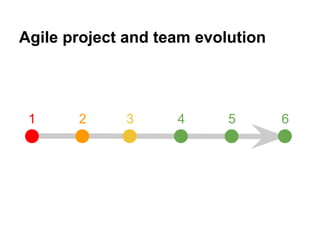
Agile project and team evolution 
1 2 3 4 5 6
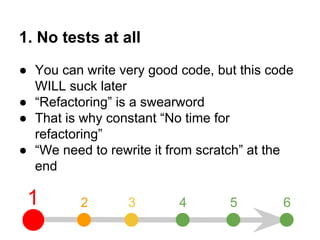
1. No tests at all 
● You can write very good code, but this code 
WILL suck later 
● “Refactoring” is a swearword 
● That is why constant “No time for 
refactoring” 
● “We need to rewrite it from scratch” at the 
end 
1 2 3 4 5 6
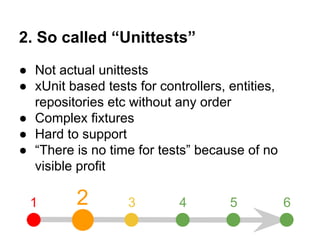
2. So called “Unittests” 
● Not actual unittests 
● xUnit based tests for controllers, entities, 
repositories etc without any order 
● Complex fixtures 
● Hard to support 
● “There is no time for tests” because of no 
visible profit 
1 2 3 4 5 6
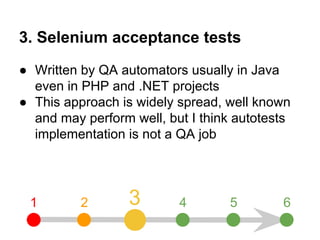
3. Selenium acceptance tests 
● Written by QA automators usually in Java 
even in PHP and .NET projects 
● This approach is widely spread, well known 
and may perform well, but I think autotests 
implementation is not a QA job 
1 2 3 4 5 6
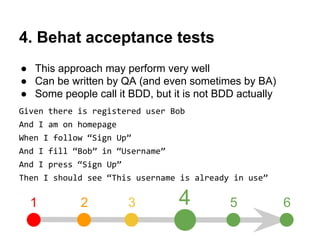
4. Behat acceptance tests 
● This approach may perform very well 
● Can be written by QA (and even sometimes by BA) 
● Some people call it BDD, but it is not BDD actually 
Given there is registered user Bob 
And I am on homepage 
When I follow “Sign Up” 
And I fill “Bob” in “Username” 
And I press “Sign Up” 
Then I should see “This username is already in use” 
1 2 3 4 5 6
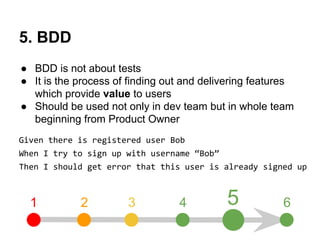
5. BDD 
● BDD is not about tests 
● It is the process of finding out and delivering features 
which provide value to users 
● Should be used not only in dev team but in whole team 
beginning from Product Owner 
Given there is registered user Bob 
When I try to sign up with username “Bob” 
Then I should get error that this user is already signed up 
1 2 3 4 5 6
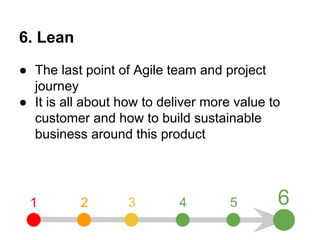
6. Lean 
● The last point of Agile team and project 
journey 
● It is all about how to deliver more value to 
customer and how to build sustainable 
business around this product 
1 2 3 4 5 6
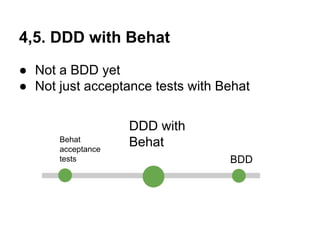
4,5. DDD with Behat 
● Not a BDD yet 
● Not just acceptance tests with Behat 
BDD 
Behat 
acceptance 
tests 
DDD with 
Behat
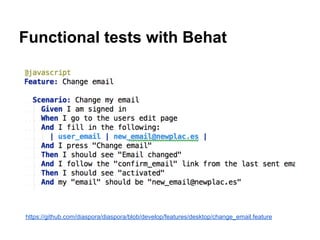
Functional tests with Behat 
https://github.com/diaspora/diaspora/blob/develop/features/desktop/change_email.feature
They are really cool 
● Provide Continuous Integration and 
Continuous Delivery possibility 
● Easy to write 
● Can be written by QA and even sometimes 
by BA
But... 
● Long execution time 
○ Less green builds 
○ Wasted developers’ time 
● Non-deterministic failures 
○ Developers try to rebuild every failing build instead 
of investigating 
○ Wasted developers’ time
But... 
● They are too specific 
○ It is difficult to dig up business value from them 
○ less benefits for use by (and with) business people 
(BA, Product Owner)
DDD can help
Model 
Model is a system of abstractions that 
describes selected aspects of a domain and 
can be used to solve problems related to this 
domain 
http://www.infoq.com/presentations/model-to-work-evans
Ubiquitous Language 
A language structured around the domain 
model and used by all team members to 
connect all the activities of the team with the 
software 
http://www.infoq.com/presentations/model-to-work-evans
Ubiquitous Language helps to find 
out model weaknesses 
If domain expert does not understand you when 
you use ubiquitous language, then your model 
does not describe domain as needed and 
should be corrected.
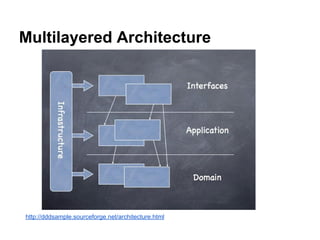
Multilayered Architecture 
http://dddsample.sourceforge.net/architecture.html
Layers in typical symfony2 project 
● Infrastructure 
○ Doctrine 
○ SwiftMailer 
● UI 
○ views 
○ JS 
● Application 
○ controllers 
○ some services 
● Domain 
○ entities
Entities are not enough to 
create a powerful domain 
model
Domain Model 
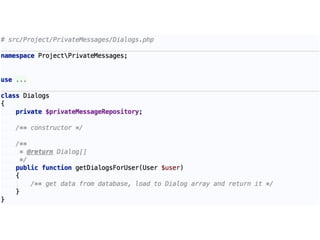
● Domain model is just Plain Old PHP Objects. 
● Framework-agnostic
Domain Model 
At its worst business logic can be very 
complex. Rules and logic describe many 
different cases and slants of behavior, and it's 
this complexity that objects were designed to 
work with. A Domain Model creates a web of 
interconnected objects, where each object 
represents some meaningful individual, 
whether as large as a corporation or as small 
as a single line on an order form. 
http://martinfowler.com/eaaCatalog/domainModel.html
Forget all you know about 
frameworks, controllers, 
forms, api etc. Just do 
OOP.
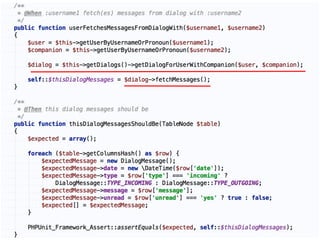
Behat can be used to 
drive Domain Model code
Warning 
This is real project code, so it is not ideal and 
can be possibly done better. But in real project 
we can not refactor our code infinitely because 
of obvious reasons.
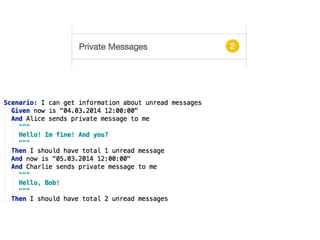
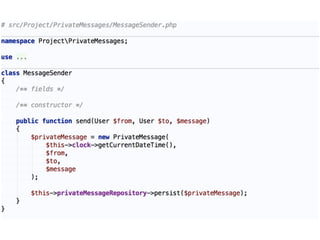
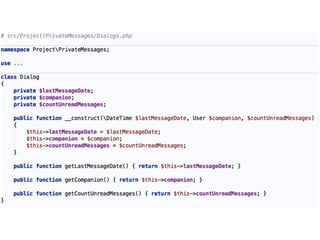
Sample user private messages 
functionality 
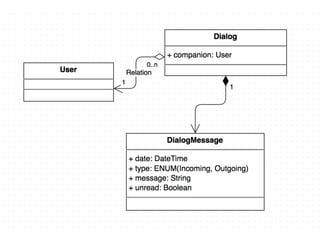
● Registered user can send private message 
to any other registered user 
● Messages should be combined to dialogs 
● There should be email notifications about 
new messages
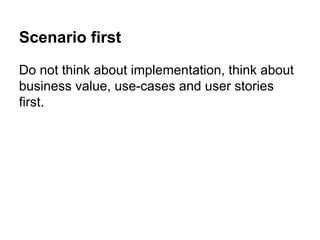
Scenario first 
Do not think about implementation, think about 
business value, use-cases and user stories 
first.
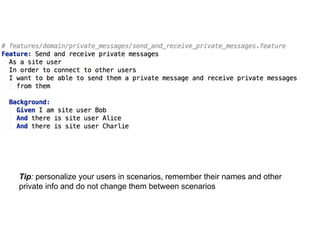
Tip: personalize your users in scenarios, remember their names and other 
private info and do not change them between scenarios
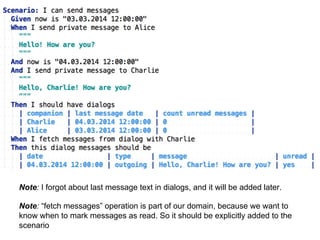
Note: I forgot about last message text in dialogs, and it will be added later. 
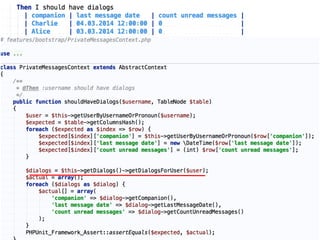
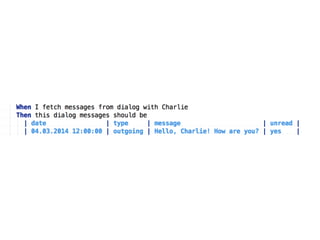
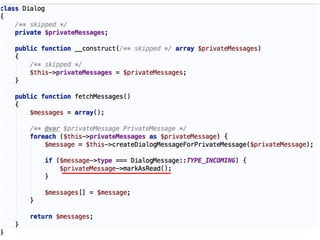
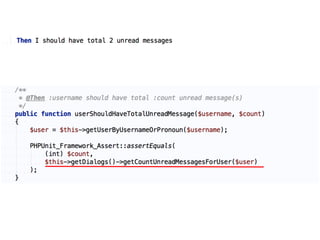
Note: “fetch messages” operation is part of our domain, because we want to 
know when to mark messages as read. So it should be explicitly added to the 
scenario
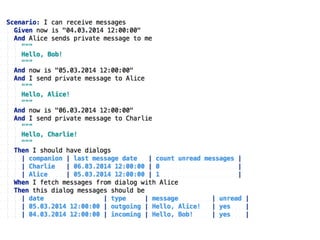
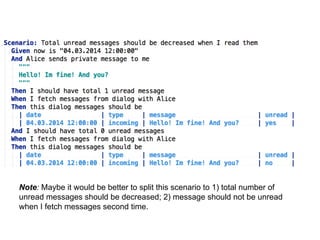
Note: Maybe it would be better to split this scenario to 1) total number of 
unread messages should be decreased; 2) message should not be unread 
when I fetch messages second time.
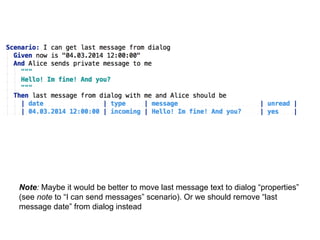
Note: Maybe it would be better to move last message text to dialog “properties” 
(see note to “I can send messages” scenario). Or we should remove “last 
message date” from dialog instead
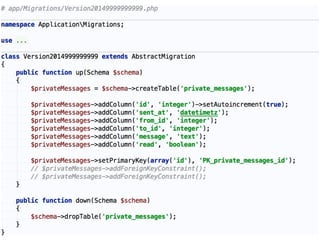
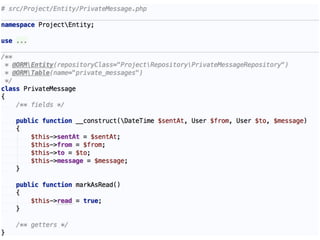
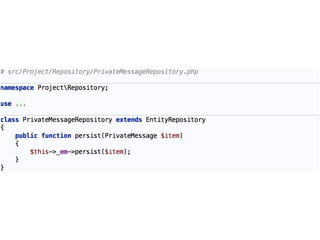
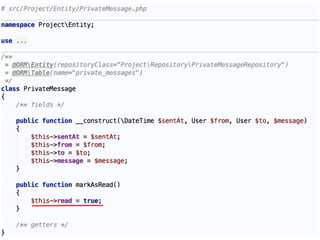
Note: this is unusual situation. Doctrine 
Entities should be used as Domain 
Entities when possible.
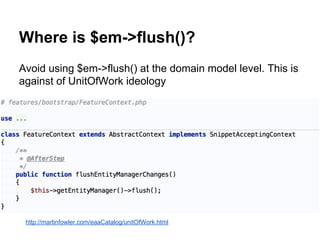
Where is $em->flush()? 
Avoid using $em->flush() at the domain model level. This is 
against of UnitOfWork ideology 
http://martinfowler.com/eaaCatalog/unitOfWork.html
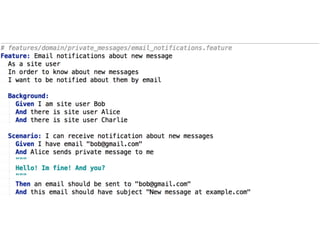
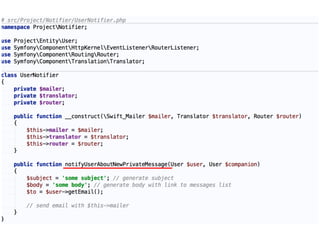
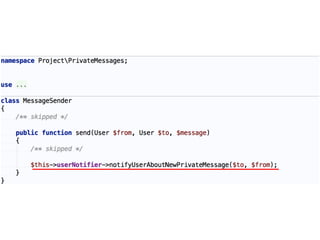
Notifications
Simple and framework agnostic 
Domain Model 
● Easy to write 
● Easy to read and understand 
● Can be guided by UnitTests if they have 
complex logic 
● Easy to migrate between frameworks (if you 
want to migrate, for example, from symfony2 
to silex + AngularJS)
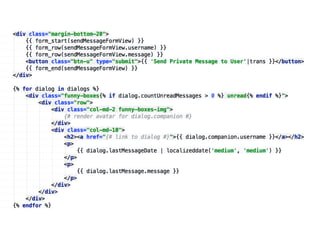
Application and UI layers
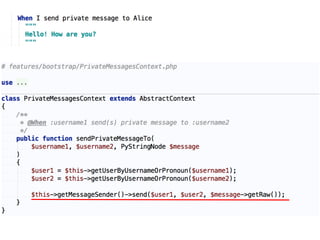
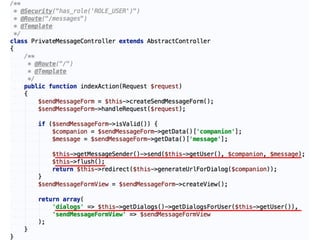
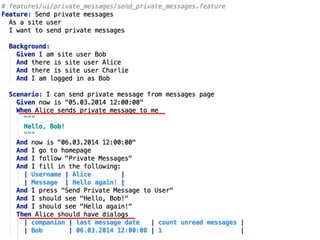
Domain scenarios steps 
can easily be reused in UI 
tests
Profit 
● Everything needed by business can be done 
without a single Controller line 
● Simple and clear integration tests can be 
used as user stories by business people 
● Simple and thin controllers will not contain 
business rules 
● Little amount of complex and heavy UI tests 
(no need to test business expectations, only 
UI itself)
Thanks!

DDD with Behat

  • 1.
    DDD with Behat by Anton Serdyuk
  • 2.
    Agile project andteam evolution 1 2 3 4 5 6
  • 3.
    1. No testsat all ● You can write very good code, but this code WILL suck later ● “Refactoring” is a swearword ● That is why constant “No time for refactoring” ● “We need to rewrite it from scratch” at the end 1 2 3 4 5 6
  • 4.
    2. So called“Unittests” ● Not actual unittests ● xUnit based tests for controllers, entities, repositories etc without any order ● Complex fixtures ● Hard to support ● “There is no time for tests” because of no visible profit 1 2 3 4 5 6
  • 5.
    3. Selenium acceptancetests ● Written by QA automators usually in Java even in PHP and .NET projects ● This approach is widely spread, well known and may perform well, but I think autotests implementation is not a QA job 1 2 3 4 5 6
  • 6.
    4. Behat acceptancetests ● This approach may perform very well ● Can be written by QA (and even sometimes by BA) ● Some people call it BDD, but it is not BDD actually Given there is registered user Bob And I am on homepage When I follow “Sign Up” And I fill “Bob” in “Username” And I press “Sign Up” Then I should see “This username is already in use” 1 2 3 4 5 6
  • 7.
    5. BDD ●BDD is not about tests ● It is the process of finding out and delivering features which provide value to users ● Should be used not only in dev team but in whole team beginning from Product Owner Given there is registered user Bob When I try to sign up with username “Bob” Then I should get error that this user is already signed up 1 2 3 4 5 6
  • 8.
    6. Lean ●The last point of Agile team and project journey ● It is all about how to deliver more value to customer and how to build sustainable business around this product 1 2 3 4 5 6
  • 9.
    4,5. DDD withBehat ● Not a BDD yet ● Not just acceptance tests with Behat BDD Behat acceptance tests DDD with Behat
  • 10.
    Functional tests withBehat https://github.com/diaspora/diaspora/blob/develop/features/desktop/change_email.feature
  • 11.
    They are reallycool ● Provide Continuous Integration and Continuous Delivery possibility ● Easy to write ● Can be written by QA and even sometimes by BA
  • 12.
    But... ● Longexecution time ○ Less green builds ○ Wasted developers’ time ● Non-deterministic failures ○ Developers try to rebuild every failing build instead of investigating ○ Wasted developers’ time
  • 13.
    But... ● Theyare too specific ○ It is difficult to dig up business value from them ○ less benefits for use by (and with) business people (BA, Product Owner)
  • 14.
  • 15.
    Model Model isa system of abstractions that describes selected aspects of a domain and can be used to solve problems related to this domain http://www.infoq.com/presentations/model-to-work-evans
  • 16.
    Ubiquitous Language Alanguage structured around the domain model and used by all team members to connect all the activities of the team with the software http://www.infoq.com/presentations/model-to-work-evans
  • 17.
    Ubiquitous Language helpsto find out model weaknesses If domain expert does not understand you when you use ubiquitous language, then your model does not describe domain as needed and should be corrected.
  • 18.
  • 19.
    Layers in typicalsymfony2 project ● Infrastructure ○ Doctrine ○ SwiftMailer ● UI ○ views ○ JS ● Application ○ controllers ○ some services ● Domain ○ entities
  • 20.
    Entities are notenough to create a powerful domain model
  • 21.
    Domain Model ●Domain model is just Plain Old PHP Objects. ● Framework-agnostic
  • 22.
    Domain Model Atits worst business logic can be very complex. Rules and logic describe many different cases and slants of behavior, and it's this complexity that objects were designed to work with. A Domain Model creates a web of interconnected objects, where each object represents some meaningful individual, whether as large as a corporation or as small as a single line on an order form. http://martinfowler.com/eaaCatalog/domainModel.html
  • 23.
    Forget all youknow about frameworks, controllers, forms, api etc. Just do OOP.
  • 24.
    Behat can beused to drive Domain Model code
  • 25.
    Warning This isreal project code, so it is not ideal and can be possibly done better. But in real project we can not refactor our code infinitely because of obvious reasons.
  • 26.
    Sample user privatemessages functionality ● Registered user can send private message to any other registered user ● Messages should be combined to dialogs ● There should be email notifications about new messages
  • 28.
    Scenario first Donot think about implementation, think about business value, use-cases and user stories first.
  • 29.
    Tip: personalize yourusers in scenarios, remember their names and other private info and do not change them between scenarios
  • 30.
    Note: I forgotabout last message text in dialogs, and it will be added later. Note: “fetch messages” operation is part of our domain, because we want to know when to mark messages as read. So it should be explicitly added to the scenario
  • 33.
    Note: Maybe itwould be better to split this scenario to 1) total number of unread messages should be decreased; 2) message should not be unread when I fetch messages second time.
  • 34.
    Note: Maybe itwould be better to move last message text to dialog “properties” (see note to “I can send messages” scenario). Or we should remove “last message date” from dialog instead
  • 38.
    Note: this isunusual situation. Doctrine Entities should be used as Domain Entities when possible.
  • 41.
    Where is $em->flush()? Avoid using $em->flush() at the domain model level. This is against of UnitOfWork ideology http://martinfowler.com/eaaCatalog/unitOfWork.html
  • 50.
  • 54.
    Simple and frameworkagnostic Domain Model ● Easy to write ● Easy to read and understand ● Can be guided by UnitTests if they have complex logic ● Easy to migrate between frameworks (if you want to migrate, for example, from symfony2 to silex + AngularJS)
  • 55.
  • 58.
    Domain scenarios steps can easily be reused in UI tests
  • 60.
    Profit ● Everythingneeded by business can be done without a single Controller line ● Simple and clear integration tests can be used as user stories by business people ● Simple and thin controllers will not contain business rules ● Little amount of complex and heavy UI tests (no need to test business expectations, only UI itself)
  • 61.