CSCI 5922
Neural Networks and Deep Learning:
Activation and Loss Functions
Mike Mozer
Department of Computer Science and
Institute of Cognitive Science
University of Colorado at Boulder
Output Activation and Loss Functions

Every neural net specifies
 an activation rule for the output unit(s)
 a loss defined in terms of the output activation

First a bit of review…
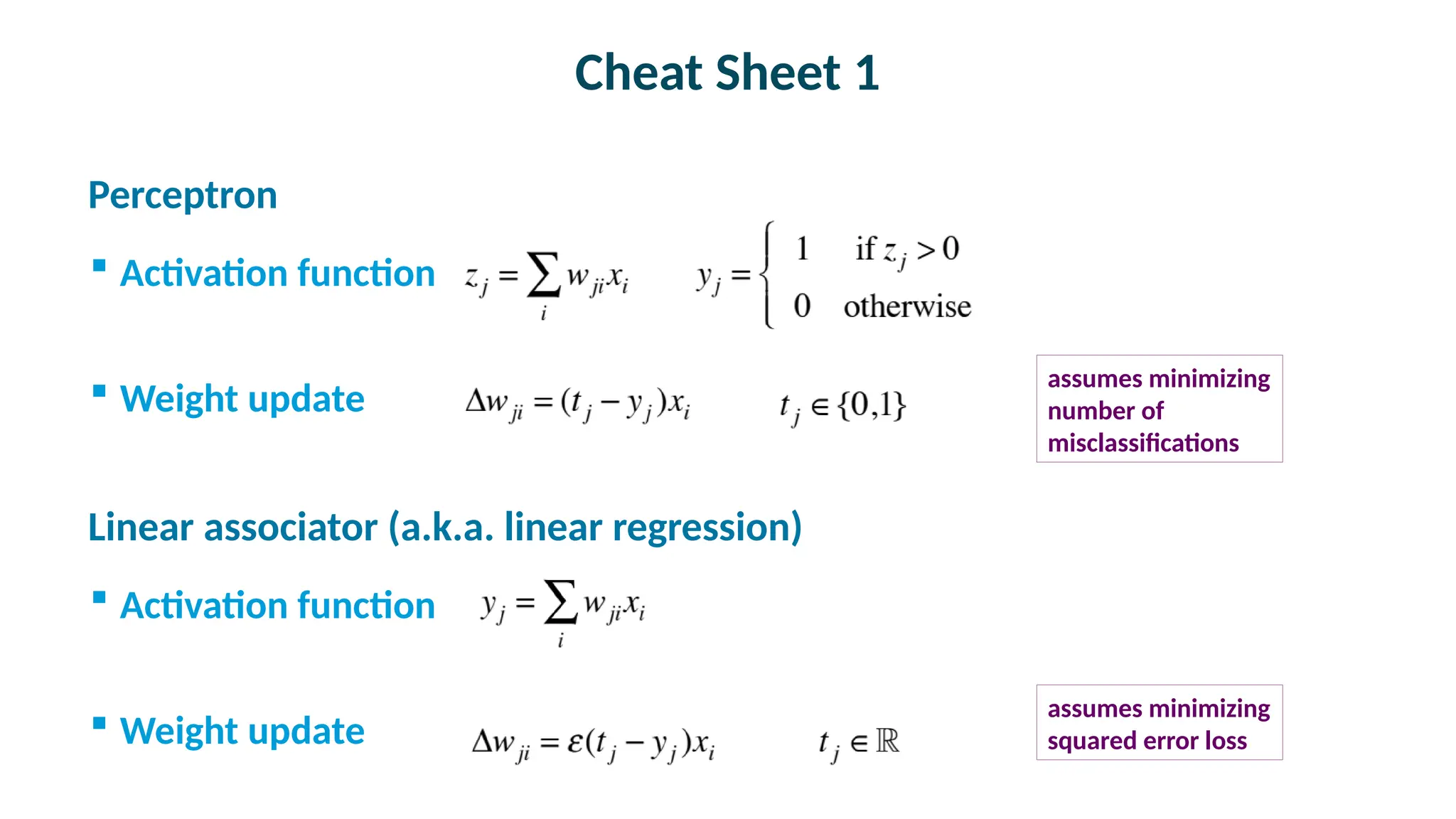
Cheat Sheet 1

Perceptron
 Activation function
 Weight update

Linear associator (a.k.a. linear regression)
 Activation function
 Weight update
assumes minimizing
squared error loss
assumes minimizing
number of
misclassifications
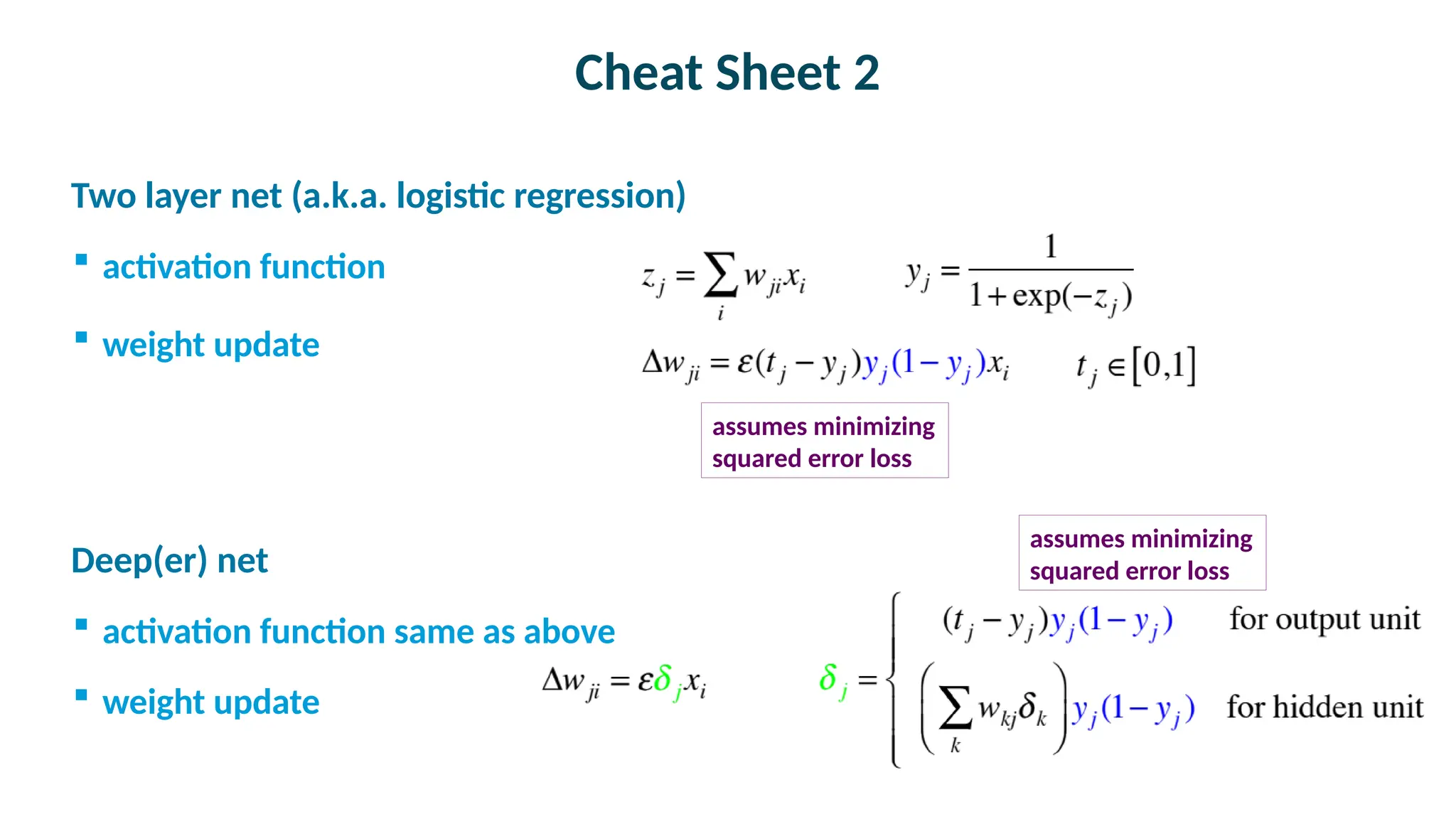
Cheat Sheet 2

Two layer net (a.k.a. logistic regression)
 activation function
 weight update

Deep(er) net
 activation function same as above
 weight update
assumes minimizing
squared error loss
assumes minimizing
squared error loss
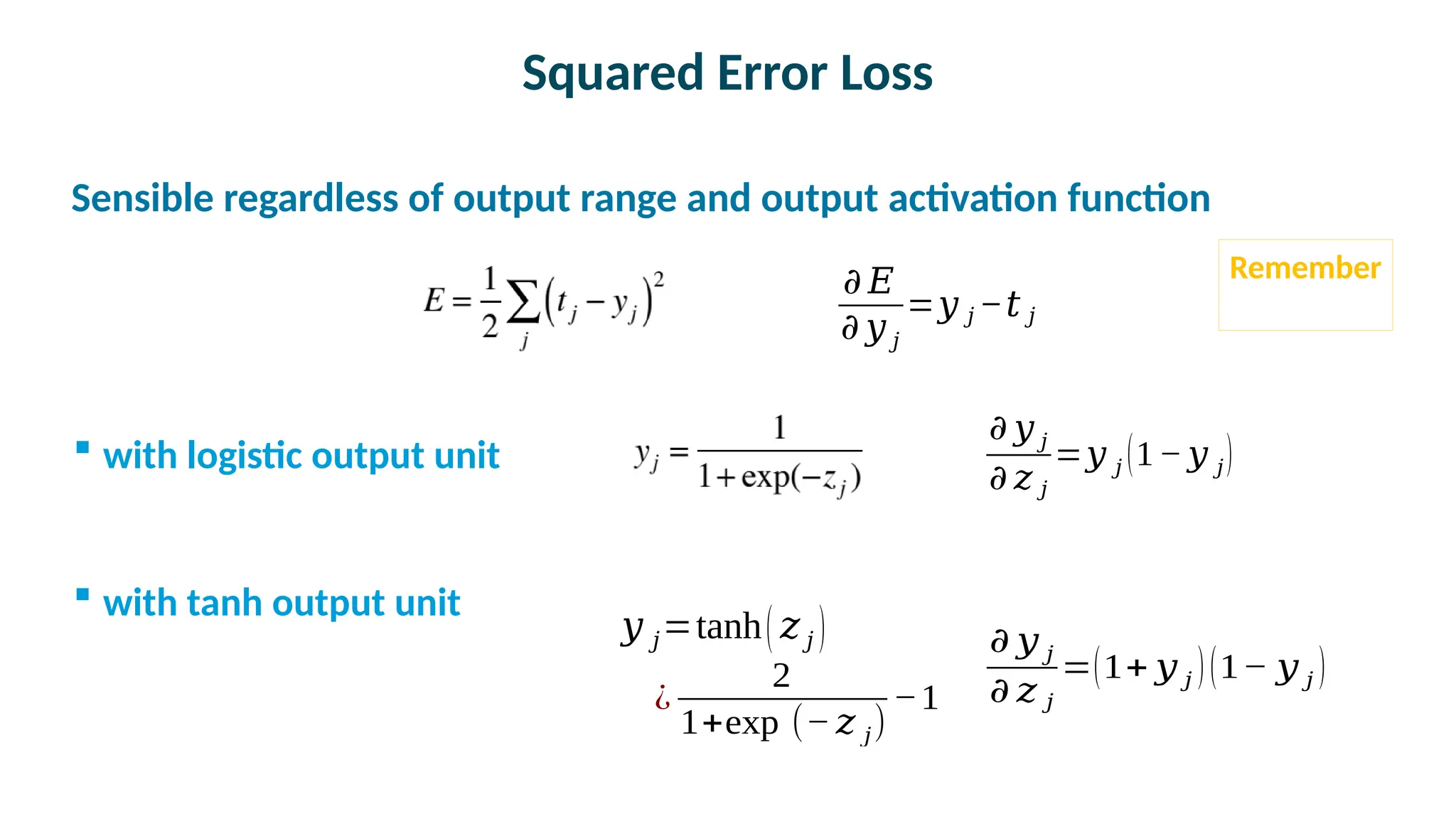
Squared Error Loss

Sensible regardless of output range and output activation function
 with logistic output unit
 with tanh output unit
𝜕 𝑦 𝑗
𝜕 𝑧 𝑗
=𝑦 𝑗 (1−𝑦 𝑗)
𝜕 𝑦 𝑗
𝜕 𝑧 𝑗
=(1+ 𝑦 𝑗 )(1− 𝑦 𝑗 )
𝑦 𝑗=tanh( 𝑧 𝑗 )
¿
2
1+exp ⁡(−𝑧 𝑗)
−1
𝜕 𝐸
𝜕 𝑦 𝑗
=𝑦 𝑗 −𝑡 𝑗
Remember
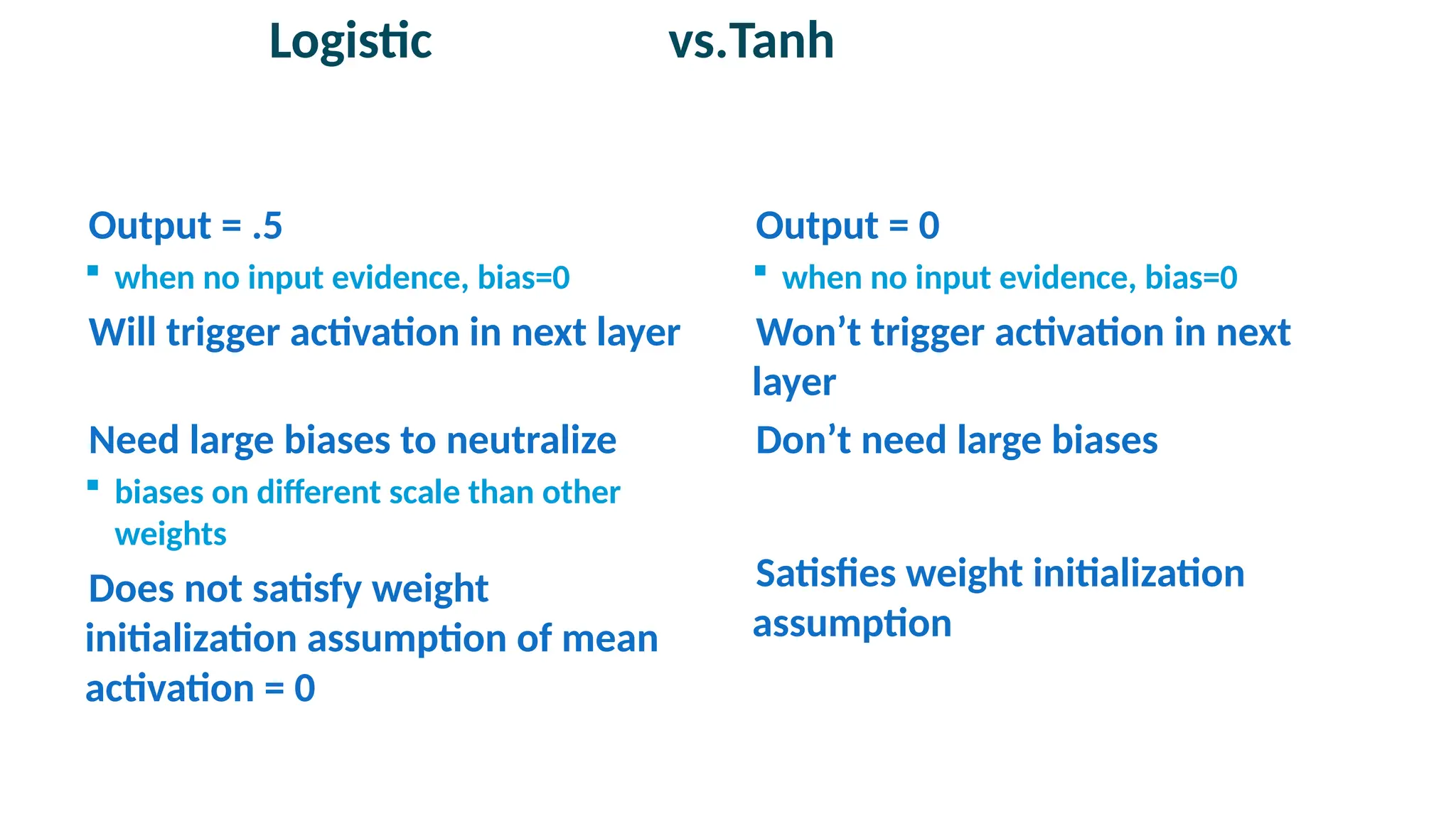
Logistic vs.Tanh
•
Output = .5
 when no input evidence, bias=0
•
Will trigger activation in next layer
•
Need large biases to neutralize
 biases on different scale than other
weights
•
Does not satisfy weight
initialization assumption of mean
activation = 0
•
Output = 0
 when no input evidence, bias=0
•
Won’t trigger activation in next
layer
•
Don’t need large biases
•
Satisfies weight initialization
assumption
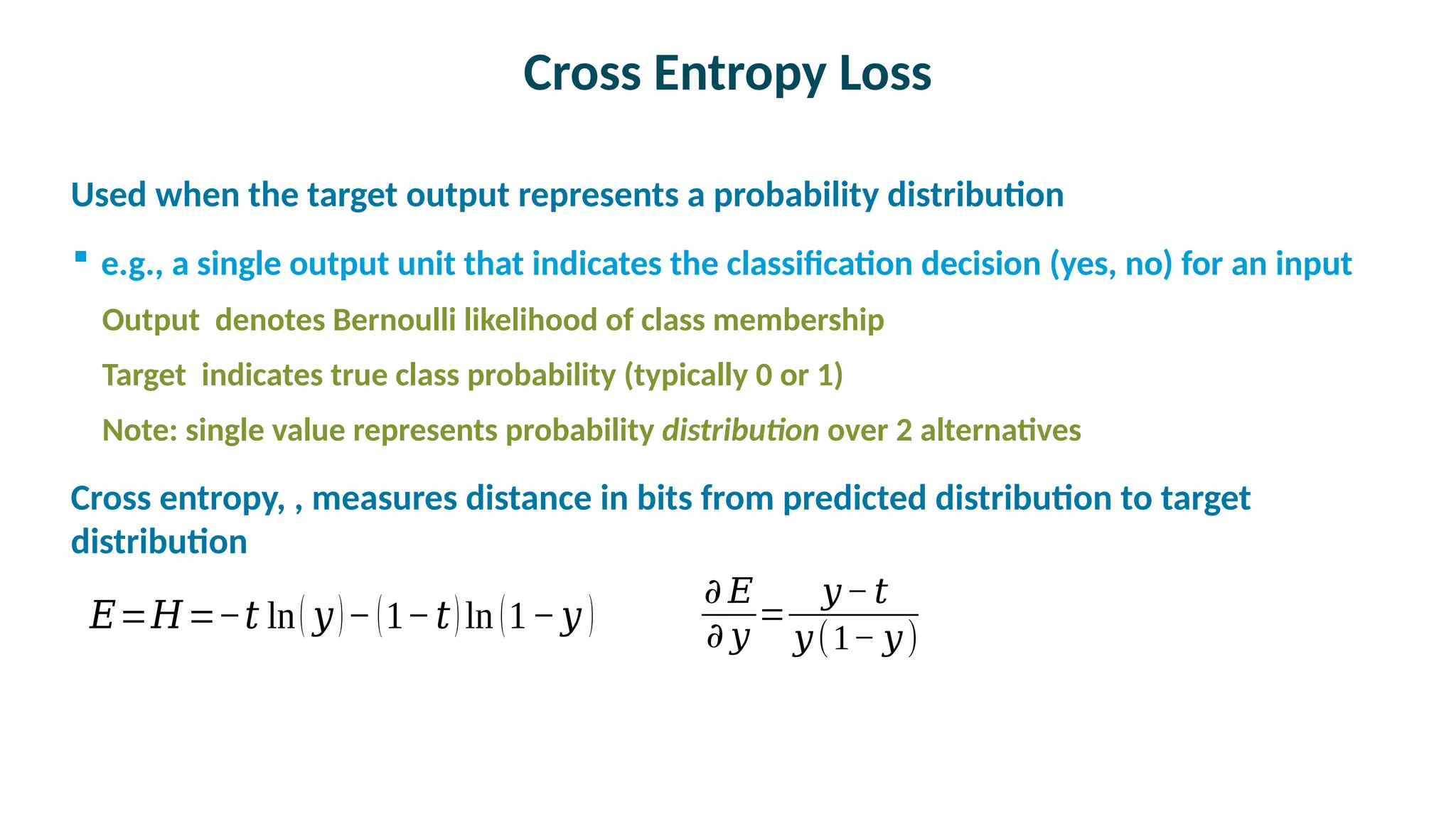
Cross Entropy Loss

Used when the target output represents a probability distribution
 e.g., a single output unit that indicates the classification decision (yes, no) for an input
Output denotes Bernoulli likelihood of class membership
Target indicates true class probability (typically 0 or 1)
Note: single value represents probability distribution over 2 alternatives

Cross entropy, , measures distance in bits from predicted distribution to target
distribution
𝐸=𝐻=−𝑡 ln( 𝑦)−(1−𝑡)ln (1−𝑦 )
𝜕 𝐸
𝜕 𝑦
=
𝑦−𝑡
𝑦(1− 𝑦)
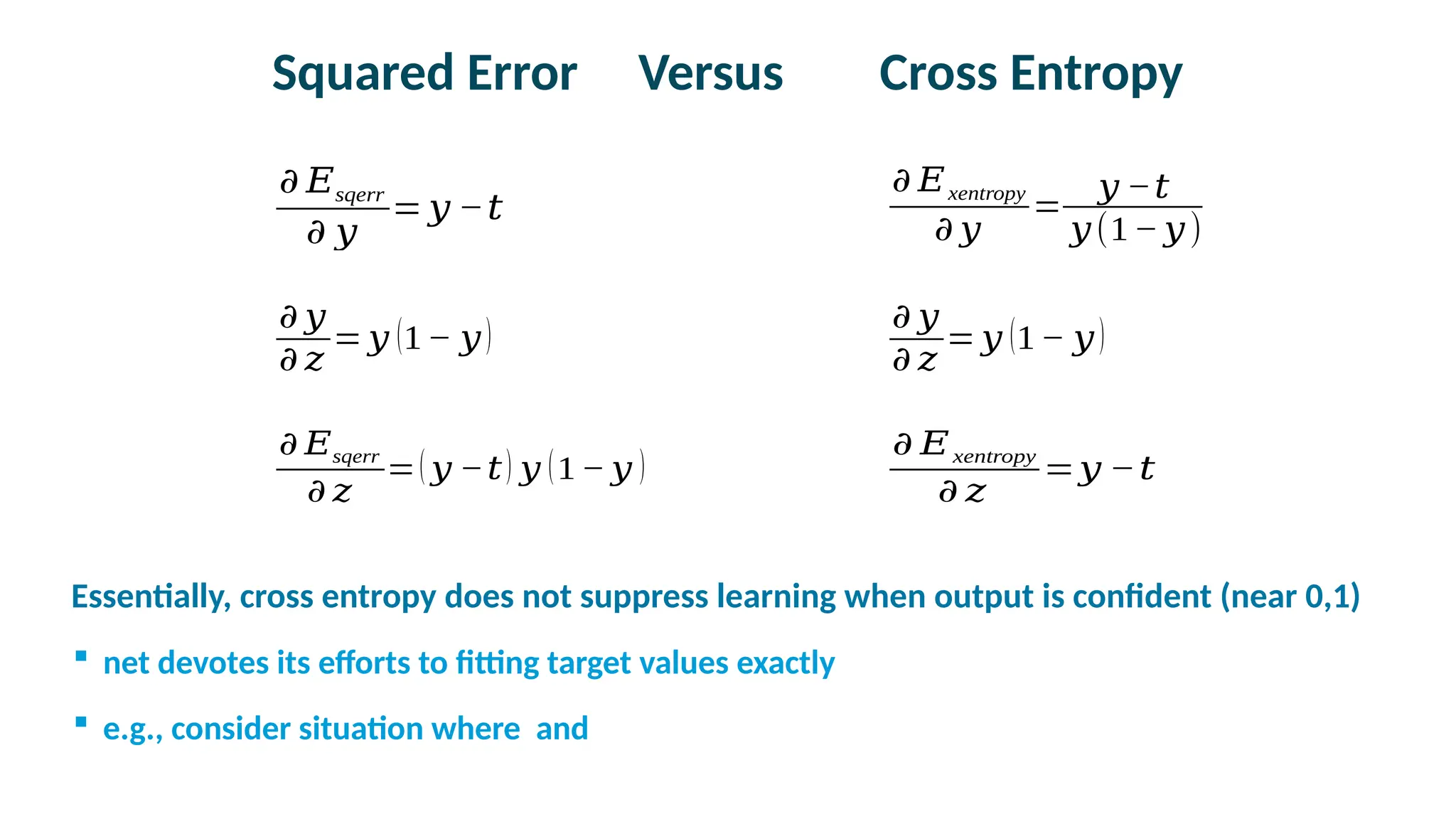
Squared Error Versus Cross Entropy
𝜕 𝐸sqerr
𝜕 𝑧
=( 𝑦 −𝑡) 𝑦 (1− 𝑦 )
𝜕 𝐸xentropy
𝜕 𝑧
=𝑦 −𝑡
𝜕 𝐸xentropy
𝜕 𝑦
=
𝑦 −𝑡
𝑦(1− 𝑦)
𝜕 𝐸sqerr
𝜕 𝑦
= 𝑦 −𝑡
𝜕 𝑦
𝜕 𝑧
= 𝑦 (1− 𝑦)
𝜕 𝑦
𝜕 𝑧
= 𝑦 (1− 𝑦)

Essentially, cross entropy does not suppress learning when output is confident (near 0,1)
 net devotes its efforts to fitting target values exactly
 e.g., consider situation where and
Maximum Likelihood Estimation

In statistics, many parameter estimation problems are formulated in terms
of maximizing the likelihood of the data
 find model parameters that maximize the likelihood of the data under the
model
 e.g., 10 coin flips producing 8 heads and 2 tails
What is the coin’s bias?

Likelihood formulation
 for
What’s the relationship
between and
Probabilistic Interpretation of Squared-Error Loss

Consider a network output and target

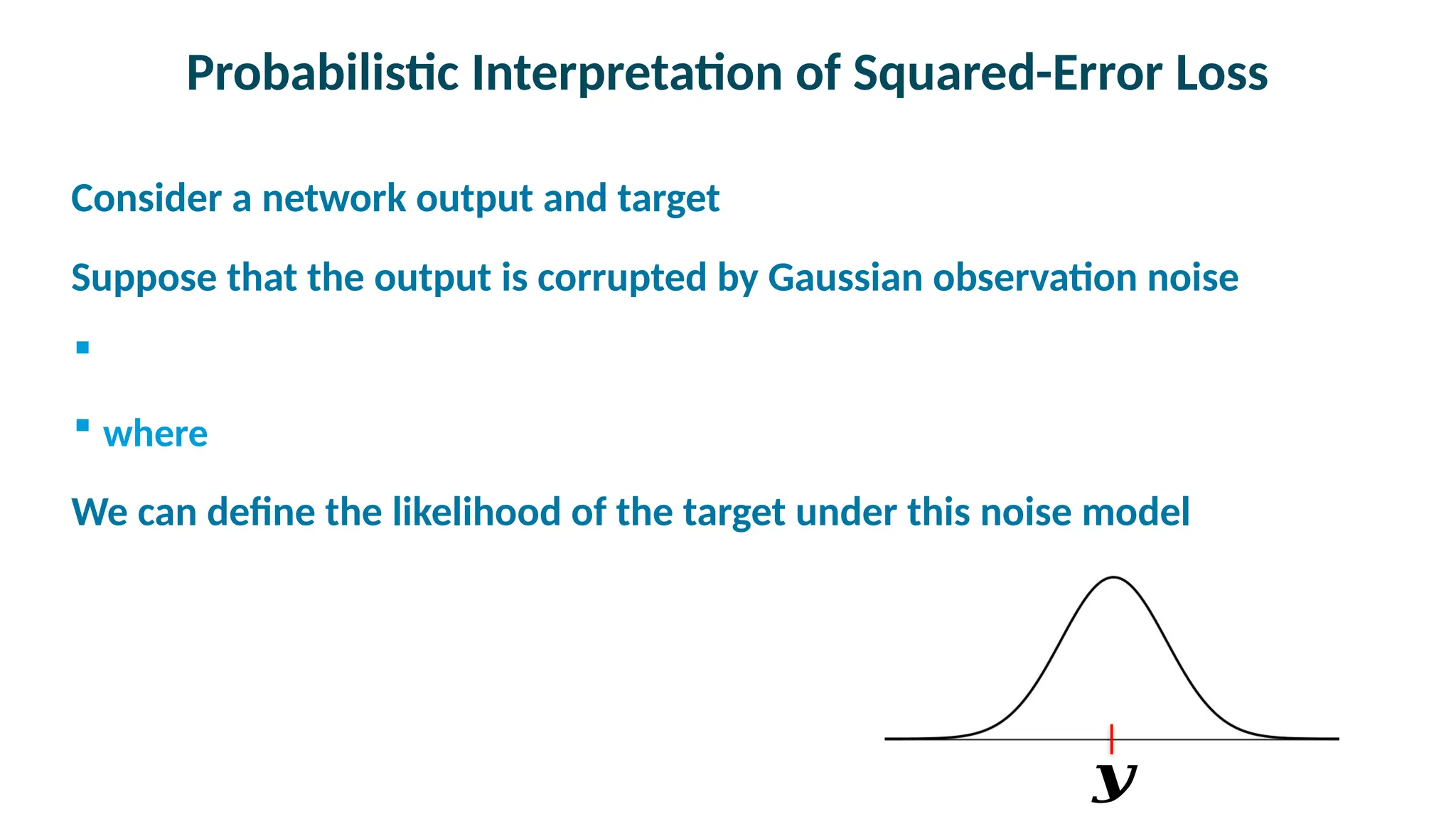
Suppose that the output is corrupted by Gaussian observation noise

 where

We can define the likelihood of the target under this noise model
𝒚
Probabilistic Interpretation of Squared-Error Loss

For a set of training examples, , we can define the data set likelihood
 where


Squared error can be viewed as likelihood under Gaussian observation noise

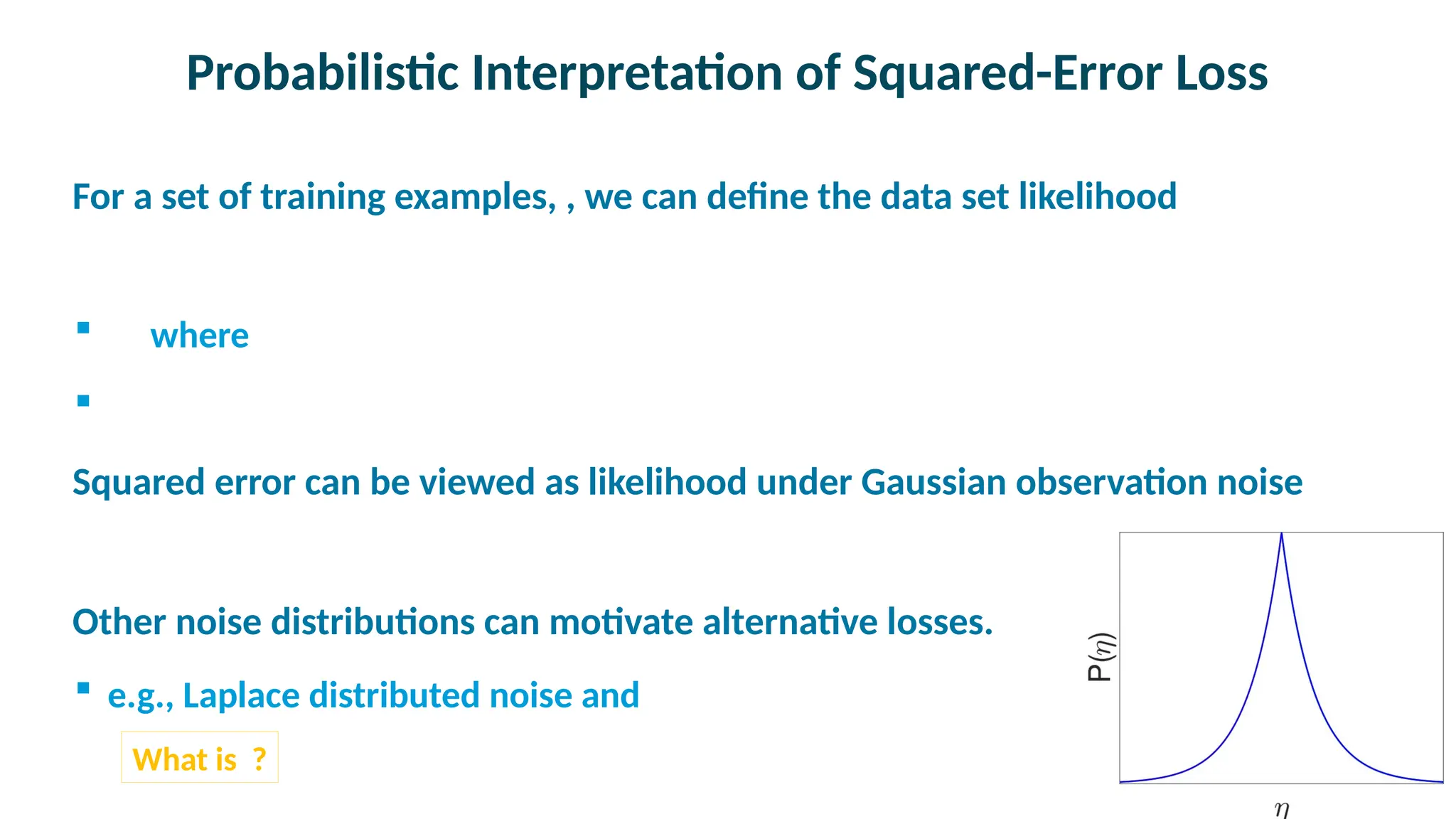
Other noise distributions can motivate alternative losses.
 e.g., Laplace distributed noise and
What is ?
Categorical Outputs

We considered the case where the output denotes the probability of class
membership
 belonging to class versus

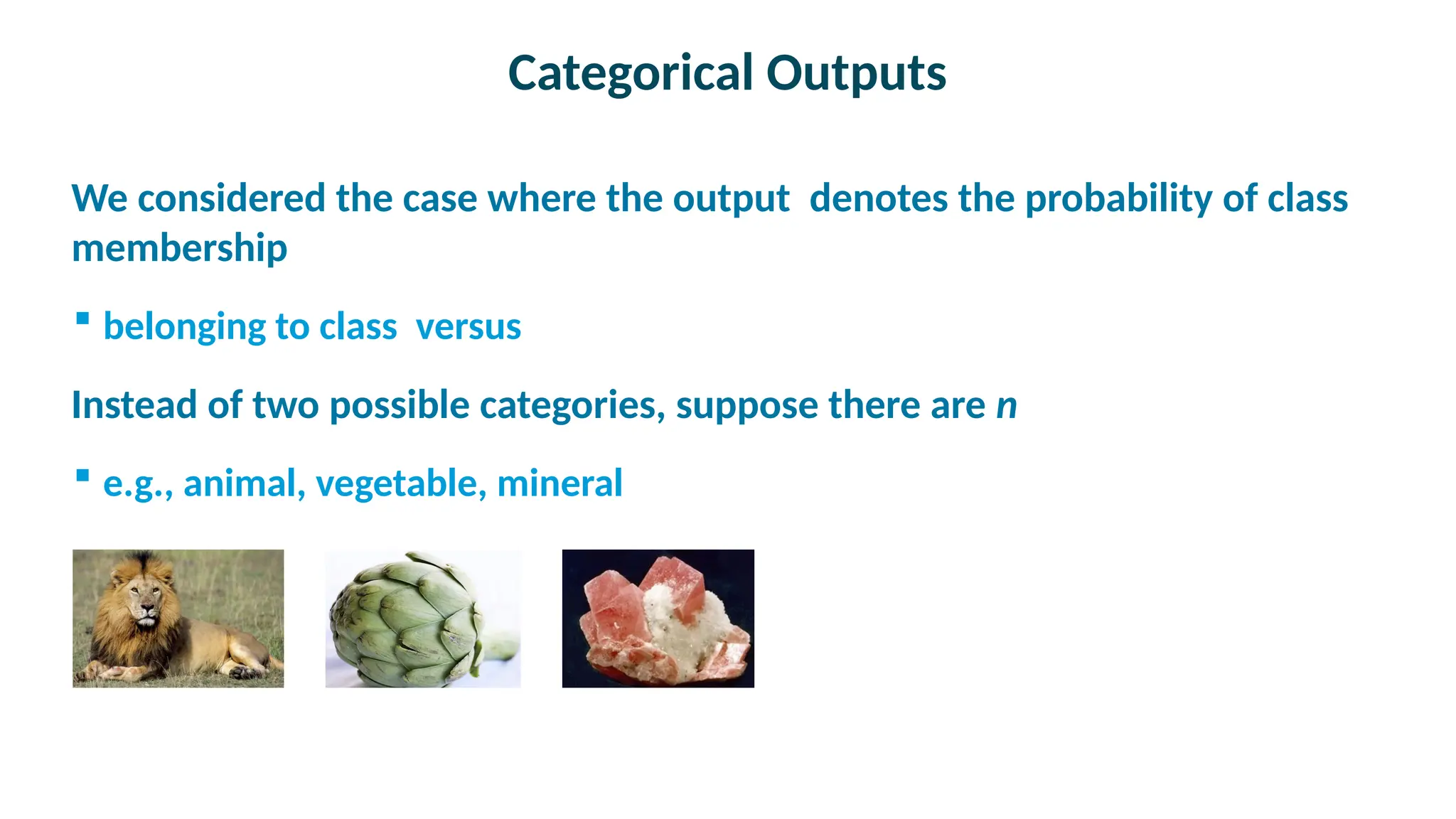
Instead of two possible categories, suppose there are n
 e.g., animal, vegetable, mineral
Categorical Outputs

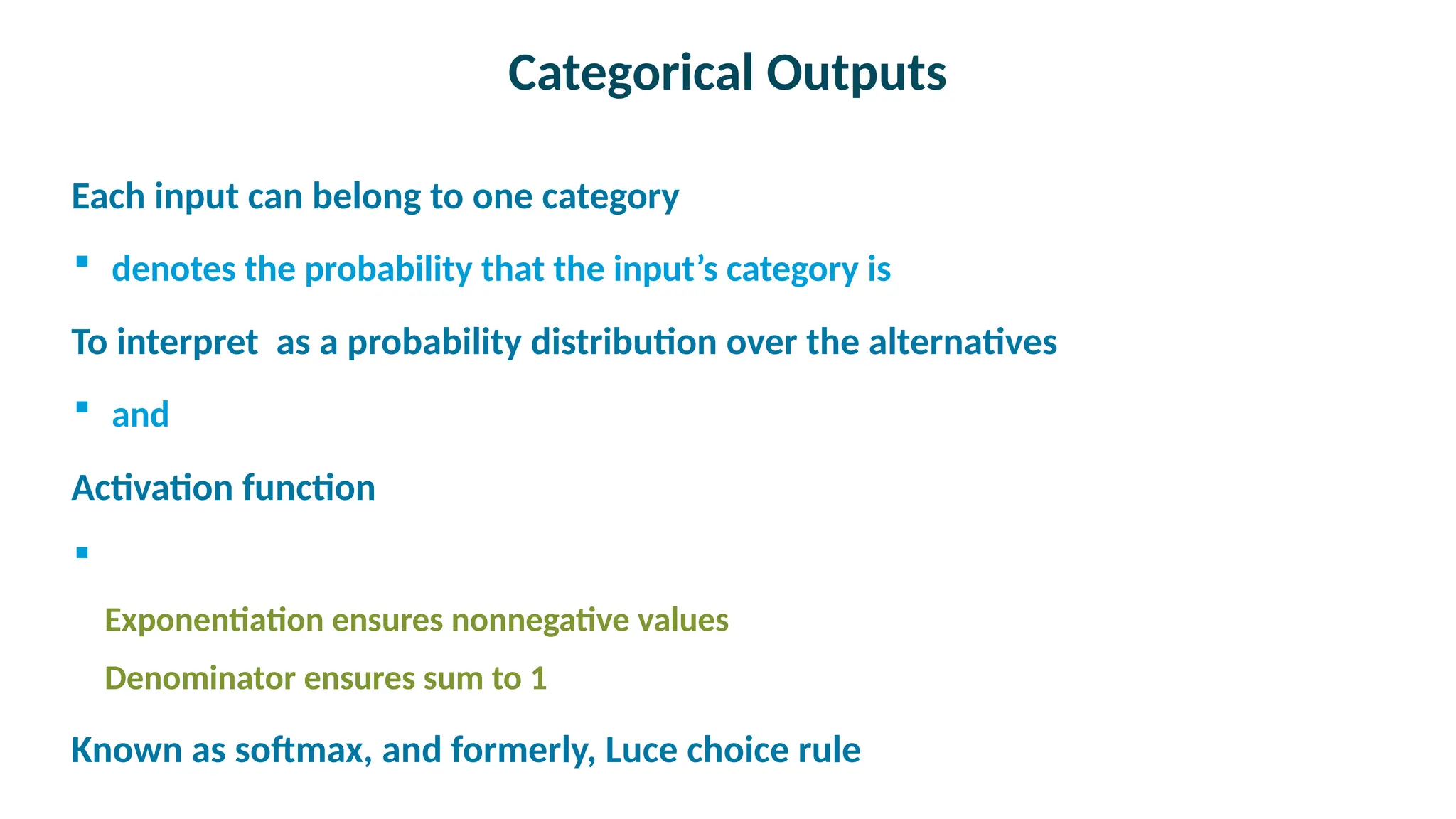
Each input can belong to one category
 denotes the probability that the input’s category is

To interpret as a probability distribution over the alternatives
 and

Activation function

Exponentiation ensures nonnegative values
Denominator ensures sum to 1

Known as softmax, and formerly, Luce choice rule
Derivatives For Categorical Outputs

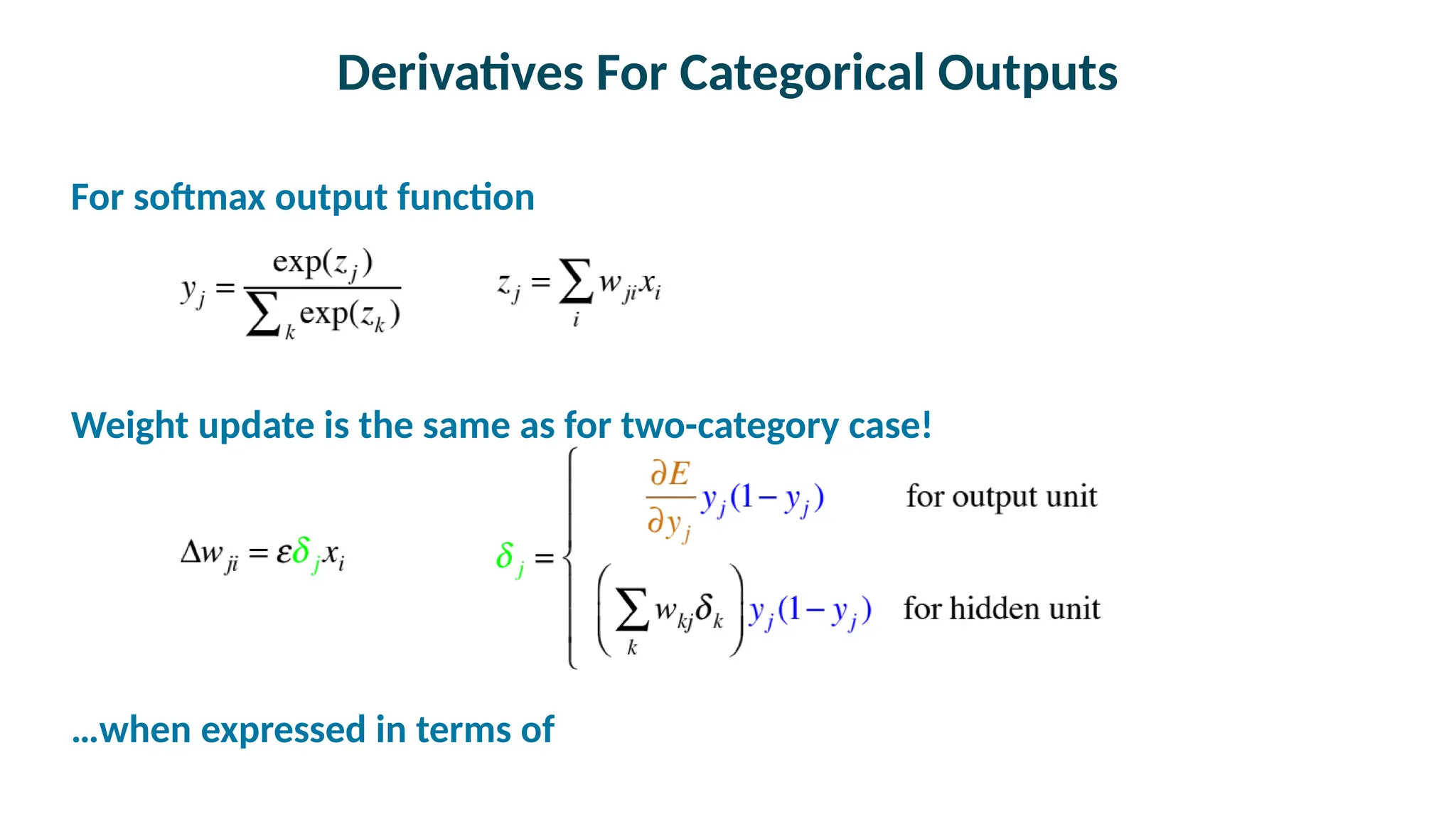
For softmax output function

Weight update is the same as for two-category case!

…when expressed in terms of
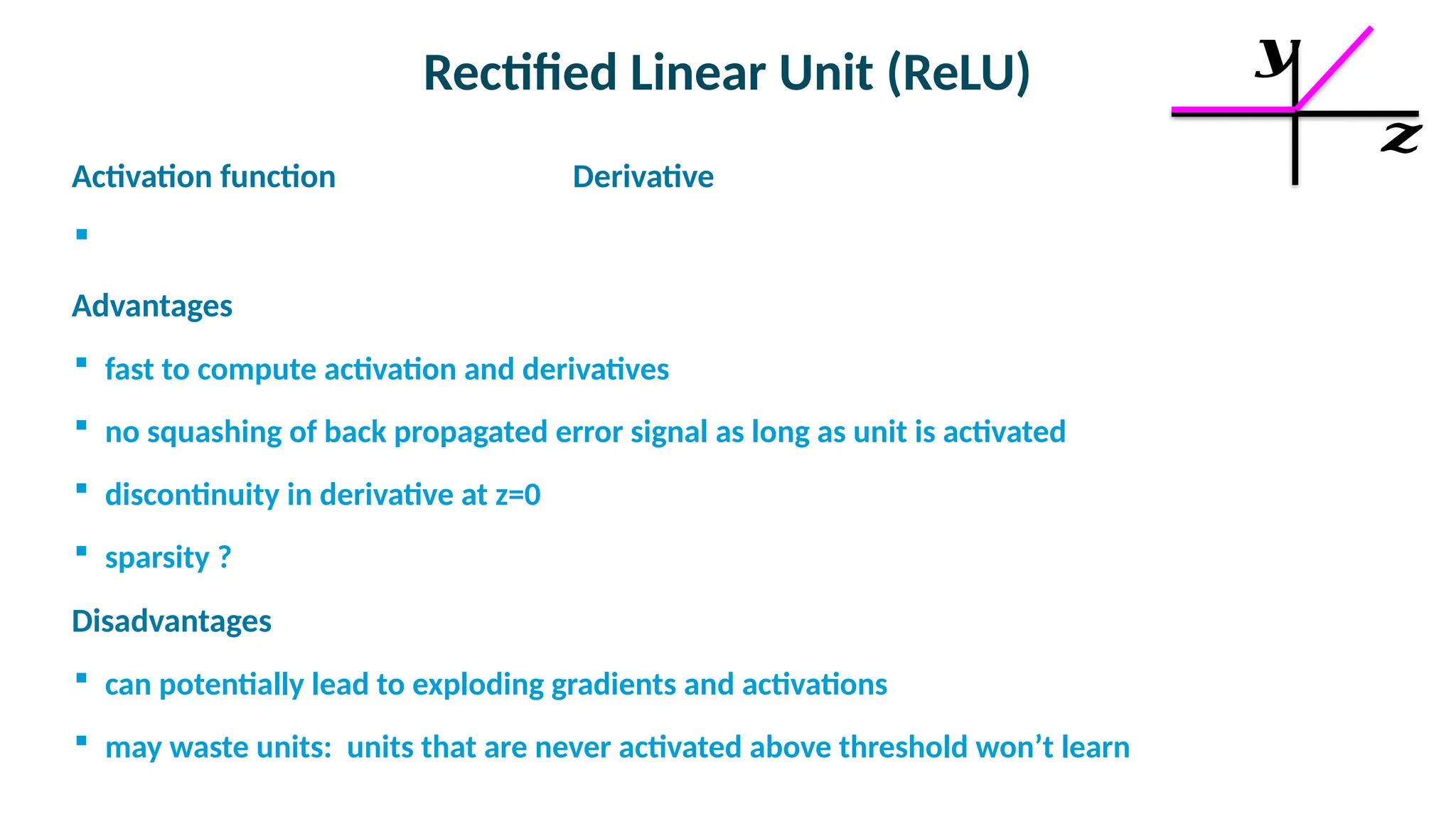
Rectified Linear Unit (ReLU)

Activation function Derivative


Advantages
 fast to compute activation and derivatives
 no squashing of back propagated error signal as long as unit is activated
 discontinuity in derivative at z=0
 sparsity ?

Disadvantages
 can potentially lead to exploding gradients and activations
 may waste units: units that are never activated above threshold won’t learn
𝒛
𝒚
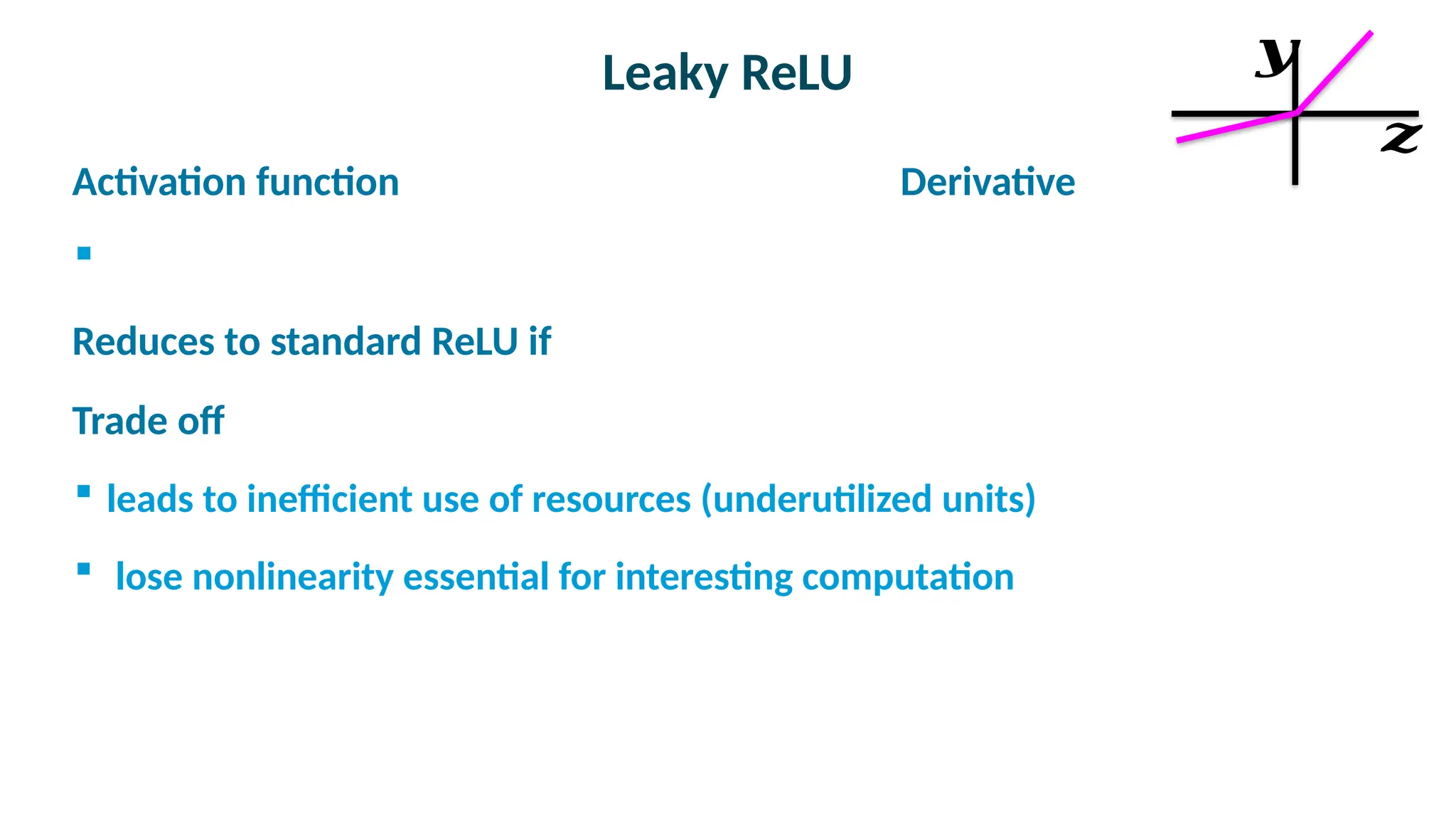
Leaky ReLU

Activation function Derivative


Reduces to standard ReLU if

Trade off
 leads to inefficient use of resources (underutilized units)
 lose nonlinearity essential for interesting computation
𝒛
𝒚
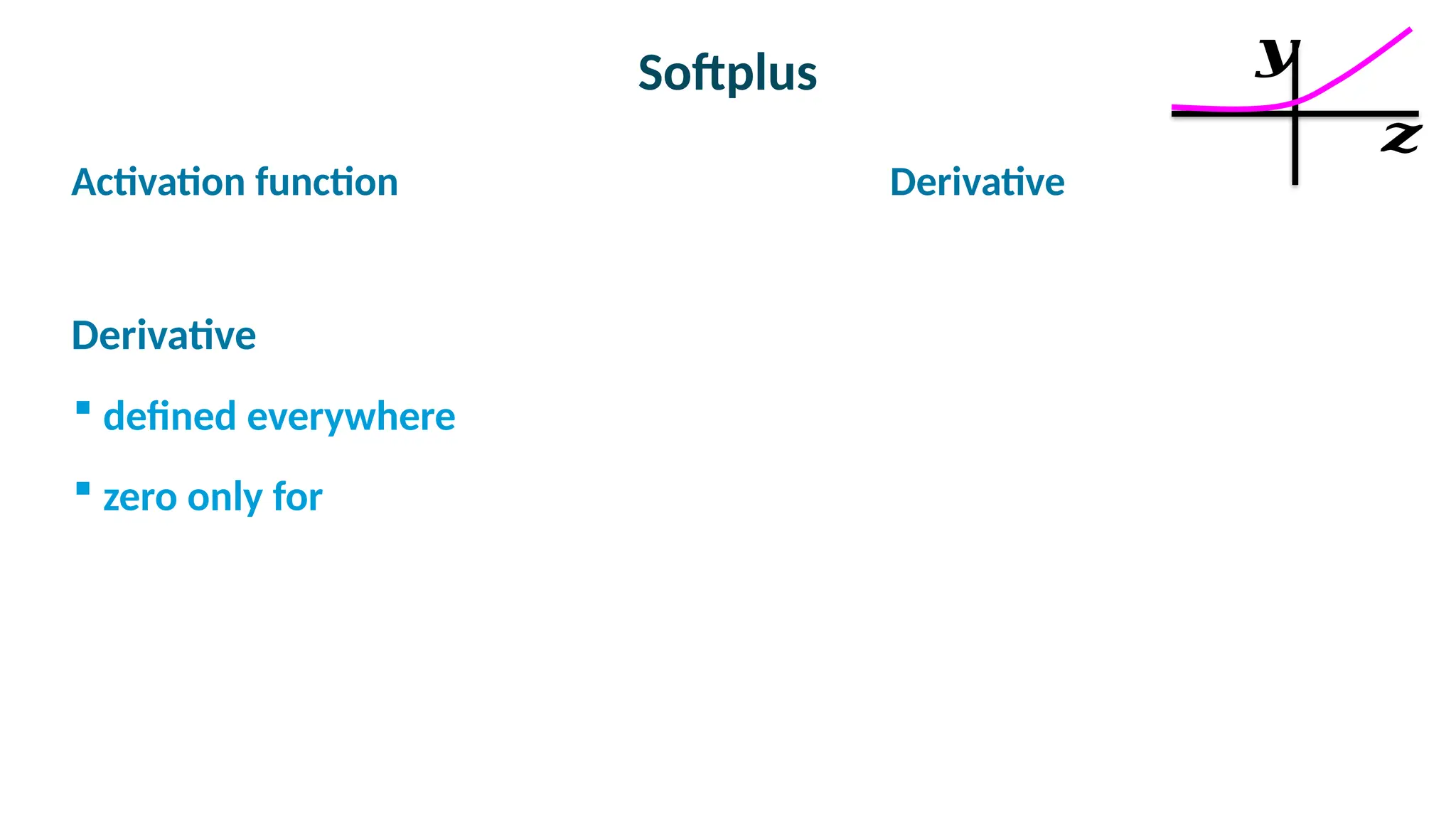
Softplus

Activation function Derivative

Derivative
 defined everywhere
 zero only for
𝒛
𝒚
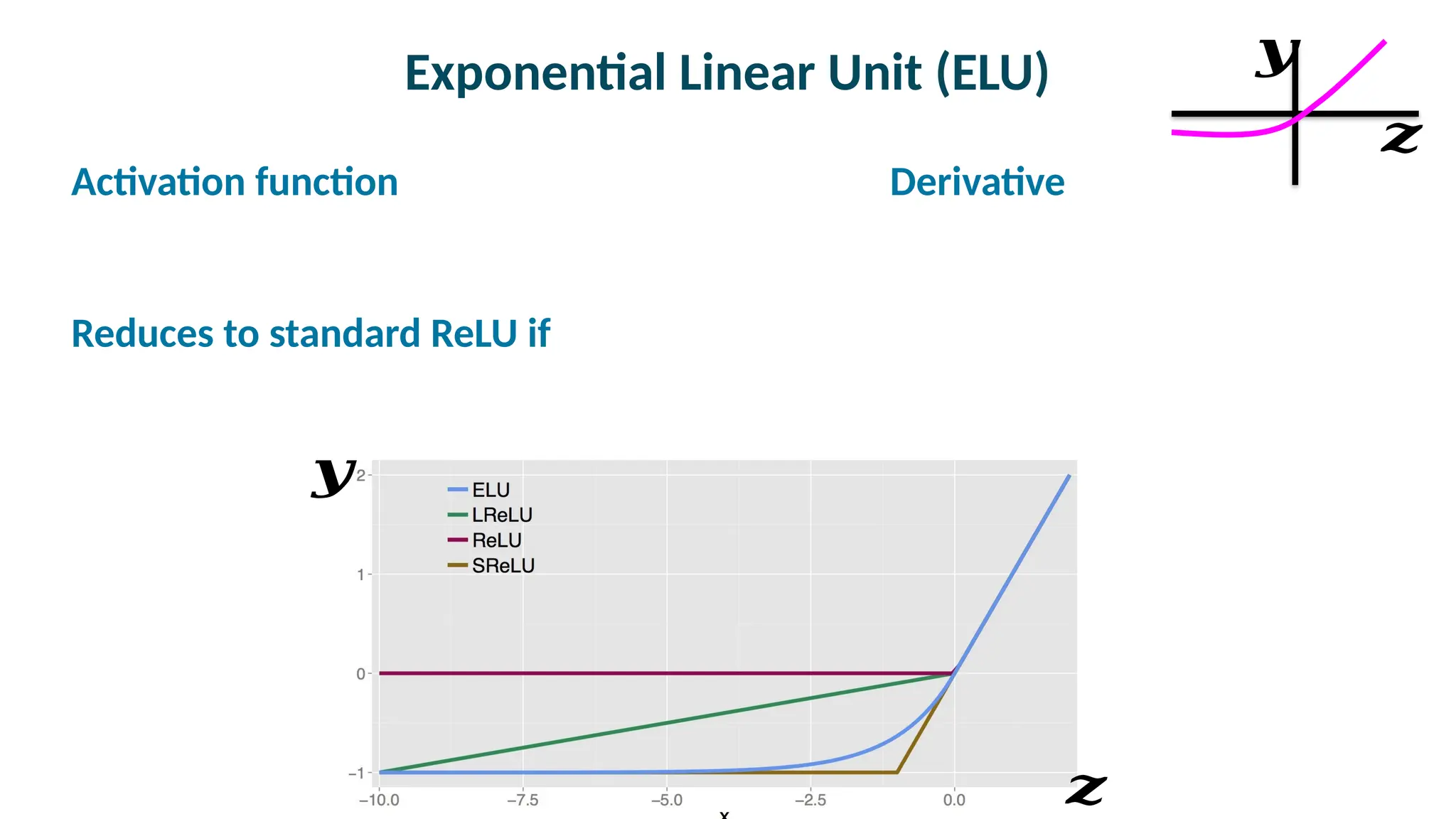
Exponential Linear Unit (ELU)

Activation function Derivative

Reduces to standard ReLU if
𝒛
𝒚
𝒛
𝒚
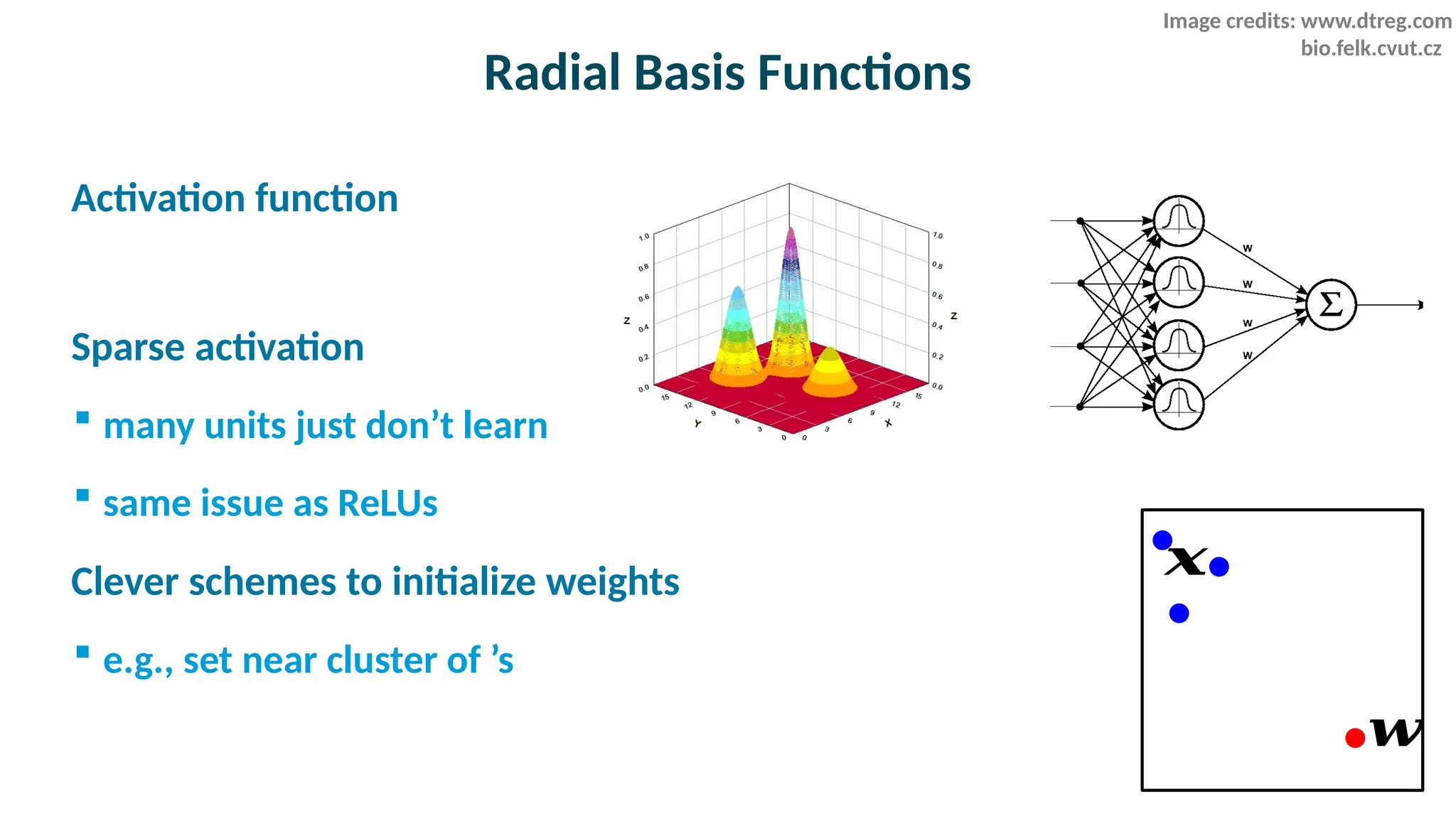
Radial Basis Functions

Activation function

Sparse activation
 many units just don’t learn
 same issue as ReLUs

Clever schemes to initialize weights
 e.g., set near cluster of ’s
𝒙
𝒘
Image credits: www.dtreg.com
bio.felk.cvut.cz
playground.tensorflow.org

Neural Networks and deep learning: activation loss

  • 1.
    CSCI 5922 Neural Networksand Deep Learning: Activation and Loss Functions Mike Mozer Department of Computer Science and Institute of Cognitive Science University of Colorado at Boulder
  • 2.
    Output Activation andLoss Functions  Every neural net specifies  an activation rule for the output unit(s)  a loss defined in terms of the output activation  First a bit of review…
  • 3.
    Cheat Sheet 1  Perceptron Activation function  Weight update  Linear associator (a.k.a. linear regression)  Activation function  Weight update assumes minimizing squared error loss assumes minimizing number of misclassifications
  • 4.
    Cheat Sheet 2  Twolayer net (a.k.a. logistic regression)  activation function  weight update  Deep(er) net  activation function same as above  weight update assumes minimizing squared error loss assumes minimizing squared error loss
  • 5.
    Squared Error Loss  Sensibleregardless of output range and output activation function  with logistic output unit  with tanh output unit 𝜕 𝑦 𝑗 𝜕 𝑧 𝑗 =𝑦 𝑗 (1−𝑦 𝑗) 𝜕 𝑦 𝑗 𝜕 𝑧 𝑗 =(1+ 𝑦 𝑗 )(1− 𝑦 𝑗 ) 𝑦 𝑗=tanh( 𝑧 𝑗 ) ¿ 2 1+exp ⁡(−𝑧 𝑗) −1 𝜕 𝐸 𝜕 𝑦 𝑗 =𝑦 𝑗 −𝑡 𝑗 Remember
  • 6.
    Logistic vs.Tanh • Output =.5  when no input evidence, bias=0 • Will trigger activation in next layer • Need large biases to neutralize  biases on different scale than other weights • Does not satisfy weight initialization assumption of mean activation = 0 • Output = 0  when no input evidence, bias=0 • Won’t trigger activation in next layer • Don’t need large biases • Satisfies weight initialization assumption
  • 7.
    Cross Entropy Loss  Usedwhen the target output represents a probability distribution  e.g., a single output unit that indicates the classification decision (yes, no) for an input Output denotes Bernoulli likelihood of class membership Target indicates true class probability (typically 0 or 1) Note: single value represents probability distribution over 2 alternatives  Cross entropy, , measures distance in bits from predicted distribution to target distribution 𝐸=𝐻=−𝑡 ln( 𝑦)−(1−𝑡)ln (1−𝑦 ) 𝜕 𝐸 𝜕 𝑦 = 𝑦−𝑡 𝑦(1− 𝑦)
  • 8.
    Squared Error VersusCross Entropy 𝜕 𝐸sqerr 𝜕 𝑧 =( 𝑦 −𝑡) 𝑦 (1− 𝑦 ) 𝜕 𝐸xentropy 𝜕 𝑧 =𝑦 −𝑡 𝜕 𝐸xentropy 𝜕 𝑦 = 𝑦 −𝑡 𝑦(1− 𝑦) 𝜕 𝐸sqerr 𝜕 𝑦 = 𝑦 −𝑡 𝜕 𝑦 𝜕 𝑧 = 𝑦 (1− 𝑦) 𝜕 𝑦 𝜕 𝑧 = 𝑦 (1− 𝑦)  Essentially, cross entropy does not suppress learning when output is confident (near 0,1)  net devotes its efforts to fitting target values exactly  e.g., consider situation where and
  • 9.
    Maximum Likelihood Estimation  Instatistics, many parameter estimation problems are formulated in terms of maximizing the likelihood of the data  find model parameters that maximize the likelihood of the data under the model  e.g., 10 coin flips producing 8 heads and 2 tails What is the coin’s bias?  Likelihood formulation  for What’s the relationship between and
  • 10.
    Probabilistic Interpretation ofSquared-Error Loss  Consider a network output and target  Suppose that the output is corrupted by Gaussian observation noise   where  We can define the likelihood of the target under this noise model 𝒚
  • 11.
    Probabilistic Interpretation ofSquared-Error Loss  For a set of training examples, , we can define the data set likelihood  where   Squared error can be viewed as likelihood under Gaussian observation noise  Other noise distributions can motivate alternative losses.  e.g., Laplace distributed noise and What is ?
  • 12.
    Categorical Outputs  We consideredthe case where the output denotes the probability of class membership  belonging to class versus  Instead of two possible categories, suppose there are n  e.g., animal, vegetable, mineral
  • 13.
    Categorical Outputs  Each inputcan belong to one category  denotes the probability that the input’s category is  To interpret as a probability distribution over the alternatives  and  Activation function  Exponentiation ensures nonnegative values Denominator ensures sum to 1  Known as softmax, and formerly, Luce choice rule
  • 14.
    Derivatives For CategoricalOutputs  For softmax output function  Weight update is the same as for two-category case!  …when expressed in terms of
  • 15.
    Rectified Linear Unit(ReLU)  Activation function Derivative   Advantages  fast to compute activation and derivatives  no squashing of back propagated error signal as long as unit is activated  discontinuity in derivative at z=0  sparsity ?  Disadvantages  can potentially lead to exploding gradients and activations  may waste units: units that are never activated above threshold won’t learn 𝒛 𝒚
  • 16.
    Leaky ReLU  Activation functionDerivative   Reduces to standard ReLU if  Trade off  leads to inefficient use of resources (underutilized units)  lose nonlinearity essential for interesting computation 𝒛 𝒚
  • 17.
    Softplus  Activation function Derivative  Derivative defined everywhere  zero only for 𝒛 𝒚
  • 18.
    Exponential Linear Unit(ELU)  Activation function Derivative  Reduces to standard ReLU if 𝒛 𝒚 𝒛 𝒚
  • 19.
    Radial Basis Functions  Activationfunction  Sparse activation  many units just don’t learn  same issue as ReLUs  Clever schemes to initialize weights  e.g., set near cluster of ’s 𝒙 𝒘 Image credits: www.dtreg.com bio.felk.cvut.cz
  • 20.

Editor's Notes

  • #13 ics colloq: “softmax is the biggest advance in neural nets…”