PDEA’s COLLEGE OFENGINEERING ENGINEERING
MANJARI (BK),PUNE
DEPARTMENT OF INFORMATION
TECHNOLOGY
Seminar on
Network Security
Guided by : Prof.Priyanka Kaurav .
Table of content
Introduction
Network Security Process
Network Security Components
Network Attacks
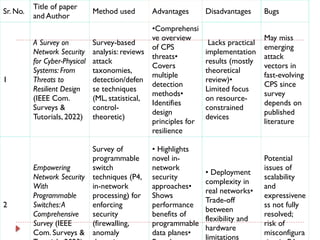
Research Papers Table
Conclusions
References
4.
Introduction
Information onnetworks may get compromised by
unauthorized access,
misuse,
malfunction,
modification,
destruction, or improper disclosure.
To prevent and monitor the unwanted threats policies
and practices are adopted.
The process of taking physical and software preventative
measures to protect the networking infrastructure is
network security.
5.
Network security process(1)
Authentication-
1. One-factor authentication-
This requires just one detail, password, to authenticate a user-
name.
2. Two-factor authentication-
Authentication is done with the help of secondary device such as a
mobile phone,ATM card, security token etc.
3. Three-factor authentication-
This authentication procedure is bounded to user’s body making
the authentication unique for each user. Fingerprint scan, retinal
scan are some of the ways to implement this authentication
technique.
6.
Access control-
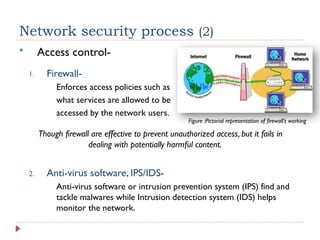
1.Firewall-
Enforces access policies such as
what services are allowed to be
accessed by the network users.
Though firewall are effective to prevent unauthorized access, but it fails in
dealing with potentially harmful content.
2. Anti-virus software, IPS/IDS-
Anti-virus software or intrusion prevention system (IPS) find and
tackle malwares while Intrusion detection system (IDS) helps
monitor the network.
Network security process (2)
Figure :Pictorial representation of firewall’s working
7.
Network security components(1)
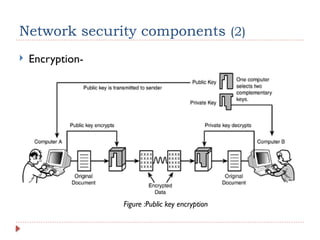
Encryption-
It is a process in cryptography in which a message or
information is encoded in such a way that only authorized
users (those who have decryption key) can access it.
Information or message, plaintext, is encrypted using an
encryption algorithm generating cipher-text that can only be
read after decryption, process of decrypting.
Two types-
Public key encryption
Private key encryption
Network security components(3)
Wireless security-
Prevention of unauthorized access or damage to computers
using wireless networks.
Types of wireless security-
Wired Equivalent Privacy (WEP)-
Introduced to provide data confidentiality comparable to that of wired
networks.
Succeeded completely by WPA in 2003.
Wi-Fi Protected Access (WPA)-
WPA and WPA2 are the two protocols developed by Wi-Fi alliance in 2003.
WPA3 was launched in Jan 2018 with better security than WPA2
Network Attacks (2)
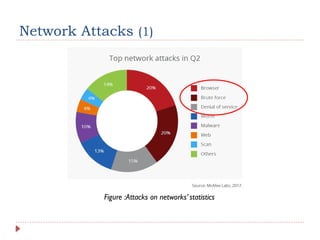
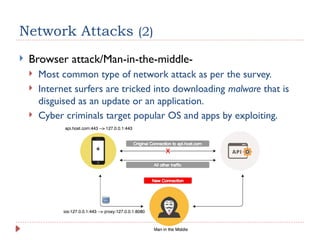
Browser attack/Man-in-the-middle-
Most common type of network attack as per the survey.
Internet surfers are tricked into downloading malware that is
disguised as an update or an application.
Cyber criminals target popular OS and apps by exploiting.
12.
Network Attacks (3)
Browser attack/Man-in-the-middle-
Prevention measures-
“Detecting a MITM attack can be very difficult as user does not realize
about the data traffic interception until data is modified. Taking
precautions in this attack is much better than cure.”- ComputerWeekly
Setting up an Intrusion detection system that monitors the
network and if someone tries to hijack, it gives immediate
alerts.
Use ofVirtual Private Network (VPN) that creates encrypted
tunnels providing additional security.
13.
Network Attacks (4)
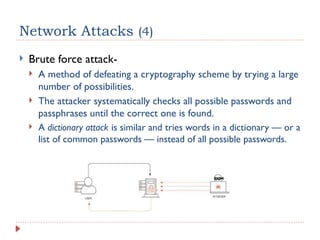
Brute force attack-
A method of defeating a cryptography scheme by trying a large
number of possibilities.
The attacker systematically checks all possible passwords and
passphrases until the correct one is found.
A dictionary attack is similar and tries words in a dictionary — or a
list of common passwords — instead of all possible passwords.
14.
Network Attacks (5)
Brute force attack-
Prevention measures-
Long and secure passwords, containing special characters, is
first and most important prevention measure to be taken.
Use of strong encryption algorithms like SHA-512.
Login limits should be set on the services that accept login.
Server software is generally set to do this out of the box, as it’s
a good security practice.
Occasionally changing passwords in a period of time.
15.
Network Attacks (6)
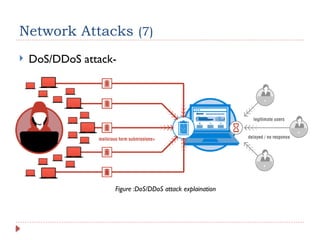
DoS/DDoS attack-
Making service unavailable temporarily or indefinitely by
flooding the network with useless traffic in order to overload
systems.
In DoS attack, typically one system is involved to flood a
network whereas in DDoS attack multiple systems and
multiple networks are involved.
Due to the overloading of requests on a network, legitimate
users get a difficulty in accessing the services.
Network Attacks (6)
DoS/DDoS attack-
Prevention measures-
Limiting traffic by authentication of users, which can be done by
configuring servers.
Using Firewall or Antivirus programs on the network.
Keeping a check on the suspicious activities, which may give a
hint on starting stage of the attack.
“With 1.35 terabits per second of traffic hit, Github, on 28 Feb 2018
survived the biggest DDoS attack ever recorded in the history.”
18.
Conclusion
Procedural stepsof network security are discussed,
comprising of authentication followed by access control.
Crucial network security components that enforces and
enriches the security over a network help in protecting a
network.
Network attacks that are common among the internet
world are visited to get a better understanding of the real
world.
19.
Sr. No.
Title ofpaper
and Author
Method used Advantages Disadvantages Bugs
1
A Survey on
Network Security
for Cyber-Physical
Systems: From
Threats to
Resilient Design
(IEEE Com.
Surveys &
Tutorials, 2022)
Survey-based
analysis: reviews
attack
taxonomies,
detection/defen
se techniques
(ML, statistical,
control-
theoretic)
•Comprehensi
ve overview
of CPS
threats•
Covers
multiple
detection
methods•
Identifies
design
principles for
resilience
Lacks practical
implementation
results (mostly
theoretical
review)•
Limited focus
on resource-
constrained
devices
May miss
emerging
attack
vectors in
fast-evolving
CPS since
survey
depends on
published
literature
2
Empowering
Network Security
With
Programmable
Switches:A
Comprehensive
Survey (IEEE
Com. Surveys &
Survey of
programmable
switch
techniques (P4,
in-network
processing) for
enforcing
security
(firewalling,
anomaly
• Highlights
novel in-
network
security
approaches•
Shows
performance
benefits of
programmable
data planes•
• Deployment
complexity in
real networks•
Trade-off
between
flexibility and
hardware
limitations
Potential
issues of
scalability
and
expressivene
ss not fully
resolved;
risk of
misconfigura






![network_security_ppt[1].pptx](https://cdn.slidesharecdn.com/ss_thumbnails/networksecurityppt1-230703125206-ba0a6eaf-thumbnail.jpg?width=640&height=640&fit=bounds)


