Networked Groups and Social Networks February 9 th , 2010 Elizabeth R. Miller
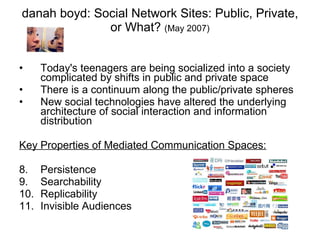
danah boyd: Social Network Sites: Public, Private, or What?  (May 2007) Today's teenagers are being socialized into a society complicated by shifts in public and private space There is a continuum along the public/private spheres New social technologies have altered the underlying architecture of social interaction and information distribution Key Properties of Mediated Communication Spaces: Persistence Searchability Replicability Invisible Audiences
Questions Questions:  Is there still a distinction in how young people and adults use public spaces? Or do you think that as older generations have begun to adopt these tools something has fundamentally changed?  Do you see a valid distinction between social network sites and social networking sites? Do you think this is valid as these sites have grown in popularity and more and more people have adopted these technologies? Could you think of examples of each?
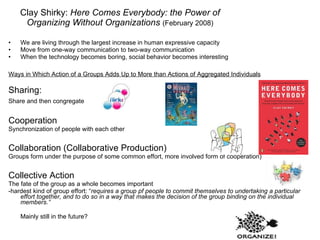
Clay Shirky:  Here Comes Everybody: the Power of Organizing Without Organizations   (February 2008) We are living through the largest increase in human expressive capacity Move from one-way communication to two-way communication When the technology becomes boring, social behavior becomes interesting Ways in Which Action of a Groups Adds Up to More than Actions of Aggregated Individuals Sharing: Share and then congregate    Cooperation Synchronization of people with each other Collaboration (Collaborative Production) Groups form under the purpose of some common effort, more involved form of cooperation) Collective Action The fate of the group as a whole becomes important -hardest kind of group effort: “ requires a group pf people to commit themselves to undertaking a particular effort together, and to do so in a way that makes the decision of the group binding on the individual members.” Mainly still in the future?
Clay Shirky:  Sharing Anchors Community (Ch 2) Groups become more complex the larger they get; it becomes impossible for everyone to interact, inevitably leads to hierarchies Now, groups are forming without set boundaries and social tools allow for a new kind of group forming (MeetUp example) Technology that allows this to happen by  “abandoning any hope of such oversight in the first place, instead putting in place tools for the self-synchronization of otherwise latent groups”
Questions Shirky concludes that moving forward he expects an increase in collective action. Given that this talk was from February of 2008, can you think of some examples in which the kind of collection action he talks about has become more normal and integrated in our society? Have we seen the mass scale adoption of sharing, conversation, collaboration and collective action? Are we at a point now where we’ve seen the technology become boring? If so, where do you think the future lies?  What do you think the relationship is between collaborative action and creative effective social change?
Clay Shirky  Gin, Television, and Social Surplus Cognitive Surplus  as an asset rather than a crisis Now, people like to  produce  and  share  just as much as they like to  consume . New era of  participation “ If we carve out a little bit of the cognitive surplus and deploy it here, could we make a good thing happen?” - Shirky says yes. What do you think? Can you think of examples?

Networked Groups And Social Networks

  • 1.
    Networked Groups andSocial Networks February 9 th , 2010 Elizabeth R. Miller
  • 2.
    danah boyd: SocialNetwork Sites: Public, Private, or What? (May 2007) Today's teenagers are being socialized into a society complicated by shifts in public and private space There is a continuum along the public/private spheres New social technologies have altered the underlying architecture of social interaction and information distribution Key Properties of Mediated Communication Spaces: Persistence Searchability Replicability Invisible Audiences
  • 3.
    Questions Questions: Is there still a distinction in how young people and adults use public spaces? Or do you think that as older generations have begun to adopt these tools something has fundamentally changed? Do you see a valid distinction between social network sites and social networking sites? Do you think this is valid as these sites have grown in popularity and more and more people have adopted these technologies? Could you think of examples of each?
  • 4.
    Clay Shirky: Here Comes Everybody: the Power of Organizing Without Organizations (February 2008) We are living through the largest increase in human expressive capacity Move from one-way communication to two-way communication When the technology becomes boring, social behavior becomes interesting Ways in Which Action of a Groups Adds Up to More than Actions of Aggregated Individuals Sharing: Share and then congregate Cooperation Synchronization of people with each other Collaboration (Collaborative Production) Groups form under the purpose of some common effort, more involved form of cooperation) Collective Action The fate of the group as a whole becomes important -hardest kind of group effort: “ requires a group pf people to commit themselves to undertaking a particular effort together, and to do so in a way that makes the decision of the group binding on the individual members.” Mainly still in the future?
  • 5.
    Clay Shirky: Sharing Anchors Community (Ch 2) Groups become more complex the larger they get; it becomes impossible for everyone to interact, inevitably leads to hierarchies Now, groups are forming without set boundaries and social tools allow for a new kind of group forming (MeetUp example) Technology that allows this to happen by “abandoning any hope of such oversight in the first place, instead putting in place tools for the self-synchronization of otherwise latent groups”
  • 6.
    Questions Shirky concludesthat moving forward he expects an increase in collective action. Given that this talk was from February of 2008, can you think of some examples in which the kind of collection action he talks about has become more normal and integrated in our society? Have we seen the mass scale adoption of sharing, conversation, collaboration and collective action? Are we at a point now where we’ve seen the technology become boring? If so, where do you think the future lies? What do you think the relationship is between collaborative action and creative effective social change?
  • 7.
    Clay Shirky Gin, Television, and Social Surplus Cognitive Surplus as an asset rather than a crisis Now, people like to produce and share just as much as they like to consume . New era of participation “ If we carve out a little bit of the cognitive surplus and deploy it here, could we make a good thing happen?” - Shirky says yes. What do you think? Can you think of examples?