





















Some session changes

                            h t t p : / / w w w. w u a l a . c o m / S h e m p 6 5 /
                            L e a r n i n g S o l u t i o n s 2 0 11 / S e s s i o n 2 0 5 /

Wednesday, March 23, 2011
BRANDON CARSON
                     l e a r n i n g & d e v e l o p m e n t @ Ya h o o !


Wednesday, March 23, 2011
2 parts to our session:

    how we got here
    what I did
                              © Flickr : kraynikov
Wednesday, March 23, 2011
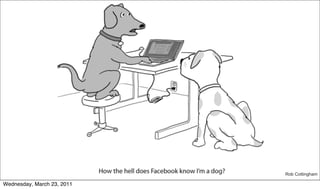
Rob Cottingham

Wednesday, March 23, 2011
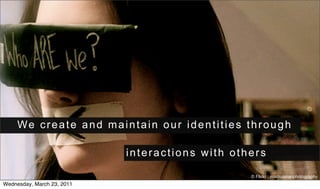
We create and maintain our identities through

                            interactions with others

                                                 © Flickr : madrussianphotography
Wednesday, March 23, 2011
Media can affect how we interact with others


                                           © Flickr : madrussianphotography
Wednesday, March 23, 2011
Who you are as a person, and your expertise
   and passions, are more important to your career
   than ever


Wednesday, March 23, 2011
welcome to the
                 A G E  O F     I M M E D I A C Y


Wednesday, March 23, 2011
Yo u r s k i l l s , e x p e r t i s e , c o n n e c t i o n s , r e p u t a t i o n


              and authority become your personal currency


Wednesday, March 23, 2011
Sometimes our online representation is different

     than our physical representation


Wednesday, March 23, 2011
To d a y, w e ’ r e l o o k i n g a t h o w a s p e c i f i c g r o u p
          represented themselves in a social learning
          environment


Wednesday, March 23, 2011
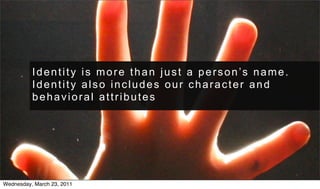
Identity is more than just a person’s name.
          Identity also includes our character and
          behavioral attributes


Wednesday, March 23, 2011
W E A R E S H I F T I N G T O “ A LWAY S O N ”

Wednesday, March 23, 2011
The days of the Internet as an identifiably
 “separate” thing are over


Wednesday, March 23, 2011
The Internet is no longer something we
 do -- it’s how we live -- it’s where we are


Wednesday, March 23, 2011
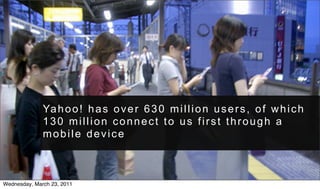
Ya h o o ! h a s o v e r 6 3 0 m i l l i o n u s e r s , o f w h i c h
              130 million connect to us first through a
              mobile device


Wednesday, March 23, 2011
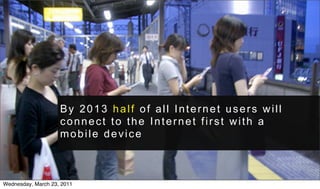
By 2013 half of all Internet users will
                    connect to the Internet first with a
                    mobile device


Wednesday, March 23, 2011
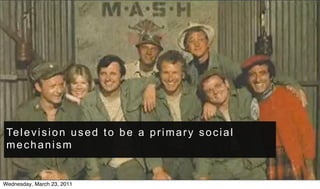
Te l e v i s i o n u s e d t o b e a p r i m a r y s o c i a l
 mechanism


Wednesday, March 23, 2011
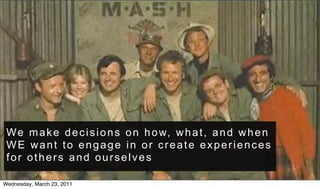
W e m a k e d e c i s i o n s o n h o w, w h a t , a n d w h e n
 WE want to engage in or create experiences
 for others and ourselves

Wednesday, March 23, 2011
Piracy is consumers telling the
                  entertainment industry how to give
                  them what they want
                                                       © Flickr : anttonen
Wednesday, March 23, 2011
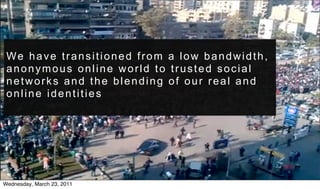
We have transitioned from a low bandwidth,
 anonymous online world to trusted social
 networks and the blending of our real and
 online identities


Wednesday, March 23, 2011
Did social media cause the recent Arab
 uprisings?


Wednesday, March 23, 2011
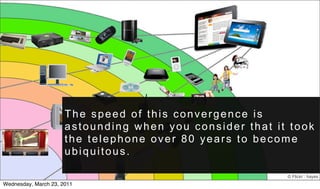
The speed of this convergence is
                      astounding when you consider that it took
                      the telephone over 80 years to become
                      ubiquitous.

                                                          © Flickr : hayes
Wednesday, March 23, 2011
Our increasingly demanding work world
     r e q u i r e s p e o p l e t o p e r f o r m b e t t e r, g e t
     i n f o r m a t i o n q u i c k e r, a n d r e l y o n e a c h
     other for practical discourse in how to
     do things better


                                                                        © Flickr : tantek
Wednesday, March 23, 2011
Our increasingly demanding work world
     Our human ability to cooperate with
     r e q u i r e s p e o p l e t o p e r f o r m b e t t e r, g e t
     e a c h o t h e r, r e g a r d l e s s o f o u r s e l f - i n t e r e s t ,
     i n f o r m a t i o n q u i c k e r, a n d r e l y o n e a c h
     is the one reason we, as a species,
     other for practical discourse in how to
     achieve great things
     d o t h i n g s b e t t e r.


                                                                                    © Flickr : tantek
Wednesday, March 23, 2011
The two principal traits that underlie
      human evolutionary success are the
      unusual ability of nonrelatives to
      cooperate and social learning, the
      ability to copy and learn from what
      others are doing
                            Kim Hill, social anthropologist


                                                              © Flickr : tantek
Wednesday, March 23, 2011
© Flickr : theirhistory
Wednesday, March 23, 2011
SOCIAL IDENTITY IN THE ENTERPRISE


Wednesday, March 23, 2011
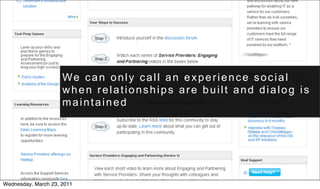
We can only call an experience social
                     when relationships are built and dialog is
                     maintained


Wednesday, March 23, 2011
BDMs:
                  20-25 new hires
                  Va r y i n g l e v e l s o f t e c h n i c a l a c u m e n
                  Comfortable with enterprise sales
                  Region-based

Wednesday, March 23, 2011
K E Y B E H AV I O R S


                               © Flickr : theirhistory
Wednesday, March 23, 2011
K E Y B E H AV I O R S


                            Competitive
                            Collaborative
                            Participatory


                                            © Flickr : theirhistory
Wednesday, March 23, 2011
COMPETITIVENESS


Wednesday, March 23, 2011
COMPETITIVENESS

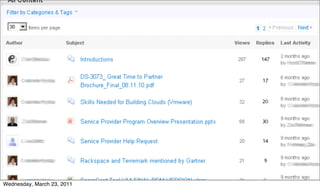
     Credibility came through various means:
     Ti t l e o r p o s i t i o n i n t h e c o m p a n y
     Number of posts
     Succinctness and quality of the message


Wednesday, March 23, 2011
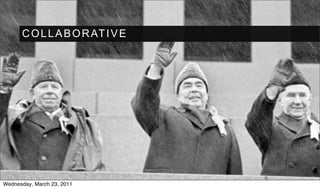
C O L L A B O R AT I V E


Wednesday, March 23, 2011
C O L L A B O R AT I V E


     Participants enjoyed working directly with
     colleagues, but also saw their own creative
     process accelerated by simply watching
     their colleagues


Wednesday, March 23, 2011
C O L L A B O R AT I V E


      Participants were able to see the results of
      t h e i r c o l l a b o r a t i o n q u i c k l y, a n d w e r e a b l e
      to reflect and explore options immediately


Wednesday, March 23, 2011
C O L L A B O R AT I V E


     They were able to share more information,
     strategies, and coordinate sales meetings
     with colleagues they normally wouldn’t
     work with


Wednesday, March 23, 2011
PA R T I C I PAT O R Y


Wednesday, March 23, 2011
PA R T I C I PAT O R Y


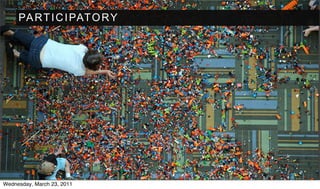
                 The community was open to anyone in the
                 sales organization. Some people feared
                 being “open and honest”


Wednesday, March 23, 2011
PA R T I C I PAT O R Y


                 There was sensitivity to expertise,
                 or at least the perception of expertise


Wednesday, March 23, 2011
When we bring social platforms to life
                  we cede a certain level of control

                  We may not be able to anticipate where the
                  conversation goes


Wednesday, March 23, 2011
Differences in online/offline
                   representation:

                   Group-think occurred quickly


Wednesday, March 23, 2011
Differences in online/offline
                   representation:

                   Heavy reliance on status quo


Wednesday, March 23, 2011
Differences in online/offline
                   representation:

                   Engagement relied on direct authority


Wednesday, March 23, 2011
Differences in online/offline
                   representation:

                   Deeper values


Wednesday, March 23, 2011
Differences in online/offline
                   representation:

                   Group-think occurred quickly
                   Heavy reliance on status quo
                   Engagement relied on direct authority
                   Deeper values


Wednesday, March 23, 2011
Differences in online/offline
                   representation:

                   Group-think occurred quickly
                   Heavy reliance on status quo
                   Engagement relied on direct authority
                   Deeper values


Wednesday, March 23, 2011
It is key to understand how people
                   represent themselves across media

                   Maybe we can use that understanding to
                   construct more meaningful learning
                   experiences


Wednesday, March 23, 2011
THANK YOU


     brandonc@yahoo-inc.com


Wednesday, March 23, 2011
DESIGN TIPS

                   It’s more difficult for your participants
                   to get involved in a community when:
                   Its population is too large -- engaging in
                   conversation with 600 people is ‘difficult’

                   It’s not ‘moderated’ by an active agent

                   There is a sense of staleness or inaction


                                                        © Flickr : darrenhester
Wednesday, March 23, 2011
DESIGN TIPS


                    Provide focused sharing opportunities

                    Social learning networks are perfect for
                    incubating “knowledge clusters”


                                                        © Flickr : darrenhester
Wednesday, March 23, 2011
DESIGN TIPS


                   Point systems

                   Utilities to encourage individual sharing

                   Commenting and rating utilities

                   G a m e f u l e l e m e n t s ( c o m p e t i t i v e p l a y,
                   leaderboards)

                                                                                © Flickr : darrenhester
Wednesday, March 23, 2011
DESIGN TIPS


                   Be careful not to just add social elements
                   around static experiences

                   There should always be an instructionally
                   justifiable reason for integrating
                   a social element


                                                       © Flickr : darrenhester
Wednesday, March 23, 2011
DESIGN TIPS


                   Reach learners where they are

                   Determine if a “new” social collaboration
                   platform is necessary


                                                       © Flickr : darrenhester
Wednesday, March 23, 2011
DESIGN TIPS


                   Create activities that rely on group-work,
                   but be careful about groupthink


                                                       © Flickr : darrenhester
Wednesday, March 23, 2011
DESIGN TIPS


                   Balance connection and disconnection.


                                                     © Flickr : darrenhester
Wednesday, March 23, 2011

Learning, Identity and Social Media

  • 1.
    Some session changes h t t p : / / w w w. w u a l a . c o m / S h e m p 6 5 / L e a r n i n g S o l u t i o n s 2 0 11 / S e s s i o n 2 0 5 / Wednesday, March 23, 2011
  • 2.
    BRANDON CARSON l e a r n i n g & d e v e l o p m e n t @ Ya h o o ! Wednesday, March 23, 2011
  • 3.
    2 parts toour session: how we got here what I did © Flickr : kraynikov Wednesday, March 23, 2011
  • 4.
  • 5.
  • 6.
    We create andmaintain our identities through interactions with others © Flickr : madrussianphotography Wednesday, March 23, 2011
  • 7.
    Media can affecthow we interact with others © Flickr : madrussianphotography Wednesday, March 23, 2011
  • 8.
  • 9.
    Who you areas a person, and your expertise and passions, are more important to your career than ever Wednesday, March 23, 2011
  • 10.
    welcome to the A G E O F I M M E D I A C Y Wednesday, March 23, 2011
  • 11.
    Yo u rs k i l l s , e x p e r t i s e , c o n n e c t i o n s , r e p u t a t i o n and authority become your personal currency Wednesday, March 23, 2011
  • 12.
    Sometimes our onlinerepresentation is different than our physical representation Wednesday, March 23, 2011
  • 13.
    To d ay, w e ’ r e l o o k i n g a t h o w a s p e c i f i c g r o u p represented themselves in a social learning environment Wednesday, March 23, 2011
  • 14.
    Identity is morethan just a person’s name. Identity also includes our character and behavioral attributes Wednesday, March 23, 2011
  • 15.
    W E AR E S H I F T I N G T O “ A LWAY S O N ” Wednesday, March 23, 2011
  • 16.
    The days ofthe Internet as an identifiably “separate” thing are over Wednesday, March 23, 2011
  • 17.
    The Internet isno longer something we do -- it’s how we live -- it’s where we are Wednesday, March 23, 2011
  • 18.
    Ya h oo ! h a s o v e r 6 3 0 m i l l i o n u s e r s , o f w h i c h 130 million connect to us first through a mobile device Wednesday, March 23, 2011
  • 19.
    By 2013 halfof all Internet users will connect to the Internet first with a mobile device Wednesday, March 23, 2011
  • 20.
    Te l ev i s i o n u s e d t o b e a p r i m a r y s o c i a l mechanism Wednesday, March 23, 2011
  • 21.
    W e ma k e d e c i s i o n s o n h o w, w h a t , a n d w h e n WE want to engage in or create experiences for others and ourselves Wednesday, March 23, 2011
  • 22.
    Piracy is consumerstelling the entertainment industry how to give them what they want © Flickr : anttonen Wednesday, March 23, 2011
  • 23.
    We have transitionedfrom a low bandwidth, anonymous online world to trusted social networks and the blending of our real and online identities Wednesday, March 23, 2011
  • 24.
    Did social mediacause the recent Arab uprisings? Wednesday, March 23, 2011
  • 25.
    The speed ofthis convergence is astounding when you consider that it took the telephone over 80 years to become ubiquitous. © Flickr : hayes Wednesday, March 23, 2011
  • 26.
    Our increasingly demandingwork world r e q u i r e s p e o p l e t o p e r f o r m b e t t e r, g e t i n f o r m a t i o n q u i c k e r, a n d r e l y o n e a c h other for practical discourse in how to do things better © Flickr : tantek Wednesday, March 23, 2011
  • 27.
    Our increasingly demandingwork world Our human ability to cooperate with r e q u i r e s p e o p l e t o p e r f o r m b e t t e r, g e t e a c h o t h e r, r e g a r d l e s s o f o u r s e l f - i n t e r e s t , i n f o r m a t i o n q u i c k e r, a n d r e l y o n e a c h is the one reason we, as a species, other for practical discourse in how to achieve great things d o t h i n g s b e t t e r. © Flickr : tantek Wednesday, March 23, 2011
  • 28.
    The two principaltraits that underlie human evolutionary success are the unusual ability of nonrelatives to cooperate and social learning, the ability to copy and learn from what others are doing Kim Hill, social anthropologist © Flickr : tantek Wednesday, March 23, 2011
  • 29.
    © Flickr :theirhistory Wednesday, March 23, 2011
  • 30.
    SOCIAL IDENTITY INTHE ENTERPRISE Wednesday, March 23, 2011
  • 31.
  • 32.
    We can onlycall an experience social when relationships are built and dialog is maintained Wednesday, March 23, 2011
  • 33.
  • 34.
    BDMs: 20-25 new hires Va r y i n g l e v e l s o f t e c h n i c a l a c u m e n Comfortable with enterprise sales Region-based Wednesday, March 23, 2011
  • 35.
    K E YB E H AV I O R S © Flickr : theirhistory Wednesday, March 23, 2011
  • 36.
    K E YB E H AV I O R S Competitive Collaborative Participatory © Flickr : theirhistory Wednesday, March 23, 2011
  • 37.
  • 38.
    COMPETITIVENESS Credibility came through various means: Ti t l e o r p o s i t i o n i n t h e c o m p a n y Number of posts Succinctness and quality of the message Wednesday, March 23, 2011
  • 39.
    C O LL A B O R AT I V E Wednesday, March 23, 2011
  • 40.
    C O LL A B O R AT I V E Participants enjoyed working directly with colleagues, but also saw their own creative process accelerated by simply watching their colleagues Wednesday, March 23, 2011
  • 41.
    C O LL A B O R AT I V E Participants were able to see the results of t h e i r c o l l a b o r a t i o n q u i c k l y, a n d w e r e a b l e to reflect and explore options immediately Wednesday, March 23, 2011
  • 42.
    C O LL A B O R AT I V E They were able to share more information, strategies, and coordinate sales meetings with colleagues they normally wouldn’t work with Wednesday, March 23, 2011
  • 43.
    PA R TI C I PAT O R Y Wednesday, March 23, 2011
  • 44.
    PA R TI C I PAT O R Y The community was open to anyone in the sales organization. Some people feared being “open and honest” Wednesday, March 23, 2011
  • 45.
    PA R TI C I PAT O R Y There was sensitivity to expertise, or at least the perception of expertise Wednesday, March 23, 2011
  • 46.
    When we bringsocial platforms to life we cede a certain level of control We may not be able to anticipate where the conversation goes Wednesday, March 23, 2011
  • 47.
    Differences in online/offline representation: Group-think occurred quickly Wednesday, March 23, 2011
  • 48.
    Differences in online/offline representation: Heavy reliance on status quo Wednesday, March 23, 2011
  • 49.
    Differences in online/offline representation: Engagement relied on direct authority Wednesday, March 23, 2011
  • 50.
    Differences in online/offline representation: Deeper values Wednesday, March 23, 2011
  • 51.
    Differences in online/offline representation: Group-think occurred quickly Heavy reliance on status quo Engagement relied on direct authority Deeper values Wednesday, March 23, 2011
  • 52.
    Differences in online/offline representation: Group-think occurred quickly Heavy reliance on status quo Engagement relied on direct authority Deeper values Wednesday, March 23, 2011
  • 53.
    It is keyto understand how people represent themselves across media Maybe we can use that understanding to construct more meaningful learning experiences Wednesday, March 23, 2011
  • 54.
    THANK YOU brandonc@yahoo-inc.com Wednesday, March 23, 2011
  • 55.
    DESIGN TIPS It’s more difficult for your participants to get involved in a community when: Its population is too large -- engaging in conversation with 600 people is ‘difficult’ It’s not ‘moderated’ by an active agent There is a sense of staleness or inaction © Flickr : darrenhester Wednesday, March 23, 2011
  • 56.
    DESIGN TIPS Provide focused sharing opportunities Social learning networks are perfect for incubating “knowledge clusters” © Flickr : darrenhester Wednesday, March 23, 2011
  • 57.
    DESIGN TIPS Point systems Utilities to encourage individual sharing Commenting and rating utilities G a m e f u l e l e m e n t s ( c o m p e t i t i v e p l a y, leaderboards) © Flickr : darrenhester Wednesday, March 23, 2011
  • 58.
    DESIGN TIPS Be careful not to just add social elements around static experiences There should always be an instructionally justifiable reason for integrating a social element © Flickr : darrenhester Wednesday, March 23, 2011
  • 59.
    DESIGN TIPS Reach learners where they are Determine if a “new” social collaboration platform is necessary © Flickr : darrenhester Wednesday, March 23, 2011
  • 60.
    DESIGN TIPS Create activities that rely on group-work, but be careful about groupthink © Flickr : darrenhester Wednesday, March 23, 2011
  • 61.
    DESIGN TIPS Balance connection and disconnection. © Flickr : darrenhester Wednesday, March 23, 2011