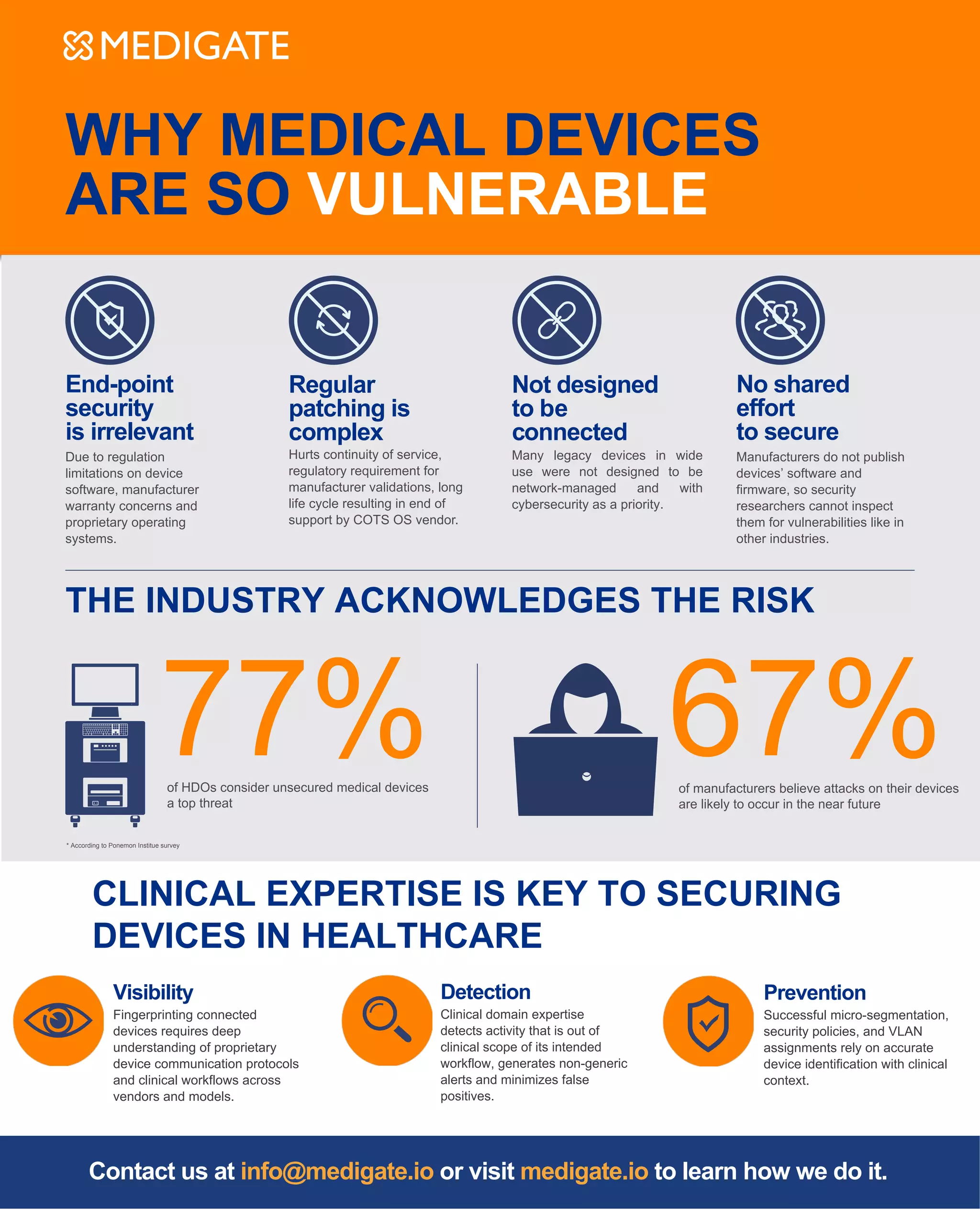
Regular
patching is
complex
Hurts continuity of service,
regulatory requirement for
manufacturer validations, long
life cycle resulting in end of
support by COTS OS vendor.
Not designed
to be
connected
Many legacy devices in wide
use were not designed to be
network-managed and with
cybersecurity as a priority.
No shared
effort
to secure
Manufacturers do not publish
devices’ software and
firmware, so security
researchers cannot inspect
them for vulnerabilities like in
other industries.
End-point
security
is irrelevant
Due to regulation
limitations on device
software, manufacturer
warranty concerns and
proprietary operating
systems.
Contact us at info@medigate.io or visit medigate.io to learn how we do it.
THE INDUSTRY ACKNOWLEDGES THE RISK
of HDOs consider unsecured medical devices
a top threat
77% of manufacturers believe attacks on their devices
are likely to occur in the near future
67%
* According to Ponemon Institue survey
Prevention
Successful micro-segmentation,
security policies, and VLAN
assignments rely on accurate
device identification with clinical
context.
Visibility
Fingerprinting connected
devices requires deep
understanding of proprietary
device communication protocols
and clinical workflows across
vendors and models.
Detection
Clinical domain expertise
detects activity that is out of
clinical scope of its intended
workflow, generates non-generic
alerts and minimizes false
positives.
CLINICAL EXPERTISE IS KEY TO SECURING
DEVICES IN HEALTHCARE
WHY MEDICAL DEVICES
ARE SO VULNERABLE

Why Medical Devices Are So Vulnerable

  • 1.
    Regular patching is complex Hurts continuityof service, regulatory requirement for manufacturer validations, long life cycle resulting in end of support by COTS OS vendor. Not designed to be connected Many legacy devices in wide use were not designed to be network-managed and with cybersecurity as a priority. No shared effort to secure Manufacturers do not publish devices’ software and firmware, so security researchers cannot inspect them for vulnerabilities like in other industries. End-point security is irrelevant Due to regulation limitations on device software, manufacturer warranty concerns and proprietary operating systems. Contact us at info@medigate.io or visit medigate.io to learn how we do it. THE INDUSTRY ACKNOWLEDGES THE RISK of HDOs consider unsecured medical devices a top threat 77% of manufacturers believe attacks on their devices are likely to occur in the near future 67% * According to Ponemon Institue survey Prevention Successful micro-segmentation, security policies, and VLAN assignments rely on accurate device identification with clinical context. Visibility Fingerprinting connected devices requires deep understanding of proprietary device communication protocols and clinical workflows across vendors and models. Detection Clinical domain expertise detects activity that is out of clinical scope of its intended workflow, generates non-generic alerts and minimizes false positives. CLINICAL EXPERTISE IS KEY TO SECURING DEVICES IN HEALTHCARE WHY MEDICAL DEVICES ARE SO VULNERABLE