.NET Framework
By Ezra Kemboi
+254799215984
 The .NET framework is a platform for rapid and easier
building, deploying, and running secured .NET software
components
to be integrated in applications as well as for rapid
developing XML Web Services and applications.
 .NET is a platform that provides a standardized set of
services.
It’s just like Windows, except distributed over the
Internet.
It exports a common interface so that it’s programs
can be run on any system that supports .NET.
Functions of .NET Framework
 Facilitates the developments of desktop window, and
Web-based application services on Windows
platform and make them available and accessible not
only on Windows platform but also on other
platforms through common protocols such as SOAP
and HTTP.
 Simplifies the componentization especially for
Component Object Model(COM), Distributed COM
(DCOM) technology.
Continuation…
 Facilitates developments of distributed components
by Remoting Channel technology.
 supports the interoperability between COM and
.NET components. A .NET component can work with
any existing COM components.
Parts of.NET Framework.
1. Common Language Runtime (CLR)-
It is a runtime environment for controlled
execution of programmed code .It executes .NET
applications.
2. Unified framework basic class libraries-Delivers
basic functionality for developing ;
XML,ADO.NET,LINQ,ASP.NET,WPF,WWF,WF.
Common Language Runtime (CLR)-
 CLR is a virtual machine environment sitting on the
top of Windows operating system.
 CLR consists of Common Type System (CTS), Just-
In-Time IL Compiler (JIT),Execution unit.
 The IL code is translated into native code by JIT
compiler in CLR. IL code is verified by CTS first to
check the validity of data type used in the code.
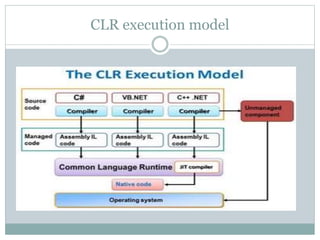
 The figure below shows how the CLR works.
CLR execution model
Explanation
 NET framework integrates multiple programming languages (VB, managed
VC++,C#, etc.) by CLR implementation. Not only a component in one language can
access the services provided by other components in other languages but also a class
in one language can inherit properties and methods from related classes in other
Languages.
 Framework Class Library provides a set of reusable classes for component
development. The CTS defines a standard set of data types and rules for creating
new types.
 The CLR knows how to execute these types. There are two categories of types:
Reference type and Value type. The code targeting CLR and to be executed by CLR is
called .NET managed code. All MS language compilers generate manage codes
that conform to the CTS.
 Regardless of the types of source code programming languages, IL code can
communicate with each other through the support of CLR. The IL code can be either
in the format of executable (.EXE) or Dynamic Link Library (.DLL). If these IL code
are generated by .NET compiler, they are called managed code. The managed code
can be executed only on .NET aware platform.
 Some DLL or EXE generated by non .NET compilers (such as early version of VC++)
are called unmanaged code.
Features of CLR
 Improves performance
 Ability to use other languages
 Language features of OOP i.e
inheritance,overloading) and interfaces.
 Allows creation of multi threaded, scalable
applications.
 Garbage collection.
.NET Framework Class library
 NET framework class library is a collection of reusable basic classes
that are well organized by namespaces.
 A namespace is just like a package which consists of many classes
and sub namespaces. It is deployed as a component class library
itself and organized in a component–based hierarchy.
 Some of the namespaces include: System, System.IO,
System.Web.System.Windows.Forms, System.XML, and System.
Text, System. Globalization, System. Data, System. Diagnostics
etc….
 Framework class library collects all classes including Windows
Foundation Classes (WFC) into a single unified set of class.
 The Common Language Specification (CLS) describes how a .NET
language should work .Describes the syntaxes of each supported
language in the framework.
 The Common Type System (CTS) describes how data types should
work together.
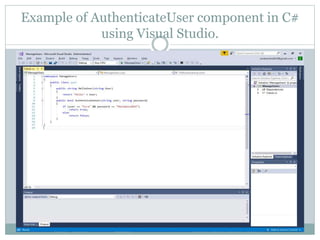
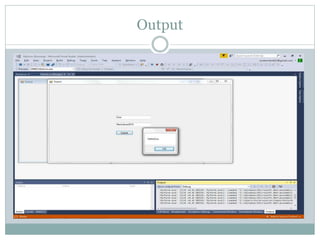
Example of AuthenticateUser component in C#
using Visual Studio.
Output

.Net framework

  • 1.
    .NET Framework By EzraKemboi +254799215984
  • 2.
     The .NETframework is a platform for rapid and easier building, deploying, and running secured .NET software components to be integrated in applications as well as for rapid developing XML Web Services and applications.  .NET is a platform that provides a standardized set of services. It’s just like Windows, except distributed over the Internet. It exports a common interface so that it’s programs can be run on any system that supports .NET.
  • 3.
    Functions of .NETFramework  Facilitates the developments of desktop window, and Web-based application services on Windows platform and make them available and accessible not only on Windows platform but also on other platforms through common protocols such as SOAP and HTTP.  Simplifies the componentization especially for Component Object Model(COM), Distributed COM (DCOM) technology.
  • 4.
    Continuation…  Facilitates developmentsof distributed components by Remoting Channel technology.  supports the interoperability between COM and .NET components. A .NET component can work with any existing COM components.
  • 5.
    Parts of.NET Framework. 1.Common Language Runtime (CLR)- It is a runtime environment for controlled execution of programmed code .It executes .NET applications. 2. Unified framework basic class libraries-Delivers basic functionality for developing ; XML,ADO.NET,LINQ,ASP.NET,WPF,WWF,WF.
  • 6.
    Common Language Runtime(CLR)-  CLR is a virtual machine environment sitting on the top of Windows operating system.  CLR consists of Common Type System (CTS), Just- In-Time IL Compiler (JIT),Execution unit.  The IL code is translated into native code by JIT compiler in CLR. IL code is verified by CTS first to check the validity of data type used in the code.  The figure below shows how the CLR works.
  • 7.
  • 8.
    Explanation  NET frameworkintegrates multiple programming languages (VB, managed VC++,C#, etc.) by CLR implementation. Not only a component in one language can access the services provided by other components in other languages but also a class in one language can inherit properties and methods from related classes in other Languages.  Framework Class Library provides a set of reusable classes for component development. The CTS defines a standard set of data types and rules for creating new types.  The CLR knows how to execute these types. There are two categories of types: Reference type and Value type. The code targeting CLR and to be executed by CLR is called .NET managed code. All MS language compilers generate manage codes that conform to the CTS.  Regardless of the types of source code programming languages, IL code can communicate with each other through the support of CLR. The IL code can be either in the format of executable (.EXE) or Dynamic Link Library (.DLL). If these IL code are generated by .NET compiler, they are called managed code. The managed code can be executed only on .NET aware platform.  Some DLL or EXE generated by non .NET compilers (such as early version of VC++) are called unmanaged code.
  • 9.
    Features of CLR Improves performance  Ability to use other languages  Language features of OOP i.e inheritance,overloading) and interfaces.  Allows creation of multi threaded, scalable applications.  Garbage collection.
  • 10.
    .NET Framework Classlibrary  NET framework class library is a collection of reusable basic classes that are well organized by namespaces.  A namespace is just like a package which consists of many classes and sub namespaces. It is deployed as a component class library itself and organized in a component–based hierarchy.  Some of the namespaces include: System, System.IO, System.Web.System.Windows.Forms, System.XML, and System. Text, System. Globalization, System. Data, System. Diagnostics etc….  Framework class library collects all classes including Windows Foundation Classes (WFC) into a single unified set of class.  The Common Language Specification (CLS) describes how a .NET language should work .Describes the syntaxes of each supported language in the framework.  The Common Type System (CTS) describes how data types should work together.
  • 11.
    Example of AuthenticateUsercomponent in C# using Visual Studio.
  • 12.