Introduction to FreeNAS 8


Dru Lavigne
Director of Community Development, iXsystems
NELF, March 17, 2012
Outline

Introduction to FreeNAS 8

Features and ZFS Overview

What's New in 8.2

Configuration Workflow

Getting Involved with the Community

Additional Resources
Introduction


Open source NAS (network attached storage)
based on an embedded version of FreeBSD
(nanoBSD) and released under 2-clause BSD
license

Enterprise-grade appliance (TrueNAS) is also
available in 2U/4U form factors with professional
support
Introduction

8.x is a rewrite of the original monolithic design
(.7x) to a modular design

8.0 was released May, 2011 with a focus on NAS
core functionality

8.0.4 is the current release (as of February, 29
2012)

8.2, currently in beta, introduces plug-in
architecture for non-core addons
Introduction
If you're used to .7x:

Hardware requirements have changed

Designed to be installed on a thumb drive or
compact flash, not a hard drive

Graphical administrative interface is completely
different and info in .7x forums/docs won't apply

Many .7x features are not “core NAS” and can be
installed using plug-in architecture
Features
Create UFS or ZFS volumes (ZFS recommended)

Import existing UFS/ZFS RAID/z volumes

Import existing UFS, DOS, NTFS, EXT2/3
volumes

Create shares using Appletalk, NFS, and SMB
protocols

Configure access through FTP/SFTP, SSH, and
iSCSI
Features

Integration with OpenLDAP, Active Directory

Automated, secure replication via rsync/ssh

Automated ZFS snapshots and scrubs

Front-ends to cron, sysctls, loader.conf

Reporting graphs, scheduled S.M.A.R.T. tests,
automated alerts, UPS
Features

Link aggregation and failover

IEEE 802.1q VLAN support

DDNS, SNMP, and TFTP support

Control panel to stop/start and view the status of
services

Users Guide available in wiki, HTML, PDF, epub,
and Kindle formats
Features

Supports OSX Time Machine

Supports Windows Shadow Copies

Upgrades keep a backup of the old OS, allowing
for rollback

Administrative GUI accessed through a web
browser; 8.2 adds a web shell for command line
operations
ZFS

128-bit filesystem designed to be a “self-healing”
and to address hardware RAID issues with data
integrity

Snapshots (point in time) only store what has
changed since the last snapshot

Snapshots (ro) can be cloned (rw)

Can rollback to any snapshot
ZFS


RAIDZ1: equivalent to RAID5

RAIDZ2: double-parity solution similar to RAID6

RAIDZ3: triple-parity solution

Caveats: resilvering takes time and can stress
disks
ZFS

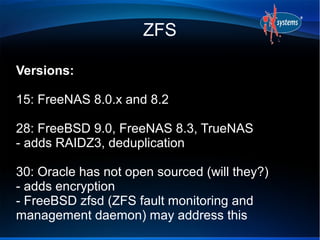
Versions:

15: FreeNAS 8.0.x and 8.2

28: FreeBSD 9.0, FreeNAS 8.3, TrueNAS
- adds RAIDZ3, deduplication

30: Oracle has not open sourced (will they?)
- adds encryption
- FreeBSD zfsd (ZFS fault monitoring and
management daemon) may address this
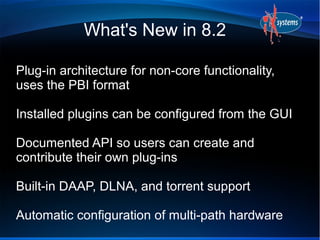
What's New in 8.2

Plug-in architecture for non-core functionality,
uses the PBI format

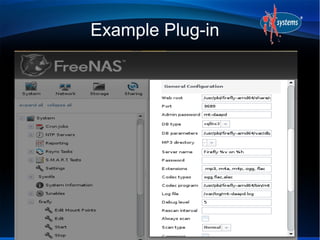
Installed plugins can be configured from the GUI

Documented API so users can create and
contribute their own plug-ins

Built-in DAAP, DLNA, and torrent support

Automatic configuration of multi-path hardware
Example Plug-in
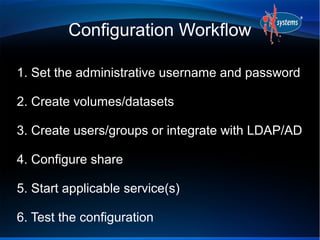
Configuration Workflow

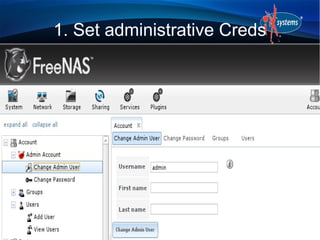
1. Set the administrative username and password

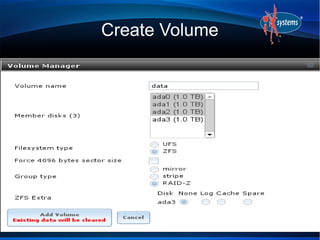
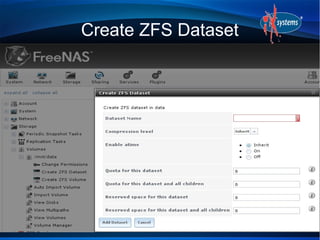
2. Create volumes/datasets

3. Create users/groups or integrate with LDAP/AD

4. Configure share

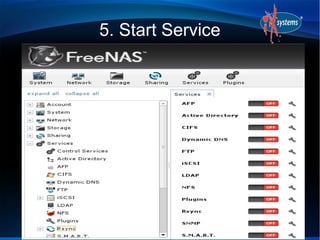
5. Start applicable service(s)

6. Test the configuration
1. Set administrative Creds
2. Create Volume

Choices:

1. Import existing UFS RAID or ZFS pool
●

●

2. Import existing disk formatted with UFS, FAT,
●

NTFS, or EXT2/3
●

3. Create UFS or ZFS volume
●
Create Volume
Create ZFS Dataset
3. Users/Groups


Choices:

1. Manually create

2. Import existing Active Directory users

3. Import existing LDAP users
4. Configure Share
Choices:

AFP: for Mac OS X

CIFS: for Windows, also supports any other OS

NFS: faster than CIFS, supports any OS

SSH: CLI and GUI clients available for any OS

FTP: CLI and GUI clients available for any OS

iSCSI target: for access to raw disks
Configure Share

When configuring:

Recommended to only have one type of share to
prevent filesystem/client conflicts

Users needing access to that share must have
permission to the volume being shared, or the
share access must be set to anon/guest

Permissions can be set on a per volume or per
dataset basis
5. Start Service
6. Test Configuration


From a client, confirm that access is permitted to
allowed users

Can enable console logging at bottom of browser
to troubleshoot a service that won't start

Can use web shell to read logs when
troubleshooting
Participate

Report bugs

Try out the testing snapshots

Contribute configuration scenarios

Assist users on the forums or IRC

Blog or write a review about your FreeNAS
experience
Resources

Website:

http://www.freenas.org

Forums:

http://forums.freenas.org

Bug tracker:

http://support.freenas.org
Resources
Links to Users Guide:

http://doc.freenas.org

IRC:

#freenas on Freenode

Links to mailing lists, instructional videos, and
professional support:

http://doc.freenas.org/index.php/
FreeNAS_Support_Resources
Questions


               Contact:

          dru@freebsd.org

            URL to Slides:

http://slideshare.net/dlavigne/nelf2012

Nelf2012

  • 1.
    Introduction to FreeNAS8 Dru Lavigne Director of Community Development, iXsystems NELF, March 17, 2012
  • 2.
    Outline Introduction to FreeNAS8 Features and ZFS Overview What's New in 8.2 Configuration Workflow Getting Involved with the Community Additional Resources
  • 3.
    Introduction Open source NAS(network attached storage) based on an embedded version of FreeBSD (nanoBSD) and released under 2-clause BSD license Enterprise-grade appliance (TrueNAS) is also available in 2U/4U form factors with professional support
  • 4.
    Introduction 8.x is arewrite of the original monolithic design (.7x) to a modular design 8.0 was released May, 2011 with a focus on NAS core functionality 8.0.4 is the current release (as of February, 29 2012) 8.2, currently in beta, introduces plug-in architecture for non-core addons
  • 5.
    Introduction If you're usedto .7x: Hardware requirements have changed Designed to be installed on a thumb drive or compact flash, not a hard drive Graphical administrative interface is completely different and info in .7x forums/docs won't apply Many .7x features are not “core NAS” and can be installed using plug-in architecture
  • 6.
    Features Create UFS orZFS volumes (ZFS recommended) Import existing UFS/ZFS RAID/z volumes Import existing UFS, DOS, NTFS, EXT2/3 volumes Create shares using Appletalk, NFS, and SMB protocols Configure access through FTP/SFTP, SSH, and iSCSI
  • 7.
    Features Integration with OpenLDAP,Active Directory Automated, secure replication via rsync/ssh Automated ZFS snapshots and scrubs Front-ends to cron, sysctls, loader.conf Reporting graphs, scheduled S.M.A.R.T. tests, automated alerts, UPS
  • 8.
    Features Link aggregation andfailover IEEE 802.1q VLAN support DDNS, SNMP, and TFTP support Control panel to stop/start and view the status of services Users Guide available in wiki, HTML, PDF, epub, and Kindle formats
  • 9.
    Features Supports OSX TimeMachine Supports Windows Shadow Copies Upgrades keep a backup of the old OS, allowing for rollback Administrative GUI accessed through a web browser; 8.2 adds a web shell for command line operations
  • 10.
    ZFS 128-bit filesystem designedto be a “self-healing” and to address hardware RAID issues with data integrity Snapshots (point in time) only store what has changed since the last snapshot Snapshots (ro) can be cloned (rw) Can rollback to any snapshot
  • 11.
    ZFS RAIDZ1: equivalent toRAID5 RAIDZ2: double-parity solution similar to RAID6 RAIDZ3: triple-parity solution Caveats: resilvering takes time and can stress disks
  • 12.
    ZFS Versions: 15: FreeNAS 8.0.xand 8.2 28: FreeBSD 9.0, FreeNAS 8.3, TrueNAS - adds RAIDZ3, deduplication 30: Oracle has not open sourced (will they?) - adds encryption - FreeBSD zfsd (ZFS fault monitoring and management daemon) may address this
  • 13.
    What's New in8.2 Plug-in architecture for non-core functionality, uses the PBI format Installed plugins can be configured from the GUI Documented API so users can create and contribute their own plug-ins Built-in DAAP, DLNA, and torrent support Automatic configuration of multi-path hardware
  • 14.
  • 15.
    Configuration Workflow 1. Setthe administrative username and password 2. Create volumes/datasets 3. Create users/groups or integrate with LDAP/AD 4. Configure share 5. Start applicable service(s) 6. Test the configuration
  • 16.
  • 17.
    2. Create Volume Choices: 1.Import existing UFS RAID or ZFS pool ● ● 2. Import existing disk formatted with UFS, FAT, ● NTFS, or EXT2/3 ● 3. Create UFS or ZFS volume ●
  • 18.
  • 19.
  • 20.
    3. Users/Groups Choices: 1. Manuallycreate 2. Import existing Active Directory users 3. Import existing LDAP users
  • 21.
    4. Configure Share Choices: AFP:for Mac OS X CIFS: for Windows, also supports any other OS NFS: faster than CIFS, supports any OS SSH: CLI and GUI clients available for any OS FTP: CLI and GUI clients available for any OS iSCSI target: for access to raw disks
  • 22.
    Configure Share When configuring: Recommendedto only have one type of share to prevent filesystem/client conflicts Users needing access to that share must have permission to the volume being shared, or the share access must be set to anon/guest Permissions can be set on a per volume or per dataset basis
  • 23.
  • 24.
    6. Test Configuration Froma client, confirm that access is permitted to allowed users Can enable console logging at bottom of browser to troubleshoot a service that won't start Can use web shell to read logs when troubleshooting
  • 25.
    Participate Report bugs Try outthe testing snapshots Contribute configuration scenarios Assist users on the forums or IRC Blog or write a review about your FreeNAS experience
  • 26.
  • 27.
    Resources Links to UsersGuide: http://doc.freenas.org IRC: #freenas on Freenode Links to mailing lists, instructional videos, and professional support: http://doc.freenas.org/index.php/ FreeNAS_Support_Resources
  • 28.
    Questions Contact: dru@freebsd.org URL to Slides: http://slideshare.net/dlavigne/nelf2012