What issues matter most to people
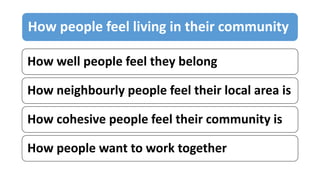
How people feel living in their community
What has changed in people’s lives
Neighbourhood Insight across Lambeth
What matters most to people
What issues matter most
How safe people feel
How people feel about their health & wellbeing
How satisfied residents are with our services
How satisfied people are with their home
How business-friendly Lambeth is
What issues matter most to businesses
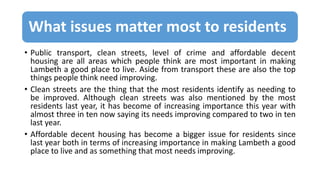
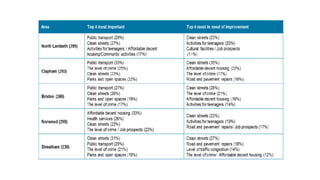
What issues matter most to residents
• Public transport, clean streets, level of crime and affordable decent
housing are all areas which people think are most important in making
Lambeth a good place to live. Aside from transport these are also the top
things people think need improving.
• Clean streets are the thing that the most residents identify as needing to
be improved. Although clean streets was also mentioned by the most
residents last year, it has become of increasing importance this year with
almost three in ten now saying its needs improving compared to two in ten
last year.
• Affordable decent housing has become a bigger issue for residents since
last year both in terms of increasing importance in making Lambeth a good
place to live and as something that most needs improving.
How safe people feel
• Lambeth is generally seen as a safe place, with 19 out of 20 residents
feeling safe from crime in their local area during the day, and four in
five feeling safe in the evening, and Lambeth residents now feel safer
than ever.
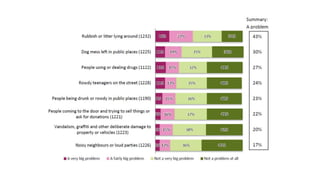
• Reflecting that clean streets is the top issue that residents say most
needs improving in the borough, rubbish or litter lying around is the
aspect of anti-social behaviour perceived to be a problem by the
largest number of residents, with over four in ten saying it’s a
problem. Next biggest perceived problems are dog mess and drug use
and dealing.
How people feel about their health & wellbeing
• All our residents want to be able to live the life they want and get the
support they need to do that. They want to manage their own health and
wellbeing and be supported to do this - including having access to
information and being able to stay healthy. They want to have as much
social contact and support as they would like, in particular for carers.
• People want to be able to plan their care with people who work together
to understand them and their carer, allow them control and bring together
services to achieve the outcomes important to them. They want to feel
they are safe, secure and protected from harm. They want to be respected,
their dignity maintained, and not experience any discrimination or
harassment.
• They want to have systems in place to help at an early stage to avoid crisis
and as small a disruption as possible if a crisis happens and live
independently, with assistance if necessary.
How satisfied residents are with our services
• Overall satisfaction with how the council runs things has increased
from 64% to 69% over the last year, and is in line with the national
average for councils.
• Residents are now more likely to agree that the council offers value
for money (up from 48% in 2014 to 55%) and for the first time over a
half of residents think this. However a large number are not aware of
the council’s financial situation, with only one in five aware the
council’s budget is decreasing.
• Over one in two people now say Lambeth responds quickly when
asked for help and resolves problems when asked.
How satisfied people are with their home
• Over six in ten residents of Lambeth social housing are satisfied with
their home, with slightly higher for tenants and slightly lower for
leaseholders (STAR Survey 2014). This compares with seven in ten
residents of Lambeth Tenant Management Organisations (TMOs)
being satisfied with their housing.
How business-friendly Lambeth is
• Six out of ten businesses rated Lambeth as a ‘good’ or ‘very good’
place to do businesses with only 6% rating Lambeth as ‘poor’ or ‘very
poor’ as a place to do business and one in three as average. This
shows a significant improvement on five years ago, where less than
four in ten rated Lambeth as ‘good’ or ‘very good’.
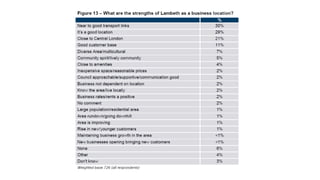
• Being near to good transport links, being a generally ‘good location’
and being close to central London were considered strengths of
Lambeth as a business location. Parking was referred to by one in five
businesses surveyed as a limitation to Lambeth as a business location.
• One in four businesses located within Business Improvement District
areas agreed or strongly agreed that being located in the BID area had
positively benefitted their business.
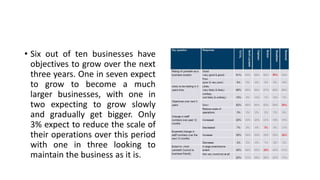
• Six out of ten businesses have
objectives to grow over the next
three years. One in seven expect
to grow to become a much
larger businesses, with one in
two expecting to grow slowly
and gradually get bigger. Only
3% expect to reduce the scale of
their operations over this period
with one in three looking to
maintain the business as it is.
How people feel living in their community
How well people feel they belong
How neighbourly people feel their local area is
How cohesive people feel their community is
How people want to work together
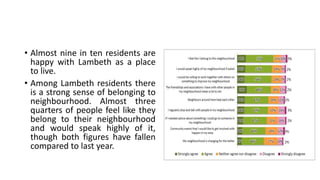
• Almost nine in ten residents are
happy with Lambeth as a place
to live.
• Among Lambeth residents there
is a strong sense of belonging to
neighbourhood. Almost three
quarters of people feel like they
belong to their neighbourhood
and would speak highly of it,
though both figures have fallen
compared to last year.
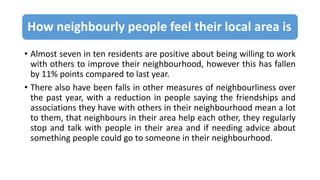
How neighbourly people feel their local area is
• Almost seven in ten residents are positive about being willing to work
with others to improve their neighbourhood, however this has fallen
by 11% points compared to last year.
• There also have been falls in other measures of neighbourliness over
the past year, with a reduction in people saying the friendships and
associations they have with others in their neighbourhood mean a lot
to them, that neighbours in their area help each other, they regularly
stop and talk with people in their area and if needing advice about
something people could go to someone in their neighbourhood.
How cohesive people feel their community is
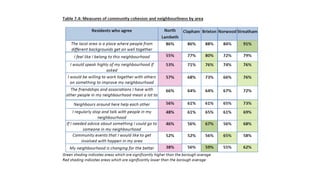
• Community cohesion is very high, with over nine in ten people saying
their local area is a place where people from different backgrounds
get on, even if this has fallen over the last year.
• There have also been falls in residents’ positivity in relation to a
number of indicators of neighbourliness, with a reduction in people
feeling like they belong to their neighbourhood, thinking that
neighbours in their area help each other, and that they would be
willing to work together with others on something to improve their
neighbourhood. This could potentially negatively impact on our
communities’ resilience.
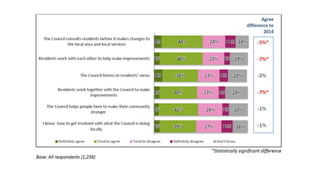
How people want to work together
• Three in five residents believe that they can influence decisions
affecting their local area, up from last year and the highest ever level.
Two in five believe they can influence housing decisions (Future
Model of Housing Management).
• One in two residents agree that residents work with each other to
make improvements. Two in five residents think that in the next year
they are likely to get involved with others in their local area to deal
with local issues that might arise, more than a 10% increase on last
year.
• Almost one in two agree that they know how to get involved with
what the council is doing locally.
What has changed in people’s lives
Neighbourhood
Individuals and families
Community
Health
Finances
Business
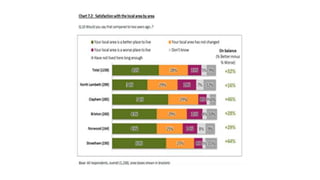
How people feel their neighbourhood has changed
• Lambeth is changing and most residents have seen change in their
neighbourhood, only three in ten saying their neighbourhood hasn’t
changed.
• Almost one in two see their area as a better place to live compared to
two years ago, and four in ten say they have benefited from change.
• However more than one in ten say their area has changed for the
worst, and almost one in ten say change has made things worse for
them and their family, with disabled, Black Caribbean, self-employed,
and low paid residents along with council tenants being more likely to
say this is the case.
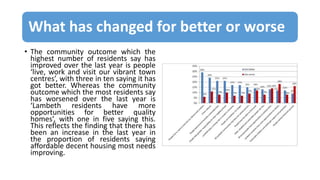
What has changed for better or worse
• The community outcome which the
highest number of residents say has
improved over the last year is people
‘live, work and visit our vibrant town
centres’, with three in ten saying it has
got better. Whereas the community
outcome which the most residents say
has worsened over the last year is
‘Lambeth residents have more
opportunities for better quality
homes’, with one in five saying this.
This reflects the finding that there has
been an increase in the last year in
the proportion of residents saying
affordable decent housing most needs
improving.
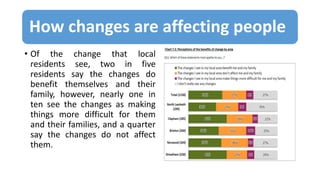
How changes are affecting people
• Of the change that local
residents see, two in five
residents say the changes do
benefit themselves and their
family, however, nearly one in
ten see the changes as making
things more difficult for them
and their families, and a quarter
say the changes do not affect
them.
How people feel their wellbeing has changed
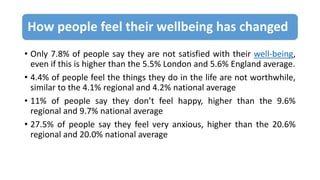
• Only 7.8% of people say they are not satisfied with their well-being,
even if this is higher than the 5.5% London and 5.6% England average.
• 4.4% of people feel the things they do in the life are not worthwhile,
similar to the 4.1% regional and 4.2% national average
• 11% of people say they don’t feel happy, higher than the 9.6%
regional and 9.7% national average
• 27.5% of people say they feel very anxious, higher than the 20.6%
regional and 20.0% national average
How people feel their work situation has changed
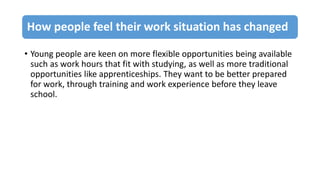
• Young people are keen on more flexible opportunities being available
such as work hours that fit with studying, as well as more traditional
opportunities like apprenticeships. They want to be better prepared
for work, through training and work experience before they leave
school.
How people feel their financial situation has changed
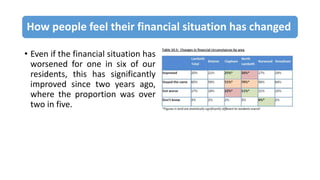
• Even if the financial situation has
worsened for one in six of our
residents, this has significantly
improved since two years ago,
where the proportion was over
two in five.
What most needs improving
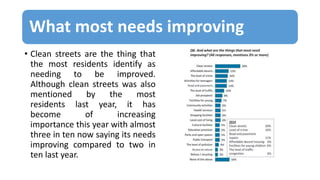
• Clean streets are the thing that
the most residents identify as
needing to be improved.
Although clean streets was also
mentioned by the most
residents last year, it has
become of increasing
importance this year with almost
three in ten now saying its needs
improving compared to two in
ten last year.
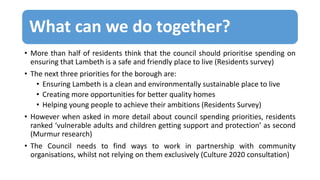
What can we do together?
• More than half of residents think that the council should prioritise spending on
ensuring that Lambeth is a safe and friendly place to live (Residents survey)
• The next three priorities for the borough are:
• Ensuring Lambeth is a clean and environmentally sustainable place to live
• Creating more opportunities for better quality homes
• Helping young people to achieve their ambitions (Residents Survey)
• However when asked in more detail about council spending priorities, residents
ranked ‘vulnerable adults and children getting support and protection’ as second
(Murmur research)
• The Council needs to find ways to work in partnership with community
organisations, whilst not relying on them exclusively (Culture 2020 consultation)

Neighbourhood Insight for Lambeth

  • 1.
    What issues mattermost to people How people feel living in their community What has changed in people’s lives Neighbourhood Insight across Lambeth
  • 2.
    What matters mostto people What issues matter most How safe people feel How people feel about their health & wellbeing How satisfied residents are with our services How satisfied people are with their home How business-friendly Lambeth is What issues matter most to businesses
  • 3.
    What issues mattermost to residents • Public transport, clean streets, level of crime and affordable decent housing are all areas which people think are most important in making Lambeth a good place to live. Aside from transport these are also the top things people think need improving. • Clean streets are the thing that the most residents identify as needing to be improved. Although clean streets was also mentioned by the most residents last year, it has become of increasing importance this year with almost three in ten now saying its needs improving compared to two in ten last year. • Affordable decent housing has become a bigger issue for residents since last year both in terms of increasing importance in making Lambeth a good place to live and as something that most needs improving.
  • 5.
    How safe peoplefeel • Lambeth is generally seen as a safe place, with 19 out of 20 residents feeling safe from crime in their local area during the day, and four in five feeling safe in the evening, and Lambeth residents now feel safer than ever. • Reflecting that clean streets is the top issue that residents say most needs improving in the borough, rubbish or litter lying around is the aspect of anti-social behaviour perceived to be a problem by the largest number of residents, with over four in ten saying it’s a problem. Next biggest perceived problems are dog mess and drug use and dealing.
  • 7.
    How people feelabout their health & wellbeing • All our residents want to be able to live the life they want and get the support they need to do that. They want to manage their own health and wellbeing and be supported to do this - including having access to information and being able to stay healthy. They want to have as much social contact and support as they would like, in particular for carers. • People want to be able to plan their care with people who work together to understand them and their carer, allow them control and bring together services to achieve the outcomes important to them. They want to feel they are safe, secure and protected from harm. They want to be respected, their dignity maintained, and not experience any discrimination or harassment. • They want to have systems in place to help at an early stage to avoid crisis and as small a disruption as possible if a crisis happens and live independently, with assistance if necessary.
  • 8.
    How satisfied residentsare with our services • Overall satisfaction with how the council runs things has increased from 64% to 69% over the last year, and is in line with the national average for councils. • Residents are now more likely to agree that the council offers value for money (up from 48% in 2014 to 55%) and for the first time over a half of residents think this. However a large number are not aware of the council’s financial situation, with only one in five aware the council’s budget is decreasing. • Over one in two people now say Lambeth responds quickly when asked for help and resolves problems when asked.
  • 9.
    How satisfied peopleare with their home • Over six in ten residents of Lambeth social housing are satisfied with their home, with slightly higher for tenants and slightly lower for leaseholders (STAR Survey 2014). This compares with seven in ten residents of Lambeth Tenant Management Organisations (TMOs) being satisfied with their housing.
  • 10.
    How business-friendly Lambethis • Six out of ten businesses rated Lambeth as a ‘good’ or ‘very good’ place to do businesses with only 6% rating Lambeth as ‘poor’ or ‘very poor’ as a place to do business and one in three as average. This shows a significant improvement on five years ago, where less than four in ten rated Lambeth as ‘good’ or ‘very good’. • Being near to good transport links, being a generally ‘good location’ and being close to central London were considered strengths of Lambeth as a business location. Parking was referred to by one in five businesses surveyed as a limitation to Lambeth as a business location. • One in four businesses located within Business Improvement District areas agreed or strongly agreed that being located in the BID area had positively benefitted their business.
  • 12.
    • Six outof ten businesses have objectives to grow over the next three years. One in seven expect to grow to become a much larger businesses, with one in two expecting to grow slowly and gradually get bigger. Only 3% expect to reduce the scale of their operations over this period with one in three looking to maintain the business as it is.
  • 13.
    How people feelliving in their community How well people feel they belong How neighbourly people feel their local area is How cohesive people feel their community is How people want to work together
  • 14.
    • Almost ninein ten residents are happy with Lambeth as a place to live. • Among Lambeth residents there is a strong sense of belonging to neighbourhood. Almost three quarters of people feel like they belong to their neighbourhood and would speak highly of it, though both figures have fallen compared to last year.
  • 15.
    How neighbourly peoplefeel their local area is • Almost seven in ten residents are positive about being willing to work with others to improve their neighbourhood, however this has fallen by 11% points compared to last year. • There also have been falls in other measures of neighbourliness over the past year, with a reduction in people saying the friendships and associations they have with others in their neighbourhood mean a lot to them, that neighbours in their area help each other, they regularly stop and talk with people in their area and if needing advice about something people could go to someone in their neighbourhood.
  • 17.
    How cohesive peoplefeel their community is • Community cohesion is very high, with over nine in ten people saying their local area is a place where people from different backgrounds get on, even if this has fallen over the last year. • There have also been falls in residents’ positivity in relation to a number of indicators of neighbourliness, with a reduction in people feeling like they belong to their neighbourhood, thinking that neighbours in their area help each other, and that they would be willing to work together with others on something to improve their neighbourhood. This could potentially negatively impact on our communities’ resilience.
  • 18.
    How people wantto work together • Three in five residents believe that they can influence decisions affecting their local area, up from last year and the highest ever level. Two in five believe they can influence housing decisions (Future Model of Housing Management). • One in two residents agree that residents work with each other to make improvements. Two in five residents think that in the next year they are likely to get involved with others in their local area to deal with local issues that might arise, more than a 10% increase on last year. • Almost one in two agree that they know how to get involved with what the council is doing locally.
  • 20.
    What has changedin people’s lives Neighbourhood Individuals and families Community Health Finances Business
  • 21.
    How people feeltheir neighbourhood has changed • Lambeth is changing and most residents have seen change in their neighbourhood, only three in ten saying their neighbourhood hasn’t changed. • Almost one in two see their area as a better place to live compared to two years ago, and four in ten say they have benefited from change. • However more than one in ten say their area has changed for the worst, and almost one in ten say change has made things worse for them and their family, with disabled, Black Caribbean, self-employed, and low paid residents along with council tenants being more likely to say this is the case.
  • 23.
    What has changedfor better or worse • The community outcome which the highest number of residents say has improved over the last year is people ‘live, work and visit our vibrant town centres’, with three in ten saying it has got better. Whereas the community outcome which the most residents say has worsened over the last year is ‘Lambeth residents have more opportunities for better quality homes’, with one in five saying this. This reflects the finding that there has been an increase in the last year in the proportion of residents saying affordable decent housing most needs improving.
  • 24.
    How changes areaffecting people • Of the change that local residents see, two in five residents say the changes do benefit themselves and their family, however, nearly one in ten see the changes as making things more difficult for them and their families, and a quarter say the changes do not affect them.
  • 25.
    How people feeltheir wellbeing has changed • Only 7.8% of people say they are not satisfied with their well-being, even if this is higher than the 5.5% London and 5.6% England average. • 4.4% of people feel the things they do in the life are not worthwhile, similar to the 4.1% regional and 4.2% national average • 11% of people say they don’t feel happy, higher than the 9.6% regional and 9.7% national average • 27.5% of people say they feel very anxious, higher than the 20.6% regional and 20.0% national average
  • 26.
    How people feeltheir work situation has changed • Young people are keen on more flexible opportunities being available such as work hours that fit with studying, as well as more traditional opportunities like apprenticeships. They want to be better prepared for work, through training and work experience before they leave school.
  • 27.
    How people feeltheir financial situation has changed • Even if the financial situation has worsened for one in six of our residents, this has significantly improved since two years ago, where the proportion was over two in five.
  • 28.
    What most needsimproving • Clean streets are the thing that the most residents identify as needing to be improved. Although clean streets was also mentioned by the most residents last year, it has become of increasing importance this year with almost three in ten now saying its needs improving compared to two in ten last year.
  • 29.
    What can wedo together? • More than half of residents think that the council should prioritise spending on ensuring that Lambeth is a safe and friendly place to live (Residents survey) • The next three priorities for the borough are: • Ensuring Lambeth is a clean and environmentally sustainable place to live • Creating more opportunities for better quality homes • Helping young people to achieve their ambitions (Residents Survey) • However when asked in more detail about council spending priorities, residents ranked ‘vulnerable adults and children getting support and protection’ as second (Murmur research) • The Council needs to find ways to work in partnership with community organisations, whilst not relying on them exclusively (Culture 2020 consultation)