SME ACCESS
          TO FINANCE
An exploration into the demand and supply
 constraints around SME access to finance

    Newcastle Business School • Northumbria University • Spring 2012
SME ACCESS TO FINANCE


     AN EXPLORATION INTO THE DEMAND
     AND SUPPLY CONSTRAINTS AROUND
          SME ACCESS TO FINANCE


Newcastle Business School
Northumbria University
Spring 2012
Contents
List of Tables ......................................................................................................................................... 6
List of Figures........................................................................................................................................ 6
Executive Summary .................................................................................................................. 8
Terms of Reference ................................................................................................................... 8
Context ................................................................................................................................................... 8
Overall Findings .................................................................................................................................... 9
Recommendations ............................................................................................................................... 12
Research Team and Ethics ................................................................................................................. 13
Conduct of the Study .......................................................................................................................... 13
1.         Banks - Interviews and Questionnaires ................................................................................ 14
2.         Business Angels - Interviews .................................................................................................. 17
3.         SMEs - Focus Group Interviews and Questionnaires .......................................................... 19
Literature Review .................................................................................................................... 24
1.         Overview of SME Finance ...................................................................................................... 24
1.1 Types of SMEs ............................................................................................................................................... 24
1.2 Sources of Finance for SMEs ......................................................................................................................... 25
             1.2.1          Internal and Informal Sources of Finance ................................................................. 25
             1.2.2          External Debt ............................................................................................................ 26
             1.2.3          External Mezzanine and Equity ................................................................................ 26
Bank Finance for SMEs...................................................................................................................... 26
2.1 Overview of Business Finance ....................................................................................................................... 26
             2.1.1          Types of Business Finance ........................................................................................ 27
             2.1.2          UK Banks‟ Lending to SMEs ................................................................................... 27
2.2 The Credit Decision-Making Process ............................................................................................................. 29
2.3 Issues and Challenges in Bank Lending ......................................................................................................... 31
             2.3.1          Relationship Lending versus Transactional Lending ................................................ 31
             2.3.2          Information Asymmetry ............................................................................................ 31
             2.3.3          Decision Overrides .................................................................................................... 31
             2.3.4          Rejections .................................................................................................................. 32
             2.3.5          Non-Performing Loans ............................................................................................. 32
             2.3.6          Enterprise Finance Guarantee ................................................................................... 33
2.         Overview of Business Angels .................................................................................................. 34
3.1 Business Angels‟ Investment Motivations...................................................................................................... 34
3.2 Sources of Deal Flow and Investment Criteria ............................................................................................... 35
             3.2.1          Deal Flow .................................................................................................................. 36
             3.2.2          Investment Criteria .................................................................................................... 37
                3.2.2.1 Business Attributes .................................................................................................................. 37
                                                                                 2
3.2.2.2 Entrepreneur(s) Attributes ....................................................................................................... 38
3.3 Issues and Challenges of Business Angels ..................................................................................................... 39
             3.3.1           Rejection Criteria ...................................................................................................... 39
             3.3.2           Training Needs .......................................................................................................... 41
             3.3.3           Key Challenges for Business Angels in the NE Region ........................................... 42
3.          SMEs‟ Difficulties in Raising Finance ................................................................................... 43
4.          Support Interventions for Access to SME Finance .............................................................. 45
Analysis and Findings ............................................................................................................ 47
1.          Banks - Interviews................................................................................................................... 47
Bank Interviews Summary ................................................................................................................................... 47
SECTION I ........................................................................................................................................................... 49
1.1 SME Classification ......................................................................................................................................... 49
             1.1.1 Turnover .......................................................................................................................... 49
             1.1.2 Sectors ............................................................................................................................. 50
1.2 Trends in SME Demand for Credit Post 2008 ................................................................................................ 51
1.3 Trends in SME Credit Supply Post 2008 ........................................................................................................ 52
             1.3.1 Change in Banking Paradigm.......................................................................................... 52
             1.3.2 The Quality of Proposals/Sophistication of Customers .................................................. 54
             1.3.3 The Role of Accountants/Financial Advisors ................................................................. 55
SECTION II - The Credit Process ........................................................................................................................ 55
2.1 Attitudes ......................................................................................................................................................... 55
             2.1.1 Confidence ...................................................................................................................... 56
             2.1.2 Outlook ........................................................................................................................... 56
             2.1.3 Trust (Relationship) ........................................................................................................ 57
             2.1.4 Transparency in Lending ................................................................................................ 58
2.2 Credit Decision-Making Process .................................................................................................................... 59
             2.2.1 Dealing with the Diversity of SMEs ............................................................................... 59
             2.2.2 Dealing with Information Asymmetry ............................................................................ 60
             2.2.3 Triggers for Non-performing Loans (NPL) and Support Interventions .......................... 60
             2.2.4 Level, Sophistication and Assessment of Credit Control................................................ 62
SECTION III - Support and Initiatives ................................................................................................................. 62
3.1 Additional Support for SMEs ......................................................................................................................... 62
             3.1.1 Coaching, Mentoring, Guidance and Professional Advice ............................................. 63
             3.1.2 Dealing with Rejections .................................................................................................. 64
3.2 Initiatives ........................................................................................................................................................ 64
             3.2.1 Project Merlin, the Task Force, Enterprise Finance Guarantee (EFG) ........................... 64
SECTION IV - Improving Demand and the Future of SME Finance ................................................................... 65
4.1 Demand and Market Share ............................................................................................................................. 65
             4.1.1 Unique Selling Proposition (USP) .................................................................................. 65
             4.1.2 Targets ............................................................................................................................ 65
4.2 Future of SME Finance ................................................................................................................................... 66

2.          Banks - Questionnaires ........................................................................................................... 67
Bank Questionnaires Summary ............................................................................................................................ 68
2.1 Demographic Information .............................................................................................................................. 70

                                                                                    3
2.2 Portfolio Information ...................................................................................................................................... 70
2.3 The Credit Decision-Making Process ............................................................................................................. 71
             2.3.1 Advice ............................................................................................................................. 71
             2.3.2 Duration of Decision-Making Process ............................................................................ 72
             2.3.3 Improving the Credit Decision-Making Process ............................................................. 74
             2.3.4 Changes in the Decision-Making Process ....................................................................... 74
             2.3.5 Autonomy in the Decision-Making Process ................................................................... 75
             2.3.6 Decision-Making Duration ............................................................................................. 78
2.4 Assessing Creditworthiness of SMEs ............................................................................................................. 79
2.5 Rejections and Overrides ................................................................................................................................ 80
2.6 Attitudes and Perception of SME Behaviour .................................................................................................. 84
2.7 Competition and Initiatives............................................................................................................................. 88
             2.7.1 Competition .................................................................................................................... 88
             2.7.2 Government Initiatives.................................................................................................... 89
             2.7.3 Market Advantage ........................................................................................................... 90
2.8 The Future of SME Finance ........................................................................................................................... 91

3.          Business Angels - Interviews .................................................................................................. 92
Main Findings by Research Area ......................................................................................................................... 92
3.1 Descriptive Summary of Participants ............................................................................................................. 94
3.2 Business Angels‟ Investment Motivations and Amounts Available for Investment ....................................... 96
             3.2.1 Motivation to Become an Angel Investor ....................................................................... 96
             3.2.2 Amounts Available for BA-investments ......................................................................... 96
3.3 Investment Criteria ......................................................................................................................................... 97
             3.3.1 Investment Criterion 1: The Person ................................................................................ 97
             3.3.2 Investment Criterion 2: The Business Concept ............................................................... 98
             3.3.3 Investment Criterion 3: The Business Plan ..................................................................... 98
             3.3.4 Intermediary Managers‟ Perspective ............................................................................ 100
3.4 Training Needs of Business Angels .............................................................................................................. 101
             3.4.1 Training Needs .............................................................................................................. 101
             3.4.2 Where to Find Training or Information ........................................................................ 101
             3.4.3 Prior Learning as a Business Angel .............................................................................. 102
3.5 Key Challenges for Business Angels in the North East Region ................................................................... 103
             3.5.1 Challenge 1 – Insufficient High-Quality Investment Opportunities ............................. 103
             3.5.2 Challenge 2 – Flow of High-Quality Investment Opportunities ................................... 107
                3.5.2.1 Promotion of Business Angels‟ Activities ............................................................................ 107
                3.5.2.2 Business Angels‟ Interaction with Intermediaries ................................................................. 108
             3.5.3 Challenge 3 – Complex and Confusing Financial Environment ................................... 111
SMEs 115
4.          SMEs - Focus Group Interviews .......................................................................................... 115
SMEs Focus Group Summary ............................................................................................................................ 115
4.1 Overview of Participants .............................................................................................................................. 116
4.2 Key Findings................................................................................................................................................. 116
             4.2.1 Bank Finance ................................................................................................................ 116
             4.2.2 Guidance and Support ................................................................................................... 118
             4.2.3 Role of Advisors/Mentors ............................................................................................. 119
                                                                                 4
4.2.4 Business Areas .............................................................................................................. 119
            4.2.5 Top Things to Consider ................................................................................................ 120
5. SMEs - Questionnaire Survey ...................................................................................................... 120
SME Survey Summary ....................................................................................................................................... 120
5.1 Profile of Respondents .................................................................................................................................. 122
5.2 SMEs‟ Growth Intentions ............................................................................................................................. 124
5.3 SMEs‟ Capital Requirements over the Past Year ......................................................................................... 125
5.4 SMEs‟ Preferred Sources of Finance ............................................................................................................ 127
5.5 Difficulties in Obtaining Finance ................................................................................................................. 128
5.6 SMEs‟ Knowledge of Finance Providers ...................................................................................................... 132
5.7 Respondents‟ Views about Current Finance for SMEs ................................................................................ 133
            5.7.1 Lending Climate............................................................................................................ 133
            5.7.2 Impact on Business Owners .......................................................................................... 133
            5.7.3 Future Needs ................................................................................................................. 134
5.8 SMEs‟ Use of Business Support Services .................................................................................................... 134
5.9 SMEs‟ Opinions on Business Support Services ........................................................................................... 136
            5.9.1 Opinion on Usefulness .................................................................................................. 136
            5.9.3 Opinion on Providers .................................................................................................... 137
            5.9.4 Opinion on Training...................................................................................................... 138
            5.9.5 Opinion on Quality ....................................................................................................... 138
5.10 Business Development/Training Related to Obtaining Finance ................................................................. 138
5.11 Any Other Comments ................................................................................................................................. 141

Appendices ............................................................................................................................. 143
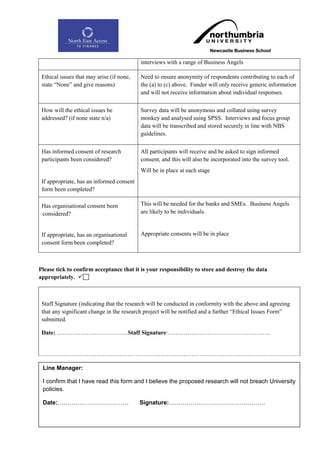
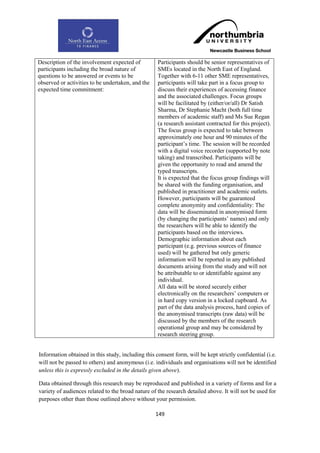
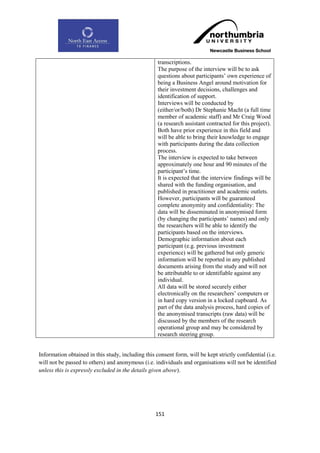
Appendix 1 - Ethical Procedures ..................................................................................................... 144
Appendix 2 - Bank Interview Question Prompts ........................................................................... 153
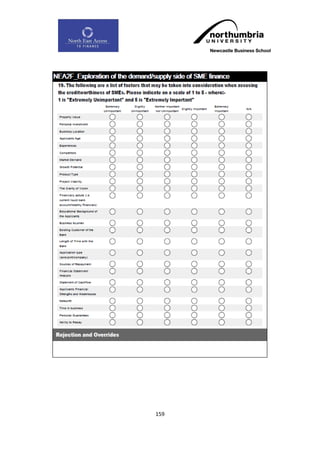
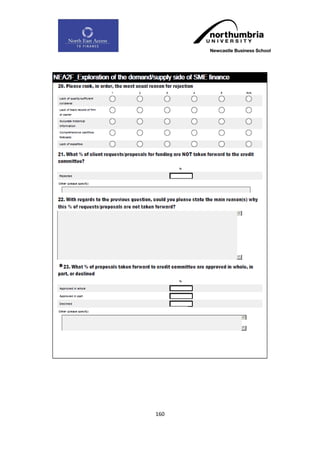
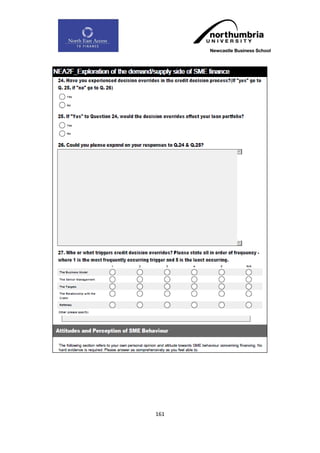
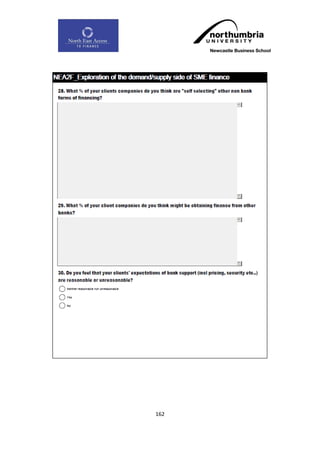
Appendix 3 - Bank Questionnaire Survey ...................................................................................... 154
Appendix 4 - Interview Prompts for Business Angels ................................................................... 166
Appendix 5 - Prompt Questions for SME Focus Group................................................................ 172
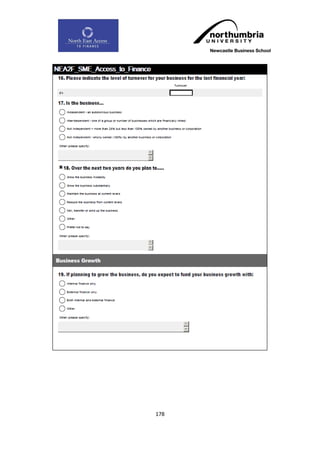
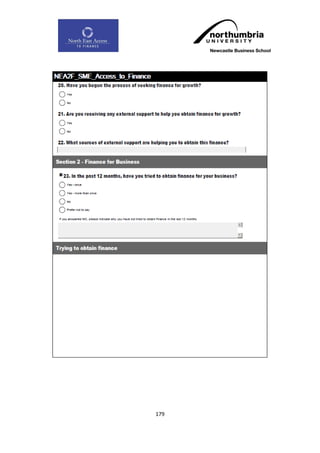
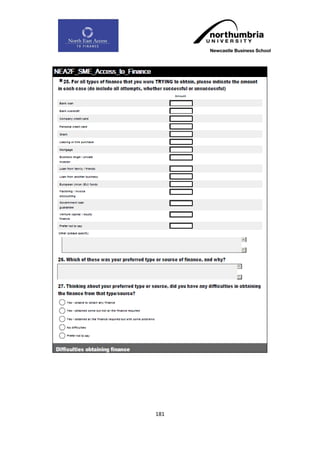
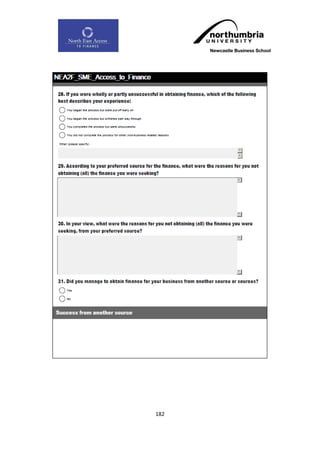
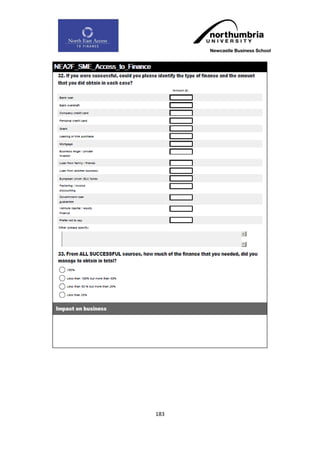
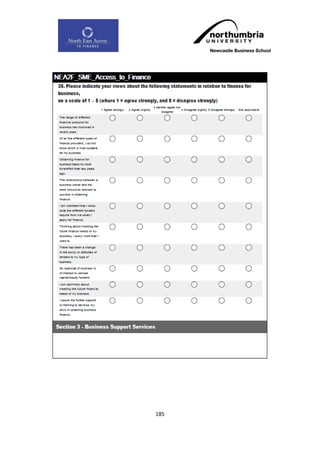
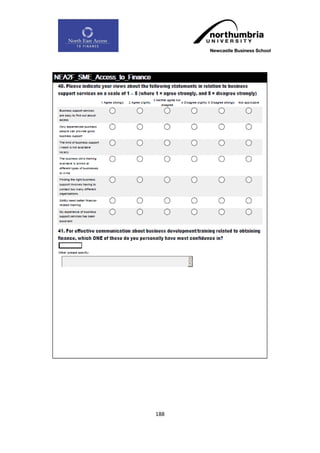
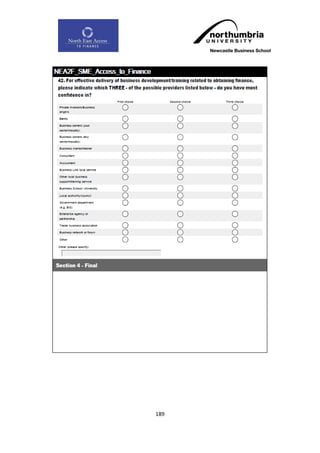
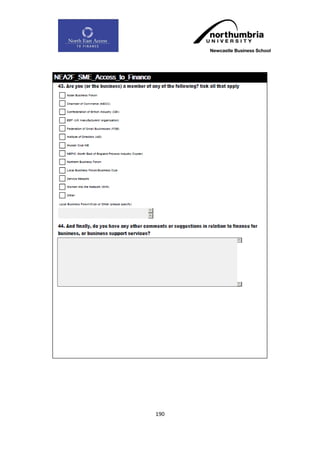
Appendix 6 - SME Questionnaire .................................................................................................... 174
References .......................................................................................................................................... 192


                                                                               5
List of Tables

Table 1     Common Characteristics of SME Lending…………………………………….                            16
Table 2     SME Population for the North East Region……………………………………                          22
Table 3     Use of Business Finance across Different Sized Firms………………………..                 27
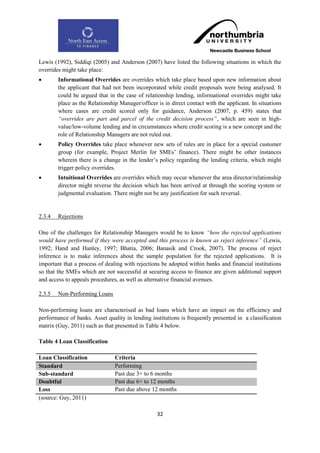
Table 4     Loan Classification…………………………………………………………….                                     32
Table 5     Expectations from a BA Academy ……………………………………………                                42
Table 6     Demographic Information for the 29 Relationship Managers…………………                 70
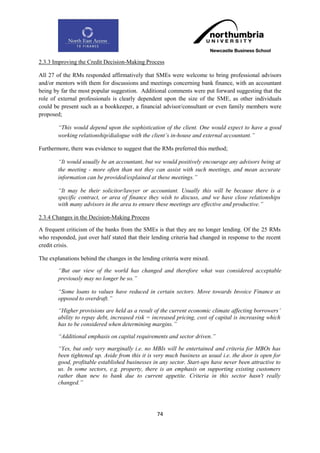
Table 7     Approximate Decision Making Timescale According to Each Product…….…             73
Table 8     Rank Order of Creditworthiness Characteristics ……………………………...                   80
Table 9     Estimated Volume of Clients Relying on Non-Banking Finance……………...              85
Table 10    Estimated Number of Clients Obtaining Finance from Other Banks………….             85
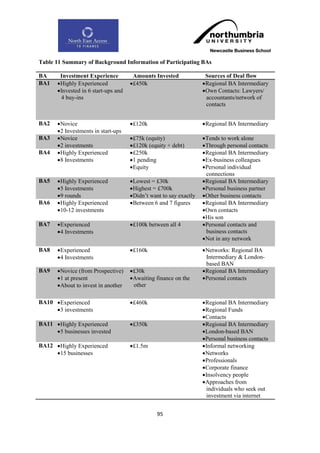
Table 11    Summary of Background Information of Participating BAs…………………..                 95
Table 12    Motivation to Become a BA…………………………………………………...                                 96
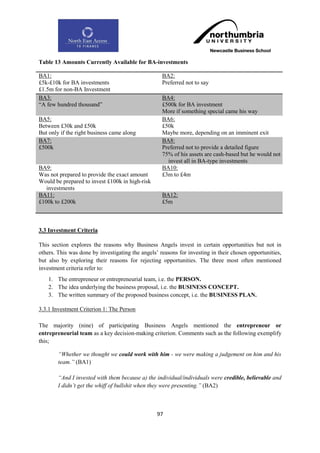
Table 13    Amounts Currently Available for BA-Investments……………………………                       97
Table 14    Preferred Sources of Finance…………………………………………………..                               127
Table 15    SMEs‟ Recent Experience of Fundraising……………………………………..                          129


List of Figures

Figure 1    New Term Lending (£m) to Small Business…………………………………..                          28
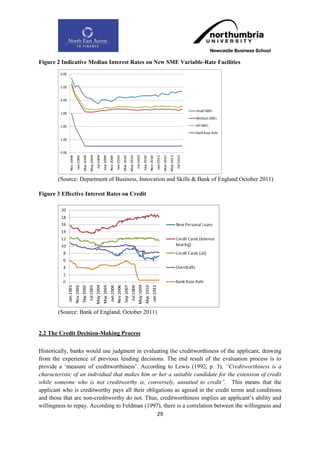
Figure 2    Indicative Median Interest Rates on New SME Variable-Rate Facilities……..        29
Figure 3    Effective Interest Rates on Credit……………………………………………..                           29
Figure 4    BA Investment Process……………………….………………………………..                                   35
Figure 5    Overview of Portfolio Composition…………………………………………...                            70
Figure 6    Authorisation Limit According to Product Type………………………………                       71
Figure 7    Overview of Changes in Lending Criteria post Credit Crisis…………………               75
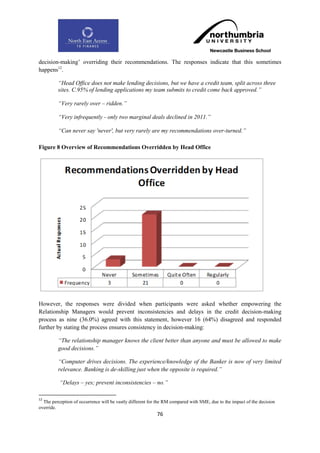
Figure 8    Overview of Recommendations Overridden by Head Office…………………                    76
Figure 9    Time Spent Dealing with a Client……………………….…………………….                             79
Figure 10   Rank Order of Rejection Reasons……………………….…………………….                              81
Figure 11   Client Requests not Taken Forward to Credit Committee……………………                   81
Figure 12   Approvals made by Credit Committee………………………………………..                             83
Figure 13   Triggers for Credit Decision Overrides………………………………………..                         84
Figure 14   Percentage of RMs Stating Expectations of SMEs Reasonable………………                 86
Figure 15   Overview of Understanding of Banks' Expectations………………………….                     87
Figure 16   Participants by Size……………………….……………………………………                                    122
Figure 17   SMEs in the Region by Size……………………….…………………………..                                123
Figure 18   Comparison of SMEs in the Region and the Survey – by Sector……………..              123
Figure 19   Anticipated Sources of Finance for Growth-Oriented Businesses…………….             125
Figure 20   Have SMEs Attempted to Raise Finance in the Last Twelve Months?..............   126
Figure 21   SMEs‟ Reasons for Raising Capital in the Last Year………………………….                   126
Figure 22   SMEs‟ Difficulties in Obtaining Finance……………………………………...                        128
Figure 23   Impact of Unsuccessful Fundraising over the Last Year………………………                  131

                                                6
Figure 24   SMEs‟ Sources of Information about Business Support………………………               135
Figure 25   Support and Guidance Sought……………………….………………………...                          135
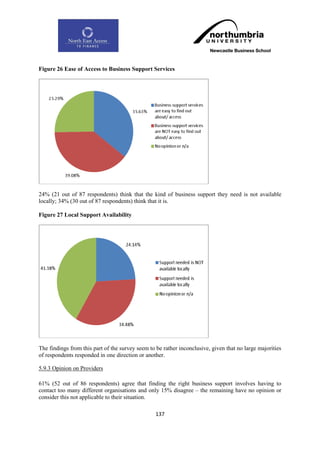
Figure 26   Ease of Access to Business Support Services………………………………….                  137
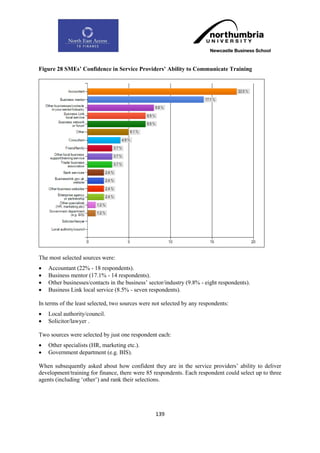
Figure 27   Local Support Availability……………………….…………………………….                           137
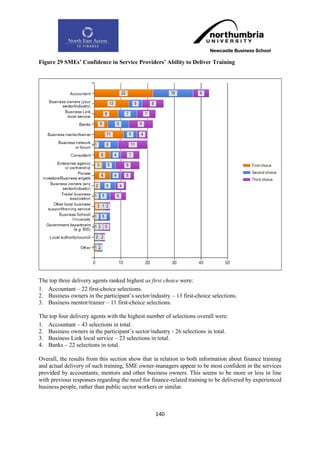
Figure 28   SMEs‟ Confidence in Service Providers‟ Ability to Communicate Training…    139
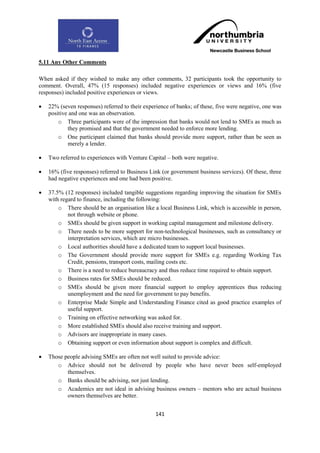
Figure 29   SMEs‟ Confidence in Service Providers‟ Ability to Deliver Training………...   140


                                             7
Executive Summary

Terms of Reference

In March 2011, the Newcastle Business School, Northumbria University was commissioned by North
East Access to Finance (NEA2F) to undertake a major piece of independent academic research to
explore both the demand and supply sides of SME access to finance in the North East of England.
The aim of the research was to gain insight and understanding into the challenges faced not only by
the SME sector but also by the key suppliers of finance to that community, specifically the banking
sector and Business Angels. Thus we do not take a position on what we think is right or what a best
practice approach might be but rather reflect, as accurately as possible, the information that was
shared with us. The research project commenced in May 2011 and was completed at the end of
March 2012.

Context

The impact of the financial crisis of 2008 is as long lasting as it was deep and as this report is drafted
in Spring 2012, the events that emanated from the US and subsequently evolved into a broader
sovereign debt crisis, threatening the stability of the European Union and indeed the continued
viability of the Euro, continue to unfold.

The inevitable demands for reform to financial regulatory structures is resulting in tighter monitoring
and control of our financial institutions, which has had an impact on the banks‟ overall appetite for
new business. There can be little doubt that there has been a fundamental change in the lending
landscape, as has been borne out by our research findings. It is claimed that the greatest impact of this
crisis has been felt by the small and medium enterprises throughout the UK (e.g. Forum of Small
Business 2009; Forum of Private Business 2009) and results from this work suggest that the North
East region was no exception in this respect.

The Newcastle Business School‟s most recent Business Barometer (published in The Journal, 11th
April 2012), indicated that almost half of all businesses are still suffering from the impact of
recession, however 41% of businesses report that they are now beginning to recover, evidenced by
just over half of respondents expecting a moderate increase in turnover during the coming 12 months
which is mirrored by those businesses reporting an increase in their order book as compared to the
position six months ago. Whilst these statistics reveal some mildly positive news, respondents were
still concerned about future reduction in consumer demand, the availability of finance and associated
credit constraint. 71% of respondents report a business climate of uncertainty as they have been
stating in each of our biannual reports since 2008. Whilst the survey that underpins the Barometer
canvasses the opinions of the largest firms operating in the North East region, the concerns that they
raise apply equally to the SME sector. Considerable effort and attention has been paid to those
attempts to support bank lending in general and to the SME sector in particular. However, while it is
reported that “there has been much comment that banks are not lending enough” (British Bankers‟

                                                    8
Association, 2010, p. 2) it is also stated that “Banks argue there is weak demand from business for
loans” (The Telegraph, 14th November, 2011); this juxtaposition is also apparent from the results of
this study.

Overall Findings

This research study consisted of three discrete components; one focussed on banks, one on the SME
community and one on Business Angels1. Some strong findings emerge from the various parts of the
research, and are discussed in more detail within the summary findings for each component; the
overarching findings are as follows:
   There is, in the North East, a perception the environment around finance and support is very
    complex, which inevitably makes finding suitable, high-quality support more difficult for SMEs.
    At the time the research was undertaken2 we found 106 finance interventions and 37 support
    interventions offered by a wide range of public, private and third sector organisations that were
    available to SMEs within the North East region.
   There is evidence of variation in the quality of support provided in the region and evident
    dissatisfaction with some current providers.
   Business Angels suggest they do not see a sufficient number of high-quality investment
    opportunities being presented to them, whilst a number of SMEs note they will in the future
    require access to external growth finance.
   Networking is highlighted as being crucial for SMEs as a means of finding both support and
    finance. Networking is also important for Business Angel investors as a way of sourcing
    investment opportunities.
   Banks indicate they would always consider good, well constructed business plans/proposals and
    are particularly encouraging of those prepared in conjunction with external advisers. The
    important role of these advisers also emerged from amongst the Business Angel community.
    However their lending criteria have changed. Though banks are committed to SME lending
    through the Task Force and Project Merlin, specific sectors are approached with greater caution
    and associated appetite for lending into these (unspecified) areas is limited. From the SME
    perspective some „fashionable‟ sectors are seen to receive preferential treatment.
   There are different views from the banks and the SMEs over the operation of the system of
    Relationship Management. Banks place great emphasis on the importance of relationship
    banking, whilst SMEs perceive it is no longer in operation.
   There are different perceptions from banks (a lack of demand from SMEs) and the SMEs (forced
    stagnation) over demand for and availability of credit.


1
 Please refer to the section on „Conduct of the Study‟ for information on methods employed and response rates.
2
 A desk review of all existing finance and support interventions available to the SME community was
undertaken in June 2011 at the start of the research project.
                                                      9
Summary Findings from Banks

1. All of the banks interviewed place great emphasis on the importance of relationship banking
   suggesting it is fundamental in their approach to SME finance providing a means of ensuring their
   position in this market. They were more willing to stand by their more loyal customers in the
   event they experience difficulties. That said, generally the larger SMEs have a dedicated bank
   Relationship Manager who has sector knowledge and experience. However the micro SMEs
   appear to be managed over the telephone from a remote location or a Head Office which deals
   with generic enquiries but with specialist knowledge of the operational area. There was evidence
   from the banks of SMEs approaching and obtaining finance from more than one relationship
   bank.
2. Demand for debt financing is perceived by the banks to be low but whether this is influenced by
   the economy or by their perception of banks‟ attitudes to lending is difficult to establish. Most
   banks feel that businesses are streamlining and adopting a more conservative approach to
   business.
3. In general, all banks still have lending targets to meet and these are increasing. They were
   supportive of and committed to Project Merlin, although one was sceptical of the impact it was
   having on the SMEs. The banks seek to differentiate themselves on the basis of quality of service
   (including speed of decision turnaround) and sector specialisation. Relationship Managers noted
   that specific (but unspecified) sectors were, however, approached with greater caution and that
   appetite for lending was limited in some (unspecified) areas.
4. Credit decision-making employs a „subjective judgemental technique‟ although for the initial
   screening of the businesses, statistical techniques such as credit scoring are used (loans under
   £100k proceed through an automated credit scoring process).
5. Banks acknowledged they are paying greater attention to the detail of business proposals. The use
   of advisers (such as accountants) is viewed as positive as it improves the disclosure of
   information and by implication the quality of the proposal which is seen as helping in the
   decision-making process (although presumably this can be in either a positive or negative
   direction).
6. The banks note increasing sophistication in the proposals being received but that there is pressure
   on SMEs to become „more savvy.‟
7. The main characteristics that are considered to be most important for the assessment of
   creditworthiness are: project viability; business acumen; sources of repayment; applicants‟
   financial strengths and weaknesses and; ability to repay.
8. The two most frequent reasons for proposals being rejected were identified as a lack of quality
   and/or sufficiency of collateral as well as the lack of a prior track record of the firm/owner 3. Just
   under half of survey respondents noted that about one third of proposals would not get taken
   forward to the credit committee. Just under half of Relationship Managers responding to the
   survey had experienced decision overrides with some stating this had an impact on their loan
   portfolio.

3
 It was separately pointed out to the research team that the most likely reason for declining a proposition would
be lack of quality of proposal rather than concerns over available collateral (e-mail exchange dated 13/02/12).
                                                       10
9. Profit margins for lending are seen as historically low whilst risk is perceived to have increased.
   The general consensus from the banks is that the supply conditions were too liberal pre-2008 and
   that banks have simply returned to their more traditional lending practices of some 20-30 years
   ago. In consequence, the banks implicitly demonstrate a more conservative attitude to lending.
10. Loan to value ratios have increased in some instances, largely reflective of the requirement
    towards greater provisioning, with half of respondents noting a change in lending criteria.
11. Some banks felt that there was a need for greater transparency of lending criteria, although they
    maintained that terms and conditions of products were always provided.
12. The banks were hopeful but also concerned for the future of SME finance as any improvement in
    the economic situation could result in an increase in base rates placing additional stress onto
    businesses. Many of the banks have adopted new strategies in the current economic climate in
    order to support SMEs. For example, some banks deliver workshops, employing role models,
    ambassadors and experts to help SMEs develop proposals.

Summary Findings from Business Angels

    1. Business Angels in the North East are not purely interested in financial gain but also have a
       strong interest in supporting others and doing something that is of personal interest to them.
    2. The interviewees appeared to suggest that money is available for investment which is
       currently not being utilised.
    3. Business Angels investing in a business tended to be attracted to a combination of factors,
       most prominently the following:
    a. The quality and personality of the people running the investee business.
    b. The specific business concept relating to their individual investment preferences.
    c. The quality and „understandability‟ of the business plan, as well as the management‟s ability
       to present and defend it.
    4. More experienced Angels highlighted:
    a. The importance of the entrepreneur/entrepreneurial team in making an investment decision
       and working with them post-investment.
    b. The importance of their thorough due diligence, which seems to develop over time and
       through „learning from mistakes‟.
    5. Challenges identified by the Angels included:
    a. Insufficient high-quality investment opportunities.
    b. Dissatisfaction with the way that the angel market (i.e. networks, groups and individuals)
       interacts with intermediaries in the region (e.g. Venture Capital funds, accountants, banks,
       lawyers).
    c. A financial environment in the North East that is highly complex, confusing and constantly
       changing.

                                                 11
Summary Findings from SMEs

1. Banks‟ relationship management systems are perceived to be no longer in operation.
2. SMEs are experiencing difficulties in gaining bank finance for new but also established
    businesses. Almost 80% of SMEs responding to the survey have faced difficulties in raising
    capital; some were unable to raise any finance at all. Therefore, many were faced with forced
    stagnation as they had to put plans on hold or defer projects.
3. A large number of SMEs will, in the near future, require access to external growth finance, which
    suggests many (if not all) may soon be affected by potential difficulties in finding funding sources
    suitable for their growth intentions.
4. Banks are perceived to over-emphasise personal guarantees and over-recommend to SMEs that
    they use alternative funding sources.
5. In the last 12 months, SMEs used bank finance, especially overdrafts, more than any other
    funding source.
6. More than one third of survey respondents were unaware of the suitability of various funding
    providers, which may possibly indicate demand-side reasons underlying their inability to raise
    capital.
7. SMEs noted that advice and mentoring are crucial to the sector but the value placed upon that
    information depends upon the provider. The most useful support providers were consultants,
    business mentors and other specialists (e.g. HR or marketing); the least useful were identified as
    banks, local authorities/councils and enterprise agencies or partnerships.
8. There is a perception that „fashionable‟ businesses (e.g. green businesses) receive preferential
    treatment.
9. There was a general call for awareness, communication and transparency of support and finance
    sources to be improved.
10. Networking and business contacts are considered key for sourcing relevant information and
    support. Just under one third of participants openly claimed to be unaware of what funders need
    from a funding proposal. Almost two thirds of participants thought finding the right business
    support involves having to contact too many different organisations.


Recommendations

The overall research findings suggest a gap exists in available support for SMEs/entrepreneurs to
understand the precise requirements of credit providers and Business Angels when considering
potential investment opportunities. The key messages emanating from the study are:
   The need for clarity, transparency and simplicity in sources of finance and support for
    SMEs/entrepreneurs;

                                                  12
   The requirement for a „one-stop-shop‟ of information to overcome the perception of „disjointed
    initiatives‟;
   The considerable value SMEs and Business Angels place upon personal contacts and networking;
   The expressed desire for mentoring/support to be delivered by actual SME-owner/managers who
    have been successful in the process, rather than by government agencies or public service
    workers;
   SMEs appear to require finance training from an appropriate provider, customised to address their
    specific needs, consisting of a „hands-on‟ approach, explaining precisely what is being sought by
    both banks and Business Angels. In addition to being efficient it also has to be cost effective.


Research Team and Ethics

Dr Jackie Harvey, Professor of Financial Management, Newcastle Business School
Dr Stephanie Macht, Principal Lecturer, Newcastle Business School
Dr Satish Sharma, Senior Lecturer, Newcastle Business School
Dr Angie Johnson, Research Assistant, Newcastle Business School
Ms Sue Regan, Research Assistant, Newcastle Business School
Mr Craig Wood, Research Assistant, Newcastle Business School

The remit of the study, conducted in accordance with the University‟s guidelines on research ethical
conduct, was independent and objective in approach, with the intention that all participants would feel
able to contribute openly and honestly. In light of this objective, the main data collection activities
were undertaken by three different research assistants who were specifically engaged for the duration
of the project.

It would not have been possible to undertake this project without the willing participation of the
banks, SMEs and business angel communities. In accordance with our ethical procedures no
individual or organisation is identifiable within the report; however, we are profoundly grateful to all
of our participants for their time and engagement with this study.


Conduct of the Study
The first part of the research involved undertaking an extensive review of key literature within the
field. This was used to identify themes that could be developed into strands of enquiry in the
subsequent interviews and focus group as well as informing questionnaire content. A mixed methods
approach was employed whereby both qualitative and quantitative data was collected through
interviews, a focus group and questionnaires. The approach to data gathering commenced in May
2011 when initial access was negotiated through NEA2F to representatives of banks operating within
the region as well as to the gatekeepers of both SMEs and the Business Angel community.
The original intention was for the majority of the data (apart from the research with Business Angels)
to be collected from surveys, however, as the work got underway it became apparent that a major
                                                  13
contribution from this work would be the deep, rich qualitative data that the researchers were
obtaining from interviews, particularly from the banks. The approach was therefore adjusted so that
interviews were conducted with senior representatives (Directors and/or Senior Managers) from all of
the banks operating in the North East region. (A total of 11 interviews were conducted).
We requested these contacts cascade a questionnaire throughout their respective organisations to their
Relationship Managers (RMs). A total of 51 individuals contributed to the survey. Although a smaller
than anticipated sample, the information that emerged from the survey did enable us to add valuable
additional data to the information obtained from the detailed interviews and thus it is considered this
part of the work represents a valid contribution to the overall findings.
The purpose of the Business Angel (BA) element of this study was to explore the opinions and
experiences of the Angels operating within the North East region, specifically with regard to their
investment motivations, deal flow, criteria, training needs and key challenges. For this part of the
study it was important to gather in-depth data from Business Angel investors with various levels of
experience as angel investors. In order to gain access to this group, there was a need to first discuss
the research with gatekeepers, in an attempt to obtain their support in accessing individual investors
and with the study as a whole. Thus initial informal interviews were arranged with the managers of
all the Business Angel intermediaries operating in the North East. Through a combination of
introduction from intermediaries and researchers‟ searching through their own networks, a total of 36
Business Angels were identified and approached. From these approaches, 12 semi-structured
interviews eventually took place with a range of representatives of the main types of angel investor.
In order to gain access to SMEs for participation in both a focus group interview and a subsequent
survey, a number of SME and entrepreneurship networking groups/intermediaries were contacted.
Through various intermediaries, the senior representatives of ten local SMEs were invited to take part
in the focus group with eventual attendance by seven. The participants were purposefully selected to
deliberately diverge according to a variety of factors, so the focus group would ultimately include a
mix of new and established SMEs of differing sizes from a range of industry types and locations.
This same group were also asked to pilot the resultant questionnaire.
The networking groups and SME intermediaries were asked to promote the questionnaire to their
members or make the link available to them via newsletters and/or their own websites. The vast
majority of intermediaries were very forthcoming and supportive of the research. Unfortunately, the
response rates for surveys with SMEs are generally known to be very low (Newby et al., 2003) and it
became necessary to undertake a variety of measures aimed to increase response rates. Ultimately, we
achieved a total of 119 responses.


1. Banks - Interviews and Questionnaires

The underlying rationale for this study was to investigate the changing demand for, and supply of,
lending in relation to SME access to finance, subsequent to the credit crisis. This area of the study
involved eight of the principal representative banks within the North East region.. In order to conduct
the study, a total of 11 interviews were conducted with the Area Directors and/or Senior Managers
within the banks and these took place over the period July to September 2011.


                                                  14
The purpose of the interviews was to gather information on a combination of generic themes initially
identified from previous research conducted by ICAEW (2011) and from existing literature (i.e.
Berger & Udell, 2006; Thampy, 2010). An additional scoping meeting with one of the banks then
ascertained the appropriateness of the questions in the context of day-to-day organisational practice.
These approaches identified areas which would be common to the banks, irrespective of their size,
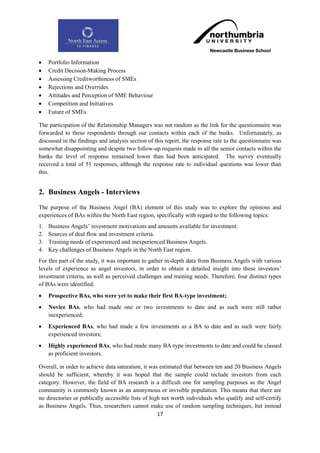
strategy and sector focus. These common characteristics or themes concerning SME lending are
shown in Table 1. The findings from this part of the research are classified in terms of these overall
themes.
All participating banks were sent ethical guidance which highlighted the anonymity and
confidentiality of their responses. In addition, the interview questions were sent to interviewees prior
to the meeting. The purpose of this was twofold; initially it was a pre-requisite to gaining clearance
from the corporate office of the bank; secondly, it enabled the bank to identify the most appropriate
person to participate in the interview. All respondents had access to the questions for preparation
prior to the interview. After a series of negotiations with the banks and the interviewees, an
appropriate date, time and location was agreed. All banks were asked to approve the recording of the
interviews. This agreement was voluntary and only one bank declined but agreed that the interviewer
could take notes. All banks were allocated a code in order to maintain anonymity and the interviews
were either recorded or notes were taken, depending upon the preference of the interviewee. Both
notes and transcripts were then coded according to the themes identified above.


                                                  15
Table 1 Common Characteristics of SME Lending

Broad Area                                Sub Area
SME Classification                        Turnover
                                          Sector
Trends in SME demand for credit           Change in banking paradigm
post 2008                                 Quality of proposals/sophistication of
                                          customers
                                          Role of accountants/ financial advisors
Attitudes                                 Confidence
                                          Outlook
                                          Trust (relationship)
                                          Transparency in lending
Credit decision-making process            Dealing with the diversity of SMEs
                                          Dealing with information asymmetry
                                          Triggers for non-performing loans and support
                                          interventions
                                          Level, sophistication and assessment of credit
                                          control
Additional support for SMEs               Coaching, mentoring, guidance and
                                          professional advice
                                          Dealing with rejections
Initiatives                               Project Merlin, the task force Enterprise
                                          Finance Guarantee (EFG)
Improving demand and market share         Unique selling proposition (USP)
                                          Targets

Future of SME finance


The themes that emerged from these interviews, together with the literature review that had been
undertaken at the start of the work, informed the questionnaire. This was developed with the aim of
involving a wider range of Relationship Managers in the research. Following the interview with the
Directors and/or Senior Managers within each bank, we requested that the questionnaires be
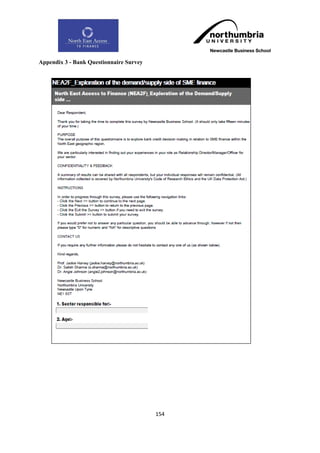
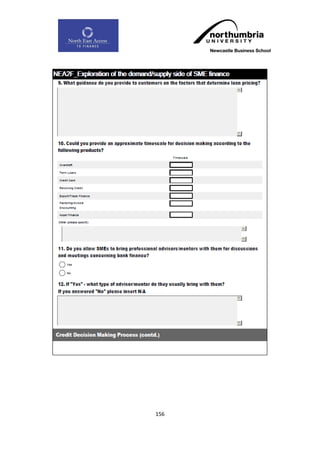
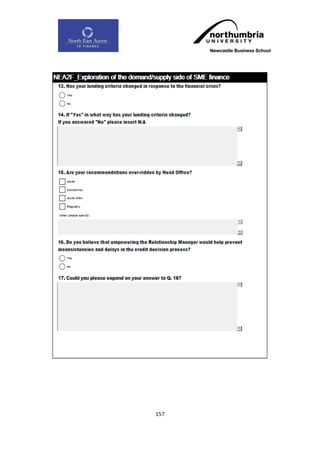
distributed to their Relationship Managers (RMs). A copy of the interview question prompts and the
final questionnaire are included as Appendices 2 and 3.

The purpose of the questionnaires was to harvest information concerning the supply and demand
aspect of SME lending in order to complement the information obtained from the interviews with the
Area Directors and Senior Managers through additional quantitative information and also qualitative
information concerning day-to-day experiences.
Again, all participating banks were referred to the ethical guidance sent prior to the interviews
reassuring anonymity and confidentiality of all responses. The questionnaire was developed using
SurveyMonkey which was identified as the most expedient process for collecting data, as it would not
interfere with the day-to-day organisational practice of the employees. The questionnaire included 39
questions across the following themes:
   Demographic information

                                                 16
    Portfolio Information
    Credit Decision-Making Process
    Assessing Creditworthiness of SMEs
    Rejections and Overrides
    Attitudes and Perception of SME Behaviour
    Competition and Initiatives
    Future of SMEs

The participation of the Relationship Managers was not random as the link for the questionnaire was
forwarded to these respondents through our contacts within each of the banks. Unfortunately, as
discussed in the findings and analysis section of this report, the response rate to the questionnaire was
somewhat disappointing and despite two follow-up requests made to all the senior contacts within the
banks the level of response remained lower than had been anticipated. The survey eventually
received a total of 51 responses, although the response rate to individual questions was lower than
this.


2. Business Angels - Interviews
The purpose of the Business Angel (BA) element of this study was to explore the opinions and
experiences of BAs within the North East region, specifically with regard to the following topics:
1.   Business Angels‟ investment motivations and amounts available for investment.
2.   Sources of deal flow and investment criteria.
3.   Training needs of experienced and inexperienced Business Angels.
4.   Key challenges of Business Angels in the North East region.
For this part of the study, it was important to gather in-depth data from Business Angels with various
levels of experience as angel investors, in order to obtain a detailed insight into these investors‟
investment criteria, as well as perceived challenges and training needs. Therefore, four distinct types
of BAs were identified:
    Prospective BAs, who were yet to make their first BA-type investment;
    Novice BAs, who had made one or two investments to date and as such were still rather
     inexperienced;
    Experienced BAs, who had made a few investments as a BA to date and as such were fairly
     experienced investors;
    Highly experienced BAs, who had made many BA-type investments to date and could be classed
     as proficient investors.

Overall, in order to achieve data saturation, it was estimated that between ten and 20 Business Angels
should be sufficient, whereby it was hoped that the sample could include investors from each
category. However, the field of BA research is a difficult one for sampling purposes as the Angel
community is commonly known as an anonymous or invisible population. This means that there are
no directories or publically accessible lists of high net worth individuals who qualify and self-certify
as Business Angels. Thus, researchers cannot make use of random sampling techniques, but instead
                                                    17
must resort to a combination of convenience sampling (i.e. using only those respondents who are
conveniently available to the researchers) and other techniques, which rely on intermediaries, in order
to access angel investors.

Generally, the following intermediaries are available for accessing Business Angels:
   Business Angel Networks (BANs) are introductory or matching services, which are membership
    organisations that allow high net worth individuals to join and benefit from introductions to fund-
    seeking entrepreneurs, investment advertisements and networking with other Business Angels.
    Members of BANs make their own individual investment decisions, independent from the
    decisions of other members and network managers.
   Business Angel Syndicates – or Angel Alliances are groupings of high net worth individuals,
    generally with fewer members than BANs, which also enable investors to network, view
    investment opportunities and be introduced to fund-seeking entrepreneurs. Similar to BANs,
    individual BAs also make their own investment decisions, independent from syndicate managers‟
    and other members‟ decisions.
   Syndicated Funds are compiled from Business Angels‟ capital. In contrast to the other two types
    of intermediaries, these are managed and organised like any other investment fund; high net worth
    individuals invest their personal capital into the fund and the fund manager makes investment
    decisions on the BAs‟ behalf, by investing money from the fund on a portfolio basis. In such
    syndicated funds, the participating BAs often do not get involved in the decision-making process
    and thus cannot invest independently from the fund manager and the other members.

In addition to these common Business Angel intermediaries, other networks (e.g. the networks of
accountants, lawyers or entrepreneurial forums) can also be used to access angel investors, but they
are more likely to contain members from outside the Business Angel community therefore
approaching these individuals tends to result in less well targeted access negotiations.

Intermediaries that specifically deal with Business Angels (i.e. BANs, syndicates and syndicated
funds) tend to guarantee confidentiality to their members. Therefore, they generally do not provide
direct contact between their member-investors and any external entrepreneurs or researchers. These
intermediaries can therefore be referred to as „gatekeepers,‟ through which access to Business Angels
must be negotiated.

Therefore, in order to gain access to Business Angel investors, it was necessary to discuss the research
with gatekeepers first, in an attempt to obtain their support with accessing individual investors and
with the study as a whole; thus, initial, informal interviews were arranged with the managers of all
Business Angel intermediaries operating in the North East. These informal interviews were carried
out between 16th June and 8th July 2011. Each informal interview lasted between 45 minutes and three
hours but due to the introductory nature of the conversations, they were not tape-recorded.


Once the BA intermediaries had been informed of the research and had been asked to support the
identification of individual angel investors, the intermediaries made introductions to individual
members of their organisations. However, the intermediary‟s introduction did not guarantee that the

                                                  18
introduced investor would be willing to take part in the study. Therefore, a further level of access
negotiations began with each potential participant. Since only a very small number of Business
Angels, introduced through the intermediaries, was willing to take part in the study, this group was
supplemented through the use of existing contacts known to the researchers in order to obtain a
sufficiently high participation in the study.

Through a combination of introduction from intermediaries and researchers‟ searching through their
own networks, a total of 36 Business Angels were identified and approached. From these approaches,
a total of 12 semi-structured interviews were held over the period 26th June to 12th August 2011. A
copy of the interview prompt questions is included as Appendix 4. The interviews lasted
approximately one hour each and all but one interview was tape-recorded (one interviewee refused
any form of recording, which the researchers honoured). Before the interviews, participants were
asked to sign Northumbria University‟s informed consent forms. The sample proved sufficiently
representative with participating investors differing according to their BA experience, such that the
initially planned variety of investment experiences could be explored within this study. The
interviews were transcribed and subjected to thematic analysis in order to identify commonalities and
differences. The key themes which have emerged from the data are presented in the findings and
analysis section of this report. While the main purpose is to present and discuss the findings derived
from the interviews with the angel investors, the report will also draw upon the informal interviews
with the BA intermediary managers, in order to provide a more complete picture. All participants
(both intermediary managers and angel investors) are anonymised and their identity is disguised – as
part of this anonymisation, all participants are portrayed as males.

3. SMEs - Focus Group Interviews and Questionnaires
Before being able to approach any potential research participants for the SME strand of the work, it
was crucial to select a suitable definition of an SME (Small and Medium Enterprise). The definition
adopted is based on that developed and accepted by the European Union4, and subsequently used by
the UK government and its regional bodies.

For the purposes of this research, SMEs are therefore defined as enterprises which:
 have fewer than 250 employees
 have an annual turnover not exceeding £43.7m (50 Million Euro)
 are autonomous (conforming to the criterion of independence).

The North East‟s SME population was calculated using data mined from the Government‟s Business
Population Estimates 2010 (BIS May 2011)5. NEA2F had initially requested that „sole traders‟ be
excluded from the SME research and with their exclusion the resultant figure for the North East SME
population is approximately 36,000, as shown in Table 2 below. This comprises micro, small and
medium enterprises (SMEs).


4
    Commission Recommendation 2003/361/EC, as described in The New SME Definition – user guide and model declaration, EU 2005
5
     Accessed at http://stats.bis.gov.uk/ed/
                                                                 19
The first part of the research aimed to establish a list of support interventions and finance initiatives
which are being offered to SMEs in the North East region. Desk-based searches were undertaken
during May and June 2011, starting with organisations such as ONE North East, Business Link,
NEA2F and local authorities etc. as a source of information regarding finance and support
interventions. These also proved an invaluable source of signposting to a wide range of other
providers and interventions.

The interventions and initiatives which were identified were subsequently entered into an Excel
spread sheet and categorised according to:
 location
 target characteristics
 content
 provider of the intervention/initiative
 any other available information.

In order to explore the experiences and opinions of SMEs when trying to access funding and support
within the North East region, and consistent with the overall approach to the research, a mixed
methods approach was deemed most suitable. First, a qualitative focus group interview was held with
a small number of regional SMEs, whereby SMEs were asked open questions about their experiences
and viewpoints. Findings and emerging themes from this focus group were then used to inform the
subsequent design and administration of a questionnaire survey that was aimed at a larger sample of
SMEs within the region.

The research aimed to investigate the experiences and opinions of SMEs in the North East, with
particular focus on:
1. Recent experience (both successful and unsuccessful) of trying to obtain business finance.
2. Recent experience of trying to obtain business support.
In order to gain access to SMEs for participation in the focus group interviews, a number of SME and
entrepreneurship networking groups/intermediaries were contacted as gatekeepers to these groups.
Through various intermediaries, the senior representatives of ten local SMEs were invited to take part
in the focus group. The participants were purposefully selected to deliberately diverge according to a
variety of factors, so that the focus group would ultimately include a mix of new and established
SMEs of differing sizes from a range of industry types and locations.

Seven of these ten SME owners attended the focus group held on 25th July 2011, at Newcastle
Business School. After each participant provided their details on a profile sheet (in order to establish
the nature of each participating SME), the focus group was tape-recorded. The questions were
purposely open-ended and derived from an initial review of the literature, focusing around funding
sources available to SMEs, the participants‟ experiences and opinions of raising finance and obtaining
other support within the region. In order to capture not only the positive experiences of obtaining
funding and support, the researchers deliberately probed participants to also reflect upon situations
where they have attempted to obtain finance or support but found that they were unable to do so. The
prompt questions for the focus group are included in Appendix 5.

                                                   20
Subsequent to conducting the focus group interview, the data was transcribed and analysed according
to emerging themes. Based on the findings from the focus group, and informed by SME literature, as
well as by the findings emerging from the Banks and Business Angels parts of this study, a
questionnaire was designed, which would enable the collection of data from a larger sample of
regional SMEs. The questions focused on experiences of raising finance and obtaining additional
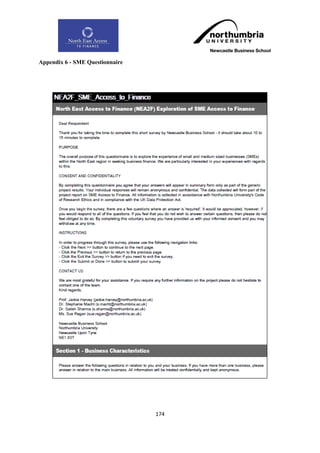
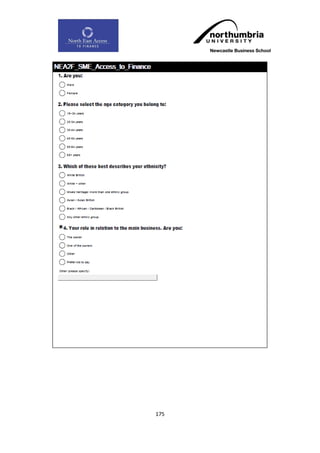
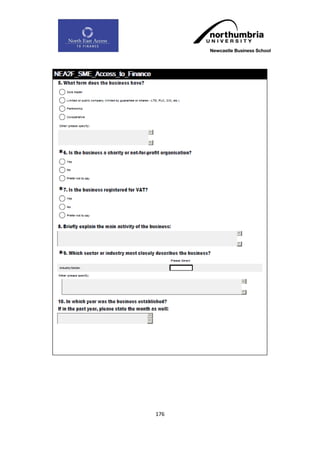
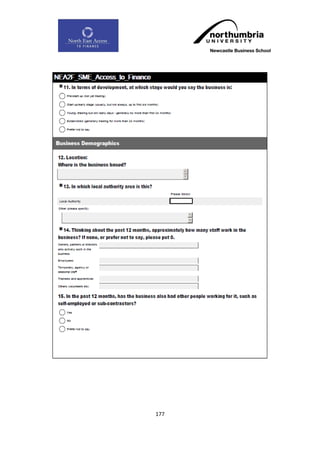
support. A copy of the questionnaire is included as Appendix 6.

Before making the questionnaire available to a wider audience, the focus group participants were
asked to complete the questionnaire and provide feedback on it. In effect this was used as a pilot to
test for clarity and it resulted in slight rewording and the re-organisation of questions. Similarly, as
with the access to the focus group participants, the networking groups and SME intermediaries were
called upon once more to forward the online questionnaire (hosted on SurveyMonkey) to their
members or make the link available to them via newsletters and/or their own websites. The vast
majority of intermediaries were very forthcoming and supportive of the research and agreed to
promote the questionnaire with the SMEs on their databases and mailing lists.

Unfortunately, the response rates for surveys with SMEs are known to be generally very low (Newby
et al., 2003). In order to increase the response rate for this survey, a variety of activities were carried
out including asking intermediaries and networking organisations to remind their members of the
survey; the researchers‟ personal networks were also called upon to distribute the survey; individual
SMEs were asked to forward the survey to other SMEs that they knew; and flyers with the web link to
the survey were distributed at various networking events. SMEs were further incentivised to take part
in the survey through the opportunity to receive one of ten randomly allocated individual coaching
sessions offered by staff at the Business School.

Ultimately, the questionnaire was kept live online for a period of seven weeks between 12 th
September and 31st October 2011, which resulted in a total of 119 responses. Due to the reliance on
intermediaries to distribute the questionnaire, the total number of SMEs ultimately approached (i.e.
the sample) cannot be verified as it is unclear how many SMEs have (a) received the survey and (b)
received it from various sources. Consequently, it is not possible to establish the exact response rate to
this survey.


                                                    21
Table 2 SME Population for the North East Region
1                                            2            3           4                                5                 6
Industry                                     Total no.    No. of      No. of                           No. of            Total of
                                             of all       Micro       Small                            Medium            SMEs by
                                             enterprises                                                                 industry
A Agriculture, Forestry and                         4,185       1,520                           55                     5      1,580
Fishing
B, D and E Mining and                                   260                115                  55                   10               180
Quarrying; Electricity, Gas,
Steam and Air Conditioning
Supply; Water Supply;
Sewerage, Waste
Management and
Remediation Activities
C Manufacturing                                     4,345                1,925                 805                 265              2,995
F Construction                                     26,185                4,310                 655                 105              5,070
G Wholesale and Retail                             11,290                6,325                 925                 105              7,355
Trade; Repair of Motor
Vehicles and Motorcycles
H Transportation and                                 7,720               1,085                 220                   40             1,345
Storage
I Accommodation and Food                             6,470               3,490                 675                   75             4,240
Service Activities
J Information and                                    5,625                 885                  95                   15               995
Communication
K Financial and Insurance                            2,455                 450                  50                   10               510
Activities
L Real Estate Activities                            1,530                  690                  55                   20               765
M Professional, Scientific                         16,880                3,355                 505                   75             3,935
and Technical Activities
N Administrative and                                 7,595               1,750                 270                   55             2,075
Support Service Activities
P Education                                          6,530                 375                  75                  20                470
Q Human Health and Social                            8,870                 890                 685                 105              1,680
Work Activities
R Arts, Entertainment and                            5,270                 495                 100                   20               615
Recreation
S Other Service Activities                           6,920               2,050                 135                   10             2,195

Total no. of SMEs by size                                ---           29,710               5,360                 935             36,005
As a percentage of total                                 ---           82.5%               14.9%                 2.6%              100%

All enterprises in North East     122,135        29,710         5,385                                              935            36,030
(BPE 2010, BIS)
(Source: Data mined from Business Population Estimates 2010, BIS May 2011
http://stats.bis.gov.uk/ed/)

Notes
The slight variation in totals between 36,030 and 36,005 is due to the data source methodology, which includes rounding in order to avoid
disclosure and also using * symbol to replace data deemed to be disclosive. Where * occurs, it has had to be interpreted as 0.
Explanatory Notes:

                                                                    22
Column 1 - Categories of Industry are those used by BIS.
Column 2 - Totals for all enterprises in North East.
„All enterprises‟ includes sole proprietorships and partnerships comprising only the self-employed owner-manager(s), and companies
comprising only an employee director (= solo entrepreneurs); plus micro, small and medium enterprises; plus large enterprises.
Column 3 - Micro enterprises which includes all those with 1-9 employees
Column 4 - Small enterprises which includes all those with 10-49 employees
Column 5 - Medium enterprises which includes all those with 50-249 employees
Column 6 - Total SME figures = addition of Columns 3, 4 and 5.
SME in this report is based on number of employees only, not turnover figures. It includes all micro, small and medium enterprises (1-249
employees) and excludes both „solo entrepreneurs‟ (= 0 employees) and also large enterprises (=250+ employees).


                                                                   23
Literature Review

1. Overview of SME Finance
In a very basic summary, there are three types of finance, in addition to bootstrapping and internal
attempts to cut costs, which are suitable for small businesses: Debt, Equity, and Mezzanine.

1.1 Types of SMEs

While it is obvious that some finance sources are not suitable for, nor accessible to, SMEs (e.g. raising
equity through the stock market or issuing publicly traded bonds), there are a variety of alternative
SME-relevant sources. However, SMEs represent a very heterogeneous population and thus finance
sources will be specific to the age and development of the SME. Mitter and Kraus (2011) argue that
the suitability of different finance sources depends upon the SME‟s capital needs, which in turn
depends upon its model of foundation and stage of development:
   Foundation model refers to the way in which the venture has been created, namely imitation
    foundation (i.e. based upon imitating an existing concept or technology) or innovative foundation
    (i.e. based upon a newly developed technology/product/service/etc.).
   Stage of development refers to the venture‟s location within its life cycle (i.e. seed, start-up,
    development or expansion stage).


A further commonly-used factor, which determines the sources of finance available to, and suitable
for, SMEs is the distinction between lifestyle, middle-market and high-growth businesses (Sohl,
1999):
   Lifestyle businesses are characterised by a very low or non-existent growth rate; some lifestyle
    businesses are also characterised by the owner-manager‟s lack of intention to grow the business,
    whereas other owner-managers would like to grow the business but realise that the concept is not
    able to grow (the latter are sometimes called the „living dead‟) – a vast majority (around 90%) of
    „typical SMEs‟ are part of this group.
   Middle-market businesses are characterised by a substantial growth rate which tends to provide
    investors with an acceptable amount of return. They are, however, not the new „stars‟ in the
    business world – only a small amount of SMEs are part of this group (around 10%).
   High-growth businesses are those businesses that grow almost exponentially and that can be
    considered the „next big thing,‟ allowing investors to reap very large returns on investment, e.g.
    through stock-market flotation; less than 1% of all businesses are high-growth in nature.
Cassar (2004) specifically investigated the financing of start-up business and identified that size and
asset structure (i.e. the level of tangible and intangible assets in the business) affect the business‟
capital structure decisions, whereas organisational form only has a limited effect (i.e. there appears to
be a signalling effect from incorporation but no further effect on capital structure) and the owners‟
characteristics have no significant influence on the capital decision.

                                                   24
1.2 Sources of Finance for SMEs

While not all of the sources that will be discussed here are appropriate for, or accessible to, all of the
different types of SMEs, there is a general consensus that two specific theories can help explain the
funding choices of entrepreneur or owner-managers: Pecking Order theory and Trade-off theory.
Pecking Order theory suggests that it is the owner-managers‟ or entrepreneurs‟ individual decision
as to which finance sources to approach at any given point in time. The theory posits that there is a
pecking order, i.e. ranking, of preferred sources of finance, whereby entrepreneurs tend to prefer own,
internal sources of finance over external debt, which in turn is preferred over external mezzanine
finance, and external equity is the least preferred source of all (Fama and French, 2002; Hackbarth et
al., 2007; Shyam-Sunder and Myers, 1999).
Trade-off theory, on the other hand, takes into account the benefits and disadvantages of funding a
business through debt rather than equity. This theory acknowledges that taking on more debt increases
the tax shield effect of the interest payable, which reduces a venture‟s tax burden – in contrast,
however, taking on more debt increases the risk of over-gearing, financial distress and bankruptcy,
which involves a variety of costs to the business. The theory therefore proposes that entrepreneurs
choose finance sources based on a trade-off between increased tax shield and increased bankruptcy
costs (Fama and French, 2002; Hackbarth et al., 2007; Shyam-Sunder and Myers, 1999).

However, independent from the owner-managers‟/entrepreneurs‟ desire for specific types of finance,
not all types of finance are suitable for all SMEs (as indicated above). Relying on the ranking of
financiers explained by Pecking Order theory, this section now briefly discusses the suitability of the
different funding sources available to SMEs.

1.2.1        Internal and Informal Sources of Finance

This refers mainly to retained earnings (i.e. capital generated by the venture itself), as well as to the
so-called 3F investors – founder, family and friends6 (Mitter and Kraus, 2011). Investment of own
capital and an ability to obtain capital from a very close circle of friends and family tends to send a
strong signal to outside investors, suggesting commitment from the entrepreneur (Prasad et al., 2000).
Generally, any business can benefit from internal finance, independent from the stage of development,
nature of foundation or growth intentions/potential. However, the larger the business becomes, the
more likely it is that the entrepreneur has already invested all available capital and/or the
entrepreneur‟s capital resources are insufficient to continue to fund the business, especially if it is a
high-growth business and/or in the expansion stage.

Using trade credit can also be considered part of internal sources as businesses use their interactions
with suppliers and customers to fund their operations, e.g. through asking for pre-payment from
customers but at the same time making use of the maximum trade credit period until suppliers are paid
(Mitter and Kraus, 2011). Another internal source of finance, which is often discussed in academic
literature and which may include some of the above-mentioned sources, is „bootstrap finance‟ – this


6
    Sometimes called 4Fs to include fools, but this is being omitted here.
                                                                       25
refers to any activity which enables entrepreneurs to obtain resources (mostly, but not exclusively,
financial resources) at a lower cost or even for free (Van Auken and Neeley, 1996).

1.2.2   External Debt

Debt, mostly provided through banks, is seen as the entrepreneur‟s second-favourite funding type.
The reasons lie in the tax shield effect, as well as the fact that no ownership needs to be relinquished.

Generally, it is the later-stage businesses (which already have a proven track record) and the lifestyle
and imitation-based businesses, which can more easily attract debt finance because they might possess
assets that can be used as security. Additionally, they are less risky than, for instance, a seed-stage
venture, which is generally based on a novel, „disruptive‟ technology that has very high growth
potential but at the same time has very high risks attached.

1.2.3   External Mezzanine and Equity

While mezzanine refers to finance types that possess elements of both debt and equity, ordinary
equity is ownership capital, which means that entrepreneurs are expected to relinquish some of their
ownership in return for the investment. Generally, it is Business Angels (BAs) and Venture Capitalists
(VCs), who are prepared to invest in smaller businesses – however, not all VCs are willing to do so;
instead, some VCs only provide expansion or similar types of finance to later-stage businesses
(Elitzur and Gavious, 2003). BAs, on the other hand, tend to specifically focus on smaller and
younger businesses.

For both types of investors, the risk associated with even high-growth and innovation-based
businesses is not a turn-off, as long as the return potential is high enough to warrant the given level of
risk (see section on Business Angels for further discussion). The literature suggests that BAs and VCs
are not interested in lifestyle businesses and tend to also shy away from imitation-based ventures, as
these cannot provide sufficiently high returns. Middle-market ventures are acceptable but it is the
high-growth (i.e. high-potential/high-risk) and often technology-based businesses that are of most
interest (Sohl, 1999; Van Osnabrugge and Robinson, 2000).


Bank Finance for SMEs
2.1 Overview of Business Finance

Bank lending (debt) is one of the key aspects of business finance. The banking and finance industry
provides a range of products and services to all types of businesses, from the smallest micro to the
largest corporate. The common finance option across all business is bank overdrafts (for working
capital needs) and term loans (for capital expenditure needs). In addition, there are a number of
specialist finance products such as asset-backed lending, invoice discounting, factoring, trade finance,
vendor finance and consortium finance.


                                                   26
2.1.1   Types of Business Finance

According to the financing objectives of the business, Table 3 below gives an overview of the
different types of business finance.

Table 3 Use of Business Finance across Different Sized Firms

Type             Turnover      Characteristics        Regular             Specialist       Provider of
                                                      Finance             Finance          Finance
Smallest         Below         Cash-based firms;      Limited             Limited, Some    Banks, credit
Micro            £50k          often part-time        mainly to           asset backed     card
Businesses                     business; few          overdrafts,         lending          companies and
                               tangible assets;       term loans,         (ABL)-           point of sale
                               local operations       credit cards        mainly vendor    (Vendor
                                                      and personal        finance          Finance)
                                                      finance
                                                      products
Micro            £50k to       Increasingly full-     Overdrafts,         Increased use    Banks, credit
Businesses       £1m           time firms with        term loans and      of structured    cards
                               staff, premises        credit cards        ABL.             companies,
                               and assets; local                          Occasional       specialised
                               activity normally                          use of trade     providers of
                               limited to a single                        finance          ABL and trade
                               region;                                    products         finance
                               occasional                                                  products.
                               international
                               trade activities
SMEs             £1m to        Full-time, larger      Overdrafts and      ABL,             Banks, credit
                 £25m          multi-regional         Term loans          factoring and    cards
                               and national                               invoice          companies,
                               firms, increasing                          discounting,     specialised
                               international                              trade finance    providers,
                               trade activities.                          and some         Business
                                                                          equity finance   Angels,
                                                                                           private equity
Mid-size         £25m up to    Larger national        Overdrafts (or      Equity           Banks, venture
companies        £500m         and international      revolving           finance, trade   funds, equity
                               firms, often           credit facility),   finance,         funds and
                               multinational          term loans          invoice          stock market
                               operations                                 finance,         listing.
                                                                          consortium
                                                                          finance
(Source: Adapted from Business Finance Taskforce, October 2010)

2.1.2   UK Banks‟ Lending to SMEs

According to the British Bankers‟ Association‟s (BBA) Small Business Support Report (September,
2011), there are in existence an estimated 484,000 term loans (within some 3.9 million small business


                                                     27
banking relationships) with a total outstanding value of £37.1bn, whilst overdraft borrowing stands at
£7.1bn.

From Figure 1 it can be seen that the average monthly value of new term lending in the first half of
2011 is slightly lower than throughout 2010. However, the aggregate value of deposits in small
business current and deposit accounts stands at £58bn. The report also states that around 50,000 small
businesses are establishing new banking relationships each month.
Figure 1 New Term Lending (£m) to Small Business


        (Source: BBA Small Business Support Report, September 2011)

Further, Figure 2 below shows that as the Bank of England base rate fell to 0.05% in March 2009, the
median interest rates on new SME variable rate facilities followed. The margins between the bank
base rate and the lending rates reflects the increased credit risk and the funding costs. It could be
argued that the spread is more for small SMEs (turnover of under £1m p.a.), however, the effect of
interest rates on credit facilities availed by SMEs as presented in Figure 3 shows that credit cards
attract higher interest rates than overdraft facilities.


                                                 28
Figure 2 Indicative Median Interest Rates on New SME Variable-Rate Facilities


        (Source: Department of Business, Innovation and Skills & Bank of England October 2011)

Figure 3 Effective Interest Rates on Credit


        (Source: Bank of England, October 2011)


2.2 The Credit Decision-Making Process

Historically, banks would use judgment in evaluating the creditworthiness of the applicant, drawing
from the experience of previous lending decisions. The end result of the evaluation process is to
provide a „measure of creditworthiness‟. According to Lewis (1992, p. 3), “Creditworthiness is a
characteristic of an individual that makes him or her a suitable candidate for the extension of credit
while someone who is not creditworthy is, conversely, unsuited to credit”. This means that the
applicant who is creditworthy pays all their obligations as agreed in the credit terms and conditions
and those that are non-creditworthy do not. Thus, creditworthiness implies an applicant‟s ability and
willingness to repay. According to Feldman (1997), there is a correlation between the willingness and
                                                 29
ability to repay of a firm with that of the owner. It could be argued that the personal history of the
owner could be used to determine the repayment prospects of the firm.

Credit officers would examine the firm‟s characteristics, evaluate its creditworthiness and decide to
approve or decline the loan (Chandler and Coffman, 1979). If the lenders find that the applicant‟s
creditworthiness is opaque, then they would either: (i) increase interest rates charged to offset the
extra risk; or (ii) exert extra effort in determining what information can add value, and how to obtain
and assess it (Stanton, 1999). Ultimately, using this subjective approach, the decision as to whether or
not to grant credit is based on the experience and personal knowledge of the credit officers (Hand,
1998). The subjective approach may also incorporate rules and other non-empirically derived credit
guides established by the bank‟s policies (Chandler and Coffman, 1979).

Given the prevalence of the „human element‟ i.e. experience, judgment and common sense, supported
by some basic numerical support in credit decisions (Banks, 2002), central to the granting of credit is
the estimation of risk in terms of identifying good and bad credit risks (Lewis, 1992). Bunn and
Wright (1991) advocate that the subjective approach can be beneficial in a lending environment which
has little or unstructured data, especially Small and Medium Enterprises (SMEs) and high net worth
individuals.

According to Thomas et al. (2002), while assessing the application for credit, banks would use credit
scoring for small borrowers and move up as the size of the SME increases. The outputs from the
credit scoring models are also subject to override by credit officers who rely on their experience and
judgment rather than the score. Saunders and Cornett (2010) argued that the credit scoring model for
small businesses could be made more sophisticated by incorporating the financial analysis of the
business along with the behavioural analysis of the owner/manager. Wilson et al. (2006) highlighted
the variability in the credit decision-making process of a clearing bank applying the same credit
scoring framework.

Further, within the literature (Binks et al., 1992; Berry et al., 1993), banks adopt the following
methods for lending to SMEs:
   Going-Concern Approach in which banks look forward to future earnings as evidence of
    repayment ability of the business. This approach requires more analytical skills, more
    information and monitoring which may be costly to administer.
   Gone-Concern (or liquidation) Approach which takes a security-based lending approach. The
    emphasis of this approach is on the past and current financial situation rather than future
    projections.
The specific approach being adopted by UK banks depends upon the size and the information
availability of the SMEs.


                                                  30
2.3 Issues and Challenges in Bank Lending

2.3.1   Relationship Lending versus Transactional Lending

Globally, SMEs are confronted with relatively harsh credit constraints and limited access to finance
(Beck and Maksimovic, 2002, Beck et al., 2004). According to Baas and Schtooten (2005), due to the
limited publicly available information on SMEs, banks are hesitant to provide credit. However, Boots
and Milbourn (2002) argue that the lack of information can be compensated by using relationship
lending, in which the SME and the bank enters into a long-term relationship that assures the SMEs
access to credit and the bank access to soft information. Thus, relationship lending is established on
soft data such as personal connections and reputation. According to Peterson (1999), lending to SMEs
differs to that of large corporates as:
       lenders face fixed costs in lending
       the relationship between the owner/manager of a SME and the bank is very close
       small firms are more informationally opaque than large firms because they do not have
        certified audited financial statements to produce financial information on a regular basis.

Relationship lending could be expensive to establish and maintain. For a large bank, spending time to
develop small accounts is simply not an efficient use of resources when the same amount of effort can
result in a much larger credit.

2.3.2   Information Asymmetry

One of the challenging areas in SME lending is „Information Asymmetry‟ which arises as a result of
the different levels of information held by the bank as well as the SME about the future of the
business (Binks and Ennew, 1996, 1997). Berger and Udell (1998) argue that new businesses are the
most informationally opaque, on account of their lack of any track record of their business. The
information required to assess the competence and commitment of the SME and the prospects for the
business is either unavailable, uneconomic to obtain or difficult to interpret. With information
asymmetry, two problems arise for the banker: Adverse selection and moral hazard. Adverse
selection is lending to an uncreditworthy business and not lending to a creditworthy business, which
may be due to lack of useful information on the future of the business. The banker would experience
moral hazard after the credit has been made and due to information asymmetry, the business may hide
certain actions which might be unfavourable to the bank‟s interest.

It is important that the bank collects adequate information about the future prospects of the SME
whilst evaluating its creditworthiness to address the problem of information asymmetry.

2.3.3   Decision Overrides

There might be instances wherein the credit decisions arrived at might be reversed or changed. These
changes to credit decisions (either positive or negative) as reported by Lewis (1992) are referred to as
overrides. They occur either through policy rules which are set out by the lender for the SMEs or
through individual decisions based upon additional information available in respect of the SMEs.
                                                  31
Lewis (1992), Siddiqi (2005) and Anderson (2007) have listed the following situations in which the
overrides might take place:
       Informational Overrides are overrides which take place based upon new information about
        the applicant that had not been incorporated while credit proposals were being analysed. It
        could be argued that in the case of relationship lending, informational overrides might take
        place as the Relationship Manager/officer is in direct contact with the applicant. In situations
        where cases are credit scored only for guidance, Anderson (2007, p. 459) states that
        “overrides are part and parcel of the credit decision process”, which are seen in high-
        value/low-volume lending and in circumstances where credit scoring is a new concept and the
        role of Relationship Managers are not ruled out.
       Policy Overrides take place whenever new sets of rules are in place for a special customer
        group (for example, Project Merlin for SMEs‟ finance). There might be other instances
        wherein there is a change in the lender‟s policy regarding the lending criteria, which might
        trigger policy overrides.
       Intuitional Overrides are overrides which may occur whenever the area director/relationship
        director might reverse the decision which has been arrived at through the scoring system or
        judgmental evaluation. There might not be any justification for such reversal.


2.3.4   Rejections

One of the challenges for Relationship Managers would be to know “how the rejected applications
would have performed if they were accepted and this process is known as reject inference” (Lewis,
1992; Hand and Hanley, 1997; Bhatia, 2006; Banasik and Crook, 2007). The process of reject
inference is to make inferences about the sample population for the rejected applications. It is
important that a process of dealing with rejections be adopted within banks and financial institutions
so that the SMEs which are not successful at securing access to finance are given additional support
and access to appeals procedures, as well as alternative financial avenues.

2.3.5   Non-Performing Loans

Non-performing loans are characterised as bad loans which have an impact on the efficiency and
performance of banks. Asset quality in lending institutions is frequently presented in a classification
matrix (Guy, 2011) such as that presented in Table 4 below.

Table 4 Loan Classification

Loan Classification             Criteria
Standard                        Performing
Sub-standard                    Past due 3+ to 6 months
Doubtful                        Past due 6+ to 12 months
Loss                            Past due above 12 months
(source: Guy, 2011)

                                                  32
100% provisioning is required for a loss (which is non-performing) and the bank‟s resources are
consumed in monitoring and regulating such loans.

2.3.6   Enterprise Finance Guarantee

Launched in January 2009, Enterprise Finance Guarantee (EFG) is a loan guarantee scheme offered
by the UK Department for Business Innovation and Skills, intended to facilitate additional bank
lending to SMEs with insufficient or no collateral security with which to secure a business loan. The
EFG is available to SMEs with an annual turnover of up to £25m, seeking loans for between £1,000 to
£1 million. EFG can be used for new term loans, refinancing of existing term loans, conversion of
overdraft to term loans, invoice finance guarantee and overdraft guarantee. The EFG will guarantee
lenders for 75% of the total loan value. However, the assessment of SMEs for the credit facility still
rests with the individual bank and the BIS does not have any role to play in credit assessment. Along
with the EFG, the lender could also take other security such as personal guarantees, in relation to the
EFG backed credit.


                                                  33
2. Overview of Business Angels
Business Angels (BAs), or high net worth individuals, are private individuals who have modest to
large amounts of disposable income, a proportion of which they use to invest directly into small,
young, unquoted high-growth ventures, with which they have no family connection (De Noble, 2001;
Elitzur and Gavious, 2003; Freear et al., 1994; Landström, 1992; Mason and Harrison, 1996a). BAs
are not interested in businesses that have limited or no potential to grow into substantial organisations
(the so-called lifestyle ventures). Instead, BAs are mostly interested in high-growth, entrepreneurial
ventures which are scalable and have a substantial growth potential. As previously explained, such
businesses often face a funding gap as they have already used up all their internal financial resources
and are too risky for banks, but at the same time are too small to be attractive to formal Venture
Capital. It is argued that BAs are the oldest, largest, most often used and most important source of
outside funds for entrepreneurial ventures (Van Osnabrugge and Robinson, 2000).

Many Business Angels have first-hand experience in entrepreneurship and small business
management because their pre-angel career tended to be entrepreneurial in nature (Kelly and Hay,
2001). Even those BAs who have not started and run their own business(es) tend to have substantial
amounts of business and management experience because they often have been involved in the senior
management of organisations (Mason and Harrison, 1996b). Only a very small minority of BAs have
obtained their wealth through opportunities outside of their control, such as lottery wins or
inheritance.

3.1 Business Angels‟ Investment Motivations

Extant research on BAs‟ motivations, i.e. their reasons for becoming an angel investor in the first
place, identified two types of motivations, a combination of which forms the actual motivation to
become a BA. The first of these motivation factors is the financial return; clearly, BAs are investors
and therefore they are interested in obtaining a monetary return on their investment, however,
researchers have also identified a very strong secondary motivating factor, which is non-financial in
nature. This so-called “psychic income” (Ehrlich et al., 1994, p. 70) consists of personal reasons, such
as the fun of being involved in business or the enjoyment of making business decisions, as well as
more altruistic and philanthropic reasons, such as the opportunity to support the next generation of
entrepreneurs or the possibility of helping new businesses or the region (Barrow et al., 2005;
Landström, 1998).

Due to the invisibility of the BA market in general, it is impossible to pinpoint exactly how much
money is still available for BA-type investment each year – researchers and policy makers have to
rely on extrapolations and guesstimates to obtain estimated data about amounts invested and amounts
still available for investment.


                                                   34
3.2 Sources of Deal Flow and Investment Criteria

This section details the literature surrounding the reasons why BAs invest in certain businesses but not
in others, i.e. their specific investment criteria. Although investment criteria are not simply the
opposite of rejection criteria, the latter can nevertheless provide further insights into the reasons why
BAs invest in certain opportunities but not in others. Therefore, research on rejection criteria is
reviewed here.

In order to explain BAs‟ investment criteria, it is worthwhile to briefly explain the investment process
which BAs tend to go through, from becoming aware of an investment opportunity to the moment
they exit from their investee. Paul et al. (2007) investigated the investment process of BAs and, after
identifying a number of distinct stages, produced the model as shown in Figure 4 below.

As Figure 4 shows, Paul et al.‟s (2007) model portrayed the investment process as being both
sequential and rather organised. However, they admitted that this portrayal would be a rather
simplistic view of the investment process as the reality of investment suggests that the process can be
messy and iterative, moving backwards and forwards between the stages and it can even be
interrupted at any point (when one of the parties decides that the investment should not go ahead).

Figure 4 BA Investment Process


(Source: Paul et al., 2007, p. 114)

According to Paul et al.‟s (2007) investment process model, the entire process can be broken down
into three phases, which in turn can be further broken down into a total of five stages:

                                                   35
Phase 1 – Pre-Investment, which consists of three distinct stages; familiarisation, screening and
bargaining which (should the BA be willing to invest) results in the actual investment.
Phase 2 – Post-Investment, which Paul et al., (2007) referred to as the „managing stage,‟ where the
investor becomes involved in the investee business and adds value to the business.
Phase 3 – Exit, or Harvesting, which is the moment in time when the BA leaves the investee
company and (in an ideal scenario) makes a financial return on investment.

During the familiarisation stage, investors become aware of investment opportunities and start to
familiarise themselves with the entrepreneur and the business idea. During the screening stage, BAs
conduct more detailed due diligence, by scrutinising every aspect of the entrepreneur, business plan,
presentation and business concept generally. The bargaining stage then requires BAs and
entrepreneurs (and possibly additional investors) to negotiate the specifics of the investment deal and
to eventually sign the actual investment agreement. Post-investment, BAs tend to become involved in
their investee companies (for instance, in the role of mentor, advisor or sounding board) and by so
doing, they attempt to add value beyond the financial investment. Finally, BAs exit their investee
businesses by selling their share and, ideally, making a return on their investment. For the purpose of
this study, only the stages within the pre-investment phase are relevant as it is the identification of
deals, as well as the motivations and investment criteria, which is the area of focus.

3.2.1   Deal Flow

During the early familiarisation stage, BAs are becoming aware of investment opportunities and this
so-called deal flow requires BAs to either actively identify investment opportunities or be guided
towards such opportunities by their contacts. Paul et al.‟s (2007) qualitative study found that BAs tend
to identify potential deals through three key intermediaries: business associates, Business Angel
Networks (BANs) and investment syndicates. The authors further specified that there are other
alternative sources of deal flow, such as accountants, lawyers, banks and other financial organisations,
but that they were much less common than the three key sources mentioned above.

When Mason and Harrison (1996b) investigated an informal syndicated fund of BAs, they concluded
that the syndicate obtained deals from a variety of sources, which they then forwarded to their
individual members. The sources of deal flow included business sections of newspapers, investment
magazines, brokers and accountants, suppliers of mailing lists and databases, BANs, industry-specific
market research and being approached by entrepreneurs directly.

In the Norwegian context, Reitan and Sørheim (2000) further corroborated that BAs tend to obtain
most of their investment opportunities through friends/acquaintances, followed by financial
institutions and intermediaries, as well magazines/newspapers and other business connections. Only a
small number of proposals came through direct contact with entrepreneurs, own initiative, public
support agencies, BA associations and service providers such as accountants.

Both Paul et al.‟s (2007) and Reitan and Sørheim‟s (2000) studies further indicated that BAs appear to
prefer deals emerging through trusted contacts, as opposed to unsolicited deals or opportunities
presented by people with whom they are not familiar. Sørheim (2003) specifically investigated the
                                                  36
pre-investment behaviour of Norwegian BAs and found that with regard to flow of investment
opportunities, there are substantial inefficiencies within the angel market; he also demonstrated that
BAs who have operated for a long time within a specific region and/or industry are more likely to find
suitable and high-quality investment opportunities within that region and/or industry. The reasons can
be traced back to the fact that such investors have not only rather large networks of contacts, but
also a rather visible position within their particular networks.

3.2.2   Investment Criteria

The investment criteria of Business Angels have been of interest to various researchers over the last
few decades and it is interesting to note that findings tend to be rather similar. A lot of early work in
the BA field has been around the characteristics and profiles of BA investors and, while this is not the
focus of this study, some generic characteristics are noteworthy as they help to explain some of the
investment criteria discussed below.

BAs have often been entrepreneurs themselves and are often retired (mostly through voluntary early
retirement) by the time they start their BA career. As such, BAs generally possess large amounts of
entrepreneurial and small business or management experience, while at the same time having spare
time and an interest in business. As such, they generally prefer to be „active‟ investors, which means
that they want to provide some of their experience to their investee businesses through post-
investment involvement. In order to be able to do so, they need to be able to easily reach their investee
business(es) – thus, BAs tend to invest locally (Paul et al., 2007). A further aspect of this desire for
involvement is the often-expressed need for BAs to invest in businesses which operate in familiar
industries or markets, as that is where the BAs have relevant experience – thus, BAs tend to prefer to
invest in businesses that they can understand and in which they have had first-hand experience in the
past (Paul et al., 2007).

Moving away from BA characteristics and delving deeper into the literature around investment
preferences and criteria, Feeney et al. (1999) argued that BAs‟ investment criteria can generally be
divided into two categories: the attributes of the owner(s), i.e. entrepreneur(s), and the attributes
of the business. The following sections review both of these attributes, but it must be noted that these
categories contain overlapping subcategories and content.

3.2.2.1 Business Attributes

Within the characteristics of the business, Feeney et al. (1999) identified four main attributes, which
investors prefer or even consider essential:
 Potential to be highly profitable.
 An exit plan, which appears reasonable and allows BAs to realise financial return on investment.
 Some form of security.
 Being able to become involved in the business post-investment.

Before the above list of attributes was published, Mason and Harrison (1996a, p. 109) had already
also investigated BAs‟ investment criteria and identified the following attributes, which are ranked in
descending order of importance:
                                                   37
   Product/market (i.e. sales prospects; quality and uniqueness of product; quality of overall idea;
    niche market).
   Financials (i.e. margins).
   Business plan (i.e. quality and feasibility of the plan and the entire business idea).
   Business (including industry; asset-backing; geographical location; stage of development of
    business and product).
   BAs‟ own attributes (i.e. possesses understanding of the business; knows the entrepreneur).

Although Mason and Harrison (1996a) did not include the BA‟s exit as a key criterion, the qualitative
element of Sudek‟s (2006) study identified the investor‟s exit and liquidity of the investment
opportunity as the only main criterion in relation to the business venture. Also his quantitative study
presented exit as the highest-ranking business-related attribute, ranking 4th, following three
entrepreneur-related attributes (see below).

By applying signalling theory, Prasad et al. (2000) expanded on the financial attributes, suggesting
that BAs are also interested in seeing the entrepreneurs invest a substantial proportion of their own
wealth into the business that not only signals the entrepreneur‟s own commitment to the venture, but
also the value of the business.

3.2.2.2 Entrepreneur(s) Attributes

Much literature which discusses the entrepreneur or entrepreneurial team as a key decision criterion,
generally argues that investors take into account both management-related and personality-related
attributes of investee management:
   Management-related attributes refer to the entrepreneur‟s management abilities, skills and
    familiarity with their business as well as with management generally. Some of them can be
    objectively established through due diligence (e.g. entrepreneur‟s track record etc.), while others
    will require BAs to interact with the entrepreneur and to make more subjective judgments, for
    instance regarding how realistic the entrepreneur‟s views are.
   Personality-related attributes, on the other hand, are of a very different nature as they refer to
    invisible and immeasurable personality traits, which require highly subjective and intuitive
    judgment on the BAs‟ part (Maxwell et al., 2011; Riding et al., 2007).

When evaluating entrepreneurs‟ management-related attributes, BAs use a combination of rational,
objective and emotional, and subjective judgments. BAs evaluate, amongst others, the entrepreneur‟s
past, performance and demeanour. For example, Paul et al. (2007) showed that BAs require
entrepreneurs to be able to present their businesses and themselves in a professional and effective
manner, but they would also rely on their own network of contacts to verify the entrepreneur‟s
background and past performance in order to confirm or disconfirm potentially intuitive early
impressions.

At the same time as evaluating entrepreneurs in a rational and analytical way, BAs also use intuition
and subjective judgment. This is illustrated by Feeney et al. (1999), who, similar to the above-


                                                  38
mentioned business-related attributes, also identified a number of entrepreneur-related attributes,
which BAs consider desirable:
       Track record, especially in terms of experience of commercialisation.
       Entrepreneurs presenting a realistic view towards their business.
       Entrepreneurs displaying integrity and openness.

Only the first two attributes are management-related, whereas the third refers to the entrepreneur‟s
personality traits and characteristics, which cannot be objectively analysed or evaluated.

Feeney et al.‟s (1999) findings support and expand on Mason and Harrison‟s (1996a) conclusion that
the people in the business are the main investment criterion taken into account by BAs; these authors
also argued that it is particularly the entrepreneurs‟ expertise that stands out, whereas personal
qualities like honesty, as well as enthusiasm, were only mentioned as supporting criteria. A decade
later, Sudek (2006) slightly contested these conclusions: Both the qualitative and quantitative
elements of his study showed that the entrepreneur‟s trustworthiness stands out above other factors,
including the quality and commitment of the entrepreneurial management.

With regard to soft factors, Paul et al. (2007), for instance, emphasised that BAs often look for
entrepreneurs who „they can get along with‟ or who „they believe they can work with.‟

In addition to trustworthiness, honesty and openness, there are various other subjective criteria, which
BAs take into consideration: Harrison et al. (1997), for instance, found that some basic level of
interpersonal trust needs to exist in the BA-investee relationship, even before the investment deal is
signed, otherwise it is unlikely that the BA will be interested in signing the deal. Such basic forms of
trust tend to be initially unconfirmed and unfounded, as the BA is only beginning to become familiar
with the entrepreneur. Macht (2008) argued that this form of trust could be referred to as „blind trust‟
as it is grounded in intuitive feelings of being able to trust the entrepreneur, as opposed to „calculated
trust‟, which develops through working together for some time.

However, judgments regarding trust are not the only intuitive decisions that BAs take while
evaluating investment proposals; they also need to like the entrepreneur. (Mason and Harrison,
1996a) believe they can „get along‟ with the entrepreneur (Paul et al., 2007) and instinctively respect
the entrepreneur, be it for their previous activities or for their personalities (Macht, 2008). Sweeting
and Wong (1997), who discussed such subjective criteria in the context of Venture Capital, referred to
it as chemistry and a positive gut feeling between investor and entrepreneur, which are required in
order for the investment deal to be signed.

3.3 Issues and Challenges of Business Angels

3.3.1   Rejection Criteria

As mentioned above, rejection criteria are not merely the opposite of investment criteria, nevertheless,
the reasons why BAs reject investment deals can provide insight into the reasons why BAs accept
other deals. Therefore, literature about rejected investment deals is reviewed in this section. Prasad et
al. (2000) summarised that, at the very early familiarisation stages, it is generally a combination of
                                                    39
criteria which results in rejection, however, the further the BA moves along the screening stage, the
more likely it is that only one single criterion will be the reason for rejection.

Feeney et al.‟s (1999) qualitative study of Canadian BAs resulted in a long list of shortcomings,
which BAs have previously found within investment opportunities. Following the approach used for
the investment criteria reviewed above, these rejection criteria can also be split into business-related
attributes and entrepreneur-related attributes.
Attributes of the business, which often result in rejection, are:
       Low quality of management team (e.g. unbalanced team; not disciplined etc.).
       Unsatisfactory profit potential in light of the venture‟s risk (i.e. BAs cannot see sufficiently
        high potential return).
       Poor fit (between BA‟s other interests and this venture).
       Undercapitalized (e.g. entrepreneur has not invested enough own capital).
       Insufficient information provided (i.e. refers to poor business plans).
On the other hand, attributes of the entrepreneur which often result in rejection are:
       Insufficient management knowledge.
       Unrealistic expectations (e.g. overly optimistic forecasts and firm values).
       Personal qualities (e.g. entrepreneur is a „control freak‟; no integrity etc.).

These rejection criteria also show that if BAs decide not to invest because of the entrepreneurs, these
rejection criteria can also be split into management-related and personality-related attributes (compare
with investment criteria above).

Mason and Harrison (2003a) showed the presentation and business summary of a fund-seeking
entrepreneur to 30 BA investors and observed their reactions. They identified that incomplete
information, lack of understanding, poor presentation and investor fit were the key reasons why BAs
decided not to consider an investment proposal any further. With regard to the investment
presentation, it was mostly clarity, structure and content which turned off the investors, while clarity
and completeness of information ranked highly in relation to the written summary of the business
proposal. Nevertheless, their study also higlighted how individual BA investors are: some investors
were very negative about the presentation and written summary but would not reject the opportunity
yet, as they would prefer to delve deeper and find out more about the opportunity, the entrepreneur
and especially the areas where they felt more clarity was needed.

In Mason and Harrison‟s (1996b) study of rejection criteria, the majority of rejected deals have
reached the BAs because entrepreneurs have contacted them directly – this corroborates Paul et al.‟s
(2007) conclusion that BAs tend to prefer to invest in opportunities which have been referred by a
trusted contact or colleague. Similar to other studies reviewed here, the management team or
entrepreneur was the most mentioned reason for rejecting a proposal. Other reasons referred to
finance (e.g. unrealistic projections), marketing (e.g. flawed marketing strategy), product (e.g.
obsolete technology) and others (including conflict of interest or unprofessionalism).


                                                    40
Also, according to Mason and Harrison (1996b), it is generally the perceived shortcomings in the
management team/entrepreneur(s) that comprises the reasons for rejecting an investment opportunity.
Therefore, it can be summarised that while the people in the business can be the key reason for why
BAs invest, they can also be the key reason why BAs reject investment opportunities.

Mason and Harrison (2003a) further corroborated this view by stating that, in particular,
technologically innovative businesses often struggle to attract BA capital because the entrepreneurs
are insufficiently „investment ready‟. This term can refer to a variety of issues, such as the technology
or the market not being sufficiently advanced or researched, as well as the management not being
sufficiently experienced, skilled or knowledgeable about external finance. Mason and Harrison
(2003a) specifically argue that entrepreneurs are often not (yet) willing or prepared to relinquish any
ownership, meaning that investment readiness can also refer to the entrepreneur‟s personal attitudes
and perspectives.

3.3.2   Training Needs

The third aim of this study is to explore the perceived training needs of both experienced and novice
Business Angels. However, literature about this topic is almost non-existent; only one academic paper
dealing with this subject could be identified, but the existence of BA training and seminars, e.g.
organised by BANs, suggests that training needs exist and that BAs are willing to make use of such
training.

San José et al. (2005) discussed that the afore-mentioned inefficiencies in the angel market not only
derive from the investors‟ desire to remain invisible, but also from the fact that many BAs (mostly,
but not exclusively, prospective and novice Angels) do not sufficiently understand the investment
process and as such are unable to appropriately identify and follow up emergent investment
opportunities. These authors suggested Business Angel academies or schools as a possible solution to
this problem, by researching 27 „student BAs‟ (i.e. participants at a Business Angel academy) in
Spain. Although San José et al. (2005) did not specifically ask their „student BAs‟ about their
perceived training needs, they obtained data regarding what their BAs expected from the curriculum.
As Table 5 shows, identification and evaluation of opportunities ranked within the top two for both
active and passive investors, but a variety of other topics are also mentioned. Subsequently, San José
et al. (2005) concluded that their sample of BAs valued investment education and perceived training
needs.


                                                   41
Table 5 Expectations from a BA Academy


(Source: San José et al., 2005, p. 159)

3.3.3   Key Challenges for Business Angels in the NE Region

Similar to training needs, specific literature about key challenges is also virtually non-existent.
Nevertheless, all the literature reviewed above can give some indication as to what challenges might
exist for Business Angels, since none of the extant literature is specifically focusing on the North East
region at this moment in time (i.e. mid-to-end 2011), this section needs to be viewed cautiously.

As previously mentioned, the BA market is invisible and ineffective and is the reason why BAs have
to make use of a large number of varied channels and networks in order to identify suitable
investment opportunities. This, in combination with San José et al.‟s (2005) finding that most BAs are
interested in learning more about sourcing deals, may suggest that deal flow, or lack thereof, is a
challenge for BAs, not just in the North East. Mason and Harrison (2002) expanded upon this deal
flow issue by suggesting that BAs face the challenge of insufficient quantity of opportunities
however, and even more importantly, insufficient quality of opportunities. The above-mentioned lack
of investment readiness and other rejection criteria mean that BAs often have spare finances but do
not see any proposals worth investing in; a demand-side issue as it is the fund-seeking entrepreneurs
and venturers that require training in order to become investment-ready and thus to propose deals of
higher quality.

A further challenge, which was touched upon by Maxwell et al. (2011), refers to the multitude of
potential investment criteria, which researchers have identified (see above). BAs are unlikely to be
able to use all of these criteria in all of their investment decisions and thus the question of which
criteria to use and especially which criteria to prioritise may be a further challenge that BAs face.
Moreover, San José et al. (2005) suggested that BAs are interested in learning more about how to
                                                   42
evaluate potential deals. This suggests that BAs may be insecure in terms of how to apply their
investment criteria and how to deal with the large extent of subjective, intuitive decision criteria.

Mason and Harrison (2002) suggested that further challenges may exist after the pre-investment
phase, for instance if BAs and entrepreneurs do not manage to agree on a mutually convenient
investment deal. Other challenges, which may occur after the pre-investment phase, might refer to the
post-investment relationship between BA and investee, where the Business Angel‟s involvement and
interactions with the entrepreneur can lead to conflicts and tensions, which need to be managed
(Macht, 2011). Finally, it could also be the exit process (i.e. the final stage of the investee process),
which could be challenging for BAs.


3. SMEs‟ Difficulties in Raising Finance
Funding difficulties for SMEs have been subject to much research since the first use of the term
„equity gap‟ in the Macmillan Committee on Finance and Industry report in 1931 (Committee on
Finance and Industry, 1931). Since then, debates about whether this gap exists and where it may be
located have been raging in both academic and practitioner circles; in addition, the notion of a „debt
gap‟ or – bringing both forms of finance together – a „finance gap‟ has emerged, which this section
will discuss.

According to Mason and Harrison (2003b), the equity gap is a market failure which results from a
mismatch between supply and demand of equity to small businesses. Mason and Harrison (2003b)
argued that the equity gap exists between the funding provided from Business Angels (BAs) and the
funding provided from Venture Capitalists (VCs). They further pointed out that the equity gap is
particularly evident for:
       Start-up and early-stage ventures (most of VCs‟ investments were found in expansion or
        MBI/MBO-type opportunities) - stage of development.
       Businesses requiring small amounts of investment (VCs tend to invest in fewer but larger
        deals, rather than more small-scale deals) - size of funding requirements.
       Businesses located outside the South East, East and London regions (this is where the
        proportion of VCs in relation to businesses is larger than in other regions) - location of fund-
        seeking venture.

Innovative firms have a particularly hard time accessing equity because of the amount of capital they
often need even early on in order to sustain their growth (Venturelli and Gualandri, 2009). The size
of the equity gap differs according to what method has been used to research it and other factors, such
as the economic development and cycle of the location being researched (Venturelli and Gualandri,
2009). Since many researchers found the equity gap exists between the amounts typically provided by
BAs and those commonly invested by VCs, the location of the equity gap was often placed around the
boundaries of £250,000 and £1.5 million (e.g. Harding, 2002; Mason and Harrison, 2003b).

However, in recent years, there appears to be a shift in the location of the equity gap, as well as the
emergence of a second equity gap: Harding and Cowling (2006) identified the equity gap as lying
                                                   43
within the boundaries of approximately £150,000 and £1.5-£2 million, while at the same time
discovering a second equity gap lying between £10,000 and £30,000 for 18 to 24-month old
expanding firms, which require such amounts of funds in order to make regulatory and fiscal
payments.

The majority of early work relating to the equity gap has assumed that the gap was due to insufficient
funds being made available through investors, i.e. the existence of the gap was blamed on the
suppliers of finance; this is also the reason why many of the government initiatives to try and
reduce/remove the equity gap have focused on improving the supply of finance to small companies
(Mason and Harrison, 2001).

Murray (2007) summarised the key supply-side reasons for the existence of an equity gap:
       High costs: Investments involve high costs for investors; not only is the actual invested
        amount a sunk cost, which can sometimes not be recovered, but also there are high transaction
        costs in terms of finding suitable investments and creating the appropriate contracts for them;
        the monitoring costs post-investment also need to be added.
       Few opportunities for economies of scale; every proposal needs to be evaluated on its own
        individual merit and thus there is little room for economies of scale.
       Information asymmetry: This is especially prevalent in technology and innovative businesses
        where technologies may not be proven yet and their acceptance in markets is yet to be
        realised, which results in high risk for investors.
       Unproven entrepreneurs: Entrepreneurs without prior business experience pose a further risk
        to investors and may increase the monitoring costs post-investment.
       R&D spillovers: In many cases, real competition for technological businesses does not
        emerge until a few months or years after the actual invention; this poses risks to early-stage
        investors if there was no competition initially but emerging competition at a later stage.
       Low liquidity/lack of exit options: Investors in small, unquoted businesses have very limited
        opportunities to exit their investments and to harvest their returns, which in turn increases the
        risk they take when investing in small, young businesses.

All of these reasons result in high risk for investors, especially when it comes to investing in very
young (i.e. seed, start-up and early-stage) and very small businesses (i.e. businesses requiring small
amounts of capital). As such, investors are incentivised to prefer to invest in fewer, but larger deals,
thus favouring larger businesses, which require larger amounts of funding, thus the equity gap
emerged.

However, in recent years, researchers have established that blaming the supply-side for the existence
of an equity gap does not take into account the full picture as the finance recipients (the demand-side)
have a role to play in the existence of the gap. For some researchers, the fact that many investors
complained about a limited amount of high-quality investment proposals suggested that it may be a
demand-side issue (Mason and Harrison, 2001).


                                                  44
Murray (2007) argued that the main demand-side reason for an equity gap is the quality of the fund-
seeking entrepreneur; if the entrepreneur is of insufficient quality, they are unable to raise capital and
as such are facing an equity gap. Mason and Harrison (2001) seconded that by presenting the notion
of investment readiness, the lack of which results in entrepreneurs being unable to raise capital.
Investment readiness involves:
       Entrepreneurs‟ attitudes towards equity; many entrepreneurs prefer to avoid equity as they are
        unwilling to relinquish some of their ownership and/or unwilling to obtain external
        involvement (or interference) in their businesses.
       Low-quality presentation of entrepreneurs‟ proposals; this refers to both written and oral
        presentation of the proposed business opportunities, for instance, through ill-prepared and
        incoherent presentations or poorly presented business plans.
       Investability of the proposed business; this can refer to an incapable management team,
        insufficiently large potential target market or insufficient potential return in relation to the risk
        posed by the opportunity.

In order to address the equity gap from a demand-side perspective, government has therefore shifted
its approach from increasing available capital (on the supply-side) towards enhancing the demand-
side, for instance, by enabling investment readiness training and seminars (Mason and Harrison,
2001).

Although there are strong reasons to suggest that the equity gap may be due to either the supply-side
or the demand-side, Mason and Harrison (2003b) summarised this debate by arguing that the equity
gap most likely exists because of a combination of both supply-side and demand-side reasons.

Although many researchers and practitioners admit to the existence of an equity gap, Venturelli and
Gualandri (2009) highlighted that although some small businesses are unable to obtain funding from
external sources, this does not signify that they are all facing an actual funding gap. Instead, there may
be merely a „perceived‟ funding gap for many small ventures, which only affects those businesses that
are less efficient or less competitive than others and as such are less interesting to investors; the
principle of „survival of the fittest‟.

Other authors follow this notion of a perceived gap, which only affects some but by no means all
businesses. For instance, Lam (2009, p. 268) stated that the “funding gap is not static or concrete;
rather it is dynamic, manageable and in many cases is within individuals‟ power and ability to
overcome.” Vos et al. (2007) further added a „contentment hypothesis‟ to the (what they call) „finance
gap hypothesis‟, in which they argue that businesses, independent of their growth aspirations, are
generally happy or content with the capital they are able to access; this also rejects the notion of a
static finance gap.


4. Support Interventions for Access to SME Finance
In total 106 finance interventions and 37 support interventions were identified, both public and
private, available from a wide range of public, private and third sector organisations within the North
                                                    45
East. The finance initiatives include all types of funding, from a range of different providers and with
both broad and narrow criteria. The types of finance include:
   Grants e.g. start-up grants, R&D grants, match funded grants.
   Loans e.g. micro loans, unsecured loans, loan guarantee schemes.
   Investment finance such as equity funding and venture capital.
   Other – tax relief, awards and competition prize finance.

These were available at the time of the research activity conducted in June 2011, but some may since
have been withdrawn or closed and others ended due to changes in public sector funding.

Some initiatives are targeted at businesses at a particular stage of development e.g. seed-corn funding
for pre-start or finance aimed at start-up SMEs. Some finance initiatives are for specified sectors or
types of business, for instance technology. Others are targeted at particular groups of (potential)
entrepreneurs, such as older people, ex-Armed Forces personnel, young people, ethnic minorities or
women.

Some sources are located in the North East, however the availability of finance is not dependent on
the geographical location of the source. Some provision, particularly among the private finance
initiatives, is available throughout the UK and therefore the source may be located elsewhere in the
UK. Public finance initiatives are generally local authority area-specific or available across the North
East region.

Support initiatives are also available widely through signposting from organisations such as Business
Link and local authorities etc, by location in the North East and via websites.

Finally, there is a considerable overlap between finance and support interventions. Some finance
initiatives come with support interventions attached such as the Acceleration Programme from Ignite
100, and „Money with Management‟ from Entrust. Several support providers e.g. Project North East,
also signpost SMEs to finance options.


                                                  46
Analysis and Findings

Banks
An overview of the summary findings from the banks was presented in the executive summary section
of this report, what follows here is the detailed findings from both the interviews and from the
questionnaires.

1. Banks - Interviews

The findings from the bank interviews are presented across three sections in line with the main themes
described in Table 1.
 Section I presents information on SME classification, changing trends and the impact of the
    economic situation on banking paradigms and customer behaviour.
   Section II reports on the credit decision-making process and also the attitudes and perceptions
    which impact upon SME access to finance.
   Section III provides an overview of the support for SMEs in the North East region, through the
    role of the banks and government initiatives.
   Section IV discusses the marketing strategies of the banks and their expectations for the future of
    SME finance.

Bank Interviews Summary

General Points

1. Definitions of SMEs are clearly variable. For example, initiatives such as project Merlin
    employed the definition of an SME as having an annual turnover of less than £25 million; while
    this study used the EU definition employed by the UK government and its regional bodies of a
    turnover of 50 million Euros. The banks in this study variously classify SMEs as having a turn
    over ranging from between £1 million and £2 million up to £5 million, £25 million or even £59
    million.
2. Some banks have developed sector specific expertise by focussing on particular categories of
    lending, mainly agriculture, manufacturing, construction, real estate, retail, leisure, trading, health
    and educational charities.


                                                    47
Trends in Demand and Supply Post 2008

3. Banks in the region state that their lending has increased compared to previous years, although it
    is not always clear how much of this is due to new debt or is the result of debt being acquired
    from either competitive banks or a merger.
4. Most banks feel that businesses are streamlining and adopting a more conservative approach to
    business.
5. The general consensus is that the supply conditions were too liberal pre-2008 and that banks have
    simply returned to their more traditional lending practices of some 20-30 years ago. Profit
    margins for lending are seen as historically low while risk is perceived to have increased. They
    can no longer, for instance, rely on the price of property increasing. Consequently, the banks
    implicitly demonstrate a more conservative attitude to lending.
6. Loan to value ratios have increased in some instances, although other lending criteria remain
    unchanged.
7. Some banks felt that there was a need for greater transparency of criteria, although they
    maintained that terms and conditions of products were always provided.
8. The banks interviewed indicated that demand from the SME sector is low. Whether this is
    influenced by the economy or by their perception of banks‟ attitudes to lending (influenced by the
    media) is difficult to establish.


The Credit Decision-Making Process

9. All of the banks place great emphasis on the importance of relationship banking. This suggested a
    reluctance to recover businesses „in jeopardy‟ but a willingness to stand by their more loyal
    customers in the event that they experience difficulties. Although many banks have departments
    focussed on business turnaround.
10. Banks acknowledged that they are paying greater attention to the detail of business proposals.
    Many suggest that input from professionals such as accountants helps improve the quality of
    proposals which benefits the lending process. They also note increasing sophistication in the
    proposals being received (this same finding emerged from the bank questionnaire).
11. Overall, the credit decisions made are subjective and judgemental. However, for the initial
    screening of the businesses, statistical techniques such as credit scoring are used.
12. The lending decision is always made by either a separate department or a separate individual,
    which can be in-house or at a centralised location. Any loan below £100k may proceed through an
    automated credit scoring process.
13. Generally, the larger SMEs have a dedicated Relationship Manager who has sector knowledge
    and experience. However micro SMEs appear to be managed over the telephone from a remote
    location or a Head Office which deals with generic enquiries with specialist knowledge of the
    operational area.

                                                   48
14. All banks reported a high level of confidence in the information they gather to enhance the
    decision-making process and therefore did not consider information asymmetry to be an issue.
15. The monitoring of accounts was dependent on the perceived risk and size of the business. Larger
    businesses are able to provide management reports and audited accounts on a more regular basis if
    required. The smaller businesses were generally monitored annually, although frequency is
    dependent on triggers such as inability to repay and delinquent accounts.
Additional Support for SMEs

16. Many of the banks have adopted new strategies in order to support SMEs in the current economic
    climate. For example, some banks deliver workshops, employing role models, ambassadors and
    experts to help SMEs develop proposals.
17. The banks were supportive of and committed to Project Merlin, although one was sceptical of the
    impact it was having on the SMEs.


Improving Market Share and the Future of SME Finance

18. The banks seek to differentiate themselves on the basis of quality of service (including speed of
    decision turnaround) and sector specialisation.
19. In general, all banks are driven by targets which are increasing.
20. Many of the banks were hopeful but also concerned for the future of SME finance as any
    improvement in the economic situation could result in an increase in base rates placing additional
    stress onto businesses.


SECTION I

1.1 SME Classification

1.1.1 Turnover


The UK government categorisation of SMEs was described earlier as being autonomous enterprises
with fewer than 250 employees and an annual turnover of less than £43.7 million. All of the banks
classified an SME according to their turnover and debt levels. For instance, Bank A1 categorises
SMEs as commercial businesses up to £15 million;

         “..start-up to £15 million and in that sector we would classify everything in that sector as an
         SME.” (A1)

 However, they acknowledge that this is not synchronised with the present market trend;

         “…so there could be a great, could be a great discussion around should we match the other
         markets and move to £25 million.” (A1)

                                                   49
The £25 million limit is supported by other banks (B1, C1), though the baseline fluctuates between
 £1 million and £2 million. In addition to this, C1 also incorporate SMEs with debt levels of £250k
 or more. This is in line with bank G1 who has a classification of £2 million to £50 million. E1 also
 adopts the higher ceiling of £50 million but restricts debt levels up to £250k. In contrast, F1
 classifies SMEs with a turnover of between £2-£5 million.

 Conversely, D1 adopts a completely different approach as they do not classify SMEs;

          “To be honest we don't and that's why basically we don't classify SMEs. Effectively in this
         branch, I could be sat dealing with a multinational PLC which we do, I could be dealing
         with a small family business that's been established 30 years that borrows £50K, you know,
         that's the way we operate. We've got the principle that a good business is a good business,
         our criteria is, is it a good business, are they good people, is there a lower risk profile.”
         (D1)

1.1.2 Sectors

SME lending is fundamentally based on relationship and subjective decision-making as opposed to
transactional lending. Categorising SMEs into sectors is part of the bank‟s business strategy as it
enables them to allocate resources in terms of specialist expertise, identify lending targets and
adoption of risk management strategies.

Each bank identified a variety of sectors that their relationship managers deal with; agriculture,
manufacturing, construction, real estate, retail, leisure, trading, health and charities such as
educational charities.

         “SMEs spread across all sectors, so you‟ve got property, you‟ve got construction, you‟ve
         got hospitality and leisure, you‟ve got manufacturing which is a key part of growth as far as
         we see it.” (E1)

Agriculture appears to have been stable and largely unaffected by the recent economic crisis, with
some banks stating that it has been a growth area, especially in the North East. This sector warrants
its own specialist sector within the banks, i.e. A1, E1, F1 and G1.

        “Yeah, I have two agricultural managers sat in my team who actually report to a specialist
        agricultural manager (director)……... Historically the bank have been very very close to the
        agricultural marketplace. It‟s very very safe – we haven‟t lost a penny to any agricultural
        borrower in the last 20 years.” (E1)

In addition the health sector has been particularly successful for A1, which was also noted by C1, but
their activity in the area did not appear to be as prolific as A1. This sector can cover GPs, dentists,
care home operators, pharmacies and opticians but excludes those SMEs who manufacture health care
products.

G1 has recently developed an innovative approach through its international network, a highly
specialised international trade sector which not only spreads risk but also provides competitive
advantage:

                                                  50
“...we can facilitate the customer in this country setting up an operation in China; we‟ll get
        our colleagues in ….(country) to sit down with them; we might do some debt in the UK, we
        might also do the debt in ….(country) for that same customer, you know, and I guess they can
        then see, because we‟re one bank, they can see everything on one platform. So they have one
        bank, they have one ....one internet account ….they can see all of their accounts right the way
        throughout across the world. So some will have four, five, six, seven countries, all the
        information held on one platform.” (G1)

In addition, the manufacturing sector, which has a strong tradition in the North East, is also
maintaining buoyancy in their operations.

        “...we absolutely want to support trade and businesses, engineering, manufacturing
        businesses, you know, particularly exporters.” (A1).

        “you‟ve got manufacturing which is a key part of growth as far as we see it. Manufacturing is
        still strong.” (E1)

        “Manufacturing seems to be doing quite well; most of the manufacturing side of things seems
        to be doing quite well.” (G1)

1.2 Trends in SME Demand for Credit Post 2008

It is claimed that the credit crisis of 2008 had greatest impact on the small and medium enterprises
throughout the UK (e.g. Forum of Small Business 2009; Forum of Private Business 2009) and reports
from the interviews suggest that the North East region was no exception. A common theme from all
banks was the adoption of a conservative approach by the SMEs.

        “For the two years after the crash in October 2008, the customers I think were just saying
        well I‟ll just stay with the bank that I‟m with – better the devil you know sometimes, let‟s stick
        with them, if they support us then that‟s fine.” (E1)

        “Yeah, it certainly changed from a demand point of view, undoubtedly. A lot of what you'll
        read about is the banks not lending. Certainly where we are, that's not our major issue, our
        major issue is that a lot of customers don't want to borrow, customers have used this as an
        opportunity to, I think, redress their balance sheets, deleverage where they can.” (C1)

        “The issues the banks have is that by not – our key income stream is out of lending money and
        we‟re not lending the money that we anticipated because the market isn‟t hungry for it.”(E1)

On the other hand, there is no substantial evidence such as anecdotal statements by businesses to
support these claims, although claims by the SMEs that the banks were refusing to lend is
substantiated by one of the banks, but they stated that this was only for a short period of time.

        “I don‟t think any bank‟s really been shut for business other than maybe for the first couple of
        months after October 2008 because nobody knew what was going on.” (C1)

Whilst there is no doubt that lending was substantially reduced following the credit crisis, the exact
degree of the contributory factors, i.e. the supply versus demand dichotomy, is not fully established.
                                                   51
Nevertheless, A1 claims that their lending is presently in an upward trend;

        “2008 we lent ....£170 million. In 2009 that dropped to £160 million and then in 2010 it
        dropped further to about £155 million. ... I think we‟ll get up to £100 million for the first half
        (of 2011), if we do that again we‟re up to £200 million, ...what we're seeing has absolutely
        turned around this year and we've been on a steady incline following that dip.” (A1)

However, there are now fewer players in the market and both A1 and G1 acknowledge that the figures
do not differentiate between old debt, new debt and debt that has been acquired from competitors who
are no longer operating.

        “we‟re 82% (loans) ahead of what we were at this point last year. I can't give you the data
        for is how much of that is brand new debt and how much is where we've taken it from a
        competitor.” (G1)

Therefore, whilst it has been acknowledged that banks may have „frozen‟ their business lending until
the outcome of the 2008 credit crisis becomes apparent, this has since followed a reduction in
demand. The direct cause of the demand reduction could consist of a number of contributory factors;
misperceptions that the banks are no longer „open for business‟ or just a general conservative
approach on the day to day expenditure of business operations. Whilst the supply figures may well
indicate that lending is up, this opinion is not positively correlated with the banks‟ perceptions of
demand. Comments from two of the banks would indicate that the statistics for lending are too
simplistic and do not provide sufficient detail which could illustrate the underlying trends.

1.3 Trends in SME Credit Supply Post 2008

1.3.1 Change in Banking Paradigm
It has been recognised that the current crisis has resulted in major liquidity problems for the banks
(Peston 2008; Cable 2009).

        “….if you go back beyond the two year piece where have we lost funding.” (A1)

        “You know, the appetite for commercial property lending in 2007, say, was very different to
        the appetite for commercial property lending in 2009 because of the market conditions.” (A2)

Unsurprisingly, this effect has gradually influenced the lending processes, not just in their appetite for
lending, but also the associative risk strategies adopted, which undoubtedly raises the issue of changes
in banking paradigms, either through pricing, margins or different product profiles.

        “There is a re-pricing exercise that every bank is going through at this point in time because
        our raw material cost has changed. So the price we pay for the funds on the wholesale
        market has gone from 60 basis points to - if it‟s five year money - to somewhere around about
        280 basis points. The conversations we have with customers have to be very sensitive to the
        fact that they‟re not expecting that and they don‟t understand when – we are not a bank that
        just sends a letter out saying „today your margin is 2%, tomorrow it will be 4%,‟ we‟re not
        doing that.” (E1)


                                                   52
“As for lending terms, certainly margins have moved since 2008, you know, I think the cost of
        capital and that has been a well-rehearsed argument but whilst margins have moved, base
        rates are still at 0.5%, whereas before, our average margin may have been 2% above base,
        it's now maybe 3% above base, we've probably moved up 1%, but you're still looking at 3.5%
        as an overall package which is very, very cheap in historic terms. So pricing in itself, I don't
        think can be an issue.” (C1)

        “All of the banks will tell you that if we‟re funding working capital then we‟ll look to do
        invoice finance, we‟ll look to do asset finance and actually if we can't fund it on them then we
        may look to do an overdraft but it would be our last kind of preference. And part of that is the
        world has changed, you know.” (G1)

Another criticism levelled at the banks from the ICAEW (2011) report was that the banks have
definitely changed their attitudes towards lending. This has resulted in complaints concerning the
lack of transparency over the lending criteria and the decision-making process, together with greater
stringency attached to the conditions. A potential issue arising from this area that could leave the
bank open to further accusations from SMEs is that they are replacing overdrafts or existing facilities
with more expensive products, possibly to mask the increase in overheads. However, in response,
many banks argue that the system prior to 2008 was not sustainable.

        “I believe that's not what a banker should be doing. A bank should be assessing repayment
        capability and so what do we look more at is assessment of the proposition to repay, not just
        you put 20% deposit down and we‟ll lend you the rest because we‟ve got bricks and mortar
        because I think that's where we got to and that to me is wrong and I don't think we should
        have been there, you know, and I was lending money, we were all doing it, the market made
        us do it.” (A1)

        “a criticism of the bank in the past, it was, you know (if you asked for a loan)...it was just
        „Yes!” (G1)

The banks‟ counter argument to criticism is that whilst they acknowledge the role of banking in the
current economic climate, they each viewed themselves as more responsible in their lending and thus
not as culpable as other banks with regard to the present market situation.

         “...we've come through this period without any government aid, without any call on the
        shareholders for rights issues, anything like that, you know, we have a very, very strong, very
        liquid position and certainly whatever measure's taken, we'd be one of the stronger.” (D1)

On the other hand, banks are stating that the new products are actually beneficial to the customer as
they allow more stringent control and awareness of the business management accounts. B1 claimed
that there should be a different product for each part of the balance sheet;

        “The problem with overdrafts is that they are „murky buckets‟, you don‟t know what‟s in it.”
        (B1)

        “We've done more invoice finance than we've ever done but it's not, for us it's not a case of
        forcing customers [inaudible] because we make more money out of that. The traditional way

                                                  53
to lend is overdraft, ....... it's also very expensive for us to run an overdraft, that's our biggest
       issue because in terms of the capital we've got to put aside for an overdraft, we've got to put
       far more capital to one side than we do for invoice finance, because invoice finance you've
       got a specific charge.” (C1)

       “...it‟s not about moving something from a cheaper to a more expensive product; it‟s about
       having the right structure of finance in place for that particular customer.” (A4)

       “There is a re-pricing exercise that every bank is going through at this point in time because
       our raw material cost has changed.” (E1)

       “Other issues you have with overdrafts is as the business grows, they've got to keep renewing
       the overdraft and maybe renewing it at a higher level, whereas invoice finance does grow
       with it naturally. I would guess somewhere between 5% and 10% of our customers will use
       invoice finance so it's still very much at the small end, the vast majority still use overdraft.”
       (C1)

   Nevertheless, the pricing strategy could just be the recognised relationship between risk and return
   and if the risk has increased, then costs should automatically increase as well. Furthermore, the
   banks state that they are sensitive to how these increased charges are being perceived.

       “…if we were renewing the overdraft facility and the business was, you know, deteriorating
       or we‟d seen a deterioration, the rate on the overdraft facility would go up, the fee would
       probably go up, and in actual fact it probably isn't any different. They're comparing what
       they had to what we‟re proposing, but if you did a like for like, this is what the invoice would
       cost you and this is what your new overdraft facility under these terms would cost you, I don't
       think there would be an awful lot of difference.” (G1)

       “Conversations we have with customers have to be very sensitive to the fact that they‟re not
       expecting that (an increase) and they don‟t understand when – we are not a bank that just
       sends a letter out saying „today your margin is 2%, tomorrow it will be 4%‟, we‟re not doing
       that, we don‟t have the critical mass of customers to do that so therefore we can take each
       opportunity on its own merit and actually go down and sit with the customer and have a
       discussion and explain and at the same time try and encourage them to bring in their
       professional support.” (E1)

1.3.2 The Quality of Proposals/Sophistication of Customers
Whilst many of the banks are stating that the lending guidelines have not changed, they have
acknowledged that business proposals definitely now require more detailed information.

       “...guidelines haven't changed but we‟re probably analysing the information more and we‟re
       probably asking for more information.” (G1)

       “...so previously a member of the public would walk into a bank and say, 'right, I've got a
       deposit for this property, here‟s the deposit', back of a fag packet, job done. Now we‟re
       looking at more, and this is right and I believe this with a passion, it‟s not good, you know,
       talk to customers about it. I believe that's not what a banker should be doing. A bank should
                                                   54
be assessing repayment capability and so what do we look more at is assessment of the
        proposition to repay, not just you put 20% deposit down and we‟ll lend you the rest because
        we‟ve got bricks and mortar because I think that's where we got to.” (A1)

However, many of the banks do actually think that their customers‟ behaviour is changing as they are
becoming slightly more sophisticated in their proposals and in their expectation of the banks.

1.3.3 The Role of Accountants/Financial Advisors
The banks‟ expectations of customers‟ credit expertise have increased during recent years and they
now require a higher level of organisation in their proposals, they further encourage the SMEs to
include accountants in the credit discussion process.
        “...the customers are being more aware of –it‟s all about cash discipline. I guess we are all
        focussed on profit in the past – what‟s the turnover, what‟s the profit. Now we focus on, you
        can still make a profit but, if you run out of cash then we focus a lot on cash flow in that
        business aspect. To get customers to meet their payments as they become due and we are
        getting our customers to focus a lot on that as well.” (G1)

        “So unless they have a good financial advisor who often costs money and they'll say, well, I
        can't afford that, they've got a good bank manager who‟s supporting that process, I think they
        do struggle in terms of getting into a structure to come to a bank and say, actually this is what
        I want to do.” (A1)

This can not only save time and resources but also can expedite the credit decision-making process.

        “We start to interrogate and can then drill down to the numbers.” (G1)

However, the benefits of using professional expertise are evident but the adoption of this is dependent
on the size of the SME. The banks may offer to help, or a book-keeper may just be required or a
reasonable financial/accounting software programme.

        “If you had a micro business you‟d be HR director, FD, shop floor – so they tend to then use
        consultants. I‟m more of the opinion that perhaps they should be using professional advice
        and OK, having to pay just a little bit more but pay for a good firm of accountants, a good
        firm of lawyers – it doesn‟t have to be …[firm name], you pay the suit but you have to pay –
        you get what you pay for and some don‟t want to pay anything because they‟re very much
        focused on their costs structure. So yes there‟s more of a support offering and we watch them
        grow.” (E1)


SECTION II - The Credit Process

2.1 Attitudes

A concern over the funding gap appears to focus on either a lack of demand from businesses or a
reduction in supply from banks. This dichotomy is evidenced during discussions of confidence and by

                                                  55
a more conservative outlook. Generally, the lack of confidence is explicitly attributed to businesses,
whereas banks appear to be implicitly demonstrating the adoption of a more conservative approach.

2.1.1 Confidence

Initially, the over-riding issue of confidence focussed around the SMEs not coming forward and
approaching banks for finance. Many banks stated that the supply was in place but the lack of
demand from SMEs was down to a lack of confidence. Poor publicity was highlighted as partially
contributing to this.

        “Clearly you've got all the press around banks not supporting, not lending money, through
        the whole economy, culturally was down, so people were less positive.” (A1)

        “...our major issue is that a lot of customers don't want to borrow, customers have used this
        as an opportunity to, I think, redress their balance sheets, deleverage where they can………
        we tell them that we're open for business and that we've got funds to lend, but ultimately, you
        know, you can't push a customer into making that investment decision to buy the property
        next door or invest in plant machinery, we can't push them that way.” (C1)

However, the present absence of confidence cannot be purely attributed to lack of demand and poor
publicity. Other factors, such as capital, play a role in lending decisions.

        “Overall banks are struggling for capital.” (B1)

Generally it has been acknowledged that in light of the current situation, it will take time for
confidence to increase and this will continue to impact on the demand for, and supply of, SME
finance.

        “...there‟s not one – not a silver bullet that‟s going to be the catalyst for confidence to
        suddenly appear in the marketplace, I think you actually have to grow confidence within – by
        just saying look, look at the North East, how good is it, look at what we‟ve got, yeah it‟s a
        struggle at the minute but actually there‟s some good businesses here.” (E1)

2.1.2 Outlook

On the surface many of the banks claimed that they had maintained a conservative policy to lending
prior to 2008. However, further investigation indicates that, whilst the guiding principles remain
unchanged, the approach to how the proposals were processed and evaluated has become more
stringent in recent years (A1, C1, F1, G1).

        “Our credit policy has never changed, ultimately our credit policy was always the same
        which was can they afford to repay us, you know, but whereas in days gone by you'd make an
        assumption around certain things i.e. the economy is going to grow so, the difference now is
        we probably want more information.” (C1)

A possible exception to this was E1 and D1 who have international parent capital backing to absorb
potential losses in the event of market turmoil.
                                                  56
“…we were the second strongest bank in the world, …. it's all about the bank's credit and that
        all comes down to our credit policy.” (D1)

        “We‟ve got a [country] parent – I was just reading something on our intranet today that
        [country] are still gearing up for further growth but they‟ve got 5%-6% growth forecast,
        ....it‟s a very strong booming economy out there.” (E1)

Furthermore, one interviewee (D1) constantly makes a conscious effort to select low-risk professional
customers through networking;

        “...if you knew that there was a person or a company that you were interested in you'd try to
        find out who you knew that knew them, …..there's lots of different ways ....if you knew their
        accountant, lawyer, a friend, you might say is there any chance I could have a coffee/dinner
        with this guy …… it's just that type of networking.” (D1)

Ultimately, the rationale behind the conservative approach adopted in recent years may well be
motivated by their business model. For instance, G1 stated “...the last thing we want to do is put
people out of business. You know that is the last resort.”

2.1.3 Trust (Relationship)

Relationship management is seen to be a fundamental aspect of SME lending. This approach has been
criticised in the literature however for being too time consuming and lacking in transparency (Berger
& Frame, 2007). It is claimed that this approach also impacts upon the decision-making process and,
being too subjective, can result in unfavourable lending criteria (Thomas et al., 2002).

Whilst it can be more costly than objective transactional lending, there is evidence to suggest that the
opacity of the SME industry warrants this approach (i.e. Berger & Udell, 1998; Cole et al., 2004;
Hyytinen & Pajarinen, 2008). In addition, it allows the banks to forge relationships and thus induce
loyalty. Moreover, the sector expertise acquired as a result can be utilised - not only to help the
clients - but also to differentiate the bank with such an approach against the competition.

        “We‟re not a transaction bank where we lend the money and then maybe never see them
        again; really it‟s about an ongoing relationship and that's one of the reasons why we‟ve got
        sector specialists who receive additional training so that they understand, you know, about
        how (sector) works, about how ...practices work.” (A3)

        “I mean I can't recall the last time that we, that I lost a [sector] relationship to a competitor
        and I‟d know about it if we had because basically I've got to do a report at that time to
        analyse kind of what went wrong in the relationship, what we can learn from it.” (A3)

        “….only do business when there is a genuine relationship between them and the customer.”
        (B1)


                                                  57
“Everything's sort of centred around the, it's all around the customer, you know, the bank
        believes in and that's why we're expanding in getting as close to the customer as you can.”
        (D1)

        “For the two years after the crash in October 2008, the customers I think were just saying
        well I‟ll just stay with the bank that I‟m with – better the devil you know sometimes, let‟s stick
        with them, if they support us then that‟s fine, if they don‟t support us then yeah, we have to go
        outside to see what‟s going on.” (E1)

        “...all of my Commercial Managers mentor one of the businesses, local business managers,
        because our guys have got a bit more experience, so they're dealing with a bit more complex
        banking requirements.” (G1)

To summarise, relationship management appears to be the fundamental aspect of SME lending and
banks could claim that they are supporting SMEs through its utilisation.

2.1.4 Transparency in Lending

In order to foster good relationships with the SME, it is of paramount importance for banks to be
transparent in their lending criteria and associated decisions.

        “I've got no problems at all with transparency. I think it‟s absolutely what is needed.” (A4)

        “The banks need to be more uniformed in their approach in the products they offer – and
        transparency to client required.” (B1)

        “...our responsibility is to actually get that message out, not to disappoint the customer when
        they‟re sat around the table, they have to be aware of the level of availability of bank
        funding.” (E1)

        “We can explain quite easily to our customers how we‟ve arrived at that price.” (G1)

Whilst the banks argued that transparency in lending is preferential, their responses imply, to a certain
degree, that the level of transparency varies due to the complexities of the lending process. For
instance, discussions around using an overdraft facility yielded the following response:

        “The customer is fully aware of what it is they‟re signing up to, or what would happen,
        leading up to, or they couldn‟t meet the terms and conditions of the facility letter. But
        actually, especially for an overdraft, it‟s on demand and the bank does have the right to
        rescind that at any time.” (G1)

 However, the actual terms of the lending facility are not explicitly explained in a financial context to
the customers so they may not be fully aware as to when and under what circumstances the facility
could be revoked.


                                                   58
2.2 Credit Decision-Making Process

There are several issues concerning the credit decision-making process. Firstly, a possible barrier in
delivering a more transparent approach to lending could result from changes adopted in the decision-
making process in reaction to market forces. These may make the process more complex. Secondly,
the time taken to provide a response to a credit request can be problematic, and finally, different credit
limit authority levels within the bank can impede the credit decision-making process.

        “The assessment of the proposition is a lot more structured; we do look at that and analyse it
        a lot more than we did.” (A1)

        “Relationship Director and Credit Manager must independently say „Yes.‟ They are from
        different departments and they must agree.” (B1)

        “...we have a credit function for certain levels of borrowing but generally speaking, most
        decisions are actually made locally and that's what most banks would probably struggle to
        get their head round because you decentralise and you let the people make decisions.” (D1)

        “We‟re getting regular management information, the credit manager has to visit the business,
        any new business that we bring on, the credit controller, the risk controller as you‟ve called
        him there, has to visit the business.” (E1)

        “From the time we get all the information, the longest it would take is 14 hours to turn an
        application around, for an increase.” (C1)

Whilst time delays appear to be inevitable, slight misperceptions of delayed decision intervals may
stem from the SME‟s misunderstanding of the information required for the credit decision-making
process.

        “I guess it‟s from where they are starting to count. It might be 28 days from when we‟ve sat
        down and listened to their ideas. But from when they‟ve sat down and collected all of the
        information for us to make the decision. We write a paper and then it goes off for the decision
        to be made with a 48 hour turnaround. But actually, it‟s 48 hours from when the application
        leaves here to when we‟ve supported it and it goes into our credit team.” (G1)

2.2.1 Dealing with the Diversity of SMEs

The argument for supporting SMEs through relationship lending stems from the diverse needs of
those businesses. However, evidence from the banks highlights that they have developed their
organisational structure to deal with the diverse nature of SMEs.

        “We don't treat them any differently to how we would treat a customer, any other customer.
        …we will put our more experienced people on the high value transaction type customers and
        our less experienced people on the lower ones.” (A1)


                                                   59
“...at the smaller end it would go into a department and be dealt with over the telephone…. in
        our space they get a dedicated manager, at the smaller end it will go down a process route. It
        will be transferred to a central team and they would manage it via the telephone.” (G1)

        “...have different requirements…. at the bigger end, so my managers will typically run with
        between 50 and 80 relationships. At the bottom end, the guys who look after start-ups out of
        the branches and look at businesses internally, will run possibly up to 200, 300 relationships,
        the vast majority of the bottom end don't require credit; a lot of these businesses are kind of
        cash type businesses anyway.” (C1).

2.2.2 Dealing with Information Asymmetry

According to Berry, Grant and Jarvis (2003, p. 13) information asymmetry can result in a „moral
hazard and adverse selection.‟ „Adverse selection‟ results in not lending to creditworthy customers or
lending to uncreditworthy customers due to a lack of information about the business. „Moral hazard‟
arises after the loan has been sanctioned and the SME hides from the bank information which might
be unfavourable. It is also problematic as it can delay the decision-making process, take up additional
bank resources and impact on the risk profile of the SMEs. However, the process is dependent on
what is provided by the owner or the director of the business. In addition, it is also dependent on the
local knowledge and the experience of the relationship manager.

           “The accountants really can help.” (G1)

However external professionals cannot be solely relied upon to provide accurate information; further,
the level of available expertise is clearly differentiated according to the size of the business.

        “One incident where we found the accountant was naive, that's the best way to describe it,
        naive. He didn‟t do, he didn‟t do anything wrong but he didn‟t sort of help the situation.”
        (A1)

        “Sometimes it‟s just a bookkeeper they need. ....quite often we recommend that they‟re not
        with the right accountant so we can identify if they are with someone who isn‟t giving them
        the right.....or isn‟t big enough to manage, you know, the complexity of it, recommend to them
        that their business has grown ..... need a better accountant.” (G1)

2.2.3 Triggers for Non-performing Loans (NPL) and Support Interventions

NPL‟s have been widely used as a measure of asset quality amongst lending institutions. They are
useful for managing and monitoring credit risk and classifying the loans into distinct categories of
„pass‟, „sub-standard‟, „doubtful‟ and „loss‟ (Guy, 2011).

        “We‟ll have our own internal systems that will give us an indication as to sort of 12-month
        turnover trend, any pressures on any kind of overdraft facilities, any kind of accessing of
        facilities or a lack of demand or.... that will give us some indications. We‟ll also look to the
        business to provide us with their own management information, trading performance on a
        monthly basis, annual accounts, profit and loss, balance sheet. There's varying different that
        we‟ll all pull together and make a general assessment on how that business is performing.
                                                  60
But again, the director, the sole trader, the partners, can give us a great indication as to how
        that's performing.” (A4)

        “...look at spending through bank accounts on a daily basis or once to four times a year,
        depending on the business.” (B1)

        “It will just depend on the complexity of the customer and the banking needs really.” (G1)

        “So he [risk control manager] will sign off new transactions but monitor existing transactions
        going on… if we take a new customer, we will always review that customer after six months,
        so we‟ll make sure all of the pre-draw-down conditions have been met. Sometimes there‟s -
        when they come to draw the funds down maybe a bit of security isn‟t registered or they need
        to put a life policy in place or they need to give us a bit of information – we‟re quite flexible,
        they‟re not always in place on the day of draw-down. So that six-month period gives us a
        chance to check that we‟ve done everything that we said we were going to do, that we‟ve
        achieved the right pricing for the individual, he‟s met our private banking team who are
        based in here, he‟s had an IFA review, he‟s had a look at treasury, so we can tick all of
        those.” (E1)

It is apparent that banks adopt a flexible approach to monitoring and managing accounts so that risk is
minimised. In addition, many confirm that it is a useful tool to enable them to help customers in
distress by early implementation of interventions to support business recovery and turnaround.

        “We have a facility that is similar to an Intensive Care Programme. This enables us to help
        the business recover.” (F1).

        “...you've got increasing debt, you're struggling to make payments, losses, that type of stuff.
        Then we've got a pool of managers, we call them special relationship managers who are
        looking after our customers who maybe need more intensive care, more support.” (C1)

Furthermore, one bank reports a successful use of this strategy;

        “We would have expected recoveries to have increased, but they haven‟t.” (G1)

However, sometimes closures are inevitable as a result of changing market demands.

        “I call it „borrower fatigue‟ and it‟s nothing to do with the bank. The bank‟s giving as much
        support as it possibly can but I think as an owner manager, some owners must get up in the
        morning and think „I‟m chasing debtors and they‟re not paying me, I‟ve got creditors chasing
        me and I can‟t pay them, I‟m up to the overdraft limit, I‟ve got staff who haven‟t had a pay
        rise for two years now, the good people are leaving – have I really got a business? And how
        long, at what point can I go on and I think that will come.‟ I think when you talk to the
        insolvency practitioners they are expecting that, it‟s not going to be driven by the banks, I
        think it will be the SMEs themselves that will think what‟s the point? Do you then decide to
        cut your losses and say it‟s time to stop? And that‟s inevitable in a recession, businesses will
        suffer because of that but I don‟t think it‟ll be the banks that will be the catalysts for it, I think
        it will just be – the owners will think that‟s me, I‟ve had enough.” (E1)

                                                     61
2.2.4 Level, Sophistication and Assessment of Credit Control

Credit control plays an important role as it can avoid the dichotomy of Type I and Type II errors. As
already discussed within the literature section, Type I errors within a banking perspective result in
classification of a business as being viable when it is not. In contrast, a Type II error incorrectly
identifies a poor business as being a viable proposition. The banks, in their discussion of the benefits
of relationship managers, have already highlighted their role in teasing apart potential Type I and
Type II errors. However, their abilities are limited and subjective and they can also be under-
resourced which prevents them from being able to conduct these assessments proficiently. Initial
business screening is conducted through statistical techniques such as credit scoring, either through
in-house models or external models i.e. Moody‟s, Experian, Dun and Bradstreet and Equifax.

         “We will credit score any lending application up to £100,000, but all that's doing is, is giving
        us a check on the individual‟s sort of circumstances behind that. Ultimately, you know, the
        lending decision will lie with the …… managers or credit departments. So the credit score
        gives us a sanity check around any potential defaults.” (A4)

        “...we'll do some credit searches so if that comes off clean that's good. If we've got some
        security that gives us a better risk grade. If the financial performance has been good that
        does, if the account operations have been good, we'll answer some questions around the
        management, our assessment and management. So that will give it a risk grade and that will
        give a level of what we call auto-approval.” (C1)


Clearly the systems are not 100% infallible as manipulations can occur and caution is required by the
banking industry.

        “...we don‟t know how the credit scoring system works – for a reason. Because they don‟t
        want us to influence it. Obviously they don‟t want to give us information about how it works
        because, in the past - I‟ve been doing this for 34 years - but in the past, we knew what the
        credit scorings were so you could kind of manipulate it as you knew how to present the
        information.” (G1)

Nevertheless, it can at least provide some level of objectivity against which to make a decision.

        “…it must be more robust. Because it takes out any kind of judgement. It‟s based on what we
        see in that sector and it‟s based on the figures. So it‟s got to be a much more professional way
        of doing things. Is it a perfect system? No, because there‟ll be lots of anomalies within that
        decision. But we still have the facility to override.” (G1)


SECTION III - Support and Initiatives

3.1 Additional Support for SMEs

The recent changes to the economic climate have brought about several initiatives to support financial
recovery. Whilst the major focus of attention has been directed towards the banks in order to

                                                   62
facilitate this recovery, there is a tension between providing finance and lending responsibly.
Furthermore, according to the banks interviewed, the process is hindered by reduced confidence and
alleged lack of demand for finance by SMEs. In order to facilitate their access to finance, the banks

have adopted several schemes through which they can support SMEs in the current financial climate.

        “We‟ve got a customer who .... when property prices were good .... bought a couple of houses
        in a very nice area (place) and let them .… he fell ill and he had quite a serious heart
        condition, he was in hospital for six or nine months, the properties were left vacant, he didn‟t
        get them re-let, he exhausted his own personal resources to pay the interest on the loans and
        he‟s effectively run out of money. Go back to five/ten years ago, we probably would have
        foreclosed, made him bankrupt, repossessed the houses, sold them and sued him for the loss.
        We‟ve actually put the loans onto non-interest accrual and said to him we see that you‟re
        going to get back to full health in the next six to nine months, you‟re actually going to start
        trading again within your profession, therefore you‟re going to be generating cash, we‟ll
        actually sit with them and will not sell the houses and when you do come back, we expect to
        see some form of capital repayment. Now I‟d never seen that done at all in the last 30 years
        and you know, I think that‟s quite innovative in the way that we‟re supporting businesses.”
        (E1)

3.1.1 Coaching, Mentoring, Guidance and Professional Advice

The use of role models or ambassadors was a common theme from some of the banks interviewed
(B1, E1, G1). The rationale behind this appears to be that they can inject increased confidence into
local businesses and also provide additional knowledge through workshops. (B1) has a scheme
whereby select local businesses are involved in a seminar taken by blue chip companies to discuss
challenges and implementing change.

        “...we‟ve got ambassadors that we have aligned to (banks), people like (names) did a
        presentation for us at the (place) last year, we had 200 people there, a mix of businesses, just
        from a mentoral [sic] point of view, just listening to somebody and we didn‟t used to do that
        four or five years ago.” (E1)

However the positive impact of such events may well not filter into the targeted audience.

        “Some are well attended, some are not as well attended as we‟d like, and actually they're
        attended by loads of business introducers and not actually down to the customers that we
        want to be there.” (G1)

Further reactions to the economic downturn are also evident in one bank‟s restructuring to support
increased customer needs.

        “When the crisis hit we settled this team to look after businesses that need more support, so
        the important thing here is our most experienced credit managers, our most experienced
        front-line credit people went in to support these customers.” (C1)

Overall this would suggest that the banks are taking positive steps in supporting SMEs in the region.

                                                  63
3.1.2 Dealing with Rejections

The actual statistics for rejections were provided by three banks; (A1) reports 20% of credit appraisals
rejected whereas (C1) reported 10% and (G1) stated just 2% of credit applications were rejected. An
anomaly here may well exist around the precise stage at which the customer is classed as having a
valid business application which is used in the bank‟s statistics. Interestingly, one bank stated that the
rejection statistics reflected all applications.

            “They'll nearly all come through to us because even if the relationship manager declines
            something themselves, they should report it and I should see it, so everything should come
            through.” (C1)

However, all of the banks discussed the rejection process and help that they offer to SMEs through
additional support, appeals and alternative financial avenues (Business Angels).

            “We have an appeals process, which is a kind of formal process for the customer to appeal,
            but basically you would talk to the customer about why it‟s been rejected so we‟d look at if
            there was a way of changing it slightly so we could accept it or we tell them what we‟d need
            them to do so we could accept it really. So we‟d look for a kind of way forward.” (A3)

            “If the reason for decline is that there's too much debt, there's no contribution, you've looked
            at the - at all the alternatives then you'll talk to them about Business Angels, we don't just
            kind of say no, go away, you're always look at how you can help the business.” (C1)


3.2 Initiatives

3.2.1 Project Merlin, the Task Force, Enterprise Finance Guarantee (EFG)

There are several initiatives that have been implemented subsequent to the credit crisis of 2008 that
aim to promote lending to SMEs. In particular, Project Merlin encompassed a range of aspects of the
financial institutions‟ operations with the intention of promoting SME finance. The „Big Four‟
leading high street banks are subscribers to this initiative: Barclays, Lloyds, RBS and HSBC.

The Task Force is a British Bankers‟ Association (BBA) initiative which encourages all major banks
to commit capital for SME lending.

EFG is a venture promoted by the Department for Business Innovation and Skills which is a loan
guarantee scheme intended to facilitate additional bank lending to viable SMEs with insufficient or no
collateral. Under this scheme the Government will provide a guarantee of 75% of the loan value.

The interviews yielded mixed attitudes with regard to the various initiatives7.

            “...introduced Project Merlin as a reaction to public attitude to bonuses.”

            “...a lot of pressure on us to meet these [Project Merlin] targets.”

7
    Bank references have been omitted to avoid compromising anonymity and confidentiality.
                                                            64
“...it is possible that [bank] has shrunk the balance sheet to meet the Project Merlin targets.”

            “...the enterprise finance guarantee which is well used and it‟s a much better product than
            the small firms‟ guarantee, the EFG – is a more robust product.”

            “...the Business Taskforce commitment, yeah. It‟s in everybody‟s interest; we‟re targeting
            very heavily on increasing our lending books so, you know, that's a key priority for us and
            will be even more key, as time goes on.”

SECTION IV - Improving Demand and the Future of SME Finance
4.1 Demand and Market Share

Porter‟s (1980) five forces model effectively analyses the attractiveness of an industry by identifying
five forces within any market, these being: Likelihood of new entry; power of buyers; power of
suppliers; degree of rivalry; and the substitute threat. In any changing market the emphasis on each
„force‟ has to adapt and adjust to meet the changing influences. The section on trust (relationship) in
this study identified that some banks have focussed on becoming experts in certain areas or sectors
which can increase demand for their particular products and thus increase market share. In any
changing landscape, industries - irrespective of their nature - need to adapt and evolve in order to
survive through identification of new opportunities to increase growth and productivity.

4.1.1 Unique Selling Proposition (USP)

Unique selling propositions are characteristic to many firms who are trying to differentiate their
product, perhaps to enable them to stand out from the competition for specific and targeted customers.
Most of the banks are explicit about their own particular USP8, advertising their specialisms on
websites and in marketing material. The following response was common to each specialism of every
bank;
        “We've been able to put in place some kind of finance to allow them to expand into new
        markets. We‟ll we do it better than the other banks because we've been around in that
        (sector) a lot longer.”

Interestingly, despite being at various stages of the evolution of banking finance, several respondents
stated that they have been actively approaching customers to consider obtaining further credit. This is
in direct contrast to the pre-credit crisis period where they would just wait for the customer to come to
them, and one bank pro-actively researches the market to identify gaps for improving market share.
The exception to this is one bank which states that they do not publicise as it would be a direct
contradiction to their business strategy that had itself evolved directly from the identification of a gap
in the market.

4.1.2 Targets

Motivation is considered to be the driving force, not only of individuals, but also of the majority of
businesses, including banks. Each business has a need to survive and this need is met through goals
which can be achieved via targets. There is a plethora of literature in psychology that identifies the

8
    USPs not cited as this would compromise anonymity of the participants and confidentiality of the research.
                                                               65
effects of goals on changing perceptions and also on behaviour. Therefore, if the banks are able to
withhold funding, then this may well be apparent in their targets.

       “We‟re driving them towards their personal team expectation, yeah, and we will get, we will
       get there.” (A1)

       “It‟s not a target, it‟s an objective to make sure that the least number of businesses fail in a
       year and that those that do fail, the loss is mitigated to the benefit of the bank and the
       customer.” (A2)

       “Target-wise, my target‟s around about £[amount], which it has been for the last few years.”
       (A3)

       “I‟d expect to see something in the region of 20% growth on healthcare across the lending
       book, whereas if we go into a charity or a not-for-profit organisation then they don't borrow
       money.” (A4)

       “...[our] focus is on growth.” (B1)

       “Targets are marginally reduced but we're still very aligned to lending targets.” (C1)

       “...see steady year on year growth and all the bank aims to do is outperform its peers on a
       returned equity basis each year, and it does, every .... year it outperforms its peers without
       targets, without bonuses.” (D1)

       “We had a 15% increase in our targets this year, we‟ve grown a lot of our income lines by in
       excess of 20% year on year.” (E1)

       “Corporates are holding cash and actually deleveraging, the 2A/4A SMEs don‟t have the
       confidence to invest in huge capital items or capital projects so our income streams I guess
       are being supplemented by 3Banksb/5E alternative products like treasury and the opportunity
       to perhaps provide hedging instruments for businesses, particularly when rates are so low.”
       (E1)

       “...always fair to reasonable but challenging, if you get customers interested you can meet
       targets.” (F1)

       “It‟s in everybody‟s interest; we‟re targeting very heavily on increasing our lending books,
       that's a key priority for us and will be even more key, you know, as time goes on. Because if
       you take it down to brass tacks, our core purpose is to lend money.” (G1)

       “Every week we are talking about our debt targets.” (G1)

4.2 Future of SME Finance

Responses concerning the future of SME finance were mixed; not just concerning demand but also
how some businesses might react if the economic climate experiences an upturn in growth and
inflation.

                                                 66
“It‟s all down to the level of demand and the extent to which an SME will put together a well
       thought through, well constructed proposal.” (A2)

       “Things have been a bit quieter in terms of demand, there's still quite a good reasonable level
       of demand out there.” (A3)

       “The problem is change happens too slowly; banks are not structured to lend money at
       present but to provide liquidity.” (B1)

       “I'm positive ....everyone recognises the importance of the SME sector in terms of
       employment and the SMEs growing and providing wealth for the country, so we will continue
       to support the SME sector undoubtedly, there's political pressure to do so.” (C1)

       “My concern is that the SMEs haven't got a strong balance sheet, they haven't got massive
       balance sheets to kind of absorb losses and if we continue on the route we are, the recovery
       doesn't come for another two, three years or we hit another recession then I do have some
       concerns for the SME sector. I think a lot of them will be bumping along the bottom, cos the
       interest rates have been low, a lot of them have managed to survive, it will be interesting to
       see where we go to with it.” (C1)

       “The challenge for all those banks will be when the economy does take off and the SMEs
       come to us and say we now want to invest, we've now got this opportunity, we want another
       £100K on our overdraft, we want a £200K loan to do this, that and the other and we look at
       the balance sheets and the balance sheets have been kind of, impaired during this process,
       that'll be the difficult thing to try and lend through the growth period that will come
       hopefully.” (C1)

       “There's still a lot of distressed assets on the books that probably haven't come out yet, being
       protected by a low interest rate environment. I think there's just so many imponderables, my
       personal opinion is I don't see anything changing for the next few years, I can't see there
       being any sort of additional, I can't see there being any freeing up of the funding for SMEs, if
       anything there could be a possibility further in track, depending upon what happens with
       these new sort of capital requirements that the banks are having to adhere to.” (D1)

       “I still see the banks being very supportive, I think the banks will continue to provide
       forbearance for customers in difficulty. I think, at the front end, there has to be a gap-filler,
       there has to be a fund of some sort – whether it‟s either government fund or a gap provision
       that is either European money or whatever but the banks are not going to change their tack,
       they‟re just not in a position to change their lending policy at this point in time and the SME –
       and our responsibility is to actually get that message out, not to disappoint the customer when
       they‟re sat around the table, they have to be aware of the level of availability of bank
       funding.” (E1)

2. Banks - Questionnaires
As previously described, following the series of interviews that were held with Area Directors and
Commercial Managers of the eight banks in the Newcastle upon Tyne and Gateshead area, we
                                                67
requested that they forward a link to our questionnaire (hosted on SurveyMonkey) to their
Relationship Managers (RMs). The researchers had no direct contact with the RMs and thus cannot
verify the number of questionnaires that were distributed in this manner. All participation was
anonymous therefore the responses received cannot be identified or correlated directly with the
interview information.

In total 51 individuals contributed to the survey although response rates to individual questions were
lower. That said, the information that emerged from the survey did enable us to add valuable
additional data to the information obtained from the detailed interviews and thus it was considered
that this part of the work had a valid contribution to make to our overall findings.

Bank Questionnaires Summary

Credit Decision-Making Process

1. The majority of decisions can be made within seven days or less, depending on product (Table 7).
2. The use of professional advisors, in particular accountants, is seen as making a positive
   contribution.
3. Just over half of the RMs answering this question stated that the decision-making process had
   changed, mentioning that specific sectors were approached with greater caution with an associated
   reduction in appetite for lending. However, the specific sectors referred to were not expanded
   upon.

Assessing Creditworthiness of SMEs

4. The main characteristics considered to be most important for the assessment of creditworthiness
   (Table 8) were: Project viability; business acumen; sources of repayment; applicants‟ financial
   strengths and weaknesses; and ability to repay. The least important were: Age, educational
   background and application type (sole/joint/company).

Rejections and Overrides

5. According to the ICAEW (2011) report, one issue with the RMs is that they lacked autonomy and
   needed greater empowerment in their decision-making. This statement was not reflected in the
   responses. A significant number of the RMs stated that their decisions were „sometimes‟
   overridden but the response as to whether greater empowerment in their role would reduce
   inconsistencies and delays was equally divided.
6. The two most frequent reasons for proposals being rejected was a lack of quality and/or sufficient
   collateral, together with a lack of track record of firm/owner9. Whilst many banks cite large
   percentages of proposals being agreed to, just under half of the respondents noted that about one
   third of proposals would not be taken forward to the credit committee. It is generally assumed
   that these figures would not be included in the banks‟ statistics for approvals. Generally these

9
 It was separately pointed out to the research team that the most likely reason for declining a proposition would be lack of
quality of proposal rather than concerns over available collateral (e-mail exchange dated 13/02/12).
                                                             68
rejections are on the basis of subjective decisions of the experienced RMs, poor business plans or
    not fitting with the credit policy of the bank.
7. When proposals are forwarded to the credit committee, the majority of the RMs state that more
   than 70% are approved in whole or in part. Just under half of the RMs stated that they had
   experienced decision overrides with some stating that it impacted on their loan portfolio. The
   most frequent trigger for credit decision overrides was attributed to the business model, senior
   management or the relationship with the client.

Attitudes and Perception of SME Behaviour

8. It has been reported that demand was down because SMEs are becoming more efficient and
   curtailing expansion, effectively doing more with less (Business Taskforce Report, 2010).
   However, some of the RMs note that a high proportion of SMEs rely upon non-banking forms of
   finance. There was also evidence of SMEs approaching and obtaining finance from more than
   one relationship bank.
9. A small proportion of RMs felt that the expectations from the SMEs were unreasonable.
   However, this attitude was not reflected in their expanded responses which highlight that many
   clients are unaware of the underlying factors which influence financial costs and decisions.
   Nonetheless, these comments may reflect a small number of their clients as most of the RMs
   stated that their clients understood the bank‟s need for disclosure of as much information as
   possible to help make a decision. Individuals stated that this was particularly relevant for the
   larger companies or if an accountant was used by their client.
Competition and Initiatives

10. When asked if all of the banks were playing on a level playing field the responses were divided.
    The responses suggest that many consider the cost of their „raw material‟ to be similar and that
    the differences between the banks must be dependent upon target profit margins. The respondents
    were also divided in their opinion on whether the government initiatives were having a material
    effect. The responses focused mainly on the Enterprise Finance Guarantee Scheme and suggest
    that it is underutilised.

Market Advantage

11. The respondents unanimously saw their own roles as the Unique Selling Point for their banks.
    Relationships were cited by all as playing a fundamental role in the banks‟ market share of SME
    finance.

Future of SMEs

12. As the financial landscape continues to change, the most successful banks and SMEs will be those
    than can adapt and evolve in line with changes in the economy. Some of the respondents
    recognised this, citing initiatives or a new sophistication in the finance system evolving in order to
    meet the demands, including pressure on the SME to become more „savvy.‟ The majority
    however view the future as being difficult.
                                                    69
2.1 Demographic Information

Demographic information was collated from 29 Relationship Managers (RMs) aged between 24 and
58 years with experience in their position ranging from one to 39 years as presented in Table 6.

Table 6 Demographic Information for the 29 Relationship Managers

     Demographic Factors                            Mean/Standard                  Range (years)
                                                    Deviation (years)
     Age                                            40     (7)                     24 -58
     Experience                                     16     (8)                     1 - 39
     Time with current employer                     16     (11)                    1 - 40

2.2 Portfolio Information

The total number of clients each respondent was responsible for varied significantly amongst the
different managers from zero, where they adopted another role within their section, for instance
focussing on business development, through to 1,250. Of the 19 individuals who declared their
product portfolio, the Total Asset Values ranged from £8 million to £150 million (median asset value
was £40m; mean asset value was £53.7m, with the standard deviation of £45.9m).

Information on the composition of the product portfolio was completed by ten of the RMs10, and is
illustrated in Figure 5 below. It can be seen that the majority of the portfolios consist of Term Loans
(46%), followed by Overdrafts (21%), Asset-Backed Lending, (17%) and Hire Purchase (13%).

Figure 5 Overview of Portfolio Composition


                                                                       N = 10

Seven of the ten RMs who responded also outlined the authorisation limits according to the portfolio.
This data excluded one who had another role within the team, and another two who stated that the


10
     One bank specifically stated that this was commercially sensitive information and another RM did not have a portfolio.


                                                               70
authorisation “depended upon the customer‟s credit rating and security position” and “varies
depending on security and risk weighting.”

Figure 6 Authorisation Limit According to Product Type


                                                                N =16


2.3 The Credit Decision-Making Process

2.3.1 Advice

Qualitative information was received from 25 RMs concerning the question “What guidance do you
provide to customers on the factors that determine loan pricing?” One response was a simple
“Loan calculator in Excel” although the majority of the responses covered a variety of aspects and
clearly demonstrated the complexities of lending to customers;

            “I do discuss the key factors that influence pricing as this is something that they can
            influence, such as the account operation, the financials and the level of security being made
            available.”

            “Full understanding given to the cost of our capital through to risk weighted assets. A full
            picture is delivered11.”

            “Pricing is determined by an internal value at risk model which is determined by sector,
            management capability, balance sheet strength, profitability, cash flow, security, strategy.
            These are all areas that are discussed in general conversation without price being mentioned
            as price is generally listed only fourth or fifth in terms of reasons to either borrow or transfer
            banking.”

            “Explain the:
               1) Cost of "money" i.e. capital to the bank.
               2) Cost associated with Risk (type of facility, purpose, repayment source).
               3) Cost associated with administration (term of debt, monitoring, review).”

11
     Whether this is understood is not recorded.
                                                       71
“Cost of funds, cost of capital, risk involved, cost of time and administration, security.”

        “Quality of business (credit rating): Term of facility; Security.”

        “Detailed guidance around market conditions/cost of capital/scarcity of capital/internal
        pricing models which determine return on equity/pricing for risk /security.”

        “Credit Rating, Risk, Cash Flows, Secondary exit, Cost of Capital, term etc.”

        “Essentially explaining how the Bank calculate a price, including the relevant factors, but
        predominantly the financial strength of the borrower, the security provided and the term of
        the facility.”

        “Explain cost of funds/different cost of funds - Libor/Base/Asset finance. Effects of security or
        lack of it, effect of term of funding, Industry risk and borrower risk.”

        “Financials = Risk Grade = Capital Requirements = Rate of Return required = Pricing.”

        “….guidance on pricing covers a number of variables including cost of Bank capital, term of
        facilities, risk (credit rating) within the customer's business, sector they operate in and
        financial performance of the business.”

        “We always explain our lending is above base rate, and loan pricing is determined largely
        from risk, and also the return that we receive on lending. Many of our customers have
        shareholders themselves, and understand the need to evidence return on investment.”

Furthermore, there was evidence that guidance was given to customers beyond the „here and now‟
lending decision such as long term strategies and alternative directions in case of failure. There was
also evidence of explaining the benefits of alternative sources of finance;

        “Costs of capital, regulatory etc. Security/secondary exit route.”

        “Term, cost, cash flow, short, medium and long term strategy.”

        “Think of the required term and repayment profile. Pledge more security, if available. Look
        to hedge the loan as this may see a reduction in the margin.”

2.3.2 Duration of Decision-Making Process

Responses to a question aimed at establishing whether claims that banks were slow to respond to the
needs of the SMEs requiring additional credit were justified are shown in Table 7 below. This
illustrates that the majority of responses are complete within one or two weeks.


                                                   72
Table 7 Approximate Decision-Making Timescale According to Each Product Timescale
% Response (actual response)

                  7           8-15       16-28        More       More           More         Total
                  days        days       days         than 1     than 2         than 3       Responses
                  or                                  month      months         months
                  less
Overdraft         68%         28%        4%           0%         0%             0%           25
                  (17)        (7)        (1)
Term Loans        57%         39%        4%           0%         0%             0%           23
                  (13)        (9)        (1)
Credit Card       74%         26%        0%           0%         0%             0%           23
                  (17)        (6)
Revolving         58%         26%        11%          5% (1)     0%             0%           19
Credit            (11)        (5)        (2)
Export/           52%         26%        22%          0%         0%             0%           23
Trade             (12)        (6)        (5)
Finance
Factoring/        36%         27%        32%          5%         0%             0%           22
Invoice           (8)         (6)        (7)          (1)
Discounting
Asset             50%         33%        17%          0%         0%             1%           20
Finance           (9)         (6)        (3)                                    (2)

Further comments were made which highlight the complexity of the decision-making process and also
the emphasis placed on ensuring that SMEs are organised.

       “Impossible to answer - depends on having all the required detailed information and the
       receipt of this coinciding with diary availability. It is not like buying a tin of peas off a
       supermarket shelf. A thorough analysis is required and this can take time, particularly if this
       needs articulating and also specialist input.”

       “N.B. the above is on the assumption we have all the relevant information provided by the
       client - we often need to ask the client for additional information (i.e. forecasts, business
       plans, valuations etc). The time above is from being provided with the final piece of the
       „jigsaw.”

       “Timescales depend on the scale of the lending. For a complicated multi-product offering,
       timescales from receiving customer's request to receiving final approval would be
       approximately 4-6 weeks. For simpler, smaller, scored lending applications, decisions can be
       much quicker.”

       “Once we are in possession of all of the detail behind the lending request then I would say a
       maximum of 14 days.”

       “Timescales will fluctuate depending on size and complexity of proposal.”


                                                 73
2.3.3 Improving the Credit Decision-Making Process

All 27 of the RMs responded affirmatively that SMEs were welcome to bring professional advisors
and/or mentors with them for discussions and meetings concerning bank finance, with an accountant
being by far the most popular suggestion. Additional comments were put forward suggesting that the
role of external professionals is clearly dependent upon the size of the SME, as other individuals
could be present such as a bookkeeper, a financial advisor/consultant or even family members were
proposed;

        “This would depend upon the sophistication of the client. One would expect to have a good
        working relationship/dialogue with the client‟s in-house and external accountant.”

Furthermore, there was evidence to suggest that the RMs preferred this method;

        “It would usually be an accountant, but we would positively encourage any advisors being at
        the meeting - more often than not they can assist with such meetings, and mean accurate
        information can be provided/explained at these meetings.”

        “It may be their solicitor/lawyer or accountant. Usually this will be because there is a
        specific contract, or area of finance they wish to discuss, and we have close relationships
        with many advisors in the area to ensure these meetings are effective and productive.”

2.3.4 Changes in the Decision-Making Process

A frequent criticism of the banks from the SMEs is that they are no longer lending. Of the 25 RMs
who responded, just over half stated that their lending criteria had changed in response to the recent
credit crisis.

The explanations behind the changes in the lending criteria were mixed.

        “But our view of the world has changed and therefore what was considered acceptable
        previously may no longer be so.”

        “Some loans to values have reduced in certain sectors. Move towards Invoice Finance as
        opposed to overdraft.”

        “Higher provisions are held as a result of the current economic climate affecting borrowers‟
        ability to repay debt, increased risk = increased pricing, cost of capital is increasing which
        has to be considered when determining margins.”

        “Additional emphasis on capital requirements and sector driven.”

        “Yes, but only very marginally i.e. no MBIs will be entertained and criteria for MBOs has
        been tightened up. Aside from this it is very much business as usual i.e. the door is open for
        good, profitable established businesses in any sector. Start-ups have never been attractive to
        us. In some sectors, e.g. property, there is an emphasis on supporting existing customers
        rather than new to bank due to current appetite. Criteria in this sector hasn't really
        changed.”


                                                 74
Figure 7 Overview of Changes in Lending Criteria Post Credit Crisis


           Respondents claiming a change in
           lending criteria in response to the
                       Credit Crisis


                              48%
                                                52%               Yes   No


                                                                  N = 25

The majority of the responses indicated that the changes were either sector-driven or that recent
economic changes had resulted in a greater emphasis on capital and risk reduction.

       “Some sectors have an additional layer of decision-making within the credit process (albeit
       we are not „closed‟ in any sector).”

       “The bulk of our criteria is unchanged although appetite for speculative property
       development (residential) and leveraged transaction etc is very limited.”

       “Limited appetite for lending in certain sectors.”

       “Caution is [applied to] certain sectors.”

       “More defined policies and guidelines around many sectors.”

       “Return to traditional banking principles i.e. increased focus on the individual/cash
       flow/increased stake to reduce risk/less reliance upon security but still require robust exit
       route.”

       “Preferred route to reduce reliance upon property exposure and move into good quality
       trading businesses.”

       “We became more conservative.”

2.3.5 Autonomy in the Decision-Making Process

According to the ICAEW (2011) review of „SME Access to Finance‟, the relationship manager is
considered to be the SME‟s ally but is increasingly seen as being disempowered with ‟tick box


                                                    75
decision-making‟ overriding their recommendations. The responses indicate that this sometimes
happens12.

         “Head Office does not make lending decisions, but we have a credit team, split across three
         sites. C.95% of lending applications my team submits to credit come back approved.”

         “Very rarely over – ridden.”

         “Very infrequently - only two marginal deals declined in 2011.”

         “Can never say 'never', but very rarely are my recommendations over-turned.”

Figure 8 Overview of Recommendations Overridden by Head Office


However, the responses were divided when participants were asked whether empowering the
Relationship Managers would prevent inconsistencies and delays in the credit decision-making
process as nine (36.0%) agreed with this statement, however 16 (64%) disagreed and responded
further by stating the process ensures consistency in decision-making:

         “The relationship manager knows the client better than anyone and must be allowed to make
         good decisions.”

         “Computer drives decisions. The experience/knowledge of the Banker is now of very limited
         relevance. Banking is de-skilling just when the opposite is required.”

          “Delays – yes; prevent inconsistencies – no.”

12
  The perception of occurrence will be vastly different for the RM compared with SME, due to the impact of the decision
override.
                                                           76
“The credit process is robust and I do not think [this would] unnecessarily delay [the]
answer.”

“Having a credit function overview is the best way.”

 “We have an embedded credit partner in our office who approves/declines applications if
decisions are outside a Relationship Manager‟s authority so the credit process is rarely
delayed and applications can be discussed in principle prior to formal submission, which
encourages consistency. If we did not have a local credit partner making the decisions, then
empowering RMs would help prevent delays but may not prevent inconsistencies in my
opinion.”

“Secondary sign-off process essential.”

“Banks would argue that credit is a function to ensure consistency with policy, which is true,
however, it does delay the process and experienced managers with sound track records
should be allowed to use their own judgement more frequently.”

“Empowered Relationship Managers will deliver inconsistencies - what you mean is - will
they say yes more often. Clearly, more local decision-making will speed up the decision.
Major current barriers are the ever increasing levels of regulation, which are acting as a
time thief along with the banks‟ desire to reduce costs in line with the reduction in income
(which is not unreasonable).”

“Truly consistent credit decisions can only be achieved by a centralised process.”

 “A credit function can help deliver more consistent decisions across the Bank, whereas more
individual empowerment may lead to inconsistencies dependent on the individual.”

“Our operating model has embedded local Credit Partners, who advise on and approve
credit applications in conjunction with the Business Partners. This speeds up the process, and
does ensure a consistent approach across the Region.”

“The risk with providing too much empowerment to a relationship manager is the fact that
this sector, is, and always will be, target-driven. Whilst I am not saying this happens, the risk
is always there that loans will be provided by relationship managers that generate a
profit/return to the Bank, that really do not carry the necessary credit strengths to justify
making the loan in the first place.”

“While I appreciate independence and empowerment can be important, sometimes it is easy
for RMs to be too close to something, and especially where performance is measured against
target there would be a risk of RMs approving pricing to enhance bank return, or perhaps
approving higher-risk lending because it is high-income. Our RMs have sufficient
empowerment to recommend credit applications, and much work goes into producing the
necessary financial and non-financial analysis that leads to a decision. Consequently, RMs
are knowledgeable enough to accurately advise customers and support applications, but there
is also a „common sense‟ check done by a local representative and our UK credit team to
ensure lending guidelines have been followed, customer interests have been protected [ensure

                                           77
facilities are appropriate and priced according to usage and return] and that bank risk is
        considered alongside return.”

        “If by empowering you mean providing local managers with lending limits then NO, it would
        actually increase inconsistency in my view.”

        “If the decision was made by the RM there is likely to be more inconsistencies, although this
        would speed up the credit process.”

        “The reason we have been given for removal of lending authorities is the FSA rule where it
        would be possible to influence your own bonus in agreeing deals. This pays no heed to
        experience and is often counterproductive in making deals.”

        “There are more likely to be inconsistencies without a credit function overview. I do not
        believe there are any issues in our credit decision timescales.”

        “Allowing small authorities at local level would allow swifter responses to simple requests
        for new or increased facilities, thus removing delay for the customer and reducing workload
        for the RM.”

        “We work very closely with our credit team and seek their early approval. They review a
        huge volume of applications and can provide value to the local team when structuring
        proposals. I believe it is good practice for final approval to be given by someone who cannot
        directly benefit from the approval.”

        “It would be easy to say 'yes', but the credit process has been tightened up. What would make
        a difference is people saying no to a proposition quickly and not wasting everyone‟s time and
        perhaps hiding behind a centralised credit function. Lending criteria is not made up on the
        spot, therefore, managers should know what it is, apply it day one and they should be able to
        respond quickly even if it is negative. On this basis, the customer knows where they are - the
        not knowing often appears to be a frustration in itself. The credit process [manager, credit
        department] could be assisted if the customers have prepared properly - a „back of the fag
        packet' approach to borrowing does not help in the current climate and the differing
        approach by customers can lead to inconsistencies in decisions for similar types of customers.
        Also, banks don't like surprises. If there is bad news, tell them and there is then the potential
        to work together. If we don't know, we can't help. A last minute request for increased
        borrowing is never well received as clearly there has been no planning on the part of the
        customer.”

2.3.6 Decision-Making Duration

Lending to SMEs via traditional Relationship Managers is considered to be very time-consuming and,
therefore, a costly process for banks. Consequently the Relationship Manager approach may not only
delay decision-making for certain SMEs at different stages in their business life cycle but also accrue
increased costs due to the time demands placed on the Relationship Manager.

Each respondent was restricted to selecting only one duration category for each life cycle stage. The
results were strikingly different for all categories which may possibly demonstrate the differing
                                                  78
approaches and procedures between the banks when specialising in certain SME applications i.e.
using credit scoring systems and having specialist departments dealing with delinquent clients.

Figure 9 Time Spent Dealing with a Client


                                                              N = 24


       “We have specialist teams who manage delinquent clients, and we have close relationships
       with clients to prevent short or long-term financial difficulties arising without support. As
       start-ups have more simple needs, we have a specialist team of branch Business Specialists
       who manage these customers, and then pass them to more experienced RMs as complexity of
       needs/sales increases.”

       “Looking at new prospective business occupies the majority of my time.”

       “New customers and increased facilities to existing customers take up most of my time.”

       “Delinquent clients are passed to our special situations department who have the time to
       provide the additional support and intensive management that is required.”

2.4 Assessing Creditworthiness of SMEs

Following claims that the decision-making criteria had changed subsequent to 2008, RMs were asked
to identify, in order of importance, specific factors that would be considered when assessing
creditworthiness. Table 8 demonstrates that the most important characteristics in the process are
financial aspects as opposed to market forces or growth potential of the proposal.


                                                79
Table 8 Rank Order of Creditworthiness Characteristics

     Rank               Characteristic
     Order
     1                  Project Viability;
                        Business Acumen;
                        Sources of Repayment;
                        Applicants Financial Strengths and Weaknesses;
                        Ability to Repay
     2                  Financially Astute (i.e. current liquid bank account/healthy
                        financials)
     3                  Experiences
                        Financial Statement Analysis
                        Net Worth
     4                  Personal Investment
                        Market Demand
                        Statement of Cash flow
     5                  Clarity of Vision
     6                  Property Value
     7                  Competitors
                        Product Type
                        Time in Business
     8                  Business Location
                        Existing Customer
                        Personal Guarantees
     9                  Growth Potential
                        Duration with Bank
     10                 Applicant Age
                        Educational Background
     11                 Application type (sole/joint/company)

2.5 Rejections and Overrides

These characteristics are highlighted further in the ranked order of reasons for rejection where
respondents had to rate the four characteristics in order of frequency for rejections (see Figure 10).
The two most frequent reasons for proposals being rejected were a lack of quality and/or sufficiency
of collateral and a lack of a proven track record, with comprehensive cash flow forecasts and accurate
historical information being relatively less frequent as the cause of rejection13.

Many banks now claim that a large percentage of requests and proposals are agreed. However, of 20
respondents, nine stated that more than one third are not taken forward to the credit committee (Figure
11).


13
  It was separately pointed out to the research team that the most likely reason for declining a proposition would be lack of
quality of proposal rather than concerns over available collateral (e-mail exchange dated 13/02/12).

                                                             80
Figure 10 Rank Order of Rejection Reasons


                                                           N = 22


Figure 11 Client Requests not Taken Forward to Credit Committee


                                                               N = 20

The reasons for rejections were cited as:

        “Bad business plan.”

        “Inability to prove serviceability.”

        “If it is apparent that the borrower cannot repay the requested debt.”

        “Lack of proven ability to service debt from historic financial information.”

                                                  81
“Poor quality.”

        “Do not meet underwriting criteria re property sector.”

        “Against credit policy or poor quality.”

        “As relationship managers, we know what a good deal looks like, and also what a bad deal
        looks like and will not put forward a deal we ourselves do not believe in. My own view, I
        imagine it is my own money I am lending, and if I wouldn‟t be comfortable in lending my
        money, then I wouldn't lend the Bank‟s. Negative answers to any of the questions listed in
        Q19 [Decision Making Characteristics] are all reasons why a proposal may not be taken
        forward.”

        “Do not fit current lending criteria or customer unwilling to commit deposit/personal assets if
        required - also patchy recent financial performance.”

        “We have a strong client base and start from a position of looking to help/assist. New to Bank
        proposals are in the main very poorly packaged/presented and businesses are not doing all
        they can to present case in a detailed and positive manner - first impressions!!”

        “Applications not robust enough to meet lending criteria - various reasons.”

        “In the past when requests and proposals have not been progressed, it is because the facility
        is not right for the customer at the time, or because repayment cannot be evidenced, and
        paying the bank for lending may jeopardise the ability for the company to maintain cash flow
        and service their suppliers/pay tax/retain profits.”

        “Lack of visibility of historic, present and future profit and cash flow to service the funding
        requested.”

        “Unable to confirm affordability.”

        “Does not fit lending guidelines.”

        “Lack of detailed information, did not qualify for product (for whatever reason), poor quality
        financials, previous poor track record and lack of appetite.”

        “Did not meet our lending criteria/were not viable propositions.”

In addition to adhering to the company policy, there is also evidence that subjective decisions are
made, based on the RM‟s experience;

        “The Proposal does not make commercial sense and you are not able to buy into the request.
        Also as a manager you are aware that a decline decision would be made and take time.”

This is demonstrated by the proportion of proposals which are approved (in part or in whole) and
declined by the credit committee. This indicates that more than half of the respondents state that the
majority of proposals are accepted.

Of the 21 respondents, nine claimed that they had experienced decision overrides by the credit
committee, and, of these, a further two stated that it affected their loan portfolio.


                                                   82
Figure 12 Approvals made by Credit Committee


                                                                       N = 21


This stage in the process was explained further, highlighting that some banks engage the credit
committee from the outset which influences the decision-making duration and process:

        “10% of applications to Credit are declined. This impacts on the RM‟s ability to grow the
        loan book. But note 90% are approved.”

        “As we engage our credit department from the outset I know what is expected at submission,
        therefore there‟s no override.”

        “Early engagement with Credit provides the basis for further discussions with the customer.
        Ongoing discussions with Credit prior to submission of an application ensure that an
        application is only submitted if it will carry credit support therefore no credit override is
        required.”

        “If a deal has been formally approved, I have never experienced this being overridden.”

        “Decisions can and are occasionally appealed - sometimes then approved in a slightly varied
        format.”

        “Often an override may see a more balanced set of conditions and covenant.”

        “It is about knowing what credit appetite is - decline at Office before submitting to Credit.
        Big influencing factor is skills of RM on how 'story is told/presented' to Credit.”

Furthermore, there was evidence that the overrides were generated by specific factors, such as targets
or changes in appetite for lending with certain products;

        “Overrides are triggered by targets as well as commitment by the bank.”


                                                 83
“Occasionally, the Bank's appetite for certain transactions has changed part way through the
       application process, and this has impacted the approval.”

       “I have challenged a decision and obtained an override.”

This was partially supported with responses to the causes of credit decision overrides which
highlighted “Senior Management” and the “Business Model” as being the most frequently occurring
cause. In addition, the “Relationship with the Client” was also reported as instigating an override.
“Referrals” and “Targets” were the least frequently occurring trigger, possibly due to banks having
systems in place to deal with customers in difficulty and RMs being aware of the bank‟s targets.

Figure 13 Triggers for Credit Decision Overrides


2.6 Attitudes and Perception of SME Behaviour

Evidence suggests that SMEs perceive a distinct lack of supply for finance and this has made them
reluctant to approach banks (Hutton & Nightingale, 2011). The opinion of exactly how many SMEs
rely on non-banking forms of finance varied between the 19 RMs who responded. One RM estimated
the value at 60%. However, many of the other responses were comparatively conservative, but still
estimating quite large values.


                                                84
Table 9 Estimated Volume of Clients Relying on Non-Banking Finance

        Estimated Clients Reliant       Number of
        on non - Banking                RMs
        Finance
        <5%                             5
        10%                             5
        10% - 20%                       3
        20%                             3
        25%                             1
        30%                             1
        60%                             1

One respondent did not give an estimate but stated:

        “I suspect the answer is high at the S[maller] of the SME market - naivety, lack of
        professional advice, lack of confidence in Banks all contribute.”

The additional sources of these provisions were not probed; one respondent claimed “25% -
introducing additional equity as appropriate” which suggests that there is no cause for concern.
However, if the additional sources of finance are from credit cards, then this may well be incubating
further problems were another economic downturn to occur.

In response to enquiring about the percentage of SMEs who might be obtaining finance from other
banks, the response again was varied, which may be reflective of the banks‟ position in the market
and their market share as well as the current economic climate.

Table 10 Estimated Number of Clients Obtaining Finance from other Banks

        Estimated Number of Clients                   Number of
        Obtaining Finance from Other                  RMs
        Banks
        None                                          1
        5% or less                                    5
        <10%                                          2
        10%                                           4
        20% - 30%                                     4
        60%                                           1
        Don‟t Know                                    0


        “Market conditions are tough reducing opportunities to obtain finance elsewhere – 5%.”

The responses also indicated that there may well be differing perceptions amongst the banks for this
type of behaviour;

        “Strange question - if an RM has suspicions or an awareness then the RM should be tackling
        the client about it immediately.”


                                                 85
“20-30%, though most of the funding we are aware of, and indeed, as having a fairly small
        market segment, we lend to many companies on a „second lender‟ basis to commence a
        relationship with businesses.”

Overall, the RMs felt that the SMEs did have reasonable expectations of support from the banks in
respect to both pricing and security.

Figure 14 Percentage of RMs Stating Expectations of SMEs Reasonable


                                               N= 20


However, further explanations which expand on their perception would indicate that the opinions are
not so clearly categorised and suggest a tension between attitude and public opinion in responding to
this. Some report that clearer communications result in a more agreeable expectation;

        “The majority of clients are aware of the Banks‟ challenges which impact the returns from
        loans etc.”

        “Providing reasonable reasons and explanations are provided as to why and how a decision
        has been made client is on the whole comfortable.”

        “When customers are made aware of the bigger picture and we explain the challenges facing
        Banks they usually understand the Bank's position.”

Conversely, the negative responses, which far outweigh those indicated in the chart, would suggest
that understanding is lacking to a certain degree from the SMEs;

        “Customers expect Bank support which is right. Occasionally they do not recognise though
        when a deal is equity not debt.”

        “I believe that many customers have unreasonable pricing expectations in the current market,
        and they don't understand the key levers that influence bank pricing.”

         “I think there is an over expectation from clients as to both the availability, and cost, of Bank
        funding - most are still expecting terms along those seen in the pre credit-crunch days. It is a
        major lack of understanding, and it is our job to educate clients in this regard. The Press do
        not help here though!”
                                                   86
“There's a cynical perception which can influence a customer‟s thoughts.”

       “Some clients are unable to accept that the Bank's costs of raw material have also
       increased.”

       “I would sway towards unreasonable as some customers can have a negative view of Banks
       and think current pricing is unjustified given that base rate is so low without considering that
       the cost of borrowing is increasing due to cost of funds, capital and risk and stricter
       regulations imposed by the Government and FSA.”

Although one response may suggest that the attitudes amongst SMEs are mixed;

       “Unable to generalise.”

Finally, one respondent suggested that the banks themselves might be responsible for the
unreasonable expectations;

       “Pricing has risen over the last couple of years – the strength of the long term relationship
       and good communication is the key here. We, as a bank, value the relationship and have not
       blindly followed the market in bumping up costs willy-nilly and without justification. Banks
       have built up massive levels of resentment and, if and when, the opportunity presents itself
       there will be re-banking on a huge scale.”

Again, a large proportion of the RMs stated that customers understood the rationale behind banks‟
expectations concerning disclosure of information prior to making decisions.

Figure 15 Overview of Understanding of Banks‟ Expectations


                                                      N= 21


       “We have always requested the same set of information.”

       “On the whole, yes. Some customers still find it difficult to understand why the Bank requires
       regular financial information on an ongoing basis to monitor their exposure.”

                                                 87
“Some clients do - but others are very reluctant to employ proper professionals to assist with
       accounts/management accounts/budgets etc.”

       “With such scrutiny in the market place I believe the answer is yes.”

       “Larger clients in the SME market understand this.”

       “Given the changing market conditions, clients are probably aware of the need to produce
       better quality information.”

       “Although the paperwork and information requested to complete a lending application can be
       viewed as excessive it is accepted in the majority of cases as necessary.”

       “SMEs recognise that they will need up to date financials, quality management information
       and a business plan incorporating financial forecasts, strategy and information on
       management capability.”

       “It can be difficult sometimes when we deal with cross-border account opening (which we do
       a lot of) because the regulations and Know Your Customer requirements can be different in
       different countries. This can sometimes delay things, but these requirements are consistent
       across the industry, and customers expect much of the paperwork we ask them to
       complete/submit.”

However, this view was not universal amongst the respondents;

        “Very few do - had credit too easy for too long. Banks soldier % of responsibility by not
        educating/communicating with Clients - has come home to roost.”

2.7 Competition and Initiatives

2.7.1 Competition

Whilst many of the banks are major players in the North East region, there was a marginal division
between those who thought that all banks in the region were operating broadly on a similar evaluation
basis i.e. a level playing field, with 38% (eight) agreeing with this statement and 52% (11)
disagreeing. Not all respondents expanded upon their answers but some answers suggest that the
reasons behind this are not just simplistic strategies to increase market share.

        “I believe that all of the Banks have differing priorities and agendas, which impacts
        consistency across the region. Increased external regulation, availability of capital and risk
        appetite are all variables at the current time.”

        “Some Banks appear to be pricing at finer margins than us.”

        “My own experiences are Banks have different agenda to suit their own internal needs. Some
        seem to be operating to meet government targets, some operating to grow market share, and
        some seem to be offering unsustainable terms.”

        “Funding basis at times seems different.”

        “Mostly, there are a few exceptions, not necessarily any Bank in particular but some cases in
        isolation suggest inconsistencies.”

                                                    88
“I think it must be very difficult for SME managers in state-owned banks, because they will be
       being encouraged to lend money because the government wants to encourage SME lending,
       but there may be times when they are not getting enough return to make this lending viable in
       the long-term for the bank. However, their service levels are normally equal to ours for
       domestic customers, and this encourages healthy competition.”

2.7.2 Government Initiatives

Again the response as to whether the Government initiatives, such as Enterprise Finance Guarantee
(EFG) and Merlin, are having a material effect on funding proposals was mixed. 54% (seven) stated
that they were and 46% (six) disagreed (two RMs declined to respond as they felt they were unable to
comment). A fundamental question here would be to ascertain whether they belonged to one of the
Big Four involved in Project Merlin, however this would have breached bank confidentiality and
cannot be reported. Interestingly, all of the expanded responses focussed on EFG with a variety of
explanations stating the benefits of the funding. However, others claim it is rarely used and one
response placed the emphasis on SMEs being aware of the existence of EFG or being too disorganised
to fulfil the criteria for this funding.

       “Not enough of the businesses are aware of it. It is also difficult at times to prove viability
       which is a key part of agreeing to an EFG.”

       “EFG has been used effectively on several deals that I have been involved with, and is a
       useful product where lack of security, or falling value of existing security, may be an issue.”

       “Window dressing. Government and EU legislation is driving up the cost of borrowing and
       driving down its availability. Legislation is applying brakes to lending, with knock-on
       negative impact on funding recovery, at the wrong stage. Brakes on when we are hardly out
       of first gear - apply with (when) we are in 4th heading for 5th.”

       “I have used EFG - but very rarely - in my opinion it has not been as widely utilised as
       expected.”

       “EFG provides a valuable tool for bankers to provide good business with funding.”

       “EFG has been critical in some deal making.”

       “EFG is a good tool to use when there is a lack of security.”

       “A viable deal is a viable deal whether or not external support is available. Banks only use
       above to reduce its perceived risk in a small number of cases.”

       “Very small number of EFG's drawn.”

       “Experience of EFGs are limited but generally there seems to have been an increase in EFG
       funding.”

       “Just because Merlin has been implemented does not mean that assessment of funding
       requests has been relaxed.”

                                                 89
“We cannot agree deals just because this is project Merlin. The EFG is worthless as it
        permits PGs. The banks have to keep their capital ratios and this percentage is to increase
        from 10% to 17% which makes signing up relatively tight deals a major disincentive. We
        sanction deals which fit well with our own guidelines.”

2.7.3 Market Advantage

Asked what they considered their distinct market advantage to be, the responses all focussed upon the
importance of the role of the relationship manager within the banking sector.

        “Good relationship management.”

        “Relationship management proposition and service.”

       “Local credit partner who can meet clients prior to making credit decisions, local specialists
       who can look after Private Banking, Wealth Management, Asset Finance, Payment Solutions
       and Treasury Solutions needs, working together in the same team and office as Relationship
       Managers.”

        “Relationship proposition.”

        “Traditional banking model with in-house credit executives.”

        “Integrated specialist support around Treasury, Asset Finance, Invoice Finance etc. Credit
        Executive also based within the centre. Sector specialism.”

        “Relationship, local credit function.”

        “Our USP in my view is the local credit decisioning [sic], and the level of local empowerment
        we have compared to other Banks.”

        “Personal relationship/local decision-making/open and honest support/desire to look after
        full rounded relationship rather than transactional one-off loans etc.”

        “Consistency of position - for long established profitable business that value a long term
        relationship.”

       “Integrated model, with all aspects of funding delivered locally (Asset Finance, Invoice
       Finance etc), along with a relatively strong balance sheet and appetite and ability to lend.
       Local decision-making is also a key differentiator.”

        “In-house local credit decision when a proposal is above manager‟s authority. 1-1
        Relationship.”

        “All relates to the relationship manager. As in all walks of life there are good bank managers
        and then are those that are pure salesmen and do not return calls/slow to make decisions etc.
        As an experienced Banker, my qualities are being transparent in words and deeds, honest and
        genuine.”

        “Our brand, strength and relationships with the professional community.”

                                                 90
2.8 The Future of SME Finance


Comments concerning the future of SME finance were mixed and taken from many perspectives.
Some focussed on increased sophistication from either the banks‟ or the businesses‟ perspective. For
instance, implicitly suggesting that the economic climate is influencing the players in the new
financial landscape to evolve and adapt, whilst others suggest that the cost of future finance is
adhering to a simplistic supply/demand economic model for costs;

       “Commitment with Project Merlin have forced banks to lend to SME.”

       “Positive if proposals are supported by a good information base.”

       “Credit applications and the credit decision process is becoming increasingly sophisticated
       with many factors having an impact on the outcome, Banks are evolving and adapting to
       conditions and regulations which may have a short term knock-on effect on access to finance
       but I think ultimately finance will be available if the lending is responsible and the borrower
       can demonstrate the ability to repay, and Banks can communicate and explain the drivers
       behind how the lending is priced in a way that customers can understand.”

       “Will continue to be difficult before improving.”

       “The supply is available if the demand is viable.”

       “The active Banks are all focussing on a similar market - good quality trading businesses,
       producing a varied regular income stream.”

       “Difficult times ahead.”

       “Can only get easier as bankers become more educated.”

       “Get the media to talk in the positive and not the negative, stop bank bashing and get the
       message out that for the right business the funding is there.”

       “Finance will always be available, however, and correctly, funding will not, and should not
       be provided to those businesses whose risk profile is too high - equity, or similar should be
       sought by such businesses.”

       “In the short term will not change dramatically - next 24 months - after this and assuming the
       economy improves then there should be increased availability.”

       “Harder and harder. SMEs need to up their game/pay for right professional input and
       guidance is how they go about asking for and justifying proposals.”

       “I think that the Banks will continue to lend, though they will be more selective on which
       deals they underwrite (and at what price). Access to grant funding would be seen as a
       concern, as in many cases this type of funding previously dove-tailed the bank funds,
       completing the funding package, and providing additional liquidity for businesses.”


                                                 91
“This is likely to remain unchanged although the pricing will increase as liquidity in the bank
        sector reduces.”

        “We need to continue to educate and inform our clients as to how to prepare themselves to
        approach a Bank for funding. A good business plan with some robust cash flow forecasts
        helps us to understand the cash dynamics of the business and we are then better placed to
        provide a solution to their funding need. Whether that be asset finance/invoice finance/term
        loans or overdraft.”


Business Angels

An overview of the summary findings from the Business Angels was presented in the executive
summary section of this report, what follows here is the detailed findings from the interviews that
were conducted.


3. Business Angels - Interviews

Main Findings by Research Area

Business Angels‟ Investment Motivation and Amounts for Investment

1. The findings suggest that Business Angels in the North East are not purely interested in financial
    gain but instead have a strong interest in supporting others and being involved in something that is
    of personal interest to them. This further suggests that Business Angels require investment
    opportunities that allow them to provide such support and to be able to engage in their areas of
    interest. Investments which may create high returns but do not „turn them on‟ mentally seem
    uninteresting.
2. A further key finding is the fact that there seems to be a lot of money available for investment
    which is currently not being used.
Investment Criteria

3. In general, the Business Angels in this study tended to be attracted by a combination of factors,
    most prominently the following:
     The quality and personality of the PEOPLE running the investee business.
     The specific BUSINESS CONCEPT relating to their individual investment preferences and
     the quality and „understandability‟ of the BUSINESS PLAN, as well as the management‟s
       ability to present and defend it.

Training Needs of Business Angels

4. The participating Business Angels did not provide any insight into potential training needs that
    they might have. They did, however, indicate some areas in which they have developed some
                                              92
learning since they became Business Angels. These can therefore be interpreted as potential areas
    in which less experienced investors might require training:
       The importance of the entrepreneur/entrepreneurial team in making an investment
        decision and working with them post-investment.
       The importance of thorough due diligence, which seems to develop over time and through
        learning from mistakes.
       Early investment decisions tend to be naive but ones made at a later-stage are more selective.


Key Challenges for Business Angels

5. There are three interrelated challenges:
    a) Insufficient high-quality investment opportunities
    There is no general dissatisfaction with the amount of investment opportunities being presented
    to the Business Angels, but there is substantial dissatisfaction with the quality of the
    opportunities presented.
    b) Flow of high-quality investment opportunities
    However, Business Angels tend to not promote themselves and as such seem to wait for high-
    quality investment opportunities to reach them without proactively “advertising” their investor
    status. This may be a reason for a lack of high-quality proposals: If entrepreneurs do not know
    that the Business Angels are out there, they cannot approach them. Well-known Business Angels
    who actively and proactively network and involve themselves in the region may have better
    chances of obtaining high-quality proposals.

    Subsequently, Business Angels are dissatisfied with the way that the Angel market (i.e. networks,
    groups and individuals) interacts with intermediaries in the region (e.g. Venture Capital funds,
    accountants, banks, lawyers) as these are considered to be a potential source of high-quality
    opportunities but this channel appeared to be insufficiently developed and/or used.

    c) Complex and Confusing Financial Environment
    The data showed that the Business Angels believe the entire financial environment in the North
    East to be highly complex, confusing and dynamic; there are a lot of parties involved, which all
    attempt to create many diverse initiatives and/or offer the same (or remarkably similar) products
    and/or services – if the angel investors consider this to be complex, it could be tentatively
    assumed that entrepreneurs/SMEs might consider it even more so, which adds to the severity of
    the other two challenges explained above.

This latter point seems to resonate with the list of development interventions that was drawn up; the
sheer size of the list and the amount of diverse interventions and programmes underlines this
challenge and supports the view that the environment is a complex one.


                                                  93
3.1 Descriptive Summary of Participants

Before exploring the themes which have emerged based on commonalities across the interviewed
BAs, this section briefly presents some descriptive background information in order to provide the
context to the identified themes as shown in Table 11 below. Out of the 12 participating Business
Angels, six are highly experienced investors, having participated in between five and 15 BA-type
investments respectively. A further three BAs are experienced, having participated in four BA-type
investments each. Two BAs are novice because they have invested as Business Angels in two
companies each. One final BA has moved from prospective to novice between the initial contact and
the actual interview; he made his first investment soon after an interview date was arranged.

When asked about the amounts of finance the BAs had provided to their investee businesses, they
tended to estimate rather than provide accurate figures, especially in cases where BAs had carried out
multiple investments, they tended to be unable to specify the exact amounts provided to each of their
investees.

Finally, all participants were asked where they sourced the investment opportunities they were
considering. In order to guarantee anonymity, the actual source of the opportunities is being disguised,
i.e. the term „Regional BA Intermediary‟ is being used to include all BANs, syndicates and syndicated
funds. The findings directly reflect the source of the Business Angels themselves, due to the fact that
most of them have been introduced via intermediaries, it was obvious that they would be using these
intermediaries as a key source of investment opportunities. On the other hand, this study also
includes some individuals who are not members of any formalised BA intermediary networks,
syndicates or syndicated funds, therefore demonstrating other ways of identifying investment
opportunities. Personal networks, most likely developed through the BAs‟ own interactions in
business and the region, as well as other service providers, such as accountants or lawyers, are
common sources of opportunities.


                                                  94
Table 11 Summary of Background Information of Participating BAs

BA     Investment Experience          Amounts Invested              Sources of Deal flow
BA1   Highly Experienced            £450k                        Regional BA Intermediary
      Invested in 6 start-ups and                                 Own Contacts: Lawyers/
       4 buy-ins                                                    accountants/network of
                                                                    contacts


BA2   Novice                        £120k                        Regional BA Intermediary
      2 Investments in start-ups
BA3   Novice                        £75k (equity)                Tends to work alone
      2 investments                 £120k (equity + debt)        Through personal contacts
BA4   Highly Experienced            £250k                        Regional BA Intermediary
      8 Investments                 1 pending                    Ex-business colleagues
                                     Equity                       Personal individual
                                                                    connections
BA5   Highly Experienced            Lowest = £30k                Regional BA Intermediary
      5 Investments                 Highest = £700k              Personal business partner
      9 rounds                      Didn‟t want to say exactly   Other business contacts
BA6   Highly Experienced            Between 6 and 7 figures      Regional BA Intermediary
      10-12 investments                                           Own contacts
                                                                   His son
BA7   Experienced                   £100k between all 4          Personal contacts and
      4 Investments                                                business contacts
                                                                   Not in any network
BA8   Experienced                   £160k                        Networks: Regional BA
      4 Investments                                                Intermediary & London-
                                                                    based BAN
BA9   Novice (from Prospective)     £30k                         Regional BA Intermediary
      1 at present                  Awaiting finance on the      Personal contacts
      About to invest in another     other

BA10 Experienced                    £460k                        Regional BA Intermediary
     3 investments                                                Regional Funds
                                                                   Contacts
BA11 Highly Experienced             £350k                        Regional BA Intermediary
     5 businesses invested                                        London-based BAN
                                                                   Personal business contacts
BA12 Highly Experienced             £1.5m                        Informal networking
     15 businesses                                                Networks
                                                                   Professionals
                                                                   Corporate finance
                                                                   Insolvency people
                                                                   Approaches from
                                                                    individuals who seek out
                                                                    investment via internet


                                                95
3.2 Business Angels‟ Investment Motivations and Amounts Available for Investment

This section details the Business Angels‟ initial motivations to become a Business Angel, as well as
the amounts that this study‟s participants still have available for investment at the time of the study.
The rationale behind investigating these topics is to obtain an insight into the (current and estimated
future) availability of this source of funding within the region.

3.2.1 Motivation to Become an Angel Investor

In terms of motivation to become a Business Angel, the participating investors and prospective
investors named a variety of motivating factors, including monetary and non-monetary drivers. The
data showed that every investor is motivated by at least one non-financial factor, whereas only
seven BAs specifically mentioned money as a key factor for them. The other non-financial
motivators are shown in Table 12.

Table 12 Motivation to Become a BA

BA investments as a personal challenge                 Discussed by 3 investors
BA investments as fun and enjoyment                    Discussed by 5 investors
BA investments as an opportunity to help others        Discussed by 8 investors
BA investments as something interesting to do          Discussed by 9 investors
  (other than the usual hobbies or full-time jobs)


It is particularly interesting that most of the Business Angels see investing as a form of support to
others and something that they consider to be stimulating or even enjoyable.

3.2.2 Amounts Available for BA-investments

With regard to amounts available, three of the participating Business Angels were unwilling to share
their financial situation, but the remaining nine investors mentioned figures of between £5,000 and
£5m. Table 13 below summarises the individual responses given.


                                                  96
Table 13 Amounts Currently Available for BA-investments

BA1:                                                BA2:
£5k-£10k for BA investments                         Preferred not to say
£1.5m for non-BA Investment
BA3:                                                BA4:
“A few hundred thousand”                            £500k for BA investment
                                                    More if something special came his way
BA5:                                                BA6:
Between £30k and £50k                               £50k
But only if the right business came along           Maybe more, depending on an imminent exit
BA7:                                                BA8:
£500k                                               Preferred not to provide a detailed figure
                                                    75% of his assets are cash-based but he would not
                                                      invest all in BA-type investments
BA9:                                                BA10:
Was not prepared to provide the exact amount        £3m to £4m
Would be prepared to invest £100k in high-risk
   investments
BA11:                                               BA12:
£100k to £200k                                      £5m


3.3 Investment Criteria

This section explores the reasons why Business Angels invest in certain opportunities but not in
others. This was done by investigating the angels‟ reasons for investing in their chosen opportunities,
but also by exploring their reasons for rejecting opportunities. The three most often mentioned
investment criteria refer to:
    1. The entrepreneur or entrepreneurial team, i.e. the PERSON.
    2. The idea underlying the business proposal, i.e. the BUSINESS CONCEPT.
    3. The written summary of the proposed business concept, i.e. the BUSINESS PLAN.

3.3.1 Investment Criterion 1: The Person

The majority (nine) of participating Business Angels mentioned the entrepreneur or
entrepreneurial team as a key decision-making criterion. Comments such as the following exemplify
this;

        “Whether we thought we could work with him - we were making a judgement on him and his
        team.” (BA1)

        “And I invested with them because a) the individual/individuals were credible, believable and
        I didn‟t get the whiff of bullshit when they were presenting.” (BA2)


                                                  97
“One person who drives it, who has preferably got track record, that‟s what I always look
        for.” (BA4)

        “It‟s about the personal chemistry and the feeling of trust and respect of other people
        involved, the person you are working with. So, you know, lots of people I‟ve met and worked
        with in one shape or form throughout my life, I wouldn‟t have risked a penny. But with these
        two particular cases they were people I‟ve respected, I admired their work ethic, belief and
        way they conducted the business, so I was quite happy to put some money in.” (BA5)

        “I like the guys and I thought I could do business with them.” (BA7)

        “We invested in the artist personally, basically. So, that‟s an interesting point, I mean in
        general you are being invited to invest in a concept, not necessarily a person, but quite often
        it comes down to your confidence in the guy you are sitting across the table from. Unless the
        chemistry is right, unless you feel you can work with them, the investment rarely proceeds.”
        (BA8)

        “But there is a heavy emotional aspect as well, so you have to believe the people that you‟re
        talking to because at the end of the day that‟s what you‟re investing into, the ability of the
        individuals to deliver the business plan.” (BA10)

        “If I don‟t trust ‟em and don‟t respect their abilities then that‟s a no-go, those are the
        thresholds they have to pass before – because they lack credibility, their business proposition
        would lack complete credibility if you don‟t respect their management credibilities or their
        idea or their trustworthiness, so that has to be a given.” (BA11)

        “I liked the person, trusted the person, thought it was a great idea, great idea.” (BA12)

3.3.2 Investment Criterion 2: The Business Concept

The above interview extracts show that the decision regarding the entrepreneurial person/team tends
to be of a more emotional or intuitive nature, rather than a rational decision. To some extent, this is
also true for investors‟ decisions based on the business concept or idea, as half of the participants
stated that they are attracted to particularly interesting business concepts; some of these investors used
emotional language to express this, such as “that‟s the one that‟s really turned me on” (BA4),
whereas others were more rational about it, e.g. recognising that the product would be of benefit to the
sector or the concept would be easily understandable. For some Business Angels, it was a specific but
very personal like or dislike towards certain sectors, which swayed their decision to invest or reject
opportunities (e.g. gambling, retail, technological sectors or armaments). However, no common
findings regarding sector interest could be identified.

3.3.3 Investment Criterion 3: The Business Plan

Despite the above criteria having a strong emotional/intuitive connotation, there are other factors
which Business Angels investigate from a more rational point of view, particularly the business plan:
                                                   98
Ten participants commented on the business plan as a whole, but also specifically on the financial
aspects within the plan, for instance;

       “We would receive a business plan, we‟d read it, if we liked it we‟d call in the proposer and
       get him to talk to us and at that stage we would be judging not only the plan but how much he
       understood about the business...” (BA1)

       “Well, it does come back to the believability and that‟s…, is it a common sense thing or is it a
       gut feel thing, I don‟t know. It‟s the believability, the credibility of the business plan.” (BA2)

       “And then the business plan will have all the history in it, as well as a lot of future stuff and I
       think looking at the history is very simple to check out; the future is obviously a lot more
       difficult to check out, so I think I need to understand the product or service, I need to
       understand the market and I need to be convinced of both, really.” (BA3)

       “I would take a good look at it, and I liked what I saw.” (BA6)

       “And then it was a case of „show me the business plan‟ and that was maybe two or three
       weeks after having a look at the business plan, and a couple of meetings to ask the questions
       from the business plan that they had.” (BA7)

       “The general quality of business plans is often poor. Sometimes you get business plans that
       are written by advisors, which is a real turn-off for me, but a lot of people think that is a
       clever/easy way of doing it. Business plans put together based on advice from accounting and
       law firms tend to be put together as funding documents. They don‟t always really represent a
       true business plan.” (BA8)

       “Carefully thought through business plans, properly stress-tested, are very welcome.” (BA9)

       “So the numbers have to stack up and I‟m trying to build some models so that I can evaluate
       different investments, score them up in the same way as I would‟ve done when I was
       underwriting.” (BA10)

       “This latest start-up, because it‟s a new product, I would say that‟s been six months and
       probably half a dozen meetings to formulate the business plan and the concept.” (BA11)

       “Know the individual, like the idea and do the numbers stack up.” (BA12)

Although we have discussed the person as a separate criterion from the business plan, it is obvious
from some of the comments above that they belong together and both need to impress the investors in
order for them to be willing to provide finance.


                                                  99
3.3.4 Intermediary Managers‟ Perspective

The above findings relating to the importance of person, concept and plan are on the whole confirmed
by the BA intermediary managers who, depending on the nature of the intermediary, either have an
overview of the members‟ investment criteria and/or are the only point of contact between an
entrepreneur and the angel market. To be more precise, the intermediary managers referred to the
following as important investment criteria:
PERSON:
   Investment readiness (some intermediaries help develop investment readiness and only
     subsequently introduce the entrepreneurs to their investors, whereas other intermediaries look
     towards investment readiness programmes to identify businesses that are already investment
     ready).
   Charismatic entrepreneur(s).
   Entrepreneur shows potential in terms of running a business.
   Must be able to take criticism on board.
   Must be able to make a convincing and professional investment pitch.
   How much has the entrepreneurs invested themselves.
BUSINESS PLAN:
   Must demonstrate investment readiness.
   Clear indication of the market potential and product.
   Track record (of business and entrepreneurs).
   Good order book.
   Must demonstrate concise presentation of business concept.
BUSINESS CONCEPT:
   Good product is more important than a full team – the latter can be created easily.
   Large market potential.
   Scalable business.
   Entrepreneurs must be able to explain the concept in a concise way.

The intermediary managers further stressed that Business Angels are individuals, which means that
they often have their own individual investment criteria and that it can be impossible to identify those
in generic terms. This also corroborates the findings from the investors themselves.

In addition to the person, plan and concept, two of the intermediary managers also referred to the
DEAL itself as a key criterion for investment, e.g. if the entrepreneur asked for too much money in
return for a very small equity stake or similar scenarios. This is an interesting finding as it emerged
from only two intermediaries and from none of the investors. The exact reasons are unclear but
considering that the investors displayed non-financial reasons for becoming a BA in the first place, a
relaxed attitude towards the deal structure seems to be in line with their motivations. On the other
hand, it is often intermediary managers who have to structure the deal or participate in negotiations
(particularly if they are managing a syndicated fund or a syndicate of BAs investing together), so that
they are more directly affected by the proposed deal structure and are often likely to withold
inappropriately structured deals from their investor-members.


                                                  100
3.4 Training Needs of Business Angels

This section discusses the findings related to the Business Angels‟ own perception of:
1. What they believe their training needs are at this moment in time.
2. Where they would expect to find such training.
3. What they have learned since becoming a Business Angel.

3.4.1 Training Needs

Only one Business Angel admitted that he would like further information or training, the remaining
11 investors claimed that they could not think of anything that they did not yet know. One of these 11
said that investors and entrepreneurs should both receive better training but he refused to specify what
type of training and he was adamant that he himself did not require any support.

When asked about training requirements, three Business Angels complained about a rather complex
finance environment in the North East and too many parties trying too many different initiatives.
They did, however, state that they themselves did not require any support in making sense of this
complexity.

Complexity is a key theme emerging in relation to the challenges that investors face in this region and
is therefore discussed in more detail below. However, it is interesting to note that making reference to
this issue when asked about training, these three angel investors might have considered this an area
where market participants might benefit from support in making sense of the complexity.

3.4.2 Where to Find Training or Information

Since most participants claimed that they did not require any training or development support, they
were asked where they would go for further information if at any point they realised that they needed
some support.

One participant mentioned the importance of mentors and role models, whereas four investors stated
that the syndicate, of which they are members, would be their first point of contact. Similarly, the
corporate members and contacts of syndicates (e.g. accountants or lawyers) would also be used for
further development. Lawyers, accountants and other such service providers within Business Angels‟
own networks were mentioned as a useful point of contact by those investors who are not members of
any network. One Business Angel claimed he would approach the Managing Director of his investee
business.

Three Business Angels emphasised that, due to the individual nature of the investment process,
investment decision and their own preferences and personalities, it would be impossible to obtain
suitable training or to provide suitable advice to others. This suggests that these investors believe the
experience to be a very personal one, which every investor needs to go through in order to develop
their learning, as opposed to anyone being able to provide any meaningful or useful support for the
specific individual issues faced at any point in time.


                                                  101
3.4.3 Prior Learning as a Business Angel

Since the participants provided very little insight into what training or support they might require,
they were asked to reflect upon what they have learned since their first Business Angel investment, as
that may suggest topics that less experienced Business Angels might find useful before entering the
investment process themselves. Some of the learning derived from having had bad or unsuccessful
experiences in the past, whereas others resulted from neutral experience of investing in general.

Six investors discussed their learning with regards to other people involved in the investment process,
mostly regarding the ENTREPRENEUR/ENTREPRENEURIAL TEAM:

        “Invest in people you trust and can work with.” (BA1)

        “I think I am a lot more cautious when considering investing in a family business, when the
        family own the lion‟s share of the equity.” (BA8)

        “So, I think that‟s the lesson I would take from that; you really have to make sure you have
        invested in having the right management in place, even if you have to pay heavily for it. And
        it‟s worth it, as an investor it‟s worth it.” (BA8)

        “You have to have a good chemistry with the people and the trust and I guess that‟s probably
        it.” (BA10)

        “I think make sure you‟ve got a really good understanding of the drivers that the owners
        have, where they just want a lifestyle business, I‟ve seen loads of those and their capabilities
        as – their drivers and their capabilities is probably absolutely key, once you‟ve done the due
        diligence...” (BA11)

        “I think I‟m a much better investor now, than I was then. More discriminating; I think they
        were rather heady days and I didn‟t know what I know now. But nonetheless I would say that,
        yeah. I would challenge people as to why they are doing it, are they sure they are doing the
        right thing.” (BA12)

Two participants also mentioned some learning they developed with regards to dealing with other
people in the business, most notably other Business Angels;

        “You know, you are never quite sure what people‟s aspirations are. Somebody might have
        decided they didn‟t want to sell, which could have caused problems. So it was a management,
        managing process that in the end worked, but it was hard work. So, yeah, dealing with
        different aspirations is quite tricky, actually. But that‟s really been my own only experience of
        it because I only got to first base in investing with others because I have not tended to operate
        like that, I tended to operate on my own.” (BA3)

        “...and underlying interests of the equity holders as well, making sure – because there‟s no
        point having shareholders where some want a quick turn and make short-term decisions and
        others want to take a long-term view. So underlying interests and getting that agreed really
        early is really important.” (BA11)


                                                  102
Seven Business Angels specifically stated that by carrying out DUE DILIGENCE and by being
naive and making mistakes along the way, they learned a great deal about this aspect of the pre-
investment stage, but they particularly learned that due diligence is crucial and needs to be done
thoroughly.

Having been naive during their first investment, six Business Angels also emphasised that they
became more selective over time, with regards to investing in specific types, stages or sizes of
businesses:
 BA1 suggested that people should only invest in things they understand.
 BA6 and BA12 recommended to invest larger amounts into fewer businesses.
 BA8 and BA10 stressed the importance of investing in familiar territories where BAs have own
    expertise.
 BA9 advised to focus on predictions of reasonable return.

Furthermore, four investors discussed the need to deliberately limit the involvement of emotions in
the investment decision, so that investments are not made naively but based on rational and
dispassionate reasons. On the other hand, four other Business Angels stressed the individual and
personal nature of every investment, which requires gut feeling, instinct or sixth sense which, as such,
is difficult to generalise.

3.5 Key Challenges for Business Angels in the North East Region

This section discusses the key challenges for angel investors, which have emerged from the interviews
held with the 12 Business Angels. Relating to these challenges, six main themes could be identified,
all of which have been mentioned by multiple investors. These themes will be discussed individually
below, but reference should be made here that they seem to be connected with one another and as
such can potentially be viewed as parts of one bigger and more substantial issue.

3.5.1 Challenge 1 – Insufficient High-Quality Investment Opportunities

Seven of the Business Angels within this research relied to a large extent upon their regional
syndicate to present them with investment opportunities. While four angels have previously received
opportunities through Business Angel Networks, only two mentioned this as a primary source of
opportunities. Ten Business Angels further referred to personal networking and personal contacts (e.g.
with lawyers, accountants or other business owners) as a key source of opportunities – those investors
who are members of syndicates tended to mention such personal referrals after discussing the role of
the syndicate, but obviously those BAs without syndicate membership relied heavily on personal
contacts.

Eleven of the 12 Business Angels considered the finding of suitable investment opportunities to be a
key challenge they are facing. Out of those, only one investor stated that it is only the quantity of
investment proposals that is insufficient;

        “I think it‟s very low! It‟s one of the big problems in the North East that there aren‟t
        many…” (BA4)

                                                  103
The remaining ten BAs considered the issue to be one of quality and quantity, in that they claimed
there were insufficient amounts of high-quality, investable opportunities, for instance;

        “So it‟s probably a factor to do with there aren‟t that many opportunities worth investing in
        up here, you‟ve got to spend a lot of time and effort so they tend to be serial, because that‟s
        just the way they hit your table.” (BA1)

        “I‟d like more, I‟d like to see more. I‟d like to see more quality ones. I don‟t care what sector,
        but, yeah, quality ones, quality ones that are investable.” (BA2)

        “The quality of the propositions that came to that group were dire.” (BA5)

        “No, they are crap, the quality is not good. Three or four out of ten may be good.” (BA6)

        “But right now there is a kind of shortage of quality opportunities at the moment.” (BA8)

        “I think one or two of the presentations I have seen [at a Business Angel Network Pitching
        event] just haven‟t been sufficiently thought through.” (BA9)

        “I would say, based on the investments I‟ve made, probably about 90% of those don‟t get
        past the first hurdle…” (BA10)

        “I mean, gosh, you see some unbelievably poor cases presented but there‟s been a couple of
        times in [Regional BAN] when – although as a business which - I like the people but it was
        completely uninvestable…” (BA11)

        “I am happy with the amount, I‟m not happy with the nature…” (BA12)

This shows that it is more the quality, rather than the quantity, of investment opportunities which
seem to be the challenge for Business Angels in the North East. Only one Business Angel was
satisfied with the amount and quality of investment opportunities he saw.

In order to draw useful conclusions and generate suitable recommendations, it is important to identify
more specifically the issues that make these investment proposals so poor. There were no common
issues which all investors discussed when referring to poor proposals but the following are indications
of low-quality:
   Exit plan/strategy:
        o   The business plan and proposal generally does not include a sufficiently thought through
            exit plan for the investor. (BA2)
        o   Business plans are too short-term focused with insufficient emphasis on the long-term
            strategy, overall objectives of the people involved and exit strategy. (BA10)


                                                  104
   The entrepreneur(s):
        o   Finding entrepreneur(s) that he cannot work with. (BA1)
        o   Entrepreneur(s) seems not credible. (BA2)
        o   The individuals in the business do not demonstrate that they have track record (if
            experienced) or that they are sufficiently knowledgeable and the right people to run the
            business (if inexperienced). (BA2)
        o   Entrepreneur(s) does not appear professional. (BA8)
        o   Entrepreneur(s) does not demonstrate that they are able and capable of delivering the
            business plan (either because they lack ability or because they have not committed to the
            plan). (BA10)
        o   Entrepreneur(s) appears inflexible and untrustworthy. (BA10)
        o   Arrogant entrepreneurs who do not take advice and believe they already know it all.
            (BA11; BA12)
        o   Entrepreneurs who do not demonstrate determination and resilience. (BA12)
   Business plan does not hold up against scrutiny:
        o   Business plans are too “flaky.” (BA5)
        o   Business plans poorly structured. (BA8)
        o   Business plans do not look professional. (BA8)
        o   Business plans are not “stress tested”, i.e. have not been thought through from every
            angle. (BA9)
        o   Business plans prepared from formulas or templates or prepared by third parties seem to
            not have sufficient buy-in from the entrepreneur(s); entrepreneurs must “live and breathe
            the business plan.” (BA10)
        o   Overly lengthy business plans – shows that entrepreneurs cannot convey the message in a
            short form. (BA10)
        o   The market is a key part of the business plan and entrepreneurs often do not demonstrate
            that they sufficiently understand it. (BA12)
        o   All business plans are over-optimistic but it is a question of how credible the figures are
            once they have been made more realistic. (BA12)
   Lack of investment readiness:
        o   Good investment opportunities but both entrepreneur(s) and business plan seemed like
            they would have needed more time and work before they were ready to be submitted to
            investors. (BA8)
        o   Due to cuts in the system, Business Angel Networks and syndicates no longer carry out
            sufficiently good screening and investment readiness preparation. (BA8)


                                                 105
o   Lack of understanding around what a business plan is, i.e. entrepreneurs think it is a
            short-term tool for fund-raising rather than a long-term strategic tool that needs updating
            over time. (BA10)
        o   Lack of basic understanding of finance. (BA10)
        o   A lot of the investments being pitched are currently un-investable and would need more
            mentoring before they get to the correct point but the networks need to provide some deal
            flow and thus present businesses that are not ready or too young. (BA11)
   Investment Pitch:
        o   Presentations not sufficiently thought through. (BA9)
        o   The market is a key part of the opportunity and entrepreneurs often do not demonstrate
            that they sufficiently understand it. (BA12)
   Detachment between Entrepreneur(s) and Business Plans:
        o   Third-party prepared business plans need to get the full commitment from the
            entrepreneur(s) as they have to deliver it. (BA10)
        o   By allowing someone else to prepare the business plan, entrepreneur(s) removes
            himself/herself from the key document that is required for investment. (BA10)
   Lack of Interaction with Universities/Insufficient Incubation and Spin-Off Activity:
        o   Universities might need to convey more commercial awareness. (BA7)
        o   More involvement with “raw talent” is desired. (BA7)
        o   It is important to get involved with students and to show them the value and opportunities
            of starting up a business. (BA7)
        o   There are insufficient commercially-aware spin-offs in the region. (BA8)
        o   Academics are often not as commercially minded as they believe they are and thus do not
            produce the type of opportunity investors are interested in. (BA10)
        o   There should be more research-based spin-offs that have commercial appeal. (BA11)
   Other factors:
        o   Investors with very strict criteria find it difficult to identify suitable opportunities in the
            region but they are unwilling to change their criteria. (BA1; BA12)


As this has shown, there seems to be an opinion that insufficient high-quality investment opportunities
are reaching Business Angels. While this suggests that there are not enough high-quality opportunities
in the region, this on its own does not seem to provide a full explanation for Business Angels‟
dissatisfaction with the status quo – instead, the data further suggested that there may be a lot of high-
quality deals but that the issue might be one of communication and actual flow of deals rather than
their quality.


                                                   106
3.5.2 Challenge 2 – Flow of High-Quality Investment Opportunities

Business Angels are generally an anonymous population which means that, unless they make others
aware of their existence, they are unlikely to be approached for investment. Within the theme of
challenge of deal flow, there are two inter-related sub-themes, referring to: The Promotion of
Business Angels‟ Activities in the region and the Business Angels‟ Interaction with Intermediaries
in the region respectively.

3.5.2.1 Promotion of Business Angels‟ Activities

Five of the participating investors were very clear that they would not proactively look for
investments or promote their investor status in any way;

        “Nowadays I probably only see about three a year and that‟s because I‟m not advertising in
        the newspaper as we did before virtually.” (BA1)

        “I don‟t solicit any myself; I am the world‟s worst networker. On a social networking scale I
        would be on the reclusive hermit scale, or end of the scale.” (BA3)

        “Well as I say apart from the two-year period that I was a member of the business group, I
        have never gone out looking for opportunities to invest in, they just come to me...” (BA5)

        “Well I think the key challenge is actually getting access to the right kind of opportunity to be
        honest, that seems to be the area that we struggle with most at. We‟re not getting access as a
        group, and maybe it‟s our own fault...” (BA8)

        “Four to date, on the back of my own and I would do as many as I could but it‟s getting
        access to those people. It‟s difficult, what do you do? Do you advertise? Do you wait? Of the
        four I‟ve been involved in, everyone has come to me.” (BA7)

        “And they come from everywhere. I don‟t actually know how you get your name out there to
        promote it. I never really got involved in that, you know, I haven‟t put my head up and said
        „I‟m a Business Angel, if you have an opportunity come and speak to me.‟ It tends to be word
        of mouth. And someone will be speaking to someone and say „you should speak to him, he‟s
        got some money that he wants to invest.” (BA7)

In line with Business Angels being anonymous and not promoting their investor status, it seems
logical that entrepreneurs may, therefore, find it difficult to identify a suitable angel investor or angel
investors in general. The following comments are examples from the data supporting this notion;

        “I think out there partly because those with the good ideas do not know where to get funding
        from.” (BA9)

        “Yes, well I don‟t think there are enough people in my position that are fortunate enough to
        have made some money in relation to ventures who are happy enough to risk a proportion of
                                                   107
that in new ventures; I don‟t think there are enough, I don‟t think it is sufficiently widely
       known to the likes of me so therefore you‟re not meeting it in both directions. The guys and
       girls with the ideas don‟t know where they can get funding and the guys and girls with the
       money don‟t know whether there may be an opportunity to help people get funding.” (BA9)

       “When you are talking in a completion meeting and you are chatting to colleagues, in the
       heady days that we had completion meetings, or when we had deals or when you‟re at
       seminars, you will always be tripping off the tongue where you can get finance, and Business
       Angels have always come up. So everyone‟s known about Business Angels; the difficulty is
       how do I find a Business Angel, and that‟s the issue, has been the issue.” (BA9)

       “There should be more advice given to both BAs and entrepreneurs at the entrepreneur
       forums.” (BA6)

3.5.2.2 Business Angels‟ Interaction with Intermediaries

If Business Angels do not promote themselves, then there is a need for others to promote them – the
participants were very positive about obtaining opportunities from their personal contact networks but
in general, they stated that the interaction between Business Angels and intermediaries (including
other investors who might provide co-investment opportunities) could be improved, which might
result in better deal flow – for example;

        “Well, people like stock brokers come along as well, every so often they get an opportunity.
        There is as much, well these days, it‟s probably more about who you know than what you
        know. So, if people know you as well, bankers, stock brokers, whoever it might be, lawyers,
        they come across these sorts of opportunities and somebody says „well where will I find
        somebody to invest in me?‟ and they say, „we know one or two people.” (BA1)
        This shows that well-known Business Angels are being approached with opportunities by
        intermediaries.

        “So they come through syndicate and they get to syndicate via the banks if it‟s a turn round
        operation, trying to protect their investments [laughs]. Why are the banks doing this you
        know! Or there are firms of accountancy, accountants, is a very good one in Newcastle, that
        budding businesses will go to and they will help them draft a business plan, get it into shape
        and then present it, not just to syndicate but to other angel investors and obviously other
        sources of public funding. [...] They don‟t come through the door; they don‟t land on the
        doormat. I don‟t go out soliciting them, other than as a syndicate member - I have a link to
        one of the corporate members, which is a legal firm in Newcastle, but I don‟t think any
        proposals that have ever come through them. They are all entirely through syndicate.” (BA3)

        “Yes, so the difficulty we‟ve got is getting access to those opportunities. We are not aware of
        where they are, so unless the firm‟s accountants were to suggest „why don‟t you consider…‟
        you know, they‟ve got to climb up a problem unless the accountants say „have you considered
        private equity?‟ or „would you like us to make some introductions?‟, unless they do that, the
        only other people that can do it are the banks. There is another thought actually, that maybe
                                                 108
the banks aren‟t totally au-fait with the financial condition of all their clients or au-fait as
they should be. I mean certainly one of the big banks told me they were beginning to put quite
a bit of effort into developing a better understanding of the financial condition of their clients
which struck me as a few years too late, but…” (BA8)

“Well deal flow is an issue. I suppose what would be helpful… I‟m an experienced
commercial lawyer. I didn‟t know about Business Angel Network until two years ago or 18
months ago. That was almost a fluke that I came across a presentation they were doing. I had
given a presentation internally to the commercial department in my firm, they didn‟t know
about it. That‟s not a criticism of Business Angel Network, it‟s just a statement in relation to
the fact that Business Angels as a collective group are well known but don‟t have a profile or
there isn‟t a procedure whereby accountants and lawyers, who would be wishing to try and
help their clients get finance, can be particularly pointed in a direction. Now I‟m more
familiar with it, it will be much easier. But unless more businesses, small fledgling and larger
businesses are aware of the finance, then they just will not necessarily get finance to be able
to take them to the next stage. So they may have a great idea but they may not know about
that great idea, because it just isn‟t promoted at all. And this is a real weakness...” (BA9)

“The Group for example is a – I see that more as a conduit, so it helps you to build up
networks within the group and also outside the group as well and that leads to opportunities
which arise which are independent of those groups...” (BA10)
This is an example of a Business Angel who seems to have recognised the importance of own
networking and creating contacts in order to increase deal flow.

“Yes, it can come through business contacts from my previous roles, people that you know.
Also I keep in touch with the banks and the corporate finance houses and the corporate
lawyers so they – I‟ve built up a network there and that‟s incredibly important and it‟s an
inexact science because there‟s no guarantee of any referral but the people who know – like
the banks and lawyers and everything who‟ve been involved with me as I‟ve been on a project
and everything, then they get to know that you‟re a person that gets things done or they like
working with or whatever so if there‟s something which is suitable, I reasonably expect them
to – and they do come up with opportunities now and again and any good angel investor
should have a network of corporate contacts because they can be useful for any investment
that they‟re going to get involved in – not just as a source for future investments but you know
there might be banking arrangements. Certainly when you‟re getting involved with a deal
you‟re going to need a lawyer to draw up the contracts so you‟re – and that should be a two-
way thing because that lawyer will have other clients, businesses that are retiring and want
extra funding and stuff like that so choosing the right ones is quite good” (BA11)
This is another example of a Business Angel who seems to have recognised the importance of
own networking and creating contacts in order to increase deal flow.

“It‟s about having a more bespoke targeted offering, i.e. if you understood what a Business
Angel is looking for and see what they do, and you are more able to reach it. So me, I am
looking for a particular thing. I don‟t know that any of the networks are really focussed on

                                          109
that, they just tend to find out who they want to give money and make them offers. So making
a more targeted discriminating broking network would help.” (BA12)

“Well I am only seeking to source them by going to the networks and saying I am interested
and will co-invest. So I go to the JEREMIE funds and I say, this is what I am interested in , I
will go to the corporate finance people, over time I want insolvency people to know it,
lawyers and the angel networks. Because if they find something to invest in people normally
then want to find people who have the money to put it in. I think the issue is a shortness of
Business Angels rather than anything else. So I‟m sort of informally networking and hoping
that that leads to things.” (BA12)

“If a business plan has come from a firm of accountants, I would be a bit wary about it, to be
honest [...]. Because a business plan should be… If you are the instigator of this business, it
has got to be YOUR plan and I think if you…, OK, you might need help to put it together, at
least get the knowledge of how to put a business plan together but I would hope you have
written it, I would hope it‟s your narrative – OK, you might use somebody to crunch the
numbers up for you but if there is too many accountants and lawyers circling around, I have
got to understand that it‟s the individual‟s plan and not somebody else‟s. Particularly when
people used to get grants for producing business plans and stuff like that, I am very wary of
those things.” (BA3)

“It feels strange. The common thinking is that it took an awful long time to set up. It took the
so called JEREMIE funds, that European funding, it took a long time to put in place, and the
thinking is that, that created a backlog of equity investment opportunities and once that was
approved and put in place, then all that kind of washed through and we were all; we often co-
invest with the JEREMIE funds. Some of them I think have co-investment requirements, so we
were quite busy for a while. Now those waves sort of gone through and we don‟t seem to be
seeing the same kind of volume. I mean there is still stuff floating around, but it tends to be
generally poor quality stuff.” (BA8)

“But also they‟re the banks and the accountants and I think a big area for cooperation could
be that the banks and the accountants referring to people like Business Angel Network and
using their Business Angel experience and they don‟t do it, it‟s unbelievable, they don‟t do it
as much as they should do and the banks, they think they‟ve got – well they don‟t think they‟ve
got - they have got their own restructuring departments but these aren‟t guys who have really
rolled their sleeves up and have been involved, they just take the financial view of it and it‟s
much more complicated than that. So in summary, I think for new businesses, new start-ups
I‟d probably look at more media exposure but in a softer light which is more encouraging and
shows success stories and things for existing businesses. Certainly encourage the banks and
the accountants to pass the underperforming businesses or try and introduce the owners of
those businesses to the Business Angel Network members or Business Angels who‟ve got a
wealth of experience and who can almost certainly find someone who‟s had sector
experience.” (BA11)
Another example of insufficient communication between Business Angel (groups) and other
potential providers of opportunities.
                                          110
The above comments suggest that Business Angels who are well-known (or part of a well-known
group) seem to be more likely to obtain opportunities through professional intermediaries than others.
However, those who are not well-known are reliant on their personal networks, which in turn suggests
that those who are proactively and actively involved in networking and extending their personal
networks of contacts may be at an advantage regarding investment opportunities – there seems to be
an expectation that the opportunities are going to materialise out of thin air, whereas it seems obvious
that there is a need for interaction with others and for some level of promotion in order for
opportunities to reach the Business Angels.

3.5.3 Challenge 3 – Complex and Confusing Financial Environment

The final challenge, which emerged from the data, is also related to the two previous challenges,
which may indicate that improvements to the overall deal flow within the region may need to come
from various angles simultaneously. This third challenge refers to a complex and confusing financial
environment in the North East with many players offering the same or seemingly the same
services and products – if the angel investors consider this to be complex, a tentative assumption
could be that entrepreneurs might believe it to be the case even more so, which adds to the severity of
the other two challenges explained above. The following are examples of what the participating
Business Angels said regarding the complexity of the financial environment, together with brief
interpretations of the individual comments (underlined);

        “I‟ve attended a few of those. I came to the conclusion myself that I‟d rather make my own
        decisions and I‟d rather have…, I‟d rather not have somebody competitively trying to pull the
        rug from under me – I‟d rather work closely with the people I am going to invest in, get them
        confident with me and I‟ll take a rational decision about whether I do this. I think there is too
        much [short pause]…, I might be misreading it – I think there is a bit of political infighting
        going on with this, with these groups, there is an insistence on consultancy if you are not
        putting the effort in, there is a few things going on that I don‟t particularly like [...]” (BA3)
        This suggests that there may be too many players with too many conflicting and overlapping
        interests and objectives, making the region a difficult one in which to operate.

        “I think it‟s a more general thing about the North East of England. We‟ve had SO many
        initiatives in this area to try and provide finance for growing businesses but I think people are
        getting a bit lost as to what is going on. I mean, we used to have a sort of grants culture,
        which thankfully we moved away from but then we have some loose sort of cartels of Business
        Angels – there is nothing formal that I know of; you get some organisations seem to manage
        them and then don‟t seem to manage them, like[regional BAN] or whatever. You got VCs out
        there, you got the big JEREMIE fund came in a year and a half ago – I don‟t know where
        that‟s going, actually – it seems to be all going as loans rather than equity because the
        funding came from European investment banks, which requires quick returns, so it‟s all hitty-
        and-missy and ONE North East going the journey, at least there was some form of control
        exerted over all of that but now, there is a bit of a missing link, really. It‟s quite difficult to
        keep up with what on earth is going on, who‟s doing what and I know most of the people in
        almost all the new Venture Capital outfits because they all came from [VC Firm B] or [VC
                                                    111
Firm A] or whatever but I still don‟t see a lot of activity happening, which is quite frustrating.
So I think it would be good if somehow all that could be controlled and we had a five-to-ten-
year plan of, you know, this is what we want to do and we have got the power and the
authority to do it and we are gonna create – a bit like, if you go to the States, it‟s much better,
actually, but if you go to somewhere like the universities, I mean Cambridge, years ago,
created sort of incubator-type arrangements and you knew you could get funding and a lot of
businesses developed out of that and that model came from the States, MIT and all that. And
that…, I mean I worked with the university here when I came back to the region in the mid-
80s actually, when [Regional] University set up a thing called Technology Fund, which was
linked with [other regional universities], through some arrangement which was in operation
but I did it for a year and found it very frustrating, actually and I felt that could have done
more and I think if the universities – and I know there is a whole issue with funding and
everything else – that could be something in the North East that could create a culture, create
an environment for start-ups that had all the pieces in place to help them, the advice, the
money, the support, you know, it‟s not a grand thing but certainly HELP to get a new
business going. We‟ve never really done that – we‟ve had attempts at it – and there‟s been
some private initiatives as well. It‟s all…, there‟s no ten-year plan built. I think I have felt
that frustration ever since I came back to this region in the mid-80s – you‟ve always got to go
your own way, which is what I‟ve done. And the reason I‟ve done that is that there‟s no
natural way of doing it.” (BA3)
Similar to the comment before, this quote suggests that the environment is difficult to operate
in due to a multiplicity of initiatives, not all of which are easily understandable but appear
overlapping and complex.

“Well, I have mentioned one and that is the absence of opportunities – there aren‟t enough –
if we are talking about here – around. The… I can‟t think of any… I think this area was on
the whole well served by One North East – not many businessmen say things like this about
public sector bodies but… But I did think of all the regional bodies and I met them all when I
was at the Learning and Skills Council and this was probably the best one, certainly one of
the best, and much more needed here than in any other parts of the country. So I think it was
very sad when it was dismantled and I don‟t think the substitution of it – I think it‟s six, isn‟t it
– authorities for it works at all. And the North East is quite a small economy anyway, it‟s only
about £40bn, something like that; it‟s really, in the global – even the European – scheme of
things, that‟s almost…, it‟s not nearly as big as say the Barcelona area. So, to break it up like
that was silly and very unhelpful. Of course, the new system is also much less funded than the
previous one, they managed to disguise that but it is. So I think that‟s a shame and it needed
focus and putting together and a bit of flag-waving and businessmen can‟t do that – they can
help it but it really has to be led by politicians or public sector somehow. And we‟ve lost that
and that‟s a shame.” (BA4)
This investor is dissatisfied with the changes within the region, which he believes have been
for the worse.

“The Trouble is, if there are two Business Angels in the room, three Business Angels and one
developer, one business developer, everyone‟s not gonna get on, someone‟s gonna get on

                                            112
better than the other person and then it gets all political and there‟s enough hassle with
building and running a business without any politics in it.” (BA7)

“And in the main, well, they‟ve all got to find private investors to co-invest with. I don‟t know
if they are all as proactive as they could be in terms of coming and knocking on our door,
Regional BA syndicate‟s door, but they may have other doors they prefer to knock on to get
that private co-investment.” (BA2)

“But the fund managers, [names], they are driven by somewhat different objectives I think ,
and I think if we can align those objectives between groups of BAs, [name of example group],
there is a view that most of the members of those organisations would have about how you
would go about valuing something. We‟ve had presentations from, I think it was one of the
directors at [regional firm of accountants] who said, you know it‟s not exactly a science and
he went through three or four different approaches you can take on that, which is fine,
intellectually we understand that, but then the fund managers, because I think this money has
come from JEREMIE, and I think they‟ve got to invest another five years. But I think that
money has gone in as loan capital, as opposed to equity, with a coupon on it. And I‟m not
sure that‟s desirable and sometimes that can lead to a radically different view as to the
eventual evaluation when it comes to the next stage of investment.” (BA2)
The previous three comments show that the complexity of the environment is not only due to
complex government and political initiatives, but is also related to the complexities of dealing
with co-investment from other Business Angels, Venture Capital or (presumably also) others.

“I find the investment environment a confusing one. There are a lot of organisations out there
purporting to support businesses, new businesses, and business start-ups. Frankly, I don‟t
know what the hell they all do. You know there is a lot of government this and that, Business
Link and da-der da-der da-der da-der. And I just find the whole thing very confusing. There
seems to be a scattergun approach to supporting business start-ups. There just doesn‟t
appear to be a good process. It just seems to be all over the place. And so people like myself
just flounder around trying to do the best we can.” (BA8)
A further discussion of the complexities and multitude of parties involved in the region.

“There‟s a constantly changing landscape in terms of taxation and those sorts of matters –
it‟s quite hard to keep up with all of that. Also the structure of the government subscribing
entities – Regional Fund and all the other funds that are out there, sources of capital,
government-sponsored sources of capital. You turn them over everywhere, there‟s
environmental technology funders, Technology and Strategy Board, there‟s the former
JEREMIE Funds – they‟re all over the place. [...] Yes, because even if you look at your
sponsor, they‟re part of North East finance, they fit in somewhere and they‟re doing a bit then
all the funds – it‟s quite a complex structure, you wonder how much bureaucracy is in there
and how it could be slimmed down – Business Link and all that kind of stuff, there‟s a lot of
things out there where, if you looked at them with a private sector perspective should I say,
then you might be able to strip some of the cost out of it which would mean that more of the
funds would find their way to where they‟re supposed to get to.” (BA10)
A further discussion of complexities and dynamic changes within the region.
                                          113
“There does need to be greater clarity. As I say there are all kinds of bodies and groups, and
entrepreneurs‟ group forums that they‟ve got locally. And I get the local morning newspaper
and hardly a week goes by when there‟s another one. There‟s another one this week. There
used to be a group called [name] which was set up I think with One North East money or
funding and the idea was to take ten companies into a process, give them £50,000 or
something and from those ten companies we have got three synopses. From those ten
companies we‟ve got synopses from three companies or three of four and a couple of them
seem quite interesting, but we‟ve been trying to get a business plan, for three months! SO
WHAT THE HELL HAVE THEY BEEN DOING if they haven‟t been preparing a business
plan? And now that‟s been replaced by something else. There is another thing in the Journal
this week, I started reading and thought oh shit I can‟t be bothered... I get sick of reading
this…. So it just seems to me that there is a lot of effort going into it but it all just seems so
disparate and un-coordinated, half-arsed. Somebody comes up with a bright idea and they try
that, and then they try this. And people like me sort of try to ignore it basically and just try
and find opportunities…” (BA8)
Complex and dynamic environment with too many initiatives and insufficient emphasis given
to each one.

“Yes because even if you look at your sponsor, they‟re part of North East finance, they fit in
somewhere and they‟re doing a bit then all the funds – it‟s quite a complex structure, you
wonder how much bureaucracy is in there and how it could be slimmed down – Business Link
and all that kind of stuff, there‟s a lot of things out there where, if you looked at them with a
private sector perspective should I say, then you might be able to strip some of the cost out of
it which would mean that more of the funds would find their way to where they‟re supposed to
get to.” (BA10)
Complexity and too many players with too many initiatives.

“I think it would be great if there was a market where all the opportunities existed, and you
could have a look at them. And if you could target in a way to communicate what you are
specifically looking for, so you knew you were seeing the - that would be quite useful. It‟s a
bit ad-hoc and I‟m not sure of a way of avoiding that. I know they are creating a new
Business Angel Network but, fine there will be another one, someone else to talk to. They are
not going to scoop up any more than all the others are. It would be useful I think to have a
secondary market, i.e. people who have got private equity investments and can‟t sell them.
Some people desperately want to sell, either because the business isn‟t working or more
particularly because they need the money for some reason. So there are opportunities to come
in and trade with them, but that is very hard to do because nobody is offering them a
secondary market in private equity investments. And it would make sense you know. If you
started off with ten, you end up with five; you might want to swap half of your five with half
another five so you‟ve got ten again.” (BA12)
Another comment on complexities and the number of parties involved.

“It‟s not, but I‟m not sure how it can be really, because there is always someone running a
different initiative. They are essentially competitive, so you‟re right, but I‟m not sure how one
                                            114
can resolve that really. I resolve that by talking to all of them rather than being in one
        network.” (BA12)
        A final comment on the diverse number of initiatives.


SMEs
An overview of the summary findings from the SMEs was presented in the executive summary
section of this report, what follows here is the detailed findings from both the focus group interviews
and from the questionnaires.


4. SMEs - Focus Group Interviews
The purpose of the focus group interviews was to gather first-hand information from a random
selection of SMEs on their views and experiences of the demand-side of SME finance. The common
themes discussed during the session concerning SME access to finance were as follows:
1.   Bank Finance.
2.   Guidance and Support.
3.   Role of Advisors/Mentors.
4.   Business Areas.
5.   Top Things to Consider.

SMEs Focus Group Summary

1. SMEs are experiencing difficulties in gaining bank finance for new businesses, but also for
   established businesses.
2. Banks‟ „relationship management‟ systems are perceived as not being in operation anymore.
3. Banks are perceived to over-emphasise personal guarantees and over-recommend SMEs to use
   alternative funding sources.
4. There is a perception that funding difficulties derive from mistakes banks have made in the past.
5. Advice and mentoring are crucial to the sector but the value depends upon the provider. For
   example, there was mixed experiences with different support providers, some good, others less so
   and differing experiences with Business Link – one has a great relationship with their Business
   Advisor, others have been given poor or not useful or out-of-date advice.
6. There is a perception that „fashionable‟ businesses (e.g. green businesses) receive preferential
   treatment.
7. There was a general call for awareness, communication and transparency of support and finance
   sources to be improved upon.
8. Networking and business contacts are key for sourcing relevant information and support. More
   experienced participants were keen to emphasise the importance of experience and developing
   networks, relationships and one-to-one business contacts regarding knowing who to approach,
   „tips‟ and where to get good information and support.
                                                115
9. Some of the SMEs reported issues/experiences which were specific to their particular business
   needs and circumstances. For example, one new E-business finding that lenders don‟t understand
   its business model; another new SME having specific finance problems related to the seasonality
   of its goods.


4.1 Overview of Participants

There were a total of seven participants that agreed to take part in the focus group (see selection
criteria discussed in analysis and findings section above). As discussed, each completed the brief
background questionnaire on the day and from this a profile of the participants could be created,
indicating their age, stage of development, size, growth potential, sector and location:
   Age: There was a good range of ages of SMEs represented in the focus group, from businesses
    which were one year old or less, to a business which was established 17 years ago.
   Stage of Development: There was a good mix of both „new‟ and „established‟ SMEs represented
    in the focus group. However there were no businesses at „start-up‟ or „pre-start-up‟ stage.
   Size: The focus group comprised five micro and two medium sized SMEs and no small
    enterprises. In the North East the distribution of micro, small and medium SMEs is: micro 82.5%;
    small 14.9% and medium 2.6% (BIS 2011). From the focus group, five out of seven SMEs were
    micro (71.4%) and two were medium (28.6%); none were small.
   Growth Potential: SMEs are intending to grow their businesses. One respondent intends to
    maintain their business at current levels. The remaining six respondents indicated that their
    intention is to grow their business and all intend this growth to be greater than 5%.
   Sector: The focus group included a cross-section of industry types and businesses from four of the
    five sectors. Across the five sectors, the distribution of micro, small and medium SMEs in the
    North East is: Primary sector (4.4%); production sector (8.8%); TRAD (transport, retail and
    distribution) sector (38.7%); construction sector (14.1%); and service sector (34%) (BIS 2011).
    From the focus group, three out of seven SMEs are from the production sector (43%); one from
    the TRAD sector (14%); one from construction (14%) and two from the service sector (29%).
    None were from the primary sector.
   Location: The focus group included a cross-section of business locations in the northern part of
    the region, with businesses from urban, urban-fringe and rural areas. However there were no
    businesses from the southern part of the region (Tees Valley area).


4.2 Key Findings

4.2.1 Bank Finance

SMEs within the region were experiencing difficulties in gaining bank finance, which could be
attributed to the shift in the banking paradigm (attitude to lending), the credit decision-making
process, the use of personal guarantees, mistakes made by banks, the use of international banking
avenues and changes in banking products and services.
                                                 116
“I mean that‟s quite a common trend, and I mean I‟ve – up until a year ago – I worked for a
       bank for eight years so I was one of the guys sitting on the other side of the fence and saw the
       kind of shift that banks made pretty much overnight away from „Well we‟ll do anything we
       can to help you as long as we can see how we‟re going to get repaid and it kind of makes
       sense then we‟ll do what we can to support you,‟ to being… was literally an attitude shift,
       overnight, by the banks.”

       “Well those are your overdraft facilities, those are your….. stick to it, that will give us more
       security and that was the kind of change in attitude practically overnight.”

Banks were known to finance SMEs through a specialised relationship management system; however
it is perceived to have been replaced by a “credit team” and “credit scoring.”

       “….I find this, the word „credit team‟ appears a bit more now, before you used to talk to your
       relationship manager and they‟d say yes or no and now you don‟t really know if you‟re going
       to be approved for something or not because it goes away to „the credit team‟ and they come
       back with lots more questions. Whereas now, all the decisions are still made by the credit
       teams.”

       “Decisions at that level are made by – where banks say, you know, 80% of our decisions are
       made on the spot by our managers are by machine, at that level they are, that‟s the way those
       decisions – you know, it‟s a credit scoring process, at micro finance level, the decisions are
       made by a machine essentially.”

SMEs are also concerned about the increased demand for personal guarantees by the banks.

       “…the banks won‟t do it unless there‟s an extra personal guarantee linked in, you have to
       provide a full set of monthly accounts and go through everything annually just to get to the
       point of saying „yeah, we‟ll lend you another £50,000.”

       “Now all accounts are graded in the bank, no matter whether you‟re a micro business or
       you‟re a multinational organisation. Every single one that - will be on different grading
       structures for different sized businesses but they‟re all on a grading structure and if your
       grading structure is in that bottom percentile, no matter how good your story is you will find
       it very difficult to raise finance and that‟s the way - but because the way the regulations are
       changing, that‟s the way the banks have to manage it now as well so the capital adequacy
       ratios…”

Further, banks are advising SMEs to opt for other sources of finance such as invoice financing or
securitised debt.

       “We have an overdraft facility, I was fairly confident we‟d get it increased for six months or
       so last year, there was a good reason behind it and they steered us down having invoice
       finance, it is a bit more costly but in their eyes it‟s a securitised debt.”

       “I know we‟re talking about banks now so on the day to day basis that‟s been our main
       change; the switch from an overdraft to invoice finance.”

                                                117
SMEs are experiencing a shift towards international banking with the entry of new players for export-
import companies and also companies related to a specific part of the community.

        “….there are other banks coming into the banking sector and you can knock on the doors of
        countries that you export to, knock on their door and I think you‟ll see more of that. If you
        were exporting into that market you can use their bank.”

        “Yes, and of course there‟s also Islamic banks coming in, there is a different emphasis as well
        on Islamic lending which has come into the market place.”

SMEs were also of the view that banks have made some mistakes in recent years which have made
access to finance difficult.

        “The banks have come out and openly admitted that a big part of why we‟re in this position is
        because they‟ve made some bad mistakes and what other business could you be in where you
        would make those fundamental mistakes and go out and ask your customers to pay for them?”

        “They went through an extensive cost-cutting exercise, you know, they might have wiped
        £20,000 off the cost base and then you would go out and wipe that out overnight by doubling
        the interest margin on the overdraft facility and putting up the money transmission fees and
        all this and it was – you begin to ask some questions of yourself actually when you‟re in that
        position.”

4.2.2 Guidance and Support

More experienced participants were keen to emphasise the importance of experience and developing
networks, relationships and one-to-one business contacts. They emphasised knowing who to
approach, „tips‟ and where to get good information and support.

        “…having somebody who could pull my application together for me, who knew exactly what
        the funders were asking, who could tell me that… „your business plan says X - we‟re not
        changing the business plan but you need to highlight why‟ and that‟s what they‟re looking for
        and that was absolutely invaluable.”

        “…we had a successful grant from [council], it was the guy who said „you need to put this in
        the application, you need to say this, this and this….and you need to get it right first time
        because you won‟t have a chance to reapply because it runs out in ten days‟ time‟, and it was
        that support.”

        “Telling us what to put for the right reasons and in the right manner to enhance the
        application standing.”

        “There‟s a load of courses available out there, there‟s a load of advice on how to write a
        good business plan. Very few of them come from the point of view of being able to write a
        business plan to obtain finance because they‟re two completely different beasts and this is
        where what I was saying before about accountants charging £2,000-£3,000 to write a
        business plan, that might be a great business plan to help you manage your business and
        monitor performance.”
                                               118
“There isn‟t any training for SMEs on accessing finance or finances as a thing so how do you
       pitch to VCs, how do you really - the whole way of getting money that way is a business skill
       and it needs to be taught, it needs to be trained and it isn‟t just something you do, it‟s a
       fundamental part of the business, banks are part of it.”

       “Investment readiness stuff. Business needs to plug into academia in a way because these
       skills need to be absorbed.”

4.2.3 Role of Advisors/Mentors

SMEs can find the advice and mentoring initiatives offered by different organisations invaluable.
However, concerns were raised by participants on the role of advisors and mentors as follows:

       “Money available for courses, but not for business. They have their own agenda to hit the
       targets.”

       “Advisors are expert in anything. … quite bureaucratic... the advisors are seen justifying
       forms… money wasted… lots of advisors.”

       “Advisors saying „impossible to get the EFGs.‟ …some are advising to use angel investment
       platforms.”

       “There is others though, as well isn‟t there, there‟s, like, the Entrepreneurs‟ Forum where
       you can ask for a mentor and that‟s probably – if I reflected on the last five years, probably
       was a bit too proud to go and ask for a mentor because you thought „what‟s he really going to
       have,‟ moving onto – nearly completion of my course and everything else you look and you
       think I wish I‟d done that earlier because the narrow vision of an individual is never going to
       give the full perspective of what probably a businessman that‟s had the last reality of 20
       years‟ worth of good, bad and ugly and in order to do that I think it is a good thing, it‟s just
       being strong enough to go and ask.”

4.2.4 Business Areas

In the current economic climate, SMEs were of the view that it would be easy to get grants or bank
finance if the SMEs were associated with renewables, green energy and social enterprises.

   “Renewables, green energy and social enterprises are becoming the buzz words. It‟s novel, it‟s
   new, it‟s of the time.”

   “…can get points on his ticket for supporting that kind of business as well because they need stars
   on their cards for what they‟re doing so if they‟re seen to be in the right place at the right time,
   great.”


                                                 119
4.2.5 Top Things to Consider

There are some issues/experiences of SMEs which differ because of specific industry, size, etc. For
example, one business‟s experience of exporting; one new E-business finding that lenders don‟t
understand its business model; another new SME having specific finance problems related to the
seasonality of its goods. However, it could be emphasised that awareness, communication, knowledge
of the finance products and transparency were essential constituents for consideration.

        “Awareness and communication…. think if there was one place which I know is probably
        what [organisation] are meant to be – but one place could pull all that together and
        communicate it out regularly to the business community, I think that would be a massive
        difference.”

        “I think if the banks, when they‟re showing you their product ranges – if they were just
        clearer about what‟s on offer, you know, for you to get this rate, your business has to be – has
        to have X amount of profitability or if you‟re a starter you have to invest, you have to
        demonstrate this element of long-term growth and you have to have invested X percentage
        into your business.”

        “But they [banks] could at least be transparent, like OPEC and tell how much production
        they‟re going to be ???!”


5. SMEs - Questionnaire Survey

Since the main reason for conducting the questionnaire survey was to identify the experiences and
opinions of many SME owner/managers, it was deemed important to make use of every response, thus
partially completed questionnaires were included in the analysis where valid data had been included
in the response beyond provision of merely demographic information. The questionnaire resulted in
119 responses in total, 116 of which were usable based upon the definition of „SME‟ adopted for the
purposes of this study.


SME Survey Summary

Requirement for Finance

1. A large number of SMEs will, in the near future, require access to external growth finance, which
   suggests that many (if not all) may soon be affected by potential difficulties in finding funding
   sources suitable for their growth intentions.
2. In the last 12 months, SMEs used bank finance, especially overdrafts, more than any other
   funding source. Since capital was required mostly for working capital purposes, flexible
   overdrafts appeared to be the best suitable form of capital.
3. Debt and grants are the preferred sources of finance.
                                                 120
4. Almost 80% of SMEs have faced difficulties in raising capital, and some were unable to raise any
   finance at all. SME owner-managers consider investors (particularly banks) to be the reason why
   they were unsuccessful in raising finance – hardly any demand-side reasons for difficulties were
   offered.


Sources of Finance

5. An over-emphasis on bank finance may suggest an over-reliance on debt to the detriment of
   potentially suitable alternative funding sources.
6. Almost three quarters of SMEs were unable to raise the required amounts of capital from their
   preferred or alternative sources of finance; therefore, many were faced with a „forced stagnation‟
   as they had to put plans on hold or defer projects.
7. More than one third of respondents lack knowledge of the suitability of various funding providers,
   which may possibly indicate a demand-side reason underlying their inability to raise capital.
8. Just under one third of participants openly claimed to be unaware of what funders are looking for
   in a funding proposal.
9. SME owner-managers are worried or only moderately optimistic about the future funding
   situation, stating that the fundraising process has become more cumbersome over the years and is
   expected to remain difficult in the future. A very small minority of respondents believe that the
   finance products for SMEs have improved over the last few years.


Business Support

10. Less than half of respondents asked for further finance-related training, but over two thirds stated
    that SMEs generally should have more finance-related training.
11. As with the findings from the focus group, when seeking information about business support
    activities, SMEs rely mostly on personal contacts, followed by Business Link, professional
    contacts and membership of business organisations. Most SMEs required support for business
    growth (which may include financial support) but only a very few SMEs explicitly sought finance
    and investment readiness support. The most frequently used support providers are accountants,
    banks, Business Link local services and the Business Link website. The least used sources are
    government departments, trade/business associations, other specialists (e.g. HR or marketing) and
    enterprise agencies or partnerships. The most useful support providers, on the other hand, are
    consultants, business mentors and other specialists (e.g. HR or marketing); the least useful were
    identified as banks, local authorities/councils and enterprise agencies or partnerships.
12. There were no particularly strong opinions about how easy it is for SMEs to access support
    providers or whether required service is available locally. Almost two thirds of participants
    thought that finding the right business support involves having to contact too many different
    organisations. Less than half of respondents claimed that there is no suitable business skills
    training for their type of business. Only a very small minority of SME owner-managers
    considered currently provided support services to be excellent. SMEs are most confident that
    accountants, mentors, other businesses in own industry and the Business Link local service can
                                                  121
communicate support services; SMEs are not confident in the communications from local
    authorities/councils and solicitors/lawyers. SMEs are most confident in accountants, other
    businesses in own industry and mentors/trainers to deliver support services.


5.1 Profile of Respondents

The respondents were asked to provide the number of employees they had employed during the
preceding 12 months. Figure 16 below presents the findings, showing that out of 97 responses, the
majority (58%) of participating SMEs can be considered micro businesses as they employ fewer than
ten employees. A further 18% employ between ten and 49 employees and thus can be considered
small businesses, whereas only 10% of participants are medium-sized enterprises employing between
50 and 249 employees.

Figure 16 Participants by Size


                      10%


          18%                                                          Micro
                                                                       Small
                                                                       Medium


                                                   58%


Comparing this to the overall population of SMEs in the North East region, the findings are slightly
biased towards small and medium-sized enterprises, as the figure below shows. However, our findings
still possess substantial similarities with the overall population of SMEs. Considering that our survey
was distributed through various business associations, it is possible that membership in these
associations is skewed in favour of small and medium-sized businesses, so that our data might reflect
the membership of those organisations, rather than the overall population in the region.


                                                 122
Figure 17 SMEs in the Region by Size


The profile of respondents by sector shows that the survey‟s responses are substantially skewed
towards the services sector, which does not reflect the official statistics (Figure 18 below). However,
our survey gave the respondents the opportunity to choose their own sector or industry and to provide
their own description of their sector. Since 48 out of 119 respondents made use of the „other‟ option,
we allocated their responses into one of the categories. Due to a large amount of very generic
descriptions, such as „consultancy‟, we were unable to identify exactly whether such a response might
fit better with other categories and thus a large proportion were allocated to the services section.

Figure 18 Comparison of SMEs in the Region and the Survey – by Sector


                                                 123
5.2 SMEs‟ Growth Intentions


The participants were asked what their plans were for the next two years of their business, which was
intended to establish their growth intentions. As shown in the Figure below, out of 110 respondents
who answered this question, 90 respondents (corresponding to 82%) intend to grow their businesses,
whereas only 12 respondents (11%) aim to maintain the business at current levels and only one
respondent (0.9%) wants to reduce levels of trading.

The growth-oriented owner-managers were subsequently asked for more detail about their planned
growth and the required financial resources. 53% (47 out of 89 respondents) of the businesses which
intend to grow expect to use external finance to fund all or some of their growth, see Figure 19.


                                                124
Figure 19 Anticipated Sources of Finance for Growth-Oriented Businesses


(NB. The three respondents who indicated „Other‟ explained that they would not require any financial
injections despite wanting to grow because of increased royalties, reduced overheads and increased
number of customers.)

35% (31 out of 89 respondents) of growth-oriented businesses had already begun seeking finance for
their intended growth objectives and, when asked what support they would draw upon to find such
external finance, 20 responses were collected. Of these, 30% (six out of 20) are receiving support
from more than one source: Six mentioned some form of service provider (e.g. accountants) or
consultancy; five mentioned the bank; four mentioned venture capital, and three mentioned Business
Link. Two respondents mentioned Business Angels.

Combined, these findings show that a large number of SMEs will, in the near future, require access to
external growth finance, which suggests that many (if not all) may soon be affected by potential
difficulties in finding funding sources suitable for their growth intentions.

5.3 SMEs‟ Capital Requirements over the Past Year

The participants were asked about their recent experience in raising capital in the North East of
England. When questioned whether they had attempted to obtain finance between September 2010
and September 2011, 109 respondents provided an answer. As Figure 20 shows, 56.9% of respondents
(corresponding to 62 SMEs) had tried to obtain finance in the last year, 29 of whom had tried to
obtain finance on more than one occasion.

                                                125
Figure 20 Have SMEs Attempted to Raise Finance in the Last Twelve Months?


When asked what they needed this capital for (in the case of SMEs attempting to raise capital more
than once, we asked respondents about the main fundraising event), 60.4% listed „working
capital/cash flow‟ (32 out of 53 respondents), 34% indicated „business expansion/growth‟ (18
mentions) and 26.4% referred to „marketing‟ (14 mentions). The remaining answers were less
frequent but can be seen in Figure 21.
Figure 21 SMEs‟ Reasons for Raising Capital in the Last Year


(NB. The three respondents who answered with „Other‟ stated the following reasons for fundraising:
Supporting core activities; buy-out; and no actual requirement for capital.)
                                               126
When asked what type of finance they were trying to obtain, 54 respondents answered the question
with a total of 212 mentioned sources. The following presents the top five most frequently mentioned
sources of finance, which respondents claimed to have sought:
1.   „Bank overdraft‟ (31 mentions).
2.   „Bank loan‟ (24 mentions).
3.   „Grant‟ (20 mentions).
4.   „Venture capital/equity finance‟ (18 mentions).
5.   „Company Credit Card‟ (15 mentions).

Given that a majority of businesses needed finance for working capital purposes, it is not surprising
that bank overdrafts were used, as it is not only the most flexible form of finance but also does not
require dilution of ownership. The least often used forms of finance were found to be loans from
friends, family and other businesses, personal credit cards and factoring/invoice discounting.

5.4 SMEs‟ Preferred Sources of Finance


Having indicated which sources of finance they attempted to obtain, respondents were further probed
as to which of those sources they preferred and why. 47 respondents answered this question and gave
insights into their preferred sources. Table 14 below shows the responses, in descending order of
preference, together with the reasons the SMEs gave for preferring these sources.

Table 14 Preferred Sources of Finance

Rank      Source of finance and proportion of all       Underlying reasons
          responses
1         Banks (44% - 21 respondents), including:
               Bank loans                               flexibility
               Bank overdrafts                          relationship
               Government guaranteed bank loans         quick decision
                                                         reasonable interest rate
                                                         trust
2         Grants (27% - 13 respondents)                  no repayments
                                                         no interest
                                                         flexibility
                                                         no debt
3         Venture capital (6% - three respondents; one  No reasons provided
          as a potential match funding for an EU grant)
4         Business Angels (4% - two respondents)         comes with experience & contacts
                                                          attached
                                                         someone who understands the sector and
                                                          what we are trying to do

Given that entrepreneurs generally tend to prefer non-equity based finance sources (in order not to
have to relinquish any equity in their business), the finding that grants and debt, sources that
typically do not involve any dilution of shareholding, were preferred sources of finance by a
                                                127
majority of respondents is not surprising. What is surprising, however, is that none of the respondents
mentioned this issue in answering the question on why they preferred these sources.

5.5 Difficulties in Obtaining Finance

When asked if they had any difficulties in obtaining finance from their preferred source, 78% (42 out
of 54 respondents) responded positively, claiming that they had experienced some difficulties (see
Figure 22).

Figure 22 SMEs‟ Difficulties in Obtaining Finance


40.7% (22 respondents) were unable to obtain any finance from their preferred source. A further 37%
(20 respondents) either obtained all the finance but with some problems, or did not get all the finance
they needed. This appears to be in line with the notion of a finance gap existing for small
businesses, as the majority of SMEs appear to face difficulties in obtaining their preferred
source of capital. Considering that more than half of respondents previously stated that they expect to
utilise more external finance in order to grow their businesses within the next year, this finding is
worrying as it may suggest that businesses with growth intentions might also face similar problems in
the coming year; this in turn may result in a continuation of a finance gap and further
unsuccessful fundraising efforts within the region.

Those respondents who were wholly or partly unsuccessful in obtaining finance were probed further
regarding their fundraising experience and 34 participants responded, see Table 15.

Although more than half of respondents (i.e. 55.9%, or 19 out of 34 respondents) described their
experience as „completed the process but was unsuccessful‟, a number of SMEs stated that they
voluntarily withdrew from the process prior to completion. Unfortunately, we could not probe into


                                                 128
the reasons for this early withdrawal, but it is interesting to note that the termination of the
process was due to the decision of the SME, rather than the investors‟ rejection of finance.

Table 15 SMEs‟ Recent Experience of Fundraising

Response                                             Number of mentions           Corresponding
                                                     (out of 34 respondents)      %
SMEs began the fundraising process but were          19                           55.9%
unsuccessful
SMEs began the process but were put off early on     10                           29.4%
SMEs began the process but withdrew part way         4                            11.8%
through
SMEs did not complete the process for other (non-    1                            2.9%
business related) reasons

In order to understand the reasons underlying the fact that 78% of respondents struggled to obtain
funding from their preferred source of finance, the respondents who were wholly or partly
unsuccessful in obtaining finance were asked to provide the reasons for this; both the reasons
provided by their preferred source of finance, as well as their own view.

When asked about the reasons given by the finance source, 46% (18 out of 39 responses) mentioned
difficulties or obstacles regarding access to bank sources of finance. Details provided include:

   “Banks are not helpful.”

   “The bank … did not understand our business.”

   “The bank wanted a house as security for £25K.”

   “Each time we have approached the bank they have quoted different reasons for not lending.
   They are inconsistent.”

   “Banks… reluctant to loan.”

   “Banks are not lending - they are pretending they are, but can only substantiate this by turning
   overdrafts into loans, so they look as if they are lending to business… It's actually a SCANDAL.”

   “The bank wanted a higher level of equity in the business.”

   “The interest was laughable, this was from our bank.”

   “Banks tended to try and nudge us away from […] to a traditional loan.”

   “Bank would not support the application without Personal Guarantees even though it was the
   Government backed Development Fund.”

                                               129
“Government loan was not explained and … overdraft was not available for bank‟s own
    reasoning.”

28% (11 out of 39 respondents) used aspects of their business (such as its financial position at the
time, its structure or stage of development) as reasons for lack of success in obtaining finance. Of
these, 82% (9 out of 11 respondents) were trying to obtain bank finance.

17% (7 out of 39 respondents) identified that they could not access finance because of their „type of
business‟ – either no funding was available (43% of these - three out of seven - referred to grant
sources), or funders would not lend to them. Sample comments include;

    “No financial support for a business of my type.”

    “[bank] will not lend to 'Construction Industry.”

When asked for the respondents‟ own views of the reasons for lack of success in obtaining finance
from their preferred source, 31% (12 out of 38 responses) mentioned issues with bank sources.

Three other reasons were each mentioned by 10% (4 out of 38) of respondents:
 Business being young/high risk.
 Business was misinformed or the information about finance was unclear.
 Insufficient or no funding available.

All reasons mentioned by respondents refer to the supply-side of finance, which may indicate either
that the funding difficulties really do exist, due to a lack of finance provided from banks, or that the
funding difficulties exist due to demand-side reasons, which the respondents did not reveal.
Unfortunately, responses to this question alone cannot be used to provide any further explanations of
the two possible meanings. Nevertheless, the fact that no respondent mentioned their own role in
unsuccessful fundraising appears suspicious, particularly in comparison to the Business Angels‟
emphasis on a lack of investment readiness and otherwise low-quality investment proposals.

Therefore, the survey respondents‟ focus on the supply-side issues might alternatively be
explained due to respondents‟ subjective and potentially biased perception of the fundraising
process; by the quality of their company; or possibly even the owner-managers‟ insufficient
understanding of different funding sources and their requirements.

This latter point is especially interesting in the context of comments about failed finance that refer
almost exclusively to banks. While this emphasis on banks reflects the respondents‟ responses to
previous questions, it might also suggest an over-reliance on bank finance to the detriment of
other potentially suitable investors due to an insufficient understanding of finance sources and
their suitability for the respondents‟ own businesses.


                                                  130
When asked about the impact on their business, 15% (five out of 33 respondents) indicated that it had
„serious financial difficulties‟ for the business. 24% (eight out of 33 respondents) had to „put plans on
hold‟ and 36% (12 out of 33 respondents) had to „defer plans‟. „Other‟ related comments include;

    “It could change to closing the company down.”

    “...had to … make staff redundant.”

    “Directors had to put in their own cash which is unsecured against business failure.”

    “We are extremely vulnerable … it makes me angry that such a successful business cannot obtain
    financing.”

Finally, 18% (six respondents) stated that they are yet to find out the extent to which the inability to
raise capital is going to affect their businesses.
Figure 23 Impact of Unsuccessful Fundraising over the Last Year


Although only a small number of respondents were severely affected by unsuccessful fundraising, the
others‟ needs to postpone or delay projects and growth plans could nevertheless influence the
businesses substantially, as long-term implications of such „forced stagnation‟ may be severe and
could ultimately lead to more SMEs being seriously affected by this need to postpone. This finding is
particularly worrying if we consider the responses from a further question, which asked unsuccessful
fundraisers whether they were able to obtain the required amounts through alternative funding
sources:
 71.1% (27 out of 38 respondents) said that they were unable to gain the required finance from
    alternative sources and
   only 28.9% of respondents were successful in gaining finance from other, less preferred sources.

Given that almost three quarters of SMEs were unable to raise required amounts of capital
from their preferred or alternative sources of finance, a „forced stagnation‟ may be even more
                                                  131
dangerous for businesses as „the way out‟ (e.g. through seeking funding from sources other than
the preferred one) seems to be also blocked.


5.6 SMEs‟ Knowledge of Finance Providers

The respondents were asked a variety of questions relating to their own views on finance for small
businesses; they were asked to indicate their responses on a five-point Likert-type scale, ranging from
„strongly agree‟ to „strongly disagree‟, with an option for „neither agree nor disagree‟ and one for „not
applicable‟.

First, respondents were asked about their own perceived level of knowledge around how suitable for
their needs various finance providers are. 38% (36 out of 95 respondents) do not know which types of
finance providers are most suitable for their business, although 31% (29 out of 95) do know.

Since more than one third of respondents claimed to not know about the suitability of various funding
providers, the previously suggested interpretation of the reasons for respondents‟ emphasis on bank
lending seems to be valid: It appears not surprising that business owner-managers are unable to
obtain finance if they are approaching funders who may be clearly unsuitable to their needs. The fact
that hardly any respondents indicated BAs or VCs as preferred sources of finance in a previous
question further underlines this and also suggests that respondents possibly do not know
enough about these funders to establish occasions when they are likely to be more suitable than
banks – hence, when banks are approached, they are unwilling to lend because the proposal is
unsuitable for bank debt.

51% (48 out of 94 respondents) are confident that they know what the different funders require from
them when they apply for finance; 30% (28 out of 94) are not confident about this.

This finding, however, conflicts with some of the interpretations discussed above, while at the same
time also conflicting with the comments made by the BAs as the latter suggested that entrepreneurs
approaching them for funding often do not seem to completely understand what the investors are
looking for.

27% (26 out of 95 respondents) think that their type or size of business is of interest to Venture
Capital/equity funders; 37% (35 out of 95) do not think this is the case.

The 26 respondents who claimed that equity funders such as VCs or BAs should be interested in their
type of business are in stark contrast to the very small number of only five participants who earlier
claimed that their preferred source of capital is a VC or BA. Although we were unable to probe the
respondents to establish the reasons behind this, it is interesting to view this in the context of the 36
respondents claiming they do not know which funders are most suitable for them as this may further
support our proposition: Many of the entrepreneurs struggle to obtain finance because they are
approaching unsuitable investors. On the other hand, it must be acknowledged that only a very
small minority of potential high-growth businesses are in fact acceptable to VC investors –
therefore, the proposition must still be viewed with caution.
                                                   132
5.7 Respondents‟ Views about Current Finance for SMEs

5.7.1 Lending Climate

Only 15% (14 out of 95 respondents) think that the range of different financial products for business
has improved in recent years.

While this is clearly a finding based on perceptions from the SME owner-managers rather than a
balanced view taking into account policy-makers‟ or funders‟ viewpoints and intentions, it suggests
that either the range of products has not improved sufficiently or that any potentially intended
improvements are not being viewed as such by the SME community – the former would be an issue
on a much wider scale, as it would mean that the products currently available do not fulfil the need of
the investees, whereas the latter may be more easily remedied by improved communication and
promotion.

53% (50 out of 95 respondents) believe that there has been a change in the policy or attitudes of
lenders to their type of business. This could corroborate the results from the focus group in which
participants were of the view that banks had replaced „relationship management‟ with „credit teams‟.

59% (56 out of 95 respondents) think that the relationship between a business owner and the bank
should be relevant to success in obtaining finance. Indeed one respondent in the bank interviews
noted that as long as the business owner had a long-standing relationship with the bank, the bank
would support them in „bad times‟.

5.7.2 Impact on Business Owners

51% (48 out of 94 respondents) think that obtaining finance for business takes more time/effort than it
did two years ago. Furthermore, 53% (49 out of 93 respondents) are worried about meeting the future
finance needs of their business, although 20% (18 out of 93) are not worried about this. While these
figures are not absolute majorities, they still refer to more than half of SMEs believing that
fundraising has become more problematic over the years. Given the time and resource
constraints that SME owner-managers face in the day-to-day running of their businesses, this
development makes it even more difficult for SMEs to continue running their business while
trying to raise capital.

However, despite SMEs believing that fundraising is more time-consuming now than two years ago,
only 31% (29 out of 93 respondents) are pessimistic about meeting the future financial needs of their
business. In contrast, 42% (39 out of 93 respondents) are optimistic about meeting the future financial
needs of their business. The reasons behind this are not entirely clear and might refer to entrepreneurs‟
and SME owner-managers‟ generally optimistic nature or might suggest that the increase in time
required for fundraising is not perceived as a trend that will continue.

The findings relating to owner-managers‟ perceptions of raising finance and the impact that this may
have on their businesses paint a bleak picture: Not only do they feel that fundraising is becoming
                                                133
increasingly difficult for them, but their anxious and medium-optimistic outlook and expectations
for the future suggest low confidence in funding sources, and potentially even suggest low
confidence in the country‟s ability to improve access to finance for their types of business.

5.7.3 Future Needs

42% (39 out of 94 respondents) would like further support or training to develop their skills in
obtaining business finance.

This figure is in line with some of the previous findings which had suggested that 38% of respondents
are not sure which financiers are suitable for their business and also in line with the 30% who stated
that they do not know what different financiers are looking for in a prospective investee business. At
the same time, this might imply that the currently available types of fundraising support and training
programmes are insufficient, either in quantity, quality and/or suitability. Unfortunately, we were
unable to probe further in this study, therefore we cannot categorically state that the region does not
provide sufficient fundraising training. However, we can tentatively propose that this finding may
derive from a real or perceived shortage of training opportunities (again, both in terms of quality,
quantity and/or suitability).

Considering the large amount of various finance-related training opportunities which we have
identified leads us to tentatively conclude that it is merely a perceived shortage of opportunities. As
the Business Angels element of this research specifically highlighted a very complex and confusing
finance environment in the North East region, this perception is not entirely surprising.

However, we can also put forward a potential alternative reason for almost half of owner-
managers wanting further training: It may be that there are sufficient training opportunities
available, but there may be a scarcity of suitable, high-quality training programmes. Taking
into account one comment from one of the Business Angel Network managers, we can
tentatively propose the suggestion that it may be a shortage of suitable, high-quality training or
of appropriate providers of such training.

5.8 SMEs‟ Use of Business Support Services

When asked how they keep informed about business support available, 95 respondents provided a
total of 425 responses, which are presented in Figure 24.

While this shows that personal contacts are the most often used source of information, Business Link
and professional contacts, as well as membership of business organisations, are also used to a large
extent.

When asked whether they have sought external business support in the last year, 71% answered „yes‟
(67 respondents out of 94).


                                                 134
When asked what they were seeking the support for, generic support for business growth was
mentioned most often, whereas actual financial support, including investment readiness and support
regarding financial products, scored rather low.

Figure 24 SMEs‟ Sources of Information about Business Support


Figure 25 Support and Guidance Sought


It may be that some respondents considered „financial support‟ as part of „support for business
growth,‟ which may mean that many respondents, who have sought financial support for growth, did
not explicitly indicate financial support – this may explain the low result for „financial products‟ and

                                                  135
„pitching for investment.‟ However, considering that so many respondents were unable to obtain the
finance they had been looking for, it is slightly surprising that they have not been seeking more
support specifically with regard to fundraising. Again, the actual reasons for this could not be
established through a survey and may refer back to the confusing support environment.

When asked about their use of different sources of business support, there were 68 respondents in
total. The most used support sources were:
1)   Accountants (80% - 55 out of 66 respondents).
2)   Bank services (75% - 48 out of 64 respondents).
3)   Business Link local service (76% - 47 out of 62 respondents).
4)   Businesslink.gov.uk website (71% - 46 out of 65 respondents).

The least used support sources were:
1)   Government department e.g. BIS (38% - 23 out of 60 respondents).
2)   Trade/business association (45% - 25 out of 56 respondents).
3)   Other specialists e.g. HR or marketing (45% - 27 out of 60 respondents).
4)   Enterprise agency or partnership (47% - 28 out of 60 respondents).


5.9 SMEs‟ Opinions on Business Support Services

5.9.1 Opinion on Usefulness

Respondents were asked to rate the 17 support services on a five-point scale of usefulness, ranging
from „very useful‟ to „not at all useful.‟ An option of „not used‟ was also available.


Scores for „very useful‟ and „somewhat useful‟ were combined to give the „useful‟ score for each
support service. According to the respondents who have used them, the top three most useful support
sources are:
1) Consultants (73% - 22 out of 30 respondents).
2) Business mentors (68% - 23 out of 34 respondents).
3) Other specialists e.g. HR or marketing (68% - 17 out of 25 respondents).

Scores for „not very useful‟ and „not at all useful‟ were combined to give the „not useful‟ score for
each support service. According to the respondents who have used them, the top three least useful
support sources are:
1) Bank services (54% - 25 out of 46 respondents).
2) Local authority/council (53% - 15 out of 28 respondents).
3) Enterprise agency or partnership (46% - 12 out of 26 respondents).

5.9.2 Opinion on Access

39% (34 out of 87 respondents) do not think that business support services are easy to find out about
or access.


                                                 136
Figure 26 Ease of Access to Business Support Services


24% (21 out of 87 respondents) think that the kind of business support they need is not available
locally; 34% (30 out of 87 respondents) think that it is.

Figure 27 Local Support Availability


The findings from this part of the survey seem to be rather inconclusive, given that no large majorities
of respondents responded in one direction or another.

5.9.3 Opinion on Providers

61% (52 out of 86 respondents) agree that finding the right business support involves having to
contact too many different organisations and only 15% disagree – the remaining have no opinion or
consider this not applicable to their situation.

                                                  137
63% (55 out of 87 respondents) are of the view that only experienced business people can provide
good business support.

5.9.4 Opinion on Training

69% (59 out of 85 respondents) agree that SMEs need better finance-related training. Only two
respondents disagreed with this statement.

45% (39 out of 87 respondents) believe that the business skills training that is available is not
aimed at their type of business.

5.9.5 Opinion on Quality

50% (43 out of 86 respondents) would not describe their experience of business support services as
excellent; only 9% (eight out of 86 respondents) agreed that it was.

Overall, the findings from this part of the survey correspond strongly to one of the key findings
from the Business Angel element of the study: There appears to be an overly complicated and
confusing environment of financial service providers in the North East region. Comments about
having to contact too many organisations underline this.

Further important findings from this section refer to the fact that 69% of SMEs considered
current finance-related training for SMEs as insufficient, thus requesting better training – this
corroborates some of our previous conclusions relating to a potential perceived or actual
scarcity of high-quality training opportunities suitable for specific types of businesses.

The issue relating to who provides support emerges strongly in this section, given that 63% of
respondents claimed that only experienced business people can provide suitable support; this is
in line with one Business Angel Network manager‟s view that the current providers of support
services (and investment readiness training in particular) may not be the most suitable people to
actually provide such support.


5.10 Business Development/Training Related to Obtaining Finance

The respondents were asked how confident they are in different service providers‟ ability to
communicate information about business development/training for finance; there were 82 respondents
in total.


                                               138
Figure 28 SMEs‟ Confidence in Service Providers‟ Ability to Communicate Training


The most selected sources were:
   Accountant (22% - 18 respondents).
   Business mentor (17.1% - 14 respondents).
   Other businesses/contacts in the business‟ sector/industry (9.8% - eight respondents).
   Business Link local service (8.5% - seven respondents).

In terms of the least selected, two sources were not selected by any respondents:
   Local authority/council.
   Solicitor/lawyer .

Two sources were selected by just one respondent each:
   Other specialists (HR, marketing etc.).
   Government department (e.g. BIS).

When subsequently asked about how confident they are in the service providers‟ ability to deliver
development/training for finance, there were 85 respondents. Each respondent could select up to three
agents (including „other‟) and rank their selections.


                                                 139
Figure 29 SMEs‟ Confidence in Service Providers‟ Ability to Deliver Training


The top three delivery agents ranked highest as first choice were:
1. Accountant – 22 first-choice selections.
2. Business owners in the participant‟s sector/industry – 13 first-choice selections.
3. Business mentor/trainer – 11 first-choice selections.

The top four delivery agents with the highest number of selections overall were:
1. Accountant – 43 selections in total.
2. Business owners in the participant‟s sector/industry - 26 selections in total.
3. Business Link local service – 23 selections in total.
4. Banks – 22 selections in total.

Overall, the results from this section show that in relation to both information about finance training
and actual delivery of such training, SME owner-managers appear to be most confident in the services
provided by accountants, mentors and other business owners. This seems to be more or less in line
with previous responses regarding the need for finance-related training to be delivered by experienced
business people, rather than public sector workers or similar.


                                                  140
5.11 Any Other Comments

When asked if they wished to make any other comments, 32 participants took the opportunity to
comment. Overall, 47% (15 responses) included negative experiences or views and 16% (five
responses) included positive experiences or views.

   22% (seven responses) referred to their experience of banks; of these, five were negative, one was
    positive and one was an observation.
        o Three participants were of the impression that banks would not lend to SMEs as much as
            they promised and that the government needed to enforce more lending.
        o One participant claimed that banks should provide more support, rather than be seen as
            merely a lender.

   Two referred to experiences with Venture Capital – both were negative.

   16% (five responses) referred to Business Link (or government business services). Of these, three
    had negative experiences and one had been positive.

   37.5% (12 responses) included tangible suggestions regarding improving the situation for SMEs
    with regard to finance, including the following:
        o There should be an organisation like a local Business Link, which is accessible in person,
            not through website or phone.
        o SMEs should be given support in working capital management and milestone delivery.
        o There needs to be more support for non-technological businesses, such as consultancy or
            interpretation services, which are micro businesses.
        o Local authorities should have a dedicated team to support local businesses.
        o The Government should provide more support for SMEs e.g. regarding Working Tax
            Credit, pensions, transport costs, mailing costs etc.
        o There is a need to reduce bureaucracy and thus reduce time required to obtain support.
        o Business rates for SMEs should be reduced.
        o SMEs should be given more financial support to employ apprentices thus reducing
            unemployment and the need for government to pay benefits.
        o Enterprise Made Simple and Understanding Finance cited as good practice examples of
            useful support.
        o Training on effective networking was asked for.
        o More established SMEs should also receive training and support.
        o Advisors are inappropriate in many cases.
        o Obtaining support or even information about support is complex and difficult.

   Those people advising SMEs are often not well suited to provide advice:
       o Advice should not be delivered by people who have never been self-employed
           themselves.
       o Banks should be advising, not just lending.
       o Academics are not ideal in advising business owners – mentors who are actual business
           owners themselves are better.


                                                 141
o   Mentors need to be directly relevant in terms of experience and they need to be
           innovative themselves.

   Complex and confusing support and finance environment:
       o Very poor and very complex sourcing information.
       o SMEs do not have the time to search for information, to attend many sessions, write bids
          or to keep updated with websites etc.
       o SMEs need to be part of a network otherwise it is difficult to get access to any support.
       o There are too many consultants, mentors, coaches, etc. and the support provider area is
          highly confusing.
       o Make it easier.
       o Simplify it, for God‟s sake, simplify it!!!

   One response was simply „Help‟

As a whole, some of these comments reflect the findings from previous questions, as well as from the
other parts of this study. The issue of a complex finance environment has been discussed by the
Business Angel investors and the notion of current advisors and service providers possessing
inappropriate experience and irrelevant backgrounds has also been mentioned elsewhere. Comments
about banks and their services and lending have tended to be negative, whereas hardly any comments
about VCs or BAs were offered – all this seems to be in line with the findings from the remainder of
the survey, which indicated that most respondents have not had much exposure to equity funders but
instead tended to attempt to gain bank finance.


                                                142
Appendices


Appendix 1 - Ethical Procedures ........................................................................................ 142
Appendix 2 - Bank Interview Question Prompts.................................................................. 150
Appendix 3 - Bank Questionnaire Survey ........................................................................... 152
Appendix 4 - Interview Prompts for Business Angels........................................................... 164
Appendix 5 - Prompt Questions for SME Focus Group ....................................................... 170
Appendix 6 - SME Questionnaire ....................................................................................... 172


                                                           143
Appendix 1 - Ethical Procedures


                                      Newcastle Business School
                                   Staff Research and Consultancy
                                         Ethical Issues Form

 Staff Name:                              Dr Satish Sharma and Dr Steffi Macht under the oversight of
                                          Professor Jackie Harvey
 Portfolio Area:                          Research
 Title of Research / Consultancy          Exploration of the demand/supply-side of SME finance including
 Project:                                 Business Angels

 Please categorise your research          Discipline based; contribution to practice
 as:
      Learning & Pedagogical
      Discipline based
      Contribution to practice
      A multiple of the above

 How does this research fit in with       Execution of grant funded project on SME access to finance
 the NBS ADP? – Which area of             financed by NEA2F. The results will be used to inform
 excellence from the ADP does             development interventions that will be delivered by CEDC
 the research address? – i.e.:            commencing calendar year 2012. Please see attached extract
                                          from funding proposal
        Business & Management
         Practice 
        Leadership &
         Management
         Development
        International Business

 Start Date of Research /                 May 2011
 Consultancy project:
                                          Comments

 Brief description of the proposed        Research will explore the Demand/Supply side of SME finance
 research methods including, in           with an initial focus on the relationship between banks and SMEs
 particular, whether human subjects       and will offer an advisory service for Business Angels,
 will be involved and how                 establishing a pipeline that enables the flow of entrepreneurial
                                          ideas to them.
                                          This will involve (a) an initial pilot with one bank (interviews) to
                                          help develop a questionnaire to be sent electronically to a wide
                                          range of staff in banks in the NE region; (b) focus group of SMEs
                                          over access to finance to help develop a questionnaire to be sent
                                          electronically to the identified sample of SMEs; and (c) 10-20

                                                144
interviews with a range of Business Angels

 Ethical issues that may arise (if none,   Need to ensure anonymity of respondents contributing to each of
 state “None” and give reasons)            the (a) to (c) above. Funder will only receive generic information
                                           and will not receive information about individual responses.


 How will the ethical issues be            Survey data will be anonymous and collated using survey
 addressed? (if none state n/a)            monkey and analysed using SPSS. Interviews and focus group
                                           data will be transcribed and stored securely in line with NBS
                                           guidelines.


 Has informed consent of research          All participants will receive and be asked to sign informed
 participants been considered?             consent, and this will also be incorporated into the survey tool.
                                           Will be in place at each stage
 If appropriate, has an informed consent
 form been completed?

 Has organisational consent been           This will be needed for the banks and SMEs. Business Angels
 considered?                               are likely to be individuals.


 If appropriate, has an organisational     Appropriate consents will be in place
 consent form been completed?


Please tick to confirm acceptance that it is your responsibility to store and destroy the data
appropriately. 


 Staff Signature (indicating that the research will be conducted in conformity with the above and agreeing
 that any significant change in the research project will be notified and a further “Ethical Issues Form”
 submitted.

 Date: ………………………………Staff Signature:…………………………………………….


 Line Manager:

 I confirm that I have read this form and I believe the proposed research will not breach University
 policies.
Please Note:
 Date:………………………………                         Signature:………………………………………….
                                                 145
The appropriate completion of this form is a critical component of the University Policy on
Ethical Issues in Research and Consultancy. If further advice is required, please contact the
School Ethics Sub Committee through the Academic Support Office in the first instance.


Organisational Consent Form for Bank Interviews

                  RESEARCH ORGANISATION INFORMED CONSENT FORM

                                      Newcastle Business School
                                      University of Northumbria

Completion of this form is required whenever research is being undertaken by NBS staff or students
within any organisation. This applies to research that is carried out on the premises, or is about an
organisation, or members of that organisation or its customers, as specifically targeted as subjects of
research.

The researcher must supply an explanation to inform the organisation of the purpose of the study, who
is carrying out the study, and who will eventually have access to the results. In particular issues of
anonymity and avenues of dissemination and publications of the findings should be brought to the
organisations‟ attention.

Researcher‟s Name : Dr. Satish Sharma and Dr. Angie Johnson

Researcher‟s Statement:
Access to Bank
This research forms part of a wider project grant funded by NEA2F “Exploration of the
demand/supply-side of SME finance”

The overall purpose of this element of the research is to explore bank credit decision-making in
relation to SME finance. The research will be conducted in the North East geographic region.

Our approach to the bank includes two parts:

Part A: Understanding the credit decision-making process through an interview with senior manager
within the identified bank.

Part B: Participation in the survey (questionnaire).

PART A
Participants Part A
 A senior credit manager from the bank from within the NE region
 The interviews will be carried out by (either/or/both) Dr Satish Sharma (a full time member of
    academic staff) and Dr Angie Johnson (a research assistant contracted for this project). Both have
    prior experience in this field and will be able to bring their knowledge to engage with participants
    during the data collection process.
                                                   146
Research methods Part A
 Engagement in individual semi-structured interview. The interviewee will be asked to sign an
     individual Informed Consent form at the commencement of the session. Interviews will be
     recorded with a digital voice recorder (supported by note taking) and transcribed, and
     interviewees will be offered the opportunity to read and correct the transcriptions.
 The purpose of the interview will be to ask questions about the credit lending process as it takes
     place from their perspective and level within the bank.
Location Part A
At the business premises of the control bank.
Time Commitment
We would expect each of the interviews to last for 1 to 1 ½ hours
Anonymity Part A
For the purposes of this research we will need to record the role of each participant. Only generic
information will be reported in any published documents arising from the study and will not be
attributable to or identifiable against any individual or organisation.
Confidentiality Part A
All data will be stored securely either electronically on computer or in hard copy version in a locked
cupboard. As part of the data analysis process, hard copies of the anonymised transcripts (raw data)
will be discussed by the members of the research operational group and may be considered by
research steering group as input into questionnaire.

PART B
Participants Part B
As many individuals within the bank as possible across and range of levels and branches that are
involved with credit decision-making. We would request permission either for direct electronic or
postal contact with respondents. If this is not possible we would ask for an identified contact at each
branch to cascade the survey instrument on our behalf.
Research methods Part B
Completion of the survey instrument will be via either an electronic questionnaire or word document.
All participants will be asked to check a box on the questionnaire prior to completion providing their
individual Informed Consent. They will be asked to answer a range of questions in a variety of
formats that will capture both quantitative and qualitative data. We will also ask if individuals would
be willing to take part in a follow up focus group session to discuss the research findings.
Location Part B
This work is not location specific.
Timescale Part B
Questionnaires to be distributed by the start of September and will remain open for 3 weeks.
Time Commitment
We would expect completion of the survey to take in the region of 15 minutes
Anonymity Part B
For the purposes of this research we will need to record the role of each participant. Only generic
information will be reported in any published documents arising from the study and will not be
attributable to or identifiable against any individual or organisation.
Confidentiality Part B
All data will be stored securely either electronically on computer or in hard copy version in a locked
cupboard. As part of the data analysis process, data will be entered into a suitable statistical package
for analysis. It is possible that hard copies of the anonymised raw data will be discussed by the
members of the research operational group.

Any organisation manager or representative who is empowered to give consent may do so here:


                                                  147
Name:

Position/Title:
Organisation Name:

Location:

Anonymity must be offered to the organisation if it does not wish to be identified in the research
report. Confidentiality is more complex and cannot extend to the markers of student work or the
reviewers of staff work, but can apply to the published outcomes. If confidentiality is required, what
form applies?

          [   ] No confidentiality required
          [   ] Masking of organisation name in research report
          [   ] No publication of the research results without specific organisational consent
          [   ] Other by agreement as specified by addendum


Signature:                 Date:


Individual Informed Consent Form for SME Research Focus Group Participants


Title of Study:                                       This research forms part of a wider project
                                                      grant funded by NEA2F “Exploration of the
                                                      demand/supply-side of SME finance”
Person(s) conducting the research:                    Dr. Stephanie Macht
                                                      Dr. Satish Sharma
                                                      Ms Sue Regan
Address of the researcher for correspondence:         Newcastle Business School,
                                                      Northumbria University
                                                      City Campus East 1
                                                      Newcastle upon Tyne
                                                      NE1 8ST
Telephone:                                            0191 243 7658 (Stephanie Macht)
                                                      0191 227 3668 (Satish Sharma)
                                                      0191 277 3274 (Sue Regan)
E-mail:                                               s.macht@northumbria.ac.uk
                                                      s.sharma@northumbria.ac.uk
                                                      sue.regan@northumbria.ac.uk
Description of the broad nature of the research:      The overall purpose of this element of the
                                                      research is to explore the SME experience in
                                                      accessing finance, including the finance
                                                      decision-making process and associated
                                                      challenges. The research will be conducted in
                                                      the North East geographic region.
                                                     148
Description of the involvement expected of          Participants should be senior representatives of
participants including the broad nature of          SMEs located in the North East of England.
questions to be answered or events to be            Together with 6-11 other SME representatives,
observed or activities to be undertaken, and the    participants will take part in a focus group to
expected time commitment:                           discuss their experiences of accessing finance
                                                    and the associated challenges. Focus groups
                                                    will be facilitated by (either/or/all) Dr Satish
                                                    Sharma, Dr Stephanie Macht (both full time
                                                    members of academic staff) and Ms Sue Regan
                                                    (a research assistant contracted for this project).
                                                    The focus group is expected to take between
                                                    approximately one hour and 90 minutes of the
                                                    participant‟s time. The session will be recorded
                                                    with a digital voice recorder (supported by note
                                                    taking) and transcribed. Participants will be
                                                    given the opportunity to read and amend the
                                                    typed transcripts.
                                                    It is expected that the focus group findings will
                                                    be shared with the funding organisation, and
                                                    published in practitioner and academic outlets.
                                                    However, participants will be guaranteed
                                                    complete anonymity and confidentiality: The
                                                    data will be disseminated in anonymised form
                                                    (by changing the participants‟ names) and only
                                                    the researchers will be able to identify the
                                                    participants based on the interviews.
                                                    Demographic information about each
                                                    participant (e.g. previous sources of finance
                                                    used) will be gathered but only generic
                                                    information will be reported in any published
                                                    documents arising from the study and will not
                                                    be attributable to or identifiable against any
                                                    individual.
                                                    All data will be stored securely either
                                                    electronically on the researchers‟ computers or
                                                    in hard copy version in a locked cupboard. As
                                                    part of the data analysis process, hard copies of
                                                    the anonymised transcripts (raw data) will be
                                                    discussed by the members of the research
                                                    operational group and may be considered by
                                                    research steering group.


Information obtained in this study, including this consent form, will be kept strictly confidential (i.e.
will not be passed to others) and anonymous (i.e. individuals and organisations will not be identified
unless this is expressly excluded in the details given above).

Data obtained through this research may be reproduced and published in a variety of forms and for a
variety of audiences related to the broad nature of the research detailed above. It will not be used for
purposes other than those outlined above without your permission.

                                                   149
Participation is entirely voluntary and participants may withdraw at any time.

By signing this consent form, you are indicating that you fully understand the above information and
agree to participate in this study on the basis of the above information.


Participant’s signature:                                 Date:


Researcher’s signature:                                   Date:


Please keep one copy of this form for your own records


Individual Informed Consent Form for Business Angel Research Participants


Title of Study:                                    This research forms part of a wider project
                                                   grant funded by NEA2F “an advisory service
                                                   for Business Angels to establish a pipeline that
                                                   enables the flow of entrepreneurial ideas”
Person(s) conducting the research:                 Dr. Stephanie Macht
                                                   Mr. Craig Wood
Address of the researcher for correspondence:      Newcastle Business School, Northumbria
                                                   University
                                                   City Campus East 1
                                                   Newcastle upon Tyne
                                                   NE1 8ST
Telephone:                                         0191 243 7658 (Stephanie Macht)
                                                   01325 240 829 (Craig Wood)
E-mail:                                            s.macht@northumbria.ac.uk
                                                   woodstar12@ntlworld.com
Description of the broad nature of the research:   The overall purpose of this element of the
                                                   research is to explore the key drivers for
                                                   Business Angels‟ investment decisions to gain
                                                   a picture of the scope and availability of this
                                                   source of funding; to understand their
                                                   challenges; and to understand the types of
                                                   projects that are attractive to them
Description of the involvement expected of         Engagement in an individual semi-structured
participants including the broad nature of         interview, which will be recorded with a digital
questions to be answered or events to be           voice recorder (supported by note taking) and
observed or activities to be undertaken, and the   transcribed. Interviewees will be offered the
expected time commitment:                          opportunity to read and correct the

                                                   150
transcriptions.
                                                    The purpose of the interview will be to ask
                                                    questions about participants‟ own experience of
                                                    being a Business Angel around motivation for
                                                    their investment decisions, challenges and
                                                    identification of support.
                                                    Interviews will be conducted by
                                                    (either/or/both) Dr Stephanie Macht (a full time
                                                    member of academic staff) and Mr Craig Wood
                                                    (a research assistant contracted for this project).
                                                    Both have prior experience in this field and
                                                    will be able to bring their knowledge to engage
                                                    with participants during the data collection
                                                    process.
                                                    The interview is expected to take between
                                                    approximately one hour and 90 minutes of the
                                                    participant‟s time.
                                                    It is expected that the interview findings will be
                                                    shared with the funding organisation, and
                                                    published in practitioner and academic outlets.
                                                    However, participants will be guaranteed
                                                    complete anonymity and confidentiality: The
                                                    data will be disseminated in anonymised form
                                                    (by changing the participants‟ names) and only
                                                    the researchers will be able to identify the
                                                    participants based on the interviews.
                                                    Demographic information about each
                                                    participant (e.g. previous investment
                                                    experience) will be gathered but only generic
                                                    information will be reported in any published
                                                    documents arising from the study and will not
                                                    be attributable to or identifiable against any
                                                    individual.
                                                    All data will be stored securely either
                                                    electronically on the researchers‟ computers or
                                                    in hard copy version in a locked cupboard. As
                                                    part of the data analysis process, hard copies of
                                                    the anonymised transcripts (raw data) will be
                                                    discussed by the members of the research
                                                    operational group and may be considered by
                                                    research steering group.


Information obtained in this study, including this consent form, will be kept strictly confidential (i.e.
will not be passed to others) and anonymous (i.e. individuals and organisations will not be identified
unless this is expressly excluded in the details given above).


                                                   151
Data obtained through this research may be reproduced and published in a variety of forms and for a
variety of audiences related to the broad nature of the research detailed above. It will not be used for
purposes other than those outlined above without your permission.


Participation is entirely voluntary and participants may withdraw at any time.


By signing this consent form, you are indicating that you fully understand the above
information and agree to participate in this study on the basis of the above information.


Participant‟s signature:                                   Date:


Researcher‟s signature:                                    Date:


Please keep one copy of this form for your own records


                                                   152
Appendix 2 - Bank Interview Question Prompts


       Interview Guide Questions
            How are SME‟s classified within the northeast region?
            Could you provide us a simplistic overview of SME lending from 2008 until the
               present time?
            What are the general types and trends occurring in SME lending?
            What challenges has SME lending provided most recently?
            Have these impacted on your targets and resulted in the generation of new
               criteria/approaches to SME lending?
            What are the products marketed to SME‟s in the NE region?
            What is your opinion on the SME‟s reporting that Banks are replacing OD facilities
               with more expensive products?
            How do you deal with the diversity and idiosyncratic nature of the SME‟s?
            How do you describe the credit decision-making process for SME lending?
            What is the decision-making process for the support in developing a proposal for
               acceptance? (Support for SME!)
            In terms of Information Asymmetry, what measures do you adopt to obtain the
               accurate information and ensure that the decision-making process is not extended
               unnecessarily? For instance, costs in with relation to time for the bank.
            How do you describe the importance and the role of inter-bank reference on your
               credit decision process?
            Could you provide more information on the rejections?
            What do you do with the rejected proposals?
            Do you provide additional support on the rejected application so that the SME can
               develop their plan?
            How do you handle NPAs within the credit appraisal process? If the NPA is high,
               what measures have you taken to improve the process?
            What are the issues that bankers would be monitoring in the case of SMEs?
            In situations when an SME account experience difficulty, what measures do you have
               to identify and resolve?
            What is your distinctive advantage to encourage SME to bank with you?
            What is your opinion concerning the future of SME access to finance?


                                             153
Appendix 3 - Bank Questionnaire Survey


                                         154
155
156
157
158
159
160
161
162
163
164
165
Appendix 4 - Interview Prompts for Business Angels


Question                   Possible Probes                                Rationale
What is your career         Entrepreneurial?                             Should establish the BA‟s
background?                 How many businesses started up? How          source of wealth and
                             did you exit them?                           experience.
                            And from that (e.g. IPO etc.) you are
                             now using the gains to invest as a BA?
                            Do you still work full-time now?
How many                    When (year) did these happen?                Establishes the level of
investments have you        Geographically, whereabouts were these       experience of the BA and
made as a BA to date?        investee companies?                          maybe gives an overview of
                            How much money invested?                     certain types of businesses
                            Still involved with them?                    they are more interested (e.g.
                            What industries?                             technology etc.)
                            Did you have any experience in these
                             sectors?
                            How many of these investments have
                             you made in parallel? Or were they
                             always one after the other?
                            Can you comment on the success of
                             these businesses/investments?
                            Would you consider yourself a hands-on
                             investor? (this may need further brief
                             questioning around: what were your
                             main duties?)
Do you have any non-        In terms of priorities for you personally,   Gives an indication of the
BA-investments?              where would you place BA investments         overall wealth, as well as the
                             as opposed to the others you have?           portfolio of the BA and any
                            In terms of money invested, which type       experience they have, which
                             of investment has received more              may be transferable to the BA
                             investment?                                  world.
How much money do                                                        Overall wealth
you have currently
available for
investment in BA and
non-BA
opportunities?
Why did you become          Financial reasons (ROI, EIS, portfolio,      General motivation for BA
a BA investor?               etc.)                                        investments
For experienced BAs:        Non-financial reasons (personal
Is this still the reason     enjoyment or boredom;
why you remain a BA          philanthropic/altruistic reasons)
until now?
Are you a member of         Why or why not?                              Should establish how formal
any (other) BANs, BA        What kind(s)? (International, regional,      they are in their approach to
                                                   166
groups etc?                local, formal, informal, ad-hoc...)      looking for investment and
                                                                    enables probing into deal flow
                                                                    later.
                                                                    This may help establish some
                                                                    of the (perceived??)
                                                                    weaknesses of BANs and
                                                                    groups, which we could use as
                                                                    recommendations to NEA2F.
How many potential       Where do you see them?                    Should establish the amount
investments do you         Formally, i.e. in BAN-organised         of ideas they are being
see per year?/have           meetings etc.                          exposed to.
you seen this year?        Informally, i.e. through own contacts
                             and personal networking?
Are you happy with       How many would you like to see?           Can be used to identify the
that amount and          What kind of investment opportunities     amount of money available
nature of opportunities   would you like to see more of?            (?).
you see?                 In an ideal world, what would you         Identifies what is most
                          improve in terms of deal flow?            attractive to BAs. Also
                                                                    identifies whether BAs are
                                                                    generally happy with the
                                                                    nature of (maybe pre-
                                                                    screened, maybe too early-
                                                                    stage etc.) opportunities they
                                                                    see – recommendations
                                                                    possible.
Before we move into                                                A very open question, which
discussing your                                                     may or may not result in BAs
experience in a bit                                                 discussing where the most
more detail, I just                                                 problems lie. Can be followed
want to ask about your                                              up with probing; can also be
KEY challenge as a                                                  picked up again in the below,
BA. Does                                                            with regards to: e.g.
ANYTHING come to                                                    challenges in finding
your mind here, which                                               opportunities etc.
stands out?


                                                167
Specific Investment Qs:


The following Qs are for EXPERIENCED BAs ONLY; they need to be tailored depending on the
interviewee‟s experience:
 VERY experienced BA: (if they have too many investments already, asking about all would be too
    time consuming, so the interviewer‟s judgment will determine if all or only 2 are being
    investigated)
       The following questions will require you to talk about your specific experience in previous
         and/or current investments. Ideally, can you think about a memorable investment early on in
         your BA-career and a memorable investment recently?
      Or:
       The following questions will require you to talk about your experience in relation to your
         specific investments that you have undertaken. Please feel free to let me know which
         investment you are referring to at any point in time.
 Medium-experienced BA: The following questions will require you to talk about your experience
    in relation to your specific investments that you have undertaken. Please feel free to let me know
    which investment you are referring to at any point in time.

For all your             Are any channels more/less             Should establish the „impact‟ of
investments to date,      successful for you to find Os?         formal BANs and investment events
where did you come       Which did you favour and why?          etc. – or are more opportunities found
across the investment                                            elsewhere?
opportunities?
When did you realise    Use investment process model (Paul       May establish the level of detail that
that you would          et al., 2007):                           the BA goes into before actually
definitely invest?       Probing needs to establish after       making the decision, e.g. is it more
                            what activity the BA made the        intuitive and spontaneous based on
(NB. This will depend       ultimate decision; the following     gut feeling or is it more rational and
on how they have            are not necessarily in the correct   based on analysis, etc.?
found out about the         order:
opportunity)                 Business plan (scanning;
                                reading; analysing)
                             Pitch (see E; hear the idea;
                                ask questions)
                             First face-to-face meeting
                                with E (formal; informal;
                                social environment)
                             Further due diligence (e.g.
                                meet management team,
                                employees, check out the
                                premises etc.)
                             Negotiations (deal structuring
                                and agreeing)
                             Contract itself (e.g. E won‟t
                                budge on a certain point/BA is
                                not flexible)


                                                 168
Probing and the way in which the above questions were answered will then lead to questions in
       more detail about the individual stages and the investment criteria within them.
       (Will depend on the answers above, e.g. if BA has not seen a pitch, asking about it will not
       make sense, etc.)
Why did you invest        Why this and not an alternative       Specific investment reasons, jockey
in that particular          one?                                 vs. horse, management vs. idea etc.
opportunity/these             Lack of other options?
particular                    What within the business          Should establish both:
opportunities?                  plan?                             Factual issues (e.g. business plan
                              What about the E?                     – what needs to be included etc.)
                              What about the E‟s                    and
                                personality?                      Relational/social/interpersonal
                              Interest in post-investment           issues (e.g. swift trust, getting
                                involvement? Suitable                along, chemistry etc.)
                                involvement available? Did
                                the E ask for involvement?
                                Etc.
                              Exit strategy and timing?
                              Negotiations with the E?
                              Investment deal (debt vs.
                                equity etc.)?
                              Enterprise Investment Scheme
                                (tax benefits for BAs)?
                              Altruism? Philanthropy? Etc.?
                              Referral from trusted source?
                              Co-investor?
Have you ever             What were the reasons for this        This again is supposed to establish
provided follow-on          decision to put more money into      investment criteria and motivations
investment for any          that business?                       (see above: jockey vs. horse or
investee companies? I                                            something irrational maybe?)
don‟t mean initially
agreed staged deals
but actual follow-on?
If you compare your       If you started your BA-career         These should establish some sort of
early investments to        again from scratch, what would       learning curve for the BA and may
the later ones, what        you do differently?                  help us identify areas where BAs
are the key things you  If a new BA came to ask you for         require
have learned in terms       just a few key tips, what would      teaching/education/development for
of being a BA?              you say?                             NEA2F‟s BA Academy to run
                          Has there ever been anything          seminars on.
                            where you though: “I wish I had
                            known that before!” or: “I wish
                            someone had told me that
                            before!”
Is there anything still  Have you recently thought: “I          Training needs
now where you are           wish someone would tell me
unsure about or             more about this!” etc.?
would prefer to have      E.g. due diligence? Post-
a bit more                  investment issues? Valuation?
information about?          Etc.?
                                                 169
If you do have           BAN or angel group?                Identifies support available.
questions like that,     Informal/social/personal
who/where would           network?
you go to for            Internet?
answers?                 Etc.?
I am sure you have      Use investment process model again: Probes into investment criteria as
come across              Probing needs to establish after   well and can be used to educate Es.
opportunities which       what activity the BA made the
you really did not        rejection-decision; the following
want to back.             are not necessarily in the correct
What are your             order:
absolute deal-              Business plan (scanning;
breakers or no-go‟s?          reading; analysing)
                            Pitch (see E; hear the idea;
                              ask questions)
                            First face-to-face meeting
                              with E (formal; informal;
                              social environment)
                            Further due diligence (e.g.
                              meet management team,
                              employees, check out the
                              premises etc.)
                            Negotiations (deal structuring
                              and agreeing)
                            Contract itself (e.g. E won‟t
                              budge on a certain point/BA is
                              not flexible)

The following Qs are for INEXPERIENCED BAs ONLY, i.e. only for those with money, who have
seriously started to look into BA-investments, but who do not have any investments just yet.
Inexperienced BA: The following questions are about your personal opinion regarding investment
opportunities. Hypothetically, if an opportunity came in the door now and/or about Os they have
rejected so far.
Where did you come           Are any channels more/less successful Should establish the „impact‟ of
across the investment           for you to find Os?                   formal BANs and investment
Os you have seen to                                                   events etc. – or are more
date?                                                                 opportunities found elsewhere?
What was the furthest       Use investment process model (Paul et
that you have gone          al., 2007): business plan, pitch, meet E,
when you had seen a         etc.?
suitable investment O?
When did you realise         Probing needs to establish after what   May establish the level of detail
that you would                  activity the BA made the ultimate     that the BA goes into before
definitely not invest?          rejection-decision; the following are actually making the decision,
                                not necessarily in the correct order: e.g. is it more intuitive and
(NB. This will depend             Business plan (scanning; reading;  spontaneous based on gut
on how they have                    analysing)                        feeling or is it more rational
found out about the               Pitch (see E; hear the idea; ask   and based on analysis, etc.?
opportunity; how many               questions)
of these will be probed           First face-to-face meeting with E
                                                 170
into will depend on the          (formal; informal; social
interviewer‟s judgment           environment)
and how many Os the            Further due diligence (e.g. meet
BA has rejected.)                management team, employees,
                                 check out the premises etc.)
                               Negotiations (deal structuring and
                                 agreeing)
                               Contract itself (e.g. E won‟t budge
                                 on a certain point/BA is not
                                 flexible)
What are your absolute     Use investment process model again:
deal-breakers or no-        Probing needs to establish after what
go‟s?                        activity the BA made the ultimate
                             decision; the following are not
                             necessarily in the correct order:
                               Business plan (scanning; reading;
                                 analysing)
                               Pitch (see E; hear the idea; ask
                                 questions)
                               First face-to-face meeting with E
                                 (formal; informal; social
                                 environment)
                               Further due diligence (e.g. meet
                                 management team, employees,
                                 check out the premises etc.)
                               Negotiations (deal structuring and
                                 agreeing)
                               Contract itself (e.g. E won‟t budge
                                 on a certain point/BA is not
                                 flexible)
In terms of you starting    Is there anything where you think: “I    This should establish the
your BA-career, is           wish someone would just tell me          training needs etc. of novice
there anything that you      about this!”                             BAs. Possible
are uncomfortable with      Or “... had just told me about this      recommendations for NEA2F.
or feel that you don‟t       before!”
know enough about
yet?
If you do have                                                        Identifies support available,
questions like that,                                                  what BAs are aware of and
who would you go to                                                   possible recommendations for
for answers?                                                          NEA2F.


                                                 171
Appendix 5 - Prompt Questions for SME Focus Group


Q.1 Your Fundraising Experience

We‟re interested in your experience of trying to raise finance for the business in the recent past, say –
the past two to three years.

Who‟s had some success – and why?

Who‟s got any unsuccessful experiences – and why?

Q.2 Understanding your Fundraising

Broadly, what sort of things did you want the money for ?

Prompts: growth - new assets - new product development - new product launch/promotion - reaching
new markets - new premises or location - existing commitments - other

What sources have you tried?

Prompts: banks - family/ friends - credit cards - equity - Business Angels - government grants -
European - other

What were the pros and cons ?

Were there any particular challenges or difficulties?

Was there anything that particularly helped the process from your point of view?

(Were the funders‟ criteria / objectives clear? )

Q.3 Development Interventions

What experience have you got of using support for your business particularly in relation to raising
finance – e.g. for financial planning, forecasting, drawing up a business plan or forward strategy

Prompts: business advice and support - signposting - networks, forums, etc - training courses or
workshops - seminars – mentoring - other

Who has provided this support?

Prompts: local government teams - government agencies (e.g. Business Link) - development
organisations - training providers - accountants - financial advisors - local business organisations (e.g.
FSB)- other

What have you found useful? Why was that? What is the added value to your business?

What has not been useful? Why not?


                                                    172
How do you find out about this type of support/ these interventions? And how do you decide whether
or not to use them?

Are there any you‟d recommend?

What other interventions do you think are needed? What would make them more likely to be
successful? Who should be involved in providing these? Why?

Q.4 Anything else?

Is there anything else you‟d like to add? Anything related to the discussion that you haven‟t had a
chance to say yet? Or that you‟ve thought of during the conversation?


                                                  173
Appendix 6 - SME Questionnaire


                                 174
175
176
177
178
179
180
181
182
183
184
185
186
187
188
189
190
191
References

Anderson, R. (2007) The Credit Scoring Toolkit: Theory and Practice for Retail Credit Risk
       Management and Decision Automation, Oxford University Press.
Banasik, J. & Crook, J. N. (2007) 'Reject Inference, augmentation and sample selection', European
       Journal of Operational Research, 183, pp. 1582-1594.
Banks, E. (2002) The Simple Rules of Risk: Revisiting the Art of Financial Risk Management. West
       Sussex: John Wiley & Sons Ltd.
Barrow, C., Burke, G., Molian, D. and Brown, R. (2005) Enterprise Development: The Challenges of
     Starting, Growing and Selling Businesses. London: Thomson Learning.
Barrow, C., Barrow, P. and Brown, R. (2001) The Business Plan Workbook, 4th edn. London: Kogan
     Page.
Bass, T. and Schrooten, M. (2005) „Relationship Banking and SMEs: A Theoretical Analysis‟, The
      Institute of Economics Research, Discussion Paper Series A, No. 470.
Beck, T., Demirguc-Kunt, A. and Levine, R. (2004) „Small and Medium Enterprises, Growth and
      Poverty: Cross-Country Evidence‟, The Work Bank, Policy Research Working Paper Series.
Beck, T. and Maksimovic (2002) „Financial and legal constraints to firm growth: does size matters‟,
      The Work Bank, Policy Research Working Paper Series.
Berger, A. N. and Udell, G. F. (1998) „The Economics of Small Business Finance: The Role of
        Private Equity and Debt Markets in the Financial Growth Cycle‟, Journal of Banking and
        Finance 22(6–8): 613–73.
Berger, A.N. & Frame, W.S. (2007) Small Business Credit Scoring and Credit Availability, Journal of
      Small Business Management, Vol. 45 (1), pp.5-22.
Berry, A.J., Faulkner, S., Hughes, M. & Jarvis, R. (1993) „Financial Information, the bankers and the
        small business‟, British Accounting Review, Vol. 24(2, June), pp. 131-150.
Berry, A. , Grant, P. & Jarvis, R. (2003) Can European Banks Plug the Finance Gap for UK SMEs?
        ACCA Research Report NO.81, Certified Accountants Educational Trust, London
Bhatia, M. (2006) Credit Risk Management and Basel II : An implementation guide. London: Risk
        Books.
Binks, M.R. & Ennew, C.T. (1996) „Growing firms and the credit constraint‟, Small Business
       Economics, Vol. 8, pp. 17-25.
Binks, M. R. and Ennew, C. T. (1997) „The Relationship between UK Banks and their
       Small Business Customers‟, Small Business Economics 9(2): 167–78.
BIS, 12th October 2011 Statistical Release available at: www.bis.gov.uk
Boots, A.W.A. and Milbourn, T. (2002) „Credit ratings as coordination mechanism‟ CEPR Discussion
        Paper.


                                                 192
Bunn, D. & Wright, G. (1991) 'Interaction of Judgmental and Statistical Forecasting Methods: Issues
      and Analysis', Management Science, Vol. 5 (37), pp. 501-518.
BBA “Supporting UK Business” The Report of the Business Finance Taskforce, October, 2010
    available at www.bba.org.uk/download/5726
Cassar, G. (2004) „The financing of business start-ups‟, Journal of Business Venturing, 19 (2), pp.
      261-283.
Chandler, G. G. & Coffman, J. Y. (1979) 'A Comparative Analysis of Empirical Vs. Judgmental
        Credit Evaluation', Journal of Retail Banking, 1 (3), pp. 15-26.
Cole, R. A., Goldberg, L.G., & White, L.J. (2004). “Cookie Cutter versus Character: The Micro
      Structure of Small Business Lending by Large and Small Banks,” Journal of Financial and
      Quantitative Analysis, Vol. 39, pp.227–251.
Committee on Finance and Industry (1931), Macmillan Report, Cmd. 3897 HMSO, London.
De Noble, A. F. (2001) „Review Essay: Raising finance from Business Angels‟, Venture Capital: An
     International Journal of Entrepreneurial Finance, 3 (4), pp. 359-367.
Ehrlich, S. B., De Noble, A. F., Moore, T. and Weaver, R. R. (1994) „After the cash arrives: A
        comparative study of venture capital and private investor involvement in entrepreneurial
        firms‟, Journal of Business Venturing, 9 (1), pp. 67-82.
Elitzur, R. and Gavious, A. (2003) „Contracting, signaling, and moral hazard: a model of
        entrepreneurs, „angels,‟ and venture capitalists‟, Journal of Business Venturing, 18 (6), pp.
        709-725.
Fama, E. F. and French, K. R. (2002) „Testing Trade‐Off and Pecking Order Predictions About
      Dividends and Debt‟, Review of Financial Studies, 15 (1), pp. 1-33.
Feeney, L., Haines, G. H. Jr. and Riding, A. L. (1999) „Private investors‟ investment criteria: insights
       from qualitative data‟, Venture Capital: An International Journal of Entrepreneurial Finance,
       1 (3), pp. 121-145.
Feldman, R. (1997) „Small business loans, small banks and a big change in technology called credit
      scoring‟, Region, Vol. 11 (3), pp.18-24.
Freear, J., Sohl, J. E. and Wetzel, W. E. J. (1994) „Angels and Non-Angels: Are there Differences?‟,
        Journal of Business Venturing, 9 (2), pp. 109-123.
Forum of Small Businesses (2009) The FSB‟s                      Budget    Submission     available    at
     http://fsb.org.uk/documents/budgetsubmission/#/10/

Forum       of    Private    Business     (2009)   Economy    Watch     available   at
     http://www.fpb.org/images/PDFs/research/FPB%20Economy%20watch%20baseline%20report
     %20final.pdf


Gualandri, E. and Venturelli, V. (Eds) (2008) Bridging the Equity Gap for Innovative SMEs, Palgrave
       Macmillan Studies in Banking and Finance Institutions, Palgrave Macmillan, Houndmills.


                                                  193
Guy, K. (2011) „Non-performing Loans and Bank Stability in Barbados‟, Research and Economic
       Analysis, Central Bank of Barbados.
Hackbarth, D., Hennessy, C. A. and Leland, H. E. (2007) „Can the Trade-off Theory Explain Debt
      Structure?‟, Review of Financial Studies, 20 (5), pp. 1389-1428.
Hand, D. J. (1998) 'Consumer Credit and Statistics', in Hand, D. J. & Jacka, S. D. (eds.) Statistics in
       Finance. London: Arnold, pp. 69-8.
Harding, R. (2002), “Plugging the knowledge gap: international comparison of the role for policy in
       the venture capital market”, Venture Capital: An International Journal of Entrepreneurial
       Finance, 4 (1), pp. 59-76.
Harding, R. and Cowling, M. (2006), “Assessing the scale of the equity gap”, Journal of Small
       Business and Enterprise Development, 13 (1), pp. 115-32.
Harrison, R. T., Dibben, M. R. and Mason, C. M. (1997) „The Role of Trust in the Informal Investor‟s
       Investment Decision: An Exploratory Analysis‟, Entrepreneurship: Theory & Practice, 21
       (4), pp. 63-81.
Harrison, R. T. and Mason, C. M. (2002) „Backing the horse or the jockey? Agency costs, information
       and the evaluation of risk by Business Angels‟, Frontiers of Entrepreneurship Research.
       Babson Park, MA: Babson College.
Hutton, W. & Nightingale, P. (2011) The Discouraged Economy- A submission from the Work
      Foundation to the Independent Commission on Banking.
Hyytinen, A. & Pajarinen, M. (2008). Opacity of young businesses: Evidence from rating
       disagreements. Journal of Banking and Finance, Vol. 32 (7), pp.1234-1241
ICAEW (2011) „SME Access to Finance- Research Report‟, January 2011
Kelly, P. and Hay, M. (2001) „Helping hand or watchful eye? An agency theory perspective on
        private investor involvement in entrepreneurial ventures‟, in Bygrave, W. D., Autio, E.,
        Brush, C. G., Davidsson, P., Greene, P. G., Reynolds, P. D. and Sapienza, H. J. (eds.)
        Frontiers of Entrepreneurship Research 2001. Proceedings of the Twenty-First Annual
        Entrepreneurship Research Conference. Babson Park, MA: Babson College, pp. 465-479.
Kuratko, D. F. and Hodgetts, R. M. (2001) Entrepreneurship: A Contemporary Approach, 5th edn.
       Orlando, FL: Harcourt.
Lam, W. (2010) „Funding gap, what funding gap? Financial bootstrapping, supply, demand and
      creation of entrepreneurial finance‟, International Journal of Entrepreneurial Behaviour &
      Research, 16 (4), pp. 268-295.
Landström, H. (1992) „The relationship between private investors and small firms: an agency theory
       approach‟, Entrepreneurship & Regional Development, 4 (3), pp. 199-223.
Landström, H. (1998) „Informal investors as entrepreneurs‟, Technovation, 18 (5), pp. 321-333.
Lewis, E. M. (1992) An Introduction to Credit Scoring. San Rafael: Athena Press.


                                                 194
Macht (2008) How are Business Angels Involved in their Investee Companies? A Theoretical and
       Empirical Study of Business Angels‟ Post-Investment Involvement. Unpublished PhD Thesis.
       Northumbria University.
Macht, S. A. (2011) „The role of investee company managers in Business Angels' involvement:
       empirical insights from dyadic data‟, Venture Capital: An International Journal of
       Entrepreneurial Finance, 13 (3), pp. 267-293.
Mason, C. M. and Harrison, R. T. (1996a) „Informal venture capital: a study of the investment
       process, the post-investment experience and investment performance‟, Entrepreneurship &
       Regional Development, 8 (2), pp. 105-125.
Mason, C. M. and Harrison, R. T. (1996b) „Why „Business Angels‟ Say No: A Case Study of
       Opportunities Rejected by an Informal Investor Syndicate‟, International Small Business
       Journal, 14 (2), pp. 35-51.
Mason, C. M. and Harrison, R. T. (2001) „„Investment Readiness‟: A Critique of Government
      Proposals to Increase the Demand for Venture Capital‟, Regional Studies, 37 (7), pp. 663-668.
Mason, C.M. and Harrison, R.T. (2002) „Barriers to investment in the informal venture capital sector‟,
       Entrepreneurship and Regional Development, 14 (1), pp. 271-287.
Mason, C. M. and Harrison, R. T. (2003a) „“Auditioning for Money”: What Do Technology Investors
       Look for at the Initial Screening Stage?‟, The Journal of Private Equity, 6 (2), pp. 29-42.
Mason, C. M. and Harrison, R. T. (2003b) „Closing the Regional Equity Gap? A Critique of the
       Department of Trade and Industry‟s Regional Venture Capital Funds Initiative‟, Regional
       Studies, 37 (8), pp. 855-868.
Maxwell, A.L., Jeffrey, S.A. and Levesque, M. (2011) „Business angel early stage decision making‟,
      Journal of Business Venturing, 26 (2), pp. 212-225.
Mitter, C. and Kraus, S. (2011) „Entrepreneurial finance – issues and evidence, revisited‟,
        International Journal of Entrepreneurship and Innovation Management, 14 (2/3), pp. 132-
        150.
Murray, G. C. (2007) „Venture capital and government policy‟, in Landström, H. (ed.) Handbook of
       Research on Venture Capital. Cheltenham: Edward Elgar Publishing Limited, pp. 113-151.
Newby, R., Watson, J. and Woodliff, D. (2003) „SME Survey Methodology: Response Rates, Data
      Quality, and Cost Effectiveness‟, Entrepreneurship: Theory & Practice, 28 (2), pp. 163-173.
Paul, S., Whittam, G. and Wyper, J. (2007) „Towards a Model of the Business Angel Investment
        Process‟, Venture Capital, 9 (2), pp. 107-125.
Peterson, M.A.(1999) „The small business lending relationship‟, Conference on Consumer
        Transactions and Credit, Federal Reserve Bank of Philadelphia, Philadelphia, PA.
Prasad, D., Bruton, G. D. and Vozikis, G. (2000) „Signaling value to Business Angels: the proportion
        of the entrepreneur‟s net worth invested in a new venture as a decision signal‟, Venture
        Capital: An International Journal of Entrepreneurial Finance, 2 (3), pp. 167-182.
Porter, M.E. (1980) Competitive Strategy, Free Press, New York, 1980.


                                                 195
Reitan, B. and Sørheim, R. (2000) „The informal venture capital market in Norway – investor
        characteristics, behaviour and investment preferences‟, Venture Capital: An International
        Journal of Entrepreneurial Finance, 2 (2), pp. 129-141.
Riding, A. L., Madill, J. J. and Haines, G. H. J. (2007) „Investment decision making by Business
        Angels‟, in Landström, H. (ed.) Handbook of Research on Venture Capital. Cheltenham:
        Edward Elgar Publishing Limited, pp. 332-346.
San José, A., Roure, J. and Aernoudt, R. (2005) „Business Angel Academies: Unleashing the Potential
       for Business Angel Investment‟, Venture Capital: An International Journal of
       Entrepreneurial Finance, 7 (2), pp. 149-165.
Saunders, A. & Cornett, M. (2010) Financial Institutions Management: A risk management approach.
       7th edn. New York: McGraw Hill Irwin.
Shyam-Sunder, L. and Myers, S. C. (1999) „Testing static tradeoff against pecking order models of
      capital structure‟, Journal of Financial Economics , 51, pp. 219-244.
Siddiqi, N. (2005) Credit Risk Scorecards: Developing and Implementing Intelligent Credit Scoring.
        New York: John Wiley and Sons, Inc.
Sohl, J. E. (1999) „The early-stage equity market in the USA‟, Venture Capital: An International
        Journal of Entrepreneurial Finance, 1 (2), pp. 101-120.
Sørheim, R. (2003) „The pre-investment behaviour of Business Angels: a social capital approach‟,
       Venture Capital: An International Journal of Entrepreneurial Finance, 5 (4), pp. 337-364.
Stanton, T. H. (1999) Credit and Loan Scoring: Tools for Improved Management of Federal Credit
        Programs Center for the Study of American Government, John Hopkins University:
        Baltimore, MD.
Sudek, R. (2006) „Angel Investment Criteria‟, Journal of Small Business Strategy, 17 (2), pp. 89-103.
Sweeting, R. C. and Wong, C. F. (1997) „A UK „Hands-off‟ Venture Capital Firm and the Handling
       of Post-Investment Investor-Investee Relationships‟, Journal of Management Studies, 34 (1),
       pp. 125-152.
Thampy, A. (2010) „Financing of SME firms in India‟, IMB Management Review, Vol. 22, pp.93-101.
Thomas, L. C., Edelman, D. B. & Crook, J. N. (2002) Credit Scoring and Its Applications.
      Philadelphia: Society for Industrial and Applied Mathematics Publishing.
Van Auken, H.E. and Neeley, L. (1996) Evidence of bootstrap financing among small start-up firms.
      Journal of Entrepreneurial Small Business Finance, 5 (3), pp. 235–249.
Van Osnabrugge, M. and Robinson, R. J. (2000) Angel Investing: Matching Start-up Funds with
      Start-up Companies – The Guide for Entrepreneurs, Individual Investors, and Venture
      Capitalists. San Francisco: Jossey-Bass Inc.
Varotto S (2011) “Liquitity Ris, Credit Risk, market Risk and Bank Capital” International Journal of
        Managerial Finance, 7 (2), pp.134 – 152
Venturelli, V. and Gualandri, E. (2009) „The determinants of equity needs: size, youth or
      innovation?‟, Journal of Small Business and Enterprise Development, 16 (4), pp.599 – 614.
                                                 196
Vos, E., Yeh, A. J., Carter, S. and Tagg, S. (2007) „The happy story of small business financing‟,
        Journal of Banking and Finance, 31 (9), pp. 2648-2672.
Wilson, F., Carter, S., Tagg, S., Shaw, E. & Lam, W. (2006) „Bank Officer perception of Business
       Owners: the role of gender‟, British Journal of Management, Vol. 18 (2), pp.154-167.


                                                 197
www.newcastlebusinessschool.co.uk

Nea2 f final june 2012

  • 1.
    SME ACCESS TO FINANCE An exploration into the demand and supply constraints around SME access to finance Newcastle Business School • Northumbria University • Spring 2012
  • 2.
    SME ACCESS TOFINANCE AN EXPLORATION INTO THE DEMAND AND SUPPLY CONSTRAINTS AROUND SME ACCESS TO FINANCE Newcastle Business School Northumbria University Spring 2012
  • 3.
    Contents List of Tables......................................................................................................................................... 6 List of Figures........................................................................................................................................ 6 Executive Summary .................................................................................................................. 8 Terms of Reference ................................................................................................................... 8 Context ................................................................................................................................................... 8 Overall Findings .................................................................................................................................... 9 Recommendations ............................................................................................................................... 12 Research Team and Ethics ................................................................................................................. 13 Conduct of the Study .......................................................................................................................... 13 1. Banks - Interviews and Questionnaires ................................................................................ 14 2. Business Angels - Interviews .................................................................................................. 17 3. SMEs - Focus Group Interviews and Questionnaires .......................................................... 19 Literature Review .................................................................................................................... 24 1. Overview of SME Finance ...................................................................................................... 24 1.1 Types of SMEs ............................................................................................................................................... 24 1.2 Sources of Finance for SMEs ......................................................................................................................... 25 1.2.1 Internal and Informal Sources of Finance ................................................................. 25 1.2.2 External Debt ............................................................................................................ 26 1.2.3 External Mezzanine and Equity ................................................................................ 26 Bank Finance for SMEs...................................................................................................................... 26 2.1 Overview of Business Finance ....................................................................................................................... 26 2.1.1 Types of Business Finance ........................................................................................ 27 2.1.2 UK Banks‟ Lending to SMEs ................................................................................... 27 2.2 The Credit Decision-Making Process ............................................................................................................. 29 2.3 Issues and Challenges in Bank Lending ......................................................................................................... 31 2.3.1 Relationship Lending versus Transactional Lending ................................................ 31 2.3.2 Information Asymmetry ............................................................................................ 31 2.3.3 Decision Overrides .................................................................................................... 31 2.3.4 Rejections .................................................................................................................. 32 2.3.5 Non-Performing Loans ............................................................................................. 32 2.3.6 Enterprise Finance Guarantee ................................................................................... 33 2. Overview of Business Angels .................................................................................................. 34 3.1 Business Angels‟ Investment Motivations...................................................................................................... 34 3.2 Sources of Deal Flow and Investment Criteria ............................................................................................... 35 3.2.1 Deal Flow .................................................................................................................. 36 3.2.2 Investment Criteria .................................................................................................... 37 3.2.2.1 Business Attributes .................................................................................................................. 37 2
  • 4.
    3.2.2.2 Entrepreneur(s) Attributes....................................................................................................... 38 3.3 Issues and Challenges of Business Angels ..................................................................................................... 39 3.3.1 Rejection Criteria ...................................................................................................... 39 3.3.2 Training Needs .......................................................................................................... 41 3.3.3 Key Challenges for Business Angels in the NE Region ........................................... 42 3. SMEs‟ Difficulties in Raising Finance ................................................................................... 43 4. Support Interventions for Access to SME Finance .............................................................. 45 Analysis and Findings ............................................................................................................ 47 1. Banks - Interviews................................................................................................................... 47 Bank Interviews Summary ................................................................................................................................... 47 SECTION I ........................................................................................................................................................... 49 1.1 SME Classification ......................................................................................................................................... 49 1.1.1 Turnover .......................................................................................................................... 49 1.1.2 Sectors ............................................................................................................................. 50 1.2 Trends in SME Demand for Credit Post 2008 ................................................................................................ 51 1.3 Trends in SME Credit Supply Post 2008 ........................................................................................................ 52 1.3.1 Change in Banking Paradigm.......................................................................................... 52 1.3.2 The Quality of Proposals/Sophistication of Customers .................................................. 54 1.3.3 The Role of Accountants/Financial Advisors ................................................................. 55 SECTION II - The Credit Process ........................................................................................................................ 55 2.1 Attitudes ......................................................................................................................................................... 55 2.1.1 Confidence ...................................................................................................................... 56 2.1.2 Outlook ........................................................................................................................... 56 2.1.3 Trust (Relationship) ........................................................................................................ 57 2.1.4 Transparency in Lending ................................................................................................ 58 2.2 Credit Decision-Making Process .................................................................................................................... 59 2.2.1 Dealing with the Diversity of SMEs ............................................................................... 59 2.2.2 Dealing with Information Asymmetry ............................................................................ 60 2.2.3 Triggers for Non-performing Loans (NPL) and Support Interventions .......................... 60 2.2.4 Level, Sophistication and Assessment of Credit Control................................................ 62 SECTION III - Support and Initiatives ................................................................................................................. 62 3.1 Additional Support for SMEs ......................................................................................................................... 62 3.1.1 Coaching, Mentoring, Guidance and Professional Advice ............................................. 63 3.1.2 Dealing with Rejections .................................................................................................. 64 3.2 Initiatives ........................................................................................................................................................ 64 3.2.1 Project Merlin, the Task Force, Enterprise Finance Guarantee (EFG) ........................... 64 SECTION IV - Improving Demand and the Future of SME Finance ................................................................... 65 4.1 Demand and Market Share ............................................................................................................................. 65 4.1.1 Unique Selling Proposition (USP) .................................................................................. 65 4.1.2 Targets ............................................................................................................................ 65 4.2 Future of SME Finance ................................................................................................................................... 66 2. Banks - Questionnaires ........................................................................................................... 67 Bank Questionnaires Summary ............................................................................................................................ 68 2.1 Demographic Information .............................................................................................................................. 70 3
  • 5.
    2.2 Portfolio Information...................................................................................................................................... 70 2.3 The Credit Decision-Making Process ............................................................................................................. 71 2.3.1 Advice ............................................................................................................................. 71 2.3.2 Duration of Decision-Making Process ............................................................................ 72 2.3.3 Improving the Credit Decision-Making Process ............................................................. 74 2.3.4 Changes in the Decision-Making Process ....................................................................... 74 2.3.5 Autonomy in the Decision-Making Process ................................................................... 75 2.3.6 Decision-Making Duration ............................................................................................. 78 2.4 Assessing Creditworthiness of SMEs ............................................................................................................. 79 2.5 Rejections and Overrides ................................................................................................................................ 80 2.6 Attitudes and Perception of SME Behaviour .................................................................................................. 84 2.7 Competition and Initiatives............................................................................................................................. 88 2.7.1 Competition .................................................................................................................... 88 2.7.2 Government Initiatives.................................................................................................... 89 2.7.3 Market Advantage ........................................................................................................... 90 2.8 The Future of SME Finance ........................................................................................................................... 91 3. Business Angels - Interviews .................................................................................................. 92 Main Findings by Research Area ......................................................................................................................... 92 3.1 Descriptive Summary of Participants ............................................................................................................. 94 3.2 Business Angels‟ Investment Motivations and Amounts Available for Investment ....................................... 96 3.2.1 Motivation to Become an Angel Investor ....................................................................... 96 3.2.2 Amounts Available for BA-investments ......................................................................... 96 3.3 Investment Criteria ......................................................................................................................................... 97 3.3.1 Investment Criterion 1: The Person ................................................................................ 97 3.3.2 Investment Criterion 2: The Business Concept ............................................................... 98 3.3.3 Investment Criterion 3: The Business Plan ..................................................................... 98 3.3.4 Intermediary Managers‟ Perspective ............................................................................ 100 3.4 Training Needs of Business Angels .............................................................................................................. 101 3.4.1 Training Needs .............................................................................................................. 101 3.4.2 Where to Find Training or Information ........................................................................ 101 3.4.3 Prior Learning as a Business Angel .............................................................................. 102 3.5 Key Challenges for Business Angels in the North East Region ................................................................... 103 3.5.1 Challenge 1 – Insufficient High-Quality Investment Opportunities ............................. 103 3.5.2 Challenge 2 – Flow of High-Quality Investment Opportunities ................................... 107 3.5.2.1 Promotion of Business Angels‟ Activities ............................................................................ 107 3.5.2.2 Business Angels‟ Interaction with Intermediaries ................................................................. 108 3.5.3 Challenge 3 – Complex and Confusing Financial Environment ................................... 111 SMEs 115 4. SMEs - Focus Group Interviews .......................................................................................... 115 SMEs Focus Group Summary ............................................................................................................................ 115 4.1 Overview of Participants .............................................................................................................................. 116 4.2 Key Findings................................................................................................................................................. 116 4.2.1 Bank Finance ................................................................................................................ 116 4.2.2 Guidance and Support ................................................................................................... 118 4.2.3 Role of Advisors/Mentors ............................................................................................. 119 4
  • 6.
    4.2.4 Business Areas.............................................................................................................. 119 4.2.5 Top Things to Consider ................................................................................................ 120 5. SMEs - Questionnaire Survey ...................................................................................................... 120 SME Survey Summary ....................................................................................................................................... 120 5.1 Profile of Respondents .................................................................................................................................. 122 5.2 SMEs‟ Growth Intentions ............................................................................................................................. 124 5.3 SMEs‟ Capital Requirements over the Past Year ......................................................................................... 125 5.4 SMEs‟ Preferred Sources of Finance ............................................................................................................ 127 5.5 Difficulties in Obtaining Finance ................................................................................................................. 128 5.6 SMEs‟ Knowledge of Finance Providers ...................................................................................................... 132 5.7 Respondents‟ Views about Current Finance for SMEs ................................................................................ 133 5.7.1 Lending Climate............................................................................................................ 133 5.7.2 Impact on Business Owners .......................................................................................... 133 5.7.3 Future Needs ................................................................................................................. 134 5.8 SMEs‟ Use of Business Support Services .................................................................................................... 134 5.9 SMEs‟ Opinions on Business Support Services ........................................................................................... 136 5.9.1 Opinion on Usefulness .................................................................................................. 136 5.9.3 Opinion on Providers .................................................................................................... 137 5.9.4 Opinion on Training...................................................................................................... 138 5.9.5 Opinion on Quality ....................................................................................................... 138 5.10 Business Development/Training Related to Obtaining Finance ................................................................. 138 5.11 Any Other Comments ................................................................................................................................. 141 Appendices ............................................................................................................................. 143 Appendix 1 - Ethical Procedures ..................................................................................................... 144 Appendix 2 - Bank Interview Question Prompts ........................................................................... 153 Appendix 3 - Bank Questionnaire Survey ...................................................................................... 154 Appendix 4 - Interview Prompts for Business Angels ................................................................... 166 Appendix 5 - Prompt Questions for SME Focus Group................................................................ 172 Appendix 6 - SME Questionnaire .................................................................................................... 174 References .......................................................................................................................................... 192 5
  • 7.
    List of Tables Table1 Common Characteristics of SME Lending……………………………………. 16 Table 2 SME Population for the North East Region…………………………………… 22 Table 3 Use of Business Finance across Different Sized Firms……………………….. 27 Table 4 Loan Classification……………………………………………………………. 32 Table 5 Expectations from a BA Academy …………………………………………… 42 Table 6 Demographic Information for the 29 Relationship Managers………………… 70 Table 7 Approximate Decision Making Timescale According to Each Product…….… 73 Table 8 Rank Order of Creditworthiness Characteristics ……………………………... 80 Table 9 Estimated Volume of Clients Relying on Non-Banking Finance……………... 85 Table 10 Estimated Number of Clients Obtaining Finance from Other Banks…………. 85 Table 11 Summary of Background Information of Participating BAs………………….. 95 Table 12 Motivation to Become a BA…………………………………………………... 96 Table 13 Amounts Currently Available for BA-Investments…………………………… 97 Table 14 Preferred Sources of Finance………………………………………………….. 127 Table 15 SMEs‟ Recent Experience of Fundraising…………………………………….. 129 List of Figures Figure 1 New Term Lending (£m) to Small Business………………………………….. 28 Figure 2 Indicative Median Interest Rates on New SME Variable-Rate Facilities…….. 29 Figure 3 Effective Interest Rates on Credit…………………………………………….. 29 Figure 4 BA Investment Process……………………….……………………………….. 35 Figure 5 Overview of Portfolio Composition…………………………………………... 70 Figure 6 Authorisation Limit According to Product Type……………………………… 71 Figure 7 Overview of Changes in Lending Criteria post Credit Crisis………………… 75 Figure 8 Overview of Recommendations Overridden by Head Office………………… 76 Figure 9 Time Spent Dealing with a Client……………………….……………………. 79 Figure 10 Rank Order of Rejection Reasons……………………….……………………. 81 Figure 11 Client Requests not Taken Forward to Credit Committee…………………… 81 Figure 12 Approvals made by Credit Committee……………………………………….. 83 Figure 13 Triggers for Credit Decision Overrides……………………………………….. 84 Figure 14 Percentage of RMs Stating Expectations of SMEs Reasonable……………… 86 Figure 15 Overview of Understanding of Banks' Expectations…………………………. 87 Figure 16 Participants by Size……………………….…………………………………… 122 Figure 17 SMEs in the Region by Size……………………….………………………….. 123 Figure 18 Comparison of SMEs in the Region and the Survey – by Sector…………….. 123 Figure 19 Anticipated Sources of Finance for Growth-Oriented Businesses……………. 125 Figure 20 Have SMEs Attempted to Raise Finance in the Last Twelve Months?.............. 126 Figure 21 SMEs‟ Reasons for Raising Capital in the Last Year…………………………. 126 Figure 22 SMEs‟ Difficulties in Obtaining Finance……………………………………... 128 Figure 23 Impact of Unsuccessful Fundraising over the Last Year……………………… 131 6
  • 8.
    Figure 24 SMEs‟ Sources of Information about Business Support……………………… 135 Figure 25 Support and Guidance Sought……………………….………………………... 135 Figure 26 Ease of Access to Business Support Services…………………………………. 137 Figure 27 Local Support Availability……………………….……………………………. 137 Figure 28 SMEs‟ Confidence in Service Providers‟ Ability to Communicate Training… 139 Figure 29 SMEs‟ Confidence in Service Providers‟ Ability to Deliver Training………... 140 7
  • 9.
    Executive Summary Terms ofReference In March 2011, the Newcastle Business School, Northumbria University was commissioned by North East Access to Finance (NEA2F) to undertake a major piece of independent academic research to explore both the demand and supply sides of SME access to finance in the North East of England. The aim of the research was to gain insight and understanding into the challenges faced not only by the SME sector but also by the key suppliers of finance to that community, specifically the banking sector and Business Angels. Thus we do not take a position on what we think is right or what a best practice approach might be but rather reflect, as accurately as possible, the information that was shared with us. The research project commenced in May 2011 and was completed at the end of March 2012. Context The impact of the financial crisis of 2008 is as long lasting as it was deep and as this report is drafted in Spring 2012, the events that emanated from the US and subsequently evolved into a broader sovereign debt crisis, threatening the stability of the European Union and indeed the continued viability of the Euro, continue to unfold. The inevitable demands for reform to financial regulatory structures is resulting in tighter monitoring and control of our financial institutions, which has had an impact on the banks‟ overall appetite for new business. There can be little doubt that there has been a fundamental change in the lending landscape, as has been borne out by our research findings. It is claimed that the greatest impact of this crisis has been felt by the small and medium enterprises throughout the UK (e.g. Forum of Small Business 2009; Forum of Private Business 2009) and results from this work suggest that the North East region was no exception in this respect. The Newcastle Business School‟s most recent Business Barometer (published in The Journal, 11th April 2012), indicated that almost half of all businesses are still suffering from the impact of recession, however 41% of businesses report that they are now beginning to recover, evidenced by just over half of respondents expecting a moderate increase in turnover during the coming 12 months which is mirrored by those businesses reporting an increase in their order book as compared to the position six months ago. Whilst these statistics reveal some mildly positive news, respondents were still concerned about future reduction in consumer demand, the availability of finance and associated credit constraint. 71% of respondents report a business climate of uncertainty as they have been stating in each of our biannual reports since 2008. Whilst the survey that underpins the Barometer canvasses the opinions of the largest firms operating in the North East region, the concerns that they raise apply equally to the SME sector. Considerable effort and attention has been paid to those attempts to support bank lending in general and to the SME sector in particular. However, while it is reported that “there has been much comment that banks are not lending enough” (British Bankers‟ 8
  • 10.
    Association, 2010, p.2) it is also stated that “Banks argue there is weak demand from business for loans” (The Telegraph, 14th November, 2011); this juxtaposition is also apparent from the results of this study. Overall Findings This research study consisted of three discrete components; one focussed on banks, one on the SME community and one on Business Angels1. Some strong findings emerge from the various parts of the research, and are discussed in more detail within the summary findings for each component; the overarching findings are as follows:  There is, in the North East, a perception the environment around finance and support is very complex, which inevitably makes finding suitable, high-quality support more difficult for SMEs. At the time the research was undertaken2 we found 106 finance interventions and 37 support interventions offered by a wide range of public, private and third sector organisations that were available to SMEs within the North East region.  There is evidence of variation in the quality of support provided in the region and evident dissatisfaction with some current providers.  Business Angels suggest they do not see a sufficient number of high-quality investment opportunities being presented to them, whilst a number of SMEs note they will in the future require access to external growth finance.  Networking is highlighted as being crucial for SMEs as a means of finding both support and finance. Networking is also important for Business Angel investors as a way of sourcing investment opportunities.  Banks indicate they would always consider good, well constructed business plans/proposals and are particularly encouraging of those prepared in conjunction with external advisers. The important role of these advisers also emerged from amongst the Business Angel community. However their lending criteria have changed. Though banks are committed to SME lending through the Task Force and Project Merlin, specific sectors are approached with greater caution and associated appetite for lending into these (unspecified) areas is limited. From the SME perspective some „fashionable‟ sectors are seen to receive preferential treatment.  There are different views from the banks and the SMEs over the operation of the system of Relationship Management. Banks place great emphasis on the importance of relationship banking, whilst SMEs perceive it is no longer in operation.  There are different perceptions from banks (a lack of demand from SMEs) and the SMEs (forced stagnation) over demand for and availability of credit. 1 Please refer to the section on „Conduct of the Study‟ for information on methods employed and response rates. 2 A desk review of all existing finance and support interventions available to the SME community was undertaken in June 2011 at the start of the research project. 9
  • 11.
    Summary Findings fromBanks 1. All of the banks interviewed place great emphasis on the importance of relationship banking suggesting it is fundamental in their approach to SME finance providing a means of ensuring their position in this market. They were more willing to stand by their more loyal customers in the event they experience difficulties. That said, generally the larger SMEs have a dedicated bank Relationship Manager who has sector knowledge and experience. However the micro SMEs appear to be managed over the telephone from a remote location or a Head Office which deals with generic enquiries but with specialist knowledge of the operational area. There was evidence from the banks of SMEs approaching and obtaining finance from more than one relationship bank. 2. Demand for debt financing is perceived by the banks to be low but whether this is influenced by the economy or by their perception of banks‟ attitudes to lending is difficult to establish. Most banks feel that businesses are streamlining and adopting a more conservative approach to business. 3. In general, all banks still have lending targets to meet and these are increasing. They were supportive of and committed to Project Merlin, although one was sceptical of the impact it was having on the SMEs. The banks seek to differentiate themselves on the basis of quality of service (including speed of decision turnaround) and sector specialisation. Relationship Managers noted that specific (but unspecified) sectors were, however, approached with greater caution and that appetite for lending was limited in some (unspecified) areas. 4. Credit decision-making employs a „subjective judgemental technique‟ although for the initial screening of the businesses, statistical techniques such as credit scoring are used (loans under £100k proceed through an automated credit scoring process). 5. Banks acknowledged they are paying greater attention to the detail of business proposals. The use of advisers (such as accountants) is viewed as positive as it improves the disclosure of information and by implication the quality of the proposal which is seen as helping in the decision-making process (although presumably this can be in either a positive or negative direction). 6. The banks note increasing sophistication in the proposals being received but that there is pressure on SMEs to become „more savvy.‟ 7. The main characteristics that are considered to be most important for the assessment of creditworthiness are: project viability; business acumen; sources of repayment; applicants‟ financial strengths and weaknesses and; ability to repay. 8. The two most frequent reasons for proposals being rejected were identified as a lack of quality and/or sufficiency of collateral as well as the lack of a prior track record of the firm/owner 3. Just under half of survey respondents noted that about one third of proposals would not get taken forward to the credit committee. Just under half of Relationship Managers responding to the survey had experienced decision overrides with some stating this had an impact on their loan portfolio. 3 It was separately pointed out to the research team that the most likely reason for declining a proposition would be lack of quality of proposal rather than concerns over available collateral (e-mail exchange dated 13/02/12). 10
  • 12.
    9. Profit marginsfor lending are seen as historically low whilst risk is perceived to have increased. The general consensus from the banks is that the supply conditions were too liberal pre-2008 and that banks have simply returned to their more traditional lending practices of some 20-30 years ago. In consequence, the banks implicitly demonstrate a more conservative attitude to lending. 10. Loan to value ratios have increased in some instances, largely reflective of the requirement towards greater provisioning, with half of respondents noting a change in lending criteria. 11. Some banks felt that there was a need for greater transparency of lending criteria, although they maintained that terms and conditions of products were always provided. 12. The banks were hopeful but also concerned for the future of SME finance as any improvement in the economic situation could result in an increase in base rates placing additional stress onto businesses. Many of the banks have adopted new strategies in the current economic climate in order to support SMEs. For example, some banks deliver workshops, employing role models, ambassadors and experts to help SMEs develop proposals. Summary Findings from Business Angels 1. Business Angels in the North East are not purely interested in financial gain but also have a strong interest in supporting others and doing something that is of personal interest to them. 2. The interviewees appeared to suggest that money is available for investment which is currently not being utilised. 3. Business Angels investing in a business tended to be attracted to a combination of factors, most prominently the following: a. The quality and personality of the people running the investee business. b. The specific business concept relating to their individual investment preferences. c. The quality and „understandability‟ of the business plan, as well as the management‟s ability to present and defend it. 4. More experienced Angels highlighted: a. The importance of the entrepreneur/entrepreneurial team in making an investment decision and working with them post-investment. b. The importance of their thorough due diligence, which seems to develop over time and through „learning from mistakes‟. 5. Challenges identified by the Angels included: a. Insufficient high-quality investment opportunities. b. Dissatisfaction with the way that the angel market (i.e. networks, groups and individuals) interacts with intermediaries in the region (e.g. Venture Capital funds, accountants, banks, lawyers). c. A financial environment in the North East that is highly complex, confusing and constantly changing. 11
  • 13.
    Summary Findings fromSMEs 1. Banks‟ relationship management systems are perceived to be no longer in operation. 2. SMEs are experiencing difficulties in gaining bank finance for new but also established businesses. Almost 80% of SMEs responding to the survey have faced difficulties in raising capital; some were unable to raise any finance at all. Therefore, many were faced with forced stagnation as they had to put plans on hold or defer projects. 3. A large number of SMEs will, in the near future, require access to external growth finance, which suggests many (if not all) may soon be affected by potential difficulties in finding funding sources suitable for their growth intentions. 4. Banks are perceived to over-emphasise personal guarantees and over-recommend to SMEs that they use alternative funding sources. 5. In the last 12 months, SMEs used bank finance, especially overdrafts, more than any other funding source. 6. More than one third of survey respondents were unaware of the suitability of various funding providers, which may possibly indicate demand-side reasons underlying their inability to raise capital. 7. SMEs noted that advice and mentoring are crucial to the sector but the value placed upon that information depends upon the provider. The most useful support providers were consultants, business mentors and other specialists (e.g. HR or marketing); the least useful were identified as banks, local authorities/councils and enterprise agencies or partnerships. 8. There is a perception that „fashionable‟ businesses (e.g. green businesses) receive preferential treatment. 9. There was a general call for awareness, communication and transparency of support and finance sources to be improved. 10. Networking and business contacts are considered key for sourcing relevant information and support. Just under one third of participants openly claimed to be unaware of what funders need from a funding proposal. Almost two thirds of participants thought finding the right business support involves having to contact too many different organisations. Recommendations The overall research findings suggest a gap exists in available support for SMEs/entrepreneurs to understand the precise requirements of credit providers and Business Angels when considering potential investment opportunities. The key messages emanating from the study are:  The need for clarity, transparency and simplicity in sources of finance and support for SMEs/entrepreneurs; 12
  • 14.
    The requirement for a „one-stop-shop‟ of information to overcome the perception of „disjointed initiatives‟;  The considerable value SMEs and Business Angels place upon personal contacts and networking;  The expressed desire for mentoring/support to be delivered by actual SME-owner/managers who have been successful in the process, rather than by government agencies or public service workers;  SMEs appear to require finance training from an appropriate provider, customised to address their specific needs, consisting of a „hands-on‟ approach, explaining precisely what is being sought by both banks and Business Angels. In addition to being efficient it also has to be cost effective. Research Team and Ethics Dr Jackie Harvey, Professor of Financial Management, Newcastle Business School Dr Stephanie Macht, Principal Lecturer, Newcastle Business School Dr Satish Sharma, Senior Lecturer, Newcastle Business School Dr Angie Johnson, Research Assistant, Newcastle Business School Ms Sue Regan, Research Assistant, Newcastle Business School Mr Craig Wood, Research Assistant, Newcastle Business School The remit of the study, conducted in accordance with the University‟s guidelines on research ethical conduct, was independent and objective in approach, with the intention that all participants would feel able to contribute openly and honestly. In light of this objective, the main data collection activities were undertaken by three different research assistants who were specifically engaged for the duration of the project. It would not have been possible to undertake this project without the willing participation of the banks, SMEs and business angel communities. In accordance with our ethical procedures no individual or organisation is identifiable within the report; however, we are profoundly grateful to all of our participants for their time and engagement with this study. Conduct of the Study The first part of the research involved undertaking an extensive review of key literature within the field. This was used to identify themes that could be developed into strands of enquiry in the subsequent interviews and focus group as well as informing questionnaire content. A mixed methods approach was employed whereby both qualitative and quantitative data was collected through interviews, a focus group and questionnaires. The approach to data gathering commenced in May 2011 when initial access was negotiated through NEA2F to representatives of banks operating within the region as well as to the gatekeepers of both SMEs and the Business Angel community. The original intention was for the majority of the data (apart from the research with Business Angels) to be collected from surveys, however, as the work got underway it became apparent that a major 13
  • 15.
    contribution from thiswork would be the deep, rich qualitative data that the researchers were obtaining from interviews, particularly from the banks. The approach was therefore adjusted so that interviews were conducted with senior representatives (Directors and/or Senior Managers) from all of the banks operating in the North East region. (A total of 11 interviews were conducted). We requested these contacts cascade a questionnaire throughout their respective organisations to their Relationship Managers (RMs). A total of 51 individuals contributed to the survey. Although a smaller than anticipated sample, the information that emerged from the survey did enable us to add valuable additional data to the information obtained from the detailed interviews and thus it is considered this part of the work represents a valid contribution to the overall findings. The purpose of the Business Angel (BA) element of this study was to explore the opinions and experiences of the Angels operating within the North East region, specifically with regard to their investment motivations, deal flow, criteria, training needs and key challenges. For this part of the study it was important to gather in-depth data from Business Angel investors with various levels of experience as angel investors. In order to gain access to this group, there was a need to first discuss the research with gatekeepers, in an attempt to obtain their support in accessing individual investors and with the study as a whole. Thus initial informal interviews were arranged with the managers of all the Business Angel intermediaries operating in the North East. Through a combination of introduction from intermediaries and researchers‟ searching through their own networks, a total of 36 Business Angels were identified and approached. From these approaches, 12 semi-structured interviews eventually took place with a range of representatives of the main types of angel investor. In order to gain access to SMEs for participation in both a focus group interview and a subsequent survey, a number of SME and entrepreneurship networking groups/intermediaries were contacted. Through various intermediaries, the senior representatives of ten local SMEs were invited to take part in the focus group with eventual attendance by seven. The participants were purposefully selected to deliberately diverge according to a variety of factors, so the focus group would ultimately include a mix of new and established SMEs of differing sizes from a range of industry types and locations. This same group were also asked to pilot the resultant questionnaire. The networking groups and SME intermediaries were asked to promote the questionnaire to their members or make the link available to them via newsletters and/or their own websites. The vast majority of intermediaries were very forthcoming and supportive of the research. Unfortunately, the response rates for surveys with SMEs are generally known to be very low (Newby et al., 2003) and it became necessary to undertake a variety of measures aimed to increase response rates. Ultimately, we achieved a total of 119 responses. 1. Banks - Interviews and Questionnaires The underlying rationale for this study was to investigate the changing demand for, and supply of, lending in relation to SME access to finance, subsequent to the credit crisis. This area of the study involved eight of the principal representative banks within the North East region.. In order to conduct the study, a total of 11 interviews were conducted with the Area Directors and/or Senior Managers within the banks and these took place over the period July to September 2011. 14
  • 16.
    The purpose ofthe interviews was to gather information on a combination of generic themes initially identified from previous research conducted by ICAEW (2011) and from existing literature (i.e. Berger & Udell, 2006; Thampy, 2010). An additional scoping meeting with one of the banks then ascertained the appropriateness of the questions in the context of day-to-day organisational practice. These approaches identified areas which would be common to the banks, irrespective of their size, strategy and sector focus. These common characteristics or themes concerning SME lending are shown in Table 1. The findings from this part of the research are classified in terms of these overall themes. All participating banks were sent ethical guidance which highlighted the anonymity and confidentiality of their responses. In addition, the interview questions were sent to interviewees prior to the meeting. The purpose of this was twofold; initially it was a pre-requisite to gaining clearance from the corporate office of the bank; secondly, it enabled the bank to identify the most appropriate person to participate in the interview. All respondents had access to the questions for preparation prior to the interview. After a series of negotiations with the banks and the interviewees, an appropriate date, time and location was agreed. All banks were asked to approve the recording of the interviews. This agreement was voluntary and only one bank declined but agreed that the interviewer could take notes. All banks were allocated a code in order to maintain anonymity and the interviews were either recorded or notes were taken, depending upon the preference of the interviewee. Both notes and transcripts were then coded according to the themes identified above. 15
  • 17.
    Table 1 CommonCharacteristics of SME Lending Broad Area Sub Area SME Classification Turnover Sector Trends in SME demand for credit Change in banking paradigm post 2008 Quality of proposals/sophistication of customers Role of accountants/ financial advisors Attitudes Confidence Outlook Trust (relationship) Transparency in lending Credit decision-making process Dealing with the diversity of SMEs Dealing with information asymmetry Triggers for non-performing loans and support interventions Level, sophistication and assessment of credit control Additional support for SMEs Coaching, mentoring, guidance and professional advice Dealing with rejections Initiatives Project Merlin, the task force Enterprise Finance Guarantee (EFG) Improving demand and market share Unique selling proposition (USP) Targets Future of SME finance The themes that emerged from these interviews, together with the literature review that had been undertaken at the start of the work, informed the questionnaire. This was developed with the aim of involving a wider range of Relationship Managers in the research. Following the interview with the Directors and/or Senior Managers within each bank, we requested that the questionnaires be distributed to their Relationship Managers (RMs). A copy of the interview question prompts and the final questionnaire are included as Appendices 2 and 3. The purpose of the questionnaires was to harvest information concerning the supply and demand aspect of SME lending in order to complement the information obtained from the interviews with the Area Directors and Senior Managers through additional quantitative information and also qualitative information concerning day-to-day experiences. Again, all participating banks were referred to the ethical guidance sent prior to the interviews reassuring anonymity and confidentiality of all responses. The questionnaire was developed using SurveyMonkey which was identified as the most expedient process for collecting data, as it would not interfere with the day-to-day organisational practice of the employees. The questionnaire included 39 questions across the following themes:  Demographic information 16
  • 18.
    Portfolio Information  Credit Decision-Making Process  Assessing Creditworthiness of SMEs  Rejections and Overrides  Attitudes and Perception of SME Behaviour  Competition and Initiatives  Future of SMEs The participation of the Relationship Managers was not random as the link for the questionnaire was forwarded to these respondents through our contacts within each of the banks. Unfortunately, as discussed in the findings and analysis section of this report, the response rate to the questionnaire was somewhat disappointing and despite two follow-up requests made to all the senior contacts within the banks the level of response remained lower than had been anticipated. The survey eventually received a total of 51 responses, although the response rate to individual questions was lower than this. 2. Business Angels - Interviews The purpose of the Business Angel (BA) element of this study was to explore the opinions and experiences of BAs within the North East region, specifically with regard to the following topics: 1. Business Angels‟ investment motivations and amounts available for investment. 2. Sources of deal flow and investment criteria. 3. Training needs of experienced and inexperienced Business Angels. 4. Key challenges of Business Angels in the North East region. For this part of the study, it was important to gather in-depth data from Business Angels with various levels of experience as angel investors, in order to obtain a detailed insight into these investors‟ investment criteria, as well as perceived challenges and training needs. Therefore, four distinct types of BAs were identified:  Prospective BAs, who were yet to make their first BA-type investment;  Novice BAs, who had made one or two investments to date and as such were still rather inexperienced;  Experienced BAs, who had made a few investments as a BA to date and as such were fairly experienced investors;  Highly experienced BAs, who had made many BA-type investments to date and could be classed as proficient investors. Overall, in order to achieve data saturation, it was estimated that between ten and 20 Business Angels should be sufficient, whereby it was hoped that the sample could include investors from each category. However, the field of BA research is a difficult one for sampling purposes as the Angel community is commonly known as an anonymous or invisible population. This means that there are no directories or publically accessible lists of high net worth individuals who qualify and self-certify as Business Angels. Thus, researchers cannot make use of random sampling techniques, but instead 17
  • 19.
    must resort toa combination of convenience sampling (i.e. using only those respondents who are conveniently available to the researchers) and other techniques, which rely on intermediaries, in order to access angel investors. Generally, the following intermediaries are available for accessing Business Angels:  Business Angel Networks (BANs) are introductory or matching services, which are membership organisations that allow high net worth individuals to join and benefit from introductions to fund- seeking entrepreneurs, investment advertisements and networking with other Business Angels. Members of BANs make their own individual investment decisions, independent from the decisions of other members and network managers.  Business Angel Syndicates – or Angel Alliances are groupings of high net worth individuals, generally with fewer members than BANs, which also enable investors to network, view investment opportunities and be introduced to fund-seeking entrepreneurs. Similar to BANs, individual BAs also make their own investment decisions, independent from syndicate managers‟ and other members‟ decisions.  Syndicated Funds are compiled from Business Angels‟ capital. In contrast to the other two types of intermediaries, these are managed and organised like any other investment fund; high net worth individuals invest their personal capital into the fund and the fund manager makes investment decisions on the BAs‟ behalf, by investing money from the fund on a portfolio basis. In such syndicated funds, the participating BAs often do not get involved in the decision-making process and thus cannot invest independently from the fund manager and the other members. In addition to these common Business Angel intermediaries, other networks (e.g. the networks of accountants, lawyers or entrepreneurial forums) can also be used to access angel investors, but they are more likely to contain members from outside the Business Angel community therefore approaching these individuals tends to result in less well targeted access negotiations. Intermediaries that specifically deal with Business Angels (i.e. BANs, syndicates and syndicated funds) tend to guarantee confidentiality to their members. Therefore, they generally do not provide direct contact between their member-investors and any external entrepreneurs or researchers. These intermediaries can therefore be referred to as „gatekeepers,‟ through which access to Business Angels must be negotiated. Therefore, in order to gain access to Business Angel investors, it was necessary to discuss the research with gatekeepers first, in an attempt to obtain their support with accessing individual investors and with the study as a whole; thus, initial, informal interviews were arranged with the managers of all Business Angel intermediaries operating in the North East. These informal interviews were carried out between 16th June and 8th July 2011. Each informal interview lasted between 45 minutes and three hours but due to the introductory nature of the conversations, they were not tape-recorded. Once the BA intermediaries had been informed of the research and had been asked to support the identification of individual angel investors, the intermediaries made introductions to individual members of their organisations. However, the intermediary‟s introduction did not guarantee that the 18
  • 20.
    introduced investor wouldbe willing to take part in the study. Therefore, a further level of access negotiations began with each potential participant. Since only a very small number of Business Angels, introduced through the intermediaries, was willing to take part in the study, this group was supplemented through the use of existing contacts known to the researchers in order to obtain a sufficiently high participation in the study. Through a combination of introduction from intermediaries and researchers‟ searching through their own networks, a total of 36 Business Angels were identified and approached. From these approaches, a total of 12 semi-structured interviews were held over the period 26th June to 12th August 2011. A copy of the interview prompt questions is included as Appendix 4. The interviews lasted approximately one hour each and all but one interview was tape-recorded (one interviewee refused any form of recording, which the researchers honoured). Before the interviews, participants were asked to sign Northumbria University‟s informed consent forms. The sample proved sufficiently representative with participating investors differing according to their BA experience, such that the initially planned variety of investment experiences could be explored within this study. The interviews were transcribed and subjected to thematic analysis in order to identify commonalities and differences. The key themes which have emerged from the data are presented in the findings and analysis section of this report. While the main purpose is to present and discuss the findings derived from the interviews with the angel investors, the report will also draw upon the informal interviews with the BA intermediary managers, in order to provide a more complete picture. All participants (both intermediary managers and angel investors) are anonymised and their identity is disguised – as part of this anonymisation, all participants are portrayed as males. 3. SMEs - Focus Group Interviews and Questionnaires Before being able to approach any potential research participants for the SME strand of the work, it was crucial to select a suitable definition of an SME (Small and Medium Enterprise). The definition adopted is based on that developed and accepted by the European Union4, and subsequently used by the UK government and its regional bodies. For the purposes of this research, SMEs are therefore defined as enterprises which:  have fewer than 250 employees  have an annual turnover not exceeding £43.7m (50 Million Euro)  are autonomous (conforming to the criterion of independence). The North East‟s SME population was calculated using data mined from the Government‟s Business Population Estimates 2010 (BIS May 2011)5. NEA2F had initially requested that „sole traders‟ be excluded from the SME research and with their exclusion the resultant figure for the North East SME population is approximately 36,000, as shown in Table 2 below. This comprises micro, small and medium enterprises (SMEs). 4 Commission Recommendation 2003/361/EC, as described in The New SME Definition – user guide and model declaration, EU 2005 5 Accessed at http://stats.bis.gov.uk/ed/ 19
  • 21.
    The first partof the research aimed to establish a list of support interventions and finance initiatives which are being offered to SMEs in the North East region. Desk-based searches were undertaken during May and June 2011, starting with organisations such as ONE North East, Business Link, NEA2F and local authorities etc. as a source of information regarding finance and support interventions. These also proved an invaluable source of signposting to a wide range of other providers and interventions. The interventions and initiatives which were identified were subsequently entered into an Excel spread sheet and categorised according to:  location  target characteristics  content  provider of the intervention/initiative  any other available information. In order to explore the experiences and opinions of SMEs when trying to access funding and support within the North East region, and consistent with the overall approach to the research, a mixed methods approach was deemed most suitable. First, a qualitative focus group interview was held with a small number of regional SMEs, whereby SMEs were asked open questions about their experiences and viewpoints. Findings and emerging themes from this focus group were then used to inform the subsequent design and administration of a questionnaire survey that was aimed at a larger sample of SMEs within the region. The research aimed to investigate the experiences and opinions of SMEs in the North East, with particular focus on: 1. Recent experience (both successful and unsuccessful) of trying to obtain business finance. 2. Recent experience of trying to obtain business support. In order to gain access to SMEs for participation in the focus group interviews, a number of SME and entrepreneurship networking groups/intermediaries were contacted as gatekeepers to these groups. Through various intermediaries, the senior representatives of ten local SMEs were invited to take part in the focus group. The participants were purposefully selected to deliberately diverge according to a variety of factors, so that the focus group would ultimately include a mix of new and established SMEs of differing sizes from a range of industry types and locations. Seven of these ten SME owners attended the focus group held on 25th July 2011, at Newcastle Business School. After each participant provided their details on a profile sheet (in order to establish the nature of each participating SME), the focus group was tape-recorded. The questions were purposely open-ended and derived from an initial review of the literature, focusing around funding sources available to SMEs, the participants‟ experiences and opinions of raising finance and obtaining other support within the region. In order to capture not only the positive experiences of obtaining funding and support, the researchers deliberately probed participants to also reflect upon situations where they have attempted to obtain finance or support but found that they were unable to do so. The prompt questions for the focus group are included in Appendix 5. 20
  • 22.
    Subsequent to conductingthe focus group interview, the data was transcribed and analysed according to emerging themes. Based on the findings from the focus group, and informed by SME literature, as well as by the findings emerging from the Banks and Business Angels parts of this study, a questionnaire was designed, which would enable the collection of data from a larger sample of regional SMEs. The questions focused on experiences of raising finance and obtaining additional support. A copy of the questionnaire is included as Appendix 6. Before making the questionnaire available to a wider audience, the focus group participants were asked to complete the questionnaire and provide feedback on it. In effect this was used as a pilot to test for clarity and it resulted in slight rewording and the re-organisation of questions. Similarly, as with the access to the focus group participants, the networking groups and SME intermediaries were called upon once more to forward the online questionnaire (hosted on SurveyMonkey) to their members or make the link available to them via newsletters and/or their own websites. The vast majority of intermediaries were very forthcoming and supportive of the research and agreed to promote the questionnaire with the SMEs on their databases and mailing lists. Unfortunately, the response rates for surveys with SMEs are known to be generally very low (Newby et al., 2003). In order to increase the response rate for this survey, a variety of activities were carried out including asking intermediaries and networking organisations to remind their members of the survey; the researchers‟ personal networks were also called upon to distribute the survey; individual SMEs were asked to forward the survey to other SMEs that they knew; and flyers with the web link to the survey were distributed at various networking events. SMEs were further incentivised to take part in the survey through the opportunity to receive one of ten randomly allocated individual coaching sessions offered by staff at the Business School. Ultimately, the questionnaire was kept live online for a period of seven weeks between 12 th September and 31st October 2011, which resulted in a total of 119 responses. Due to the reliance on intermediaries to distribute the questionnaire, the total number of SMEs ultimately approached (i.e. the sample) cannot be verified as it is unclear how many SMEs have (a) received the survey and (b) received it from various sources. Consequently, it is not possible to establish the exact response rate to this survey. 21
  • 23.
    Table 2 SMEPopulation for the North East Region 1 2 3 4 5 6 Industry Total no. No. of No. of No. of Total of of all Micro Small Medium SMEs by enterprises industry A Agriculture, Forestry and 4,185 1,520 55 5 1,580 Fishing B, D and E Mining and 260 115 55 10 180 Quarrying; Electricity, Gas, Steam and Air Conditioning Supply; Water Supply; Sewerage, Waste Management and Remediation Activities C Manufacturing 4,345 1,925 805 265 2,995 F Construction 26,185 4,310 655 105 5,070 G Wholesale and Retail 11,290 6,325 925 105 7,355 Trade; Repair of Motor Vehicles and Motorcycles H Transportation and 7,720 1,085 220 40 1,345 Storage I Accommodation and Food 6,470 3,490 675 75 4,240 Service Activities J Information and 5,625 885 95 15 995 Communication K Financial and Insurance 2,455 450 50 10 510 Activities L Real Estate Activities 1,530 690 55 20 765 M Professional, Scientific 16,880 3,355 505 75 3,935 and Technical Activities N Administrative and 7,595 1,750 270 55 2,075 Support Service Activities P Education 6,530 375 75 20 470 Q Human Health and Social 8,870 890 685 105 1,680 Work Activities R Arts, Entertainment and 5,270 495 100 20 615 Recreation S Other Service Activities 6,920 2,050 135 10 2,195 Total no. of SMEs by size --- 29,710 5,360 935 36,005 As a percentage of total --- 82.5% 14.9% 2.6% 100% All enterprises in North East 122,135 29,710 5,385 935 36,030 (BPE 2010, BIS) (Source: Data mined from Business Population Estimates 2010, BIS May 2011 http://stats.bis.gov.uk/ed/) Notes The slight variation in totals between 36,030 and 36,005 is due to the data source methodology, which includes rounding in order to avoid disclosure and also using * symbol to replace data deemed to be disclosive. Where * occurs, it has had to be interpreted as 0. Explanatory Notes: 22
  • 24.
    Column 1 -Categories of Industry are those used by BIS. Column 2 - Totals for all enterprises in North East. „All enterprises‟ includes sole proprietorships and partnerships comprising only the self-employed owner-manager(s), and companies comprising only an employee director (= solo entrepreneurs); plus micro, small and medium enterprises; plus large enterprises. Column 3 - Micro enterprises which includes all those with 1-9 employees Column 4 - Small enterprises which includes all those with 10-49 employees Column 5 - Medium enterprises which includes all those with 50-249 employees Column 6 - Total SME figures = addition of Columns 3, 4 and 5. SME in this report is based on number of employees only, not turnover figures. It includes all micro, small and medium enterprises (1-249 employees) and excludes both „solo entrepreneurs‟ (= 0 employees) and also large enterprises (=250+ employees). 23
  • 25.
    Literature Review 1. Overviewof SME Finance In a very basic summary, there are three types of finance, in addition to bootstrapping and internal attempts to cut costs, which are suitable for small businesses: Debt, Equity, and Mezzanine. 1.1 Types of SMEs While it is obvious that some finance sources are not suitable for, nor accessible to, SMEs (e.g. raising equity through the stock market or issuing publicly traded bonds), there are a variety of alternative SME-relevant sources. However, SMEs represent a very heterogeneous population and thus finance sources will be specific to the age and development of the SME. Mitter and Kraus (2011) argue that the suitability of different finance sources depends upon the SME‟s capital needs, which in turn depends upon its model of foundation and stage of development:  Foundation model refers to the way in which the venture has been created, namely imitation foundation (i.e. based upon imitating an existing concept or technology) or innovative foundation (i.e. based upon a newly developed technology/product/service/etc.).  Stage of development refers to the venture‟s location within its life cycle (i.e. seed, start-up, development or expansion stage). A further commonly-used factor, which determines the sources of finance available to, and suitable for, SMEs is the distinction between lifestyle, middle-market and high-growth businesses (Sohl, 1999):  Lifestyle businesses are characterised by a very low or non-existent growth rate; some lifestyle businesses are also characterised by the owner-manager‟s lack of intention to grow the business, whereas other owner-managers would like to grow the business but realise that the concept is not able to grow (the latter are sometimes called the „living dead‟) – a vast majority (around 90%) of „typical SMEs‟ are part of this group.  Middle-market businesses are characterised by a substantial growth rate which tends to provide investors with an acceptable amount of return. They are, however, not the new „stars‟ in the business world – only a small amount of SMEs are part of this group (around 10%).  High-growth businesses are those businesses that grow almost exponentially and that can be considered the „next big thing,‟ allowing investors to reap very large returns on investment, e.g. through stock-market flotation; less than 1% of all businesses are high-growth in nature. Cassar (2004) specifically investigated the financing of start-up business and identified that size and asset structure (i.e. the level of tangible and intangible assets in the business) affect the business‟ capital structure decisions, whereas organisational form only has a limited effect (i.e. there appears to be a signalling effect from incorporation but no further effect on capital structure) and the owners‟ characteristics have no significant influence on the capital decision. 24
  • 26.
    1.2 Sources ofFinance for SMEs While not all of the sources that will be discussed here are appropriate for, or accessible to, all of the different types of SMEs, there is a general consensus that two specific theories can help explain the funding choices of entrepreneur or owner-managers: Pecking Order theory and Trade-off theory. Pecking Order theory suggests that it is the owner-managers‟ or entrepreneurs‟ individual decision as to which finance sources to approach at any given point in time. The theory posits that there is a pecking order, i.e. ranking, of preferred sources of finance, whereby entrepreneurs tend to prefer own, internal sources of finance over external debt, which in turn is preferred over external mezzanine finance, and external equity is the least preferred source of all (Fama and French, 2002; Hackbarth et al., 2007; Shyam-Sunder and Myers, 1999). Trade-off theory, on the other hand, takes into account the benefits and disadvantages of funding a business through debt rather than equity. This theory acknowledges that taking on more debt increases the tax shield effect of the interest payable, which reduces a venture‟s tax burden – in contrast, however, taking on more debt increases the risk of over-gearing, financial distress and bankruptcy, which involves a variety of costs to the business. The theory therefore proposes that entrepreneurs choose finance sources based on a trade-off between increased tax shield and increased bankruptcy costs (Fama and French, 2002; Hackbarth et al., 2007; Shyam-Sunder and Myers, 1999). However, independent from the owner-managers‟/entrepreneurs‟ desire for specific types of finance, not all types of finance are suitable for all SMEs (as indicated above). Relying on the ranking of financiers explained by Pecking Order theory, this section now briefly discusses the suitability of the different funding sources available to SMEs. 1.2.1 Internal and Informal Sources of Finance This refers mainly to retained earnings (i.e. capital generated by the venture itself), as well as to the so-called 3F investors – founder, family and friends6 (Mitter and Kraus, 2011). Investment of own capital and an ability to obtain capital from a very close circle of friends and family tends to send a strong signal to outside investors, suggesting commitment from the entrepreneur (Prasad et al., 2000). Generally, any business can benefit from internal finance, independent from the stage of development, nature of foundation or growth intentions/potential. However, the larger the business becomes, the more likely it is that the entrepreneur has already invested all available capital and/or the entrepreneur‟s capital resources are insufficient to continue to fund the business, especially if it is a high-growth business and/or in the expansion stage. Using trade credit can also be considered part of internal sources as businesses use their interactions with suppliers and customers to fund their operations, e.g. through asking for pre-payment from customers but at the same time making use of the maximum trade credit period until suppliers are paid (Mitter and Kraus, 2011). Another internal source of finance, which is often discussed in academic literature and which may include some of the above-mentioned sources, is „bootstrap finance‟ – this 6 Sometimes called 4Fs to include fools, but this is being omitted here. 25
  • 27.
    refers to anyactivity which enables entrepreneurs to obtain resources (mostly, but not exclusively, financial resources) at a lower cost or even for free (Van Auken and Neeley, 1996). 1.2.2 External Debt Debt, mostly provided through banks, is seen as the entrepreneur‟s second-favourite funding type. The reasons lie in the tax shield effect, as well as the fact that no ownership needs to be relinquished. Generally, it is the later-stage businesses (which already have a proven track record) and the lifestyle and imitation-based businesses, which can more easily attract debt finance because they might possess assets that can be used as security. Additionally, they are less risky than, for instance, a seed-stage venture, which is generally based on a novel, „disruptive‟ technology that has very high growth potential but at the same time has very high risks attached. 1.2.3 External Mezzanine and Equity While mezzanine refers to finance types that possess elements of both debt and equity, ordinary equity is ownership capital, which means that entrepreneurs are expected to relinquish some of their ownership in return for the investment. Generally, it is Business Angels (BAs) and Venture Capitalists (VCs), who are prepared to invest in smaller businesses – however, not all VCs are willing to do so; instead, some VCs only provide expansion or similar types of finance to later-stage businesses (Elitzur and Gavious, 2003). BAs, on the other hand, tend to specifically focus on smaller and younger businesses. For both types of investors, the risk associated with even high-growth and innovation-based businesses is not a turn-off, as long as the return potential is high enough to warrant the given level of risk (see section on Business Angels for further discussion). The literature suggests that BAs and VCs are not interested in lifestyle businesses and tend to also shy away from imitation-based ventures, as these cannot provide sufficiently high returns. Middle-market ventures are acceptable but it is the high-growth (i.e. high-potential/high-risk) and often technology-based businesses that are of most interest (Sohl, 1999; Van Osnabrugge and Robinson, 2000). Bank Finance for SMEs 2.1 Overview of Business Finance Bank lending (debt) is one of the key aspects of business finance. The banking and finance industry provides a range of products and services to all types of businesses, from the smallest micro to the largest corporate. The common finance option across all business is bank overdrafts (for working capital needs) and term loans (for capital expenditure needs). In addition, there are a number of specialist finance products such as asset-backed lending, invoice discounting, factoring, trade finance, vendor finance and consortium finance. 26
  • 28.
    2.1.1 Types of Business Finance According to the financing objectives of the business, Table 3 below gives an overview of the different types of business finance. Table 3 Use of Business Finance across Different Sized Firms Type Turnover Characteristics Regular Specialist Provider of Finance Finance Finance Smallest Below Cash-based firms; Limited Limited, Some Banks, credit Micro £50k often part-time mainly to asset backed card Businesses business; few overdrafts, lending companies and tangible assets; term loans, (ABL)- point of sale local operations credit cards mainly vendor (Vendor and personal finance Finance) finance products Micro £50k to Increasingly full- Overdrafts, Increased use Banks, credit Businesses £1m time firms with term loans and of structured cards staff, premises credit cards ABL. companies, and assets; local Occasional specialised activity normally use of trade providers of limited to a single finance ABL and trade region; products finance occasional products. international trade activities SMEs £1m to Full-time, larger Overdrafts and ABL, Banks, credit £25m multi-regional Term loans factoring and cards and national invoice companies, firms, increasing discounting, specialised international trade finance providers, trade activities. and some Business equity finance Angels, private equity Mid-size £25m up to Larger national Overdrafts (or Equity Banks, venture companies £500m and international revolving finance, trade funds, equity firms, often credit facility), finance, funds and multinational term loans invoice stock market operations finance, listing. consortium finance (Source: Adapted from Business Finance Taskforce, October 2010) 2.1.2 UK Banks‟ Lending to SMEs According to the British Bankers‟ Association‟s (BBA) Small Business Support Report (September, 2011), there are in existence an estimated 484,000 term loans (within some 3.9 million small business 27
  • 29.
    banking relationships) witha total outstanding value of £37.1bn, whilst overdraft borrowing stands at £7.1bn. From Figure 1 it can be seen that the average monthly value of new term lending in the first half of 2011 is slightly lower than throughout 2010. However, the aggregate value of deposits in small business current and deposit accounts stands at £58bn. The report also states that around 50,000 small businesses are establishing new banking relationships each month. Figure 1 New Term Lending (£m) to Small Business (Source: BBA Small Business Support Report, September 2011) Further, Figure 2 below shows that as the Bank of England base rate fell to 0.05% in March 2009, the median interest rates on new SME variable rate facilities followed. The margins between the bank base rate and the lending rates reflects the increased credit risk and the funding costs. It could be argued that the spread is more for small SMEs (turnover of under £1m p.a.), however, the effect of interest rates on credit facilities availed by SMEs as presented in Figure 3 shows that credit cards attract higher interest rates than overdraft facilities. 28
  • 30.
    Figure 2 IndicativeMedian Interest Rates on New SME Variable-Rate Facilities (Source: Department of Business, Innovation and Skills & Bank of England October 2011) Figure 3 Effective Interest Rates on Credit (Source: Bank of England, October 2011) 2.2 The Credit Decision-Making Process Historically, banks would use judgment in evaluating the creditworthiness of the applicant, drawing from the experience of previous lending decisions. The end result of the evaluation process is to provide a „measure of creditworthiness‟. According to Lewis (1992, p. 3), “Creditworthiness is a characteristic of an individual that makes him or her a suitable candidate for the extension of credit while someone who is not creditworthy is, conversely, unsuited to credit”. This means that the applicant who is creditworthy pays all their obligations as agreed in the credit terms and conditions and those that are non-creditworthy do not. Thus, creditworthiness implies an applicant‟s ability and willingness to repay. According to Feldman (1997), there is a correlation between the willingness and 29
  • 31.
    ability to repayof a firm with that of the owner. It could be argued that the personal history of the owner could be used to determine the repayment prospects of the firm. Credit officers would examine the firm‟s characteristics, evaluate its creditworthiness and decide to approve or decline the loan (Chandler and Coffman, 1979). If the lenders find that the applicant‟s creditworthiness is opaque, then they would either: (i) increase interest rates charged to offset the extra risk; or (ii) exert extra effort in determining what information can add value, and how to obtain and assess it (Stanton, 1999). Ultimately, using this subjective approach, the decision as to whether or not to grant credit is based on the experience and personal knowledge of the credit officers (Hand, 1998). The subjective approach may also incorporate rules and other non-empirically derived credit guides established by the bank‟s policies (Chandler and Coffman, 1979). Given the prevalence of the „human element‟ i.e. experience, judgment and common sense, supported by some basic numerical support in credit decisions (Banks, 2002), central to the granting of credit is the estimation of risk in terms of identifying good and bad credit risks (Lewis, 1992). Bunn and Wright (1991) advocate that the subjective approach can be beneficial in a lending environment which has little or unstructured data, especially Small and Medium Enterprises (SMEs) and high net worth individuals. According to Thomas et al. (2002), while assessing the application for credit, banks would use credit scoring for small borrowers and move up as the size of the SME increases. The outputs from the credit scoring models are also subject to override by credit officers who rely on their experience and judgment rather than the score. Saunders and Cornett (2010) argued that the credit scoring model for small businesses could be made more sophisticated by incorporating the financial analysis of the business along with the behavioural analysis of the owner/manager. Wilson et al. (2006) highlighted the variability in the credit decision-making process of a clearing bank applying the same credit scoring framework. Further, within the literature (Binks et al., 1992; Berry et al., 1993), banks adopt the following methods for lending to SMEs:  Going-Concern Approach in which banks look forward to future earnings as evidence of repayment ability of the business. This approach requires more analytical skills, more information and monitoring which may be costly to administer.  Gone-Concern (or liquidation) Approach which takes a security-based lending approach. The emphasis of this approach is on the past and current financial situation rather than future projections. The specific approach being adopted by UK banks depends upon the size and the information availability of the SMEs. 30
  • 32.
    2.3 Issues andChallenges in Bank Lending 2.3.1 Relationship Lending versus Transactional Lending Globally, SMEs are confronted with relatively harsh credit constraints and limited access to finance (Beck and Maksimovic, 2002, Beck et al., 2004). According to Baas and Schtooten (2005), due to the limited publicly available information on SMEs, banks are hesitant to provide credit. However, Boots and Milbourn (2002) argue that the lack of information can be compensated by using relationship lending, in which the SME and the bank enters into a long-term relationship that assures the SMEs access to credit and the bank access to soft information. Thus, relationship lending is established on soft data such as personal connections and reputation. According to Peterson (1999), lending to SMEs differs to that of large corporates as:  lenders face fixed costs in lending  the relationship between the owner/manager of a SME and the bank is very close  small firms are more informationally opaque than large firms because they do not have certified audited financial statements to produce financial information on a regular basis. Relationship lending could be expensive to establish and maintain. For a large bank, spending time to develop small accounts is simply not an efficient use of resources when the same amount of effort can result in a much larger credit. 2.3.2 Information Asymmetry One of the challenging areas in SME lending is „Information Asymmetry‟ which arises as a result of the different levels of information held by the bank as well as the SME about the future of the business (Binks and Ennew, 1996, 1997). Berger and Udell (1998) argue that new businesses are the most informationally opaque, on account of their lack of any track record of their business. The information required to assess the competence and commitment of the SME and the prospects for the business is either unavailable, uneconomic to obtain or difficult to interpret. With information asymmetry, two problems arise for the banker: Adverse selection and moral hazard. Adverse selection is lending to an uncreditworthy business and not lending to a creditworthy business, which may be due to lack of useful information on the future of the business. The banker would experience moral hazard after the credit has been made and due to information asymmetry, the business may hide certain actions which might be unfavourable to the bank‟s interest. It is important that the bank collects adequate information about the future prospects of the SME whilst evaluating its creditworthiness to address the problem of information asymmetry. 2.3.3 Decision Overrides There might be instances wherein the credit decisions arrived at might be reversed or changed. These changes to credit decisions (either positive or negative) as reported by Lewis (1992) are referred to as overrides. They occur either through policy rules which are set out by the lender for the SMEs or through individual decisions based upon additional information available in respect of the SMEs. 31
  • 33.
    Lewis (1992), Siddiqi(2005) and Anderson (2007) have listed the following situations in which the overrides might take place:  Informational Overrides are overrides which take place based upon new information about the applicant that had not been incorporated while credit proposals were being analysed. It could be argued that in the case of relationship lending, informational overrides might take place as the Relationship Manager/officer is in direct contact with the applicant. In situations where cases are credit scored only for guidance, Anderson (2007, p. 459) states that “overrides are part and parcel of the credit decision process”, which are seen in high- value/low-volume lending and in circumstances where credit scoring is a new concept and the role of Relationship Managers are not ruled out.  Policy Overrides take place whenever new sets of rules are in place for a special customer group (for example, Project Merlin for SMEs‟ finance). There might be other instances wherein there is a change in the lender‟s policy regarding the lending criteria, which might trigger policy overrides.  Intuitional Overrides are overrides which may occur whenever the area director/relationship director might reverse the decision which has been arrived at through the scoring system or judgmental evaluation. There might not be any justification for such reversal. 2.3.4 Rejections One of the challenges for Relationship Managers would be to know “how the rejected applications would have performed if they were accepted and this process is known as reject inference” (Lewis, 1992; Hand and Hanley, 1997; Bhatia, 2006; Banasik and Crook, 2007). The process of reject inference is to make inferences about the sample population for the rejected applications. It is important that a process of dealing with rejections be adopted within banks and financial institutions so that the SMEs which are not successful at securing access to finance are given additional support and access to appeals procedures, as well as alternative financial avenues. 2.3.5 Non-Performing Loans Non-performing loans are characterised as bad loans which have an impact on the efficiency and performance of banks. Asset quality in lending institutions is frequently presented in a classification matrix (Guy, 2011) such as that presented in Table 4 below. Table 4 Loan Classification Loan Classification Criteria Standard Performing Sub-standard Past due 3+ to 6 months Doubtful Past due 6+ to 12 months Loss Past due above 12 months (source: Guy, 2011) 32
  • 34.
    100% provisioning isrequired for a loss (which is non-performing) and the bank‟s resources are consumed in monitoring and regulating such loans. 2.3.6 Enterprise Finance Guarantee Launched in January 2009, Enterprise Finance Guarantee (EFG) is a loan guarantee scheme offered by the UK Department for Business Innovation and Skills, intended to facilitate additional bank lending to SMEs with insufficient or no collateral security with which to secure a business loan. The EFG is available to SMEs with an annual turnover of up to £25m, seeking loans for between £1,000 to £1 million. EFG can be used for new term loans, refinancing of existing term loans, conversion of overdraft to term loans, invoice finance guarantee and overdraft guarantee. The EFG will guarantee lenders for 75% of the total loan value. However, the assessment of SMEs for the credit facility still rests with the individual bank and the BIS does not have any role to play in credit assessment. Along with the EFG, the lender could also take other security such as personal guarantees, in relation to the EFG backed credit. 33
  • 35.
    2. Overview ofBusiness Angels Business Angels (BAs), or high net worth individuals, are private individuals who have modest to large amounts of disposable income, a proportion of which they use to invest directly into small, young, unquoted high-growth ventures, with which they have no family connection (De Noble, 2001; Elitzur and Gavious, 2003; Freear et al., 1994; Landström, 1992; Mason and Harrison, 1996a). BAs are not interested in businesses that have limited or no potential to grow into substantial organisations (the so-called lifestyle ventures). Instead, BAs are mostly interested in high-growth, entrepreneurial ventures which are scalable and have a substantial growth potential. As previously explained, such businesses often face a funding gap as they have already used up all their internal financial resources and are too risky for banks, but at the same time are too small to be attractive to formal Venture Capital. It is argued that BAs are the oldest, largest, most often used and most important source of outside funds for entrepreneurial ventures (Van Osnabrugge and Robinson, 2000). Many Business Angels have first-hand experience in entrepreneurship and small business management because their pre-angel career tended to be entrepreneurial in nature (Kelly and Hay, 2001). Even those BAs who have not started and run their own business(es) tend to have substantial amounts of business and management experience because they often have been involved in the senior management of organisations (Mason and Harrison, 1996b). Only a very small minority of BAs have obtained their wealth through opportunities outside of their control, such as lottery wins or inheritance. 3.1 Business Angels‟ Investment Motivations Extant research on BAs‟ motivations, i.e. their reasons for becoming an angel investor in the first place, identified two types of motivations, a combination of which forms the actual motivation to become a BA. The first of these motivation factors is the financial return; clearly, BAs are investors and therefore they are interested in obtaining a monetary return on their investment, however, researchers have also identified a very strong secondary motivating factor, which is non-financial in nature. This so-called “psychic income” (Ehrlich et al., 1994, p. 70) consists of personal reasons, such as the fun of being involved in business or the enjoyment of making business decisions, as well as more altruistic and philanthropic reasons, such as the opportunity to support the next generation of entrepreneurs or the possibility of helping new businesses or the region (Barrow et al., 2005; Landström, 1998). Due to the invisibility of the BA market in general, it is impossible to pinpoint exactly how much money is still available for BA-type investment each year – researchers and policy makers have to rely on extrapolations and guesstimates to obtain estimated data about amounts invested and amounts still available for investment. 34
  • 36.
    3.2 Sources ofDeal Flow and Investment Criteria This section details the literature surrounding the reasons why BAs invest in certain businesses but not in others, i.e. their specific investment criteria. Although investment criteria are not simply the opposite of rejection criteria, the latter can nevertheless provide further insights into the reasons why BAs invest in certain opportunities but not in others. Therefore, research on rejection criteria is reviewed here. In order to explain BAs‟ investment criteria, it is worthwhile to briefly explain the investment process which BAs tend to go through, from becoming aware of an investment opportunity to the moment they exit from their investee. Paul et al. (2007) investigated the investment process of BAs and, after identifying a number of distinct stages, produced the model as shown in Figure 4 below. As Figure 4 shows, Paul et al.‟s (2007) model portrayed the investment process as being both sequential and rather organised. However, they admitted that this portrayal would be a rather simplistic view of the investment process as the reality of investment suggests that the process can be messy and iterative, moving backwards and forwards between the stages and it can even be interrupted at any point (when one of the parties decides that the investment should not go ahead). Figure 4 BA Investment Process (Source: Paul et al., 2007, p. 114) According to Paul et al.‟s (2007) investment process model, the entire process can be broken down into three phases, which in turn can be further broken down into a total of five stages: 35
  • 37.
    Phase 1 –Pre-Investment, which consists of three distinct stages; familiarisation, screening and bargaining which (should the BA be willing to invest) results in the actual investment. Phase 2 – Post-Investment, which Paul et al., (2007) referred to as the „managing stage,‟ where the investor becomes involved in the investee business and adds value to the business. Phase 3 – Exit, or Harvesting, which is the moment in time when the BA leaves the investee company and (in an ideal scenario) makes a financial return on investment. During the familiarisation stage, investors become aware of investment opportunities and start to familiarise themselves with the entrepreneur and the business idea. During the screening stage, BAs conduct more detailed due diligence, by scrutinising every aspect of the entrepreneur, business plan, presentation and business concept generally. The bargaining stage then requires BAs and entrepreneurs (and possibly additional investors) to negotiate the specifics of the investment deal and to eventually sign the actual investment agreement. Post-investment, BAs tend to become involved in their investee companies (for instance, in the role of mentor, advisor or sounding board) and by so doing, they attempt to add value beyond the financial investment. Finally, BAs exit their investee businesses by selling their share and, ideally, making a return on their investment. For the purpose of this study, only the stages within the pre-investment phase are relevant as it is the identification of deals, as well as the motivations and investment criteria, which is the area of focus. 3.2.1 Deal Flow During the early familiarisation stage, BAs are becoming aware of investment opportunities and this so-called deal flow requires BAs to either actively identify investment opportunities or be guided towards such opportunities by their contacts. Paul et al.‟s (2007) qualitative study found that BAs tend to identify potential deals through three key intermediaries: business associates, Business Angel Networks (BANs) and investment syndicates. The authors further specified that there are other alternative sources of deal flow, such as accountants, lawyers, banks and other financial organisations, but that they were much less common than the three key sources mentioned above. When Mason and Harrison (1996b) investigated an informal syndicated fund of BAs, they concluded that the syndicate obtained deals from a variety of sources, which they then forwarded to their individual members. The sources of deal flow included business sections of newspapers, investment magazines, brokers and accountants, suppliers of mailing lists and databases, BANs, industry-specific market research and being approached by entrepreneurs directly. In the Norwegian context, Reitan and Sørheim (2000) further corroborated that BAs tend to obtain most of their investment opportunities through friends/acquaintances, followed by financial institutions and intermediaries, as well magazines/newspapers and other business connections. Only a small number of proposals came through direct contact with entrepreneurs, own initiative, public support agencies, BA associations and service providers such as accountants. Both Paul et al.‟s (2007) and Reitan and Sørheim‟s (2000) studies further indicated that BAs appear to prefer deals emerging through trusted contacts, as opposed to unsolicited deals or opportunities presented by people with whom they are not familiar. Sørheim (2003) specifically investigated the 36
  • 38.
    pre-investment behaviour ofNorwegian BAs and found that with regard to flow of investment opportunities, there are substantial inefficiencies within the angel market; he also demonstrated that BAs who have operated for a long time within a specific region and/or industry are more likely to find suitable and high-quality investment opportunities within that region and/or industry. The reasons can be traced back to the fact that such investors have not only rather large networks of contacts, but also a rather visible position within their particular networks. 3.2.2 Investment Criteria The investment criteria of Business Angels have been of interest to various researchers over the last few decades and it is interesting to note that findings tend to be rather similar. A lot of early work in the BA field has been around the characteristics and profiles of BA investors and, while this is not the focus of this study, some generic characteristics are noteworthy as they help to explain some of the investment criteria discussed below. BAs have often been entrepreneurs themselves and are often retired (mostly through voluntary early retirement) by the time they start their BA career. As such, BAs generally possess large amounts of entrepreneurial and small business or management experience, while at the same time having spare time and an interest in business. As such, they generally prefer to be „active‟ investors, which means that they want to provide some of their experience to their investee businesses through post- investment involvement. In order to be able to do so, they need to be able to easily reach their investee business(es) – thus, BAs tend to invest locally (Paul et al., 2007). A further aspect of this desire for involvement is the often-expressed need for BAs to invest in businesses which operate in familiar industries or markets, as that is where the BAs have relevant experience – thus, BAs tend to prefer to invest in businesses that they can understand and in which they have had first-hand experience in the past (Paul et al., 2007). Moving away from BA characteristics and delving deeper into the literature around investment preferences and criteria, Feeney et al. (1999) argued that BAs‟ investment criteria can generally be divided into two categories: the attributes of the owner(s), i.e. entrepreneur(s), and the attributes of the business. The following sections review both of these attributes, but it must be noted that these categories contain overlapping subcategories and content. 3.2.2.1 Business Attributes Within the characteristics of the business, Feeney et al. (1999) identified four main attributes, which investors prefer or even consider essential:  Potential to be highly profitable.  An exit plan, which appears reasonable and allows BAs to realise financial return on investment.  Some form of security.  Being able to become involved in the business post-investment. Before the above list of attributes was published, Mason and Harrison (1996a, p. 109) had already also investigated BAs‟ investment criteria and identified the following attributes, which are ranked in descending order of importance: 37
  • 39.
    Product/market (i.e. sales prospects; quality and uniqueness of product; quality of overall idea; niche market).  Financials (i.e. margins).  Business plan (i.e. quality and feasibility of the plan and the entire business idea).  Business (including industry; asset-backing; geographical location; stage of development of business and product).  BAs‟ own attributes (i.e. possesses understanding of the business; knows the entrepreneur). Although Mason and Harrison (1996a) did not include the BA‟s exit as a key criterion, the qualitative element of Sudek‟s (2006) study identified the investor‟s exit and liquidity of the investment opportunity as the only main criterion in relation to the business venture. Also his quantitative study presented exit as the highest-ranking business-related attribute, ranking 4th, following three entrepreneur-related attributes (see below). By applying signalling theory, Prasad et al. (2000) expanded on the financial attributes, suggesting that BAs are also interested in seeing the entrepreneurs invest a substantial proportion of their own wealth into the business that not only signals the entrepreneur‟s own commitment to the venture, but also the value of the business. 3.2.2.2 Entrepreneur(s) Attributes Much literature which discusses the entrepreneur or entrepreneurial team as a key decision criterion, generally argues that investors take into account both management-related and personality-related attributes of investee management:  Management-related attributes refer to the entrepreneur‟s management abilities, skills and familiarity with their business as well as with management generally. Some of them can be objectively established through due diligence (e.g. entrepreneur‟s track record etc.), while others will require BAs to interact with the entrepreneur and to make more subjective judgments, for instance regarding how realistic the entrepreneur‟s views are.  Personality-related attributes, on the other hand, are of a very different nature as they refer to invisible and immeasurable personality traits, which require highly subjective and intuitive judgment on the BAs‟ part (Maxwell et al., 2011; Riding et al., 2007). When evaluating entrepreneurs‟ management-related attributes, BAs use a combination of rational, objective and emotional, and subjective judgments. BAs evaluate, amongst others, the entrepreneur‟s past, performance and demeanour. For example, Paul et al. (2007) showed that BAs require entrepreneurs to be able to present their businesses and themselves in a professional and effective manner, but they would also rely on their own network of contacts to verify the entrepreneur‟s background and past performance in order to confirm or disconfirm potentially intuitive early impressions. At the same time as evaluating entrepreneurs in a rational and analytical way, BAs also use intuition and subjective judgment. This is illustrated by Feeney et al. (1999), who, similar to the above- 38
  • 40.
    mentioned business-related attributes,also identified a number of entrepreneur-related attributes, which BAs consider desirable:  Track record, especially in terms of experience of commercialisation.  Entrepreneurs presenting a realistic view towards their business.  Entrepreneurs displaying integrity and openness. Only the first two attributes are management-related, whereas the third refers to the entrepreneur‟s personality traits and characteristics, which cannot be objectively analysed or evaluated. Feeney et al.‟s (1999) findings support and expand on Mason and Harrison‟s (1996a) conclusion that the people in the business are the main investment criterion taken into account by BAs; these authors also argued that it is particularly the entrepreneurs‟ expertise that stands out, whereas personal qualities like honesty, as well as enthusiasm, were only mentioned as supporting criteria. A decade later, Sudek (2006) slightly contested these conclusions: Both the qualitative and quantitative elements of his study showed that the entrepreneur‟s trustworthiness stands out above other factors, including the quality and commitment of the entrepreneurial management. With regard to soft factors, Paul et al. (2007), for instance, emphasised that BAs often look for entrepreneurs who „they can get along with‟ or who „they believe they can work with.‟ In addition to trustworthiness, honesty and openness, there are various other subjective criteria, which BAs take into consideration: Harrison et al. (1997), for instance, found that some basic level of interpersonal trust needs to exist in the BA-investee relationship, even before the investment deal is signed, otherwise it is unlikely that the BA will be interested in signing the deal. Such basic forms of trust tend to be initially unconfirmed and unfounded, as the BA is only beginning to become familiar with the entrepreneur. Macht (2008) argued that this form of trust could be referred to as „blind trust‟ as it is grounded in intuitive feelings of being able to trust the entrepreneur, as opposed to „calculated trust‟, which develops through working together for some time. However, judgments regarding trust are not the only intuitive decisions that BAs take while evaluating investment proposals; they also need to like the entrepreneur. (Mason and Harrison, 1996a) believe they can „get along‟ with the entrepreneur (Paul et al., 2007) and instinctively respect the entrepreneur, be it for their previous activities or for their personalities (Macht, 2008). Sweeting and Wong (1997), who discussed such subjective criteria in the context of Venture Capital, referred to it as chemistry and a positive gut feeling between investor and entrepreneur, which are required in order for the investment deal to be signed. 3.3 Issues and Challenges of Business Angels 3.3.1 Rejection Criteria As mentioned above, rejection criteria are not merely the opposite of investment criteria, nevertheless, the reasons why BAs reject investment deals can provide insight into the reasons why BAs accept other deals. Therefore, literature about rejected investment deals is reviewed in this section. Prasad et al. (2000) summarised that, at the very early familiarisation stages, it is generally a combination of 39
  • 41.
    criteria which resultsin rejection, however, the further the BA moves along the screening stage, the more likely it is that only one single criterion will be the reason for rejection. Feeney et al.‟s (1999) qualitative study of Canadian BAs resulted in a long list of shortcomings, which BAs have previously found within investment opportunities. Following the approach used for the investment criteria reviewed above, these rejection criteria can also be split into business-related attributes and entrepreneur-related attributes. Attributes of the business, which often result in rejection, are:  Low quality of management team (e.g. unbalanced team; not disciplined etc.).  Unsatisfactory profit potential in light of the venture‟s risk (i.e. BAs cannot see sufficiently high potential return).  Poor fit (between BA‟s other interests and this venture).  Undercapitalized (e.g. entrepreneur has not invested enough own capital).  Insufficient information provided (i.e. refers to poor business plans). On the other hand, attributes of the entrepreneur which often result in rejection are:  Insufficient management knowledge.  Unrealistic expectations (e.g. overly optimistic forecasts and firm values).  Personal qualities (e.g. entrepreneur is a „control freak‟; no integrity etc.). These rejection criteria also show that if BAs decide not to invest because of the entrepreneurs, these rejection criteria can also be split into management-related and personality-related attributes (compare with investment criteria above). Mason and Harrison (2003a) showed the presentation and business summary of a fund-seeking entrepreneur to 30 BA investors and observed their reactions. They identified that incomplete information, lack of understanding, poor presentation and investor fit were the key reasons why BAs decided not to consider an investment proposal any further. With regard to the investment presentation, it was mostly clarity, structure and content which turned off the investors, while clarity and completeness of information ranked highly in relation to the written summary of the business proposal. Nevertheless, their study also higlighted how individual BA investors are: some investors were very negative about the presentation and written summary but would not reject the opportunity yet, as they would prefer to delve deeper and find out more about the opportunity, the entrepreneur and especially the areas where they felt more clarity was needed. In Mason and Harrison‟s (1996b) study of rejection criteria, the majority of rejected deals have reached the BAs because entrepreneurs have contacted them directly – this corroborates Paul et al.‟s (2007) conclusion that BAs tend to prefer to invest in opportunities which have been referred by a trusted contact or colleague. Similar to other studies reviewed here, the management team or entrepreneur was the most mentioned reason for rejecting a proposal. Other reasons referred to finance (e.g. unrealistic projections), marketing (e.g. flawed marketing strategy), product (e.g. obsolete technology) and others (including conflict of interest or unprofessionalism). 40
  • 42.
    Also, according toMason and Harrison (1996b), it is generally the perceived shortcomings in the management team/entrepreneur(s) that comprises the reasons for rejecting an investment opportunity. Therefore, it can be summarised that while the people in the business can be the key reason for why BAs invest, they can also be the key reason why BAs reject investment opportunities. Mason and Harrison (2003a) further corroborated this view by stating that, in particular, technologically innovative businesses often struggle to attract BA capital because the entrepreneurs are insufficiently „investment ready‟. This term can refer to a variety of issues, such as the technology or the market not being sufficiently advanced or researched, as well as the management not being sufficiently experienced, skilled or knowledgeable about external finance. Mason and Harrison (2003a) specifically argue that entrepreneurs are often not (yet) willing or prepared to relinquish any ownership, meaning that investment readiness can also refer to the entrepreneur‟s personal attitudes and perspectives. 3.3.2 Training Needs The third aim of this study is to explore the perceived training needs of both experienced and novice Business Angels. However, literature about this topic is almost non-existent; only one academic paper dealing with this subject could be identified, but the existence of BA training and seminars, e.g. organised by BANs, suggests that training needs exist and that BAs are willing to make use of such training. San José et al. (2005) discussed that the afore-mentioned inefficiencies in the angel market not only derive from the investors‟ desire to remain invisible, but also from the fact that many BAs (mostly, but not exclusively, prospective and novice Angels) do not sufficiently understand the investment process and as such are unable to appropriately identify and follow up emergent investment opportunities. These authors suggested Business Angel academies or schools as a possible solution to this problem, by researching 27 „student BAs‟ (i.e. participants at a Business Angel academy) in Spain. Although San José et al. (2005) did not specifically ask their „student BAs‟ about their perceived training needs, they obtained data regarding what their BAs expected from the curriculum. As Table 5 shows, identification and evaluation of opportunities ranked within the top two for both active and passive investors, but a variety of other topics are also mentioned. Subsequently, San José et al. (2005) concluded that their sample of BAs valued investment education and perceived training needs. 41
  • 43.
    Table 5 Expectationsfrom a BA Academy (Source: San José et al., 2005, p. 159) 3.3.3 Key Challenges for Business Angels in the NE Region Similar to training needs, specific literature about key challenges is also virtually non-existent. Nevertheless, all the literature reviewed above can give some indication as to what challenges might exist for Business Angels, since none of the extant literature is specifically focusing on the North East region at this moment in time (i.e. mid-to-end 2011), this section needs to be viewed cautiously. As previously mentioned, the BA market is invisible and ineffective and is the reason why BAs have to make use of a large number of varied channels and networks in order to identify suitable investment opportunities. This, in combination with San José et al.‟s (2005) finding that most BAs are interested in learning more about sourcing deals, may suggest that deal flow, or lack thereof, is a challenge for BAs, not just in the North East. Mason and Harrison (2002) expanded upon this deal flow issue by suggesting that BAs face the challenge of insufficient quantity of opportunities however, and even more importantly, insufficient quality of opportunities. The above-mentioned lack of investment readiness and other rejection criteria mean that BAs often have spare finances but do not see any proposals worth investing in; a demand-side issue as it is the fund-seeking entrepreneurs and venturers that require training in order to become investment-ready and thus to propose deals of higher quality. A further challenge, which was touched upon by Maxwell et al. (2011), refers to the multitude of potential investment criteria, which researchers have identified (see above). BAs are unlikely to be able to use all of these criteria in all of their investment decisions and thus the question of which criteria to use and especially which criteria to prioritise may be a further challenge that BAs face. Moreover, San José et al. (2005) suggested that BAs are interested in learning more about how to 42
  • 44.
    evaluate potential deals.This suggests that BAs may be insecure in terms of how to apply their investment criteria and how to deal with the large extent of subjective, intuitive decision criteria. Mason and Harrison (2002) suggested that further challenges may exist after the pre-investment phase, for instance if BAs and entrepreneurs do not manage to agree on a mutually convenient investment deal. Other challenges, which may occur after the pre-investment phase, might refer to the post-investment relationship between BA and investee, where the Business Angel‟s involvement and interactions with the entrepreneur can lead to conflicts and tensions, which need to be managed (Macht, 2011). Finally, it could also be the exit process (i.e. the final stage of the investee process), which could be challenging for BAs. 3. SMEs‟ Difficulties in Raising Finance Funding difficulties for SMEs have been subject to much research since the first use of the term „equity gap‟ in the Macmillan Committee on Finance and Industry report in 1931 (Committee on Finance and Industry, 1931). Since then, debates about whether this gap exists and where it may be located have been raging in both academic and practitioner circles; in addition, the notion of a „debt gap‟ or – bringing both forms of finance together – a „finance gap‟ has emerged, which this section will discuss. According to Mason and Harrison (2003b), the equity gap is a market failure which results from a mismatch between supply and demand of equity to small businesses. Mason and Harrison (2003b) argued that the equity gap exists between the funding provided from Business Angels (BAs) and the funding provided from Venture Capitalists (VCs). They further pointed out that the equity gap is particularly evident for:  Start-up and early-stage ventures (most of VCs‟ investments were found in expansion or MBI/MBO-type opportunities) - stage of development.  Businesses requiring small amounts of investment (VCs tend to invest in fewer but larger deals, rather than more small-scale deals) - size of funding requirements.  Businesses located outside the South East, East and London regions (this is where the proportion of VCs in relation to businesses is larger than in other regions) - location of fund- seeking venture. Innovative firms have a particularly hard time accessing equity because of the amount of capital they often need even early on in order to sustain their growth (Venturelli and Gualandri, 2009). The size of the equity gap differs according to what method has been used to research it and other factors, such as the economic development and cycle of the location being researched (Venturelli and Gualandri, 2009). Since many researchers found the equity gap exists between the amounts typically provided by BAs and those commonly invested by VCs, the location of the equity gap was often placed around the boundaries of £250,000 and £1.5 million (e.g. Harding, 2002; Mason and Harrison, 2003b). However, in recent years, there appears to be a shift in the location of the equity gap, as well as the emergence of a second equity gap: Harding and Cowling (2006) identified the equity gap as lying 43
  • 45.
    within the boundariesof approximately £150,000 and £1.5-£2 million, while at the same time discovering a second equity gap lying between £10,000 and £30,000 for 18 to 24-month old expanding firms, which require such amounts of funds in order to make regulatory and fiscal payments. The majority of early work relating to the equity gap has assumed that the gap was due to insufficient funds being made available through investors, i.e. the existence of the gap was blamed on the suppliers of finance; this is also the reason why many of the government initiatives to try and reduce/remove the equity gap have focused on improving the supply of finance to small companies (Mason and Harrison, 2001). Murray (2007) summarised the key supply-side reasons for the existence of an equity gap:  High costs: Investments involve high costs for investors; not only is the actual invested amount a sunk cost, which can sometimes not be recovered, but also there are high transaction costs in terms of finding suitable investments and creating the appropriate contracts for them; the monitoring costs post-investment also need to be added.  Few opportunities for economies of scale; every proposal needs to be evaluated on its own individual merit and thus there is little room for economies of scale.  Information asymmetry: This is especially prevalent in technology and innovative businesses where technologies may not be proven yet and their acceptance in markets is yet to be realised, which results in high risk for investors.  Unproven entrepreneurs: Entrepreneurs without prior business experience pose a further risk to investors and may increase the monitoring costs post-investment.  R&D spillovers: In many cases, real competition for technological businesses does not emerge until a few months or years after the actual invention; this poses risks to early-stage investors if there was no competition initially but emerging competition at a later stage.  Low liquidity/lack of exit options: Investors in small, unquoted businesses have very limited opportunities to exit their investments and to harvest their returns, which in turn increases the risk they take when investing in small, young businesses. All of these reasons result in high risk for investors, especially when it comes to investing in very young (i.e. seed, start-up and early-stage) and very small businesses (i.e. businesses requiring small amounts of capital). As such, investors are incentivised to prefer to invest in fewer, but larger deals, thus favouring larger businesses, which require larger amounts of funding, thus the equity gap emerged. However, in recent years, researchers have established that blaming the supply-side for the existence of an equity gap does not take into account the full picture as the finance recipients (the demand-side) have a role to play in the existence of the gap. For some researchers, the fact that many investors complained about a limited amount of high-quality investment proposals suggested that it may be a demand-side issue (Mason and Harrison, 2001). 44
  • 46.
    Murray (2007) arguedthat the main demand-side reason for an equity gap is the quality of the fund- seeking entrepreneur; if the entrepreneur is of insufficient quality, they are unable to raise capital and as such are facing an equity gap. Mason and Harrison (2001) seconded that by presenting the notion of investment readiness, the lack of which results in entrepreneurs being unable to raise capital. Investment readiness involves:  Entrepreneurs‟ attitudes towards equity; many entrepreneurs prefer to avoid equity as they are unwilling to relinquish some of their ownership and/or unwilling to obtain external involvement (or interference) in their businesses.  Low-quality presentation of entrepreneurs‟ proposals; this refers to both written and oral presentation of the proposed business opportunities, for instance, through ill-prepared and incoherent presentations or poorly presented business plans.  Investability of the proposed business; this can refer to an incapable management team, insufficiently large potential target market or insufficient potential return in relation to the risk posed by the opportunity. In order to address the equity gap from a demand-side perspective, government has therefore shifted its approach from increasing available capital (on the supply-side) towards enhancing the demand- side, for instance, by enabling investment readiness training and seminars (Mason and Harrison, 2001). Although there are strong reasons to suggest that the equity gap may be due to either the supply-side or the demand-side, Mason and Harrison (2003b) summarised this debate by arguing that the equity gap most likely exists because of a combination of both supply-side and demand-side reasons. Although many researchers and practitioners admit to the existence of an equity gap, Venturelli and Gualandri (2009) highlighted that although some small businesses are unable to obtain funding from external sources, this does not signify that they are all facing an actual funding gap. Instead, there may be merely a „perceived‟ funding gap for many small ventures, which only affects those businesses that are less efficient or less competitive than others and as such are less interesting to investors; the principle of „survival of the fittest‟. Other authors follow this notion of a perceived gap, which only affects some but by no means all businesses. For instance, Lam (2009, p. 268) stated that the “funding gap is not static or concrete; rather it is dynamic, manageable and in many cases is within individuals‟ power and ability to overcome.” Vos et al. (2007) further added a „contentment hypothesis‟ to the (what they call) „finance gap hypothesis‟, in which they argue that businesses, independent of their growth aspirations, are generally happy or content with the capital they are able to access; this also rejects the notion of a static finance gap. 4. Support Interventions for Access to SME Finance In total 106 finance interventions and 37 support interventions were identified, both public and private, available from a wide range of public, private and third sector organisations within the North 45
  • 47.
    East. The financeinitiatives include all types of funding, from a range of different providers and with both broad and narrow criteria. The types of finance include:  Grants e.g. start-up grants, R&D grants, match funded grants.  Loans e.g. micro loans, unsecured loans, loan guarantee schemes.  Investment finance such as equity funding and venture capital.  Other – tax relief, awards and competition prize finance. These were available at the time of the research activity conducted in June 2011, but some may since have been withdrawn or closed and others ended due to changes in public sector funding. Some initiatives are targeted at businesses at a particular stage of development e.g. seed-corn funding for pre-start or finance aimed at start-up SMEs. Some finance initiatives are for specified sectors or types of business, for instance technology. Others are targeted at particular groups of (potential) entrepreneurs, such as older people, ex-Armed Forces personnel, young people, ethnic minorities or women. Some sources are located in the North East, however the availability of finance is not dependent on the geographical location of the source. Some provision, particularly among the private finance initiatives, is available throughout the UK and therefore the source may be located elsewhere in the UK. Public finance initiatives are generally local authority area-specific or available across the North East region. Support initiatives are also available widely through signposting from organisations such as Business Link and local authorities etc, by location in the North East and via websites. Finally, there is a considerable overlap between finance and support interventions. Some finance initiatives come with support interventions attached such as the Acceleration Programme from Ignite 100, and „Money with Management‟ from Entrust. Several support providers e.g. Project North East, also signpost SMEs to finance options. 46
  • 48.
    Analysis and Findings Banks Anoverview of the summary findings from the banks was presented in the executive summary section of this report, what follows here is the detailed findings from both the interviews and from the questionnaires. 1. Banks - Interviews The findings from the bank interviews are presented across three sections in line with the main themes described in Table 1.  Section I presents information on SME classification, changing trends and the impact of the economic situation on banking paradigms and customer behaviour.  Section II reports on the credit decision-making process and also the attitudes and perceptions which impact upon SME access to finance.  Section III provides an overview of the support for SMEs in the North East region, through the role of the banks and government initiatives.  Section IV discusses the marketing strategies of the banks and their expectations for the future of SME finance. Bank Interviews Summary General Points 1. Definitions of SMEs are clearly variable. For example, initiatives such as project Merlin employed the definition of an SME as having an annual turnover of less than £25 million; while this study used the EU definition employed by the UK government and its regional bodies of a turnover of 50 million Euros. The banks in this study variously classify SMEs as having a turn over ranging from between £1 million and £2 million up to £5 million, £25 million or even £59 million. 2. Some banks have developed sector specific expertise by focussing on particular categories of lending, mainly agriculture, manufacturing, construction, real estate, retail, leisure, trading, health and educational charities. 47
  • 49.
    Trends in Demandand Supply Post 2008 3. Banks in the region state that their lending has increased compared to previous years, although it is not always clear how much of this is due to new debt or is the result of debt being acquired from either competitive banks or a merger. 4. Most banks feel that businesses are streamlining and adopting a more conservative approach to business. 5. The general consensus is that the supply conditions were too liberal pre-2008 and that banks have simply returned to their more traditional lending practices of some 20-30 years ago. Profit margins for lending are seen as historically low while risk is perceived to have increased. They can no longer, for instance, rely on the price of property increasing. Consequently, the banks implicitly demonstrate a more conservative attitude to lending. 6. Loan to value ratios have increased in some instances, although other lending criteria remain unchanged. 7. Some banks felt that there was a need for greater transparency of criteria, although they maintained that terms and conditions of products were always provided. 8. The banks interviewed indicated that demand from the SME sector is low. Whether this is influenced by the economy or by their perception of banks‟ attitudes to lending (influenced by the media) is difficult to establish. The Credit Decision-Making Process 9. All of the banks place great emphasis on the importance of relationship banking. This suggested a reluctance to recover businesses „in jeopardy‟ but a willingness to stand by their more loyal customers in the event that they experience difficulties. Although many banks have departments focussed on business turnaround. 10. Banks acknowledged that they are paying greater attention to the detail of business proposals. Many suggest that input from professionals such as accountants helps improve the quality of proposals which benefits the lending process. They also note increasing sophistication in the proposals being received (this same finding emerged from the bank questionnaire). 11. Overall, the credit decisions made are subjective and judgemental. However, for the initial screening of the businesses, statistical techniques such as credit scoring are used. 12. The lending decision is always made by either a separate department or a separate individual, which can be in-house or at a centralised location. Any loan below £100k may proceed through an automated credit scoring process. 13. Generally, the larger SMEs have a dedicated Relationship Manager who has sector knowledge and experience. However micro SMEs appear to be managed over the telephone from a remote location or a Head Office which deals with generic enquiries with specialist knowledge of the operational area. 48
  • 50.
    14. All banksreported a high level of confidence in the information they gather to enhance the decision-making process and therefore did not consider information asymmetry to be an issue. 15. The monitoring of accounts was dependent on the perceived risk and size of the business. Larger businesses are able to provide management reports and audited accounts on a more regular basis if required. The smaller businesses were generally monitored annually, although frequency is dependent on triggers such as inability to repay and delinquent accounts. Additional Support for SMEs 16. Many of the banks have adopted new strategies in order to support SMEs in the current economic climate. For example, some banks deliver workshops, employing role models, ambassadors and experts to help SMEs develop proposals. 17. The banks were supportive of and committed to Project Merlin, although one was sceptical of the impact it was having on the SMEs. Improving Market Share and the Future of SME Finance 18. The banks seek to differentiate themselves on the basis of quality of service (including speed of decision turnaround) and sector specialisation. 19. In general, all banks are driven by targets which are increasing. 20. Many of the banks were hopeful but also concerned for the future of SME finance as any improvement in the economic situation could result in an increase in base rates placing additional stress onto businesses. SECTION I 1.1 SME Classification 1.1.1 Turnover The UK government categorisation of SMEs was described earlier as being autonomous enterprises with fewer than 250 employees and an annual turnover of less than £43.7 million. All of the banks classified an SME according to their turnover and debt levels. For instance, Bank A1 categorises SMEs as commercial businesses up to £15 million; “..start-up to £15 million and in that sector we would classify everything in that sector as an SME.” (A1) However, they acknowledge that this is not synchronised with the present market trend; “…so there could be a great, could be a great discussion around should we match the other markets and move to £25 million.” (A1) 49
  • 51.
    The £25 millionlimit is supported by other banks (B1, C1), though the baseline fluctuates between £1 million and £2 million. In addition to this, C1 also incorporate SMEs with debt levels of £250k or more. This is in line with bank G1 who has a classification of £2 million to £50 million. E1 also adopts the higher ceiling of £50 million but restricts debt levels up to £250k. In contrast, F1 classifies SMEs with a turnover of between £2-£5 million. Conversely, D1 adopts a completely different approach as they do not classify SMEs; “To be honest we don't and that's why basically we don't classify SMEs. Effectively in this branch, I could be sat dealing with a multinational PLC which we do, I could be dealing with a small family business that's been established 30 years that borrows £50K, you know, that's the way we operate. We've got the principle that a good business is a good business, our criteria is, is it a good business, are they good people, is there a lower risk profile.” (D1) 1.1.2 Sectors SME lending is fundamentally based on relationship and subjective decision-making as opposed to transactional lending. Categorising SMEs into sectors is part of the bank‟s business strategy as it enables them to allocate resources in terms of specialist expertise, identify lending targets and adoption of risk management strategies. Each bank identified a variety of sectors that their relationship managers deal with; agriculture, manufacturing, construction, real estate, retail, leisure, trading, health and charities such as educational charities. “SMEs spread across all sectors, so you‟ve got property, you‟ve got construction, you‟ve got hospitality and leisure, you‟ve got manufacturing which is a key part of growth as far as we see it.” (E1) Agriculture appears to have been stable and largely unaffected by the recent economic crisis, with some banks stating that it has been a growth area, especially in the North East. This sector warrants its own specialist sector within the banks, i.e. A1, E1, F1 and G1. “Yeah, I have two agricultural managers sat in my team who actually report to a specialist agricultural manager (director)……... Historically the bank have been very very close to the agricultural marketplace. It‟s very very safe – we haven‟t lost a penny to any agricultural borrower in the last 20 years.” (E1) In addition the health sector has been particularly successful for A1, which was also noted by C1, but their activity in the area did not appear to be as prolific as A1. This sector can cover GPs, dentists, care home operators, pharmacies and opticians but excludes those SMEs who manufacture health care products. G1 has recently developed an innovative approach through its international network, a highly specialised international trade sector which not only spreads risk but also provides competitive advantage: 50
  • 52.
    “...we can facilitatethe customer in this country setting up an operation in China; we‟ll get our colleagues in ….(country) to sit down with them; we might do some debt in the UK, we might also do the debt in ….(country) for that same customer, you know, and I guess they can then see, because we‟re one bank, they can see everything on one platform. So they have one bank, they have one ....one internet account ….they can see all of their accounts right the way throughout across the world. So some will have four, five, six, seven countries, all the information held on one platform.” (G1) In addition, the manufacturing sector, which has a strong tradition in the North East, is also maintaining buoyancy in their operations. “...we absolutely want to support trade and businesses, engineering, manufacturing businesses, you know, particularly exporters.” (A1). “you‟ve got manufacturing which is a key part of growth as far as we see it. Manufacturing is still strong.” (E1) “Manufacturing seems to be doing quite well; most of the manufacturing side of things seems to be doing quite well.” (G1) 1.2 Trends in SME Demand for Credit Post 2008 It is claimed that the credit crisis of 2008 had greatest impact on the small and medium enterprises throughout the UK (e.g. Forum of Small Business 2009; Forum of Private Business 2009) and reports from the interviews suggest that the North East region was no exception. A common theme from all banks was the adoption of a conservative approach by the SMEs. “For the two years after the crash in October 2008, the customers I think were just saying well I‟ll just stay with the bank that I‟m with – better the devil you know sometimes, let‟s stick with them, if they support us then that‟s fine.” (E1) “Yeah, it certainly changed from a demand point of view, undoubtedly. A lot of what you'll read about is the banks not lending. Certainly where we are, that's not our major issue, our major issue is that a lot of customers don't want to borrow, customers have used this as an opportunity to, I think, redress their balance sheets, deleverage where they can.” (C1) “The issues the banks have is that by not – our key income stream is out of lending money and we‟re not lending the money that we anticipated because the market isn‟t hungry for it.”(E1) On the other hand, there is no substantial evidence such as anecdotal statements by businesses to support these claims, although claims by the SMEs that the banks were refusing to lend is substantiated by one of the banks, but they stated that this was only for a short period of time. “I don‟t think any bank‟s really been shut for business other than maybe for the first couple of months after October 2008 because nobody knew what was going on.” (C1) Whilst there is no doubt that lending was substantially reduced following the credit crisis, the exact degree of the contributory factors, i.e. the supply versus demand dichotomy, is not fully established. 51
  • 53.
    Nevertheless, A1 claimsthat their lending is presently in an upward trend; “2008 we lent ....£170 million. In 2009 that dropped to £160 million and then in 2010 it dropped further to about £155 million. ... I think we‟ll get up to £100 million for the first half (of 2011), if we do that again we‟re up to £200 million, ...what we're seeing has absolutely turned around this year and we've been on a steady incline following that dip.” (A1) However, there are now fewer players in the market and both A1 and G1 acknowledge that the figures do not differentiate between old debt, new debt and debt that has been acquired from competitors who are no longer operating. “we‟re 82% (loans) ahead of what we were at this point last year. I can't give you the data for is how much of that is brand new debt and how much is where we've taken it from a competitor.” (G1) Therefore, whilst it has been acknowledged that banks may have „frozen‟ their business lending until the outcome of the 2008 credit crisis becomes apparent, this has since followed a reduction in demand. The direct cause of the demand reduction could consist of a number of contributory factors; misperceptions that the banks are no longer „open for business‟ or just a general conservative approach on the day to day expenditure of business operations. Whilst the supply figures may well indicate that lending is up, this opinion is not positively correlated with the banks‟ perceptions of demand. Comments from two of the banks would indicate that the statistics for lending are too simplistic and do not provide sufficient detail which could illustrate the underlying trends. 1.3 Trends in SME Credit Supply Post 2008 1.3.1 Change in Banking Paradigm It has been recognised that the current crisis has resulted in major liquidity problems for the banks (Peston 2008; Cable 2009). “….if you go back beyond the two year piece where have we lost funding.” (A1) “You know, the appetite for commercial property lending in 2007, say, was very different to the appetite for commercial property lending in 2009 because of the market conditions.” (A2) Unsurprisingly, this effect has gradually influenced the lending processes, not just in their appetite for lending, but also the associative risk strategies adopted, which undoubtedly raises the issue of changes in banking paradigms, either through pricing, margins or different product profiles. “There is a re-pricing exercise that every bank is going through at this point in time because our raw material cost has changed. So the price we pay for the funds on the wholesale market has gone from 60 basis points to - if it‟s five year money - to somewhere around about 280 basis points. The conversations we have with customers have to be very sensitive to the fact that they‟re not expecting that and they don‟t understand when – we are not a bank that just sends a letter out saying „today your margin is 2%, tomorrow it will be 4%,‟ we‟re not doing that.” (E1) 52
  • 54.
    “As for lendingterms, certainly margins have moved since 2008, you know, I think the cost of capital and that has been a well-rehearsed argument but whilst margins have moved, base rates are still at 0.5%, whereas before, our average margin may have been 2% above base, it's now maybe 3% above base, we've probably moved up 1%, but you're still looking at 3.5% as an overall package which is very, very cheap in historic terms. So pricing in itself, I don't think can be an issue.” (C1) “All of the banks will tell you that if we‟re funding working capital then we‟ll look to do invoice finance, we‟ll look to do asset finance and actually if we can't fund it on them then we may look to do an overdraft but it would be our last kind of preference. And part of that is the world has changed, you know.” (G1) Another criticism levelled at the banks from the ICAEW (2011) report was that the banks have definitely changed their attitudes towards lending. This has resulted in complaints concerning the lack of transparency over the lending criteria and the decision-making process, together with greater stringency attached to the conditions. A potential issue arising from this area that could leave the bank open to further accusations from SMEs is that they are replacing overdrafts or existing facilities with more expensive products, possibly to mask the increase in overheads. However, in response, many banks argue that the system prior to 2008 was not sustainable. “I believe that's not what a banker should be doing. A bank should be assessing repayment capability and so what do we look more at is assessment of the proposition to repay, not just you put 20% deposit down and we‟ll lend you the rest because we‟ve got bricks and mortar because I think that's where we got to and that to me is wrong and I don't think we should have been there, you know, and I was lending money, we were all doing it, the market made us do it.” (A1) “a criticism of the bank in the past, it was, you know (if you asked for a loan)...it was just „Yes!” (G1) The banks‟ counter argument to criticism is that whilst they acknowledge the role of banking in the current economic climate, they each viewed themselves as more responsible in their lending and thus not as culpable as other banks with regard to the present market situation. “...we've come through this period without any government aid, without any call on the shareholders for rights issues, anything like that, you know, we have a very, very strong, very liquid position and certainly whatever measure's taken, we'd be one of the stronger.” (D1) On the other hand, banks are stating that the new products are actually beneficial to the customer as they allow more stringent control and awareness of the business management accounts. B1 claimed that there should be a different product for each part of the balance sheet; “The problem with overdrafts is that they are „murky buckets‟, you don‟t know what‟s in it.” (B1) “We've done more invoice finance than we've ever done but it's not, for us it's not a case of forcing customers [inaudible] because we make more money out of that. The traditional way 53
  • 55.
    to lend isoverdraft, ....... it's also very expensive for us to run an overdraft, that's our biggest issue because in terms of the capital we've got to put aside for an overdraft, we've got to put far more capital to one side than we do for invoice finance, because invoice finance you've got a specific charge.” (C1) “...it‟s not about moving something from a cheaper to a more expensive product; it‟s about having the right structure of finance in place for that particular customer.” (A4) “There is a re-pricing exercise that every bank is going through at this point in time because our raw material cost has changed.” (E1) “Other issues you have with overdrafts is as the business grows, they've got to keep renewing the overdraft and maybe renewing it at a higher level, whereas invoice finance does grow with it naturally. I would guess somewhere between 5% and 10% of our customers will use invoice finance so it's still very much at the small end, the vast majority still use overdraft.” (C1) Nevertheless, the pricing strategy could just be the recognised relationship between risk and return and if the risk has increased, then costs should automatically increase as well. Furthermore, the banks state that they are sensitive to how these increased charges are being perceived. “…if we were renewing the overdraft facility and the business was, you know, deteriorating or we‟d seen a deterioration, the rate on the overdraft facility would go up, the fee would probably go up, and in actual fact it probably isn't any different. They're comparing what they had to what we‟re proposing, but if you did a like for like, this is what the invoice would cost you and this is what your new overdraft facility under these terms would cost you, I don't think there would be an awful lot of difference.” (G1) “Conversations we have with customers have to be very sensitive to the fact that they‟re not expecting that (an increase) and they don‟t understand when – we are not a bank that just sends a letter out saying „today your margin is 2%, tomorrow it will be 4%‟, we‟re not doing that, we don‟t have the critical mass of customers to do that so therefore we can take each opportunity on its own merit and actually go down and sit with the customer and have a discussion and explain and at the same time try and encourage them to bring in their professional support.” (E1) 1.3.2 The Quality of Proposals/Sophistication of Customers Whilst many of the banks are stating that the lending guidelines have not changed, they have acknowledged that business proposals definitely now require more detailed information. “...guidelines haven't changed but we‟re probably analysing the information more and we‟re probably asking for more information.” (G1) “...so previously a member of the public would walk into a bank and say, 'right, I've got a deposit for this property, here‟s the deposit', back of a fag packet, job done. Now we‟re looking at more, and this is right and I believe this with a passion, it‟s not good, you know, talk to customers about it. I believe that's not what a banker should be doing. A bank should 54
  • 56.
    be assessing repaymentcapability and so what do we look more at is assessment of the proposition to repay, not just you put 20% deposit down and we‟ll lend you the rest because we‟ve got bricks and mortar because I think that's where we got to.” (A1) However, many of the banks do actually think that their customers‟ behaviour is changing as they are becoming slightly more sophisticated in their proposals and in their expectation of the banks. 1.3.3 The Role of Accountants/Financial Advisors The banks‟ expectations of customers‟ credit expertise have increased during recent years and they now require a higher level of organisation in their proposals, they further encourage the SMEs to include accountants in the credit discussion process. “...the customers are being more aware of –it‟s all about cash discipline. I guess we are all focussed on profit in the past – what‟s the turnover, what‟s the profit. Now we focus on, you can still make a profit but, if you run out of cash then we focus a lot on cash flow in that business aspect. To get customers to meet their payments as they become due and we are getting our customers to focus a lot on that as well.” (G1) “So unless they have a good financial advisor who often costs money and they'll say, well, I can't afford that, they've got a good bank manager who‟s supporting that process, I think they do struggle in terms of getting into a structure to come to a bank and say, actually this is what I want to do.” (A1) This can not only save time and resources but also can expedite the credit decision-making process. “We start to interrogate and can then drill down to the numbers.” (G1) However, the benefits of using professional expertise are evident but the adoption of this is dependent on the size of the SME. The banks may offer to help, or a book-keeper may just be required or a reasonable financial/accounting software programme. “If you had a micro business you‟d be HR director, FD, shop floor – so they tend to then use consultants. I‟m more of the opinion that perhaps they should be using professional advice and OK, having to pay just a little bit more but pay for a good firm of accountants, a good firm of lawyers – it doesn‟t have to be …[firm name], you pay the suit but you have to pay – you get what you pay for and some don‟t want to pay anything because they‟re very much focused on their costs structure. So yes there‟s more of a support offering and we watch them grow.” (E1) SECTION II - The Credit Process 2.1 Attitudes A concern over the funding gap appears to focus on either a lack of demand from businesses or a reduction in supply from banks. This dichotomy is evidenced during discussions of confidence and by 55
  • 57.
    a more conservativeoutlook. Generally, the lack of confidence is explicitly attributed to businesses, whereas banks appear to be implicitly demonstrating the adoption of a more conservative approach. 2.1.1 Confidence Initially, the over-riding issue of confidence focussed around the SMEs not coming forward and approaching banks for finance. Many banks stated that the supply was in place but the lack of demand from SMEs was down to a lack of confidence. Poor publicity was highlighted as partially contributing to this. “Clearly you've got all the press around banks not supporting, not lending money, through the whole economy, culturally was down, so people were less positive.” (A1) “...our major issue is that a lot of customers don't want to borrow, customers have used this as an opportunity to, I think, redress their balance sheets, deleverage where they can……… we tell them that we're open for business and that we've got funds to lend, but ultimately, you know, you can't push a customer into making that investment decision to buy the property next door or invest in plant machinery, we can't push them that way.” (C1) However, the present absence of confidence cannot be purely attributed to lack of demand and poor publicity. Other factors, such as capital, play a role in lending decisions. “Overall banks are struggling for capital.” (B1) Generally it has been acknowledged that in light of the current situation, it will take time for confidence to increase and this will continue to impact on the demand for, and supply of, SME finance. “...there‟s not one – not a silver bullet that‟s going to be the catalyst for confidence to suddenly appear in the marketplace, I think you actually have to grow confidence within – by just saying look, look at the North East, how good is it, look at what we‟ve got, yeah it‟s a struggle at the minute but actually there‟s some good businesses here.” (E1) 2.1.2 Outlook On the surface many of the banks claimed that they had maintained a conservative policy to lending prior to 2008. However, further investigation indicates that, whilst the guiding principles remain unchanged, the approach to how the proposals were processed and evaluated has become more stringent in recent years (A1, C1, F1, G1). “Our credit policy has never changed, ultimately our credit policy was always the same which was can they afford to repay us, you know, but whereas in days gone by you'd make an assumption around certain things i.e. the economy is going to grow so, the difference now is we probably want more information.” (C1) A possible exception to this was E1 and D1 who have international parent capital backing to absorb potential losses in the event of market turmoil. 56
  • 58.
    “…we were thesecond strongest bank in the world, …. it's all about the bank's credit and that all comes down to our credit policy.” (D1) “We‟ve got a [country] parent – I was just reading something on our intranet today that [country] are still gearing up for further growth but they‟ve got 5%-6% growth forecast, ....it‟s a very strong booming economy out there.” (E1) Furthermore, one interviewee (D1) constantly makes a conscious effort to select low-risk professional customers through networking; “...if you knew that there was a person or a company that you were interested in you'd try to find out who you knew that knew them, …..there's lots of different ways ....if you knew their accountant, lawyer, a friend, you might say is there any chance I could have a coffee/dinner with this guy …… it's just that type of networking.” (D1) Ultimately, the rationale behind the conservative approach adopted in recent years may well be motivated by their business model. For instance, G1 stated “...the last thing we want to do is put people out of business. You know that is the last resort.” 2.1.3 Trust (Relationship) Relationship management is seen to be a fundamental aspect of SME lending. This approach has been criticised in the literature however for being too time consuming and lacking in transparency (Berger & Frame, 2007). It is claimed that this approach also impacts upon the decision-making process and, being too subjective, can result in unfavourable lending criteria (Thomas et al., 2002). Whilst it can be more costly than objective transactional lending, there is evidence to suggest that the opacity of the SME industry warrants this approach (i.e. Berger & Udell, 1998; Cole et al., 2004; Hyytinen & Pajarinen, 2008). In addition, it allows the banks to forge relationships and thus induce loyalty. Moreover, the sector expertise acquired as a result can be utilised - not only to help the clients - but also to differentiate the bank with such an approach against the competition. “We‟re not a transaction bank where we lend the money and then maybe never see them again; really it‟s about an ongoing relationship and that's one of the reasons why we‟ve got sector specialists who receive additional training so that they understand, you know, about how (sector) works, about how ...practices work.” (A3) “I mean I can't recall the last time that we, that I lost a [sector] relationship to a competitor and I‟d know about it if we had because basically I've got to do a report at that time to analyse kind of what went wrong in the relationship, what we can learn from it.” (A3) “….only do business when there is a genuine relationship between them and the customer.” (B1) 57
  • 59.
    “Everything's sort ofcentred around the, it's all around the customer, you know, the bank believes in and that's why we're expanding in getting as close to the customer as you can.” (D1) “For the two years after the crash in October 2008, the customers I think were just saying well I‟ll just stay with the bank that I‟m with – better the devil you know sometimes, let‟s stick with them, if they support us then that‟s fine, if they don‟t support us then yeah, we have to go outside to see what‟s going on.” (E1) “...all of my Commercial Managers mentor one of the businesses, local business managers, because our guys have got a bit more experience, so they're dealing with a bit more complex banking requirements.” (G1) To summarise, relationship management appears to be the fundamental aspect of SME lending and banks could claim that they are supporting SMEs through its utilisation. 2.1.4 Transparency in Lending In order to foster good relationships with the SME, it is of paramount importance for banks to be transparent in their lending criteria and associated decisions. “I've got no problems at all with transparency. I think it‟s absolutely what is needed.” (A4) “The banks need to be more uniformed in their approach in the products they offer – and transparency to client required.” (B1) “...our responsibility is to actually get that message out, not to disappoint the customer when they‟re sat around the table, they have to be aware of the level of availability of bank funding.” (E1) “We can explain quite easily to our customers how we‟ve arrived at that price.” (G1) Whilst the banks argued that transparency in lending is preferential, their responses imply, to a certain degree, that the level of transparency varies due to the complexities of the lending process. For instance, discussions around using an overdraft facility yielded the following response: “The customer is fully aware of what it is they‟re signing up to, or what would happen, leading up to, or they couldn‟t meet the terms and conditions of the facility letter. But actually, especially for an overdraft, it‟s on demand and the bank does have the right to rescind that at any time.” (G1) However, the actual terms of the lending facility are not explicitly explained in a financial context to the customers so they may not be fully aware as to when and under what circumstances the facility could be revoked. 58
  • 60.
    2.2 Credit Decision-MakingProcess There are several issues concerning the credit decision-making process. Firstly, a possible barrier in delivering a more transparent approach to lending could result from changes adopted in the decision- making process in reaction to market forces. These may make the process more complex. Secondly, the time taken to provide a response to a credit request can be problematic, and finally, different credit limit authority levels within the bank can impede the credit decision-making process. “The assessment of the proposition is a lot more structured; we do look at that and analyse it a lot more than we did.” (A1) “Relationship Director and Credit Manager must independently say „Yes.‟ They are from different departments and they must agree.” (B1) “...we have a credit function for certain levels of borrowing but generally speaking, most decisions are actually made locally and that's what most banks would probably struggle to get their head round because you decentralise and you let the people make decisions.” (D1) “We‟re getting regular management information, the credit manager has to visit the business, any new business that we bring on, the credit controller, the risk controller as you‟ve called him there, has to visit the business.” (E1) “From the time we get all the information, the longest it would take is 14 hours to turn an application around, for an increase.” (C1) Whilst time delays appear to be inevitable, slight misperceptions of delayed decision intervals may stem from the SME‟s misunderstanding of the information required for the credit decision-making process. “I guess it‟s from where they are starting to count. It might be 28 days from when we‟ve sat down and listened to their ideas. But from when they‟ve sat down and collected all of the information for us to make the decision. We write a paper and then it goes off for the decision to be made with a 48 hour turnaround. But actually, it‟s 48 hours from when the application leaves here to when we‟ve supported it and it goes into our credit team.” (G1) 2.2.1 Dealing with the Diversity of SMEs The argument for supporting SMEs through relationship lending stems from the diverse needs of those businesses. However, evidence from the banks highlights that they have developed their organisational structure to deal with the diverse nature of SMEs. “We don't treat them any differently to how we would treat a customer, any other customer. …we will put our more experienced people on the high value transaction type customers and our less experienced people on the lower ones.” (A1) 59
  • 61.
    “...at the smallerend it would go into a department and be dealt with over the telephone…. in our space they get a dedicated manager, at the smaller end it will go down a process route. It will be transferred to a central team and they would manage it via the telephone.” (G1) “...have different requirements…. at the bigger end, so my managers will typically run with between 50 and 80 relationships. At the bottom end, the guys who look after start-ups out of the branches and look at businesses internally, will run possibly up to 200, 300 relationships, the vast majority of the bottom end don't require credit; a lot of these businesses are kind of cash type businesses anyway.” (C1). 2.2.2 Dealing with Information Asymmetry According to Berry, Grant and Jarvis (2003, p. 13) information asymmetry can result in a „moral hazard and adverse selection.‟ „Adverse selection‟ results in not lending to creditworthy customers or lending to uncreditworthy customers due to a lack of information about the business. „Moral hazard‟ arises after the loan has been sanctioned and the SME hides from the bank information which might be unfavourable. It is also problematic as it can delay the decision-making process, take up additional bank resources and impact on the risk profile of the SMEs. However, the process is dependent on what is provided by the owner or the director of the business. In addition, it is also dependent on the local knowledge and the experience of the relationship manager. “The accountants really can help.” (G1) However external professionals cannot be solely relied upon to provide accurate information; further, the level of available expertise is clearly differentiated according to the size of the business. “One incident where we found the accountant was naive, that's the best way to describe it, naive. He didn‟t do, he didn‟t do anything wrong but he didn‟t sort of help the situation.” (A1) “Sometimes it‟s just a bookkeeper they need. ....quite often we recommend that they‟re not with the right accountant so we can identify if they are with someone who isn‟t giving them the right.....or isn‟t big enough to manage, you know, the complexity of it, recommend to them that their business has grown ..... need a better accountant.” (G1) 2.2.3 Triggers for Non-performing Loans (NPL) and Support Interventions NPL‟s have been widely used as a measure of asset quality amongst lending institutions. They are useful for managing and monitoring credit risk and classifying the loans into distinct categories of „pass‟, „sub-standard‟, „doubtful‟ and „loss‟ (Guy, 2011). “We‟ll have our own internal systems that will give us an indication as to sort of 12-month turnover trend, any pressures on any kind of overdraft facilities, any kind of accessing of facilities or a lack of demand or.... that will give us some indications. We‟ll also look to the business to provide us with their own management information, trading performance on a monthly basis, annual accounts, profit and loss, balance sheet. There's varying different that we‟ll all pull together and make a general assessment on how that business is performing. 60
  • 62.
    But again, thedirector, the sole trader, the partners, can give us a great indication as to how that's performing.” (A4) “...look at spending through bank accounts on a daily basis or once to four times a year, depending on the business.” (B1) “It will just depend on the complexity of the customer and the banking needs really.” (G1) “So he [risk control manager] will sign off new transactions but monitor existing transactions going on… if we take a new customer, we will always review that customer after six months, so we‟ll make sure all of the pre-draw-down conditions have been met. Sometimes there‟s - when they come to draw the funds down maybe a bit of security isn‟t registered or they need to put a life policy in place or they need to give us a bit of information – we‟re quite flexible, they‟re not always in place on the day of draw-down. So that six-month period gives us a chance to check that we‟ve done everything that we said we were going to do, that we‟ve achieved the right pricing for the individual, he‟s met our private banking team who are based in here, he‟s had an IFA review, he‟s had a look at treasury, so we can tick all of those.” (E1) It is apparent that banks adopt a flexible approach to monitoring and managing accounts so that risk is minimised. In addition, many confirm that it is a useful tool to enable them to help customers in distress by early implementation of interventions to support business recovery and turnaround. “We have a facility that is similar to an Intensive Care Programme. This enables us to help the business recover.” (F1). “...you've got increasing debt, you're struggling to make payments, losses, that type of stuff. Then we've got a pool of managers, we call them special relationship managers who are looking after our customers who maybe need more intensive care, more support.” (C1) Furthermore, one bank reports a successful use of this strategy; “We would have expected recoveries to have increased, but they haven‟t.” (G1) However, sometimes closures are inevitable as a result of changing market demands. “I call it „borrower fatigue‟ and it‟s nothing to do with the bank. The bank‟s giving as much support as it possibly can but I think as an owner manager, some owners must get up in the morning and think „I‟m chasing debtors and they‟re not paying me, I‟ve got creditors chasing me and I can‟t pay them, I‟m up to the overdraft limit, I‟ve got staff who haven‟t had a pay rise for two years now, the good people are leaving – have I really got a business? And how long, at what point can I go on and I think that will come.‟ I think when you talk to the insolvency practitioners they are expecting that, it‟s not going to be driven by the banks, I think it will be the SMEs themselves that will think what‟s the point? Do you then decide to cut your losses and say it‟s time to stop? And that‟s inevitable in a recession, businesses will suffer because of that but I don‟t think it‟ll be the banks that will be the catalysts for it, I think it will just be – the owners will think that‟s me, I‟ve had enough.” (E1) 61
  • 63.
    2.2.4 Level, Sophisticationand Assessment of Credit Control Credit control plays an important role as it can avoid the dichotomy of Type I and Type II errors. As already discussed within the literature section, Type I errors within a banking perspective result in classification of a business as being viable when it is not. In contrast, a Type II error incorrectly identifies a poor business as being a viable proposition. The banks, in their discussion of the benefits of relationship managers, have already highlighted their role in teasing apart potential Type I and Type II errors. However, their abilities are limited and subjective and they can also be under- resourced which prevents them from being able to conduct these assessments proficiently. Initial business screening is conducted through statistical techniques such as credit scoring, either through in-house models or external models i.e. Moody‟s, Experian, Dun and Bradstreet and Equifax. “We will credit score any lending application up to £100,000, but all that's doing is, is giving us a check on the individual‟s sort of circumstances behind that. Ultimately, you know, the lending decision will lie with the …… managers or credit departments. So the credit score gives us a sanity check around any potential defaults.” (A4) “...we'll do some credit searches so if that comes off clean that's good. If we've got some security that gives us a better risk grade. If the financial performance has been good that does, if the account operations have been good, we'll answer some questions around the management, our assessment and management. So that will give it a risk grade and that will give a level of what we call auto-approval.” (C1) Clearly the systems are not 100% infallible as manipulations can occur and caution is required by the banking industry. “...we don‟t know how the credit scoring system works – for a reason. Because they don‟t want us to influence it. Obviously they don‟t want to give us information about how it works because, in the past - I‟ve been doing this for 34 years - but in the past, we knew what the credit scorings were so you could kind of manipulate it as you knew how to present the information.” (G1) Nevertheless, it can at least provide some level of objectivity against which to make a decision. “…it must be more robust. Because it takes out any kind of judgement. It‟s based on what we see in that sector and it‟s based on the figures. So it‟s got to be a much more professional way of doing things. Is it a perfect system? No, because there‟ll be lots of anomalies within that decision. But we still have the facility to override.” (G1) SECTION III - Support and Initiatives 3.1 Additional Support for SMEs The recent changes to the economic climate have brought about several initiatives to support financial recovery. Whilst the major focus of attention has been directed towards the banks in order to 62
  • 64.
    facilitate this recovery,there is a tension between providing finance and lending responsibly. Furthermore, according to the banks interviewed, the process is hindered by reduced confidence and alleged lack of demand for finance by SMEs. In order to facilitate their access to finance, the banks have adopted several schemes through which they can support SMEs in the current financial climate. “We‟ve got a customer who .... when property prices were good .... bought a couple of houses in a very nice area (place) and let them .… he fell ill and he had quite a serious heart condition, he was in hospital for six or nine months, the properties were left vacant, he didn‟t get them re-let, he exhausted his own personal resources to pay the interest on the loans and he‟s effectively run out of money. Go back to five/ten years ago, we probably would have foreclosed, made him bankrupt, repossessed the houses, sold them and sued him for the loss. We‟ve actually put the loans onto non-interest accrual and said to him we see that you‟re going to get back to full health in the next six to nine months, you‟re actually going to start trading again within your profession, therefore you‟re going to be generating cash, we‟ll actually sit with them and will not sell the houses and when you do come back, we expect to see some form of capital repayment. Now I‟d never seen that done at all in the last 30 years and you know, I think that‟s quite innovative in the way that we‟re supporting businesses.” (E1) 3.1.1 Coaching, Mentoring, Guidance and Professional Advice The use of role models or ambassadors was a common theme from some of the banks interviewed (B1, E1, G1). The rationale behind this appears to be that they can inject increased confidence into local businesses and also provide additional knowledge through workshops. (B1) has a scheme whereby select local businesses are involved in a seminar taken by blue chip companies to discuss challenges and implementing change. “...we‟ve got ambassadors that we have aligned to (banks), people like (names) did a presentation for us at the (place) last year, we had 200 people there, a mix of businesses, just from a mentoral [sic] point of view, just listening to somebody and we didn‟t used to do that four or five years ago.” (E1) However the positive impact of such events may well not filter into the targeted audience. “Some are well attended, some are not as well attended as we‟d like, and actually they're attended by loads of business introducers and not actually down to the customers that we want to be there.” (G1) Further reactions to the economic downturn are also evident in one bank‟s restructuring to support increased customer needs. “When the crisis hit we settled this team to look after businesses that need more support, so the important thing here is our most experienced credit managers, our most experienced front-line credit people went in to support these customers.” (C1) Overall this would suggest that the banks are taking positive steps in supporting SMEs in the region. 63
  • 65.
    3.1.2 Dealing withRejections The actual statistics for rejections were provided by three banks; (A1) reports 20% of credit appraisals rejected whereas (C1) reported 10% and (G1) stated just 2% of credit applications were rejected. An anomaly here may well exist around the precise stage at which the customer is classed as having a valid business application which is used in the bank‟s statistics. Interestingly, one bank stated that the rejection statistics reflected all applications. “They'll nearly all come through to us because even if the relationship manager declines something themselves, they should report it and I should see it, so everything should come through.” (C1) However, all of the banks discussed the rejection process and help that they offer to SMEs through additional support, appeals and alternative financial avenues (Business Angels). “We have an appeals process, which is a kind of formal process for the customer to appeal, but basically you would talk to the customer about why it‟s been rejected so we‟d look at if there was a way of changing it slightly so we could accept it or we tell them what we‟d need them to do so we could accept it really. So we‟d look for a kind of way forward.” (A3) “If the reason for decline is that there's too much debt, there's no contribution, you've looked at the - at all the alternatives then you'll talk to them about Business Angels, we don't just kind of say no, go away, you're always look at how you can help the business.” (C1) 3.2 Initiatives 3.2.1 Project Merlin, the Task Force, Enterprise Finance Guarantee (EFG) There are several initiatives that have been implemented subsequent to the credit crisis of 2008 that aim to promote lending to SMEs. In particular, Project Merlin encompassed a range of aspects of the financial institutions‟ operations with the intention of promoting SME finance. The „Big Four‟ leading high street banks are subscribers to this initiative: Barclays, Lloyds, RBS and HSBC. The Task Force is a British Bankers‟ Association (BBA) initiative which encourages all major banks to commit capital for SME lending. EFG is a venture promoted by the Department for Business Innovation and Skills which is a loan guarantee scheme intended to facilitate additional bank lending to viable SMEs with insufficient or no collateral. Under this scheme the Government will provide a guarantee of 75% of the loan value. The interviews yielded mixed attitudes with regard to the various initiatives7. “...introduced Project Merlin as a reaction to public attitude to bonuses.” “...a lot of pressure on us to meet these [Project Merlin] targets.” 7 Bank references have been omitted to avoid compromising anonymity and confidentiality. 64
  • 66.
    “...it is possiblethat [bank] has shrunk the balance sheet to meet the Project Merlin targets.” “...the enterprise finance guarantee which is well used and it‟s a much better product than the small firms‟ guarantee, the EFG – is a more robust product.” “...the Business Taskforce commitment, yeah. It‟s in everybody‟s interest; we‟re targeting very heavily on increasing our lending books so, you know, that's a key priority for us and will be even more key, as time goes on.” SECTION IV - Improving Demand and the Future of SME Finance 4.1 Demand and Market Share Porter‟s (1980) five forces model effectively analyses the attractiveness of an industry by identifying five forces within any market, these being: Likelihood of new entry; power of buyers; power of suppliers; degree of rivalry; and the substitute threat. In any changing market the emphasis on each „force‟ has to adapt and adjust to meet the changing influences. The section on trust (relationship) in this study identified that some banks have focussed on becoming experts in certain areas or sectors which can increase demand for their particular products and thus increase market share. In any changing landscape, industries - irrespective of their nature - need to adapt and evolve in order to survive through identification of new opportunities to increase growth and productivity. 4.1.1 Unique Selling Proposition (USP) Unique selling propositions are characteristic to many firms who are trying to differentiate their product, perhaps to enable them to stand out from the competition for specific and targeted customers. Most of the banks are explicit about their own particular USP8, advertising their specialisms on websites and in marketing material. The following response was common to each specialism of every bank; “We've been able to put in place some kind of finance to allow them to expand into new markets. We‟ll we do it better than the other banks because we've been around in that (sector) a lot longer.” Interestingly, despite being at various stages of the evolution of banking finance, several respondents stated that they have been actively approaching customers to consider obtaining further credit. This is in direct contrast to the pre-credit crisis period where they would just wait for the customer to come to them, and one bank pro-actively researches the market to identify gaps for improving market share. The exception to this is one bank which states that they do not publicise as it would be a direct contradiction to their business strategy that had itself evolved directly from the identification of a gap in the market. 4.1.2 Targets Motivation is considered to be the driving force, not only of individuals, but also of the majority of businesses, including banks. Each business has a need to survive and this need is met through goals which can be achieved via targets. There is a plethora of literature in psychology that identifies the 8 USPs not cited as this would compromise anonymity of the participants and confidentiality of the research. 65
  • 67.
    effects of goalson changing perceptions and also on behaviour. Therefore, if the banks are able to withhold funding, then this may well be apparent in their targets. “We‟re driving them towards their personal team expectation, yeah, and we will get, we will get there.” (A1) “It‟s not a target, it‟s an objective to make sure that the least number of businesses fail in a year and that those that do fail, the loss is mitigated to the benefit of the bank and the customer.” (A2) “Target-wise, my target‟s around about £[amount], which it has been for the last few years.” (A3) “I‟d expect to see something in the region of 20% growth on healthcare across the lending book, whereas if we go into a charity or a not-for-profit organisation then they don't borrow money.” (A4) “...[our] focus is on growth.” (B1) “Targets are marginally reduced but we're still very aligned to lending targets.” (C1) “...see steady year on year growth and all the bank aims to do is outperform its peers on a returned equity basis each year, and it does, every .... year it outperforms its peers without targets, without bonuses.” (D1) “We had a 15% increase in our targets this year, we‟ve grown a lot of our income lines by in excess of 20% year on year.” (E1) “Corporates are holding cash and actually deleveraging, the 2A/4A SMEs don‟t have the confidence to invest in huge capital items or capital projects so our income streams I guess are being supplemented by 3Banksb/5E alternative products like treasury and the opportunity to perhaps provide hedging instruments for businesses, particularly when rates are so low.” (E1) “...always fair to reasonable but challenging, if you get customers interested you can meet targets.” (F1) “It‟s in everybody‟s interest; we‟re targeting very heavily on increasing our lending books, that's a key priority for us and will be even more key, you know, as time goes on. Because if you take it down to brass tacks, our core purpose is to lend money.” (G1) “Every week we are talking about our debt targets.” (G1) 4.2 Future of SME Finance Responses concerning the future of SME finance were mixed; not just concerning demand but also how some businesses might react if the economic climate experiences an upturn in growth and inflation. 66
  • 68.
    “It‟s all downto the level of demand and the extent to which an SME will put together a well thought through, well constructed proposal.” (A2) “Things have been a bit quieter in terms of demand, there's still quite a good reasonable level of demand out there.” (A3) “The problem is change happens too slowly; banks are not structured to lend money at present but to provide liquidity.” (B1) “I'm positive ....everyone recognises the importance of the SME sector in terms of employment and the SMEs growing and providing wealth for the country, so we will continue to support the SME sector undoubtedly, there's political pressure to do so.” (C1) “My concern is that the SMEs haven't got a strong balance sheet, they haven't got massive balance sheets to kind of absorb losses and if we continue on the route we are, the recovery doesn't come for another two, three years or we hit another recession then I do have some concerns for the SME sector. I think a lot of them will be bumping along the bottom, cos the interest rates have been low, a lot of them have managed to survive, it will be interesting to see where we go to with it.” (C1) “The challenge for all those banks will be when the economy does take off and the SMEs come to us and say we now want to invest, we've now got this opportunity, we want another £100K on our overdraft, we want a £200K loan to do this, that and the other and we look at the balance sheets and the balance sheets have been kind of, impaired during this process, that'll be the difficult thing to try and lend through the growth period that will come hopefully.” (C1) “There's still a lot of distressed assets on the books that probably haven't come out yet, being protected by a low interest rate environment. I think there's just so many imponderables, my personal opinion is I don't see anything changing for the next few years, I can't see there being any sort of additional, I can't see there being any freeing up of the funding for SMEs, if anything there could be a possibility further in track, depending upon what happens with these new sort of capital requirements that the banks are having to adhere to.” (D1) “I still see the banks being very supportive, I think the banks will continue to provide forbearance for customers in difficulty. I think, at the front end, there has to be a gap-filler, there has to be a fund of some sort – whether it‟s either government fund or a gap provision that is either European money or whatever but the banks are not going to change their tack, they‟re just not in a position to change their lending policy at this point in time and the SME – and our responsibility is to actually get that message out, not to disappoint the customer when they‟re sat around the table, they have to be aware of the level of availability of bank funding.” (E1) 2. Banks - Questionnaires As previously described, following the series of interviews that were held with Area Directors and Commercial Managers of the eight banks in the Newcastle upon Tyne and Gateshead area, we 67
  • 69.
    requested that theyforward a link to our questionnaire (hosted on SurveyMonkey) to their Relationship Managers (RMs). The researchers had no direct contact with the RMs and thus cannot verify the number of questionnaires that were distributed in this manner. All participation was anonymous therefore the responses received cannot be identified or correlated directly with the interview information. In total 51 individuals contributed to the survey although response rates to individual questions were lower. That said, the information that emerged from the survey did enable us to add valuable additional data to the information obtained from the detailed interviews and thus it was considered that this part of the work had a valid contribution to make to our overall findings. Bank Questionnaires Summary Credit Decision-Making Process 1. The majority of decisions can be made within seven days or less, depending on product (Table 7). 2. The use of professional advisors, in particular accountants, is seen as making a positive contribution. 3. Just over half of the RMs answering this question stated that the decision-making process had changed, mentioning that specific sectors were approached with greater caution with an associated reduction in appetite for lending. However, the specific sectors referred to were not expanded upon. Assessing Creditworthiness of SMEs 4. The main characteristics considered to be most important for the assessment of creditworthiness (Table 8) were: Project viability; business acumen; sources of repayment; applicants‟ financial strengths and weaknesses; and ability to repay. The least important were: Age, educational background and application type (sole/joint/company). Rejections and Overrides 5. According to the ICAEW (2011) report, one issue with the RMs is that they lacked autonomy and needed greater empowerment in their decision-making. This statement was not reflected in the responses. A significant number of the RMs stated that their decisions were „sometimes‟ overridden but the response as to whether greater empowerment in their role would reduce inconsistencies and delays was equally divided. 6. The two most frequent reasons for proposals being rejected was a lack of quality and/or sufficient collateral, together with a lack of track record of firm/owner9. Whilst many banks cite large percentages of proposals being agreed to, just under half of the respondents noted that about one third of proposals would not be taken forward to the credit committee. It is generally assumed that these figures would not be included in the banks‟ statistics for approvals. Generally these 9 It was separately pointed out to the research team that the most likely reason for declining a proposition would be lack of quality of proposal rather than concerns over available collateral (e-mail exchange dated 13/02/12). 68
  • 70.
    rejections are onthe basis of subjective decisions of the experienced RMs, poor business plans or not fitting with the credit policy of the bank. 7. When proposals are forwarded to the credit committee, the majority of the RMs state that more than 70% are approved in whole or in part. Just under half of the RMs stated that they had experienced decision overrides with some stating that it impacted on their loan portfolio. The most frequent trigger for credit decision overrides was attributed to the business model, senior management or the relationship with the client. Attitudes and Perception of SME Behaviour 8. It has been reported that demand was down because SMEs are becoming more efficient and curtailing expansion, effectively doing more with less (Business Taskforce Report, 2010). However, some of the RMs note that a high proportion of SMEs rely upon non-banking forms of finance. There was also evidence of SMEs approaching and obtaining finance from more than one relationship bank. 9. A small proportion of RMs felt that the expectations from the SMEs were unreasonable. However, this attitude was not reflected in their expanded responses which highlight that many clients are unaware of the underlying factors which influence financial costs and decisions. Nonetheless, these comments may reflect a small number of their clients as most of the RMs stated that their clients understood the bank‟s need for disclosure of as much information as possible to help make a decision. Individuals stated that this was particularly relevant for the larger companies or if an accountant was used by their client. Competition and Initiatives 10. When asked if all of the banks were playing on a level playing field the responses were divided. The responses suggest that many consider the cost of their „raw material‟ to be similar and that the differences between the banks must be dependent upon target profit margins. The respondents were also divided in their opinion on whether the government initiatives were having a material effect. The responses focused mainly on the Enterprise Finance Guarantee Scheme and suggest that it is underutilised. Market Advantage 11. The respondents unanimously saw their own roles as the Unique Selling Point for their banks. Relationships were cited by all as playing a fundamental role in the banks‟ market share of SME finance. Future of SMEs 12. As the financial landscape continues to change, the most successful banks and SMEs will be those than can adapt and evolve in line with changes in the economy. Some of the respondents recognised this, citing initiatives or a new sophistication in the finance system evolving in order to meet the demands, including pressure on the SME to become more „savvy.‟ The majority however view the future as being difficult. 69
  • 71.
    2.1 Demographic Information Demographicinformation was collated from 29 Relationship Managers (RMs) aged between 24 and 58 years with experience in their position ranging from one to 39 years as presented in Table 6. Table 6 Demographic Information for the 29 Relationship Managers Demographic Factors Mean/Standard Range (years) Deviation (years) Age 40 (7) 24 -58 Experience 16 (8) 1 - 39 Time with current employer 16 (11) 1 - 40 2.2 Portfolio Information The total number of clients each respondent was responsible for varied significantly amongst the different managers from zero, where they adopted another role within their section, for instance focussing on business development, through to 1,250. Of the 19 individuals who declared their product portfolio, the Total Asset Values ranged from £8 million to £150 million (median asset value was £40m; mean asset value was £53.7m, with the standard deviation of £45.9m). Information on the composition of the product portfolio was completed by ten of the RMs10, and is illustrated in Figure 5 below. It can be seen that the majority of the portfolios consist of Term Loans (46%), followed by Overdrafts (21%), Asset-Backed Lending, (17%) and Hire Purchase (13%). Figure 5 Overview of Portfolio Composition N = 10 Seven of the ten RMs who responded also outlined the authorisation limits according to the portfolio. This data excluded one who had another role within the team, and another two who stated that the 10 One bank specifically stated that this was commercially sensitive information and another RM did not have a portfolio. 70
  • 72.
    authorisation “depended uponthe customer‟s credit rating and security position” and “varies depending on security and risk weighting.” Figure 6 Authorisation Limit According to Product Type N =16 2.3 The Credit Decision-Making Process 2.3.1 Advice Qualitative information was received from 25 RMs concerning the question “What guidance do you provide to customers on the factors that determine loan pricing?” One response was a simple “Loan calculator in Excel” although the majority of the responses covered a variety of aspects and clearly demonstrated the complexities of lending to customers; “I do discuss the key factors that influence pricing as this is something that they can influence, such as the account operation, the financials and the level of security being made available.” “Full understanding given to the cost of our capital through to risk weighted assets. A full picture is delivered11.” “Pricing is determined by an internal value at risk model which is determined by sector, management capability, balance sheet strength, profitability, cash flow, security, strategy. These are all areas that are discussed in general conversation without price being mentioned as price is generally listed only fourth or fifth in terms of reasons to either borrow or transfer banking.” “Explain the: 1) Cost of "money" i.e. capital to the bank. 2) Cost associated with Risk (type of facility, purpose, repayment source). 3) Cost associated with administration (term of debt, monitoring, review).” 11 Whether this is understood is not recorded. 71
  • 73.
    “Cost of funds,cost of capital, risk involved, cost of time and administration, security.” “Quality of business (credit rating): Term of facility; Security.” “Detailed guidance around market conditions/cost of capital/scarcity of capital/internal pricing models which determine return on equity/pricing for risk /security.” “Credit Rating, Risk, Cash Flows, Secondary exit, Cost of Capital, term etc.” “Essentially explaining how the Bank calculate a price, including the relevant factors, but predominantly the financial strength of the borrower, the security provided and the term of the facility.” “Explain cost of funds/different cost of funds - Libor/Base/Asset finance. Effects of security or lack of it, effect of term of funding, Industry risk and borrower risk.” “Financials = Risk Grade = Capital Requirements = Rate of Return required = Pricing.” “….guidance on pricing covers a number of variables including cost of Bank capital, term of facilities, risk (credit rating) within the customer's business, sector they operate in and financial performance of the business.” “We always explain our lending is above base rate, and loan pricing is determined largely from risk, and also the return that we receive on lending. Many of our customers have shareholders themselves, and understand the need to evidence return on investment.” Furthermore, there was evidence that guidance was given to customers beyond the „here and now‟ lending decision such as long term strategies and alternative directions in case of failure. There was also evidence of explaining the benefits of alternative sources of finance; “Costs of capital, regulatory etc. Security/secondary exit route.” “Term, cost, cash flow, short, medium and long term strategy.” “Think of the required term and repayment profile. Pledge more security, if available. Look to hedge the loan as this may see a reduction in the margin.” 2.3.2 Duration of Decision-Making Process Responses to a question aimed at establishing whether claims that banks were slow to respond to the needs of the SMEs requiring additional credit were justified are shown in Table 7 below. This illustrates that the majority of responses are complete within one or two weeks. 72
  • 74.
    Table 7 ApproximateDecision-Making Timescale According to Each Product Timescale % Response (actual response) 7 8-15 16-28 More More More Total days days days than 1 than 2 than 3 Responses or month months months less Overdraft 68% 28% 4% 0% 0% 0% 25 (17) (7) (1) Term Loans 57% 39% 4% 0% 0% 0% 23 (13) (9) (1) Credit Card 74% 26% 0% 0% 0% 0% 23 (17) (6) Revolving 58% 26% 11% 5% (1) 0% 0% 19 Credit (11) (5) (2) Export/ 52% 26% 22% 0% 0% 0% 23 Trade (12) (6) (5) Finance Factoring/ 36% 27% 32% 5% 0% 0% 22 Invoice (8) (6) (7) (1) Discounting Asset 50% 33% 17% 0% 0% 1% 20 Finance (9) (6) (3) (2) Further comments were made which highlight the complexity of the decision-making process and also the emphasis placed on ensuring that SMEs are organised. “Impossible to answer - depends on having all the required detailed information and the receipt of this coinciding with diary availability. It is not like buying a tin of peas off a supermarket shelf. A thorough analysis is required and this can take time, particularly if this needs articulating and also specialist input.” “N.B. the above is on the assumption we have all the relevant information provided by the client - we often need to ask the client for additional information (i.e. forecasts, business plans, valuations etc). The time above is from being provided with the final piece of the „jigsaw.” “Timescales depend on the scale of the lending. For a complicated multi-product offering, timescales from receiving customer's request to receiving final approval would be approximately 4-6 weeks. For simpler, smaller, scored lending applications, decisions can be much quicker.” “Once we are in possession of all of the detail behind the lending request then I would say a maximum of 14 days.” “Timescales will fluctuate depending on size and complexity of proposal.” 73
  • 75.
    2.3.3 Improving theCredit Decision-Making Process All 27 of the RMs responded affirmatively that SMEs were welcome to bring professional advisors and/or mentors with them for discussions and meetings concerning bank finance, with an accountant being by far the most popular suggestion. Additional comments were put forward suggesting that the role of external professionals is clearly dependent upon the size of the SME, as other individuals could be present such as a bookkeeper, a financial advisor/consultant or even family members were proposed; “This would depend upon the sophistication of the client. One would expect to have a good working relationship/dialogue with the client‟s in-house and external accountant.” Furthermore, there was evidence to suggest that the RMs preferred this method; “It would usually be an accountant, but we would positively encourage any advisors being at the meeting - more often than not they can assist with such meetings, and mean accurate information can be provided/explained at these meetings.” “It may be their solicitor/lawyer or accountant. Usually this will be because there is a specific contract, or area of finance they wish to discuss, and we have close relationships with many advisors in the area to ensure these meetings are effective and productive.” 2.3.4 Changes in the Decision-Making Process A frequent criticism of the banks from the SMEs is that they are no longer lending. Of the 25 RMs who responded, just over half stated that their lending criteria had changed in response to the recent credit crisis. The explanations behind the changes in the lending criteria were mixed. “But our view of the world has changed and therefore what was considered acceptable previously may no longer be so.” “Some loans to values have reduced in certain sectors. Move towards Invoice Finance as opposed to overdraft.” “Higher provisions are held as a result of the current economic climate affecting borrowers‟ ability to repay debt, increased risk = increased pricing, cost of capital is increasing which has to be considered when determining margins.” “Additional emphasis on capital requirements and sector driven.” “Yes, but only very marginally i.e. no MBIs will be entertained and criteria for MBOs has been tightened up. Aside from this it is very much business as usual i.e. the door is open for good, profitable established businesses in any sector. Start-ups have never been attractive to us. In some sectors, e.g. property, there is an emphasis on supporting existing customers rather than new to bank due to current appetite. Criteria in this sector hasn't really changed.” 74
  • 76.
    Figure 7 Overviewof Changes in Lending Criteria Post Credit Crisis Respondents claiming a change in lending criteria in response to the Credit Crisis 48% 52% Yes No N = 25 The majority of the responses indicated that the changes were either sector-driven or that recent economic changes had resulted in a greater emphasis on capital and risk reduction. “Some sectors have an additional layer of decision-making within the credit process (albeit we are not „closed‟ in any sector).” “The bulk of our criteria is unchanged although appetite for speculative property development (residential) and leveraged transaction etc is very limited.” “Limited appetite for lending in certain sectors.” “Caution is [applied to] certain sectors.” “More defined policies and guidelines around many sectors.” “Return to traditional banking principles i.e. increased focus on the individual/cash flow/increased stake to reduce risk/less reliance upon security but still require robust exit route.” “Preferred route to reduce reliance upon property exposure and move into good quality trading businesses.” “We became more conservative.” 2.3.5 Autonomy in the Decision-Making Process According to the ICAEW (2011) review of „SME Access to Finance‟, the relationship manager is considered to be the SME‟s ally but is increasingly seen as being disempowered with ‟tick box 75
  • 77.
    decision-making‟ overriding theirrecommendations. The responses indicate that this sometimes happens12. “Head Office does not make lending decisions, but we have a credit team, split across three sites. C.95% of lending applications my team submits to credit come back approved.” “Very rarely over – ridden.” “Very infrequently - only two marginal deals declined in 2011.” “Can never say 'never', but very rarely are my recommendations over-turned.” Figure 8 Overview of Recommendations Overridden by Head Office However, the responses were divided when participants were asked whether empowering the Relationship Managers would prevent inconsistencies and delays in the credit decision-making process as nine (36.0%) agreed with this statement, however 16 (64%) disagreed and responded further by stating the process ensures consistency in decision-making: “The relationship manager knows the client better than anyone and must be allowed to make good decisions.” “Computer drives decisions. The experience/knowledge of the Banker is now of very limited relevance. Banking is de-skilling just when the opposite is required.” “Delays – yes; prevent inconsistencies – no.” 12 The perception of occurrence will be vastly different for the RM compared with SME, due to the impact of the decision override. 76
  • 78.
    “The credit processis robust and I do not think [this would] unnecessarily delay [the] answer.” “Having a credit function overview is the best way.” “We have an embedded credit partner in our office who approves/declines applications if decisions are outside a Relationship Manager‟s authority so the credit process is rarely delayed and applications can be discussed in principle prior to formal submission, which encourages consistency. If we did not have a local credit partner making the decisions, then empowering RMs would help prevent delays but may not prevent inconsistencies in my opinion.” “Secondary sign-off process essential.” “Banks would argue that credit is a function to ensure consistency with policy, which is true, however, it does delay the process and experienced managers with sound track records should be allowed to use their own judgement more frequently.” “Empowered Relationship Managers will deliver inconsistencies - what you mean is - will they say yes more often. Clearly, more local decision-making will speed up the decision. Major current barriers are the ever increasing levels of regulation, which are acting as a time thief along with the banks‟ desire to reduce costs in line with the reduction in income (which is not unreasonable).” “Truly consistent credit decisions can only be achieved by a centralised process.” “A credit function can help deliver more consistent decisions across the Bank, whereas more individual empowerment may lead to inconsistencies dependent on the individual.” “Our operating model has embedded local Credit Partners, who advise on and approve credit applications in conjunction with the Business Partners. This speeds up the process, and does ensure a consistent approach across the Region.” “The risk with providing too much empowerment to a relationship manager is the fact that this sector, is, and always will be, target-driven. Whilst I am not saying this happens, the risk is always there that loans will be provided by relationship managers that generate a profit/return to the Bank, that really do not carry the necessary credit strengths to justify making the loan in the first place.” “While I appreciate independence and empowerment can be important, sometimes it is easy for RMs to be too close to something, and especially where performance is measured against target there would be a risk of RMs approving pricing to enhance bank return, or perhaps approving higher-risk lending because it is high-income. Our RMs have sufficient empowerment to recommend credit applications, and much work goes into producing the necessary financial and non-financial analysis that leads to a decision. Consequently, RMs are knowledgeable enough to accurately advise customers and support applications, but there is also a „common sense‟ check done by a local representative and our UK credit team to ensure lending guidelines have been followed, customer interests have been protected [ensure 77
  • 79.
    facilities are appropriateand priced according to usage and return] and that bank risk is considered alongside return.” “If by empowering you mean providing local managers with lending limits then NO, it would actually increase inconsistency in my view.” “If the decision was made by the RM there is likely to be more inconsistencies, although this would speed up the credit process.” “The reason we have been given for removal of lending authorities is the FSA rule where it would be possible to influence your own bonus in agreeing deals. This pays no heed to experience and is often counterproductive in making deals.” “There are more likely to be inconsistencies without a credit function overview. I do not believe there are any issues in our credit decision timescales.” “Allowing small authorities at local level would allow swifter responses to simple requests for new or increased facilities, thus removing delay for the customer and reducing workload for the RM.” “We work very closely with our credit team and seek their early approval. They review a huge volume of applications and can provide value to the local team when structuring proposals. I believe it is good practice for final approval to be given by someone who cannot directly benefit from the approval.” “It would be easy to say 'yes', but the credit process has been tightened up. What would make a difference is people saying no to a proposition quickly and not wasting everyone‟s time and perhaps hiding behind a centralised credit function. Lending criteria is not made up on the spot, therefore, managers should know what it is, apply it day one and they should be able to respond quickly even if it is negative. On this basis, the customer knows where they are - the not knowing often appears to be a frustration in itself. The credit process [manager, credit department] could be assisted if the customers have prepared properly - a „back of the fag packet' approach to borrowing does not help in the current climate and the differing approach by customers can lead to inconsistencies in decisions for similar types of customers. Also, banks don't like surprises. If there is bad news, tell them and there is then the potential to work together. If we don't know, we can't help. A last minute request for increased borrowing is never well received as clearly there has been no planning on the part of the customer.” 2.3.6 Decision-Making Duration Lending to SMEs via traditional Relationship Managers is considered to be very time-consuming and, therefore, a costly process for banks. Consequently the Relationship Manager approach may not only delay decision-making for certain SMEs at different stages in their business life cycle but also accrue increased costs due to the time demands placed on the Relationship Manager. Each respondent was restricted to selecting only one duration category for each life cycle stage. The results were strikingly different for all categories which may possibly demonstrate the differing 78
  • 80.
    approaches and proceduresbetween the banks when specialising in certain SME applications i.e. using credit scoring systems and having specialist departments dealing with delinquent clients. Figure 9 Time Spent Dealing with a Client N = 24 “We have specialist teams who manage delinquent clients, and we have close relationships with clients to prevent short or long-term financial difficulties arising without support. As start-ups have more simple needs, we have a specialist team of branch Business Specialists who manage these customers, and then pass them to more experienced RMs as complexity of needs/sales increases.” “Looking at new prospective business occupies the majority of my time.” “New customers and increased facilities to existing customers take up most of my time.” “Delinquent clients are passed to our special situations department who have the time to provide the additional support and intensive management that is required.” 2.4 Assessing Creditworthiness of SMEs Following claims that the decision-making criteria had changed subsequent to 2008, RMs were asked to identify, in order of importance, specific factors that would be considered when assessing creditworthiness. Table 8 demonstrates that the most important characteristics in the process are financial aspects as opposed to market forces or growth potential of the proposal. 79
  • 81.
    Table 8 RankOrder of Creditworthiness Characteristics Rank Characteristic Order 1 Project Viability; Business Acumen; Sources of Repayment; Applicants Financial Strengths and Weaknesses; Ability to Repay 2 Financially Astute (i.e. current liquid bank account/healthy financials) 3 Experiences Financial Statement Analysis Net Worth 4 Personal Investment Market Demand Statement of Cash flow 5 Clarity of Vision 6 Property Value 7 Competitors Product Type Time in Business 8 Business Location Existing Customer Personal Guarantees 9 Growth Potential Duration with Bank 10 Applicant Age Educational Background 11 Application type (sole/joint/company) 2.5 Rejections and Overrides These characteristics are highlighted further in the ranked order of reasons for rejection where respondents had to rate the four characteristics in order of frequency for rejections (see Figure 10). The two most frequent reasons for proposals being rejected were a lack of quality and/or sufficiency of collateral and a lack of a proven track record, with comprehensive cash flow forecasts and accurate historical information being relatively less frequent as the cause of rejection13. Many banks now claim that a large percentage of requests and proposals are agreed. However, of 20 respondents, nine stated that more than one third are not taken forward to the credit committee (Figure 11). 13 It was separately pointed out to the research team that the most likely reason for declining a proposition would be lack of quality of proposal rather than concerns over available collateral (e-mail exchange dated 13/02/12). 80
  • 82.
    Figure 10 RankOrder of Rejection Reasons N = 22 Figure 11 Client Requests not Taken Forward to Credit Committee N = 20 The reasons for rejections were cited as: “Bad business plan.” “Inability to prove serviceability.” “If it is apparent that the borrower cannot repay the requested debt.” “Lack of proven ability to service debt from historic financial information.” 81
  • 83.
    “Poor quality.” “Do not meet underwriting criteria re property sector.” “Against credit policy or poor quality.” “As relationship managers, we know what a good deal looks like, and also what a bad deal looks like and will not put forward a deal we ourselves do not believe in. My own view, I imagine it is my own money I am lending, and if I wouldn‟t be comfortable in lending my money, then I wouldn't lend the Bank‟s. Negative answers to any of the questions listed in Q19 [Decision Making Characteristics] are all reasons why a proposal may not be taken forward.” “Do not fit current lending criteria or customer unwilling to commit deposit/personal assets if required - also patchy recent financial performance.” “We have a strong client base and start from a position of looking to help/assist. New to Bank proposals are in the main very poorly packaged/presented and businesses are not doing all they can to present case in a detailed and positive manner - first impressions!!” “Applications not robust enough to meet lending criteria - various reasons.” “In the past when requests and proposals have not been progressed, it is because the facility is not right for the customer at the time, or because repayment cannot be evidenced, and paying the bank for lending may jeopardise the ability for the company to maintain cash flow and service their suppliers/pay tax/retain profits.” “Lack of visibility of historic, present and future profit and cash flow to service the funding requested.” “Unable to confirm affordability.” “Does not fit lending guidelines.” “Lack of detailed information, did not qualify for product (for whatever reason), poor quality financials, previous poor track record and lack of appetite.” “Did not meet our lending criteria/were not viable propositions.” In addition to adhering to the company policy, there is also evidence that subjective decisions are made, based on the RM‟s experience; “The Proposal does not make commercial sense and you are not able to buy into the request. Also as a manager you are aware that a decline decision would be made and take time.” This is demonstrated by the proportion of proposals which are approved (in part or in whole) and declined by the credit committee. This indicates that more than half of the respondents state that the majority of proposals are accepted. Of the 21 respondents, nine claimed that they had experienced decision overrides by the credit committee, and, of these, a further two stated that it affected their loan portfolio. 82
  • 84.
    Figure 12 Approvalsmade by Credit Committee N = 21 This stage in the process was explained further, highlighting that some banks engage the credit committee from the outset which influences the decision-making duration and process: “10% of applications to Credit are declined. This impacts on the RM‟s ability to grow the loan book. But note 90% are approved.” “As we engage our credit department from the outset I know what is expected at submission, therefore there‟s no override.” “Early engagement with Credit provides the basis for further discussions with the customer. Ongoing discussions with Credit prior to submission of an application ensure that an application is only submitted if it will carry credit support therefore no credit override is required.” “If a deal has been formally approved, I have never experienced this being overridden.” “Decisions can and are occasionally appealed - sometimes then approved in a slightly varied format.” “Often an override may see a more balanced set of conditions and covenant.” “It is about knowing what credit appetite is - decline at Office before submitting to Credit. Big influencing factor is skills of RM on how 'story is told/presented' to Credit.” Furthermore, there was evidence that the overrides were generated by specific factors, such as targets or changes in appetite for lending with certain products; “Overrides are triggered by targets as well as commitment by the bank.” 83
  • 85.
    “Occasionally, the Bank'sappetite for certain transactions has changed part way through the application process, and this has impacted the approval.” “I have challenged a decision and obtained an override.” This was partially supported with responses to the causes of credit decision overrides which highlighted “Senior Management” and the “Business Model” as being the most frequently occurring cause. In addition, the “Relationship with the Client” was also reported as instigating an override. “Referrals” and “Targets” were the least frequently occurring trigger, possibly due to banks having systems in place to deal with customers in difficulty and RMs being aware of the bank‟s targets. Figure 13 Triggers for Credit Decision Overrides 2.6 Attitudes and Perception of SME Behaviour Evidence suggests that SMEs perceive a distinct lack of supply for finance and this has made them reluctant to approach banks (Hutton & Nightingale, 2011). The opinion of exactly how many SMEs rely on non-banking forms of finance varied between the 19 RMs who responded. One RM estimated the value at 60%. However, many of the other responses were comparatively conservative, but still estimating quite large values. 84
  • 86.
    Table 9 EstimatedVolume of Clients Relying on Non-Banking Finance Estimated Clients Reliant Number of on non - Banking RMs Finance <5% 5 10% 5 10% - 20% 3 20% 3 25% 1 30% 1 60% 1 One respondent did not give an estimate but stated: “I suspect the answer is high at the S[maller] of the SME market - naivety, lack of professional advice, lack of confidence in Banks all contribute.” The additional sources of these provisions were not probed; one respondent claimed “25% - introducing additional equity as appropriate” which suggests that there is no cause for concern. However, if the additional sources of finance are from credit cards, then this may well be incubating further problems were another economic downturn to occur. In response to enquiring about the percentage of SMEs who might be obtaining finance from other banks, the response again was varied, which may be reflective of the banks‟ position in the market and their market share as well as the current economic climate. Table 10 Estimated Number of Clients Obtaining Finance from other Banks Estimated Number of Clients Number of Obtaining Finance from Other RMs Banks None 1 5% or less 5 <10% 2 10% 4 20% - 30% 4 60% 1 Don‟t Know 0 “Market conditions are tough reducing opportunities to obtain finance elsewhere – 5%.” The responses also indicated that there may well be differing perceptions amongst the banks for this type of behaviour; “Strange question - if an RM has suspicions or an awareness then the RM should be tackling the client about it immediately.” 85
  • 87.
    “20-30%, though mostof the funding we are aware of, and indeed, as having a fairly small market segment, we lend to many companies on a „second lender‟ basis to commence a relationship with businesses.” Overall, the RMs felt that the SMEs did have reasonable expectations of support from the banks in respect to both pricing and security. Figure 14 Percentage of RMs Stating Expectations of SMEs Reasonable N= 20 However, further explanations which expand on their perception would indicate that the opinions are not so clearly categorised and suggest a tension between attitude and public opinion in responding to this. Some report that clearer communications result in a more agreeable expectation; “The majority of clients are aware of the Banks‟ challenges which impact the returns from loans etc.” “Providing reasonable reasons and explanations are provided as to why and how a decision has been made client is on the whole comfortable.” “When customers are made aware of the bigger picture and we explain the challenges facing Banks they usually understand the Bank's position.” Conversely, the negative responses, which far outweigh those indicated in the chart, would suggest that understanding is lacking to a certain degree from the SMEs; “Customers expect Bank support which is right. Occasionally they do not recognise though when a deal is equity not debt.” “I believe that many customers have unreasonable pricing expectations in the current market, and they don't understand the key levers that influence bank pricing.” “I think there is an over expectation from clients as to both the availability, and cost, of Bank funding - most are still expecting terms along those seen in the pre credit-crunch days. It is a major lack of understanding, and it is our job to educate clients in this regard. The Press do not help here though!” 86
  • 88.
    “There's a cynicalperception which can influence a customer‟s thoughts.” “Some clients are unable to accept that the Bank's costs of raw material have also increased.” “I would sway towards unreasonable as some customers can have a negative view of Banks and think current pricing is unjustified given that base rate is so low without considering that the cost of borrowing is increasing due to cost of funds, capital and risk and stricter regulations imposed by the Government and FSA.” Although one response may suggest that the attitudes amongst SMEs are mixed; “Unable to generalise.” Finally, one respondent suggested that the banks themselves might be responsible for the unreasonable expectations; “Pricing has risen over the last couple of years – the strength of the long term relationship and good communication is the key here. We, as a bank, value the relationship and have not blindly followed the market in bumping up costs willy-nilly and without justification. Banks have built up massive levels of resentment and, if and when, the opportunity presents itself there will be re-banking on a huge scale.” Again, a large proportion of the RMs stated that customers understood the rationale behind banks‟ expectations concerning disclosure of information prior to making decisions. Figure 15 Overview of Understanding of Banks‟ Expectations N= 21 “We have always requested the same set of information.” “On the whole, yes. Some customers still find it difficult to understand why the Bank requires regular financial information on an ongoing basis to monitor their exposure.” 87
  • 89.
    “Some clients do- but others are very reluctant to employ proper professionals to assist with accounts/management accounts/budgets etc.” “With such scrutiny in the market place I believe the answer is yes.” “Larger clients in the SME market understand this.” “Given the changing market conditions, clients are probably aware of the need to produce better quality information.” “Although the paperwork and information requested to complete a lending application can be viewed as excessive it is accepted in the majority of cases as necessary.” “SMEs recognise that they will need up to date financials, quality management information and a business plan incorporating financial forecasts, strategy and information on management capability.” “It can be difficult sometimes when we deal with cross-border account opening (which we do a lot of) because the regulations and Know Your Customer requirements can be different in different countries. This can sometimes delay things, but these requirements are consistent across the industry, and customers expect much of the paperwork we ask them to complete/submit.” However, this view was not universal amongst the respondents; “Very few do - had credit too easy for too long. Banks soldier % of responsibility by not educating/communicating with Clients - has come home to roost.” 2.7 Competition and Initiatives 2.7.1 Competition Whilst many of the banks are major players in the North East region, there was a marginal division between those who thought that all banks in the region were operating broadly on a similar evaluation basis i.e. a level playing field, with 38% (eight) agreeing with this statement and 52% (11) disagreeing. Not all respondents expanded upon their answers but some answers suggest that the reasons behind this are not just simplistic strategies to increase market share. “I believe that all of the Banks have differing priorities and agendas, which impacts consistency across the region. Increased external regulation, availability of capital and risk appetite are all variables at the current time.” “Some Banks appear to be pricing at finer margins than us.” “My own experiences are Banks have different agenda to suit their own internal needs. Some seem to be operating to meet government targets, some operating to grow market share, and some seem to be offering unsustainable terms.” “Funding basis at times seems different.” “Mostly, there are a few exceptions, not necessarily any Bank in particular but some cases in isolation suggest inconsistencies.” 88
  • 90.
    “I think itmust be very difficult for SME managers in state-owned banks, because they will be being encouraged to lend money because the government wants to encourage SME lending, but there may be times when they are not getting enough return to make this lending viable in the long-term for the bank. However, their service levels are normally equal to ours for domestic customers, and this encourages healthy competition.” 2.7.2 Government Initiatives Again the response as to whether the Government initiatives, such as Enterprise Finance Guarantee (EFG) and Merlin, are having a material effect on funding proposals was mixed. 54% (seven) stated that they were and 46% (six) disagreed (two RMs declined to respond as they felt they were unable to comment). A fundamental question here would be to ascertain whether they belonged to one of the Big Four involved in Project Merlin, however this would have breached bank confidentiality and cannot be reported. Interestingly, all of the expanded responses focussed on EFG with a variety of explanations stating the benefits of the funding. However, others claim it is rarely used and one response placed the emphasis on SMEs being aware of the existence of EFG or being too disorganised to fulfil the criteria for this funding. “Not enough of the businesses are aware of it. It is also difficult at times to prove viability which is a key part of agreeing to an EFG.” “EFG has been used effectively on several deals that I have been involved with, and is a useful product where lack of security, or falling value of existing security, may be an issue.” “Window dressing. Government and EU legislation is driving up the cost of borrowing and driving down its availability. Legislation is applying brakes to lending, with knock-on negative impact on funding recovery, at the wrong stage. Brakes on when we are hardly out of first gear - apply with (when) we are in 4th heading for 5th.” “I have used EFG - but very rarely - in my opinion it has not been as widely utilised as expected.” “EFG provides a valuable tool for bankers to provide good business with funding.” “EFG has been critical in some deal making.” “EFG is a good tool to use when there is a lack of security.” “A viable deal is a viable deal whether or not external support is available. Banks only use above to reduce its perceived risk in a small number of cases.” “Very small number of EFG's drawn.” “Experience of EFGs are limited but generally there seems to have been an increase in EFG funding.” “Just because Merlin has been implemented does not mean that assessment of funding requests has been relaxed.” 89
  • 91.
    “We cannot agreedeals just because this is project Merlin. The EFG is worthless as it permits PGs. The banks have to keep their capital ratios and this percentage is to increase from 10% to 17% which makes signing up relatively tight deals a major disincentive. We sanction deals which fit well with our own guidelines.” 2.7.3 Market Advantage Asked what they considered their distinct market advantage to be, the responses all focussed upon the importance of the role of the relationship manager within the banking sector. “Good relationship management.” “Relationship management proposition and service.” “Local credit partner who can meet clients prior to making credit decisions, local specialists who can look after Private Banking, Wealth Management, Asset Finance, Payment Solutions and Treasury Solutions needs, working together in the same team and office as Relationship Managers.” “Relationship proposition.” “Traditional banking model with in-house credit executives.” “Integrated specialist support around Treasury, Asset Finance, Invoice Finance etc. Credit Executive also based within the centre. Sector specialism.” “Relationship, local credit function.” “Our USP in my view is the local credit decisioning [sic], and the level of local empowerment we have compared to other Banks.” “Personal relationship/local decision-making/open and honest support/desire to look after full rounded relationship rather than transactional one-off loans etc.” “Consistency of position - for long established profitable business that value a long term relationship.” “Integrated model, with all aspects of funding delivered locally (Asset Finance, Invoice Finance etc), along with a relatively strong balance sheet and appetite and ability to lend. Local decision-making is also a key differentiator.” “In-house local credit decision when a proposal is above manager‟s authority. 1-1 Relationship.” “All relates to the relationship manager. As in all walks of life there are good bank managers and then are those that are pure salesmen and do not return calls/slow to make decisions etc. As an experienced Banker, my qualities are being transparent in words and deeds, honest and genuine.” “Our brand, strength and relationships with the professional community.” 90
  • 92.
    2.8 The Futureof SME Finance Comments concerning the future of SME finance were mixed and taken from many perspectives. Some focussed on increased sophistication from either the banks‟ or the businesses‟ perspective. For instance, implicitly suggesting that the economic climate is influencing the players in the new financial landscape to evolve and adapt, whilst others suggest that the cost of future finance is adhering to a simplistic supply/demand economic model for costs; “Commitment with Project Merlin have forced banks to lend to SME.” “Positive if proposals are supported by a good information base.” “Credit applications and the credit decision process is becoming increasingly sophisticated with many factors having an impact on the outcome, Banks are evolving and adapting to conditions and regulations which may have a short term knock-on effect on access to finance but I think ultimately finance will be available if the lending is responsible and the borrower can demonstrate the ability to repay, and Banks can communicate and explain the drivers behind how the lending is priced in a way that customers can understand.” “Will continue to be difficult before improving.” “The supply is available if the demand is viable.” “The active Banks are all focussing on a similar market - good quality trading businesses, producing a varied regular income stream.” “Difficult times ahead.” “Can only get easier as bankers become more educated.” “Get the media to talk in the positive and not the negative, stop bank bashing and get the message out that for the right business the funding is there.” “Finance will always be available, however, and correctly, funding will not, and should not be provided to those businesses whose risk profile is too high - equity, or similar should be sought by such businesses.” “In the short term will not change dramatically - next 24 months - after this and assuming the economy improves then there should be increased availability.” “Harder and harder. SMEs need to up their game/pay for right professional input and guidance is how they go about asking for and justifying proposals.” “I think that the Banks will continue to lend, though they will be more selective on which deals they underwrite (and at what price). Access to grant funding would be seen as a concern, as in many cases this type of funding previously dove-tailed the bank funds, completing the funding package, and providing additional liquidity for businesses.” 91
  • 93.
    “This is likelyto remain unchanged although the pricing will increase as liquidity in the bank sector reduces.” “We need to continue to educate and inform our clients as to how to prepare themselves to approach a Bank for funding. A good business plan with some robust cash flow forecasts helps us to understand the cash dynamics of the business and we are then better placed to provide a solution to their funding need. Whether that be asset finance/invoice finance/term loans or overdraft.” Business Angels An overview of the summary findings from the Business Angels was presented in the executive summary section of this report, what follows here is the detailed findings from the interviews that were conducted. 3. Business Angels - Interviews Main Findings by Research Area Business Angels‟ Investment Motivation and Amounts for Investment 1. The findings suggest that Business Angels in the North East are not purely interested in financial gain but instead have a strong interest in supporting others and being involved in something that is of personal interest to them. This further suggests that Business Angels require investment opportunities that allow them to provide such support and to be able to engage in their areas of interest. Investments which may create high returns but do not „turn them on‟ mentally seem uninteresting. 2. A further key finding is the fact that there seems to be a lot of money available for investment which is currently not being used. Investment Criteria 3. In general, the Business Angels in this study tended to be attracted by a combination of factors, most prominently the following:  The quality and personality of the PEOPLE running the investee business.  The specific BUSINESS CONCEPT relating to their individual investment preferences and  the quality and „understandability‟ of the BUSINESS PLAN, as well as the management‟s ability to present and defend it. Training Needs of Business Angels 4. The participating Business Angels did not provide any insight into potential training needs that they might have. They did, however, indicate some areas in which they have developed some 92
  • 94.
    learning since theybecame Business Angels. These can therefore be interpreted as potential areas in which less experienced investors might require training:  The importance of the entrepreneur/entrepreneurial team in making an investment decision and working with them post-investment.  The importance of thorough due diligence, which seems to develop over time and through learning from mistakes.  Early investment decisions tend to be naive but ones made at a later-stage are more selective. Key Challenges for Business Angels 5. There are three interrelated challenges: a) Insufficient high-quality investment opportunities There is no general dissatisfaction with the amount of investment opportunities being presented to the Business Angels, but there is substantial dissatisfaction with the quality of the opportunities presented. b) Flow of high-quality investment opportunities However, Business Angels tend to not promote themselves and as such seem to wait for high- quality investment opportunities to reach them without proactively “advertising” their investor status. This may be a reason for a lack of high-quality proposals: If entrepreneurs do not know that the Business Angels are out there, they cannot approach them. Well-known Business Angels who actively and proactively network and involve themselves in the region may have better chances of obtaining high-quality proposals. Subsequently, Business Angels are dissatisfied with the way that the Angel market (i.e. networks, groups and individuals) interacts with intermediaries in the region (e.g. Venture Capital funds, accountants, banks, lawyers) as these are considered to be a potential source of high-quality opportunities but this channel appeared to be insufficiently developed and/or used. c) Complex and Confusing Financial Environment The data showed that the Business Angels believe the entire financial environment in the North East to be highly complex, confusing and dynamic; there are a lot of parties involved, which all attempt to create many diverse initiatives and/or offer the same (or remarkably similar) products and/or services – if the angel investors consider this to be complex, it could be tentatively assumed that entrepreneurs/SMEs might consider it even more so, which adds to the severity of the other two challenges explained above. This latter point seems to resonate with the list of development interventions that was drawn up; the sheer size of the list and the amount of diverse interventions and programmes underlines this challenge and supports the view that the environment is a complex one. 93
  • 95.
    3.1 Descriptive Summaryof Participants Before exploring the themes which have emerged based on commonalities across the interviewed BAs, this section briefly presents some descriptive background information in order to provide the context to the identified themes as shown in Table 11 below. Out of the 12 participating Business Angels, six are highly experienced investors, having participated in between five and 15 BA-type investments respectively. A further three BAs are experienced, having participated in four BA-type investments each. Two BAs are novice because they have invested as Business Angels in two companies each. One final BA has moved from prospective to novice between the initial contact and the actual interview; he made his first investment soon after an interview date was arranged. When asked about the amounts of finance the BAs had provided to their investee businesses, they tended to estimate rather than provide accurate figures, especially in cases where BAs had carried out multiple investments, they tended to be unable to specify the exact amounts provided to each of their investees. Finally, all participants were asked where they sourced the investment opportunities they were considering. In order to guarantee anonymity, the actual source of the opportunities is being disguised, i.e. the term „Regional BA Intermediary‟ is being used to include all BANs, syndicates and syndicated funds. The findings directly reflect the source of the Business Angels themselves, due to the fact that most of them have been introduced via intermediaries, it was obvious that they would be using these intermediaries as a key source of investment opportunities. On the other hand, this study also includes some individuals who are not members of any formalised BA intermediary networks, syndicates or syndicated funds, therefore demonstrating other ways of identifying investment opportunities. Personal networks, most likely developed through the BAs‟ own interactions in business and the region, as well as other service providers, such as accountants or lawyers, are common sources of opportunities. 94
  • 96.
    Table 11 Summaryof Background Information of Participating BAs BA Investment Experience Amounts Invested Sources of Deal flow BA1 Highly Experienced £450k Regional BA Intermediary Invested in 6 start-ups and Own Contacts: Lawyers/ 4 buy-ins accountants/network of contacts BA2 Novice £120k Regional BA Intermediary 2 Investments in start-ups BA3 Novice £75k (equity) Tends to work alone 2 investments £120k (equity + debt) Through personal contacts BA4 Highly Experienced £250k Regional BA Intermediary 8 Investments 1 pending Ex-business colleagues Equity Personal individual connections BA5 Highly Experienced Lowest = £30k Regional BA Intermediary 5 Investments Highest = £700k Personal business partner 9 rounds Didn‟t want to say exactly Other business contacts BA6 Highly Experienced Between 6 and 7 figures Regional BA Intermediary 10-12 investments Own contacts His son BA7 Experienced £100k between all 4 Personal contacts and 4 Investments business contacts Not in any network BA8 Experienced £160k Networks: Regional BA 4 Investments Intermediary & London- based BAN BA9 Novice (from Prospective) £30k Regional BA Intermediary 1 at present Awaiting finance on the Personal contacts About to invest in another other BA10 Experienced £460k Regional BA Intermediary 3 investments Regional Funds Contacts BA11 Highly Experienced £350k Regional BA Intermediary 5 businesses invested London-based BAN Personal business contacts BA12 Highly Experienced £1.5m Informal networking 15 businesses Networks Professionals Corporate finance Insolvency people Approaches from individuals who seek out investment via internet 95
  • 97.
    3.2 Business Angels‟Investment Motivations and Amounts Available for Investment This section details the Business Angels‟ initial motivations to become a Business Angel, as well as the amounts that this study‟s participants still have available for investment at the time of the study. The rationale behind investigating these topics is to obtain an insight into the (current and estimated future) availability of this source of funding within the region. 3.2.1 Motivation to Become an Angel Investor In terms of motivation to become a Business Angel, the participating investors and prospective investors named a variety of motivating factors, including monetary and non-monetary drivers. The data showed that every investor is motivated by at least one non-financial factor, whereas only seven BAs specifically mentioned money as a key factor for them. The other non-financial motivators are shown in Table 12. Table 12 Motivation to Become a BA BA investments as a personal challenge Discussed by 3 investors BA investments as fun and enjoyment Discussed by 5 investors BA investments as an opportunity to help others Discussed by 8 investors BA investments as something interesting to do Discussed by 9 investors (other than the usual hobbies or full-time jobs) It is particularly interesting that most of the Business Angels see investing as a form of support to others and something that they consider to be stimulating or even enjoyable. 3.2.2 Amounts Available for BA-investments With regard to amounts available, three of the participating Business Angels were unwilling to share their financial situation, but the remaining nine investors mentioned figures of between £5,000 and £5m. Table 13 below summarises the individual responses given. 96
  • 98.
    Table 13 AmountsCurrently Available for BA-investments BA1: BA2: £5k-£10k for BA investments Preferred not to say £1.5m for non-BA Investment BA3: BA4: “A few hundred thousand” £500k for BA investment More if something special came his way BA5: BA6: Between £30k and £50k £50k But only if the right business came along Maybe more, depending on an imminent exit BA7: BA8: £500k Preferred not to provide a detailed figure 75% of his assets are cash-based but he would not invest all in BA-type investments BA9: BA10: Was not prepared to provide the exact amount £3m to £4m Would be prepared to invest £100k in high-risk investments BA11: BA12: £100k to £200k £5m 3.3 Investment Criteria This section explores the reasons why Business Angels invest in certain opportunities but not in others. This was done by investigating the angels‟ reasons for investing in their chosen opportunities, but also by exploring their reasons for rejecting opportunities. The three most often mentioned investment criteria refer to: 1. The entrepreneur or entrepreneurial team, i.e. the PERSON. 2. The idea underlying the business proposal, i.e. the BUSINESS CONCEPT. 3. The written summary of the proposed business concept, i.e. the BUSINESS PLAN. 3.3.1 Investment Criterion 1: The Person The majority (nine) of participating Business Angels mentioned the entrepreneur or entrepreneurial team as a key decision-making criterion. Comments such as the following exemplify this; “Whether we thought we could work with him - we were making a judgement on him and his team.” (BA1) “And I invested with them because a) the individual/individuals were credible, believable and I didn‟t get the whiff of bullshit when they were presenting.” (BA2) 97
  • 99.
    “One person whodrives it, who has preferably got track record, that‟s what I always look for.” (BA4) “It‟s about the personal chemistry and the feeling of trust and respect of other people involved, the person you are working with. So, you know, lots of people I‟ve met and worked with in one shape or form throughout my life, I wouldn‟t have risked a penny. But with these two particular cases they were people I‟ve respected, I admired their work ethic, belief and way they conducted the business, so I was quite happy to put some money in.” (BA5) “I like the guys and I thought I could do business with them.” (BA7) “We invested in the artist personally, basically. So, that‟s an interesting point, I mean in general you are being invited to invest in a concept, not necessarily a person, but quite often it comes down to your confidence in the guy you are sitting across the table from. Unless the chemistry is right, unless you feel you can work with them, the investment rarely proceeds.” (BA8) “But there is a heavy emotional aspect as well, so you have to believe the people that you‟re talking to because at the end of the day that‟s what you‟re investing into, the ability of the individuals to deliver the business plan.” (BA10) “If I don‟t trust ‟em and don‟t respect their abilities then that‟s a no-go, those are the thresholds they have to pass before – because they lack credibility, their business proposition would lack complete credibility if you don‟t respect their management credibilities or their idea or their trustworthiness, so that has to be a given.” (BA11) “I liked the person, trusted the person, thought it was a great idea, great idea.” (BA12) 3.3.2 Investment Criterion 2: The Business Concept The above interview extracts show that the decision regarding the entrepreneurial person/team tends to be of a more emotional or intuitive nature, rather than a rational decision. To some extent, this is also true for investors‟ decisions based on the business concept or idea, as half of the participants stated that they are attracted to particularly interesting business concepts; some of these investors used emotional language to express this, such as “that‟s the one that‟s really turned me on” (BA4), whereas others were more rational about it, e.g. recognising that the product would be of benefit to the sector or the concept would be easily understandable. For some Business Angels, it was a specific but very personal like or dislike towards certain sectors, which swayed their decision to invest or reject opportunities (e.g. gambling, retail, technological sectors or armaments). However, no common findings regarding sector interest could be identified. 3.3.3 Investment Criterion 3: The Business Plan Despite the above criteria having a strong emotional/intuitive connotation, there are other factors which Business Angels investigate from a more rational point of view, particularly the business plan: 98
  • 100.
    Ten participants commentedon the business plan as a whole, but also specifically on the financial aspects within the plan, for instance; “We would receive a business plan, we‟d read it, if we liked it we‟d call in the proposer and get him to talk to us and at that stage we would be judging not only the plan but how much he understood about the business...” (BA1) “Well, it does come back to the believability and that‟s…, is it a common sense thing or is it a gut feel thing, I don‟t know. It‟s the believability, the credibility of the business plan.” (BA2) “And then the business plan will have all the history in it, as well as a lot of future stuff and I think looking at the history is very simple to check out; the future is obviously a lot more difficult to check out, so I think I need to understand the product or service, I need to understand the market and I need to be convinced of both, really.” (BA3) “I would take a good look at it, and I liked what I saw.” (BA6) “And then it was a case of „show me the business plan‟ and that was maybe two or three weeks after having a look at the business plan, and a couple of meetings to ask the questions from the business plan that they had.” (BA7) “The general quality of business plans is often poor. Sometimes you get business plans that are written by advisors, which is a real turn-off for me, but a lot of people think that is a clever/easy way of doing it. Business plans put together based on advice from accounting and law firms tend to be put together as funding documents. They don‟t always really represent a true business plan.” (BA8) “Carefully thought through business plans, properly stress-tested, are very welcome.” (BA9) “So the numbers have to stack up and I‟m trying to build some models so that I can evaluate different investments, score them up in the same way as I would‟ve done when I was underwriting.” (BA10) “This latest start-up, because it‟s a new product, I would say that‟s been six months and probably half a dozen meetings to formulate the business plan and the concept.” (BA11) “Know the individual, like the idea and do the numbers stack up.” (BA12) Although we have discussed the person as a separate criterion from the business plan, it is obvious from some of the comments above that they belong together and both need to impress the investors in order for them to be willing to provide finance. 99
  • 101.
    3.3.4 Intermediary Managers‟Perspective The above findings relating to the importance of person, concept and plan are on the whole confirmed by the BA intermediary managers who, depending on the nature of the intermediary, either have an overview of the members‟ investment criteria and/or are the only point of contact between an entrepreneur and the angel market. To be more precise, the intermediary managers referred to the following as important investment criteria: PERSON:  Investment readiness (some intermediaries help develop investment readiness and only subsequently introduce the entrepreneurs to their investors, whereas other intermediaries look towards investment readiness programmes to identify businesses that are already investment ready).  Charismatic entrepreneur(s).  Entrepreneur shows potential in terms of running a business.  Must be able to take criticism on board.  Must be able to make a convincing and professional investment pitch.  How much has the entrepreneurs invested themselves. BUSINESS PLAN:  Must demonstrate investment readiness.  Clear indication of the market potential and product.  Track record (of business and entrepreneurs).  Good order book.  Must demonstrate concise presentation of business concept. BUSINESS CONCEPT:  Good product is more important than a full team – the latter can be created easily.  Large market potential.  Scalable business.  Entrepreneurs must be able to explain the concept in a concise way. The intermediary managers further stressed that Business Angels are individuals, which means that they often have their own individual investment criteria and that it can be impossible to identify those in generic terms. This also corroborates the findings from the investors themselves. In addition to the person, plan and concept, two of the intermediary managers also referred to the DEAL itself as a key criterion for investment, e.g. if the entrepreneur asked for too much money in return for a very small equity stake or similar scenarios. This is an interesting finding as it emerged from only two intermediaries and from none of the investors. The exact reasons are unclear but considering that the investors displayed non-financial reasons for becoming a BA in the first place, a relaxed attitude towards the deal structure seems to be in line with their motivations. On the other hand, it is often intermediary managers who have to structure the deal or participate in negotiations (particularly if they are managing a syndicated fund or a syndicate of BAs investing together), so that they are more directly affected by the proposed deal structure and are often likely to withold inappropriately structured deals from their investor-members. 100
  • 102.
    3.4 Training Needsof Business Angels This section discusses the findings related to the Business Angels‟ own perception of: 1. What they believe their training needs are at this moment in time. 2. Where they would expect to find such training. 3. What they have learned since becoming a Business Angel. 3.4.1 Training Needs Only one Business Angel admitted that he would like further information or training, the remaining 11 investors claimed that they could not think of anything that they did not yet know. One of these 11 said that investors and entrepreneurs should both receive better training but he refused to specify what type of training and he was adamant that he himself did not require any support. When asked about training requirements, three Business Angels complained about a rather complex finance environment in the North East and too many parties trying too many different initiatives. They did, however, state that they themselves did not require any support in making sense of this complexity. Complexity is a key theme emerging in relation to the challenges that investors face in this region and is therefore discussed in more detail below. However, it is interesting to note that making reference to this issue when asked about training, these three angel investors might have considered this an area where market participants might benefit from support in making sense of the complexity. 3.4.2 Where to Find Training or Information Since most participants claimed that they did not require any training or development support, they were asked where they would go for further information if at any point they realised that they needed some support. One participant mentioned the importance of mentors and role models, whereas four investors stated that the syndicate, of which they are members, would be their first point of contact. Similarly, the corporate members and contacts of syndicates (e.g. accountants or lawyers) would also be used for further development. Lawyers, accountants and other such service providers within Business Angels‟ own networks were mentioned as a useful point of contact by those investors who are not members of any network. One Business Angel claimed he would approach the Managing Director of his investee business. Three Business Angels emphasised that, due to the individual nature of the investment process, investment decision and their own preferences and personalities, it would be impossible to obtain suitable training or to provide suitable advice to others. This suggests that these investors believe the experience to be a very personal one, which every investor needs to go through in order to develop their learning, as opposed to anyone being able to provide any meaningful or useful support for the specific individual issues faced at any point in time. 101
  • 103.
    3.4.3 Prior Learningas a Business Angel Since the participants provided very little insight into what training or support they might require, they were asked to reflect upon what they have learned since their first Business Angel investment, as that may suggest topics that less experienced Business Angels might find useful before entering the investment process themselves. Some of the learning derived from having had bad or unsuccessful experiences in the past, whereas others resulted from neutral experience of investing in general. Six investors discussed their learning with regards to other people involved in the investment process, mostly regarding the ENTREPRENEUR/ENTREPRENEURIAL TEAM: “Invest in people you trust and can work with.” (BA1) “I think I am a lot more cautious when considering investing in a family business, when the family own the lion‟s share of the equity.” (BA8) “So, I think that‟s the lesson I would take from that; you really have to make sure you have invested in having the right management in place, even if you have to pay heavily for it. And it‟s worth it, as an investor it‟s worth it.” (BA8) “You have to have a good chemistry with the people and the trust and I guess that‟s probably it.” (BA10) “I think make sure you‟ve got a really good understanding of the drivers that the owners have, where they just want a lifestyle business, I‟ve seen loads of those and their capabilities as – their drivers and their capabilities is probably absolutely key, once you‟ve done the due diligence...” (BA11) “I think I‟m a much better investor now, than I was then. More discriminating; I think they were rather heady days and I didn‟t know what I know now. But nonetheless I would say that, yeah. I would challenge people as to why they are doing it, are they sure they are doing the right thing.” (BA12) Two participants also mentioned some learning they developed with regards to dealing with other people in the business, most notably other Business Angels; “You know, you are never quite sure what people‟s aspirations are. Somebody might have decided they didn‟t want to sell, which could have caused problems. So it was a management, managing process that in the end worked, but it was hard work. So, yeah, dealing with different aspirations is quite tricky, actually. But that‟s really been my own only experience of it because I only got to first base in investing with others because I have not tended to operate like that, I tended to operate on my own.” (BA3) “...and underlying interests of the equity holders as well, making sure – because there‟s no point having shareholders where some want a quick turn and make short-term decisions and others want to take a long-term view. So underlying interests and getting that agreed really early is really important.” (BA11) 102
  • 104.
    Seven Business Angelsspecifically stated that by carrying out DUE DILIGENCE and by being naive and making mistakes along the way, they learned a great deal about this aspect of the pre- investment stage, but they particularly learned that due diligence is crucial and needs to be done thoroughly. Having been naive during their first investment, six Business Angels also emphasised that they became more selective over time, with regards to investing in specific types, stages or sizes of businesses:  BA1 suggested that people should only invest in things they understand.  BA6 and BA12 recommended to invest larger amounts into fewer businesses.  BA8 and BA10 stressed the importance of investing in familiar territories where BAs have own expertise.  BA9 advised to focus on predictions of reasonable return. Furthermore, four investors discussed the need to deliberately limit the involvement of emotions in the investment decision, so that investments are not made naively but based on rational and dispassionate reasons. On the other hand, four other Business Angels stressed the individual and personal nature of every investment, which requires gut feeling, instinct or sixth sense which, as such, is difficult to generalise. 3.5 Key Challenges for Business Angels in the North East Region This section discusses the key challenges for angel investors, which have emerged from the interviews held with the 12 Business Angels. Relating to these challenges, six main themes could be identified, all of which have been mentioned by multiple investors. These themes will be discussed individually below, but reference should be made here that they seem to be connected with one another and as such can potentially be viewed as parts of one bigger and more substantial issue. 3.5.1 Challenge 1 – Insufficient High-Quality Investment Opportunities Seven of the Business Angels within this research relied to a large extent upon their regional syndicate to present them with investment opportunities. While four angels have previously received opportunities through Business Angel Networks, only two mentioned this as a primary source of opportunities. Ten Business Angels further referred to personal networking and personal contacts (e.g. with lawyers, accountants or other business owners) as a key source of opportunities – those investors who are members of syndicates tended to mention such personal referrals after discussing the role of the syndicate, but obviously those BAs without syndicate membership relied heavily on personal contacts. Eleven of the 12 Business Angels considered the finding of suitable investment opportunities to be a key challenge they are facing. Out of those, only one investor stated that it is only the quantity of investment proposals that is insufficient; “I think it‟s very low! It‟s one of the big problems in the North East that there aren‟t many…” (BA4) 103
  • 105.
    The remaining tenBAs considered the issue to be one of quality and quantity, in that they claimed there were insufficient amounts of high-quality, investable opportunities, for instance; “So it‟s probably a factor to do with there aren‟t that many opportunities worth investing in up here, you‟ve got to spend a lot of time and effort so they tend to be serial, because that‟s just the way they hit your table.” (BA1) “I‟d like more, I‟d like to see more. I‟d like to see more quality ones. I don‟t care what sector, but, yeah, quality ones, quality ones that are investable.” (BA2) “The quality of the propositions that came to that group were dire.” (BA5) “No, they are crap, the quality is not good. Three or four out of ten may be good.” (BA6) “But right now there is a kind of shortage of quality opportunities at the moment.” (BA8) “I think one or two of the presentations I have seen [at a Business Angel Network Pitching event] just haven‟t been sufficiently thought through.” (BA9) “I would say, based on the investments I‟ve made, probably about 90% of those don‟t get past the first hurdle…” (BA10) “I mean, gosh, you see some unbelievably poor cases presented but there‟s been a couple of times in [Regional BAN] when – although as a business which - I like the people but it was completely uninvestable…” (BA11) “I am happy with the amount, I‟m not happy with the nature…” (BA12) This shows that it is more the quality, rather than the quantity, of investment opportunities which seem to be the challenge for Business Angels in the North East. Only one Business Angel was satisfied with the amount and quality of investment opportunities he saw. In order to draw useful conclusions and generate suitable recommendations, it is important to identify more specifically the issues that make these investment proposals so poor. There were no common issues which all investors discussed when referring to poor proposals but the following are indications of low-quality:  Exit plan/strategy: o The business plan and proposal generally does not include a sufficiently thought through exit plan for the investor. (BA2) o Business plans are too short-term focused with insufficient emphasis on the long-term strategy, overall objectives of the people involved and exit strategy. (BA10) 104
  • 106.
    The entrepreneur(s): o Finding entrepreneur(s) that he cannot work with. (BA1) o Entrepreneur(s) seems not credible. (BA2) o The individuals in the business do not demonstrate that they have track record (if experienced) or that they are sufficiently knowledgeable and the right people to run the business (if inexperienced). (BA2) o Entrepreneur(s) does not appear professional. (BA8) o Entrepreneur(s) does not demonstrate that they are able and capable of delivering the business plan (either because they lack ability or because they have not committed to the plan). (BA10) o Entrepreneur(s) appears inflexible and untrustworthy. (BA10) o Arrogant entrepreneurs who do not take advice and believe they already know it all. (BA11; BA12) o Entrepreneurs who do not demonstrate determination and resilience. (BA12)  Business plan does not hold up against scrutiny: o Business plans are too “flaky.” (BA5) o Business plans poorly structured. (BA8) o Business plans do not look professional. (BA8) o Business plans are not “stress tested”, i.e. have not been thought through from every angle. (BA9) o Business plans prepared from formulas or templates or prepared by third parties seem to not have sufficient buy-in from the entrepreneur(s); entrepreneurs must “live and breathe the business plan.” (BA10) o Overly lengthy business plans – shows that entrepreneurs cannot convey the message in a short form. (BA10) o The market is a key part of the business plan and entrepreneurs often do not demonstrate that they sufficiently understand it. (BA12) o All business plans are over-optimistic but it is a question of how credible the figures are once they have been made more realistic. (BA12)  Lack of investment readiness: o Good investment opportunities but both entrepreneur(s) and business plan seemed like they would have needed more time and work before they were ready to be submitted to investors. (BA8) o Due to cuts in the system, Business Angel Networks and syndicates no longer carry out sufficiently good screening and investment readiness preparation. (BA8) 105
  • 107.
    o Lack of understanding around what a business plan is, i.e. entrepreneurs think it is a short-term tool for fund-raising rather than a long-term strategic tool that needs updating over time. (BA10) o Lack of basic understanding of finance. (BA10) o A lot of the investments being pitched are currently un-investable and would need more mentoring before they get to the correct point but the networks need to provide some deal flow and thus present businesses that are not ready or too young. (BA11)  Investment Pitch: o Presentations not sufficiently thought through. (BA9) o The market is a key part of the opportunity and entrepreneurs often do not demonstrate that they sufficiently understand it. (BA12)  Detachment between Entrepreneur(s) and Business Plans: o Third-party prepared business plans need to get the full commitment from the entrepreneur(s) as they have to deliver it. (BA10) o By allowing someone else to prepare the business plan, entrepreneur(s) removes himself/herself from the key document that is required for investment. (BA10)  Lack of Interaction with Universities/Insufficient Incubation and Spin-Off Activity: o Universities might need to convey more commercial awareness. (BA7) o More involvement with “raw talent” is desired. (BA7) o It is important to get involved with students and to show them the value and opportunities of starting up a business. (BA7) o There are insufficient commercially-aware spin-offs in the region. (BA8) o Academics are often not as commercially minded as they believe they are and thus do not produce the type of opportunity investors are interested in. (BA10) o There should be more research-based spin-offs that have commercial appeal. (BA11)  Other factors: o Investors with very strict criteria find it difficult to identify suitable opportunities in the region but they are unwilling to change their criteria. (BA1; BA12) As this has shown, there seems to be an opinion that insufficient high-quality investment opportunities are reaching Business Angels. While this suggests that there are not enough high-quality opportunities in the region, this on its own does not seem to provide a full explanation for Business Angels‟ dissatisfaction with the status quo – instead, the data further suggested that there may be a lot of high- quality deals but that the issue might be one of communication and actual flow of deals rather than their quality. 106
  • 108.
    3.5.2 Challenge 2– Flow of High-Quality Investment Opportunities Business Angels are generally an anonymous population which means that, unless they make others aware of their existence, they are unlikely to be approached for investment. Within the theme of challenge of deal flow, there are two inter-related sub-themes, referring to: The Promotion of Business Angels‟ Activities in the region and the Business Angels‟ Interaction with Intermediaries in the region respectively. 3.5.2.1 Promotion of Business Angels‟ Activities Five of the participating investors were very clear that they would not proactively look for investments or promote their investor status in any way; “Nowadays I probably only see about three a year and that‟s because I‟m not advertising in the newspaper as we did before virtually.” (BA1) “I don‟t solicit any myself; I am the world‟s worst networker. On a social networking scale I would be on the reclusive hermit scale, or end of the scale.” (BA3) “Well as I say apart from the two-year period that I was a member of the business group, I have never gone out looking for opportunities to invest in, they just come to me...” (BA5) “Well I think the key challenge is actually getting access to the right kind of opportunity to be honest, that seems to be the area that we struggle with most at. We‟re not getting access as a group, and maybe it‟s our own fault...” (BA8) “Four to date, on the back of my own and I would do as many as I could but it‟s getting access to those people. It‟s difficult, what do you do? Do you advertise? Do you wait? Of the four I‟ve been involved in, everyone has come to me.” (BA7) “And they come from everywhere. I don‟t actually know how you get your name out there to promote it. I never really got involved in that, you know, I haven‟t put my head up and said „I‟m a Business Angel, if you have an opportunity come and speak to me.‟ It tends to be word of mouth. And someone will be speaking to someone and say „you should speak to him, he‟s got some money that he wants to invest.” (BA7) In line with Business Angels being anonymous and not promoting their investor status, it seems logical that entrepreneurs may, therefore, find it difficult to identify a suitable angel investor or angel investors in general. The following comments are examples from the data supporting this notion; “I think out there partly because those with the good ideas do not know where to get funding from.” (BA9) “Yes, well I don‟t think there are enough people in my position that are fortunate enough to have made some money in relation to ventures who are happy enough to risk a proportion of 107
  • 109.
    that in newventures; I don‟t think there are enough, I don‟t think it is sufficiently widely known to the likes of me so therefore you‟re not meeting it in both directions. The guys and girls with the ideas don‟t know where they can get funding and the guys and girls with the money don‟t know whether there may be an opportunity to help people get funding.” (BA9) “When you are talking in a completion meeting and you are chatting to colleagues, in the heady days that we had completion meetings, or when we had deals or when you‟re at seminars, you will always be tripping off the tongue where you can get finance, and Business Angels have always come up. So everyone‟s known about Business Angels; the difficulty is how do I find a Business Angel, and that‟s the issue, has been the issue.” (BA9) “There should be more advice given to both BAs and entrepreneurs at the entrepreneur forums.” (BA6) 3.5.2.2 Business Angels‟ Interaction with Intermediaries If Business Angels do not promote themselves, then there is a need for others to promote them – the participants were very positive about obtaining opportunities from their personal contact networks but in general, they stated that the interaction between Business Angels and intermediaries (including other investors who might provide co-investment opportunities) could be improved, which might result in better deal flow – for example; “Well, people like stock brokers come along as well, every so often they get an opportunity. There is as much, well these days, it‟s probably more about who you know than what you know. So, if people know you as well, bankers, stock brokers, whoever it might be, lawyers, they come across these sorts of opportunities and somebody says „well where will I find somebody to invest in me?‟ and they say, „we know one or two people.” (BA1) This shows that well-known Business Angels are being approached with opportunities by intermediaries. “So they come through syndicate and they get to syndicate via the banks if it‟s a turn round operation, trying to protect their investments [laughs]. Why are the banks doing this you know! Or there are firms of accountancy, accountants, is a very good one in Newcastle, that budding businesses will go to and they will help them draft a business plan, get it into shape and then present it, not just to syndicate but to other angel investors and obviously other sources of public funding. [...] They don‟t come through the door; they don‟t land on the doormat. I don‟t go out soliciting them, other than as a syndicate member - I have a link to one of the corporate members, which is a legal firm in Newcastle, but I don‟t think any proposals that have ever come through them. They are all entirely through syndicate.” (BA3) “Yes, so the difficulty we‟ve got is getting access to those opportunities. We are not aware of where they are, so unless the firm‟s accountants were to suggest „why don‟t you consider…‟ you know, they‟ve got to climb up a problem unless the accountants say „have you considered private equity?‟ or „would you like us to make some introductions?‟, unless they do that, the only other people that can do it are the banks. There is another thought actually, that maybe 108
  • 110.
    the banks aren‟ttotally au-fait with the financial condition of all their clients or au-fait as they should be. I mean certainly one of the big banks told me they were beginning to put quite a bit of effort into developing a better understanding of the financial condition of their clients which struck me as a few years too late, but…” (BA8) “Well deal flow is an issue. I suppose what would be helpful… I‟m an experienced commercial lawyer. I didn‟t know about Business Angel Network until two years ago or 18 months ago. That was almost a fluke that I came across a presentation they were doing. I had given a presentation internally to the commercial department in my firm, they didn‟t know about it. That‟s not a criticism of Business Angel Network, it‟s just a statement in relation to the fact that Business Angels as a collective group are well known but don‟t have a profile or there isn‟t a procedure whereby accountants and lawyers, who would be wishing to try and help their clients get finance, can be particularly pointed in a direction. Now I‟m more familiar with it, it will be much easier. But unless more businesses, small fledgling and larger businesses are aware of the finance, then they just will not necessarily get finance to be able to take them to the next stage. So they may have a great idea but they may not know about that great idea, because it just isn‟t promoted at all. And this is a real weakness...” (BA9) “The Group for example is a – I see that more as a conduit, so it helps you to build up networks within the group and also outside the group as well and that leads to opportunities which arise which are independent of those groups...” (BA10) This is an example of a Business Angel who seems to have recognised the importance of own networking and creating contacts in order to increase deal flow. “Yes, it can come through business contacts from my previous roles, people that you know. Also I keep in touch with the banks and the corporate finance houses and the corporate lawyers so they – I‟ve built up a network there and that‟s incredibly important and it‟s an inexact science because there‟s no guarantee of any referral but the people who know – like the banks and lawyers and everything who‟ve been involved with me as I‟ve been on a project and everything, then they get to know that you‟re a person that gets things done or they like working with or whatever so if there‟s something which is suitable, I reasonably expect them to – and they do come up with opportunities now and again and any good angel investor should have a network of corporate contacts because they can be useful for any investment that they‟re going to get involved in – not just as a source for future investments but you know there might be banking arrangements. Certainly when you‟re getting involved with a deal you‟re going to need a lawyer to draw up the contracts so you‟re – and that should be a two- way thing because that lawyer will have other clients, businesses that are retiring and want extra funding and stuff like that so choosing the right ones is quite good” (BA11) This is another example of a Business Angel who seems to have recognised the importance of own networking and creating contacts in order to increase deal flow. “It‟s about having a more bespoke targeted offering, i.e. if you understood what a Business Angel is looking for and see what they do, and you are more able to reach it. So me, I am looking for a particular thing. I don‟t know that any of the networks are really focussed on 109
  • 111.
    that, they justtend to find out who they want to give money and make them offers. So making a more targeted discriminating broking network would help.” (BA12) “Well I am only seeking to source them by going to the networks and saying I am interested and will co-invest. So I go to the JEREMIE funds and I say, this is what I am interested in , I will go to the corporate finance people, over time I want insolvency people to know it, lawyers and the angel networks. Because if they find something to invest in people normally then want to find people who have the money to put it in. I think the issue is a shortness of Business Angels rather than anything else. So I‟m sort of informally networking and hoping that that leads to things.” (BA12) “If a business plan has come from a firm of accountants, I would be a bit wary about it, to be honest [...]. Because a business plan should be… If you are the instigator of this business, it has got to be YOUR plan and I think if you…, OK, you might need help to put it together, at least get the knowledge of how to put a business plan together but I would hope you have written it, I would hope it‟s your narrative – OK, you might use somebody to crunch the numbers up for you but if there is too many accountants and lawyers circling around, I have got to understand that it‟s the individual‟s plan and not somebody else‟s. Particularly when people used to get grants for producing business plans and stuff like that, I am very wary of those things.” (BA3) “It feels strange. The common thinking is that it took an awful long time to set up. It took the so called JEREMIE funds, that European funding, it took a long time to put in place, and the thinking is that, that created a backlog of equity investment opportunities and once that was approved and put in place, then all that kind of washed through and we were all; we often co- invest with the JEREMIE funds. Some of them I think have co-investment requirements, so we were quite busy for a while. Now those waves sort of gone through and we don‟t seem to be seeing the same kind of volume. I mean there is still stuff floating around, but it tends to be generally poor quality stuff.” (BA8) “But also they‟re the banks and the accountants and I think a big area for cooperation could be that the banks and the accountants referring to people like Business Angel Network and using their Business Angel experience and they don‟t do it, it‟s unbelievable, they don‟t do it as much as they should do and the banks, they think they‟ve got – well they don‟t think they‟ve got - they have got their own restructuring departments but these aren‟t guys who have really rolled their sleeves up and have been involved, they just take the financial view of it and it‟s much more complicated than that. So in summary, I think for new businesses, new start-ups I‟d probably look at more media exposure but in a softer light which is more encouraging and shows success stories and things for existing businesses. Certainly encourage the banks and the accountants to pass the underperforming businesses or try and introduce the owners of those businesses to the Business Angel Network members or Business Angels who‟ve got a wealth of experience and who can almost certainly find someone who‟s had sector experience.” (BA11) Another example of insufficient communication between Business Angel (groups) and other potential providers of opportunities. 110
  • 112.
    The above commentssuggest that Business Angels who are well-known (or part of a well-known group) seem to be more likely to obtain opportunities through professional intermediaries than others. However, those who are not well-known are reliant on their personal networks, which in turn suggests that those who are proactively and actively involved in networking and extending their personal networks of contacts may be at an advantage regarding investment opportunities – there seems to be an expectation that the opportunities are going to materialise out of thin air, whereas it seems obvious that there is a need for interaction with others and for some level of promotion in order for opportunities to reach the Business Angels. 3.5.3 Challenge 3 – Complex and Confusing Financial Environment The final challenge, which emerged from the data, is also related to the two previous challenges, which may indicate that improvements to the overall deal flow within the region may need to come from various angles simultaneously. This third challenge refers to a complex and confusing financial environment in the North East with many players offering the same or seemingly the same services and products – if the angel investors consider this to be complex, a tentative assumption could be that entrepreneurs might believe it to be the case even more so, which adds to the severity of the other two challenges explained above. The following are examples of what the participating Business Angels said regarding the complexity of the financial environment, together with brief interpretations of the individual comments (underlined); “I‟ve attended a few of those. I came to the conclusion myself that I‟d rather make my own decisions and I‟d rather have…, I‟d rather not have somebody competitively trying to pull the rug from under me – I‟d rather work closely with the people I am going to invest in, get them confident with me and I‟ll take a rational decision about whether I do this. I think there is too much [short pause]…, I might be misreading it – I think there is a bit of political infighting going on with this, with these groups, there is an insistence on consultancy if you are not putting the effort in, there is a few things going on that I don‟t particularly like [...]” (BA3) This suggests that there may be too many players with too many conflicting and overlapping interests and objectives, making the region a difficult one in which to operate. “I think it‟s a more general thing about the North East of England. We‟ve had SO many initiatives in this area to try and provide finance for growing businesses but I think people are getting a bit lost as to what is going on. I mean, we used to have a sort of grants culture, which thankfully we moved away from but then we have some loose sort of cartels of Business Angels – there is nothing formal that I know of; you get some organisations seem to manage them and then don‟t seem to manage them, like[regional BAN] or whatever. You got VCs out there, you got the big JEREMIE fund came in a year and a half ago – I don‟t know where that‟s going, actually – it seems to be all going as loans rather than equity because the funding came from European investment banks, which requires quick returns, so it‟s all hitty- and-missy and ONE North East going the journey, at least there was some form of control exerted over all of that but now, there is a bit of a missing link, really. It‟s quite difficult to keep up with what on earth is going on, who‟s doing what and I know most of the people in almost all the new Venture Capital outfits because they all came from [VC Firm B] or [VC 111
  • 113.
    Firm A] orwhatever but I still don‟t see a lot of activity happening, which is quite frustrating. So I think it would be good if somehow all that could be controlled and we had a five-to-ten- year plan of, you know, this is what we want to do and we have got the power and the authority to do it and we are gonna create – a bit like, if you go to the States, it‟s much better, actually, but if you go to somewhere like the universities, I mean Cambridge, years ago, created sort of incubator-type arrangements and you knew you could get funding and a lot of businesses developed out of that and that model came from the States, MIT and all that. And that…, I mean I worked with the university here when I came back to the region in the mid- 80s actually, when [Regional] University set up a thing called Technology Fund, which was linked with [other regional universities], through some arrangement which was in operation but I did it for a year and found it very frustrating, actually and I felt that could have done more and I think if the universities – and I know there is a whole issue with funding and everything else – that could be something in the North East that could create a culture, create an environment for start-ups that had all the pieces in place to help them, the advice, the money, the support, you know, it‟s not a grand thing but certainly HELP to get a new business going. We‟ve never really done that – we‟ve had attempts at it – and there‟s been some private initiatives as well. It‟s all…, there‟s no ten-year plan built. I think I have felt that frustration ever since I came back to this region in the mid-80s – you‟ve always got to go your own way, which is what I‟ve done. And the reason I‟ve done that is that there‟s no natural way of doing it.” (BA3) Similar to the comment before, this quote suggests that the environment is difficult to operate in due to a multiplicity of initiatives, not all of which are easily understandable but appear overlapping and complex. “Well, I have mentioned one and that is the absence of opportunities – there aren‟t enough – if we are talking about here – around. The… I can‟t think of any… I think this area was on the whole well served by One North East – not many businessmen say things like this about public sector bodies but… But I did think of all the regional bodies and I met them all when I was at the Learning and Skills Council and this was probably the best one, certainly one of the best, and much more needed here than in any other parts of the country. So I think it was very sad when it was dismantled and I don‟t think the substitution of it – I think it‟s six, isn‟t it – authorities for it works at all. And the North East is quite a small economy anyway, it‟s only about £40bn, something like that; it‟s really, in the global – even the European – scheme of things, that‟s almost…, it‟s not nearly as big as say the Barcelona area. So, to break it up like that was silly and very unhelpful. Of course, the new system is also much less funded than the previous one, they managed to disguise that but it is. So I think that‟s a shame and it needed focus and putting together and a bit of flag-waving and businessmen can‟t do that – they can help it but it really has to be led by politicians or public sector somehow. And we‟ve lost that and that‟s a shame.” (BA4) This investor is dissatisfied with the changes within the region, which he believes have been for the worse. “The Trouble is, if there are two Business Angels in the room, three Business Angels and one developer, one business developer, everyone‟s not gonna get on, someone‟s gonna get on 112
  • 114.
    better than theother person and then it gets all political and there‟s enough hassle with building and running a business without any politics in it.” (BA7) “And in the main, well, they‟ve all got to find private investors to co-invest with. I don‟t know if they are all as proactive as they could be in terms of coming and knocking on our door, Regional BA syndicate‟s door, but they may have other doors they prefer to knock on to get that private co-investment.” (BA2) “But the fund managers, [names], they are driven by somewhat different objectives I think , and I think if we can align those objectives between groups of BAs, [name of example group], there is a view that most of the members of those organisations would have about how you would go about valuing something. We‟ve had presentations from, I think it was one of the directors at [regional firm of accountants] who said, you know it‟s not exactly a science and he went through three or four different approaches you can take on that, which is fine, intellectually we understand that, but then the fund managers, because I think this money has come from JEREMIE, and I think they‟ve got to invest another five years. But I think that money has gone in as loan capital, as opposed to equity, with a coupon on it. And I‟m not sure that‟s desirable and sometimes that can lead to a radically different view as to the eventual evaluation when it comes to the next stage of investment.” (BA2) The previous three comments show that the complexity of the environment is not only due to complex government and political initiatives, but is also related to the complexities of dealing with co-investment from other Business Angels, Venture Capital or (presumably also) others. “I find the investment environment a confusing one. There are a lot of organisations out there purporting to support businesses, new businesses, and business start-ups. Frankly, I don‟t know what the hell they all do. You know there is a lot of government this and that, Business Link and da-der da-der da-der da-der. And I just find the whole thing very confusing. There seems to be a scattergun approach to supporting business start-ups. There just doesn‟t appear to be a good process. It just seems to be all over the place. And so people like myself just flounder around trying to do the best we can.” (BA8) A further discussion of the complexities and multitude of parties involved in the region. “There‟s a constantly changing landscape in terms of taxation and those sorts of matters – it‟s quite hard to keep up with all of that. Also the structure of the government subscribing entities – Regional Fund and all the other funds that are out there, sources of capital, government-sponsored sources of capital. You turn them over everywhere, there‟s environmental technology funders, Technology and Strategy Board, there‟s the former JEREMIE Funds – they‟re all over the place. [...] Yes, because even if you look at your sponsor, they‟re part of North East finance, they fit in somewhere and they‟re doing a bit then all the funds – it‟s quite a complex structure, you wonder how much bureaucracy is in there and how it could be slimmed down – Business Link and all that kind of stuff, there‟s a lot of things out there where, if you looked at them with a private sector perspective should I say, then you might be able to strip some of the cost out of it which would mean that more of the funds would find their way to where they‟re supposed to get to.” (BA10) A further discussion of complexities and dynamic changes within the region. 113
  • 115.
    “There does needto be greater clarity. As I say there are all kinds of bodies and groups, and entrepreneurs‟ group forums that they‟ve got locally. And I get the local morning newspaper and hardly a week goes by when there‟s another one. There‟s another one this week. There used to be a group called [name] which was set up I think with One North East money or funding and the idea was to take ten companies into a process, give them £50,000 or something and from those ten companies we have got three synopses. From those ten companies we‟ve got synopses from three companies or three of four and a couple of them seem quite interesting, but we‟ve been trying to get a business plan, for three months! SO WHAT THE HELL HAVE THEY BEEN DOING if they haven‟t been preparing a business plan? And now that‟s been replaced by something else. There is another thing in the Journal this week, I started reading and thought oh shit I can‟t be bothered... I get sick of reading this…. So it just seems to me that there is a lot of effort going into it but it all just seems so disparate and un-coordinated, half-arsed. Somebody comes up with a bright idea and they try that, and then they try this. And people like me sort of try to ignore it basically and just try and find opportunities…” (BA8) Complex and dynamic environment with too many initiatives and insufficient emphasis given to each one. “Yes because even if you look at your sponsor, they‟re part of North East finance, they fit in somewhere and they‟re doing a bit then all the funds – it‟s quite a complex structure, you wonder how much bureaucracy is in there and how it could be slimmed down – Business Link and all that kind of stuff, there‟s a lot of things out there where, if you looked at them with a private sector perspective should I say, then you might be able to strip some of the cost out of it which would mean that more of the funds would find their way to where they‟re supposed to get to.” (BA10) Complexity and too many players with too many initiatives. “I think it would be great if there was a market where all the opportunities existed, and you could have a look at them. And if you could target in a way to communicate what you are specifically looking for, so you knew you were seeing the - that would be quite useful. It‟s a bit ad-hoc and I‟m not sure of a way of avoiding that. I know they are creating a new Business Angel Network but, fine there will be another one, someone else to talk to. They are not going to scoop up any more than all the others are. It would be useful I think to have a secondary market, i.e. people who have got private equity investments and can‟t sell them. Some people desperately want to sell, either because the business isn‟t working or more particularly because they need the money for some reason. So there are opportunities to come in and trade with them, but that is very hard to do because nobody is offering them a secondary market in private equity investments. And it would make sense you know. If you started off with ten, you end up with five; you might want to swap half of your five with half another five so you‟ve got ten again.” (BA12) Another comment on complexities and the number of parties involved. “It‟s not, but I‟m not sure how it can be really, because there is always someone running a different initiative. They are essentially competitive, so you‟re right, but I‟m not sure how one 114
  • 116.
    can resolve thatreally. I resolve that by talking to all of them rather than being in one network.” (BA12) A final comment on the diverse number of initiatives. SMEs An overview of the summary findings from the SMEs was presented in the executive summary section of this report, what follows here is the detailed findings from both the focus group interviews and from the questionnaires. 4. SMEs - Focus Group Interviews The purpose of the focus group interviews was to gather first-hand information from a random selection of SMEs on their views and experiences of the demand-side of SME finance. The common themes discussed during the session concerning SME access to finance were as follows: 1. Bank Finance. 2. Guidance and Support. 3. Role of Advisors/Mentors. 4. Business Areas. 5. Top Things to Consider. SMEs Focus Group Summary 1. SMEs are experiencing difficulties in gaining bank finance for new businesses, but also for established businesses. 2. Banks‟ „relationship management‟ systems are perceived as not being in operation anymore. 3. Banks are perceived to over-emphasise personal guarantees and over-recommend SMEs to use alternative funding sources. 4. There is a perception that funding difficulties derive from mistakes banks have made in the past. 5. Advice and mentoring are crucial to the sector but the value depends upon the provider. For example, there was mixed experiences with different support providers, some good, others less so and differing experiences with Business Link – one has a great relationship with their Business Advisor, others have been given poor or not useful or out-of-date advice. 6. There is a perception that „fashionable‟ businesses (e.g. green businesses) receive preferential treatment. 7. There was a general call for awareness, communication and transparency of support and finance sources to be improved upon. 8. Networking and business contacts are key for sourcing relevant information and support. More experienced participants were keen to emphasise the importance of experience and developing networks, relationships and one-to-one business contacts regarding knowing who to approach, „tips‟ and where to get good information and support. 115
  • 117.
    9. Some ofthe SMEs reported issues/experiences which were specific to their particular business needs and circumstances. For example, one new E-business finding that lenders don‟t understand its business model; another new SME having specific finance problems related to the seasonality of its goods. 4.1 Overview of Participants There were a total of seven participants that agreed to take part in the focus group (see selection criteria discussed in analysis and findings section above). As discussed, each completed the brief background questionnaire on the day and from this a profile of the participants could be created, indicating their age, stage of development, size, growth potential, sector and location:  Age: There was a good range of ages of SMEs represented in the focus group, from businesses which were one year old or less, to a business which was established 17 years ago.  Stage of Development: There was a good mix of both „new‟ and „established‟ SMEs represented in the focus group. However there were no businesses at „start-up‟ or „pre-start-up‟ stage.  Size: The focus group comprised five micro and two medium sized SMEs and no small enterprises. In the North East the distribution of micro, small and medium SMEs is: micro 82.5%; small 14.9% and medium 2.6% (BIS 2011). From the focus group, five out of seven SMEs were micro (71.4%) and two were medium (28.6%); none were small.  Growth Potential: SMEs are intending to grow their businesses. One respondent intends to maintain their business at current levels. The remaining six respondents indicated that their intention is to grow their business and all intend this growth to be greater than 5%.  Sector: The focus group included a cross-section of industry types and businesses from four of the five sectors. Across the five sectors, the distribution of micro, small and medium SMEs in the North East is: Primary sector (4.4%); production sector (8.8%); TRAD (transport, retail and distribution) sector (38.7%); construction sector (14.1%); and service sector (34%) (BIS 2011). From the focus group, three out of seven SMEs are from the production sector (43%); one from the TRAD sector (14%); one from construction (14%) and two from the service sector (29%). None were from the primary sector.  Location: The focus group included a cross-section of business locations in the northern part of the region, with businesses from urban, urban-fringe and rural areas. However there were no businesses from the southern part of the region (Tees Valley area). 4.2 Key Findings 4.2.1 Bank Finance SMEs within the region were experiencing difficulties in gaining bank finance, which could be attributed to the shift in the banking paradigm (attitude to lending), the credit decision-making process, the use of personal guarantees, mistakes made by banks, the use of international banking avenues and changes in banking products and services. 116
  • 118.
    “I mean that‟squite a common trend, and I mean I‟ve – up until a year ago – I worked for a bank for eight years so I was one of the guys sitting on the other side of the fence and saw the kind of shift that banks made pretty much overnight away from „Well we‟ll do anything we can to help you as long as we can see how we‟re going to get repaid and it kind of makes sense then we‟ll do what we can to support you,‟ to being… was literally an attitude shift, overnight, by the banks.” “Well those are your overdraft facilities, those are your….. stick to it, that will give us more security and that was the kind of change in attitude practically overnight.” Banks were known to finance SMEs through a specialised relationship management system; however it is perceived to have been replaced by a “credit team” and “credit scoring.” “….I find this, the word „credit team‟ appears a bit more now, before you used to talk to your relationship manager and they‟d say yes or no and now you don‟t really know if you‟re going to be approved for something or not because it goes away to „the credit team‟ and they come back with lots more questions. Whereas now, all the decisions are still made by the credit teams.” “Decisions at that level are made by – where banks say, you know, 80% of our decisions are made on the spot by our managers are by machine, at that level they are, that‟s the way those decisions – you know, it‟s a credit scoring process, at micro finance level, the decisions are made by a machine essentially.” SMEs are also concerned about the increased demand for personal guarantees by the banks. “…the banks won‟t do it unless there‟s an extra personal guarantee linked in, you have to provide a full set of monthly accounts and go through everything annually just to get to the point of saying „yeah, we‟ll lend you another £50,000.” “Now all accounts are graded in the bank, no matter whether you‟re a micro business or you‟re a multinational organisation. Every single one that - will be on different grading structures for different sized businesses but they‟re all on a grading structure and if your grading structure is in that bottom percentile, no matter how good your story is you will find it very difficult to raise finance and that‟s the way - but because the way the regulations are changing, that‟s the way the banks have to manage it now as well so the capital adequacy ratios…” Further, banks are advising SMEs to opt for other sources of finance such as invoice financing or securitised debt. “We have an overdraft facility, I was fairly confident we‟d get it increased for six months or so last year, there was a good reason behind it and they steered us down having invoice finance, it is a bit more costly but in their eyes it‟s a securitised debt.” “I know we‟re talking about banks now so on the day to day basis that‟s been our main change; the switch from an overdraft to invoice finance.” 117
  • 119.
    SMEs are experiencinga shift towards international banking with the entry of new players for export- import companies and also companies related to a specific part of the community. “….there are other banks coming into the banking sector and you can knock on the doors of countries that you export to, knock on their door and I think you‟ll see more of that. If you were exporting into that market you can use their bank.” “Yes, and of course there‟s also Islamic banks coming in, there is a different emphasis as well on Islamic lending which has come into the market place.” SMEs were also of the view that banks have made some mistakes in recent years which have made access to finance difficult. “The banks have come out and openly admitted that a big part of why we‟re in this position is because they‟ve made some bad mistakes and what other business could you be in where you would make those fundamental mistakes and go out and ask your customers to pay for them?” “They went through an extensive cost-cutting exercise, you know, they might have wiped £20,000 off the cost base and then you would go out and wipe that out overnight by doubling the interest margin on the overdraft facility and putting up the money transmission fees and all this and it was – you begin to ask some questions of yourself actually when you‟re in that position.” 4.2.2 Guidance and Support More experienced participants were keen to emphasise the importance of experience and developing networks, relationships and one-to-one business contacts. They emphasised knowing who to approach, „tips‟ and where to get good information and support. “…having somebody who could pull my application together for me, who knew exactly what the funders were asking, who could tell me that… „your business plan says X - we‟re not changing the business plan but you need to highlight why‟ and that‟s what they‟re looking for and that was absolutely invaluable.” “…we had a successful grant from [council], it was the guy who said „you need to put this in the application, you need to say this, this and this….and you need to get it right first time because you won‟t have a chance to reapply because it runs out in ten days‟ time‟, and it was that support.” “Telling us what to put for the right reasons and in the right manner to enhance the application standing.” “There‟s a load of courses available out there, there‟s a load of advice on how to write a good business plan. Very few of them come from the point of view of being able to write a business plan to obtain finance because they‟re two completely different beasts and this is where what I was saying before about accountants charging £2,000-£3,000 to write a business plan, that might be a great business plan to help you manage your business and monitor performance.” 118
  • 120.
    “There isn‟t anytraining for SMEs on accessing finance or finances as a thing so how do you pitch to VCs, how do you really - the whole way of getting money that way is a business skill and it needs to be taught, it needs to be trained and it isn‟t just something you do, it‟s a fundamental part of the business, banks are part of it.” “Investment readiness stuff. Business needs to plug into academia in a way because these skills need to be absorbed.” 4.2.3 Role of Advisors/Mentors SMEs can find the advice and mentoring initiatives offered by different organisations invaluable. However, concerns were raised by participants on the role of advisors and mentors as follows: “Money available for courses, but not for business. They have their own agenda to hit the targets.” “Advisors are expert in anything. … quite bureaucratic... the advisors are seen justifying forms… money wasted… lots of advisors.” “Advisors saying „impossible to get the EFGs.‟ …some are advising to use angel investment platforms.” “There is others though, as well isn‟t there, there‟s, like, the Entrepreneurs‟ Forum where you can ask for a mentor and that‟s probably – if I reflected on the last five years, probably was a bit too proud to go and ask for a mentor because you thought „what‟s he really going to have,‟ moving onto – nearly completion of my course and everything else you look and you think I wish I‟d done that earlier because the narrow vision of an individual is never going to give the full perspective of what probably a businessman that‟s had the last reality of 20 years‟ worth of good, bad and ugly and in order to do that I think it is a good thing, it‟s just being strong enough to go and ask.” 4.2.4 Business Areas In the current economic climate, SMEs were of the view that it would be easy to get grants or bank finance if the SMEs were associated with renewables, green energy and social enterprises. “Renewables, green energy and social enterprises are becoming the buzz words. It‟s novel, it‟s new, it‟s of the time.” “…can get points on his ticket for supporting that kind of business as well because they need stars on their cards for what they‟re doing so if they‟re seen to be in the right place at the right time, great.” 119
  • 121.
    4.2.5 Top Thingsto Consider There are some issues/experiences of SMEs which differ because of specific industry, size, etc. For example, one business‟s experience of exporting; one new E-business finding that lenders don‟t understand its business model; another new SME having specific finance problems related to the seasonality of its goods. However, it could be emphasised that awareness, communication, knowledge of the finance products and transparency were essential constituents for consideration. “Awareness and communication…. think if there was one place which I know is probably what [organisation] are meant to be – but one place could pull all that together and communicate it out regularly to the business community, I think that would be a massive difference.” “I think if the banks, when they‟re showing you their product ranges – if they were just clearer about what‟s on offer, you know, for you to get this rate, your business has to be – has to have X amount of profitability or if you‟re a starter you have to invest, you have to demonstrate this element of long-term growth and you have to have invested X percentage into your business.” “But they [banks] could at least be transparent, like OPEC and tell how much production they‟re going to be ???!” 5. SMEs - Questionnaire Survey Since the main reason for conducting the questionnaire survey was to identify the experiences and opinions of many SME owner/managers, it was deemed important to make use of every response, thus partially completed questionnaires were included in the analysis where valid data had been included in the response beyond provision of merely demographic information. The questionnaire resulted in 119 responses in total, 116 of which were usable based upon the definition of „SME‟ adopted for the purposes of this study. SME Survey Summary Requirement for Finance 1. A large number of SMEs will, in the near future, require access to external growth finance, which suggests that many (if not all) may soon be affected by potential difficulties in finding funding sources suitable for their growth intentions. 2. In the last 12 months, SMEs used bank finance, especially overdrafts, more than any other funding source. Since capital was required mostly for working capital purposes, flexible overdrafts appeared to be the best suitable form of capital. 3. Debt and grants are the preferred sources of finance. 120
  • 122.
    4. Almost 80%of SMEs have faced difficulties in raising capital, and some were unable to raise any finance at all. SME owner-managers consider investors (particularly banks) to be the reason why they were unsuccessful in raising finance – hardly any demand-side reasons for difficulties were offered. Sources of Finance 5. An over-emphasis on bank finance may suggest an over-reliance on debt to the detriment of potentially suitable alternative funding sources. 6. Almost three quarters of SMEs were unable to raise the required amounts of capital from their preferred or alternative sources of finance; therefore, many were faced with a „forced stagnation‟ as they had to put plans on hold or defer projects. 7. More than one third of respondents lack knowledge of the suitability of various funding providers, which may possibly indicate a demand-side reason underlying their inability to raise capital. 8. Just under one third of participants openly claimed to be unaware of what funders are looking for in a funding proposal. 9. SME owner-managers are worried or only moderately optimistic about the future funding situation, stating that the fundraising process has become more cumbersome over the years and is expected to remain difficult in the future. A very small minority of respondents believe that the finance products for SMEs have improved over the last few years. Business Support 10. Less than half of respondents asked for further finance-related training, but over two thirds stated that SMEs generally should have more finance-related training. 11. As with the findings from the focus group, when seeking information about business support activities, SMEs rely mostly on personal contacts, followed by Business Link, professional contacts and membership of business organisations. Most SMEs required support for business growth (which may include financial support) but only a very few SMEs explicitly sought finance and investment readiness support. The most frequently used support providers are accountants, banks, Business Link local services and the Business Link website. The least used sources are government departments, trade/business associations, other specialists (e.g. HR or marketing) and enterprise agencies or partnerships. The most useful support providers, on the other hand, are consultants, business mentors and other specialists (e.g. HR or marketing); the least useful were identified as banks, local authorities/councils and enterprise agencies or partnerships. 12. There were no particularly strong opinions about how easy it is for SMEs to access support providers or whether required service is available locally. Almost two thirds of participants thought that finding the right business support involves having to contact too many different organisations. Less than half of respondents claimed that there is no suitable business skills training for their type of business. Only a very small minority of SME owner-managers considered currently provided support services to be excellent. SMEs are most confident that accountants, mentors, other businesses in own industry and the Business Link local service can 121
  • 123.
    communicate support services;SMEs are not confident in the communications from local authorities/councils and solicitors/lawyers. SMEs are most confident in accountants, other businesses in own industry and mentors/trainers to deliver support services. 5.1 Profile of Respondents The respondents were asked to provide the number of employees they had employed during the preceding 12 months. Figure 16 below presents the findings, showing that out of 97 responses, the majority (58%) of participating SMEs can be considered micro businesses as they employ fewer than ten employees. A further 18% employ between ten and 49 employees and thus can be considered small businesses, whereas only 10% of participants are medium-sized enterprises employing between 50 and 249 employees. Figure 16 Participants by Size 10% 18% Micro Small Medium 58% Comparing this to the overall population of SMEs in the North East region, the findings are slightly biased towards small and medium-sized enterprises, as the figure below shows. However, our findings still possess substantial similarities with the overall population of SMEs. Considering that our survey was distributed through various business associations, it is possible that membership in these associations is skewed in favour of small and medium-sized businesses, so that our data might reflect the membership of those organisations, rather than the overall population in the region. 122
  • 124.
    Figure 17 SMEsin the Region by Size The profile of respondents by sector shows that the survey‟s responses are substantially skewed towards the services sector, which does not reflect the official statistics (Figure 18 below). However, our survey gave the respondents the opportunity to choose their own sector or industry and to provide their own description of their sector. Since 48 out of 119 respondents made use of the „other‟ option, we allocated their responses into one of the categories. Due to a large amount of very generic descriptions, such as „consultancy‟, we were unable to identify exactly whether such a response might fit better with other categories and thus a large proportion were allocated to the services section. Figure 18 Comparison of SMEs in the Region and the Survey – by Sector 123
  • 125.
    5.2 SMEs‟ GrowthIntentions The participants were asked what their plans were for the next two years of their business, which was intended to establish their growth intentions. As shown in the Figure below, out of 110 respondents who answered this question, 90 respondents (corresponding to 82%) intend to grow their businesses, whereas only 12 respondents (11%) aim to maintain the business at current levels and only one respondent (0.9%) wants to reduce levels of trading. The growth-oriented owner-managers were subsequently asked for more detail about their planned growth and the required financial resources. 53% (47 out of 89 respondents) of the businesses which intend to grow expect to use external finance to fund all or some of their growth, see Figure 19. 124
  • 126.
    Figure 19 AnticipatedSources of Finance for Growth-Oriented Businesses (NB. The three respondents who indicated „Other‟ explained that they would not require any financial injections despite wanting to grow because of increased royalties, reduced overheads and increased number of customers.) 35% (31 out of 89 respondents) of growth-oriented businesses had already begun seeking finance for their intended growth objectives and, when asked what support they would draw upon to find such external finance, 20 responses were collected. Of these, 30% (six out of 20) are receiving support from more than one source: Six mentioned some form of service provider (e.g. accountants) or consultancy; five mentioned the bank; four mentioned venture capital, and three mentioned Business Link. Two respondents mentioned Business Angels. Combined, these findings show that a large number of SMEs will, in the near future, require access to external growth finance, which suggests that many (if not all) may soon be affected by potential difficulties in finding funding sources suitable for their growth intentions. 5.3 SMEs‟ Capital Requirements over the Past Year The participants were asked about their recent experience in raising capital in the North East of England. When questioned whether they had attempted to obtain finance between September 2010 and September 2011, 109 respondents provided an answer. As Figure 20 shows, 56.9% of respondents (corresponding to 62 SMEs) had tried to obtain finance in the last year, 29 of whom had tried to obtain finance on more than one occasion. 125
  • 127.
    Figure 20 HaveSMEs Attempted to Raise Finance in the Last Twelve Months? When asked what they needed this capital for (in the case of SMEs attempting to raise capital more than once, we asked respondents about the main fundraising event), 60.4% listed „working capital/cash flow‟ (32 out of 53 respondents), 34% indicated „business expansion/growth‟ (18 mentions) and 26.4% referred to „marketing‟ (14 mentions). The remaining answers were less frequent but can be seen in Figure 21. Figure 21 SMEs‟ Reasons for Raising Capital in the Last Year (NB. The three respondents who answered with „Other‟ stated the following reasons for fundraising: Supporting core activities; buy-out; and no actual requirement for capital.) 126
  • 128.
    When asked whattype of finance they were trying to obtain, 54 respondents answered the question with a total of 212 mentioned sources. The following presents the top five most frequently mentioned sources of finance, which respondents claimed to have sought: 1. „Bank overdraft‟ (31 mentions). 2. „Bank loan‟ (24 mentions). 3. „Grant‟ (20 mentions). 4. „Venture capital/equity finance‟ (18 mentions). 5. „Company Credit Card‟ (15 mentions). Given that a majority of businesses needed finance for working capital purposes, it is not surprising that bank overdrafts were used, as it is not only the most flexible form of finance but also does not require dilution of ownership. The least often used forms of finance were found to be loans from friends, family and other businesses, personal credit cards and factoring/invoice discounting. 5.4 SMEs‟ Preferred Sources of Finance Having indicated which sources of finance they attempted to obtain, respondents were further probed as to which of those sources they preferred and why. 47 respondents answered this question and gave insights into their preferred sources. Table 14 below shows the responses, in descending order of preference, together with the reasons the SMEs gave for preferring these sources. Table 14 Preferred Sources of Finance Rank Source of finance and proportion of all Underlying reasons responses 1 Banks (44% - 21 respondents), including:  Bank loans  flexibility  Bank overdrafts  relationship  Government guaranteed bank loans  quick decision  reasonable interest rate  trust 2 Grants (27% - 13 respondents)  no repayments  no interest  flexibility  no debt 3 Venture capital (6% - three respondents; one No reasons provided as a potential match funding for an EU grant) 4 Business Angels (4% - two respondents)  comes with experience & contacts attached  someone who understands the sector and what we are trying to do Given that entrepreneurs generally tend to prefer non-equity based finance sources (in order not to have to relinquish any equity in their business), the finding that grants and debt, sources that typically do not involve any dilution of shareholding, were preferred sources of finance by a 127
  • 129.
    majority of respondentsis not surprising. What is surprising, however, is that none of the respondents mentioned this issue in answering the question on why they preferred these sources. 5.5 Difficulties in Obtaining Finance When asked if they had any difficulties in obtaining finance from their preferred source, 78% (42 out of 54 respondents) responded positively, claiming that they had experienced some difficulties (see Figure 22). Figure 22 SMEs‟ Difficulties in Obtaining Finance 40.7% (22 respondents) were unable to obtain any finance from their preferred source. A further 37% (20 respondents) either obtained all the finance but with some problems, or did not get all the finance they needed. This appears to be in line with the notion of a finance gap existing for small businesses, as the majority of SMEs appear to face difficulties in obtaining their preferred source of capital. Considering that more than half of respondents previously stated that they expect to utilise more external finance in order to grow their businesses within the next year, this finding is worrying as it may suggest that businesses with growth intentions might also face similar problems in the coming year; this in turn may result in a continuation of a finance gap and further unsuccessful fundraising efforts within the region. Those respondents who were wholly or partly unsuccessful in obtaining finance were probed further regarding their fundraising experience and 34 participants responded, see Table 15. Although more than half of respondents (i.e. 55.9%, or 19 out of 34 respondents) described their experience as „completed the process but was unsuccessful‟, a number of SMEs stated that they voluntarily withdrew from the process prior to completion. Unfortunately, we could not probe into 128
  • 130.
    the reasons forthis early withdrawal, but it is interesting to note that the termination of the process was due to the decision of the SME, rather than the investors‟ rejection of finance. Table 15 SMEs‟ Recent Experience of Fundraising Response Number of mentions Corresponding (out of 34 respondents) % SMEs began the fundraising process but were 19 55.9% unsuccessful SMEs began the process but were put off early on 10 29.4% SMEs began the process but withdrew part way 4 11.8% through SMEs did not complete the process for other (non- 1 2.9% business related) reasons In order to understand the reasons underlying the fact that 78% of respondents struggled to obtain funding from their preferred source of finance, the respondents who were wholly or partly unsuccessful in obtaining finance were asked to provide the reasons for this; both the reasons provided by their preferred source of finance, as well as their own view. When asked about the reasons given by the finance source, 46% (18 out of 39 responses) mentioned difficulties or obstacles regarding access to bank sources of finance. Details provided include: “Banks are not helpful.” “The bank … did not understand our business.” “The bank wanted a house as security for £25K.” “Each time we have approached the bank they have quoted different reasons for not lending. They are inconsistent.” “Banks… reluctant to loan.” “Banks are not lending - they are pretending they are, but can only substantiate this by turning overdrafts into loans, so they look as if they are lending to business… It's actually a SCANDAL.” “The bank wanted a higher level of equity in the business.” “The interest was laughable, this was from our bank.” “Banks tended to try and nudge us away from […] to a traditional loan.” “Bank would not support the application without Personal Guarantees even though it was the Government backed Development Fund.” 129
  • 131.
    “Government loan wasnot explained and … overdraft was not available for bank‟s own reasoning.” 28% (11 out of 39 respondents) used aspects of their business (such as its financial position at the time, its structure or stage of development) as reasons for lack of success in obtaining finance. Of these, 82% (9 out of 11 respondents) were trying to obtain bank finance. 17% (7 out of 39 respondents) identified that they could not access finance because of their „type of business‟ – either no funding was available (43% of these - three out of seven - referred to grant sources), or funders would not lend to them. Sample comments include; “No financial support for a business of my type.” “[bank] will not lend to 'Construction Industry.” When asked for the respondents‟ own views of the reasons for lack of success in obtaining finance from their preferred source, 31% (12 out of 38 responses) mentioned issues with bank sources. Three other reasons were each mentioned by 10% (4 out of 38) of respondents:  Business being young/high risk.  Business was misinformed or the information about finance was unclear.  Insufficient or no funding available. All reasons mentioned by respondents refer to the supply-side of finance, which may indicate either that the funding difficulties really do exist, due to a lack of finance provided from banks, or that the funding difficulties exist due to demand-side reasons, which the respondents did not reveal. Unfortunately, responses to this question alone cannot be used to provide any further explanations of the two possible meanings. Nevertheless, the fact that no respondent mentioned their own role in unsuccessful fundraising appears suspicious, particularly in comparison to the Business Angels‟ emphasis on a lack of investment readiness and otherwise low-quality investment proposals. Therefore, the survey respondents‟ focus on the supply-side issues might alternatively be explained due to respondents‟ subjective and potentially biased perception of the fundraising process; by the quality of their company; or possibly even the owner-managers‟ insufficient understanding of different funding sources and their requirements. This latter point is especially interesting in the context of comments about failed finance that refer almost exclusively to banks. While this emphasis on banks reflects the respondents‟ responses to previous questions, it might also suggest an over-reliance on bank finance to the detriment of other potentially suitable investors due to an insufficient understanding of finance sources and their suitability for the respondents‟ own businesses. 130
  • 132.
    When asked aboutthe impact on their business, 15% (five out of 33 respondents) indicated that it had „serious financial difficulties‟ for the business. 24% (eight out of 33 respondents) had to „put plans on hold‟ and 36% (12 out of 33 respondents) had to „defer plans‟. „Other‟ related comments include; “It could change to closing the company down.” “...had to … make staff redundant.” “Directors had to put in their own cash which is unsecured against business failure.” “We are extremely vulnerable … it makes me angry that such a successful business cannot obtain financing.” Finally, 18% (six respondents) stated that they are yet to find out the extent to which the inability to raise capital is going to affect their businesses. Figure 23 Impact of Unsuccessful Fundraising over the Last Year Although only a small number of respondents were severely affected by unsuccessful fundraising, the others‟ needs to postpone or delay projects and growth plans could nevertheless influence the businesses substantially, as long-term implications of such „forced stagnation‟ may be severe and could ultimately lead to more SMEs being seriously affected by this need to postpone. This finding is particularly worrying if we consider the responses from a further question, which asked unsuccessful fundraisers whether they were able to obtain the required amounts through alternative funding sources:  71.1% (27 out of 38 respondents) said that they were unable to gain the required finance from alternative sources and  only 28.9% of respondents were successful in gaining finance from other, less preferred sources. Given that almost three quarters of SMEs were unable to raise required amounts of capital from their preferred or alternative sources of finance, a „forced stagnation‟ may be even more 131
  • 133.
    dangerous for businessesas „the way out‟ (e.g. through seeking funding from sources other than the preferred one) seems to be also blocked. 5.6 SMEs‟ Knowledge of Finance Providers The respondents were asked a variety of questions relating to their own views on finance for small businesses; they were asked to indicate their responses on a five-point Likert-type scale, ranging from „strongly agree‟ to „strongly disagree‟, with an option for „neither agree nor disagree‟ and one for „not applicable‟. First, respondents were asked about their own perceived level of knowledge around how suitable for their needs various finance providers are. 38% (36 out of 95 respondents) do not know which types of finance providers are most suitable for their business, although 31% (29 out of 95) do know. Since more than one third of respondents claimed to not know about the suitability of various funding providers, the previously suggested interpretation of the reasons for respondents‟ emphasis on bank lending seems to be valid: It appears not surprising that business owner-managers are unable to obtain finance if they are approaching funders who may be clearly unsuitable to their needs. The fact that hardly any respondents indicated BAs or VCs as preferred sources of finance in a previous question further underlines this and also suggests that respondents possibly do not know enough about these funders to establish occasions when they are likely to be more suitable than banks – hence, when banks are approached, they are unwilling to lend because the proposal is unsuitable for bank debt. 51% (48 out of 94 respondents) are confident that they know what the different funders require from them when they apply for finance; 30% (28 out of 94) are not confident about this. This finding, however, conflicts with some of the interpretations discussed above, while at the same time also conflicting with the comments made by the BAs as the latter suggested that entrepreneurs approaching them for funding often do not seem to completely understand what the investors are looking for. 27% (26 out of 95 respondents) think that their type or size of business is of interest to Venture Capital/equity funders; 37% (35 out of 95) do not think this is the case. The 26 respondents who claimed that equity funders such as VCs or BAs should be interested in their type of business are in stark contrast to the very small number of only five participants who earlier claimed that their preferred source of capital is a VC or BA. Although we were unable to probe the respondents to establish the reasons behind this, it is interesting to view this in the context of the 36 respondents claiming they do not know which funders are most suitable for them as this may further support our proposition: Many of the entrepreneurs struggle to obtain finance because they are approaching unsuitable investors. On the other hand, it must be acknowledged that only a very small minority of potential high-growth businesses are in fact acceptable to VC investors – therefore, the proposition must still be viewed with caution. 132
  • 134.
    5.7 Respondents‟ Viewsabout Current Finance for SMEs 5.7.1 Lending Climate Only 15% (14 out of 95 respondents) think that the range of different financial products for business has improved in recent years. While this is clearly a finding based on perceptions from the SME owner-managers rather than a balanced view taking into account policy-makers‟ or funders‟ viewpoints and intentions, it suggests that either the range of products has not improved sufficiently or that any potentially intended improvements are not being viewed as such by the SME community – the former would be an issue on a much wider scale, as it would mean that the products currently available do not fulfil the need of the investees, whereas the latter may be more easily remedied by improved communication and promotion. 53% (50 out of 95 respondents) believe that there has been a change in the policy or attitudes of lenders to their type of business. This could corroborate the results from the focus group in which participants were of the view that banks had replaced „relationship management‟ with „credit teams‟. 59% (56 out of 95 respondents) think that the relationship between a business owner and the bank should be relevant to success in obtaining finance. Indeed one respondent in the bank interviews noted that as long as the business owner had a long-standing relationship with the bank, the bank would support them in „bad times‟. 5.7.2 Impact on Business Owners 51% (48 out of 94 respondents) think that obtaining finance for business takes more time/effort than it did two years ago. Furthermore, 53% (49 out of 93 respondents) are worried about meeting the future finance needs of their business, although 20% (18 out of 93) are not worried about this. While these figures are not absolute majorities, they still refer to more than half of SMEs believing that fundraising has become more problematic over the years. Given the time and resource constraints that SME owner-managers face in the day-to-day running of their businesses, this development makes it even more difficult for SMEs to continue running their business while trying to raise capital. However, despite SMEs believing that fundraising is more time-consuming now than two years ago, only 31% (29 out of 93 respondents) are pessimistic about meeting the future financial needs of their business. In contrast, 42% (39 out of 93 respondents) are optimistic about meeting the future financial needs of their business. The reasons behind this are not entirely clear and might refer to entrepreneurs‟ and SME owner-managers‟ generally optimistic nature or might suggest that the increase in time required for fundraising is not perceived as a trend that will continue. The findings relating to owner-managers‟ perceptions of raising finance and the impact that this may have on their businesses paint a bleak picture: Not only do they feel that fundraising is becoming 133
  • 135.
    increasingly difficult forthem, but their anxious and medium-optimistic outlook and expectations for the future suggest low confidence in funding sources, and potentially even suggest low confidence in the country‟s ability to improve access to finance for their types of business. 5.7.3 Future Needs 42% (39 out of 94 respondents) would like further support or training to develop their skills in obtaining business finance. This figure is in line with some of the previous findings which had suggested that 38% of respondents are not sure which financiers are suitable for their business and also in line with the 30% who stated that they do not know what different financiers are looking for in a prospective investee business. At the same time, this might imply that the currently available types of fundraising support and training programmes are insufficient, either in quantity, quality and/or suitability. Unfortunately, we were unable to probe further in this study, therefore we cannot categorically state that the region does not provide sufficient fundraising training. However, we can tentatively propose that this finding may derive from a real or perceived shortage of training opportunities (again, both in terms of quality, quantity and/or suitability). Considering the large amount of various finance-related training opportunities which we have identified leads us to tentatively conclude that it is merely a perceived shortage of opportunities. As the Business Angels element of this research specifically highlighted a very complex and confusing finance environment in the North East region, this perception is not entirely surprising. However, we can also put forward a potential alternative reason for almost half of owner- managers wanting further training: It may be that there are sufficient training opportunities available, but there may be a scarcity of suitable, high-quality training programmes. Taking into account one comment from one of the Business Angel Network managers, we can tentatively propose the suggestion that it may be a shortage of suitable, high-quality training or of appropriate providers of such training. 5.8 SMEs‟ Use of Business Support Services When asked how they keep informed about business support available, 95 respondents provided a total of 425 responses, which are presented in Figure 24. While this shows that personal contacts are the most often used source of information, Business Link and professional contacts, as well as membership of business organisations, are also used to a large extent. When asked whether they have sought external business support in the last year, 71% answered „yes‟ (67 respondents out of 94). 134
  • 136.
    When asked whatthey were seeking the support for, generic support for business growth was mentioned most often, whereas actual financial support, including investment readiness and support regarding financial products, scored rather low. Figure 24 SMEs‟ Sources of Information about Business Support Figure 25 Support and Guidance Sought It may be that some respondents considered „financial support‟ as part of „support for business growth,‟ which may mean that many respondents, who have sought financial support for growth, did not explicitly indicate financial support – this may explain the low result for „financial products‟ and 135
  • 137.
    „pitching for investment.‟However, considering that so many respondents were unable to obtain the finance they had been looking for, it is slightly surprising that they have not been seeking more support specifically with regard to fundraising. Again, the actual reasons for this could not be established through a survey and may refer back to the confusing support environment. When asked about their use of different sources of business support, there were 68 respondents in total. The most used support sources were: 1) Accountants (80% - 55 out of 66 respondents). 2) Bank services (75% - 48 out of 64 respondents). 3) Business Link local service (76% - 47 out of 62 respondents). 4) Businesslink.gov.uk website (71% - 46 out of 65 respondents). The least used support sources were: 1) Government department e.g. BIS (38% - 23 out of 60 respondents). 2) Trade/business association (45% - 25 out of 56 respondents). 3) Other specialists e.g. HR or marketing (45% - 27 out of 60 respondents). 4) Enterprise agency or partnership (47% - 28 out of 60 respondents). 5.9 SMEs‟ Opinions on Business Support Services 5.9.1 Opinion on Usefulness Respondents were asked to rate the 17 support services on a five-point scale of usefulness, ranging from „very useful‟ to „not at all useful.‟ An option of „not used‟ was also available. Scores for „very useful‟ and „somewhat useful‟ were combined to give the „useful‟ score for each support service. According to the respondents who have used them, the top three most useful support sources are: 1) Consultants (73% - 22 out of 30 respondents). 2) Business mentors (68% - 23 out of 34 respondents). 3) Other specialists e.g. HR or marketing (68% - 17 out of 25 respondents). Scores for „not very useful‟ and „not at all useful‟ were combined to give the „not useful‟ score for each support service. According to the respondents who have used them, the top three least useful support sources are: 1) Bank services (54% - 25 out of 46 respondents). 2) Local authority/council (53% - 15 out of 28 respondents). 3) Enterprise agency or partnership (46% - 12 out of 26 respondents). 5.9.2 Opinion on Access 39% (34 out of 87 respondents) do not think that business support services are easy to find out about or access. 136
  • 138.
    Figure 26 Easeof Access to Business Support Services 24% (21 out of 87 respondents) think that the kind of business support they need is not available locally; 34% (30 out of 87 respondents) think that it is. Figure 27 Local Support Availability The findings from this part of the survey seem to be rather inconclusive, given that no large majorities of respondents responded in one direction or another. 5.9.3 Opinion on Providers 61% (52 out of 86 respondents) agree that finding the right business support involves having to contact too many different organisations and only 15% disagree – the remaining have no opinion or consider this not applicable to their situation. 137
  • 139.
    63% (55 outof 87 respondents) are of the view that only experienced business people can provide good business support. 5.9.4 Opinion on Training 69% (59 out of 85 respondents) agree that SMEs need better finance-related training. Only two respondents disagreed with this statement. 45% (39 out of 87 respondents) believe that the business skills training that is available is not aimed at their type of business. 5.9.5 Opinion on Quality 50% (43 out of 86 respondents) would not describe their experience of business support services as excellent; only 9% (eight out of 86 respondents) agreed that it was. Overall, the findings from this part of the survey correspond strongly to one of the key findings from the Business Angel element of the study: There appears to be an overly complicated and confusing environment of financial service providers in the North East region. Comments about having to contact too many organisations underline this. Further important findings from this section refer to the fact that 69% of SMEs considered current finance-related training for SMEs as insufficient, thus requesting better training – this corroborates some of our previous conclusions relating to a potential perceived or actual scarcity of high-quality training opportunities suitable for specific types of businesses. The issue relating to who provides support emerges strongly in this section, given that 63% of respondents claimed that only experienced business people can provide suitable support; this is in line with one Business Angel Network manager‟s view that the current providers of support services (and investment readiness training in particular) may not be the most suitable people to actually provide such support. 5.10 Business Development/Training Related to Obtaining Finance The respondents were asked how confident they are in different service providers‟ ability to communicate information about business development/training for finance; there were 82 respondents in total. 138
  • 140.
    Figure 28 SMEs‟Confidence in Service Providers‟ Ability to Communicate Training The most selected sources were:  Accountant (22% - 18 respondents).  Business mentor (17.1% - 14 respondents).  Other businesses/contacts in the business‟ sector/industry (9.8% - eight respondents).  Business Link local service (8.5% - seven respondents). In terms of the least selected, two sources were not selected by any respondents:  Local authority/council.  Solicitor/lawyer . Two sources were selected by just one respondent each:  Other specialists (HR, marketing etc.).  Government department (e.g. BIS). When subsequently asked about how confident they are in the service providers‟ ability to deliver development/training for finance, there were 85 respondents. Each respondent could select up to three agents (including „other‟) and rank their selections. 139
  • 141.
    Figure 29 SMEs‟Confidence in Service Providers‟ Ability to Deliver Training The top three delivery agents ranked highest as first choice were: 1. Accountant – 22 first-choice selections. 2. Business owners in the participant‟s sector/industry – 13 first-choice selections. 3. Business mentor/trainer – 11 first-choice selections. The top four delivery agents with the highest number of selections overall were: 1. Accountant – 43 selections in total. 2. Business owners in the participant‟s sector/industry - 26 selections in total. 3. Business Link local service – 23 selections in total. 4. Banks – 22 selections in total. Overall, the results from this section show that in relation to both information about finance training and actual delivery of such training, SME owner-managers appear to be most confident in the services provided by accountants, mentors and other business owners. This seems to be more or less in line with previous responses regarding the need for finance-related training to be delivered by experienced business people, rather than public sector workers or similar. 140
  • 142.
    5.11 Any OtherComments When asked if they wished to make any other comments, 32 participants took the opportunity to comment. Overall, 47% (15 responses) included negative experiences or views and 16% (five responses) included positive experiences or views.  22% (seven responses) referred to their experience of banks; of these, five were negative, one was positive and one was an observation. o Three participants were of the impression that banks would not lend to SMEs as much as they promised and that the government needed to enforce more lending. o One participant claimed that banks should provide more support, rather than be seen as merely a lender.  Two referred to experiences with Venture Capital – both were negative.  16% (five responses) referred to Business Link (or government business services). Of these, three had negative experiences and one had been positive.  37.5% (12 responses) included tangible suggestions regarding improving the situation for SMEs with regard to finance, including the following: o There should be an organisation like a local Business Link, which is accessible in person, not through website or phone. o SMEs should be given support in working capital management and milestone delivery. o There needs to be more support for non-technological businesses, such as consultancy or interpretation services, which are micro businesses. o Local authorities should have a dedicated team to support local businesses. o The Government should provide more support for SMEs e.g. regarding Working Tax Credit, pensions, transport costs, mailing costs etc. o There is a need to reduce bureaucracy and thus reduce time required to obtain support. o Business rates for SMEs should be reduced. o SMEs should be given more financial support to employ apprentices thus reducing unemployment and the need for government to pay benefits. o Enterprise Made Simple and Understanding Finance cited as good practice examples of useful support. o Training on effective networking was asked for. o More established SMEs should also receive training and support. o Advisors are inappropriate in many cases. o Obtaining support or even information about support is complex and difficult.  Those people advising SMEs are often not well suited to provide advice: o Advice should not be delivered by people who have never been self-employed themselves. o Banks should be advising, not just lending. o Academics are not ideal in advising business owners – mentors who are actual business owners themselves are better. 141
  • 143.
    o Mentors need to be directly relevant in terms of experience and they need to be innovative themselves.  Complex and confusing support and finance environment: o Very poor and very complex sourcing information. o SMEs do not have the time to search for information, to attend many sessions, write bids or to keep updated with websites etc. o SMEs need to be part of a network otherwise it is difficult to get access to any support. o There are too many consultants, mentors, coaches, etc. and the support provider area is highly confusing. o Make it easier. o Simplify it, for God‟s sake, simplify it!!!  One response was simply „Help‟ As a whole, some of these comments reflect the findings from previous questions, as well as from the other parts of this study. The issue of a complex finance environment has been discussed by the Business Angel investors and the notion of current advisors and service providers possessing inappropriate experience and irrelevant backgrounds has also been mentioned elsewhere. Comments about banks and their services and lending have tended to be negative, whereas hardly any comments about VCs or BAs were offered – all this seems to be in line with the findings from the remainder of the survey, which indicated that most respondents have not had much exposure to equity funders but instead tended to attempt to gain bank finance. 142
  • 144.
    Appendices Appendix 1 -Ethical Procedures ........................................................................................ 142 Appendix 2 - Bank Interview Question Prompts.................................................................. 150 Appendix 3 - Bank Questionnaire Survey ........................................................................... 152 Appendix 4 - Interview Prompts for Business Angels........................................................... 164 Appendix 5 - Prompt Questions for SME Focus Group ....................................................... 170 Appendix 6 - SME Questionnaire ....................................................................................... 172 143
  • 145.
    Appendix 1 -Ethical Procedures Newcastle Business School Staff Research and Consultancy Ethical Issues Form Staff Name: Dr Satish Sharma and Dr Steffi Macht under the oversight of Professor Jackie Harvey Portfolio Area: Research Title of Research / Consultancy Exploration of the demand/supply-side of SME finance including Project: Business Angels Please categorise your research Discipline based; contribution to practice as:  Learning & Pedagogical  Discipline based  Contribution to practice  A multiple of the above How does this research fit in with Execution of grant funded project on SME access to finance the NBS ADP? – Which area of financed by NEA2F. The results will be used to inform excellence from the ADP does development interventions that will be delivered by CEDC the research address? – i.e.: commencing calendar year 2012. Please see attached extract from funding proposal  Business & Management Practice   Leadership & Management Development  International Business Start Date of Research / May 2011 Consultancy project: Comments Brief description of the proposed Research will explore the Demand/Supply side of SME finance research methods including, in with an initial focus on the relationship between banks and SMEs particular, whether human subjects and will offer an advisory service for Business Angels, will be involved and how establishing a pipeline that enables the flow of entrepreneurial ideas to them. This will involve (a) an initial pilot with one bank (interviews) to help develop a questionnaire to be sent electronically to a wide range of staff in banks in the NE region; (b) focus group of SMEs over access to finance to help develop a questionnaire to be sent electronically to the identified sample of SMEs; and (c) 10-20 144
  • 146.
    interviews with arange of Business Angels Ethical issues that may arise (if none, Need to ensure anonymity of respondents contributing to each of state “None” and give reasons) the (a) to (c) above. Funder will only receive generic information and will not receive information about individual responses. How will the ethical issues be Survey data will be anonymous and collated using survey addressed? (if none state n/a) monkey and analysed using SPSS. Interviews and focus group data will be transcribed and stored securely in line with NBS guidelines. Has informed consent of research All participants will receive and be asked to sign informed participants been considered? consent, and this will also be incorporated into the survey tool. Will be in place at each stage If appropriate, has an informed consent form been completed? Has organisational consent been This will be needed for the banks and SMEs. Business Angels considered? are likely to be individuals. If appropriate, has an organisational Appropriate consents will be in place consent form been completed? Please tick to confirm acceptance that it is your responsibility to store and destroy the data appropriately.  Staff Signature (indicating that the research will be conducted in conformity with the above and agreeing that any significant change in the research project will be notified and a further “Ethical Issues Form” submitted. Date: ………………………………Staff Signature:……………………………………………. Line Manager: I confirm that I have read this form and I believe the proposed research will not breach University policies. Please Note: Date:……………………………… Signature:…………………………………………. 145
  • 147.
    The appropriate completionof this form is a critical component of the University Policy on Ethical Issues in Research and Consultancy. If further advice is required, please contact the School Ethics Sub Committee through the Academic Support Office in the first instance. Organisational Consent Form for Bank Interviews RESEARCH ORGANISATION INFORMED CONSENT FORM Newcastle Business School University of Northumbria Completion of this form is required whenever research is being undertaken by NBS staff or students within any organisation. This applies to research that is carried out on the premises, or is about an organisation, or members of that organisation or its customers, as specifically targeted as subjects of research. The researcher must supply an explanation to inform the organisation of the purpose of the study, who is carrying out the study, and who will eventually have access to the results. In particular issues of anonymity and avenues of dissemination and publications of the findings should be brought to the organisations‟ attention. Researcher‟s Name : Dr. Satish Sharma and Dr. Angie Johnson Researcher‟s Statement: Access to Bank This research forms part of a wider project grant funded by NEA2F “Exploration of the demand/supply-side of SME finance” The overall purpose of this element of the research is to explore bank credit decision-making in relation to SME finance. The research will be conducted in the North East geographic region. Our approach to the bank includes two parts: Part A: Understanding the credit decision-making process through an interview with senior manager within the identified bank. Part B: Participation in the survey (questionnaire). PART A Participants Part A  A senior credit manager from the bank from within the NE region  The interviews will be carried out by (either/or/both) Dr Satish Sharma (a full time member of academic staff) and Dr Angie Johnson (a research assistant contracted for this project). Both have prior experience in this field and will be able to bring their knowledge to engage with participants during the data collection process. 146
  • 148.
    Research methods PartA  Engagement in individual semi-structured interview. The interviewee will be asked to sign an individual Informed Consent form at the commencement of the session. Interviews will be recorded with a digital voice recorder (supported by note taking) and transcribed, and interviewees will be offered the opportunity to read and correct the transcriptions.  The purpose of the interview will be to ask questions about the credit lending process as it takes place from their perspective and level within the bank. Location Part A At the business premises of the control bank. Time Commitment We would expect each of the interviews to last for 1 to 1 ½ hours Anonymity Part A For the purposes of this research we will need to record the role of each participant. Only generic information will be reported in any published documents arising from the study and will not be attributable to or identifiable against any individual or organisation. Confidentiality Part A All data will be stored securely either electronically on computer or in hard copy version in a locked cupboard. As part of the data analysis process, hard copies of the anonymised transcripts (raw data) will be discussed by the members of the research operational group and may be considered by research steering group as input into questionnaire. PART B Participants Part B As many individuals within the bank as possible across and range of levels and branches that are involved with credit decision-making. We would request permission either for direct electronic or postal contact with respondents. If this is not possible we would ask for an identified contact at each branch to cascade the survey instrument on our behalf. Research methods Part B Completion of the survey instrument will be via either an electronic questionnaire or word document. All participants will be asked to check a box on the questionnaire prior to completion providing their individual Informed Consent. They will be asked to answer a range of questions in a variety of formats that will capture both quantitative and qualitative data. We will also ask if individuals would be willing to take part in a follow up focus group session to discuss the research findings. Location Part B This work is not location specific. Timescale Part B Questionnaires to be distributed by the start of September and will remain open for 3 weeks. Time Commitment We would expect completion of the survey to take in the region of 15 minutes Anonymity Part B For the purposes of this research we will need to record the role of each participant. Only generic information will be reported in any published documents arising from the study and will not be attributable to or identifiable against any individual or organisation. Confidentiality Part B All data will be stored securely either electronically on computer or in hard copy version in a locked cupboard. As part of the data analysis process, data will be entered into a suitable statistical package for analysis. It is possible that hard copies of the anonymised raw data will be discussed by the members of the research operational group. Any organisation manager or representative who is empowered to give consent may do so here: 147
  • 149.
    Name: Position/Title: Organisation Name: Location: Anonymity mustbe offered to the organisation if it does not wish to be identified in the research report. Confidentiality is more complex and cannot extend to the markers of student work or the reviewers of staff work, but can apply to the published outcomes. If confidentiality is required, what form applies? [ ] No confidentiality required [ ] Masking of organisation name in research report [ ] No publication of the research results without specific organisational consent [ ] Other by agreement as specified by addendum Signature: Date: Individual Informed Consent Form for SME Research Focus Group Participants Title of Study: This research forms part of a wider project grant funded by NEA2F “Exploration of the demand/supply-side of SME finance” Person(s) conducting the research: Dr. Stephanie Macht Dr. Satish Sharma Ms Sue Regan Address of the researcher for correspondence: Newcastle Business School, Northumbria University City Campus East 1 Newcastle upon Tyne NE1 8ST Telephone: 0191 243 7658 (Stephanie Macht) 0191 227 3668 (Satish Sharma) 0191 277 3274 (Sue Regan) E-mail: s.macht@northumbria.ac.uk s.sharma@northumbria.ac.uk sue.regan@northumbria.ac.uk Description of the broad nature of the research: The overall purpose of this element of the research is to explore the SME experience in accessing finance, including the finance decision-making process and associated challenges. The research will be conducted in the North East geographic region. 148
  • 150.
    Description of theinvolvement expected of Participants should be senior representatives of participants including the broad nature of SMEs located in the North East of England. questions to be answered or events to be Together with 6-11 other SME representatives, observed or activities to be undertaken, and the participants will take part in a focus group to expected time commitment: discuss their experiences of accessing finance and the associated challenges. Focus groups will be facilitated by (either/or/all) Dr Satish Sharma, Dr Stephanie Macht (both full time members of academic staff) and Ms Sue Regan (a research assistant contracted for this project). The focus group is expected to take between approximately one hour and 90 minutes of the participant‟s time. The session will be recorded with a digital voice recorder (supported by note taking) and transcribed. Participants will be given the opportunity to read and amend the typed transcripts. It is expected that the focus group findings will be shared with the funding organisation, and published in practitioner and academic outlets. However, participants will be guaranteed complete anonymity and confidentiality: The data will be disseminated in anonymised form (by changing the participants‟ names) and only the researchers will be able to identify the participants based on the interviews. Demographic information about each participant (e.g. previous sources of finance used) will be gathered but only generic information will be reported in any published documents arising from the study and will not be attributable to or identifiable against any individual. All data will be stored securely either electronically on the researchers‟ computers or in hard copy version in a locked cupboard. As part of the data analysis process, hard copies of the anonymised transcripts (raw data) will be discussed by the members of the research operational group and may be considered by research steering group. Information obtained in this study, including this consent form, will be kept strictly confidential (i.e. will not be passed to others) and anonymous (i.e. individuals and organisations will not be identified unless this is expressly excluded in the details given above). Data obtained through this research may be reproduced and published in a variety of forms and for a variety of audiences related to the broad nature of the research detailed above. It will not be used for purposes other than those outlined above without your permission. 149
  • 151.
    Participation is entirelyvoluntary and participants may withdraw at any time. By signing this consent form, you are indicating that you fully understand the above information and agree to participate in this study on the basis of the above information. Participant’s signature: Date: Researcher’s signature: Date: Please keep one copy of this form for your own records Individual Informed Consent Form for Business Angel Research Participants Title of Study: This research forms part of a wider project grant funded by NEA2F “an advisory service for Business Angels to establish a pipeline that enables the flow of entrepreneurial ideas” Person(s) conducting the research: Dr. Stephanie Macht Mr. Craig Wood Address of the researcher for correspondence: Newcastle Business School, Northumbria University City Campus East 1 Newcastle upon Tyne NE1 8ST Telephone: 0191 243 7658 (Stephanie Macht) 01325 240 829 (Craig Wood) E-mail: s.macht@northumbria.ac.uk woodstar12@ntlworld.com Description of the broad nature of the research: The overall purpose of this element of the research is to explore the key drivers for Business Angels‟ investment decisions to gain a picture of the scope and availability of this source of funding; to understand their challenges; and to understand the types of projects that are attractive to them Description of the involvement expected of Engagement in an individual semi-structured participants including the broad nature of interview, which will be recorded with a digital questions to be answered or events to be voice recorder (supported by note taking) and observed or activities to be undertaken, and the transcribed. Interviewees will be offered the expected time commitment: opportunity to read and correct the 150
  • 152.
    transcriptions. The purpose of the interview will be to ask questions about participants‟ own experience of being a Business Angel around motivation for their investment decisions, challenges and identification of support. Interviews will be conducted by (either/or/both) Dr Stephanie Macht (a full time member of academic staff) and Mr Craig Wood (a research assistant contracted for this project). Both have prior experience in this field and will be able to bring their knowledge to engage with participants during the data collection process. The interview is expected to take between approximately one hour and 90 minutes of the participant‟s time. It is expected that the interview findings will be shared with the funding organisation, and published in practitioner and academic outlets. However, participants will be guaranteed complete anonymity and confidentiality: The data will be disseminated in anonymised form (by changing the participants‟ names) and only the researchers will be able to identify the participants based on the interviews. Demographic information about each participant (e.g. previous investment experience) will be gathered but only generic information will be reported in any published documents arising from the study and will not be attributable to or identifiable against any individual. All data will be stored securely either electronically on the researchers‟ computers or in hard copy version in a locked cupboard. As part of the data analysis process, hard copies of the anonymised transcripts (raw data) will be discussed by the members of the research operational group and may be considered by research steering group. Information obtained in this study, including this consent form, will be kept strictly confidential (i.e. will not be passed to others) and anonymous (i.e. individuals and organisations will not be identified unless this is expressly excluded in the details given above). 151
  • 153.
    Data obtained throughthis research may be reproduced and published in a variety of forms and for a variety of audiences related to the broad nature of the research detailed above. It will not be used for purposes other than those outlined above without your permission. Participation is entirely voluntary and participants may withdraw at any time. By signing this consent form, you are indicating that you fully understand the above information and agree to participate in this study on the basis of the above information. Participant‟s signature: Date: Researcher‟s signature: Date: Please keep one copy of this form for your own records 152
  • 154.
    Appendix 2 -Bank Interview Question Prompts Interview Guide Questions  How are SME‟s classified within the northeast region?  Could you provide us a simplistic overview of SME lending from 2008 until the present time?  What are the general types and trends occurring in SME lending?  What challenges has SME lending provided most recently?  Have these impacted on your targets and resulted in the generation of new criteria/approaches to SME lending?  What are the products marketed to SME‟s in the NE region?  What is your opinion on the SME‟s reporting that Banks are replacing OD facilities with more expensive products?  How do you deal with the diversity and idiosyncratic nature of the SME‟s?  How do you describe the credit decision-making process for SME lending?  What is the decision-making process for the support in developing a proposal for acceptance? (Support for SME!)  In terms of Information Asymmetry, what measures do you adopt to obtain the accurate information and ensure that the decision-making process is not extended unnecessarily? For instance, costs in with relation to time for the bank.  How do you describe the importance and the role of inter-bank reference on your credit decision process?  Could you provide more information on the rejections?  What do you do with the rejected proposals?  Do you provide additional support on the rejected application so that the SME can develop their plan?  How do you handle NPAs within the credit appraisal process? If the NPA is high, what measures have you taken to improve the process?  What are the issues that bankers would be monitoring in the case of SMEs?  In situations when an SME account experience difficulty, what measures do you have to identify and resolve?  What is your distinctive advantage to encourage SME to bank with you?  What is your opinion concerning the future of SME access to finance? 153
  • 155.
    Appendix 3 -Bank Questionnaire Survey 154
  • 156.
  • 157.
  • 158.
  • 159.
  • 160.
  • 161.
  • 162.
  • 163.
  • 164.
  • 165.
  • 166.
  • 167.
    Appendix 4 -Interview Prompts for Business Angels Question Possible Probes Rationale What is your career  Entrepreneurial? Should establish the BA‟s background?  How many businesses started up? How source of wealth and did you exit them? experience.  And from that (e.g. IPO etc.) you are now using the gains to invest as a BA?  Do you still work full-time now? How many  When (year) did these happen? Establishes the level of investments have you  Geographically, whereabouts were these experience of the BA and made as a BA to date? investee companies? maybe gives an overview of  How much money invested? certain types of businesses  Still involved with them? they are more interested (e.g.  What industries? technology etc.)  Did you have any experience in these sectors?  How many of these investments have you made in parallel? Or were they always one after the other?  Can you comment on the success of these businesses/investments?  Would you consider yourself a hands-on investor? (this may need further brief questioning around: what were your main duties?) Do you have any non-  In terms of priorities for you personally, Gives an indication of the BA-investments? where would you place BA investments overall wealth, as well as the as opposed to the others you have? portfolio of the BA and any  In terms of money invested, which type experience they have, which of investment has received more may be transferable to the BA investment? world. How much money do  Overall wealth you have currently available for investment in BA and non-BA opportunities? Why did you become  Financial reasons (ROI, EIS, portfolio, General motivation for BA a BA investor? etc.) investments For experienced BAs:  Non-financial reasons (personal Is this still the reason enjoyment or boredom; why you remain a BA philanthropic/altruistic reasons) until now? Are you a member of  Why or why not? Should establish how formal any (other) BANs, BA  What kind(s)? (International, regional, they are in their approach to 166
  • 168.
    groups etc? local, formal, informal, ad-hoc...) looking for investment and enables probing into deal flow later. This may help establish some of the (perceived??) weaknesses of BANs and groups, which we could use as recommendations to NEA2F. How many potential  Where do you see them? Should establish the amount investments do you  Formally, i.e. in BAN-organised of ideas they are being see per year?/have meetings etc. exposed to. you seen this year?  Informally, i.e. through own contacts and personal networking? Are you happy with  How many would you like to see? Can be used to identify the that amount and  What kind of investment opportunities amount of money available nature of opportunities would you like to see more of? (?). you see?  In an ideal world, what would you Identifies what is most improve in terms of deal flow? attractive to BAs. Also identifies whether BAs are generally happy with the nature of (maybe pre- screened, maybe too early- stage etc.) opportunities they see – recommendations possible. Before we move into  A very open question, which discussing your may or may not result in BAs experience in a bit discussing where the most more detail, I just problems lie. Can be followed want to ask about your up with probing; can also be KEY challenge as a picked up again in the below, BA. Does with regards to: e.g. ANYTHING come to challenges in finding your mind here, which opportunities etc. stands out? 167
  • 169.
    Specific Investment Qs: Thefollowing Qs are for EXPERIENCED BAs ONLY; they need to be tailored depending on the interviewee‟s experience:  VERY experienced BA: (if they have too many investments already, asking about all would be too time consuming, so the interviewer‟s judgment will determine if all or only 2 are being investigated)  The following questions will require you to talk about your specific experience in previous and/or current investments. Ideally, can you think about a memorable investment early on in your BA-career and a memorable investment recently? Or:  The following questions will require you to talk about your experience in relation to your specific investments that you have undertaken. Please feel free to let me know which investment you are referring to at any point in time.  Medium-experienced BA: The following questions will require you to talk about your experience in relation to your specific investments that you have undertaken. Please feel free to let me know which investment you are referring to at any point in time. For all your  Are any channels more/less Should establish the „impact‟ of investments to date, successful for you to find Os? formal BANs and investment events where did you come  Which did you favour and why? etc. – or are more opportunities found across the investment elsewhere? opportunities? When did you realise Use investment process model (Paul May establish the level of detail that that you would et al., 2007): the BA goes into before actually definitely invest?  Probing needs to establish after making the decision, e.g. is it more what activity the BA made the intuitive and spontaneous based on (NB. This will depend ultimate decision; the following gut feeling or is it more rational and on how they have are not necessarily in the correct based on analysis, etc.? found out about the order: opportunity)  Business plan (scanning; reading; analysing)  Pitch (see E; hear the idea; ask questions)  First face-to-face meeting with E (formal; informal; social environment)  Further due diligence (e.g. meet management team, employees, check out the premises etc.)  Negotiations (deal structuring and agreeing)  Contract itself (e.g. E won‟t budge on a certain point/BA is not flexible) 168
  • 170.
    Probing and theway in which the above questions were answered will then lead to questions in more detail about the individual stages and the investment criteria within them. (Will depend on the answers above, e.g. if BA has not seen a pitch, asking about it will not make sense, etc.) Why did you invest  Why this and not an alternative Specific investment reasons, jockey in that particular one? vs. horse, management vs. idea etc. opportunity/these  Lack of other options? particular  What within the business Should establish both: opportunities? plan?  Factual issues (e.g. business plan  What about the E? – what needs to be included etc.)  What about the E‟s and personality?  Relational/social/interpersonal  Interest in post-investment issues (e.g. swift trust, getting involvement? Suitable along, chemistry etc.) involvement available? Did the E ask for involvement? Etc.  Exit strategy and timing?  Negotiations with the E?  Investment deal (debt vs. equity etc.)?  Enterprise Investment Scheme (tax benefits for BAs)?  Altruism? Philanthropy? Etc.?  Referral from trusted source?  Co-investor? Have you ever  What were the reasons for this This again is supposed to establish provided follow-on decision to put more money into investment criteria and motivations investment for any that business? (see above: jockey vs. horse or investee companies? I something irrational maybe?) don‟t mean initially agreed staged deals but actual follow-on? If you compare your  If you started your BA-career These should establish some sort of early investments to again from scratch, what would learning curve for the BA and may the later ones, what you do differently? help us identify areas where BAs are the key things you  If a new BA came to ask you for require have learned in terms just a few key tips, what would teaching/education/development for of being a BA? you say? NEA2F‟s BA Academy to run  Has there ever been anything seminars on. where you though: “I wish I had known that before!” or: “I wish someone had told me that before!” Is there anything still  Have you recently thought: “I Training needs now where you are wish someone would tell me unsure about or more about this!” etc.? would prefer to have  E.g. due diligence? Post- a bit more investment issues? Valuation? information about? Etc.? 169
  • 171.
    If you dohave  BAN or angel group? Identifies support available. questions like that,  Informal/social/personal who/where would network? you go to for  Internet? answers?  Etc.? I am sure you have Use investment process model again: Probes into investment criteria as come across  Probing needs to establish after well and can be used to educate Es. opportunities which what activity the BA made the you really did not rejection-decision; the following want to back. are not necessarily in the correct What are your order: absolute deal-  Business plan (scanning; breakers or no-go‟s? reading; analysing)  Pitch (see E; hear the idea; ask questions)  First face-to-face meeting with E (formal; informal; social environment)  Further due diligence (e.g. meet management team, employees, check out the premises etc.)  Negotiations (deal structuring and agreeing)  Contract itself (e.g. E won‟t budge on a certain point/BA is not flexible) The following Qs are for INEXPERIENCED BAs ONLY, i.e. only for those with money, who have seriously started to look into BA-investments, but who do not have any investments just yet. Inexperienced BA: The following questions are about your personal opinion regarding investment opportunities. Hypothetically, if an opportunity came in the door now and/or about Os they have rejected so far. Where did you come  Are any channels more/less successful Should establish the „impact‟ of across the investment for you to find Os? formal BANs and investment Os you have seen to events etc. – or are more date? opportunities found elsewhere? What was the furthest Use investment process model (Paul et that you have gone al., 2007): business plan, pitch, meet E, when you had seen a etc.? suitable investment O? When did you realise  Probing needs to establish after what May establish the level of detail that you would activity the BA made the ultimate that the BA goes into before definitely not invest? rejection-decision; the following are actually making the decision, not necessarily in the correct order: e.g. is it more intuitive and (NB. This will depend  Business plan (scanning; reading; spontaneous based on gut on how they have analysing) feeling or is it more rational found out about the  Pitch (see E; hear the idea; ask and based on analysis, etc.? opportunity; how many questions) of these will be probed  First face-to-face meeting with E 170
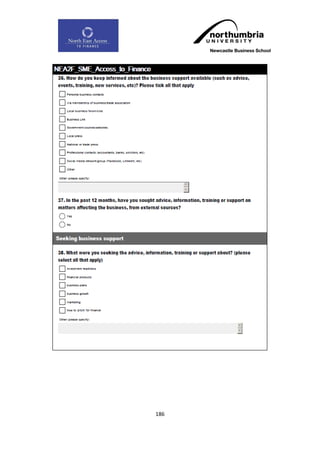
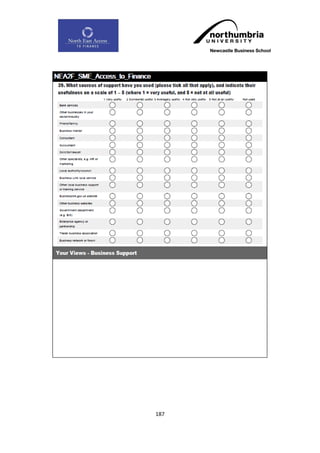
  • 172.
    into will dependon the (formal; informal; social interviewer‟s judgment environment) and how many Os the  Further due diligence (e.g. meet BA has rejected.) management team, employees, check out the premises etc.)  Negotiations (deal structuring and agreeing)  Contract itself (e.g. E won‟t budge on a certain point/BA is not flexible) What are your absolute Use investment process model again: deal-breakers or no-  Probing needs to establish after what go‟s? activity the BA made the ultimate decision; the following are not necessarily in the correct order:  Business plan (scanning; reading; analysing)  Pitch (see E; hear the idea; ask questions)  First face-to-face meeting with E (formal; informal; social environment)  Further due diligence (e.g. meet management team, employees, check out the premises etc.)  Negotiations (deal structuring and agreeing)  Contract itself (e.g. E won‟t budge on a certain point/BA is not flexible) In terms of you starting  Is there anything where you think: “I This should establish the your BA-career, is wish someone would just tell me training needs etc. of novice there anything that you about this!” BAs. Possible are uncomfortable with  Or “... had just told me about this recommendations for NEA2F. or feel that you don‟t before!” know enough about yet? If you do have Identifies support available, questions like that, what BAs are aware of and who would you go to possible recommendations for for answers? NEA2F. 171
  • 173.
    Appendix 5 -Prompt Questions for SME Focus Group Q.1 Your Fundraising Experience We‟re interested in your experience of trying to raise finance for the business in the recent past, say – the past two to three years. Who‟s had some success – and why? Who‟s got any unsuccessful experiences – and why? Q.2 Understanding your Fundraising Broadly, what sort of things did you want the money for ? Prompts: growth - new assets - new product development - new product launch/promotion - reaching new markets - new premises or location - existing commitments - other What sources have you tried? Prompts: banks - family/ friends - credit cards - equity - Business Angels - government grants - European - other What were the pros and cons ? Were there any particular challenges or difficulties? Was there anything that particularly helped the process from your point of view? (Were the funders‟ criteria / objectives clear? ) Q.3 Development Interventions What experience have you got of using support for your business particularly in relation to raising finance – e.g. for financial planning, forecasting, drawing up a business plan or forward strategy Prompts: business advice and support - signposting - networks, forums, etc - training courses or workshops - seminars – mentoring - other Who has provided this support? Prompts: local government teams - government agencies (e.g. Business Link) - development organisations - training providers - accountants - financial advisors - local business organisations (e.g. FSB)- other What have you found useful? Why was that? What is the added value to your business? What has not been useful? Why not? 172
  • 174.
    How do youfind out about this type of support/ these interventions? And how do you decide whether or not to use them? Are there any you‟d recommend? What other interventions do you think are needed? What would make them more likely to be successful? Who should be involved in providing these? Why? Q.4 Anything else? Is there anything else you‟d like to add? Anything related to the discussion that you haven‟t had a chance to say yet? Or that you‟ve thought of during the conversation? 173
  • 175.
    Appendix 6 -SME Questionnaire 174
  • 176.
  • 177.
  • 178.
  • 179.
  • 180.
  • 181.
  • 182.
  • 183.
  • 184.
  • 185.
  • 186.
  • 187.
  • 188.
  • 189.
  • 190.
  • 191.
  • 192.
  • 193.
    References Anderson, R. (2007)The Credit Scoring Toolkit: Theory and Practice for Retail Credit Risk Management and Decision Automation, Oxford University Press. Banasik, J. & Crook, J. N. (2007) 'Reject Inference, augmentation and sample selection', European Journal of Operational Research, 183, pp. 1582-1594. Banks, E. (2002) The Simple Rules of Risk: Revisiting the Art of Financial Risk Management. West Sussex: John Wiley & Sons Ltd. Barrow, C., Burke, G., Molian, D. and Brown, R. (2005) Enterprise Development: The Challenges of Starting, Growing and Selling Businesses. London: Thomson Learning. Barrow, C., Barrow, P. and Brown, R. (2001) The Business Plan Workbook, 4th edn. London: Kogan Page. Bass, T. and Schrooten, M. (2005) „Relationship Banking and SMEs: A Theoretical Analysis‟, The Institute of Economics Research, Discussion Paper Series A, No. 470. Beck, T., Demirguc-Kunt, A. and Levine, R. (2004) „Small and Medium Enterprises, Growth and Poverty: Cross-Country Evidence‟, The Work Bank, Policy Research Working Paper Series. Beck, T. and Maksimovic (2002) „Financial and legal constraints to firm growth: does size matters‟, The Work Bank, Policy Research Working Paper Series. Berger, A. N. and Udell, G. F. (1998) „The Economics of Small Business Finance: The Role of Private Equity and Debt Markets in the Financial Growth Cycle‟, Journal of Banking and Finance 22(6–8): 613–73. Berger, A.N. & Frame, W.S. (2007) Small Business Credit Scoring and Credit Availability, Journal of Small Business Management, Vol. 45 (1), pp.5-22. Berry, A.J., Faulkner, S., Hughes, M. & Jarvis, R. (1993) „Financial Information, the bankers and the small business‟, British Accounting Review, Vol. 24(2, June), pp. 131-150. Berry, A. , Grant, P. & Jarvis, R. (2003) Can European Banks Plug the Finance Gap for UK SMEs? ACCA Research Report NO.81, Certified Accountants Educational Trust, London Bhatia, M. (2006) Credit Risk Management and Basel II : An implementation guide. London: Risk Books. Binks, M.R. & Ennew, C.T. (1996) „Growing firms and the credit constraint‟, Small Business Economics, Vol. 8, pp. 17-25. Binks, M. R. and Ennew, C. T. (1997) „The Relationship between UK Banks and their Small Business Customers‟, Small Business Economics 9(2): 167–78. BIS, 12th October 2011 Statistical Release available at: www.bis.gov.uk Boots, A.W.A. and Milbourn, T. (2002) „Credit ratings as coordination mechanism‟ CEPR Discussion Paper. 192
  • 194.
    Bunn, D. &Wright, G. (1991) 'Interaction of Judgmental and Statistical Forecasting Methods: Issues and Analysis', Management Science, Vol. 5 (37), pp. 501-518. BBA “Supporting UK Business” The Report of the Business Finance Taskforce, October, 2010 available at www.bba.org.uk/download/5726 Cassar, G. (2004) „The financing of business start-ups‟, Journal of Business Venturing, 19 (2), pp. 261-283. Chandler, G. G. & Coffman, J. Y. (1979) 'A Comparative Analysis of Empirical Vs. Judgmental Credit Evaluation', Journal of Retail Banking, 1 (3), pp. 15-26. Cole, R. A., Goldberg, L.G., & White, L.J. (2004). “Cookie Cutter versus Character: The Micro Structure of Small Business Lending by Large and Small Banks,” Journal of Financial and Quantitative Analysis, Vol. 39, pp.227–251. Committee on Finance and Industry (1931), Macmillan Report, Cmd. 3897 HMSO, London. De Noble, A. F. (2001) „Review Essay: Raising finance from Business Angels‟, Venture Capital: An International Journal of Entrepreneurial Finance, 3 (4), pp. 359-367. Ehrlich, S. B., De Noble, A. F., Moore, T. and Weaver, R. R. (1994) „After the cash arrives: A comparative study of venture capital and private investor involvement in entrepreneurial firms‟, Journal of Business Venturing, 9 (1), pp. 67-82. Elitzur, R. and Gavious, A. (2003) „Contracting, signaling, and moral hazard: a model of entrepreneurs, „angels,‟ and venture capitalists‟, Journal of Business Venturing, 18 (6), pp. 709-725. Fama, E. F. and French, K. R. (2002) „Testing Trade‐Off and Pecking Order Predictions About Dividends and Debt‟, Review of Financial Studies, 15 (1), pp. 1-33. Feeney, L., Haines, G. H. Jr. and Riding, A. L. (1999) „Private investors‟ investment criteria: insights from qualitative data‟, Venture Capital: An International Journal of Entrepreneurial Finance, 1 (3), pp. 121-145. Feldman, R. (1997) „Small business loans, small banks and a big change in technology called credit scoring‟, Region, Vol. 11 (3), pp.18-24. Freear, J., Sohl, J. E. and Wetzel, W. E. J. (1994) „Angels and Non-Angels: Are there Differences?‟, Journal of Business Venturing, 9 (2), pp. 109-123. Forum of Small Businesses (2009) The FSB‟s Budget Submission available at http://fsb.org.uk/documents/budgetsubmission/#/10/ Forum of Private Business (2009) Economy Watch available at http://www.fpb.org/images/PDFs/research/FPB%20Economy%20watch%20baseline%20report %20final.pdf Gualandri, E. and Venturelli, V. (Eds) (2008) Bridging the Equity Gap for Innovative SMEs, Palgrave Macmillan Studies in Banking and Finance Institutions, Palgrave Macmillan, Houndmills. 193
  • 195.
    Guy, K. (2011)„Non-performing Loans and Bank Stability in Barbados‟, Research and Economic Analysis, Central Bank of Barbados. Hackbarth, D., Hennessy, C. A. and Leland, H. E. (2007) „Can the Trade-off Theory Explain Debt Structure?‟, Review of Financial Studies, 20 (5), pp. 1389-1428. Hand, D. J. (1998) 'Consumer Credit and Statistics', in Hand, D. J. & Jacka, S. D. (eds.) Statistics in Finance. London: Arnold, pp. 69-8. Harding, R. (2002), “Plugging the knowledge gap: international comparison of the role for policy in the venture capital market”, Venture Capital: An International Journal of Entrepreneurial Finance, 4 (1), pp. 59-76. Harding, R. and Cowling, M. (2006), “Assessing the scale of the equity gap”, Journal of Small Business and Enterprise Development, 13 (1), pp. 115-32. Harrison, R. T., Dibben, M. R. and Mason, C. M. (1997) „The Role of Trust in the Informal Investor‟s Investment Decision: An Exploratory Analysis‟, Entrepreneurship: Theory & Practice, 21 (4), pp. 63-81. Harrison, R. T. and Mason, C. M. (2002) „Backing the horse or the jockey? Agency costs, information and the evaluation of risk by Business Angels‟, Frontiers of Entrepreneurship Research. Babson Park, MA: Babson College. Hutton, W. & Nightingale, P. (2011) The Discouraged Economy- A submission from the Work Foundation to the Independent Commission on Banking. Hyytinen, A. & Pajarinen, M. (2008). Opacity of young businesses: Evidence from rating disagreements. Journal of Banking and Finance, Vol. 32 (7), pp.1234-1241 ICAEW (2011) „SME Access to Finance- Research Report‟, January 2011 Kelly, P. and Hay, M. (2001) „Helping hand or watchful eye? An agency theory perspective on private investor involvement in entrepreneurial ventures‟, in Bygrave, W. D., Autio, E., Brush, C. G., Davidsson, P., Greene, P. G., Reynolds, P. D. and Sapienza, H. J. (eds.) Frontiers of Entrepreneurship Research 2001. Proceedings of the Twenty-First Annual Entrepreneurship Research Conference. Babson Park, MA: Babson College, pp. 465-479. Kuratko, D. F. and Hodgetts, R. M. (2001) Entrepreneurship: A Contemporary Approach, 5th edn. Orlando, FL: Harcourt. Lam, W. (2010) „Funding gap, what funding gap? Financial bootstrapping, supply, demand and creation of entrepreneurial finance‟, International Journal of Entrepreneurial Behaviour & Research, 16 (4), pp. 268-295. Landström, H. (1992) „The relationship between private investors and small firms: an agency theory approach‟, Entrepreneurship & Regional Development, 4 (3), pp. 199-223. Landström, H. (1998) „Informal investors as entrepreneurs‟, Technovation, 18 (5), pp. 321-333. Lewis, E. M. (1992) An Introduction to Credit Scoring. San Rafael: Athena Press. 194
  • 196.
    Macht (2008) Howare Business Angels Involved in their Investee Companies? A Theoretical and Empirical Study of Business Angels‟ Post-Investment Involvement. Unpublished PhD Thesis. Northumbria University. Macht, S. A. (2011) „The role of investee company managers in Business Angels' involvement: empirical insights from dyadic data‟, Venture Capital: An International Journal of Entrepreneurial Finance, 13 (3), pp. 267-293. Mason, C. M. and Harrison, R. T. (1996a) „Informal venture capital: a study of the investment process, the post-investment experience and investment performance‟, Entrepreneurship & Regional Development, 8 (2), pp. 105-125. Mason, C. M. and Harrison, R. T. (1996b) „Why „Business Angels‟ Say No: A Case Study of Opportunities Rejected by an Informal Investor Syndicate‟, International Small Business Journal, 14 (2), pp. 35-51. Mason, C. M. and Harrison, R. T. (2001) „„Investment Readiness‟: A Critique of Government Proposals to Increase the Demand for Venture Capital‟, Regional Studies, 37 (7), pp. 663-668. Mason, C.M. and Harrison, R.T. (2002) „Barriers to investment in the informal venture capital sector‟, Entrepreneurship and Regional Development, 14 (1), pp. 271-287. Mason, C. M. and Harrison, R. T. (2003a) „“Auditioning for Money”: What Do Technology Investors Look for at the Initial Screening Stage?‟, The Journal of Private Equity, 6 (2), pp. 29-42. Mason, C. M. and Harrison, R. T. (2003b) „Closing the Regional Equity Gap? A Critique of the Department of Trade and Industry‟s Regional Venture Capital Funds Initiative‟, Regional Studies, 37 (8), pp. 855-868. Maxwell, A.L., Jeffrey, S.A. and Levesque, M. (2011) „Business angel early stage decision making‟, Journal of Business Venturing, 26 (2), pp. 212-225. Mitter, C. and Kraus, S. (2011) „Entrepreneurial finance – issues and evidence, revisited‟, International Journal of Entrepreneurship and Innovation Management, 14 (2/3), pp. 132- 150. Murray, G. C. (2007) „Venture capital and government policy‟, in Landström, H. (ed.) Handbook of Research on Venture Capital. Cheltenham: Edward Elgar Publishing Limited, pp. 113-151. Newby, R., Watson, J. and Woodliff, D. (2003) „SME Survey Methodology: Response Rates, Data Quality, and Cost Effectiveness‟, Entrepreneurship: Theory & Practice, 28 (2), pp. 163-173. Paul, S., Whittam, G. and Wyper, J. (2007) „Towards a Model of the Business Angel Investment Process‟, Venture Capital, 9 (2), pp. 107-125. Peterson, M.A.(1999) „The small business lending relationship‟, Conference on Consumer Transactions and Credit, Federal Reserve Bank of Philadelphia, Philadelphia, PA. Prasad, D., Bruton, G. D. and Vozikis, G. (2000) „Signaling value to Business Angels: the proportion of the entrepreneur‟s net worth invested in a new venture as a decision signal‟, Venture Capital: An International Journal of Entrepreneurial Finance, 2 (3), pp. 167-182. Porter, M.E. (1980) Competitive Strategy, Free Press, New York, 1980. 195
  • 197.
    Reitan, B. andSørheim, R. (2000) „The informal venture capital market in Norway – investor characteristics, behaviour and investment preferences‟, Venture Capital: An International Journal of Entrepreneurial Finance, 2 (2), pp. 129-141. Riding, A. L., Madill, J. J. and Haines, G. H. J. (2007) „Investment decision making by Business Angels‟, in Landström, H. (ed.) Handbook of Research on Venture Capital. Cheltenham: Edward Elgar Publishing Limited, pp. 332-346. San José, A., Roure, J. and Aernoudt, R. (2005) „Business Angel Academies: Unleashing the Potential for Business Angel Investment‟, Venture Capital: An International Journal of Entrepreneurial Finance, 7 (2), pp. 149-165. Saunders, A. & Cornett, M. (2010) Financial Institutions Management: A risk management approach. 7th edn. New York: McGraw Hill Irwin. Shyam-Sunder, L. and Myers, S. C. (1999) „Testing static tradeoff against pecking order models of capital structure‟, Journal of Financial Economics , 51, pp. 219-244. Siddiqi, N. (2005) Credit Risk Scorecards: Developing and Implementing Intelligent Credit Scoring. New York: John Wiley and Sons, Inc. Sohl, J. E. (1999) „The early-stage equity market in the USA‟, Venture Capital: An International Journal of Entrepreneurial Finance, 1 (2), pp. 101-120. Sørheim, R. (2003) „The pre-investment behaviour of Business Angels: a social capital approach‟, Venture Capital: An International Journal of Entrepreneurial Finance, 5 (4), pp. 337-364. Stanton, T. H. (1999) Credit and Loan Scoring: Tools for Improved Management of Federal Credit Programs Center for the Study of American Government, John Hopkins University: Baltimore, MD. Sudek, R. (2006) „Angel Investment Criteria‟, Journal of Small Business Strategy, 17 (2), pp. 89-103. Sweeting, R. C. and Wong, C. F. (1997) „A UK „Hands-off‟ Venture Capital Firm and the Handling of Post-Investment Investor-Investee Relationships‟, Journal of Management Studies, 34 (1), pp. 125-152. Thampy, A. (2010) „Financing of SME firms in India‟, IMB Management Review, Vol. 22, pp.93-101. Thomas, L. C., Edelman, D. B. & Crook, J. N. (2002) Credit Scoring and Its Applications. Philadelphia: Society for Industrial and Applied Mathematics Publishing. Van Auken, H.E. and Neeley, L. (1996) Evidence of bootstrap financing among small start-up firms. Journal of Entrepreneurial Small Business Finance, 5 (3), pp. 235–249. Van Osnabrugge, M. and Robinson, R. J. (2000) Angel Investing: Matching Start-up Funds with Start-up Companies – The Guide for Entrepreneurs, Individual Investors, and Venture Capitalists. San Francisco: Jossey-Bass Inc. Varotto S (2011) “Liquitity Ris, Credit Risk, market Risk and Bank Capital” International Journal of Managerial Finance, 7 (2), pp.134 – 152 Venturelli, V. and Gualandri, E. (2009) „The determinants of equity needs: size, youth or innovation?‟, Journal of Small Business and Enterprise Development, 16 (4), pp.599 – 614. 196
  • 198.
    Vos, E., Yeh,A. J., Carter, S. and Tagg, S. (2007) „The happy story of small business financing‟, Journal of Banking and Finance, 31 (9), pp. 2648-2672. Wilson, F., Carter, S., Tagg, S., Shaw, E. & Lam, W. (2006) „Bank Officer perception of Business Owners: the role of gender‟, British Journal of Management, Vol. 18 (2), pp.154-167. 197
  • 199.