
Cancer Research Data Ecosystem
NCI Imaging Community Call
January 9th, 2017
Warren Kibbe, PhD
Warren.kibbe@nih.gov
@wakibbe
2
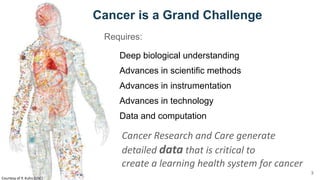
3
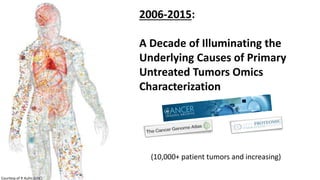
(10,000+ patient tumors and increasing)
Courtesy of P. Kuhn (USC)
2006-2015:
A Decade of Illuminating the
Underlying Causes of Primary
Untreated Tumors Omics
Characterization
Cancer is a Grand Challenge
Deep biological understanding
Advances in scientific methods
Advances in instrumentation
Advances in technology
Data and computation
Cancer Research and Care generate
detailed data that is critical to
create a learning health system for cancer
Requires:
4
(10,000+ patient tumors and increasing)
Courtesy of P. Kuhn (USC)
2006-2015:
A Decade of Illuminating the
Underlying Causes of Primary
Untreated Tumors Omics
Characterization
5
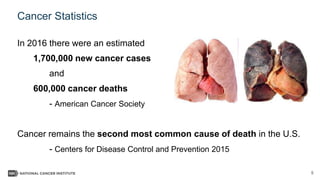
Cancer Statistics
In 2016 there were an estimated
1,700,000 new cancer cases
and
600,000 cancer deaths
- American Cancer Society
Cancer remains the second most common cause of death in the U.S.
- Centers for Disease Control and Prevention 2015
6
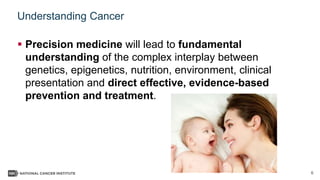
Understanding Cancer
 Precision medicine will lead to fundamental
understanding of the complex interplay between
genetics, epigenetics, nutrition, environment, clinical
presentation and direct effective, evidence-based
prevention and treatment.
7
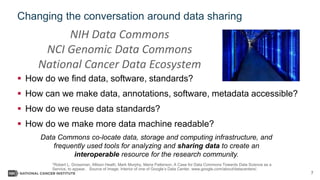
Changing the conversation around data sharing
 How do we find data, software, standards?
 How can we make data, annotations, software, metadata accessible?
 How do we reuse data standards?
 How do we make more data machine readable?
NIH Data Commons
NCI Genomic Data Commons
National Cancer Data Ecosystem
Data Commons co-locate data, storage and computing infrastructure, and
frequently used tools for analyzing and sharing data to create an
interoperable resource for the research community.
*Robert L. Grossman, Allison Heath, Mark Murphy, Maria Patterson, A Case for Data Commons Towards Data Science as a
Service, to appear. Source of image: Interior of one of Google’s Data Center, www.google.com/about/datacenters/.
8
Cancer Data Sharing and Data Commons:
A Cancer Research Data Ecosystem
• Making data available for discovery, validation,
new therapies
• Working toward a learning National Cancer
Data Ecosystem
• Maximizing the impact, reuse, and
reproducibility of cancer research
• Changing incentives for data sharing
Reduce the risk, improve early detection, outcomes, and survivorship in cancer
9
NIH Genomic Data Sharing Policy
https://gds.nih.gov/
Went into effect January 25, 2015
NCI guidance:
http://www.cancer.gov/grants-training/grants-
management/nci-policies/genomic-data
Requires public sharing of genomic data sets
10
FAIR –
Making data
Findable,
Accessible,
Attributable,
Interoperable,
Reusable,
and provide Recognition
Force11 white paper
https://www.force11.org/group/fairgroup/fairprinciples
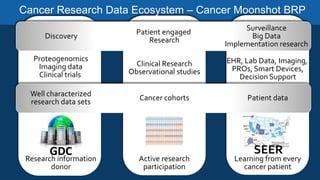
Cancer Research Data Ecosystem – Cancer Moonshot BRP
Well characterized
research data sets Cancer cohorts Patient data
EHR, Lab Data, Imaging,
PROs, Smart Devices,
Decision Support
Learning from every
cancer patient
Active research
participation
Research information
donor
Clinical Research
Observational studies
Proteogenomics
Imaging data
Clinical trials
Discovery
Patient engaged
Research
Surveillance
Big Data
Implementation research
SEERGDC
12
The Beau Biden
Cancer Moonshot
How do we enable meaningful,
patient-centered and patient-level
data sharing for cancer and
promote access to clinical trials for
all Americans?
13
Goals of the Beau Biden Cancer Moonshot
 Accelerate progress in cancer, including prevention &
screening
 From cutting edge basic research to wider uptake of standard
of care
 Encourage greater cooperation and collaboration
 Within and between academia, government, and private sector
 Enhance data sharing
(Presidential Memo 2016)
14
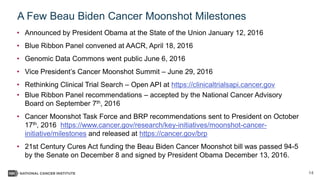
A Few Beau Biden Cancer Moonshot Milestones
• Announced by President Obama at the State of the Union January 12, 2016
• Blue Ribbon Panel convened at AACR, April 18, 2016
• Genomic Data Commons went public June 6, 2016
• Vice President’s Cancer Moonshot Summit – June 29, 2016
• Rethinking Clinical Trial Search – Open API at https://clinicaltrialsapi.cancer.gov
• Blue Ribbon Panel recommendations – accepted by the National Cancer Advisory
Board on September 7th, 2016
• Cancer Moonshot Task Force and BRP recommendations sent to President on October
17th, 2016 https://www.cancer.gov/research/key-initiatives/moonshot-cancer-
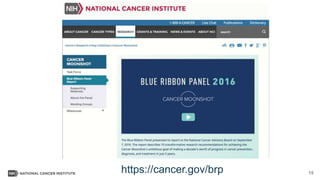
initiative/milestones and released at https://cancer.gov/brp
• 21st Century Cures Act funding the Beau Biden Cancer Moonshot bill was passed 94-5
by the Senate on December 8 and signed by President Obama December 13, 2016.
15https://cancer.gov/brp
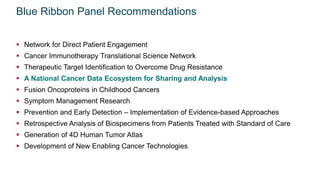
Blue Ribbon Panel Recommendations
 Network for Direct Patient Engagement
 Cancer Immunotherapy Translational Science Network
 Therapeutic Target Identification to Overcome Drug Resistance
 A National Cancer Data Ecosystem for Sharing and Analysis
 Fusion Oncoproteins in Childhood Cancers
 Symptom Management Research
 Prevention and Early Detection – Implementation of Evidence-based Approaches
 Retrospective Analysis of Biospecimens from Patients Treated with Standard of Care
 Generation of 4D Human Tumor Atlas
 Development of New Enabling Cancer Technologies
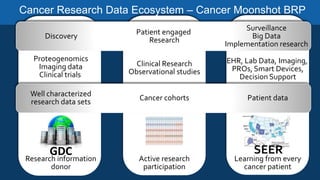
Cancer Research Data Ecosystem – Cancer Moonshot BRP
Well characterized
research data sets Cancer cohorts Patient data
EHR, Lab Data, Imaging,
PROs, Smart Devices,
Decision Support
Learning from every
cancer patient
Active research
participation
Research information
donor
Clinical Research
Observational studies
Proteogenomics
Imaging data
Clinical trials
Discovery
Patient engaged
Research
Surveillance
Big Data
Implementation research
SEERGDC
18
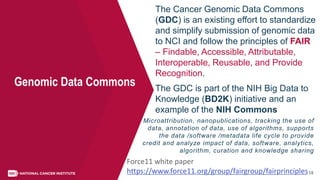
The Cancer Genomic Data Commons
(GDC) is an existing effort to standardize
and simplify submission of genomic data
to NCI and follow the principles of FAIR
– Findable, Accessible, Attributable,
Interoperable, Reusable, and Provide
Recognition.
The GDC is part of the NIH Big Data to
Knowledge (BD2K) initiative and an
example of the NIH Commons
Genomic Data Commons
Microattribution, nanopublications, tracking the use of
data, annotation of data, use of algorithms, supports
the data /software /metadata life cycle to provide
credit and analyze impact of data, software, analytics,
algorithm, curation and knowledge sharing
Force11 white paper
https://www.force11.org/group/fairgroup/fairprinciples
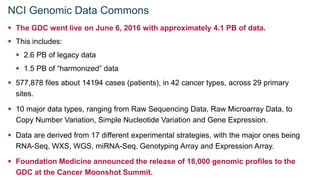
NCI Genomic Data Commons
 The GDC went live on June 6, 2016 with approximately 4.1 PB of data.
 This includes:
 2.6 PB of legacy data
 1.5 PB of “harmonized” data
 577,878 files about 14194 cases (patients), in 42 cancer types, across 29 primary
sites.
 10 major data types, ranging from Raw Sequencing Data, Raw Microarray Data, to
Copy Number Variation, Simple Nucleotide Variation and Gene Expression.
 Data are derived from 17 different experimental strategies, with the major ones being
RNA-Seq, WXS, WGS, miRNA-Seq, Genotyping Array and Expression Array.
 Foundation Medicine announced the release of 18,000 genomic profiles to the
GDC at the Cancer Moonshot Summit.
20
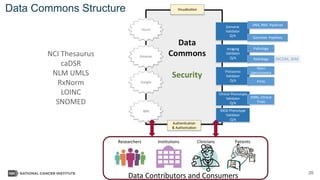
Data Commons Structure
DICOM, AIM
Amazon
Google
IBM
Imaging
Validator
Q/A
Proteomic
Validator
Q/A
Clinical Phenotype
Validator
Q/A
MOD Phenotype
Validator
Q/A
Pathology
Radiology
Mass
Spectrometry
Array
Data
Commons
Security
Visualization
Authentication
& Authorization
Genomic
Validator
Q/A Germline Pipelines
DNA, RNA Pipelines
EMRs, Clinical
Trials
Azure
Data Contributors and Consumers
Researchers PatientsCliniciansInstitutions
NCI Thesaurus
caDSR
NLM UMLS
RxNorm
LOINC
SNOMED
21
Questions?
Warren Kibbe, Ph.D.
Warren.kibbe@nih.gov
@wakibbe
www.cancer.gov www.cancer.gov/espanol

NCI Cancer Imaging Program - Cancer Research Data Ecosystem

  • 1.
    Cancer Research DataEcosystem NCI Imaging Community Call January 9th, 2017 Warren Kibbe, PhD Warren.kibbe@nih.gov @wakibbe
  • 2.
  • 3.
    3 (10,000+ patient tumorsand increasing) Courtesy of P. Kuhn (USC) 2006-2015: A Decade of Illuminating the Underlying Causes of Primary Untreated Tumors Omics Characterization Cancer is a Grand Challenge Deep biological understanding Advances in scientific methods Advances in instrumentation Advances in technology Data and computation Cancer Research and Care generate detailed data that is critical to create a learning health system for cancer Requires:
  • 4.
    4 (10,000+ patient tumorsand increasing) Courtesy of P. Kuhn (USC) 2006-2015: A Decade of Illuminating the Underlying Causes of Primary Untreated Tumors Omics Characterization
  • 5.
    5 Cancer Statistics In 2016there were an estimated 1,700,000 new cancer cases and 600,000 cancer deaths - American Cancer Society Cancer remains the second most common cause of death in the U.S. - Centers for Disease Control and Prevention 2015
  • 6.
    6 Understanding Cancer  Precisionmedicine will lead to fundamental understanding of the complex interplay between genetics, epigenetics, nutrition, environment, clinical presentation and direct effective, evidence-based prevention and treatment.
  • 7.
    7 Changing the conversationaround data sharing  How do we find data, software, standards?  How can we make data, annotations, software, metadata accessible?  How do we reuse data standards?  How do we make more data machine readable? NIH Data Commons NCI Genomic Data Commons National Cancer Data Ecosystem Data Commons co-locate data, storage and computing infrastructure, and frequently used tools for analyzing and sharing data to create an interoperable resource for the research community. *Robert L. Grossman, Allison Heath, Mark Murphy, Maria Patterson, A Case for Data Commons Towards Data Science as a Service, to appear. Source of image: Interior of one of Google’s Data Center, www.google.com/about/datacenters/.
  • 8.
    8 Cancer Data Sharingand Data Commons: A Cancer Research Data Ecosystem • Making data available for discovery, validation, new therapies • Working toward a learning National Cancer Data Ecosystem • Maximizing the impact, reuse, and reproducibility of cancer research • Changing incentives for data sharing Reduce the risk, improve early detection, outcomes, and survivorship in cancer
  • 9.
    9 NIH Genomic DataSharing Policy https://gds.nih.gov/ Went into effect January 25, 2015 NCI guidance: http://www.cancer.gov/grants-training/grants- management/nci-policies/genomic-data Requires public sharing of genomic data sets
  • 10.
    10 FAIR – Making data Findable, Accessible, Attributable, Interoperable, Reusable, andprovide Recognition Force11 white paper https://www.force11.org/group/fairgroup/fairprinciples
  • 11.
    Cancer Research DataEcosystem – Cancer Moonshot BRP Well characterized research data sets Cancer cohorts Patient data EHR, Lab Data, Imaging, PROs, Smart Devices, Decision Support Learning from every cancer patient Active research participation Research information donor Clinical Research Observational studies Proteogenomics Imaging data Clinical trials Discovery Patient engaged Research Surveillance Big Data Implementation research SEERGDC
  • 12.
    12 The Beau Biden CancerMoonshot How do we enable meaningful, patient-centered and patient-level data sharing for cancer and promote access to clinical trials for all Americans?
  • 13.
    13 Goals of theBeau Biden Cancer Moonshot  Accelerate progress in cancer, including prevention & screening  From cutting edge basic research to wider uptake of standard of care  Encourage greater cooperation and collaboration  Within and between academia, government, and private sector  Enhance data sharing (Presidential Memo 2016)
  • 14.
    14 A Few BeauBiden Cancer Moonshot Milestones • Announced by President Obama at the State of the Union January 12, 2016 • Blue Ribbon Panel convened at AACR, April 18, 2016 • Genomic Data Commons went public June 6, 2016 • Vice President’s Cancer Moonshot Summit – June 29, 2016 • Rethinking Clinical Trial Search – Open API at https://clinicaltrialsapi.cancer.gov • Blue Ribbon Panel recommendations – accepted by the National Cancer Advisory Board on September 7th, 2016 • Cancer Moonshot Task Force and BRP recommendations sent to President on October 17th, 2016 https://www.cancer.gov/research/key-initiatives/moonshot-cancer- initiative/milestones and released at https://cancer.gov/brp • 21st Century Cures Act funding the Beau Biden Cancer Moonshot bill was passed 94-5 by the Senate on December 8 and signed by President Obama December 13, 2016.
  • 15.
  • 16.
    Blue Ribbon PanelRecommendations  Network for Direct Patient Engagement  Cancer Immunotherapy Translational Science Network  Therapeutic Target Identification to Overcome Drug Resistance  A National Cancer Data Ecosystem for Sharing and Analysis  Fusion Oncoproteins in Childhood Cancers  Symptom Management Research  Prevention and Early Detection – Implementation of Evidence-based Approaches  Retrospective Analysis of Biospecimens from Patients Treated with Standard of Care  Generation of 4D Human Tumor Atlas  Development of New Enabling Cancer Technologies
  • 17.
    Cancer Research DataEcosystem – Cancer Moonshot BRP Well characterized research data sets Cancer cohorts Patient data EHR, Lab Data, Imaging, PROs, Smart Devices, Decision Support Learning from every cancer patient Active research participation Research information donor Clinical Research Observational studies Proteogenomics Imaging data Clinical trials Discovery Patient engaged Research Surveillance Big Data Implementation research SEERGDC
  • 18.
    18 The Cancer GenomicData Commons (GDC) is an existing effort to standardize and simplify submission of genomic data to NCI and follow the principles of FAIR – Findable, Accessible, Attributable, Interoperable, Reusable, and Provide Recognition. The GDC is part of the NIH Big Data to Knowledge (BD2K) initiative and an example of the NIH Commons Genomic Data Commons Microattribution, nanopublications, tracking the use of data, annotation of data, use of algorithms, supports the data /software /metadata life cycle to provide credit and analyze impact of data, software, analytics, algorithm, curation and knowledge sharing Force11 white paper https://www.force11.org/group/fairgroup/fairprinciples
  • 19.
    NCI Genomic DataCommons  The GDC went live on June 6, 2016 with approximately 4.1 PB of data.  This includes:  2.6 PB of legacy data  1.5 PB of “harmonized” data  577,878 files about 14194 cases (patients), in 42 cancer types, across 29 primary sites.  10 major data types, ranging from Raw Sequencing Data, Raw Microarray Data, to Copy Number Variation, Simple Nucleotide Variation and Gene Expression.  Data are derived from 17 different experimental strategies, with the major ones being RNA-Seq, WXS, WGS, miRNA-Seq, Genotyping Array and Expression Array.  Foundation Medicine announced the release of 18,000 genomic profiles to the GDC at the Cancer Moonshot Summit.
  • 20.
    20 Data Commons Structure DICOM,AIM Amazon Google IBM Imaging Validator Q/A Proteomic Validator Q/A Clinical Phenotype Validator Q/A MOD Phenotype Validator Q/A Pathology Radiology Mass Spectrometry Array Data Commons Security Visualization Authentication & Authorization Genomic Validator Q/A Germline Pipelines DNA, RNA Pipelines EMRs, Clinical Trials Azure Data Contributors and Consumers Researchers PatientsCliniciansInstitutions NCI Thesaurus caDSR NLM UMLS RxNorm LOINC SNOMED
  • 21.
  • 22.

Editor's Notes

  • #19 The GDC is the Foundation of a Cancer Knowledge System