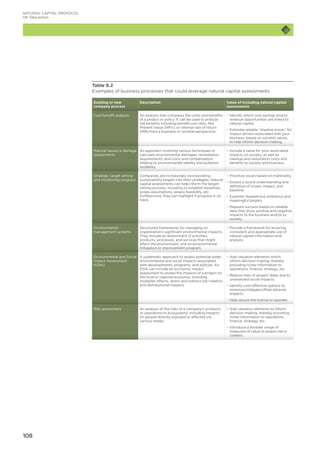
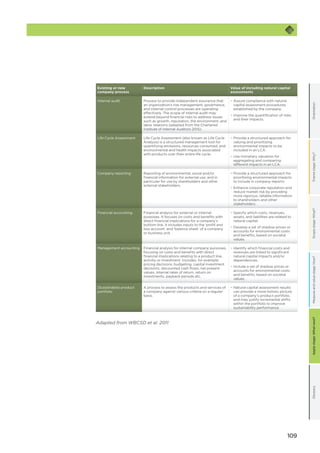
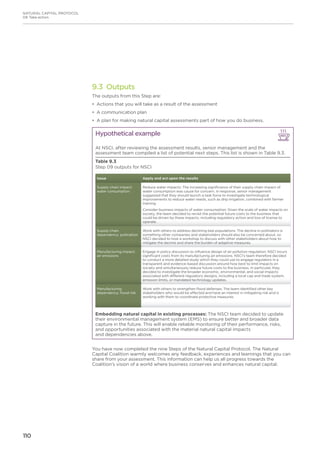
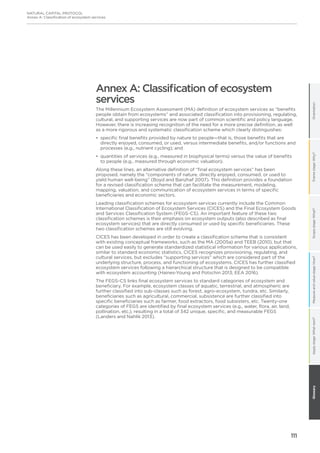
NATURAL
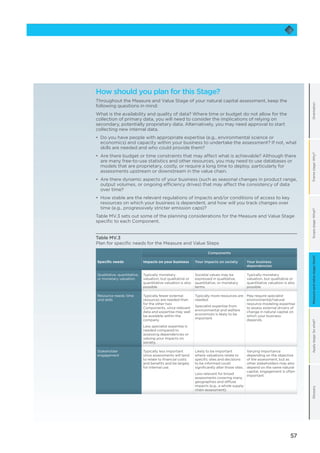
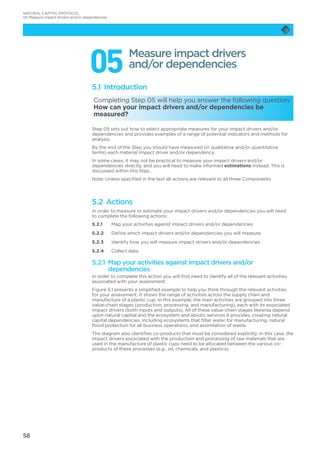
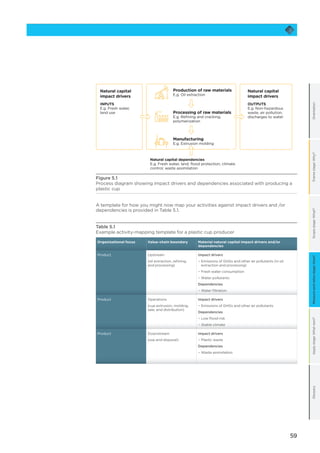
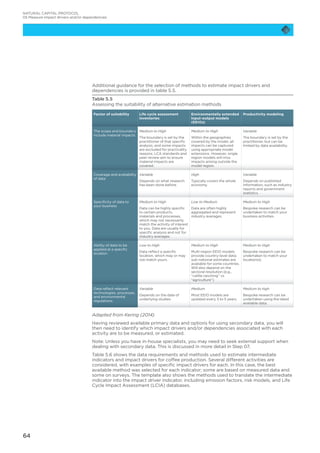
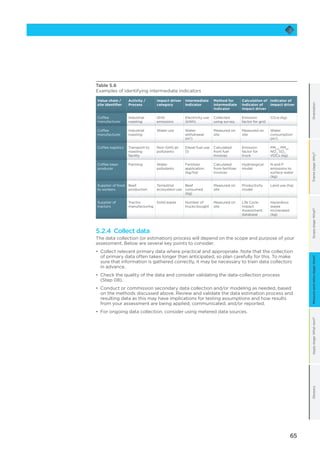
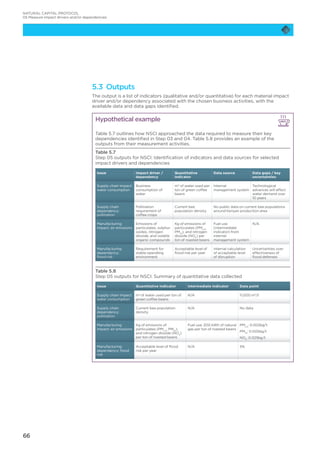
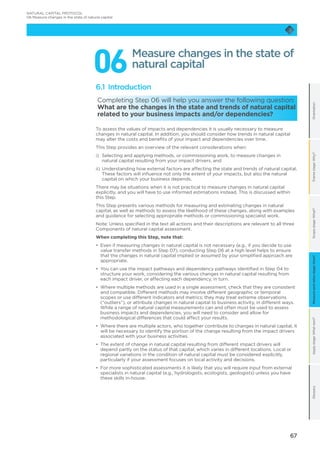
CAPITAL
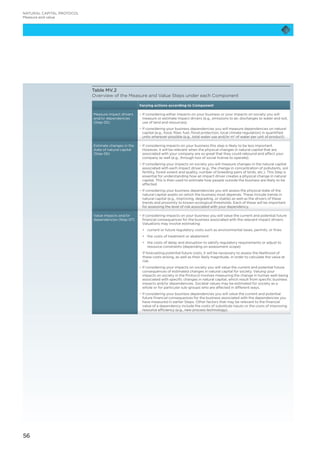
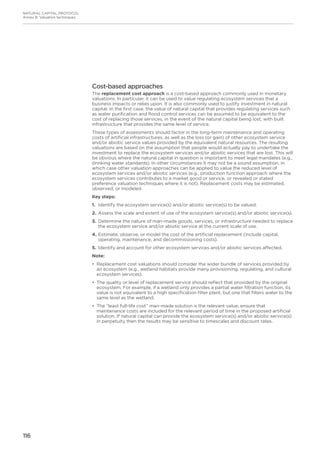
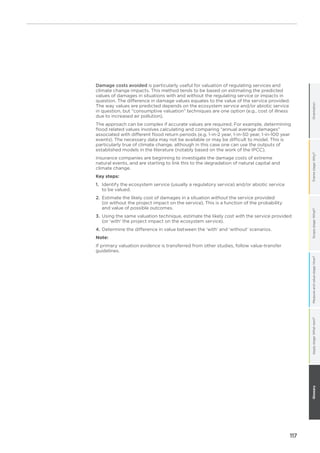
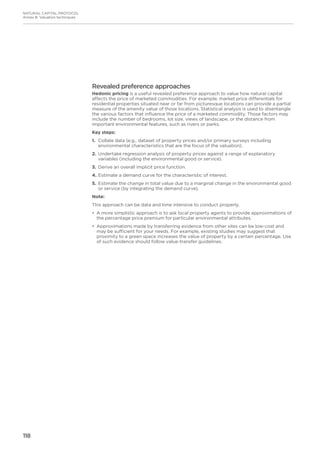
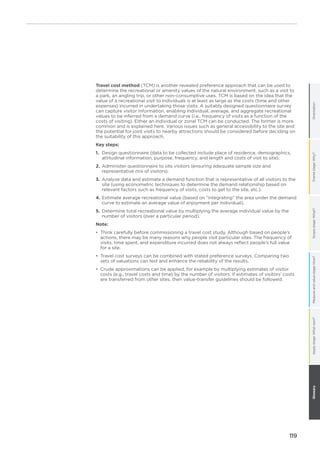
PROTOCOL
NATURAL CAPITAL PROTOCOL
Foreword by Mark Gough, Executive Director,
Natural Capital Coalition1
Orientation	 2
FRAME STAGE: Why? 10
Step 01: Get started 11
SCOPE STAGE: What? 24
Step 02: Define the objective 26
Step 03: Scope the assessment 30
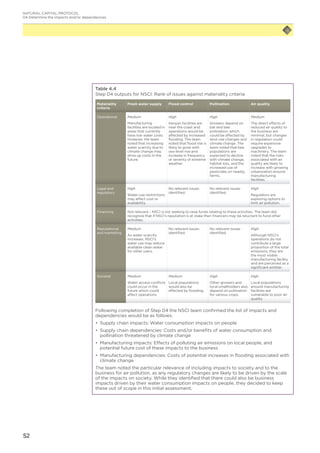
Step 04: Determine the impacts and/or dependencies  43
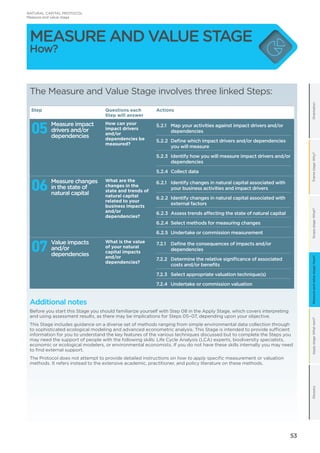
MEASURE AND VALUE STAGE: How? 53
Step 05: Measure impact drivers and/or dependencies 58
Step 06: Measure changes in the state of natural capital 67
Step 07: Value impacts and/or dependencies 80
APPLY STAGE: What next? 94
Step 08: Interpret and test the results 95
Step 09: Take action 103
Annex A: Classification of ecosystem services 111
Annex B: Valuation techniques for natural capital assessments 112
Glossary122
References and resources 125
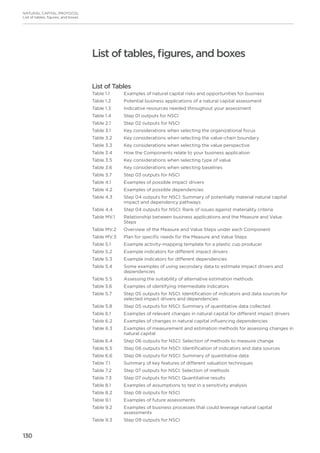
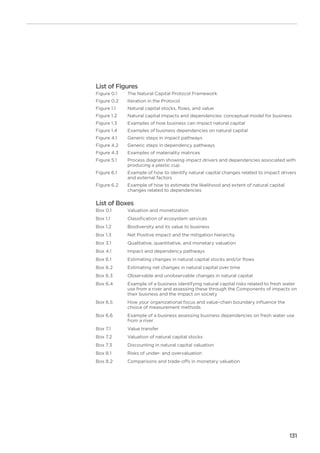
List of tables, figures, and boxes  130
Acknowledgements132
About the Natural Capital Coalition Back cover
Contents
Framestage:Why?Scopestage:What?Measureandvaluestage:How?Applystage:Whatnext?GlossaryOrientation
1
Foreword by Mark Gough, Executive
Director, Natural Capital Coalition
By picking up this document you are joining a growing
number of organizations who have recognized the
benefits of including natural capital in their decision
making. This not only makes their organizations more
successful, but is essential if we are to conserve and
enhance the natural world that underpins our societies
and economies.
I fully expect you are familiar with the multiple initiatives around
natural capital and how confusing this arena can be. The Natural
Capital Coalition has come together to harmonize existing best
practice and produce a standardized, generally-accepted, global
approach.
Collaboration is essential if we are to address the considerable
global challenges we are facing today, such as climate change
and biodiversity. No individual organization can solve these alone,
and we need to find new ways of working that bring together the
views of all stakeholders if we are to find solutions that last. The
Protocol development has been a unique testing ground for this
theory and has proven that collaboration can provide solutions
that are accepted and supported by every element of society.
Nature shows us that we live in a complex system of interrelations
and by embracing this we provide ourselves with an opportunity
to unlock significant potential.
While the Protocol provides an important step forward, realizing
the Coalition’s vision of a world where business conserves and
enhances natural capital will also require agreement on the rules
around the data and information used to inform decisions.
Success will require the creation of enabling policy environments
and the integration of natural capital into all decisions so that
ultimately it becomes an integral part of business as usual.
I would like to thank all of the people who have been involved in
the Protocol development: the technical team; those who ran the
business engagement program, those who developed the
accompanying sector guides; the pilot companies; the many
people who spent time commenting on the draft version; the
Steering Group who provided sage guidance; the funders who
believed this was possible; the board of directors, and our hosts,
ICAEW, who all kept us moving in the right direction.
The next step is simple. Apply the Protocol, continue to
collaborate, share your experience, and make better decisions.
2
NATURAL CAPITAL PROTOCOL
Orientation
Orientation
0.1 What is the Natural Capital Protocol?
The Natural Capital Protocol (hereafter the “Protocol”) is a framework designed to help
generate trusted, credible, and actionable information that business managers need to
inform decisions.
The Protocol aims to support better decisions by including how we interact with nature, or
more specifically natural capital, in decision making. Until now, natural capital has for the
most part been excluded from decisions and, when included, has been largely
inconsistent, open to interpretation, or limited by moral arguments. The Protocol responds
by offering a standardized framework to identify, measure, and value impacts and
dependencies on natural capital.
Why does business need to include natural capital in its decisions? The growing need to
conserve and enhance natural capital is well documented. We know that we are depleting
natural resources faster than the earth can replenish them, and at an accelerating rate
(WWF 2014). We have grown financial capital in large part through the use, exploitation,
and degradation of natural and social capital.
For most companies, interactions with nature do not yet affect their market value, the
price of their products or the price they pay for materials they use, their cash flows or risk
profile. If they do, they are not visualized on a company’s profit and loss statement or on
their balance sheet. They remain “externalities”, or issues without internal consequence.
However there are several potential drivers that may lead to such externalities being
internalized in the future including increasing regulatory or legal action, market forces and
changing operating environments, new actions by and relationships with external
stakeholders, plus an increasing drive for transparency or voluntary action by businesses
because they recognize the significance of transparency to future success.
The Protocol builds on a number of approaches that already exist to help business
measure and value natural capital, including the Corporate Ecosystem Services Review
(WRI, WBCSD and the Meridian Institute. 2012.), and the Guide to Corporate Ecosystem
Valuation (WBCSD, IUCN, ERM, and PwC. 2011). These and many other important
references and resources are listed at the back of this document and provide extremely
useful guidance to help complete the Stages and Steps of this Protocol.
The Protocol does not, however, explicitly list or recommend specific tools or
methodologies. This is because the choice of tools will be dependent on business context,
resources, and needs. Further, natural capital measurement and valuation is evolving and
new approaches and methodologies become available all the time.
The Protocol focuses on improving internal decision making. It is not a formal reporting
framework and does not assume or require that assessment results are reported or
disclosed externally. Nevertheless, some companies may wish to report their assessment
findings and this is encouraged as a means to demonstrate risks, opportunity and value
creation to stakeholders. It is important to note that while the Protocol does provide a
standardized process, it also remains flexible in the choice of measurement and valuation
approaches used, which means that results may not be comparable within or between
different businesses and applications. Nevertheless, the Protocol does provide the
foundation for future work around comparability in natural capital reporting and
standard setting.
	Glossary
Natural Capital Protocol
A standardized framework to
identify, measure, and value direct
and indirect impacts (positive and
negative) and/or dependencies on
natural capital.
Natural capital
The stock of renewable and non-
renewable natural resources (e.g.,
plants, animals, air, water, soils,
minerals) that combine to yield a
flow of benefits to people
(adapted from Atkinson and
Pearce 1995; Jansson et al. 1994).
Market value
The amount for which something
can be bought or sold in a
given market.
Price
The amount for which something
can be bought or sold in a
given market.
Externality
A consequence of an action that
affects someone other than the
agent undertaking that action, and
for which the agent is neither
compensated nor penalized.
Externalities can be either positive
or negative (WBCSD et al. 2011).
Framestage:Why?Scopestage:What?Measureandvaluestage:How?Applystage:Whatnext?GlossaryOrientation
3
The Protocol is purposely a broad and flexible framework that is applicable to any
business sector, operating in any geography, at any organizational level. It allows you to
adapt, leverage, and integrate your existing business processes into the framework if
needed, and encourages experimentation with different approaches and methods
depending on the decisions you are looking to inform. The Protocol provides guidance on
all types of valuation, whether qualitative, quantitative, or monetary, depending on which
is most appropriate for the decision you are attempting to inform.
Natural capital is one of several other commonly recognized forms of capital. Others
include financial, manufactured, social and relationship, human, and intellectual capital.
Natural capital can be seen as fundamental in supporting all other forms of capital; it
provides the resources with which we build our societies, economies, and institutions, and
ultimately regulates the environmental conditions that enable human life. Furthermore, the
benefits of natural capital (e.g., fresh water) are often only realized by applying other
forms of capital (e.g., manufactured capital like a water pump, which is purchased using
financial capital, and owned and operated thanks to social and human capital). This
integration makes it impossible to completely separate any one form of capital from the
others, and considering trade-offs between them will be part of any decision. For further
information on the various forms of capital, see the Integrated Reporting Framework in
IIRC 2013; Pearce and Atkinson 1993; World Bank 2011; and WBCSD 2015 on developing a
Social Capital Protocol.
Box 0.1 Valuation and monetization
To value something means to understand what it is worth to us. In the Protocol,
valuation refers to the process of estimating the relative importance, worth, or
usefulness of natural capital to people, in a particular context.
In financial accounting terms, valuation is understood to mean monetization, but in
environmental economics and this Protocol, valuation means more than just
monetization. It includes qualitative, quantitative, and monetary approaches, or a
combination of these.
It is important to note that valuation in the Protocol is different from moral judgments,
for example, people’s environmental rights or the rights of a species to exist. These
judgements require different approaches that are outside the scope of the Protocol.
	Glossary
Value (noun)
The importance, worth, or
usefulness of something.
Economic value
The importance, worth, or
usefulness of something to
people—including all relevant
market and non-market values. In
more technical terms, the sum of
individual preferences for a given
level of provision of that good or
service. Economic values are
usually expressed in terms of
marginal/incremental changes in
the supply of a good or service,
using money as the metric
(e.g., $/unit).
4
NATURAL CAPITAL PROTOCOL
Orientation
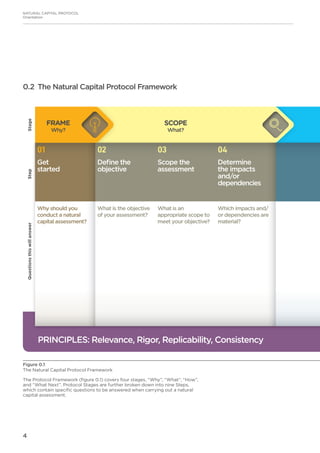
0.2 The Natural Capital Protocol Framework
Figure 0.1
The Natural Capital Protocol Framework
01
Get
started
02
Define the
objective
03
Scope the
assessment
04
Determine
the impacts
and/or
dependencies
Why should you
conduct a natural
capital assessment?
What is the objective
of your assessment?
What is an
appropriate scope to
meet your objective?
Which impacts and/
or dependencies are
material?
StepQuestionsthiswillanswer
PRINCIPLES: Relevance, Rigor, Replicability, Consistency
Stage
SCOPE
What?
FRAME
Why?
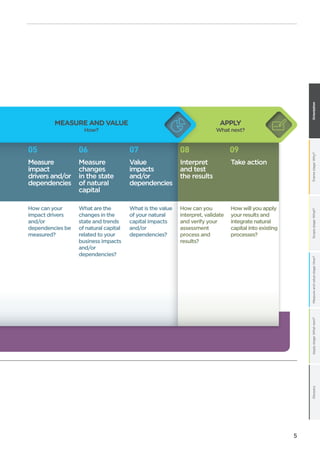
The Protocol Framework (figure 0.1) covers four stages, “Why”, “What”, “How”,
and “What Next”. Protocol Stages are further broken down into nine Steps,
which contain specific questions to be answered when carrying out a natural
capital assessment.
Framestage:Why?Scopestage:What?Measureandvaluestage:How?Applystage:Whatnext?GlossaryOrientation
5
APPLY
What next?
MEASURE AND VALUE
How?
05
Measure
impact
drivers and/or
dependencies
06
Measure
changes
in the state
of natural
capital
07
Value
impacts
and/or
dependencies
08
Interpret
and test
the results
09
Take action
How can your
impact drivers
and/or
dependencies be
measured?
What are the
changes in the
state and trends
of natural capital
related to your
business impacts
and/or
dependencies?
What is the value
of your natural
capital impacts
and/or
dependencies?
How can you
interpret, validate
and verify your
assessment
process and
results?
How will you apply
your results and
integrate natural
capital into existing
processes?
6
NATURAL CAPITAL PROTOCOL
Orientation
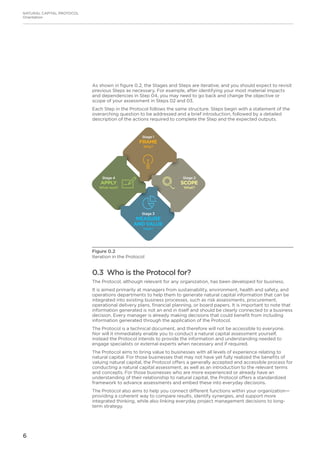
As shown in figure 0.2, the Stages and Steps are iterative; and you should expect to revisit
previous Steps as necessary. For example, after identifying your most material impacts
and dependencies in Step 04, you may need to go back and change the objective or
scope of your assessment in Steps 02 and 03.
Each Step in the Protocol follows the same structure. Steps begin with a statement of the
overarching question to be addressed and a brief introduction, followed by a detailed
description of the actions required to complete the Step and the expected outputs.
0.3 Who is the Protocol for?
The Protocol, although relevant for any organization, has been developed for business.
It is aimed primarily at managers from sustainability, environment, health and safety, and
operations departments to help them to generate natural capital information that can be
integrated into existing business processes, such as risk assessments, procurement,
operational delivery plans, financial planning, or board papers. It is important to note that
information generated is not an end in itself and should be clearly connected to a business
decision. Every manager is already making decisions that could benefit from including
information generated through the application of the Protocol.
The Protocol is a technical document, and therefore will not be accessible to everyone.
Nor will it immediately enable you to conduct a natural capital assessment yourself,
instead the Protocol intends to provide the information and understanding needed to
engage specialists or external experts when necessary and if required.
The Protocol aims to bring value to businesses with all levels of experience relating to
natural capital. For those businesses that may not have yet fully realized the benefits of
valuing natural capital, the Protocol offers a generally accepted and accessible process for
conducting a natural capital assessment, as well as an introduction to the relevant terms
and concepts. For those businesses who are more experienced or already have an
understanding of their relationship to natural capital, the Protocol offers a standardized
framework to advance assessments and embed these into everyday decisions.
The Protocol also aims to help you connect different functions within your organization—
providing a coherent way to compare results, identify synergies, and support more
integrated thinking, while also linking everyday project management decisions to long-
term strategy.
Figure 0.2
Iteration in the Protocol
Stage 4
APPLY
What next?
Stage 3
MEASURE
AND VALUE
How?
Stage 2
SCOPE
What?
Stage 1
FRAME
Why?
Framestage:Why?Scopestage:What?Measureandvaluestage:How?Applystage:Whatnext?GlossaryOrientation
7
0.5 Principles
The Protocol is underpinned by four Principles that help to guide you through the process
of a natural capital assessment.
These Principles are:
Relevance
Ensure that you consider the most relevant issues throughout your natural capital
assessment including the impacts and/or dependencies that are most material for the
business and its stakeholders (adapted from CDSB 2015 and WRI and WBCSD 2004).
Rigor
Use technically robust (from a scientific and economic perspective) information, data,
and methods that are also fit for purpose.
Replicability
Ensure that all assumptions, data, caveats, and methods used are transparent, traceable,
fully documented, and repeatable. This allows for eventual verification or audit, as
required (adapted from GRI 2013).
Consistency
Ensure the data and methods used for an assessment are compatible with each other and
with the scope of analysis, which depends on the overall objective and expected
application (adapted from WRI and WBCSD 2004 and IIRC 2013).
Note: Whereas Relevance is a principle to adhere to throughout the application of the
Protocol, Materiality is covered in Step 04, “Determine the impacts and/or dependencies.”
Although it is recommended that the Principle of Consistency is adhered to throughout
your assessment, the Protocol does not propose that outputs be consistent and
comparable between companies as they are context specific. Comparability of results is
something that will be addressed at a later date.
The Principles should be adhered to throughout the four Stages of the Protocol to ensure
the results of your assessment are credible and fit for purpose, as described below.
Natural capital accounts at the national and sub-regional level have similarities and
differences to the Protocol, which focuses at a business level. Although not covered in this
Protocol, governments, financial institutions, and businesses “would gain significantly from
improved sharing of the data and information on natural capital and environmental
impacts that they collect” (Spurgeon 2015) and future alignment would be beneficial
for all.
0.4 Where can you find more specific guidance for
your sector?
The Natural Capital Coalition (henceforth, the “Coalition”) is also developing sector guides
to accompany the Protocol. These will provide more specific guidance for the sector,
including why natural capital is relevant, the benefits it can provide, and practical guidance
for applying the Protocol supported by case studies to demonstrate sector-specific
business applications.
The sector guides are available on the Coalition website. The Coalition welcomes dialogue
with those engaged in sector-specific initiatives interested in working towards developing
additional guides for their sectors.
8
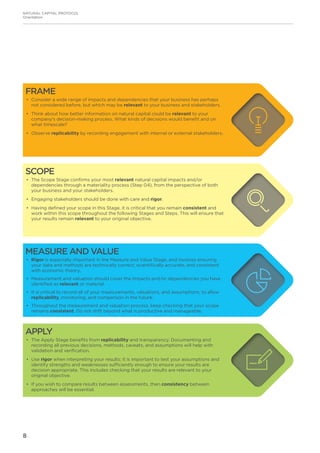
FRAME
•	 Consider a wide range of impacts and dependencies that your business has perhaps
not considered before, but which may be relevant to your business and stakeholders.
•	 Think about how better information on natural capital could be relevant to your
company’s decision-making process. What kinds of decisions would benefit and on
what timescale?
•	 Observe replicability by recording engagement with internal or external stakeholders.
NATURAL CAPITAL PROTOCOL
Orientation
SCOPE
•	 The Scope Stage confirms your most relevant natural capital impacts and/or
dependencies through a materiality process (Step 04), from the perspective of both
your business and your stakeholders.
•	 Engaging stakeholders should be done with care and rigor.
•	 Having defined your scope in this Stage, it is critical that you remain consistent and
work within this scope throughout the following Stages and Steps. This will ensure that
your results remain relevant to your original objective.
MEASURE AND VALUE
•	 Rigor is especially important in the Measure and Value Stage, and involves ensuring
your data and methods are technically correct, scientifically accurate, and consistent
with economic theory.
•	 Measurement and valuation should cover the impacts and/or dependencies you have
identified as relevant or material.
•	 It is critical to record all of your measurements, valuations, and assumptions, to allow
replicability, monitoring, and comparison in the future.
•	 Throughout the measurement and valuation process, keep checking that your scope
remains consistent. Do not drift beyond what is productive and manageable.
APPLY
•	 The Apply Stage benefits from replicability and transparency. Documenting and
recording all previous decisions, methods, caveats, and assumptions will help with
validation and verification.
•	 Use rigor when interpreting your results; it is important to test your assumptions and
identify strengths and weaknesses sufficiently enough to ensure your results are
decision appropriate. This includes checking that your results are relevant to your
original objective.
•	 If you wish to compare results between assessments, then consistency between
approaches will be essential.
Framestage:Why?Scopestage:What?Measureandvaluestage:How?Applystage:Whatnext?GlossaryOrientation
9
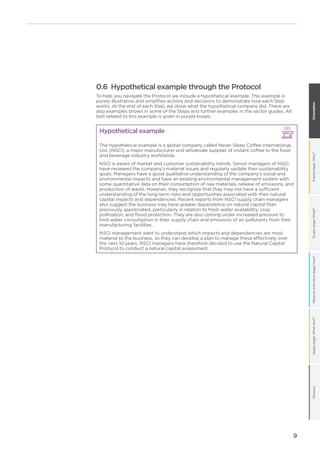
0.6 Hypothetical example through the Protocol
To help you navigate the Protocol we include a hypothetical example. This example is
purely illustrative and simplifies actions and decisions to demonstrate how each Step
works. At the end of each Step, we show what the hypothetical company did. There are
also examples shown in some of the Steps and further examples in the sector guides. All
text related to this example is given in purple boxes.
Hypothetical example NSCI
The hypothetical example is a global company called Never Sleep Coffee International,
Ltd. (NSCI), a major manufacturer and wholesale supplier of instant coffee to the food
and beverage industry worldwide.
NSCI is aware of market and customer sustainability trends. Senior managers of NSCI
have reviewed the company’s material issues and regularly update their sustainability
goals. Managers have a good qualitative understanding of the company’s social and
environmental impacts and have an existing environmental management system with
some quantitative data on their consumption of raw materials, release of emissions, and
production of waste. However, they recognize that they may not have a sufficient
understanding of the long-term risks and opportunities associated with their natural
capital impacts and dependencies. Recent reports from NSCI supply chain managers
also suggest the business may have greater dependence on natural capital than
previously appreciated, particularly in relation to fresh water availability, crop
pollination, and flood protection. They are also coming under increased pressure to
limit water consumption in their supply chain and emissions of air pollutants from their
manufacturing facilities.
NSCI management want to understand which impacts and dependencies are most
material to the business, so they can develop a plan to manage these effectively over
the next 10 years. NSCI managers have therefore decided to use the Natural Capital
Protocol to conduct a natural capital assessment.
10
NATURAL CAPITAL PROTOCOL
Frame Stage
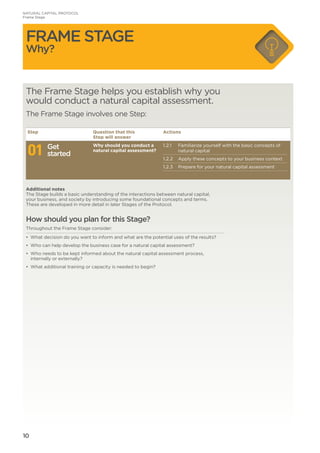
The Frame Stage helps you establish why you
would conduct a natural capital assessment.
The Frame Stage involves one Step:
Step Question that this
Step will answer
Actions
01 Get
started
Why should you conduct a
natural capital assessment?
1.2.1	Familiarize yourself with the basic concepts of
natural capital
1.2.2	 Apply these concepts to your business context
1.2.3	 Prepare for your natural capital assessment
Additional notes
The Stage builds a basic understanding of the interactions between natural capital,
your business, and society by introducing some foundational concepts and terms.
These are developed in more detail in later Stages of the Protocol.
How should you plan for this Stage?
Throughout the Frame Stage consider:
•	 What decision do you want to inform and what are the potential uses of the results?
•	 Who can help develop the business case for a natural capital assessment?
•	 Who needs to be kept informed about the natural capital assessment process,
internally or externally?
•	 What additional training or capacity is needed to begin?
FRAME STAGE
Why?
11
GlossaryApplystage:Whatnext?OrientationScopestage:What?Measureandvaluestage:How?Framestage:Why?
NATURAL CAPITAL PROTOCOL
01 Get started
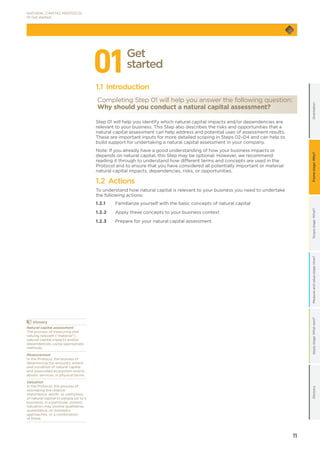
011.1 Introduction
Completing Step 01 will help you answer the following question:
Why should you conduct a natural capital assessment?
Step 01 will help you identify which natural capital impacts and/or dependencies are
relevant to your business. This Step also describes the risks and opportunities that a
natural capital assessment can help address and potential uses of assessment results.
These are important inputs for more detailed scoping in Steps 02–04 and can help to
build support for undertaking a natural capital assessment in your company.
Note: If you already have a good understanding of how your business impacts or
depends on natural capital, this Step may be optional. However, we recommend
reading it through to understand how different terms and concepts are used in the
Protocol and to ensure that you have considered all potentially important or material
natural capital impacts, dependencies, risks, or opportunities.
1.2 Actions
To understand how natural capital is relevant to your business you need to undertake
the following actions:
1.2.1	Familiarize yourself with the basic concepts of natural capital
1.2.2	 Apply these concepts to your business context
1.2.3	 Prepare for your natural capital assessment
Get
started
	Glossary
Natural capital assessment
The process of measuring and
valuing relevant (“material”)
natural capital impacts and/or
dependencies, using appropriate
methods.
Measurement
In the Protocol, the process of
determining the amounts, extent,
and condition of natural capital
and associated ecosystem and/or
abiotic services, in physical terms.
Valuation
In the Protocol, the process of
estimating the relative
importance, worth, or usefulness
of natural capital to people (or to a
business), in a particular context.
Valuation may involve qualitative,
quantitative, or monetary
approaches, or a combination
of these.
12
1.2.1 Familiarize yourself with the basic concepts of natural capital
This action introduces the basic concepts and definitions that you will need to advance
through the Steps of the Protocol.
a. The foundational concepts of natural capital stocks and flows
Natural capital is another term for the stock of renewable and non-renewable natural
resources on earth (e.g., plants, animals, air, water, soils, minerals) that combine to yield a
flow of benefits or “services” to people (adapted from Atkinson and Pearce 1995; Jansson
et al. 1994).
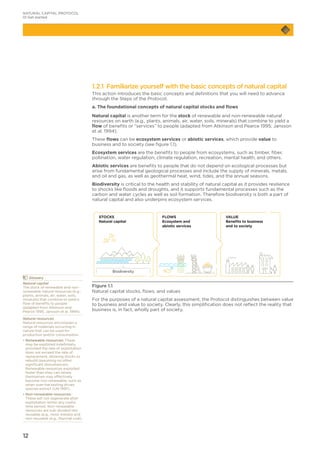
These flows can be ecosystem services or abiotic services, which provide value to
business and to society (see figure 1.1).
Ecosystem services are the benefits to people from ecosystems, such as timber, fiber,
pollination, water regulation, climate regulation, recreation, mental health, and others.
Abiotic services are benefits to people that do not depend on ecological processes but
arise from fundamental geological processes and include the supply of minerals, metals,
and oil and gas, as well as geothermal heat, wind, tides, and the annual seasons.
Biodiversity is critical to the health and stability of natural capital as it provides resilience
to shocks like floods and droughts, and it supports fundamental processes such as the
carbon and water cycles as well as soil formation. Therefore biodiversity is both a part of
natural capital and also underpins ecosystem services.
Figure 1.1
Natural capital stocks, flows, and values
For the purposes of a natural capital assessment, the Protocol distinguishes between value
to business and value to society. Clearly, this simplification does not reflect the reality that
business is, in fact, wholly part of society.
	Glossary
Natural capital
The stock of renewable and non-
renewable natural resources (e.g.,
plants, animals, air, water, soils,
minerals) that combine to yield a
flow of benefits to people
(adapted from Atkinson and
Pearce 1995, Jansson et al. 1994).
Natural resources
Natural resources encompass a
range of materials occurring in
nature that can be used for
production and/or consumption.
• Renewable resources: These
may be exploited indefinitely,
provided the rate of exploitation
does not exceed the rate of
replacement, allowing stocks to
rebuild (assuming no other
significant disturbances).
Renewable resources exploited
faster than they can renew
themselves may effectively
become non-renewable, such as
when over-harvesting drives
species extinct (UN 1997).
• Non-renewable resources:
These will not regenerate after
exploitation within any useful
time period. Non-renewable
resources are sub-divided into
reusable (e.g., most metals) and
non-reusable (e.g., thermal coal).
VALUE
Benefits to business
and to society
FLOWS
Ecosystem and
abiotic services
Biodiversity
STOCKS
Natural capital
NATURAL CAPITAL PROTOCOL
01 Get started
13
GlossaryApplystage:Whatnext?OrientationScopestage:What?Measureandvaluestage:How?Framestage:Why?
	Glossary
Ecosystem
A dynamic complex of plants,
animals, and microorganisms, and
their non-living environment,
interacting as a functional unit.
Examples include deserts, coral
reefs, wetlands, and rainforests
(MA 2005a). Ecosystems are part
of natural capital.
Ecosystem services
The most widely used definition of
ecosystem services is from the
Millennium Ecosystem Assessment
(MA 2005a): “the benefits people
obtain from ecosystems”. The MA
further categorized ecosystem
services into four categories:
• Provisioning: Material outputs
from nature (e.g., seafood, water,
fiber, genetic material).
• Regulating: Indirect benefits
from nature generated through
regulation of ecosystem
processes (e.g., mitigation of
climate change through carbon
sequestration, water filtration by
wetlands, erosion control and
protection from storm surges by
vegetation, crop pollination by
insects).
• Cultural: Non-material benefits
from nature (e.g., spiritual,
aesthetic, recreational, and
others).
• Supporting: Fundamental
ecological processes that
support the delivery of other
ecosystem services (e.g., nutrient
cycling, primary production, soil
formation).
Abiotic services
The benefits arising from
fundamental geological processes
(e.g., the supply of minerals,
metals, oil and gas, geothermal
heat, wind, tides, and the annual
seasons).
Biodiversity
The variability among living
organisms from all sources
including, inter alia, terrestrial,
marine, and other aquatic
ecosystems and the ecological
complexes of which they are part;
this includes diversity within
species, between species, and of
ecosystems (UN 1992).
Box 1.1 Classification of ecosystem services
Since the Millennium Ecosystem Assessment was published in 2005 (MA 2005a),
alternative definitions of ecosystem services have been proposed in an effort to clarify
the concept, reduce the overlap between different categories of service, and improve
alignment with other analytical frameworks (e.g., environmental economic accounting).
A key focus is clarifying the distinction between “supporting” and “regulating” services
and the final benefits that people obtain from nature, sometimes described as “final
outputs” or “final ecosystem services”. These efforts are important for:
	 i.	 allowing comparison between assessments;
	 ii.	 minimizing double counting;
	 iii.	 facilitating the translation of information between different applications; and
	 iv.	enabling better communication among experts from different disciplinary
backgrounds.
Leading classifications of ecosystem services in use today include the Common
International Classification of Ecosystem Services (CICES) and the Final Ecosystem
Goods and Services Classification System (FEGS-CS).
	 •	CICES classifies the “final outputs” or products of ecological systems so they can
be more easily translated into statistical information for use in various applications,
similar to standards for economic products and activities (Haines-Young and
Potschin 2013).
	 •	FEGS-CS classifies “final ecosystem services”, which are defined as the last
elements from nature that are enjoyed, used, or experienced by specific human
beneficiaries (Boyd and Banzhaf 2007), while also describing the type of
ecosystem (i.e., environmental class) producing these benefits (Landers and
Nahlik 2013).
These classification approaches are evolving and their development and use are likely to
generate further refinements. For more information on ecosystem services definitions
and classifications see Annex A.
14
Box 1.2 Biodiversity and its value to business
Biodiversity is critical to the health and stability of natural capital and flows of
ecosystem services as it provides resilience to shocks like floods and droughts, and it
supports fundamental processes such as the carbon and water cycles as well as soil
formation. Species build and sustain the terrestrial, marine, and atmospheric elements of
a living, breathing Earth necessary to support human life.
Compared to other business interactions with natural capital (e.g., emissions to air, use
of fresh water), business impacts and dependencies on biodiversity are often difficult to
measure and value systematically with no single measurement or indicator to capture all
the dimensions of biodiversity.
However, momentum is growing to progress and find consensus around how business
can measure and value biodiversity and valuation methods are evolving quickly.
Business impacts on biodiversity
In order to measure and value business impacts on biodiversity, you need to understand
the causal relationships between your business activities, the changes in biodiversity, and
the associated costs and/or benefits of these impacts. Business impacts on biodiversity
may be direct or indirect, for example through over-exploitation of resources, habitat loss
or restoration, fragmentation or degradation of ecosystems, pollution, the introduction of
exotic species, or contributions to climate change. Currently, the measurement of
business impacts on biodiversity tends to focus on changes in the distribution of species
and/or ecosystems relative to a defined baseline (e.g., IUCN Red Lists, Key Biodiversity
Areas, High Conservation Values, the Mean Species Abundance and the IFC Performance
Standard 6 (IFC 2012) which specifies certain conditions to meet when developments are
likely to affect natural or “critical habitat”).
The approach used to value changes in biodiversity (whether caused by business or by
other factors) will vary depending on, among other things, whether the aim is to assess:
	 •	the value of biodiversity per se to individuals and to society, for example some
threatened bird species found on a site;
	 •	the value of the ecosystem services dependent on processes regulated by
biodiversity, for example food production that relies on decomposition and
nutrient cycling by bacteria, earthworms, etc.; or
	 •	the value of ecosystem services for which an element of biodiversity is considered
a reliable indicator or proxy, for example seed-dispersing animals can be used as
“indicator species” and their abundance can serve as a proxy for the overall health
and functioning of a forest. This can be an efficient approach for some businesses
to monitor the value of biodiversity within specific sites over time.
Any comprehensive valuation of ecosystem services is likely to include biodiversity
values, unless specific separate values for biodiversity are required.
Business dependencies on biodiversity
In order to measure and value business dependencies on biodiversity, you need to
understand which aspects of biodiversity your business activities rely on and how
external factors could affect them. The value that biodiversity provides to business is
clearly observable in some industries, such as pharmaceuticals and biotechnology,
which may rely on the genetic information contained in wild plants and animals to
identify new products. Another example is the reliance of the agricultural sector on the
diversity of wild or regionally specific varieties to maintain disease resistance (a source
of resilience).
The approaches used to value business dependencies on biodiversity will vary with the
context and type of dependency. A production-function approach, for example, may be
used to assess the value of biodiversity in a commercial process, such as pollination of
crops. Alternatively, the value that biodiversity provides by increasing the stability of
ecosystems and their resilience to shocks may be assessed using a replacement cost
approach—for example, the costs of man-made infrastructure required to ensure an
equivalent level of protection from flooding as would be provided by a natural wetland.
NATURAL CAPITAL PROTOCOL
01 Get started
15
GlossaryApplystage:Whatnext?OrientationScopestage:What?Measureandvaluestage:How?Framestage:Why?
Box 1.2 Biodiversity and its value to business
Consideration of intrinsic value
The total economic value of biodiversity includes what economists refer to as “existence
value”: the value that people place on the continued existence of species or ecosystems,
regardless of whether they themselves will ever encounter the species or experience the
ecosystem. Some people argue that biodiversity has “intrinsic” value beyond this,
separate from any uses or values that people associate with it. This way of thinking is
often linked to concepts such as a “duty of care” and stewardship of nature, irrespective
of any benefits to people. This can be an issue of great sensitivity to certain stakeholders
and may need to be taken into account explicitly during the course of a natural capital
assessment.
b. Interactions between business, society, and natural capital
Natural capital and the benefits that flow from it sustain us all: individuals, families,
companies, and society as a whole. At the same time, our individual or collective actions
can build or degrade natural capital, depending on how we use it.
Every business impacts and depends on natural capital to some degree and will
experience risks and/or opportunities associated with those impacts and/or
dependencies.
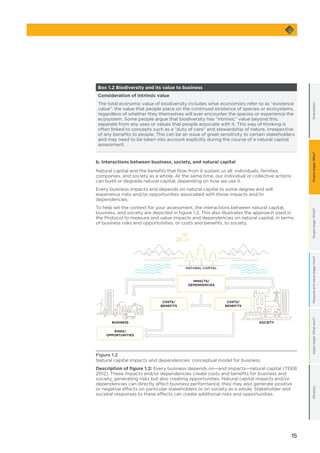
To help set the context for your assessment, the interactions between natural capital,
business, and society are depicted in figure 1.2. This also illustrates the approach used in
the Protocol to measure and value impacts and dependencies on natural capital, in terms
of business risks and opportunities, or costs and benefits, to society.
Figure 1.2
Natural capital impacts and dependencies: conceptual model for business
Description of figure 1.2: Every business depends on—and impacts—natural capital (TEEB
2012). These impacts and/or dependencies create costs and benefits for business and
society, generating risks but also creating opportunities. Natural capital impacts and/or
dependencies can directly affect business performance; they may also generate positive
or negative effects on particular stakeholders or on society as a whole. Stakeholder and
societal responses to these effects can create additional risks and opportunities.
NATURAL CAPITAL
16
1.2.2 Apply these concepts to your business context
This action builds on the concepts acquired in action 1.2.1, and shows how they relate to
your business model, supply chain, operations, etc. This action aims to ensure that your
natural capital assessment considers all potential natural capital impacts and/or
dependencies that may be important or material to your business and its stakeholders
(covered further in Step 04).
a. Natural capital impacts that are potentially relevant to your business
A natural capital impact is the negative or positive effect of business activity on natural
capital.
Natural capital impacts can arise directly from business operations or indirectly from the
use of products and services. Impacts may occur at any point in the value chain, through
exploration and extraction of raw materials, intermediate processing, the production of
finished goods, distribution, consumption, disposal, or recycling. Natural capital impacts
will also vary depending on the industrial sector concerned, the stage of the supply chain,
and the geographic location of operations.
Impacts on natural capital may be negative—for example due to land degradation or
pollution—or positive. Examples of positive impacts include ecological recovery due to
business investment in site rehabilitation, or improved ground and surface water quality
due to filtration and treatment of process water, which can sometimes result in higher
quality water released back to the environment than was extracted in the first place.
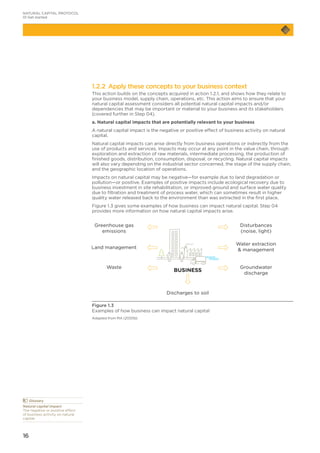
Figure 1.3 gives some examples of how business can impact natural capital. Step 04
provides more information on how natural capital impacts arise.
Figure 1.3
Examples of how business can impact natural capital
Adapted from MA (2005b)
	Glossary
Natural capital impact
The negative or positive effect
of business activity on natural
capital.
Land management
Greenhouse gas
emissions
Disturbances
(noise, light)
Water extraction
 management
Discharges to soil
Groundwater
discharge
Waste
BUSINESS
NATURAL CAPITAL PROTOCOL
01 Get started
17
GlossaryApplystage:Whatnext?OrientationScopestage:What?Measureandvaluestage:How?Framestage:Why?
	Glossary
Natural capital dependency
A business reliance on or use of
natural capital.
b. Natural capital dependencies that are potentially relevant to your business
All businesses depend on natural capital and associated ecosystem and/or abiotic
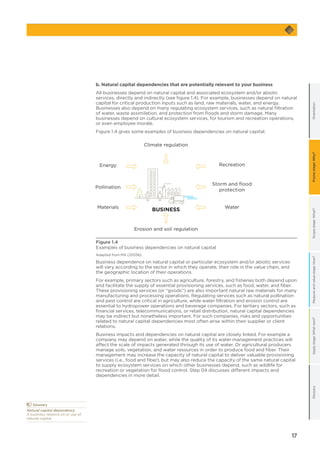
services, directly and indirectly (see figure 1.4). For example, businesses depend on natural
capital for critical production inputs such as land, raw materials, water, and energy.
Businesses also depend on many regulating ecosystem services, such as natural filtration
of water, waste assimilation, and protection from floods and storm damage. Many
businesses depend on cultural ecosystem services, for tourism and recreation operations,
or even employee morale.
Figure 1.4 gives some examples of business dependencies on natural capital.
Figure 1.4
Examples of business dependencies on natural capital
Adapted from MA (2005b)
Business dependence on natural capital or particular ecosystem and/or abiotic services
will vary according to the sector in which they operate, their role in the value chain, and
the geographic location of their operations.
For example, primary sectors such as agriculture, forestry, and fisheries both depend upon
and facilitate the supply of essential provisioning services, such as food, water, and fiber.
These provisioning services (or “goods”) are also important natural raw materials for many
manufacturing and processing operations. Regulating services such as natural pollination
and pest control are critical in agriculture, while water filtration and erosion control are
essential to hydropower operations and beverage companies. For tertiary sectors, such as
financial services, telecommunications, or retail distribution, natural capital dependencies
may be indirect but nonetheless important. For such companies, risks and opportunities
related to natural capital dependencies most often arise within their supplier or client
relations.
Business impacts and dependencies on natural capital are closely linked. For example a
company may depend on water, while the quality of its water management practices will
affect the scale of impacts generated through its use of water. Or agricultural producers
manage soils, vegetation, and water resources in order to produce food and fiber. Their
management may increase the capacity of natural capital to deliver valuable provisioning
services (i.e., food and fiber), but may also reduce the capacity of the same natural capital
to supply ecosystem services on which other businesses depend, such as wildlife for
recreation or vegetation for flood control. Step 04 discusses different impacts and
dependencies in more detail.
Pollination
Energy Recreation
Storm and flood
protection
Erosion and soil regulation
Climate regulation
WaterMaterials
BUSINESS
18
c. Risks and/or opportunities that are potentially relevant to your business
The business case for undertaking a natural capital assessment is based on identifying the
risks and opportunities that arise from impacts and/or dependencies on natural capital
that might be invisible, overlooked, misunderstood, or under-valued. Once you have
identified these and can start to measure and ultimately value them, you can consider how
best to integrate them into your business decisions.
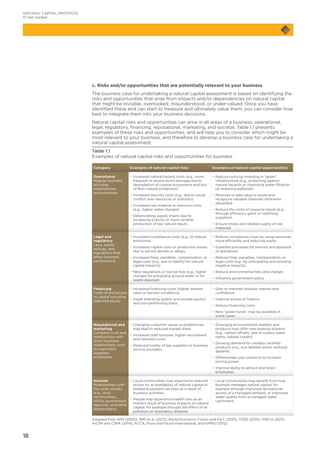
Natural capital risks and opportunities can arise in all areas of a business: operational,
legal, regulatory, financing, reputational, marketing, and societal. Table 1.1 presents
examples of these risks and opportunities, and will help you to consider which might be
most relevant to your business, and therefore to develop a business case for undertaking a
natural capital assessment.
Table 1.1
Examples of natural capital risks and opportunities for business
Category Examples of natural capital risks Examples of natural capital opportunities
Operational
Regular business
activities,
expenditures,
and processes
−− Increased natural hazard costs (e.g., more
frequent or severe storm damage due to
degradation of coastal ecosystems and loss
of their natural protection)
−− Increased security costs (e.g., due to social
conflict over resources or pollution)
−− Increased raw material or resource costs
(e.g., higher water charges)
−− Deteriorating supply chains due to
increasing scarcity or more variable
production of key natural inputs
−− Reduce costs by investing in “green”
infrastructure (e.g., protecting against
natural hazards or improving water filtration
by restoring wetlands)
−− Minimize or add value to waste and
recapture valuable materials otherwise
discarded
−− Reduce the costs of resource inputs (e.g.,
through efficiency gains or switching
suppliers)
−− Ensure timely and reliable supply of raw
materials
Legal and
regulatory
Laws, public
policies, and
regulations that
affect business
performance
−− Increased compliance costs (e.g., to reduce
emissions)
−− Increased capital costs or production losses
due to permit denials or delays
−− Increased fines, penalties, compensation, or
legal costs (e.g., due to liability for natural
capital impacts)
−− New regulations or license fees (e.g., higher
charges for extracting ground water or for
waste disposal)
−− Reduce compliance costs by using resources
more efficiently and reducing waste
−− Expedite processes for permits and approval
of operations
−− Reduce fines, penalties, compensation, or
legal costs (e.g., by anticipating and avoiding
negative impacts)
−− Reduce environmental fees and charges
−− Influence government policy
Financing
Costs of and access
to capital including
debt and equity
−− Increased financing costs (higher interest
rates or harsher conditions)
−− Asset stranding (public and private equity)
and non-performing loans
−− Gain or maintain investor interest and
confidence
−− Improve access to finance
−− Reduce financing costs
−− New “green funds” may be available in
some cases
Reputational and
marketing
Company trust and
relationships with
direct business
stakeholders, such
as customers,
suppliers,
employees
−− Changing customer values or preferences
may lead to reduced market share
−− Increased staff turnover, higher recruitment
and retention costs
−− Reduced loyalty of key suppliers or business
service providers
−− Emerging environmental markets and
products may offer new revenue streams
(e.g., carbon offsets, sale of surplus water
rights, habitat credits)
−− Growing demand for credibly certified
products (e.g., eco-labeled wood, seafood,
apparel)
−− Differentiate your products to increase
pricing power
−− Improve ability to attract and retain
employees
Societal
Relationships with
the wider society
(e.g., local
communities,
NGOs, government
agencies, and other
stakeholders)
−− Local communities may experience reduced
access to, or availability of, natural capital or
related ecosystem services as a result of
business activities.
−− People may experience health risks as an
indirect result of business impacts on natural
capital, for example through the effect of air
pollution on respiratory diseases.
−− Local communities may benefit from how
business manages natural capital, for
example through improved recreational
access of a managed wetland, or improved
water quality from a managed water
catchment.
Adapted from WRI (2005); WRI et al. (2012); World Economic Forum and PwC (2010); TEEB (2010); IPIECA (2011);
AICPA and CIMA (2014); ACCA, Flora and Fauna International, and KPMG (2012).
NATURAL CAPITAL PROTOCOL
01 Get started
19
GlossaryApplystage:Whatnext?OrientationScopestage:What?Measureandvaluestage:How?Framestage:Why?
Note that different risks or opportunities may vary in importance over different timescales.
The temporal factor is discussed in more detail in Step 03 (action 3.2.6.d).
Where possible, identify other companies in your sector who have assessed risks and/or
opportunities associated with natural capital and are willing to share their findings. This
may help you draw parallels and inspiration for your own business.
1.2.3 Prepare for your natural capital assessment
a. Identify potential applications of your assessment results
Building on your review of potential business risks and opportunities, described in action
1.2.2.c, this action helps you identify the decision you are attempting to inform and how
your business may benefit from better information on natural capital.
Every user of the Protocol will have their own reasons (or business case) for conducting a
natural capital assessment, and their own ideas about how best to apply the results.
Most natural capital assessments are designed to inform business strategy, management,
or operating decisions. This may involve one-off inputs to project design, or the
integration of natural capital into standard business processes, such as raw material
procurement, option appraisal, or estimating “net positive impact” (see box 1.3 on the
mitigation hierarchy). Some applications may also be relevant to external audiences, such
as revaluation of assets for company valuations, demonstrating net environmental impact
to regulators, stakeholder analysis for damage or compensation claims, or public
reporting.
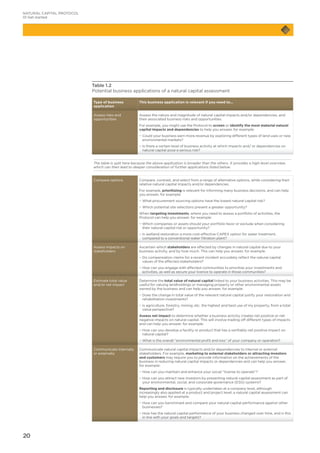
In the Protocol, a business application is defined as the intended use of the results of your
natural capital assessment, to help inform decision-making. Table 1.2 presents a list of
possible business applications with examples of the types of strategic or operational
decisions that could be informed. These applications are neither mutually exclusive nor
exhaustive, and may not match the terminology used in your company, but should provide
an idea of the potential scope of applications.
You will refer back to this business application in Step 02, when you articulate your
objective. There may be more than one relevant business application. Consider your
priorities and focus on the one that is most appropriate.
	Glossary
Business application
In the Protocol, the intended use
of the results of your natural
capital assessment, to help inform
decision making.
20
Table 1.2
Potential business applications of a natural capital assessment
Type of business
application
This business application is relevant if you need to…
Assess risks and
opportunities
Assess the nature and magnitude of natural capital impacts and/or dependencies, and
their associated business risks and opportunities.
For example, you might use the Protocol to screen or identify the most material natural
capital impacts and dependencies to help you answer, for example:
−− Could your business earn more revenue by exploring different types of land uses or new
environmental markets?
−− Is there a certain level of business activity at which impacts and/ or dependencies on
natural capital pose a serious risk?
The table is split here because the above application is broader than the others. It provides a high-level overview,
which can then lead to deeper consideration of further applications listed below.
Compare options Compare, contrast, and select from a range of alternative options, while considering their
relative natural capital impacts and/or dependencies.
For example, prioritizing is relevant for informing many business decisions, and can help
you answer, for example:
−− What procurement sourcing options have the lowest natural capital risk?
−− Which potential site selections present a greater opportunity?
When targeting investments, where you need to assess a portfolio of activities, the
Protocol can help you answer, for example:
−− Which companies or assets should your portfolio favor or exclude when considering
their natural capital risk or opportunity?
−− Is wetland restoration a more cost-effective CAPEX option for water treatment,
compared to a conventional water filtration plant?
Assess impacts on
stakeholders
Ascertain which stakeholders are affected by changes in natural capital due to your
business activity, and by how much. This can help you answer, for example:
−− Do compensation claims for a recent incident accurately reflect the natural capital
values of the affected stakeholders?
−− How can you engage with affected communities to prioritize your investments and
activities, as well as secure your licence to operate in those communities?
Estimate total value
and/or net impact
Determine the total value of natural capital linked to your business activities. This may be
useful for valuing landholdings or managing property or other environmental assets
owned by the business and can help you answer, for example:
−− Does the change in total value of the relevant natural capital justify your restoration and
rehabilitation investments?
−− Is agriculture, forestry, mining, etc. the highest and best use of my property, from a total
value perspective?
Assess net impact to determine whether a business activity creates net positive or net
negative impacts on natural capital. This will involve trading off different types of impacts
and can help you answer, for example:
−− How can you develop a facility or product that has a verifiably net positive impact on
natural capital?
−− What is the overall “environmental profit and loss” of your company or operation?
Communicate internally
or externally
Communicate natural capital impacts and/or dependencies to internal or external
stakeholders. For example, marketing to external stakeholders or attracting investors
and customers may require you to provide information on the achievements of the
business in reducing natural capital impacts or dependencies and can help you answer,
for example:
−− How can you maintain and enhance your social “license to operate”?
−− How can you attract new investors by presenting natural capital assessment as part of
your environmental, social, and corporate governance (ESG) systems?
Reporting and disclosure is typically undertaken at a company level, although
increasingly also applied at a product and project level; a natural capital assessment can
help you answer, for example:
−− How can you benchmark and compare your natural capital performance against other
businesses?
−− How has the natural capital performance of your business changed over time, and is this
in line with your goals and targets?
NATURAL CAPITAL PROTOCOL
01 Get started
21
GlossaryApplystage:Whatnext?OrientationScopestage:What?Measureandvaluestage:How?Framestage:Why?
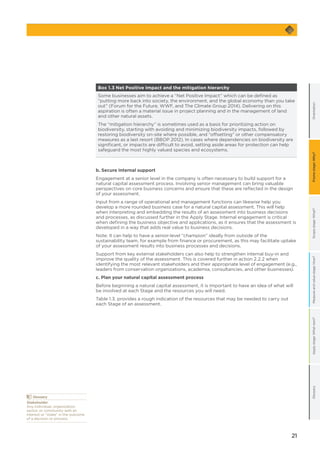
Box 1.3 Net Positive Impact and the mitigation hierarchy
Some businesses aim to achieve a “Net Positive Impact” which can be defined as
“putting more back into society, the environment, and the global economy than you take
out” (Forum for the Future, WWF, and The Climate Group 2014). Delivering on this
aspiration is often a material issue in project planning and in the management of land
and other natural assets.
The “mitigation hierarchy” is sometimes used as a basis for prioritizing action on
biodiversity, starting with avoiding and minimizing biodiversity impacts, followed by
restoring biodiversity on-site where possible, and “offsetting” or other compensatory
measures as a last resort (BBOP 2012). In cases where dependencies on biodiversity are
significant, or impacts are difficult to avoid, setting aside areas for protection can help
safeguard the most highly valued species and ecosystems.
b. Secure internal support
Engagement at a senior level in the company is often necessary to build support for a
natural capital assessment process. Involving senior management can bring valuable
perspectives on core business concerns and ensure that these are reflected in the design
of your assessment.
Input from a range of operational and management functions can likewise help you
develop a more rounded business case for a natural capital assessment. This will help
when interpreting and embedding the results of an assessment into business decisions
and processes, as discussed further in the Apply Stage. Internal engagement is critical
when defining the business objective and applications, as it ensures that the assessment is
developed in a way that adds real value to business decisions.
Note: It can help to have a senior-level “champion” ideally from outside of the
sustainability team, for example from finance or procurement, as this may facilitate uptake
of your assessment results into business processes and decisions.
Support from key external stakeholders can also help to strengthen internal buy-in and
improve the quality of the assessment. This is covered further in action 2.2.2 when
identifying the most relevant stakeholders and their appropriate level of engagement (e.g.,
leaders from conservation organizations, academia, consultancies, and other businesses).
c. Plan your natural capital assessment process
Before beginning a natural capital assessment, it is important to have an idea of what will
be involved at each Stage and the resources you will need.
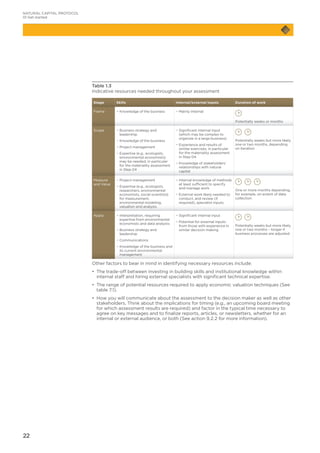
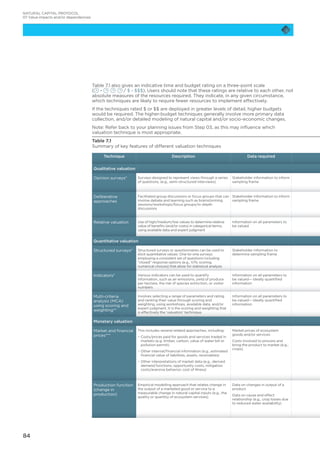
Table 1.3. provides a rough indication of the resources that may be needed to carry out
each Stage of an assessment.
	Glossary
Stakeholder
Any individual, organization,
sector, or community with an
interest or “stake” in the outcome
of a decision or process.
22
Table 1.3
Indicative resources needed throughout your assessment
Stage Skills Internal/external inputs Duration of work
Frame −− Knowledge of the business −− Mainly internal
Potentially weeks or months
Scope −− Business strategy and
leadership
−− Knowledge of the business
−− Project management
−− Expertise (e.g., ecologists,
environmental economists)
may be needed, in particular
for the materiality assessment
in Step 04
−− Significant internal input
(which may be complex to
organize in a large business)
−− Experience and results of
similar exercises, in particular
for the materiality assessment
in Step 04
−− Knowledge of stakeholders’
relationships with natural
capital
Potentially weeks but more likely
one or two months, depending
on iteration
Measure
and Value
−− Project management
−− Expertise (e.g., ecologists,
researchers, environmental
economists, social scientists)
for measurement,
environmental modeling,
valuation and analysis.
−− Internal knowledge of methods
at least sufficient to specify
and manage work
−− External work likely needed to
conduct, and review (if
required), specialist inputs
One or more months depending,
for example, on extent of data
collection
Apply −− Interpretation, requiring
expertise from environmental
economists and data analysts
−− Business strategy and
leadership
−− Communications
−− Knowledge of the business and
its current environmental
management
−− Significant internal input
−− Potential for external inputs
from those with experience in
similar decision making
Potentially weeks but more likely
one or two months – longer if
business processes are adjusted
Other factors to bear in mind in identifying necessary resources include:
•	 The trade-off between investing in building skills and institutional knowledge within
internal staff and hiring external specialists with significant technical expertise.
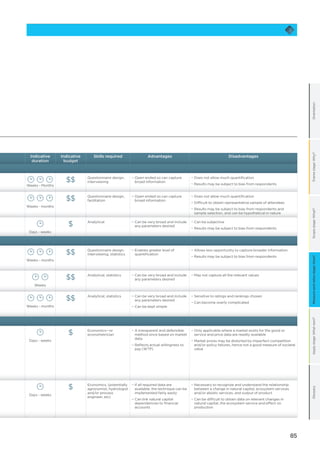
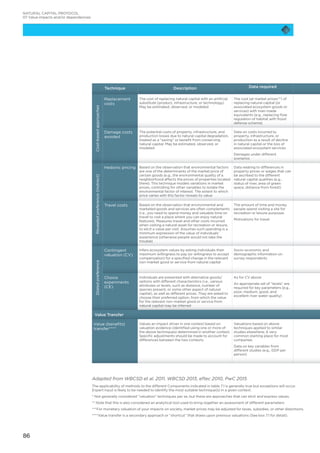
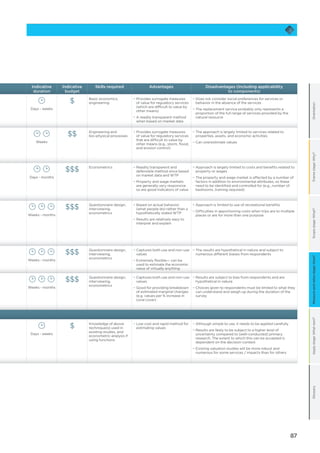
•	 The range of potential resources required to apply economic valuation techniques (See
table 7.1).
•	 How you will communicate about the assessment to the decision maker as well as other
stakeholders. Think about the implications for timing (e.g., an upcoming board meeting
for which assessment results are required) and factor in the typical time necessary to
agree on key messages and to finalize reports, articles, or newsletters, whether for an
internal or external audience, or both (See action 9.2.2 for more information).
NATURAL CAPITAL PROTOCOL
01 Get started
23
GlossaryApplystage:Whatnext?OrientationScopestage:What?Measureandvaluestage:How?Framestage:Why?
1.3 Outputs
The outputs of Step 01 are:
•	 An understanding of the basic concepts of natural capital.
•	 Initial ideas about which natural capital impacts and/or dependencies might present
risks or opportunities for your business, now or in the future.
•	 Potential applications of your assessment results.
•	 Support for the assessment, in principle, from key business stakeholders.
•	 An initial understanding of the resources needed to carry out a natural capital
assessment (to be refined in subsequent steps).
These outputs will establish a solid foundation for later Steps in your assessment, in
particular the Scope Stage described in Steps 02, 03, and 04.
It is important to document the assessment process and the basis for your decisions, in
particular to help with later interpretation of results and embedding natural capital in the
Apply Stage.
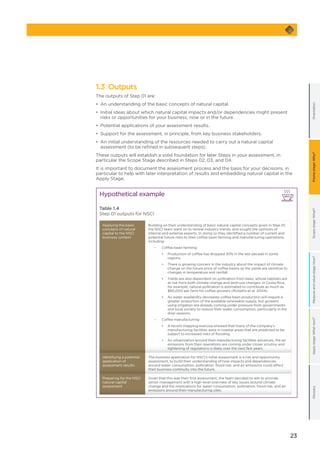
Hypothetical example NSCI
Table 1.4
Step 01 outputs for NSCI
Applying the basic
concepts of natural
capital to the NSCI
business context
Building on their understanding of basic natural capital concepts given in Step 01,
the NSCI team went on to review industry trends, and sought the opinions of
internal and external experts. In doing so they identified a number of current and
potential future risks to their coffee bean farming and manufacturing operations,
including:
	 –	 Coffee bean farming:
		 •	Production of coffee has dropped 30% in the last decade in some
regions.
		 •	There is growing concern in the industry about the impact of climate
change on the future price of coffee beans as the yields are sensitive to
changes in temperature and rainfall.
		 •	Yields are also dependent on pollination from bees, whose habitats are
at risk from both climate change and land-use changes. In Costa Rica,
for example, natural pollination is estimated to contribute as much as
$60,000 per farm for coffee growers (Ricketts et al. 2004).
		 •	As water availability decreases coffee bean production will require a
greater proportion of the available renewable supply, but growers
using irrigation are already coming under pressure from governments
and local society to reduce their water consumption, particularly in the
drier seasons.
	 –	 Coffee manufacturing:
		 •	A recent mapping exercise showed that many of the company’s
manufacturing facilities were in coastal areas that are predicted to be
subject to increased risks of flooding.
	 	•	As urbanization around their manufacturing facilities advances, the air
emissions from their operations are coming under closer scrutiny and
tightening of regulations is likely over the next few years.
Identifying a potential
application of
assessment results
The business application for NSCI’s initial assessment is a risk and opportunity
assessment, to build their understanding of how impacts and dependencies
around water consumption, pollination, flood risk, and air emissions could affect
their business continuity into the future.
Preparing for the NSCI
natural capital
assessment
Given that this was their first assessment, the team decided to aim to provide
senior management with a high-level overview of key issues around climate
change and the implications for water consumption, pollination, flood risk, and air
emissions around their manufacturing sites.
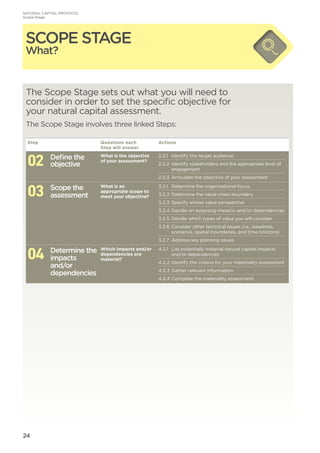
24
The Scope Stage sets out what you will need to
consider in order to set the specific objective for
your natural capital assessment.
The Scope Stage involves three linked Steps:
Step Questions each
Step will answer
Actions
02 Define the
objective
What is the objective
of your assessment?
2.2.1	 Identify the target audience	
2.2.2	 Identify stakeholders and the appropriate level of
engagement
2.2.3	 Articulate the objective of your assessment
03 Scope the
assessment
What is an
appropriate scope to
meet your objective?
3.2.1	 Determine the organizational focus	
3.2.2	 Determine the value-chain boundary
3.2.3	 Specify whose value perspective
3.2.4	Decide on assessing impacts and/or dependencies
3.2.5	 Decide which types of value you will consider
3.2.6	Consider other technical issues (i.e., baselines,
scenarios, spatial boundaries, and time horizons)
3.2.7	 Address key planning issues		
04 Determine the
impacts
and/or
dependencies
Which impacts and/or
dependencies are
material?
4.2.1	 List potentially material natural capital impacts
and/or dependencies	
4.2.2	Identify the criteria for your materiality assessment
4.2.3	Gather relevant information
4.2.4	Complete the materiality assessment
SCOPE STAGE
What?
NATURAL CAPITAL PROTOCOL
Scope Stage
25
Scopestage:What?GlossaryApplystage:Whatnext?Measureandvaluestage:How?Framestage:Why?OrientationScopestage:What?
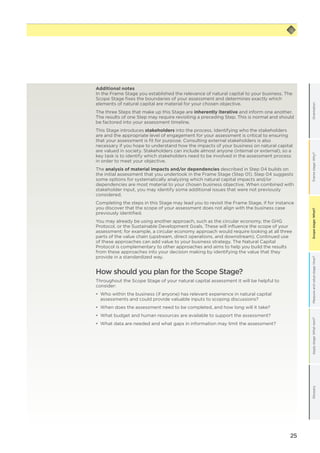
Additional notes
In the Frame Stage you established the relevance of natural capital to your business. The
Scope Stage fixes the boundaries of your assessment and determines exactly which
elements of natural capital are material for your chosen objective.
The three Steps that make up this Stage are inherently iterative and inform one another.
The results of one Step may require revisiting a preceding Step. This is normal and should
be factored into your assessment timeline.
This Stage introduces stakeholders into the process. Identifying who the stakeholders
are and the appropriate level of engagement for your assessment is critical to ensuring
that your assessment is fit for purpose. Consulting external stakeholders is also
necessary if you hope to understand how the impacts of your business on natural capital
are valued in society. Stakeholders can include almost anyone (internal or external), so a
key task is to identify which stakeholders need to be involved in the assessment process
in order to meet your objective.
The analysis of material impacts and/or dependencies described in Step 04 builds on
the initial assessment that you undertook in the Frame Stage (Step 01). Step 04 suggests
some options for systematically analyzing which natural capital impacts and/or
dependencies are most material to your chosen business objective. When combined with
stakeholder input, you may identify some additional issues that were not previously
considered.
Completing the steps in this Stage may lead you to revisit the Frame Stage, if for instance
you discover that the scope of your assessment does not align with the business case
previously identified.
You may already be using another approach, such as the circular economy, the GHG
Protocol, or the Sustainable Development Goals. These will influence the scope of your
assessment; for example, a circular economy approach would require looking at all three
parts of the value chain (upstream, direct operations, and downstream). Continued use
of these approaches can add value to your business strategy. The Natural Capital
Protocol is complementary to other approaches and aims to help you build the results
from these approaches into your decision making by identifying the value that they
provide in a standardized way.
How should you plan for the Scope Stage?
Throughout the Scope Stage of your natural capital assessment it will be helpful to
consider:
•	 Who within the business (if anyone) has relevant experience in natural capital
assessments and could provide valuable inputs to scoping discussions?
•	 When does the assessment need to be completed, and how long will it take?
•	 What budget and human resources are available to support the assessment?
•	 What data are needed and what gaps in information may limit the assessment?
26
022.1 Introduction
Completing Step 02 will help you answer the following question:
What is the objective of your assessment?
Now that Step 01 has provided an overview as to why natural capital is relevant to your
business, the next Step is to identify the objective of your assessment.
2.2 Actions
In order to develop the objective for your natural capital assessment you will need to
carry out the following actions:
2.2.1	 Identify the target audience
2.2.2	 Identify stakeholders and the appropriate level of engagement
2.2.3	 Articulate the objective of your assessment
2.2.1 Identify the target audience
Identifying the target audience and understanding what drives them is key in defining
your objective as it will influence the way the assessment is conducted, the type of
outputs to be delivered, and the desired outcomes. The target audience is defined here as
the main users of the assessment output (i.e., those people that will read and use the
output to make decisions). The target audience is likely to be an internal stakeholder or
decision-maker, although it may be an external audience such as shareholders if the
objective is to provide output for a company report.
Linked to this target audience are those stakeholders that may need to authorize or fund
the assessment at the outset. Quite often these will be the same as the target audience. It
will be important to develop a strong case to justify the need to carry out the assessment.
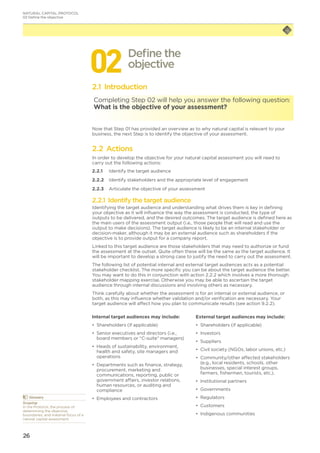
The following list of potential internal and external target audiences acts as a potential
stakeholder checklist. The more specific you can be about the target audience the better.
You may want to do this in conjunction with action 2.2.2 which involves a more thorough
stakeholder mapping exercise. Otherwise you may be able to ascertain the target
audience through internal discussions and involving others as necessary.
Think carefully about whether the assessment is for an internal or external audience, or
both, as this may influence whether validation and/or verification are necessary. Your
target audience will affect how you plan to communicate results (see action 9.2.2).
Define the
objective
	Glossary
Scoping
In the Protocol, the process of
determining the objective,
boundaries, and material focus of a
natural capital assessment.
Internal target audiences may include:
•	 Shareholders (if applicable)
•	 Senior executives and directors (i.e.,
board members or “C-suite” managers)
•	 Heads of sustainability, environment,
health and safety, site managers and
operations
•	 Departments such as finance, strategy,
procurement, marketing and
communications, reporting, public or
government affairs, investor relations,
human resources, or auditing and
compliance
•	 Employees and contractors
External target audiences may include:
•	 Shareholders (if applicable)
•	 Investors
•	 Suppliers
•	 Civil society (NGOs, labor unions, etc.)
•	 Community/other affected stakeholders
(e.g., local residents, schools, other
businesses, special interest groups,
farmers, fishermen, tourists, etc.).
•	 Institutional partners
•	 Governments
•	 Regulators
•	 Customers
•	 Indigenous communities
NATURAL CAPITAL PROTOCOL
02 Define the objective
27
Scopestage:What?GlossaryApplystage:Whatnext?Measureandvaluestage:How?Framestage:Why?OrientationScopestage:What?
2.2.2 Identify stakeholders and the appropriate level
of engagement
Your assessment is likely to be more relevant, reliable, and useful in the longer term (e.g.,
for embedding natural capital assessments into your business strategy) if you are able to
consult and involve the right internal and external stakeholders from the outset. In addition
to your target audience, this may include identifying and engaging with other stakeholders
who may be affected by the results, including people who can:
i.	 Provide information to help undertake the assessment.
ii.	 Influence the assessment, in terms of their viewpoints and behaviors.
iii.	Help verify, validate, and interpret the assessment (e.g., experts).
Various stakeholders may contribute significant insights into the assessment and its
results. Internal stakeholders may be able to provide considerable insights, for example
procurement staff knowledge of the value chain. External stakeholder input can provide
greater robustness and credibility to results, as one benefit, and is certainly to be
encouraged, bearing in mind that you may have to give some background on the basic
concepts of a natural capital assessment.
To help complete this action you may want to undertake some form of stakeholder
analysis or mapping exercise. Stakeholder analysis typically involves identifying potential
stakeholders, analyzing their characteristics, and then mapping them in order to prioritize
the preferred nature and level of engagement. If your business, or your industry peers,
have already mapped out the most important stakeholders, then you could use this as a
starting point. If not, there is a wealth of guidance available on stakeholder analysis and
mapping. The choice of stakeholders and nature of engagement should be based upon
the objective of the assessment, how transparent you are prepared to be, and budgetary
constraints.
Characteristics to consider typically include the relative importance of stakeholders and
their relative influence. However, many other factors can also be taken into account in the
analysis and prioritizing, such as whether they are primary stakeholders (i.e., they depend
on the resources affected) or secondary stakeholders (i.e., they are not directly affected
but interested), as well as their legitimacy, willingness, and ability to engage and
contribute.
28
2.2.3 Articulate the objective of your assessment
In Step 01, using table 1.2, you identified how you intend to use the results of your
assessment—your potential business application. With the additional clarity from Step 01
and the first two actions in Step 02, on target audience and stakeholders, you should now
be able to develop and articulate the specific objective or why you are doing this natural
capital assessment.
It is important to be able to articulate the anticipated benefits that your business stands to
gain from undertaking an assessment.
Articulating the anticipated benefits can help to:
•	 Justify an appropriate level of staffing and other resources to undertake the assessment;
•	 Confirm who needs to be involved in the assessment, based on what parts of the
business are most likely to benefit;
•	 Improve engagement with internal and external stakeholders; and
•	 Integrate the results into decision making.
Ideally the objective should be SMART (specific, measurable, attainable, relevant, and
time-bound). Examples of objectives for a natural capital assessment include:
•	 Measure and value the positive natural capital impact of a planned new product, to
increase sales, through supporting communication with customers and marketing
campaigns over the next two years.
•	 Assess where and how your supply chain may be affected by changes in natural capital
over the coming 10 years, to support stakeholder engagement and minimize future
supply chain risk.
•	 Identify and estimate potential new revenue streams linked to natural capital, and
communicate this to senior management, finance, and marketing departments.
NATURAL CAPITAL PROTOCOL
02 Define the objective
29
Scopestage:What?GlossaryApplystage:Whatnext?Measureandvaluestage:How?Framestage:Why?OrientationScopestage:What?
2.3 Outputs
The output of Step 02 is your objective for the assessment (action 2.2.3), which you will
have defined by taking into account:
•	 The defined audience who will ultimately consider and apply the results of the
assessment (2.2.1)
•	 A stakeholder list and appropriate level of engagement (2.2.2)
•	 The specific benefits you anticipate from the assessment (2.2.3)
It is important to document the process you have undertaken to complete each Step
along with the basis for any decisions. As well as assisting the completion of future Steps,
this will provide a record for verification and validation and will prove useful when carrying
out future assessments at a later date.
Hypothetical example NSCI
A completed template recording these outputs is shown for the hypothetical example
in table 2.1.
Table 2.1
Step 02 outputs for NSCI
Question Response for hypothetical example: NSCI
1.	Who is the target
audience?
Senior management.
2.	Who are your
identified
stakeholders and
what is the
appropriate level of
engagement?
Initially the assessment is intended for internal use only. Future involvement of local
regulators, investors, and suppliers may be warranted based on the results of the
assessment.
3.	What specific
benefits do you
anticipate from the
assessment?
Understand the potential relevance of natural capital impacts and dependencies to
long-term profitability.
Identify farmers and manufacturing facilities most at risk and consider potential
mitigating actions.
4.	What is the specified
objective?
To measure and value the extent to which facilities and growers impact and depend
on natural capital related to water use, pollination, flooding, and air quality.
To lay the ground work for a more detailed analysis to design a strategy addressing
priority risks.
30
033.1 Introduction
Completing Step 03 will help you answer the following question:
What is an appropriate scope to meet your objective?
Step 03 will help to plan the assessment by setting out key considerations that may affect
the assessment result. It is worth looking at existing practice in your business, and noting
that some of the terms used here may be referred to as something else within your
business, for example parts of the value chain may be referred to as suppliers and
customers rather than upstream and downstream.
Keep it simple. Based upon the business application you have chosen, you may decide to
have a broad and shallow approach (i.e., assessing multiple impacts across the entire
company or value chain) or you may choose a narrow and deep approach (i.e., fewer
issues and a tighter scope with more detailed analysis). Setting a broad or deep scope
from the start might require more time and resources.
3.2 Actions
In order to scope your assessment you will need to carry out the following actions:
3.2.1	 Determine the organizational focus
3.2.2	 Determine the value-chain boundary
3.2.3	 Specify whose value perspective
3.2.4	 Decide on assessing impacts and/or dependencies
3.2.5	 Decide which types of value you will consider
3.2.6	 Consider other technical issues (i.e., baselines, scenarios, spatial boundaries,
and time horizons)
3.2.7	 Address key planning issues
Scope the
assessment
NATURAL CAPITAL PROTOCOL
03 Scope the assessment
31
Scopestage:What?GlossaryApplystage:Whatnext?Measureandvaluestage:How?Framestage:Why?OrientationScopestage:What?
3.2.1 Determine the organizational focus
Organizational focus refers to the part or parts of a business to be included in a natural
capital assessment. The Protocol considers three general levels of organizational focus,
namely: corporate, project and product.
There are important similarities and differences between these three levels, in terms of
how an assessment is undertaken.
Determining an appropriate organizational focus will likely depend on the business
application you have chosen. Table 3.1 provides some additional considerations for
choosing an appropriate organizational focus.
Table 3.1
Key considerations when selecting the organizational focus
Corporate Project Product
−− Likely to require more effort
and consolidation of
information across the business.
−− May need to define which
subsidiaries to include.
−− May imply a broad but shallow
assessment of impacts and/or
dependencies.
−− May highlight material issues
that were not anticipated.
−− May be bounded geographically
to a country, or even a single
location.
−− Good for comparing alternative
options.
−− Need to decide which projects/sites
to assess.
−− May involve assessing an extension
of an existing facility or a new build.
−− New builds are likely to require
significant data collection,
especially on the baseline situation.
−− May need to define specific aspects
or alternative options (e.g.,
scenarios) to assess.
−− Narrow scope may allow for
detailed assessment of impacts
and/or dependencies.
−− 	Good for comparing alternative
options.
−− Need to decide which product(s),
material(s), and/or related services to
assess.
−− High volume, fast growing, or most
profitable products may not have the
most material issues.
−− Narrow scope may allow for detailed
assessment of impacts and/or
dependencies.
	Glossary
Organizational focus
In the Protocol, the part or parts
of the business to be assessed
(e.g., the company as a whole, a
business unit, or a product, project,
process, site, or incident). For
simplicity, these are grouped under
three general levels as below:
• Corporate: assessment of a
corporation or group, including
all subsidiaries, business units,
divisions, different geographies
or markets, etc.
• Project: assessment of a planned
undertaking or initiative for a
specific purpose, and including all
related sites, activities, processes,
and incidents.
• Product: assessment of particular
goods and/or services, including
the materials and services used in
their production.
32
3.2.2 Determine the value-chain boundary
As well as choosing your organizational focus, you need to identify which part(s) of the
value chain will be assessed. The Protocol considers three major parts of the value chain:
upstream, direct operations, and downstream.
While the obvious choice is to start with the direct operations of your business where
you have control, the most material issues may be found upstream or downstream (see
Step 04).
Table 3.2 suggests additional issues to consider when choosing the value-chain boundary.
It is important to remember that the relative importance of each value-chain stage
depends on the sector in which your business operates and therefore it is worth looking at
sector guidance where this is available. For example, the extractive industry experiences
the highest land footprint in its upstream and direct operations stages, whereas carbon
emissions are largest in the downstream stage.
Table 3.2
Key considerations when selecting the value-chain boundary
Part of the value chain Key points to consider
Upstream −− Upstream suppliers often represent your biggest natural capital impacts or
dependencies and can be considerable areas of risk.
−− Considering upstream issues may help you comply with regulations in some jurisdictions
that require companies to take responsibility for minimizing adverse environmental
impacts and their social consequences in their supply chains.
−− Assessing upstream impacts and dependencies can help inform a procurement
strategy, reduce reputational risks, and create reputational opportunities.
−− Upstream issues can be more difficult to influence than direct operations, due to the
need to negotiate with suppliers, but you will often have more control than downstream
as you there is a contract between you and your suppliers which can be negotiated.
−− Upstream assessments may require additional effort to collect relevant impact data.
Direct operations −− Direct operations often may not represent your biggest natural capital impacts or
dependencies. However, the impacts and dependencies of direct operations are likely to
be more important for companies with large landholdings or direct footprints (e.g.,
extractives, agriculture). Most of the information needed for an assessment of direct
operations is likely to be readily available.
−− You can measure the impacts and dependencies of direct operations more easily and on
a more regular basis relative to other value-chain stages.
−− Greater influence over direct operations means it is possible to experiment with
different options to reduce impacts and/or dependencies on natural capital.
Downstream −− Downstream stages of the value chain may represent a significant portion of a business’
impacts on natural capital.
−− Assessing downstream impacts will be particularly relevant to customers and may be
useful for public relations and marketing.
−− Downstream is often more difficult to influence than direct operations or upstream
impacts and dependencies.
If you are familiar with the GHG Protocol’s three Scopes (WRI and WBCSD 2004), it may
be helpful to note that:
•	 Scope 1 in the GHG Protocol – all direct GHG emissions – is similar to the direct
operations here.
•	 Scope 2 in the GHG Protocol – indirect GHG emissions from consumption of purchased
electricity, heat or steam – is a specific type of upstream activity considered here.
•	 Scope 3 in the GHG Protocol – other indirect emissions (e.g., the extraction and
production of purchased materials and fuels, waste disposal) – encompass both
upstream and downstream activities here.
	Glossary
Value-chain boundary
The part or parts of the business
value chain to be included in a
natural capital assessment. For
simplicity, the Protocol identifies
three generic parts of the value
chain: upstream, direct operations
and downstream. An assessment of
the full lifecycle of a product would
encompass all three parts.
• Upstream (cradle-to-gate): covers
the activities of suppliers,
including purchased energy.
• Direct operations (gate-to-gate):
covers activities over which the
business has direct operational
control, including majority owned
subsidiaries.
• Downstream (gate-to-grave):
covers activities linked to the
purchase, use, re-use, recovery,
recycling, and final disposal of the
business’ products and services.
NATURAL CAPITAL PROTOCOL
03 Scope the assessment
33
Scopestage:What?GlossaryApplystage:Whatnext?Measureandvaluestage:How?Framestage:Why?OrientationScopestage:What?
3.2.3 Specify whose value perspective
A key action in your assessment is deciding whose value perspectives to consider. In the
Protocol, you may focus your assessment on the value to business (i.e., business value) or
on the value to society (i.e., societal value). A complete assessment will include both value
perspectives, as they are integrally linked. However there can be benefit in initially
considering them separately, to better understand them.
If you are focusing, for example, on the financial implications to your business of water
shortages, you would start from the business value perspective. However, for a more
complete understanding, you must also consider how impacts to society may affect your
business, both now and in the future. For example, while your business may have enough
water, shortages could result in nearby stakeholders having insufficient water, which might
lead to indirect impacts to your business (e.g., reputational costs from protesting
stakeholders and losing your license to operate).
Your impacts on society may result in changes in business values. Understanding the
nature and magnitude of societal values can shed light on potential risks (and
opportunities) to your business. For example, societal values may affect your social license
to operate, or raise the risk that some environmental externalities may be “internalized”
through new regulations or environmental markets. Alternatively, your company may be
able to create an additional or greater revenue stream through providing wider societal
benefits (e.g., through restoring habitat that enhances recreation). Table 3.3 provides
additional advice on the selection of an appropriate value perspective.
Table 3.3
Key considerations when selecting the value perspective
Value perspective Typically used to
Business value −− Assess how natural capital impacts and/or dependencies affect, positively or negatively,
the financial performance of the company (i.e., the bottom line) and thus the value at
risk.
−− Assess company exposure to risks arising from its impacts and/or dependencies.
−− Minimize company expenses or liabilities and maximize company revenues/receivables.
−− Communicate to shareholders, budget control staff, management, and creditors.
Societal value −− Understand the significance of your natural capital impacts and dependencies to other/
external stakeholders.
−− Determine outcomes for society, assess which stakeholders are affected and how much,
and assess net impacts to society.
−− Investigate the potential nature and extent of future risks and opportunities, including
license to operate, and reputational issues.
−− Assess risks and opportunities associated with environmental externalities, either
positive or negative.
−− Communicate to employees and external stakeholders (e.g., regulators, local
communities, consumers, non-governmental organizations, suppliers, contractors, and
clients).
Both value perspectives −− Undertake a comprehensive natural capital assessment. Assessing societal values, in
particular your future impacts on society, enables all potential business values to be
considered as well.
Adapted from A4S (2015)
	Glossary
Value perspectives
In the Protocol, the perspective or
point of view from which value is
assessed; this determines which
costs or benefits are included in
an assessment.
• Business value: The costs and
benefits to the business, also
referred to as internal, private,
financial, or shareholder value.
• Societal values: The costs and
benefits to wider society, also
referred to as external, public, or
stakeholder value (or externalities).
34
3.2.4 Decide on assessing impacts and/or dependencies
Your assessment may cover your impacts or your dependencies, or both. This will, in part,
depend on the business application and your objective. A complete assessment considers
both impacts and dependencies to gain a full understanding of your company’s risk and
opportunity related to natural capital.
It is important to note that impacts and dependencies are inter-related. For example,
business dependencies typically result in impacts (e.g., water use by a company will often
mean less water, or lower quality water, available for other stakeholders).
Impacts and dependencies are explained further in Step 04 where the concepts of impact
pathways and dependency pathways are introduced. In that Step, you will be guided in
how to select which specific impacts and dependencies your assessment will cover.
Both impacts and dependencies can be relevant to any organizational focus and value-
chain boundary. They can be considered in the three Components of a complete natural
capital assessment:
•	 Impacts on your business (as a result of your impacts on natural capital)
•	 Your impacts on society (as a result of your impacts on natural capital)
•	 Your business dependencies (benefits that your business receives from natural capital)
It is recommended that all three Components be included within a natural capital
assessment as all three are generally relevant to all potential business applications. The
following descriptions provide examples of specific analyses alongside the limitations of
considering each Component in isolation.
Note: Depending on your specific objective, you may wish to only focus on one value
perspective or on impacts or dependencies. It is important to recognize the associated
limitations of not assessing all three Components in these instances.
a. Impacts on your business
“Impacts on your business” as a result of your impacts on natural capital are those that
affect your financial bottom line—either now or in the future. They may result from your
direct operations or be passed through to you as a result of natural capital impacts
elsewhere in your value chain. The following are examples of potential impacts on your
business:
•	 	Current financial costs or benefits (e.g., environmental taxes, fines, or compensation
costs, effluent or waste treatment costs, increased input prices due to regulation of your
suppliers, reduced sales due to negative publicity about your product’s impacts on
natural capital)
•	 Potential future financial costs or benefits (e.g., where you anticipate that new
regulations or taxes may lead to increased future costs or create new liabilities)
The limitations:
•	 You will not assess your dependence on natural capital.
•	 The estimates of value obtained will not reflect the external costs and/or benefits to
society associated with the impacts of your business on natural capital. In many cases,
the direct financial consequences for a business that arise from its impacts on natural
capital will be lower than the costs borne or benefits secured by society.
Resources and stakeholder engagement considerations:
•	 Typically fewer external resources and less specialist expertise are needed than for the
other two Components, since relevant data and expertise may well be available within
the company.
•	 Stakeholder engagement may be less important as assessments will tend to relate to
financial costs and benefits and be largely for internal use.
NATURAL CAPITAL PROTOCOL
03 Scope the assessment
	Glossary
Natural capital impact:
The negative or positive effect of
business activity on natural capital.
Natural capital dependency:
A business reliance on or use of
natural capital.
Components:
The three elements of a complete
natural capital assessment identified
in the Protocol: “impacts on your
business”, “your impacts on
society”, and “your business
dependencies”.
35
Scopestage:What?GlossaryApplystage:Whatnext?Measureandvaluestage:How?Framestage:Why?OrientationScopestage:What?
b. Your impacts on society
“Your impacts on society” can come from your direct operations or indirectly from
somewhere else in your value chain, including suppliers and consumers. Note that you
may want to understand the scale of these impacts even if you are not directly responsible
for them. The following examples show analyses that consider your impacts on society:
•	 Wider changes in human well-being and social capital as a result of your business
impacts on natural capital
•	 Societal costs and/or benefits associated with the company’s use of natural capital
(dependencies)
•	 Costs or benefits associated with both direct and indirect (e.g., supply chain) impacts
and/or dependencies
The limitations:
•	 You will not assess your dependence on natural capital.
•	 Societal costs and benefits rarely translate directly into financial costs and benefits to
business, even when they are expressed in monetary terms. This is because these
societal costs and benefits can rarely be imposed on or captured by companies
precisely. For example, the financial costs (e.g., mitigating expenditures) imposed by
environmental legislation are typically lower than the societal costs of the impacts
avoided. Equally, the financial costs of reputational damages associated with impacts on
natural capital may be greater than the societal costs of the impacts themselves.
Resources and stakeholder engagement considerations:
•	 Typically more resources are needed.
•	 Specialist expertise from environmental and welfare economists is likely to be important.
•	 Stakeholder engagement is likely to be important when considering specifically local
issues and decisions that may significantly alter local sites/resources or access to them.
Stakeholder engagement is less relevant for broad assessments covering many
geographies and diffuse impacts (e.g., a whole supply chain assessment).
c. Your business dependencies
“Your business dependencies” applies whether you depend on natural capital for your
direct operations or indirectly somewhere else in your value chain, including suppliers and
consumers. Note that you may want to understand the scale of these dependencies even
if you cannot directly influence them. The following examples show analyses that consider
your business dependencies:
•	 The benefits (i.e., value) to your company from using natural capital
•	 Current financial costs (e.g., amounts paid for water, agricultural inputs, and minerals)
•	 Potential future financial costs (e.g., if you expect the prices of inputs from natural
capital to rise or become more volatile)
•	 Costs associated with both direct and indirect dependencies (e.g., dependencies in the
supply chain)
The limitations:
•	 If you have particularly significant natural capital dependencies (e.g., you are a major
user of fresh water), these may also create major impacts on society which you will not
capture without looking at your impacts on society. If these impacts on society are
sufficiently severe, they may in turn results in impacts on your business (e.g.,
reputational damage or loss of social license to operate), which you will miss if you
choose only to look at your business dependencies.
Resources and stakeholder engagement considerations:
•	 May require specialist environmental/natural resource modeling expertise to assess
external drivers of change in natural capital on which your business depends.
•	 The importance of stakeholder engagement will vary depending on the objective of the
assessment, but as other stakeholders may also depend on the same natural capital,
engagement is often important.
36
In Step 01 you identified how you intend to use the results of your assessment—the
business application. Reviewing how the Components relate to your business application,
using Table 3.4, will help to identify if one or more Components are relevant for your
assessment.
Table 3.4
How the Components relate to your business application
Type of business application This business application is relevant if you need to…
Assess risks and opportunities Assess the nature and magnitude of natural capital impacts and/or
dependencies, and their associated business risks and opportunities.
The value perspective will depend on your objective however options can be
considered with all three Components in mind.
From a future risk perspective, considering your business dependencies may be
particularly helpful for establishing the value of natural capital dependencies in
relation to other inputs and services that you rely on. It can be particularly
insightful if some or all of these dependencies are currently un-priced,
highlighting areas of potential risk.
Likewise the inclusion of your impacts on society in this analysis would help
identify when business uses of natural capital may lead to conflict with other
stakeholders that rely on the same resources.
The table is split here because the above application is broader than the others. It provides a high-level overview,
which can then lead to deeper consideration of further applications listed below.
Compare options Compare, contrast, and select from a range of alternative options, while
considering their relative natural capital impacts and/or dependencies.
The value perspective will depend on your objective however options can be
considered with all three Components in mind.
Considering impacts on your business in this case is helpful for establishing the
relevance of natural capital impacts to the company’s bottom line, for
incorporating natural capital into financial analyses, and for communicating
natural capital costs and/or benefits (e.g., to shareholders) when considering
different options.
There may be instances where both your business dependencies and your
impacts on society are relevant depending on the scope of the options
comparison.
Assess impacts on stakeholders Ascertain which stakeholders are affected by changes in natural capital due to
your business activity, and by how much.
This application likely requires consideration of both societal and business value
perspectives. As such, consideration of your impacts on society is important and
can be used to ascertain what wider and longer-term risks and opportunities
your business faces and what these mean for different stakeholders.
Estimate total value and/or net
impact
Determine the total value of natural capital linked to your business activities or
assess net impact to determine whether a business activity creates net positive
or net negative impacts on natural capital.
All three Components are particularly important when considering this
application as focusing on only one Component will not enable the estimation of
either the total value or net impact.
Communicate internally or
externally
Communicate natural capital impacts and/or dependencies to internal and/or
external stakeholders. Here all three Components are useful depending on the
context of the project.
Note: Communicating information with respect to a limited scope, i.e., focusing
on only one Component, will require explanation as part of this process along
with any specific limitations.
NATURAL CAPITAL PROTOCOL
03 Scope the assessment
37
Scopestage:What?GlossaryApplystage:Whatnext?Measureandvaluestage:How?Framestage:Why?OrientationScopestage:What?
	Glossary
Qualitative valuation: Valuation that
describes natural capital impacts or
dependencies and may rank them
into categories such as high,
medium, or low.
Quantitative valuation: Valuation
that uses non-monetary units such
as numbers (e.g., in a composite
index), areas, mass, or volume to
assess the magnitude of natural
capital impacts or dependencies.
Monetary valuation: Valuation that
uses money (e.g., $, €, ¥) as the
common unit to assess the values of
natural capital impacts and/or
dependencies.
3.2.5 Decide which types of value you will consider
The value of impacts and dependencies may be assessed and considered in different
ways. The Protocol provides three general types of valuation: qualitative, quantitative, and
monetary. The important thing is to choose based on the decision you are attempting to
inform.
Assessments typically start with a qualitative review, then proceed to quantitative
measurement, and finally to estimation of monetary values as required, each potentially
contributing to the next.
In some cases, a qualitative or quantitative valuation may be sufficient to meet your needs.
In other cases you may need a mix of all three types of valuation, for example where
certain impacts are not easily monetized, or when reliable data are unavailable for some
variables. Box 3.1 sets out the different options for valuation.
Box 3.1 Qualitative, quantitative, and monetary valuation
In the Protocol, valuation is the process of estimating the relative importance, worth, or
usefulness of natural capital to people (or to a business), in a particular context.
Valuation involves a continuum of qualitative, quantitative, and monetary approaches,
each potentially contributing to the next.
Qualitative valuation is usually descriptive and focuses on more subjective perceptions
of change. Normally implemented through questionnaire surveys, deliberative
approaches, or expert opinions, qualitative valuation is often useful for a preliminary
identification of impacts and/or dependencies. Qualitative valuation may be the only
option in situations where monetary valuation is not needed, and/or some stakeholders
find it difficult to accept or interpret monetary valuations, for example in relation to
spiritual values. Qualitative valuation may express relative value using terms such as
“high, medium, or low”, “yes or no”, or ranking options using defined categories.
Qualitative valuation may also take the form of stories, case histories, selected
quotations, or expressions of emotional responses to changes in natural capital.
Quantitative valuation is about expressing the value of impacts and/or dependencies in
numerical, non-monetary, terms. It is slightly different from quantitative measurement (i.e.,
Step 05) in that quantitative valuation relates to the importance, worth, or usefulness of
the impact and/or dependency by taking into account the context and ideally including
affected stakeholders. So, for example, a company consuming 1,000 m3
of water per day
in a water-stressed location may well cause an impact of far greater value to other
stakeholders than a company consuming 100,000 m3
where there is an abundance of
water. Quantitative measurement in physical terms (the output of Step 05) is typically
required as an input for quantitative valuation, and is also normally a pre-requisite for
monetary valuation. Quantitative valuation of impacts and/or dependencies may be
undertaken, for example, through use of questionnaires (e.g., to determine the number of
people affected by an environmental change), by applying indicators (e.g., Disability
Adjusted Life Years (DALYs)) and indices (e.g., relating water use to a water stress index),
and through value-based weighting and scoring approaches (e.g., multi-criteria analysis).
Monetary valuation is best used to provide information on the marginal value of
incremental changes in impacts or dependencies, either at a point in time or over a
given period. Monetary valuation can also be used to assess trends in value as a function
of changes in supply and demand conditions. Both market and non-market approaches
to monetary valuation aim to measure social preferences—using observed prices in the
market in the former case, and “revealed” or “stated” preference methods for impacts or
dependencies that do not have explicit market prices. Monetary valuation is particularly
useful in situations where there is a need to:
i.	Determine the value of impacts and/or dependencies in a common unit of measure,
like US dollars, euros, etc., for ease of comparison with financial values (e.g., business
costs or revenue);
ii.	Determine the net costs and benefits of an intervention that alters the quality and/or
quantity of ecosystem and/or abiotic services provided;
iii.	Assess how costs and benefits are distributed among different stakeholders;
iv.	Assess the magnitude of potential financing or revenue sources.
Monetary valuation of natural capital impacts and/or dependencies is usually based on
sophisticated statistical techniques and should be carried out by qualified experts.
38
Table 3.5 suggests some considerations when determining which type of valuation is most
appropriate for meeting your objective.
Table 3.5
Key considerations when selecting types of value
Type of value Points to consider
Qualitative −− May be appropriate when there are insufficient data to allow quantitative
measurement.
−− Can be useful when there are many different impacts or dependencies, or
many different perspectives on them.
−− Can be appropriate when particular impacts or dependencies have a strong
moral or ethical dimension or when important stakeholders find monetary
values difficult to accept or interpret.
−− Can be appropriate when assessing spiritual, religious, aesthetic, recreational,
and other cultural values.
−− Establishing consistency in qualitative valuation can be difficult and therefore
meaningful comparison is not normally possible.
−− Outputs may be subject to bias and tend to be difficult to validate or
reproduce.
Quantitative −− Good for assessing progress towards a physical target (e.g., carbon emission
reductions or waste recycling).
−− Can be measured on natural scales (e.g., volume of water) and constructed
scales (e.g., areas with high biodiversity value). Measures might be direct
measures (e.g., abundance of fish) or proxy indicators (e.g., area of coral reef as
a proxy for fish abundance).
−− Appropriate when impacts and/or dependencies have a strong moral or ethical
dimension or when important stakeholders find monetary values difficult to
accept or interpret.
−− Can be difficult to compare between or among multiple impacts or
dependencies (e.g., volumes of water vs. tons of emissions).
−− Not all impacts or dependencies can be measured in quantifiable terms (e.g.,
spiritual, religious, aesthetic, recreational and other cultural values, historical
significance, political security).
Monetary −− If monetary values are estimated correctly and on a consistent basis (using the
methods of welfare/well-being economics), they should be broadly
comparable and offer meaningful information to help assess trade-offs (see
box 8.2 for further discussion).
−− Essential for determining financial or economic values, where these are
required for decision making (e.g., CAPEX decisions).
−− Useful for determining financial value at risk and/or potential changes in (net)
revenues.
−− May be time consuming and expensive, especially if primary research is
required to generate data.
−− Some lower-cost monetary valuation methods are available (e.g., value
transfer).
−− Some stakeholders may find it difficult to accept or interpret monetary
valuation of certain benefits (e.g., spiritual values). In such situations, special
efforts may be required to explain the advantages and also to acknowledge the
limitations of monetary valuation.
Adapted in part from A4S (2015)
NATURAL CAPITAL PROTOCOL
03 Scope the assessment
39
Scopestage:What?GlossaryApplystage:Whatnext?Measureandvaluestage:How?Framestage:Why?OrientationScopestage:What?
3.2.6 Consider other technical issues (i.e., baselines, scenarios,
spatial boundaries, and time horizon)
a. Baselines
A baseline is the starting point or benchmark against which changes in natural capital can
be compared. For most assessments, an explicit baseline is required to enable meaningful
conclusions to be drawn.
The type of baseline will vary depending on the nature of the assessment. Examples
include:
•	 The historical situation over a specified period of time, such as a comparison of this
year’s emissions to last year’s.
•	 The state of natural capital (e.g., air quality) at a point in time, for example, the state
immediately before a project began.
•	 A sector-wide or economy-wide average level of a given natural capital impact or
dependency (i.e., an industry benchmark).
When undertaking an assessment that covers an extended period (e.g., to assess the
impacts of a project over 20 years), you will need to consider how the baseline would have
changed over the same period. For example, even without your company’s project, natural
capital may change due to other pressures (e.g., population influx, climate change, or the
impacts of other businesses). The changes that would have occurred independently of
your project are sometimes referred to as “business as usual”, or a “future projection”
scenario (i.e., what is projected to happen anyway). Considering these trends allows you to
compare your “with project” and “without project” scenarios in a meaningful way.
Table 3.6 outlines some issues to consider when choosing a baseline for different
organizational focus and value chain options.
Table 3.6
Key considerations when selecting baselines
Corporate Project Product
−− The baseline may include data
for previous years, or data from
the start and end of last year.
−− It may be helpful to align
baselines with financial
reporting and/or strategic
timeframes.
−− Benchmarks against the
performance of other
companies (within and between
sectors) may be illuminating.
−− Baselines and/or alternative options
or scenarios are often required for
project-level assessments.
−− You can compare one option to
another, compare a range of
options, or compare one or more
alternatives to a baseline scenario.
−− Project baselines are often based on
detailed surveys to assess the stock
(extent and condition) of natural
capital.
−− Project or site-level baselines can
either be a fixed point in time (e.g.,
when the company took control of
the site, or a previous condition
some years earlier), or one that
evolves over time (usually in a
gradual and predictable way, such
as “business as usual”).
−− Determining a baseline for product
assessments can be challenging,
especially when using life-cycle
assessment tools.
−− It is worth reviewing other similar
assessments before setting a baseline
for a product.
Value Chain
−− Economic input-output tables with significant sector disaggregation can provide useful information on the
structure of industrial value chains, and with suitable natural capital extensions can also provide information on the
balance of natural capital impacts and dependencies along the value chain.
−− Establishing an appropriate baseline across an entire value chain may require certain simplifying assumptions, such
as that the study value chain and the baseline value chain are located in the same geographic regions and exhibit
other structural similarities.
	Glossary
Baseline
In the Protocol, the starting point or
benchmark against which changes
in natural capital attributed to your
business’ activities can be
compared.
40
b. Scenarios
The concept of valuation is based on being able to compare outcomes and impacts across
at least two scenarios: the baseline discussed above, and a chosen scenario that is being
“valued”.
Types of scenario that you may wish to consider include (McKenzie et al. 2012):
•	 “Intervention” scenarios or real alternatives being considered (e.g., for comparing
alternative development projects or project locations, or comparing alternative materials
used within particular products);
•	 	“Exploratory” scenarios, assessing possible unexpected futures (sometimes used in risk
assessments);
•	 	“Vision” scenarios, describing explicitly desirable or undesirable futures (also used in risk
and strategy assessments). Vision scenarios can be used to inform potential “business as
usual” scenarios as well.
•	 	A “counterfactual” is a form of scenario that describes a plausible alternative state of the
site and its environmental conditions that would result if the company did not operate.
More than one counterfactual can be considered, to account for different perspectives
(e.g., from stakeholders or experts).
Note that these provide a starting point but are not conclusive and other scenarios may be
appropriate for your objective. Further guidance on scenario analysis is not provided
within the Protocol.
It is recommended that you use scenarios if you have identified your business application
to be “compare options”.
c. Spatial boundary
Establishing the spatial boundary means deciding what geographic area the assessment
will consider. The answer depends on various factors, including the organizational focus,
value-chain boundary, and chosen value perspective, which you will have already decided
earlier in Step 03.
For project-level assessments, for example, you need to include the “potential area of
influence” for each type of impact (i.e., the total area over which each impact may occur).
This may involve the following considerations:
•	 Impacts to biodiversity and ecosystem services may extend well beyond the immediate
vicinity of a project, due to ecological linkages, wildlife migration, and other landscape-
level factors.
•	 Water pollution and related issues should be assessed at catchment level, taking into
account relevant upriver, downriver, and water scarcity issues as appropriate.
•	 Assessment of air-quality issues should bear in mind the specific area and features likely
to be affected as a result of wind and dispersion. In the case of GHG emissions, the
relevant spatial boundary is the entire planet.	Glossary
Scenario
A storyline describing a possible
future. Scenarios explore aspects of,
and choices about, the future that
are uncertain, such as alternative
project options, business as usual,
and alternative visions.
Counterfactual
A form of scenario that describes a
plausible alternative situation, and
the environmental conditions that
would result if the activity or
operation did not proceed (adapted
from Cambridge Natural Capital
Leaders Platform 2013).
Spatial boundary
The geographic area covered by the
assessment, for example, a site,
watershed, landscape, country, or
global level. The spatial boundary
may vary for different impacts and
dependencies and will also depend
on the organizational focus, value-
chain boundary, value perspective,
and other factors.
NATURAL CAPITAL PROTOCOL
03 Scope the assessment
41
Scopestage:What?GlossaryApplystage:Whatnext?Measureandvaluestage:How?Framestage:Why?OrientationScopestage:What?
	Glossary
Temporal boundary
The time horizon of the assessment.
This could be a current “snapshot”, a
1-year period, a 3-year period, a
25-year period, or longer.
d. Temporal boundary
Identifying a temporal boundary means determining an appropriate time frame for the
assessment (i.e., over how many days, months, or years should impacts and/or
dependencies be assessed and compared?). The assessment period should relate to your
objective and correspond to the organizational focus and material impacts and/or
dependencies under consideration. Some relevant questions include
•	 Should the assessment cover past, present, and/or future impacts and dependencies?
•	 What and when is the most appropriate temporal baseline? Should the company
consider changes in natural capital relative to some original “pristine” state, or to
conditions when the company took effective control?
•	 What period should the assessment cover? For example, an assessment may be limited
to a “snapshot” of the situation at a particular point in time. Alternatively, it may cover a
particular financial year, or the entire expected project lifespan. You could also consider
meaningful milestones in the business’ history, such as a large merger, acquisition, or
divestment, which could help to identify significant time periods. Your objective and
other scoping questions will influence the extent to which historical (“sunk”) costs and/
or future decommissioning costs need to be included.
Note: You should be prepared to revisit these boundaries, baselines and scenarios after
you have identified your relevant, material issues in Step 04, as this may influence your
desired scope.
3.2.7 Address key planning issues
Your answers to the scoping questions outlined above may need to be adjusted in light of
planning and resource constraints (see action 1.2.3.c), which will determine what scope is
actually achievable. These constraints may also be considered as “critical success factors”
and include:
•	 Timescale: How quickly does the assessment need to be completed? Have you factored
enough time for the expected duration of work?
•	 Funding/resources: What budget and human resources are available? Are there other
sources of funding available from within the business or externally that could help
finance the assessment? Review table 7.1 for a relative cost indication of the various
valuation techniques.
•	 Capacity: What skills are available within the business to undertake an assessment?
What additional skills, if any, are needed? Depending on the business decision you are
seeking to influence, you may need a range of skills and expertise including
environmental economics, research, data analysis, mathematical or statistical modeling
(from calculating averages and estimations on a spreadsheet, to using complex
statistical and econometric packages), stakeholder mapping and engagement, and
communications. This list of skills is not meant to be exhaustive but a starting point.
•	 Data availability and accessibility: What constraints on data are anticipated, and/or
what requirements are necessary for translation into other languages?
•	 Stakeholder relationships: To what extent do you need to identify and establish
relationships with stakeholders to conduct the study, and potentially implement
solutions? You considered your desired stakeholder engagement in action 2.2.2.
Note: You should be prepared to revisit the previous actions in this Step, if the key
planning issues identified here are likely to affect what is achievable.
42
3.3 Outputs
The output for Step 03 is the completion of table 3.7 (see hypothetical example below). It
is important to document the process and the basis for any decisions made to assist with
interpretation and embedding in the Apply Stage.
Hypothetical example NSCI
Table 3.7
Step 03 outputs for NSCI
Question NSCI Context NSCI Response
1.	What organizational
focus?
NSCI buys from coffee growers in East Africa as
well as South and Central America. It has
manufacturing facilities in Kenya and the US. For
this initial analysis they decided to focus on their
Kenyan supply chain and manufacturing operations
because all of the issues identified in Step 02 are
present here, therefore providing a practical
starting point for their assessment.
Corporate-level activities in
Kenya.
2.	Which value-chain
boundary?
Including both the supply chain and manufacturing
operations was dictated by the key objectives of the
study. Only the direct activities were considered;
other inputs to these processes, such as packaging
materials or fertilizers, were not included in the
scope of the assessment.
Direct operations and the
upstream coffee growers in
Kenya. Other inputs to these
activities (e.g., production of
fertilizer) were out of scope.
3.	Which value
perspective?
To address the issues identified in Step 02 the team
recognized the need to consider the impacts on
their business and on society, as well as their
business dependencies.
Value to the business and value
to society.
4.	What types of value? With their senior management in mind, the NSCI
team decided all the values would be monetary.
However for health impacts (e.g., from air
emissions) they decided to also present quantitative
values in Disability-Adjusted Life Years (“DALYs”;
DALYs quantify the burden of a disease to an
individual, one DALY is equivalent to one year of
‘healthy’ life lost. It includes premature mortality
(years of lost life) and morbidity, which is
considered as the disability-weighted duration of
the disease).
Monetary and quantitative
(namely DALYs, for health).
5.	Assess impacts and/
or dependencies?
NSCI would like to apply their assessment results to
informing a full risk and opportunity assessment,
therefore both impacts and dependencies are
necessary.
Impacts and dependencies will
be considered.
6.	Other technical issues
to consider:
	 a)	baseline
	 b)	scenarios
	 c)	 spatial boundary
	 d)	 temporal boundary
a) Baseline: current conditions.
b) Scenarios: climate change based on published IPCC predictions.
c) Spatial boundary: 3 largest manufacturing facilities, 3 largest plantations in Kenya.
d) Temporal boundary: Next 10 years.
7.	Key planning issues to
consider
−− The availability of data and initial understanding of issues within NCSI is an essential
precursor to being able to complete the project efficiently. The company believes
that there is limited available data applicable to the assessment, but it should be
sufficient for this high-level assessment.
−− NSCI has a strategic planning meeting in eight months where the results of the
assessment must be presented.
−− NSCI has committed 50 thousand USD and 20 percent of an environmental
manager’s time to support the assessment.
−− Existing staff have most of the relevant experience and skills to carry out the
assessment. However, they will need some assistance from an environmental
economist and a climate change specialist.
NATURAL CAPITAL PROTOCOL
03 Scope the assessment
43
Scopestage:What?GlossaryApplystage:Whatnext?Measureandvaluestage:How?Framestage:Why?OrientationScopestage:What?
044.1 Introduction
Completing Step 04 will help you answer the following question:
Which impacts and/or dependencies are material?
Step 04 helps you decide which impacts and/or dependencies are most relevant for
inclusion in your natural capital assessment. Lists of potential impacts and dependencies
are included to help you identify those that could be considered relevant, and a process to
prioritize those that are most relevant to your specific natural capital assessment and its
objective is described. However, the Protocol does not attempt to provide an exhaustive
list of impacts and dependencies as these need to be considered independently in the
context of each assessment.
In the Protocol, an impact or dependency on natural capital is material if consideration of
its value, as part of the set of information used for decision making, has the potential to
alter that decision. A materiality assessment is the process that involves identifying what is
(or is potentially) material in relation to the assessment’s objective and application.
Important note regarding disclosure
Materiality is both a general and legal concept (Corporate Reporting Dialogue 2016).
Materiality within the Natural Capital Protocol does not necessarily equate to the legal
concept of materiality which applies to formal corporate reporting in many jurisdictions
(for example as defined in the US by the Supreme Court). Many companies around the
world regularly disclose information about their impacts and dependencies on natural
capital. However, if you have concerns about the potential interpretation of disclosures
you plan to make on natural capital impacts or dependencies (e.g., by investors,
regulators, or other stakeholders), you are advised to seek independent legal advice
relevant to your industry and jurisdiction.
There are many different approaches to assessing the materiality of issues affecting a
business. Most companies have experience with at least one approach through their risk,
governance, finance, or strategy functions. The Protocol does not specify one particular
method for assessing materiality, but instead sets out the importance of carrying out an
assessment through a generic, systematic, and transparent process. Use your own existing
approaches or company-based materiality assessments where they are available as an
output for this Step and adapt them if necessary to include natural capital.
Materiality can be judged for each organizational focus (see action 3.2.1); for example, at
an overall strategic organizational focus, a specific project focus, or a particular product or
service focus. The materiality assessment itself can also be qualitative, quantitative, or
monetary.
In essence, carrying out a materiality assessment is like a high-level screening, or hot
spotting, which is deepened by more detailed measurement and valuation in Steps 05–07.
As you progress though the Measure and Value Stage and gain more detailed information
on the value of impacts and dependencies it is likely that you will want to return to Step
04 to review your materiality assessment.
Although your assessment may focus on just impacts or dependencies, it is worth
considering both at the same time when carrying out a materiality assessment as they
often create inter-related risks and opportunities. It is also worth noting that it is easier to
have an understanding of direct operational impacts and dependencies, where you have
control, than of indirect impacts or dependencies, where you do not have control.
Finally, impacts or dependencies may be material individually or when aggregated. It is
also important to consider cumulative effects which may increase over time.
After conducting the materiality assessment in Step 04, you may need to revisit your
objective (Step 02) and scope (Step 03).
Determine the impacts
and/or dependencies
	Glossary
Materiality
In the Protocol, an impact or
dependency on natural capital is
material if consideration of its value,
as part of the set of information
used for decision making, has the
potential to alter that decision
(Adapted from OECD 2015 and
IIRC 2013).
Materiality assessment
In the Protocol, the process that
involves identifying what is (or is
potentially) material in relation to
the natural capital assessment’s
objective and application.
Value (noun)
The importance, worth, or
usefulness of something.
Economic value
The importance, worth, or
usefulness of something to people—
including all relevant market and
non-market values. In more
technical terms, the sum of
individual preferences for a given
level of provision of that good or
service. Economic values are usually
expressed in terms of marginal/
incremental changes in the supply
of a good or service, using money
as the metric (e.g., $/unit).
NATURAL CAPITAL PROTOCOL
04 Determine the impacts and/or dependencies
44
4.2 Actions
In order to determine which impacts and/or dependencies are relevant to your natural
capital assessment, you will need to complete the following actions:
4.2.1	 List potentially material natural capital impacts and/or dependencies
4.2.2	 Identify the criteria for your materiality assessment
4.2.3	 Gather relevant information
4.2.4	 Complete the materiality assessment
4.2.1 List potentially material natural capital impacts and/or
dependencies
The first activity in a materiality assessment is to consider all potentially relevant impacts
and dependencies for the chosen objective and scope.
At this point we introduce the concepts of impact drivers, impact pathways, and
dependency pathways. Understanding these terms is fundamental to conducting a
natural capital assessment.
In the Protocol, an impact driver is a measurable quantity of a natural resource that is
used as an input to production (e.g., volume of sand and gravel used in construction) or a
measurable non-product output of business activity (e.g., a kilogram of NOx emissions
released into the atmosphere by a manufacturing facility). Outside the context of the
Protocol, environmental “outputs” are also sometimes referred to as “residuals”, for
example in UNSEEA documents.
Impact drivers are generally expressed in quantitative units (e.g., kilograms, m3
, hectares)
and may already be included in company non-financial reporting or generated through
life-cycle assessments.
An impact driver is not the same as an impact. An impact is a change in the quantity or
quality of natural capital that occurs as a consequence of an impact driver. A single impact
driver may be associated with multiple impacts.
	Glossary
Impact driver
In the Protocol, an impact driver is a
measurable quantity of a natural
resource that is used as an input to
production (e.g., volume of sand
and gravel used in construction) or
a measurable non-product output
of business activity (e.g., a kilogram
of NOx emissions released into the
atmosphere by a manufacturing
facility).
NATURAL CAPITAL PROTOCOL
04 Determine the impacts and/or dependencies
45
Scopestage:What?GlossaryApplystage:Whatnext?Measureandvaluestage:How?Framestage:Why?OrientationScopestage:What?
	Glossary
Impact pathway
An impact pathway describes how,
as a result of a specific business
activity, a particular impact driver
results in changes in natural capital
and how these changes in natural
capacity affect different
stakeholders.
Box 4.1 Impact and dependency pathways
Impact pathways
Impact pathways describe how, as a result of a specific business activity, a particular
impact driver results in changes in natural capital and how these changes impact
different stakeholders.
Figure 4.1 illustrates the impact pathway for air pollution, a classic non-product output
of industry. In this example, the business activity is the manufacture of industrial
chemicals, which results in the emission of certain pollutants (the impact driver,
measured in Step 05). These emissions lead in turn to a reduction in air quality (the
change in natural capital, measured in Step 06), which may have significant impacts on
various people depending on the local environment (the impact, valued in Step 07).
Note that changes in natural capital that result from your business activity are
sometimes called “outcomes”.
In this example, a materiality assessment would be needed to determine whether air
pollution was a material impact and, if so, which specific pollutants and resulting
impacts are most relevant.
Figure 4.1:
Generic steps in impact pathways
(Adapted from PwC 2015)
Business activities at a chemical
manufacturing plant produce
air emissions, which are an
impact driver
Step 05: Measure impact drivers
Changes in natural capital result in
impacts, in this case health problems
Step 07: Value impacts
Impact drivers lead to changes in
natural capital, in this case reduced
air quality
Step 06: Measure changes in
natural capital
46
4.1 Impact and dependency pathways – continued
Dependency pathways
A dependency pathway shows how a particular business activity depends upon specific
features of natural capital. It identifies how observed or potential changes in natural
capital affect the costs and/or benefits of doing business.
Figure 4.2 illustrates a dependency pathway using the pollination of coffee plants as an
example. In this situation, a decline in the populations of wild pollinators (due to
deforestation) results in lower yields and/or additional costs to coffee producers, who
may be forced to rely on commercial pollinating services.
A materiality assessment in this example would consider whether the yield loss or extra
cost of commercial pollination is likely to have a significant impact on the business,
compared to other potential relevant dependencies.
Business activities at a coffee production plant have
a dependency on the pollination of coffee plants
Step 05: Measure dependencies
Changes in
natural capital
afffect business
dependency, so
pollination
services are
imported
Step 07: Value
dependencies
Changes in natural
capital cause the
bee population to
decline, due to:
– The business
itself, e.g. overuse
of pesticides
– Natural changes
e.g. extreme
weather events
– Human-induced
changes,
including due to
the activity of
other businesses,
e.g. habitat
change
Step 06: Measure
changes in natural
capital
Pollination
Figure 4.2
Generic steps in dependency pathways
(Adapted from PwC 2015)
Tables 4.1 and 4.2 below present a selection of potential impact drivers and dependencies
to consider when identifying which are most material to your business. You will notice that
a business activity (e.g., the use of water) can create both impacts and dependencies and
thus appear in both tables; for clarity the Protocol discusses each separately, but in your
assessment you may need to consider both at the same time.
NATURAL CAPITAL PROTOCOL
04 Determine the impacts and/or dependencies
	Glossary
Dependency pathway
A dependency pathway shows how
a particular business activity
depends upon specific features of
natural capital. It identifies how
observed or potential changes in
natural capital affect the costs and/
or benefits of doing business.
47
Scopestage:What?GlossaryApplystage:Whatnext?Measureandvaluestage:How?Framestage:Why?OrientationScopestage:What?
Table 4.1
Examples of possible impact drivers
Business input
or output
Impact driver category Examples of specific, measurable impact
drivers
Inputs Water use Volume of groundwater consumed, volume of
surface water consumed, etc.
Terrestrial ecosystem use Area of agriculture by type, area of forest
plantation by type, area of open cast mine by
type, etc.
Fresh water ecosystem use Area of wetland, ponds, lakes, streams, rivers or
peatland necessary to provide ecosystem
services such as water purification, fish
spawning, etc., areas of infrastructure necessary
to use rivers and lakes such as bridges, dams,
and flood barriers, etc.
Marine ecosystem use Area of aquaculture by type, area of seabed
mining by type, etc.
Other resource use Volume of mineral extracted, volume of wild-
caught fish by species, number of wild-caught
mammals by species, etc.
Outputs GHG emissions Volume of carbon dioxide (CO2), methane (CH4),
nitrous oxide (N2O), Sulphur hexafluoride (SF6),
Hydrofluorocarbons, (HFCs) and
perfluorocarbons (PFCs), etc.
Non-GHG air pollutants Volume of fine particulate matter (PM2.5) and
coarse particulate matter (PM10), Volatile
Organic Compounds (VOCs), mono-nitrogen
oxides (NO and NO2, commonly referred to as
NOx), Sulphur dioxide (SO2), Carbon monoxide
(CO), etc.
Water pollutants Volume discharged to receiving water body of
nutrients (e.g., nitrates and phosphates) or other
substances (e.g., heavy metals and chemicals).
Soil pollutants Volume of waste matter discharged and
retained in soil over a given period.
Solid waste Volume of waste by classification (i.e., non-
hazardous, hazardous, and radioactive), by
specific material constituents (e.g., lead, plastic),
or by disposal method (e.g., landfill, incineration,
recycling, specialist processing).
Disturbances Decibels and duration of noise, lumens and
duration of light, etc. at site of impact.
48
Table 4.2
Examples of possible dependencies
Business inputs Dependency category Specific dependencies
Consumptive Energy Solar, wind, hydro, geothermal, biofuel,
fossil fuel
Water Fresh water (ground, surface, or rain) or
sea water
Nutrition Human or animal food
Materials Wood fiber, genetic resources, metals, minerals,
plant and animal materials
Non-
consumptive
Regulation of physical environment Flood attenuation, water quality regulation
Regulation of biological environment Crop pest control, pollination
Regulation of waste and emissions Waste assimilation, noise and dust regulation
Experience Nature-based recreation, tourism
Knowledge Information from nature (e.g., for “bio-mimicry”)
Well-being and spiritual/ethical values Employee satisfaction and stress release, sacred
sites and indigenous traditions that support
company staff or operations
Note: The lists above are not exhaustive; impacts and/or dependencies that are relevant
to your business but not included here should also be considered.
4.2.2 Identify the criteria for your materiality assessment
Once you have compiled a short list of potentially material issues, you will need to identify
criteria to judge which impacts and dependencies are most significant.
Before you identify the criteria though you will need to identify who the impacts and
dependencies are most significant for. For this you may wish to look at the Components
you selected in Step 03 and whether you are considering the value to business, society, or
both. One common approach is to consider if the material issues are significant to your
company board, as they should be taking into account both business and societal issues.
Reviewing historic board papers will provide an indication of what is significant to them,
although this will not always identify what will be important to them in the future.
Therefore taking account of the extent to which the natural capital impact and/or
dependency may change over time is important.
Potential criteria may include:
•	 Operational: the extent to which the natural capital impact or dependency may
significantly affect business operations, project implementation, or the value of existing
or new product(s).
•	 Legal and regulatory: the extent to which the natural capital impact or dependency
may trigger a legal process or liability (e.g., emission fees or extraction quotas,
environmental impact mitigation requirements).
•	 Financing: the extent to which the natural capital impact or dependency may influence
“cost of capital” or your access to capital, investor interest, or insurance conditions.
•	 Reputational and marketing: the extent to which the natural capital impact or
dependency may affect the product portfolio, company image, or relationship with
customers and other stakeholders (e.g., changing customer preferences).
•	 Societal: the extent to which the natural capital impact or dependency may generate
significant impacts to society.
NATURAL CAPITAL PROTOCOL
04 Determine the impacts and/or dependencies
49
Scopestage:What?GlossaryApplystage:Whatnext?Measureandvaluestage:How?Framestage:Why?OrientationScopestage:What?
4.2.3 Gather relevant information
Based on the materiality criteria you have selected, you should next gather the necessary
information to assess the potential material significance of each natural capital impact
and/or dependency.
The type of information you collect might include:
•	 Type of impact and/or dependency
•	 Scale of impact and/or dependency
•	 Consequence of impact and/or dependency (on business, society, or both)
•	 Time scale (short, medium, and long-term)
Collecting this information may involve:
•	 Seeking expert opinion and/or analysis, or leveraging existing information (e.g., results
of an environmental impact assessment) and local knowledge of key issues;
•	 Consulting stakeholders (internal and/or external) (e.g., interviews, workshops,
questionnaire surveys);
•	 Compiling publicly available information on specific issues (e.g., case studies from
relevant locations, land-use maps, species threat assessments);
•	 Conducting a rapid assessment of value (e.g., what proportion of total sales revenue
depends upon a specific ecosystem and/or abiotic service? What is the financial value of
the production asset involved?); and, where available,
•	 Referring to dedicated sector guidance (e.g., sector guides accompanying the Natural
Capital Protocol).
External consultation can be helpful but is not always required, as long as an appropriate
method and/or expert judgment is used along with adequate qualitative and/or
quantitative research (see 2.2.2 for more guidance on identifying stakeholders and
appropriate levels of engagement).
Note: When identifying information to collect it is important to also identify who will
provide the information, who will collate it, when it will be collated, and where it will be
held.
50
4.2.4 Complete the materiality assessment
Based on the information you have gathered, it should now be possible to assess the
relative materiality of each natural capital impact and/or dependency based on the criteria
in 4.2.2., and identify those that are most significant to your business and/or society.
It is recommended to establish a panel of relevant people with a broad range of skills to
complete the materiality assessment, and to ensure the panel is consistent throughout the
assessment. When ranking, it is also good practice to set a threshold above which issues
are considered significant, and also to consider your ability to influence your impact and/
or dependency.
Once you have assessed and ranked potentially material natural capital impacts and/or
dependencies, you should be able to identify those that are material, definitely not
material, or still uncertain. The result is a short list of material impact drivers and/or
dependencies that you will include in your assessment.
Where uncertainties remain, further information gathering or consultation may be
necessary to judge materiality. You may find it helpful to plot the impacts, and/or
dependencies on a matrix (see some illustrative examples in figure 4.3).
Likelihood of change
Costimplication
Significance of impacts
Importancetostakeholders
Importance to business
Importancetosociety
Figure 4.3
Examples of materiality matrices
NATURAL CAPITAL PROTOCOL
04 Determine the impacts and/or dependencies
51
Scopestage:What?GlossaryApplystage:Whatnext?Measureandvaluestage:How?Framestage:Why?OrientationScopestage:What?
4.3 Outputs
The output for Step 04 is a prioritized list of material impacts, dependencies, and
changes in natural capital to include in your natural capital assessment and to inform
Steps 05 to 07.
This may consist of a list, ranked according to your chosen criteria. Table 4.3 provides
an example of the output required, and is completed here for the hypothetical example
of NSCI
Hypothetical example NSCI
The NSCI team conducted an impact and dependency pathway mapping exercise, and
materiality matrix, to confirm that the objectives and scope of their assessment were
appropriate. Table 4.3 summarizes the impact and dependency pathways for NSCI’s
assessment; these are presented in tabular form rather than diagrammatically (as in box
4.1) to make it easier to consider several pathways together.
You will notice that the impact driver for air emissions in manufacturing has two lines
because it is being considered for the impact on people as well as the impact to the
business as those costs to people become internalized.
Table 4.3
Step 04 outputs for NSCI: Summary of potentially material natural capital impact and
dependency pathways
Issue Impact driver /
dependency
Change in natural capital Value to business /
society
Supply chain impact (on
society): water
consumption
Business consumption of
water
Increasing scarcity of
clean surface and ground
water
Health cost to people
associated with use of
dirty water
Supply chain business
dependency: pollination
Requirement of pollination
of coffee crops
Declining bee populations Costs of reduced yields or
setting up mobile
pollination services
Manufacturing impact (on
society): air emissions
Emissions of particulates
and nitrogen dioxide
Reduction in air quality Health cost to people
through inhalation
Manufacturing impact (to
the business): air emissions
Emissions of particulates
and nitrogen dioxide
Reduction in air quality Cost to the business of
tightening regulation as a
result of impacts on
people (internalization)
Manufacturing business
dependency: flood risk
Requirement for stable
operating environment
Increased risk of coastal
flooding
Cost to the business of
increased flooding risks
In order to assess materiality and confirm the scope of their assessment the team
engaged internal stakeholders to understand their views, and used publicly available
information to gauge the materiality to other stakeholders. Their investigations
included:
•	 Brief interviews with the facility staff and growers
•	 Review of internal data from the company’s Environmental Management System
(EMS) and finance systems
•	 Analysis of publicly available data including: IPCC climate predications, sea-level rise
predictions, ecological reviews of trends in bee populations
The team considered the current materiality and the likelihood that the issues would
get more acute over the next 10 years. The findings of their materiality assessment are
summarized in Table 4.4.
52
Table 4.4
Step 04 outputs for NSCI: Rank of issues against materiality criteria
Materiality
criteria
Fresh water supply Flood control Pollination Air quality
Operational Medium
Manufacturing
facilities are located in
areas that currently
have low water costs.
However, the team
noted that increasing
water scarcity due to
climate change may
drive up costs in the
future.
High
Kenyan facilities are
near the coast and
operations would be
affected by increased
flooding. The team
noted that flood risk is
likely to grow with
sea-level rise and
increase in frequency
or severity of extreme
weather.
High
Growers depend on
bat and bee
pollination, which
could be affected by
land-use changes and
climate change. The
team noted that bee
populations are
expected to decline
with climate change,
habitat loss, and the
increased use of
pesticides on nearby
farms.
Medium
The direct effects of
reduced air quality to
the business are
minimal, but changes
in regulation could
require expensive
upgrades to
machinery. The team
noted that the risks
associated with air
quality are likely to
increase with growing
urbanization around
manufacturing
facilities.
Legal and
regulatory
High
Water-use restrictions
may affect cost or
availability.
No relevant issues
identified.
No relevant issues
identified.
High
Regulators are
exploring options to
limit air pollution.
Financing Not relevant – NSCI is not seeking to raise funds relating to these activities. The team did
recognize that if NSCI’s reputation is at stake then financers may be reluctant to fund other
activities.
Reputational
and marketing
Medium
As water scarcity
increases, NSCI’s
water use may reduce
available clean water
for other users.
No relevant issues
identified.
No relevant issues
identified.
High
Although NSCI’s
operations do not
contribute a large
proportion of the total
emissions, they are
the most visible
manufacturing facility
and are perceived as a
significant emitter.
Societal Medium
Water access conflicts
could occur in the
future which could
affect operations.
Medium
Local populations
would also be
affected by flooding.
High
Other growers and
local smallholders also
depend on pollination
for various crops.
High
Local populations
around manufacturing
facilities are
vulnerable to poor air
quality
Following completion of Step 04 the NSCI team confirmed the list of impacts and
dependencies would be as follows:
•	 Supply chain impacts: Water consumption impacts on people
•	 Supply chain dependencies: Costs and/or benefits of water consumption and
pollination threatened by climate change
•	 Manufacturing impacts: Effects of polluting air emissions on local people, and
potential future cost of these impacts to the business
•	 Manufacturing dependencies: Costs of potential increases in flooding associated with
climate change
The team noted the particular relevance of including impacts to society and to the
business for air pollution, as any regulatory changes are likely to be driven by the scale
of the impacts on society. While they identified that there could also be business
impacts driven by their water consumption impacts on people, they decided to keep
these out of scope in this initial assessment.
NATURAL CAPITAL PROTOCOL
04 Determine the impacts and/or dependencies
53
GlossaryApplystage:Whatnext?Scopestage:What?Framestage:Why?OrientationMeasureandvaluestage:how?
All outputs from this Stage are built upon in the Scope Stage where your initial
consideration of important and relevant natural capital impacts and/or dependencies, the
indicative business case and the early thinking on potential uses for the assessment results
all factor in defining a specific business objective.
Your choice of route in the Measure and Value Stage is based on your understanding of
the conceptual interactions between natural capital, business and society developed here.
Your indicative business case will contribute to the Apply Stage by building support for
the natural capital assessment process within your company.
NATURAL CAPITAL PROTOCOL	
Measure and value stage
OrientationFramestage:Why?Scopestage:What?GlossaryMeasureandvaluestage:How?
The Measure and Value Stage involves three linked Steps:
Step Questions each
Step will answer
Actions
05 Measure impact
drivers and/or
dependencies
How can your
impact drivers
and/or
dependencies be
measured?
5.2.1	Map your activities against impact drivers and/or
dependencies
5.2.2	Define which impact drivers and/or dependencies
you will measure
5.2.3	Identify how you will measure impact drivers and/or
dependencies
5.2.4	Collect data
06 Measure changes
in the state of
natural capital
What are the
changes in the
state and trends of
natural capital
related to your
business impacts
and/or
dependencies?
6.2.1	Identify changes in natural capital associated with
your business activities and impact drivers
6.2.2	Identify changes in natural capital associated with
external factors
6.2.3	Assess trends affecting the state of natural capital
6.2.4	Select methods for measuring changes
6.2.5	Undertake or commission measurement
07 Value impacts
and/or
dependencies
What is the value
of your natural
capital impacts
and/or
dependencies?
7.2.1	Define the consequences of impacts and/or
dependencies
7.2.2	Determine the relative significance of associated
costs and/or benefits
7.2.3	Select appropriate valuation technique(s)
7.2.4	Undertake or commission valuation
Additional notes
Before you start this Stage you should familiarize yourself with Step 08 in the Apply Stage, which covers interpreting
and using assessment results, as there may be implications for Steps 05–07, depending upon your objective.
This Stage includes guidance on a diverse set of methods ranging from simple environmental data collection through
to sophisticated ecological modeling and advanced econometric analysis. This Stage is intended to provide sufficient
information for you to understand the key features of the various techniques discussed but to complete the Steps you
may need the support of people with the following skills: Life Cycle Analysis (LCA) experts, biodiversity specialists,
economic or ecological modelers, or environmental economists. If you do not have these skills internally you may need
to find external support.
The Protocol does not attempt to provide detailed instructions on how to apply specific measurement or valuation
methods. It refers instead to the extensive academic, practitioner, and policy literature on these methods.
MEASURE AND VALUE STAGE
How?
54
NATURAL CAPITAL PROTOCOL
Measure and value
The three Steps in this Stage follow a logical progression, which was introduced in
Box 4.1 and is explained again in the two examples below:
Example 1:
To assess the costs and benefits of using water in a manufacturing process, a
business will:
•	 Measure the cubic meters of water extracted for a particular business process (Step
05).
•	 Quantify the impact of the water extraction on society and/or business, by
understanding the changes in natural capital that results from the extraction of
water (Step 06).
•	 Value the consequences for business and/or society, associated with these changes
in natural capital (Step 07).
The measurement carried out in Step 05 alone does not explain the significance of
the water extraction. Once it is quantified in Step 06, the business will know whether
the water system has been altered by the extraction and if sufficient water is likely to
remain in the system to meet the current or future needs of other users. Once this is
valued in Step 07 they will then be able to tell what these changes mean for the
business or society.
Example 2:
To assess the costs and benefits of GHG emissions, a business will:
•	 Measure GHG emissions, using the GHG Protocol, in carbon dioxide equivalent
(CO2e) (Step 05). Note that this does not yet tell them the actual “impact” of those
emissions.
•	 To understand “impacts”, they need to understand the changes in natural capital
that occur as a result of releasing CO2e into the atmosphere (Step 06). This in turn
requires an understanding of atmospheric chemistry, meteorology, and forecasting
the consequences of climate change on rainfall patterns, ocean acidity, storm
frequency and intensity, sea level, etc.
•	 They then need to value the consequences for people associated with these
changes in natural capital (Step 07). In the case of climate change due to CO2e
emissions, this means estimating impacts on nature and human communities both
now and in the future, and expressing these in current economic terms.
This may seem daunting, but the task is made easier in this case by the large volume
of research previously conducted on the science and economics of climate change.
As a result, they can identify a suitable existing estimate of the “societal cost of
carbon” from the scientific and policy literature. Such an estimate will already
incorporate the work described in Steps 06 and 07, and therefore can be applied
directly to the emissions measured in Step 05.
In the case of water, biodiversity, and many other areas of natural capital assessment,
however, there is often less prior research to draw upon that is relevant to the
location or context of the assessment. Hence detailed, context-specific research may
still be required to estimate changes in natural capital, and to assess how these
changes will affect society, the business, or both.
The following table MV.1 sets out how your choice of business application may
influence how you approach the Steps in this Stage.
55
OrientationFramestage:Why?Scopestage:What?Measureandvaluestage:How?Applystage:Whatnext?Glossary
Table MV.1
Relationship between business applications and the Measure and Value Steps
Business application Relationship to specific Measure and Value Steps and actions
Assess risks and
opportunities
All Steps and actions are potentially relevant.
Step 06 may be of particular importance here because risks will be greater in proximity
to significant ecological thresholds or where there is potential for irreversible changes.
Carrying out an option
appraisal
In Step 07:
−− Qualitative valuation may be sufficient for initial high-level screening and prioritization
of options.
−− Monetary valuation will help you to compare different impacts (or dependencies)
associated with each option in more detail and to assess the aggregate impacts using
a common currency.
Assess impacts on
different stakeholders
To allow for effective distributional analysis, the affected populations will need to be
segmented by stakeholder group in Step 07.
Estimate total value and/
or net impact
In Step 07, monetary valuation enables the aggregation of varied impacts using the
same currency. In this way you can determine whether the subject of your assessment is
net positive, either from a business value or societal value perspective.
Quantitative approaches may be preferable if net impact in a single impact area is the
focus, as long as the context is adequately taken into account.
Communicate internally
and/or externally
Communication of qualitative and quantitative natural capital information of the kind
described in Step 05 has a long history and is relatively commonplace in sustainability
reporting.
Communication of natural capital valuation results (business or societal) (Step 07) is a
more recent trend but is becoming increasingly common.
Although the actions in this Stage can apply to all three Components introduced in Step
03 (impacts on your business, your impacts on society, and your business
dependencies), there are differences in their relative importance and the applicability of
certain methods. 	
Table MV.2 provides a brief overview of how the Steps vary according to each of the
three Components.
Measureandvaluestage:How?
56
NATURAL CAPITAL PROTOCOL
Measure and value
Table MV.2
Overview of the Measure and Value Steps under each Component
Varying actions according to Component
Measure impact drivers
and/or dependencies
(Step 05)
−− If considering either impacts on your business or your impacts on society you will
measure or estimate impact drivers (e.g., emissions to air, discharges to water and soil,
use of land and resources).
−− If considering your business dependencies you will measure dependencies on natural
capital (e.g., food, fiber, fuel, flood protection, local climate regulation) in quantified
units wherever possible (e.g., total water use and/or m3
of water per unit of product).
Estimate changes in the
state of natural capital
(Step 06)
−− If considering impacts on your business this step is likely to be less important.
However, it will be relevant when the physical changes in natural capital that are
associated with your company are so great that they could rebound and affect your
company as well (e.g., through loss of social license to operate).
−− If considering your impacts on society you will measure changes in the natural capital
associated with each impact driver (e.g., the change in concentration of pollutants, soil
fertility, forest extent and quality, number of breeding pairs of birds, etc.). This Step is
essential for understanding how an impact driver creates a physical change in natural
capital. This is then used to estimate how people outside the business are likely to be
affected.
−− If considering your business dependencies you will assess the physical state of the
natural capital assets on which the business most depends. These include trends in
natural capital (e.g., improving, degrading, or stable) as well as the drivers of these
trends and proximity to known ecological thresholds. Each of these will be important
for assessing the level of risk associated with your dependency.
Value impacts and/or
dependencies (Step 07)
−− If considering impacts on your business you will value the current and potential future
financial consequences for the business associated with the relevant impact drivers.
Valuations may involve estimating:
	 •	 current or future regulatory costs such as environmental taxes, permits, or fines
	 •	 the costs of treatment or abatement
	 •	the costs of delay and disruption to satisfy regulatory requirements or adjust to
resource constraints (depending on assessment scope)
	If forecasting potential future costs, it will be necessary to assess the likelihood of
these costs arising, as well as their likely magnitude, in order to calculate the value at
risk.
−− If considering your impacts on society you will value the current and potential future
consequences of estimated changes in natural capital for society. Valuing your
impacts on society in the Protocol involves measuring the change in human well-being
associated with specific changes in natural capital, which result from specific business
impacts and/or dependencies. Societal values may be estimated for society as a
whole or for particular sub-groups who are affected in different ways.
−− If considering your business dependencies you will value the current and potential
future financial consequences for the business associated with the dependencies you
have measured in earlier Steps. Other factors that may be relevant to the financial
value of a dependency include the costs of substitute inputs or the costs of improving
resource efficiency (e.g., new process technology).
57
GlossaryScopestage:What?Framestage:Why?OrientationApplystage:Sowhat?Measureandvaluestage:How?Measureandvaluestage:How?
How should you plan for this Stage?
Throughout the Measure and Value Stage of your natural capital assessment, keep the
following questions in mind:
What is the availability and quality of data? Where time or budget do not allow for the
collection of primary data, you will need to consider the implications of relying on
secondary, potentially proprietary data. Alternatively, you may need approval to start
collecting new internal data.
•	 Do you have people with appropriate expertise (e.g., environmental science or
economics) and capacity within your business to undertake the assessment? If not, what
skills are needed and who could provide them?
•	 Are there budget or time constraints that may affect what is achievable? Although there
are many free-to-use statistics and other resources, you may need to use databases or
models that are proprietary, costly, or require a long time to deploy, particularly for
assessments upstream or downstream in the value chain.
•	 Are there dynamic aspects of your business (such as seasonal changes in product range,
output volumes, or ongoing efficiency drives) that may affect the consistency of data
over time?
•	 How stable are the relevant regulations of impacts and/or conditions of access to key
resources on which your business is dependent, and how will you track changes over
time (e.g., progressively stricter emission caps)?
Table MV.3 sets out some of the planning considerations for the Measure and Value Stage
specific to each Component.
Table MV.3
Plan for specific needs for the Measure and Value Steps
Components
Specific needs Impacts on your business Your impacts on society Your business
dependencies
Qualitative, quantitative,
or monetary valuation
Typically monetary
valuation, but qualitative or
quantitative valuation is also
possible
Societal values may be
expressed in qualitative,
quantitative, or monetary
terms
Typically monetary
valuation, but qualitative or
quantitative valuation is also
possible
Resource needs: time
and skills
Typically fewer external
resources are needed than
for the other two
Components, since relevant
data and expertise may well
be available within the
company.
Less specialist expertise is
needed compared to
assessing dependencies or
valuing your impacts on
society.
Typically more resources are
needed.
Specialist expertise from
environmental and welfare
economists is likely to be
important.
May require specialist
environmental/natural
resource modeling expertise
to assess external drivers of
change in natural capital on
which your business
depends.
Stakeholder
engagement
Typically less important
since assessments will tend
to relate to financial costs
and benefits and be largely
for internal use.
Likely to be important
where valuations relate to
specific sites and decisions
to be informed could
significantly alter those sites.
Less relevant for broad
assessments covering many
geographies and diffuse
impacts (e.g., a whole supply
chain assessment).
Varying importance
depending on the objective
of the assessment, but as
other stakeholders may also
depend on the same natural
capital, engagement is often
important.
58
NATURAL CAPITAL PROTOCOL
05 Measure impact drivers and/or dependencies
055.1 Introduction
Completing Step 05 will help you answer the following question:
How can your impact drivers and/or dependencies be
measured?
Step 05 sets out how to select appropriate measures for your impact drivers and/or
dependencies and provides examples of a range of potential indicators and methods for
analysis.
By the end of the Step you should have measured (in qualitative and/or quantitative
terms) each material impact driver and/or dependency.
In some cases, it may not be practical to measure your impact drivers and/or
dependencies directly, and you will need to make informed estimations instead. This is
discussed within this Step.
Note: Unless specified in the text all actions are relevant to all three Components
5.2 Actions
In order to measure or estimate your impact drivers and/or dependencies you will need
to complete the following actions:
5.2.1	 Map your activities against impact drivers and/or dependencies
5.2.2	 Define which impact drivers and/or dependencies you will measure
5.2.3	 Identify how you will measure impact drivers and/or dependencies
5.2.4	 Collect data
5.2.1 Map your activities against impact drivers and/or
dependencies
In order to complete this action you will first need to identify all of the relevant activities
associated with your assessment.
Figure 5.1 presents a simplified example to help you think through the relevant activities
for your assessment. It shows the range of activities across the supply chain and
manufacture of a plastic cup. In this example, the main activities are grouped into three
value-chain stages (production, processing, and manufacturing), each with its associated
impact drivers (both inputs and outputs). All of these value-chain stages likewise depend
upon natural capital and the ecosystem and abiotic services it provides, creating natural
capital dependencies, including ecosystems that filter water for manufacturing, natural
flood protection for all business operations, and assimilation of waste.
The diagram also identifies co-products that must be considered explicitly. In this case, the
impact drivers associated with the production and processing of raw materials that are
used in the manufacture of plastic cups need to be allocated between the various co-
products of these processes (e.g., oil, chemicals, and plastics).
Measure impact drivers
and/or dependencies
59
OrientationFramestage:Why?Scopestage:What?Applystage:Whatnext?GlossaryMeasureandvaluestage:How?
OUTPUTS
E.g. Non-hazardous
waste, air pollution,
discharges to water
Natural capital
impact drivers
Natural capital dependencies
E.g. Fresh water, land, flood protection, climate
control, waste assimilation
Production of raw materials
E.g. Oil extraction
Processing of raw materials
E.g. Refining and cracking,
polymerization
Manufacturing
E.g. Extrusion molding
Natural capital
impact drivers
INPUTS
E.g. Fresh water,
land use
Figure 5.1
Process diagram showing impact drivers and dependencies associated with producing a
plastic cup
A template for how you might now map your activities against impact drivers and /or
dependencies is provided in Table 5.1.
Table 5.1
Example activity-mapping template for a plastic cup producer
Organizational focus Value-chain boundary Material natural capital impact drivers and/or
dependencies
Product Upstream
(oil extraction, refining,
and processing)
Impact drivers
−− Emissions of GHGs and other air pollutants (in oil
extraction and processing)
−− Fresh water consumption
−− Water pollutants
Dependencies
−− Water filtration
Product Operations
(cup extrusion, molding,
sale, and distribution)
Impact drivers
−− Emissions of GHGs and other air pollutants
Dependencies
−− Low flood risk
−− Stable climate
Product Downstream
(use and disposal)
Impact drivers
−− Plastic waste
Dependencies
−− Waste assimilation
60
5.2.2 Define which impact drivers and/or dependencies you
will measure
This action involves determining what you will be measuring (the indicator) and the type
of data needed.
Measurement of the material impact drivers and/or dependencies can be either qualitative
or quantitative.
•	 Qualitative indicators may be based on professional judgment and can be informed by
the opinions of stakeholders. Qualitative measures may involve a subjective assessment
of high, medium, or low, or other defined criteria.
•	 Quantitative indicators are typically in physical units, such as amount of different
pollutants emitted (e.g., tons) or the amount of resources consumed (m3
water, ha of
habitat), or a rate of consumption over the duration of a project (m3
/day). Although this
provides an amount it is rarely precise because of the need to estimate.
You may find that the data required to measure impact drivers and dependencies are
frequently the same. In the plastic cup example in figure 5.1, the processing of raw
materials requires water inputs. Data on the use of water can be used for defining the level
of dependency on water, at the same time the use of water is also the impact driver, and
can be used to calculate the scale of the impact on other users. You may also be interested
in the impact on fresh water ecosystems, which is another related category of impact
driver. Caution is required in how these data are accounted for in calculations to avoid
double counting data on impact drivers with dependency data. This is not a risk in
subsequent steps because impacts and dependencies which are measured accrue to
different parties (i.e., society or the business). For simplicity we discuss the data for impact
drivers and dependencies separately in this Step.
You will also need to distinguish data that are available internally (within the company),
publicly, or commercially. What is most important is that you choose indicators that meet
your assessment needs. In this context, an indicator is the form of measurement used to
gauge the state or level of the impact driver and/or dependency. Selecting the right
indicators requires careful consideration as they may be used to track the environmental
performance of a business over time, or for comparison across business units and with
other companies.
It is equally important that the indicators chosen are suitable for measuring changes in
natural capital (Step 06) and for valuation (Step 07). For this reason, the selection of
indicators should be coordinated with the selection of measurement and valuation
methods in other Steps. For example, an appropriate indicator for measuring the impacts
of discharges to water (the impact driver) will depend on what types of impacts on the
receiving water body (natural capital) are considered material, from the perspective of the
business or society. Chemical oxygen demand (COD) is often used as an indicator of the
impact of industrial effluent on water quality. It measures the amount of organic
compounds in water, so can be a useful measure of eutrophication risk (excessive algal
growth which uses up available oxygen in water and affects wildlife). However, COD does
not provide information on the toxicity of effluents, and therefore cannot be used to
assess the impacts on human health associated with pollutant discharges.
In ideal cases, an impact driver or dependency can be measured or estimated directly
(e.g., the volume of water consumed or the mass of solid waste). In other cases,
intermediate or proxy indicators are required. These provide a useful shortcut, which must
then be combined with other information to measure or estimate the impact driver or
dependency. For example, energy- or fuel-use data can indicate the volume of GHG and
other emissions to air. Various published guides are available which provide emission
factors (or conversion factors) to translate kilowatt hours (kWh) of electricity consumed or
liters of fuel used into grams of emissions. Note that the GHG Protocol provides detailed
guidance on estimating GHG emissions and may be used to quantify GHG emissions as
part of this Step.
Table 5.2 presents sample indicators for different categories of impact driver. This is
relevant for impacts on your business and your impacts on society only.
NATURAL CAPITAL PROTOCOL
05 Measure impact drivers and/or dependencies
61
OrientationFramestage:Why?Scopestage:What?Applystage:Whatnext?GlossaryMeasureandvaluestage:How?
Table 5.2
Example indicators for different impact drivers
Impact driver category Example
qualitative
indicators
according to set
criteria
Example quantitative indicator (for a given
location and over a given period of time)
Water use
Largetosmall
Hightolow
Severetominor
Cubic meters of water abstracted from surface
water
Terrestrial ecosystem use Hectares of degraded land converted to
agricultural land
Number of species “threatened with extinction”
on the IUCN Red List and hectares of critical
habitat for these species in areas affected by
operations
Local proportion of habitat converted to
monoculture
Fresh water ecosystem use Hectares of valley flooded for a dam
Marine ecosystem use Hectares of mangrove protected and/or restored
Other resource use Tons of Atlantic Cod caught
GHG emissions Tons of CO2e
Non-GHG air pollutants Tons of PM2.5
released to air
Water pollutants Kilograms of arsenic released to surface water
Soil pollutants Kilograms of organophosphate pesticide
discharged to soil
Solid waste Tons of non-hazardous waste avoided
Disturbances Decibels of noise above normal level
Table 5.3 provides example indicators for different dependency categories. The indicators
for dependencies that are business inputs (e.g., water) will often be the same as indicators
for impact driver inputs. This is relevant if your business dependencies are part of your
analysis. Selecting appropriate indicators to assess dependence on regulating services is
more challenging. Relevant indicators may relate to the area and quality of habitats that
provide the service (e.g., 10 hectares of mature forest providing a water filtration service),
or they may be more specific to the service itself (e.g., 8 million liters of water filtered per
year).
62
Table 5.3
Example indicators for different dependencies
Impact driver category Example
qualitative
indicators
according to set
criteria
Example quantitative indicator (for a given
location and over a given period of time)
Energy
Largetosmall
Hightolow
Severetominor
Essentialtosuperfluous
Kilowatt hours of energy
Water Cubic meters or turbidity of water
Nutrition Joules of energy consumed
Materials Tons or cubic meters of wood
Regulation of physical environment Hectares of habitat providing water filtration;
cubic meters /day of water filtered by vegetation
Regulation of biological environment Risk level of incident (e.g., flood frequency);
resilience against diseases (e.g., in trees or crops)
Regulation of waste and emissions Grams of pollutant assimilated per kilometer of
river
Experience Estimation of time required for ecosystem
restoration based on previous experience
Knowledge Importance of particular species for the
resilience of ecosystems (e.g., threshold at which
services cease)
Well-being and spiritual/ethical values Mental or physical health benefits of access to
green space or clean air and water (e.g., change
in productivity).
Note: Identifying indicators being used by your peers or recommended through guidance
and standards or by association bodies can be a good starting point.
5.2.3 Identify how you will measure impact drivers and/or
dependencies
You now need to determine which data sources you will use to qualitatively or
quantitatively measure your impact drivers and/or dependencies. There are many
potential sources of available data which include:
Primary data:
•	 Internal business data collected for the assessment being undertaken
•	 Data collected from suppliers or customers for the assessment being undertaken
Secondary data:
•	 Published, peer-reviewed, and grey literature (e.g., life-cycle impact assessment
databases; industry, government or internal reports)
•	 Past assessments
•	 Estimates derived using modeling techniques (e.g., EEIO, productivity models,
mass balance)
Although primary data will deliver more precise results and match your business activities
most closely, collecting data involves significant effort and specialist skills and primary
data are only correct at the time and place of capture. Therefore, most businesses use a
combination of primary and secondary data as this is more practical and is sufficient to
inform their decisions.
	Glossary
Primary data
Data collected specifically for the
assessment being undertaken.
Secondary data
Data that were originally collected
and published for another purpose
or a different assessment.
NATURAL CAPITAL PROTOCOL
05 Measure impact drivers and/or dependencies
63
OrientationFramestage:Why?Scopestage:What?Applystage:Whatnext?GlossaryMeasureandvaluestage:How?
Issues that make primary data more complex to collect include the need to define a
representative sample, develop a survey method that is free of bias, determine the
minimum sample size, and allocate the resources for actual data collection, verification,
and other tests. Training or specialist assistance may be necessary to ensure that relevant
data are collected correctly, and to determine the statistical significance of results. Also,
impact drivers vary over time, for example due to seasonal variation in production or
where there are significant spatial variations.
In cases where direct measurement of impact drivers and/or dependencies is not
practical, you will have to make informed estimates instead. Techniques that rely on
secondary data include the direct application of results from other situations, as well as
adjusted estimates based on modeling. Use of secondary data requires careful
consideration of underlying assumptions, conversion factors, and other procedures to
ensure the data used are appropriate for your situation. Some common approaches when
using secondary data to estimate the measurement of your impact drivers and
dependencies are presented in Table 5.4.
Table 5.4
Some examples of using secondary data to estimate impact drivers and dependencies
Type of company
information required
Estimation technique Summary of estimation method
Consumption of raw
materials
Life cycle Inventories Life cycle assessment (LCA) inventories contain
estimates of emissions and resource use associated
with particular products, materials, and processes.
The units are typically per weight or volume of
material.
LCAs do not necessarily represent industry averages,
but rather the results of specific analyses. It is
therefore important to consider the appropriateness
of the source and assumptions that underlie the data
before applying data to a different situation.
Productivity modeling Data from industry reports and government statistics
can be used. For example, impacts can be calculated
based on the efficiency of production in different
locations, using different technologies.
Mass balance Detailed examination of the inputs, processes, and
outputs of a system can identify impact drivers by
examining the mass of different inputs and how this
changes as inputs flow through a process, waste is
generated, and finished products are delivered.
Procurement spend Environmentally extended
economic input-output tables
Environmentally extended input-output models
(EEIOs) combine data on the environmental impacts
of different sectors in an economy with traditional IO
tables, which show aggregate exchanges between
sectors in volume or value terms. The usefulness of
EEIO data depends on whether industry averages are
relevant for your business, as well as the sectoral
resolution of available data (e.g., “cattle ranching” is
relatively specific, while “agriculture” is very broad).
Various Transferred estimates from
published literature
Where data are available for a similar site, for example
from an industry study, this may be used as a proxy for
the site of interest. However, appropriate adjustments
should be made to reflect differences between your
site and the industry study site, and appropriate
caveats should be included in your results.
Adapted from Kering (2014) and Danish Environmental Protection Agency (2014)
	Glossary
Life Cycle Assessment (LCA)
Also known as Life Cycle Analysis. A
technique used to assess the
environmental impacts of a product
or service through all stages of its
life cycle, from material extraction
to end-of-life (disposal, recycling, or
reuse). The International
Organization for Standardization
(ISO) has standardized the LCA
approach under ISO 14040 (UNEP
2015). Several Life Cycle Impact
Assessment (LCIA) databases
provide a useful library of published
estimates for different products and
processes.
Environmentally extended input-
output models (EEIO)
Traditional input-output (IO) tables
summarize the exchanges between
major sectors of an economy (Miller
and Blair 2009). For example,
output from the footwear
manufacturing sector results in
economic activity in associated
sectors, from cattle ranching to
accounting services.
Environmentally extended input-
output models (EEIOs) integrate
information on the environmental
impacts of each sector within IO
tables (Kitzes 2013; Leontief 1970;
Tukker et al. 2006).
64
Additional guidance for the selection of methods to estimate impact drivers and
dependencies is provided in table 5.5.
Table 5.5
Assessing the suitability of alternative estimation methods
Factor of suitability Life cycle assessment
inventories
Environmentally extended
input-output models
(EEIOs)
Productivity modeling
The scope and boundary
include material impacts
Medium to High
The boundary is set by the
practitioner of that specific
analysis, and some impacts
are excluded for practicality
reasons. LCA standards and
peer review aim to ensure
material impacts are
covered.
Medium to High
Within the geographies
covered by the model, all
impacts can be captured
using appropriate model
extensions. However, single
region models will miss
impacts arising outside the
model region.
Variable
The boundary is set by the
practitioner, but can be
limited by data availability.
Coverage and availability
of data
Variable
Depends on what research
has been done before.
High
Typically covers the whole
economy.
Variable
Depends on published
information, such as industry
reports and government
statistics.
Specificity of data to
your business
Medium to High
Data can be highly specific
to certain products,
materials and processes,
which may not necessarily
match the activity of interest
to you. Data are usually for
specific analysis and not for
industry averages.
Low to Medium
Data are often highly
aggregated and represent
industry averages.
Medium to High
Bespoke research can be
undertaken to match your
business activities.
Ability of data to be
applied at a specific
location
Low to High
Data reflect a specific
location, which may or may
not match yours.
Medium to High
Multi-region EEIO models
provide country-level data;
sub-national estimates are
available for some countries.
Will also depend on the
sectoral resolution (e.g.,
“cattle ranching” vs
“agriculture”)
Medium to High
Bespoke research can be
undertaken to match your
location(s).
Data reflect relevant
technologies, processes,
and environmental
regulations
Variable
Depends on the date of
underlying studies.
Medium
Most EEIO models are
updated every 3 to 5 years.
Medium to high
Bespoke research can be
undertaken using the latest
available data.
Adapted from Kering (2014)
Having reviewed available primary data and options for using secondary data, you will
then need to identify which impact drivers and/or dependencies associated with each
activity are to be measured, or estimated.
Note: Unless you have in-house specialists, you may need to seek external support when
dealing with secondary data. This is discussed in more detail in Step 07.
Table 5.6 shows the data requirements and methods used to estimate intermediate
indicators and impact drivers for coffee production. Several different activities are
considered, with examples of specific impact drivers for each. In this case, the best
available method was selected for each indicator; some are based on measured data and
some on surveys. The template also shows the methods used to translate the intermediate
indicator into the impact driver indicator, including emission factors, risk models, and Life
Cycle Impact Assessment (LCIA) databases.
NATURAL CAPITAL PROTOCOL
05 Measure impact drivers and/or dependencies
65
OrientationFramestage:Why?Scopestage:What?Applystage:Whatnext?GlossaryMeasureandvaluestage:How?
Table 5.6
Examples of identifying intermediate indicators
Value chain /
site identifier
Activity /
Process
Impact driver
category
Intermediate
indicator
Method for
intermediate
indicator
Calculation of
indicator of
impact driver
Indicator of
impact driver
Coffee
manufacturer
Industrial
roasting
GHG
emissions
Electricity use
(kWh)
Collected
using survey
Emission
factor for grid
CO2e (kg)
Coffee
manufacturer
Industrial
roasting
Water use Water
withdrawal
(m3
)
Measured on
site
Measured on
site
Water
consumption
(m3
)
Coffee logistics Transport to
roasting
facility
Non-GHG air
pollutants
Diesel fuel use
(l)
Calculated
from fuel
invoices
Emission
factor for
truck
PM2.5
, PM10
,
NOx
, SOx
,
VOCs (kg)
Coffee bean
producer
Farming Water
pollutants
Fertilizer
application
(kg/ha)
Calculated
from fertilizer
invoices
Hydrological
model
N and P
emissions to
surface water
(kg)
Supplier of food
to workers
Beef
production
Terrestrial
ecosystem use
Beef
consumed
(kg)
Measured on
site
Productivity
model
Land use (ha)
Supplier of
tractors
Tractor
manufacturing
Solid waste Number of
trucks bought
Measured on
site
Life Cycle
Impact
Assessment
database
Hazardous
waste
incinerated
(kg)
5.2.4 Collect data
The data collection (or estimation) process will depend on the scope and purpose of your
assessment. Below are several key points to consider.
•	 Collect relevant primary data where practical and appropriate. Note that the collection
of primary data often takes longer than anticipated, so plan carefully for this. To make
sure that information is gathered correctly, it may be necessary to train data collectors
in advance.
•	 Check the quality of the data and consider validating the data-collection process
(Step 08).
•	 Conduct or commission secondary data collection and/or modeling as needed, based
on the methods discussed above. Review and validate the data estimation process and
resulting data as this may have implications for testing assumptions and how results
from your assessment are being applied, communicated, and/or reported.
•	 For ongoing data collection, consider using metered data sources.
66
5.3 Outputs
The output is a list of indicators (qualitative and/or quantitative) for each material impact
driver and/or dependency associated with the chosen business activities, with the
available data and data gaps identified.
Hypothetical example NSCI
Table 5.7 outlines how NSCI approached the data required to measure their key
dependencies identified in Step 03 and 04. Table 5.8 provides an example of the
outputs from their measurement activities.
Table 5.7
Step 05 outputs for NSCI: Identification of indicators and data sources for selected
impact drivers and dependencies
Issue Impact driver /
dependency
Quantitative
indicator
Data source Data gaps / key
uncertainties
Supply chain impact:
water consumption
Business
consumption of
water
m3
of water used per
ton of green coffee
beans
Internal
management system
Technological
advances will affect
water demand over
10 years
Supply chain
dependency:
pollination
Pollination
requirement of
coffee crops
Current bee
population density
No public data on current bee populations
around Kenyan production area
Manufacturing
impact: air emissions
Emissions of
particulates, sulphur
oxides, nitrogen
dioxide, and volatile
organic compounds
Kg of emissions of
particulates (PM2.5
,
PM10
), and nitrogen
dioxide (NO2
) per
ton of roasted beans
Fuel use
(intermediate
indicator) from
internal
management system
N/A
Manufacturing
dependency:
flood risk
Requirement for
stable operating
environment
Acceptable level of
flood risk per year
Internal calculation
of acceptable level
of disruption
Uncertainties over
effectiveness of
flood defenses
Table 5.8
Step 05 outputs for NSCI: Summary of quantitative data collected
Issue Quantitative indicator Intermediate indicator Data point
Supply chain impact:
water consumption
m3
of water used per ton of
green coffee beans
N/A 11,000 m3
/t
Supply chain
dependency:
pollination
Current bee population
density
N/A No data
Manufacturing
impact: air emissions
Kg of emissions of
particulates (PM2.5
, PM10
),
and nitrogen dioxide (NO2
)
per ton of roasted beans
Fuel use: 200 kWh of natural
gas per ton of roasted beans
PM2.5
: 0.002kg/t
PM10
: 0.005kg/t
NO2
: 0.025kg/t
Manufacturing
dependency: flood
risk
Acceptable level of flood
risk per year
N/A 5%
NATURAL CAPITAL PROTOCOL
05 Measure impact drivers and/or dependencies
67
OrientationFramestage:Why?Scopestage:What?Applystage:Whatnext?GlossaryMeasureandvaluestage:How?
066.1 Introduction
Completing Step 06 will help you answer the following question:
What are the changes in the state and trends of natural capital
related to your business impacts and/or dependencies?
To assess the values of impacts and dependencies it is usually necessary to measure
changes in natural capital. In addition, you should consider how trends in natural capital
may alter the costs and benefits of your impact and dependencies over time.
This Step provides an overview of the relevant considerations when:
i)	Selecting and applying methods, or commissioning work, to measure changes in
natural capital resulting from your impact drivers, and
ii)	Understanding how external factors are affecting the state and trends of natural capital.
These factors will influence not only the extent of your impacts, but also the natural
capital on which your business depends.
There may be situations when it is not practical to measure changes in natural capital
explicitly, and you will have to use informed estimations instead. This is discussed within
this Step.
This Step presents various methods for measuring and estimating changes in natural
capital, as well as methods to assess the likelihood of these changes, along with examples
and guidance for selecting appropriate methods or commissioning specialist work.
Note: Unless specified in the text all actions and their descriptions are relevant to all three
Components of natural capital assessment.
When completing this Step, note that:
•	 Even if measuring changes in natural capital is not necessary (e.g., if you decide to use
value transfer methods in Step 07), conducting Step 06 at a high level helps to ensure
that the changes in natural capital implied or assumed by your simplified approach are
appropriate.
•	 You can use the impact pathways and dependency pathways identified in Step 04 to
structure your work, considering the various changes in natural capital resulting from
each impact driver, or affecting each dependency, in turn.
•	 Where multiple methods are used in a single assessment, check that they are consistent
and compatible. Different methods may involve different geographic or temporal
scopes or use different indicators and metrics; they may treat extreme observations
(“outliers”), or attribute changes in natural capital to business activity, in different ways.
While a range of natural capital measurements can and often must be used to assess
business impacts and dependencies, you will need to consider and allow for
methodological differences that could affect your results.
•	 Where there are multiple actors, who together contribute to changes in natural capital, it
will be necessary to identify the portion of the change resulting from the impact drivers
associated with your business activities.
•	 The extent of change in natural capital resulting from different impact drivers will
depend partly on the status of that capital, which varies in different locations. Local or
regional variations in the condition of natural capital must be considered explicitly,
particularly if your assessment focuses on local activity and decisions.
•	 For more sophisticated assessments it is likely that you will require input from external
specialists in natural capital (e.g., hydrologists, ecologists, geologists) unless you have
these skills in-house.
Measure changes in the state of
natural capital
NATURAL CAPITAL PROTOCOL
06 Measure changes in the state of natural capital
68
6.2 Actions
In order to measure (or estimate) changes in the state and trends of natural capital you will
need to complete the following actions:
6.2.1	Identify changes in natural capital associated with your business activities and
impact drivers
6.2.2	 Identify changes in natural capital associated with external factors
6.2.3	 Assess trends affecting the state of natural capital
6.2.4	 Select methods for measuring changes
6.2.5	 Undertake or commission measurement
6.2.1 Identify changes in natural capital associated with your
business activities and impact drivers
This action considers the changes in natural capital that are likely to result from the impact
drivers measured or estimated in Step 05, sometimes known as “outcomes”.
Note: You can skip this action and move on to 6.2.2 directly if:
•	 The impacts on your business are independent of the magnitude of your impacts on
society (e.g., many regulations and taxes are not set based on the societal value of your
impacts), OR
•	 You are using other studies, including value transfer, that have already estimated the link
between the impact driver and natural capital changes (e.g., many published LCA data
have the change in natural capital implicitly included), OR
•	 Your impacts on society do not affect the natural capital you are dependent on (e.g.,
human health impacts arising from your wastewater discharge do not necessarily affect
the availability of fresh water).
Where value transfer or published impact factors are used to assess changes in natural
capital resulting from your business activities, it may be possible to adjust for differences
between your business/site of interest and the location or context of the original source
study. In such cases, completing this Step can help you make those adjustments. Even if
no adjustments are needed, you should consider changes in natural capital at a high level.
This will enable you to check that the type and extent of natural capital change described
in the source study is comparable to what occurs at the site(s) of interest in your
assessment.
Table 6.1 presents examples of changes in natural capital for a range of impact drivers.
Note that many impact drivers result in multiple changes in natural capital, both directly
and indirectly. For example, emissions of air pollutants affect air quality, with potential
impacts on human health, and such emissions may also contribute to acid rain, with
consequences for both natural systems and the built environment.
You might find it helpful to map the relevant indicators chosen in Step 05 to their impact
driver categories and identify the likely subsequent changes in natural capital (as shown in
table 6.1).
	Glossary
Value transfer
A technique that takes a value
determined in one context and
applies it to another context. Where
contexts are similar or appropriate
adjustments are made to account
for differences, value transfer can
provide reasonable estimates of
value (see box 7.1).
NATURAL CAPITAL PROTOCOL
06 Measure changes in the state of natural capital
69
OrientationFramestage:Why?Scopestage:What?Applystage:Whatnext?GlossaryMeasureandvaluestage:How?
Table 6.1
Examples of relevant changes in natural capital for different impact drivers
Example indicator in
a given location (see
indicators in Step 05)
Impact driver category Example of changes in natural capital,
in a given location, resulting from the
impact driver
Cubic meters of water
consumed from surface
water
Water use Change in physical water resources (may be
seasonal)
Hectares of forests
converted to pasture
Terrestrial ecosystem use Change in wildlife populations, stocks of
timber and non-timber forest products,
erosion control
Hectares of valley
flooded for a dam
Fresh water ecosystem use Change in various capital stocks and
ecosystem services (e.g., wildlife, carbon
sequestration, flood control)
Hectares of mangrove
ecosystem cleared
Marine ecosystem use Change in fish stocks and ecosystem
services (e.g., protection from storm surges)
Tons of Atlantic Cod
caught
Other resource use Change in Atlantic Cod stocks, which can
include resilience of population
Tons of CO2e released to
air
GHG emissions Change in CO2e concentration and
contribution to global climate change
Tons of PM2.5 released
to air
Non-GHG air pollutants Change in PM2.5
concentration and
increased frequency/severity of smog
Kilograms of arsenic
released to surface
water
Water pollutants Change in arsenic concentration and
reduction in fish abundance
Kilograms of
organophosphate
pesticide to soil
Soil pollutants Change in organophosphate concentration
and reduction in invertebrate abundance
Tons of non-hazardous
waste incinerated
Solid waste See GHGs, other air emissions, terrestrial
ecosystem services
Decibels of noise above
normal background level
Disturbances Change in numbers or reproductive success
of nesting birds
The changes in natural capital to consider will be informed by decisions made in the Scope
Stage. This includes deciding whether to focus on natural capital stocks, flows, or both
(see box 6.1) and whether to assess alternative scenarios (e.g., for assessing net changes
over time, see box 6.2). The selection of specific changes in natural capital to include in
your assessment will also depend on available data, the cost of sourcing or modeling
additional data, suitable methods, and the time and other resources available for your
assessment.
70
Box 6.1 Estimating changes in natural capital stocks and/or flows
Whether your assessment should focus on natural capital stocks and/or flows depends
on the objective you identified in the Scope Stage. Of the large number of company
natural capital assessments conducted to date, the majority have been primarily
concerned with flows, and for this reason the Protocol provides significantly more
guidance on measuring and valuing flows as opposed to stocks.
In many cases, it is simpler to estimate changes in flows and also unnecessary to
estimate changes in the underlying natural capital stock. This is the case, for example, if
you are undertaking a high-level assessment of the impacts of air pollution, using value
transfer.
In some situations, understanding changes in the state of the stock may be important.
This may be the case when assessing dependencies on provisioning services or
assessing site-level biodiversity impacts, where changes in the stock are directly
observable (e.g., the volume of standing timber in a forest) or can be inferred from flows
(e.g., a reduced stock due to clearing two hectares).
Temporal and spatial connections between the stock of natural capital and the flow of
benefits should be considered explicitly. In some cases, flows may arise at different
geographic or temporal scales than stock changes. For example, the benefits of carbon
sequestration accrue globally, while changes in carbon stocks (e.g., in biomass) may be
assessed locally. Step 07 provides more details on how to value stocks based on
estimates of flows.
Box 6.2 Estimating net changes in natural capital over time
The Scope Stage raised the issue of net changes in natural capital as part of the
discussion of baselines and scenarios. Assessments that consider net changes in natural
capital over time will need to include a range of scenarios. Hence they require a separate
set of outputs from Step 05 for each scenario, which in turn provide separate inputs to
Step 06.
Alongside these scenarios, there may be different assumptions to consider for each of
the natural capital changes represented in each scenario. For example, considering
changes in natural capital under different climate change scenarios will require different
assumptions. It will be necessary to run the analysis for this Step several times, once for
each scenario of interest. Net changes can then be calculated based on the differences
in results from one scenario to another.
NATURAL CAPITAL PROTOCOL
06 Measure changes in the state of natural capital
71
OrientationFramestage:Why?Scopestage:What?Applystage:Whatnext?GlossaryMeasureandvaluestage:How?
6.2.2 Identify changes in natural capital associated with
external factors
You should identify any external factors that could result in major changes in the state of
natural capital, as these may directly or indirectly affect the significance of impacts on
your business, your impacts on society, and/or your business dependencies. See
table 6.2.
•	 Impacts (business or societal) – identify external forces already affecting, or that could
result in changes to, your business impacts on natural capital. For example, a small food-
processing business may have relatively minor impacts on fresh water today, due to
moderate water consumption, but development of irrigated farming in the region could
mean the company’s water use becomes much more significant in a local context, due
to changing supply and demand conditions.
•	 Business dependencies – identify external factors already affecting, or that could result
in changes to, your business dependencies. For example, if a nearby wetland is drained,
there may be less water available for your business. Or if a nearby forest is degraded,
this could reduce the protection from fire and flooding that your business benefits from.
External factors potentially leading to changes in natural capital include both natural
forces and human activities. This is particularly important when considering your business
dependencies. The factors can be described as follows:
1.	Natural changes: All environments, habitats, and species are in a dynamic state. For
example, rivers change their routes due to fluvial erosion and deposition processes,
while populations of certain species can vary dramatically based on predator-prey
cycles or on mortality due to harsh weather conditions.
2.	Human-induced change: Many ecosystems are changing as a result of human pressures
(e.g., land-use change, increased water use, pollution). The impact drivers resulting from
the activities of other businesses, government agencies, and individuals can all affect
natural capital, with potentially significant consequences for your business.
One of the most significant changes in natural capital is likely that associated with a
changing climate, and the more frequent occurrence of extreme weather events such as
major storms, flooding, and droughts. This is likely to have consequences for business,
particularly regarding its dependency on natural resources, accessible and affordable
energy, and compliance with climate regulations. An understanding of the magnitude of
such changes will increase the ability of business to assess risks and opportunities, as well
as to adapt and increase resilience to climate change.
Note: You might find it helpful to map the relevant indicators chosen in Step 05 to their
dependencies and identify the likely subsequent changes in natural capital (as shown in
table 6.2).
Table 6.2
Examples of changes in natural capital influencing dependencies
Dependencies Change in natural capital influencing your business’ dependency
Energy Siltation of a hydropower reservoir
Water Diversion or desiccation of a river that provided a source of process water
Nutrition Acid rain affecting agricultural productivity
Materials Forest fires destroying raw material (fiber) inputs
Regulation of physical
environment
Loss of mangrove habitat resulting in reduced protection from extreme weather events
Regulation of biological
environment
Reduction in bird populations resulting in increased insect damage to crops
(but less bird damage)
Regulation of waste and
emissions
Loss of vegetation cover and natural dust suppression
Experience Third-party pollution affecting environmental quality in and around the workplace
Knowledge Loss of traditional knowledge about the uses of species
Well-being and spiritual/
ethical values
Loss of iconic species, habitats, and attractive landscapes
72
6.2.3 Assess trends affecting the state of natural capital
Having identified any external factors that may influence the state of natural capital, you
now need to determine the trends associated with these factors.
Understanding trends in external factors is especially important where changes in natural
capital are non-linear, cumulative, or approaching critical thresholds. The effect of your
impact drivers may be accentuated (or moderated) by external factors. This information
may also be required for valuation (see Step 07).
It is not strictly necessary to distinguish natural from human-induced environmental
change. Nevertheless, the distinction can be helpful as it may influence your choice of
assessment methods, as well as the actions you take based on your assessment. For
changes in natural capital resulting from natural processes, the methods used will focus on
ecological patterns and processes, while for human-induced changes the methods used
will consider changes arising from emissions, resource use, and waste production (i.e.,
impact drivers).
In some cases, it may be necessary to quantify the state and trends of natural capital
through direct measurement; in other cases, this can be done through estimation. For
example, site-level analysis of ecosystem and/or abiotic services may require that you
model current conditions, in order to understand pre-existing pressures on the system.
The additional impacts of your business are then introduced to the model, in order to
determine the portion of change in the system that can be attributed to your business
activities.
In other cases, it may be sufficient to consider natural capital state and trends in
qualitative terms, in order to validate the assumptions implied by your choice of
assessment methods. For example, some air pollution models assume that the ambient
level of pollution is already above the threshold where health impacts occur, and use a
linear relationship to assess the impacts of additional pollution. In this example, you need
only confirm your belief that the assumption is reasonable, rather than attempting to
quantify the level of external pressures.
Taking into account both natural and human-induced trends on the environment is
essential for assessing scenarios, including “business as usual” and any other alternative
options being considered.
6.2.4 Select methods for measuring changes
You now need to select the most appropriate method(s) for measuring or estimating the
relevant changes in natural capital for different impact and dependency pathways. In
addition, where relevant, you may need to determine the likelihood of external factors
affecting different changes in natural capital occurring, particularly when assessing
dependencies (see 6.2.4.b).
a. Methods to assess changes in natural capital
There are many different methods available for measuring and estimating changes in
natural capital. Table 6.3 presents several examples of methods that can be used to
measure or estimate different types of changes in natural capital. The table includes
methods for measuring change directly and less detailed high-level methods, as well as
detailed estimation or modeling methods.
The appropriate choice will depend on the level of detail required (or practical within the
available time and resources), and the geographic scope under consideration. Rather than
being comprehensive in its guidance, the Protocol aims to help you make an informed
choice from among the wealth of existing methods. Here we provide an overview of the
main methods used together with considerations for selecting your approach.
Where changes in natural capital are not directly observable or measurable, it is often
possible to estimate changes using modeling methods (see box 6.3). For example,
modeling may be used to estimate likely changes in natural capital associated with
activities in your supply chain, where the precise location of those activities is not known.
In such cases, modeling allows you to integrate local knowledge in your analysis,
generating more relevant estimates of changes in natural capital.
To help you—or the specialist working with you—select the appropriate method(s) to
estimate changes in natural capital, refer to table 6.3 and consider the following questions
to help guide your decision:
•	 Is the change under consideration directly measurable or must it be estimated or
modeled?
NATURAL CAPITAL PROTOCOL
06 Measure changes in the state of natural capital
73
OrientationFramestage:Why?Scopestage:What?Applystage:Whatnext?GlossaryMeasureandvaluestage:How?
•	 What level of precision is required to meet your objective and is feasible, given the
available time and resources?
•	 Does the selected method require quantitative estimates of external pressures and the
status and trends of natural capital in your context, or can you use qualitative validation
of key assumptions when using estimates transferred from another context?
•	 What available local/contextual data are necessary to understand changes in the local
environment?
•	 What are the technical demands of applying different methods?
Table 6.3
Examples of measurement and estimation methods for assessing changes in natural
capital
Changes in
natural capital
Direct measurement
methods
Modeling methods Modeling methods –
more detailed methods
Climate change N/A – current emissions
contribute to future climate
change, which can be
modeled but not measured
as some changes have not
yet occurred.
Climate modeling is a complex science; however, the IPCC publishes
several scenarios which can be applied in corporate assessments to
identify current and predicted global or regional changes.
Bespoke modeling is also possible, but may not be cost-effective for
most companies.
Land cover Transects to assess the
density, age, and/or
species distribution of
vegetation and other
species.
The probability of land-cover
change may be predicted from
soil and rainfall data, human
settlements and infrastructure,
etc.
Data from remote sensing can be
used to measure and model a
range of variables related to land
cover (e.g., carbon storage,
primary productivity, water
cycles).
Change in
concentration
of pollutants in
air/water/soil
Direct measurement of
water, air, or soil quality.
LCIA literature provides
“characterization factors” which
describe the change in natural
capital as a result of emissions or
resource use (“elementary flows”
and “waste flows”). These factors
provide a generic view of
potential changes and rarely take
into account local environmental
or socio-economic conditions
such as eutrophication or
acidification potential.
A range of fate models are
available which consider the
persistence and movement of
specific pollutants in different
mediums, based on the chemical
properties of the chemical in
question and biophysical
conditions. For air and water most
methods make use of dispersion
modeling through time and
space. For emissions to soil, it is
first necessary to estimate the
pathways through which
pollutants will move between soil,
air, and water.
Change in
physical water
scarcity
Direct measurement of
renewable fresh water
reserves.
Water stress or scarcity indices
are available at different
geographical scales and can be
used to estimate changes
following increased or decreased
consumption.
Hydrological models provide a
simplified view of the processes in
the water cycle to estimate how
changing the balance of these
processes will impact the
availability of water in different
parts of the system.
Change in
flooding
Direct measurement of
change in flooding
frequency and actual
flooding damages.
Risk assessment based on
historical events.
Hydrological models can be used
to calculate risk factors based on
physical features of the landscape
and climate projections.
Change in
erosion
Direct measurement of
loss of topsoil and
sedimentation of local
waterways.
Estimate based on published
factors for given type of soil,
climate, and land management
techniques.
Process models taking into
account local physical features of
the landscape and hydrological
and climate systems that lead to
erosion, as well as
anthropomorphic drivers and
feedback.
Change in fish
stocks
Direct measurement
based on catch volumes or
ecological survey methods
(variable depending on
species and location).
Basic population dynamics model
with generic data inputs.
More detailed models of
population dynamics building on
primary data of stocks, existing
pressures, and population
recovery statistics.
Note: Caution is required with these methods where the business is not the only actor
contributing to the observed change. Reasonable estimates of the influence of others on
the observed change will be important.
74
Box 6.3 Observable and unobservable changes in natural capital
Impact pathways describe the means through which your business activities and their
associated impact drivers lead to changes in natural capital. In some cases these
changes are directly observable and can be measured on-site (time and resources
permitting). In other cases, significant changes in natural capital may be unobservable
(by humans or machines), meaning they cannot be measured directly but must be
estimated or modeled indirectly. A change may be unobservable due to:
•	 Time lags – for example, planting trees in upland areas can reduce soil erosion and
sedimentation of water bodies downstream, but it may take several years before any
results are observable.
•	 Distance – for example, plastic waste can harm marine organisms halfway around the
world, where those conducting an assessment may not have a presence or be aware
of their impacts. The challenge of distance also applies to impacts that occur
upstream in the supply chain. Just because these changes are out of sight, it does not
mean they are unimportant or that they should be excluded from further
consideration.
•	 Confounding factors – changes may be difficult to attribute to a particular impact
driver where there are multiple influencing factors that cannot easily be disentangled,
such as the many drivers of species decline (e.g., habitat loss and fragmentation,
illegal harvest, invasive alien species, competition with other species, climate change).
NATURAL CAPITAL PROTOCOL
06 Measure changes in the state of natural capital
75
OrientationFramestage:Why?Scopestage:What?Applystage:Whatnext?GlossaryMeasureandvaluestage:How?
Box 6.4 shows the overall process for a river example. Meanwhile, box 6.5 highlights a few
relevant points in relation to different choices in organizational focus and value-chain
boundaries that might be applicable to the chosen scope and boundaries of your
assessment.
Box 6.4 Example of a business identifying natural capital risks related to fresh water
use from a river and assessing these through the Components of impacts on their
business and the impact on society.
A business uses fresh water from a river (a), leading to a reduction in water availability.
The impact pathways identified key changes in natural capital associated with in-stream
flows of water and associated changes in fresh water ecosystems of the river and
riparian areas (b). Water availability is predicted to decrease over the next few years,
due to climate change and increased demand (c). Hence the business wants to
understand both current changes and likely future changes based on predictions of
climate change for the region (d).
The figure depicts the impact drivers identified in Step 05 and the associated changes in
natural capital that relate to the business’ impact drivers and to external factors
affecting the state and trends. For each of the relevant changes a method is identified to
estimate the change in natural capital and attribute it to the impact driver.
a)
Impact drivers
measured in
Step 05
Fresh water use
quantified in m3
b)
Identify relevant
changes
c)
Identify state
and trends
d)
Select method
to estimate
changes
Source of
abstraction
identified as
point in a river
Extraction
confirmed to
be constant
throughout
the year
Direct changes in
river flow and level
Increased physical
water scarcity
Indirect changes
in river and riparian
ecosystem
functioning and
fish abundance
Increased demand
from competitors
Changing climate
resulting in reduced
rainfall
Non-linear effects
as climate change
progresses
ecosystems
become more
sensitive to
abstraction
Current change in
in-stream scarcity
measured; fish
abundance
estimated from
catch data
Future changes
estimated using
climate and
ecosystem models
e.g Surface fresh water use
Figure 6.1
Example of how to identify natural capital changes related to impact drivers and
external factors
76
Box 6.5 How your organizational focus and value-chain boundary influence the
choice of measurement methods
Your organizational focus and the chosen value-chain boundary are two among many
factors to consider when selecting measurement and estimation methods. In general, a
site-level assessment will favor direct measurement approaches, while a broader value-
chain boundary often implies more reliance on simulation modeling or indirect
estimation methods, as direct measurement may not be possible. However, for vertically
integrated businesses, or those with strong relationships with suppliers and customers
and deep insights into the supply chain, it may be feasible to gather primary data for at
least some activities all along the value chain.
A mix of methods may allow the use of the best available data for each part of the
assessment. However, mixing different methods requires careful consideration to ensure
consistency across different parts of an assessment. For example, if Life Cycle Impact
Assessment (LCIA) factors are used to estimate changes associated with unobservable
activities in the supply chain, while direct measurement methods are used for the
business’ own operations, it will be important to verify that both methods are based on
the same principles and assumptions and therefore comparable to a reasonable degree.
b. Methods to assess likelihood of changes
For each internal and external factor you identify which could lead to a significant change
to the natural capital on which your business has material impacts or dependencies, you
will need to estimate the likelihood of that factor occurring. In addition, you should
consider the likely extent or magnitude of change, over what timescale, and at what
geographical scale. This is particularly important for assessing dependencies.
A good approach is to develop probability-weighted estimates of changes (see below for
reference to calculating this). Such a risk-based approach is especially relevant for
dependencies, because many external impact drivers are not under your direct control
and therefore their precision is unknown or uncertain; hence the value of interest is “value
at risk” or, conversely, the risk-weighted opportunity of increased revenues.
For changes that are directly observed in real time, the relevant probability is simply 100%.
For future or unobserved changes, however, there may be uncertainty about potential
outcomes. Various methods can be used to assess the likelihood of change, including:
•	 Probability-based analysis: Quantitative estimates of likelihood can be derived by
testing the statistical significance of relationships. For example, multivariate regressions
can be used to identify the key contributors to observed trends, or Monte-Carlo analysis
can be used to test the potential permutations of multiple possible data points,
assumptions, and judgments, in order to identify the most likely outcome (central
tendency).
•	 Multi-criteria analysis: Where multiple factors contribute to the likelihood of a change,
multi-criteria analysis can be used to generate informed weightings of the influence of
different factors on the overall likelihood of change in natural capital. This is similar to
multivariate analysis above but typically uses judgments and expert opinion, rather than
statistics, to produce the weightings.
•	 Expert opinion and/or multi-stakeholder assessment: In some cases, quantitative data
will not be available and qualitative judgment or expert opinion is required. For example,
the probability of a policy change affecting resource access rights will depend on the
political context. In such cases, the views of experts and other stakeholders can help you
establish a rough estimate of likelihood.
The likelihood or probability of change is then multiplied by the extent or magnitude of
change, giving you an estimate of the probability-weighted change in natural capital. Box
6.6 provides the example of a likelihood assessment, again relating to a business
depending on river water.
NATURAL CAPITAL PROTOCOL
06 Measure changes in the state of natural capital
77
OrientationFramestage:Why?Scopestage:What?Applystage:Whatnext?GlossaryMeasureandvaluestage:How?
Box 6.6 Example of a business assessing business dependencies on fresh water use
from a river
The business is dependent on its extraction and use of river water (a). It has identified
potential natural changes in the supply of river water and human-induced changes from
increased competition and altered access rights to the river (b). To understand the
potential costs and/or benefits of these changes, the likelihood (c) and extent of
changes (d) for each factor are required to then calculate the probability-weighted
change (e).
b)
Identify
relevant
external factors
Fresh water use
quantifield in m3
Source of
abstraction
identified as
point in a river
Extraction
confirmed to
be constant
throughout
the year
Natural changes:
Change in
river path
Human changes:
Increased
competition
for water
Accessibility:
reduced
extraction
permits
Natural changes:
Statistical analysis
of trends
Human changes:
based on recent
extraction
applications
Accessibility:
multi criteria
analysis of
factors affecting
policy
Natural changes:
ecosystem
service provision
models
Human changes:
based on
extraction
applications
Accessibility:
based on
proposed draft
policy papers
e.g. Surface fresh water use
a)
Dependencies
measured in
Step 05
c)
Estimate
likehood
of change
d)
Estimate
extent
of change
e)
Calculate
probability
weighted
change
Likelihood
X
=
Extent
of change
Probability
weighted
change
Figure 6.2
Example of how to estimate the likelihood and extent of natural capital changes related
to dependencies
Your assessment of likelihood will have an important influence (directly proportionate) on
the final results of the natural capital assessment. However, assessments of likelihood are
inherently uncertain and may be subjective, particularly when qualitative approaches are
used to assess risk. Your sensitivity analysis of the final results (see Step 08) should
therefore consider a range of alternative values of likelihood, allowing you to identify the
threshold level(s) of likelihood at which the assessment would lead to a different decision.
It is often easier to judge whether a given level of likelihood is “reasonable” than to a priori
pinpoint the exact probability for your chosen threshold, so threshold analysis can be a
useful method to justify the results of the assessment and substantiate your decisions.
78
6.2.5 Undertake or commission measurement
The final action is to undertake or commission an external provider to conduct
measurement or estimation for each natural capital change associated with each impact
driver and/or dependency using the methods selected above.
6.3 Outputs
The outputs should specify the changes in natural capital of material relevance to your
business, related to your impacts and/or dependencies. The resulting data may be
qualitative and/or quantitative. In addition, where relevant, the outputs should include
likelihood-weighted estimates of changes. This relates in particular to dependency
assessments. Equally, the information on likelihood and extent or magnitude of the
changes measured should be retained for subsequent sensitivity analysis (see Step 08).
These outputs form the principle input to Step 07, where the consequences of these
changes in natural capital for the business or society are valued.
Hypothetical example NSCI
Using the impact and dependency pathways generated in Step 04, the NSCI team
estimated the changes in natural capital relevant to each pathway. In order to do so
they first identified the available methods (table 6.4) and data sources (table 6.5). Their
quantitative results are presented in table 6.6.
Table 6.4
Step 06 outputs for NSCI: Selection of methods to measure change
Issue Change in natural
capital
Method to measure change in natural capital
Supply chain impact:
water consumption
Decreased
availability of clean
surface and ground
water
Two changes in water availability are relevant:
i) The current change as a result of NSCI’s water use—estimated
based on the current renewable supply and NSCI’s current use.
ii) The predicted future decrease in available water as a result of
climate change—the team used existing IPCC estimates based on
published literature for the region.
Supply chain
dependency:
pollination
Declining bee
populations
The team conducted a literature review of publicly available
research on declining bee populations in East Africa and more
generally. Although data were not available for the precise region
of interest, the review helped them understand the scale of the
issue for their business and base their initial assessment on
educated assumptions.
Manufacturing
impact: air emissions
Reduction in air
quality
The team used a publicly available dispersion model to estimate
how their air emissions would result in air quality changes in the
surrounding region.
Manufacturing
dependency:
flood risk
Increased risk of
coastal flooding
The team used IPCC predictions of sea-level rise under climate
change to estimate the potential change in flood risk.
NATURAL CAPITAL PROTOCOL
06 Measure changes in the state of natural capital
79
OrientationFramestage:Why?Scopestage:What?Applystage:Whatnext?GlossaryMeasureandvaluestage:How?
Table 6.5
Step 06 outputs for NSCI: Identification of indicators and data sources
Issue Change in natural
capital
Quantitative
indicator
Data source Data gaps / key
uncertainties
Supply chain impact:
water consumption
Increasing scarcity
of clean surface and
ground water
% increase in surface
water scarcity
Internal
management system
Technological
advances will affect
water demand over
10 years
Supply chain
dependency:
pollination
Declining bee
populations
% change in bee
population
Data are not available for farming region,
but relevant ecological studies have been
conducted elsewhere
Manufacturing
impact: air emissions
Reduction in air
quality
Change in air quality
(µm/m3
)
Publicly available air
dispersion model
Meteorological data
for dispersion model
taken from nearest
weather station, but
is 80 km away
Manufacturing
dependency: flood
risk
Increased risk of
coastal flooding
Change in % flood
risk
IPCC predictions for
future climate
change
Precise timescales
around future
changes in flood risk
The team presented their results for changes in natural capital due to their current
operations and those that are predicted to occur over the next 10 years taking into
account other external factors, like climate change. For water consumption, as water
becomes scarcer their use will have an increasingly significant effect on the available
water supply. For air quality, they do not expect their emissions to increase so the
change in air quality is constant. However, given the ambient pollution levels are
expected to increase, the impact of these emissions will increase, as shown in Step 07.
Table 6.6
Step 06 outputs for NSCI: Summary of quantitative data
Activity Change in natural capital Quantitative indicator
– change due to current
operations
Quantitative indicator –
predicted future change
over 10-year period
Coffee growing Increasing scarcity of clean
surface and ground water
1% increase in surface water
scarcity
Groundwater extraction is
below recharge rate, so no
change in scarcity
8% increase in surface water
scarcity
2% increase in groundwater
scarcity
Coffee growing Declining bee populations N/A ~10% decline in bee numbers
within 10 years
Manufacturing Reduction in air quality Increase of:
PM2.5: 12 µm/m3
PM10: 17 µm/m3
NO2: 68 µm/m3
Increase of:
PM2.5: 12 µm/m3
PM10: 17 µm/m3
NO2: 68 µm/m3
Manufacturing Increased risk of coastal
flooding
N/A 7% increase in flood risk
within 10 years
80
077.1 Introduction
Completing Step 07 will help you answer the following question:
What is the value of your natural capital impacts and/or
dependencies?
Step 07 describes the main valuation techniques and helps you select the most
appropriate one(s) for your assessment. While taking this Step and in preparation for the
Apply Stage, keep in mind that:
•	 Valuing natural capital can be helpful but is not the only basis for decision making,
hence results should be presented as part of a suite of information, including details of
the wider socio-economic, legal, and business context.
•	 There will always be estimation or uncertainty of some kind involved in your valuation;
therefore it is important to identify where this occurs and clearly document the
limitations of your assessment. Even rough approximations of value, when combined
with a good understanding of the context, can provide relevant information for decision
making.
•	 It is likely that you will need assistance from external experts in natural capital valuation
to undertake many of the methods described in this Step, unless you have access to
these skills in-house.
7.2 Actions
7.2.1	 Define the consequences of impacts and/or dependencies
7.2.2	 Determine the relative significance of associated costs and/or benefits
7.2.3	 Select appropriate valuation technique(s)
7.2.4	 Undertake or commission valuation
7.2.1 Define the consequences of impacts and/or dependencies
Based on the impact drivers and dependencies and associated changes in natural capital
measured in Steps 05 and 06, you should now be able to identify the consequences (i.e.,
the types of business and societal costs and benefits) that may arise under one or more
relevant scenarios.
List the potential costs and benefits associated with each of your relevant natural capital
indicators (identified in Step 05), in relation to your chosen Component(s).
a. Consequences of impacts on your business
Your business itself may be affected by the natural capital impacts of your activities.
Impacts on your business include any financial costs or benefits that directly affect your
bottom line. They also include less tangible impacts that may affect the bottom line
indirectly, such as reputational damages (or benefits), delays in permitting, or the relative
ease or difficulty of recruiting or retaining employees. Impacts on your business may
relate to the cost of production inputs (e.g., the purchase costs of water and timber), as
well as the cost and/or benefit of outputs (e.g., increased cost of emission permits, or
increased revenue from waste recovery and recycling).
Many jurisdictions are beginning to introduce environmental market mechanisms whereby
companies increasingly need to pay for their use of or impacts to natural capital, or get
paid for environmental enhancements they provide. Examples include purchasing (or
selling) carbon credits or biodiversity offsets in response to environmental damages.
These new markets may create new costs and/or benefits for your business.
Value impacts
and/or dependencies
NATURAL CAPITAL PROTOCOL
07 Value impacts and/or dependencies
81
OrientationFramestage:Why?Scopestage:What?Applystage:Whatnext?GlossaryMeasureandvaluestage:How?
Environmental market prices, administrative charges, or taxes may be scaled according to
the amount of resources used, or emissions or waste generated, which are all impact
drivers rather than final impacts on natural capital. Alternatively, fines or legal claims for
environmental damages (or revenues from payments for ecosystem services) may be
linked to measured changes in natural capital. Financial costs may also be linked to the
positive actions you take to mitigate adverse impacts or to comply with environmental
standards (e.g., for reducing or managing air emissions).
If the scope of your assessment extends over several years, you will need to consider not
only potential future direct impacts on your business, but also the possibility that future
impacts on your business may arise indirectly through your company’s impacts on society.
These indirect future impacts are assessed in the “your impacts on society” Component
(see below). While this Component is more demanding, it is more likely to capture the risk
(and opportunity) of your impacts being internalized at some point in the future.
b. Consequences of your impacts on society
The natural capital impacts of your business may also affect society. Your impacts on
society include all costs or benefits accruing to individuals, communities, or organizations
that are not captured through current market systems and are external to your business—
these are often referred to as “externalities”. Your impacts on society arise from changes in
natural capital resulting from the impact drivers of your business, as described in Step 04.
Relevant impact drivers may include business inputs (e.g., your use of water and timber)
and outputs (e.g., your solid waste and air emissions, or your investments in ecological
restoration). The potential long-term consequences of your impacts on society may also
be considered.
In the case of air emissions, for example, a particular business activity may result in
emissions of NOx
(the impact driver). These emissions may result in reduced air quality
(the change in natural capital), which in turn may lead to a range of impacts on society,
such as increased respiratory complaints, reduced visibility, loss of agricultural output, or
loss of other ecosystem services.
Your impacts on society will vary depending on the “receptors” that are affected (e.g.,
people, buildings, agriculture). The location of different receptors is important, due to the
way air pollution disperses. You will also need to consider how impacts change over time
and how they can build up through cumulative effects. In the case of air pollutants,
chemicals released into the atmosphere may have significant impacts only when they
accumulate and breach certain thresholds, which may vary depending on the receptor.
You should also consider trends in natural capital, identified in previous Steps, which could
influence your valuation. For example, your use of water may not be an issue today but in
5 or 10 years, as a result of population increase, climate change, and other pressures on
resources, your water use may have far greater societal impact.
When completing this action, you should consider the current and expected future socio-
economic context, as well as relevant changes in natural capital over the assessment
period, along with other contextual variables included in the scope of your assessment.
c. Consequences of your business dependencies
The dependence of your business on natural capital primarily affects the business itself.
Potential costs and benefits associated with your business dependencies fall into two
categories: Resources—or goods—that you rely upon for your business (e.g., water and
timber), and services that nature provides which are often unseen and unpriced (e.g.,
natural flood and erosion control).
Variations in resource availability will affect costs and benefits and may result in you
needing to identify substitute resources, if available, which may be more expensive.
Ecosystems may decline in size and quality thereby providing reduced benefits (e.g., flood
protection and water filtration). This may lead to increased flood risk or a need to spend
money replacing the function that these ecosystems once provided.
82
7.2.2 Determine the relative significance of associated costs and/or
benefits
To identify the most significant impacts and/or dependencies—and therefore where you
should focus your valuation efforts—you should first reassess the relative significance of
each associated cost and benefit from Step 04 now that you have more information from
Steps 05 and 06. For example, your materiality assessment may have identified water use
as a material issue, but it may not be until you complete Steps 05 and 06 that you are able
to identify the associated changes in natural capital and the range of accompanying
impacts on your business and your impacts on society (e.g., implications for nearby
wetlands and recreational impacts).
Note: Depending on the scope of your assessment, you may need to consider the extent
of the impacts and/or dependencies both now and in the future, the likelihood of market
and/or regulatory change, the geographic area over which impacts occur, and the relevant
time horizon of the assessment.
7.2.3 Select appropriate valuation technique(s)
Valuation is the process of determining the importance, worth, or usefulness of something
in a particular context. Understanding this context, which can be social, environmental,
and/or economic, is essential, as without such understanding you cannot meaningfully
estimate value or correctly interpret results. Much of the contextual information you need
will have been identified in Steps 01 to 06, but it is important to review this as you
proceed.
A popular valuation shortcut is “value transfer”. This involves using the results of previous
assessments, rather than collecting primary data for a new analysis. While there are
important limitations to the value-transfer approach, as the results are often less accurate
or credible, assessments using this shortcut are often easier and quicker, hence their
popularity. More detail on value transfer is set out in box 7.1.
For each cost and/or benefit identified, you will need to select an appropriate valuation
technique, based on whether you intend to assess values in qualitative, quantitative, or
monetary terms.
•	 Qualitative valuation techniques are used to inform the potential scale of costs and/or
benefits expressed through qualitative, non-numerical terms (e.g., increase in air
emissions, decrease in social benefits of recreation).
•	 Quantitative valuation techniques, in turn, focus on numerical data which are used as
indicators for these costs and/or benefits (e.g., changes in tons of pollutants, decrease in
number of people benefitting from recreation).
•	 Monetary valuation techniques translate quantitative estimates of costs and/or benefits
into a single common currency.
The choice of valuation technique depends on which natural capital impact drivers or
dependencies you wish to assess, the chosen value perspective (i.e., business, societal, or
both), the ultimate objective of your assessment, and the time and resources available.
There may be trade-offs between different valuation techniques in terms of their relative
precision, time, and cost and utility for the desired use. All valuation methods have
advantages and disadvantages (TEEB 2010) and, generally speaking, a sequential,
pragmatic approach from identifying and estimating costs and/or benefits qualitatively,
followed by quantification and monetization, when possible, is recommended (TEEB 2011).
An important valuation limitation can be uncertainty around potential future costs or
benefits, particularly in proximity to critical thresholds and potentially irreversible
ecosystem changes. A precautionary approach is therefore advisable in some contexts
(see box 8.1 for a fuller discussion).
NATURAL CAPITAL PROTOCOL
07 Value impacts and/or dependencies
83
OrientationFramestage:Why?Scopestage:What?Applystage:Whatnext?GlossaryMeasureandvaluestage:How?
Table 7.1 outlines a number of commonly used valuation techniques. These techniques may
be used to assess the value of incremental or marginal changes in natural capital stocks or
flows, which will be relevant for most business applications. The same techniques can be
used to assess the total (aggregate) value of natural capital stocks, although this is rarely
necessary and may require additional analysis. Box 7.2 provides an overview of the
valuation of natural capital stocks through qualitative, quantitative, or monetary
assessments, discussing some of the challenges associated with assumptions required to
determine some of these values. Annex B provides further guidance on using each of the
valuation techniques for natural capital assessments.
Note: Expert input is likely to be helpful here considering the range of factors that
influence the practicality and appropriateness of applying the various techniques.
All qualitative and quantitative valuation techniques are potentially applicable to all three
Components.
Most monetary valuation techniques can be used for all three Components, but methods
which derive willingness-to-pay (WTP) values (including stated and revealed preference
methods) tend to be better suited to valuing your impacts on society.
Willingness to pay (as measured through different valuation techniques) and market price
for a good or service are different concepts. WTP measures the maximum amount
someone would be prepared to pay for a good or service. It is determined by an
individual’s tastes and preferences, and is constrained by their income—i.e., their ability to
pay. Market price represents what is actually paid for a good or service. It is determined by
market and institutional factors (e.g., market structure and competition, regulatory
interventions, and aspects such as property rights). Understanding the difference between
WTP and market price gives an insight into the value of your impacts on society.
A key issue for all monetary valuations is to avoid double counting. This can occur, for
example, when intermediate costs and/or benefits, rather than only final costs and/or
benefits, are assessed. For example, the value of wheels is included in the price of a car
sold. So recording both the price of wheels and the price of cars themselves in a balance
sheet is an example of double counting. Note that recent advances in the classification of
ecosystem services, such as the Common International Classification of Ecosystem
Services (CICES) and Final Ecosystem Goods and Services (FEGS) classification systems,
may help to avoid double counting (see box 1.1 and Annex A).
Various factors will influence which valuation techniques are best for your assessment. As
well as identifying which are most appropriate for your chosen scope, you will want to take
account of data availability, budget and time constraints, the level of stakeholder
engagement desired, and the degree of accuracy required for your objective. Qualitative
valuation techniques, for example, are good for eliciting contextual detail and intangible
values, but do not provide numerical precision, measures of variance within a sample, or
results that can be easily compared to financial costs and benefits.
Table 7.1 summarizes these factors and will help you select the technique(s) appropriate
for your needs. If adequate data do not exist and/or you do not have time or resources for
primary research, the most cost-effective approach is to use value transfer and this is a
common place to start. Value transfer is not as reliable as primary valuation however, so
you need to bear this in mind when applying the results (see box 7.1).
	Glossary
Valuation technique
The specific method used to
determine the importance, worth,
or usefulness of something in a
particular context.
84
NATURAL CAPITAL PROTOCOL
07 Value impacts and/or dependencies
Table 7.1 also gives an indicative time and budget rating on a three-point scale
( – / $ - $$$). Users should note that these ratings are relative to each other, not
absolute measures of the resources required. They indicate, in any given circumstance,
which techniques are likely to require fewer resources to implement effectively.
If the techniques rated $ or $$ are deployed in greater levels of detail, higher budgets
would be required. The higher-budget techniques generally involve more primary data
collection, and/or detailed modeling of natural capital and/or socio-economic changes.
Note: Refer back to your planning issues from Step 03, as this may influence which
valuation technique is most appropriate.
Table 7.1
Summary of key features of different valuation techniques
Technique Description Data required
Qualitative valuation
Opinion surveys* Surveys designed to represent views through a series
of questions, (e.g., semi-structured interviews)
Stakeholder information to inform
sampling frame
Deliberative
approaches
Facilitated group discussions or focus groups that can
involve debate and learning such as brainstorming
sessions/workshops/focus groups/in-depth
discussions
Stakeholder information to inform
sampling frame
Relative valuation Use of high/medium/low values to determine relative
value of benefits (and/or costs) in categorical terms,
using available data and expert judgment
Information on all parameters to
be valued
Quantitative valuation
Structured surveys* Structured surveys or questionnaires can be used to
elicit quantitative values: One-to-one surveys
employing a consistent set of questions including
“closed” response options (e.g., Y/N, scoring,
numerical choices) that allow for statistical analysis
Stakeholder information to
determine sampling frame
Indicators* Various indicators can be used to quantify
information, such as air emissions, yield of produce
per hectare, the risk of species extinction, or visitor
numbers
Information on all parameters to
be valued— ideally quantified
information
Multi-criteria
analysis (MCA)
using scoring and
weighting**
Involves selecting a range of parameters and rating
and ranking their value through scoring and
weighting, using workshops, available data, and/or
expert judgment. It is the scoring and weighting that
is effectively the ‘valuation’ technique.
Information on all parameters to
be valued— ideally quantified
information
Monetary valuation
Market and financial
prices***
This includes several related approaches, including:
−− Costs/prices paid for goods and services traded in
markets (e.g. timber, carbon, value of water bill or
pollution permit)
−− Other internal/financial information (e.g., estimated
financial value of liabilities, assets, receivables)
−− Other interpretations of market data (e.g., derived
demand functions, opportunity costs, mitigation
costs/aversive behavior, cost of illness)
Market prices of ecosystem
goods and/or services
Costs involved to process and
bring the product to market (e.g.,
crops)
Production function
(change in
production)
Empirical modelling approach that relates change in
the output of a marketed good or service to a
measurable change in natural capital inputs (e.g., the
quality or quantity of ecosystem services)
Data on changes in output of a
product
Data on cause and effect
relationship (e.g., crop losses due
to reduced water availability)
85
OrientationFramestage:Why?Scopestage:What?Applystage:Whatnext?GlossaryMeasureandvaluestage:How?
Indicative
duration
Indicative
budget
Skills required Advantages Disadvantages
Weeks - Months
$$ Questionnaire design,
interviewing
−− Open ended so can capture
broad information
−− Does not allow much quantification
−− Results may be subject to bias from respondents
Weeks - months
$$ Questionnaire design,
facilitation
−− Open ended so can capture
broad information
−− Does not allow much quantification
−− Difficult to obtain representative sample of attendees
−− Results may be subject to bias from respondents and
sample selection, and can be hypothetical in nature
Days - weeks
$ Analytical −− 	Can be very broad and include
any parameters desired
−− Can be subjective
−− Results may be subject to bias from respondents
Weeks - months
$$ Questionnaire design,
interviewing, statistics
−− Enables greater level of
quantification
−− Allows less opportunity to capture broader information
−− Results may be subject to bias from respondents
Weeks
$$ Analytical, statistics −− Can be very broad and include
any parameters desired
−− May not capture all the relevant values
Weeks - months
$$ Analytical, statistics −− Can be very broad and include
any parameters desired
−− Can be kept simple
−− Sensitive to ratings and rankings chosen
−− Can become overly complicated
Days - weeks
$ Economics—or
econometrician
−− A transparent and defensible
method since based on market
data
−− Reflects actual willingness to
pay (WTP)
−− Only applicable where a market exists for the good or
service and price data are readily available
−− Market prices may be distorted by imperfect competition
and/or policy failures, hence not a good measure of societal
value
Days - weeks
$ Economics, (potentially
agronomist, hydrologist
and/or process
engineer, etc)
−− If all required data are
available, the technique can be
implemented fairly easily
−− Can link natural capital
dependencies to financial
accounts
−− Necessary to recognize and understand the relationship
between a change in natural capital, ecosystem services
and/or abiotic services, and output of product
−− Can be difficult to obtain data on relevant changes in
natural capital, the ecosystem service and effect on
production
86
NATURAL CAPITAL PROTOCOL
07 Value impacts and/or dependencies
Technique Description Data required
Cost-basedapproaches Replacement
costs
The cost of replacing natural capital with an artificial
substitute (product, infrastructure, or technology).
May be estimated, observed, or modeled
The cost (at market prices**) of
replacing natural capital (or
associated ecosystem goods or
services) with man-made
equivalents (e.g., replacing flow
regulation of habitat with flood
defense scheme)
Damage costs
avoided
The potential costs of property, infrastructure, and
production losses due to natural capital degradation,
treated as a “saving” or benefit from conserving
natural capital. May be estimated, observed, or
modeled
Data on costs incurred to
property, infrastructure, or
production as a result of decline
in natural capital or the loss of
associated ecosystem services
Damages under different
scenarios
Revealedpreference(indirect)
Hedonic pricing Based on the observation that environmental factors
are one of the determinants of the market price of
certain goods (e.g., the environmental quality of a
neighborhood affects the prices of properties located
there). This technique models variations in market
prices, controlling for other variables to isolate the
environmental factor of interest. The extent to which
price varies with this factor reveals its value
Data relating to differences in
property prices or wages that can
be ascribed to the different
natural capital qualities (e.g.,
status of river, area of green
space, distance from forest)
Travel costs Based on the observation that environmental and
marketed goods and services are often complements
(i.e., you need to spend money and valuable time on
travel to visit a place where you can enjoy natural
features). Measures travel and other costs incurred
when visiting a natural asset for recreation or leisure,
to elicit a value per visit. Assumes such spending is a
minimum expression of the value of individuals’
experience (otherwise people would not take the
trouble)
The amount of time and money
people spend visiting a site for
recreation or leisure purposes
Motivations for travel
Statedpreference
Contingent
valuation (CV)
Infers ecosystem values by asking individuals their
maximum willingness to pay (or willingness to accept
compensation) for a specified change in the relevant
non-market good or service from natural capital
Socio-economic and
demographic information on
survey respondents
Choice
experiments
(CE)
Individuals are presented with alternative goods/
options with different characteristics (i.e., various
attributes or levels, such as distance, number of
species present, or some other aspect of natural
capital), as well as different prices. They are asked to
choose their preferred option, from which the value
for the relevant non-market good or service from
natural capital may be inferred
As for CV above
An appropriate set of “levels” are
required for key parameters (e.g.,
poor, medium, good, and
excellent river water quality)
Value Transfer
Value (benefits)
transfer****
Values an impact driver in one context based on
valuation evidence (identified using one or more of
the above techniques) determined in another context.
Specific adjustments should be made to account for
differences between the two contexts
Valuations based on above
techniques applied to similar
studies elsewhere; A very
common starting place for most
companies
Data on key variables from
different studies (e.g., GDP per
person)
Adapted from WBCSD et al. 2011, WBCSD 2013, eftec 2010, PwC 2015
The applicability of methods to the different Components indicated in table 7.1 is generally true but exceptions will occur.
Expert input is likely to be needed to identify the most suitable technique(s) in a given context.
* Not generally considered “valuation” techniques per se, but these are approaches that can elicit and express values.
** Note that this is also considered an analytical tool used to bring together an assessment of different parameters
***For monetary valuation of your impacts on society, market prices may be adjusted for taxes, subsidies, or other distortions.
****Value transfer is a secondary approach or “shortcut” that draws upon previous valuations (See box 7.1 for detail).
87
OrientationFramestage:Why?Scopestage:What?Applystage:Whatnext?GlossaryMeasureandvaluestage:How?
Indicative
duration
Indicative
budget
Skills required Advantages Disadvantages (Including applicability
to components)
Days - weeks
$ Basic economics,
engineering
−− Provides surrogate measures
of value for regulatory services
(which are difficult to value by
other means)
−− A readily transparent method
when based on market data
−− Does not consider social preferences for services or
behavior in the absence of the services
−− The replacement service probably only represents a
proportion of the full range of services provided by the
natural resource
Weeks
$$ Engineering and
bio-physical processes
−− Provides surrogate measures
of value for regulatory services
that are difficult to value by
other means (e.g., storm, flood,
and erosion control)
−− The approach is largely limited to services related to
properties, assets, and economic activities
−− Can overestimate values
Days - months
$$$ Econometrics −− Readily transparent and
defensible method since based
on market data and WTP
−− Property and wage markets
are generally very responsive
so are good indicators of value
−− Approach is largely limited to costs and benefits related to
property or wages
−− The property and wage market is affected by a number of
factors in addition to environmental attributes, so these
need to be identified and controlled for (e.g., number of
bedrooms, training required)
Weeks - months
$$$ Questionnaire design,
interviewing,
econometrics
−− Based on actual behavior
(what people do) rather than a
hypothetically stated WTP
−− Results are relatively easy to
interpret and explain
−− Approach is limited to use of recreational benefits
−− Difficulties in apportioning costs when trips are to multiple
places or are for more than one purpose
Weeks - months
$$$ Questionnaire design,
interviewing,
econometrics
−− Captures both use and non-use
values
−− Extremely flexible— can be
used to estimate the economic
value of virtually anything
−− The results are hypothetical in nature and subject to
numerous different biases from respondents
Weeks - months
$$$ Questionnaire design,
interviewing,
econometrics
−− Captures both use and non-use
values
−− Good for providing breakdown
of estimated marginal changes
(e.g. values per % increase in
coral cover)
−− Results are subject to bias from respondents and are
hypothetical in nature
−− Choices given to respondents must be limited to what they
can understand and weigh up during the duration of the
survey
Days - weeks
$ Knowledge of above
technique(s) used in
existing studies, and
econometric analysis if
using functions
−− Low cost and rapid method for
estimating values
−− Although simple to use, it needs to be applied carefully
−− Results are likely to be subject to a higher level of
uncertainty compared to (well-conducted) primary
research. The extent to which this can be accepted is
dependent on the decision-context
−− Existing valuation studies will be more robust and
numerous for some services / impacts than for others
88
Box 7.1 Value transfer
A primary valuation study based on detailed information specific to the study site or
context is likely to produce the most accurate results for a natural capital assessment.
However, a primary study is frequently not possible due to resource, expertise, or time
limitations, and will not be required to meet many assessment objectives.
Transferring existing valuations from other contexts (the study site) to a new ecological
and socio-economic context (the assessment site)—commonly described as “value
transfer” or “benefit transfer”— is considered an imperfect but frequently valid
alternative to primary valuation (Liu et al. 2012). Values may be transferred both
spatially, across different sites, and over time, but this must be done with care, as most
natural capital values are context specific. Significant expertise and applied experience
is required to conduct value transfer with confidence, and to understand when it is and
is not appropriate.
Value transfer can be done in various ways:
i.	Unit value transfer: the mean (or median) value estimate for an impact or dependency
at the study site is used to estimate the value of a similar impact driver or
dependency at the assessment site;
ii.	Adjusted value transfer: the mean (or median) value estimate for an impact or
dependency at the study site is adjusted to account for some contextual factor(s),
such as a small difference in average incomes, to estimate the value of a similar
impact driver or dependency at the assessment site;
iii.	Value function transfer: multiple valuations of one or more impact(s) or dependencies
from several study sites are used to develop a function or model that can be used to
estimate the value of similar impact driver(s) or dependencies at one or more
assessment site(s). Value function transfers attempt to account for heterogeneity
across sites in terms of factors such as the size of an ecosystem, the valuation
methods used, and socioeconomic characteristics considered relevant in the
estimation of value.
Value transfer estimates are subject to various limitations and potential sources of error,
most commonly associated with generalization, such as when values are transferred to
assessment sites that have different ecological and socio-economic characteristics than
the study site. Other sources of error include measurement errors in the original study
site, which may be replicated at the assessment site, as well as errors arising in the
transfer itself.
To use value transfer with confidence to estimate the economic value of impacts and/or
dependencies on natural capital, you will need:
i.	Reliable estimates of the economic value of the impact and/or dependencies on
natural capital, based on a thorough review of previous studies. The list below
suggests several databases from which values can be identified and potentially used
in value transfers;
ii.	A thorough description of the changes in impact drivers and/or dependencies on
natural capital under consideration (at the assessment site); this may be presented in
qualitative and/or quantitative terms (based on your actions in Steps 05 and 06);
iii.	Knowledge of how economic value changes due to the variation in impact drivers
and/or dependencies on natural capital at the study site(s) (i.e., the relationship
between the level of impacts and/or dependencies on natural capital and willingness
to pay for marginal changes); and
iv.	Knowledge of which contextual factors determine economic value and to what extent
(e.g., the number of individuals affected by the change in natural capital, their uses of
natural capital, their socio-economic characteristics (e.g., income, age, gender,
education), and the availability and price of substitute goods or services).
(adapted from eftec 2010)
NATURAL CAPITAL PROTOCOL
07 Value impacts and/or dependencies
89
OrientationFramestage:Why?Scopestage:What?Applystage:Whatnext?GlossaryMeasureandvaluestage:How?
Box 7.1 Value transfer – continued
Where a choice of evidence generated using different valuation methods is available,
you may select particular study sites for value transfer based on the guidance provided
in table 7.1. Where only one source of data is available, you must ensure it is sufficiently
relevant to inform your assessment and, if so, that the degree of relevance is considered
when reporting the level of confidence of your results. This can be done through
consideration of similarities and differences between the study and assessment, from
the perspective of impact drivers or dependencies, as well as their changes, location,
effects on population, and market constructs, among other things. The quality of the
study from which valuation evidence is being transferred should also be carefully
considered. This requires an assessment of data and procedures used in the original
study (e.g., was the sample population representative, were best practice methodologies
used). Finally, you need to consider whether the results of a value transfer are consistent
with your expectations and/or whether any significant discrepancies can be explained.
Databases for value transfer
•	 Benefits Table (BeTa)
ec.europa.eu/environment/enveco/air/pdf/betaec02a.pdf
A database developed for the European Commission DG Environment to estimate the
external costs (health and environmental) of air pollution.
•	 	ENVALUE
www.environment.nsw.gov.au/envalueapp
The main database for valuation studies in Australia. It contains over 400 studies,
one-third of which are Australian, covering nine different environmental goods.
However it has not been updated since 2001.
•	 Environmental Valuation Reference Inventory (EVRI)
www.evri.ca
Currently the most comprehensive database with the greatest coverage of UK studies.
•	 Natural Resource Conservation Service (NRCS), US Department of Agriculture
www.nrcs.usda.gov/wps/portal/nrcs/main/national/technical/econ/tools/
A database and listing of unit value estimates for different recreational activities.
•	 Review of Externality Data (RED)
www.isis-it.net/red
This is a list of studies mainly related to environmental costs (from a life-cycle
perspective) of energy and other sectors. It contains mostly details of value-transfer
exercises rather than primary valuation studies.
•	 The Economics of Ecosystems and Biodiversity (TEEB) Valuation Database
www.fsd.nl/esp/80763/5/0/50
A searchable database of 1310 estimates of the monetary values of ecosystem
services.
•	 Valuation Study Database for Environmental Change in Sweden (ValueBaseSWE)
www.beijer.kva.se/valuebase.htm
This contains a survey of Swedish studies.
For further details see: Danish Environmental Protection Agency (2007) and eftec
(2010). All weblinks accessed May 2016.
90
Box 7.2 Valuation of natural capital stocks
As noted in box 6.1, the majority of natural capital assessments for business will be
primarily concerned with flows (following an impact and dependency approach), and for
this reason the Protocol provides significantly more guidance on measuring and valuing
flows. Here we briefly discuss how natural capital can be valued as a “stock”, rather than
in terms of changes in the “flow” of costs and benefits that derive from it.
Qualitative valuation of natural capital stocks
The capacity of natural capital to generate flows of benefits depends partly on the size
and condition of the stock, but also on more qualitative attributes, such as historical
importance or legal status. For example, the designation of Australia’s Great Barrier Reef
as a World Heritage Natural Site, under the UN World Heritage Convention, can be
considered a qualitative indicator of the value of a particularly impressive stock of
natural capital.
Quantitative valuation of natural capital stocks
In physical terms, “stocks” refer to the total quantity and quality of assets at a given
point in time, such as the volume of standing timber in a given area, hectares of land of a
particular type, biomass of commercially valuable species in a designated fishery,
proven reserves of minerals in a concession, or tons of CO2e in the atmosphere (UN
2014). In addition, various indicators may be used to measure the condition of a stock of
biological resources, for example, habitat fragmentation or connectivity. These and
other quantitative stock indicators may be normalized on a common scale, weighted,
and aggregated into composite indices of ecological health.
Monetary valuation of natural capital stocks
The monetary value of a stock of natural capital can be inferred from the expected
future flow of benefits. Net present value (NPV) is one of the commonly applied tools
for assessing the discounted future flow of benefits from a given capital asset. The same
method can be used to assess natural capital stocks, based on estimates of the value of
benefit flows (which may include marketed and non-marketed goods and services).
Data required for monetary valuation of natural capital stocks may include:
•	 projection of future flows of benefits or extraction of resources on a sustainable basis
(without undermining productive capacity);
•	 projection of changes in real marginal values (prices) of benefits over time (e.g., due to
demographic trends or economic growth);
•	 estimation of the future costs of deriving benefits (e.g., extraction of resources);
•	 determination of the life of the asset (in years), which may be indefinite depending on
the management regime and the nature of the resource;
•	 determination of appropriate discount rates (market or social, depending on the
context).
Challenges
There is significant uncertainty about the future condition of natural capital and the
resulting flows of benefits, which may be affected by climate change or other
environmental conditions. There is likewise uncertainty about future demand for the
benefits currently provided by natural capital, which may vary due to socio-economic or
technological changes. Such uncertainties about the future are one of the reasons why
discounting is commonly applied to future values when assessing stock values in
monetary terms. In fact, the discount rate is often the single parameter to which
estimates of the net present value of stocks are most sensitive (see box 7.3 for discussion
of discounting in natural capital valuations).
NATURAL CAPITAL PROTOCOL
07 Value impacts and/or dependencies
91
OrientationFramestage:Why?Scopestage:What?Applystage:Whatnext?GlossaryMeasureandvaluestage:How?
Box 7.3 Discounting in natural capital valuation
Where natural capital valuation relates only to private costs or benefits to a business, it
is appropriate to use that business’s normal financial discount rate to express future
costs or benefits in present value terms, i.e. the standard “hurdle rate” used for project
appraisal, or the business’s weighted average cost of capital (WACC).
However, it is rare that decisions relating to natural capital have purely private
consequences attributable only to the decision-maker. It is therefore much more likely
that valuation will need to consider costs or benefits accruing to third parties (in the
Protocol referred to as impacts on society).
Where these future societal costs or benefits are concerned, it is appropriate to apply a
discount rate which reflects the balance of preferences (among all the affected
stakeholders) for consumption now versus consumption in the future—this is referred to
as a societal or social discount rate (SDR).
Societal discount rates vary, but are almost always lower than normal financial discount
rates, principally because they attempt to reflect the well-being of future generations as
well as generations alive today. This can be particularly important in the context of
natural capital which, unlike most other forms of capital, can continue to provide
benefits indefinitely if it is managed well.
Typical social discount rates range between 2–5%, but in some contexts higher, lower,
and even negative discount rates can be justified. A common approach to address
potential debate about the appropriate discount rate is to test the sensitivity of results
and conclusions using multiple different discount rates.
A thorough discussion of discounting in the context of biodiversity and ecosystem
services is included in Chapter 6 of TEEB’s “Ecological and Economic Foundations”
report (TEEB 2010).
7.2.4 Undertake or commission valuation
Based on your assessment objective, combined with the information you have compiled
and the valuation techniques selected, you should now be in a position to either undertake
or commission the relevant valuation for your chosen assessment.
Note: Because significant training and applied experience is generally required to apply
natural capital valuation techniques with confidence, the Protocol does not give details on
application and execution of these techniques. However, further guidance on each of the
techniques is provided in Annex B.
7.3 Outputs
The outputs of this Step should include:
•	 	A completed valuation (whether qualitative, quantitative, and/or monetary) of costs and
benefits.
•	 	Documentation of all key assumptions, sources of data, methods used, and resulting
values.
92
Hypothetical example NSCI
NSCI first identified the most appropriate methods to value, in monetary terms, the
impacts and dependencies selected for assessment (table 7.2).
Table 7.2
Step 07 outputs for NSCI: Selection of methods
Issue Consequences of
impact or dependency
on chosen Component
(business or society)
Chosen valuation technique
Supply chain impact
(on society): water
consumption
Health cost to people
associated with use of
dirty water
The team identified research, published by the WHO, that linked
change in prevalence of water-borne disease (diarrheal diseases
such as cholera) to clean water availability.
The DALY estimates from the WHO research were valued in
monetary terms based on estimates of the value of statistical
life (e.g., estimates published by the OECD).
Future costs were estimated based on constant demand, but
decreasing availability.
Supply chain
dependency:
pollination
Cost of reduced yields
or setting up mobile
pollination services
Mobile pollination services are becoming more widely used in
the US, but were not yet available in Kenya. The team estimated
the cost of setting up micro-enterprises to provide such
services to replace the service in the case of pollinator decline.
Manufacturing
impact (on society):
air emissions
Health cost to people
through inhalation
Pollution dose-response functions, published by the WHO, were
used to estimate the potential incidence of health impacts (lung
cancer, bronchitis, and cardiovascular disease), which were
valued in the same way as those for water consumption.
Manufacturing
impact (to the
business): air
emissions
Cost to the business of
tightening regulation as
a result of impacts on
people (internalization)
The team considered the abatement cost of retrofitting
machinery with emission reduction technology to estimate the
costs of reducing pollution in line with expected regulatory
levels.
Manufacturing
dependency: flood
risk
Cost to the business of
increased flooding risks
The engineering costs of putting in place green and hard
infrastructure to combat the rising risk of flooding and keep the
risk at an acceptable level were used to estimate the cost to the
business over the 10-year period.
The NSCI team presented their results for the Kenyan supply chain and manufacturing
operations as per table 7.3, highlighting those costs which accrue now and in the future,
to their business and to society. To facilitate presenting results to top management, all
values were expressed in 2016 USD currency at local Kenyan purchasing power.
The future impacts and dependencies are expressed in net present value (NPV) terms
over the 10-year period. Private costs to the business are discounted at the financial
discount rate (10%, their internal cost of capital), while the impacts are discounted at a
societal discount rate (3%).
NATURAL CAPITAL PROTOCOL
07 Value impacts and/or dependencies
93
OrientationFramestage:Why?Scopestage:What?Applystage:Whatnext?GlossaryMeasureandvaluestage:How?
Table 7.3
Step 07 outputs for NSCI: Quantitative results
Issue Cost to the business ($/yr) Cost to society ($/yr)
Current cost Probability weighted
NPV over 10 yrs
Current cost Probability weighted
NPV over 10 yrs
Supply chain impact:
water consumption
Not in scope Not in scope 11 DALYs
$130,000
132 DALYs (not
discounted)
$1.5m
Supply chain
dependency: pollination
N/A $800,000 Not in scope Not in scope
Manufacturing impact:
air emissions
N/A $1.4m $100,000 $900,000
Manufacturing
dependency: flood risk
$0 $2.1m Not in scope Not in scope
Total $4.3m $2.4m
94
NATURAL CAPITAL PROTOCOL
Apply stage
The Apply Stage concludes the natural capital
assessment process by helping you interpret,
apply, and act upon your results in your
business. It also encourages you to consider
how to optimize the value from this and future
assessments.
The Apply Stage involves two interlinked Steps:
Step Question each
Step will answer
Actions
08 Interpret and
test the results
How can you interpret,
validate, and verify your
assessment process and
results?
8.2.1 	 Test key assumptions
8.2.2	 Identify who is affected
8.2.3	 Collate results
8.2.4	Validate and verify the assessment process
and results
8.2.5	Review the strengths and weaknesses of the
assessment
09 Take action How will you apply your
results and integrate
natural capital into existing
processes?
9.2.1	Apply and act upon the results	
9.2.2	Communicate internally and externally
9.2.3	Make natural capital assessments part of how
you do business
Additional notes
Your natural capital assessment was conducted for a specific objective, articulated in
Step 02. In order to apply your results to this objective, you must have confidence in the
credibility of the process and results.
Identifying critical uncertainties, key assumptions, and important caveats will help to
explain the strengths and weaknesses of the assessment, and to interpret the results. This
will also help you determine and communicate whether the assessment achieved your
objective and can be used as a basis for decision making and action.
Formal verification or external audit is not a mandatory feature of the Protocol, but may
be required if you intend to communicate the assessment results to certain audiences
(e.g., for external reporting).
How should you plan for this Stage?
•	 Consider organizing meetings, internally and/or externally, to discuss the results and
explore their implications with the stakeholders you identified in Step 02.
•	 If necessary and as appropriate, engage your communications colleagues to agree on
a strategy for sharing the results in a compelling and accessible way.
APPLY STAGE
What next?
95
OrientationFramestage:Why?GlossaryScopestage:What?Applystage:Whatnext?Measureandvaluestage:How?
088.1 Introduction
Completing Step 08 will help you answer the following question:
How can you interpret, validate, and verify your assessment
process and results?
Step 08 will help you interpret and test the results of previous Steps, including validation
and formal verification.
The overarching question of Step 08 can be unpacked into the following questions:
•	 What do my results mean? This Step provides practical guidance on how to interpret
the results of your assessment.
•	 How reliable are the assessment process and results? This includes guidance on how to
validate the assessment process itself, as well as how to test that your assumptions are
correct and determine the level of confidence in your results.
•	 Does the documentation available provide a comprehensive and accurate
representation of the assessment process and results? This includes consideration of
whether external verification may be necessary.
•	 Was the assessment worthwhile? Before exploring what actions you could take as a
result of your assessment, consider the value of the assessment you have just
completed.
8.2 Actions
In order to interpret and use the results of your assessment with confidence, you will need
to complete the following actions:
8.2.1	 Test key assumptions	
8.2.2	 Identify who is affected
8.2.3	 Collate results
8.2.4	 Validate and verify the assessment process and results
8.2.5	 Review the strengths and weaknesses of the assessment
Interpret and test
the results
NATURAL CAPITAL PROTOCOL
08	Interpret and test the results
96
8.2.1 Test key assumptions
There will always be some estimation or approximation involved in a natural capital
assessment. You should therefore avoid precision and instead present any numbers in a
range or rounded and document your decision to do this.
To understand what level of confidence you can have in your results, you will need to carry
out a sensitivity analysis. This involves testing how changes in assumptions or key
variables affect the results of an assessment (see table 8.1). Sensitivity analysis may involve
simulation modeling to identify critical thresholds, where small changes in the value of
assumptions yield large changes in assessment results. Alternatively, it may simply involve
reporting a range of potential values for a particular impact or dependency. If value
transfer has been used in the assessment, it is essential to conduct a sensitivity analysis to
determine if the values used are relevant to your situation.
Table 8.1
Examples of assumptions to test in a sensitivity analysis
Assumptions you can test: How do my results change if...
Number of people affected 15,000 instead of 1,500 people are affected?
Magnitude of change in natural capital Water availability is halved?
Changes in key prices Prices of energy or water change (e.g., what if the cost of carbon goes
from US$5 to $75 per ton of CO2e)?
Changes to discount rates A discount rate of 2%, 5%, or 10% is used?
Time horizon The assessment is carried out over a 10-, 30- or 60-year time frame?
Box 8.1 Risks of under and overvaluation
The potential to undervalue or overvalue costs or benefits exists in any valuation
exercise. In the case of natural capital valuation, the likelihood of significant valuation
errors can be greatly reduced by involving relevant experts, using recognized methods,
and following good practice guidance which has been developed and tested over many
years.
In areas of uncertainty, it is usually preferable to choose the most reasonable
assumptions, rather than defaulting intentionally towards best or worst case
assumptions*. This is particularly true where valuation is being used to compare
between different types of impact or dependency. In such cases, the application of
intentionally conservative assumptions in more uncertain areas could inappropriately
skew the results and lead to poor decisions. It would be preferable to use “most likely”
estimates alongside sensitivity analyses to test the potential implications of major
variations in assumptions with large uncertainty ranges.
However, there are situations where a more precautionary approach to natural capital
valuation is warranted. For example, if proximity to significant ecological thresholds is
identified (e.g., through ecological surveys conducted in Step 05 or ecological modeling
conducted in Step 06), or decisions to be informed by the assessment have the potential
to cause irreversible changes (e.g., species extinction). A precautionary approach to
valuation is also important in contexts where results of a natural capital valuation may
be used to inform trade-offs with different forms of capital, since some properties of
natural capital cannot be substituted by other forms of capital.
* This differs from financial accounting guidance which suggests that any assumptions
required within company accounts should be “conservative” (i.e,. they should increase
expected costs and reduce expected benefits accruing to the company).
NATURAL CAPITAL PROTOCOL
08	Interpret and test the results
97
OrientationFramestage:Why?GlossaryScopestage:What?Applystage:Whatnext?Measureandvaluestage:How?
There are different methods of carrying out a sensitivity analysis, many of which require
knowledge of statistics. All methods are designed to help you understand the degree of
confidence you can have in your results, without overstating their accuracy.
As a starting point, you may apply one of the most commonly used models, namely “one-
at-a-time” or “one-factor-at-a-time” sensitivity analysis. As the name suggests, this
involves changing one factor (assumption or variable) at a time to see what effect this
produces. The output of this analysis:
•	 Provides a range of estimates, rather than one single number, which may reflect varying
levels of confidence.
•	 May help to identify “switching values”. These are values that a particular parameter or
factor needs to attain in order to switch or flip the outcome, for example by altering the
ranking of multiple options, changing a result from negative to positive, or crossing a
threshold.
8.2.2 Identify who is affected
Distributional analysis is used to understand who is affected by a decision, and whether
they gain or lose. Use a distributional analysis to identify which stakeholders gain or lose
as a result of your natural capital impacts and/or dependencies, and whether they might
gain or lose in the future as a result of your anticipated actions or responses following the
natural capital assessment.
Distributional analysis is not only an important element in the assessment itself, but also
influences how your results may be interpreted and used.
Note: Remember that the type of stakeholder affected may influence the type and
magnitude of different values. To give an obvious example, recreational or amenity values
for a particular site will vary depending upon whether a person is a local resident or not.
8.2.3 Collate results
In order to interpret your results, you first need to bring the values together in a way that
is appropriate to your assessment. This is likely to involve some form of analytical
approach or framework such as cost-benefit analysis, multi-criteria analysis, Environmental
Profit and Loss Account (EPL), or Total Contribution (see A4S 2015 and WBCSD 2013). If
your assessment is designed to support a “total impact” or “net value” application, or to
“compare options” using net present value (NPV) analysis, you may need to add up the
different values that you measured.
However, when doing so you need to be clear about what can and cannot be added
together. For example, combining all the values identified from different parts of your
value chain (direct and indirect, upstream and downstream) could lead to additional credit
and responsibility being attributed to you and/ or double counting of results. In this case,
direct and indirect values should be reported separately.
If you are using quantitative valuation rather than monetary valuation, you can convert
different metrics (e.g., kg and m3
) into scores for improved comparison. The comparison
can be further enhanced by weighting the scores in terms of their overall importance, as is
often done using multi-criteria analysis.
98
NATURAL CAPITAL PROTOCOL
08	Interpret and test the results
Box 8.2 Comparisons and trade-offs in monetary valuation
Valuing natural capital impacts and dependencies in monetary terms can be a powerful
aid to decision making, and can facilitate comparison between diverse categories of
impact and dependence. However, caution does need to be exercised when interpreting
or comparing monetary values because:
a) different monetary estimates may reflect different value perspectives (e.g., business
or societal), and
b) some monetary estimates will only be partial estimates of the overall value.
Impacts on your business and your business dependencies
When valuing impacts on your business or your business dependencies, the intent of
valuation is to estimate actual or potential financial costs or benefits to the business. A
general rule here is that values based on observed market prices, taxes, or charges are
likely to be more readily comparable, whereas estimates based on other techniques
should be carefully assessed in terms of their comparability.
Your impacts on society
When valuing your impacts on society, the intent of valuation is to estimate costs or
benefits accruing to society as a whole or particular groups within it. These costs or
benefits are estimated in terms of changes in human well-being (also referred to as
human welfare). Societal values derived using methods consistent with the theory of
welfare economics are likely to offer better comparability, however this is not
guaranteed. A distinction is frequently drawn between financial/market values (often
referred to as “exchange values”) and welfare/well-being values. However, this
distinction is not always helpful for assessing the comparability of values. Exchange
values can be either good or poor proxies for welfare values depending on the
characteristics of the market in which the exchange takes place. Furthermore, there can
be at least as much variation between values derived using inconsistently applied
welfare-based methods as there is between exchange values and welfare/well-being
values. If you’re unsure about comparability in the results of your assessment you should
seek independent expert advice.
For example, in an assessment concerned with impacts on society, it would not be
appropriate to apply a societal cost of carbon to GHG emissions, and an internal
abatement cost to water consumption, and then use the results to prioritize the
company’s mitigation actions between GHG emissions and water consumption.
This is because the internal water abatement cost is not likely to be a good indicator
of the societal cost of water consumption.
99
OrientationFramestage:Why?GlossaryScopestage:What?Applystage:Whatnext?Measureandvaluestage:How?
8.2.4 Validate and verify the assessment process and results
The four Principles of a natural capital assessment provide a guide to validating and
verifying your results, highlighting the need to check that your assessment was relevant,
rigorous, replicable, and consistent. Different types of checks require different levels of
effort (e.g., systematic or random, process audits, external validation), so you need to
decide what levels of validation and/ or verification are required for your assessment, and
the desired level of credibility.
Validation and verification may cover either the assessment process or the results or both
together. The benefits of rigorous validation and verification can be significant:
•	 Validation of the accuracy and completeness of your results may be required by internal
colleagues involved in making the decision that your assessment is intended to inform.
•	 Verification can provide confidence to various stakeholders that the data and
methodologies used are fit for purpose and that the assessment results are sufficiently
robust to be used as a basis for business decisions and/or external communication.
As described in Step 01, natural capital assessments can be undertaken for different
business applications. Each application may have its own validation and verification
requirements, whether company-specific or specified by external parties (e.g., for financial
reporting to satisfy the requirements of International Financial Reporting Standards or
national Generally Accepted Accounting Principles (GAAP)). The extent to which
validation and verification are undertaken therefore depends partly on the proposed use
and communication of your assessment. There are two main options:
•	 Internal reviews are “self-checks” that can be carried out within the company, ideally
involving colleagues who were not directly involved in the assessment (e.g., internal
audit department). This may be sufficient for internal decision making. Internal reviews
are often more flexible and easier to conduct but will not deliver the same level of
external confidence.
•	 External reviews typically involve people from outside the company. You may want or
need to communicate your results to external stakeholders (e.g., for public reporting, to
support customer relations, or to demonstrate compliance to regulators). In such cases,
verification by independent experts can enhance the credibility of the assessment
process and results. External reviews are typically more expensive and time consuming
than conducting an internal review.
If an external review is required you will need to:
•	 Identify an appropriate external party to carry out the review.
•	 Agree to the scope and timetable for the review.
•	 Provide documentation of your decisions and processes.
•	 Inform relevant stakeholders (e.g., data owners) if they will be interviewed as part of the
review process.
	Glossary
Validation
Internal or external process to check
the quality of the assessment,
including technical credibility, the
appropriateness of key assumptions,
and the strength of your results.
This process may be more or less
formal and often relies on self-
assessment.
Verification
Independent process involving
expert review to check that the
documentation of the assessment is
complete and accurate, and gives a
true representation of the process
and results. “Verification” is used
interchangeably with terms such as
“audit” or “assurance”.
100
NATURAL CAPITAL PROTOCOL
08	Interpret and test the results
A non-exhaustive list of sample questions to consider when validating and verifying your
assessment, either internally or externally, is provided below as a starting point.
•	 Was the scope of assessment appropriately defined?
•	 Was the chosen scope applied consistently throughout the assessment?
•	 Were data relevant and as complete as possible, given the time and resources available?
•	 Were the data and data sources reliable, including the use of proxies, averages, and/or
directly measured data?
•	 Were data collected from different sources consolidated appropriately and, where
applicable, in a consistent manner?
•	 Was information on data uncertainties provided qualitatively and, if available,
quantitatively?
•	 Were baselines and spatial and temporal boundaries selected appropriately and applied
consistently?
•	 Are the assumptions reasonable, appropriate, and consistent?
•	 What scientific and estimation uncertainties were considered?
•	 Do the results address the objective of the assessment?
•	 Was a sensitivity analysis undertaken and across how many different variables or
assumptions?
•	 Was documentation of the assessment process (including scoping, measuring, and
valuing) appropriate and transparent?
•	 Was documentation of the collection and calculation of data appropriate and
transparent?
•	 Was documentation of the results and their business applications appropriate and
transparent?
The completed review should include a summary statement of the level of confidence that
may be placed on the assessment process and results, as well as any caveats around the
assumptions used and remaining uncertainties. The statement of confidence may be
qualitative (e.g., using a scale from “very low” to “very high”).
The review may also highlight actions that could be taken to improve confidence in the
results. You will then need to decide if you intend to undertake any of these actions, which
may involve revisiting part of your assessment.
101
OrientationFramestage:Why?GlossaryScopestage:What?Applystage:Whatnext?Measureandvaluestage:How?
8.2.5 Review the strengths and weaknesses of the assessment
Upon completing a natural capital assessment, you and others will want to know what the
strengths and weaknesses of the assessment were. This can inform future assessments
and help identify what could be improved. This final “assessment of the assessment” will
be informed by any structured validation or verification just carried out.
If the assessment fell short of expectations, try to identify how and what could have
been done differently. This will be especially important if you plan to undertake more
assessments in the future.
You may realize that you have limited confidence in the results. This could be as a result of
significant caveats and/or assumptions on which your results are based. Would additional
information reduce uncertainty and potentially change your conclusions? This could mean
returning to earlier Steps to improve the assessment so that the results can be used as a
credible basis to inform your decision. Or you may find that although you are comfortable
proceeding based on your results, other stakeholders may require additional information
to be convinced of the credibility of the assessment and results. You should be sure to
report any relevant caveats and/or assumptions to allow these stakeholders to make this
judgment themselves.
As a general rule, if there is uncertainty in the results (e.g., due to lack of data) but you
are unable to go back and revisit the assessment (e.g., due to resource constraints), it is
recommended to take a precautionary approach. This is particularly important if decisions
taken based on the results of the natural capital assessment might surpass important
ecological limits and thresholds. In such circumstances, you may need to postpone making
the decision.
You might also have gathered additional information that was not part of the initial
objective, but can still provide valuable insights.
As part of your review of the assessment, try to answer the following questions:
•	 Will the results of the assessment help inform the decision as per your objective?
•	 How much time, funding, and other resources were expended to complete the
assessment?
•	 What were the major gaps, limitations, strengths, or weaknesses, as perceived by
different stakeholders?
•	 What were the impacts of the assessment on relationships with external stakeholders?
•	 Did you gather any additional information that was not part of the initial objective, which
can still be valuable?
•	 Overall, was the assessment worth the effort? Was it timely?
Note: This can be a simple subjective exercise where you list the strengths and
weaknesses of the assessment, or you may consider setting up an internal data collection
and management system to track this in more detail.
102
NATURAL CAPITAL PROTOCOL
08	Interpret and test the results
8.3 Outputs
The main output of this Step is a document explaining your interpretation of results. This
should include:
•	 Key messages, caveats, assumptions, and uncertainties, including the results of
sensitivity analysis if appropriate.
•	 Output(s) from validation and internal/external verification (if appropriate) of the
assessment process and results, including an objective acknowledgement of key
assumptions and uncertainties around the results.
•	 Notes on the review process itself, including how critical assumptions were tested, what
level of confidence was deemed necessary, and why.
Hypothetical example NSCI
Table 8.2
Step 08 outputs for NSCI
Testing key
assumptions and the
extent of those
affected
To better understand their results, the team conducted a sensitivity analysis to test their
assumptions and consider at what point different assumptions would lead them to a
different outcome.
For example, for flood risk the team ran different climate change scenarios through their
calculations, and identified that if global warming was kept to a rise of less than 1.3
degrees centigrade the increased risk of flooding would be minimal. However, given the
strength of evidence pointing to a rise of more than 2 degrees, the team concluded
flooding was a material risk which needed a response.
Collate results While NSCI’s current operations are not exposed to natural capital declines, the team’s
analysis suggested that over 10 years the costs incurred by the business of a changing
natural environment could be $4.3 million. The NSCI manufacturing and supply chain
activities were also predicted to have increasing impacts on society over this time,
representing a net present value (NPV) of $2.4 million across water consumption and air
pollution.
Validate and verify
the assessment
process and results
The team validated their results by comparing their findings with other studies. For
example, for air pollution impacts, they identified a comprehensive academic study in the
US and used a comparison of DALYs and valued impacts per unit of emission around an
urban manufacturing facility to sense check the scale of their numbers.
Review strengths
and weaknesses
A summary of the assessment process and results were submitted to NSCI senior
management for review.
103
OrientationFramestage:Why?GlossaryScopestage:What?Applystage:Whatnext?Measureandvaluestage:How?
NATURAL CAPITAL PROTOCOL
09	Take action
099.1 Introduction
Completing Step 09 will help you answer the following question:
How will you apply your results and integrate natural capital
into existing processes?
Step 09 considers how to act upon the results, how to communicate them to inform
decisions and engage stakeholders, and how to build natural capital assessments into your
company’s policies and processes on an ongoing basis.
The overarching question may be broken down as follows:
•	 How will you use the results? This includes guidance on how your results may be used
to inform business decisions, given your objective and scope.
•	 What further natural capital assessments are worthwhile? Do you need to revisit or
deepen certain aspects of the assessment just completed? Would your business benefit
from attempting new or additional assessments?
•	 How should the results be communicated? A few considerations are provided about
how to communicate the results of your assessment, as well as the process you went
through, keeping in mind any confidentiality concerns.
•	 How can natural capital assessments be integrated into your business? How does the
assessment process relate to existing or new decision-making processes within your
company, and what resources or decisions would be needed to embed natural capital
assessments into your business systems?
When undertaking this Step it is worth considering how to:
•	 Leverage your existing business strategy. The idea is to integrate natural capital into
what you already do and not create another way of doing things. This means that the
results should not just sit in your sustainability department but be used in strategic and
operational decision making. Ultimately a separate natural capital approach should not
be needed as it will automatically be part of how you do business.
•	 Establish clear, consistent, and relevant criteria for the success of natural capital
assessments. This will help you judge the business case for carrying out further
assessments.
•	 Learn from and link to other related assessment processes in your company. Sometimes
projects and activities that are closely related to natural capital use language that
obscures the link. For example, environmental risk management can be considered a
form of natural capital protection but your colleagues may not make the connection.
9.2 Actions
In order to embed natural capital assessments into your business you will need to
complete the following actions:
9.2.1	 Apply and act upon the results
9.2.2	 Communicate internally and externally
9.2.3	 Make natural capital assessments part of how you do business
Take action
104
9.2.1 Apply and act upon the results
Remember that business decisions are rarely based upon objective information alone, and
that emotion and relationships often play a part in the decision-making process. It is
therefore important to make sure that the people involved in the decision-making process
(identified in Step 02) are provided sufficient background information to understand the
assessment and to have confidence in the process and its results.
You should of course consider whether and how the assessment met the objective
(identified in Step 02) and can inform the decision you need to make. The results of your
assessment may have led to a change of activity, or to smaller adjustments in a plan of
action or additional mitigations, or they may simply provide further justification for the
activities already underway meaning no change is necessary. You may need to measure
the contribution of the assessment to your business strategy or targets, for example, the
amount of money saved (or lost) relative to an alternative approach.
Depending on your selected business application (see table 1.2), you may decide to,
for example:
•	 Explore different types of land use or different markets
•	 Reduce or increase a certain business activity
•	 Use a specific procurement sourcing option
•	 Select a specific site
•	 Make a specific investment (e.g., in landscape restoration)
•	 Adapt your activities based on stakeholder relationships
•	 Develop a new product or adapt existing ones
•	 Include natural capital in your reporting
•	 Monitor your natural capital performance over time
Additional actions that you may consider include:
a.	 Carrying out another assessment
Applying the Protocol may already have generated ideas about additional business
decisions that could be improved by a natural capital assessment. These additional
business decisions could be based upon clarifying what is most material (as identified in
Step 04) or they might focus on new and unexpected natural capital impacts and
dependencies that were revealed in your first assessment.
Consider if there are other strategic focus areas that could be used as an entry point for
further natural capital assessments and to secure wider support internally.
Table 9.1 provides some ideas for undertaking further assessments, including exploring
new business opportunities, expanding the scope of your assessment, or broadening your
assessment to include societal values.
NATURAL CAPITAL PROTOCOL
09	Take action
105
OrientationFramestage:Why?GlossaryScopestage:What?Applystage:Whatnext?Measureandvaluestage:How?
Table 9.1
Examples of future assessments
If you’ve already considered… Could you now consider…?
Natural capital risks (e.g.,
insecure water supplies)
Business opportunities linked to natural capital (e.g., new products or markets)
Your direct operations Upstream and downstream activities
One site Comparing several sites
One product A range of different products or even a company-wide assessment
A well-known impact
(e.g., GHG emissions)
Other natural capital impacts
Natural capital impacts Natural capital dependencies
Value to your business Value to society
Qualitative or quantitative valuation Monetary valuation
b.	Internalizing externalities
You may want to consider whether externalities that you have identified could, or would,
be internalized in the future as you take action based on the results of the assessment. An
example might be the inclusion of an internal carbon or water “shadow” price in your
future decisions, or even adjusting your financial books to account for these externalities.
106
9.2.2 Communicate internally and externally
You now have a completed assessment and can provide decision makers with the
necessary information to inform their decision. This should include information to explain
the assessment process and results, including assumptions, uncertainties, or limitations
that may apply.
a.	 Providing decision makers with the information needed to inform the decision
In the Scope Stage, you identified the assessment objective and the different people
involved in making the decision that the assessment is to inform. For assessment results to
most effectively inform the business decision, you will need to provide all relevant parties
with the necessary information in a suitable format. Where possible information should be
shared through existing processes within your business. For example, you might add
content to existing management board papers, integrate information into your corporate
risk process, or build information into a business operations program.
b.	Communicating with internal and external stakeholders
Sharing information about your natural capital assessment and the decisions informed by
it in a clear and transparent way can help to strengthen relationships, build the case for
further assessments, and integrate natural capital into the way you do business.
Depending on your needs, you may wish to consider:
•	 Who will you communicate with and how?
•	 Who will the communication come from? Communication that is clearly connected with
the core business, and with the business area responsible for the decision informed by
the natural capital assessment, can often provide the most benefit.
•	 Will you publish an internal or external report? Will you present the result of your
assessment at an industry event? Will you include a news story on your website? Will
you refer to other similar studies?
•	 How much information will you share, and with whom? While some results may be
sensitive, external communication could still be possible and beneficial. Rather than
report monetary values, for example, you can “anonymize” the most sensitive results
using an index or ratios, allowing you to share key outcomes. For example, instead of
reporting publicly that “the cost of option 1 was valued at 100 million USD and option 2
at 150 million USD” you might say that the “cost of option 2 was valued at 50% more
than option 1”.
•	 How much did the natural capital assessment inform the decision and how confident are
you in the results and the actions that will or have been taken? Transparency is
important, and it often is worthwhile sharing any assumptions, uncertainty, or limitations
upfront.
Communications experts can provide guidance on reaching out internally, including
getting your colleagues on board and more familiar with the topic and explaining how
assessment results may affect them, and externally, including recommending which
messages can be disclosed and how.
External stakeholders may challenge and question not only the assessment process and
the results, but also the company’s reasons for carrying out the assessment in the first
place. Some questions you may want to think about include:
•	 Do you already know your key external stakeholders and have relationships with them?
•	 Are you ready to discuss with, and be confronted by, those who might challenge you?
•	 Have you got some “critical friends” among conservation bodies or other external
stakeholders who can challenge you in a constructive way?
NATURAL CAPITAL PROTOCOL
09	Take action
107
OrientationFramestage:Why?GlossaryScopestage:What?Applystage:Whatnext?Measureandvaluestage:How?
9.2.3 Make natural capital assessments part of how you do
business
A natural capital assessment can and should lead to new ways of thinking about how your
business relates to the natural environment. Consider whether, and how, your assessment
might have challenged your existing business model or management processes. For
example, it may flag significant dependencies on ecosystem services and/or abiotic
services that you were not aware of, or reveal previously unrecognized risks or
opportunities associated with the indirect impacts of your business on society, through
changes in natural capital.
Although in extreme cases, a natural capital assessment may fundamentally challenge or
support your business model, it is most likely that it will be one of many factors that will
inform your decision and you may not be able to identify exactly how it has supported
this.
In general, as you begin to include natural capital more systematically in your decisions,
more and more of your business will be affected. Specific business applications (see table
1.2) can be considered more regularly and built into existing or new business processes.
For example:
•	 Which environmental systems and processes are currently used in your company, and
how do natural capital assessments connect, complement, or integrate with them?
•	 Does your company already have a strategic environmental focus (e.g., on water, GHG
emissions, or soils) that could be used as an entry point for further natural capital
assessments and to secure wide internal support?
To make natural capital part of how you do business, it is important to not focus only on
the Measure and Value Stage (Steps 05–07) but to apply all Steps in the Protocol. It may
also help to consider:
•	 Developing a system to track and monitor assessments, preferably built into an existing
system, such as the financial reporting system, can aid integration. A review of existing
systems and processes currently used and how they might connect, complement, or
integrate with natural capital assessments is a good starting point.
•	 Embedding natural capital will only happen if key internal stakeholders see business
value and actively contribute to the process. Assessing natural capital must make it onto
the board agenda and senior leaders must be involved in developing and implementing
these assessments.
•	 Some of your company’s employees, who may already be charged with addressing
environmental challenges, such as wastewater discharges or GHG emissions, could be
trained to undertake natural capital assessments. They may become your “natural
capital champions” of the future.
Table 9.2 outlines some existing processes commonly used in business that could make
use of data and results from a natural capital assessment.
108
Table 9.2
Examples of business processes that could leverage natural capital assessments
Existing or new
company process
Description Value of including natural capital
assessments
Cost-benefit analysis An analysis that compares the costs and benefits
of a project or policy. It can be used to analyze
net benefits including benefit:cost ratio, Net
Present Value (NPV), or internal rate of return
(IRR) from a business or societal perspective.
−− Identify which cost savings and/or
revenue opportunities are linked to
natural capital.
−− Estimate reliable “shadow prices” for
impact drivers associated with your
business, based on societal values,
to help inform decision making.
Natural resource damage
assessments
An approach involving various techniques to
calculate environmental damages, remediation
requirements, and costs and compensation
relating to environmental liability and pollution
incidents.
−− Include a value for your associated
impacts on society, as well as
cleanup and restoration costs and
benefits to society and business.
Strategic target setting
and monitoring progress
Companies are increasingly incorporating
sustainability targets into their strategies. Natural
capital assessments can help inform the target-
setting process, including to establish baselines,
scope assumptions, assess feasibility, etc.
Furthermore, they can highlight if progress is on
track.
−− Prioritize issues based on materiality.
−− Ensure a sound understanding and
definition of scope, impact, and
baseline.
−− Establish feasible but ambitious and
meaningful targets.
−− Measure success based on reliable
data that show positive and negative
impacts to the business and/or to
society.
Environmental
management systems
Structured frameworks for managing an
organization’s significant environmental impacts.
They include an assessment of activities,
products, processes, and services that might
affect the environment, and an environmental
mitigation or improvement program.
−− Provide a framework for ensuring
consistent and appropriate use of
natural capital information and
analysis.
Environmental and Social
Impact Assessment
(ESIA)
A systematic approach to assess potential wider
environmental and social impacts associated
with developments, programs, and policies. An
ESIA can include an economic impact
assessment to assess the impacts of a project on
the local or regional economy, including
multiplier effects, direct and indirect job creation,
and distributional impacts.
−− Add valuation elements which
inform decision making, thereby
providing richer information to
operations, finance, strategy, etc.
−− Reduce risks of project delay due to
unassessed social impacts.
−− Identify cost-effective options to
minimize/mitigate/offset adverse
impacts.
−− Help secure the license to operate.
Risk assessment An analysis of the risks of a company’s products
or operations to ecosystems, including impacts
on people directly exposed or affected via
various media.
−− Add valuation elements to inform
decision making, thereby providing
richer information to operations,
finance, strategy, etc.
−− Introduce a broader range of
measures of value to assess risk in
context.
NATURAL CAPITAL PROTOCOL
09	Take action
109
OrientationFramestage:Why?GlossaryScopestage:What?Applystage:Whatnext?Measureandvaluestage:How?
Existing or new
company process
Description Value of including natural capital
assessments
Internal audit Process to provide independent assurance that
an organization’s risk management, governance,
and internal control processes are operating
effectively. The scope of internal audit may
extend beyond financial risks to address issues
such as growth, reputation, the environment, and
labor relations (adapted from the Chartered
Institute of Internal Auditors 2015).
−− Assure compliance with natural
capital assessment procedures
established by the company.
−− Improve the quantification of risks
and their impacts.
Life Cycle Assessment Life Cycle Assessment (also known as Life Cycle
Analysis) is a structured management tool for
quantifying emissions, resources consumed, and
environmental and health impacts associated
with products over their entire life cycle.
−− Provide a structured approach for
valuing and prioritizing
environmental impacts to be
included in an LCA.
−− Use monetary valuation for
aggregating and comparing
different impacts in an LCA.
Company reporting Reporting of environmental, social and/or
financial information for external use, and in
particular for use by shareholders and other
external stakeholders.
−− Provide a structured approach for
prioritizing environmental impacts
to include in company reports.
−− Enhance corporate reputation and
reduce market risk by providing
more rigorous, reliable information
to shareholders and other
stakeholders.
Financial accounting Financial analysis for external or internal
purposes. It focuses on costs and benefits with
direct financial implications for a company’s
bottom line. It includes inputs to the ‘profit and
loss account’ and ‘balance sheet’ of a company
or business unit.
−− Specify which costs, revenues,
assets, and liabilities are related to
natural capital.
−− Develop a set of shadow prices or
accounts for environmental costs
and benefits, based on societal
values.
Management accounting Financial analysis for internal company purposes,
focusing on costs and benefits with direct
financial implications relating to a product line,
activity or investment. Includes, for example:
pricing decisions, budgeting, capital investment
decisions, discounted cash flows, net present
values, internal rates of return, return on
investments, payback periods etc.
−− Identify which financial costs and
revenues are linked to significant
natural capital impacts and/or
dependencies.
−− Include a set of shadow prices or
accounts for environmental costs
and benefits, based on societal
values.
(Sustainable) product
portfolio
A process to assess the products and services of
a company against various criteria on a regular
basis.
−− Natural capital assessment results
can provide a more holistic picture
of a company’s product portfolio,
and may justify incremental shifts
within the portfolio to improve
sustainability performance.
Adapted from WBCSD et al. 2011
110
NATURAL CAPITAL PROTOCOL
09	Take action
9.3 Outputs
The outputs from this Step are:
•	 Actions that you will take as a result of the assessment
•	 A communication plan
•	 A plan for making natural capital assessments part of how you do business.
Hypothetical example NSCI
At NSCI, after reviewing the assessment results, senior management and the
assessment team compiled a list of potential next steps. This list is shown in Table 9.3.
Table 9.3
Step 09 outputs for NSCI
Issue Apply and act upon the results
Supply chain impact:
water consumption
Reduce water impacts: The increasing significance of their supply chain impact of
water consumption was cause for concern. In response, senior management
suggested that they should launch a task force to investigate technological
improvements to reduce water needs, such as drip irrigation, combined with farmer
training.
Consider business impacts of water consumption: Given the scale of water impacts on
society, the team decided to revisit the potential future costs to the business that
could be driven by these impacts, including regulatory action and loss of license to
operate.
Supply chain
dependency: pollination
Work with others to address declining bee populations: The decline in pollinators is
something other companies and stakeholders should also be concerned about, so
NSCI decided to host a workshop to discuss with other stakeholders about how to
mitigate the decline and share the burden of adaptive measures.
Manufacturing impact:
air emissions
Engage in policy discussion to influence design of air pollution regulation: NSCI incurs
significant costs from its manufacturing air emissions. NSCI’s team therefore decided
to conduct a more detailed study which they could use to engage regulators in a
transparent and evidence-based discussion around how best to limit impacts on
society and simultaneously reduce future costs to the business. In particular, they
decided to investigate the broader economic, environmental, and social impacts
associated with different regulatory designs, including a local cap and trade system,
emission limits, or mandated technology updates.
Manufacturing
dependency: flood risk
Work with others to strengthen flood defenses: The team identified other key
stakeholders who would be affected and have an interest in mitigating risk and is
working with them to coordinate protective measures.
Embedding natural capital in existing processes: The NSCI team decided to update
their environmental management system (EMS) to ensure better and broader data
capture in the future. This will enable reliable monitoring of their performance, risks,
and opportunities associated with the material natural capital impacts
and dependencies above.
You have now completed the nine Steps of the Natural Capital Protocol. The Natural
Capital Coalition warmly welcomes any feedback, experiences and learnings that you can
share from your assessment. This information can help us all progress towards the
Coalition’s vision of a world where business conserves and enhances natural capital.
111
OrientationFramestage:Why?Scopestage:What?Measureandvaluestage:How?GlossaryApplystage:Whatnext?
Annex A: Classification of ecosystem
services
The Millennium Ecosystem Assessment (MA) definition of ecosystem services as “benefits
people obtain from ecosystems” and associated classification into provisioning, regulating,
cultural, and supporting services are now part of common scientific and policy language.
However, there is increasing recognition of the need for a more precise definition, as well
as a more rigorous and systematic classification scheme which clearly distinguishes:
•	 specific final benefits provided by nature to people—that is, those benefits that are
directly enjoyed, consumed, or used, versus intermediate benefits, and/or functions and
processes (e.g., nutrient cycling); and
•	 quantities of services (e.g., measured in biophysical terms) versus the value of benefits
to people (e.g., measured through economic valuation).
Along these lines, an alternative definition of “final ecosystem services” has been
proposed, namely the “components of nature, directly enjoyed, consumed, or used to
yield human well-being” (Boyd and Banzhaf 2007). This definition provides a foundation
for a revised classification scheme that can facilitate the measurement, modeling,
mapping, valuation, and communication of ecosystem services in terms of specific
beneficiaries and economic sectors.
Leading classification schemes for ecosystem services currently include the Common
International Classification of Ecosystem Services (CICES) and the Final Ecosystem Goods
and Services Classification System (FEGS-CS). An important feature of these two
classification schemes is their emphasis on ecosystem outputs (also described as final
ecosystem services) that are directly consumed or used by specific beneficiaries. These
two classification schemes are still evolving.
CICES has been developed in order to create a classification scheme that is consistent
with existing conceptual frameworks, such as the MA (2005a) and TEEB (2010), but that
can be used easily to generate standardized statistical information for various applications,
similar to standard economic statistics. CICES recognizes provisioning, regulating, and
cultural services, but excludes “supporting services” which are considered part of the
underlying structure, process, and functioning of ecosystems. CICES has further classified
ecosystem services following a hierarchical structure that is designed to be compatible
with ecosystem accounting (Haines-Young and Potschin 2013; EEA 2016).
The FEGS-CS links final ecosystem services to standard categories of ecosystem and
beneficiary. For example, ecosystem classes of aquatic, terrestrial, and atmospheric are
further classified into sub-classes such as forest, agro-ecosystem, tundra, etc. Similarly,
beneficiaries such as agricultural, commercial, subsistence are further classified into
specific beneficiaries such as farmer, food extractors, food subsisters, etc. Twenty-one
categories of FEGS are identified by final ecosystem services (e.g., water, flora, air, land,
pollination, etc.), resulting in a total of 342 unique, specific, and measurable FEGS
(Landers and Nahlik 2013).
NATURAL CAPITAL PROTOCOL
Annex A: Classification of ecosystem services
112
Annex B: Valuation techniques for natural
capital assessments
In environmental economics and this Protocol, valuation means more than just
monetization. Valuation refers to the process of estimating the relative importance, worth,
or usefulness of natural capital to people, in a particular context. It includes qualitative,
quantitative, and monetary approaches, or a combination of these.
This annex expands on table 7.1, by providing further detail on some of the key qualitative,
quantitative, and monetary valuation techniques available (based on WBCSD 2013 and
WBCSD et al. 2011). The aim is to help business managers understand the basics of the
techniques, as well as key issues to consider.
Indicative key steps are included for some of the more complex techniques.
Qualitative valuation
Qualitative valuation can range from simple descriptions of “importance” to more formal
assessment of the relative value of impacts and dependencies.
Opinion surveys provide a means of representing the views of a broad group of relevant
stakeholders through a series of questions (e.g., semi-structured interviews). The relative
importance or worth of natural capital in a given context can be elicited to estimate the
value in a qualitative sense. Questions may be based on actual or hypothetical scenarios
and seek responses from a range of relevant stakeholders. Surveys can be delivered in
person, or remotely via telephone or the internet. It is essential to consider potential
sources of bias in survey design, including in sample selection, scenario framing, the
wording of questions, and data analysis. Surveys are often also used for quantitative
analysis (see “structured surveys” below), but should always include qualitative questions
to corroborate results and to validate respondents’ understanding of quantitative
questions.
Deliberative approaches are structured frameworks, such as facilitated group discussions
or focus groups, for stakeholders to debate the relative values of natural capital in a given
context. They are particularly useful where there are divergent opinions that would benefit
from facilitated discussion, in order to understand the key drivers of different points of
view, and to work through these differences in an attempt to reach consensus around an
appropriate qualitative valuation.
Relative valuation is a relative expression of value in a particular context. This may be
expressed in terms of low, medium, or high value, indicating if they are positive or negative
values, where appropriate. Sometimes a simple color rating such as red, amber, and green
(RAG) may be used to highlight positive and negative values. If a numerical scale is used,
for example a 5- or 10-point scale, or +3 to -3, the valuation becomes a quantitative
assessment.
Key steps for a relative valuation:
1.	Identify the range of potentially relevant impacts in terms of changes in value (both
positive and negative) resulting from what you are assessing.
2.	Agree on the scale of qualitative values to use for different impacts (e.g., high, medium,
or low value — or, for quantitative approaches, a score of say 0 – 5) and define what
these terms in this scale mean.
3.	Assign a qualitative value for each impact (or change in value) using a consistent
approach and relevant information. This may be based on professional judgment,
stakeholder interviews, stakeholder workshops, and/or a review of available data
(including quantitative information).
4.	Ideally conduct some form of consensus-building exercise (e.g., including staff, external
experts, other stakeholders, and academics) to add credibility to the results.
NATURAL CAPITAL PROTOCOL
Annex B: Valuation techniques
113
OrientationFramestage:Why?Scopestage:What?Measureandvaluestage:How?GlossaryApplystage:Whatnext?
Note:
•	 Adopt a consistent approach with clear definitions for different levels of qualitative
value, where possible.
•	 Support qualitative valuations with quantitative information where practicable.
•	 Relative valuation is best conducted by an environmental economist, ideally involving
other relevant experts, in particular ecologists, but potentially, hydrologists, air quality
experts, sociologists, etc.
•	 Involving wider stakeholders in the valuation process, or to review the outputs, adds to
assessment robustness and credibility.
Quantitative valuation
Various methods of quantitative valuation can be used in natural capital assessments.
Quantitative valuation can add numerical data to qualitative valuations and is always
necessary to support monetary valuations of natural capital. Alternative approaches to
quantitative valuation range from structured questionnaire surveys, to various non-
monetary indicators (e.g., Disability-Adjusted Life Years—DALYs for health impacts), to
more complex analytical techniques such as simulation modeling or multi-criteria analysis
(MCA). The latter is commonly used in environmental studies as a means to compare
alternative management options.
Note the similarities in potential methods to those described in Step 05 (Measure impact
drivers and/or dependencies). The distinction is that, for valuation, the results of these
methods are placed in context to give an indication of relative worth or importance.
Structured surveys are a powerful means to elicit quantitative values, including data on
people’s preferences (ranked outcomes), behaviors (consumption levels), or other facts
(location). Survey questions may be based on actual or hypothetical scenarios to gather
responses from a range of relevant stakeholders. Surveys can be delivered in person, or
remotely via telephone or the Internet, and involve a consistent set of questions including
“closed response” options (e.g., Y/N). It is essential to consider potential sources of bias in
the survey design, including in sample selection, delivery method, scenario framing, the
wording of questions, and in the analysis of results.
The results of quantitative surveys are often used as inputs to other valuation methods,
including multi-criteria analysis or monetary valuation. Quantitative surveys should also
include qualitative questions to corroborate results and to verify that respondents
understood the questions (see qualitative “opinion surveys” above).
Indicators can be used to quantify the measurement of natural capital, as described in
Step 05. However, measurements only provide an indication of value when expressed in
context. For example, simple units of output like m3
of water can be used to assess value
only when the data are put in context, such as m3
per unit of output, or m3
of consumption
as a percent of water availability, in the catchment where it is extracted.
Insights into the value of natural capital can be obtained by combining quantitative
metrics from various information sources, such as when water consumption (in m3
per unit
of output) is combined with water scarcity indicators to measure changes in water scarcity
per unit of output. Quantitative indicators can also be used to value changes in human
well-being and health directly, such as Disability-Adjusted Life Years (DALYs), or Quality-
Adjusted Life Years (QALYs), which are widely used in the health sector to assess and
compare the determinants of health status in particular populations.
Multi-criteria analysis (MCA) involves identifying and assessing a range of parameters
typically covering environmental, social, and economic issues (including financial cost) for
a range of alternative project options or decisions. The parameters are first scored (rated),
based on the extent of impact (e.g., on a scale of 10 or 100), and then weighted based on
their relative importance within the project/decision context. By calculating a weighted
average across all criteria, the options can be given an overall score and ranking to help
identify the preferred one. It is the scoring and weighting that is effectively the “valuation”
technique.
114
NATURAL CAPITAL PROTOCOL
Annex B: Valuation techniques
Key steps:
1.	Establish the decision context in terms of aims, decision makers, and other key
stakeholders.
2.	Identify the relevant options (projects or decisions).
3.	Identify the objectives and a set of criteria (parameters) that best reflect the values
associated with the consequences of each option.
4.	Describe and score the expected performance of each option against the criteria.
5.	Assign weights to each of the criteria to reflect their relative importance in the decision.
6.	Combine the weights and scores for each option to derive an overall value.
7.	 Conduct a sensitivity analysis of the results to changes in scores or weights.
Note:
•	 	Ensure a comprehensive but mutually exclusive set of criteria are included.
•	 	Involve a range of stakeholders to agree upon the scores and weights applied.
Monetary valuation
For monetary valuation, in particular, a choice must be made between the use of a
secondary (or indirect) valuation approach, or a primary approach using context-specific
data. If adequate data do not exist and/or you do not have time or resources to conduct
primary research, the most cost-effective approach is to use “value transfer”. Note that
value transfer is generally not as reliable as primary valuation, because of its reliance on
data from other contexts (see box 7.1). In some cases, value transfer can provide useful
information to help design and/or validate the results of primary valuation.
Market and financial prices can be used when available. This approach is commonly used
in assessments regarding impacts to your business and your business dependencies.
Where market prices are used, it should be borne in mind that they represent an indicator
of value to those buying and selling the good or service in question. Thus they may not
represent the full value to society arising from changes in natural capital. Market prices
can also be used in assessments that address your impacts on society, where they may be
used as a proxy for societal value. For example, even where water markets exist, water
prices are often set administratively and may be lower than their true economic value. This
may be because water is deliberately or inadvertently subsidized.
The same applies to other ecosystem services and/or abiotic services. For example,
anglers may pay a permit fee for the right to fish in particular waters, but that price may be
much lower than the angler would be willing to pay. However, there is often no market for
goods and services provided by natural capital (e.g., regulating ecosystem services), and
hence no directly observable prices.
For consumptive uses of natural capital, various market-price- or market-cost-based
approaches can be used. See Canadian Council of Ministers of the Environment (2010) and
United Nations Statistics Division (2007) for further details. A few examples include:
•	 Derived demand function: The total value of a natural capital input to a household or
business is determined based on an “inverse demand function”, which relies on
statistical regression analysis of observed quantities purchased at different prices. This
requires good data on use, which are not often available for natural capital.
•	 Opportunity costs: The value forgone as a result of implementing an action (i.e., the
cost of the opportunity lost) is sometimes used as proxy value. For example, the value of
creating a set-aside on agricultural land can be considered to be at least the value of
agricultural production forgone (net of subsidies).
115
OrientationFramestage:Why?Scopestage:What?Measureandvaluestage:How?GlossaryApplystage:Whatnext?
•	 Mitigation costs/aversive behavior: The price paid to mitigate environmental impacts
may provide a minimum proxy of the value of those impacts to those who have
undertaken the mitigation. For example, the costs of water treatment may be used as a
proxy for the value of water pollution damages. Note that a hypothetical cost to mitigate
environmental damage is not necessarily an indication of value—this is only the case if
an individual or organization is actually prepared to undertake the expenditure in
question, or obliged to do so by legislation. In the latter case, the value of the
environmental damage is implicitly assessed by the legislation as being at least as large
as the costs of mitigation.
•	 Cost of illness: The cost of pollution may be inferred based on the cost of illness that
results when people’s health is affected. Relevant costs include medical expenditures as
well as losses due to reduced labor productivity.
If a business is mainly interested in the financial implications of changes in natural capital,
whether for revenue generation or cost control, then using market prices to assess natural
capital impacts may be appropriate.
The production function approach, also referred to as the “change in production” or
“effect on production” method, relates changes in the output of a marketed good or
service to a relevant and measurable change in the quality or quantity of ecosystem
services. For example, one can estimate the reduction in agricultural or business output
resulting from a reduced quantity or quality of a particular good or service derived from
natural capital. The cause-effect relationship can be technically difficult to determine,
however, and complex formulae and calculations may be required to determine the results
with accuracy.
Key steps:
1.	Identify the relevant good or service to be valued, where there is a well-established link
between the quantity or quality of output and the provision of benefits to business and/
or society.
2.	Identify the production process for which the ecosystem service and/or abiotic service
is an input (e.g., crop yields or mining output).
3.	Estimate the production function. Collect data on the quantity and unit cost of
production inputs and outputs, or refer to previous similar assessments and use similar
assumptions and adjust as necessary for differences in the context.
4.	Create before and after scenarios, reflecting change in the natural good or service.
Measure or estimate current conditions and model or estimate future conditions.
5.	Estimate net revenues before the change in ecosystem input.
6.	Estimate net revenues after the change in ecosystem input.
7.	Calculate the change in net revenues.
Note:
•	 It may be worth trying to identify changes in the quantity or quality of ecosystem
services and/or abiotic services (or other changes in natural capital) that are large
enough to result in measurable price changes, as opposed to modest changes that can
be easily absorbed by the market.
•	 Rules of thumb from similar studies, or expert opinion, can be used to estimate changes
in output (e.g., assume an increase in crop output of 10% when 10% more water is
applied). Transferring evidence in this way should follow standard value-transfer
guidelines.
116
NATURAL CAPITAL PROTOCOL
Annex B: Valuation techniques
Cost-based approaches
The replacement cost approach is a cost-based approach commonly used in monetary
valuations. In particular, it can be used to value regulating ecosystem services that a
business impacts or relies upon. It is also commonly used to justify investment in natural
capital. In the first case, the value of natural capital that provides regulating services such
as water purification and flood control services can be assumed to be equivalent to the
cost of replacing those services, in the event of the natural capital being lost, with built
infrastructure that provides the same level of service.
These types of assessments should factor in the long-term maintenance and operating
costs of artificial infrastructures, as well as the loss (or gain) of other ecosystem service
and/or abiotic service values provided by the equivalent natural resources. The resulting
valuations are based on the assumption that people would actually pay to undertake the
investment to replace the ecosystem services and/or abiotic services that are lost. This will
be obvious where the natural capital in question is important to meet legal mandates (e.g.,
drinking water standards). In other circumstances it may not be a sound assumption, in
which case other valuation approaches can be applied to value the reduced level of
ecosystem services and/or abiotic services (e.g., production function approach where the
ecosystem services contributes to a market good or service, or revealed or stated
preference valuation techniques where it is not). Replacement costs may be estimated,
observed, or modeled.
Key steps:
1.	Identify the ecosystem service(s) and/or abiotic service(s) to be valued.
2.	Assess the scale and extent of use of the ecosystem service(s) and/or abiotic service(s).
3.	Determine the nature of man-made goods, services, or infrastructure needed to replace
the ecosystem service and/or abiotic service at the current scale of use.
4.	Estimate, observe, or model the cost of the artificial replacement (include capital,
operating, maintenance, and decommissioning costs).
5.	Identify and account for other ecosystem services and/or abiotic services affected.
Note:
•	 Replacement cost valuations should consider the wider bundle of services provided by
an ecosystem (e.g., wetland habitats provide many provisioning, regulating, and cultural
ecosystem services).
•	 The quality or level of replacement service should reflect that provided by the original
ecosystem. For example, if a wetland only provides a partial water filtration function, its
value is not equivalent to a high specification filter plant, but one that filters water to the
same level as the wetland.
•	 The “least full-life cost” man-made solution is the relevant value; ensure that
maintenance costs are included for the relevant period of time in the proposed artificial
solution. If natural capital can provide the ecosystem service(s) and/or abiotic service(s)
in perpetuity then the results may be sensitive to timescales and discount rates.
117
OrientationFramestage:Why?Scopestage:What?Measureandvaluestage:How?GlossaryApplystage:Whatnext?
Damage costs avoided is particularly useful for valuation of regulating services and
climate change impacts. This method tends to be based on estimating the predicted
values of damages in situations with and without the regulating service or impacts in
question. The difference in damage values equates to the value of the service provided.
The way values are predicted depends on the ecosystem service and/or abiotic service
in question, but “consumptive valuation” techniques are one option (e.g., cost of illness
due to increased air pollution).
The approach can be complex if accurate values are required. For example, determining
flood related values involves calculating and comparing “annual average damages”
associated with different flood return periods (e.g. 1-in-2 year, 1-in-50 year, 1-in-100 year
events). The necessary data may not be available or may be difficult to model. This is
particularly true of climate change, although in this case one can use the outputs of
established models in the literature (notably based on the work of the IPCC).
Insurance companies are beginning to investigate the damage costs of extreme
natural events, and are starting to link this to the degradation of natural capital and
climate change.
Key steps:
1.	Identify the ecosystem service (usually a regulatory service) and/or abiotic service
to be valued.
2.	Estimate the likely cost of damages in a situation without the service provided
(or without the project impact on the service). This is a function of the probability
and value of possible outcomes.
3.	Using the same valuation technique, estimate the likely cost with the service provided
(or ‘with’ the project impact on the ecosystem service).
4.	Determine the difference in value between the ‘with’ and ‘without’ scenarios.
Note:
If primary valuation evidence is transferred from other studies, follow value-transfer
guidelines.
118
NATURAL CAPITAL PROTOCOL
Annex B: Valuation techniques
Revealed preference approaches
Hedonic pricing is a useful revealed preference approach to value how natural capital
affects the price of marketed commodities. For example, market price differentials for
residential properties situated near or far from picturesque locations can provide a partial
measure of the amenity value of those locations. Statistical analysis is used to disentangle
the various factors that influence the price of a marketed commodity. Those factors may
include the number of bedrooms, lot size, views of landscape, or the distance from
important environmental features, such as rivers or parks.
Key steps:
1.	Collate data (e.g., dataset of property prices and/or primary surveys including
environmental characteristics that are the focus of the valuation).
2.	Undertake regression analysis of property prices against a range of explanatory
variables (including the environmental good or service).
3.	Derive an overall implicit price function.
4.	Estimate a demand curve for the characteristic of interest.
5.	Estimate the change in total value due to a marginal change in the environmental good
or service (by integrating the demand curve).
Note:
This approach can be data and time intensive to conduct properly.
•	 A more simplistic approach is to ask local property agents to provide approximations of
the percentage price premium for particular environmental attributes.
•	 Approximations made by transferring evidence from other sites can be low-cost and
may be sufficient for your needs. For example, existing studies may suggest that
proximity to a green space increases the value of property by a certain percentage. Use
of such evidence should follow value-transfer guidelines.
119
OrientationFramestage:Why?Scopestage:What?Measureandvaluestage:How?GlossaryApplystage:Whatnext?
Travel cost method (TCM) is another revealed preference approach that can be used to
determine the recreational or amenity values of the natural environment, such as a visit to
a park, an angling trip, or other non-consumptive uses. TCM is based on the idea that the
value of a recreational visit to individuals is at least as large as the costs (time and other
expenses) incurred in undertaking those visits. A suitably designed questionnaire survey
can capture visitor information, enabling individual, average, and aggregate recreational
values to be inferred from a demand curve (i.e., frequency of visits as a function of the
costs of visiting). Either an individual or zonal TCM can be conducted. The former is more
common and is explained here. Various issues such as general accessibility to the site and
the potential for joint visits to nearby attractions should be considered before deciding on
the suitability of this approach.
Key steps:
1.	Design questionnaire (data to be collected include place of residence, demographics,
attitudinal information, purpose, frequency, and length and costs of visit to site).
2.	Administer questionnaire to site visitors (ensuring adequate sample size and
representative mix of visitors).
3.	Analyze data and estimate a demand function that is representative of all visitors to the
site (using econometric techniques to determine the demand relationship based on
relevant factors such as frequency of visits, costs to get to the site, etc.).
4.	Estimate average recreational value (based on “integrating” the area under the demand
curve to estimate an average value of enjoyment per individual).
5.	Determine total recreational value by multiplying the average individual value by the
number of visitors (over a particular period).
Note:
•	 Think carefully before commissioning a travel cost study. Although based on people’s
actions, there may be many reasons why people visit particular sites. The frequency of
visits, time spent, and expenditure incurred does not always reflect people’s full value
for a site.
•	 	Travel cost surveys can be combined with stated preference surveys. Comparing two
sets of valuations can test and enhance the reliability of the results.
•	 Crude approximations can be applied, for example by multiplying estimates of visitor
costs (e.g., travel costs and time) by the number of visitors. If estimates of visitors’ costs
are transferred from other sites, then value-transfer guidelines should be followed.
120
NATURAL CAPITAL PROTOCOL
Annex B: Valuation techniques
Stated preference approaches
Stated preference approaches involve questionnaire surveys to ask a representative
sample of a particular population what their preferences are for a particular good or
service. These techniques are commonly used to ascertain consumers’ “willingness to pay”
(WTP) for a marginal improvement in the quantity or quality of natural capital, or their
“willingness to accept” (WTA) compensation for a marginal loss.
There are two main types of stated preference surveys:
•	 Contingent valuation (CV) surveys typically involve asking consumers to directly state
their WTP or WTA for something (often alternative options that provide different levels
of non-marketed benefit).
•	 Choice experiment (CE) (or choice modeling) surveys ask respondents to choose a
preferred option from a set of alternatives, as described by a set of some five or six
different attributes (parameters), one of which is a price they would have to pay.
Through econometric modeling, it is possible to elicit the monetary values of different
levels of each attribute.
Key advantages of these approaches include their flexibility in valuing any specific
environmental, social, or economic asset or impact. Indeed, they are the only primary
valuation method capable of determining non-use (or “existence”) values. In addition, they
allow for primary data collection and valuation addressing a specific issue, which can be
designed to ensure that results are representative of the individuals affected by the
impact.
Disadvantages of stated preference methods include the fact that comprehensive and
robust surveys can be time consuming and expensive. This is partly due to the need to
overcome various potential sources of bias in hypothetical scenarios, which otherwise
result in poor or meaningless results. For example, respondents may express a
strategically high or low willingness to pay, or they may be unfamiliar with what they are
being asked to value, potentially resulting in inaccurate responses. It is also important to
recognize that results are based on what respondents say they would do, rather than their
actual behavior.
Nevertheless, experience in the design and use of stated preference methods is growing
rapidly, enhancing their reliability and reducing costs. In addition, the use of internet-based
survey methods is increasingly accepted, bringing costs down further.
Key steps for a CE or CV:
1.	Undertake initial research to explore the scope of what is to be valued. This can involve
review of existing relevant valuation evidence, and its use, through value transfer, to
gain better understanding of the values involved.
2.	Choose a survey method (e.g., face-to-face, mail, or telephone) and valuation technique
(CV or CE).
3.	Choose target population to sample (such as all people who may be affected by the
impact (e.g., people visiting a site) or total households in an area or country) and
sampling strategy (e.g., random or stratified).
4.	Design and format of questionnaire (e.g., open ended WTP, payment ladder) and
payment vehicle (e.g., bills, tax, donation, car park charges).
5.	Test the questionnaire using focus groups, especially if the topic is new, and pilot tests
to check the wording and understanding of the questionnaire.
6.	Conduct the main survey using a large enough sample to ensure statistically significant
results.
7.	Complete econometric analysis including work to identify outliers (e.g., extreme high
bids) and protest bids (e.g., unwillingness to accept the scenarios presented).
8.	Test validity and reliability.
9.	Aggregate and report.
121
OrientationFramestage:Why?Scopestage:What?Measureandvaluestage:How?GlossaryApplystage:Whatnext?
Note:
•	 Make sure an experienced and appropriately trained expert is involved in designing the
stated preference survey and analyzing the results. Although they appear simple, it is
easy to design a questionnaire that yields meaningless results. Poor analysis and dealing
incorrectly with biased responses can also limit the usefulness of results.
•	 Ensure the survey sample is representative of the target population, such that the survey
results can be adjusted to give a representative aggregate value.
•	 Make sure the selected sample size is appropriate and justified. It is recommended that
around 250 questionnaires be completed (assuming a target population of up to 1
million people and a 95% confidence interval). However, sample sizes of around 100 may
yield useful results, with appropriate caveats.
•	 Make sure that adequate efforts are made to overcome the majority of biases associated
with this approach, such as hypothetical, information, strategic, starting point, and
payment vehicle bias.
•	 When designing the survey, consider the use of simple but effective visual information
to help explain what is being valued.
•	 Check that the payment scenarios are realistic and politically acceptable. Check that the
assumptions used are conservative and clearly set out.
Value transfer
Value (or benefits) transfer has evolved as an alternative, low-cost approach to primary
monetary valuation techniques. It involves transferring value estimates from existing
economic valuation studies (the “study site”) to the site where a decision is being taken.
Value transfer is discussed in more detail in box 7.1.
122
NATURAL CAPITAL PROTOCOL
Glossary
NOTE: In writing the Natural Capital Protocol we have tried as much as possible to use
standard English (US) and standard terminology in environmental economics, for which
any dictionary or a good text book (respectively) can supply appropriate definitions. In
some cases it was necessary to introduce new terminology specific to the Protocol.
Definitions for these terms are adapted from the scientific literature or based on expert
opinion and are prefaced by the phrase “In the Protocol”.
Abiotic services The benefits arising from fundamental geological processes (e.g., the supply of
minerals, metals, oil and gas, geothermal heat, wind, tides and the annual seasons).
Baseline In the Protocol, the starting point or benchmark against which changes in natural capital
attributed to your business’ activities can be compared.
Biodiversity The variability among living organisms from all sources including, inter alia, terrestrial,
marine, and other aquatic ecosystems and the ecological complexes of which they are
part; this includes diversity within species, between species, and of ecosystems (UN
1992).
Business application In the Protocol, the intended use of the results of your natural capital assessment, to
help inform decision making.
Components The three elements of a complete natural capital assessment identified in the Protocol:
“impacts on your business”, “your impacts on society”, and “your business
dependencies”.
Counterfactual A form of scenario that describes a plausible alternative situation, and the
environmental conditions that would result if the activity or operation did not proceed
(adapted from Cambridge Natural Capital Leaders Platform 2013).
Dependency See “natural capital dependency”
Dependency pathway A dependency pathway shows how a particular business activity depends upon specific
features of natural capital. It identifies how observed or potential changes in natural
capital affect the costs and/or benefits of doing business.
Economic value The importance, worth, or usefulness of something to people—including all relevant
market and non-market values. In more technical terms, the sum of individual
preferences for a given level of provision of that good or service. Economic values are
usually expressed in terms of marginal/incremental changes in the supply of a good or
service, using money as the metric (e.g., $/unit).
Ecosystem A dynamic complex of plants, animals, and microorganisms, and their non-living
environment, interacting as a functional unit. Examples include deserts, coral reefs,
wetlands, and rainforests (MA 2005a). Ecosystems are part of natural capital.
Ecosystem services The most widely used definition of ecosystem services is from the Millennium
Ecosystem Assessment (MA 2005a): “the benefits people obtain from ecosystems”.
The MA further categorized ecosystem services into four categories:
−− Provisioning: Material outputs from nature (e.g., seafood, water, fiber, genetic
material).
−− 	Regulating: Indirect benefits from nature generated through regulation of ecosystem
processes (e.g., mitigation of climate change through carbon sequestration, water
filtration by wetlands, erosion control and protection from storm surges by vegetation,
crop pollination by insects).
−− Cultural: Non-material benefits from nature (e.g., spiritual, aesthetic, recreational, and
others).
−− Supporting: Fundamental ecological processes that support the delivery of other
ecosystem services (e.g., nutrient cycling, primary production, soil formation).
Environmentally
Extended Input-Output
Models (EEIO)
Traditional input-output (IO) tables summarize the exchanges between major sectors of
an economy (Miller and Blair 2009). For example, output from the footwear
manufacturing sector results in economic activity in associated sectors, from cattle
ranching to accounting services. Environmentally extended input-output models
(EEIOs) integrate information on the environmental impacts of each sector within IO
tables (Kitzes 2013; Leontief 1970; Tukker et al. 2006).
Externality A consequence of an action that affects someone other than the agent undertaking
that action, and for which the agent is neither compensated nor penalized. Externalities
can be either positive or negative (WBCSD et al. 2011).
Impact See “natural capital impact”
Impact driver In the Protocol, an impact driver is a measurable quantity of a natural resource that is
used as an input to production (e.g., volume of sand and gravel used in construction) or
a measurable non-product output of business activity (e.g., a kilogram of NOx
emissions released into the atmosphere by a manufacturing facility).
Glossary
123
OrientationFramestage:Why?Scopestage:What?Measureandvaluestage:How?GlossaryApplystage:Whatnext?
Impact pathway An impact pathway describes how, as a result of a specific business activity, a particular
impact driver results in changes in natural capital and how these changes in natural
capital affect different stakeholders.
Life Cycle Assessment Also known as Life Cycle Analysis. A technique used to assess the environmental impacts
of a product or service through all stages of its life cycle, from material extraction to
end-of-life (disposal, recycling or reuse). The International Organization for
Standardization (ISO) has standardized the LCA approach under ISO 14040 (UNEP 2015).
Several Life Cycle Impact Assessment (LCIA) databases provide a useful library of
published estimates for different products and processes.
Market value The amount for which something can be bought or sold in a given market.
Materiality In the Protocol, an impact or dependency on natural capital is material if consideration
of its value, as part of the set of information used for decision making, has the potential
to alter that decision (Adapted from OECD 2015 and IIRC 2013).
Materiality assessment In the Protocol, the process that involves identifying what is (or is potentially) material in
relation to the natural capital assessment’s objective and application.
Measurement In the Protocol, the process of determining the amounts, extent, and condition of
natural capital and associated ecosystem and/or abiotic services, in physical terms.
Monetary valuation Valuation that uses money (e.g., $, €, ¥) as the common unit to assess the values of
natural capital impacts or dependencies.
Natural capital The stock of renewable and non-renewable natural resources (e.g., plants, animals, air,
water, soils, minerals) that combine to yield a flow of benefits to people (adapted from
Atkinson and Pearce 1995; Jansson et al. 1994).
Natural capital
assessment
The process of measuring and valuing relevant (“material”) natural capital impacts and/
or dependencies, using appropriate methods.
Natural capital
dependency
A business reliance on or use of natural capital.
Natural capital impact The negative or positive effect of business activity on natural capital.
Natural Capital Protocol A standardized framework to identify, measure, and value direct and indirect impacts
(positive and negative) and/or dependencies on natural capital.
Natural resources Natural resources encompass a range of materials occurring in nature that can be used
for production and/or consumption.
−− Renewable resources: These may be exploited indefinitely, provided the rate of
exploitation does not exceed the rate of replacement, allowing stocks to rebuild
(assuming no other significant disturbances). Renewable resources exploited faster
than they can renew themselves may effectively become non-renewable, such as
when over-harvesting drives species extinct (UN 1997).
−− Non-renewable resources: These will not regenerate after exploitation within any
useful time period. Non-renewable resources are sub-divided into reusable (e.g., most
metals) and non-reusable (e.g., thermal coal).
Organizational focus In the Protocol, the part or parts of the business to be assessed (e.g., the company as
a whole, a business unit, or a product, project, process, site, or incident). For simplicity,
these are grouped under three general headings as below:
−− Corporate: assessment of a corporation or group, including all subsidiaries, business
units, divisions, different geographies or markets, etc.
−− Project: assessment of a planned undertaking or initiative for a specific purpose, and
including all related sites, activities, processes, and incidents.
−− Product: assessment of particular goods and/or services, including the materials and
services used to produce these products.
Price The amount of money expected, required, or given in payment for something (normally
requiring the presence of a market).
Primary data Data collected specifically for the assessment being undertaken.
Qualitative valuation Valuation that describes natural capital impacts or dependencies and may rank them
into categories such as high, medium, or low.
Quantitative valuation Valuation that uses non-monetary units such as numbers (e.g., in a composite index),
areas, mass, or volume to assess the magnitude of natural capital impacts or
dependencies.
124
NATURAL CAPITAL PROTOCOL
Glossary
Scenario A storyline describing a possible future. Scenarios explore aspects of, and choices
about, the future that are uncertain, such as alternative project options, business as
usual, and alternative visions.
Scoping In the Protocol, the process of determining the objective, boundaries, and material
focus of a natural capital assessment.
Secondary data Data that were originally collected and published for another purpose or a different
assessment.
Spatial boundary The geographic area covered by the assessment, for example, a site, watershed,
landscape, country, or global level. The spatial boundary may vary for different impacts
and dependencies and will also depend on the organizational focus, value-chain
boundary, value perspective, and other factors.
Stakeholder Any individual, organization, sector, or community with an interest or “stake” in the
outcome of a decision or process.
Temporal boundary The time horizon of the assessment. This could be a current “snapshot”, a 1-year period,
a 3-year period, or a 25-year period, or longer.
Validation Internal or external process to check the quality of the assessment, including technical
credibility, the appropriateness of key assumptions, and the strength of your results.
This process may be more or less formal and often relies on self-assessment.
Valuation In the Protocol, the process of estimating the relative importance, worth, or usefulness
of natural capital to people (or to a business), in a particular context. Valuation may
involve qualitative, quantitative, or monetary approaches, or a combination of these.
Valuation technique The specific method used to determine the importance, worth, or usefulness of
something in a particular context.
Value (noun) The importance, worth, or usefulness of something.
Value perspective In the Protocol, the perspective or point of view from which value is assessed; this
largely determines which costs or benefits are included in an assessment.
−− Business value: The costs and benefits to the business, also referred to as internal,
private, financial, or shareholder value.
−− Societal values: The costs and benefits to wider society, also referred to as external,
public, or stakeholder value (or externalities).
Value transfer A technique that takes a value determined in one context and applies it to another
context. Where contexts are similar or appropriate adjustments are made to account for
differences, value transfer can provide reasonable estimates of value.
Value-chain boundary The part or parts of the business value chain to be included in a natural capital
assessment. For simplicity, the Protocol identifies three generic parts of the value chain:
upstream, direct operations, and downstream. An assessment of the full lifecycle of a
product would encompass all three parts.
−− 	Upstream (cradle-to-gate): covers the activities of suppliers, including purchased
energy.
−− Direct operations (gate-to-gate): covers activities over which the business has direct
operational control, including majority-owned subsidiaries.
−− Downstream (gate-to-grave): covers activities linked to the purchase, use, reuse,
recovery, recycling, and final disposal of the business’ products and services.
Verification Independent process involving expert assessment to check that the documentation of
the assessment is complete and accurate and gives a true representation of the process
and results. “Verification” is used interchangeably with terms such as “audit”
or “assurance”.
125
NATURAL CAPITAL PROTOCOL
References and resources
We would like to thank all those who voluntarily shared their publically available and
proprietary methodologies to aid the development of the Protocol. Additional thanks to
the Methodology Review Panel who objectively reviewed the submissions of proprietary
methodologies. More information is available on the Natural Capital Coalition website.
All weblinks accessed May 2016.
A4S. 2015. “Natural and Social Capital Accounting: An introduction for finance teams.”
The Accounting for Sustainability Chief Financial Officer Leadership Network. [Online]
Available at: http://www.accountingforsustainability.org/cfos/network-of-chief-financial-
officers/a4s-cfo-leadership-network-activities/natural-and-social-capital
ABPmer and eftec. 2013. “The Scottish Marine Protected Area Project – Developing the
Evidence Base for Impact Assessments and the Sustainability Appraisal Final Report
Report R.2097”. [Online] Available at: http://www.gov.scot/Publications/2013/08/9645
ACCA, Flora and Fauna International, and KPMG. 2012. “Is Natural Capital a Material
Issue?” Association of Chartered Certified Accountants, Flora  Fauna International and
KPMG. [Online] Available at: http://www.accaglobal.com/uk/en/technical-activities/
technical-resources-search/2012/november/is-natural-capital-a-material-issue.html
AICPA and CIMA. 2014. “Rethinking the value chain: accounting for natural capital in the
value chain.” Chartered Global Management Consultant Briefing. American Institute of
Certified Public Accountants and Chartered Institute of Management Accountants
[Online] Available at: http://www.cgma.org/Resources/DownloadableDocuments/
Accounting-for-natural-capital-in-the-value-chain.pdf
Aretano, R., I. Petrosillo, N. Zaccarelli, T. Semeraro, and G. Zurlini. 2013. People perception
of landscape change effects on ecosystem services in small Mediterranean islands: A
combination of subjective and objective assessments. Landscape and Urban Planning 112:
63-73
Atkinson, G. and D. Pearce. 1995. “Measuring sustainable development.” In: Bromley, D. W.,
(ed.) Handbook of Environmental Economics. Blackwell, Oxford, UK, pp. 166-182
Bateman, I.J., Harwood, a. R., Mace, G. M., Watson, R. T., Abson, D. J., Andrews, B.,
Termansen, M. 2013. Bringing Ecosystem Services into Economic Decision-Making: Land
Use in the United Kingdom. Science: (341): 6141: 45–50
Bauch, S. C., Birkenbach, A. M., Pattanayak, S. K., and Sills, E. O. 2015. Public health
impacts of ecosystem change in the Brazilian Amazon. Proceedings of the National
Academy of Sciences, 112(24), 7414-7419
Bishop, J. (ed.) 2010. “The Economics of Ecosystems and Biodiversity in Business and
Enterprise.” London and New York: Earthscan
Boyd, J., and S. Banzhaf. 2007. “What are ecosystem services? The need for standardized
environmental accounting units”. Ecological Economics 63: 616– 626
Business and Biodiversity Offsets Programme (BBOP). 2012. Standard on Biodiversity
Offsets. BBOP, Washington, DC. Available at http://www.forest-trends.org/documents/
files/doc_3078.pdf
Cambridge Natural Capital Leaders Platform. 2013. “E.valu.a.te: The Practical Guide.”
[Online] Available at: http://www.cisl.cam.ac.uk/publications/publication-pdfs/evaluate-
practical-guide-nov-2013-new.pdf
Canadian Council of Ministers of the Environment. 2010. Water Valuation Guidance
Document PN 1443 ISBN 978-1-896997-92-6 PDF [Online] Available at: http://www.ccme.
ca/files/Resources/water/water_valuation/water_valuation_en_1.0.pdf
Cardinale, B.J. 2012. “Biodiversity loss and its impact on humanity” Nature 486, 59-67
Chartered Institute of Internal Auditors. 2015. “What is internal audit?”: https://iia.org.uk/
about-us/what-is-internal-audit/
CDSB. 2015. “CDSB Framework: Promoting and advancing disclosure of environmental
information in mainstream reports.” [Online] http://www.cdsb.net/sites/cdsbnet/files/
cdsb_framework_for_reporting_environmental_information_natural_capital.pdf
Corporate Reporting Dialogue. 2016. “Statement of Common Principles of Materiality of
the Corporate Reporting Dialogue.” [Online] http://corporatereportingdialogue.com/
wp-content/uploads/2016/03/Statement-of-Common-Principles-of-Materiality1.pdf
References and resources
126
NATURAL CAPITAL PROTOCOL
References and resources
Crutzen, Paul J. 2002. “Geology of mankind.” Nature 415.6867: 23-23.
Danish Environmental Protection Agency. 2007. “Practical tools for value transfer in
Denmark – guidelines and an example.” [Online] Available at: http://mst.dk/service/
publikationer/publikationsarkiv/2007/dec/practical-tools-for-value-transfer-in-denmark-
guidelines-and-an-example/
Danish Environmental Protection Agency. 2014. “Methodology report for Novo Nordisk’s
environmental profit and loss account” [Online] Available at: http://www.trucost.com/_
uploads/publishedResearch/Novo%20Nordisk%20EPandL.pdf
EEA. 2016. “CICES. Toward a Common Classification of Ecosystem Services”. [Online]
Available at http://cices.eu/
eftec. 2012. “Scoping study to develop understanding of a Natural Capital Asset Check.”
Revised final report for Defra. [Online] Available at: http://www.eftec.co.uk/eftec-
projects/defra-natura-capital-asset-check
eftec. 2010. “Valuing Environmental Impacts: Practical Guidelines for the Use of Value
Transfer in Policy and Project Appraisal.” Value Transfer Guidelines submitted to
Department for Environment, Food and Rural Affairs. [Online] Available at: http://www.
eftec.co.uk/eftec-projects/valuing-environmental-impacts-practical-guidelines-for-the-
use-of-value-transfer-in-policy-and-project-appraisal
Forum for the Future, WWF, and The Climate Group. 2014. “The Net Positive Report”
[online] Available at: https://www.forumforthefuture.org/project/net-positive-project/
overview
Global Nature Fund. 2014. “How Business Values Natural Capital: Taking Stock and
Looking Forward.” International Foundation for the Protection of Environment and Nature.
[Online] Available at: http://www.business-biodiversity.eu/global/
download/%7BSYYFGQIDSY-6242014124559-MRIRELADKC%7D.pdf
GLOBE International. 2014. “GLOBE Natural Capital Accounting Study: 2nd Edition. Legal
and policy developments in twenty-one countries.” GLOBE International and University
College London, London, United Kingdom
GRI. 2013. G4 Sustainability Reporting Guidelines: Implementation Manual. Global
Reporting Initiative. [Online] Available at: https://www.globalreporting.org/
resourcelibrary/GRIG4-Part1-Reporting-Principles-and-Standard-Disclosures.pdf
Haines-Young, R., and Potschin, M. 2011. Common international classification of ecosystem
services (CICES): 2011 Update. Nottingham: Report to the European Environmental
Agency
Haines-Young, R. and Potschin, M. 2013. “CICES V4.3 – Revised report prepared following
consultation on CICES Version 4, August-December 2012.” EEA Framework Contract No
EEA/IEA/09/003
Hoekstra, A.Y., Chapagain, A.Y., Aldaya, M, M. and Mekonnen, M. M. 2011. “The Water
Footprint Assessment Manual: Setting the Global Standard.” Water Footprint Network.
[Online] Available at: http://waterfootprint.org/media/downloads/
TheWaterFootprintAssessmentManual_2.pdf
Houdet, J. 2012. “Le Bilan Biodiversité. Une méthodologie pour intégrer la nature dans
votre comptabilité.” Natureparif – Synergiz, Victoires Editions
Houdet, J., Finisdore, J., Martin-Ortega, J., Ding, H., Maleganos, J., Spurgeon, J., Hartmann,
T., and Steuerman, D. 2015. “Accounting for ecosystem services in business.” In Potschin,
M., Haines-Young, R., Fish, R. and Turner, R.K. (eds) Routledge Handbook of Ecosystem
Services. Routledge, London and New York
Hull, S, I. Dickie, R. Tinch and J. Saunders. 2014. Issues and challenges in spatio-temporal
application of an ecosystem services framework to UK seas. Marine Policy 45 (2014) 359–
367
IEMA, 2015. Climate Change Adaptation: Building the Business Case Guidance for
Environment and Sustainability Practitioners [Online] Available at http://www.iema.net/
readingroom/articles/cca-business-case-guidance
IIRC. 2013. International Integrated Reporting Framework. International Integrated
Reporting Council [Online] Available at: http://integratedreporting.org/wp-content/
uploads/2015/03/13-12-08-THE-INTERNATIONAL-IR-FRAMEWORK-2-1.pdf
127
International Finance Corporation (IFC). 2012. “Performance Standards on Environmental
and Social Sustainability” [Online] Available at: http://www.ifc.org/wps/wcm/
connect/115482804a0255db96fbffd1a5d13d27/PS_English_2012_Full-Document.
pdf?MOD=AJPERES
IPIECA. 2011. “Ecosystem services guidance: Biodiversity and ecosystem services guide.”
International Petroleum Industry Environmental Conversation Association. [Online]
Available at:http://www.ipieca.org/publication/ecosystem-services-guidance-
biodiversity-and-ecosystem-services-guide
ITU. 2010. World Telecommunication/ICT Development Report, Monitoring the WSIS
Targets: A mid-term review, Executive Summary [Online] Available at: https://www.itu.int/
dms_pub/itu-d/opb/ind/D-IND-WTDR-2010-SUM-PDF-E.pdf
Jansson, A., M. Hammer, C. Folke, and R. Costanza (eds.) 1994. Investing in Natural Capital:
The Ecological Economics Approach To Sustainability. Island Press: Washington, DC
Kering. 2014. Environmental Profit  Loss: Methodology  2013 Group Results [Online]
Available at: http://www.kering.com/sites/default/files/document/kering_epl_
methodology_and_2013_group_results_0.pdf
Kitzes, J. 2013. ‘An Introduction to Environmentally-Extended Input-Output Analysis’,
Resources, 2: 489-503
KPMG. 2014a. “Sustainable Insight: the essentials of Materiality Assessments.” [Online]
Available at: https://www.kpmg.com/Global/en/IssuesAndInsights/ArticlesPublications/
Documents/materiality-assessment.pdf
KPMG. 2014b. “A New Vision of Value: Connecting corporate and societal value creation.”
[Online] Available at: https://www.kpmg.com/Global/en/topics/climate-change-
sustainability-services/Documents/a-new-vision-of-value.pdf
Landers, D.H. and A.M. Nahlik. 2013. “Final Ecosystem Goods and Services Classification
System (FEGS-CS).” EPA/600/R-13/ORD- 004914. U.S. Environmental Protection Agency,
Office of Research and Development, Washington, DC
Layke, C. 2009. “Measuring Nature’s Benefits: A Preliminary Roadmap for Improving
Ecosystem Service Indicators.” WRI Working Paper. World Resources Institute,
Washington DC
Leontief, W. 1970. ‘Environmental repercussions and the economic structure: an input-
output approach’, Review of Economics and Statistics, Vol. 52, No 3, pp. 262–271
Liu, S., R. Portela, A. Ghermandi, N. Rao, and X. Wang. 2012. Environmental Benefit
Transfers of Ecosystem Service Valuation in van den Belt M. and Costanza R. (eds) Volume
12, ‘Ecological Economics of Estuaries and Coasts’. In Wolanski E. and McLusky D.S. (eds)
Treatise on Estuarine and Coastal Science. Waltham, MA: Academic Press
MA. 2005a. “Millennium Ecosystem Assessment: Ecosystems and human wellbeing.
Biodiversity Synthesis.” Washington DC: Island Press
MA. 2005b. “Millennium Ecosystem Assessment: PowerPoint MA findings: Animated
slides. Slide 86.” [Online] Available at: http://www.millenniumassessment.org/en/
SlidePresentations.html
Mace, G., Norris, K and A.H. Fitter. 2012. Biodiversity and ecosystem services: A
multilayered relationship. Trends in Ecology  Evolution: 27 (1): 19-26
Martín-López, B., Iniesta-Arandia, I., García-Llorente, M., Palomo, I., Casado-Arzuaga, I., Del
Amo, D. G. and Montes, C. 2012. Uncovering ecosystem service bundles through social
preferences. PloS one, 7(6), e38970
McKenzie, E., Rosenthal, A., Bernhardt, J., Girvetz, E., Kovacs, K., Olwero, N. and Toft, J.
2012. “Developing scenarios to assess ecosystem service tradeoffs: Guidance and case
studies for InVEST users.” [Online] http://www.naturalcapitalproject.org/pubs/
ScenariosGuide.pdf
Miller, R.E. and P.D. Blair. 2009. Input – output analysis: Foundations and extensions. (2nd
ed.). New York: Cambridge University Press
Natural Capital Coalition. 2014. “Valuing Natural Capital in Business. Taking stock: Existing
initiatives and applications.” [Online] Available at: http://www.naturalcapitalcoalition.org/
js/plugins/filemanager/files/Valuing_Nature_in_Business_Part_2_Taking_Stock_WEB.
pdf
128
NATURAL CAPITAL PROTOCOL
References and resources
Natural Capital Coalition. 2013. “Natural Capital at Risk: The Top 100 Externalities of
Business.” [Online] Available at: http://www.naturalcapitalcoalition.org/projects/natural-
capital-at-risk.html
Nijhof, B. et al. 2014. “Extracts of BESMETRICS Draft Final Report.” ARCADIS IP.
OECD. 2015. “Glossary of Statistical Terms. Organisation for Economic Co-operation and
Development.” [Online] Available at: https://stats.oecd.org/glossary/
Pearce, D. and Atkinson, G. 1998. “The concept of sustainable development: an evaluation
of its usefulness ten years after Brundtland.” Swiss Journal of Economics and Statistics,
134 (3). pp. 251-269
Pearce, D. and G. Atkinson. 1993. “Capital theory and the measurement of sustainable
development: an indicator of “weak” sustainability.” Ecological Economics, 8 (2). pp. 103-
108
PwC. 2010. “The rise of Generation C: Implications for the world of 2020”, originally
published by Booz  Company in 2010 [Online] Available at: http://www.strategyand.pwc.
com/uk/home/press_contacts/displays/rise_of_generation_c
PwC. 2015. “Valuing corporate environmental impacts: PwC methodology document.”
[Online] Available at: http://www.pwc.co.uk/sustainability-climate-change/total-impact/
natural-capital-exploring-the-risks.jhtml
Ricketts, T., et al. 2004. “Economic value of tropical forest to coffee production.”
Proceedings of the National Academy of Sciences of the United States of America. vol. 101
no. 34, 12579–12582
Rockström, J., W. Steffen, K. Noone, Å. Persson, F. S. Chapin, III, E. Lambin, T. M. Lenton, M.
Scheffer, C. Folke, H. Schellnhuber, B. Nykvist, C. A. De Wit, T. Hughes, S. van der Leeuw,
H. Rodhe, S. Sörlin, P. K. Snyder, R. Costanza, U. Svedin, M. Falkenmark, L. Karlberg, R. W.
Corell, V. J. Fabry, J. Hansen, B. Walker, D. Liverman, K. Richardson, P. Crutzen, and J.
Foley. 2009. “Planetary boundaries: exploring the safe operating space for humanity.”
Ecology and Society: 14 (2): 32
Spurgeon, J.P.G. 2014. “Natural Capital Accounting for Business: Guide to selecting an
approach.” [Online] Available at: http://ec.europa.eu/environment/biodiversity/business/
assets/pdf/b-at-b-platform-nca-workstream-final-report.pdf
Spurgeon, J.P.G. 2015. “Comparing Natural Capital Accounting approaches, data
availability and data requirements for businesses, governments and financial institutions: a
preliminary overview.” [Online]. Available at: http://ec.europa.eu/environment/
biodiversity/business/assets/pdf/b-at-b-workstream-1-natural-capital-accounting.pdf
Steffen et al. 2015. “Planetary Boundaries: Guiding human development on a changing
planet.” Science Vol. 347 no. 6223
TEEB. 2010. “The Economics of Ecosystems and Biodiversity: Ecological Economics
Foundations.” Edited by P. Kumar. Earthscan, London and Washington, DC
TEEB. 2011. “The Economics of Ecosystems and Biodiversity in National and International
Policy Making.” Edited by P. ten Brink. Earthscan, London and Washington, DC
TEEB. 2012. “The Economics of Ecosystems and Biodiversity in Business and Enterprise.”
Edited by J. Bishop. Earthscan, London and New York, DC
TESSA. 2014. “Toolkit for ecosystem service site based assessment.” Birdlife International.
[Online] Available at: http://tessa.tools/
The Crown Estate. 2013. “Our Contribution” [Online] available at: http://www.
thecrownestate.co.uk/our-business/how-we-measure-value/
Tukker, A., G. Huppes, L.F.C.M van Oers and R. Heijungs. 2006. Environmentally extended
input-output tables and models for Europe, Report EUR 22194 EN [Online]Available at:
http://ftp.jrc.es/EURdoc/eur22194en.pdf
UN. 1992. “Convention on Biological Diversity: Text of the Convention.” United Nations
[Online] Available at: https://www.cbd.int/doc/legal/cbd-en.pdf
UN. 1997. “Glossary of Environment Statistics, Studies in Methods, Series F, No. 67.” United
Nations: New York
UN. 2014. System of Environmental Economic Accounting (SEEA) 2012— Central
Framework. United Nations. New York. [Online] Available at: http://unstats.un.org/unsd/
envaccounting/seeaRev/SEEA_CF_Final_en.pdf
129
UNEP. 2015. “Consumption - Measuring Sustainability - Life Cycle Assessment.” United
Nations Environment Program [Online] Available at: http://www.unep.org/
resourceefficiency/Consumption/StandardsandLabels/MeasuringSustainability/
LifeCycleAssessment/tabid/101348/Default.aspx
UN Statistics Division. 2007. “System of Environmental-Economic Accounting for Water.”
Prepared by United Nations Statistics Division upon recommendation by the UN
Committee of Experts on Environmental Economic Accounting
UNEP. 2015. “Consumption - Measuring Sustainability - Life Cycle Assessment.” United
Nations Environment Program [Online] Available at: http://www.unep.org/
resourceefficiency/Consumption/StandardsandLabels/MeasuringSustainability/
LifeCycleAssessment/tabid/101348/Default.aspx
Van der Ploeg, S. and R.S. de Groot. 2010. The TEEB Valuation Database – a searchable
database of 1310 estimates of the monetary values of ecosystem services. Foundation for
Sustainable Development, Wageningen, The Netherlands
Wallace, K.J. 2007. “Classification of ecosystem services: problems and solutions.”
Biological Conservation: 139: 3-4
WBCSD. 2013. “Business Guide to Water Valuation: An introduction to concepts and
techniques.” World Business Council for Sustainable Development. [Online] Available at:
http://www.wbcsd.org/Pages/EDocument/EDocumentDetails.aspx?ID=15801
WBCSD. 2015. “Towards a Social Capital Protocol. A Call for Collaboration: Measuring
social impacts and dependencies for better business”. [Online] Available at: http://
wbcsdpublications.org/project/towards-a-social-capital-protocol-a-call-for-collaboration/
WBCSD, IUCN, ERM, and PwC. 2011. “Guide to Corporate Ecosystem Valuation.” World
Business Council for Sustainable Development, International Union for the Conservation of
Nature, ERM and PwC. [Online] Available at: http://www.wbcsd.org/pages/edocument/
edocumentdetails.aspx?id=104nosearchcontextkey=true
World Bank. 2012 “Massive Show of Support for Action on Natural Capital Accounting at
Rio Summit” [Online] Available at: http://www.worldbank.org/en/news/press-
release/2012/06/20/massive-show-support-action-natural-capital-accounting-rio-summit
World Bank. 2011. “The Changing Wealth of Nations—Measuring Sustainable Development
in the New Millennium”. Washington DC
World Economic Forum and PwC. 2010. “Biodiversity and Business Risk”. [Online]
Available at: http://www.pwc.co.uk/assets/pdf/wef-biodiversity-and-business-risk.pdf
WRI. 2005. “Ecosystems and Human Well-Being: Opportunities and Challenges for
Business and Industry.” World Resources Institute. [Online] Available at: http://www.
millenniumassessment.org/documents/document.353.aspx.pdf
WRI, WBCSD and the Meridian Institute. 2012. “Corporate Ecosystem Services Review,
Version 2.0.” World Resources Institute. [Online] Available at: http://www.wri.org/sites/
default/files/corporate_ecosystem_services_review_1.pdf
WRI and WBCSD. 2004. “The Greenhouse Gas Protocol: A Corporate Accounting and
Reporting Standard. Revised Edition”. World Resources Institute and World Business
Council for Sustainable Development [Online] Available at: http://www.ghgprotocol.org/
files/ghgp/public/ghg-protocol-revised.pdf
WWF. 2014. “Living Planet Report 2014: species and spaces, people and places.” World
Wildlife Fund: McLellan, R., Iyengar, L., Jeffries, B., and Oerlemans, N. (Eds.). Available at:
http://wwf.panda.org/about_our_earth/all_publications/living_planet_report/
130
NATURAL CAPITAL PROTOCOL
List of tables, figures, and boxes
List of Tables
Table 1.1	 Examples of natural capital risks and opportunities for business
Table 1.2 	 Potential business applications of a natural capital assessment
Table 1.3 	 Indicative resources needed throughout your assessment
Table 1.4 	 Step 01 outputs for NSCI
Table 2.1 	 Step 02 outputs for NSCI
Table 3.1 	 Key considerations when selecting the organizational focus
Table 3.2 	 Key considerations when selecting the value-chain boundary
Table 3.3 	 Key considerations when selecting the value perspective
Table 3.4 	 How the Components relate to your business application
Table 3.5 	 Key considerations when selecting type of value
Table 3.6 	 Key considerations when selecting baselines
Table 3.7 	 Step 03 outputs for NSCI
Table 4.1 	 Examples of possible impact drivers
Table 4.2 	 Examples of possible dependencies
Table 4.3 	Step 04 outputs for NSCI: Summary of potentially material natural capital
impact and dependency pathways
Table 4.4 	 Step 04 outputs for NSCI: Rank of issues against materiality criteria
Table MV.1 	Relationship between business applications and the Measure and Value
Steps
Table MV.2	 Overview of the Measure and Value Steps under each Component
Table MV.3	 Plan for specific needs for the Measure and Value Steps
Table 5.1	 Example activity-mapping template for a plastic cup producer
Table 5.2	 Example indicators for different impact drivers
Table 5.3	 Example indicators for different dependencies
Table 5.4	Some examples of using secondary data to estimate impact drivers and
dependencies
Table 5.5	 Assessing the suitability of alternative estimation methods
Table 5.6 	Examples of identifying intermediate indicators
Table 5.7	Step 05 outputs for NSCI: Identification of indicators and data sources for
selected impact drivers and dependencies
Table 5.8	Step 05 outputs for NSCI: Summary of quantitative data collected
Table 6.1	Examples of relevant changes in natural capital for different impact drivers
Table 6.2	Examples of changes in natural capital influencing dependencies
Table 6.3	Examples of measurement and estimation methods for assessing changes in
natural capital
Table 6.4	Step 06 outputs for NSCI: Selection of methods to measure change
Table 6.5	Step 06 outputs for NSCI: Identification of indicators and data sources
Table 6.6	Step 06 outputs for NSCI: Summary of quantitative data
Table 7.1	Summary of key features of different valuation techniques
Table 7.2	Step 07 outputs for NSCI: Selection of methods
Table 7.3	Step 07 outputs for NSCI: Quantitative results
Table 8.1	Examples of assumptions to test in a sensitivity analysis
Table 8.2	Step 08 outputs for NSCI
Table 9.1	Examples of future assessments
Table 9.2	Examples of business processes that could leverage natural capital
assessments
Table 9.3	Step 09 outputs for NSCI
List of tables, figures, and boxes
131
List of Figures
Figure 0.1	The Natural Capital Protocol Framework
Figure 0.2	Iteration in the Protocol
Figure 1.1	Natural capital stocks, flows, and value
Figure 1.2	Natural capital impacts and dependencies: conceptual model for business
Figure 1.3	Examples of how business can impact natural capital
Figure 1.4	Examples of business dependencies on natural capital
Figure 4.1	 Generic steps in impact pathways
Figure 4.2	Generic steps in dependency pathways
Figure 4.3	Examples of materiality matrices
Figure 5.1	Process diagram showing impact drivers and dependencies associated with
producing a plastic cup
Figure 6.1	Example of how to identify natural capital changes related to impact drivers
and external factors
Figure 6.2	Example of how to estimate the likelihood and extent of natural capital
changes related to dependencies
List of Boxes
Box 0.1	Valuation and monetization
Box 1.1	Classification of ecosystem services
Box 1.2	Biodiversity and its value to business
Box 1.3	Net Positive Impact and the mitigation hierarchy
Box 3.1	Qualitative, quantitative, and monetary valuation
Box 4.1	Impact and dependency pathways
Box 6.1	Estimating changes in natural capital stocks and/or flows
Box 6.2	Estimating net changes in natural capital over time
Box 6.3	Observable and unobservable changes in natural capital
Box 6.4	Example of a business identifying natural capital risks related to fresh water
use from a river and assessing these through the Components of impacts on
their business and the impact on society
Box 6.5	How your organizational focus and value-chain boundary influence the
choice of measurement methods
Box 6.6	Example of a business assessing business dependencies on fresh water use
from a river
Box 7.1	Value transfer
Box 7.2	Valuation of natural capital stocks
Box 7.3	Discounting in natural capital valuation
Box 8.1	Risks of under- and overvaluation
Box 8.2	Comparisons and trade-offs in monetary valuation
132
The Natural Capital Protocol has been developed through a unique collaborative effort.
The Steering Group, which was appointed by the Coalition Board to provide guidance and
oversight for the project, would like to thank all of the organizations who have dedicated
resources to deliver this significant piece of work. We offer special thanks to WBCSD for
leading this work on behalf of the Coalition. We would also like to thank the individuals
who have proved that collaboration delivers something more than any of us can achieve
alone and have contributed so much of their time, expertise and passion:
For developing the Protocol
Eva Zabey, WBCSD; Rosimeiry Portela, Conservation International and Holly Dublin, The B
Team, for leading the development of the Protocol, and James Spurgeon, Sustain Value
and Will Evison, PwC for their technical leadership; with support from Hannah Pitts,
WBCSD.
Josh Bishop, WWF; Quiller Brooke, PwC; Arturo Castillo, Imperial College London; Ian
Dickie, eftec; Mark Gough, Natural Capital Coalition; Stephanie Hime, Natural Capital
Coalition (part-time secondment from KPMG UK) and Little Blue Research Ltd.; Joël
Houdet, ACTS, ISS, and Synergiz; Johan Lammerant, Arcadis; Doug MacNair, ERM; Emily
McKenzie, WWF and Natural Capital Project; and Bianca Nijhof, Arcadis, for developing
critical technical elements of the Protocol, including conceptualizing and drafting Steps.
Cynthia Cummis, World Resources Institute; Becky Chaplin-Kramer, Natural Capital
Project; Baptiste Cassan-Barnel, Kering; Helen Ding, Deloitte; Chris Earl, Roche; Axel
Frank, Accenture; Pier Gribaudi, LafargeHolcim; Lois Guthrie, CDSB; Jon Hoekstra, WWF
and Natural Capital Project; Mikkel Kallesoe, Shell; Laurent Lanvier, Nestlé; Scott Noesen,
WorldView Consulting LLC; Sonal Pandya Dalal, Conservation International; Kirsi
Sormunen, non-executive director on corporate boards; Pavan Sukhdev, GIST Advisory; Jo
Treweek, eCountability; Mark Weick, Dow; Tom Woollard, ERM; and Huihui Zhou, Deloitte;
for their technical insights and review.
For contributing to the Protocol development
Gerard Bos, IUCN; Steve Bullock, Trucost; Gemma Cranston, University of Cambridge
Institute for Sustainability Leadership; Steve Lang, EY; Alastair MacGregor, Trucost;
Jeremy Osborn, EY; Mathew Parr, IUCN National Committee of the Netherlands, for their
leadership on business engagement and piloting, and providing framing and structural
input and guidance.
Roberto Bossi, eni; Joseph Confino, Natural Capital Coalition, Olivia Cox, ICAEW; Sophie
Van Eetvelt, formerly Natural Capital Coalition; Pieter van der Gaag, formerly Natural
Capital Coalition; Henrik Dinesen, Natural Capital Coalition; Daniel Girdler, VitalMetrics;
Emma Gilfillian, ICAEW; Lucy Godshall, EY; Adrian de Groot Ruiz, True Price; Colette
Grosscurt, True Price; Alison Jones, Natural Capital Coalition (secondment from Arcadis);
Nicky Landsbergen, EY; Charlotte Masiello-Riome, formerly Natural Capital Coalition
(seconded from A4S); Dorothy Maxwell, formerly Natural Capital Coalition; Deborah
McSkimming, formerly Natural Capital Coalition (seconded from A4S); Nathalie Olsen,
IUCN; Patrick O’Neil, Broadminded Communications; Ben Packard, The Nature
Conservancy; Michel Scholte, True Price; Francesca Sharp, ICAEW; Andreza Souza, Natura;
Sangwon Suh, VitalMetrics; Sanjeev Sanyal, Deutsche Bank; Alasdair Townsend, Sherlock
Digital; Sara van Wijk, formerly Natural Capital Coalition; Luciana Villa Nova, Natura;
Jasmin Willis, Natural Capital Coalition; for contributing their insights, time, passion, and
support.
Over 50 organizations took part in the piloting program including 10 deep dive companies;
Coca Cola; Dow; Hugo Boss; Kering; Olam; Natura; Nespresso; Nestlé; Roche; Shell. Other
pilot testers included AkzoNobel; Arcadis; CEMEX; CPFL Renováveis; Desso; DSM; HM;
InterfaceFlor; Interloom; JaguarLandRover; LVMH; MS; Novartis; Pearson; Natural Capital
Partners; Organic Cotton Colours SL; Royal Philips NV; Skanska; South West Water; Suez;
Tata Chemicals; Tata Power; Tata Steel; TD Bank; Thames Water Utilities; The Crown
Estate; Yorkshire Water/Kelda Group and Votorantim Industrial.
The expert review panel included: Tom Baumann; Becky Chaplin-Kramer; Strahil Christov;
Andrew Collins; Robert Costanza; Cynthia Cummis; Helen Ding; Bob Eccles; Stathis Gould;
Oliver Greenfield; Lois Guthrie; Tony Juniper; Rashila Kerai; Ashok Khosla; Mervyn King;
Martin Lok; Zhiyun Ouyang; Sarah Owen; Davide Parisse; John Purcell; Bill Rahil; Leila
Rohd-Thomsen; Tracey Rouleau; Todd Scaletta; Diana Shand; Pavan Sukhdev; Jo Treweek;
Sissel Waage; Tim Youmans.
Acknowledgements
NATURAL CAPITAL PROTOCOL
Acknowledgements
Organizations that contributed to the consultation: ACCA; AECOM; Ag Resource
Strategies; Altus Impact; Anglian Water; Anteo; Anthesis Group; Arcadis; B2Consultancy;
BCSD Portugal; BCSD UK; Biocensus; BirdLife International; British American Tobacco;
BSI; Capitalactiv; CDSB; CH2M; CII-ITC Centre of Excellence for Sustainable Development;
CIMA; CIRIA; Client Earth; Conservation International; Cotton Research and Development
Corporation; CSO; Denkstatt; Dow; Earth Economics; Ecoacsa Reserva de Biodiversidad;
EcoValue; EnviroMarket Ltd.; Mumbai Environmental Management Centre; EY; FFI;
Forestry Commission; Forum for the Future; Fujitsu Laboratories Ltd.; Global Canopy
Programme; Global Nature Fund; Hugo Boss; ICAS; ICMM; IEMA; IUCN; IUCN-CEESP;
Irbaris; Irish Forum on Natural Capital; Jacobs; Joint Nature Conservation Committee;
KPMG; Landmark Information Group; Landmark Public Policy Advisers Asia; Lebanon
Green Building Council; Liverpool John Moores University; Mahindra Lifespace Developers
Limited; Malik Institute; Mango Impact; Middlesex University; Mother Earth Trust; N2 Inc;
PBL - Netherlands Environmental Assessment Agency; Perrigo; Ramboll Environ; RSPB;
SC Consulting; SIG; Skanska; Stanford University; Suez Environment; Sustainable Business
Australia; The Biodiversity Consultancy; Tetra Pak; The Geological Society; Thinkstep; The
Nature Conservancy; Toulouse Business School; Trucost; UNEP-WCMC; Unilever; Vale;
WBCSD; Weyerhaeuser; Wolfs Company; and WWF. The consultation was carried out
using Collaborase.
For hosting meetings: Deloitte; EY; ICAEW; IUCN; KPMG; Mitsubshi Corporation; PwC;
WBCSD.
Global Initiatives for communications support, Jennifer Hole for copy editing, CtrlPrint for
editing software, and Radley Yeldar for design.
For providing oversight and guidance
The Coalition Board
Nanno Kleiterp, FMO (Chair); Michael Meehan, GRI (Deputy Chair); Liz Barber, Yorkshire
Water; Aron Cramer, BSR; Jessica Fries, HRH the Prince’s Accounting for Sustainability
project; Robert Hodkinson, ICAEW; Jennifer Morris, Conservation International; Tony
Gourlay, Global Initiatives; and former board members; Peter Bakker, WBCSD; Gerard Ee
Hock Kim, formerly EY; Ernst Ligteringen, formerly GRI; Sarah Nolleth, HRH the Prince’s
Accounting for Sustainability project; Sanjeev Sanyal, Deutsche Bank; Peter Seligmann,
Conservation International; and Pavan Sukhdev, GIST Advisory.
For funding the development of the Protocol and Sector Guides:
Gordon and Betty Moore Foundation; IFC with the support of the Swiss State Secretariat
for Economic Affairs (SECO) and the Ministry of Foreign Affairs of the Government of the
Netherlands; The Rockefeller Foundation; United Nations Environment Programme
(UNEP); and the UK Department for the Environment, Food and Rural Affairs (DEFRA).
Thank you also to the Institute of Chartered Accountants in England and Wales (ICAEW)
for hosting the Coalition.
With our thanks, the Protocol Steering Group,
Richard Fleck, Herbert Smith Freehills (Chair); Rosemary Bissett, National Australia Bank;
Helen Dunn, DEFRA; Michelle Lapinski, IFC, SustainBiz; Ivo Mulder, UNEP; Sarah Nolleth,
HRH the Prince’s Accounting for Sustainability project; Richard Spencer, ICAEW; Elizabeth
White, IFC; and Heather Wright, Gordon and Betty Moore Foundation.
Suggested citation
Natural Capital Coalition. 2016. “Natural Capital Protocol”. (Online) Available at:
www.naturalcapitalcoalition.org/protocol
This work is licensed under a Creative Commons
Attribution-NonCommercial-NoDerivatives 4.0 International License
© ICAEW 2016
Powered by
CtrlPrint
naturalcapitalcoalition.org
Designed and produced by Radley Yeldar
www.ry.com
The Natural Capital Coalition brings together leading initiatives and organizations under a
common vision of a world where business conserves and enhances the natural capital that
safeguards thriving societies and prosperous economies.
It is a collaboration between research, science, academia, business, advisory, membership,
accountancy, reporting, standard setting, finance, investment, policy, government,
conservation and civil society. Its strength comes from this diversity, and from a shared
belief that we can achieve more together than we could alone.
About The Natural Capital Coalition
@NatCapCoalition #NatCapProtocol

NCC_Protocol_WEB_2016-07-12

  • 1.
  • 2.
    NATURAL CAPITAL PROTOCOL Forewordby Mark Gough, Executive Director, Natural Capital Coalition1 Orientation 2 FRAME STAGE: Why? 10 Step 01: Get started 11 SCOPE STAGE: What? 24 Step 02: Define the objective 26 Step 03: Scope the assessment 30 Step 04: Determine the impacts and/or dependencies 43 MEASURE AND VALUE STAGE: How? 53 Step 05: Measure impact drivers and/or dependencies 58 Step 06: Measure changes in the state of natural capital 67 Step 07: Value impacts and/or dependencies 80 APPLY STAGE: What next? 94 Step 08: Interpret and test the results 95 Step 09: Take action 103 Annex A: Classification of ecosystem services 111 Annex B: Valuation techniques for natural capital assessments 112 Glossary122 References and resources 125 List of tables, figures, and boxes 130 Acknowledgements132 About the Natural Capital Coalition Back cover Contents
  • 3.
    Framestage:Why?Scopestage:What?Measureandvaluestage:How?Applystage:Whatnext?GlossaryOrientation 1 Foreword by MarkGough, Executive Director, Natural Capital Coalition By picking up this document you are joining a growing number of organizations who have recognized the benefits of including natural capital in their decision making. This not only makes their organizations more successful, but is essential if we are to conserve and enhance the natural world that underpins our societies and economies. I fully expect you are familiar with the multiple initiatives around natural capital and how confusing this arena can be. The Natural Capital Coalition has come together to harmonize existing best practice and produce a standardized, generally-accepted, global approach. Collaboration is essential if we are to address the considerable global challenges we are facing today, such as climate change and biodiversity. No individual organization can solve these alone, and we need to find new ways of working that bring together the views of all stakeholders if we are to find solutions that last. The Protocol development has been a unique testing ground for this theory and has proven that collaboration can provide solutions that are accepted and supported by every element of society. Nature shows us that we live in a complex system of interrelations and by embracing this we provide ourselves with an opportunity to unlock significant potential. While the Protocol provides an important step forward, realizing the Coalition’s vision of a world where business conserves and enhances natural capital will also require agreement on the rules around the data and information used to inform decisions. Success will require the creation of enabling policy environments and the integration of natural capital into all decisions so that ultimately it becomes an integral part of business as usual. I would like to thank all of the people who have been involved in the Protocol development: the technical team; those who ran the business engagement program, those who developed the accompanying sector guides; the pilot companies; the many people who spent time commenting on the draft version; the Steering Group who provided sage guidance; the funders who believed this was possible; the board of directors, and our hosts, ICAEW, who all kept us moving in the right direction. The next step is simple. Apply the Protocol, continue to collaborate, share your experience, and make better decisions.
  • 4.
    2 NATURAL CAPITAL PROTOCOL Orientation Orientation 0.1 Whatis the Natural Capital Protocol? The Natural Capital Protocol (hereafter the “Protocol”) is a framework designed to help generate trusted, credible, and actionable information that business managers need to inform decisions. The Protocol aims to support better decisions by including how we interact with nature, or more specifically natural capital, in decision making. Until now, natural capital has for the most part been excluded from decisions and, when included, has been largely inconsistent, open to interpretation, or limited by moral arguments. The Protocol responds by offering a standardized framework to identify, measure, and value impacts and dependencies on natural capital. Why does business need to include natural capital in its decisions? The growing need to conserve and enhance natural capital is well documented. We know that we are depleting natural resources faster than the earth can replenish them, and at an accelerating rate (WWF 2014). We have grown financial capital in large part through the use, exploitation, and degradation of natural and social capital. For most companies, interactions with nature do not yet affect their market value, the price of their products or the price they pay for materials they use, their cash flows or risk profile. If they do, they are not visualized on a company’s profit and loss statement or on their balance sheet. They remain “externalities”, or issues without internal consequence. However there are several potential drivers that may lead to such externalities being internalized in the future including increasing regulatory or legal action, market forces and changing operating environments, new actions by and relationships with external stakeholders, plus an increasing drive for transparency or voluntary action by businesses because they recognize the significance of transparency to future success. The Protocol builds on a number of approaches that already exist to help business measure and value natural capital, including the Corporate Ecosystem Services Review (WRI, WBCSD and the Meridian Institute. 2012.), and the Guide to Corporate Ecosystem Valuation (WBCSD, IUCN, ERM, and PwC. 2011). These and many other important references and resources are listed at the back of this document and provide extremely useful guidance to help complete the Stages and Steps of this Protocol. The Protocol does not, however, explicitly list or recommend specific tools or methodologies. This is because the choice of tools will be dependent on business context, resources, and needs. Further, natural capital measurement and valuation is evolving and new approaches and methodologies become available all the time. The Protocol focuses on improving internal decision making. It is not a formal reporting framework and does not assume or require that assessment results are reported or disclosed externally. Nevertheless, some companies may wish to report their assessment findings and this is encouraged as a means to demonstrate risks, opportunity and value creation to stakeholders. It is important to note that while the Protocol does provide a standardized process, it also remains flexible in the choice of measurement and valuation approaches used, which means that results may not be comparable within or between different businesses and applications. Nevertheless, the Protocol does provide the foundation for future work around comparability in natural capital reporting and standard setting. Glossary Natural Capital Protocol A standardized framework to identify, measure, and value direct and indirect impacts (positive and negative) and/or dependencies on natural capital. Natural capital The stock of renewable and non- renewable natural resources (e.g., plants, animals, air, water, soils, minerals) that combine to yield a flow of benefits to people (adapted from Atkinson and Pearce 1995; Jansson et al. 1994). Market value The amount for which something can be bought or sold in a given market. Price The amount for which something can be bought or sold in a given market. Externality A consequence of an action that affects someone other than the agent undertaking that action, and for which the agent is neither compensated nor penalized. Externalities can be either positive or negative (WBCSD et al. 2011).
  • 5.
    Framestage:Why?Scopestage:What?Measureandvaluestage:How?Applystage:Whatnext?GlossaryOrientation 3 The Protocol ispurposely a broad and flexible framework that is applicable to any business sector, operating in any geography, at any organizational level. It allows you to adapt, leverage, and integrate your existing business processes into the framework if needed, and encourages experimentation with different approaches and methods depending on the decisions you are looking to inform. The Protocol provides guidance on all types of valuation, whether qualitative, quantitative, or monetary, depending on which is most appropriate for the decision you are attempting to inform. Natural capital is one of several other commonly recognized forms of capital. Others include financial, manufactured, social and relationship, human, and intellectual capital. Natural capital can be seen as fundamental in supporting all other forms of capital; it provides the resources with which we build our societies, economies, and institutions, and ultimately regulates the environmental conditions that enable human life. Furthermore, the benefits of natural capital (e.g., fresh water) are often only realized by applying other forms of capital (e.g., manufactured capital like a water pump, which is purchased using financial capital, and owned and operated thanks to social and human capital). This integration makes it impossible to completely separate any one form of capital from the others, and considering trade-offs between them will be part of any decision. For further information on the various forms of capital, see the Integrated Reporting Framework in IIRC 2013; Pearce and Atkinson 1993; World Bank 2011; and WBCSD 2015 on developing a Social Capital Protocol. Box 0.1 Valuation and monetization To value something means to understand what it is worth to us. In the Protocol, valuation refers to the process of estimating the relative importance, worth, or usefulness of natural capital to people, in a particular context. In financial accounting terms, valuation is understood to mean monetization, but in environmental economics and this Protocol, valuation means more than just monetization. It includes qualitative, quantitative, and monetary approaches, or a combination of these. It is important to note that valuation in the Protocol is different from moral judgments, for example, people’s environmental rights or the rights of a species to exist. These judgements require different approaches that are outside the scope of the Protocol. Glossary Value (noun) The importance, worth, or usefulness of something. Economic value The importance, worth, or usefulness of something to people—including all relevant market and non-market values. In more technical terms, the sum of individual preferences for a given level of provision of that good or service. Economic values are usually expressed in terms of marginal/incremental changes in the supply of a good or service, using money as the metric (e.g., $/unit).
  • 6.
    4 NATURAL CAPITAL PROTOCOL Orientation 0.2 TheNatural Capital Protocol Framework Figure 0.1 The Natural Capital Protocol Framework 01 Get started 02 Define the objective 03 Scope the assessment 04 Determine the impacts and/or dependencies Why should you conduct a natural capital assessment? What is the objective of your assessment? What is an appropriate scope to meet your objective? Which impacts and/ or dependencies are material? StepQuestionsthiswillanswer PRINCIPLES: Relevance, Rigor, Replicability, Consistency Stage SCOPE What? FRAME Why? The Protocol Framework (figure 0.1) covers four stages, “Why”, “What”, “How”, and “What Next”. Protocol Stages are further broken down into nine Steps, which contain specific questions to be answered when carrying out a natural capital assessment.
  • 7.
    Framestage:Why?Scopestage:What?Measureandvaluestage:How?Applystage:Whatnext?GlossaryOrientation 5 APPLY What next? MEASURE ANDVALUE How? 05 Measure impact drivers and/or dependencies 06 Measure changes in the state of natural capital 07 Value impacts and/or dependencies 08 Interpret and test the results 09 Take action How can your impact drivers and/or dependencies be measured? What are the changes in the state and trends of natural capital related to your business impacts and/or dependencies? What is the value of your natural capital impacts and/or dependencies? How can you interpret, validate and verify your assessment process and results? How will you apply your results and integrate natural capital into existing processes?
  • 8.
    6 NATURAL CAPITAL PROTOCOL Orientation Asshown in figure 0.2, the Stages and Steps are iterative; and you should expect to revisit previous Steps as necessary. For example, after identifying your most material impacts and dependencies in Step 04, you may need to go back and change the objective or scope of your assessment in Steps 02 and 03. Each Step in the Protocol follows the same structure. Steps begin with a statement of the overarching question to be addressed and a brief introduction, followed by a detailed description of the actions required to complete the Step and the expected outputs. 0.3 Who is the Protocol for? The Protocol, although relevant for any organization, has been developed for business. It is aimed primarily at managers from sustainability, environment, health and safety, and operations departments to help them to generate natural capital information that can be integrated into existing business processes, such as risk assessments, procurement, operational delivery plans, financial planning, or board papers. It is important to note that information generated is not an end in itself and should be clearly connected to a business decision. Every manager is already making decisions that could benefit from including information generated through the application of the Protocol. The Protocol is a technical document, and therefore will not be accessible to everyone. Nor will it immediately enable you to conduct a natural capital assessment yourself, instead the Protocol intends to provide the information and understanding needed to engage specialists or external experts when necessary and if required. The Protocol aims to bring value to businesses with all levels of experience relating to natural capital. For those businesses that may not have yet fully realized the benefits of valuing natural capital, the Protocol offers a generally accepted and accessible process for conducting a natural capital assessment, as well as an introduction to the relevant terms and concepts. For those businesses who are more experienced or already have an understanding of their relationship to natural capital, the Protocol offers a standardized framework to advance assessments and embed these into everyday decisions. The Protocol also aims to help you connect different functions within your organization— providing a coherent way to compare results, identify synergies, and support more integrated thinking, while also linking everyday project management decisions to long- term strategy. Figure 0.2 Iteration in the Protocol Stage 4 APPLY What next? Stage 3 MEASURE AND VALUE How? Stage 2 SCOPE What? Stage 1 FRAME Why?
  • 9.
    Framestage:Why?Scopestage:What?Measureandvaluestage:How?Applystage:Whatnext?GlossaryOrientation 7 0.5 Principles The Protocol isunderpinned by four Principles that help to guide you through the process of a natural capital assessment. These Principles are: Relevance Ensure that you consider the most relevant issues throughout your natural capital assessment including the impacts and/or dependencies that are most material for the business and its stakeholders (adapted from CDSB 2015 and WRI and WBCSD 2004). Rigor Use technically robust (from a scientific and economic perspective) information, data, and methods that are also fit for purpose. Replicability Ensure that all assumptions, data, caveats, and methods used are transparent, traceable, fully documented, and repeatable. This allows for eventual verification or audit, as required (adapted from GRI 2013). Consistency Ensure the data and methods used for an assessment are compatible with each other and with the scope of analysis, which depends on the overall objective and expected application (adapted from WRI and WBCSD 2004 and IIRC 2013). Note: Whereas Relevance is a principle to adhere to throughout the application of the Protocol, Materiality is covered in Step 04, “Determine the impacts and/or dependencies.” Although it is recommended that the Principle of Consistency is adhered to throughout your assessment, the Protocol does not propose that outputs be consistent and comparable between companies as they are context specific. Comparability of results is something that will be addressed at a later date. The Principles should be adhered to throughout the four Stages of the Protocol to ensure the results of your assessment are credible and fit for purpose, as described below. Natural capital accounts at the national and sub-regional level have similarities and differences to the Protocol, which focuses at a business level. Although not covered in this Protocol, governments, financial institutions, and businesses “would gain significantly from improved sharing of the data and information on natural capital and environmental impacts that they collect” (Spurgeon 2015) and future alignment would be beneficial for all. 0.4 Where can you find more specific guidance for your sector? The Natural Capital Coalition (henceforth, the “Coalition”) is also developing sector guides to accompany the Protocol. These will provide more specific guidance for the sector, including why natural capital is relevant, the benefits it can provide, and practical guidance for applying the Protocol supported by case studies to demonstrate sector-specific business applications. The sector guides are available on the Coalition website. The Coalition welcomes dialogue with those engaged in sector-specific initiatives interested in working towards developing additional guides for their sectors.
  • 10.
    8 FRAME • Consider awide range of impacts and dependencies that your business has perhaps not considered before, but which may be relevant to your business and stakeholders. • Think about how better information on natural capital could be relevant to your company’s decision-making process. What kinds of decisions would benefit and on what timescale? • Observe replicability by recording engagement with internal or external stakeholders. NATURAL CAPITAL PROTOCOL Orientation SCOPE • The Scope Stage confirms your most relevant natural capital impacts and/or dependencies through a materiality process (Step 04), from the perspective of both your business and your stakeholders. • Engaging stakeholders should be done with care and rigor. • Having defined your scope in this Stage, it is critical that you remain consistent and work within this scope throughout the following Stages and Steps. This will ensure that your results remain relevant to your original objective. MEASURE AND VALUE • Rigor is especially important in the Measure and Value Stage, and involves ensuring your data and methods are technically correct, scientifically accurate, and consistent with economic theory. • Measurement and valuation should cover the impacts and/or dependencies you have identified as relevant or material. • It is critical to record all of your measurements, valuations, and assumptions, to allow replicability, monitoring, and comparison in the future. • Throughout the measurement and valuation process, keep checking that your scope remains consistent. Do not drift beyond what is productive and manageable. APPLY • The Apply Stage benefits from replicability and transparency. Documenting and recording all previous decisions, methods, caveats, and assumptions will help with validation and verification. • Use rigor when interpreting your results; it is important to test your assumptions and identify strengths and weaknesses sufficiently enough to ensure your results are decision appropriate. This includes checking that your results are relevant to your original objective. • If you wish to compare results between assessments, then consistency between approaches will be essential.
  • 11.
    Framestage:Why?Scopestage:What?Measureandvaluestage:How?Applystage:Whatnext?GlossaryOrientation 9 0.6 Hypothetical example throughthe Protocol To help you navigate the Protocol we include a hypothetical example. This example is purely illustrative and simplifies actions and decisions to demonstrate how each Step works. At the end of each Step, we show what the hypothetical company did. There are also examples shown in some of the Steps and further examples in the sector guides. All text related to this example is given in purple boxes. Hypothetical example NSCI The hypothetical example is a global company called Never Sleep Coffee International, Ltd. (NSCI), a major manufacturer and wholesale supplier of instant coffee to the food and beverage industry worldwide. NSCI is aware of market and customer sustainability trends. Senior managers of NSCI have reviewed the company’s material issues and regularly update their sustainability goals. Managers have a good qualitative understanding of the company’s social and environmental impacts and have an existing environmental management system with some quantitative data on their consumption of raw materials, release of emissions, and production of waste. However, they recognize that they may not have a sufficient understanding of the long-term risks and opportunities associated with their natural capital impacts and dependencies. Recent reports from NSCI supply chain managers also suggest the business may have greater dependence on natural capital than previously appreciated, particularly in relation to fresh water availability, crop pollination, and flood protection. They are also coming under increased pressure to limit water consumption in their supply chain and emissions of air pollutants from their manufacturing facilities. NSCI management want to understand which impacts and dependencies are most material to the business, so they can develop a plan to manage these effectively over the next 10 years. NSCI managers have therefore decided to use the Natural Capital Protocol to conduct a natural capital assessment.
  • 12.
    10 NATURAL CAPITAL PROTOCOL FrameStage The Frame Stage helps you establish why you would conduct a natural capital assessment. The Frame Stage involves one Step: Step Question that this Step will answer Actions 01 Get started Why should you conduct a natural capital assessment? 1.2.1 Familiarize yourself with the basic concepts of natural capital 1.2.2 Apply these concepts to your business context 1.2.3 Prepare for your natural capital assessment Additional notes The Stage builds a basic understanding of the interactions between natural capital, your business, and society by introducing some foundational concepts and terms. These are developed in more detail in later Stages of the Protocol. How should you plan for this Stage? Throughout the Frame Stage consider: • What decision do you want to inform and what are the potential uses of the results? • Who can help develop the business case for a natural capital assessment? • Who needs to be kept informed about the natural capital assessment process, internally or externally? • What additional training or capacity is needed to begin? FRAME STAGE Why?
  • 13.
    11 GlossaryApplystage:Whatnext?OrientationScopestage:What?Measureandvaluestage:How?Framestage:Why? NATURAL CAPITAL PROTOCOL 01Get started 011.1 Introduction Completing Step 01 will help you answer the following question: Why should you conduct a natural capital assessment? Step 01 will help you identify which natural capital impacts and/or dependencies are relevant to your business. This Step also describes the risks and opportunities that a natural capital assessment can help address and potential uses of assessment results. These are important inputs for more detailed scoping in Steps 02–04 and can help to build support for undertaking a natural capital assessment in your company. Note: If you already have a good understanding of how your business impacts or depends on natural capital, this Step may be optional. However, we recommend reading it through to understand how different terms and concepts are used in the Protocol and to ensure that you have considered all potentially important or material natural capital impacts, dependencies, risks, or opportunities. 1.2 Actions To understand how natural capital is relevant to your business you need to undertake the following actions: 1.2.1 Familiarize yourself with the basic concepts of natural capital 1.2.2 Apply these concepts to your business context 1.2.3 Prepare for your natural capital assessment Get started Glossary Natural capital assessment The process of measuring and valuing relevant (“material”) natural capital impacts and/or dependencies, using appropriate methods. Measurement In the Protocol, the process of determining the amounts, extent, and condition of natural capital and associated ecosystem and/or abiotic services, in physical terms. Valuation In the Protocol, the process of estimating the relative importance, worth, or usefulness of natural capital to people (or to a business), in a particular context. Valuation may involve qualitative, quantitative, or monetary approaches, or a combination of these.
  • 14.
    12 1.2.1 Familiarize yourself withthe basic concepts of natural capital This action introduces the basic concepts and definitions that you will need to advance through the Steps of the Protocol. a. The foundational concepts of natural capital stocks and flows Natural capital is another term for the stock of renewable and non-renewable natural resources on earth (e.g., plants, animals, air, water, soils, minerals) that combine to yield a flow of benefits or “services” to people (adapted from Atkinson and Pearce 1995; Jansson et al. 1994). These flows can be ecosystem services or abiotic services, which provide value to business and to society (see figure 1.1). Ecosystem services are the benefits to people from ecosystems, such as timber, fiber, pollination, water regulation, climate regulation, recreation, mental health, and others. Abiotic services are benefits to people that do not depend on ecological processes but arise from fundamental geological processes and include the supply of minerals, metals, and oil and gas, as well as geothermal heat, wind, tides, and the annual seasons. Biodiversity is critical to the health and stability of natural capital as it provides resilience to shocks like floods and droughts, and it supports fundamental processes such as the carbon and water cycles as well as soil formation. Therefore biodiversity is both a part of natural capital and also underpins ecosystem services. Figure 1.1 Natural capital stocks, flows, and values For the purposes of a natural capital assessment, the Protocol distinguishes between value to business and value to society. Clearly, this simplification does not reflect the reality that business is, in fact, wholly part of society. Glossary Natural capital The stock of renewable and non- renewable natural resources (e.g., plants, animals, air, water, soils, minerals) that combine to yield a flow of benefits to people (adapted from Atkinson and Pearce 1995, Jansson et al. 1994). Natural resources Natural resources encompass a range of materials occurring in nature that can be used for production and/or consumption. • Renewable resources: These may be exploited indefinitely, provided the rate of exploitation does not exceed the rate of replacement, allowing stocks to rebuild (assuming no other significant disturbances). Renewable resources exploited faster than they can renew themselves may effectively become non-renewable, such as when over-harvesting drives species extinct (UN 1997). • Non-renewable resources: These will not regenerate after exploitation within any useful time period. Non-renewable resources are sub-divided into reusable (e.g., most metals) and non-reusable (e.g., thermal coal). VALUE Benefits to business and to society FLOWS Ecosystem and abiotic services Biodiversity STOCKS Natural capital NATURAL CAPITAL PROTOCOL 01 Get started
  • 15.
    13 GlossaryApplystage:Whatnext?OrientationScopestage:What?Measureandvaluestage:How?Framestage:Why? Glossary Ecosystem A dynamic complexof plants, animals, and microorganisms, and their non-living environment, interacting as a functional unit. Examples include deserts, coral reefs, wetlands, and rainforests (MA 2005a). Ecosystems are part of natural capital. Ecosystem services The most widely used definition of ecosystem services is from the Millennium Ecosystem Assessment (MA 2005a): “the benefits people obtain from ecosystems”. The MA further categorized ecosystem services into four categories: • Provisioning: Material outputs from nature (e.g., seafood, water, fiber, genetic material). • Regulating: Indirect benefits from nature generated through regulation of ecosystem processes (e.g., mitigation of climate change through carbon sequestration, water filtration by wetlands, erosion control and protection from storm surges by vegetation, crop pollination by insects). • Cultural: Non-material benefits from nature (e.g., spiritual, aesthetic, recreational, and others). • Supporting: Fundamental ecological processes that support the delivery of other ecosystem services (e.g., nutrient cycling, primary production, soil formation). Abiotic services The benefits arising from fundamental geological processes (e.g., the supply of minerals, metals, oil and gas, geothermal heat, wind, tides, and the annual seasons). Biodiversity The variability among living organisms from all sources including, inter alia, terrestrial, marine, and other aquatic ecosystems and the ecological complexes of which they are part; this includes diversity within species, between species, and of ecosystems (UN 1992). Box 1.1 Classification of ecosystem services Since the Millennium Ecosystem Assessment was published in 2005 (MA 2005a), alternative definitions of ecosystem services have been proposed in an effort to clarify the concept, reduce the overlap between different categories of service, and improve alignment with other analytical frameworks (e.g., environmental economic accounting). A key focus is clarifying the distinction between “supporting” and “regulating” services and the final benefits that people obtain from nature, sometimes described as “final outputs” or “final ecosystem services”. These efforts are important for: i. allowing comparison between assessments; ii. minimizing double counting; iii. facilitating the translation of information between different applications; and iv. enabling better communication among experts from different disciplinary backgrounds. Leading classifications of ecosystem services in use today include the Common International Classification of Ecosystem Services (CICES) and the Final Ecosystem Goods and Services Classification System (FEGS-CS). • CICES classifies the “final outputs” or products of ecological systems so they can be more easily translated into statistical information for use in various applications, similar to standards for economic products and activities (Haines-Young and Potschin 2013). • FEGS-CS classifies “final ecosystem services”, which are defined as the last elements from nature that are enjoyed, used, or experienced by specific human beneficiaries (Boyd and Banzhaf 2007), while also describing the type of ecosystem (i.e., environmental class) producing these benefits (Landers and Nahlik 2013). These classification approaches are evolving and their development and use are likely to generate further refinements. For more information on ecosystem services definitions and classifications see Annex A.
  • 16.
    14 Box 1.2 Biodiversityand its value to business Biodiversity is critical to the health and stability of natural capital and flows of ecosystem services as it provides resilience to shocks like floods and droughts, and it supports fundamental processes such as the carbon and water cycles as well as soil formation. Species build and sustain the terrestrial, marine, and atmospheric elements of a living, breathing Earth necessary to support human life. Compared to other business interactions with natural capital (e.g., emissions to air, use of fresh water), business impacts and dependencies on biodiversity are often difficult to measure and value systematically with no single measurement or indicator to capture all the dimensions of biodiversity. However, momentum is growing to progress and find consensus around how business can measure and value biodiversity and valuation methods are evolving quickly. Business impacts on biodiversity In order to measure and value business impacts on biodiversity, you need to understand the causal relationships between your business activities, the changes in biodiversity, and the associated costs and/or benefits of these impacts. Business impacts on biodiversity may be direct or indirect, for example through over-exploitation of resources, habitat loss or restoration, fragmentation or degradation of ecosystems, pollution, the introduction of exotic species, or contributions to climate change. Currently, the measurement of business impacts on biodiversity tends to focus on changes in the distribution of species and/or ecosystems relative to a defined baseline (e.g., IUCN Red Lists, Key Biodiversity Areas, High Conservation Values, the Mean Species Abundance and the IFC Performance Standard 6 (IFC 2012) which specifies certain conditions to meet when developments are likely to affect natural or “critical habitat”). The approach used to value changes in biodiversity (whether caused by business or by other factors) will vary depending on, among other things, whether the aim is to assess: • the value of biodiversity per se to individuals and to society, for example some threatened bird species found on a site; • the value of the ecosystem services dependent on processes regulated by biodiversity, for example food production that relies on decomposition and nutrient cycling by bacteria, earthworms, etc.; or • the value of ecosystem services for which an element of biodiversity is considered a reliable indicator or proxy, for example seed-dispersing animals can be used as “indicator species” and their abundance can serve as a proxy for the overall health and functioning of a forest. This can be an efficient approach for some businesses to monitor the value of biodiversity within specific sites over time. Any comprehensive valuation of ecosystem services is likely to include biodiversity values, unless specific separate values for biodiversity are required. Business dependencies on biodiversity In order to measure and value business dependencies on biodiversity, you need to understand which aspects of biodiversity your business activities rely on and how external factors could affect them. The value that biodiversity provides to business is clearly observable in some industries, such as pharmaceuticals and biotechnology, which may rely on the genetic information contained in wild plants and animals to identify new products. Another example is the reliance of the agricultural sector on the diversity of wild or regionally specific varieties to maintain disease resistance (a source of resilience). The approaches used to value business dependencies on biodiversity will vary with the context and type of dependency. A production-function approach, for example, may be used to assess the value of biodiversity in a commercial process, such as pollination of crops. Alternatively, the value that biodiversity provides by increasing the stability of ecosystems and their resilience to shocks may be assessed using a replacement cost approach—for example, the costs of man-made infrastructure required to ensure an equivalent level of protection from flooding as would be provided by a natural wetland. NATURAL CAPITAL PROTOCOL 01 Get started
  • 17.
    15 GlossaryApplystage:Whatnext?OrientationScopestage:What?Measureandvaluestage:How?Framestage:Why? Box 1.2 Biodiversityand its value to business Consideration of intrinsic value The total economic value of biodiversity includes what economists refer to as “existence value”: the value that people place on the continued existence of species or ecosystems, regardless of whether they themselves will ever encounter the species or experience the ecosystem. Some people argue that biodiversity has “intrinsic” value beyond this, separate from any uses or values that people associate with it. This way of thinking is often linked to concepts such as a “duty of care” and stewardship of nature, irrespective of any benefits to people. This can be an issue of great sensitivity to certain stakeholders and may need to be taken into account explicitly during the course of a natural capital assessment. b. Interactions between business, society, and natural capital Natural capital and the benefits that flow from it sustain us all: individuals, families, companies, and society as a whole. At the same time, our individual or collective actions can build or degrade natural capital, depending on how we use it. Every business impacts and depends on natural capital to some degree and will experience risks and/or opportunities associated with those impacts and/or dependencies. To help set the context for your assessment, the interactions between natural capital, business, and society are depicted in figure 1.2. This also illustrates the approach used in the Protocol to measure and value impacts and dependencies on natural capital, in terms of business risks and opportunities, or costs and benefits, to society. Figure 1.2 Natural capital impacts and dependencies: conceptual model for business Description of figure 1.2: Every business depends on—and impacts—natural capital (TEEB 2012). These impacts and/or dependencies create costs and benefits for business and society, generating risks but also creating opportunities. Natural capital impacts and/or dependencies can directly affect business performance; they may also generate positive or negative effects on particular stakeholders or on society as a whole. Stakeholder and societal responses to these effects can create additional risks and opportunities. NATURAL CAPITAL
  • 18.
    16 1.2.2 Apply these conceptsto your business context This action builds on the concepts acquired in action 1.2.1, and shows how they relate to your business model, supply chain, operations, etc. This action aims to ensure that your natural capital assessment considers all potential natural capital impacts and/or dependencies that may be important or material to your business and its stakeholders (covered further in Step 04). a. Natural capital impacts that are potentially relevant to your business A natural capital impact is the negative or positive effect of business activity on natural capital. Natural capital impacts can arise directly from business operations or indirectly from the use of products and services. Impacts may occur at any point in the value chain, through exploration and extraction of raw materials, intermediate processing, the production of finished goods, distribution, consumption, disposal, or recycling. Natural capital impacts will also vary depending on the industrial sector concerned, the stage of the supply chain, and the geographic location of operations. Impacts on natural capital may be negative—for example due to land degradation or pollution—or positive. Examples of positive impacts include ecological recovery due to business investment in site rehabilitation, or improved ground and surface water quality due to filtration and treatment of process water, which can sometimes result in higher quality water released back to the environment than was extracted in the first place. Figure 1.3 gives some examples of how business can impact natural capital. Step 04 provides more information on how natural capital impacts arise. Figure 1.3 Examples of how business can impact natural capital Adapted from MA (2005b) Glossary Natural capital impact The negative or positive effect of business activity on natural capital. Land management Greenhouse gas emissions Disturbances (noise, light) Water extraction management Discharges to soil Groundwater discharge Waste BUSINESS NATURAL CAPITAL PROTOCOL 01 Get started
  • 19.
    17 GlossaryApplystage:Whatnext?OrientationScopestage:What?Measureandvaluestage:How?Framestage:Why? Glossary Natural capital dependency Abusiness reliance on or use of natural capital. b. Natural capital dependencies that are potentially relevant to your business All businesses depend on natural capital and associated ecosystem and/or abiotic services, directly and indirectly (see figure 1.4). For example, businesses depend on natural capital for critical production inputs such as land, raw materials, water, and energy. Businesses also depend on many regulating ecosystem services, such as natural filtration of water, waste assimilation, and protection from floods and storm damage. Many businesses depend on cultural ecosystem services, for tourism and recreation operations, or even employee morale. Figure 1.4 gives some examples of business dependencies on natural capital. Figure 1.4 Examples of business dependencies on natural capital Adapted from MA (2005b) Business dependence on natural capital or particular ecosystem and/or abiotic services will vary according to the sector in which they operate, their role in the value chain, and the geographic location of their operations. For example, primary sectors such as agriculture, forestry, and fisheries both depend upon and facilitate the supply of essential provisioning services, such as food, water, and fiber. These provisioning services (or “goods”) are also important natural raw materials for many manufacturing and processing operations. Regulating services such as natural pollination and pest control are critical in agriculture, while water filtration and erosion control are essential to hydropower operations and beverage companies. For tertiary sectors, such as financial services, telecommunications, or retail distribution, natural capital dependencies may be indirect but nonetheless important. For such companies, risks and opportunities related to natural capital dependencies most often arise within their supplier or client relations. Business impacts and dependencies on natural capital are closely linked. For example a company may depend on water, while the quality of its water management practices will affect the scale of impacts generated through its use of water. Or agricultural producers manage soils, vegetation, and water resources in order to produce food and fiber. Their management may increase the capacity of natural capital to deliver valuable provisioning services (i.e., food and fiber), but may also reduce the capacity of the same natural capital to supply ecosystem services on which other businesses depend, such as wildlife for recreation or vegetation for flood control. Step 04 discusses different impacts and dependencies in more detail. Pollination Energy Recreation Storm and flood protection Erosion and soil regulation Climate regulation WaterMaterials BUSINESS
  • 20.
    18 c. Risks and/oropportunities that are potentially relevant to your business The business case for undertaking a natural capital assessment is based on identifying the risks and opportunities that arise from impacts and/or dependencies on natural capital that might be invisible, overlooked, misunderstood, or under-valued. Once you have identified these and can start to measure and ultimately value them, you can consider how best to integrate them into your business decisions. Natural capital risks and opportunities can arise in all areas of a business: operational, legal, regulatory, financing, reputational, marketing, and societal. Table 1.1 presents examples of these risks and opportunities, and will help you to consider which might be most relevant to your business, and therefore to develop a business case for undertaking a natural capital assessment. Table 1.1 Examples of natural capital risks and opportunities for business Category Examples of natural capital risks Examples of natural capital opportunities Operational Regular business activities, expenditures, and processes −− Increased natural hazard costs (e.g., more frequent or severe storm damage due to degradation of coastal ecosystems and loss of their natural protection) −− Increased security costs (e.g., due to social conflict over resources or pollution) −− Increased raw material or resource costs (e.g., higher water charges) −− Deteriorating supply chains due to increasing scarcity or more variable production of key natural inputs −− Reduce costs by investing in “green” infrastructure (e.g., protecting against natural hazards or improving water filtration by restoring wetlands) −− Minimize or add value to waste and recapture valuable materials otherwise discarded −− Reduce the costs of resource inputs (e.g., through efficiency gains or switching suppliers) −− Ensure timely and reliable supply of raw materials Legal and regulatory Laws, public policies, and regulations that affect business performance −− Increased compliance costs (e.g., to reduce emissions) −− Increased capital costs or production losses due to permit denials or delays −− Increased fines, penalties, compensation, or legal costs (e.g., due to liability for natural capital impacts) −− New regulations or license fees (e.g., higher charges for extracting ground water or for waste disposal) −− Reduce compliance costs by using resources more efficiently and reducing waste −− Expedite processes for permits and approval of operations −− Reduce fines, penalties, compensation, or legal costs (e.g., by anticipating and avoiding negative impacts) −− Reduce environmental fees and charges −− Influence government policy Financing Costs of and access to capital including debt and equity −− Increased financing costs (higher interest rates or harsher conditions) −− Asset stranding (public and private equity) and non-performing loans −− Gain or maintain investor interest and confidence −− Improve access to finance −− Reduce financing costs −− New “green funds” may be available in some cases Reputational and marketing Company trust and relationships with direct business stakeholders, such as customers, suppliers, employees −− Changing customer values or preferences may lead to reduced market share −− Increased staff turnover, higher recruitment and retention costs −− Reduced loyalty of key suppliers or business service providers −− Emerging environmental markets and products may offer new revenue streams (e.g., carbon offsets, sale of surplus water rights, habitat credits) −− Growing demand for credibly certified products (e.g., eco-labeled wood, seafood, apparel) −− Differentiate your products to increase pricing power −− Improve ability to attract and retain employees Societal Relationships with the wider society (e.g., local communities, NGOs, government agencies, and other stakeholders) −− Local communities may experience reduced access to, or availability of, natural capital or related ecosystem services as a result of business activities. −− People may experience health risks as an indirect result of business impacts on natural capital, for example through the effect of air pollution on respiratory diseases. −− Local communities may benefit from how business manages natural capital, for example through improved recreational access of a managed wetland, or improved water quality from a managed water catchment. Adapted from WRI (2005); WRI et al. (2012); World Economic Forum and PwC (2010); TEEB (2010); IPIECA (2011); AICPA and CIMA (2014); ACCA, Flora and Fauna International, and KPMG (2012). NATURAL CAPITAL PROTOCOL 01 Get started
  • 21.
    19 GlossaryApplystage:Whatnext?OrientationScopestage:What?Measureandvaluestage:How?Framestage:Why? Note that differentrisks or opportunities may vary in importance over different timescales. The temporal factor is discussed in more detail in Step 03 (action 3.2.6.d). Where possible, identify other companies in your sector who have assessed risks and/or opportunities associated with natural capital and are willing to share their findings. This may help you draw parallels and inspiration for your own business. 1.2.3 Prepare for your natural capital assessment a. Identify potential applications of your assessment results Building on your review of potential business risks and opportunities, described in action 1.2.2.c, this action helps you identify the decision you are attempting to inform and how your business may benefit from better information on natural capital. Every user of the Protocol will have their own reasons (or business case) for conducting a natural capital assessment, and their own ideas about how best to apply the results. Most natural capital assessments are designed to inform business strategy, management, or operating decisions. This may involve one-off inputs to project design, or the integration of natural capital into standard business processes, such as raw material procurement, option appraisal, or estimating “net positive impact” (see box 1.3 on the mitigation hierarchy). Some applications may also be relevant to external audiences, such as revaluation of assets for company valuations, demonstrating net environmental impact to regulators, stakeholder analysis for damage or compensation claims, or public reporting. In the Protocol, a business application is defined as the intended use of the results of your natural capital assessment, to help inform decision-making. Table 1.2 presents a list of possible business applications with examples of the types of strategic or operational decisions that could be informed. These applications are neither mutually exclusive nor exhaustive, and may not match the terminology used in your company, but should provide an idea of the potential scope of applications. You will refer back to this business application in Step 02, when you articulate your objective. There may be more than one relevant business application. Consider your priorities and focus on the one that is most appropriate. Glossary Business application In the Protocol, the intended use of the results of your natural capital assessment, to help inform decision making.
  • 22.
    20 Table 1.2 Potential businessapplications of a natural capital assessment Type of business application This business application is relevant if you need to… Assess risks and opportunities Assess the nature and magnitude of natural capital impacts and/or dependencies, and their associated business risks and opportunities. For example, you might use the Protocol to screen or identify the most material natural capital impacts and dependencies to help you answer, for example: −− Could your business earn more revenue by exploring different types of land uses or new environmental markets? −− Is there a certain level of business activity at which impacts and/ or dependencies on natural capital pose a serious risk? The table is split here because the above application is broader than the others. It provides a high-level overview, which can then lead to deeper consideration of further applications listed below. Compare options Compare, contrast, and select from a range of alternative options, while considering their relative natural capital impacts and/or dependencies. For example, prioritizing is relevant for informing many business decisions, and can help you answer, for example: −− What procurement sourcing options have the lowest natural capital risk? −− Which potential site selections present a greater opportunity? When targeting investments, where you need to assess a portfolio of activities, the Protocol can help you answer, for example: −− Which companies or assets should your portfolio favor or exclude when considering their natural capital risk or opportunity? −− Is wetland restoration a more cost-effective CAPEX option for water treatment, compared to a conventional water filtration plant? Assess impacts on stakeholders Ascertain which stakeholders are affected by changes in natural capital due to your business activity, and by how much. This can help you answer, for example: −− Do compensation claims for a recent incident accurately reflect the natural capital values of the affected stakeholders? −− How can you engage with affected communities to prioritize your investments and activities, as well as secure your licence to operate in those communities? Estimate total value and/or net impact Determine the total value of natural capital linked to your business activities. This may be useful for valuing landholdings or managing property or other environmental assets owned by the business and can help you answer, for example: −− Does the change in total value of the relevant natural capital justify your restoration and rehabilitation investments? −− Is agriculture, forestry, mining, etc. the highest and best use of my property, from a total value perspective? Assess net impact to determine whether a business activity creates net positive or net negative impacts on natural capital. This will involve trading off different types of impacts and can help you answer, for example: −− How can you develop a facility or product that has a verifiably net positive impact on natural capital? −− What is the overall “environmental profit and loss” of your company or operation? Communicate internally or externally Communicate natural capital impacts and/or dependencies to internal or external stakeholders. For example, marketing to external stakeholders or attracting investors and customers may require you to provide information on the achievements of the business in reducing natural capital impacts or dependencies and can help you answer, for example: −− How can you maintain and enhance your social “license to operate”? −− How can you attract new investors by presenting natural capital assessment as part of your environmental, social, and corporate governance (ESG) systems? Reporting and disclosure is typically undertaken at a company level, although increasingly also applied at a product and project level; a natural capital assessment can help you answer, for example: −− How can you benchmark and compare your natural capital performance against other businesses? −− How has the natural capital performance of your business changed over time, and is this in line with your goals and targets? NATURAL CAPITAL PROTOCOL 01 Get started
  • 23.
    21 GlossaryApplystage:Whatnext?OrientationScopestage:What?Measureandvaluestage:How?Framestage:Why? Box 1.3 NetPositive Impact and the mitigation hierarchy Some businesses aim to achieve a “Net Positive Impact” which can be defined as “putting more back into society, the environment, and the global economy than you take out” (Forum for the Future, WWF, and The Climate Group 2014). Delivering on this aspiration is often a material issue in project planning and in the management of land and other natural assets. The “mitigation hierarchy” is sometimes used as a basis for prioritizing action on biodiversity, starting with avoiding and minimizing biodiversity impacts, followed by restoring biodiversity on-site where possible, and “offsetting” or other compensatory measures as a last resort (BBOP 2012). In cases where dependencies on biodiversity are significant, or impacts are difficult to avoid, setting aside areas for protection can help safeguard the most highly valued species and ecosystems. b. Secure internal support Engagement at a senior level in the company is often necessary to build support for a natural capital assessment process. Involving senior management can bring valuable perspectives on core business concerns and ensure that these are reflected in the design of your assessment. Input from a range of operational and management functions can likewise help you develop a more rounded business case for a natural capital assessment. This will help when interpreting and embedding the results of an assessment into business decisions and processes, as discussed further in the Apply Stage. Internal engagement is critical when defining the business objective and applications, as it ensures that the assessment is developed in a way that adds real value to business decisions. Note: It can help to have a senior-level “champion” ideally from outside of the sustainability team, for example from finance or procurement, as this may facilitate uptake of your assessment results into business processes and decisions. Support from key external stakeholders can also help to strengthen internal buy-in and improve the quality of the assessment. This is covered further in action 2.2.2 when identifying the most relevant stakeholders and their appropriate level of engagement (e.g., leaders from conservation organizations, academia, consultancies, and other businesses). c. Plan your natural capital assessment process Before beginning a natural capital assessment, it is important to have an idea of what will be involved at each Stage and the resources you will need. Table 1.3. provides a rough indication of the resources that may be needed to carry out each Stage of an assessment. Glossary Stakeholder Any individual, organization, sector, or community with an interest or “stake” in the outcome of a decision or process.
  • 24.
    22 Table 1.3 Indicative resourcesneeded throughout your assessment Stage Skills Internal/external inputs Duration of work Frame −− Knowledge of the business −− Mainly internal Potentially weeks or months Scope −− Business strategy and leadership −− Knowledge of the business −− Project management −− Expertise (e.g., ecologists, environmental economists) may be needed, in particular for the materiality assessment in Step 04 −− Significant internal input (which may be complex to organize in a large business) −− Experience and results of similar exercises, in particular for the materiality assessment in Step 04 −− Knowledge of stakeholders’ relationships with natural capital Potentially weeks but more likely one or two months, depending on iteration Measure and Value −− Project management −− Expertise (e.g., ecologists, researchers, environmental economists, social scientists) for measurement, environmental modeling, valuation and analysis. −− Internal knowledge of methods at least sufficient to specify and manage work −− External work likely needed to conduct, and review (if required), specialist inputs One or more months depending, for example, on extent of data collection Apply −− Interpretation, requiring expertise from environmental economists and data analysts −− Business strategy and leadership −− Communications −− Knowledge of the business and its current environmental management −− Significant internal input −− Potential for external inputs from those with experience in similar decision making Potentially weeks but more likely one or two months – longer if business processes are adjusted Other factors to bear in mind in identifying necessary resources include: • The trade-off between investing in building skills and institutional knowledge within internal staff and hiring external specialists with significant technical expertise. • The range of potential resources required to apply economic valuation techniques (See table 7.1). • How you will communicate about the assessment to the decision maker as well as other stakeholders. Think about the implications for timing (e.g., an upcoming board meeting for which assessment results are required) and factor in the typical time necessary to agree on key messages and to finalize reports, articles, or newsletters, whether for an internal or external audience, or both (See action 9.2.2 for more information). NATURAL CAPITAL PROTOCOL 01 Get started
  • 25.
    23 GlossaryApplystage:Whatnext?OrientationScopestage:What?Measureandvaluestage:How?Framestage:Why? 1.3 Outputs The outputs ofStep 01 are: • An understanding of the basic concepts of natural capital. • Initial ideas about which natural capital impacts and/or dependencies might present risks or opportunities for your business, now or in the future. • Potential applications of your assessment results. • Support for the assessment, in principle, from key business stakeholders. • An initial understanding of the resources needed to carry out a natural capital assessment (to be refined in subsequent steps). These outputs will establish a solid foundation for later Steps in your assessment, in particular the Scope Stage described in Steps 02, 03, and 04. It is important to document the assessment process and the basis for your decisions, in particular to help with later interpretation of results and embedding natural capital in the Apply Stage. Hypothetical example NSCI Table 1.4 Step 01 outputs for NSCI Applying the basic concepts of natural capital to the NSCI business context Building on their understanding of basic natural capital concepts given in Step 01, the NSCI team went on to review industry trends, and sought the opinions of internal and external experts. In doing so they identified a number of current and potential future risks to their coffee bean farming and manufacturing operations, including: – Coffee bean farming: • Production of coffee has dropped 30% in the last decade in some regions. • There is growing concern in the industry about the impact of climate change on the future price of coffee beans as the yields are sensitive to changes in temperature and rainfall. • Yields are also dependent on pollination from bees, whose habitats are at risk from both climate change and land-use changes. In Costa Rica, for example, natural pollination is estimated to contribute as much as $60,000 per farm for coffee growers (Ricketts et al. 2004). • As water availability decreases coffee bean production will require a greater proportion of the available renewable supply, but growers using irrigation are already coming under pressure from governments and local society to reduce their water consumption, particularly in the drier seasons. – Coffee manufacturing: • A recent mapping exercise showed that many of the company’s manufacturing facilities were in coastal areas that are predicted to be subject to increased risks of flooding. • As urbanization around their manufacturing facilities advances, the air emissions from their operations are coming under closer scrutiny and tightening of regulations is likely over the next few years. Identifying a potential application of assessment results The business application for NSCI’s initial assessment is a risk and opportunity assessment, to build their understanding of how impacts and dependencies around water consumption, pollination, flood risk, and air emissions could affect their business continuity into the future. Preparing for the NSCI natural capital assessment Given that this was their first assessment, the team decided to aim to provide senior management with a high-level overview of key issues around climate change and the implications for water consumption, pollination, flood risk, and air emissions around their manufacturing sites.
  • 26.
    24 The Scope Stagesets out what you will need to consider in order to set the specific objective for your natural capital assessment. The Scope Stage involves three linked Steps: Step Questions each Step will answer Actions 02 Define the objective What is the objective of your assessment? 2.2.1 Identify the target audience 2.2.2 Identify stakeholders and the appropriate level of engagement 2.2.3 Articulate the objective of your assessment 03 Scope the assessment What is an appropriate scope to meet your objective? 3.2.1 Determine the organizational focus 3.2.2 Determine the value-chain boundary 3.2.3 Specify whose value perspective 3.2.4 Decide on assessing impacts and/or dependencies 3.2.5 Decide which types of value you will consider 3.2.6 Consider other technical issues (i.e., baselines, scenarios, spatial boundaries, and time horizons) 3.2.7 Address key planning issues 04 Determine the impacts and/or dependencies Which impacts and/or dependencies are material? 4.2.1 List potentially material natural capital impacts and/or dependencies 4.2.2 Identify the criteria for your materiality assessment 4.2.3 Gather relevant information 4.2.4 Complete the materiality assessment SCOPE STAGE What? NATURAL CAPITAL PROTOCOL Scope Stage
  • 27.
    25 Scopestage:What?GlossaryApplystage:Whatnext?Measureandvaluestage:How?Framestage:Why?OrientationScopestage:What? Additional notes In theFrame Stage you established the relevance of natural capital to your business. The Scope Stage fixes the boundaries of your assessment and determines exactly which elements of natural capital are material for your chosen objective. The three Steps that make up this Stage are inherently iterative and inform one another. The results of one Step may require revisiting a preceding Step. This is normal and should be factored into your assessment timeline. This Stage introduces stakeholders into the process. Identifying who the stakeholders are and the appropriate level of engagement for your assessment is critical to ensuring that your assessment is fit for purpose. Consulting external stakeholders is also necessary if you hope to understand how the impacts of your business on natural capital are valued in society. Stakeholders can include almost anyone (internal or external), so a key task is to identify which stakeholders need to be involved in the assessment process in order to meet your objective. The analysis of material impacts and/or dependencies described in Step 04 builds on the initial assessment that you undertook in the Frame Stage (Step 01). Step 04 suggests some options for systematically analyzing which natural capital impacts and/or dependencies are most material to your chosen business objective. When combined with stakeholder input, you may identify some additional issues that were not previously considered. Completing the steps in this Stage may lead you to revisit the Frame Stage, if for instance you discover that the scope of your assessment does not align with the business case previously identified. You may already be using another approach, such as the circular economy, the GHG Protocol, or the Sustainable Development Goals. These will influence the scope of your assessment; for example, a circular economy approach would require looking at all three parts of the value chain (upstream, direct operations, and downstream). Continued use of these approaches can add value to your business strategy. The Natural Capital Protocol is complementary to other approaches and aims to help you build the results from these approaches into your decision making by identifying the value that they provide in a standardized way. How should you plan for the Scope Stage? Throughout the Scope Stage of your natural capital assessment it will be helpful to consider: • Who within the business (if anyone) has relevant experience in natural capital assessments and could provide valuable inputs to scoping discussions? • When does the assessment need to be completed, and how long will it take? • What budget and human resources are available to support the assessment? • What data are needed and what gaps in information may limit the assessment?
  • 28.
    26 022.1 Introduction Completing Step 02will help you answer the following question: What is the objective of your assessment? Now that Step 01 has provided an overview as to why natural capital is relevant to your business, the next Step is to identify the objective of your assessment. 2.2 Actions In order to develop the objective for your natural capital assessment you will need to carry out the following actions: 2.2.1 Identify the target audience 2.2.2 Identify stakeholders and the appropriate level of engagement 2.2.3 Articulate the objective of your assessment 2.2.1 Identify the target audience Identifying the target audience and understanding what drives them is key in defining your objective as it will influence the way the assessment is conducted, the type of outputs to be delivered, and the desired outcomes. The target audience is defined here as the main users of the assessment output (i.e., those people that will read and use the output to make decisions). The target audience is likely to be an internal stakeholder or decision-maker, although it may be an external audience such as shareholders if the objective is to provide output for a company report. Linked to this target audience are those stakeholders that may need to authorize or fund the assessment at the outset. Quite often these will be the same as the target audience. It will be important to develop a strong case to justify the need to carry out the assessment. The following list of potential internal and external target audiences acts as a potential stakeholder checklist. The more specific you can be about the target audience the better. You may want to do this in conjunction with action 2.2.2 which involves a more thorough stakeholder mapping exercise. Otherwise you may be able to ascertain the target audience through internal discussions and involving others as necessary. Think carefully about whether the assessment is for an internal or external audience, or both, as this may influence whether validation and/or verification are necessary. Your target audience will affect how you plan to communicate results (see action 9.2.2). Define the objective Glossary Scoping In the Protocol, the process of determining the objective, boundaries, and material focus of a natural capital assessment. Internal target audiences may include: • Shareholders (if applicable) • Senior executives and directors (i.e., board members or “C-suite” managers) • Heads of sustainability, environment, health and safety, site managers and operations • Departments such as finance, strategy, procurement, marketing and communications, reporting, public or government affairs, investor relations, human resources, or auditing and compliance • Employees and contractors External target audiences may include: • Shareholders (if applicable) • Investors • Suppliers • Civil society (NGOs, labor unions, etc.) • Community/other affected stakeholders (e.g., local residents, schools, other businesses, special interest groups, farmers, fishermen, tourists, etc.). • Institutional partners • Governments • Regulators • Customers • Indigenous communities NATURAL CAPITAL PROTOCOL 02 Define the objective
  • 29.
    27 Scopestage:What?GlossaryApplystage:Whatnext?Measureandvaluestage:How?Framestage:Why?OrientationScopestage:What? 2.2.2 Identify stakeholders andthe appropriate level of engagement Your assessment is likely to be more relevant, reliable, and useful in the longer term (e.g., for embedding natural capital assessments into your business strategy) if you are able to consult and involve the right internal and external stakeholders from the outset. In addition to your target audience, this may include identifying and engaging with other stakeholders who may be affected by the results, including people who can: i. Provide information to help undertake the assessment. ii. Influence the assessment, in terms of their viewpoints and behaviors. iii. Help verify, validate, and interpret the assessment (e.g., experts). Various stakeholders may contribute significant insights into the assessment and its results. Internal stakeholders may be able to provide considerable insights, for example procurement staff knowledge of the value chain. External stakeholder input can provide greater robustness and credibility to results, as one benefit, and is certainly to be encouraged, bearing in mind that you may have to give some background on the basic concepts of a natural capital assessment. To help complete this action you may want to undertake some form of stakeholder analysis or mapping exercise. Stakeholder analysis typically involves identifying potential stakeholders, analyzing their characteristics, and then mapping them in order to prioritize the preferred nature and level of engagement. If your business, or your industry peers, have already mapped out the most important stakeholders, then you could use this as a starting point. If not, there is a wealth of guidance available on stakeholder analysis and mapping. The choice of stakeholders and nature of engagement should be based upon the objective of the assessment, how transparent you are prepared to be, and budgetary constraints. Characteristics to consider typically include the relative importance of stakeholders and their relative influence. However, many other factors can also be taken into account in the analysis and prioritizing, such as whether they are primary stakeholders (i.e., they depend on the resources affected) or secondary stakeholders (i.e., they are not directly affected but interested), as well as their legitimacy, willingness, and ability to engage and contribute.
  • 30.
    28 2.2.3 Articulate the objectiveof your assessment In Step 01, using table 1.2, you identified how you intend to use the results of your assessment—your potential business application. With the additional clarity from Step 01 and the first two actions in Step 02, on target audience and stakeholders, you should now be able to develop and articulate the specific objective or why you are doing this natural capital assessment. It is important to be able to articulate the anticipated benefits that your business stands to gain from undertaking an assessment. Articulating the anticipated benefits can help to: • Justify an appropriate level of staffing and other resources to undertake the assessment; • Confirm who needs to be involved in the assessment, based on what parts of the business are most likely to benefit; • Improve engagement with internal and external stakeholders; and • Integrate the results into decision making. Ideally the objective should be SMART (specific, measurable, attainable, relevant, and time-bound). Examples of objectives for a natural capital assessment include: • Measure and value the positive natural capital impact of a planned new product, to increase sales, through supporting communication with customers and marketing campaigns over the next two years. • Assess where and how your supply chain may be affected by changes in natural capital over the coming 10 years, to support stakeholder engagement and minimize future supply chain risk. • Identify and estimate potential new revenue streams linked to natural capital, and communicate this to senior management, finance, and marketing departments. NATURAL CAPITAL PROTOCOL 02 Define the objective
  • 31.
    29 Scopestage:What?GlossaryApplystage:Whatnext?Measureandvaluestage:How?Framestage:Why?OrientationScopestage:What? 2.3 Outputs The output ofStep 02 is your objective for the assessment (action 2.2.3), which you will have defined by taking into account: • The defined audience who will ultimately consider and apply the results of the assessment (2.2.1) • A stakeholder list and appropriate level of engagement (2.2.2) • The specific benefits you anticipate from the assessment (2.2.3) It is important to document the process you have undertaken to complete each Step along with the basis for any decisions. As well as assisting the completion of future Steps, this will provide a record for verification and validation and will prove useful when carrying out future assessments at a later date. Hypothetical example NSCI A completed template recording these outputs is shown for the hypothetical example in table 2.1. Table 2.1 Step 02 outputs for NSCI Question Response for hypothetical example: NSCI 1. Who is the target audience? Senior management. 2. Who are your identified stakeholders and what is the appropriate level of engagement? Initially the assessment is intended for internal use only. Future involvement of local regulators, investors, and suppliers may be warranted based on the results of the assessment. 3. What specific benefits do you anticipate from the assessment? Understand the potential relevance of natural capital impacts and dependencies to long-term profitability. Identify farmers and manufacturing facilities most at risk and consider potential mitigating actions. 4. What is the specified objective? To measure and value the extent to which facilities and growers impact and depend on natural capital related to water use, pollination, flooding, and air quality. To lay the ground work for a more detailed analysis to design a strategy addressing priority risks.
  • 32.
    30 033.1 Introduction Completing Step 03will help you answer the following question: What is an appropriate scope to meet your objective? Step 03 will help to plan the assessment by setting out key considerations that may affect the assessment result. It is worth looking at existing practice in your business, and noting that some of the terms used here may be referred to as something else within your business, for example parts of the value chain may be referred to as suppliers and customers rather than upstream and downstream. Keep it simple. Based upon the business application you have chosen, you may decide to have a broad and shallow approach (i.e., assessing multiple impacts across the entire company or value chain) or you may choose a narrow and deep approach (i.e., fewer issues and a tighter scope with more detailed analysis). Setting a broad or deep scope from the start might require more time and resources. 3.2 Actions In order to scope your assessment you will need to carry out the following actions: 3.2.1 Determine the organizational focus 3.2.2 Determine the value-chain boundary 3.2.3 Specify whose value perspective 3.2.4 Decide on assessing impacts and/or dependencies 3.2.5 Decide which types of value you will consider 3.2.6 Consider other technical issues (i.e., baselines, scenarios, spatial boundaries, and time horizons) 3.2.7 Address key planning issues Scope the assessment NATURAL CAPITAL PROTOCOL 03 Scope the assessment
  • 33.
    31 Scopestage:What?GlossaryApplystage:Whatnext?Measureandvaluestage:How?Framestage:Why?OrientationScopestage:What? 3.2.1 Determine the organizationalfocus Organizational focus refers to the part or parts of a business to be included in a natural capital assessment. The Protocol considers three general levels of organizational focus, namely: corporate, project and product. There are important similarities and differences between these three levels, in terms of how an assessment is undertaken. Determining an appropriate organizational focus will likely depend on the business application you have chosen. Table 3.1 provides some additional considerations for choosing an appropriate organizational focus. Table 3.1 Key considerations when selecting the organizational focus Corporate Project Product −− Likely to require more effort and consolidation of information across the business. −− May need to define which subsidiaries to include. −− May imply a broad but shallow assessment of impacts and/or dependencies. −− May highlight material issues that were not anticipated. −− May be bounded geographically to a country, or even a single location. −− Good for comparing alternative options. −− Need to decide which projects/sites to assess. −− May involve assessing an extension of an existing facility or a new build. −− New builds are likely to require significant data collection, especially on the baseline situation. −− May need to define specific aspects or alternative options (e.g., scenarios) to assess. −− Narrow scope may allow for detailed assessment of impacts and/or dependencies. −− Good for comparing alternative options. −− Need to decide which product(s), material(s), and/or related services to assess. −− High volume, fast growing, or most profitable products may not have the most material issues. −− Narrow scope may allow for detailed assessment of impacts and/or dependencies. Glossary Organizational focus In the Protocol, the part or parts of the business to be assessed (e.g., the company as a whole, a business unit, or a product, project, process, site, or incident). For simplicity, these are grouped under three general levels as below: • Corporate: assessment of a corporation or group, including all subsidiaries, business units, divisions, different geographies or markets, etc. • Project: assessment of a planned undertaking or initiative for a specific purpose, and including all related sites, activities, processes, and incidents. • Product: assessment of particular goods and/or services, including the materials and services used in their production.
  • 34.
    32 3.2.2 Determine the value-chainboundary As well as choosing your organizational focus, you need to identify which part(s) of the value chain will be assessed. The Protocol considers three major parts of the value chain: upstream, direct operations, and downstream. While the obvious choice is to start with the direct operations of your business where you have control, the most material issues may be found upstream or downstream (see Step 04). Table 3.2 suggests additional issues to consider when choosing the value-chain boundary. It is important to remember that the relative importance of each value-chain stage depends on the sector in which your business operates and therefore it is worth looking at sector guidance where this is available. For example, the extractive industry experiences the highest land footprint in its upstream and direct operations stages, whereas carbon emissions are largest in the downstream stage. Table 3.2 Key considerations when selecting the value-chain boundary Part of the value chain Key points to consider Upstream −− Upstream suppliers often represent your biggest natural capital impacts or dependencies and can be considerable areas of risk. −− Considering upstream issues may help you comply with regulations in some jurisdictions that require companies to take responsibility for minimizing adverse environmental impacts and their social consequences in their supply chains. −− Assessing upstream impacts and dependencies can help inform a procurement strategy, reduce reputational risks, and create reputational opportunities. −− Upstream issues can be more difficult to influence than direct operations, due to the need to negotiate with suppliers, but you will often have more control than downstream as you there is a contract between you and your suppliers which can be negotiated. −− Upstream assessments may require additional effort to collect relevant impact data. Direct operations −− Direct operations often may not represent your biggest natural capital impacts or dependencies. However, the impacts and dependencies of direct operations are likely to be more important for companies with large landholdings or direct footprints (e.g., extractives, agriculture). Most of the information needed for an assessment of direct operations is likely to be readily available. −− You can measure the impacts and dependencies of direct operations more easily and on a more regular basis relative to other value-chain stages. −− Greater influence over direct operations means it is possible to experiment with different options to reduce impacts and/or dependencies on natural capital. Downstream −− Downstream stages of the value chain may represent a significant portion of a business’ impacts on natural capital. −− Assessing downstream impacts will be particularly relevant to customers and may be useful for public relations and marketing. −− Downstream is often more difficult to influence than direct operations or upstream impacts and dependencies. If you are familiar with the GHG Protocol’s three Scopes (WRI and WBCSD 2004), it may be helpful to note that: • Scope 1 in the GHG Protocol – all direct GHG emissions – is similar to the direct operations here. • Scope 2 in the GHG Protocol – indirect GHG emissions from consumption of purchased electricity, heat or steam – is a specific type of upstream activity considered here. • Scope 3 in the GHG Protocol – other indirect emissions (e.g., the extraction and production of purchased materials and fuels, waste disposal) – encompass both upstream and downstream activities here. Glossary Value-chain boundary The part or parts of the business value chain to be included in a natural capital assessment. For simplicity, the Protocol identifies three generic parts of the value chain: upstream, direct operations and downstream. An assessment of the full lifecycle of a product would encompass all three parts. • Upstream (cradle-to-gate): covers the activities of suppliers, including purchased energy. • Direct operations (gate-to-gate): covers activities over which the business has direct operational control, including majority owned subsidiaries. • Downstream (gate-to-grave): covers activities linked to the purchase, use, re-use, recovery, recycling, and final disposal of the business’ products and services. NATURAL CAPITAL PROTOCOL 03 Scope the assessment
  • 35.
    33 Scopestage:What?GlossaryApplystage:Whatnext?Measureandvaluestage:How?Framestage:Why?OrientationScopestage:What? 3.2.3 Specify whose valueperspective A key action in your assessment is deciding whose value perspectives to consider. In the Protocol, you may focus your assessment on the value to business (i.e., business value) or on the value to society (i.e., societal value). A complete assessment will include both value perspectives, as they are integrally linked. However there can be benefit in initially considering them separately, to better understand them. If you are focusing, for example, on the financial implications to your business of water shortages, you would start from the business value perspective. However, for a more complete understanding, you must also consider how impacts to society may affect your business, both now and in the future. For example, while your business may have enough water, shortages could result in nearby stakeholders having insufficient water, which might lead to indirect impacts to your business (e.g., reputational costs from protesting stakeholders and losing your license to operate). Your impacts on society may result in changes in business values. Understanding the nature and magnitude of societal values can shed light on potential risks (and opportunities) to your business. For example, societal values may affect your social license to operate, or raise the risk that some environmental externalities may be “internalized” through new regulations or environmental markets. Alternatively, your company may be able to create an additional or greater revenue stream through providing wider societal benefits (e.g., through restoring habitat that enhances recreation). Table 3.3 provides additional advice on the selection of an appropriate value perspective. Table 3.3 Key considerations when selecting the value perspective Value perspective Typically used to Business value −− Assess how natural capital impacts and/or dependencies affect, positively or negatively, the financial performance of the company (i.e., the bottom line) and thus the value at risk. −− Assess company exposure to risks arising from its impacts and/or dependencies. −− Minimize company expenses or liabilities and maximize company revenues/receivables. −− Communicate to shareholders, budget control staff, management, and creditors. Societal value −− Understand the significance of your natural capital impacts and dependencies to other/ external stakeholders. −− Determine outcomes for society, assess which stakeholders are affected and how much, and assess net impacts to society. −− Investigate the potential nature and extent of future risks and opportunities, including license to operate, and reputational issues. −− Assess risks and opportunities associated with environmental externalities, either positive or negative. −− Communicate to employees and external stakeholders (e.g., regulators, local communities, consumers, non-governmental organizations, suppliers, contractors, and clients). Both value perspectives −− Undertake a comprehensive natural capital assessment. Assessing societal values, in particular your future impacts on society, enables all potential business values to be considered as well. Adapted from A4S (2015) Glossary Value perspectives In the Protocol, the perspective or point of view from which value is assessed; this determines which costs or benefits are included in an assessment. • Business value: The costs and benefits to the business, also referred to as internal, private, financial, or shareholder value. • Societal values: The costs and benefits to wider society, also referred to as external, public, or stakeholder value (or externalities).
  • 36.
    34 3.2.4 Decide on assessingimpacts and/or dependencies Your assessment may cover your impacts or your dependencies, or both. This will, in part, depend on the business application and your objective. A complete assessment considers both impacts and dependencies to gain a full understanding of your company’s risk and opportunity related to natural capital. It is important to note that impacts and dependencies are inter-related. For example, business dependencies typically result in impacts (e.g., water use by a company will often mean less water, or lower quality water, available for other stakeholders). Impacts and dependencies are explained further in Step 04 where the concepts of impact pathways and dependency pathways are introduced. In that Step, you will be guided in how to select which specific impacts and dependencies your assessment will cover. Both impacts and dependencies can be relevant to any organizational focus and value- chain boundary. They can be considered in the three Components of a complete natural capital assessment: • Impacts on your business (as a result of your impacts on natural capital) • Your impacts on society (as a result of your impacts on natural capital) • Your business dependencies (benefits that your business receives from natural capital) It is recommended that all three Components be included within a natural capital assessment as all three are generally relevant to all potential business applications. The following descriptions provide examples of specific analyses alongside the limitations of considering each Component in isolation. Note: Depending on your specific objective, you may wish to only focus on one value perspective or on impacts or dependencies. It is important to recognize the associated limitations of not assessing all three Components in these instances. a. Impacts on your business “Impacts on your business” as a result of your impacts on natural capital are those that affect your financial bottom line—either now or in the future. They may result from your direct operations or be passed through to you as a result of natural capital impacts elsewhere in your value chain. The following are examples of potential impacts on your business: • Current financial costs or benefits (e.g., environmental taxes, fines, or compensation costs, effluent or waste treatment costs, increased input prices due to regulation of your suppliers, reduced sales due to negative publicity about your product’s impacts on natural capital) • Potential future financial costs or benefits (e.g., where you anticipate that new regulations or taxes may lead to increased future costs or create new liabilities) The limitations: • You will not assess your dependence on natural capital. • The estimates of value obtained will not reflect the external costs and/or benefits to society associated with the impacts of your business on natural capital. In many cases, the direct financial consequences for a business that arise from its impacts on natural capital will be lower than the costs borne or benefits secured by society. Resources and stakeholder engagement considerations: • Typically fewer external resources and less specialist expertise are needed than for the other two Components, since relevant data and expertise may well be available within the company. • Stakeholder engagement may be less important as assessments will tend to relate to financial costs and benefits and be largely for internal use. NATURAL CAPITAL PROTOCOL 03 Scope the assessment Glossary Natural capital impact: The negative or positive effect of business activity on natural capital. Natural capital dependency: A business reliance on or use of natural capital. Components: The three elements of a complete natural capital assessment identified in the Protocol: “impacts on your business”, “your impacts on society”, and “your business dependencies”.
  • 37.
    35 Scopestage:What?GlossaryApplystage:Whatnext?Measureandvaluestage:How?Framestage:Why?OrientationScopestage:What? b. Your impactson society “Your impacts on society” can come from your direct operations or indirectly from somewhere else in your value chain, including suppliers and consumers. Note that you may want to understand the scale of these impacts even if you are not directly responsible for them. The following examples show analyses that consider your impacts on society: • Wider changes in human well-being and social capital as a result of your business impacts on natural capital • Societal costs and/or benefits associated with the company’s use of natural capital (dependencies) • Costs or benefits associated with both direct and indirect (e.g., supply chain) impacts and/or dependencies The limitations: • You will not assess your dependence on natural capital. • Societal costs and benefits rarely translate directly into financial costs and benefits to business, even when they are expressed in monetary terms. This is because these societal costs and benefits can rarely be imposed on or captured by companies precisely. For example, the financial costs (e.g., mitigating expenditures) imposed by environmental legislation are typically lower than the societal costs of the impacts avoided. Equally, the financial costs of reputational damages associated with impacts on natural capital may be greater than the societal costs of the impacts themselves. Resources and stakeholder engagement considerations: • Typically more resources are needed. • Specialist expertise from environmental and welfare economists is likely to be important. • Stakeholder engagement is likely to be important when considering specifically local issues and decisions that may significantly alter local sites/resources or access to them. Stakeholder engagement is less relevant for broad assessments covering many geographies and diffuse impacts (e.g., a whole supply chain assessment). c. Your business dependencies “Your business dependencies” applies whether you depend on natural capital for your direct operations or indirectly somewhere else in your value chain, including suppliers and consumers. Note that you may want to understand the scale of these dependencies even if you cannot directly influence them. The following examples show analyses that consider your business dependencies: • The benefits (i.e., value) to your company from using natural capital • Current financial costs (e.g., amounts paid for water, agricultural inputs, and minerals) • Potential future financial costs (e.g., if you expect the prices of inputs from natural capital to rise or become more volatile) • Costs associated with both direct and indirect dependencies (e.g., dependencies in the supply chain) The limitations: • If you have particularly significant natural capital dependencies (e.g., you are a major user of fresh water), these may also create major impacts on society which you will not capture without looking at your impacts on society. If these impacts on society are sufficiently severe, they may in turn results in impacts on your business (e.g., reputational damage or loss of social license to operate), which you will miss if you choose only to look at your business dependencies. Resources and stakeholder engagement considerations: • May require specialist environmental/natural resource modeling expertise to assess external drivers of change in natural capital on which your business depends. • The importance of stakeholder engagement will vary depending on the objective of the assessment, but as other stakeholders may also depend on the same natural capital, engagement is often important.
  • 38.
    36 In Step 01you identified how you intend to use the results of your assessment—the business application. Reviewing how the Components relate to your business application, using Table 3.4, will help to identify if one or more Components are relevant for your assessment. Table 3.4 How the Components relate to your business application Type of business application This business application is relevant if you need to… Assess risks and opportunities Assess the nature and magnitude of natural capital impacts and/or dependencies, and their associated business risks and opportunities. The value perspective will depend on your objective however options can be considered with all three Components in mind. From a future risk perspective, considering your business dependencies may be particularly helpful for establishing the value of natural capital dependencies in relation to other inputs and services that you rely on. It can be particularly insightful if some or all of these dependencies are currently un-priced, highlighting areas of potential risk. Likewise the inclusion of your impacts on society in this analysis would help identify when business uses of natural capital may lead to conflict with other stakeholders that rely on the same resources. The table is split here because the above application is broader than the others. It provides a high-level overview, which can then lead to deeper consideration of further applications listed below. Compare options Compare, contrast, and select from a range of alternative options, while considering their relative natural capital impacts and/or dependencies. The value perspective will depend on your objective however options can be considered with all three Components in mind. Considering impacts on your business in this case is helpful for establishing the relevance of natural capital impacts to the company’s bottom line, for incorporating natural capital into financial analyses, and for communicating natural capital costs and/or benefits (e.g., to shareholders) when considering different options. There may be instances where both your business dependencies and your impacts on society are relevant depending on the scope of the options comparison. Assess impacts on stakeholders Ascertain which stakeholders are affected by changes in natural capital due to your business activity, and by how much. This application likely requires consideration of both societal and business value perspectives. As such, consideration of your impacts on society is important and can be used to ascertain what wider and longer-term risks and opportunities your business faces and what these mean for different stakeholders. Estimate total value and/or net impact Determine the total value of natural capital linked to your business activities or assess net impact to determine whether a business activity creates net positive or net negative impacts on natural capital. All three Components are particularly important when considering this application as focusing on only one Component will not enable the estimation of either the total value or net impact. Communicate internally or externally Communicate natural capital impacts and/or dependencies to internal and/or external stakeholders. Here all three Components are useful depending on the context of the project. Note: Communicating information with respect to a limited scope, i.e., focusing on only one Component, will require explanation as part of this process along with any specific limitations. NATURAL CAPITAL PROTOCOL 03 Scope the assessment
  • 39.
    37 Scopestage:What?GlossaryApplystage:Whatnext?Measureandvaluestage:How?Framestage:Why?OrientationScopestage:What? Glossary Qualitative valuation: Valuationthat describes natural capital impacts or dependencies and may rank them into categories such as high, medium, or low. Quantitative valuation: Valuation that uses non-monetary units such as numbers (e.g., in a composite index), areas, mass, or volume to assess the magnitude of natural capital impacts or dependencies. Monetary valuation: Valuation that uses money (e.g., $, €, ¥) as the common unit to assess the values of natural capital impacts and/or dependencies. 3.2.5 Decide which types of value you will consider The value of impacts and dependencies may be assessed and considered in different ways. The Protocol provides three general types of valuation: qualitative, quantitative, and monetary. The important thing is to choose based on the decision you are attempting to inform. Assessments typically start with a qualitative review, then proceed to quantitative measurement, and finally to estimation of monetary values as required, each potentially contributing to the next. In some cases, a qualitative or quantitative valuation may be sufficient to meet your needs. In other cases you may need a mix of all three types of valuation, for example where certain impacts are not easily monetized, or when reliable data are unavailable for some variables. Box 3.1 sets out the different options for valuation. Box 3.1 Qualitative, quantitative, and monetary valuation In the Protocol, valuation is the process of estimating the relative importance, worth, or usefulness of natural capital to people (or to a business), in a particular context. Valuation involves a continuum of qualitative, quantitative, and monetary approaches, each potentially contributing to the next. Qualitative valuation is usually descriptive and focuses on more subjective perceptions of change. Normally implemented through questionnaire surveys, deliberative approaches, or expert opinions, qualitative valuation is often useful for a preliminary identification of impacts and/or dependencies. Qualitative valuation may be the only option in situations where monetary valuation is not needed, and/or some stakeholders find it difficult to accept or interpret monetary valuations, for example in relation to spiritual values. Qualitative valuation may express relative value using terms such as “high, medium, or low”, “yes or no”, or ranking options using defined categories. Qualitative valuation may also take the form of stories, case histories, selected quotations, or expressions of emotional responses to changes in natural capital. Quantitative valuation is about expressing the value of impacts and/or dependencies in numerical, non-monetary, terms. It is slightly different from quantitative measurement (i.e., Step 05) in that quantitative valuation relates to the importance, worth, or usefulness of the impact and/or dependency by taking into account the context and ideally including affected stakeholders. So, for example, a company consuming 1,000 m3 of water per day in a water-stressed location may well cause an impact of far greater value to other stakeholders than a company consuming 100,000 m3 where there is an abundance of water. Quantitative measurement in physical terms (the output of Step 05) is typically required as an input for quantitative valuation, and is also normally a pre-requisite for monetary valuation. Quantitative valuation of impacts and/or dependencies may be undertaken, for example, through use of questionnaires (e.g., to determine the number of people affected by an environmental change), by applying indicators (e.g., Disability Adjusted Life Years (DALYs)) and indices (e.g., relating water use to a water stress index), and through value-based weighting and scoring approaches (e.g., multi-criteria analysis). Monetary valuation is best used to provide information on the marginal value of incremental changes in impacts or dependencies, either at a point in time or over a given period. Monetary valuation can also be used to assess trends in value as a function of changes in supply and demand conditions. Both market and non-market approaches to monetary valuation aim to measure social preferences—using observed prices in the market in the former case, and “revealed” or “stated” preference methods for impacts or dependencies that do not have explicit market prices. Monetary valuation is particularly useful in situations where there is a need to: i. Determine the value of impacts and/or dependencies in a common unit of measure, like US dollars, euros, etc., for ease of comparison with financial values (e.g., business costs or revenue); ii. Determine the net costs and benefits of an intervention that alters the quality and/or quantity of ecosystem and/or abiotic services provided; iii. Assess how costs and benefits are distributed among different stakeholders; iv. Assess the magnitude of potential financing or revenue sources. Monetary valuation of natural capital impacts and/or dependencies is usually based on sophisticated statistical techniques and should be carried out by qualified experts.
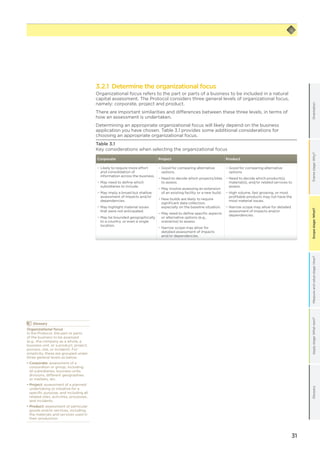
  • 40.
    38 Table 3.5 suggestssome considerations when determining which type of valuation is most appropriate for meeting your objective. Table 3.5 Key considerations when selecting types of value Type of value Points to consider Qualitative −− May be appropriate when there are insufficient data to allow quantitative measurement. −− Can be useful when there are many different impacts or dependencies, or many different perspectives on them. −− Can be appropriate when particular impacts or dependencies have a strong moral or ethical dimension or when important stakeholders find monetary values difficult to accept or interpret. −− Can be appropriate when assessing spiritual, religious, aesthetic, recreational, and other cultural values. −− Establishing consistency in qualitative valuation can be difficult and therefore meaningful comparison is not normally possible. −− Outputs may be subject to bias and tend to be difficult to validate or reproduce. Quantitative −− Good for assessing progress towards a physical target (e.g., carbon emission reductions or waste recycling). −− Can be measured on natural scales (e.g., volume of water) and constructed scales (e.g., areas with high biodiversity value). Measures might be direct measures (e.g., abundance of fish) or proxy indicators (e.g., area of coral reef as a proxy for fish abundance). −− Appropriate when impacts and/or dependencies have a strong moral or ethical dimension or when important stakeholders find monetary values difficult to accept or interpret. −− Can be difficult to compare between or among multiple impacts or dependencies (e.g., volumes of water vs. tons of emissions). −− Not all impacts or dependencies can be measured in quantifiable terms (e.g., spiritual, religious, aesthetic, recreational and other cultural values, historical significance, political security). Monetary −− If monetary values are estimated correctly and on a consistent basis (using the methods of welfare/well-being economics), they should be broadly comparable and offer meaningful information to help assess trade-offs (see box 8.2 for further discussion). −− Essential for determining financial or economic values, where these are required for decision making (e.g., CAPEX decisions). −− Useful for determining financial value at risk and/or potential changes in (net) revenues. −− May be time consuming and expensive, especially if primary research is required to generate data. −− Some lower-cost monetary valuation methods are available (e.g., value transfer). −− Some stakeholders may find it difficult to accept or interpret monetary valuation of certain benefits (e.g., spiritual values). In such situations, special efforts may be required to explain the advantages and also to acknowledge the limitations of monetary valuation. Adapted in part from A4S (2015) NATURAL CAPITAL PROTOCOL 03 Scope the assessment
  • 41.
    39 Scopestage:What?GlossaryApplystage:Whatnext?Measureandvaluestage:How?Framestage:Why?OrientationScopestage:What? 3.2.6 Consider other technicalissues (i.e., baselines, scenarios, spatial boundaries, and time horizon) a. Baselines A baseline is the starting point or benchmark against which changes in natural capital can be compared. For most assessments, an explicit baseline is required to enable meaningful conclusions to be drawn. The type of baseline will vary depending on the nature of the assessment. Examples include: • The historical situation over a specified period of time, such as a comparison of this year’s emissions to last year’s. • The state of natural capital (e.g., air quality) at a point in time, for example, the state immediately before a project began. • A sector-wide or economy-wide average level of a given natural capital impact or dependency (i.e., an industry benchmark). When undertaking an assessment that covers an extended period (e.g., to assess the impacts of a project over 20 years), you will need to consider how the baseline would have changed over the same period. For example, even without your company’s project, natural capital may change due to other pressures (e.g., population influx, climate change, or the impacts of other businesses). The changes that would have occurred independently of your project are sometimes referred to as “business as usual”, or a “future projection” scenario (i.e., what is projected to happen anyway). Considering these trends allows you to compare your “with project” and “without project” scenarios in a meaningful way. Table 3.6 outlines some issues to consider when choosing a baseline for different organizational focus and value chain options. Table 3.6 Key considerations when selecting baselines Corporate Project Product −− The baseline may include data for previous years, or data from the start and end of last year. −− It may be helpful to align baselines with financial reporting and/or strategic timeframes. −− Benchmarks against the performance of other companies (within and between sectors) may be illuminating. −− Baselines and/or alternative options or scenarios are often required for project-level assessments. −− You can compare one option to another, compare a range of options, or compare one or more alternatives to a baseline scenario. −− Project baselines are often based on detailed surveys to assess the stock (extent and condition) of natural capital. −− Project or site-level baselines can either be a fixed point in time (e.g., when the company took control of the site, or a previous condition some years earlier), or one that evolves over time (usually in a gradual and predictable way, such as “business as usual”). −− Determining a baseline for product assessments can be challenging, especially when using life-cycle assessment tools. −− It is worth reviewing other similar assessments before setting a baseline for a product. Value Chain −− Economic input-output tables with significant sector disaggregation can provide useful information on the structure of industrial value chains, and with suitable natural capital extensions can also provide information on the balance of natural capital impacts and dependencies along the value chain. −− Establishing an appropriate baseline across an entire value chain may require certain simplifying assumptions, such as that the study value chain and the baseline value chain are located in the same geographic regions and exhibit other structural similarities. Glossary Baseline In the Protocol, the starting point or benchmark against which changes in natural capital attributed to your business’ activities can be compared.
  • 42.
    40 b. Scenarios The conceptof valuation is based on being able to compare outcomes and impacts across at least two scenarios: the baseline discussed above, and a chosen scenario that is being “valued”. Types of scenario that you may wish to consider include (McKenzie et al. 2012): • “Intervention” scenarios or real alternatives being considered (e.g., for comparing alternative development projects or project locations, or comparing alternative materials used within particular products); • “Exploratory” scenarios, assessing possible unexpected futures (sometimes used in risk assessments); • “Vision” scenarios, describing explicitly desirable or undesirable futures (also used in risk and strategy assessments). Vision scenarios can be used to inform potential “business as usual” scenarios as well. • A “counterfactual” is a form of scenario that describes a plausible alternative state of the site and its environmental conditions that would result if the company did not operate. More than one counterfactual can be considered, to account for different perspectives (e.g., from stakeholders or experts). Note that these provide a starting point but are not conclusive and other scenarios may be appropriate for your objective. Further guidance on scenario analysis is not provided within the Protocol. It is recommended that you use scenarios if you have identified your business application to be “compare options”. c. Spatial boundary Establishing the spatial boundary means deciding what geographic area the assessment will consider. The answer depends on various factors, including the organizational focus, value-chain boundary, and chosen value perspective, which you will have already decided earlier in Step 03. For project-level assessments, for example, you need to include the “potential area of influence” for each type of impact (i.e., the total area over which each impact may occur). This may involve the following considerations: • Impacts to biodiversity and ecosystem services may extend well beyond the immediate vicinity of a project, due to ecological linkages, wildlife migration, and other landscape- level factors. • Water pollution and related issues should be assessed at catchment level, taking into account relevant upriver, downriver, and water scarcity issues as appropriate. • Assessment of air-quality issues should bear in mind the specific area and features likely to be affected as a result of wind and dispersion. In the case of GHG emissions, the relevant spatial boundary is the entire planet. Glossary Scenario A storyline describing a possible future. Scenarios explore aspects of, and choices about, the future that are uncertain, such as alternative project options, business as usual, and alternative visions. Counterfactual A form of scenario that describes a plausible alternative situation, and the environmental conditions that would result if the activity or operation did not proceed (adapted from Cambridge Natural Capital Leaders Platform 2013). Spatial boundary The geographic area covered by the assessment, for example, a site, watershed, landscape, country, or global level. The spatial boundary may vary for different impacts and dependencies and will also depend on the organizational focus, value- chain boundary, value perspective, and other factors. NATURAL CAPITAL PROTOCOL 03 Scope the assessment
  • 43.
    41 Scopestage:What?GlossaryApplystage:Whatnext?Measureandvaluestage:How?Framestage:Why?OrientationScopestage:What? Glossary Temporal boundary The timehorizon of the assessment. This could be a current “snapshot”, a 1-year period, a 3-year period, a 25-year period, or longer. d. Temporal boundary Identifying a temporal boundary means determining an appropriate time frame for the assessment (i.e., over how many days, months, or years should impacts and/or dependencies be assessed and compared?). The assessment period should relate to your objective and correspond to the organizational focus and material impacts and/or dependencies under consideration. Some relevant questions include • Should the assessment cover past, present, and/or future impacts and dependencies? • What and when is the most appropriate temporal baseline? Should the company consider changes in natural capital relative to some original “pristine” state, or to conditions when the company took effective control? • What period should the assessment cover? For example, an assessment may be limited to a “snapshot” of the situation at a particular point in time. Alternatively, it may cover a particular financial year, or the entire expected project lifespan. You could also consider meaningful milestones in the business’ history, such as a large merger, acquisition, or divestment, which could help to identify significant time periods. Your objective and other scoping questions will influence the extent to which historical (“sunk”) costs and/ or future decommissioning costs need to be included. Note: You should be prepared to revisit these boundaries, baselines and scenarios after you have identified your relevant, material issues in Step 04, as this may influence your desired scope. 3.2.7 Address key planning issues Your answers to the scoping questions outlined above may need to be adjusted in light of planning and resource constraints (see action 1.2.3.c), which will determine what scope is actually achievable. These constraints may also be considered as “critical success factors” and include: • Timescale: How quickly does the assessment need to be completed? Have you factored enough time for the expected duration of work? • Funding/resources: What budget and human resources are available? Are there other sources of funding available from within the business or externally that could help finance the assessment? Review table 7.1 for a relative cost indication of the various valuation techniques. • Capacity: What skills are available within the business to undertake an assessment? What additional skills, if any, are needed? Depending on the business decision you are seeking to influence, you may need a range of skills and expertise including environmental economics, research, data analysis, mathematical or statistical modeling (from calculating averages and estimations on a spreadsheet, to using complex statistical and econometric packages), stakeholder mapping and engagement, and communications. This list of skills is not meant to be exhaustive but a starting point. • Data availability and accessibility: What constraints on data are anticipated, and/or what requirements are necessary for translation into other languages? • Stakeholder relationships: To what extent do you need to identify and establish relationships with stakeholders to conduct the study, and potentially implement solutions? You considered your desired stakeholder engagement in action 2.2.2. Note: You should be prepared to revisit the previous actions in this Step, if the key planning issues identified here are likely to affect what is achievable.
  • 44.
    42 3.3 Outputs The output forStep 03 is the completion of table 3.7 (see hypothetical example below). It is important to document the process and the basis for any decisions made to assist with interpretation and embedding in the Apply Stage. Hypothetical example NSCI Table 3.7 Step 03 outputs for NSCI Question NSCI Context NSCI Response 1. What organizational focus? NSCI buys from coffee growers in East Africa as well as South and Central America. It has manufacturing facilities in Kenya and the US. For this initial analysis they decided to focus on their Kenyan supply chain and manufacturing operations because all of the issues identified in Step 02 are present here, therefore providing a practical starting point for their assessment. Corporate-level activities in Kenya. 2. Which value-chain boundary? Including both the supply chain and manufacturing operations was dictated by the key objectives of the study. Only the direct activities were considered; other inputs to these processes, such as packaging materials or fertilizers, were not included in the scope of the assessment. Direct operations and the upstream coffee growers in Kenya. Other inputs to these activities (e.g., production of fertilizer) were out of scope. 3. Which value perspective? To address the issues identified in Step 02 the team recognized the need to consider the impacts on their business and on society, as well as their business dependencies. Value to the business and value to society. 4. What types of value? With their senior management in mind, the NSCI team decided all the values would be monetary. However for health impacts (e.g., from air emissions) they decided to also present quantitative values in Disability-Adjusted Life Years (“DALYs”; DALYs quantify the burden of a disease to an individual, one DALY is equivalent to one year of ‘healthy’ life lost. It includes premature mortality (years of lost life) and morbidity, which is considered as the disability-weighted duration of the disease). Monetary and quantitative (namely DALYs, for health). 5. Assess impacts and/ or dependencies? NSCI would like to apply their assessment results to informing a full risk and opportunity assessment, therefore both impacts and dependencies are necessary. Impacts and dependencies will be considered. 6. Other technical issues to consider: a) baseline b) scenarios c) spatial boundary d) temporal boundary a) Baseline: current conditions. b) Scenarios: climate change based on published IPCC predictions. c) Spatial boundary: 3 largest manufacturing facilities, 3 largest plantations in Kenya. d) Temporal boundary: Next 10 years. 7. Key planning issues to consider −− The availability of data and initial understanding of issues within NCSI is an essential precursor to being able to complete the project efficiently. The company believes that there is limited available data applicable to the assessment, but it should be sufficient for this high-level assessment. −− NSCI has a strategic planning meeting in eight months where the results of the assessment must be presented. −− NSCI has committed 50 thousand USD and 20 percent of an environmental manager’s time to support the assessment. −− Existing staff have most of the relevant experience and skills to carry out the assessment. However, they will need some assistance from an environmental economist and a climate change specialist. NATURAL CAPITAL PROTOCOL 03 Scope the assessment
  • 45.
    43 Scopestage:What?GlossaryApplystage:Whatnext?Measureandvaluestage:How?Framestage:Why?OrientationScopestage:What? 044.1 Introduction Completing Step 04will help you answer the following question: Which impacts and/or dependencies are material? Step 04 helps you decide which impacts and/or dependencies are most relevant for inclusion in your natural capital assessment. Lists of potential impacts and dependencies are included to help you identify those that could be considered relevant, and a process to prioritize those that are most relevant to your specific natural capital assessment and its objective is described. However, the Protocol does not attempt to provide an exhaustive list of impacts and dependencies as these need to be considered independently in the context of each assessment. In the Protocol, an impact or dependency on natural capital is material if consideration of its value, as part of the set of information used for decision making, has the potential to alter that decision. A materiality assessment is the process that involves identifying what is (or is potentially) material in relation to the assessment’s objective and application. Important note regarding disclosure Materiality is both a general and legal concept (Corporate Reporting Dialogue 2016). Materiality within the Natural Capital Protocol does not necessarily equate to the legal concept of materiality which applies to formal corporate reporting in many jurisdictions (for example as defined in the US by the Supreme Court). Many companies around the world regularly disclose information about their impacts and dependencies on natural capital. However, if you have concerns about the potential interpretation of disclosures you plan to make on natural capital impacts or dependencies (e.g., by investors, regulators, or other stakeholders), you are advised to seek independent legal advice relevant to your industry and jurisdiction. There are many different approaches to assessing the materiality of issues affecting a business. Most companies have experience with at least one approach through their risk, governance, finance, or strategy functions. The Protocol does not specify one particular method for assessing materiality, but instead sets out the importance of carrying out an assessment through a generic, systematic, and transparent process. Use your own existing approaches or company-based materiality assessments where they are available as an output for this Step and adapt them if necessary to include natural capital. Materiality can be judged for each organizational focus (see action 3.2.1); for example, at an overall strategic organizational focus, a specific project focus, or a particular product or service focus. The materiality assessment itself can also be qualitative, quantitative, or monetary. In essence, carrying out a materiality assessment is like a high-level screening, or hot spotting, which is deepened by more detailed measurement and valuation in Steps 05–07. As you progress though the Measure and Value Stage and gain more detailed information on the value of impacts and dependencies it is likely that you will want to return to Step 04 to review your materiality assessment. Although your assessment may focus on just impacts or dependencies, it is worth considering both at the same time when carrying out a materiality assessment as they often create inter-related risks and opportunities. It is also worth noting that it is easier to have an understanding of direct operational impacts and dependencies, where you have control, than of indirect impacts or dependencies, where you do not have control. Finally, impacts or dependencies may be material individually or when aggregated. It is also important to consider cumulative effects which may increase over time. After conducting the materiality assessment in Step 04, you may need to revisit your objective (Step 02) and scope (Step 03). Determine the impacts and/or dependencies Glossary Materiality In the Protocol, an impact or dependency on natural capital is material if consideration of its value, as part of the set of information used for decision making, has the potential to alter that decision (Adapted from OECD 2015 and IIRC 2013). Materiality assessment In the Protocol, the process that involves identifying what is (or is potentially) material in relation to the natural capital assessment’s objective and application. Value (noun) The importance, worth, or usefulness of something. Economic value The importance, worth, or usefulness of something to people— including all relevant market and non-market values. In more technical terms, the sum of individual preferences for a given level of provision of that good or service. Economic values are usually expressed in terms of marginal/ incremental changes in the supply of a good or service, using money as the metric (e.g., $/unit). NATURAL CAPITAL PROTOCOL 04 Determine the impacts and/or dependencies
  • 46.
    44 4.2 Actions In order todetermine which impacts and/or dependencies are relevant to your natural capital assessment, you will need to complete the following actions: 4.2.1 List potentially material natural capital impacts and/or dependencies 4.2.2 Identify the criteria for your materiality assessment 4.2.3 Gather relevant information 4.2.4 Complete the materiality assessment 4.2.1 List potentially material natural capital impacts and/or dependencies The first activity in a materiality assessment is to consider all potentially relevant impacts and dependencies for the chosen objective and scope. At this point we introduce the concepts of impact drivers, impact pathways, and dependency pathways. Understanding these terms is fundamental to conducting a natural capital assessment. In the Protocol, an impact driver is a measurable quantity of a natural resource that is used as an input to production (e.g., volume of sand and gravel used in construction) or a measurable non-product output of business activity (e.g., a kilogram of NOx emissions released into the atmosphere by a manufacturing facility). Outside the context of the Protocol, environmental “outputs” are also sometimes referred to as “residuals”, for example in UNSEEA documents. Impact drivers are generally expressed in quantitative units (e.g., kilograms, m3 , hectares) and may already be included in company non-financial reporting or generated through life-cycle assessments. An impact driver is not the same as an impact. An impact is a change in the quantity or quality of natural capital that occurs as a consequence of an impact driver. A single impact driver may be associated with multiple impacts. Glossary Impact driver In the Protocol, an impact driver is a measurable quantity of a natural resource that is used as an input to production (e.g., volume of sand and gravel used in construction) or a measurable non-product output of business activity (e.g., a kilogram of NOx emissions released into the atmosphere by a manufacturing facility). NATURAL CAPITAL PROTOCOL 04 Determine the impacts and/or dependencies
  • 47.
    45 Scopestage:What?GlossaryApplystage:Whatnext?Measureandvaluestage:How?Framestage:Why?OrientationScopestage:What? Glossary Impact pathway An impactpathway describes how, as a result of a specific business activity, a particular impact driver results in changes in natural capital and how these changes in natural capacity affect different stakeholders. Box 4.1 Impact and dependency pathways Impact pathways Impact pathways describe how, as a result of a specific business activity, a particular impact driver results in changes in natural capital and how these changes impact different stakeholders. Figure 4.1 illustrates the impact pathway for air pollution, a classic non-product output of industry. In this example, the business activity is the manufacture of industrial chemicals, which results in the emission of certain pollutants (the impact driver, measured in Step 05). These emissions lead in turn to a reduction in air quality (the change in natural capital, measured in Step 06), which may have significant impacts on various people depending on the local environment (the impact, valued in Step 07). Note that changes in natural capital that result from your business activity are sometimes called “outcomes”. In this example, a materiality assessment would be needed to determine whether air pollution was a material impact and, if so, which specific pollutants and resulting impacts are most relevant. Figure 4.1: Generic steps in impact pathways (Adapted from PwC 2015) Business activities at a chemical manufacturing plant produce air emissions, which are an impact driver Step 05: Measure impact drivers Changes in natural capital result in impacts, in this case health problems Step 07: Value impacts Impact drivers lead to changes in natural capital, in this case reduced air quality Step 06: Measure changes in natural capital
  • 48.
    46 4.1 Impact anddependency pathways – continued Dependency pathways A dependency pathway shows how a particular business activity depends upon specific features of natural capital. It identifies how observed or potential changes in natural capital affect the costs and/or benefits of doing business. Figure 4.2 illustrates a dependency pathway using the pollination of coffee plants as an example. In this situation, a decline in the populations of wild pollinators (due to deforestation) results in lower yields and/or additional costs to coffee producers, who may be forced to rely on commercial pollinating services. A materiality assessment in this example would consider whether the yield loss or extra cost of commercial pollination is likely to have a significant impact on the business, compared to other potential relevant dependencies. Business activities at a coffee production plant have a dependency on the pollination of coffee plants Step 05: Measure dependencies Changes in natural capital afffect business dependency, so pollination services are imported Step 07: Value dependencies Changes in natural capital cause the bee population to decline, due to: – The business itself, e.g. overuse of pesticides – Natural changes e.g. extreme weather events – Human-induced changes, including due to the activity of other businesses, e.g. habitat change Step 06: Measure changes in natural capital Pollination Figure 4.2 Generic steps in dependency pathways (Adapted from PwC 2015) Tables 4.1 and 4.2 below present a selection of potential impact drivers and dependencies to consider when identifying which are most material to your business. You will notice that a business activity (e.g., the use of water) can create both impacts and dependencies and thus appear in both tables; for clarity the Protocol discusses each separately, but in your assessment you may need to consider both at the same time. NATURAL CAPITAL PROTOCOL 04 Determine the impacts and/or dependencies Glossary Dependency pathway A dependency pathway shows how a particular business activity depends upon specific features of natural capital. It identifies how observed or potential changes in natural capital affect the costs and/ or benefits of doing business.
  • 49.
    47 Scopestage:What?GlossaryApplystage:Whatnext?Measureandvaluestage:How?Framestage:Why?OrientationScopestage:What? Table 4.1 Examples ofpossible impact drivers Business input or output Impact driver category Examples of specific, measurable impact drivers Inputs Water use Volume of groundwater consumed, volume of surface water consumed, etc. Terrestrial ecosystem use Area of agriculture by type, area of forest plantation by type, area of open cast mine by type, etc. Fresh water ecosystem use Area of wetland, ponds, lakes, streams, rivers or peatland necessary to provide ecosystem services such as water purification, fish spawning, etc., areas of infrastructure necessary to use rivers and lakes such as bridges, dams, and flood barriers, etc. Marine ecosystem use Area of aquaculture by type, area of seabed mining by type, etc. Other resource use Volume of mineral extracted, volume of wild- caught fish by species, number of wild-caught mammals by species, etc. Outputs GHG emissions Volume of carbon dioxide (CO2), methane (CH4), nitrous oxide (N2O), Sulphur hexafluoride (SF6), Hydrofluorocarbons, (HFCs) and perfluorocarbons (PFCs), etc. Non-GHG air pollutants Volume of fine particulate matter (PM2.5) and coarse particulate matter (PM10), Volatile Organic Compounds (VOCs), mono-nitrogen oxides (NO and NO2, commonly referred to as NOx), Sulphur dioxide (SO2), Carbon monoxide (CO), etc. Water pollutants Volume discharged to receiving water body of nutrients (e.g., nitrates and phosphates) or other substances (e.g., heavy metals and chemicals). Soil pollutants Volume of waste matter discharged and retained in soil over a given period. Solid waste Volume of waste by classification (i.e., non- hazardous, hazardous, and radioactive), by specific material constituents (e.g., lead, plastic), or by disposal method (e.g., landfill, incineration, recycling, specialist processing). Disturbances Decibels and duration of noise, lumens and duration of light, etc. at site of impact.
  • 50.
    48 Table 4.2 Examples ofpossible dependencies Business inputs Dependency category Specific dependencies Consumptive Energy Solar, wind, hydro, geothermal, biofuel, fossil fuel Water Fresh water (ground, surface, or rain) or sea water Nutrition Human or animal food Materials Wood fiber, genetic resources, metals, minerals, plant and animal materials Non- consumptive Regulation of physical environment Flood attenuation, water quality regulation Regulation of biological environment Crop pest control, pollination Regulation of waste and emissions Waste assimilation, noise and dust regulation Experience Nature-based recreation, tourism Knowledge Information from nature (e.g., for “bio-mimicry”) Well-being and spiritual/ethical values Employee satisfaction and stress release, sacred sites and indigenous traditions that support company staff or operations Note: The lists above are not exhaustive; impacts and/or dependencies that are relevant to your business but not included here should also be considered. 4.2.2 Identify the criteria for your materiality assessment Once you have compiled a short list of potentially material issues, you will need to identify criteria to judge which impacts and dependencies are most significant. Before you identify the criteria though you will need to identify who the impacts and dependencies are most significant for. For this you may wish to look at the Components you selected in Step 03 and whether you are considering the value to business, society, or both. One common approach is to consider if the material issues are significant to your company board, as they should be taking into account both business and societal issues. Reviewing historic board papers will provide an indication of what is significant to them, although this will not always identify what will be important to them in the future. Therefore taking account of the extent to which the natural capital impact and/or dependency may change over time is important. Potential criteria may include: • Operational: the extent to which the natural capital impact or dependency may significantly affect business operations, project implementation, or the value of existing or new product(s). • Legal and regulatory: the extent to which the natural capital impact or dependency may trigger a legal process or liability (e.g., emission fees or extraction quotas, environmental impact mitigation requirements). • Financing: the extent to which the natural capital impact or dependency may influence “cost of capital” or your access to capital, investor interest, or insurance conditions. • Reputational and marketing: the extent to which the natural capital impact or dependency may affect the product portfolio, company image, or relationship with customers and other stakeholders (e.g., changing customer preferences). • Societal: the extent to which the natural capital impact or dependency may generate significant impacts to society. NATURAL CAPITAL PROTOCOL 04 Determine the impacts and/or dependencies
  • 51.
    49 Scopestage:What?GlossaryApplystage:Whatnext?Measureandvaluestage:How?Framestage:Why?OrientationScopestage:What? 4.2.3 Gather relevant information Basedon the materiality criteria you have selected, you should next gather the necessary information to assess the potential material significance of each natural capital impact and/or dependency. The type of information you collect might include: • Type of impact and/or dependency • Scale of impact and/or dependency • Consequence of impact and/or dependency (on business, society, or both) • Time scale (short, medium, and long-term) Collecting this information may involve: • Seeking expert opinion and/or analysis, or leveraging existing information (e.g., results of an environmental impact assessment) and local knowledge of key issues; • Consulting stakeholders (internal and/or external) (e.g., interviews, workshops, questionnaire surveys); • Compiling publicly available information on specific issues (e.g., case studies from relevant locations, land-use maps, species threat assessments); • Conducting a rapid assessment of value (e.g., what proportion of total sales revenue depends upon a specific ecosystem and/or abiotic service? What is the financial value of the production asset involved?); and, where available, • Referring to dedicated sector guidance (e.g., sector guides accompanying the Natural Capital Protocol). External consultation can be helpful but is not always required, as long as an appropriate method and/or expert judgment is used along with adequate qualitative and/or quantitative research (see 2.2.2 for more guidance on identifying stakeholders and appropriate levels of engagement). Note: When identifying information to collect it is important to also identify who will provide the information, who will collate it, when it will be collated, and where it will be held.
  • 52.
    50 4.2.4 Complete the materialityassessment Based on the information you have gathered, it should now be possible to assess the relative materiality of each natural capital impact and/or dependency based on the criteria in 4.2.2., and identify those that are most significant to your business and/or society. It is recommended to establish a panel of relevant people with a broad range of skills to complete the materiality assessment, and to ensure the panel is consistent throughout the assessment. When ranking, it is also good practice to set a threshold above which issues are considered significant, and also to consider your ability to influence your impact and/ or dependency. Once you have assessed and ranked potentially material natural capital impacts and/or dependencies, you should be able to identify those that are material, definitely not material, or still uncertain. The result is a short list of material impact drivers and/or dependencies that you will include in your assessment. Where uncertainties remain, further information gathering or consultation may be necessary to judge materiality. You may find it helpful to plot the impacts, and/or dependencies on a matrix (see some illustrative examples in figure 4.3). Likelihood of change Costimplication Significance of impacts Importancetostakeholders Importance to business Importancetosociety Figure 4.3 Examples of materiality matrices NATURAL CAPITAL PROTOCOL 04 Determine the impacts and/or dependencies
  • 53.
    51 Scopestage:What?GlossaryApplystage:Whatnext?Measureandvaluestage:How?Framestage:Why?OrientationScopestage:What? 4.3 Outputs The output forStep 04 is a prioritized list of material impacts, dependencies, and changes in natural capital to include in your natural capital assessment and to inform Steps 05 to 07. This may consist of a list, ranked according to your chosen criteria. Table 4.3 provides an example of the output required, and is completed here for the hypothetical example of NSCI Hypothetical example NSCI The NSCI team conducted an impact and dependency pathway mapping exercise, and materiality matrix, to confirm that the objectives and scope of their assessment were appropriate. Table 4.3 summarizes the impact and dependency pathways for NSCI’s assessment; these are presented in tabular form rather than diagrammatically (as in box 4.1) to make it easier to consider several pathways together. You will notice that the impact driver for air emissions in manufacturing has two lines because it is being considered for the impact on people as well as the impact to the business as those costs to people become internalized. Table 4.3 Step 04 outputs for NSCI: Summary of potentially material natural capital impact and dependency pathways Issue Impact driver / dependency Change in natural capital Value to business / society Supply chain impact (on society): water consumption Business consumption of water Increasing scarcity of clean surface and ground water Health cost to people associated with use of dirty water Supply chain business dependency: pollination Requirement of pollination of coffee crops Declining bee populations Costs of reduced yields or setting up mobile pollination services Manufacturing impact (on society): air emissions Emissions of particulates and nitrogen dioxide Reduction in air quality Health cost to people through inhalation Manufacturing impact (to the business): air emissions Emissions of particulates and nitrogen dioxide Reduction in air quality Cost to the business of tightening regulation as a result of impacts on people (internalization) Manufacturing business dependency: flood risk Requirement for stable operating environment Increased risk of coastal flooding Cost to the business of increased flooding risks In order to assess materiality and confirm the scope of their assessment the team engaged internal stakeholders to understand their views, and used publicly available information to gauge the materiality to other stakeholders. Their investigations included: • Brief interviews with the facility staff and growers • Review of internal data from the company’s Environmental Management System (EMS) and finance systems • Analysis of publicly available data including: IPCC climate predications, sea-level rise predictions, ecological reviews of trends in bee populations The team considered the current materiality and the likelihood that the issues would get more acute over the next 10 years. The findings of their materiality assessment are summarized in Table 4.4.
  • 54.
    52 Table 4.4 Step 04outputs for NSCI: Rank of issues against materiality criteria Materiality criteria Fresh water supply Flood control Pollination Air quality Operational Medium Manufacturing facilities are located in areas that currently have low water costs. However, the team noted that increasing water scarcity due to climate change may drive up costs in the future. High Kenyan facilities are near the coast and operations would be affected by increased flooding. The team noted that flood risk is likely to grow with sea-level rise and increase in frequency or severity of extreme weather. High Growers depend on bat and bee pollination, which could be affected by land-use changes and climate change. The team noted that bee populations are expected to decline with climate change, habitat loss, and the increased use of pesticides on nearby farms. Medium The direct effects of reduced air quality to the business are minimal, but changes in regulation could require expensive upgrades to machinery. The team noted that the risks associated with air quality are likely to increase with growing urbanization around manufacturing facilities. Legal and regulatory High Water-use restrictions may affect cost or availability. No relevant issues identified. No relevant issues identified. High Regulators are exploring options to limit air pollution. Financing Not relevant – NSCI is not seeking to raise funds relating to these activities. The team did recognize that if NSCI’s reputation is at stake then financers may be reluctant to fund other activities. Reputational and marketing Medium As water scarcity increases, NSCI’s water use may reduce available clean water for other users. No relevant issues identified. No relevant issues identified. High Although NSCI’s operations do not contribute a large proportion of the total emissions, they are the most visible manufacturing facility and are perceived as a significant emitter. Societal Medium Water access conflicts could occur in the future which could affect operations. Medium Local populations would also be affected by flooding. High Other growers and local smallholders also depend on pollination for various crops. High Local populations around manufacturing facilities are vulnerable to poor air quality Following completion of Step 04 the NSCI team confirmed the list of impacts and dependencies would be as follows: • Supply chain impacts: Water consumption impacts on people • Supply chain dependencies: Costs and/or benefits of water consumption and pollination threatened by climate change • Manufacturing impacts: Effects of polluting air emissions on local people, and potential future cost of these impacts to the business • Manufacturing dependencies: Costs of potential increases in flooding associated with climate change The team noted the particular relevance of including impacts to society and to the business for air pollution, as any regulatory changes are likely to be driven by the scale of the impacts on society. While they identified that there could also be business impacts driven by their water consumption impacts on people, they decided to keep these out of scope in this initial assessment. NATURAL CAPITAL PROTOCOL 04 Determine the impacts and/or dependencies
  • 55.
    53 GlossaryApplystage:Whatnext?Scopestage:What?Framestage:Why?OrientationMeasureandvaluestage:how? All outputs fromthis Stage are built upon in the Scope Stage where your initial consideration of important and relevant natural capital impacts and/or dependencies, the indicative business case and the early thinking on potential uses for the assessment results all factor in defining a specific business objective. Your choice of route in the Measure and Value Stage is based on your understanding of the conceptual interactions between natural capital, business and society developed here. Your indicative business case will contribute to the Apply Stage by building support for the natural capital assessment process within your company. NATURAL CAPITAL PROTOCOL Measure and value stage OrientationFramestage:Why?Scopestage:What?GlossaryMeasureandvaluestage:How? The Measure and Value Stage involves three linked Steps: Step Questions each Step will answer Actions 05 Measure impact drivers and/or dependencies How can your impact drivers and/or dependencies be measured? 5.2.1 Map your activities against impact drivers and/or dependencies 5.2.2 Define which impact drivers and/or dependencies you will measure 5.2.3 Identify how you will measure impact drivers and/or dependencies 5.2.4 Collect data 06 Measure changes in the state of natural capital What are the changes in the state and trends of natural capital related to your business impacts and/or dependencies? 6.2.1 Identify changes in natural capital associated with your business activities and impact drivers 6.2.2 Identify changes in natural capital associated with external factors 6.2.3 Assess trends affecting the state of natural capital 6.2.4 Select methods for measuring changes 6.2.5 Undertake or commission measurement 07 Value impacts and/or dependencies What is the value of your natural capital impacts and/or dependencies? 7.2.1 Define the consequences of impacts and/or dependencies 7.2.2 Determine the relative significance of associated costs and/or benefits 7.2.3 Select appropriate valuation technique(s) 7.2.4 Undertake or commission valuation Additional notes Before you start this Stage you should familiarize yourself with Step 08 in the Apply Stage, which covers interpreting and using assessment results, as there may be implications for Steps 05–07, depending upon your objective. This Stage includes guidance on a diverse set of methods ranging from simple environmental data collection through to sophisticated ecological modeling and advanced econometric analysis. This Stage is intended to provide sufficient information for you to understand the key features of the various techniques discussed but to complete the Steps you may need the support of people with the following skills: Life Cycle Analysis (LCA) experts, biodiversity specialists, economic or ecological modelers, or environmental economists. If you do not have these skills internally you may need to find external support. The Protocol does not attempt to provide detailed instructions on how to apply specific measurement or valuation methods. It refers instead to the extensive academic, practitioner, and policy literature on these methods. MEASURE AND VALUE STAGE How?
  • 56.
    54 NATURAL CAPITAL PROTOCOL Measureand value The three Steps in this Stage follow a logical progression, which was introduced in Box 4.1 and is explained again in the two examples below: Example 1: To assess the costs and benefits of using water in a manufacturing process, a business will: • Measure the cubic meters of water extracted for a particular business process (Step 05). • Quantify the impact of the water extraction on society and/or business, by understanding the changes in natural capital that results from the extraction of water (Step 06). • Value the consequences for business and/or society, associated with these changes in natural capital (Step 07). The measurement carried out in Step 05 alone does not explain the significance of the water extraction. Once it is quantified in Step 06, the business will know whether the water system has been altered by the extraction and if sufficient water is likely to remain in the system to meet the current or future needs of other users. Once this is valued in Step 07 they will then be able to tell what these changes mean for the business or society. Example 2: To assess the costs and benefits of GHG emissions, a business will: • Measure GHG emissions, using the GHG Protocol, in carbon dioxide equivalent (CO2e) (Step 05). Note that this does not yet tell them the actual “impact” of those emissions. • To understand “impacts”, they need to understand the changes in natural capital that occur as a result of releasing CO2e into the atmosphere (Step 06). This in turn requires an understanding of atmospheric chemistry, meteorology, and forecasting the consequences of climate change on rainfall patterns, ocean acidity, storm frequency and intensity, sea level, etc. • They then need to value the consequences for people associated with these changes in natural capital (Step 07). In the case of climate change due to CO2e emissions, this means estimating impacts on nature and human communities both now and in the future, and expressing these in current economic terms. This may seem daunting, but the task is made easier in this case by the large volume of research previously conducted on the science and economics of climate change. As a result, they can identify a suitable existing estimate of the “societal cost of carbon” from the scientific and policy literature. Such an estimate will already incorporate the work described in Steps 06 and 07, and therefore can be applied directly to the emissions measured in Step 05. In the case of water, biodiversity, and many other areas of natural capital assessment, however, there is often less prior research to draw upon that is relevant to the location or context of the assessment. Hence detailed, context-specific research may still be required to estimate changes in natural capital, and to assess how these changes will affect society, the business, or both. The following table MV.1 sets out how your choice of business application may influence how you approach the Steps in this Stage.
  • 57.
    55 OrientationFramestage:Why?Scopestage:What?Measureandvaluestage:How?Applystage:Whatnext?Glossary Table MV.1 Relationship betweenbusiness applications and the Measure and Value Steps Business application Relationship to specific Measure and Value Steps and actions Assess risks and opportunities All Steps and actions are potentially relevant. Step 06 may be of particular importance here because risks will be greater in proximity to significant ecological thresholds or where there is potential for irreversible changes. Carrying out an option appraisal In Step 07: −− Qualitative valuation may be sufficient for initial high-level screening and prioritization of options. −− Monetary valuation will help you to compare different impacts (or dependencies) associated with each option in more detail and to assess the aggregate impacts using a common currency. Assess impacts on different stakeholders To allow for effective distributional analysis, the affected populations will need to be segmented by stakeholder group in Step 07. Estimate total value and/ or net impact In Step 07, monetary valuation enables the aggregation of varied impacts using the same currency. In this way you can determine whether the subject of your assessment is net positive, either from a business value or societal value perspective. Quantitative approaches may be preferable if net impact in a single impact area is the focus, as long as the context is adequately taken into account. Communicate internally and/or externally Communication of qualitative and quantitative natural capital information of the kind described in Step 05 has a long history and is relatively commonplace in sustainability reporting. Communication of natural capital valuation results (business or societal) (Step 07) is a more recent trend but is becoming increasingly common. Although the actions in this Stage can apply to all three Components introduced in Step 03 (impacts on your business, your impacts on society, and your business dependencies), there are differences in their relative importance and the applicability of certain methods. Table MV.2 provides a brief overview of how the Steps vary according to each of the three Components. Measureandvaluestage:How?
  • 58.
    56 NATURAL CAPITAL PROTOCOL Measureand value Table MV.2 Overview of the Measure and Value Steps under each Component Varying actions according to Component Measure impact drivers and/or dependencies (Step 05) −− If considering either impacts on your business or your impacts on society you will measure or estimate impact drivers (e.g., emissions to air, discharges to water and soil, use of land and resources). −− If considering your business dependencies you will measure dependencies on natural capital (e.g., food, fiber, fuel, flood protection, local climate regulation) in quantified units wherever possible (e.g., total water use and/or m3 of water per unit of product). Estimate changes in the state of natural capital (Step 06) −− If considering impacts on your business this step is likely to be less important. However, it will be relevant when the physical changes in natural capital that are associated with your company are so great that they could rebound and affect your company as well (e.g., through loss of social license to operate). −− If considering your impacts on society you will measure changes in the natural capital associated with each impact driver (e.g., the change in concentration of pollutants, soil fertility, forest extent and quality, number of breeding pairs of birds, etc.). This Step is essential for understanding how an impact driver creates a physical change in natural capital. This is then used to estimate how people outside the business are likely to be affected. −− If considering your business dependencies you will assess the physical state of the natural capital assets on which the business most depends. These include trends in natural capital (e.g., improving, degrading, or stable) as well as the drivers of these trends and proximity to known ecological thresholds. Each of these will be important for assessing the level of risk associated with your dependency. Value impacts and/or dependencies (Step 07) −− If considering impacts on your business you will value the current and potential future financial consequences for the business associated with the relevant impact drivers. Valuations may involve estimating: • current or future regulatory costs such as environmental taxes, permits, or fines • the costs of treatment or abatement • the costs of delay and disruption to satisfy regulatory requirements or adjust to resource constraints (depending on assessment scope) If forecasting potential future costs, it will be necessary to assess the likelihood of these costs arising, as well as their likely magnitude, in order to calculate the value at risk. −− If considering your impacts on society you will value the current and potential future consequences of estimated changes in natural capital for society. Valuing your impacts on society in the Protocol involves measuring the change in human well-being associated with specific changes in natural capital, which result from specific business impacts and/or dependencies. Societal values may be estimated for society as a whole or for particular sub-groups who are affected in different ways. −− If considering your business dependencies you will value the current and potential future financial consequences for the business associated with the dependencies you have measured in earlier Steps. Other factors that may be relevant to the financial value of a dependency include the costs of substitute inputs or the costs of improving resource efficiency (e.g., new process technology).
  • 59.
    57 GlossaryScopestage:What?Framestage:Why?OrientationApplystage:Sowhat?Measureandvaluestage:How?Measureandvaluestage:How? How should youplan for this Stage? Throughout the Measure and Value Stage of your natural capital assessment, keep the following questions in mind: What is the availability and quality of data? Where time or budget do not allow for the collection of primary data, you will need to consider the implications of relying on secondary, potentially proprietary data. Alternatively, you may need approval to start collecting new internal data. • Do you have people with appropriate expertise (e.g., environmental science or economics) and capacity within your business to undertake the assessment? If not, what skills are needed and who could provide them? • Are there budget or time constraints that may affect what is achievable? Although there are many free-to-use statistics and other resources, you may need to use databases or models that are proprietary, costly, or require a long time to deploy, particularly for assessments upstream or downstream in the value chain. • Are there dynamic aspects of your business (such as seasonal changes in product range, output volumes, or ongoing efficiency drives) that may affect the consistency of data over time? • How stable are the relevant regulations of impacts and/or conditions of access to key resources on which your business is dependent, and how will you track changes over time (e.g., progressively stricter emission caps)? Table MV.3 sets out some of the planning considerations for the Measure and Value Stage specific to each Component. Table MV.3 Plan for specific needs for the Measure and Value Steps Components Specific needs Impacts on your business Your impacts on society Your business dependencies Qualitative, quantitative, or monetary valuation Typically monetary valuation, but qualitative or quantitative valuation is also possible Societal values may be expressed in qualitative, quantitative, or monetary terms Typically monetary valuation, but qualitative or quantitative valuation is also possible Resource needs: time and skills Typically fewer external resources are needed than for the other two Components, since relevant data and expertise may well be available within the company. Less specialist expertise is needed compared to assessing dependencies or valuing your impacts on society. Typically more resources are needed. Specialist expertise from environmental and welfare economists is likely to be important. May require specialist environmental/natural resource modeling expertise to assess external drivers of change in natural capital on which your business depends. Stakeholder engagement Typically less important since assessments will tend to relate to financial costs and benefits and be largely for internal use. Likely to be important where valuations relate to specific sites and decisions to be informed could significantly alter those sites. Less relevant for broad assessments covering many geographies and diffuse impacts (e.g., a whole supply chain assessment). Varying importance depending on the objective of the assessment, but as other stakeholders may also depend on the same natural capital, engagement is often important.
  • 60.
    58 NATURAL CAPITAL PROTOCOL 05Measure impact drivers and/or dependencies 055.1 Introduction Completing Step 05 will help you answer the following question: How can your impact drivers and/or dependencies be measured? Step 05 sets out how to select appropriate measures for your impact drivers and/or dependencies and provides examples of a range of potential indicators and methods for analysis. By the end of the Step you should have measured (in qualitative and/or quantitative terms) each material impact driver and/or dependency. In some cases, it may not be practical to measure your impact drivers and/or dependencies directly, and you will need to make informed estimations instead. This is discussed within this Step. Note: Unless specified in the text all actions are relevant to all three Components 5.2 Actions In order to measure or estimate your impact drivers and/or dependencies you will need to complete the following actions: 5.2.1 Map your activities against impact drivers and/or dependencies 5.2.2 Define which impact drivers and/or dependencies you will measure 5.2.3 Identify how you will measure impact drivers and/or dependencies 5.2.4 Collect data 5.2.1 Map your activities against impact drivers and/or dependencies In order to complete this action you will first need to identify all of the relevant activities associated with your assessment. Figure 5.1 presents a simplified example to help you think through the relevant activities for your assessment. It shows the range of activities across the supply chain and manufacture of a plastic cup. In this example, the main activities are grouped into three value-chain stages (production, processing, and manufacturing), each with its associated impact drivers (both inputs and outputs). All of these value-chain stages likewise depend upon natural capital and the ecosystem and abiotic services it provides, creating natural capital dependencies, including ecosystems that filter water for manufacturing, natural flood protection for all business operations, and assimilation of waste. The diagram also identifies co-products that must be considered explicitly. In this case, the impact drivers associated with the production and processing of raw materials that are used in the manufacture of plastic cups need to be allocated between the various co- products of these processes (e.g., oil, chemicals, and plastics). Measure impact drivers and/or dependencies
  • 61.
    59 OrientationFramestage:Why?Scopestage:What?Applystage:Whatnext?GlossaryMeasureandvaluestage:How? OUTPUTS E.g. Non-hazardous waste, airpollution, discharges to water Natural capital impact drivers Natural capital dependencies E.g. Fresh water, land, flood protection, climate control, waste assimilation Production of raw materials E.g. Oil extraction Processing of raw materials E.g. Refining and cracking, polymerization Manufacturing E.g. Extrusion molding Natural capital impact drivers INPUTS E.g. Fresh water, land use Figure 5.1 Process diagram showing impact drivers and dependencies associated with producing a plastic cup A template for how you might now map your activities against impact drivers and /or dependencies is provided in Table 5.1. Table 5.1 Example activity-mapping template for a plastic cup producer Organizational focus Value-chain boundary Material natural capital impact drivers and/or dependencies Product Upstream (oil extraction, refining, and processing) Impact drivers −− Emissions of GHGs and other air pollutants (in oil extraction and processing) −− Fresh water consumption −− Water pollutants Dependencies −− Water filtration Product Operations (cup extrusion, molding, sale, and distribution) Impact drivers −− Emissions of GHGs and other air pollutants Dependencies −− Low flood risk −− Stable climate Product Downstream (use and disposal) Impact drivers −− Plastic waste Dependencies −− Waste assimilation
  • 62.
    60 5.2.2 Define which impactdrivers and/or dependencies you will measure This action involves determining what you will be measuring (the indicator) and the type of data needed. Measurement of the material impact drivers and/or dependencies can be either qualitative or quantitative. • Qualitative indicators may be based on professional judgment and can be informed by the opinions of stakeholders. Qualitative measures may involve a subjective assessment of high, medium, or low, or other defined criteria. • Quantitative indicators are typically in physical units, such as amount of different pollutants emitted (e.g., tons) or the amount of resources consumed (m3 water, ha of habitat), or a rate of consumption over the duration of a project (m3 /day). Although this provides an amount it is rarely precise because of the need to estimate. You may find that the data required to measure impact drivers and dependencies are frequently the same. In the plastic cup example in figure 5.1, the processing of raw materials requires water inputs. Data on the use of water can be used for defining the level of dependency on water, at the same time the use of water is also the impact driver, and can be used to calculate the scale of the impact on other users. You may also be interested in the impact on fresh water ecosystems, which is another related category of impact driver. Caution is required in how these data are accounted for in calculations to avoid double counting data on impact drivers with dependency data. This is not a risk in subsequent steps because impacts and dependencies which are measured accrue to different parties (i.e., society or the business). For simplicity we discuss the data for impact drivers and dependencies separately in this Step. You will also need to distinguish data that are available internally (within the company), publicly, or commercially. What is most important is that you choose indicators that meet your assessment needs. In this context, an indicator is the form of measurement used to gauge the state or level of the impact driver and/or dependency. Selecting the right indicators requires careful consideration as they may be used to track the environmental performance of a business over time, or for comparison across business units and with other companies. It is equally important that the indicators chosen are suitable for measuring changes in natural capital (Step 06) and for valuation (Step 07). For this reason, the selection of indicators should be coordinated with the selection of measurement and valuation methods in other Steps. For example, an appropriate indicator for measuring the impacts of discharges to water (the impact driver) will depend on what types of impacts on the receiving water body (natural capital) are considered material, from the perspective of the business or society. Chemical oxygen demand (COD) is often used as an indicator of the impact of industrial effluent on water quality. It measures the amount of organic compounds in water, so can be a useful measure of eutrophication risk (excessive algal growth which uses up available oxygen in water and affects wildlife). However, COD does not provide information on the toxicity of effluents, and therefore cannot be used to assess the impacts on human health associated with pollutant discharges. In ideal cases, an impact driver or dependency can be measured or estimated directly (e.g., the volume of water consumed or the mass of solid waste). In other cases, intermediate or proxy indicators are required. These provide a useful shortcut, which must then be combined with other information to measure or estimate the impact driver or dependency. For example, energy- or fuel-use data can indicate the volume of GHG and other emissions to air. Various published guides are available which provide emission factors (or conversion factors) to translate kilowatt hours (kWh) of electricity consumed or liters of fuel used into grams of emissions. Note that the GHG Protocol provides detailed guidance on estimating GHG emissions and may be used to quantify GHG emissions as part of this Step. Table 5.2 presents sample indicators for different categories of impact driver. This is relevant for impacts on your business and your impacts on society only. NATURAL CAPITAL PROTOCOL 05 Measure impact drivers and/or dependencies
  • 63.
    61 OrientationFramestage:Why?Scopestage:What?Applystage:Whatnext?GlossaryMeasureandvaluestage:How? Table 5.2 Example indicatorsfor different impact drivers Impact driver category Example qualitative indicators according to set criteria Example quantitative indicator (for a given location and over a given period of time) Water use Largetosmall Hightolow Severetominor Cubic meters of water abstracted from surface water Terrestrial ecosystem use Hectares of degraded land converted to agricultural land Number of species “threatened with extinction” on the IUCN Red List and hectares of critical habitat for these species in areas affected by operations Local proportion of habitat converted to monoculture Fresh water ecosystem use Hectares of valley flooded for a dam Marine ecosystem use Hectares of mangrove protected and/or restored Other resource use Tons of Atlantic Cod caught GHG emissions Tons of CO2e Non-GHG air pollutants Tons of PM2.5 released to air Water pollutants Kilograms of arsenic released to surface water Soil pollutants Kilograms of organophosphate pesticide discharged to soil Solid waste Tons of non-hazardous waste avoided Disturbances Decibels of noise above normal level Table 5.3 provides example indicators for different dependency categories. The indicators for dependencies that are business inputs (e.g., water) will often be the same as indicators for impact driver inputs. This is relevant if your business dependencies are part of your analysis. Selecting appropriate indicators to assess dependence on regulating services is more challenging. Relevant indicators may relate to the area and quality of habitats that provide the service (e.g., 10 hectares of mature forest providing a water filtration service), or they may be more specific to the service itself (e.g., 8 million liters of water filtered per year).
  • 64.
    62 Table 5.3 Example indicatorsfor different dependencies Impact driver category Example qualitative indicators according to set criteria Example quantitative indicator (for a given location and over a given period of time) Energy Largetosmall Hightolow Severetominor Essentialtosuperfluous Kilowatt hours of energy Water Cubic meters or turbidity of water Nutrition Joules of energy consumed Materials Tons or cubic meters of wood Regulation of physical environment Hectares of habitat providing water filtration; cubic meters /day of water filtered by vegetation Regulation of biological environment Risk level of incident (e.g., flood frequency); resilience against diseases (e.g., in trees or crops) Regulation of waste and emissions Grams of pollutant assimilated per kilometer of river Experience Estimation of time required for ecosystem restoration based on previous experience Knowledge Importance of particular species for the resilience of ecosystems (e.g., threshold at which services cease) Well-being and spiritual/ethical values Mental or physical health benefits of access to green space or clean air and water (e.g., change in productivity). Note: Identifying indicators being used by your peers or recommended through guidance and standards or by association bodies can be a good starting point. 5.2.3 Identify how you will measure impact drivers and/or dependencies You now need to determine which data sources you will use to qualitatively or quantitatively measure your impact drivers and/or dependencies. There are many potential sources of available data which include: Primary data: • Internal business data collected for the assessment being undertaken • Data collected from suppliers or customers for the assessment being undertaken Secondary data: • Published, peer-reviewed, and grey literature (e.g., life-cycle impact assessment databases; industry, government or internal reports) • Past assessments • Estimates derived using modeling techniques (e.g., EEIO, productivity models, mass balance) Although primary data will deliver more precise results and match your business activities most closely, collecting data involves significant effort and specialist skills and primary data are only correct at the time and place of capture. Therefore, most businesses use a combination of primary and secondary data as this is more practical and is sufficient to inform their decisions. Glossary Primary data Data collected specifically for the assessment being undertaken. Secondary data Data that were originally collected and published for another purpose or a different assessment. NATURAL CAPITAL PROTOCOL 05 Measure impact drivers and/or dependencies
  • 65.
    63 OrientationFramestage:Why?Scopestage:What?Applystage:Whatnext?GlossaryMeasureandvaluestage:How? Issues that makeprimary data more complex to collect include the need to define a representative sample, develop a survey method that is free of bias, determine the minimum sample size, and allocate the resources for actual data collection, verification, and other tests. Training or specialist assistance may be necessary to ensure that relevant data are collected correctly, and to determine the statistical significance of results. Also, impact drivers vary over time, for example due to seasonal variation in production or where there are significant spatial variations. In cases where direct measurement of impact drivers and/or dependencies is not practical, you will have to make informed estimates instead. Techniques that rely on secondary data include the direct application of results from other situations, as well as adjusted estimates based on modeling. Use of secondary data requires careful consideration of underlying assumptions, conversion factors, and other procedures to ensure the data used are appropriate for your situation. Some common approaches when using secondary data to estimate the measurement of your impact drivers and dependencies are presented in Table 5.4. Table 5.4 Some examples of using secondary data to estimate impact drivers and dependencies Type of company information required Estimation technique Summary of estimation method Consumption of raw materials Life cycle Inventories Life cycle assessment (LCA) inventories contain estimates of emissions and resource use associated with particular products, materials, and processes. The units are typically per weight or volume of material. LCAs do not necessarily represent industry averages, but rather the results of specific analyses. It is therefore important to consider the appropriateness of the source and assumptions that underlie the data before applying data to a different situation. Productivity modeling Data from industry reports and government statistics can be used. For example, impacts can be calculated based on the efficiency of production in different locations, using different technologies. Mass balance Detailed examination of the inputs, processes, and outputs of a system can identify impact drivers by examining the mass of different inputs and how this changes as inputs flow through a process, waste is generated, and finished products are delivered. Procurement spend Environmentally extended economic input-output tables Environmentally extended input-output models (EEIOs) combine data on the environmental impacts of different sectors in an economy with traditional IO tables, which show aggregate exchanges between sectors in volume or value terms. The usefulness of EEIO data depends on whether industry averages are relevant for your business, as well as the sectoral resolution of available data (e.g., “cattle ranching” is relatively specific, while “agriculture” is very broad). Various Transferred estimates from published literature Where data are available for a similar site, for example from an industry study, this may be used as a proxy for the site of interest. However, appropriate adjustments should be made to reflect differences between your site and the industry study site, and appropriate caveats should be included in your results. Adapted from Kering (2014) and Danish Environmental Protection Agency (2014) Glossary Life Cycle Assessment (LCA) Also known as Life Cycle Analysis. A technique used to assess the environmental impacts of a product or service through all stages of its life cycle, from material extraction to end-of-life (disposal, recycling, or reuse). The International Organization for Standardization (ISO) has standardized the LCA approach under ISO 14040 (UNEP 2015). Several Life Cycle Impact Assessment (LCIA) databases provide a useful library of published estimates for different products and processes. Environmentally extended input- output models (EEIO) Traditional input-output (IO) tables summarize the exchanges between major sectors of an economy (Miller and Blair 2009). For example, output from the footwear manufacturing sector results in economic activity in associated sectors, from cattle ranching to accounting services. Environmentally extended input- output models (EEIOs) integrate information on the environmental impacts of each sector within IO tables (Kitzes 2013; Leontief 1970; Tukker et al. 2006).
  • 66.
    64 Additional guidance forthe selection of methods to estimate impact drivers and dependencies is provided in table 5.5. Table 5.5 Assessing the suitability of alternative estimation methods Factor of suitability Life cycle assessment inventories Environmentally extended input-output models (EEIOs) Productivity modeling The scope and boundary include material impacts Medium to High The boundary is set by the practitioner of that specific analysis, and some impacts are excluded for practicality reasons. LCA standards and peer review aim to ensure material impacts are covered. Medium to High Within the geographies covered by the model, all impacts can be captured using appropriate model extensions. However, single region models will miss impacts arising outside the model region. Variable The boundary is set by the practitioner, but can be limited by data availability. Coverage and availability of data Variable Depends on what research has been done before. High Typically covers the whole economy. Variable Depends on published information, such as industry reports and government statistics. Specificity of data to your business Medium to High Data can be highly specific to certain products, materials and processes, which may not necessarily match the activity of interest to you. Data are usually for specific analysis and not for industry averages. Low to Medium Data are often highly aggregated and represent industry averages. Medium to High Bespoke research can be undertaken to match your business activities. Ability of data to be applied at a specific location Low to High Data reflect a specific location, which may or may not match yours. Medium to High Multi-region EEIO models provide country-level data; sub-national estimates are available for some countries. Will also depend on the sectoral resolution (e.g., “cattle ranching” vs “agriculture”) Medium to High Bespoke research can be undertaken to match your location(s). Data reflect relevant technologies, processes, and environmental regulations Variable Depends on the date of underlying studies. Medium Most EEIO models are updated every 3 to 5 years. Medium to high Bespoke research can be undertaken using the latest available data. Adapted from Kering (2014) Having reviewed available primary data and options for using secondary data, you will then need to identify which impact drivers and/or dependencies associated with each activity are to be measured, or estimated. Note: Unless you have in-house specialists, you may need to seek external support when dealing with secondary data. This is discussed in more detail in Step 07. Table 5.6 shows the data requirements and methods used to estimate intermediate indicators and impact drivers for coffee production. Several different activities are considered, with examples of specific impact drivers for each. In this case, the best available method was selected for each indicator; some are based on measured data and some on surveys. The template also shows the methods used to translate the intermediate indicator into the impact driver indicator, including emission factors, risk models, and Life Cycle Impact Assessment (LCIA) databases. NATURAL CAPITAL PROTOCOL 05 Measure impact drivers and/or dependencies
  • 67.
    65 OrientationFramestage:Why?Scopestage:What?Applystage:Whatnext?GlossaryMeasureandvaluestage:How? Table 5.6 Examples ofidentifying intermediate indicators Value chain / site identifier Activity / Process Impact driver category Intermediate indicator Method for intermediate indicator Calculation of indicator of impact driver Indicator of impact driver Coffee manufacturer Industrial roasting GHG emissions Electricity use (kWh) Collected using survey Emission factor for grid CO2e (kg) Coffee manufacturer Industrial roasting Water use Water withdrawal (m3 ) Measured on site Measured on site Water consumption (m3 ) Coffee logistics Transport to roasting facility Non-GHG air pollutants Diesel fuel use (l) Calculated from fuel invoices Emission factor for truck PM2.5 , PM10 , NOx , SOx , VOCs (kg) Coffee bean producer Farming Water pollutants Fertilizer application (kg/ha) Calculated from fertilizer invoices Hydrological model N and P emissions to surface water (kg) Supplier of food to workers Beef production Terrestrial ecosystem use Beef consumed (kg) Measured on site Productivity model Land use (ha) Supplier of tractors Tractor manufacturing Solid waste Number of trucks bought Measured on site Life Cycle Impact Assessment database Hazardous waste incinerated (kg) 5.2.4 Collect data The data collection (or estimation) process will depend on the scope and purpose of your assessment. Below are several key points to consider. • Collect relevant primary data where practical and appropriate. Note that the collection of primary data often takes longer than anticipated, so plan carefully for this. To make sure that information is gathered correctly, it may be necessary to train data collectors in advance. • Check the quality of the data and consider validating the data-collection process (Step 08). • Conduct or commission secondary data collection and/or modeling as needed, based on the methods discussed above. Review and validate the data estimation process and resulting data as this may have implications for testing assumptions and how results from your assessment are being applied, communicated, and/or reported. • For ongoing data collection, consider using metered data sources.
  • 68.
    66 5.3 Outputs The output isa list of indicators (qualitative and/or quantitative) for each material impact driver and/or dependency associated with the chosen business activities, with the available data and data gaps identified. Hypothetical example NSCI Table 5.7 outlines how NSCI approached the data required to measure their key dependencies identified in Step 03 and 04. Table 5.8 provides an example of the outputs from their measurement activities. Table 5.7 Step 05 outputs for NSCI: Identification of indicators and data sources for selected impact drivers and dependencies Issue Impact driver / dependency Quantitative indicator Data source Data gaps / key uncertainties Supply chain impact: water consumption Business consumption of water m3 of water used per ton of green coffee beans Internal management system Technological advances will affect water demand over 10 years Supply chain dependency: pollination Pollination requirement of coffee crops Current bee population density No public data on current bee populations around Kenyan production area Manufacturing impact: air emissions Emissions of particulates, sulphur oxides, nitrogen dioxide, and volatile organic compounds Kg of emissions of particulates (PM2.5 , PM10 ), and nitrogen dioxide (NO2 ) per ton of roasted beans Fuel use (intermediate indicator) from internal management system N/A Manufacturing dependency: flood risk Requirement for stable operating environment Acceptable level of flood risk per year Internal calculation of acceptable level of disruption Uncertainties over effectiveness of flood defenses Table 5.8 Step 05 outputs for NSCI: Summary of quantitative data collected Issue Quantitative indicator Intermediate indicator Data point Supply chain impact: water consumption m3 of water used per ton of green coffee beans N/A 11,000 m3 /t Supply chain dependency: pollination Current bee population density N/A No data Manufacturing impact: air emissions Kg of emissions of particulates (PM2.5 , PM10 ), and nitrogen dioxide (NO2 ) per ton of roasted beans Fuel use: 200 kWh of natural gas per ton of roasted beans PM2.5 : 0.002kg/t PM10 : 0.005kg/t NO2 : 0.025kg/t Manufacturing dependency: flood risk Acceptable level of flood risk per year N/A 5% NATURAL CAPITAL PROTOCOL 05 Measure impact drivers and/or dependencies
  • 69.
    67 OrientationFramestage:Why?Scopestage:What?Applystage:Whatnext?GlossaryMeasureandvaluestage:How? 066.1 Introduction Completing Step 06will help you answer the following question: What are the changes in the state and trends of natural capital related to your business impacts and/or dependencies? To assess the values of impacts and dependencies it is usually necessary to measure changes in natural capital. In addition, you should consider how trends in natural capital may alter the costs and benefits of your impact and dependencies over time. This Step provides an overview of the relevant considerations when: i) Selecting and applying methods, or commissioning work, to measure changes in natural capital resulting from your impact drivers, and ii) Understanding how external factors are affecting the state and trends of natural capital. These factors will influence not only the extent of your impacts, but also the natural capital on which your business depends. There may be situations when it is not practical to measure changes in natural capital explicitly, and you will have to use informed estimations instead. This is discussed within this Step. This Step presents various methods for measuring and estimating changes in natural capital, as well as methods to assess the likelihood of these changes, along with examples and guidance for selecting appropriate methods or commissioning specialist work. Note: Unless specified in the text all actions and their descriptions are relevant to all three Components of natural capital assessment. When completing this Step, note that: • Even if measuring changes in natural capital is not necessary (e.g., if you decide to use value transfer methods in Step 07), conducting Step 06 at a high level helps to ensure that the changes in natural capital implied or assumed by your simplified approach are appropriate. • You can use the impact pathways and dependency pathways identified in Step 04 to structure your work, considering the various changes in natural capital resulting from each impact driver, or affecting each dependency, in turn. • Where multiple methods are used in a single assessment, check that they are consistent and compatible. Different methods may involve different geographic or temporal scopes or use different indicators and metrics; they may treat extreme observations (“outliers”), or attribute changes in natural capital to business activity, in different ways. While a range of natural capital measurements can and often must be used to assess business impacts and dependencies, you will need to consider and allow for methodological differences that could affect your results. • Where there are multiple actors, who together contribute to changes in natural capital, it will be necessary to identify the portion of the change resulting from the impact drivers associated with your business activities. • The extent of change in natural capital resulting from different impact drivers will depend partly on the status of that capital, which varies in different locations. Local or regional variations in the condition of natural capital must be considered explicitly, particularly if your assessment focuses on local activity and decisions. • For more sophisticated assessments it is likely that you will require input from external specialists in natural capital (e.g., hydrologists, ecologists, geologists) unless you have these skills in-house. Measure changes in the state of natural capital NATURAL CAPITAL PROTOCOL 06 Measure changes in the state of natural capital
  • 70.
    68 6.2 Actions In order tomeasure (or estimate) changes in the state and trends of natural capital you will need to complete the following actions: 6.2.1 Identify changes in natural capital associated with your business activities and impact drivers 6.2.2 Identify changes in natural capital associated with external factors 6.2.3 Assess trends affecting the state of natural capital 6.2.4 Select methods for measuring changes 6.2.5 Undertake or commission measurement 6.2.1 Identify changes in natural capital associated with your business activities and impact drivers This action considers the changes in natural capital that are likely to result from the impact drivers measured or estimated in Step 05, sometimes known as “outcomes”. Note: You can skip this action and move on to 6.2.2 directly if: • The impacts on your business are independent of the magnitude of your impacts on society (e.g., many regulations and taxes are not set based on the societal value of your impacts), OR • You are using other studies, including value transfer, that have already estimated the link between the impact driver and natural capital changes (e.g., many published LCA data have the change in natural capital implicitly included), OR • Your impacts on society do not affect the natural capital you are dependent on (e.g., human health impacts arising from your wastewater discharge do not necessarily affect the availability of fresh water). Where value transfer or published impact factors are used to assess changes in natural capital resulting from your business activities, it may be possible to adjust for differences between your business/site of interest and the location or context of the original source study. In such cases, completing this Step can help you make those adjustments. Even if no adjustments are needed, you should consider changes in natural capital at a high level. This will enable you to check that the type and extent of natural capital change described in the source study is comparable to what occurs at the site(s) of interest in your assessment. Table 6.1 presents examples of changes in natural capital for a range of impact drivers. Note that many impact drivers result in multiple changes in natural capital, both directly and indirectly. For example, emissions of air pollutants affect air quality, with potential impacts on human health, and such emissions may also contribute to acid rain, with consequences for both natural systems and the built environment. You might find it helpful to map the relevant indicators chosen in Step 05 to their impact driver categories and identify the likely subsequent changes in natural capital (as shown in table 6.1). Glossary Value transfer A technique that takes a value determined in one context and applies it to another context. Where contexts are similar or appropriate adjustments are made to account for differences, value transfer can provide reasonable estimates of value (see box 7.1). NATURAL CAPITAL PROTOCOL 06 Measure changes in the state of natural capital
  • 71.
    69 OrientationFramestage:Why?Scopestage:What?Applystage:Whatnext?GlossaryMeasureandvaluestage:How? Table 6.1 Examples ofrelevant changes in natural capital for different impact drivers Example indicator in a given location (see indicators in Step 05) Impact driver category Example of changes in natural capital, in a given location, resulting from the impact driver Cubic meters of water consumed from surface water Water use Change in physical water resources (may be seasonal) Hectares of forests converted to pasture Terrestrial ecosystem use Change in wildlife populations, stocks of timber and non-timber forest products, erosion control Hectares of valley flooded for a dam Fresh water ecosystem use Change in various capital stocks and ecosystem services (e.g., wildlife, carbon sequestration, flood control) Hectares of mangrove ecosystem cleared Marine ecosystem use Change in fish stocks and ecosystem services (e.g., protection from storm surges) Tons of Atlantic Cod caught Other resource use Change in Atlantic Cod stocks, which can include resilience of population Tons of CO2e released to air GHG emissions Change in CO2e concentration and contribution to global climate change Tons of PM2.5 released to air Non-GHG air pollutants Change in PM2.5 concentration and increased frequency/severity of smog Kilograms of arsenic released to surface water Water pollutants Change in arsenic concentration and reduction in fish abundance Kilograms of organophosphate pesticide to soil Soil pollutants Change in organophosphate concentration and reduction in invertebrate abundance Tons of non-hazardous waste incinerated Solid waste See GHGs, other air emissions, terrestrial ecosystem services Decibels of noise above normal background level Disturbances Change in numbers or reproductive success of nesting birds The changes in natural capital to consider will be informed by decisions made in the Scope Stage. This includes deciding whether to focus on natural capital stocks, flows, or both (see box 6.1) and whether to assess alternative scenarios (e.g., for assessing net changes over time, see box 6.2). The selection of specific changes in natural capital to include in your assessment will also depend on available data, the cost of sourcing or modeling additional data, suitable methods, and the time and other resources available for your assessment.
  • 72.
    70 Box 6.1 Estimatingchanges in natural capital stocks and/or flows Whether your assessment should focus on natural capital stocks and/or flows depends on the objective you identified in the Scope Stage. Of the large number of company natural capital assessments conducted to date, the majority have been primarily concerned with flows, and for this reason the Protocol provides significantly more guidance on measuring and valuing flows as opposed to stocks. In many cases, it is simpler to estimate changes in flows and also unnecessary to estimate changes in the underlying natural capital stock. This is the case, for example, if you are undertaking a high-level assessment of the impacts of air pollution, using value transfer. In some situations, understanding changes in the state of the stock may be important. This may be the case when assessing dependencies on provisioning services or assessing site-level biodiversity impacts, where changes in the stock are directly observable (e.g., the volume of standing timber in a forest) or can be inferred from flows (e.g., a reduced stock due to clearing two hectares). Temporal and spatial connections between the stock of natural capital and the flow of benefits should be considered explicitly. In some cases, flows may arise at different geographic or temporal scales than stock changes. For example, the benefits of carbon sequestration accrue globally, while changes in carbon stocks (e.g., in biomass) may be assessed locally. Step 07 provides more details on how to value stocks based on estimates of flows. Box 6.2 Estimating net changes in natural capital over time The Scope Stage raised the issue of net changes in natural capital as part of the discussion of baselines and scenarios. Assessments that consider net changes in natural capital over time will need to include a range of scenarios. Hence they require a separate set of outputs from Step 05 for each scenario, which in turn provide separate inputs to Step 06. Alongside these scenarios, there may be different assumptions to consider for each of the natural capital changes represented in each scenario. For example, considering changes in natural capital under different climate change scenarios will require different assumptions. It will be necessary to run the analysis for this Step several times, once for each scenario of interest. Net changes can then be calculated based on the differences in results from one scenario to another. NATURAL CAPITAL PROTOCOL 06 Measure changes in the state of natural capital
  • 73.
    71 OrientationFramestage:Why?Scopestage:What?Applystage:Whatnext?GlossaryMeasureandvaluestage:How? 6.2.2 Identify changes innatural capital associated with external factors You should identify any external factors that could result in major changes in the state of natural capital, as these may directly or indirectly affect the significance of impacts on your business, your impacts on society, and/or your business dependencies. See table 6.2. • Impacts (business or societal) – identify external forces already affecting, or that could result in changes to, your business impacts on natural capital. For example, a small food- processing business may have relatively minor impacts on fresh water today, due to moderate water consumption, but development of irrigated farming in the region could mean the company’s water use becomes much more significant in a local context, due to changing supply and demand conditions. • Business dependencies – identify external factors already affecting, or that could result in changes to, your business dependencies. For example, if a nearby wetland is drained, there may be less water available for your business. Or if a nearby forest is degraded, this could reduce the protection from fire and flooding that your business benefits from. External factors potentially leading to changes in natural capital include both natural forces and human activities. This is particularly important when considering your business dependencies. The factors can be described as follows: 1. Natural changes: All environments, habitats, and species are in a dynamic state. For example, rivers change their routes due to fluvial erosion and deposition processes, while populations of certain species can vary dramatically based on predator-prey cycles or on mortality due to harsh weather conditions. 2. Human-induced change: Many ecosystems are changing as a result of human pressures (e.g., land-use change, increased water use, pollution). The impact drivers resulting from the activities of other businesses, government agencies, and individuals can all affect natural capital, with potentially significant consequences for your business. One of the most significant changes in natural capital is likely that associated with a changing climate, and the more frequent occurrence of extreme weather events such as major storms, flooding, and droughts. This is likely to have consequences for business, particularly regarding its dependency on natural resources, accessible and affordable energy, and compliance with climate regulations. An understanding of the magnitude of such changes will increase the ability of business to assess risks and opportunities, as well as to adapt and increase resilience to climate change. Note: You might find it helpful to map the relevant indicators chosen in Step 05 to their dependencies and identify the likely subsequent changes in natural capital (as shown in table 6.2). Table 6.2 Examples of changes in natural capital influencing dependencies Dependencies Change in natural capital influencing your business’ dependency Energy Siltation of a hydropower reservoir Water Diversion or desiccation of a river that provided a source of process water Nutrition Acid rain affecting agricultural productivity Materials Forest fires destroying raw material (fiber) inputs Regulation of physical environment Loss of mangrove habitat resulting in reduced protection from extreme weather events Regulation of biological environment Reduction in bird populations resulting in increased insect damage to crops (but less bird damage) Regulation of waste and emissions Loss of vegetation cover and natural dust suppression Experience Third-party pollution affecting environmental quality in and around the workplace Knowledge Loss of traditional knowledge about the uses of species Well-being and spiritual/ ethical values Loss of iconic species, habitats, and attractive landscapes
  • 74.
    72 6.2.3 Assess trends affectingthe state of natural capital Having identified any external factors that may influence the state of natural capital, you now need to determine the trends associated with these factors. Understanding trends in external factors is especially important where changes in natural capital are non-linear, cumulative, or approaching critical thresholds. The effect of your impact drivers may be accentuated (or moderated) by external factors. This information may also be required for valuation (see Step 07). It is not strictly necessary to distinguish natural from human-induced environmental change. Nevertheless, the distinction can be helpful as it may influence your choice of assessment methods, as well as the actions you take based on your assessment. For changes in natural capital resulting from natural processes, the methods used will focus on ecological patterns and processes, while for human-induced changes the methods used will consider changes arising from emissions, resource use, and waste production (i.e., impact drivers). In some cases, it may be necessary to quantify the state and trends of natural capital through direct measurement; in other cases, this can be done through estimation. For example, site-level analysis of ecosystem and/or abiotic services may require that you model current conditions, in order to understand pre-existing pressures on the system. The additional impacts of your business are then introduced to the model, in order to determine the portion of change in the system that can be attributed to your business activities. In other cases, it may be sufficient to consider natural capital state and trends in qualitative terms, in order to validate the assumptions implied by your choice of assessment methods. For example, some air pollution models assume that the ambient level of pollution is already above the threshold where health impacts occur, and use a linear relationship to assess the impacts of additional pollution. In this example, you need only confirm your belief that the assumption is reasonable, rather than attempting to quantify the level of external pressures. Taking into account both natural and human-induced trends on the environment is essential for assessing scenarios, including “business as usual” and any other alternative options being considered. 6.2.4 Select methods for measuring changes You now need to select the most appropriate method(s) for measuring or estimating the relevant changes in natural capital for different impact and dependency pathways. In addition, where relevant, you may need to determine the likelihood of external factors affecting different changes in natural capital occurring, particularly when assessing dependencies (see 6.2.4.b). a. Methods to assess changes in natural capital There are many different methods available for measuring and estimating changes in natural capital. Table 6.3 presents several examples of methods that can be used to measure or estimate different types of changes in natural capital. The table includes methods for measuring change directly and less detailed high-level methods, as well as detailed estimation or modeling methods. The appropriate choice will depend on the level of detail required (or practical within the available time and resources), and the geographic scope under consideration. Rather than being comprehensive in its guidance, the Protocol aims to help you make an informed choice from among the wealth of existing methods. Here we provide an overview of the main methods used together with considerations for selecting your approach. Where changes in natural capital are not directly observable or measurable, it is often possible to estimate changes using modeling methods (see box 6.3). For example, modeling may be used to estimate likely changes in natural capital associated with activities in your supply chain, where the precise location of those activities is not known. In such cases, modeling allows you to integrate local knowledge in your analysis, generating more relevant estimates of changes in natural capital. To help you—or the specialist working with you—select the appropriate method(s) to estimate changes in natural capital, refer to table 6.3 and consider the following questions to help guide your decision: • Is the change under consideration directly measurable or must it be estimated or modeled? NATURAL CAPITAL PROTOCOL 06 Measure changes in the state of natural capital
  • 75.
    73 OrientationFramestage:Why?Scopestage:What?Applystage:Whatnext?GlossaryMeasureandvaluestage:How? • What levelof precision is required to meet your objective and is feasible, given the available time and resources? • Does the selected method require quantitative estimates of external pressures and the status and trends of natural capital in your context, or can you use qualitative validation of key assumptions when using estimates transferred from another context? • What available local/contextual data are necessary to understand changes in the local environment? • What are the technical demands of applying different methods? Table 6.3 Examples of measurement and estimation methods for assessing changes in natural capital Changes in natural capital Direct measurement methods Modeling methods Modeling methods – more detailed methods Climate change N/A – current emissions contribute to future climate change, which can be modeled but not measured as some changes have not yet occurred. Climate modeling is a complex science; however, the IPCC publishes several scenarios which can be applied in corporate assessments to identify current and predicted global or regional changes. Bespoke modeling is also possible, but may not be cost-effective for most companies. Land cover Transects to assess the density, age, and/or species distribution of vegetation and other species. The probability of land-cover change may be predicted from soil and rainfall data, human settlements and infrastructure, etc. Data from remote sensing can be used to measure and model a range of variables related to land cover (e.g., carbon storage, primary productivity, water cycles). Change in concentration of pollutants in air/water/soil Direct measurement of water, air, or soil quality. LCIA literature provides “characterization factors” which describe the change in natural capital as a result of emissions or resource use (“elementary flows” and “waste flows”). These factors provide a generic view of potential changes and rarely take into account local environmental or socio-economic conditions such as eutrophication or acidification potential. A range of fate models are available which consider the persistence and movement of specific pollutants in different mediums, based on the chemical properties of the chemical in question and biophysical conditions. For air and water most methods make use of dispersion modeling through time and space. For emissions to soil, it is first necessary to estimate the pathways through which pollutants will move between soil, air, and water. Change in physical water scarcity Direct measurement of renewable fresh water reserves. Water stress or scarcity indices are available at different geographical scales and can be used to estimate changes following increased or decreased consumption. Hydrological models provide a simplified view of the processes in the water cycle to estimate how changing the balance of these processes will impact the availability of water in different parts of the system. Change in flooding Direct measurement of change in flooding frequency and actual flooding damages. Risk assessment based on historical events. Hydrological models can be used to calculate risk factors based on physical features of the landscape and climate projections. Change in erosion Direct measurement of loss of topsoil and sedimentation of local waterways. Estimate based on published factors for given type of soil, climate, and land management techniques. Process models taking into account local physical features of the landscape and hydrological and climate systems that lead to erosion, as well as anthropomorphic drivers and feedback. Change in fish stocks Direct measurement based on catch volumes or ecological survey methods (variable depending on species and location). Basic population dynamics model with generic data inputs. More detailed models of population dynamics building on primary data of stocks, existing pressures, and population recovery statistics. Note: Caution is required with these methods where the business is not the only actor contributing to the observed change. Reasonable estimates of the influence of others on the observed change will be important.
  • 76.
    74 Box 6.3 Observableand unobservable changes in natural capital Impact pathways describe the means through which your business activities and their associated impact drivers lead to changes in natural capital. In some cases these changes are directly observable and can be measured on-site (time and resources permitting). In other cases, significant changes in natural capital may be unobservable (by humans or machines), meaning they cannot be measured directly but must be estimated or modeled indirectly. A change may be unobservable due to: • Time lags – for example, planting trees in upland areas can reduce soil erosion and sedimentation of water bodies downstream, but it may take several years before any results are observable. • Distance – for example, plastic waste can harm marine organisms halfway around the world, where those conducting an assessment may not have a presence or be aware of their impacts. The challenge of distance also applies to impacts that occur upstream in the supply chain. Just because these changes are out of sight, it does not mean they are unimportant or that they should be excluded from further consideration. • Confounding factors – changes may be difficult to attribute to a particular impact driver where there are multiple influencing factors that cannot easily be disentangled, such as the many drivers of species decline (e.g., habitat loss and fragmentation, illegal harvest, invasive alien species, competition with other species, climate change). NATURAL CAPITAL PROTOCOL 06 Measure changes in the state of natural capital
  • 77.
    75 OrientationFramestage:Why?Scopestage:What?Applystage:Whatnext?GlossaryMeasureandvaluestage:How? Box 6.4 showsthe overall process for a river example. Meanwhile, box 6.5 highlights a few relevant points in relation to different choices in organizational focus and value-chain boundaries that might be applicable to the chosen scope and boundaries of your assessment. Box 6.4 Example of a business identifying natural capital risks related to fresh water use from a river and assessing these through the Components of impacts on their business and the impact on society. A business uses fresh water from a river (a), leading to a reduction in water availability. The impact pathways identified key changes in natural capital associated with in-stream flows of water and associated changes in fresh water ecosystems of the river and riparian areas (b). Water availability is predicted to decrease over the next few years, due to climate change and increased demand (c). Hence the business wants to understand both current changes and likely future changes based on predictions of climate change for the region (d). The figure depicts the impact drivers identified in Step 05 and the associated changes in natural capital that relate to the business’ impact drivers and to external factors affecting the state and trends. For each of the relevant changes a method is identified to estimate the change in natural capital and attribute it to the impact driver. a) Impact drivers measured in Step 05 Fresh water use quantified in m3 b) Identify relevant changes c) Identify state and trends d) Select method to estimate changes Source of abstraction identified as point in a river Extraction confirmed to be constant throughout the year Direct changes in river flow and level Increased physical water scarcity Indirect changes in river and riparian ecosystem functioning and fish abundance Increased demand from competitors Changing climate resulting in reduced rainfall Non-linear effects as climate change progresses ecosystems become more sensitive to abstraction Current change in in-stream scarcity measured; fish abundance estimated from catch data Future changes estimated using climate and ecosystem models e.g Surface fresh water use Figure 6.1 Example of how to identify natural capital changes related to impact drivers and external factors
  • 78.
    76 Box 6.5 Howyour organizational focus and value-chain boundary influence the choice of measurement methods Your organizational focus and the chosen value-chain boundary are two among many factors to consider when selecting measurement and estimation methods. In general, a site-level assessment will favor direct measurement approaches, while a broader value- chain boundary often implies more reliance on simulation modeling or indirect estimation methods, as direct measurement may not be possible. However, for vertically integrated businesses, or those with strong relationships with suppliers and customers and deep insights into the supply chain, it may be feasible to gather primary data for at least some activities all along the value chain. A mix of methods may allow the use of the best available data for each part of the assessment. However, mixing different methods requires careful consideration to ensure consistency across different parts of an assessment. For example, if Life Cycle Impact Assessment (LCIA) factors are used to estimate changes associated with unobservable activities in the supply chain, while direct measurement methods are used for the business’ own operations, it will be important to verify that both methods are based on the same principles and assumptions and therefore comparable to a reasonable degree. b. Methods to assess likelihood of changes For each internal and external factor you identify which could lead to a significant change to the natural capital on which your business has material impacts or dependencies, you will need to estimate the likelihood of that factor occurring. In addition, you should consider the likely extent or magnitude of change, over what timescale, and at what geographical scale. This is particularly important for assessing dependencies. A good approach is to develop probability-weighted estimates of changes (see below for reference to calculating this). Such a risk-based approach is especially relevant for dependencies, because many external impact drivers are not under your direct control and therefore their precision is unknown or uncertain; hence the value of interest is “value at risk” or, conversely, the risk-weighted opportunity of increased revenues. For changes that are directly observed in real time, the relevant probability is simply 100%. For future or unobserved changes, however, there may be uncertainty about potential outcomes. Various methods can be used to assess the likelihood of change, including: • Probability-based analysis: Quantitative estimates of likelihood can be derived by testing the statistical significance of relationships. For example, multivariate regressions can be used to identify the key contributors to observed trends, or Monte-Carlo analysis can be used to test the potential permutations of multiple possible data points, assumptions, and judgments, in order to identify the most likely outcome (central tendency). • Multi-criteria analysis: Where multiple factors contribute to the likelihood of a change, multi-criteria analysis can be used to generate informed weightings of the influence of different factors on the overall likelihood of change in natural capital. This is similar to multivariate analysis above but typically uses judgments and expert opinion, rather than statistics, to produce the weightings. • Expert opinion and/or multi-stakeholder assessment: In some cases, quantitative data will not be available and qualitative judgment or expert opinion is required. For example, the probability of a policy change affecting resource access rights will depend on the political context. In such cases, the views of experts and other stakeholders can help you establish a rough estimate of likelihood. The likelihood or probability of change is then multiplied by the extent or magnitude of change, giving you an estimate of the probability-weighted change in natural capital. Box 6.6 provides the example of a likelihood assessment, again relating to a business depending on river water. NATURAL CAPITAL PROTOCOL 06 Measure changes in the state of natural capital
  • 79.
    77 OrientationFramestage:Why?Scopestage:What?Applystage:Whatnext?GlossaryMeasureandvaluestage:How? Box 6.6 Exampleof a business assessing business dependencies on fresh water use from a river The business is dependent on its extraction and use of river water (a). It has identified potential natural changes in the supply of river water and human-induced changes from increased competition and altered access rights to the river (b). To understand the potential costs and/or benefits of these changes, the likelihood (c) and extent of changes (d) for each factor are required to then calculate the probability-weighted change (e). b) Identify relevant external factors Fresh water use quantifield in m3 Source of abstraction identified as point in a river Extraction confirmed to be constant throughout the year Natural changes: Change in river path Human changes: Increased competition for water Accessibility: reduced extraction permits Natural changes: Statistical analysis of trends Human changes: based on recent extraction applications Accessibility: multi criteria analysis of factors affecting policy Natural changes: ecosystem service provision models Human changes: based on extraction applications Accessibility: based on proposed draft policy papers e.g. Surface fresh water use a) Dependencies measured in Step 05 c) Estimate likehood of change d) Estimate extent of change e) Calculate probability weighted change Likelihood X = Extent of change Probability weighted change Figure 6.2 Example of how to estimate the likelihood and extent of natural capital changes related to dependencies Your assessment of likelihood will have an important influence (directly proportionate) on the final results of the natural capital assessment. However, assessments of likelihood are inherently uncertain and may be subjective, particularly when qualitative approaches are used to assess risk. Your sensitivity analysis of the final results (see Step 08) should therefore consider a range of alternative values of likelihood, allowing you to identify the threshold level(s) of likelihood at which the assessment would lead to a different decision. It is often easier to judge whether a given level of likelihood is “reasonable” than to a priori pinpoint the exact probability for your chosen threshold, so threshold analysis can be a useful method to justify the results of the assessment and substantiate your decisions.
  • 80.
    78 6.2.5 Undertake or commissionmeasurement The final action is to undertake or commission an external provider to conduct measurement or estimation for each natural capital change associated with each impact driver and/or dependency using the methods selected above. 6.3 Outputs The outputs should specify the changes in natural capital of material relevance to your business, related to your impacts and/or dependencies. The resulting data may be qualitative and/or quantitative. In addition, where relevant, the outputs should include likelihood-weighted estimates of changes. This relates in particular to dependency assessments. Equally, the information on likelihood and extent or magnitude of the changes measured should be retained for subsequent sensitivity analysis (see Step 08). These outputs form the principle input to Step 07, where the consequences of these changes in natural capital for the business or society are valued. Hypothetical example NSCI Using the impact and dependency pathways generated in Step 04, the NSCI team estimated the changes in natural capital relevant to each pathway. In order to do so they first identified the available methods (table 6.4) and data sources (table 6.5). Their quantitative results are presented in table 6.6. Table 6.4 Step 06 outputs for NSCI: Selection of methods to measure change Issue Change in natural capital Method to measure change in natural capital Supply chain impact: water consumption Decreased availability of clean surface and ground water Two changes in water availability are relevant: i) The current change as a result of NSCI’s water use—estimated based on the current renewable supply and NSCI’s current use. ii) The predicted future decrease in available water as a result of climate change—the team used existing IPCC estimates based on published literature for the region. Supply chain dependency: pollination Declining bee populations The team conducted a literature review of publicly available research on declining bee populations in East Africa and more generally. Although data were not available for the precise region of interest, the review helped them understand the scale of the issue for their business and base their initial assessment on educated assumptions. Manufacturing impact: air emissions Reduction in air quality The team used a publicly available dispersion model to estimate how their air emissions would result in air quality changes in the surrounding region. Manufacturing dependency: flood risk Increased risk of coastal flooding The team used IPCC predictions of sea-level rise under climate change to estimate the potential change in flood risk. NATURAL CAPITAL PROTOCOL 06 Measure changes in the state of natural capital
  • 81.
    79 OrientationFramestage:Why?Scopestage:What?Applystage:Whatnext?GlossaryMeasureandvaluestage:How? Table 6.5 Step 06outputs for NSCI: Identification of indicators and data sources Issue Change in natural capital Quantitative indicator Data source Data gaps / key uncertainties Supply chain impact: water consumption Increasing scarcity of clean surface and ground water % increase in surface water scarcity Internal management system Technological advances will affect water demand over 10 years Supply chain dependency: pollination Declining bee populations % change in bee population Data are not available for farming region, but relevant ecological studies have been conducted elsewhere Manufacturing impact: air emissions Reduction in air quality Change in air quality (µm/m3 ) Publicly available air dispersion model Meteorological data for dispersion model taken from nearest weather station, but is 80 km away Manufacturing dependency: flood risk Increased risk of coastal flooding Change in % flood risk IPCC predictions for future climate change Precise timescales around future changes in flood risk The team presented their results for changes in natural capital due to their current operations and those that are predicted to occur over the next 10 years taking into account other external factors, like climate change. For water consumption, as water becomes scarcer their use will have an increasingly significant effect on the available water supply. For air quality, they do not expect their emissions to increase so the change in air quality is constant. However, given the ambient pollution levels are expected to increase, the impact of these emissions will increase, as shown in Step 07. Table 6.6 Step 06 outputs for NSCI: Summary of quantitative data Activity Change in natural capital Quantitative indicator – change due to current operations Quantitative indicator – predicted future change over 10-year period Coffee growing Increasing scarcity of clean surface and ground water 1% increase in surface water scarcity Groundwater extraction is below recharge rate, so no change in scarcity 8% increase in surface water scarcity 2% increase in groundwater scarcity Coffee growing Declining bee populations N/A ~10% decline in bee numbers within 10 years Manufacturing Reduction in air quality Increase of: PM2.5: 12 µm/m3 PM10: 17 µm/m3 NO2: 68 µm/m3 Increase of: PM2.5: 12 µm/m3 PM10: 17 µm/m3 NO2: 68 µm/m3 Manufacturing Increased risk of coastal flooding N/A 7% increase in flood risk within 10 years
  • 82.
    80 077.1 Introduction Completing Step 07will help you answer the following question: What is the value of your natural capital impacts and/or dependencies? Step 07 describes the main valuation techniques and helps you select the most appropriate one(s) for your assessment. While taking this Step and in preparation for the Apply Stage, keep in mind that: • Valuing natural capital can be helpful but is not the only basis for decision making, hence results should be presented as part of a suite of information, including details of the wider socio-economic, legal, and business context. • There will always be estimation or uncertainty of some kind involved in your valuation; therefore it is important to identify where this occurs and clearly document the limitations of your assessment. Even rough approximations of value, when combined with a good understanding of the context, can provide relevant information for decision making. • It is likely that you will need assistance from external experts in natural capital valuation to undertake many of the methods described in this Step, unless you have access to these skills in-house. 7.2 Actions 7.2.1 Define the consequences of impacts and/or dependencies 7.2.2 Determine the relative significance of associated costs and/or benefits 7.2.3 Select appropriate valuation technique(s) 7.2.4 Undertake or commission valuation 7.2.1 Define the consequences of impacts and/or dependencies Based on the impact drivers and dependencies and associated changes in natural capital measured in Steps 05 and 06, you should now be able to identify the consequences (i.e., the types of business and societal costs and benefits) that may arise under one or more relevant scenarios. List the potential costs and benefits associated with each of your relevant natural capital indicators (identified in Step 05), in relation to your chosen Component(s). a. Consequences of impacts on your business Your business itself may be affected by the natural capital impacts of your activities. Impacts on your business include any financial costs or benefits that directly affect your bottom line. They also include less tangible impacts that may affect the bottom line indirectly, such as reputational damages (or benefits), delays in permitting, or the relative ease or difficulty of recruiting or retaining employees. Impacts on your business may relate to the cost of production inputs (e.g., the purchase costs of water and timber), as well as the cost and/or benefit of outputs (e.g., increased cost of emission permits, or increased revenue from waste recovery and recycling). Many jurisdictions are beginning to introduce environmental market mechanisms whereby companies increasingly need to pay for their use of or impacts to natural capital, or get paid for environmental enhancements they provide. Examples include purchasing (or selling) carbon credits or biodiversity offsets in response to environmental damages. These new markets may create new costs and/or benefits for your business. Value impacts and/or dependencies NATURAL CAPITAL PROTOCOL 07 Value impacts and/or dependencies
  • 83.
    81 OrientationFramestage:Why?Scopestage:What?Applystage:Whatnext?GlossaryMeasureandvaluestage:How? Environmental market prices,administrative charges, or taxes may be scaled according to the amount of resources used, or emissions or waste generated, which are all impact drivers rather than final impacts on natural capital. Alternatively, fines or legal claims for environmental damages (or revenues from payments for ecosystem services) may be linked to measured changes in natural capital. Financial costs may also be linked to the positive actions you take to mitigate adverse impacts or to comply with environmental standards (e.g., for reducing or managing air emissions). If the scope of your assessment extends over several years, you will need to consider not only potential future direct impacts on your business, but also the possibility that future impacts on your business may arise indirectly through your company’s impacts on society. These indirect future impacts are assessed in the “your impacts on society” Component (see below). While this Component is more demanding, it is more likely to capture the risk (and opportunity) of your impacts being internalized at some point in the future. b. Consequences of your impacts on society The natural capital impacts of your business may also affect society. Your impacts on society include all costs or benefits accruing to individuals, communities, or organizations that are not captured through current market systems and are external to your business— these are often referred to as “externalities”. Your impacts on society arise from changes in natural capital resulting from the impact drivers of your business, as described in Step 04. Relevant impact drivers may include business inputs (e.g., your use of water and timber) and outputs (e.g., your solid waste and air emissions, or your investments in ecological restoration). The potential long-term consequences of your impacts on society may also be considered. In the case of air emissions, for example, a particular business activity may result in emissions of NOx (the impact driver). These emissions may result in reduced air quality (the change in natural capital), which in turn may lead to a range of impacts on society, such as increased respiratory complaints, reduced visibility, loss of agricultural output, or loss of other ecosystem services. Your impacts on society will vary depending on the “receptors” that are affected (e.g., people, buildings, agriculture). The location of different receptors is important, due to the way air pollution disperses. You will also need to consider how impacts change over time and how they can build up through cumulative effects. In the case of air pollutants, chemicals released into the atmosphere may have significant impacts only when they accumulate and breach certain thresholds, which may vary depending on the receptor. You should also consider trends in natural capital, identified in previous Steps, which could influence your valuation. For example, your use of water may not be an issue today but in 5 or 10 years, as a result of population increase, climate change, and other pressures on resources, your water use may have far greater societal impact. When completing this action, you should consider the current and expected future socio- economic context, as well as relevant changes in natural capital over the assessment period, along with other contextual variables included in the scope of your assessment. c. Consequences of your business dependencies The dependence of your business on natural capital primarily affects the business itself. Potential costs and benefits associated with your business dependencies fall into two categories: Resources—or goods—that you rely upon for your business (e.g., water and timber), and services that nature provides which are often unseen and unpriced (e.g., natural flood and erosion control). Variations in resource availability will affect costs and benefits and may result in you needing to identify substitute resources, if available, which may be more expensive. Ecosystems may decline in size and quality thereby providing reduced benefits (e.g., flood protection and water filtration). This may lead to increased flood risk or a need to spend money replacing the function that these ecosystems once provided.
  • 84.
    82 7.2.2 Determine the relativesignificance of associated costs and/or benefits To identify the most significant impacts and/or dependencies—and therefore where you should focus your valuation efforts—you should first reassess the relative significance of each associated cost and benefit from Step 04 now that you have more information from Steps 05 and 06. For example, your materiality assessment may have identified water use as a material issue, but it may not be until you complete Steps 05 and 06 that you are able to identify the associated changes in natural capital and the range of accompanying impacts on your business and your impacts on society (e.g., implications for nearby wetlands and recreational impacts). Note: Depending on the scope of your assessment, you may need to consider the extent of the impacts and/or dependencies both now and in the future, the likelihood of market and/or regulatory change, the geographic area over which impacts occur, and the relevant time horizon of the assessment. 7.2.3 Select appropriate valuation technique(s) Valuation is the process of determining the importance, worth, or usefulness of something in a particular context. Understanding this context, which can be social, environmental, and/or economic, is essential, as without such understanding you cannot meaningfully estimate value or correctly interpret results. Much of the contextual information you need will have been identified in Steps 01 to 06, but it is important to review this as you proceed. A popular valuation shortcut is “value transfer”. This involves using the results of previous assessments, rather than collecting primary data for a new analysis. While there are important limitations to the value-transfer approach, as the results are often less accurate or credible, assessments using this shortcut are often easier and quicker, hence their popularity. More detail on value transfer is set out in box 7.1. For each cost and/or benefit identified, you will need to select an appropriate valuation technique, based on whether you intend to assess values in qualitative, quantitative, or monetary terms. • Qualitative valuation techniques are used to inform the potential scale of costs and/or benefits expressed through qualitative, non-numerical terms (e.g., increase in air emissions, decrease in social benefits of recreation). • Quantitative valuation techniques, in turn, focus on numerical data which are used as indicators for these costs and/or benefits (e.g., changes in tons of pollutants, decrease in number of people benefitting from recreation). • Monetary valuation techniques translate quantitative estimates of costs and/or benefits into a single common currency. The choice of valuation technique depends on which natural capital impact drivers or dependencies you wish to assess, the chosen value perspective (i.e., business, societal, or both), the ultimate objective of your assessment, and the time and resources available. There may be trade-offs between different valuation techniques in terms of their relative precision, time, and cost and utility for the desired use. All valuation methods have advantages and disadvantages (TEEB 2010) and, generally speaking, a sequential, pragmatic approach from identifying and estimating costs and/or benefits qualitatively, followed by quantification and monetization, when possible, is recommended (TEEB 2011). An important valuation limitation can be uncertainty around potential future costs or benefits, particularly in proximity to critical thresholds and potentially irreversible ecosystem changes. A precautionary approach is therefore advisable in some contexts (see box 8.1 for a fuller discussion). NATURAL CAPITAL PROTOCOL 07 Value impacts and/or dependencies
  • 85.
    83 OrientationFramestage:Why?Scopestage:What?Applystage:Whatnext?GlossaryMeasureandvaluestage:How? Table 7.1 outlinesa number of commonly used valuation techniques. These techniques may be used to assess the value of incremental or marginal changes in natural capital stocks or flows, which will be relevant for most business applications. The same techniques can be used to assess the total (aggregate) value of natural capital stocks, although this is rarely necessary and may require additional analysis. Box 7.2 provides an overview of the valuation of natural capital stocks through qualitative, quantitative, or monetary assessments, discussing some of the challenges associated with assumptions required to determine some of these values. Annex B provides further guidance on using each of the valuation techniques for natural capital assessments. Note: Expert input is likely to be helpful here considering the range of factors that influence the practicality and appropriateness of applying the various techniques. All qualitative and quantitative valuation techniques are potentially applicable to all three Components. Most monetary valuation techniques can be used for all three Components, but methods which derive willingness-to-pay (WTP) values (including stated and revealed preference methods) tend to be better suited to valuing your impacts on society. Willingness to pay (as measured through different valuation techniques) and market price for a good or service are different concepts. WTP measures the maximum amount someone would be prepared to pay for a good or service. It is determined by an individual’s tastes and preferences, and is constrained by their income—i.e., their ability to pay. Market price represents what is actually paid for a good or service. It is determined by market and institutional factors (e.g., market structure and competition, regulatory interventions, and aspects such as property rights). Understanding the difference between WTP and market price gives an insight into the value of your impacts on society. A key issue for all monetary valuations is to avoid double counting. This can occur, for example, when intermediate costs and/or benefits, rather than only final costs and/or benefits, are assessed. For example, the value of wheels is included in the price of a car sold. So recording both the price of wheels and the price of cars themselves in a balance sheet is an example of double counting. Note that recent advances in the classification of ecosystem services, such as the Common International Classification of Ecosystem Services (CICES) and Final Ecosystem Goods and Services (FEGS) classification systems, may help to avoid double counting (see box 1.1 and Annex A). Various factors will influence which valuation techniques are best for your assessment. As well as identifying which are most appropriate for your chosen scope, you will want to take account of data availability, budget and time constraints, the level of stakeholder engagement desired, and the degree of accuracy required for your objective. Qualitative valuation techniques, for example, are good for eliciting contextual detail and intangible values, but do not provide numerical precision, measures of variance within a sample, or results that can be easily compared to financial costs and benefits. Table 7.1 summarizes these factors and will help you select the technique(s) appropriate for your needs. If adequate data do not exist and/or you do not have time or resources for primary research, the most cost-effective approach is to use value transfer and this is a common place to start. Value transfer is not as reliable as primary valuation however, so you need to bear this in mind when applying the results (see box 7.1). Glossary Valuation technique The specific method used to determine the importance, worth, or usefulness of something in a particular context.
  • 86.
    84 NATURAL CAPITAL PROTOCOL 07Value impacts and/or dependencies Table 7.1 also gives an indicative time and budget rating on a three-point scale ( – / $ - $$$). Users should note that these ratings are relative to each other, not absolute measures of the resources required. They indicate, in any given circumstance, which techniques are likely to require fewer resources to implement effectively. If the techniques rated $ or $$ are deployed in greater levels of detail, higher budgets would be required. The higher-budget techniques generally involve more primary data collection, and/or detailed modeling of natural capital and/or socio-economic changes. Note: Refer back to your planning issues from Step 03, as this may influence which valuation technique is most appropriate. Table 7.1 Summary of key features of different valuation techniques Technique Description Data required Qualitative valuation Opinion surveys* Surveys designed to represent views through a series of questions, (e.g., semi-structured interviews) Stakeholder information to inform sampling frame Deliberative approaches Facilitated group discussions or focus groups that can involve debate and learning such as brainstorming sessions/workshops/focus groups/in-depth discussions Stakeholder information to inform sampling frame Relative valuation Use of high/medium/low values to determine relative value of benefits (and/or costs) in categorical terms, using available data and expert judgment Information on all parameters to be valued Quantitative valuation Structured surveys* Structured surveys or questionnaires can be used to elicit quantitative values: One-to-one surveys employing a consistent set of questions including “closed” response options (e.g., Y/N, scoring, numerical choices) that allow for statistical analysis Stakeholder information to determine sampling frame Indicators* Various indicators can be used to quantify information, such as air emissions, yield of produce per hectare, the risk of species extinction, or visitor numbers Information on all parameters to be valued— ideally quantified information Multi-criteria analysis (MCA) using scoring and weighting** Involves selecting a range of parameters and rating and ranking their value through scoring and weighting, using workshops, available data, and/or expert judgment. It is the scoring and weighting that is effectively the ‘valuation’ technique. Information on all parameters to be valued— ideally quantified information Monetary valuation Market and financial prices*** This includes several related approaches, including: −− Costs/prices paid for goods and services traded in markets (e.g. timber, carbon, value of water bill or pollution permit) −− Other internal/financial information (e.g., estimated financial value of liabilities, assets, receivables) −− Other interpretations of market data (e.g., derived demand functions, opportunity costs, mitigation costs/aversive behavior, cost of illness) Market prices of ecosystem goods and/or services Costs involved to process and bring the product to market (e.g., crops) Production function (change in production) Empirical modelling approach that relates change in the output of a marketed good or service to a measurable change in natural capital inputs (e.g., the quality or quantity of ecosystem services) Data on changes in output of a product Data on cause and effect relationship (e.g., crop losses due to reduced water availability)
  • 87.
    85 OrientationFramestage:Why?Scopestage:What?Applystage:Whatnext?GlossaryMeasureandvaluestage:How? Indicative duration Indicative budget Skills required AdvantagesDisadvantages Weeks - Months $$ Questionnaire design, interviewing −− Open ended so can capture broad information −− Does not allow much quantification −− Results may be subject to bias from respondents Weeks - months $$ Questionnaire design, facilitation −− Open ended so can capture broad information −− Does not allow much quantification −− Difficult to obtain representative sample of attendees −− Results may be subject to bias from respondents and sample selection, and can be hypothetical in nature Days - weeks $ Analytical −− Can be very broad and include any parameters desired −− Can be subjective −− Results may be subject to bias from respondents Weeks - months $$ Questionnaire design, interviewing, statistics −− Enables greater level of quantification −− Allows less opportunity to capture broader information −− Results may be subject to bias from respondents Weeks $$ Analytical, statistics −− Can be very broad and include any parameters desired −− May not capture all the relevant values Weeks - months $$ Analytical, statistics −− Can be very broad and include any parameters desired −− Can be kept simple −− Sensitive to ratings and rankings chosen −− Can become overly complicated Days - weeks $ Economics—or econometrician −− A transparent and defensible method since based on market data −− Reflects actual willingness to pay (WTP) −− Only applicable where a market exists for the good or service and price data are readily available −− Market prices may be distorted by imperfect competition and/or policy failures, hence not a good measure of societal value Days - weeks $ Economics, (potentially agronomist, hydrologist and/or process engineer, etc) −− If all required data are available, the technique can be implemented fairly easily −− Can link natural capital dependencies to financial accounts −− Necessary to recognize and understand the relationship between a change in natural capital, ecosystem services and/or abiotic services, and output of product −− Can be difficult to obtain data on relevant changes in natural capital, the ecosystem service and effect on production
  • 88.
    86 NATURAL CAPITAL PROTOCOL 07Value impacts and/or dependencies Technique Description Data required Cost-basedapproaches Replacement costs The cost of replacing natural capital with an artificial substitute (product, infrastructure, or technology). May be estimated, observed, or modeled The cost (at market prices**) of replacing natural capital (or associated ecosystem goods or services) with man-made equivalents (e.g., replacing flow regulation of habitat with flood defense scheme) Damage costs avoided The potential costs of property, infrastructure, and production losses due to natural capital degradation, treated as a “saving” or benefit from conserving natural capital. May be estimated, observed, or modeled Data on costs incurred to property, infrastructure, or production as a result of decline in natural capital or the loss of associated ecosystem services Damages under different scenarios Revealedpreference(indirect) Hedonic pricing Based on the observation that environmental factors are one of the determinants of the market price of certain goods (e.g., the environmental quality of a neighborhood affects the prices of properties located there). This technique models variations in market prices, controlling for other variables to isolate the environmental factor of interest. The extent to which price varies with this factor reveals its value Data relating to differences in property prices or wages that can be ascribed to the different natural capital qualities (e.g., status of river, area of green space, distance from forest) Travel costs Based on the observation that environmental and marketed goods and services are often complements (i.e., you need to spend money and valuable time on travel to visit a place where you can enjoy natural features). Measures travel and other costs incurred when visiting a natural asset for recreation or leisure, to elicit a value per visit. Assumes such spending is a minimum expression of the value of individuals’ experience (otherwise people would not take the trouble) The amount of time and money people spend visiting a site for recreation or leisure purposes Motivations for travel Statedpreference Contingent valuation (CV) Infers ecosystem values by asking individuals their maximum willingness to pay (or willingness to accept compensation) for a specified change in the relevant non-market good or service from natural capital Socio-economic and demographic information on survey respondents Choice experiments (CE) Individuals are presented with alternative goods/ options with different characteristics (i.e., various attributes or levels, such as distance, number of species present, or some other aspect of natural capital), as well as different prices. They are asked to choose their preferred option, from which the value for the relevant non-market good or service from natural capital may be inferred As for CV above An appropriate set of “levels” are required for key parameters (e.g., poor, medium, good, and excellent river water quality) Value Transfer Value (benefits) transfer**** Values an impact driver in one context based on valuation evidence (identified using one or more of the above techniques) determined in another context. Specific adjustments should be made to account for differences between the two contexts Valuations based on above techniques applied to similar studies elsewhere; A very common starting place for most companies Data on key variables from different studies (e.g., GDP per person) Adapted from WBCSD et al. 2011, WBCSD 2013, eftec 2010, PwC 2015 The applicability of methods to the different Components indicated in table 7.1 is generally true but exceptions will occur. Expert input is likely to be needed to identify the most suitable technique(s) in a given context. * Not generally considered “valuation” techniques per se, but these are approaches that can elicit and express values. ** Note that this is also considered an analytical tool used to bring together an assessment of different parameters ***For monetary valuation of your impacts on society, market prices may be adjusted for taxes, subsidies, or other distortions. ****Value transfer is a secondary approach or “shortcut” that draws upon previous valuations (See box 7.1 for detail).
  • 89.
    87 OrientationFramestage:Why?Scopestage:What?Applystage:Whatnext?GlossaryMeasureandvaluestage:How? Indicative duration Indicative budget Skills required AdvantagesDisadvantages (Including applicability to components) Days - weeks $ Basic economics, engineering −− Provides surrogate measures of value for regulatory services (which are difficult to value by other means) −− A readily transparent method when based on market data −− Does not consider social preferences for services or behavior in the absence of the services −− The replacement service probably only represents a proportion of the full range of services provided by the natural resource Weeks $$ Engineering and bio-physical processes −− Provides surrogate measures of value for regulatory services that are difficult to value by other means (e.g., storm, flood, and erosion control) −− The approach is largely limited to services related to properties, assets, and economic activities −− Can overestimate values Days - months $$$ Econometrics −− Readily transparent and defensible method since based on market data and WTP −− Property and wage markets are generally very responsive so are good indicators of value −− Approach is largely limited to costs and benefits related to property or wages −− The property and wage market is affected by a number of factors in addition to environmental attributes, so these need to be identified and controlled for (e.g., number of bedrooms, training required) Weeks - months $$$ Questionnaire design, interviewing, econometrics −− Based on actual behavior (what people do) rather than a hypothetically stated WTP −− Results are relatively easy to interpret and explain −− Approach is limited to use of recreational benefits −− Difficulties in apportioning costs when trips are to multiple places or are for more than one purpose Weeks - months $$$ Questionnaire design, interviewing, econometrics −− Captures both use and non-use values −− Extremely flexible— can be used to estimate the economic value of virtually anything −− The results are hypothetical in nature and subject to numerous different biases from respondents Weeks - months $$$ Questionnaire design, interviewing, econometrics −− Captures both use and non-use values −− Good for providing breakdown of estimated marginal changes (e.g. values per % increase in coral cover) −− Results are subject to bias from respondents and are hypothetical in nature −− Choices given to respondents must be limited to what they can understand and weigh up during the duration of the survey Days - weeks $ Knowledge of above technique(s) used in existing studies, and econometric analysis if using functions −− Low cost and rapid method for estimating values −− Although simple to use, it needs to be applied carefully −− Results are likely to be subject to a higher level of uncertainty compared to (well-conducted) primary research. The extent to which this can be accepted is dependent on the decision-context −− Existing valuation studies will be more robust and numerous for some services / impacts than for others
  • 90.
    88 Box 7.1 Valuetransfer A primary valuation study based on detailed information specific to the study site or context is likely to produce the most accurate results for a natural capital assessment. However, a primary study is frequently not possible due to resource, expertise, or time limitations, and will not be required to meet many assessment objectives. Transferring existing valuations from other contexts (the study site) to a new ecological and socio-economic context (the assessment site)—commonly described as “value transfer” or “benefit transfer”— is considered an imperfect but frequently valid alternative to primary valuation (Liu et al. 2012). Values may be transferred both spatially, across different sites, and over time, but this must be done with care, as most natural capital values are context specific. Significant expertise and applied experience is required to conduct value transfer with confidence, and to understand when it is and is not appropriate. Value transfer can be done in various ways: i. Unit value transfer: the mean (or median) value estimate for an impact or dependency at the study site is used to estimate the value of a similar impact driver or dependency at the assessment site; ii. Adjusted value transfer: the mean (or median) value estimate for an impact or dependency at the study site is adjusted to account for some contextual factor(s), such as a small difference in average incomes, to estimate the value of a similar impact driver or dependency at the assessment site; iii. Value function transfer: multiple valuations of one or more impact(s) or dependencies from several study sites are used to develop a function or model that can be used to estimate the value of similar impact driver(s) or dependencies at one or more assessment site(s). Value function transfers attempt to account for heterogeneity across sites in terms of factors such as the size of an ecosystem, the valuation methods used, and socioeconomic characteristics considered relevant in the estimation of value. Value transfer estimates are subject to various limitations and potential sources of error, most commonly associated with generalization, such as when values are transferred to assessment sites that have different ecological and socio-economic characteristics than the study site. Other sources of error include measurement errors in the original study site, which may be replicated at the assessment site, as well as errors arising in the transfer itself. To use value transfer with confidence to estimate the economic value of impacts and/or dependencies on natural capital, you will need: i. Reliable estimates of the economic value of the impact and/or dependencies on natural capital, based on a thorough review of previous studies. The list below suggests several databases from which values can be identified and potentially used in value transfers; ii. A thorough description of the changes in impact drivers and/or dependencies on natural capital under consideration (at the assessment site); this may be presented in qualitative and/or quantitative terms (based on your actions in Steps 05 and 06); iii. Knowledge of how economic value changes due to the variation in impact drivers and/or dependencies on natural capital at the study site(s) (i.e., the relationship between the level of impacts and/or dependencies on natural capital and willingness to pay for marginal changes); and iv. Knowledge of which contextual factors determine economic value and to what extent (e.g., the number of individuals affected by the change in natural capital, their uses of natural capital, their socio-economic characteristics (e.g., income, age, gender, education), and the availability and price of substitute goods or services). (adapted from eftec 2010) NATURAL CAPITAL PROTOCOL 07 Value impacts and/or dependencies
  • 91.
    89 OrientationFramestage:Why?Scopestage:What?Applystage:Whatnext?GlossaryMeasureandvaluestage:How? Box 7.1 Valuetransfer – continued Where a choice of evidence generated using different valuation methods is available, you may select particular study sites for value transfer based on the guidance provided in table 7.1. Where only one source of data is available, you must ensure it is sufficiently relevant to inform your assessment and, if so, that the degree of relevance is considered when reporting the level of confidence of your results. This can be done through consideration of similarities and differences between the study and assessment, from the perspective of impact drivers or dependencies, as well as their changes, location, effects on population, and market constructs, among other things. The quality of the study from which valuation evidence is being transferred should also be carefully considered. This requires an assessment of data and procedures used in the original study (e.g., was the sample population representative, were best practice methodologies used). Finally, you need to consider whether the results of a value transfer are consistent with your expectations and/or whether any significant discrepancies can be explained. Databases for value transfer • Benefits Table (BeTa) ec.europa.eu/environment/enveco/air/pdf/betaec02a.pdf A database developed for the European Commission DG Environment to estimate the external costs (health and environmental) of air pollution. • ENVALUE www.environment.nsw.gov.au/envalueapp The main database for valuation studies in Australia. It contains over 400 studies, one-third of which are Australian, covering nine different environmental goods. However it has not been updated since 2001. • Environmental Valuation Reference Inventory (EVRI) www.evri.ca Currently the most comprehensive database with the greatest coverage of UK studies. • Natural Resource Conservation Service (NRCS), US Department of Agriculture www.nrcs.usda.gov/wps/portal/nrcs/main/national/technical/econ/tools/ A database and listing of unit value estimates for different recreational activities. • Review of Externality Data (RED) www.isis-it.net/red This is a list of studies mainly related to environmental costs (from a life-cycle perspective) of energy and other sectors. It contains mostly details of value-transfer exercises rather than primary valuation studies. • The Economics of Ecosystems and Biodiversity (TEEB) Valuation Database www.fsd.nl/esp/80763/5/0/50 A searchable database of 1310 estimates of the monetary values of ecosystem services. • Valuation Study Database for Environmental Change in Sweden (ValueBaseSWE) www.beijer.kva.se/valuebase.htm This contains a survey of Swedish studies. For further details see: Danish Environmental Protection Agency (2007) and eftec (2010). All weblinks accessed May 2016.
  • 92.
    90 Box 7.2 Valuationof natural capital stocks As noted in box 6.1, the majority of natural capital assessments for business will be primarily concerned with flows (following an impact and dependency approach), and for this reason the Protocol provides significantly more guidance on measuring and valuing flows. Here we briefly discuss how natural capital can be valued as a “stock”, rather than in terms of changes in the “flow” of costs and benefits that derive from it. Qualitative valuation of natural capital stocks The capacity of natural capital to generate flows of benefits depends partly on the size and condition of the stock, but also on more qualitative attributes, such as historical importance or legal status. For example, the designation of Australia’s Great Barrier Reef as a World Heritage Natural Site, under the UN World Heritage Convention, can be considered a qualitative indicator of the value of a particularly impressive stock of natural capital. Quantitative valuation of natural capital stocks In physical terms, “stocks” refer to the total quantity and quality of assets at a given point in time, such as the volume of standing timber in a given area, hectares of land of a particular type, biomass of commercially valuable species in a designated fishery, proven reserves of minerals in a concession, or tons of CO2e in the atmosphere (UN 2014). In addition, various indicators may be used to measure the condition of a stock of biological resources, for example, habitat fragmentation or connectivity. These and other quantitative stock indicators may be normalized on a common scale, weighted, and aggregated into composite indices of ecological health. Monetary valuation of natural capital stocks The monetary value of a stock of natural capital can be inferred from the expected future flow of benefits. Net present value (NPV) is one of the commonly applied tools for assessing the discounted future flow of benefits from a given capital asset. The same method can be used to assess natural capital stocks, based on estimates of the value of benefit flows (which may include marketed and non-marketed goods and services). Data required for monetary valuation of natural capital stocks may include: • projection of future flows of benefits or extraction of resources on a sustainable basis (without undermining productive capacity); • projection of changes in real marginal values (prices) of benefits over time (e.g., due to demographic trends or economic growth); • estimation of the future costs of deriving benefits (e.g., extraction of resources); • determination of the life of the asset (in years), which may be indefinite depending on the management regime and the nature of the resource; • determination of appropriate discount rates (market or social, depending on the context). Challenges There is significant uncertainty about the future condition of natural capital and the resulting flows of benefits, which may be affected by climate change or other environmental conditions. There is likewise uncertainty about future demand for the benefits currently provided by natural capital, which may vary due to socio-economic or technological changes. Such uncertainties about the future are one of the reasons why discounting is commonly applied to future values when assessing stock values in monetary terms. In fact, the discount rate is often the single parameter to which estimates of the net present value of stocks are most sensitive (see box 7.3 for discussion of discounting in natural capital valuations). NATURAL CAPITAL PROTOCOL 07 Value impacts and/or dependencies
  • 93.
    91 OrientationFramestage:Why?Scopestage:What?Applystage:Whatnext?GlossaryMeasureandvaluestage:How? Box 7.3 Discountingin natural capital valuation Where natural capital valuation relates only to private costs or benefits to a business, it is appropriate to use that business’s normal financial discount rate to express future costs or benefits in present value terms, i.e. the standard “hurdle rate” used for project appraisal, or the business’s weighted average cost of capital (WACC). However, it is rare that decisions relating to natural capital have purely private consequences attributable only to the decision-maker. It is therefore much more likely that valuation will need to consider costs or benefits accruing to third parties (in the Protocol referred to as impacts on society). Where these future societal costs or benefits are concerned, it is appropriate to apply a discount rate which reflects the balance of preferences (among all the affected stakeholders) for consumption now versus consumption in the future—this is referred to as a societal or social discount rate (SDR). Societal discount rates vary, but are almost always lower than normal financial discount rates, principally because they attempt to reflect the well-being of future generations as well as generations alive today. This can be particularly important in the context of natural capital which, unlike most other forms of capital, can continue to provide benefits indefinitely if it is managed well. Typical social discount rates range between 2–5%, but in some contexts higher, lower, and even negative discount rates can be justified. A common approach to address potential debate about the appropriate discount rate is to test the sensitivity of results and conclusions using multiple different discount rates. A thorough discussion of discounting in the context of biodiversity and ecosystem services is included in Chapter 6 of TEEB’s “Ecological and Economic Foundations” report (TEEB 2010). 7.2.4 Undertake or commission valuation Based on your assessment objective, combined with the information you have compiled and the valuation techniques selected, you should now be in a position to either undertake or commission the relevant valuation for your chosen assessment. Note: Because significant training and applied experience is generally required to apply natural capital valuation techniques with confidence, the Protocol does not give details on application and execution of these techniques. However, further guidance on each of the techniques is provided in Annex B. 7.3 Outputs The outputs of this Step should include: • A completed valuation (whether qualitative, quantitative, and/or monetary) of costs and benefits. • Documentation of all key assumptions, sources of data, methods used, and resulting values.
  • 94.
    92 Hypothetical example NSCI NSCIfirst identified the most appropriate methods to value, in monetary terms, the impacts and dependencies selected for assessment (table 7.2). Table 7.2 Step 07 outputs for NSCI: Selection of methods Issue Consequences of impact or dependency on chosen Component (business or society) Chosen valuation technique Supply chain impact (on society): water consumption Health cost to people associated with use of dirty water The team identified research, published by the WHO, that linked change in prevalence of water-borne disease (diarrheal diseases such as cholera) to clean water availability. The DALY estimates from the WHO research were valued in monetary terms based on estimates of the value of statistical life (e.g., estimates published by the OECD). Future costs were estimated based on constant demand, but decreasing availability. Supply chain dependency: pollination Cost of reduced yields or setting up mobile pollination services Mobile pollination services are becoming more widely used in the US, but were not yet available in Kenya. The team estimated the cost of setting up micro-enterprises to provide such services to replace the service in the case of pollinator decline. Manufacturing impact (on society): air emissions Health cost to people through inhalation Pollution dose-response functions, published by the WHO, were used to estimate the potential incidence of health impacts (lung cancer, bronchitis, and cardiovascular disease), which were valued in the same way as those for water consumption. Manufacturing impact (to the business): air emissions Cost to the business of tightening regulation as a result of impacts on people (internalization) The team considered the abatement cost of retrofitting machinery with emission reduction technology to estimate the costs of reducing pollution in line with expected regulatory levels. Manufacturing dependency: flood risk Cost to the business of increased flooding risks The engineering costs of putting in place green and hard infrastructure to combat the rising risk of flooding and keep the risk at an acceptable level were used to estimate the cost to the business over the 10-year period. The NSCI team presented their results for the Kenyan supply chain and manufacturing operations as per table 7.3, highlighting those costs which accrue now and in the future, to their business and to society. To facilitate presenting results to top management, all values were expressed in 2016 USD currency at local Kenyan purchasing power. The future impacts and dependencies are expressed in net present value (NPV) terms over the 10-year period. Private costs to the business are discounted at the financial discount rate (10%, their internal cost of capital), while the impacts are discounted at a societal discount rate (3%). NATURAL CAPITAL PROTOCOL 07 Value impacts and/or dependencies
  • 95.
    93 OrientationFramestage:Why?Scopestage:What?Applystage:Whatnext?GlossaryMeasureandvaluestage:How? Table 7.3 Step 07outputs for NSCI: Quantitative results Issue Cost to the business ($/yr) Cost to society ($/yr) Current cost Probability weighted NPV over 10 yrs Current cost Probability weighted NPV over 10 yrs Supply chain impact: water consumption Not in scope Not in scope 11 DALYs $130,000 132 DALYs (not discounted) $1.5m Supply chain dependency: pollination N/A $800,000 Not in scope Not in scope Manufacturing impact: air emissions N/A $1.4m $100,000 $900,000 Manufacturing dependency: flood risk $0 $2.1m Not in scope Not in scope Total $4.3m $2.4m
  • 96.
    94 NATURAL CAPITAL PROTOCOL Applystage The Apply Stage concludes the natural capital assessment process by helping you interpret, apply, and act upon your results in your business. It also encourages you to consider how to optimize the value from this and future assessments. The Apply Stage involves two interlinked Steps: Step Question each Step will answer Actions 08 Interpret and test the results How can you interpret, validate, and verify your assessment process and results? 8.2.1 Test key assumptions 8.2.2 Identify who is affected 8.2.3 Collate results 8.2.4 Validate and verify the assessment process and results 8.2.5 Review the strengths and weaknesses of the assessment 09 Take action How will you apply your results and integrate natural capital into existing processes? 9.2.1 Apply and act upon the results 9.2.2 Communicate internally and externally 9.2.3 Make natural capital assessments part of how you do business Additional notes Your natural capital assessment was conducted for a specific objective, articulated in Step 02. In order to apply your results to this objective, you must have confidence in the credibility of the process and results. Identifying critical uncertainties, key assumptions, and important caveats will help to explain the strengths and weaknesses of the assessment, and to interpret the results. This will also help you determine and communicate whether the assessment achieved your objective and can be used as a basis for decision making and action. Formal verification or external audit is not a mandatory feature of the Protocol, but may be required if you intend to communicate the assessment results to certain audiences (e.g., for external reporting). How should you plan for this Stage? • Consider organizing meetings, internally and/or externally, to discuss the results and explore their implications with the stakeholders you identified in Step 02. • If necessary and as appropriate, engage your communications colleagues to agree on a strategy for sharing the results in a compelling and accessible way. APPLY STAGE What next?
  • 97.
    95 OrientationFramestage:Why?GlossaryScopestage:What?Applystage:Whatnext?Measureandvaluestage:How? 088.1 Introduction Completing Step 08will help you answer the following question: How can you interpret, validate, and verify your assessment process and results? Step 08 will help you interpret and test the results of previous Steps, including validation and formal verification. The overarching question of Step 08 can be unpacked into the following questions: • What do my results mean? This Step provides practical guidance on how to interpret the results of your assessment. • How reliable are the assessment process and results? This includes guidance on how to validate the assessment process itself, as well as how to test that your assumptions are correct and determine the level of confidence in your results. • Does the documentation available provide a comprehensive and accurate representation of the assessment process and results? This includes consideration of whether external verification may be necessary. • Was the assessment worthwhile? Before exploring what actions you could take as a result of your assessment, consider the value of the assessment you have just completed. 8.2 Actions In order to interpret and use the results of your assessment with confidence, you will need to complete the following actions: 8.2.1 Test key assumptions 8.2.2 Identify who is affected 8.2.3 Collate results 8.2.4 Validate and verify the assessment process and results 8.2.5 Review the strengths and weaknesses of the assessment Interpret and test the results NATURAL CAPITAL PROTOCOL 08 Interpret and test the results
  • 98.
    96 8.2.1 Test key assumptions Therewill always be some estimation or approximation involved in a natural capital assessment. You should therefore avoid precision and instead present any numbers in a range or rounded and document your decision to do this. To understand what level of confidence you can have in your results, you will need to carry out a sensitivity analysis. This involves testing how changes in assumptions or key variables affect the results of an assessment (see table 8.1). Sensitivity analysis may involve simulation modeling to identify critical thresholds, where small changes in the value of assumptions yield large changes in assessment results. Alternatively, it may simply involve reporting a range of potential values for a particular impact or dependency. If value transfer has been used in the assessment, it is essential to conduct a sensitivity analysis to determine if the values used are relevant to your situation. Table 8.1 Examples of assumptions to test in a sensitivity analysis Assumptions you can test: How do my results change if... Number of people affected 15,000 instead of 1,500 people are affected? Magnitude of change in natural capital Water availability is halved? Changes in key prices Prices of energy or water change (e.g., what if the cost of carbon goes from US$5 to $75 per ton of CO2e)? Changes to discount rates A discount rate of 2%, 5%, or 10% is used? Time horizon The assessment is carried out over a 10-, 30- or 60-year time frame? Box 8.1 Risks of under and overvaluation The potential to undervalue or overvalue costs or benefits exists in any valuation exercise. In the case of natural capital valuation, the likelihood of significant valuation errors can be greatly reduced by involving relevant experts, using recognized methods, and following good practice guidance which has been developed and tested over many years. In areas of uncertainty, it is usually preferable to choose the most reasonable assumptions, rather than defaulting intentionally towards best or worst case assumptions*. This is particularly true where valuation is being used to compare between different types of impact or dependency. In such cases, the application of intentionally conservative assumptions in more uncertain areas could inappropriately skew the results and lead to poor decisions. It would be preferable to use “most likely” estimates alongside sensitivity analyses to test the potential implications of major variations in assumptions with large uncertainty ranges. However, there are situations where a more precautionary approach to natural capital valuation is warranted. For example, if proximity to significant ecological thresholds is identified (e.g., through ecological surveys conducted in Step 05 or ecological modeling conducted in Step 06), or decisions to be informed by the assessment have the potential to cause irreversible changes (e.g., species extinction). A precautionary approach to valuation is also important in contexts where results of a natural capital valuation may be used to inform trade-offs with different forms of capital, since some properties of natural capital cannot be substituted by other forms of capital. * This differs from financial accounting guidance which suggests that any assumptions required within company accounts should be “conservative” (i.e,. they should increase expected costs and reduce expected benefits accruing to the company). NATURAL CAPITAL PROTOCOL 08 Interpret and test the results
  • 99.
    97 OrientationFramestage:Why?GlossaryScopestage:What?Applystage:Whatnext?Measureandvaluestage:How? There are differentmethods of carrying out a sensitivity analysis, many of which require knowledge of statistics. All methods are designed to help you understand the degree of confidence you can have in your results, without overstating their accuracy. As a starting point, you may apply one of the most commonly used models, namely “one- at-a-time” or “one-factor-at-a-time” sensitivity analysis. As the name suggests, this involves changing one factor (assumption or variable) at a time to see what effect this produces. The output of this analysis: • Provides a range of estimates, rather than one single number, which may reflect varying levels of confidence. • May help to identify “switching values”. These are values that a particular parameter or factor needs to attain in order to switch or flip the outcome, for example by altering the ranking of multiple options, changing a result from negative to positive, or crossing a threshold. 8.2.2 Identify who is affected Distributional analysis is used to understand who is affected by a decision, and whether they gain or lose. Use a distributional analysis to identify which stakeholders gain or lose as a result of your natural capital impacts and/or dependencies, and whether they might gain or lose in the future as a result of your anticipated actions or responses following the natural capital assessment. Distributional analysis is not only an important element in the assessment itself, but also influences how your results may be interpreted and used. Note: Remember that the type of stakeholder affected may influence the type and magnitude of different values. To give an obvious example, recreational or amenity values for a particular site will vary depending upon whether a person is a local resident or not. 8.2.3 Collate results In order to interpret your results, you first need to bring the values together in a way that is appropriate to your assessment. This is likely to involve some form of analytical approach or framework such as cost-benefit analysis, multi-criteria analysis, Environmental Profit and Loss Account (EPL), or Total Contribution (see A4S 2015 and WBCSD 2013). If your assessment is designed to support a “total impact” or “net value” application, or to “compare options” using net present value (NPV) analysis, you may need to add up the different values that you measured. However, when doing so you need to be clear about what can and cannot be added together. For example, combining all the values identified from different parts of your value chain (direct and indirect, upstream and downstream) could lead to additional credit and responsibility being attributed to you and/ or double counting of results. In this case, direct and indirect values should be reported separately. If you are using quantitative valuation rather than monetary valuation, you can convert different metrics (e.g., kg and m3 ) into scores for improved comparison. The comparison can be further enhanced by weighting the scores in terms of their overall importance, as is often done using multi-criteria analysis.
  • 100.
    98 NATURAL CAPITAL PROTOCOL 08 Interpretand test the results Box 8.2 Comparisons and trade-offs in monetary valuation Valuing natural capital impacts and dependencies in monetary terms can be a powerful aid to decision making, and can facilitate comparison between diverse categories of impact and dependence. However, caution does need to be exercised when interpreting or comparing monetary values because: a) different monetary estimates may reflect different value perspectives (e.g., business or societal), and b) some monetary estimates will only be partial estimates of the overall value. Impacts on your business and your business dependencies When valuing impacts on your business or your business dependencies, the intent of valuation is to estimate actual or potential financial costs or benefits to the business. A general rule here is that values based on observed market prices, taxes, or charges are likely to be more readily comparable, whereas estimates based on other techniques should be carefully assessed in terms of their comparability. Your impacts on society When valuing your impacts on society, the intent of valuation is to estimate costs or benefits accruing to society as a whole or particular groups within it. These costs or benefits are estimated in terms of changes in human well-being (also referred to as human welfare). Societal values derived using methods consistent with the theory of welfare economics are likely to offer better comparability, however this is not guaranteed. A distinction is frequently drawn between financial/market values (often referred to as “exchange values”) and welfare/well-being values. However, this distinction is not always helpful for assessing the comparability of values. Exchange values can be either good or poor proxies for welfare values depending on the characteristics of the market in which the exchange takes place. Furthermore, there can be at least as much variation between values derived using inconsistently applied welfare-based methods as there is between exchange values and welfare/well-being values. If you’re unsure about comparability in the results of your assessment you should seek independent expert advice. For example, in an assessment concerned with impacts on society, it would not be appropriate to apply a societal cost of carbon to GHG emissions, and an internal abatement cost to water consumption, and then use the results to prioritize the company’s mitigation actions between GHG emissions and water consumption. This is because the internal water abatement cost is not likely to be a good indicator of the societal cost of water consumption.
  • 101.
    99 OrientationFramestage:Why?GlossaryScopestage:What?Applystage:Whatnext?Measureandvaluestage:How? 8.2.4 Validate and verifythe assessment process and results The four Principles of a natural capital assessment provide a guide to validating and verifying your results, highlighting the need to check that your assessment was relevant, rigorous, replicable, and consistent. Different types of checks require different levels of effort (e.g., systematic or random, process audits, external validation), so you need to decide what levels of validation and/ or verification are required for your assessment, and the desired level of credibility. Validation and verification may cover either the assessment process or the results or both together. The benefits of rigorous validation and verification can be significant: • Validation of the accuracy and completeness of your results may be required by internal colleagues involved in making the decision that your assessment is intended to inform. • Verification can provide confidence to various stakeholders that the data and methodologies used are fit for purpose and that the assessment results are sufficiently robust to be used as a basis for business decisions and/or external communication. As described in Step 01, natural capital assessments can be undertaken for different business applications. Each application may have its own validation and verification requirements, whether company-specific or specified by external parties (e.g., for financial reporting to satisfy the requirements of International Financial Reporting Standards or national Generally Accepted Accounting Principles (GAAP)). The extent to which validation and verification are undertaken therefore depends partly on the proposed use and communication of your assessment. There are two main options: • Internal reviews are “self-checks” that can be carried out within the company, ideally involving colleagues who were not directly involved in the assessment (e.g., internal audit department). This may be sufficient for internal decision making. Internal reviews are often more flexible and easier to conduct but will not deliver the same level of external confidence. • External reviews typically involve people from outside the company. You may want or need to communicate your results to external stakeholders (e.g., for public reporting, to support customer relations, or to demonstrate compliance to regulators). In such cases, verification by independent experts can enhance the credibility of the assessment process and results. External reviews are typically more expensive and time consuming than conducting an internal review. If an external review is required you will need to: • Identify an appropriate external party to carry out the review. • Agree to the scope and timetable for the review. • Provide documentation of your decisions and processes. • Inform relevant stakeholders (e.g., data owners) if they will be interviewed as part of the review process. Glossary Validation Internal or external process to check the quality of the assessment, including technical credibility, the appropriateness of key assumptions, and the strength of your results. This process may be more or less formal and often relies on self- assessment. Verification Independent process involving expert review to check that the documentation of the assessment is complete and accurate, and gives a true representation of the process and results. “Verification” is used interchangeably with terms such as “audit” or “assurance”.
  • 102.
    100 NATURAL CAPITAL PROTOCOL 08 Interpretand test the results A non-exhaustive list of sample questions to consider when validating and verifying your assessment, either internally or externally, is provided below as a starting point. • Was the scope of assessment appropriately defined? • Was the chosen scope applied consistently throughout the assessment? • Were data relevant and as complete as possible, given the time and resources available? • Were the data and data sources reliable, including the use of proxies, averages, and/or directly measured data? • Were data collected from different sources consolidated appropriately and, where applicable, in a consistent manner? • Was information on data uncertainties provided qualitatively and, if available, quantitatively? • Were baselines and spatial and temporal boundaries selected appropriately and applied consistently? • Are the assumptions reasonable, appropriate, and consistent? • What scientific and estimation uncertainties were considered? • Do the results address the objective of the assessment? • Was a sensitivity analysis undertaken and across how many different variables or assumptions? • Was documentation of the assessment process (including scoping, measuring, and valuing) appropriate and transparent? • Was documentation of the collection and calculation of data appropriate and transparent? • Was documentation of the results and their business applications appropriate and transparent? The completed review should include a summary statement of the level of confidence that may be placed on the assessment process and results, as well as any caveats around the assumptions used and remaining uncertainties. The statement of confidence may be qualitative (e.g., using a scale from “very low” to “very high”). The review may also highlight actions that could be taken to improve confidence in the results. You will then need to decide if you intend to undertake any of these actions, which may involve revisiting part of your assessment.
  • 103.
    101 OrientationFramestage:Why?GlossaryScopestage:What?Applystage:Whatnext?Measureandvaluestage:How? 8.2.5 Review the strengthsand weaknesses of the assessment Upon completing a natural capital assessment, you and others will want to know what the strengths and weaknesses of the assessment were. This can inform future assessments and help identify what could be improved. This final “assessment of the assessment” will be informed by any structured validation or verification just carried out. If the assessment fell short of expectations, try to identify how and what could have been done differently. This will be especially important if you plan to undertake more assessments in the future. You may realize that you have limited confidence in the results. This could be as a result of significant caveats and/or assumptions on which your results are based. Would additional information reduce uncertainty and potentially change your conclusions? This could mean returning to earlier Steps to improve the assessment so that the results can be used as a credible basis to inform your decision. Or you may find that although you are comfortable proceeding based on your results, other stakeholders may require additional information to be convinced of the credibility of the assessment and results. You should be sure to report any relevant caveats and/or assumptions to allow these stakeholders to make this judgment themselves. As a general rule, if there is uncertainty in the results (e.g., due to lack of data) but you are unable to go back and revisit the assessment (e.g., due to resource constraints), it is recommended to take a precautionary approach. This is particularly important if decisions taken based on the results of the natural capital assessment might surpass important ecological limits and thresholds. In such circumstances, you may need to postpone making the decision. You might also have gathered additional information that was not part of the initial objective, but can still provide valuable insights. As part of your review of the assessment, try to answer the following questions: • Will the results of the assessment help inform the decision as per your objective? • How much time, funding, and other resources were expended to complete the assessment? • What were the major gaps, limitations, strengths, or weaknesses, as perceived by different stakeholders? • What were the impacts of the assessment on relationships with external stakeholders? • Did you gather any additional information that was not part of the initial objective, which can still be valuable? • Overall, was the assessment worth the effort? Was it timely? Note: This can be a simple subjective exercise where you list the strengths and weaknesses of the assessment, or you may consider setting up an internal data collection and management system to track this in more detail.
  • 104.
    102 NATURAL CAPITAL PROTOCOL 08 Interpretand test the results 8.3 Outputs The main output of this Step is a document explaining your interpretation of results. This should include: • Key messages, caveats, assumptions, and uncertainties, including the results of sensitivity analysis if appropriate. • Output(s) from validation and internal/external verification (if appropriate) of the assessment process and results, including an objective acknowledgement of key assumptions and uncertainties around the results. • Notes on the review process itself, including how critical assumptions were tested, what level of confidence was deemed necessary, and why. Hypothetical example NSCI Table 8.2 Step 08 outputs for NSCI Testing key assumptions and the extent of those affected To better understand their results, the team conducted a sensitivity analysis to test their assumptions and consider at what point different assumptions would lead them to a different outcome. For example, for flood risk the team ran different climate change scenarios through their calculations, and identified that if global warming was kept to a rise of less than 1.3 degrees centigrade the increased risk of flooding would be minimal. However, given the strength of evidence pointing to a rise of more than 2 degrees, the team concluded flooding was a material risk which needed a response. Collate results While NSCI’s current operations are not exposed to natural capital declines, the team’s analysis suggested that over 10 years the costs incurred by the business of a changing natural environment could be $4.3 million. The NSCI manufacturing and supply chain activities were also predicted to have increasing impacts on society over this time, representing a net present value (NPV) of $2.4 million across water consumption and air pollution. Validate and verify the assessment process and results The team validated their results by comparing their findings with other studies. For example, for air pollution impacts, they identified a comprehensive academic study in the US and used a comparison of DALYs and valued impacts per unit of emission around an urban manufacturing facility to sense check the scale of their numbers. Review strengths and weaknesses A summary of the assessment process and results were submitted to NSCI senior management for review.
  • 105.
    103 OrientationFramestage:Why?GlossaryScopestage:What?Applystage:Whatnext?Measureandvaluestage:How? NATURAL CAPITAL PROTOCOL 09 Takeaction 099.1 Introduction Completing Step 09 will help you answer the following question: How will you apply your results and integrate natural capital into existing processes? Step 09 considers how to act upon the results, how to communicate them to inform decisions and engage stakeholders, and how to build natural capital assessments into your company’s policies and processes on an ongoing basis. The overarching question may be broken down as follows: • How will you use the results? This includes guidance on how your results may be used to inform business decisions, given your objective and scope. • What further natural capital assessments are worthwhile? Do you need to revisit or deepen certain aspects of the assessment just completed? Would your business benefit from attempting new or additional assessments? • How should the results be communicated? A few considerations are provided about how to communicate the results of your assessment, as well as the process you went through, keeping in mind any confidentiality concerns. • How can natural capital assessments be integrated into your business? How does the assessment process relate to existing or new decision-making processes within your company, and what resources or decisions would be needed to embed natural capital assessments into your business systems? When undertaking this Step it is worth considering how to: • Leverage your existing business strategy. The idea is to integrate natural capital into what you already do and not create another way of doing things. This means that the results should not just sit in your sustainability department but be used in strategic and operational decision making. Ultimately a separate natural capital approach should not be needed as it will automatically be part of how you do business. • Establish clear, consistent, and relevant criteria for the success of natural capital assessments. This will help you judge the business case for carrying out further assessments. • Learn from and link to other related assessment processes in your company. Sometimes projects and activities that are closely related to natural capital use language that obscures the link. For example, environmental risk management can be considered a form of natural capital protection but your colleagues may not make the connection. 9.2 Actions In order to embed natural capital assessments into your business you will need to complete the following actions: 9.2.1 Apply and act upon the results 9.2.2 Communicate internally and externally 9.2.3 Make natural capital assessments part of how you do business Take action
  • 106.
    104 9.2.1 Apply and actupon the results Remember that business decisions are rarely based upon objective information alone, and that emotion and relationships often play a part in the decision-making process. It is therefore important to make sure that the people involved in the decision-making process (identified in Step 02) are provided sufficient background information to understand the assessment and to have confidence in the process and its results. You should of course consider whether and how the assessment met the objective (identified in Step 02) and can inform the decision you need to make. The results of your assessment may have led to a change of activity, or to smaller adjustments in a plan of action or additional mitigations, or they may simply provide further justification for the activities already underway meaning no change is necessary. You may need to measure the contribution of the assessment to your business strategy or targets, for example, the amount of money saved (or lost) relative to an alternative approach. Depending on your selected business application (see table 1.2), you may decide to, for example: • Explore different types of land use or different markets • Reduce or increase a certain business activity • Use a specific procurement sourcing option • Select a specific site • Make a specific investment (e.g., in landscape restoration) • Adapt your activities based on stakeholder relationships • Develop a new product or adapt existing ones • Include natural capital in your reporting • Monitor your natural capital performance over time Additional actions that you may consider include: a. Carrying out another assessment Applying the Protocol may already have generated ideas about additional business decisions that could be improved by a natural capital assessment. These additional business decisions could be based upon clarifying what is most material (as identified in Step 04) or they might focus on new and unexpected natural capital impacts and dependencies that were revealed in your first assessment. Consider if there are other strategic focus areas that could be used as an entry point for further natural capital assessments and to secure wider support internally. Table 9.1 provides some ideas for undertaking further assessments, including exploring new business opportunities, expanding the scope of your assessment, or broadening your assessment to include societal values. NATURAL CAPITAL PROTOCOL 09 Take action
  • 107.
    105 OrientationFramestage:Why?GlossaryScopestage:What?Applystage:Whatnext?Measureandvaluestage:How? Table 9.1 Examples offuture assessments If you’ve already considered… Could you now consider…? Natural capital risks (e.g., insecure water supplies) Business opportunities linked to natural capital (e.g., new products or markets) Your direct operations Upstream and downstream activities One site Comparing several sites One product A range of different products or even a company-wide assessment A well-known impact (e.g., GHG emissions) Other natural capital impacts Natural capital impacts Natural capital dependencies Value to your business Value to society Qualitative or quantitative valuation Monetary valuation b. Internalizing externalities You may want to consider whether externalities that you have identified could, or would, be internalized in the future as you take action based on the results of the assessment. An example might be the inclusion of an internal carbon or water “shadow” price in your future decisions, or even adjusting your financial books to account for these externalities.
  • 108.
    106 9.2.2 Communicate internally andexternally You now have a completed assessment and can provide decision makers with the necessary information to inform their decision. This should include information to explain the assessment process and results, including assumptions, uncertainties, or limitations that may apply. a. Providing decision makers with the information needed to inform the decision In the Scope Stage, you identified the assessment objective and the different people involved in making the decision that the assessment is to inform. For assessment results to most effectively inform the business decision, you will need to provide all relevant parties with the necessary information in a suitable format. Where possible information should be shared through existing processes within your business. For example, you might add content to existing management board papers, integrate information into your corporate risk process, or build information into a business operations program. b. Communicating with internal and external stakeholders Sharing information about your natural capital assessment and the decisions informed by it in a clear and transparent way can help to strengthen relationships, build the case for further assessments, and integrate natural capital into the way you do business. Depending on your needs, you may wish to consider: • Who will you communicate with and how? • Who will the communication come from? Communication that is clearly connected with the core business, and with the business area responsible for the decision informed by the natural capital assessment, can often provide the most benefit. • Will you publish an internal or external report? Will you present the result of your assessment at an industry event? Will you include a news story on your website? Will you refer to other similar studies? • How much information will you share, and with whom? While some results may be sensitive, external communication could still be possible and beneficial. Rather than report monetary values, for example, you can “anonymize” the most sensitive results using an index or ratios, allowing you to share key outcomes. For example, instead of reporting publicly that “the cost of option 1 was valued at 100 million USD and option 2 at 150 million USD” you might say that the “cost of option 2 was valued at 50% more than option 1”. • How much did the natural capital assessment inform the decision and how confident are you in the results and the actions that will or have been taken? Transparency is important, and it often is worthwhile sharing any assumptions, uncertainty, or limitations upfront. Communications experts can provide guidance on reaching out internally, including getting your colleagues on board and more familiar with the topic and explaining how assessment results may affect them, and externally, including recommending which messages can be disclosed and how. External stakeholders may challenge and question not only the assessment process and the results, but also the company’s reasons for carrying out the assessment in the first place. Some questions you may want to think about include: • Do you already know your key external stakeholders and have relationships with them? • Are you ready to discuss with, and be confronted by, those who might challenge you? • Have you got some “critical friends” among conservation bodies or other external stakeholders who can challenge you in a constructive way? NATURAL CAPITAL PROTOCOL 09 Take action
  • 109.
    107 OrientationFramestage:Why?GlossaryScopestage:What?Applystage:Whatnext?Measureandvaluestage:How? 9.2.3 Make natural capitalassessments part of how you do business A natural capital assessment can and should lead to new ways of thinking about how your business relates to the natural environment. Consider whether, and how, your assessment might have challenged your existing business model or management processes. For example, it may flag significant dependencies on ecosystem services and/or abiotic services that you were not aware of, or reveal previously unrecognized risks or opportunities associated with the indirect impacts of your business on society, through changes in natural capital. Although in extreme cases, a natural capital assessment may fundamentally challenge or support your business model, it is most likely that it will be one of many factors that will inform your decision and you may not be able to identify exactly how it has supported this. In general, as you begin to include natural capital more systematically in your decisions, more and more of your business will be affected. Specific business applications (see table 1.2) can be considered more regularly and built into existing or new business processes. For example: • Which environmental systems and processes are currently used in your company, and how do natural capital assessments connect, complement, or integrate with them? • Does your company already have a strategic environmental focus (e.g., on water, GHG emissions, or soils) that could be used as an entry point for further natural capital assessments and to secure wide internal support? To make natural capital part of how you do business, it is important to not focus only on the Measure and Value Stage (Steps 05–07) but to apply all Steps in the Protocol. It may also help to consider: • Developing a system to track and monitor assessments, preferably built into an existing system, such as the financial reporting system, can aid integration. A review of existing systems and processes currently used and how they might connect, complement, or integrate with natural capital assessments is a good starting point. • Embedding natural capital will only happen if key internal stakeholders see business value and actively contribute to the process. Assessing natural capital must make it onto the board agenda and senior leaders must be involved in developing and implementing these assessments. • Some of your company’s employees, who may already be charged with addressing environmental challenges, such as wastewater discharges or GHG emissions, could be trained to undertake natural capital assessments. They may become your “natural capital champions” of the future. Table 9.2 outlines some existing processes commonly used in business that could make use of data and results from a natural capital assessment.
  • 110.
    108 Table 9.2 Examples ofbusiness processes that could leverage natural capital assessments Existing or new company process Description Value of including natural capital assessments Cost-benefit analysis An analysis that compares the costs and benefits of a project or policy. It can be used to analyze net benefits including benefit:cost ratio, Net Present Value (NPV), or internal rate of return (IRR) from a business or societal perspective. −− Identify which cost savings and/or revenue opportunities are linked to natural capital. −− Estimate reliable “shadow prices” for impact drivers associated with your business, based on societal values, to help inform decision making. Natural resource damage assessments An approach involving various techniques to calculate environmental damages, remediation requirements, and costs and compensation relating to environmental liability and pollution incidents. −− Include a value for your associated impacts on society, as well as cleanup and restoration costs and benefits to society and business. Strategic target setting and monitoring progress Companies are increasingly incorporating sustainability targets into their strategies. Natural capital assessments can help inform the target- setting process, including to establish baselines, scope assumptions, assess feasibility, etc. Furthermore, they can highlight if progress is on track. −− Prioritize issues based on materiality. −− Ensure a sound understanding and definition of scope, impact, and baseline. −− Establish feasible but ambitious and meaningful targets. −− Measure success based on reliable data that show positive and negative impacts to the business and/or to society. Environmental management systems Structured frameworks for managing an organization’s significant environmental impacts. They include an assessment of activities, products, processes, and services that might affect the environment, and an environmental mitigation or improvement program. −− Provide a framework for ensuring consistent and appropriate use of natural capital information and analysis. Environmental and Social Impact Assessment (ESIA) A systematic approach to assess potential wider environmental and social impacts associated with developments, programs, and policies. An ESIA can include an economic impact assessment to assess the impacts of a project on the local or regional economy, including multiplier effects, direct and indirect job creation, and distributional impacts. −− Add valuation elements which inform decision making, thereby providing richer information to operations, finance, strategy, etc. −− Reduce risks of project delay due to unassessed social impacts. −− Identify cost-effective options to minimize/mitigate/offset adverse impacts. −− Help secure the license to operate. Risk assessment An analysis of the risks of a company’s products or operations to ecosystems, including impacts on people directly exposed or affected via various media. −− Add valuation elements to inform decision making, thereby providing richer information to operations, finance, strategy, etc. −− Introduce a broader range of measures of value to assess risk in context. NATURAL CAPITAL PROTOCOL 09 Take action
  • 111.
    109 OrientationFramestage:Why?GlossaryScopestage:What?Applystage:Whatnext?Measureandvaluestage:How? Existing or new companyprocess Description Value of including natural capital assessments Internal audit Process to provide independent assurance that an organization’s risk management, governance, and internal control processes are operating effectively. The scope of internal audit may extend beyond financial risks to address issues such as growth, reputation, the environment, and labor relations (adapted from the Chartered Institute of Internal Auditors 2015). −− Assure compliance with natural capital assessment procedures established by the company. −− Improve the quantification of risks and their impacts. Life Cycle Assessment Life Cycle Assessment (also known as Life Cycle Analysis) is a structured management tool for quantifying emissions, resources consumed, and environmental and health impacts associated with products over their entire life cycle. −− Provide a structured approach for valuing and prioritizing environmental impacts to be included in an LCA. −− Use monetary valuation for aggregating and comparing different impacts in an LCA. Company reporting Reporting of environmental, social and/or financial information for external use, and in particular for use by shareholders and other external stakeholders. −− Provide a structured approach for prioritizing environmental impacts to include in company reports. −− Enhance corporate reputation and reduce market risk by providing more rigorous, reliable information to shareholders and other stakeholders. Financial accounting Financial analysis for external or internal purposes. It focuses on costs and benefits with direct financial implications for a company’s bottom line. It includes inputs to the ‘profit and loss account’ and ‘balance sheet’ of a company or business unit. −− Specify which costs, revenues, assets, and liabilities are related to natural capital. −− Develop a set of shadow prices or accounts for environmental costs and benefits, based on societal values. Management accounting Financial analysis for internal company purposes, focusing on costs and benefits with direct financial implications relating to a product line, activity or investment. Includes, for example: pricing decisions, budgeting, capital investment decisions, discounted cash flows, net present values, internal rates of return, return on investments, payback periods etc. −− Identify which financial costs and revenues are linked to significant natural capital impacts and/or dependencies. −− Include a set of shadow prices or accounts for environmental costs and benefits, based on societal values. (Sustainable) product portfolio A process to assess the products and services of a company against various criteria on a regular basis. −− Natural capital assessment results can provide a more holistic picture of a company’s product portfolio, and may justify incremental shifts within the portfolio to improve sustainability performance. Adapted from WBCSD et al. 2011
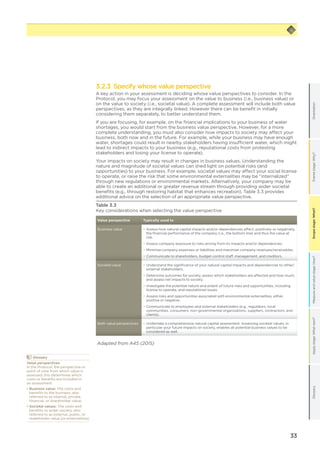
  • 112.
    110 NATURAL CAPITAL PROTOCOL 09 Takeaction 9.3 Outputs The outputs from this Step are: • Actions that you will take as a result of the assessment • A communication plan • A plan for making natural capital assessments part of how you do business. Hypothetical example NSCI At NSCI, after reviewing the assessment results, senior management and the assessment team compiled a list of potential next steps. This list is shown in Table 9.3. Table 9.3 Step 09 outputs for NSCI Issue Apply and act upon the results Supply chain impact: water consumption Reduce water impacts: The increasing significance of their supply chain impact of water consumption was cause for concern. In response, senior management suggested that they should launch a task force to investigate technological improvements to reduce water needs, such as drip irrigation, combined with farmer training. Consider business impacts of water consumption: Given the scale of water impacts on society, the team decided to revisit the potential future costs to the business that could be driven by these impacts, including regulatory action and loss of license to operate. Supply chain dependency: pollination Work with others to address declining bee populations: The decline in pollinators is something other companies and stakeholders should also be concerned about, so NSCI decided to host a workshop to discuss with other stakeholders about how to mitigate the decline and share the burden of adaptive measures. Manufacturing impact: air emissions Engage in policy discussion to influence design of air pollution regulation: NSCI incurs significant costs from its manufacturing air emissions. NSCI’s team therefore decided to conduct a more detailed study which they could use to engage regulators in a transparent and evidence-based discussion around how best to limit impacts on society and simultaneously reduce future costs to the business. In particular, they decided to investigate the broader economic, environmental, and social impacts associated with different regulatory designs, including a local cap and trade system, emission limits, or mandated technology updates. Manufacturing dependency: flood risk Work with others to strengthen flood defenses: The team identified other key stakeholders who would be affected and have an interest in mitigating risk and is working with them to coordinate protective measures. Embedding natural capital in existing processes: The NSCI team decided to update their environmental management system (EMS) to ensure better and broader data capture in the future. This will enable reliable monitoring of their performance, risks, and opportunities associated with the material natural capital impacts and dependencies above. You have now completed the nine Steps of the Natural Capital Protocol. The Natural Capital Coalition warmly welcomes any feedback, experiences and learnings that you can share from your assessment. This information can help us all progress towards the Coalition’s vision of a world where business conserves and enhances natural capital.
  • 113.
    111 OrientationFramestage:Why?Scopestage:What?Measureandvaluestage:How?GlossaryApplystage:Whatnext? Annex A: Classificationof ecosystem services The Millennium Ecosystem Assessment (MA) definition of ecosystem services as “benefits people obtain from ecosystems” and associated classification into provisioning, regulating, cultural, and supporting services are now part of common scientific and policy language. However, there is increasing recognition of the need for a more precise definition, as well as a more rigorous and systematic classification scheme which clearly distinguishes: • specific final benefits provided by nature to people—that is, those benefits that are directly enjoyed, consumed, or used, versus intermediate benefits, and/or functions and processes (e.g., nutrient cycling); and • quantities of services (e.g., measured in biophysical terms) versus the value of benefits to people (e.g., measured through economic valuation). Along these lines, an alternative definition of “final ecosystem services” has been proposed, namely the “components of nature, directly enjoyed, consumed, or used to yield human well-being” (Boyd and Banzhaf 2007). This definition provides a foundation for a revised classification scheme that can facilitate the measurement, modeling, mapping, valuation, and communication of ecosystem services in terms of specific beneficiaries and economic sectors. Leading classification schemes for ecosystem services currently include the Common International Classification of Ecosystem Services (CICES) and the Final Ecosystem Goods and Services Classification System (FEGS-CS). An important feature of these two classification schemes is their emphasis on ecosystem outputs (also described as final ecosystem services) that are directly consumed or used by specific beneficiaries. These two classification schemes are still evolving. CICES has been developed in order to create a classification scheme that is consistent with existing conceptual frameworks, such as the MA (2005a) and TEEB (2010), but that can be used easily to generate standardized statistical information for various applications, similar to standard economic statistics. CICES recognizes provisioning, regulating, and cultural services, but excludes “supporting services” which are considered part of the underlying structure, process, and functioning of ecosystems. CICES has further classified ecosystem services following a hierarchical structure that is designed to be compatible with ecosystem accounting (Haines-Young and Potschin 2013; EEA 2016). The FEGS-CS links final ecosystem services to standard categories of ecosystem and beneficiary. For example, ecosystem classes of aquatic, terrestrial, and atmospheric are further classified into sub-classes such as forest, agro-ecosystem, tundra, etc. Similarly, beneficiaries such as agricultural, commercial, subsistence are further classified into specific beneficiaries such as farmer, food extractors, food subsisters, etc. Twenty-one categories of FEGS are identified by final ecosystem services (e.g., water, flora, air, land, pollination, etc.), resulting in a total of 342 unique, specific, and measurable FEGS (Landers and Nahlik 2013). NATURAL CAPITAL PROTOCOL Annex A: Classification of ecosystem services
  • 114.
    112 Annex B: Valuationtechniques for natural capital assessments In environmental economics and this Protocol, valuation means more than just monetization. Valuation refers to the process of estimating the relative importance, worth, or usefulness of natural capital to people, in a particular context. It includes qualitative, quantitative, and monetary approaches, or a combination of these. This annex expands on table 7.1, by providing further detail on some of the key qualitative, quantitative, and monetary valuation techniques available (based on WBCSD 2013 and WBCSD et al. 2011). The aim is to help business managers understand the basics of the techniques, as well as key issues to consider. Indicative key steps are included for some of the more complex techniques. Qualitative valuation Qualitative valuation can range from simple descriptions of “importance” to more formal assessment of the relative value of impacts and dependencies. Opinion surveys provide a means of representing the views of a broad group of relevant stakeholders through a series of questions (e.g., semi-structured interviews). The relative importance or worth of natural capital in a given context can be elicited to estimate the value in a qualitative sense. Questions may be based on actual or hypothetical scenarios and seek responses from a range of relevant stakeholders. Surveys can be delivered in person, or remotely via telephone or the internet. It is essential to consider potential sources of bias in survey design, including in sample selection, scenario framing, the wording of questions, and data analysis. Surveys are often also used for quantitative analysis (see “structured surveys” below), but should always include qualitative questions to corroborate results and to validate respondents’ understanding of quantitative questions. Deliberative approaches are structured frameworks, such as facilitated group discussions or focus groups, for stakeholders to debate the relative values of natural capital in a given context. They are particularly useful where there are divergent opinions that would benefit from facilitated discussion, in order to understand the key drivers of different points of view, and to work through these differences in an attempt to reach consensus around an appropriate qualitative valuation. Relative valuation is a relative expression of value in a particular context. This may be expressed in terms of low, medium, or high value, indicating if they are positive or negative values, where appropriate. Sometimes a simple color rating such as red, amber, and green (RAG) may be used to highlight positive and negative values. If a numerical scale is used, for example a 5- or 10-point scale, or +3 to -3, the valuation becomes a quantitative assessment. Key steps for a relative valuation: 1. Identify the range of potentially relevant impacts in terms of changes in value (both positive and negative) resulting from what you are assessing. 2. Agree on the scale of qualitative values to use for different impacts (e.g., high, medium, or low value — or, for quantitative approaches, a score of say 0 – 5) and define what these terms in this scale mean. 3. Assign a qualitative value for each impact (or change in value) using a consistent approach and relevant information. This may be based on professional judgment, stakeholder interviews, stakeholder workshops, and/or a review of available data (including quantitative information). 4. Ideally conduct some form of consensus-building exercise (e.g., including staff, external experts, other stakeholders, and academics) to add credibility to the results. NATURAL CAPITAL PROTOCOL Annex B: Valuation techniques
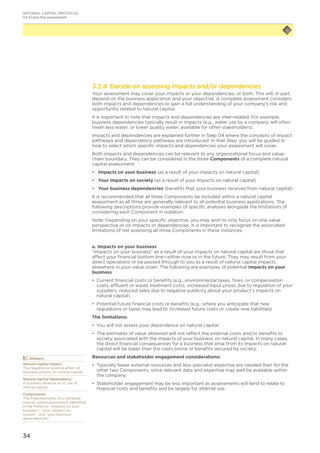
  • 115.
    113 OrientationFramestage:Why?Scopestage:What?Measureandvaluestage:How?GlossaryApplystage:Whatnext? Note: • Adopt aconsistent approach with clear definitions for different levels of qualitative value, where possible. • Support qualitative valuations with quantitative information where practicable. • Relative valuation is best conducted by an environmental economist, ideally involving other relevant experts, in particular ecologists, but potentially, hydrologists, air quality experts, sociologists, etc. • Involving wider stakeholders in the valuation process, or to review the outputs, adds to assessment robustness and credibility. Quantitative valuation Various methods of quantitative valuation can be used in natural capital assessments. Quantitative valuation can add numerical data to qualitative valuations and is always necessary to support monetary valuations of natural capital. Alternative approaches to quantitative valuation range from structured questionnaire surveys, to various non- monetary indicators (e.g., Disability-Adjusted Life Years—DALYs for health impacts), to more complex analytical techniques such as simulation modeling or multi-criteria analysis (MCA). The latter is commonly used in environmental studies as a means to compare alternative management options. Note the similarities in potential methods to those described in Step 05 (Measure impact drivers and/or dependencies). The distinction is that, for valuation, the results of these methods are placed in context to give an indication of relative worth or importance. Structured surveys are a powerful means to elicit quantitative values, including data on people’s preferences (ranked outcomes), behaviors (consumption levels), or other facts (location). Survey questions may be based on actual or hypothetical scenarios to gather responses from a range of relevant stakeholders. Surveys can be delivered in person, or remotely via telephone or the Internet, and involve a consistent set of questions including “closed response” options (e.g., Y/N). It is essential to consider potential sources of bias in the survey design, including in sample selection, delivery method, scenario framing, the wording of questions, and in the analysis of results. The results of quantitative surveys are often used as inputs to other valuation methods, including multi-criteria analysis or monetary valuation. Quantitative surveys should also include qualitative questions to corroborate results and to verify that respondents understood the questions (see qualitative “opinion surveys” above). Indicators can be used to quantify the measurement of natural capital, as described in Step 05. However, measurements only provide an indication of value when expressed in context. For example, simple units of output like m3 of water can be used to assess value only when the data are put in context, such as m3 per unit of output, or m3 of consumption as a percent of water availability, in the catchment where it is extracted. Insights into the value of natural capital can be obtained by combining quantitative metrics from various information sources, such as when water consumption (in m3 per unit of output) is combined with water scarcity indicators to measure changes in water scarcity per unit of output. Quantitative indicators can also be used to value changes in human well-being and health directly, such as Disability-Adjusted Life Years (DALYs), or Quality- Adjusted Life Years (QALYs), which are widely used in the health sector to assess and compare the determinants of health status in particular populations. Multi-criteria analysis (MCA) involves identifying and assessing a range of parameters typically covering environmental, social, and economic issues (including financial cost) for a range of alternative project options or decisions. The parameters are first scored (rated), based on the extent of impact (e.g., on a scale of 10 or 100), and then weighted based on their relative importance within the project/decision context. By calculating a weighted average across all criteria, the options can be given an overall score and ranking to help identify the preferred one. It is the scoring and weighting that is effectively the “valuation” technique.
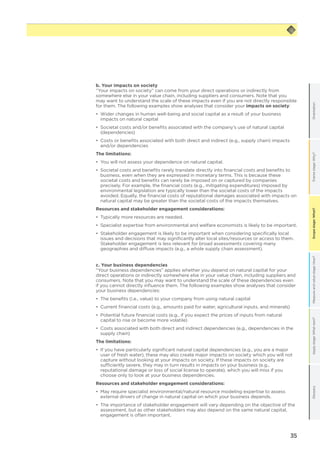
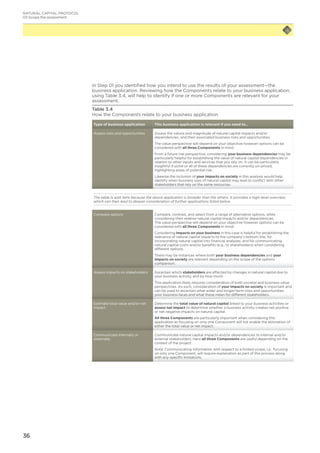
  • 116.
    114 NATURAL CAPITAL PROTOCOL AnnexB: Valuation techniques Key steps: 1. Establish the decision context in terms of aims, decision makers, and other key stakeholders. 2. Identify the relevant options (projects or decisions). 3. Identify the objectives and a set of criteria (parameters) that best reflect the values associated with the consequences of each option. 4. Describe and score the expected performance of each option against the criteria. 5. Assign weights to each of the criteria to reflect their relative importance in the decision. 6. Combine the weights and scores for each option to derive an overall value. 7. Conduct a sensitivity analysis of the results to changes in scores or weights. Note: • Ensure a comprehensive but mutually exclusive set of criteria are included. • Involve a range of stakeholders to agree upon the scores and weights applied. Monetary valuation For monetary valuation, in particular, a choice must be made between the use of a secondary (or indirect) valuation approach, or a primary approach using context-specific data. If adequate data do not exist and/or you do not have time or resources to conduct primary research, the most cost-effective approach is to use “value transfer”. Note that value transfer is generally not as reliable as primary valuation, because of its reliance on data from other contexts (see box 7.1). In some cases, value transfer can provide useful information to help design and/or validate the results of primary valuation. Market and financial prices can be used when available. This approach is commonly used in assessments regarding impacts to your business and your business dependencies. Where market prices are used, it should be borne in mind that they represent an indicator of value to those buying and selling the good or service in question. Thus they may not represent the full value to society arising from changes in natural capital. Market prices can also be used in assessments that address your impacts on society, where they may be used as a proxy for societal value. For example, even where water markets exist, water prices are often set administratively and may be lower than their true economic value. This may be because water is deliberately or inadvertently subsidized. The same applies to other ecosystem services and/or abiotic services. For example, anglers may pay a permit fee for the right to fish in particular waters, but that price may be much lower than the angler would be willing to pay. However, there is often no market for goods and services provided by natural capital (e.g., regulating ecosystem services), and hence no directly observable prices. For consumptive uses of natural capital, various market-price- or market-cost-based approaches can be used. See Canadian Council of Ministers of the Environment (2010) and United Nations Statistics Division (2007) for further details. A few examples include: • Derived demand function: The total value of a natural capital input to a household or business is determined based on an “inverse demand function”, which relies on statistical regression analysis of observed quantities purchased at different prices. This requires good data on use, which are not often available for natural capital. • Opportunity costs: The value forgone as a result of implementing an action (i.e., the cost of the opportunity lost) is sometimes used as proxy value. For example, the value of creating a set-aside on agricultural land can be considered to be at least the value of agricultural production forgone (net of subsidies).
  • 117.
    115 OrientationFramestage:Why?Scopestage:What?Measureandvaluestage:How?GlossaryApplystage:Whatnext? • Mitigation costs/aversivebehavior: The price paid to mitigate environmental impacts may provide a minimum proxy of the value of those impacts to those who have undertaken the mitigation. For example, the costs of water treatment may be used as a proxy for the value of water pollution damages. Note that a hypothetical cost to mitigate environmental damage is not necessarily an indication of value—this is only the case if an individual or organization is actually prepared to undertake the expenditure in question, or obliged to do so by legislation. In the latter case, the value of the environmental damage is implicitly assessed by the legislation as being at least as large as the costs of mitigation. • Cost of illness: The cost of pollution may be inferred based on the cost of illness that results when people’s health is affected. Relevant costs include medical expenditures as well as losses due to reduced labor productivity. If a business is mainly interested in the financial implications of changes in natural capital, whether for revenue generation or cost control, then using market prices to assess natural capital impacts may be appropriate. The production function approach, also referred to as the “change in production” or “effect on production” method, relates changes in the output of a marketed good or service to a relevant and measurable change in the quality or quantity of ecosystem services. For example, one can estimate the reduction in agricultural or business output resulting from a reduced quantity or quality of a particular good or service derived from natural capital. The cause-effect relationship can be technically difficult to determine, however, and complex formulae and calculations may be required to determine the results with accuracy. Key steps: 1. Identify the relevant good or service to be valued, where there is a well-established link between the quantity or quality of output and the provision of benefits to business and/ or society. 2. Identify the production process for which the ecosystem service and/or abiotic service is an input (e.g., crop yields or mining output). 3. Estimate the production function. Collect data on the quantity and unit cost of production inputs and outputs, or refer to previous similar assessments and use similar assumptions and adjust as necessary for differences in the context. 4. Create before and after scenarios, reflecting change in the natural good or service. Measure or estimate current conditions and model or estimate future conditions. 5. Estimate net revenues before the change in ecosystem input. 6. Estimate net revenues after the change in ecosystem input. 7. Calculate the change in net revenues. Note: • It may be worth trying to identify changes in the quantity or quality of ecosystem services and/or abiotic services (or other changes in natural capital) that are large enough to result in measurable price changes, as opposed to modest changes that can be easily absorbed by the market. • Rules of thumb from similar studies, or expert opinion, can be used to estimate changes in output (e.g., assume an increase in crop output of 10% when 10% more water is applied). Transferring evidence in this way should follow standard value-transfer guidelines.
  • 118.
    116 NATURAL CAPITAL PROTOCOL AnnexB: Valuation techniques Cost-based approaches The replacement cost approach is a cost-based approach commonly used in monetary valuations. In particular, it can be used to value regulating ecosystem services that a business impacts or relies upon. It is also commonly used to justify investment in natural capital. In the first case, the value of natural capital that provides regulating services such as water purification and flood control services can be assumed to be equivalent to the cost of replacing those services, in the event of the natural capital being lost, with built infrastructure that provides the same level of service. These types of assessments should factor in the long-term maintenance and operating costs of artificial infrastructures, as well as the loss (or gain) of other ecosystem service and/or abiotic service values provided by the equivalent natural resources. The resulting valuations are based on the assumption that people would actually pay to undertake the investment to replace the ecosystem services and/or abiotic services that are lost. This will be obvious where the natural capital in question is important to meet legal mandates (e.g., drinking water standards). In other circumstances it may not be a sound assumption, in which case other valuation approaches can be applied to value the reduced level of ecosystem services and/or abiotic services (e.g., production function approach where the ecosystem services contributes to a market good or service, or revealed or stated preference valuation techniques where it is not). Replacement costs may be estimated, observed, or modeled. Key steps: 1. Identify the ecosystem service(s) and/or abiotic service(s) to be valued. 2. Assess the scale and extent of use of the ecosystem service(s) and/or abiotic service(s). 3. Determine the nature of man-made goods, services, or infrastructure needed to replace the ecosystem service and/or abiotic service at the current scale of use. 4. Estimate, observe, or model the cost of the artificial replacement (include capital, operating, maintenance, and decommissioning costs). 5. Identify and account for other ecosystem services and/or abiotic services affected. Note: • Replacement cost valuations should consider the wider bundle of services provided by an ecosystem (e.g., wetland habitats provide many provisioning, regulating, and cultural ecosystem services). • The quality or level of replacement service should reflect that provided by the original ecosystem. For example, if a wetland only provides a partial water filtration function, its value is not equivalent to a high specification filter plant, but one that filters water to the same level as the wetland. • The “least full-life cost” man-made solution is the relevant value; ensure that maintenance costs are included for the relevant period of time in the proposed artificial solution. If natural capital can provide the ecosystem service(s) and/or abiotic service(s) in perpetuity then the results may be sensitive to timescales and discount rates.
  • 119.
    117 OrientationFramestage:Why?Scopestage:What?Measureandvaluestage:How?GlossaryApplystage:Whatnext? Damage costs avoidedis particularly useful for valuation of regulating services and climate change impacts. This method tends to be based on estimating the predicted values of damages in situations with and without the regulating service or impacts in question. The difference in damage values equates to the value of the service provided. The way values are predicted depends on the ecosystem service and/or abiotic service in question, but “consumptive valuation” techniques are one option (e.g., cost of illness due to increased air pollution). The approach can be complex if accurate values are required. For example, determining flood related values involves calculating and comparing “annual average damages” associated with different flood return periods (e.g. 1-in-2 year, 1-in-50 year, 1-in-100 year events). The necessary data may not be available or may be difficult to model. This is particularly true of climate change, although in this case one can use the outputs of established models in the literature (notably based on the work of the IPCC). Insurance companies are beginning to investigate the damage costs of extreme natural events, and are starting to link this to the degradation of natural capital and climate change. Key steps: 1. Identify the ecosystem service (usually a regulatory service) and/or abiotic service to be valued. 2. Estimate the likely cost of damages in a situation without the service provided (or without the project impact on the service). This is a function of the probability and value of possible outcomes. 3. Using the same valuation technique, estimate the likely cost with the service provided (or ‘with’ the project impact on the ecosystem service). 4. Determine the difference in value between the ‘with’ and ‘without’ scenarios. Note: If primary valuation evidence is transferred from other studies, follow value-transfer guidelines.
  • 120.
    118 NATURAL CAPITAL PROTOCOL AnnexB: Valuation techniques Revealed preference approaches Hedonic pricing is a useful revealed preference approach to value how natural capital affects the price of marketed commodities. For example, market price differentials for residential properties situated near or far from picturesque locations can provide a partial measure of the amenity value of those locations. Statistical analysis is used to disentangle the various factors that influence the price of a marketed commodity. Those factors may include the number of bedrooms, lot size, views of landscape, or the distance from important environmental features, such as rivers or parks. Key steps: 1. Collate data (e.g., dataset of property prices and/or primary surveys including environmental characteristics that are the focus of the valuation). 2. Undertake regression analysis of property prices against a range of explanatory variables (including the environmental good or service). 3. Derive an overall implicit price function. 4. Estimate a demand curve for the characteristic of interest. 5. Estimate the change in total value due to a marginal change in the environmental good or service (by integrating the demand curve). Note: This approach can be data and time intensive to conduct properly. • A more simplistic approach is to ask local property agents to provide approximations of the percentage price premium for particular environmental attributes. • Approximations made by transferring evidence from other sites can be low-cost and may be sufficient for your needs. For example, existing studies may suggest that proximity to a green space increases the value of property by a certain percentage. Use of such evidence should follow value-transfer guidelines.
  • 121.
    119 OrientationFramestage:Why?Scopestage:What?Measureandvaluestage:How?GlossaryApplystage:Whatnext? Travel cost method(TCM) is another revealed preference approach that can be used to determine the recreational or amenity values of the natural environment, such as a visit to a park, an angling trip, or other non-consumptive uses. TCM is based on the idea that the value of a recreational visit to individuals is at least as large as the costs (time and other expenses) incurred in undertaking those visits. A suitably designed questionnaire survey can capture visitor information, enabling individual, average, and aggregate recreational values to be inferred from a demand curve (i.e., frequency of visits as a function of the costs of visiting). Either an individual or zonal TCM can be conducted. The former is more common and is explained here. Various issues such as general accessibility to the site and the potential for joint visits to nearby attractions should be considered before deciding on the suitability of this approach. Key steps: 1. Design questionnaire (data to be collected include place of residence, demographics, attitudinal information, purpose, frequency, and length and costs of visit to site). 2. Administer questionnaire to site visitors (ensuring adequate sample size and representative mix of visitors). 3. Analyze data and estimate a demand function that is representative of all visitors to the site (using econometric techniques to determine the demand relationship based on relevant factors such as frequency of visits, costs to get to the site, etc.). 4. Estimate average recreational value (based on “integrating” the area under the demand curve to estimate an average value of enjoyment per individual). 5. Determine total recreational value by multiplying the average individual value by the number of visitors (over a particular period). Note: • Think carefully before commissioning a travel cost study. Although based on people’s actions, there may be many reasons why people visit particular sites. The frequency of visits, time spent, and expenditure incurred does not always reflect people’s full value for a site. • Travel cost surveys can be combined with stated preference surveys. Comparing two sets of valuations can test and enhance the reliability of the results. • Crude approximations can be applied, for example by multiplying estimates of visitor costs (e.g., travel costs and time) by the number of visitors. If estimates of visitors’ costs are transferred from other sites, then value-transfer guidelines should be followed.
  • 122.
    120 NATURAL CAPITAL PROTOCOL AnnexB: Valuation techniques Stated preference approaches Stated preference approaches involve questionnaire surveys to ask a representative sample of a particular population what their preferences are for a particular good or service. These techniques are commonly used to ascertain consumers’ “willingness to pay” (WTP) for a marginal improvement in the quantity or quality of natural capital, or their “willingness to accept” (WTA) compensation for a marginal loss. There are two main types of stated preference surveys: • Contingent valuation (CV) surveys typically involve asking consumers to directly state their WTP or WTA for something (often alternative options that provide different levels of non-marketed benefit). • Choice experiment (CE) (or choice modeling) surveys ask respondents to choose a preferred option from a set of alternatives, as described by a set of some five or six different attributes (parameters), one of which is a price they would have to pay. Through econometric modeling, it is possible to elicit the monetary values of different levels of each attribute. Key advantages of these approaches include their flexibility in valuing any specific environmental, social, or economic asset or impact. Indeed, they are the only primary valuation method capable of determining non-use (or “existence”) values. In addition, they allow for primary data collection and valuation addressing a specific issue, which can be designed to ensure that results are representative of the individuals affected by the impact. Disadvantages of stated preference methods include the fact that comprehensive and robust surveys can be time consuming and expensive. This is partly due to the need to overcome various potential sources of bias in hypothetical scenarios, which otherwise result in poor or meaningless results. For example, respondents may express a strategically high or low willingness to pay, or they may be unfamiliar with what they are being asked to value, potentially resulting in inaccurate responses. It is also important to recognize that results are based on what respondents say they would do, rather than their actual behavior. Nevertheless, experience in the design and use of stated preference methods is growing rapidly, enhancing their reliability and reducing costs. In addition, the use of internet-based survey methods is increasingly accepted, bringing costs down further. Key steps for a CE or CV: 1. Undertake initial research to explore the scope of what is to be valued. This can involve review of existing relevant valuation evidence, and its use, through value transfer, to gain better understanding of the values involved. 2. Choose a survey method (e.g., face-to-face, mail, or telephone) and valuation technique (CV or CE). 3. Choose target population to sample (such as all people who may be affected by the impact (e.g., people visiting a site) or total households in an area or country) and sampling strategy (e.g., random or stratified). 4. Design and format of questionnaire (e.g., open ended WTP, payment ladder) and payment vehicle (e.g., bills, tax, donation, car park charges). 5. Test the questionnaire using focus groups, especially if the topic is new, and pilot tests to check the wording and understanding of the questionnaire. 6. Conduct the main survey using a large enough sample to ensure statistically significant results. 7. Complete econometric analysis including work to identify outliers (e.g., extreme high bids) and protest bids (e.g., unwillingness to accept the scenarios presented). 8. Test validity and reliability. 9. Aggregate and report.
  • 123.
    121 OrientationFramestage:Why?Scopestage:What?Measureandvaluestage:How?GlossaryApplystage:Whatnext? Note: • Make surean experienced and appropriately trained expert is involved in designing the stated preference survey and analyzing the results. Although they appear simple, it is easy to design a questionnaire that yields meaningless results. Poor analysis and dealing incorrectly with biased responses can also limit the usefulness of results. • Ensure the survey sample is representative of the target population, such that the survey results can be adjusted to give a representative aggregate value. • Make sure the selected sample size is appropriate and justified. It is recommended that around 250 questionnaires be completed (assuming a target population of up to 1 million people and a 95% confidence interval). However, sample sizes of around 100 may yield useful results, with appropriate caveats. • Make sure that adequate efforts are made to overcome the majority of biases associated with this approach, such as hypothetical, information, strategic, starting point, and payment vehicle bias. • When designing the survey, consider the use of simple but effective visual information to help explain what is being valued. • Check that the payment scenarios are realistic and politically acceptable. Check that the assumptions used are conservative and clearly set out. Value transfer Value (or benefits) transfer has evolved as an alternative, low-cost approach to primary monetary valuation techniques. It involves transferring value estimates from existing economic valuation studies (the “study site”) to the site where a decision is being taken. Value transfer is discussed in more detail in box 7.1.
  • 124.
    122 NATURAL CAPITAL PROTOCOL Glossary NOTE:In writing the Natural Capital Protocol we have tried as much as possible to use standard English (US) and standard terminology in environmental economics, for which any dictionary or a good text book (respectively) can supply appropriate definitions. In some cases it was necessary to introduce new terminology specific to the Protocol. Definitions for these terms are adapted from the scientific literature or based on expert opinion and are prefaced by the phrase “In the Protocol”. Abiotic services The benefits arising from fundamental geological processes (e.g., the supply of minerals, metals, oil and gas, geothermal heat, wind, tides and the annual seasons). Baseline In the Protocol, the starting point or benchmark against which changes in natural capital attributed to your business’ activities can be compared. Biodiversity The variability among living organisms from all sources including, inter alia, terrestrial, marine, and other aquatic ecosystems and the ecological complexes of which they are part; this includes diversity within species, between species, and of ecosystems (UN 1992). Business application In the Protocol, the intended use of the results of your natural capital assessment, to help inform decision making. Components The three elements of a complete natural capital assessment identified in the Protocol: “impacts on your business”, “your impacts on society”, and “your business dependencies”. Counterfactual A form of scenario that describes a plausible alternative situation, and the environmental conditions that would result if the activity or operation did not proceed (adapted from Cambridge Natural Capital Leaders Platform 2013). Dependency See “natural capital dependency” Dependency pathway A dependency pathway shows how a particular business activity depends upon specific features of natural capital. It identifies how observed or potential changes in natural capital affect the costs and/or benefits of doing business. Economic value The importance, worth, or usefulness of something to people—including all relevant market and non-market values. In more technical terms, the sum of individual preferences for a given level of provision of that good or service. Economic values are usually expressed in terms of marginal/incremental changes in the supply of a good or service, using money as the metric (e.g., $/unit). Ecosystem A dynamic complex of plants, animals, and microorganisms, and their non-living environment, interacting as a functional unit. Examples include deserts, coral reefs, wetlands, and rainforests (MA 2005a). Ecosystems are part of natural capital. Ecosystem services The most widely used definition of ecosystem services is from the Millennium Ecosystem Assessment (MA 2005a): “the benefits people obtain from ecosystems”. The MA further categorized ecosystem services into four categories: −− Provisioning: Material outputs from nature (e.g., seafood, water, fiber, genetic material). −− Regulating: Indirect benefits from nature generated through regulation of ecosystem processes (e.g., mitigation of climate change through carbon sequestration, water filtration by wetlands, erosion control and protection from storm surges by vegetation, crop pollination by insects). −− Cultural: Non-material benefits from nature (e.g., spiritual, aesthetic, recreational, and others). −− Supporting: Fundamental ecological processes that support the delivery of other ecosystem services (e.g., nutrient cycling, primary production, soil formation). Environmentally Extended Input-Output Models (EEIO) Traditional input-output (IO) tables summarize the exchanges between major sectors of an economy (Miller and Blair 2009). For example, output from the footwear manufacturing sector results in economic activity in associated sectors, from cattle ranching to accounting services. Environmentally extended input-output models (EEIOs) integrate information on the environmental impacts of each sector within IO tables (Kitzes 2013; Leontief 1970; Tukker et al. 2006). Externality A consequence of an action that affects someone other than the agent undertaking that action, and for which the agent is neither compensated nor penalized. Externalities can be either positive or negative (WBCSD et al. 2011). Impact See “natural capital impact” Impact driver In the Protocol, an impact driver is a measurable quantity of a natural resource that is used as an input to production (e.g., volume of sand and gravel used in construction) or a measurable non-product output of business activity (e.g., a kilogram of NOx emissions released into the atmosphere by a manufacturing facility). Glossary
  • 125.
    123 OrientationFramestage:Why?Scopestage:What?Measureandvaluestage:How?GlossaryApplystage:Whatnext? Impact pathway Animpact pathway describes how, as a result of a specific business activity, a particular impact driver results in changes in natural capital and how these changes in natural capital affect different stakeholders. Life Cycle Assessment Also known as Life Cycle Analysis. A technique used to assess the environmental impacts of a product or service through all stages of its life cycle, from material extraction to end-of-life (disposal, recycling or reuse). The International Organization for Standardization (ISO) has standardized the LCA approach under ISO 14040 (UNEP 2015). Several Life Cycle Impact Assessment (LCIA) databases provide a useful library of published estimates for different products and processes. Market value The amount for which something can be bought or sold in a given market. Materiality In the Protocol, an impact or dependency on natural capital is material if consideration of its value, as part of the set of information used for decision making, has the potential to alter that decision (Adapted from OECD 2015 and IIRC 2013). Materiality assessment In the Protocol, the process that involves identifying what is (or is potentially) material in relation to the natural capital assessment’s objective and application. Measurement In the Protocol, the process of determining the amounts, extent, and condition of natural capital and associated ecosystem and/or abiotic services, in physical terms. Monetary valuation Valuation that uses money (e.g., $, €, ¥) as the common unit to assess the values of natural capital impacts or dependencies. Natural capital The stock of renewable and non-renewable natural resources (e.g., plants, animals, air, water, soils, minerals) that combine to yield a flow of benefits to people (adapted from Atkinson and Pearce 1995; Jansson et al. 1994). Natural capital assessment The process of measuring and valuing relevant (“material”) natural capital impacts and/ or dependencies, using appropriate methods. Natural capital dependency A business reliance on or use of natural capital. Natural capital impact The negative or positive effect of business activity on natural capital. Natural Capital Protocol A standardized framework to identify, measure, and value direct and indirect impacts (positive and negative) and/or dependencies on natural capital. Natural resources Natural resources encompass a range of materials occurring in nature that can be used for production and/or consumption. −− Renewable resources: These may be exploited indefinitely, provided the rate of exploitation does not exceed the rate of replacement, allowing stocks to rebuild (assuming no other significant disturbances). Renewable resources exploited faster than they can renew themselves may effectively become non-renewable, such as when over-harvesting drives species extinct (UN 1997). −− Non-renewable resources: These will not regenerate after exploitation within any useful time period. Non-renewable resources are sub-divided into reusable (e.g., most metals) and non-reusable (e.g., thermal coal). Organizational focus In the Protocol, the part or parts of the business to be assessed (e.g., the company as a whole, a business unit, or a product, project, process, site, or incident). For simplicity, these are grouped under three general headings as below: −− Corporate: assessment of a corporation or group, including all subsidiaries, business units, divisions, different geographies or markets, etc. −− Project: assessment of a planned undertaking or initiative for a specific purpose, and including all related sites, activities, processes, and incidents. −− Product: assessment of particular goods and/or services, including the materials and services used to produce these products. Price The amount of money expected, required, or given in payment for something (normally requiring the presence of a market). Primary data Data collected specifically for the assessment being undertaken. Qualitative valuation Valuation that describes natural capital impacts or dependencies and may rank them into categories such as high, medium, or low. Quantitative valuation Valuation that uses non-monetary units such as numbers (e.g., in a composite index), areas, mass, or volume to assess the magnitude of natural capital impacts or dependencies.
  • 126.
    124 NATURAL CAPITAL PROTOCOL Glossary ScenarioA storyline describing a possible future. Scenarios explore aspects of, and choices about, the future that are uncertain, such as alternative project options, business as usual, and alternative visions. Scoping In the Protocol, the process of determining the objective, boundaries, and material focus of a natural capital assessment. Secondary data Data that were originally collected and published for another purpose or a different assessment. Spatial boundary The geographic area covered by the assessment, for example, a site, watershed, landscape, country, or global level. The spatial boundary may vary for different impacts and dependencies and will also depend on the organizational focus, value-chain boundary, value perspective, and other factors. Stakeholder Any individual, organization, sector, or community with an interest or “stake” in the outcome of a decision or process. Temporal boundary The time horizon of the assessment. This could be a current “snapshot”, a 1-year period, a 3-year period, or a 25-year period, or longer. Validation Internal or external process to check the quality of the assessment, including technical credibility, the appropriateness of key assumptions, and the strength of your results. This process may be more or less formal and often relies on self-assessment. Valuation In the Protocol, the process of estimating the relative importance, worth, or usefulness of natural capital to people (or to a business), in a particular context. Valuation may involve qualitative, quantitative, or monetary approaches, or a combination of these. Valuation technique The specific method used to determine the importance, worth, or usefulness of something in a particular context. Value (noun) The importance, worth, or usefulness of something. Value perspective In the Protocol, the perspective or point of view from which value is assessed; this largely determines which costs or benefits are included in an assessment. −− Business value: The costs and benefits to the business, also referred to as internal, private, financial, or shareholder value. −− Societal values: The costs and benefits to wider society, also referred to as external, public, or stakeholder value (or externalities). Value transfer A technique that takes a value determined in one context and applies it to another context. Where contexts are similar or appropriate adjustments are made to account for differences, value transfer can provide reasonable estimates of value. Value-chain boundary The part or parts of the business value chain to be included in a natural capital assessment. For simplicity, the Protocol identifies three generic parts of the value chain: upstream, direct operations, and downstream. An assessment of the full lifecycle of a product would encompass all three parts. −− Upstream (cradle-to-gate): covers the activities of suppliers, including purchased energy. −− Direct operations (gate-to-gate): covers activities over which the business has direct operational control, including majority-owned subsidiaries. −− Downstream (gate-to-grave): covers activities linked to the purchase, use, reuse, recovery, recycling, and final disposal of the business’ products and services. Verification Independent process involving expert assessment to check that the documentation of the assessment is complete and accurate and gives a true representation of the process and results. “Verification” is used interchangeably with terms such as “audit” or “assurance”.
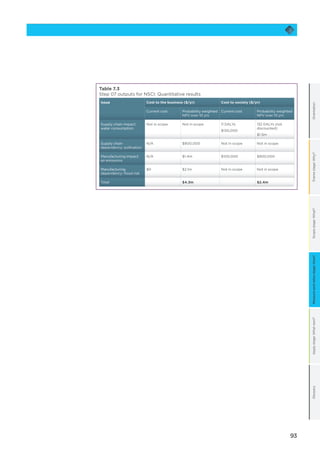
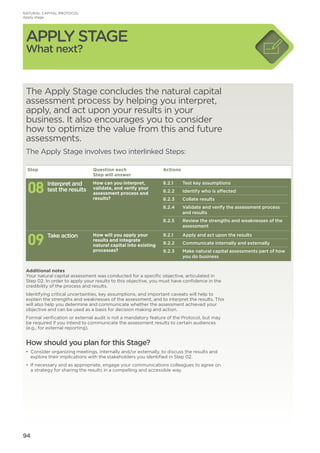
  • 127.
    125 NATURAL CAPITAL PROTOCOL Referencesand resources We would like to thank all those who voluntarily shared their publically available and proprietary methodologies to aid the development of the Protocol. Additional thanks to the Methodology Review Panel who objectively reviewed the submissions of proprietary methodologies. More information is available on the Natural Capital Coalition website. All weblinks accessed May 2016. A4S. 2015. “Natural and Social Capital Accounting: An introduction for finance teams.” The Accounting for Sustainability Chief Financial Officer Leadership Network. [Online] Available at: http://www.accountingforsustainability.org/cfos/network-of-chief-financial- officers/a4s-cfo-leadership-network-activities/natural-and-social-capital ABPmer and eftec. 2013. “The Scottish Marine Protected Area Project – Developing the Evidence Base for Impact Assessments and the Sustainability Appraisal Final Report Report R.2097”. [Online] Available at: http://www.gov.scot/Publications/2013/08/9645 ACCA, Flora and Fauna International, and KPMG. 2012. “Is Natural Capital a Material Issue?” Association of Chartered Certified Accountants, Flora Fauna International and KPMG. [Online] Available at: http://www.accaglobal.com/uk/en/technical-activities/ technical-resources-search/2012/november/is-natural-capital-a-material-issue.html AICPA and CIMA. 2014. “Rethinking the value chain: accounting for natural capital in the value chain.” Chartered Global Management Consultant Briefing. American Institute of Certified Public Accountants and Chartered Institute of Management Accountants [Online] Available at: http://www.cgma.org/Resources/DownloadableDocuments/ Accounting-for-natural-capital-in-the-value-chain.pdf Aretano, R., I. Petrosillo, N. Zaccarelli, T. Semeraro, and G. Zurlini. 2013. People perception of landscape change effects on ecosystem services in small Mediterranean islands: A combination of subjective and objective assessments. Landscape and Urban Planning 112: 63-73 Atkinson, G. and D. Pearce. 1995. “Measuring sustainable development.” In: Bromley, D. W., (ed.) Handbook of Environmental Economics. Blackwell, Oxford, UK, pp. 166-182 Bateman, I.J., Harwood, a. R., Mace, G. M., Watson, R. T., Abson, D. J., Andrews, B., Termansen, M. 2013. Bringing Ecosystem Services into Economic Decision-Making: Land Use in the United Kingdom. Science: (341): 6141: 45–50 Bauch, S. C., Birkenbach, A. M., Pattanayak, S. K., and Sills, E. O. 2015. Public health impacts of ecosystem change in the Brazilian Amazon. Proceedings of the National Academy of Sciences, 112(24), 7414-7419 Bishop, J. (ed.) 2010. “The Economics of Ecosystems and Biodiversity in Business and Enterprise.” London and New York: Earthscan Boyd, J., and S. Banzhaf. 2007. “What are ecosystem services? The need for standardized environmental accounting units”. Ecological Economics 63: 616– 626 Business and Biodiversity Offsets Programme (BBOP). 2012. Standard on Biodiversity Offsets. BBOP, Washington, DC. Available at http://www.forest-trends.org/documents/ files/doc_3078.pdf Cambridge Natural Capital Leaders Platform. 2013. “E.valu.a.te: The Practical Guide.” [Online] Available at: http://www.cisl.cam.ac.uk/publications/publication-pdfs/evaluate- practical-guide-nov-2013-new.pdf Canadian Council of Ministers of the Environment. 2010. Water Valuation Guidance Document PN 1443 ISBN 978-1-896997-92-6 PDF [Online] Available at: http://www.ccme. ca/files/Resources/water/water_valuation/water_valuation_en_1.0.pdf Cardinale, B.J. 2012. “Biodiversity loss and its impact on humanity” Nature 486, 59-67 Chartered Institute of Internal Auditors. 2015. “What is internal audit?”: https://iia.org.uk/ about-us/what-is-internal-audit/ CDSB. 2015. “CDSB Framework: Promoting and advancing disclosure of environmental information in mainstream reports.” [Online] http://www.cdsb.net/sites/cdsbnet/files/ cdsb_framework_for_reporting_environmental_information_natural_capital.pdf Corporate Reporting Dialogue. 2016. “Statement of Common Principles of Materiality of the Corporate Reporting Dialogue.” [Online] http://corporatereportingdialogue.com/ wp-content/uploads/2016/03/Statement-of-Common-Principles-of-Materiality1.pdf References and resources
  • 128.
    126 NATURAL CAPITAL PROTOCOL Referencesand resources Crutzen, Paul J. 2002. “Geology of mankind.” Nature 415.6867: 23-23. Danish Environmental Protection Agency. 2007. “Practical tools for value transfer in Denmark – guidelines and an example.” [Online] Available at: http://mst.dk/service/ publikationer/publikationsarkiv/2007/dec/practical-tools-for-value-transfer-in-denmark- guidelines-and-an-example/ Danish Environmental Protection Agency. 2014. “Methodology report for Novo Nordisk’s environmental profit and loss account” [Online] Available at: http://www.trucost.com/_ uploads/publishedResearch/Novo%20Nordisk%20EPandL.pdf EEA. 2016. “CICES. Toward a Common Classification of Ecosystem Services”. [Online] Available at http://cices.eu/ eftec. 2012. “Scoping study to develop understanding of a Natural Capital Asset Check.” Revised final report for Defra. [Online] Available at: http://www.eftec.co.uk/eftec- projects/defra-natura-capital-asset-check eftec. 2010. “Valuing Environmental Impacts: Practical Guidelines for the Use of Value Transfer in Policy and Project Appraisal.” Value Transfer Guidelines submitted to Department for Environment, Food and Rural Affairs. [Online] Available at: http://www. eftec.co.uk/eftec-projects/valuing-environmental-impacts-practical-guidelines-for-the- use-of-value-transfer-in-policy-and-project-appraisal Forum for the Future, WWF, and The Climate Group. 2014. “The Net Positive Report” [online] Available at: https://www.forumforthefuture.org/project/net-positive-project/ overview Global Nature Fund. 2014. “How Business Values Natural Capital: Taking Stock and Looking Forward.” International Foundation for the Protection of Environment and Nature. [Online] Available at: http://www.business-biodiversity.eu/global/ download/%7BSYYFGQIDSY-6242014124559-MRIRELADKC%7D.pdf GLOBE International. 2014. “GLOBE Natural Capital Accounting Study: 2nd Edition. Legal and policy developments in twenty-one countries.” GLOBE International and University College London, London, United Kingdom GRI. 2013. G4 Sustainability Reporting Guidelines: Implementation Manual. Global Reporting Initiative. [Online] Available at: https://www.globalreporting.org/ resourcelibrary/GRIG4-Part1-Reporting-Principles-and-Standard-Disclosures.pdf Haines-Young, R., and Potschin, M. 2011. Common international classification of ecosystem services (CICES): 2011 Update. Nottingham: Report to the European Environmental Agency Haines-Young, R. and Potschin, M. 2013. “CICES V4.3 – Revised report prepared following consultation on CICES Version 4, August-December 2012.” EEA Framework Contract No EEA/IEA/09/003 Hoekstra, A.Y., Chapagain, A.Y., Aldaya, M, M. and Mekonnen, M. M. 2011. “The Water Footprint Assessment Manual: Setting the Global Standard.” Water Footprint Network. [Online] Available at: http://waterfootprint.org/media/downloads/ TheWaterFootprintAssessmentManual_2.pdf Houdet, J. 2012. “Le Bilan Biodiversité. Une méthodologie pour intégrer la nature dans votre comptabilité.” Natureparif – Synergiz, Victoires Editions Houdet, J., Finisdore, J., Martin-Ortega, J., Ding, H., Maleganos, J., Spurgeon, J., Hartmann, T., and Steuerman, D. 2015. “Accounting for ecosystem services in business.” In Potschin, M., Haines-Young, R., Fish, R. and Turner, R.K. (eds) Routledge Handbook of Ecosystem Services. Routledge, London and New York Hull, S, I. Dickie, R. Tinch and J. Saunders. 2014. Issues and challenges in spatio-temporal application of an ecosystem services framework to UK seas. Marine Policy 45 (2014) 359– 367 IEMA, 2015. Climate Change Adaptation: Building the Business Case Guidance for Environment and Sustainability Practitioners [Online] Available at http://www.iema.net/ readingroom/articles/cca-business-case-guidance IIRC. 2013. International Integrated Reporting Framework. International Integrated Reporting Council [Online] Available at: http://integratedreporting.org/wp-content/ uploads/2015/03/13-12-08-THE-INTERNATIONAL-IR-FRAMEWORK-2-1.pdf
  • 129.
    127 International Finance Corporation(IFC). 2012. “Performance Standards on Environmental and Social Sustainability” [Online] Available at: http://www.ifc.org/wps/wcm/ connect/115482804a0255db96fbffd1a5d13d27/PS_English_2012_Full-Document. pdf?MOD=AJPERES IPIECA. 2011. “Ecosystem services guidance: Biodiversity and ecosystem services guide.” International Petroleum Industry Environmental Conversation Association. [Online] Available at:http://www.ipieca.org/publication/ecosystem-services-guidance- biodiversity-and-ecosystem-services-guide ITU. 2010. World Telecommunication/ICT Development Report, Monitoring the WSIS Targets: A mid-term review, Executive Summary [Online] Available at: https://www.itu.int/ dms_pub/itu-d/opb/ind/D-IND-WTDR-2010-SUM-PDF-E.pdf Jansson, A., M. Hammer, C. Folke, and R. Costanza (eds.) 1994. Investing in Natural Capital: The Ecological Economics Approach To Sustainability. Island Press: Washington, DC Kering. 2014. Environmental Profit Loss: Methodology 2013 Group Results [Online] Available at: http://www.kering.com/sites/default/files/document/kering_epl_ methodology_and_2013_group_results_0.pdf Kitzes, J. 2013. ‘An Introduction to Environmentally-Extended Input-Output Analysis’, Resources, 2: 489-503 KPMG. 2014a. “Sustainable Insight: the essentials of Materiality Assessments.” [Online] Available at: https://www.kpmg.com/Global/en/IssuesAndInsights/ArticlesPublications/ Documents/materiality-assessment.pdf KPMG. 2014b. “A New Vision of Value: Connecting corporate and societal value creation.” [Online] Available at: https://www.kpmg.com/Global/en/topics/climate-change- sustainability-services/Documents/a-new-vision-of-value.pdf Landers, D.H. and A.M. Nahlik. 2013. “Final Ecosystem Goods and Services Classification System (FEGS-CS).” EPA/600/R-13/ORD- 004914. U.S. Environmental Protection Agency, Office of Research and Development, Washington, DC Layke, C. 2009. “Measuring Nature’s Benefits: A Preliminary Roadmap for Improving Ecosystem Service Indicators.” WRI Working Paper. World Resources Institute, Washington DC Leontief, W. 1970. ‘Environmental repercussions and the economic structure: an input- output approach’, Review of Economics and Statistics, Vol. 52, No 3, pp. 262–271 Liu, S., R. Portela, A. Ghermandi, N. Rao, and X. Wang. 2012. Environmental Benefit Transfers of Ecosystem Service Valuation in van den Belt M. and Costanza R. (eds) Volume 12, ‘Ecological Economics of Estuaries and Coasts’. In Wolanski E. and McLusky D.S. (eds) Treatise on Estuarine and Coastal Science. Waltham, MA: Academic Press MA. 2005a. “Millennium Ecosystem Assessment: Ecosystems and human wellbeing. Biodiversity Synthesis.” Washington DC: Island Press MA. 2005b. “Millennium Ecosystem Assessment: PowerPoint MA findings: Animated slides. Slide 86.” [Online] Available at: http://www.millenniumassessment.org/en/ SlidePresentations.html Mace, G., Norris, K and A.H. Fitter. 2012. Biodiversity and ecosystem services: A multilayered relationship. Trends in Ecology Evolution: 27 (1): 19-26 Martín-López, B., Iniesta-Arandia, I., García-Llorente, M., Palomo, I., Casado-Arzuaga, I., Del Amo, D. G. and Montes, C. 2012. Uncovering ecosystem service bundles through social preferences. PloS one, 7(6), e38970 McKenzie, E., Rosenthal, A., Bernhardt, J., Girvetz, E., Kovacs, K., Olwero, N. and Toft, J. 2012. “Developing scenarios to assess ecosystem service tradeoffs: Guidance and case studies for InVEST users.” [Online] http://www.naturalcapitalproject.org/pubs/ ScenariosGuide.pdf Miller, R.E. and P.D. Blair. 2009. Input – output analysis: Foundations and extensions. (2nd ed.). New York: Cambridge University Press Natural Capital Coalition. 2014. “Valuing Natural Capital in Business. Taking stock: Existing initiatives and applications.” [Online] Available at: http://www.naturalcapitalcoalition.org/ js/plugins/filemanager/files/Valuing_Nature_in_Business_Part_2_Taking_Stock_WEB. pdf
  • 130.
    128 NATURAL CAPITAL PROTOCOL Referencesand resources Natural Capital Coalition. 2013. “Natural Capital at Risk: The Top 100 Externalities of Business.” [Online] Available at: http://www.naturalcapitalcoalition.org/projects/natural- capital-at-risk.html Nijhof, B. et al. 2014. “Extracts of BESMETRICS Draft Final Report.” ARCADIS IP. OECD. 2015. “Glossary of Statistical Terms. Organisation for Economic Co-operation and Development.” [Online] Available at: https://stats.oecd.org/glossary/ Pearce, D. and Atkinson, G. 1998. “The concept of sustainable development: an evaluation of its usefulness ten years after Brundtland.” Swiss Journal of Economics and Statistics, 134 (3). pp. 251-269 Pearce, D. and G. Atkinson. 1993. “Capital theory and the measurement of sustainable development: an indicator of “weak” sustainability.” Ecological Economics, 8 (2). pp. 103- 108 PwC. 2010. “The rise of Generation C: Implications for the world of 2020”, originally published by Booz Company in 2010 [Online] Available at: http://www.strategyand.pwc. com/uk/home/press_contacts/displays/rise_of_generation_c PwC. 2015. “Valuing corporate environmental impacts: PwC methodology document.” [Online] Available at: http://www.pwc.co.uk/sustainability-climate-change/total-impact/ natural-capital-exploring-the-risks.jhtml Ricketts, T., et al. 2004. “Economic value of tropical forest to coffee production.” Proceedings of the National Academy of Sciences of the United States of America. vol. 101 no. 34, 12579–12582 Rockström, J., W. Steffen, K. Noone, Å. Persson, F. S. Chapin, III, E. Lambin, T. M. Lenton, M. Scheffer, C. Folke, H. Schellnhuber, B. Nykvist, C. A. De Wit, T. Hughes, S. van der Leeuw, H. Rodhe, S. Sörlin, P. K. Snyder, R. Costanza, U. Svedin, M. Falkenmark, L. Karlberg, R. W. Corell, V. J. Fabry, J. Hansen, B. Walker, D. Liverman, K. Richardson, P. Crutzen, and J. Foley. 2009. “Planetary boundaries: exploring the safe operating space for humanity.” Ecology and Society: 14 (2): 32 Spurgeon, J.P.G. 2014. “Natural Capital Accounting for Business: Guide to selecting an approach.” [Online] Available at: http://ec.europa.eu/environment/biodiversity/business/ assets/pdf/b-at-b-platform-nca-workstream-final-report.pdf Spurgeon, J.P.G. 2015. “Comparing Natural Capital Accounting approaches, data availability and data requirements for businesses, governments and financial institutions: a preliminary overview.” [Online]. Available at: http://ec.europa.eu/environment/ biodiversity/business/assets/pdf/b-at-b-workstream-1-natural-capital-accounting.pdf Steffen et al. 2015. “Planetary Boundaries: Guiding human development on a changing planet.” Science Vol. 347 no. 6223 TEEB. 2010. “The Economics of Ecosystems and Biodiversity: Ecological Economics Foundations.” Edited by P. Kumar. Earthscan, London and Washington, DC TEEB. 2011. “The Economics of Ecosystems and Biodiversity in National and International Policy Making.” Edited by P. ten Brink. Earthscan, London and Washington, DC TEEB. 2012. “The Economics of Ecosystems and Biodiversity in Business and Enterprise.” Edited by J. Bishop. Earthscan, London and New York, DC TESSA. 2014. “Toolkit for ecosystem service site based assessment.” Birdlife International. [Online] Available at: http://tessa.tools/ The Crown Estate. 2013. “Our Contribution” [Online] available at: http://www. thecrownestate.co.uk/our-business/how-we-measure-value/ Tukker, A., G. Huppes, L.F.C.M van Oers and R. Heijungs. 2006. Environmentally extended input-output tables and models for Europe, Report EUR 22194 EN [Online]Available at: http://ftp.jrc.es/EURdoc/eur22194en.pdf UN. 1992. “Convention on Biological Diversity: Text of the Convention.” United Nations [Online] Available at: https://www.cbd.int/doc/legal/cbd-en.pdf UN. 1997. “Glossary of Environment Statistics, Studies in Methods, Series F, No. 67.” United Nations: New York UN. 2014. System of Environmental Economic Accounting (SEEA) 2012— Central Framework. United Nations. New York. [Online] Available at: http://unstats.un.org/unsd/ envaccounting/seeaRev/SEEA_CF_Final_en.pdf
  • 131.
    129 UNEP. 2015. “Consumption- Measuring Sustainability - Life Cycle Assessment.” United Nations Environment Program [Online] Available at: http://www.unep.org/ resourceefficiency/Consumption/StandardsandLabels/MeasuringSustainability/ LifeCycleAssessment/tabid/101348/Default.aspx UN Statistics Division. 2007. “System of Environmental-Economic Accounting for Water.” Prepared by United Nations Statistics Division upon recommendation by the UN Committee of Experts on Environmental Economic Accounting UNEP. 2015. “Consumption - Measuring Sustainability - Life Cycle Assessment.” United Nations Environment Program [Online] Available at: http://www.unep.org/ resourceefficiency/Consumption/StandardsandLabels/MeasuringSustainability/ LifeCycleAssessment/tabid/101348/Default.aspx Van der Ploeg, S. and R.S. de Groot. 2010. The TEEB Valuation Database – a searchable database of 1310 estimates of the monetary values of ecosystem services. Foundation for Sustainable Development, Wageningen, The Netherlands Wallace, K.J. 2007. “Classification of ecosystem services: problems and solutions.” Biological Conservation: 139: 3-4 WBCSD. 2013. “Business Guide to Water Valuation: An introduction to concepts and techniques.” World Business Council for Sustainable Development. [Online] Available at: http://www.wbcsd.org/Pages/EDocument/EDocumentDetails.aspx?ID=15801 WBCSD. 2015. “Towards a Social Capital Protocol. A Call for Collaboration: Measuring social impacts and dependencies for better business”. [Online] Available at: http:// wbcsdpublications.org/project/towards-a-social-capital-protocol-a-call-for-collaboration/ WBCSD, IUCN, ERM, and PwC. 2011. “Guide to Corporate Ecosystem Valuation.” World Business Council for Sustainable Development, International Union for the Conservation of Nature, ERM and PwC. [Online] Available at: http://www.wbcsd.org/pages/edocument/ edocumentdetails.aspx?id=104nosearchcontextkey=true World Bank. 2012 “Massive Show of Support for Action on Natural Capital Accounting at Rio Summit” [Online] Available at: http://www.worldbank.org/en/news/press- release/2012/06/20/massive-show-support-action-natural-capital-accounting-rio-summit World Bank. 2011. “The Changing Wealth of Nations—Measuring Sustainable Development in the New Millennium”. Washington DC World Economic Forum and PwC. 2010. “Biodiversity and Business Risk”. [Online] Available at: http://www.pwc.co.uk/assets/pdf/wef-biodiversity-and-business-risk.pdf WRI. 2005. “Ecosystems and Human Well-Being: Opportunities and Challenges for Business and Industry.” World Resources Institute. [Online] Available at: http://www. millenniumassessment.org/documents/document.353.aspx.pdf WRI, WBCSD and the Meridian Institute. 2012. “Corporate Ecosystem Services Review, Version 2.0.” World Resources Institute. [Online] Available at: http://www.wri.org/sites/ default/files/corporate_ecosystem_services_review_1.pdf WRI and WBCSD. 2004. “The Greenhouse Gas Protocol: A Corporate Accounting and Reporting Standard. Revised Edition”. World Resources Institute and World Business Council for Sustainable Development [Online] Available at: http://www.ghgprotocol.org/ files/ghgp/public/ghg-protocol-revised.pdf WWF. 2014. “Living Planet Report 2014: species and spaces, people and places.” World Wildlife Fund: McLellan, R., Iyengar, L., Jeffries, B., and Oerlemans, N. (Eds.). Available at: http://wwf.panda.org/about_our_earth/all_publications/living_planet_report/
  • 132.
    130 NATURAL CAPITAL PROTOCOL Listof tables, figures, and boxes List of Tables Table 1.1 Examples of natural capital risks and opportunities for business Table 1.2 Potential business applications of a natural capital assessment Table 1.3 Indicative resources needed throughout your assessment Table 1.4 Step 01 outputs for NSCI Table 2.1 Step 02 outputs for NSCI Table 3.1 Key considerations when selecting the organizational focus Table 3.2 Key considerations when selecting the value-chain boundary Table 3.3 Key considerations when selecting the value perspective Table 3.4 How the Components relate to your business application Table 3.5 Key considerations when selecting type of value Table 3.6 Key considerations when selecting baselines Table 3.7 Step 03 outputs for NSCI Table 4.1 Examples of possible impact drivers Table 4.2 Examples of possible dependencies Table 4.3 Step 04 outputs for NSCI: Summary of potentially material natural capital impact and dependency pathways Table 4.4 Step 04 outputs for NSCI: Rank of issues against materiality criteria Table MV.1 Relationship between business applications and the Measure and Value Steps Table MV.2 Overview of the Measure and Value Steps under each Component Table MV.3 Plan for specific needs for the Measure and Value Steps Table 5.1 Example activity-mapping template for a plastic cup producer Table 5.2 Example indicators for different impact drivers Table 5.3 Example indicators for different dependencies Table 5.4 Some examples of using secondary data to estimate impact drivers and dependencies Table 5.5 Assessing the suitability of alternative estimation methods Table 5.6 Examples of identifying intermediate indicators Table 5.7 Step 05 outputs for NSCI: Identification of indicators and data sources for selected impact drivers and dependencies Table 5.8 Step 05 outputs for NSCI: Summary of quantitative data collected Table 6.1 Examples of relevant changes in natural capital for different impact drivers Table 6.2 Examples of changes in natural capital influencing dependencies Table 6.3 Examples of measurement and estimation methods for assessing changes in natural capital Table 6.4 Step 06 outputs for NSCI: Selection of methods to measure change Table 6.5 Step 06 outputs for NSCI: Identification of indicators and data sources Table 6.6 Step 06 outputs for NSCI: Summary of quantitative data Table 7.1 Summary of key features of different valuation techniques Table 7.2 Step 07 outputs for NSCI: Selection of methods Table 7.3 Step 07 outputs for NSCI: Quantitative results Table 8.1 Examples of assumptions to test in a sensitivity analysis Table 8.2 Step 08 outputs for NSCI Table 9.1 Examples of future assessments Table 9.2 Examples of business processes that could leverage natural capital assessments Table 9.3 Step 09 outputs for NSCI List of tables, figures, and boxes
  • 133.
    131 List of Figures Figure0.1 The Natural Capital Protocol Framework Figure 0.2 Iteration in the Protocol Figure 1.1 Natural capital stocks, flows, and value Figure 1.2 Natural capital impacts and dependencies: conceptual model for business Figure 1.3 Examples of how business can impact natural capital Figure 1.4 Examples of business dependencies on natural capital Figure 4.1 Generic steps in impact pathways Figure 4.2 Generic steps in dependency pathways Figure 4.3 Examples of materiality matrices Figure 5.1 Process diagram showing impact drivers and dependencies associated with producing a plastic cup Figure 6.1 Example of how to identify natural capital changes related to impact drivers and external factors Figure 6.2 Example of how to estimate the likelihood and extent of natural capital changes related to dependencies List of Boxes Box 0.1 Valuation and monetization Box 1.1 Classification of ecosystem services Box 1.2 Biodiversity and its value to business Box 1.3 Net Positive Impact and the mitigation hierarchy Box 3.1 Qualitative, quantitative, and monetary valuation Box 4.1 Impact and dependency pathways Box 6.1 Estimating changes in natural capital stocks and/or flows Box 6.2 Estimating net changes in natural capital over time Box 6.3 Observable and unobservable changes in natural capital Box 6.4 Example of a business identifying natural capital risks related to fresh water use from a river and assessing these through the Components of impacts on their business and the impact on society Box 6.5 How your organizational focus and value-chain boundary influence the choice of measurement methods Box 6.6 Example of a business assessing business dependencies on fresh water use from a river Box 7.1 Value transfer Box 7.2 Valuation of natural capital stocks Box 7.3 Discounting in natural capital valuation Box 8.1 Risks of under- and overvaluation Box 8.2 Comparisons and trade-offs in monetary valuation
  • 134.
    132 The Natural CapitalProtocol has been developed through a unique collaborative effort. The Steering Group, which was appointed by the Coalition Board to provide guidance and oversight for the project, would like to thank all of the organizations who have dedicated resources to deliver this significant piece of work. We offer special thanks to WBCSD for leading this work on behalf of the Coalition. We would also like to thank the individuals who have proved that collaboration delivers something more than any of us can achieve alone and have contributed so much of their time, expertise and passion: For developing the Protocol Eva Zabey, WBCSD; Rosimeiry Portela, Conservation International and Holly Dublin, The B Team, for leading the development of the Protocol, and James Spurgeon, Sustain Value and Will Evison, PwC for their technical leadership; with support from Hannah Pitts, WBCSD. Josh Bishop, WWF; Quiller Brooke, PwC; Arturo Castillo, Imperial College London; Ian Dickie, eftec; Mark Gough, Natural Capital Coalition; Stephanie Hime, Natural Capital Coalition (part-time secondment from KPMG UK) and Little Blue Research Ltd.; Joël Houdet, ACTS, ISS, and Synergiz; Johan Lammerant, Arcadis; Doug MacNair, ERM; Emily McKenzie, WWF and Natural Capital Project; and Bianca Nijhof, Arcadis, for developing critical technical elements of the Protocol, including conceptualizing and drafting Steps. Cynthia Cummis, World Resources Institute; Becky Chaplin-Kramer, Natural Capital Project; Baptiste Cassan-Barnel, Kering; Helen Ding, Deloitte; Chris Earl, Roche; Axel Frank, Accenture; Pier Gribaudi, LafargeHolcim; Lois Guthrie, CDSB; Jon Hoekstra, WWF and Natural Capital Project; Mikkel Kallesoe, Shell; Laurent Lanvier, Nestlé; Scott Noesen, WorldView Consulting LLC; Sonal Pandya Dalal, Conservation International; Kirsi Sormunen, non-executive director on corporate boards; Pavan Sukhdev, GIST Advisory; Jo Treweek, eCountability; Mark Weick, Dow; Tom Woollard, ERM; and Huihui Zhou, Deloitte; for their technical insights and review. For contributing to the Protocol development Gerard Bos, IUCN; Steve Bullock, Trucost; Gemma Cranston, University of Cambridge Institute for Sustainability Leadership; Steve Lang, EY; Alastair MacGregor, Trucost; Jeremy Osborn, EY; Mathew Parr, IUCN National Committee of the Netherlands, for their leadership on business engagement and piloting, and providing framing and structural input and guidance. Roberto Bossi, eni; Joseph Confino, Natural Capital Coalition, Olivia Cox, ICAEW; Sophie Van Eetvelt, formerly Natural Capital Coalition; Pieter van der Gaag, formerly Natural Capital Coalition; Henrik Dinesen, Natural Capital Coalition; Daniel Girdler, VitalMetrics; Emma Gilfillian, ICAEW; Lucy Godshall, EY; Adrian de Groot Ruiz, True Price; Colette Grosscurt, True Price; Alison Jones, Natural Capital Coalition (secondment from Arcadis); Nicky Landsbergen, EY; Charlotte Masiello-Riome, formerly Natural Capital Coalition (seconded from A4S); Dorothy Maxwell, formerly Natural Capital Coalition; Deborah McSkimming, formerly Natural Capital Coalition (seconded from A4S); Nathalie Olsen, IUCN; Patrick O’Neil, Broadminded Communications; Ben Packard, The Nature Conservancy; Michel Scholte, True Price; Francesca Sharp, ICAEW; Andreza Souza, Natura; Sangwon Suh, VitalMetrics; Sanjeev Sanyal, Deutsche Bank; Alasdair Townsend, Sherlock Digital; Sara van Wijk, formerly Natural Capital Coalition; Luciana Villa Nova, Natura; Jasmin Willis, Natural Capital Coalition; for contributing their insights, time, passion, and support. Over 50 organizations took part in the piloting program including 10 deep dive companies; Coca Cola; Dow; Hugo Boss; Kering; Olam; Natura; Nespresso; Nestlé; Roche; Shell. Other pilot testers included AkzoNobel; Arcadis; CEMEX; CPFL Renováveis; Desso; DSM; HM; InterfaceFlor; Interloom; JaguarLandRover; LVMH; MS; Novartis; Pearson; Natural Capital Partners; Organic Cotton Colours SL; Royal Philips NV; Skanska; South West Water; Suez; Tata Chemicals; Tata Power; Tata Steel; TD Bank; Thames Water Utilities; The Crown Estate; Yorkshire Water/Kelda Group and Votorantim Industrial. The expert review panel included: Tom Baumann; Becky Chaplin-Kramer; Strahil Christov; Andrew Collins; Robert Costanza; Cynthia Cummis; Helen Ding; Bob Eccles; Stathis Gould; Oliver Greenfield; Lois Guthrie; Tony Juniper; Rashila Kerai; Ashok Khosla; Mervyn King; Martin Lok; Zhiyun Ouyang; Sarah Owen; Davide Parisse; John Purcell; Bill Rahil; Leila Rohd-Thomsen; Tracey Rouleau; Todd Scaletta; Diana Shand; Pavan Sukhdev; Jo Treweek; Sissel Waage; Tim Youmans. Acknowledgements NATURAL CAPITAL PROTOCOL Acknowledgements
  • 135.
    Organizations that contributedto the consultation: ACCA; AECOM; Ag Resource Strategies; Altus Impact; Anglian Water; Anteo; Anthesis Group; Arcadis; B2Consultancy; BCSD Portugal; BCSD UK; Biocensus; BirdLife International; British American Tobacco; BSI; Capitalactiv; CDSB; CH2M; CII-ITC Centre of Excellence for Sustainable Development; CIMA; CIRIA; Client Earth; Conservation International; Cotton Research and Development Corporation; CSO; Denkstatt; Dow; Earth Economics; Ecoacsa Reserva de Biodiversidad; EcoValue; EnviroMarket Ltd.; Mumbai Environmental Management Centre; EY; FFI; Forestry Commission; Forum for the Future; Fujitsu Laboratories Ltd.; Global Canopy Programme; Global Nature Fund; Hugo Boss; ICAS; ICMM; IEMA; IUCN; IUCN-CEESP; Irbaris; Irish Forum on Natural Capital; Jacobs; Joint Nature Conservation Committee; KPMG; Landmark Information Group; Landmark Public Policy Advisers Asia; Lebanon Green Building Council; Liverpool John Moores University; Mahindra Lifespace Developers Limited; Malik Institute; Mango Impact; Middlesex University; Mother Earth Trust; N2 Inc; PBL - Netherlands Environmental Assessment Agency; Perrigo; Ramboll Environ; RSPB; SC Consulting; SIG; Skanska; Stanford University; Suez Environment; Sustainable Business Australia; The Biodiversity Consultancy; Tetra Pak; The Geological Society; Thinkstep; The Nature Conservancy; Toulouse Business School; Trucost; UNEP-WCMC; Unilever; Vale; WBCSD; Weyerhaeuser; Wolfs Company; and WWF. The consultation was carried out using Collaborase. For hosting meetings: Deloitte; EY; ICAEW; IUCN; KPMG; Mitsubshi Corporation; PwC; WBCSD. Global Initiatives for communications support, Jennifer Hole for copy editing, CtrlPrint for editing software, and Radley Yeldar for design. For providing oversight and guidance The Coalition Board Nanno Kleiterp, FMO (Chair); Michael Meehan, GRI (Deputy Chair); Liz Barber, Yorkshire Water; Aron Cramer, BSR; Jessica Fries, HRH the Prince’s Accounting for Sustainability project; Robert Hodkinson, ICAEW; Jennifer Morris, Conservation International; Tony Gourlay, Global Initiatives; and former board members; Peter Bakker, WBCSD; Gerard Ee Hock Kim, formerly EY; Ernst Ligteringen, formerly GRI; Sarah Nolleth, HRH the Prince’s Accounting for Sustainability project; Sanjeev Sanyal, Deutsche Bank; Peter Seligmann, Conservation International; and Pavan Sukhdev, GIST Advisory. For funding the development of the Protocol and Sector Guides: Gordon and Betty Moore Foundation; IFC with the support of the Swiss State Secretariat for Economic Affairs (SECO) and the Ministry of Foreign Affairs of the Government of the Netherlands; The Rockefeller Foundation; United Nations Environment Programme (UNEP); and the UK Department for the Environment, Food and Rural Affairs (DEFRA). Thank you also to the Institute of Chartered Accountants in England and Wales (ICAEW) for hosting the Coalition. With our thanks, the Protocol Steering Group, Richard Fleck, Herbert Smith Freehills (Chair); Rosemary Bissett, National Australia Bank; Helen Dunn, DEFRA; Michelle Lapinski, IFC, SustainBiz; Ivo Mulder, UNEP; Sarah Nolleth, HRH the Prince’s Accounting for Sustainability project; Richard Spencer, ICAEW; Elizabeth White, IFC; and Heather Wright, Gordon and Betty Moore Foundation. Suggested citation Natural Capital Coalition. 2016. “Natural Capital Protocol”. (Online) Available at: www.naturalcapitalcoalition.org/protocol This work is licensed under a Creative Commons Attribution-NonCommercial-NoDerivatives 4.0 International License © ICAEW 2016 Powered by CtrlPrint
  • 136.
    naturalcapitalcoalition.org Designed and producedby Radley Yeldar www.ry.com The Natural Capital Coalition brings together leading initiatives and organizations under a common vision of a world where business conserves and enhances the natural capital that safeguards thriving societies and prosperous economies. It is a collaboration between research, science, academia, business, advisory, membership, accountancy, reporting, standard setting, finance, investment, policy, government, conservation and civil society. Its strength comes from this diversity, and from a shared belief that we can achieve more together than we could alone. About The Natural Capital Coalition @NatCapCoalition #NatCapProtocol