HD CARBERY
Prepared by : Anna Isha
Copyright ©2011
 ....VideosVIDEO PnPNATURE.flv
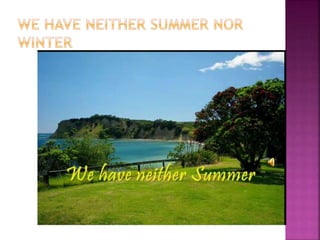
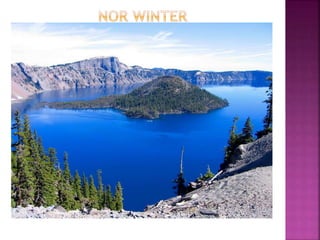
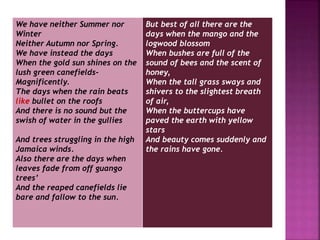
We have neither Summer nor
Winter
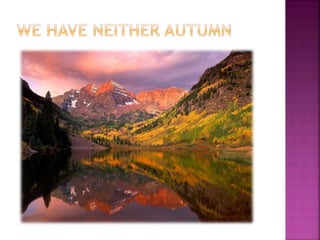
Neither Autumn nor Spring.
We have instead the days
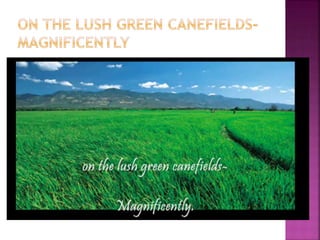
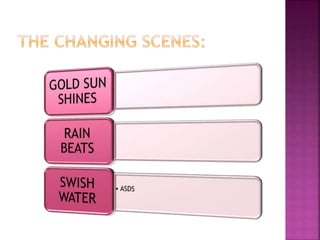
When the gold sun shines on the
lush green canefields-
Magnificently.
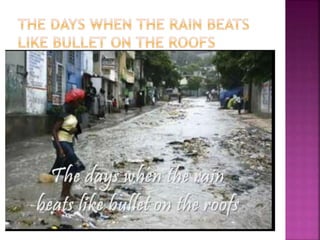
The days when the rain beats
like bullet on the roofs
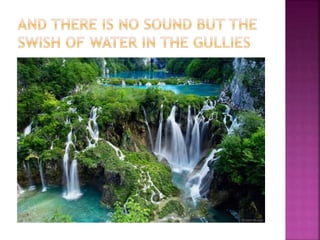
And there is no sound but the
swish of water in the gullies
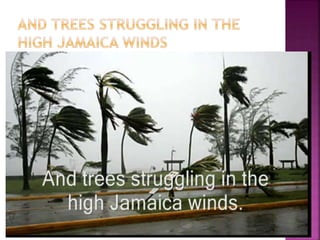
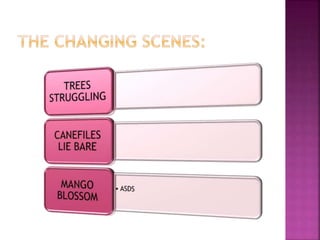
And trees struggling in the high
Jamaica winds.
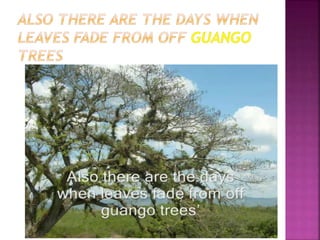
Also there are the days when
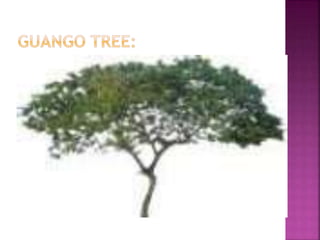
leaves fade from off guango
trees’
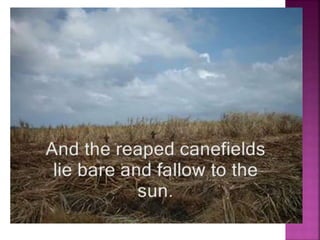
And the reaped canefields lie
bare and fallow to the sun.
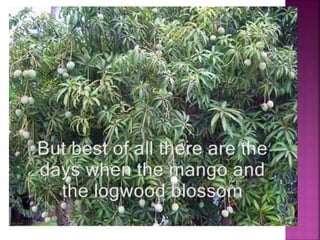
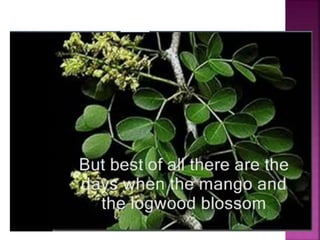
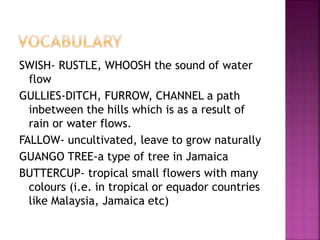
But best of all there are the
days when the mango and the
logwood blossom
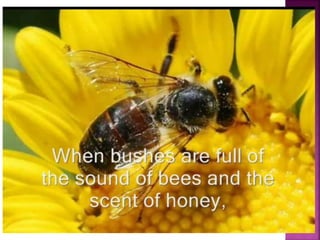
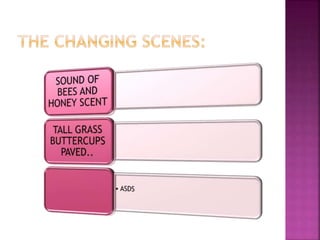
When bushes are full of the
sound of bees and the scent of
honey,
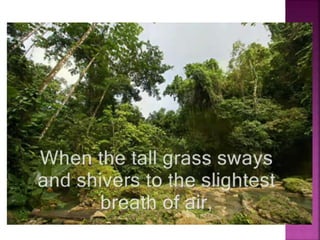
When the tall grass sways and
shivers to the slightest breath
of air,
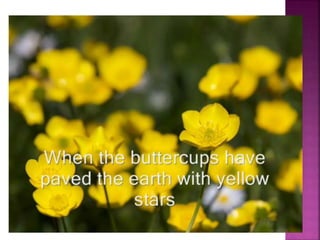
When the buttercups have
paved the earth with yellow
stars
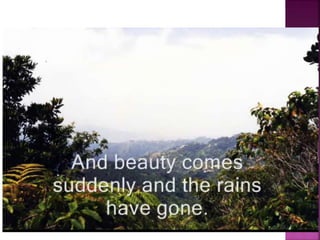
And beauty comes suddenly and
the rains have gone.
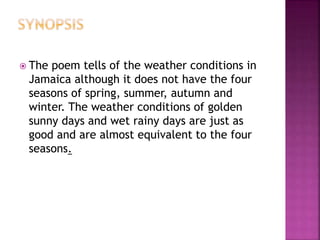
SWISH- RUSTLE, WHOOSH the sound of water
flow
GULLIES-DITCH, FURROW, CHANNEL a path
inbetween the hills which is as a result of
rain or water flows.
FALLOW- uncultivated, leave to grow naturally
GUANGO TREE-a type of tree in Jamaica
BUTTERCUP- tropical small flowers with many
colours (i.e. in tropical or equador countries
like Malaysia, Jamaica etc)
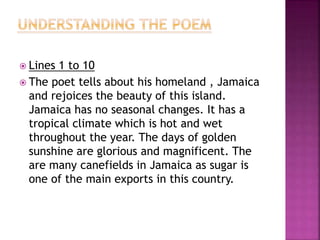
 The poem tells of the weather conditions in
Jamaica although it does not have the four
seasons of spring, summer, autumn and
winter. The weather conditions of golden
sunny days and wet rainy days are just as
good and are almost equivalent to the four
seasons.
 Lines 1 to 10
 The poet tells about his homeland , Jamaica
and rejoices the beauty of this island.
Jamaica has no seasonal changes. It has a
tropical climate which is hot and wet
throughout the year. The days of golden
sunshine are glorious and magnificent. The
are many canefields in Jamaica as sugar is
one of the main exports in this country.
 Lines 11 to 15
 In the ending of the poem, the poet tells us
his favourite time – days when the flowers of
mango trees and logwood blossom. He uses
imagery of sound and smell to illustrate
abundant life and activity in the bushes when
the ‘sound of bees and the scent of honey’
add to the charm and beauty if Jamaica. He
describes the fields filled with lovely yellow
buttercups. All this happens when the rains
have stopped and the beauty if nature
emerges once again.
 Beauty of nature
 Appreciation of one own country
 Appreciate nature
 We should appreciate what we have in our
own country
 We should not long for what we do not have.
 We should appreciate our homeland.
 We should appreciate the beauty of nature.
 Appreciative and happy
 Carefree and light-hearted
 Sense of beauty
POINT OF VIEW
Third person point of view
LANGUAGE AND STYLE
 Simple and easy to understand the language
 Clear and descriptive
 Simple style with no rhyming scheme
Reflects the tone of rejoicing and pride
The persona gives a vivid description of nature
of his homeland.
The mood is joyful even though the seasons
can change the environment(line 11-14)
The persona shares his appreciation and
gratitude for nature with the readers.(line
15)
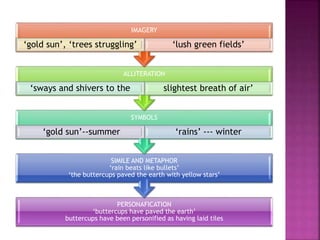
PERSONAFICATION
‘buttercups have paved the earth’
buttercups have been personified as having laid tiles
SIMILE AND METAPHOR
‘rain beats like bullets’
‘the buttercups paved the earth with yellow stars’
SYMBOLS
‘gold sun’--summer ‘rains’ --- winter
ALLITERATION
‘sways and shivers to the slightest breath of air’
IMAGERY
‘gold sun’, ‘trees struggling’ ‘lush green fields’
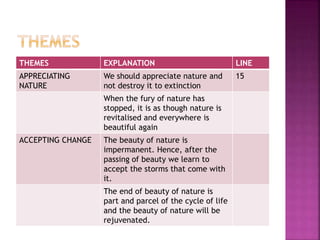
THEMES EXPLANATION LINE
APPRECIATING
NATURE
We should appreciate nature and
not destroy it to extinction
15
When the fury of nature has
stopped, it is as though nature is
revitalised and everywhere is
beautiful again
ACCEPTING CHANGE The beauty of nature is
impermanent. Hence, after the
passing of beauty we learn to
accept the storms that come with
it.
The end of beauty of nature is
part and parcel of the cycle of life
and the beauty of nature will be
rejuvenated.
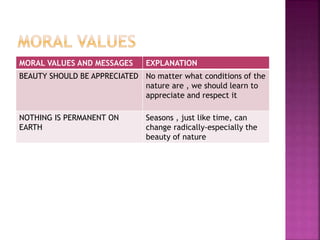
MORAL VALUES AND MESSAGES EXPLANATION
BEAUTY SHOULD BE APPRECIATED No matter what conditions of the
nature are , we should learn to
appreciate and respect it
NOTHING IS PERMANENT ON
EARTH
Seasons , just like time, can
change radically-especially the
beauty of nature
Please click this link
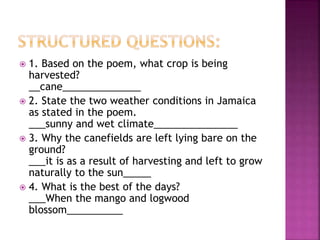
 1. Based on the poem, what crop is being
harvested?
__cane______________
 2. State the two weather conditions in Jamaica
as stated in the poem.
___sunny and wet climate_______________
 3. Why the canefields are left lying bare on the
ground?
___it is as a result of harvesting and left to grow
naturally to the sun_____
 4. What is the best of the days?
___When the mango and logwood
blossom__________
 5. What can be heard and smell in the bushes?
___the sound of bees and scent of honey______
 6. Which line suggests that the winds are
blowing strongly?
 __ttrees struggling in the high Jamaica winds._
 7. Name three elements of nature found in the
poem.
 ____sun____, __rain_, and _wind__
 8. What does the line, “And there is no sound
but the swish of water in the gullies’ suggests?
 _heavy flow of water running in the gullies__
1. Do you like the poem? Give a reason.
________________
2. Would you like to live in a place like
Jamaica? Give a reason.
_____________________________________
3. Which season do you like best? Give a
reason.
_____________________________________
 IF YOU HAD BEEN GIVEN AN OPPORTUNITY TO
TWO-WAY FREE TICKETS TO JAMAICA AND
RETURNED TO MALAYSIA, WHAT WOULD YOU
TELL TO YOUR FRIENDS ABOUT JAMAICA?
 You know , Jamaica is
_____________________________
 ___________________________________
 _________________________________
 _______________________________
 ______________________
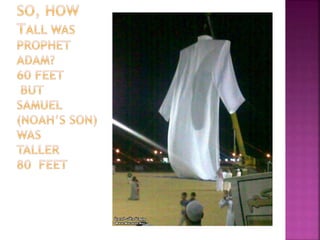
 Jamaican people are so tall… they always
walk and run to go elsewhere instead of
driving a vehicle….They had on strenuous
training --running miles..and miles
..barefooted
No wonder,many sprinters are originated
from Jamaica….
 Question: How tall is the average of
Jamaican?
Nature POEM HD CADBERY

Nature POEM HD CADBERY

  • 1.
    HD CARBERY Prepared by: Anna Isha Copyright ©2011
  • 22.
  • 23.
    We have neitherSummer nor Winter Neither Autumn nor Spring. We have instead the days When the gold sun shines on the lush green canefields- Magnificently. The days when the rain beats like bullet on the roofs And there is no sound but the swish of water in the gullies And trees struggling in the high Jamaica winds. Also there are the days when leaves fade from off guango trees’ And the reaped canefields lie bare and fallow to the sun. But best of all there are the days when the mango and the logwood blossom When bushes are full of the sound of bees and the scent of honey, When the tall grass sways and shivers to the slightest breath of air, When the buttercups have paved the earth with yellow stars And beauty comes suddenly and the rains have gone.
  • 24.
    SWISH- RUSTLE, WHOOSHthe sound of water flow GULLIES-DITCH, FURROW, CHANNEL a path inbetween the hills which is as a result of rain or water flows. FALLOW- uncultivated, leave to grow naturally GUANGO TREE-a type of tree in Jamaica BUTTERCUP- tropical small flowers with many colours (i.e. in tropical or equador countries like Malaysia, Jamaica etc)
  • 25.
     The poemtells of the weather conditions in Jamaica although it does not have the four seasons of spring, summer, autumn and winter. The weather conditions of golden sunny days and wet rainy days are just as good and are almost equivalent to the four seasons.
  • 26.
     Lines 1to 10  The poet tells about his homeland , Jamaica and rejoices the beauty of this island. Jamaica has no seasonal changes. It has a tropical climate which is hot and wet throughout the year. The days of golden sunshine are glorious and magnificent. The are many canefields in Jamaica as sugar is one of the main exports in this country.
  • 27.
     Lines 11to 15  In the ending of the poem, the poet tells us his favourite time – days when the flowers of mango trees and logwood blossom. He uses imagery of sound and smell to illustrate abundant life and activity in the bushes when the ‘sound of bees and the scent of honey’ add to the charm and beauty if Jamaica. He describes the fields filled with lovely yellow buttercups. All this happens when the rains have stopped and the beauty if nature emerges once again.
  • 28.
     Beauty ofnature  Appreciation of one own country  Appreciate nature
  • 29.
     We shouldappreciate what we have in our own country  We should not long for what we do not have.  We should appreciate our homeland.  We should appreciate the beauty of nature.
  • 30.
     Appreciative andhappy  Carefree and light-hearted  Sense of beauty POINT OF VIEW Third person point of view LANGUAGE AND STYLE  Simple and easy to understand the language  Clear and descriptive  Simple style with no rhyming scheme
  • 31.
    Reflects the toneof rejoicing and pride The persona gives a vivid description of nature of his homeland. The mood is joyful even though the seasons can change the environment(line 11-14) The persona shares his appreciation and gratitude for nature with the readers.(line 15)
  • 32.
    PERSONAFICATION ‘buttercups have pavedthe earth’ buttercups have been personified as having laid tiles SIMILE AND METAPHOR ‘rain beats like bullets’ ‘the buttercups paved the earth with yellow stars’ SYMBOLS ‘gold sun’--summer ‘rains’ --- winter ALLITERATION ‘sways and shivers to the slightest breath of air’ IMAGERY ‘gold sun’, ‘trees struggling’ ‘lush green fields’
  • 33.
    THEMES EXPLANATION LINE APPRECIATING NATURE Weshould appreciate nature and not destroy it to extinction 15 When the fury of nature has stopped, it is as though nature is revitalised and everywhere is beautiful again ACCEPTING CHANGE The beauty of nature is impermanent. Hence, after the passing of beauty we learn to accept the storms that come with it. The end of beauty of nature is part and parcel of the cycle of life and the beauty of nature will be rejuvenated.
  • 34.
    MORAL VALUES ANDMESSAGES EXPLANATION BEAUTY SHOULD BE APPRECIATED No matter what conditions of the nature are , we should learn to appreciate and respect it NOTHING IS PERMANENT ON EARTH Seasons , just like time, can change radically-especially the beauty of nature
  • 35.
  • 39.
     1. Basedon the poem, what crop is being harvested? __cane______________  2. State the two weather conditions in Jamaica as stated in the poem. ___sunny and wet climate_______________  3. Why the canefields are left lying bare on the ground? ___it is as a result of harvesting and left to grow naturally to the sun_____  4. What is the best of the days? ___When the mango and logwood blossom__________
  • 40.
     5. Whatcan be heard and smell in the bushes? ___the sound of bees and scent of honey______  6. Which line suggests that the winds are blowing strongly?  __ttrees struggling in the high Jamaica winds._  7. Name three elements of nature found in the poem.  ____sun____, __rain_, and _wind__  8. What does the line, “And there is no sound but the swish of water in the gullies’ suggests?  _heavy flow of water running in the gullies__
  • 41.
    1. Do youlike the poem? Give a reason. ________________ 2. Would you like to live in a place like Jamaica? Give a reason. _____________________________________ 3. Which season do you like best? Give a reason. _____________________________________
  • 42.
     IF YOUHAD BEEN GIVEN AN OPPORTUNITY TO TWO-WAY FREE TICKETS TO JAMAICA AND RETURNED TO MALAYSIA, WHAT WOULD YOU TELL TO YOUR FRIENDS ABOUT JAMAICA?  You know , Jamaica is _____________________________  ___________________________________  _________________________________  _______________________________  ______________________
  • 43.
     Jamaican peopleare so tall… they always walk and run to go elsewhere instead of driving a vehicle….They had on strenuous training --running miles..and miles ..barefooted No wonder,many sprinters are originated from Jamaica….  Question: How tall is the average of Jamaican?