Improving the Lives and Learning
of Children and Youth
Insert Name and Date
Location
What do you want for your career?
2
What are you looking for in a job?
Lots of
job openings?
Diverse roles and
responsibilities?
Good salary
and benefits?
Job flexibility
and stability?
School Psychology
might be the career
for you!
Who are school psychologists?
• Highly-qualified professionals with a
graduate degree
• Work in schools and related settings
• Provide comprehensive psychological and
educational services to diverse students
• Promote children’s learning, positive
behavior, and development
• Support students’ social, emotional, and
mental health
What do School Psychologists do?
• Conduct assessments, counseling, and
other mental health and academic
services
• Work with children individually and in
groups
• Collaborate with parents, teachers, and
administrators
• Help schools, families, and communities
provide successful outcomes for
children
6
INSERT A PERSONAL STORY
OR SPECIFICS
• (Alternative: insert a testimonial or video?)
When do children NEED a School
Psychologist?
• Learning difficulties
• Behavior and attention concerns
• Problems with peers (isolation, bullying)
• Depression and other mental health issues
• Coping with crisis & trauma (natural disasters,
war, school violence, abuse, rape)
• Poverty, violence, homelessness, foster youth,
loss, grief
• Family issues (divorce, death, substance abuse,
military deployment)
Most school psychologists work in
K-12 public schools.
9
Where do School
Psychologists work?
10
86%
Public Schools
7%
Private
Practice
10%
Colleges &
Universities 6.7%
Faith-Based
Schools 1.6%
Dept. of
Education
1.5 Clinics &
hospitals
7.7%
8%
Private
Schools
Sources: Walcott, Charvat, McNamara, & Hyson (2015)
Who are today’s School Psychologists?
Gender
11
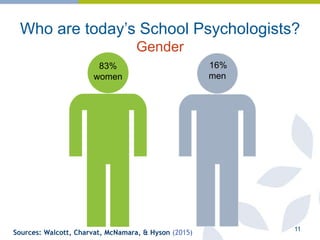
83%
women
16%
men
Sources: Walcott, Charvat, McNamara, & Hyson (2015)
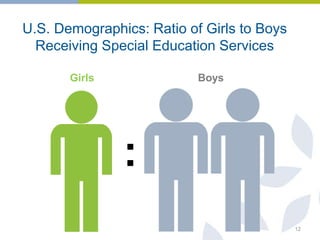
U.S. Demographics: Ratio of Girls to Boys
Receiving Special Education Services
12
:
Girls Boys
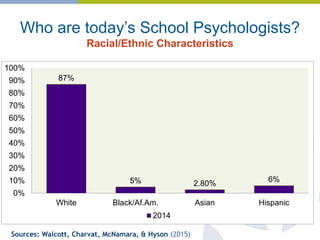
Who are today’s School Psychologists?
Racial/Ethnic Characteristics
87%
5% 2.80%
6%
0%
10%
20%
30%
40%
50%
60%
70%
80%
90%
100%
White Black/Af.Am. Asian Hispanic
2014
Sources: Walcott, Charvat, McNamara, & Hyson (2015)
U.S. Demographics
Racial/Ethnic Characteristics
Source: www.cencus.gov
78%
13%
5.40%
17%
76%
14%
4.70%
24.40%
0%
10%
20%
30%
40%
50%
60%
70%
80%
90%
100%
White Black/Af.Am. Asian Hispanic
Total Under 18
14
Who Are Today’s School Psychologists?
Linguistic Diversity
86%
7%
1.3%
5.3%
0
10
20
30
40
50
60
70
80
90
100
English Only Spanish American Sign
Language
Other Languages
(includes 27
different
languages)
15
Sources: Walcott, Charvat, McNamara, & Hyson (2015)
U.S. Demographics
Linguistic Diversity – Ages 5 and older
Among those speaking a language other than English
16
62%
4.80%
2.10% 1.80% 2.60%
0%
10%
20%
30%
40%
50%
60%
70%
Spanish Chinese French German Tagalog
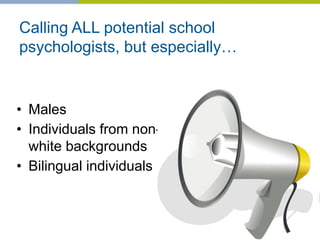
Calling ALL potential school
psychologists, but especially…
• Males
• Individuals from non-
white backgrounds
• Bilingual individuals
17
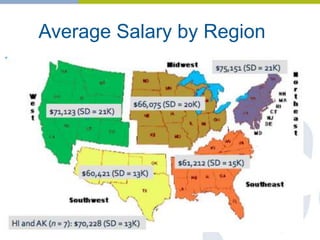
Average Salary by Region
18
19
Preparation
for graduate
school
Graduate
school
coursework
Practicum
experience Internship
How to Become a
School Psychologist
• A bachelor’s degree with a major in:
– Psychology
– Child Development
– Sociology
– Education or related field
• Volunteer or work experience with
children and youth
– For example; camp, school, YMCA, or
mentoring program
Preparation for
Graduate School
Considerations When
Applying to Programs
• Degree level
• Program Approval
• Faculty
• Size of program
• Location
• Research opportunities
• Availability of financial support
• Employment rates
• Rate of completion
• Advising opportunities
For more information: http://apps.nasponline.org/standards-and-certification/graduate-education/index.aspx
21
Preparation for
Graduate School
Selecting a Degree
Program
Specialist-Level (EdS;
CAGS, CAS)
• >60 graduate semester
hours
• 3+ years full-time (includes
one year internship)
• Entry-level degree
• Typically allows for work in
schools
Doctoral-level (PhD,
PsyD)
• >90 graduate semester
hours
• 5-6+ years (includes one
year internship)
• Allows for work in schools,
academia, research
• More options for
independent practice
Preparation for
Graduate School
Program Approval/
Accreditation
• Most graduate programs hold one or more types of
accreditation:
– NASP-approval of specialist and doctoral levels
• http://www.nasponline.org/standards-and-
certification/graduate-program-approval/nasp-
approved-programs
– APA accreditation for doctoral programs
– State department of education approval for
programs that lead to a state certificate or
license for graduates
23
Preparation for
Graduate School
24
Develops knowledge and skills in
Prevention and Intervention Services for
Students and Families:
Graduate school
coursework
• Assessment
• Academic/learning interventions
• Mental and behavioral health interventions
• Instructional support
• Special education services
• Crisis preparedness, response, and recovery
• Family-school-community collaboration
• Cultural competence
25
Develops knowledge and skills in
Foundations of Services Needed in
Schools
Graduate school
coursework
• Data collection and analysis
• Resilience and risk factors
• Consultation and collaboration
• Diversity in development and learning
• Research and program evaluation
• Professional ethics
• Education law
Graduate School Field Experiences
– Supervised experiences in schools, clinics, or
related settings throughout your graduate
program allow you to apply specific skills and
techniques learned in courses.
– Culminating experience
– Provides intensive and supervised preparation
for first job
– Full year (1200-1500+ hours)
26
Practicum Experiences
Internship
Getting a Job
• School psychologists must hold a current, valid
state credential for practice
• A state-by-state summary of school psychologist
certificate and license requirements is found at:
– https://www.nasponline.org/standards-and-
certification/state-school-psychology-credentialing-
requirements
• Independent practice may require an
additional credential
27
Job Outlook?
• High national demand for school
psychologists
• Federal education law includes provisions for
school psychologists services
• Particular need for professionals from
culturally and linguistically diverse
backgrounds
• For several years, “school psychologist” has been
listed in Top 10 among Best Social Services Jobs
in U.S. News &World Report.
• Stable career with good benefits 28
A Great Career Choice!
• Positively impact the lives of youth
• Help parents and educators
• Flexible school schedule
• Range of responsibilities
• Variety of work settings
29
Questions?
30
References/Resources
Castillo, J.M., Curtis, M. J., Chappel, A., & Cunningham, J. (2011, February).
School psychology 2010: Results of the national membership study. Paper
presented at the annual convention of the National Association of School
Psychologists, San Francisco, CA.
Fagan, T. K., & Wise, P. S. (2007). School psychology: Past, present, and future 3rd
Ed. Bethesda: NASP.
Harrison, P., & Thomas, A. (2014). Best practices in school psychology VI.
Bethesda: NASP.
U.S. Census Bureau (2010). Place of Birth of the Foreign-Born Population: 2009.
Washington, DC: U.S. Census Bureau.
www.census.gov/prod/2010pubs/acsbr09-15.pdf
U.S. Census Bureau (2010). Race and Hispanic Origin of the Foreign-Born
Population in the United States: 2007. Washington, DC: U.S. Census Bureau.
www.census.gov/prod/2010pubs/acs-11.pdf
U.S. News & World Report. Best Social Service Jobs. Retrieved from
http://money.usnews.com/careers/best-jobs/school-psychologist
31
For more information, contact:
National Association of School Psychologists
www.nasponline.org
32
As an African American school psychologist,
I knew I could make a difference with
individuals, groups, and systems that allow
trends of disproportionality to continue. But
even more importantly, I knew that by
becoming a culturally responsive school
psych, I could spread best practices in
general and special education that could
improve the learning experiences for all
students.
— Nicholas McIntosh, EdS
School Psychologist, California
“Ya’at’eeh. Greetings! I am Diné/Navajo. I
aspire to advocate for our Native American
students who continue to be
disproportionately underrepresented and
misidentified in Special Education and
increase the awareness and insight in the
areas of historical and intergenerational
trauma –a powerful dynamic that continues
to impact Native students’ identities and
academic success today.”
— Alyssa Ashley, EdS , School Psychologist, Arizona
“As an African- American male, I am driven
to become a change-agent at schools for
students from culturally linguistically diverse
(CLD) backgrounds. As a future school
psychologist, my dream is to empower
students to understand that they can
succeed no matter what obstacles; they may
face during their educational career.”
— Daunte Haynes, M.A.
EdS School Psychology Student, California
I love the variety in my job. I do assessment,
counseling, consultation, direct academic
and behavioral intervention, staff support
and training , and crisis response. No day is
ever the same!
-- Jaimi McDonough, Ph.D., School Psychologist, Texas
36
I became a school psychologist because I
have a passion for working with and helping
kids accomplish their goals. I also love
working in a school setting and collaborating
with teams of coworkers to solve problems.
--Lynsi Havens
EdS School Psychology Student, Wisconsin
37
Being a school psychologist is the best job
I’ve ever had. I get to improve children’s
lives and support appropriate educaiton for
all. It’s a great feeling to know you’re making
a positive impact on the future.
--Susan Jarmuz-Smith, School Psychologist, Maine
38
39

NASP_Careers_in_SP.pptx

  • 1.
    Improving the Livesand Learning of Children and Youth Insert Name and Date Location
  • 2.
    What do youwant for your career? 2
  • 3.
    What are youlooking for in a job? Lots of job openings? Diverse roles and responsibilities? Good salary and benefits? Job flexibility and stability?
  • 4.
    School Psychology might bethe career for you!
  • 5.
    Who are schoolpsychologists? • Highly-qualified professionals with a graduate degree • Work in schools and related settings • Provide comprehensive psychological and educational services to diverse students • Promote children’s learning, positive behavior, and development • Support students’ social, emotional, and mental health
  • 6.
    What do SchoolPsychologists do? • Conduct assessments, counseling, and other mental health and academic services • Work with children individually and in groups • Collaborate with parents, teachers, and administrators • Help schools, families, and communities provide successful outcomes for children 6
  • 7.
    INSERT A PERSONALSTORY OR SPECIFICS • (Alternative: insert a testimonial or video?)
  • 8.
    When do childrenNEED a School Psychologist? • Learning difficulties • Behavior and attention concerns • Problems with peers (isolation, bullying) • Depression and other mental health issues • Coping with crisis & trauma (natural disasters, war, school violence, abuse, rape) • Poverty, violence, homelessness, foster youth, loss, grief • Family issues (divorce, death, substance abuse, military deployment)
  • 9.
    Most school psychologistswork in K-12 public schools. 9
  • 10.
    Where do School Psychologistswork? 10 86% Public Schools 7% Private Practice 10% Colleges & Universities 6.7% Faith-Based Schools 1.6% Dept. of Education 1.5 Clinics & hospitals 7.7% 8% Private Schools Sources: Walcott, Charvat, McNamara, & Hyson (2015)
  • 11.
    Who are today’sSchool Psychologists? Gender 11 83% women 16% men Sources: Walcott, Charvat, McNamara, & Hyson (2015)
  • 12.
    U.S. Demographics: Ratioof Girls to Boys Receiving Special Education Services 12 : Girls Boys
  • 13.
    Who are today’sSchool Psychologists? Racial/Ethnic Characteristics 87% 5% 2.80% 6% 0% 10% 20% 30% 40% 50% 60% 70% 80% 90% 100% White Black/Af.Am. Asian Hispanic 2014 Sources: Walcott, Charvat, McNamara, & Hyson (2015)
  • 14.
    U.S. Demographics Racial/Ethnic Characteristics Source:www.cencus.gov 78% 13% 5.40% 17% 76% 14% 4.70% 24.40% 0% 10% 20% 30% 40% 50% 60% 70% 80% 90% 100% White Black/Af.Am. Asian Hispanic Total Under 18 14
  • 15.
    Who Are Today’sSchool Psychologists? Linguistic Diversity 86% 7% 1.3% 5.3% 0 10 20 30 40 50 60 70 80 90 100 English Only Spanish American Sign Language Other Languages (includes 27 different languages) 15 Sources: Walcott, Charvat, McNamara, & Hyson (2015)
  • 16.
    U.S. Demographics Linguistic Diversity– Ages 5 and older Among those speaking a language other than English 16 62% 4.80% 2.10% 1.80% 2.60% 0% 10% 20% 30% 40% 50% 60% 70% Spanish Chinese French German Tagalog
  • 17.
    Calling ALL potentialschool psychologists, but especially… • Males • Individuals from non- white backgrounds • Bilingual individuals 17
  • 18.
  • 19.
  • 20.
    • A bachelor’sdegree with a major in: – Psychology – Child Development – Sociology – Education or related field • Volunteer or work experience with children and youth – For example; camp, school, YMCA, or mentoring program Preparation for Graduate School
  • 21.
    Considerations When Applying toPrograms • Degree level • Program Approval • Faculty • Size of program • Location • Research opportunities • Availability of financial support • Employment rates • Rate of completion • Advising opportunities For more information: http://apps.nasponline.org/standards-and-certification/graduate-education/index.aspx 21 Preparation for Graduate School
  • 22.
    Selecting a Degree Program Specialist-Level(EdS; CAGS, CAS) • >60 graduate semester hours • 3+ years full-time (includes one year internship) • Entry-level degree • Typically allows for work in schools Doctoral-level (PhD, PsyD) • >90 graduate semester hours • 5-6+ years (includes one year internship) • Allows for work in schools, academia, research • More options for independent practice Preparation for Graduate School
  • 23.
    Program Approval/ Accreditation • Mostgraduate programs hold one or more types of accreditation: – NASP-approval of specialist and doctoral levels • http://www.nasponline.org/standards-and- certification/graduate-program-approval/nasp- approved-programs – APA accreditation for doctoral programs – State department of education approval for programs that lead to a state certificate or license for graduates 23 Preparation for Graduate School
  • 24.
    24 Develops knowledge andskills in Prevention and Intervention Services for Students and Families: Graduate school coursework • Assessment • Academic/learning interventions • Mental and behavioral health interventions • Instructional support • Special education services • Crisis preparedness, response, and recovery • Family-school-community collaboration • Cultural competence
  • 25.
    25 Develops knowledge andskills in Foundations of Services Needed in Schools Graduate school coursework • Data collection and analysis • Resilience and risk factors • Consultation and collaboration • Diversity in development and learning • Research and program evaluation • Professional ethics • Education law
  • 26.
    Graduate School FieldExperiences – Supervised experiences in schools, clinics, or related settings throughout your graduate program allow you to apply specific skills and techniques learned in courses. – Culminating experience – Provides intensive and supervised preparation for first job – Full year (1200-1500+ hours) 26 Practicum Experiences Internship
  • 27.
    Getting a Job •School psychologists must hold a current, valid state credential for practice • A state-by-state summary of school psychologist certificate and license requirements is found at: – https://www.nasponline.org/standards-and- certification/state-school-psychology-credentialing- requirements • Independent practice may require an additional credential 27
  • 28.
    Job Outlook? • Highnational demand for school psychologists • Federal education law includes provisions for school psychologists services • Particular need for professionals from culturally and linguistically diverse backgrounds • For several years, “school psychologist” has been listed in Top 10 among Best Social Services Jobs in U.S. News &World Report. • Stable career with good benefits 28
  • 29.
    A Great CareerChoice! • Positively impact the lives of youth • Help parents and educators • Flexible school schedule • Range of responsibilities • Variety of work settings 29
  • 30.
  • 31.
    References/Resources Castillo, J.M., Curtis,M. J., Chappel, A., & Cunningham, J. (2011, February). School psychology 2010: Results of the national membership study. Paper presented at the annual convention of the National Association of School Psychologists, San Francisco, CA. Fagan, T. K., & Wise, P. S. (2007). School psychology: Past, present, and future 3rd Ed. Bethesda: NASP. Harrison, P., & Thomas, A. (2014). Best practices in school psychology VI. Bethesda: NASP. U.S. Census Bureau (2010). Place of Birth of the Foreign-Born Population: 2009. Washington, DC: U.S. Census Bureau. www.census.gov/prod/2010pubs/acsbr09-15.pdf U.S. Census Bureau (2010). Race and Hispanic Origin of the Foreign-Born Population in the United States: 2007. Washington, DC: U.S. Census Bureau. www.census.gov/prod/2010pubs/acs-11.pdf U.S. News & World Report. Best Social Service Jobs. Retrieved from http://money.usnews.com/careers/best-jobs/school-psychologist 31
  • 32.
    For more information,contact: National Association of School Psychologists www.nasponline.org 32
  • 33.
    As an AfricanAmerican school psychologist, I knew I could make a difference with individuals, groups, and systems that allow trends of disproportionality to continue. But even more importantly, I knew that by becoming a culturally responsive school psych, I could spread best practices in general and special education that could improve the learning experiences for all students. — Nicholas McIntosh, EdS School Psychologist, California
  • 34.
    “Ya’at’eeh. Greetings! Iam Diné/Navajo. I aspire to advocate for our Native American students who continue to be disproportionately underrepresented and misidentified in Special Education and increase the awareness and insight in the areas of historical and intergenerational trauma –a powerful dynamic that continues to impact Native students’ identities and academic success today.” — Alyssa Ashley, EdS , School Psychologist, Arizona
  • 35.
    “As an African-American male, I am driven to become a change-agent at schools for students from culturally linguistically diverse (CLD) backgrounds. As a future school psychologist, my dream is to empower students to understand that they can succeed no matter what obstacles; they may face during their educational career.” — Daunte Haynes, M.A. EdS School Psychology Student, California
  • 36.
    I love thevariety in my job. I do assessment, counseling, consultation, direct academic and behavioral intervention, staff support and training , and crisis response. No day is ever the same! -- Jaimi McDonough, Ph.D., School Psychologist, Texas 36
  • 37.
    I became aschool psychologist because I have a passion for working with and helping kids accomplish their goals. I also love working in a school setting and collaborating with teams of coworkers to solve problems. --Lynsi Havens EdS School Psychology Student, Wisconsin 37
  • 38.
    Being a schoolpsychologist is the best job I’ve ever had. I get to improve children’s lives and support appropriate educaiton for all. It’s a great feeling to know you’re making a positive impact on the future. --Susan Jarmuz-Smith, School Psychologist, Maine 38
  • 39.