Lasting Power of Attorney
Advance Medical Directive
Dr Tan Jit Seng
Director and Senior Home Care
Physician
Lotus Eldercare
Advance Care Planning
• Advance Care Planning (ACP) involves conversations
between healthcare professionals, patients and their family
members about the patient's future healthcare plans.
Having these discussions can reduce crisis decision-making
and ensure that medical decisions are made in the patient's
best interest.
AIC, together with the ACP Steering Committee, has
facilitated training for over 170 ACP facilitators and
organised awareness talks for healthcare staff in
restructured hospitals, nursing homes, hospices and dialysis
centres.
What is ACP?
• Advance care planning is an on-going communication process
between the advance care planning facilitator, the patient, health
professionals involved in the patient’s care, and the patient’s next-
of-kin. It helps the patient reflect, plan and make decisions for
future healthcare options. The patient’s thoughts and wishes are
documented and shared with everyone involved in his or her care. If
the patient loses capacity to make specific healthcare decisions in
the future advance care planning will help guide decisions to ensure
the patient’s interest.
Advance Care Planning is:
• An inclusive process that involves the patient’s loved ones
• A non-legal plan for future medical care in relation to the patient’s
current clinical status
• An ongoing communication process
How does ACP work?
• ACP encourages open communication. It assists patients, their
loved ones and health professionals involved in their care think and
talk about their medical options in a non-emergency environment.
• This anticipatory care approach is not only useful for patients with
an illness and who want to make decisions about specific
treatments, but is also beneficial for healthy individuals who want
to make known the sort of medical treatments they would like or
would refuse.
• The Living Matters ACP framework also encourages patients to
appoint a substitute decision maker who can make decisions on
their behalf if they become too ill to speak.
Advance Care Planning
Communication in the formulation of the care
arrangement and treatment for hypothetical but
highly possible future scenarios, e.g. -
• Possible theoretical trajectory of dying
• Diseases leading to demise
• Disability and period of dependency to care
givers
• Example: Dying with Dignity
Advance Care Planning
• Recognise the options available
• Input ideas, concerns and expectations on end
of life care plans
• Deciding on proxy decision makers
• Making them official via LPA and AMD
• Keep dying issues alive and kicking
Decision on Goals of Care
• No more treatment if ill, not even oral antibiotics.
Only medications providing comfort e.g.
morphine
• Treatment at home only, no hospitalisation
• Hospitalisation but only maximum ward
treatment, no CPR or ICU
• High Dependency care but no CPR or ventilatory
support
• Intensive Care Unit admission and indefinite
support with CPR and ventilatory support
Advance Psychosocial & Spiritual
Planning
• Religious support
• Site of care, in hospital/hospices/nursing
homes/own home
• Persons to care and to meet during the last
days
• Lasts wishes, wills
• Rites and rituals at funeral; Organ donations;
type of burial etc
Lasting Power of Attorney
The Office of the Public Guardian
• The Office of the Public Guardian (“OPG”) works
towards protecting the dignity and interests of
individuals who lack mental capacity and are
vulnerable as well as encouraging proactive
planning for an eventuality of losing one’s mental
capacity.
• The OPG is a Division of the Ministry of Social and
Family Development (“MSF”). The Office supports
the Public Guardian in carrying out his functions.
The Public Guardian
The Public Guardian carries out various functions towards
enabling and protecting persons who lack capacity. These
functions include:
• To set up and maintain a register of Lasting Power of
Attorney ("LPA") and to set up and maintain a register
of court orders that appoint deputies,
• To supervise deputies,
• To receive reports from donees and deputies,
• To investigate any alleged violation of any provision in
the Mental Capacity Act, including complaints about
the way in which donees and deputies are exercising
their powers. Recent case on Mdm Chung Khin Chun
The Lasting Power of Attorney
• A Lasting Power of Attorney ("LPA") is a legal
document which allows a person who is at
least 21 years of age ('donor'), to voluntarily
appoint one or more persons ('donee(s)'), to
make decisions and act on his behalf as his
proxy decision maker if he should lose mental
capacity one day. A donee(s) can be appointed
to act in two broad areas: personal welfare as
well as property & affairs matters.
LPA Forms (September 2014)
• http://www.publicguardian.gov.sg/Portals/0/
New%20Forms/(ToFill)ApplicationForm_1Sep1
4.pdf
• http://www.publicguardian.gov.sg/Portals/0/
New%20Forms/(ToFill)LPAForm1_1Sep14.pdf
• http://www.publicguardian.gov.sg/Portals/0/
New%20Forms/(ToFill)LPAForm2_1Sep14.pdf
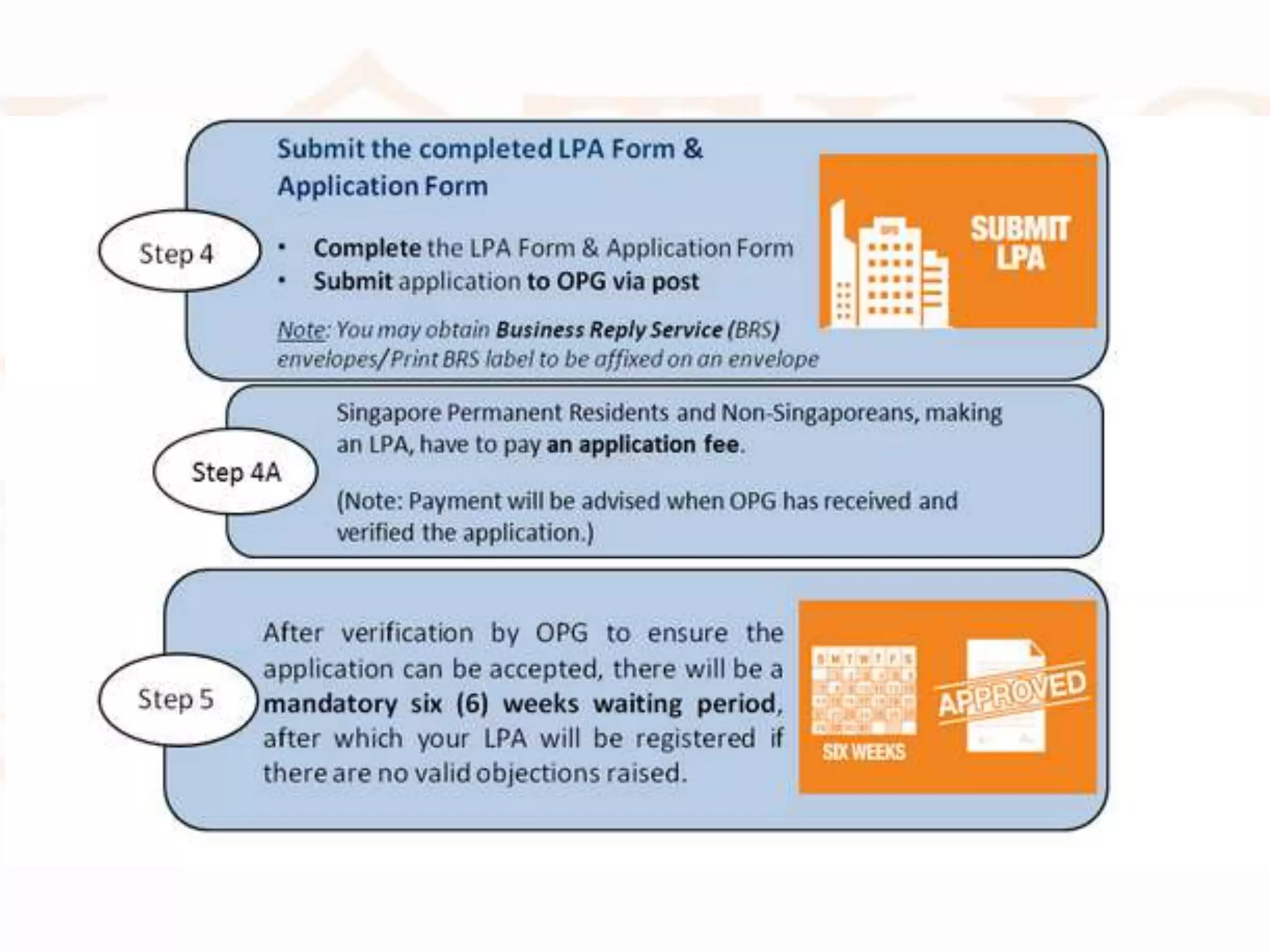
Procedure to sign an LPA
• LPA can be issued by accredited GPs, any Lawyers or
Psychiatrists
• Demonstrating Decision-making capacity:
– Understand information relevant to the decision, including
the purpose of any proposed course of action, the main
benefits, risk and alternatives, and the consequences of
refusing to follow the proposed course of action and of
failing to make a decision
– Retain the information long enough to make a decision
– Use or weigh that information as part of the process of
making the decision
– Communicates his or her decision, whether by speech,
sign language or other means.
Guidebooks
• http://www.publicguardian.gov.sg/Portals/0/Gui
des/Caregivers_Eng.pdf
• http://www.publicguardian.gov.sg/Portals/0/Gui
des/Donees%20Guide_Eng.pdf
• http://www.publicguardian.gov.sg/Portals/0/Gui
des/Guide%20to%20LPA_Eng.pdf
• http://www.publicguardian.gov.sg/Portals/0/Gui
des/Deputys%20Guide-Eng.pdf
• http://www.publicguardian.gov.sg/Portals/0/Gui
des/[EN]%20COP_3%20Apr%202014.pdf
Advance Medical Directive
• An Advance Medical Directive (AMD) is a legal
document you sign in advance to inform your
doctor that you do not want the use of any
life-sustaining treatment to be used to prolong
your life in the event you become terminally ill
and unconscious and where death is
imminent.
Advance Medical Directive
• The AMD can be made by any person, aged 21
years and above, and is not mentally disordered.
The AMD form is a legal document which must be
completed and signed in the presence of two
witnesses before it is returned to the Registrar of
AMDs.
• The patient's doctor must be one of the two
witnesses, while the other witness must be at
least 21 years old. In addition, both witnesses
must not have any vested interests in the
patient's death.
Advance Medical Directive
Certification of terminal condition by doctor-in-charge of
care, using a prescribed form, and submit the certificate
to the Registrar of AMD, who will in turn conduct a
search if the patient is on the register.
• A total of 3 doctors need to concur on ‘terminality’,
and at least 2 of them must be Specialists. In case of
disagreement, DMS can appoint 3 specialists to deliberate
on this. The assessment must be unanimous.
• Unless the doctor-in-charge of care has registered his
objections, he is obligated to comply with the AMD.
Advance Medical Directive
It is offence for the doctor to enquire whether
Directive has been made, or is to be made by
the patient, unless such discussions are: -
• consistent with good medical practice;
• held in the context of doctor-patient
relationship
• in furtherance of the purposes of public
education
ADVANCE MEDICAL DIRECTIVE ACT
Chapter 4A
New advances in medical knowledge and technology create new choices for
both patients and health care providers. Some of these choices raise new
ethical and legal issues.
One issue is that modern medical technology can technically prolong life in
the final stages of a terminal illness. However, it cannot stop the dying
process. In such situations, further medical intervention would be medically
ineffective, and a decision has to be made whether to withdraw such futile
medical intervention. Some terminally ill persons who are unable to express
their wishes at that time, may want to be spared further suffering and be
allowed to die naturally, in peace and with dignity.
The law in Singapore allows Singaporeans who wish to make an advance
medical directive to do so. The AMD Act was passed in Parliament in May
1996.
ADVANCE MEDICAL DIRECTIVE ACT
• 1 "Extraordinary life-sustaining treatment" is any
medical treatment which serves only to prolong the
process of dying for terminally ill patients but does not cure
the illness. An example is the respirator that is connected
to a patient to assist him/her to breathe. It serves only to
artificially prolong the life of a terminally ill patient.
2 "Terminal illness" is defined in the Act as an incurable
condition caused by injury or disease from which there is
no reasonable prospect of a temporary or permanent
recovery. For such a condition, death is imminent even
if extraordinary life-sustaining measures were used. These
measures would only serve to postpone the moment of
death for the patient.
AMD Form
• http://www.moh.gov.sg/content/dam/moh_w
eb/Forms/FORM1AMD(270905).pdf
Pit Falls
• LPA –
– Proxy not involved in discussion
– Patient’s preference is vague or non-specific
– Family disagrees with patient’s decisions
• AMD –
– Not practical in real life clinical practice
– No role on emergency practice or resuscitation
processes
• INTERPRETATION OF TERMS
– What is and is not terminal in modern medicine?
Interviews with practitioners:
• “It is very restrictive…having to check with the Register only DURING
OFFICE HOURS. Many a times, we make decisions for intubation outside
office hours you know. We can’t wait for AMD office to operate. ..
• Through my career, perhaps I might have attempted 4-5 times to activate
AMD, almost always only after having been informed by a family member.
If the family member had not told us, we might not have checked!
Anyway, a good window to check would be the point when we decide to
open a tracheostomy, after an Endotracheal tube had been inserted – but
then again, if we do decide to do tracheostomy, we must believe the
patient will survive, right? Then he is not terminal…
• Moreover, it is a whole spectrum of degree of ‘active care’ that can be
done. “Life support is not ‘black or white’.”
– paraphrased from a senior anaesthetist-intensivist in private practice
Interviews with practitioners:
• “Actually the grey file of hospice care association is more useful.
Immediately tells us the extend of care expected. I have never used
the AMD nor seen it used during resuscitation.”
– a senior ED Physician in a restructured hospital
• “The AMD is very narrow – the patient must be terminally ill. If the
person is brain-dead, I don’t even need the AMD to decide on what
to do next. How do you define being ‘terminally ill’? if the life can
be sustained with ventilator and artificial feeding and hydration, is
the patient terminally ill?”
– another intensivist in a restructured hospital

2014 LPA AMD ACP Talk

  • 1.
    Lasting Power ofAttorney Advance Medical Directive Dr Tan Jit Seng Director and Senior Home Care Physician Lotus Eldercare
  • 2.
    Advance Care Planning •Advance Care Planning (ACP) involves conversations between healthcare professionals, patients and their family members about the patient's future healthcare plans. Having these discussions can reduce crisis decision-making and ensure that medical decisions are made in the patient's best interest. AIC, together with the ACP Steering Committee, has facilitated training for over 170 ACP facilitators and organised awareness talks for healthcare staff in restructured hospitals, nursing homes, hospices and dialysis centres.
  • 3.
    What is ACP? •Advance care planning is an on-going communication process between the advance care planning facilitator, the patient, health professionals involved in the patient’s care, and the patient’s next- of-kin. It helps the patient reflect, plan and make decisions for future healthcare options. The patient’s thoughts and wishes are documented and shared with everyone involved in his or her care. If the patient loses capacity to make specific healthcare decisions in the future advance care planning will help guide decisions to ensure the patient’s interest. Advance Care Planning is: • An inclusive process that involves the patient’s loved ones • A non-legal plan for future medical care in relation to the patient’s current clinical status • An ongoing communication process
  • 4.
    How does ACPwork? • ACP encourages open communication. It assists patients, their loved ones and health professionals involved in their care think and talk about their medical options in a non-emergency environment. • This anticipatory care approach is not only useful for patients with an illness and who want to make decisions about specific treatments, but is also beneficial for healthy individuals who want to make known the sort of medical treatments they would like or would refuse. • The Living Matters ACP framework also encourages patients to appoint a substitute decision maker who can make decisions on their behalf if they become too ill to speak.
  • 6.
    Advance Care Planning Communicationin the formulation of the care arrangement and treatment for hypothetical but highly possible future scenarios, e.g. - • Possible theoretical trajectory of dying • Diseases leading to demise • Disability and period of dependency to care givers • Example: Dying with Dignity
  • 9.
    Advance Care Planning •Recognise the options available • Input ideas, concerns and expectations on end of life care plans • Deciding on proxy decision makers • Making them official via LPA and AMD • Keep dying issues alive and kicking
  • 10.
    Decision on Goalsof Care • No more treatment if ill, not even oral antibiotics. Only medications providing comfort e.g. morphine • Treatment at home only, no hospitalisation • Hospitalisation but only maximum ward treatment, no CPR or ICU • High Dependency care but no CPR or ventilatory support • Intensive Care Unit admission and indefinite support with CPR and ventilatory support
  • 11.
    Advance Psychosocial &Spiritual Planning • Religious support • Site of care, in hospital/hospices/nursing homes/own home • Persons to care and to meet during the last days • Lasts wishes, wills • Rites and rituals at funeral; Organ donations; type of burial etc
  • 12.
    Lasting Power ofAttorney The Office of the Public Guardian • The Office of the Public Guardian (“OPG”) works towards protecting the dignity and interests of individuals who lack mental capacity and are vulnerable as well as encouraging proactive planning for an eventuality of losing one’s mental capacity. • The OPG is a Division of the Ministry of Social and Family Development (“MSF”). The Office supports the Public Guardian in carrying out his functions.
  • 13.
    The Public Guardian ThePublic Guardian carries out various functions towards enabling and protecting persons who lack capacity. These functions include: • To set up and maintain a register of Lasting Power of Attorney ("LPA") and to set up and maintain a register of court orders that appoint deputies, • To supervise deputies, • To receive reports from donees and deputies, • To investigate any alleged violation of any provision in the Mental Capacity Act, including complaints about the way in which donees and deputies are exercising their powers. Recent case on Mdm Chung Khin Chun
  • 14.
    The Lasting Powerof Attorney • A Lasting Power of Attorney ("LPA") is a legal document which allows a person who is at least 21 years of age ('donor'), to voluntarily appoint one or more persons ('donee(s)'), to make decisions and act on his behalf as his proxy decision maker if he should lose mental capacity one day. A donee(s) can be appointed to act in two broad areas: personal welfare as well as property & affairs matters.
  • 15.
    LPA Forms (September2014) • http://www.publicguardian.gov.sg/Portals/0/ New%20Forms/(ToFill)ApplicationForm_1Sep1 4.pdf • http://www.publicguardian.gov.sg/Portals/0/ New%20Forms/(ToFill)LPAForm1_1Sep14.pdf • http://www.publicguardian.gov.sg/Portals/0/ New%20Forms/(ToFill)LPAForm2_1Sep14.pdf
  • 18.
    Procedure to signan LPA • LPA can be issued by accredited GPs, any Lawyers or Psychiatrists • Demonstrating Decision-making capacity: – Understand information relevant to the decision, including the purpose of any proposed course of action, the main benefits, risk and alternatives, and the consequences of refusing to follow the proposed course of action and of failing to make a decision – Retain the information long enough to make a decision – Use or weigh that information as part of the process of making the decision – Communicates his or her decision, whether by speech, sign language or other means.
  • 21.
    Guidebooks • http://www.publicguardian.gov.sg/Portals/0/Gui des/Caregivers_Eng.pdf • http://www.publicguardian.gov.sg/Portals/0/Gui des/Donees%20Guide_Eng.pdf •http://www.publicguardian.gov.sg/Portals/0/Gui des/Guide%20to%20LPA_Eng.pdf • http://www.publicguardian.gov.sg/Portals/0/Gui des/Deputys%20Guide-Eng.pdf • http://www.publicguardian.gov.sg/Portals/0/Gui des/[EN]%20COP_3%20Apr%202014.pdf
  • 22.
    Advance Medical Directive •An Advance Medical Directive (AMD) is a legal document you sign in advance to inform your doctor that you do not want the use of any life-sustaining treatment to be used to prolong your life in the event you become terminally ill and unconscious and where death is imminent.
  • 23.
    Advance Medical Directive •The AMD can be made by any person, aged 21 years and above, and is not mentally disordered. The AMD form is a legal document which must be completed and signed in the presence of two witnesses before it is returned to the Registrar of AMDs. • The patient's doctor must be one of the two witnesses, while the other witness must be at least 21 years old. In addition, both witnesses must not have any vested interests in the patient's death.
  • 24.
    Advance Medical Directive Certificationof terminal condition by doctor-in-charge of care, using a prescribed form, and submit the certificate to the Registrar of AMD, who will in turn conduct a search if the patient is on the register. • A total of 3 doctors need to concur on ‘terminality’, and at least 2 of them must be Specialists. In case of disagreement, DMS can appoint 3 specialists to deliberate on this. The assessment must be unanimous. • Unless the doctor-in-charge of care has registered his objections, he is obligated to comply with the AMD.
  • 25.
    Advance Medical Directive Itis offence for the doctor to enquire whether Directive has been made, or is to be made by the patient, unless such discussions are: - • consistent with good medical practice; • held in the context of doctor-patient relationship • in furtherance of the purposes of public education
  • 26.
    ADVANCE MEDICAL DIRECTIVEACT Chapter 4A New advances in medical knowledge and technology create new choices for both patients and health care providers. Some of these choices raise new ethical and legal issues. One issue is that modern medical technology can technically prolong life in the final stages of a terminal illness. However, it cannot stop the dying process. In such situations, further medical intervention would be medically ineffective, and a decision has to be made whether to withdraw such futile medical intervention. Some terminally ill persons who are unable to express their wishes at that time, may want to be spared further suffering and be allowed to die naturally, in peace and with dignity. The law in Singapore allows Singaporeans who wish to make an advance medical directive to do so. The AMD Act was passed in Parliament in May 1996.
  • 27.
    ADVANCE MEDICAL DIRECTIVEACT • 1 "Extraordinary life-sustaining treatment" is any medical treatment which serves only to prolong the process of dying for terminally ill patients but does not cure the illness. An example is the respirator that is connected to a patient to assist him/her to breathe. It serves only to artificially prolong the life of a terminally ill patient. 2 "Terminal illness" is defined in the Act as an incurable condition caused by injury or disease from which there is no reasonable prospect of a temporary or permanent recovery. For such a condition, death is imminent even if extraordinary life-sustaining measures were used. These measures would only serve to postpone the moment of death for the patient.
  • 28.
  • 29.
    Pit Falls • LPA– – Proxy not involved in discussion – Patient’s preference is vague or non-specific – Family disagrees with patient’s decisions • AMD – – Not practical in real life clinical practice – No role on emergency practice or resuscitation processes • INTERPRETATION OF TERMS – What is and is not terminal in modern medicine?
  • 30.
    Interviews with practitioners: •“It is very restrictive…having to check with the Register only DURING OFFICE HOURS. Many a times, we make decisions for intubation outside office hours you know. We can’t wait for AMD office to operate. .. • Through my career, perhaps I might have attempted 4-5 times to activate AMD, almost always only after having been informed by a family member. If the family member had not told us, we might not have checked! Anyway, a good window to check would be the point when we decide to open a tracheostomy, after an Endotracheal tube had been inserted – but then again, if we do decide to do tracheostomy, we must believe the patient will survive, right? Then he is not terminal… • Moreover, it is a whole spectrum of degree of ‘active care’ that can be done. “Life support is not ‘black or white’.” – paraphrased from a senior anaesthetist-intensivist in private practice
  • 31.
    Interviews with practitioners: •“Actually the grey file of hospice care association is more useful. Immediately tells us the extend of care expected. I have never used the AMD nor seen it used during resuscitation.” – a senior ED Physician in a restructured hospital • “The AMD is very narrow – the patient must be terminally ill. If the person is brain-dead, I don’t even need the AMD to decide on what to do next. How do you define being ‘terminally ill’? if the life can be sustained with ventilator and artificial feeding and hydration, is the patient terminally ill?” – another intensivist in a restructured hospital

Editor's Notes