NAF’s Student
Certification
Assessment System
& New Assessment-
Based Certificate
Course-Based Assessment


#NAFNext
Course-Based Assessment


  Culminating
  Project Assessment   +   End of Course
                           Exam

#NAFNext
Culminating Project Assessment


  Upload A Work Sample   Reflect on Learning

#NAFNext
End of Course Exam


      Multiple Choice   Constructed Response

#NAFNext
Internship Assessment


#NAFNext
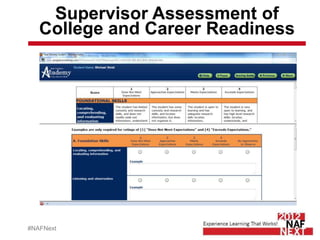
Supervisor Assessment of
   College and Career Readiness


#NAFNext
Supervisor Assessment of
   College and Career Readiness


#NAFNext
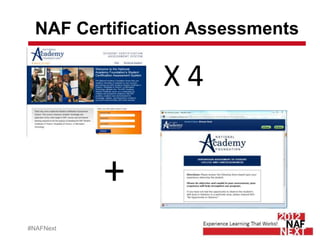
NAF Certification Assessments

                X4


           +
#NAFNext
Earning the NAF Certificate
 NAF Certification Assessments
   4 NAF Course Assessments
   NAF WBL Supervisor Assessment of
    College and Career Readiness

 High School Graduation, with
   College Admission Requirements Met
   College Placement Tests Waived

#NAFNext
Earning the NAF Certificate


#NAFNext
Why Is This Important To You?


      Improving Student Learning
#NAFNext
Why Is This Important To You?


   Improving Program Outcomes
#NAFNext
Why Is This Important To You?


                                       A
   Academy and School Recognition
#NAFNext
Why Is This Important To You?


                             Employer Invitation to
                            Informational Interview


Postsecondary and Industry/Employer Recognition
 #NAFNext
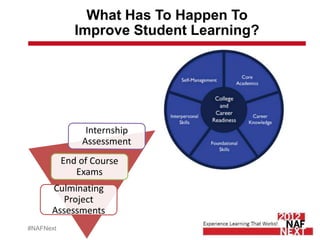
What Has To Happen To
           Improve Student Learning?


#NAFNext
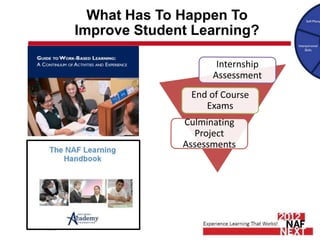
What Has To Happen To
           Improve Student Learning?


#NAFNext
What Has To Happen To
           Improve Student Learning?


#NAFNext
Culminating Project
    Assessment for Certification (CPAC)


#NAFNext
Culminating Project Assessment
   Measures CCR Knowledge and Skills


#NAFNext
Culminating Project
                Driving Questions

 “How can we educate our families and fellow
 students about issues critical to a person’s
 financial literacy?”

  “How can we best design an all-inclusive
  vacation package that is attractive to high school
  students?”
  “How do we best design a ‘dream’ computer
  system that meets a specific purpose and stays
  within budget?”

#NAFNext
Culminating Project
  Planning and Implementation Products

 • Research
 • Rough Drafts of Display Board, Brochure, and
   Talking Points

  • Business Proposal
  • Special Meal Plan, Itinerary, Promotion
    Plan, Brochure
  • Project Planner Report
  • Component Price List and Presentation
    Reference Sheet

#NAFNext
Culminating Project
                Final Products

 • Display Board
 • Brochure
 • Talking Points

  • Vacation Package
  • Vacation Package Presentation


  • Dream Computer PowerPoint Presentation


#NAFNext
Culminating Project
Assessment for Certification (CPAC)


#NAFNext
Culminating Project
Assessment for Certification (CPAC)


           Upload A Work Sample
#NAFNext
Culminating Project
Assessment for Certification (CPAC)


#NAFNext
Culminating Project
    Assessment for Certification (CPAC)


#NAFNext
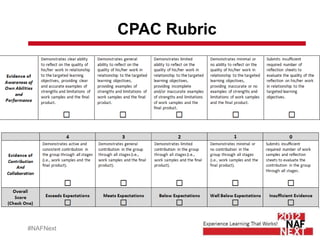
CPAC Rubric


#NAFNext
CPAC Rubric


#NAFNext
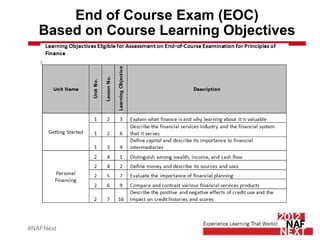
End of Course Exam (EOC)
   Based on Course Learning Objectives


#NAFNext
End of Course Exam (EOC)
   Based on Course Learning Objectives


#NAFNext
End of Course Exam (EOC)
   Based on Course Learning Objectives


#NAFNext
Measuring Career Knowledge


                                 End of
                                 Course
                                  Exam


#NAFNext
End of Course Exam


     35 Multiple Choice   5 Constructed Response
     32 Count + 3 Test    4 Count + 1 Test

#NAFNext
Internship Assessment
   Measures CCR Knowledge and Skills


#NAFNext
Skills Assessed
    Through WBL and Internship


#NAFNext
Skills Assessed
    Through WBL and Internship


#NAFNext
Skills Assessed
    Through WBL and Internship


#NAFNext
Skills Assessed
    Through WBL and Internship


#NAFNext
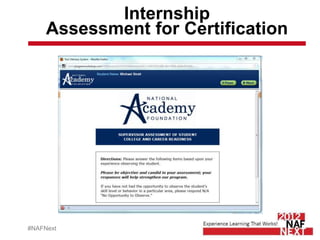
Internship
     Assessment for Certification


#NAFNext
Supervisor Assessment of
   College and Career Readiness


#NAFNext
First Steps
 NAF creates accounts for
  academies, administrators, teachers, and
  internship coordinators
 Academy school administrator adds academy
  students
 Teachers create classes, enroll students, and
  set due dates for culminating project
  assessment uploads and end of course exam
 Internship Coordinators enter supervisors and
  match students with supervisors

#NAFNext
Summary
This session has provided an overview of, and an opportunity to experience, NAF’s new

student certification assessment to be launched in the fall of 2012. The system is

designed to measure students’ knowledge and application of key career-related

technical content and 21st century skills essential for both college and career success.

The NAF student certification assessment system will help high schools comply with

federal and state accountability requirements and will be recognized by postsecondary

institutions and employers. But none of this will happen without academies
implementing the NAF model and teachers understanding and implementing the NAF

curriculum, and then using the certification assessment system to allow students the

opportunity to earn the NAF certificate. This is your opportunity to be NAF Next.


#NAFNext
For more information, contact


Michael J. Strait, Ph.D.
Director, Student Certification & Assessment
National Academy Foundation
2150 Shattuck Avenue, Suite 1200
Berkeley, CA 94704
415-692-1569
mstrait@naf.org


#NAFNext

Lunching the New NAF Certification and Assessments

  • 1.
    NAF’s Student Certification Assessment System &New Assessment- Based Certificate
  • 2.
  • 3.
    Course-Based Assessment Culminating Project Assessment + End of Course Exam #NAFNext
  • 4.
    Culminating Project Assessment Upload A Work Sample Reflect on Learning #NAFNext
  • 5.
    End of CourseExam Multiple Choice Constructed Response #NAFNext
  • 6.
  • 7.
    Supervisor Assessment of College and Career Readiness #NAFNext
  • 8.
    Supervisor Assessment of College and Career Readiness #NAFNext
  • 9.
  • 10.
    Earning the NAFCertificate  NAF Certification Assessments  4 NAF Course Assessments  NAF WBL Supervisor Assessment of College and Career Readiness  High School Graduation, with  College Admission Requirements Met  College Placement Tests Waived #NAFNext
  • 11.
    Earning the NAFCertificate #NAFNext
  • 12.
    Why Is ThisImportant To You? Improving Student Learning #NAFNext
  • 13.
    Why Is ThisImportant To You? Improving Program Outcomes #NAFNext
  • 14.
    Why Is ThisImportant To You? A Academy and School Recognition #NAFNext
  • 15.
    Why Is ThisImportant To You? Employer Invitation to Informational Interview Postsecondary and Industry/Employer Recognition #NAFNext
  • 16.
    What Has ToHappen To Improve Student Learning? #NAFNext
  • 17.
    What Has ToHappen To Improve Student Learning? #NAFNext
  • 18.
    What Has ToHappen To Improve Student Learning? #NAFNext
  • 19.
    Culminating Project Assessment for Certification (CPAC) #NAFNext
  • 20.
    Culminating Project Assessment Measures CCR Knowledge and Skills #NAFNext
  • 21.
    Culminating Project Driving Questions “How can we educate our families and fellow students about issues critical to a person’s financial literacy?” “How can we best design an all-inclusive vacation package that is attractive to high school students?” “How do we best design a ‘dream’ computer system that meets a specific purpose and stays within budget?” #NAFNext
  • 22.
    Culminating Project Planning and Implementation Products • Research • Rough Drafts of Display Board, Brochure, and Talking Points • Business Proposal • Special Meal Plan, Itinerary, Promotion Plan, Brochure • Project Planner Report • Component Price List and Presentation Reference Sheet #NAFNext
  • 23.
    Culminating Project Final Products • Display Board • Brochure • Talking Points • Vacation Package • Vacation Package Presentation • Dream Computer PowerPoint Presentation #NAFNext
  • 24.
    Culminating Project Assessment forCertification (CPAC) #NAFNext
  • 25.
    Culminating Project Assessment forCertification (CPAC) Upload A Work Sample #NAFNext
  • 26.
    Culminating Project Assessment forCertification (CPAC) #NAFNext
  • 27.
    Culminating Project Assessment for Certification (CPAC) #NAFNext
  • 28.
  • 29.
  • 30.
    End of CourseExam (EOC) Based on Course Learning Objectives #NAFNext
  • 31.
    End of CourseExam (EOC) Based on Course Learning Objectives #NAFNext
  • 32.
    End of CourseExam (EOC) Based on Course Learning Objectives #NAFNext
  • 33.
    Measuring Career Knowledge End of Course Exam #NAFNext
  • 34.
    End of CourseExam 35 Multiple Choice 5 Constructed Response 32 Count + 3 Test 4 Count + 1 Test #NAFNext
  • 35.
    Internship Assessment Measures CCR Knowledge and Skills #NAFNext
  • 36.
    Skills Assessed Through WBL and Internship #NAFNext
  • 37.
    Skills Assessed Through WBL and Internship #NAFNext
  • 38.
    Skills Assessed Through WBL and Internship #NAFNext
  • 39.
    Skills Assessed Through WBL and Internship #NAFNext
  • 40.
    Internship Assessment for Certification #NAFNext
  • 41.
    Supervisor Assessment of College and Career Readiness #NAFNext
  • 42.
    First Steps  NAFcreates accounts for academies, administrators, teachers, and internship coordinators  Academy school administrator adds academy students  Teachers create classes, enroll students, and set due dates for culminating project assessment uploads and end of course exam  Internship Coordinators enter supervisors and match students with supervisors #NAFNext
  • 43.
    Summary This session hasprovided an overview of, and an opportunity to experience, NAF’s new student certification assessment to be launched in the fall of 2012. The system is designed to measure students’ knowledge and application of key career-related technical content and 21st century skills essential for both college and career success. The NAF student certification assessment system will help high schools comply with federal and state accountability requirements and will be recognized by postsecondary institutions and employers. But none of this will happen without academies implementing the NAF model and teachers understanding and implementing the NAF curriculum, and then using the certification assessment system to allow students the opportunity to earn the NAF certificate. This is your opportunity to be NAF Next. #NAFNext
  • 44.
    For more information,contact Michael J. Strait, Ph.D. Director, Student Certification & Assessment National Academy Foundation 2150 Shattuck Avenue, Suite 1200 Berkeley, CA 94704 415-692-1569 mstrait@naf.org #NAFNext

Editor's Notes

  • #2 This session will provide an overview of, and an opportunity to experience, NAF’s new student certification assessment to be launched in the fall of 2012. The system is designed to measure students’ knowledge and application of key career-related technical content and 21st century skills essential for both college and career success. The NAF student certification assessment system will help high schools comply with federal and state accountability requirements and will be recognized by postsecondary institutions and employers. But none of this will happen without academies implementing the NAF model and teachers understanding and implementing the NAF curriculum, and then using the certification assessment system to allow students the opportunity to earn the NAF certificate. This is your opportunity to be NAF Next.
  • #3 The certification assessment system This is what students see as the login page to complete their part of the course-based assessments.
  • #4 The Student Certification Assessment System includes course-based assessments and an internship assessment. The course-based assessments include a summative assessment of the culminating project built into the course and an end of course exam targeting key learning objectives.
  • #5 The student’s part in the culminating project assessment includes uploading work samples they have produced in the culminating project in the course and writing short reflections on how their work relates to the learning objectives for the course and how they think they are doing.
  • #6 The end of course exam for each course is the most traditional component. It is mostly multiple choice items that are automatically scored by the computer but includes a few constructed response items that are scored by the teacher using a provided scoring guide.
  • #7 The Internship Coordinator adds internship supervisors and the dates of internship. An email is sent to the supervisor at the end of the internship with a link to an assessment form to be completed for the student intern.
  • #8 The supervisor does not have to login to the system. They click on a link provided in an email sent by the system and are taken to this beginning page to complete the assessment
  • #9 Here is a sample screen of what it looks like to the supervisor. Outcomes to be rated on a 4 point scale below and the scoring guide for each item above, with examples.
  • #10 Culminating Project Assessment and End of Course Exam in 4 NAF courses plus the supervisor assessment of college and career readiness in the student’s culminating work based learning experience.
  • #11 The NAF Student Certification Assessments are meant to complement other widely accepted measures of college and career readiness, for example graduation, successful completion of a college prep curriculum, whatever that means in your state, and performance on an early assessment or admissions test that satisfies requirements for waiver of college placement tests.
  • #12 The course-based assessments in this system right now are just of it, ht, and finance. NAF will accept results on end of course exams provided by engineering curriculum providers for AOEs. NAF course-based assessments will be developed for AOHS as courses are completed. Academies from all career themes will be expected to use the internship assessment.
  • #13 Improve Student Learning: knowledge of goals and continuous feedback on performance in relation to goals will help improve student learning. The cumulative nature of this system of assessments means that students will also learning things from each assessment experience that will help them do better on subsequent assessments.
  • #14 Improve Program Outcomes: At a group level, how students perform on the assessments helps academy leadership and teachers identify program strengths and areas needing improvement.
  • #15 Participation in the Student Certification Assessment System will become part of the formula for attaining Leadership and Distinguished Academy status over the next 2-3 years. During this time we will also be helping your academy, school, and district identify ways that your academy and school can earn recognition from local, state, and national education agencies for participating in these assessments. This will include, but not be limited to, recognition of the NAF certificate for purposes of qualifying for CTE-related funding and for purposes of counting numbers of students graduating “college and career ready.”
  • #16  Many academies and schools already have some articulation agreements with postsecondary institutions attended by their students and have developed agreements with some local employers that benefit their students who seek employment with those employers. Typically these local articulation agreements with colleges and relationships with local employers grow out of and are at least partially dependent on personal relationships based on trust that known high quality “inputs” will result in high quality “outputs,” meaning students prepared for the demands of the college or workplace. That “trust” can be lost if and when individuals who established the agreement move on. Often, agreements also include selection or screening criteria that, by definition, can benefit only the highest performing students. NAF’s goal for postsecondary and employer recognition of the NAF credential addresses all of these limitations. For postsecondary recognition, we are seeking to establish program level, rather than course level, articulation agreements with states, systems, or consortia rather than with individual institutions. For industry recognition, we are seeking recognition from state, regional, and national industry organizations concerning the rigor and relevance of our programs from an industry perspective. For employer recognition, we are seeking agreements at national corporate levels that benefit students holding the NAF credential in terms of employment and career advancement opportunities.
  • #17 Teachers explain to students, at the outset and repeatedly, the overall aim of their high school education.
  • #18 Teachers explain to students, from the outset and continuously, how the program components and associated assessments, are meant to help them stay focused on, and measure progress toward the ultimate aim.
  • #19 Teachers have to know how the course-based assessments for certification are tied to NAF courses and the internship assessment is tied to work-based learning guidelines and the Gold Standards for Internships.
  • #20 The Culminating Project Assessment is based on the culminating project embedded in each NAF course.Every culminating project unfolds over several lessons. There is a common structure to a culminating project.It includes a planning stage, and implementation stage, and a final product stage.
  • #21 Teachers explain to students, at the outset and repeatedly, the overall aim of their high school education.
  • #22 Sample Culminating Projects from three Principles courses. Driving question.
  • #23 These intermediate products are developed and assessed as part of the course using project- and product specific assessment criteria and rubrics provided as part of the course.
  • #24 Intermediate products and final products are submitted by students along with reflections on the learning to the Certification Assessment System
  • #25 Each time, the work samples and the learning objectives they can choose from are given.
  • #26 Each time, students upload a work sample.
  • #27 Each time, student reflect on their learning by answering the same set of questions.
  • #28 Here is what it looks like to the student. The work sample and choices of learning objectives are displayed on the left, the questions and a text entry form for writing an answer are on the right.
  • #29 After all the project work is done, the teacher reviews the submitted work samples and reflections, compares them with exemplars of each performance level, and then uses a common rubric to assess the student’s Evidence of Content Knowledge and Skills,
  • #30 Evidence of Awareness of Own Abilities and Performance, Evidence of Contribution and Collaboration, and gives an overall score as a holistic judgment.
  • #31 Can someone tell me where to find the course learning objectives?
  • #32 Can someone tell me where to find the course learning objectives?
  • #33 Can someone tell me where to find the course learning objectives?
  • #34 Teachers explain to students, at the outset and repeatedly, the overall aim of their high school education.
  • #36 Teachers explain to students, at the outset and repeatedly, the overall aim of their high school education.