NachOS 3
                        on
Theore tical Presentati
What is networking?

A collection of machines, links and switches set up so that machines can
communicate with each other.

Nachos provides the abstraction of communication using mailboxes. The Nachos
networking abstraction reaches to closely connected computers. The messaging is
unreliable and messages can be dropped, but they are never corrupted in any way.
The networking provides ordered and fixed-sized messages. There are several
classes that builds the Nachos networking facility.
 
How it works?
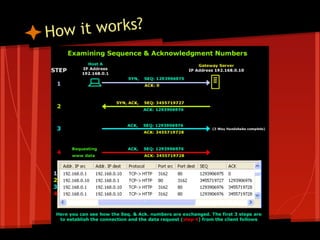
Step 1
Host A is telling the Gateway Server the following: "I'd like to initiate a new
connection with you. My Sequence number is 1293906975"
 
Step 2
The Gateway Server is telling Host A the following: "I acknowledge your
sequence number and expecting your next packet with sequence number
1293906976. My sequence number is 3455719727".

Step 3.
Host A is telling the Gateway Server the following: "I acknowledge your last
packet. This packet's sequence number is1293906976, which is what you're
expecting. I'll also be expecting the next packet you send me to have a sequence
number of3455719728".

 
Step 4.
Host A generates a packet with some data and sends it to the Gateway Server.
The data tells the Gateway Server which webpage it would like sent.
The sequence number of the segment in line 4 is the same as in line 3 because
the ACK does not occupy sequence number space.

 
W hich files?
First of all we have to implement Locks and Condition
Variables
Which files should we modify?
The files of importance are:

threads directory:
● lockcond.h, lockcond.cc: for defining and implementing
  lock and condition synchronization primitives; needed for
  network applications to work.
network directory:
●   post.h, post.cc: postoffice and mailbox, mail message
    definition and implementation.
●   nettest.cc: application to test communication between
    host id 0 and host id 1
machine directory:
● network.h, network.cc: Data structures to emulate a physical
  network connection. The network provides the abstraction of
  ordered, unreliable, fixed-size packet delivery to other
  machines on the network.
● sysdep.h, sysdep.cc : Interprocess communication
  operations, for simulating the network; Unix sockets creation,
  binding, closing, etc. are called here to provide nachos socket
  functionality.
 
Security

● Encryption
All encryption is based on an algorithm, the function of this
algorithm is basically encode the information to be
indecipherable at first sight.

An encryption algorithm can transform the letter "A" to
"5x5mBwE" or to "xQE9fq" and the work of an encryption
algorithm is precisely determine how information will be
transformed from its original state to one that is difficult to
decode.
The encryption and decryption algorithms uses what is called key to encrypt or
                           decrypt information.

These keys are used to encrypt information, however, there is another key that
the person who receives the message knows, and it is through this unique key
                     that the message can be decrypted.
seudo-code (Server)
     P
class Server{
    try{
        ServerSocket ss = new ServerSocket(8080); /*Create
    server*/
        Socket s = ss.acept();   /* Create socket */
        receiveString();
        decodeString();
        s.close();        /* Close connection */
        ss.close(); }
    catch(Exception ex){
        ex.printStackTrace();}
}//End of Server
seudo-code (Client)
     P
class Client{
    try{
        Socket s = new Socket("localhost", 8080); /*Create
    socket*/
        encodeString(); /*before send String data must be
encode*/
        sendString();
        s.close();
        }
    catch(Exception ex){
        ex.printStackTrace();
    }
}//End of Client
Sources
●   http://en.wikipedia.org/wiki/Acknowledgement_(data_networks)

●   http://www.firewall.cx/networking-topics/65-tcp-protocol-analysis/134-tcp-
    seq-ack-numbers.html
●   http://cnx.org/content/m30811/latest/

●   http://cnx.org/content/m30811/latest/

        For more information go to blog: www.os-ocj.blogspot.com

Nachos3 - Theoretical Part

  • 1.
    NachOS 3 on Theore tical Presentati
  • 2.
    What is networking? Acollection of machines, links and switches set up so that machines can communicate with each other. Nachos provides the abstraction of communication using mailboxes. The Nachos networking abstraction reaches to closely connected computers. The messaging is unreliable and messages can be dropped, but they are never corrupted in any way. The networking provides ordered and fixed-sized messages. There are several classes that builds the Nachos networking facility.  
  • 3.
  • 4.
    Step 1 Host Ais telling the Gateway Server the following: "I'd like to initiate a new connection with you. My Sequence number is 1293906975"   Step 2 The Gateway Server is telling Host A the following: "I acknowledge your sequence number and expecting your next packet with sequence number 1293906976. My sequence number is 3455719727". Step 3. Host A is telling the Gateway Server the following: "I acknowledge your last packet. This packet's sequence number is1293906976, which is what you're expecting. I'll also be expecting the next packet you send me to have a sequence number of3455719728".  
  • 5.
    Step 4. Host Agenerates a packet with some data and sends it to the Gateway Server. The data tells the Gateway Server which webpage it would like sent. The sequence number of the segment in line 4 is the same as in line 3 because the ACK does not occupy sequence number space.  
  • 6.
    W hich files? Firstof all we have to implement Locks and Condition Variables Which files should we modify? The files of importance are: threads directory: ● lockcond.h, lockcond.cc: for defining and implementing lock and condition synchronization primitives; needed for network applications to work. network directory: ● post.h, post.cc: postoffice and mailbox, mail message definition and implementation.
  • 7.
    nettest.cc: application to test communication between host id 0 and host id 1 machine directory: ● network.h, network.cc: Data structures to emulate a physical network connection. The network provides the abstraction of ordered, unreliable, fixed-size packet delivery to other machines on the network. ● sysdep.h, sysdep.cc : Interprocess communication operations, for simulating the network; Unix sockets creation, binding, closing, etc. are called here to provide nachos socket functionality.  
  • 8.
    Security ● Encryption All encryptionis based on an algorithm, the function of this algorithm is basically encode the information to be indecipherable at first sight. An encryption algorithm can transform the letter "A" to "5x5mBwE" or to "xQE9fq" and the work of an encryption algorithm is precisely determine how information will be transformed from its original state to one that is difficult to decode.
  • 9.
    The encryption anddecryption algorithms uses what is called key to encrypt or decrypt information. These keys are used to encrypt information, however, there is another key that the person who receives the message knows, and it is through this unique key that the message can be decrypted.
  • 11.
    seudo-code (Server) P class Server{ try{ ServerSocket ss = new ServerSocket(8080); /*Create server*/ Socket s = ss.acept(); /* Create socket */ receiveString(); decodeString(); s.close(); /* Close connection */ ss.close(); } catch(Exception ex){ ex.printStackTrace();} }//End of Server
  • 12.
    seudo-code (Client) P class Client{ try{ Socket s = new Socket("localhost", 8080); /*Create socket*/ encodeString(); /*before send String data must be encode*/ sendString(); s.close(); } catch(Exception ex){ ex.printStackTrace(); } }//End of Client
  • 13.
    Sources ● http://en.wikipedia.org/wiki/Acknowledgement_(data_networks) ● http://www.firewall.cx/networking-topics/65-tcp-protocol-analysis/134-tcp- seq-ack-numbers.html ● http://cnx.org/content/m30811/latest/ ● http://cnx.org/content/m30811/latest/ For more information go to blog: www.os-ocj.blogspot.com