MYOCARDIAL INFARCTION
INTRODUCTION
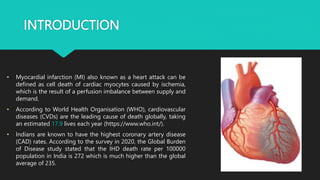
• Myocardial infarction (MI) also known as a heart attack can be
defined as cell death of cardiac myocytes caused by ischemia,
which is the result of a perfusion imbalance between supply and
demand.
• According to World Health Organisation (WHO), cardiovascular
diseases (CVDs) are the leading cause of death globally, taking
an estimated 17.9 lives each year (https://www.who.int/).
• Indians are known to have the highest coronary artery disease
(CAD) rates. According to the survey in 2020, the Global Burden
of Disease study stated that the IHD death rate per 100000
population in India is 272 which is much higher than the global
average of 235.
SYMPTOMS
 Chest pain that travels to the left arm or left side of the neck
 Shortness of breath
 Sweating
 Abnormal heart beating
 Anxiety
 Fatigue
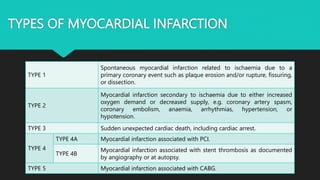
TYPES OF MYOCARDIAL INFARCTION
TYPE 1
Spontaneous myocardial infarction related to ischaemia due to a
primary coronary event such as plaque erosion and/or rupture, fissuring,
or dissection.
TYPE 2
Myocardial infarction secondary to ischaemia due to either increased
oxygen demand or decreased supply, e.g. coronary artery spasm,
coronary embolism, anaemia, arrhythmias, hypertension, or
hypotension.
TYPE 3 Sudden unexpected cardiac death, including cardiac arrest.
TYPE 4
TYPE 4A Myocardial infarction associated with PCI.
TYPE 4B
Myocardial infarction associated with stent thrombosis as documented
by angiography or at autopsy.
TYPE 5 Myocardial infarction associated with CABG.
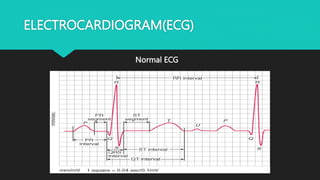
ELECTROCARDIOGRAM(ECG)
Normal ECG
Changes due to myocardial infarction in ECG

MYOCARDIAL INFARCTION.pptx

  • 1.
  • 2.
    INTRODUCTION • Myocardial infarction(MI) also known as a heart attack can be defined as cell death of cardiac myocytes caused by ischemia, which is the result of a perfusion imbalance between supply and demand. • According to World Health Organisation (WHO), cardiovascular diseases (CVDs) are the leading cause of death globally, taking an estimated 17.9 lives each year (https://www.who.int/). • Indians are known to have the highest coronary artery disease (CAD) rates. According to the survey in 2020, the Global Burden of Disease study stated that the IHD death rate per 100000 population in India is 272 which is much higher than the global average of 235.
  • 3.
    SYMPTOMS  Chest painthat travels to the left arm or left side of the neck  Shortness of breath  Sweating  Abnormal heart beating  Anxiety  Fatigue
  • 4.
    TYPES OF MYOCARDIALINFARCTION TYPE 1 Spontaneous myocardial infarction related to ischaemia due to a primary coronary event such as plaque erosion and/or rupture, fissuring, or dissection. TYPE 2 Myocardial infarction secondary to ischaemia due to either increased oxygen demand or decreased supply, e.g. coronary artery spasm, coronary embolism, anaemia, arrhythmias, hypertension, or hypotension. TYPE 3 Sudden unexpected cardiac death, including cardiac arrest. TYPE 4 TYPE 4A Myocardial infarction associated with PCI. TYPE 4B Myocardial infarction associated with stent thrombosis as documented by angiography or at autopsy. TYPE 5 Myocardial infarction associated with CABG.
  • 5.
  • 6.
    Changes due tomyocardial infarction in ECG