Remote Monitoring and control
Brief overview
Electrical powerisa majorpart of any businessinfrastructure.Nowadayssuccessof the business
is very heavily dependent upon assets like Grid, Generators, batteries and fuel etc. Data about the
performance of these assets is mostly overlooked. This data about the power infrastructure system is
logged manually that is generally never analyzed. Failure of such assets cause huge loses to business.
What is Remote Monitoring and Control?
Remote monitoringandcontrol isa fieldof industrial automation thatoffersorganizations tools
to quickly identify problems and remotely manage and control equipment and processes. Remote
monitoring can also be explained as an availability of digital information from one unit or a system to
another at a different, or distant geographical location, thereby minimizing the efforts to achieve any
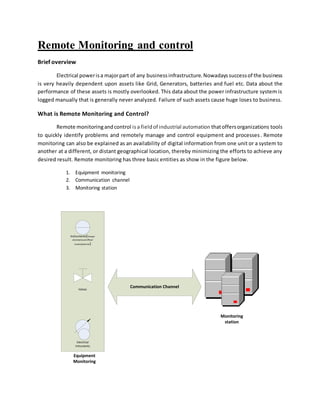
desired result. Remote monitoring has three basic entities as show in the figure below.
1. Equipment monitoring
2. Communication channel
3. Monitoring station
Communication Channel
Monitoring
station
Equipment
Monitoring
Instruments(Temper
ature/pressure/flow/
Level/speed etc)
Valves
Electrical
Intruments
Advantages of RMC
Large Companieshave a huge geographical sprawl, which can be a challenge sometimes. They
have their headquarters locatedinone cityandfacilities and sites in another. Managing the processes,
systems,andassetswithout personnelbeingonsite is very difficult. Remote monitoring and control in
Industries like these where the equipment and assets are networked and spread across a wide
geographical area is very advantageous. Some of the potentials of using RMC are as follow
 Minimizing peak load requirements
 Lowering cost of electricity supply
 Lowering costs of asset maintenance
 Reducingthe staff requirementsatindividualsite
 Reduce efforts on travel to several sites
 Automate control from a centralized location
 Enhancing scope of optimization
 Fuel theft control
 Improving customer satisfaction
 Overall reduction in OPEX
 Providing operational visibility across the support processes
How does Remote Monitoring and Control works?
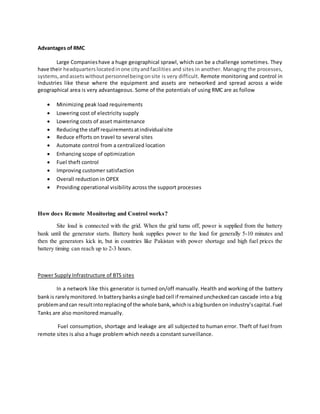
Site load is connected with the grid. When the grid turns off, power is supplied from the battery
bank until the generator starts. Battery bank supplies power to the load for generally 5-10 minutes and
then the generators kick in, but in countries like Pakistan with power shortage and high fuel prices the
battery timing can reach up to 2-3 hours.
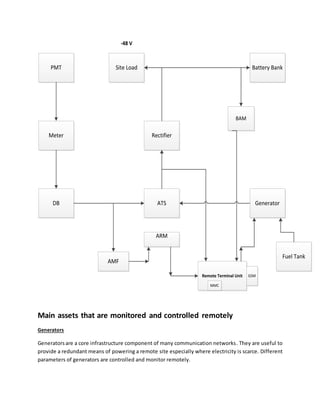
Power Supply Infrastructure of BTS sites
In a network like this generator is turned on/off manually. Health and working of the battery
bankis rarelymonitored.Inbatterybanksasingle badcell if remaineduncheckedcan cascade into a big
problemandcan resultintoreplacingof the whole bank,whichisabigburdenon industry’scapital.Fuel
Tanks are also monitored manually.
Fuel consumption, shortage and leakage are all subjected to human error. Theft of fuel from
remote sites is also a huge problem which needs a constant surveillance.
PMT
Meter
DB
AMF
ATS Generator
Fuel Tank
Site Load
Rectifier
Battery Bank
-48 V
Crank signal
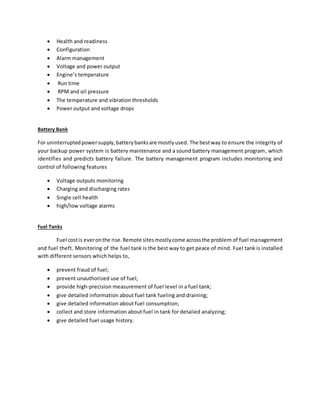
Power Supply Infrastructure of BTS sites with Remote Monitoring and Control
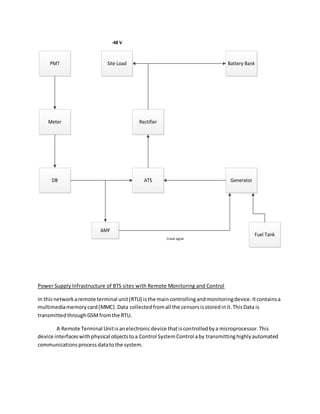
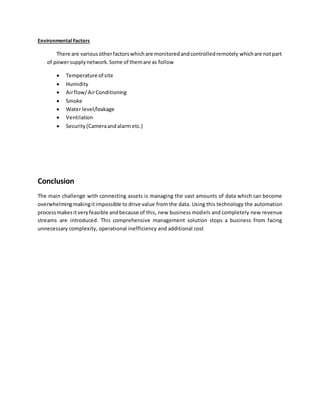
In thisnetworkaremote terminal unit(RTU) isthe maincontrollingandmonitoringdevice.Itcontainsa
multimediamemorycard(MMC).Data collectedfromall the censorsisstoredinit.ThisData is
transmittedthroughGSMfromthe RTU.
A Remote Terminal Unitisanelectronicdevice thatiscontrolledbya microprocessor.This
device interfaceswithphysical objectstoa Control SystemControl aby transmittinghighlyautomated
communicationsprocess datatothe system.
PMT
Meter
DB
AMF
ATS Generator
Fuel Tank
Site Load
Rectifier
Battery Bank
-48 V
ARM
Remote Terminal Unit GSM
BAM
MMC
Main assets that are monitored and controlled remotely
Generators
Generatorsare a core infrastructure component of many communication networks. They are useful to
provide a redundant means of powering a remote site especially where electricity is scarce. Different
parameters of generators are controlled and monitor remotely.
 Health and readiness
 Configuration
 Alarm management
 Voltage and power output
 Engine’s temperature
 Run time
 RPM and oil pressure
 The temperature and vibration thresholds
 Power output and voltage drops
Battery Bank
For uninterruptedpowersupply,batterybanksare mostlyused. The bestway to ensure the integrity of
your backup power system is battery maintenance and a sound battery management program, which
identifies and predicts battery failure. The battery management program includes monitoring and
control of following features
 Voltage outputs monitoring
 Charging and discharging rates
 Single cell health
 high/low voltage alarms
Fuel Tanks
Fuel costis everonthe rise.Remote sitesmostlycome acrossthe problem of fuel management
and fuel theft. Monitoring of the fuel tank is the best way to get peace of mind. Fuel tank is installed
with different sensors which helps to,
 prevent fraud of fuel;
 prevent unauthorized use of fuel;
 provide high-precision measurement of fuel level in a fuel tank;
 give detailed information about fuel tank fueling and draining;
 give detailed information about fuel consumption;
 collect and store information about fuel in tank for detailed analyzing;
 give detailed fuel usage history.
Environmental Factors
There are variousotherfactorswhichare monitoredandcontrolledremotely whichare notpart
of powersupplynetwork.Some of themare as follow
 Temperature of site
 Humidity
 Airflow/AirConditioning
 Smoke
 Water level/leakage
 Ventilation
 Security(Cameraandalarm etc.)
Conclusion
The main challenge with connecting assets is managing the vast amounts of data which can become
overwhelmingmakingitimpossible to drive value from the data. Using this technology the automation
processmakesitveryfeasible andbecause of this, new business models and completely new revenue
streams are introduced. This comprehensive management solution stops a business from facing
unnecessary complexity, operational inefficiency and additional cost

Remote Monitoring and control

  • 1.
    Remote Monitoring andcontrol Brief overview Electrical powerisa majorpart of any businessinfrastructure.Nowadayssuccessof the business is very heavily dependent upon assets like Grid, Generators, batteries and fuel etc. Data about the performance of these assets is mostly overlooked. This data about the power infrastructure system is logged manually that is generally never analyzed. Failure of such assets cause huge loses to business. What is Remote Monitoring and Control? Remote monitoringandcontrol isa fieldof industrial automation thatoffersorganizations tools to quickly identify problems and remotely manage and control equipment and processes. Remote monitoring can also be explained as an availability of digital information from one unit or a system to another at a different, or distant geographical location, thereby minimizing the efforts to achieve any desired result. Remote monitoring has three basic entities as show in the figure below. 1. Equipment monitoring 2. Communication channel 3. Monitoring station Communication Channel Monitoring station Equipment Monitoring Instruments(Temper ature/pressure/flow/ Level/speed etc) Valves Electrical Intruments
  • 2.
    Advantages of RMC LargeCompanieshave a huge geographical sprawl, which can be a challenge sometimes. They have their headquarters locatedinone cityandfacilities and sites in another. Managing the processes, systems,andassetswithout personnelbeingonsite is very difficult. Remote monitoring and control in Industries like these where the equipment and assets are networked and spread across a wide geographical area is very advantageous. Some of the potentials of using RMC are as follow  Minimizing peak load requirements  Lowering cost of electricity supply  Lowering costs of asset maintenance  Reducingthe staff requirementsatindividualsite  Reduce efforts on travel to several sites  Automate control from a centralized location  Enhancing scope of optimization  Fuel theft control  Improving customer satisfaction  Overall reduction in OPEX  Providing operational visibility across the support processes How does Remote Monitoring and Control works? Site load is connected with the grid. When the grid turns off, power is supplied from the battery bank until the generator starts. Battery bank supplies power to the load for generally 5-10 minutes and then the generators kick in, but in countries like Pakistan with power shortage and high fuel prices the battery timing can reach up to 2-3 hours. Power Supply Infrastructure of BTS sites In a network like this generator is turned on/off manually. Health and working of the battery bankis rarelymonitored.Inbatterybanksasingle badcell if remaineduncheckedcan cascade into a big problemandcan resultintoreplacingof the whole bank,whichisabigburdenon industry’scapital.Fuel Tanks are also monitored manually. Fuel consumption, shortage and leakage are all subjected to human error. Theft of fuel from remote sites is also a huge problem which needs a constant surveillance.
  • 3.
    PMT Meter DB AMF ATS Generator Fuel Tank SiteLoad Rectifier Battery Bank -48 V Crank signal Power Supply Infrastructure of BTS sites with Remote Monitoring and Control In thisnetworkaremote terminal unit(RTU) isthe maincontrollingandmonitoringdevice.Itcontainsa multimediamemorycard(MMC).Data collectedfromall the censorsisstoredinit.ThisData is transmittedthroughGSMfromthe RTU. A Remote Terminal Unitisanelectronicdevice thatiscontrolledbya microprocessor.This device interfaceswithphysical objectstoa Control SystemControl aby transmittinghighlyautomated communicationsprocess datatothe system.
  • 4.
    PMT Meter DB AMF ATS Generator Fuel Tank SiteLoad Rectifier Battery Bank -48 V ARM Remote Terminal Unit GSM BAM MMC Main assets that are monitored and controlled remotely Generators Generatorsare a core infrastructure component of many communication networks. They are useful to provide a redundant means of powering a remote site especially where electricity is scarce. Different parameters of generators are controlled and monitor remotely.
  • 5.
     Health andreadiness  Configuration  Alarm management  Voltage and power output  Engine’s temperature  Run time  RPM and oil pressure  The temperature and vibration thresholds  Power output and voltage drops Battery Bank For uninterruptedpowersupply,batterybanksare mostlyused. The bestway to ensure the integrity of your backup power system is battery maintenance and a sound battery management program, which identifies and predicts battery failure. The battery management program includes monitoring and control of following features  Voltage outputs monitoring  Charging and discharging rates  Single cell health  high/low voltage alarms Fuel Tanks Fuel costis everonthe rise.Remote sitesmostlycome acrossthe problem of fuel management and fuel theft. Monitoring of the fuel tank is the best way to get peace of mind. Fuel tank is installed with different sensors which helps to,  prevent fraud of fuel;  prevent unauthorized use of fuel;  provide high-precision measurement of fuel level in a fuel tank;  give detailed information about fuel tank fueling and draining;  give detailed information about fuel consumption;  collect and store information about fuel in tank for detailed analyzing;  give detailed fuel usage history.
  • 6.
    Environmental Factors There arevariousotherfactorswhichare monitoredandcontrolledremotely whichare notpart of powersupplynetwork.Some of themare as follow  Temperature of site  Humidity  Airflow/AirConditioning  Smoke  Water level/leakage  Ventilation  Security(Cameraandalarm etc.) Conclusion The main challenge with connecting assets is managing the vast amounts of data which can become overwhelmingmakingitimpossible to drive value from the data. Using this technology the automation processmakesitveryfeasible andbecause of this, new business models and completely new revenue streams are introduced. This comprehensive management solution stops a business from facing unnecessary complexity, operational inefficiency and additional cost