April
                                                   18
                                                   2012


MVC           Mohammed Arif
              Manager Interactive Development @ SapientNitro

    &         www.mohammedarif.com
              https://twitter.com/#!/arif_iq
backbone.js   http://in.linkedin.com/in/mohdarif
Agenda
•   What is MVC

•   Why MVC

•   MVC Advantages

•   What is backbone

•   Why backbone

•   What is JavaScript templating

•   Why JavaScript templating

•   Questions/Feedback
What is MVC…


MVC stands for Model-View-Controller.
What is MVC…


MVC is a Architectural Design Pattern
What is MVC…


Separates a web application into three parts: the data
(Model), the presentation of that data to the user (View),
and the actions taken on any user interaction
(Controller or routers).
What is MVC

In the past it has been heavily used for structuring desktop and server-side
applications, but it's only been in recent years that come to being applied to
JavaScript.


As the majority of JavaScript developers currently using these patterns opt to
utilize libraries such as Backbone.js for implementing an MVC/MV*-like
structure.
Design Pattern
A pattern that has been developed to help programmers cope with common
problems


Blueprints on how to construct something
MVC - Model

Data representation


Can be database/xml/etc


Business Logic
MVC - View

Data presentation and user input


Renders the Model in to a View


Can be HTML/PDF/WML/Javascript


No computations, very little logic, display logic i.e. loops
MVC - Controller

Dispatches Requests and controls flow


Centralizes access


Interacts with Model and View
Why MVC

If you do a lot of JavaScript, things tend to get messy!


Backbone provides a way to organize your code, by using the MVC pattern


Only the View accesses the DOM (e.g. with jQuery, Dojo,…)
MVC Advantages…

Separation of interests
    Model centralizes business logic
    View centralizes display logic
    Controller centralizes application flow
MVC Advantages

Clean separation of content/style


Improved decoupling


Easier testing


Allow multiple people to work on different parts
What is backbone.js

Backbone.js is one of a number of JavaScript frameworks for creating MVC-
like web applications, it's relatively lightweight and can be easily tested using
third-party toolkits such as Jasmine or QUnit.


                                     Or
Backbone.js gives structure to web applications by providing models with
key-value binding and custom events, collections with a rich API of
enumerable functions, views with declarative event handling, and connects it
all to your existing API over a RESTful JSON interface.
Why backbone

Organize the structure to your application


Simplify server-side persistence


Decouple the DOM from your page's data


Model data, views and routers in a succinct manner


Provide DOM, model and collection synchronization
Backbone.js - Model


Models are the heart of any JavaScript application, containing the interactive
data as well as a large part of the logic surrounding it: conversions,
validations, computed properties, and access control.
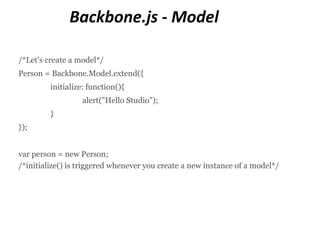
Backbone.js - Model

/*Let’s create a model*/
Person = Backbone.Model.extend({
         initialize: function(){
                  alert("Hello Studio");
         }
});


var person = new Person;
/*initialize() is triggered whenever you create a new instance of a model*/
Backbone.js - View


Backbone views are used to reflect what your applications’ data models look
like


They are also used to listen to events and react accordingly
Backbone.js - View

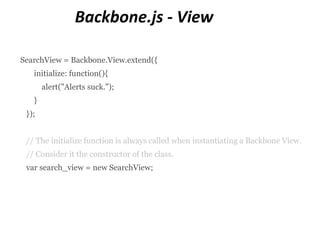
SearchView = Backbone.View.extend({
   initialize: function(){
       alert("Alerts suck.");
   }
 });


 // The initialize function is always called when instantiating a Backbone View.
 // Consider it the constructor of the class.
 var search_view = new SearchView;
Backbone.js - Collection

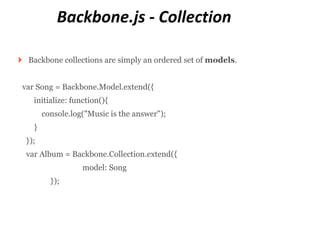
 Backbone collections are simply an ordered set of models.


var Song = Backbone.Model.extend({
   initialize: function(){
       console.log("Music is the answer");
   }
 });
 var Album = Backbone.Collection.extend({
                  model: Song
         });
What is JavaScript templating

A template contains markup with binding expressions. The template is
applied to data objects or arrays, and rendered into the HTML DOM.
Why JavaScript templating

Loading all data from the server especially in rich list displays


Adding or updating new items in lists


Anywhere you need to add new complex content to the page


Anything that requires client side HTML rendering
MVC & backbone.js

MVC & backbone.js

  • 1.
    April 18 2012 MVC Mohammed Arif Manager Interactive Development @ SapientNitro & www.mohammedarif.com https://twitter.com/#!/arif_iq backbone.js http://in.linkedin.com/in/mohdarif
  • 2.
    Agenda • What is MVC • Why MVC • MVC Advantages • What is backbone • Why backbone • What is JavaScript templating • Why JavaScript templating • Questions/Feedback
  • 3.
    What is MVC… MVCstands for Model-View-Controller.
  • 4.
    What is MVC… MVCis a Architectural Design Pattern
  • 5.
    What is MVC… Separatesa web application into three parts: the data (Model), the presentation of that data to the user (View), and the actions taken on any user interaction (Controller or routers).
  • 6.
    What is MVC Inthe past it has been heavily used for structuring desktop and server-side applications, but it's only been in recent years that come to being applied to JavaScript. As the majority of JavaScript developers currently using these patterns opt to utilize libraries such as Backbone.js for implementing an MVC/MV*-like structure.
  • 7.
    Design Pattern A patternthat has been developed to help programmers cope with common problems Blueprints on how to construct something
  • 8.
    MVC - Model Datarepresentation Can be database/xml/etc Business Logic
  • 9.
    MVC - View Datapresentation and user input Renders the Model in to a View Can be HTML/PDF/WML/Javascript No computations, very little logic, display logic i.e. loops
  • 10.
    MVC - Controller DispatchesRequests and controls flow Centralizes access Interacts with Model and View
  • 11.
    Why MVC If youdo a lot of JavaScript, things tend to get messy! Backbone provides a way to organize your code, by using the MVC pattern Only the View accesses the DOM (e.g. with jQuery, Dojo,…)
  • 12.
    MVC Advantages… Separation ofinterests Model centralizes business logic View centralizes display logic Controller centralizes application flow
  • 13.
    MVC Advantages Clean separationof content/style Improved decoupling Easier testing Allow multiple people to work on different parts
  • 14.
    What is backbone.js Backbone.jsis one of a number of JavaScript frameworks for creating MVC- like web applications, it's relatively lightweight and can be easily tested using third-party toolkits such as Jasmine or QUnit. Or Backbone.js gives structure to web applications by providing models with key-value binding and custom events, collections with a rich API of enumerable functions, views with declarative event handling, and connects it all to your existing API over a RESTful JSON interface.
  • 15.
    Why backbone Organize thestructure to your application Simplify server-side persistence Decouple the DOM from your page's data Model data, views and routers in a succinct manner Provide DOM, model and collection synchronization
  • 16.
    Backbone.js - Model Modelsare the heart of any JavaScript application, containing the interactive data as well as a large part of the logic surrounding it: conversions, validations, computed properties, and access control.
  • 17.
    Backbone.js - Model /*Let’screate a model*/ Person = Backbone.Model.extend({ initialize: function(){ alert("Hello Studio"); } }); var person = new Person; /*initialize() is triggered whenever you create a new instance of a model*/
  • 18.
    Backbone.js - View Backboneviews are used to reflect what your applications’ data models look like They are also used to listen to events and react accordingly
  • 19.
    Backbone.js - View SearchView= Backbone.View.extend({ initialize: function(){ alert("Alerts suck."); } }); // The initialize function is always called when instantiating a Backbone View. // Consider it the constructor of the class. var search_view = new SearchView;
  • 20.
    Backbone.js - Collection Backbone collections are simply an ordered set of models. var Song = Backbone.Model.extend({ initialize: function(){ console.log("Music is the answer"); } }); var Album = Backbone.Collection.extend({ model: Song });
  • 21.
    What is JavaScripttemplating A template contains markup with binding expressions. The template is applied to data objects or arrays, and rendered into the HTML DOM.
  • 22.
    Why JavaScript templating Loadingall data from the server especially in rich list displays Adding or updating new items in lists Anywhere you need to add new complex content to the page Anything that requires client side HTML rendering