By:
Mr Million D.
2022
MTU- ETHIOPIA
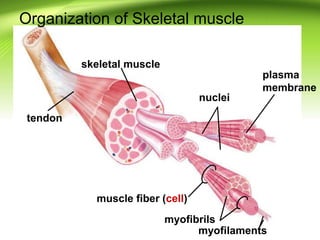
tendon
skeletal muscle
muscle fiber (cell)
myofilaments
myofibrils
plasma
membrane
nuclei
Organization of Skeletal muscle
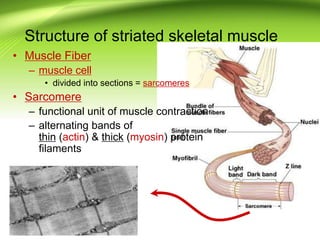
Structure of striated skeletal muscle
• Muscle Fiber
– muscle cell
• divided into sections = sarcomeres
• Sarcomere
– functional unit of muscle contraction
– alternating bands of
thin (actin) & thick (myosin) protein
filaments
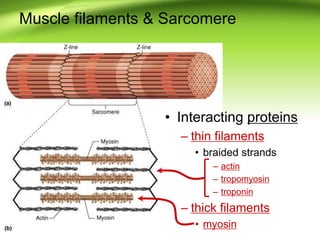
Muscle filaments & Sarcomere
• Interacting proteins
– thin filaments
• braided strands
– actin
– tropomyosin
– troponin
– thick filaments
• myosin
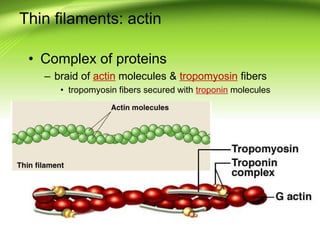
Thin filaments: actin
• Complex of proteins
– braid of actin molecules & tropomyosin fibers
• tropomyosin fibers secured with troponin molecules
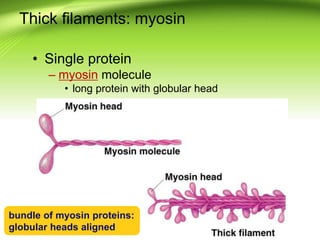
Thick filaments: myosin
• Single protein
– myosin molecule
• long protein with globular head
bundle of myosin proteins:
globular heads aligned
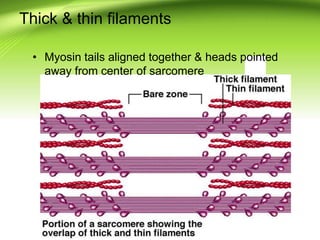
Thick & thin filaments
• Myosin tails aligned together & heads pointed
away from center of sarcomere
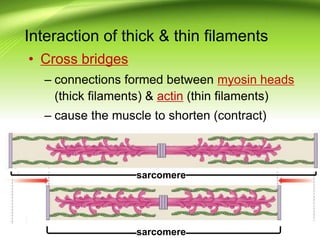
Interaction of thick & thin filaments
• Cross bridges
– connections formed between myosin heads
(thick filaments) & actin (thin filaments)
– cause the muscle to shorten (contract)
sarcomere
sarcomere
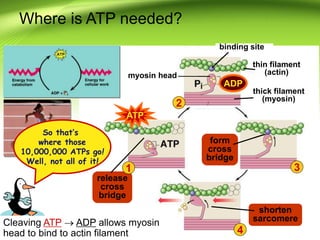
Where is ATP needed?
3
4
12
1
1
1
Cleaving ATP  ADP allows myosin
head to bind to actin filament
thin filament
(actin)
thick filament
(myosin)
ATP
myosin head
form
cross
bridge
binding site
So that’s
where those
10,000,000 ATPs go!
Well, not all of it!
ADP
release
cross
bridge
shorten
sarcomere
1
Closer look at muscle cell
multi-nucleated
Mitochondrion
Sarcoplasmic
reticulum
Transverse tubules
(T-tubules)
Muscle cell organelles
• Sarcoplasm
– muscle cell cytoplasm
– contains many mitochondria
• Sarcoplasmic reticulum (SR)
– organelle similar to ER
• network of tubes
– stores Ca2+
• Ca2+ released from SR through channels
• Ca2+ restored to SR by Ca2+ pumps
– pump Ca2+ from cytosol
– pumps use ATP
Ca2+ ATPase of SR
ATP
There’s
the rest
of the
ATPs!
But what
does the
Ca2+ do?
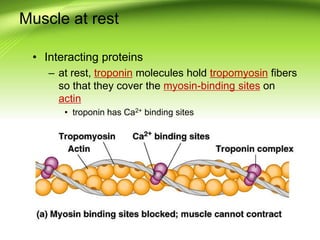
Muscle at rest
• Interacting proteins
– at rest, troponin molecules hold tropomyosin fibers
so that they cover the myosin-binding sites on
actin
• troponin has Ca2+ binding sites
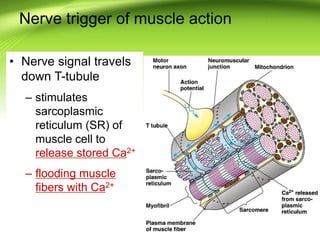
• Nerve signal travels
down T-tubule
– stimulates
sarcoplasmic
reticulum (SR) of
muscle cell to
release stored Ca2+
– flooding muscle
fibers with Ca2+
Nerve trigger of muscle action
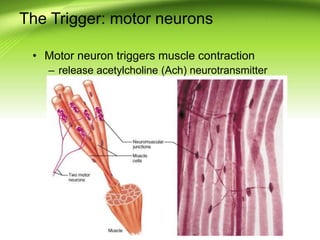
The Trigger: motor neurons
• Motor neuron triggers muscle contraction
– release acetylcholine (Ach) neurotransmitter
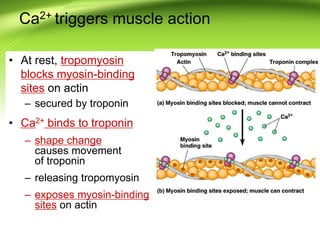
• At rest, tropomyosin
blocks myosin-binding
sites on actin
– secured by troponin
• Ca2+ binds to troponin
– shape change
causes movement
of troponin
– releasing tropomyosin
– exposes myosin-binding
sites on actin
Ca2+ triggers muscle action
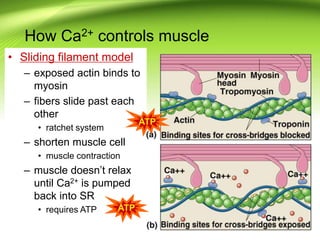
How Ca2+ controls muscle
• Sliding filament model
– exposed actin binds to
myosin
– fibers slide past each
other
• ratchet system
– shorten muscle cell
• muscle contraction
– muscle doesn’t relax
until Ca2+ is pumped
back into SR
• requires ATP
ATP
ATP
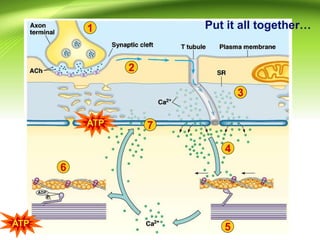
Put it all together…
1
ATP
2
3
4
5
7
6
ATP
How it all works…
• Action potential causes Ca2+ release from SR
– Ca2+ binds to troponin
• Troponin moves tropomyosin uncovering myosin
binding site on actin
• Myosin binds actin
– uses ATP to "ratchet" each time
– releases, "unratchets" & binds to next actin
• Myosin pulls actin chain along
• Sarcomere shortens
– Z discs move closer together
• Whole fiber shortens  contraction!
• Ca2+ pumps restore Ca2+ to SR  relaxation!
– pumps use ATP
ATP
ATP
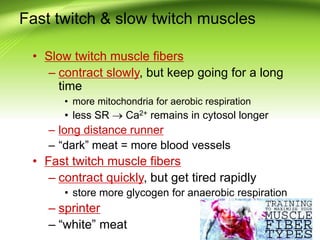
Fast twitch & slow twitch muscles
• Slow twitch muscle fibers
– contract slowly, but keep going for a long
time
• more mitochondria for aerobic respiration
• less SR  Ca2+ remains in cytosol longer
– long distance runner
– “dark” meat = more blood vessels
• Fast twitch muscle fibers
– contract quickly, but get tired rapidly
• store more glycogen for anaerobic respiration
– sprinter
– “white” meat
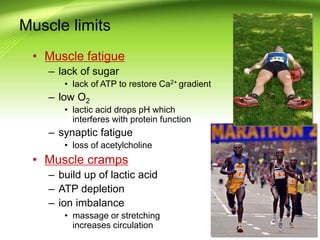
Muscle limits
• Muscle fatigue
– lack of sugar
• lack of ATP to restore Ca2+ gradient
– low O2
• lactic acid drops pH which
interferes with protein function
– synaptic fatigue
• loss of acetylcholine
• Muscle cramps
– build up of lactic acid
– ATP depletion
– ion imbalance
• massage or stretching
increases circulation
Diseases of Muscle tissue
• ALS
– amyotrophic lateral sclerosis
– Lou Gehrig’s disease
– motor neurons degenerate
• Myasthenia gravis
– auto-immune
– antibodies to
acetylcholine
receptors
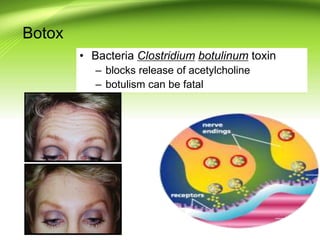
Botox
• Bacteria Clostridium botulinum toxin
– blocks release of acetylcholine
– botulism can be fatal
2006-2007
END OF SLIDE

muscle contraction slide share.pptx

  • 1.
  • 2.
    tendon skeletal muscle muscle fiber(cell) myofilaments myofibrils plasma membrane nuclei Organization of Skeletal muscle
  • 3.
    Structure of striatedskeletal muscle • Muscle Fiber – muscle cell • divided into sections = sarcomeres • Sarcomere – functional unit of muscle contraction – alternating bands of thin (actin) & thick (myosin) protein filaments
  • 4.
    Muscle filaments &Sarcomere • Interacting proteins – thin filaments • braided strands – actin – tropomyosin – troponin – thick filaments • myosin
  • 5.
    Thin filaments: actin •Complex of proteins – braid of actin molecules & tropomyosin fibers • tropomyosin fibers secured with troponin molecules
  • 6.
    Thick filaments: myosin •Single protein – myosin molecule • long protein with globular head bundle of myosin proteins: globular heads aligned
  • 7.
    Thick & thinfilaments • Myosin tails aligned together & heads pointed away from center of sarcomere
  • 8.
    Interaction of thick& thin filaments • Cross bridges – connections formed between myosin heads (thick filaments) & actin (thin filaments) – cause the muscle to shorten (contract) sarcomere sarcomere
  • 9.
    Where is ATPneeded? 3 4 12 1 1 1 Cleaving ATP  ADP allows myosin head to bind to actin filament thin filament (actin) thick filament (myosin) ATP myosin head form cross bridge binding site So that’s where those 10,000,000 ATPs go! Well, not all of it! ADP release cross bridge shorten sarcomere 1
  • 10.
    Closer look atmuscle cell multi-nucleated Mitochondrion Sarcoplasmic reticulum Transverse tubules (T-tubules)
  • 11.
    Muscle cell organelles •Sarcoplasm – muscle cell cytoplasm – contains many mitochondria • Sarcoplasmic reticulum (SR) – organelle similar to ER • network of tubes – stores Ca2+ • Ca2+ released from SR through channels • Ca2+ restored to SR by Ca2+ pumps – pump Ca2+ from cytosol – pumps use ATP Ca2+ ATPase of SR ATP There’s the rest of the ATPs! But what does the Ca2+ do?
  • 12.
    Muscle at rest •Interacting proteins – at rest, troponin molecules hold tropomyosin fibers so that they cover the myosin-binding sites on actin • troponin has Ca2+ binding sites
  • 13.
    • Nerve signaltravels down T-tubule – stimulates sarcoplasmic reticulum (SR) of muscle cell to release stored Ca2+ – flooding muscle fibers with Ca2+ Nerve trigger of muscle action
  • 14.
    The Trigger: motorneurons • Motor neuron triggers muscle contraction – release acetylcholine (Ach) neurotransmitter
  • 15.
    • At rest,tropomyosin blocks myosin-binding sites on actin – secured by troponin • Ca2+ binds to troponin – shape change causes movement of troponin – releasing tropomyosin – exposes myosin-binding sites on actin Ca2+ triggers muscle action
  • 16.
    How Ca2+ controlsmuscle • Sliding filament model – exposed actin binds to myosin – fibers slide past each other • ratchet system – shorten muscle cell • muscle contraction – muscle doesn’t relax until Ca2+ is pumped back into SR • requires ATP ATP ATP
  • 17.
    Put it alltogether… 1 ATP 2 3 4 5 7 6 ATP
  • 18.
    How it allworks… • Action potential causes Ca2+ release from SR – Ca2+ binds to troponin • Troponin moves tropomyosin uncovering myosin binding site on actin • Myosin binds actin – uses ATP to "ratchet" each time – releases, "unratchets" & binds to next actin • Myosin pulls actin chain along • Sarcomere shortens – Z discs move closer together • Whole fiber shortens  contraction! • Ca2+ pumps restore Ca2+ to SR  relaxation! – pumps use ATP ATP ATP
  • 19.
    Fast twitch &slow twitch muscles • Slow twitch muscle fibers – contract slowly, but keep going for a long time • more mitochondria for aerobic respiration • less SR  Ca2+ remains in cytosol longer – long distance runner – “dark” meat = more blood vessels • Fast twitch muscle fibers – contract quickly, but get tired rapidly • store more glycogen for anaerobic respiration – sprinter – “white” meat
  • 20.
    Muscle limits • Musclefatigue – lack of sugar • lack of ATP to restore Ca2+ gradient – low O2 • lactic acid drops pH which interferes with protein function – synaptic fatigue • loss of acetylcholine • Muscle cramps – build up of lactic acid – ATP depletion – ion imbalance • massage or stretching increases circulation
  • 21.
    Diseases of Muscletissue • ALS – amyotrophic lateral sclerosis – Lou Gehrig’s disease – motor neurons degenerate • Myasthenia gravis – auto-immune – antibodies to acetylcholine receptors
  • 22.
    Botox • Bacteria Clostridiumbotulinum toxin – blocks release of acetylcholine – botulism can be fatal
  • 23.
  • 24.