DIVISION TRAINING OF TRAINERS
(DTOT)
REVISED K TO 12 (MATATAG)
CURRICULUM
ASNHS, San Francisco, Agusan del Sur
June 11-13 , 2025
1
GRADE 3
Day
1
Day 2 Day 3
Session 1
Shaping Paper of the MATATAG
CURRICULUM (Revised K TO
12)
Session 2
21st
Century skills in the
MATATAG Curriculum
Session 3
LESSON PLANNING
INTEGRATING CONTENT
AND PEDAGOGY
Session 3
LESSON PLANNING
INTEGRATING CONTENT AND
PEDAGOGY
ROSALYN V. SUMAMPONG,EdD
Principal-I, Sta. Maria ES
Session Objectives
. By the end of the session, you should be able to:
1. Explain the process in writing a lesson plan.
2. Prepare a well-structured lesson plan based on DO 42 s. 2016 and
aligned with the Revised K to 12 (MATATAG) curriculum standards .
3. Use appropriate instructional strategies, materials, and assessment tools
during the presentation of Lesson Plan as the participant’s output.
4. Demonstrate reflective and professional attitude toward continuous
improvement in teaching content, pedagogy, and assessment practices.
Professional Standards Covered
Domain 1. Content Knowledge and Pedagogy
Strand 1.2 Research-based knowledge and principles of teaching and
learning
1.2.2 Use research-based knowledge and principles of teaching and learning
to enhance professional practice.
Strand 1.6 Classroom communication strategies
1.6.2 Apply effective verbal and non-verbal classroom communication
strategies to support learner understanding.
Professional Standards Covered
Domain 5. Assessment and Reporting
Strand 5.1 Design, selection, organization and utilization of assessment
strategies
5.1.2 Design, select, organize and use diagnostic, formative, and summative
assessment strategies consistent with curriculum requirements.
Strand 5.3 Feedback to improve learning
5.3.2 Provide timely, accurate and constructive feedback to improve learner
performance.
Session Flow
Mechanics on Lesson Planning
Feedback-Giving (Friday)
Mechanics on Demonstration Teaching
Presentation of a sample Daily Lesson Plan/DLL (Friday)
Review DO 42 s. 2016
Match it Up!
MATCH IT UP!
CONTENT PEDAGOGY
1. Telling time
2. Character Traits in a Story
3. Learning Community Rules
4. Life Cycle of Butterfly
5. Addition and Subtraction
a. Math games and problem solving tasks
b. Clock-making craft and timed activities
c. Visual aids and drawing activities
d. Story mapping and group discussion
e. Role Play
MATCH IT UP!
CONTENT PEDAGOGY
Telling time
Character Traits in a Story
Learning Community Rules
Life Cycle of Butterfly
Addition and Subtraction
b. Clock-making craft and timed activities
d. Story mapping and group discussion
e. Role Play
c. Visual aids and drawing activities
a. Math games and problem-solving tasks
Question and Answer:
● What did you notice about matching
pedagogy with content?
● Were there multiple strategies that could
apply to one topic?
● How does this relate to your own lesson
planning?
●DO NOTE!
In effective lesson planning, content
and pedagogy are partners, not
separate pieces.
DO. 42 s. 2016 Policy Guidelines on Daily Lesson Preparation
Curriculum Guide
Detailed Lesson Plan (DLP)
It contains a detailed description of the
steps a teacher will take to teach a
particular topic.
WHO WILL USE THE DETAILED LESSON PLAN?
● Newly –hired teachers without professional teaching
experience .
● Those who are still Novice teachers with less than a year
of experience.
● Applicant teachers as well as teachers in the service
including Master Teachers who will conduct demonstration
teaching.
DAILY LESSON LOG (DLL)
● DLL is a template used by teachers to log parts of their daily lesson.
● It covers a day’s or weeks’ worth of lesson.
● It contains Objectives, Content, Learning Resources, Procedures, Remarks
and Reflection.
Take Note!!!
● Teachers are allowed to work together in preparing DLPs and DLLs
● Seasoned or veteran teachers shall also mentor new or novice teachers in the
preparation of DLPs and DLLs
PARTS OF DAILY LESSON PLAN
(DO 42, s. 2016) Page 2
Part I Objectives
Part II Content
Part III Learning Resources
Part IV Procedures
Part V Remarks
Part VI Reflection
Revisiting Existing Lesson Plan
MATATAG FORMAT
IV. Evaluating Learning
 are statements that describe the expected learning
outcomes of the learners at the end of the lesson.
 specify what students need to learn and thereby
guide learners in carrying out the lesson's activities.
 also direct the teacher in selecting the appropriate
learning resources and methods to use in teaching.
 should also be the bases for assessing student
learning before, during, and after the lesson.
I. Objectives
I - Objectives
20
Lesson Objectives Sub-Parts Description
A. Content Standards
key concepts and skills that are covered in the
quarter.
B. Performance Standards level of and/or evidence of performance expected
to be exhibited by learners at the end of the quarter
C. Learning Competencies
target competencies for the quarter. The
competencies are unpacked through learning
objectives which the lesson will address.
D. Learning Objectives
State what the teacher intends to teach and serve
as a guide for instruction and assessment.
E. Integration integration of topics, themes, and/or advocacies
22
Learning Resources
(Batayang Sanggunian sa
Pagkatuto)
resources used in the lesson
● Books, magazine articles, Images, media texts,
eResources, DepEd LR Portal Note: (APA 7th Edition format)
III- Learning Resources
II-Content
Lesson Plan Part Description
Content key ideas or skills that the lesson will cover (topics and subtopics)
Procedures
 The procedure details the steps and activities the
teachers and learners will do during the lesson
towards achievement of the lesson's objectives.
 describes the learning experiences that learners will
go through in understanding and mastering the
lesson's content.
24
Lesson Parts Description
A. Activating prior
Knowledge
(Mind and Mood)
linking what learners know with what they
need to know
1. Short Review - active way of
recalling concepts covered
2. Feedback (Optional) - giving
qualitative feedback to
performance or products
IV. Teaching and Learning Procedure
Science of Learning Principle
Linking what the learner knows with what he/she needs to know
25
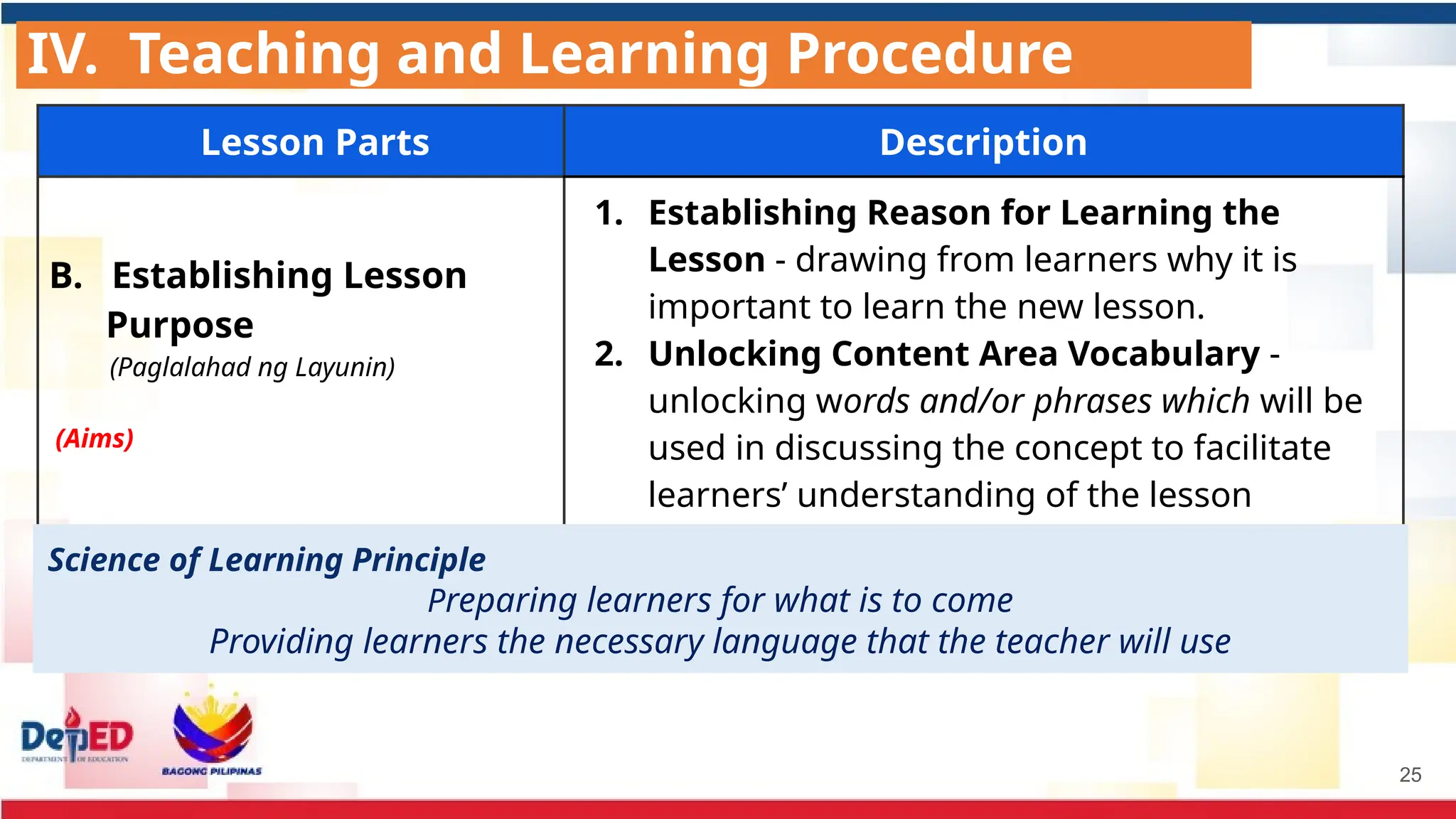
Lesson Parts Description
B. Establishing Lesson
Purpose
(Paglalahad ng Layunin)
(Aims)
1. Establishing Reason for Learning the
Lesson - drawing from learners why it is
important to learn the new lesson.
2. Unlocking Content Area Vocabulary -
unlocking words and/or phrases which will be
used in discussing the concept to facilitate
learners’ understanding of the lesson
IV. Teaching and Learning Procedure
Science of Learning Principle
Preparing learners for what is to come
Providing learners the necessary language that the teacher will use
27
Lesson Parts Description
C. Developing and
Deepening
Understanding
(Paglinang at Pagpapalalim)
(Task and Thought)
1. Explicitation - situating the topic in context and
having learners talk about the topic from where
they are and in terms of what they know and can
do.
2. Worked Example - involving learners’ deliberate
effort to develop understanding of the topic by
hearing and talking about it and applying their
knowledge, skill, or understanding in guided
practice.
3. Lesson Activity - having learners work on
multiple and varied examples repetitively
Science of Learning Principle
Developing the ‘idea’ of the lesson, working on an example, and application
(new content development)
IV. Teaching and Learning Procedure
28
C. Developing and Deepening Understanding
1. Explicitation
- Processing of initial understanding of new idea
2. Worked Example
- Experiments
- Modeling
- Guided (deliberate) practice
- Elaboration
- Translating errors into useful knowledge
3. Lesson Activity (Application and/or integration)
- Working on multiple examples (varied and repetitive)
- Independent/extended practice
IV. Teaching and Learning Procedure
30
Lesson Parts Description
D. Making Generalization
(Abstractions)
1. Learners’ Takeaways - guiding
learners in articulating their
conceptual understanding of the
topic(s) covered
2. Reflection on Learning - guiding
learners in thinking about how they
learned
Science of Learning Principle:
Allowing learners to write and/or talk about the idea they have understood after practice
activities
Having learners reflect on how they learned (gains and challenges)
IV. Teaching and Learning Procedure
D. Making
Generalization
(Abstractions)
Ask: Now, can you tell me what rhyming
words are?
What are the different greetings that you
remember from today’s lesson?
32
Lesson Parts Description
A. Evaluating
Learning
(Tools for
Assessment)
Activities involve assessment of performance and/or
product.
Various assessment methods and tools may be utilized.
Giving of Homework for extended deliberate practice is an
optional sub-component.
V. EVALUATE LEARNING: ASSESSMENT AND
TEACHER’S REFLECTION
Take Note:
Additional Task: HOMEWORK
34
Lesson Parts Description
B. TEACHER’S REMARKS
(Annotations)
Notes on:
1. Relevant observations (critical incident)
2. Learning outcomes accomplished
3. Tasks that will be continued the next day
4. Additional activities needed
V. EVALUATE LEARNING: ASSESSMENT AND
TEACHER’S REFLECTION
35
V. EVALUATE LEARNING: ASSESSMENT AND TEACHER’S REFLECTION
36
LESSON PART DESCRIPTION
Guiding teacher’s reflection
Reflection
(Gaps and Gains)
C. Reflection (Gains)
Inputs for LAC session
What? So What? Now What?
How to teach? Why?
- Exploring a strategy, method, or activity
- Sharing of best practice
- Problems encountered and actions to taken
- Anticipated challenges and intended solutions
V. EVALUATE LEARNING: ASSESSMENT AND
TEACHER’S REFLECTION
LESSON PLANNING
(Assignment)
ACTIVITY 2.
Note: Participants shall work/ submit by pair.
Mechanics on Lesson Planning
Step 1: Identify Learning Objectives
• Define what learners should know, do, and value at the end of the lesson.
• Align objectives with the competencies in the MATATAG Curriculum.
• Use clear, measurable action verbs (e.g., describe, demonstrate, reflect).
Step 2: Determine the Content
• Identify the key concepts, values, and topics related to the lesson.
• Make sure the content is age-appropriate, culturally relevant, and
contextualized to learners’ real-life experiences.
Mechanics on Lesson Planning
Step 3: Choose Appropriate Teaching and Learning Materials
• Select resources such as stories, visuals, multimedia, or real-life case
examples.
• Incorporate values-based content and ICT tools where appropriate.
Step 4: Design Engaging Learning Activities
• Plan a variety of learner-centered activities that match the objectives,
observing the time allotment for each learning area.
• Ensure activities promote critical thinking.
• The number of days to be covered will depend on the competency chosen.
References:
● DO 10, s. 2024 Policy Guidelines of the K to 10 MATATAG Curriculum
https://www.deped.gov.ph/wp-content/uploads/DO_s2024_010.pdf
● DO 24, s. 2022 Adoption of the Basic Education Plan 2030
https://www.deped.gov.ph/wp-content/uploads/2022/07/BEDP-2030-Photo-
Documentation.pdf
● https://www.deped.gov.ph/matatag-curriculum/
● K to 10 MATATAG Curriculum Guide
● Philippine Professional Standards for Teachers
Program Management Team
Curriculum and Teaching Strand
Bureau of Curriculum Development
Bureau of Learning Delivery
Bureau of Education Assessment
Bureau of Alternative Education
Bureau of Learning Resources
Human Resources and Organizational
Development Strand
National Educators Academy of the Philippines
(NEAP)
Professional Development Division
Quality Assurance Division
Session Guide and Presentation
Deck Developer/s
Alexander Simagala
MATATAG CURRICULUM TRAINING RESOURCE PACKAGE
● Lesson planning will be led by Class PMT members,
with the Process Observer or Classroom Manager
facilitating the workshop using the provided slide deck
and lesson plan templates. One lesson plan will be
prepared by each Municipality. All lesson plans will be
submitted to the PMT.
For templates and submission of outputs:
https://tinyurl.com/G3-Class-A-Lesson-Planning
● During the demonstration teaching, PMT will select
participants who will present the lesson plan and provide a
walkthrough (not simulation) on how the lesson will be
delivered. Maximum of 10 minutes will be given for each
presenter. After each presentation, PMT members will provide
feedback focused on the mastery of content, the
appropriateness of teaching strategies, and the relevance
of assessment methods used.
Mechanics on Demonstration Teaching
1. Selection of Presenters
• The PMT (Program Management Team) will select participants who will
present their prepared lesson plans.
• Each presenter will be notified to prepare for a walkthrough, not a teaching
simulation.
2. Time Allocation
• Each presenter will be given a maximum of 10 minutes to present.
• Time should be used efficiently to walk through the key parts of the lesson.
Mechanics on Demonstration Teaching
5. Feedback and Reflection
• After each presentation, PMT members and/or co-participants will
provide feedback, focusing on:
• Mastery of content: accuracy and clarity of concepts
• Appropriateness of teaching strategies: learner-centeredness, engagement, and
relevance
• Relevance of assessment methods: alignment with objectives and expected
outcomes
• Feedback should be constructive and concise, highlighting strengths
and offering suggestions for improvement.

Municipal-Based-Lesson-Planning-Sumampong.pptx

  • 1.
    DIVISION TRAINING OFTRAINERS (DTOT) REVISED K TO 12 (MATATAG) CURRICULUM ASNHS, San Francisco, Agusan del Sur June 11-13 , 2025 1 GRADE 3
  • 2.
    Day 1 Day 2 Day3 Session 1 Shaping Paper of the MATATAG CURRICULUM (Revised K TO 12) Session 2 21st Century skills in the MATATAG Curriculum Session 3 LESSON PLANNING INTEGRATING CONTENT AND PEDAGOGY
  • 3.
    Session 3 LESSON PLANNING INTEGRATINGCONTENT AND PEDAGOGY ROSALYN V. SUMAMPONG,EdD Principal-I, Sta. Maria ES
  • 4.
    Session Objectives . Bythe end of the session, you should be able to: 1. Explain the process in writing a lesson plan. 2. Prepare a well-structured lesson plan based on DO 42 s. 2016 and aligned with the Revised K to 12 (MATATAG) curriculum standards . 3. Use appropriate instructional strategies, materials, and assessment tools during the presentation of Lesson Plan as the participant’s output. 4. Demonstrate reflective and professional attitude toward continuous improvement in teaching content, pedagogy, and assessment practices.
  • 5.
    Professional Standards Covered Domain1. Content Knowledge and Pedagogy Strand 1.2 Research-based knowledge and principles of teaching and learning 1.2.2 Use research-based knowledge and principles of teaching and learning to enhance professional practice. Strand 1.6 Classroom communication strategies 1.6.2 Apply effective verbal and non-verbal classroom communication strategies to support learner understanding.
  • 6.
    Professional Standards Covered Domain5. Assessment and Reporting Strand 5.1 Design, selection, organization and utilization of assessment strategies 5.1.2 Design, select, organize and use diagnostic, formative, and summative assessment strategies consistent with curriculum requirements. Strand 5.3 Feedback to improve learning 5.3.2 Provide timely, accurate and constructive feedback to improve learner performance.
  • 7.
    Session Flow Mechanics onLesson Planning Feedback-Giving (Friday) Mechanics on Demonstration Teaching Presentation of a sample Daily Lesson Plan/DLL (Friday) Review DO 42 s. 2016 Match it Up!
  • 8.
    MATCH IT UP! CONTENTPEDAGOGY 1. Telling time 2. Character Traits in a Story 3. Learning Community Rules 4. Life Cycle of Butterfly 5. Addition and Subtraction a. Math games and problem solving tasks b. Clock-making craft and timed activities c. Visual aids and drawing activities d. Story mapping and group discussion e. Role Play
  • 9.
    MATCH IT UP! CONTENTPEDAGOGY Telling time Character Traits in a Story Learning Community Rules Life Cycle of Butterfly Addition and Subtraction b. Clock-making craft and timed activities d. Story mapping and group discussion e. Role Play c. Visual aids and drawing activities a. Math games and problem-solving tasks
  • 10.
    Question and Answer: ●What did you notice about matching pedagogy with content? ● Were there multiple strategies that could apply to one topic? ● How does this relate to your own lesson planning?
  • 11.
    ●DO NOTE! In effectivelesson planning, content and pedagogy are partners, not separate pieces.
  • 12.
    DO. 42 s.2016 Policy Guidelines on Daily Lesson Preparation
  • 13.
  • 15.
    Detailed Lesson Plan(DLP) It contains a detailed description of the steps a teacher will take to teach a particular topic.
  • 16.
    WHO WILL USETHE DETAILED LESSON PLAN? ● Newly –hired teachers without professional teaching experience . ● Those who are still Novice teachers with less than a year of experience. ● Applicant teachers as well as teachers in the service including Master Teachers who will conduct demonstration teaching.
  • 17.
    DAILY LESSON LOG(DLL) ● DLL is a template used by teachers to log parts of their daily lesson. ● It covers a day’s or weeks’ worth of lesson. ● It contains Objectives, Content, Learning Resources, Procedures, Remarks and Reflection. Take Note!!! ● Teachers are allowed to work together in preparing DLPs and DLLs ● Seasoned or veteran teachers shall also mentor new or novice teachers in the preparation of DLPs and DLLs
  • 18.
    PARTS OF DAILYLESSON PLAN (DO 42, s. 2016) Page 2 Part I Objectives Part II Content Part III Learning Resources Part IV Procedures Part V Remarks Part VI Reflection Revisiting Existing Lesson Plan MATATAG FORMAT IV. Evaluating Learning
  • 19.
     are statementsthat describe the expected learning outcomes of the learners at the end of the lesson.  specify what students need to learn and thereby guide learners in carrying out the lesson's activities.  also direct the teacher in selecting the appropriate learning resources and methods to use in teaching.  should also be the bases for assessing student learning before, during, and after the lesson. I. Objectives
  • 20.
    I - Objectives 20 LessonObjectives Sub-Parts Description A. Content Standards key concepts and skills that are covered in the quarter. B. Performance Standards level of and/or evidence of performance expected to be exhibited by learners at the end of the quarter C. Learning Competencies target competencies for the quarter. The competencies are unpacked through learning objectives which the lesson will address. D. Learning Objectives State what the teacher intends to teach and serve as a guide for instruction and assessment. E. Integration integration of topics, themes, and/or advocacies
  • 22.
    22 Learning Resources (Batayang Sangguniansa Pagkatuto) resources used in the lesson ● Books, magazine articles, Images, media texts, eResources, DepEd LR Portal Note: (APA 7th Edition format) III- Learning Resources II-Content Lesson Plan Part Description Content key ideas or skills that the lesson will cover (topics and subtopics)
  • 23.
    Procedures  The proceduredetails the steps and activities the teachers and learners will do during the lesson towards achievement of the lesson's objectives.  describes the learning experiences that learners will go through in understanding and mastering the lesson's content.
  • 24.
    24 Lesson Parts Description A.Activating prior Knowledge (Mind and Mood) linking what learners know with what they need to know 1. Short Review - active way of recalling concepts covered 2. Feedback (Optional) - giving qualitative feedback to performance or products IV. Teaching and Learning Procedure Science of Learning Principle Linking what the learner knows with what he/she needs to know
  • 25.
    25 Lesson Parts Description B.Establishing Lesson Purpose (Paglalahad ng Layunin) (Aims) 1. Establishing Reason for Learning the Lesson - drawing from learners why it is important to learn the new lesson. 2. Unlocking Content Area Vocabulary - unlocking words and/or phrases which will be used in discussing the concept to facilitate learners’ understanding of the lesson IV. Teaching and Learning Procedure Science of Learning Principle Preparing learners for what is to come Providing learners the necessary language that the teacher will use
  • 27.
    27 Lesson Parts Description C.Developing and Deepening Understanding (Paglinang at Pagpapalalim) (Task and Thought) 1. Explicitation - situating the topic in context and having learners talk about the topic from where they are and in terms of what they know and can do. 2. Worked Example - involving learners’ deliberate effort to develop understanding of the topic by hearing and talking about it and applying their knowledge, skill, or understanding in guided practice. 3. Lesson Activity - having learners work on multiple and varied examples repetitively Science of Learning Principle Developing the ‘idea’ of the lesson, working on an example, and application (new content development) IV. Teaching and Learning Procedure
  • 28.
    28 C. Developing andDeepening Understanding 1. Explicitation - Processing of initial understanding of new idea 2. Worked Example - Experiments - Modeling - Guided (deliberate) practice - Elaboration - Translating errors into useful knowledge 3. Lesson Activity (Application and/or integration) - Working on multiple examples (varied and repetitive) - Independent/extended practice IV. Teaching and Learning Procedure
  • 30.
    30 Lesson Parts Description D.Making Generalization (Abstractions) 1. Learners’ Takeaways - guiding learners in articulating their conceptual understanding of the topic(s) covered 2. Reflection on Learning - guiding learners in thinking about how they learned Science of Learning Principle: Allowing learners to write and/or talk about the idea they have understood after practice activities Having learners reflect on how they learned (gains and challenges) IV. Teaching and Learning Procedure
  • 31.
    D. Making Generalization (Abstractions) Ask: Now,can you tell me what rhyming words are? What are the different greetings that you remember from today’s lesson?
  • 32.
    32 Lesson Parts Description A.Evaluating Learning (Tools for Assessment) Activities involve assessment of performance and/or product. Various assessment methods and tools may be utilized. Giving of Homework for extended deliberate practice is an optional sub-component. V. EVALUATE LEARNING: ASSESSMENT AND TEACHER’S REFLECTION
  • 33.
  • 34.
    34 Lesson Parts Description B.TEACHER’S REMARKS (Annotations) Notes on: 1. Relevant observations (critical incident) 2. Learning outcomes accomplished 3. Tasks that will be continued the next day 4. Additional activities needed V. EVALUATE LEARNING: ASSESSMENT AND TEACHER’S REFLECTION
  • 35.
    35 V. EVALUATE LEARNING:ASSESSMENT AND TEACHER’S REFLECTION
  • 36.
    36 LESSON PART DESCRIPTION Guidingteacher’s reflection Reflection (Gaps and Gains) C. Reflection (Gains) Inputs for LAC session What? So What? Now What? How to teach? Why? - Exploring a strategy, method, or activity - Sharing of best practice - Problems encountered and actions to taken - Anticipated challenges and intended solutions V. EVALUATE LEARNING: ASSESSMENT AND TEACHER’S REFLECTION
  • 37.
    LESSON PLANNING (Assignment) ACTIVITY 2. Note:Participants shall work/ submit by pair.
  • 38.
    Mechanics on LessonPlanning Step 1: Identify Learning Objectives • Define what learners should know, do, and value at the end of the lesson. • Align objectives with the competencies in the MATATAG Curriculum. • Use clear, measurable action verbs (e.g., describe, demonstrate, reflect). Step 2: Determine the Content • Identify the key concepts, values, and topics related to the lesson. • Make sure the content is age-appropriate, culturally relevant, and contextualized to learners’ real-life experiences.
  • 39.
    Mechanics on LessonPlanning Step 3: Choose Appropriate Teaching and Learning Materials • Select resources such as stories, visuals, multimedia, or real-life case examples. • Incorporate values-based content and ICT tools where appropriate. Step 4: Design Engaging Learning Activities • Plan a variety of learner-centered activities that match the objectives, observing the time allotment for each learning area. • Ensure activities promote critical thinking. • The number of days to be covered will depend on the competency chosen.
  • 41.
    References: ● DO 10,s. 2024 Policy Guidelines of the K to 10 MATATAG Curriculum https://www.deped.gov.ph/wp-content/uploads/DO_s2024_010.pdf ● DO 24, s. 2022 Adoption of the Basic Education Plan 2030 https://www.deped.gov.ph/wp-content/uploads/2022/07/BEDP-2030-Photo- Documentation.pdf ● https://www.deped.gov.ph/matatag-curriculum/ ● K to 10 MATATAG Curriculum Guide ● Philippine Professional Standards for Teachers
  • 42.
    Program Management Team Curriculumand Teaching Strand Bureau of Curriculum Development Bureau of Learning Delivery Bureau of Education Assessment Bureau of Alternative Education Bureau of Learning Resources Human Resources and Organizational Development Strand National Educators Academy of the Philippines (NEAP) Professional Development Division Quality Assurance Division Session Guide and Presentation Deck Developer/s Alexander Simagala MATATAG CURRICULUM TRAINING RESOURCE PACKAGE
  • 43.
    ● Lesson planningwill be led by Class PMT members, with the Process Observer or Classroom Manager facilitating the workshop using the provided slide deck and lesson plan templates. One lesson plan will be prepared by each Municipality. All lesson plans will be submitted to the PMT.
  • 44.
    For templates andsubmission of outputs: https://tinyurl.com/G3-Class-A-Lesson-Planning
  • 45.
    ● During thedemonstration teaching, PMT will select participants who will present the lesson plan and provide a walkthrough (not simulation) on how the lesson will be delivered. Maximum of 10 minutes will be given for each presenter. After each presentation, PMT members will provide feedback focused on the mastery of content, the appropriateness of teaching strategies, and the relevance of assessment methods used.
  • 46.
    Mechanics on DemonstrationTeaching 1. Selection of Presenters • The PMT (Program Management Team) will select participants who will present their prepared lesson plans. • Each presenter will be notified to prepare for a walkthrough, not a teaching simulation. 2. Time Allocation • Each presenter will be given a maximum of 10 minutes to present. • Time should be used efficiently to walk through the key parts of the lesson.
  • 47.
    Mechanics on DemonstrationTeaching 5. Feedback and Reflection • After each presentation, PMT members and/or co-participants will provide feedback, focusing on: • Mastery of content: accuracy and clarity of concepts • Appropriateness of teaching strategies: learner-centeredness, engagement, and relevance • Relevance of assessment methods: alignment with objectives and expected outcomes • Feedback should be constructive and concise, highlighting strengths and offering suggestions for improvement.

Editor's Notes

  • #20 Say: These are the components under part 1 of the lesson exemplar.
  • #22 Purpose of the Slide: To present the 2nd part of the lesson plan which is learning resources.
  • #24 Purpose of the Slide: To present the components under teaching and learning procedure.
  • #25 Purpose of the Slide: To present the components under teaching and learning procedure.
  • #27 Purpose of the Slide: To present the components under teaching and learning procedure.
  • #28 Purpose of the Slide: To present the components under teaching and learning procedure.
  • #30 Purpose of the Slide: To present the components under teaching and learning procedure.
  • #32 Purpose of the Slide: To present the components under Evaluating Learning.
  • #34 Purpose of the Slide: To present the components under Evaluating Learning.
  • #35 Purpose of the Slide: To present the components under Evaluating Learning.
  • #36 Purpose of the Slide: To present the components under Evaluating Learning.