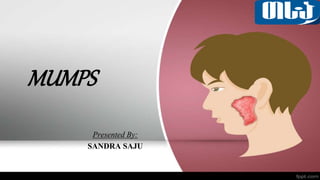
MUMPS
Presented By:
SANDRA SAJU
MUMPS VIRUS
 Mumps virus is the cause of acute,
benign viral parotitis.
 RNA virus
(Genus: Rubulavirus of the Paramyxoviridae family)
 Only one serotype is known.
{Hence, lifelong immunity after the infection}
Disease Mechanisms
• Cell-mediated immunity is essential for control of infection and responsible for
causing some of the symptoms. Antibody is not sufficient because of virus’s ability
to spread cell to cell.
Spread by respiratory droplets
Replicates in T Lymphocytes
Hematogenous spread
Infection of Parotid gland and Other organs.
Mumps Parotitis
Medical microbiology, 7th edition , page no.- 520
EPIDEMIOLOGY
I. Virus has large enveloped virion that is easily inactivated by dryness and acid.
II. Contagion period precedes symptoms.
III. Virus may cause asymptomatic shedding.
IV. Host range is limited to humans.
V. Only one serotype exists.
VI. Immunity is lifelong.
Symptoms {16-18 days}
Transmission
Inhalation / Direct Contact of large-droplet
aerosols.
Who Is at Risk?
• Unvaccinated people.
• Immunocompromised people.
complications
1.Inflammation of :
 Testicles(Orchitis)
 Ovaries
 Brain (Encephalitis)
2.Temporary or permanent blindness.
Geography/Season
• Virus is found worldwide
• Virus is endemic in late winter and early spring.
Laboratory diagnosis
 No Laboratory confirmation needed.
 Atypical infection needs laboratory diagnosis.
• Virus isolated from;
Saliva, Urine, Pharynx, Secretions from Stensen duct and CSF.
• Serology: mumps-specific IgM antibody.
• Enzyme-linked immunosorbent assay, Immunofluorescence tests, and
hemagglutination inhibition can be used to detect the mumps virus, antigen, or
antibody
Treatment
 No specific Antiviral therapy.
 Antipyretics are administered for fever.
 Bed rest
 And the Diet should be adjusted to patient’s ability to
chew.
Modes of Prevention
• Live attenuated vaccine (Jeryl Lynn strain),
Administered as a part of MMR vaccine.
• Keep distance from infected person.
Video:
References:
• Medical Microbiology, 7th edition, Murray, Rosenthal, Pfaller. [Pages ;519,520]
• http://www.slideshare.net/alanisaad/mumps-5090004
• Video Reference : https://www.youtube.com/watch?v=gZjaCigD4So
Mumps

Mumps

  • 1.
  • 2.
    MUMPS VIRUS  Mumpsvirus is the cause of acute, benign viral parotitis.  RNA virus (Genus: Rubulavirus of the Paramyxoviridae family)  Only one serotype is known. {Hence, lifelong immunity after the infection}
  • 3.
    Disease Mechanisms • Cell-mediatedimmunity is essential for control of infection and responsible for causing some of the symptoms. Antibody is not sufficient because of virus’s ability to spread cell to cell. Spread by respiratory droplets Replicates in T Lymphocytes Hematogenous spread Infection of Parotid gland and Other organs. Mumps Parotitis
  • 4.
    Medical microbiology, 7thedition , page no.- 520
  • 5.
    EPIDEMIOLOGY I. Virus haslarge enveloped virion that is easily inactivated by dryness and acid. II. Contagion period precedes symptoms. III. Virus may cause asymptomatic shedding. IV. Host range is limited to humans. V. Only one serotype exists. VI. Immunity is lifelong.
  • 6.
  • 8.
    Transmission Inhalation / DirectContact of large-droplet aerosols.
  • 9.
    Who Is atRisk? • Unvaccinated people. • Immunocompromised people.
  • 10.
    complications 1.Inflammation of : Testicles(Orchitis)  Ovaries  Brain (Encephalitis) 2.Temporary or permanent blindness.
  • 11.
    Geography/Season • Virus isfound worldwide • Virus is endemic in late winter and early spring.
  • 12.
    Laboratory diagnosis  NoLaboratory confirmation needed.  Atypical infection needs laboratory diagnosis. • Virus isolated from; Saliva, Urine, Pharynx, Secretions from Stensen duct and CSF. • Serology: mumps-specific IgM antibody. • Enzyme-linked immunosorbent assay, Immunofluorescence tests, and hemagglutination inhibition can be used to detect the mumps virus, antigen, or antibody
  • 13.
    Treatment  No specificAntiviral therapy.  Antipyretics are administered for fever.  Bed rest  And the Diet should be adjusted to patient’s ability to chew.
  • 14.
    Modes of Prevention •Live attenuated vaccine (Jeryl Lynn strain), Administered as a part of MMR vaccine. • Keep distance from infected person.
  • 15.
  • 16.
    References: • Medical Microbiology,7th edition, Murray, Rosenthal, Pfaller. [Pages ;519,520] • http://www.slideshare.net/alanisaad/mumps-5090004 • Video Reference : https://www.youtube.com/watch?v=gZjaCigD4So