Multitarget stool DNA Test performance
versus FIT in an average-risk Colorectal
Cancer Screening Population
Colorectal Journal Club
Important Terminology
• Sensitivity (true positive rate): Proportion of persons with disease who have a positive test.
• Specificity (true negative rate): Proportion of persons without disease who have a negative test.
• False negative rate (1 minus sensitivity): Proportion of persons with disease who have a
negative test.
• False positive rate (1 minus specificity): Proportion of persons without disease who have a
positive test.
• Positive predictive value: Proportion of persons with disease among those with a positive test.
• Negative predictive value: Proportion of persons without disease among those with a negative
test.
• Number needed to screen: The number of persons who would need to be screened to identify one
Criteria for a screening test
1- Condition is an important health problem
2- Natural hx of the condition understood
3- Disease has a latent asymptomatic stage
4- Treatment available & agreed policy on
who to treat
5- Available diagnosis & treatment facilities
6- Test acceptable to the population (safe)
7- Test has reasonable cost (cost effective)
8- Test is easy to administer
9- High sensitivity & specificity
10- Reproducible results (reliable)
Examples of Screening tests
• Mammography for breast cancer
• Cervical smear for cervical cancer
• USS abdomen for AAA
• FIT test for bowel cancer
Background
• Colorectal cancer (CRC) is one of the top 4 most common cancers worldwide (breast, lung, prostate)
and one of the leading causes for cancer-related mortality
• Colonoscopy is the gold standard for diagnosing CRC (visualises the entire colon + biopsies)
• FIT – Faecal Immunochemical Test
• Tests human haemoglobin using polyclonal antibodies
• Multitarget stool DNA testing
• Tests for KRAS mutations, NDRG4 & BMP3 promoter methylation, and haemoglobin
• Higher sensitivity in detecting CRC, advanced precancerous lesions and polyps with high grade dysplasia but lower
specificity when compared to FIT
• Currently colonoscopy is the main screening tool for CRC in US versus FIT in Europe
Aims & Endpoints
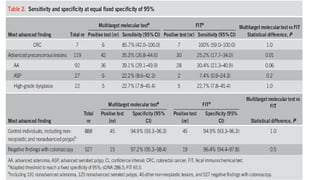
1- Evaluate the sensitivity and specificity of MT-sDNA and FIT in detecting CRC & AAs
2- Sensitivity of MT-sDNA with FIT using an equal fixed specificity of 95%
3- Stool test results in relation to different tumour characteristics, number of lesions, size, location,
morphology, histology, and dysplasia
Methodology
• Multi-centre (Amsterdam & Rotterdam in the Netherlands) prospective cohort study
• Data collected from June 2009 to July 2010
• Inclusion criteria:
• Asymptomatic individuals aged 50-75 years for 1ry colonoscopy screening
• Spontaneous stool sample prior to bowel prep
Exclusion criteria:
• Patients who had colonoscopy, CTC or Ba enemas in the last 5 years
• Patients undergoing surveillance colonoscopy
• FIT using OC-sensor, Eiken Chemical, Tokyo, Japan
• MT-sDNA using a standard operational procedure at Exact Sciences Lab, Madison, WI
Analysis
• 95% Confidence Intervals
• Chi Square & Fisher Exact tests used
• Logistic regression to decrease effect of confounding factors
Results
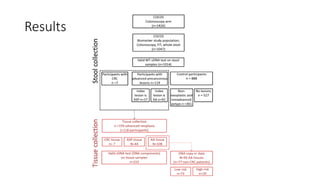
• 1,047 of 1,426 of individuals (73%) within the colonoscopy arm of COCOCS trial
had valid FIT & MT-sDNA tests
• MT-sDNA testing was successful in 1,014 of 1,047 evaluated samples (97%)
• Average age was 60 years (range 49 – 75)
• No significant difference in age or gender across participants
• CRC was present in 7 individuals (0.7%)
• Advanced precancerous lesions was found in 119 individuals (12%), of which 92
had advanced serrated polyps (ASP)
Results
Discussion
• MT-sDNA has increased sensitivity for detecting advanced precancerous
lesions compared with FIT alone.
• AAs with high progression risk were not associated with a significantly
higher sensitivity with either MT-sDNA or FIT.
• There could be benefit for MT-sDNA & FIT to be used in conjunction.
• US guidelines advocate that MT-sDNA every 3 years has similar specificity
to 3 annual FIT.
Critique
• Part of a randomised trial, gold standard for research
• Robust design & clear protocols to minimise risk of Bias
• Salami slicing
• Some poor participants’ compliance

multi-sDNA versus faecal immunochemical testing

  • 1.
    Multitarget stool DNATest performance versus FIT in an average-risk Colorectal Cancer Screening Population Colorectal Journal Club
  • 2.
    Important Terminology • Sensitivity(true positive rate): Proportion of persons with disease who have a positive test. • Specificity (true negative rate): Proportion of persons without disease who have a negative test. • False negative rate (1 minus sensitivity): Proportion of persons with disease who have a negative test. • False positive rate (1 minus specificity): Proportion of persons without disease who have a positive test. • Positive predictive value: Proportion of persons with disease among those with a positive test. • Negative predictive value: Proportion of persons without disease among those with a negative test. • Number needed to screen: The number of persons who would need to be screened to identify one
  • 3.
    Criteria for ascreening test 1- Condition is an important health problem 2- Natural hx of the condition understood 3- Disease has a latent asymptomatic stage 4- Treatment available & agreed policy on who to treat 5- Available diagnosis & treatment facilities 6- Test acceptable to the population (safe) 7- Test has reasonable cost (cost effective) 8- Test is easy to administer 9- High sensitivity & specificity 10- Reproducible results (reliable)
  • 4.
    Examples of Screeningtests • Mammography for breast cancer • Cervical smear for cervical cancer • USS abdomen for AAA • FIT test for bowel cancer
  • 5.
    Background • Colorectal cancer(CRC) is one of the top 4 most common cancers worldwide (breast, lung, prostate) and one of the leading causes for cancer-related mortality • Colonoscopy is the gold standard for diagnosing CRC (visualises the entire colon + biopsies) • FIT – Faecal Immunochemical Test • Tests human haemoglobin using polyclonal antibodies • Multitarget stool DNA testing • Tests for KRAS mutations, NDRG4 & BMP3 promoter methylation, and haemoglobin • Higher sensitivity in detecting CRC, advanced precancerous lesions and polyps with high grade dysplasia but lower specificity when compared to FIT • Currently colonoscopy is the main screening tool for CRC in US versus FIT in Europe
  • 6.
    Aims & Endpoints 1-Evaluate the sensitivity and specificity of MT-sDNA and FIT in detecting CRC & AAs 2- Sensitivity of MT-sDNA with FIT using an equal fixed specificity of 95% 3- Stool test results in relation to different tumour characteristics, number of lesions, size, location, morphology, histology, and dysplasia
  • 7.
    Methodology • Multi-centre (Amsterdam& Rotterdam in the Netherlands) prospective cohort study • Data collected from June 2009 to July 2010 • Inclusion criteria: • Asymptomatic individuals aged 50-75 years for 1ry colonoscopy screening • Spontaneous stool sample prior to bowel prep Exclusion criteria: • Patients who had colonoscopy, CTC or Ba enemas in the last 5 years • Patients undergoing surveillance colonoscopy • FIT using OC-sensor, Eiken Chemical, Tokyo, Japan • MT-sDNA using a standard operational procedure at Exact Sciences Lab, Madison, WI
  • 8.
    Analysis • 95% ConfidenceIntervals • Chi Square & Fisher Exact tests used • Logistic regression to decrease effect of confounding factors
  • 9.
    Results • 1,047 of1,426 of individuals (73%) within the colonoscopy arm of COCOCS trial had valid FIT & MT-sDNA tests • MT-sDNA testing was successful in 1,014 of 1,047 evaluated samples (97%) • Average age was 60 years (range 49 – 75) • No significant difference in age or gender across participants • CRC was present in 7 individuals (0.7%) • Advanced precancerous lesions was found in 119 individuals (12%), of which 92 had advanced serrated polyps (ASP)
  • 10.
  • 13.
    Discussion • MT-sDNA hasincreased sensitivity for detecting advanced precancerous lesions compared with FIT alone. • AAs with high progression risk were not associated with a significantly higher sensitivity with either MT-sDNA or FIT. • There could be benefit for MT-sDNA & FIT to be used in conjunction. • US guidelines advocate that MT-sDNA every 3 years has similar specificity to 3 annual FIT.
  • 14.
    Critique • Part ofa randomised trial, gold standard for research • Robust design & clear protocols to minimise risk of Bias • Salami slicing • Some poor participants’ compliance