Staggered Timing
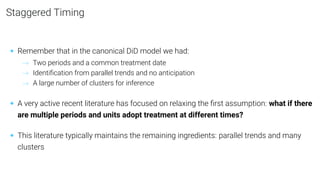
• Remember that in the canonical DiD model we had:
→ Two periods and a common treatment date
→ Identification from parallel trends and no anticipation
→ A large number of clusters for inference
• A very active recent literature has focused on relaxing the first assumption: what if there
are multiple periods and units adopt treatment at different times?
• This literature typically maintains the remaining ingredients: parallel trends and many
clusters
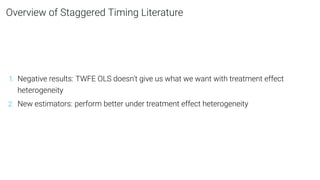
Overview of Staggered Timing Literature
1. Negative results: TWFE OLS doesn’t give us what we want with treatment effect
heterogeneity
2. New estimators: perform better under treatment effect heterogeneity
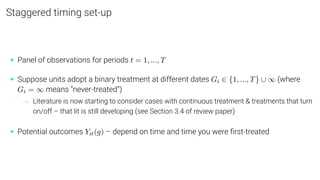
Staggered timing set-up
• Panel of observations for periods t = 1, ..., T
• Suppose units adopt a binary treatment at different dates Gi ∈ {1, ..., T} ∪ ∞ (where
Gi = ∞ means “never-treated”)
→ Literature is now starting to consider cases with continuous treatment & treatments that turn
on/off – that lit is still developing (see Section 3.4 of review paper)
• Potential outcomes Yit(g) – depend on time and time you were first-treated
Extending the Identifying Assumptions
• The key identifying assumptions from the canonical model are extended in the natural way
• Parallel trends: Intuitively, says that if treatment hadn’t happened, all “adoption cohorts”
would have parallel average outcomes in all periods
E[Yit(∞) − Yi,t−1(∞)|Gi = g] = E[Yit(∞) − Yi,t−1(∞)|Gi = g0
] for all g, g0
, t, t0
Note: can impose slightly weaker versions (e.g. only require PT post-treatment)
• No anticipation: Intuitively, says that treatment has no impact before it is implemented
Yit(g) = Yit(∞) for all t < g
Negative results
• Suppose we again run the regression
Yit = αi + φt + Ditβ + it,
where Dit = 1[t ≥ Gi] is a treatment indicator.
• Suppose we’re willing to assume no anticipation and parallel trends across all adoption
cohorts as described above
Negative results
• Suppose we again run the regression
Yit = αi + φt + Ditβ + it,
where Dit = 1[t ≥ Gi] is a treatment indicator.
• Suppose we’re willing to assume no anticipation and parallel trends across all adoption
cohorts as described above
• Good news: if treatment effects are constant across time and units, Yit(g) − Yit(∞) ≡ τ,
then β = τ
Negative results
• Suppose we again run the regression
Yit = αi + φt + Ditβ + it,
where Dit = 1[t ≥ Gi] is a treatment indicator.
• Suppose we’re willing to assume no anticipation and parallel trends across all adoption
cohorts as described above
• Good news: if treatment effects are constant across time and units, Yit(g) − Yit(∞) ≡ τ,
then β = τ
• Bad news: if treatment effects are not constant across time/units, then β may put
negative weights on treatment effects for some units and time periods
→ E.g., if treatment effect depends on time since treatment, Yit(t − r) − Yit(∞) = τr, then some
τrs may get negative weight
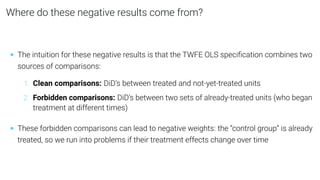
Where do these negative results come from?
• The intuition for these negative results is that the TWFE OLS specification combines two
sources of comparisons:
1. Clean comparisons: DiD’s between treated and not-yet-treated units
2. Forbidden comparisons: DiD’s between two sets of already-treated units (who began
treatment at different times)
• These forbidden comparisons can lead to negative weights: the “control group” is already
treated, so we run into problems if their treatment effects change over time
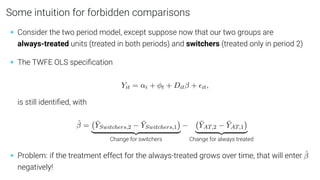
Some intuition for forbidden comparisons
• Consider the two period model, except suppose now that our two groups are
always-treated units (treated in both periods) and switchers (treated only in period 2)
• The TWFE OLS specification
Yit = αi + φt + Ditβ + it,
is still identified, with
β̂ = ȲSwitchers,2 − ȲSwitchers,1

| {z }
Change for switchers
− ȲAT,2 − ȲAT,1

| {z }
Change for always treated
• Problem: if the treatment effect for the always-treated grows over time, that will enter β̂
negatively!
Not just negative but weird...
The literature has placed a lot of emphasis on the fact that some treatment effects may get
negative weights
• But even if the weights are non-negative, they might not give us the most intuitive
parameter
• For example, suppose each unit i has treatment effect τi in every period if they are treated
(no dynamics). Then β gives a weighted average of the τi where the weights are largest
for units treated closest to the middle of the panel
• It is not obvious that these weights are relevant for policy, even if they are all non-negative!
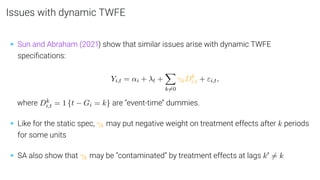
Issues with dynamic TWFE
• Sun and Abraham (2021) show that similar issues arise with dynamic TWFE
specifications:
Yi,t = αi + λt +
X
k6=0
γkDk
i,t + εi,t,
where Dk
i,t = 1 {t − Gi = k} are “event-time” dummies.
• Like for the static spec, γk may put negative weight on treatment effects after k periods
for some units
• SA also show that γk may be “contaminated” by treatment effects at lags k0 6= k
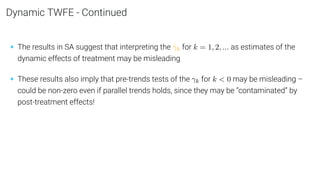
Dynamic TWFE - Continued
• The results in SA suggest that interpreting the γ̂k for k = 1, 2, ... as estimates of the
dynamic effects of treatment may be misleading
• These results also imply that pre-trends tests of the γk for k  0 may be misleading –
could be non-zero even if parallel trends holds, since they may be “contaminated” by
post-treatment effects!
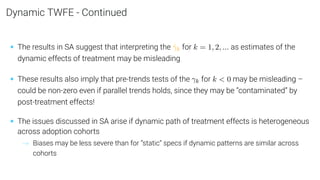
Dynamic TWFE - Continued
• The results in SA suggest that interpreting the γ̂k for k = 1, 2, ... as estimates of the
dynamic effects of treatment may be misleading
• These results also imply that pre-trends tests of the γk for k  0 may be misleading –
could be non-zero even if parallel trends holds, since they may be “contaminated” by
post-treatment effects!
• The issues discussed in SA arise if dynamic path of treatment effects is heterogeneous
across adoption cohorts
→ Biases may be less severe than for “static” specs if dynamic patterns are similar across
cohorts
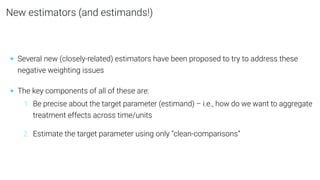
New estimators (and estimands!)
• Several new (closely-related) estimators have been proposed to try to address these
negative weighting issues
• The key components of all of these are:
1. Be precise about the target parameter (estimand) – i.e., how do we want to aggregate
treatment effects across time/units
2. Estimate the target parameter using only “clean-comparisons”
Example – Callaway and Sant’Anna (2020)
• Define ATT(g, t) to be ATT in period t for units first treated at period g,
ATT(g, t) = E[Yit(g) − Yit(∞)|Gi = g]
Example – Callaway and Sant’Anna (2020)
• Define ATT(g, t) to be ATT in period t for units first treated at period g,
ATT(g, t) = E[Yit(g) − Yit(∞)|Gi = g]
• Under PT and No Anticipation, ATT(g, t) is identified as
ATT(g, t) = E[Yit − Yi,g−1|Gi = g]
| {z }
Change for cohort g
− E[Yit − Yi,g−1|Gi = ∞]
| {z }
Change for never-treated units
• Why?
Example – Callaway and Sant’Anna (2020)
• Define ATT(g, t) to be ATT in period t for units first treated at period g,
ATT(g, t) = E[Yit(g) − Yit(∞)|Gi = g]
• Under PT and No Anticipation, ATT(g, t) is identified as
ATT(g, t) = E[Yit − Yi,g−1|Gi = g]
| {z }
Change for cohort g
− E[Yit − Yi,g−1|Gi = ∞]
| {z }
Change for never-treated units
• Why? This is a two-group two-period comparison, so the argument is the same as in the
canonical case!
Proof of Identification Argument
• Start with
E[Yit − Yi,g−1|Gi = g] − E[Yit − Yi,g−1|Gi = ∞]
Proof of Identification Argument
• Start with
E[Yit − Yi,g−1|Gi = g] − E[Yit − Yi,g−1|Gi = ∞]
• Apply definition of POs to obtain:
E[Yit(g) − Yi,g−1(g)|Gi = g] − E[Yig(∞) − Yi,g−1(∞)|Gi = ∞]
Proof of Identification Argument
• Start with
E[Yit − Yi,g−1|Gi = g] − E[Yit − Yi,g−1|Gi = ∞]
• Apply definition of POs to obtain:
E[Yit(g) − Yi,g−1(g)|Gi = g] − E[Yig(∞) − Yi,g−1(∞)|Gi = ∞]
• Use No Anticipation to substitute Yi,g−1(∞) for Yi,g−1(g):
E[Yit(g) − Yi,g−1(∞)|Gi = g] − E[Yig(∞) − Yi,g−1(∞)|Gi = ∞]
Proof of Identification Argument
• Start with
E[Yit − Yi,g−1|Gi = g] − E[Yit − Yi,g−1|Gi = ∞]
• Apply definition of POs to obtain:
E[Yit(g) − Yi,g−1(g)|Gi = g] − E[Yig(∞) − Yi,g−1(∞)|Gi = ∞]
• Use No Anticipation to substitute Yi,g−1(∞) for Yi,g−1(g):
E[Yit(g) − Yi,g−1(∞)|Gi = g] − E[Yig(∞) − Yi,g−1(∞)|Gi = ∞]
• Add and subtract E[Yit(∞)|Gi = g] to obtain:
E[Yit(g) − Yit(∞)|Gi = g]+
[E[Yit(∞) − Yi,g−1(∞)|Gi = g] − E[Yig(∞) − Yi,g−1(∞)|Gi = ∞]]
Proof of Identification Argument
• Start with
E[Yit − Yi,g−1|Gi = g] − E[Yit − Yi,g−1|Gi = ∞]
• Apply definition of POs to obtain:
E[Yit(g) − Yi,g−1(g)|Gi = g] − E[Yig(∞) − Yi,g−1(∞)|Gi = ∞]
• Use No Anticipation to substitute Yi,g−1(∞) for Yi,g−1(g):
E[Yit(g) − Yi,g−1(∞)|Gi = g] − E[Yig(∞) − Yi,g−1(∞)|Gi = ∞]
• Add and subtract E[Yit(∞)|Gi = g] to obtain:
E[Yit(g) − Yit(∞)|Gi = g]+
[E[Yit(∞) − Yi,g−1(∞)|Gi = g] − E[Yig(∞) − Yi,g−1(∞)|Gi = ∞]]
• Cancel the last term using PT to get E[Yit(g) − Yit(∞)|Gi = g] = ATT(g, t)
Example – Callaway and Sant’Anna (2020)
• Define ATT(g, t) to be ATT in period t for units first treated at period g,
ATT(g, t) = E[Yit(g) − Yit(∞)|Gi = g]
Example – Callaway and Sant’Anna (2020)
• Define ATT(g, t) to be ATT in period t for units first treated at period g,
ATT(g, t) = E[Yit(g) − Yit(∞)|Gi = g]
• Under PT and No Anticipation,
ATT(g, t) = E[Yit − Yi,g−1|Gi = g]
| {z }
Change for cohort g
− E[Yit − Yi,g−1|Gi = ∞]
| {z }
Change for never-treated
Example – Callaway and Sant’Anna (2020)
• Define ATT(g, t) to be ATT in period t for units first treated at period g,
ATT(g, t) = E[Yit(g) − Yit(∞)|Gi = g]
• Under PT and No Anticipation,
ATT(g, t) = E[Yit − Yi,g−1|Gi = g]
| {z }
Change for cohort g
− E[Yit − Yi,g−1|Gi = ∞]
| {z }
Change for never-treated
• We can then estimate this with sample analogs:
[
ATT(g, t) = b
E[Yit − Yi,g−1|Gi = g]
| {z }
Sample change for cohort g
− b
E[Yit − Yi,g−1|Gi = ∞]
| {z }
Sample change for never-treated
where Ê denotes sample means.
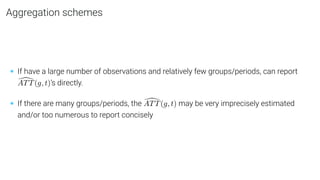
Aggregation schemes
• If have a large number of observations and relatively few groups/periods, can report
[
ATT(g, t)’s directly.
• If there are many groups/periods, the [
ATT(g, t) may be very imprecisely estimated
and/or too numerous to report concisely
Aggregation schemes
• In these cases, it is often desirable to report sensible averages of the [
ATT(g, t)’s.
Aggregation schemes
• In these cases, it is often desirable to report sensible averages of the [
ATT(g, t)’s.
• One of the most useful is to report event-study parameters which aggregate [
ATT(g, t)’s
at a particular lag since treatment
→ E.g. θ̂k =
P
g
[
ATT(g, t + k) aggregates effects for cohorts in the kth period after treatment
→ Can also construct for k  0 to estimate “pre-trends”
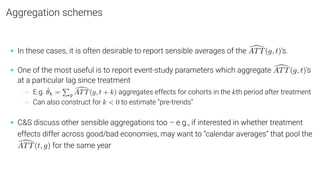
Aggregation schemes
• In these cases, it is often desirable to report sensible averages of the [
ATT(g, t)’s.
• One of the most useful is to report event-study parameters which aggregate [
ATT(g, t)’s
at a particular lag since treatment
→ E.g. θ̂k =
P
g
[
ATT(g, t + k) aggregates effects for cohorts in the kth period after treatment
→ Can also construct for k  0 to estimate “pre-trends”
• CS discuss other sensible aggregations too – e.g., if interested in whether treatment
effects differ across good/bad economies, may want to “calendar averages” that pool the
[
ATT(t, g) for the same year
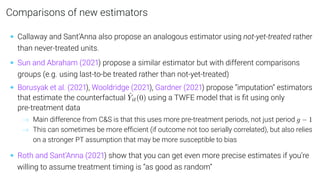
Comparisons of new estimators
• Callaway and Sant’Anna also propose an analogous estimator using not-yet-treated rather
than never-treated units.
• Sun and Abraham (2021) propose a similar estimator but with different comparisons
groups (e.g. using last-to-be treated rather than not-yet-treated)
• Borusyak et al. (2021), Wooldridge (2021), Gardner (2021) propose “imputation” estimators
that estimate the counterfactual Ŷit(0) using a TWFE model that is fit using only
pre-treatment data
→ Main difference from CS is that this uses more pre-treatment periods, not just period g − 1
→ This can sometimes be more efficient (if outcome not too serially correlated), but also relies
on a stronger PT assumption that may be more susceptible to bias
• Roth and Sant’Anna (2021) show that you can get even more precise estimates if you’re
willing to assume treatment timing is “as good as random”
Personal advice
• Don’t freak out about this new literature!
Personal advice
• Don’t freak out about this new literature!
• In most cases, using the “new” DiD methods will not lead to a big change in your results
(empirically, TE heterogeneity is not that large in most cases)
→ The exceptions are cases where there are many periods with very few treated units – this is
when “forbidden comparisons” get the most weight
Personal advice
• Don’t freak out about this new literature!
• In most cases, using the “new” DiD methods will not lead to a big change in your results
(empirically, TE heterogeneity is not that large in most cases)
→ The exceptions are cases where there are many periods with very few treated units – this is
when “forbidden comparisons” get the most weight
• The most important thing is to be precise about who you want the comparison group to
be and to choose a method that only uses these “clean comparisons”
Personal advice
• Don’t freak out about this new literature!
• In most cases, using the “new” DiD methods will not lead to a big change in your results
(empirically, TE heterogeneity is not that large in most cases)
→ The exceptions are cases where there are many periods with very few treated units – this is
when “forbidden comparisons” get the most weight
• The most important thing is to be precise about who you want the comparison group to
be and to choose a method that only uses these “clean comparisons”
• In my experience, the difference between the new estimators is typically not that large –
can report multiple new methods for robustness (to make your referees happy!)
References I
Borusyak, Kirill, Xavier Jaravel, and Jann Spiess, “Revisiting Event Study Designs: Robust
and Efficient Estimation,” arXiv:2108.12419 [econ], 2021.
Gardner, John, “Two-stage differences in differences,” Working Paper, 2021.
Roth, Jonathan and Pedro H. C. Sant’Anna, “Efficient Estimation for Staggered Rollout
Designs,” arXiv:2102.01291 [econ, math, stat], 2021.
Sun, Liyang and Sarah Abraham, “Estimating dynamic treatment effects in event studies
with heterogeneous treatment effects,” Journal of Econometrics, 2021, 225 (2), 175–199.
Wooldridge, Jeffrey M, “Two-Way Fixed Effects, the Two-Way Mundlak Regression, and
Difference-in-Differences Estimators,” Working Paper, 2021, pp. 1–89.

Multiple periods and staggered treatment timing

  • 2.
    Staggered Timing • Rememberthat in the canonical DiD model we had: → Two periods and a common treatment date → Identification from parallel trends and no anticipation → A large number of clusters for inference • A very active recent literature has focused on relaxing the first assumption: what if there are multiple periods and units adopt treatment at different times? • This literature typically maintains the remaining ingredients: parallel trends and many clusters
  • 3.
    Overview of StaggeredTiming Literature 1. Negative results: TWFE OLS doesn’t give us what we want with treatment effect heterogeneity 2. New estimators: perform better under treatment effect heterogeneity
  • 4.
    Staggered timing set-up •Panel of observations for periods t = 1, ..., T • Suppose units adopt a binary treatment at different dates Gi ∈ {1, ..., T} ∪ ∞ (where Gi = ∞ means “never-treated”) → Literature is now starting to consider cases with continuous treatment & treatments that turn on/off – that lit is still developing (see Section 3.4 of review paper) • Potential outcomes Yit(g) – depend on time and time you were first-treated
  • 5.
    Extending the IdentifyingAssumptions • The key identifying assumptions from the canonical model are extended in the natural way • Parallel trends: Intuitively, says that if treatment hadn’t happened, all “adoption cohorts” would have parallel average outcomes in all periods E[Yit(∞) − Yi,t−1(∞)|Gi = g] = E[Yit(∞) − Yi,t−1(∞)|Gi = g0 ] for all g, g0 , t, t0 Note: can impose slightly weaker versions (e.g. only require PT post-treatment) • No anticipation: Intuitively, says that treatment has no impact before it is implemented Yit(g) = Yit(∞) for all t < g
  • 6.
    Negative results • Supposewe again run the regression Yit = αi + φt + Ditβ + it, where Dit = 1[t ≥ Gi] is a treatment indicator. • Suppose we’re willing to assume no anticipation and parallel trends across all adoption cohorts as described above
  • 7.
    Negative results • Supposewe again run the regression Yit = αi + φt + Ditβ + it, where Dit = 1[t ≥ Gi] is a treatment indicator. • Suppose we’re willing to assume no anticipation and parallel trends across all adoption cohorts as described above • Good news: if treatment effects are constant across time and units, Yit(g) − Yit(∞) ≡ τ, then β = τ
  • 8.
    Negative results • Supposewe again run the regression Yit = αi + φt + Ditβ + it, where Dit = 1[t ≥ Gi] is a treatment indicator. • Suppose we’re willing to assume no anticipation and parallel trends across all adoption cohorts as described above • Good news: if treatment effects are constant across time and units, Yit(g) − Yit(∞) ≡ τ, then β = τ • Bad news: if treatment effects are not constant across time/units, then β may put negative weights on treatment effects for some units and time periods → E.g., if treatment effect depends on time since treatment, Yit(t − r) − Yit(∞) = τr, then some τrs may get negative weight
  • 9.
    Where do thesenegative results come from? • The intuition for these negative results is that the TWFE OLS specification combines two sources of comparisons: 1. Clean comparisons: DiD’s between treated and not-yet-treated units 2. Forbidden comparisons: DiD’s between two sets of already-treated units (who began treatment at different times) • These forbidden comparisons can lead to negative weights: the “control group” is already treated, so we run into problems if their treatment effects change over time
  • 10.
    Some intuition forforbidden comparisons • Consider the two period model, except suppose now that our two groups are always-treated units (treated in both periods) and switchers (treated only in period 2) • The TWFE OLS specification Yit = αi + φt + Ditβ + it, is still identified, with β̂ = ȲSwitchers,2 − ȲSwitchers,1 | {z } Change for switchers − ȲAT,2 − ȲAT,1 | {z } Change for always treated • Problem: if the treatment effect for the always-treated grows over time, that will enter β̂ negatively!
  • 11.
    Not just negativebut weird... The literature has placed a lot of emphasis on the fact that some treatment effects may get negative weights • But even if the weights are non-negative, they might not give us the most intuitive parameter • For example, suppose each unit i has treatment effect τi in every period if they are treated (no dynamics). Then β gives a weighted average of the τi where the weights are largest for units treated closest to the middle of the panel • It is not obvious that these weights are relevant for policy, even if they are all non-negative!
  • 12.
    Issues with dynamicTWFE • Sun and Abraham (2021) show that similar issues arise with dynamic TWFE specifications: Yi,t = αi + λt + X k6=0 γkDk i,t + εi,t, where Dk i,t = 1 {t − Gi = k} are “event-time” dummies. • Like for the static spec, γk may put negative weight on treatment effects after k periods for some units • SA also show that γk may be “contaminated” by treatment effects at lags k0 6= k
  • 13.
    Dynamic TWFE -Continued • The results in SA suggest that interpreting the γ̂k for k = 1, 2, ... as estimates of the dynamic effects of treatment may be misleading • These results also imply that pre-trends tests of the γk for k 0 may be misleading – could be non-zero even if parallel trends holds, since they may be “contaminated” by post-treatment effects!
  • 14.
    Dynamic TWFE -Continued • The results in SA suggest that interpreting the γ̂k for k = 1, 2, ... as estimates of the dynamic effects of treatment may be misleading • These results also imply that pre-trends tests of the γk for k 0 may be misleading – could be non-zero even if parallel trends holds, since they may be “contaminated” by post-treatment effects! • The issues discussed in SA arise if dynamic path of treatment effects is heterogeneous across adoption cohorts → Biases may be less severe than for “static” specs if dynamic patterns are similar across cohorts
  • 15.
    New estimators (andestimands!) • Several new (closely-related) estimators have been proposed to try to address these negative weighting issues • The key components of all of these are: 1. Be precise about the target parameter (estimand) – i.e., how do we want to aggregate treatment effects across time/units 2. Estimate the target parameter using only “clean-comparisons”
  • 16.
    Example – Callawayand Sant’Anna (2020) • Define ATT(g, t) to be ATT in period t for units first treated at period g, ATT(g, t) = E[Yit(g) − Yit(∞)|Gi = g]
  • 17.
    Example – Callawayand Sant’Anna (2020) • Define ATT(g, t) to be ATT in period t for units first treated at period g, ATT(g, t) = E[Yit(g) − Yit(∞)|Gi = g] • Under PT and No Anticipation, ATT(g, t) is identified as ATT(g, t) = E[Yit − Yi,g−1|Gi = g] | {z } Change for cohort g − E[Yit − Yi,g−1|Gi = ∞] | {z } Change for never-treated units • Why?
  • 18.
    Example – Callawayand Sant’Anna (2020) • Define ATT(g, t) to be ATT in period t for units first treated at period g, ATT(g, t) = E[Yit(g) − Yit(∞)|Gi = g] • Under PT and No Anticipation, ATT(g, t) is identified as ATT(g, t) = E[Yit − Yi,g−1|Gi = g] | {z } Change for cohort g − E[Yit − Yi,g−1|Gi = ∞] | {z } Change for never-treated units • Why? This is a two-group two-period comparison, so the argument is the same as in the canonical case!
  • 19.
    Proof of IdentificationArgument • Start with E[Yit − Yi,g−1|Gi = g] − E[Yit − Yi,g−1|Gi = ∞]
  • 20.
    Proof of IdentificationArgument • Start with E[Yit − Yi,g−1|Gi = g] − E[Yit − Yi,g−1|Gi = ∞] • Apply definition of POs to obtain: E[Yit(g) − Yi,g−1(g)|Gi = g] − E[Yig(∞) − Yi,g−1(∞)|Gi = ∞]
  • 21.
    Proof of IdentificationArgument • Start with E[Yit − Yi,g−1|Gi = g] − E[Yit − Yi,g−1|Gi = ∞] • Apply definition of POs to obtain: E[Yit(g) − Yi,g−1(g)|Gi = g] − E[Yig(∞) − Yi,g−1(∞)|Gi = ∞] • Use No Anticipation to substitute Yi,g−1(∞) for Yi,g−1(g): E[Yit(g) − Yi,g−1(∞)|Gi = g] − E[Yig(∞) − Yi,g−1(∞)|Gi = ∞]
  • 22.
    Proof of IdentificationArgument • Start with E[Yit − Yi,g−1|Gi = g] − E[Yit − Yi,g−1|Gi = ∞] • Apply definition of POs to obtain: E[Yit(g) − Yi,g−1(g)|Gi = g] − E[Yig(∞) − Yi,g−1(∞)|Gi = ∞] • Use No Anticipation to substitute Yi,g−1(∞) for Yi,g−1(g): E[Yit(g) − Yi,g−1(∞)|Gi = g] − E[Yig(∞) − Yi,g−1(∞)|Gi = ∞] • Add and subtract E[Yit(∞)|Gi = g] to obtain: E[Yit(g) − Yit(∞)|Gi = g]+ [E[Yit(∞) − Yi,g−1(∞)|Gi = g] − E[Yig(∞) − Yi,g−1(∞)|Gi = ∞]]
  • 23.
    Proof of IdentificationArgument • Start with E[Yit − Yi,g−1|Gi = g] − E[Yit − Yi,g−1|Gi = ∞] • Apply definition of POs to obtain: E[Yit(g) − Yi,g−1(g)|Gi = g] − E[Yig(∞) − Yi,g−1(∞)|Gi = ∞] • Use No Anticipation to substitute Yi,g−1(∞) for Yi,g−1(g): E[Yit(g) − Yi,g−1(∞)|Gi = g] − E[Yig(∞) − Yi,g−1(∞)|Gi = ∞] • Add and subtract E[Yit(∞)|Gi = g] to obtain: E[Yit(g) − Yit(∞)|Gi = g]+ [E[Yit(∞) − Yi,g−1(∞)|Gi = g] − E[Yig(∞) − Yi,g−1(∞)|Gi = ∞]] • Cancel the last term using PT to get E[Yit(g) − Yit(∞)|Gi = g] = ATT(g, t)
  • 24.
    Example – Callawayand Sant’Anna (2020) • Define ATT(g, t) to be ATT in period t for units first treated at period g, ATT(g, t) = E[Yit(g) − Yit(∞)|Gi = g]
  • 25.
    Example – Callawayand Sant’Anna (2020) • Define ATT(g, t) to be ATT in period t for units first treated at period g, ATT(g, t) = E[Yit(g) − Yit(∞)|Gi = g] • Under PT and No Anticipation, ATT(g, t) = E[Yit − Yi,g−1|Gi = g] | {z } Change for cohort g − E[Yit − Yi,g−1|Gi = ∞] | {z } Change for never-treated
  • 26.
    Example – Callawayand Sant’Anna (2020) • Define ATT(g, t) to be ATT in period t for units first treated at period g, ATT(g, t) = E[Yit(g) − Yit(∞)|Gi = g] • Under PT and No Anticipation, ATT(g, t) = E[Yit − Yi,g−1|Gi = g] | {z } Change for cohort g − E[Yit − Yi,g−1|Gi = ∞] | {z } Change for never-treated • We can then estimate this with sample analogs: [ ATT(g, t) = b E[Yit − Yi,g−1|Gi = g] | {z } Sample change for cohort g − b E[Yit − Yi,g−1|Gi = ∞] | {z } Sample change for never-treated where Ê denotes sample means.
  • 27.
    Aggregation schemes • Ifhave a large number of observations and relatively few groups/periods, can report [ ATT(g, t)’s directly. • If there are many groups/periods, the [ ATT(g, t) may be very imprecisely estimated and/or too numerous to report concisely
  • 28.
    Aggregation schemes • Inthese cases, it is often desirable to report sensible averages of the [ ATT(g, t)’s.
  • 29.
    Aggregation schemes • Inthese cases, it is often desirable to report sensible averages of the [ ATT(g, t)’s. • One of the most useful is to report event-study parameters which aggregate [ ATT(g, t)’s at a particular lag since treatment → E.g. θ̂k = P g [ ATT(g, t + k) aggregates effects for cohorts in the kth period after treatment → Can also construct for k 0 to estimate “pre-trends”
  • 30.
    Aggregation schemes • Inthese cases, it is often desirable to report sensible averages of the [ ATT(g, t)’s. • One of the most useful is to report event-study parameters which aggregate [ ATT(g, t)’s at a particular lag since treatment → E.g. θ̂k = P g [ ATT(g, t + k) aggregates effects for cohorts in the kth period after treatment → Can also construct for k 0 to estimate “pre-trends” • CS discuss other sensible aggregations too – e.g., if interested in whether treatment effects differ across good/bad economies, may want to “calendar averages” that pool the [ ATT(t, g) for the same year
  • 31.
    Comparisons of newestimators • Callaway and Sant’Anna also propose an analogous estimator using not-yet-treated rather than never-treated units. • Sun and Abraham (2021) propose a similar estimator but with different comparisons groups (e.g. using last-to-be treated rather than not-yet-treated) • Borusyak et al. (2021), Wooldridge (2021), Gardner (2021) propose “imputation” estimators that estimate the counterfactual Ŷit(0) using a TWFE model that is fit using only pre-treatment data → Main difference from CS is that this uses more pre-treatment periods, not just period g − 1 → This can sometimes be more efficient (if outcome not too serially correlated), but also relies on a stronger PT assumption that may be more susceptible to bias • Roth and Sant’Anna (2021) show that you can get even more precise estimates if you’re willing to assume treatment timing is “as good as random”
  • 32.
    Personal advice • Don’tfreak out about this new literature!
  • 33.
    Personal advice • Don’tfreak out about this new literature! • In most cases, using the “new” DiD methods will not lead to a big change in your results (empirically, TE heterogeneity is not that large in most cases) → The exceptions are cases where there are many periods with very few treated units – this is when “forbidden comparisons” get the most weight
  • 34.
    Personal advice • Don’tfreak out about this new literature! • In most cases, using the “new” DiD methods will not lead to a big change in your results (empirically, TE heterogeneity is not that large in most cases) → The exceptions are cases where there are many periods with very few treated units – this is when “forbidden comparisons” get the most weight • The most important thing is to be precise about who you want the comparison group to be and to choose a method that only uses these “clean comparisons”
  • 35.
    Personal advice • Don’tfreak out about this new literature! • In most cases, using the “new” DiD methods will not lead to a big change in your results (empirically, TE heterogeneity is not that large in most cases) → The exceptions are cases where there are many periods with very few treated units – this is when “forbidden comparisons” get the most weight • The most important thing is to be precise about who you want the comparison group to be and to choose a method that only uses these “clean comparisons” • In my experience, the difference between the new estimators is typically not that large – can report multiple new methods for robustness (to make your referees happy!)
  • 36.
    References I Borusyak, Kirill,Xavier Jaravel, and Jann Spiess, “Revisiting Event Study Designs: Robust and Efficient Estimation,” arXiv:2108.12419 [econ], 2021. Gardner, John, “Two-stage differences in differences,” Working Paper, 2021. Roth, Jonathan and Pedro H. C. Sant’Anna, “Efficient Estimation for Staggered Rollout Designs,” arXiv:2102.01291 [econ, math, stat], 2021. Sun, Liyang and Sarah Abraham, “Estimating dynamic treatment effects in event studies with heterogeneous treatment effects,” Journal of Econometrics, 2021, 225 (2), 175–199. Wooldridge, Jeffrey M, “Two-Way Fixed Effects, the Two-Way Mundlak Regression, and Difference-in-Differences Estimators,” Working Paper, 2021, pp. 1–89.