Multi-objective Genetic Algorithm for
Interior Lighting Design
Alice Plebe and Mario Pavone
Department of Mathematics and Computer Science
University of Catania
V.le A. Doria 6, I-95125 Catania, Italy
alice.plebe@gmail.com, mpavone@dmi.unict.it
Abstract. This paper proposes a novel system to help in the design of
interior lighting. It is based on multi-objective optimization of the key
criteria involved in lighting design: the respect of a given target level
of illuminance, uniformity of lighting, and electrical energy saving. The
proposed solution integrates the 3D graphic software Blender, used to
reproduce the architectural space and to simulate the effect of illumina-
tion, and the genetic algorithm NSGA-II. This solution offers advantages
in design flexibility over previous related works.
Keywords: Lighting design · Genetic algorithm · Blender
1 Introduction
The design of interior lighting is the crucial and complex process of integrating
luminaries into the fabric of architecture [11, 17]. The goal is to select the lighting
equipment and their placement in the interior environment, that result in a
comfortable and pleasant visual experience. The design process should take into
account several aspects, such as the type of occupants and the type of activities
in the given space, or the interior surface finishes and furnishings.
In addition, in the last decades increasing attention has been paid to the
issue of energy savings. In U.S. the energy consumed for lighting accounts for
about 30% of the total energy consumed by commercial buildings, and in the
European Union the yearly consumption is over 170 TWh. Therefore, the concept
of sustainable lighting design has become central in architectural strategies [23].
A well established aids offered by computational tools to the designer is by
photorealistic architectural rendering, simulating in computer graphics the effect
of a lighting solution on a model of the interior environment [15]. Mathematically,
this is the solution of the direct lighting problem. The drawback of direct lighting
tools is that, if the achieved illumination is not satisfactory, it is not easy to infer
which modifications to the current solution may lead to improvements. Very
likely, the final solution chosen by the designer over a collection of trials, will be
far from optimal.
As discussed in §2, a more effective assistance would be given by compu-
tational tools implementing the inverse lighting problem: the determination of
2 A. Plebe, M. Pavone
the lighting equipment and their placement from specifications on the illumi-
nance. This is the line of research undertaken by this paper. The inverse lighting
problem lacks reliable analytic solutions, therefore it is often formulated as an
optimization problem. The proposed methodology aims to optimize the main
common requirements of interior lighting design, chiefly the desired level of av-
erage luminous intensity, the uniformity of light in the interior space, taking into
account energy consumption. Due to the clashing of these multiple factors, the
resulting problem is multi-objective in nature, as discusses in §3, where previ-
ous proposals for interior lighting design are compared and contrasted with the
present one.
Our methodology, detailed in §4, is based on the combination of a 3D graphic
software providing a rendering engine for direct illumination, and genetic algo-
rithms for solving the multi-objective inverse illumination optimization. Results
on a variety of interior environments are shown in §5.
2 The Inverse Lighting Problem
In a nutshell, lighting design for interior spaces is the process of integration of
artificial light sources in architectural complexes – be it industrial, public or
private [11]. Since the discovery of the electric light system by Thomas Edison
in 1879, lighting design has experienced several significant revolutions, such as
fluorescent lamps in 1938 and, more recently, solid-state lighting.
Traditionally, illumination design has been seen as a blend of art and practice,
where all the challenges are left to the creativity and the experience of the
design architect. Given the aesthetic nature of the task, lighting design may
seems difficult to formally model. Nevertheless, the design process has been
lately considered as a mathematical and physical problem to be solved with
optimization techniques.
The inverse lighting problem [2, 14, 24, 20] is the problem of determining po-
tential light sources satisfying a set of given illumination requirements, for a
pre-defined interior space. Conversely, the direct lighting problem refers to the
computation of radiance distribution in an environment that is completely known
a priori, including its lighting parameters. In the inverse problem, lighting con-
figurations are inferred from the desired illumination requirements, taking into
account positions, kinds of luminaries, intensities and number of light sources.
Energy efficiency is often considered as well.
Given the many feasible solutions possible, the application of optimization
methods still allows the designer to have a degree of freedom and creativity in
the final choice of the lighting configuration, from one of the optimal solutions
obtained.
2.1 Blender as Direct Engine
A system facing the inverse lighting problem must provide two fundamental
components:
Multi-objective Genetic Algorithm for Interior Lighting Design 3
• a three-dimensional environment able to accurately reproduce the architec-
tural space and its spectral reflectometric properties;
• a physical simulation platform for illumination calculation in sample points
of the architectural space.
Several approaches were considered in order to satisfy these requirements. Light-
solve [1] is an interactive dedicated environment for daylight design, with a
performance-driven decision support system. The system lacks a detailed ar-
chitectural reproduction, and the inclusion of interior furniture is difficult to
manage. In [10] the 3d models of building facades are obtained with the simple
modeling tool Google SketchUp, which offers a quick and easy way to outline an
architectural space, but resulting in a low level of realism. Conversely, the pop-
ular software Radiance, widely used in the field of optimal lighting design [15,
9, 19], consists of a sophisticated physically-correct rendering engine for illumi-
nation calculation, and it allows architectural spaces reproduction at arbitrary
levels of detail. Nevertheless, it is a non-interactive system composed by a col-
lection of command-line programs, and all architectural specifications have to be
coded into configuration files. Attempts have been made to unify those extremes,
for example Painting With Light is an integration environment for Rhinoceros,
a commercial CAD software, and Radiance [4].
This paper investigates the adoption of the 3D graphic software Blender as
a unified solution to the two requirements stated above. Firstly, Blender is the
most comprehensive open-source computer graphic tool available, it is particu-
larly suitable for modeling architectural interiors, with the possibility of import-
ing components from CAD files. Secondly, Blender provides a physically-based
rendering engine, named Cycles, able to exhaustively evaluate lighting configura-
tions needed for solving the inverse lighting problem. Moreover, Blender embeds
a Python interpreter which can run scripts supplied by the user, in order to ex-
tend its functionalities, and is known for its remarkable software integrity [12].
Thanks to its intrinsic versatility, Blender has already been applied to a number
of different problems, including industrial applications [21].
3 Multi-objective Optimization
Interior illumination design involves multiple and often conflicting factors, there-
fore the resulting problem is multi-objective in nature. In contrast to a single-
optimization problem, where there is usually a single optimal solution, a multi-
objective optimization finds a set of solutions that satisfies all conflicting criteria.
Multi-objective optimization methods have been widely used in architectural
and lighting design, and plenty of them are nature-inspired. A particle swarm
optimization algorithm was developed to design curtain wall facades for office
buildings and to achieves low energy consumption [22]. A study has adopted
multicriteria ant colony optimization to design paneled building envelopes, op-
timizing lighting performance and cost criteria [25]. Harmony search algorithms
have been applied in the field of civil engineering several times, such as structural
4 A. Plebe, M. Pavone
design optimization [16], and residential buildings design with low-emission and
energy-efficient requirements [7].
But most of all, genetic algorithms have been proven to be successfully use-
ful in a variety of architectural tasks, including lighting. The GENE ARCH tool
[3, 4] is a popular generative design system for energy-efficient and sustainable
architectural solutions, based on a Pareto genetic algorithm. In [26] genetic al-
gorithms and parametric modeling are combined to explore the morphology of
a dome, taking into account structural performance and daylight transmittance.
A micro-genetic algorithm is used in [10] to explore facade designs based on
illuminance and glare criteria. A study has applied genetic programming to de-
sign decorative wall of lights, and to create stained-glass window for large public
spaces [19].
For the problem in hand, we used two objectives treated as multi-objective,
and we deem this is the appropriate value for real cases. In fact we might have
more requirements for illumination design, for example in our experiments we
used as illumination quality both the deviation from a target value, and the
overall uniformity. However, it seems that requirements can always be unified
in two combined fitness only, which are significantly conflicting: one the sum up
to lighting quality, and a contrasting one that expresses the cost for achieving
quality.
3.1 Previous Related Works
There is a number of multi-objective genetic formulations of the inverse lighting
problem that shares similarities with the one here proposed. A variant of genetic
algorithm called generalized extremal optimization is used in [5] to minimize the
deviation of lighting to a desired target, and the energy consumption. Our algo-
rithm takes into account also the uniformity of lighting, but the main difference
is that the methodology proposed by Cassol et al. is customized to a rectangular
enclosure formed by surfaces that are perfectly diffuse, while our system is fully
flexible in the geometry of the interior space, and the properties of the surfaces.
In [27] one of the criteria to satisfy, named suitable office lighting, is derived by
interpolating subjective data obtained from psycho-visual tests, while the other
criteria is energy savings. The optimization is solved using genetic algorithm,
but it affects only the relative dimming of two fixed light sources.
In [18] a genetic algorithm was employed for simultaneously minimizing the
power consumption and the uniformity of the illuminance. Our algorithm takes
into account, in addition to the uniformity, the adherence of the average illumi-
nation to a given target. But the most important difference is that in Madias
et al. the location of the light sources is assumed constant, and only their dim-
ming is variable, while in our strategy there is full flexibility in light selection,
placement, and dimming.
Multi-objective Genetic Algorithm for Interior Lighting Design 5
3.2 NSGA-II
The Non-dominated Sorting Genetic Algorithm II (NSGA-II), introduced by Deb
et al. [6], is an elitist multi-objective genetic algorithm that performs well with
real world problems, producing Pareto-optimal solutions to the optimization
problem. The evaluation of the population of solutions takes into account the
dominance and the crowding distance of the individuals. The first criterion is
used to sort the population into different fronts of non-dominated individuals,
while the second criterion gives preference to solutions that are less crowded.
Non-dominated individuals belonging to a high-rank front with a larger crowding
distance are selected to reproduce more than others. The offspring are generated
through the genetic operators of crossover and mutation. The next-generation
population is then selected among the best individuals from both the offspring
and the parent population, ensuring elitism. The result of the algorithm is the
set of non-dominated solutions of the whole final population, namely the Pareto
front.
One of the key working principles of the genetic algorithm is the chromoso-
mal representation of a solution. The algorithm works with a coding of decision
variables, instead of the variable themselves, and choosing the right represen-
tation scheme is crucial to its performance [13]. The most traditional approach
is to code the decision variables in a binary string of fixed length, which is a
natural translation of real-life genetic chromosomes. Such strings are directly
manipulated by the genetic operators, crossover and mutation, to obtain a new
(and hopefully better) set of individuals. Another well established method is the
floating point representation of chromosomes, where each solution is coded as
a vector of floating point numbers, and crossover and mutation operators are
adapted to handle real parameter values.
For the algorithm presented in this paper, we developed a novel chromosomal
representation of solutions, specifically tailored for lighting design optimization.
Each individual represents a possible illumination configuration, and it is coded
as a vector of variable length containing a set of lamp specifications. A lamp
specification is the set of features describing the luminaries in the 3D environ-
ment, including position and orientation, intensity, color temperature of light,
and model of light fixture (wall or ceiling mount). Special operators of crossover
and mutation are implemented to handle this peculiar chromosomal representa-
tion. The design of such operators is, however, facilitated by the transparency
of the representation itself. Therefore, our approach is introduced especially to
deal with representation of complex structured individuals, and it ensures more
flexibility with respect to previous proposals.
3.3 Fitness Evaluation and Constraint Handling
The goal of the proposed model is to find the lighting configuration that best
satisfies the most common and compelling requirements faced by the lighting
designer. In accordance to what stated in the Introduction, there are goals di-
rectly related with the quality of the lighting, and an additional goal of energy
6 A. Plebe, M. Pavone
saving. We adopt as goal for the light quality the combination of two objectives:
achieving an illuminance level closest as possible to the given target, and ob-
taining light distribution uniform enough in the given space. The evaluation of
light quality is performed on samplers S, horizontal surfaces distributed in the
interior space, captured by virtual cameras placed in Blender over each sampler.
The system allows two placement methods: one automatic that locate as much as
evenly as possible the sample in the space, or a manual placing, more convenient
in the case of complex spaces, or when key portions of the space, that require
the best quality, are known in advance. Compliance with the target level of light,
and degree of uniformity, are combined in a single fitness f1 of the individual I,
with the following computations:
t (I) =
1
M
M
i=0
|Si − T| (1)
u (I) =
1
M
M
i=0
Si − S
2
(2)
f1 (I) = wt(I) + (1 − w)u(I) (3)
where Si is the illumination measured on the i-th sampler produced by the
lighting configuration of individual I, and M is the number of samplers S. Note
that treating t(I) and u(i) as separate fitness in multi-objective optimization
would be incorrect, because they are not conflicting. It can be easily verified in
the limit case of an individual ˆI that illuminates all samplers exactly at target
level T, from equations (1) and (2) we obtain t(ˆI) = u(ˆI) = 0. The weight w
control the balance between the desired compliance with the target level of light
and uniformity, the default value used in all reported results is 0.5.
Energy consumption represents the second fitness and it is quantified as the
overall power consumption of the lamps (measured in Watt) divided by the
volume of the room:
f2 (I) =
N
i=0 Ci
V
(4)
where Ci is the amount of Watts consumed by the i-th lamp of the individual
I, V the volume of the interior environment in m3
, and N the number of lamps
composing the solution.
In the presented problem of lighting optimization there are some conditions
on the design process to be satisfied, therefore a constraint handling method
has to be considered as well. The constrains in question concern positioning the
lamps inside the interior environment:
• a lamp must be placed inside the room and in contact with the room surface;
• two lamps can not be placed in the same location;
• a lamp should be mounted on the walls or on the ceiling in accordance with
its model of light fixture;
Multi-objective Genetic Algorithm for Interior Lighting Design 7
• depending on the room design, there might be some areas where the lamp
placement is not allowed, for example in presence of windows, pillars, or
supporting beams.
The constraint specifications are provided to the system within the 3D model
of the environment itself. The walls and ceiling are structured as a discrete grid
of vertices, each representing a feasible position for a lamp. With this approach,
the set of constraints can be effortlessly reformulated for different experiments,
ensuring absolute flexibility in the design process.
Since the satisfaction of the above constraints is mandatory for the problem,
they can be referred as hard constraints. To handle them, we adopted a method
based on preserving feasibility of solutions. In this approach, two feasible solu-
tions, after crossover and mutation operation, will create two feasible offspring.
Nevertheless, it can happen that crossover produces an individual composed of
exactly the same lamps of another solution. In that case, the duplicated solution
is discarded.
4 The Proposed Strategy
The algorithm presented in this paper has been implemented in the form of a
Blender script, composed by 9 main Python modules. The simulation environ-
ment set-up is performed by the first group of modules, which rely on Blender’s
modeling features. The architectural interior scene of interest is represented in-
side the computer graphics software by means of geometric meshes and material
shaders. The room structure (walls, floors, ceiling) and its furnishings are defined
by the meshes, while colors, textures and reflectivity properties of the objects
are specified through the shaders.
When evaluating the fitness of a solution, the 3D scene is enriched with
further supporting elements: the proposed lamps illuminating the environment,
and basic 3D structures employed to perform individual lighting measurements
at locations of interest. Using a sophisticated ray-tracing render engine, Blender
executes an accurate simulation of illumination, taking into account a variety of
environmental factors. The obtained rendered images are processed by the second
group of python modules to extract light intensity values and their distribution
across the interior space.
These outputs are used, in the third group of modules, by the genetic algo-
rithm to compute the actual fitness values of a solution. After evaluating the
entire current population and selecting the mating pool, the genetic operators
of crossover and mutation are applied to generate the offspring. The operators
are specifically implemented for the presented case problem, as mentioned in
§3.2, with the support of an evolutionary computation python framework named
DEAP [8], which allows to freely customize any component of the genetic algo-
rithm workflow.
At the end of the execution of the algorithm, the obtained result is the Pareto
front of the final population, namely the set of non-dominated solutions, each
one of them representing an optimal lighting configuration for the given interior
8 A. Plebe, M. Pavone
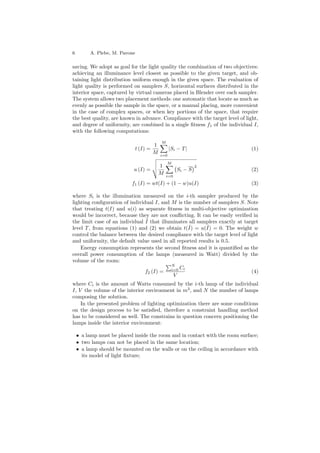
Fig. 1. On the left the final populations and the Pareto fronts in the two case studies.
On the right the comparison of Pareto fronts for executions with 64 and 200 individuals.
environment. Optionally, a photorealistic rendering of the illuminated scene can
be generated.
5 Results
We evaluated empirically our lighting optimization algorithm on two case stud-
ies. As discussed in the Introduction, a satisfactory lighting quality is highly
dependent on the visual tasks that are to be performed in the interior space,
and on specific requirements of visual interest within the space. These specifica-
tions are passed to the model with the placement of the samplers and fixing the
target illumination level. All genetic parameters of the model have been tuned
in a preliminary phase on simpler and smaller rooms, and these settings did not
required further tweaking in the two case studies. The chosen case environments
are both complex architectural interiors, with irregular and non-convex planime-
tries, demonstrating that there are no limitations in the flexibility of application
of the presented system.
5.1 Art Gallery
The first case study is an art gallery environment hosting temporary exhibitions,
its dimensions are 24 × 12 × 4.5 meter. The architecture of this room is char-
acterized by a wide open space with high ceilings, a supporting beam, and two
load-bearing columns placed in the middle of the room. A temporary wallboard
is also placed as support for hanging canvas painting, and other ground stands
are used for various sculpture exhibitions.
A total of 16 samplers have been used to evaluate illumination levels, placed
in key areas where light should create visual interest. An illumination target of
0.95 has been selected, since the overall lighting level needed for art exhibitions is
slightly lower than typical. The genetic algorithm has been run with a population
Multi-objective Genetic Algorithm for Interior Lighting Design 9
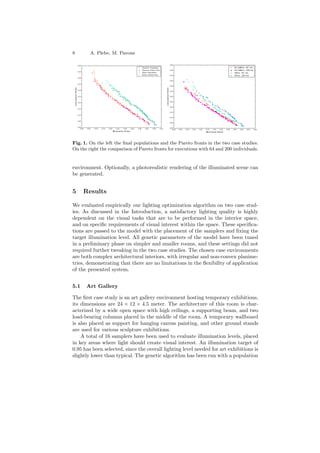
Fig. 2. Two renderings, a plan view and an interior view, of two different optimal light
configurations in the art gallery environment.
of 200 individuals, the final population after 30 generations is shown on the left in
Fig. 1, where it is possible to appreciate how the solutions smoothly span a large
Pareto front of the two fitness. The right plot in Fig. 1 shows that the algorithm
with an initial population of 64 individuals and 20 generations only already
provides an acceptable approximation of the best Pareto front, obtained with
200 individuals. The Fig. 2 shows photorealistic renderings of two of the solutions
belonging to the Pareto front, the first gives more importance to the quality of
illumination, while the second privileges optimal energy consumption. A more
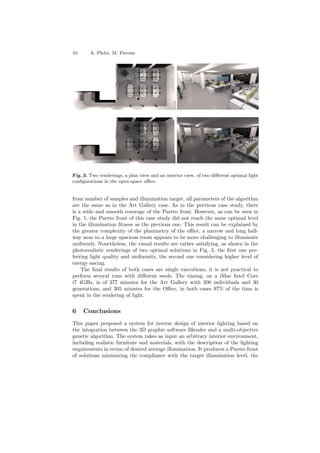
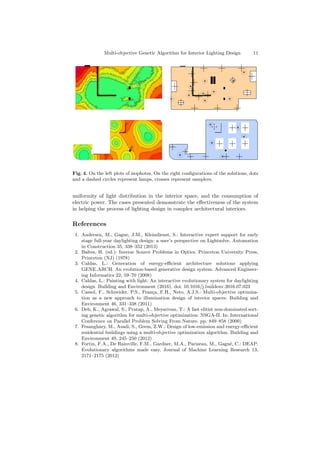
qualitative evaluation of the quality of light is given by the isophotes plotted
at 1 mt. level in the room, in Fig 4 on the left. This case study demonstrates
how the presented algorithm can be a suitable tool to effectively design light
configuration for a frequently changing environment, a temporary art gallery,
with minimum effort from the user.
5.2 Office
The second case study is a typical open-space office, with dimensions of 29×13×3
meter, composed by a reception area connected to an hallway leading to the main
office area. The space is suitable for 20 work stations, and it also includes a sep-
arated private area serving as meeting room or as lounge room. The architecture
is even more complicated by the presence of a curved wall in the reception, a
supporting column and a full window wall in the office area. A total of 12 samples
have been used, evenly spaced in the working area, and an illumination target of
1.0 has been specified, since office work requires standard lighting level. Apart
10 A. Plebe, M. Pavone
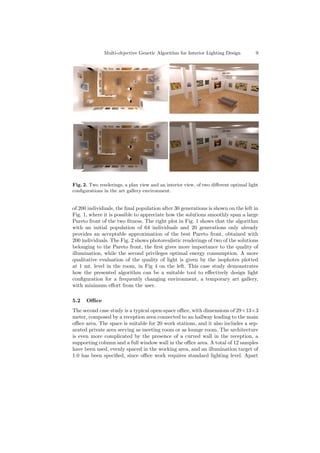
Fig. 3. Two renderings, a plan view and an interior view, of two different optimal light
configurations in the open-space office.
from number of samples and illumination target, all parameters of the algorithm
are the same as in the Art Gallery case. As in the previous case study, there
is a wide and smooth coverage of the Pareto front. However, as can be seen in
Fig. 1, the Pareto front of this case study did not reach the same optimal level
in the illumination fitness as the previous one. This result can be explained by
the greater complexity of the planimetry of the office, a narrow and long hall-
way near to a large spacious room appears to be more challenging to illuminate
uniformly. Nonetheless, the visual results are rather satisfying, as shown in the
photorealistic renderings of two optimal solutions in Fig. 3, the first one pre-
ferring light quality and uniformity, the second one considering higher level of
energy saving.
The final results of both cases are single executions, it is not practical to
perform several runs with different seeds. The timing, on a iMac Intel Core
i7 4GHz, is of 377 minutes for the Art Gallery with 200 individuals and 30
generations, and 305 minutes for the Office, in both cases 97% of the time is
spent in the rendering of light.
6 Conclusions
This paper proposed a system for inverse design of interior lighting based on
the integration between the 3D graphic software Blender and a multi-objective
genetic algorithm. The system takes as input an arbitrary interior environment,
including realistic furniture and materials, with the description of the lighting
requirements in terms of desired average illumination. It produces a Pareto front
of solutions minimizing the compliance with the target illumination level, the
Multi-objective Genetic Algorithm for Interior Lighting Design 11
Fig. 4. On the left plots of isophotes. On the right configurations of the solutions, dots
and a dashed circles represent lamps, crosses represent samplers.
uniformity of light distribution in the interior space, and the consumption of
electric power. The cases presented demonstrate the effectiveness of the system
in helping the process of lighting design in complex architectural interiors.
References
1. Andersen, M., Gagne, J.M., Kleindienst, S.: Interactive expert support for early
stage full-year daylighting design: a user’s perspective on Lightsolve. Automation
in Construction 35, 338–352 (2013)
2. Baltes, H. (ed.): Inverse Source Problems in Optics. Princeton University Press,
Princeton (NJ) (1978)
3. Caldas, L.: Generation of energy-efficient architecture solutions applying
GENE ARCH: An evolution-based generative design system. Advanced Engineer-
ing Informatics 22, 59–70 (2008)
4. Caldas, L.: Painting with light: An interactive evolutionary system for daylighting
design. Building and Environment (2016), doi: 10.1016/j.buildenv.2016.07.023
5. Cassol, F., Schneider, P.S., Fran¸ca, F.H., Neto, A.J.S.: Multi-objective optimiza-
tion as a new approach to illumination design of interior spaces. Building and
Environment 46, 331–338 (2011)
6. Deb, K., Agrawal, S., Pratap, A., Meyarivan, T.: A fast elitist non-dominated sort-
ing genetic algorithm for multi-objective optimization: NSGA-II. In: International
Conference on Parallel Problem Solving From Nature. pp. 849–858 (2000)
7. Fesanghary, M., Asadi, S., Geem, Z.W.: Design of low-emission and energy-efficient
residential buildings using a multi-objective optimization algorithm. Building and
Environment 49, 245–250 (2012)
8. Fortin, F.A., De Rainville, F.M., Gardner, M.A., Parizeau, M., Gagn´e, C.: DEAP:
Evolutionary algorithms made easy. Journal of Machine Learning Research 13,
2171–2175 (2012)
12 A. Plebe, M. Pavone
9. Futrell, B., Ozelkan, E.C., Brentrup, D.: Optimizing complex building design for
annual daylighting performance and evaluation of optimization algorithms. Energy
and Buildings 92, 234–245 (2014)
10. Gagne, J., Andersen, M.: A generative facade design method based on daylighting
performance goals. Journal of Building Performance Simulation 5, 141–154 (2012)
11. Gordon, G.: Interior lighting for designers. John Wiley, New York (2014)
12. Grasso, G., Plebe, A.: Conceptual integrity without concepts. In: International
Conference on Software Engineering and Knowledge Engineering. pp. 422–427.
KSI Research Inc. and Knowledge Systems Institute, Pittsburgh (PA) (2016)
13. Janikow, C.Z., Michalewicz, Z.: An experimental comparison of binary and floating
point representations in genetic algorithms. In: Proceedings of the 4th International
Conference on Genetic Algorithms. pp. 31–36 (1991)
14. Kawai, J., Painter, J.S., Cohen, M.F.: Radioptimization: goal based rendering. In:
Proceedings of the 20th annual conference on Computer graphics and interactive
techniques. pp. 147–154 (1993)
15. Larson, G.W., Shakespeare, R.: Rendering with Radiance: the art and science of
lighting visualization. Morgan Kaufmann, San Francisco (CA) (1997)
16. Lee, K.S., Geem, Z.W.: A new structural optimization method based on the har-
mony search algorithm. Computers and Structures 82, 781–798 (2004)
17. Livingston, J.: Designing with light: the art, science, and practice of architectural
lighting design. John Wiley, New York (2015)
18. Madias, E.N.D., Kontaxis, P.A., Topalis, F.V.: Application of multi-objective ge-
netic algorithms to interior lighting optimization. Energy and Buildings 125, 66–74
(2016)
19. Moylan, K., Ross, B.J.: Interior illumination design using genetic programming.
In: Johnson, C., Carballal, A., ao Correia, J. (eds.) Proceedings IV Conference on
Evolutionary and Biologically Inspired Music, Sound, Art and Design. pp. 148–160
(2015)
20. Patow, G., Pueyo, X.: A survey of inverse rendering problems. Computer graphics
forum 22, 663–687 (2003)
21. Plebe, A., Grasso, G.: Simulating fire outbreaks in industrial plants. In: Blender
Conference. Amsterdam (2016)
22. Rapone, G., Saro, O.: Optimisation of curtain wall facades for office buildings by
means of PSO algorithm. Energy and Buildings 45, 189–196 (2012)
23. Sansoni, P., Farini, A., Mercatelli, L. (eds.): Sustainable Indoor Lighting. Springer-
Verlag, Berlin (2015)
24. Schoeneman, C., Dorsey, J., Smits, B., Arvo, J., Greenberg, D.: Painting with
light. In: Proceedings of the 20th annual conference on Computer graphics and
interactive techniques. pp. 143–146 (1993)
25. Shea, K., Sedgwick, A., Antonuntto, G.: Multicriteria optimization of paneled
building envelopes using ant colony optimization. In: Smith, I.F.C. (ed.) 13th
Workshop on Intelligent Computing in Engineering and Architecture. pp. 627–636
(2006)
26. Turrin, M., von Buelow, P., Stouffs, R.: Design explorations of performance driven
geometry in architectural design using parametric modeling and genetic algorithms.
Advanced Engineering Informatics 25, 656–675 (2011)
27. Villa, C., Labayrade, R.: Multi-objective optimisation of lighting installations tak-
ing into account user preferences – a pilot study. Lighting Res. Technol. 45, 176–196
(2013)

Multi-objective Genetic Algorithm for Interior Lighting Design

  • 1.
    Multi-objective Genetic Algorithmfor Interior Lighting Design Alice Plebe and Mario Pavone Department of Mathematics and Computer Science University of Catania V.le A. Doria 6, I-95125 Catania, Italy alice.plebe@gmail.com, mpavone@dmi.unict.it Abstract. This paper proposes a novel system to help in the design of interior lighting. It is based on multi-objective optimization of the key criteria involved in lighting design: the respect of a given target level of illuminance, uniformity of lighting, and electrical energy saving. The proposed solution integrates the 3D graphic software Blender, used to reproduce the architectural space and to simulate the effect of illumina- tion, and the genetic algorithm NSGA-II. This solution offers advantages in design flexibility over previous related works. Keywords: Lighting design · Genetic algorithm · Blender 1 Introduction The design of interior lighting is the crucial and complex process of integrating luminaries into the fabric of architecture [11, 17]. The goal is to select the lighting equipment and their placement in the interior environment, that result in a comfortable and pleasant visual experience. The design process should take into account several aspects, such as the type of occupants and the type of activities in the given space, or the interior surface finishes and furnishings. In addition, in the last decades increasing attention has been paid to the issue of energy savings. In U.S. the energy consumed for lighting accounts for about 30% of the total energy consumed by commercial buildings, and in the European Union the yearly consumption is over 170 TWh. Therefore, the concept of sustainable lighting design has become central in architectural strategies [23]. A well established aids offered by computational tools to the designer is by photorealistic architectural rendering, simulating in computer graphics the effect of a lighting solution on a model of the interior environment [15]. Mathematically, this is the solution of the direct lighting problem. The drawback of direct lighting tools is that, if the achieved illumination is not satisfactory, it is not easy to infer which modifications to the current solution may lead to improvements. Very likely, the final solution chosen by the designer over a collection of trials, will be far from optimal. As discussed in §2, a more effective assistance would be given by compu- tational tools implementing the inverse lighting problem: the determination of
  • 2.
    2 A. Plebe,M. Pavone the lighting equipment and their placement from specifications on the illumi- nance. This is the line of research undertaken by this paper. The inverse lighting problem lacks reliable analytic solutions, therefore it is often formulated as an optimization problem. The proposed methodology aims to optimize the main common requirements of interior lighting design, chiefly the desired level of av- erage luminous intensity, the uniformity of light in the interior space, taking into account energy consumption. Due to the clashing of these multiple factors, the resulting problem is multi-objective in nature, as discusses in §3, where previ- ous proposals for interior lighting design are compared and contrasted with the present one. Our methodology, detailed in §4, is based on the combination of a 3D graphic software providing a rendering engine for direct illumination, and genetic algo- rithms for solving the multi-objective inverse illumination optimization. Results on a variety of interior environments are shown in §5. 2 The Inverse Lighting Problem In a nutshell, lighting design for interior spaces is the process of integration of artificial light sources in architectural complexes – be it industrial, public or private [11]. Since the discovery of the electric light system by Thomas Edison in 1879, lighting design has experienced several significant revolutions, such as fluorescent lamps in 1938 and, more recently, solid-state lighting. Traditionally, illumination design has been seen as a blend of art and practice, where all the challenges are left to the creativity and the experience of the design architect. Given the aesthetic nature of the task, lighting design may seems difficult to formally model. Nevertheless, the design process has been lately considered as a mathematical and physical problem to be solved with optimization techniques. The inverse lighting problem [2, 14, 24, 20] is the problem of determining po- tential light sources satisfying a set of given illumination requirements, for a pre-defined interior space. Conversely, the direct lighting problem refers to the computation of radiance distribution in an environment that is completely known a priori, including its lighting parameters. In the inverse problem, lighting con- figurations are inferred from the desired illumination requirements, taking into account positions, kinds of luminaries, intensities and number of light sources. Energy efficiency is often considered as well. Given the many feasible solutions possible, the application of optimization methods still allows the designer to have a degree of freedom and creativity in the final choice of the lighting configuration, from one of the optimal solutions obtained. 2.1 Blender as Direct Engine A system facing the inverse lighting problem must provide two fundamental components:
  • 3.
    Multi-objective Genetic Algorithmfor Interior Lighting Design 3 • a three-dimensional environment able to accurately reproduce the architec- tural space and its spectral reflectometric properties; • a physical simulation platform for illumination calculation in sample points of the architectural space. Several approaches were considered in order to satisfy these requirements. Light- solve [1] is an interactive dedicated environment for daylight design, with a performance-driven decision support system. The system lacks a detailed ar- chitectural reproduction, and the inclusion of interior furniture is difficult to manage. In [10] the 3d models of building facades are obtained with the simple modeling tool Google SketchUp, which offers a quick and easy way to outline an architectural space, but resulting in a low level of realism. Conversely, the pop- ular software Radiance, widely used in the field of optimal lighting design [15, 9, 19], consists of a sophisticated physically-correct rendering engine for illumi- nation calculation, and it allows architectural spaces reproduction at arbitrary levels of detail. Nevertheless, it is a non-interactive system composed by a col- lection of command-line programs, and all architectural specifications have to be coded into configuration files. Attempts have been made to unify those extremes, for example Painting With Light is an integration environment for Rhinoceros, a commercial CAD software, and Radiance [4]. This paper investigates the adoption of the 3D graphic software Blender as a unified solution to the two requirements stated above. Firstly, Blender is the most comprehensive open-source computer graphic tool available, it is particu- larly suitable for modeling architectural interiors, with the possibility of import- ing components from CAD files. Secondly, Blender provides a physically-based rendering engine, named Cycles, able to exhaustively evaluate lighting configura- tions needed for solving the inverse lighting problem. Moreover, Blender embeds a Python interpreter which can run scripts supplied by the user, in order to ex- tend its functionalities, and is known for its remarkable software integrity [12]. Thanks to its intrinsic versatility, Blender has already been applied to a number of different problems, including industrial applications [21]. 3 Multi-objective Optimization Interior illumination design involves multiple and often conflicting factors, there- fore the resulting problem is multi-objective in nature. In contrast to a single- optimization problem, where there is usually a single optimal solution, a multi- objective optimization finds a set of solutions that satisfies all conflicting criteria. Multi-objective optimization methods have been widely used in architectural and lighting design, and plenty of them are nature-inspired. A particle swarm optimization algorithm was developed to design curtain wall facades for office buildings and to achieves low energy consumption [22]. A study has adopted multicriteria ant colony optimization to design paneled building envelopes, op- timizing lighting performance and cost criteria [25]. Harmony search algorithms have been applied in the field of civil engineering several times, such as structural
  • 4.
    4 A. Plebe,M. Pavone design optimization [16], and residential buildings design with low-emission and energy-efficient requirements [7]. But most of all, genetic algorithms have been proven to be successfully use- ful in a variety of architectural tasks, including lighting. The GENE ARCH tool [3, 4] is a popular generative design system for energy-efficient and sustainable architectural solutions, based on a Pareto genetic algorithm. In [26] genetic al- gorithms and parametric modeling are combined to explore the morphology of a dome, taking into account structural performance and daylight transmittance. A micro-genetic algorithm is used in [10] to explore facade designs based on illuminance and glare criteria. A study has applied genetic programming to de- sign decorative wall of lights, and to create stained-glass window for large public spaces [19]. For the problem in hand, we used two objectives treated as multi-objective, and we deem this is the appropriate value for real cases. In fact we might have more requirements for illumination design, for example in our experiments we used as illumination quality both the deviation from a target value, and the overall uniformity. However, it seems that requirements can always be unified in two combined fitness only, which are significantly conflicting: one the sum up to lighting quality, and a contrasting one that expresses the cost for achieving quality. 3.1 Previous Related Works There is a number of multi-objective genetic formulations of the inverse lighting problem that shares similarities with the one here proposed. A variant of genetic algorithm called generalized extremal optimization is used in [5] to minimize the deviation of lighting to a desired target, and the energy consumption. Our algo- rithm takes into account also the uniformity of lighting, but the main difference is that the methodology proposed by Cassol et al. is customized to a rectangular enclosure formed by surfaces that are perfectly diffuse, while our system is fully flexible in the geometry of the interior space, and the properties of the surfaces. In [27] one of the criteria to satisfy, named suitable office lighting, is derived by interpolating subjective data obtained from psycho-visual tests, while the other criteria is energy savings. The optimization is solved using genetic algorithm, but it affects only the relative dimming of two fixed light sources. In [18] a genetic algorithm was employed for simultaneously minimizing the power consumption and the uniformity of the illuminance. Our algorithm takes into account, in addition to the uniformity, the adherence of the average illumi- nation to a given target. But the most important difference is that in Madias et al. the location of the light sources is assumed constant, and only their dim- ming is variable, while in our strategy there is full flexibility in light selection, placement, and dimming.
  • 5.
    Multi-objective Genetic Algorithmfor Interior Lighting Design 5 3.2 NSGA-II The Non-dominated Sorting Genetic Algorithm II (NSGA-II), introduced by Deb et al. [6], is an elitist multi-objective genetic algorithm that performs well with real world problems, producing Pareto-optimal solutions to the optimization problem. The evaluation of the population of solutions takes into account the dominance and the crowding distance of the individuals. The first criterion is used to sort the population into different fronts of non-dominated individuals, while the second criterion gives preference to solutions that are less crowded. Non-dominated individuals belonging to a high-rank front with a larger crowding distance are selected to reproduce more than others. The offspring are generated through the genetic operators of crossover and mutation. The next-generation population is then selected among the best individuals from both the offspring and the parent population, ensuring elitism. The result of the algorithm is the set of non-dominated solutions of the whole final population, namely the Pareto front. One of the key working principles of the genetic algorithm is the chromoso- mal representation of a solution. The algorithm works with a coding of decision variables, instead of the variable themselves, and choosing the right represen- tation scheme is crucial to its performance [13]. The most traditional approach is to code the decision variables in a binary string of fixed length, which is a natural translation of real-life genetic chromosomes. Such strings are directly manipulated by the genetic operators, crossover and mutation, to obtain a new (and hopefully better) set of individuals. Another well established method is the floating point representation of chromosomes, where each solution is coded as a vector of floating point numbers, and crossover and mutation operators are adapted to handle real parameter values. For the algorithm presented in this paper, we developed a novel chromosomal representation of solutions, specifically tailored for lighting design optimization. Each individual represents a possible illumination configuration, and it is coded as a vector of variable length containing a set of lamp specifications. A lamp specification is the set of features describing the luminaries in the 3D environ- ment, including position and orientation, intensity, color temperature of light, and model of light fixture (wall or ceiling mount). Special operators of crossover and mutation are implemented to handle this peculiar chromosomal representa- tion. The design of such operators is, however, facilitated by the transparency of the representation itself. Therefore, our approach is introduced especially to deal with representation of complex structured individuals, and it ensures more flexibility with respect to previous proposals. 3.3 Fitness Evaluation and Constraint Handling The goal of the proposed model is to find the lighting configuration that best satisfies the most common and compelling requirements faced by the lighting designer. In accordance to what stated in the Introduction, there are goals di- rectly related with the quality of the lighting, and an additional goal of energy
  • 6.
    6 A. Plebe,M. Pavone saving. We adopt as goal for the light quality the combination of two objectives: achieving an illuminance level closest as possible to the given target, and ob- taining light distribution uniform enough in the given space. The evaluation of light quality is performed on samplers S, horizontal surfaces distributed in the interior space, captured by virtual cameras placed in Blender over each sampler. The system allows two placement methods: one automatic that locate as much as evenly as possible the sample in the space, or a manual placing, more convenient in the case of complex spaces, or when key portions of the space, that require the best quality, are known in advance. Compliance with the target level of light, and degree of uniformity, are combined in a single fitness f1 of the individual I, with the following computations: t (I) = 1 M M i=0 |Si − T| (1) u (I) = 1 M M i=0 Si − S 2 (2) f1 (I) = wt(I) + (1 − w)u(I) (3) where Si is the illumination measured on the i-th sampler produced by the lighting configuration of individual I, and M is the number of samplers S. Note that treating t(I) and u(i) as separate fitness in multi-objective optimization would be incorrect, because they are not conflicting. It can be easily verified in the limit case of an individual ˆI that illuminates all samplers exactly at target level T, from equations (1) and (2) we obtain t(ˆI) = u(ˆI) = 0. The weight w control the balance between the desired compliance with the target level of light and uniformity, the default value used in all reported results is 0.5. Energy consumption represents the second fitness and it is quantified as the overall power consumption of the lamps (measured in Watt) divided by the volume of the room: f2 (I) = N i=0 Ci V (4) where Ci is the amount of Watts consumed by the i-th lamp of the individual I, V the volume of the interior environment in m3 , and N the number of lamps composing the solution. In the presented problem of lighting optimization there are some conditions on the design process to be satisfied, therefore a constraint handling method has to be considered as well. The constrains in question concern positioning the lamps inside the interior environment: • a lamp must be placed inside the room and in contact with the room surface; • two lamps can not be placed in the same location; • a lamp should be mounted on the walls or on the ceiling in accordance with its model of light fixture;
  • 7.
    Multi-objective Genetic Algorithmfor Interior Lighting Design 7 • depending on the room design, there might be some areas where the lamp placement is not allowed, for example in presence of windows, pillars, or supporting beams. The constraint specifications are provided to the system within the 3D model of the environment itself. The walls and ceiling are structured as a discrete grid of vertices, each representing a feasible position for a lamp. With this approach, the set of constraints can be effortlessly reformulated for different experiments, ensuring absolute flexibility in the design process. Since the satisfaction of the above constraints is mandatory for the problem, they can be referred as hard constraints. To handle them, we adopted a method based on preserving feasibility of solutions. In this approach, two feasible solu- tions, after crossover and mutation operation, will create two feasible offspring. Nevertheless, it can happen that crossover produces an individual composed of exactly the same lamps of another solution. In that case, the duplicated solution is discarded. 4 The Proposed Strategy The algorithm presented in this paper has been implemented in the form of a Blender script, composed by 9 main Python modules. The simulation environ- ment set-up is performed by the first group of modules, which rely on Blender’s modeling features. The architectural interior scene of interest is represented in- side the computer graphics software by means of geometric meshes and material shaders. The room structure (walls, floors, ceiling) and its furnishings are defined by the meshes, while colors, textures and reflectivity properties of the objects are specified through the shaders. When evaluating the fitness of a solution, the 3D scene is enriched with further supporting elements: the proposed lamps illuminating the environment, and basic 3D structures employed to perform individual lighting measurements at locations of interest. Using a sophisticated ray-tracing render engine, Blender executes an accurate simulation of illumination, taking into account a variety of environmental factors. The obtained rendered images are processed by the second group of python modules to extract light intensity values and their distribution across the interior space. These outputs are used, in the third group of modules, by the genetic algo- rithm to compute the actual fitness values of a solution. After evaluating the entire current population and selecting the mating pool, the genetic operators of crossover and mutation are applied to generate the offspring. The operators are specifically implemented for the presented case problem, as mentioned in §3.2, with the support of an evolutionary computation python framework named DEAP [8], which allows to freely customize any component of the genetic algo- rithm workflow. At the end of the execution of the algorithm, the obtained result is the Pareto front of the final population, namely the set of non-dominated solutions, each one of them representing an optimal lighting configuration for the given interior
  • 8.
    8 A. Plebe,M. Pavone Fig. 1. On the left the final populations and the Pareto fronts in the two case studies. On the right the comparison of Pareto fronts for executions with 64 and 200 individuals. environment. Optionally, a photorealistic rendering of the illuminated scene can be generated. 5 Results We evaluated empirically our lighting optimization algorithm on two case stud- ies. As discussed in the Introduction, a satisfactory lighting quality is highly dependent on the visual tasks that are to be performed in the interior space, and on specific requirements of visual interest within the space. These specifica- tions are passed to the model with the placement of the samplers and fixing the target illumination level. All genetic parameters of the model have been tuned in a preliminary phase on simpler and smaller rooms, and these settings did not required further tweaking in the two case studies. The chosen case environments are both complex architectural interiors, with irregular and non-convex planime- tries, demonstrating that there are no limitations in the flexibility of application of the presented system. 5.1 Art Gallery The first case study is an art gallery environment hosting temporary exhibitions, its dimensions are 24 × 12 × 4.5 meter. The architecture of this room is char- acterized by a wide open space with high ceilings, a supporting beam, and two load-bearing columns placed in the middle of the room. A temporary wallboard is also placed as support for hanging canvas painting, and other ground stands are used for various sculpture exhibitions. A total of 16 samplers have been used to evaluate illumination levels, placed in key areas where light should create visual interest. An illumination target of 0.95 has been selected, since the overall lighting level needed for art exhibitions is slightly lower than typical. The genetic algorithm has been run with a population
  • 9.
    Multi-objective Genetic Algorithmfor Interior Lighting Design 9 Fig. 2. Two renderings, a plan view and an interior view, of two different optimal light configurations in the art gallery environment. of 200 individuals, the final population after 30 generations is shown on the left in Fig. 1, where it is possible to appreciate how the solutions smoothly span a large Pareto front of the two fitness. The right plot in Fig. 1 shows that the algorithm with an initial population of 64 individuals and 20 generations only already provides an acceptable approximation of the best Pareto front, obtained with 200 individuals. The Fig. 2 shows photorealistic renderings of two of the solutions belonging to the Pareto front, the first gives more importance to the quality of illumination, while the second privileges optimal energy consumption. A more qualitative evaluation of the quality of light is given by the isophotes plotted at 1 mt. level in the room, in Fig 4 on the left. This case study demonstrates how the presented algorithm can be a suitable tool to effectively design light configuration for a frequently changing environment, a temporary art gallery, with minimum effort from the user. 5.2 Office The second case study is a typical open-space office, with dimensions of 29×13×3 meter, composed by a reception area connected to an hallway leading to the main office area. The space is suitable for 20 work stations, and it also includes a sep- arated private area serving as meeting room or as lounge room. The architecture is even more complicated by the presence of a curved wall in the reception, a supporting column and a full window wall in the office area. A total of 12 samples have been used, evenly spaced in the working area, and an illumination target of 1.0 has been specified, since office work requires standard lighting level. Apart
  • 10.
    10 A. Plebe,M. Pavone Fig. 3. Two renderings, a plan view and an interior view, of two different optimal light configurations in the open-space office. from number of samples and illumination target, all parameters of the algorithm are the same as in the Art Gallery case. As in the previous case study, there is a wide and smooth coverage of the Pareto front. However, as can be seen in Fig. 1, the Pareto front of this case study did not reach the same optimal level in the illumination fitness as the previous one. This result can be explained by the greater complexity of the planimetry of the office, a narrow and long hall- way near to a large spacious room appears to be more challenging to illuminate uniformly. Nonetheless, the visual results are rather satisfying, as shown in the photorealistic renderings of two optimal solutions in Fig. 3, the first one pre- ferring light quality and uniformity, the second one considering higher level of energy saving. The final results of both cases are single executions, it is not practical to perform several runs with different seeds. The timing, on a iMac Intel Core i7 4GHz, is of 377 minutes for the Art Gallery with 200 individuals and 30 generations, and 305 minutes for the Office, in both cases 97% of the time is spent in the rendering of light. 6 Conclusions This paper proposed a system for inverse design of interior lighting based on the integration between the 3D graphic software Blender and a multi-objective genetic algorithm. The system takes as input an arbitrary interior environment, including realistic furniture and materials, with the description of the lighting requirements in terms of desired average illumination. It produces a Pareto front of solutions minimizing the compliance with the target illumination level, the
  • 11.
    Multi-objective Genetic Algorithmfor Interior Lighting Design 11 Fig. 4. On the left plots of isophotes. On the right configurations of the solutions, dots and a dashed circles represent lamps, crosses represent samplers. uniformity of light distribution in the interior space, and the consumption of electric power. The cases presented demonstrate the effectiveness of the system in helping the process of lighting design in complex architectural interiors. References 1. Andersen, M., Gagne, J.M., Kleindienst, S.: Interactive expert support for early stage full-year daylighting design: a user’s perspective on Lightsolve. Automation in Construction 35, 338–352 (2013) 2. Baltes, H. (ed.): Inverse Source Problems in Optics. Princeton University Press, Princeton (NJ) (1978) 3. Caldas, L.: Generation of energy-efficient architecture solutions applying GENE ARCH: An evolution-based generative design system. Advanced Engineer- ing Informatics 22, 59–70 (2008) 4. Caldas, L.: Painting with light: An interactive evolutionary system for daylighting design. Building and Environment (2016), doi: 10.1016/j.buildenv.2016.07.023 5. Cassol, F., Schneider, P.S., Fran¸ca, F.H., Neto, A.J.S.: Multi-objective optimiza- tion as a new approach to illumination design of interior spaces. Building and Environment 46, 331–338 (2011) 6. Deb, K., Agrawal, S., Pratap, A., Meyarivan, T.: A fast elitist non-dominated sort- ing genetic algorithm for multi-objective optimization: NSGA-II. In: International Conference on Parallel Problem Solving From Nature. pp. 849–858 (2000) 7. Fesanghary, M., Asadi, S., Geem, Z.W.: Design of low-emission and energy-efficient residential buildings using a multi-objective optimization algorithm. Building and Environment 49, 245–250 (2012) 8. Fortin, F.A., De Rainville, F.M., Gardner, M.A., Parizeau, M., Gagn´e, C.: DEAP: Evolutionary algorithms made easy. Journal of Machine Learning Research 13, 2171–2175 (2012)
  • 12.
    12 A. Plebe,M. Pavone 9. Futrell, B., Ozelkan, E.C., Brentrup, D.: Optimizing complex building design for annual daylighting performance and evaluation of optimization algorithms. Energy and Buildings 92, 234–245 (2014) 10. Gagne, J., Andersen, M.: A generative facade design method based on daylighting performance goals. Journal of Building Performance Simulation 5, 141–154 (2012) 11. Gordon, G.: Interior lighting for designers. John Wiley, New York (2014) 12. Grasso, G., Plebe, A.: Conceptual integrity without concepts. In: International Conference on Software Engineering and Knowledge Engineering. pp. 422–427. KSI Research Inc. and Knowledge Systems Institute, Pittsburgh (PA) (2016) 13. Janikow, C.Z., Michalewicz, Z.: An experimental comparison of binary and floating point representations in genetic algorithms. In: Proceedings of the 4th International Conference on Genetic Algorithms. pp. 31–36 (1991) 14. Kawai, J., Painter, J.S., Cohen, M.F.: Radioptimization: goal based rendering. In: Proceedings of the 20th annual conference on Computer graphics and interactive techniques. pp. 147–154 (1993) 15. Larson, G.W., Shakespeare, R.: Rendering with Radiance: the art and science of lighting visualization. Morgan Kaufmann, San Francisco (CA) (1997) 16. Lee, K.S., Geem, Z.W.: A new structural optimization method based on the har- mony search algorithm. Computers and Structures 82, 781–798 (2004) 17. Livingston, J.: Designing with light: the art, science, and practice of architectural lighting design. John Wiley, New York (2015) 18. Madias, E.N.D., Kontaxis, P.A., Topalis, F.V.: Application of multi-objective ge- netic algorithms to interior lighting optimization. Energy and Buildings 125, 66–74 (2016) 19. Moylan, K., Ross, B.J.: Interior illumination design using genetic programming. In: Johnson, C., Carballal, A., ao Correia, J. (eds.) Proceedings IV Conference on Evolutionary and Biologically Inspired Music, Sound, Art and Design. pp. 148–160 (2015) 20. Patow, G., Pueyo, X.: A survey of inverse rendering problems. Computer graphics forum 22, 663–687 (2003) 21. Plebe, A., Grasso, G.: Simulating fire outbreaks in industrial plants. In: Blender Conference. Amsterdam (2016) 22. Rapone, G., Saro, O.: Optimisation of curtain wall facades for office buildings by means of PSO algorithm. Energy and Buildings 45, 189–196 (2012) 23. Sansoni, P., Farini, A., Mercatelli, L. (eds.): Sustainable Indoor Lighting. Springer- Verlag, Berlin (2015) 24. Schoeneman, C., Dorsey, J., Smits, B., Arvo, J., Greenberg, D.: Painting with light. In: Proceedings of the 20th annual conference on Computer graphics and interactive techniques. pp. 143–146 (1993) 25. Shea, K., Sedgwick, A., Antonuntto, G.: Multicriteria optimization of paneled building envelopes using ant colony optimization. In: Smith, I.F.C. (ed.) 13th Workshop on Intelligent Computing in Engineering and Architecture. pp. 627–636 (2006) 26. Turrin, M., von Buelow, P., Stouffs, R.: Design explorations of performance driven geometry in architectural design using parametric modeling and genetic algorithms. Advanced Engineering Informatics 25, 656–675 (2011) 27. Villa, C., Labayrade, R.: Multi-objective optimisation of lighting installations tak- ing into account user preferences – a pilot study. Lighting Res. Technol. 45, 176–196 (2013)