Presented by
1. Roohana Rehmat
PROBLEM STATEMENT
Affective Computing
Affective computing is the study and
development of systems and devices that can
recognize, interpret, process, and simulate human
affects.
Emotional Psychology
In psychology, emotion is often defined as a
complex state of feeling that results in physical
and psychological changes that influence
thought and behavior.
Introduction
 With rapid development of modern HCI
technology, computers or robots are required to
help people complete extensive and complicated
works
 To a large extent, it depends on robots and
computers’ affective interaction abilities including
emotion recognition, under- standing and
expression.
Multi-layer affective computing model
based on emotional psychology
Literature review
 MIT developed sensors for mental signal measure.
The sensors consist of GSR, BVP, EMG and The
Respiration Sensor, etc.
 IBM proposed ‘‘the Blue Eye Program’’ to make
robots feel human thought.
 IBM also developed emotion mouse products
feeling human emotion by touch of hand and
mouse.
 etc etc
 picard of MIT proposed that HMM
(Hidden Markov Model) can be applied
in affective modeling.
 The simulation and experiment results
show that the multi-layer affective
computing model can reflect character
of human emotions.
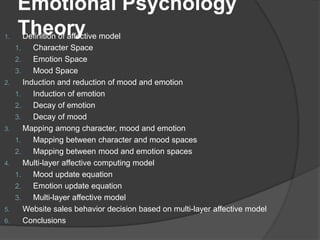
Emotional Psychology
Theory1. Definition of affective model
1. Character Space
2. Emotion Space
3. Mood Space
2. Induction and reduction of mood and emotion
1. Induction of emotion
2. Decay of emotion
3. Decay of mood
3. Mapping among character, mood and emotion
1. Mapping between character and mood spaces
2. Mapping between mood and emotion spaces
4. Multi-layer affective computing model
1. Mood update equation
2. Emotion update equation
3. Multi-layer affective model
5. Website sales behavior decision based on multi-layer affective model
6. Conclusions
Emotional Psychology
Theory1. Definition of affective model
 Affective computing model in the work involves the
relationship among three factors and the time
response to external stimulation signals.
Therefore, relevant definition and quantization
processing technology are firstly discussed in the
work.
 Character Space
 Emotion Space
 Mood Space
1.1 Character Space
 character is defined as the whole spirit of one
person
 The sum of stable mental characteristics formed in
certain social conditions.
 C = [c1; c2; c3; c4; c5]t
 where T is transposition; 1, 2, ..., 5 are Openness,
Conscientiousness, Extraversion, Agreeableness
and Neuroticism in character respectively.
1.1 Character Space
Big Five personality traits
 The five factors are:
 Openness to
experience (inventive/curious vs. consistent/cautious)
 Conscientiousness (efficient/organized vs. easy-
going/careless)
 Extraversion (outgoing/energetic vs. solitary/reserved)
 Agreeableness (friendly/compassionate vs. challengin
g/detached)
 Neuroticism (sensitive/nervous vs. secure/confident)
1.2 Emotion Space
 Emotion is a person’s feeling about surrounding
environment, reflecting demand satisfaction
degree in emotional process and character.
 6 emotions (joy, sadness, anger, surprise, fear and
disgust)
 E = [ejoy; esadness; eanger; esurprise; efear; edisgust]
1.3 Mood Space
 The work defines mood variable as follows by
using PAD (pleasure-displeasure, arousal-
nonarousal, dominance-submissiveness)
 M = [mP; mA; mD]
 where - 1 < mP, mA, mD < 1. If the mood is in a
calm state, then M = [0, 0, 0]
2. Induction and reduction of
mood and emotion
1. Induction of emotion
Common external stimulation signals consist of facial
expressions, sounds, gestures, postures and all kinds of
physiological signals. All emotions are induced by
stimulation signals.
2. Decay of emotion
With the disappearance of the stimulation, the emotion
fades; the strength of the emotion decreases
3. Decay of mood
With the disappearance of the stimulation, the mood
fades; the strength of mood gradually weakens.
3. Mapping among character,
mood and emotion
 Character is a constant value. Under the
stimulation of external signals, individuals with
different personalities have large fluctuation
difference between mood and emotion.
1. Mapping between character and mood spaces
2. Mapping between mood and emotion spaces
4. Multi-layer affective
computing model
 The establishment of model can be decomposed
into emotion and mood models because of the
influence of mood to the change of emotion.
Mood is updated by considering external
stimulation, emotion and mood decay. Besides,
emotion strength is updated by considering the
interaction among external stimulation, mood,
character and emotion.
1. Mood update equation
2. Emotion update equation
3. Multi-layer affective model
Multi-layer affective model
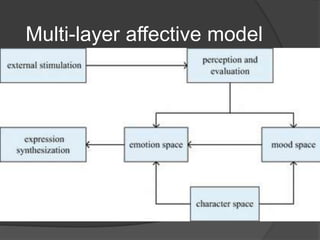
 Figure 1 shows multi-layer affective model.
External stimulation is transformed into
affective variable A by perception and
evaluation. A acts on mood and emotion
spaces, respectively. In the relationships
with character space, the two spaces affect
the changes of emotion and mood. At last,
expression synthesization is output.
Thereinto, facial expression synthesization
is emotional expression. Requirement
expression can be obtained based on
multi-layer affective model.
Website sales behavior decision
based on multi-layer affective
modelA great significance to explore the emotion between
commodity and consumer for recommendation.
Based on multi-layer affective model proposed in the
work, we build a model perceiving, identifying and
understanding people. The model can make
intelligent, sensitive and friendly responses to
people’s emotions. In E-commerce field, customer’s
requirements are met by analyzing customer’s
emotion state and change to commodity, thus
providing satisfied service for the customer.
Therefore, the income is increased by improving
business management mode.
Conclusion
Based on the basic theory of emotional
psychology, the relevant definitions
and quantification are given. A multi-
layer affective computing model is
proposed by building mapping
relationship among three spaces.
This model can reasonably reflect the
relationship among external stimulation,
character, mood and emotion
Thanks For
Watching
The End

Multi-layer affective computing model based on emotional psychology

  • 1.
  • 2.
  • 3.
    Affective Computing Affective computingis the study and development of systems and devices that can recognize, interpret, process, and simulate human affects. Emotional Psychology In psychology, emotion is often defined as a complex state of feeling that results in physical and psychological changes that influence thought and behavior.
  • 4.
    Introduction  With rapiddevelopment of modern HCI technology, computers or robots are required to help people complete extensive and complicated works  To a large extent, it depends on robots and computers’ affective interaction abilities including emotion recognition, under- standing and expression. Multi-layer affective computing model based on emotional psychology
  • 5.
    Literature review  MITdeveloped sensors for mental signal measure. The sensors consist of GSR, BVP, EMG and The Respiration Sensor, etc.  IBM proposed ‘‘the Blue Eye Program’’ to make robots feel human thought.  IBM also developed emotion mouse products feeling human emotion by touch of hand and mouse.  etc etc
  • 6.
     picard ofMIT proposed that HMM (Hidden Markov Model) can be applied in affective modeling.  The simulation and experiment results show that the multi-layer affective computing model can reflect character of human emotions.
  • 7.
    Emotional Psychology Theory1. Definitionof affective model 1. Character Space 2. Emotion Space 3. Mood Space 2. Induction and reduction of mood and emotion 1. Induction of emotion 2. Decay of emotion 3. Decay of mood 3. Mapping among character, mood and emotion 1. Mapping between character and mood spaces 2. Mapping between mood and emotion spaces 4. Multi-layer affective computing model 1. Mood update equation 2. Emotion update equation 3. Multi-layer affective model 5. Website sales behavior decision based on multi-layer affective model 6. Conclusions
  • 8.
    Emotional Psychology Theory1. Definitionof affective model  Affective computing model in the work involves the relationship among three factors and the time response to external stimulation signals. Therefore, relevant definition and quantization processing technology are firstly discussed in the work.  Character Space  Emotion Space  Mood Space
  • 9.
    1.1 Character Space character is defined as the whole spirit of one person  The sum of stable mental characteristics formed in certain social conditions.  C = [c1; c2; c3; c4; c5]t  where T is transposition; 1, 2, ..., 5 are Openness, Conscientiousness, Extraversion, Agreeableness and Neuroticism in character respectively.
  • 10.
    1.1 Character Space BigFive personality traits  The five factors are:  Openness to experience (inventive/curious vs. consistent/cautious)  Conscientiousness (efficient/organized vs. easy- going/careless)  Extraversion (outgoing/energetic vs. solitary/reserved)  Agreeableness (friendly/compassionate vs. challengin g/detached)  Neuroticism (sensitive/nervous vs. secure/confident)
  • 11.
    1.2 Emotion Space Emotion is a person’s feeling about surrounding environment, reflecting demand satisfaction degree in emotional process and character.  6 emotions (joy, sadness, anger, surprise, fear and disgust)  E = [ejoy; esadness; eanger; esurprise; efear; edisgust]
  • 12.
    1.3 Mood Space The work defines mood variable as follows by using PAD (pleasure-displeasure, arousal- nonarousal, dominance-submissiveness)  M = [mP; mA; mD]  where - 1 < mP, mA, mD < 1. If the mood is in a calm state, then M = [0, 0, 0]
  • 13.
    2. Induction andreduction of mood and emotion 1. Induction of emotion Common external stimulation signals consist of facial expressions, sounds, gestures, postures and all kinds of physiological signals. All emotions are induced by stimulation signals. 2. Decay of emotion With the disappearance of the stimulation, the emotion fades; the strength of the emotion decreases 3. Decay of mood With the disappearance of the stimulation, the mood fades; the strength of mood gradually weakens.
  • 14.
    3. Mapping amongcharacter, mood and emotion  Character is a constant value. Under the stimulation of external signals, individuals with different personalities have large fluctuation difference between mood and emotion. 1. Mapping between character and mood spaces 2. Mapping between mood and emotion spaces
  • 15.
    4. Multi-layer affective computingmodel  The establishment of model can be decomposed into emotion and mood models because of the influence of mood to the change of emotion. Mood is updated by considering external stimulation, emotion and mood decay. Besides, emotion strength is updated by considering the interaction among external stimulation, mood, character and emotion. 1. Mood update equation 2. Emotion update equation 3. Multi-layer affective model
  • 16.
  • 17.
    Multi-layer affective model Figure 1 shows multi-layer affective model. External stimulation is transformed into affective variable A by perception and evaluation. A acts on mood and emotion spaces, respectively. In the relationships with character space, the two spaces affect the changes of emotion and mood. At last, expression synthesization is output. Thereinto, facial expression synthesization is emotional expression. Requirement expression can be obtained based on multi-layer affective model.
  • 18.
    Website sales behaviordecision based on multi-layer affective modelA great significance to explore the emotion between commodity and consumer for recommendation. Based on multi-layer affective model proposed in the work, we build a model perceiving, identifying and understanding people. The model can make intelligent, sensitive and friendly responses to people’s emotions. In E-commerce field, customer’s requirements are met by analyzing customer’s emotion state and change to commodity, thus providing satisfied service for the customer. Therefore, the income is increased by improving business management mode.
  • 19.
    Conclusion Based on thebasic theory of emotional psychology, the relevant definitions and quantification are given. A multi- layer affective computing model is proposed by building mapping relationship among three spaces. This model can reasonably reflect the relationship among external stimulation, character, mood and emotion
  • 21.