Types of outcome
ContinuousOrdinary least squares (OLS)
Linear regression
Binary Binary regression
Logistic or probit regression
Time to event data Survival or event history analysis
Ordinary least squares (OLS) regression is an optimization strategy used in linear
regression models that finds a straight line that fits as close as possible to the
data points, in order to help estimate the relationship between a dependent
variable and one or more independent variables.
3.
Examples of timeto event data
Time to death
Time to incidence of disease
Unemployed - time till find job
Time to birth of first child
Smokers – time till quit smoking
4.
Time to eventdata
Analyse durations or length of time to reach
endpoint
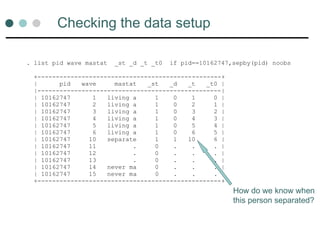
Data are usually censored
Don’t follow sample long enough for everyone to get to the
endpoint (e.g. death)
5.
4 key conceptsfor survival analysis
States
Events
Risk period
Duration
6.
States
States arecategories of the outcome variable of interest
Each person occupies exactly one state at any moment in
time
Examples
alive, dead
single, married, divorced, widowed
never smoker, smoker, ex-smoker
Set of possible states called the state space
7.
Events
A transitionfrom one state to another
From an origin state to a destination state
Possible events depend on the state space
Examples
From smoker to ex-smoker
From married to widowed
Not all transitions can be events
E.g. from smoker to never smoker
8.
Risk period
Notall people can experience each state throughout the
study period
To be able to have a particular event, one must be in the
origin state at some stage
Example
can only experience divorce if married
The period of time that someone is at risk of a particular
event is called the risk period
All subjects at risk of an event at a point in time called
the risk set
9.
Duration
Event historyanalysis is to do with the analysis of the
duration of a nonoccurrence of an event or the length of
time during the risk period
Examples
Duration of marriage
Length of life
In practice we model the probability of a transition
conditional on being in the risk set
10.
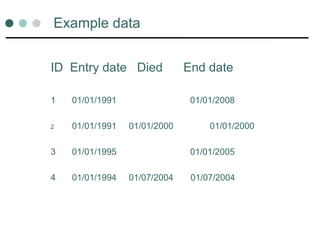
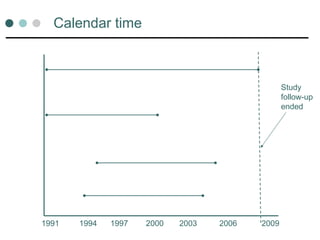
Example data
ID Entrydate Died End date
1 01/01/1991 01/01/2008
2 01/01/1991 01/01/2000 01/01/2000
3 01/01/1995 01/01/2005
4 01/01/1994 01/07/2004 01/07/2004
Study time inyears
0 3 6 9 12 15 18
censored
event
censored
event
13.
Censoring
An observationis censored if it has incomplete
information
We will only consider right censoring
That is, the person did not have an event during the time
that they were studied
Common reasons for right censoring
the study ends
the person drops-out of the study
the person has to be taken off a drug
14.
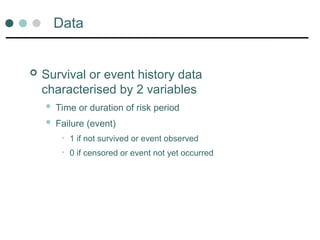
Data
Survival orevent history data
characterised by 2 variables
Time or duration of risk period
Failure (event)
• 1 if not survived or event observed
• 0 if censored or event not yet occurred
15.
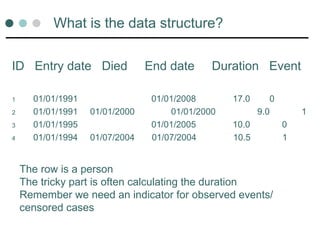
What is thedata structure?
ID Entry date Died End date Duration Event
1 01/01/1991 01/01/2008 17.0 0
2 01/01/1991 01/01/2000 01/01/2000 9.0 1
3 01/01/1995 01/01/2005 10.0 0
4 01/01/1994 01/07/2004 01/07/2004 10.5 1
The row is a person
The tricky part is often calculating the duration
Remember we need an indicator for observed events/
censored cases
16.
Worked example
Random20% sample from BHPS
Waves 1 – 15
One record per person/wave
Outcome: Duration of cohabitation
Conditions on cohabiting in first wave
Survival time: years from entry to the study in 1991
till year living without a partner
17.
The data
+----------------------------+
| pidwave mastat |
|----------------------------|
| 10081798 1 married |
| 10081798 2 married |
| 10081798 3 married |
| 10081798 4 married |
| 10081798 5 married |
| 10081798 6 married |
| 10081798 7 widowed |
| 10081798 8 widowed |
| 10081798 9 widowed |
| 10081798 10 widowed |
| 10081798 11 widowed |
| 10081798 12 widowed |
| 10081798 13 widowed |
| 10081798 14 widowed |
| 10081798 15 widowed |
|----------------------------|
Duration = 6 years
Event = 1
Ignore data after
event = 1
18.
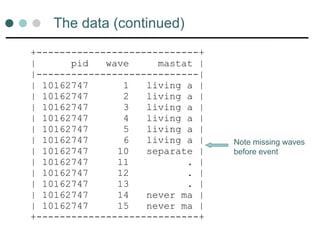
The data (continued)
+----------------------------+
|pid wave mastat |
|----------------------------|
| 10162747 1 living a |
| 10162747 2 living a |
| 10162747 3 living a |
| 10162747 4 living a |
| 10162747 5 living a |
| 10162747 6 living a |
| 10162747 10 separate |
| 10162747 11 . |
| 10162747 12 . |
| 10162747 13 . |
| 10162747 14 never ma |
| 10162747 15 never ma |
+----------------------------+
Note missing waves
before event
19.
Preparing the data
.sort pid wave
. generate skey=1 if wave==1&(mastat==1|mastat==2)
. by pid: replace skey=skey[_n-1] if wave~=1
. keep if skey==1
. drop skey
.
. stset wave,id(pid) failure(mastat==3/6)
id: pid
failure event: mastat == 3 4 5 6
obs. time interval: (wave[_n-1], wave]
exit on or before: failure
------------------------------------------------------------------------------
15058 total obs.
1628 obs. begin on or after (first) failure
------------------------------------------------------------------------------
13430 obs. remaining, representing
1357 subjects
270 failures in single failure-per-subject data
13612 total analysis time at risk, at risk from t = 0
earliest observed entry t = 0
last observed exit t = 15
Select records for
respondents who
were cohabiting in 1991
Declare that you want to
set the data to survival time
Important to check that you
have set data as intended
20.
Checking the datasetup
. list pid wave mastat _st _d _t _t0 if pid==10081798,sepby(pid) noobs
+-------------------------------------------------+
| pid wave mastat _st _d _t _t0 |
|-------------------------------------------------|
| 10081798 1 married 1 0 1 0 |
| 10081798 2 married 1 0 2 1 |
| 10081798 3 married 1 0 3 2 |
| 10081798 4 married 1 0 4 3 |
| 10081798 5 married 1 0 5 4 |
| 10081798 6 married 1 0 6 5 |
| 10081798 7 widowed 1 1 7 6 |
| 10081798 8 widowed 0 . . . |
| 10081798 9 widowed 0 . . . |
| 10081798 10 widowed 0 . . . |
| 10081798 11 widowed 0 . . . |
| 10081798 12 widowed 0 . . . |
| 10081798 13 widowed 0 . . . |
| 10081798 14 widowed 0 . . . |
| 10081798 15 widowed 0 . . . |
+-------------------------------------------------+
1 if observation is to be used
and 0 otherwise
1 if event, 0 if censoring or
event not yet occurred
time of exit
time of entry
21.
Checking the datasetup
. list pid wave mastat _st _d _t _t0 if pid==10162747,sepby(pid) noobs
+--------------------------------------------------+
| pid wave mastat _st _d _t _t0 |
|--------------------------------------------------|
| 10162747 1 living a 1 0 1 0 |
| 10162747 2 living a 1 0 2 1 |
| 10162747 3 living a 1 0 3 2 |
| 10162747 4 living a 1 0 4 3 |
| 10162747 5 living a 1 0 5 4 |
| 10162747 6 living a 1 0 6 5 |
| 10162747 10 separate 1 1 10 6 |
| 10162747 11 . 0 . . . |
| 10162747 12 . 0 . . . |
| 10162747 13 . 0 . . . |
| 10162747 14 never ma 0 . . . |
| 10162747 15 never ma 0 . . . |
+--------------------------------------------------+
How do we know when
this person separated?
22.
Trying again!
. fillinpid wave
. stset wave,id(pid) failure(mastat==3/6) exit(mastat==3/6 .)
id: pid
failure event: mastat == 3 4 5 6
obs. time interval: (wave[_n-1], wave]
exit on or before: mastat==3 4 5 6 .
---------------------------------------------------------------------------
---
20355 total obs.
7524 obs. begin on or after exit
---------------------------------------------------------------------------
---
12831 obs. remaining, representing
1357 subjects
234 failures in single failure-per-subject data
12831 total analysis time at risk, at risk from t = 0
earliest observed entry t = 0
last observed exit t = 15
23.
. list pidwave mastat _st _d _t _t0 if pid==10162747,sepby(pid) noobs
+--------------------------------------------------+
| pid wave mastat _st _d _t _t0 |
|--------------------------------------------------|
| 10162747 1 living a 1 0 1 0 |
| 10162747 2 living a 1 0 2 1 |
| 10162747 3 living a 1 0 3 2 |
| 10162747 4 living a 1 0 4 3 |
| 10162747 5 living a 1 0 5 4 |
| 10162747 6 living a 1 0 6 5 |
| 10162747 7 . 1 0 7 6 |
| 10162747 8 . 0 . . . |
| 10162747 9 . 0 . . . |
| 10162747 10 separate 0 . . . |
| 10162747 11 . 0 . . . |
| 10162747 12 . 0 . . . |
| 10162747 13 . 0 . . . |
| 10162747 14 never ma 0 . . . |
| 10162747 15 never ma 0 . . . |
+--------------------------------------------------+
Checking the new data setup
Now censored instead of
an event
24.
Summarising time toevent data
Individuals followed up for different lengths of time
So can’t use prevalence rates (% people who have
an event)
Use rates instead that take account of person years
at risk
Incidence rate per year
Death rate per 1000 person years
25.
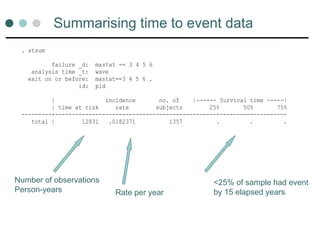
Summarising time toevent data
Number of observations
Person-years Rate per year
<25% of sample had event
by 15 elapsed years
. stsum
failure _d: mastat == 3 4 5 6
analysis time _t: wave
exit on or before: mastat==3 4 5 6 .
id: pid
| incidence no. of |------ Survival time -----|
| time at risk rate subjects 25% 50% 75%
---------+---------------------------------------------------------------------
total | 12831 .0182371 1357 . . .
Graphs of survivaltime
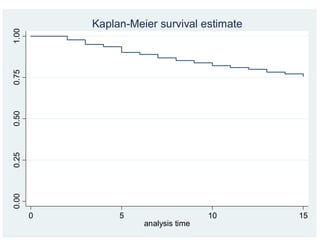
Kaplan-Meier estimate of survival curve
The Kaplan-Meier method estimates the cumulative
probability of an individual surviving after baseline to
any time, t
Kaplan-Meier graphs
Canread off the estimated probability of surviving a
relationship at any time point on the graph
E.g. at 5 years 88% are still cohabiting
The survival probability only changes when an event
occurs
So the graph is stepped and not a smooth curve
0.00
0.25
0.50
0.75
1.00
0 5 1015
analysis time
sex = male sex = female
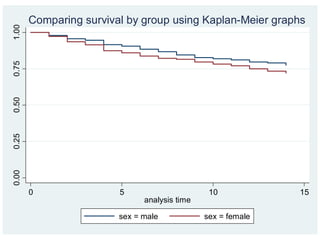
Comparing survival by group using Kaplan-Meier graphs
32.
Testing equality ofsurvival curves among
groups
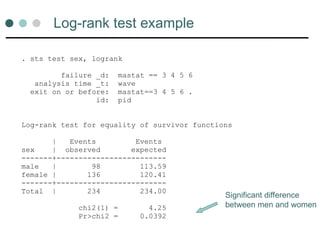
The log-rank test
A non –parametric test that assesses the null
hypothesis that there are no differences in survival
times between groups
33.
. sts testsex, logrank
failure _d: mastat == 3 4 5 6
analysis time _t: wave
exit on or before: mastat==3 4 5 6 .
id: pid
Log-rank test for equality of survivor functions
| Events Events
sex | observed expected
-------+-------------------------
male | 98 113.59
female | 136 120.41
-------+-------------------------
Total | 234 234.00
chi2(1) = 4.25
Pr>chi2 = 0.0392
Log-rank test example
Significant difference
between men and women
Event History withCox Model
Event History with Cox regression model
No longer modelling the duration
Modelling the hazard
Hazard: measure of the probability that an event
occurs at time t conditional on it not having occurred
up until t
Also known as the Cox proportional hazard model
36.
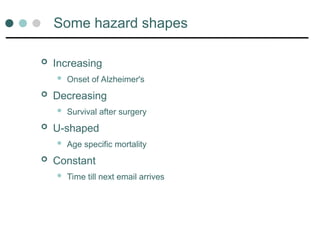
Some hazard shapes
Increasing
Onset of Alzheimer's
Decreasing
Survival after surgery
U-shaped
Age specific mortality
Constant
Time till next email arrives
37.
Cox regression model
Regression model for survival analysis
Can model time invariant and time varying
explanatory variables
Produces estimated hazard ratios (sometimes
called rate ratios or risk ratios)
Regression coefficients are on a log scale
Exponentiate to get hazard ratio
Similar to odds ratios from logistic models
38.
Cox regression equation
)
.......
exp(
)
(
)
(2
2
1
1
0 in
n
i
i
i x
x
x
t
h
t
h
)
(
0 t
h
)
(t
hi
is the baseline hazard function and can take any
form
It is estimated from the data (non parametric)
is the hazard function for individual i
in
i
i x
x
x ,....,
, 2
1
n
,....,
, 2
1
are the covariates
are the regression coefficients estimated from the data
Effect of covariates is constant over time (parameterised)
This is the proportional hazards assumption
Therefore, Cox regression referred to as a semi-parametric
39.
Cox regression inStata
Will first model a time invariant covariate (sex)
on risk of partnership ending
Then will add a time dependent covariate (age)
to the model
40.
Cox regression inStata
. stcox female
failure _d: mastat == 3 4 5 6
analysis time _t: wave
exit on or before: mastat==3 4 5 6 .
id: pid
Cox regression -- Breslow method for ties
No. of subjects = 1357 Number of obs = 12337
No. of failures = 234
Time at risk = 12337
LR chi2(1) = 4.18
Log likelihood = -1574.5782 Prob > chi2 = 0.0409
------------------------------------------------------------------------------
_t | Haz. Ratio Std. Err. z P>|z| [95% Conf. Interval]
-------------+----------------------------------------------------------------
female | 1.30913 .1734699 2.03 0.042 1.009699 1.697358
------------------------------------------------------------------------------
41.
Interpreting output fromCox regression
Cox model has no intercept
It is included in the baseline hazard
In our example, the baseline hazard is when sex=1 (male)
The hazard ratio is the ratio of the hazard for a unit
change in the covariate
HR = 1.3 for women vs. men
The risk of partnership breakdown is increased by 30% for women
compared with men
Hazard ratio assumed constant over time
At any time point, the hazard of partnership breakdown for a woman
is 1.3 times the hazard for a man
42.
Interpreting output fromCox regression (ii)
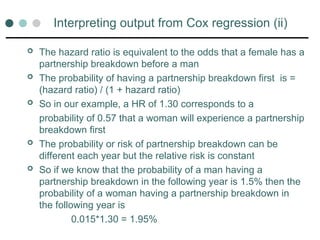
The hazard ratio is equivalent to the odds that a female has a
partnership breakdown before a man
The probability of having a partnership breakdown first is =
(hazard ratio) / (1 + hazard ratio)
So in our example, a HR of 1.30 corresponds to a
probability of 0.57 that a woman will experience a partnership
breakdown first
The probability or risk of partnership breakdown can be
different each year but the relative risk is constant
So if we know that the probability of a man having a
partnership breakdown in the following year is 1.5% then the
probability of a woman having a partnership breakdown in
the following year is
0.015*1.30 = 1.95%
Time dependent covariates
Examples
Current age group rather than age at baseline
GHQ score may change over time and predict break-ups
Will use age to predict duration of cohabitation
Nonlinear relationship hypothesised
Recode age into 8 equally spaced age groups
Cox regression assumptions
Assumption of proportional hazards
No censoring patterns
True starting time
Plus assumptions for all modelling
Sufficient sample size, proper model specification, independent
observations, exogenous covariates, no high multicollinearity,
random sampling, and so on
48.
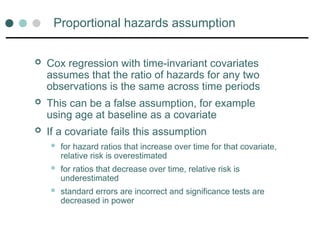
Proportional hazards assumption
Cox regression with time-invariant covariates
assumes that the ratio of hazards for any two
observations is the same across time periods
This can be a false assumption, for example
using age at baseline as a covariate
If a covariate fails this assumption
for hazard ratios that increase over time for that covariate,
relative risk is overestimated
for ratios that decrease over time, relative risk is
underestimated
standard errors are incorrect and significance tests are
decreased in power
49.
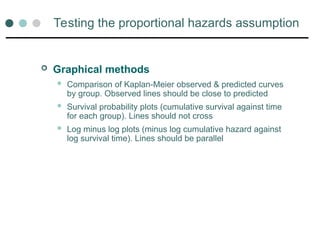
Testing the proportionalhazards assumption
Graphical methods
Comparison of Kaplan-Meier observed & predicted curves
by group. Observed lines should be close to predicted
Survival probability plots (cumulative survival against time
for each group). Lines should not cross
Log minus log plots (minus log cumulative hazard against
log survival time). Lines should be parallel
50.
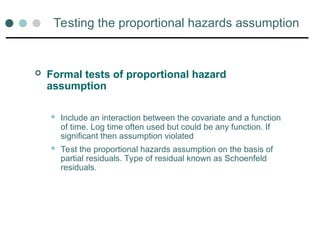
Testing the proportionalhazards assumption
Formal tests of proportional hazard
assumption
Include an interaction between the covariate and a function
of time. Log time often used but could be any function. If
significant then assumption violated
Test the proportional hazards assumption on the basis of
partial residuals. Type of residual known as Schoenfeld
residuals.
51.
When assumptions arenot met
If categorical covariate, include the variable as a
strata variable
Allows underlying hazard function to differ between
categories and be non proportional
Estimates separate underlying baseline hazard for each
stratum
52.
When assumptions arenot met
If a continuous covariate
Consider splitting the follow-up time. For example, hazard
may be proportional within first 5 years, next 5-10 years
and so on
Could covariate be included as time dependent covariate?
There are different survival regression methods (e.g.
parametric model)
53.
Censoring assumptions
Censoredcases must be independent of the
survival distribution. There should be no pattern to
these cases, which instead should be missing at
random.
If censoring is not independent, then censoring is
said to be informative
You have to judge this for yourself
Usually don’t have any data that can be used to test the
assumption
Think carefully about start and end dates
Always check a sample of records
54.
True starting time
The ideal model for survival analysis would be
where there is a true zero time
If the zero point is arbitrary or ambiguous, the
data series will be different depending on
starting point. The computed hazard rate
coefficients could differ, sometimes markedly
Conduct a sensitivity analysis to see how
coefficients may change according to different
starting points
55.
Other extensions tosurvival analysis
Discrete (interval-censored) survival times
Repeated events
Multi-state models (more than 1 event type)
Transition from employment to unemployment or leaving
labour market
Modelling type of exit from cohabiting relationship-
separation/divorce/widowhood
56.
Could you uselogistic regression
instead?
May produce similar results for short or fixed
follow-up periods
Examples
• everyone followed-up for 7 years
• maximum follow-up 5 years
Results may differ if there are varying follow-up
times
If dates of entry and dates of events are
available then better to use Cox regression
57.
Finally….
This isjust an introduction to survival/ event
history analysis
Only reviewed the Cox regression model
Also parametric survival methods
But Cox regression likely to suit type of analyses of
interest to sociologists
Consider an intensive course if you want to use
survival analysis in your own work










![Preparing the data
. sort pid wave
. generate skey=1 if wave==1&(mastat==1|mastat==2)
. by pid: replace skey=skey[_n-1] if wave~=1
. keep if skey==1
. drop skey
.
. stset wave,id(pid) failure(mastat==3/6)
id: pid
failure event: mastat == 3 4 5 6
obs. time interval: (wave[_n-1], wave]
exit on or before: failure
------------------------------------------------------------------------------
15058 total obs.
1628 obs. begin on or after (first) failure
------------------------------------------------------------------------------
13430 obs. remaining, representing
1357 subjects
270 failures in single failure-per-subject data
13612 total analysis time at risk, at risk from t = 0
earliest observed entry t = 0
last observed exit t = 15
Select records for
respondents who
were cohabiting in 1991
Declare that you want to
set the data to survival time
Important to check that you
have set data as intended](https://image.slidesharecdn.com/slide5-250419150311-994f54e0/85/Biomedical-statistics-lectures-for-mph-students-19-320.jpg)

![Trying again!
. fillin pid wave
. stset wave,id(pid) failure(mastat==3/6) exit(mastat==3/6 .)
id: pid
failure event: mastat == 3 4 5 6
obs. time interval: (wave[_n-1], wave]
exit on or before: mastat==3 4 5 6 .
---------------------------------------------------------------------------
---
20355 total obs.
7524 obs. begin on or after exit
---------------------------------------------------------------------------
---
12831 obs. remaining, representing
1357 subjects
234 failures in single failure-per-subject data
12831 total analysis time at risk, at risk from t = 0
earliest observed entry t = 0
last observed exit t = 15](https://image.slidesharecdn.com/slide5-250419150311-994f54e0/85/Biomedical-statistics-lectures-for-mph-students-22-320.jpg)


![List the cumulative hazard function
Default is the survivor function
. sts list, failure
failure _d: mastat == 3 4 5 6
analysis time _t: wave
exit on or before: mastat==3 4 5 6 .
id: pid
Beg. Net Failure Std.
Time Total Fail Lost Function Error [95% Conf. Int.]
-------------------------------------------------------------------------------
2 1357 29 162 0.0214 0.0039 0.0149 0.0306
3 1166 33 89 0.0491 0.0061 0.0384 0.0625
4 1044 16 64 0.0636 0.0070 0.0513 0.0789
5 964 35 58 0.0976 0.0088 0.0818 0.1164
6 871 12 34 0.1101 0.0094 0.0931 0.1300
7 825 20 24 0.1316 0.0103 0.1128 0.1534
8 781 14 17 0.1472 0.0109 0.1271 0.1701
9 750 12 30 0.1609 0.0115 0.1398 0.1848
10 708 15 23 0.1786 0.0121 0.1563 0.2038
11 670 9 32 0.1897 0.0125 0.1666 0.2155
12 629 8 16 0.2000 0.0128 0.1762 0.2266
13 605 13 24 0.2172 0.0134 0.1922 0.2449
14 568 8 24 0.2282 0.0138 0.2025 0.2566
15 536 10 526 0.2426 0.0143 0.2160 0.2719
-------------------------------------------------------------------------------](https://image.slidesharecdn.com/slide5-250419150311-994f54e0/85/Biomedical-statistics-lectures-for-mph-students-26-320.jpg)







![Cox regression in Stata
. stcox female
failure _d: mastat == 3 4 5 6
analysis time _t: wave
exit on or before: mastat==3 4 5 6 .
id: pid
Cox regression -- Breslow method for ties
No. of subjects = 1357 Number of obs = 12337
No. of failures = 234
Time at risk = 12337
LR chi2(1) = 4.18
Log likelihood = -1574.5782 Prob > chi2 = 0.0409
------------------------------------------------------------------------------
_t | Haz. Ratio Std. Err. z P>|z| [95% Conf. Interval]
-------------+----------------------------------------------------------------
female | 1.30913 .1734699 2.03 0.042 1.009699 1.697358
------------------------------------------------------------------------------](https://image.slidesharecdn.com/slide5-250419150311-994f54e0/85/Biomedical-statistics-lectures-for-mph-students-40-320.jpg)



![Cox regression with time dependent covariates
. xi: stcox female i.agecat
i.agecat _Iagecat_0-7 (naturally coded; _Iagecat_0 omitted)
failure _d: mastat == 3 4 5 6
analysis time _t: wave
exit on or before: mastat==3 4 5 6 .
id: pid
Cox regression -- Breslow method for ties
No. of subjects = 1357 Number of obs = 12337
No. of failures = 234
Time at risk = 12337
LR chi2(8) = 78.44
Log likelihood = -1537.4472 Prob > chi2 = 0.0000
------------------------------------------------------------------------------
_t | Haz. Ratio Std. Err. z P>|z| [95% Conf. Interval]
-------------+----------------------------------------------------------------
female | 1.3705 .1842481 2.34 0.019 1.05304 1.783666
_Iagecat_1 | .5838602 .1883578 -1.67 0.095 .3102449 1.098786
_Iagecat_2 | .311325 .1039311 -3.50 0.000 .1618279 .5989281
_Iagecat_3 | .2136714 .0737986 -4.47 0.000 .1085813 .4204725
_Iagecat_4 | .2225187 .0811395 -4.12 0.000 .1088888 .4547261
_Iagecat_5 | .4770023 .1691695 -2.09 0.037 .238035 .9558732
_Iagecat_6 | 1.203702 .4306775 0.52 0.604 .5969856 2.427023
_Iagecat_7 | 1.644141 .9677715 0.84 0.398 .518688 5.21161
------------------------------------------------------------------------------](https://image.slidesharecdn.com/slide5-250419150311-994f54e0/85/Biomedical-statistics-lectures-for-mph-students-46-320.jpg)