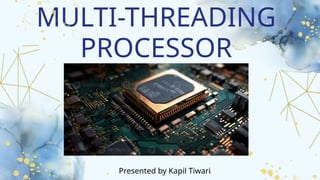
MULTI-THREADING
PROCESSOR
Presented by Kapil Tiwari
INTRODUCTION
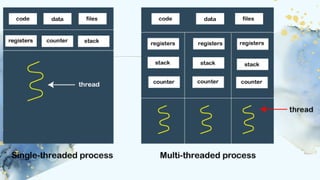
A multithreading processor is a
type of computer processor that
can handle multiple tasks at the
same time. It can execute different
threads concurrently, improving
overall performance and efficiency.
Why Multithreading?
• Speed Through Parallel Execution: Multithreading allows tasks to run
simultaneously on multiple cores, boosting overall performance.
• Efficient Resource Utilization: Running threads on separate cores
maximizes CPU usage, ensuring efficient resource utilization.
• Enhanced Responsiveness: Multithreading maintains responsive user
interfaces by handling background tasks concurrently, improving the user
experience.
• Scalability and Concurrency: Handling many tasks at once makes the
system adaptable to different workloads, boosting scalability and
responsiveness.
Types of Multithreading
Kernel-Level Multithreading:
• Managed by the boss (operating system).
• The boss assigns tasks to the workers (threads).
User-Level Multithreading:
• Managed by the worker (application).
• The worker decides which tasks to handle.
Simultaneous Multithreading (SMT):
• Like a worker with multiple hands doing different tasks simultaneously.
• Boosts efficiency by doing more work at the same time.
Process-Level Multithreading:
• Different teams (processes) of workers (threads).
• Each team works on its own tasks.
Challenges
• Thread Safety: Ensuring shared data is accessed without race
conditions.
• Complexity: Writing and debugging multithreaded code is
inherently challenging.
• Overhead: Extra resources needed for thread management.
• Deadlocks: Threads unable to proceed due to circular
dependencies
• Synchronization: Making sure threads work together smoothly for
consistent data.
Benefits of Multithreading
• Increased Throughput: Multiple threads executing tasks
simultaneously enhance overall system performance.
• Improved Responsiveness: Responsiveness to user input remains
high, providing a smoother user experience.
• Resource Utilization: Efficient use of CPU resources, ensuring
optimal processing power.
• Parallel Execution: Tasks can be executed concurrently, maximizing
efficiency and reducing latency.
Multithreading Models
Many-to-One: There will be a many-to-one relationship model between
threads, as the name implies. Multiple user threads are linked or mapped
to a single kernel thread in this case.
Multithreading Models
One-to-One: We can deduce from the name that one user thread is
mapped to one separate kernel thread. The user-level thread and the
kernel-level thread have a one-to-one relationship.
Multithreading Models
Many-to-many: User-level threads are efficiently mapped to a shared
pool of kernel-level threads, optimizing resource usage and enhancing
responsiveness in applications.
• More Cores, More Power: Processors will keep getting more cores and
threads, boosting parallel processing.
Future Trends in Multithreading:
• Smarter Architecture: Ongoing improvements in design to better
handle multithreading demands.
• Teamwork with Tech: Multithreading will team up with AI, edge computing,
and IoT for a more efficient performance.
• Speed Boost Ahead: Future developments will focus on making systems
faster and more responsive using optimized multithreading tech.
Conclusion :
Multithreading is a key to enhanced computer
performance, using resources efficiently for better
speed and responsiveness. Despite challenges,
ongoing trends, such as more cores, highlight its
importance in future computing advancements.
Overall, multithreading remains a crucial and
promising aspect of modern technology.
THANK YOU
MULTI PROCESSOR is a computer processor to handle multiple tasks at the same time.pptx

MULTI PROCESSOR is a computer processor to handle multiple tasks at the same time.pptx

  • 1.
  • 2.
    INTRODUCTION A multithreading processoris a type of computer processor that can handle multiple tasks at the same time. It can execute different threads concurrently, improving overall performance and efficiency.
  • 3.
    Why Multithreading? • SpeedThrough Parallel Execution: Multithreading allows tasks to run simultaneously on multiple cores, boosting overall performance. • Efficient Resource Utilization: Running threads on separate cores maximizes CPU usage, ensuring efficient resource utilization. • Enhanced Responsiveness: Multithreading maintains responsive user interfaces by handling background tasks concurrently, improving the user experience. • Scalability and Concurrency: Handling many tasks at once makes the system adaptable to different workloads, boosting scalability and responsiveness.
  • 4.
    Types of Multithreading Kernel-LevelMultithreading: • Managed by the boss (operating system). • The boss assigns tasks to the workers (threads). User-Level Multithreading: • Managed by the worker (application). • The worker decides which tasks to handle. Simultaneous Multithreading (SMT): • Like a worker with multiple hands doing different tasks simultaneously. • Boosts efficiency by doing more work at the same time. Process-Level Multithreading: • Different teams (processes) of workers (threads). • Each team works on its own tasks.
  • 5.
    Challenges • Thread Safety:Ensuring shared data is accessed without race conditions. • Complexity: Writing and debugging multithreaded code is inherently challenging. • Overhead: Extra resources needed for thread management. • Deadlocks: Threads unable to proceed due to circular dependencies • Synchronization: Making sure threads work together smoothly for consistent data.
  • 7.
    Benefits of Multithreading •Increased Throughput: Multiple threads executing tasks simultaneously enhance overall system performance. • Improved Responsiveness: Responsiveness to user input remains high, providing a smoother user experience. • Resource Utilization: Efficient use of CPU resources, ensuring optimal processing power. • Parallel Execution: Tasks can be executed concurrently, maximizing efficiency and reducing latency.
  • 8.
    Multithreading Models Many-to-One: Therewill be a many-to-one relationship model between threads, as the name implies. Multiple user threads are linked or mapped to a single kernel thread in this case.
  • 9.
    Multithreading Models One-to-One: Wecan deduce from the name that one user thread is mapped to one separate kernel thread. The user-level thread and the kernel-level thread have a one-to-one relationship.
  • 10.
    Multithreading Models Many-to-many: User-levelthreads are efficiently mapped to a shared pool of kernel-level threads, optimizing resource usage and enhancing responsiveness in applications.
  • 11.
    • More Cores,More Power: Processors will keep getting more cores and threads, boosting parallel processing. Future Trends in Multithreading: • Smarter Architecture: Ongoing improvements in design to better handle multithreading demands. • Teamwork with Tech: Multithreading will team up with AI, edge computing, and IoT for a more efficient performance. • Speed Boost Ahead: Future developments will focus on making systems faster and more responsive using optimized multithreading tech.
  • 12.
    Conclusion : Multithreading isa key to enhanced computer performance, using resources efficiently for better speed and responsiveness. Despite challenges, ongoing trends, such as more cores, highlight its importance in future computing advancements. Overall, multithreading remains a crucial and promising aspect of modern technology.
  • 13.