All contents © MuleSoft, LLC
Kiet.Yap@mulesoft.com - Distinguished Client Architect
MuleSoft France
Applying Zero-Trust Security
with API-Led Connectivity
All contents © MuleSoft, LLC 2
Thank you
All contents © MuleSoft, LLC
Safe harbor statement
The information in this presentation is confidential and proprietary to MuleSoft and may not be disclosed without
the permission of MuleSoft. This presentation is not subject to your license agreement or any other service or
subscription agreement with MuleSoft. MuleSoft has no obligation to pursue any course of business outlined in this
document or any related presentation, or to develop or release any functionality mentioned therein. This document,
or any related presentation and MuleSoft's strategy and possible future developments, products and or platforms
directions and functionality are all subject to change and may be changed by MuleSoft at any time for any reason
without notice. The information on this document is not a commitment, promise or legal obligation to deliver any
material, code or functionality. This document is provided without a warranty of any kind, either express or implied,
including but not limited to, the implied warranties of merchantability, fitness for a particular purpose, or non-
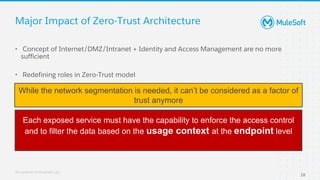
infringement. This document is for informational purposes and may not be incorporated into a contract. MuleSoft
assumes no responsibility for errors or omissions in this document, except if such damages were caused by MuleSoft
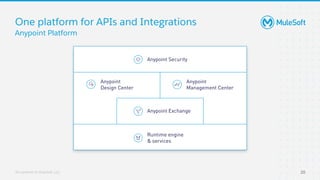
intentionally or grossly negligent.
All forward-looking statements are subject to various risks and uncertainties that could cause actual results to differ
materially from expectations. Readers are cautioned not to place undue reliance on these forward-looking
statements, which speak only as of their dates, and they should not be relied upon in making purchasing decisions.
3
All contents © MuleSoft, LLC
Agenda
1. Current Security Landscape and Approaches
2. Security to Cybersecurity Challenges
3. Defining Zero-Trust Mindset
4. How to adopt APIs with Zero-Trust Model
4
All contents © MuleSoft, LLC
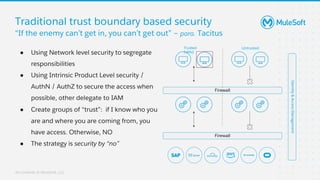
Traditional trust boundary based security
“If the enemy can’t get in, you can’t get out” – para. Tacitus
● Using Network level security to segregate
responsibilities
● Using Intrinsic Product Level security /
AuthN / AuthZ to secure the access when
possible, other delegate to IAM
● Create groups of “trust”: if I know who you
are and where you are coming from, you
have access. Otherwise, NO
● The strategy is security by “no”
Firewall
Firewall
Identity
&
Access
Management
Trusted
(VPN)
Untrusted
All contents © MuleSoft, LLC
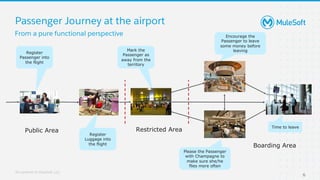
Passenger Journey at the airport
6
Passport
Control
Register
Passenger into
the flight
Register
Luggage into
the flight
Mark the
Passenger as
away from the
territory
Encourage the
Passenger to leave
some money before
leaving
Please the Passenger
with Champagne to
make sure she/he
flies more often
Time to leave
Restricted Area
Public Area
Boarding Area
From a pure functional perspective
All contents © MuleSoft, LLC
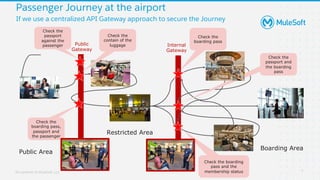
Passenger Journey at the airport
If we use a centralized API Gateway approach to secure the Journey
7
Check-in
Lounge
Access
Boarding
Hand
Luggage
Immigration
Duty Free
Shopping
Check the
boarding pass,
passport and
the passenger
Check the
boarding pass
Check the boarding
pass and the
membership status
Check the
passport and
the boarding
pass
Public
Gateway
Internal
Gateway
Check the
passport
against the
passenger
Check the
contain of the
luggage
Restricted Area
Public Area
Boarding Area
All contents © MuleSoft, LLC
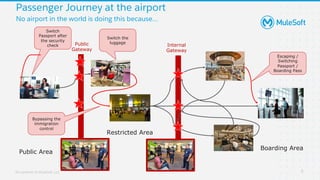
Passenger Journey at the airport
No airport in the world is doing this because…
8
Check-in
Lounge
Access
Boarding
Hand
Luggage
Immigration
Duty Free
Shopping
Bypassing the
immigration
control
Escaping /
Switching
Passport /
Boarding Pass
Public
Gateway
Internal
Gateway
Switch the
luggage
Switch
Passport after
the security
check
Restricted Area
Public Area
Boarding Area
All contents © MuleSoft, LLC
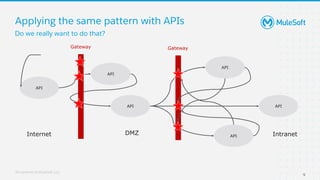
Applying the same pattern with APIs
9
API
API
API
API
API
API
Gateway Gateway
DMZ
Internet Intranet
Do we really want to do that?
All contents © MuleSoft, LLC
Agenda
1. Current Security Landscape and Approaches
2. Security to Cybersecurity Challenges
3. Defining Zero-Trust Mindset
4. How to adopt APIs with Zero-Trust Model
10
All contents © MuleSoft, LLC
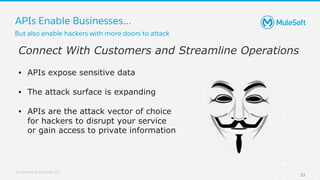
APIs Enable Businesses…
11
Connect With Customers and Streamline Operations
▪ APIs expose sensitive data
▪ The attack surface is expanding
▪ APIs are the attack vector of choice
for hackers to disrupt your service
or gain access to private information
But also enable hackers with more doors to attack
All contents © MuleSoft, LLC
Danger of Considering a Traditional API Gateway
Cyber Security is about preventing unauthorized information access and protect delivery of
essential services from
• Remote attacks
• Misconfiguration of physical systems
• Holes in complex and unstructured information networks
A black-box based Gateway or Proxy to protect from
Brute Force Attack are not sufficient
as a Cyber Security layer
12
All contents © MuleSoft, LLC
Modern Security Posture
13
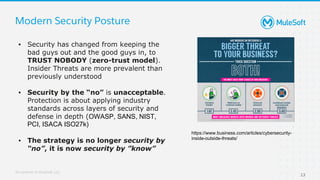
▪ Security has changed from keeping the
bad guys out and the good guys in, to
TRUST NOBODY (zero-trust model).
Insider Threats are more prevalent than
previously understood
▪ Security by the “no” is unacceptable.
Protection is about applying industry
standards across layers of security and
defense in depth (OWASP, SANS, NIST,
PCI, ISACA ISO27k)
▪ The strategy is no longer security by
“no”, it is now security by ”know”
https://www.business.com/articles/cybersecurity-
inside-outside-threats/
All contents © MuleSoft, LLC
Agenda
1. Current Security Landscape and Approaches
2. Security to Cybersecurity Challenges
3. Defining Zero-Trust Mindset
4. How to adopt APIs with Zero-Trust Model
14
All contents © MuleSoft, LLC
https://doubleoctopus.com/security-wiki/network-architecture/zero-trust/
“Zero Trust, Zero Trust Network, or Zero Trust Architecture refer to
security concepts and threat model that no longer assumes that
actors, systems or services operating from within the security
perimeter should be automatically trusted…
…and instead must verify anything and everything trying to
connect to its systems before granting access”
All contents © MuleSoft, LLC
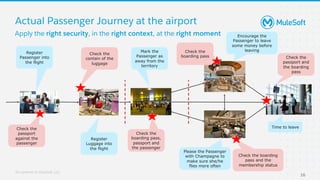
Actual Passenger Journey at the airport
16
Passport
Control
Register
Passenger into
the flight
Register
Luggage into
the flight
Mark the
Passenger as
away from the
territory
Encourage the
Passenger to leave
some money before
leaving
Please the Passenger
with Champagne to
make sure she/he
flies more often
Time to leave
Check the
contain of the
luggage
Check the
boarding pass,
passport and
the passenger
Check the
boarding pass
Check the boarding
pass and the
membership status
Check the
passport and
the boarding
pass
Check the
passport
against the
passenger
Apply the right security, in the right context, at the right moment
All contents © MuleSoft, LLC
Major Impact of Zero-Trust Architecture
17
• Concept of Internet/DMZ/Intranet + Identity and Access Management are no more
sufficient
• Redefining roles in Zero-Trust model
– Infrastructure level (Firewall, Network Segment, hardware based encryption, signature)
• To filter out “syntactically” brute force attack or bad requests (wrong origin, wrong signature…)
– Application level (request authentication, user authentication, authorization)
• To trust “semantically” the incoming request by enforcing validation, in the application
– Data level (encryption, masking, tokenization)
• To expose “contextually” the necessary data only
All contents © MuleSoft, LLC
Major Impact of Zero-Trust Architecture
18
• Concept of Internet/DMZ/Intranet + Identity and Access Management are no more
sufficient
• Redefining roles in Zero-Trust model
– Infrastructure level (Firewall, Network Segment, hardware based encryption, signature)
• To filter out “syntactically” brute force attack or bad requests (wrong origin, wrong signature…)
– Application level (request authentication, user authentication, authorization)
• To trust “semantically” the incoming request by enforcing validation, in the application
– Data level (encryption, masking, tokenization)
• To expose “contextually” the necessary data securely
While the network segmentation is needed, it can’t be considered as a factor of
trust anymore
Each exposed service must have the capability to enforce the access control
and to filter the data based on the usage context at the endpoint level
All contents © MuleSoft, LLC
Agenda
1. Current Security Landscape and Approaches
2. Security to Cybersecurity Challenges
3. Defining Zero-Trust Mindset
4. How to adopt APIs with Zero-Trust Model
19
All contents © MuleSoft, LLC
One platform for APIs and Integrations
20
Anypoint Platform
All contents © MuleSoft, LLC
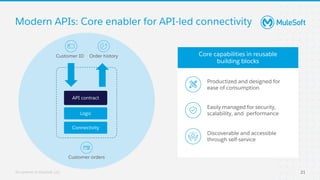
Modern APIs: Core enabler for API-led connectivity
21
Core capabilities in reusable
building blocks
Easily managed for security,
scalability, and performance
Discoverable and accessible
through self-service
Productized and designed for
ease of consumption
Customer ID Order history
API contract
Logic
Connectivity
Customer orders
All contents © MuleSoft, LLC
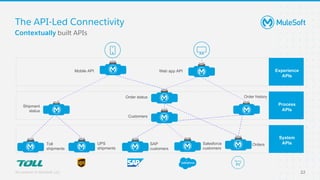
The API-Led Connectivity
Web app API
Orders
Salesforce
customers
SAP
customers
Toll
shipments
UPS
shipments
Shipment
status
Order history
Customers
Order status
Mobile API
Process
APIs
Experience
APIs
System
APIs
Contextually built APIs
22
All contents © MuleSoft, LLC
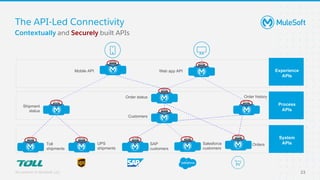
The API-Led Connectivity
Web app API
Orders
Salesforce
customers
SAP
customers
Toll
shipments
UPS
shipments
Shipment
status
Order history
Customers
Order status
Mobile API
Process
APIs
Experience
APIs
System
APIs
Contextually and Securely built APIs
23
All contents © MuleSoft, LLC
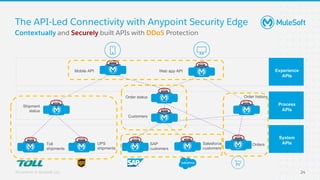
The API-Led Connectivity with Anypoint Security Edge
Web app API
Orders
Salesforce
customers
SAP
customers
Toll
shipments
UPS
shipments
Shipment
status
Order history
Customers
Order status
Mobile API
Process
APIs
Experience
APIs
System
APIs
Contextually and Securely built APIs with DDoS Protection
24
All contents © MuleSoft, LLC
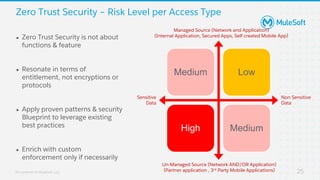
Zero Trust Security – Risk Level per Access Type
25
Medium Low
High Medium
● Zero Trust Security is not about
functions & feature
● Resonate in terms of
entitlement, not encryptions or
protocols
● Apply proven patterns & security
Blueprint to leverage existing
best practices
● Enrich with custom
enforcement only if necessarily
Sensitive
Data
Non Sensitive
Data
Managed Source (Network and Application)
(Internal Application, Secured Apps, Self created Mobile App)
Un-Managed Source (Network AND/OR Application)
(Partner application , 3rd Party Mobile Applications)
All contents © MuleSoft, LLC
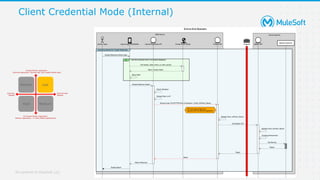
Client Credential Mode (Internal)
All contents © MuleSoft, LLC
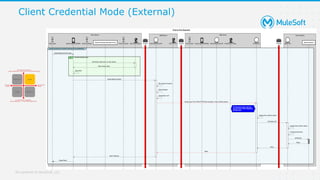
Client Credential Mode (External)
All contents © MuleSoft, LLC
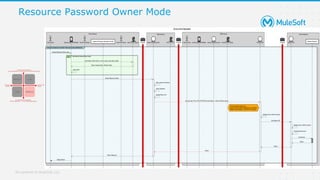
Resource Password Owner Mode
All contents © MuleSoft, LLC
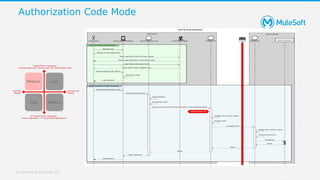
Authorization Code Mode
All contents © MuleSoft, LLC
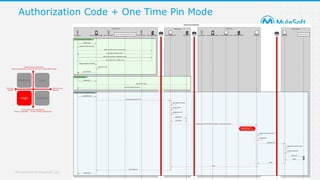
Authorization Code + One Time Pin Mode
All contents © MuleSoft, LLC
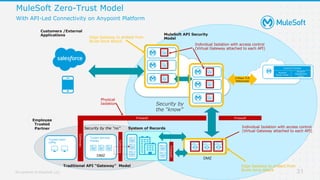
MuleSoft Zero-Trust Model
With API-Led Connectivity on Anypoint Platform
31
MuleSoft API Security
Model
Firewall Firewall
Customers /External
Applications
Physical
Isolation
Gateway
Gateway
Trusted Users
(VPN)
Trusted Services
Proxies
Employee
Trusted
Partner
Security by
the “know”
Security by the “no”
Traditional API “Gateway” Model
System of Records
Individual Isolation with access control
(Virtual Gateway attached to each API)
Individual Isolation with access control
(Virtual Gateway attached to each API)
Edge Gateway to protect from
Brute force Attack
Edge Gateway to protect from
Brute force Attack
Firewall
DMZ
DMZ
2-Ways TLS
Websocket
All contents © MuleSoft, LLC
Thank you

MuleSoft Meetup Dubai Anypoint security with api-led Connectivity

  • 1.
    All contents ©MuleSoft, LLC Kiet.Yap@mulesoft.com - Distinguished Client Architect MuleSoft France Applying Zero-Trust Security with API-Led Connectivity
  • 2.
    All contents ©MuleSoft, LLC 2 Thank you
  • 3.
    All contents ©MuleSoft, LLC Safe harbor statement The information in this presentation is confidential and proprietary to MuleSoft and may not be disclosed without the permission of MuleSoft. This presentation is not subject to your license agreement or any other service or subscription agreement with MuleSoft. MuleSoft has no obligation to pursue any course of business outlined in this document or any related presentation, or to develop or release any functionality mentioned therein. This document, or any related presentation and MuleSoft's strategy and possible future developments, products and or platforms directions and functionality are all subject to change and may be changed by MuleSoft at any time for any reason without notice. The information on this document is not a commitment, promise or legal obligation to deliver any material, code or functionality. This document is provided without a warranty of any kind, either express or implied, including but not limited to, the implied warranties of merchantability, fitness for a particular purpose, or non- infringement. This document is for informational purposes and may not be incorporated into a contract. MuleSoft assumes no responsibility for errors or omissions in this document, except if such damages were caused by MuleSoft intentionally or grossly negligent. All forward-looking statements are subject to various risks and uncertainties that could cause actual results to differ materially from expectations. Readers are cautioned not to place undue reliance on these forward-looking statements, which speak only as of their dates, and they should not be relied upon in making purchasing decisions. 3
  • 4.
    All contents ©MuleSoft, LLC Agenda 1. Current Security Landscape and Approaches 2. Security to Cybersecurity Challenges 3. Defining Zero-Trust Mindset 4. How to adopt APIs with Zero-Trust Model 4
  • 5.
    All contents ©MuleSoft, LLC Traditional trust boundary based security “If the enemy can’t get in, you can’t get out” – para. Tacitus ● Using Network level security to segregate responsibilities ● Using Intrinsic Product Level security / AuthN / AuthZ to secure the access when possible, other delegate to IAM ● Create groups of “trust”: if I know who you are and where you are coming from, you have access. Otherwise, NO ● The strategy is security by “no” Firewall Firewall Identity & Access Management Trusted (VPN) Untrusted
  • 6.
    All contents ©MuleSoft, LLC Passenger Journey at the airport 6 Passport Control Register Passenger into the flight Register Luggage into the flight Mark the Passenger as away from the territory Encourage the Passenger to leave some money before leaving Please the Passenger with Champagne to make sure she/he flies more often Time to leave Restricted Area Public Area Boarding Area From a pure functional perspective
  • 7.
    All contents ©MuleSoft, LLC Passenger Journey at the airport If we use a centralized API Gateway approach to secure the Journey 7 Check-in Lounge Access Boarding Hand Luggage Immigration Duty Free Shopping Check the boarding pass, passport and the passenger Check the boarding pass Check the boarding pass and the membership status Check the passport and the boarding pass Public Gateway Internal Gateway Check the passport against the passenger Check the contain of the luggage Restricted Area Public Area Boarding Area
  • 8.
    All contents ©MuleSoft, LLC Passenger Journey at the airport No airport in the world is doing this because… 8 Check-in Lounge Access Boarding Hand Luggage Immigration Duty Free Shopping Bypassing the immigration control Escaping / Switching Passport / Boarding Pass Public Gateway Internal Gateway Switch the luggage Switch Passport after the security check Restricted Area Public Area Boarding Area
  • 9.
    All contents ©MuleSoft, LLC Applying the same pattern with APIs 9 API API API API API API Gateway Gateway DMZ Internet Intranet Do we really want to do that?
  • 10.
    All contents ©MuleSoft, LLC Agenda 1. Current Security Landscape and Approaches 2. Security to Cybersecurity Challenges 3. Defining Zero-Trust Mindset 4. How to adopt APIs with Zero-Trust Model 10
  • 11.
    All contents ©MuleSoft, LLC APIs Enable Businesses… 11 Connect With Customers and Streamline Operations ▪ APIs expose sensitive data ▪ The attack surface is expanding ▪ APIs are the attack vector of choice for hackers to disrupt your service or gain access to private information But also enable hackers with more doors to attack
  • 12.
    All contents ©MuleSoft, LLC Danger of Considering a Traditional API Gateway Cyber Security is about preventing unauthorized information access and protect delivery of essential services from • Remote attacks • Misconfiguration of physical systems • Holes in complex and unstructured information networks A black-box based Gateway or Proxy to protect from Brute Force Attack are not sufficient as a Cyber Security layer 12
  • 13.
    All contents ©MuleSoft, LLC Modern Security Posture 13 ▪ Security has changed from keeping the bad guys out and the good guys in, to TRUST NOBODY (zero-trust model). Insider Threats are more prevalent than previously understood ▪ Security by the “no” is unacceptable. Protection is about applying industry standards across layers of security and defense in depth (OWASP, SANS, NIST, PCI, ISACA ISO27k) ▪ The strategy is no longer security by “no”, it is now security by ”know” https://www.business.com/articles/cybersecurity- inside-outside-threats/
  • 14.
    All contents ©MuleSoft, LLC Agenda 1. Current Security Landscape and Approaches 2. Security to Cybersecurity Challenges 3. Defining Zero-Trust Mindset 4. How to adopt APIs with Zero-Trust Model 14
  • 15.
    All contents ©MuleSoft, LLC https://doubleoctopus.com/security-wiki/network-architecture/zero-trust/ “Zero Trust, Zero Trust Network, or Zero Trust Architecture refer to security concepts and threat model that no longer assumes that actors, systems or services operating from within the security perimeter should be automatically trusted… …and instead must verify anything and everything trying to connect to its systems before granting access”
  • 16.
    All contents ©MuleSoft, LLC Actual Passenger Journey at the airport 16 Passport Control Register Passenger into the flight Register Luggage into the flight Mark the Passenger as away from the territory Encourage the Passenger to leave some money before leaving Please the Passenger with Champagne to make sure she/he flies more often Time to leave Check the contain of the luggage Check the boarding pass, passport and the passenger Check the boarding pass Check the boarding pass and the membership status Check the passport and the boarding pass Check the passport against the passenger Apply the right security, in the right context, at the right moment
  • 17.
    All contents ©MuleSoft, LLC Major Impact of Zero-Trust Architecture 17 • Concept of Internet/DMZ/Intranet + Identity and Access Management are no more sufficient • Redefining roles in Zero-Trust model – Infrastructure level (Firewall, Network Segment, hardware based encryption, signature) • To filter out “syntactically” brute force attack or bad requests (wrong origin, wrong signature…) – Application level (request authentication, user authentication, authorization) • To trust “semantically” the incoming request by enforcing validation, in the application – Data level (encryption, masking, tokenization) • To expose “contextually” the necessary data only
  • 18.
    All contents ©MuleSoft, LLC Major Impact of Zero-Trust Architecture 18 • Concept of Internet/DMZ/Intranet + Identity and Access Management are no more sufficient • Redefining roles in Zero-Trust model – Infrastructure level (Firewall, Network Segment, hardware based encryption, signature) • To filter out “syntactically” brute force attack or bad requests (wrong origin, wrong signature…) – Application level (request authentication, user authentication, authorization) • To trust “semantically” the incoming request by enforcing validation, in the application – Data level (encryption, masking, tokenization) • To expose “contextually” the necessary data securely While the network segmentation is needed, it can’t be considered as a factor of trust anymore Each exposed service must have the capability to enforce the access control and to filter the data based on the usage context at the endpoint level
  • 19.
    All contents ©MuleSoft, LLC Agenda 1. Current Security Landscape and Approaches 2. Security to Cybersecurity Challenges 3. Defining Zero-Trust Mindset 4. How to adopt APIs with Zero-Trust Model 19
  • 20.
    All contents ©MuleSoft, LLC One platform for APIs and Integrations 20 Anypoint Platform
  • 21.
    All contents ©MuleSoft, LLC Modern APIs: Core enabler for API-led connectivity 21 Core capabilities in reusable building blocks Easily managed for security, scalability, and performance Discoverable and accessible through self-service Productized and designed for ease of consumption Customer ID Order history API contract Logic Connectivity Customer orders
  • 22.
    All contents ©MuleSoft, LLC The API-Led Connectivity Web app API Orders Salesforce customers SAP customers Toll shipments UPS shipments Shipment status Order history Customers Order status Mobile API Process APIs Experience APIs System APIs Contextually built APIs 22
  • 23.
    All contents ©MuleSoft, LLC The API-Led Connectivity Web app API Orders Salesforce customers SAP customers Toll shipments UPS shipments Shipment status Order history Customers Order status Mobile API Process APIs Experience APIs System APIs Contextually and Securely built APIs 23
  • 24.
    All contents ©MuleSoft, LLC The API-Led Connectivity with Anypoint Security Edge Web app API Orders Salesforce customers SAP customers Toll shipments UPS shipments Shipment status Order history Customers Order status Mobile API Process APIs Experience APIs System APIs Contextually and Securely built APIs with DDoS Protection 24
  • 25.
    All contents ©MuleSoft, LLC Zero Trust Security – Risk Level per Access Type 25 Medium Low High Medium ● Zero Trust Security is not about functions & feature ● Resonate in terms of entitlement, not encryptions or protocols ● Apply proven patterns & security Blueprint to leverage existing best practices ● Enrich with custom enforcement only if necessarily Sensitive Data Non Sensitive Data Managed Source (Network and Application) (Internal Application, Secured Apps, Self created Mobile App) Un-Managed Source (Network AND/OR Application) (Partner application , 3rd Party Mobile Applications)
  • 26.
    All contents ©MuleSoft, LLC Client Credential Mode (Internal)
  • 27.
    All contents ©MuleSoft, LLC Client Credential Mode (External)
  • 28.
    All contents ©MuleSoft, LLC Resource Password Owner Mode
  • 29.
    All contents ©MuleSoft, LLC Authorization Code Mode
  • 30.
    All contents ©MuleSoft, LLC Authorization Code + One Time Pin Mode
  • 31.
    All contents ©MuleSoft, LLC MuleSoft Zero-Trust Model With API-Led Connectivity on Anypoint Platform 31 MuleSoft API Security Model Firewall Firewall Customers /External Applications Physical Isolation Gateway Gateway Trusted Users (VPN) Trusted Services Proxies Employee Trusted Partner Security by the “know” Security by the “no” Traditional API “Gateway” Model System of Records Individual Isolation with access control (Virtual Gateway attached to each API) Individual Isolation with access control (Virtual Gateway attached to each API) Edge Gateway to protect from Brute force Attack Edge Gateway to protect from Brute force Attack Firewall DMZ DMZ 2-Ways TLS Websocket
  • 32.
    All contents ©MuleSoft, LLC Thank you