Presented By
Sindhu VL
 Mule ESB provides numerous options for handling
errors. Faults that occur within Mule are referred to
as exceptions; when an activity in your Mule instance
fails, Mule throws an exception. To manage these
exceptions, Mule allows you to configureexception
strategies.
Default exception strategy
 It implicitly applies to all Mule applications — manages
errors (i.e. thrown exceptions) in Mule flows. When your
flows require more sophisticated error management, you
can implement one or more exception strategies to
construct precise, efficient protocols for handling errors.
 Mule ESB’s default exception strategy implicitly and
globally handles all messaging exceptions that are thrown
in Mule applications. You can override Mule’s default
exception strategy by adding a catch, rollback, or choice
exception strategy to a flow. Otherwise, when an exception
is thrown in a flow, Mule automatically rolls back any
pending transaction and logs the exception; if no
transaction is involved, the default exception strategy
simply logs the exception.
Error Types :
1. System Exceptions
Mule invokes a System Exception Strategy when an
exception is thrown at the system-level (i.e., when no
message is involved, exceptions are handled by system
exception strategies). For example, system exception
strategies handle exceptions that occur:
During application start-up
When a connection to an external system fails
 Messaging Exceptions : Mule invokes a Messaging
Exception Strategy whenever an exception is thrown
within a flow (i.e., whenever a message is involved,
exceptions are handled by messagingexception strategies).
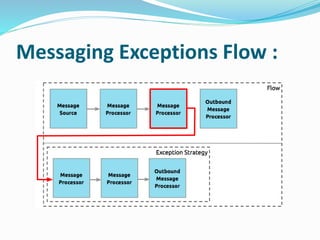
 When a message being processed through a Mule flow
throws an exception, normal flow execution stops and
processes transfers to the message processor sequence
within the exception strategy. You can incorporate any
number of message processors – and in one case, other
exception strategies – into an exception strategy to handle
the exception precisely as you wish. The diagram below
illustrates what happens when a message throws an
exception.
Messaging Exceptions Flow :
Types of messaging exception
strategies :
 Default Exception Strategy
 Catch exception strategy
 Rollback exception strategy
 Reference exception strategy
 Choice exception strategy
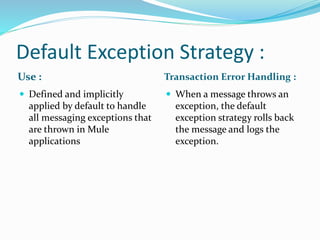
Default Exception Strategy :
Use : Transaction Error Handling :
 Defined and implicitly
applied by default to handle
all messaging exceptions that
are thrown in Mule
applications
 When a message throws an
exception, the default
exception strategy rolls back
the message and logs the
exception.
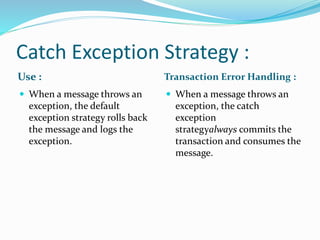
Catch Exception Strategy :
Use : Transaction Error Handling :
 When a message throws an
exception, the default
exception strategy rolls back
the message and logs the
exception.
 When a message throws an
exception, the catch
exception
strategyalways commits the
transaction and consumes the
message.
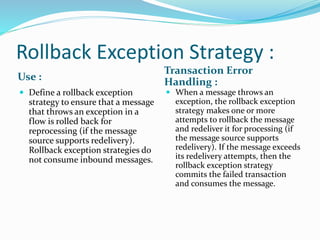
Rollback Exception Strategy :
Use :
Transaction Error
Handling :
 Define a rollback exception
strategy to ensure that a message
that throws an exception in a
flow is rolled back for
reprocessing (if the message
source supports redelivery).
Rollback exception strategies do
not consume inbound messages.
 When a message throws an
exception, the rollback exception
strategy makes one or more
attempts to rollback the message
and redeliver it for processing (if
the message source supports
redelivery). If the message exceeds
its redelivery attempts, then the
rollback exception strategy
commits the failed transaction
and consumes the message.
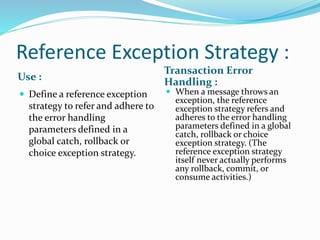
Reference Exception Strategy :
Use :
Transaction Error
Handling :
 Define a reference exception
strategy to refer and adhere to
the error handling
parameters defined in a
global catch, rollback or
choice exception strategy.
 When a message throws an
exception, the reference
exception strategy refers and
adheres to the error handling
parameters defined in a global
catch, rollback or choice
exception strategy. (The
reference exception strategy
itself never actually performs
any rollback, commit, or
consume activities.)
Choice Exception Strategy :
Use :
Transaction Error
Handling :
 Define a choice exception
strategy to customize the way
Mule handles a message that
throws an exception based on
the message’s content at the
moment it throws the
exception.
 When a message throws an
exception, the choice
exception strategy makes a
decision about where to route
the message for further
processing. (The choice
exception strategy itself never
actually performs any
rollback, commit, or consume
activities.)
Characteristics of messaging
exception strategies:
 Each flow can contain only one exception strategy.
 Each exception strategy can contain any number of
message processors.
 Choice exception strategies can contain one or more
catch and/or rollback exception strategies. (Rollback
and catch exception strategies cannot, however,
contain other exception strategies.)
Thank You!!!!!!!!!!!!

Mule errors

  • 1.
  • 2.
     Mule ESBprovides numerous options for handling errors. Faults that occur within Mule are referred to as exceptions; when an activity in your Mule instance fails, Mule throws an exception. To manage these exceptions, Mule allows you to configureexception strategies.
  • 3.
    Default exception strategy It implicitly applies to all Mule applications — manages errors (i.e. thrown exceptions) in Mule flows. When your flows require more sophisticated error management, you can implement one or more exception strategies to construct precise, efficient protocols for handling errors.  Mule ESB’s default exception strategy implicitly and globally handles all messaging exceptions that are thrown in Mule applications. You can override Mule’s default exception strategy by adding a catch, rollback, or choice exception strategy to a flow. Otherwise, when an exception is thrown in a flow, Mule automatically rolls back any pending transaction and logs the exception; if no transaction is involved, the default exception strategy simply logs the exception.
  • 4.
    Error Types : 1.System Exceptions Mule invokes a System Exception Strategy when an exception is thrown at the system-level (i.e., when no message is involved, exceptions are handled by system exception strategies). For example, system exception strategies handle exceptions that occur: During application start-up When a connection to an external system fails
  • 5.
     Messaging Exceptions: Mule invokes a Messaging Exception Strategy whenever an exception is thrown within a flow (i.e., whenever a message is involved, exceptions are handled by messagingexception strategies).  When a message being processed through a Mule flow throws an exception, normal flow execution stops and processes transfers to the message processor sequence within the exception strategy. You can incorporate any number of message processors – and in one case, other exception strategies – into an exception strategy to handle the exception precisely as you wish. The diagram below illustrates what happens when a message throws an exception.
  • 6.
  • 7.
    Types of messagingexception strategies :  Default Exception Strategy  Catch exception strategy  Rollback exception strategy  Reference exception strategy  Choice exception strategy
  • 8.
    Default Exception Strategy: Use : Transaction Error Handling :  Defined and implicitly applied by default to handle all messaging exceptions that are thrown in Mule applications  When a message throws an exception, the default exception strategy rolls back the message and logs the exception.
  • 9.
    Catch Exception Strategy: Use : Transaction Error Handling :  When a message throws an exception, the default exception strategy rolls back the message and logs the exception.  When a message throws an exception, the catch exception strategyalways commits the transaction and consumes the message.
  • 10.
    Rollback Exception Strategy: Use : Transaction Error Handling :  Define a rollback exception strategy to ensure that a message that throws an exception in a flow is rolled back for reprocessing (if the message source supports redelivery). Rollback exception strategies do not consume inbound messages.  When a message throws an exception, the rollback exception strategy makes one or more attempts to rollback the message and redeliver it for processing (if the message source supports redelivery). If the message exceeds its redelivery attempts, then the rollback exception strategy commits the failed transaction and consumes the message.
  • 11.
    Reference Exception Strategy: Use : Transaction Error Handling :  Define a reference exception strategy to refer and adhere to the error handling parameters defined in a global catch, rollback or choice exception strategy.  When a message throws an exception, the reference exception strategy refers and adheres to the error handling parameters defined in a global catch, rollback or choice exception strategy. (The reference exception strategy itself never actually performs any rollback, commit, or consume activities.)
  • 12.
    Choice Exception Strategy: Use : Transaction Error Handling :  Define a choice exception strategy to customize the way Mule handles a message that throws an exception based on the message’s content at the moment it throws the exception.  When a message throws an exception, the choice exception strategy makes a decision about where to route the message for further processing. (The choice exception strategy itself never actually performs any rollback, commit, or consume activities.)
  • 13.
    Characteristics of messaging exceptionstrategies:  Each flow can contain only one exception strategy.  Each exception strategy can contain any number of message processors.  Choice exception strategies can contain one or more catch and/or rollback exception strategies. (Rollback and catch exception strategies cannot, however, contain other exception strategies.)
  • 14.